Slowly repeating bursts of intense radio waves from space have puzzled astronomers since they were discovered in 2022.
In new research, we have for the first time tracked one of these pulsating signals back to its source: a common kind of lightweight star called a red dwarf, likely in a binary orbit with a white dwarf, the core of another star that exploded long ago.
We know some repeating radio signals come from a kind of neutron star called a radio pulsar, which spins rapidly (typically once a second or faster), beaming out radio waves like a lighthouse. The trouble is, our current theories say a pulsar spinning only once every 18 minutes should not produce radio waves.
So we thought our 2022 discovery could point to new and exciting physics – or help explain exactly how pulsars emit radiation, which despite 50 years of research is still not understood very well.
More slowly blinking radio sources have been discovered since then. There are now about ten known “long-period radio transients”.
However, just finding more hasn’t been enough to solve the mystery.
Searching the outskirts of the galaxy
Until now, every one of these sources has been found deep in the heart of the Milky Way.
This makes it very hard to figure out what kind of star or object produces the radio waves, because there are thousands of stars in a small area. Any one of them could be responsible for the signal, or none of them.
So, we started a campaign to scan the skies with the Murchison Widefield Array radio telescope in Western Australia, which can observe 1,000 square degrees of the sky every minute. An undergraduate student at Curtin University, Csanád Horváth, processed data covering half of the sky, looking for these elusive signals in more sparsely populated regions of the Milky Way.
One element of the Murchison Widefield Array, a radio telescope in Western Australia that observes the sky at low radio frequencies. ICRAR / Curtin University
And sure enough, we found a new source! Dubbed GLEAM-X J0704-37, it produces minute-long pulses of radio waves, just like other long-period radio transients. However, these pulses repeat only once every 2.9 hours, making it the slowest long-period radio transient found so far.
Where are the radio waves coming from?
We performed follow-up observations with the MeerKAT telescope in South Africa, the most sensitive radio telescope in the southern hemisphere. These pinpointed the location of the radio waves precisely: they were coming from a red dwarf star. These stars are incredibly common, making up 70% of the stars in the Milky Way, but they are so faint that not a single one is visible to the naked eye.
The source of the radio waves, as seen by the MWA at low resolution (magenta circle) and MeerKAT at high resolution (cyan circle). The white circles are all stars in our own Galaxy. Hurley-Walker et al. 2024 / Astrophysical Journal Letters
Combining historical observations from the Murchison Widefield Array and new MeerKAT monitoring data, we found that the pulses arrive a little earlier and a little later in a repeating pattern. This probably indicates that the radio emitter isn’t the red dwarf itself, but rather an unseen object in a binary orbit with it.
Based on previous studies of the evolution of stars, we think this invisible radio emitter is most likely to be a white dwarf, which is the final endpoint of small to medium-sized stars like our own Sun. If it were a neutron star or a black hole, the explosion that created it would have been so large it should have disrupted the orbit.
It takes two to tango
So how do a red dwarf and a white dwarf generate a radio signal?
The red dwarf probably produces a stellar wind of charged particles, just like our Sun does. When the wind hits the white dwarf’s magnetic field, it would be accelerated, producing radio waves.
This could be similar to how the Sun’s stellar wind interacts with Earth’s magnetic field to produce beautiful aurora, and also low-frequency radio waves.
An artist’s impression of the AR Sco system: a binary red dwarf and white dwarf that interact to produce radio emission.
We already know of a few systems like this, such as AR Scorpii, where variations in the brightness of the red dwarf imply that the companion white dwarf is hitting it with a powerful beam of radio waves every two minutes. None of these systems are as bright or as slow as the long-period radio transients, but maybe as we find more examples, we will work out a unifying physical model that explains all of them.
On the other hand, there may be manydifferentkinds of system that can produce long-period radio pulsations.
Either way, we’ve learned the power of expecting the unexpected – and we’ll keep scanning the skies to solve this cosmic mystery.
Natasha Hurley-Walker is supported by an Australian Research Council Future Fellowship (project number FT190100231) funded by the Australian Government.
These challenges can disproportionately affect low-income and vulnerable communities, especially in our outer suburbs.
The new NUP aims to address all of that, but the big question remains: does it go far enough to build the cities we need for the future?
What is the National Urban Policy?
This policy is Australia’s road map for sustainable city development. It guides collaboration between the federal government, states, territories and local communities to shape future cities to be liveable and productive.
The policy focuses on three key pillars:
1.Liveable and equitable cities: this is to ensure the basic human rights everyone should have access to, like affordable housing, public transport, and essential services like healthcare and education.
If the new policy delivers on its promise, here is how daily life could be affected for Australians.
Affordable housing: With the ambitious goal of delivering 1.2 million homes by 2029, the government aims to ease the housing crunch. More social housing and making homes closer to jobs and schools are top priorities.
Improved public transport: The government is planning to support public transport upgrades for faster, more reliable and greener commute choices like bike paths.
Inclusive communities: Ensuring opportunities and services are available to everyone, including First Nations people, elders and those with disabilities, and providing job opportunities closer to home.
Can the policy address Australia’s critical challenges?
But addressing them requires more than a list of goals – it demands bold actions and long-term commitments.
This is an area Western Sydney University has researched in its newly released report looking at international best practices in infrastructure funding.
It highlights how fragmented, short-term funding systems worsen these challenges.
It advocates for long-term, stable funding streams, collaboration, and community-driven approaches and principles successfully embedded in other countries.
The Organisation for Economic Co-operation and Development and United Nations Habitat’s Global State of National Policy report also provides a comprehensive overview of strategies used by other countries to tackle similar issues.
Other developed countries like Singapore, Canada, the United Kingdom and the United States have addressed many of the gaps we have noted through their approaches, including long-term funding models, coordination and clear sustainability goals.
Gaps in the new policy
While the new NUP sets a strong vision, it leaves several critical gaps:
Long-term funding is crucial: The policy leans heavily on short-term budgets and competitive grants, which prioritise projects based on competition, not community need. This leaves many communities and stakeholders with inadequate infrastructure.
An example of this is the short-term, limited support for modular and prefabricated systems as a solution to the housing crisis. A multi-decade funding commitment is essential to allow councils to plan effectively.
Collaboration across government levels is essential: The siloed approach between local councils and state governments impedes effective action. The Commonwealth must take a more proactive role in aligning projects and addressing fragmentation.
Clear timelines and accountability: When will these goals be achieved? The policy lacks clear deadlines and measurable targets to track progress. An ongoing evaluation framework is essential to ensure projects are executed efficiently and build trust among communities.
Embracing digital trasnformation: Many developed countries are using emerging technologies like digital twins and AI to improve their urban planning. Australia’s new policy could adopt similar approach to make smarter, data-driven decisions, though this is not clearly outlined in the current framework.
Infrastructure funding models need overhaul: Australia’s current infrastructure funding system is considered by some as fragmented, inconsistent and poorly coordinated, driven more by short-term political cycles than a by a long-term strategy. The NUP must address this critical gap.
Investment in green construction: The policy overlooks the role of financial institutions in driving sustainable urban development. Green mortgages, green bonds, and incentives for energy-efficient construction, like those in the UK and Europe, could help bridge the gap between affordability and sustainability while ensuring climate resilience in future housing strategies.
More support for vulnerable groups: While inclusivity is mentioned in the new policy, there is room for more specific strategies to support migrants, international students, refugees, single parent families and those from asylum-seeking backgrounds.
Overall, the new NUP is a positive and welcomed step forward.
For success, it must be shaped by meaningful collaboration between policymakers, planners, communities and researchers, drawing on global successes to ensure long-term impact. Only then can the government achieve its ambitious vision.
Dr. Ehsan Noroozinejad has received competitive funding from national and international organisations to support research addressing the housing and climate crises.
Nicky Morrison receives funding from all tiers of governments and works with the National Growth Area Alliance.
But these sweeping moves are, essentially, opening the door to private business interests in public education.
And these changes could introduce vulnerabilities into our school system. International experiences with charter schools, for example, demonstrate how they survive or fail at the whims of private funders who can withdraw at any time.
Instead, New Zealand needs to be investing in public education for everyone, leaving private education and resources to those who want to pay for it themselves.
Private interests in public education
Charter schools are publicly funded but are operated by a private sponsor.
The ACT Party first introduced charter schools in 2014 under John Key’s National government. Labour abolished these schools in 2017. But in 2024, the government pledged NZ$153 million in new funding over four years to establish and operate up to 15 new charter schools and convert 35 state schools to charter schools.
Promoters of charter schools claim the flexibility to determine the curriculum and who to employ as teachers enables them to improve student achievement.
But Ministry of Education evaluations of the last charter school experiment found insufficient evidence of a positive impact on students’ achievement.
Charter schools are not the only way private interests are entering New Zealand’s public education system.
The most recent iteration of the New Zealand curriculum includes structured approaches to literacy and maths.
The ministry provides some resources to schools free of charge.
But the ministry has also acknowledged schools may want to purchase other programs and resources from private providers. Depending on the packages they select, many schools will be required to top-up the government’s contribution from their own budgets.
Teachers must also engage in professional development to support implementation. All of the professional development in literacy, for example, is delivered by private providers, who can promote their own programmes and resources.
A lack of accountability
Public funding of charter schools, literacy and maths packages, and private provision of teacher professional development diverts public funds to private businesses, with consequences for children’s learning.
Charter schools, for instance, do not have to follow the newly revised, mandated curriculum or cell phone ban – despite being required for all other students. Nor do charter schools have to demonstrate how they will be culturally responsive and inclusive of all New Zealand children.
Charter school contracts last for ten years and can be terminated if targets are not met. If a child and their family are unhappy with their charter school, they can complain to independent reviewers arranged by the charter school – raising questions over their objectivity – or to an ombudsman.
Many of the literacy and maths packages are highly scripted and may compel teachers to rigidly adhere to the package rather than respond in the moment to each child’s needs.
Some packages have been developed for other countries without evidence of their effectiveness for New Zealand children.
Unnecessary changes
It is clear the public education system needs work to ensure equitable outcomes for all students.
Data from the Curriculum Insights and Progress study show the education outcomes of children from low-income families and communities are particularly concerning.
The money being spent on charter schools and curriculum changes could, instead, be redeployed to meet the needs of students in the public sector, such as additional funding for teacher aids.
Families already have school choice in the existing options of Kura Kaupapa Māori, special character (public schools with a particular character – such as religious philosophy – which sets it apart from ordinary state schools), state and private schools.
The rapid implementation schedule means there has been no time to independently evaluate literacy and maths packages and the accompanying professional development for teachers.
Ultimately, the government is responsible for the education of all our children and should not outsource this responsibility to private business.
Karen Nairn has previously received Marsden funding.
Susan Sandretto has received funding from the Teaching and Learning Research Initiative. She was a Team Writer (2022) with the Ministry of Education for the English Learning Area as part of an earlier curriculum refresh.
Pro-independence Kanak leader Christian Téin will remain in a mainland French jail for the time being, a Court of Appeal has ruled in Nouméa.
This followed an earlier ruling on October 22 from the Court of Cassation, which is tasked to rule on possible procedural mistakes in earlier judgments.
The Court of Cassation found some flaws in the procedure that justified the case being heard again by a Court of Appeal.
Téin’s lawyer, Pierre Ortet, confirmed his client’s detention in a mainland prison (Mulhouse jail, north-eastern France) has been maintained as a result of the latest Court of Appeal hearing behind closed doors in Nouméa on Friday.
But he also told local media he now intends to bring the case to the European Court of Human Rights, as well as United Nations’ human rights mechanisms — especially on the circumstances that surrounded Téin’s transfer to France on 23 June 2024 on board a specially-chartered plane four days after his arrest in Nouméa on June 19.
Nouméa Public Prosecutor Yves Dupas told local media in an interview on Friday that in this case the next step should happen “some time in January”, when a criminal chamber of the Court of Cassation is expected to deliver another ruling.
Reacting to recent comments made by pro-independence party Union Calédonienne, which maintains Téin is a political prisoner, Dupas said Téin and others facing similar charges “are still presumed innocent”, but “are not political prisoners, they have not been held in relation to a political motive”.
Alleged crimes The alleged crimes, he said, were “crimes and delicts related to organised crime”.
The seven charges include complicity as part of murder attempts, theft involving the use of weapons and conspiracy in view of the preparation of acts of organised crimes.
Téin’s defence maintains it was never his client’s intention to commit such crimes.
Christian Téin is the head of a “Field Action Coordinating Cell” (CCAT), a group created late in 2023 by the largest and oldest pro-independence party Union Calédonienne.
From October 2023 onward, the CCAT organised marches and demonstrations that later degenerated — starting May 13 — into insurrectional riots, arson and looting, causing 13 deaths and an estimated 2.2 billion euros (NZ$3.9 billion) in material damage, mainly in the Greater Nouméa area.
“The judicial inquiry aims at establishing every responsibility, especially at the level of ‘order givers’,” Dupas told local Radio Rythme Bleu on Friday.
He confirmed six persons were still being detained in several jails of mainland France, including Téin.
3 released under ‘judicial control’ Three others have been released under judiciary control with an obligation to remain in mainland France.
“You see, the manifestation of truth requires time. Justice requires serenity, it’s very important”, he commented.
Late August, Téin was also chosen as president of the pro-independence umbrella FLNKS at its congress.
The August 2024 Congress was also marked by the non-attendance of two other main pillars of the movement, UPM and PALIKA, which have since confirmed their intention to distance themselves from FLNKS.
This article is republished under a community partnership agreement with RNZ.
Source: The Conversation (Au and NZ) – By Adrian Beaumont, Election Analyst (Psephologist) at The Conversation; and Honorary Associate, School of Mathematics and Statistics, The University of Melbourne
A national YouGov poll, conducted November 15–21 from a sample of 1,515, had a 50–50 tie, unchanged from the previous YouGov poll in September. Primary votes were 38% Coalition (down one), 30% Labor (steady), 13% Greens (down one), 9% One Nation (up two) and 10% for all Others (steady).
Albanese’s net approval was up two to -20, with 56% dissatisfied and 36% satisfied. Dutton’s net approval was up two to -8. Albanese led Dutton by an unchanged 42–39 as better PM.
By 77–23, respondents supported the proposed social media ban for children under 16, a large increase in support from 61% in August.
In a separate YouGov poll that was conducted in late October, by 59–41 voters opposed replacing King Charles with an Australian president as head of state. Now 43% (up eight since September 2023) say Australia should remain a constitutional monarchy after the king passes away.
Most royals were regarded far more positively than Australia’s politicians. Of prominent politicians, Lidia Thorpe was at -45, Adam Bandt at -14, Pauline Hanson at -13, Tanya Plibersek at -4, Penny Wong at +2 and Jacqui Lambie at +7.
This YouGov poll and other polls in this article suggest little movement in the last two weeks, and it’s still roughly tied at 50–50. However, the improvement in economic sentiment may help the government.
Essential poll: Labor regains lead
A national Essential poll, conducted November 13–17 from a sample of 1,206, gave Labor a 48–47 lead including undecided, (49–47 to the Coalition in early November). Primary votes were 35% Coalition (up one), 30% Labor (down one), 13% Greens (up one), 7% One Nation (down two), 2% UAP (steady), 8% for all Others (steady) and 5% undecided (steady).
Albanese’s net approval was down one since October to -5, with 48% disapproving and 43% approving. Dutton’s net approval fell five points to +1, indicating the October sample was pro-Dutton.
By 48–35, respondents thought Australia was on the wrong track, but this was a big drop for wrong track since October (a 52–30 lead). In Essential’s monthly tracking of this question, it’s wrong track’s worst net position since May 2023.
The Guardian reported that for the first time since October 2023, more said they were financially comfortable (51%) than said they were struggling (49%). Better perceptions of the economy should help Labor.
On addressing climate change, 37% (down one since March) thought Australia is doing enough, 33% (down two) not doing enough and 19% (up one) doing too much.
Freshwater poll: Coalition’s primary slips
A national Freshwater poll for The Financial Review, conducted November 15–17 from a sample of 1,046, gave the Coalition a 51–49 lead, unchanged from October. Primary votes were 40% Coalition (down one), 30% Labor (steady), 14% Greens (up one) and 16% for all Others.
The primary vote movements suggest a one-point gain for Labor after preferences. Rounding explains why Labor didn’t gain.
Albanese’s net approval dropped three points to -17, with 50% unfavourable and 33% favourable. Dutton’s net approval dropped two points to -4. Albanese maintained a one-point lead as preferred PM by 43–42.
Cost of living was the top issue, with 77% saying it was important, up five points since October. The Coalition’s lead over Labor on this issue dropped two points to 12. The Coalition’s lead on economic management was up a point to 17.
By 47–36, respondents favoured Dutton over Albanese for being best to negotiate with Trump in Australia’s best interests.
On the effects of Trump’s election, by 55–28 voters thought the world would be less safe rather than safer. By 60–10, they thought the world would be less likely rather than more likely to achieve the net zero by 2050 emissions reduction target. By 42–27, they thought the Australian economy would be weaker rather than stronger.
Morgan, DemosAU and Redbridge polls
A national Morgan poll, conducted November 11–17 from a sample of 1,675, gave the Coalition a 51–49 lead, a 0.5-point gain for the Coalition since the November 4–10 Morgan poll.
In the November 18–24 Morgan poll (1,663 sampled), Labor regained the lead by 51–49, a two-point gain for Labor since November 11–17.
Primary votes were 37% Coalition (down two), 31.5% Labor (up 2.5), 12.5% Greens (down one), 6.5% One Nation (steady), 8.5% independents (up one) and 4% others (down 0.5).
The headline figure uses respondent preferences. By 2022 election preference flows, Labor led by 51.5–48.5, a 1.5-point gain for Labor. By this measure, the November 11–17 poll was the worst Morgan poll for Labor since August.
A national poll by new pollster DemosAU, conducted November 19–21 from a sample of 1,038, had a 50–50 tie, from primary votes of 38% Coalition, 32% Labor, 12% Greens, 7% One Nation and 11% for all Others. This poll used online methods.
A national Redbridge poll
, conducted November 6–13 from a sample of 2,011, had a 50–50 tie, a 0.5-point gain for the Coalition since an August Redbridge poll. Primary votes were 39% Coalition (up one), 34% Labor (up one), 11% Greens (down one) and 16% for all Others (down one).
By 61–11, voters thought Albanese had given Qantas preferential treatment over Qatar Airways. On the Greens, 38% used one of two negative statements to describe them and 29% used one of three positive statements, with 14% opting for “the Greens are a party of protest and disruption”.
Irish election and US near-final results
I’ve been following the counting in Friday’s Irish election for The Poll Bludger. A conservative governing coalition of Fine Gael, Fianna Fáil and some others is the likely outcome, with support for the left-wing Sinn Féin and the Greens slumping since 2020.
In near-final results from the November 5 US election, Donald Trump won the national popular vote by 49.8–48.3 over Kamala Harris. Republicans won the House of Representatives by a narrow 220 seats to 215 for Democrats and the Senate by 53–47. Recent European elections were also covered.
Labor gains in Tasmanian EMRS poll
A Tasmanian EMRS poll, conducted November 5–14 from a sample of 1,000, gave the Liberals 35% (down one since August), Labor 31% (up four), the Greens 14% (steady), the Jacqui Lambie Network 6% (down two), independents 11% (down one) and others 3% (steady).
Tasmania uses a proportional system, so a two-party estimate isn’t applicable. Incumbent Liberal Jeremy Rockliff led Labor’s Dean Winter as preferred premier by 43–37 (45–30 in August).
In a new question on leaders’ favourability, Rockliff was at +15 (37% favourable, 22% unfavourable), while Winter was at +14 (25% favourable, 11% unfavourable).
SA Black byelection final result
Labor gained Black from the Liberals in South Australia at the November 16 byelection by a 59.9–40.1 margin, a 12.6% swing to Labor since the 2022 SA state election. Primary votes were 47.9% Labor (up 9.7%), 34.1% Liberals (down 16.0%), 13.1% Greens (up 1.3%) and 5.0% Australian Families (new).
Adrian Beaumont does not work for, consult, own shares in or receive funding from any company or organisation that would benefit from this article, and has disclosed no relevant affiliations beyond their academic appointment.
Twenty five Pacific civil society organisations and solidarity movements have called on Pacific leaders of their “longstanding responsibility” to West Papua, and to urgently address the “ongoing gross human rights abuses” by Indonesia.
The organisations — including the Pacific Conference of Churches (PCC), Fiji Council of Social Services (FCOSS). Pacific Network on Globalisation (PANG), Fiji Women’s Crisis Centre (FWCC) and Vanuatu Human Rights Coalition — issued a statement marking 1 December 2024.
This date commemorates 63 years since the Morning Star flag was first raised in West Papua to signify the territory’s sovereignty.
The organisations condemned the “false narrative Indonesia has peddled of itself as a morally upright, peace-loving, and benevolent friend of the Melanesian people and of the Pacific”.
Jakarta had “infiltrated our governments and institutional perceptions”.
The statement also said:
Yet Indonesia’s annexation of the territory, military occupation, and violent oppression, gross human rights violations on West Papuans continue to be ignored internationally and unfortunately by most Pacific leaders.
The deepening relations between Pacific states and Jakarta reflect how far the false narrative Indonesia has peddled of itself as a morally upright, peace-loving, and benevolent friend of the Melanesian people and of the Pacific, has infiltrated our governments and institutional perceptions.
The corresponding dilution of our leaders’ voice, individually and collectively, is indicative of political and economic complicity, staining the Pacific’s anti-colonial legacy, and is an attack on the core values of our regional solidarity.
The Pacific has a legacy of holding colonial powers in our region to account. The Pacific Islands Forum (PIF) Leaders communiques in 2015, 2017, and 2019 are reflective of this, deploring the violence and human rights violations in West Papua, calling on Indonesia to allow independent human rights assessment in the territory, and to address the root causes of conflict through peaceful means.
In 2023, PIF Leaders appointed Fiji and Papua New Guinea (PNG) Prime Ministers, [Sitiveni] Rabuka and [James] Marape respectively to facilitate such constructive engagement with Indonesia.
As PIF envoys, both Prime Ministers visited Indonesia in 2023 on separate occasions, yet they have failed to address these concerns. Is this to be interpreted as regional political expediency or economic self-interest?
Today, torture, discrimination, extrajudicial killings, unlawful arrests, and detention of West Papuans continue to be rife. Approximately 70,000 Papuans remain displaced due to military operations.
Between January and September this year, human rights violations resulted in a total of over 1300 victims across various categories. The most significant violations were arbitrary detention, with 331 victims in 20 cases, and freedom of assembly, which affected at least 388 victims in 21 cases. Other violations included ill-treatment (98 victims), torture (23 victims), and killings (15 victims), along with freedom of expression violations impacting 31 victims.
Additionally, cultural rights violations affected dozens of individuals, while intimidation cases resulted in 15 victims. Disappearances accounted for 2 victims, and right to health violations impacted dozens.
This surge in human rights abuses highlights a concerning trend, with arbitrary detention and freedom of assembly violations standing out as the most widespread and devastating.
The commemoration of the Morning Star flag-raising this 1st of December is a solemn reminder of the region’s unfinished duty of care to the West Papuan people and their struggle for human rights, including the right to self-determination.
Clearly, Pacific leaders, including the Special Envoys, must fulfill their responsibility to a region of genuine peace and solidarity, and thereby rectify their unconscionable response thus far.
They must do justice to the 63 years of resilient resistance by the West Papuan people under violent, even deadly repression.
We call on leaders, especially the Prime Ministers of Fiji and PNG, not to succumb to Indonesia’s chequebook diplomacy and other soft-power overtures now evident in education, the arts, culture, food and agriculture, security, and even health sectors.
We remind our Pacific leaders of their responsibility to 63 years of injustice by Indonesia, and the resilience of the West Papuan people against this oppression to this day.
In solidarity with the people of West Papua, we demand that our leaders:
Honour the resolutions of the Melanesian Spearhead Group (MSG) and PIF, which call for a peaceful resolution to the West Papua conflict and the recognition of the rights of West Papuans;
Take immediate and concrete action to review, and if necessary, sanction Indonesia’s status as a dialogue partner in the PIF, associate member of the MSG, and as a party to other privileged bilateral and multilateral arrangements in our Pacific region on the basis of its human rights record in West Papua;
Stand firm against Indonesia’s colonial intrusion into the Pacific through its cheque-book and other diplomatic overtures, ensuring that the sovereignty and rights of the people of West Papua are not sacrificed for political or economic gain; and
PIF must take immediate action to establish a Regional Human Rights Commission or task force, support independent investigations into human rights violations in West Papua, and ensure accountability for all abuses.
The LIVE Recording of A View from Afar podcast will begin today, Monday at 12:45pm December 2, 2024 (NZST) which is Sunday evening, 6:45pm (USEST).
In this episode of A View From Afar political scientist Paul Buchanan and host Selwyn Manning will analyse how conflicts are expanding, arguably with warring sides taking an opportunity to take as much territory, while a ‘Lame-Duck Window’ exists in the United States.
For example;
In Syria, opposition-baked forces have taken Aleppo city and other strategic centres in an attempt to remove Syria’s authoritarian leader Assad. Assad’s forces are resisting on the ground while Russian air forces attacked the opposition force’s positions. Israel announced it may strike Syria government munitions sites in a move to ensure opposition forces do not take possession of such weaponry.
Meanwhile, fighting has intensified on the Ukraine-Russia frontlines after:
North Korea deployed a 10,000-strong assistance force to the Kursk region;
Outgoing US President Joe Biden authorised Ukraine to fire ATTACM missiles deep into Russia;
Ukraine indeed fired ATTACMs into the Russian motherland and has increased its drone attacks on military targets in cities once regarded as safe from attack.
Also, and significantly, Russia fired into Dnipro City in Ukraine a hypersonic “experimental” Medium-Range-Ballistic-Missile – and followed up with the biggest barrage of drone and missile strikes on Ukraine’s energy infrastructure since the conflict began.
So-called “red-lines” have been crossed and all sides appear determined to take as much territory as possible before US President-Elect Donald Trump is sworn into office in January.
Paul and Selwyn will assess what we can expect to witness in the next two months, how other state actors are being drawn into conflict, and what objectives are driving warring sides at flashpoints around the world.
Live Audience: Remember, if you are joining us live via the social media platforms, feel free to comment as we can include your comments and questions in this programme.
INTERACTION WHILE LIVE:
Paul and Selwyn encourage their live audience to interact while they are live with questions and comments.
RECOGNITION: The MIL Network’s podcast A View from Afar was Nominated as a Top Defence Security Podcast by Threat.Technology – a London-based cyber security news publication. Threat.Technology placed A View from Afar at 9th in its 20 Best Defence Security Podcasts of 2021 category.
You can follow A View from Afar via our affiliate syndicators.
Source: The Conversation (Au and NZ) – By Joanne Enticott, Associate Professor, Monash Centre for Health Research and Implementation, Monash University
Australian pride in our universal health system is partly derived from our belief that services should be most available to those who most need them. Logically, this should apply just as much to mental health as to other parts of the health system.
But our new research finds Australia’s mental health care system is not equitable in this way.
While Australians living in the most disadvantaged areas experience the highest levels of mental distress, they appear to have the least access to mental health services.
Using this information, and demographic data from the Census, we calculated 29% of working age Australian adults in the lowest income households experience elevated mental distress. This is compared to around 11% in the highest income households.
About 6% of working age adults experience “very high” mental distress, indicating serious distress and very likely a mental disorder. Our analysis showed around 14% in the lowest income households reach this threshold, compared to only 2% in the highest income households.
We first examined federally funded Medicare mental health services, largely provided under the Better Access initiative, to establish how equitably – or not – these are distributed. These services are delivered by GPs, psychiatrists, psychologists and allied health-care professionals (social workers and occupational therapists).
Better Access showed some strong initial results in lifting overall access to mental health services in 2006–10. However, more recent data suggest this has plateaued.
We calculated the total number of Medicare-subsidised services provided in a year, and divided this by the number of people with the most need for those services. We defined this group in our study as those with “very high” mental distress according to the K10 scale. This gave us an average number of services available per person. For our calculations we assumed all services were accessed by those in most need of care.
In 2019, if all people with the most need had equal access to mental health care, on average, each person would receive 12 services. The map below highlights regions where the average is higher (darker shades) or lower (lighter shades). It shows significant inequity and service gaps.
Traditionally, comparing mental health service use between areas has been challenging due to differing levels of need for care. So as part of our research, we created something called an equity indicator.
The equity indicator allows us to compare apples with apples, focusing on a key group – those most in need of mental health services. Essentially, we can take an area with wealthy residents and another area with a poorer population and compare them to see how those most in need are accessing services.
We found the equity indicator was six for Medicare-subsidised mental health care in 2019. This means, among those in most need of care, people living in the poorest areas received six times fewer Medicare-subsidised mental health services compared with those living in the richest areas.
Looking back to 2015, the indicator was five. So inequity has increased with time.
Community mental health services
We then looked at public community mental health services. These are mostly public hospital outpatient services, and some other community services not funded by Medicare. We wanted to understand whether poorer Australians are accessing these services, evening out Medicare’s apparent inequity.
When we included these services into our calculations, the equity indicator did drop from six to three. In other words, people with the greatest need for care living in the poorest areas received three times fewer mental health services (community services and Medicare-subsidised services) compared with those in the richest areas.
In 2015, the equity indicator was 2.6, again demonstrating inequity is increasing.
How can we bridge the gap?
Rates of mental distress and demand for mental health services vary across socioeconomic areas. But our analysis paints a picture of a two-tiered mental health-care system, where the “poor” are more reliant on public community mental health services while everyone else uses Medicare.
People with the greatest need for mental health care living in the poorest areas might access fewer Medicare mental health services for a number of reasons. For example, out-of-pocket costs are increasing, which is likely to create financial barriers for many. There’s also a lack of services in a large number of rural areas, many of which are relatively disadvantaged areas.
While community mental health services appear to be partially mitigating the socioeconomic disparity in Medicare-subsidised mental health services, the two service types cannot be viewed as equal or comparable.
Medicare services are largely provided to people with less severe mental health-care needs. Conversely, public community mental health services typically treat people facing serious or complex mental illness in times of acute distress.
Community mental health services are increasingly stretched and not a replacement for Medicare-subsidised mental health care in socioeconomically disadvantaged areas.
Improving access to Medicare mental health services might even help to prevent some of these more acute episodes, potentially alleviating some of the pressure on community mental health services.
We need to properly configure these larger elements of our mental health service jigsaw into a more contiguous design, making it less likely people will fall through dangerous cracks.
This can be achieved through better and more coordinated planning between federal and state mental health services, and funding research to better understand who actually accesses current services.
Joanne Enticott received funding from a grant awarded by Equity Trustees and Monash Partners.
Graham Meadows is a member of the Australian Labor Party.
Sebastian Rosenberg does not work for, consult, own shares in or receive funding from any company or organisation that would benefit from this article, and has disclosed no relevant affiliations beyond their academic appointment.
Historically, gas in New Zealand traded below NZ$10 per gigajoule. When prices hit $50 per gigajoule in August this year, anyone with gas to sell could have made a lot of money.
But there clearly wasn’t much gas around. In the end, the big generators Genesis and Contact had to buy gas off Methanex to keep the lights on.
How did this happen? It’s tempting to blame the previous government’s ban on offshore oil and gas exploration. The current government has indeed listed the gas shortage as a reason for its plan to reverse the ban.
But diving into gas statistics held by the Ministry of Business, Innovation and Employment (MBIE) suggests this probably wasn’t the case.
Although the ban was introduced in 2018, companies had already halted most offshore exploration two years prior. And even if a new discovery had been made around 2018, it would probably have taken too long to develop to be ready for 2024.
Why New Zealand ran low on gas
When the 2018 ban was announced, only one offshore permit had been granted during each of the previous two years. As MBIE statistics show, this was quite a drop compared to the period between 2012 and 2016, with an average of six permits per year.
Exploration drilling was down, too. During 2013 and 2014, 40 wells were drilled, but only five between 2015 and 2018. Had any major gas fields turned up, those companies would have been entitled to develop them regardless of the ban – but that didn’t happen.
Past experience in New Zealand shows offshore developments take a long time. The fastest was Pohokura, a major field in North Taranaki, which took six years from discovery to gas flowing. If exploration permits had been obtained in 2018 and successful discoveries made during a subsequent drilling campaign, it most likely wouldn’t have translated to available gas in 2024.
Exploration and development of offshore gas fields takes a long time. Getty Images
In January 2024, MBIE estimated New Zealand had about 8.5 years worth of gas reserves (1,300 petajoules) at 2023 rates of consumption. There’s certainly gas left, but it can’t all be accessed when needed.
Gas fields are like ATMs – you can only take out so much each day regardless of how much you have in the bank. The flow of gas has been squeezed in recent years by poor production at Pohokura and was compounded in mid-2024 by higher demand from electricity generators when hydro lakes were running low.
If New Zealand had another large offshore gas field, this arguably wouldn’t have happened. But it’s not at all obvious we would have had that capacity in 2024 even without the exploration ban.
Risky investment
Nevertheless, the ban did have some major impacts on New Zealand.
It broadcast a message of urgency and intent to tackle emissions from the fossil fuel industry. Denmark followed suit with their own ban in 2020 and Ireland in 2021. France has been more reticent, proposing a future ban from 2040 but allowing new exploration until then.
The ban also sent signals to large multinational energy companies that New Zealand is a risky place to invest. The fossil fuel industry is rightly uncertain about its future role in New Zealand. Some will see this as a good outcome in pursuit of climate goals. But how far does the uncertainty spread and what might it mean?
The spectre of political intervention creates an investment risk for companies. This is because the large capital works these companies undertake are often debt-funded over a decade or more. Hence, companies need to be confident in their future freedom to operate.
Emissions Trading Scheme distortions
In 2021, the Climate Change Commission released draft advice implying that, due to its high emissions, the Far North’s Ngāwhā geothermal power station would need to close.
The suggested closure was removed in the final advice, and Ngāwhā emissions have since been eliminated. In 2022, in the face of high carbon charges under New Zealand’s Emissions Trading Scheme (ETS), engineers worked out how to capture and inject carbon dioxide back underground.
The case of Ngāwhā is an ETS success story. Economic pressure was applied to a large emitter and, faced with going out of business, it changed its practices.
A feature of the ETS is its general ambivalence about where emissions come from. One tonne of carbon dioxide produced using natural gas to generate electricity in winter is charged the same as one tonne of carbon dioxide produced when driving freight across the country.
This is not to say that other policies aren’t useful in shoring up the deficiencies of emission pricing. But the effectiveness of the exploration ban is debatable. Offshore interest seemed to have already largely subsided and its lack of cross-party support ensured it was shortlived.
On the other hand, the political message it broadcast to major energy players may ultimately ensure its enduring legacy, by dissuading future gas investment.
Structurally, the challenges of 2024 remain. Declining gas reserves must be divided between electricity generators and exporter industries, and the hydro system is vulnerable to similar climate fluctuations.
On a more positive note, utility solar and grid-scale batteries continue their relentless expansion. Of the 22 renewable projects applying for fast-track consent, ten are solar farms.
David Dempsey receives funding from MBIE to research underground hydrogen storage and atmospheric carbon dioxide removal.
Some A$13 billion in taxpayer dollars and 30 years of policy reform have failed to arrest the devastating decline in the health of Australia’s most important river system, the Murray-Darling Basin, new research shows.
The four-year study released today involved 12 scientists from Australia’s leading universities, and draws on data from 1980 to 2023. It is the most comprehensive report card to date on government policies to protect the Murray-Darling.
We found expensive and contentious reforms, including the once-vaunted Murray-Darling Basin Plan, have mostly failed to improve outcomes for people and nature along the river system.
The result is deeply alarming for a natural asset so fundamental to Australia’s environmental, cultural and economic wellbeing. Here, we outline our findings, and present a plan to turn this situation around.
The findings are alarming for a natural asset so fundamental to Australia. Shutterstock
A river system in peril
The Murray-Darling river system starts in southern Queensland, winds through New South Wales and Victoria and reaches the sea near Adelaide in South Australia.
Historically, state governments have allowed too much water to be taken from the system, primarily to irrigate crops. This has caused extensive environmental damage such as toxic blue-green algae blooms, dramatic falls in bird and fish populations and undrinkable town water supplies, to name just a few.
The damage has been exacerbated by invasive species, climate change, dams that block water flows, and bush clearing which makes water running into rivers more salty.
What’s more, colonisation dispossessed the nearly 50 Indigenous nations in the basin. They now collectively have rights over less than 0.2% of surface water in the river system.
Government reform to improve the health of the basin dates back more than three decades. In 1994, Australian governments agreed to cap further licenses to extract water from the Murray-Darling. In 2008, Prime Minister John Howard’s “once and for all” reform, known as the Water Act, became law. It aimed to reallocate water from irrigation to the environment.
The reform is largely being implemented through the $13 billion Murray Darling Basin Plan enacted in 2012. The historic deal between state and federal governments was supposed to rein in the water extracted by farmers and make sure the environment got the water it needed.
Almost $8 billion was spent implementing the plan to June 2023. But has this massive taxpayer investment delivered the promised benefits for people and nature? Our new findings suggest the answer is largely no.
Despite massive taxpayer funds, the basin reforms have not delivered. Shutterstock
Applying expert eyes
When the basin plan was adopted, governments cut funding to the independent audit which monitored the river system’s environmental health. It was replaced with far less effective monitoring systems.
The new systems did not set clear targets to be achieved, or assess real-world outcomes for people and the environment. For example, a government might measure the timing and frequency of water flowing at specific river locations, rather than the numbers of threatened fish species across the basin.
The indicators are also complex
and monitored by government agencies and their consultants, so the results are not independent.
For this study, we developed our own monitoring system. It involved 27 indicators of success across the themes of Indigenous, environmental and social wellbeing, economic performance and compliance with water laws. We used publicly available data spanning more than 40 years.
The study released today reports our essential findings.
Scientists were concerned about inadequate monitoring of the basin plan. Shutterstock
What we found
Troublingly, we found that after more than a decade of the Murray-Darling Basin Plan, 74% of success indicators were not met. This means there was either no improvement or worsening conditions.
In particular, only two of 12 environmental indicators were met.
Among our findings were:
flows required to achieve environmental outcomes were not met at 65% of river gauge sites assessed
water returned to rivers is not effectively used to restore the environment. For example, 79% of Commonwealth environmental water releases from 2014–19 stayed in river channels rather than spilling out to rejuvenate floodplain wetlands
the abundance of waterbirds is declining and the incidence of very large fish-kill events is increasing, as witnessed at Menindee Lakes, NSW, twice in the past decade
Indigenous rights over water are declining as a percentage of surface water, and water flows to Indigenous-controlled wetlands has not increased. This grossly inadequate situation prevents Indigenous Peoples from managing water on Country, harming their health and wellbeing
the basic human right to access adequate, safe drinking water is not being met in many towns, including predominantly Indigenous communities such as Wilcannia, NSW.
The findings are not all negative. We found irrigation communities are not necessarily suffering economically from federal government buy-backs of water entitlements. For example, the period of most water buybacks coincided with marked increases in profits for irrigated farms.
The finding is contrary to claims in several studies, including one commissioned by the Murray-Darling Basin Authority.
Two environmental indicators show an upward trend. Populations of large-bodied freshwater fish are improving, coinciding with the end of commercial fishing. Pleasingly, nitrogen and phosphorus concentrations in the Murray River have fallen.
A video outlining the importance of the Barka, or Darling River, to Indigenous people.
What does all this mean?
So what can we learn from these failures to ensure the Murray-Darling river system is brought back to health?
In 2023, the federal Labor government enacted the “Restoring Our Rivers” laws, to increase the return of water to the environment. This was a very important step, but there’s a long way to go.
The Murray-Darling Basin Plan is due for review in 2026. Clearly, monitoring to date has been inadequate. Our paper outlines ways to fix this, so real outcomes are achieved.
Among our suggestions, river ecosystems could be mapped to ensure Australia meets its international obligation this decade to restore 30% of inland water ecosystems and include 30% of these ecosystems in protected areas.
And those responsible for implementing the basin plan, primarily state and federal government agencies, should be held accountable when targets are not met.
Urgent reform is needed to ensure Australian taxpayers get a return on their investment. We must ensure the Murray-Darling basin and the communities that rely on it can prosper in the decades ahead.
Jamie Pittock is a member of the Wentworth Group of Concerned Scientists. He has roles on a number of government advisory committees and non-governmental environmental organisations involved in natural resources management.
This article is based on an academic paper led by Dr Matt Colloff and involving 10 other co-authors.
One of the Albanese government’s top priorities in education is to see more Australians graduating from university.
It has set a target of 80% of the workforce having a university degree or TAFE qualification by 2050, up from 60% today.
A key part of this will be raising participation rates for people from underrepresented backgrounds. Australians from low socioeconomic backgrounds make up 25% of the population, but only represent 17% undergraduate enrolments in higher education.
Immigrant families often face socioeconomic disadvantages that can effect their children’s opportunities in education. As well as lower incomes, they can have fewer resources and supports.
In our project, we looked at Punchbowl Boys’ High School in Sydney’s western suburbs, where 98% of students come from a non-English speaking background.
We interviewed parents to better understand the challenges they face and how to help them. This is because research tells us families are an important source of motivation and support for young people making post-school plans.
Our research
We interviewed parents from 23 families with immigrant backgrounds. They all had students in years 9 to 12. Most of the parents supported the idea of their children going on to further study. As one parent told us:
I push education for my kids because I want them to get somewhere.
But they also reported many obstacles when supporting their children to go to university.
‘If they could explain’
More than 50% of Australians were either born overseas or have a parent born overseas.
This means they may not have first-hand knowledge or experience of the final years of school, or the options for study and training post-school.
Some parents in our study said they were not familiar with how the higher education system works. They were also unsure about alternative pathways to enrol in university. Many parents told us they would like more specific guidance on the application process.
If they [teachers at the school] could explain how our children are going to finish school, and when we can expect they’re going to receive these emails then they would know when to accept or decline.
Others wanted more guidance on student loans, possible challenges and the “avenues [students] can go down”.
The language barrier
Language was also a “big barrier” mentioned by parents. This made it hard for parents to engage with the school and ask for help. One told us:
when I go to schools, and I want to talk to the schools, I don’t have the strong language ability to confront the school with whatever is concerning me.
Another parent talked about the difficulty of going to parent–teacher interviews:
I went to the parents’ meeting with the teacher, each teacher, one by one, and just reading his mark, not asking or not suggesting a way to improve himself. Okay, I didn’t ask them to be honest, but I felt, like, lost. Like, what should I do?
‘Strugging a lot’
Parents talked about how they often lacked help and security in their lives as they were trying to support their children:
We’re renting, we’re moving, moving too much in one year, we lived in three houses, and that was painful.
They also talked about a lack of family support:
we don’t have a lot of family around here.
Financial challenges also meant there were limited resources to help pave the way to university. They talked about not being able to afford “more tutoring” or other families they knew having to cut back on tutoring.
Some families relied on the children working after school instead of studying, noting if they were “struggling a lot,” then they “need that child to work”.
There was also an overwhelming concern about the eventual cost of a university education. Some interviewees said their child going would depend on getting a scholarship, while others worried about the eventual HELP debt:
we see university as something like that’s going to become a debt for a child later on.
‘A cultural gap’
Parents reported on how cultural differences could make it difficult to engage with their children over education and their aspirations in life. As one parent said:
It’s bit of cultural gap, I think, because the culture of this country and concern in our country is different […] the children, they feel that they are free to do whatever they like, whatever they want, and that the parents cannot stop them.
Parents also raised generational differences – they felt young people lack aspiration and are distracted by technology. As one parent said:
they’re simply controlled by it, and they’re just consumed by it, and they lose interest in other parts of life.
What can we do differently?
Previous research suggests students from migrant families can give up on further study if they don’t have support from their families. This support relies on their families understanding the complexities of the school and university systems – and all the options available to young people.
Our study suggests schools, universities and governments can do several things differently to encourage more students from migrant backgrounds to study at university. These include:
education programs for parents: these could teach immigrant parents about Year 12 exams, ATARs, university pathways and the long-term benefits of higher education. This could be done through information sessions at school or online resources distributed by the school.
more school-university partnerships: collaborations between schools and universities can provide early exposure and support, through campus visits and mentoring programs. This can help demystify higher education for students and their families.
language support: enhancing language support programs already offered by education department trained staff – and making sure they start from the early years of school – is crucial to better involve parents in their children’s schooling.
financial support: to ease financial pressures on migrant families, universities could expand their equity scholarships to specifically target students from these communities. Financial literacy programs could help families understand and access existing supports, provide guidance on government assistance and long-term financial planning for education.
The authors do not work for, consult, own shares in or receive funding from any company or organisation that would benefit from this article, and have disclosed no relevant affiliations beyond their academic appointment.
The so-called silliest time of the year is here. But for many it can also be a stressful time. Whether you’re frantically planning for Christmas and/or New Year celebrations – or steeling yourself ahead of some longer-than-ideal interactions with the relatives – you’re going to want to let off some steam.
We can help on that front. This month’s pickings include an unashamedly gory horror flick, a captivating limited series starring Cate Blanchett, and a colourful new season of Drag Race exploring drag culture down under. Sit back and enjoy!
The Diplomat, season two
Netflix
The Diplomat is clearly a show for those of us who like political drama untroubled by reality. Its basic premise – that a scrappy career officer can be plucked out of the field, named US ambassador to London, and arrive there within 24 hours – sets the scene for a thriller that James Bond himself could have concocted.
Not only is Kate (Keri Russell) an odd choice as the ambassador, she comes with a husband (Rufus Sewell) who is himself a former ambassador and determined to advance them both. As Kate wants both a divorce and hot sex with her husband, this provides a subplot that wouldn’t be out of place in Bridgerton.
The story revolves around an attack on a British ship in the Persian Gulf, and over the two seasons a growing list of suspects are revealed – each one pared back to reveal yet more improbable events. But it allows the wonderful Alison Janney (from West Wing) to appear as Vice President, with apparently the sort of clout Dick Cheney exercised for George W Bush.
Even Australia gets a cameo role, with references to the submarine deal and the delight of the Anglosphere leaders in pissing off the French. And in Trump’s America, Kate is probably overqualified for her role.
– Dennis Altman
What We Do In The Shadows, season 6
Binge
Celebrated mockumentary What We Do in the Shadows has always had a degree of circularity. Across five seasons, the Staten Island vampires – Nadja, Laszlo, Nandor the Relentless and energy vampire Colin Robinson – have bounced in and out of different hobbies and odd fascinations. Meanwhile, put-upon, low-status “familiar” Guillermo unsuccessfully explored various ways to advance his life. In season five he briefly fulfils his dreams of becoming a vampire proper: a disappointing experience.
In the sixth and final season, all are looking for purpose. Guillermo has quit and is looking to break his codependent relationship with Nandor, and the vampires are reevaluating their choices after realising how little they’ve achieved, given their failure to conquer anything beyond their street and half of Ashley Street.
This dissatisfaction prompts Laszlo to revisit his ambitions as a mad scientist, while pushing the remaining characters out into the workforce. Guillermo moves up the ladder quickly at a consultancy, perhaps finding a new master–familiar relationship with his obnoxious finance bro boss, both helped and hindered by the others. It’s an inspired and funny conceit that refreshes and expands the show’s world, while challenging the characters, their relationships and their worst excesses in unexpected ways.
This season also foregrounds the absurd, disruptive presence of the mockumentary camera crew to great and hilarious effect. After a strong run, the show successfully bows out on its own terms – a rare feat.
– Erin Harrington
Disclaimer
Apple TV
Disclaimer is television at its very best. Based on Renée Knight’s 2015 novel, and directed by five-time Academy Award winning Mexican director Alfonso Cuarón, it stars Cate Blanchett, Kevin Kline, Sacha Baron Cohen and Kodi Smit-McPhee.
A famous journalist, Catherine Ravenscroft (Blanchett), discovers she is the character of a novel anonymously sent to her. It reveals her darkest secret and has devastating and life-changing consequences when it emerges.
Billed as a thriller, this seven-part limited series is structured with voiceover, adding depth, character conflict and motivation. Cuarón has used this technique distinctively and evocatively before in other productions such as his acclaimed film Y Tu Mamá También (2001).
Apple TV released episodes weekly so the show couldn’t be binged – which suits its complex production. The first episode unwinds slowly to reveal the background from different viewpoints. There is an ominous atmosphere of flashbacks – even in the highly explicit sex scenes between Jonathan (Louis Partridge) and the young Catherine (played by Leila George).
It’s a high-quality production photographed in an evocative filmic style by Cuarón’s frequent collaborator, three-time Academy Award-winning cinematographer Emmanuel Lubezki.
– Lisa French
RuPaul’s Drag Race Down Under, season four
Stan
RuPaul’s Drag Race is a global phenomenon. There have been 16 seasons of the US series, several all-star spin-offs and numerous international versions.
Now, Drag Race Down Under has returned for a fourth season and there are some refreshing changes to the format. RuPaul hasn’t returned as host, with Michelle Visage instead taking the lead. Her rapport with the queens feels genuine and her status as the primary judge is a milestone for cisgender women in drag culture.
Rhys Nicholson has returned as a judge and it’s fantastic to have an Australian comedian who captures the “down under” sense of humour. Other fantastic additions to the rotating judging panel this year are former Drag Race Down Under winners Isis Avis Loren, Spankie Jackzon and Kita Mean – which means local drag knowledge is always featured on the judging panel.
In fact, the cast of this season is perhaps the strongest Down Under has seen. Lazy Susan, Vybe, Mandy Moobs, Max Drag Queen and Brenda Bressed have all demonstrated a strong presence on the show and their performances are consistently impressive.
Lazy Susan’s runways have been particularly strong. In one runway, her use of an electric headdress that projected futurist faces saw her go viral. It’s wonderful to see Australian drag humour being celebrated by the Drag Race juggernaut.
The 2019 American horror film Ready or Not, recently released on Netflix, is an occasionally amusing satire about the predatory super-rich, and all the metaphorical and literal backstabbing that goes on behind manor doors.
Girl-power protagonist Grace (Samara Weaving) looks and sounds like a privileged, blonde supermodel. But we’re led to believe she is a former foster child from the wrong side of the tracks, about to marry into the sinister Le Domas family dynasty and fortune.
The early scenes offer the slow-build, viewing pleasures of a lavish poolside wedding, followed by a deliciously dysfunctional family dinner with sneaky, old-money eccentrics. Finally, Grace realises it is she who is about to be served up and sacrificed for the amusement of her new family.
It’s downhill from there, however. The plot collapses into a predictable hunt-and-slash horror (think Scream with more upmarket interiors). The film tries too hard to be clever and progressive in a way that comes across as campy and derivative.
An ending in which the demonic in-laws implode as the Sun rises (expect buckets of blood) is so ridiculous it tips over into horror comedy. And the final scene of a dishevelled Grace smoking on the steps while the terrible place burns up behind her reminded me a lot of Heathers (1988) – another, better satire.
– Susan Hopkins
The authors do not work for, consult, own shares in or receive funding from any company or organisation that would benefit from this article, and have disclosed no relevant affiliations beyond their academic appointment.
Anaiwan Elder and cultural knowledge holder Uncle Les Ahoy at Bulagaranda near Armidale, NSW. From the Rola[STONE] documentary, 2022.Marissa Betts and Mike Terry
A lot of things scientists study are part of Country – the lands, waters and skies to which First Nations peoples are connected. In Australia, there has to date been little respect for the significance or value of cultural knowledge in scientific practice.
Here is how one of us (Steve Ahoy, Anaiwan Elder and cultural knowledge holder) puts his perspective:
Everything is Country. To Aboriginal people, fossils are artefacts. We don’t see or distinguish between our artefacts and a fossil. Our artefacts come from Mother Earth; a fossil comes from Mother Earth. I come from the Earth. I walk the Earth. I die, I go back to the Earth. The Earth can continue without us. We can’t continue without the Earth.
In our new research, we explored four grassroots initiatives promoting First Nations cultural knowledge alongside Western scientific knowledge. These initiatives show these two perspectives can complement one another and together create a rich tapestry of knowledge about the past.
Institutional distrust
In Australia, especially on land that does not have exclusive Native Title claim, it is not common practice for Earth scientists to consult with local First Nations communities to seek permission before extracting materials such as fossils, rocks or minerals. Archaeologists are required to consult with First Nations communities, but the developers they advise often have no obligation to change their actions in response to the consultation.
Museums have traditionally been warehouses for both natural and cultural heritage collections. However, a history of colonial collecting practices has led to deep-rooted distrust in these institutions among First Nations communities.
As Ahoy puts it:
In my experience, I have never seen a museum freely engage with our community and say ‘Hey, we’ve got your stuff, do you want it back?’ It’s always us having to go through the authorities to […] force the return of our cultural heritage.
Grassroots initiatives represent more trusted ways to protect and communicate about heritage.
1. Found a Fossil project
Fossils and First Nations artefacts are different in their formation, preservation and significance. However, both can be found across the vast Australian landscape, and members of the general public often uncover these objects.
Legislation surrounding the protection of fossils and First Nations artefacts varies across land types and differs in each state and territory in Australia. Information about these rules can be vague, confusing and difficult to find (if it exists at all).
This situation has led to many serious misunderstandings, especially propagation of myths about land reclamation – the idea that if you find Aboriginal cultural heritage on your property, your land could be taken away. (Ironically, removal from their land was exactly what many First Nations communities have historically faced.)
The Found a Fossil website provides guidelines for heritage finds created in collaboration with First Nations community members, archaeologists, paleontologists and science communicators. Found A Fossil
In 2021, one of us (Sally Hurst) started a project called Found a Fossil to understand what members of the Australian public might do if they discovered something, and to raise awareness of heritage protection in an accessible way.
The project surveyed members of the public about their knowledge and created a guide for what to do it if you find a fossil or artefact, in consultation with First Nations peoples, palaeontologists and archaeologists.
The project is the first of its kind in Australia. It acknowledges and promotes the deep connection between natural and cultural heritage, and the need to protect it into the future.
2. Museum of Stone Tools
The Museum of Stone Tools is a digital, open-access collection of 3D models of artefacts. As an online repository, the museum allows in-depth exploration and knowledge sharing, without issues associated with managing physical collections.
The platform has allowed universities and physical museums, students, archaeologists and First Nations groups to use these digital objects for cultural training, education and managing heritage, even when an object has been returned to Country.
The Museum of Stone Tools interface, showing a 3D model of an Aboriginal stone tool from the traditional Country of the Widi people. Museum of Stone Tools
3. Broome dinosaur trackways
In Western Australia, on what former premier Colin Barnett once called “an unremarkable beach” near Broome in the state’s north, thousands of dinosaur footprints are preserved in rocks exposed by shifting sands.
The tracks have been a part of Dreaming stories of the peoples of the West Coast Saltwater Sun Down law and cultural group, traditionally known as Goolarabooloo, for thousands of years. Some of the tracks left by three-toed feet, for example, are associated with a creator-being known as Marala, or the “Emu-man”.
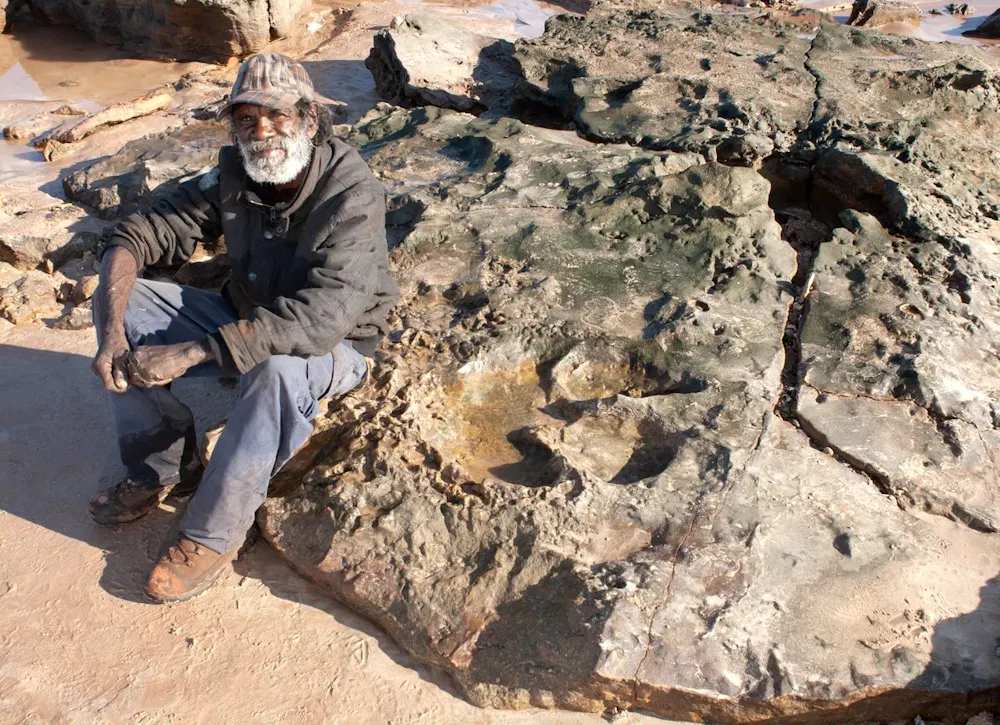
Goolarabooloo Maja (Law Boss) Richard Hunter alongside dinosaur tracks subsequently named Walmadanyichnus hunteri (Hunter’s mark of Walmadany). Steven Salisbury
In 2015, after several years of collaborative research between palaeontologists from the University of Queensland and Goolarabooloo traditional custodians, the Dinosaur Coast Management Group was established. This is a not-for-profit collective comprising knowledge holders and other members of the Indigenous community along with professional, Western-trained palaeontologists and local dinosaur track enthusiasts.
The main purpose of the group is to inform the public about the significance of the coastline and its dinosaur tracks. The group also works with local interest groups to devise strategies to protect the area from impacts associated with greater numbers of visitors and coastal development. At the same time, the group works to create job opportunities for people in Broome, through educational activities and guided tours for visitors.
4. Rola[STONE] documentary
The documentary Rola[STONE] explores the connections between geology, landscape and cultural knowledge on Anaiwan Country around Armidale, New South Wales. One of us (geoscientist Marissa Betts), in collaboration with Anaiwan Elders, directed the film. It shows how the landscape can be read through a scientific lens and through the Dreaming stories of those who have deep connections to Country.
Rola[Stone] was filmed on Anaiwan Country, NSW, and won an award at the Earth Futures Film Festival in 2022.
Valuing layers of knowledge
These case studies show the potential of positive engagement with First Nations peoples, communities and knowledge. They show there are myriad ways to dovetail multiple and different perspectives to promote mutual, two-way benefits.
In Ahoy’s words:
We want people to work with us, instead of us being forced to work with them. Building transparent, educational partnerships is the only way we can guarantee the free two-way flow of information.
Scientists and others working in Western institutions have the opportunity to create meaningful collaborations with First Nations peoples to promote their voices, and share cultural knowledge for the benefit of both parties. In this way we can weave together not just a rich story of the past, but of our future.
Sally Hurst created and works for the Found a Fossil project.
Marissa Betts directed the documentary Rola[STONE] discussed in this article.
Steve Ahoy featured in the documentary Rola[STONE] discussed in this article.
Last month, US Republican lawmakers renewed calls to sanction officials of the International Criminal Court (ICC) in retaliation for the arrest warrants it issued against Israeli Prime Minister Benjamin Netanyahu and former Defence Minister Yoav Gallant.
In contrast, Australian Foreign Minister Penny Wong reiterated the need to respect the “independence of the ICC and its important role in upholding international law”.
These divergent responses highlight a core problem with Australia’s current approach to sanctions, which is the topic of an ongoing Senate inquiry.
Shadow Foreign Affairs Minister Simon Birmingham initiated the review to seek ways to better align Australia’s sanctions with those of allies like the US.
Instead, the review should be an opportunity to reset this flawed principle of alignment in favour of an approach grounded in core principles of international law.
Australia’s history of sanctions
Sanctions are official measures that prohibit trade and economic relations with particular states or individuals for a range of reasons. These can include to pressure a state to change its behaviour, enforce international norms or isolate individuals for unlawful behaviour.
Australia’s sanctions regime is made up of two categories:
sanctions that implement decisions of the UN Security Council
“autonomous” sanctions that Australia applies unilaterally.
Historically, Australian sanctions have at times preceded Security Council action. In the mid-1960s, Australia followed the United Kingdom in sanctioning the white supremacist rule in Rhodesia (now Zimbabwe) before the council adopted sanctions.
Australia also sanctioned apartheid-era South Africa in the mid-1980s in the absence of Security Council action – and in the face of initial opposition from the UK and US.
Since 2011, Australian legislation grants the foreign minister broad discretionary powers to impose unilateral sanctions on other countries. This system has recently been expanded to include sanctions of individuals engaged in corruption and serious abuses of human rights.
Australia now imposes a range of sanctions autonomously, including travel bans and freezing of financial assets. This includes sanctions on the political and military leaders of Myanmar, Zimbabwe and Russia.
In practice, Australia has a policy of aligning its nominally “autonomous” sanctions decision-making with its so-called like-minded partners, such as the US.
For example, Australia has so far decided not to unilaterally impose sanctions on Israel’s political and military leadership. This is despite sustained civil society pressure and a historic ruling of the International Court of Justice.
Foreign Minister Penny Wong defended the decision on the basis that “going it alone gets us nowhere”.
When Australia applies sanctions, we coordinate with partners. That’s what makes them effective.
Dangers of a ‘like-minded partners’ approach
Yet, this rhetorical appeal to alignment with “like-minded partners” fails to recognise the dangers of such an approach.
For one, it risks drawing Australia further into the geostrategic competition between the US and China, in which sanctions are fast becoming a central tool. The US is increasingly using sanctions to punish China (and other adversaries) or stymie their development, while blocking attempts to sanction its friends, notably Israel.
The US is overwhelmingly the world’s biggest user of unilateral sanctions. Between 2001-21, it increased its sanctions designations by a stunning 933%.
The proliferation of US sanctions has only intensified since then. In 2023, the US added a total of 2,500 entities and individuals to its “Specially Designated Nationals and Blocked Persons” list. This is a significant increase from its annual average of 815 people in previous years.
Australia lacks the resources to adequately investigate this volume of sanctions designations. In practice, alignment often amounts to simply copying sanctions from the US, UK or European Union.
The commitment to aligning sanctions with those of allies also puts Australia at odds with some of our neighbours. Many Asian countries view US unilateral sanctions as unlawful coercion that infringes on their sovereign rights.
In April, diplomats from 32 states, including China, India, Indonesia, Malaysia, and Vietnam, supported a motion in the UN Human Rights Council that urged states to refrain from imposing unilateral sanctions in ways that are not consistent with international law. It said:
they are contrary to the [UN] Charter and norms and principles governing peaceful relations among states.
The UN General Assembly has also passed numerous resolutions criticising the imposition of certain unilateral sanctions. This shows the US reliance on sanctions is the global outlier.
This is perhaps clearest regarding the US embargo of Cuba, in place since 1960. Last month, the UN General Assembly passed a resolution renewing its long-standing call for the US to lift the embargo. It got near-unanimous support, with 187 states, including Australia, voting in favour. Only two states, the US and Israel, voted against. One abstained (Moldova).
What Trump is likely to do
While Trump has recently claimed he would like to use sanctions “as little as possible”, this is doubtful given his previous record.
In addition to imposing sanctions against China, Iran and Venezuela (among others), the administration also sanctioned ICC officials for investigating US military personnel for alleged war crimes in Afghanistan.
Trump’s pick to be his new secretary of state, Marco Rubio, is a sanctions hawk. Following the Biden administration’s ending of ICC sanctions, he co-sponsored a bill in Congress to impose new sanctions on ICC employees and their families if they investigated the US or Israel.
Rubio has also made clear his opposition to sanctioning Israeli nationals. When the Biden administration sanctioned an Israeli entity and individual for “extremist settler violence” in the occupied West Bank, Rubio accused Secretary of State Antony Blinken of acting “to undercut our ally, Israel”.
Given this, we can assume the new Trump administration will revoke these sanctions against Israelis. We can also anticipate there will be pressure on Australia to remove the already limited sanctions it has imposed on a handful of Israeli settlers, to realign Australia’s approach with that of the new US administration.
A new approach
We recently co-authored a submission to the Senate inquiry that recalled Australia’s history of supporting anti-apartheid sanctions.
And we recommended that Australian sanctions law and decision-making be reoriented towards recognising core principles of international law, including the right of all people to self-determination.
This could be done through “a trigger mechanism” that automatically implements sanctions in accordance with decisions of the International Court of Justice concerning serious violations and abuses of human rights.
As the Trump administration potentially gears up to strengthen sanctions against perceived enemies while exempting friends, Australia should consider a different path.
Sara Dehm receives funding from the Australian Research Council.
Jessica Whyte receives funding from the Australian Research Council
Disney has returned to Motunui with Moana 2, a sequel to the 2016 hit Moana. But have they been able to recapture the magic?
This time, the story sees Moana (voiced by Auli’i Cravalho) setting out from her home island once again to try reconnect with the lost people of the ocean.
With the help of an unlikely crew and demigod Maui (Dwayne Johnson), she must reckon with an angry god and find a way to free a cursed island.
The first film was co-directed by John Musker and Ron Clements, two legendary writer directors from such fame as The Little Mermaid, Aladdin, Hercules, Treasure Planet and The Princess and the Frog.
They haven’t returned for the sequel, which is co-directed by David Derrick Jr, Jason Hand and Dana Ledoux Miller.
Moana 2 actually began as a Disney+ series before being retooled into a film earlier this year. While it moves the story of the world and the characters forward, the film feels like a slapstick and half-baked reworked TV show.
Moana 2. RNZ Reviews
Thankfully, Auli’i Cravalho is still great as Moana; the vibrance and expression of her voice is wonderful. And it really is a movie centred mostly around her, which is a strength.
Two-dimensional crew However, that also means that Moana’s little crew of friends are two-dimensional and not needed other than for a little inspiration here and there. Even Dwayne Johnson’s Maui feels a little less colourful this time around and a bit more of a plot device than actual character.
There is also a half-baked villain plot, with the character not really present and another who feels undercooked. It’s not until a small mid-credits scene where we get something of a hint, as well as what’s to come in a potential sequel film or series.
While Cravalho’s singing is lovely, unfortunately the songs of Moana 2 are not as memorable or catchy. And it certainly doesn’t help that Dwayne Johnson cannot sing or rap to save himself.
It’s wonderful to have a Pacific Island-centric story, and it’s got some great cultural representation, but Moana 2 could have been so much better.
While I’m obviously not the target audience, I really enjoyed the first one and I believe kids deserve good, smart movies. If there’s going to be another one, I hope they make it worth it.
This article is republished under a community partnership agreement with RNZ.
On Papuan Independence Day, the focus is on discussing protests against Indonesia’s transmigration programme, environmental destruction, militarisation, and the struggle for self-determination. Te Aniwaniwa Paterson reports.
By Te Aniwaniwa Paterson of Te Ao Māori News
On 1 December 1961, West Papua’s national flag, known as the Morning Star, was raised for the first time as a declaration of West Papua’s independence from the Netherlands.
The flag continues to be raised globally on December 1 each year on what is still called “Papuan Independence Day”.
Region-wide protests Protests have been building in West Papua since the new Indonesian President Prabowo Subianto announced the revival of the Transmigration Programme to West Papua.
This was declared a day after he came to power on October 21 and confirmed fears from West Papuans about Prabowo’s rise to power.
This is because Prabowo is a former general known for a trail of allegations of war crimes and human rights abuses in West Papua and East Timor to his name.
Transmigration’s role The transmigration programme began before Indonesia gained independence from the Dutch colonial government, intended to reduce “overcrowding” in Java and to provide a workforce for plantations in Sumatra.
After independence ended and under Indonesian rule, the programme expanded and in 1969 transmigration to West Papua was started.
This was also the year of the controversial “Act of Free Choice” where a small group of Papuans were coerced by Indonesia into a unanimous vote against their independence.
Indonesia has also said transmigration helps with cultural exchange to unite the West Papuans so they are one nation — “Indonesian”.
West Papuan human rights activist Rosa Moiwend said in the 1980s that Indonesians used the language of “humanising West Papuans” through erasing their indigenous identity.
“It’s a racist kind of thing because they think West Papuans were not fully human,” Moiwend said.
Pathway to environmental destruction Papuans believe this was to dilute the Indigenous Melanesian population, and to secure the control of their natural resources, to conduct mining, oil and gas extraction and deforestation.
This is because in the past the transmigration programme was tied to agricultural settlements where, following the deforestation of conservation forests, Indonesian migrants worked on agricultural projects such as rice fields and palm oil plantations.
The ecology in West Papua was being damaged by mining, deforestation, and oil and gas extraction, he said. Mote said Indonesia wanted to “wipe them from the land and control their natural resources”.
He emphasised that defending West Papua meant defending the world, because New Guinea had the third-largest rainforest after the Amazon and Congo and was crucial for climate change mitigation as they sequester and store carbon.
Concerns grow over militarisation Moiwend said the other concern right now was the National Strategic Project which developed projects to focus on Indonesian self-sufficiency in food and energy.
Merauke Integrated Food and Energy Estate (MIFEE) started in 2011, so isn’t a new project, but it has failed to deliver many times and was described by Global Atlas of Environmental Justice as a “textbook land grab”.
The mega-project includes the deforestation of a million hectares for rice fields and an additional 600,000 hectares for sugar cane plantations that will be used to make bioethanol.
The project is managed by the Ministry of Defense and the Ministry of Agriculture, and the private company, Jhonlin Group, owned by Haji Andi Syamsuddin Arsyad. Ironically, given the project has been promoted to address climate issues, Arsyad is a coal magnate, a primary industry responsible for man-made climate change.
Conservation news website Mongabay reported that the villages in the project site had a population of 3000 people whereas a battalion consisted of usually 1000 soldiers, which meant there would be more soldiers than locals and the villagers said it felt as if their home would be turned into a “war zone”.
Merauke is where Moiwend’s village is and many of her cousins and family are protesting and, although there haven’t been any incidents yet, with increased militarisation she feared for the lives of her family as the Indonesian military had killed civilians in the past.
Destruction of spiritual ancestors The destruction of the environment was also the killing of their dema (spiritual ancestors), she said.
The dema represented and protected different components of nature, with a dema for fish, the sago palm, and the coconut tree.
Traditionally when planting taro, kumara or yam, they chanted and sang for the dema of those plants to ensure an abundant harvest.
Moiwend said they connected to their identity through calling on the name of the dema that was their totem.
She said her totem was the coconut and when she needed healing she would find a coconut tree, drink coconut water, and call to the dema for help.
There were places where the dema lived that humans were not meant to enter but many sacred forests had been deforested.
She said the Indonesians had destroyed their food sources, their connection to their spirituality as well destroying their humanity.
“Anim Ha means the great human being,” she said, “to become a great human being you have to have a certain quality of life, and one quality of life is the connection to your dema, your spiritual realm.”
Te Aniwaniwa Paterson is a digital producer for Te Ao Māori News. Republished with permission.
Raising the West Papuan Morning Star flag in Tāmaki Makaurau in 2023. Image: Te Ao Māori News
New Caledonia’s largest pro-independence party, the Union Calédonienne (UC), has unveiled the main outcome of its congress last weekend, including its plans for the French Pacific territory’s political future.
Speaking at a news conference on Thursday in Nouméa, the party’s newly-elected executive bureau, now headed by Emmanuel Tjibaou, debriefed the media about the main resolutions made during its congress.
One of the motions was specifically concerning a timeframe for New Caledonia’s road to independence.
Tjibaou said UC now envisaged that one of the milestones on this road to sovereignty would be the signing of a “Kanaky Agreement”, at the latest on 24 September 2025 — a highly symbolic date as this was the day of France’s annexation of New Caledonia in 1853.
‘Kanaky Agreement’ by 24 September 2025? This, he said, would mark the beginning of a five-year “transition period” from “2025 to 2030” that would be concluded by New Caledonia becoming fully sovereign under a status yet to be defined.
Several wordings have recently been advanced by stakeholders from around the political spectrum.
Depending on the pro-independence and pro-France sympathies, these have varied from “shared sovereignty”, “independence in partnership”, “independence-association” and, more recently, from the also divided pro-France loyalists camp, an “internal federalism” (Le Rassemblement-LR party) or a “territorial federation” (Les Loyalistes).
Charismatic pro-independence leader Jean-Marie Tjibaou, Emmanuel’s father who was assassinated in 1989, was known for being an advocate of a relativist approach to the term “independence”, to which he usually preferred to adjunct the pragmatic term “inter-dependence”.
Founding FLNKS leader Jean Marie Tjibaou in Kanaky New Caledonia in 1985 . . . assassinated four years later. Image: David Robie/Café Pacific
Negotiations between all political parties and the French State are expected to begin in the next few weeks.
The talks (between pro-independence, anti-independence parties and the French State) are scheduled in such a way that all parties manage to reach a comprehensive and inclusive political agreement no later than March 2025.
The talks had completely stalled after the pro-indeoendence riots broke out on 13 May 2024.
Over the past three years, following three referendums (2018, 2020, 2021, the latter being strongly challenged by the pro-independence side) on the question of independence (all yielding a majority in favour of New Caledonia remaining part of France), there had been several attempts to hold inclusive talks in order to discuss New Caledonia’s political future.
But UC and other parties (including pro-France and pro-independence) did not manage to sit at the same table.
Speaking to journalists, Emmanuel Tjibaou confirmed that under its new leadership, UC was now willing to return to the negotiating table.
He said “May 13 has stopped our advances in those exchanges” but “now is the time to build the road to full sovereignty”.
Back to the negotiating table In the footsteps of those expected negotiations, heavy campaigning will follow to prepare for crucial provincial elections to be held no later than November 2025.
The five years of “transition” (2025-2030), would be used to transfer the remaining “regal” powers from France as well as putting in place “a political, financial and international” framework, accompanied by the French State, Tjibaou elaborated.
And after the transitional period, UC’s president said a new phase of talks could start to put in place what he terms “interdependence conventions on some of the ‘regal’ — main — powers” (defence, law and order, foreign affairs, currency).
Tjibaou said this project could resemble a sort of independence in partnership, a “shared sovereignty”, a concept that was strongly suggested early November 2024 by visiting French Senate President Gérard Larcher.
But Tjibaou said there was a difference in the sense that those discussions on sharing would only take place once all the powers have been transferred from France.
“You can only share sovereignty if you have obtained it first”, he told local media.
One of the other resolutions from its congress held last weekend in the small village of Mia (Canala) was to reiterate its call to liberate Christian Téin, appointed president of the FLNKS (Kanak Socialist National Liberation Front) in absentia late August, even though he is currently imprisoned in Mulhouse (north-east of France) pending his trial.
Allegations over May riots He is alleged to have been involved in the organisation of the demonstrations that degenerated into the May 13 riots, arson, looting and a deadly toll of 13 people, several hundred injured and material damage estimated at some 2.2 billion euros (NZ$3.9 billion).
Tjibaou also said that within a currently divided pro-independence movement, he hoped that a reunification process and “clarification” would be possible with other components of FLNKS, namely the Progressist Union in Melanesia (UPM) and the Kanak Liberation Party (PALIKA).
Since August 2024, both UPM and PALIKA have de facto withdrawn with FLNKS’s political bureau, saying they no longer recognised themselves in the way the movement had radicalised.
In 1988, after half a decade of a quasi civil war, Jean-Marie Tjibaou signed the Matignon-Oudinot agreements with New Caledonia’s pro-France and anti-independence leader Jacques Lafleur.
The third signatory was the French State.
One year later, in 1989, Tjibaou was shot dead by a hard-line pro-independence militant.
His son Emmanuel was aged 13 at the time.
‘Common destiny’ In 1998, a new agreement, the Nouméa Accord, was signed, with a focus on increased autonomy, the notions of “common destiny” and a local “citizenship” and a gradual transfer of powers from France.
After the three referendums held between 2018 and 2021, the Nouméa Accord prescribed that if there had been three referendums rejecting independence, then political stakeholders should “meet to examine the situation thus generated”.
On Thursday, Union Calédonienne also stressed that the Nouméa Accord remained the founding document of all future political discussions.
“We are sticking to the Nouméa Accord because it is this document that brings us to the elements of accession to sovereignty”.
This article is republished under a community partnership agreement with RNZ.
A Fiji solidarity group for the Palestinians has accused the Rabuka-led coalition government of “complicity” in Israel’s genocide and relentless war in Gaza that has killed more than 44,000 people — mostly women and children — over the past year.
The Fijians4Palestine have called on the Fiji government to “uphold the principles of peace, justice, and human rights that our nation cherishes”.
“We urge our leaders to use their diplomatic channels to advocate for a peaceful resolution to the conflict, to support international efforts in providing humanitarian aid to the affected regions, and to publicly express solidarity with the Palestinian people, reflecting the sentiments of many Fijians,” the movement said in a statement marking the UN International Day of Solidarity with the Palestinian People.
The group said it was “ashamed that the Fiji government continues to vote for the genocide and occupation of Palestinians”.
It said that it expected the Fiji government to enforce arrest warrants issued by the International Criminal Court (ICC) for Israeli Prime Minister Benjamin Netanyahu and Israel’s former defence minister Yoav Gallant for alleged war crimes and crimes against humanity in the Gaza Strip.
The Fijians4Palestine group’s statement said:
It has been over one year since Israel began its genocide against Palestinians in Gaza.
Over the past year, Israeli attacks have killed more than 44,000 Palestinians living in Gaza, equal to 1 out of every 55 people living there.
At least 16,756 children have been killed, the highest number of children recorded in a single year of conflict over the past two decades. More than 17,000 children have lost one or both parents.
At least 97,303 people are injured in Gaza — equal to one in 23 people.
According to the United Nations Relief and Works Agency for Palestine Refugees, every day 10 children lose one or both legs, with operations and amputations conducted with little or no anaesthesia due to Israel’s ongoing siege.
In addition to the killed and injured, more than 10,000 people are feared buried under the rubble.
A Fiji protester with a “Your silence kills” placard rebuking the Fiji government for its stance on Israeli’s war on Gaza. Image: FWCC
With few tools to remove rubble and rescue those trapped beneath concrete, volunteers and civil defence workers rely on their bare hands.
We, the #Fijians4Palestine Solidarity Network join the global voices demanding a permanent ceasefire and an end to the violence. We express our unwavering solidarity with the Palestinian people.
The Palestinian struggle is not just a regional issue; it is a testament to the resilience of a people who, despite facing impossible odds, continue to fight for their right to exist, freedom, and dignity. Their struggle resonates with all who believe in justice, equality, and the fundamental rights of every human being.
Families torn apart The images of destruction, the stories of families torn apart, and the cries of children caught in the crossfire are heart-wrenching. These are not mere statistics or distant news stories; these are real people with hopes, dreams, and aspirations, much like us.
As Fijians, we have always prided ourselves on our commitment to peace, unity, and humanity. Our rich cultural heritage and shared values teach us the importance of standing up for what is right, even when it is not popular or convenient.
Today, we stand in solidarity with the Palestinian people, not out of political allegiance but out of a shared belief in humanity, justice, and the inalienable human rights of every individual.
We unequivocally condemn the State of Israel for its actions that amount to war crimes, genocide, and apartheid against the Palestinian people. The deliberate targeting of civilians, the disproportionate use of force, and the destruction of essential infrastructure, including hospitals and schools, are in clear violation of international humanitarian law.
The intent to destroy, in whole or in part, a national, ethnic, racial, or religious group is evident. The continuous displacement of Palestinians, the destruction of their homes, and the systematic erasure of their history and culture are indicative of genocidal intent.
The State of Israel’s policies in the West Bank and Gaza Strip, characterised by racial segregation, discrimination, and domination, amount to apartheid as defined under international law.
Oppressive regime The construction of settlements, the separation wall, and the system of checkpoints are manifestations of this oppressive regime. Palestinians are subjected to different laws, regulations, and treatments based on their ethnicity, clearly violating the principle of equality.
We call upon the Fiji government to uphold the principles of peace, justice, and human rights that our nation cherishes. We urge our leaders to use their diplomatic channels to advocate for a peaceful resolution to the conflict, to support international efforts in providing humanitarian aid to the affected regions, and to publicly express solidarity with the Palestinian people, reflecting the sentiments of many Fijians.
We are ashamed that the Fiji government continues to vote for the genocide and occupation of Palestinians. We expect our government to enforce arrest warrants issued by the International Criminal Court for Israeli Prime Minister Benjamin Netanyahu and Israel’s former defence minister Yoav Gallant for alleged war crimes and crimes against humanity in the Gaza Strip.
The silence of the Fiji government is complicity, and history will not forgive their inaction.
Our solidarity with the Palestinian people is a testament to our shared humanity. We believe in a world where diversity, is treated with dignity and respect. We dream of a future where children in Gaza can play without fear, where families can live without the shadow of war, and where the Palestinian people can finally enjoy the peace and freedom they so rightly deserve.
There can be no peace without justice, and we stand in unity with all people and territories struggling for self-determination and freedom from occupation.
The Pacific cannot be an Ocean of Peace without freedom and self determination in Palestine, West Papua, Kanaky and all oppressed territories.
Source: The Conversation (Au and NZ) – By Joanna Mendelssohn, Honorary Senior Fellow, School of Culture and Communication. Editor in chief, Design and Art of Australia Online, The University of Melbourne
In 1974, when a local Sydney newspaper wrote on the success of two local artists, they were introduced using their husband’s names. Ruth Faerber, who has died aged 102, was named as “Mrs Hans (Ruth) Faerber of Castle Cove”.
This was later expanded to indicate the “housewife, mother of two is the wife of Hans Faerber, a design engineer”, before describing her prizewinning work and noting she was also the art critic of the Jewish Times.
Ever polite, always elegant, Faerber never vocally contested such categorisations. However, from girlhood until her extreme old age, she was first and foremost an artist.
A young interest in art
Ruth Levy was born in the Sydney suburb of Woollahra, on October 9 1922. After a less than pleasant experience at Sydney Girls High with an art teacher she later described as an “absolute whacko”, she became a boarding student at Ravenswood.
Here, she was inspired by her teacher Gladys Gibbons and introduced to printmaking as an art. When Ruth told her father she wanted to leave school and be an artist, he agreed on the condition that “you’ve got to be able earn your own living”.
She enrolled at Peter Dodd’s Commercial Art School. Dodd’s friends included the radical modernists Frank and Margel Hinder, recently arrived from the United States, giving the students a surprisingly radical art education.
Two years later, as the impact of World War II led to young women being encouraged to take the jobs of departed men, the 17-year-old worked as a junior commercial artist.
At the Market Printery she was introduced to photogravure printing and made her first experimental etching.
Ruth continued her studies at East Sydney Technical College. In 1944 she enrolled in Desiderius Orban’s Rowe Street Studio. The refugee Hungarian artist taught that rules were to be broken, that artists must experiment, and to have faith in her creativity.
These were lessons she never forgot.
Making a life as an artist
In 1946, Ruth married Hans Faerber, a young design engineer who had escaped from Germany in 1938.
Despite postwar cultural pressures prescribing that women should solely devote themselves to their families, Ruth continued to paint, turning the garage into her studio and running children’s art classes from home. She wanted to learn printmaking but in Sydney this was not possible: the only lithography course was limited to printing apprentices, and only men were eligible to apply.
In 1961 Joy Ewart donated her lithography press to create Sydney’s first public access print workshop at the Willoughby Arts Centre. Faerber became one of its most active participants.
In 1963, the year of her first solo exhibition, the family moved to a house on Sydney’s north shore. Her new studio was built into the base of the cliff. To provide safe access without the bother of planning permission, Hans removed the floor of the broom cupboard and placed a ladder down to the studio.
Faerber’s ability to disappear into a cupboard straight after dinner did sometimes disconcert her children and visitors, but it gave her time to make art as she worked through the night.
Continual experiments
By 1968 her prints had been acquired by the National Gallery of Victoria and the Art Gallery of NSW, but she knew she needed to learn more.
She received a scholarship for New York City’s Pratt Center. In New York, she saw Rauschenberg’s Experiments in Art & Technology and remembered Orban’s dictum to constantly experiment. She started to use spray paint as a medium and to incorporate photographic images in her work. One print includes a newspaper photograph of Leonard Cohen, made after she saw him perform.
Her return to Australia saw continual experiments. She also began to write, becoming the art critic for the Australian Jewish News. Her reviews were characterised by a generosity of spirit, especially noticing artists at the beginning of their careers. Women and printmakers were favoured subjects.
One of the most significant costs for printmakers is the cost of imported handmade paper. In 1980, Faerber was invited to attend the first hand paper-making workshop at the Tasmanian School of Art’s Jabberwock Mill.
There she realised the possibilities of paper as a medium rather than as a surface.
She abandoned standard shapes. Her experiments with paper became irregular, then sculptural. Paper began to be made with different materials, including tapioca flour and cold tea. She found if she sprayed a paper sculpture with the kind of aerosol paint designed for cars, she could simulate an impression of aged stone.
While she kept a close eye on the latest technical developments, her best tools of trade were sometimes found in the home. Electric frying pans, food processors and a microwave oven were repurposed to make art. An ironing board with a mesh base was used as a press for making paper. She had a long fascination with archaeological sites, realising how fragile civilisations and human life may be.
As she became physically frail, Faerber changed her practice towards making digital prints, seeing how far she could stretch the new media to her ends.
Joanna Mendelssohn has previously received funding from the Australian Research Council
As the curtain fell at the UN climate summit in Baku last Sunday, frustration and disappointment engulfed Pacific delegations after another meeting under-delivered.
Two weeks of intensive negotiations at COP29, hosted by Azerbaijan and attended by 55,000 delegates, resulted in a consensus decision among nearly 200 nations.
Climate finance was tripled to US $300 billion a year in grant and loan funding from developed nations, far short of the more than US $1 trillion sought by Least Developed Countries and Small Island Developing States.
“We travelled thousands of kilometres, it is a long way to travel back without good news,” Niue’s Minister of Natural Resources Mona Ainu’u told BenarNews.
Three-hundred Pacific delegates came to COP29 with the key demands to stay within the 1.5-degree C warming goal, make funds available and accessible for small island states, and cut ambiguous language from agreements.
Their aim was to make major emitters pay Pacific nations — who are facing the worst effects of climate change despite being the lowest contributors — to help with transition, adaptation and mitigation.
“If we lose out on the 1.5 degrees C, then it really means nothing for us being here, understanding the fact that we need money in order for us to respond to the climate crisis,” Tuvalu’s Minister for Climate Change Maina Talia told BenarNews at the start of talks.
PNG withdrew Papua New Guinea withdrew from attending just days before COP29, with Prime Minister James Marape warning: “The pledges made by major polluters amount to nothing more than empty talk.”
Miss Kiribati 2024 Kimberly Tokanang Aromata gives the “1.5 to stay alive” gesture while attending COP29 as a youth delegate earlier this month. Image: SPC/BenarNews
Fiji’s lead negotiator Dr Sivendra Michael told BenarNews that climate finance cut across many of the committee negotiations running in parallel, with parties all trying to strategically position themselves.
“We had a really challenging time in the adaptation committee room, where groups of negotiators from the African region had done a complete block on any progress on (climate) tax,” said Dr Michael, adding the Fiji team was called to order on every intervention they made.
He said it’s the fourth consecutive year adaptation talks were left hanging, despite agreement among the majority of nations, because there was “no consensus among the like-minded developing countries, which includes China, as well as the African group.”
Pacific delegates told BenarNews at COP they battled misinformation, obstruction and subversion by developed and high-emitting nations, including again negotiating on commitments agreed at COP28 last year.
Pushback began early on with long sessions on the Global Stock Take, an assessment of what progress nations and stakeholders had made to limit global warming to 1.5 degrees C.
“If we cannot talk about 1.5, then we have a very weak language around mitigation,” Tuvalu’s Talia said. “Progress on finance was nothing more than ‘baby steps’.”
Pacific faced resistance Pacific negotiators faced resistance to their call for U.S.$39 billion for Small Island Developing States and U.S.$220 billion for Least Developed Countries.
“We expected pushbacks, but the lack of ambition was deeply frustrating,” Talia said.
Fiji’s Assistant Minister of Foreign Affairs Lenora Qereqeretabua addresses the COP29 summit in Baku this month. Image: SPREP/BenarNews
Greenpeace Pacific lead Shiva Gounden accused developed countries of deliberately stalling talks — of which Australia co-chaired the finance discussions — including by padding texts with unnecessary wording.
“Hours passed without any substance out of it, and then when they got into the substance of the text, there simply was not enough time,” he told BenarNews.
In the final week of COP29, the intense days negotiating continued late into the nights, sometimes ending the next morning.
“Nothing is moving as it should, and climate finance is a black hole,” Pacific Climate Action Network senior adviser Sindra Sharma told BenarNews during talks.
“There are lots of rumours and misinformation floating around, people saying that SIDS are dropping things — this is a complete lie.”
Pacific delegates and negotiators meet in the final week of intensive talks at COP29 in Baku this month. Image: SPREP/BenarNews
COP29 presidency influence Sharma said the significant influence of the COP presidency — held by Azerbaijan — came to bear as talks on the final outcome dragged past the Friday night deadline.
The Azeri presidency faced criticism for not pushing strongly enough for incorporation of the “transition away from fossil fuels” — agreed to at COP28 — in draft texts.
“What we got in the end on Saturday was a text that didn’t have the priorities that smaller island states and least developed countries had reflected,” Sharma said.
COP29’s outcome was finally announced on Sunday at 5.30am.
“For me it was heartbreaking, how developed countries just blocked their way to fulfilling their responsibilities, their historical responsibilities, and pretty much offloaded that to developing countries,” Gounden from Greenpeace Pacific said.
Some retained faith Amid the Pacific delegates’ disappointment, some retained their faith in the summits and look forward to COP30 in Brazil next year.
“We are tired, but we are here to hold the line on hope; we have no choice but to,” 350.org Pacific managing director Joseph Zane Sikulu told BenarNews.
“We can very easily spend time talking about who is missing, who is not here, and the impact that it will have on negotiation, or we can focus on the ones who came, who won’t give up,” he said at the end of summit.
Fiji’s lead negotiator Dr Michael said the outcome was “very disappointing” but not a total loss.
“COP is a very diplomatic process, so when people come to me and say that COP has failed, I am in complete disagreement, because no COP is a failure,” he told BenarNews at the end of talks.
“If we don’t agree this year, then it goes to next year; the important thing is to ensure that Pacific voices are present,” he said.
Palestinian diaspora poets, singers and musicians gathered today with solidarity partners from Aotearoa New Zealand, African nations — including South Africa — in a vibrant celebration.
For coral reefs, climate change is an existential threat. Australia’s Great Barrier Reef has endured seven mass bleaching events over the past 25 years. Five have occurred in the past eight years.
But amid the story of decline, something curious is happening. Surveys from the air and on water show a few reef groups, such as the Ribbon Reefs in the far north and the Swains and Pompey reefs in the south, are consistently escaping severe bleaching while their neighbouring reefs suffer.
But how? In our new research, we found their survival is due to cold water. That is, most of these reefs are periodically bathed in cooler water even as other parts of the reef bake in marine heatwaves. This stems from the phenomenon called upwelling, where cooler waters from the deep mix with warm surface waters. These reefs are likely to be buffered from the worst of climate change.
While the world’s oceans are heating up steadily, the deeper waters remain cooler than surface waters. Our modelling suggests cold currents could protect these vital refuges at least into the 2080s, even if continued high emissions lead to sea surface temperatures 2-3°C hotter than now. Safeguarding these refuges offers the best chance to preserve some of the reef’s rich array of species and – potentially – to allow corals to adapt to new heat regimes and eventually repopulate degraded reefs.
These figures show where upwellings of cooler water are protecting some reefs among the thousands making up the Great Barrier Reef. These refuges are visible as areas of cooler water (dark blue patches) relative to the average sea surface temperatures over January to March. Author provided, CC BY-NC-ND
Where are these refuges from heat?
Coral reefs are very sensitive to heat. When marine heatwaves strike, heat stress can make coral polyps bleach by expelling their symbiotic algae. These colourful “zooxanthellae” algae provide coral energy and nutrition from photosynthesis in exchange for shelter. Bleached coral can recover if given a reprieve. But if the heat stress continues, it can die.
Climate change is loading the dice for more heat, more often. This is why we are now seeing parts of the Great Barrier Reef record the worst coral loss in 39 years.
In our research, we looked at why some reefs are less affected by heat. We found upwellings of cool water are protecting them. The reefs are climate refuges – areas where local conditions allow species to survive while other areas become unlivable.
We define these cooler refuges as areas where average summer sea surface temperatures are at least 1°C cooler than nearby regions. These safer zones lie along the ends of the northern and southern Great Barrier Reef and run over 200 kilometres along the continental shelf, where coral reefs are densely packed.
Off northern Australia in the eastern Torres Strait lie the Ribbon Reefs. These climate refuges are located near a steep continental slope with deep channels.
The Ribbon Reefs are acting as a climate refuge in the far north of the reef. In this satellite image of Cape York and the Torres Strait, these reefs are the long, narrow reefs to the right. AIMS/NASA, CC BY-SA
On the southern reefs, a key refuge is the Swains and Pompeys reef complex, 135 km offshore from Mackay. These reefs lie right on the continental drop off where the East Australian Current raises cold water closer to the surface.
When strong tidal currents flood through narrow reef channels, cooler water from the deep can be drawn up over the continental shelf and mixed with warm surface water, acting like a cold bath for the fringing reefs and giving relief to coral.
These effects can last up to a week or more, if conditions are right, and can occur several times over a summer. Currents can trap these cooler waters behind a long, skinny ribbon reef, giving sustained relief.
Pompey Reefs, the southern refuge. These reefs lie offshore from the Whitsundays (Whitsunday Island is pictured near top left). This is a cropped NASA image taken by satellite in 2000. NASA/GSFC/LaRC/JPL, CC BY-NC-ND
Will these refuges vanish?
To detect these refuges, we looked for unusually cool water in satellite temperature maps and ocean models. Then we ran these models forward in time, to see if these life-sustaining cool flows would persist in the 2050s under a high emissions scenario, and again in the 2080s. The good news: currents of cool water will continue at least to 2080.
This is because even as surface waters warm and marine heatwaves arrive more often, the currents carrying cooler water to the surface in these refuge reefs will continue. But if climate change continues unchecked, even deeper waters will warm to a level that coral cannot tolerate.
What about changes in ocean currents? At present, the South Equatorial Current carries warm water westward toward the Barrier Reef but then splits into the north-flowing Gulf of Papua Current and the south-flowing East Australian Current.
Our research found the location of the split is steadily moving southward. This could change where current-dependent larvae of coral and coral-eating crown of thorns starfish end up. But our modelling shows these changes won’t greatly affect upwellings over our time period.
Protecting these refuges is vital
If we keep these refuge reefs as intact as possible, we may be able to preserve more of the reef’s staggering biodiversity. If these corals find ways of adapting to the new heat regimes, it might be possible to use them to replenish harder hit reefs. Scientists in the collaborative Reef Restoration and Adaptation Program are already exploring ways to make coral better able to tolerate heat.
Overfishing, damage from shipping and crown of thorns outbreaks also pose threats to these remote reefs. We should protect them as best we can. That’s not to say we should give up on tackling threats to the reef more broadly – only that these reefs are particularly valuable.
Climate change poses the largest threat to coral. Every living thing has temperature limits and adaptation can only go so far. The corals of the Red Sea evolved to tolerate hotter water. But they had thousands of years to do so, while today’s climate is changing far faster. Other researchers have found coral refuges would break down when warming goes past 3°C.
Could coral on these more protected reefs adapt fast enough to take advantage of cool upwellings? If so, could heat-adapted coral larvae repopulate worse-hit areas? We don’t know yet. If they could, some version of the Great Barrier Reef might survive.
But if global warming continues unchecked, these reefs, too, could feel the heat. Sharply reducing emissions is our best option to control global warming and help the Great Barrier Reef endure into the next century.
Chaojiao Sun receives funding from CSIRO and the Reef Restoration and Adaptation Program.
Craig Steinberg receives funding from the Australian Institute of Marine Science, the Integrated Marine Observing System, National Collaborative Research Infrastructure Strategy and National Environmental Science Program.
A community broadcaster in Aotearoa New Zealand has appealed for an end to the “sadistic cruelty” and the “out in the open genocide” by Israel in Gaza and the occupied Palestine territories.
K Gurunathan’s article “Sparks fly as political tinder of Māori anger builds” (The Press and The Post, November 25) argues that the injustices imposed by colonialism, including the “systematic confiscation of Māori land”, leading to poverty and cultural alienation are factors behind the anger expressed by the recent Hīkoi.
We need to learn Aotearoa New Zealand history.
One needs to learn history in order to understand the present.
Earlier this year, the Independent National Security Legislation Monitor (INSLM), Jake Blight, compared the sheer volume of Australia’s secrecy laws to works of literature.
“You’d be looking at about 3,000-plus pages. That’s about the same as the complete works of William Shakespeare, War and Peace, and the three volumes of the Lord of the Rings – added together,” he told the ABC.
Of course, secrecy laws are necessary in an increasingly dangerous world. And since the September 11 2001 attacks, Australia has passed more than any other country on Earth – more than 90 by a 2021 count (though the number is now closer to 100).
But as Blight went on to point out, when these laws also smother the transparency that legitimate whistleblowing and investigative journalism bring to a democracy, they can wind up damaging the very system they are designed to protect.
That is why Attorney General Mark Dreyfus’ announcement this week that he has accepted six of the INSLM’s 15 recommendations to reform Australia’s secrecy laws in full, and six others in part, is an important break from the direction of travel.
When classified information causes harm
In Blight’s review of the secrecy offences in the Criminal Code, some of those making submissions (including my own organisation, the Alliance for Journalists’ Freedom) argued that many of the laws are inconsistent with the rule of law and human rights principles.
Critics also argue the laws unnecessarily penalise legitimate whistleblowing and criminalise the very journalists, lawyers and activist groups that are essential to the effective functioning of our democracy.
As it stands, the law makes it an offence to “deal with” classified information – a phrase so broad that a journalist or lawyer cannot open an envelope containing a classified document without risking prison. The government has agreed that merely receiving information should not be an offence alone.
The law also assumes that if a document is stamped “classified”, it would be harmful if it were released. It is what the law describes as “deemed” harm.
Instead, the government has agreed that what matters is the actual harm that might be caused if a document is released, rather than the stamp at the top of it.
In his review, Blight agreed the current system of classifying documents depended on secret policies and anonymous public servants rather than the courts. He said, however, that should not form the basis for criminal prosecutions that could send people to prison for years.
My concern is in taking a policy document and trying to enshrine it in the criminal law. Criminal laws need much more precision than a policy like that can provide.
‘The most extreme secrets’
Dreyfus also agreed to invite the Commonwealth Director of Public Prosecutions to revise the policy to consider press freedom when the office is dealing with journalists or publishers in cases involving classified documents.
But the government did not go as far as Blight had asked, particularly with regard to narrowing the scope of what is considered harmful information about intelligence agencies.
Currently, it is an offence to publish any information from an intelligence agency. Blight had recommended it be restricted to information about the data they handle, their operations, capabilities, technologies, methods and sources.
While Dreyfus agreed the scope of protected information is broad, he said Blight’s recommendation would “remove protections from categories of information which would cause harm if disclosed”.
Blight called that decision “unfortunate”.
Many of our intelligence agencies now do important work, but actually isn’t intelligence work, and I think our laws need to be tailored to that. Extreme secrecy should be focused only on the most extreme secrets.
Government lacking action
Broadly, though, Blight and other groups, including the Human Rights Law Centre and the Alliance for Journalists’ Freedom, have welcomed the government’s response as an important step towards improving transparency and press freedom.
But accepting the recommendations is not the same as implementing them. The government has a record of promising improvements in transparency, but falling short in terms of passing legislation.
In 2020, the parliament’s intelligence and security committee published a report into the impact of the law enforcement and intelligence agencies on the freedom of the press.
The report included 16 recommendations, and both the government and the opposition accepted 15 of them. Dreyfus, who was the shadow attorney general at the time, went even further. He described the recommendations as “the bare minimum”.
So far, five years on, only one has been implemented.
Peter Greste is Professor of Journalism at Macquarie University and the Executive Director for the Alliance for Journalists’ Freedom. The AJF made both written and oral submissions to the INSLM inquiry into secrecy laws. He was also a researcher on a University of Queensland project between 2018 and 2021 that studied the intersection of press freedom and national security.
The Future & Other Fictions, ACMI’s flagship summer exhibition, explores where storytelling imagines and rethinks the future.
It is an original show co-curated by ACMI’s Amanda Haskard (Gunai/Kurnai) and Chelsey O’Brien, in collaboration with director, featured artist and futurist Liam Young.
Featuring the work of 19 creatives, it brings together an impressive 180 works, showcasing film, videogames, screen-based art, costumes, paraphernalia from movies, video essays, textiles, fashion activism and new commissioned works.
The future, according to Young, “rushes over us like water”. It doesn’t just “happen to us” – “we can all be active participants in shaping and defining it”.
At the opening he described the exhibition as a “call to arms”, challenging visitors to imagine or be empowered to shape a more optimistic world. Young’s analogy with water is present throughout the exhibition.
Moving through the maze
The first part of the exhibition has a video essay that offers a provocative history of future worlds as seen on screen. As you explore, you encounter popular items from Marvel Studios’ Black Panther: Wakanda Forever (2022) to a miniature from Blade Runner 2049 (2017).
The Future Other Fictions features costumes from Black Panther: Wakanda Forever (2022). Eugene Hyland/ACMI
As visitors move through, the set design wraps around us, directing us – a bit like a maze drawing one forward.
Birth of Dawn, by Queensland-based artist Hannah Brontë, uses the pregnant form and water to represent the embodiment of her Country.
This work is mesmerising and tranquil. The experience includes the smell of an earthy blue gum scent, which I identified as suggesting the earth sweating. The exhibition label for this work observes “there is nothing more science fiction than nature itself”.
Another commission, After the End, is designed and directed by Young and written and narrated by Ngarrindjeri, Narungga, Kaurna and Noongar actor Natasha Wanganeen.
It is described in the publicity as reimagining “a world in which fossil fuel production has ceased, and communities return to rebuild the landscape”.
Much of the work evokes the sensation of floating in water. I found it utterly hypnotic. Viewers can recline on bean bags and let the experience gently wash over them.
After the End, designed and directed by Liam Young and written and narrated by Natasha Wanganeen. Eugene Hyland/ACMI
Other works have this same imagining of speculative (hypothetical) futures, resistance and rebellion, including the idea Indigenous people reclaim sovereignty and Country.
Nigerian-born United States artist Olalekan Jeyifous’s Shanty Megastructures imagines “Anarchonauts”: an advanced and empowered African identity who turn neglected spaces into innovation and sustainability centres.
These works remind the viewer of Mad Max films, initially conjuring up dystopian ideas of society having gone wrong.
But Jeyifous’ vision feels utopian. We observe harmony realised by calm expressions, an image of a mother, child and technology (the latter creatively made wearable). The beaming face of a smiling child tells us that these shanty towns, usually places of extreme poverty, might be optimistic places of social ingenuity.
It flips the Max Max narrative. This society is resilient and thriving.
A model from Blade Runner 2049 (2017), and Olalekan Jeyifous’ Shanty Megastructures. Eugene Hyland/ACMI
Screen culture and the future
Screen culture (which is everything a screen community does, from production, to this article, and to exhibitions) has always engaged in futurism, from Fritz Lang’s Metropolis (1927) through to the new commissions described above.
As the exhibition’s introductory wall text offers, many of the innovations of today, from “driverless cars, smart phones, virtual reality – first appeared on screen”.
Bjork’s The Gate, Music video by Andrew Thomas Huang. ACMI
From this perspective, this exhibition showcases a vision of the transformative power of screen culture for shaping the future. Throughout the exhibition, we are shown how screen productions of the past imagined the future, juxtaposed against contemporary creators speculating about futures they want to live in.
The environment and Indigenous cultures
Many of the works in the exhibition come from the Asia Pacific.
The fashion activist collective the Pacific Sisters celebrate Indigenous identities and mana wāhine (a concept from Māori culture in Aotearoa New Zealand that refers to the power, authority and prestige of women).
K; Tauleolevai: Keeper of the Water (Tuna) from The Pacific Sisters. Lisa French
Their aim is to preserve culture through costume design and speculative storytelling.
Artwork that dramatically represents their sustainable approach is seen in Kaitiaki with a K; Tauleolevai: Keeper of the Water (Tuna).
There are three imposing fashion artworks, one made from VHS video tape. Due to a lack of materials, they recycled the tape, removing it from cassettes and plaiting it using a technique usually applied to palm leaves for making kikau brooms.
Videotape has its own qualities, shimmering in the light as if it were alive. This is a metaphor; VHS is considered obsolete but, as the wall text reminds us, in Māori and Pacific cultures, “the past lives in the present”.
Interactivity
The exhibition is mentally and physically interactive. It poses thought-provoking questions about our future selves, exploring how artificial intelligence will reshape cinema and whether screen culture predicts the future or merely reflects the fantasies and social realities of the era in which it is created.
It also has lots of interactive features from making posters to using the barcode on the entry ticket to capture things and take them home.
There are interactive experiences throughout the exhibition. Eugene Hyland/ACMI
Visitors who’ve ever wondered what sci-fi renegades, afrofuturists, fashion activists, anarchonauts, Indigenous futurism, cyberpunks and screen culture have in common will be enlightened by the end of the show.
Each of these are woven into the story of the exhibition which has a positive message about how screen culture and environmental care can imagine and potentially create a future where human and nature thrive together.
It has something for audiences of all ages and will be a welcome cultural addition to the hot days of Melbourne’s forthcoming summer.
The Future & Other Fictions is at ACMI until April 27 2025.
As the weather warms up, offices are cranking up the air conditioning. But with such varying temperature preferences, where should you set the thermostat?
It may be an impossible task to find an optimal temperature that suits everyone. So why do we have such different temperature preferences? And does it affect more than our level of comfort?
Women tend to prefer a slightly warmer office
While there are always more similarities than differences between the sexes, women tend to feel the cold more than men.
A 2021 study of more than 38,000 participants found 38% of respondents were dissatisfied with the temperature of their office. Of those dissatisfied, women accounted for nearly two-thirds.
When asked, in other studies, the less satisfied women said they preferred warmer temperatures, while the less satisfied men would prefer a cooler office environment.
Although specifics vary, the optimal office temperature for women is often around 1°C higher than for men. One study reported the optimal temperature was 24.0°C for women and 23.2°C for men.
Can temperature affect your ability to work?
The room’s temperature can impact productivity. In warmer environments (above 25°C), men have been found to perform worse on maths and verbal tasks, while women performed worse on these tasks at cooler temperatures (below 25°C).
But on other tasks, temperature doesn’t appear to have an influence. Researchers found no difference to either gender’s performance on a number of cognitive tasks, such as cognitive reflection tests (where the questions are such that the intuitive answer is the wrong answer), or cognitive load tasks (where working memory is overloaded).
It is often proposed that concentration can be impacted by temperature, but this is not always the case.
When subjects (men and women) underwent a series of cognitive tasks, performance was not affected between 22°C (considered cold) and 25°C (considered hot) environments.
These researchers argued that maintaining a warmer temperature was optimal due to the environmental benefits and energy savings.
What’s behind gender temperature differences?
Hormones play a key role in our temperature preferences.
Testosterone causes more muscle development around the shoulders. Muscle generates heat, making men more likely to have warmer necks than women. This area is particularly sensitive to cool temperatures.
Oestrogen promotes and maintains different fat distributions in women, who tend to carry slightly more fat between the skin and muscles in a number of areas. This makes the skin feel cooler and drives a preference for slightly warmer temperatures.
Women also tend to have a lower metabolic rate (or slower metabolism) than men. This means women produce less heat and their bodies are more prone to feeling cold in cooler temperatures.
Women’s preferences can change from week to week
The menstrual cycle has a considerable influence on temperature preferences. After ovulation, the ovaries release more progesterone. This causes the body’s core temperature to warm by around 0.3–0.6°C. This means women will perceive the outside temperature as cooler than men, due to the larger thermal drop compared to their core temperatures.
Progesterone also helps conserve heat, diverting blood from the skin and into the organs. This means women’s hands, ears and feet may be up to 1-2°C colder than men’s. It’s harder to feel warm in a cool environment when your hands and feet are very cold.
At other times of the month, the opposite may be true. Oestrogen causes blood to flow to the skin, resulting in greater heat dissipation, and potential hot flushes.
During pregnancy and menopause, hormones change again, and can flow in different directions. This can cause a feeling of cold, but also hot flushes and transient increases in the sensation of warmth, where a cooler environment is far preferred.
This means some women may prefer a cooler temperature one week, then a warmer temperature the following.
What else impacts temperature preferences?
Overall, body size and composition has a strong influence on temperature preferences. As muscle generates heat, the more muscle mass we have the more heat we tend to generate, keeping us warmer.
The perception of temperature can also be impacted by many individual factors such as age, height and weight. Overweight body sizes are associated with a higher preference for a cooler environment.
Age can also affect thermoregulatory mechanisms, such as our body’s ability to sweat as well as noticing changes in the temperature. Children are also less likely to notice the cold than adults.
Of course, the sort of job a person does has an impact as well. The more you move around, the more heat you generate.
The dress code for the office also has an impact. If heavy business suits or formal attire is expected, a cooler environment may be more appropriate.
Ethnicity may also have an impact. When directly compared in one study, Asian participants reported being more comfortable in environments that were 5°C warmer than participants with European origins.
And lastly, we can’t overlook individual preference. Some people may have grown up in cool environments and simply be more used to the cold, and vice versa.
In summer, warmer office temperatures don’t use as much energy. In fact, energy use increases by 5–10% for each 1°C the temperature is lowered.
You don’t want to shut them down too much, though. Air conditioning systems also reduce humidity by removing moisture from the air, an important measure to prevent indoor mould growth.
With hormones that influence temperature preferences changing during the month, health status, body composition, individual experiences and age all playing a part, there may never be a one-size-fits-all approach to setting the office thermostat.
As such, it is recommended that staff are encouraged to have open conversations about the temperature, and for managers to listen to each member’s needs and be willing to change the thermostat where appropriate.
The authors do not work for, consult, own shares in or receive funding from any company or organisation that would benefit from this article, and have disclosed no relevant affiliations beyond their academic appointment.
Source: The Conversation (Au and NZ) – By Anna Girardi, Lecturer in Speech Pathology and Researcher at the Centre for Health Research, University of Southern Queensland
Children, especially toddlers and preschoolers, have an uncanny ability to surprise adults. And one of the more alarming discoveries parents can make is their child has stuck a small object, such as a Lego piece, up their nose.
Queensland Children’s Hospital recently reported more than 1,650 children with foreign objects up their nose had presented to its emergency department over the past decade. Lego, beads, balls, batteries, buttons and crayons were among the most common objects.
With the Christmas season approaching, it’s likely more of these small objects will be brought into our homes as toys, gifts or novelty items.
But why do children stick things like these up their nose? Here’s how natural curiosity, developing motor skills, and a limited understanding of risk can be a dangerous combination.
1. Kids are curious creatures
Toddlers are naturally curious creatures. During the toddler and preschool years, children explore their environment by using their senses. They touch, taste, smell, listen to and look at everything around them. It’s a natural part of their development and a big part of how they learn about the world.
Researchers call this “curiosity-based learning”. They say children are more likely to explore unfamiliar objects or when they don’t completely understand how they work. This may explain why toddlers tend to gravitate towards new or unfamiliar objects at home.
Unfortunately, this healthy developmental curiosity sometimes leads to them putting things in places they shouldn’t, such as their nose.
2. Kids are great mimics
Young children often mimic what they see. Studies that tracked the same group of children over time confirm imitation plays a vital role in a child’s development. This activates certain critical neural pathways in the brain. Imitation is particularly important when learning to use and understand language and when learning motor skills such as walking, clapping, catching a ball, waving and writing.
Put simply, when a child imitates, it strengthens brain connections and helps them learn new skills faster. Anecdotally, parents of toddlers will relate to seeing their younger children copying older siblings’ phrases or gestures.
Inserting items into their nose is no different. Toddlers see older children and adults placing items near their face – when they blow their nose, put on makeup or eat – and decide to try it themselves.
Kids see you placing items near your face, so they copy you in sometimes dangerous ways. MDV Edwards/Shutterstock
3. Kids don’t yet understand risk
Toddlers might be curious. But they don’t have the cognitive capacity or reasoning ability to comprehend the consequences of placing items in their nose or mouth. This can be a dangerous combination. So supervising your toddler is essential.
Small, bright-coloured objects, items with interesting textures, or items that resemble food are especially tempting for little ones.
What can I do?
Sometimes, it’s obvious when a child has put something up their nose, but not always. Your child might have pain or itchiness around the nose, discharge or bleeding from the nose, and be upset or uncomfortable.
If your child has difficulty breathing or you suspect your child has inserted a sharp object or button battery seek immediate medical care. Button batteries can burn and damage tissues in as little as 15 minutes, which can lead to infection and injury.
If your child inserts an object where they shouldn’t:
stay calm: your child will react to your emotions, so try to remain calm and reassuring
assess the situation: can you see the object? Is your child in distress?
encourage your child to blow their nose gently. This may help dislodge the object
take your child outside in the Sun: brief exposure for a minute or two might prompt a “Sun sneeze”, which may dislodge the object. But avoid sniffing, which may cause the object to travel further in the airways and into the lungs
never try to remove the object yourself using tweezers, cotton swabs or other tools. This can push the object further into the nose, causing more damage.
If these methods don’t dislodge the item, your child is not distressed and you don’t suspect a sharp object or button battery, go to your GP. They may be able to see and remove the item.
Prevention is better
Preventing these incidents starts with keeping small, shiny, tempting objects out of reach of children, and teaching them not to place objects in their noses or mouths.
Supervision is key. Parents and caregivers can also be stringent about what they bring into their home. If there’s an alternative item, for example, a similar product that doesn’t need a button battery, consider buying that instead.
Curiosity is a hallmark of children and a key learning process in the early years. However, this curiosity, combined with a limited ability to identify danger, can be a risky combination. With awareness of the dangers, supervision, and appropriate action when incidents happen, parents can keep their children safe, while they explore the world.
Anna Girardi works for Ramsay Health Care and Food Solutions Diet Consultants as a speech pathologist. She is affiliated with Speech Pathology Australia.
To prepare for the next inevitable pandemic, the report says New Zealand must build public health capacity to increase the range of response options and tools available to decision makers.
The big question is when and how the government will implement these recommendations, particularly in the context of job cuts and downsizing of public health capacity.
Te Whatu Ora/Health NZ is set to cut 1,500 more jobs (on top of more than 500 voluntary redundancies), including positions in the national public health service and its digital and data teams.
These capabilities are critical for any future pandemic response, so there is a strong argument to halt the cuts while New Zealand is implementing the recommendations of the COVID inquiry.
Strategy is key
The report concludes that New Zealand’s adoption of an elimination strategy was highly successful, but had wide-ranging impacts on all aspects of life.
The strategy required early use of border controls, lockdowns and other restrictions which helped prevent widespread infection until most of the population was vaccinated. This response gave New Zealand one of the lowest COVID mortality rates globally.
The report also found that as the pandemic progressed into late 2021, the negative impacts increased. Controlling the pandemic was focused on mandates, including restrictions on public gatherings, quarantine and isolation, contact tracing, masking and vaccination requirements.
The effects included declining trust in government within some communities and loss of social cohesion. Vaccine hesitancy emerged as a growing challenge to the vaccine rollout, fed by exposure to misinformation and disinformation.
The prolonged pandemic and lack of a clear exit strategy from elimination added to the difficulties, according to the commission’s report.
Negative impacts: as the pandemic wore on the response became more challenging. Getty Images
A road map for pandemic planning
The report identifies how COVID expanded international understanding of pandemic pathogens, which require a different kind of response from most other emergencies because of their scale and duration.
This challenge benefits from clear strategic leadership coupled with strong social cohesion and trust. Pandemics require anticipatory governance, and long-term planning and investment. This conclusion is consistent with those of the first published module from the UK’s COVID inquiry.
The report’s 39 recommendations provide a welcome and needed road map for future pandemic planning. It calls for a central agency function to coordinate all-of-government preparation and response planning for pandemics and other national threats, supported by strengthened scenario planning and modelling.
This planning would integrate sector-specific plans. The Ministry of Health would be responsible for the most substantial sector planning linked with the all-of-government plan.
This greatly expanded pandemic plan would set out a range of public health strategies (such as elimination, suppression and mitigation) and associated public health and social measures, as well as guidance on how they might be deployed.
The plan would cover quarantine and isolation measures, contact tracing, testing, vaccination, infection prevention and control, and information and data capability to deliver a pandemic response.
The recommendations also include improving the way public sector agencies work alongside iwi during a pandemic to support the Crown in its relationship with Māori under te Tiriti o Waitangi.
However, the report doesn’t say much about reducing the long-term effects of COVID infection, notably the large burden of long COVID. The pandemic is still continuing and ongoing vaccination and efforts to reduce infections remain important. This is an area where Australia’s COVID inquiry report had a stronger focus.
Challenges of implementation
The report’s final recommendation is critical. It calls for assigning a government minister to lead the implementation process, and for six-monthly reporting on progress to be made publicly available. This is where we need a clear response from the coalition government.
Implementation should begin immediately, the report proposes. However, it’s possible action could be delayed until the first half of 2026 while we wait for an additional phase 2 of the inquiry. This will review aspects of our COVID-19 response in greater detail.
But the major logistical barrier to implementation is the downsizing of key government agencies needed to do this work. The situation in New Zealand is in stark contrast with Australia where the release of their report coincided with an announcement of a A$251 million investment in establishing a national centre for disease control.
Meanwhile, the risk of future pandemics is increasing. Modelling suggests an 18-26% chance of another COVID-magnitude pandemic within the next decade.
There is a long and growing list of infectious agents with pandemic potential. High on that list is influenza, with the risk from bird flu (influenza H5N1) increasing as it adapts to new mammalian hosts like cattle, and now humans in North America.
We have the plan, now all we need is a rapid government response, proactive leadership and anticipatory decision-making to give New Zealand the pandemic preparedness it urgently needs.
Michael Baker’s employer, the University of Otago, has received funding from the Health Research Council of New Zealand and the New Zealand Ministry of Health for research he has carried out on COVID-19 epidemiology, prevention and control.
Amanda Kvalsvig’s employer, the University of Otago, has received funding from the Health Research Council of New Zealand and the New Zealand Ministry of Health for research she has carried out on COVID-19 epidemiology, prevention and control..
Collin Tukuitonga and Nick Wilson do not work for, consult, own shares in or receive funding from any company or organisation that would benefit from this article, and have disclosed no relevant affiliations beyond their academic appointment.
The just-ended COP-29 in Baku, and the election of Donald Trump, have put the global response to climate change in the spotlight. Meanwhile back home, Climate Change Minister Chris Bowen this week reported Australia is on track to meet its 2030 target to reduce emissions as part of the Paris Climate Agreement.
But the government won’t say whether it will reveal its 2035 target before the election. It points out it is awaiting advice from the Climate Change Authority. The head of that authority, former New South Wales Liberal treasurer Matt Kean, joins the podcast to talk about COP, Australia’s energy transition, and the challenge of preparing that advice on the 2035 target.
Kean says COP left him more encouraged than he’d expected:
I arrived at COP incredibly pessimistic. It was on the back of Trump’s election victory where he basically called climate change a hoax. He said his energy policy was going to be “drill, baby, drill”. And it was clear that there was going to be an absence of American leadership in the climate discussion over the next four years. So, I arrived with not high hopes.
But I left optimistic and positive, and the reason for that is that this is the world’s most important climate conference. It’s the world’s biggest climate conference. It brings together people from all over the globe, be it governments at the national level or sub-national level, businesses, private enterprise, NGOs. And the message that I received from all those actors is, yes, there is a setback, but the effort required and the determination to continue the trajectory that we were on was very, very clear.
It’s an opportunity to collaborate and come up with new ways to solve this challenge. I mean, the world coming together in a global effort to limit global warming by 1.5 degrees above pre-industrial levels is one of the great challenges of our times. No country alone is going to solve it, and my message to your listeners is this: the fight for a cleaner, safer and better planet by tackling dangerous climate change is bigger than one election cycle in one country at one point in time.
Australia had hoped to get the nod during COP to host (together with Pacific countries) the 2026 COP but a decision has been deferred until June. Kean describes where things are up to and why it’s an important event not just for Australia’s reputation but also for its economy:
I was led to believe that there was a strong indication that other countries might pull out of the race. But clearly that didn’t happen. We arrived in Baku to hear the president of Turkey making a strong and forceful argument as to why Turkey should be the host of that COP. And I think that caught a few people by surprise, to be honest.
But […] hopefully, Australia will be chosen as the country that can host this world-class huge event which will bring lots of economic benefits.
Over 70,000 people descended on Baku. So, regardless of the importance of bringing people together to collaborate and try and solve this challenge, it is a huge economic boon for the city and the country that hosts it. I mean, I can’t think of many events that could attract 70,000 people to Australian shores.
On the Climate Change Authority’s progress report, released this week, Kean highlights a key opportunity for new renewable energy capacity:
Take, for example, one of the recommendations around using more business rooftops to meet our energy needs. Australia has the potential for an extra 28GW of solar capacity using the commercial and industrial rooftops of Australia. That’s bigger than the size of the New South Wales energy system alone.
[The Australian Energy Market Operator] predicts only 5% of the commercial and industrial customer demand will be met by rooftop solar and batteries and that’s compared to 50% for households. So we’ve got a huge opportunity to install more capacity into the grid, ensure that our system is more reliable and able to manage the exit of these unreliable coal fired power stations without adding a huge cost to consumers.
On when Australians will learn about our 2035 targets, and his authority’s advice on them, Kean says Australia will need to submit its targets before next year’s COP, but is coy about when the authority’s advice will be coming:
Let me firstly say what matters most is the quality of the target and the strength of the evidence and analysis that underpin it. So we want to give the Australian people confidence that Australia’s next target is ambitious, achievable and in our national interest.
As far as we’re aware, all countries intend to submit their next targets before the next climate conference in 2025. We will provide our advice in plenty of time for Australia to submit before then.
I’m not going to be rushed by domestic political timetables. I’m an independent voice in this process and as I said, what matters most is the quality of the target and the strength of the evidence and analysis that underpin it.
Michelle Grattan does not work for, consult, own shares in or receive funding from any company or organisation that would benefit from this article, and has disclosed no relevant affiliations beyond their academic appointment.
Earlier this month, China declared new “baselines” around Scarborough Reef, a large coral atoll topped by a handful of rocks barely above sea level in the South China Sea.
By doing so, China reaffirmed its sovereignty claim over what has become a global flashpoint in the disputed waters.
This was a pre-calculated response to the Philippines’ enactment of new maritime laws two days earlier that aimed to safeguard its own claims over the reef and other contested parts of the sea.
This legal tit-for-tat is a continuation of the ongoing sovereignty and maritime dispute between China and the Philippines (and others) in a vital ocean area through which one-third of global trade travels.
The Philippines rejected China’s declaration as a violation of its “long-established sovereignty over the shoal”. Defence Secretary Gilberto Teodoro said:
What we see is an increasing demand by Beijing for us to concede our sovereign rights in the area.
As the tensions continue to worsen over these claims, there is an ever-increasing risk of an at-sea conflict between the two countries.
What is the Scarborough Reef?
Scarborough Reef is called Huangyan Dao in Chinese and Bajo de Masinloc by the Philippines. It is located in the northeast of the South China Sea, about 116 nautical miles (215km) west of the Philippine island of Luzon and 448 nautical miles (830km) south of the Chinese mainland.
Disputed claims in the South China Sea. Author provided
At high tide it is reduced to a few tiny islets, the tallest of which is just 3 metres above the water. However, at low tide, it is the largest coral atoll in the South China Sea.
China asserts sovereignty over all of the waters, islands, rocks and other features in the South China Sea, as well as unspecified “historic rights” within its claimed nine-dash line. This includes Scarborough Reef.
In recent years, the reef has been the scene of repeated clashes between China and the Philippines. Since 2012, China has blocked Filipino fishing vessels from accessing the valuable lagoon here. This prompted the Philippines to take China to international arbitration under the United Nations Convention on the Law of the Sea (UNCLOS) in 2013.
Three years later, an arbitration tribunal ruled that China has no historic rights to maritime areas where this would conflict with UNCLOS. The tribunal also concluded China had “unlawfully prevented Filipino fishermen from engaging in traditional fishing at Scarborough Shoal.”
China refused to participate in the arbitration case and has strongly rejected its ruling as being “null and void” and having “no binding force”.
What did China do this month?
China declared the exact location of the base points of its territorial claim around Scarborough Reef with geographical coordinates (longitude and latitude), joined up by straight lines.
China’s new baselines claims at the Scarborough Reef. Author provided
The declaration of so-called “baselines” is standard practice for countries that want to claim maritime zones along their coasts. Baselines provide the starting point for measuring these zones.
A country’s “territorial sea” is measured from this baseline outward to as far as 12 nautical miles (22km). Under the UNCLOS treaty, a country then has full sovereignty rights over this zone, covering the seabed, water, airspace and any resources located there.
Countries want their baselines to be as far out to sea as possible so they can maximise the ocean areas over which they can reap economic benefits and enforce their own laws.
China is no exception. Along with other countries (especially in Asia), it draws the most generous baselines of all – straight baselines. These can connect distant headlands or other coastal outcrops with a simple straight line, or even enclose nearshore islands.
China is especially fond of straight baselines. In 1996, it drew them along most of its mainland coast and around the Paracel Islands, a disputed archipelago in the South China Sea. China defined additional straight baselines this March in the Gulf of Tonkin up to its land border with Vietnam.
China says these actions comply with UNCLOS. However, its use of straight baselines around Scarborough Reef conflicts with international law. This is because UNCLOS provides a specific rule for baselines around reefs, which China did not follow.
Based on our review of satellite imagery, however, China has only advanced the outer limit of its territorial sea by a few hundred metres in two directions. This is because its straight baselines largely hug the edge of the reef.
These new baselines around Scarborough Reef are therefore fairly conservative and enclose a dramatically smaller area than the US had feared.
China’s declaration signals that it may have abandoned its much larger “offshore archipelago” claim to what it calls the Zhongsha Islands.
China has long asserted that Scarborough Reef is part of this larger island group, which includes the Macclesfield Bank, a totally underwater feature 180 nautical miles (333 km) to the west. This led to concern that Beijing might draw a baseline around this entire island group, claiming all the waters within exclusively for its use.
The South China Sea arbitration tribunal ruled that international law prohibits such claims. There will be a collective sigh of relief among many countries that China decided to make a much smaller claim over Scarborough Reef.
Significance and future steps?
However, China’s clarification of its baselines around the reef signals it may be more assertive in its law enforcement here.
The China Coast Guard has said it will step up patrols in the South China Sea to “firmly uphold order, protect the local ecosystem and biological resources and safeguard national territorial sovereignty and maritime rights”.
Given the long history of clashes related to fishing access around Scarborough Reef, this sets the scene for more confrontation.
And what about the biggest prize of all in the South China Sea – the Spratly Islands?
We can now expect China will continue its long straight baselines march to this island group to the south. The Spratlys are an archipelago of more than 150 small islands, reefs and atolls spread out over around 240,000 square kilometres of lucrative fishing grounds. They are claimed by China, as well as the Philippines and several other countries.
These countries can be expected to protest any attempted encirclement of the Spratly Islands by new Chinese baselines.
Clive Schofield served as an independent expert witness appointed by the Philippines in the South China Sea arbitration case.
Warwick Gullett and Yucong Wang do not work for, consult, own shares in or receive funding from any company or organisation that would benefit from this article, and have disclosed no relevant affiliations beyond their academic appointment.
Source: The Conversation (Au and NZ) – By John Hawkins, Senior Lecturer, Canberra School of Politics, Economics and Society, University of Canberra
On Thursday night, after a whirlwind day in Canberra, the Senate finally passed the federal government’s long-delayed amendments to the Reserve Bank Act.
The reforms will create two separate boards for the Reserve Bank of Australia (RBA) – one will be focused on monetary policy, the other on governance.
The idea of having two boards emerged from a landmark independent review of the Reserve Bank, which reported back in March last year.
But only a couple of months ago, such reforms were feared “dead” after the government had failed to strike a deal with either the Coalition or the Greens.
The government’s stunning recent turnaround – which required it to make some concessions – will have important implications for the way the Reserve Bank operates.
Whether it will ultimately translate to different kinds of monetary policy decisions is less clear.
Under the reforms, the current functions of the Reserve Bank board will be split across two new boards.
The first will be a specialist monetary policy board, dedicated to setting the “target for the cash rate”. This is the interest rate on overnight loans between banks.
Controlling this rate is how the Reserve Bank affects the interest rates charged by banks to households and businesses, and how it exerts its influence on the economy.
Like the current board, the new monetary policy board would have nine members. These would include a governor, deputy governor, treasury secretary and six external members.
Creating this board was a key recommendation of the 2023 review. It would bring the RBA into line with some other central banks, such as the Bank of England.
There is no evidence, however, that having a separate board has led to a superior performance.
Monetary policy experts
Monetary policy board members are likely to be selected for being monetary policy experts, rather than corporate executives and other non-economists.
The six external members will not be RBA staff, public servants or bankers. But they will be expected to spend the equivalent of a day a week on monetary policy considerations.
This is a significant time commitment, meaning it may be difficult to find qualified outsiders who are willing to perform the role.
That’s led some commentators, including former Reserve Bank board member John Edwards, to suggest the board risks becoming dominated by academics.
The other board will concentrate on governance and operational issues, such as staffing decisions, premises, IT and so on. It will be more like the board of a company.
Splitting off monetary policy decisions from this board may mean governance matters get more attention.
Why create a separate board?
It’s important to understand why the government had been pursuing these reforms in the first place.
One key argument that emerged from the independent review of the Reserve Bank was the board wasn’t challenging the governor enough on interest rate decisions – that it was simply “rubber-stamping” decisions.
That would be a problem if true, because providing quality scrutiny is supposed to be one of the board’s key roles.
According to the review’s final report, the board had:
not voted against a recommendation of the RBA executive in at least the last decade.
It said the board was “not always fully involved in decisions” and there was a need to “shift the nature of the board from what is in effect an advisory body to one that proactively shapes policy decisions”.
Differing views
That assertion was soon challenged, however, by then-Governor Philip Lowe, who said in April 2023:
The idea that the board members sit there meekly and accept the recommendation that I put to them is very far from the reality that I’ve lived as the governor.
Recent board member Mark Barnaba echoed Lowe’s sentiment, reflecting:
In my experience, the way this board operates is diametrically opposed to a simple rubber-stamping.
It is difficult to be definitive on this. We have not been in the room during the board’s deliberations – but neither had the review panel members.
It is therefore hard to know just how much the proposed changes will reduce the influence of the RBA governor and staff.
Under the current system, there have not been formal votes on the RBA board. But this does not necessarily mean the governor always gets their way. They may just not bring to the table a recommendation likely to be rejected.
Would a separate board have made a difference earlier?
Australia’s target cash rate has now been held at 4.35% for over a year, its highest level since 2011. That begs the question: if we’d had a separate specialist board of experts earlier on, would we have a different cash rate?
One way of assessing how much difference a panel of monetary policy specialists might have made is to look at the record of the nine-person “RBA shadow board”.
This was established by the Centre for Applied Macroeconomic Analysis. Since 2011, it has been asked to report on what it thinks that the RBA should do. This is distinct from market economists, who concentrate on predicting what it will do.
In 105 out of 130 instances, it has made the same recommendation as that adopted by the actual board.
The average difference between the cash rate target set by the RBA and that suggested by the economists on the shadow board was less than 0.05%.
This would support the conjecture by academics Ross Garnaut and David Vines and journalist John Kehoe that had the separate boards been in place, recent policy settings would not have been very different.
Employment and inflation outcomes would likely to have been similar, too.
What had to be dropped?
To get the legislation through the Senate, the government had to drop two suggestions from the review. One was a proposal to remove the ability of the treasurer to overrule the RBA.
It is important to note this veto has existed in central bank legislation since 1945. It was introduced by a Labor government and retained by the subsequent Coalition government.
But it has never been used, despite having been considered on some occasions. In each case, one side backed off or a compromise was reached between the government and the Reserve Bank.
Actually exercising it would likely come at a large political cost to the government of the day. But that doesn’t automatically mean it shouldn’t be available.
There is a democratic principle around whether a central bank should be able to exercise total “unelected power”.
Back in the 1930s, the chair (this was before the governor became the ex officio chair) of the Commonwealth Bank (the Reserve Bank’s predecessor), arguably exacerbated the Great Depression by refusing to help the Scullin Labor government fund public works.
This year’s humpback whale (Megaptera novaeangliae) season in Australia has almost come to an end. The beloved mammals are on their way to Antarctica for a summer of feeding. Next year from April onwards, millions of people will again witness their movements and acrobatic displays – either from the coast or by joining one of the hundreds of whale-watch boat operators.
But as much as we like to watch humpback whales, we still know very little about them. They are notoriously difficult to study in the field. While they are known for their surface activities, they spend most of their time underwater and outside the range of direct observations.
One of the biggest mysteries of all is how these animals make decisions to determine what they do and where they go.
This is where our new research, published in Marine Mammal Science today, comes in. We developed a model which effectively captures key humpback whale behaviours and their resulting southward migratory movements in east Australia. It can help anticipate challenges whales may face in the future. In turn, it may aid efforts to better conserve these majestic animals.
A comeback
Following the end of commercial whaling, the worldwide recovery of humpback whale populations has been very successful. In Australia, the species was removed from the threatened species list in 2022.
However, scientists fear the effects of climate change may now be the biggest threat to their survival.
Our previous research examined which environmental factors matter in humpback whale ecology. For instance, while water temperature may have little impact in the cold Antarctic waters, breeding grounds further north that are too warm could drive humpback whales to seek better conditions elsewhere.
Currently we rely on satellite tags to inform us of their large-scale whereabouts. But unfortunately, this provides little information on humpback whale activities on a smaller scale, such as how they socialise, hunt, or react to specific conditions.
Humpback whales migrate throughout the year between Antarctica and northern Australia. NPWS/DPIE
Movements through space and time
To address this, we turned to computer models, as these can deal with scarce or inconsistently collected data. In particular, “agent-based” models are designed to capture the behavioural response of an agent (in this case, a pod consisting of a humpback whale mother and one calf) to the environmental conditions they encounter. Based on this information, the models then project movements through space and time.
We developed the first such model to simulate migratory movements of humpback whale mother and calf pods between the Great Barrier Reef and the Gold Coast bay. Along this route is Hervey Bay, an important resting area due to its calm and sheltered waters, where the pairs may stay for up to a few weeks before continuing migration.
As humpback whales are almost always sighted in waters between 15 and 200 metres deep and below 28°C, we took a simple yet reasonable approach where we assumed they avoided waters too shallow, deep, or warm as they swam southwards.
This “avoidance” response would be similar to us going indoors when it is too hot outside or raining heavily: a simple decision to move away from somewhere we are not comfortable.
To estimate how fast whales were moving, we combined the speed of the current with an estimate of real-world swimming speeds by migrating mother and calf pairs along the Gold Coast.
Our simulations accurately predict the routes taken by migrating mother and calf pairs but point to a change in direction after Hervey Bay so whales remain close to the coastline.
Other research has shown that this “distance to shore” is an important variable to consider when studying humpback whales.
Results also highlight the importance of water depth when entering Hervey Bay and ensuring the whales avoid getting too close to shore or into the deep ocean.
A tool for conservation
What the model does less well is accurately predict travel time between the Great Barrier Reef and the Gold Coast bay.
There are a few reasons why this may be the case. For example, the aforementioned underwater movements and associated behaviours are difficult to capture and convert into meaningful components of our model. Research has started to reveal detailed dive profiles but is time consuming and expensive.
We also assume that swimming speed remains more or less constant over time regardless of whether it is day or night. However, research into daily activity patterns has, so far, focused primarily on feeding and mating behaviours rather than variations in swimming speed.
Nevertheless, the current version of our model provides a suitable framework for simulating humpback whale migration and can be expanded to investigate a response of this species to future changes in ocean conditions. In theory, it can be applied to other marine species too, as long as relevant behavioural response data is available.
The development of such predictive models is increasingly important to aid conservation efforts and guide effective strategies for protecting vulnerable species affected by climate change.
Jasper de Bie receives funding from from a private charitable trust as part of the Whales & Climate Program at Griffith University
Source: The Conversation (Au and NZ) – By Anne Salmond, Distinguished Professor of Anthropology and Māori Studies, University of Auckland, Waipapa Taumata Rau
Getty Images
After the hīkoi, the haka, the flags and the tumult, what next?
In the absence of obvious answers, a thoughtful and respectful discussion about te Tiriti o Waitangi/Treaty of Waitangi would be timely, to help guide us into the future.
How can that be managed, however? Like any debate, it will be characterised by differences of opinion, within te ao Māori (the Māori world) as well as beyond it.
How those differences are handled will be vital. And that is the challenge facing the Justice Select Commmittee, now calling for submissions (closing January 7) on the Principles of the Treaty of Waitangi Bill.
Diversity and consensus
Aotearoa New Zealand has always been diverse, from the arrival of the first star navigators from different islands in the Pacific, and the migration of different hapū or kin groups around the country, to the arrival of settlers from Europe and elsewhere.
When te Tiriti was signed in 1840, each rangatira (chief), official or missionary who spoke at Waitangi, Mangungu, Kaitaia or elsewhere had their own views about its virtues and weaknesses, its promises and dangers.
Despite that, in 1840 they were able to reach a consensus, on the speaking grounds and beyond. Most of the rangatira who engaged in the debates in fact signed te Tiriti.
Various settlers, missionaries and officials were also involved in these discussions, although their exchanges among themselves and with Governor William Hobson are less well documented.
In 1840, the population was small, perhaps 80,000 tangata māori (indigenous inhabitants) and about 2,050 settlers. It was highly cosmopolitan, with many people (including tangata māori) coming and going to and from other parts of the world.
It was also diverse because not all settlers came from the United Kingdom. By 1840, people from many different parts of the world were living in New Zealand.
No mention of ‘race’ in te Tiriti
The key parties to te Tiriti o Waitangi were the queen of England and her representative, the kāwana or governor, the settlers, the rangatira with their hapū, and ngā tangata māori o Nu Tirani (the indigenous inhabitants of New Zealand).
(In Te Tiriti, the term “māori” is used throughout as an adjective, meaning normal, everyday or, in this context, indigenous. Those who came from England were “ngā tangata o Ingarani”.)
In 1840, the relationships among the various rangatira, hapū and indigenous inhabitants were defined by kinship, not “race” – a colonial concept with no scientific validity and a terrible history, associated with slavery, genocide and other atrocities.
Whānau (extended families) and hapū were highly flexible, with membership being limited by practical commitment as well as descent from a shared ancestor.
These kin groups included those who married in, so long as they contributed to the life of the group. By 1840, some of those who had married in had arrived from outside New Zealand.
Some new arrivals later became the founders of kin groups that were named after them, although their different countries of origin were also remembered – the Manueras, the O’Regans and the Jacksons, for example.
In addition to their kin groups, individuals were identified by their papa kāinga or places of origin, as marked by ancestral mountains and rivers.
The queen was also identified in this same way, by her country of origin, as “Te Kuini o Ingarani” – the Queen of England. This is the idea of “tangata whenua” in action – person and place intertwined. Again, there is no mention of “race” anywhere in te Tiriti.
Many voices, many views: reconstruction of the Signing of the Treaty of Waitangi by Marcus King, 1939. Archives New Zealand, CC BY-SA
What the Treaty articles say
In te Tiriti o Waitangi, each of the parties – queen, kāwana, settlers, each of the rangatira with their hapū, and ngā tangata māori o Nu Tirani – had their own mana.
In the Preamble and Ture/Article 1 of te Tiriti, the rangatira gave the queen, absolutely and forever, the right to appoint a kāwana as a “kai whakarite” (literally, one who makes things equal) to introduce kāwanatanga (governance) and ture (laws) to bring about peace and tranquil living across their lands.
In Ture/Article 2, the queen promised each of the rangatira with their hapū and members that she will uphold the tino rangatiranga (independence) of their lands, dwelling places and all of their ancestral treasures.
This was not a gift, but a recognition of their preexisting rights and duties as tangata whenua (literally, land people) in their own territories.
In Ture/Article 3, in return for the gift of kāwanatanga, the queen promised to protect ngā tangata māori of New Zealand, and give to them “ngā tikanga rite tahi” – absolute equality as persons – with her subjects, the inhabitants of England.
This is a multilateral, rather than a bilateral agreement. In the process of signing te Tiriti, each rangatira and hapū (and their members) retained their tino rangatiratanga, qualified only by their agreement to the exercise of the kāwanatanga of the queen.
They have done so ever since, in the Northern War and the Land Wars, for instance, when some hapū fought for and some against the settler government, and in the modern Treaty settlement process.
Breaking an agreement
So, what does this mean in the 21st century? How can these relationships best be reflected in contemporary constitutional arrangements?
How can we achieve a way forward that weaves us together as New Zealanders, rather than divides us? What kind of process would be wise and fair?
Unfortunately, the Treaty Principles bill starts the debate off on the wrong foot.
Most New Zealanders, I think, would agree that if one party to any agreement – the sale of a house, an employment contract or a divorce settlement, for example – is allowed to alter its terms without reference to the other party or parties, that would be fundamentally unfair.
That is exactly what has happened in the bill, however. Its terms have been drawn up by one party, the Crown – and in reality, by ACT, a small political party with only 8.6% of the vote at the last election – and without the backing of the rest of the coalition government.
The other parties to te Tiriti, the various rangatira and their hapū whose tino rangatiratanga is at stake, and whose members with their tikanga were promised absolute equality with the incoming settlers, have been excluded from having any say about the terms of the bill, and how these change the terms of the original agreement.
Most New Zealanders, if they’d signed an agreement in good faith, would be furious to find the other party was trying to unilaterally change its terms in their own favour. In most situations, that would not only be unfair, it would also be illegal.
If in the process, they were accused of seeking special treatment for themselves, when they were simply trying to uphold the terms of the original agreement, they’d be bitterly angry and upset.
As for individuals, so for groups. As we can see from other countries where different groups are set against each other in this kind of way, whether by “race”, ethnicity or religion, this is dangerous, and the outcomes are generally catastrophic.
Terms and conditions: the hīkoi to protest the Treaty principles bill arrives at parliament, November 19. Getty Images
Seeking consensus
Rather than letting ourselves be polarised into hostile camps, it would be wiser for New Zealanders to regard diversity as a strength, to think of what’s fair for others as well as ourselves, and to weave ourselves together.
To do this, there are a few questions we might ask ourselves.
For instance, what is the debate over te Tiriti really about? Is it really about democracy and the rights of ordinary New Zealanders? Or is it, as has been argued elsewhere, about removing impediments to the privatisation of public assets and projects that might be subject to Treaty claims?
If in Te Tiriti the queen of England solemnly promised each of the rangatira and their hapū and its members te tino rangatiratanga (independence) of their lands, dwelling places and ancestral treasures, and in return they agreed to her kāwanatanga (governance), is it wise, fair or even legal to unilaterally try to redefine that agreement?
If each of the rangatira and their hapū have a measure of autonomy under te Tiriti, how might that work? What might the relationship between tino rangatiratanga and kāwanatanga look like in the 21st century?
How can a consensus fairly be sought on these questions?
If the queen of England promised ngā tangata māori “ngā tikanga rite tahi” (absolute equality) with her subjects, the incoming settlers, has that promise been kept?
If the answer is yes, how can one explain all the negative statistics for Māori in health, education, justice and the economy that demonstrate fundamental inequities at present?
If the answer is no, and the queen’s promise has been broken, how can this situation best be remedied?
Do the promises of tino rangatiratanga and ngā tikanga rite tahi suggest the rangatira, hapū and ngā tangata māori should have a significant say about what approaches are most likely to be effective?
Above all, perhaps, if roles were reversed and the descendants of settlers were the descendants of the rangatira and their hapū – or vice versa – how would they like to be treated?
Perhaps the select committee, under National MP James Meager’s leadership, can help answer these questions.
That will only happen, however, if its members can rise above party politics, attend to the evidence, and work together to promote peace (rongo), tranquil living (ata noho) and the absolute equality (nga tikanga rite tahi) Queen Victoria promised in 1840.
Anne Salmond does not work for, consult, own shares in or receive funding from any company or organisation that would benefit from this article, and has disclosed no relevant affiliations beyond their academic appointment.
Figures for violence against women in New Caledonia have increased due to the post-riots crisis, according to local NGO SOS Violences president Anne-Marie Mestre.
Mestre has told local news media that the recent upsurge was mainly due to the riots over independence that broke out on May 13, which resulted in a rising number of jobless people due to the destruction by arson and looting of more 600 businesses.
She stressed that all ethnic communities in New Caledonia were affected by domestic violence and that the trend existed even before the riots-triggered crisis.
New Caledonia’s domestic violence statistics are 2.5 times higher than in mainland France.
In 2023, 3012 cases were reported in the French Pacific territory, a staggering increase of some 91 percent compared to 2019, the French Auditor-General’s office reported in its latest survey published in April 2024.
New Caledonia’s curfew extended to December 2 Meanwhile, New Caledonia’s curfew introduced after the rioting remains in place until December 2, according to the latest advisory from the French High Commission.
The restrictions still include the curfew per se from midnight to 5am, and most notably the ban on transportation, possession and sale of firearms and ammunition.
Public meetings remain banned in the Greater Nouméa Area and will be maintained until December 20, when the ban will be re-assessed with a possible relaxation just before Christmas.
Although opening hours for the sale of alcohol have now returned to normal, the authorised quantity per person per day remains controlled — up to four litres of beer (under 10 percent alcohol), or two litres of wine (10 to 22 percent), or one litre of spirits (above 22 percent).
This article is republished under a community partnership agreement with RNZ.
Source: The Conversation (Au and NZ) – By Anna Hickey-Moody, Professor of Intersectional Humanities, Maynooth, National University of Ireland, RMIT University
Shutterstock
I’m not sure if you remember Kaitlyn and Leah […] they are social media famous and they’re a couple. That was the first time I’d seen representation in a positive way, ‘cause of my dad being so conservative about it […] And then I just saw a happy couple together. And I was like this actually doesn’t seem like the terrible thing that I am taught it is, you know.
– Sam
This quote is taken from a recent interview one of us (Anna) conducted with a trans teen living in Melbourne. It was the beginning of what turned out to be a detailed learning journey highlighting the role of internet access in trans youths’ education – and the importance of Instagram in creating safe spaces for them.
The Albanese government has passed a bill that will introduce a minimum age of 16 for most social media platforms, in a bid to protect children from social harm.
But our research has found social media platforms can play a very specific and much-needed role in the lives of Australia’s transgender youth, who face significantly higher rates of suicide and mental health challenges compared with their cisgender peers.
Transgender youth have symptoms of depression at nearly ten times the rate of the general young population, and anxiety disorders at ten to 13 times the average rate. A 2021 study also found nearly half of Australia’s transgender individuals had attempted suicide at some point in their lives.
Poor mental health is not inherent to trans people; it is caused by experiences of societal hostility, stigma, discrimination and a lack of support. Their wellbeing can be significant improved through supportive environments and access to appropriate resources.
Social media can be a lifeline for trans youth
Sam is a university student who lives at home with mum and dad. They have been brought up in a highly conservative Christian environment and speak a lot about their father campaigning against the gay marriage plebiscite.
Sam grew up being told – and believing – that being gay was a sin. They also had no formal education about being transgender. Like so many other young people, they learned about being trans through peer networks and online exploration. As Sam explains:
After somebody had told me their [gender/pronoun] label, I was like what is a label? So I googled it, and I was like what are all these labels? And that’s how I learnt it. And then I also tried to memorise it. I kind of know a lot of them off by heart by now. That’s how the internet has kind of guided me to it.
Sam’s choice to memorise the various gender identities beyond male and female goes some way to explain how important this information was to them.
While exploring their most positive life experiences, Sam focused almost entirely on Instagram accounts. They explained how various pages helped them learn about gender and sexuality and how the transgender accounts they followed helped boost their confidence.
Instagram is Sam’s safe and happy place of belonging. In contrast, Sam struggled – even with significant encouragement – to list happy “offline” places.
Sam’s story is just one of several examples that emerged from our research on how online platforms function as vital safe spaces for trans youth growing up in conservative religious households — which are often hostile to their identities.
Through virtual communities, many young people can navigate their faith while also exploring their gender identity. Online, they can find support networks and access mental health resources that would otherwise be unavailable.
A host of challenges
The government’s legislation will prevent people under 16 from creating accounts on sites such as Instagram, Snapchat and TikTok. But social media experts have raised concerns that this may cause more harm than good.
The ban’s feasibility has also been challenged, as young people may find workarounds to continue accessing banned platforms. Some experts have even said the ban may be unconstitutional.
While these legislative moves to regulate social media seem well-intentioned, they risk cutting off a vital lifeline for trans youth. These young people need nuanced policies that will support them, rather than isolate them.
For the trans youth we speak to, social media sites can be healthy and life-giving spaces – and they ought to be kept available.
Anna Hickey-Moody receives funding from the Australian Research Council. This article arises from research that is funded through Discovery Project DP220100159 ‘Youth, religion and sexuality: digital media, school cultures, exemptions’.
Lizzie Maughan does not work for, consult, own shares in or receive funding from any company or organisation that would benefit from this article, and has disclosed no relevant affiliations beyond their academic appointment.
Unfortunately, this decline is due to the human impacts of urbanisation, intensive agriculture and poor land management. Many communities that depend on freshwater sources have witnessed this deterioration firsthand.
To address this critical issue, numerous catchment care groups have emerged over the past decade, championing sustainable land management to enhance the health of New Zealand’s rivers, lakes, aquifers and wetlands.
These groups engage in activities such as planting native vegetation along waterways, erecting fences to keep livestock at bay and altering farming practices to be more environmentally friendly. Many people care deeply about the land and water, and their intricate, collective knowledge is a powerful force for change.
Collective storytelling as a tool for freshwater restoration
Over the past few years, we have been listening to these communities and exploring a tool that might elevate their efforts and empower those who haven’t yet started on their river restoration journey. It’s a simple and ancient tool rooted deeply in human history and embedded in our social identities today: collective storytelling by trusted storytellers.
Rural communities, including food producers, identify with trusted peers. When they share their experiences, others can learn from them. We saw that this kind of trust motivates people to get involved in caring for waterways, for the benefit of generations to come. It is independent of changing governments and policies, and grows stronger when passionate people come together, united by their shared sense of place.
Our research highlighted an absence of collective storytelling in national freshwater restoration efforts and pioneered a way to develop this at scale.
Storytelling can help restoration projects of rivers, lakes, wetlands and aquifers. Blair Reid, CC BY-SA
To this end, we have been working with the Land Air Water Aotearoa (LAWA) environmental reporting platform. Communities can now share their restoration knowledge as “Actions for Healthy Waterways” in the form of stories. Beyond reporting facts and figures alone, stories represent more meaningful narratives that others striving for healthy waterways can relate to.
We interviewed 23 land managers and met with five catchment care groups across Aotearoa New Zealand. We discussed why knowledge sharing is important, how knowledge should be shared and who may be best placed as knowledge brokers.
Based on those conversations, we highlight three guiding principles of collective storytelling that can enhance the restoration of rivers, lakes, wetlands and aquifers.
1. Respected storytellers
Trust is crucial. It influences who is believed and who inspires action. When peers share their experiences, particularly farmers discussing restoration efforts, collective responsibility is created and drives others to participate.
One food producer encapsulated this sentiment, noting:
If you start creating that collective responsibility, then you can go, ‘Oh yeah, you’ve put a hundred [trees in] – we’ll do a hundred, too.
Catchment champions – locally respected individuals who are driving restoration activities and encouraging others – are immensely important in amplifying these stories. We found authentic storytellers could be individuals or an entire catchment group, as long as they held this trust.
In the New Zealand context we would say they had the mana (authority, prestige, status, charisma). One participant shared:
I’m a newcomer, so I was learning what’s gone well and what works. I don’t want to make someone else’s mistake, I can’t afford to already, so if I go “Oh this works well”, I will do that, too.
2. Authenticity in storytelling
The content of stories is as vital as the tellers. It needs to be genuine and honest.
Catchment care groups emphasised that restoration stories need to include failures as well as successes. Celebrating successes, like the return of a fish species, while also acknowledging challenges, such as vegetation die-off, creates a more genuine narrative. This unconditional storytelling fosters connection through shared experiences.
As one participant highlighted:
It is important to share what we know about land management and restoration: the things that worked and the things that didn’t work.
Many farmers want to leave a better environment for their children. Blair Reid, CC BY-SA
3. Future generations motivate action
The motivation behind restoration efforts is a crucial aspect of knowledge sharing.
Farmers frequently voiced a desire to leave rivers in better condition for their children and grandchildren, saying:
We acknowledge that we are only passing through, so that whatever we do now should have long lasting impacts for our children.
This inter-generational perspective fosters a long-term commitment to restoration. While our study participants were Pākehā (New Zealanders of European ancestry), this view aligns well with kaitiakitanga, the integral Māori principle of environmental stewardship. It illustrates a shared deep sense of responsibility for future generations.
Given that reversing damage to freshwater systems will require sustained effort over time, collective storytelling that emphasises inter-generational goals helps cultivate patience and resilience within communities. It also possibly avoids disappointment when improvements are not seen as quickly as hoped.
We advocate for the broader integration of collective storytelling as a valuable strategic tool in restoring the health of waterways globally. At the same time, we emphasise that restoration is only one part of improving freshwater health.
Substantial changes in land use will also be needed in New Zealand and elsewhere to prevent further degradation. Authentic, local and collective storytelling can help both the transition in land use and restoration.
Katharina Doehring receives funding from MBIE, MFE and MPI. She is affiliated with the Motueka Catchment Collective (Steering Group member), Wai Connection (Governance Group member), New Zealand Advisory Group for Freshwater Citizen Science (member), Freshwater Champions Awards (Judge).
Cathy Cole is affiliated with the Graduate School of the Environment, at the Centre for Alternative Technology (CAT) in Wales. She is a former Lecturer in Science Communication at the University of Otago in New Zealand.
Nancy Longnecker receives funding from MBIE, Marsden, Health Research Council, and Lotteries Environmental Heritage. She is a member of the Green Party. Before her work as a practicing and academic science communicator, she conducted research on nutrient efficiency in agriculture.
Earlier this week, the mining magnate Andrew Forrest made headlines calling for a global “polymer premium” – or plastic tax – to be placed on every tonne of newly manufactured plastics. A tax like this could form part of the Global Plastic Treaty being hammered out right now in Busan, South Korea. In fact, a treaty aimed at stopping plastic waste will have to have strong measures such as a plastic tax or a cap on plastic production to shift the status quo.
In economics, taxing things you don’t want should mean fewer get made. What Forrest is pitching is a way to curb the seemingly unstoppable rise in plastic production and tackle the plastic waste crisis at its source. While we may think recycling is all we need to solve the plastic waste problem, it’s nowhere near enough. Plastic is steadily choking seas and rivers, while toxic microplastics damage our health.
Forrest isn’t the first. Environmental groups and think tanks are also calling for a global tax on plastic producers and importers.
Many plastic products are designed to last for a long time. But manufacturers are increasingly churning out cheap plastics such as single-use items and food packaging which almost inevitably become waste.
Introducing a tax would add an additional cost to making virgin (new) plastic, to deter manufacturers from producing and selling as much non-recyclable and non-reuseable products as possible. If introduced, they would go some way to cut the overproduction of plastic.
What would a plastic treaty do?
Over this week and next, negotiators from more than 170 United Nations member states are working towards a Global Plastic Treaty at the fifth and final set of talks.
Work on this treaty has progressed rapidly. It was only in 2022 that 175 nations voted to adopt a historic resolution to negotiate a legally binding international treaty to end plastic pollution. In recognition of the danger posed by unchecked plastic production, nations set an accelerated timeline. If a treaty is agreed, it could come into effect as soon as 2025.
It would operate much like the legally-binding Paris Agreement on climate change, which requires nations to regularly report their greenhouse gas emissions and efforts to cut them. A Global Plastics Treaty would include binding measures requiring signatories to commit to action on plastic pollution. But exactly what will be covered and how is yet to be decided.
Nations have already agreed on measures to improve waste management and recycling as well as new design standards for plastic products.
While positive, the hardest part is yet to come.
These final negotiations wraps up on Sunday. Still to come is a decision on the most contentious issue: whether to introduce limits on how much plastic a company can produce. Plastic industry lobbyists are arguing strongly against any cap to plastic production.
Plastic pollution has been a problem for decades. But to date, our efforts to respond have hardly made a dint. Today, there are about 7 billion tonnes of plastic waste in the world. So far, just 9% has been recycled.
The rest ends up burned in incinerators, in landfills, or in rivers, seas and forests. Plastics can also damage our health in many different ways.
Plastic production doubled between 2000 and 2019, reaching 460 million tonnes a year. By 2060, production is projected to almost triple that figure, to 1.2 billion tonnes a year.
Researchers have found recycling and waste management will only cut plastic pollution by 7% in the long term. These tools won’t be enough.
Plastic taxes are not new
In 2021, the European Union introduced a levy on non-recycled plastic packaging waste created by its member states. Set at €0.80 (A$1.30) per kilo, the cost is borne by national governments, who in turn can pass the cost on to producers. The levy is expected to generate A$11.3 billion per year when fully implemented.
Nations in Europe have already begun to pass on the cost. Last year, Spain imposed a tax on producers and importers of single use plastic packaging, while Hungary expanded an existing scheme to include plastic products. Earlier this year, Bulgaria, Portugal and the United Kingdom introduced their own fees for single-use plastics.
Because these taxes are new, it’s difficult to fully assess their impact. But over time, these incentives should reduce plastic pollution and boost government revenue, which can be used to drive better recycling and resource recovery.
Australia’s government is consulting on new standards for packaging in a bid to phase out dangerous chemicals and boost use of recycled plastics, while some state and territory governments have introduced bans on single-use plastics. But plastic waste researchers and environmental advocates argue that stronger measures are needed to curb plastic waste.
Taxing single-use plastic packaging in Australia could raise $1.5 billion, according to one study. These funds could be used to accelerate progress on plastic pollution.
A global treaty needs teeth
Over the last 70 years, plastics have become ubiquitous. But the convenience of cheap plastics comes at a cost to our health and the health of the natural world.
Tackling plastic pollution will take concerted effort and financing to reduce plastic production.
As Andrew Forrest and others point out, taxing virgin plastic could discourage overproduction of plastics and encourage more investment in recyclable and reusable plastic products.
But for plastic taxes to work, they need to be widely adopted. That could be as part of the Global Plastic Treaty, or done on a national level. Plastic taxes could work as an alternative to capping plastic production, if negotiators can’t reach agreement in Busan.
Plastic taxes are not a silver bullet. We would still need a suite of measures addressing plastics throughout their lifecycle, from design and production to recycling and disposal. But putting a price on plastic would help.
Amelia Leavesley does not work for, consult, own shares in or receive funding from any company or organisation that would benefit from this article, and has disclosed no relevant affiliations beyond their academic appointment.
Teachers’ jobs involve more than just teaching the required curriculum. A significant part of their role includes providing emotional support to their students
And with many students facing mental health challenges and experiencing trauma, meeting these emotional needs has become increasingly difficult.
My research investigates compassion fatigue among Australian teachers. This condition — which involves a reduced ability to empathise with others — can develop when people face ongoing emotional and psychological strain.
How is compassion fatigue impacting our teachers? And what can be done to address it?
Burnout is characterised by emotional exhaustion, de-personalisation and a reduced sense of personal accomplishment.
Secondary traumatic stress mirrors symptoms of post-traumatic stress disorder (PTSD). It occurs when teachers hear about or witness their students’ trauma and begin to experience symptoms like emotional numbing, intrusive thoughts or avoidance behaviours.
What is happening in Australian schools?
Children with trauma and poor mental health make up a significant part of Australian classrooms.
A 2023 Australian Bureau of Statistics study found 38.8% of 16-to-24-year-olds had experienced a mental disorder within the last 12 months, an increase on previous studies.
The Australian Child Maltreatment Study also found 40% of young Australians aged 16–24 had experienced more than one type of abuse, such as physical violence or neglect. Other research shows during 2019 and 2020 about 3% of Australian children received child protection services.
Managing outbursts and trauma
This means teachers are regularly managing emotional and behavioural crises in classrooms. This might include student meltdowns, violent outbursts or other disruptive behaviours.
Teachers are also exposed to their students’ traumatic experiences while trying to provide support. Research shows these interactions significantly contribute to stress and anxiety among educators.
Australian research has highlighted how compassion fatigue, burnout and secondary traumatic stress are significant factors pushing teachers out of the profession.
These issues don’t just impact teachers they also affect students. When teachers are highly stressed, research shows students are more likely to behave poorly in the classroom and record lower academic performance.
My research
In early 2023, I surveyed 1,612 Australian teachers to understand how compassion fatigue affects their emotional wellbeing. I also conducted interviews with 57 teachers later in the year to gain deeper insights in a study, which is yet to be published.
Teachers in my study worked across the country, though most were from Queensland primary schools. More than 93% of respondents were women.
I found 73.9% of respondents had moderate-to-high levels of burnout when compared to the general population, while 71.5% were exhibiting signs of secondary traumatic stress. These results align with findings from other research. For example, a 2024 study on Victorian teachers reported similar rates.
While additional research is needed to fully understand the scope of this problem in different types of schools and different locations, these findings suggest compassion fatigue and related issues are affecting a significant proportion of Australian teachers.
‘Extreme and very real’
Teachers who had compassion fatigue, spoke about how their emotional state was deeply influenced by the emotional needs and behaviours of their students. As one teacher told us:
The students that I am caring for at the moment are a very hard cohort. My compassion fatigue is extreme and very real at the moment. I am exhausted.
Another teacher noted how they could gauge how the day would go, based on the mood of their students.
When they’re struggling, I find it hard to keep my own emotions in check.
One teacher explained the difficulty of managing student behaviour while dealing with emotional exhaustion:
When behaviour blows up, which it does several times a day, I just don’t know if I have the energy to respond compassionately.
Teachers in the study described exhaustion and emotional problems due to their compassion fatigue. Liza Summer/ Pexels, CC BY
‘It’s frustrating’
Teachers described a tension between providing emotional support to students and needing to teach the required curriculum and meet administrative responsibilities.
It’s frustrating knowing what the students need emotionally, but the curriculum and administrative demands don’t leave room for that kind of support.
This also reflects a broader issue for teachers – who increasingly note how the pressure to constantly provide data about what they are doing limits their ability to focus on their students in general.
Impossible to switch off
Because of the intensity of the issues they encounter, teachers find it difficult to leave their work at work. As one interviewee told us:
The emotional load from school often follows me home. I find it hard to stop thinking about my students, even when I’m supposed to be relaxing.
Some teachers also feel like they should not be relaxing (out-of-hours) when their students need help.
It’s hard to focus on self-care when I know my students are struggling. I feel guilty taking time for myself when I should be helping them.
What can we do?
Supporting teachers who experience compassion fatigue requires a combination of three things.
1. Trauma-informed training: this can equip teachers with strategies to address trauma in their classrooms while also protecting their own mental health. Studies have shown trauma-informed approaches can improve teacher resilience and reduce burnout.
2. Mental health support: teachers should have access to counselling services and peer networks where they can share their experiences and receive guidance. Programs like “reflective circles”, which offer structured opportunities to process emotional challenges have been shown to be particularly effective in reducing stress and improving wellbeing for teachers.
3. Systemic changes: schools can reduce workloads, offer better administrative support and recognise the emotional labour involved in teaching. Research shows these changes help teachers manage their stress and enhance “compassion satisfaction”. This is the opposite of compassion fatigue and is the rewarding feeling of making a difference in students’ lives.
Understanding the toll of compassion fatigue and supporting teachers’ wellbeing ensures they can continue providing essential care and guidance to students.
Glenys Oberg does not work for, consult, own shares in or receive funding from any company or organisation that would benefit from this article, and has disclosed no relevant affiliations beyond their academic appointment.
This article is part of The Conversation’s “Business Basics” series where we ask experts to discuss key concepts in business, economics and finance.
Thanks to US President-elect Donald Trump, the term “trade war” is back in the headlines. Trump campaigned successfully on a platform of aggressive trade policies, and since being elected, has only doubled down on this posture.
On Tuesday, he threatened Mexico and Canada with new 25% tariffs on all goods, and a separate “additional” 10% tariff on China “above any additional tariffs”.
While the term might conjure up dramatic images of battlefield tactics, the real economic impact of any looming trade war is likely to hit much closer to home – both for Americans and the rest of the world.
Global supply chains are deeply interlinked. That means a major trade war initiated by the US could push up the prices of all kinds of goods – from new cars to Australian-inspired avocado on toast.
To understand where we might be headed, it’s worth unpacking the metaphor. What exactly is a trade war? What are the “weapons” countries use? Perhaps most importantly – can either side win?
The weapons of war
There are many “weapons” available to a country in a trade war, but tariffs are often a popular choice. This is simply an extra tax put on a product as it crosses a border as an import.
For example, all else equal, Trump’s proposed 25% tariff on goods from Canada would bump the price of a $32,000 Canadian-built car up to $40,000.
Tariffs are charged by the government of an importing country, and paid by the importer. The Bold Bureau/Shutterstock
Tariffs are usually paid by whoever is importing the product and paid to the government of the importing country.
That means the extra cost is almost always passed on to consumers.
Why would any government want to force prices up like that? Because it gives locally produced goods without the tariff a cost advantage.
That might seem like a reasonable way to protect local industries, but tariffs can backfire in unexpected ways. Consider how many foreign parts go into “American-made” products.
When a car rolls off a US assembly line, it’s built from thousands of components – many of which have to be imported from other countries. If those parts face tariffs, manufacturing costs rise for domestic producers, and prices rise further for domestic consumers.
There are other trade restrictions, too, referred to as non-tariff measures.
Quotas are one example. These place limits on how many units of something can be imported during a specific time period.
Returning to our earlier example, the US could choose to set an import quota on that same Canadian-made car of one million per year. Once that limit had been reached, no more Canadian cars could enter the country, even if consumers wanted to buy them.
This artificial scarcity can drive up prices because demand stays the same while supply is restricted. Like tariffs, the theory is that those higher prices for imports will cause consumers to favour locally manufactured goods.
More covert weapons
Some other trade restrictions are more covert – arguably easier to conceal and deny.
Or your country suddenly disappears from another country’s electronic export system, meaning that you now cannot export anything there at all (this happened to Lithuania, which was removed from China’s customs database).
These are the sorts of trade war tactics that my research team and I have been studying in our Weaponised Trade Project.
We have collected nearly 100 examples of coercive trade weapons over the past decade, used by a wide range of countries against their competitors.
Today’s tariff is tomorrow’s trade war
Once deployed, trade weapons can cause political tensions to escalate rapidly. Other countries often retaliate with their own tit-for-tat measures. From there, they can escalate into full-blown trade wars.
The new president of Mexico, Claudia Sheinbaum, has already warned this may happen, in response to Trump’s threats earlier this week.
One tariff would be followed by another in response, and so on until we put at risk common businesses.
We’ve had some nasty trade wars before. One of the most notorious examples from history were the “beggar-thy-neighbour” tariffs and other protectionist policies of the interwar years, which deepened the Great Depression.
You might remember this from the classic movie Ferris Bueller’s Day Off:
The Smoot-Hawley tariffs of the 1930s were the subject of a now-famous movie scene.
When countries restrict trade, prices typically rise for consumers, jobs can be lost in industries dependent on foreign materials, and trade and economic growth slow on both sides.
Politicians might claim victory when their foreign competitors make concessions, but economists generally agree that trade wars create more losers than winners.
Lisa Toohey receives funding from the Australian Government for a research project on Weaponised Trade, funded under the Defence Strategic Research Grants Program.
Around 5–10% of people with COVID infections go on to experience long COVID, with symptoms lasting three months or more.
Researchers have proposed several biological mechanisms to explain long COVID. However, in a perspective article published in the latest Medical Journal of Australia, we argue that much, if not all, long COVID appears to be driven by the virus itself persisting in the body.
Since relatively early in the pandemic, there has been a recognition that in some people, SARS-CoV-2 – or at least remnants of the virus – could stay in various tissues and organs for extended periods. This theory is known as “viral persistence”.
While the long-term presence of residual viral fragments in some people’s bodies is now well established, what remains less certain is whether live virus itself, not just old bits of virus, is lingering – and if so, whether this is what causes long COVID. This distinction is crucial because live virus can be targeted by specific antiviral approaches in ways that “dead” viral fragments cannot.
when it occurs in some highly immunocompromised people, it is thought to be the source of new and substantially different-looking variants, such as JN.1
it has the potential to continue to cause symptoms in many people in the wider population long beyond the acute illness. In other words, long COVID could be caused by a long infection.
What does the research say?
While there remains no single study that confirms that persistent virus is the cause of long COVID, collectively several recent key papers make a compelling case.
In February, a study in Nature found a high number of people with mild COVID symptoms had extended periods of shedding the genetic material of the virus, so-called viral RNA, from their respiratory tract. Those with persistent shedding of this viral RNA – which almost certainly represents the presence of live virus – were at higher risk of long COVID.
Other key papers detected replicating viral RNA and proteins in blood fluid of patients years after their initial infection, a sign that the virus is likely replicating for long periods in some hidden reservoirs in the body, perhaps including blood cells.
The virus could be hiding out, causing symptoms of long COVID. tonecgi/Shutterstock
Another study detected viral RNA in ten different tissue sites and blood samples 1–4 months after acute infection. This study found the risk of long COVID (measured four months following infection) was higher in those with persistently positive viral RNA.
The same study also gave clues about where in the body the persisting virus resides. The gastrointestinal tract is one site of considerable interest as a long-term viral hideout.
Earlier this week, further evidence of persistent virus increasing likelihood of long COVID has been published as part of the RECOVER initiative, a collaborative research project that aims to address the impacts of long COVID.
However, formal proof that virus capable of replicating can last for years in the body remains elusive. This is because isolating the live virus from reservoirs inside the body where the virus “hides” is technically challenging.
In its absence, we and otherscientists argue the cumulative evidence is now sufficiently compelling to galvanise action.
What needs to happen next?
The obvious response to this is to fast-track trials of known antivirals for prevention and cure of long COVID.
This should include more left-field therapies such as the diabetes drug metformin. This has possible dual benefits in the context of long COVID:
However, another major thrust should be the development of new drugs and the establishment of clinical trial platforms for rapid testing.
Science has uncovered exciting therapeutic options. But translating these into forms usable in the clinic is a large hurdle that requires support and investment from governments.
Demystify and preventing long COVID
The notion of “long infection” as a contributor or even the driver of long COVID is a powerful message. It could help demystify the condition in the eyes of the wider community and increase awareness among the general public as well as medical professionals.
It should help raise awareness in the community of the importance of reducing rates of re-infection. It is not just your first infection, but each subsequent COVID infection carries a risk of long COVID.
Long COVID is common and isn’t restricted to those at high risk of severe acute disease but affects all age groups. In one study, the highest impact was in those aged 30 to 49 years.
So, for now, we all need to reduce our exposure to the virus with the tools available, a combination of:
clean indoor air approaches. In its simplest form, this means being conscious of the importance of well-ventilated indoor spaces, opening the windows and improving airflow as COVID spreads through air. More sophisticated ways of ensuring indoor air is safe involve monitoring quality and filtering air in spaces that cannot be easily naturally ventilated
using high-quality masks (that are well-fitting and don’t let air in easily, such as N95-type masks) in settings where you don’t have confidence of the quality of the indoor air and/or that are crowded
testing, so you know when you’re positive. Then, if you’re eligible, you can get treatment. And you can be vigilant about protecting those around you with masks, staying at home where possible, and ventilating spaces
Hopefully one day there will be better treatments and even a cure for long COVID. But in the meantime, increased awareness of the biomedical basis of long COVID should prompt clinicians to take patients more seriously as they attempt to access the treatments and services that already exist.
Brendan Crabb and the Institute he leads receives research grant funding from the National Health & Medical Research Council of Australia, the Medical Research Future Fund, DFAT’s Centre for Health Security and other Australian federal and Victorian State Government bodies. He is the Chair of The Australian Global Health Alliance and the Pacific Friends of Global Health, both in an honorary capacity. And he serves on the Board of the Kids Research Institute Australia, on advisory committees of mRNA Victoria, the Sanger Institute (UK), The Brain Cancer Centre (Australia), and is a member of OzSAGE and The John Snow Project, all honorary positions.
Gabriela Khoury receives funding from the Medical Research Future Fund.
Michelle Scoullar receives funding from the Medical Research Future Fund. She is affiliated with Clinic Nineteen, a clinic that specialises in long COVID.