Page 36

Flora captures the Australian environment. It is something bold and new in Australian dance

Source: The Conversation (Au and NZ) – By Yvette Grant, PhD Candidate in Dance and Dance History Tutor, The University of Melbourne

In 1950 Australian writer and dancer Jean Garling argued:

Dance reflects [a people’s] reaction to environment, for it is every art, and in its quality can be read the characteristics of a nation.

She could have no idea what that would look like in 2026.

Flora, a collaboration between The Australian Ballet and Bangarra Dance Theatre, is an embodiment of our Australian environment. It optimistically and lavishly captures the characteristics and complexities of our contemporary nation. It represents something bold and new in Australian dance.

With choreography by Frances Rings and featuring dancers from both companies, in two acts the ballet unfolds not as a story but as a physical exploration of important botanic elements and botanic moments in Australian history.

Australia’s floral ecosystem

The first act takes us to an ancient world beneath the surface where seeds and plant life begin. The dancers in reds and pinks use sticks to beat the primordial rhythm as they move in circular patterns around the stage.

Long pieces of brown ropy cloth – root systems – descend from the ceiling and with them five golden dancers clumped as sleeping yams. The dancers hang upside down and sprout, extend and connect like a rhizomic network.

Five dancers suspended from the ceiling.

The dancers hang upside down and sprout, extend and connect like a rhizomic network. Kate Longley/Bangarra Dance Theatre/The Australian Ballet

This shifts into a fluid and lyrical movement with dancers in green representing the energy plants offer us in keeping us alive through food and breath.

A homage to spinifex comes next. A group of male dancers enters with patches of pale yellow grass. When raised together, they take on the animated character of a furry beast. The grass has come to life, and we hear the dancers’ voices with “tch tch,” “HAH!” and “hoo”.

The grasses become the setting for a group of women weaving baskets. Their long skirts emphasise their hip rolls, arm movements and expressive upper bodies. They weave through each other.

The act ends with the disruptive sound of hooves and pickaxes and the arrival of a man in a red coat and a rabble of anonymous settlers.

Colonisation has upset the Australian floral ecosystem.

Colonisation and cleansing

The second act opens with colonist Joseph Banks’ collection of stolen plants: white netted specimens under flickering fluorescent lights. The dancers are trapped like the plants trying to escape their captivity.

The light dims and excerpts of the Australian constitution are projected onto the backdrop. A voice-over tells us Aboriginal people were still not recognised as citizens into the 1960s. The scene, like the constitution, is in black and white, and a single woman dances energetically in the foreground.

Five dancers in white nets.

We see Joseph Banks’ stolen plant collection: white netted specimens under flickering fluorescent lights. Kate Longley/Bangarra Dance Theatre/The Australian Ballet

But colonisation is followed by two scenes of repatriation and cleansing. The first, women with baskets of smoking leaves. The second, lines of men in red and black with torches of live fire against a filmic backdrop of a growing bushfire.

These two traditional tools of renewal see new life in the regeneration of spiky grass trees and a finale of flourishing pink, orange, blue, purple and yellow bush flowers.

A new collaborative voice

Flora is the fourth collaboration between the two companies. But it feels different to the others.

William Barton’s rich and diverse score has layers and fascinating twists and turns with distinct voices, bells, chimes, harp and sliding trombone. It perfectly achieves his aim of creating a new musical space that remains true to its Indigenous roots and landscape while positioning itself within the classical canon.

Costumes by Grace Lillian Lee feel resplendent and luxurious with each of the 12 chapters adorned in its own style and with colour palettes from earthy to fiery to kaleidoscopic.

The dancers as grass.

Grace Lillian Lee’s costumes feel resplendent and luxurious. Kate Longley/Bangarra Dance Theatre/The Australian Ballet

In her choreography, Rings has worked closely with the dancers. The movement belongs to them. They wear it like their skin. Despite its chapters, the work never loses its momentum. There is a sense of deep time and continuation.

While some of the solos or smaller group dances highlight the strengths and nuances of the different backgrounds of the dancers, they dance throughout as one deliciously heterogeneous group.

Some chapters draw heavily on traditional Indigenous dance, others are Martha Graham-esque, others more balletic. There are also moments that are contemporary with whispers of Stephanie Lake’s influence on the ballet dancers last year.

Flora both acknowledges the trauma of colonisation and expresses gratitude for an extraordinary botanic heritage. The work expresses honestly and harmoniously a reckoning and a shared sense of responsibility. And this is new.

I hope, in Garling’s words, these are the new characteristics of our Australian nation.

Flora is at the Regent Theatre, Melbourne, until March 21, then the Sydney Opera House from April 7–18.

ref. Flora captures the Australian environment. It is something bold and new in Australian dance – https://theconversation.com/flora-captures-the-australian-environment-it-is-something-bold-and-new-in-australian-dance-277969

Prezzy promo a reminder to watch out for ‘loyalty tax’, Consumer NZ says

Source: Radio New Zealand

Supplied / Kiwibank

A recent insurance promotion in which customers were offered Prezzy cards for new business is a reminder to watch out for loyalty tax, Consumer NZ says.

Glenn Marshall, who is an insurance broker but is acting in a personal capacity as a consumer, has complained to IAG about a recent promotion across several of its brands, in which people taking out new insurance cover were offered $200 Prezzy cards.

He said it seemed to create a situation where those who were shifting to a new insurer were able to access bonuses that loyal customers could not.

“My wife and I own our own home, have no mortgage and savings. However, many households and pensioners are already struggling with premium increases. Promotions that reward churn – and effectively penalise loyalty – shift costs on to renewing customers.”

IAG told him in response that it was not a discount on the premium but an incentive for new business and was available to new and existing customers who initiated new business.

Marshall has also complained to the Financial Markets Authority.

A spokesperson told RNZ the authority was aware of the promotional offers.

“These types of promotions do not in themselves create concerns for us. They can support healthy competition by encouraging customers to shop around and choose the provider that best meets their needs.

“If consumers have concerns about any offer or promotion, they are welcome to contact us.”

Consumer NZ insurance spokesperson Rebecca Styles said similar promotions had been used in the past to induce customers to switch providers.

“It does highlight that existing customers are likely missing out on those deals, in what’s called a loyalty tax. We find in our surveying that most people set and forget insurance. We would encourage people to shop around and take advantage of these deals, providing that when they switch, they’re getting a good deal on their premiums and the policy details make sense for their circumstances.”

IAG has been approached for comment.

Sign up for Money with Susan Edmunds, a weekly newsletter covering all the things that affect how we make, spend and invest money

– Published by EveningReport.nz and AsiaPacificReport.nz, see: MIL OSI in partnership with Radio New Zealand


Man denies sexually assaulting drunk teen in mid-1990s

Source: Radio New Zealand

Christchurch District Court. RNZ / Nate McKinnon

Warning: This story contains details of an alleged sexual assault.

A man accused of taking a teenager 17 years his junior to a bach and then sexually violating him while the young man was intoxicated has pleaded not guilty.

The accused, who has name suppression, is facing one charge of sexual violation by unlawful sexual connection between 1994 and 1995.

In her opening address at Christchurch District Court, Crown prosecutor Penny Brown said the complainant, who was 18 or 19 years old, claimed the pair drank and smoked cannabis at the Lake Coleridge bach, with the complainant becoming so intoxicated he thought he might have been drugged.

He said the accused, who was 17 years older than him, helped him to bed and to remove his clothes other than his boxer shorts and a T-shirt.

The complainant said he woke and found himself face down with his hips propped up over cushions, and the accused sexually violating him.

“The defendant said he felt like a child, like a child who was supposed to be seen and not heard,” Brown said, “and while it registered to him that it should not be happening, he could not muster any type of fright or flight response. He just froze and let it happen.”

The complainant did not tell anyone until around 2000 when he revealed what had happened to his ex-wife.

Brown said the complainant did not report it to the police until 2020, by which time she said his life had derailed and he was due to be sentenced for serious offending.

He told the person preparing his pre-sentence report he had been sexually abused.

In 2021, prison staff got in touch with police to say the complainant wanted to speak to someone about the allegations, and a video interview was made.

On Monday afternoon the video interview will be played to the jury. In the video, the man said he knew the accused was gay, but had no issue with that.

On the night of the alleged abuse the accused put on gay pornography, but the younger man asked him to turn it off. The older man said he should watch it for a bit and he might like it.

The complaint left the room, and when he returned the video was off.

He said on the night the accused made all of the drinks in another room, and at the time he just thought the man was being a good host.

“Looking back, why wasn’t the Coke and [stuff] sitting there with us?”

He said he had been drunk and smoked marijuana before, but on this occasion he could not get his body to move properly and his feet were dragging.

The complainant said the next day the accused acted like nothing had happened.

In the defence’s opening address, lawyer Ryan Jones said the accused accepted he took the young man to the bach but said no sexual activity and no sexual abuse occurred.

He said the case was not straightforward, and it should be remembered that the defendant was presumed innocent until proved otherwise.

The trial continues.

Where to get help

Sign up for Ngā Pitopito Kōrero, a daily newsletter curated by our editors and delivered straight to your inbox every weekday.

– Published by EveningReport.nz and AsiaPacificReport.nz, see: MIL OSI in partnership with Radio New Zealand

Youths abscond from Oranga Tamariki care facility in Lower Hutt

Source: Radio New Zealand

RNZ

Oranga Tamariki is investigating after two youths absconded from a Lower Hutt care facility.

Residential services care and protection manager Karen Gillies said police were called when the pair fled the Epuni Care and Protection Facility on Sunday night.

They were found and returned in the early hours of Monday morning, she said.

“We are looking into the incident to determine how it occurred and consider any lessons we can take forward.”

Sign up for Ngā Pitopito Kōrero, a daily newsletter curated by our editors and delivered straight to your inbox every weekday.

– Published by EveningReport.nz and AsiaPacificReport.nz, see: MIL OSI in partnership with Radio New Zealand

Mama Hooch rapists Danny and Roberto Jaz’s appeals dismissed

Source: Radio New Zealand

The Mama Hooch trial, Danny Jaz, left, Roberto Jaz appear in the Christchurch District Court charged with sexual violation 07 February 2023. Supplied / POOL

Warning: This story deals with sexual violence.

Lengthy prison sentences for two of Christchurch’s most prolific sex offenders have been upheld by a High Court judge.

Danny and Roberto Jaz were convicted in 2023 of 69 charges, including sexual assault, rape, stupefaction, disabling, sexual violation and indecent assault.

The case garnered international attention after details emerged showing how the brothers had systematically targeted young women at their family businesses over several years.

Many of their 23 victims were staff or patrons of Mama Hooch bar on Colombo Street, or nearby restaurant Venuti.

The brothers were each sentenced to more than 16 years in jail, with non-parole periods of half their sentences.

At sentencing, Judge Paul Mabey told the men the level of their offending was unprecedented in New Zealand.

“You helped yourself to young women with callous disregard for their rights and their dignity, their youth,” Judge Mabey said.

The pair appealed the convictions, claiming Judge Mabey was biased, made errors assessing evidence and breached their fair trial rights by refusing to allow closing submissions.

Danny Jaz also appealed his sentence on the basis he did not receive sufficient credit for pleading guilty.

At appeal, the brothers’ lawyer Ron Mansfield KC told the court his clients did not get a fair hearing, which had led to a significant miscarriage of justice.

All appeals, except for three charges against Roberto Jaz for making an intimate visual recording, failed.

In his decision, which was reserved until Monday, Justice Cameron Mander dismissed the sentence appeal as without merit.

Despite the guilty plea, Danny Jaz showed “no remorse or acceptance of the harm he caused his victims”, he said.

Thirteen of the 14 complainants associated with those charges were still required to attend court and give evidence about “distressing matters” because Jaz continued to deny other related charges of drugging and disabling those same women, he noted.

The Jaz family ran Mama Hooch, pictured, and nearby Venuti on Colombo St. Mama Hooch’s premises has since been taken over by new owners and given a new name. David Walker / Stuff

Justice Mander also dismissed both brothers’ appeal of their conviction, with the exception of three “lesser” charges against Roberto Jaz of making an intimate visual recording, which were quashed.

However, his sentence – 17 years’ imprisonment, with a minimum period of eight years and six months – remained unchanged.

The total starting points for Roberto’s original sentences aggregated to 41 years, and the judge had already significantly reduced that to 17 years, Justice Mander said.

“When viewed overall, I do not consider the final 17-year sentence is required to be adjusted.”

Justice Mander described the trial judge’s decision to skip closing arguments as “unadvised” and demonstrating a “lack of procedural prudence”, noting that the judge appeared to have become distracted by the need to prioritise the start of a second trial.

However, “an appellant must be able to demonstrate that, as a consequence of the error or irregularity, their trial was unfair”, he said.

Where to get help:

Sign up for Ngā Pitopito Kōrero, a daily newsletter curated by our editors and delivered straight to your inbox every weekday.

– Published by EveningReport.nz and AsiaPacificReport.nz, see: MIL OSI in partnership with Radio New Zealand

As Australia’s tobacco wars continue, a NSW heroin drought in 2000 might offer lessons

Source: The Conversation (Au and NZ) – By Sergey Alexeev, Senior research fellow, University of Sydney; UNSW Sydney

Victorian Premier Jacinta Allan has announced she plans to introduce “Australia’s toughest illicit tobacco laws”, which marks another escalation in the state’s battle against the illicit tobacco trade.

Under the proposed laws, Victoria Police and regulator Tobacco Licensing Victoria will be able to shut down tobacco shops if they are found to be selling illegal tobacco.

Whether or not these proposed laws have any major impact on Victoria’s “tobacco wars” will only be known in time.

But our research into a different drug in a different state in 2000 may help shed some light on how authorities can diffuse the current tensions.

Fires and violence

Victoria Police’s Taskforce Lunar says it is investigating more than 125 fires across the state (most at businesses involved in selling tobacco) and has arrested more than 100 people in connection with the fires and related serious offending.

The violence has also spilled beyond shopfronts.

In January 2025, Katie Tangey was killed in the melbourne suburb of Truganina after a townhouse was set alight. Police said the offenders may have targeted the wrong address.

This is the sharp end of Australia’s tobacco crackdown.


Read more: Alleged tobacco kingpin Kazem ‘Kaz’ Hamad has been arrested in Iraq – what happens next?


Why is this happening?

A legal pack of cigarettes costs about $40–$60. A large share of that price is tax. Excise is now around $1.50 per cigarette.

The federal government hopes sky-high excise will reduce daily smoking prevalence to 5% or less by 2030.

As legal sales fall, the black market has surged. Illicit packs can sell for as little as $10–$15, a fraction of the legal price, giving organised crime a powerful incentive to supply the market.

The Australian Taxation Office estimates the illegal trade now accounts for about one in five tobacco sales, as syndicates import untaxed tobacco and sell cut-price packets outside the system.

So is Australia’s price-led strategy working?

Our findings from the heroin market suggest the answer depends heavily on what happens to supply, not just price.

Lessons from history

Around Christmas 2000, something remarkable happened in Australia’s heroin market: heroin purity plummeted by more than 75%, prices tripled, and overdose deaths fell by 64% nationwide.

Most evidence points to a genuine “heroin drought”: a major disruption of the supply chain, widely attributed to law enforcement efforts that disrupted supply routes.

We set out to see what that drought did to crime. We used 25 years of data for every postcode in New South Wales and compared postcodes with high historical heroin use with other areas and other crime types.

In the first month of the heroin shortage, crime in high-heroin areas jumped by about 8% as dependent users scrambled to cope with higher prices and weaker drugs.

After that, the pattern flipped: the relative crime rate declined about 1% a year. By the late 2010s, cash-motivated crimes in those areas were roughly 23% lower than the pre-shortage trend would have predicted.

Putting a dollar figure on that long-run drop suggests an annual reduction in crime costs of around A$2.21 billion (2020 dollars).

This is our estimate, based on Australian Institute of Criminology cost-of-crime figures updated for inflation – and it should be treated as a conservative back-of-the-envelope estimate rather than a precise calculation.

What can we learn from this?

The heroin drought produced short-term pain and a large but mostly invisible long-term gain.

It also shows why judging drug crackdowns from the first few headlines is risky: successful and failed crackdowns can look much the same at the start.

The numbers also depend on which data you look at. In our study, if you focused only on court prosecutions, you would have misread the story entirely, because changes in DNA laws pushed up the number of solved and prosecuted robberies even as the robbery rate itself was falling.

Tobacco policy has the same measurement trap. If you look only at legal cigarette sales, you might see a sharp decline and think “mission accomplished”. But those numbers miss the cigarettes coming in car boots and backyard factories, and they miss the violent competition over illicit tobacco.

Some key differences

Heroin and tobacco markets are very different. Heroin is illegal, imported and hard to manufacture. Tobacco is legal, easy to grow and widely accepted in many communities.

The comparison is therefore not between the substances themselves but between the market dynamics.

The heroin drought shows when authorities manage to sharply reduce supply and sustain that reduction, the long-term fall in harm can be large — even if the short-term picture looks messy.

Even with excellent policing we are unlikely to recreate a true heroin-style drought for cigarettes and our research cannot tell us what the “right” level of tobacco tax is.

What it does show is that when you do manage to choke off supply and keep it that way – and back it with treatment – the strategy can deliver large, long-run reductions in harm.

In plain terms: to get the long-term benefits, you need a supply reduction that lasts. A short-lived squeeze just encourages the market to adapt (new routes, new suppliers) while the harms continue.

By contrast, pushing prices very high while leaving supply routes largely intact risks splitting the market: well-off, risk-averse smokers keep buying legal packs, while everyone else is pushed towards untaxed imports sold by organised crime.

The awkward part is what happens in the meantime.

If we want policy that truly reduces harm – whether for nicotine, opioids or whatever drug comes next – we need patience, better numbers and a clear idea of what counts as success.

ref. As Australia’s tobacco wars continue, a NSW heroin drought in 2000 might offer lessons – https://theconversation.com/as-australias-tobacco-wars-continue-a-nsw-heroin-drought-in-2000-might-offer-lessons-274537

What’s the link between tattoos and vision loss? 2 optometrists explain

Source: The Conversation (Au and NZ) – By James Andrew Armitage, Professor of Optometry and Optometry Course Director, Deakin University

Getting a tattoo can be a thrilling, albeit painful, experience.

About one-third of Australians have a tattoo, with many getting inked as a rite of passage.

However, a small but increasing number of Australians are being diagnosed with a rare tattoo-related eye condition. It’s known as tattoo-associated uveitis and can cause permanent vision loss.

So what is this condition? And what do tattoos have to do with eye health?

How might a tattoo impact my eyes?

Tattoo inks used in Australia and other countries may contain toxic chemicals, which have been linked to the development of certain cancers.

This is a concern from a regulation perspective. That’s because Australia, compared to other jurisdictions, has less strict rules around what ingredients go into tattoo ink. The European Union, for example, bans many of the inks that are allowed in Australia.

From a health perspective, the vast majority of people don’t react to these chemicals. But in some cases, they may trigger a harmful immune response. This happens when a person’s immune system recognises the ink as being dangerous and starts attacking the tattoo site. This can cause inflammation, both of the tattooed skin and other parts of the body.

Inflammatory cells from a tattoo may breach the blood-ocular barrier, which is a wall-like structure designed to protect the inside of the eye. If that happens, inflammation can spread to various parts of the eye.

This includes the uvea, the middle layer of the eye which helps it focus on nearby objects. The uvea also contains the coloured part of the eye, the iris.

If your uvea becomes inflamed, you may develop the rare condition known as tattoo-associated uveitis. Symptoms include sudden pain, red eyes, and increased sensitivity to light. In severe cases, this condition can lead to glaucoma, which refers to several eye diseases caused by damage to the optic nerve, or scarring on your eye. Both complications can cause blindness, if left untreated or if treatment is delayed.

Who’s most at risk?

In a 2025 study, a group of Australian eye health experts examined 40 known cases of tattoo-associated uveitis reported between 2023 and 2025. With these new cases, the number of global cases has doubled since 2010. Tattoo-associated uveitis is still a rare condition. But scientists say it may be more common than we think, with some describing it as a public health issue.

In this 2025 study, researchers found tattoo-associated uveitis consistently caused inflammation at the tattoo site. Patients experienced inflammation anywhere between three months and ten years after getting a tattoo.

A 2026 review of related studies suggests larger tattoos and tattoos made of black ink were more likely to cause tattoo-associated uveitis.

Existing research suggests tattoo-associated uveitis affects men and women equally. But people with over-active immune systems may be more likely to develop uveitis. This is especially true for people with existing medical conditions such as multiple sclerosis and certain kinds of arthritis and bowel disease. And there is evidence to suggest people with sarcoidosis, a condition which mainly causes inflammation in the lungs, may be at greater risk of developing tattoo-associated uveitis.

Can you treat it?

Yes, but treatment may not work for everyone.

We can treat milder cases with steroid eyedrops. These eyedrops work by suppressing the activity of immune cells which cause the inflammation. Steroid eyedrops also help strengthen the blood-ocular barrier, which prevents harmful substances from entering the eye.

But in most cases, ophthalmologists need to inject steroids into the patient’s eyeball. This ensures the steroids go directly to the most inflamed area, where they can act quickly and effectively. Patients may also need to take immunosuppressive medications such as methotrexate or adalimubab over a period of months or even years.

However, treatment doesn’t always work. Even after having treatment, about 75% of patients experience temporary vision loss and 17% experience permanent visual loss. Many also develop cataract and glaucoma, both conditions which can lead to permanent vision loss or blindness.

So if you have a tattoo and notice any swelling at the tattoo site, you should speak to an optometrist as soon as possible. You should do the same if you experience any vision problems, such as sudden pain or redness in your eye. If your optometrist finds you have tattoo-related uveitis, they can refer you for treatment or to see an ophthalmologist.

We still have a lot to learn about tattoo-associated uveitis. And the popularity of tattoos, particularly larger designs made of black ink, means the number of Australian cases may continue to rise.

ref. What’s the link between tattoos and vision loss? 2 optometrists explain – https://theconversation.com/whats-the-link-between-tattoos-and-vision-loss-2-optometrists-explain-276049

Matt Canavan is keen on income splitting. Here’s what it would mean for couples

Source: The Conversation (Au and NZ) – By Donovan Castelyn, Senior Industry Fellow – Taxation and Director of the UTAS Tax Clinic, University of Tasmania

Newly elected Nationals leader Matt Canavan has proposed allowing couples with dependent children to split their income for tax purposes.

In simple terms, the total income of a couple could be divided between both parents before calculating tax. Similar structures already exist internationally, such as in France and Germany.

Supporters say the change would make the tax system more “family-friendly”, by recognising that many families share resources and financial responsibilities. They also say the current system can disadvantage households in which one parent temporarily leaves the workforce to care for children.

Critics say it could reinforce an outdated “male breadwinner” model and reduce incentives for women to participate in paid work.

Understanding the debate requires looking at how income splitting works and where it already exists.

What is income splitting?

Income splitting refers to arrangements where income that might otherwise be earned by one person is distributed across multiple taxpayers, typically within a family.

This matters because Australia taxes people using progressive income tax rates. As income rises, the tax rate applied to the upper part of their income increases.

Spreading income across more than one person can therefore reduce the total tax paid by a household.

For example, an Australian resident taxpayer earning A$200,000 a year pays a higher proportion of tax than if that income was split between two people each earning $100,000. That gap is what Canavan’s proposal aims to address.

Some households already use income splitting

Australia does not formally allow couples to split income. But some legal structures can produce similar effects.

One example is a family trust. A trust is a legal arrangement where a trustee, such as the parent(s) or nominated company, manages assets or income for beneficiaries, such as a spouse or children.

Under Australia’s trust tax rules, income is generally taxed in the hands of the beneficiaries who are entitled to it.

Because beneficiaries may include spouses or adult children, trust distributions can sometimes spread income across family members and produce tax savings.

Some commentators, such as independent MP Allegra Spender in her tax white paper, argue this means wealthier households already have access to income-splitting strategies that wage earners do not. This is the case where the main wage earner is engaged in a profession such as law, accounting and most trades, and creates an incentive to be self-employed.

Mother and daughter cooking in the kitchen

In a family trust, income can be shared with a spouse or children. Vitaly Gariev/Unsplash

Current restrictions and anti-avoidance rules

Australia’s tax system contains rules designed to stop income being shifted simply to reduce tax. These include rules to:

  1. discourage diverting income to children under the age of 18. In these circumstances, the beneficiary is usually subject to a higher tax rate.

  2. restrict certain benefits or entitlements where income mainly comes from someone’s own labour, such as a contractor.

ATO scrutiny

The Australian Taxation Office (ATO) recently stepped up scrutiny of some income-splitting arrangements, particularly those that involve trusts or business structures used to distribute income to family members on lower tax rates.

Importantly, the ATO does say ordinary family or business dealings are unlikely to trigger these rules. But where income splitting appears designed to primarily reduce tax, anti-avoidance provisions may apply.

Varying rates of tax

Advocates of income splitting often point out that two households with the same total income can pay very different amounts of tax depending on how the income is earned. Allowing income splitting, they argue, would reduce that difference and make the system more neutral between single-earner and dual-earner families.

Critics raise several concerns.

One is distributional fairness. Because income splitting reduces tax by shifting income from higher tax brackets to lower ones, the largest benefits tend to go to higher-income households.

Another issue is gender equity. In many households women are still more likely to be the second income earner or to take time out of paid work for caring responsibilities.

Household-based taxation would increase the effective tax rate on that second income – thus reducing the incentive for the secondary earner to (re)enter the workforce.

Bigger policy questions

The proposal ultimately raises broader questions: should the tax system treat individuals or households as the main unit of taxation?

Australia has historically taxed individuals rather than families. But other parts of the broader tax and transfer system already consider household income when determining eligibility for benefits or subsidiaries. This includes the family tax benefit and Medicare levy surcharge.

The Nationals’ proposals therefore represent more than a technical tax change. They involve a shift in how the tax system defines fairness between individuals, families and different working arrangements.

Bottom line

Income splitting sits at the intersection of tax policy, family policy and labour market incentives.

Supporters see it as a way to make the tax system fairer for families that share income and care-giving responsibilities. Critics worry it could increase inequality and weaken incentives to workforce participation, particularly for women.

As a result, the debate over income splitting is unlikely to disappear any time soon. It reflects a deeper question about how modern tax systems balance fairness, economic participation and support for families.

ref. Matt Canavan is keen on income splitting. Here’s what it would mean for couples – https://theconversation.com/matt-canavan-is-keen-on-income-splitting-heres-what-it-would-mean-for-couples-278204

Chris Hipkins’ ex-wife makes series of unsubstantiated claims about him

Source: Radio New Zealand

Chris Hipkins has rejected the allegations. RNZ / Marika Khabazi

Labour leader Chris Hipkins is seeking legal advice about a series of unsubstantiated claims made by his ex-wife on social media, RNZ understands.

The allegations – which do not relate to any unlawful activity – were posted on Jade Paul’s private Facebook page on Sunday evening but have since been removed.

In a brief statement on Monday, Hipkins said: “I reject the allegations entirely and don’t intend to make any further comment.”

In response to questions from RNZ, Paul said she stood by her comments.

The couple married at Premier House in early 2020 and separated in 2022. They have two children.

Hipkins publicly confirmed the split in January 2023, shortly after becoming prime minister, saying they had made the decision in the best interest of their family.

Later that year, Hipkins revealed during his election night concession speech that he had a new partner, Toni Grace.

Hipkins proposed to Grace in November.

Sign up for Ngā Pitopito Kōrero, a daily newsletter curated by our editors and delivered straight to your inbox every weekday.

– Published by EveningReport.nz and AsiaPacificReport.nz, see: MIL OSI in partnership with Radio New Zealand

Prime Minister Christopher Luxon moves on from Samoan matai title ‘miscommunication’

Source: Radio New Zealand

Christopher Luxon is putting the question of whether or not he asked for a matai title behind him, saying it was a miscommunication and both he and the Samoan prime minister have moved on.

Samoa’s government had to clarify on Monday morning that neither Luxon nor his representatives had requested he be given an honour, shortly before the presentation.

Luxon thanked those present for the title Tuisinavemaulumoto’otua, saying it was a great honour.

“We are now connected forever,” Luxon told the crowd, which included representatives of villages and the wider community, as well as the New Zealand delegation.

At the end of the lengthy ceremony, in which Luxon and assembled ministers and delegation members drunk kava (prompting an “I love Samoa” from police minister Mark Mitchell), Luxon and his wife Amanda joined Samoa’s representatives for a dance.

Luxon then met privately with La’aulialemalietoa for a bilateral discussion, before a joint Cabinet meeting.

Memorandums of arrangement were signed on Police and Customs matters, with commitments around combatting transnational crime and drug trafficking.

Afterwards, Luxon said the Pacific had become a “super-highway for drugs,” and he and La’aulialemalietoa were committed to more information sharing.

RNZ / Giles Dexter

“We’ve got to make sure we cut down the drugs out on the sea. We’ve got to make sure that the borders are strong, because actually, the border around the Pacific is the border for all of us. We’ve got to make sure that we disrupt it in-country,” he said.

“And then, importantly, we also need to make sure we work with good organisations like the Salvation Army and others to deal with the social harm that is happening inside our own communities as well.”

He said the conversations were “illuminating,” and the two had shared what more could be done in healthcare and education as well.

Luxon invited Samoan ministers to visit New Zealand later in the year for further collaboration.

Asked about what went wrong with the matai title mixup, Luxon said he was “done and finished” with the matter.

“We’ve worked our way through that issue in the last few hours, the last day, and what I’d say is important is our conversation has been about how we take our relationship forward,” he said.

“And so I appreciate there was some miscommunication and all of that, but we’ve got ourselves to the right place where we are wanting to build our relationship in a deeper way.”

A question was put to La’aulialemalietoa about the matai title, which he did not answer, but earlier said it was a “token of respect.”

RNZ / Giles Dexter

La’aulialemalietoa also spoke of the importance of the relationship between New Zealand and Samoa, which he described in sibling terms.

“You see the changing nowadays in the world. Big countries bully, start to change things dynamically, tariffs, pushing things, patrolling, and all that taking over. Samoa’s focus is to make sure we look after ourselves by ourselves, and controlling by ourselves,” he said.

“So that’s why it’s very, very important for Samoa, New Zealand, and Australia, and all Pacific regions, to come back together again, formulate our Pacific island nation, and make sure we have the capacity to look after ourselves in our own side of the world.”

Luxon was asked about what the government would do to improve visa access, but gave the same answer he has previously given New Zealand media – that the government has made it easier, cheaper, and faster but remains concerned about overstayers.

“We’ve had two attempts, I think, at visa free in New Zealand’s history, and they had to get stopped very quickly, because our hospitals got filled up, our schools got filled up, and people didn’t go home. “

Neither leader mentioned the HMNZS Manawanui in their opening remarks, but La’aulialemalietoa later indicated he did not believe the matter to be finished.

The New Zealand government paid $6 million in compensation last year, but La’aulialemalietoa said where it would go was still being finalised.

“At this stage, the continuation of the negotiation is still on, and we need to have time, better time with New Zealand, to consider what is good for us here, and protective, and also preserve what’s going to be affected in the future. That’s the where the discussion should be.”

Sign up for Ngā Pitopito Kōrero, a daily newsletter curated by our editors and delivered straight to your inbox every weekday.

– Published by EveningReport.nz and AsiaPacificReport.nz, see: MIL OSI in partnership with Radio New Zealand

Mama Hooch rapists’ appeals dismissed

Source: Radio New Zealand

The Mama Hooch trial, Danny Jaz, left, Roberto Jaz appear in the Christchurch District Court charged with sexual violation 07 February 2023. Supplied / POOL

Warning: This story deals with sexual violence.

Lengthy prison sentences for two of Christchurch’s most prolific sex offenders have been upheld by a High Court judge.

Danny and Roberto Jaz were convicted in 2023 of 69 charges, including sexual assault, rape, stupefaction, disabling, sexual violation and indecent assault.

The case garnered international attention after details emerged showing how the brothers had systematically targeted young women at their family businesses over several years.

Many of their 23 victims were staff or patrons of Mama Hooch bar on Colombo Street, or nearby restaurant Venuti.

The brothers were each sentenced to more than 16 years in jail, with non-parole periods of half their sentences.

At sentencing, Judge Paul Mabey told the men the level of their offending was unprecedented in New Zealand.

“You helped yourself to young women with callous disregard for their rights and their dignity, their youth,” Judge Mabey said.

The pair appealed the convictions, claiming Judge Mabey was biased, made errors assessing evidence and breached their fair trial rights by refusing to allow closing submissions.

Danny Jaz also appealed his sentence on the basis he did not receive sufficient credit for pleading guilty.

At appeal, the brothers’ lawyer Ron Mansfield KC told the court his clients did not get a fair hearing, which had led to a significant miscarriage of justice.

All appeals, except for three charges against Roberto Jaz for making an intimate visual recording, failed.

In his decision, which was reserved until Monday, Justice Cameron Mander dismissed the sentence appeal as without merit.

Despite the guilty plea, Danny Jaz showed “no remorse or acceptance of the harm he caused his victims”, he said.

Thirteen of the 14 complainants associated with those charges were still required to attend court and give evidence about “distressing matters” because Jaz continued to deny other related charges of drugging and disabling those same women, he noted.

The Jaz family ran Mama Hooch, pictured, and nearby Venuti on Colombo St. Mama Hooch’s premises has since been taken over by new owners and given a new name. David Walker / Stuff

Justice Mander also dismissed both brothers’ appeal of their conviction, with the exception of three “lesser” charges against Roberto Jaz of making an intimate visual recording, which were quashed.

However, his sentence – 17 years’ imprisonment, with a minimum period of eight years and six months – remained unchanged.

The total starting points for Roberto’s original sentences aggregated to 41 years, and the judge had already significantly reduced that to 17 years, Justice Mander said.

“When viewed overall, I do not consider the final 17-year sentence is required to be adjusted.”

Justice Mander described the trial judge’s decision to skip closing arguments as “unadvised” and demonstrating a “lack of procedural prudence”, noting that the judge appeared to have become distracted by the need to prioritise the start of a second trial.

However, “an appellant must be able to demonstrate that, as a consequence of the error or irregularity, their trial was unfair”, he said.

Where to get help:

  • Need to Talk? Free call or text 1737 any time to speak to a trained counsellor, for any reason.
  • Lifeline: 0800 543 354 or text HELP to 4357
  • Suicide Crisis Helpline: 0508 828 865 / 0508 TAUTOKO (24/7). This is a service for people who may be thinking about suicide, or those who are concerned about family or friends.
  • Depression Helpline: 0800 111 757 (24/7) or text 4202
  • Samaritans: 0800 726 666 (24/7)
  • Youthline: 0800 376 633 (24/7) or free text 234 (8am-12am), or email talk@youthline.co.nz|
  • What’s Up: free counselling for 5 to 19 years old, online chat 11am-10.30pm 7 days/week or free phone 0800 WHATSUP / 0800 9428 787 11am-11pm
  • Asian Family Services: 0800 862 342 Monday to Friday 9am to 8pm or text 832 Monday to Friday 9am – 5pm. Languages spoken: Mandarin, Cantonese, Korean, Vietnamese, Thai, Japanese, Hindi, Gujarati, Marathi and English.
  • Rural Support Trust Helpline: 0800 787 254
  • Healthline: 0800 611 116
  • Rainbow Youth: (09) 376 4155
  • OUTLine: 0800 688 5463 (6pm-9pm)

If it is an emergency and you feel like you or someone else is at risk, call 111.

Sign up for Ngā Pitopito Kōrero, a daily newsletter curated by our editors and delivered straight to your inbox every weekday.

– Published by EveningReport.nz and AsiaPacificReport.nz, see: MIL OSI in partnership with Radio New Zealand

Tech companies are blaming massive layoffs on AI. What’s really going on?

Source: The Conversation (Au and NZ) – By Uri Gal, Professor in Business Information Systems, University of Sydney

In the past few months, a wave of tech corporations have announced significant staff cuts and attributed them to efficiency gains driven by artificial intelligence (AI).

Companies such as Atlassian, Block and Amazon have announced they would lay off thousands of employees due to increased reliance on AI.

The narrative these companies offer is consistent: AI is making human labour replaceable, and responsible management demands adjustment.

The evidence, however, tells a more nuanced story.

The automation story is partly true

Genuine disruption is visible in specific corners of the labour market, though the scale of that disruption is commonly overstated. Research from Anthropic published earlier this month shows that although many work tasks are susceptible to automation, the vast majority are still performed primarily by humans rather than AI tools.

Moreover, some occupations are more exposed to displacement than others: computer programmers sit at the top of the list, followed by customer service representatives and data entry workers. Yet even within the most exposed occupations, AI use is still limited.

The aggregate economic data reflects this reality. A 2025 Goldman Sachs report estimated that if AI were used across the economy for all the things it could currently do, roughly 2.5% of US employment would be at risk of job loss.

That’s not a trivial number. However, the report notes that workers in AI-exposed occupations are currently no more likely to lose their jobs, face reduced hours, or earn lower wages than anyone else.

The report does note early signs of strain in specific industries. Goldman Sachs identifies sectors where employment growth has slowed that align with AI-related efficiency gains. Examples include marketing consulting, graphic design, office administration and call centres.

In the tech sector, US workers in their 20s in AI-exposed occupations saw unemployment rise by almost 3% in the first half of 2025. Anthropic’s research also found that job-finding rates (the chance of an unemployed person finding a job in a one-month period) for workers aged 22–25 entering AI-exposed occupations have fallen by around 14% since the launch of ChatGPT in 2022. This is a tentative but telling signal about where the pressure is being felt first.

These are meaningful signals, but they are sector-specific and concentrated – not the evidence of sweeping displacement that corporate announcements often imply. That gap between the evidence and the rhetoric raises an obvious question: what else might be driving these decisions?

What is the motive?

The timing and framing of the layoffs attributed to AI layoffs warrants closer examination. Corporate restructuring, over-hiring during the post-pandemic boom as demand for online services soared, and pressure from investors to demonstrate improved profit margins are all forces operating at the same time as genuine advances in AI.

While these are not mutually exclusive explanations, they are rarely acknowledged alongside one another in corporate communications.

There is a powerful financial incentive for companies to be seen to be embracing AI aggressively. Since the launch of ChatGPT, AI-related stocks have accounted for about 75% of S&P 500 returns.

A workforce reduction framed around AI adoption sends a signal to investors that a straightforward cost-cutting announcement does not. A company making AI-related innovations looks a lot better than one sacking staff due to declining revenues or poor strategic decisions.

It is also worth distinguishing between two kinds of workforce reduction. In the first, AI genuinely increases productivity to the point where fewer workers are needed to produce the same output. In the second, staff reductions are not a consequence of AI, but a way to fund it.

Meta illustrates this distinction. The social media giant is reportedly planning to lay off as much as 20% of its workforce, while simultaneously committing US$600 billion to build data centres and recruit top AI researchers.

In this case, the workers being let go are not being replaced by AI today; they are subsidising the AI bet their employer is making on the future.

The more plausible future

The big picture is likely one of transformation rather than elimination. According to a recent PwC report, employment is still growing in most industries exposed to AI, although growth tends to be slower than in less exposed sectors.

At the same time, wages in AI-exposed industries are rising roughly twice as fast as in those least touched by the technology. Workers with AI skills command an average wage premium of about 56% across the industries analysed.

Together, the data points toward a flattening of the traditional workplace pyramid rather than mass displacement. Firms require fewer junior employees for routine analytical and administrative work, while experienced professionals who deploy AI tools effectively become more productive and command greater value.

AI is a consequential technology and will have a significant impact in the long term. What is in doubt is whether the dramatic, AI-attributed workforce reductions announced by individual companies accurately reflect that trajectory, or whether they conflate genuine technological change with decisions that would have been made regardless.

Making this distinction is not merely an academic exercise. It shapes how policymakers, educators and workers themselves understand the nature of the disruption they are navigating.

ref. Tech companies are blaming massive layoffs on AI. What’s really going on? – https://theconversation.com/tech-companies-are-blaming-massive-layoffs-on-ai-whats-really-going-on-278314

ER Report: A Roundup of Significant Articles on EveningReport.nz for March 16, 2026

ER Report: Here is a summary of significant articles published on EveningReport.nz on March 16, 2026.

Microbes in Antarctica survive the freezing and dark winter by living on air
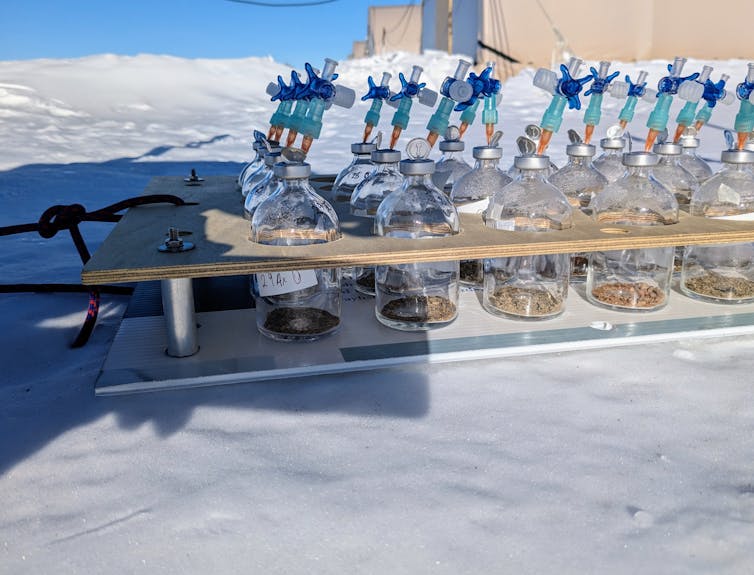
Source: The Conversation (Au and NZ) – By Ry Holland, Research Fellow in Microbial Ecology, Monash University Winter in Antarctica is long and dark. Temperatures remain well below freezing. In many places, the Sun sets in April and does not rise above the horizon again until August. Without sunlight, photosynthetic life such as plants, mosses

4 expert tips for family mealtimes without the drama
Source: The Conversation (Au and NZ) – By Nick Fuller, Clinical Trials Director, Department of Endocrinology, RPA Hospital, University of Sydney When you have young children, it can be tempting to feed them early, then sit down to a separate meal once they’re in bed. But setting a routine where you eat as a family,

Vanuatu newspaper faces football coverage ban after ‘lesbianism’ headline
By Kaya Selby, RNZ Pacific journalist Vanuatu’s only daily newspaper, the Vanuatu Daily Post, is facing a ban on covering future football league matches after publishing an article with the headline: “Former women’s coach says lesbianism is a reason Vanuatu women’s squad keeps losing”. The outlet ran a story on March 6 featuring an interview

Polls show federal Labor losing support; One Nation looking strong in Farrer seat poll
Source: The Conversation (Au and NZ) – By Adrian Beaumont, Election Analyst (Psephologist) at The Conversation; and Honorary Associate, School of Mathematics and Statistics, The University of Melbourne It’s over two weeks since the United States and Israel began their war on Iran. In the federal Resolve and Morgan polls, Labor has lost support to

The Iran crisis is hitting KiwiSaver balances – but market volatility can work for you too
Source: The Conversation (Au and NZ) – By Aaron Gilbert, Professor of Finance, Auckland University of Technology As well as checking the news for updates on events in the Middle East, many New Zealanders are also nervously checking their KiwiSaver balances. What they see is more than a snapshot of their own savings, it’s a

Why the next escalation in the Iran conflict could be between the US and Turkey
Source: The Conversation (Au and NZ) – By Ben Seymour, PhD Candidate in International Relations, Nottingham Trent University In the two weeks since the US and Israeli strikes on Iran began, Donald Trump’s war aims have fluctuated between crippling Iranian military capabilities and toppling the regime that has ruled there since 1979. But despite the

As the Oscars approach, Hollywood grapples with AI’s growing influence on filmmaking
Source: The Conversation (Au and NZ) – By Holly Willis, Professor of Cinematic Arts, University of Southern California I teach a course on AI and filmmaking at USC’s School of Cinematic Arts, and lately, rather than planning each session well in advance, I’ve been structuring the class the night before. I’ll browse platforms like X,

Secrets, sexism and hypocrisy: Bonfire of the Murdochs reveals the family’s real succession drama
Source: The Conversation (Au and NZ) – By Matthew Ricketson, Professor of Communication, Deakin University Does the world need another biography of Rupert Murdoch? It depends what it has to say and who has written it. Bonfire of the Murdochs, by journalist Gabriel Sherman, looks promising. He made his name with an exhaustively researched biography

South Australian election is likely to be Labor in a landslide. But who will be the opposition?
Source: The Conversation (Au and NZ) – By Clement Macintyre, Professor emeritus in politics, Adelaide University For the past six decades, South Australian politics has been characterised by long periods of Labor domination interrupted by short-lived Liberal governments. Since a record 32 uninterrupted years in office came to an end in 1965, the Liberal Party

Why Donald Trump is losing the war at home
Source: The Conversation (Au and NZ) – By David Smith, Associate Professor in American Politics and Foreign Policy, US Studies Centre, University of Sydney No US president in living memory has gone to war with less public support than Donald Trump has for the war in Iran. Even Barack Obama’s much-maligned Libyan intervention began with

Largest ever Parkinson’s study shows how symptoms differ between men and women
Source: The Conversation (Au and NZ) – By Lyndsey Collins-Praino, Associate Professor, School of Biomedicine, Adelaide University Parkinson’s disease is the fastest growing neurological disorder, with over 10 million cases worldwide. Up to 150,000 Australians currently live with the disease and 50 new cases are diagnosed each day. The number of people living with Parkison’s

There’s a new plan to help First Nations students from daycare to uni. What does it need to work?
Source: The Conversation (Au and NZ) – By Ren Perkins, Lecturer in Indigenous Education, The University of Queensland The federal government is promising a new policy to guide First Nations students right throughout their education careers. It will cover from the time they are in early childhood education right through to after they leave school.

Despite denials, there are signs the RBA does consider house prices in setting rates
Source: The Conversation (Au and NZ) – By Martin Duck, Post-Doctoral Research Associate, University of Sydney As households are squeezed by the cost-of-living crisis, central bank governors such as Jerome Powell in the United States and Michele Bullock in Australia are coming under repeated fire from politicians, pundits and households. Before each interest rate decision,

Kitchens are the heart of the home. What do all these bland luxury renovations lose?
Source: The Conversation (Au and NZ) – By Caroline Cumberbatch, PhD Candidate, School of Creative Arts and Media, University of Tasmania According to anthropologist Richard Wrangham, cooking fundamentally altered the human species. He claims the control of fire and the advent of cooking sparked significant biological changes (including brain development and digestive efficiency). This shaped

War on Iran: Australia should put trust in its neighbours not a modern Titanic rogue state
COMMENTARY: By Kellie Tranter The US-Israeli attack on Iran has unequivocally demonstrated to the world — apart, it seems, from Australia’s government — that being an ally of the US attracts potentially disastrous liabilities but confers few if any benefits. The US was manipulated into starting this illegal and unjustified war simply because Netanyahu planned

ER Report: A Roundup of Significant Articles on EveningReport.nz for March 15, 2026
ER Report: Here is a summary of significant articles published on EveningReport.nz on March 15, 2026.

Man charged with murder of Gisborne father who was shot dead in September

Source: Radio New Zealand

The arrested men will appear in court later this month, say police. RNZ / Angus Dreaver

Two men have been charged with the murder of a Gisborne father of four who was shot and killed last year.

Bill Maangi died in hospital after being shot at an address on Ormond Road in the early hours of 29 September.

Four people were arrested in December and charged with aggravated robbery, as well as firearm and drug related charges.

Gisborne police confirmed on Monday that two of those arrested people were now facing further charges.

A 25-year-old man has been charged with the murder of Maangi, and a 28-year-old man has been charged with party to murder.

Both men are due to appear in Gisborne District Court on 27 March.

Eastern District Criminal Investigations manager Detective Inspector Marty James thanked members of the public who responded to police appeals and assisted with “necessary information”.

“While this does not change the devastating loss that Mr Maangi’s family are coping with, I hope that holding these people to account will bring them some sort of closure,” Detective Inspector James says.

Sign up for Ngā Pitopito Kōrero, a daily newsletter curated by our editors and delivered straight to your inbox every weekday.

– Published by EveningReport.nz and AsiaPacificReport.nz, see: MIL OSI in partnership with Radio New Zealand

Leslie Parr revealed as man twice ruled insane after committing two separate killings

Source: Radio New Zealand

Leslie Parr. Supplied

A man who has twice been ruled insane after committing two separate killings can now be named.

RNZ can reveal the man is Leslie Raymond Parr, who killed two people more than two decades apart – beheading his partner Fiona Maulolo in 1997, and then in 2024 fatally stabbing his mother Heather Condon.

The revelations of a second killing prompted the Chief Victims Advisor to call for a Royal Commission of Inquiry into forensic mental health facilities.

A High Court judge said the offending occurred “against a backdrop of apparent significant failures in the mental health system”.

Parr’s family believes the mental health system let both him, and his mother, down.

RNZ earlier revealed the case, which had been shrouded in secrecy. However, an appeal against name suppression meant it was not possible to publish details about either killing. That suppression lapsed on Monday after the Supreme Court did not grant leave to appeal.

An appeal was heard in the Court of Appeal in August before president Justice French, Justice Campbell and Justice Collins.

In a decision released last year, the court dismissed Parr’s appeal. The court said the fact Parr had again killed someone closely connected to him whilst suffering from mental illness was a matter of “overwhelming public interest”.

It can now be reported that Parr killed his partner Maulolo in April 1997. Maulolo was decapitated with her head found in a plastic bag in a clothes dryer. Forensic evidence revealed Parr had driven a chisel multiple times into her heart before decapitating her.

Parr, who had a history of schizophrenia, told police he killed her after she told him to.

“She said she was Satan and I had to kill her,” he said.

Fiona Maulolo. Supplied

A year before the killing he was made a compulsory patient for six months after attacking a policeman. However, nine days later he was discharged by psychiatrist Linda Astor without even meeting him. Astor later fled the country and was unmasked as a bogus psychiatrist.

A jury found Parr not guilty by reason of insanity. A judge ordered he be detained in a special secure unit and not freed without the health minister’s authority.

A coroner later said Parr’s treatment had been seriously deficient.

To be released into the community after being designated a special patient, requires the sign off of the Minister of Health, the Attorney General and the Director of Mental Health. Parr was released back in the community in 2012. In 2021, his status was changed to being a patient under the Mental Health Act.

At the time of his second killing, he was subject to a Compulsory Treatment Order.

Health NZ earlier confirmed an external review of the care Parr received leading up to the offending was under way.

The house where Fiona Maulolo was found dead in 1997. Supplied

‘The second killing’

In the weeks leading up to his mother’s death, Parr’s mental health was “rapidly declining,” Justice Karen Grau said.

In May 2024, following an altercation between Parr and a relative he was admitted to a mental health facility.

He was released after around a week on 30 May. Following his release, he became preoccupied with the loss of his car keys and was having difficulties with relationship he was in. He was also using cannabis.

Court documents reveal that about 6pm on 4 June last year, Parr and his mother were at a property in Whanganui.

An incident occurred between the pair and Parr, armed with a knife, stabbed his mother in the chest.

He then left the address, driving his car to another address to see an associate, arriving about 6.20pm.

He then walked into the address and sat on the doorstep.

Parr asked his associate: “Cuz do you know where to get a gun?”

He said he needed a gun because the Mongrel Mob were after him. He then made a call to his sister, and a plan was made to go to Raetihi.

Parr and his associate left the property in Parr’s car. As they travelled past Whanganui Girls College, Parr told his associate: “Cuz I’ve killed mum”.

The associate stopped the car on the side of the road and asked Parr why.

“Mum’s possessed, Mum’s possessed. I had to do it. She killed your parents…” he replied.

The associate then exited the car and walked away.

Parr then got into the driver’s seat and drove off.

The associate went to a nearby petrol station to get a $20 top up and called a friend. The two men then went to the Whanganui Police Station and reported what Parr had told them.

Police went to Condon’s property where they found her dead in the garden behind the porch.

She had a white handled knife sticking out of the right side of her chest through her clothing.

Parr was arrested by police shortly before 2am on June 5. When he was advised he was under arrest for murder he said “yes, I know”.

‘Mentally impaired’

Justice Karen Grau ruled that Parr was legally insane at the time he caused his mother’s death in April last year.

In her judgment, Justice Grau addressed Parr’s family.

“Understandably there is shock, disbelief, and grief for Heather who was taken too soon, a fit, yet elderly woman deeply involved in her whanau and in her community.

“The whanau understands that insanity has played a role, but again, understandably, the feeling remains that this was a cruel and heartless act. The whanau feels that the mental health system has failed Mr Parr and has failed his mother.”

Justice Grau said the criminal charge “could not unpick what has happened in the system and what could and should have done, but it is hoped that answers will come, both for the whanau and for the wider community”.

Parr was described as someone who “loved his mother very much and would do anything for her,” Justice Grau said.

“He was a caring person when he was well, but at the time Ms Condon died, he was clearly unwell.”

Name suppression

Parr’s whānau requested permanent name suppression for Parr and his mother.

Justice Grau said that while she had the “utmost sympathy” for the whānau, she was unable to grant suppression.

She said there were two reasons why she declined name suppression.

Firstly, Parr’s name and details of his first killing had already been reported which would not change if she made an order for suppression in relation to his mother’s death.

“The second is that this is a case where the public interest in open justice must prevail. There is rightly a high degree of public interest in learning of the circumstances in which a person who has been released into the community under the supervision of mental health services has gone on to kill again. While this case represents a family tragedy, it also represents a wider tragedy to the community.”

Justice Grau said it was a case where Parr had killed another person while suffering from mental illness “against a backdrop of apparent significant failures in the mental health system”.

“These are matters that the public has an interest and an entitlement to know about.”

Parr also posed an “ongoing and serious risk to public safety”.

An appeal was then made against Justice Grau’s decision to not order any suppressions.

‘Overwhelming public interest’

In its decision, the Court of Appeal said tikanga may assist courts in determining whether or not an applicant had demonstrated they would suffer extreme hardship or whether a victim had established they would suffer undue hardship if name suppression was declined, and in assessing the extent of that hardship.

“But, even assessing the hardship of Mr Parr’s whānau through that tikanga lens, we are not persuaded that that hardship outweighed the strong public interest in open justice in this case.”

The Court agreed with Justice Grau that there was an “overwhelming interest” in giving supremacy to the principles of open justice.

“Mr Parr’s name is already known to the public in connection with the killing of Ms Maulolo and the profound failings of the mental health system which contributed to that tragedy. The fact that Mr Parr has again killed a person closely connected to him whilst suffering from mental illness is a matter of overwhelming public interest.”

The Court said while the media had been able to convey a lot of information about Parr’s actions without naming him or his mother, further inquiries and the inquest into Condon’s death would be “hampered” if it was not possible for authorities to openly identify Parr.

The public also had a right to know about Parr’s “distressing history of violence”, in order that they are aware of the risks he may pose if he was ever released into the community again.

The Court added that Maulolo’s family had a “unique interest” in knowing, and being free to discuss, that Parr had killed another person closely connected to him.

“These factors overwhelmingly lead us to conclude that the hardship suffered by the whānau does not outweigh the principle of open justice in this case.”

Review under way

Health New Zealand (HNZ) national director of mental health & addictions enhancement, Phil Grady, said on Monday the case was an incredibly tragic event.

“Our thoughts remain with the family, friends and communities affected. On behalf of Health New Zealand, I extend our heartfelt sympathies to everyone impacted,” Grady said.

“It is completely understandable that people feel let down and are seeking answers. We acknowledge those concerns and want to approach them with openness and respect, while recognising the deep impact this has had on both victim’s loved ones, the wider community, and the staff involved in Mr Parr’s care.”

Grady said HNZ also recognised that questions had been raised about aspects of Parr’s care and the decisions made at the time.

“These were complex clinical decisions based on the information available, and the external review has carefully examined those concerns.

“Where the review has identified areas that could be clearer or stronger, such as expectations around drug screening, information sharing, and clinical oversight, we are acting on those findings to improve consistency and strengthen practice across the service.”

Health NZ reviewed every serious adverse event that occurs within its services, and were committed to learning from them, he said.

“An external review of the care Mr Parr received leading up to this event is currently being finalised, led by senior Health NZ staff from outside the Central Region to ensure independence.

“We are committed to implementing any recommended changes so that we continue to strengthen the quality and safety of the care we provide.

“Events of this nature are incredibly tragic, but when they occur, we take them extremely seriously. The learning from this event is already informing improvements across the service, including strengthening clinical leadership, improving information sharing, clarifying clinical protocols such as drug screening, and enhancing whānau engagement and staff training.”

Mental health care in the community was complex, and risk could never be removed entirely, he said

“Especially in the case of serious mental illness, but these improvements are designed to strengthen safeguards and provide reassurance to the people we care for, their whānau, and the wider community.”

Mental Health Minister Matt Doocey said in a statement his thoughts were with the families impacted.

“I have made it very clear to HNZ that patient and public safety must always be paramount, clearly situations like this are not good enough. New Zealanders deserve to have trust that when people are in the care of mental health services, the appropriate care is being taken to ensure patient and public safety is at the forefront of all decisions,” he said.

“As Minister, my focus is on ensuring agencies put in place all necessary changes to prevent tragedies like this from occurring again. I have made it very clear to Health New Zealand that they must move quickly to implement the findings of the reviews and make all necessary changes to prevent this from happening again.”

Doocey was awaiting the Director of Mental Health’s decision on whether he was satisfied with the review and whether any further action needs to be taken.

The Ministry of Health also extended its deepest sympathies to the families, friends and communities affected by these tragic events.

Following Parr’s second killing Health New Zealand commissioned an external review into the care provided to the individual.

“Health New Zealand has already made changes since the incident, and I support their work,” Director of Mental Health Dr John Crawshaw said.

He said the external review was being led by an external expert panel and is near completion.

“Once the external review is available, I will carefully consider whether any further actions are required.”

TIMELINE:

August 1995: Parr was admitted to hospital under the mental health act after twice cutting his wrists and attempting to hang himself. After attacking a policeman in 1996 he was made a compulsory patient.

March 1996: Less than two weeks after being made a compulsory patient Parr was discharged from Hutt Hospital by psychiatrist Linda Astor without even meeting him. Astor later fled the country and was later unmasked as a bogus psychiatrist.

April 1997: Leslie Parr, 27, killed Fiona Maulolo, 31 in Naenae. Maulolo was his partner. A jury found him not guilty by reason of insanity. A judge ordered he be detained in a special secure unit and not freed without the health minister’s authority.

August 2002: Coroner Garry Evans releases a damning report into Parr’s psychiatric care, finding it was seriously deficient.

Parr was released back in the community in 2012.

In 2021, Parr’s status was changed to being a patient under the Mental Health Act.

May 2024: Parr was admitted to a mental health facility following an altercation with a relative. He was released about a week later on May 30.

4 June 2024: Parr kills his mother, Heather Condon.

April 2025: Justice Karen Grau finds Parr not criminally responsible for the death of his mother on account of insanity. He is detained in a hospital as a special patient under the Mental Health Act.

Sign up for Ngā Pitopito Kōrero, a daily newsletter curated by our editors and delivered straight to your inbox every weekday.

– Published by EveningReport.nz and AsiaPacificReport.nz, see: MIL OSI in partnership with Radio New Zealand
Average 91 petrol price surges past $3 as Willis slams EV subsidies

Source: Radio New Zealand

Finance Minister Nicola Willis. Nick Monro

Drivers are being urged not to panic-buy fuel amid going concerns about rising prices.

Meanwhile, Finance Minister Nicola Willis stands by her government’s decision to stop the electric car rebate scheme, as she looks at how the government could respond to rising prices.

Petrol stations across the country are seeing a surge of drivers filling up as petrol prices rise.

Petrol price monitoring app Gaspy says the average price of 91 petrol is now above $3 and has risen 20 percent since the start of the month.

Spokesperson Mike Newton said the average national price at the start of March was about $2.50 per litre.

He said it had been rising quickly.

Petrol has tipped over the $3 a litre mark in some areas. RNZ / Dan Cook

The rise in prices was largely due to the conflict in the Middle East.

US President Donald Trump is calling for countries to send ships to secure the Strait of Hormuz, which is effectively closed as Iran launches attacks to halt maritime traffic.

The area is critical because around 20 percent of the world’s oil consumption or 20 million barrels a day, usually passes through it.

It’s resulted in several petrol stations running dry over the weekend.

Newton said most of the petrol stations running low on gas seemed to be Gull.

“It’s not a supply problem, they have plenty of fuel in the tanks. It’s just they have to get it into the tankers and get it to the stations. Hopefully we’ll start to see that be alleviated in the next couple of days.”

He said the average price was now just 6c away from the level it reached when the Government cut the fuel excise tax, after the Russian invasion of Ukraine.

“We’re starting to get into that territory and this government has said they’re less interested in doing that… so it’ll be interesting to see when the pressure starts to build.”

Finance Minister Nicola Willis told Morning Report the government was carefully monitoring fuel stock levels.

New Zealand has around 32 days’ worth of fuel in the country and 25 days in ships on the way to the country.

“There is no current issue with the availability of fuel,” Willis said. “Were that to be the case, we would get very good forewarning because we would be aware of fuel companies reporting to us that orders had been disrupted or cancelled. They have not made any reports of that sort to us at this stage.

If we got that warning, Willis said we would have several weeks to plan for it.

“This is why we have these minimum stock holdings in the country, so we don’t get ourselves into a panic situation.”

She said the government hasn’t needed to review its sanctions on Russian-origin oil.

“This is, obviously, an event that is unfolding; if there are changes in that position, we will review them when they occur.”

Demand at Waitomo petrol stations has increased by 15 percent. RNZ/Nikki Mandow

Waitomo CEO Simon Parham said demand at the company’s petrol station has increased by about 15 percent.

“We’ve had the odd run out from here and there, but it’s really been for a maximum of 30 minutes,” he told Morning Report.

“What we are seeing is that increase in demand, coupled with a very stressed driver system, anything from a delay at the terminal to a truck breaking down, it’s just caused that slight delay in he system, so you have a slight run out.

“There’s nothing to worry about.”

He expects to see the demand soften.

“We’re still in good shape… There’s no need to panic. Yes, we are suffering from high prices, which is tough on everyone, but there is no need to panic at the moment.”

He said if the cargo orders can’t be placed, that’s when New Zealand may need to look at managing stock.

“If we are staying around that 50-day mark, that’s a rolling 50 days, then we’re fine. If we start to see that drop back, then that’s when we have to manage stock,” Parham said.

Westpac chief economist Kelly Eckhold said next month will be very difficult if things don’t improve.

“The refiners in Asia are going to run out of feed stocks to be able to continue to produce at the levels we are used to,” he said.

“I think if we are sitting here in mid-April and things haven’t improved, I think we will be looking at the possibility that everybody is just going to have to rein things in a bit.”

Brent crude has been sitting around US$100 a barrel, but if it reaches US$150 a barrel, Eckhold said that’s when the real damaging impacts on businesses and consumers would be seen.

Finance Minister considering govt response to rising prices

Willis has shut down suggestions of temporarily cutting the fuel excise tax, as the Labour government previously did in response to the Russia-Ukraine war, saying it was too broad.

She said she was closely looking at the cost of living impacts the rise in fuel prices has on lower-income working New Zealanders.

Finance Minister Nicola Willis said the government was carefully monitoring fuel stock levels. RNZ / Samuel Rillstone

“When the petrol prices go up this much, that has an effect on the cost of living, particularly for working New Zealanders who use their cars to get to work. We are very conscious of that and are considering whether a government response is warranted,” Willis said.

Willis stands by her government’s decision to remove the electric vehicle rebate.

She said the rebate was very untargeted.

“I simply don’t accept the idea that giving subsidies to millionaires in Remuera would help those afflicted by high petrol prices,” Willis said.

She said if the government were to give support, it would be targeted, temporary and timely.

Willis said she has not taken advice to Cabinet yet on these matters.

The owner of a bus company said more people could opt for public transport over private vehicles.

Kiwi Coaches owner Dayton Howie told Morning Report petrol price rises were cutting into margins.

He said the costs were currently being absorbed, but it was unclear how long that could last.

Howie said students could miss out on school trips if fuel prices keep going up.

Sign up for Ngā Pitopito Kōrero, a daily newsletter curated by our editors and delivered straight to your inbox every weekday.

– Published by EveningReport.nz and AsiaPacificReport.nz, see: MIL OSI in partnership with Radio New Zealand

New Zealand costume designer adds Oscar to trophy case

Source: Radio New Zealand

The golden statue joins the Bafta award that she bagged last month for the same film.

“On behalf of myself and the amazing team that I work with – the artisans, the alchemists, the dream weavers – we are so grateful to the Academy for recognising our craft,” Hawley said in accepting her award on Monday.

“I’m so so grateful and thank you very much for recognising our craft.”

When Hawley signed on forFrankenstein her third collaboration with director del Toro, she knew it would be special, she previously told RNZ’s Nine to Noon.

“I can really look back on it and be very thankful for the project, it was a wonderful project to be on, it was a very, very special collaboration.”

Hawley, who studied at the Wellington School of Design before being trained at London’s Motley School of Theatre Design, says the adaption of Mary Shelley’s gothic classic was a project long in the making for director del Toro.

The script, she says, is her “Bible”, the starting point for her costume ideas.

“That first few precious moments you get to read that script, I try and lock myself away and just be in the world that they’re creating and try and visualise what it is my director’s trying to do.”

Del Toro’s script for Frankenstein was particularly evocative, she says.

“I think the thing that inspired me most was the tone; there’s this beautiful tone and mood and atmosphere that was created.”

Hawley’s work has been seen in other movies, including Edge of Tomorrow, Mortal Engine, Suicide Squad, Pacific Rim, Crimson Peak and The Lovely Bones.

– Published by EveningReport.nz and AsiaPacificReport.nz, see: MIL OSI in partnership with Radio New Zealand

Willis reveals how bad inflation could get as petrol surges past $3

Source: Radio New Zealand

Finance Minister Nicola Willis is downplaying the economic risks New Zealand faces in the wake of the war in the Middle East and closure of the Strait of Hormuz.

She warned on Monday of potential “acute cost of living pressures” ahead, but said fuel excise tax would not be cut, partly because it would encourage people to use more petrol.

Asked about the “worst case scenario” predicted by Treasury – Willis said she had been told in the event of a prolonged conflict in Iran, inflation in New Zealand could reach 3.7%.

She said ministers were meeting daily on the issue, two-and-half weeks into the US-Israeli assault on Iran.

“We’re also going ahead with a weekly strategic meeting at which further decisions are being taken. We’re also receiving written situation updates twice daily. And of course, I updated Cabinet today on our strategy to date.”

Finance Minister Nicola Willis explains government’s plan as petrol prices increase. RNZ / Samuel Rillstone

Willis said there were three parts to the strategy – first, a focus on “mitigating the impact of the war on critical supply chains”.

She said on 8 March, when the last update from the Ministry of Business, Innovation and Employment was issued, there was enough petrol either in the country or on the way for 57 days; diesel, 49 days and jet fuel, 47 days.

Thirteen vessels were on their way to New Zealand already, and three more set to leave soon.

The next update was due on Wednesday, and Willis said work was underway to make releases more frequent.

“It has been observed and reported on that demand at some petrol stations has increased, and we will factor that into our future updates.”

She said New Zealand’s largest fuel import terminal had not seen “any issues” with supply.

“Petrol prices have risen about 45 to 50 cents a litre, adding about $23 to the cost of filling an average car. We are acutely conscious of the impact this will be having for many New Zealanders.

“Diesel prices have risen about 72 cents a litre, adding about $36 to the cost of filling an average diesel vehicle.

“Despite these increases, prices are still slightly below their 2022 peak, although it is reasonable to assume they could go higher.”

Willis said the government was “anticipating, and to the extent possible mitigating the impact on the New Zealand economy, including what could potentially be acute cost of living pressures for some households”.

She said she had spoken to bank bosses who had assured her they would provide “an umbrella to businesses” they worked with.

“From the government’s point of view, we need to ensure that any support we provide to households is temporary, is targeted and is timely.”

She said official advice was that reducing fuel excise would “send the wrong signal” and not be sufficiently targeted.

More to come…

Sign up for Ngā Pitopito Kōrero, a daily newsletter curated by our editors and delivered straight to your inbox every weekday.

– Published by EveningReport.nz and AsiaPacificReport.nz, see: MIL OSI in partnership with Radio New Zealand

Microbes in Antarctica survive the freezing and dark winter by living on air

Source: The Conversation (Au and NZ) – By Ry Holland, Research Fellow in Microbial Ecology, Monash University

Winter in Antarctica is long and dark. Temperatures remain well below freezing. In many places, the Sun sets in April and does not rise above the horizon again until August. Without sunlight, photosynthetic life such as plants, mosses and algae cannot make energy.

But that’s not to say all life stops.

In a new study published in The ISME Journal, my colleagues and I show that Antarctic microbes make energy from the air at temperatures as low as –20°C. This finding improves our understanding of how life survives at temperature extremes in Antarctica – and how climate change will affect this important process.

How to make energy from air

In 2017, scientists showed that a large number of Antarctic microbes can generate energy from atmospheric gases present at very low concentrations.

This process is called “aerotrophy”. By using enzymes that are very finely tuned to “sniff out” the hydrogen and carbon monoxide in the atmosphere, these microbes have found a way to make energy from the air itself – a huge advantage in Antarctica’s nutrient-poor desert soils.

What remained unknown until now was the temperature limits of this process. Could aerotrophy be a way to power the continent’s soil communities through the winter?

Yellow tents pitched on white snow, with rocky mountains in the background.

Field camp in Dronning Maud Land, Antarctica. Braydon Moloney/Northern Pictures

Taking the lab down south

Measuring how quickly these microbes consume such a small amount of fuel can be difficult.

From 2022–24, we collected surface soil samples from different areas across East Antarctica and analysed them in our lab.

We measured how quickly they can use the atmospheric gases. We also extracted all the DNA from the soil microbes and sequenced it. This tells us what microbes are present, what genes they have, and what they are capable of using as energy sources.

We showed aerotrophy happening in the lab at representative summer (4°C) and winter (–20°C) temperatures. This means hydrogen and carbon monoxide are a viable food source not just over the summer months, but year-round. What was even more surprising though, was the upper temperature limit.

Soil temperatures in Antarctica rarely rise above 20°C. Yet we found microbes in these soils that continued to generate energy from hydrogen up to a staggering 75°C. It seems as though microbes in Antarctic soils are well adapted to the continent’s cold temperatures, but not restricted to them. It’s a bit like seeing a penguin thrive in a tropical jungle.

We also wanted to see this process occurring in Antarctica itself, so two years ago we brought the lab down south. We collected fresh soil samples, sealed them in the glass vials, and took gas samples.

For the first time, it was clear that under real-world conditions these soil microbes were still munching their way through hydrogen.

A researcher wearing a beanie and puffy jacket, sitting on snow in front of a tray of vials.

Ry Holland measuring gas consumption of soil microbes. Braydon Moloney/Northern Pictures

The primary producers of Antarctica

DNA sequencing has showed us that the vast majority of microbes in Antarctic soils encode the genes to gain energy from hydrogen. Many of these bacteria also have genes to take carbon from the atmosphere.

These aerotrophs are “primary producers”, generating new biomass from the air itself.

In most land-based ecosystems, photosynthesis is thought to be the bottom of the food chain. Photosynthesis takes energy from sunlight and carbon from the atmosphere and turns it into yummy organic compounds.

It’s what makes plants grow. Plants are primary producers that are eaten by herbivores, which are then eaten by carnivores.

In Antarctica’s desert soils, photosynthesis is relatively rare. Instead, we hypothesise that aerotrophy fulfils the primary producer role in many places.

This makes sense because, unlike sunlight-dependent photosythesis, we now know that aerotrophy can happen year-round. Another benefit is that it doesn’t require liquid water, whereas photosynthesis does.

A set of glass vials each containing small amounts of soil, sealed at the top and with a needle and stopcock sticking out of each one. The vials are arranged in a rack sitting on the snow.
Soil samples were incubated in glass vials in Antarctica, to show the microbes consuming atmospheric gasses under real world conditions. Ry Holland

Hydrogen in a heating world

Aerotrophy clearly has an important role in Antarctic ecosystems. So next, we wanted to determine how global warming might affect this process.

Under low-emissions scenarios, we predict a 4% increase in how quickly aerotrophs use atmospheric hydrogen. Under very high-emissions scenarios, this increase rises to 35%. The numbers are similar for carbon monoxide.

Although hydrogen isn’t a greenhouse gas itself, it is important because it affects how long some greenhouse gases, including methane, hang around in the atmosphere.

Soils (including the microbes that live in them) are responsible for 82% of all hydrogen consumed on Earth globally. In other words, they are a hydrogen sink. This is a crucial component in the global hydrogen cycle.

There are a lot of factors that determine how microorganisms will respond to climate change. Temperature is just one of them. This study is an important piece of the puzzle as scientists figure out how resilient Antarctica’s unique microbal ecosystems are.

ref. Microbes in Antarctica survive the freezing and dark winter by living on air – https://theconversation.com/microbes-in-antarctica-survive-the-freezing-and-dark-winter-by-living-on-air-276384

College hooper to Super Rugby: Tevita Latu’s long road to Moana Pasifika

Source: Radio New Zealand

Tevita Latu took a roundabout route to Super Rugby. Alan Lee / www.photosport.nz

Moana Pasifika midfielder Tevita Latu has taken one of the more unusual routes to Super Rugby.

A duel-sporting star in high school, Latu was not short on offers upon leaving Pakuranga College.

With both rugby and basketball career paths in front him, Latu chose the court, playing college basketball in the Philippines.

But after struggling with homesickness in the Philippines, he returned to Aotearoa and switching back to his first sporting love.

Back home, there were challenges of different kind for Latu. He admits he was not ready for the demands of pro rugby, and bounced around the provinces.

The 27-year-old spent four years in Southland, and a season in Northland and Canterbury before Moana came calling.

“I didn’t really know what it took to be a professional rugby player and to have all these obstacles, you can take the wrong path, and then you learn from it. But I wouldn’t change it for a thing now. I think it’s moulded me into the person I am today.”

Latu said he struggled with off field discipline during his early years in the NPC.

“Just living life, and diet in the off season. But that’s what got me here, I’ve learned from those mistakes.”

Latu earned his first NPC contract with Southland in 2020. Photosport

Self doubt had also been a barrier for the Moana midfielder, something he said his parents helped him to overcome.

“I think definitely have pushed through it. They’ve always believed in my abilities to be here, especially when I don’t really believe in myself.”

Family has been a key grounding force for Latu, having become a father in early 2025.

“I’ve got a baby boy now and that’s helped. Playing full-time and being a dad at the same time, it’s been cool.”

Latu also has senior figures within the squad to lean on for advice, including former All Blacks Julian Savea and Ngani Laumape.

Latu made the move north to the Taniwha in 2024. Photosport

“I have no problems going to them, asking any questions. They probably get annoyed because I ask so many. That’s the sort of experience that they tend to bring.”

His sporting career was on an entirely different trajectory out of high school.

A rugby and basketball star, Latu opted to take up a scholarship to play college ball in Manila.

“It was just a big shock,” he said.

“It was my first time moving out of home and didn’t know much about the country and was so fixed on how Americans go about their college life, then get to the Philippines was completely different, the lifestyle there was pretty different, but that was pretty cool.”

Feeling homesick, Latu returned home but said he has no regrets about his time overseas.

“I just thought I’d give it a crack, and I’m happy I did.”

The basketball gene runs strong in the Latu whanau, his younger brother Noa currently playing for the Auckland Tuatara.

Latu was playing NPC for Canterbury when he was signed by Moana Pasifika. www.photosport.nz

Now settled back in his hometown on his first Super Rugby contract, Latu said Moana are determined not to let the standards of 2025 slip, despite a rough start to the season which has seen them sink to the bottom of the table.

“I think we’ve always had a point to prove. From day one, they’ve kind of had to show that they actually belong here, so it hasn’t been anything different to us. What’s different is just the sense of urgency from us now.”

The side has been battling with plenty of off field distractions as well, including the speculation that their coach Tana Umaga is set to be snapped up by the new All Blacks regime.

“It’d be pretty cool to see him get the promotion. I think the club would be real gutted to lose him, but I know he’ll have the full backing of the team if he does go on. We haven’t really made him look too flash lately, I think that’s on us to get him that backing from the people. If they do question why he’s being selected, we need to do a job send him off in the right way.”

Sign up for Ngā Pitopito Kōrero, a daily newsletter curated by our editors and delivered straight to your inbox every weekday.

– Published by EveningReport.nz and AsiaPacificReport.nz, see: MIL OSI in partnership with Radio New Zealand

Services recovery hits brick wall

Source: Radio New Zealand

The services sector recovery has come to an abrupt halt after only two months in expansion. 123RF

  • Services sector slumps into contraction
  • All five sub-indices retreat
  • Negative comments stay elevated
  • BNZ says PSI “a real disappointment”.

New Zealand’s services sector recovery has come to an abrupt halt after only two months in expansion.

The BNZ-BusinessNZ Performance of Services Index (PSI) fell by 2.7 points to 48.0 in January, below its long‑term average of 52.8.

A reading below 50 indicates the sector – which accounts for nearly three‑quarters of the economy – is contracting.

BusinessNZ’s chief executive Katherine Rich said that the service sector’s expansion had only lasted two months, and February’s result was similar to the levels of contraction seen towards the end of 2025.

All five sub‑indices fell into contraction.

Stocks/inventories recorded the deepest pullback at 46.7, followed by employment at 47.2. Activity/sales slid sharply to 47.9, and new orders/business dropped back below 50 to 49.3

The share of negative comments eased slightly to 56.4 percent in February, down from 58.7 percent in January.

Firms cited weak economic conditions, high living costs, inflation and interest rates suppressing consumer spending and demand.

BNZ’s senior economist Doug Steel said that bad weather in February may have played a part, but there was no denying that today’s PSI suggested that the economy is recovering at a slower pace than expected.

“The PSI comes as a real disappointment given that Friday’s Performance of Manufacturing Index (PMI) was relatively upbeat,” he said.

Steel said most indicators over recent months had pointed toward a slow recovery, but today’s release underlined how fragile that recovery remains.

The slow momentum, combined with uncertainty stemming from developments in the Middle East, leaves the inflation outlook “well and truly up in the air”.

Sign up for Ngā Pitopito Kōrero, a daily newsletter curated by our editors and delivered straight to your inbox every weekday.

– Published by EveningReport.nz and AsiaPacificReport.nz, see: MIL OSI in partnership with Radio New Zealand

4 expert tips for family mealtimes without the drama

Source: The Conversation (Au and NZ) – By Nick Fuller, Clinical Trials Director, Department of Endocrinology, RPA Hospital, University of Sydney

When you have young children, it can be tempting to feed them early, then sit down to a separate meal once they’re in bed.

But setting a routine where you eat as a family, for even a couple of nights a week, can lay the foundations for healthy eating habits, positive relationships with food and social skills that extend into adulthood.

Here’s why – and how you can make family mealtimes with young children more manageable.

Reducing fussiness

Preschool-aged children who regularly eat with their families eat more fruit and vegetables and are less likely to develop fussy eating habits.

One reason is children learn through observation. When parents and older siblings eat and enjoy a wide variety of foods, children are more likely to try and accept those foods themselves.

Allowing children to touch, explore and play with food in their first year supports sensory development and confidence with eating. It can be messy – much of the food will end up on faces, hands or the floor – but this exploration is a normal and valuable part of learning to eat.

Family meals provide repeated, low-pressure opportunities for children to become familiar with a variety of foods. Over time, this exposure can increase acceptance of foods that they initially refuse.

Tuning into hunger cues

Regular family meals create predictable eating routines. And eating at the table, rather than in front of screens, helps children pay attention to hunger and fullness cues, reducing the likelihood of overeating.

Children who share family meals at least three times a week are more likely to eat nutrient-dense foods, maintain a healthy weight, and are less likely to have disordered eating.

Learning social skills

A relaxed, supportive mealtime helps children develop positive attitudes to food and encourages exploration without pressure.

Family mealtimes are opportunities to slow down and connect. Studies link regular shared meals with improved communication, greater family closeness and stronger self-esteem in children.

Mealtimes also play an important role in teaching table manners, and self-regulation of their emotions and the amount of food they’re eating. Observational research suggests everyday family meals are a key setting in which children learn how to sit, use cutlery and engage appropriately at the table, helping them learn broader expectations about interaction and self-control that extend beyond eating.

4 ways to make meal times manageable

Having young children at the dinner table can be challenging. Here are four tips to make them more manageable:

1. Be realistic

Modern life’s demands make it unrealistic for everyone to be around the table for every meal. So, set a target that works for your family, such as having three family dinners weekly. If someone works nights, make breakfast your shared meal.

But put devices away so everyone’s focused on eating and connecting.

2. Don’t create separate meals

It’s tempting to make different meals for toddlers, but this creates unnecessary work and can establish fussy eating.

When families eat together, meals are more likely to be home-cooked and nutritionally balanced. They tend to involve planning and preparing one dish for everyone, rather than relying on convenience or “fast” food.

Children are more open to trying new foods when there’s something familiar on their plate. Try tweaking family favourites by swapping ingredients, such as using lentils instead of beef in bolognese or roasting carrots to make “orange chippies”. Grating veggies into sauces also expands kids’ diets without overwhelming them.

3. Abandon rules that have never worked

Many of us remember being required to finish everything on our plate or be denied dessert unless we ate our vegetables. While well-intentioned, these coercive food practices can teach children to eat in response to external pressures rather than internal hunger and fullness cues.

Coercive food practices among parents are associated with poorer self-regulation of eating and emotional overeating in young children.

Over the long term, studies link these experiences in childhood with less intuitive eating and more disordered eating behaviours in adulthood. So these old-school rules can have lasting effects.

Simply offer the family meal and allow them to dictate how much they eat.

4. Involve your child and make food fun

Including children in preparation and serving gets them interested in and used to family mealtime routines. Ask them to pick healthy recipes and complete child-appropriate tasks such as washing veggies. When they’re old enough, ask them to set the table.

Younger children often respond well when healthy foods are presented in playful, engaging ways. Try offering a mix of colours, textures and shapes to keep their interest.

Switching up the setting can help too – even a simple picnic in the backyard or local park can make mealtimes feel fresh, special and fun.


Nick Fuller is the author of Healthy Parents, Healthy Kids – Six Steps to Total Family Wellness. His free, practical recipe ideas can be found at feedingfussykids.com.

ref. 4 expert tips for family mealtimes without the drama – https://theconversation.com/4-expert-tips-for-family-mealtimes-without-the-drama-257626

Vanuatu newspaper faces football coverage ban after ‘lesbianism’ headline

By Kaya Selby, RNZ Pacific journalist

Vanuatu’s only daily newspaper, the Vanuatu Daily Post, is facing a ban on covering future football league matches after publishing an article with the headline: “Former women’s coach says lesbianism is a reason Vanuatu women’s squad keeps losing”.

The outlet ran a story on March 6 featuring an interview with a former women’s team coach, Emmanuel Vatu, that criticised in-team relationships as an occasional distraction.

While Vatu had not been quoted directly, the Vanuatu Daily Post ran the story with a social media caption that blamed “lesbianism” for poor results by the women’s national team, who lost all three group games in the FIFA Women’s World Cup 2027 Oceania Qualifiers held in Fiji.

“Sexual relationships with teammates would lead to distraction during matches,” the newspaper reported.

“He witnessed his players at the time, more focused on their personal relationships off the field, rather than developing their skills on the field.”

In response, Vanuatu Football Federation (VFF) released a statement, saying that the comments were “defamatory” and denigrating to female players.

“They have every right to pursue the necessary means to address these negative and harmful comments,” a statement read.

‘Committed to equality’
“We will not allow such rhetoric to diminish the achievements and contributions of our women’s team. We remain committed to promoting equality and ensuring football is a welcoming environment for all.”

On March 9, the Vanuatu Daily Post reported that VFF president Lambert Matlock, who is also the president of the Oceania Football Confederation, had threatened to ban their journalists from their games via email.

Lead reporter Mavuku Tokona told RNZ Pacific they are unapologetic.

“In his interview [Vatu] actually emphasised the fact on how many women that are involved [in] sexual relations on the field,” Tokona said.

“He said it’s explosive, or something along those lines.”

Tokoma said the term “lesbian” was used as a catch-all term because there is no word for it in Bislama.

“In order to encapsulate all of that, we had to phrase it that way.”

Ban effectively begun
He said the ban has effectively begun, with his reporters missing out on invites as of Wednesday last week.

Tokona said the “lesbian” comments were just an excuse for years of mistreatment by the VFF.

He believes the Vanuatu Daily Post has been given the cold shoulder by sports bodies because they ask tough questions, saying he often relied on his competitors to stay in the loop.

“There was a strategic launch of the National Women’s Team, and they decided not to invite us,” he said.

He said when a “small female” reporter from the newspaper headed along despite not receiving an invitation, she faced “verbal abuse”.

“They usually heckle her while she’s walking in, threaten her, intimidate her . . .  I usually force her to go anyway,” Tokona said.

The VFF has been approached for comment.

This article is republished under a community partnership agreement with RNZ.

Article by AsiaPacificReport.nz

IRD issues warning over employers failing to pass on tax deductions

Source: Radio New Zealand

The department has issued a “revenue alert” which are are issued when there are significant or tax issues. Supplied

Employers are being warned that they could be sent to prison if they take tax from their employees’ pay and do not send it to Inland Revenue.

The department has issued a “revenue alert” over the failure of some employers to pass on PAYE deductions.

These alerts are issued when there are significant or emerging tax issues of concern.

Employers must pay PAYE, as well as any other deductions from employees’ salaries, by the due dates. If they do not, they can face up to five years in prison.

Anyone who aids, abets, incites, or conspires with another person to commit to do that also commits a criminal offence. This means, for example, that the director of a company who decides that the company will not pay the deductions to Inland Revenue may be prosecuted for the company’s failure to pay.

Robyn Walker, tax partner at Deloitte, said it was a timely reminder that not paying PAYE was a really bad thing to do and the consequences could be serious.

“Historically it was always the case that not paying PAYE was an extremely frowned upon action, as this is tax which is being deducted from employee’s pay and held on trust by the employer. This is conceptually different to if a business is having trouble paying its own company tax bill, because it is other people’s money.

“Rightly or wrongly, during the Covid years there was more leniency applied to PAYE payments, and so some employers may have begun taking a more casual approach to paying PAYE. This can be seen in the statistics of what makes up tax debt – In September 2000 there was $800m of ’employer’ tax debt, the June 2025 statistics put this at $2m now.”

IR said it had taken legal action that had resulted in people being sent to prison.

In one case, a Christchurch woman was jailed for three years for taking $1.6 million from employee wages and not passing it on to the tax department.

Sign up for Money with Susan Edmunds, a weekly newsletter covering all the things that affect how we make, spend and invest money

– Published by EveningReport.nz and AsiaPacificReport.nz, see: MIL OSI in partnership with Radio New Zealand

Mass resignations rock Solomon Islands government

Source: Radio New Zealand

RNZ / Samuel Rillstone

Ten Solomon Island Cabinet ministers have tendered their resignation in an apparent coalition breakdown.

RNZ Pacific understands that Deputy Prime Minister Frederick Kologeto and every member of the Peoples First Party (PFP) are among them.

Others include Finance Minister Harry Kuma, Justice Minister Clezy Rore and Health Minister Paul Popora Bosawai.

A spokesperson for Government House confirmed that the resignations were received at quarter past nine last night.

Solomon Islands Governor-General Sir David Tiva Kapu is now giving the ministers until 12pm (today) Monday to re-consider their choices.

Prime Minister Jeremiah Manele now faces a third threat to his leadership, having survived a motion of no confidence in April 2025 after six ministers and five government backbenchers walked away.

The opposition grouping would need a majority of 26 in the House to pass such a motion.

The Prime Minister, Deputy Prime Minister and Opposition Leader Matthew Wale have been approached for comment.

– Published by EveningReport.nz and AsiaPacificReport.nz, see: MIL OSI in partnership with Radio New Zealand

Fuel crisis: Which foods will rise in price fastest, and when?

Source: Radio New Zealand

RNZ

Food prices are likely to rise if war in the Middle East keeps pressure on oil prices – but some types of food may be more affected than others.

Infometrics chief forecaster Gareth Kiernan looked at which sectors might be most exposed by comparing the proportion of their costs devoted to oil-based fuels.

He said the fishing sector was top of the list. It spent about 25 percent of its input costs on oil-based fuels.

“Diesel for boats, presumably.”

That was followed by horticulture, which spent about 5 percent of its costs on oil-based fuel.

“Presumably that’s around heating or that kind of thing.”

Next was farming more generally,

“You get down to broader areas of farming, sheep and beef… where you’re talking about 3 percent to 4 percent of overall input costs.”

He said fertiliser could be an additional cost that was also exposed to energy price movements.

Supermarkets spent about 10 percent of their non-wage costs on transport, he said, and meat processing was at a similar level.

Kelly Eckhold. Supplied / LinkedIn

Westpac chief economist Kelly Eckhold said food coming from overseas would also be affected.

“The issue is how transportation costs start going through – I guess anything that’s having to come from overseas is going to have a higher transportation component.”

Kiernan agreed.

“Stuff that is having to travel halfway around the world – cocoa beans or coffee or whatever it might be – that is potentially going to be more heavily impacted than stuff we’re producing globally.”

Eckhold said it could be a couple of months before food price rises started to be seen on New Zealand shelves.

“That’s what we got through Covid… there is a bit of a lead there between movements in global food prices and what we see here, assuming it’s not driven by a local climatic type thing. There’s about a six-month lag. Some of that stuff could be building all through this year.”

Eckhold said it could be the case that more businesses would start to charge a separate fuel surcharge to cover their additional costs.

“I would envisage you could see the introduction of a whole lot of surcharges coming on to things, as people say, ‘Well hey, I’ve got this particular identifiable increased cost,’ and you’ll find that you might end up having to pay an extra $5 or $10 or something like that for anything that’s got a clear transportation component – courier fees and things like that, for example.”

He said he now expected the Consumer Price Index to stay above 3 percent until the end of the year.

Infometrics’ supplier cost index showed costs to Foodstuffs supermarkets up 2.3 percent year-on-year in February, before the oil price rise began to be felt.

Sign up for Money with Susan Edmunds, a weekly newsletter covering all the things that affect how we make, spend and invest money.

– Published by EveningReport.nz and AsiaPacificReport.nz, see: MIL OSI in partnership with Radio New Zealand

Ninety Mile Beach Snapper Bonanza winner reveals his secrets

Source: Radio New Zealand

Kaitāia man Harley Ra with the snapper than earned him more than $30,000. Supplied

The winner of the $30,000 top prize in this year’s Ninety Mile Beach Snapper Bonanza says the secret is pilchard bait and his dad’s fishing rigs.

Harley Ra, who was raised in Kaitāia but works in Perth, hooked the 7.665 kilogram winner on Saturday, the final day of the five-day contest.

Ra suspected he had the winning fish as soon as he pulled it into the shallows.

“It ran for a fair bit. Then it started going sideways. I thought it was a stingray, but then there were more head nods, and it just kept stripping line,” he said.

“It wasn’t till I seen it get close, I seen the big tail flipping up, and I thought it was a stingray wing, and I thought ‘oh bugger’. Then just as it got into the clear shallows, I saw it was a snapper, and I was screaming out, ‘holy shit, it’s a moocha’.”

“I ran straight down to the water to grab it and grab my trace. It snapped at the water’s edge, and I dug into its gills straight away to grab it.”

That was just after 8am.

“It was early, and I was nervous the whole time. I pretty much knew it was the winner then. And I was like, I need to get back to the ramp [contest headquarters] to weigh this ASAP. So I was nervous hanging around. About 12 o’clock, I packed up and boosted straight back to the tents for weigh-in.”

Harley Ra with his winning fish, the trophy and his father John Ra, known in Kaitāia for his expertise in making fishing rigs. Supplied

Ra said he had fished in the Snapper Classic – an earlier version of the contest – as a child with his father and uncles, but this was only his second time competing in the Bonanza.

Using the right bait was key to success on Ninety Mile Beach, he said.

“I used BKK circle hooks, and the bait was pilchard, just half a pilchard. It always works up the Ninety [Mile Beach]. When the bite’s hot, pilchard’s the go, and then when the bite cools down, then you go to ocky (octopus])and crayfish and all your other exotic baits.”

Ra also credited his father, John Ra, who was known in Kaitāia as an expert rig-maker.

“Dad does all our fishing tackle. He does some pretty mean fishing rigs. He even does his own bit of YouTube and Facebook showing how to do it.”

As well as the $30,000 top prize for heaviest snapper of the contest, Ra took home $2500 for Saturday’s biggest fish.

He confessed to feeling “a bit hazy” after that night’s celebrations.

“We drank a few at the tent, and then went down to the Awanui pub. The boys filled the cup up, and we drank from the cup.”

As for what he would spend his winnings on, Ra said he would leave that to his wife, Alicia.

“I let her decide. She makes the smarter decisions.”

Harley Ra takes a break from fishing during the Ninety Mile Beach Snapper Bonanza. Supplied

Ra said he would definitely be back next year – as long as he could get a ticket.

Tickets were capped at 1200 and sold out in less than an hour when they went online.

“So when they go on sale here at seven, that’s 2am in Perth, so you gotta set the alarm at 1am. Get up, make a coffee, and get ready to start hammering the button at two in the morning.”

Until Ra hooked his winning snapper, Ōpōtiki man Darin Maxwell was on track to become the first fisher to win the competition twice.

In the end, Maxwell had to console himself with second place and cash prizes totalling $4500 for a fish weighing 7.25kg.

Maxwell’s monster 12.03kg catch in 2012 remains the heaviest snapper caught in the competition’s 15-year history.

Far North man Harley Ra with the snapper that earned him a whopping $30,000. Supplied / Snapper Bonanza

The Bonanza, which has been held every March since 2011, is said to be the world’s largest surfcasting competition.

Fishing is permitted only from Ninety Mile Beach – or Te Oneroa-a-Tōhe – not from rocks or boats.

The contest is organised by Kaitāia publican Dave Collard and printer John Stewart, who rescued the event after the Snapper Classic folded due to financial difficulties in 2009.

The annual prize pool totals more than $200,000.

About 120 fish caught during the contest were auctioned off at Saturday’s Kaitāia Market, raising more than $14,000 for the Kaitāia Volunteer Fire Brigade.

Sign up for Ngā Pitopito Kōrero, a daily newsletter curated by our editors and delivered straight to your inbox every weekday.

– Published by EveningReport.nz and AsiaPacificReport.nz, see: MIL OSI in partnership with Radio New Zealand

Oscar 2026 live: The full winners list

Source: Radio New Zealand

The 98th Academy Awards are set to roll out Monday (NZ time) in the heart of Hollywood, with funnyman Conan O’Brien on tap to host the proceedings for the second year in a row.

The leadup to this year’s edition of the Oscars has been anything but standard, with disdain for ballet and hatred of housecats adding some zany conversation to a wide-open race.

A scene from Sinners.

Courtesy of Warner Bros. Pictures via CNN Newsource

– Published by EveningReport.nz and AsiaPacificReport.nz, see: MIL OSI in partnership with Radio New Zealand

Polls show federal Labor losing support; One Nation looking strong in Farrer seat poll

Source: The Conversation (Au and NZ) – By Adrian Beaumont, Election Analyst (Psephologist) at The Conversation; and Honorary Associate, School of Mathematics and Statistics, The University of Melbourne

It’s over two weeks since the United States and Israel began their war on Iran. In the federal Resolve and Morgan polls, Labor has lost support to the Greens and Others, although YouGov has Labor’s vote steady. Left-wing voters would like Anthony Albanese to oppose the war.

One Nation is ahead of the Coalition in all three polls, and it appears the switch in Liberal leadership from Sussan Ley to Angus Taylor has had no lasting impact. Last Wednesday Matt Canavan was elected Nationals leader in a party room spill after former leader David Littleproud resigned the previous day.

The total vote for the Coalition and One Nation was 45–46% in these polls, and it appears to have stalled at this level. Labor would win an election comfortably on current polls, against either the Coalition or One Nation.

In the US, Donald Trump’s net approval has scarcely changed since the beginning of the Iran war, but he is now the most unpopular president at this point in presidential terms.

A national Resolve poll for Nine newspapers, conducted March 9–14 from a sample of 1,803, gave Labor 29% of the primary vote (down three since the February Resolve poll), One Nation 24% (up one), the Coalition 22% (down one), the Greens 12% (up one), independents 8% (up one) and others 5% (steady).

No two-party estimate was provided. By 2025 election preference flows, Labor would lead the Coalition by above 53–47, a 0.5-point gain for the Coalition.

Albanese’s net approval was up three points to -17 (52% poor, 36% good). Taylor’s initial net approval in this poll was +9 (35% good, 27% poor). Ley had been at -23 in her final Resolve poll as Liberal leader. Albanese led as preferred PM by 35–31 (38–22 against Ley).

On issues, 43% said cost of living was their top priority, with no other issue in the double digits. In February, 10% had said immigration was their top issue. The Liberals led Labor by 28–24 on keeping the cost of living low (24–23 in February). The Liberals led Labor on economic management by 30–28 after it was previously tied at 26–26.

On the national outlook, 51% thought it would get worse in the next year (up nine since July 2025), 20% get better (down five) and 30% stay the same (down three).

YouGov poll: Coalition falls back to record low

A national YouGov poll for Sky News, conducted March 3–10 from a sample of 1,500, gave Labor 30% of the primary vote (up one since the February 17–24 YouGov poll), One Nation 26% (up two), the Coalition 19% (down three), the Greens 13% (steady), independents 5% (down one) and others 7% (up one).

The Coalition’s 19% matched the record low in this poll they recorded in early February before Taylor replaced Ley as Liberal leader. By respondent preferences, Labor led both One Nation and the Coalition by 55–45, a one-point gain for One Nation vs Labor and a two-point gain for Labor vs the Coalition.

Albanese’s net approval was down two points to -16, with 54% dissatisfied and 38% satisfied. Taylor’s net approval was up one point to -4 (38% dissatisfied, 34% satisfied). Albanese led Taylor as better PM by 45–33 (45–34 previously).

On the Iran war, 33% said they were most concerned about increased fuel prices and inflation, 32% major destabilisation in the region and 21% terror attacks in Australia.

By 53–16, respondents thought Jim Chalmers’ handling of cost of living was poor, with 31% neither good nor poor. By 42–8, they said their household finances had become worse rather than better in the past three months.

Morgan poll: Labor down and Greens up

A national Morgan poll, conducted March 2–8 from a sample of 1,532, gave Labor 26.5% of the primary vote (down four since the late February Morgan poll), One Nation 23.5% (up 1.5), the Coalition 22.5% (down one), the Greens 14.5% (up three) and all Others 13% (up 0.5).

By respondent preferences, Labor led the Coalition by 54.5–45.5, a 1.5-point gain for the Coalition. By 2025 election preference flows, Labor led by 53–47, a 0.5-point gain for the Coalition. No Labor vs One Nation two-party estimate was reported.

Farrer byelection poll has One Nation winning

The byelection for Ley’s former seat of Farrer will occur on May 9. A uComms poll for the left-wing Australia Institute, conducted March 5–6 from a sample of 1,281, gave One Nation 28.7% of the primary vote, independent Michelle Milthorpe 23.3%, the Liberals 19.1%, Labor 9.0%, the Nationals 5.2%, the Greens 3.9%, others 2.2% and 8.6% were undecided.

There were follow-up questions about who Labor voters would support if they didn’t run and who undecided voters had a leaning towards. Using these questions, analyst Kevin Bonham gets primary votes of One Nation 31.4%, Milthorpe 29.4%, Liberal 21.7%, National 7.4%, Green 5.4% and others 2.7%.

Greens preferences would flow strongly to Milthorpe, but Liberal and National preferences would go to One Nation. On these primary votes, One Nation would win Farrer. Seat polls are unreliable.

US: Trump’s ratings and a special election

In analyst Nate Silver’s aggregate of US national polls, Trump’s net approval is -13.8, with 54.7% disapproving and 40.9% approving. His net approval has scarcely changed since the start of the Iran war. Trump’s lowest net approval in this aggregate was -15.0 on both February 15 and November 23.

Compared with past presidents since Harry Truman at this point in their terms, Trump’s net approval is now the lowest – it has even edged below his net approval at this point in his first term.

The benchmark US S&P 500 stock market index is down 4.5% since February 25. If the Strait of Hormuz continues to be blocked, stockmarkets are very likely to fall further. However, the S&P has increased 33% since April 8, 2025, when Trump’s “Liberation Day” tariffs caused a stock market rout.

If Trump is to become much more unpopular, it’s likely that stock markets will need to fall far more than they have so far.

A federal special election occurred for Georgia’s 14th last Tuesday. In a “jungle primary”, no candidate won a majority, with a Republican and a Democrat advancing to the April 7 runoff. I covered this for The Poll Bludger.

At the 2024 presidential election, Donald Trump defeated Kamala Harris in this seat by 68.2–31.3. There was over an eight-point swing to Democrats from Harris’ vote share, but the Republican should easily win the runoff.

ref. Polls show federal Labor losing support; One Nation looking strong in Farrer seat poll – https://theconversation.com/polls-show-federal-labor-losing-support-one-nation-looking-strong-in-farrer-seat-poll-277966

Layer of regulation on telcos believed to have ‘done the job’ and could be lifted

Source: Radio New Zealand

The Commerce Commission has passed on its recommendation to the Minister for Media and Communications for consideration. boscorelli

Rules keeping a lid on the cost of calls and text messages between mobile providers’ networks could soon be scrapped.

Regulation introduced in 2010 sought to control what telcos could charge one another for calls and messages between their networks, otherwise known as the Mobile Termination Access Service.

The intervention was designed to help increase competition in a market dominated at the time by Telecom and Vodafone.

“The two big operators were squeezing 2degrees and they did that by making it cheaper to call within their own networks, while making it expensive for 2degrees to send calls to their networks,” says Tristan Gilbertson, Telecommunications Commissioner at the Commerce Commission.

“That squeeze created a structural disadvantage in the market for a new entrant like 2degrees.”

He says regulation gave 2degrees a chance to compete and grow into a strong third market player.

“Our view is that regulation has done the job it was intended to do and can step back,” says Gilbertson.

“Good regulation needs to know when to step in, but also when to step back and we think allowing competition to take over when it’s strong enough to do that, helps support investment, innovation and confidence in the sector.”

The Commerce Commission has passed on its recommendation to the Minister for Media and Communications for consideration.

Gilbertson says if approved, the telco sector will be left to its own devices on wholesale services pricing.

“The existing baseline of arrangements that have developed over the past 15 years will remain in place and competition will discipline the commercial arrangements over time,” he says.

“In practice, we really don’t think that very much will will change either at that inter-operator level, where existing arrangements are very well-entrenched in the market or at the retail level for consumers, this change should be invisible to consumers.”

Sign up for Ngā Pitopito Kōrero, a daily newsletter curated by our editors and delivered straight to your inbox every weekday.

– Published by EveningReport.nz and AsiaPacificReport.nz, see: MIL OSI in partnership with Radio New Zealand

Social Investment Agency deputy resigns while under bullying, harassment investigation

Source: Radio New Zealand

Kylie Reiri, pictured in 2017, quit as Deputy Chief Executive of the Social Investment Agency last month. (RNZ / Teresa Cowie )

The Deputy Chief Executive of the Social Investment Agency has resigned while under investigation in relation to allegations of bullying and harassment.

Social Investment Agency (SIA) Deputy Chief Executive Kylie Reiri left the job last month. Her departure comes after former SIA chief executive Andrew Coster quit in December following a scathing Independent Police Conduct Authority report.

Within days of Coster’s resignation, RNZ was contacted with allegations that Reiri was under investigation in relation to complaints of bullying and harassment.

RNZ contacted Reiri at the time who said she was on leave due to health-related reasons. She did not respond to requests for comment over the weekend.

  • Do you know more? Email sam.sherwood@rnz.co.nz

Approached for comment in December, the SIA said they did not comment on individual employment matters. Asked why that was and for the status of Reiri’s employment, the SIA treated the follow up questions as a request under the Official Information Act (OIA).

Then, in January, the SIA released an OIA which said they do not generally comment on individual employment matters “as the disclosure of information relating to individual employees would involve the unwarranted disclosure of personal information”.

The following month Reiri resigned.

Andrew Coster resigned from the Social Investment Agency following the damning IPCA report. RNZ / Samuel Rillstone

In an email on February 12, released to RNZ, SIA’s acting chief executive and secretary for social investment Alistair Mason said Reiri had resigned.

“We acknowledge the contribution Kylie has made during her time here. We thank her for her service to the organisation and wish her well for the future,” he said.

“I know you may have questions, however, out of respect for Kylie’s privacy I am not able to discuss this matter.”

In an OIA released to RNZ, the SIA confirmed there had been two employment investigations over the last 12 months.

“I am also able to confirm that there has been one investigation in response to four formal reports of bullying and harassment. In the interest of privacy, we cannot provide a breakdown as to what each allegation was concerning.”

RNZ understands the investigation, which is ongoing, relates to Reiri.

“As a responsible employer, SIA takes these matters seriously and all complaints are investigated and followed through to the end. We have robust policies and procedures to manage disclosure of any allegations including protected disclosures (speak safe) and bullying and harassment policies, which provide informal and formal options for staff to raise concerns of serious wrongdoing and bullying and harassment.”

A SIA spokesperson said in a statement to RNZ they could confirm Reiri had resigned from her role.

About a month before the IPCA’s report was released, Coster sent an email to all staff following a meeting that day.

In the email, seen by RNZ, Coster said it was important for him that the SIA was an organisation “where each one of us feels we can bring our best to our work, in an environment that is positive and enabling.”

“Acknowledging the wider context from the Public Service census (in which we fared well and in connection with which we have an action plan), some comments in a recent Te Rama survey have given me cause for concern. I want to be able to address any issues, to ensure this is a place where everyone feels respected and valued. To do this, I need to understand your experiences and perspectives.

“To that end, I want to make myself available to meet with anyone who would like to talk. If you have something to share, please reach out to me directly. Anything you share will be treated with respect and care. I value your thoughts and insights, and I will only use what you share in a way that aligns with what you are comfortable with. I understand that speaking up isn’t easy but I invite you to feel that I will listen and take action where that is required.”

About a month later, he emailed staff about the IPCA report.

“In light of that report, I’ve agreed with the Public Service Commissioner that I will take leave while we work through a process connected with it. In my absence, Alistair Mason will cover for me.

“I’m sorry to have to step out at this time. Thank you for the amazing work you’re all doing.”

Then, two days later, Mason emailed staff and said he’d had a “good conversation with Minister [Nicola] Willis last night”.

“The primary purpose of the conversation was her wanting to check-in on the wellbeing of the agency and the staff. She wanted to know if there was anything she could do and if we are getting the support we need. Importantly she expressed her ongoing confidence in the Social Investment Agency.

“The Social Investment Board also had an ad hoc meeting last night and have again expressed their support for the agency and offered to lean in and support wherever they can. And of course I am in regular contact with PSC who are offering any support we need.”

In December, RNZ asked SIA Minister Nicola Willis’ office for comment on the matter. They said questions were best put to the SIA.

“Staffing within agencies is an operational matter for which Ministers don’t have responsibility.”

On Monday, a spokesperson for Willis said the Minister didn’t have any comment to make.

“Employment matters within government agencies are for agency chief executives and, if warranted, the Public Service Commission to manage.”

Reiri’s profile on the SIA website, which has since been taken down, said she brought a “unique blend of public and private sector experience to the Social Investment Agency”.

“Her career has been dedicated to improving outcomes for New Zealanders through data-driven decision making and social investment approaches.”

Sign up for Ngā Pitopito Kōrero, a daily newsletter curated by our editors and delivered straight to your inbox every weekday.

– Published by EveningReport.nz and AsiaPacificReport.nz, see: MIL OSI in partnership with Radio New Zealand

Black Ferns Sevens win New York title to wrap up World Series victory

Source: Radio New Zealand

Kelsey Teneti of New Zealand scores a try. RICHARD WAINWRIGHT

The Black Ferns Sevens have wrapped up the World Series title for another year after beating Australia 22-21 in a thrilling final of the inaugural New York round.

They won five of the six rounds this season with their victory in New York extending their lead in the overall standings over the Australians, who won one round.

Kelsey Teneti opened the scoring for the Black Ferns before Australia hit back with two tries to take a 14-5 lead into halftime.

Jorja Miller in action for the Black Ferns. Photosport

Australia were the first to score in the second half through Tegan Levi to extend their lead to 21-5.

The Black Ferns needed to score next and they did through Alena Saili to cut Australia’s lead to 11 points with a few minutes remaining.

New Zealand kept hold of possession and scored again with Teneti dotting down to make it a one-try game at 21-15.

Australia tried to kill the game off by holding on to the ball for the final minutes but gave away a penalty handing New Zealand possession. The Black Ferns took their chance with Katelyn Vahaakolo diving over at close range.

The try was converted giving New Zealand a 22-21 lead and that’s how the match would end, with the Black Ferns crowned champions in New York. Teneti was named player of the final.

The New Zealand women beat Great Britain, Fiji and France in pool play. They beat hosts the USA 26-14 in the semi-finals before outclassing Australia in the title decider.

The New Zealand men finished sixth in New York.

They lost to South Africa and Australia in pool play, before beating Great Britain in the fifth place semi-final. They were then beaten 21-14 by France in the fifth place playoff.

South Africa won the men’s title after beating Fiji 10-7 in the final, with the victory also securing the overall World Series title for the South Africans.

The All Blacks Sevens finished fourth overall.

The season features a new structure, with the first six rounds deciding the World Series winners, before three further tournaments to determine the World Champions.

The New Zealand teams next play a three-tournament World Championship series (held in Hong Kong, Valladolid, and Bordeaux), with the Grand Final in Bordeaux, France, on 5-7 June.

Sign up for Ngā Pitopito Kōrero, a daily newsletter curated by our editors and delivered straight to your inbox every weekday.

– Published by EveningReport.nz and AsiaPacificReport.nz, see: MIL OSI in partnership with Radio New Zealand

Key players missing for All White World Cup warmup games

Source: Radio New Zealand

Chris Wood of the New Zealand All Whites. © Bildbyrån Photo Agency 2025 © Photosport Ltd 2025 www.photosport.nz

All Whites coach Darren Bazeley has been unable to call on a number of key players for World Cup warmup games at home against Finland and Chile later this month.

Missing through injury are regulars Michael Boxall, Liberato Cacace, Matt Garbett, Nando Pijnaker, Sarpreet Singh, and captain Chris Wood.

However, all are set to return to play ahead of the FIFA World Cup in June and July.

There is a debut call-up for Newcastle Jets’ Lachlan Bayliss.

“These are two really important games for us as we continue building towards the World Cup, so it is great to name our squad to play in front of our home fans for the last time before the tournament,” Bazeley said.

“I want to congratulate Lachlan Bayliss on his debut All Whites call-up. He has been in great form over the last few months with Newcastle Jets, so I’m pleased to bring him in for the first time at senior level.

“We know the deadline for naming our FIFA World Cup squad is getting closer and closer, so we are pleased to be able to give opportunities to a number of players to state their case, especially with a few regulars unavailable for this window.

“Finland and Chile should be great tests for us, and we look forward to taking them on in front of all of our home fans at Eden Park.”

The FIFA Series games at Eden Park also involve Cape Verde.

85th ranked New Zealand play 75th ranked Finland on 27 March and 55th ranked Chile on 30 March.

All Whites squad:

Kosta Barbarouses (70 caps, 9 goals) Western Sydney Wanderers, Australia

Lachlan Bayliss (debut) Newcastle Jets, Australia

Joe Bell (28/1) Viking FK, Norway

Tyler Bindon (20/3) Sheffield United, England (on loan from Nottingham Forest)

Max Crocombe (19/0) Millwall, England

Andre De Jong (11/2) Orlando Pirates, South Africa

Francis De Vries (15/1) Auckland FC, Aotearoa New Zealand

Callan Elliot (7/0) Auckland FC, Aotearoa New Zealand

Eli Just (38/8) Motherwell, Scotland

Callum McCowatt (28/4) Silkeborg IF, Denmark

James McGarry (3/0) Brisbane Roar, Australia

Ben Old (18/1) AS Saint-Étienne, France

Alex Paulsen (5/0) Lechia Gdańsk, Poland (on loan from AFC Bournemouth)

Tim Payne (48/3) Wellington Phoenix, Aotearoa New Zealand

Jesse Randall (5/1) Auckland FC, Aotearoa New Zealand

Logan Rogerson (16/2) Auckland FC, Aotearoa New Zealand

Alex Rufer (22/0) Wellington Phoenix, Aotearoa New Zealand

Marko Stamenic (33/3) Swansea City, Wales

Finn Surman (13/2) Portland Timbers, USA

Ryan Thomas (23/3) PEC Zwolle, Netherlands

Bill Tuiloma (45/4) Wellington Phoenix, Aotearoa New Zealand

Ben Waine (26/8) Port Vale, England

Michael Woud (6/0) Auckland FC, Aotearoa New Zealand

– Published by EveningReport.nz and AsiaPacificReport.nz, see: MIL OSI in partnership with Radio New Zealand

Buyers and sellers ‘patient’ as house prices lift, REINZ says

Source: Radio New Zealand

Infometrics said the increase in prices between January and February was the sharpest in two-and-a-half years. Unsplash/ Jakub Żerdzicki

‘Patient’ house buyers and sellers are prepared to negotiate or wait for the right price for their properties, the Real Estate Institute says.

The institute’s February data shows national median sale prices up 3.2 percent on a year earlier, to $795,000.

Auckland, Canterbury and Waikato had their highest number of sales since 2021 but, in general, homes were taking longer to sell around the country.

Most regions had median days to sell higher than their 10-year average for February. The national median was 56 days.

Across the country, there were 6523 sales in the month, up 0.3 percent compared to February last year.

Otago recorded a 13.2 percent increase in median price.

“The southern regions, particularly Otago and Southland, are maintaining strong momentum. In contrast, Northland continues to feel some downward pressure following recent severe weather and flooding. Nationally, the three-month trend points to a modest but steady lift in median prices nationally,” said institute chief executive Lizzy Ryley.

“The South Island is showing the most growth, Canterbury, Otago and Southland. A significant sales count happened in Auckland in February but the house price index for Auckland is flat. So it’s a mixed bag but relatively stable and you’re seeing patience on both sides of the negotiating table, with buyers and sellers.”

She said the war in the Middle East was creating many unknowns, on top of the approaching election.

“Interest rates have stabilised and I think there’s a bit of a view among buyers and sellers that it’s probably a good time to buy now to act before they rise. That’s why we’re seeing quite a reasonably active market.

“But none of us really knows how this impact of the ware and oil price and so on is going to have if it flows through into food prices and everything else. How the Reserve Bank will look at inflation and what they do with the OCR, that will probably flow through to the property market… but right now it’s not a frozen market, it’s an active market. You’ve got buyers and sellers waiting or negotiating for the right price.”

Investors were less active, she said.

Infometrics said the increase in prices between January and February was the sharpest in two-and-a-half years.

“Prices are still lower than a year ago across much of the North Island, including falls of 3.6 percent per annum in Gisborne and 2.9 percent in Wellington. Tasman is the only South Island region currently showing an annual price fall, while Southland has the strongest price growth, at 7 percent.”

It said Otago, Northland and Auckland had led the sales growth in recent months and the number of homes listed for sale dropped for the fourth consecutive month when seasonally adjusted, the longest run of declines since mid-2023.

“February’s result suggests more stability in the housing market, after sales declines in November 2025 and January 2026 had pointed towards a softening market. This assessment of a more stable market is reinforced by less negative trends for house prices and the stock of properties.

“However, the Iran War has recently led to significant increases in petrol prices and wholesale interest rates. If higher fuel prices continue for any sustained period, they will undermine New Zealand’s economic recovery and hit consumer confidence. In tandem with upward pressure on mortgage rates, international events could weaken housing market demand in coming weeks and lead to renewed downward pressure on house sales and prices.”

ANZ economists said the increase in prices was surprisingly strong but was unlikely to represent a shift in the underlying direction of the market.

“However, we are doubtful that this represents a shift in the underlying direction in the market. Other indicators of housing demand are not showing the same strength, including sales volumes – which remain a touch below their long run average – and days to sell – which lengthened further in February. Today’s data also refers to a period before the conflict in the Middle East broke out. Nervousness about how the conflict could impact the economy here will add to the sense of caution among buyers in the coming months.”

Sign up for Money with Susan Edmunds, a weekly newsletter covering all the things that affect how we make, spend and invest money

– Published by EveningReport.nz and AsiaPacificReport.nz, see: MIL OSI in partnership with Radio New Zealand

Winston Peters slams departing Fonterra boss Miles Hurrell

Source: Radio New Zealand

Winston Peters. RNZ / Samuel Rillstone

New Zealand First leader Winston Peters has weighed in on the resignation of the Fonterra CEO, saying his departure was expected after the sale of “iconic Kiwi dairy brands” to a foreign owned company.

“CEO Miles Hurrell has resigned and will leave once his bonuses are paid,” Peters said on social media.

“We said this exact thing would happen in our open letter to farmers last year – he of course denied it.”

Hurrell announced on Monday he was leaving the dairy co-op after 25 years, saying it was not an easy decision to step away, but the time was right for the co-op and him personally.

Hurrell said Fonterra was entering the next phase in its strategic implementation, which marked a natural turning point for a new leader to step in.

Fonterra’s interim chief executive Miles Hurrell discussing the annual results. RNZ / Dan Cook

The co-op’s sale of its consumer brands to French dairy giant Lactalis went unconditional earlier this month.

Peters said Hurrell had “sold off” almost every consumer brand since he started, “leaving Fonterra as a commodity price taker, not a market maker”.

“Their decision leaves serious questions for New Zealand about what we must do to protect dairy manufacturing in our country as a result of Fonterra’s dereliction of duty.”

Peters said the last time a Fonterra CEO resigned, Theo Spierings in 2018, he was paid out a “ridiculous” $4.67 million after being paid a total of $43m in just seven years in the role.

Peters questioned how much Hurrell would be “paid out”.

Sign up for Ngā Pitopito Kōrero, a daily newsletter curated by our editors and delivered straight to your inbox every weekday.

– Published by EveningReport.nz and AsiaPacificReport.nz, see: MIL OSI in partnership with Radio New Zealand

“No fangirling” as Tall Ferns well beaten by star-studded USA team

Source: Radio New Zealand

Caitlin Clark of USA shoots against the New Zealand Tall Ferns at the 2026 FIBA World Cup Qualifying Tournament between New Zealand in Puerto Rico. EDGARDO MEDINA / AFP

The scoreline might not suggest it but Tall Ferns captain Tayla Dalton felt her side played some of their best basketball against world champions the United States.

The Tall Ferns suffered their fourth loss of the World Cup qualifying tournament in Puerto Rico, going down 101-46 to the USA.

New Zealand started strongly and went shot for shot with the WNBA-laden US side for the first few minutes before the Americans took control.

The USA, who have already qualified for the World Cup in Germany later this year, led by 15 after the first quarter, and extended that to 36 at half time.

The Kiwis put in a solid shift to lose the third quarter by just three before Team USA outscored the New Zealanders 23-7 in the final quarter.

Sharne Robati top scored for the Tall Ferns with 11 points and also had six rebounds.

Rhyne Howard of the Atlanta Dream top scored for the US with 18 points, while Caitlin Clark of the Indiana Fever had 14.

“We talked about no fangirling on court and right from the get-go we played New Zealand basketball,” Dalton said afterwards.

“We did our jersey proud and it was so fun competing against some of the best players in the world and there were some glimpses where we were playing really good basketball.

“We were playing as a team and it’s not every day that you get to play the USA team, it’s a once in a lifetime opportunity and we gave it our all today and I’m really proud of the girls.”

Ferns coach Natalie Hurst admitted the Americans were very impressive.

“They swarm you, they’re athletic and they can all shoot the basketball. They keep putting the pressure on for 40 minutes.

“They’re the best, a powerhouse of basketball, amazing for our girls to get out on the court and see them live as well,” Hurst said.

New Zealand’s last game is against hosts Puerto Rico and depending on other results a win could still gain them a World Cup berth.

Sign up for Ngā Pitopito Kōrero, a daily newsletter curated by our editors and delivered straight to your inbox every weekday.

– Published by EveningReport.nz and AsiaPacificReport.nz, see: MIL OSI in partnership with Radio New Zealand

Wellington State Highway 2 heavily congested after two crashes

Source: Radio New Zealand

Motorists are being warned to expect significant delays. 123rf

Wellington commuters are facing kilometres of bumper-to-bumper traffic after two crashes within half-an-hour on State Highway 2.

Motorists are being warned to expect significant delays heading into the city following a two-car collision just before the Ngauranga off-ramp and one after the Dowse interchange.

Transport Agency says one lane remains blocked following the first crash, with traffic queuing as far back as the Melling intersection.

Emergency services were called to the first two-vehicle crash just before 8am on Monday, followed by a nose-to-tail around 8.20am.

A police spokesperson said one person sustained injuries in the first crash near Ngauranga and one vehicle remains to be towed.

The Transport Agency said the right southbound lane remains blocked at Ngauranga with contractors, tow vehicles, and emergency services on-site.

“Take extra care when passing and continue to expect significant delays as traffic is queued back past Melling intersection.”

Sign up for Ngā Pitopito Kōrero, a daily newsletter curated by our editors and delivered straight to your inbox every weekday.

– Published by EveningReport.nz and AsiaPacificReport.nz, see: MIL OSI in partnership with Radio New Zealand

The Iran crisis is hitting KiwiSaver balances – but market volatility can work for you too

Source: The Conversation (Au and NZ) – By Aaron Gilbert, Professor of Finance, Auckland University of Technology

As well as checking the news for updates on events in the Middle East, many New Zealanders are also nervously checking their KiwiSaver balances.

What they see is more than a snapshot of their own savings, it’s a window onto world events – in particular the rough ride stock markets are having as the price of oil spikes because of the US-Israeli attack on Iran.

Oil, for better or worse, is the lifeblood of the global economy, a crucial ingredient in many products and the fuel that moves goods around the planet.

A reduction in supply – or even the expectation of reduction – pushes oil prices up. Since the Iran crisis, it has risen from around US$60 per barrel to more than $100, with some analysts saying it could reach $150.

When transport costs rise, prices rise with them and inflation and interest rates follow. Households spend less, businesses sell fewer goods and services, and potentially cut jobs.

Lower economic activity means lower company profits. Higher interest rates reduce future growth. When geopolitical crises erupt, investors become nervous and demand a higher return for taking risk.

Put those forces together and the result is usually the same: falling share prices. Because KiwiSaver funds are heavily invested in local and global share markets, many New Zealanders are likely seeing their balances fall as well.

Take the long view

So what should KiwiSaver investors do? Nothing – seriously. If watching your balance drop is causing anxiety, the best response might simply be to stop looking. But it’s also important to remember stock markets are resilient beasts.

This is not the first time markets have faced an oil shock. The 1973–74 OPEC oil crisis led to fuel rationing, soaring inflation and economic disruption not seen since the 1920s.

Stock markets around the world – including in New Zealand – felt that pain, with the Dow Jones and the NZ share market both falling by roughly 40%.

But markets recovered. Returns remained weak for much of the 1970s, but over the following decades global share markets went from strength to strength.

The first Gulf War in 1990 had a similar, though smaller, effect: rising oil prices, higher inflation and falling share prices. Once again, markets eventually recovered.

For most of us, KiwiSaver is a long-term investment. Even if you are approaching retirement, most people will live several decades beyond it. Unless you need the money today, what happens in markets this month matters far less than what happens over the next ten or 20 years.

On that timescale, the current crisis will likely be a blip that barely registers. Even the pain of the 1970s barely stands out when you look at a 100-year chart of the S&P 500 index against its long upward climb.

Volatility – like we are seeing now – is the price investors pay for higher expected returns in the long run. It is felt most by investors in “growth” and “aggressive” KiwiSaver funds, which are heavily invested in shares.

But those higher-risk funds have historically produced higher returns. Since KiwiSaver was introduced in 2007, investors have lived through the global financial crisis, COVID, trade wars and a period of very high inflation. Each caused markets to fall and created uncertainty for investors.

Yet the cumulative return on a typical KiwiSaver growth fund since 2007 is around 240% – far higher than could have been earned in safer investments over the same period.

The upside of volatility

Volatility is our friend when it comes to investing. It just doesn’t feel good while we are experiencing it. In fact, falling markets can sometimes help long-term investors.

KiwiSaver contributions are invested regularly – usually every payday. Most funds invest those contributions immediately rather than trying to guess the “best” time to enter the market.

That is probably a good thing, because there is little evidence that fund managers can reliably time the market.

When prices are high, your contributions buy fewer shares. When prices fall, the same contribution buys more.

Consider a KiwiSaver member contributing around $100 a month. If your fund was to invest in a single company with a share price of $10, you can would buy ten shares. If the next month the price falls to $5, that same $100 buys 20 shares.

When prices eventually recover – as they usually do – you benefit from owning more shares than you otherwise would have.

This process is known as “dollar-cost averaging”, and it underpins one of the most reliable sayings in finance: it is not timing the market that matters, but time in the market.

Despite all the gloomy predictions and short-term pain right now, for KiwiSaver investors this is largely background noise.

And let’s face it, if global share markets ever did collapse permanently, leaving KiwiSaver balances worthless, retirement savings would probably be the least of our concerns.

ref. The Iran crisis is hitting KiwiSaver balances – but market volatility can work for you too – https://theconversation.com/the-iran-crisis-is-hitting-kiwisaver-balances-but-market-volatility-can-work-for-you-too-278297

‘No need to panic’, fuel supplier says as average petrol price surges past $3

Source: Radio New Zealand

Finance Minister Nicola Willis. Nick Monro

Drivers are being urged not to panic-buy fuel as motorists worry about rising prices.

Meanwhile, Finance Minister Nicola Willis stands by her government’s decision to stop the electric car rebate scheme, as she looks at how the government could respond to rising prices.

Petrol stations across the country are seeing a surge of drivers filling up as petrol prices rise.

Petrol price monitoring app Gaspy says the average price of 91 petrol is now above $3 and has risen 20 percent since the start of the month.

Spokesperson Mike Newton said the average national price at the start of March was about $2.50 per litre.

He said it had been rising quickly.

Petrol has tipped over the $3 a litre mark in some areas. RNZ / Dan Cook

The rise in prices was largely due to the conflict in the Middle East.

US President Donald Trump is calling for countries to send ships to secure the Strait of Hormuz, which is effectively closed as Iran launches attacks to halt maritime traffic.

The area is critical because around 20 percent of the world’s oil consumption or 20 million barrels a day, usually passes through it.

It’s resulted in several petrol stations running dry over the weekend.

Newton said most of the petrol stations running low on gas seemed to be Gull.

“It’s not a supply problem, they have plenty of fuel in the tanks. It’s just they have to get it into the tankers and get it to the stations. Hopefully we’ll start to see that be alleviated in the next couple of days.”

He said the average price was now just 6c away from the level it reached when the Government cut the fuel excise tax, after the Russian invasion of Ukraine.

“We’re starting to get into that territory and this government has said they’re less interested in doing that… so it’ll be interesting to see when the pressure starts to build.”

Finance Minister Nicola Willis told Morning Report the government was carefully monitoring fuel stock levels.

New Zealand has around 32 days’ worth of fuel in the country and 25 days in ships on the way to the country.

“There is no current issue with the availability of fuel,” Willis said. “Were that to be the case, we would get very good forewarning because we would be aware of fuel companies reporting to us that orders had been disrupted or cancelled. They have not made any reports of that sort to us at this stage.

If we got that warning, Willis said we would have several weeks to plan for it.

“This is why we have these minimum stock holdings in the country, so we don’t get ourselves into a panic situation.”

She said the government hasn’t needed to review its sanctions on Russian-origin oil.

“This is, obviously, an event that is unfolding; if there are changes in that position, we will review them when they occur.”

Demand at Waitomo petrol stations has increased by 15 percent. RNZ/Nikki Mandow

Waitomo CEO Simon Parham said demand at the company’s petrol station has increased by about 15 percent.

“We’ve had the odd run out from here and there, but it’s really been for a maximum of 30 minutes,” he told Morning Report.

“What we are seeing is that increase in demand, coupled with a very stressed driver system, anything from a delay at the terminal to a truck breaking down, it’s just caused that slight delay in he system, so you have a slight run out.

“There’s nothing to worry about.”

He expects to see the demand soften.

“We’re still in good shape… There’s no need to panic. Yes, we are suffering from high prices, which is tough on everyone, but there is no need to panic at the moment.”

He said if the cargo orders can’t be placed, that’s when New Zealand may need to look at managing stock.

“If we are staying around that 50-day mark, that’s a rolling 50 days, then we’re fine. If we start to see that drop back, then that’s when we have to manage stock,” Parham said.

Westpac chief economist Kelly Eckhold said next month will be very difficult if things don’t improve.

“The refiners in Asia are going to run out of feed stocks to be able to continue to produce at the levels we are used to,” he said.

“I think if we are sitting here in mid-April and things haven’t improved, I think we will be looking at the possibility that everybody is just going to have to rein things in a bit.”

Brent crude has been sitting around US$100 a barrel, but if it reaches US$150 a barrel, Eckhold said that’s when the real damaging impacts on businesses and consumers would be seen.

Finance Minister considering govt response to rising prices

Willis has shut down suggestions of temporarily cutting the fuel excise tax, as the Labour government previously did in response to the Russia-Ukraine war, saying it was too broad.

She said she was closely looking at the cost of living impacts the rise in fuel prices has on lower-income working New Zealanders.

Finance Minister Nicola Willis said the government was carefully monitoring fuel stock levels. RNZ / Samuel Rillstone

“When the petrol prices go up this much, that has an effect on the cost of living, particularly for working New Zealanders who use their cars to get to work. We are very conscious of that and are considering whether a government response is warranted,” Willis said.

Willis stands by her government’s decision to remove the electric vehicle rebate.

She said the rebate was very untargetted.

“I simply don’t accept the idea that giving subsudies to millionaires in Remuera would help those afflicted by high petrol prices,” Willis said.

She said if the government were to give support, it would be targeted, temporary and timely.

Willis said she has not taken advice to Cabinet yet on these matters.

The owner of a bus company said more people could opt for public transport over private vehicles.

Kiwi Coaches owner Dayton Howie told Morning Report petrol price rises were cutting into margins.

He said the costs were currently being absorbed, but it was unclear how long that could last.

Howie said students could miss out on school trips if fuel prices keep going up.

Sign up for Ngā Pitopito Kōrero, a daily newsletter curated by our editors and delivered straight to your inbox every weekday.

– Published by EveningReport.nz and AsiaPacificReport.nz, see: MIL OSI in partnership with Radio New Zealand

Shoppers warned to brace for higher grocery prices

Source: Radio New Zealand

New Infometric’s data shows supplier costs rose 2.3 percent in February compared with a year ago. 123rf

Shoppers are being told to brace themselves for higher prices at the checkout as the conflict in the Middle East drives up the cost of freight and fuel.

New Infometric’s data shows supplier costs rose 2.3 percent in February compared with a year ago.

Chief executive and principal economist Brad Olsen told Morning Report the increase was an average, with some household staples – such as bread and chocolate – rising more sharply than other commodities.

He said the data didn’t yet reflect the impact of the war in Iran – but expected the effect of it to flow through to food prices within the next three months.

Olsen said the transport industry was responding to rising fuel prices and operators were adjusting their rates accordingly.

He said that would have an impact on supermarkets.

“In terms of the broader supermarket sector in New Zealand, 10 percent of non-wage input costs come directly from transport, so it’s a fairly big line item that starts to hit there.”

Olsen expected other producers to weigh up whether or not to increase prices now – juggling preserving margins and maintaining sales numbers.

“I think there will be a little bit of caution in some areas around pushing prices on,” Olsen said.

“For the likes of transport costs specifically, we’ve had a look and margins do look a lot thinner now over the last couple of years, so we do expect a more immediate pass-through.”

He said businesses were likely to respond differently to the uncertainty around how long the war would last.

“Businesses are also thinking… ‘Do I wait it out? Might things stabilise and calm down within the next week or so?’ … Reality suggests that that’s probably further away.

“They are probably wondering how much do they… take on themselves in the short term and then potentially have to raise prices, or again do they try and push things through because they’re under a lot of pressure.”

Olsen expected supplier costs to increase further and would hit some items harder than others.

“It’s more likely that it will come through on specific items that do take more to transport or do take more fuel into account in their production process.

“It will be uneven, but we’re certainly not expecting to see double-digit increase, but the pressure would be on.”

Sign up for Ngā Pitopito Kōrero, a daily newsletter curated by our editors and delivered straight to your inbox every weekday.

– Published by EveningReport.nz and AsiaPacificReport.nz, see: MIL OSI in partnership with Radio New Zealand