Source: The Conversation (Au and NZ) – By Raquel Peel, Research Supervisor, University of Technology Sydney, Adjunct Senior Lecturer, University of Southern Queensland and Senior Lecturer, University of Notre Dame Australia
Some friendships outlast romantic connections and can prove to be more meaningful. Friends help us get through day-to-day challenges and make the tough stuff more bearable. For older people, a close circle of friends is associated with living longer.
But having close friends can also involve conflict and even break-ups. Breaking up with a friend can be as devastating as breaking up with an intimate partner.
For most of us, friendship is the first close relationship we will form outside of the home environment. Learning to communicate and manage conflict with friends starts in childhood, and shapes our personal and social development, as well as our self-esteem.
So how can deal with conflict in adult friendships in a healthy way? And how do you know if it’s time to call quits on the friendship?
How is conflict different in friendships?
Relationships with friends are often seen as needing less work to maintain than other kinds of relationships. They might be less structured than work relationships and less involved than romantic relationships. The dynamic of our friendships is often very different to how we relate to work colleagues and romantic partners.
Some of the characteristics we display with friends might be also very different to how we behave with others. Male friendships, for example, often involve using insults to show a close bond. For some people, it can be difficult to transition to a relationship where you can be yourself, be vulnerable and have difficult conversations.
Having these deeper conversations with friends means conveying concern, empathy and solidarity. Again, this might look different than in other relationships, especially among men, who often opt for a direct approach when communicating with friends. A direct approach is a way of showing concern, but might sound like an interrogation.
It’s also important to be able to regulate our emotions. This means being able to recognise, manage and respond to your own emotions (such as anger or envy), allowing you to de-escalate situations and avoid conflicts getting out of hand. Research has shown people with better emotional regulation tend to be more popular, have more friends and are more successful maintaining long-term friendships.
Are you ready to forgive?
If you’ve been fighting with a friend and want to repair the relationship, you will need to be open to forgiveness. This will help restore connection, security, happiness and meaning in your relationship.
But people’s willingness to forgive differs across gender and personality types, with some being more willing to forgive than others.
Our willingness to forgive will also depend on how we perceive the issue. Active transgressions (such as physical altercations, insults, lies and gossip) are often perceived as more severe and harder to forgive than passive transgressions (such as failing to act by not apologising).
However, if an interaction with a friend has left you feeling mistreated (physically or emotionally), consider what you are willing to stand for or let go. Weighing-up if the value of the friendship warrants the work to maintain it can be very difficult.
In some cases, conflict might be a result of you outgrowing the friendship. Letting the connection go might be better for your mental health.
I want to repair my relationship with my friend. But how?
Before you repair a relationship, you first need to acknowledge your own feelings, your friend’s experience, and how the interaction has affected the relationship.
When bringing up your grievances with a friend, initiate a conversation about the issue with honesty, discuss the issue in context and find a way forward together, using these core tenets:
Connection
Intimacy in friendships means having honest conversations and spending quality time together. Ask your friends real questions and give them honest advice. With a foundation of open communication, you can solve disagreements and differences when they arise.
Express your own feelings and views using “I feel like” statements rather than blaming the other person with “you do this” or “think that” statements. Instead, show empathy and acknowledge your friend’s perspective.
Forgiveness
When you’re ready, asking for and granting forgiveness can be a powerful way to reconnect. You can do this verbally or non-verbally, such as with a hug.
But try not to negotiate conditions (“I will forgive you when…”). This might be a sign you’re not ready yet.
Boundaries
If a friendship is hurting you, affecting your wellbeing and functioning, it may be beyond repair. Feeling physically unsafe or being subject to verbal abuse or manipulation are signs of victimisation, not healthy conflict. Consider creating distance and seeking support elsewhere from people you can trust.
Raquel Peel does not work for, consult, own shares in or receive funding from any company or organisation that would benefit from this article, and has disclosed no relevant affiliations beyond their academic appointment.
Australia has failed to win an exemption from Donald Trump’s 25% tariffs on aluminium and steel, but the government has vowed to fight on for a carve out.
The White House spokeswoman, Karoline Leavitt, told Australian media in Washington “there will be no exemptions” from the tariffs, which come into effect imminently. Pressed on why, she said “America First steel”.
She said, “If they want to be exempted, they should consider moving steel manufacturing here”.
Deputy Prime Minister Richard Marles said the government would continue to lobby for an exemption. He pointed out it had taken the Coalition government many months to win a carve out from tariffs under the first Trump administration.
“Tariffs don’t make any sense, it’s an act of kind of economic self harm. We’ll be able to find other markets for our steel and our aluminium and we have been diversifying those markets. But we’re obviously really disappointed with this.
“I would say, though, we’ll keep advocating to the United States on this issue. Last time around it was nine months before we got an exemption in relation to steel and aluminium out of the Trump administration in its first term. So, we’ll keep pressing the case, we’ll keep diversifying our own trade. But look, there’s no hiding this, we’re really disappointed with this decision.”
Opposition deputy leader Sussan Ley said the government “just hasn’t done enough”.
“All of the other leaders of the Quad and AUKUS, Japan, India, the UK, travelled to the US, and they had face-to-face meetings, and they did what they needed to do. They advocated fiercely in their country’s interests, but this prime minister has been nowhere to be seen.”
But given no exemptions are being provided, a personal trip by the Albanese would likely have had little effect. The PM made the case for an exemption to the president in a call some weeks ago. In that conversation Trump indicated he would consider Australia’s case, but the government quickly became pessimistic about the administration giving it a special deal.
BlueScope, while expressing disappointment, saw one silver lining. “BlueScope produces more than 3 million tonnes of steel per annum at its NorthStar BlueScope plant in Delta, Ohio. As the US tariffs come into effect the company expects to see the positive impact from an improvement in steel prices.”
Former prime minister Malcolm Turnbull this week predicted Trump would shy away from exemptions this time around. While some observers said Turnbull’s broad attack on Trump, whom he called a bully, could work against Australia’s lobbying, it almost certainly was irrelevant, given all representations were rejected.
The Australian concern is less the direct impact of the tariffs – our exports of steel and aluminium to the US are limited – but the fallout from an international trade war that could be sparked by Trump’s policies.
Michelle Grattan does not work for, consult, own shares in or receive funding from any company or organisation that would benefit from this article, and has disclosed no relevant affiliations beyond their academic appointment.
Keith Rankin, trained as an economic historian, is a retired lecturer in Economics and Statistics. He lives in Auckland, New Zealand.
The plan in Germany is to use the ‘lame-duck’ Parliament that was voted out on 23 February 2025 to alter that country’s constitution. To do this, a two-thirds majority is required in Parliament, and the Chancellor-elect (Friedrich Merz) believes he will not be able to get such a majority in the new parliament, which convenes at the end of March.
To achieve this change in Germany’s constitution, the provisional coalition (CDU/CSU/SPD) will need the support of either the Green Party (in the new parliament) or the ‘liberal’ (ie like New Zealand’s ACT) Free Democratic Party (who will not feature in the new parliament). Hitherto – before 2025 – the CDU, the FDP, and the SPD, were the main supporters of the debt brake. They understood it – in 2009, when it was added to the Constitution – as a means of hobbling any future government which might oppose fiscal austerity; as a means of baking-in, for all foreseeable time, their particular macroeconomic philosophy.
(New Zealand, though with a less formal constitution, has the 1989 Reserve Bank Act and the 1994 Fiscal Responsibility Act effectively baked in. And for similar reasons; to make it extremely difficult for a future government to undertake reforms similar to the very popular macroeconomic policies that were implemented, and successful, in the late 1930s.)
Germany has less than two weeks to break its self-imposed shackle. If they miss that deadline, if they have to use the new parliament, they will have to do something like what Adolf Hitler did in 1933 with the Enabling Act. The irony is that the parties expected to vote against the emergency measure will be the parties – strong in Eastern Germany – who, if in power, would benefit most from a general release of the debt brake.
For the Green Party it will be a case of ‘Which side are you on?’; the Establishment or the Anti-Establishment? This vote may be ‘make or break’ for the German Greens. Historically, the Greens have been opposed to the use of the debt brake to hobble progressive domestic policies. Will they now favour a piece of unprincipled political manoeuvring so that Germany can put itself in a position to make war on Russia or in support of Israel?
A Case for Comparison: New Zealand’s ‘Constitutional Crisis’ of 1984
Robert Muldoon was New Zealand’s caretaker Prime Minister in the week of so after his political defeat in the 14 July 1984 election. The constitutional crisis unfolded the following Monday.
Before and during the election campaign, the Labour Party’s ‘Finance Minister in Waiting’ Roger Douglas had indicated a desire to devalue the New Zealand Dollar by around twenty percent. This set up a ‘one-way-bet’ within the monied community; sell New Zealand dollars for another currency, wait for the election, then buy-back New Zealand dollars. At best there would be windfall capital-gains of 20%; at worst there would be no losses.
So, in the weeks leading up to the election, a financial crisis took place on account of the dramatic rundown of foreign exchange reserves. After the election, Douglas and Prime Minister elect David Lange wanted Robert Muldoon to immediately devalue the New Zealand dollar by twenty percent. Muldoon was reluctant to grant the one-way-speculators their maximum windfall profits; he favoured a much smaller five-percent devaluation.
This reluctance was presented as a constitutional crisis, because the ‘lame duck’ Prime Minister (and Finance Minister) disagreed with the incoming administration. Though eventually Muldoon conceded. Subsequently, the foreign exchange crisis has always been dubbed a constitutional crisis – a crisis of democracy – because the outvoted ‘lame-duck’ government was reluctant to give way to the government-elect. On the matter of the best policy, Muldoon was correct; a 5% devaluation would have been optimal. But nobody seemed to care about that; the barely contested narrative was that in a proper democracy the incoming parliament is always right, even when it’s wrong!
On this basis, what Friedrich Merz is planning to do should be a political scandal. But it probably won’t be. In the end, its all about who’s pushing the narratives, and whose interest it is to buy into which narrative.
Friedrich Merz’s double narrative
In Merz’s first narrative, public debt is bad, so bad that it must be curtailed through a country’s constitution. In his second narrative, Russia is worse; and the United States has become an unreliable ally. Merz still wants to have it both ways. He wants Germany (and the European Union) to continue to be self-hobbled on social spending, including those automatic stabilisers that prevent recessions turning into depressions. He wants to have access to unlimited public debt only for a limited purpose; freedom to wage war, to pursue military spending (despite his country not being under military threat). Mainly as a concession to his putative coalition partner, Merz will agree to use public debt (beyond that presently allowed for) to provide some improvements in public capital infrastructure. He continues to promulgate both an anti-public-debt narrative and an anti-Russia narrative. He wants to perpetuate a forever stalemate in the Russia-Ukraine war, and to promote a baseless domino theory narrative about Russia’s global military ambitions. Germany borders neither Russia nor Ukraine.
Certainly, there is an argument for Germany to have a defence force in balance with the totality of the public sphere, especially in a liberal democracy which sets its own foreign policy. In that context, any German government should be able to persuade the entire parliament (not just two-thirds) to proceed by removing the debt brake without privileging military spending. The recently elected German government should be able to do this with the Bundestag-elect. But in the present context, the constitutionally dubious proposal is not about self-defence, but in about the pursuit of a geopolitical narrative which posits an urgent need for Western Europe to escalate the Russia-Ukraine War.
Historical Military Conflicts between Russia and Foreign Powers since Tsar Peter the Great
While Russia expanded eastwards in much the same way as the United States expanded westward, there has never been anything like evidence that Russia would like to become a global hegemon. As such, Russia has never attacked German territory with expansion in mind. Russia did ‘liberate’ Eastern Europe at the end of World War Two, and continued to control most of Eastern Europe (including a portion of Germany). But that was the end of a vicious conflict in which Germany coveted much of Russia’s territory. Russia (or Soviet Union as the Russian Empire was then) never sought to extend its living space into Germany, though it did inadvertently in 1945 (in the former East Prussia, the Kaliningrad enclave today).
World War One started on 1 August 1914, when Germany declared war on Russia. And the Soviet Union’s ‘Great Patriotic War’ began when Germany invaded the Soviet Union on 22 June 1941.
Other great power military invasions of the Russian Empire included that by Sweden in the 1700s (Sweden was a ‘great power’ then), repelled by Tsar Peter the Great. Then there was Napoleon’s invasion by France in 1812, the subject of Tolstoy’s novel War and Peace. Then there was the conflict in the 1850s in Crimea, involving United Kingdom and France and Florence Nightingale (Crimean War); and an abortive invasion by United Kingdom and United States on the incipient Soviet Union in August 1918 (at Archangel and at Vladivostok). (In addition, Russia fought Japan in Manchuria in 1905; Japan opened hostilities. Both Russia and Japan were emulating the prior European powers’ aggression towards China.)
The Domino Theory as applied to Russia
We should mention the Soviet Invasion of its neighbour, Afghanistan, in 1979. This serves as an analogue for the present Russia-Ukraine war. It this stage we should note several things: that Afghanistan was the neighbour of the Soviet Union, the Soviet Union had genuine concerns about western-power game-playing in Afghanistan, that Afghanistan was not intended by Soviet Russia as the first domino of a global military campaign, and that the world is still dealing with the unforeseen consequences of post-1976 foreign-power-meddling in Afghanistan. The 1989 outcome, a withdrawal of the Soviet Union from Afghanistan, should not be seen as a credible template for an end to the present war. (‘Game playing’, for the West, is a semi-formal process, representing an application of game theory, a branch of economics.)
Despite the historical record being one of Western European aggression towards Russia – and not vice versa – the present conflict in Ukraine is being increasingly framed (without evidence) as Russia waging a ‘domino war’, meaning that once the Ukrainian domino is knocked over, there will be no halting Russia’s alleged ambitions to control the western world. (Indeed, in the White House rhetorical fracas on 28 February, the comment by Ukraine’s Volodymyr Zelenskyy that set off Donald Trump was the suggestion that Trump might “think differently” when Russia had secured territory on the Atlantic coast of Europe.)
In three years, Russia has not had sufficient military power to fully appropriate the Oblast of Donetsk, in Ukraine. Under what conceivable scenario might the Putin military machine have the capacity or competence to threaten Germany or indeed any part of the European Union?
This is not the first time of course that the domino theory has been applied to Russia. Many of us will remember how North Vietnam was portrayed as a ‘Communist’ stooge – a Soviet Union proxy – and that if the Communists won in Vietnam they would be all around the Pacific Rim next.
1885 and all that
Going further back into history, there was the Russian Scare, which peaked in New Zealand in 1885. New Zealand’s major cities still have the gun emplacements constructed in 1885, to protect the colony from the Russians! Near the albatross colony at Taiaroa Head, Otago, there is a disappearing gun that’s still in pristine condition. And the similar gun at Auckland’s North Head is also a major tourist attraction.
It’s worth noting that the 1880s was in New Zealand a period of fiscal austerity – the global Long Depression, and in New Zealand – in which defence spending was being pushed despite what was, for all practical purposes, a public sector debt brake.
What was happening in and around 1885 was conflict in Afghanistan between the United Kingdom and the Russian Empire; conflict in which the United Kingdom was portraying Russia as a domino-style aggressor. (Refer the Panjdeh Incident. This period in British military history was sometimes known as the Great Game, and it includes the Crimean War.)
Russia has always seen Ukraine as being part of Greater Russia. Indeed, Kyiv was Russia’s foundation city. In 2022, Russia’s Plan A was to do to Ukraine exactly what the United States did to Iraq in 2003; use military force to bring about regime change through conquest. Aggression, indeed. That war was apparently within the ‘international rules’; or was an ‘acceptable’ departure from those rules. (And, as of now, civilian casualties in Ukraine have been fewer than those of Iraq in the Iraq War.)
Russia’s Plan B has been to redraw the former provincial boundary between Russia and Ukraine, as Russia did in Georgia in 2008 with the effective incorporation of South Ossetia into Russia. (In 2008, there was no subsequent domino invasion of the wider world, and the West was not as invested in Georgia as it came to be in Ukraine.) These border disputes reflect that the former Soviet Union provincial boundaries might not have been optimised for a world in which former republics have become nation states.
From 1999, the United States has overseen the process in which a new state, Kosovo, has been created through a split that Serbia was forced to accept; it was a commonsense rationalisation arising from the breakup of the former Yugoslavia, despite the supposed sanctity of international borders.
None of these issues warranted escalation into a world war. Nor does the present Ukraine dispute. Nor did the Third Balkan War (1914); a war that did (but needn’t have) become World War One.
The irony is that Plan B, the plan Russia is following, is the lesser plan; a partial military conquest is always lesser than a full conquest such as the 2003 Iraq War. And a second irony is that, if hostilities do not end this or next month, then Russia (which seems to have settled for some form of Plan B) may end up achieving its original Plan A goal.
War is a nasty business. There should always be alternatives to war, so that conflicting security concerns can be understood and managed peacefully. It requires international ‘players’ seeking mutual optimisation rather than ‘victory’ for one party over another.
What has been the game of the United States and its European proxies?
Three Well-Informed Realists
John Mearsheimer is an American international relations scholar and practitioner who distinguishes between the ‘liberals’ and the ‘realists’ in places like Washington. He’s firmly in the realist camp. And he’s able to evaluate the debates between the two groups. This short clip on YouTube is an interview with John Anderson, former Deputy Prime Minister of Australia (under John Howard). He traces how, from the time of Bill Clinton’s presidency, the liberal foreign policy hawks have always pushed for the ongoing eastward expansion of Nato after the fall of the Soviet Union in 1991. And how realists (including former senior European political leaders Nicolas Sarkozy and Angela Merkel) opposed this, especially the push to get Nato into Ukraine and Georgia; but were outmanoeuvred by the ‘liberals’. Journalist Peter Hitchens echoes this realist view, also in an interview with Anderson, noting how democracies will get into wars on the basis of overhyped narratives, and on account of those same narratives find it almost impossible to get out of these wars.
Jeffrey Sachs is an esteemed Harvard and Columbia University development economist, who’s been a consultant on global economic development and has been a first-hand witness to much geopolitical policymaking over the last four decades. You can see and hear Sachs in this long clip; in an address/discussion to the European Parliament in late February 2025. He connects the 1990s’ United States expansionist project to the philosophy of Zbigniew Brzezinski, for example outlined here in A Geostrategy for Eurasia, Foreign Affairs 1997; though noting that American unipolar hegemony builds on British Empire principles that go back to Lord Palmerston in the 1850s, and to the early twentieth century theories of Halford Mackinder. Brzezinski was an important figure, United States’ rival foreign policy guru to the pragmatic realist Henry Kissinger in the 1970s. It was under Brzezinski’s period in power as National Security Adviser, in the late 1970s under Jimmy Carter, that the Cold War – dampened in the early 1970s under Richard Nixon’s presidency – reheated; and that the United States started meddling in Afghanistan.
Peter Turchin is the Russian-born American cliodynamicist (scholar of long period history with the use of long-period statistics) who wrote in End Times (2023) and a number of other important books in the last quarter-century. He has substantial insights into the political and business dynamics of the United States, and of Russia along with its historical satellites such as Belarus and Ukraine. Turchin sees – for the 1990s – the United States, Russia, and Ukraine as true plutocracies (or ‘oligarchies’), subject to the power and foibles of the very rich. For the United States, that influence has waxed and waned throughout its history, but has always been there. Russia, Turchin observes, ceased to be a plutocracy after what was effectively a coup in the late 1990s on the part of the former military/bureaucratic establishment. Belarus never got started as an oligarchy. But Ukraine continues as a true plutocracy, and the United States liberal establishment invested heavily into ensuring that Ukraine would remain so. He says in End Times “By 2014, American ‘proconsuls’, such as veteran diplomat Victoria Nuland, had acquired a large degree of power over the Ukrainian plutocrats.” On this basis, it would seem to be true that the American Lobby in Ukraine operated much as the Israel Lobby operates in the United States. (And we sort-of know the stories of the Bidens’ interest [Joe and Hunter] in Ukraine.)
Conclusion
Germany is dowsing the embers of a twice-vibrant democracy. A war that might have been a small regional war threatens to become a world war, as big liberal-mercantilist (money-focused ‘economically conservative’ and ‘socially liberal’ political classes who are indifferent to unselected genocides and mass-suffering-events) economic powers such as Germany (and the United Kingdom) become less democratic and more bellicose. If we treasure our democratic principles, we should at least take notice.
The Russia-Ukraine War is a mucky border conflict between two countries with a long and intertwined shared history, and with more than enough ‘stirring of the pot’ from outside to convert a regional security dispute into an existential global security threat. It can be settled with a deal that reflects the military situation, rather than by democratically compromised sabre-rattling from Western Europe. After a fluid war in 1950 followed by an extended bloody stalemate – and a change of government in Washington – the 1953 Korean War cease-fire enabled the Republic of Korea (South Korea) to become an economic superpower. An independent capitalist Republic of Ukraine (or, if necessary, West Ukraine) might do the same.
(In that context, we note that Korea’s Volodymyr Zelenskyy, Syngman Rhee, “refused to sign the armistice agreement that ended the [hostilities], wishing to have the peninsula reunited by force”. Syngman Rhee’s country was saved, though not by him.)
*******
Keith Rankin (keith at rankin dot nz), trained as an economic historian, is a retired lecturer in Economics and Statistics. He lives in Auckland, New Zealand.
The age-old saying “you are what you eat” rings true – diet quality affects our health from the inside out. While a healthy diet can improve health and wellbeing, a poor diet increases the risk of chronic health conditions such as obesity, diabetes and heart disease.
But Australians’ diets appear to be getting worse, not better. Our new modelling study suggests by 2030, our diets will comprise almost 10% less fruit, and around 18% more junk food. This puts us further away from national targets for healthy eating.
A public health priority
A healthy diet is a priority area of the National Preventive Health Strategy. This strategy sets clear goals to improve diet quality by 2030, including increasing fruit and vegetable intake, and reducing consumption of discretionary or “junk” food.
Junk foods (such as cakes, chips, chocolate, confectionery, certain takeaway foods and sugary drinks) are high in saturated fat, salt and sugar, and should only be consumed occasionally and in small amounts.
The preventive health strategy stipulates adults should be consuming two servings of fruit per day and five serves of vegetables, and should be reducing discretionary foods to less than 20% of total energy intake.
Currently, we’re sitting well short of these targets.
We wanted to know whether we might be able to achieve these goals by 2030. So we combined unique data on Australians’ diets with predictive models to map out how our diets are likely to change by 2030.
The CSIRO Healthy Diet Score survey has been running since 2015. This survey uses short questions to measure intake of the five healthy food groups, including fruit and vegetables, as well as discretionary foods. The questions ask about how often people eat certain foods, and how much they eat, to determine an individual’s average daily consumption.
We analysed data from more than 275,000 people who completed this survey between 2015 and 2023. We used predictive modelling techniques called generalised linear models to forecast future diet trends against the national targets. We also broke our findings down by sex and age.
What we found suggests we’re heading in the wrong direction.
Overall, we found fruit consumption is declining. On average, Australians were eating 0.1 fewer serves of fruit in 2023 than they did in 2015. If this trend continues, we expect a further 9.7% decrease in the average serves of daily fruit to 1.3 serves per day by 2030, well below national targets.
While vegetable consumption appears steady at around 3.7 serves per day, this is well below the recommended daily intake of 5 serves per day.
Concerningly, we are also seeing an increase in consumption of discretionary foods. Average daily intake increased by 0.7 serves between 2015 and 2023, with a further 0.8 serve increase predicted by 2030 (an 18% rise). That’s a 1.5 serve (40%) increase in just 15 years.
We can’t put an exact figure on how junk food intake stacks up against the targets, because we looked at serves per day, while the targets are about the proportion of total energy. However, the figures we identified constitute significantly more than 20% of total energy intake.
Things look worse for women. By 2030, women are predicted to be eating 13.2% less fruit and 21.6% more discretionary foods compared to 2023. For men, our predictions suggest a 4.8% decrease in fruit intake and a 19.5% increase in junk foods.
Despite a greater change in women, men are still predicted to be eating more discretionary foods by 2030 (6.3 serves per day for men versus 4.6 for women).
For Australians aged 30 and above, both fruit and vegetable intake are declining. Adults aged 31–50 have the lowest reported fruit and vegetable intake, but the largest change is in adults 71 and older. For these older Australians, we estimate a 14.7% decrease in fruit consumption and a 6.9% decrease in vegetable consumption by 2030. That’s equivalent to a decrease of 0.5 serves of fruit and 0.2 serves of vegetables since 2015.
Discretionary food intake is on the rise in all age groups, but particularly in younger adults.
However, young Australians (18–30 years) may be eating more discretionary foods, but they’re also the only ones eating more healthy food as well. Both fruit and vegetable consumption are increasing for young Australians, with our modelling suggesting a 10.7% and 13.2% respective rise in average serves per day by 2030.
Although this is a positive sign, it’s not enough, as these projections still put young Australians below the recommended daily intake.
Some limitations
Our modelling helps us to understand diet trends over recent years and project these into the future.
However, the research doesn’t tell us what’s driving the worrying trends we’ve observed in Australian diet quality. There are likely to be a variety of factors at play.
For example, many Australians understand what a “healthy balanced diet” is, but what we eat could be affected by social and personal preferences.
It could also be related to cost of living and other pressures which can make fresh food harder to obtain. Also, the area where we live can influence how easy or hard it is to make healthy food choices.
Understanding the root causes behind these changes is a vital area of future research.
In terms of other limitations, our study only focused on the diet quality of Australian adults and didn’t investigate trends is children’s diets.
Also, we only looked at fruit, vegetables and junk food in this study. But we are currently studying changes in the whole diet, taking in other food groups as well.
What can we do?
Australian diets are going in the wrong direction, but it’s not too late to correct the path. We need to ensure all Australians understand what constitutes a healthy diet, and can afford to maintain one.
While no one person, sector or organisation can do this alone, by working together we can put a greater focus towards eating a healthy diet. This includes reviewing policy around the availability and price of fresh fruits and vegetables, as well as looking at our own plates and swapping the junk food for healthier options.
Danielle Baird, a Team Leader in Nutrition and Behaviour at CSIRO, contributed to this article.
As an employee of CSIRO, Matthew Ryan has worked on projects funded by government.
As an employee of CSIRO, Gilly Hendrie has worked on various projects funded by government, industry and research councils.
Source: The Conversation (Au and NZ) – By Kerrie Sadiq, Professor of Taxation, QUT Business School, and ARC Future Fellow, Queensland University of Technology
For over a decade, there has been an increase in calls for multinational corporations to be forced to disclose tax information publicly. The idea is that enhanced transparency reduces tax avoidance and the use of tax havens.
There is also growing recognition that paying taxes is a corporate social responsibility. To date, voluntary corporate tax reporting regimes have had mixed success.
High quality tax information is important as it allows stakeholders to assess corporate behaviour. People are able to better consider whether companies are doing the right thing. For example, investors and media want to know whether companies are using tax havens. Currently, it is only voluntary information that tells us this.
In our latest study, we examine the influence of the chief executive on the decision to provide tax information. Specifically, whether chief executives’ moral characteristics influence their views on tax reporting. We found they do – that benevolent CEOs are more likely to be tax transparent.
Changes are coming
The voluntary nature of tax reporting in Australia is about to change.
Starting this financial year, companies that meet certain requirements must disclose their global group’s revenues, profits, and income taxes to the public. They will also need to disclose the global group’s activities and related party dealings.
Broadly, the rules will apply to large multinationals with an annual Australian turnover above A$10 million. This regime is known as public country-by-country reporting.
This mandatory regime is the latest attempt by the Australian government to increase corporate tax transparency. Nearly a decade ago, the Board of Taxation produced a voluntary tax transparency code.
It provides a framework for corporate tax disclosure to encourage large businesses to take the lead and become more transparent, and help educate the public about their compliance with Australian tax laws.
Many of our largest companies follow this voluntary code. However, the information provided is of mixed quality.
The question remains: why? It is well understood that some companies view paying taxes as a mere legal obligation, while others see it as a social obligation. The same view is held when it comes to reporting tax information.
Why we need high quality tax data
Tax reporting is increasingly viewed as a way for entities to demonstrate compliance with their corporate social responsibility to pay taxes.
High quality data will tell stakeholders about tax practices including details on related party dealings, tax governance, and tax contributions. Companies that provide high quality data are those complying with the code recommended by the Board of Taxation. Investors and the media are then able to interpret the information to make informed decisions.
We know corporate social responsibility is influenced by corporate leadership, with the moral characteristics of board members affecting disclosure quality. One way to measure this characteristic is to determine a chief executive’s decision to be involved in not-for-profit leadership.
Like all strategic decisions, corporate tax policy and transparency are influenced by the preferences of its top leaders. We examine what leadership characteristics would contribute to a decision to provide high-quality tax reporting.
What makes a benevolent leader?
Specifically, we look at CEO characteristics to see if their charitable nature influences their views on tax reporting. Leaders who contribute their time and talent to not-for-profit organisations are likely to be charitable and are considered benevolent leaders.
Our study revealed that between 30% to 45% of chief executives in the top ASX 300 have leadership positions in non-profits. Those in the consumer staples sector lead the way at 54%. And 57% of women CEOs are benevolent, compared with 32% of male CEOs.
Given their benevolent nature, it might be expected these same leaders would be more likely to view paying taxes and providing the public with information as a social responsibility.
In our study, the top 300 Australian listed firms were analysed to see if CEOs who were also leaders at non-profits were more likely to run a transparent company.
Transparency was an indicator the leaders believed the public should understand the company’s tax practices and be provided with high quality tax information.
We discovered CEO benevolence is a moral characteristic that influences the tax disclosure quality of the top 300 listed firms.
Our study also finds CEO benevolence significantly influences voluntary tax disclosure quality. This suggests a company run by a benevolent CEO is more likely to see tax and reporting as a corporate social responsibility.
Leading in tax transparency
Our study shows benevolent leaders are more likely to be tax transparent.
The companies they lead publish high-quality tax information. When tax reporting is left to leaders to decide what information will be shared, leadership characteristics such as benevolence influence decision-making.
The opposite is also true. Leaders who do not act benevolently are likely to run a company that provides less tax information. This suggests they view tax obligations as being purely legal.
It is logical, therefore, that the government response is also legislative in the form of public country-by-country reporting.
Australia is one of the global leaders in corporate tax transparency. As we move to the new mandatory regime, it is important to understand what factors contribute to a company’s decision to provide high-quality information to the public.
Only time will tell whether regulation requiring disclosure will solve a current lack of quality information.
Kerrie Sadiq currently receives funding from the Australian Research Council. She has previously received research grants from CPA and CAANZ.
Ellie Chapple is affiliated with the Financial Research Network Ltd
Ashesha Weerasinghe does not work for, consult, own shares in or receive funding from any company or organisation that would benefit from this article, and has disclosed no relevant affiliations beyond their academic appointment.
In wet forests of southeastern Australia, superb lyrebirds engage in extraordinary behaviour – tilling the soil to create habitats for their prey to flourish.
The superb lyreird scratches through the leaf litter and topsoil while foraging, using its powerful claws to search for invertebrates such as worms, centipedes, spiders, crustaceans and insects.
This loosens the soil, allowing more air and water to infiltrate, and speeding up the decomposition of organic material. Our new study shows this creates an ideal habitat for the invertebrates on which it feeds – ensuring they grow large and ensuring the lyrebirds’ future buffet.
So, lyrebirds essentially “farm” their food resource by cultivating the forest floor. This behaviour is rarely seen in the non-human world. It extends across millions of hectares, potentially delivering far-reaching benefits to forest ecosystems.
A remarkable species
The superb lyrebird is mainly found in moist eucalypt forests in southeastern Australia. It is known for its mimicking song and, in the case of the males, ornate, lyre-shaped tail feathers.
Lyrebirds are considered “ecosystem engineers”. This means their foraging changes the environment in ways that affect other species.
Our previous research has shown superb lyrebirds can move an astounding 155 tonnes of litter and soil per hectare of forest floor each year.
The scale of this disturbance suggests it must affect the invertebrates that live in the soil, including those on which lyrebirds rely for their food. Did this in turn benefit the lyrebirds themselves? Our research set out to test this.
What our research involved
Our two-year project involved three sites in the tall forests of Victoria’s Central Highlands.
At each site, we established three experimental plots (3m × 3m), each involving a different “treatment”.
The first treatment involved fencing off the plot to create a lyrebird-free environment. We left these areas alone for two years.
The second treatment also fenced out lyrebirds. But at these, we visited monthly to rake the litter and soil, mimicking lyrebird foraging and scratching. We used a three-pronged, claw-like rake the same width as a lyrebird’s foot. But unlike the lyrebird, we didn’t eat the bugs we encountered!
In the third treatment, we marked the plots with metal stakes, but no fence. This allowed lyrebirds to forage as they pleased.
We collected a sample of soil and leaf litter from each plot at the start of the study, and then again in each spring season.
Then, with help from a specialist insect scientist, known as an entomologist, we counted and classified the invertebrates in the samples – a whopping 197,880 creatures in all.
What we found
We compared samples from the fenced plots – both those that excluded lyrebirds and prevented them feeding, and those where we raked to mimic lyrebird foraging.
We found the raked plots had more types and a larger amount of invertebrates than the undisturbed plots. This suggests turning over the litter and soil creates conditions for invertebrates to thrive and grow bigger.
Then we compared samples from the raked plots and plots where lyrebirds had been free to forage. Again, invertebrates in the raked areas were bigger and more diverse. This was because in both treatments invertebrates had increased, but some had been eaten by lyrebirds in the unfenced plots.
These results provide evidence – albeit unsurprising – that lyrebird feeding affects the invertebrate community on the forest floor. But it also shows that lyrebird cultivation of the litter and soil allow invertebrates to rapidly increase in number and type, replacing what lyrebirds harvest.
Our research shows lyrebirds scratch and modify the forest floor in ways that promote bigger and more diverse food sources. This makes it one of only a few non-human animals known to farm their prey.
Other well-known examples include leaf cutter ants in South America, which grow elaborate fungus “farms” in their nest chambers. The ants weed out unpalatable fungi and select premium leaf matter to feed their crop.
And in West Africa, foraging by both the greater flamingo and the fiddler crab changes mudflats in ways that increase algal biofilms, their shared food resource.
The interaction between lyrebirds and invertebrates has wide benefits for forests. Invertebrates help cycle nutrients and disperse seeds. They also provide food for many birds, small mammals and reptiles.
In this way, the superb lyrebirds’ farming-type behaviour plays an important role in maintaining forest biodiversity. This fascinating behaviour also provides yet another reason to celebrate the complexity of nature.
Alex Maisey has received funding from Holsworth Wildlife Research Endowment – Equity Trustees Charitable Foundation. He is affiliated with the Sherbrooke Lyrebird Study Group.
Andrew Bennett has received funding in recent years from the Department of Energy, Environment and Climate Action, Victoria; the Bushfire and Natural Hazards CRC; BirdLife Australia and the Macdoch Foundation. He is affiliated with the Ecological Society of Australia, the Australian Mammal Society, BirdLife Australia, and the International Association for Lanscape Ecology.
Angie Haslem has received funding from the Victorian Department of Energy, Environment and Climate Action and is affiliated with the Ecological Society of Australia. She currently works for the Victorian Department of Energy, Environment and Climate Action
That’s not as eye-wateringly high as the United States (124%), the UK (101%) or Japan (216.3%) – but it’s bad enough at a time when crucial infrastructure spending is overdue.
The government wants to reduce that debt ratio to within the 20-40% range. Simultaneously, however, the coalition government is committed to income and possibly corporate tax cuts.
Some might label this a form of cognitive dissonance: high investment and growth, with low taxes and spending. But in the meantime, New Zealanders can look forward to possible solutions being presented at this week’s Infrastructure Investment Summit, a central plank in the government’s “going for growth” plan.
The aspiration is to attract crucial infrastructure investment from overseas wealth funds to leverage local economic and employment growth. The mostly Asia-Pacific investors attending manage funds collectively worth trillions – although convincing them to spend will be harder than inviting them to the summit.
Public-private partnerships revisited
Central to the desired outcomes will be public-private partnerships (PPPs). These generally consist of consortia of funders, builders, designers and managers which construct and operate public infrastructure.
For investing in asset construction and operation, funders receive guaranteed revenue from user payments, such as road and bridge tolls or school and hospital fees. The infrastructure can then operate on rolling service contracts, or transfer to public ownership after a fixed term (commonly 25 years).
In theory, infrastructure is built, government borrowing is minimised and public services improve. In reality, PPPs try to offset capital expenditure (borrowings) against operational expenditure, thus lowering the initial debt burden but extending the terms. In effect, a hire-purchase agreement for infrastructure.
For all that, and given the parlous state of its infrastructure, New Zealand must find ways to fund major improvements to roads, rail, sanitation, drainage and housing.
The country will also need to combat a looming deficit of skilled professionals. As Engineering New Zealand noted in February, the current construction slowdown has led to a serious decline in qualified engineers.
Prime Minister Christopher Luxon and Infrastructure Minister Chris Bishop are talking up the benefits of public-private partnerships. Getty Images
What investors want
With the effects of climate change already being felt in the 21st century, much basic infrastructure still reflects its 19th century origins. Indeed, New Zealand has long suffered from lags between aspiration and investment.
For example, the Public Health Acts of 1848 and 1875 instigated substantial investment in mains water and sewerage infrastructure. Yet “night soil” removal remained commonplace into the 20th century – right up to the 1960s in Auckland.
However, as political commentator Matthew Hooton rightly noted last week, “investors don’t put money into countries but into projects”. To secure the kind of investment needed, that means projects that can demonstrate minimal risk and high revenues.
The government will open registrations of interest for the first stage of the Northland Expressway at this week’s summit. But other projects in the mix – defence force camps, prisons, court buildings – seem unlikely to meet the minimum size requirements for funders.
PPP investors are in the risk management business. Negotiations can be time-consuming, sometimes lasting years. Risks are costed into concept proposals and preliminary design.
The process, from negotiation to actual construction, can easily outlive a term of government. And there is always the temptation for subsequent governments to renegotiate the scope of a project and its costs.
But once performance requirements are set and signed off, nothing changes without additional and usually high cost increases. The recent fiasco around the Interislander ferry replacements demonstrates the challenges inherent in government procurement.
Projects that outlive governments
The prime minister will no doubt point enthusiastically to his government’s PPP framework having qualified Labour Party support. But investors will still see a three-year electoral cycle and its risks: a 25-year PPP could outlast five or more governments – what impact will this have?
Similarly, New Zealand’s earthquake-prone geology will affect calculations. How does a PPP in an earthquake zone factor in 25-plus years of seismic risk?
Looking ahead to this week’s summit, New Zealand will need to offer projects with serious scale to attract serious investment: flood defences, major public housing, water and drainage assets, another Auckland harbour crossing, significant road improvement and replacement.
Such proposals are on the table, in theory at least. The real question is whether New Zealanders are comfortable with the dynamics of long-term contracts with substantial service charges that will last decades.
Because today’s politicians will be writing contracts our grandchildren will still be bound by.
John Tookey does not work for, consult, own shares in or receive funding from any company or organisation that would benefit from this article, and has disclosed no relevant affiliations beyond their academic appointment.
Paolo* was just 15 years old when he witnessed the Philippine National Police (PNP) mercilessly kill his father in 2016.
Nearly nine years later, the scales are shifting as Rodrigo Duterte, the man who unleashed death upon his family and thousands of others, now faces the weight of justice before the International Criminal Court (ICC).
“Finally, naaresto din, [pero] dapat isama si [Senator Ronald dela Rosa], dapat silang panagutin sa dami ng pamilyang inulila nila. (Finally, he’s arrested but Dela Rosa should’ve been with him, they should be held accountable for how many families they left in mourning),” he said.
Paolo, then a minor, was also accosted and tortured by Caloocan police — from the same city police who would kill 17-year-old Kian delos Santos less than a year later.
He was threatened not to do anything else or else end up like his father. Paolo carried the threats and the fear over the years, even as he hoped for justice.
This hanging on for hope in the face of devastation was not for nothing.
The ICC has been investigating the killings under Duterte’s flagship campaign, which led to at least 6252 deaths in police operations alone by May 2022. The number reached between 27,000 to 30,000, including those killed vigilante-style.
Duterte was presented by the Philippine government’s Prosecutor-General with the ICC notification of an arrest over crimes against humanity upon his arrival from Hong Kong on this morning.
Slow but sure step to justice Paolo is not the only one rejoicing over Duterte’s arrest. Many families, including those from drug war hot spot Caloocan City, see this as the long-awaited step toward the justice they have been denied for years.
When the news broke, Ana* was overcome with joy and thanked God for giving families the strength and unwavering faith to keep fighting for justice. She knew the weight of loss all too well.
In 2017, police stormed into their home in Caloocan City and brutally killed her husband and father-in-law in a single night.
Ana, who was five months pregnant at that time, was caught in the violence and was hit by a stray bullet. She and other victims have since been supported by the In Defence of Human Rights and Dignity Movement.
“Sa wakas, unti-unti nang nakakamit ang hustisya para sa lahat ng biktima (At last, justice is slowly being achieved for all the victims),” she recalled thinking when she read that Duterte had been arrested.
But Ana is wishing for more than just imprisonment for Duterte, even as she welcomed the long-awaited accountability from the former president and his allies.
“Sana din ay aminin niya lahat ng kamalian at humingi siya ng kapatawaran sa lahat ng tao na biktima para matahimik din ang mga kaluluwa ng mga namatay (I hope he also admits to all his wrongdoings and asks for forgiveness from every victim, so that the souls of those who were killed may finally find peace),” she said.
Brutality they endured For the families, the ICC’s move and the government’s action are an acknowledgment of the brutality they endured. The latest development is also a validation of their grief and provides a glimmer of hope that accountability is finally within reach. After years of being silenced and dismissed, they see this moment as the start of a reckoning they feared would never come.
Celina, whose husband was shot dead in a drug war operation, feels overwhelming joy but is wary that the arrest is just part of a long process at the ICC.
“Ang sabi nga po, mahaba-habang laban ito kaya hindi po sa pag-aresto natatapos ito, bagkus ito ay simula pa lamang ng aming mga laban [at] naniniwala kami at aasa sa kakayahan at suporta na ibinibigay sa amin ng ICC [na] sa huli, mananagot ang dapat managot, maparusahan ang may mga sala,” she said.
(As they say, this is a long battle, so it does not end with the arrest. Rather, this is only the beginning of our fight. We believe in and will rely on the ICC’s capability and support, knowing that in the end, those who must be held accountable will face justice, and the guilty will be punished.)
‘Duterte should feel our pain’ The wounds left behind by the drug war killings remain deep. The families’ losses are irreversible, yes, but they see this arrest as a long-awaited step toward the justice they have fought for years to achieve.
It is a stark contrast to the reality they have lived following the deaths of their loved ones. They were constantly under threat from the police who pulled the trigger. Many families had to flee to faraway places, leaving behind their own communities and source of livelihood.
“Nakakaiyak ako, hindi ko alam ang dapat kong maramdaman na sa ilang taon naming ipinaglalaban ay nakamit din namin ang hustisyang aming minimithi (I’m in tears — I don’t know what to feel. After years of fighting, we have finally achieved the justice we have long been yearning for),“ said Betty, whose 44-year-old son and 22-year-old grandson were killed under Duterte’s drug war.
For Jane Lee, the arrest only underscores the glaring disparity between the powerful and the powerless.
“Mabuti pa siya, inaresto ng mga kapulisan. Ang aming mga kaanak, pinatay agad,” she said. “Napakalaki ng pagkakaiba sa pagitan ng makapangyarihan at ordinaryong taong tulad namin.”
(At least he was arrested by the police. Our loved ones were killed on the spot. The difference between the powerful and ordinary people like us is enormous.)
Lee’s husband, Michael, was gunned down by unidentified men in May 2017, leaving her to raise their three children alone. Since then, she has volunteered for Rise Up for Life and for Rights, a group composed mostly of widows and mothers who remain steadfast in demanding justice for drug war victims.
Collective rage Families from Rise Up in Cebu also voiced their collective rage against Duterte who ordered killings from the presidential pulpit for six years. They hope that Duterte will feel the same pain they felt when their loved ones were forcibly taken away from them.
This afternoon, Duterte condemned the alleged violation of due process following his arrest. His allies are also echoing this messaging, calling the arrest unlawful.
His longtime aide, Senator Bong Go, Go, tried to access Duterte in Villamor Air Base, asking the guards to let him deliver pizza since they hadn’t eaten yet.
“Katiting lang iyan sa ginawa mo sa amin na sinira mo ang aming buhay at hanapbuhay dahil sa iyong pekeng war on drugs,” the families of drug war victims in Cebu said. “Wala kang karapatan na kumuha ng buhay ng iba [kasi] Diyos lang may karapatan kaya sa ginawa mo, maniningil ang taumbayan lalo na kaming mga pamilya ng mga naging biktima.”
(That is nothing compared to what you did to us. You destroyed our lives and livelihood because of your fake war on drugs. You have no right to take another person’s life; only God has that right. Because of what you have done, the people will demand justice, especially we, the families of the victims.)
There is still no clear information on what comes next, whether Duterte will be immediately transferred to the International Criminal Court headquarters in The Hague, Netherlands, or if legal battles will delay the process.
But Mila*, whose 17-year-old nephew was killed by police in Quezon City in 2018, hopes for one thing if the former president finds himself in a detention cell soon: “Sana huwag na siya lumaya (I hope he is never set free).”
Vanuatu’s media community was in mourning today following the death of Marc Neil-Jones, founder of the Trading Post Vanuatu, which later became the Vanuatu Daily Post, and also radio 96BuzzFM. He was 67.
His fearless pursuit of press freedom and dedication to truth have left an indelible mark on the country’s media landscape.
Neil-Jones’s journey began in 1989 when he arrived in Vanuatu from the United Kingdom with just $8000, an early Macintosh computer, and an Apple laser printer.
It was only four years after Cyclone Uma had ravaged the country, and he was determined to create something that would stand the test of time — a voice for independent journalism.
In 1993, Neil-Jones succeeded in convincing then Prime Minister Maxime Carlot Korman to grant permission to launch the Trading Post, the country’s first independent newspaper. Prior to this, the media was under tight government control, and there had been no platform for critical or independent reporting.
The Trading Post was a bold step toward change. Neil-Jones’s decision to start the newspaper, with its unapologetically independent voice, was driven by his desire to provide the people of Vanuatu with the truth, no matter how difficult or controversial.
This was a turning point for the country’s media, and his dedication to fairness and transparency quickly made his newspaper a staple in the community.
Blend of passion, wit and commitment Marc Neil-Jones’s blend of passion, wit, and unyielding commitment to press freedom became the foundation upon which the Vanuatu Trading Post evolved. The paper grew, expanded, and ultimately rebranded as the Vanuatu Daily Post, but Marc’s vision remained constant — to provide a platform for honest journalism and to hold power to account.
His ability to navigate the challenges that came with being an independent voice in a country where media freedom was still in its infancy is a testament to his resilience and determination.
Marc Neil-Jones faced numerous hurdles throughout his career — imprisonment, deportation, threats, and physical attacks — but he never wavered. Image: Del Abcede/Asia Pacific Report
Neil-Jones faced numerous hurdles throughout his career — imprisonment, deportation, threats, and physical attacks — but he never wavered. His sense of fairness and his commitment to truth were unwavering, even when the challenges seemed insurmountable.
His personal integrity and passion for his work left a lasting impact on the development of independent journalism in Vanuatu, ensuring that the country’s media continued to evolve and grow despite the odds.
Marc Neil-Jones’ legacy is immeasurable. He not only created a platform for independent news in Vanuatu, but he also became a symbol of resilience and a staunch defender of press freedom.
Marc Neil-Jones explaining how he used his radio journalism as a “guide” in the Secret Garden in 2016. Video: David Robie
His work has influenced generations of journalists, and his fight for the truth has shaped the media landscape in the Pacific.
As we remember Marc Neil-Jones, we also remember the Trading Post — the paper that started it all and grew into an institution that continues to uphold the values of fairness, integrity, and transparency.
Marc Neil-Jones’s work has changed the course of Vanuatu’s media history, and his contributions will continue to inspire those who fight for the freedom of the press in the Pacific and beyond.
Rest in peace, Marc Neil-Jones. Your legacy will live on in every headline, every report, and every story told with truth and integrity.
Photojournalist Ben Bohane’s tribute Vale Marc Neil-Jones, media pioneer and kava enthusiast who passed away last night. He fought for and normalised media freedom in Vanuatu through his Daily Post newspaper with business partner Gene Wong and a great bunch of local journalists.
Reporting the Pacific can sometimes be a body contact sport and Marc had the lumps to prove it. It was Marc who brought me to Vanuatu to work as founding editor for the regional Pacific Weekly Review in 2002 and I never left.
The newspaper didn’t last but our friendship did.
He was a humane and eccentric character who loved journalism and the botanical garden he ran with long time partner Jenny.
Rest easy mate, there will be many shells of kava raised in your honour today.
Last Monday, March 3, the Bureau of Meteorology warned residents of Queensland and New South Wales that Tropical Cyclone Alfred was coming their way. The storm was expected to hit the coast on Thursday or Friday.
By Wednesday, landfall was expected on Thursday night, and residents braced for impact. And then the waiting began.
The storm stalled, dithered and eventually weakened before reaching land early on Saturday morning. But alongside punishing winds, rain and flooding, another kind of damage spread during the long wait: conspiracy theories and misinformation were rife on social media.
They were part of a growing worldwide trend. As climate change ramps up, extreme weather proliferates and trust in authorities declines. Every large natural disaster triggers a wave of conspiracy theorising.
Suspicions of ‘weather modification’
The most persistent theme among the conspiracy theorists is the idea that Cyclone Alfred was “geoengineered” – the result of human efforts to control weather or climate. “Weather modification is real,” one member of a Facebook community group ominously posted, linking to a site listing patents for geoengineering.
A commenter on a community Facebook page points to information about weather modification in a conversation about Cyclone Alfred. Facebook
The post argued that the position of the cyclone as far south as Brisbane was due to deliberate human intervention.
Of course, tropical cyclones have crossed the coast of southeast Queensland before – and as recently as 2019 one came very close.
However, it is true that human activity may have played an indirect role in Cyclone Alfred’s behaviour. As the Australian Institute for Disaster Resilience has noted, human-driven global warming means cyclones are likely to move farther south more often.
The spectre of geoengineering
What is geoengineering exactly? Among climate experts, the word is often used to describe proposed actions to mitigate climate change, such as adding tiny particles to the upper atmosphere to reflect away sunlight or attempting to suck carbon dioxide out of the atmosphere.
However, in conspiracy theories, geoengineering is more likely to refer to supposed secretive attempts to directly control weather. Like many conspiracy theories, these ideas often contain elements of the real and the fantastical.
A common element of the Cyclone Alfred theory (and others like it) is that the storm was created by the High-Frequency Active Auroral Research Program (HAARP). This project, originally created by the United States military and now at the University of Alaska, studies auroras by transmitting radio waves into a layer of Earth’s atmosphere called the ionosphere.
Though HAARP is real, there is no evidence that radio waves can create a weather event. Weather forms much closer to the ground, in a layer of the atmosphere called the troposphere.
Another theory claimed that Cyclone Alfred was the result of cloud seeding. This is the practice of “seeding” the atmosphere with tiny particles that trigger the formation of rain clouds under the right conditions. Cloud seeding has really been attempted, but the jury is out on how effective it is.
However, triggering some rain is quite different to creating a cyclone or changing the path of one. Experts say these are impossible, mainly due to the amount of energy it would take to produce and then control a cyclone’s path.
Despite the lack of scientific support for these theories, the seemingly endless wait between preparation and impact gave plenty of time for people to spread misinformation and conspiracy theories on social media.
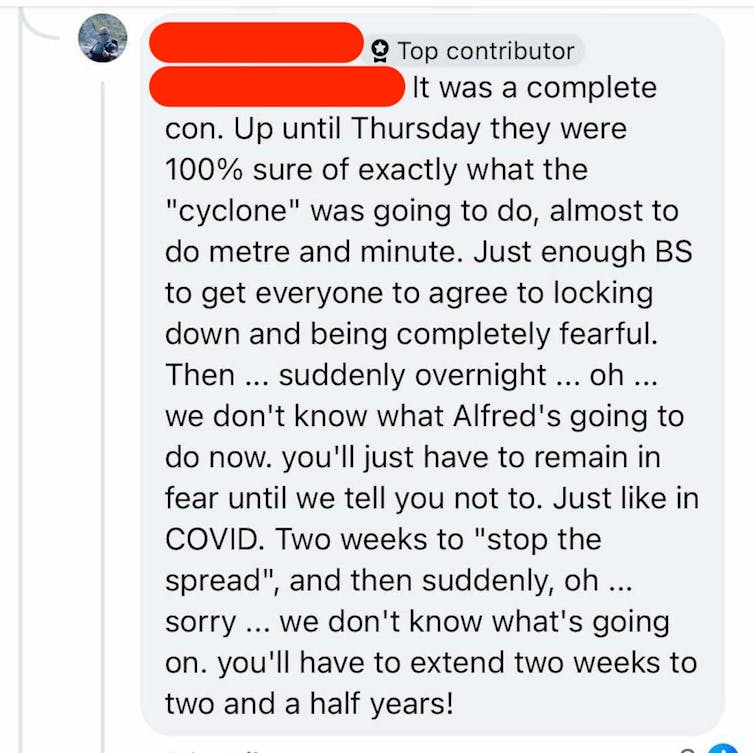
This led some to declare the cyclone a “media beat-up”, or a fever dream based on media lies. It was, they claimed, “just like covid” – the government and media were conspiring to induce people to give up their freedoms.
A commenter in a Facebook community group claims Cyclone Alfred was ‘a complete con’. Facebook.
A growing problem
Misinformation around natural disasters and climate change is a growing problem.
Last October in the US, Hurricane Milton hit Florida and caused catastrophic flooding in Georgia and South Carolina. Online conspiracy theories suggested Milton too was “seeded” or engineered. Social media was flooded with AI-generated clips and out-of-date media.
The problem of climate-related misinformation is getting worse. Last year, when the United Nations recommended urgent action to combat misinformation and disinformation, climate change was one key area of focus.
As online misinformation and conspiracy theories rise, social media companies such as Meta (owner of Facebook, Instagram and Threads) and X (formerly Twitter) are withdrawing from active content moderation strategies. Instead, they are shifting the burden onto users through community-driven fact checking.
The problem of misinformation is particularly pronounced in community groups on Facebook. These groups may have thousands of members and often only loose moderation.
However, they are increasingly becoming sources of misinformation and conspiracy theories intermingled with genuine information and sound advice.
Why conspiracy theories?
Why are we so compelled by misinformation and conspiracy theories?
Climate change is unpredictable, and is creating more intense weather events than before. In the face of such uncertainty it may be easier to retreat to the clear narratives offered by conspiracy theories.
If a cyclone was created by the government, it has a clear cause. Those affected have a clear place to direct their fear, frustration and anxiety.
What can be done?
There is plenty governments and social media platforms can do to combat the spread of misinformation, if they have the desire to do so. But the everyday user should be cautious.
In times of disaster, seek out trusted sources of information. Remember that nature is unpredictable and advice can and will change. Community groups can be excellent places for practical support, but they are not filled with experts.
Latching on to a conspiracy theory may feel good. It can create a clean-cut world of heroes and villains.
Naomi Smith does not work for, consult, own shares in or receive funding from any company or organisation that would benefit from this article, and has disclosed no relevant affiliations beyond their academic appointment.
Shortly after the fall of Bashar al-Assad’s regime in Syria, the new government led by rebel leader Ahmed al-Sharaa pledged to unite Syrians and establish a “civil peace” in the country.
In recent days, this fragile peace has been tested. Late last week, clashes broke out between government security forces and the remnants of pro-Assad militias in the former president’s stronghold of Latakia province on the northwestern coast. More than 1,000 people were killed, mostly civilians.
In a positive sign, a major deal was struck on Monday between the government and another armed faction, the Syrian Democratic Forces (SDF) of the semi-autonomous Kurdish region in northeastern Syria. The SDF has agreed to integrate all of its forces and institutions with the central government in Damascus.
Yet, the threat of more violence in the fractured country remains. This raises serious doubts about whether al-Sharaa’s vision can become a reality.
What caused the recent violence?
The unrest in Latakia was sparked by an ambush attack by pro-Assad gunmen against government security forces (composed primarily of former rebel fighters) last Thursday. This reignited old wounds from Syria’s 13-year civil war, triggering the deadliest violence since the fall of al-Assad in December.
According to the Syrian Observatory for Human Rights, at least 1,068 civilians were killed in the violence – mostly members of the Alawite minority (a sect of Shiite Islam), as well as some Christians.
The United Nations said it had received “extremely disturbing” reports of entire families being killed, including children.
Many members of Assad’s family and his former regime’s high-ranking officials belong to the Alawite minority. Tensions have persisted between these Assad loyalists and the new government, which is dominated by Sunni factions with a history of jihadist and anti-Shiite leanings.
The government said its operations against the pro-Assad forces had ended by Monday. Al-Sharaa also acknowledged that human rights violations had occurred and announced an investigation to identify those responsible.
However, he placed primary blame on the pro-Assad groups for instigating the violence. While defending the crackdown overall, he stressed that security forces should not “exaggerate in their response”.
Following the violence, US Secretary of State Marco Rubio expressed solidarity with Syria’s religious and ethnic minorities, calling on the interim government to hold the perpetrators accountable.
The European Union, which recently eased some restrictions on Syria to support an “inclusive political transition”, also condemned the violence.
Transitional justice is key
In a diverse and deeply divided country like Syria, the decades of dictatorship eroded national identity and fueled sectarian conflict. This is why a comprehensive process of transitional justice is essential.
Such a process would help bridge the divisions between different ethnic and religious communities. This would foster national unity, while respecting the unique identities of individual groups.
Although the new administration has emphasised the importance of social cohesion, its forces are accused of acting counter to this pledge and carrying out extrajudicial killings. Sectarian rhetoric from some pro-government figures has only further inflamed tensions.
These developments underscore Syria’s urgent need for an independent transitional justice committee. Without a structured approach to hold those accountable for crimes committed under the Assad regime and national reconciliation, the country risks replacing one cycle of repression with another. This will only deepen grievances, not heal them.
A well-designed justice process is crucial to help Syrians move beyond the trauma of the previous regime and build a stable, inclusive future.
Challenges to a united Syria
Amid the ongoing turmoil, the recent agreement signed between the Syrian Democratic Forces (SDF) and al-Sharaa’s government has raised hopes the country may still have a chance to maintain its unity and avoid fragmentation.
However, the details of how the SDF forces will be integrated remain unclear. Will the Kurds finally achieve their long-held demand for semi-autonomy within a federal state? Or will this integration mark the end of their aspirations?
The situation is equally complex for the Alawites and Druze communities in the western and southern regions of Syria, given they have two powerful regional forces backing them.
Israel has made significant inroads in the Druze areas of southern Syria, offering to defend the Druze if necessary. Similarly, Iran continues to support the Alawites, with its leadership predicting an uprising against the new Syrian regime.
These dynamics present serious obstacles to Syria’s unity. In such a polarised environment, a federal system may be the last viable option to preserve the country’s cohesion. However, if the new regime continues to reject this idea, the country risks fragmentation and undoubtedly more violence.
Ali Mamouri does not work for, consult, own shares in or receive funding from any company or organisation that would benefit from this article, and has disclosed no relevant affiliations beyond their academic appointment.
On Monday, the Australian Federal Police declared it and 14 antisemitic attacks a “con job” by organised criminals who were trying to distract police or use it as a bargaining chip to influence prosecutions.
Following dawn raids, more than 140 charges have been laid, including for arson, possessing prohibited weapons, and destroying property – but not terrorism.
On radio, New South Wales Premier Chris Minns said the acts had “unleashed terror” that was very real for the Jewish community, despite revelations about the true motive.
Minns did not say the explosives and attacks would qualify legally as terrorism, but his comments raise an important question: can “fake” terrorism still be terrorism, especially if it causes significant fear?
Terrorism requires a political, religious or ideological cause
Australia’s legal definition of terrorism is found in the federal Criminal Code. It triggers many offences and it targets both conduct and threats – but these must all be done for the purpose of advancing a “political, religious or ideological cause”.
This motive requirement is the main element that distinguishes terrorism from crimes such as murder, assault and property damage.
It is the major barrier to prosecuting these acts as terrorism. The apparent motive was to benefit organised crime interests. It cannot be terrorism if it was not intended to advance a political, religious or ideological cause.
There is another requirement that terrorism be designed to intimidate part of the community (or a government), but this is additional to the motive requirement, and both need to be proven. If any single element in a prosecution fails, the defendant will be found not guilty.
This does not lessen the significant impacts on the Jewish community. It just explains why terrorism charges have not been laid.
What about hoax terrorism?
In addition to the main terrorism offences, there are offences for hoax terrorist acts. These were created in 2002 as part of Australia’s first legal responses to terrorism.
These do not rely on the definition of the terrorist act, so the motive requirement explained above need not be proven. However, they apply only in very specific cases, similar to copycat anthrax attacks, in which someone uses the postal service to induce a false belief that an article contains an explosive or dangerous substance (for example, if someone sends a letter containing harmless white powder with a threatening note).
A similar offence applies where someone uses a carriage service to make a hoax threat. This could apply if an organised criminal group phoned in a fake bomb threat.
This sounds quite similar to recent events, but the offence relates to the use of a carriage service to make a fake threat – not the discovery of real explosives.
This might seem a ridiculous conclusion: that the threat was actually not fake enough. If an organised criminal group phoned in a “genuinely fake” threat, they could have been prosecuted under federal terrorism laws, but not if they planted real explosives.
This is a product of trigger-response lawmaking in terrorism. The postal hoax laws were drafted in direct response to events in the US after 9/11, and the legacy remains.
In any case, the hoax offences do not attract any higher penalties than the ones being charged. In NSW, destroying or damaging property with fire attracts the same maximum penalty of ten years’ imprisonment.
Political and community needs
It is important to remember that police and prosecutors will make decisions to pursue specific charges based on the evidence available and the likelihood of a successful conviction for the highest penalty.
This will be based on their previous experience. If they believe they can secure a conviction for arson or property damage, but a case for terrorism or hoax terrorism might fail, they will prefer the charges with the higher chance of success.
As members of the wider community, we may wish to see different or additional charges laid, but we will not know all the evidence behind a decision to allege one crime or another.
Police and prosecutors are not infallible, but we can trust they will aim to secure the highest available penalty.
It is understandable that governments, the opposition and the wider community want clear statements and answers about whether a crime is terrorism or not. Unfortunately, this level of clarity is not always available.
In the midst of a crisis, such as the Sydney Lindt Cafe siege or Wieambilla ambush, it can be difficult to know all the circumstances that gave rise to the event, and an offender’s motivations.
In the aftermath, it can take months – even years, through major inquests and inquiries – for consensus to arise. Even then, views on whether a given act was terrorism may still differ.
The most definitive answer comes when a jury of 12 community members finds an offender guilty of terrorism beyond reasonable doubt. Unfortunately, this sort of clarity is not always possible, because the evidence available means a terrorism charge was not pursued, or an offender was killed in the attack.
It is rarely an urgent question for governments and communities to know whether organised crime activities will be prosecuted under one law or another, but terrorism provokes a special, understandable concern – especially in the current environment. It reflects valid community needs to denounce antisemitism as terrorism and achieve justice for victims.
But justice can be achieved regardless of the specific charges that police and prosecutors pursue. Better that they secure convictions, even for “lesser” crimes in the community’s eyes, than they seek terrorism charges and fail.
Keiran Hardy receives funding from the Australian Research Council for a Discovery Project on conspiracy extremism.
Ex-Tropical Cyclone Alfred is the latest in a succession of extreme rainfall events to wreak havoc on coastal communities in New South Wales and Queensland.
This is a massive area, affecting hundreds of thousands of households, with tens of thousands of people stranded. Similar numbers of properties are likely to be damaged.
It’s only been three years since the same general region was affected by major flooding. Many people are still recovering. So, how exactly do we think about and measure the cost of such catastrophes? What lessons have been learnt, and how well are they being practised?
It’s too early to make a comprehensive estimate of the costs of Alfred, as some impacts are continuing to unfold. But previous natural disasters offer us a framework for thinking about them.
The costs of natural disasters can be accounted for in different ways. Impact costs include social, financial, economic, environmental and cultural values.
These can be broken down further into direct, indirect and intangible costs. Intangible costs are things with value that do not contribute directly to the market economy.
An assessment of the 2022 Queensland floods, produced by Deloitte Access Economics for the Queensland Reconstruction Authority, estimated the total cost of impacts to be A$7.7 billion.
Tangible economic costs were estimated at $3.1 billion, and intangibles at $4.5 billion. Intangible losses included mortalities, injuries and long-term changes in health and welfare caused by the event.
Some costs are hard to measure
Not so long ago, economic estimates were restricted to direct losses on property and infrastructure, and lost income for individuals and businesses, so we’ve come a long way.
Even though estimates are becoming more sophisticated, they generally cover social, financial and economic impacts. Environmental and cultural losses are often less of a focus, unless they are closely linked to income.
If you ask people why they love living in a particular place, they’ll often say its because a location is special to them. That might be because of the relationships they have with neighbours or community activities they take part in.
These things aren’t featured in measures of economic activity, but they are a feature of people’s lives.
This raises the issue of marginal costs. When we only look at the dollar cost of damage, we can lose sight of how disproportionately it can impact the more vulnerable groups in society.
This includes those who rent, those with limited incomes, the elderly, those with limited mobility or long-term medical conditions (mental and physical), recent immigrants and marginalised groups in society, including traditional owners.
Lasting damage from a natural disaster can include things like loss of identity, a place to live, treasured possessions, loss of a loved animal or family breakdown.
Insurance only goes so far
Another way to assess the cost of a catastrophe is through an insurance lens – losses that are recoverable through insurance and those that are not covered.
The Insurance Council of Australia has become much more proactive in recent years, recognising that preparedness and prevention can minimise these losses.
But insuring against major catastrophes relies on reinsurance, policies purchased by insurance companies themselves to cover peak losses.
The federal government has also established its own Cyclone Reinsurance Pool with the aim of pushing down premiums for consumers.
Well-targeted relief can bring benefits. One study examining the response to the 2010–11 Queensland floods found the government’s post-disaster relief payments were effective in aiding economic recovery.
A new reality
The governance arrangements surrounding disasters in Australia – national plans for how to prepare, respond and recover – are rapidly evolving. This has been largely driven by the disasters themselves.
Disasters in Australia have historically been bad, but infrequent. Now they are occurring on an almost annual basis.
Some locations are more exposed than others, including northeast NSW and southeast Queensland. The economic cost of the 2010-11 Queensland floods was estimated to be equivalent to 5.2% of the state’s gross domestic product (GDP) in that year.
Losses will continue to mount as such events become more frequent and severe.
That means we need to look at the full economic picture of the catastrophe life cycle. For climate events, this means looking not only at what we spend on insurance, preparation, prevention and recovery, but also the money invested in fossil fuels and subsidies.
The Climate Council has projected that parts of Australia might become uninsurable by 2030. A recent report by Climate Valuation looks at high-end flood risk down to suburb and address level.
Such projections are almost certainly underestimated because the models that are used do not adequately predict how fast extreme events are changing.
People need relief now, but we cannot continue to finance our own destruction over the longer term.
Roger Jones does not work for, consult, own shares in or receive funding from any company or organisation that would benefit from this article, and has disclosed no relevant affiliations beyond their academic appointment.
While some parts of southeast Queensland and northern New South Wales are still on alert for flooding, others are starting the difficult clean-up process as flood waters recede.
Stagnant water after floods provides the perfect breeding ground for mosquitoes. So as you clean up, remember to empty containers of water and other reservoirs around your house and yard such as water-filled boats, trailers and other large objects. Get rid of debris that may be collecting water too.
This year, mozzies are carrying the usual viruses we want to avoid, such as Ross River virus, but the potentially deadly Japanese encephalitis virus has also been detected in parts of New South Wales and Queensland.
But while flood waters may boost mosquito numbers, outbreaks of disease don’t always follow. Hurricanes in North America have been associated with increased mosquito populations but few outbreaks of disease.
In Australia too, there are few examples of mosquito-borne disease outbreaks after cyclones – with a notable exception. After Tropical Cyclone Zoe made landfall in 1974, we had one of the one of the biggest outbreaks of Murray Valley encephalitis virus later in the year.
Health authorities in Queensland and NSW are monitoring activity of mosquitoes and mosquito-borne pathogens. A/Prof Cameron Webb (NSW Health Pathology)
Japanese encephalitis is already active
Somewhat dry conditions in the summer of 2024-25 have meant mosquito populations in many regions of eastern Australia have remained well below average.
Humans have also been infected. Cases are rare but the disease can be serious, with symptoms ranging from fever, headache, and vomiting through to disorientation, coma, seizure and brain swelling. One person has died of the virus this year.
Japanese encephalitis virus first arrived in southeastern Australia over the summer of 2021-2022. That followed extensive flooding across the Murray Darling Basin thanks to the arrival of La Niña. At the time, there were phenomenal numbers of mosquitoes that continued over subsequent years as the above average rainfall continued.
Mosquito numbers this summer have only been a fraction of what was recorded during those seasons influenced by La Niña. The activity of Japanese encephalitis in 2024-25 has scientists scratching their heads, as it goes against the commonly held theories that greater mosquito numbers combined with increased waterbird activity (typically following flooding) drive greater transmission of viruses such as Japanese and Murray Valley encephalitis.
Fortunately, there is no evidence of these viruses along the coast of southeast Queensland through to northern NSW.
But regions where the virus has already been active, such as Darling Downs in Queensland and Moree in NSW, may see substantial rainfall as a result of ex-Tropical Cyclone Alfred.
Thousands of cases of infection are reported across the country each year, including in urban areas of southeast Queensland and northern NSW.
Concerns about Ross River diseases were already raised with heavy rain and flooding in northern Australia this summer. Case numbers often peak at the end or summer and early autumn. So there is potential for greater activity in the coming months.
Other mosquito-borne pathogens, such as Barmah Forest virus, may also be circulating and may cause cases of mild disease but these occur far less commonly than those due to Ross River virus infection.
Protect yourself while cleaning up
If you’re out cleaning up after the storms, try to avoid mosquito bites.
Cover up with long-sleeved shirts, long pants and covered shoes for a physical barrier against mosquito bites.
Use topical insect repellents containing DEET, picaridin, or oil of lemon eucalyptus. Be sure to apply an even coat on all exposed areas of skin for the longest-lasting protection.
For those living or working in regions of Queensland, NSW and Victoria at risk of Japanese encephalitis, a safe and effective vaccine is available.
Cameron Webb and the Department of Medical Entomology, NSW Health Pathology and University of Sydney, have been engaged by a wide range of insect repellent and insecticide manufacturers to provide testing of products and provide expert advice on medically important arthropods, including mosquitoes. Cameron has also received funding from local, state and federal agencies to undertake research into various aspects of management of various medically important arthropods.
For many people, the most visible impact of Cyclone Alfred was the damage big waves and storm surge did to their local beaches.
Beaches in southeast Queensland and northeast New South Wales are now scarred by dramatic sand cliffs, including the tourist drawcard of Surfers Paradise.
Sand islands off Brisbane – Bribie, Moreton and North Stradbroke – protected the city from the worst of the storm surge. But they took a hammering doing so, reducing their ability to protect the coastline.
The good news is, the sand isn’t gone forever. Most of it is now sitting on sandbars offshore. Over time, many beaches will naturally replenish. But sand dunes will take longer. And there are areas where the damage will linger.
Why did it do so much damage?
Cyclone Alfred travelled up and down the coast for a fortnight before crossing the mainland as a tropical low. On February 27, it reached Category 4 offshore from Mackay. From here on, the cyclone’s intense winds whipped up very large swells.
By the time the cyclone started heading towards the coast, many beaches had already been hit by erosion-causing waves. This meant they were more vulnerable to storm surge and further erosion.
As Alfred moved west to make landfall, it coincided with one of the the year’s highest tides. As a result, many beaches have been denuded of sand and coastal infrastructure weakened in some places.
Timelapse showing the coastal erosion caused by ex-Tropical Cyclone Alfred, looking north from Surfers Paradise to The Spit. UNSW Water Research Laboratory
Which beaches were hit hardest?
Areas south of the cyclone’s track have been hit hardest, from the Gold Coast to the Northern Rivers.
Some beaches and dunes have significantly eroded. Peregian Beach south of Noosa has lost up to 30 metres of width.
Erosion cliffs, or “scarps”, up to 3 metres high have appeared on the Gold Coast. It exposed sections of the last line of coastal defence – a buried seawall known as the A-line, constructed following large storms in the 1970s.
Up and down the Gold Coast, most dunes directly behind beaches (foredunes) have been affected by storm surge of up to 0.5 metres above the high tide mark and eroded. Even established dunes further inland have been eroded.
Up to 3 metre high dune erosion scarps have appeared along the Sunshine Coast. Javier Leon, CC BY-NC-ND
Where did the sand go?
In just a week, millions of tonnes of sand on our beaches seemingly disappeared. Where did it go?
Beaches change constantly and are very resilient. As these landforms constantly interact with waves and currents, they adapt by changing their shape.
When there’s a lot of energy in waves and currents, beaches become flatter and narrower. Sand is pulled off the beaches and dunes and washed off offshore, where it forms sandbars. These sandbars actually protect the remaining beach, as they make waves break further offshore.
Dunes form when sand is blown off the beach on very windy days and lands further inland. Over time, plants settle the dune. Their roots act to stabilise the sand.
Healthy dunes covered in vegetation are normally harder to erode. But as beaches are washed away during large storms and the water level rises, larger waves can directly attack dunes.
The tall erosion scarps have formed because dunes have been eaten away. In some areas, seawater has flooded inland, which may damage dune plants.
As coastal conditions return to normal, much of this sand will naturally be transported back ashore. Our beaches will become steeper and wider again.
It won’t be immediate. It can take months for this to occur, and it’s not guaranteed – it depends on what wave conditions are like.
Some sand will have been washed into very deep water, or swept by currents away from the beaches. In these cases, sand will take longer to return or won’t return at all. Dunes recover more slowly than beaches. It may take years for them to recover.
Australia’s east coast has one of the longest longshore drift systems in the world, where sand is carried northward by currents to eventually join K’Gari/Fraser Island.
Can humans help?
Sand will naturally come back to most beaches. It’s usually best to let this natural process take place.
But if extreme erosion is threatening buildings or roads, beach nourishment might be necessary. Here, sand is added to eroded beaches to speed up the replenishment process.
Other options include building vertical seawalls or sloping revetment walls. These expensive methods of protection work very well to protect roads or buildings behind them. But these engineered structures often accelerate erosion of beaches and dunes.
We can help dunes by staying off them as much as possible. Plants colonising early dunes are very fragile and can be easily damaged. Temporary fencing can be used cheaply to trap sand and help dunes recover. Re-vegetating dunes is an efficient way of reducing future erosion.
How can we prepare for next time?
The uncertainty on Cyclone Alfred’s track, intensity and landfall location kept many people on edge, including at-risk communities and disaster responders. This uncertainty puts many scientists under enormous pressure. Decision-makers want fast and clear information, but it’s simply not possible.
In Australia, almost 90% of people live within 50km of the coast. In coming decades, the global coastal population will grow rapidly – even as sea level rise and more intense natural disasters put more people at risk.
As the climate crisis deepens, rebuilding in high-risk areas can create worse, more expensive problems.
Communities must begin talking seriously about managed retreat from some areas of the coast. This means not building on erosion-prone areas, choosing not to defend against sea incursion in some places and beginning to relocate houses and infrastructure to safer heights inland.
Decision-makers should also consider deploying nature-based solutions such as dunes, mangroves and oyster reefs to reduce the threat from the seas.
Technology has advanced rapidly since Cyclone Zoe made landfall in this region in 1974. We can track weather systems from satellites, get up-to-date weather and wave forecasts on our phones and use drones to see change on beaches and dunes.
But these technologies only work if we use them. The Gold Coast has the world’s largest coastal imaging program. But most other coastal regions don’t conduct long-term monitoring of dunes and beaches. Without it, we don’t have access to data vital to protecting our beaches and communities.
Javier Leon received funding from The Australian Research Council and the Australian Centre for International Agricultural Research. He is affiliated with Surfrider Foundation Australia.
But supplies are only one part of the picture, and their usefulness is limited without trained health-care workers who know how to treat and care for patients.
Health-care workers are the most critical component of any health system. Despite being protected under international law, they have been killed and injured at alarming rates in Gaza since October 7 2023.
There is also growing evidence of inhumane treatment and abuse of health-care workers in Israeli detention. This has serious implications for the health of Palestinians, in both the short and long term.
What is the state of the health-care system?
The health system in the Gaza Strip is in ruins. The Israeli Defence force has carried out at least 670 attacks on health services and facilities since October 7 2023.
The most recent World Health Organization update in February reported only 50% of hospitals were partially functional, and 41% of primary health-care facilities (for example, general practice clinics and pharmacies) were functional.
The latest report by the United Nations Relief and Works Agency for Palestine indicates only four out of the 22 health centres it runs are operational.
This widespread and systematic destruction of health infrastructure and equipment puts health professionals and their patients in immediate danger. Shortages of medical supplies and lack of reliable electricity and water make it harder for health-care workers to provide care.
What about health-care workers?
More than 1,000 health-care workers – including nurses, surgeons and other clinicians, paramedics, pharmacists and technicians – have been killed in Palestinian territories in the last 17 months, according to estimates by the United Nations and Palestinian monitoring group Healthcare Workers Watch.
In September last year, a UN inquiry found Israeli security forces have deliberately killed, wounded, arrested, detained, mistreated and tortured medical personnel and targeted medical vehicles.
The latest report from Healthcare Workers Watch documents 384 cases of unlawful detention of health-care workers in Palestine since the current war began, 339 of them from Gaza.
Of these, 96 have provided testimonies of inhumane treatment. At least 185 are known to remain in detention and 24 are missing after hospital invasions.
Physicians for Human Rights Israel and The Guardian have also documented testimonies of medical personnel released from Israeli detention. Many say they were detained while carrying out medical duties.
They report being subjected to interrogations without legal representation, medical neglect and starvation, abuse and torture.
He alleges prison guards were given instructions to deliberately damage his hands: “They said they wanted to make sure I could never return to work”.
The Israeli Defence Forces (IDF) did not respond to the individual allegations but told The Guardian “suspects of terrorist activities” have been arrested and detained during fighting in the Gaza Strip. In a statement, the IDF said: “Those who are not involved in terrorist activity are released back to the Gaza Strip as soon as possible”.
The UN High Commissioner for Human Rights Volker Türk has said Israel’s claims hospitals are being used for military purposes are vague, unsubstantiated and “in some cases, they appear to be contradicted by publicly available information”.
What does this mean for people in Gaza?
Before October 7, Gaza’s health system was already unable to meet the needs of its population. The escalation of those needs due to the bombardment and reduced sanitation in a shattered health system is catastrophic.
Losing health-care workers – whether they are killed, injured or incarcerated – further depletes an overburdened system. As a result, ordinary people have reduced access to skilled and qualified personnel. And so do junior medical staff, meaning they miss out on opportunities to learn from the experience of senior staff.
All residents of Gaza, including health-care workers and their families, face serious threats to their health. A lack of adequate sanitation, nutritious food and safe water compounds other issues, such as increased risk of respiratory and diarrhoeal diseases, as well as complications during pregnancy and birth.
In a population of 2.1 million there are large unmet needs from pre-existing conditions. The UN estimates 45,000 people in Gaza have heart disease, 650,000 have high blood pressure, more than 2,000 are diagnosed with cancer each year and more than 485,000 have mental illnesses.
Without enough health staff, there is reduced capacity for public health surveillance and control – for example routine screening services and immunisation programs – and this increases the risk of disease outbreaks.
Health workers also play a vital role in training the next generation of health professionals. Disrupting this chain makes it harder to rebuild the health workforce and the health system more generally.
The impacts of war can’t simply be calculated in terms of fatalities, injuries and damaged health-care centres or facilities.
What’s also damaged is a shared commitment to humanitarian principles and the respect for human rights and international law.
Tania King receives funding from the Australian Research Council, National Health and Medical Research Council, Medical Research Future Fund, veski and Suicide Prevention Australia.
Fiona Stanley receives current National Health and Medical Research Council and Australian Research Council funding as a mentor not Chief Investigator. I am retired University Professor and Institute Director – now only Patron.
Guy Gillor is a Jewish-Israeli-Australian researcher and policy analyst that has advocated for justice and equal rights in his homeland of Palestine/ Israel from a young age, and is currently involved with a number of Jewish-Australian anti-war campaigns. Guy currently works as Manager of Strategy Policy and Research for an Aboriginal Community Controlled Organisation.
Rob Moodie is affiliated with the Medical Association for the Prevention of War (MAPW – national councillor) and Quit Nukes. He has received funding from National Health and Medical Research Council.
Tilman Ruff is affiliated with International Physicians for the Prevention of War (board member), International Campaign to Abolish Nuclear Weapons Australia (board member, co-representative to International Steering Group), Medical Association for Prevention of War (international councillor), Treaty on the Prohibition of Nuclear Weapons Scientific Network (member), Initiative for Peacebuilding, University of Melbourne (board member).
The damage inflicted by ex-Tropical Cyclone Alfred on Queensland and northern New South Wales has been extensive. Several areas have had infrastructure badly damaged, and many homes have been destroyed.
With natural disasters set to become “situation normal” as the impacts of heating oceans and climate change accelerate, it’s crucial Australia consider contingency workforce planning.
Disasters such as these expose the extent of the severe skills shortages experienced in many parts of Australia, but especially in the regions. Each year, regional Australia loses to cities thousands of professional and trade-related people whose skills cannot be replaced.
Rebuilding, restoring and rehabilitating the affected areas will require the immediate and sustained work of skilled workers – but these are in short supply in many places.
Already it was hard to find people with the necessary skills to undertake infrastructure maintenance. Now people affected by ex-Tropical Cyclone Alfred are joining long wait lists for electricians, plumbers, builders and other services.
Where are the workers when you need them?
The situation is stark. There are not enough skilled workers to support Australia’s day-to-day building and maintenance needs, let alone in response to disasters.
These shortages are much more acute in regional, rural and remote parts of Australia. In these places, location is commonly cited as the reason why suitable applicants do not take the job.
This labour is not just a problem for disaster responses. These skills gaps are also pushing up construction costs, frustrating building works needed to relieve the housing pressure Australia-wide.
The situation is so bad states and territories are competing for tradespeople to move. The Western Australia government’s Build a Life in WA campaign, for instance, offers cash incentives to attract building and construction professionals, and skilled tradespeople.
Australia’s skills gaps are so entrenched, education and training schemes – such as apprenticeships – are not going to help quickly enough.
However, Australia is competing with many other countries for skilled tradespeople. Traditional sources of migrant labour may not provide the number of skilled migrants needed.
An untapped source of skilled workers: refugees
One solution to these problems is exploring the untapped potential of the more than 122 million people who are displaced around the world. Many have the skills and experience that countries like Australia need.
This scheme provides concessions to the usual visa requirements for skilled migration. This helps refugees to overcome the administrative hurdles that exclude them from regular processes (such as not having a passport).
With this flexibility, the program — led by not-for-profit group Talent Beyond Boundaries — will match 500 refugees to employers by mid-2025.
Talent Beyond Boundaries matches refugees with employers.
To date, 40% of workers accessing this pathway in Australia have been recruited by employers in regional areas. Roughly 40% are technicians and trades workers.
This kind of solution helps the Australian government expand its response to the ever-increasing numbers of displaced peoples globally.
It also provides opportunities for employers to source skilled workers through the matching facility offered by Talent Beyond Boundaries.
Using their extensive Talent Catalog, Talent Beyond Boundaries can connect employers in professions with key skills gaps, and in areas experiencing severe skills shortages, to a pool of more than 120,000 skilled workers looking for an opportunity to restart their careers and lives in safety.
Recognising the skills in our midst
A second creative solution is to leverage the skills and expertise that already exist in Australia’s migrant and refugee communities.
We’re currently researching the economic, social and policy dimensions of skilled refugee labour mobility in addressing skills shortages in regional Australia, particularly for small and medium-sized employers.
Working with partner organisations Talent Beyond Boundaries and a think tank called the Regional Australia Institute, researchers at UNSW and ANU have been speaking to employers, community leaders, employment and settlement services in regional areas across the country. We’ve also been speaking with skilled refugee workers who have settled in regional Australia through the pilot.
What we are hearing is that businesses are desperate for workers ready to go. They are frustrated by the costly, lengthy and complicated processes of sourcing talent from overseas. The costs are especially prohibitive for small and medium enterprises.
Highly skilled refugees have told us the Skilled Refugee Labour Agreement Pilot has helped them regain a foothold in their careers, and rebuild their and their children’s lives, while also helping meet regional skills shortages.
Programs matching skilled refugees with employers and regions desperate for skilled workers can be a win-win.
Sally Baker receives funding from the Australian Refugee Council (Linkage: LP220100286) and the Australia Centre for Student Equity and Success to research on issues relating to refugee resettlement and educational and employment access.
Louise Olliff has previously done consultancy work for Settlement Services International and is funded by the ARC. She is a part-time Senior Policy Advisor for the Refugee Council of Australia. Talent Beyond Boundaries is a partner organisation in the ARC Linkage Grant she is funded through.
Source: The Conversation (Au and NZ) – By Claire Matthews, Associate Professor and Head of School, School of Accountancy, Economics and Finance, Te Kunenga ki Pūrehuroa – Massey University
Adrian Orr has so far not spoken about the reasons for his recent and unexpected resignation as Reserve Bank governor, but the sudden departure caused understandable speculation.
One suggestion has been that Orr was at odds with the government over his requirement that the Australian-owned New Zealand banks hold high levels of capital compared to other countries.
Whether this was indeed a reason for Orr’s resignation we can’t say. But it does raise important questions about Reserve Bank – and government – policies.
Set by the Reserve Bank, capital requirements specify the amount of equity banks need to have to cover future losses. Since 2022, banks have been required to hold enough equity to be able to survive a 1-in-200-year event.
But holding onto this much capital is expensive for banks. The higher requirements have led to higher interest rates – making it more expensive for people and businesses to borrow.
The government has long criticised the current capital requirements. Last August, Finance Minister Nicola Willis said she was open to making the Reserve Bank ease its regulation of banks – if a strong enough case could be made that it would improve competition and efficiency without undermining the stability of the financial system.
Reserve Bank governor Adrian Orr has resigned, leading to questions about what happens next for his much-criticised capital requirements. Hagen Hopkins/Getty Images
Making lending attractive again
The 2022 capital requirements meant the “big four” banks (ANZ, Westpac, ASB and BNZ) had to increase equity from 10.5% to 18% of their risk-weighted assets over the next seven years. Smaller banks had to increase their equity to 16%.
The new requirements were met with some resistance. This was due, in part, to concerns about how the move would affect bank customers.
To meet higher capital requirements, banks focused on lending that generated higher returns. They also charged higher interest rates to compensate for the increased levels of capital required for the loans.
Financial analytics company S&P Global described the rules as the toughest bank capital requirements in the world and noted the risk of reduced access to credit, particularly for smaller businesses.
Calls for change
Even before Orr’s resignation, members of the coalition government had called for changes to the capital requirements.
Seymour has said going back to the former levels of bank capital would support economic growth by enabling more lending to business at more affordable interest rates.
The 2022 capital requirements have influenced the type of lending banks do and the interest rates they have applied.
The more capital banks have to hold against a loan, the higher the interest rate required to cover that cost. This means home loans are more expensive under the current rules. If the requirements reduced (and nothing else changes) home loan interest rates would reduce.
At the same time. other types of lending – such as business loans – would become more attractive if capital requirements drop and banks have to have less equity on hand.
With a limited pool of funds available to lend, this may mean banks make fewer home loans and more personal and business loans.
Careful consideration needed
In the end, there is no guarantee a new Reserve Bank governor will reduce the capital requirements. And, under the current rules, the governor is the one who gets to make that call.
Whoever finally takes the post will have to weigh up the benefits of any rule changes with the potential risks – including what the uncertainty of frequent rule changes do to the wider economy.
They will also need to take into account why Orr pushed for the higher capital requirements to begin with. He worried that in the event of a global financial disaster, the four major Australian-owned banks might abandon New Zealand customers.
Having the higher levels of capital forced the banks to have a greater financial cushion against losses and reduced the risk of bank failure. And ultimately, no government wants a bank to fail, with the personal and economic costs that would entail.
Claire Matthews is a Senior Fellow of Finsia and a Certified Member of INFINZ. She received a grant from the RBNZ to assist with expenses associated with her PhD in 2004.
A series of violent incidents and confrontations over the weekend in New Caledonia’s capital Nouméa and its surroundings, causing clashes with law enforcement agencies and several injuries.
On Saturday night, in a bar and night-club in downtown Nouméa, a “Ladies Night” event dedicated to International Women’s Day degenerated into an all-out brawl, involving mostly young customers.
The event was scheduled to end at 2am, but bar owners decided to close at 1am, prompting violent reactions from the young patrons, who started to throw glasses at the DJ, then ransacked the bar.
The incident was recorded and later broadcast on social networks.
“We should have closed at 2am, but shortly after midnight, we felt the pressure was mounting and most of the people were already quite inebriated”, the 1881 establishment owner told local media.
“So we decided to close earlier to avoid people getting more drunk. We stopped the music, that’s when they started to throw glasses to the bar”.
The brawl involved 300-400 youths in a bar and night-club in downtown Nouméa on Saturday night. Image: RNZ Pacific/FB
Public brawl outside Outside, in a parking lot, an estimated “300 to 400 hundred” customers began a public brawl.
Law enforcement units were called and later described themselves as finding “a dangerous situation” — confronted with “hostile” individuals, and having to resort to teargas and stun-balls.
The French High Commission reported during a press conference yesterday that seven people had been injured, including one gendarme and a police officer, in the face of people throwing “bottles, stones and even concrete blocks”.
The situation came back under control at around 2:30 am, officials said.
The High Commission said that at this stage no one had been arrested, but an investigation was underway that could lead to the bar and night club being closed down.
“This is a serious incident . . . but we are not back to the insurrection situation last year”, the French High Commission’s chief-of-staff, Anaïs Aït Mansour, told reporters.
She said a meeting had been called with all of Nouméa’s bar and nightclub owners and managers.
After months of prohibition on the sale of alcoholic beverages, following the violent unrest that started in May 2024, the restrictions were finally lifted only a few weeks ago.
A re-introduction of the restrictive measure was now “under consideration”, Aït Mansour said.
The incident has also prompted political reactions as parties were preparing for the return of French Minister for Overseas Manuel Valls in less than two weeks to try to bring political talks to another level on New Caledonia’s political future.
Politicians warned not to amalgamate The incidents, widely condemned by the pro-France political groups, were also labelled as “unacceptable” by the major pro-independence Union Calédonienne (UC)-FLNKS party.
In a media statement, UC said these “acts of vandalism and violence committed by inebriated youths” had “nothing to do with the political claims from 13 May 2024, or with the Kanak people’s struggle”.
However, the pro-independence party warned against any attempt to “turn these youths into scapegoats for all of our society’s harms”.
UC said this behaviour could be explained by “a profound ill-being” among “a certain part” of the young Kanak population who felt disenfranchised.
Violent clashes on highway The weekend was also marred by another violent confrontation with law enforcement services on the territorial road RT1 between the capital Nouméa and the La Tontouta International Airport where motorists were targeted by people throwing stones at them.
The incidents took place early Sunday morning near the Saint-Laurent village, in an area usually referred to as Col de La Pirogue, close to the small town of Païta.
The Gendarmerie Commander, General Nicolas Matthéos, said those actions were from a group of up to 30 individuals under the influence of alcohol.
He said his services were now attempting to talk to traditional chiefs in the area so they could persuade those responsible for these “very aggressive” acts to surrender and be “brought to justice”.
He said four gendarmes had been slightly injured after being hit by stones.
“We had to use stun grenades and during those operations we had to stop all traffic on the RT1″,” he said.
Traffic was interrupted for almost one hour and a squadron of gendarmes remained in place to secure the area.
A judicial inquiry is also underway.
Sandalwood oil factory goes up in flames Also at the weekend, a sandalwood oil factory went up in flames late on Sunday evening on the island of Maré in the Loyalty Islands group.
Local firemen could not stop the destruction of the small factory’ production and refinery unit.
Another investigation is now underway from Nouméa-based gendarmerie investigators to determine the cause of the fire and whether it was accidental or criminal.
The locally-managed unit was created in 2010.
It is believed to be the world’s third largest producer of high-quality sandalwood essential oil, with international perfume and cosmetics clients such as Dior, Guerlain and Chanel.
This article is republished under a community partnership agreement with RNZ.
Domestic cats have been living alongside humans for an estimated 10,000 years, first as rodent control and then as the couch-warmers we know and love. A far cry from the lone predator lifestyle of their ancestors, today millions of cats worldwide live within human families. More than 30% of households in the United States and Australia own a cat.
And this sentiment may be shared, with cats demonstrating affection through seeking out our company, physical contact and engaging in play. Like a secret language between friends, there is even evidence to suggest cats have developed specific vocalisations to communicate with their owners.
Despite this, cats are typically seen as aloof and elusive. But how true is this? Do cats form friendships beyond us?
A complex recipe
Firstly, what does a cat friendship look like? Behaviours that may indicate friendship between two cats include social grooming, such as licking each other’s fur, head rubbing, spending time together and playing together.
In contrast, behaviours such as charging, fighting or chasing may indicate a disagreement is brewing or already underway.
Cats also have very few “conflict defusing” signals in their behavioural repertoire, choosing to run away or avoid each other rather than attempt reconciliation during conflict.
Such disharmony can be stressful for the cats. Many owners end up wondering how to maximise the chances of fostering a positive relationship between their cat and other animals – or if they should get them a “friend” at all.
Successful cat friendships can be tricky to achieve. Kelly/Unsplash
The recipe for successful feline friendships is a little complex. Research on cat dynamics in unowned, free-ranging cats has found close relationships are more likely to form – and last – if they are:
Indoor-only cats can also form strong friendships with other cats in the household. Similar to unowned free-ranging cats, cats who have been introduced to one another at a young age, who are related, and who have lived together for a long-time, are more likely to be close friends.
We know less about the social lives of pet cats that are allowed to roam outside, but the default behaviour for most cats is one of competitiveness and territorialism.
That said, cats will typically try to avoid confrontations with others.
While some research has found interactions between roaming cats are usually calm, they can and do sometimes result in fights – particularly if food is around or they venture into an unfamiliar unowned cats’ territory.
To complicate things further, two cats are more likely to fight within a household if they are allowed outside – likely due to bringing in unfamiliar scents.
We also can’t forget the problematic relationship cats can have with native fauna, sometimes decimating local wildlife populations. In many places, especially in parts of Australia, cats are not allowed outdoors for this reason.
There are also dangers to their own health and safety if allowed to roam, such as misadventure, risks from road traffic or even disgruntled neighbours.
Cats are territorial, but typically avoid confrontations with others. Fred Augé/Pexels
Cats and dogs … in harmony?
While research has mainly explored cats’ friendship with each other, cats can also have positive relationships with other species. For example, while cats and dogs are commonly depicted as mortal enemies, they can live harmoniously, often sleeping and playing together.
However, once again the importance of early exposure and slow introductions in developing this relationship cannot be overstated.
Interestingly, it also appears that indoor cats are friendlier towards their canine companions than cats allowed outdoors. This is possibly because outdoor cats may be exposed to multiple dogs, many of which aren’t happy to see them.
Cats can have positive relationships with other species – like Alfie the cat who comes to visit Bingo the dog every day. The Conversation
Who’s your cat’s closest friend?
So, should your pet cat have a friend? As you may have guessed by now, the answer to cat friendships is complicated.
If you do plan to introduce your cat to a new companion, here are some suggestions to follow. Firstly, cat introductions should be slow and supervised to increase the chance of a positive first meeting.
Your house should also have plenty of safe spaces, toys and puzzle feeders, scratching posts, and separate food and litter areas in a quiet spot. Providing these resources will help prevent resource guarding (where cats stop other cats from accessing things they need or like) and reduce conflict between the animals.
At the end of the day, while cats can form friendships with other animals, they aren’t crucial to their health and happiness.
Your cat’s closest relationship is the one it has with you. Ensuring they have lots of opportunities to bask in your attention and engage in play is likely enough for even the most social of felines. After all, they have their “aloof and elusive” reputations to uphold.
The authors do not work for, consult, own shares in or receive funding from any company or organisation that would benefit from this article, and have disclosed no relevant affiliations beyond their academic appointment.
As part of a major reform of the science sector, the government plans to set up a research organisation focused on emerging technologies, including quantum technologies.
The first quantum revolution – based on understanding how electrons behave in semiconductors to make computer chips possible – brought us computers and smart phones.
We are now in the middle of the second wave of quantum capabilities, which heralds quantum computing, enhanced sensing systems and secure communication technologies.
Walls and his co-worker Crispin Gardiner established a school of physics in New Zealand that trained many of the world’s leading quantum opticians.
The legacy of this is that New Zealand enjoys an enviable reputation for its contributions to quantum science. But to turn this legacy into a thriving commercial sector, we need sufficient investment to train the next generation of STEM-literate young people and to take the world-leading ideas developed here out to the market.
The moniker “quantum” comes from another German physicist, Max Planck. His assertion was that energy could only come in discrete packets, or quanta, such as the energy in light being made up of photons.
The logical consequence of this, according to Schrödinger and Heisenberg, is that waves and particles are just the extreme limits of how we can view the substance of the world. An electron, which we tend to think of as a particle, can have wave-like properties. Light, which we consider a wave, can also behave like a particle.
Understanding the wave-like properties of electrons is what underpins the electronics industry. Understanding the quantum nature of light gives us lasers and optical-fibre communications technologies.
Lasers such as this laser cutter, and optical-fibre communications, are some of the technologies developed during the first quantum revolution. Shutterstock/Pixel B
However, the technologies we have developed so far are just the beginning. The second quantum revolution utilises the more weird and wonderful consequences of Planck’s seemingly innocuous “quantisation” of energy.
As long as we don’t look, a quantum particle can be in a superposition of two states at once.
In Schrödinger’s example, a cat in a closed box could be alive and dead at the same time, until we check. Similarly, as an electron spins around its axis, it can have its spin axis pointing up or down. This two-option system can be used to make bits – the zero and one binary building blocks of all computation.
In the quantum world, a new option is allowed: the superposition of zero and one bits. It turns out that, with this new option available, we can construct some algorithms that are faster than anything available through classical logic. This is the promise of quantum computing, the advent of which is on our doorstep.
The risks and rewards of quantum computing
Quantum computation offers both benefits and risks. For example, a quantum algorithm set to surpass classical computing is known as Grover’s search algorithm.
This will speed up the search of vast quantities of information and could optimise logistics, investigations of molecular configurations for drug discovery and myriad other opportunities in computation and design. But it could also compromise privacy and expose people to the attentions of bad actors.
Much of our current information security is based on an encryption system developed in 1977 and known as RSA after the authors of its description (Rivest, Shamir and Adleman). RSA is based on the factorisation of big numbers into their unique prime factors.
RSA2048 is currently unbreakable by modern computers. But a recent survey suggested it could be broken in a day by a quantum computer developed within the next 15 years. This would render current encryption for banking and all information exchange obsolete.
Quantum properties can also be used to make sensors for electric, magnetic and gravitational fields, leading to applications in medicine and environmental monitoring, but also military and nefarious activities.
The development of quantum technologies faces huge technological challenges and can only proceed effectively through international collaboration.
However, the very nature of the benefits and risks can lead to protectionism and drive the pursuit of national advantage. Because of this, there is a real threat to access to supply chains and new technology.
It is therefore imperative New Zealand is part of international collaborations developing these technologies. We may not build our own quantum computing facility, but we do provide important niche expertise.
For example, we have capability in the development of quantum memories to store quantum information and in quantum transduction (where a quantum state of light can be transferred from one frequency to another) which will be essential for networking quantum computers.
Last month, the OECD published a quantum technologies policy primer. This provides an early foundation for governments to understand the benefits and risks of quantum technologies and outlines the policy opportunities and challenges.
It highlights the need for early, anticipatory governance to ensure equitable benefits accrue from these new technologies. And it identifies a critical risk in the looming lack of appropriately skilled young people.
For New Zealand, this stresses the ever growing need for investment to ensure we can train, attract and retain top talent. New Zealand has a solid foundation in quantum science. It is imperative we capitalise on it for the benefit and security of the nation.
David Hutchinson receives funding through MBIE’s Quantum Technology Aotearoa platform and from the Ministry of Education through the Dodd-Walls Centre of Research Excellence. Until September 2024 he was a departmental science advisor to MBIE, and he is a member of the OECD Global Forum on Technology quantum expert panel.
Source: The Conversation (Au and NZ) – By Maxine Newlands, Adjunct Senior Research Fellow, Centre for Policy Futures, University of Queensland, Adjunct Principle Research Fellow, Cairns Institute, James Cook University
In 2022, the national vote for independents or minor parties was the highest in almost a century. A third of Australians voted for someone who wasn’t running for Labor or the Coalition.
This has been interpreted as a phenomenon largely playing out in inner-city electorates.
But this election, it will pay to keep an eye on independents running in regional and rural Australia. Growing grassroots support suggests they, along with minor parties, will pose a major challenge to the two-party dominance that’s slowly diminishing.
Building independent momentum
Independents and minor parties have long been a feature of Australian politics, despite Australia’s political setup favouring a two-party system.
But as successive federal elections have shown, traditional two-party voting is changing.
In 2019, one in four voters preferred minor or independent candidates. In 2022, it was one in three.
Pollsters predict on two-candidate preferred, there will be a swing towards independents in regional and rural seats, and swings against them in the inner cities.
Labor movements have been drifting away from their manufacturing heartland, towards cities and metropolitan issues. The Coalition, meanwhile, has held steady in the cities and even grown in regional areas, but declined in rural seats.
In 2013, the Community Independents Project was cofounded by Cathy McGowan and Alana Johnson, targeting inner-city seats.
Then, six weeks before the 2019 federal election, Climate 200 emerged as a second network of independent, community-minded candidates.
By 2022, the results were reflected in both the upper and lower house, with ten independents elected to the House of Representatives – the largest crossbench since 1934 – and ten of the 40 incoming senators representing minor parties or independents.
Now, they have their sights set on regional or provincial and rural seats. They are repeating the 2022 strategy of mostly women candidates issuing a challenge to Liberals in formerly “safe” seats.
‘Kitchen table’ campaigners
Claiming the two major parties have abandoned regional and rural Australia, independents are pitching themselves as the solution.
However, they take care to distinguish their goals from the Teal movement’s focus on city seats.
Candidates include former teachers, nurses, lawyers, regional health leaders, financial education specialists, natural resources managers, community support centre chief executives, solar-energy innovators, and a radio show host.
Health, wellbeing, regional access to medical facilities and the housing crisis are key issues. This is because construction lags behind population growth in areas such as Queensland’s Sunshine Coast and the outer northwestern suburbs of Sydney and outer west of Melbourne.
The strategy is simple: conversations around the kitchen table, community centre meetings, and “listening campaigns” focusing on hyper-local issues.
It’s a movement that pays homage to a more direct model of democracy.
While the candidates may differ in background and even in policy priorities, the idea is they represent the community, not the interests of a party. A focus on climate change is also key.
The movement is aiming to raise $2 million for rural and regional candidates, through the Regional Voices Fund. The target is getting five regional and rural crossbenchers into the next parliament.
So far, the regional fund is supporting 12 candidates:
one each in Queensland, Western Australia and South Australia
four in New South Wales
and five in country Victoria.
Priority will be given to defending key independent seats, including Indi in southeast Victoria, where Helen Haines holds a 1.4% margin against the Liberal Party’s Ross Lyman.
Of the 35 independent candidates supported by the Community Independent movement, four came close in 2022 and are recontesting.
Caz Heise will try again for the New South Wales seat of Cowper, currently held by the Nationals on a margin of just 2.4%.
Another Nationals-held NSW seat, Calare, will be challenged again by Kate Hook, who attracted 40% of the vote in 2022.
In Victoria, Alex Dyson cut the Liberal margin from 10.2% to 3.5% in Wannon in the previous election, and will be hoping to win this time.
And in Queensland, Suzie Holt will try again for the seat of Groom. Previously a very safe Liberal seat, there was a 13.65% swing against the party in 2022.
A primed electorate
The ground is fertile for success. Take Queensland as an example.
It’s the state with the most regional seats outside the capital. In 2019, Queensland saw a substantial growth in a minor party and independent vote, propelled largely by a regional, populist and conservative backlash against progressive metropolitan policy agendas.
Almost 90% of Queensland voters endorsed a major party in 1996, but just 70% did so in 2019.
Queensland’s politics is shaped by populism, with distrust of outsiders, elites and people from southern states. Such slogans such as “don’t take my coal job and I won’t take your soy latte” are readily deployed, priming a disenfranchised electorate to look for alternatives outside the usual dichotomy.
In WA, changes to the Legislative Council on a state level remove the distinction between city and country members of the upper house. It’s ignited a similar city vs country divide.
So while the regions have much lower populations than cities, due to preferential and proportional voting systems, independents and minor parties can have an outsized influence on politics without being in government.
Source: The Conversation (Au and NZ) – By Sharon Lewin, Melbourne Laureate Professor, University of Melbourne; Director, The Peter Doherty Institute for Infection and Immunity
On March 11, 2020, as COVID continued to spread rapidly around the globe, the World Health Organization (WHO) officially declared a pandemic.
More than 7 million people have since died from COVID. The virus, and the public health measures enacted to control it, have had far-reaching effects on societies around the world.
Meanwhile, long COVID continues to have a major impact on people’s lives. Estimates suggest more than 400 million people around the world have had or are currently living with long COVID.
At this point, Australia and the world must take the lessons of COVID – in areas from surveillance, to outbreak response, to vaccines and therapeutics – to be better prepared for the next pandemic.
Some areas we went right – and wrong
Our diagnostic laboratories across Australia were well prepared. Laboratories at the Doherty Institute diagnosed the first case of COVID in Australia and were the first to isolate and share the virus globally in early 2020.
At the same time, a national public health response was quickly put in place. This involved measures such as closing borders, setting up testing centres, and limiting gatherings.
But there are several areas where we could have mobilised more effectively.
During the early stages of the pandemic, there were, at times, challenges with sharing data as well as biological samples and the ingredients for COVID tests between the different states and territories.
For example, there are currently restrictions in place that limit sharing of virus strains between states and territories. But when a new strain emerges, many laboratories need access to it to evaluate their testing capabilities.
One recommendation from an independent 2024 review of the federal government’s COVID response was an Australian Centre for Disease Control. An interim version was launched in early 2024 and the Australian government is investing A$251.7 million in this important initiative.
The goal for the new centre for disease control will be to provide independent technical advice on infectious diseases to government. It will also facilitate rapid integration of data from all states and territories leading to a more unified response.
At the start of a pandemic, we need to understand everything about the new virus and at great speed. This needs systems in place in “peace time”, ready to be mobilised in “war time”.
Back in 2020, we had protocols ready for hospitalised patients and intensive care units to collect specimens and also start new clinical trials. But we were not prepared on many other fronts, for example to collect samples or study how COVID was transmitted in the community or in different key groups.
Every day counts at the start of a pandemic.
Harnessing medical technologies
Relatively recent technological advances in both diagnostics (RAT tests) and vaccine development (the use of messenger RNA, which gives our body genetic instructions to fight COVID) have put us in a strong position to be at the cutting edge in any pandemic response.
Moderna, one of the two companies that pioneered the mRNA vaccines, has established its Asia-Pacific headquarters in Melbourne. CSL, which made the AstraZeneca COVID vaccines in Australia and manufactures several other vaccines, has now incorporated mRNA in its repertoire.
This capability means Australians could have immediate access to mRNA vaccines in the event of another pandemic. We could also potentially manufacture these vaccines for low- and middle-income countries in our region.
But what if we can’t make an effective vaccine to fight a future pandemic? This is a situation we must be prepared for, as we’ve seen with infections such as HIV, where after 40 years of trying and billions of dollars spent, we still don’t have a vaccine.
In such a situation, we will need to rely on antiviral drugs. The way we currently make antiviral drugs takes significantly longer to develop than vaccines. And although we have some broad spectrum antiviral drugs, the most potent antivirals are very specific – meaning one drug treats only one type of virus.
To be better prepared for future pandemics, many groups around the world are working on developing a library of drugs that work against whole families of viruses that could cause the next pandemic.
Another approach is to develop totally new technologies that are fully tested for one virus, but can be easily adapted to a new virus. This approach could allow more rapid deployment, as the details of safety and dosing would already be understood.
These ambitious efforts will require global collaboration, sharing resources and engagement of the private sector.
A COVID vaccine was developed very quickly, although its rollout came with challenges. hedgehog94/Shutterstock
Once we have a vaccine or drug that works, we need agreed systems in place to ensure widespread equitable access. We fell seriously short of this goal with COVID. Some low- and middle-income countries received vaccines months or years later than high income countries. For treatments, antivirals such as Paxlovid were never available in many countries.
This is one goal of an agreement led by the WHO, called the “pandemic accord”, to have member states agree on pandemic prevention, preparedness and response. But after years of discussion, there remains no binding agreement.
Preparing for the next pandemic
As COVID was (partly due to advances in technology) the most intensively studied pandemic in human history, we have a unique resource in the record of what happened to inform our response to any future pandemic.
And this is likely a matter of when, not if. New infectious disease outbreaks have continued to emerge over the past five years, including mpox, which was declared a public health emergency of international concern in July 2022 and again in August 2024.
Right now, there’s an outbreak of a new viral disease in the Congo, the origins of which have still not been identified.
We know bats, thought to be the source of the coronavirus behind the COVID pandemic, carry an enormous spectrum of viruses that potentially threaten us. But new pandemics can also arise through mosquitoes and close contact with other animals.
Pandemics are global, not national, problems. We are at a pivotal time where countries including Australia must step up their commitments to this global effort. This will need politicians to rely on the evidence and lessons learned from COVID as well as private and public investment.
Unfortunately, five years down the track, we still have a long way to go to be prepared for the next pandemic.
Sharon Lewin receives funding for her research from the National Health and Medical Research Council, the National Institutes of Health, the American Foundation of AIDS Research, mRNA Victoria, the Medical Research Future Fund and Gilead Sciences. Her institution has received funding from the National Foundation for Australia China Relations. She has received honoraria paid to her personally for participation in advisory boards for Gilead Sciences, Merck. Viiv Healthcare, Abbvie, Esfam and Immunocore. She is the Director of the Peter Doherty Institute for Infection and Immunity and the Cumming Global Centre for Pandemic Therapeutics. She is the immediate past President of the International AIDS Society. The Doherty Institute has provided modelling and advice to the Australian government pertaining to COVID.
Peter C. Doherty does not work for, consult, own shares in or receive funding from any company or organisation that would benefit from this article, and has disclosed no relevant affiliations beyond their academic appointment.
Recognising a child is being bullied and knowing what to do about it can be difficult for parents.
It’s important to understand what is and isn’t bullying.
Bullying is about deliberately using power and status to repeatedly cause distress to, or control another person.
It is not usually a “one off” (although cyberbullying can involve a single post/image, which may be viewed many times or reposted over a long period of time).
It can involve repeated verbal, physical and/or social behaviours (on and offline) intended to cause physical, social and/or psychological harm.
Younger children tend to use more physical forms of bullying. Older children may use more subtle forms of covert and manipulative bullying, which harms social relationships. This can include excluding someone from a group and spreading rumours.
This may include physical injuries, a change in their participation in school or other activities or shifts in friendships. Your child may also be more anxious and nervous, withdrawn or angry.
You know your child best, but directly asking how their friendships are going, may be met with resistance. So if you want to talk about it, a more casual approach may be a better first step. This could include in the car after school/sport or walking together somewhere.
A child who is being bullied may become more anxios or withdrawn. Pixabay/ Pexels, CC BY
What if your child says they are being bullied?
Children may not want to tell anyone they are being bullied out of fear of things getting worse.
But if and when they do tell, it is often to a parent before friends or the teacher/school.
For parents, hearing your child is being bullied is confronting.
But try to stay calm and resist any urges to trivialise, ridicule, blame, get angry or downplay what is being reported. For example, don’t dismiss it as other kids “just being bitchy/nasty”.
Remember no one chooses to be victimised and it takes courage for a child to report and share what has happened.
Listen for the emotion in their voice to know how to connect with them. Are they scared, nervous and/or angry?
Let your child know it’s not OK for this to happen, and that it is not their fault. This validates your child’s feelings. Let them know you support them and are going to help.
If your child tells you they are being bullied, try and stay calm. Fizkes/ Shutterstock
What can you do next?
Talk with your child about what to do next.
They may ask you not to go to the school because they are worried it will make things worse for them. Let them know you are taking responsibility for dealing with this now. This means letting the school know, so you can work together to address it.
Gather evidence demonstrating this may not be an isolated incident: what has happened, when, where and over how long. Keep a record of what your child has shared with you, especially images or posts if the bullying is happening online.
How to work with the school
Research shows it is crucial for parents and schools to work together to address all forms of bullying. This means both parties are taking responsibility and sharing all relevant information to stop the bullying and support the victimised child.
Before you formally notify the school, read the school’s anti-bullying policy, so you know what to expect the school to do.
When you come to report your concerns, clearly and calmly tell your child’s story of being bullied. Provide evidence and a timeline to the teacher in writing.
Ask when you can expect a response about what will be done. Check back in and ask for a progress report.
Schools should outline the steps they will take once it has been reported. This includes how long the investigation will take, when they will get back to you, and what they are putting in place to protect your child.
Keep trying
If you don’t find initial responses timely or transparent, you may choose to escalate the matter to the next level.
This could mean speaking to the school principal or a more senior teacher, or eventually contacting your state’s department of education or school’s government body (for non-government schools).
If you need more information, you and your child can get support from KidsHelpine and Youth Law Australia. The eSafety Commissioner also has specific advice about cyberbullying.
Infrastructure Victoria has released a draft 30-year plan outlining how the state can grow sustainably.
It focuses on key areas like transport, housing, energy, and public services to support a growing population and improve liveability. The plan also suggests ways to make the state’s infrastructure and tax system fairer, more efficient and more sustainable.
The plan’s recommendations are expected to cost between A$60 billion and $75 billion, mostly spent before 2035. This is around 10% of Victoria’s yearly economic output in 2023-24, spread over the next decade.
With Victoria already spending record amounts on infrastructure, and budget deficits forecast until 2025-26, finding the money to fund social housing, transport and other projects is a key challenge. We estimate the Infrastructure Victoria proposals would add between $4 billion and $5 billion to Victorian government expenditure each year.
Yet one of its proposals — replacing stamp duty with an annual land tax — would only cost between $1 million and $5 million to implement, but generate substantial gains for Victorian households.
Why replace stamp duty with land tax?
Stamp duty is one of the biggest barriers to moving house in Victoria and other Australian states. This tax, which people pay when they buy property, adds thousands of dollars to the cost of moving.
In 2022-23, Victorians paid about $12 billion to move house. Of this, $3 billion went to actual moving costs (like real estate services, and removalists) and $9 billion was stamp duty.
That’s an effective tax rate of 300% on the true cost of moving, and in 2023 added about $40,000, or 5.3%, to the cost of purchasing the average Victorian home.
High stamp duty discourages people from relocating, even when their needs change — whether that’s moving for a new job, finding a bigger home for a growing family or downsizing after retirement. This leads to longer commutes, traffic congestion and a less efficient housing market. JI: is it worth adding a link for ‘discourages people’?
Switching from stamp duty to an annual land tax would make moving easier and spread the tax burden more fairly.
Instead of a large, one-time tax when buying a home, all landowners would pay a smaller tax each year. This would help fund schools, hospitals, and other infrastructure more sustainably.
What can we learn from Canberra?
Victoria University’s Centre of Policy Studies studied a similar reform in the Australian Capital Territory, where stamp duty has been gradually phased out since 2012 and replaced with higher general rates (a type of land tax).
Each year, the ACT government sets a target for how much money it needs to raise. Landowners then pay a share of that total, based on the value of their land.
One of the biggest benefits of this approach is that it raises money more efficiently. Unlike other taxes, land taxes don’t discourage investment or economic activity.
The study found removing stamp duty had a big positive impact on the ACT’s economy. Around 80% of the economic boost came from removing stamp duty, while introducing land tax also had benefits. By studying transaction data from the ACT, we showed each 10% reduction stamp duty rates drove a 6% rise in property transactions.
Would it help housing affordability?
One of the main arguments for replacing stamp duty with land tax is its effect on housing prices. Economists widely agree land taxes reduce land values, which makes housing more affordable. JI: worth adding a link ‘widely agree’?
However, the impact of removing stamp duty is less predictable. Our previous research found the effect on house prices depends on how often properties are bought and sold. Apartments, for example, tend to change hands more frequently than houses. Because of this, removing stamp duty tends to push up apartment prices more than house prices.
Even so, the overall effect of the reform is a drop in property prices. The challenge is ensuring this price reduction is evenly spread across different types of housing.
A fairer tax system
To make the system fairer, policymakers could adjust how land tax is applied. One option is to introduce a fixed-rate component, as proposed in New South Wales. Another idea, suggested 15 years ago in the Henry Tax Review, is to base the tax on the per-square-metre value of land.
Another key factor is housing supply. If planning laws allow more high-density housing in inner suburbs, price changes could be better managed.
We also need short-term solutions
Replacing stamp duty with land tax is a long-term reform that would take years to fully implement. The ACT, for example, planned a 20-year transition.
If all state governments implemented this reform, we estimate Australian households would ultimately be better off by about $,1600 per household per year.
In the short term, other policies could help improve housing affordability. These include increasing Commonwealth Rent Assistance and rethinking first-home buyer support. These steps could complement broader tax, infrastructure and housing supply reforms.
The Victorian government is seeking feedback on the draft plan before releasing the final version later this year. This is an opportunity for Victorians to contribute ideas on how to shape the state’s future and ensure its infrastructure and tax system work for everyone.
The authors do not work for, consult, own shares in or receive funding from any company or organisation that would benefit from this article, and have disclosed no relevant affiliations beyond their academic appointment.
Source: The Conversation (Au and NZ) – By Kim M Caudwell, Senior Lecturer in Psychology | Chair, Researchers in Behavioural Addictions, Alcohol and Drugs (BAAD), Charles Darwin University
Managers have long surveilled employees in an effort to reduce distractions, and maximise productivity (as famously satirised in the 1999 cult cinema classic Office Space).
So, are there any benefits to taking a short break from the grind?
‘Exercising’ your brain
Over the last few decades, there has been a continued interest in whether engaging in brain-stimulating activities – even for short periods – may help “exercise” our brain. There have been claims that activities which engage our attention and memory could prevent cognitive decline in older age.
So, playing something like Wordle might seem a good way to warm our brains up, or help us improve at problem-solving. However, the purported benefits of “brain training” are hotly debated.
Since its viral release in 2021, Wordle has been the subject of many a break-time competition. dotshock/Shutterstock
Much of this debate relates to what scientists refer to as ecological validity – the extent to which a study’s methods or findings relate to the “real world”. Simple cognitive tasks may have little relevance to the many kinds of cognitive skills we use at work, such as typing an email while in an online meeting.
To improve ecological validity, scientists often strive to create what is termed mundane realism: making the lab feel like the real world, like South Bank University’s “fake pub” in London, used to study drinking culture.
It is difficult to replicate office environments experimentally, and difficult to generalise from one work setting to another.
However, there are some ideas as to how taking breaks that involve games might impact our work and wellbeing in different ways.
Making room for recovery experiences
One way workplace breaks might benefit us is by creating opportunities for recovery experiences: activities that create a sense of detachment or relaxation, and tend to involve a feeling of mastery or control.
Another way to think about workplace breaks involving games is their potential to create team-building opportunities.
In a way, Wordle sparked a modern workplace watercooler conversation. These have long been thought to improve culture and collaboration.
Wordle workplace discussions have involved colleagues competing for the quickest solves, sharing hints and swapping strategies.
Games which require players to reach a solution may work well in generating conversation, or by simply incorporating fun in an otherwise humdrum work day.
Research has also shown that playing games with colleagues positively impacts team cohesion and performance, even on a subsequent task. This suggests playing games like Wordle with peers or team members might improve communication skills, and give people valuable experience in working together to solve problems.
This is especially relevant to modern workplaces where employees may not be working in the same location, or could be working on different components of an overarching project.
The de-intensification of work
Given the culture of busyness associated with modern work, we need to ensure employees can make the best use of breaks, including those used for games, to realise any productivity or wellbeing gains.
For example, one study showed that when employees were overstretched, those who engaged in breaks involving cognitive activities tended to feel worse at the end of the workday. So it is important to consider whether taking a break might be restorative, or counterproductive.
We also need to be realistic about our propensity to underestimate how long we are spending taking a break. Spending too much time on non-work related tasks might raise suspicions from colleagues and managers alike – and could create challenging workplace scenarios.
Although, we also need to keep in mind that many work breaks are nevertheless interrupted or cut short by work – which is not good for us either.
So, taking a few minutes to crack the day’s Wordle as a means to engage in some friendly competition – or as a simple solo endeavour – might be exactly the kind of break we need to optimise work productivity, without undermining our health and wellbeing.
Nothing to disclose
Kim M Caudwell does not work for, consult, own shares in or receive funding from any company or organisation that would benefit from this article, and has disclosed no relevant affiliations beyond their academic appointment.
Towns and cities are pushing ahead with ambitious climate policies, even as global collaboration on climate breakdown splinters. One flagship example is the proliferation of bans on advertising for highly polluting companies and products such as fossil fuels, airlines, luxury travel and SUVs.
In the UK, the cities of Edinburgh and Sheffield have introduced such bans, with billboard ads for fossil fuel companies like Shell and BP, as well as airlines, airports, SUVs, and petrol- or diesel-powered vehicles disappearing from council-owned sites as the policies take hold.
Edinburgh’s city councillors acknowledged that achieving the city’s climate goals required “a shift in society’s perception of success” and that “the promotion of high-carbon products is incompatible with net zero objectives”. Councillors in Sheffield stated that the city’s advertising ban “tackles some of the impacts of consumerism, advertising and injustice”.
Further afield, the Dutch city of The Hague and the Swedish capital of Stockholm have introduced bans, alongside transport networks in Göthenburg, Montreal and Toronto. Many more towns and cities around the world have tabled motions that could blossom into fully functional bans.
Not long ago, it was common to see adverts compelling us to smoke tobacco products. But thanks to effective campaigning, these ads were removed from billboards, football jerseys, television screens and, eventually, everyday life. Tobacco is the most well known historical precedent, but there have been local bans on alcohol advertising, like one proposed in Scotland, and on junk food, like the one on public transport in London – one of the largest collections of physical and digital advertising spaces on earth.
The logic behind advertising bans is straightforward. By prohibiting the advertisement of certain goods and services, you will reduce the consumption of them and, by extension, the harms associated with their consumption, be it emissions, pollution or disease.
The direct causal link between advertisement and consumption is gaining recognition. Studies have shown that high-carbon advertising increases the demand for these goods and, as a result, drives emissions growth. One 2022 study found that airlines with the biggest advertising budgets had higher ticket sales, suggesting a direct link between ad spend and demand for flights. Another study found that advertising as a whole is responsible for adding 32% to the carbon emissions of every single person in the UK.
Alongside the direct impact of advertising on emissions, high-carbon advertising normalises emissions-intensive forms of consumption, such as frequent air travel. The adverts in question often contain misleading environmental claims, sometimes making people think the climate crisis is less severe or that there is nothing they can do about it.
This is perhaps the more symbolic, but no less pernicious, effect of high-carbon advertising. There is a consensus that phasing out fossil fuels rapidly is essential to stabilising global temperatures and preventing catastrophic impacts, yet these companies spend tens of billions worldwide on advertisements that claim they are “part of the solution”. More often than not, this is a one-way conversation: citizens do not have a right of reply when it comes to giant advertising billboards.
Reducing the demand for emissions-intensive goods and services is an increasingly vital facet of government mitigation strategies. Indeed, the IPCC estimates that demand-side strategies could cut global emissions by between 40% and 70% by 2050. The UK government’s official advisory Climate Change Committee (CCC) has recognised that advertising both stimulates demand and shapes norms and aspirations.
With the growth in emissions from SUVs cancelling out progress on decarbonising transport more broadly, it may only be a matter of time before the CCC and other government advisers recommend tighter restrictions on high-carbon advertising.
Guerilla advertising by the artist-activist group Brandalism, in protest of Barclays bank sponsoring Wimbledon tennis. Brandalism
Ever worsening climate change highlights a tension for the advertising policies of cities and towns. Should they promote the very companies that are undermining public safety, the insurability of their cities, and destroying public spaces through floods, fires and extreme weather events? Some cities have already answered this question with an emphatic “no”.
These bans are more than political gestures – they are a crucial step in reducing demand for emissions-intensive goods and aligning public policy with climate science. As climate disasters intensify and the financial burden on cities grows, the question is no longer whether high-carbon advertising should be restricted, but how quickly these policies can be expanded to match the scale of the crisis.
Freddie Daley campaigns on demand reduction for Badvertising.
Donald Trump has attacked Malcolm Turnbull as “a weak and ineffective leader” after the former prime minister claimed the US president’s style of behaviour was likely to benefit China and said Australia needed to pursue a policy more independent of the United States.
Trump lambasted Turnbull in a social media post, saying, “Malcolm Turnbull, the former prime minister of Australia who was always leading that wonderful country from ‘behind’, never understood what was going on in China, nor did he have the capacity to do so.
“I always thought he was a weak and ineffective leader and, obviously, Australian’s [sic] agreed with me.”
Turnbull, in an interview with Bloomberg, had said the world was now seeing a “much more undiluted Donald Trump the second time around”, and predicted China would take advantage of the president’s behaviour.
China’s President Xi Jinping “will aim to be the exact opposite of Trump. Where Trump is chaotic, he will be consistent. Where Trump is rude and abusive, he will be respectful. Where Trump is erratic, he will be consistent,” Turnbull said.
That would build trust with countries and many would look at “China on the one hand, and Trump on the other and find China a more attractive partner”.
The Trump-Turnbull spat comes as the Albanese government this week awaits the president’s decision on its plea for Australia to be exempted from Trump’s tariffs on aluminium and steel.
The government remains pessimistic, as last-minute lobbying by Australia continues.
Trade Minister Don Farrell said on Monday “Australia and the United States are trusted partners and we are using every opportunity to make known to our friends in America the immense benefits of our partnership”.
Turnbull, whose government secured an exemption from tariffs on these products from the first Trump administration, said he thought it would be “a lot harder” to get one this time.
“Trump will be being told, and I suspect he’ll conclude himself, that you give one country an exemption, then you have to give another and another. And before long there are too many exemptions and you haven’t got much of a tariff. So I suspect it will be on everybody.”
Turnbull said that in his second term Trump was “more determined”. He had a team that was “totally on board” – he was surrounded by “yes men”.
If Trump’s policies triggered a wave of protectionism around the world “that’s clearly going to be bad for business everywhere,” he said.
Turnbull said it appeared the closer countries were to the US the more Trump “feels he can extract value from you, stand over you, extort you.
“Look at the business with Greenland. Is this Denmark’s reward for supporting the Americans in Afghanistan? To have their prime minister rung up and told that her country has to cede one of its territories?
“Is this Canada’s reward for decades of solidarity and alliance, that they should be told they’re just the 51st state and be threatened with tariffs that are going to send the country into a recession?”
(Former banker Mark Carney, who has just won his party’s vote to become Canada’s new prime minister, following Justin Trudeau’s decision to step down, made his claim to be the best person to deal with the trade battle with the Trump administration a central argument in his bid for the leadership.)
Turnbull said Trump did not subscribe to the same values Australia had in the past shared with America – he was not committed to the international rule of law and did not care about treaties and alliances. So Australia would have to work out “how we are going to defend ourselves and how we will pursue a more independent – independent of the United States – approach to international and security affairs”.
The former PM is organising a March 31 conference in Canberra to discuss the alliance and AUKUS in the age of Trump.
Michelle Grattan does not work for, consult, own shares in or receive funding from any company or organisation that would benefit from this article, and has disclosed no relevant affiliations beyond their academic appointment.
Hamas has accused Israel of “cheap and unacceptable blackmail” over its decision to halt the electricity supply to war-ravaged Palestinian enclave of Gaza to pressure the group into releasing the captives.
“We strongly condemn the occupation’s decision to cut off electricity to Gaza, after depriving it of food, medicine, and water,” Izzat al-Risheq, a member of Hamas’s political bureau, said in a statement.
He said it was “a desperate attempt to pressure our people and their resistance through cheap and unacceptable blackmail tactics”.
“Cutting off electricity, closing the crossings, stopping aid, relief and fuel, and starving our people, constitutes collective punishment and a full-fledged war crime,” al-Risheq said.
He accused Israeli Prime Minister Benjamin Netanyahu of attempting “to impose a new roadmap” that prioritised his personal interests.
Israel has been widely condemned for violating the terms of the three-phased ceasefire agreement signed on January 19. It has been trying force “renegotiation” of the terms on Hamas by cutting off food supplies and now electricity.
Albanese slams ‘clean water’ cut off Francesa Albanese, the UN special rapporteur on the occupied Palestinian territory, said Israel’s decision to cut off electricity to Gaza meant “no functioning desalination stations, ergo: no clean water”.
She added that countries that were yet to impose sanctions or an arms embargo on Israel were “AIDING AND ASSISTING Israel in the commission of one of the most preventable genocides of our history”.
According to Human Rights Watch, Israel had already intentionally cut off most ways that Palestinians in Gaza could access water, including by blocking pipelines to Gaza and destroying solar panels used to try to keep some water pumps and desalination and waste management plants running during power outages.
❌GENOCIDE ALERT!❌Israel cutting off electricity supplies to Gaza means, among others, no functioning desalination stations, ergo: no clean water. STILL NO SANCTION/NO ARMS EMBARGO against Israel means, among others, AIDING AND ASSISTING Israel in the commission of one of the… https://t.co/x2cX4MuP0K
— Francesca Albanese, UN Special Rapporteur oPt (@FranceskAlbs) March 9, 2025
In a December report, the organisation noted that Palestinians in many areas of Gaza had access to 2 to 9 litres (0.5 to 2 gallons) of water for drinking and washing per day, per person, far below the 15-litre (3.3 gallons) per person threshold for survival.
“At this point in the war, I do not believe that Israel, Hamas and America are far apart. I want to see our people home. All of them, not just the Americans,” he added.
Boehler praises Qatar’s role US President Donald Trump’s envoy on captives, Adam Boehler, said face-to-face talks with Hamas representatives — the first such discussions between the US and the organisation in 28 years — had been “very useful”.
In an interview with Israel’s Channel 13, the envoy dismissed a question by the channel’s reporter, who asked if the US had been “tricked” by Qatar into holding talks with Hamas.
“I don’t think it was a trick by the Qataris at all. It was something we asked for,” he said, reports Al Jazeera.
“They facilitated it. I think the Qataris have been great in this, quite frankly, in a number of different regards. They’ve done a very good job.
“Sometimes, it’s very very hard when you’re talking through intermediaries to understand what people actually want.”
Boehler added that his first question to Hamas was what the movement wanted.
“To me, they said they wanted it [the war] to end. They wanted to give all the prisoners back. They wanted prisoners on the other side. Eventually, we will rebuild Gaza,” he said.
Hamas also knew they would not be in charge of Gaza when the war ended, the US envoy said.
“At this point in the war, I do not believe that Israel, Hamas and America are far apart. I want to see our people home. All of them, not just the Americans,” he added.
Source: The Conversation (Au and NZ) – By Cheryl Desha, Visiting Professor, School of Engineering and Built Environment, Sciences Group, Griffith University
Thousands of residents are mopping up in the wake of ex-Cyclone Alfred, which has damaged homes and cars, flooded roads and gouged out beaches.
I write from Brisbane, where rain has fallen for several days. Most of it is draining to a coastline already swollen and eroded by Alfred’s swell.
Despite all this, the damage could have been so much worse – and we may not be so lucky next time. Australia must use Cyclone Alfred as a serious wake-up call to bolster our essential infrastructure against disasters.
A complex picture
Cyclones are incredibly complex. They involve multiple interacting hazards such as severe wind, flooding, storm surge and erosion. This makes their impacts hard to predict.
Alfred meandered slowly off the coast for almost a fortnight, fed by warm waters in the Coral Sea. Its movements were made even more complicated by a new moon, which creates extra-high high tides.
Despite these intricacies, experts were able to map the path and character of the cyclone. This was due to collaboration between multiple agencies and personnel across national, state and local governments.
In Queensland and NSW, Alfred flooded and damaged roads, causing scores of road closures and traffic signal outages.
Drawing lessons from nature
As climate change worsens, extreme weather will become more frequent and severe. We must minimise the risks of infrastructure failing during these events. It will require a broad range of measures extending beyond those adopted in the past.
Nature is incredibly resilient. It can offer many lessons to decision-makers, engineers, town planners and others. This approach is known as “biomimicry” – innovation that emulates the forms, processes or systems found in nature.
Connected vegetation such as a line of mature trees, wetlands and mangroves can detain and slow water. This means water passing through has less energy to erode land and topple infrastructure. It also allows for water to soak into the ground, which cleans it and filters out debris.
In flood management, holding ponds known as “detention basins” are used to temporarily store stormwater run-off during heavy rain. City parks can be reshaped or upgraded to become detention basins, holding water until it can safely drain away.
Urban infrastructure could also mimic the swales and earthen mounds found in nature, by incorporating human-made channels and mounds. These would guide water away from communities and infrastructure, to storage above or underground.
And what about our coastlines? Cyclones stir up huge swells which crash on shores and gouge out beaches. Alfred has left extreme sand erosion up and down the coast.
Coastlines are inherently mobile; sand naturally leaves and returns, depending on the weather. To protect our permanent coastal development, sand dune restoration could provide a line of defence in front of built infrastructure. This option has been implemented in the Netherlands, where it was found to be cost-effective.
In Australia, an estimated 17% of mangroves have been destroyed since European settlement. Mangroves naturally buffer the land from wind and storm surge. Reinstating mangroves could help protect coastal communities from future wind damage, as a 2020 study in Fiji showed.
Globally, there is a growing movement towards creating “sponge cities”. These are urban areas rich in natural features such as trees, lakes and parks, which can absorb rain (and sometimes wind) and prevent flooding.
Australia is cottoning on to how nature can help protect our cities. But there is much more work to do.
Experts from James Cook University have been deployed to southeast Queensland to capture immediate data after ex-Cyclone Alfred. They are documenting the effects of extreme wind and other hazards on buildings and infrastructure, and collecting data on wind speeds, water ingress and damage caused by debris.
Hopefully, the findings will inform decision-making on construction, building codes and disaster-resilience strategies for communities.
Building back better
Climate change is expected to cause fewer, but generally more severe, tropical cyclones. Combined with other climate-related changes, such as more intense rainfall and higher sea levels, the risk of flooding associated with cyclones will worsen.
Australians should not need another reminder to proactively reduce the damage caused by extreme weather events. But Alfred has certainly provided one.
As the clean up begins, let’s embrace the opportunity to build back better.
Bureau of Meteorology update dated March 10.
Cheryl Desha works for Natural Hazards Research Australia, which receives government and participant funding. Natural Hazards Research Australia’s funded research includes tropical cyclones and floods, spanning the physical impacts of cyclones, analysis of fatalities after natural hazards, how people are affected by extreme disasters and the benefits of mitigation. She is affiliated with Engineers Australia, and the International Society of Digital Earth.
More than 2000 people — mostly women and union members — marked International Women’s Day two days early last week on March 6 with a lively rally and march in Melbourne, capital of the Australian state of Victoria.
Chants of “Women united will never be defeated”, “Tell me what a feminist looks like? This is what a feminist looks like” and “When women’s rights are under attack, what do we do? Stand up! Fight back!” rang through the streets.
Speakers addressed the inequality women still faced at work and in society, the leading roles women play in many struggles for justice, including for First Nations rights, against the junta in Myanmar, against Israel’s genocide in Gaza/Palestine, and against oppressive regimes like that in Iran.
“Palestine is not for sale.” Video: Green Left
When Michelle O’Neill, president of the Australian Council of Trade Unions (ACTU) spoke, some women chanted “CFMEU” to demonstrate their displeasure at the ACTU’s complicity in attacks against that union.
The rally also marched to Victoria’s Parliament House.
Republished from Green Left.
in Auckland, Aotearoa New Zealand, activists marked International Women’s Day on Saturday and the start of Ramadan this week with solidarity rallies across the country, calling for justice and peace for Palestinian women and the territories occupied illegally by Israel.
The theme this year for IWD was “For all women and girls: Rights. Equality. Empowerment” and this was the 74th week of Palestinian solidarity protests.
The IWD protesters at the Victorian Parliament. Image: Jordan AK/Green Left
Ex-Cyclone Alfred has passed. However, residents of northern New South Wales and parts of Brisbane and the Sunshine Coast should be on high alert for bands of intense rainfall and possible flash flooding.
This is the sting in Alfred’s tail. These storms are drawing down very warm, moist air from the Coral Sea in the north. If you happen to be under one of these slow-moving thunderstorms, they are getting ready to dump a lot of rain.
The situation is very volatile, as the atmosphere is very unstable.
What’s happening now?
Thankfully, the winds have died down in many parts of eastern Australia affected by ex-Cyclone Alfred, but the main concern now is these intense thunderstorms popping up in a fast-changing atmosphere.
The Bureau of Meteorology issued a severe weather warning around 11am (NSW time) on Monday, predicting heavy rainfall over the Northern Rivers, Northern Tablelands, Mid North Coast and the North West Slopes and Plains.
A similar severe weather warning has been issued for a large part of southeast Queensland, including inland areas.
It also issued flood warnings for many parts of Queensland, including Brisbane and the Gold Coast.
Radar images showed large bands of heavy rain hovering over the east coast.
This is a significant weather event because these rainbands are stretching from as far north as Bundaberg in Queensland, right down to Inverell and further south in NSW. And if you’re under one of these rain bands, there’s a risk of flash flooding.
The steering winds are quite weak, so they are moving quite slowly and dumping huge amounts of rain as they go.
Why is this happening?
Winds in the atmosphere are colliding with each other, and when they do, air is forced to rise. If the air is saturated and warm, it contains huge amounts of water.
The air cools as it rises and eventually reaches the temperature at which saturated air condenses and turns into water. Then, down comes the rain.
All of this is now happening over an extraordinarily large area.
Some of these storms may last just a few hours, but may dump phenomenal amounts of rain. Our drainage infrastructure is just not set up for this. It’s quite rare to have this amount of rain falling in such a short amount of time.
In some places, the water will rise very quickly because the catchments are already saturated from days of rain.
The hope is that conditions improve in the evening. But right now, people need to be vigilant.
The below flood maps were updated by Brisbane City Council over the weekend and show the areas at risk.
There it is stored, ready to feed heat and moisture into the atmosphere through evaporation. Even a small amount of warming of the atmosphere means the air can hold much more water.
“We don’t want to be Danes or Americans”, Greenland Prime Minister Múte Egede told Fox News recently. He wants his country to be independent and plans to hold a referendum.
But this is no longer the main issue for Greenlanders as the world’s largest island votes in a general election on March 11.
US President Donald Trump has declared it is absolutely necessary for America to take over Greenland – and he will not be deterred. He even refused to rule out using military or economic force.
The Danish territory is now the subject of international controversy. And that has altered the trajectory of the election.
Greenland’s territory status
The name Greenland was invented by Viking Erik den Röde, who encountered the territory around 990 and wanted to lure his compatriots to the island.
Since the 1950s, America has operated an airbase in Thule in the north of the island.
However, at present, the territory – roughly the size of Mexico but with a population of just 56,000 people – is part of Denmark. The Vikings never left.
Greenland today
In the early 1950s, Greenland became a county of Denmark, and in 1979, it was given its own devolved parliament – with powers to make laws.
Its single-chamber parliament in Nuuk – the territory’s capital – is called the Inatsisartut in Greenlandic, which means “those who make the laws”. Apart from defence and foreign affairs, all of these are made by the Greenlanders.
Independence from Denmark only became an issue in the early 2000s, but it was not seriously debated before 2008 when Denmark agreed to Greenland’s future status.
Part of the deal was that the money Denmark sends Greenland every year (known as a “block grant”) will be reduced as mineral mining starts paying for public services. The agreement was passed in a referendum in 2008, which also gives Greenland the right to secede at a time of its choosing.
The incumbent Egede is the leader of the left-wing Inuit Ataqatigiit party, which wants independence from Denmark. So does the centrist party Naleraq.
The two parties have have a combined 16 of the 31 seats in the parliament. However, some members of other parties – including the previously unionist Siumut (which is currently part of the government) – have signalled a gradual shift. So, the actual number of members that would vote for independence is likely to be slightly higher.
Independence is opposed by the conservative Demokraatit party, the centre-left Siumut party and the centre-right Atasut party. The Demokraatit party has become more popular than the Siumut and Atasut parties. The latter two used to dominate Greenlandic politics but have struggled in the past few years.
Will there be a referendum?
The current government is a centre-left coalition of Egede’s Inuit Ataqatigiit and Siumut. The two parties agreed to disagree on the issue of independence, but that could change after the election. And, even the Siumut parliamentary leader Doris J. Jensen has expressed guarded support for breaking free from Copenhagen.
Although Naleraq and Inuit Ataqatigiit are ideologically apart, it seems likely they will call for a referendum after the election (should they win a majority).
A territory unilaterally calling a referendum on independence would usually be unconstitutional in most countries. The Spanish government called a 2017 independence referendum in Catalonia unconstitutional and responded with a police crackdown.
But Greenland is different. In 2009, the Danish parliament passed a law allowing the Greenlanders to hold a vote on independence at the time of their choosing.
Greenland has an abundance of critical minerals, including copper, tungsten and even platinum – albeit mostly buried under the ice.
It is likely access to these minerals is what is driving Trump’s interest in Kalaallit Nunaat (“the land of the people”), as Greenland’s Inuit people call their country.
Until recently, this was not the main issue on most voters’ agendas. Many in Greenland are more concerned with bread and butter issues such as welfare and the cost of living than with underground resources. But Trump’s interest in the island has changed the debate.
The election as it stands
The current government parties have lost ground. Inuit Ataqatigiit’s projected vote share is down from 37% to 31%, and Siumut’s will – according to polls – be reduced from 29% to 21%.
The main beneficiaries of the unpopularity of the present government are Demokraatit and Naleraq. The former stands to double its vote share to 18%, 2% ahead of the latter.
The overall percentage of parties that support independence has not changed.
Whatever the result of the election, neither side wants to become Americans.
The parties may not agree on whether they want to continue their 1,000-year union with Denmark, but they agree with Danish Prime Minister Mette Frederiksen’s message to Donald Trump: “Greenland is not for sale”.
Anders Vistisen, a Danish member of the European parliament for the Nationalist Dansk Folkeparti, put it even more succinctly. He told the assembly recently:
Let me put it into words you might understand. Mr Trump, fuck off.
None of the parties have expressed sympathy for being part of the US, but all are happy to discuss future collaboration on defence. All of them, in different ways, are open to exploring the possibility of minerals exploration but sympathy in Greenland for Trump’s position is non-existent.
Matt Qvortrup does not work for, consult, own shares in or receive funding from any company or organisation that would benefit from this article, and has disclosed no relevant affiliations beyond their academic appointment.
Marshall Islands defence provisions could “fairly easily” be considered to run against the nuclear-free treaty that they are now a signatory to, says a veteran Pacific journalist and editor.
The South Pacific’s nuclear non-proliferation and disarmament treaty, known as the Treaty of Rarotonga, was signed in Majuro last week during the observance of Nuclear Victims Remembrance Day.
RNZ Pacific’s Marshall Islands correspondent Giff Johnson, who is also editor of the weekly newspaper Marshall Islands Journal, said many people assumed the Compact of Free Association — which gives the US military access to the island nation — was in conflict with the treaty.
However, Johnson said the signing of the treaty was only the first step.
“The US said there was no issue with the Marshall Islands signing the treaty because that does not bring the treaty into force,” he said.
“I would expect that there would not be a move to ratify the treaty soon . . . with the current situation in Washington this is going to be kicked down the road a bit.”
He said the US military routinely brought in naval vessels and planes into the Marshall Islands.
“Essentially, the US policy neither confirms nor denies the presence of nuclear weapons on board aircraft or vessels or whether they’re nuclear powered.
‘Clearly spelled out defence’ “The US is allowed to carry out its responsibility which is very clearly spelled out to defend and provide defence for the Marshall Islands, the Federated States of Micronesia and Palau.
“So yes, I think you could fairly easily make the case that the activity at Kwajalein and the compact’s defence provisions do run foul of the spirit of a nuclear-free treaty.”
Johnson said the US and the Marshall Islands would need to work out how it would deliver its defence and security including the Ronald Reagan Ballistic Missile Defence Test Site, where weapon systems are routinely tested on Kwajalein Atoll.
Meanwhile, the Greenpeace flagship Rainbow Warrior will be visiting the Marshall Islands next week to support the government on gathering data to support further nuclear compensation.
“What we are hoping to do is provide that independent science that currently is not in the Marshall Islands,” the organisation’s Pacific lead Shiva Gounden told RNZ Pacific Waves.
“Most of the science that happens in on the island is mostly been funded or taken control by the US government and the Marshallese people, rightly so, do not trust that data. Do not trust that sample collection.”
Top-secret lab study The Micronesian nation experienced 67 atmospheric nuclear tests between 1946 and 1958, resulting in an ongoing legacy of death, illness, and contamination.
In 2017, the Marshall Islands government created the National Nuclear Commission to coordinate efforts to address the impacts from testing.
Gounden said Project 4.1 — which was the top-secret medical lab study on the effects of radiation on human bodies — has caused distrust of US data.
“The Marshallese people do not trust any scientific data or science coming out from the US,” he said.
“So they have asked us to see if we can assist in gathering samples and collecting data that is independent from the US that could assist in at least giving them a clear picture of what’s happening right now in those atolls.”
This article is republished under a community partnership agreement with RNZ.
Source: The Conversation (Au and NZ) – By Tom Shand, Honorary Senior Lecturer, Department of Civil and Environmental Engineering, University of Auckland, Waipapa Taumata Rau
Strong waves originating from the North Pacific batter the promenade in Viña del Mar, Chile, on December 29 2024.Getty Images
Late last year, a massive ocean swell caused by a low pressure system in the North Pacific generated waves up to 20 metres high, and damaged coastlines and property thousands of kilometres from its source.
Two years earlier, another storm system southeast of New Zealand also whipped up massive waves, with the swell reaching as far as Canada, battering Pacific island coasts along the way.
These storms, and the swells they create, are facts of nature. But while we understand a lot about the extraordinary forces at work, we can still do more to predict their impact and coordinate global warning systems.
How big waves are born
Waves are made by wind blowing over a water surface. The longer and stronger the wind blows, the more energy is transferred into those waves.
As well as an increase in wave height, sustained high wind speeds generate waves with a longer period – that is, the distance or time between successive wave crests. Oceanographers refer to the mix of wave heights and periods (and to some extent directions) as a “sea” state.
Once the wind stops blowing, or the sea moves away from the wind that is generating it, the waves become swell and start to separate. The longest-period waves move fastest and shorter-period waves more slowly.
Most waves resulting from a storm have periods of 12–16 seconds, with the individual waves travelling at speeds of 60–80km per hour.
But very large storms with high, sustained winds can generate waves with periods of more than 20 seconds. These waves travel much faster, over 100km per hour in the open ocean, and their energy (which travels more slowly than individual waves) can cover 1,500km in 24 hours.
Ocean waves, particularly long-period swells, lose very little energy as they travel. And unless they collide with an island and break, they are capable of travelling great distances.
By comparison, shorter period waves take much longer to travel and lose more energy. If they encounter a wind field moving in another direction, this also removes energy and reduces their height.
But sometimes, a particularly strong storm system can generate long-period waves with enough energy to travel across the Pacific, reaching shores thousands of kilometres away.
A unique characteristic of such long-range swells is that individual waves contain a lot more energy than shorter-period local waves. They grow to greater heights as they “shoal” in shallow water, and can hit shorelines and structures with greater force, causing more damage and danger.
Waves are generated by wind blowing over water with the distribution of energy changing dependent on their stage of evolution. CC BY-NC-ND
The ‘Code Red 2’ swell
The “Code Red 2” swell was a good example of this in action. It was generated by a massive storm system southeast of New Zealand in July 2022. The “significant wave height”, or average of the largest third of the system’s waves, reached 13 metres. Individual waves were up to twice this height.
The storm system was unusual due to very strong southerly winds blowing northweard from near Antarctica for over 2,000km. This resulted in long-period (20 second) swells moving north into the Pacific Ocean.
The swell first reached Tahiti, where waves closed most of the south-facing coast, prompting a Code Red warning. This was only the second such warning since 2011 (hence its name), and resulted in massive waves at the Teahupo’o surf break, location of the 2024 Olympic surfing event.
The swell also caused flooding along the south coast of Rarotonga and other Pacific Islands before continuing north across the equator to reach the south coast of Hawaii – 7,000km from where it was generated.
Due to their direction and very long period, large waves reached places they don’t usually affect, literally crashing weddings and breaking over houses. The swell then carried on to hit the Californian coast some 10,000km away, and eventually reaching Canada more than a week after it was initially generated.
Tracking the July 2022 Code Red II swell across the Pacific. CC BY-NC-ND
The ‘Eddie’ swell
More recently, the 2024 “Eddie” swell was generated from an extremely intense low pressure system in the North Pacific in December 2024. Waves near the centre of the storm reached heights of 20 metres, with a 22-second period.
The resulting swell hit Hawaii first, where waves were large enough to run the Eddie Aikau Big Wave Invitational at Waimea Bay, a surfing event that requires such large waves it has only been run 11 times in its 40-year history (and which gave the swell its name).
Due to its very long period, the swell was able to continue southward, still with a lot of energy. It reached the north coast of Ecuador and Peru, 8,500km from where it began, where it destroyed fishing boats. And it finally hit Chile, 11,000km from its source, where it closed ports and inundated coastal promenades.
These coasts typically receive large southwest swells. But this rare, long-period north swell was able to reach normally protected north-facing sections of coast, causing uncharacteristic damage.
Tracking the December 2024 Eddie swell across the Pacific. CC BY-NC-ND
Predicting local impacts
It can be difficult to sound warnings for these types of long-period waves, as they are generated so far from the affected shorelines they are missed by local forecasters and emergency managers.
New early warning systems are being developed that take global wave forecasts and downscale them to take into account the shape of the local coastline. The wave information is then combined with predictions of tide and storm surge to give warnings of when coastal impacts may occur.
These systems will give emergency managers, ports and coastal infrastructure operators – and the public – better information and more time to prepare for these damaging wave events.
Tom Shand is affiliated with the Engineering Consultancy Tonkin + Taylor and with the industry association PIANC (World Association for Waterborne Transport Infrastructure).
Source: The Conversation (Au and NZ) – By Adrian Beaumont, Election Analyst (Psephologist) at The Conversation; and Honorary Associate, School of Mathematics and Statistics, The University of Melbourne
A national Newspoll, conducted March 3–7 from a sample of 1,255, gave the Coalition a 51–49 lead, unchanged since the previous Newspoll, three weeks ago. Primary votes were 39% Coalition (up one), 32% Labor (up one), 12% Greens (steady), 7% One Nation (steady) and 10% for all Others (down two).
Newspoll is using a stronger One Nation preference flow to the Coalition than occurred at the 2022 election. By 2022 preference flows, this poll would be near a 50–50 tie.
Anthony Albanese’s net approval jumped nine points to -12, with 53% dissatisfied and 41% satisfied. Peter Dutton’s net approval dropped four points to -14. Albanese extended his better PM lead over Dutton to 47–38 (45–40 previously).
This is the first time Albanese has had a better net approval than Dutton since September 2024, and also his biggest better PM lead since then. It’s not always the case, but sometimes movements in leaders’ ratings come before a gain in voting intentions.
In the other polls released in the last week, Labor gained a 51–49 lead in a YouGov poll, but the Coalition regained a narrow lead in both the Essential and Morgan polls.
The graph below shows Labor’s two-party vote in national polls. While still narrowly behind, Labor is doing better than they were two weeks ago.
This is the graph of Albanese’s net approval in Newspoll this term. The plus signs are the data points and a trend line has been fitted. The trend line will need a sustained improvement for Albanese before it turns up.
In an additional Newspoll question, by 55–45 respondents said they were not confident that the Dutton Coalition is ready to govern Australia.
Labor gains lead in a YouGov poll
A national YouGov poll, conducted February 28 to March 6 from a sample of 1,504, gave Labor a 51–49 lead, a two-point gain for Labor since the February 21–27 YouGov poll. This is the first Labor lead in YouGov since July 2024. YouGov will be releasing weekly voting intentions until the election.
Primary votes were 36% Coalition (down one), 31% Labor (up three), 13% Greens (down one), 7% One Nation (down one), 1% for Clive Palmer’s Trumpet of Patriots (steady) 10% independents (steady) and 2% others (steady). YouGov is using preference flows that are weaker for Labor than at the 2022 election, and by 2022 election flows Labor would lead by more than 52–48.
Anthony Albanese’s net approval improved three points to -9, with 51% dissatisfied and 42% satisfied. Dutton’s net approval slid two points to -4. Albanese led Dutton as better PM by 45–39 (42–40 previously).
Essential poll: Coalition takes narrow lead
A national Essential poll, conducted February 26 to March 2 from a sample of 1,150, gave the Coalition a 48–47 lead including undecided using respondent preferences (a 48–48 tie in mid-February). The Coalition has been narrowly ahead since early December except for the previous poll.
Primary votes were 35% Coalition (steady), 29% Labor (down one), 13% Greens (up one), 8% One Nation (down one), 1% UAP (steady), 10% for all Others (up one) and 5% undecided (up one). By 2022 election preference flows, Labor would lead by about an unchanged 51–49. Essential should have replaced UAP with Clive Palmer’s new Trumpet of Patriots party.
Albanese’s net approval was down three points to -8, with 49% disapproving and 41% approving. Dutton’s net approval was up one to -3. By 49–34, voters thought Australia was on the wrong track (51–31 previously).
Essential’s party trusted to handle issues were better for Labor than other issue polls by Resolve and Freshwater. Labor led the Coalition by 33–27 on addressing cost of living pressures and only trailed by 30–29 on managing the economy.
Overall, 52% said they were committed to their vote, including 65% of Coalition supporters and 52% of Labor supporters.
Morgan poll: Coalition retakes narrow lead
A national Morgan poll, conducted February 24 to March 2 from a sample of 1,673, gave the Coalition a 50.5–49.5 lead, a 1.5-point gain for the Coalition since the February 17–23 Morgan poll that was probably a pro-Labor outlier.
Primary votes were 40% Coalition (up 3.5), 28.5% Labor (down three), 13.5% Greens (steady), 4% One Nation (down one), 10.5% independents (up 0.5) and 3.5% others (steady). By 2022 election flows, there was a 50–50 tie, a three-point gain for the Coalition.
By 52–31.5, respondents thought the country is going in the wrong direction (49.5–34.5 previously). Morgan’s consumer confidence index fell 2.1 points to 87.7.
Economy has best quarterly growth for two years
The Australian Bureau of Statistics released the December quarter GDP report last Wednesday. The economy grew 0.6% in December, up from 0.3% in the September quarter. This was the best growth since December 2022, when the economy grew 0.7%.
There was much media attention on the 0.8% annual growth rate after the September quarter GDP was released in December. The annual growth for the year to December was 1.3%, after the weak December 2023 quarter (0.1% growth) was replaced with this stronger quarter.
GDP per capita rose 0.1% in the December quarter, after dropping in the seven quarters from March 2023 to September 2024.
Carney wins Canadian Liberal leadership
Mark Carney has been elected Canadian federal Liberal leader today and will replace Justin Trudeau as prime minister. I covered this for The Poll Bludger. The Liberals have surged back from way behind the Conservatives in the Canadian polls.
I also wrote about US, Austrian and German electoral developments.
Adrian Beaumont does not work for, consult, own shares in or receive funding from any company or organisation that would benefit from this article, and has disclosed no relevant affiliations beyond their academic appointment.
Source: The Conversation (Au and NZ) – By Adrian Beaumont, Election Analyst (Psephologist) at The Conversation; and Honorary Associate, School of Mathematics and Statistics, The University of Melbourne
A national Newspoll, conducted March 3–7 from a sample of 1,255, gave the Coalition a 51–49 lead, unchanged since the previous Newspoll, three weeks ago. Primary votes were 39% Coalition (up one), 32% Labor (up one), 12% Greens (steady), 7% One Nation (steady) and 10% for all Others (down two).
Newspoll is using a stronger One Nation preference flow to the Coalition than occurred at the 2022 election. By 2022 preference flows, this poll would be near a 50–50 tie.
Anthony Albanese’s net approval jumped nine points to -12, with 53% dissatisfied and 41% satisfied. Peter Dutton’s net approval dropped four points to -14. Albanese extended his better PM lead over Dutton to 47–38 (45–40 previously).
This is the first time Albanese has had a better net approval than Dutton since September 2024, and also his biggest better PM lead since then. It’s not always the case, but sometimes movements in leaders’ ratings come before a gain in voting intentions.
In the other polls released in the last week, Labor gained a 51–49 lead in a YouGov poll, but the Coalition regained a narrow lead in both the Essential and Morgan polls.
The graph below shows Labor’s two-party vote in national polls. While still narrowly behind, Labor is doing better than they were two weeks ago.
This is the graph of Albanese’s net approval in Newspoll this term. The plus signs are the data points and a trend line has been fitted. The trend line will need a sustained improvement for Albanese before it turns up.
In an additional Newspoll question, by 55–45 respondents said they were not confident that the Dutton Coalition is ready to govern Australia.
Labor gains lead in a YouGov poll
A national YouGov poll, conducted February 28 to March 6 from a sample of 1,504, gave Labor a 51–49 lead, a two-point gain for Labor since the February 21–27 YouGov poll. This is the first Labor lead in YouGov since July 2024. YouGov will be releasing weekly voting intentions until the election.
Primary votes were 36% Coalition (down one), 31% Labor (up three), 13% Greens (down one), 7% One Nation (down one), 1% for Clive Palmer’s Trumpet of Patriots (steady) 10% independents (steady) and 2% others (steady). YouGov is using preference flows that are weaker for Labor than at the 2022 election, and by 2022 election flows Labor would lead by more than 52–48.
Anthony Albanese’s net approval improved three points to -9, with 51% dissatisfied and 42% satisfied. Dutton’s net approval slid two points to -4. Albanese led Dutton as better PM by 45–39 (42–40 previously).
Essential poll: Coalition takes narrow lead
A national Essential poll, conducted February 26 to March 2 from a sample of 1,150, gave the Coalition a 48–47 lead including undecided using respondent preferences (a 48–48 tie in mid-February). The Coalition has been narrowly ahead since early December except for the previous poll.
Primary votes were 35% Coalition (steady), 29% Labor (down one), 13% Greens (up one), 8% One Nation (down one), 1% UAP (steady), 10% for all Others (up one) and 5% undecided (up one). By 2022 election preference flows, Labor would lead by about an unchanged 51–49. Essential should have replaced UAP with Clive Palmer’s new Trumpet of Patriots party.
Albanese’s net approval was down three points to -8, with 49% disapproving and 41% approving. Dutton’s net approval was up one to -3. By 49–34, voters thought Australia was on the wrong track (51–31 previously).
Essential’s party trusted to handle issues were better for Labor than other issue polls by Resolve and Freshwater. Labor led the Coalition by 33–27 on addressing cost of living pressures and only trailed by 30–29 on managing the economy.
Overall, 52% said they were committed to their vote, including 65% of Coalition supporters and 52% of Labor supporters.
Morgan poll: Coalition retakes narrow lead
A national Morgan poll, conducted February 24 to March 2 from a sample of 1,673, gave the Coalition a 50.5–49.5 lead, a 1.5-point gain for the Coalition since the February 17–23 Morgan poll that was probably a pro-Labor outlier.
Primary votes were 40% Coalition (up 3.5), 28.5% Labor (down three), 13.5% Greens (steady), 4% One Nation (down one), 10.5% independents (up 0.5) and 3.5% others (steady). By 2022 election flows, there was a 50–50 tie, a three-point gain for the Coalition.
By 52–31.5, respondents thought the country is going in the wrong direction (49.5–34.5 previously). Morgan’s consumer confidence index fell 2.1 points to 87.7.
Economy has best quarterly growth for two years
The Australian Bureau of Statistics released the December quarter GDP report last Wednesday. The economy grew 0.6% in December, up from 0.3% in the September quarter. This was the best growth since December 2022, when the economy grew 0.7%.
There was much media attention on the 0.8% annual growth rate after the September quarter GDP was released in December. The annual growth for the year to December was 1.3%, after the weak December 2023 quarter (0.1% growth) was replaced with this stronger quarter.
GDP per capita rose 0.1% in the December quarter, after dropping in the seven quarters from March 2023 to September 2024.
Carney wins Canadian Liberal leadership
Mark Carney has been elected Canadian federal Liberal leader today and will replace Justin Trudeau as prime minister. I covered this for The Poll Bludger. The Liberals have surged back from way behind the Conservatives in the Canadian polls.
I also wrote about US, Austrian and German electoral developments.
Adrian Beaumont does not work for, consult, own shares in or receive funding from any company or organisation that would benefit from this article, and has disclosed no relevant affiliations beyond their academic appointment.
International Women’s Day, March 8, is an opportunity to celebrate the achievements of women around the world.
Closer to home, here in Aotearoa New Zealand, we can take a moment to acknowledge Pasifika women, and in particular the contributions of Luamanuvao Dame Winnie Laban.
For her, “International Women’s day is an opportunity to acknowledge Pasifika women’s contribution to economic, social, and cultural development in New Zealand and our Pacific region.”
Luamanuvao has a significant string of “firsts” in her resume, including becoming the first Pasifika woman to be elected to Parliament in 1999.
Growing up, she drew great motivation from her parents’ immigrant story.
She told RNZ Pacific that she often contemplated their journey to New Zealand from Samoa on a boat. Sailing with them were their dreams for a better life.
‘Hard work and sacrifice’ “And it is that hard work and sacrifice that for me makes me reflect on why this award is so important.
“Because it acknowledges the Pacific journey of sacrifice and dreams. But more importantly, bringing up a generation who must make the best use of their opportunities.”
Luamanuvao Dame Winnie Laban and supporters during an International Women’s day event in Wellington. Image: RNZ Pacific
After serving as assistant Vice-Chancellor (Pasifika) at Te Herenga Waka/Victoria University since 2010, Dame Winnie is stepping down. As she prepares to move on from that role, she spoke to RNZ Pacific about the importance of Pasifika women in society.
“Our women teach us that our strength and resilience is in our relationship, courage to do what is right, respect and ability to work together, stay together and look after and support each other,” she said.
“We are also reminded of the powerful women from our communities who are strong leaders and contributors to the welfare and wellbeing of our families and communities.
“They are the sacred weavers of our ie toga, tivaevae, latu, bilum and masi that connect our genealogy and our connection to each other.
“Our Pacific Ocean is our mother and she binds us together. This is our enduring legacy.”
This article is republished under a community partnership agreement with RNZ.
Earlier this year I received comments on an academic manuscript of mine as part of the usual peer review process, and noticed something strange.
My research focuses on ensuring trustworthy evidence is used to inform policy, practice and decision making. I often collaborate with groups like the World Health Organization to conduct systematic reviews to inform clinical and public health guidelines or policy. The paper I had submitted for peer review was about systematic review conduct.
What I noticed raised my concerns about the growing role artificial intelligence (AI) is playing in the scientific process.
A service to the community
Peer review is fundamental to academic publishing, ensuring research is rigorously critiqued prior to publication and dissemination. In this process researchers submit their work to a journal where editors invite expert peers to provide feedback. This benefits all involved.
For peer reviewers, it is favourably considered when applying for funding or promotion as it is seen as a service to the community. For researchers, it challenges them to refine their methodologies, clarify their arguments, and address weaknesses to prove their work is publication worthy. For the public, peer review ensures that the findings of research are trustworthy.
Even at first glance the comments I received on my manuscript in January this year seemed odd.
First, the tone was far too uniform and generic. There was also an unexpected lack of nuance, depth or personality. And the reviewer had provided no page or line numbers and no specific examples of what needed to be improved to guide my revisions.
For example, they suggested I “remove redundant explanations”. However, they didn’t indicate which explanations were redundant, or even where they occurred in the manuscript.
They also suggested I order my reference list in a bizarre manner which disregarded the journal requirements and followed no format that I have seen replicated in a scientific journal. They provided comments pertaining to subheadings that didn’t exist.
And although the journal required no “discussion” section, the peer reviewer had provided the following suggestion to improve my non-existent discussion: “Addressing future directions for further refinement of [the content of the paper] would enhance the paper’s forward-looking perspective”.
The output from ChatGPT about the manuscript was similar to the comments from a peer reviewer. Diego Thomazini/Shutterstock
Testing my suspicions
To test my suspicions the review was, at least in part, written by AI, I uploaded my own manuscript to three AI models – ChatGPT-4o, Gemini 1.5Pro and DeepSeek-V3. I then compared comments from the peer review with the models’ output.
For example, the comment from the peer reviewer regarding the abstract read:
Briefly address the broader implications of [main output of paper] for systematic review outcomes to emphasise its importance.
The output from ChatGPT-4o regarding the abstract read:
Conclude with a sentence summarising the broader implications or potential impact [main output of paper] on systematic reviews or evidence-based practice.
The comment from the peer reviewer regarding the methods read:
Methodological transparency is commendable, with detailed documentation of the [process we undertook] and the rationale behind changes. Alignment with [gold standard] reporting requirements is a strong point, ensuring compatibility with current best practices.
The output from ChatGPT-4o regarding the methods read:
Clearly describes the process of [process we undertook], ensuring transparency in methodology. Emphasises the alignment of the tool with [gold standard] guidelines, reinforcing methodological rigour.
But the biggest red flag was the difference between the peer-reviewer’s feedback and the feedback of the associate editor of the journal I had submitted my manuscript to. Where the associate editor’s feedback was clear, instructive and helpful, the peer reviewer’s feedback was vague, confusing, and did nothing to improve my work.
I expressed my concerns directly to the editor-in-chief. To their credit, I was met with immediate thanks for flagging the issues and for documenting my investigation – which, they said, was “concerning and revealing”.
The feedback about the manuscript from the journal’s associate editor was clear, instructive and helpful. Mikhail Nilov/Pexels
Careful oversight is needed
I do not have definitive proof the peer review of my manuscript was AI-generated. But the similarities between the comments left by the peer reviewer, and the output from the AI models was striking.
If AI models are to be used in peer review, authors have the right to be informed and given the option to opt out. Reviewers also need to disclose the use of AI in their review. However, the enforcement of this remains an issue and needs to fall to the journals and editors to ensure peer reviewers who use AI models inappropriately are flagged.
I submitted my research for “expert” review by my peers in the field, yet received AI-generated feedback that ultimately failed to improve my work. Had I accepted these comments without question – and if the associate editor had not provided such exemplary feedback – there is every chance this could have gone unnoticed.
My work may have been accepted for publication without being properly scrutinised, disseminated into the public as “fact” corroborated by my peers, despite my peers not actually reviewing this work themselves.
Timothy Hugh Barker is the chair of the RIPPER (Research Integrity and Predatory Practices in Evidence Reviews) Working Group. This group conduct research into the imapct that fraudulent and erroneous data and predatory journals have on evidence syntheses. He is the the deputy-director of the Adelaide GRADE Centre and a Senior Research Fellow of Health Evidence Synthesis, Recommendations and Impact (HESRI) at the University of Adelaide.
Australia’s food security is on the political agenda, with Labor flagging a new national strategy if it is re-elected for a second term.
“Feeding Australia” would build-in ways to make the agricultural sector more resilient. This industry focus is important, but it is only part of what the plan needs to achieve. Food security is about more than just food production and supply chains.
We also need the strategy to deal with chronic long-term food insecurity, which is defined by the United Nations as a lack of consistent access to adequate, safe and nutritious food.
According to food relief charity Foodbank, too many Australians simply don’t have enough to eat because of ongoing poverty and the cost-of-living crisis.
An abundance of food, but not enough to eat
Genuine food security means all Australians have consistent access to healthy food to meet their dietary needs and food preferences.
This is not the same thing as our farmers producing enough to hypothetically feed the whole country. In fact, we already do that, and more, with food exports sustaining a further 60 million people overseas.
Despite this abundance, not everyone has access to a fair share of food. Foodbank’s 2024 Hunger Report found 48% of Australians earning less than A$30,000 a year are food insecure, up 5% from 2022. Overall, the charity estimates almost one in three Australian households are either moderately or severely food insecure.
We have to rely on survey data from charities and researchers to understand the extent of Australia’s food security problem because no government has formally measured
food insecurity in Australia since 2011. Evidence-based policy needs reliable data, so the national strategy should include a commitment to regularly measure people’s access to food.
Vulnerable Australians
Some groups of Australians are more vulnerable to food insecurity. These include single parents, homeless and older people, and people from culturally and linguistically diverse backgrounds. University students are also at higher risk.
investigating the feasibility of a school meals program
developing basic cooking skills as part of school curriculum
assisting community projects for local food systems
improving food security in remote and First Nations communities.
However the Feeding Australia strategy announcement makes no mention of these.
Remote challenges
Food insecurity is more prevalent and severe in remote regions, especially in many Indigenous communities, where high grocery prices and a lack of fresh food make putting healthy produce on the table a daily challenge.
Prime Minister Anthony Albanese recently announced a federal scheme to ensure the cost of 30 essential items in remote stores is on par with city prices for the same items. This is part of a just-released federal ten-year strategy to improve food security in First Nations communities.
While these measures are welcome, the Feeding Australia plan must heed the particular challenges faced by First Nations people when it comes to sustaining healthy diets.
No overarching strategy
It all comes back to a lack of coordinated approach to feeding the nation. Australia continues to lag the rest of the world in food security policy.
The Economist’s Global Food Security Index measures 113 countries across a range of indicators including affordability, availability and quality.
Australia scores a flat zero in the category of policy commitments to food security and access, compared with a global average of 47.1%. This rating was based on the lack of a national food security strategy and whether the government is responsible and can be held accountable for food security.
Food cuts across many government portfolios. Therefore, central responsibility for all aspects of national food security should rest with a Ministry of Food – which was recommended by the 2023 parliamentary inquiry.
This would bring all the threads together under one responsible department to lift our performance to an international standard.
Disasters and external threats
Shock-proofing the agriculture industry is another urgent objective of the Feeding Australia plan. Consistent and reliable supplies provided by farm production and transport networks are a critical part of national food security.
Crisis events that disrupt food supply, such as extreme weather events and global conflicts, also pose real threats to food security.
Australia needs a strategy that covers these risks and targets the entire supply chain from the farm gate to the dinner table.
Liesel Spencer has undertaken volunteer work for the Federation of Canteens in Schools (Australia) national roundtable event.