Peter Dutton is a tease when it comes to the fine print of policies. At least that’s the benign explanation. Critics have a harsher take on why we’re always being told to wait for the detail. They would claim his policies are often thin, or unfolded on the run.
Right now, we’re into the first week of the campaign and we’re still waiting for more on the Coalition’s gas reservation policy, announced in Dutton’s budget reply, as well as precision on its immigration policy and for how much extra it would spend on defence.
Dutton said on Sunday we’d get information on the gas policy in the next “couple of days”.
Danny Price, of Frontier Economics, has been hard at work, putting some modelling together. Price did the modelling for the opposition’s controversial nuclear policy, finding it much cheaper than the government’s energy transition plan. But those numbers depend on the assumptions. That modelling was contested, and no doubt so will be the gas policy analysis.
Whatever the numbers that come out, they won’t include one key figure: what you would (arguably) save on your power bill. The opposition has learned something from Labor’s debacle of promising, before the last election, that its energy policy would save households $275 by 2025.
At the weekend Albanese dismissed Labor’s modelling before the 2022 election as “RepuTex modelling based on the circumstances at the time”. Indeed.
Dutton has, however, suggested his gas policy would reduce the wholesale domestic price from $14 per gigajoule to under $10 a gigajoule. More gas would mean cheaper prices, is its logic.
The opposition’s thinking is that it lands the generality of a policy first, lets the public absorb that, and then produces detail. But the trouble with releasing the detail so late is the Coalition is likely to get bogged down in a confusing and damaging debate over what opponents will say are dodgy numbers and assumptions.
This can lose a day or more and there aren’t that many days in a five-week campaign, especially when pre-polling starts a fortnight before the end.
While Dutton was batting off questions about gas at the weekend, Anthony Albanese swung into his campaign stride in a comfort zone – at attack on supermarkets.
He announced that if re-elected, Labor will legislate against supermarkets being able to price gouge. Not immediately though. There’d be a taskforce to work out the detail.
There’s more than a touch of chutzpah here. We’ve just seen the report of a long inquiry by the Australian Competition and Consumer Commission into supermarkets. It found they were very profitable but it didn’t find price gouging. Its raft of recommendations did not include legislation on price gouging.
This hasn’t deterred the PM, who provided his own definition of the problem. “I got asked today by someone … ‘how do you know what price gouging is?’ Price gouging is when supermarkets are taking the piss off Australian consumers. That’s what it is. That’s what price gouging is. Everyone out there knows. Consumers know. We’ll take action here.”
He did give the rather less colloquial EU definition.“In the EU, a price is unfair and excessive if, and to quote their law, ‘it has no reasonable relation to the economic value of the product supplied’.”
After a fairly ordinary start to the campaign, this week Donald Trump will step right into the centre of it, with his much-anticipated tariff announcement. Australian officials continue to lobby the US; no one is confidently predicting whether or not we’ll be escape the firing line.
Before the Trump announcement will come Tuesday’s first meeting of the new monetary policy board that has been set up under Labor’s changes to the Reserve Bank.
Unlike February, when all the heat was on the bank’s governor to deliver that rate cut (which did come), nobody is expecting another cut yet. Michele Bullock can relax this week.
Michelle Grattan does not work for, consult, own shares in or receive funding from any company or organisation that would benefit from this article, and has disclosed no relevant affiliations beyond their academic appointment.
Global press freedom organisations have condemned the killing of two journalists in Gaza this week, who died in separate targeted airstrikes by the Israeli armed forces.
And protesters in Aotearoa New Zealand dedicated their week 77 rally and march in the heart of Auckland to their memory, declaring “Journalism is not a crime”.
Hossam Shabat, a 23-year-old correspondent for the Al Jazeera Mubasher channel, was killed by an Israeli airstrike on his car in the eastern part of Beit Lahiya, media reports said.
Video, reportedly from minutes after the airstrike, shows people gathering around the shattered and smoking car and pulling a body out of the wreckage.
Mohammed Mansour, a correspondent for Palestine Today television was killed earlier on Monday, reportedly along with his wife and son, in an Israeli airstrike on his home in south Khan Younis.
One Palestinian woman read out a message from Shabat’s family: “He dreamed of becoming a journalist and to tell the world the truth.
“But war doesn’t wait for dreams. He was only 23, and when the war began he left classes to give a voice to those who had none.”
Global media condemnation In the hours after the deaths, the New York-based Committee to Protect Journalists (CPJ) and Palestinian press freedom organisations released statements condemning the attacks.
“CPJ is appalled that we are once again seeing Palestinians weeping over the bodies of dead journalists in Gaza,” said Carlos Martínez de la Serna, CPJ’s programme director.
“This nightmare in Gaza has to end. The international community must act fast to ensure that journalists are kept safe and hold Israel to account for the deaths of Hossam Shabat and Mohammed Mansour.
“Journalists are civilians and it is illegal to attack them in a war zone.”
Honouring the life of Al Jazeera journalist Hossam Shabat – killed by Israeli forces at 23 and shattering his dreams. Image: Del Abcede/APR
In a statement, the Israel Defence Forces (IDF) confirmed it had targeted and killed Shabat and Mansour and labelled them as “terrorists” — without any evidence to back their claim.
The IDF also said that it had struck Hamas and Islamic Jihad resistance fighters in Khan Younis, where Mohammed Mansour was killed.
In October 2024, the IDF had accused Shabat and five other Palestinian journalists working for Al Jazeera in Gaza of being members of the militant arm of Hamas and Islamic Jihad.
Al Jazeera and Shabat denied Israel’s claims, with Shabat stating in an interview with the CPJ that “we are civilians … Our only crime is that we convey the image and the truth.”
In its statement condemning the deaths of Shabat and Mansour, the CPJ again called on Israel to “stop making unsubstantiated allegations to justify its killing and mistreatment of members of the press”.
The CPJ estimates that more than 170 journalists have been killed in Gaza since the war began in October 2023, making it the deadliest period for journalists since the organisation began gathering data in 1992.
However, the Palestinian Journalists Syndicate says it believes the number is higher and, with the deaths of Shabat and Mansour, 208 journalists and other members of the press have been killed over the course of the conflict.
Under international law, journalists are protected civilians who must not be targeted by warring parties.
Israel has killed more than 50,000 Palestinians, mostly women and children, in its genocide in the blockaded enclave since October 7, 2023.
The Israeli carnage has reduced most of the Gaza to ruins and displaced almost the entire 2.3 million population, while causing a massive shortage of basic necessities.
The International Criminal Court (ICC) issued arrest warrants last November for Israeli Prime Minister Benjamin Netanyahu and his former defence minister Yoav Gallant for war crimes and crimes against humanity in Gaza.
Israel also faces a genocide case at the International Court of Justice (ICJ) for its war on the enclave.
New Zealand protesters wearing mock “Press” vests in solidarity with Gazan journalists documenting the Israeli genocide. Image: Del Abcede/APR
In early 2021, after a decade of political and economic reforms, Myanmar looked like it was finally beginning to shake off the hangover of decades of military rule. Foreign investment was growing, and standards of living were gradually improving.
In February that year, however, the military again grabbed power after ousting Aung San Suu Kyi’s democratically elected government in a coup. This sent the country spiralling towards civil war and social and economic collapse.
In the latest addition to the daily misery of Myanmar’s long-suffering people, a huge 7.7-magnitude earthquake hit the centre of the country on Friday. Its epicentre was just outside Mandalay, the county’s second-largest city.
The Thai capital of Bangkok, more than 1,000 kilometres from the epicentre, experienced extensive damage too. Video images showed a collapsing building under construction and sloshing rooftop infinity pools causing waterfalls down high-rise condominiums.
Information on the extent of the damage in Myanmar was slower to emerge, given the junta has largely banned social media and communications apps, such as Facebook, Instagram, WhatsApp, Signal and X.
The death toll has now passed 1,000 at the time of writing. US Geological Survey modelling, however, suggests there could be more than 10,000 deaths and economic losses potentially exceeding the country’s gross domestic product (GDP).
Unusually for the isolationist military juntas of Myanmar, its leader, Min Aung Hlaing, immediately issued a call for international assistance.
The junta, however, has full control of as little as 21% of the country in the ongoing civil war, with the rest contested or controlled by ethnic armed groups and resistance fighters. This indicates some hard-hit areas of the country may be inaccessible to international aid.
Compounding these difficulties, the Trump administration has decimated the US Agency for International Development (USAID) activities in the country. This will make it far more challenging to determine the areas most in need and distribute any aid on the ground.
Natural disasters in Myanmar
Along with its history of brutal and authoritarian military rule since gaining independence in 1948, Myanmar is also regularly afflicted by natural disasters.
At least 430 people are believed to have died in floods last September due to the remnants of Typhoon Yagi. In 2023, Cyclone Mocha reportedly killed about 460 of the Rohingya ethnic minority, who are largely confined to government camps in Rakhine state in inhuman conditions.
The worst natural disaster in living memory, however, was Cyclone Nargis in 2008, which left at least 140,000 dead. On that occasion, the military junta resisted international assistance, likely resulting in many unnecessary deaths.
At that time, there was no independent media in Myanmar and it was almost impossible to find out what was actually happening on the ground.
Fortunately, the proliferation of mobile phones in the last decade has allowed information to spread much more widely, even with the junta’s internet blocks and other methods of censorship currently in place.
When Cyclone Nargis occurred – the year after the iPhone was launched – only around 1% of the Myanmar’s population had mobile phones. By the time of the coup in 2021, Myanmar had a smartphone penetration rate of 114%. (This means the country has more smartphones than people.)
Foreign assistance has been compromised
While Min Aung Hlaing has gone farther than his predecessor in 2008 in asking for international help, US President Donald Trump’s actions have ensured that any aid will be far less effective than it would have been two months ago.
On Friday, the same day the earthquake hit, the Trump administration told Congress it would cut nearly all remaining jobs at USAID and shut the agency, closing all USAID missions worldwide.
Jeremy Konyndyk, the president of Refugees International and a former USAID official, called the move “a total abdication of decades of US leadership in the world”. He argued the firings would cut “the last remnants of the team that would have mobilised a USAID disaster response” to the earthquake.
In 2024, USAID spent US$240 million (A$380 million) in Myanmar, around one-third of all multilateral humanitarian assistance to the country.
However, since Trump’s inauguration in January, the number of USAID programs in Myanmar has shrunk from 18 to just three. Several NGOs and at least seven US-funded hospitals operating along Myanmar’s border with Thailand have been shut down.
Myanmar’s exiled independent media outlets, which shine a light on the military’s atrocities, have also seen their funding slashed by the Trump administration’s USAID cuts.
What happens now?
The day before the earthquake, Min Aung Hlaing addressed troops at the 80th anniversary of Armed Forces Day Parade. He announced national elections would go ahead in December – a vote that human rights groups are already calling a “sham”.
There is no conceivable way elections of any integrity can be held in the country under military rule or while the civil war continues to rage.
Military-backed parties have been overwhelmingly rejected by Myanmar’s electorate in every remotely free or fair election over the last four decades. This includes the most recent elections held in 2020, won by the National League of Democracy (NLD), led by Aung San Suu Kyi.
While the world should welcome – and urgently respond to – Min Aung Hlaing’s invitation for international assistance, this doesn’t mean the past is forgotten. Thousands of innocent lives have been lost as a result of the military’s unnecessary and destructive 2021 coup.
If the NLD had remained in government, the country would be infinitely more prepared to deal with consequences of this earthquake. Once again, the military’s brutal rule – and Trump’s draconian aid cuts – will no doubt cause more unnecessary suffering and deaths.
Adam Simpson does not work for, consult, own shares in or receive funding from any company or organisation that would benefit from this article, and has disclosed no relevant affiliations beyond their academic appointment.
Dozens of Filipinos and supporters in Aotearoa New Zealand came together in a Black Friday vigil and Rally for Justice in the heart of two cities tonight — Auckland and Christchurch.
They celebrated the arrest of former President Rodrigo Duterte by the International Criminal Court (ICC) earlier this month to face trial for alleged crimes against humanity over a wave of extrajudicial killings during his six-year presidency in a so-called “war on drugs”.
Estimates of the killings have ranged between 6250 (official police figure) and up to 30,000 (human rights groups) — including 32 in a single day — during his 2016-2022 term and critics have described the bloodbath as a war against the poor.
But speakers warned tonight this was only the first step to end the culture of impunity in the Philippines.
Current President Ferdinand Marcos Jr, son of the late dictator, and his adminstration were also condemned by the protesters.
Introducing the rally with the theme “Convict Duterte! End Impunity!” in Freyberg Square in the heart of downtown Auckland, Bagong Alyansang Makabayan’s Eugene Velasco said: “We demand justice for the thousands killed in the bloody and fraudulent war on drugs under the US-Duterte regime.”
She said they sought to:
expose the human rights violations against the Filipino people;
call for Duterte’s accountability; and
to hold Marcos responsible for continuing this reign of terror against the masses.
Flown to The Hague The ICC issued an arrest warrant for Duterte on March 11. He was immediately arrested on an aircraft at Manila International Airport and flown by charter aircraft to The Hague where he is now detained awaiting trial.
“We welcome this development because his arrest is the result of tireless resistance — not only from human rights defenders but, most importantly, from the families of those who fell victim to Duterte’s extrajudicial killings,” Velasco said.
Filipina activist Eugene Velasco . . . families of victims fought for justice “even in the face of relentless threats and violence from the police and military”. Image: APR
“These families fought for justice despite the complete lack of support from the Marcos administration.”
Velasco said their their courage and resilience had pushed this case forward — “even in the face of relentless threats and violence from the police and military”.
“‘Shoot them dead!’—this was Duterte’s direct order to the Philippine National Police (PNP) and the Armed Forces of the Philippines (AFP). His death squads carried out these brutal killings with impunity,” Velasco said.
Mock corpses in the Philippines rally in Freyberg Square tonight. Image: APR
But Duterte was not the only one who must be held accountable, she added.
“We demand the immediate arrest and prosecution of all those who orchestrated and enabled the state-sponsored executions, led by figures like Senator Bato Dela Rosa and Lieutenant-Colonel Jovie Espenido, that led to over 30,000 deaths, the militarisation of 47,587 schools, churches, and public institutions — especially in rural areas — the abductions and killings of human rights defenders, and the continued existence of National Task Force to End Local Communist Armed Conflict or NTF-ELCAC.”
A masked young speaker tells of many victims of extrajudicial killings at tonight’s Duterte rally in Freyberg Square. Image: APR
Fake news, red-tagging Velasco accused this agency of having “used the Filipino people’s taxes to fuel human rights abuses” through the spread of fake news and red-tagging against activists, peasants, trade unionists, and people’s lawyers.
“The fight does not end here,” she said.
“The Filipino people, together with all justice and peace-loving people of Aotearoa New Zealand, will not stop until justice is fully served — not just for the victims, but for all who continue to suffer under the Duterte-Marcos regime, which remains under the grip of US imperialist interests.
“As Filipinos overseas, we must unite in demanding justice, stand in solidarity with the victims of extrajudicial killings, and continue the struggle for accountability.”
Several speakers gave harrowing testimony about the fate of named victims as their photographs and histories were remembered.
Speakers from local political groups, including Green Party MP Francisco Hernandez, and retired prominent trade unionist and activist Robert Reid, also participated.
Reid referenced the ICC arrest issued last November against Israeli Prime Minister Benjamin Netanyahu, wanted for war crimes and crimes against humanity related to the Gaza genocide, saying he hoped that he too would end up in The Hague.
Mock corpses surrounded by candles displayed signs — which had been a hallmark of the drug war killings — declaring “Jail Duterte”, “Justice for all victims of human rights” and “Convict Sara Duterte now!” Duterte’s daughter, Sara Duterte is currently Vice-President and is facing impeachment proceedings.
The “convict Duterte” rally and vigil in Freyberg Square tonight. Image: APR
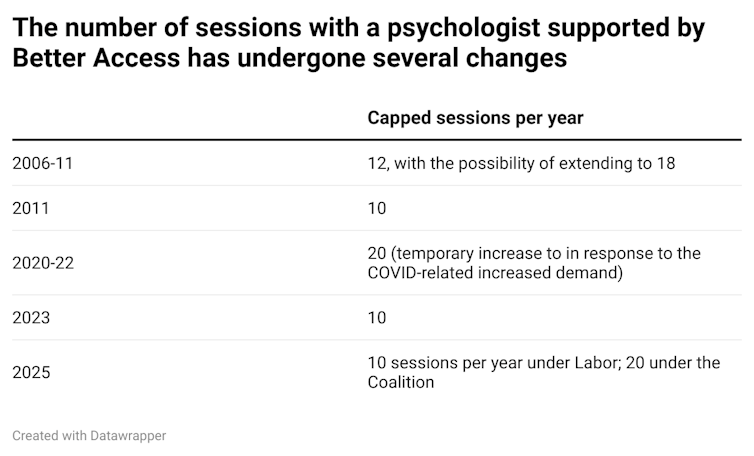
Opposition Leader Peter Dutton has promised a Coalition government would spend an extra A$400 million on youth mental health services.
This is in addition to raising the number of subsidised psychology sessions from ten to 20, which had been previously announced.
While extra funding for youth mental health is welcome, it’s important to target this in ways that will make a real difference to young people.
In our recent research, we asked young people about their experiences of waiting for mental health support, how they coped in the meantime, and what would really make a difference while they waited.
Rates of mental illness rising
An estimated one in seven Australian children and adolescents had a mental illness in the past 12 months. Rates of mental illness have also increased over time, particularly among younger generations.
The COVID pandemic led to a rapid rise in the number of children and young people seeing their GP for mental health problems. Visits for depression rose by 61% and eating disorders by 56% compared with before the pandemic.
The number of visits to the emergency department in New South Wales for self-harm, or plans or thoughts about suicide, have also increased since COVID.
The annual Mission Australia Survey reveals young Australians see mental health as one of their biggest challenges, with thousands calling for more support.
But there are long waits for care
Despite the greater demand for mental health treatment in Australia, there is very little information on how long young people wait to access it.
The Australian Psychological Society reported that during the pandemic, 88% of psychologists increased their wait times and one in five were not taking on new clients. This meant about half of people waited more than three months to begin psychological treatment. But this is for clients of all ages.
There is also little information on how young people experience the wait for treatment.
We asked young people about the wait for care
We recently published research on the wait times for mental health treatment for Australian teens.
We asked 375 young people aged 13–17 about the mental health care they have tried to access for their anxiety and depression and how long they waited to start treatment. We also asked them about their mental health while they waited, what helped them cope, and the types of support they received.
We found that on average, teens were waiting more than three months for their first session of treatment. Most teens waited to access psychologists and psychiatrists after a GP referral.
While their wait times varied, nearly all teens felt they waited “too long”.
Longer wait times were linked to poorer mental health, with more than 90% of teens reporting high distress while they waited. Many of the teens felt their feelings of worry and sadness had worsened and they had used risky and unhealthy ways to cope, such as spending more time alone, sleeping more, self-harming, and using alcohol and other drugs.
Most teens did not receive any support from their health-care providers during the wait time, despite wanting it.
One female 17-year-old had waited six months for treatment and told us:
It felt like I was hanging over a cliff and was just told to hold on.
Teens also felt their parents would benefit from greater support during the wait time. But we need more research to better understand how to help families.
Together, these findings show we desperately need to address wait times for young people’s mental health treatment.
Teens know the support they need
If teens are to wait for mental health treatment, they told us they need support while they do so.
Young people wanted more regular contact and “check-ins” from their service providers, someone to talk to during the wait, as well as more useful information on positive ways to cope.
Most teens in our study used digital mental health tools – such as mental health websites, online mental health checks, mobile apps, online chat services and forums – while they waited.
We’re developing digital mental health tools, in consultation with young people and GPs, to support doctors to care for their teen patients when treatment isn’t available right away. We’re testing the system of short digital mental health programs, supportive text messages and peer support in NSW this year.
But not all teens we surveyed found digital mental health tools helpful. So we need to offer teens a range of supports – from their family, their GP, and from their referred service provider – to help them cope while they wait for treatment.
What can governments do?
We must carefully consider when, where and how mental health funds are invested. If governments wish to see more young people treated for their mental health problems, then we need to look at how our health-care system will cope with the growing demand.
We also need national, transparent benchmarks for how long young Australians wait for mental health treatment. Only some health services in Australia have this. Other countries, such as the United Kingdom, have something similar to minimise the health risks of young people waiting too long for care.
Ultimately, though, we need to prevent mental health issues from starting in the first place. That would reduce the need for treatment, the very type young Australians are waiting too long for.
If this article has raised issues for you, or if you’re concerned about someone you know, call Kids Helpline on 1800 55 1800 or Lifeline on 13 11 14.
Bridianne O’Dea is supported by a National Health and Medical Research Council (NHMRC) Medical Research Future Fund (MRFF) Investigator Fellowship (1197249) and a MRFF Millions Minds Mental Health Grant (2035416). Bridianne O’Dea received funding from the Buxton Family Foundation, Australian Unity, the Frontiers Technology Clinical Academic Group Industry Connection Seed Funding Scheme and the UNSW Medicine, Neuroscience, Mental Health and Addiction Theme and SPHERE Clinical Academic Group Collaborative Research Funding to conduct this research. Bridianne O’Dea is a member of the Australian Society for Mental Health Research and the International Society for Research on Internet Interventions. Bridianne O’Dea’s current work has received pro bono support from Deloitte Digital Australia.
Source: The Conversation (Au and NZ) – By Fei Gao, Lecturer in Taxation, Discipline of Accounting, Governance & Regulation, The University of Sydney, University of Sydney
Tuesday night’s federal budget revealed a sharp drop in what was once a major source of revenue for the government – the tobacco excise.
This financial year, the government expects to earn revenue from the tobacco excise of A$7.4 billion. That’s down sharply from $12.6 billion in 2022–23, and an earlier peak of $16.3 billion in 2019–20.
The government expects this downward trend to continue. Australia’s heavy tobacco taxation has driven many consumers towards illicit cigarettes.
But this is more than just a problem for government coffers accustomed to revenue from the tobacco tax.
It presents a major challenge for a public health policy that has long relied on increasing tobacco excise duty as its primary tool to reduce smoking.
If government revenue from tobacco is falling, it isn’t because we aren’t trying to tax it. Cigarette prices in Australia are among the highest in the world, with taxes making up a substantial chunk of the price.
About $1.40 of the cost of each cigarette represents excise duty. GST is payable on top of that.
Australia’s tobacco excise is indexed every March and September, in line with average weekly ordinary-time earnings.
On top of indexation, the excise rate is currently being increased by an additional 5% each year, for a period of three years that began in September 2023.
This policy is grounded in the principle that higher costs deter smoking.
And smoking rates have fallen in recent decades. About 8% of Australians aged 14 and over still smoke daily, down from almost 20% in 2001.
Some of that fall has been offset by the rapid ascent of vaping. About 7% of Australians use e-cigarettes – about half of whom vape daily.
But while legal cigarette prices are prohibitively high for some, illegal alternatives are widely available and significantly cheaper. That’s because these unregulated products bypass excise and GST entirely.
The estimated value of illicit tobacco entering the Australian market has soared, from $980 million in 2016–17 to more than $6 billion in 2022–23. Of this $6 billion, almost $3 billion entered the market undetected.
The actual decline in tobacco excise revenue, as exposed in the latest budget papers, has been much more significant than previously forecast.
To make things worse, the cost of enforcement is rising. The 2025–26 federal budget allocates an additional $156 million over the next two years to combat illicit tobacco — on top of the $188 million committed in the previous budget.
There are other broader impacts on overall tax revenue. Convenience stores lose legitimate sales to illegal tobacco vendors, resulting in less corporate tax income.
Holding back broader public health efforts
On other measures, Australia has long been a global leader in tobacco control. The first health warnings on cigarette packets appeared in 1973.
In 2006, graphic health warnings were introduced. And in 2011, Australia pioneered plain packaging laws.
Such public health measures are set to get even stronger this year, with new requirements for every individual cigarette sold to have an “on-product” health warning such as “causes 16 cancers” or “shortens your life”.
These new regulations come into effect on April 1 2025, but retailers will have a three-month transition period to phase out existing stock.
The tight transition period may prove challenging for the legitimate cigarette trade.
But it is unlikely those who ply the unlawful trade in illegal tobacco – or their customers – will be particularly bothered by this latest attempt to wean the public off the habit.
No easy solution
The increasing heavy tobacco excise and the new law requiring warning messages on individual cigarettes have the potential to reduce tobacco consumption among those who purchase the product legally.
However, suppliers of black-market cigarettes – who now comprise an estimated 18% of market share – are unlikely to allow this initiative to affect their illegal trade.
The widespread move to vaping, with poor regulation, has further fuelled the black market for both products.
It is going too far to draw parallels with the prohibition era in the United States, when the manufacture, transportation and sale of alcohol was illegal. This was a brief but disastrous experiment in social engineering with unfortunate and, in retrospect, arguably predictable consequences.
But there are some unfortunate similarities when it comes to Australia’s tobacco tax policy, which has inadvertently encouraged black markets, criminality and organised crime.
Yet for the government, lowering the excise tax to encourage smokers back to legal cigarettes would be completely out of step with its public health objectives. Legal or illegal, black-market cigarettes and vapes still contribute to health risks, undermining the public health goals behind regulatory controls.
The authors do not work for, consult, own shares in or receive funding from any company or organisation that would benefit from this article, and have disclosed no relevant affiliations beyond their academic appointment.
Digital Storytelling Team does not work for, consult, own shares in or receive funding from any company or organisation that would benefit from this article, and has disclosed no relevant affiliations beyond their academic appointment.
Ants are among nature’s greatest success stories, with an estimated 22,000 species worldwide.
Tropical Australia in particular is a global hotspot for ant diversity. Some researchers believe it could hold some of the richest ant biodiversity on the planet, with an estimated 5,000 species in the tropics alone.
But if ants are so successful out in nature, why do they so often turn up in our homes and even upper-level apartments?
And what can we do to keep them out?
There’s probably an ant near you right now
Ants dominate the planet in terms of sheer abundance.
At any given moment, there are an estimated 20 quadrillion ants alive — that’s 20 followed by 15 zeros.
In fact, for every human being, there are roughly 2.5 million ants.
There are about 22,000 ant species worldwide. This one is called the Green tree ant (Oecophylla smaragdina). Tanya Latty
So the short answer to “Why are there ants in my house?” is simply this: there are a lot of ants.
We live on a planet where ants outnumber us by an almost unimaginable margin. The fact that a few occasionally wander into our homes shouldn’t come as a surprise.
Ants work from home (yours, that is)
Ants owe much of their success to their highly social nature.
Within the colony, some individuals (female queens and male drones) are responsible for reproduction, while others (workers) are busy caring for the young, cleaning or foraging for food. Workers ants are always female.
Ants may start off outside but at least some will probably eventually end up inside. Tanya Latty
Ant colonies do not have leaders. They are an excellent example of collective behaviour and swarm intelligence, where individuals following relatively simple rules can collectively achieve far more than any individual could alone.
Just as the individual neurons in your brain can’t compose music, play football, or read articles, the brain as a whole can achieve all these feats and more.
Colonies of co-operating ants are capable of amazingly sophisticated behaviours such as:
“farming” fungi and aphids (small, sap-sucking insects that feed on plants).
Ants even outperform humans on some cooperative cognition tasks.
Credit: Wonder World.
The highly social nature of ants is a big part of their success — and a key reason why they are so good at finding their way into our homes.
Each colony contains thousands of intrepid workers, many of which are constantly searching for new food sources. If even a single ant discovers a valuable resource in your home, it can quickly share that information with its nest mates.
Different ant species use different methods of communication, but the ones that most often invade our homes tend to use “pheromone trails”.
When an ant finds a food source, she returns to her nest leaving little drops of pheromones as she goes; this trail guides other ants from their nest directly to the food source.
This highly efficient communication system means a single ant can rapidly recruit thousands of its nest mates to any food it finds.
Ants may also come inside in search of water, particularly when the weather is hot.
Some species prefer to build their nests in humid environments, which might explain why they are often found in bathrooms.
I once discovered an entire colony of sugar ants nesting inside my aquarium filter! The combination of high humidity and an enclosed structure made it an ideal place to build a nest.
On the flip side, heavy rains can flood ant nests, prompting colonies to seek drier ground — sometimes leading them straight into our homes.
I live in an upper-floor apartment. How did ants get in?
Many ant species are exceptional climbers, thanks to tiny adhesive pads and fine hairs on their feet.
These specialised structures allow ants to stick to walls and find footholds even on surfaces that appear smooth to the human eye.
Remarkably, some canopy-dwelling ants have evolved a behaviour known as “controlled descent” which protects them when they fall. By adjusting the position of their abdomens, falling ants can steer their trajectory, directing themselves back toward the tree trunk and safety.
Ants often have tiny adhesive pads and fine hairs on their feet, which help them stick to walls. Mob_photo/Shutterstock
How do I keep ants out of my house?
Well, good luck. No matter what you do, ants will probably enter your house at one time or another.
Finding a few ants in your home doesn’t mean your house is dirty. We simply live on a planet that is absolutely teeming with ants.
To minimise unwanted ant visits, start by eliminating any potential food sources that could feed a hungry ant.
Store all food in sealed airtight containers, clean behind the fridge and inside/under the toaster, avoid leaving pet food out longer than needed and make sure your bins are securely sealed.
Ants have tiny stomachs, so even small crumbs or the residue from spilled sugary drinks can be enough to entice them back.
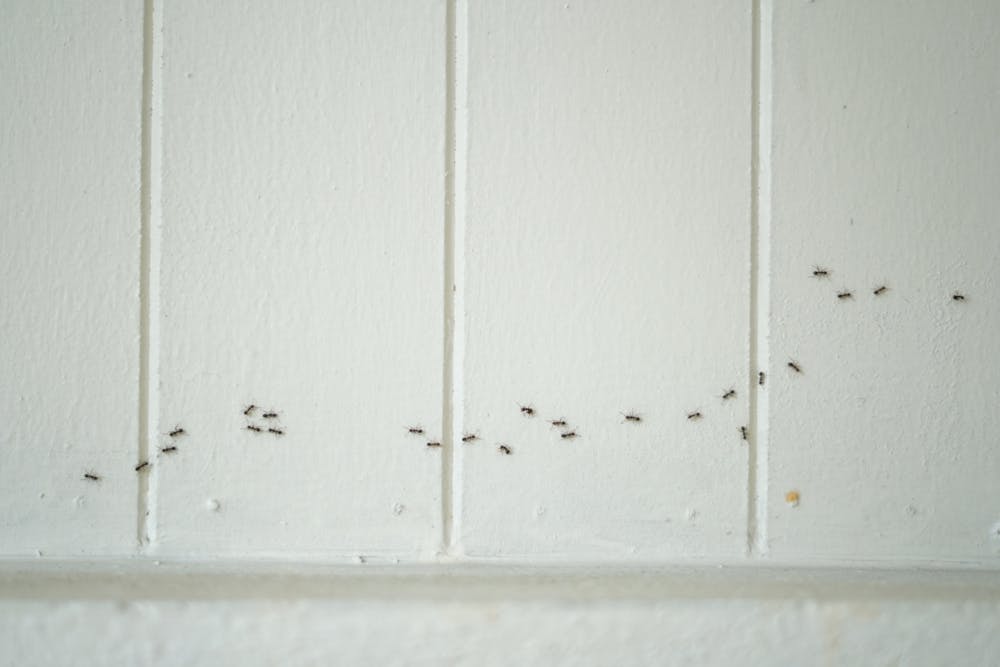
If ants seem to be following each other in a line, try disrupting their chemical trail using vinegar or bleach. Be warned, however: ants are very good at repairing broken trail networks.
Seal any small cracks or entrance points that might allow ants to get into your home and make sure your windows and doors have well-fitting fly screens.
Insecticidal baits can kill ant colonies, but before you deploy the nuclear option, ask yourself: what harm are the ants really doing?
Most common home-invading ants do not sting and are pretty harmless. They can usually be redirected simply by removing their food source.
Ants are nature’s clean-up crew, tirelessly scavenging waste and helping to maintain a healthy, balanced ecosystem.
They also play important roles as predators and seed dispersers.
Before reaching for insecticides, consider whether a few ants in your house are truly a problem.
Tanya Latty co-founded and volunteers for conservation organisation Invertebrates Australia, is former president of the Australasian Society for the Study of Animal Behaviour and is on the Education committee for the Australian Entomological Society. She receives funding from the Australian Research Council, NSW Saving our Species, and Agrifutures Australia.
On March 26 NSW Health issued an alert advising people to be vigilant for signs of measles after an infectious person visited Sydney Airport and two locations in western New South Wales.
The person recently returned from Southeast Asia where there are active measles outbreaks in several countries including Vietnam, Thailand and Indonesia.
If you’re travelling overseas soon, you could be at risk of measles. Here’s what to know to ensure you’re protected.
First, what is measles?
Measles is one of the most contagious viral illnesses. It spreads through the air when a person breathes, coughs or sneezes. On average, one person can infect 12 to 18 others who are not immune.
Initial symptoms include fever, a runny nose, cough and conjunctivitis. Then a non-itchy rash usually starts around the hairline before spreading around the body.
Measles is most common in children, and they’re also most vulnerable to getting very sick with the virus. Measles is severe in around one in ten children. Complications can include ear infection, diarrhoea and pneumonia, and, more rarely, encephalitis (brain swelling).
However, adults can also catch and spread the disease, making up 10–20% of measles cases during outbreaks.
The measles vaccine is free through Australia’s National Immunisation Program. It’s routinely given at 12 and 18 months of age. The first dose is combined with mumps and rubella (the MMR vaccine) and the second adds protection against chickenpox, or varicella (MMRV).
False suggestions the measles vaccination is linked with disorders such as autism have been thoroughly disproven. The vaccine is very safe and highly effective.
However, because the vaccine is made from a live virus, people with weakened immune systems (for example, those receiving chemotherapy for cancer or pregnant women) cannot have the vaccine even though they’re at higher risk of severe measles. Their safety depends on high community immunisation rates to reduce the spread of the virus.
Because measles is so infectious, at least 95% of the population needs to be immune to prevent its spread.
Immunity occurs from either two doses of measles vaccine or past infection. Measles vaccination was introduced in Australia in 1968. Most adults born before the mid-1960s would still be immune from a past infection. But vaccination is recommended for everyone else who is not immune.
In 2023 only 83% of the world’s children received at least one dose of measles vaccine by their first birthday, down from 86% in 2019. This is not enough to halt spread.
The withdrawal of US government funding from many global health programs, including a measles surveillance network that supports testing and outbreak responses, is throwing fuel on the fire.
In Australia, small but progressive declines in the uptake of childhood vaccines over the past five years and immunity gaps in other age groups means our risk of outbreaks in increasing.
For example, coverage of the MMR vaccine at 24 months declined 0.4 percentage points between 2022 and 2023 (from 95.3% to 94.9% in Indigenous children and 95.1% to 94.7% in children overall).
On-time vaccination rates – within 30 days of the recommended age – are also falling. The proportion of children who had their MMR vaccine on time dropped from 75.3% to 67.2% for non-Indigenous children and 64.7% to 56% for Indigenous children between 2020 and 2023.
Measles outbreaks are increasing in Australia and across the world
Measles cases are rapidly rising across the globe and more cases are arriving from overseas into Australia. So far in 2025, 37 cases have been reported compared to 57 in all of 2024, 26 in 2023 and seven in 2022. Most cases have been imported from overseas, but we’ve ascertained eight cases so far in 2025 were locally acquired.
Many of the countries experiencing the largest measles outbreaks are popular travel destinations for Australians, including India, Thailand, Indonesia and Vietnam.
As the incubation period – the gap between exposure and symptoms – is around seven to ten days, travellers may enter the country without knowing they’re about to become ill and potentially spread the virus to others.
Protecting yourself and your family
Although the usual age for the first measles dose is 12 months, the MMR vaccine can be given to babies as young as six months who are travelling to measles hotspots or during outbreaks.
This early measles vaccine dose does not replace those given at 12 and 18 months, but will help protect the infant in the interim.
It’s important all adults, particularly those planning overseas travel, know their vaccination or infection history. If you don’t, talk to your health-care provider about being vaccinated.
Everyone who doesn’t have immunity from an infection should have two lifetime doses. Some adults, including those who have migrated from overseas, may have had none or only one dose when they were younger. If you’re unsure, there’s no harm in receiving a vaccine if you’ve had measles or have been fully vaccinated already.
If you come back from overseas and need medical care, inform your health-care provider about your symptoms and recent travel before attending a clinic in person.
Archana Koirala has worked on projects funded by the Australian Department of Health and Aged Care and NSW Health. She is the chair of Vaccination Special Interest Group and a committee member of Australian and New Zealand Paediatric Infectious Diseases Group of the Australasian Society of Infectious Diseases.
Kristine Macartney is the Director of the Australian National Centre for Immunisation Research and Surveillance (NCIRS). NCIRS receives funding from the Australian government Department of Health and Department of Foreign Affairs and Trade, NSW and other state and territory health departments, Gavi the Vaccine Alliance, the World Health Organization, the NHMRC, the MRFF and the Wellcome Trust.
Excoriating is the word that may best describe expat Canadian James Grenon’s 11-page critique of NZME. His forensic examination of the board he hopes to replace and the company’s performance is a sobering read.
You may not have seen the letter. At the time of writing, it was still sitting behind The New Zealand Herald’s Premium paywall. It is, however, available through the New Zealand Stock Exchange. You can access it here.
Grenon is highly critical in a number of areas that he breaks down into sections in the letter. The headings include:
“The combined performance of the two core businesses has been mediocre, to sliding, for the past eight years, despite a temporary period of covid gains.”
“There has been a consistent pattern of over promising and under delivering since covid.”
“Public disclosure is weak, with a slant that I interpret as supporting the status quo.”
Grenon’s letter includes an analysis of NZME’s share price in relation to the perceived value of its OneRoof real estate marketing arm, and the company’s dividend policy. He claims “the disclosure on these two critical elements is, in my opinion, lacking or even misleading”. He also criticises levels of management-level remuneration and high levels of staff turnover which he says “does not suggest a happy working environment”.
NZME’s board has yet to respond to the letter stating — in a note to the New Zealand Stock Exchange accompanying the release of Grenon’s letter — that it will do so in its notice to shareholders before the annual general meeting on April 29.
Were that the sum total of his challenge to the present board, it might be characterised as simply a move to improve the group’s financial performance and its return to shareholders. Much of what he says will, in fact, resonate with ordinary shareholders worried about the group’s financial performance and direction. It may well attract even more votes at the April AGM than he currently commands.
However, there is an enormous caveat hanging over any support for Grenon’s initiative.
He states categorically in his letter that he does not propose to act as a passive board chair (yes, there is an assumption that he will head an entirely new board). Instead, he leaves a strong impression he will be an executive chairman, in effect if not in name.
“I propose to be very active at the management level, leading a board and team that will delve into the operational details so as to be able to challenge management . . . This approach to governance is the only realistic way to ensure NZME gets a fresh set of eyes questioning every aspect of operational effectiveness and shareholder value creation.” The italics are mine and are highlighted for reasons I will return to shortly, but the import is clear: James Grenon and his team will have a finger in the pie.
The second reason for exercising caution on any endorsement of the Canadian’s move relates to the three paragraphs he groups under the heading “Journalism”.
On the surface, he promises better journalism, saying his intention is that “more quality content should be produced, not less”.
In contrast to NZME’s recent announcement to “set a new tone and build positive social momentum for New Zealanders”, our proposal will lift the company’s journalistic standards, resulting in the production of higher quality news content, characterised by independent, trustworthy and balanced perspectives. There will also be material for entertainment value as well. Then all the content will be used in any number of ways to generate profit.
He also applauds the “audience leading ratings of NZME’s audio segment”.
All of this sounds laudible, until one asks the simple question: How?
He has yet to give any specific answers. A request from the journalists’ union E Tū for assurances simply led to Grenon asking more questions about what the union meant by “editorial independence”.
However, let’s return to what Grenon means by his references to NZME’s journalism.
If he means the board will limit itself to supporting an annual budget that will allow NZME’s editors to independently produce the sort of content to which his letter alludes, all well and good.
If he means the aims set out in his letter will be transmitted to editors as an expectation of their approach to journalism, no problem.
However, when read in conjunction with the intentions I italicised above, there are strong indications that he intends to be at least meddlesome and, at worst, to dictate editorial direction and content. There is a signal to his editorial preferences in the fact that he applauds radio ratings that are firmly anchored by NewstalkZB’s right-leaning content.
Nowhere in Grenon’s letter is there any undertaking to observe the principles of editorial independence that certainly permeated The New Zealand Herald when I was editor a couple of decades ago and which I inherited from a long list of predecessors. Nowhere is there recognition that NZME has responsibilities to the general public. Declining trust is seen only in terms of the impact on profits.
Responsible and accountable journalism is something editors and their staff hold in trust on behalf of society. They seek audiences for the dual purposes of spreading that journalism to the general public and, in the process, producing the profits that ensure its ongoing sustainability. Done well, it is a virtuous circle.
However, like all circles, once any part of it is fractured it collapses. If Mr Grenon views the editorial department in the same way he sees every other aspect of NZME’s business, he would be in boots and all. Then it would be only a matter of time before the circle falls in on itself.
James Grenon’s bid deserves support only if he gives cast-iron guarantees of editorial independence, and that requires more than a letter of reassurance. Mere words are not enough.
Well-founded concerns for the future of a vital component of our journalistic infrastructure will be allayed only by changing the constitution of NZME to prevent directors from instructing any employee on editorial policy or operational matters. That protection would be all the more vital if now-stalled discussions over the purchase of Stuff’s titles and associated digital outlets are resumed after NZME’s board battle is resolved.
Both Television New Zealand and Radio New Zealand have statutory protection against ministerial interference in editorial matters. The community deserves the same protection from board interference in private sector media in the public interest.
That, however, has never been a given and many news media enterprises rely on a mixture of tradition and peer pressure to ensure their journalists are insulated from undue influence.
The New York Times, for example, has a proud tradition of editorial independence but that owes more to the Salzberger family than to the company’s articles of association. The Daily Mail and General Trust have a tradition whereby its editors are appointed by the editor-in-chief in consultation with the board chairman, who also by tradition has been Viscount Rothermere (currently the fourth holder of the title). Each editor then controls the content of the respective titles. The editor-in-chief of The Guardian is not appointed by the board but by the Scott Trust, which owns the newspaper group, and reports directly to it.
I commend to Grenon and his fellow board aspirants an essay on editorial independence by the chairman of the New York Times Company, A G Salzberger. You can access it here.
For NZME to have effective guarantees of editorial independence, its articles would need to have a failsafe mechanism to prevent the sort of override that Rupert Murdoch affected with his news acquisitions. Such a mechanism might be special recourse to the Media Council in the event of an attempt by directors to interfere. The council could then independently investigate whether there had been a breach of the company constitution. Disclosure of such a breach could be damaging to both directors and the company.
The combination of protective governance plus an independent review process would allay most of the fears generated by Grenon’s utterances and his past brief encounters with news media — a former shareholding in the right-wing aggregator site The Centrist, and financing of legal action against mainstream media.
NZME shareholders and the public of New Zealand should be very wary if no such undertakings are forthcoming.
Disclosure: I was formerly a shareholder in the previous parent company of the group but do not currently hold shares in NZME.
Dr Gavin Ellis holds a PhD in political studies. He is a media consultant and researcher. A former editor-in-chief of The New Zealand Herald, he has a background in journalism and communications — covering both editorial and management roles — that spans more than half a century. Dr Ellis publishes the website knightlyviews.com where this commentary was first published and it is republished by Café Pacific with permission.
Last week, Queensland Health alerted the public about the risk of Australian bat lyssavirus, after a bat found near a school just north of Brisbane was given to a wildlife carer group.
The bat later died, but it was not confirmed whether it carried the virus.
This is not unusual. Volunteer wildlife carers respond to thousands of calls from the public every year after encountering sick, injured and orphaned bats. And testing them all routinely for the virus is not warranted or feasible.
Here’s what you need to know about the risk of catching Australian bat lyssavirus and how it can be treated.
What is bat lyssavirus?
Australian bat lyssavirus belongs to the same group of viruses that includes rabies – one of the most notorious diseases humans can catch from animals. Rabies causes about 59,000 deaths worldwide a year, mainly after dog bites. It is almost always fatal once symptoms appear.
Australian bat lyssavirus was discovered in 1996. There have been only three confirmed cases of the virus in humans in Australia, the most recent in 2013. All three were fatal.
Fortunately, because Australian bat lyssavirus and rabies are so closely related, the preventative measures that have been developed internationally against rabies can also protect humans from the effects of Australian bat lyssavirus.
Australian bat lyssavirus and rabies have a long incubation period (the period between exposure to infection and appearance of symptoms). If preventative treatments are given during the incubation period, they are highly effective in preventing disease and saving lives.
Such treatment reduces what is already a very low risk of illness and death to effectively zero.
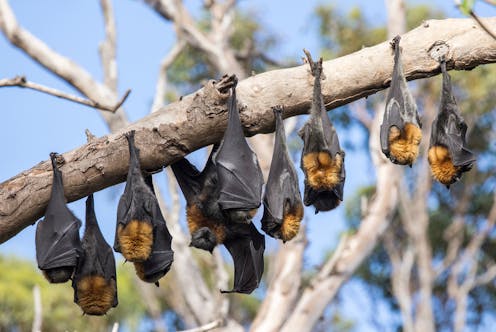
The virus is present in the saliva of some Australian bats, including the large flying foxes (fruit-eating bats) and some smaller bats that eat insects. But the proportion of bats infected by the virus is normally very low – less than 0.5%.
Infected bats may become sick and die, but some may appear unaffected. In other words, you can’t always tell just by looking at a bat whether it’s infected or not. However, there is evidence the virus is present at a higher level in sick bats than in healthy ones.
You cannot be exposed to the virus by being under a flying fox roost, even if the bats poo on you. You cannot be exposed by having bats in your roof or in a shed.
No, you can’t catch Australian bat lyssavirus from bat poo. Anna Evangeli
But the virus can be transferred to a human via either a scratch or bite. That’s if an infected bat scratches or bites you, or if their saliva is transmitted to an existing wound.
So you do need to be careful if you come across a sick or injured bat, or you find a child playing with a bat.
There is no evidence the virus regularly infects dogs and cats, although rabies does.
Nevertheless, given that Australian bat lyssavirus is a close relative of rabies and that rabies will infect most mammals, the possibility that it may sometimes spill over to mammals other than humans cannot be eliminated.
For example, in 2013 two horses in the same paddock became infected and had to be euthanised. The source of infection was not identified.
So you should also seek advice if you see an animal such as a dog or cat play with a dead or injured bat. Contact a wildlife care group for advice about the bat and a vet to discuss post-exposure treatment for your pet.
If your dog plays with a dead or injured bat, seek advice from your veterinarian to be on the safe side. Lazy_Bear/Shutterstock
How great is the risk?
It is important to put the risk posed by Australian bat lyssavirus into perspective.
Although each of the three deaths known to have been caused by the virus since 1996 is tragic, in 2017-2018 alone, 12 people in Australia died from bee or wasp stings.
Bats play an important role in our ecosystems. Without the pollination and pest control services bats provide, our increasingly fragmented native forests would struggle to recover after fires, and we’d need to use more pesticides on our crops. There is also no evidence bat lyssaviruses are increasing in Australian bat populations.
Is the risk to humans changing?
However, as we encroach upon natural habitats via land clearing we are likely to have increased contact with wildlife, including bats.
Mass mortality events in bats in Australia – such as those in recent years caused by extreme heat or bat paralysis syndrome (thought to be caused by bats ingesting an environmental toxin) – are likely to lead to increased contact between people, their pets and vulnerable bats.
The risk to human health is therefore likely increasing, albeit from a very low level.
What should I do?
First, don’t panic. Infection is extraordinarily rare and will continue to be so.
Second, don’t interfere with bat populations. Do not pick up sick or injured bats and do not allow your children or pets to play with them. Keep your pets inside at night to minimise potential contact with bats.
Third, if you or a member of your family is bitten or scratched by a bat, or suspect you have been, seek medical attention, including post-exposure treatment. People who regularly handle bats, such as wildlife carers or researchers, should be vaccinated in advance. They are also trained to handle bats safely and use appropriate personal protection equipment.
If you find a sick or injured bat, contact your local wildlife rehabilitation group or veterinarian.
Hamish McCallum receives funding from the US NSF and fron the EU Horizons program. His work on bat virus disease ecology has previously been funded by the US NSF and DARPA
Alison Peel receives funding from the US NIH. Her work on bat virus disease ecology has previously been funded by the ARC, US NSF and DARPA
Cinthia is a volunteer wildlife carer for a not-for-profit organisation based in Southeast Queensland that works with bats.
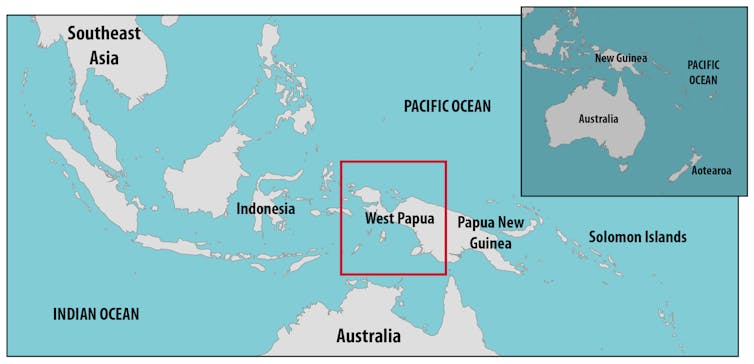
Owing to its violent political history, West Papua’s vibrant human past has long been ignored.
Unlike its neighbour, the independent country of Papua New Guinea, West Papua’s cultural history is poorly understood. But now, for the first time, we have recorded this history in detail, shedding light on 50 millennia of untold stories of social change.
By examining the territory’s archaeology, anthropology and linguistics, our new book fits together the missing puzzle pieces in Australasia’s human history. The book is the first to celebrate West Papua’s deep past, involving authors from West Papua itself, as well as Indonesia, Australasia and beyond.
The new evidence shows West Papua is central to understanding how humans moved from Eurasia into the Australasian region, how they adapted to challenging new environments, independently developed agriculture, exchanged genes and languages, and traded exquisitely crafted objects.
Archaeological evidence shows that people migrating from Eurasia into the Australasian region came through West Papua. Dylan Gaffney, CC BY-SA
Early seafaring and adaptation
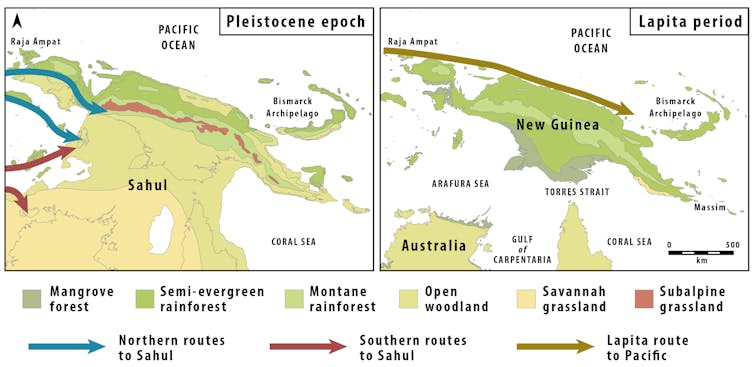
During the Pleistocene epoch (2.5 million to 12,000 years ago), West Papua was connected to Australia in a massive continent called Sahul.
Archaeological evidence from the limestone chamber of Mololo Cave shows some of the first people to settle Sahul arrived on the shores of present-day West Papua. There they quickly adapted to a host of new ecologies.
The precise date of arrival of the first seafaring groups on Sahul is debated. However, a tree resin artefact from Mololo has been radiocarbon dated to show this happened more than 50,000 years ago.
Genetic analyses support this early arrival time to Sahul. Our work suggests these earliest seafarers crossed along the northern route, one of two passages through the Indonesian islands.
Human dispersal to West Papua during the Pleistocene epoch (about 50,000 years ago) and during the Lapita period (more than 3,000 years ago). Dylan Gaffney, CC BY-SA
Interestingly, the first migrants carried with them the genetic legacy of intermarriages between our species, Homo sapiens, and the Denisovans, a now extinct species of hominins that lived in eastern Asia. Geneticists currently dispute whether these encounters took place in Southeast Asia, along a northerly or southerly route to Sahul, or even in Sahul itself.
In the same way modern European populations retain about 2% of Neanderthal ancestry, many West Papuans retain about 3% of Denisovan heritage.
As the Earth warmed at the end of the Pleistocene, rising seas split Sahul apart. The large savannah plains that joined West Papua and Papua New Guinea to Australia were submerged around 8,000 years ago. Much of West Papua’s southern and western coastlines became islands.
Social transformations during the past 10,000 years
As environments changed, so did people’s cuisine and culture.
We know from sites in Papua New Guinea that people developed their own agricultural systems between 10,000 and 6,000 years ago, at a similar time to innovations in Asia and the Americas. However, agricultural systems were not universally adopted across the island.
New chemical evidence from human tooth enamel in West Papua shows people retained a wide variety of diets, from fish and shellfish to forest plants and marsupials.
One of the key unanswered questions in West Papua’s history is when cultivation emerged and how it spread into other regions, including Southeast Asia. Taro, bananas, yams and sago were all initially cultivated in New Guinea and have become important staple crops around the world.
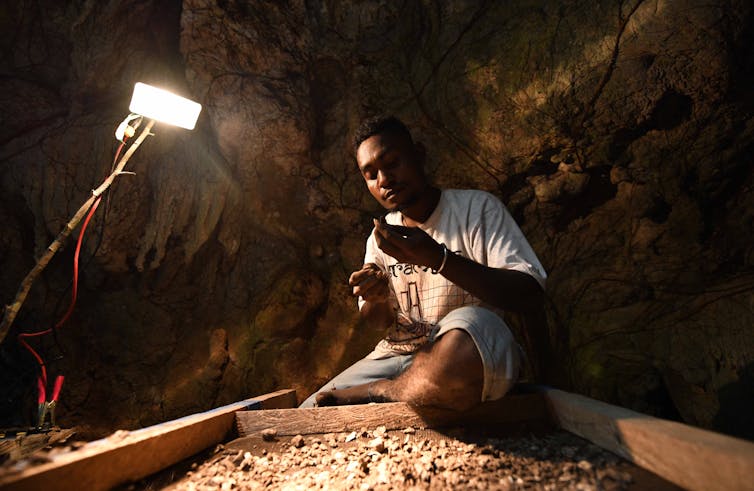
Moses Dialom, an archaeological fieldwork collaborator from the Raja Ampat Islands, examines excavated artefacts at Mololo Cave. Tristan Russell, CC BY-SA
The arrival of pottery, some 3,000 years ago, represents movements of new people to the Pacific. These are best illustrated by iconic Lapita pottery, recorded by archaeologists from Papua New Guinea all the way to Samoa and Tonga.
Lapita pottery makers spoke Austronesian languages, which became the ancestors of today’s Polynesian languages, including Māori.
New pottery discoveries from Mololo Cave suggest the ancestors of Lapita pottery makers existed somewhere around West Papua. Finding the location of these ancestral Lapita settlements is a major priority for archaeological research in the territory.
Rock paintings provide evidence of social change in West Papua. Tristan Russell, CC BY-SA
Other evidence for social transformations includes rock paintings and even bronze axes. The latter were imported all the way from mainland Southeast Asia to West Papua around 2,000 years ago. Metal working was not practised in West Papua at this time and chemical analyses show some of these artefacts were made in northern Vietnam.
At all times in the past, people had a rich and complex material culture. But only a small fraction of these objects survive for archaeologists to study, especially in humid tropical conditions.
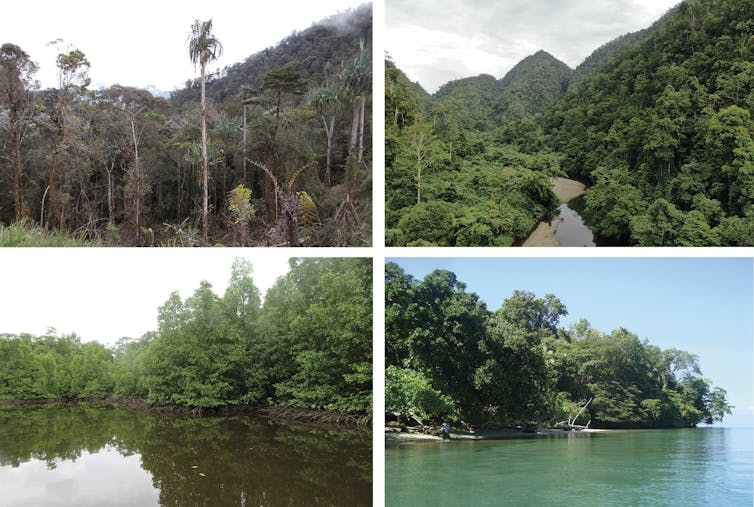
People settled diverse environments around West Papua, including montane cloud forests (upper left), lowland rainforests (upper right), mangrove swamps (lower left) and coastal beaches (lower right). Dylan Gaffney, CC BY-SA
Living traditions and the movement of objects
From the early 1800s, when West Papua was part of the Dutch East Indies, colonial administrators, scientists and explorers exported tonnes of West Papuan artefacts to European museums. Sometimes the objects were traded or gifted, other times stolen outright.
In the early 1900s, many objects were also burned by missionaries who saw Indigenous material culture as evidence of paganism. The West Papuan objects that now inhabit museums in Europe, America, Australia and New Zealand are connections between modern people and their ancestral traditions.
Sometimes these objects represent people’s direct ancestors. Major work is currently underway to connect West Papuans with these collections and to repatriate some of these objects to museums in West Papua. Unfortunately, funding remains a central issue for these museums.
Many West Papuans continue to produce and use wooden carvings, string bags and shell ornaments. Anthropologists have described how people are actively reconfiguring their material culture, especially given the presence of new synthetic materials and a cash economy.
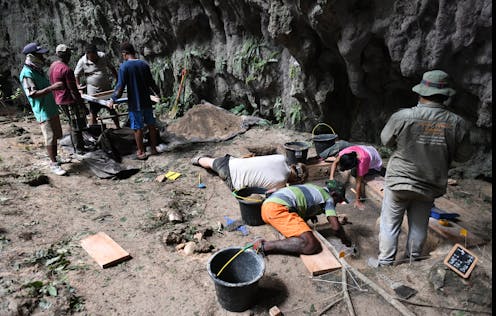
A montage of images showing West Papuan archaeologists in the field. (A) Klementin Fairyo, left, is setting up a new excavation. (B) Martinus Tekege excavating pottery. (C) Sonya Kawer with wartime archaeology. (D) Abdul Razak Macap, right, sieving for archaeological artefacts at Mololo Cave. Klementin Fairyo, Martinus Tekege, Sonya Kawer, Abdul Razak Macap, CC BY-SA
Despite our new findings, West Papua remains an enigma for researchers. It has a land area twice the size of Aotearoa New Zealand, but there are fewer than ten known archaeological sites that have been radiocarbon dated.
By contrast, Aotearoa has thousands of dated sites. This means West Papua is the least well researched part of the Pacific and there is much more work to be done. Crucially, Papuan scholars need to be at the heart of this research.
The authors do not work for, consult, own shares in or receive funding from any company or organisation that would benefit from this article, and have disclosed no relevant affiliations beyond their academic appointment.
Amazon has disabled two key privacy features in its Alexa smart speakers, in a push to introduce artificial intelligence-powered “agentic capabilities” and turn a profit from the popular devices.
Starting today (March 28), Alexa devices will send all audio recordings to the cloud for processing, and choosing not to save these recordings will disable personalisation features.
How do voice assistants work?
A voice assistant works by constantly listening for a “wake word”, such as “Alexa”. Once woken, it records the command that is spoken and matches it to an action, such as playing a music track. Matching a spoken command to an action requires what computer scientists call natural language understanding, which can take a lot of computer power.
Matching commands to actions can be done locally (on the device itself), or sound recordings can be uploaded to the cloud for processing. On-device processing has improved substantially in recent years, but is still less accurate than using the cloud, where more computer power is available.
Amazon is making two changes today
Alexa devices send recordings to the cloud by default. However, some high-end Echo models previously supported a setting called “Do not send voice recordings”.
If this setting was enabled, all recordings were processed locally. In practice, only a tiny fraction of Echo users (around 0.03% had this turned on.
In the first change, this setting is being disabled, and all recordings will be sent to the cloud.
Once in the cloud, recordings can be deleted or saved.
Alexa users also have a setting called “Don’t save recordings”, which, if enabled, deletes cloud recordings once they’re processed. In the second change, if the “Don’t save recordings” setting is enabled, Voice ID will stop working, and with it, access to personalised features such as user-specific calendar events.
This two-step change means Alexa users need to make a trade-off between privacy and functionality.
Alexa loses a lot of money
Put simply, Amazon needs Echo devices to start making money.
As US voice assistant expert Joseph Turow has detailed, Amazon began selling Echo devices very cheaply as a “loss leader”. Amazon says it has sold more than 500 million Alexa devices, but between 2017 and 2021 alone the company lost more than US$25 billion on the project.
Amazon has invested US$8 billion in AI developer Anthropic. Amazon
In February, Amazon launched a new AI-powered Alexa+ system. It promises more natural interaction and the ability to carry out tasks such as booking flights. Alexa+ is currently only available in the United States.
“Agentic capabilities” such as booking flights require detailed profile information about the user on whose behalf they are acting. This would include details such as preferred products or services.
Voice ID and data from spoken commands assist Amazon in tying preferences to a particular person.
An AI-powered intermediary
How will Alexa+ help Amazon make money? The first way is via direct subscription fees: the service will eventually only be available to Amazon Prime members or people who pay US$19.99 per month.
But what may prove more important is that it will help Amazon to position itself as an intermediary between buyers and sellers. This is what Amazon already does with its existing e-commerce platform.
It’s easy to see the system in action when you search for a product on Amazon’s website. Alongside items sold directly by Amazon, you are presented with products from multiple sellers, each of whom pays Amazon to be listed.
Everybody pays the platform
Agentic capabilities are likely to have a similar business model. Service providers – such as airlines or restaurant reservation companies – would pay Amazon when Alexa+ refers customers to them.
Amazon’s move is part of a broader phenomenon termed “platform capitalism”. This takes in the crowdsourced content of social media platforms, “sharing economy” businesses such as AirBnb, and the automated gig work of the likes of Uber.
Platform capitalism has delivered benefits for consumers, but in general the greatest benefits flow to those who own the platforms and design their infrastructure, services and constraints.
The settings can be viewed and changed from the Alexa app on your smartphone, under “More > Alexa Privacy”. Alexa users may wish to review the settings in “Manage
your Alexa Data” to choose how long recordings are saved for and which
voice recordings to delete. Recordings may also be deleted using a voice
command.
As Alexa+ becomes available more widely, users will need to decide whether they are comfortable sharing data about their preferences with Amazon to enable agentic capabilities.
Some Alexa privacy settings are still available. Amazon
What are the alternatives?
For users who are uncomfortable with the privacy settings now available with Alexa, a private voice assistant may prove a better choice.
The Home Assistant Voice Preview is one example. It gives people the option to have voice recordings processed on-device, but offers less functionality than Alexa and can’t work with as many other services. It’s also not very user-friendly, being aimed more at technical tinkerers.
Users may face a trade-off between privacy and functionality, both within Alexa itself and when considering alternatives. They may also find themselves grappling with their own place in the increasingly inescapable systems of platform capitalism.
Kathy Reid receives funding from the Australian Government Research Training Program (AGRTP) for her doctoral work and is a recipient of the Florence Violet McKenzie scholarship.
She currently contracts on a part-time basis to Mozilla Common Voice as a linguistic engineer. She is a past President of Linux Australia, Inc., an organisation dedicated to supporting open source communities and practices in the region. She was previously Director of Developer Relations at Mycroft.AI, a privacy-focused voice assistant, and held shares in the company, which is now dissolved. She has previously contracted with NVIDIA as a speech data specialist. NVIDIA provided hardware for Echo devices prior to 2021.
Source: The Conversation (Au and NZ) – By Dennis Altman, Vice Chancellor’s Fellow and Professorial Fellow, Institute for Human Security and Social Change, La Trobe University
It seems Britain has one key inducement to offer US President Donald Trump: a state visit hosted by King Charles.
One can only imagine what the king thinks of this, but he will undoubtedly maintain a stiff upper lip and preside over several lavish dinners.
Following reports of this offer, which would make Trump the only US president to be twice hosted by a British monarch, stories surfaced that the US might become an associate member of the Commonwealth.
There has been no official confirmation of this, but the story has been floated in several British newspapers.
What is the Commonwealth?
The Commonwealth came into existence as a means of retaining links with former British colonies, so there is a certain historical justification for the idea.
Almost all of Britain’s former colonies are now members of the Commonwealth of Nations, with Ireland and the US notable exceptions.
The Commonwealth is an organisation that ties together 56 countries, including a few in Africa that have been admitted despite not having been British colonies.
Of the 56, only a minority recognise the British king as their head of state, a point local monarchists are reluctant to acknowledge.
Indeed, some members of the Commonwealth, such as Malaysia, Brunei and Tonga, have their own hereditary monarchs.
In theory, all members are democratic, and several, such as Fiji, have at times been suspended from membership for failing on this count.
Whatever doubts we might have about the state of US democracy, it is hard to argue the US would fail to meet a bar that allows continued membership to states such as Pakistan and Zimbabwe.
The Commonwealth is largely seen as less important than other international groupings, and its heads of government meetings are often skipped by leaders of the most significant members.
Other than turning up to the Commonwealth Games, few recent Australian prime ministers have paid it much attention, compared to our membership of the G20 or the Asia-Pacific Economic Cooperation (APEC).
Nonetheless, the Commonwealth does include a remarkable range of countries ranging from significant states such as India, Canada and South Africa to the many island states of the Pacific and the Caribbean.
While its work is largely unreported, it does provide a range of international assistance and linkages that otherwise would be out of reach for its smaller and poorer members.
Why is Trump interested in joining?
Trump, it can be assumed, has no interest in the Commonwealth as a means of better working with states such as Namibia and Belize.
The attraction seems to be linked to his strange reverence for royalty and a fundamental misunderstanding of the role of the British sovereign.
King Charles is head of the Commonwealth through agreement of its members, probably in recognition of the extraordinary commitment his mother showed as the Commonwealth developed out of the old British Empire. Indeed, she clashed several times with her British ministers because of her loyalty to the Commonwealth.
But unlike the king’s British – and Australian – crown, this is not a position that belongs automatically to the British monarch.
So, while inviting Trump to Windsor Castle may be the gift of UK Prime Minister Keir Starmer, admission to the Commonwealth would require the agreement of all its members.
Given Trump’s demands to acquire Canada and to punish South Africa for recent land expropriation law, it is hard to imagine unanimous enthusiasm.
Most member states are cautious about being too closely linked to either the US or China, although Australia might end up the last true believer in US alliances. Others, such as Ghana and Pakistan, depend considerably on Chinese aid.
In a world dominated by increasingly autocratic leaders, a middle power like Australia needs as wide a range of friends as possible. Most of us have only a vague sense of what the Commonwealth entails.
Like all international institutions, the Commonwealth often seems more concerned with grand statements than actual commitment.
democracy and democratic processes, including free and fair elections and representative legislatures; the rule of law and independence of the judiciary; good governance, including a well-trained public service and transparent public accounts; and protection of human rights, freedom of expression, and equality of opportunity.
Would Trump’s America meet those demands?
Dennis Altman does not work for, consult, own shares in or receive funding from any company or organisation that would benefit from this article, and has disclosed no relevant affiliations beyond their academic appointment.
Australians will go to the polls on May 3 for an election squarely centred on the cost of living.
Prime Minister Anthony Albanese visited Governor-General Sam Mostyn at Yarralumla first thing on Friday morning.
Later he told an 8am news conference at parliament house the election choice was “between Labor’s plan to keep building or Peter Dutton’s plan to cut.
“Only Labor has the plan to make you better off over the next three years,” he said. “Now is not the time for cutting and wrecking, punching down.”
Less than a week after the federal budget and following an earlier delay caused by Cyclone Alfred, the formal campaign starts with government and opposition neck and neck and minority government considered a real possibility.
But in recent days, the government has gained more momentum and Labor enters the campaign more confident than at the start of the year.
The aggregated January-March quarterly Newspoll had the Coalition leading Labor 51-49%, but Albanese leading Peter Dutton as preferred PM 45% to 40%. Polling only shows a snapshot of the present, and the campaign itself could be crucial to the election result.
This is the fourth consecutive election launched off the back of a budget, with both sides this week bidding for voters’ support with big handouts.
Labor pushed through legislation for its $17 billion tax cut, the first stage of which comes in mid next year. Opposition leader Peter Dutton in his budget reply promised a 12-month halving of excise on petrol and diesel and a gas reservation scheme.
Labor goes into the election with 78 seats in the lower house, and the Coalition with 57 (counting the seats of two recent Liberal defectors). The large crossbench includes four Greens and half a dozen “teals”.
With a majority being 76 seats in the new 150-seat parliament, the Coalition needs to win 19 seats for an outright majority. This would require a uniform swing of 5.3% (although swings are not uniform). A swing of less than 1% could take Labor into minority. The Coalition would need a swing of about 3.6% to end with more seats than the government. While all states are important if the result is close, Victoria and NSW are regarded as the crucial battlegrounds.
If the Coalition won, it would be the first time that a first-term government had been defeated since 1931, during the great depression.
Since the end of the second world war, while all first term governments have been reelected, each saw a two-party swing against them.
One challenge for Albanese is that he has only a tiny majority, providing little buffer against a swing.
The combined vote of the major parties will be something to watch, with the vote steadily declining from 85.47% of the vote just 19 years ago at the 2007 election, to only 68.28% at the 2022 election.
Labor won the last election with a two-party vote of
52.13% to the Coalition’s 47.87%.
As of December 31 2024, 17,939,818 Australians were enrolled to vote.
The start of the formal campaign follows a long “faux” campaign in which both leaders have been travelling the length and breadth of the country non-stop, with the government making a series of major spending announcement but the opposition holding back on policy.
Marginal seats based on the redistribution
Michelle Grattan does not work for, consult, own shares in or receive funding from any company or organisation that would benefit from this article, and has disclosed no relevant affiliations beyond their academic appointment.
The usual story for a first-term government is a loss of seats, as voters send it a message, but ultimate survival.
It can be a close call. John Howard risked all in 1998 with his GST, and almost lost office, despite having a big majority.
But you have to go back to 1931 to find a first-term government thrown out.
So, going into this campaign, Anthony Albanese has the weight of history on his side. But modern day politics is volatile, and the voters are cranky, which has in recent months given the opposition hope it could run the government close or even defy the odds.
Government and opposition start the formal campaign with the polls close on the two-party vote. In the past few weeks, the government has improved its position, arguably to be now in the lead. If the election were held today, Labor would probably win more seats than the Coalition, and form government.
But the margins are narrow. With the next parliament, like this one, expected to have a large crossbench, present polling is pointing towards a minority government as a likely outcome. Things can change during a campaign.
Albanese started the term with substantial public goodwill – although his majority was razor thin, and his 2022 election owed more to the unpopularity of then prime minister Scott Morrison than to any real enthusiasm for Labor.
If one had to point to the single biggest political mistake the prime minister made, it was his over-investment in the Voice referendum. Whatever one thinks of the proposal itself, Albanese let it distract from what was a growing-cost-of-living crisis. The referendum was probably always destined to fail, but Albanese and the “yes” side were also out-campaigned by the “no” forces, strongest among them opposition spokeswoman Jacinta Price.
Albanese never properly recovered from the Voice’s defeat.
Early in the term the government was complacent about its opponents, believing Peter Dutton was unelectable. Indeed, that was a widespread view, including among many on the conservative side of politics. It underestimated Dutton’s strategic and tactical skills, the changing nature of the electorate, and how deeply the cost-of-living crisis – with its dozen interest rate rises under Labor, on top of one under Morrison – would bite.
Suburbia up for grabs
What was once ALP heartland, outer suburbia, is now up for grabs. Many of the tradies have become conservatives, to whom Dutton’s blunt, black-and-white political pitch is not just acceptable but potentially attractive.
Labor’s appeal to working people in this campaign is that that the worst is over on the economy, with unemployment still low and real wages in (slightly) positive territory. The latest national accounts figures showed Australia’s per capita recession, which had lasted seven quarters, was over. The February interest rate fall has also been a plus for the government: it may not be a big vote changer but it has reinforced Labor’s argument that things are going in the right direction.
The question remains: will people buy the story of life getting better when they are still not back to where they were a few years ago, and continue to feel under the financial pump?
This week’s budget and Dutton’s reply have homed in on cost of living. The government has come up with modest tax cuts, starting mid next year. These were legislated in a rush before parliament rose, so the Coalition was forced into saying it would repeal them. Dutton countered by promising an immediate cut to the excise on petrol and diesel. The opposition leader also used his budget reply to open another front in the battle over the energy transition, with the promise of a gas reservation scheme.
In the past month or two, there has been some change in the political atmosphere. Dutton’s momentum seemed to have stalled. The tight internal disciple he had maintained frayed somewhat, with messages over some policy and internal fears Dutton had left policy announcements too late.
Will voters think they don’t know enough about Peter Dutton?
The risk for Dutton is that people will fear they’re buying a pig in a poke. He has run a small target strategy; leaders (Howard in 1996, Abbott in 2013) have won on these before.
But if Dutton’s policy offerings in the campaign fall short, or his policy doesn’t stand up to the forensic scrutiny that comes in a campaign, he is likely to stall. So far, Dutton has established himself as a strong negative campaigner but he has yet to come through as a positive alternative prime minister.
His signing up to Labor’s $8.5 billion bulk-billing initiative was an example of a short-term tactic to neutralise an issue that raised questions about the Coalition’s inability to produce its own health blueprint.
The government will mobilise industrial relations against the Coalition, arguing Labor has delivered benefits to workers that a Coalition government would attack. This is risky for Dutton. His plans for slashing the public service, curbing working-from-home and removing the right to disconnect will fuel Labor’s negative campaigning, which will focus too on Dutton’s general plan to cut spending.
The Trump factor
A major unknown is what impact overseas events will have on this election. There has been a general swing to the right internationally. But the Trump factor has become a danger for Dutton.
His opponents seek cast Dutton as Trump-lite. The opposition leader is a critic of Trump on Ukraine, and he’s aware Trumpism is now politically scary for many voters. Nevertheless, Dutton’s pre-occupation with the size of the public service and his emphasis on cuts (without giving detail) will, to some voters, sound like echoes (albeit faint) of Trump. Labor claims its focus groups show people have been increasingly seeing Dutton as Trumpist.
Trump this week announced tariffs on foreign cars (not a worry to Australia, which doesn’t make any anymore). Next week he’ll announced the next stage in his tariff policy. This will feed into the election campaign. The extent it does will depend on whether Australia is directly hit. The government is busy with intense last-minute lobbying.
The cost of living is front and centre in the election, but the recent appearance of Chinese ships near Australia and their live-fire exercise has contributed to making national security and defence (especially how much we should be spending on it) issues as well, although second tier for most voters.
Major attention in this election will be on the performance of independents. Half a dozen so-called teals seized Liberal seats in 2022, and it would be very hard for the Coalition to obtain a majority without regaining some of them. The Melbourne seats of Kooyong and Goldstein will be especially closely watched. In New South Wales, one teal seat has already been lost through the redistribution.
The teals ran last time on climate change, integrity, and equity for women. This election, climate is less to the fore in the voters’ minds, while we now have an anti-corruption body, the National Anti-Corruption Commission. And there is no Scott Morrison, who was a lightning rod for the Liberals’ “women problem”. So in terms of issues, the teals have a harder case to make than before.
On the other hand, people remain deeply disillusioned with the major parties, and the teals have had plenty of time to dig into their seats. The general “community candidate” movement has strengthened and broadened. Whatever its precise composition, the new House of Representatives is expected to have a large crossbench.
In the event of a hung parliament, the crossbench will come into play. This means its potential members, especially the teals, will be under pressure during the campaign to indicate what factors they would take into account in deciding to whom to give confidence and supply. They are likely to keep their cards close to their chests.
The election will also test whether the hardline positions the Greens have taken, on local and foreign issues, have alienated or attracted voters. The Greens are at an historic high with four seats in the lower house. The three of those that are in Queensland will be on the line.
Given the closeness of the polls as the formal campaign starts, what happens in the coming five weeks, and notably the personal performances of Anthony Albanese and Peter Dutton could be crucial to the outcome. This is not one of those elections where either side can be confident it has the result in the bag.
Michelle Grattan does not work for, consult, own shares in or receive funding from any company or organisation that would benefit from this article, and has disclosed no relevant affiliations beyond their academic appointment.
Source: The Conversation (Au and NZ) – By Pandanus Petter, Postdoctoral Research Fellow, School of Politics and International Relations, Australian National University
Now that an election has been called, Australian voters will go to the polls on May 3 to decide the fate of the first-term, centre-left Australian Labor Party government led by Prime Minister Anthony Albanese.
In Australia, national elections are held every three years. The official campaign period only lasts for around a month.
This time around, Albanese will be seeking to hold onto power after breaking Labor’s nine-year dry spell by beating the more right-leaning Liberal Party, led by Scott Morrison, in 2022.
Now, he’s up against the Liberals’ new leader, a conservative with a tough guy image, Peter Dutton. It’s looking like a tight race.
So how do elections work in Australia, who’s contesting for the top spot and why is the race looking so close?
For Albanese, the honeymoon is over
Albanese was brought into power in 2022 on the back of dissatisfaction with the long-term and scandal-prone Liberal-National Coalition government.
At the time, he was considered personally more competent, warm and sensible than Morrison.
Unfortunately for Albanese, the dissatisfaction and stress about the cost of living hasn’t gone away.
Governments in Australia almost always win a second term. However, initially high levels of public support have dissipated over the first term. Opinion polls are pointing to a close election, though Albanese’s approval ratings have had a boost in recent weeks.
At the heart of what makes this such a tight contest are issues shared by many established democracies: the public’s persistent sense of economic hardship in the post-pandemic period and longer-term dissatisfaction with “politics as usual”, combined with an increased focus on party leaders.
Around the world, incumbents have faced challenges holding onto power over the past year, with voters sweeping out the Conservatives in the United Kingdom and the Democrats in the United States.
Australia has faced some similar economic challenges, such as relatively high inflation and cost-of-living problems.
Likewise, Australia – like many other established democracies – has long-term trends of dissatisfaction with major parties and the political system itself.
However, this distaste with “business as usual” manifests differently in Australia from comparable countries such the UK and US.
Australia’s voting system
In Australia, voting is compulsory, and those who fail to turn out face a small fine. Some observers have argued this pushes parties to try to persuade “swing” voters with more moderate policies, rather than rely on their faithful “bases” and court those with more extreme views who are more likely to vote.
In the UK, by comparison, widespread public distaste with the Conservatives, combined with low turnout and first-past-the-post voting, delivered Keir Steirmer’s Labour Party a dramatic victory. This was despite a limited uptick in support.
And in the US, turnout in the 2024 election was only about 64%. Donald Trump and the Republicans swept to power last year by channelling a deep anti-establishment sentiment among those people who voted.
And the country is now so polarised, that the more strongly identifying Democrat and Republican voters who do turn out to vote can’t see eye to eye on highly emotionally charged issues which dominate the parties’ platforms. Independent voters are left without “centrist” options.
Because Australia’s voting system is different, Dutton is unlikely to follow Trump’s far-right positioning too closely, despite dabbling in the “anti-woke” culture wars.
It also explains why Albanese’s personal style is usually quite mild-mannered and why he’s unlikely to present himself as a radical reformer.
However, neither man’s approach has made them wildly popular with the public. This means neither can rely on their own popularity to win over the public.
Another factor making Australia distinct is that voters rank their choices, with their vote flowing to their second choice if their first choice doesn’t achieve a majority. This means many races in the 150-seat lower house of parliament are won from second place.
Similarly, seats in the Senate (Australia’s second chamber, with the power to amend or block legislation) are won based on the proportion of votes a party receives in each state or territory. This gives minor parties and independents a better chance at winning seats compared to the lower house.
This means dissatisfaction with the major parties has in recent years created space for minor parties and a new crop of well-organised independents to get elected and influence policy. In 2022, around one-third of voters helped independents and minor parties take seats off both the Liberals and Labor in the inner cities.
To win government, Dutton will need to get them back, or take more volatile outer-suburban seats off Labor.
The big policy concerns
Against this backdrop, Australian voters both in 2022 and today have a fairly consistent set of policy concerns. And while parties want to be seen addressing them, their messaging isn’t always heard.
The 2022 Australian Election Study, run by Australian political researchers, revealed that pessimism about the economy and concerns about the cost of living were front of mind when Australians voted out the Liberal-National Coalition government last federal election.
This time around, one might think some relative improvement in economic factors like unemployment and cuts to interest rates would put a spring in the prime minister’s step.
However, the public is still very concerned about the day-to-day cost-of-living pressures and practical issues such as access to health care.
The government’s policy efforts in this direction – for example, tax cuts and subsidies for power bills – have so far not strongly cut through.
What have the major parties promised?
Comparing the parties’ platforms, Labor is firmly focused on economic and government service issues to support people in the short term.
Although expected to announce the election earlier, Albanese was handed the opportunity of delivering an extra budget by a tropical storm in early March. This included spending promises foreshadowed earlier, as well as a new modest tax cut as an election sweetener.
The Coalition, for its part, has been critical of these long-term goals and promised to repeal the newly legislated tax cuts in favour of subsidies for petrol. It has focused its message on reduced government spending, while strategically mirroring promises on health to avoid Labor attacks on that front.
Dutton has also proposed cuts to migration to reduce housing pressures and a controversial plan to build nuclear power plants at the expense of renewables.
Will these differences in long-term plans cut through? Or are people focused on short-term, hip-pocket concerns?
This election, whatever the result, will not represent a long-term shifting of loyalties, but rather a precarious compact with distrustful voters looking for relief in uncertain times.
Pandanus Petter is employed at the Australian National University with funding from the Australian Research Council.
At the last federal election, Australia elected the largest lower house crossbench in its post-war federal history.
In addition to four Greens MPs, Rebekah Sharkie from the Centre Alliance and Bob Katter (with his own micro-party), there were ten independent MPs, seven of them new to parliament. These MPs have the freedom and flexibility to vote on every piece of legislation without having to adhere to any party-room pledge.
Micro-parties and independents also fared well in the Senate in 2022, thanks in part to the fact that we use proportional representation to elect our senators. In a half-Senate election with 40 vacancies, six went to the Greens, one to Independent ACT candidate David Pocock, one to United Australia Party Senator Ralph Babet and one to Pauline Hanson in Queensland.
Defections during the 47th parliament grew the crossbench even further. Five former Coalition MPs and Senators have moved to the crossbench, one over allegations of sexual harassment, one over the Voice to Parliament referendum and three over bruising preselection defeats.
Senator Fatima Payman defected from the Labor Party last year, citing problems with the party’s stance on Palestine, and has now set up the Australia’s Voice party.
Getting elected
Independents hardly enjoy a level playing field in federal elections. Brian Costar and Jennifer Curtin pointed out in their book, Rebels with a Cause, that independent candidates lack equal access to the electoral roll, do not initially benefit from the public funding that flows consistently to the major parties, and cannot be listed above the line on the Senate ballot paper unless they form a group or party.
Unless they are party defectors with a seat in parliament already, independent candidates also lack the advantages of incumbency. Previous research from the Australia Institute has shown the dollar value of an incumbent MP’s entitlements (in terms of their salary and those of staff, printing and travel allowances, public exposure), is about $2.9 million per term.
Once elected, though, Independents have shown the major parties that they can be very hard to beat. Helen Haines and her predecessor as Member for Indi, Cathy McGowan, have won four consecutive elections between them. Zali Steggall, who famously beat former prime minister Tony Abbott in the electorate of Warringah in 2019, has been re-elected once, and the people of metropolitan Hobart have returned former public servant and whistleblower Andrew Wilkie to Canberra five times in a row.
No safe seats
Political parties and journalists have conventionally treated certain seats as “safe” (if the winning party’s vote two-party preferred margin was 60% or higher), others as “fairly safe” (if the winning party’s 2PP margin was between 56% and 60%) and others as “marginal” (those won by less than 56% at the previous election).
But the days of safe and marginal seats are over. These terms belong to an age of two-party contests and more predictable preference flows. As Bill Browne and Richard Denniss of the Australia Institute have pointed out, the major party vote share has now “crossed a threshold” below which the idea of “safe seats” becomes redundant.
Independent candidates can win with a relatively low share of the primary vote. In 2022, community independent Kylea Tink won the electorate of North Sydney with 25% of the primary vote, having ranked favourably, but not first, on many voters’ ballots.
Holding on?
Several contests involving current crossbenchers may prove nationally influential in the event of a hung parliament. Tink, whose electorate has been abolished in a routine redistribution, will not be among the incumbents hoping to hold their seat.
The Liberal Party, by some accounts, perceives the Perth seat of Curtin, won by community independent Kate Chaney in 2022, as an important litmus test for the future. January saw a “surge in volunteers and donations” for Liberal candidate Tom White’s campaign, according to media reports.
Elsewhere, the Liberals are attempting to meet incumbent community independents with candidates that more closely resemble them. The Liberal candidate for Warringah, Jaimee Rogers, is, like the sitting member Zali Steggall, a former athlete with a public profile. Wentworth candidate Ro Knox, a former Deloitte consultant, will run against Allegra Spender, whose own pitch for re-election has emphasised tax reform and productivity.
In Victoria, Monique Ryan, who won the seat of Kooyong from then-treasurer Josh Frydenberg, will this time face Amelia Hamer, a local woman, professional and grand-niece of former Victorian premier Rupert Hamer.
There are exceptions to that pattern. Former RSL President James Brown was preselected as the Liberal candidate for Mackellar, currently held by community independent Sophie Scamps. And in Goldstein, there will be a rerun of the previous contest between community independent Zoe Daniel and her Liberal predecessor Tim Wilson.
At least three of the major party defectors in both houses are hoping to keep their seats, too. Gerard Rennick, formerly a Coalition senator who was denied a winnable spot on the Liberal National Party ticket, has registered the Gerard Rennick People First Party ahead of his bid for re-election this year. Rennick has pointed out that this will get his name “above the line” on the Senate ballot paper.
Former Liberals Ian Goodenough and Russell Broadbent have both indicated they will run as independents to defend their seats – Moore and Monash respectively – from their erstwhile colleagues.
Room for growth?
Despite the watershed result in 2022, the crossbench may grow yet. Fundraising group Climate 200 is reported to be backing up to 35 candidates across the country, and an army of volunteers has already begun to mobilise in support.
Health professional Carolyn Heise will hope that, with the support of the new campaign fundraiser the Regional Voices Fund, her second campaign in the regional electorate of Cowper may land her in parliament alongside Indi MP Helen Haines.
The retirement of shadow minister Paul Fletcher as member for Bradfield in inner-Sydney makes for a particularly interesting contest in that electorate. Gisele Kapterian, who won Liberal preselection against Warren Mundine, will campaign against community independent Nicolette Boele, who would need a swing of only 5% in her favour to win on her second attempt.
In Victoria’s western district, community independent Alex Dyson will attempt for the third time to win the seat of Wannon from shadow immigration minister Dan Tehan. Dyson came close in 2022 and would need only a 4% swing (two-candidate preferred) to win this time.
In 2022, community groups supported independent candidate Penny Ackery in her campaign against then-minister and now shadow treasurer Angus Taylor. The two-candidate preferred vote left the seat “relatively safe” (in old terms), but declining support for the Coalition saw the state electorate of Wollondilly (within Hume’s borders) elect community independent Judy Hannan in a “surprise win” at the 2023 state election.
There is plenty of potential for surprise victories and shock defeats at the forthcoming election. Community independents are running in at least four Labor-held seats. What should surprise nobody is that every vote in every seat will count on election day.
Joshua Black is a Postdoctoral Research Fellow at the Australia Institute.
They are neither as leafy nor as affluent as much of the Liberal heartland, but Peter Dutton believes the outer ring-roads of Australia’s capitals provide the most direct route to power.
He has been telling his MPs these once-safe Labor-voting suburbs are where the 2025 election can be won.
From the moment the Queenslander assumed control of the Liberal Party in 2022, he was intent on this suburbs-first strategy, even if it seemed historically unlikely and involved repositioning his formerly business-loyal party as the new tribune of the working class. As he told Minerals Week in September 2023:
The Liberal Party is the party of the worker. The Labor Party has become the party of the inner city elite and Greens.
This has been Dutton’s long game. It’s an outsider approach reminiscent of what US President Donald Trump had achieved with disaffected blue-collar Democratic supporters in the United States, and what Boris Johnson managed by turning British Labour supporters in England’s de-industrialised north into Brexiteers and then Conservative voters.
It was not the obvious play but it may prove the right one.
After a tumultuous period in which the Liberals had cycled through three prime ministers and ignored a clear public clamour for policy modernisation on women, anti-corruption and climate change, the Morrison government had been bundled from office.
Morrison hadn’t merely failed to attract disengaged undecideds in the middle-ground, but had haemorrhaged engaged constituents from some of Australia’s safest Liberal postcodes.
Nineteen seats came off the Coalition tally in that election, yet Labor’s gain was only nine.
Something fundamental had happened. Six new centrist independents now sat in Liberal heartland seats – all of them professional women.
Numerically, they formed a kind of electoral Swiss Guard around the new Labor government’s otherwise weak primary vote and thin (two-seat) parliamentary majority.
In a sharp visual contrast to the Coalition parties, women made up around half of Anthony Albanese’s new Labor government and he moved to prioritise the very things on which the Coalition had steadfastly refused to budge – including meaningful constitutional recognition of First Peoples.
Albanese, it seemed, had tuned in to the zeitgeist. He would even go on to break a 102-year record a year later, becoming the first PM to increase his majority by taking a set off the opposition in a byelection. One more urban jewel shifted out of the Liberals’ column.
Dutton, however, never blinked.
His first press conference as leader in 2022 had been notable for the absence of the usual mea culpa – a suitably contrite acknowledgement that he’d heard the message from erstwhile Liberals who had abandoned their party for more progressive community independents.
Instead, Dutton confidently responded that the 2025 election would be decided not in these comfortable seats but in the further-flung parts of Australia’s cities where people make long commutes to work and struggle to find adequate childcare and other services.
It was a bold strategy because it meant targeting seats with healthy Labor margins.
Canberra insiders wondered privately if this was brave or simply delusional. Some concluded it could only work as a two-election strategy.
Many asked where a net gain of 19 seats would come from if not through the recovery of most or all of what became known as the “teal” seats?
Yet the combative Liberal continued to focus on prising suburbanites away from Labor with a relentless campaign emphasising the rising cost-of-living under Labor.
Three years later and even accounting for the first interest rate cut in over four years, it is Dutton’s strategy that has looked the more attuned to the electoral zeitgeist.
So much so that he goes into this election with a realistic chance of breaking another longstanding electoral record: that of replacing a first-term government.
This hasn’t been done federally since the Great Depression took out the Scullin Labor government of 1929-1931.
It’s all about geography
While only votes in ballot boxes will tell, the Coalition’s rebounding support appears to have come from the outer mortgage belt, just as he predicted.
These voters absorb their political news sporadically via social media feeds, soft breakfast interviews, and car-radio snippets.
These are media where Dutton’s crisp sound-bite messaging around cost-of-living pressures has simply been sharper and more resonant than Labor’s.
And it is by this means that these voters may have picked up that a Dutton government would seek to deport dual citizens convicted of serious crimes, stop new migrants from buying property (a policy first ridiculed as inconsequential by Labor and since copied), and cut petrol excise, temporarily taking around $14 off the price of a tank of fuel.
These voters may have noticed Dutton’s campaign against the supermarket duopoly, which includes the option of forced divestiture for so-called “price-gouging”.
And they might have heard his dramatic nuclear “solution” to high energy costs and emissions (in reality, devilishly complex and expensive).
On top of these, semi-engaged voters might recall Dutton’s culture-war topics for which he has regularly received generous media minutes, including:
his opposition to what he called “the Canberra Voice”
his defence of Australia Day
his refusal to stand in front of the Aboriginal and Torres Strait Islander flags
his oft-made claim that a Greens-Teals-Labor preoccupation with progressive issues has left the cost-of-living crisis unaddressed.
Beyond such rhetoric, Dutton has had little to say in detailed policy terms. But will that matter? However comprehensive, Labor’s list of legislated achievements has, arguably, achieved even less purchase in the electoral mind.
Polls taken as the election campaign neared showed Dutton’s Coalition was well-placed to win seats from Labor in suburban and outer-suburban areas of Perth, Melbourne, and Sydney, as well as regional seats in the NSW Central Coast.
These include seats such as Tangney and Bullwinkel in outer Perth; McEwen and Chisolm in suburban Melbourne, and as many as seven seats in NSW – mostly on the periphery of Sydney or in the industrial Hunter Valley region.
There may be other seats to move also. Liberal sources say they like their chances in Goldstein, currently held by the Teal, Zoe Daniel. And with a recent conservative turn in the Northern Territory election to the CLP, seats like the ultra-marginal Lingiari and the numerically safer Solomon could also be in play.
A YouGov MRP poll reported by the ABC on February 16 put Dutton’s chances of securing an outright majority after the election at 20%.
It measured the Coalition’s two-party-preferred support at 51.1% over Labor on 48.9%. That represents a swing towards the Coalition of 3.2%. But it is where the swing occurs that matters most.
Seat-by-seat assessment of the YouGov results suggested the Coalition would be likely to win about 73 seats (median), with a lower estimate of 65 and an upper estimate of 80, if a federal election was held today.
The same modelling indicates Labor would go backwards, holding about 66 seats in the next parliament, with a lower estimate of 59 and an upper estimate of 72. This is just one, albeit unusually large poll, but it will concern Albanese that even on its upper margin of Labor seat holds, he would not retain a majority.
Of course, the campaign can change things and already, the delayed start caused by Cyclone Alfred introduced further variables in the form of a federal budget, replete with income tax cuts.
A succession of polls conducted through March point to a Labor recovery with a Redbridge poll of 2,007 respondents, taken over March 3–11 putting Labor ahead 51%–49%. The same poll however showed a majority of people worry that the country is heading in the wrong direction.
The final contest
In political circles, people talk about momentum in campaigns, and say things like “the trend is our friend”. If true, that electoral amity has leaned decisively towards Dutton for the past year, and only recently to Labor.
But caution is always advised. Election counts invariably throw up oddities – swings being more (or less) marked in one state compared to others, and seats retained (or lost) against a broader national trend on the night.
Such surprises give the lie to the concept of uniform swings and makes prediction of a final seat count more difficult.
If the polling consensus is broadly correct – rather than being the result of herding – and the source of Dutton’s rising support is former Labor suburbs, the question is, will those vote gains materialise at sufficient scale to translate into seat gains?
If so, this election could redraw the political map and require new thinking about major party voting bases, policies and strategies into the future.
The final outcome seems likely to turn on three things:
Dutton’s ability to stay on message about the cost-of-living through the campaign when others in his team, buoyed by Trump’s war on wokeness, want to raise tendentious social issues.
Albanese’s effectiveness in convincing wayward Labor voters that Labor has in fact delivered, that the economy has turned the corner, and that Dutton’s comparative toughness is code for budget cuts that would hit them hardest.
Unforeseen events – at home or abroad.
The Liberal leader is surprisingly well-placed. But remember, he is coming from a long way back.
Mark Kenny does not work for, consult, own shares in or receive funding from any company or organisation that would benefit from this article, and has disclosed no relevant affiliations beyond their academic appointment.
Lately, there have been many headlines on scientific fraud and journal article retractions. If this trend continues, it represents a serious threat to public trust in science.
One way to tackle this problem – and ensure public trust in science remains high – may be to slow it down. We sometimes refer to this philosophy as “slow science”. Akin to the slow food movement, slow science prioritises quality over speed and seeks to buck incentive structures that promote mass production.
Slow science may not represent an obvious way to improve science because we often equate science with progress, and slowing down progress does not sound very appealing. However, progress is not just about speed, but about basing important societal decisions on strong scientific foundations. And this takes time.
As a result, the pressure to publish has never been higher. Indeed, in my yearly performance meetings, I am asked how many articles I’ve published and what is the status of the journals I published in. I am not asked how robust my methods are and how discerning my peer reviewers were.
The problems with fast science
Our current “fast science” approach has produced a host of problems.
Much as with fast food, scientists are incentivised to produce as much science as possible in as little time as possible. This can mean cutting corners. We know, for instance, that larger samples lead to more trustworthy results because they are more likely to be representative of the relevant population. However, collecting large samples takes time and resources.
Fast science is also associated with gaming the system. As a hypothetical example, an educational scientist might collect data to find evidence for their theory that a new teaching style promotes better learning. Then, they look at the data and realise the intervention did not quite improve learning. But if you squint at it, there might be a trend if you drop a couple of pesky outliers that didn’t see a benefit. So, they do just that.
This an example of what’s known as a “questionable research practice”, because it’s not considered outright fraud by conventional standards. Surveys in many fields suggest these practices are widespread, with about 50% of scientists saying they have engaged in them at least once.
Fast science is also associated with more obviously unethical practices.
Reports of fabricated data are likely due, in part, to scientists trying to publish as quickly as possible. An industry has even sprung up around scientific fraud – what are known as “paper mills”. These organisations produce articles around fabricated data and then sell authorship to those papers.
Surveys have shown about 50% of scientists have engaged in questionable research practices such as slightly tweaking research data. National Cancer Institute/Unsplash
Why trustworthy science takes time
So, what does slow science look like and how can it help?
In many ways, it is the opposite of fast science: large samples and careful, well-documented, transparent practices.
Recall the hypothetical example of the scientists testing a new education practice. Rather than immediately jumping into data collection, the slow practice would be to first write a “registered report”. In other words, scientists would write out their theory and how they propose to test that theory, and send that out for peer review prior to collecting data.
The journal would then follow the normal process of soliciting peer reviews and allowing the scientists to revise their report in response to those reviews. Then, the authors would collect data, with publication in the journal being assured as long as they follow the agreed upon methods.
There are two major benefits to registered reports: it allows for peer feedback while it is still possible to improve the study and it removes an incentive to engage in questionable or fraudulent practices. Using the registered report format can take longer. But it is associated with more credible findings.
In theory, all science should be reproducible. That is, scientists should share their methods and data such that other scientists can both verify that work and build on it (developing new recipes, to continue the analogy to slow food).
Similarly, cleaning up the scientific record is incredibly important. For the same reasons that chef Gordon Ramsay likes to a clean a kitchen out before improving it, science needs to get a handle on what existing findings are reliable before we can build on them.
This means carefully going through existing publications to find studies that show indications of being fabricated or otherwise unreliable. This sleuthing is rare among university scientists because it does not typically result in publications. But it is highly important.
Slow science is the opposite of fast science: large samples and careful, well-documented, transparent practices. National Cancer Institute/Unsplash
Slow science is slowly gaining steam
Currently, it requires bravery to engage in slow science.
Universities are keen to move up the university rankings lists. Those rankings are driven by publishing. So, universities hire, promote and retain their scientists based on their publications. This makes it risky to slow down.
There are, however, some reasons to hope. Movements are afoot to redefine research quality to take into account more aspects of slow science.
The Declaration on Research Assessment is a worldwide initiative to move away from ranking systems that ignore the principles of slow science.
And advocates for more careful research practices have recently been appointed to important positions, such as with research funders and academic journals.
These developments are worth following and building upon because society does not need heaps of low-quality science. It needs science that deserves trust.
Jason Chin is affiliated with the Association for Interdisciplinary Metaresearch and Open Science (AIMOS), a charity that promotes the study and improvement of research methods. AIMOS is a co-founder of the open peer-review platform, MetaROR.
Source: The Conversation (Au and NZ) – By Joanne Enticott, Associate Professor, Monash Centre for Health Research and Implementation, Monash University
During COVID, the former Morrison Coalition government temporarily expanded the yearly cap on the number of psychology sessions, from ten to 20. The Labor Albanese government reverted to ten sessions at the end of 2022.
But did capping sessions at 20 increase access to mental health care, especially for disadvantaged Australians? Or are there more effective ways to achieve this?
How does it work?
Australians can access up to ten rebated psychology sessions annually. Patients need to have a mental health treatment or management plan from their GP or psychiatrist.
The typical Medicare rebate is $141.85 per session with a clinical psychologist and $96.65 with other registered psychologists. (All psychologists are university qualified mental health professionals, but clinical psychologists have more qualifications.)
Psychologists can choose their own fees. They can bulk bill (no out of pocket cost for patients) or charge consultation fees, leaving some patients hundreds of dollars out of pocket for each session.
How did access change during COVID?
To assess the changes during COVID, we need to consider three components: number of people accessing services, service use rates (number of sessions per population) and the average number of sessions per patient.
1. Number of people accessing services
In 2020-21, all states saw a 5% jump in the number of people accessing Medicare mental health services, coinciding with the first year of the COVID pandemic.
However, a 2022 independent evaluation of the Better Access initiative showed that between 2018 and 2021, new users declined from 56% to 50%, with the steepest drop between 2020 and 2021.
This reduction in new users coincided with the temporary increased cap to 20 sessions.
Australians from disadvantaged backgrounds continued to have poorer access to psychologists than those from wealthier population groups, despite an increase in the number of sessions.
2. Service use rates (number of sessions per population)
Service use rates tell us how much a particular service is being used each year. To compare service use rates between different years, and because the Australian population is growing yearly, we report service use rates per 1,000 people in the population.
When the cap on number of sessions was reduced to ten sessions, there was a small drop in service use rates, but it didn’t return to the pre-pandemic levels.
The increase in services occurring in the first two years of the COVID pandemic (and around the time as the cap temporarily increased from ten to 20 sessions), resulted in a small increase in the average number of sessions per patient.
In the ten years between 2013-14 and 2022-23, average number of sessions with a clinical psychologist increased from five to six sessions whereas the average number of sessions with other psychologists increased from four to five sessions.
Overall, most people used ten or fewer sessions, even when up to 20 sessions were available.
Some extra services were provided to existing clients during COVID and this may have actually prevented new people from receiving services.
So the evidence suggests simply increasing the number of rebated psychology sessions from ten to 20 for everybody isn’t the most effective approach.
What should Labor and the Coalition do instead?
We don’t limit the number of chemotherapy sessions for cancer patients, so why do we cap evidence-based psychological treatments for mental illness?
Instead of capping access to Medicare rebates for mental health care, access should be based on a person’s needs and treatment outcomes. The number of sessions should be determined collaboratively between the person and the provider, ensuring people receive the appropriate level of evidence-based care for their condition.
Measure outcomes
Currently in Australia for Medicare-funded mental health services, we only measure service activity. Patient outcomes are not collected, which hinders the development of value-based mental health care.
Without collecting outcomes, current initiatives to address inequities are only partially informed and may not work as intended.
We urgently need to establish a set of outcomes (patient-reported outcome measures and experience measures) through consensus with the community, providers, professional organisations and governments.
Address affordability
We should also address inequities, such as gap fees that act as barriers to accessing services.
Greater rebates and bulk billing incentives for vulnerable people can assist those with less money.
We need to develop and invest in a range of services that cater to differing levels of need. This would ensure more specialised services are available for those with higher complexity or severity.
The authors do not work for, consult, own shares in or receive funding from any company or organisation that would benefit from this article, and have disclosed no relevant affiliations beyond their academic appointment.
As a GP and mum to two boys I have many experiences of trying to navigate the school morning when my boys aren’t feeling well. It always seems to happen on the busiest days.
None of us want to send our child to school when they are not well – I hate the thought of my kids feeling sick in the classroom and also the idea they might make other children sick.
Lots of families have someone for whom illnesses are more dangerous. They might have a weakened immune system because they are going through cancer treatment or suffer from another illness.
But it can be hard to tell. A child might be dramatically crying “my tummy HURTS” one minute and racing around with their sibling the next. Or you might wonder if they are angling for some time off in front of the TV.
How can you tell if your child is too sick to go to school?
In school-aged children here are some symptoms to consider.
Fever: if your child feels hot to touch, or you have a thermometer showing a fever (a temperature above 38 degrees), then they shouldn’t attend school.
This is even if you are giving them regular paracetamol or ibuprofen to keep their temperature down. Your child won’t feel comfortable at school with a fever and they have a high chance of making others unwell.
Vomiting and diarrhoea: children should stay home until it is at least 24 hours since their last vomit or runny poo. This is to reduce the spread of viral gastroenteritis (or stomach flu) and to make sure your child can stay hydrated and well. If your child is vomiting or has diarrhoea, it also is important to keep a close eye on them to make sure they are improving and to seek medical care if they are getting worse.
Runny noses: a runny nose without a fever might be a sign of hayfever, especially if your child has other symptoms like itchy eyes or sneezing. On its own, this is not a reason to stay home.
But a new runny nose with a fever is a reason to stay home. Many infections, including influenza, COVID and even measles can start with a fever and runny nose, although usually it signals a common cold.
The common cold needs rest, fluids and encouraging your child to keep their nose clear with gentle blowing or saline sprays. And a reminder, the annual flu vaccine is an excellent way to protect your family from the serious consequences of the “proper flu”.
Cough: there are many different reasons for a child to cough. This includes infections such as COVID, whooping cough and influenza and non-infectious reasons such as hayfever and reflux. If your child has developed a new cough, and especially if they are also feverish, this is a reason to keep them at home. A cough that doesn’t go away after two weeks should also be checked out by your GP.
Tiredness: mostly on Fridays, my kids are tired after a busy week – much like me! Tiredness can be an early sign of a lurking infection or some other health issue. But on its own is probably not a reason to keep your child home. However, ongoing tiredness is a good reason to have your child checked out by your GP as there are many causes from poor sleep to iron deficiency.
Poor appetite: kids’ appetites can vary so wildly, especially when they move into growing phases. Not wanting to eat breakfast in the morning might be an early gastro infection, a sign of constipation or nervous butterflies for the day ahead. If your child is otherwise OK, with no tummy pain, fever or tiredness, then a lack of appetite for breakfast is not a solid reason to stay home.
It’s common for kids to feel tired, but this on its own is not a reason to skip school. Andrew Will/ Shutterstock
Watch out for school refusal
I find it helpful to let my child know if they stay home, they will need to stay in bed with no screens to rest and get well. This tends to separate the “truly feeling unwell” days from the “just hoping to have a rest” days.
But feeling unwell in the morning – particularly in the tummy, tiredness or unexplained headaches – can be an early sign something might not be going smoothly for your child at school or home.
School refusal is a serious problem where a child is completely overwhelmed and unable to attend school. It can come on gradually or suddenly. Talking with your child’s school is a critical first step if you are concerned about school refusal – it should be a conversation that happens promptly and your school should have procedures for helping you to manage it.
If you’re not sure, consider giving a trusted friends or family member a quick call to talk things over.
You can also contact Healthdirect on 1800 022 222 (or 13 Health if you are in Queensland). This is a national phone service open 24 hours for anyone who has symptoms and needs advice on what to do next.
Liz Sturgiss receives funding from the NHMRC, MRFF, RACGP Foundation, Diabetes Australia and VicHealth that is unrelated to this article. She is affiliated with Australian Journal of Primary Health (CSIRO), Australian Prescriber, RACGP, NAPCRG, Guidelines Development Committee for the review and update of the Clinical Practice Guidelines for the Management of Overweight and Obesity in Adults, Adolescents and Children in Australia and Australasian Association for Academic Primary Care.
Of all the problems facing Australia today, few have worsened so rapidly in the past 25 years as housing affordability.
Housing has become more and more expensive – to rent or buy – and home ownership continues to fall among poorer Australians of all ages.
Housing makes up most of Australia’s wealth, so more expensive homes concentrated in fewer hands means growing wealth inequality, with a marked generational divide.
To unwind inequality, we need to make housing cheaper, and that means building much more of it.
Housing has become more expensive
The price of the typical Australian home has grown much faster than incomes since the turn of the century: from about four times median incomes in the early 2000s, to more than eight times today, and nearly 10 times in Sydney.
Housing has also become more expensive to rent, especially since the pandemic.
Rental vacancy rates are at record lows and asking rents (that is for newly advertised properties) have risen fast – by roughly 20% in Sydney and Melbourne in the past four years, and by much more in Brisbane, Adelaide, and Perth.
Home ownership is falling fast among the young
Rising house prices are pushing home ownership out of reach for many younger Australians.
Unsurprisingly, home ownership rates are falling fastest for younger people. Whereas 57% of 30–34 year-olds owned their home in 2001, just 50% did so by 2021. And just 36% of 25–29 year olds own their home today, down from 43% in 2001.
People on low incomes, who are increasingly renters, are spending more of their incomes on housing.
The real incomes of the lowest fifth of households increased by about 26% between 2003–04 and 2019–20. But more than half of this was chewed up by skyrocketing housing costs, with real incomes after housing costs increasing by only 12%.
In contrast, the real incomes for the highest fifth of households increased by 47%, and their after-housing real incomes by almost as much: 43%.
Wealth inequality in Australia is still around the OECD average but has been climbing for two decades, largely due to rising house prices.
In 2019–20, one-quarter of homeowning households reported net wealth exceeding $1 million. By contrast, median net wealth for non-homeowning households was $60,000.
Since 2003–04, the wealth of high-income households has grown by more than 50%, much of that due to increasing property values. By contrast, the wealth of low-income households – mostly non-homeowners – has grown by less than 10%.
This inequality will get baked in as wealth is passed onto the next generation.
Some Australians will be lucky enough to inherit one or more homes. Others – typically those on lower incomes – will receive none.
To unwind inequality, we need to make housing less expensive
We haven’t built enough
Australians’ demand for housing since the turn of the decade is a story of historically low interest rates, increased access to finance, tax and welfare settings that favour investments in housing, and a booming population.
But one widely-blamed villain – the introduction of the 50% capital gains tax discount in 1999, together with negative gearing – is likely to have played only a small part in rising house prices.
Yet Australia has one of the lowest levels of housing per person of any OECD country, and is one of only four OECD countries where the amount of housing per person went backwards over the past two decades.
This is largely a failure of housing policy. Australia’s land-use planning rules – the rules that dictate what can get built where – are highly restrictive and complex. Current rules and community opposition make it very difficult to build new homes, particularly in the places where people most want to live and work.
More homes would mean less inequality
Fixing this will allow mores home to get built, moderate house price growth, and reduce barriers to home ownership. In turn, this will reduce the inequalities created by our broken housing system.
Easing planning restrictions is hard for governments, because many residents don’t want more homes near theirs.
The good news is that the penny has started to drop and state governments – particularly in Victoria and New South Wales – are making meaningful progress towards allowing more homes in activity centres and on existing transport links.
But now the real test begins: how will governments respond to the backlash from people who would prefer their communities to stay the same?
How well governments hold the line against the so-called NIMBYs (Not In My Back Yard) will tell us a lot about what we can expect to happen to inequality in Australia in the future.
Grattan Institute began with contributions to its endowment of $15 million from each of the federal and Victorian governments, $4 million from BHP Billiton, and $1 million from NAB. In order to safeguard its independence, Grattan Institute’s board controls this endowment. The funds are invested and contribute to funding Grattan Institute’s activities. Grattan Institute also receives funding from corporates, foundations, and individuals to support its general activities, as disclosed on its website.
Joey Moloney and Matthew Bowes do not work for, consult, own shares in or receive funding from any company or organisation that would benefit from this article, and have disclosed no relevant affiliations beyond their academic appointment.
Eid is a special time for Muslims. There are two major Eid celebrations each year: Eid al-Fitr is celebrated at the end of Ramadan, the month of fasting, and Eid al-Adha is connected to the dates of Hajj, the annual pilgrimage to Mecca, Saudi Arabia.
Eid, which means “festival” or “feast” in Arabic, is a celebratory occasion for more than one billion Muslims worldwide. However, in some countries, especially multicultural ones like Australia, Muslims don’t always celebrate Eid on the same day. Here’s why.
Worshippers pray outside the Taj Mahal on Eid al-Fitr. Muslim emperor Shah Jahan commissioned the mausoleum in 1631 to hold his wife’s tomb. Wikimedia, CC BY-SA
Eid comes 10-12 days earlier each year
Beyond different groups celebrating on different days, the timing of Eid celebrations also shift as a whole each year. That’s because Islam follows the lunar calendar, based on the moon’s cycles – unlike the Gregorian calendar, which follows the sun.
As such, dates on the Islamic calendar come 10–12 days earlier each year. This means the dates of both Eids also move about 11 days forward each year.
In terms of the Islamic calendar:
Eid al-Fitr happens on the 1st of the month of Shawwal (the 10th month), which comes right after the month of Ramadan.
Eid al-Adha happens on the 10th of Dhul-Hijjah (the 12th month), during Hajj.
What about local discrepancies?
Since Islam follows the lunar calendar, determining the start of each Islamic month, and the dates of both Eids, requires sighting the new crescent moon, which comes directly after the new moon (the phase in which the moon is invisible).
But there are different methods for doing this, and different scholarly interpretations regarding what method is best. These variations are the reason one group in a community might celebrate on a Sunday, while others may celebrate on a Monday.
The Islamic month of Ramadan lasts 29 to 30 days, from one sighting of the crescent moon to the next. Moon sighting approaches can vary between countries, communities and even households. Shutterstock
Some Muslims believe each country should rely on its own local moon sighting.
This means if the new crescent moon is visible in neighbouring countries, but not in Australia (such as if it’s hidden behind clouds), then Australia should celebrate a day after its neighbours. The organisation Moonsighting Australia follows this method, only declaring Eid when the moon is seen locally.
However, others argue if the moon has been sighted anywhere in the world, it should be accepted by all Muslims as the start of the new Islamic month. Some Muslims in Australia opt for this “global moon sighting” approach, following Saudi Arabia’s Eid announcement even when the moon is not sighted locally.
As far back as the early centuries AD, people in the Arab world used astrolabes to survey the skies. This instrument belonged to Yemeni sultan, mathematician and astronomer Al-Ashraf Umar II (circa 1242-1296). Metropolitan Museum of Art
Apart from the question of where the crescent moon is sighted, there are also different views over how it should be sighted. Many scholars believe in physically sighting it with the eyes, as was practised during the time of Prophet Muhammad.
But some Muslim countries, such as in Turkey and parts of Europe, use astronomical calculations to predict the new moon’s birth. This allows them to pre-set the date of Eid months, or even years, in advance.
Australia versus majority-Muslim countries
In Muslim-majority countries, deciding the day of Eid happens at a government level.
For example, in Saudi Arabia, the Supreme Court officially declares the date based on moon sighting reports. This decision sets the timing for Eid prayers and public holidays for the entire nation, allowing for unified celebrations across the country.
But Muslims in Australia come from diverse cultural backgrounds, and hold varying views regarding how the moon should be sighted. Some may follow the Eid announcement from their country of origin. Others may rely on local announcements, or on dates set by peak bodies such as the Australian National Imams Council.
One 2023 report published by the ISRA Academy surveyed more than 5,500 Muslims in Australia to understand how they determined the date of Eid.
The findings reveal notable differences across communities. Respondents from the Arab community were almost evenly split between following their local mosque (28.5%) and the Australian National Imams Council (28.0%), with a slightly lower percentage (23.9%) following Moonsighting Australia. Only 0.6% followed their country of origin.
Among the Turkish community, 16.1% followed their country of origin, while the largest proportion (28.5%) relied on a local mosque or Islamic organisation. But given Turkish mosques tend to follow Turkey’s state religious institution, Diyanet, most Australian Turks (44.6%) ultimately align with Turkey’s decision on Eid.
Of the others, 18.8% followed Moonsighting Australia and 14.6% following the national imams’ council.
In the African Muslim community, 48.4% followed Moonsighting Australia, while 32.8% relied on a local mosque, and 11.7% on the imams’ council.
Eid celebrations will keep evolving
While celebrating Eid on different days may seem divisive and fragmenting, there are positive aspects to this.
For one thing, it means Australian Muslims actively seek out information from various religious authorities. This reflects a high level of public engagement in religious decisions – rather than following blindly.
The strong influence of organisations such as the Australian National Imams Council and Moonsighting Australia also suggests local religious institutions are a trusted source for guidance.
Moreover, the high percentage of Muslims now following Moonsighting Australia indicates a trend towards a localised determination of Eid. And this trend will likely become stronger with the emergence of third- and fourth- generation Australian Muslims who are less connected with their ancestral homelands.
Only time will tell whether most Australian Muslims will eventually celebrate Eid on the same day. In the meantime, families and communities continue to navigate these differences with understanding and respect.
Zuleyha Keskin does not work for, consult, own shares in or receive funding from any company or organisation that would benefit from this article, and has disclosed no relevant affiliations beyond their academic appointment.
Oops. Anthony Albanese’s own department pre-empted its boss on Thursday. Some unfortunate official, pressing the wrong button, posted on X that the government was in “caretaker” mode, although the prime minister had not yet called the election.
There was a grovelling apology from the department, saying it was trying to find out why the error occurred.
No matter. The department was only a day early. Albanese goes to government house on Friday for an election on May 3.
Indeed, most players and observers had expected, before cyclone Alfred, that the campaign, with its “caretaker” period, would be well under way by now.
Instead, we’ve had this budget week that’s seen an auction of handouts.
First, the budget announced the tax cuts, which are more than a year away, and will be delivered in two stages, They are, to use Treasurer Jim Chalmers’ description, “modest”.
Then came Peter Duttlon’s counter hit – a halving of the excise on petrol and diesel, briefed out ahead of his budget reply. The benefit would come more quickly – but would only last a year. This is a recycled, extended version of the Morrison government’s 2022 excise cut. Labor supported the 2022 move, but rejects Dutton’s proposal.
The budget we nearly didn’t have gave Chalmers the stage to strut his stuff. Budget weeks traditionally belong to treasurers who, among other things, do a walkabout through the ranks of the journalists who are “locked up” and ploughing through the embargoed budget documents. So some old hands were surprised when the PM appeared with a senior staffer to do his own walkabout. Precedents didn’t come to mind.
Labor sought to wedge the Coalition by pushing through legislation to enshrine the tax cuts. The Coalition voted against them in parliament, then declared if elected, it would repeal them. Dutton has confirmed he won’t be announcing any policy for tax cuts closer to the election.
For the Liberals, to be seen opposing an income tax cut is unusual and risky. It’s made for campaign slogans. “The only thing they don’t want to cut is people’s taxes,” Albanese declared. “Labor is the party of lower taxes.” Both sides will be watching their polling carefully in coming days to see whether this stand rebounds against the Liberals.
The opposition believes its excise reduction will hit the mark, especially in the seats it is most targeting – those in the outer suburbs where people drive a lot.
But Kos Samaras, from the Redbridge political consultancy, predicts people will see this “arms race” of hand outs as providing just band-aids, with the measures likely to cancel each other out.
Apart from the excise measure the other big initiative in Dutton’s reply was his plan for a gas reservation scheme.
This is designed to fill what has been an apparent big hole in the opposition’s energy policy. It has its ambitious (many would say unrealistic) nuclear plan for the long term. But if it is arguing it would be able to bring down energy bills any time soon, it needs a here-and-now policy to do so.
Its answer is to turn to gas. That requires ensuring a reliable and adequate supply for the local market, to drive down the price.
“Gas sold on the domestic market will be de-coupled from overseas markets to protect Australia from international price shocks,” Dutton said in his Thursday speech. “And this will drive down new wholesale domestic gas prices from over $14 per gigajoule to under 10 per gigajoule.”
Dutton told the ABC after his address that the price fall could be achieved by the end of this calendar year.
That estimate sounds like a hostage to fortune. Precision can be dangerous when it comes to energy promises. Who can forget that number Labor put out so confidently before the last election – a $275 fall in household power bills?
Critics will find all sorts of issues with Dutton’s east coast reservation scheme, including that it would be heavily interventionist and there’s no guarantee it would work. Labor says Dutton is reheating one of its old plans, and that the government has the gas situation under control anyway.
The opposition says its plan is in line with warnings on gas supply released by the Australian Competition and Consumer Commission on Thursday.
The potential effectiveness of Dutton’s gas plan will be highly contested. What is not in dispute is that the partisan divide over the energy transition will be one of the central issues of the campaign.
This week the prime minister has had a spring in his step. The polls have improved somewhat, and the “vibe” seems to be with him. Responding to a challenge from a couple of podcasters, he playfully put the phrase, “delulu with no solulu” into a speech to describe his opponents. Never mind that middle-aged politicians sound slightly absurd when they try to be hip. Albanese is a confidence player and at the moment his confidence is up.
The tactical games aren’t just around the tax cuts. Calling the election first thing Friday carpet bombs Dutton’s budget reply.
And once the election is called, parliament will be prorogued and that will scrap the Friday sitting of estimates committees, denying the opposition an opportunity to quiz officials about the budget and other matters. (On Thursday, the “caretaker” fiasco became public during an estimates hearing, surprising officials from the PM’s department who happened to be appearing at the time.)
For his part, Dutton understands the odds against him.
Political scientist Rodney Tiffen, in an analysis of federal campaigns from 1972 to 2022, found no example where an opposition had started the campaign roughly equal in the polls and won, and three where it had lost (1980, 1987, and 2004). “All winning oppositions started the campaign already ahead,” Tiffen writes in a chapter in The Art of Opposition.
In his budget reply, Dutton delivered one revealing line: “This election is as much about leadership as it’s about policy”.
Dutton casts himself as the leader who would make the tough decisions. “I will lead with conviction – not walk both sides of the street,” he said.
“I will be a strong leader and a steady hand – just as John Howard was.”
Dutton might see Howard as his role model, but it will be a big leap of faith for many voters to see the opposition as a contemporary Howard.
Michelle Grattan does not work for, consult, own shares in or receive funding from any company or organisation that would benefit from this article, and has disclosed no relevant affiliations beyond their academic appointment.
A West Papuan doctoral candidate has warned that indigenous noken-weaving practices back in her homeland are under threat with the world’s biggest deforestation project.
About 60 people turned up for the opening of her “Noken/Men: String Bags of the Muyu Tribe of Southern West Papua” exhibition by Veronika T Kanem at Auckland University today and were treated to traditional songs and dances by a group of West Papuan students from Auckland and Hamilton.
The three-month exhibition focuses on the noken — known as “men” — of the Muyu tribe from southern West Papua and their weaving cultural practices.
It is based on Kanem’s research, which explores the socio-cultural significance of the noken/men among the Muyu people, her father’s tribe.
“Indigenous communities in southern Papua are facing the world’s biggest deforestation project underway in West Papua as Indonesia looks to establish 2 million hectares of sugarcane and palm oil plantations in the Papua region,” she said.
West Papua has the third-largest intact rainforest on earth and indigenous communities are being forced off their land by this project and by military.
The ancient traditions of noken-weaving are under threat.
Natural fibres, tree bark Noken — called bilum in neighbouring Papua New Guinea — are finely woven or knotted string bags made from various natural fibres of plants and tree bark.
“Noken contains social and cultural significance for West Papuans because this string bag is often used in cultural ceremonies, bride wealth payments, child initiation into adulthood, and gifts,” Kanem said.
West Papua student dancers performed traditional songs and dances at the noken exhibition. Image: APR
“This string bag has different names depending on the region, language and dialect of local tribes. For the Muyu — my father’s tribe — in Southern West Papua, they call it ‘men’.
In West Papua, noken symbolises a woman’s womb or a source of life because this string bag is often used to load tubers, garden harvests, piglets, and babies.
Noken string bag as a fashion item. Image: APR
“My research examines the Muyu people’s connection to their land, forest, and noken weaving,” said Kanem.
“Muyu women harvest the genemo (Gnetum gnemon) tree’s inner fibres to make noken, and gift-giving noken is a way to establish and maintain relationships from the Muyu to their family members, relatives and outsiders.
“Drawing on the Melanesian and Indigenous research approaches, this research formed noken weaving as a methodology, a research method, and a metaphor based on the Muyu tribe’s knowledge and ways of doing things.”
Hosting pride Welcoming the guests, Associate Professor Gordon Nanau, head of Pacific Studies, congratulated Kanem on the exhibition and said the university was proud to be hosting such excellent Melanesian research.
Part of the scores of noken on display at the exhibition. Image: APR
Professor Yvonne Underhill-Sem, Kanem’s primary supervisor, was also among the many speakers, including Kolokesa Māhina-Tuai of Lagi Maama, and Daren Kamali of Creative New
The exhibition provides insights into the refined artistry, craft and making of noken/men string bags, personal stories, and their functions.
An 11 minute documentary on the weaving process and examples of noken from Waropko, Upkim, Merauke, Asmat, Wamena, Nabire and Paniai was also screened, and a booklet is expected to be launched soon.
The crowd at the noken exhibition at Auckland University today. Image: APR
Oops. Anthony Albanese’s own department pre-empted its boss on Thursday. Some unfortunate official, pressing the wrong button, posted on X that the government was in “caretaker” mode, although the prime minister had not yet called the election.
There was a grovelling apology from the department, saying it was trying to find out why the error occurred.
No matter. The department was only a day early. Albanese goes to government house on Friday for an election on May 3.
Indeed, most players and observers had expected, before cyclone Alfred, that the campaign, with its “caretaker” period, would be well under way by now.
Instead, we’ve had this budget week that’s seen an auction of handouts.
First, the budget announced the tax cuts, which are more than a year away, and will be delivered in two stages, They are, to use Treasurer Jim Chalmers’ description, “modest”.
Then came Peter Duttlon’s counter hit – a halving of the excise on petrol and diesel, briefed out ahead of his budget reply. The benefit would come more quickly – but would only last a year. This is a recycled, extended version of the Morrison government’s 2022 excise cut. Labor supported the 2022 move, but rejects Dutton’s proposal.
The budget we nearly didn’t have gave Chalmers the stage to strut his stuff. Budget weeks traditionally belong to treasurers who, among other things, do a walkabout through the ranks of the journalists who are “locked up” and ploughing through the embargoed budget documents. So some old hands were surprised when the PM appeared with a senior staffer to do his own walkabout. Precedents didn’t come to mind.
Labor sought to wedge the Coalition by pushing through legislation to enshrine the tax cuts. The Coalition voted against them in parliament, then declared if elected, it would repeal them. Dutton has confirmed he won’t be announcing any policy for tax cuts closer to the election.
For the Liberals, to be seen opposing an income tax cut is unusual and risky. It’s made for campaign slogans. “The only thing they don’t want to cut is people’s taxes,” Albanese declared. “Labor is the party of lower taxes.” Both sides will be watching their polling carefully in coming days to see whether this stand rebounds against the Liberals.
The opposition believes its excise reduction will hit the mark, especially in the seats it is most targeting – those in the outer suburbs where people drive a lot.
But Kos Samaras, from the Redbridge political consultancy, predicts people will see this “arms race” of hand outs as providing just band-aids, with the measures likely to cancel each other out.
Apart from the excise measure the other big initiative in Dutton’s reply was his plan for a gas reservation scheme.
This is designed to fill what has been an apparent big hole in the opposition’s energy policy. It has its ambitious (many would say unrealistic) nuclear plan for the long term. But if it is arguing it would be able to bring down energy bills any time soon, it needs a here-and-now policy to do so.
Its answer is to turn to gas. That requires ensuring a reliable and adequate supply for the local market, to drive down the price.
“Gas sold on the domestic market will be de-coupled from overseas markets to protect Australia from international price shocks,” Dutton said in his Thursday speech. “And this will drive down new wholesale domestic gas prices from over $14 per gigajoule to under 10 per gigajoule.”
Dutton told the ABC after his address that the price fall could be achieved by the end of this calendar year.
That estimate sounds like a hostage to fortune. Precision can be dangerous when it comes to energy promises. Who can forget that number Labor put out so confidently before the last election – a $275 fall in household power bills?
Critics will find all sorts of issues with Dutton’s east coast reservation scheme, including that it would be heavily interventionist and there’s no guarantee it would work. Labor says Dutton is reheating one of its old plans, and that the government has the gas situation under control anyway.
The opposition says its plan is in line with warnings on gas supply released by the Australian Competition and Consumer Commission on Thursday.
The potential effectiveness of Dutton’s gas plan will be highly contested. What is not in dispute is that the partisan divide over the energy transition will be one of the central issues of the campaign.
This week the prime minister has had a spring in his step. The polls have improved somewhat, and the “vibe” seems to be with him. Responding to a challenge from a couple of podcasters, he playfully put the phrase, “delulu with no solulu” into a speech to describe his opponents. Never mind that middle-aged politicians sound slightly absurd when they try to be hip. Albanese is a confidence player and at the moment his confidence is up.
The tactical games aren’t just around the tax cuts. Calling the election first thing Friday carpet bombs Dutton’s budget reply.
And once the election is called, parliament will be prorogued and that will scrap the Friday sitting of estimates committees, denying the opposition an opportunity to quiz officials about the budget and other matters. (On Thursday, the “caretaker” fiasco became public during an estimates hearing, surprising officials from the PM’s department who happening to be appearing at the time.)
For his part, Dutton understands the odds against him.
Political scientist Rodney Tiffen, in an analysis of federal campaigns from 1972 to 2022, found no example where an opposition had started the campaign roughly equal in the polls and won, and three where it had lost (1980, 1987, and 2004). “All winning oppositions started the campaign already ahead,” Tiffen writes in a chapter in The Art of Opposition.
In his budget reply, Dutton delivered one revealing line: “This election is as much about leadership as it’s about policy”.
Dutton casts himself as the leader who would take the tough decisions. “I will lead with conviction – not walk both sides of the street,” he said.
“I will be a strong leader and a steady hand – just as John Howard was.”
Dutton might see Howard as his role model, but it will be a big leap of faith for many voters to see the opposition as a contemporary Howard.
Michelle Grattan does not work for, consult, own shares in or receive funding from any company or organisation that would benefit from this article, and has disclosed no relevant affiliations beyond their academic appointment.
Opposition Leader Peter Dutton says a Coalition government would introduce a long-awaited gas reservation scheme, in a budget reply speech that puts energy policy firmly at the centre of the upcoming election campaign.
On Thursday night, Dutton pledged a national gas plan that he claimed would “prioritise domestic gas supply, address shortfalls and reduce energy prices for Australians”.
Under the proposed reservation policy, gas companies would be required to divert more gas to the Australian market, rather than sell it overseas. Dutton also pledged measures to speed up development approvals for proposed gas projects.
Gas reservation policy may ruffle the feathers of gas importers such as Japan. But it offers a chance to reset relations with our energy-trading partners, and position Australia as a renewable-energy powerhouse.
However, Dutton’s plan to expand gas production is a folly. No new gas projects are needed to meet Australia’s energy needs. The best way to cut energy prices is to accelerate the shift to the cheapest form of energy – which is from wind, solar and storage.
Gas reservation: a long time coming
Australia is one of the world’s biggest gas exporters. But only a fraction of gas produced here is used to power our homes and businesses. Around 80% is exported or is used to liquefy gas so it can be shipped abroad.
This means despite massive production, parts of Australia face potential gas shortages. The Australian Energy Market Operator has warned of a seasonal supply crunch in the nation’s south from 2028, as production in Bass Strait declines. Reserving gas for the domestic market instead of exporting it could close these potential gaps.
The idea of reserving gas for use in Australia is broadly popular. It is supported by Australia’s manufacturing industry, and crossbenchers including David Pocock and Jacqui Lambie.
Western Australia has had a gas reservation policy for more than a decade. However, federal policymakers have, to date, not followed suit.
There have also been concerns the policy could harm Australia’s relations with strategic partners – especially Japan.
Spotlight on Japan
Australia supplied 43% of Japan’s liquefied natural gas (LNG) in 2022. Japan has previously expressed concern about federal government moves towards diverting Australia’s gas supplies for domestic use, saying it could threaten long-established trade practices and future Japanese investment.
Importantly, gas contributes to dangerous climate change – both when it leaks into the atmosphere as methane, and when it is burned, releasing carbon dioxide and other pollutants.
Tokyo’s finance for gas projects in Australia is slowing the shift away from fossil fuels and diverting investment, workforce, and supply-chain capacity away from clean energy industries.
Diverting Australian gas to meet local needs would help reset trading relations in our region. Australia’s economic prospects are tied to embracing our potential as a clean energy superpower. This requires signalling to our trading partners our intention to shift away from gas extraction for export.
invest A$1 billion into a critical gas infrastructure fund
increase gas pipeline and storage capacity
prevent gas companies from prolonged delays in drilling offshore gas fields.
However, Australia does not need any new gas projects. We only use a fraction of what we produce.
What’s more, evidence suggests more gas production will not bring prices down. East coast gas production has doubled over the past decade even as gas prices have tripled.
Keeping more gas onshore may help with energy prices. But the best way to reduce power bills is to shift to the cheapest form of electricity generation – which is renewables, not gas.
Australia’s gas use is declining as we move to cleaner, cheaper and more efficient types of energy for homes and businesses.
Gas has a small, short-term role as Australia switches to renewables, smoothing out electricity supplies when demand exceeds generation from wind, solar and energy storage.
A domestic reservation policy could ensure this gas is used to avoid potential supply gaps.
Our shared clean energy future
With a national gas reservation scheme on the table no matter who wins the election, Australia will have some tough conversations ahead with international customers – especially Japan.
However both Australia and Japan have committed to cut emissions over the next decade and achieve net-zero emissions in their economies by 2050.
Gas will play an ever-dwindling role in both countries in coming years, as it is replaced by cleaner forms of energy from wind, solar and storage.
Government efforts to manage the energy transition should not encourage new gas projects. Instead, it should position Australia at the forefront of the clean energy revolution.
Wesley Morgan is a fellow with the Climate Council of Australia.
Anthony Albanese is set to announce on Friday that Australians will go to the polls on May 3, after he makes an early morning visit to Governor-General Sam Mostyn.
The prime minster’s timing means Thursday night’s budget reply from Opposition Leader Peter Dutton will be quickly overshadowed. A day of Senate estimates scrutiny of the budget will be also be scrapped.
In his budget reply, Dutton announced a raft of proposed spending cuts and several new measures. The one big handout, a year-long halving of the fuel excise rate, had been foreshadowed ahead of the speech.
Dutton announced a Coalition government would introduce a National Gas Plan to secure a domestic supply of gas, and invest $1 billion in a Critical Gas Infrastructure Fund.
The gas plan would be aimed at ensuring the local supply, putting downward pressure on prices in the medium term.
Meanwhile, Dutton’s proposal to cut the excise on petrol and diesel came under sharp attack on Thursday from the government.
The excise plan is the opposition’s counter to the government’s $17 billion tax cuts announced in Tuesday’s budget, which were rushed through parliament on Wednesday night. Dutton said the “so called tax cut ‘top up’ is simply a tax cut cop-out”.
Other Coalition initiatives announced by Dutton include a new target of 400,000 apprentices and $400 million for youth mental health.
A Coalition government would cut Labor’s $20 billion Rewiring the Nation Fund, the $10 Housing Australia Future Fund and the $16 billion production tax credits. It would also reverse the 41,000 increase in Canberra-based public service.
In his speech, Dutton declared the election was “as much about leadership as it’s about policy”.
“The choice is clear at the next election,” he said, declaring he would be “a strong leader and a steady hand – just as John Howard was.
“I will make the tough decisions – not shirk them. I will put the national interest first. I will lead with conviction – not walk both sides of the street.”
He said he had “real life experience”, pointing to his police force service and time as a small business owner. He was “someone who came from a working-class background and knows the value of hard-work and the aspiration that drives Australians.”
Dutton declared the Coalition would “provide the moral and political leadership needed to restore law, order, and justice”.
“Under Labor, you will get the same weakness of leadership that has compounded crime and emboldened antisemitism on our streets,” Dutton said.
He said that “All too often, this prime minister is too weak, too late, and too equivocal”.
Homing in on the energy issue, Dutton said “under the Coalition, energy will become affordable and reliable again”.
He said “the only way to drive down power prices quickly is to ramp-up domestic gas production.
The Coalition would “prioritise domestic gas supply, address shortfalls, and reduce energy prices for Australians”.
“We will immediately introduce an east coast gas reservation.
“This will secure an additional 10% to 20% of the east coast’s demand – gas which would otherwise be exported.
“Gas sold on the domestic market will be de-coupled from overseas markets to protect Australia from international price shocks.
“And this will drive down new wholesale domestic gas prices from over $14 per gigajoule to under 10 per gigajoule.”
The Coalition’s investment of $1 billion in a Critical Gas Infrastructure Fund would increase gas pipeline and storage capacity,
“We will put in place ‘use it or lose it’ stipulations for gas drilling companies – so offshore gas fields are not locked-up for years.
“And we will ensure we will have a fit-for-purpose gas trigger to safeguard supply.
“This plan will deliver lower wholesale gas prices which will flow through the economy.”
Dutton said this election was “sliding doors moment for our nation”.
“A returned Albanese Government in any form won’t just be another three bleak years. Setbacks will be set in stone.”
Michelle Grattan does not work for, consult, own shares in or receive funding from any company or organisation that would benefit from this article, and has disclosed no relevant affiliations beyond their academic appointment.
Anthony Albanese is set to announce on Friday that Australians will go to the polls on May 3, after he makes an early morning visit to Governor-General Sam Mostyn.
The prime minster’s timing means Thursday night’s budget reply from Opposition Leader Peter Dutton will be quickly overshadowed. A day of Senate estimates scrutiny of the budget will be also be scrapped.
In his budget reply, Dutton announced a raft of proposed spending cuts and several new measures. The one big handout, a year-long halving of the fuel excise rate, had been foreshadowed ahead of the speech.
Dutton announced a Coalition government would introduce a National Gas Plan to secure a domestic supply of gas, and invest $1 billion in a Critical Gas Infrastructure Fund.
The gas plan would be aimed at ensuring the local supply, putting downward pressure on prices in the medium term.
Meanwhile, Dutton’s proposal to cut the excise on petrol and diesel came under sharp attack on Thursday from the government.
The excise plan is the opposition’s counter to the government’s $17 billion tax cuts announced in Tuesday’s budget, which were rushed through parliament on Wednesday night. Dutton said the “so called tax cut ‘top up’ is simply a tax cut cop-out”.
Other Coalition initiatives announced by Dutton include a new target of 400,000 apprentices and $400 million for youth mental health.
A Coalition government would cut Labor’s $20 billion Rewiring the Nation Fund, the $10 Housing Australia Future Fund and the $16 billion production tax credits. It would also reverse the 41,000 increase in Canberra-based public service.
In his speech, Dutton declared the election was “as much about leadership as it’s about policy”.
“The choice is clear at the next election,” he said, declaring he would be “a strong leader and a steady hand – just as John Howard was.
“I will make the tough decisions – not shirk them. I will put the national interest first. I will lead with conviction – not walk both sides of the street.”
He said he had “real life experience”, pointing to his police force service and time as a small business owner. He was “someone who came from a working-class background and knows the value of hard-work and the aspiration that drives Australians.”
Dutton declared the Coalition would “provide the moral and political leadership needed to restore law, order, and justice”.
“Under Labor, you will get the same weakness of leadership that has compounded crime and emboldened antisemitism on our streets,” Dutton said.
He said that “All too often, this prime minister is too weak, too late, and too equivocal”.
Homing in on the energy issue, Dutton said “under the Coalition, energy will become affordable and reliable again”.
He said “the only way to drive down power prices quickly is to ramp-up domestic gas production.
The Coalition would “prioritise domestic gas supply, address shortfalls, and reduce energy prices for Australians”.
“We will immediately introduce an east coast gas reservation.
“This will secure an additional 10% to 20% of the east coast’s demand – gas which would otherwise be exported.
“Gas sold on the domestic market will be de-coupled from overseas markets to protect Australia from international price shocks.
“And this will drive down new wholesale domestic gas prices from over $14 per gigajoule to under 10 per gigajoule.”
The Coalition’s investment of $1 billion in a Critical Gas Infrastructure Fund would increase gas pipeline and storage capacity,
“We will put in place ‘use it or lose it’ stipulations for gas drilling companies – so offshore gas fields are not locked-up for years.
“And we will ensure we will have a fit-for-purpose gas trigger to safeguard supply.
“This plan will deliver lower wholesale gas prices which will flow through the economy.”
Dutton said this election was “sliding doors moment for our nation”.
“A returned Albanese Government in any form won’t just be another three bleak years. Setbacks will be set in stone.”
Michelle Grattan does not work for, consult, own shares in or receive funding from any company or organisation that would benefit from this article, and has disclosed no relevant affiliations beyond their academic appointment.
The opposition has unveiled its response to Labor’s A$17 billion “top-up” tax cuts outlined in Tuesday night’s federal budget: cheaper fuel for Australians.
Opposition Leader Peter Dutton will take to the election a policy to halve the fuel excise for 12 months. It would drop from 50.8 cents a litre to 25.4 cents, costing the government $6 billion.
It is a revival of the six-month reduction by the Morrison government ahead of the 2022 election.
So, how much might people save at the fuel pump? Shadow Treasurer Angus Taylor is touting savings of around $1,500 over 12 months for families who fill up (not just top up) two cars every week.
But few households consume anywhere near this much petrol. Households with electric cars – or no car at all – will get no direct benefit.
Lowering petrol and diesel prices also shows a lack of commitment to climate action. It reduces the incentive for people to switch to electric cars, use public transport or drive less.
Cutting petrol prices is not a well-targeted way of helping those people doing it tough. On average, high-income households spend more on petrol than low-income households. There’s also significant variation by area.
By updating modelling we did at the time of the Morrison government fuel excise cuts, we find that under Dutton’s proposal, the average inner-city household in Sydney, Melbourne, Brisbane and Adelaide will save around $270 over 12 months. The average outer suburban household in these cities will save $450.
Inner-city dwellers drive less as they have more ability to use public transport, or even walk or ride to work. It is people on the urban fringe, and some inner regional areas, who typically face long commutes.
Across inner regional Australia, areas relatively close to major cities, the average household saves $410. For outer regional, remote and very remote areas, total savings fall in the range between $370 and $410.
Effects on inflation
If the cut to the excise of about 25 cents is fully passed on, the retail petrol price should drop from around $1.80 to $1.55, around 15%. As petrol has a weight of 3.7% in the consumer price index, the direct impact would be to reduce the CPI by around 0.5% when it is introduced and increase it by 0.5% a year later.
There will be some, likely much smaller, indirect effects. Retailers may pass on some of the reduced cost of having goods delivered to them. Tradies may pass on some of their reduced cost of driving. As a very visible price, there may be some impact on inflationary expectations.
On the other hand, the increased purchasing power – and therefore spending – by some households may push up other prices.
As the impact is temporary, and will not be reflected in the trimmed mean measure of underlying inflation, it is unlikely to have much effect on interest rate decisions by the Reserve Bank.
What will be the effect on the federal budget?
Dutton claims his policy will cost the budget around $6 billion.
But this assumes the cut remains temporary. It is unlikely that households will feel cost-of-living pressures have gone away by mid-2026. A Dutton government would be under pressure to extend the cut in the May 2026 budget to avoid petrol prices going back up.
History shows governments find it hard to reverse cuts once implemented. In 2001, for example, the Howard government was panicked by poor opinion polls into suspending indexation of the petrol excise when prices reached $1 a litre.
With this policy, it would appear Dutton is giving up on trying to regain the former Liberal seats lost to the Teals. Voters in these inner city seats drive less than the average and are more concerned about climate change.
He seems instead to be concentrating his campaign on outer suburban seats and what were termed in the Abbott era “Tony’s tradies”.
So, is it a good idea?
In 2022, the Economic Society of Australia asked 46 leading economists whether they thought cutting the fuel excise would be good economic policy. Not a single one thought it was a good idea. It’s unlikely that sentiment has changed.
John Hawkins was formerly a senior economist with Treasury and the Reserve Bank.
Yogi Vidyattama has previously received funding from The Department of Infrastructure, Transport, Regional Development, Communications and the Arts to do research related to fuel excise and road pricing in 2016-2017.
Since taking office in January, the Trump administration has adopted a heavy-handed approach to cutting any perceived wasteful spending in the US government.
One of the more recent institutions targeted by Trump’s team, Voice of America, holds a potentially staggering implication: the end of American soft power.
Soft power earned the US government a significant amount of goodwill over the course of the 20th century, with Voice of America one of the most effective conduits. Taking VOA off the airwaves could signify a new era in geopolitics.
A short history of Voice of America
The Voice of America (VOA) has been in operation for over 80 years and was one of the first major campaigns conducted by the American government to promote positive sentiments towards the US as a leader of the free world.
The government-funded radio station began as a method of keeping US troops informed during the Second World War and was administered by the Office of War Information.
After WWII, Congress passed the Smith-Mundt Act of 1948, which aimed to promote a “better understanding” of the US around the world and to “strengthen cooperative international relations”.
This act put the VOA under the domain of the United States Information Agency (USIA). It became one of the US government’s many assets in combating Soviet propaganda during the Cold War.
The VOA was essentially a method of generating soft power, an invaluable tool in international diplomacy made famous by the American political scientist, Joesph Nye.
As Nye believed, a nation can use military intervention (“hard power”) to achieve its foreign policy aims, or it can create familiarity with other nations by promoting its culture, educational institutions and ideology (“soft power”).
During the Cold War, VOA broadcasts were an invaluable method of cultivating soft power. People all over the world relied on them as a source of news and commentary, especially in countries where the media was state-controlled.
Additionally, Voice of America effectively became an advertisement for the American way of life. The Music USA program, for instance, took Western popular culture to a global audience. This was especially effective in the Eastern Bloc, where jazz, in particular, became incredibly popular.
Voice of America and the other US-funded radio stations operating during the Cold War, such as Radio Free Europe/Radio Liberty, had their share of critics. The majority came from the Eastern Bloc. Some, however, were American.
In the 1970s, Senator William J. Fulbright, for instance, maintained that radio broadcasts such as VOA hindered diplomacy with the Soviet Union by disseminating American propaganda. He called them “Cold War relics”.
They were not mere propaganda mouthpieces, though. Although these stations and many of the other radio outlets under the control of the United States Agency for Global Media (USAGM) were funded by the American government, they demonstrated a reliance on journalistic integrity.
The VOA has also not shied away from reporting on negative aspects of American society. This is likely one reason why Trump has been so critical of its mandate.
The end of US soft power?
The short-term implications of Voice of America’s potential demise are worrying. Many journalists are out of work and a respected institution promoting international diplomacy hangs in the balance.
The long-term geopolitical implications, however, could be far greater. First, Voice of America and other stations managed by USAGM have long provided an alternative to state-run media in countries such as Russia and China.
Outlets like Russia’s Sputnik news organisation, which was recently removed from the airwaves in Washington for promoting antisemitic content and misinformation about the war in Ukraine, will now face fewer challenges reaching a global audience.
Taking VOA off the air also signals the Trump administration is done with soft power as a diplomatic tool and has little regard for the harm this will cause America’s reputation on the global stage.
If the US abandons the principles of appealing to other governments through soft power, it could resort to other means to achieve its geopolitical aims. This includes hard power.
One soft power advocate, General James Mattis, told Congress in 2013 when he was overseeing US military operations in Iraq and Afghanistan, “If you don’t fund the State Department fully, then I need to buy more ammunition ultimately.”
The Trump administration’s rejection of soft power as a diplomatic tool could also allow China, in particular, to take its place.
As Nye himself pointed out in a recent Washington Post essay, polling in 24 countries in 2023 found the US was viewed much more positively than China. Another survey showed the US had the advantage over China in 81 of 133 countries surveyed.
Nye concluded: “If Trump thinks he will easily beat China by completely forgoing soft power, he is likely to be disappointed. And so will we.”
Ben Hammond has received funding from the Harry S. Truman Foundation and the Dwight D. Eisenhower foundation.
This came after a 100-day review by the Games Independent Infrastructure and Coordination Authority (GIICA).
More than 5,000 submissions were received from the general public. The review included topics such as precincts and transport systems, while evaluating topics such as demand and affordability.
So, what’s going to be happening in Queensland before, during and after the games?
The main event: venues
Get ready for the likes of Taylor Swift, Pink, Coldplay and others to finally come to Brisbane with the announcement of a new world-class 63,000 seat Olympic Stadium to be built in Victoria Park in Brisbane.
All indications are major codes, such as the Australian Football League (AFL) and cricket, are also very pleased, as they will have a new home replacing the outdated Gabba.
Other venues, both in South East Queensland and in regional areas such as the Gold Coast, Sunshine Coast, Cairns and Townsville, were also outlined.
As Australia is a swimming powerhouse with major medal hauls expected in 2032, this news was well received.
However, a few of the GIICA recommendations were not accepted. The government has announced rowing will take place in Rockhampton – and not interstate – in an existing flat water venue.
Why the delays?
There had been plenty of criticism of the decision-making delays on facilities and their locations. But the Queensland government’s 2032 Games Delivery Plan indicates there is no need to panic.
Previously, the International Olympic Committee chose a host city seven years out, but under new protocols, Los Angeles in 2028 and Brisbane in 2032 have been given 11 years to finalise planning.
Previous Australian games (Melbourne in 1956 and Sydney in 2000) only had seven years to organise their events.
In the case of Melbourne, several controversies erupted due to the costs of building a new stadium at proposed sites such as the Royal Showgrounds or Princes Park.
Eventually, politics and economics intervened, and a refurbished Melbourne Cricket Ground within an impressive Olympic Park precinct was agreed on.
In the case of Sydney, the original idea back in the 1960s was to host either the Commonwealth Games or the Olympic Games at Moore Park, an inner-city region home to the Sydney Cricket Ground, a golf course and parklands.
But many local residents were vehemently opposed to that suggestion, so other sites were sought.
Eventually, the uninhabited Homebush site was chosen in 1973. This was an unexpected decision because it was the most polluted environment in Australia and its remediation, however noble, would be an enormous challenge.
And so it proved.
When Sydney was awarded the games in 1993, timeline pressures prompted organisers to bulldoze toxic waste into mounds on site, where they were covered with clay and landscaped.
All that said, the Sydney games provided tangible legacies. The Olympic Village is now the suburb of Newington, there are parklands and cycle paths for visitors, and from a sport perspective several facilities remain in use today. In 2024, more than 10 million people visited the Sydney Olympic Park precinct, attending sport, concerts, or participating in social activities.
Opportunities and hurdles
The initial hiccups associated with the Brisbane games have resulted in some interesting and healthy debate, but this major project now has a positive vibe.
There is more than enough time to build the new facilities (including the athletes’ villages), upgrade existing ones, build the necessary transport infrastructure, and ensure community engagement.
The “Queensland way” seems not only to be referring to a better games, but also the legacy that comes with it.
Generational infrastructure (for example, the upgrade of transport connectivity), housing (such as the conversion of the RNA Showgrounds and a multimillion dollar investment into grassroots clubs can enable the next generations of Queenslanders to compete.
Tourism and regionalisation of the games through a 20-year plan should ensure the impact of the games goes far beyond 2032.
Some fine-tuning is expected the next few years though, and there may be unforeseen issues that arise – here are some.
1. Beyond the 31 core sports that must feature, will new sports necessitate changes or additions to proposed venues? Host cities are now allowed to have 4-5 sports added to the program which could cause increases to the budget.
2. Will the federal government fund the games on the currently agreed 50-50 basis with the Queensland government? This currently sits at around $7 billion split two ways, but it is likely to rise based on cost over-runs on virtually all major builds across Australia.
3. Will there be some tweaking of chosen venues due to local issues, lobbying by Olympic sports, political decisions and other factors?
4. Will a global health issue (such as COVID during the Tokyo 2021 games) or a major world problem (such as the current Gaza or Ukraine conflicts) impact the games in some way?
The Brisbane games are following the footsteps of Melbourne 1956 (affectionately referred to as the “friendly games”) and Sydney 2000 (the “best games ever”).
The eventual Brisbane label has yet to be determined. But the Brisbane games will no doubt add to the Olympic folklore of Australia in their own unique way.
Björn is a PhD Candidate in Olympic Coaches’ Learning at the University of Queensland and a casual academic in Sports Coaching subjects.
Daryl Adair and Richard Baka do not work for, consult, own shares in or receive funding from any company or organisation that would benefit from this article, and have disclosed no relevant affiliations beyond their academic appointment.
Alone Australia is back this week for a third season on SBS. And its ten contestants are learning what it means to be really hungry.
They’ve been dropped alone into separate areas of the Tasmanian wilderness to film their experiences of the elements, isolation and hunger. The person who lasts the longest wins the A$250,000 prize.
The contestants are trying various methods to find food. But not everyone’s had success in fishing, trapping and foraging. And the effects on their bodies and minds are already evident.
Here’s what happens when hunger and starvation kick in.
Shelter, water, food
After shelter and water, food is a main concern for long-term survival – not just for Alone Australia contestants.
Many of us are familiar with the feeling of hunger – discomfort caused by a lack of food. Hunger is a complex process that involves regulation of blood glucose levels and release of hormones that control appetite and how full you feel. For instance, when we are hungry, the stomach produces the hormone ghrelin, telling us it’s time to eat.
Starvation is a much more serious state. It’s a long period without enough food that results in severe disruption to how the body normally works.
A healthy person may be able to survive without foodforaround one to two months. However, the length of time is likely to be affected by many factors including age, sex, fitness, health, sleep and access to clean drinking water.
Last year’s winner of Alone Australia made it to 64 days, much of it without enough food.
But even successful survivalists can struggle to find and eat enough food to meet their requirements. One previous contestant lost as much as 11 kilograms over eight days.
Hunger is already an issue for contestants, most of whom are struggling to find food.
What happens if you don’t have enough food?
A lack of food doesn’t just affect your body size. It also affects the way your body functions. People can experience extreme tiredness, have trouble remembering recent events, and feel colder due to a drop in body temperature.
Prolonged starvation can also have psychological impacts and affect the way you think, reason and make decisions.
We have some clues from a study that would be unethical to reproduce today.
The Minnesota Starvation Experiment started in 1944 to examine the effects of starvation on the body. The idea was to replicate the degree of starvation experienced in areas of Europe during world war two.
Thirty-six healthy young men who were conscientious objectors to war service volunteered to undergo a six-month semi-starvation phase where their calorie intake was halved, followed by a three-month rehabilitation.
Data showed they lost an average of one-quarter of their body weight (including a reduced heart mass).
But other impacts included depression, fatigue and irritability. One participant said:
little things that wouldn’t bother me before or after would really make me upset.
Participants had difficulty concentrating, and their attitudes towards food changed dramatically. They had constant thoughts about food, hoarded food and even started collecting cookbooks. Many of these attitudes and behaviours lasted even after rehabilitation back to a normal diet.
Yes, feeling ‘hangry’ is real
Most Australians will be fortunate to never experience the same levels of starvation as in the Minnesota experiment or in Alone Australia.
But even skipping a meal can have an impact on our wellbeing. We become
“hangry” – when hunger leads us to be irritable or angry.
A study of 64 participants from Europe tracked their hunger and emotions over 21 days. The more hungry the participants were, the more hangry they felt and the more unpleasant feelings they reported (for example, feeling depressed or stressed versus feeling relaxed or excited).
When people are hungry, they are also more likely to have intrusive, mind-wandering thoughts.
In a complex reading and comprehension task, the minds of people who hadn’t eaten for five hours wandered more than the minds of people who had eaten recently. Those who were hungry also performed worse on the task.
So in Alone Australia, it’s easy to see how hunger can lead people to lose focus on what they’re doing, and their minds wandering. Rather than focusing on the best spot to go fishing, contestants’ minds can wander to feelings of self-doubt.
Muzza from Victoria caught some fish early on. But will his success continue? Credit Narelle Portanier/SBS
Hunger also affects decision making
Feeling hungry also affects how you make rational decisions, but there’s conflicting evidence.
Hungry people are more likely to make impulsive decisions about food. In Alone Australia, this might result in a decision to eat fish raw rather than cooking it first, a more hazardous choice due to an increased risk of infection from parasites.
However, hungry people can show better judgement when making complex decisions with uncertain outcomes – like a gambling task. So being mildly hungry (in this study, overnight fasting) might sharpen your survival instincts. In Alone Australia, hungrier contestants may make better decisions around where to place hunting traps.
But hunger’s effect on decision making is likely to depend on the context. It may make people more impulsive in some situations, but more strategic and willing to take risks in others.
For the contestants in Alone Australia, some risk taking will be required to secure an ongoing food supply. This will be crucial to successfully surviving in the Tasmanian wilderness.
Therese O’Sullivan does not work for, consult, own shares in or receive funding from any company or organisation that would benefit from this article, and has disclosed no relevant affiliations beyond their academic appointment.
Keith Rankin, trained as an economic historian, is a retired lecturer in Economics and Statistics. He lives in Auckland, New Zealand.
Analysis by Keith Rankin.
Keith Rankin, trained as an economic historian, is a retired lecturer in Economics and Statistics. He lives in Auckland, New Zealand.
While World War Two (WW2) always was a set of intersecting conflicts – with Japan fighting a war of imperialism in East Asia and the Western Pacific – the war in Europe has been cast as the ultimate battle of ‘Good’ versus ‘Evil’. Hence the narrative of the Good War. Further, it has been personalised, with Adolf Hitler becoming the personalisation of Evil and Winston Churchill the personalisation of Good.
It always was nonsense. Wars are fought over territories and hegemony, between various peoples (nationalities), empires, religions, ideologies etc.; in the vast majority of cases between Bad and Bad, albeit various shades of bad (although the Hitler’s Nazis and Joseph Stalin’s Communists were close to having been equally Bad). The Bad versus Good narrative remains compelling to the human mind, however. Once you can find a compelling Evil – without or within, over there or over here – then our brains want to tell us that whoever opposes that ‘bad’ must be ‘good’. (In the old days, the ‘good’ said: ‘God was on our side’. Typically, their opponents thought something similar.)
Winston Churchill was neither a Good leader nor a competent leader. He didn’t start WW2, though there is an argument that the United Kingdom did. Nevertheless, Churchill, as a charismatic rhetorician and narcissist, had some sway over political discourse in Britain for half a century. (His important career began in 1904, when he became a party-hopping backbencher. He resigned from his second stint as Prime Minister in 1955; he was an MP for 61 years, and PM for 9 years.) That’s why there are so many more cited quotations from him than from any other British back-bench MP in the late 1930s.
Churchill, as a war-leader, was an ultra-imperialist who fought imperialist wars under the cover of World Wars One and Two. He was responsible for numerous atrocities, including appeasements of Stalin that were more problematic than Neville Chamberlain’s appeasement of Hitler in 1938. In his speeches in 1938 and 1939, Churchill may have been alluding to Eastern Europe, but he was thinking about Italy and its threat to British ‘assets’ in and around the Mediterranean Sea.
WW2: Germany versus Soviet Russia, with the United Kingdom as stoker and as kingmaker
World War Two was round two of the Germany versus Russia conflict; this time as ‘Nazi’ Germany against ‘Communist’ Russia, the Third Reich versus the Soviet Union. The centrality of the Germany versus Russia conflict – indeed a conflict between them for the territories of Ukraine and the oilfields to the southeast of Ukraine – becomes more apparent when WW1 and WW2 are seen as one. World War One clearly started as a conflict between Germany and Russia; albeit triggered as a conflict between proxies, Austria and Serbia. And World War Two ended with the defeat of Germany by Soviet Russia; and after the entry of Russia into the Pacific War (which henceforth became the Cold War between Soviet Russia and the United States of America).
Technically, WW2 became a world war (rather than a regional war) when the United Kingdom and France (and their empires) ‘declared war’ on Germany on 1 Sep 1939. The trigger issue was the possibility of Germany invading Poland. But what mischief was the United Kingdom upto with distant Poland? Why did a British ghost-war go horribly wrong? And why did open warfare between the two principal belligerents in Europe – Berlin and Moscow – not commence until June 1941?
My reading of British and French ‘diplomacy’ between March and August 1939 is that these notional allies, United Kingdom in particular, wanted there to be a major regional showdown between Berlin and Moscow; both powers would be substantially weakened as a result, thereby enhancing British and French control of the Mediterranean and the ‘Middle East’.
The British and the French ‘tried’ to do a deal with Stalin, in March 1939, with respect to protecting Poland from German aggression. (On 15 March 1939, Germany annexed the Czech part of Czechoslovakia.) They revealed their military weakness (especially Britain’s), or at least the paucity of the military contribution they were willing to make towards the security of Poland.
Britain and France subsequently went on to sign a treaty guarantee with Poland; a guarantee that both would declare war against Germany if Poland was attacked by Germany. Stalin already knew that the United Kingdom would not back-up such a declaration with any action to defend Poland.
The reason for the guarantee appears to have been to deter Poland from negotiating a peace deal with Germany. Further, Britain was maintaining diplomatic communication with Germany until August 1939. The inference would appear to be that Britain was trying to start a ‘nothing-war’ between itself and Germany, while stoking a ‘something war’ between Germany and Soviet Russia. Britain had no intention of doing anything in Poland, and was expecting that France would provide a substantial defensive barrier between Germany and Great Britain; this was all in the context that Britain and France would be helping their own security by nudging Germany into ‘pushing’ East (as was always Germany’s apparent plan) rather than ‘West’.
However, Britain and France were nonplussed by the non-aggression pact – the Molotov-Ribbentrop Pact – signed between Moscow and Berlin in the last week of August 1939. Further, there was a secret sub-pact. Moscow and Berlin would carve up Poland, and which effectively – and subsequently – meant the Soviet annexation of Lithuania, Latvia and Estonia. Germany invaded Poland on 1 September 1939, activating that secret deal. Despite having nineteenth-century precedents for a pragmatic backing out from a signed-up deal, the United Kingdom and France – at least notionally – honoured their guarantee and declared war on Germany.
For France, this meant further shoring-up of its border with Germany, and – virtue signalling –making a small and brief incursion into Germany (the Saar Offensive). For Britain it meant further rearmament, but really to build up its navy to shore up its imperial interests, and building up its Air Force to defend itself from possible German attack. And it sent an army into France, as a show of support for France, more to be seen to be doing something than to actually be doing anything.
But the clear sense is that Britain still expected Germany to negotiate peace with Britain while consolidating its annexations of the Czech lands and Poland. The ‘phoney war’ proceeded, though it was far from phoney to the people of Poland and other Eastern European countries. The United Kingdom was launched into war proper in May 1940, with the lightning conquest of France by Germany, a conquest made possible by Germany’s temporary truce with the Soviet Union. (Though that was preceded, by a month, by Germany’s invasion of Norway; a matter for Britain’s navy rather than army.)
Adolf Hitler abandoned the Molotov-Ribbentrop Pact in June 1941, embarking Nazi Germany on a full-scale invasion of the Soviet Union, his main plan all along. He had secured his western border in 1940; though his plans were somewhat scuppered by a need to attend to the military failings of Mussolini’s Italian forces in the Eastern Mediterranean, hence the war in Greece which involved New Zealand.
The Bloodlands and their toll of political murder: 1932-1945
The atrocities of the Nazis took place during a world war; those of Stalin were mostly during peace-time. Timothy Snyder, in his 2010 book Bloodlands, “conservatively” estimates that fourteen million civilians and prisoners-of-war were politically murdered in a set of contiguous territories – between Germany and Russia-proper – by either the Moscow-based Soviet Communist regime or the Berlin-based National Socialist regime. This includes ‘The Holocaust’, or at least most of it.
As real estate, Snyder defines the Bloodlands as the pre-WW2 territories of Ukraine and Belarus (within the Soviet Union), Poland, the Baltic States (Lithuania, Latvia, and Estonia), and the part of Russia close to Leningrad (now St Petersburg). The murders included in his tally were inflicted by deliberate starvation, guns, and gas. The cases of starvation were not due to famine in the conventional sense of that term. In the Ukrainian ‘famine’ of 1932/33, the food grown on Ukrainian farms – among the most productive lands in Europe – was confiscated and exported to Russian cities and to other countries in return for foreign currency. In the Siege of Leningrad – 1941 to 1944 – the German military prevented food from entering the city.
The worst-affected areas of the Bloodlands are today in western Ukraine and western Belarus. This land was in Eastern Poland before World War Two, and therefore in the Soviet-annexed territories of pre-war Poland. These lands were annexed or occupied by the Soviet Union in 1939, Germany in 1941, and the Soviet Union again in 1944. Each annexation saw its own round of political mass murder.
The murders of citizens of Poland and the Soviet Union took place on a vastly larger scale than any comparable atrocities committed on West Europeans; including the Holocaust, for which the vast majority of victims were Jews resident in Eastern Europe (not Germany; not the West). Snyder summarises the Bloodlands murder toll as:
3.3 million deliberately starved mostly in Ukraine in the 1932/33 Holodomor
0.7 million murdered in the Great Terror of 1937/38
0.2 million murdered in occupied Poland in 1939-1941 (disproportionately highly educated people; many killed by the notorious Einsatzgruppen, Nazi loyalists with PhD degrees)
4.2 million Soviet citizens starved by German occupiers in 1941-1944
5.4 million Jews (mostly Polish or Soviet citizens) shot or gassed by Germans in 1941-1944
0.7 million citizens (mostly Belarussians or Poles) shot by Germans in reprisals in 1941-1944
To what extent would have these (or equivalent numbers of) deaths have happened anyway, regardless of how the war actually started in Poland? Stalin’s victims, mostly already dead, represented about 40 percent of these fourteen million. The majority of Stalin’s victims were killed in the Ukrainian Holodomor which peaked in 1932 and 1933; or in the Great Terror of 1937 and 1938, which targeted the ‘kulak’ class of peasants and former peasants, ethnic Poles, and Russia’s political class (including many Bolshevik allies of the paranoid Stalin; communists who had come to be seen as potential threats to him).
Before September 1939, Hitler’s attempts at political murder were puny at best, when compared to Stalin’s ‘peace-time’ terror campaigns. Stalin murdered Soviet citizens. So, to a large extent did Hitler; Hitler killed comparatively few Germans, before or during the war.
Those who died in the Bloodlands after August 1939 might have experienced different fates had the war not been started then and there. Certainly, in 1940, a group of Hitler’s scientists – led by a leading agronomist – devised the ‘Hunger Plan’, which, if implemented in full, would have led to the murder of thirty of forty million Soviet citizens, to be replaced by German Aryan settlers. (While Hitler used ‘capitalist’ and ‘communist’ Jews as convenient scapegoats, Nazi racism should be understood as pro-Aryan rather than specifically anti-Jewish.) This was probably a racist and supremacist Nazi fantasy, unlikely to be able to be realised in full, and which was not prevented by the declaration of war by the United Kingdom against Germany in 1939.
It’s hard to see that the eventual victory of the Soviet Union over Germany in 1945 made the world a better, freer or more democratic place than it otherwise would have been; with fewer deaths and sufferings after 1939 than there actually were. Would a German victory over the Soviet Union have led to a less inhumane outcome for many millions of people, in the Bloodlands and elsewhere? We’ll never know, but it’s possible. It seems unlikely that the extremes of German National Socialism could have lasted for as long as the extremes of Soviet and Maoist Communism. And we know that most oppressive regimes do come to an end eventually; just as Hitler thought the Third Reich was forever (or for 1,000 years), so did Stalin and his successors believe of the Soviet Union.
World War Two morphed into the Cold War
Mostly, the Cold War – between the United States and the Soviet Union, and their proxies and alleged proxies – was ‘fought’ between the First World and the Second World; but its many victims were mostly in the ‘Third World’, now called the ‘Global South’. The way the Pacific War morphed into the Cold War is glaringly obvious, with the nuclear attack on Japan by the United States representing the end of the one war and the beginning of the next. (And note The bombing of Hamburg foreshadowed the horrors of Hiroshima.)
The Cold War began in Europe too, when the ‘victorious’ western ‘powers’, most particularly the United States, ‘suggested’ that the Russian ‘liberators’ of Eastern Europe were planning to overrun Western Europe as well (and turn the conquered into ‘communists’). The result was a tensely divided Europe until 1990, unnecessarily so; many European lives were blighted by politico-military suppression for 45 years. Further, that east-west divide has reappeared; just look at the results of the recent general election in Germany.
Finally, the costs ain’t over yet
Just as the World War came in two episodes, so too is the Cold War now in its second episode. (In the case of the World War, the second episode was explicitly ideological; communism versus fascism. In the Cold War, it was the first episode that was explicitly ideological; communism versus liberal capitalism.) Further, with signs that the United States might be withdrawing early, the second Cold War (CW2?) is looking like becoming, at its core, the Fourth Reich (aka the European Union) versus Russia (the new Russian Empire?), and with the territories of contention once again being Ukraine and the Black Sea.
The World War could have ended in 1918 or 1919 after the Great War (later known as World War One) – understood then to be the ‘War to End All Wars’ – if the ‘great powers’ had learned the appropriate lessons. Sadly, the ‘powers-that-were’ and the ‘powers-that-would-be’ learned, if anything, the wrong lessons. World War Two was not a Good War; it was grubbier and crueller than probably all its predecessors, and all sides – including the Anglo-side – contributed to that grubbiness and cruelty.
Imperialism was very much the problem, not the solution. The ‘rules-based-world-order’, devised in 1919 by the then-victorious powers – shonky new-nation national-borders and all – proved to be just another variation of great-power imperialism. We live in a world today of powers (some more ‘super’ than others), their proxies, and nations in the Global South saddled with borders which ensure forever conflicts.
We live in a world in which the Global West sees itself as morally and culturally superior, even though manifestly it isn’t. And we live in a world in which the Global East – in its various ethnic and cultural shades – rejects the supremacist assumptions and liberal presumptions of the West. And we live in a world in which those powers gamble with global war, just as the British gambled in 1939. And we live in a world in which the militaries contribute vastly to very real climate change, partly from military emissions of greenhouse gasses, partly because the immediate (eg 2020s) security concerns of the world outweigh concerns about the climate future (eg 2040s) concerns, and partly because we behave as if the goals to prevent or adapt to global warming are unwinnable.
There is a lot happening in the world at the moment, including tensions within Europe that would lead few people to be confident that – in 2050 – the present political architecture of Europe would still exist. Germany coveted Ukraine in the first half of the twentieth century. Indeed, Germany occupied Ukraine in 1918 and in the middle years of World War Two. Will the second quarter of the twenty-first century once again see German control of Ukraine? I wouldn’t bet against it. I see a stronger belligerence today in Germany towards having influence in Ukraine than I see in any other western country.
The biggest threat to peace is war; not Russia, not China, not Germany, not the United States of America, not Iran, not the hapless United Kingdom. Wars are a problem, not a solution.
The worst things happen during wars, or as a result of wars. There is one important exception. As we have seen, the Soviet Union – a Marxian ‘scientific utopia’ – destroyed many of its own people in the 1930s, in ‘peacetime’, and while the liberal world was looking the other way. Something similar, maybe worse, happened in China in the 1960s.
The lessons to learn are: avoid war, and the drum-beating that precedes it. And avoid technocratic utopian groupthink; avoid ideologies masquerading as science. The Nazi Hunger Plan was devised by an agronomist, Herbert Backe. War leads to such ideologies; and such ideologies lead to war.
*******
Keith Rankin (keith at rankin dot nz), trained as an economic historian, is a retired lecturer in Economics and Statistics. He lives in Auckland, New Zealand.
Source: The Conversation (Au and NZ) – By Kristen Sobeck, Research Fellow, Tax and Transfer Policy Institute, Crawford School of Public Policy, Australian National University
Labor’s tax changes this week do not tackle tax reform, or why we desperately need it. They only address the amount collected from personal income tax, which is the largest source of tax revenue.
Real tax reform would review taxes such as the GST, taxes on savings (including housing and super), and personal and corporate income tax – and ensure they are sustainable over the long term.
Tax cuts and tax revenue relate to the amount of tax the government collects. Reform needs to tackle both the amount of tax and how we collect it.
It involves redesigning how we collect tax revenue in a way that is efficient, equitable, simple and resilient, to improve the well-being of all Australians.
And the quantum – how much we collect as part of tax reform – depends on the demand for government services, which is growing, with structural budget deficits forecast for the next 10 years.
So how does the income tax system work?
When you earn a salary from your job, every dollar earned above A$18,200 is taxed. Income earned between $18,201 to $45,000 is taxed at 16 cents per dollar. Three higher tax brackets follow, as the table below shows. This is known as a progressive tax system, where the tax rate increases as your income rises.
Mathematically, this means that if a worker named Jane has a $130,000 salary, the first $18,200 of her income is tax free, the next $26,800 of her salary is taxed at 16 cents for each dollar and so on. Her total income tax bill is $29,788.
In the budget, the Labor government announced from July 1 2026, it would cut the 16 cents marginal income tax rate to 15 cents and from July 1 2027 to 14 cents. As the example above shows, the proposed reductions will affect all Australian income taxpayers, not just low income earners.
The legislation passed parliament late on Wednesday night, but the Coalition has said it will repeal the cuts if it wins the election.
What is bracket creep?
Workers generally receive an increase in their wage each financial year. But in recent years, the increase in wages received by some workers hasn’t been enough to keep up with inflation (changes in prices).
This is the case for our imaginary worker, Jane. Where she lives, prices have increased by 10%. Her employer has offered her a wage increase of 5%, so now she earns $136,500. However, everything where Jane lives is now 10% more expensive, so while her salary has increased, the purchasing power of her wage has declined.
Unfortunately for Jane, the income tax system completely disregards her decline in living standards. Since her salary has increased she owes more income tax.
This is what’s referred to as bracket creep. It’s also known as fiscal drag. It arises when our income tax bill goes up, our take-home pay (our disposable income) goes down as a result, and our standard of living declines.
Sometimes inflation can push a person into a higher income tax bracket. This is the case for Jane, who now pays 37 cents per dollar on $555 of her income. However it also applies if a taxpayer remains in the same income tax bracket (since their salary still goes up and they owe more income tax).
Is bracket creep a good or a bad thing?
For workers, bracket creep is bad news because it reduces their after-tax income while their standard of living declines.
However, for governments it can be a useful tool.
First, bracket creep allows governments to collect more revenue than they would in the absence of inflation. Higher inflation means more revenue. This approach enables governments to increase expenditure and/or offer tax cuts to offset bracket creep. The government is doing the latter even in a period of budget deficit.
Second, bracket creep can be useful for governments during periods of high inflation. Governments need to rein in spending to reduce high inflation and bracket creep is one way of achieving this goal.
Given these benefits, Australia is not alone among developed countries that opt to change their income tax thresholds on a discretionary basis. Just over half (55%) of OECD countries took this approach in 2022 for their personal income tax systems.
The remaining OECD countries (45%) applied automatic indexation in 2022. Indexation ensures that taxpayers’ income tax bills only increase (in real terms) when their wages increase by more than inflation.
But ensuring tax brackets keep pace with inflation is only one part of the tax picture. Neither side of politics is addressing the sort of major tax reforms needed to make the tax system more sustainable and match fit for the 21st century. But the Tax and Transfer Policy Institute is prepared with ideas when they are.
Kristen Sobeck does not work for, consult, own shares in or receive funding from any company or organisation that would benefit from this article, and has disclosed no relevant affiliations beyond their academic appointment.
Tennessee Williams (1911-1983) is widely regarded as one of America’s greatest playwrights. A prolific and unabashedly autobiographical writer, Williams’ career spanned four decades of the 20th century.
The Glass Menagerie, which premiered in Chicago on December 26 1944, was the writer’s first major success. It won scores of national theatrical awards and catapulted Williams to enduring fame.
An engrossing new production of the classic play, currently running at Sydney’s Ensemble Theatre, does more than simply revive the famous piece of theatre. It revitalises it for modern audiences.
A troubled family from St. Louis
The Glass Menagerie is a lyrical exploration of memory, longing and familial obligation.
Set in the 1930s in St. Louis, the play revolves around three adult members of the Wingfield family: Tom, a restless and possibly closeted young man torn between duty and desire; Laura, his painfully shy sister, whose physical disability and introversion leave her isolated from the world; and Amanda, their domineering but fragile mother who clings to faded Southern dreams.
The plot is simple, and draws direct inspiration from Williams’ troubled family life. The Wingfields are struggling to get by. They live in a cramped apartment, in the shadow of an absent patriarch who we hear “fell in love with long distances” a long time ago.
Amanda is desperate to secure a future for Laura. She pins her hopes on the arrival of a “gentleman caller”, convinced that marriage is the only hope for her daughter’s security.
The plot follow the Wingfields, a small family struggling to get by in the 1930s in St. Louis. Prudence Upton
When Tom – who is also the play’s narrator (a cutout for Williams himself) – invites a colleague to dinner, the overbearing Amanda seizes the opportunity to present Laura in the best possible light. Suffice to say, things do not end well.
Lifting lyricism to its highest level
Potted plot summaries don’t really do The Glass Menagerie justice.
As Liesel Badorrek, director of the new production at Sydney’s Ensemble Theatre, points out, “Williams wanted to break with the prosaic realism that he felt had dominated the American theatre” and fashion a new, more symbolic approach to theatre, where memory and emotion take precedence over conventional forms of dramatic action.
According to Williams himself, his aim was to demonstrate
that truth, life, or reality is an organic thing which the poetic imagination can represent or suggest, in essence, only through transformation, through changing into other forms than those which were merely present in appearance.
To bring his vision to life, Williams combined heightened poetic dialogue, repeated musical motifs and unconventional stagecraft. In doing so, he intentionally blurred the lines between reality and memory, allowing the audience to experience the emotional truth of the characters, rather than a literal depiction of events.
This innovative approach to dramatic form was revolutionary at the time and became a hallmark of Williams’ mature work. As Arthur Miller once wrote:
The Glass Menagerie in one stroke lifted lyricism to its highest level in our theatre’s history, but it broke new ground in another way. What was new in Tennessee Williams was his rhapsodic insistence that form serve his utterance rather than dominating and cramping it.
Ensemble Theatre revives Williams’ play in a way that is both timeless and transcendent. Prudence Upton
A fresh take with remarkable depth
Miller’s observations about poetic rhapsody and form are worth keeping in mind when discussing the Ensemble Theatre’s impressive take on The Glass Menagerie.
One of the great merits of the production is how it does justice to Williams’ formal innovations while also engaging the audience on an emotional level.
Making excellent use of expressionistic lighting (Verity Hampson) and sound design (Maria Alfonsine and Damian de Boos-Smith), Badorrek’s production strikes a fine balance between preserving the play’s delicate, dreamlike structure and grounding its characters in charged performances that feel immediate and often painfully real.
Deftly blending humour and pathos, the cast of four delivers strong performances that ensure the play’s vivid lyricism enhances (but does not overwhelm) its emotional core.
Blazey Best’s Amanda delivers a tour de force performance. Prudence Upton
Blazey Best’s Amanda is in equal measure maddening and charming, a true tour de force. Her verbal sparring with Danny Ball’s Tom was an early high point of the evening. One particularly striking moment was staged entirely in silhouette – elongated shadows stretching across the stage’s backdrop.
That said, to me the true standouts were Bridie McKim and Tom Rogers, whose interpretations of Laura and the gentleman caller, Jim, lifted the entire production.
In particular, McKim, who has called for greater disability representation in Australian theatre, brings remarkable depth and dynamism to the role of Laura. She imbues Laura with vulnerability and, crucially, strength.
McKim imbues Laura with both vulnerability and strength. Prudence Upton
McKim and Rogers breathe new life into this 81-year old staple of the dramatic canon. Their performances render Williams’ work fresh and contemporary, ensuring the play feels as urgent today as it would have in its post-war heyday.
Alexander Howard does not work for, consult, own shares in or receive funding from any company or organisation that would benefit from this article, and has disclosed no relevant affiliations beyond their academic appointment.
You might know South Australia’s iconic Coorong from the famous Australian children’s book, Storm Boy, set around this coastal lagoon.
This internationally important wetland is sacred to the Ngarrindjeri people and a haven for migratory birds. The lagoon is the final stop for the Murray River’s waters before they reach the sea. Tens of thousands of migratory waterbirds visit annually. Pelicans, plovers, terns and ibises nest, while orange-bellied parrots visit and Murray Cod swim. But there are other important inhabitants – trillions of microscopic organisms.
You might not give much thought to the sedimentary microbes of a lagoon. But these tiny microbes in the mud are vital to river ecosystems, quietly cycling nutrients and supporting the food web. Healthy microbes make for a healthy Coorong – and this unassuming lagoon is a key indicator for the health of the entire Murray-Darling Basin.
For decades, the Coorong has been in poor health. Low water flows have concentrated salt and an excess of nutrients. But in 2022, torrential rains on the east coast turned into a once-in-a-century flood, which swept down the Murray into the Coorong.
In our new research, we took the pulse of the Coorong’s microbiome after this huge flood and found the surging fresh water corrected microbial imbalances. The numbers of methane producing microbes fell while beneficial nutrient-eating bacteria grew. Populations of plants, animals and invertebrates boomed.
We can’t just wait for irregular floods – we have to find ways to ensure enough water is left in the river to cleanse the Coorong naturally.
Under a scanning electron micrograph, the mixed community of microbes in water is visible. This image shows a seawater sample. Sophie Leterme/Flinders University, CC BY
Rivers have microbiomes, just like us
Our gut microbes can change after a heavy meal or in response to dietary changes.
In humans, a sudden shift in diet can encourage either helpful or harmful microbes.
In the same way, aquatic microbes respond to changes in salinity and freshwater flows. Depending on what changes are happening, some species boom and others bust.
As water gets saltier in brackish lagoons, communities of microbes have to adapt or die. High salinity often favours microbes with anaerobic metabolisms, meaning they don’t need oxygen. But these tiny lifeforms often produce the highly potent greenhouse gas methane. The microbes in wetlands are a large natural source of the gas.
While we know pulses of freshwater are vital for river health, they don’t happen often enough. The waters of the Murray-Darling Basin support most of Australia’s irrigated farming. Negotiations over how to ensure adequate environmental flows have been fraught – and long-running. Water buybacks have improved matters somewhat, but researchers have found the river basin’s ecosystems are not in good condition.
Wetlands such as the Coorong are a natural source of methane. The saltier the water gets, the more environmentally harmful microbes flourish – potentially producing more methane. Vincent_Nguyen
The Coorong is out of balance
A century ago, regular pulses of fresh water from the Murray flushed nutrients and sediment out of the Coorong, helping maintain habitat for fish, waterbirds and the plants and invertebrates they eat. While other catchments discharge into the Coorong, the Murray is by far the major water source.
Over the next decades, growth in water use for farming meant less water in the river. In the 1930s, barrages were built near the river’s mouth to control nearby lake levels and prevent high salinity moving upstream in the face of reduced river flows.
In 2022, torrential rain fell in many parts of eastern Australia. Rainfall on the inland side of the Great Dividing Range filled rivers in the Murray-Darling Basin. That year became the largest flood since 1956.
We set about recording the changes. As the salinity fell in ultra-salty areas, local microbial communities in the sediment were reshuffled.
The numbers of methane-producing microbes fell sharply. This means the floods would have temporarily reduced the Coorong’s greenhouse footprint.
Christopher Keneally sampling for microbes in the Coorong in 2022. Tyler Dornan, CC BY
When we talk about harmful bacteria, we’re referring to microbes that emit greenhouse gases such as methane, drive the accumulation of toxic sulfide (such as Desulfobacteraceae), or cause algae blooms (Cyanobacteria) that can sicken people, fish and wildlife.
During the flood, beneficial microbes from groups such as Halanaerobiaceae and Beggiatoaceae grew rapidly, consuming nutrients such as nitrogen, which is extremely high in the Coorong. This is very useful to prevent algae blooms. Beggiatoaceae bacteria also remove toxic sulfide compounds.
The floods also let plants and invertebrates bounce back, flushed out salt and supported a healthier food web.
On balance, we found the 2022 flood was positive for the Coorong. It’s as if the Coorong switched packets of chips for carrot sticks – the flood pulse reduced harmful bacteria and encouraged beneficial ones.
While the variety of microbes shrank in some areas, those remaining performed key functions helping keep the ecosystem in balance.
From 2022 to 2023, consistent high flows let native fish and aquatic plants bounce back, in turn improving feeding grounds for birds and allowing black swans to thrive.
When enough water is allowed to flow down the Murray to the Coorong, ecosystems get healthier.
But the Coorong has been in poor health for decades. It can’t just rely on rare flood events.
Next year, policymakers will review the Murray-Darling Basin Plan, which sets the rules for sharing water in Australia’s largest and most economically important river system.
Balancing our needs with those of other species is tricky. But if we neglect the environment, we risk more degradation and biodiversity loss in the Coorong.
As the climate changes and rising water demands squeeze the basin, decision-makers must keep the water flowing for wildlife.
Christopher Keneally receives funding from the Australian Government Department of Climate Change, Energy, the Environment and Water. His research is affiliated with The University of Adelaide and the Goyder Institute for Water Research. Chris is also a committee member and former president of the Biology Society of South Australia, and a member of the Australian Freshwater Sciences Society.
Matt Gibbs receives funding from the Australian Government Department of Climate Change, Energy, the Environment and Water.
Sophie Leterme receives funding from the Australian Research Council (ARC). Her research is affiliated with Flinders University, with the ARC Training Centre for Biofilm Research & Innovation, and with the Goyder Institute for Water Research.
Justin Brookes does not work for, consult, own shares in or receive funding from any company or organisation that would benefit from this article, and has disclosed no relevant affiliations beyond their academic appointment.
Australia’s defence spending is on the rise. The future defence budget has already been increased to 2.4% of GDP. There is pressure from the new Trump administration in the United States to raise this further to at least 3%.
However, it is unclear whether the money will be spent wisely. Our recent research found that current defence planning may leave the Australian Defence Force (ADF) poorly prepared for future conflicts.
To keep up, Australia must develop capabilities for contemporary “grey zone” operations (coercive statecraft activities that blur the line between peace and war, or fall short of war), as well as future 21st-century conflicts. Priority areas are cyber, information and space technologies.
Positive signs and missteps
In the past two years, we have seen a slew of announcements about the current and future capabilities of the ADF.
Defence experts have complained of “a lack of clear purpose and intent, a lack of direct connection between strategic objectives and industry policy, and a continuing project-by-project approach”.
The ADF acknowledges the need for advanced technological capabilities. However, in practice it is still too focused on platforms and hardware suited more for the conflicts of the past.
The current context and challenges
Several Defence reviews over the past 50 years have found that the ADF procurement and acquisition system lacks the agility and resources to adapt to changes in the strategic environment.
Defence spending as a share of GDP has been declining in Australia since the end of the Vietnam War. Notably, the ADF has focused on reducing costs, lowering errors in defence procurement, outsourcing to industry, and speeding up acquisition.
Despite the recent plans to increase defence budgets, critics argue the strategy is too little, too late. It delays the acquisition of most new capabilities to beyond five years from now.
On October 30 2024, Defence Industry Minister Pat Conroy announced a major acquisition of missiles, other guided weapons and explosive ordnance. Many of these acquisitions were simply plugging existing gaps, and would not be ready until at least 2029.
Many of the acquisitions (such as missiles, 155mm ammunition and submarines) did not quite align with the government’s Defence Innovation, Science and Technology Strategy (DISTS) launched the previous month.
The hard task of planning ahead
Making plans for defence procurement is a difficult task. The strategic environment changes quickly, and technology can move even faster. As a result, planned acquisitions may be irrelevant by the time they arrive.
However, there are ways to get better at forecasting. These include horizon scanning, to spot potentially important developments early, and systemic design for a big-picture approach. These approaches can also be combined with AI-supported analysis tools including scientometrics (which analyses the amount of research in different areas and how it is all linked) and natural language processing.
In our first project, we conducted a comprehensive horizon scan of emerging technologies, focusing on cyber, internet of things (or networked smart devices), AI, and autonomous systems.
We used scientometric research methods, which provide a bird’s-eye view of research into disruptive and converging technologies.
This was supplemented by a survey asking industry professionals and experts to evaluate emerging technologies. In particular, we asked about their potential impact, likelihood of deployment or utilisation, extensiveness of use, and novelty of use in future conflicts.
The survey data was analysed using a qualitative, machine-driven, AI-based, data analysis tool. We used it for text mining, thematic and content analyses.
We found the likelihood of deployment and utilisation of cyber technologies in conflict is very high in the near term, reflecting the growing challenges in this area. Similarly, AI technologies were also singled out for their immediate potential and urgency.
We concluded that to maintain a competitive edge, the ADF must invest significantly in these priority areas, particularly cyber, network communications, AI and smart sensors.
Designing better systems
Our second project was a systemic design study evaluating Australia’s opportunities and barriers for achieving a technological advantage in light of regional military technological advancement.
The study highlighted ten specific technologies or trends as potential force multipliers for the ADF. We found three areas with immediate potential and urgency: cybersecurity of critical infrastructure, optimisation and other algorithmic technologies, followed by space technologies.
These findings were reinforced in further research supported by the Army Research Scheme. It found the ADF’s capabilities for operating effectively in the “grey zone” will be strongly facilitated by ensuring it is maintaining its technological edge in the integration of its cyber capabilities and information operations.
A widespread challenge
The ADF is not alone in these challenges. For example, successive UK governments have also identified persistent challenges in defence acquisition. These have included issues with budgetary planning due to limited competition, significant barriers to entry for new enterprises, and the constantly evolving geopolitical landscape.
The ADF should focus on fostering emerging technologies and enabling the development of disruptive military capabilities to deliver asymmetric advantage for the ADF. As Australia’s Chief Defence Scientist notes, this will help get emerging technologies into the hands of our war fighters faster.
The authors would like to acknowledge the following people from Edith Cowan University who contributed to the research: Helen Cripps, Jalleh Sharafizad, Stephanie Meek, Summer O’Brien, David Suter and Tony Marceddo.
Pi-Shen Seet received funding from the Australian Department of Defence’s Strategic Policy Grant Program and the Australian Army Research Scheme.
Anton Klarin receives funding from the Australian Department of Defence’s Strategic Policy Grant Program and the Australian Army Research Scheme.
Janice Jones receives funding from the Australian Department of Defence’s Strategic Policy Grant Program and the Australian Army Research Scheme
Mike Johnstone receives funding from the Australian Department of Defence’s Strategic Policy Grant Program and the Australian Army Research Scheme.
Violetta Wilk receives funding from the Australian Department of Defence’s Strategic Policy Grant Program and the Australian Army Research Scheme.
Jason, a 42-year-old father of two, has been battling back pain for weeks. Scrolling through his phone, he sees ad after ad promising relief: chiropractic alignments, acupuncture, back braces, vibrating massage guns and herbal patches.
His GP told him to “stay active”, but what does that even mean when every movement hurts? Jason wants to avoid strong painkillers and surgery, but with so many options (and opinions), it’s hard to know what works and what’s just marketing hype.
If Jason’s experience sounds familiar, you’re not alone. Back pain is one of the most common reasons people visit a doctor. It can be challenging to manage, mainly due to widespread misunderstandings and the overwhelming number of ineffective and uncertain treatments promoted.
We assessed the best available evidence of non-drug and non-surgical treatments to alleviate low back pain. Our review – published today by the independent, international group the Cochrane Collaboration – includes 31 Cochrane systematic reviews, covering 97,000 people with back pain.
It shows bed rest doesn’t work for back pain. Some of the treatments that do work can depend on how long you’ve been in pain.
Is back pain likely to be serious?
There are different types of low back pain. It can:
be short-lived, lasting less than six weeks (acute back pain)
linger for a bit longer, for six to twelve weeks (sub-acute)
stick around for months and even years (chronic, defined as more than 12 weeks).
In most cases (90-95%), back pain is non-specific and cannot be reliably linked to a specific cause or underlying disease. This includes common structural changes seen in x-rays and MRIs of the spine.
For this reason, imaging of the back is only recommended in rare situations – typically when there’s a clear suspicion of serious back issues, such as after physical trauma or when there is numbness or loss of sensation in the groin or legs.
Many people expect to receive painkillers for their back pain or even surgery, but these are no longer the front-line treatment options due to limited benefits and the high risk of harm.
International clinical guidelines recommend people choose non-drug and non-surgical treatments to relieve their pain, improve function and reduce the distress commonly associated with back pain.
So what works for different types of pain? Here’s what our review found when researchers compared these treatments with standard care (the typical treatment patients usually receive) or no treatment.
What helps for short-term back pain
1. Stay active – don’t rest in bed
If your back pain is new, the best advice is also one of the simplest: keep moving despite the pain.
Changing the way you move and use your body to protect it, or resting in bed, can seem like to right way to respond to pain – and may have even been recommended in the past. But we know know this excessive protective behaviour can make it harder to return to meaningful activities.
This doesn’t mean pushing through pain or hitting the gym, but instead, trying to maintain your usual routines as much as possible. Evidence suggests that doing so won’t make your pain worse, and may improve it.
2. Multidisciplinary care, if pain lingers
For pain lasting six to 12 weeks, multidisciplinary treatment is likely to reduce pain compared to standard care.
This involves a coordinated team of doctors, physiotherapists and psychologists working together to address the many factors contributing to your back pain persisting:
neurophysiological influences refer to how your nervous system is currently processing pain. It can make you more sensitive to signals from movements, thoughts, feelings and environment
psychological factors include how your thoughts, feelings and behaviours affect your pain system and, ultimately, the experience of pain you have
occupational factors include the physical demands of your job and how well you can manage them, as well as aspects like low job satisfaction, all of which can contribute to ongoing pain.
It’s important to keep up your normal routines when you have low back pain. Raychan/Unsplash
What works for chronic back pain
Once pain has been around for more than 12 weeks, it can become more difficult to treat. But relief is still possible.
Exercise therapy
Exercise – especially programs tailored to your needs and preferences – is likely to reduce pain and help you move better. This could include aerobic activity, strength training or Pilates-based movements.
It doesn’t seem to matter what type of exercise you do – it matters more that you are consistent and have the right level of supervision, especially early on.
Multidisciplinary treatment
As with short-term pain, coordinated care involving a mix of physical, occupational and psychological approaches likely works better than usual care alone.
Psychological therapies
Psychological therapies for chronic pain include approaches to help people change thinking, feelings, behaviours and reactions that might sustain persistent pain.
These approaches are likely to reduce pain, though they may not be as effective in improving physical function.
Acupuncture
Acupuncture probably reduces pain and improves how well you can function compared to placebo or no treatment.
While some debate remains about how it works, the evidence suggests potential benefits for some people with chronic back pain.
The review found that many commonly advertised treatments still have uncertain benefits or probably do not benefit people with back pain.
Spinal manipulation, for example, has uncertain benefits in acute and chronic back pain, and it likely does not improve how well you function if you have acute back pain.
Traction, which involves stretching the spine using weights or pulleys, probably doesn’t help with chronic back pain. Despite its popularity in some circles, there’s little evidence that it works.
There isn’t enough reliable data to determine whether advertised treatments – such back braces, vibrating massage guns and herbal patches – are effective.
How can you use the findings?
If you have back pain, start by considering how long you’ve had it. Then explore treatment options that research supports and discuss them with your GP, psychologist or physiotherapist.
Your health provider should reassure you about the importance of gradually increasing your activity to resume meaningful work, social and life activities. They should also support you in making informed decisions about which treatments are most appropriate for you at this stage.
Rodrigo Rossi Nogueira Rizzo receives funding from the Australian Government’s Medical Research Future Fund (MRFF).
Aidan Cashin receives funding from a National Health and Medical Research Council Investigator Grant