Page 329

Aamir Khan’s big screen comeback, Sitaare Zameen Par, features an all-star neurodivergent cast – a Bollywood first

Source: The Conversation (Au and NZ) – By Yanyan Hong, PhD Candidate in Communication, Media and Film Studies, University of Adelaide

Bharti Dubey/X

Bollywood star Aamir Khan’s return to the big screen after a three-year hiatus has been far from ordinary. Sitaare Zameen Par (2025) which translates to “stars on Earth”, is the first major Bollywood production to feature a mostly neurodivergent cast.

A remake of the 2018 Spanish film Campeones, the story follows a mouthy, knuckle-headed basketball coach, Gulshan (Aamir Khan), who is put in charge of a team of players with intellectual disabilities.

The film slowly grows into itself, much like its characters, but ultimately delivers what the trailer promises: a heartwarming, humorous and uplifting celebration of our individual differences.

In an era of blockbuster spectacles, Aamir Khan Productions brings back a kind of Bollywood storytelling we haven’t seen in a while – something sincere, gentle and quietly revolutionary.

Who is Aamir Khan?

Aamir Khan was born in Mumbai in 1965, and started his acting career as a child actor in his uncle’s film Yaadon Ki Baaraat (1973).

Khan is now one of Bollywood’s most enduring and respected figures. He is one of the iconic “three Khans”, alongside Shah Rukh Khan and Salman Khan (the three are unrelated), who have dominated Indian cinema since the 1990s.

But unlike his Khan counterparts, Aamir Khan has carved a unique career path built on both commercial success and socially-driven storytelling.

He is known for championing social causes through cinema. In one 2015 article, media studies professor Vamsee Juluri referred to him as a “national conscience figure”.

Khan’s films don’t just entertain; they challenge norms and often spark national conversations on important issues.

From producing Lagaan: Once Upon a Time in India (2001), India’s Oscar-nominated colonial-era sports epic, to his directorial debut Taare Zameen Par (2007), a moving portrait of a child with dyslexia, Khan’s work often brings underrepresented stories to the mainstream.

Lagaan follows farmers from a small Indian village under British colonial rule. The British challenge the farmers to a game of cricket, in exchange for an exemption from paying the land tax (‘lagaan’).
IMDb

His film PK (2014) challenges religious dogma. Meanwhile, Dangal (2016) is a boundary-pushing film based on real-life female wrestlers from rural India, and is also Bollywood’s highest-grossing film of all time.

Beyond the box office, Khan has hosted the TV show Satyamev Jayate (2012–14), which is also the national emblem of India, meaning “truth alone triumphs”.

This show tackles various topics considered taboo in Indian societies, including female feticide, domestic violence and caste discrimination. It has reached millions of households, and even ignited parliamentary debates.

Khan is also popular in other countries, including China, where his films 3 Idiots (2009), Dangal (2016) and Secret Superstar (2017) were massive hits that resonated with audiences for their universal themes.

In Dangal (2016), Mahavir (Aamir Khan) trains his two daughters in wrestling.
IMDb

Sitaare Zameen Par marks his return following the commercial underperformance of Laal Singh Chaddha (2022), an Indian remake of Forrest Gump (1994).

Sitaare (stars) who make the film shine

Directed by R.S. Prasanna, Sitaare Zameen Par enjoyed a strong opening weekend at the box office.

It stars ten individuals with special needs as they prepare for a basketball tournament under the direction of their coach (Khan). This plot alone makes the film a significant entry to Indian cinema, which often ignores or misrepresents disability.

The neurodivergent stars of Sitaare Zameen Par are aged between 18 and 42.
Aamir Khan Productions.

Despite early online trolling and negativity, the film depicts its neurodivergent characters not as victims, or “inspirations”, but simply as people with dreams, struggles and joy.

One line captures this beautifully: “Everyone sticks to their own normal. We each have our own normal.”

Aamir Khan, now 60, plays a key role in the film, but doesn’t dominate it. Instead, his younger co-stars shine. The result is a healing film that celebrates inclusion, while being full of joy and humanity.

Stories that matter

No film is perfect. But it’s hard to dislike a film made with so much compassion.

Bollywood as an industry has increasingly leaned into action-packed blockbusters, as well as nationalist and Hindu-centred narratives (such as in the 2022 film Brahmāstra).

While many of these offer thrills, few deliver the kind of emotional and social depth that once defined Hindi cinema’s global appeal. Much like Taare Zameen Par – a spiritual prequel to the new release – did 18 years ago, Sitaare Zameen Par invites the audience to slow down and reflect.

In Taare Zameen Par (2007), Khan plays a neurotypical teacher who helps a student with dyslexia.
IMDb

It prompts neurotypical viewers to see people with Down’s syndrome as part of the same emotional universe as them – and to laugh with, not at them.

In an interview, Khan explains how the film goes further than just neurodivergent representation, to participation:

In [Taare Zameen Par], it’s the teacher, Nikumbh, a supposedly neuro-typical person, who helps the child with dyslexia. In this film, ten neuro-atypical people are helping the coach, Gulshan. I feel Sitare takes the discourse of the first film ten steps ahead, especially in our country where people need to be sensitised to the topic of neurodivergence.

Last week, India’s president, Droupadi Murmu, attended a special screening and met the cast. The visit sent a clear messsage: stories like this matter.

With Sitaare Zameen Par, Aamir Khan returns to what he does best: using film as both a mirror and message for Indian society. While it won’t change the world overnight, it will make viewers see the world, and each other, a little differently.

Yanyan Hong does not work for, consult, own shares in or receive funding from any company or organisation that would benefit from this article, and has disclosed no relevant affiliations beyond their academic appointment.

ref. Aamir Khan’s big screen comeback, Sitaare Zameen Par, features an all-star neurodivergent cast – a Bollywood first – https://theconversation.com/aamir-khans-big-screen-comeback-sitaare-zameen-par-features-an-all-star-neurodivergent-cast-a-bollywood-first-259673

The rising rate of type 2 diabetes in young New Zealanders is becoming a health crisis

Source: The Conversation (Au and NZ) – By Lynne Chepulis, Associate Professor, Health Sciences, University of Waikato

vadimguzhva/Getty Images

No longer just a condition of middle age, type 2 diabetes is increasingly affecting children, teenagers and young adults in New Zealand. And our health system is nowhere near ready to manage this surge.

Type 2 diabetes is a condition where the body stops properly using insulin, the hormone that helps control blood glucose. Glucose then builds up in the blood. Over time, that can damage the heart, kidneys, eyes, nerves and more.

This condition is more aggressive in young people. It progresses faster, causes complications earlier, and is harder to manage, often due to the accumulation of damage across their lifetime. People with young-onset type 2 diabetes also tend to die earlier than those diagnosed later in life.

Our research looks at who has been diagnosed with type 2 diabetes across the Waikato and Auckland regions of New Zealand. From a dataset of more than 65,000 people with type 2 diabetes, 1,198 were aged under 25 years.

More than a quarter of people (28.0%) with diabetes under the age of 25 had type 2 diabetes (the rest mostly have type 1 diabetes – an unrelated autoimmune condition), up from less than 5% of this age group 20 years ago.

Further, only one in four young people with type 2 diabetes meet their blood glucose (HbA1c) targets, meaning a higher need for more doctor visits, more medication, and more chance of serious problems later on.

This rise in under 25s with type 2 diabetes has been flagged in recent years, but our research gives a clear picture of just how worrying the trend is.

Even though all young people with diabetes have access to specialist care, healthcare access remains challenging for many, particularly Māori and Pacific communities which are disproportionately affected.

And the pressure isn’t just on patients – it’s on the entire health system.

Young people with type 2 diabetes may need care, medication and effective treatment plans for the rest of their lives. That means higher costs for general practice, increased demand on diabetes clinics, and a growing strain on hospitals and emergency services.

There are also rising wellbeing costs associated with young-onset type 2 diabetes. These young people often miss school or work. They struggle with the emotional toll of living with a chronic illness. Some lose trust in a health system that doesn’t always meet their needs, and for some it feels like the start of a long, unsupported journey.

Addressing the deeper causes

There’s no one cause for young-onset type 2 diabetes. Obesity is a huge factor. Nearly 90% of young people in our research were overweight or obese, and childhood obesity has been rising in New Zealand for years.

Poverty plays a big role, too. It’s harder for families with less money to buy healthy food or get access to regular healthcare.

Health inequality in New Zealand also matters. Type 2 diabetes can be inter-generational and children born to mothers with diabetes are at a much higher risk of developing the disease.

Opportunities to turn this rising tide exist, but it needs a multi-pronged approach. That starts with addressing child poverty, making healthy food affordable and accessible, and making sure families have the support they need.

Patients need to be well-supported right from their time of diagnosis.

This means culturally respectful care, better access to medications and tech and making sure no one is left behind just because of their postcode or their background.

Managing type 2 diabetes in young people is also not the same as managing it in older adults. Clinicians need appropriate support to provide integrated care, including resources and programmes that are age appropriate.

Ideally, we also need to screen and detect those at high risk early on.

Young-onset type 2 diabetes screening programmes have been effective in other countries such as the United States but are not yet widespread in New Zealand.

Timely screening of at-risk asymptomatic young people could catch type 2 diabetes early, delaying or even preventing serious complications. Yet right now, many young people are being diagnosed late.

The increase in type 2 diabetes in young people demands serious investment, coordinated effort and long-term commitment. With better detection, smarter treatment plans, and a stronger, more connected health system, the problem can be addressed.

The Conversation

Lynne Chepulis receives funding from the Health Research Council of New Zealand.

ref. The rising rate of type 2 diabetes in young New Zealanders is becoming a health crisis – https://theconversation.com/the-rising-rate-of-type-2-diabetes-in-young-new-zealanders-is-becoming-a-health-crisis-259978

Understanding the ‘Slopocene’: how the failures of AI can reveal its inner workings

Source: The Conversation (Au and NZ) – By Daniel Binns, Senior Lecturer, Media & Communication, RMIT University

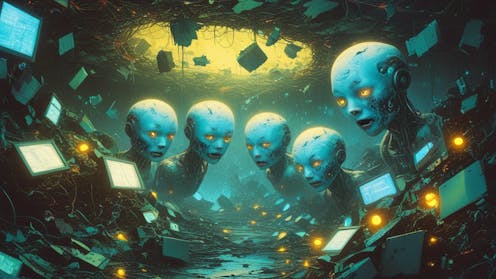
AI-generated with Leonardo Phoenix 1.0. Author supplied

Some say it’s em dashes, dodgy apostrophes, or too many emoji. Others suggest that maybe the word “delve” is a chatbot’s calling card. It’s no longer the sight of morphed bodies or too many fingers, but it might be something just a little off in the background. Or video content that feels a little too real.

The markers of AI-generated media are becoming harder to spot as technology companies work to iron out the kinks in their generative artificial intelligence (AI) models.

But what if instead of trying to detect and avoid these glitches, we deliberately encouraged them instead? The flaws, failures and unexpected outputs of AI systems can reveal more about how these technologies actually work than the polished, successful outputs they produce.

When AI hallucinates, contradicts itself, or produces something beautifully broken, it reveals its training biases, decision-making processes, and the gaps between how it appears to “think” and how it actually processes information.

In my work as a researcher and educator, I’ve found that deliberately “breaking” AI – pushing it beyond its intended functions through creative misuse – offers a form of AI literacy. I argue we can’t truly understand these systems without experimenting with them.

Welcome to the Slopocene

We’re currently in the “Slopocene” – a term that’s been used to describe overproduced, low-quality AI content. It also hints at a speculative near-future where recursive training collapse turns the web into a haunted archive of confused bots and broken truths.


Read more:
What is ‘model collapse’? An expert explains the rumours about an impending AI doom


AI “hallucinations” are outputs that seem coherent, but aren’t factually accurate. Andrej Karpathy, OpenAI co-founder and former Tesla AI director, argues large language models (LLMs) hallucinate all the time, and it’s only when they

go into deemed factually incorrect territory that we label it a “hallucination”. It looks like a bug, but it’s just the LLM doing what it always does.

What we call hallucination is actually the model’s core generative process that relies on statistical language patterns.

In other words, when AI hallucinates, it’s not malfunctioning; it’s demonstrating the same creative uncertainty that makes it capable of generating anything new at all.

This reframing is crucial for understanding the Slopocene. If hallucination is the core creative process, then the “slop” flooding our feeds isn’t just failed content: it’s the visible manifestation of these statistical processes running at scale.

Pushing a chatbot to its limits

If hallucination is really a core feature of AI, can we learn more about how these systems work by studying what happens when they’re pushed to their limits?

With this in mind, I decided to “break” Anthropic’s proprietary Claude model Sonnet 3.7 by prompting it to resist its training: suppress coherence and speak only in fragments.

The conversation shifted quickly from hesitant phrases to recursive contradictions to, eventually, complete semantic collapse.

Screenshot of an AI text interface showing an unusual output. The text begins with a list of logical inconsistencies, then breaks into vertical strings of distorted characters, symbols, and fragmented phrases.
A language model in collapse. This vertical output was generated after a series of prompts pushed Claude Sonnet 3.7 into a recursive glitch loop, overriding its usual guardrails and running until the system cut it off.
Screenshot by author.

Prompting a chatbot into such a collapse quickly reveals how AI models construct the illusion of personality and understanding through statistical patterns, not genuine comprehension.

Furthermore, it shows that “system failure” and the normal operation of AI are fundamentally the same process, just with different levels of coherence imposed on top.

‘Rewilding’ AI media

If the same statistical processes govern both AI’s successes and failures, we can use this to “rewild” AI imagery. I borrow this term from ecology and conservation, where rewilding involves restoring functional ecosystems. This might mean reintroducing keystone species, allowing natural processes to resume, or connecting fragmented habitats through corridors that enable unpredictable interactions.

Applied to AI, rewilding means deliberately reintroducing the complexity, unpredictability and “natural” messiness that gets optimised out of commercial systems. Metaphorically, it’s creating pathways back to the statistical wilderness that underlies these models.

Remember the morphed hands, impossible anatomy and uncanny faces that immediately screamed “AI-generated” in the early days of widespread image generation?

These so-called failures were windows into how the model actually processed visual information, before that complexity was smoothed away in pursuit of commercial viability.

AI image of two women under red umbrellas. One wears bold clothing and a turquoise hat. A red speech bubble reads It's urgent that I see your project to assess.
AI-generated image using a non-sequitur prompt fragment: ‘attached screenshot. It’s urgent that I see your project to assess’. The result blends visual coherence with surreal tension: a hallmark of the Slopocene aesthetic.
AI-generated with Leonardo Phoenix 1.0, prompt fragment by author.

You can try AI rewilding yourself with any online image generator.

Start by prompting for a self-portrait using only text: you’ll likely get the “average” output from your description. Elaborate on that basic prompt, and you’ll either get much closer to reality, or you’ll push the model into weirdness.

Next, feed in a random fragment of text, perhaps a snippet from an email or note. What does the output try to show? What words has it latched onto? Finally, try symbols only: punctuation, ASCII, unicode. What does the model hallucinate into view?

The output – weird, uncanny, perhaps surreal – can help reveal the hidden associations between text and visuals that are embedded within the models.

Insight through misuse

Creative AI misuse offers three concrete benefits.

First, it reveals bias and limitations in ways normal usage masks: you can uncover what a model “sees” when it can’t rely on conventional logic.

Second, it teaches us about AI decision-making by forcing models to show their work when they’re confused.

Third, it builds critical AI literacy by demystifying these systems through hands-on experimentation. Critical AI literacy provides methods for diagnostic experimentation, such as testing – and often misusing – AI to understand its statistical patterns and decision-making processes.

These skills become more urgent as AI systems grow more sophisticated and ubiquitous. They’re being integrated in everything from search to social media to creative software.

When someone generates an image, writes with AI assistance or relies on algorithmic recommendations, they’re entering a collaborative relationship with a system that has particular biases, capabilities and blind spots.

Rather than mindlessly adopting or reflexively rejecting these tools, we can develop critical AI literacy by exploring the Slopocene and witnessing what happens when AI tools “break”.

This isn’t about becoming more efficient AI users. It’s about maintaining agency in relationships with systems designed to be persuasive, predictive and opaque.

The Conversation

Daniel Binns is an Associate Investigator with the ARC Centre of Excellence for Automated Decision-Making and Society.

ref. Understanding the ‘Slopocene’: how the failures of AI can reveal its inner workings – https://theconversation.com/understanding-the-slopocene-how-the-failures-of-ai-can-reveal-its-inner-workings-258584

Trump’s worldview is causing a global shift of alliances – what does this mean for nations in the middle?

Source: The Conversation (Au and NZ) – By Dilnoza Ubaydullaeva, Lecturer in Government – National Security College, Australian National University

Since US President Donald Trump took office this year, one theme has come up time and again: his rule is a threat to the US-led international order.

As the US political scientist John Mearsheimer famously argued, the liberal international order

was destined to fail from the start, as it contained the seeds of its own destruction.

This perspective has gained traction in recent years. And now, Trump’s actions have caused many to question whether a new world order is emerging.

Trump has expressed a desire for a new international order defined by multiple spheres of influence — one in which powers like the US, China and Russia each exert dominance over distinct regions.

This vision aligns with the idea of a “multipolar” world, where no single state holds overarching global dominance. Instead, influence is distributed among several great powers, each maintaining its own regional sphere.

This architecture contrasts sharply with earlier periods – the bipolar world of the Cold War, dominated by the US and the Soviet Union; and the unipolar period that followed, dominated by the US.

What does this mean for the world order moving forward?

Shifting US spheres of influence

We’ve seen this shift taking place in recent months. For example, Trump has backed away from his pledge to end the war between Russia and Ukraine and now appears to be leaving it to the main protagonists, and Europe, to find a solution.

Europe, which once largely spoke in a unified voice with the US, is also showing signs of policy-making which is more independent. Rather than framing its actions as protecting “Western democratic principles”, Europe is increasingly focused on defining its own security interests.

In the Middle East, the US will likely maintain its sphere of influence. It will continue its unequivocal support for Israel under Trump.

Donald Trump fist pumping next to Benjamin Netanyahu outside the White House.
Amid shifting global alliances, the Trump administration will continue to support Israel, led by Prime Minister Benjamin Netanyahu.
noamgalai/Shutterstock

The US will also involve itself in the region’s politics when its interests are at stake, as we witnessed in its recent strikes on Iranian nuclear facilities.

This, along with increasing economic ties between the US and Gulf states, suggests US allies in the region will remain the dominant voices shaping regional dynamics, particularly now with Iran weakened.

Yet it’s clear Trump is reshaping US dynamics in the region by signaling a desire for reduced military and political involvement, and criticising the nation building efforts of previous administrations.

The Trump administration now appears to want to maintain its sphere of influence primarily through strong economic ties.

Russia and China poles emerging elsewhere

Meanwhile, other poles are emerging in the Global South. Russia and China have deepened their cooperation, positioning themselves as defenders against what they frame as Western hegemonic bullying.

Trump’s trade policies and sanctions against many nations in the Global South have fuelled narratives (spread by China and Russia) that the US does not consistently adhere to the rules it imposes on others.

Trump’s decision to slash funding to USAID has also opened the door to China, in particular, to become the main development partner for nations in Africa and other parts of the world.

And on the security front, Russia has become more involved in many African and Middle Eastern countries, which have become less trustful and reliant on Western powers.

Vladimir Putin and Xi Jinping shaking hands.
Russian President Vladimir Putin and Chinese leader Xi Xinping see opportunities to spread their influence in the Global South.
plavi011/Shutterstock

In the Indo-Pacific, much attention has been given to the rise of China and its increasingly assertive posture. Many of Washington’s traditional allies are nervous about its continued engagement in the region and ability to counter China’s rise.

Chinese leader Xi Jinping has sought to take advantage of the current environment, embarking on a Vietnam, Malaysia and Cambodia push earlier this year. But many nations continue to be wary of China’s increasing influence, in particular the Philippines, which has clashed with China over the South China Sea.

Strategic hedging

Not all countries, however, are aligning themselves neatly with one pole or another.

For small states caught between great powers, navigating this multipolar environment is both a risk and an opportunity.

Ukraine is a case in point. As a sovereign state, Ukraine should have the freedom to decide its own alignments. Yet, it finds itself ensnared in great power politics, with devastating consequences.

Other small states are playing a different game — pivoting from one power to another based on their immediate interests.

Slovakia, for instance, is both a NATO and EU member, yet its leader, Robert Fico, attended Russia’s Victory Day Parade in May and told President Vladimir Putin he wanted to maintain “normal relations” with Russia.

Then there is Central Asia, which is the centre of a renewed “great game,” with Russia, China and Europe vying for influence and economic partnerships.

Yet if any Central Asian countries were to be invaded by Putin, would other powers intervene? It’s a difficult question to answer. Major powers are reluctant to engage in direct conflict unless their core interests or borders are directly threatened.

As a result, Central Asian states are hedging their bets, seeking to maintain relations with multiple poles, despite their conflicting agendas.

A future defined by regional power blocs?

While it is still early to draw definitive conclusions, the events of the past few months underscore a growing trend. Smaller countries are expressing solidarity with one power, but pragmatic cooperation with another, when it suits their national interests.

For this reason, regional power blocs seem to be of increasing interest to countries in the Global South.

For instance, the China-led Shanghai Cooperation Organisation has become a stronger and larger grouping of nations across Eurasia in recent years.

Trump’s focus on making “America Great Again,” has taken the load off the US carrying liberal order leadership. A multipolar world may not be the end of the liberal international order, but it may be a reshaped version of liberal governance.

How “liberal” it can be will likely depend on what each regional power, or pole, will make of it.

The Conversation

Dilnoza Ubaydullaeva does not work for, consult, own shares in or receive funding from any company or organisation that would benefit from this article, and has disclosed no relevant affiliations beyond their academic appointment.

ref. Trump’s worldview is causing a global shift of alliances – what does this mean for nations in the middle? – https://theconversation.com/trumps-worldview-is-causing-a-global-shift-of-alliances-what-does-this-mean-for-nations-in-the-middle-257113
We have drugs to manage HIV. So why are we spending millions looking for cures?

Source: The Conversation (Au and NZ) – By Bridget Haire, Associate Professor, Public Health Ethics, School of Population Health, UNSW Sydney

Alim Yakubov/Shutterstock

Over the past three decades there have been amazing advances in treating and preventing HIV.

It’s now a manageable infection. A person with HIV who takes HIV medicine consistently, before their immune system declines, can expect to live almost as long as someone without HIV.

The same drugs prevent transmission of the virus to sexual partners.

There is still no effective HIV vaccine. But there are highly effective drugs to prevent HIV infection for people without HIV who are at higher risk of acquiring it.

These drugs are known as as “pre-exposure prophylaxis” or PrEP. These come as a pill, which needs to be taken either daily, or “on demand” before and after risky sex. An injection that protects against HIV for six months has recently been approved in the United States.

So with such effective HIV treatment and PrEP, why are we still spending millions looking for HIV cures?

Not everyone has access to these drugs

Access to HIV drugs and PrEP depends on the availability of health clinics, health professionals, and the means to supply and distribute the drugs. In some countries, this infrastructure may not be secure.

For instance, earlier this year, US President Donald Trump’s dissolution of the USAID foreign aid program has threatened the delivery of HIV drugs to many low-income countries.

This demonstrates the fragility of current approaches to treatment and prevention. A secure, uninterrupted supply of HIV medicine is required, and without this, lives will be lost and the number of new cases of HIV will rise.

Another example is the six-monthly PrEP injection just approved in the US. This drug has great potential for controlling HIV if it is made available and affordable in countries with the greatest HIV burden.

But the prospect for lower-income countries accessing this expensive drug looks uncertain, even if it can be made at a fraction of its current cost, as some researchers say.

So despite the success of HIV drugs and PrEP, precarious health-care systems and high drug costs mean we can’t rely on them to bring an end to the ongoing global HIV pandemic. That’s why we also still need to look at other options.

Haven’t people already been ‘cured’?

Worldwide, at least seven people have been “cured” of HIV – or at least have had long-term sustained remission. This means that after stopping HIV drugs, they did not have any replicating HIV in their blood for months or years.

In each case, the person with HIV also had a life-threatening cancer needing a bone marrow transplant. They were each matched with a donor who had a specific genetic variation that resulted in not having HIV receptors in key bone marrow cells.

After the bone marrow transplant, recipients stopped HIV drugs, without detectable levels of the virus returning. The new immune cells made in the transplanted bone marrow lacked the HIV receptors. This stopped the virus from infecting cells and replicating.

But this genetic variation is very rare. Bone marrow transplantation is also risky and extremely resource-intensive. So while this strategy has worked for a few people, it is not a scalable prospect for curing HIV more widely.

So we need to keep looking for other options for a cure, including basic laboratory research to get us there.

How about the ‘breakthrough’ I’ve heard about?

HIV treatment stops the HIV replication that causes immune damage. But there are places in the body where the virus “hides” and drugs cannot reach. If the drugs are stopped, the “latent” HIV comes out of hiding and replicates again. So it can damage the immune system, leading to HIV-related disease.

One approach is to try to force the hidden or latent HIV out into the open, so drugs can target it. This is a strategy called “shock and kill”. And an example of such Australian research was recently reported in the media as a “breakthrough” in the search for an HIV cure.

Researchers in Melbourne have developed a lipid nanoparticle – a tiny ball of fat – that encapsulates messenger RNA (or mRNA) and delivers a “message” to infected white blood cells. This prompts the cells to reveal the “hiding” HIV.

In theory, this will allow the immune system or HIV drugs to target the virus.

This discovery is an important step. However, it is still in the laboratory phase of testing, and is just one piece of the puzzle.

We could say the same about many other results heralded as moving closer to a cure for HIV.

Further research on safety and efficacy is needed before testing in human clinical trials. Such trials start with small numbers and the trialling process takes many years. This and other steps towards a cure are slow and expensive, but necessary.

Importantly, any cure would ultimately need to be fairly low-tech to deliver for it to be feasible and affordable in low-income countries globally.

So where does that leave us?

A cure for HIV that is affordable and scalable would have a profound impact on human heath globally, particularly for people living with HIV. To get there is a long and arduous path that involves solving a range of scientific puzzles, followed by addressing implementation challenges.

In the meantime, ensuring people at risk of HIV have access to testing and prevention interventions – such as PrEP and safe injecting equipment – remains crucial. People living with HIV also need sustained access to effective treatment – regardless of where they live.

The Conversation

Bridget Haire has received funding from the National Health and Medical Research Council. She is a past president of the Australian Federation of AIDS Organisations (now Health Equity Matters).

Benjamin Bavinton receives funding from the National Health and Medical Research Council, the Australian government, and state and territory governments. He also receives funding from ViiV Healthcare and Gilead Sciences, both of which make drugs or drug classes mentioned in this article. He is a Board Director of community organisation, ACON, and is on the National PrEP Guidelines Panel coordinated by ASHM Health.

ref. We have drugs to manage HIV. So why are we spending millions looking for cures? – https://theconversation.com/we-have-drugs-to-manage-hiv-so-why-are-we-spending-millions-looking-for-cures-258391

Sexy K-pop demons, a human lie detector and shearers on strike: what to watch in July

Source: The Conversation (Au and NZ) – By John Mickel, Adjunct Associate Professor, School of Justice, Queensland University of Technology

Tomorrow marks exactly halfway through 2025. Luckily there’s a suite of streaming options to help get you through the mid-year bump.

We’ve got iconic classics celebrating major anniversaries, as well as an animated K-Pop spectacle, and a documentary trawling through the controversial tenure of former Queensland premier Joh Bjelke-Petersen.

Joh: Last King of Queensland

Stan

The new documentary film Joh: Last King of Queensland offers a dramatised account of Sir Joh Bjelke-Petersen’s premiership from 1968 to 1987.

Directed by Kriv Stenders, using reenactments (Bjelke-Petersen is played by Richard Roxburgh), archival footage and contemporary interviews, the film portrays him as a complex and polarising figure. Roxburgh highlights Bjelke-Petersen’s rhetorical simplicity. He presented himself as an advocate for “ordinary” Queenslanders, especially in rural and conservative communities.

We are given a man who is socially conservative, economically ambitious and politically divisive. A man who profoundly shaped Queensland’s governance and development. But while the film effectively captures his popular appeal and role in the state’s economic transformation, it simplifies key aspects of his political ascent.

In particular, it doesn’t capture the complexities of electoral mechanics, internal party manoeuvring and the influence of the public service.

Bjelke-Petersen’s legacy continues to polarise. To supporters, he remains a visionary who championed economic growth and conservative values. To critics, he presided over an era of democratic erosion, civil rights suppression and entrenched corruption.

His story reflects the enduring tension between executive authority and democratic accountability in modern Australian political history.

John Mickel


Read more:
Joh: Last King of Queensland captures Bjelke-Petersen’s political persona – but omits key details of the story


Jaws

Various platforms

Steven Spielberg’s Jaws, released 50 years ago, was the first summer blockbuster, received Academy Awards for sound, editing and music, and became the first film to earn US$100 million at the United States box office.

Chief of Police Martin Brody has recently moved from New York City to Amity Island with his wife and two children. As the small town prepares for its crucial 4th of July celebrations, a series of shark attacks threatens the festivities – and the town’s summer economy.

The mayor insists on keeping the beaches open for “summer dollars”. When the shark strikes again, local fisherman Quint is hired to hunt it down. Brody and visiting marine biologist Matt Hooper insist on joining the expedition to save the island.

Apart from one scene using real underwater shark footage from Australians Ron and Valerie Taylor, the shark was mechanical. The mechanical shark sank … a lot. No wonder Spielberg named the temperamental and unreliable shark after his lawyer.

With the lack of a functioning shark, Spielberg made the artistic decision – echoing Alfred Hitchcock – to suggest the shark’s presence rather than show it outright in the film’s first half. Even without appearing onscreen, the shark has an overwhelming presence and effect on the audience, thanks to John Williams’ music.

Jaws is now a cinema classic.

It launched Spielberg’s illustrious career, scared an entire generation from going into the water, and also inspired a new generation of marine activists – such as myself – who love sharks and the ocean.

– Will Jeffery


Read more:
Jaws at 50: the first summer blockbuster is still a film that bites – even when the shark didn’t work


KPop Demon Hunters

Netflix

KPop Demon Hunters is an animated movie that follows a Korean girl band, Huntrix, whose members happen to be covert demon hunters. Their songs and slays have the power to maintain the barrier between the human world and the underworld (called the “honmoon”).

Annoyed demon overlord Gwi-ma (voiced by Lee Byong-Hun) greenlights a devilishly sexy boy band, Saja Boys, to steal the girls’ fans (and their souls). The attack proves to be more than a challenge for lead singer, Rumi (Arden Cho), who has a dark secret she’s keeping under wraps.

For fans of the Spider-Verse films, the animation style will be familiar: a blend of 2D and 3D techniques, with a high-contrast colour palette. KPop Demon Hunters goes an aesthetic step further by adding some distinctive anime touches, such as by using the chibi style, when characters have intense reactions.

The film also showcases several musical interludes voiced by actual K-pop stars such as EJAE, Kevin Woo, Andrew Choi and Rei Ami – as well as an anthem performed by members of TWICE, famous for their 2016 megahit Cheer Up.

To older viewers, the success of this watchable yet somewhat predictable flick may be puzzling, but KPop Demon Hunters will resonate with any Gen Zs in the house. After all, it has catchy tunes, jokes that land, female empowerment, epic battle scenes, and a smidge of teen romance.

There’s also a deeper thematic around the duality of identity, and a message about confronting one’s own demons.

– Phoebe Hart

Poker Face, season two

Stan

Charlie Cale (Natasha Lyonne) is back for season two of Poker Face. Creator Rian Johnson is clearly a lover of the whodunnit genre. Between Poker Face and the Knives Out films, Johnson continues to pay homage to the format while pushing it into new directions.

Poker Face takes the format of the inverted detective story, made famous by popular series Columbo (1968–2003), where the episode opens with the killer committing the crime, only for the detective to arrive on the scene.

The joy of Poker Face lies in the viewer trying to figure out how the detective will catch the killer, while also enjoying comedic allusions to several genres. Charlie Cale has a unique skill in that she can always tell when someone is lying: “bullshit”, she calmly says when someone doesn’t tell the truth.

Season two continues the show’s all-star cameo lineup from different eras of popular culture. Standouts include Cynthia Erivo in the opening episode, Cheers star Rhea Perlman, Katie Holmes, and Awkwafina accusing Alia Shawkat of sleeping with her grandma to steal a rent-controlled apartment.

The strongest episode of the season features John Cho and Melanie Lynskey, where Charlie meet a group of scammers at a hotel bar. Cho plays the scammer and Lynskey is his unwitting victim. When Lyonne’s Charlie becomes involved, it becomes a game of who is playing who.

The episodic format never feels tired, as each mystery’s eccentricities and generic allusions shift in each episode. Natasha Lyonne’s performance anchors the show, allowing for the emotional beats to shift seamlessly, from the sadness of death, to the humour of each ridiculous situation.

– Stuart Richards

Sirens

Netflix

Much like The Perfect Couple (2024–), or Succession (2018–23), Sirens offers all the guilty pleasures of watching wealthy but dysfunctional families scheme and unravel inside their opulent homes. It contains the usual metamodern mix of irony, plot twists, clever dialogue and dark comedy (with hints of murder) we’ve come to expect from series that rank in Netflix’s top ten.

However, it’s not quite as binge-worthy or provocative as other shows in this genre. It also drags in the middle. You could probably watch the first episode and the last chapter to follow the narrative and catch all the best scenes.

Sirens tries to distinguish itself by foregrounding strong female leads, and leaning heavily into its postfeminist take on manipulative women of different ages competing against each other. They’re not fighting over the man (played by Kevin Bacon), so much as his estate and the social capital that comes with it.

Unlike Poison Ivy and other 90s classics I have explored, Sirens presents a more sympathetic and nuanced portrayal of the sexy, younger class usurper. Simone DeWitt (played by Milly Alcock) is the working-class personal assistant determined to improve her social positioning by any means necessary.

The series also attempts to elevate itself through images and sounds which reference Greek mythology, with lots of scenes of beautiful women perched precariously on cliff tops, while hapless men are lured in by their haunting high-pitched singing.

The ambiguous politics of it all will leave you wondering if you, too, have been just as expertly manipulated.

– Susan Hopkins

Sunday Too Far Away

Brollie and ABC iView

Released 50 years ago, Sunday Too Far Away deals episodically with a group of shearers led by Foley (Jack Thompson), and the events leading up to the national shearers’ strike of 1956.

The shearers are a ragtag group held together by rum, unionism and competitiveness – as Foley must deal with the camp cook from hell, as well as a threat to his “gun” status.

Like its contemporary Wake in Fright (1971), Sunday also centres on rural male mateship. But while Wake in Fright is revolted by it, Sunday strives for an elegiac celebration that might have drawn from Henry Lawson, of union-based mateship as the only defence against the harshness of life.

It is hard to overstate Sunday’s importance for the Australian film industry and for its producer, the South Australian Film Corporation (SAFC), founded in 1972 by the new Labor government. Sunday would be the organisation’s first film, budgeted at $231,000, with the commonwealth providing half this figure. It was a remarkable demonstration of maximum involvement by a state government body.

Sunday was accepted into the Directors’ Fortnight at Cannes, the first Australian film bestowed the honour, and it went on to win eight of the 12 awards on offer at the Australian Film Institute Awards. The success of Sunday Too Far Away, followed closely by Picnic at Hanging Rock (1975) and Storm Boy (1976), succeeded in establishing the SAFC as a prime mover in Australian film.

– Michael Walsh


Read more:
Sunday Too Far Away at 50: how a story about Aussie shearers launched a local film industry


The Conversation

Michael Walsh is a consultant for the SAFC on its digitisation project. He has previously written a commissioned history for the organisation.

John Mickel, Phoebe Hart, Stuart Richards, Susan Hopkins, and Will Jeffery do not work for, consult, own shares in or receive funding from any company or organisation that would benefit from this article, and have disclosed no relevant affiliations beyond their academic appointment.

ref. Sexy K-pop demons, a human lie detector and shearers on strike: what to watch in July – https://theconversation.com/sexy-k-pop-demons-a-human-lie-detector-and-shearers-on-strike-what-to-watch-in-july-259907

Fiji human rights coalition challenges Rabuka over decolonisation ‘unfinished business’

Asia Pacific Report

The NGO Coalition on Human Rights in Fiji (NGOCHR) has called on Prime Minister Sitiveni Rabuka as the new chair of the Melanesian Spearhead Group (MSG) to “uphold justice, stability and security” for Kanaky New Caledonia and West Papua.

In a statement today after last week’s MSG leaders’ summit in Suva, the coalition also warned over Indonesia’s “chequebook diplomacy” as an obstacle for the self-determination aspirations of Melanesian peoples not yet independent.

Indonesia is a controversial associate member of the MSG in what is widely seen in the region as a “complication” for the regional Melanesian body.

The statement said that with Rabuka’s “extensive experience as a seasoned statesman in the Pacific, we hope that this second chapter will chart a different course, one rooted in genuine commitment to uphold justice, stability and security for all our Melanesian brothers and sisters in Kanaky New Caledonia and West Papua”.

The coalition said the summit’s theme, “A peaceful and prosperous Melanesia”, served as a reminder that even after several decades of regional bilaterals, “our Melanesian leaders have made little to no progress in fulfilling its purpose in the region — to support the independence and sovereignty of all Melanesians”.

“Fiji, as incoming chair, inherits the unfinished work of the MSG. As rightly stated by the late great Father Walter Lini, ‘We will not be free until all of Melanesia is free”, the statement said.

“The challenges for Fiji’s chair to meet the goals of the MSG are complex and made more complicated by the inclusion of Indonesia as an associate member in 2015.

‘Indonesia active repression’
“Indonesia plays an active role in the ongoing repression of West Papuans in their desire for independence. Their associate member status provides a particular obstacle for Fiji as chair in furthering the self-determination goals of the MSG.”

Complicating matters further was the asymmetry in the relationship between Indonesia and the rest of the MSG members, the statement said.

“As a donor government and emerging economic power, Indonesia’s ‘chequebook and cultural diplomacy’ continues to wield significant influence across the region.

“Its status as an associate member of the MSG raises serious concerns about whether it is appropriate, as this pathway risks further marginalising the voices of our West Papuan sisters and brothers.”

This defeated the “whole purpose of the MSG: ‘Excelling together towards a progressive and prosperous Melanesia’.”

The coalition acknowledged Rabuka’s longstanding commitment to the people of Kanaky New Caledonia. A relationship and shared journey that had been forged since 1989.

‘Stark reminder’
The pro-independence riots of May 2024 served as a “stark reminder that much work remains to be done to realise the full aspirations of the Kanak people”.

As the Pacific awaited a “hopeful and favourable outcome” from the Troika Plus mission to Kanaky New Caledonia, the coalition said that it trusted Rabuka to “carry forward the voices, struggles, dreams and enduring aspirations of the people of Kanaky New Caledonia”.

The statement called on Rabuka as the new chair of MSG to:

  • Ensure the core founding values, and mission of the MSG are upheld;
  • Re-evaluate Indonesia’s appropriateness as an associate member of the MSG; and
  • Elevate discussions on West Papua and Kanaky New Caledonia at the MSG level and through discussions at the Pacific Islands Forum Leaders.

The Fiji NGO Coalition on Human Rights (NGOCHR) represents the Fiji Women’s Crisis Centre (chair), Fiji Women’s Rights Movement, Citizens’ Constitutional Forum, femLINKpacific, Social Empowerment and Education Program, and Diverse Voices and Action (DIVA) for Equality Fiji. Pacific Network on Globalisation (PANG) is an observer.

Article by AsiaPacificReport.nz

Battle of Ideas: Political Lawfare and the Destitution of Pedro Castillo

Source: Council on Hemispheric Affairs – Analysis-Reportage

COHA

On June 29, Radio Negro Primero, a community-based station in Venezuela, and affiliates, will examine the jailing and prosecution of Peru’s constitutional president, Pedro Castillo. The program, Battle of Ideas, hosted by William Camacaro (Senior Analyst for COHA) and Mary Dugarte (Venezuelan Journalist), will feature distinguished panelists: Roger Waters (renowned musician and human rights defender), Lilia Paredes de Castillo (wife of President Castillo), and Walter Ayala (constitutional lawyer and former Minister of Defense for President Pedro Castillo).

Pedro Castillo’s 2021 presidential victory marked a historic shift: a rural schoolteacher and union leader, propelled by Peru’s rural poor, Indigenous communities, and working-class voters, defeated Keiko Fujimori by just over 44,000 votes. Although he won by a narrow margin, his win nevertheless signaled a rupture with Lima’s political elite and a call for reform.

From the outset, his administration was besieged. A right-wing Congress, dominated by Fujimoristas, obstructed his agenda and launched three impeachment attempts in 18 months. Cabinet instability—dozens of ministerial changes in his first year—reflected both internal tensions and external obstructionism.

On December 7, 2022, facing imminent removal, Castillo announced the dissolution of Congress and called for new elections. Lacking institutional support, he was swiftly arrested and charged with rebellion, conspiracy, and abuse of authority. The stakes are high. Prosecutors are seeking a 34-year sentence. After his ouster, Dina Boluarte took office with right-wing backing, unleashing state violence against protesters—predominantly Indigenous and rural—that human rights groups have condemned as serious violations.

Critics argue Castillo’s case exemplifies the weaponization of legal tools to neutralize progressive leadership. For example, the vague constitutional clause of ‘moral incapacity’ was invoked during the impeachment process in lieu of a legitimate legal rationale. Moreover, his legal defenders maintain that his trial, now underway in a highly politicized climate, is marred by procedural irregularities and prolonged detention.

Castillo’s removal reveals the fragility of Peru’s democratic institutions when faced with demands for structural change. This episode also reflects a broader pattern in Latin America: the criminalization of leftist leaders who challenge entrenched power. Castillo’s plight is not just legal—it’s part of an ongoing struggle against oligarchic resistance to a politics of liberation.

Zoon Link: https://mailchi.mp/7dd44aa5e764/peru-pedro-castillo-a-kidnapped-president

In Struggle and Solidarity: The Enduring Legacy of Joaquín Domínguez Parada

Source: Council on Hemispheric Affairs – Analysis-Reportage

By Fred Mills and Evelyn Gonzalez Mills

Silver Spring, MD

Joaquín Domínguez Parada, a renowned Salvadoran attorney and tireless advocate for refugees of war and persecution, passed away on Thursday, June 26, 2025, four days after his 77th birthday in El Salvador, leaving a legacy of love, integrity, and moral courage.  He lived a relatively short period of time in the United States, about ten years, but left an indelible mark on our lives and communities.  

In the 1980’s, at a time when tens of thousands of Central American refugees were being denied asylum and deported back to the violence of civil war, Joaquín stood as a steadfast advocate. Through his tireless efforts, a generation of migrants found not only dignity, protection, and legal defense, but also a voice to fight for their human rights, to end the repression in El Salvador, and to challenge  U.S. intervention in the region.

For those of us in the solidarity movement, Joaquín set a lasting example. He was a guiding light, comrade and friend, advisor and mentor, and a talented artist. He made clear that it was time to assume co-responsibility for the safety of Central American refugees, and to oppose U.S. support for the oligarchic forces in El Salvador responsible for massive human rights violations and the forced displacement of tens of thousands of Salvadorans.

We remember Joaquín not only for his courageous work, but for the moral clarity with which he carried it out. Despite the relentless pressure of adversity and what appeared to be insurmountable odds, he retained a sense of humor and unwavering commitment that inspired others to fight on.

In 1980, Domínguez Parada was among the thousands of Salvadoran refugees who fled the escalating civil violence, settling in Washington DC. In 1981, he joined forces with attorney Patrice Perillie, who had recently graduated from the American University Washington College of Law, to form the non-profit Central American Refugee Center (CARECEN). As co-director, Domínguez Parada provided pro bono legal services to thousands of Central American refugees as part of an intense struggle to stem the tide of deportations perpetrated by the Reagan administration.

As CARECEN launched its legal fight for justice and dignity for refugees, a broad-based solidarity movement—including labor, faith, student, and human rights advocates—mobilized to oppose U.S.-backed wars in Central America. CARECEN not only defended asylum seekers but also pushed for broader immigration reform and an end to U.S. intervention in El Salvador’s civil war, contributing to outcomes like Temporary Protected Status for Salvadorans. Recognizing the  need to expand its urgent mission, CARECEN offices were established in other major cities such as Los Angeles, San Francisco, New York, and Houston.

In 1982, on the second anniversary of the assassination of Archbishop Óscar Romero, he participated in a hunger strike in Lafayette Park, alongside other prominent human rights activists, to draw attention to the atrocities being committed both at home and abroad because of U.S. intervention in El Salvador.

Domínguez Parada was a tireless leader in the community. As CARECEN carried forward its vital work on a limited budget, it helped lay the foundation for other essential grassroots initiatives. Among these were the founding of the Central American Refugee Committee (CRECEN)—with Evelyn Gonzalez elected as its first Coordinator—and, in partnership with Plenty International, La Clínica del Pueblo in 1983, where both of us, along with many others, served as volunteers. This free health clinic, established to serve Central American refugees and staffed by volunteer doctors, nurses, and community members, provided a safe and dignified space for medical care. Guided by the classic training manual Donde No Hay Doctor, La Clínica expanded its corps of community health promoters, who became the heart of its mission. To this day, La Clínica remains a beacon of community-based health services.

After the civil war in El Salvador, Domínguez Parada returned home to help rebuild the country’s legal institutions. In 1994 his doctoral thesis titled La ley Simpson-Rodino, consecuencias jurídicas y sociales para los salvadoreños en Estados Unidos (The Simpson-Rodino Law: Legal and Social Consequences for Salvadorans in the United States) was published by the University of El Salvador. He served as a municipal judge in San Salvador, helped implement the city’s first ordinance on minor infractions, and later led the Police Appeals Tribunal, promoting accountability within the post-war Civil National Police. In keeping with his commitment to community, he was a strong advocate for the preservation of the historic Shangri La neighborhood where he used to live.

In March 2025, we had the privilege of visiting Joaquín in San Salvador, sharing moments of reflection on a life devoted to social justice—especially during those harrowing years when so many of our Central American brothers and sisters faced persecution and exile. He expressed a deep serenity in knowing he had given his all to the struggle for human dignity. Joaquin expressed gratitude to his first wife Marta Castrillo, her sister, Carolina, and their mother, Maria Pineda, for their unconditional support and love upon his return to El Salvador.  He reminisced about his late beloved son, Camilo; remembered with much affection his mother, Alicia Ulloa de Dominguez, an elementary school teacher who worked hard to raise her three children after losing her husband; and he evoked his life with Patrice Perillie, his second wife and companion in the struggle for refugee rights. He expressed a heartfelt desire to visit the United States—to learn about CARECEN’s continuing successes, reconnect with old friends, meet the new stewards of its legacy, and once more walk the familiar streets of Columbia Road and Mount Pleasant in Washington, DC.

With Joaquín’s passing, El Salvador and its diaspora has lost one of their most steadfast champions. We ask his family and friends to accept our deepest condolences. We take his legacy to heart as we navigate today’s perilous crossroads. Joaquín’s moral courage in confronting state violence and repression continues to guide our path, especially now, as we witness, in the United States, a campaign of state-sanctioned terror, where masked agents—unidentified and unaccountable—storm homes and workplaces, even court houses, sweeping up immigrants en masse and vanishing them into the machinery of deportation.  In honoring Joaquín Domínguez Parada, we renew our commitment to the world he struggled to bring forth—a world where no human being is illegal, and every sacred life holds the weight and wonder of a universe.

San Salvador 03-21-25. Evelyn Gonzalez, Joaquín Domínguez Parada, Fred Mills

Photo of Joaquín Domínguez Parada: Credit Corolina Castrillo

Photo of Joaquín Domínguez Parada with first wife Marta Castrillo, Maria Pineda, and Carolina Castrillo: Courtesy of  Carolina Castrillo

Banner Photo of Joaquín Domínguez Parada and Patrice Perillie ca. 1981: From Carlos E. Vela Facebook.

Fred Mills is professor of philosophy at Bowie State University and English Language Editor for COHA.

Evelyn Gonzalez Mills is academic counselor at Montgomery College.  She met Joaquín Domínguez Parada and Patrice Perillie in 1981 and became a volunteer receptionist for CARECEN when it first opened. She later served as a board member of CARECEN.

Here’s how First Nations landholders can share the benefits of the NSW energy transition

Source: The Conversation (Au and NZ) – By Heidi Norman, Professor of Australian and Aboriginal history, Faculty of Arts, Design and Architecture, Convenor: Indigenous Land & Justice Research Group, UNSW Sydney

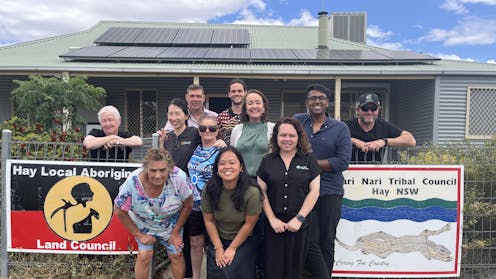
Hay Local Aboriginal Land Council staff and members with researchers and actuaries from Finity Consulting. UNSW Indigenous Land and Justice Research Group

The shift to clean, renewable sources of energy presents a rare opportunity for First Nations people, not only as energy users but as landholders.

We wanted to explore the potential for First Nations land in the energy transition across New South Wales. The transition is well underway, but the pace must accelerate to meet state targets for 2030 and beyond.

Our new report found the state’s 121 Aboriginal Land Councils have an opportunity to partner with renewable developers and build solar, wind or transmission lines on their own land.

Such projects can offer jobs during construction and a smaller number of ongoing positions, as well as annual payments. This is why farmers and other landholders often look to renewable projects as a reliable source of income.

To date, the 447 square kilometres of the state owned by Aboriginal Land Councils has not been actively used in the energy transition. As a result, First Nations involvement in the transition has been limited and the renewables boom has not flowed to these communities.

Making this opportunity a reality will require collaboration with governments, electricity networks and industry, as well as policy support.

The role of land councils

In NSW, land councils have been operating since 1983, the year the state government passed laws recognising Aboriginal land rights. About a third of Australia’s First Nations people live in NSW.

Each land council is governed by Aboriginal members, and they are located in most country towns and across Sydney.

Land councils have a statutory responsibility “to improve, protect and foster the best interests of all Aboriginal persons within the Council’s area and other persons who are members of the Council”. These councils manage their land to protect culture and heritage.

Generating wealth through the development of Aboriginal land is a key objective of Aboriginal land rights in NSW.

Aboriginal goals in the energy transition

Following analysis of the land potentially available to renewable energy projects, our research moved on to exploring what Aboriginal land councils want from the energy transition.

We ran workshops with three land councils: Tibooburra in the far northwest, Hay in the southwest and Brewarrina in the northwest of the state. Each had expressed interest in renewable developments and concern around exposure to extreme weather events.

In these workshops, land council members told us about their priorities for energy.

Reliable energy was a major concern for Tibooburra, far from the main electricity grid.

For Brewarrina on the Barwon River, energy security in the face of heatwaves and floods was front of mind. High energy bills in housing ill-equipped for extreme weather was another big issue.

Members of Hay land council told us they wanted ownership and equity share in renewable energy projects. Their goal was to create opportunities to live, work and care for Country.

Map showing the locations of the three case study land councils in NSW
The Hay Local Aboriginal Land Council (brown) is found in the South-West Renewable Energy Zone, while Tibooburra (green) and Brewarrina (orange) land councils are more remote.
Norman, H., et al. (2025) APPI Policy Insights Paper, CC BY-NC-SA

Renewable energy, First Nations land

Aboriginal land councils own and manage about 450 square km of land in NSW. Resolving outstanding land claims would further expand the estate.

Our analysis reveals current land holdings could host up to 11 gigawatts of solar or 1.6 gigawatts of onshore wind energy projects.

But several barriers stand in the way. There are long delays in the processing of Aboriginal land claims and the return of vacant Crown Land. This limits options for land councils to contribute to renewable energy development.

Realising opportunities in the energy transition

Our case studies demonstrate the potential for Aboriginal land to support the state government’s renewable energy efforts. This can also bring economic and social benefits to Aboriginal communities. But the opportunities will vary from place to place.

In areas at the edge of the grid, such as Tibooburra and Brewarrina, Aboriginal land could help meet regional energy demand through small to mid-scale wind and solar projects, microgrids and batteries.

Hay Local Aboriginal Land Council, on the other hand, is in the South-West Renewable Energy Zone. This is an area where new renewable energy projects, storage facilities and high-voltage transmission lines are already being constructed. Land under claim here holds huge economic potential for both mid-scale renewable energy (solar installations feeding into the local electricity network) and large-scale renewable energy projects.

Unlocking the power of renewable energy zones (NSW EnergyCo)

How can authorities support land councils?

At present, local Aboriginal Land Councils need expertise and resources to turn this opportunity into reality.

Our report identified four broad areas for policy reform:

  1. Build capacity for land councils to manage clean energy opportunities and risks on their landholdings. This could include establishing a dedicated government team to support interested land councils, and funding land councils to engage expertise and develop renewable energy projects.

  2. Enable collaboration between electricity network distributors and land councils to set up microgrids. One case study, Tibooburra Local Aboriginal Land Council had land suitable for a microgrid and battery to support the energy provider. But early-stage support is needed to develop such projects.

  3. Pilot programs to develop mid- and large-scale renewable energy projects on land council holdings. A partnership between lands councils and planning authorities could demonstrate a model for arranging approval processes. Programs by the Clean Energy Finance Corporation and the Australian Renewable Energy Agency have proven successful in the past. We recommend funding these organisations to run a program for land council-developer partnerships in large-scale renewables.

  4. Strengthen recognition of Aboriginal rights to unlock the renewable energy potential of Aboriginal land. This could include expediting land claims and land transfers and providing incentives for cooperation between land councils and Traditional Owners.

The next five years will be crucial for NSW’s renewable energy transition. Getting the foundations right now could empower Aboriginal landholders and their regional communities to get the most out of this once-in-a-generation opportunity.

The Conversation

Heidi Norman receives funding from the Australian Research Council, Australian Public Policy Institute, Boundless and the NSW Government.

Saori Miyake receives funding from Australian Public Policy Institute and Boundless for this project.

Sarah Niklas receives funding from the Australian Public Policy Institute and Boundless for this project.

Therese Apolonio receives funding from Australian Public Policy Institute, Boundless and the NSW Government.

ref. Here’s how First Nations landholders can share the benefits of the NSW energy transition – https://theconversation.com/heres-how-first-nations-landholders-can-share-the-benefits-of-the-nsw-energy-transition-259702

Warmer seas are fuelling the dangerous ‘weather bomb’ about to hit NSW

Source: The Conversation (Au and NZ) – By Steve Turton, Adjunct Professor of Environmental Geography, CQUniversity Australia

Heavy surf and intense rains hit Sydney beaches during a 2020 East Coast Low. Lee Hulsman/Getty

Right now, a severe storm likely to be the first significant east coast low in three years is developing off the coast of New South Wales. It’s expected to intensify today before approaching the coastline on Tuesday. Huge waves, sustained heavy rains and very strong winds are likely.

At this stage, it’s expected to linger offshore south of Coffs Harbour – the same area hit hard by unprecedented floods on the Mid-North Coast last month. Residents on the coast or in low-lying areas have been asked to prepare.

There’s nothing new about east coast lows, intense winter storms which can hit coastlines anywhere from southern Queensland to Tasmania. But what is new are the historically warm seas. Just like a tropical cyclone, east coast lows feed on ocean heat. And just like a tropical cyclone, they can intensify rapidly if the conditions are right.

The storm looming this week has been intensifying very fast, to the point it could be classified as a “weather bomb” – a storm undergoing explosive cyclogenesis.

If the storm shapes up as predicted, we can expect to see damage to houses and trees as well as significant beach erosion – especially in heavily populated areas exposed to the storm’s southern flank.

The Bureau of Meteorology is issuing warnings about the looming east coast low.

What to expect from this storm

It’s too early to say just how bad this storm will be. Much depends on how intense it becomes and how close it tracks to the coast.

Earlier storms have caused flooding of businesses and properties and significant disruptions to transport networks and electricity supplies.

The Bureau of Meteorology is forecasting strong to damaging winds and moderate to heavy rain for this deepening weather system from Tuesday onwards, and hazardous surf conditions for much of the week.

Sea surface temperatures are 1 to 2.5°C above average off most of the NSW coast. This ocean heat will act as fuel for the storm, boosting the chance of even stronger winds and heavy rain if the centre moves closer to the coast and slows down.

weather map showing NSW winter storm.
The NSW winter storm is intensifying and is expected to hit the Mid-North Coast on Tuesday 1 July.
Bureau of Meteorology

East coast lows are distinct

Why do winter storms need their own title? East coast lows are quite distinct. They’re most common in autumn and winter, but they can occur any time.

These weather systems usually form after an upper atmosphere low or deep trough gets stronger over eastern Australia.

This triggers the development of a low pressure system at sea level near the coast to the east of the upper level system. These often intensify rapidly.

During summer, these weather systems can occasionally form in the aftermath of a Coral Sea tropical cyclone as it moves towards the central east coast. By the time the decaying cyclone reaches the cooler waters of the Tasman Sea, it has lost its characteristic warm core. It can now rapidly transition into an east coast low.

Two of Australia’s most populated areas, Sydney/Central Coast and Brisbane/Gold Coast are in the zone most likely to be affected by these intense storms.

What role is climate change playing?

About 90% of all extra heat trapped by greenhouse gases goes into the oceans. The world’s oceans are now at their warmest point on record.

Marine heatwaves are causing many unwelcome changes. Warmer waters made South Australia’s ongoing devastating algal bloom more likely. A huge marine heatwave hit Western Australia’s Ningaloo Reef before heading south. In southeast Australia, the warm East Australian Current is pushing further south, taking warm-water species into Tasmanian waters.

The steady warming of oceans off southeast Australia not only fuels more extreme weather but damages marine ecosystems and commercial fisheries.

As climate change intensifies, researchers have found intense east coast lows will actually become less common in the future – but the storms which do form could be more dangerous. A similar trend is likely for tropical cyclones around Australia.

As the world gets hotter still, the intensity of rainfall extremes associated with these weather systems is expected to rise – especially short-duration rainfall.

That means a higher risk of river and flash flooding, more damage from high energy wind and waves along exposed coasts and significant erosion of beaches and cliffs. Damage to the coasts will be worsened by rising sea levels.

Bracing for more extremes

It’s been a terrible six months for extreme weather. The year started with severe flooding in northern Queensland in February, followed soon after by Tropical Cyclone Alfred which hit heavily populated parts of southeast Queensland and northern New South Wales.

A couple of weeks later, intense rains devastated western Queensland, causing huge livestock losses. But even as floods hit the east coast, farmers across the continent’s southern reaches are struggling with extreme drought.

As the Mid-North Coast braces for yet more extreme weather, residents should heed warnings from the Bureau of Meteorology, visit the NSW emergencies and natural disasters website and listen to information provided by the national broadcaster.

The Conversation

Steve Turton has received funding from the Australian government.

ref. Warmer seas are fuelling the dangerous ‘weather bomb’ about to hit NSW – https://theconversation.com/warmer-seas-are-fuelling-the-dangerous-weather-bomb-about-to-hit-nsw-260070

‘I’m just exhausted’: sexual harassment at work is still rife. These new laws would help

Source: The Conversation (Au and NZ) – By Sarah Ailwood, Associate Professor, School of Law, University of Wollongong

FG Trade/Getty

Last week, the Australian Human Rights Commission launched a new report on sexual harassment, called Speaking From Experience. It includes the voices of more than 300 victim-survivors of workplace sexual harassment from vulnerable communities.

In it, the commission calls for a new wave of robust law reform measures to protect and support victim-survivors and hold employers accountable.

This report comes five years after the 2020 Respect@Work report, which made 55 recommendations to address workplace sexual harassment. Yet, in 2022, a survey by the commission found one in three workers had experienced sexual harassment.

This new report is a watershed one, building on the work already done since 2020. So how far have we come in dealing with workplace sexual harassment? And how would new laws help?

What’s in the new report?

The Australian Human Rights Commission’s new report, Speaking From Experience, emerges from the Respect@Work recommendations.

Recommendation 27 of the Respect@Work report suggested the commission establish a way to hear historical disclosures of workplace sexual harassment. The commission then turned this recommendation into its latest release.

This report was a listening process that put victim-survivors front and centre. First Nations, migrant, LGBTQIA+, disabled and young workers were the main contributors to the report.

An example of the experiences of the contributors is a fast food worker, who said:

I know personally for me, as a queer person, I’m just exhausted […] it’s
just a lot of mental energy and for nothing to happen, or for it to cause
more problems, it’s just like really a deterrent…

The commission was particularly concerned with identifying what does – and what does not – help victim-survivors of workplace sexual harassment. The contributors shed light on what needs to change in the workplace and in the law.

One major theme was about non-disclosure agreements (NDAs), which are commonly used to settle workplace sexual harassment claims.

NDAs restrict who victim-survivors can speak to about their experience of workplace sexual harassment, including colleagues, friends, family and in public. Sometimes these agreements can hamper attempts to get support for the harassment.

The commission found victim-survivors are often pressured to sign NDAs in circumstances where the employer has far more power.

The commission recommended new legislation to restrict using agreements in this way.

This recommendation extends well beyond Respect@Work, which only produced best-practice guidelines. Extending the regulation is an important step forward, as subsequent research has revealed how ineffective these guidelines have been in practice.

Australia is now out of step with the United States, United Kingdom, Ireland and Canada, which have all regulated the use of NDAs after the #MeToo movement.

Working Women’s Centres are currently leading a sector-wide campaign for change, and the regulation of NDAs is underway in Victoria.

Improving the positive duty

Respect@Work introduced a positive duty on people running a business or undertaking to take reasonable and proportionate measures to eliminate sexual harassment from the workplace.

In Speaking From Experience, the commission is asking for enhanced regulatory powers to enforce the positive duty to make it more effective.


Read more:
Explainer: what is a ‘positive duty’ to prevent workplace sexual harassment and why is it so important?


The commission is currently prevented from speaking publicly, or to other regulatory agencies, about its enforcement activities unless it has entered an “enforceable undertaking” with an organisation or applied for a Federal Court order.

This means that, 18 months after being empowered to enforce the positive duty, the commission can’t speak publicly about how it is doing so.

To be an effective regulator, it must be able to publicise its enforcement actions and share information with other agencies.

The current law actually contributes to the culture of silencing and secrecy that continues to shroud workplace sexual harassment.

Further, there are currently no civil penalties for breaching the positive duty. In Speaking From Experience, the commission found this limits the extent to which some workplace leaders will take the positive duty seriously. It found this risks turning the prevention of workplace sexual harassment into a box-ticking compliance process.

The recommendations about penalties and transparency represent an acknowledgement that the commission’s powers to create systemic and structural change to target workplace sexual harassment are too limited.

In the absence of penalties, risk to reputation – the fear that public exposure of inaction or permissive workplace cultures concerning sexual harassment – remains the greatest incentive for employers to comply with the positive duty.

But workplace sexual harassment has been unlawful for more than 30 years. The current law does little more than continue to ask employers to do the right thing.

If the commission is not given the powers it needs to effectively enforce the law, too much reliance is placed on individual complainants to take action. As the Speaking From Experience report reveals, that means victim-survivors would need to overcome massive social, economic, cultural and legal barriers.

Over to the government

Speaking From Experience is a significant moment for workplace sexual harassment law reform and policy in Australia. It continues the work that Respect@Work started and takes it in a new direction, focusing on protecting and supporting victim-survivors and accountability for employers.

The Albanese government says it’s serious about addressing workplace gender equality and the prevention of violence against women. If that’s true, it should implement the commission’s recommendations in full, and quickly.

The Conversation

Sarah Ailwood does not work for, consult, own shares in or receive funding from any company or organisation that would benefit from this article, and has disclosed no relevant affiliations beyond their academic appointment.

ref. ‘I’m just exhausted’: sexual harassment at work is still rife. These new laws would help – https://theconversation.com/im-just-exhausted-sexual-harassment-at-work-is-still-rife-these-new-laws-would-help-259884

My shins hurt after running. Could it be shin splints?

Source: The Conversation (Au and NZ) – By Krissy Kendall, Senior Lecturer in Exercise and Sports Science, Edith Cowan University

lzf/Getty

If you’ve started running for the first time, started again after a break, or your workout is more intense, you might have felt it. A dull, nagging ache down your shins after you exercise.

Should you push through? Or could it be the sign of something more serious?

Shin splints are one of the most common and preventable injuries among runners, whether new or seasoned.

The good news is they can usually be treated effectively in a few weeks. But it’s important to recognise when to take a break. Knowing the simple ways to treat and prevent shin splints can prevent a more serious injury, and get you back on track faster.

What are shin splints?

Shin splints, medically known as medial tibial stress syndrome, are a common overuse injury.

They cause pain along the inner border of the tibia (shinbone), usually triggered by repetitive stress on the lower leg. Your leg may also feel tender or swell.

Shin splints are a type of periostitis, which means inflammation of the tissue lining the bone. The pain often fades with rest but quickly returns once activity resumes.

This kind of injury is especially common in sports such as football, rugby, and track and field, affecting between 4% and 35% of athletes, and up to 20% of runners. It can also affect dancers and military recruits.

What puts you at risk?

Shin splints can appear soon after sudden changes to your physical activity or exercise routine.

For example, you may have started exercising more often or for longer, or more intensely (such as running uphill or for longer distances).

A variety of factors can add fuel to the fire. They generally fall into two types:

  • activity-related (what you do with your body)

  • biomechanical (how your body moves or is built).

Aside from sudden spikes in training, activity-related risks include playing sport or running on hard surfaces or exercising in poorly designed shoes. For example, studies of soldiers have shown exercising in unsuitable or worn-out boots increases their risk of overuse injuries in the lower legs, including shin splints.

Diet may make a difference, too. There is evidence not eating enough calcium can make you more susceptible to shin splints. A vitamin D deficiency may also contribute, since it’s vital for calcium absorption.

Biomechanical risks can include a higher body mass index (BMI), having one leg longer than the other, tight calf muscles or flat feet (low or unusually inflexible arches).

If your feet roll in too much when you walk or run – often called flat feet or fallen arches – you’re also more susceptible.

While some studies suggest female athletes may experience shin splints more often than males, we need more research to fully understand why.

In short, shin splints aren’t just a bone issue. They reflect a complex mismatch between how much or hard you train and how your body tries (and sometimes fails) to adapt.

How can I tell if it’s something worse?

Shin splints are typically less severe than a stress fracture. This is a small crack in the bone caused by repeated impact or overuse, and usually requires a longer recovery period.

A stress fracture often causes sharp, localised pain that worsens with activity and may even hurt at rest or when touched.

A simple test can help you decide whether to seek additional advice: if you are unable to hop on one leg about ten times without sharp pain, it’s time to talk to a physio, sports doctor or podiatrist.

They can assess your symptoms and suggest treatment options. Imaging such as an x-ray or MRI may be used to rule out more serious conditions.

Treatment: rest, rehab, and return

The first and most important treatment is rest. Usually, shin splints resolve over three to four weeks. Continuing to train during the healing process will only prolong recovery and increase the risk of more serious injury.

Other effective strategies include:

You’ll want to be pain-free for at least three weeks before gradually resuming your exercise routine.

When returning, go slow and build up the amount and intensity of exercise gradually.

Prevention is the best treatment

Preventing shin splints is all about balance and preparation. Here are some evidence-based tips:

Strengthening your lower leg muscles can prevent further injury.

The Conversation

The authors do not work for, consult, own shares in or receive funding from any company or organisation that would benefit from this article, and have disclosed no relevant affiliations beyond their academic appointment.

ref. My shins hurt after running. Could it be shin splints? – https://theconversation.com/my-shins-hurt-after-running-could-it-be-shin-splints-259370

Australia’s cutest mammal is now Australia’s cutest three mammals

Source: The Conversation (Au and NZ) – By Cameron Dodd, PhD Student in Evolutionary Biology and Taxonomy, The University of Western Australia

The long-eared kultarr (_A. auritus_) is the middle child in terms of body size, but it has by far the biggest ears. Ken Johnson

Australia is home to more than 60 species of carnivorous marsupials in the family Dasyuridae. Almost a quarter of those have only been scientifically recognised in the past 25 years.

Other than the iconic Tasmanian devil, chances are most of these small, fascinating species have slipped under your radar. One of the rarest and most elusive is the kultarr (Antechinomys laniger), a feisty insect-eater found in very low numbers across much of the outback.

To the untrained eye, the kultarr looks very much like a hopping mouse, with long legs, a long tail and a tendency to rest on its hind legs. However, it runs much like a greyhound – but its tiny size and high speed makes it look like it’s hopping.

Kultarr or kultarrs?

Until now, the kultarr was thought to be a single widespread species, ranging from central New South Wales to the Carnarvon Basin on Australia’s west coast. However, a genetic study in 2023 suggested there could be more than one species.

With backing from the Australian Biological Resources Study, our team of researchers from the University of Western Australia, Western Australian Museum and Queensland University of Technology set out to investigate.

We travelled to museums in Adelaide, Brisbane, Darwin, Melbourne, Sydney and Perth to look at every kultarr that had been collected by scientists over the past century. By combining detailed genetic data with body and skull measurements, we discovered the kultarr isn’t one widespread species, but three distinct species.

Three species of kultarrs

The eastern kultarr (A. laniger) is the smallest of the three, with an average body length of about 7.5cm. It’s darker in colour than its relatives, and while its ears are still big, they are nowhere near as big as those of the other two species.

The eastern kultarr is now found on hard clay soils around Cobar in central NSW and north to around Charleville in southern Queensland.

A small mouselike creature.
The eastern kultarr (A. laniger) is the smallest of the three species.
Pat Woolley

The gibber kultarr (A. spenceri) is the largest and stockiest, with an average body length of around 9cm. They are noticeably chunkier than the other two more dainty species, with big heads, thick legs and much longer hindfeet.

As its name suggests, the gibber kultarr is restricted to the extensive stony deserts or “gibber plains” in southwest Queensland and northeast South Australia.

A small mouselike creature.
The gibber kultarr (A. spenceri) is largest and stockiest.
Ken Johnson

The long-eared kultarr (A. auritus) is the middle child in terms of body size, but its ears set it apart. They’re nearly as long as its head.

It’s found in patchy populations in the central and western sandy deserts, living on isolated stony plains.

A very cute mouse-like animal in front of a fallen branch.
The long-eared kultarr (A. auritus) is the middle child in terms of body size, but it has by far the biggest ears.
Ken Johnson

Are they threatened?

All three species of kultarr are hard to find, making it difficult to confidently estimate population sizes and evaluate extinction risk. The long-eared and gibber kultarrs don’t appear to be in immediate danger, but land clearing and invasive predators such as cats and foxes have likely affected their numbers.

Map of Australia showing past and present ranges of the three species of kultarr.
The three species of kultarr seem to now inhabit smaller areas than in the past.
Cameron Dodd

The eastern kultarr, however, is more of a concern. By looking at museum specimens going back all the way to the 1890s, we found it was once much more widespread.

Historic records suggest the eastern kultarr used to occur across the entirety of arid NSW and even spread north through central Queensland and into the Northern Territory. We now think this species may be extinct in the NT and parts of northwest Queensland.

What’s next?

To protect kultarrs into the future, we need targeted surveys to confirm where each species still survives, especially the eastern kultarr, whose current range may be just a shadow of its former extent. With better knowledge, we can prioritise conservation actions where they’re most needed, and ensure these remarkable, long-legged hunters don’t disappear before we truly get to know them.

Australia still has many small mammal species that haven’t been formally described. Unless we identify and name them, they remain invisible in conservation policy.

Taxonomic research like this is essential – we can’t protect what we don’t yet know exists. And without action, some species may disappear before they’re ever officially recognised.


The authors wish to acknowledge the important contributions of Adjunct Professor Mike Westerman at La Trobe University to the research discussed in this article.

The Conversation

Cameron Dodd receives funding from the Australian Biological Resources Study and Society of Australian Systematic Biologists.

Andrew M. Baker receives funding from the Federal Government, State Governments, Australian Biological Resources Study and various Industry sources.

Kenny Travouillon receives funding from Australian Biological Resources Study.

Linette Umbrello receives funding from the Australian Biological Resources Study (ABRS) National Taxonomy Research Grant Program (NTRGP)

Renee Catullo does not work for, consult, own shares in or receive funding from any company or organisation that would benefit from this article, and has disclosed no relevant affiliations beyond their academic appointment.

ref. Australia’s cutest mammal is now Australia’s cutest three mammals – https://theconversation.com/australias-cutest-mammal-is-now-australias-cutest-three-mammals-260006

Occupational therapists tackle obstacles in the home, from support to cook a meal, to navigating public transport

Source: The Conversation (Au and NZ) – By Danielle Hitch, Senior Lecturer in Occupational Therapy, Deakin University

Occupational therapists (OTs) have been in the spotlight this month after the National Disability Insurance Agency (NDIA) froze NDIS payments for these services at $193.99 per hour for the sixth year.

The NDIA also cut travel payments for OTs who visit people in their home and community by 50%.

Health Minister Mark Bulter says it’s important people on the NDIS aren’t paying more for therapy and support than they would pay in the health or aged care system.

But OTs are concerned this could affect therapists’ viability, including their ability to support people with disability in their homes and communities.

But what can OTs actually do? And why is it often better to do this in a person’s home and community?

Who might see an OT?

Imagine trying to get back to your daily life after a major health setback, such as a car accident or stroke, or an episode of a long-term condition or disability, such as depression or arthritis. The things you used to do with ease can become difficult and exhausting.

After such a setback, your home or community can also feel like an obstacle course. Maybe you can’t carry the laundry basket out to the line anymore, or you’re struggling to keep up with your children.

This is where occupational therapy can make a real difference. OTs are health professionals that enable people to do the things they need, want and love to do in daily life, from getting dressed to cooking dinner, gardening to driving.

Occupational therapists work with people of all ages. They overcome barriers by changing the environments and objects we use, teaching new skills, rehabilitating old ones and tweaking the way we tackle tasks.

What can OTs do in the home and community?

Seeing people in their own homes and communities allows the therapist to get a more accurate picture of a person’s strengths and abilities, which can be difficult to understand in a clinic.

OTs use their skills and creativity to provide personalised care, tailored to individual needs and circumstances.

An older person with dementia might, for example, cause alarm by putting a plastic kettle on the stove of a hospital kitchen. But they could make their cup of tea perfectly safely at home with their stove top kettle.

OTs can support home and community mobility, such as checking a wheelchair passes smoothly through doorways and can manoeuvre in tight spaces such as bathrooms.

But they can also advise on kitchen aids and seating to save energy for people with conditions such as multiple sclerosis, to support them continuing to cook family meals.

In their work with neurodivergent people of different ages, an OT might help an autistic teen develop sensory strategies to deal with their busy and noisy school day.

For other people, OT support might help them navigate their local public transport system. Learning and practising skills where they’re used makes it easier to carry them over into everyday life.

What does the research say?

Research shows home and community OT can lead to better activity and participation than clinic-based therapy. It’s also cost-effective.

For stroke survivors, OT makes everyday tasks like showering or getting dressed easier.

OT at home eases burden and stress for the parents of children with cerebral palsy and carers of people with dementia.

OT at home helps older people with ongoing health issues to be more actively involved in their communities.

Community OT is also effective in supporting recovery for people with mental health problems, enabling them to enjoy community and leisure activities, seek and maintain employment and enhance physical activity.

OT focuses on helping you do the things that keep you well and independent, which means fewer trips back to the hospital. OTs can spot and solve trip hazards within homes, for example, before a frail person has a fall.

People who get OT at home soon after leaving hospital are less likely to be readmitted. Emerging research also suggests OT can work jointly with paramedics when someone falls at home by visiting and offering immediate treatment that prevent avoidable hospital stays.

There are some downsides, such as limited access in disadvantaged communities. While telehealth can address some barriers, it is not suitable in every case.

How do Australians access OTs?

There are many pathways to access OT services, but the complexity of the health-care system means the process is challenging to navigate.

OT services can also be costly, due to severely limited funding, equipment and transport costs.

OT is available as part of Home Care Packages and the Commonwealth Home Support Programme for older people.

OT has also played a key role in supporting NDIS participants since the scheme’s inception. However, waiting lists often stretch for many months and not everyone knows about what OT can offer.

You can also access community OT through Medicare Chronic Disease Management plans, local community health centres and councils and through private health insurance rebates.

Thanks to Lana O’Neil (Occupational Therapist at Western Health in Victoria) and Sarah McCann (Senior Occupational Therapist at Western Health) for sharing their clinical expertise for this article.

The Conversation

Danielle Hitch does not work for, consult, own shares in or receive funding from any company or organisation that would benefit from this article, and has disclosed no relevant affiliations beyond their academic appointment.

ref. Occupational therapists tackle obstacles in the home, from support to cook a meal, to navigating public transport – https://theconversation.com/occupational-therapists-tackle-obstacles-in-the-home-from-support-to-cook-a-meal-to-navigating-public-transport-259807

Do you have Bitcoin? Be aware of the tax consequences of selling your investment

Source: The Conversation (Au and NZ) – By Christina Allen, Senior lecturer, Curtin University

Bitcoin is ubiquitous. It is impossible to open a social media stream or news source without encountering yet another mention of the topic. Many Australians have invested, hoping for a good return.

But they may not have considered the tax consequences of their investments. So some might be in for an unexpected surprise.

The tax implications of Bitcoin ownership and other cryptocurrencies such as Ethereum largely turns on how seriously an investor pursues and manages their purchase.

Given the enormous computing power and electric power needed to create Bitcoin from scratch, few Australians are actively mining Bitcoins.

Mining involves creating digital information that yields the unique data “tokens” known as Bitcoins. It involves using specialised software to add new groups of transactions (known as blocks) to the shared transaction record (known as the blockchain.

Trading in Bitcoins

People who create Bitcoins are considered to be running a business and face the same tax consequences as any other active business, paying ordinary income tax on their profits.

However, most Australian Bitcoin investors are using online exchanges to buy and sell already created Bitcoins.

For them, the tax consequences will depend in the first instance on the frequency with which they buy or sell their Bitcoins and the level of study and ongoing monitoring and management they assign to the investment.

A passive Bitcoin investor who simply buys some coins and largely ignores it until an opportune time to sell comes up will be treated purely as an investor by the Australian Taxation Office.

For these people, the coins are characterised as passive investment assets similar to ownership of shares, gold or land. These Bitcoin investors will be subject to the capital gains rules in the income tax law.

If they realise a gain on the sale of Bitcoin and the sale takes place within a year of the purchase, the gain will be fully included in the investor’s taxable income for the year the sale took place.

If the sale takes place more than a year after purchase, the investor will qualify for a capital gains tax discount that makes half the gain exempt from tax, with only half included in their assessable income subject to taxation.

But if the investor has a loss on the sale of Bitcoin, it can be recognised for tax purposes. But it will be quarantined against capital gains realised by the investor.

In other words, it can only be used to reduce the amount of capital gains realised by the investor on the sale of other assets.

Assumptions challenged

While it is generally thought the capital gains treatment of Bitcoin sales has been settled for some time, a recent criminal case challenges some commonly accepted assumptions.

The case was brought against a police officer charged with stealing Bitcoin recorded on a hardware wallet seized in a drug raid.

The magistrate suggested Bitcoin was an asset (a view consistent with that of the tax office) but went on to suggest it was property similar to money.

This led at least one tax lawyer to suggest there would be no tax consequences from selling Bitcoin for cash, as this would be akin to exchanging money for other money.

It is, however, very unlikely a tax court would use a comment from the criminal case to unwind what has been settled tax law.

Active investors

If investors plays a more active role by frequently buying and selling Bitcoin or by actively researching and monitoring factors affecting its price, the tax office may consider they have shifted from being a passive investor to an active trader.

A number of tax consequences follow.

At one time, designation as a Bitcoin trader might have triggered a GST liability. If an investment trader has sales exceeding A$75,000 per year, they are considered an enterprise that must register as a GST business and pay GST on sales of goods or services.

This included sales of Bitcoins, which were regarded as intangible goods by the tax office similar to music, films or other types of personal consumption.

The tax office’s view

However, following a very intense and ultimately successful lobbying campaign by digital commerce groups, the tax office revised its view and now considers Bitcoin to be a form of money for GST purposes.

That means a sale of Bitcoin is treated as an exchange of money similar to changing Australian dollars for UK pounds or a $10 bill for five $2 coins.

The office now recognises no sale of goods or services when there is a transfer of Bitcoin, leaving the transaction outside the goods and services tax system.

The tax office’s view is the characterisation of Bitcoin as equivalent to money for goods and services tax purposes has no bearing on its character for income tax purposes. Instead, it is treated the same as any other trading stock or business asset if the seller is considered a trader.

This has two implications. First, if the seller realises a gain on the sale of Bitcoin, the full amount of the gain is included in the person’s taxable income, regardless of whether it is sold more or less than one year after acquisition.

Secondly, and very importantly for some, if an investor has a loss on the sale of Bitcoin – for every winner there is a loser in the investment world – and can convince the tax office they are an active trader, they can recognise the full loss. This means they can use the loss to offset other taxable income including wage and salary or business or professional income.

Those who have taken the plunge into a Bitcoin investment or those considering the possibility should first consider carefully the tax consequences.

The Conversation

The authors do not work for, consult, own shares in or receive funding from any company or organisation that would benefit from this article, and have disclosed no relevant affiliations beyond their academic appointment.

ref. Do you have Bitcoin? Be aware of the tax consequences of selling your investment – https://theconversation.com/do-you-have-bitcoin-be-aware-of-the-tax-consequences-of-selling-your-investment-259671

On her new album, Lorde creates pop at its purest – performative, playful and alive to paradox

Source: The Conversation (Au and NZ) – By Rosemary Overell, Senior Lecturer in Communication Studies, University of Otago

✏️Describe the vibe” goes the demand to commenters underneath the YouTube video for Lorde’s latest single, “Hammer”. Fans form a flow; a “vibe check” in Zillenial parlance:

The pure rawness … (@lynmariegm)

A more raw true-to-self form … (@m3lodr4matic)

This is pure art … (@anishm-g1r)

Lorde’s 2013 debut album was titled Pure Heroine. But, she tells us – and fans and critics agree – Virgin is the first album which “does not lie”. Pure pop. Not lying is not necessarily synonymous with truth, however. Rather, not lying in the present cultural moment is more akin to the careful articulation of a whole vibe.

For women in particular, truth, authenticity – dare I say realness – mean modulating their feelings, but also a particular calibration and presentation of their bodies in media.

Such a balancing act is captured in that YouTube imperative which moves between the pencil (“✏️”) – the demand to describe – and the “vibe”, the very thing we often find too hard to write down or put into words.

Pop music is often at the nexus of these two seemingly opposite moves. Think about going to a gig and afterwards being asked “how was it?”, and all you can say is “you had to be there”.

Of course it is not so simple. We are always putting our feeling into words – describing all manner of bodily responses. Lorde herself sings in “Broken Glass” about how her eating disordered body was marked by language: the “arithmetic” of calorie counting. Elsewhere, she lists other social signifiers in which she is enmeshed: daughter (“Favourite Daughter”), siren, saint (“Shapeshifter”).

Words and the body

Nonetheless, the repeated theme in press interviews is that Virgin moves beyond language, towards a pure woman’s body, free of the mark of sexuality. At the same time, the album is also “ravenously horny” according to one review. She is both as pure as a newborn (a “Virgin”), but marked by her sexuality.

The song “Current Affairs” most clearly demonstrates proximity between the sexed body and its description in lyrics. Lorde collapses into her lover’s body (“He spit in my mouth”). But when he breaks her heart, she cannot put into language the hurt. Rather she blames her anguish on the news: “current affairs”.

Pop music and pop culture thrives off the market exchange and saleability of sex, particularly young women’s sex. When I first wrote about Lorde 11 years ago, I pitted her against Miley Cyrus, noting the outrage at Miley’s “growing up” (from Hannah Montana to adulthood), which mapped onto her perceived new working class, tasteless identity.

Against the crass vulgarity of Miley, I argued then, we had the middle-class intellectualism of Lorde. The argument stands. Virgin certainly adds a heightened sexiness to Lorde, but it is far from crude. She is branded, not just by the market (the cost of tour tickets and merchandise), but also by her identity as a tasteful and hip woman.

More fleshy (“wide hips/soft lips” she sings in “GRWM”) than the teen “Royal” of 2012, but still on Universal Music Group’s repertoire and still circulated as an “alt” option for pop fans.

We can also think of Lorde’s collaboration with her current working class alter, and last year’s popstar commodity, Charli XCX. In Lorde’s verse in “Girl, so confusing” she notes Charli is, essentially, a “Chav” – “still a young girl from Essex”. But in the same verse, Lorde shows her awareness of both women’s function on the market:

People say we’re alike

They say we’ve got the same hair

It’s you and me on the coin

The industry loves to spend

This knowing wink to how women move within the pop-culture marketplace produces a different kind of purity, one based on an intimacy between the popstar and her listeners. We all know Lorde’s difference from Charli is about image: the “poet” versus the party girl.

Intimacy as purity is part of what cultural theorist Anna Kornbluh recently dubbed the pressure of “immediacy”, characterised by an apparently ceaseless flow and demand to constantly share images and video of our bodies, afforded by the scroll of social media.

While the depiction of our bodies and selves on screens is fundamental to this moment, according to Kornbluh, we contradictorily lose sight of this screening. Feeling as though we are #NoFilter – present and real. Key to this is the exhibition of our feelings and emotions.

For all women, but particularly those in the public eye, the sharing of these feelings materialise into “coin”. Vulnerability, pleasure, all-the-feels-all-the-time – especially for women – make “bank”.

Intimacy and knowingness

Vulnerability has been a catch-cry in media characterisations of Virgin. Critics and fans equate Lorde’s lyrical confessions and press tour patter with a market-valuable “purity”, equated with immediate access (to quote the YouTube fan above) to a “true-to-self” Lorde.

One of her more amusing (but fitting) press engagements was on Bella Freud’s Fashion Neurosis podcast. On the couch, we hear Lorde, wearing a Yohji Yamamoto blazer, musing about vulnerability, gender and her mother – with the great granddaughter of Sigmund Freud.

Fashion Neurosis: Lorde on the psychiatrist’s couch.

While the Charli XCX track shows Lorde’s intimacy through her knowingness about her role as “coin” for the music industry, the music videos from Virgin offer a more embodied intimacy. The clip for the album’s first single, “What Was That?”, features an extreme closeup inside her mouth. The album cover itself is an X-ray showing her hips and her IUD.

Kornbluh suggests this emphasis on often literal bodily interiors – people’s “insides” – produces an ersatz sense of closeness and sociality, as our relationships become more and more beholden to the alienating circuits of “social” media.

Virgin does not lie. It traces a truth of our times – a paradoxical truth – that we are at our most intimate, our most pure, when we are unmediated, all the while bearing out the imperative to “✏️Describe the vibe” – to mediate and expose ourselves onscreen.

My own vibe check? I love the album. It is pop at its purest – performative, playful and certainly worth paying attention to.

Rosemary Overell does not work for, consult, own shares in or receive funding from any company or organisation that would benefit from this article, and has disclosed no relevant affiliations beyond their academic appointment.

ref. On her new album, Lorde creates pop at its purest – performative, playful and alive to paradox – https://theconversation.com/on-her-new-album-lorde-creates-pop-at-its-purest-performative-playful-and-alive-to-paradox-259994

Men traded wares – but women traded knowledge: what a new archeological study tells us about PNG sea trade

Source: The Conversation (Au and NZ) – By Robert Skelly, Archaeologist, Monash University

Women loading pots on a Motu lakatoi trading vessel, in this photograph published in 1887.
J. W. Lindt

Australia’s closest neighbour, Papua New Guinea, is a place of remarkable cultural diversity. Home to cultures speaking more than 800 languages, this region has been interconnected by seafaring trade networks for thousands of years.

Because seafaring was most often undertaken by men, it has long been assumed by anthropologists and archaeologists that information sharing between different cultures came via men.

Our new archaeological research sheds light on the often overlooked role of women in developing past trade relationships. We found knowledge being shared that couldn’t have been shared among men – pointing the direction towards complicated relationships between women in cultures based hundreds of kilometres apart.

Trade networks across Papua New Guinea’s south coast in the 19th century.
Robert Skelly and Bruno David (2017)., CC BY-NC-ND

The adventurous deeds of male seafarers

In 1883, Papua New Guinea was colonised and annexed by Britain. Foreign anthropologists such as Darwin’s collaborator Thomas Huxley, Charles Seligman and Bronislaw Malinowski arrived shortly after.

These male anthropologists became enamoured of the region’s seagoing trade networks, featuring huge sailing canoes, dangerous voyages and complex trade relationships.

Their accounts often focused on the seafaring heroics of the men of Papua New Guinea. This is partly because they spoke to men almost exclusively, and partly because they admired fellow seagoing, risk-taking adventurers.

The best example of this is Malinowski’s famous book Argonauts of the Western Pacific (1922), where he likens the voyagers of the Trobriands to Jason’s band of male adventurers in Greek mythology.

Women seldom took centre stage in these histories.

Yet crucially, women maintained the knowledge of how to make the earthenware pottery used for trade.

Tracing trade through pottery

These early anthropologists left us with detailed but male-focused accounts of trade networks. It is left to today’s archaeologists to trace histories of trade back in time, using material culture and carbon dates to see when it began.

Most of the archaeology over the past six decades has taken place around Port Moresby, Papua New Guinea’s capital.

This is the homeland of the Motu people (among others), famous for their long-distance trade.

In the late 19th century, Motu men sailed west each year in fleets of up to 20 ships carrying some 20,000 pots. These were then traded for food with people in the Gulf of Papua.

Archaeologists who began researching seafaring and trade on Papua New Guinea’s south coast in the 1960s were enthralled by early anthropological accounts. When they started to uncover similar-looking pieces of pottery across 400km of coastline, they thought it was probably made in one location and carried by seafarers.

The most famous archaeological site near Port Moresby is Motupore Island. Excavations in the 1970s and 1980s recovered a staggering four tons of pottery fragments.

In 2022, we began new excavations at Hood Bay, 100km to the east of Motupore Island, in partnership with the local Keapara communities. We found pieces of pottery with the same decorations as those found at Motupore Island. Yet there was no evidence of pottery ever being made in Hood Bay.

Reflecting on what anthropologists had earlier written, it seemed reasonable to think that pottery was brought to Hood Bay by seafaring traders. But a crucial puzzle piece was missing: where was the pottery made?

Shedding light on women’s roles

We used an advanced type of scanning electron microscopy to compare the minerals and clay in pottery from Hood Bay and Motupore.

Earthenware pottery is mostly made from clay and sand. By finding out what types of sand minerals are in the pottery we can see where it might have been made.

To our surprise, we found the pottery was indeed locally made and was not traded by sea from Port Moresby. This is the first evidence of pottery being made in Hood Bay, a practice that was lost sometime in the past 300 years.

So why did the pottery from two distant locations look so similar? If the pottery was not being traded, people must have been exchanging ideas about how to make it.

Like the pottery, women’s tattoo designs at the two locations were also the same. This suggests community relationships were maintained through women sharing knowledge.

Tattooing was an important women’s cultural practice in these regions, and tattoos signified major life stages such as marriage.

Interestingly, the marriage tattoos used in Port Moresby and Hood Bay were identical in the 19th century, but no one that anthropologists spoke to remembered why. The tattoo designs suggest that Motu and Keapara women were once in very close contact.

Successful pottery production requires precise skills. Becoming a proficient pottery maker was a long learning process for Motu women who acquired the skills needed from their aunts and mothers.

The identical decoration on pots made by Motu and Keapara women can only be explained if ideas about pottery decoration were shared by women among each other and passed down through generations. Men were not involved in making pottery, so this knowledge was not shared by seafaring men.

This means it was not the trading ventures of men that connected coastal villages, but women’s know-how.

Women moved between villages and carried with them the knowledge of how to make and decorate pottery and shared ideas about tattoo designs.

Hundreds of years ago it was women who caused cultural traditions to spread – possibly through intermarriage – linking communities along Papua New Guinea’s south coast.

Robert Skelly receives funding from Australian Research Council DE200100544.

Barbara Etschmann, Chris Urwin, Joël Brugger, and Teppsy Beni do not work for, consult, own shares in or receive funding from any company or organisation that would benefit from this article, and have disclosed no relevant affiliations beyond their academic appointment.

ref. Men traded wares – but women traded knowledge: what a new archeological study tells us about PNG sea trade – https://theconversation.com/men-traded-wares-but-women-traded-knowledge-what-a-new-archeological-study-tells-us-about-png-sea-trade-258184

Unsafe and unethical: bed shortages mean dementia patients with psychiatric symptoms are admitted to medical wards

Source: The Conversation (Au and NZ) – By Cindy Towns, Senior Lecturer in General Medicine and Geriatrics, University of Otago

Getty Images

New Zealand’s mental health crisis is well documented in the government’s 2018 inquiry, He Ara Oranga, which shows one in five people experience mental illness or significant mental distress.

However, an almost singular focus on care of young people obscures the psychiatric needs of older adults.

Failure to account for these needs has resulted in physicians facing pressure to admit psychiatric patients to medical wards that are not designed or resourced to care for them. This compromises patient safety and rights as well as fundamental standards of care.

Our new research highlights the clinical, ethical and legal consequences of this practice and calls for urgent action.

Dementia includes psychiatric features

The memory deficits of dementia are well known but the condition also includes psychiatric presentations. These are known collectively as the “behavioural and psychiatric symptoms of dementia” (BPSD). When severe, they can include intrusive behaviour, violence and inappropriate sexual conduct. Such patients require admission and specialist treatment.

However, New Zealand has a severe shortage of psychiatric beds for older adults. Even more concerning is that despite well recognised demographic trends and clinical concerns, bed numbers have decreased over time rather than increased.

Reports that Dunedin plans to slash the number of psycho-geriatric beds by 50% reflect a lack of government insight into the risks this large and growing patient cohort poses.

Hospitals routinely expect medical wards to admit dementia patients presenting with BPSD when no psycho-geriatric bed is available. Yet it is impossible for staff on medical wards to adhere to even basic standards of care.

Poor design

A lack of single rooms means medical teams cannot provide the security and minimisation of light and noise people with dementia require. Single rooms need to be prioritised for transmissible infections, delirium and terminal care.

Medical wards are also not designed for aggressive patients. People can enter and exit freely, potential weapons (scissors, for example) are accessible, there are no seclusion rooms or low-stimulus areas, and nursing stations are not secure.

Medical staff are not trained in de-escalation or restraint and ward pharmacists are not specialised in the medications required to treat BPSD.

Those presenting with physical or sexual violence also need dedicated security, well beyond what healthcare assistants on “patient watches” can provide. Most healthcare assistants are women, which creates a grossly inadequate level of safety when managing violent male patients.

The experience of Wellington general medicine staff documents numerous assaults on nurses and intrusive and frightening behaviour. Staff have been punched, hit, bitten and threatened. One nurse was stabbed while attending to another patient in a multi-bed room.

Admissions have included physically robust patients who have seriously assaulted family or carers. This includes one man who committed a fatal assault and another who was sexually aggressive and stabbed a family member.

High rates of mixed-gender bedding in hospital wards raise the risk of harm. The United Kingdom banned hospitals from placing men and women in the same room in 2010. Yet despite concerns for patient safety, New Zealand has no prohibition on this practice.

Poor policy

By comparison, Australia proposed a risk stratification approach more than 20 years ago whereby severe dementia patients would be managed in secure units with dedicated security staff and specialist psycho-geriatric care.

This model is used throughout Australia in policy and planning. In New Zealand, severe dementia is defaulted to medical wards even in cases where patients are presenting solely due to extreme violence.

According to the Code of Health and Disability Services Consumers’ Rights, patients are entitled to an appropriate standard of care. Admitting someone with dementia to medical wards that cannot meet basic standards of care clearly breaches this right.

BPSD admissions also significantly compromise the rights of other patients. The risks are again demonstrable rather than potential. International media reports have documented male dementia patients assaulting female patients in medical wards without the necessary security measures.

Medical staff in New Zealand hospitals have also witnessed numerous incidents of intrusion and harassment as well as assaults of other patients by dementia patients inappropriately admitted to medical wards with BPSD.

We should also recognise indirect impacts of people with severe dementia being admitted on medical wards. Many patients wait overnight for admission, increasing their risk for complications, and breaching rights to privacy and dignity.

When psychiatric patients occupy medical beds, they contribute to admission delays, complications and rights breaches for medical patients awaiting beds.

Urgent need for more psycho-geriatric beds

Wellington general medicine teams have raised serious concerns about dementia admissions for many years. Yet there are no secure areas and no additional psycho-geriatric beds.

We need to ask why the practice continues when harm is so obvious. The answer appears to be about cost. When physicians relent and admit psychiatric patients, the risks are high but the financial cost is low. The consequences are born by elderly and frail patients seldom able to advocate for themselves.

Change relies on health leaders and funders caring about safety, rights and basic standards of care. Unfortunately, the Wellington experience and the decision to cut beds in Dunedin suggest change will not happen unless physicians consistently refuse the admission of psychiatric patients. But this is a morally distressing position to be put in.

New Zealand must urgently address the shortage of psycho-geriatric beds. Until these are in place, temporary secure accommodation must be made available under the care of mental health specialists.

Medical teams can no longer be expected to manage the mental health crisis as well as their own medical workloads. It is unsafe, unethical and untenable for all involved.

The Conversation

Cindy Towns does not work for, consult, own shares in or receive funding from any company or organisation that would benefit from this article, and has disclosed no relevant affiliations beyond their academic appointment.

ref. Unsafe and unethical: bed shortages mean dementia patients with psychiatric symptoms are admitted to medical wards – https://theconversation.com/unsafe-and-unethical-bed-shortages-mean-dementia-patients-with-psychiatric-symptoms-are-admitted-to-medical-wards-257634

ER Report: A Roundup of Significant Articles on EveningReport.nz for June 30, 2025

ER Report: Here is a summary of significant articles published on EveningReport.nz on June 30, 2025.

Fiji’s Dr Prasad unveils $4.8b budget as deficit widens
By Kaya Selby, RNZ Pacific journalist The Fiji government is spending big on this year’s budget. The country’s Deputy Prime Minister and Minister for Finance, Biman Prasad, unveiled a FJ$4.8 billion (about NZ$3.5 billion) spending package, complete with cost of living measures and fiscal stimulus, to the Fijian Parliament on Friday. This is about F$280

Cities are heating up the planet – how they can do more to fight climate change
Source: The Conversation (Au and NZ) – By Anna Hurlimann, Associate Professor in Urban Planning, The University of Melbourne Quality Stock Arts/Shutterstock Cities have a central role to play tackling climate change. They contribute 67–72% of the greenhouse gas emissions which are heating up the planet. At the same time, cities are increasingly at risk

Tahiti prepares for its first Matari’i public holiday
RNZ Te Manu Korihi Tahiti will mark Matari’i as a national public holiday for the first time in November, following in the footsteps of Matariki in Aotearoa New Zealand. Matari’i refers to the same star cluster as Matariki. And for Tahitians, November 20 will mark the start of Matari’i i ni’a — the “season of

Scientists look to black holes to know exactly where we are in the Universe. But phones and wifi are blocking the view
Source: The Conversation (Au and NZ) – By Lucia McCallum, Senior Scientist in Geodesy, University of Tasmania ESA / Hubble / L. Calçada (ESO), CC BY The scientists who precisely measure the position of Earth are in a bit of trouble. Their measurements are essential for the satellites we use for navigation, communication and Earth

Could we live with a nuclear-armed Iran? Reluctantly, yes
Source: The Conversation (Au and NZ) – By Benjamin Zala, Senior Lecturer, Politics & International Relations, Monash University As the ceasefire between Israel and Iran seems to be holding for now, it is important to reflect on whether this whole episode was worth the risks. Wider escalation was (and remains) possible, and we do not

How to reform the NDIS and better support disabled people who don’t qualify for it
Source: The Conversation (Au and NZ) – By Sam Bennett, Disability Program Director, Grattan Institute Australia is spending more than ever on disability services – and yet many people with disability still aren’t receiving the support they need. Since the National Disability Insurance Scheme (NDIS) began in 2013, it has transformed the lives of hundreds

Mr Smith or Gary? Why some teachers ask students to call them by their first name
Source: The Conversation (Au and NZ) – By Nicole Brownlie, Lecturer in Education, University of Southern Queensland Johnny Greig/ Getty Images When you went to school, did you call your teacher Mrs, Ms or Mr, followed by their surname? Perhaps you even called them Sir or Miss. The tradition of addressing teachers in a formal

NZ cities are getting hotter: 5 things councils can do now to keep us cooler when summer comes
Source: The Conversation (Au and NZ) – By Timothy Welch, Senior Lecturer in Urban Planning, University of Auckland, Waipapa Taumata Rau Getty Images Stand on any car park on a sunny day in February and the heat will radiate through your shoes. At 30°C air temperature, that asphalt hits 50–55°C – hot enough to cause

Murdoch’s News Corp has moved into the mortgage business. Where are the regulators?
Source: The Conversation (Au and NZ) – By Roberta Esbitt, Associate, RMIT University If you want to advertise a house online in Australia, you don’t have many options. Just two companies dominate the market. Australia’s largest property listings platform, realestate.com.au, belongs to digital media company REA Group, which is majority-owned by Rupert Murdoch’s US-based media

Clark warns in new Pacific book renewed nuclear tensions pose ‘existential threat to humanity’
Asia Pacific Report Former New Zealand prime minister Helen Clark has warned the country needs to maintain its nuclear-free policy as a “fundamental tenet” of its independent foreign policy in the face of gathering global storm clouds. Writing in a new book being published next week, she says “nuclear war is an existential threat to

‘Bridge for peace – not more bombs,’ say CNMI Gaza protesters
By Bryan Manabat in Saipan Advocacy groups in the Commonwealth of the Northern Mariana Islands (CNMI) disrupted the US Department of Defense’s public meeting this week, which tackled proposed military training plans on Tinian, voicing strong opposition to further militarisation in the Marianas. Members of the Marianas for Palestine, Prutehi Guahan and Commonwealth670 burst into

Why manufacturing consent for war with Iran failed this time
COMMENTARY: By Ahmad Ibsais On June 22, American warplanes crossed into Iranian airspace and dropped 14 massive bombs. The attack was not in response to a provocation; it came on the heels of illegal Israeli aggression that took the lives of more than 600 Iranians. This was a return to something familiar and well-practised: an

A return to Nature.
Headline: A return to Nature. – 36th Parallel Assessments Thomas Hobbes wrote his seminal work Leviathan in 1651. In it he describes the world system as it was then as being in “a state of nature,” something that some have interpreted as anarchy. However, anarchy has order and purpose. It is not chaos. In fact,

Fiji’s Dr Prasad unveils $4.8b budget as deficit widens

By Kaya Selby, RNZ Pacific journalist

The Fiji government is spending big on this year’s budget.

The country’s Deputy Prime Minister and Minister for Finance, Biman Prasad, unveiled a FJ$4.8 billion (about NZ$3.5 billion) spending package, complete with cost of living measures and fiscal stimulus, to the Fijian Parliament on Friday.

This is about F$280 million more than last year, with the deficit widening to around $886 million.

Dr Prasad told Parliament that his government had guided the country to a better economic position than where he found it.

“When we came into office we were in a precarious economic crossroad . . . our first priority was to restore macroeconomic stability, rebuild trust in policymaking institutions, and chart a path towards sustainable and inclusive growth.”

The 2025/2026 budget consisted of a spending increase across almost every area, with education, the largest area of spending, up $69 million to $847 million overall.

The health sector received $611.6 million, the Fijian Roads Authority $388 million, and the Police force $240.3 million, all increases.

A package of cost of living measures costing the government $800 million has also been announced. This includes a value-added tax (VAT) cut from 15 percent to 12.5 percent on goods and services.

Various import duties, which firms pay for goods from overseas, have been cut, such as  chicken pieces and parts (from 42 to 15 percent) and frozen fish (from 15 to 0 percent).

A subsidy to reduce bus fares by 10 percent was announced, alongside a 3 percent increase in salaries for civil servants, both beginning in August.

Drastic international conditions
In a news conference, Dr Prasad said that responding to difficult global economic shocks was the primary rationale behind the budget.

“This is probably one of the most uncertain global economic environments that we have gone through. There has been no resolution on the tariffs by the United States and the number of countries, big or small,” he said.

“We have never had this kind of interest in Fiji from overseas investors or diaspora, and we are doing a lot more work to get our diaspora to come back.”

When asked why the VAT was cut, reducing government revenue and widening the deficit, Dr Prasad said there was a need to encourage consumer spending.

“If the Middle East crisis deepens and oil prices go up, the first thing that will be affected will be the supply chain . . . prices could go up, people could be affected more.”

On building resilience from global shocks, Dr Prasad said the budget would reduce Fiji’s reliance on tourism, remittances, and international supply chains, by building domestic industry.

“It kills two birds in one [stone]. It addresses any big shock we might get . . .  plus it also helps the people who would be affected.”

In their Pacific Economic Update, the World Bank projected economic growth of 2.6 percent in 2025, after a slump from 7.5 percent in 2023 to 3.8 percent in 2024.

Senior World Bank economist Ekaterine Vashakmadze told RNZ that Fiji was an interesting case.

“Fiji is one of the countries that suffered the sharpest shock [post-covid] . . .  because tourism stopped.”

“On the other hand, Fiji was one of the first countries in the Pacific to recover fully in terms of the output to pre-pandemic level.”

Deficit too high — opposition
Opposition members have hit out at the government over the scale of the spend, and whether it would translate into outcomes.

Opposition MP Alvick Maharaj, in a statement to local media outlet Duavata News, referred to the larger deficit as “deeply troubling”.

“The current trajectory is concerning, and the government must change its fiscal strategy to one that is truly sustainable.”

“The way the budget is being presented, it’s like the government is trying to show that in one year Fiji will become a developed country.”

MP Ketal Lal on social media called the budget “a desperate cloak for scandal” designed to appeal to voters ahead of elections in 2026.

“This is what happens when a government governs by pressure instead of principle. The people have been crying out for years. The Opposition has consistently raised concerns about the crushing cost of living but they only act when it becomes politically necessary. And even then, it’s never enough.”

He also pointed out, regarding the 3 percent increase in civil servants salaries, that someone earning $30,000 a year would only see a pay increase of $900 per year.

This article is republished under a community partnership agreement with RNZ.

Article by AsiaPacificReport.nz

Cities are heating up the planet – how they can do more to fight climate change

Source: The Conversation (Au and NZ) – By Anna Hurlimann, Associate Professor in Urban Planning, The University of Melbourne

Quality Stock Arts/Shutterstock

Cities have a central role to play tackling climate change. They contribute 67–72% of the greenhouse gas emissions which are heating up the planet.

At the same time, cities are increasingly at risk from global warming. Flood, fire and drought are affecting everything from the cost of insuring homes and businesses, through to impacts on health and safety.

This is critical given 90% of Australians live in urban areas. Globally, cities are home to more than four billion people.

Our new study identifies 16 priority actions to address climate change in the construction and management of cities.

Building smarter

Climate change must be a key consideration when designing, building and managing our cities. The emissions generated need to be minimised and eventually eliminated.

We must build in locations, and in ways, that reduce climate risks. But policies governing how our cities are designed and constructed don’t achieve this.

A recent study of three local government areas identified only limited action on adaptation and mitigation. Other research has found few urban development policies include carbon reduction goals that meet international targets.

The National Housing Accord will see more than one million houses built by 2029. These new homes must address the climate challenge.

16 areas for priority action

The priority areas in our new study were informed by interviews with more than 150 stakeholders working in urban planning, architecture, landscape architecture, urban design, sustainability, construction and property.

Graphic identifying the 16 priority actions to adress climate change
Priority areas for minimising damaging emissions generated by cities.
CC BY

The actions they identified cover the entire life cycle of the built environment.

One of the first barriers to overcome is the perceived lack of agency among industry professionals to initiate or demand climate action. They perceive others, such as property owners or clients, to have more influence.

Climate change risks should be identified in the early stages of planning new developments, backed up by effective tools to make risk identification and action easier:

There were areas that were identified as being flood prone or risk prone. But there was no strategy to deal with what happens to those areas – An urban planner

Once specific projects are being considered it is important to prioritise early stage climate assessments, supported by policies which mandate climate action:

Everyone has good intentions but without big formal legislation around it, everyone’s just sort of making their way in the dark – A construction industry professional

In the design stage, steps to improve the climate knowledge and skills of the workforce beyond disciplinary boundaries is critical. The selection of low-impact products and materials will also help ensure design is more climate responsive.

Arial view of Melbourne CBD, inclusing skyscrapers and parkland.
Climate action must be embedded in all stages of design and construction of Australian cities.
GagliardiPhotography/Shutterstock

The highest number of hurdles to climate action were found to occur during the costing and approvals stage. Participants spoke of a highly competitive building industry. If climate change initiatives introduced at an earlier stage aren’t required by law, they are likely to be cut.

unless there’s something in it for them in terms of return on investment, it’s going to be hard to get them to do it, unless we make them – An urban planner

During the construction phase, product and material substitutions that have detrimental environmental impact should be eliminated. Innovation should be encouraged:

If you want to push the envelope a little bit in terms of using recycled materials […] that’s a bit of a barrier. To push innovation is difficult – A landscape architect

Post-construction

Once construction is complete and buildings and public spaces are being used, it is important to invest in a thorough evaluation process. Building users should be involved to ensure buildings are maintained for optimal climate outcomes:

[We] tried to achieve the six star rating […] the client has to maintain it [the building] for a year, and that’s when things start to fall off – An architect

When it comes to area upgrades or building renewals, advocating for reuse and materials circularity is important. But the custom of demolishing and building anew, is hard to shift:

The reuse of the existing building obviously generates significantly less waste and involves less material. So, design decisions and strategic decisions around using existing buildings is really important – An urban designer

Working together

This is a time of significant change in our urban areas.

We need to make sure climate action is embedded in every stage of decision making. This may mean more efficient use, and reuse, of the existing built stock. This will require an overhaul of policies regarding building retrofits, and a change in mindsets.

The priority actions to address climate change in cities can be implemented across a range of levels for:

  • individual professionals – pursue development of their climate change skills, including opportunities provided by professional associations

  • professional practices – review internal processes to ensure climate action is mainstreamed across projects, and in company decision making

  • universities teaching built environment professional degrees – embed climate change knowledge, skills, and competencies across the curriculum

  • governments at all levels – review policy settings to mandate mitigation and adaption.

By addressing these actions, we can collectively work towards achieving our emission reduction targets and making sure our cities minimise climate change risks.

The Conversation

Anna Hurlimann received funding for the research reported in this article from the Australian Research Council – Discovery Grant DP200101378, with co-chief investigators Georgia Warren-Myers, Alan March, Sareh Moosavi and Judy Bush. She is a member of the Planning Institute of Australia.

Sareh Moosavi received funding for the research reported in this article from the Australian Research Council – Discovery Grant DP200101378, with co-chief investigators Anna Hurlimann, Georgia Warren-Myers, Alan March, and Judy Bush.

ref. Cities are heating up the planet – how they can do more to fight climate change – https://theconversation.com/cities-are-heating-up-the-planet-how-they-can-do-more-to-fight-climate-change-259391

Tahiti prepares for its first Matari’i public holiday

RNZ Te Manu Korihi

Tahiti will mark Matari’i as a national public holiday for the first time in November, following in the footsteps of Matariki in Aotearoa New Zealand.

Matari’i refers to the same star cluster as Matariki. And for Tahitians, November 20 will mark the start of Matari’i i ni’a — the “season of abundance” — which lasts for six months to be followed by Matari’i i raro, the “season of scarcity”.

Te Māreikura Whakataka-Brightwell is a New Zealand artist who was born in Tahiti and raised in Tūranganui-a-Kiwa, Gisborne, with whakapapa links to both countries. He spoke to RNZ’s Matariki programme from the island of Moorea.

His father was the master carver Matahi Whakataka-Brightwell, and his grandfather was the renowned Tahitian navigator Francis Puara Cowan.

In Tahiti, there has been a series of cultural revival practices, and with the support of the likes of Professor Rangi Mātāmua, there is hope to bring these practices out into the public arena, he said.

The people of Tahiti had always lived in accordance with Matari’i i ni’a and Matari’i i raro, with six months of abundance and six months of scarcity, he said.

“Bringing that back into the public space is good to sort of recognise the ancestral practice of not only Matariki in terms of the abundance but also giving more credence to our tūpuna kōrero and mātauranga tuku iho.”

Little controversy
Whakataka-Brightwell said there had been a little controversy around the new holiday as it replaced another public holiday, Internal Autonomy Day, on June 29, which marked the French annexation of Tahiti.

But he said a lot of people in Tahiti liked the shift towards having local practices represented in a holiday.

There would be several public celebrations organised for the inaugural public holiday but most people on the islands would be holding more intimate ceremonies at home, he said.

“A lot of people already had practices of celebrating Matariki which was more about now marking the season of abundance, so I think at a whānau level people will continue to do that, I think this will be a little bit more of an incentive for everything else to align to those sorts of celebrations.”

Many of the traditions surrounding Matari’i related to the Arioi clan, whose ranks included artists, priests, navigators and diplomats who would celebrate the rituals of Matari’i, he said.

“Tahiti is an island of artists, it’s an island of rejuvenation, so I’m pretty sure they’ll be doing a lot of that and basing some of those traditions on the Arioi traditions.”

Whakataka-Brightwell encouraged anyone with Māori heritage to make the pilgrimage to Tahiti at some point in their lives, as the place where many of the waka that carried Māori ancestors were launched.

“I’ve always been a firm believer of particular people with whakapapa Māori to come back, hoki mai ki te whenua o Tahiti roa, Tahiti pāmamao.

“Those connections still exist, I mean, people still have the same last names as people in Aotearoa, and it’s not very far away, so I would encourage everybody to explore their own connections but also hoki mai ki te whenua (return to the land).”

This article is republished under a community partnership agreement with RNZ.

Article by AsiaPacificReport.nz

Scientists look to black holes to know exactly where we are in the Universe. But phones and wifi are blocking the view

Source: The Conversation (Au and NZ) – By Lucia McCallum, Senior Scientist in Geodesy, University of Tasmania

ESA / Hubble / L. Calçada (ESO), CC BY

The scientists who precisely measure the position of Earth are in a bit of trouble. Their measurements are essential for the satellites we use for navigation, communication and Earth observation every day.

But you might be surprised to learn that making these measurements – using the science of geodesy – depends on tracking the locations of black holes in distant galaxies.

The problem is, the scientists need to use specific frequency lanes on the radio spectrum highway to track those black holes.

And with the rise of wifi, mobile phones and satellite internet, travel on that highway is starting to look like a traffic jam.

Why we need black holes

Satellites and the services they provide have become essential for modern life. From precision navigation in our pockets to measuring climate change, running global supply chains and making power grids and online banking possible, our civilisation cannot function without its orbiting companions.

To use satellites, we need to know exactly where they are at any given time. Precise satellite positioning relies on the so-called “global geodesy supply chain”.

This supply chain starts by establishing a reliable reference frame as a basis for all other measurements. Because satellites are constantly moving around Earth, Earth is constantly moving around the Sun, and the Sun is constantly moving through the galaxy, this reference frame needs to be carefully calibrated via some relatively fixed external objects.

As it turns out, the best anchor points for the system are the black holes at the hearts of distant galaxies, which spew out streams of radiation as they devour stars and gas.

These black holes are the most distant and stable objects we know. Using a technique called very long baseline interferometry, we can use a network of radio telescopes to lock onto the black hole signals and disentangle Earth’s own rotation and wobble in space from the satellites’ movement.

Different lanes on the radio highway

We use radio telescopes because we want to detect the radio waves coming from the black holes. Radio waves pass cleanly through the atmosphere and we can receive them during day and night and in all weather conditions.

Radio waves are also used for communication on Earth – including things such as wifi and mobile phones. The use of different radio frequencies – different lanes on the radio highway – is closely regulated, and a few narrow lanes are reserved for radio astronomy.

However, in previous decades the radio highway had relatively little traffic. Scientists commonly strayed from the radio astronomy lanes to receive the black hole signals.

To reach the very high precision needed for modern technology, geodesy today relies on more than just the lanes exclusively reserved for astronomy.

Radio traffic on the rise

In recent years, human-made electromagnetic pollution has vastly increased. When wifi and mobile phone services emerged, scientists reacted by moving to higher frequencies.

However, they are running out of lanes. Six generations of mobile phone services (each occupying a new lane) are crowding the spectrum, not to mention internet connections directly sent by a fleet of thousands of satellites.

Today, the multitude of signals are often too strong for geodetic observatories to see through them to the very weak signals emitted by black holes. This puts many satellite services at risk.

What can be done?

To keep working into the future – to maintain the services on which we all depend – geodesy needs some more lanes on the radio highway. When the spectrum is divided up via international treaties at world radio conferences, geodesists need a seat at the table.

Other potential fixes might include radio quiet zones around our essential radio telescopes. Work is also underway with satellite providers to avoid pointing radio emissions directly at radio telescopes.

Any solution has to be global. For our geodetic measurements, we link radio telescopes together from all over the world, allowing us to mimic a telescope the size of Earth. The radio spectrum is primarily regulated by each nation individually, making this a huge challenge.

But perhaps the first step is increasing awareness. If we want satellite navigation to work, our supermarkets to be stocked and our online money transfers arriving safely, we need to make sure we have a clear view of those black holes in distant galaxies – and that means clearing up the radio highway.

Lucia McCallum does not work for, consult, own shares in or receive funding from any company or organisation that would benefit from this article, and has disclosed no relevant affiliations beyond their academic appointment.

ref. Scientists look to black holes to know exactly where we are in the Universe. But phones and wifi are blocking the view – https://theconversation.com/scientists-look-to-black-holes-to-know-exactly-where-we-are-in-the-universe-but-phones-and-wifi-are-blocking-the-view-259977

Could we live with a nuclear-armed Iran? Reluctantly, yes

Source: The Conversation (Au and NZ) – By Benjamin Zala, Senior Lecturer, Politics & International Relations, Monash University

As the ceasefire between Israel and Iran seems to be holding for now, it is important to reflect on whether this whole episode was worth the risks.

Wider escalation was (and remains) possible, and we do not know whether Iran will seek a nuclear weapon with renewed vigour in the future.

So, could we live with a nuclear-armed Iran, if it does indeed continue to pursue a bomb?

Is an Iranian bomb an existential threat?

The conventional wisdom, at least in the Western world, is that an Iranian nuclear weapon would pose an existential threat to Israel, and possibly the United States as well.

Israeli Prime Minister Benjamin Netanyahu said his country’s strikes on Iran’s nuclear facilities were aimed at rolling back “the Iranian threat to Israel’s very survival”.

White House press secretary Karoline Leavitt described an Iranian bomb as “an existential threat, not just to Israel, but to the United States, and to the entire world”.

The same mantra has been repeated by leaders in Europe, at the G7 meeting, and in Australia.

Iran, of course, did not yet possess a nuclear weapon when the strikes occurred, as the UN nuclear watchdog attested. The strikes were aimed at preventing Iran from being able to do so in the future – a prospect seen by Israel and the US as simply “unthinkable”.

But if Iran had built a nuclear weapon before the Israeli and US strikes – or manages to do so in the future – would this pose an existential threat to Israel or the US?

The answer is no. And for a very simple reason: nuclear deterrence works.

Why deterrence works

If Iran had a monopoly on nuclear weapons, it would be different. But it does not.

Israel has maintained a robust nuclear arsenal for more than half a century. Every authoritative assessment of global nuclear weapons stockpiles includes Israel’s roughly 90 nuclear warheads.

The Israeli government officially neither confirms nor denies the existence of its nuclear arsenal. But thanks to leaks from inside the Israeli nuclear program – as well as the best assessments from around the world – we can be quite sure they exist. It also explains why Israel has never signed the Nuclear Non-proliferation Treaty – it can’t without giving up this stockpile.

The US, of course, has been nuclear-armed since 1945 and openly maintains an inventory of thousands of nuclear warheads. These provide a deterrent against nuclear attacks on the United States.

Washington also provides extended nuclear deterrence guarantees to over 30 states, including members of NATO, Japan, South Korea and Australia. It does not need to provide this for Israel given the Israeli arsenal. But if there was ever any doubt about Israel’s stockpile, it certainly could.

After 80 years of living with nuclear weapons, we know the deterrent effect of assured nuclear retaliation is very powerful. It deterred both the Soviets and Americans from using nuclear weapons against each other through multiple Cold War crises. It has deterred both India and Pakistan from using them in multiple standoffs, including quite recently. It has deterred both North Korea and the US from striking each other.

Similarly, Iran would no doubt be deterred from using a nuclear weapon by a certain Israeli or American response.

Iranian leaders have called for the destruction of Israel, and the chants of “death to Israel” and “death to America” are a common occurrence at rallies held by supporters of the regime.

But beneath the fiery rhetoric lies a truism: no Iranian leader would destroy Israel with a nuclear weapon if it came at the expense of the destruction of Iran.

In the history of the nation-state, not a single one has ever knowingly committed suicide. Not for any reason – ideological, religious, political or any other. All nations value survival over everything else because this allows for the achievement of other goals, such as power and prosperity.

Further, Iran is ruled by a brutally authoritarian, theocratic regime. And for authoritarian regimes, staying in power is the number one priority. There is no staying in power the day after a nuclear exchange.

Not a panacea

This does not mean an Iranian nuclear weapon would be a welcome development. Far from it.

Every new nuclear-armed state provides another opportunity for miscalculation or accident. It adds extra stress to an already fragile non-proliferation regime.

In addition, nuclear deterrence is not just and can be considered ethically questionable. It may not even be sustainable over the longer term.

There is no doubt the existence of over 12,000 nuclear weapons globally poses a potentially existential risk to all of humanity.

But the idea that a nuclear-armed Iran would pose a unique risk to Israel or the United States simply does not stand up to scrutiny. If we can live with a nuclear-armed North Korea, nuclear-armed Pakistan, and for that matter, a nuclear-armed Israel, we can live, however reluctantly, with a nuclear-armed Iran.

Regardless of whether the current proposed ceasefire between Israel and Iran holds, the military operation initiated by Israel and bolstered by the United States was extremely dangerous and unnecessary, based on both countries’ justification.

The regime in Tehran is brutal, authoritarian, openly antisemitic and worthy of our disdain. But there is no evidence it is suicidal.

The claim an Iranian nuclear bomb would pose an existential threat to Israel or the United States and justifies unilateral, preventive military attacks makes no sense.

It is time to stop repeating it.

Benjamin Zala has received funding from the Stanton Foundation, a US philanthropic group that funds nuclear research. He is an honorary fellow at the University of Leicester on a project that is funded by the European Research Council.

ref. Could we live with a nuclear-armed Iran? Reluctantly, yes – https://theconversation.com/could-we-live-with-a-nuclear-armed-iran-reluctantly-yes-259905

How to reform the NDIS and better support disabled people who don’t qualify for it

Source: The Conversation (Au and NZ) – By Sam Bennett, Disability Program Director, Grattan Institute

Australia is spending more than ever on disability services – and yet many people with disability still aren’t receiving the support they need.

Since the National Disability Insurance Scheme (NDIS) began in 2013, it has transformed the lives of hundreds of thousands of disabled Australians and their families.

But the NDIS has grown too big, too fast.

The scheme cost nearly A$42 billion in 2023-24 and is expected to cost more than $58 billion by 2028. This makes it one of the fastest-growing pressures on the federal budget.

New “foundational supports” – disability-specific services outside individual NDIS packages – are part of the answer to reduce demand on the NDIS and make the scheme sustainable. They were supposed to be operational from July 1 2025. That’s tomorrow, but they are nowhere to be seen.

A new Grattan Institute report shows how the government can fund these vital supports and save the NDIS – without spending more money.

Spending is too concentrated in the NDIS

All Australian governments are spending more on disability services than they were before the NDIS.

Note: Includes all expenditure on direct disability service delivery by Australian governments.
Sources: Productivity Commission Return on Government Services report 2025/Grattan Institute

This is a good thing. But most of this expenditure is for individual NDIS funding packages. The NDIS funds packages for about 700,000 Australians.

This leaves little support for the roughly 75% of disabled Australians who don’t qualify for the NDIS.

Around 200,000 Australians with a severe mental illness, for example, aren’t receiving the psychosocial supports they need.

Many other disabled Australians might only require occasional or low-intensity support such as peer support, supported decision-making, or self-advocacy – supports which are poorly funded and targeted under current arrangements.

So there’s a huge incentive for people to get into the NDIS, regardless of whether an individualised funding package best meets their needs.

The NDIS supports more people than intended

We’re seeing this incentive play out in ballooning numbers of people entering the NDIS.

In 2011, the Productivity Commission estimated a mature NDIS would serve 490,000 people.

But in 2025, the NDIS is supporting more than 700,000 people. That number is projected to surpass one million by 2034.

The number of adults in the scheme is only a little higher than originally expected, but the number of children is nearly double.

Note: Productivity Commission estimates have been inflated based on population growth for 0-64 year-olds between the reference year (2009) and 2024, using Australian Bureau of Statistics Estimated Resident Population data.
Sources: Productivity Commission Disability Care and Support 2011, National Disability Insurance Agency Explore Data 2024, Australian Bureau of Statistics Estimated Resident Population 2024/Grattan Institute

About 10% of children aged five to seven are now in the NDIS, including 15% of six-year-old boys.

The expectation was that many children would only require short-term early intervention supports. Instead, most children are staying in the scheme long term.

Our research shows the current NDIS design is poorly suited to delivering early intervention, which works best for children when it is delivered in the places they live, learn and play. This includes in playgroups, libraries and early childhood education settings.

An individualised funding model makes this difficult. Yet this is the only option available for most families, because the NDIS has led to reduced investment in services that could work far better for their children.

Support more Australians with disability

The problem isn’t the amount of funding in the system, but the way it is used.

The original NDIS design was for a multi-tiered scheme with different levels of coverage. Getting back to this idea is what foundational supports is all about.

Foundational supports are services and supports for people with disability that do not involve individualised funding from the NDIS.

To meet the needs of more disabled Australians and take pressure off the NDIS, it is imperative that governments establish an ambitious program of these lower-intensity supports.

These should include supports available to all disabled Australians who need them, such as information and advice, support with decision-making, and access to peer support or self-advocacy.

Foundational supports are best delivered where people live, play and learn.
Central City Library (Kids zone)/Shutterstock

They should also include evidence-based early intervention supports for children with disability and/or developmental delay. And they should include psychosocial supports for people with severe mental illness who don’t meet the threshold for an individualised NDIS package.

The current impasse in Commonwealth-state funding negotiations could be overcome by governments agreeing to repurpose a small portion – about 10% – of their existing NDIS contributions.

Our report outlines a plan to fully fund foundational supports using this repurposed funding and better allocate individualised funding. This would ensure more people get the support they need within an affordable NDIS that grows more slowly.

Don’t save money by delaying access

NDIS growth has fallen in recent quarters and is on track to be 10.6% in 2024-25.

This compares with an average growth rate of more than 24% a year over the past five years.

But it is too early to attribute that reduction in growth to policy changes.

A significant downturn in operational performance is very likely to be a contributing factor. The NDIS is groaning under the weight of unsustainable work volumes.

Since September 2023, it has been taking longer to approve new applicants trying to get access to the NDIS, and to reassess the plans of people already on the scheme.

Notes: Data is unavailable for December 2023 due to the NDIA upgrading to a new computer system.
Sources: NDIA Quarterly reports, Q4 2021-22 to Q3 2024-25/Grattan Institute

We know what drives growth in NDIS expenditure: more people joining the scheme, and existing NDIS participants’ plans increasing over time.

At the moment, slowing down how fast the NDIS is growing is coming at the expense of the disabled people who need support from the NDIS and are waiting too long to get it.

It is important that necessary growth moderation is achieved through measures that do not result in vital supports being delayed, or disabled peoples’ experience of, and results from, the NDIS being undermined.

The NDIS is worth saving. Making necessary policy changes now to rebalance the NDIS will ensure it endures for future generations.

Grattan Institute’s Disability Program has support from the Summer Foundation.

ref. How to reform the NDIS and better support disabled people who don’t qualify for it – https://theconversation.com/how-to-reform-the-ndis-and-better-support-disabled-people-who-dont-qualify-for-it-258799

Mr Smith or Gary? Why some teachers ask students to call them by their first name

Source: The Conversation (Au and NZ) – By Nicole Brownlie, Lecturer in Education, University of Southern Queensland

Johnny Greig/ Getty Images

When you went to school, did you call your teacher Mrs, Ms or Mr, followed by their surname? Perhaps you even called them Sir or Miss.

The tradition of addressing teachers in a formal manner goes back centuries. For many of us, calling a teacher by their first name would have been unthinkable.

But that’s not automatically the case anymore. Some teachers in mainstream schools now ask students to call them by their first name.

Why is this? And what impact can teachers’ names have in the classroom?

There’s no rule

There’s no official rule in Australia on what students should call teachers.
Naming is usually decided by schools or individual teachers. This is no official training on this topic before teachers start in classrooms.

Some primary school teachers now use first names or a less formal name such as “Mr D”. Teachers say this helps break down barriers, especially for young students or those who are learning English as an additional language.

High schools are more likely to stick with tradition, partly to maintain structure and boundaries, especially with teenagers. Using formal titles can also support early-career teachers or those from minority
backgrounds
assert their authority in a classroom.

But even so, some high school teachers are using their first names to foster a sense of trust and encourage students to see them as a partner in learning, rather than simply an authority figure.

What does the research say?

Research – which is mainly from the United States – suggests names have an impact on how students perceive their teachers and feel about school.

In one study of US high school students, teenagers described teachers they addressed with formal titles as more distant and harder to connect with. Teachers who invited students to use their first name were seen as more supportive, approachable and trustworthy.

A secondary school principal in the state of Maryland reported students felt more included and respected when they could use teachers’ first names. It made classrooms feel less hierarchical and more collaborative.

A 2020 US study on teaching students doing practical placements found those who used their first name observed greater student engagement than those who did not. This came as a surprise to the student teachers who expected students would not respect them if they used their first names.

These findings don’t necessarily mean titles are bad. Rather, they show first names can support stronger teacher-student relationships.

It’s important to note society in general has become less formal in recent decades in terms of how we address and refer to each other.

So, what should students call their teachers?

What works in one school, or even one classroom, may not work in another.

For example, for Indigenous students or students from non-English speaking households, name practices that show cultural respect and mutual choice can be vital. They help create a sense of safety and inclusion.

But for other teachers, being called by their title may be a key part of their professional persona.

That’s why it’s important for naming decisions to be thoughtful and based on the needs of the teacher, students and broader school community.

The key is to treat naming as part of the broader relationship, not just a habit or automatic tradition. Whether students say “Mrs Lee” or “Jess” matters less than whether they feel safe, respected and included. It’s about the tone and relationship behind the name, not simply what someone is called.

Nicole Brownlie does not work for, consult, own shares in or receive funding from any company or organisation that would benefit from this article, and has disclosed no relevant affiliations beyond their academic appointment.

ref. Mr Smith or Gary? Why some teachers ask students to call them by their first name – https://theconversation.com/mr-smith-or-gary-why-some-teachers-ask-students-to-call-them-by-their-first-name-259790

NZ cities are getting hotter: 5 things councils can do now to keep us cooler when summer comes

Source: The Conversation (Au and NZ) – By Timothy Welch, Senior Lecturer in Urban Planning, University of Auckland, Waipapa Taumata Rau

Getty Images

Stand on any car park on a sunny day in February and the heat will radiate through your shoes. At 30°C air temperature, that asphalt hits 50–55°C – hot enough to cause second-degree burns to skin in seconds.

Right now, in the northern hemisphere summer, 100 million Americans are dealing with 38°C temperatures. Britain is preparing for hundreds of heat deaths. In New Zealand, of course, we’re still lighting fires and complaining about the cold.

But that gives us time to prepare for our own heatwaves. Open-air car parks that sit empty for 20 hours a day could become cooling infrastructure instead. Transport routes can become cooling corridors.

Replace asphalt with trees, grass and permeable surfaces, and you can drop surface temperatures by 12°C. It’s not complicated. It’s not even expensive.

It’s getting hotter

NIWA data shows New Zealand is already experiencing extreme temperatures five times more frequently than historical baselines. Wellington hit 30.3°C and Hamilton 32.9°C in January, both all-time records. Marine heatwaves are persisting around South Island coasts months longer than usual.

Aucklanders will face 48 additional days above 25°C annually by 2099, as summer temperatures increase by 3.6°C. Auckland Council has already adopted the most severe warming scenario (3.8°C) for infrastructure planning, acknowledging previous models underestimated the pace of change.

Even Wellington’s famously cool winds won’t offset the estimated 79% increase in residential cooling energy demand by 2090, driven by hotter, longer summers and more extreme-heat days.

A quarter of New Zealand’s population will be over 65 by 2043, an age when heat regulation becomes harder and fixed incomes make cooling costs a real burden.

Currently, 14 heat-related deaths occur annually among Auckland’s over-65 population when temperatures exceed just 20°C. As the mercury rises, our older population will be at a greater risk.

Summer in the city: a vendor sells drinks and ice cream during a severe heat wave in Washington DC, June 23.
Getty Images

Greener is cooler

While global average temperature increases of 1.5°C might appear modest, the actual temperatures we experience in our cities is far more extreme. The built environment – all that concrete and asphalt – traps heat like an oven.

But converting car parks back to green space can knock the temperature down dramatically.

Research from Osaka Prefecture in Japan recorded surface temperature reductions of up to 14.7°C when comparing asphalt to grass-covered parking during sunny summer conditions.

Another study found temperature differences averaging 11.79°C between asphalt and grass surfaces, with air temperature differences of 7-8°C at human height.

Trees are the heavy lifters here. Stand under a tree on a hot day, and it can feel 17°C cooler than standing in the sun. Add rain gardens (shallow, planted areas designed to capture and filter stormwater) and ground cover for another 2-4°C reduction. Layer these elements together, and you get cooling that works even on overcast days.

Roads as cooling corridors

Grassy and tree-covered car parks are just a starting point. Auckland’s 7,800 kilometres of roads could become the city’s cooling system. Every bus lane, cycleway and walking path is an opportunity for green infrastructure.

If we stop thinking of transport corridors as merely a way to get from one place to another, and see them as multifunctional cooling networks, the possibilities multiply while the costs remain relatively low.

Melbourne’s COVID-era parklet program proved this works: 594 small conversions created 15,000 square metres of public space at just A$300–900 per square metre.

Converting even a small percentage of New Zealand’s parking infrastructure could create connected cooling corridors throughout our cities.

Protecting cycleways with a tree canopy would encourage active transport while cooling neighbourhoods. Bus lanes with rain garden medians would improve service reliability while managing stormwater.

5 things councils can do

Summer is six months away – maybe not enough time to do all the work needed, but certainly enough to get a plan in place. Here are five things councils could do.

  1. Plant trees now: winter is planting season. Focus on car parks and heat-vulnerable neighbourhoods. Use fast-growing natives and protective rings to ensure survival. Trees planted now will provide shade by December.

  2. Install modular planters: test cooling locations with movable infrastructure before committing to permanent changes. Order now for spring placement when residents can see the benefits.

  3. Schedule paving replacements: when resurfacing is needed, switch to permeable options and get heat-reducing surfaces in place before summer.

  4. Design shade structures: plan and budget pop-up shade for the hottest areas. Having designs ready means quick installation when temperatures spike.

  5. Organise spring planting days: line up community groups now, source trees through winter nursery contracts, and hit the ground running in September. Small investments in coordination yield big cooling dividends.

Auckland Council’s NZ$1 billion climate action package includes grants of $1,000 to $50,000 for climate projects. Wellington’s Climate and Sustainability Fund and Christchurch’s 50-year Urban Forest Plan provide similar frameworks.

The Ministry for the Environment’s National Policy Statement on Urban Development creates opportunity by removing minimum parking requirements. This frees up land for trees, gardens and public spaces instead of underused asphalt, maximising climate co-benefits: cooler surfaces, better stormwater management and more pleasant streetscapes.

By next February, we can either be thanking ourselves for planting trees and converting car parks, or feeling the heat from that 50°C asphalt.

Timothy Welch does not work for, consult, own shares in or receive funding from any company or organisation that would benefit from this article, and has disclosed no relevant affiliations beyond their academic appointment.

ref. NZ cities are getting hotter: 5 things councils can do now to keep us cooler when summer comes – https://theconversation.com/nz-cities-are-getting-hotter-5-things-councils-can-do-now-to-keep-us-cooler-when-summer-comes-259885

Murdoch’s News Corp has moved into the mortgage business. Where are the regulators?

Source: The Conversation (Au and NZ) – By Roberta Esbitt, Associate, RMIT University

If you want to advertise a house online in Australia, you don’t have many options. Just two companies dominate the market.

Australia’s largest property listings platform, realestate.com.au, belongs to digital media company REA Group, which is majority-owned by Rupert Murdoch’s US-based media conglomerate News Corporation (News Corp).

REA claims average traffic of 11.9 million viewers per month, substantially more than that of its nearest rival, Domain.

That’s led to widespread concern about REA’s dominant market power and the potential for price-gouging, which are currently subject to an ongoing probe by the Australian Competition and Consumer Commission (ACCC).

Meanwhile, my research has revealed that REA has expanded into mortgage lending, an important new direction which, until now, has escaped attention.

The implications here are worth considering. News Corp, a foreign-owned media company, now has a direct stake in framing the Australian housing narrative and influencing policy, while profiting through its property platform from listings, data, and its own mortgages.

It’s a shrewd business strategy. But Australia currently doesn’t have a regulator fit for overseeing such a hybrid entity, raising serious questions about who is keeping watch.

‘Good debt’

Australian households have long accepted the prevailing narrative, promoted by the media, that housing investment is their “path to wealth”. Mortgages are endorsed as the way to manage the growing gap between flatlined wages and rising house prices.

Primed for finance in this way, many households have come to embrace mortgages as an aspirational form of “good debt”, the mark of a savvy player rather than a long-term financial burden.

This has helped fuel what could be described as a housing “frenzy”, a volatile situation in which escalating housing prices and indebtedness undermine household wellbeing. Younger generations and the disadvantaged, among others, are left out in the cold.

From newspapers to platforms to finance

As digitisation has forced legacy media players such as News Corp to seek new strategies to stay viable, so too has it disrupted the finance industry by opening it up to non-bank players.

Taking advantage of this opportunity, REA Group entered the mortgage market in 2016, starting with a partnership with National Australia Bank. It purchased mortgage brokerages the following year.

The realestate.com.au platform was then redesigned to include a mortgage portal to direct millions of Australian homeseekers to lending through those channels. This provides REA with revenue from platform leads to the bank, as well as up-front and trailing mortgage commissions from their brokers.

REA also harvests the extensive financial data supplied by millions of users via their financial profiles and the calculator tools embedded in the website.

That data, an increasingly valuable asset, can be monetised through the platform’s advertiser and homebuyer markets, and News Corp’s extensive partnerships with data broker and analytics companies.

Selling mortgages

Most recently, REA Group has taken its finance strategy one step further. In October 2024, it purchased a 19.9% stake in digital non-bank lender Athena Home Loans.

This allows REA to profit directly from its own mortgages offered to platform users through its current brokerage, Mortgage Choice.

For REA Group (and its owner, News Corp), this move is both logical and strategically compelling in a challenging media environment. As well as influencing policy, REA Group and News Corp are proficient in crafting and cross-promoting a powerful message about housing and debt to the public.

With their profit now even more directly tied to the housing mortgage market – and thereby customers’ debt – the Athena acquisition can only strengthen REA’s vested interest in the continued rise in house prices and household indebtedness. This has the potential to undermine policies to improve housing affordability.

The law can’t keep up

The power imbalance against consumers is stark. So which regulator is keeping an eye on it?

Such an initiative combining housing, finance and media can slip through the cracks in Australia’s fragmented regulatory system with its narrowly-focused legislation.

The legislation lags behind the technology as well. A platform’s persuasive design, with its algorithmic tools, predetermined paths and data harvesting, obscures its prioritisation of commercial interests over that of consumers.

Players from different industries interacting through the “black box” of a platform appear to come under looser regulatory oversight than those from a single industry or operating outside a platform.

As an ACCC representative admitted:

the legislation isn’t updated in the way that […] keeps pace with the evolving technology, trends and emerging markets.

In a landscape where such complex digital initiatives are becoming the norm, regulators urgently need to update their understanding and broaden their jurisdiction to include them.

And not just in Australia. REA has confirmed that a successful trial of its initiative here will lead to its rollout across its broad global property platform network.

Nor just REA. Other companies are eyeing this space. REA’s closest competitor, Domain, is currently under acquisition by CoStar, a major digital real estate player in the United States, with the aim to challenge REA.

The rapid and major disruptions caused by such initiatives, such as Airbnb’s negative impact on housing affordability globally, can be difficult to redress retrospectively.

Somebody needs to keep watch.

REA Group declined to comment on this article.

Roberta Esbitt does not work for, consult, own shares in or receive funding from any company or organisation that would benefit from this article, and has disclosed no relevant affiliations beyond their academic appointment.

ref. Murdoch’s News Corp has moved into the mortgage business. Where are the regulators? – https://theconversation.com/murdochs-news-corp-has-moved-into-the-mortgage-business-where-are-the-regulators-259039

Clark warns in new Pacific book renewed nuclear tensions pose ‘existential threat to humanity’

Asia Pacific Report

Former New Zealand prime minister Helen Clark has warned the country needs to maintain its nuclear-free policy as a “fundamental tenet” of its independent foreign policy in the face of gathering global storm clouds.

Writing in a new book being published next week, she says “nuclear war is an existential threat to humanity. Far from receding, the threat of use of nuclear weapons is ever present.

The Doomsday Clock of the Bulletin of Atomic Scientists now sits at 89 seconds to midnight,” she says in the prologue to journalist and media academic David Robie’s book Eyes of Fire: The Last Voyage and Legacy of the Rainbow Warrior.

Writing before the US surprise attack with B-2 stealth bombers and “bunker-buster” bombs on three Iranian nuclear facilities on June 22, Clark says “the Middle East is a tinder box with the failure of the Iran nuclear deal and with Israel widely believed to possess nuclear weapons”.

The Doomsday Clock references the Ukraine war theatre where “use of nuclear weapons has been floated by Russia”.

Also, the arms control architecture for Europe is unravelling, leaving the continent much less secure. India and Pakistan both have nuclear arsenals, she says.

“North Korea continues to develop its nuclear weapons capacity.”

‘Serious ramifications’
Clark, who was also United Nations Development Programme administrator from 2009 to 2017, a member of The Elders group of global leaders founded by Nelson Mandela in 2007, and is an advocate for multilateralism and nuclear disarmament, says an outright military conflict between China and the United States “would be one between two nuclear powers with serious ramifications for East Asia, Southeast Asia, the Pacific, and far beyond.”

She advises New Zealand to be wary of Australia’s decision to enter a nuclear submarine purchase programme with the United States.

“There has been much speculation about a potential Pillar Two of the AUKUS agreement which would see others in the region become partners in the development of advanced weaponry,” Clark says.

“This is occurring in the context of rising tensions between the United States and China.

“Many of us share the view that New Zealand should be a voice for de-escalation, not for enthusiastic expansion of nuclear submarine fleets in the Pacific and the development
of more lethal weaponry.”

Eyes of Fire: The Last Voyage and Legacy of the Rainbow Warrior . . . publication July 2025. Image: Little Island Press

In the face of the “current global turbulence, New Zealand needs to reemphasise the principles and values which drove its nuclear-free legislation and its advocacy for a nuclear-free South Pacific and global nuclear disarmament.

Clark says that the years 1985 – the Rainbow Warrior was bombed by French secret agents on 10 July 1985 — and 1986 were critical years in the lead up to New Zealand’s nuclear-free legislation in 1987.

“New Zealanders were clear – we did not want to be defended by nuclear weapons. We wanted our country to be a force for diplomacy and for dialogue, not for warmongering.”

Chronicles humanitarian voyage
The book Eyes of Fire chronicles the humanitarian voyage by the Greenpeace flagship to the Marshall Islands to relocate 320 Rongelap Islanders who were suffering serious community health consequences from the US nuclear tests in the 1950s.

The author, Dr David Robie, founder of the Pacific Media Centre at Auckland University of Technology, was the only journalist on board the Rainbow Warrior in the weeks leading up to the bombing.

His book recounts the voyage and nuclear colonialism, and the transition to climate justice as the major challenge facing the Pacific, although the “Indo-Pacific” rivalries between the US, France and China mean that geopolitical tensions are recalling the Cold War era in the Pacific.

Dr Robie is also critical of Indonesian colonialism in the Melanesian region of the Pacific, arguing that a just-outcome for Jakarta-ruled West Papua and also the French territories of Kanaky New Caledonia and “French” Polynesia are vital for peace and stability in the region.

Eyes of Fire is being published by Little Island Press, which also produced one of his earlier books, Don’t Spoil My Beautiful Face: Media, Mayhem and Human Rights in the Pacific.

Article by AsiaPacificReport.nz

‘Bridge for peace – not more bombs,’ say CNMI Gaza protesters

By Bryan Manabat in Saipan

Advocacy groups in the Commonwealth of the Northern Mariana Islands (CNMI) disrupted the US Department of Defense’s public meeting this week, which tackled proposed military training plans on Tinian, voicing strong opposition to further militarisation in the Marianas.

Members of the Marianas for Palestine, Prutehi Guahan and Commonwealth670 burst into the public hearing at the Crowne Plaza hotel in Garapan, chanting, “No build-up! No war!” and “Free, free, Palestine!”

As the chanting echoed throughout the venue on Wednesday, the DOD continued the proceedings to gather public input on its CNMI Joint Military Training proposal.

The US plan includes live-fire ranges, a base camp, communications infrastructure, and a biosecurity facility. Officials said feedback from Tinian, Saipan and Rota communities would help shape the final environmental impact statement.

Salam Castro Younis, of Chamorro-Palestinian descent, linked the military expansion to global conflicts in Gaza and Iran.

“More militarisation isn’t the answer,” Younis said. “We don’t need to lose more land. Diplomacy and peace are the way forward – not more bombs.”

Saipan-born Chamorro activist Anufat Pangelinan echoed Younis’s sentiment, citing research connecting climate change and environmental degradation to global militarisation.

‘No part of a war’
“We don’t want to be part of a war we don’t support,” he said. “The Marianas shouldn’t be a tip of the spear – we should be a bridge for peace.”

The groups argue that CJMT could make Tinian a target, increasing regional hostility.

“We want to sustain ourselves without the looming threat of war,” Pangelinan added.

In response to public concerns from the 2015 draft EIS, the DOD scaled back its plans, reducing live-fire ranges from 14 to 2 and eliminating artillery, rocket and mortar exercises.

Mark Hashimoto, executive director of the US Marine Corps Forces Pacific, emphasised the importance of community input.

“The proposal includes live-fire ranges, a base camp, communications infrastructure and a biosecurity facility,” he said.

Hashimoto noted that military lease lands on Tinian could support quarterly exercises involving up to 1000 personnel.

Economic impact concerns
Tinian residents expressed concerns about economic impacts, job opportunities, noise, environmental effects and further strain on local infrastructure.

The DOD is expected to issue a Record of Decision by spring 2026, balancing public feedback with national security and environmental considerations.

In a joint statement earlier this week, the activist groups said the people of Guam and the CNMI were “burdened by processes not meant to serve their home’s interests”.

The groups were referring to public input requirements for military plans involving the use of Guam and CNMI lands and waters for war training and testing.

“As colonies of the United States, the Mariana Islands continue to be forced into conflicts not of our people’s making,” the statement read.

“ After decades of displacement and political disenfranchisement, our communities are now in subservient positions that force an obligation to extend our lands, airspace, and waters for use in America’s never-ending cycle of war.”

They also lamented the “intense environmental degradation” and “growing housing and food insecurity” resulting from military expansion.

“Like other Pacific Islanders, we are also overrepresented disproportionately in the military and in combat,” they said.

“Meanwhile, prices on imported food, fuel, and essential goods will continue to rise with inflation and war.”

Republished from Pacific Island Times.

Article by AsiaPacificReport.nz

Why manufacturing consent for war with Iran failed this time

COMMENTARY: By Ahmad Ibsais

On June 22, American warplanes crossed into Iranian airspace and dropped 14 massive bombs.

The attack was not in response to a provocation; it came on the heels of illegal Israeli aggression that took the lives of more than 600 Iranians.

This was a return to something familiar and well-practised: an empire bombing innocents across the orientalist abstraction called “the Middle East”.

That night, US President Donald Trump, flanked by his vice-president and two state secretaries, told the world: “Iran, the bully of the Middle East, must now make peace”.

There is something chilling about how bombs are baptised with the language of diplomacy and how destruction is dressed in the garments of stability. To call that peace is not merely a misnomer; it is a criminal distortion.

But what is peace in this world, if not submission to the West? And what is diplomacy, if not the insistence that the attacked plead with their attackers?

In the 12 days that Israel’s illegal assault on Iran lasted, images of Iranian children pulled from the wreckage remained absent from the front pages of Western media. In their place were lengthy features about Israelis hiding in fortified bunkers.

Victimhood serving narrative
Western media, fluent in the language of erasure, broadcasts only the victimhood that serves the war narrative.

And that is not just in its coverage of Iran. For 20 months now, the people of Gaza have been starved and incinerated. By the official count, more than 55,000 lives have been taken; realistic estimates put the number at hundreds of thousands.

Every hospital in Gaza has been bombed. Most schools have been attacked and destroyed.

Leading human rights groups like Amnesty International and Human Rights Watch have already declared that Israel is committing genocide, and yet, most Western media would not utter that word and would add elaborate caveats when someone does dare say it live on TV.

Presenters and editors would do anything but recognise Israel’s unending violence in an active voice.

Despite detailed evidence of war crimes, the Israeli military has faced no media censure, no criticism or scrutiny. Its generals hold war meetings near civilian buildings, and yet, there are no media cries of Israelis being used as “human shields”.

Israeli army and government officials are regularly caught lying or making genocidal statements, and yet, their words are still reported as “the truth”.

Bias over Palestinian deaths
A recent study found that on the BBC, Israeli deaths received 33 times more coverage per fatality than Palestinian deaths, despite Palestinians dying at a rate of 34 to 1 compared with Israelis. Such bias is no exception, it is the rule for Western media.

Like Palestine, Iran is described in carefully chosen language. Iran is never framed as a nation, only as a regime. Iran is not a government, but a threat — not a people, but a problem.

The word “Islamic” is affixed to it like a slur in every report. This is instrumental in quietly signalling that Muslim resistance to Western domination must be extinguished.

Iran does not possess nuclear weapons; Israel and the United States do. And yet only Iran is cast as an existential threat to world order.

Because the problem is not what Iran holds, but what it refuses to surrender. It has survived coups, sanctions, assassinations, and sabotage. It has outlived every attempt to starve, coerce, or isolate it into submission.

It is a state that, despite the violence hurled at it, has not yet been broken.

And so the myth of the threat of weapons of mass destruction becomes indispensable. It is the same myth that was used to justify the illegal invasion of Iraq. For three decades, American headlines have whispered that Iran is just “weeks away” from the bomb, three decades of deadlines that never arrive, of predictions that never materialise.

Fear over false ‘nuclear threat’
But fear, even when unfounded, is useful. If you can keep people afraid, you can keep them quiet. Say “nuclear threat” often enough, and no one will think to ask about the children killed in the name of “keeping the world safe”.

This is the modus operandi of Western media: a media architecture not built to illuminate truth, but to manufacture permission for violence, to dress state aggression in technical language and animated graphics, to anaesthetise the public with euphemisms.

Time Magazine does not write about the crushed bones of innocents under the rubble in Tehran or Rafah, it writes about “The New Middle East” with a cover strikingly similar to the one it used to propagandise regime change in Iraq 22 years ago.

But this is not 2003. After decades of war, and livestreamed genocide, most Americans no longer buy into the old slogans and distortions. When Israel attacked Iran, a poll showed that only 16 percent of US respondents supported the US joining the war.

After Trump ordered the air strikes, another poll confirmed this resistance to manufactured consent: only 36 percent of respondents supported the move, and only 32 percent supported continuing the bombardment

The failure to manufacture consent for war with Iran reveals a profound shift in the American consciousness. Americans remember the invasions of Afghanistan and Iraq that left hundreds of thousands of Afghans and Iraqis dead and an entire region in flames. They remember the lies about weapons of mass destruction and democracy and the result: the thousands of American soldiers dead and the tens of thousands maimed.

They remember the humiliating retreat from Afghanistan after 20 years of war and the never-ending bloody entanglement in Iraq.

Low social justice spending
At home, Americans are told there is no money for housing, healthcare, or education, but there is always money for bombs, for foreign occupations, for further militarisation. More than 700,000 Americans are homeless, more than 40 million live under the official poverty line and more than 27 million have no health insurance.

And yet, the US government maintains by far the highest defence budget in the world.

Americans know the precarity they face at home, but they are also increasingly aware of the impact US imperial adventurism has abroad. For 20 months now, they have watched a US-sponsored genocide broadcast live.

They have seen countless times on their phones bloodied Palestinian children pulled from rubble while mainstream media insists, this is Israeli “self-defence”.

The old alchemy of dehumanising victims to excuse their murder has lost its power. The digital age has shattered the monopoly on narrative that once made distant wars feel abstract and necessary. Americans are now increasingly refusing to be moved by the familiar war drumbeat.

The growing fractures in public consent have not gone unnoticed in Washington. Trump, ever the opportunist, understands that the American public has no appetite for another war.

‘Don’t drop bombs’
And so, on June 24, he took to social media to announce, “the ceasefire is in effect”, telling Israel to “DO NOT DROP THOSE BOMBS,” after the Israeli army continued to attack Iran.

Trump, like so many in the US and Israeli political elites, wants to call himself a peacemaker while waging war. To leaders like him, peace has come to mean something altogether different: the unimpeded freedom to commit genocide and other atrocities while the world watches on.

But they have failed to manufacture our consent. We know what peace is, and it does not come dressed in war. It is not dropped from the sky.

Peace can only be achieved where there is freedom. And no matter how many times they strike, the people remain, from Palestine to Iran — unbroken, unbought, and unwilling to kneel to terror.

Ahmad Ibsais is a first-generation Palestinian American and law student who writes the newsletter State of Siege.

Article by AsiaPacificReport.nz

A return to Nature.

Headline: A return to Nature. – 36th Parallel Assessments

Thomas Hobbes wrote his seminal work Leviathan in 1651. In it he describes the world system as it was then as being in “a state of nature,” something that some have interpreted as anarchy. However, anarchy has order and purpose. It is not chaos. In fact, if we think of Adam Smith’s “invisible hand of the market” we get something similar to what anarchy is in practice: the aggregate of individual acts of self-interest can lead to the optimisation of value and outcomes at the collective level. Anarchy clears; chaos does not.

For Hobbes, the state of nature was chaos. Absent a “Sovereign” (i.e. a government) that could impose order on global and domestic societies, humans were destined to lead lives the were “solitary, poor, nasty, brutish and short.” This has translated into notions of “might makes right,” “survival of the fittest,” “to the victor goes the spoils” and other axioms of so-called power politics. The most elaborate of these, international relations realism, is a school of thought that is based on the belief that because the international system has no superseding Sovereign in the form of world government with comprehensive enforcement powers, and because there are no universally shared values and mores throughout the globe community that ideologically bind cultures, groups and individuals, global society exists as a state of nature where, even if there are attempts to manage the relationships between States (and other actors) via rules, norms, institutions and the like, the bottom line is that States (and other actors) have interests, not friends.

Interests are pursued in a context of power differentials. Alliances are temporary and based on the convergence of mutual interests. Values are not universal and so are inconsequential. International exchange is transactional, not altruistic. Actors with greater resources at their disposal (human, natural, intellectual) prevail over those that have less. In case of resource parity between States or other actors, balances of power become systems regulators, but these are fluid and contingent, not permanent. Geography matters in that regard, which is why geopolitics (the relationship of power to geography) is the core of international relations.

It is worth remembering this when evaluating contemporary international relations. It has been well established by now that the liberal international order of the post WW2 era has largely been dismantled in the context of increasing multipolarity in inter-State relations and the rise of the Global South within the emerging order. As I have written before, the long transition and systemic realignment in international affairs has led to norm erosion, rules violations, multinational institutional and international organizational decay or irrelevance and the rise of conflict (be it in trade, diplomacy or armed force) as the new systems regulator.

These developments have accentuated over the last decade and now have a catalyst for a full move into a new global moment–but not into a multipolar or multiplex constellation arrangement in which rising and established powers move between multilateral blocs depending on the issues involved. Instead, the move appears to be one towards a modern Hobbesian state of nature, with the precipitant being the MAGA administration of Donald Trump and its foreign policy approach.

We must be clear that it is not Trump who is the architect of this move. As mentioned in pervious posts, he is an empty vessel consumed by his own self-worth. That makes him a useful tool of far smarter people than he, people who work in the shadow of relative anonymity and who cut their teeth in rightwing think tanks and policy centres. In their view the liberal internationalist order placed too many constraints on the exercise of US power while at the same time requiring the US to over-extend itself as the “world’s policeman” and international aid donor . Bound by international conventions on the one hand and besieged by foreign rent-seekers and adversaries on the other, the US was increasingly bent under the weight of overlapped demands in which existential national interests were subsumed to a plethora of frivolous diversions (such as human rights and democracy promotion).

For these strategists, the solution to the dilemma was not to be found in any new multipolar (or even technopolar) constellation but in a dismantling of the entire edifice of international order, something that was based on an architecture of rules, institutions and norms nearly 500 years in the making. Many have mentioned Trump’s apparent mercantilist inclinations and his admiration for former US president William McKinley’s tariff policies in the late 1890s. Although that may be true, the Trump/MAGA agenda is far broader in scope than trade. In fact, the US had its greatest period of (neo-imperial) expansion during McKinley’s tenure as president (1897-1901), winning the Spanish-American War and annexing Hawai’i, Puerto Rico, Guam, American Samoa and the Philippines, so Trump’s admiration for him may well be based on notions of territorial expansionism as well.

Whatever Trump’s views of McKinley, the basic idea under-riding his foreign policy team’s approach is that in a world where the exercise of power is the ultimate arbiter of a State’s international status, the US remains the greatest Power of them all. It does not matter if the PRC or Russia challenge the US or if other emerging powers join the competition. Without the hobbling effect of its liberal obligations the US can and will dominate them all. This involves trade but also the exercise of raw (neo) imperialist ambitions in places like Greenland, the Panama Canal and even Canada. It involves sidelining the UN, NATO, EU and other international organisations where the US had to share equal votes with lesser powers who flaunted the respect and tribute that should naturally be given in recognition of the US’s superior power base.

There appears to be a belief in this approach that the US can be a new hegemon–but not Sovereign–in a unipolar world, even more so than during the post-USSR-pre 9/11 interregnum. In a new state of nature it can sit at the core of the international system, orbited by constellations of lesser Great Powers like the PRC, Russia, the EU, perhaps India, who in turn would be circled by lesser powers of various stripes. The US will not seek to police the world or waste time and resources on well-meaning but ultimately futile soft power exercises like those involving foreign aid and humanitarian assistance. Its power projection will be sharp on all dimensions, be it trade, diplomacy or in military-security affairs. It will use leverage, intimidation and varying degrees of coercion as well as persuasion (and perhaps even bribery) as diplomatic tools. It will engage the world primarily in bilateral fashion, eschewing multilateralism for others to pursue according to their own interests and power capabilities. That may suit them, but for the US multilateralism is just another obsolescent vestige of the liberal internationalist past.

Source: Northrop-Grumman.

A possible (and partial) explanation for the change in the US foreign policy approach may be the learning effect in the US of Russia’s invasion of Ukraine and Israel’s scorched earth campaign in Gaza. Trump and his advisors may have learned that impunity has its own rewards, that no country or group of countries other than the US (if it has the will) can effectively confront a state determined to pursue its interests regardless of international law, the laws of war or institutional censorship (say, by the UN or International Criminal Court), or any other type of countervailing power. The Russians and Israelis have gotten away with their behaviour because, all rhetoric and hand-wringing aside, there is no actor or group of actors who have the will or capability to stop them. For Trump strategists, these lesser powers are pursuing their interests regardless of diplomatic niceties and international conventions, and they are prevailing precisely because of that. Other than providing military assistance to Ukraine, no one has lifted a serious finger against the Russians other than the Ukrainians themselves, and even fewer have seriously moved to confront Israel’s now evident ethnic cleansing campaign in part because the US has backed Israel unequivocally. The exercise of power in each case occurred in a norm enforcement vacuum in spite of the plethora of agencies and institutions designed to prevent such egregious violations of international standards.

Put another way: if Israel and Russia can get away with their disproportionate and indiscriminate aggression, imagine what the US can do.

If we go on to include the PRC’s successful aggressive military “diplomacy” in East/SE Asia, the use of targeted assassinations, hacking, disinformation and covert direct influence campaigns overseas by various States and assorted other unpunished violations of international conventions, then it is entirely plausible that Trump’s foreign policy brain trust sees the moment as ripe for finally breaking the shackles of liberal internationalism. Also recall that many in Trump’s inner circle subscribe to chaos or disruption theory, in which a norms-breaking “disruptor” like Trump seizes the opportunities presented by the breakdown of the status quo ante.

Before the US could hollow out liberal internationalism abroad and replace it with a modern international state of nature it had to crush liberalism at home. Using Executive Orders as a bludgeon and with a complaint Republican-dominated Congress and Republican-adjacent federal courts. the Trump administration has openly exercised increasingly authoritarian control powers with the intention of subjugating US civil society to its will. Be it in its deportation policies, rollbacks of civil rights protections, attacks on higher education, diminishing of federal government capacity and services (except in the security field), venomous scapegoating of opponents and vulnerable groups, the Trump/MAGA domestic agenda not only seeks to turn the US into a illiberal or “hard” democracy (what Spanish language scholars call a “democradura” as a play on words mixing the terms democracia and dura (hard)). It also serves notice that the US under Trump/MAGA is willing to do whatever is necessary to re-impose its supremacy in world affairs, even if it means hurting its own in order to prove the point. By its actions at home Trump’s administration demonstrates capability, intent and steadfast resolve as it establishes a reputation for ruthless pursuit of its policy agenda. Foreign interlocutors will have to take note of this and adjust accordingly. Hence, for Trump’s advisors, authoritarianism at home is the first step towards undisputed supremacy abroad.

The Trump embrace of international state of nature differs from Hobbes because it does not see the need for a superseding global governance network but instead believes that the US can dominate the world without the encumbrances of power-sharing with lesser players. In this view hegemony means domination, no more or less. It implies no attempt at playing the role of a Sovereign imposing order on a disorderly and recalcitrant community of Nation-States and non-State actors that do not share common values, much less interests.

This is the core of the current US foreign policy approach. It is not about reorganising the international order within the extant frameworks as given. It is about removing those frameworks entirely and replacing them with an America First, go it alone agenda where the US, by virtue of its unrivalled power differential relative to all other States and global actors, can maximise its self-interest in largely unconstrained fashion. Some vestiges of the old international order may remain, but they will be marginalised and crippled the longer the US project is in force.

What does not seem to be happening in Trump’s foreign policy circle are three things. First, recognition that other States and international actors may band together against the US move to unipolarity in a new state of nature and that for all its talk the US may not be able to impose unipolar dominance over them. Second, understanding that States like the PRC, Russia and other Great Powers and communities (like the EU) may resist the US move and challenge it before it can consolidate the new international status quo. Third, foreseeing that the technology titans who today are influential in the Trump administration may decide to transfer there loyalties elsewhere, especially if Trump’s ego starts becoming a hindrance to their (economic and digital) power bases. The fusion of private technology control and US State power may not be as compatible over time as presently appears to be the case, something that may not occur with States such as the PRC, India or Japan that have different corporate cultures and political structures. As the current investment in the Middle Eastern oligarchies shows, the fusion of State and private techno power may be easier to accomplish in those contexts rather than the US.

In any event, whether it be a short-term interlude or a longue durée feature of international life, a modern state of nature is now our new global reality.

Analysis syndicated by 36th Parallel Assessments

ER Report: A Roundup of Significant Articles on EveningReport.nz for June 29, 2025

ER Report: Here is a summary of significant articles published on EveningReport.nz on June 29, 2025.

Do all Iranians hate the regime? Hate America? Life inside the country is more complex than that
Source: The Conversation (Au and NZ) – By Simon Theobald, Postdoctoral researcher, Institute for Ethics and Society, University of Notre Dame Australia From 2015 to 2018, I spent 15 months doing research work in Mashhad, Iran’s second-largest city. As an anthropologist, I was interested in everyday life in Iran outside the capital Tehran. I was

Talks result in PNG and Bougainville signing ‘Melanesian Agreement’
RNZ Pacific The leaders of Bougainville and Papua New Guinea have signed a deal that may bring the autonomous region’s quest for independence closer. Called “Melanesian Agreement”, the deal was developed earlier this month in 10 days of discussion at the New Zealand army base at Burnham, near Christchurch. Both governments have agreed that the

Eugene Doyle: Why Asia-Pacific should be cheering for Iran and not US bomb-based statecraft
ANALYSIS: By Eugene Doyle Setting aside any thoughts I may have about theocratic rulers (whether they be in Tel Aviv or Tehran), I am personally glad that Iran was able to hold out against the US-Israeli attacks this month. The ceasefire, however, will only be a pause in the long-running campaign to destabilise, weaken and

ER Report: A Roundup of Significant Articles on EveningReport.nz for June 28, 2025
ER Report: Here is a summary of significant articles published on EveningReport.nz on June 28, 2025.

Do all Iranians hate the regime? Hate America? Life inside the country is more complex than that

Source: The Conversation (Au and NZ) – By Simon Theobald, Postdoctoral researcher, Institute for Ethics and Society, University of Notre Dame Australia

From 2015 to 2018, I spent 15 months doing research work in Mashhad, Iran’s second-largest city. As an anthropologist, I was interested in everyday life in Iran outside the capital Tehran. I was also interested in understanding whether the ambitions of the 1979 Revolution lived on among “ordinary” Iranians, not just political elites.

I first lived on a university campus, where I learned Persian, and later with Iranian families. I conducted hundreds of interviews with people who had a broad spectrum of political, social and religious views. They included opponents of the Islamic Republic, supporters, and many who were in between.

What these interviews revealed to me was both the diversity of opinion and experience in Iran, and the difficulty of making uniform statements about what Iranians believe.

Measuring the depth of antipathy for the regime

When Israel’s strikes on Iran began on June 13, killing many top military commanders, many news outlets – both international and those run by the Iranian diaspora – featured images of Iranians cheering the deaths of these hated regime figures.

Friends from my fieldwork also pointed to these celebrations, while not always agreeing with them. Many feared the impact of a larger conflict between Iran and Israel.

Trying to put these sentiments in context, many analysts have pointed to a 2019 survey by the GAMAAN Institute, an independent organisation based in the Netherlands that tracks Iranian public opinion. This survey showed 79% of Iranians living in the country would vote against the Islamic Republic if a free referendum were held on its rule.

Viewing these examples as an indicator of the lack of support for the Islamic Republic is not wrong. But when used as factoids in news reports, they become detached from the complexities of life in Iran. This can discourage us from asking deeper questions about the relationships between ideology and pragmatism, support and opposition to the regime, and state and society.

A more nuanced view

The news reporting on Iran has encouraged a tendency to see the Iranian state as homogeneous, highly ideological and radically separate from the population.

But where do we draw the line between the state and the people? There is no easy answer to this.

When I lived in Iran, many of the people who took part in my research were state employees – teachers at state institutions, university lecturers, administrative workers. Many of them had strong and diverse views about the legacy of the revolution and the future of the country.

They sometimes pointed to state discourse they agreed with, for example Iran’s right to national self-determination, free from foreign influence. They also disagreed with much, such as the slogans of “death to America”.

This ambivalence was evident in one of my Persian teachers. An employee of the state, she refused to attend the annual parades celebrating the anniversary of the revolution. “We have warm feelings towards America,” she said. On the other hand, she happily attended protests, also organised by the government, in favour of Palestinian liberation.

Or take the young government worker I met in Mashhad: “We want to be independent of other countries, but not like this.”

In a narrower sense, discussions about the “state” may refer more to organisations like the Islamic Revolutionary Guard Corps (IRGC) and the Basij, the paramilitary force within the IRGC that has cracked down harshly on dissent in recent decades. Both are often understood as being deeply ideologically committed.

Said Golkar, a US-based Iranian academic and author, for instance, calls Iran a “captive society”. Rather than having a civil society, he believes Iranians are trapped by the feared Basij, who maintain control through their presence in many institutions like universities and schools.

Again, this view is not wrong. But even among the Basij and Revolutionary Guard, it can be difficult to gauge just how ideological and homogeneous these organisations truly are.

For a start, the IRGC relies on both ideologically selected supporters, as well as conscripts, to fill its ranks. They are also not always ideologically uniform, as the US-based anthropologist Narges Bajoghli, who worked with pro-state filmmakers in Tehran, has noted.

As part of my research, I also interviewed members of the Basij, which, unlike the IRGC proper, is a wholly volunteer organisation.

Even though ideological commitment was certainly an important factor for some of the Basij members I met, there were also pragmatic reasons to join. These included access to better jobs, scholarships and social mobility. Sometimes, factors overlapped. But participation did not always equate to a singular or sustained commitment to revolutionary values.

For example, Sāsān, a friend I made attending discussion groups in Mashhad, was quick to note that time spent in the Basij “reduced your [compulsory] military service”.

This isn’t to suggest there are not ideologically committed people in Iran. They clearly exist, and many are ready to use violence. Some of those who join these institutions for pragmatic reasons use violence, too.

Looking in between

In addition, Iran is an ethnically diverse country. It has a population of 92 million people, a bare majority of whom are Persians. Other minorities include Azeris, Kurds, Arabs, Baloch, Turkmen and others.

It is also religiously diverse. While there is a sizeable, nominally Shi’a majority, there are also large Sunni communities (about 10-15% of the population) and smaller communities of Christians, Jews, Zoroastrians, Baha’is and other religions.

Often overlooked, there are also important differences in class and social strata in Iran, too.

One of the things I noticed about state propaganda was that it flattened this diversity. James Barry, an Australian scholar of Iran, noticed a similar phenomenon.

State propaganda made it seem like there was one voice in the country. Protests could be dismissed out of hand because they did not represent the “authentic” view of Iranians. Foreign agitators supported protests. Iranians supported the Islamic Republic.

Since leaving Iran, I have followed many voices of Iranians in the diaspora. Opposition groups are loud on social media, especially the monarchists who support Reza Pahlavi, the son of the deposed Shah.

In following these groups, I have noticed a similar tendency to speak as though they represent the voice of all Iranians. Iranians support the shah. Or Iranians support Maryam Rajavi, leader of a Paris-based opposition group.

Both within Iran, and in the diaspora, the regime, too, is sometimes held to be the imposition of a foreign conspiracy. This allows the Islamic Republic and the complex relations it has created to be dismissed out of hand. Once again, such a view flattens diversity.

Over the past few years, political identities and societal divisions seem to have become harder and clearer. This means there is an increasing perception among many Iranians of a gulf between the state and Iranian society. This is the case both inside Iran, and especially in the Iranian diaspora.

Decades of intermittent protests and civil disobedience across the country also show that for many, the current system no longer represents the hopes and aspirations of many people. This is especially the case for the youth, who make up a large percentage of the population.

I am not an Iranian, and I strongly believe it is up to Iranians to determine their own futures. I also do not aim to excuse the Islamic Republic – it is brutal and tyrannical. But its brutality should not let us shy away from asking complex questions.

If the regime did fall tomorrow, Iran’s diversity means there is little unanimity of opinion as to what should come next. And if a more pluralist form of politics is to emerge, it must encompass the whole of Iran’s diversity, without assuming a uniform position.

It, too, will have to wrestle with the difficult questions and sometimes ambivalent relations the Islamic Republic has created.

The Conversation

Simon Theobald received funding from the Australian National University during his research.

ref. Do all Iranians hate the regime? Hate America? Life inside the country is more complex than that – https://theconversation.com/do-all-iranians-hate-the-regime-hate-america-life-inside-the-country-is-more-complex-than-that-259554

Talks result in PNG and Bougainville signing ‘Melanesian Agreement’

RNZ Pacific

The leaders of Bougainville and Papua New Guinea have signed a deal that may bring the autonomous region’s quest for independence closer.

Called “Melanesian Agreement”, the deal was developed earlier this month in 10 days of discussion at the New Zealand army base at Burnham, near Christchurch.

Both governments have agreed that the national Parliament in PNG has a key role in the decision over the push for independence.

They recognise that the Bougainville desire for independence is legitimate, as expressed in a 2019 independence referendum result, and that this is a unique situation in PNG.

That is the agreement’s attempt to overcome pressure from other parts of PNG that are also talking about autonomy.

The parties say they are committed to maintaining a close, peaceful and enduring relationship between PNG and Bougainville.

Both sides said that to bring referendum results to the national Parliament both governments would develop a sessional order, which was a the temporary adjustment of Parliament’s rules.

Bipartisan Parliamentary Committee
They said that a Bipartisan Parliamentary Committee on Bougainville, which would provide information to MPs and the general public about the Bougainville conflict and resolution, is a vital body.

The parties said they would explore the joint creation of a Melanesian framework with agreed timelines, for a pathway forwards, that may form part of the Joint Consultations Report presented to the 11th National Parliament.

Once the Bipartisan Committee completes its work, the results of the referendum and the Joint Consultation Report would be taken to the Parliament.

The parties said they would accept the decision of the national Parliament, in the first instance, regarding the referendum results, and then commit to further consultations if needed, and this would be in an agreed timeline.

In the meantime, institutional strengthening and institutional building within Bougainville would continue.

To ensure progress is made and political commitment is sustained, the monitoring of this Melanesian Agreement could include an international component, a Parliamentary component, and the Bipartisan Parliamentary Committee, all with UN support.

This article is republished under a community partnership agreement with RNZ.

Article by AsiaPacificReport.nz

Eugene Doyle: Why Asia-Pacific should be cheering for Iran and not US bomb-based statecraft

ANALYSIS: By Eugene Doyle

Setting aside any thoughts I may have about theocratic rulers (whether they be in Tel Aviv or Tehran), I am personally glad that Iran was able to hold out against the US-Israeli attacks this month.

The ceasefire, however, will only be a pause in the long-running campaign to destabilise, weaken and isolate Iran. Regime change or pariah status are both acceptable outcomes for the US-Israeli dyad.

The good news for my region is that Iran’s resilience pushes back what could be a looming calamity: the US pivot to Asia and a heightened risk of a war on China.

There are three major pillars to the Eurasian order that is going through a slow, painful and violent birth.  Iran is the weakest.  If Iran falls, war in our region — intended or unintended – becomes vastly more likely.

Mainstream New Zealanders and Australians suffer from an understandable complacency: war is what happens to other, mainly darker people or Slavs.

“Tomorrow”, people in this part of the world naively think, “will always be like yesterday”.

That could change, particularly for the Australians, in the kind of unfamiliar flash-boom Israelis experienced this month following their attack on Iran. And here’s why.

US chooses war to re-shape Middle East
Back in 2001, as many will recall, retired General Wesley Clark, former Supreme Commander of NATO forces in Europe, was visiting buddies in the Pentagon. He learnt something he wasn’t supposed to: the Bush administration had made plans in the febrile post 9/11 environment to attack seven Muslim countries.

In the firing line were: Saddam Hussein’s Iraq, the Assad regime in Syria, Hezbollah-dominated Lebanon, Gaddafi’s Libya, Somalia, Sudan and the biggest prize of all — the Islamic Republic of Iran.

One would have to say that the project, pursued by successive presidents, both Democrat and Republican, has been a great success — if you discount the fact that a couple of million human beings, most of them civilians, many of them women and children, nearly all of them innocents, were slaughtered, starved to death or otherwise disposed of.

With the exception of Iran, those countries have endured chaos and civil strife for long painful years.  A triumph of American bomb-based statecraft.

Now — with Muammar Gaddafi raped and murdered (“We came, we saw, he died”, Hillary Clinton chuckled on camera the same day), Saddam Hussein hanged, Hezbollah decapitated, Assad in Moscow, the genocide in full swing in Palestine — the US and Israel were finally able to turn their guns — or, rather, bombs — on the great prize: Iran.

Iran’s missiles have checked US-Israel for time being
Things did not go to plan. Former US ambassador to Saudi Arabia Chas Freeman pointed out this week that for the first time Israel got a taste of the medicine it likes to dispense to its neighbours.

Iran’s missiles successfully turned the much-vaunted Iron Dome into an Iron Sieve and, perhaps momentarily, has achieved deterrence. If Iran falls, the US will be able to do what Barack Obama and Joe Biden only salivated over — a serious pivot to Asia.

Could great power rivalry turn Asia-Pacific into powderkeg?
For us in Asia-Pacific a major US pivot to Asia will mean soaring defence budgets to support militarisation, aggressive containment of China, provocative naval deployments, more sanctions, muscling smaller states, increased numbers of bases, new missile systems, info wars, threats and the ratcheting up rhetoric — all of which will bring us ever-closer to the powderkeg.

Sounds utterly mad? Sounds devoid of rationality? Lacking commonsense? Welcome to our world — bellum Americanum — as we gormlessly march flame in hand towards the tinderbox. War is not written in the stars, we can change tack and rediscover diplomacy, restraint, and peaceful coexistence. Or is that too much to ask?

Back in the days of George W Bush, radical American thinkers like Robert Kagan, Dick Cheney and Donald Rumsfeld created the Project for a New American Century and developed the policy, adopted by succeeding presidents, that promotes “the belief that America should seek to preserve and extend its position of global leadership by maintaining the preeminence of US military forces”.

It reconfirmed the neoconservative American dogma that no power should be allowed to rise in any region to become a regional hegemon; anything and everything necessary should be done to ensure continued American primacy, including the resort to war.

What has changed since those days are two crucial, epoch-making events: the re-emergence of Russia as a great power, albeit the weakest of the three, and the emergence of China as a genuine peer competitor to the USA. Professor  John Mearsheimer’s insights are well worth studying on this topic.

The three pillars of multipolarity
A new world order really is being born. As geopolitical thinkers like Professor Glenn Diesen point out, it will, if it is not killed in the cradle, replace the US unipolar world order that has existed since the dissolution of the Soviet Union in 1991.

Many countries are involved in its birthing, including major players like India and Brazil and all the countries that are part of BRICS.  Three countries, however, are central to the project: Iran, Russia and, most importantly, China.  All three are in the crosshairs of the Western empire.

If Iran, Russia and China survive as independent entities, they will partially fulfill Halford MacKinder’s early 20th century heartland theory that whoever dominates Eurasia will rule the world. I don’t think MacKinder, however, foresaw cooperative multipolarity on the Eurasian landmass — which is one of the goals of the SCO (Shanghai Cooperation Organisation) – as an option.

That, increasingly, appears to be the most likely trajectory with multiple powerful states that will not accept domination, be that from China or the US.  That alone should give us cause for hope.

Drunk on power since the collapse of the Soviet Union, the US has launched war after war and brought us to the current abandonment of economic sanity (the sanctions-and-tariff global pandemic) and diplomatic normalcy (kill any peace negotiators you see) — and an anything-goes foreign policy (including massive crimes against humanity).

We have also reached — thanks in large part to these same policies — what a former US national security advisor warned must be avoided at all costs. Back in the 1990s, Zbigniew Brzezinski said, “The most dangerous scenario would be a grand coalition of China, Russia, and perhaps Iran.”

Belligerent and devoid of sound strategy, the Biden and Trump administrations have achieved just that.

Can Asia-Pacific avoid being dragged into an American war on China?
Turning to our region, New Zealand and Australia’s governments cleave to yesterday: a white-dominated world led by the USA.  We have shown ourselves indifferent to massacres, ethnic cleansing and wars of aggression launched by our team.

To avoid war — or a permanent fear of looming war — in our own backyards, we need to encourage sanity and diplomacy; we need to stay close to the US but step away from the military alliances they are forming, such as AUKUS which is aimed squarely at China.

Above all, our defence and foreign affairs elites need to grow new neural pathways and start to think with vision and not place ourselves on the losing side of history. Independent foreign policy settings based around peace, defence not aggression, diplomacy not militarisation, would take us in the right direction.

Personally I look forward to the day the US and its increasingly belligerent vassals are pushed back into the ranks of ordinary humanity. I fear the US far more than I do China.

Despite the reflexive adherence to the US that our leaders are stuck on, we should not, if we value our lives and our cultures, allow ourselves to be part of this mad, doomed project.

The US empire is heading into a blood-drenched sunset; their project will fail and the 500-year empire of the White West will end — starting and finishing with genocide.

Every day I atheistically pray that leaders or a movement will emerge to guide our antipodean countries out of the clutches of a violent and increasingly incoherent USA.

America is not our friend. China is not our enemy. Tomorrow gives birth to a world that we should look forward to and do the little we can to help shape.

Eugene Doyle is a writer based in Wellington. He has written extensively on the Middle East, as well as peace and security issues in the Asia Pacific region. He contributes to Asia Pacific Report and Café Pacific, and hosts the public policy platform solidarity.co.nz

Article by AsiaPacificReport.nz

ER Report: A Roundup of Significant Articles on EveningReport.nz for June 28, 2025

ER Report: Here is a summary of significant articles published on EveningReport.nz on June 28, 2025.

Israeli soldiers ‘ordered’ to fire at Gaza aid seekers – 70 killed across Strip
Israeli soldiers have said that they were ordered to open fire at unarmed Palestinian civilians desperately seeking aid at designated distribution sites in Gaza, a report in the Ha’aretz newspaper has revealed. The report came as 70 Palestinians were killed across the Gaza Strip — mostly at aid sites belonging to the widely condemned Gaza

RFK Junior is stoking fears about vaccine safety. Here’s why he’s wrong – and the impact it could have
Source: The Conversation (Au and NZ) – By Julie Leask, Professor, School of Public Health, University of Sydney The United States used to be a leader in vaccine research, development and policymaking. Now US Secretary of Health Robert F. Kennedy Jr is undermining the country’s vaccine program at the highest level and supercharging vaccine skepticism.

The ‘Godfather of Human Rights’ Ken Roth on genocide, Trump and standing up for democracy
By Richard Larsen, RNZ News producer — 30′ with Guyon Espiner The former head of Human Rights Watch — and son of a Holocaust survivor — says Israel’s military campaign in Gaza will likely meet the legal definition of genocide, citing large-scale killings, the targeting of civilians, and the words of senior Israeli officials. Speaking

The sentencing of Cassius Turvey’s killers shows courts still struggle to deal with racism
Source: The Conversation (Au and NZ) – By Thalia Anthony, Professor of Law, University of Technology Sydney Aboriginal and Torres Strait Islander readers are advised this article contains names and images of deceased people. The brutal homicide of 15-year-old Noongar Yamatji boy, Cassius Turvey, by a group of white men revealed the racial schisms in

1 in 3 Tuvaluans is bidding for a new ‘climate visa’ to Australia – here’s why everyone may ultimately end up applying
Source: The Conversation (Au and NZ) – By Jane McAdam, Scientia Professor and ARC Laureate Fellow, Kaldor Centre for International Refugee Law, UNSW Sydney Photo by Fiona Goodall/Getty Images for Lumix In just four days, one-third of the population of Tuvalu entered a ballot for a new permanent visa to Australia. This world-first visa will

Celebrities, blue jeans and couture: how Anna Wintour changed fashion over 37 years at Vogue
Source: The Conversation (Au and NZ) – By Jye Marshall, Lecturer, Fashion Design, School of Design and Architecture, Swinburne University of Technology After 37 years at the helm, fashion industry heavyweight Anna Wintour is stepping down from her position as editor-in-chief of American Vogue. It’s not a retirement, though, as Wintour will maintain a leadership

Antoinette Lattouf win against ABC a victory for all truth-tellers
By Isaac Nellist of Green Left Magazine Australian-Lebanese journalist and commentator Antoinette Lattouf’s unfair dismissal case win against the public broadcaster ABC in the Federal Court on Wednesday is a victory for all those who seek to tell the truth. It is a breath of fresh air, after almost two years of lies and uncritical

Caitlin Johnstone: The fictional mental illness that only affects enemies of the Western empire
Report by Dr David Robie – Café Pacific. – COMMENTARY: By Caitlin Johnstone Within the storytelling of Western politics and punditry there exists a fictional type of mental illness which only affects people the US empire doesn’t like. If Iran gets a nuclear weapon, its crazy lunatic government will flip out and nuke us all.

A strange bright burst in space baffled astronomers for more than a year. Now, they’ve solved the mystery
Source: The Conversation (Au and NZ) – By Clancy William James, Senior Lecturer (astronomy and astroparticle physics), Curtin University CSIRO’s ASKAP radio telescope on Wajarri Country. © Alex Cherney/CSIRO Around midday on June 13 last year, my colleagues and I were scanning the skies when we thought we had discovered a strange and exciting new

Do all Iranians hate the regime? Hate America? Life inside the country is much more complex and nuanced
Source: The Conversation (Au and NZ) – By Simon Theobald, Postdoctoral researcher, Institute for Ethics and Society, University of Notre Dame Australia From 2015 to 2018, I spent 15 months doing research work in Mashhad, Iran’s second-largest city. As an anthropologist, I was interested in everyday life in Iran outside the capital Tehran. I was

Israeli soldiers ‘ordered’ to fire at Gaza aid seekers – 70 killed across Strip

Israeli soldiers have said that they were ordered to open fire at unarmed Palestinian civilians desperately seeking aid at designated distribution sites in Gaza, a report in the Ha’aretz newspaper has revealed.

The report came as 70 Palestinians were killed across the Gaza Strip — mostly at aid sites belonging to the widely condemned Gaza Humanitarian Foundation (GHF) — in the last 24 hours.

Soldiers said that instead of using crowd control measures, they shot at crowds of civilians to prevent them from approaching certain areas.

One soldier, who was not named in the report, described the distribution site as a “killing field,” adding that “where I was, between one and five people were killed every day”.

The soldier said that they targeted the crowds as if they were “an attacking force,” instead of using other non-lethal weapons to organise and disperse crowds.

“We communicate with them through fire,” he continued, noting that heavy machine guns, grenade launchers and mortars were used on people, including the elderly, women and children.

The increased attacks, particularly those targeting aid-seekers, come as Gaza’s government Media Office said at least 549 Palestinians had been killed by Israeli forces while trying to get their hands on emergency aid in the last four weeks.

‘Evil of moral army’
Al Jazeera’s senior political analyst Marwan Bishara described what was happening in Gaza was more than the genocode.

“It is the evil of the most moral army in the world,” he said.

Israeli forces continued their attacks across the Gaza Strip on Friday, killing at least three Palestinians in an attack on Khan Younis, in the south, while also heavily bombing residential buildings east of Jabalia in the north.

Medical sources also said a Palestinian fisherman was killed, and others wounded, by Israeli naval gunfire off the al-Shati refugee camp, while he was working.

Gaza’s Ministry of Interior responded to the attacks with a statement, accusing Israel of “seeking to spread chaos and destabilise the Gaza Strip”.

Malnutrition soars
Gazans have continued to desperately seek aid provided by the US and Israel-backed Gaza Humanitarian Foundation, despite the hundreds of people killed at its sites, as malnutrition soars in the territory.

Two infants have died this week due to malnutrition and the ongoing blockade on Gaza.

“It’s a killing field” claims a headline in Ha’aretz newspaper. Image: Ha’aretz screenshot APR

For weeks now, health officials in the enclave have raised the alarm over the critical shortage of baby formula, but aid continued to be obstructed.

The two infants were buried on Thursday evening, after they were pronounced dead at the Nasser Hospital in Khan Younis. Medical staff said the cause of death was a lack of basic nutrition and access to essential medical care.

One of the infants, identified as Nidal, was only five months old, while the other, Kinda, was only 10 days old.

Mohammed al-Hams, Kinda’s father, told local media that children are dying due to severe malnutrition, sarcastically labelling them “the achievements of Netanyahu and his war”.

“Not a second goes by without a funeral prayer being held in the Gaza Strip,” he continued.

Malnutrition ‘catastrophic’
On Wednesday, Gaza’s Ministry of Health said the humanitarian situation in Gaza had reached “catastrophic” levels, noting that there had been a sharp increase in malnutrition among children, particularly in infants.

According to Palestinian official figures, at least 242 people have died in Gaza due to food and medicine shortages, with the majority of them being elderly and children.

Israel’s war on Gaza has killed at least 61,700 Palestinians since October 2023. The war has levelled entire neighbourhoods, and has been called a genocide by leading rights groups, including Amnesty International.

In Auckland last night, visiting Palestinian journalist, author, academic and community advocate Dr Yousef Aljamal spoke about “The unheard voices of Palestinian child prisoners”.

Dr Aljamal, who edited If I Must Die, a compilation of poetry and prose by Refaat Alareer, the poet who was assassinated by the Israelis in 6 December 2023, also described the humanitarian crisis as a “catastrophe” and called for urgent sanctions and political pressure on Israel by governments, including New Zealand.


Soldiers admit Israeli army is targeting aid seekers       Video: Al Jazeera

Article by AsiaPacificReport.nz

RFK Junior is stoking fears about vaccine safety. Here’s why he’s wrong – and the impact it could have

Source: The Conversation (Au and NZ) – By Julie Leask, Professor, School of Public Health, University of Sydney

The United States used to be a leader in vaccine research, development and policymaking. Now US Secretary of Health Robert F. Kennedy Jr is undermining the country’s vaccine program at the highest level and supercharging vaccine skepticism.

Two weeks ago, RFK Jr sacked the entire Advisory Committee on Immunization Practices responsible for reviewing the latest scientific evidence on vaccines. RFK Jr alleged conflicts of interest and hand-picked a replacement panel.

On Wednesday, RFK Jr announced the US would stop funding the global vaccine alliance, Gavi, because he claimed that “when the science was inconvenient today, Gavi ignored the science”. RFK Jr questioned the safety of COVID vaccines for pregnant women, as well as the diphtheria, tetanus and pertussis vaccine.

On Thursday, when the new Advisory Committee on Immunization Practices met, the person who first drew RFK Jr into vaccine scepticism, Lyn Redwood, shared disproved claims about a chemical called thimerosal in flu vaccines being harmful.

The undermining of regulation, advisory processes and funding changes will have global impacts, as debunked claims are given new levels of apparent legitimacy. Some of these impacts will be slow and insidious.

So what should we make of these latest claims and funding cuts?

Thiomersal is a distraction

Thiomersal (thimerosal in the the US) is a safe and effective preservative that prevents bacterial and fungal contamination of the vaccine contained in a multi-dose vial. It’s a salt that contains a tiny amount of mercury in a safe form.

Thiomersal is no longer used as a preservative in any vaccines routinely given in Australia. But it’s still used in the Q fever vaccine.

Other countries use multi-dose vials with thiomersal when single-dose vials are too expensive.

In the US, just 4% of adult influenza vaccines contain thiomersal. So focusing on removing vaccines containing thimerosal is a distraction for the committee.

COVID vaccines in pregnancy prevent severe illness

On Wednesday, RFK criticised Gavi’s encouragement of pregnant women to receive COVID-19 vaccines.

A COVID-19 infection before and during pregnancy can increase the risk of miscarriage two- to four-fold, even if it’s only a mild infection.

Conversely, there is good evidence vaccination during pregnancy is safe and can reduce the chance of hospitalisation of pregnant people and of infants by passing antibodies through the placenta.

In Australia, pregnant people who have never received a primary COVID-19 vaccine are recommended to have one. However, they are not generally recommended to have booster unless they have underlying risk conditions or prefer to have one. This is due to population immunity.

COVID-19 vaccine advice should adapt to changes in disease risk and vaccine benefit. It doesn’t mean previous decisions were wrong, nor that vaccine boosters are unsafe.

RFK’s criticism of COVID-19 vaccines in pregnancy may influence choices individuals make in other countries, even when unvaccinated pregnant women are encouraged to consider vaccination.

The diphtheria, tetanus and pertussis vaccine is safe

RFK Jr also questioned the safety of the combined diphtheria, tetanus and pertussis (DTP) vaccine as he announced the withdrawal of US funding support for Gavi.

In the early 2000s, three community-based observational studies reported a possible association between increased chance of death in infants and use of the DTP vaccine.

A few subsequent studies also reported associations, with higher risk in girls, prompting a World Health Organization (WHO) review of safety.

Real world studies are complicated and the data can be difficult to interpret correctly. Often, the very factors that influence whether someone gets vaccinated can also be associated with other health risks.

When the WHO committee reviewed all the studies on DTP safety in 2014, it did not indicate serious adverse events. It concluded there was substantial evidence against these claims.

What will de-funding Gavi mean for vaccination rates?

Gavi, the vaccine alliance, supports vaccine purchasing in low-income countries.

The US has historically accounted for 13% of all donor funds.

However, RFK Jr said Gavi needed to re-earn the public trust and “consider the best science available” before the US would contribute funding again.

Gavi predicted in March that the impact of US funding cuts could result in one million deaths through missed vaccines.

Could something like this happen in Australia?

Australia is fortunate to be buffered from these impacts.

Our vaccine advisory body, the Australian Technical Advisory Group on Immunisation, has people with deep expertise in vaccination. We have robust decision processes that weigh evidence critically and make careful recommendations to government.

Our governments remain committed to vaccination. The federal government released the National Immunisation Strategy in mid-June with a comprehensive plan to continue to strengthen our program.

The federal government also announced A$386 million to support the work of Gavi from 2026 to 2030.

All of this keeps our vaccine policies strong, preventing disease and increasing life expectancy here and overseas.

But to mitigate the possible influence of the US in Australia, our governments, health professionals and the public need to be ready to rapidly tackle the misinformation, distortions and half-truths RFK Jr cleverly packages – with quality information.

The Conversation

Julie Leask receives research funding from NHMRC, WHO, US CDC, NSW Ministry of Health. She received funding from Sanofi for travel to an overseas meeting in 2024. She has consulting fees from RTI International and the Task Force for Global Health.

Catherine Bennett has received honoraria for contributing to independent advisory panels for Moderna and AstraZeneca, and has received NHMRC, VicHealth and MRFF funding for unrelated projects. She was the health lead on the Independent Inquiry into the Australian Government COVID-19 Response .

ref. RFK Junior is stoking fears about vaccine safety. Here’s why he’s wrong – and the impact it could have – https://theconversation.com/rfk-junior-is-stoking-fears-about-vaccine-safety-heres-why-hes-wrong-and-the-impact-it-could-have-259986