Page 305

SA company Sibaneye-Stillwater eyes New Caledonia nickel mining plant

By Patrick Decloitre, RNZ Pacific correspondent French Pacific desk

A South African company is reported to be the most probable bidder for shares in New Caledonia’s Prony Resources.

As part of an already advanced takeover of the ailing southern plant of Prony Resources, the most probable bidder is reported to be South African group Sibaneye-Stillwater, local new media report.

Just like the other two major mining plants and smelters in New Caledonia, Prony Resources is facing acute hardships due to the emergence of Indonesia as a major player on the world market, compounded with New Caledonia’s violent unrest that broke out in May.

Prony Resources has been trying to find a possible company to take over the shares held by Swiss trader Trafigura (19 percent).

The process was recently described as very favourable to a “seriously interested” buyer.

Citing reliable sources, daily newspaper Les Nouvelles Calédoniennes yesterday named South Africa’s Sibanye-Stillwater.

The Johannesburg-based entity is a significant player on the minerals world market (including nickel, platinum and palladium) and owns, amongst other assets, a hydro-metallurgic processing plant in Sandouville (near Le Havre, western France) with a production capacity of 12,000 tonnes per year of high-grade nickel which it bought in February 2022 from French mining giant Eramet for 85 million euros (NZ$153 million).

Sibanye-Stillwater appears to follow a well-planned scheme, aiming at building an integrated project that would control all of the nickel extraction and production stages.

The ultimate goal would be, for the South African player, to become a leader on the production market for innovative electric vehicles batteries, especially on the European market.

Southern Province President Sonia Backès had already hinted last week that one buyer had now been found and that one bidder had successfully reached advanced stages in the due diligence process.

If the deal eventuated, the new entity would take over the shares held by Swiss trader Trafigura (19 percent) and another block of shares held by the Southern Province to reach a total of 74 percent participation in Prony Resources stock, as part of a major restructuration of the company’s capital.

Prony Resources, in full operation mode, employs about 1300 staff.

Another 1700 are employed indirectly through sub-contractors.

It has paused its production to retain only up to 300 staff, in safety and maintenance mode, partly due to New Caledonia’s current unrest.

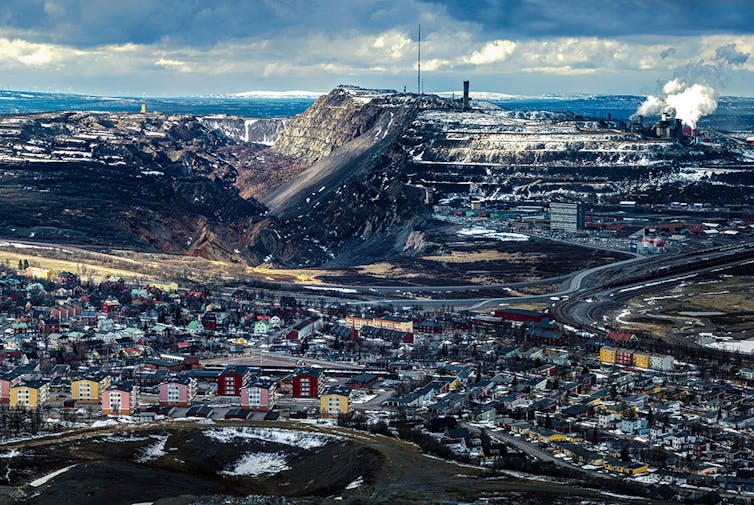
New Caledonia’s Koniambo (KNS) mining site aerial view. Image: KNS

New Caledonian consortium’s surprise bid for mothballed Northern plant
Meanwhile, a local consortium of New Caledonian investors is reported to have made an 11-hour offer to take over and restart activity for the now mothballed Koniambo (KNS) nickel plant.

The plant’s furnaces were placed in “cold care and maintenance” mode at the end of August, six months after major shareholder Anglo-Swiss Glencore announced it wanted to withdraw and sell the 49 percent shares it has in the project.

This caused close to 1200 job losses and further 600 among sub-contractors.

Other bidders still interested
KNS claimed at least three foreign investors were still interested at this stage, but none of these have so far materialised.

Talks were however reported to continue behind the scenes, with interested parties even ready to travel and visit on-site, KNS Vice-President and spokesman Alexandre Rousseau told Reuters news agency earlier this month.

‘Okelani Group One’
But a so-called “Okelani Group One” (OGO), made up of three local partners, said their offer could revive the project with a different business model.

They say they have made an offer to KNS’s majority shareholder SMSP (Société Minière du Sud Pacifique, New Caledonia’s Northern province financial arm).

OGO president Florent Tavernier told public broadcaster NC la 1ère much depended on what Glencore intended to do with the staggering debt of some US$13.7 billion which KNS had accumulated over the past 10 years.

Another OGO partner, Gilles Hernandez, explained: “We would be targeting a niche market of very high quality nickel used in aeronautics and edge-cutting technologies, especially in Europe, where nickel is now classified as ‘strategic metal’.”

Although KNS was designed to produce 60,000 tonnes of nickel a year, that target was never reached.

OGO said it would only aim for 15,000 tonnes per year and would only re-employ 400 of the 1200 laid-off staff.

New Caledonia’s third nickel plant, owned by historic Société Le Nickel (SLN, a subsidiary of French mining giant Eramet), which is also facing major hardships for the same reasons, is said to currently operate at minimal capacity.

This article is republished under a community partnership agreement with RNZ.

Article by AsiaPacificReport.nz

Papuan aspirations at stake in divided Melanesian Spearhead Group politics

COMMENTARY: By Laurens Ikinia in Jakarta

The Land of Papua is widely known as a land full of milk and honey. It is a name widely known in Indonesia that refers to the western half of the island of New Guinea.

Its natural wealth and beauty are special treasures entrusted by the Creator to the Papuan people who are of Melanesian ethnicity.

The beauty of the land inhabited by the blackish and brownish-skinned people is often sung about by Papuans in “Tanah Papua”, a song created by the late Yance Rumbino. The lyrics, besides being musical art, also contain expressions of gratitude and prayer for the masterpiece of the Creator.

For Papuans, “Tanah Papua” — composed by a former teacher in the central highlands of Papua — is always sung at various important events with a Papuan nuance, both in the Land of Papua and other parts of the world in Papuan gatherings.

The rich, beautiful and mysterious Land of Papua as expressed in the lyrics of the song has not been placed in the right position by the hands of those in power.

So for Papuans, when singing “Tanah Papua”, on one hand they admire and are grateful for all of God’s works in their ancestral land. On the other hand, by singing that song, they remind themselves to stay strong in facing daily challenges.

The characteristics of the Land of Papua geographically and ethnographically are the same as the eastern part of the island of New Guinea, now the independent state of Papua New Guinea.

Attractive to Europe
The beauty and wealth of natural resources and the richness of cultural heritage initially become attractions to European nations.

Therefore, the richness attracted the Europeans who later became the colonisers and invaders of the island.

The Dutch invaded the western part of the island and the British Empire and Germany the eastern part of the island.

The Europeans were present on the island of New Guinea with a “3Gs mission” (gospel, gold, glory). The gospel mission is related to the spread of Christianity. The gold mission is related to power over natural resource wealth. The glory mission is related to reigning over politics and territory on indigenous land outside of Europe.

The western part of the island, during the Dutch administration, was known as Dutch New Guinea or Netherlands New Guinea. Later when Indonesia took over the territory, was then named West Irian, and now it is called Papua or internationally known as West Papua.

The Land of Papua is divided into six provinces and it is home to 250 indigenous Melanesian tribes.

Meanwhile, the eastern part of the island which currently stands on its independent state New Guinea is home to more than 800 indigenous Melanesian tribes. Given the anthropological and ethnographic facts, the Land of Papua and PNG collectively are the most diverse and richest island in the world.

Vital role of language
In the process of forming an embryo and giving birth to a new nation and country, language plays an important role in uniting the various existing indigenous tribes and languages.

In Papua, after the Dutch left its territory and Indonesia took over control over the island, Bahasa Indonesia — modified Malay — was introduced. As a result, Indonesian became the unifying language for all Papuans, all the way from the Sorong to the Merauke region.

Besides Bahasa Indonesia, Papuans are still using their ancestral languages.

Meanwhile, in PNG, Tok Pisin, English and Hiri Motu are three widely spoken languages besides indigenous Melanesian languages. After the British Empire and Germany left the eastern New Guinea territory,

PNG, then an Australian administered former British protectorate and League of Nations mandate, gained its independence in 1975 — yesterday was celebrated as its 49th anniversary.

The relationship between the Land of Papua and its Melanesian sibling PNG is going well.

However, the governments of Indonesia and Papua New Guinea with the spirit of sharing the same land and ocean, culture and values, and the same blood and ancestors, should take tangible steps.

Melanesian policies
As an example, the foreign policy of each country needs to be translated into deep-rooted policies and regulations that fulfill the inner desire of the Melanesian people from both sides of the divide.

And then it needs to be extended to other Melanesian countries in the spirit of “we all are wantok” (one speak). The Melanesian countries and territories include the Fiji, Papua New Guinea, Solomon Islands, Vanuatu and Kanak and Socialist National Liberation Front (FLNKS).

Together, they are members of the sub-regional Oceania political organisation Melanesian Spearhead Group (MSG).

In that forum, Indonesia is an associate member, while the United Liberation Movement for West Papua (ULMWP) and Timor-Leste are observers. The ULMWP is the umbrella organisation for the Papuans who are dissatisfied with at least four root causes as concluded by Papua Road Map (2010), the distortion of the historical facts, racial injustice and discrimination, human rights violations, and marginalisation that Papuans have been experiencing for years.

Fiji:
Here is a brief overview of the diplomatic relationship between the Indonesian government and Melanesian countries. First, Indonesia-Fiji bilateral affairs. The two countries cooperate in several areas including defence, police, development, trade, tourism sector, and social issues including education, broadcasting and people-to-people to contact.

PNG:
Second, Indonesia-PNG bilateral affairs. The two countries cooperate in several areas including trade cooperation, investment, tourism, people-to-people contact and connectivity, energy and minerals, plantations and fisheries.

Quite surprisingly there is no cooperation agreement covering the police and defence sectors.

Solomon Islands:
Third, Indonesia-Solomon Islands diplomacy. The two countries cooperate in several areas including trade, investment, telecommunications, mining and tourism.

Interestingly, the country that is widely known in the Pacific as a producer of “Pacific Beat” musicians receives a significant amount of assistance from the Indonesian government.

Indonesia and the Solomon Islands do not have security and defence cooperation.

Vanuatu:
Fourth, Indonesia-Vanuatu cooperation. Although Vanuatu is known as a country that is consistent and steadfast in supporting “Free Papua”, it turns out that the two countries have had diplomatic relations since 1995.

They have cooperation in three sectors: trade, investment and tourism. Additionally, the MSG is based in Port Vila, the Vanuatu capital.

FLNKS — New Caledonia:
Meanwhile, New Caledonia, the territory that is vulnerable to political turmoil in seeking independence from France, is still a French overseas territory in the Pacific. Cooperation between the Indonesian and New Caledonia governments covers the same sectors as other MSG members.

However, one sector that gives a different aspect to Indonesia-New Caledonia affairs is cooperation in language, society and culture.

Indonesia’s relationship with MSG member countries cannot be limited to political debate or struggle only. Even though Indonesia has not been politically accepted as a full member of the MSG forum, in other forums in the region Indonesia has space to establish bilateral relations with Pacific countries.

For example, in June 2014, then President Susilo Bambang Yudhoyono was invited to be one of the keynote speakers at the Pacific Islands Development Forum (PIDF) summit in Nadi, Fiji.

PIDF is home to 12 member countries (Fiji, Federated States of Micronesia, Kiribati, Nauru, Marshall Islands, Palau, Solomon Islands, Timor-Leste, Tokelau, Tonga, Tuvalu, Vanuatu). Its mission is to implement green economic policies in the Pacific.

Multilateral forums
Indonesia has also joined various multilateral forums with other Pacific countries. The Archipelagic and Island States (AIS) is one example — Pacific states through mutual benefits programs.

During the outgoing President Joko Widodo’s administration, Indonesia initiated several cooperation projects with Pacific states, such as hosting the Pacific Exposition in Auckland, New Zealand, in 2019, and initiating the Indonesia-Pacific Development Forum.

Will Indonesia be granted a full membership status at the MSG? Or will ULMWP be granted an associate or full membership status at the MSG? Only time will reveal.

Both the Indonesian government and the United Liberation Movement for West Papua see a home at the MSG.

As former RNZ Pacific journalist Johnny Blades wrote in 2020, “West Papua is the issue that won’t go away for Melanesia”.

At this stage, the leaders of MSG countries are faced with moral and political dilemmas. The world is watching what next step will be taken by the MSG over the region’s polarising issue.

Laurens Ikinia is a Papuan lecturer and researcher at the Institute of Pacific Studies, Indonesian Christian University, Jakarta, and is a member of the Asia Pacific Media Network (APMN).

Article by AsiaPacificReport.nz

Saved from extinction? New modelling suggests a hopeful future for te reo Māori

Source: The Conversation (Au and NZ) – By Michael Miller, PhD Candidate, School of Information Management, Te Herenga Waka — Victoria University of Wellington

Just four years ago, experts warned te reo Māori was on a “pathway towards extinction” unless resources were put into teaching young Māori.

But a new mathematical model combined with recent data suggests the future of Māori language is not as grim as it once was.

My ongoing research looks at the future trajectory of Māori language acquisition over the next few decades. Based on recent data, my model suggests the Māori language could be on a path to recovery.

For over 50 years, revitalisation efforts have played a significant role in supporting the language’s resurgence.

The progress of te reo Māori provides hope for campaigners working to save the 55% of world languages destined to be dormant, doomed, or extinct by the end of the century.

Rescuing te reo Māori

Māori revitalisation efforts began in earnest in the late 1970s. The first kōhanga reo was opened in 1982, and te reo Māori was made an official language under the Maori Language Act 1987.

Despite these efforts, there have been ongoing concerns about the sustainability of the language. According to the 2018 Census, just 4% of New Zealanders reported they were fluent speakers of te reo Māori, up from 3.7% in 2013.

In the General Social Survey (also based on self-reported data), the number of people able to speak te reo Māori, at least fairly well, increased – from 6.1% in 2018 to 7.9% in 2021.

This was the first time there was a significant increase in this level of te reo Māori proficiency.

In 2019, the Labour government committed to the revitalisation of te reo Māori by setting a national target of one million speakers (at any level of proficiency) by 2040.

Modelling the future

My research is based on several sources of data – including the Census, the General Social Survey and the Te Kupenga survey of Māori wellbeing. The goal is to model how many speakers of te reo Māori we can expect in 20 or 30 years.

To understand this future path, I use my model to create different possible trajectories and compare them to these data sources. After finding the trajectories that best match, I extend these trajectories into the next few decades to estimate how many people might speak te reo in the future.

Some of the data, particularly from the more recent General Social Survey and the number of students learning te reo in schools and at university level, pointed to growth in te reo Māori acquisition. For example, enrolments in tertiary te reo courses have increased by 93% over the past ten years.

According to the model and current data, achieving one million speakers by 2040 is within reach, but it will take an increased commitment from the government and communities to make this future more likely.


Read more:
A ‘forever language’ – te Wiki o te Reo Māori marks 52 years of extraordinary progress


Developing policies to help

The next step of the research will be to better understand the role of government policy, iwi and the public in encouraging the adoption of te reo Māori.

Such policies include more te reo Māori in schools, providing more access to university-level te reo courses, encouraging fluent speakers to become teachers, increasing the use of bilingual signs, and promoting the use of te reo Māori at home.

But these are not the sort of policies we can expect from the current government, which has actively discouraged the official use of te reo Māori and is working to reduce incentives for public servants to learn the language.

This year’s Wiki o te Reo Māori (Māori Language Week) also comes amid an ongoing debate around the constitutional role of Te Tiriti o Waitangi (Treaty of Waitangi).

There is likely enough momentum within the reo community to keep the language growing in the short term. But if these policy settings were to continue (or worsen) over several years, it could have a negative effect on the future trajectory of te reo.

There are a lot of Indigenous languages being lost at the moment. Research has shown this can cause irrevocable harm for the communities they belong to.

It is important for the wellbeing of Māori that their language and culture are preserved. And it benefits all New Zealanders to have an understanding of one of the foundational languages of the country.

Based on the modelling, the future is looking hopeful in this respect.

The Conversation

Michael Miller is a PhD scholar funded by Te Pūnaha Matatini – New Zealand Centre of Research Excellence for complex systems.

ref. Saved from extinction? New modelling suggests a hopeful future for te reo Māori – https://theconversation.com/saved-from-extinction-new-modelling-suggests-a-hopeful-future-for-te-reo-maori-239084

The internet is worse than it used to be. How did we get here, and can we go back?

Source: The Conversation (Au and NZ) – By Marc Cheong, Senior Lecturer of Information Systems, School of Computing and Information Systems; and (Honorary) Senior Fellow, Melbourne Law School, The University of Melbourne

Two Pixel/Shutterstock

When it comes to our experience of the internet, “the times, they are a-changin’”, as Bob Dylan would say. You can’t quite recall how, but the internet certainly feels different these days.

To some, it is “less fun and less informative” than it used to be. To others, online searches are made up of “cookie cutter” pages that drown out useful information and are saturated with scams, spam and content generated by artificial intelligence (AI).

Your social media feeds are full of eye-catching, provocative, hyper-targeted, or anger-inducing content, from bizarre AI-generated imagery to robot-like comments. You’re lucky if your video feeds are not solely made up of exhortations to “subscribe”.

How did we get here? And can we claw our way back?

Commercial interests rule

One major factor contributing to the current state of the internet is its over-commercialisation: financial motives drive much of the content. This has arguably led to the prevalence of sensationalism, prioritising virality over information quality.

Covert and deceptive advertising is widespread, blurring the line between commercial and non-commercial content to attract more attention and engagement.

Another driving force is the dominance of tech giants like Google, Meta and Amazon. They reach billions worldwide and wield immense power over the content we consume.

Their platforms use advanced tracking technologies and opaque algorithms to generate hyper-targeted media content, powered by extensive user data. This creates filter bubbles, where users are exposed to limited content that reinforces their existing beliefs and biases, and echo chambers where other viewpoints are actively discredited.

Bad actors like cyber criminals and scammers have been an enduring problem online. However, evolving technology like generative AI has further empowered them, enabling them to create highly realistic fake images, deepfake videos and voice cloning.

AI’s ability to automate content creation has also flooded the internet with low-quality, misleading and harmful material at an unprecedented scale.

In sum, the accelerated commercialisation of the internet, the dominance of media tech giants and the presence of bad actors have infiltrated content on the internet. The rise of AI further intensifies this, making the internet more chaotic than ever.

Some of the ‘good’ internet remains

So, what was the “good internet” some of us long for with nostalgia?

At the outset, the internet was meant to be a free egalitarian space people were meant to “surf” and “browse”. Knowledge was meant to be shared: sites such as Wikipedia and The Internet Archive are continuing bastions of knowledge.

Before the advent of filter bubbles, the internet was a creative playground where people explored different ideas, discussed varying perspectives, and collaborated with individuals from “outgroups” – those outside their social circles who may hold opposing views.

Early social media platforms were built on the ethos of reconnecting with long-lost classmates and family members. Many of us have community groups, acquaintances and family we reach out to via the internet. The “connection” aspect of the internet remains as important as ever – as we all saw during the COVID pandemic.

What else do we want to preserve? Privacy. A New Yorker cartoon joke in 1993 stated that “on the internet, nobody knows you’re a dog”. Now everyone – especially advertisers – wants to know who you are. To quote the Office of the Australian Information Commissioner, one of the tenets of privacy is “to be able to control who can see or use information about you”.

At the very least, we want to control what big tech knows about us, especially if they could stand to profit from it.

Can we ever go back?

We can’t control “a changin’” times, but we can keep as much of the good parts as we can.

For starters, we can vote with our feet. Users can enact change and bring awareness to problems on existing platforms. In recent times, we have seen this with the exodus of users from X (formerly Twitter) to other platforms, and the platform-wide protest against Reddit for changing its third-party data access policies.

However, voting with our feet is only possible when there’s competition. In the case of X, various other platforms – from Mastodon to Threads to Bluesky – enable users to pick one that aligns with their preferences, values and social circles. Search engines have alternatives, too, such as DuckDuckGo or Ecosia.

But competition can only be created by moving to decentralised systems and removing monopolies. This actually happened in the early days of the internet during the 1990s “browser wars”, when Microsoft was eventually accused of illegally monopolising the web browser market in a landmark court case.

As users of technology, all of us must remain vigilant about threats to our privacy and knowledge. With cheap and ubiquitous generative AI, misleading content and scams are more realistic as ever.

We must exercise healthy scepticism and ensure those most at risk from online threats – such as children and older people – are educated about potential harms.

Remember, the internet is not optimised for your best interests. It’s up to you to decide how much power you give to the tech giants who are fuelling theirs.

The Conversation

Marc Cheong is a member of the Twitter Moderation Research Consortium, made up of a “global group of experts studying platform governance issues”. He was also part of CrowdTangle’s Academics & Researchers program (Meta owns CrowdTangle).

Wonsun Shin is an associate editor of Journal of Advertising and serves on the Editorial Review Boards of the International Journal of Advertising and Communication Research Practice. Her research has been funded by Meta Platform, Australian Research Council, and Academy of Korean Studies.

ref. The internet is worse than it used to be. How did we get here, and can we go back? – https://theconversation.com/the-internet-is-worse-than-it-used-to-be-how-did-we-get-here-and-can-we-go-back-236513

Global powers are grappling with ‘responsible’ use of military AI. What would that look like?

Source: The Conversation (Au and NZ) – By Zena Assaad, Senior Lecturer, School of Engineering, Australian National University

Air Force Tech. Sgt. Teri Eicher

Last week, some 2,000 government officials and experts from around the world met for the REAIM (Responsible Artificial Intelligence in the Military Domain) summit in Seoul, South Korea. This was the second event of its kind, with the first one held in the Netherlands in February 2023.

During this year’s summit, 61 countries endorsed a “Blueprint for Action” for governing the development and use of artificial intelligence (AI) by the military.

However, 30 countries sent a government representative to the summit but didn’t endorse the blueprint, including China.

The blueprint is an important, if modest, development. But there is still a gap in the understanding of what constitutes responsible use of AI and how this translates into concrete actions in the military domain.

How is AI currently used in military contexts?

Military use of AI has increased over the last few years, notably in the Russia-Ukraine and Israel-Palestine conflicts.

Israel has used AI-enabled systems known as “Gospel” and “Lavender” to help it make key military decisions, such as which locations and people to target with bombs. The systems use large amounts of data, including people’s addresses, phone numbers and membership of chat groups.

The “Lavender” system in particular made headlines earlier this year when critics questioned its efficacy and legality. There was particular concern around its training data and how it classified targets.

Both Russia and Ukraine also use AI to support military decision making. Satellite imagery, social media content and drone surveillance are just some of the many information sources which generate copious volumes of data.

AI can analyse this data much more quickly than humans could. The results are incorporated into existing “kill chains” – the process of locating, tracking, targeting and engaging targets.

It means military officials can make faster decisions during active armed conflict, providing tactical advantages. However, the misuse of AI systems can also result in potential harm.

Civil society and non-governmental organisations such as the International Committee of the Red Cross have warned about the risks. For example, algorithmic bias can exacerbate the risk to civilians during active warfare.

What is responsible AI in the military domain?

There is no consensus on what constitutes “responsible” AI.

Some researchers argue the technology itself can be responsible. In this case, “responsible” would mean having built-in fairness and freedom from bias.

Other studies refer to the practices around AI – such as design, development and use – being responsible. These would mean practices that are lawful, traceable, reliable and focused on mitigating bias.

The blueprint endorsed at the recent summit in Seoul aligns with the latter interpretation. It advocates that anyone using AI in the military must comply with relevant national and international laws.

It also highlights the importance of human roles in the development, deployment and use of AI in the military domain. This includes ensuring human judgement and control over the use of force are responsibly and safely managed.

This is an important distinction, because many narratives around AI falsely imply an absence of human involvement and responsibility.

What can governments do to use military AI responsibly?

Discussions at the summit focused heavily on concrete steps governments can take to support responsible use of military AI.

As military AI use is currently increasing, we need interim steps to deal with it. One suggestion was to strike AI regulation agreements within different regions, rather than taking longer to reach a global, universal consensus.

To improve global cooperation on military AI, we could also heed lessons from previous global challenges – such as nuclear non-proliferation, saving the ozone layer and keeping outer space and Antarctica demilitarised.

Eighteen months since the inaugural summit last year, governments and other responsible parties have started putting into place risk-mitigation processes and toolkits for military AI.

The blueprint reflects the progress since then, and the ideas discussed at the summit. It proposes a number of tangible steps, which include:

  • universal legal reviews for AI-enabled military capabilities
  • promoting dialogue on developing measures to ensure responsible AI in the military domain at the national, regional and international levels
  • maintaining appropriate human involvement in the development, deployment and use of AI in the military domain.

However, progress is slow because we still don’t have a universal understanding of what responsible military AI actually looks like.

The need to cut thorough these issues is now putting pressure on the next summit (not yet announced). The Netherlands has also set up an expert body to further a globally consistent approach to military AI.

Humanity can benefit from AI tools. But we urgently need to ensure the risks they pose don’t proliferate, especially in the military domain.

The Conversation

Lauren Sanders has previously received funding from the Australian Government’s Next Generation Technologies Fund, through Trusted Autonomous Systems, a Defence Cooperative Research Centre. She is affiliated with the Asia-Pacific Institute for Law and Security, and a legal practice that provides international law advice. The views in this article are her own and do not reflet those of any institutions she is affiliated with.

Rain Liivoja has previously received funding from the Australian Government’s Next Generation Technologies Fund, through Trusted Autonomous Systems, a Defence Cooperative Research Centre. He is affiliated with the Asia-Pacific Institute for Law and Security.

Zena Assaad does not work for, consult, own shares in or receive funding from any company or organisation that would benefit from this article, and has disclosed no relevant affiliations beyond their academic appointment.

ref. Global powers are grappling with ‘responsible’ use of military AI. What would that look like? – https://theconversation.com/global-powers-are-grappling-with-responsible-use-of-military-ai-what-would-that-look-like-237216

New data reveals rates of family violence among those who died by suicide

Source: The Conversation (Au and NZ) – By Kate Fitz-Gibbon, Professor (Practice), Faculty of Business and Economics, Monash University, Monash University

Shutterstock

Domestic, family and sexual violence is rightly recognised as a national crisis.

While the evidence base has built significantly in recent years, one important missing piece of the puzzle is how these forms of violence have impacted people who die by suicide across the country.

Data released this week by the Coroner’s Court of Victoria provides a detailed account of the experiences of family violence among people who have died by suicide.

The statistics are alarming. They remind us of what many working in this space already instinctively knew: the horrifically high count of lives lost to the national crisis of men’s violence against women is likely far higher than official numbers suggest.

What does the report tell us?

This latest report presents data collected by the Victorian Suicide Register on 4,790 suicides reported between 2009 and 2016.

Over this period, in one in four suicides (24.5%) the deceased had experienced family violence prior to their death.

This rate was higher among females who died by suicide, with evidence of family violence present in 28.2% of cases recorded.

This rate only captures the cases in which evidence of family violence could be identified by the court.

Given all forms of family violence are under reported, including to police, legal and other services, this data are likely to underestimate the true rates of family violence experienced by people who die by suicide.

Where there was evidence of family violence prior to the suicide, in half of these the person who died by suicide was the perpetrator of violence.

In one in three cases, the individual who died by suicide had experienced family violence victimisation. In these cases, the deceased was significantly more likely to be a female (62.1%).

The report also records a further 17.5% of suicides where the individual who died by suicide had both used and been a victim of family violence. Little information about this group is provided.

We need to better understand the primary use of violence in these situations, including whether this data includes incidents of misidentification and what the impact of it was. The role of intergenerational experiences of abuse should also be considered.

Gendered abuse

The report highlights gender differences in the records of people who died by suicide in Victoria during this period.

Significantly more males (65%) than females (16%) were recorded as a family violence perpetrator. Conversely, females were significantly more likely to be listed as a victim of family violence (62.1%).

These differences are expected given the gendered nature of family violence. Internationally, research has consistently highlighted the higher risk of suicidality and self-harm among women victims of violence.

The data show just over one in two male perpetrators of family violence who die by suicide had used violence against an intimate partner.

A higher proportion of men (22.1%) who died by suicide than women (10.2%) had perpetrated family violence against numerous people, including a partner and at least one other family member.

The data also show female victims of family violence who died by suicide were more likely to have experienced family violence by their intimate partner.

By contrast, male victims were more likely to have experienced family violence perpetrated by a family member other than their partner.

Many factors at play

The report provides insights into how family violence and suicide interact with other social issues.

While the report doesn’t discuss causation, it does look at prevalence of mental health diagnoses. Nearly three quarters of victims of family violence who later died by suicide had been diagnosed with a mental illness at some point in their lives (72.5% among males, 78.2% among females).

The rate of substance misuse was reported as higher among people who had experienced family violence than among the general Victorian suicide population.

Victims and perpetrators of family violence who died by suicide were more likely to be under financial stress when compared to the broader Victorian suicide population.

This was defined as any evidence of stress or harm relating to the deceased’s financial situation. For example, high debts, loss of money, inability to pay mortgage or bills or afford other costs of living, and gambling-related harms. This is a timely finding given the current cost of living crisis and the need to understand where additional support services may be needed.

More than 60% of male family violence perpetrators who died by suicide in the period studied had experienced at least one legal stressor prior to their death. This included involvement in criminal and civil legal processes, including divorce settlements and child custody cases.

Reflecting the harmful impacts the legal system can have on victims, legal stressors were also present in more than a third of the lives of victims of family violence who died by suicide.

Coordination and consistency is key

This data represents an important step forward in quantifying the prevalence of family violence among individuals who died by suicide in one Australian state.

But this violence is a national problem. This data are needed for every Australian state and territory. We simply cannot seek to effectively address and prevent what we do not measure.

Following the recommendations of the recent federal rapid review, there needs to be greater coordination at the commonwealth, state and territory levels to gather this data in the same way in every jurisdiction.

Knowing the impact that experiences of family violence may have had on someone’s suicide is also important to understand. This data doesn’t examine the time frame of experiences, nor their proximity to the person’s death. These are crucial factors to inform prevention strategies.

The more we know about how victims experience and interact with services, the more informed early intervention and response efforts can be. It’s likely victims would have encountered a range of different services before they died.

Each of these points is an important opportunity for intervention. Greater understanding, including of what role family and friends may play in supporting their loved ones to seek help, can be used to inform more effective suicide prevention efforts.

First and foremost, each of these lives matter. And they represent additional lives lost in Australia’s national crisis of domestic, family and sexual violence. Current efforts to prevent femicide in Australia should extend to accounting for, and better understanding deaths by suicide following family violence.


The National Sexual Assault, Family and Domestic Violence Counselling Line – 1800 RESPECT (1800 737 732) – is available 24 hours a day, seven days a week for any Australian who has experienced, or is at risk of, family and domestic violence and/or sexual assault.

The Conversation

Kate has received funding for family violence-related research from the Australian Research Council, Australian Institute of Criminology, Australia’s National Research Organisation for Women’s Safety, the Victorian, Queensland and ACT governments, the Commonwealth Department of Social Services and the Victorian Women’s Trust. This piece is written by Kate Fitz-Gibbon in her role at Monash University and is wholly independent of Kate Fitz-Gibbon’s role as Chair of Respect Victoria.

Stefani Vasil has received funding from Respect Victoria, the Department of Foreign Affairs and Trade, the e-Safety Commissioner and the Victorian Women’s Trust.

ref. New data reveals rates of family violence among those who died by suicide – https://theconversation.com/new-data-reveals-rates-of-family-violence-among-those-who-died-by-suicide-239090

How perpetrators of domestic violence use drugs and alcohol to control their victims

Source: The Conversation (Au and NZ) – By Cathy Humphreys, Professor of Social Work, The University of Melbourne

panitanphoto/Shutterstock

At least three decades of research on the intersection of substance use with domestic and family violence consistently shows the frequency, severity and impact of violence increases in the context of the perpetrator using alcohol and other drugs.

Some 24–54% of domestic and family violence incidents reported to police in Australia are classified as alcohol-related, while other drugs are implicated in 1–9% of incidents. This is consistent with international evidence which shows substance use occurs with domestic and family violence in 25–50% of cases.

Several studies have also pointed to the increased severity of domestic and family violence when substances are involved. An Australian study, which looked at 240 women murdered by a current or former male partner between 2010 and 2018, reports more than 60% of the male perpetrators were affected by alcohol or drugs during the fatal episode.

Other research indicates alcohol-related domestic and family violence is two to three times more likely to involve severe physical violence such as life-threatening injuries and broken bones, compared to domestic and family violence where alcohol is not involved.

Our research, however, is interested specifically in the role alcohol and other drugs play in perpetrators’ tactics of violence and abuse. This is sometimes called “substance use coercion” and is a type of coercive control.

Understanding substance use coercion

Coercive control is a repeated pattern of emotional, verbal, sexual, financial or technology-enabled abuse that creates fear and exerts control over another person.

A set of national principles seeking to address coercive control in family and domestic violence recognise that substance use can be exploited in the same way as technology or financial abuse.

Our work identifies several ways perpetrators may use alcohol or other drugs as a form of coercive control, or, in other words, exploit their own substance use to gain more power. These include:

  • to excuse their violence (“The drink made me do it”)

  • to shift the focus from their abuse to other issues (“I have a drug problem, that’s more important”)

  • to control others through their substance use. For example, when a person using violence is intoxicated or in withdrawal, victim-survivors often comply with their demands or avoid arguments to de-escalate the violence.

Perpetrators may also weaponise victim-survivors’ substance use. Research shows that, to numb the physical and emotional pain of family violence, victim-survivors may start using substances.

Perpetrators often encourage this practice to increase their power and control over the victim-survivor and to undermine their credibility if authorities become involved.

Likewise, perpetrators may exacerbate victim-survivors’ existing substance use, such as by pressuring them to drink or take drugs more often. Alternatively they might sabotage victim-survivors’ recovery efforts, preventing their access to treatment services.

Another tactic involves lying about the nature and extent of the victim-survivor’s substance use. This can undermine their credibility with authorities such as child protection services or the family court.

Children suffer too

On a basic level, children are terrified when they hear their father come home drunk and abusive. They fear for both themselves and their mothers, often finding the abuse that follows leaves them with neither parent in a position to look after their needs.

They may also be implicated in their father’s substance use coercion. For example:

Unless you shut those kids up, I’m going to drink.

The severe impact on children living with violence where either or both parents are substance-affected can be seen through child protection data.

A recent New South Wales study reported on children living in situations of domestic and family violence. Children where one or both parents had either substance use issues or poor mental health were three times more likely to be identified as at risk of harm warranting statutory intervention, than in cases of domestic and family violence alone.

Children in situations where substance use and domestic and family violence intersect are some of the most vulnerable in Australia.

A woman comforting a child, while a man drinks from a bottle.
When substance use and family violence collide, it can have serious consequences for children.
Alexander_Safonov/Shutterstock

What can we do?

Policy and practice responses to the intersection of domestic violence and substance use, both in Australia and internationally, have tended to focus on single issues: domestic violence or substance use.

While many families experience domestic violence and substance use as profoundly intertwined, service systems often fragment their experiences, treating the two as disconnected problems.

Our research is exploring how these two highly siloed sectors can work together, in the form of a 17-week group program for fathers who used violence and abuse in the context of substance use. These men had more significant histories of violence and abuse than men in a similar program targeting violence only.

International evidence shows programs that address both substance use and domestic violence are developed but rarely sustained, despite evidence of their effectiveness.

We would like to see more nuanced policy and practice that recognises the complex crossover between domestic and family violence and substance use. Importantly, these approaches must address children’s experiences of these intersecting issues, and provide tailored responses to promote their safety.

The National Sexual Assault, Family and Domestic Violence Counselling Line – 1800 RESPECT (1800 737 732) – is available 24 hours a day, seven days a week for any Australian who has experienced, or is at risk of, family and domestic violence and/or sexual assault.

The Conversation

Cathy Humphreys receives funding from the Australian Research Council, ANROWS and funding from community organisation grants for specific projects.

Margaret Kertesz receives funding from the Australian Research Council, from DV NSW and project-specific funding from some community-based organisations.

Van Callaly receives funding from the Australian Research Council and project specific funding from some community-based organisations.

ref. How perpetrators of domestic violence use drugs and alcohol to control their victims – https://theconversation.com/how-perpetrators-of-domestic-violence-use-drugs-and-alcohol-to-control-their-victims-236865

‘Pirate birds’ force other seabirds to regurgitate fish meals. Their thieving ways could spread lethal avian flu

Source: The Conversation (Au and NZ) – By Simon Gorta, PhD Candidate in ecology, UNSW Sydney

Skuas chase a gannet to force it to regurgitate its meal Bob Brewer/Unsplash, CC BY-NC-ND

It’s not easy finding food at sea. Seabirds often stay aloft, scanning the churning waters for elusive prey. Most seabirds take fish, squid, or other prey from the first few metres of seawater. Scavenging is common.

But there are other tactics. Frigatebirds, skuas, and gulls rely on the success of other seabirds. These large, strong birds chase, harry, and attack their targets until they regurgitate or drop the prey they’ve just caught. They’re the pirates of the seabird world, stealing hard-earned meals from other species. This behaviour is known as kleptoparasitism, from the Ancient Greek word kléptēs, thief.

The strategy is brutal, effective, and a core behaviour for these important seabirds. But as our new research shows, it comes with major risks for the thieves. The new strain of avian flu is killing birds by their millions – and we found kleptoparasitism could spread the virus very easily.

Food thieves at sea

It’s not that frigatebirds, skuas, and gulls can’t hunt. They can and do catch their own food. But hunting fish and squid is hard work. It’s much easier to use extortion tactics to win the food from other seabirds.

These tactics have made these birds very successful as foragers. They hang around the breeding sites of birds such as gannets and terns waiting for a tired parent to return from the sea with a crop of food.

For the seabirds being targeted, these kleptoparasitic birds are just one more threat. The world’s 362 species of seabird can be found across every ocean and many islands. At sea, they prey on fish and squid. When they nest or rest on islands, their nutrient-rich guano shapes soil and plant communities, defining entire ecosystems.

But they are not doing well. Just under half of all seabird species (155) are now classified between “near threatened” and “critically endangered” on the world’s list of threatened species, the IUCN Red List. Of those with known trends, 56% have populations in decline.

The threats they face are daunting. Invasive predators such as mice and rats eat eggs or chicks on breeding islands. Many are caught by fishing boats as accidental bycatch, while overfishing depletes their prey. Then there’s climate change, habitat loss, and many other threats, including disease.

Seabirds are generally long-lived. They often raise only one chick every one or two years. Many species breed in only a few locations. They take many years to mature. Put together, these traits make recovery from population declines slow.

skua chasing tern
Kleptoparasitism is an effective way to get food.
Simon C Stobart/Shutterstock

Of parasites and viruses

Three years ago, a more lethal strain of avian influenza virus emerged. This HPAI H5N1 2.3.4.4b strain has spread around the world, killing at least 280 million wild birds. The strain can also infect and kill marine mammals such as seals.

“HPAI” stands for Highly Pathogenic Avian Influenza, meaning the virus can more readily cause severe disease and death. The strain has become an animal pandemic (formally, a panzootic). It’s made it to Antarctica, but not yet to Australia or the rest of Oceania.

We know seabirds are particularly at risk. Our new research has shown kleptoparasites are at an even higher risk relative to other seabirds.

During the 2022 northern hemisphere summer, the virus killed roughly half of the world’s great skua (Stercorarius skua).

Food-stealing behaviour can enable the virus to spread. When a great skua harasses a gannet and makes it regurgitate food, the skua gets a fish meal – coated in saliva. If the gannet is infectious, its saliva will likely have a high viral load.

Once infected, these pirate birds can drive spread faster. Skuas, frigatebirds and gulls can cover great distances across polar regions and the tropics. They can transmit the disease to their mates, chicks, and other seabirds.

This means we could see outbreaks in new populations or places, hundreds or even thousands of kilometres apart. We have already seen signs of this in skua populations in the northern and southern hemispheres, with brown (Stercorarius antarcticus) and great skuas being some of the first detected H5N1 infections at new locations.

Skuas more often steal food from other seabirds when away from their breeding sites – including when they’re migrating back to these areas. If skuas get infected en route, they could bring the disease to their breeding sites and then beyond.

Frigatebirds are known for the red pouches on the necks of the males, which they inflate during breeding season. But they have other remarkable traits, such as travelling tens of thousands of kilometres across oceans outside breeding season. These travels are often broken up by “island-hopping”, where they will encounter and potentially infect other seabirds.

frigatebird on nest
Frigatebirds are known for the large red pouches male birds have on their necks.
buteo/Shutterstock

Frigatebirds and skuas have already suffered mass deaths from this strain of avian influenza.

While the virus is now almost everywhere, it hasn’t reached Australia, New Zealand, Oceania, and parts of Antarctica and the subantarctic. We can monitor skuas, frigatebirds and gulls for signs of illness to give us early warning that the virus has arrived.

By itself, avian influenza is a major threat to seabirds. But the outlook is even more dire when this is compounded with further human-caused threats. Identifying, managing, and reducing these threats is critical for their conservation, and the health of our islands and oceans.


Read more:
Lethal bird flu could decimate Oceania’s birds. From vigilance to vaccines, here’s what we’re doing to prepare


The Conversation

Simon Gorta is a PhD student at the University of New South Wales and his PhD research is supported by the Australian Government Research Training Program scholarship.

Richard Kingsford and Rohan Clarke do not work for, consult, own shares in or receive funding from any company or organisation that would benefit from this article, and have disclosed no relevant affiliations beyond their academic appointment.

ref. ‘Pirate birds’ force other seabirds to regurgitate fish meals. Their thieving ways could spread lethal avian flu – https://theconversation.com/pirate-birds-force-other-seabirds-to-regurgitate-fish-meals-their-thieving-ways-could-spread-lethal-avian-flu-238438

Are kiwi and moa recent immigrants from Australia? Neither fossils nor genetic evidence support the story

Source: The Conversation (Au and NZ) – By Nic Rawlence, Associate Professor in Ancient DNA, University of Otago

Marty Melville/AFP/Getty Images

Aotearoa New Zealand is a land of birds, from the smallest of wrens to the mightiest of moa. The ancestors of some species have been here for tens of millions of years, while others arrived only a few million years ago.

So a recent suggestion that moa and kiwi are recent immigrants from Australia, while wrens and kākāpō are New Zealand’s truly ancient birds, was sure to ignite controversy.

The contentious report was based on a scientific review of fossils found at St Bathans in Central Otago.

However, putting dates on arrivals requires a combination of both physical fossil evidence in deposits of a known age and genetic dating techniques that determine when the birds we know today diverged from their closest relatives.

Dating the arrival of birds in New Zealand

New Zealand is part of the larger continent of Zealandia, which finished separating from the supercontinent Gondwana some 57 million years ago.

Some familiar animals were likely present in proto-New Zealand at this time, including our unique silent frogs, the ancient tuatara and many invertebrates. Tens of millions of years of dispersal of both plants and animals followed.

Fossils and DNA allow us to explore these dispersal events in detail. Fossils can preserve evidence for millennia longer than DNA molecules, but DNA can shed light on many processes even when fossils are rare. This quality is particularly valuable since the chance of finding fossils decreases the further back we look in time.

Both approaches carry their own assumptions and biases that influence calculations of the range of arrival times.

This graph shows the estimated arrival of ancestors of New Zealand's birds.
The ancestors of birds have been arriving in New Zealand for tens of millions of years.
Adapted from Valente et al (2019), CC BY-SA

Our team uses ancient DNA to date these arrivals, showing for example that the purple swamp hen ancestors of takahē and moho arrived in Aotearoa New Zealand around four million years ago from Australia, as part of a suite of open-habitat birds that included ancestors of the kakī black stilt, pouākai Haast’s eagle and kērangi Eyles’ harrier.

Other genetic studies have shown the ancestors of New Zealand wrens, the most primitive of all perching birds, split off about 50 to 60 million years ago. Wren fossils are part of the wonders unearthed at St Bathans, alongside remains of both moa and kiwi.

Genetic and morphological analyses of ratites (such as ostrich, kiwi, moa and elephant birds) suggest the ancestors of moa and kiwi reached Zealandia, separately, around 50 to 60 million years ago. Both groups filled the job vacancy in the ecosystem left by dinosaurs, becoming large and flightless.

The kākāpō, meanwhile, along with the kākā and kea, belong to a family that split off from all other living parrots very early on; they, too, are an ancient group. But genetic dating of their arrival in Zealandia remains unresolved, with studies variously putting it between 20 to 80 million years ago.

Kakapo Sirocco among renga renga lillies on Maud Island.
The genetic analysis of when kākāpō arrived in New Zealand remains unresolved.
Chris Birmingham/Department of Conservation/Wikimedia Commons, CC BY-SA

Precise dating of these splits presents a significant challenge. Nevertheless, the range between 30 million and a few million ascribed to the moa and kiwi by the recent announcement is not borne out by available evidence – and neither group is Australian as reported.

Moa are most closely related to the flying chicken-sized tinamous from South America, and kiwi are relatives of the giant extinct elephant birds from Madagascar. Indeed, Australia did not even exist as a discrete entity 50 to 60 million years ago; it was still firmly affixed to Antarctica and South America.

Exactly what routes the ancestors of moa and kiwi took to reach Zealandia remains unknown. They were part of a group of flying birds with a worldwide distribution called Lithornids, which lost flight many times independently and evolved into the ratites we know today.

The bones will speak

The St Bathans fossil deposit has given us an indispensable window into prehistoric New Zealand, and in many ways it is familiar – the bones of moa, kiwi, parrots, wrens and bats provide a reassuring continuity.

A group of people lying flat on their bellies while excavating fossils at St Bathans.
Excavating bird fossils at St Bathans.
Nic Rawlence, CC BY-SA

As the publication notes, though, there are also many strange things in the fossil deposit – crocodiles, a relative of flamingos and a giant turtle. There’s an Alice in Wonderland quality to St Bathans, and it’s a crucial piece of the story of Aotearoa New Zealand’s biological heritage.

The presence of a bird’s fossil in the deposit indicates the lineage was present in New Zealand a long time ago. But how long ago, exactly? Most estimates put the age of the St Bathans lake sediments between 12 and 20 million years, but these estimates are imprecise, making definitive statements about the age of animal groups difficult.

Even if a lineage was present in the St Bathans deposits, this still does not prove a continuous presence from that time to the present day.

Whatever the age of St Bathans, it’s tempting to think remains found in the palaeo-lake are members of truly ancient lineages, while things that only arrived after the lake dried up are invaders, little more than wayward tourists that got off at the wrong stop.

No matter when ancestors of birds arrived in New Zealand, their time on these isles has shaped their evolution in profound ways. Our team is working on determining arrival times and it’s looking increasingly dynamic, tied to environmental conditions.

The ancestors of the majestic huia arrived here 27 million years ago, evolving distinct beak shapes in males and females and white-tipped feathers that were high-status symbols in Māori society.

At the other end of the scale, the closest relative of the 16kg Haast’s eagle, whose ancestors arrived here a mere 2.5 million years ago, is the smallest eagle in the world – weighing only 1kg.

Let’s continue to embrace and care for our amazing bird fauna – whatever their age, they all have a bit of Aotearoa New Zealand in them.

The Conversation

Nic Rawlence receives funding from Royal Society Te Apārangi Marsden Fund.

Alan Tennyson has been the recipient of Australian Research Council grants in the past that partly funded the St Bathans fossil excavations.

Pascale Lubbe receives funding from Royal Society Te Apārangi Marsden Fund.

ref. Are kiwi and moa recent immigrants from Australia? Neither fossils nor genetic evidence support the story – https://theconversation.com/are-kiwi-and-moa-recent-immigrants-from-australia-neither-fossils-nor-genetic-evidence-support-the-story-238577

Young homeowners are more likely to use their home as an ‘ATM’ than their Boomer parents. Here’s why

Source: The Conversation (Au and NZ) – By Rachel Ong ViforJ, ARC Future Fellow & Professor of Economics, Curtin University

Bricolage/Shutterbox

For many Australians, the family home is their largest financial asset. With an increasing variety of ways to tap into home equity, the temptation to access this wealth is ever growing.

Homeowners increase the debt owed on their home when they borrow against their equity. Standard mortgage home loans now provide facilities for relatively cheap or free withdrawals of equity from the home.

This turns the home into an ATM, which borrowers can access when they choose.

Our new study asks what motivates Australians to tap into their home equity, and how does this behaviour change with age?

Surprisingly, despite having much lower housing equity levels, younger homeowners borrow often, and borrow more, than their Boomer parents.

How common is equity borrowing?

Using 15 years of data from the government-funded Household, Income and Labour Dynamics in Australia (HILDA) survey, we tracked the mortgage debt and repayments of homeowners aged 35 and over.

The chart below shows younger owners are far more likely to engage in equity borrowing.

In 2006, nearly 39% of the youngest homeowners, aged 35–44, borrowed against their home equity. By 2021, this number had dropped to 29%. Despite the decline, it’s still 24 percentage points more common than those aged 65 and over. The older group has remained steady at about 5% over the years.


How much do equity borrowers withdraw from their home?

Among those who use their home like an ATM, younger borrowers now withdraw larger amounts than older borrowers.

In 2006–07, equity borrowers aged 35–44 and 45–54 withdrew on average $43,000 and $57,000, respectively (expressed in real values set at 2022 price levels). By 2021, the amount withdrawn by these two age groups had climbed to $70,000 and $100,000.

On the other hand, the amount withdrawn by borrowers aged 55 or older fell from more than $50,000 to less than $40,000.


What motivates equity borrowing?

Young homeowners’ equity borrowing behaviours are sensitive to changes in house prices and debt values, and their financial risk preferences. Among those aged 35–44, a $10,000 increase in the primary home value raises the likelihood of equity borrowing by ten percentage points.

Every $10,000 in debt against the primary home reduces the likelihood by 2.8% percentage points. Those willing to take substantial financial risk are eight percentage points more likely to borrow against their home than those who are risk-averse.

Those aged 65+ are not inclined to borrow, and exhibit little change in equity borrowing behaviour with variations in asset, debt, income or financial risk preferences.

Why borrowing practices differ between age groups

As well as being more likely than older homeowners to borrow against equity, the younger group also withdraws higher amounts than their Boomer parents.

This is despite younger borrowers already carrying much higher debt against their primary home. Among those in our study who engaged in equity borrowing in 2021, the median debt before borrowing was $401,000 for 35-44 year-olds compared to $0 for those aged 65+.

As real house prices have risen over decades, the current generation of young homeowners has had to invest more money into purchasing their first home than previous generations.

It’s therefore not surprising the primary home is now widely viewed as a financial resource to be tapped into to meet spending needs.

On the other hand, most Baby Boomers bought their first home at more affordable prices than their children, and at lower levels of debt. Now they don’t appear to be spending their kids’ inheritance by drawing down housing wealth.

In fact, older parents may shy away from equity borrowing to bequeath wealth to children. Some also dislike passing debt on to their children.

Older people may also avoid equity borrowing due to concerns about aged care costs. Some may be hampered by poor financial literacy.

More debt ahead without policy changes

Present trends suggest young homeowners will remain indebted for longer periods, and more and more will retire with mortgage debt.

For indebted retirees, there are real prospects of drawing down of superannuation to pay off mortgages in retirement.

This may impose extra burdens on the age pension system. Another unwelcome consequence, which may add to health costs, is the prospect of debt-related psychological distress among those who can’t pay off their mortgage in old age.

If the current trends continue, the great wealth transfer that has already begun looks set to further entrench inequality between those who have access to the bank of mum and dad and those who do not.

Encouraging older people to use their housing equity to fund their needs in old age may lighten fiscal burdens on younger generations. But policy reforms will be needed to relieve concerns about the risks of equity borrowing in old age.

The Conversation

Rachel Ong ViforJ is the recipient of an Australian Research Council Future Fellowship (project FT200100422).

Christopher Phelps does not work for, consult, own shares in or receive funding from any company or organisation that would benefit from this article, and has disclosed no relevant affiliations beyond their academic appointment.

ref. Young homeowners are more likely to use their home as an ‘ATM’ than their Boomer parents. Here’s why – https://theconversation.com/young-homeowners-are-more-likely-to-use-their-home-as-an-atm-than-their-boomer-parents-heres-why-238924

Up close and friendly with Vietnam’s war resistance Củ Chi tunnels

Report by Dr David Robie – Café Pacific.

COMMENTARY: By David Robie in Ho Chi Minh City

Vietnam’s famous Củ Chi tunnel network was on our bucket list for years.

For me, it was for more than half a century, ever since I had been editor of the Melbourne Sunday Observer, which campaigned against Australian (and New Zealand) involvement in the unjust Vietnam War — redubbed the “American War” by the Vietnamese.

For Del, it was a dream to see how the resistance of a small and poor country could defeat the might of colonisers.

“I wanted to see for myself how the tunnels and the sacrifices of the Vietnamese had contributed to winning the war,” she recalls.

“Love for country, a longing for peace and a resistance to foreign domination were strong factors in victory.”

We finally got our wish last month — a half day trip to the tunnel network, which stretched some 250 kilometres at the peak of their use. The museum park is just 45 km northeast of Ho Chi Minh city, known as Saigon during the war years (many locals still call it that).

Building of the tunnels started after the Second World War after the Japanese had withdrawn from Indochina and liberation struggles had begun against the French. But they reached their most dramatic use in the war against the Americans, especially during the spate of surprise attacks during the Tet Offensive in 1968.

The Viet Minh kicked off the network, when it was a sort of southern gateway to the Ho Chi Minh trail in the 1940s as the communist forces edged closer to Saigon.

Checking out the Củ Chi tunnel network near Vietnam’s Ho Chi Minh City. Image: David Robie/APR

Eventually the liberation successes of the Viet Minh led to humiliating defeat of the French colonial forces at Dien Bien Phu in 1954.

Cutting off supply lines
The French had rebuilt an ex-Japanese airbase in a remote valley near the Laotian border in a so-called “hedgehog” operation — in a belief that the Viet Minh forces did not have anti-aircraft artillery. They hoped to cut off the Viet Minh’s guerrilla forces’ supply lines and draw them into a decisive conventional battle where superior French firepower would prevail.

However, they were the ones who were cut off.


The Củ Chi tunnels explored.    Video: History channel

The French military command badly miscalculated as General Nguyen Giap’s forces secretly and patiently hauled artillery through the jungle-clad hills over months and established strategic batteries with tunnels for the guns to be hauled back under cover after firing several salvos.

Giap compared Dien Bien Phu to a “rice bowl” with the Viet Minh on the edges and the French at the bottom.

After a 54-day siege between 13 March and 7 May 1954, as the French forces became increasingly surrounded and with casualties mounting (up to 2300 killed), the fortifications were over-run and the surviving soldiers surrendered.

The defeat led to global shock that an anti-colonial guerrilla army had defeated a major European power.

The French government of Prime Minister Joseph Laniel resigned and the 1954 Geneva Accords were signed with France pulling out all its forces in the whole of Indochina, although Vietnam was temporarily divided in half at the 17th Parallel — the communist Democratic Republic of Vietnam under Ho Chi Minh, and the republican State of Vietnam nominally under Emperor Bao Dai (but in reality led by a series of dictators with US support).

Debacle of Dien Bien Phu
The debacle of Dien Bien Phu is told very well in an exhibition that takes up an entire wing of the Vietnam War Remnants Museum (it was originally named the “Museum of American War Crimes”).

But that isn’t all at the impressive museum, the history of the horrendous US misadventure is told in gruesome detail – with some 58,000 American troops killed and the death of an estimated up to 3 million Vietnamese soldiers and civilians. (Not to mention the 521 Australian and 37 New Zealand soldiers, and the many other allied casualties.)

The section of the museum devoted to the Agent Orange defoliant war waged on the Vietnamese and the country’s environment is particularly chilling – casualties and people suffering from the aftermath of the poisoning are now into the fourth generation.

“Peace in Vietnam” posters and photographs at the War Remnants Museum in Ho Chi Minh City. Image: David Robie/APR
“Nixon out of Vietnam” daubed on a bombed house in the War Remnants Museum. Image: Del Abcede/APR

The global anti-Vietnam War peace protests are also honoured at the museum and one section of the compound has a recreation of the prisons holding Viet Cong independence fighters, including the torture “tiger cells”.

A shackled Viet Cong suspect (mannequin) in a torture “tiger cage” recreation. Image: David Robie/APR

A guillotine is on display. The execution method was used by both France and the US-backed South Vietnam regimes against pro-independence fighters.

A guillotine on display at the Remnants War Museum in Ho Chi Minh City. Image: David Robie/APR

A placard says: “During the US war against Vietnam, the guillotine was transported to all of the provinces in South Vietnam to decapitate the Vietnam patriots. [On 12 March 1960], the last man who was executed by guillotine was Hoang Le Kha.”

A member of the ant-French liberation “scout movement”, Hoang was sentenced to death by a military court set up by the US-backed President Ngo Dinh Diem’s regime.

In 1981, France outlawed capital punishment and abandoned the use of the guillotine, but the last execution was as recent as 1977.

Museum visit essential
Visiting Ho Ch Min City’s War Remnants Museum is essential for background and contextual understanding of the role and importance of the Củ Chi tunnels.

Also for insights about how the last US troops left Vietnam in March 1973, Nixon resigned the following year under pressure from the Watergate revelations, and a series of reverses led to the collapse of the South Vietnam regime and the humiliating scenes of the final Americans withdrawing by helicopter from the US Embassy rooftop in Saigon in April 1975.

The Sunday Observer coverage of the My Lai massacre. Image: Screenshot David Robie/APR

Back in my protest days as chief subeditor and then editor of Melbourne’s Sunday Observer, I had published Ronald Haberle’s My Lai massacre photos the same week as Life Magazine in December 1969 (an estimated 500 women, children and elderly men were killed at the hamlet on 16 March 1968 near Quang Nai city and the atrocity was covered up for almost two years).

Ironically, we were prosecuted for “obscenity’ for publishing photographs of a real life US obscenity and war crime in the Australian state of Victoria. (The case was later dropped).

So our trip to the Củ Chi tunnels was laced with expectation. What would we see? What would we feel?

A tunnel entrance at Ben Dinh. Image: David Robie/APR

The tunnels played a critical role in the “American” War, eventually leading to the collapse of South Vietnamese resistance in Saigon. And the guides talk about the experience and the sacrifice of Viet Cong fighters in reverential tones.

The tunnel network at Ben Dinh is in a vast park-like setting with restored sections, including underground kitchen (with smoke outlets directed through simulated ant hills), medical centre, and armaments workshop.

ingenious bamboo and metal spike booby traps, snakes and scorpions were among the obstacles to US forces pursuing resistance fighters. Special units — called “tunnel rats” using smaller soldiers were eventually trained to combat the Củ Chi system but were not very effective.

We were treated to cooked cassava, a staple for the fighters underground.

A disabled US tank demonstrates how typical hit-and-run attacks by the Viet Cong fighters would cripple their treads and then they would be attacked through their manholes.

‘Walk’ through showdown
When it came to the section where we could walk through the tunnels ourselves, our guide said: “It only takes a couple of minutes.”

It was actually closer to 10 minutes, it seemed, and I actually got stuck momentarily when my knees turned to jelly with the crouch posture that I needed to use for my height. I had to crawl on hands and knees the rest of the way.

David at a tunnel entrance — “my knees turned to jelly” but crawling through was the solution in the end. Image: David Robie/APR

A warning sign said don’t go if you’re aged over 70 (I am 79), have heart issues (I do, with arteries), or are claustrophobic (I’m not). I went anyway.

People who have done this are mostly very positive about the experience and praise the tourist tunnels set-up. Many travel agencies run guided trips to the tunnels.

How small can we squeeze to fit in the tunnel? The thinnest person in one group visiting the tunnels tries to shrink into the space. Image: David Robie/APR
A so-called “clipping armpit” Viet Cong trap in the Củ Chi tunnel network. Image: David Robie/APR

“Exploring the Củ Chi tunnels near Saigon was a fascinating and historically significant experience,” wrote one recent visitor on a social media link.

“The intricate network of tunnels, used during the Vietnam War, provided valuable insights into the resilience and ingenuity of the Vietnamese people. Crawling through the tunnels, visiting hidden bunkers, and learning about guerrilla warfare tactics were eye-opening . . .

“It’s a place where history comes to life, and it’s a must-visit for anyone interested in Vietnam’s wartime history and the remarkable engineering of the Củ Chi tunnels.”

“The visit gives a very real sense of what the war was like from the Vietnamese side — their tunnels and how they lived and efforts to fight the Americans,” wrote another visitor. “Very realistic experience, especially if you venture into the tunnels.”

Overall, it was a powerful experience and a reminder that no matter how immensely strong a country might be politically and militarily, if grassroots people are determined enough for freedom and justice they will triumph in the end.

There is hope yet for Palestine.

The Củ Chi tunnel network. Image: War Remnants Museum/APR

This article was first published on Café Pacific.

Another assassination attempt, baseless claims about pets, and Taylor Swift: the US election is wild, but does any of it matter?

Source: The Conversation (Au and NZ) – By Jared Mondschein, Director of Research, US Studies Centre, University of Sydney

It has not yet been a week since the debate between Kamala Harris and Donald Trump – in which the Democrat was widely held to have bested the Republican – and the US presidential election has been dominated by whether Haitian immigrants in Springfield, Ohio, eat dogs and cats; pop superstar Taylor Swift endorsing Harris and Walz followed by Trump posting “I HATE TAYLOR SWIFT!” on his social media site; and now a second assassination attempt on Trump.

While there is plenty of heat and noise around, will any of it matter on election day on November 5?

A second assassination attempt

For the second time in only two months, it appears Trump has survived an attempt on his life, this time by a suspect armed with an “AK-47-style rifle”.

Though details are still emerging, 58-year-old Ryan Wesley Routh was reportedly within a few hundred yards of the former president while he was playing golf in Florida. However, unlike the July 13 assassination attempt on Trump, the alleged assailant was identified and pursued by secret service officers before he could even fire a shot. Trump was uninjured.

Unfortunately, assassination are not rare occurrences in US politics. After all, every US president in modern history – including Joe Biden – has faced assassination attempts of various kinds. The more rare instance is when attempted assassins come as close to being successful as the July 2024 assailant did.

Dogs, cats and wild claims

Perhaps the line that received the most traction from the presidential debate was Trump’s unfounded claim that in Springfield, Ohio, Haitian immigrants were “eating” dogs and cats, after his running mate JD Vance first made the claims.

Despite officials in the town repeatedly denying it was happening, Vance later doubled down on the claims. There have since been reports of threats against Haitian members of the community.

It should be noted that in 2014, leaders of the Ohio city declared “an emergency” and announced it was a “welcoming city” to immigrants, due to labour shortages at the time. The 59,000-person town’s subsequent economic revival not only coincided with a rapid influx of an estimated 12,000–15,000 migrants fleeing political instability and violence in Haiti, but also strained city resources and increased tensions.

The Trump–Vance campaign’s refusal to distance themselves from the unproven claims about Springfield’s Haitian community is a clear effort to keep the attention on immigration, a policy area in which the majority of Americans would prefer the Republican’s approach. We can expect to hear more anti-immigration rhetoric if the US unemployment rate increases in the next two months.

Does any of it matter?

Back in July, the combination of Biden’s poor debate performance, a series of legal wins for Trump, poor approval ratings of the Biden–Harris administration and then the image of a bloodied Trump raising his fist after surviving the July 2024 assassination attempt led some to believe Trump was all but guaranteed to be the next US president. In many ways, it would be hard to imagine a series of events that could have benefited his campaign more.

Then, on July 21, Biden dropped out and Harris assumed the top of the presidential ticket, giving the Democrats what many called a political “reset”.

Yet despite unprecedented events in the election – the last time the incumbent president decided to not run for re-election, in 1968, occurred before the primary races began in earnest – perhaps the most important takeaway from these events may be how little has changed.

Before Biden dropped out of the 2024 ticket, multiple national polls had the president trailing Trump (who had recently survived an assassination attempt) by only 1 or 2 percentage points. And before Harris’ successful debate last week, the race was even closer, with various polls showing Harris closely behind Trump, tied with Trump, or even slightly ahead of the former president.

In the same way the July 13 assassination attempt saw Trump’s approval rating increasing by less than 2 percentage points, the polls after Harris’ debate performance appear to have on average only shifted in her favour by less than a single percentange point.

Half a year ago – and many political lifetimes before any of these events occurred – Trump averaged an approval rating of 47%. Today, that number is exactly the same. His approval has yet to go below 44% or above 49% over the past half year – essentially remaining within the margin of error. In other words, regardless of events, views of Trump – much like views of Harris and Biden – will likely remain largely unchanged.

A once-in-a-century pandemic, an insurrection, criminal convictions and even an assassination attempt may feel seismic to Americans – and those outside looking in – but the calcification of US political polarisation remains.

However, given the slimmest of margins for the last two presidential elections – a total of 0.03% of Americans decided the 2020 election – even the most seemingly inconsequential events may prove decisive.

Jared Mondschein does not work for, consult, own shares in or receive funding from any company or organisation that would benefit from this article, and has disclosed no relevant affiliations beyond their academic appointment.

ref. Another assassination attempt, baseless claims about pets, and Taylor Swift: the US election is wild, but does any of it matter? – https://theconversation.com/another-assassination-attempt-baseless-claims-about-pets-and-taylor-swift-the-us-election-is-wild-but-does-any-of-it-matter-239083

Papua New Guinea celebrates 49 years of independence from Australia

By Scott Waide, RNZ Pacific PNG correspondent, and Lydia Lewis RNZ Pacific journalist

Papua New Guinea is today celebrating almost half a century of independence from Australia.

The journey has not been easy, and the path since 16 September 1975 has been filled with challenges and triumphs, Prime Minister James Marape said in a statement.

“In 1975, Papua New Guinea raised its own flag and took its place among the sovereign nations of the world,” he said.

Papua New Guinea’s High Commissioner to New Zealand Sakias Tameo, said Papua New Guineans around the world were celebrating 49 years of freedom:

“The birth of the country is very important to Papua New Guinea,” Tameo said.

Papua New Guineans will be celebrating in red and yellow colours all throughout Papua New Guinea.

“It’s a great day.”

Women and children at PNG’s Gordon’s Market in 2023. Image: RNZ Pacific/Lydia Lewis

Unique culture
Papua New Guinea has more than 800 languages and distinct cultures.

In the 1970s, when a young Michael Somare, Pita Lus, Julius Chan, John Momis and other leaders decided to push for independence, they faced a mammoth challenge of uniting the land of many tribes and languages.

They travelled widely and studied the decolonisation process in Africa and drew lessons from countries like Tanzania and Zimbabwe.

But back home, many people still did not understand the concept of political independence.

As Deputy Chairman of the Constitutional Planning Committee, John Momis, travelled to every district to consult with people who were going to be citizens of the new country.

The committee incorporated their thoughts on culture, languages and family into the new constitution.

Poverty – inequality – corruption
The journey has not been without its difficulties, Marape said.

“Poverty, inequality, corruption, and service delivery challenges continue to test us as a nation,” he said.

“However, each challenge is also an opportunity-an opportunity to do better, to serve our people more effectively, and to chart a brighter course for future generations.”

Looking to the future, Marape said he wanted to invest in education, make headway on building a robust economy, fight corruption and unite the country.

“In the coming year, we will face challenges, but I am confident that if we remain united, focused, and committed to the vision of our forefathers, we will overcome them and continue to build a nation that our children and grandchildren will be proud of,” Marape said.

This article is republished under a community partnership agreement with RNZ.

Article by AsiaPacificReport.nz

Australia’s new scam prevention draft is welcome – but it needs to be broader in scope

Source: The Conversation (Au and NZ) – By Mohiuddin Ahmed, Senior Lecturer of Computing and Security, Edith Cowan University

ParinPix/Shutterstock

The federal government is stepping up its fight against scams, which last year cost Australians more than A$2.7 billion.

On Friday, the federal treasury released a draft scam prevention framework. The government said the plan is:

an economy‑wide reform to protect the Australian community from scams. It takes a whole‑of‑ecosystem approach to reduce gaps which scammers can exploit.

Many of the measures it includes are designed to put more responsibility onto social media companies, banks and telecommunications companies. This is a welcome move which favours the victims of scams.

However, the increasing sophistication of scams using artificial intelligence (AI) technologies presents an ongoing challenge. The framework also needs to be broader in scope if it is to achieve its aim.

A popular target for scammers

A scam is a criminal scheme designed to deceive someone and steal their personal information and money.

Australia is a popular target for cyber criminals from all around the world. In 2023, there were more than 600,000 scam reports in Australia. This was an 18.5% increase from the previous year.

In total, these scams cost Australians more than A$2.7 billion.

However, this figure is only from reported scams. There are certainly many more unreported ones, too.

Worryingly, new technology is being weaponised by scammers. Recent advances in AI and deepfakes will continue to bring newer variants of scams.

A focus on organisations, not victims

The proposed scam prevention framework in Australia seeks to encourage organisations to stop scams before they happen.

The framework applies to banks, social media platforms and telecommunication companies and requires them to identify, filter and stop scam-related content and transactions.

For example, search engines and social media platforms would be required to authenticate and verify the identity of business users and advertisers. This is aimed at preventing the proliferation of scam advertisements and scam accounts.

Companies that fail to prevent scams would incur a maximum A$50 million penalty.

The proposed framework doesn’t include a requirement for banks to reimburse scam victims. However, the framework imposes a transparent dispute resolution system.

Even before announcing the new anti-scam framework, the federal government was emphasising the importance of cyber security.

This government was the first in the country’s history to introduce a minister for the cyber security portfolio (a position currently held by Tony Burke). It has also launched initiatives such as the $58 million National Anti-Scam Centre.

Other jurisdictions have also been upping their efforts to tackle the problem of scammers. For example, in the United Kingdom banks are supposed to refund scam victims. However, recent changes will favour banks by reducing the maximum reimbursement amount from £415,000 to £80,000 (A$812,000 to A$156,000).

Will it work?

The A$50 million penalty will force banks, telcos and social media companies to improve their scam-fighting tactics, techniques and procedures.

However, in the event of a scam, just blaming these three types of organisations without a transparent investigation will not necessarily help scam victims. Instead, it may just become a courtroom drama in which government prosecutors and corporate lawyers battle it out over whether a fine should be imposed.

It is important to focus on the entire ecosystem of scams. Most start by criminals accessing the contact details of a person, such as their mobile phone number.

Text message-based scams were the most reported in 2023 and scam calls resulted in the highest reported losses of all scams (A$116 million).

Silhouette of person in front of Meta logo.
The government is trying to force social media platforms such as Meta to do more to stop scams.
kovop/Shutterstock

Criminals get access to mobile phone numbers in several ways. The most common methods include the dark web, automatic random number generators and simple Google searches.

For example, well-respected members of the community who provide voluntary services – such as Justices of the Peace – have their mobile numbers publicly accessible. Some of these people are senior citizens who are often targeted by scammers.

It’s also possible for scammers to access personal data shared with and stored by various companies in today’s digital economy. So, we cannot just say it is always the responsibility of a bank, social media platform or telco to fight scams.

Instead, we need to look at the entire end-to-end pipeline of scams – and hold everyone who is a part of that accountable.

Immediate steps

The federal government’s draft scam prevention framework is open for public consultation for the next three weeks. In the meantime, there are steps people can take now to ensure they are better protected against scammers.

Above everything, be very careful with sharing your personal contact details, such as your phone number or email address. You can also access many resources which will help you be prepared and avoid becoming a scam victim. They include the following quizzes:

The Conversation

I am a Justice of Peace in Western Australia.

ref. Australia’s new scam prevention draft is welcome – but it needs to be broader in scope – https://theconversation.com/australias-new-scam-prevention-draft-is-welcome-but-it-needs-to-be-broader-in-scope-238995

What is ‘health at every size’ lifestyle counselling? How does it compare with weight-focused treatments?

Source: The Conversation (Au and NZ) – By Clare Collins, Laureate Professor in Nutrition and Dietetics, University of Newcastle

Health at every size (or HAES) is a lifestyle counselling approach that promotes mindful eating and lifestyle behaviours to pursue health and wellness, without focusing on weight loss. Weight loss is seen as a beneficial side effect, rather than a goal.

The Association for Size Diversity and Health first developed the approach in 2003 and revised it in 2013 and 2024. Its current core principles promote:

  • minimising weight discrimination
  • encouraging body acceptance
  • intuitive eating
  • enjoyable physical activities.

It also aims to address stigma and discrimination that people in larger bodies may experience when seeking medical care.

Internationally, a range of health professionals have incorporated the HAES approach into their treatment and services. Some organisations, such as Obesity Canada, have included HAES in their guidelines for obesity treatment.

How does it compare with weight-focused treatments?

We conducted a systematic review and meta-analysis of all the research studies published until November 2022 that had used HAES-based programs.

Across 19 scientific papers, we compared the outcomes of people living in larger bodies who used HAES-based programs with:

  • conventional weight loss programs (six studies)
  • people on waiting lists receiving no treatment at all (six studies)
  • groups where people received weekly social support in groups (four studies).

We evaluated the program’s impact on appetite, weight, physical health measurements including cholesterol and blood pressure, and also wellbeing and mental health.

Clinician sets up glucose monitor
We compared the outcomes of people receiving HAES programs with other approaches.
Halfpoint/Shutterstock

Our analysis found HAES interventions were beneficial in reducing susceptibility to hunger more than other approaches, meaning people had less subjective perceptions of hunger or eating in response to emotions.

However, compared to control interventions, HAES did not show superior results for improving any other physical health outcome – weight loss, blood cholesterol levels, blood pressure – or wellbeing or mental health outcomes.

Given the results to date, the choice about whether to use a HAES-based approach (or not) will depend on each person’s preference, needs and goals.

Don’t get your health advice from influencers

While HAES has been used in clinical practice for many years, some United States and Canadian anti-diet practitioner’s motives have been scrutinised because of their links with processed food companies.

The spotlight was put on the very small number of dietitian “influencers” (roughly 20 from a membership of more than 80,000 dietitians in the US and Canada) promoting “eat what you feel like” and discouraging people from making weight loss attempts, under the banner of HAES. They failed to mention they were being paid to promote products sold by food, beverage or supplement companies.

US author and dietitian Carrie Dennet urges people to not look to influencers for health advice. Instead, seek non-judgemental health care from your GP.

What might treatment look like?

When improving your health is a treatment goal, a good place to start your journey is to have a health check-up with your doctor, as well as to assess your relationship with food.

A healthy relationship with food means being able to eat appropriate amounts and variety of foods to meet your nutritional, health and wellbeing goals. This might include strategies such as:

  • keeping a food mood diary
  • reflecting on factors that influence your eating
  • practising mindful eating
  • learning about nutrient needs
  • focusing on food enjoyment and the pleasure that comes from preparing, sharing and eating with others.

If you need more help to develop this, ask your doctor to refer you to a health practitioner who can assist.

What if your goal is weight loss?

When it comes to medical nutrition therapy to treat weight-related health conditions, such as high blood pressure and type 2 diabetes, the approach will depend on individual needs and expectations.

Broadly, there are three graded energy intake target levels:

  1. a reduced-energy diet where the goal is to lower energy intake by 2,000 to 4,000 kilojoules (kJ) per day by identifying food substitutions, like swapping soft drinks and other sugar-sweetened drinks for zero or diet versions or water.

  2. a low-energy diet, which uses an energy intake goal in the range of 4,200-5,000 kJ, up to 7,000 kJ per day depending on an individual’s energy expenditure.

  3. the most restricted regime is a very low-energy diet, has an energy intake target less than 2,500 kJ/day, achieved using formulated meal replacement products.

The aim of a very low-energy diet is to facilitate rapid weight loss when this is essential to improve health acutely such as poorly controlled type 2 diabetes. Such a diet should be used under supervision by your doctor and dietitian.

When selecting an initial strategy, seek a balance between energy intake goals and your ability to stick to it. Your approach may change over time as your health needs change.

If you need personalised nutrition advice, ask for a referral to an accredited practising dietitian. The register of service providers though Dietitians Australia allows you to view their expertise and location.

Regardless of whether your practitioner uses a HAES approach or not, your health providers should always treat you with respect and address your personal health and wellbeing.

The Conversation

Clare Collins AO is a Laureate Professor in Nutrition and Dietetics at the University of Newcastle, NSW and a Hunter Medical Research Institute (HMRI) affiliated researcher. She is a National Health and Medical Research Council (NHMRC) Leadership Fellow and has received research grants from NHMRC, ARC, MRFF, HMRI, Diabetes Australia, Heart Foundation, Bill and Melinda Gates Foundation, nib foundation, Rijk Zwaan Australia, WA Dept. Health, Meat and Livestock Australia, and Greater Charitable Foundation. She has consulted to SHINE Australia, Novo Nordisk, Quality Bakers, the Sax Institute, Dietitians Australia and the ABC. She was a team member conducting systematic reviews to inform the 2013 Australian Dietary Guidelines update, the Heart Foundation evidence reviews on meat and dietary patterns and current Co-Chair of the Guidelines Development Advisory Committee for Clinical Practice Guidelines for Treatment of Obesity.

Erin Clarke is a Postdoctoral Fellow at the University of Newcastle, and an affiliated researcher with Hunter Medical Research Institute (HMRI). She is also an Accredited Practising Dietitian working in private practice. She is currently supported by L/Prof Clare Collins’ National Health and Medical Research Council Leadership Fellowship. She has received funding from the University of Newcastle, HMRI, Hunter New England Health and has an industry grant with Honeysuckle Health Pty Limited. She also holds positions on the Nutrition Society of Australia Council as Co-Chair of the Newcastle Regional Group, she is an early career representative for the HMRI Food and Nutrition Research Program and the University of Newcastle College of Health, Medicine and Wellbeing ECR Research Sub-Committee. She is also a member of the Nutrition Society of Australia Precision and Personalised Nutrition Special Interest Group and the NSW Cardiovascular Research Network.

Jordan Stanford is a Postdoctoral Research Fellow in Nutrition and Dietetics at the University of Newcastle, NSW, and an affiliated researcher with the Hunter Medical Research Institute (HMRI). She is currently supported by L/Prof Clare Collin’s National Health and Medical Research Council (NHMRC) Leadership Fellowship. In addition, she has previously consulted for Almonds Australia. Jordan is a member of the Nutrition Society of Australia (NSA) Newcastle branch, the NSA Special Interest Group in Precision and Personalised Nutrition, and serves as the Chair of the Precision and Personalised Nutrition Community of Practice.

Maria Gomez Martin is a Dietitian and early career researcher at the School of Health Sciences, University of Newcastle, NSW, and is affiliated with the Hunter Medical Research Institute (HMRI). She is supported by Clare Collins’ National Health and Medical Research Council (NHMRC) Leadership Fellowship. Maria is also a member of the Newcastle branch of the Nutrition Society of Australia (NSA) and the NSW Cardiovascular Research Network.

ref. What is ‘health at every size’ lifestyle counselling? How does it compare with weight-focused treatments? – https://theconversation.com/what-is-health-at-every-size-lifestyle-counselling-how-does-it-compare-with-weight-focused-treatments-234376

National parks and other protected areas often fail to conserve Earth’s forests, research finds

Source: The Conversation (Au and NZ) – By Timothy Neal, Senior lecturer in Economics / Institute for Climate Risk and Response, UNSW Sydney

Shutterstock

The destruction of nature is a global crisis. Establishing protected areas of forest is a common policy governments use to tackle the problem.

Indeed most countries, including Australia, have signed a global agreement to protect 30% of land by 2030. But to what extent do protected areas, such as national parks and nature reserves, actually preserve forests?

My new research examined this question. The findings are the first global-scale estimate of where protected areas are succeeding and failing.

Alarmingly, I found protected areas fail to prevent forest loss in many parts of the world. Clearly, we must make these areas more effective to conserve the remaining diversity of Earth’s plants and animals.

Sign reading 'Yellowstone National Park' with trees in background
Establishing protected areas such as national parks is a key tool to preventing biodiversity loss.
Shutterstock

Probing protected areas

Forests are often destroyed through human activity such as logging with chainsaws or the deliberate use of fire. The aim is usually to extract timber, or to clear land for agriculture, roads, housing or other human purposes.

Natural bushfires can also damage forests. In some cases, ecosystems are so badly burnt they cannot recover. There’s a link to human activity here too, because human-caused climate change is leading to more severe, frequent, and wider-ranging bushfires in places such as Australia.

I wanted to know how well protected areas prevent forests from being lost.

To work this out, I first took a map that covers the precise boundaries of about 300,000 of the world’s protected areas. I overlaid it with high-resolution satellite data from between 2001 and 2022 showing forest loss just inside and just outside these boundaries.

This method assumed if forest loss was much higher just outside the boundary of a protected area than inside, the protection was working.

Conversely, if forest loss was relatively similar inside and outside the boundary, that shows the protection did not have a strong effect.

This idea can apply even if forest loss on both sides of the boundary is low – because it suggests the area is remote or otherwise not sought-after for human activity. In these cases, we have no evidence that protection is effective, because the forest probably would have been retained even if the protection wasn’t in place.

What I found

I found protected areas prevent an average 30% of forest loss that would have occurred if the policy was not in place. Forest loss occurred in protected areas in all countries – including Australia – but less frequently than in unprotected forest.

The 30% figure is discouragingly low. But it does indicate protected areas are effective to some degree. And effectiveness varies significantly across countries, as the below graphic shows.

World map showing red, blue, apricot and white areas
World map showing effectiveness of protected areas around the world. Red is least effective, dark blue is most effective. White indicates data was insufficient.
Author provided

The policy is almost completely ineffective in many countries, including Indonesia, the Democratic Republic of the Congo, Bolivia, Venezuela, Madagascar, Russia and Gabon. Several of these countries house vast amounts of the planet’s remaining biodiversity. Most, but not all, are developing economies.

In the case of forest loss due to fire, protected areas in advanced economies were also ineffective in some cases.

Australia is a good example. Protected areas here were fairly effective from 2001 to 2018. But the horrific 2019–20 Black Summer fires burned indiscriminately through large swathes of protected forest.

In better news, protected areas were highly effective in some areas, such as New Zealand, Canada, Scandinavia and the Baltic states (Estonia, Latvia and Lithuania).

man looks at snowy mountain landscape
Protected areas in Canada are reasonably effective.
Shutterstock

What this all means

My research illustrates the large improvements needed in many protected areas across the globe to genuinely conserve forests. More research is also needed to understand the best policies to achieve this, before it’s too late.

Developing countries clearly need help to protect their forests. Corruption, political instability, and a lack of resources can make it difficult for governments in these nations to enforce forest conservation laws. Government indifference can also play a role.

How do we turn this around? Schemes such as REDD+, which pays local communities to conserve forest that may otherwise be cleared, could be scaled up.

Foreign aid for forest conservation, from countries such as Australia, can also help. And non-government organisations such as African Parks can put rangers on the ground to help patrol and enforce the integrity of protected areas.

Technology such as real-time deforestation alerts from satellite data can also help.

My findings also highlight the threat climate change poses to forest ecosystems in Australia and elsewhere. Obviously, fire does not respect the boundaries of a national park or other protected area.

So yes, it’s great to see governments around the world signing up to protect 30% of their land. But my work shows attention is needed to make sure those protected areas are working.

The Conversation

Timothy Neal does not work for, consult, own shares in or receive funding from any company or organisation that would benefit from this article, and has disclosed no relevant affiliations beyond their academic appointment.

ref. National parks and other protected areas often fail to conserve Earth’s forests, research finds – https://theconversation.com/national-parks-and-other-protected-areas-often-fail-to-conserve-earths-forests-research-finds-237567

Oscar: the tragedy and beauty of Wilde’s life, and an historic moment on the ballet stage

Source: The Conversation (Au and NZ) – By Yvette Grant, PhD (Dance) Candidate and Dance History Tutor, The University of Melbourne

Benjamin Garrett and Callum Linnane star in Wheeldon’s new ballet production. Christopher Rogers-Wilson

Christopher Wheeldon and The Australian Ballet’s Oscar, which had its world premiere in Melbourne on September 13, is based on the story of Oscar Wilde: the writer, the man, the protester.

Combining key life events with two of Wilde’s well-known works – The Nightingale and the Rose, and The Picture of Dorian Gray – Wheeldon has created a complex and highly cinematic ballet about a literary genius who was also a gay martyr.

Wheeldon has also delivered on something I think has been long overdue: a gay ballet.

Act one: memories of happier days

The first act begins with Wilde’s trial and conviction for committing sexual acts with men.

From his prison bed, we see the memories of love that flood his mind. We see him happy with his wife Constance and their children, and attending literary and social occasions. We see memories of his favourite female actors, as well as his introduction to his best friend Robbie Ross and the secret world of gay men.

Callum Linnane, Sharni Spencer and Joseph Caley performed as Oscar Wilde, Constance Wilde and Robbie Ross on opening night.
Christopher Rogers-Wilson

These stories are segmented; the scenes cut from one to another, as well as to the unfolding tale of Wilde’s nightingale and her futile sacrifice and death for love.

These are the mixed-up memories of a man facing the horrific consequences of standing up for a forbidden love. In them we see a world where Wilde was successful and happy. In his iconic suit and waistcoat, he is the Oscar Wilde we know.

But this is a man only beginning his prison time.

Act two: the horror sinks in

In the second act we see Wilde deep into his two-year sentence, lying on the floor of his cell. Isolation, malnutrition and hard labour have destroyed him both physically and emotionally. He is remembering his relationship with Lord Alfred Douglas that ultimately led to his conviction and imprisonment.

Again, the scenes are cut and interspersed with other scenes from the trial, of his family, his friend Ross and the nightingale. They are also set next to pieces of the story of Dorian Gray, in which Wilde and Douglas at times replace Dorian the man and Dorian the decaying portrait.

Ako Kondo appeared in both acts in the role of the nightingale.
Christopher Rogers-Wilson

In act two, Wilde is a broken man. The memory scenes are seedier, darker, and more debauched and threatening. Sex largely replaces the romantic and platonic love of the first act. We see dimly lit illegal gay sex scenes and cavorting in cabaret clubs. Wilde stumbles through the act in his dirty dark green prison uniform.

An ‘out’ ballet

Wheeldon and The Australian Ballet artistic director David Hallberg have described Oscar as the first “out” gay ballet.

In act one, a near-kiss prepared us for what was to come in act two, two men kissing on the ballet stage. In the program, Wheeldon states both he and Hallberg, as gay men, felt a gay ballet narrative was overdue and that the time was right to make one.

But what makes Oscar a gay ballet? Is it the heroic narrative about an historic gay figure? Is it two men kissing for perhaps the first time on an Australian ballet stage? Is it because it is made by gay men who themselves have called it a gay ballet?

Two men kiss on a stage.
Benjamin Garrett and Callum Linnane’s kiss in act two is a historic first for the Australian ballet stage.
Christopher Rogers-Wilson

Yes, it’s all of these. But it’s also more than that.

As Hannah McCann and Whitney Monaghan suggest in their book Queer Theory Now, the term “queer” is used to describe not just the slipperiness of categories and boundaries of gender and sexuality, but also of more general categories and boundaries.

In Oscar, there is a slipperiness of the category of ballet. The movement vocabulary in the ballet draws from multiple forms of dance. Music theatre, for instance, has a strong presence in one courtroom scene in which chairs and benches are being manoeuvred in formations.

There is classical ballet, such as with the pas de deux between Oscar and his wife. There are contemporary lyrical pieces, including Ross’s solo which opens the second act. There is a touch of Russian constructivism with geometric arm shapes, mechanised jerky movement and fixed mask-like facial expressions.

There is even a little vaudeville, with cancan and cross-dressing – as well as some sassy Balanchine-esque moments of contemporary ballet with slides and swings, strong geometries and slightly cocked hips.

This melange applies equally to Joby Talbot’s score. It moves from classical, to jazzed up, to recorded sounds, to techno.

Jean-Marc Puissant’s costumes also follow the trend. While traditional rich Victorian clothes are worn in the historical scenes, the costumes in the nightingale story are brightly coloured and flamboyant, some with Wilde’s handwriting printed into the fabric. Wilde’s simple prison uniform is much like pyjamas.

Benjamin Garrett and Callum Linnane dance on the stage.
Christopher Rogers-Wilson

Oscar is a pastiche of forms of dance, music and design unapologetically and abruptly juxtaposed across a splintered narrative that cuts like a piece of cinema from one scene to the next. It is Swan Lake meets Baz Luhrmann, Moulin Rouge meets the Brothers Grimm.

At the start of opening night, Hallberg warned the audience they might be shocked. Perhaps some were, but the standing ovation at the end suggested this was a much-loved and welcomed ballet.

Oscar is showing at the Regent Theatre, Melbourne, until September 24 and at the Sydney Opera House from November 8 to 23.

The Conversation

Yvette Grant does not work for, consult, own shares in or receive funding from any company or organisation that would benefit from this article, and has disclosed no relevant affiliations beyond their academic appointment.

ref. Oscar: the tragedy and beauty of Wilde’s life, and an historic moment on the ballet stage – https://theconversation.com/oscar-the-tragedy-and-beauty-of-wildes-life-and-an-historic-moment-on-the-ballet-stage-235649

PNG police chief Manning declares emergency for Porgera

The National

Papua New Guinea’s Police Commissioner David Manning has declared emergency orders to safeguard infrastructure and residents in Porgera due to escalating law and order issues brought about by illegal miners.

Manning said police would be increasing the legitimate use of force to remove combatants in order to protect critical infrastructure, including the Porgera Mine, a critical asset for the national economy facing increasing threats.

Enga Governor Peter Ipatas on Sunday called on the government to implement a state of emergency due to escalating law and order issues in recent weeks.

Ipatas said: “if these security challenges are not addressed promptly, there is an ongoing risk of the mine being shut down to safeguard its operations and personnel, which could have significant economic impact for the country”.

Manning said: “This worsening situation is caused by illegal miners and settlers who are using violence to victimise and terrorise the traditional landowners.

“Emergency orders have been declared to protect life and important infrastructure in the valley, where I have directed police to remove illegal miners and settlers.

“We have 122 security personnel on the ground, including mobile squad, dog squads and Sector Response Unit as well as personnel from Papua New Guinea Defence Force (PNGDF).”

He said Deputy Commissioner (Regional operations) Samson Kua was deployed to effect on-the-ground command in Porgera and would be aided by Assistant Commissioner Joseph Tondop.

“Security personnel will use legitimate lethal force where appropriate to protect the innocent, meaning that any person carrying an offensive weapon in public will be considered a threat and dealt with accordingly, with force,” Manning said.

“Porgera station is declared off-limits to people who are non-residents and a curfew is in effect between 6pm to 8pm, which will be strictly enforced along with a total liquor ban.”

Governor Ipatas issued an urgent plea to the government following a surge in tribal violence in Porgera Valley over the past few days.

“The violence has led to loss of many innocent lives, displacement of people, property destruction and heightened fears for the safety of local residents and businesses,” he said.

“This situation is dire. We have witnessed innocent lives being claimed and properties destroyed within days. The current situation can’t continue,” said Ipatas.

“The government must act swiftly to implement the SOE for Porgera Valley to restore peace and order.”

Republished with permission.

Article by AsiaPacificReport.nz

Up close and friendly with Vietnam’s war relic Củ Chi tunnels

Chuong Cop, Vietnam. Image by David Robie.

COMMENTARY: By David Robie

Vietnam’s famous Củ Chi tunnel network was on our bucket list for years.

For me, it was for more than half a century, ever since I had been editor of the Melbourne Sunday Observer, which campaigned against Australian (and New Zealand) involvement in the unjust Vietnam War — redubbed the “American War” by the Vietnamese.

For Del, it was a dream to see how the resistance of a small and poor country could defeat the might of colonisers.

“I wanted to see for myself how the tunnels and the sacrifices of the Vietnamese had contributed to winning the war,” she recalls.

“Love for country, a longing for peace and a resistance to foreign domination were strong factors in victory.”

We finally got our wish last month — a half day trip to the tunnel network, which stretched some 250 kilometres at the peak of their use. The museum park is just 45 km northeast of Ho Chi Minh city, known as Saigon during the war years (many locals still call it that).

Building of the tunnels started after the Second World War after the Japanese had withdrawn from Indochina and liberation struggles had begun against the French. But they reached their most dramatic use in the war against the Americans, especially during the spate of surprise attacks during the Tet Offensive in 1968.

The Viet Minh kicked off the network, when it was a sort of southern gateway to the Ho Chi Minh trail in the 1940s as the communist forces edged closer to Saigon.

Checking out the Củ Chi tunnel network
Checking out the Củ Chi tunnel network near Vietnam’s Ho Chi Minh City. Image: David Robie/APR

Eventually the liberation successes of the Viet Minh led to humiliating defeat of the French colonial forces at Dien Bien Phu in 1954.

Cutting off supply lines
The French had rebuilt an ex-Japanese airbase in a remote valley near the Laotian border in a so-called “hedgehog” operation — in a belief that the Viet Minh forces did not have anti-aircraft artillery. They hoped to cut off the Viet Minh’s guerrilla forces’ supply lines and draw them into a decisive conventional battle where superior French firepower would prevail.

However, they were the ones who were cut off.


The Củ Chi tunnels explored.    Video: History channel

The French military command badly miscalculated as General Nguyen Giap’s forces secretly and patiently hauled artillery through the jungle-clad hills over months and established strategic batteries with tunnels for the guns to be hauled back under cover after firing several salvos.

Giap compared Dien Bien Phu to a “rice bowl” with the Viet Minh on the edges and the French at the bottom.

After a 54-day siege between 13 March and 7 May 1954, as the French forces became increasingly surrounded and with casualties mounting (up to 2300 killed), the fortifications were over-run and the surviving soldiers surrendered.

The defeat led to global shock that an anti-colonial guerrilla army had defeated a major European power.

The French government of Prime Minister Joseph Laniel resigned and the 1954 Geneva Accords were signed with France pulling out all its forces in the whole of Indochina, although Vietnam was temporarily divided in half at the 17th Parallel — the communist Democratic Republic of Vietnam under Ho Chi Minh, and the republican State of Vietnam nominally under Emperor Bao Dai (but in reality led by a series of dictators with US support).

Debacle of Dien Bien Phu
The debacle of Dien Bien Phu is told very well in an exhibition that takes up an entire wing of the Vietnam War Remnants Museum (it was originally named the “Museum of American War Crimes”).

But that isn’t all at the impressive museum, the history of the horrendous US misadventure is told in gruesome detail – with some 58,000 American troops killed and the death of an estimated up to 3 million Vietnamese soldiers and civilians. (Not to mention the 521 Australian and 37 New Zealand soldiers, and the many other allied casualties.)

The section of the museum devoted to the Agent Orange defoliant war waged on the Vietnamese and the country’s environment is particularly chilling – casualties and people suffering from the aftermath of the poisoning are now into the fourth generation.

"Peace in Vietnam" posters and photographs
“Peace in Vietnam” posters and photographs at the War Remnants Museum in Ho Chi Minh City. Image: David Robie/APR
"Nixon out of Vietnam" daubed on a bombed house
“Nixon out of Vietnam” daubed on a bombed house in the War Remnants Museum. Image: Del Abcede/APR

The global anti-Vietnam War peace protests are also honoured at the museum and one section of the compound has a recreation of the prisons holding Viet Cong independence fighters, including the torture “tiger cells”.

A shackled Viet Cong suspect (mannequin) in a torture "tiger cage"
A shackled Viet Cong suspect (mannequin) in a torture “tiger cage” recreation. Image: David Robie/APR

A guillotine is on display. The execution method was used by both France and the US-backed South Vietnam regimes against pro-independence fighters.

A guillotine on display at the Remnants War Museum
A guillotine on display at the Remnants War Museum in Ho Chi Minh City. Image: David Robie/APR

A placard says: “During the US war against Vietnam, the guillotine was transported to all of the provinces in South Vietnam to decapitate the Vietnam patriots. [On 12 March 1960], the last man who was executed by guillotine was Hoang Le Kha.”

A member of the ant-French liberation “scout movement”, Hoang was sentenced to death by a military court set up by the US-backed President Ngo Dinh Diem’s regime.

In 1981, France outlawed capital punishment and abandoned the use of the guillotine, but the last execution was as recent as 1977.

Museum visit essential
Visiting Ho Ch Min City’s War Remnants Museum is essential for background and contextual understanding of the role and importance of the Củ Chi tunnels.

Also for insights about how the last US troops left Vietnam in March 1973, Nixon resigned the following year under pressure from the Watergate revelations, and a series of reverses led to the collapse of the South Vietnam regime and the humiliating scenes of the final Americans withdrawing by helicopter from the US Embassy rooftop in Saigon in April 1975.

The Sunday Observer coverage of the My Lai massacre
The Sunday Observer coverage of the My Lai massacre. Image: Screenshot David Robie/APR

Back in my protest days as chief subeditor and then editor of Melbourne’s Sunday Observer, I had published Ronald Haberle’s My Lai massacre photos the same week as Life Magazine in December 1969 (an estimated 500 women, children and elderly men were killed at the hamlet on 16 March 1968 near Quang Nai city and the atrocity was covered up for almost two years).

Ironically, we were prosecuted for “obscenity’ for publishing photographs of a real life US obscenity and war crime in the Australian state of Victoria. (The case was later dropped).

So our trip to the Củ Chi tunnels was laced with expectation. What would we see? What would we feel?

A tunnel entrance at Ben Dinh
A tunnel entrance at Ben Dinh. Image: David Robie/APR

The tunnels played a critical role in the “American” War, eventually leading to the collapse of South Vietnamese resistance in Saigon. And the guides talk about the experience and the sacrifice of Viet Cong fighters in reverential tones.

The tunnel network at Ben Dinh is in a vast park-like setting with restored sections, including underground kitchen (with smoke outlets directed through simulated ant hills), medical centre, and armaments workshop.

ingenious bamboo and metal spike booby traps, snakes and scorpions were among the obstacles to US forces pursuing resistance fighters. Special units — called “tunnel rats” using smaller soldiers were eventually trained to combat the Củ Chi system but were not very effective.

We were treated to cooked cassava, a staple for the fighters underground.

A disabled US tank demonstrates how typical hit-and-run attacks by the Viet Cong fighters would cripple their treads and then they would be attacked through their manholes.

The park also has a shooting range where tourists can fire M-16s and AK-47s — by buying their own bullets.

‘Walk’ through showdown
When it came to the section where we could walk through the tunnels ourselves, our guide said: “It only takes a couple of minutes.”

It was actually closer to 10 minutes, it seemed, and I actually got stuck momentarily when my knees turned to jelly with the crouch posture that I needed to use for my height. I had to crawl on hands and knees the rest of the way.

David at a tunnel entrance
David at a tunnel entrance — “my knees turned to jelly” but crawling through was the solution in the end. Image: David Robie/APR

A warning sign said don’t go if you’re aged over 70 (I am 79), have heart issues (I do, with arteries), or are claustrophobic (I’m not). I went anyway.

People who have done this are mostly very positive about the experience and praise the tourist tunnels set-up. Many travel agencies run guided trips to the tunnels.

How small can we squeeze to fit in the tunnel?
How small can we squeeze to fit in the tunnel? The thinnest person in one group visiting the tunnels tries to shrink into the space. Image: David Robie/APR
A so-called "clipping armpit" Viet Cong trap
A so-called “clipping armpit” Viet Cong trap in the Củ Chi tunnel network. Image: David Robie/APR

“Exploring the Củ Chi tunnels near Saigon was a fascinating and historically significant experience,” wrote one recent visitor on a social media link.

“The intricate network of tunnels, used during the Vietnam War, provided valuable insights into the resilience and ingenuity of the Vietnamese people. Crawling through the tunnels, visiting hidden bunkers, and learning about guerrilla warfare tactics were eye-opening . . .

“It’s a place where history comes to life, and it’s a must-visit for anyone interested in Vietnam’s wartime history and the remarkable engineering of the Củ Chi tunnels.”

“The visit gives a very real sense of what the war was like from the Vietnamese side — their tunnels and how they lived and efforts to fight the Americans,” wrote another visitor. “Very realistic experience, especially if you venture into the tunnels.”

Overall, it was a powerful experience and a reminder that no matter how immensely strong a country might be politically and militarily, if grassroots people are determined enough for freedom and justice they will triumph in the end.

There is hope yet for Palestine.

The Củ Chi tunnel network
The Củ Chi tunnel network. Image: War Remnants Museum/APR

What would a second Trump presidency mean for the global economy?

Source: The Conversation (Au and NZ) – By John Hawkins, Senior Lecturer, Canberra School of Politics, Economics and Society, University of Canberra

Evan El-Amin/Shutterstock

Donald Trump inherited a strong economy from President Obama and managed it poorly.

Real GDP grew more slowly under Trump than it had under any president since the second world war. He was the only president since then to preside over a fall in the number of workers with a job.

In 2016, the United States (US) economy was the world’s largest; by 2020 China’s was more than 10% bigger.


Trump’s economic policies

Would a second Trump presidency be any better? Hopefully, there will not be another pandemic for him to mismanage. But his policies suggest the economy would again do poorly.

Admittedly, it is hard to be sure about the policies Trump would adopt in a second term as his record of implementing his promises is so poor. Mexico never paid for a border wall. Hillary Clinton was not locked up. And I doubt many Americans were “tired of winning”.

The provision of policy detail has not been a defining feature of Trump’s rallies. There is a lot of detail in the 900 pages of Project 2025, produced by right-wing think tank the Heritage Foundation and whose writers include many former Trump advisors.

But Trump has disowned it. On his social media site he said both that “I disagree with some of the things they’re saying” and “I know nothing about Project 2025”.

Trump and Elon Musk

In businessman and investor Elon Musk’s rambling conversation with him on X, Trump had little to say about economics beyond not taxing tips. The moderators in the debate with Harris did try to elucidate more about his economic plans but it was a struggle.

To Musk, Trump claimed there is a “disaster with inflation”, which he falsely claimed was the worst in a century. In his debate with Harris, he was even more inaccurate calling it “probably the worst in our nation’s history, we were at 21%”.

Actually inflation had been higher in the 1970s than the peak of 8% under Biden. Inflation is now down to 2.5%.

He promised to end inflation quickly, but did not say how. He claimed a “drill, baby, drill” policy would cut petrol prices, an odd priority when talking to an electric car maker. And this would take years to have any impact.

In the debate he claimed he would “cut taxes very substantially”. Which taxes, he did not say, but his record suggests it would be taxes on the rich. Nor did he say what spending he would cut to fund the tax cuts, or whether he would just allow the government debt to expand further.

He has threatened the independence of the Federal Reserve, which could lead to interest rates being higher as expectations of inflation rise.

Policies or ‘concepts’?

Eight years after he campaigned for president criticising Obama’s health care arrangements, all Trump could offer as an alternative at the debate was “concepts of a plan”.

The clearest policy he has announced is more tariffs. He has proposed an across-the-board tariff of 10%, or perhaps 20%. For China they would be 60% or more.

The clear result would be American households paying much more for basic goods. Many goods US households buy are imported and US manufacturers import raw materials and components for the goods they make and machinery to make them.

It is likely many countries on which Trump imposes these tariffs will retaliate, making it harder for US exporters.

IMF modelling estimated the impact of Trump’s previous trade policies was to cut US (and global) GDP by around half to 1%. But now he is proposing much higher tariffs.

US and trade deficits

Trump is almost as fixated about the size of trade deficits as he is about the size of crowds at his rallies. But in his term as president, notwithstanding his tariffs, the US trade deficit was not narrowed.

Another way Trump would damage US trading interests is his impact on their “soft power”. He is very unpopular in many countries. A Trump-led US would likely attract fewer tourists and international students.

A pile of gold coloured coins
Trump says he would create a national bitcoin stockpile.
Shutterstock/macondo

A bizarre new Trump policy is to create a “national bitcoin stockpile”. Following the lead of El Salvador’s self-described dictator Nayib Bukele, Trump would gamble taxpayers’ money on a hoard of speculative tokens which he had formerly called out as a “scam”.

As the world’s second largest economy, and a major customer of the rest of the world, a protectionist and smaller US economy would be a drag on global economic growth. There would be lower wages and fewer jobs globally as a result.

The big concern

But the major longer-term impact of a second Trump presidency on the global economy would come from his rejection of climate change.

He has called climate change a hoax. Asked directly about climate action in the first 2024 debate, Trump just referred irrelevantly to clean water. There was no mention of any action to reduce greenhouse gas emissions.

He would, again, withdraw the US from the Paris climate accords. This would be a major setback to attempts to moderate the increase in greenhouse gas emissions. As the second largest emitter, the US would directly contribute to a hotter planet and more deaths.

This is an edited version of a speech given by the author at the University of Canberra on the weekend.

The Conversation

John Hawkins does not work for, consult, own shares in or receive funding from any company or organisation that would benefit from this article, and has disclosed no relevant affiliations beyond their academic appointment.

ref. What would a second Trump presidency mean for the global economy? – https://theconversation.com/what-would-a-second-trump-presidency-mean-for-the-global-economy-239069

A ‘forever language’ – te Wiki o te Reo Māori marks 52 years of extraordinary progress

Source: The Conversation (Au and NZ) – By Jeanette King, Professor, Aotahi School of Māori and Indigenous Studies, University of Canterbury

Getty Images

Ko tēnei te Wiki o te Reo Māori – it’s Māori Language Week.

It’s been 52 years since the landmark moment on September 14 1972, when Hana Te Hemara and her fellow activists from Ngā Tamatoa, Te Reo Māori Society and student group Te Huinga Tauira marched to parliament and carefully placed a suitcase on its steep, grey steps.

Inside the suitcase was a petition with 30,000 signatures, which became known as te Petihana Reo Māori – the Māori Language Petition.

Although a National government was still in power, a general election was due and the petition was delivered to MP Matiu Rata, soon to become Minister of Māori Affairs in the Labour government of Norman Kirk.

It was one of the most important catalysts for the subsequent Māori language revitalisation movement, and led to the introduction of optional te reo classes in schools, and teacher training courses.

Over the years since, there have been many more milestones as te reo Māori regained its place in the nation’s life and culture, including it becoming an official language in 1987, the direct result of the WAI11 Waitangi Tribunal claim.

Already, in 1982, the kōhanga reo (preschool language “nest”) system had begun, after a national hui of kaumātua was presented with research showing very few Māori children were being raised as speakers of the language.

With the subsequent advent of kura kaupapa Māori (language immersion schools) and wānanga (tertiary institutions), the language’s slow decline since colonisation was gradually reversed. A new phrase eventually entered the national consciousness: the kōhanga reo generation.

Hana Te Hemara explains the motivation for the Māori Language Petition, presented to parliament on September 14 1972.

A better future

While there have been several generations of kōhanga reo graduates, it’s the current group of savvy, articulate reo speakers aged under 35 that is making waves.

They include politicians such as Hana-Rawhiti Maipi-Clarke and now the new Kuini Māori Nga wai hono i te po. Along with many others, they embody the energy, vision and passion of the kōhanga reo generation, grounded in their whakapapa and identity as reo Māori speakers.

Looking back from this vantage point to 1972, it’s clear Aotearoa New Zealand has come a long way. The people behind that landmark petition were largely urban-raised and disconnected from their Māori roots. But they wanted a better future for Māori children, and access to te reo Māori was one of their key priorities.

At the heart of the petition was a very modest request:

We the undersigned, do humbly pray that courses in Māori language and aspects of Māori culture be offered in all those schools with large Māori rolls and that these same courses be offered as a gift to the Pākehā from the Māori in all other New Zealand schools as a positive effort to promote a more meaningful concept of integration.

Essentially, they were asking for te reo Māori to be taught in some schools – hardly an earth-shattering request at face value, but one with profound consequences.

And the life and influence of the petition didn’t stop there. September 14 quickly became Māori Language Day, which then became Māori Language Week, which we’ve been celebrating ever since.

Pages from the 1972 Māori Language Petition.
Archives New Zealand via Wikimedia Commons, CC BY-SA

Ake, Ake, Ake

Hana Te Hemara was only 22 when she laid that petition on the steps of parliament. But she knew it was a historic moment, one that would lead to a future almost impossible to envisage back then – one where a strong generation of young Māori, fluent in te reo, would take their place as leaders in their country.

That journey is far from over, of course. In 2018, the then Labour government set a national target of one million te reo Māori speakers (at any level of proficiency) by 2040.

Tomorrow, data visualisations based on the 2018 Census will be released by researchers looking at how the language is tracking, and what resources and strategies might be needed now to ensure its long-term revitalisation and survival.

It’s particularly appropriate, then, that the theme for this year’s te Wiki o te Reo Māori is “Ake Ake Ake – A Forever Language”. The phrase also has a political context, being the words said to have been spoken by Rewi Maniapoto at the seige of Ōrākau in 1864: Ka whawhai tonu mātou, Ake, Ake, Ake – we will keep fighting, for as long as it takes.

A forever language still needs to be fought for, especially in the current environment where the government has moved to minimise the official use of te reo.

Let’s remember and celebrate the vision and actions of Hana Te Hemara and others all those years ago, which have ensured te reo Māori has become what it always has been – Aotearoa’s forever language.

Jeanette King does not work for, consult, own shares in or receive funding from any company or organisation that would benefit from this article, and has disclosed no relevant affiliations beyond their academic appointment.

ref. A ‘forever language’ – te Wiki o te Reo Māori marks 52 years of extraordinary progress – https://theconversation.com/a-forever-language-te-wiki-o-te-reo-maori-marks-52-years-of-extraordinary-progress-238974

A new play brings Trent Dalton’s Love Stories to the stage in a joyful and exuberant celebration of love

Source: The Conversation (Au and NZ) – By Caitlin West, PhD Candidate in Drama and Theatre Studies, The University of Queensland

David Kelly/QPAC/Brisbane Festival

Unapologetically sentimental, uncynically joyful, and brimming with wholeheartedness, Love Stories delivers exactly what its title promises.

Adapted by Tim McGarry from Trent Dalton’s 2021 book and directed by Sam Strong, this production is an uplifting celebration of love in all its forms.

Sitting on a street corner in Brisbane with a typewriter, an author (identified as “Husband” in the program) solicits love stories from passers-by. An exuberant and kaleidoscopic series of vignettes follows, based on (and some recounted verbatim from) stories told by real people.

A man proposes to his girlfriend via flash mob; grandparents describe their love for their grandchildren; a woman reconnects with her heroin-addicted mother; a widow grieves the loss of her husband. Interwoven through these narratives is the Husband’s own love story with his wife.

Inspired by the real-life marriage of Dalton and Fiona Franzmann, this story explores the underbelly of work, pain and hard-earned joy that sits beneath a seemingly perfect relationship.

Powerfully moving

Two hours of love stories could easily become emotionally repetitive or stale. However, McGarry, Dalton, Franzmann and Strong have deftly crafted a narrative arc that balances light and shade, joy and sorrow, renewal and loss.

The vignettes are, without exception, engaging, heartwarming, funny and, at times, powerfully moving. Although varied, they are held together by the spinal narrative thread of Husband and Wife.

A man and a woman on stage.
Jason Klarwein and Michala Banas shine in their portrayals of Husband and Wife.
David Kelly/QPAC/Brisbane Festival

Jason Klarwein and Michala Banas shine in their portrayals of Husband and Wife, bringing a down-to-earth warmth and relatability to their depiction of a loving marriage under strain. They are supported by a strong ensemble, who move seamlessly between characters and storylines, often with impressive clarity. Bryan Probets’ and Jeanette Cronin’s playful and at times hilarious transformations are particularly enjoyable.

Throughout the production, on-stage cameras capture and project footage of the actors onto a screen at the back of the stage. Craig Wilkinson’s video design and Tnee Dyer’s camera work are tightly choreographed and often strikingly beautiful.

People on stage, and projected behind.
The projections are at their best in the moments of cinematic intimacy.
David Kelly/QPAC/Brisbane Festival

The projections are at their best in the moments of cinematic intimacy, when close-ups of characters’ faces allow the audience to see every nuance of their pain and joy.

Occasionally, the simultaneous on-stage action and video feed becomes overwhelming, with the two elements distracting from rather than supporting each other. For the most part, however, the camera work adds intimacy and texture to the drama.

Joyful and explosive celebration of love

This production, according to Dalton’s program note, aims not only to celebrate love, but also to ask the deeper question: what is love?

Many of its stories suggest answers, as well as raising their own questions. Is it more loving to hold onto someone or let them go? Where is the line between worthwhile effort and unreasonable sacrifice?

While these are rich and important questions, they are not always given space to settle and expand. The sheer number of stories packed into this nearly two-hour production means the action is at times almost frenetically busy. The pace is engaging and exciting – but leaves little time for deeper explorations of each story’s questions and themes.

A man lifts a woman on his shoulder.
This production aims not only to celebrate love, but also to ask the deeper question: what is love?
David Kelly/QPAC/Brisbane Festival

This production may not always reach the philosophical depths it seems sometimes to aim at, but this does not detract from the joyful and explosive celebration of love that is its greatest achievement.

Some of the play’s most powerful moments are generated the moments when the production leans into a well-earned stillness and thoughtfulness.

A stunning monologue on the continuity of love across thousands of First Nations generations is performed beautifully by Mathew Cooper. An ordinary conversation between Husband and Wife reveals how a seed of discord can be sown while you’re brushing your teeth for bed. The story of Sakura Tomii, performed movingly by Kimie Tsukakoshi, reveals the depths of pain that can live behind a cheerful smile from a stranger.

Love Stories is peppered with quotations and expressions of love. “Love is all there is,” quotes a passing poet. “Love is the answer to every question”, Wife tells her Husband. “I love you”, signs a young girl to her boyfriend across a busy street.

A man and a woman laugh on stage.
The role of ‘Husband’ is inspired by Dalton himself.
David Kelly/QPAC/Brisbane Festival

In the final moments, the character Jean-Benoit – a busker who has acted as a chorus of sorts, played engagingly by Rashidi Edward – invites the audience to go out into the world and love one another. There is no subtlety here: love more, love better and love deeply is the resounding battle cry of this production.

A cynic might raise an eyebrow, but who wants to be a cynic? More than anything else, Love Stories is an expression of hope. Love does exist: people live, strive and make sacrifices for one another every day.

It is an undeniably important reminder, and it is delivered with joy, energy, humour, passion and beauty.

Love Stories is playing at QPAC for Brisbane Festival until September 29.

The Conversation

Caitlin West does not work for, consult, own shares in or receive funding from any company or organisation that would benefit from this article, and has disclosed no relevant affiliations beyond their academic appointment.

ref. A new play brings Trent Dalton’s Love Stories to the stage in a joyful and exuberant celebration of love – https://theconversation.com/a-new-play-brings-trent-daltons-love-stories-to-the-stage-in-a-joyful-and-exuberant-celebration-of-love-235663

Hidden craters reveal Earth may once have had a ring – like Saturn

Source: The Conversation (Au and NZ) – By Andrew Tomkins, Geologist, Monash University

Artist’s impression. Oliver Hull

The rings of Saturn are some of the most famous and spectacular objects in the Solar System. Earth may once have had something similar.

In a paper published last week in Earth & Planetary Science Letters, my colleagues and I present evidence that Earth may have had a ring.

The existence of such a ring, forming around 466 million years ago and persisting for a few tens of millions of years, could explain several puzzles in our planet’s past.

The case for a ringed Earth

Around 466 million years ago, a lot of meteorites started hitting Earth. We know this because many impact craters formed in a geologically brief period.

In the same period we also find deposits of limestone across Europe, Russia and China containing very high levels of debris from a certain type of meteorite. The meteorite debris in these sedimentary rocks show signs that they were exposed to space radiation for much less time than we see in meteorites that fall today.

Many tsunamis also occurred at this time, as can be seen from other unusual jumbled up sedimentary rocks.

We think all these features are likely related to one another. But what links them together?

A pattern of craters

We know of 21 meteorite impact craters that formed during this high-impact period. We wanted to see if there was a pattern in their locations.

Using models of how Earth’s tectonic plates moved in the past, we mapped out where all these craters were when they first formed. We found all of the craters are on continents that were close to the equator in this period, and none are in places that were closer to the poles.

So all the impacts occurred close to the equator. But is this actually a fair sample of the impacts that occurred?

Well, we measured how much of Earth’s land surface suitable for preserving a crater was near the equator at that time. Only about 30% of the suitable land was close to the equator, with 70% at higher latitudes.

Under normal circumstances, asteroids hitting Earth can hit at any latitude, at random, as we see in craters on the Moon, Mars and Mercury.

Photo the far side of the Moon
Impact craters on the far side of the Moon are quite evenly distributed.
Lunar Reconnaissance Orbiter / NASA / GSFC / Arizona State University

So it’s extremely unlikely that all 21 craters from this period would form close to the equator if they were unrelated to one another. We would expect to see many other craters at higher latitudes as well.

We think the best explanation for all this evidence is that a large asteroid broke up during a close encounter with Earth. Over several tens of millions of years, the asteroid’s debris rained down onto Earth, creating the pattern of craters, sediments and tsunamis we describe above.

How rings form

You may know that Saturn isn’t the only planet with rings. Jupiter, Neptune and Uranus have less obvious rings, too. Some scientists have even suggested that Phobos and Deimos, the small moons of Mars, may be remnants of an ancient ring.

So we know a lot about how rings form. Here’s how it works.

Photo of Saturn floating in space surrounded by glowing rings.
Saturn backlit by the Sun, taken by the Cassini spacecraft.
Cassini Imaging Team / SSI / JPL / ESA / NASA

When a small body (like an asteroid) passes close to a large body (like a planet), it gets stretched by gravity. If it gets close enough (inside a distance called the Roche limit), the small body will break apart into lots of tiny pieces and a small number of bigger pieces.

All those fragments will be jostled around and gradually evolved into a debris ring orbiting the equator of the larger body. Over time, the material in the ring will fall down to the larger body, where the larger pieces will form impact craters. These craters will be located close to the equator.

So if Earth destroyed and captured a passing asteroid around 466 million years ago, it would explain the anomalous locations of the impact craters, the meteorite debris in sedimentary rocks, craters and tsunamis, and the meteorites’ relatively brief exposure to space radiation.

A giant sunshade?

Back then, the continents were in different positions due to continental drift. Much of North America, Europe and Australia were close to the equator, whereas Africa and South America were at higher southern latitudes.

The ring would have been around the equator. And since Earth’s axis is tilted relative to its orbit around the Sun, the ring would have shaded parts of Earth’s surface.

This shading in turn might have caused global cooling, as less sunlight reached the planet’s surface.

This brings us to another interesting puzzle. Around 465 million years ago, our planet began cooling dramatically. By 445 million years ago it was in the Hirnantian Ice Age, the coldest period in the past half a billion years.

Was a ring shading Earth responsible for this extreme cooling? The next step in our scientific sleuthing is to make mathematical models of how asteroids break up and disperse, and how the resulting ring evolves over time. This will set the scene for climate modelling that explores how much cooling could be imposed by such a ring.

The Conversation

Andrew Tomkins receives funding from the Australian Research Council.

ref. Hidden craters reveal Earth may once have had a ring – like Saturn – https://theconversation.com/hidden-craters-reveal-earth-may-once-have-had-a-ring-like-saturn-239068

High-speed rail plans may finally end Australia’s 40-year wait to get on board

Source: The Conversation (Au and NZ) – By Philip Laird, Honorary Principal Fellow, University of Wollongong

Japan has had high-speed rail since 1964. Blanscape/Shutterstock

Australia has debated and studied high-speed rail for four decades. The High Speed Rail Authority has begun work on a project that could finally deliver some high-speed rail in the 2030s.

The Albanese government set up the authority in 2022. It also committed A$500 million to plan and protect a high-speed rail corridor between Sydney and Newcastle. This corridor was prioritised due to significant capacity constraints on the existing line, among other reasons.

The ultimate plan is for a high-speed rail network to connect Brisbane, Sydney, Canberra, Melbourne and regional communities across the east coast. The network would help Australia in its urgent task to reduce greenhouse gas emissions from transport. These continue to increase even as emissions from other sectors fall.

The authority has now publicly outlined plans for the first stage of this east coast network. After a history of failed proposals dating back to 1984, the new plans provide some cause for optimism that Australia could have some high-speed rail by 2037.

What is high-speed rail and why do we need it?

The International Rail Union of Railways defines high-speed rail as new lines designed for speeds of 250km/h or more and upgraded lines for speeds of at least 200km/h.

High-speed rail could greatly reduce transport emissions by replacing air travel in particular.

For example, the 7.92 million passengers flying between Melbourne and Sydney in 2023-24 produced about 1.5 million tonnes of emissions. Including travel to and from airports and other flight routes along the corridor (Sydney or Melbourne to Canberra, Albury etc), this adds up to about 2% of annual domestic transport emissions.

A Sydney–Melbourne high-speed rail link could cut emissions to a fraction of those from air and road transport. If Australia is to achieve net zero by 2050, a shift to rail will be essential.

High-speed city-to-city rail services will be needed to become an attractive alternative to air travel.

What is the authority working on?

Early this year the High Speed Rail Authority gained a new CEO, Tim Parker, with extensive experience in delivering mega-projects. In late August, the authority outlined its plans at an industry briefing in Newcastle.

The authority has commissioned eight studies, including a business case for a Sydney–Newcastle line. Significantly, it will include the cost of future highway upgrades if high-speed rail does not proceed. This study, along with a report on how high-speed rail will proceed along Australia’s east coast, is due by the end of this year.

Also under way is a geotechnical study that includes drilling 27 boreholes. It will help determine the proposed depths of two long rail tunnels and guide decisions on crossing the Hawkesbury River and the route to the Central Coast and on to Newcastle.

All going well, including land acquisition and agreements with the New South Wales government (which could include funding), work could start in 2027 and be completed by 2037.

Front page of Newcastle Herald newspaper
The Newcastle Herald reports on the industry briefing to deliver a high-speed rail line by 2037.
Philip Laird

Many questions remain

Given the time and money required to deliver a Sydney–Newcastle line, bipartisan support will be needed. However, the federal opposition is yet to make a clear commitment to high-speed rail.

There are other uncertainties too. Will the trains be operated by the public or private sector? The latter was the intention for projects that were scrapped decades ago, such as the CSIRO-proposed Very Fast Train (VFT) linking Sydney, Canberra and Melbourne, and the Sydney–Canberra Speedrail.

And how will the engineering projects be delivered? The new authority must learn from the project management problems in delivering the Inland Rail freight line. The project is running late and costs have blown out.

Some major federally funded government projects have worked well. These include upgrades of the national highway system (by state road authorities and contractors) and the new Western Sydney International Airport, which is nearing completion.

And what about a full Sydney–Melbourne line?

The big question is when work will start on a Sydney–Melbourne high-speed rail service. In 2019, International High-Speed Rail Association chairman Masafumi Shukuri estimated building this line could take 20 years.

The present line is 60km longer than it should be as the route dates back to the steam age. It also has far too many tight curves. This means train travel on this line is slower than cars and trucks.

As former NSW State Rail chief Len Harper said in 1995, this railway was already “inadequate for current and future needs” even back then.

When the VFT was proposed in 1984, questions were raised as to whether our population was big enough for such a project. Now, more than 15.5 million people live in NSW, Victoria and the Australian Capital Territory. Melbourne–Sydney is the world’s fifth-busiest flight route.

Advocacy group Fastrack Australia has called for a Sydney–Melbourne track built to high-speed standards and able to carry freight. The estimated travel time is four hours.

This group and the Rail Futures Institute propose the line be built in stages, with priority given to the section from near Macarthur to Mittagong in NSW. This would reduce the current line’s length by about 18km and allow for better Sydney–Canberra train services.

Urgent action is needed to protect the rail corridor from encroaching urban development.

Australia needs to catch up

In June 2023, when the new authority started work, I observed that Australia must surely hold the world record for studies into high-speed rail with no construction.

In stark contrast, this October marks the 60th anniversary of the world’s first dedicated high-speed rail line, the Tokaido Shinkansen in Japan linking Tokyo to Shin-Osaka. The network has since grown in stages to about 3,000km of lines.

Today, high-speed rail operates in 21 countries over about 60,000km of lines – China has about 40,000km. Indonesia’s high-speed rail service between Jakarta and Bandung started running last year. India and Thailand are in the advanced stages of delivering high-speed rail. It’s also under construction in another 11 countries.

Australia could finally join them in the next few years if it starts building the Sydney–Newcastle line.

The Conversation

Philip Laird owns shares in some transport companies and has received funding from the two rail-related CRCs as well as the ARC. He is affiliated, inter alia, with the Chartered Institute of Logistics and Transport, the Railway Technical Society of Australasia and the Rail Futures Institute. The opinions expressed are those of the author.

ref. High-speed rail plans may finally end Australia’s 40-year wait to get on board – https://theconversation.com/high-speed-rail-plans-may-finally-end-australias-40-year-wait-to-get-on-board-238232

More rooftop solar in cities would help solve NZ’s energy crisis – and build disaster resilience

Source: The Conversation (Au and NZ) – By Priscila Besen, Lecturer in Sustainable Architecture, Auckland University of Technology

Getty Images

New Zealad’s current electricity supply crisis requires immediate solutions.

But we argue the government’s emphasis on importing natural gas and construction of centralised solar farms is a missed opportunity.

The case against gas has been highly publicised because of its greenhouse gas emissions and substantial costs.

But the government’s focus on large solar infrastructure in rural areas, away from our main centres, misses a chance to address two urgent issues at once – the need to cut emissions and to adapt to climate impacts.

Instead, we should plan local renewable energy generation, integrated into communities, to improve New Zealand’s energy security and disaster preparedness.

Centralised versus decentralised energy systems

Centralised renewable electricity generation using large-scale hydro, wind and solar infrastructure helps to cut emissions and move New Zealand closer towards a fully renewable grid. These projects can be implemented quickly and are a positive step.

However, we must also focus on climate change adaptation. Creating more renewable electricity alone won’t help during power outages, which might become more frequent due to climate-related extreme weather events.

During Cyclone Gabrielle in 2023, almost 234,000 homes lost power, some for over a week.

Solar technologies offer opportunities to distribute electricity generation and storage by integrating power into buildings and cities. Bringing electricity generation close to where it is used helps to increase resilience during extreme weather events and other disruptions to power lines, including earthquakes.

Although large solar farms generate clean electricity at scale, they keep generation far away from where it is used. This applies new technologies in an old-fashioned way, centralising power generation in a few locations, controlled by a handful of companies.

Close up of solar panels with the city of Auckland
The many rooftops and walls in cities could be used to generate renewable electricity close to where it’s used.
Getty Images

Government policies and incentives could help to integrate solar generation into communities to create resilient places, with access to their own power during natural disasters and outages.

For instance, integrating solar panels into schools, public buildings, hospitals and homes would enhance resilience, especially for our most vulnerable populations.

While there are already some projects of this type through the New Zealand Solar Schools Project and Community Renewable Energy Fund, much more could be done. Instead of using productive farmland distant from communities, we could better utilise the many rooftops and walls available in cities.

Even though solar power’s peak generation around midday does not align with peak electricity demand in New Zealand, every small solar system connected to the grid contributes. At the national scale, the water flowing into hydro lakes could be held back in the dams to meet evening peaks in demand when solar is no longer available.

SolarZero’s virtual power plant, made up of thousands of home batteries, is already helping New Zealand get through cold snaps by feeding electricity to the grid. Photovoltaics have become significantly more affordable and there are many finance options available. But these technologies are still not accessible for many households, especially rental properties.

Policies and incentives could make it easier for everyone to afford solar-powered homes. Having public buildings with solar panels in every community would enable basic access to energy for everyone.

Potential of distributed solar power

To visualise how solar infrastructures could be distributed in cities, we use the size of New Zealand’s largest solar farm as an example.

With a total land area of 93 hectares and 63 megawatts of capacity, the solar plant will generate enough renewable energy to power approximately 13,000 homes. We explore how this land area could be distributed on Auckland’s rooftops.

A map of Auckland marks the sites of the city's 14 largest buildings, which have a rooftop area equal to the largest solar farm.
The rooftops of 14 of Auckland’s largest buildings have the same land area as New Zealand’s largest solar farm.
Andrew Burgess, CC BY-SA

The map above applies the total land area of the solar farm to 14 of the largest building rooftops in Auckland.

The map below distributes this power more evenly to communities by utilising the rooftops of schools and supermarkets, totalling 167 buildings.

A map of Auckland showing the sites of 167 public buildings whose rooftops add up to the same area as the largest solar farm.
The rooftops of 167 schools and supermarkets would be equivalent to New Zealand’s largest solar farm.
Andrew Burgess, CC BY-SA

Both scenarios show how we could better utilise the space available on rooftops in our cities. The second scenario presents a higher potential of creating resilient communities due to its geographical distribution; these places could help locals during power outages.

Locally generated solar power is key to resilient, sustainable cities and New Zealand’s transition to a zero-carbon future. Decentralised renewable energy, especially building-integrated solar power, brings power generation closer to consumption.

In a country subject to multiple natural hazards, investment in solar for public buildings and homes could bring several benefits for disaster resilience and climate change mitigation.


We would like to acknowledge the contribution by Kyle Paala, who worked on this research project as part of his Masters in Architecture.


The Conversation

The authors do not work for, consult, own shares in or receive funding from any company or organisation that would benefit from this article, and have disclosed no relevant affiliations beyond their academic appointment.

ref. More rooftop solar in cities would help solve NZ’s energy crisis – and build disaster resilience – https://theconversation.com/more-rooftop-solar-in-cities-would-help-solve-nzs-energy-crisis-and-build-disaster-resilience-238193

The best way to regulate AI might be not to specifically regulate AI. This is why

Source: The Conversation (Au and NZ) – By Stephen King, Professor of Economics, Monash University

The new wave of artificial intelligence – so-called AI – is bringing with it promises as well as threats.

By assisting workers, it can raise productivity and boost real wages. By making use of large, underutilised data, it can improve outcomes in services including retailing, health and education.

The risks include deepfakes, privacy abuse, unappealable algorithmic decisions, intellectual property infringement and wholesale job losses.

Both the risks and the potential benefits seem to grow by the day. On Thursday Open AI released new models it said could reason, performing complex calculations and drawing conclusions.

But, as a specialist in competition and consumer protection, I have formed the view that calls for new AI-specific regulations are largely misguided.

Most uses of AI are already regulated

A Senate committee is about to report on the opportunities and impacts of the uptake of AI, and I helped draft the Productivity Commission’s submission.

Separately, the government is consulting about mandatory guardrails for AI in high-risk settings, which would function as a sort of checklist for what developers should consider alongside a voluntary safety standard.

Here’s my thinking: most of the potential uses of AI are already covered by existing rules and regulations designed to do things such as protect consumers, protect privacy and outlaw discrimination.

These laws are far from perfect, but where they are not perfect the best approach is to fix or extend them rather than introduce special extra rules for AI.

AI can certainly raise challenges for the laws we have – for example, by making it easier to mislead consumers or to apply algorithms that help businesses to collude on prices.

But the key point is that laws to control these things exist, as do the regulators experienced in enforcing them.

The best approach is to make existing rules work

One of Australia’s great advantages is the strength and expertise of its regulators, among them the Competition and Consumer Commission, the Communications and Media Authority, the Australian Information Commissioner, the Australian Securities and Investments Commission, and the Australian Energy Regulator.

Their job ought to be to show where AI is covered by the existing rules, to evaluate the ways in which AI might fall foul of those rules, and to run test cases that make the applicability of the rules clear.

It is an approach that will help build trust in AI, as consumers see they are already protected, as well as providing clarity for businesses.

AI might be new, but the established consensus about what is and is not acceptable behaviour hasn’t much changed.

Some rules will need to be tweaked

In some situations, existing regulations will need to be amended or extended to ensure behaviours facilitated by AI are covered. Approval processes for vehicles, machinery and medical equipment are among those that will increasingly need to take account of AI.

And in some cases, new regulations will be needed. But this should be where we end up, not where we begin. Trying to regulate AI because it is AI will, at best, be ineffective. At worst, it will stifle the development of socially desirable uses of AI.

Many uses of AI will create little if any risk. Where potential harm exists, it will need to be weighed against the potential benefits of the use. The risks and benefits ought to be judged against real-world, human-based alternatives, which are themselves far from risk-free.

New regulations will only be needed where existing regulations – even when clarified, amended or extended – are inadequate.

Where they are needed, they ought to be technology-neutral wherever possible. Rules written for specific technologies are likely to quickly become obsolete.

Last mover advantage

Finally, there’s a lot to be said for becoming an international “regulation taker”. Other jurisdictions such as the European Union are leading the way in designing AI-specific regulations.

Product developers worldwide, including those in Australia, will need to meet those new rules if they want to access the EU and those other big markets.

If Australia developed its own idiosyncratic AI-specific rules, developers might ignore our relatively small market and go elsewhere.

This means that, in those limited situations where AI-specific regulation is needed, the starting point ought to be the overseas rules that already exist.

There’s an advantage in being a late or last mover. This doesn’t mean Australia shouldn’t be in the forefront of developing international standards. It merely means it should help design those standards with other countries in international forums rather than striking out on its own.

The landscape is still developing. Our aim ought to be to give ourselves the best chance of maximising the gains from AI while providing safety nets to protect ourselves from adverse consequences. Our existing rules, rather than new AI-specific ones, ought to be where we start.

The Conversation

Stephen King is a Commissioner with the Australian Productivity Commission and was a Commissioner with the Australian Competition and Consumer Commission.

ref. The best way to regulate AI might be not to specifically regulate AI. This is why – https://theconversation.com/the-best-way-to-regulate-ai-might-be-not-to-specifically-regulate-ai-this-is-why-238788

What is a trained clown and what does the training look like?

Source: The Conversation (Au and NZ) – By Anna-Sophie Jürgens, Senior Lecturer in Science Communication (Pop Culture Studies), Australian National University

Where do clowns come from? In popular culture, they may come from alien worlds, such as Killer Klowns from Outer Space, peer out from drains like Pennywise from Stephen King’s It, or emerge from a vat of chemicals or a lab accident, like The Joker in DC comics.

In real life, however, they often come from clown schools, theatre institutes or universities.

Clown education is often long, rigorous and very physically demanding. Many clown courses are quite hard to get into.

So, how are they trained and what are some of the main institutions?

We’ve always had clowns

The clown is an anthropological constant, a phenomenon that exists across cultures and time.

From “ritual clowns” in indigenous cultures, to the “court bufoons” that traditionally entertained Pacific chiefs and royal jesters in medieval Europe, there are many different types of clowns. And they serve different purposes in society.

A scary looking engraving.
Attributed to Zacharias Dolendo after Jacques de Gheyn II, Three Dancing Mummers, Including a Jester, 1595/1596.
National Gallery of Art

Clowns are often afforded special privilege to say or do what would be unthinkable for most of us. As one research paper notes:

The earliest record of clowns or jesters appear to date back to Ancient Egypt over 4,000 years ago, where a ‘Danga’ is recorded as a fool at the court of the Pharaoh Dadkeri-Assi […] his activities, dances and diversions were treated not only with tolerance but also with privilege.

Clowns also appear in the literature on ancient Greece and ancient Rome, again enjoying positions of relative privilege at the time.

The stock characters and themes explored in the Commedia dell’arte – a theatre tradition that flourished between the 16th and 18th centuries in Europe – became the source of many Harlequins and Pierrots, Punches and Judies.

Italian commedia dell’art scene
Giovanni Domenico Tiepolo, The Triumph of Pulcinella, 1760-1770.
Statens Museum for Kunst

In the 18th century, with the rise of the modern circus and pantomime, the mischievous clown became popular. This was most famously personified by English clown Joseph Grimaldi, who wore white face paint and is described by one report as having “invented the creepy clown” with his unsettling acts of mischief.

Since then, many more whiteface clowns and mimes (such as clowning legend, Lindsay Kemp, who studied mime with France’s Marcel Marceau and worked with David Bowie and Kate Bush), Auguste clowns (who wear red noses and are often in grotesquely mismatched costumes), character clowns (such as The Three Stooges or The Marx Brothers), tramps (such as Charlie Chaplin) and many other clown incarnations have populated our cultural imagination.

Today’s clowns may be entertainers, political activists, boundary-pushers, or even medical clowns performing to relieve people’s physical and emotional pain in hospitals or aged care settings.

All of these require different skills and training.

How are clowns trained?

The methods, techniques and schools of clowning are as diverse as the cultural history of clowns itself.

Not surprisingly, many circuses train clowns.

Among the well-known schools in the United States was Ringling Bros. and Barnum & Bailey Clown College, which educated clowns until it closed in 1997 (one famous graduate is Penn Jillette from the magic-performing duo Penn and Teller).

A clown rests on wagon wheels.
Ringling Circus clown Emmett Kelly in Sarasota, Florida, in 1947.
Library of Congress

Theatre schools often train clowns, too. One example is Accademia Dimitri in Switzerland, founded by Swiss clown Dimitri, his wife Gunda, and Czech-born actor and mime Richard Weber. The program they designed focuses on teaching students pantomime, dance, theatrical improvisation, acrobatics and other skills.

Universities also train clowns. The University of Alberta in Canada, for example, has a Movement, Dance and Clowning stream.

In fact, there are clown and physical theatre hubs all around the world that train clowns.

A female clown in black and yellow.
Henri de Toulouse-Lautrec, Seated Clowness (La Clownesse assise), 1896.
National Gallery of Art

The Budapest Circus Arts and Contemporary Dance College, for example, offers a three-year clown training programme. Students learn skills in “preparing the body, the mind and the spirit for creation”, improvisation techniques, circus studies, juggling, clowning technique and acrobatics.

There’s also the famous École Internationale de Théâtre Jacques Lecoq in France. One well-known graduate is Australian actor Geoffrey Rush, who studied mime and movement there.

There’s Sydney’s Clown Institute, which describes itself as a “fun-tastic outlet to ditch stress”.

Then there are also mentoring-based approaches to clown training that tap into literature and art (see, for example, the International School for Acting And Creativity).

All of these approaches help future clowns develop their artistic and expressive pathways by combining technical skills with personal artistic sensibilities.

But it is the clown’s purpose that shapes the direction of the training.

How purpose shapes training

If you want to become a professional mime (with or without whiteface), you will likely learn the techniques developed by groundbreaking artists such as France’s Marcel Marceau and Étienne Decroux, who spearheaded a type of physically demanding performance known as corporeal mime.

A mime may also study improvisation, ballet, modern dance, acrobatics and fencing.

If you want to become a circus clown, your training may include classical acting techniques, interdisciplinary circus arts and dance, physical comedy, acrobatics, yoga, stage combat, juggling and storytelling.

Clown doctors often undertake specialist training in performing arts such as physical theatre, pantomime or puppetry, as well as learning practical skills in nursing, hospital practices and procedures. They must adapt their clowning to a therapeutic profession in a medical setting.

One medical clowning organisation, Dream Doctors, says that after inital training, their graduates undertake about 200 hours of ongoing professional development seminars, courses and workshops every year.

Clowns master the body as a storyteller

Trained clowns create engaging experiences for audiences, generate memorable moments and harness the power of creativity for wellbeing and social change.

A sketch of four clowns.
Henri-Gabriel Ibels, Clowns, 1893.
National Gallery of Art

Through institutionalised programmes, mentoring by senior colleagues and the study of routines they admire, future clown performers must discover and unfold their own inner clown.

Trained clowns master the body as a storyteller, fostering new artistic creation and stimulating creative intelligence.

The Conversation

Anna-Sophie Jürgens does not work for, consult, own shares in or receive funding from any company or organisation that would benefit from this article, and has disclosed no relevant affiliations beyond their academic appointment.

ref. What is a trained clown and what does the training look like? – https://theconversation.com/what-is-a-trained-clown-and-what-does-the-training-look-like-237123

20 dead – PNG women, girls flee tribal fighting in Porgera mine valley

By Miriam Zarriga in Port Moresby

Women, girls, the elderly, and young boys have rushed to pack any vehicle they could as they escaped heavy tribal fighting that has erupted in Papua New Guinea’s Porgera Valley.

The sound of gunfire erupts in the peaceful valley, shouts of war follow the gunfire, and amid the chaos, women and girls have been hiding, ever keeping a close eye on the scenes unfolding before them.

The fight in the golden valley of Porgera started earlier this week when two factions of illegal miners fought among themselves and one faction of the group killed two men from the other faction.

And the fight erupted from then on. With no leader since the death of their local member of Parliament, Maso Karipe, the valley has seen fighting intensify since Wednesday.

Caught smack in the middle are security personnel who have tried their best to bring peace to the mining township.

Papua New Guinea celebrates its independence from Australia on 16 September 1975 this weekend with a national holiday tomorrow.

The PNG Post-Courier attempted to make contact with security personnel but could only hear gunfire as the men continued to protect the mining site and each other.

Mass exodus of 5000
Porgera has seen a mass exodus of more than 5000 people.

The 20 people killed include two local mine workers and the numbers increase steadily each day. The electorate is run by gunmen, with all local services stopped and prices of goods the highest the electorate has seen in years.

The main road via Mulitaka has been closed since the May 24 landslide. The bypass road is yet to be completed.

A state of emergency must be declared, says Lagaip member Aikem Amos as his electorate borders the mining township.

He said that the government had often said short-term pain for long-term gain. However, that had fallen on deaf ears as gunmen moved into the valley laying waste to those who dared stand up against them.

Akem has called on the national government to intervene to stop the recent fight that has escalated.

He confirmed that all the schools, hospitals, aid posts, and other government services, including the BSP banking service in Porgera, were all closed in fear of this tribal warfare that is flaring like wildfire, costing a lot of lives.

Warlords ‘in control’
He said the fight was not confined to the Porgerans themselves but men from Lagaip districts and Mulitaka LLG were also involved in this fight.

“The fight is said to be covering all the Porgera valley,” Akem said.

The Lagaip MP said there was no road network, no communications, and even the price of goods and services had sky-rocketed in the last few days due to the fight and the road reconstruction in Mulitaka.

“The only thing that seems to be working is the Porgera gold mine,” Akem said.

He added there were not enough policemen and soldiers to maintain peace in the valley.

A few security personnel who were there were protecting the mine site and the nearby area and outside the mine premises all was in the hands of warlords.

“I as the member for Lagaip call for the government to intervene and declare a state of emergency in Porgera Valley now,” Akem said.

‘Peaceful golden valley’ gone
“If the government takes longer time to stop the fight in Porgera now, we might never have a mine in the next two weeks or months and years to come,” he added.

He said that there was no leadership in Porgera and the place once called a “peaceful golden valley” was in the hands of warlords now as we were were speaking.

Akem said without the late Maso Karipe there was nobody in Porgera to provide leadership.

“I am a leader for the people of Lagaip and I cannot look after Porgera District too given the status of my capability. But as a leader, I will always call for the national government’s intervention,” he said.

Prime Minister James Marape and coalition members were reminded in Parliament this week that law and order was the number one priority.

PM Marape said: “In this meeting, this body of leaders, on behalf of the coalition government, has elevated the fight for law and order as a number one priority as we move our country into 50 years of Independence and beyond.

“We resolved that, in the face of many competing needs, this government must, at the very earliest, explore every possible means to uphold the rule of law in our country, strengthen law enforcement, and ensure that the police and all systems of justice are functioning properly.

Concerted effort needed
“While we work on the economy, fixing health and education, and developing infrastructure through Connect PNG, every concerted effort must be made in the area of law and order, including fighting corruption.

“This is the number one focus for our coalition government.”

Prime Minister Marape emphasised that this initiative built upon the government’s ongoing efforts in the law and justice sector, including targeted personnel training to bolster ongoing force and the broader justice system.

According to sources on the ground the New Porgera mine had shut down its operations for a day as fighting continued on Wednesday.

However, by Thursday, the mine had reopened.

Miriam Zarriga is a PNG Post-Courier reporter. Republished with permission.

Article by AsiaPacificReport.nz

Australia can’t afford an AUKUS about-face: 5 things the critics are getting wrong

Source: The Conversation (Au and NZ) – By John Blaxland, Professor, Strategic and Defence Studies Centre, Australian National University

Three years have passed since the United States, Australia and United Kingdom announced on September 15 2021 that they would enter into a security partnership called AUKUS.

A major part of the deal involved the US and UK helping Australia acquire nuclear-propulsion submarines. This decision by the Morrison government controversially entailed backing out of a A$90 billion deal with a French company to purchase 12 submarines.

In recent months, the AUKUS deal has generated a fair amount of criticism from former Prime Ministers Paul Keating and Malcolm Turnbull, former Foreign Minister Gareth Evans, and some in the media.

Critics have focused on five main arguments about AUKUS:

  • the pact enhances the prospects of war with China
  • Australia doesn’t need nuclear-propulsion submarines
  • the deal makes our neighbours in South-East Asia uneasy
  • it drags us back to our Anglosphere past, tying us closely to the US and UK
  • the forecast cost of the submarines (between A$268 and $368 billion) is unconscionably high.

Yet, each of these claims is based on assertions that miss the point. Here’s why.

1. AUKUS increases the likelihood of war

Some critics argue that by acquiring nuclear-propulsion submarines, Australia will support a more belligerent posture by the US towards China, notably over Taiwan. And this makes war more likely.

This, however, belies American awareness of its own limitations and the risks such a provocative approach would entail.

Others argue AUKUS encourages a military industrial complex that ostensibly makes Australia more of a dependent – rather than independent – ally to the US. And this denies Australia agency in regional or global security affairs.

But this bleak interpretation, again, sees a binary world in which Australia would be expected to support the US unquestioningly in a potential war with China over Taiwan. It also overlooks the prospect that war might not happen – that China will squeeze, rather than seize Taiwan.

As defence expert Peter Dean has observed, the debate over Taiwan’s security is “an argument without context”. It ignores the importance of Australia’s own regional security strategy. Whether or not we’d support the US in a war, Dean says, is the wrong question in the wrong argument.

This belief that AUKUS increases the likelihood of war also misreads the nuanced nature of deterrence for which credible force is needed.

Indeed, realists widely acknowledge that weakness invites adventurism, even aggression. The whole point of having a defence force is to deter would-be aggressors by giving them pause for thought and, failing that, to inflict such costs on an enemy, they fail in their objectives.

Tensions are greater today than they have been in generations. And as strategic studies expert Brendan Taylor argues, there are at least four flash points in Australia’s region: Korea, the East China Sea, the South China Sea and Taiwan.

Australia has a vested interest in preserving peace and stability in the region to protect and foster its prosperity. Capable and potent deterrent capabilities have proven increasingly effective at doing this, as conflicts in recent years in Ukraine and the Middle East have shown by not spiralling out of control.

So, the AUKUS deal shouldn’t be seen as provocative. Rather, it maintains strong deterrence in the region. Our neighbours understand that.

2. Australia doesn’t need nuclear-propulsion submarines

This myth persists despite mounting evidence. Australia is interested in nuclear-propulsion submarines because its ageing fleet of diesel-electric propulsion submarines has become vulnerable to aerial detection and strikes.

Most of earth is now covered by low-earth polar orbit satellites. Coupled with armed drones, artificial intelligence and pattern analysis, this means a determined adversary can detect the wake of traditional submarine funnels when they raise their snorkels to recharge their batteries.

Given that stealth had been their only advantage over surface warships, diesel-electric submarines are no longer so useful where long transits are involved.

Australia’s diesel-electric submarines cannot transit from any major domestic or foreign port to their base in Western Australia without multiple snorts. And each snort generates a grave risk of detection. This leaves nuclear propulsion as the only viable option for countries with vast ocean distances to transit, such as Australia or the United States.

Operationally, nuclear-propulsion submarines have other considerable benefits. For one, they can travel faster (about 20 knots on average instead of 6.5 knots). The transit time from Fremantle to the Strait of Malacca, therefore drops from 18 days to just six days.

The faster transit speeds means coverage of key choke points can be maintained with a handful of submarines that can relocate (away from danger or to a new surveillance location) with breathtaking speed.

The nuclear-propulsion submarines can also stay underwater “on station” (at an assigned patrol location, say, the Malacca or Lombok straits) for longer. A fleet should also be able to be deployed three times longer than Australia’s current submarines, remaining undetected without needing to recharge batteries.

3. The neighbours don’t like it

Official reservations about AUKUS in public declarations are entirely understandable, given Indonesia’s “free and active” foreign policy.

Yet, the new enhanced defence pact signed by Australia and Indonesia on August 29 suggests that Indonesia, like the Philippines, Singapore, and Vietnam, are quite comfortable with Australia engaging in AUKUS and with its neighbours concurrently.

4. The focus on the Anglosphere detracts from regional engagement

Australia was once described as a “torn country” because of its geographical location in the Asia-Pacific and its historical and cultural connections to the United Kingdom.

But these days, Australia is successfully managing the tension between its Anglosphere roots and its physical place in the world. Arguably, it’s a key factor making it attractive for foreign students and migrants, luring them away from UK and US alternatives.

Foreign Minister Penny Wong’s diplomatic successes also belie the line that AUKUS detracts from engagement with our neighbours. Successful summits with the Pacific Islands Forum and Association of South East Asian Nation leaders recently make a mockery of such claims.

Even France, the most slighted out of the AUKUS deal, has gotten over it because Australia matters to its Indo-Pacific claims.

Indeed, Labor’s election victory in 2022 allowed for a convenient reset in relations. This has been illustrated with the recently refreshed trilateral “FRANZ” agreement between France, Australia and New Zealand.

5. The cost is unconscionable

A cost of up to A$368 billion over 30 years sounds like a lot. But this amount is unlikely to be fully spent as other efficiencies may arise and because defence is accommodating the submarines from its existing budget, much to the chagrin of the Air Force and Army having to make cutbacks.

Defence budget increases are occurring only incrementally, with substantial increases slated for several years into the future.

To be sure, the government must grapple with competing demands for missiles, aircraft, drones and other fighting systems. As retired Lieutenant General Peter Leahy observed, military readiness requires additional expenditures in the short term to hedge against uncertainty.

Ironically enough, however, increased reliance on US-sourced technology is key to enabling a more self-reliant defence posture.

Australia prides itself on its high level of interoperability with the US military as part of maintaining a qualitative technological edge. This is intended to compensate for its lack of quantity when it comes to military hardware and uniformed personnel.

Under AUKUS, the US is transferring the know-how to build, maintain and operate the nuclear-powered submarines in Australia. This relies on trusted access to the most advanced US military technology – building on more than 80 years of collaboration on intelligence matters.

These advanced systems are vital should the US prove unwilling or unable to engage as actively in the neighbourhood as we might like in the future.

Balancing interests

What has emerged in recent times is what Rory Medcalf, head of the ANU National Security College, describes as “the Australian way of war and peace”. This means Australia is respectfully but firmly asserting its rights, protecting its interests and setting an example for others in the neighbourhood to follow.

In weighing up Australia’s interests, we must look beyond the critiques. Now is not the time for yet another submarine about-face.

The geopolitical circumstances and new technological advances point to the need to stay the course.

From 2015-2018 John Blaxland received funding from the US DoD Minerva Research Initiative to undertake a study on the US-Thai alliance and Asian international relations (co-authored with Dr Greg Raymond and published with Routledge in 2021).

ref. Australia can’t afford an AUKUS about-face: 5 things the critics are getting wrong – https://theconversation.com/australia-cant-afford-an-aukus-about-face-5-things-the-critics-are-getting-wrong-238219

Pope Francis – a message of peace and real change in Pacific political struggles

COMMENTARY: By Laurens Ikinia in Jakarta

Pope Francis has completed his historic first visit to Southeast Asian and Pacific nations.

The papal apostolic visit covered Indonesia, Papua New Guinea, Singapore and Timor-Leste.

This visit is furst to the region after he was elected as the leader of the Catholic Church based in Rome and also as the Vatican Head of State.

Under Pope Francis’ leadership, many church traditions have been renewed. For example, he gives space to women to take some important leadership and managerial roles in Vatican.

Many believe that the movement of the smiling Pope in distributing roles to women and lay groups is a timely move. Besides, during his term as the head of the Vatican state, the Pope has changed the Vatican’s banking and financial system.

Now, it is more transparent and accountable.

Besides, the Holy Father bluntly acknowledges the darkness concealed by the church hierarchy for years and graciously apologises for the wrong committed by the church.

The Pope invites the clergy (shepherds) to live simply, mingling and uniting with the members of the congregation (sheep).

The former archbishop of Buenos Aires also encourages the church to open itself to accepting congregations who identify as lesbian, gay, bisexual, and transgender (LGBT).

However, Papa Francis’ encouragement was flooded with protests from some members of the church. And it is still an ongoing spiritual battle that has not been fully delivered in Catholic Church.

Two encyclicals
Pope Francis, the successor of Apostle Peter, is a humble and modest man. Under his papacy, the highest authority of the Catholic Church has issued four apostolic works, two in the form of encyclicals, namely Lumen Fidei (Light of Faith) and Laudato si’ (Praise Be to You) and two others in the form of apostolic exhortations, namely Evangelii Gaudium (Joy of the Gospel) and Amoris Laetitia (Joy of Love).

Of the four masterpieces of the Pope, the encyclical Laudato si’ seems to gain most attention globally.

The encyclical Laudato si’ is an invitation from the Holy Father to human beings to be responsible for the existence of the universe. He begs us human beings not to exploit and torture Mother Nature.

We should respect nature because it provides plants and cares for us like a mother does for her children. Therefore, caring for the environment or the universe is a calling that needs to be responded to genuinely.

This apostolic call is timely because the world is experiencing various threats of natural devastation that leads to natural disasters.

The irresponsible and greedy behaviour of human beings has destroyed the beauty and diversity of the flora and fauna. Other parts of the world have experienced and are experiencing adverse impacts.

This is also taking place in the Pacific region.

Sinking cities
The World Economy Forum (2019) reports that it is estimated there will be eleven cities in the world that will “sink” by 2100. The cities listed include Jakarta (Indonesia), Lagos (Nigeria), Houston (Texas-US), Dhaka (Bangladesh), Virginia Beach (Virginia-US), Bangkok (Thailand), New Orleans (Louisiana-US), Rotterdam (Netherlands), Alexandra (Egypt), and Miami (Florida-US).

During the visit of the 266th Pope, he addressed the importance of securing and protecting our envirinment.

During the historic interfaith dialogue held at the Jakarta’s Istiqlal Mosque on September 5, the 87-year-old Pope said Indonesia was blessed with rainforest and rich in natural resources.

He indirectly referred to the Land of Papua — internationally known as West Papua. The message was not only addressed to the government of Indonesia, but also to Papua New Guinea.

The apostolic visit amazed people in Indonesia which is predominantly a Muslim nation. The humbleness and friendliness of Papa Francis touched the hearts of many, not only Christians, but also people with other religious backgrounds.

Witnessing the presence of the Pope in Jakarta firsthand, we could certainly testify that his presence has brought tremendous joy and will be remembered forever. Those who experienced joy were not only because of the direct encounter.

Some were inspired when watching the broadcast on the mainstream or social media.

The Pope humbly made himself available to be greeted by his people and blessed those who approached him. Those who received the greeting from the Holy Father also came from different age groups — starting from babies in the womb, toddlers and teenagers, young people, adults, the elderly and brothers and sisters with disabilities.

Pope brings inner comfort
An unforgettable experience of faith that the people of the four nations did not expect, but experienced, was that the presence of the Pope Francis brought inner comfort. It was tremendously significant given the social conditions of Indonesia, PNG and Timor-Leste are troubled politically and psychologically.

State policies that do not lift the people out of poverty, practices of injustice that are still rampant, corruption that seems endemic and systemic, the seizure of indigenous people’s customary land by giant companies with government permission, and an economic system that brings profits to a handful of people are some of the factors that have caused disturbed the inner peace of the people.

In Indonesia, soon after the inauguration on October 20 of the elected President and Vice-President, Prabowo Subianto and Gibran Rakabuming Raka, the people of Indonesia will welcome the election of governors and deputy governors, regents and deputy regents, mayors and deputy mayors.

This will include the six provinces in the Land of Papua. The simultaneous regional elections will be held on November 27.

The public will monitor the process of the regional election. Reflecting on the presidential election which allegedly involved the current President’s “interference”, in the collective memory of democracy lovers there is a possibility of interference from the government that will lead the nation.

Could that happen? Only time will tell. The task of all elements of society is to jointly maintain the values of honest, honest and open democracy.

Pope Francis in his book, Let Us Dream, the Path to the Future (2020) wrote:

“We need a politics that can integrate and dialogue with the poor, the excluded, and the vulnerable that gives people a say in the decisions that impact their lives.”

Hope for people’s struggles
This message of Pope Francis has a deep meaning in the current context. What is common everywhere, politicians only make sweet promises or give fake hope to voters so that they are elected.

After being elected, the winning or elected candidate tends to be far from the people.

Therefore, a fragment of the Holy Father’s invitation in the book needs to be a shared concern. The written and implied meaning of the fragment above is not far from the democratic values adopted by Indonesia and other Pacific nations.

Pacific Islanders highly value the views of each person. But lately the noble values that were well-cultivated and inherited by the ancestors are increasingly diminishing.

Hopefully, the governments will deliver on the real needs and struggles of the people.

“Our greatest power is not in the respect that others have for us, but the service we can give others,” wrote Pope Francis.

Laurens Ikinia is a lecturer and researcher at the Institute of Pacific Studies, Indonesian Christian University, Jakarta, and is a member of the Asia Pacific Media Network (APMN).

Article by AsiaPacificReport.nz

RSF calls on UN to investigate Israeli attack killing photojournalist Issam Abdallah

Pacific Media Watch

A month before the anniversary of the death of photojournalist Issam Abdallah — killed by an Israeli strike while reporting in southern Lebanon — Reporters Without Borders (RSF) and 10 organisations have sent a letter to the UN Commission of Inquiry on the Occupied Palestinian Territory, including East Jerusalem and Israel.

The letter supports a request made by Abdallah’s family in July for an investigation into the crime, reports RSF.

According to the findings of Reuters and Agence France-Presse (AFP) news agenciesand the NGOs Human Rights Watch and Amnesty International, the shooting that killed Abdallah and injured journalists from AFP, Reuters, and Al Jazeera on 13 October 2023 originated from an Israeli tank.

A sixth  investigation, conducted by the United Nations Interim Force in Lebanon (UNIFIL), found that “an Israeli tank killed Reuters reporter Issam Abdallah in Lebanon last year by firing two 120 mm rounds at a group of ‘clearly identifiable journalists’ in violation of international law,” according to Reuters.

Based on these findings, RSF and 10 human rights organisations sent a letter to the United Nations this week urging it to conduct an official investigation into the attack.

The letter, dated September 13, was specifically sent to the UN’s Commission of Inquiry charged with investigating possible international crimes and violations of international human rights law committed in Israel and the occupied Palestinian territories since 7 October 2023.

With this letter, RSF and the co-signatories express their support for a similar request for an investigation into the circumstances of Abdallah’s murder, made by the reporter’s family last June which remains unanswered at the time of this writing.

Rare Israeli responses
Rarely does Israel respond on investigations over journalists killed in Palestine, including Gaza, and Lebanon.

Two years after the murder of Shireen Abu Akleh in the West Bank on 11 May 2022, and a year after Israel’s official apology acknowledging its responsibility, justice has yet to be delivered for the charismatic Al Jazeera journalist.

At least 134 journalists and media workers have been killed since Israeli’s war on Gaza began.

Jonathan Dagher, team leader of RSF’s Middle East bureau, wrote about tbe Abdallah case:

“Issam Abdallah a été tué par l’armée israélienne, caméra à la main, vêtu de son gilet siglé ‘PRESS’ et de son casque.

“Dans le contexte de la violence croissante contre les journalistes dans la région, ce crime bien documenté dans de nombreuses enquêtes ne doit pas rester impuni.

“La justice pour Issam ouvre une voie solide vers la justice pour tous les reporters.

>“Nous exhortons la Commission à se saisir de cette affaire et à nous aider à mener les auteurs de cette attaque odieuse contre des journalistes courageux et professionnels à rendre des comptes.”

Article by AsiaPacificReport.nz

West Papuan independence advocate seeks NZ support against ‘genocide, ecocide’

SPECIAL REPORT: By Te Aniwaniwa Paterson of Te Ao Māori News

West Papuan independence advocate Octo Mote is in Aotearoa New Zealand to win support for independence for West Papua, which has been ruled by Indonesia for more than 60 years.

Mote is vice-president of the United Liberation Movement for West Papua (ULMWP) and is being hosted in New Zealand by the Green Party, which Mote said had always been a “hero” for West Papua.

He spoke at a West Papua seminar at the Māngere Mountain Education Centre tonight.

ULMWP president Benny Wenda has alleged more than 500,000 Papuans have been killed since the occupation, and millions of hectares of ancestral forests, rivers and mountains have been destroyed or polluted for “corporate profit”.

The struggle for West Papuans
“Being born a West Papuan, you are already an enemy of the nation [Indonesia],” Mote says.

“The greatest challenge we are facing right now is that we are facing the colonial power who lives next to us.”

If West Papuans spoke up about what was happening, they were considered “separatists”, Mote says, regardless of whether they are journalists, intellectuals, public servants or even high-ranking Indonesian generals.

“When our students on the ground speak of justice, they’re beaten up, put in jail and [the Indonesians] kill so many of them,” Mote says.

Mote is a former journalist and says that while he was working he witnessed Indonesian forces openly fire at students who were peacefully demonstrating their rights.

“We are in a very dangerous situation right now. When our people try to defend their land, the Indonesian government ignores them and they just take the land without recognising we are landowners,” he says.

The ‘ecocide’ of West Papua
The ecology in West Papua iss being damaged by mining, deforestation, and oil and gas extraction. Mote says Indonesia wants to “wipe them from the land and control their natural resources”.

He says he is trying to educate the world that defending West Papua means defending the world, especially small islands in the Pacific.

West Papua is the western half of the island of New Guinea, bordering the independent nation of Papua New Guinea. New Guinea has the world’s third-largest rainforest after the Amazon and Congo and it is crucial for climate change mitigation as they sequester and store carbon.

Mote says the continued deforestation of New Guinea, which West Papuan leaders are trying to stop, would greatly impact on the small island countries in the Pacific, which are among the most vulnerable to climate change.

Mote also says their customary council in West Papua has already considered the impacts of climate change on small island nations and, given West Papua’s abundance of land the council says that by having sovereignty they would be able to both protect the land and support Pacific Islanders who need to migrate from their home islands.

In 2021, West Papuan leaders pledged to make ecocide a serious crime and this week Vanuatu, Fiji and Samoa submitted a court proposal to the International Criminal Court (ICJ) to recognise ecocide as a crime.

Support from local Indonesians
Mote says there are Indonesians who support the indigenous rights movement for West Papuans. He says there are both NGOs and a Papuan Peace Network founded by West Papuan peace campaigner Neles Tebay.

“There is a movement growing among the academics and among the well-educated people who have read the realities among those who are also victims of the capitalist investors, especially in Indonesia when they introduced the Omnibus Law.”

The so-called Omnibus Law was passed in 2020 as part of outgoing President Joko Widodo’s goals to increase investment and industrialisation in Indonesia. The law was protested against because of concerns it would be harmful for workers due to changes in working conditions, and the environment because it would allow for increased deforestation.

Mote says there has been an “awakening”, especially among the younger generations who are more open-minded and connected to the world, who could see it both as a humanitarian and an environmental issue.

The ‘transfer’ of West Papua to Indonesia
“The [former colonial nation] Dutch [traded] us like a cow,” Mote says.

The former Dutch colony was passed over to Indonesia in 1963 in disputed circumstances but the ULMWP calls it an “invasion”.

From 1957, the Soviet Union had been supplying arms to Indonesia and, during that period, the Indonesian Communist Party had become the largest political party in the country.

The US government urged the Dutch government to give West Papua to Indonesia in an attempt to appease the communist-friendly Indonesian government as part of a US drive to stop the spread of communism in Southeast Asia.

The US engineered a meeting between both countries, which resulted in the New York Agreement, giving control of West Papua to the UN in 1962 and then Indonesia a year later.

The New York Agreement stipulated that the population of West Papua would be entitled to an act of self-determination.

The ‘act of no choice’
This decolonisation agreement was titled the 1969 Act of Free Choice, which is referred to as “the act of no choice” by pro-independence activists.

Mote says they witnessed “how the UN allowed Indonesia to cut us into pieces, and they didn’t say anything when Indonesia manipulated our right to self-determination”.

The manipulation Mote refers to is for the Act of Free Choice. Instead of a national referendum, the Indonesian military hand-picked 1025 West Papuan “representatives” to vote on behalf of the 816,000 people. The representatives were allegedly threatened, bribed and some were held at gunpoint to ensure a unanimous vote.

Leaders of the West Papuan independence movement assert that this was not a real opportunity to exercise self-determination as it was manipulated. However, it was accepted by the UN.

Pacific support at UN General Assembly
Mote has came to Aotearoa after the 53rd Pacific Island Forum Leaders summit in Tonga last week and he has come to discuss plans over the next five years. Mote hopes to gain support to take what he calls the “slow-motion genocide” of West Papua back to the UN General Assembly.

“In that meeting we formulated how we can help really push self-determination as the main issue in the Pacific Islands,” Mote says.

Mote says there was a focus on self-determination of West Papua, Kanaky/New Caledonia and Tahiti. He also said the focus was on what he described as the current colonisation issue with capitalists and global powers having vested interests in the Pacific region.

The movement got it to the UN General Assembly in 2018, so Mote says it is achievable. In 2018, Pacific solidarity was shown as the Republic of the Marshall Islands, Tuvalu and the Republic of Vanuatu all spoke out in support of West Papua.

They affirmed the need for the matter to be returned to the United Nations, and the Solomon Islands voiced its concerns over human rights abuses and violations.

ULMWP vice-president Octo Mote . . . in the next five years Pacific nations need to firstly make the Indonesian government “accountable” for its actions in West Papua. Image: Poster screenshot

What needs to be done
He says that in the next five years Pacific nations need to firstly make the Indonesian government accountable for its actions in West Papua. He also says outgoing President Widodo should be held accountable for his “involvement”.

Mote says New Zealand is the strongest Pacific nation that would be able to push for the human rights and environmental issues happening, especially as he alleges Australia always backs Indonesian policies.

He says he is looking to New Zealand to speak up about the atrocities taking place in West Papua and is particularly looking for support from the Greens, Labour and Te Pāti Māori for political support.

The coalition government announced a plan of action on July 30 this year, which set a new goal of $6 billion in annual two-way trade with Indonesia by 2029.

“New Zealand is strongly committed to our partnership with Indonesia,” Foreign Affairs Minister Winston Peters said at the time.

“There is much more we can and should be doing together.”

Te Aniwaniwa Paterson is a digital producer for Te Ao Māori News. Republished by Asia Pacific Report with permission.

Article by AsiaPacificReport.nz

Get set for more extreme weather across Australia this spring and summer

Source: The Conversation (Au and NZ) – By Andrew King, Senior Lecturer in Climate Science, The University of Melbourne

Australia is no stranger to extreme weather. From heatwaves and droughts to flooding rains, hailstorms or fire weather, our continent experiences it all.

To help Australians prepare for these hazards, the Bureau of Meteorology regularly briefs emergency services and governments, along with providing forecasts and advanced warnings for the public when severe weather approaches.

The latest spring and summer briefing shows the rest of this year is likely to be warmer than normal, with more extreme heat events possible.

We need to prepare for fire risks and severe storms. There’s also every chance the nation could experience multiple extreme events at any one time – concurrently or in rapid succession – in different parts of the country. Here’s what we expect to see.

Our most severe weather usually starts in October

Australia’s severe weather season is really from October to April.

But in the past few weeks, we’ve seen extreme heat across most of the country, severe winds in the southeast, floods in Tasmania, and even damaging hail in parts of Victoria.

With those unusually extreme events already happening across much of Australia, many people will be worried about the next few months.

The Bureau of Meteorology monitors current conditions and the drivers of Australian climate, then forecasts weather for the coming days and climate conditions for the coming months.

On Friday, the bureau’s general manager for environmental prediction, Matt Collopy, presented this outlook below at the National Situation Room in Canberra.

A summary of climate hazards for Australia in three panels: heat, rain shortfalls and storms, with icons indicating the greatest areas of risk.
The Bureau of Meteorology’s spring and summer climate hazards outlook.
2024-25 Higher Risk Weather Season National Preparedness Briefing.

What will the rest of 2024 look like?

Australia’s climate and the likelihood of severe weather varies depending on the behaviour of climate drivers, such as the El Niño-Southern Oscillation and Indian Ocean Dipole. This is particularly true at this time of year, when the connections between these drivers and Australian weather and climate are strongest.

At the moment, we have neutral conditions in both the Pacific and Indian Oceans, but a higher-than-normal likelihood of a La Niña developing. Without strong climate drivers, the seasonal outlook for Australia is less certain than if we had established El Niño/La Niña or positive/negative Indian Ocean Dipole events in place.

Nevertheless, with a higher chance of La Niña, a slightly wetter-than-normal outlook, and above-average rates of runoff already flowing into some eastern Australian rivers, the chance of river flooding is higher than normal for the next few months, particularly in Tasmania. On the plus side, wetter than average soils across much of eastern Australia reduces the risk of dust storms in coming months.

Western and Central Victoria, on the other hand, have had a dry few months and river flows are below average. Drought is continuing and there’s not a strong signal for either wet or dry conditions in the seasonal outlook for this region.

The risks of a very warm spring

Having just experienced the warmest August on record, it is perhaps no surprise that Australia is likely to have another very warm spring. This is accompanied by a heightened chance of extreme heat events.

Continued high temperatures in the seas around Australia raise the chance of marine heatwaves, particularly in the Tasman Sea this spring.

With the warmer conditions and a lack of a strong rainfall signal in the forecast, there is a raised risk of bushfires this spring across much of northeastern Australia, as well as in the drought-affected areas of Victoria and southeastern South Australia. A summer bushfire outlook will come in November.

The bureau is also warning people in and around Canberra to beware of thunderstorm asthma, in which storms induce breathing difficulties. But these events are hard to forecast this far out from October-December, when such events are most frequent.

Similarly, while tropical cyclones are a major weather hazard across northern Australia, it is hard to make useful forecasts for the summer and early autumn season at this stage. The bureau will publish its tropical cyclone outlook next month.

Climate and water long-range forecast, issued 12 September 2024.

Preparing for more extremes

With so much potential for extreme weather and significant risks to lives and livelihoods, it’s useful to know what lies ahead.

The outlook helps Australians prepare for the severe weather on the horizon. As the climate varies from one year to the next, the likelihood of different types of severe weather changes. This is happening on top of background trends related to the warming of the planet.

In the future, with continued global warming, Australians will experience more extreme heat and there will more often be a heightened risk of bushfires.

In Australia’s southwest and southeast, we expect droughts to worsen too, while increases in short-duration extreme rainfall are on the cards for most of us.

Forecasting of extreme weather will continue to improve, helping us prepare for some hazards. But reducing greenhouse gas emissions will also help to limit rises in the frequency and intensity of these extreme weather events.

The Conversation

Andrew King receives funding from the ARC Centre of Excellence for 21st Century Weather and the National Environmental Science Program.

ref. Get set for more extreme weather across Australia this spring and summer – https://theconversation.com/get-set-for-more-extreme-weather-across-australia-this-spring-and-summer-238985

Are you ready for it? What a Taylor Swift endorsement means for Kamala Harris

Source: The Conversation (Au and NZ) – By Emma Shortis, Adjunct Senior Fellow, School of Global, Urban and Social Studies, RMIT University

As the US Presidential debate wrapped up on Wednesday, commentators and journalists regrouped and drew breath.

But then, enter Taylor Swift. The pop superstar posted her endorsement of the Kamala Harris and Tim Walz ticket on social media. She followed it up by reminding the public to register to vote in her speech at the MTV Video Music Awards.

People listened. Within 24 hours, more than 400,000 visitors hit the voter registration website.

It’s always tempting to question the relevance of celebrity political endorsements. After all, endorsing products and brands is par for the course. So does a political nod from Taylor Swift really matter?

It sure does. It matters particularly to the young white women who form large parts of her engaged fanbase. Mobilising these women could have a huge impact on who turns up to vote – and ultimately, who wins the tight presidential race.

Why Taylor Swift?

The Harris campaign has already received its fair share of celebrity advocacy, most notably Charli XCX’s early declaration that Kamala is brat.

Beyonce hasn’t said anything explicitly, though she has given her tacit endorsement by giving Harris the right to use her song “Freedom” in advertising material.

Swift’s explicit endorsement adds a new level: it’s not just about having the backing of a singer, but of a cultural phenomenon.

Coming off the back of the European leg of the Eras Tour (the highest-grossing tour of all time), Swift has shown she can mobilise and energise millions of people. The Democrats would be wanting to tap into that.

She has 284 million Instagram followers. That’s an audience campaign strategists can only dream of.

It’s not the first time Swift has weighed in on political matters. That was in the 2018 midterms, when she urged her followers not to vote for Tennessee Republican senate nominee Marsha Blackburn.

Blackburn was ultimately elected, but Swift has continued to engage in politics. Last year, she used Voter Registration Day to call for people to sign up to vote. More than 35,000 people heeded the call.

Style and substance

It’s not surprising Swift threw her weight behind the Democrats, especially given the campaign’s focus on reproductive and minority rights.

Especially since 2019, Swift has advocated for these causes in her music. They’re causes she shares with many swifties.

This is why the endorsement is so crucial. While swifties are a group already primed to support Harris and Walz, getting them to vote is the key challenge. If mobilising large numbers of people is the goal, Swift is surely the person to help achieve it.

But swifties voting for the Democrats won’t just be doing so because their favourite singer told them to. It’s because they themselves believe in the substance of the policies put forward.

When one in three women in the United States live in a state with either full or heavily restrictive abortion bans, the impact on the lives of those women cannot be understated. These are issues that matter deeply to young women and LGBTQI+ communities.

Strategic timing

Swift’s wording in her statement was entirely deliberate. While she outlined why she’d be supporting Harris, she didn’t directly tell anyone to vote for the Democrats. Instead, she encouraged people to do their research and register to vote.

This degree of separation provides Swift with some plausible deniability from inevitable Republican attacks. As the Trump campaign seeks to paint the opposition as a bunch of rich, white, east coast elites, avoiding the direct call for swifties to vote for Harris blunts that attack. It’s also entirely in line with Swift’s approach to her fanbase more broadly, and implicitly supports Harris’ argument that women should be able to make their own decisions.

The timing, on the other hand, might not have been quite so mutually advantageous.

While Harris would clearly take a Swift endorsement in whatever form it came, one can imagine Democratic strategists might want to put more distance between it and the debate. That way, they could ride high off the debate, then have the Swift support as a standalone story down the line.

The rationale behind announcing it directly after the debate is unclear, but perhaps Swift wanted to use it to illustrate her independence from the Democrat party machine. Being speculative, it seems the timing was on her terms.

Of course, the party jumped on the opportunity. Friendship bracelets that went on sale minutes after the endorsement sold out almost immediately.

An Eras Tour vibe

One interesting part of Swift’s post is the explicit mention of Walz and his policy priorities.

Walz injected a sort of joyous dad quality to the Harris campaign. He regularly tells stories about helping care for your neighbours and being free to love whomever you love.

In many ways, Walz represents a dad at the Eras Tour supporting his daughters. He typifies a different sort of masculinity: one that isn’t intimidated by strong, successful women, and is not afraid to shake it off in a glitter-filled, girl-dominated space.

The Eras Tour has been filled with these examples of community-building. It’s demonstrated the power of the collective, spontaneous friendship and caring for each other, even if you’re strangers.

While the strength of the Trump vote shows there’s still widespread support for angry politics, many Americans are tired of being scared and threatened with violence.

Until the Harris campaign, there wasn’t a clear alternative energy. Now there is, and it’s not unlike the energy that thousands of girls and women (and their dads) bring to stadiums to watch Taylor Swift perform.

This could have a tangible impact on the election result. While untangling precisely what wins elections is always difficult, a Harris win could come down to only a couple of thousand votes in some swing states.

One extremely tight race is in Swift’s home state of Pennsylvania. If Swift motivated even a small portion of people to vote when they otherwise wouldn’t have engaged, it could have an outsized impact.

The Conversation

Emma Shortis is Senior Researcher in International and Security Affairs at The Australia Institute, an independent think-tank.

ref. Are you ready for it? What a Taylor Swift endorsement means for Kamala Harris – https://theconversation.com/are-you-ready-for-it-what-a-taylor-swift-endorsement-means-for-kamala-harris-238981

What the government’s home care changes mean for ageing Australians

Source: The Conversation (Au and NZ) – By Tracy Comans, Executive Director, National Ageing Research Institute; Professor, Centre for Health Services Research, The University of Queensland

pikselstock/Shutterstock

The Albanese government has this week announced it will introduce one of the largest reforms to Australia’s aged-care sector to date.

The package includes a A$4.3 billion investment in home care, now called “Support at Home”, to come into effect from July 2025. This reflects both the desire of many people to remain living at home as they age, and the government’s desire to reduce the costs of residential aged care.

So what changes is the government making to home care packages? And what will these changes mean for ageing Australians?

Reducing waiting times

One of the major complaints about the current home care system is the long waiting times. Estimates suggest there’s a 6–to-12-month wait for the higher level 3 and 4 home care packages. For people with the highest needs, this is far too long.

As of March this year, around 45,000 people were waiting for any level of home care. An additional 14,000 were already receiving a package, but on a lower level of home care than they were entitled to.

With additional funding, the new system will support more participants. It aims to shorten wait times to an average of three months from July 2027.

Changes to services

The new system will replace the current four levels of home care packages with eight classifications of funding for services. When participants are assessed, they will be assigned the most suitable category. There’s currently very limited information on what these classifications are, but the idea is they will provide more targeted services.

A number of short-term supports will also be available. These include assistive technology (such as mobility aids) and home modifications. Some people will be able to access 12 weeks of restorative care – a more intensive program designed to build function after injury or illness – as well as palliative care support.

A senior woman with a nurse standing in a doorway.
At the moment, waiting lists for home care packages can be several months.
pikselstock/Shutterstock

The way different types of services are subsidised is also changing. Previously, the same means-tested co-contribution applied regardless of the type of service.

Under the new system, services are categorised into clinical care (for example, physiotherapy or wound care), independence (such as help with bathing or cooking) and everyday living (for example, gardening or home maintenance). The new reforms fully subsidise clinical services regardless of income, whereas independence and everyday living services will attract co-contributions based on means testing.

For example, a self-funded retiree would pay nothing out of pocket for physiotherapy, but would pay 50% for help with showering and 80% towards gardening costs. A full pensioner would also pay nothing for physiotherapy, but pay 5% for help with showering and 17.5% of the cost of gardening.

This is a positive change. Our research has previously highlighted a tendency for people with home care packages to choose everyday living services such as gardening and cleaning and refuse clinical care such as allied health and nursing as these types of services were more expensive.

These changes should make older people more likely to choose allied health and clinical care services, which will help them maintain their function and stay fitter for longer.

Some challenges

For the government’s reforms to deliver faster and better support at home, a number of issues need to be addressed.

As people stay at home for longer, we also see that these people are frailer and have more health conditions than in the past. This requires a different and more highly skilled home care workforce.

The current home care workforce consists largely of personal care and domestic support workers alongside a much smaller skilled workforce of registered nurses and allied health professionals.

But with the changing profile of people receiving care at home, there will need to be a greater focus on maintaining functional capacity. This might mean more allied health input will be required, such as from physiotherapists and occupational therapists.

It’s difficult to source an appropriately skilled workforce across the sector, and almost impossible in rural and remote areas. Alternative models, such as training personal care workers to act as allied health assistants, and effectively using technology such as telehealth, will be necessary to meet demand without compromising on quality of care.

One example of the need for upskilling in specific areas relates to caring for people with dementia. The majority of people who are living with dementia at home receive care from family carers, supported by home care workers. It’s vital that these care workers have adequate knowledge and skills specific to dementia.

However, research has shown the home care workforce may lack the knowledge and skills to provide best-practice care for people living with dementia. Specialised dementia training for home care workers is effective in improving knowledge, attitudes and sense of competence in providing care. It should be rolled out across the sector.

A woman sitting at a table with a senior man, looking at a pill packet.
Many older people living at home receive support from family carers.
Kampus Production/Pexels

What about unpaid care at home?

Unpaid carers, such as family members, provide significant amounts of care for older people. The value of this unpaid care is estimated to be in the billions. As older people stay at home for longer, this is set to increase even further.

However, carers with high care burdens are particularly vulnerable to poor physical and mental health. Without adequate support, we may find extra caring pressures lead to a breakdown in caring relationships and an increase in other health-care costs for both the carer and care recipient.

So we need to ensure carers have adequate financial, psychological and practical support. But the currently available detail on the reforms doesn’t indicate this has been adequately addressed.

With careful implementation and ongoing evaluation, these reforms have the potential to significantly enhance the home care system. However, their success will depend on addressing workforce challenges, ensuring adequate support for unpaid carers, and maintaining a focus on the holistic needs of older Australians.

More information about Support at Home is available online.

The Conversation

Tracy Comans receives funding from the National Health and Medical Research Council and the Medical Research Future Fund and holds consultancies with the Australian government Department of Health and Aged Care.

Frances Batchelor has received funding for research from the Royal Commission into Aged Care Quality and Safety, Department of Health and Aged Care, Medical Research Future Fund. Funders have had no input into this opinion piece.

ref. What the government’s home care changes mean for ageing Australians – https://theconversation.com/what-the-governments-home-care-changes-mean-for-ageing-australians-238890

A billionaire and an engineer have completed the first private spacewalk. But this isn’t just a vanity project

Source: The Conversation (Au and NZ) – By Gail Iles, Associate Professor – Physics, RMIT University

Two astronauts have carried out the first-ever commercial spacewalk, using new less-bulky spacesuits designed by SpaceX.

Tech billionaire Jared Isaacman (who also funded the mission) and SpaceX engineer Sarah Gillis together spent almost half an hour outside their spacecraft at an altitude of some 700 km, further from Earth than any human since the Apollo Moon landings.

The brief jaunt into the void is a significant milestone for commercial spaceflight, with the spacecraft, suits and the overall mission all being SpaceX productions.

What’s so interesting about the mission?

The Polaris Dawn mission stands out for several reasons. In terms of science and technology, the highlight is the test of new spacesuits for extravehicular activity (or EVA). A spacesuit that allows an astronaut to leave their vessel is a small spacecraft in its own right, and interest in new, modern suits is growing as NASA’s planned Artemis missions to the Moon approach.

The mission is travelling around Earth in a highly elliptical orbit, which means its altitude ranges from 192 km way out to 1,400 km. The orbit is taking astronauts through regions of high radiation, including the South Atlantic Anomaly, and may allow for testing of the new suits under these extreme conditions.

Polaris Dawn also carries 36 different experiments, many studying the effects of spaceflight on the human body.

Polaris Dawn is the first of three missions Isaacman plans with SpaceX, which he says will “serve the bigger purpose of opening up space for everyone and making humankind a multiplanetary species”. The second may aim to boost the Hubble Space Telescope’s orbit and prolong its life, while the third may use SpaceX’s reusable Starship rocket (which is currently in the early stages of testing).

Commercial spaceflight on the way up

Perhaps the most significant thing about Polaris Dawn is what it suggests about the future of spaceflight. This is a commercial mission, operated by SpaceX using its own technology without the involvement of government space agencies.

It is not the “space tourism” we have seen from the likes of Blue Origin, sending rich people on sub-orbital joyrides. While the SpaceX mission is funded via private wealth, it is making a genuine contribution to scientific knowledge – and to the future of spaceflight.

One crucial feature of government space programs has been the rigorous training and selection process for astronauts, ensuring those who make it to space know exactly what they are doing. SpaceX is continuing this high level of professionalism, with four extremely well-qualified and prepared astronauts participating in Polaris Dawn.

The Polaris Dawn spacewalk comes as two NASA astronauts are stranded on the International Space Station due to problems with the Starliner space vehicle, which Boeing built for the US space agency at great expense. It is now expected the pair will be rescued next February by a SpaceX vehicle (developed for far less money than Boeing’s).

For all humankind?

The rise of non-government space flight has its critics, who say commercial imperatives and private control have no place in what should be a purely scientific endeavour. SpaceX (with its controversial owner Elon Musk) has also faced criticisms over environmental concerns and treatment of staff.

However, the huge improvements in space technology and reductions in cost that have occurred in recent years are largely due to commercial involvement. When humanity returns to the Moon – and if we one day travel to Mars and beyond – private companies will play an essential role.

And while Polaris Dawn is clearly a passion project for Isaacman, it’s not a vanity project. It will have real benefits in terms of science and technology – and that’s good news for all future human endeavours, in space and here on Earth.

The Conversation

Gail Iles does not work for, consult, own shares in or receive funding from any company or organisation that would benefit from this article, and has disclosed no relevant affiliations beyond their academic appointment.

ref. A billionaire and an engineer have completed the first private spacewalk. But this isn’t just a vanity project – https://theconversation.com/a-billionaire-and-an-engineer-have-completed-the-first-private-spacewalk-but-this-isnt-just-a-vanity-project-238980

Samoan journalists blast ‘ridiculous’ media restrictions at Commonwealth summit

By Harry Pearl

Restrictions on journalists covering an upcoming summit of Commonwealth nations in Samoa are “ridiculous” and at odds with a government that purportedly values democracy, says the Pacific island country’s media association.

The Samoa Observer newspaper in an editorial also condemned the government’s attempt to limit coverage of the Commonwealth Heads of Government Meeting (CHOGM), calling it a “slap across the face of press freedom, democracy and freedom of speech”.

The Commonwealth association, whose 56 members range from the world’s most populous nation India to Tuvalu in the South Pacific (population 14,000), covers some 2.7 billion people.

The summit in the Samoan capital Apia in October will be one of the biggest events ever held in Polynesian nation.

“I find the committee’s stance ridiculous,” Lagi Keresoma, president of the Journalist Association of Samoa (JAWS) told BenarNews. “We have written to the prime minister who is the head of the CHOGM task force regarding these restrictions.

“We are also trying to get a copy of the Commonwealth guidelines the committee chairperson said the decision is based on.”

The restrictions were very disappointing for a government that claimed to believe in democracy, transparency and accountability, Keresoma told online news portal Talamua.

Alarmed over stringent rules
On Wednesday, local journalists who attended a press briefing by Lefaoalii Unutoa Auelua-Fonoti, co-chair of the CHOGM media sub-committee and CEO for the Ministry of Communications and Information Technology, were alarmed to hear of the stringent media rules.

The guidelines, endorsed by cabinet, prevent photographers and videographers taking pictures, put restrictions on journalists covering side events unless accredited to a specific pool, and stop reporters from approaching delegates for interviews, Samoan media reported.

Two state-owned media outlets, in partnership with New Zealand-based company MMG Communications, have been awarded exclusive rights to cover the event in film and video, according to the Samoa Observer. All other media, including foreign press, will have to request access to pooled photos and footage.

The Samoa Observer said the restrictions were incongruous with international practices and set a dangerous precedent for future events.

“It is a farce and an attempt by a dysfunctional government unit to gag local and overseas media,” the newspaper editorial said.

“We are not living under a dictatorship, neither are the media organisations coming to cover the event.”

CHOGM did not immediately reply to a request for comment on the media guidelines.

Unstable Pacific media freedom
The incident highlights the unstable state of press freedom in some Pacific island countries. Fiji in 2023 repealed a draconian media law that mandated prison sentences for content deemed against the national interest, while Papua New Guinea’s government has been considering proposals for greater control over the media.

Last month, Papua New Guinea’s media council condemned the exclusion of a BenarNews journalist during a visit by Indonesia’s President-elect Prabowo Subianto as “concerning” and “shameful.”

Samoa’s ranking in Reporters Without Borders’ global press freedom index slipped to 22nd this year out of 180 countries, from 19th in 2022. But it is the only Pacific island nation in the top 25.

The restrictions at CHOGM were not an accurate reflection of the country’s solid ranking, the Samoa Observer editorial said.

State-controlled or influenced media has a prominent role in many Pacific island countries, partly due to small populations and cultural norms that emphasize deference to authority and tradition.

Some Pacific island nations, such as Tuvalu and Nauru, have only government media because they have the populations of a small town. In others, such as Papua New Guinea, Samoa and Fiji, private media has established a greater role despite episodes of government hostility.

Copyright ©2015-2024, BenarNews. Republished with the permission of BenarNews.

Article by AsiaPacificReport.nz

Your gas stove might be making your asthma worse. Here’s what you can do about it

Source: The Conversation (Au and NZ) – By Nusrat Homaira, Senior Lecturer, School of Clinical Medicine, UNSW Sydney

Kwon Junho/Unsplash

We may think of air pollution as an outdoor problem, made up of car exhaust and smog. But if the air inside our homes is polluted, this can also affect our health.

In Australia, around 12% of childhood asthma can be attributed to gas stoves and the toxic chemicals they release into the air. And while there’s a growing push to phase out gas indoors, some 38% of Australian households rely on natural gas for cooking.

Recommended interventions – such as replacing a gas stove with electric – may not be possible for those who are renting or struggling with the cost of living. This is important because, as our research shows, childhood asthma is more common in socioeconomically disadvantaged areas.

If you’re living with gas, here’s how it can affect you or your child’s asthma, and what you can do to improve air quality.

What is asthma?

Asthma is the most common chronic condition in Australian children. The respiratory condition affects almost 400,000 of those aged aged 14 and under – close to 9% of that age group.

Asthma narrows the airways and obstructs airflow, making it hard to breath. Many people manage the condition with inhalers and asthma action plans. But it can be serious and even fatal. Australian emergency departments saw 56,600 presentations for asthma in 2020-21.

While there is no single cause for asthma, both indoor and outdoor air pollution play a significant role.

Being exposed to small airborne particles increases your risk of getting asthma, and can aggravate symptoms if you already have it.

Gas stoves release nitrogen dioxide

The gas stoves commonly found in Australian homes release toxic chemicals into the air. They include carbon monoxide (CO), PM₂.₅ (small particles, often from smoke), benzene, formaldehyde and nitrogen dioxide (NO₂). All are harmful, but nitrogen dioxide in particular is associated with asthma developing and getting worse.

Gas heaters can also produce nitrogen dioxide.

As nitrogen dioxide is a tasteless, invisible gas, it’s difficult to know how much is in your air at home unless you have an air monitor. However one US study showed houses with gas stoves can have nitrogen dioxide levels three times higher than houses with electric stoves.

This is particularly concerning for households with children, given children tend to spend most of their time indoors.

A hand reaches for an asthma inhaler on a bed.
When microparticles of gas settle in the airway they can causing breathing distress and trigger asthma symptoms.
Dragana Gordic/Shutterstock

Banning gas

There is a growing push across Australia to replace gas stoves with electric stoves, which are more energy efficient and can reduce indoor air pollution.

Victoria and the Australian Capital Territory have announced bans on gas connections in new homes from 2024. Sydney’s Waverley council recently made a similar move.

But until a ban on using household gas appliances is implemented across the country, the problem persists for children who are currently living in old homes or rented properties with gas stoves.

Do exhaust fans in the kitchen help?

Using a high-efficiency exhaust hood placed over an existing gas cooktop can be effective. They can capture more than 75% of air pollutants and direct them outside.

A tradesman fixes an exhaust fan above a stove.
Installing a high-efficiency exhaust hoods can be effective, but may not be an option for everyone.
Daria Voronchuk/Shutterstock

Cooking on the back burner – rather than the front burner – can also improve their efficiency.

However exhaust hoods with lower flow rates, or hoods that don’t vent the air outside, are less effective.

And an exhaust hood only improves air quality if you use it. One study in Melbourne found more than 40% of people didn’t use an exhaust hood regularly while cooking.

For many people, installing high-efficiency exhaust hoods will not be practical – especially for those renting or experiencing socio-economic disadvantage.

Natural ventilation

There is a free way to ventilate your home. Keeping windows open during and after cooking will increase air flow and evidence shows this can improve overall air quality.

However this is not always possible, especially during cooler months of the year which can be especially chilly in places such as Victoria and Tasmania.

Unfortunately, people are also more likely to use gas heaters during those cooler months.

A two-storey house with its four front windows open.
Opening your doors and windows can help air circulate and improve indoor air quality.
Vineyard Perspective/Shutterstock

What about heaters?

There are two kinds of gas heaters, flued and unflued.

Like cooking with gas, unflued gas heaters release air pollutants including nitrogen dioxide directly into the home. Flued heaters are better for air quality because they use a chimney, or “flue”, to send emissions outside.

If you can, replacing your unflued gas heater with a flued one – or even better, an electric heater – can significantly alleviate asthma symptoms.

If you can’t replace your unflued gas heater, do not use it overnight in the room where you or your children sleep.

Asthma can’t be cured, but its symptoms can be controlled by managing triggers – and this may be easier to do indoors than out. Improving air quality, even in a rented or old property, can help people with asthma breathe more easily.

The Conversation

Nusrat Homaira receives funding from Asthma Australia, Medical Research Future Fund of the National Health and Medical Research Council of the Australian Government and NSW Ministry of Health for her research. At times Nusrat has received consultation fees from Sanofi, Pfizer, and MSD, taken part as an invited speaker for Sanofi and Advisory board for MSD, all outside of this work. The author has no conflict of interest to declare related to this work.

ref. Your gas stove might be making your asthma worse. Here’s what you can do about it – https://theconversation.com/your-gas-stove-might-be-making-your-asthma-worse-heres-what-you-can-do-about-it-238787

The death of printed newspapers has long been predicted – but there are still some pleasing signs of life

Source: The Conversation (Au and NZ) – By Andrea Carson, 2024 Oxford University visiting research fellow RIJS; Professor of Political Communication., La Trobe University

Shutterstock

This piece is part of a series on the Future of Australian media. You can read the rest of the series here.


When the Australian newspaper celebrated its 60th anniversary this year, its founder, Rupert Murdoch, foreshadowed the death of print newspapers within 15 years.

“Fifteen years, with a lot of luck,” declared the media mogul and chairman emeritus of News Corp in a Sky interview, much to the chagrin of his employees.

It’s an uncomfortable prediction for those in an already struggling industry. In the past month, Australia’s newsrooms have continued to shrink. Big-name journalists have been taking redundancies across metropolitan and regional mastheads.

Workplace discontent is also high, with job cuts following hundreds of Nine journalists striking over pay during the Paris Olympics.

Social media grab the headlines – and the eyeballs

Global trends also show worrying signs for legacy media. In Britain, recent data released by media regulator Ofcom showed a generational shift, with more people getting their news online than from TV for the first time since the 1960s (with the exception of election coverage). The annual survey also showed social media dominating audience share over news publisher websites.

The University of Oxford’s Reuters Institute annual digital news report, released in June, paints the same picture. It found that, across 47 countries, news use was fragmenting across platforms and outlets.

Even social media are disrupted. A wave of new online platforms is taking greater audience share from what are now termed “legacy” social media sites. For example, the relatively new kid on the block, TikTok, has overtaken the rebranded Twitter, now X, for news use for the first time.

Meanwhile, the proportion of news consumers (22%) whose main news source is news websites has fallen 10% since 2018. Instead, digital short-form videos and online “news explainers” from influencers are increasingly popular, especially with younger audiences. TikTok and YouTube news use is also increasing, as they are ideal mediums for video content.

In some instances, social media influencers have greater audience trust levels than established mastheads. Media news trust varies by brand, but in a world troubled with misinformation, overall trust in Australia media sits at a worrying 40%.

Young people in particular are increasingly turning to social media for their news.
Shutterstock

Ask anyone under 30 when they last read a printed newspaper? For generation Z (18 to 26 years old) two-thirds rely on social media as their main news source. Meta’s Instagram is their preferred platform. For other age groups, one in two (49%) of Australians say they use social media for news, a fraction behind TV (56%).

Newspapers show signs of adapting

Yet, despite the doom and gloom facing newspapers, there are signs they are adapting to a volatile news market and finding ways to profit in the process. Legacy outlets have built followings on TikTok, Instagram and other social media platforms. They are also earning advertising revenue on YouTube.

During the 2023 Voice referendum, for example, Murdoch’s Sky Australia posted about 490 Voice-related YouTube videos. These postings earned 9 million views, providing the outlet with influence over public opinion – most were anti-Voice stories – and a new revenue model. Media rival the Guardian Australia posted about 110 Voice videos, attracting about 1.6 million views. As a digital native, the Guardian’s future has never been in print.

Most surviving newspapers have diversified their revenue streams, drawing on a mix of:

  • print, digital and native advertising
  • paywall or voluntary subscriptions
  • donations
  • philanthropy
  • hosting events
  • selling data
  • grants from digital platforms and governments
  • News Media Bargaining Code payments
  • taxpayer funding for the public broadcasters (ABC, SBS).

Crisis narratives around newspapers have been constant since advertising shifted to online competitors from the early 2000s. But there have also been funding innovations, most recently the world-first News Media Bargaining Code.

Introduced in 2021, the NMBC was initially regarded as a breakthrough model to sustain journalism. Operating as a voluntary code, it resulted in more than $200 million a year flowing from Google and Facebook to news outlets.

But after three years, Facebook has turned its back on the code, and the government, so far, has resisted using its powers to force Facebook back to negotiate.

A decade earlier, the latest innovation was digital paywalls to build subscription revenue. The tipping point in Australia was 2012, when the majority of daily mastheads introduced some form of paywall. But paywalls can be a difficult balancing act and success stories such as that of the New York Times – with 10 million subscribers and digital subscription revenue outstripping advertising – are hard to emulate because most papers do not have similar global brand appeal.

Also, profits are higher from selling print advertising compared to selling digital ads. Papers like America’s Salt Lake Tribune are disbanding their paywall in favour of a nonprofit business model.

But, with only 21% of Australians prepared to pay for news, paywalls better suit large metropolitan papers that have loyal audiences and established brands. For start-ups and tabloid-style publications that depend on social media referrals or clickbait to draw in readers and advertisers, paywalls can be an obstacle. Murdoch’s news.com.au is a case in point: it’s free and Australia’s most popular online news site.

AI is the latest innovation. News Corp, Reuters, Time Magazine, Financial Times, Le Monde, Prisa Media and other news outlets have entered into lucrative contracts with generative AI companies to allow their news content to train AI models. In the newsroom, News Corp is reportedly using AI to help produce over 3,000 stories a week.

While the future of printed Australian newspapers is uncertain, it doesn’t spell the end of newspapers – or of a Murdoch’s influence on the news.

Andrea Carson was a visiting research fellow at the Reuters Institue for the Study of Journalism at the University of Oxford this year. In the past she was a news journalist at The Age and ABC.

ref. The death of printed newspapers has long been predicted – but there are still some pleasing signs of life – https://theconversation.com/the-death-of-printed-newspapers-has-long-been-predicted-but-there-are-still-some-pleasing-signs-of-life-237986

New plan shows Australia’s hydrogen dream is still alive. But are we betting on the right projects?

Source: The Conversation (Au and NZ) – By Alison Reeve, Deputy Program Director, Energy and Climate Change, Grattan Institute

Producing hydrogen remains vital to Australia’s prosperity through the net-zero transition, according to a major strategy that lays a national pathway to becoming a global leader in the low-emissions technology.

The new National Hydrogen Strategy, released today by Federal Climate Change and Energy Minister Chris Bowen, aims to ensure Australia produces green hydrogen at a competitive cost. It’s also designed to guide investment and signal Australia’s bold ambitions to the world.

The document updates the first national hydrogen strategy, released in 2019 by then Chief Scientist Alan Finkel. I helped devise that strategy in my previous job as a federal public servant. I was also part of a panel convened to advise the government on the strategy released today (although it was up to the government whether the advice was accepted).

In my view, this new version of the hydrogen strategy improves on the old one, and responds to changing circumstances. But much remains unclear, including how the strategy interacts with existing policies, and whether taxpayer money will be used to fund hydrogen projects doomed to fail.

A map included in the new strategy, showing places in Australia best suited to green hydrogen production.
Geosciences Australia

What is hydrogen?

Hydrogen is the smallest, lightest and most abundant element in the universe. It’s usually found as a gas, or bonded to other elements.

The element is used to make products such as fertilisers, explosives and plastics. In future, it may also be a zero-emissions replacement for fossil fuels in industries such as steel and chemicals manufacturing.

Hydrogen can also store electricity – so may one day be used to shore up domestic electricity supplies, or be transported in liquid form to countries less able to produce renewable energy.

Australia currently makes very low volumes of hydrogen using natural gas, which produces greenhouse gas emissions.

We are well-placed to produce “green” or zero-emissions hydrogen, through a process powered by renewable energy which releases hydrogen from water.

But creating a large green hydrogen industry won’t be easy. Today’s strategy – led by the federal government in collaboration with the states and territories – seeks to find a path through.

Aiming for a new target

The cost of producing green hydrogen is currently higher than what most buyers are willing to pay. The new strategy seeks to overcome this by scaling up production.

It sets production targets: 500,000 tonnes of green hydrogen a year by 2030, and 15 million tonnes a year by 2050.

The strategy also sets more ambitious “stretch targets” of 1.5 million tonnes by 2030 and 30 million tonnes by 2050. Achieving this will require finding new customers for the hydrogen we produce.

A graph showing the strategy’s targets for green hydrogen production out to 2050.
National Hydrogen Strategy 2024

The new strategy dispenses with a previous target set by the Coalition government in 2020, to produce hydrogen for less than $2 a kilogram.

As I’ve written before, that target did not account for the high costs of moving and storing hydrogen, and switching to new technology that can use it.

Production and price targets can both be effective, if they are realistic. But whether those targets are achieved comes down to governments’ policy choices.

Time to prioritise

The strategy identifies three industries – iron, alumina and ammonia – where hydrogen could best be used to build new export industries. It also identifies three areas where hydrogen shows promise in cutting emissions: aviation and shipping, electricity storage and freight trucks.

These priorities show governments are coming to grips with hydrogen’s limitations, in a technical and economic sense. For example, in passenger vehicles, hydrogen has lost out to electric cars. And using hydrogen to replace natural gas in homes is far more expensive than simply going electric.

What’s not clear is how the new priorities will guide government decisions. For example, will priority sectors get first dibs on funding or infrastructure assistance? And will governments stop funding hydrogen projects once it becomes clear they are not competitive?

Without guidance on these and other questions, investors may find it hard to decide where to put their money.

Electric vehicles have outcompeted hydrogen fuel-cell vehicles.
Shutterstock

A nuanced view of exports

The 2019 strategy was squarely focused on exporting liquid hydrogen to prospective buyers in Japan and South Korea.

Now, the likely big buyers are in Europe. In fact, Bowen today announced Australia and Germany are working towards a A$660 million deal, funded equally by the two nations, to guarantee European buyers for Australia’s green hydrogen.

Importantly, however, hydrogen is very difficult and expensive to transport. As my colleagues and I have written, Australia should instead focus on using hydrogen to produce green iron from iron ore.

The new strategy treads a fine line on the question of exports. It identifies priority sectors and aims to develop those new industries in Australia.
But it doesn’t rule out liquid hydrogen exports.

Getting communities on board

The 2019 strategy emphasised the need for community acceptance of hydrogen technologies – particularly in relation to safety. Overseas experience showed communities feared the risk of explosions and fires from this volatile gas.

Safety remains a meaningful concern in the strategy. But the new version also emphasises community benefits, such as jobs and more diverse regional economies.

In particular, the document seeks to ensure proper consultation with First Nations people and to manage impacts on water.

Cart before the horse?

This strategy interacts with two measures the Albanese government announced in recent months: the $2 billion Hydrogen Headstart grants program, and a tax credit for hydrogen producers.

The credits are only available for ten years, and there’s nothing in their design to ensure they help the priority sectors. It would be a shame if they were taken up by producers pursuing hydrogen technology that will never work.

More broadly, it’s not clear whether these measures were calibrated to achieve the strategy’s production and export targets. It’s also unclear whether governments would pull the plug on support for technologies that turn out to be less promising than first thought.

Where to next

The hydrogen strategy will be reviewed again in 2029. Its success can be measured by watching for the following developments:

  • large hydrogen projects attracting finance and starting construction

  • hydrogen suppliers signing multi-year contracts with users, possibly including exports

  • the building of hydrogen storage facilities, and wind and solar farms to supply electricity for hydrogen production

  • commitments and timelines from domestic heavy industry to replace fossil fuels with hydrogen.

If these signs don’t emerge in the next decade, Australia may need to adjust its hydrogen strategy, and global ambitions, accordingly.

Alison Reeve does not work for, consult, own shares in or receive funding from any company or organisation that would benefit from this article. She led the development of the first National Hydrogen Strategy in 2019, and was a member of the stakeholder advisory group for revised 2024 National Hydrogen Strategy.

Since 2008, Grattan Institute has been supported in its work by government, corporations, and philanthropic gifts. A full list of supporters is published at www.grattan.edu.au.

ref. New plan shows Australia’s hydrogen dream is still alive. But are we betting on the right projects? – https://theconversation.com/new-plan-shows-australias-hydrogen-dream-is-still-alive-but-are-we-betting-on-the-right-projects-237227