Page 297

Gone in a puff of smoke: 52,000 sq km of ‘long unburnt’ Australian habitat has vanished in 40 years

Source: The Conversation (Au and NZ) – By William Geary, Lecturer in Quantitative Ecology & Biodiversity Conservation, The University of Melbourne

Trismegist san, Shutterstock

Landscapes that have escaped fire for decades or centuries tend to harbour vital structures for wildlife, such as tree hollows and large logs. But these “long unburnt” habitats can be eliminated by a single blaze.

The pattern of fire most commonly experienced within an ecosystem is known as the fire regime. This includes aspects such as fire frequency, season, intensity, size and shape.

Fire regimes are changing across the globe, stoked by climate and land-use change. Recent megafires in Australia, Brazil, Canada and United States epitomise the dire consequences of shifting fire regimes for humanity and biodiversity alike.

We wanted to find out how Australian fire regimes are changing and what this means for biodiversity.

In our new research, we analysed the past four decades of fires across southern Australia. We found fires are becoming more frequent in many of the areas most crucial for protecting threatened wildlife. Long unburnt habitat is disappearing faster than ever.


Read more:
Research reveals fire is pushing 88% of Australia’s threatened land mammals closer to extinction


Uncovering long-term changes

“Fire regimes that cause declines in biodiversity” was recently listed as a key threatening process under Australia’s environmental protection legislation.

However, evidence of how fire regimes are shifting within both threatened species’ ranges and protected areas is scarce, particularly at the national scale and over long periods.

To address this gap, we compiled maps of bushfires and prescribed burns in southern Australia from 1980 to 2021.

We studied how fire activity has changed across 415 Australian conservation reserves and state forests (‘reserves’ hereafter), a total of 21.5 million hectares. We also studied fire activity within the ranges of 129 fire-threatened species, spanning birds, mammals, reptiles, frogs and invertebrates.

We focused on New South Wales, the Australia Capital Territory, Victoria, South Australia and Western Australia because these states and territories have the most complete fire records.

A recently burnt forest, with blackened trees against a cloudy blue sky
Large areas of long unburnt forest in New South Wales were burnt in the 2019-20 fire season.
Tim Doherty

More fire putting wildlife at risk

We found areas of long unburnt vegetation (30 years or more without fire) are shrinking. Meanwhile, areas of recently burnt vegetation (5 years or less since the most recent fire) are growing. And fires are burning more frequently.

On average, the percentage of long unburnt vegetation within reserves declined from 61% to 36% over the four decades we studied. We estimate the total area of long unburnt vegetation decreased by about 52,000 square kilometres, from about 132,000 sq km in 1980 to about 80,000 sq km in 2021. That’s an area almost as large as Tasmania.

At the same time, the mean amount of recently burnt vegetation increased from 20% to 35%. Going from about 42,000 sq km to about 64,000 sq km in total, which is an increase of 22,000 square kilometres.

And the average number of times a reserve burnt within 20 years increased by almost a third.

While the extent of unburnt vegetation has been declining since 1980, increases in fire frequency and the extent of recently burnt vegetation were mainly driven by the record-breaking 2019–20 fire season.

Charting the changing proportions of unburnt and recently burnt vegetation in 415 conservation reserves and state forests across southern Australia. The two lines meet in the middle after 40 years from 1980 to 2020.
Changes in the proportions of unburnt and recently burnt vegetation across 415 conservation reserves and state forests in southern Australia.
Tim Doherty

Which areas have seen the biggest changes?

The strongest increases in fire frequency and losses of long unburnt habitat occurred within reserves at high elevation with lots of dry vegetation. This pattern was most prominent in southeastern Australia, including the Kosciuszko and Alpine national parks.


Read more:
Fire almost wiped out rare species in the Australian Alps. Feral horses are finishing the job


In these locations, dry years with low rainfall can make abundant vegetation more flammable. These conditions contribute to high fire risk across very large areas, as observed in the 2019–20 fire season.

Threatened species living at high elevations, such as the spotted tree frog, the mountain skink and the mountain pygmy possum, have experienced some of the biggest losses of long unburnt habitat and largest increases in fire frequency.

Multiple fires in the same region can be particularly problematic for some fire-threatened animals as they prevent the recovery of important habitats like logs, hollows and deep leaf-litter beds. Frequent fire can even turn a tall forest into shrubland.

Composite image showing four fire-threatened species - the kyloring (western ground parrot), mountain skink, stuttering frog and mountain pygmy possum
Fire-threatened species Australia include (clockwise from top-left) the kyloring (western ground parrot), mountain skink, stuttering frog and mountain pygmy possum.
Clockwise from top-left: Jennene Riggs, Jules Farquhar, Jules Farquhar, Zoos Victoria.

What does this mean for Australia’s wildlife?

Fire management must adapt to stabilise fire regimes across southern Australia and alleviate pressure on Australia’s wildlife.

Indigenous land management, including cultural burning, is one approach that holds promise in reducing the incidence of large fires while providing fire for those species that need it.

Strategic fire management within and around the ranges of fire-threatened species may also help prevent large bushfires burning extensive portions of species’ ranges within a single fire season.

We can also help wildlife become more resilient to shifting fire regimes by reducing other pressures such as invasive predators.

However, our efforts will be continually undermined if we persist in modifying our atmosphere by burning fossil fuels. This means conservation managers must also prepare for a future in which these trends continue, or hasten.

Our findings underscore the increased need for management strategies that conserve threatened species in an increasingly fiery future.


Read more:
200 experts dissected the Black Summer bushfires in unprecedented detail. Here are 6 lessons to heed


The Conversation

William Geary is affiliated with the Victorian Department of Energy, Environment and Climate Action.

Dale Nimmo receives funding from the Australian Research Council, the Department of Biodiversity Conservation and Attractions, and the Department of Energy, Environment and Climate Action.

Julianna Santos and Kristina J Macdonald do not work for, consult, own shares in or receive funding from any company or organisation that would benefit from this article, and have disclosed no relevant affiliations beyond their academic appointment.

ref. Gone in a puff of smoke: 52,000 sq km of ‘long unburnt’ Australian habitat has vanished in 40 years – https://theconversation.com/gone-in-a-puff-of-smoke-52-000-sq-km-of-long-unburnt-australian-habitat-has-vanished-in-40-years-226810

Ecosystems are deeply interconnected – environmental research, policy and management should be too

Source: The Conversation (Au and NZ) – By Rebecca Gladstone-Gallagher, Lecturer in Marine Science, University of Auckland, Waipapa Taumata Rau

Shutterstock/S Curtis

Why are we crossing ecological boundaries that affect Earth’s fundamental life-supporting capacity? Is it because we don’t have enough information about how ecosystems respond to change? Or are we unable, even unwilling, to use that information better?

We have a lot to learn still, but as we show in our research, using current ecological knowledge more effectively could deliver substantial environmental gains.

Our work focuses on improving links between research and ecosystem management to identify key trigger points for action in a framework that joins land, freshwater and sea ecosystems.

Specifically, we investigate solutions to environmental and societal problems that stem from the disparities between scientific research, policy and management responses to environmental issues.

We need managers and policy makers to consider ecological tipping points and how they can cascade though ecosystems from land into rivers and lakes and, ultimately, the ocean.

A graphic that shows the gaps between social, political, ecological and management approaches.
Gaps between social, political, ecological and management approaches between ecosystems contribute to difficulties in managing ecosystems.
Author provided, CC BY-SA

Our work’s standing among global research aimed at stopping ecosystem collapse has been recognised as one of 23 national champions in this year’s Frontiers Planet Prize.


Read more:
Our oceans are in deep trouble – a ‘mountains to sea’ approach could make a real difference


More holistic solutions

This issue came into focus when New Zealand set up research collaborations known as national science challenges a decade ago to solve “wicked” social and ecological problems.

The challenges focused on environmental issues were deliberately created to concentrate on separate ecosystem and management domains (marine, freshwater and land). But all included research groups addressing ecological tipping points.

This was our inspirational spark. Our research highlights the consequences of managing land, freshwater and sea ecosystems in socially constructed bubbles. We focus on solutions where social and ecological connections are at the forefront of environmental management practices and decisions.

Small bits of plastics on a sandy beach
Microplastic pollution is a recognised threat to marine ecosystems.
Shutterstock/SannePhoto

An example is the movement of pollutants such as microplastics from the land to the sea. Most of the microplastics found along coasts and in harbours are blown or washed off the land. While this pollution is a well recognised environmental threat to the marine environment, we have not yet focused on strategies to reduce the load.

Our work points to the ignored but critical issue that people’s impacts on land accumulate in the sea, but land management and consequent actions are not informed by these far-field effects.

This leads to lags in decision making which create undesirable environmental outcomes that are difficult to return from. But if we act on these connections, the environmental gains could be substantial.

Cyclones as a real-world example

As a result of massive soil erosion on the east coast of the North Island during Cyclone Bola in 1988, steep hillsides were retired from grazing and converted to pine plantations to help stabilise the land.

Fast forward three decades and a large proportion of the forest reached harvest at the same time. The exposed soil associated with clear felling was left draped in woody debris to protect it from rain.

However, Cyclone Gabrielle hit in February last year, with extreme rainfall washing both soil and woody debris into streams.

An upturned tractor in a flooded field
Cyclone Gabrielle washed tonnes of silt onto farms and orchards.
Getty Images/STR/AFP

This destroyed habitats, transported vast amounts of silt and wrecked lowland farms, orchards and critical infrastructure. The debris also clogged harbours and coastal beaches, smothered seafloor habitats, destroyed fisheries and affected cultural and recreational values.

This real-world example demonstrates the severe consequences of lags in information flow and management responses. If land-use management decisions had considered the effects on other connected ecosystems and the potential for climate change to intensify those connections, the outcomes could have been different.

We could have implemented more diverse strategies in land use and put emphasis on restoring native forest and coastal wetlands.


Read more:
Cyclone Gabrielle triggered more destructive forestry ‘slash’ – NZ must change how it grows trees on fragile land


Living with nature, not off it

Our vision is one where social and ecological connections across ecosystem domains are at the forefront of moving to a more sustainable future.

Living within planetary boundaries requires a paradigm shift in behaviours, including the way we link science and management to on-the-ground action. Crucially, we need to increase the speed at which new research is taken up and rapidly transition this into action that improves environmental outcomes at local scales.

This behavioural shift underpins the way to a more integrated, broad-scale ability to act and stay within planetary boundaries.

Our research shows we can, with trust and open minds, transcend the disciplinary silos to support new forms of research organisation. The challenge now is to extend holistic approaches into new practices.


Read more:
NZ’s vital kelp forests are in peril from ocean warming – threatening the important species that rely on them


This means identifying opportunities where connected research can alter behaviours across society, from individuals to global finance and governance. Central to this transition is recognising we are part of complex social and ecological systems and our actions have indirect effects and long-term consequences.

We need new research to provide this evidence. It will inevitably lead to new questions about fundamental ecological and integrated Earth processes.

We believe these holistic approaches will allow science to be more readily incorporated into decision making and ensure environmental perspectives are captured. This will lead to relevant, locally appropriate, integrated and robust environmental management actions.

The Conversation

Rebecca Gladstone-Gallagher receives funding from philanthropy, Ministry of Business Innovation and Employment (MBIE), including from the National Science Challenges, the Marsden Fund and the Rutherford Foundation Postdoctoral Fellowships.

Conrad Pilditch receives funding from Ministry of Business Innovation and Employment (MBIE), including the National Science Challenge Sustainable Seas, Marsden Fund and regional councils. He is a member of the Sustainable Seas Challenge Leadership Team.

Simon Francis Thrush receives funding from MBIE, government agencies, international organisations and philanthropy. He is a fellow of the Royal Society of New Zealand.

ref. Ecosystems are deeply interconnected – environmental research, policy and management should be too – https://theconversation.com/ecosystems-are-deeply-interconnected-environmental-research-policy-and-management-should-be-too-228371

What if the Reserve Bank itself has been feeding inflation? An economist explains

Source: The Conversation (Au and NZ) – By Matthew Crocker, PhD Student in Economics, Deakin University

Here’s something for the board of the Reserve Bank of Australia to ponder as it meets next month to set interest rates.

It has pushed up rates on 13 occasions since it began its attempt to restrain inflation in May 2022.

On each occasion, its rationale was that by making borrowing more expensive, it would take money out of the economy. Yet, at the same time, it has also been pushing money into the economy and potentially feeding inflation.

It helps to know a bit about the relationship between the Reserve Bank and the private banks that bank with it.

Banker to the banks

Each of the private banks has an exchange settlement account at the Reserve Bank. The banks use these accounts to make payments to one another.

Here’s why. Every day some of the customers of each bank want to transfer to money to the customers of other banks, usually to pay for services or goods.

To a large extent, the transactions cancel each other out, because, say, Westpac needs to transfer about as much to the ANZ as the ANZ needs to transfer to Westpac. But they don’t cancel out completely, meaning that at the end of each day Westpac might need to make a net payment to the ANZ.

It does this by transferring funds from its exchange settlement account at the Reserve Bank to the ANZ’s settlement account at the Reserve Bank.

If Westpac doesn’t have enough cash in its account, it will borrow from another bank that does, at a rate known as the overnight cash rate.

The overnight cash rate is the rate the Reserve Bank tries to influence when it adjusts interest rates.

How it adjusts the overnight cash rate is slightly more complicated. It sets two other rates.

The Reserve Bank pays interest to banks that have excess cash in their settlement accounts and it charges interest to banks that need to borrow cash from it to settle their payments.

It is by setting these two rates – either side of the overnight cash rate – that the Reserve Bank nudges the cash rate up or down.

Historically, the Reserve Bank ensured there was just enough cash in the exchange settlement system to meet the banks’ needs, neither too much nor too little. It called it a “scarce reserves” system.

From just enough cash to an abundance of cash

If there was too much cash in the system, the Reserve Bank sold financial instruments such as bonds to banks, requiring them to pay from their exchange settlement account. If there was too little, it bought financial instruments from them, paying cash into their account.

That’s until COVID. In 2020 it stopped buying bonds from banks, leaving cash to accumulate in their accounts in what it called an “abundant reserves” system. This was done to ensure the banking system had more than enough cash to deal with whatever was in store.

And because the Reserve Bank was also lending billions to the banks through its Term Funding Facility an awful lot of cash accumulated in these accounts.

Beginning in 2020, the amount of surplus cash in the system exploded, from very little in the years leading up to COVID to A$450 billion.


To start with, the Reserve Bank wasn’t required to pay much interest on these extra hundreds of billions because its cash rate target was close to zero. But as it lifted rates to get on top of inflation, it began to pay serious sums.

My calculations suggest that since the Reserve Bank began lifting rates in May 2022 it has paid out more than $25 billion in interest, in some months paying more than $1.3 billion.


To put that $25 billion in perspective, it is more than the $20 billion the government plans to spend on modernising the electricity network. An important difference is that for the billions paid out by the Reserve Bank, there’s no direct benefit to the public.

Each time the Reserve Bank has pushed up rates, it has had to pay out more in interest, which means it has been been pumping money into the economy potentially feeding inflation at the same time as it announced measures to restrain it.

Against this, in recent months the COVID-era Term Funding Facility has been winding down, as the three-year loans issued to banks expire. The last will expire in the middle of this year, winding back the surplus cash in exchange settlement accounts.

But my calculations suggest when this happens there is still likely to be $200 billion of surplus cash in the accounts and about $700 million paid to the banks in interest each month this year.

Excess cash is set to stay

It’d be open to the Reserve Bank to soak up the excess cash by selling the banks enough financial instruments to return to the system of scarce reserves.

But earlier this month it announced it wasn’t planning to go that far.

It said ensuring the banks had just enough cash to transfer funds to each other had required a lot of effort on its part, forcing it to buy and sell financial assets daily, and sometimes more than daily.

And it said the banks seem to have adapted to having more than enough reserves, and the extra reserves made the system resilient to shocks.

It will move instead to a new system it will call “ample reserves”, selling enough bonds to limit excess reserves, but not too harshly.


Read more:
As the COVID cash glut comes to an end, the Reserve Bank is changing the way it sets and maintains interest rates


This new system will mean that when it next pushes up rates (most likely not for a long time) it will again be working against itself to some extent, putting more money into the hands of the banks.

How much has the interest paid out by the Reserve Bank contributed to Australia’s inflation problem? I don’t know. But I think it’s time we consider the whole picture.

The Conversation

Matthew Crocker is a PhD student exploring the history of Australia’s monetary system and is a recipient of a Commonwealth Research Training Program scholarship.

ref. What if the Reserve Bank itself has been feeding inflation? An economist explains – https://theconversation.com/what-if-the-reserve-bank-itself-has-been-feeding-inflation-an-economist-explains-219107

Choice and control: people with disability feel safer when they can select their NDIS providers

Source: The Conversation (Au and NZ) – By Sophie Yates, Research Fellow, Crawford School of Public Policy, Australian National University

Many Australians with disability feel on the edge of a precipice right now. Recommendations from the disability royal commission and the NDIS review were released late last year. Now a draft NDIS reform bill has been tabled. In this series, experts examine what new proposals could mean for people with disability.


Recent media coverage about the National Disability Insurance Scheme (NDIS) frames the choices of people with disability as threats to their safety or the safety of others. Such reports suggest participants who use unregistered providers could be putting themselves in harm’s way. Or that some participants – such as those with criminal backgrounds – pose unacceptable dangers to support providers.

But research shows choice and safety are not at odds when it comes to disability support. What does this mean for the recommendations from the review of the NDIS – especially given its push for evidence-based practice?


Read more:
Choice and control: are whitegoods disability supports? Here’s what proposed NDIS reforms say


Choosing services and who provides them

Part of the original thinking in developing an NDIS structured around principles of choice and control was recognising that not having those things puts people with disability in more vulnerable situations. Research indicates people with disability are more likely to be safe and free from abuse when they have choice over what services they receive and who provides them.

Previous research by one of us (Sophie) also found some people feel safe as a result of having more choice.

When we interviewed people about why they use unregistered NDIS providers, most described feeling more secure when they were able to choose the right people for the job – those with the right attitudes and skills. One told us:

Safety for me means being able to work with people that I know have relevant qualifications and people that are embedded in my community.

This means being able to look beyond whichever providers happen to be NDIS registered and available in their area. Some people feel less safe with registered providers if they’ve had bad experiences with them before or they aren’t sure who the provider will send each week.

People we interviewed also talked about how they select their support worker team for themselves or their family members via interviews, trial shifts and reference checks. This builds a sense of whether the relationship will work or not.

Limited service options, particularly in regional, rural and remote areas, place people with disability in disempowering and risky positions. They may be dependent upon one provider for essential services.

Reforms that restrict participant choice could have a detrimental effect on many people’s NDIS experiences.


Read more:
Unregistered NDIS providers are in the firing line – but lots of participants have good reasons for using them


There is more than one way to support safety

Regulatory oversight is just one (albeit important) piece of the safeguarding puzzle. Choice – which promotes safety – is best supported when participants are informed, empowered, and have a range of people to go to for help, including when things go wrong.

Laura’s recent research found many in the disability sector, including people with disability, family members and advocates, view the NDIS commission’s complaints processes as inaccessible and difficult to navigate. One disability advocate pointed out:

You shouldn’t need an advocate to liaise with the body that has the responsibility of safeguarding your rights and protection.

Unfortunately, the NDIS review had relatively little to say about strengthening the complaints processes.

It did make other quality and safety recommendations that have not received the same degree of attention as the controversial recommendation on mandatory provider registration. These proposals should not be allowed to fall by the wayside.

One recommendation is to invest in “nationally consistent access to individual disability advocacy services” so Australians with disability all have a right to speak up for what they want and need. There are also recommendations to help all people with disability to navigate NDIS, foundational and other services and increase decision-making support.

The recommendations to diversify housing and living supports are critical for expanding both choice and safety.

What about worker safety?

The disability support workforce has a high proportion of female and low-paid workers. They face increasingly insecure employment arrangements. These workers experience different pay and working conditions depending on the provider they work for and industrial award they are employed under.

Since the introduction of the NDIS, there has been a rapid rise in gig economy-style employment. NDIS participants can use online platforms to employ sole-trader support workers rather than going through agencies. Some self-managing participants also choose to directly employ their support workers, effectively becoming small businesses in the process.

Gig economy work potentially involves risks for workers, as well as participants, because there isn’t any oversight or monitoring. That said, workers employed by disability service organisations also report low levels of confidence in organisational safety and reporting systems.

All of this points to the need for strategies to build and retain a high-quality, well-paid and safe workforce. This was noted in the NDIS review and the government’s draft National Strategy for the Care and Support Economy released last year.

Woman in wheelchair works at desk
Some NDIS participants employ and screen their own support workers, rather than using agencies.
Shutterstock

What could support safety for everyone?

Rather than assuming choice and safety are in opposition to each other and further restricting choice, our research suggests the following priorities:

  • clear complaints pathways, with “no wrong door” referral models so people don’t miss the chance to lodge issues
  • accessible and responsive formats for submitting complaints
  • accessible and up-to-date information so people know their rights, can navigate the NDIS and choose providers
  • peer support with resources to promote these networks.

Both NDIS-specific and mainstream safeguarding institutions such as police, health authorities, consumer bodies and community services, need to build their capacity to listen and respond to people with disability.


Read more:
For people with communication disability, complaining about their treatment isn’t so simple


Lastly, we need to foster “natural safeguards” – the relationships with family, friends and the community that keep everyone safe (not just people with disability).

Safety is about being connected and embedded within the community, where many people are looking out for you, checking in on you and noticing if you don’t show up to your usual activities. Supporting all people with disability to build and sustain these relationships should be a priority.

NDIS participants and workers face distinct challenges but the voices and concerns of both groups need to be heard and addressed by service providers and government. Ultimately, a scheme where people with disability are empowered to make meaningful decisions between quality services, and workers are valued and supported in their roles, will promote safety for everyone.


Read more:
States agreed to share foundational support costs. So why the backlash against NDIS reforms now?


The Conversation

The authors do not work for, consult, own shares in or receive funding from any company or organisation that would benefit from this article, and have disclosed no relevant affiliations beyond their academic appointment.

ref. Choice and control: people with disability feel safer when they can select their NDIS providers – https://theconversation.com/choice-and-control-people-with-disability-feel-safer-when-they-can-select-their-ndis-providers-227579

NZ’s Foreign Minister Winston Peters ‘defers’ recognition of Palestine

By Russell Palmer, RNZ News digital political journalist

New Zealand’s Foreign Minister Winston Peters is putting off recognition of Palestine as a state, despite opposition Labour’s formal request that he make the move.

Peters said diplomatic recognition of Palestine was a matter of “when not if”, but doing so now could impede progress towards a two-state solution — and the focus should be on aid for civilians.

Labour’s foreign affairs spokesperson David Parker had written to Peters, calling for New Zealand to take “meaningful action” by recognising Palestine as a state.

He noted this did not mean a recognition of Hamas, “which is one political party in the Palestinian territories”.

“There can be no lasting peace without Palestinian statehood,” Parker wrote, pointing to 139 of the 193 member states of the United Nations having already recognised it.

“Recognition signals this. It doesn’t matter that the state is yet to be fully established, with agreed borders. Many states and much of the Western world recognised Israel well before it was established as a state. Similarly with Kosovo.”

Labour Party MP David Parker
Labour’s foreign affairs spokesperson David Parker . . . Image: RNZ/Angus Dreaver

Parker said New Zealand should do this by inviting the Palestinian Authority to send an ambassador to present their credentials to New Zealand, a role which could be performed by the Head of the General Delegation of Palestine based in Canberra Izzat Abdulhadi.

‘Immediate ceasefire’ needed
Peters, however, said the “immediate and urgent need is for an immediate ceasefire and the provision of aid to help alleviate the desperate plight of an innocent civilian population”.

“The government supports the establishment of a Palestinian state and has done so for decades. We must see momentum towards this goal and it’s a matter of ‘when not if’ we see Palestinian statehood,” he wrote.

However, he said they could not afford to take focus away from the current crisis.

“Bluntly asserting statehood unilaterally at this point, however well intentioned, would do nothing to alleviate the current plight of the Palestinian people. Indeed, it might impede progress.

“We would need to be sure that any change in our current settings would contribute credibly to a serious diplomatic push to achieve a two-state solution. We do not believe we are currently at that point.

“We are realistic that achieving this will require serious negotiations, including over the territory and political authority of a future Palestinian state. Statehood is neither a prerequisite for renewed negotiations, nor is it a guarantee they will progress faster.

“It is important for any Palestinian state that it does not contain elements that threaten Israel’s security, and that the Palestinian Authority can govern effectively. That is why we have said an organisation like Hamas — which commits terrorism — cannot be part of future governance in Palestine.”

Case for recognition
Parker had laid out his case for recognition, saying Israel had ignored two resolutions of the UN General Assembly backed by an overwhelming majority of the world’s nations, including “its closest ally, the United States, which has repeatedly said the loss of civilian life in Gaza is an unacceptable price to pay for Israel’s pursuit of Hamas”.

“The international community, including New Zealand, should not stand by and watch Israel breach international law and ignore entreaties without taking meaningful action,” he wrote.

“The absence of progress for many years, and the current war, make the status quo ever more untenable.

“The occupying Israeli government forces cannot legitimately continue to deprive Palestinians of basic rights to govern themselves.

“We believe it is time now for New Zealand to reinforce our opposition to the war and our support for a lasting peace including Palestinian independence.”

Parker said Australian Foreign Minister Penny Wong’s recent statements also contemplating recognition was coincidental, and Labour had already decided to make the proposal to Peters.

He accepted it was unlikely Peters would be able to give an immediate response, other than to say no.

This article is republished under a community partnership agreement with RNZ.

  • Asia Pacific Report says that in the UN Security Council vote last week, only the US voted against Palestine becoming a full member of the United Nations by using its veto. But an overwhelming majority of 12 nations out of the 15 voted in favour of admission, including three of the permanent members (China, France and Russia). Only the fifth permanent member, UK, and Switzerland abstained.
  • Palestine currently has had permanent observer status since 2012.
Print Friendly, PDF & Email

Article by AsiaPacificReport.nz

Elon Musk is mad he’s been ordered to remove Sydney church stabbing videos from X. He’d be more furious if he saw our other laws

Source: The Conversation (Au and NZ) – By Rob Nicholls, Senior research associate, University of Sydney

Australia’s eSafety Commissioner has ordered social media platform “X” (formerly known as Twitter) to remove graphic videos of the stabbing of Bishop Mar Mari Emmanuel in Sydney last week from the site. The incident was captured on the church’s livestreamed mass service.

In response to this order, X’s owner, Elon Musk, has branded the commissioner the “Australian censorship commissar”.

X had agreed to part of the take-down. However, it did not agree with removing the material entirely, telling media publications “X believes that eSafety’s order was not within the scope of Australian law and we complied with the directive pending a legal challenge.”

So what are the laws around this, especially because the church incident was quickly labelled a terrorist act by authorities? What powers do governments have in this situation?


Read more:
Why is the Sydney church stabbing an act of terrorism, but the Bondi tragedy isn’t?


Prompt political fallout

The response from politicians has been swift. Labor minister Tanya Plibersek referred to Musk as an “egotistical billionaire”.

Senior Liberal Simon Birmingham said:

They absolutely should be able to quickly and effectively remove content that’s damaging and devastating to the social harmony and fabric of society, particularly images such as terrorist attacks.

Other Labor ministers described X as “a playground for criminals and cranks” or accused the company of thinking they’re above the law.

Of course such damning remarks directed towards a much-maligned website and its equally controversial owner are to be expected. What politicians can do about it is another matter.

What do federal laws say?

The eSafety Commissioner, Julie Inman-Grant, has the power to require the take-down of material under the Online Safety Act. The power she exercised under part nine of that act was to issue a “removal notice”. The removal notice requires a social media platform to take down material that would be refused classification under the Classification Act.

The video was circulating online as the New South Wales Commissioner of Police, Karen Webb announced the attack was a terrorist incident and the alleged perpetrator would be charged with a terrorist offence.

While it’s these laws being applied in the case against X, there are other laws that can come into play.

Australia also has a voluntary code of practice relating to disinformation and misinformation. This is administered by the industry group DiGi. The signatories to this code include Adobe, Apple, Facebook, Google, Microsoft, Redbubble, TikTok, and Twitch.

X had previously adopted the code. X’s failure to comply led to its signatory status being withdrawn by DiGi in November 2023.

The government released a draft of a proposed bill to combat misinformation and disinformation in June 2023. The Communications Legislation Amendment (Combatting Misinformation and Disinformation) Bill would give the Australian Communications and Media Authority power to enforce an industry code, or make one if the industry could not. It is a variation of this bill, reflecting the substantial range of views on the draft, that now has bipartisan support.

Would this new law make any difference in this case?

The immediate answer is no. The eSafety Commissioner already has extensive powers. She used only one of those powers in this case, but there are are alternative courses of action.


Read more:
Yes, Labor’s misinformation bill could jeopardise free speech online


What else could be done?

Perhaps the gruesome images in the Wakeley videos might remind some of the Christchurch massacre.

In that attack, Telstra, Optus, and Vodafone (now part of TPG), cut access to sites such as 4Chan, which were disseminating video of the attack. This was without any prompting from either the eSafety Commissioner or from law enforcement agencies.

A computer screen showing a browser window reading 4chan.
Telcos blocked websites like 4Chan in the immediate aftermath of the Christchurch massacre.
Shutterstock

The eSafety Commissioner has the power to require telcos to block access. She would need to be satisfied the material depicts abhorrent violent conduct and be satisfied the availability of the material online is likely to cause significant harm to the Australian community.

This means the commissioner could give a blocking notice to telcos which would have to block X for as long as the abhorrent material is available on the X platform.


Read more:
Terrorist content lurks all over the internet – regulating only 6 major platforms won’t be nearly enough


Separately, the telcos have an obligation to do their best “to prevent telecommunications networks and facilities from being used in, or in relation to, the commission of offences against the laws of the Commonwealth or of the States and Territories” under the Telecommunications Act. This requires there to be an offence.

There is a potential that sharing the video material could be seen as an act done in preparation for, or planning, terrorist acts, if the video was depicting an incident police had decided was an act of terror. This would be a breach of the terrorism prohibitions under the federal Criminal Code.

All this is to say while Musk may be unhappy with the eSafety Commissioner’s actions, it’s just the tip of the iceberg of the laws that could force his site to remove terrorist content.

The Conversation

Rob Nicholls receives funding from the Australian Research Council for the International Digital Policy Observatory.

ref. Elon Musk is mad he’s been ordered to remove Sydney church stabbing videos from X. He’d be more furious if he saw our other laws – https://theconversation.com/elon-musk-is-mad-hes-been-ordered-to-remove-sydney-church-stabbing-videos-from-x-hed-be-more-furious-if-he-saw-our-other-laws-228380

More than coral: the unseen casualties of record-breaking heat on the Great Barrier Reef

Source: The Conversation (Au and NZ) – By John Turnbull, Postdoctoral Research Associate, University of Sydney

John Turnbull, CC BY-NC-ND

In past bleaching events on the Great Barrier Reef, the southern region has sometimes been spared worst of the bleaching. Not this time. This year’s intense underwater heat has triggered the most severe heat stress ever seen on record. Only 3% of surveyed southern reefs have not bleached at all. It’s shaping up to be the most severe and widespread bleaching of the southern reef, while mass bleaching has hit other areas of the reef in the fifth mass bleaching event in eight years.

We’re shocked and saddened by images of stark white coral skeletons. But the damage done by heat underwater goes much further. A living coral reef is a complex ecosystem teeming with vastly more species than the corals. Not only that, but 95% of the habitat on the reef is not coral, but sediment and sand, hotspots of hidden biodiversity. So, what happens to this cornucopia of life when subjected to extreme temperature stress?

We are currently on One Tree Island on the southern reef. It’s home to a research station and has one of the highest levels of protection within the whole reef.

What have we found? So far, the signs are not good. When we dive underwater, we can taste the change as stressed and dying corals release chemicals into water. When we bring back samples, the smell is distinctly sulphurous and sour. We see not just bleached hard corals, but also bleached anemones and soft corals. There are few starfish or sea urchins, yet algae growing on dead coral is attracting more herbivorous fish.


Read more:
The Great Barrier Reef’s latest bout of bleaching is the fifth in eight summers – the corals now have almost no reprieve


A reef is made up of interlocking parts

Coral reefs are complex, interlocking systems built on relationships. Living organisms need other living organisms to survive, whether as food, homes, symbiotic partners, or as substrate to grow on.

Think of the famous relationship between anemonefish and their anemones. These fish chase away predators of their anemone hosts, and their poo gives the anemone nutrients. In turn, the anemone’s stinging cells keep the fish safe from predators.

We are working to uncover relationships between different parts of a reef ecosystem, such as corals, fishes, sea stars, worms and microbes. We want to know the effect of higher water temperatures on these relationships.

To unpick this complexity, we need a lot of data. We do real-time underwater surveys, photogrammetry to turn photos into 3D models of reefs and sediment collection and sorting. We also record temperatures, deploy underwater coral incubation chambers to study respiration, and analyse the environmental DNA and nutrients held in sediments.

coral reef and lagoon, barrier reef
We need many sources of data to gauge the health of reef ecosystems on One Tree Island.
John Turnbull, CC BY-NC-ND

The taste of a sick reef

From our first day at One Tree, we could see what the heat had done. Bleached, fluorescing and dead corals were on every reef we surveyed in the lagoon. Newly dead corals were beginning to be colonised by wavy, dense algae, known as filamentous turfing algae.

Near each reef, we could see more biofilm than usual on top of the sediment sections, which appear like white sand seen from above. Touching the sediments gave a sticky feeling, indicating mucus sloughing off bleaching corals settles here.

So far, the fish communities seem relatively unaffected. The flow-on effects are likely to be delayed, however, with changes expected in coming months and years.

All the large anemones we saw had expelled their own symbiotic algae and bleached, which suggests some anemonefish may soon be losing their homes.

clownfish on sick anemone
A black back anenomefish on a bleached anemone.
John Turnbull, CC BY-NC-ND

Damselfish and gobies, which usually hide in live coral heads, were now having to hide in dead, algae encrusted coral. Common parrotfish species were there in substantial numbers, suggesting they are benefiting from eating algae on the dead coral.

Sea stars, shell animals and sea urchins were scarce. This was as we feared, as these mobile macroinvertebrates are in widespread decline. If they go, the reef will lose the ecological services which these animals provide, as these organisms recycle nutrients and eat detritus, while some also hunt prey.

From the sky, the Barrier Reef presents as patches and lines of reef, interspersed with a great deal of sand. These sediment and sand communities are not barren. They’re hotspots for crustaceans and worms, feeding grounds for many fish, and the sites where a great deal of nutrient cycling takes place. They are very likely to be hit hard by the heat.

What future can the reef have?

When coral bleaches, it’s easy to tell. It looks very different. But when broader reef ecosystems dwindle, it’s harder. Much of the damage done this summer will take months or even years to manifest.

What will it look like? Research on other reefs is a guide. First, we would expect to see falling numbers of coral-eaters such as butterflyfish. We would then expect to see a drop in coral-dwellers such as the damselfish and gobies living in coral heads.

dead coral heatwave
In 2023, these acropora corals were alive. This year, they’ve died, and algae has covered them.
John Turnbull, CC BY-NC-ND

For herbivores, such as algae-eating fish, we would expect to see first a rise in numbers, as their populations expand to eat algae, and then the potential for a substantial fall as the overall health, diversity and structure of the reef declines.

The rippling damage done by bleaching isn’t always one-way. Some immediate damage can be reversed and even lead to recovery, but we won’t know this for some time.

Extreme underwater heatwaves are predicted to increase in frequency and intensity as we continue heating the planet. We are entering unknown territory for these incredibly diverse and highly valued ecosystems, with flow-on effects we are only starting to understand.


Read more:
Global coral bleaching caused by global warming demands a global response


Acknowledgement: We could not have done this work without the support of One Tree Island Research Station managers Ruby Holmes and Heinrich Breuer

The Conversation

John Turnbull receives funding from the Australian Research Council and the University of Sydney. He is also a volunteer on the Reef Life Survey program.

Emma Johnston receives funding from the Australian Research Council.

Graeme Clark and Steph Gardner do not work for, consult, own shares in or receive funding from any company or organisation that would benefit from this article, and have disclosed no relevant affiliations beyond their academic appointment.

ref. More than coral: the unseen casualties of record-breaking heat on the Great Barrier Reef – https://theconversation.com/more-than-coral-the-unseen-casualties-of-record-breaking-heat-on-the-great-barrier-reef-227906

New play The Exact Dimensions of Hell explores the chaos and contradiction of teenage girlhood – and witchcraft

Source: The Conversation (Au and NZ) – By Sarah Austin, Lecturer in Theatre, The University of Melbourne

Darren Gill/Mackey, Darling & Collaborators

The relationship between witchcraft and teenage girls has been the subject of many books, films and television shows.

Over time, the traditional image of witch as crone has been replaced and reclaimed by a glamourous symbol of rebellion and feminine empowerment, notions that are deeply appealing to teenagers.

During the grunge era of the 1990s, these ideas reached their peak with Buffy (a film in 1992, and on television from 1997–2001) and Charmed (1998–2006). In 1998, Australian musician and television personality Fiona Horne wrote her infamous book situating witchcraft as an alternative form of spirituality and knowledge.

Director Alice Darling and playwright Bridget Mackey situate The Exact Dimensions of Hell in this 1990s suburban Australia. It is a theatrical exploration that unflinchingly examines themes of teenage girls, desire and power.

The story revolves around 14-year-old The Girl (Matilda Gibbs), who begins seeking information in online chat groups about witchcraft and magic(k) rituals. We understand this girl is isolated, struggling to belong and perceives herself as hideous.

Conversely, she believes she is special and worthy, claiming she has always been able to perceive “the unseen”. She wants to learn witchcraft to destroy her enemies and obtain her desires – which largely include being able to dance front row in the Rock Eisteddfod and make boys notice her.


Read more:
How witches went on to become modern feminist icons


A pact with the devil

Through these chat groups, she encounters The Witch (Daniel Schlusser), a lonely, ageing and terminally ill occultist who has already written one book, and desperately wants to make his mark writing another before cancer prematurely ends his life.

The Witch convinces The Girl he can teach her how to practise witchcraft and bend the universe to her will.

A man and a woman, the woman wears horns.
Through online chat groups, The Girl encounters The Witch.
Darren Gill/Mackey, Darling & Collaborators

Traditional ideas of witches suggest that a witch is usually a woman who makes a pact with the devil in exchange for powers to undertake evil acts. In this way, Schlusser’s The Witch is situated as wholly unreliable and deeply problematic, a corrupt and evil force.

What unfolds in this relationship between The Girl and The Witch is a predictable, uncomfortable and disturbing manipulation. The Girl’s desire to encounter and submit to the possibilities of the forbidden become entangled in The Witch’s capacity to propel and groom The Girl into being part of his own fantasies of infamy and control.

Taking place on a stripped back set with minimal props (visual design by Meg Wilson), the performance oscillates between realistic dialogue and sequences of abstracted and stylised choreography.

Projection reads: 'My desire was manipulated'
The performance makes great use of projected text.
Darren Gill/Mackey, Darling & Collaborators

Rituals and invisible forces are represented through movement sequences and hanging fabric demarcating the space. The performance makes great use of projected text which visually depict the occult practice of sigils and uses the symbol of a triangle, understood in some witchcraft practices as representative of the feminine.

The projected text also reflects the exact dimensions of power playing out throughout the story.

Witchcraft and ‘hysteria’

Throughout, the intentions of The Girl are placed at the forefront of the story, and the audience are given a clear depiction of the chaos and contradiction of this character.

There are moments in the play when the force of The Girl’s desire for power over her own life are physically inhabited and realised, and she shakes palpably with the intensity of her beliefs and her desire. Unfortunately, this theatrical attempt to centre her perspective and empower The Girl does little to provide her with narrative agency.

A young woman on stage.
The Girl is both wild and trapped, playful and serious, certain and unsure.
Darren Gill/Mackey, Darling & Collaborators

As we watch the horror of an abusive situation unfold on stage between The Witch and The Girl, her vulnerability is emphasised – despite her gaining confidence in her own power.

The Exact Dimensions of Hell does not focus on the complexities of occult practices, but rather works to depict the fearlessness and vulnerability of adolescence. The Girl is a romanticised embodiment of the multiple realities and truths of this particular age; she is both wild and trapped, playful and serious, certain and unsure.

Historically, the depictions of witches in popular culture have intersected with social anxieties over young girls as they enter into womanhood. These young women have often been positioned as dangerous and “hysterical”.

The Exact Dimensions of Hell works to reinforce this idea of the dangerous and hysterical teenage girl, and so misses an opportunity to critique how this notion has been constructed in social discourse. The choice to theatrically fragment the depictions of the catalogue of abuse The Girl has suffered at the hands of men make her an unreliable narrator for the audience.

We have often seen how women have been depicted as unreliable with the truth in arenas of public judgement or the halls of justice. Attributing these ideas of the dangerous, unreliable and hysterical to young women can define how they are seen, and how they are believed in these and other contexts.

It is not too big a jump to imagine the persistent interest young women show in witchcraft practices is related to a desire to control what is around them – and in so doing protect themselves from the very real danger they face as teenage girls in a patriarchal society.

The Exact Dimensions of Hell is at fortyfivedownstairs, Melbourne, until April 28.


Read more:
Most witches are women, because witch hunts were all about persecuting the powerless


The Conversation

Sarah Austin does not work for, consult, own shares in or receive funding from any company or organisation that would benefit from this article, and has disclosed no relevant affiliations beyond their academic appointment.

ref. New play The Exact Dimensions of Hell explores the chaos and contradiction of teenage girlhood – and witchcraft – https://theconversation.com/new-play-the-exact-dimensions-of-hell-explores-the-chaos-and-contradiction-of-teenage-girlhood-and-witchcraft-225164

The UK plans to phase out smoking. What does this new law mean for tobacco control in Australia?

Source: The Conversation (Au and NZ) – By Becky Freeman, Associate Professor, School of Public Health, University of Sydney

Andres Siimon/Unsplash

There are no silver bullets, magic tricks or secret hacks to solving complex public health problems. Taking on the global tobacco industry and reducing the devastating consequences of smoking has taken decades of incremental reforms.

Most of these reforms have focused on making smoking less attractive, to reduce the appeal of and demand for tobacco products. Countries that are serious about reducing tobacco use have all increased the price through high taxes, placed graphic health warnings on packs, adopted bans on all forms of tobacco advertising, and generally made smoking socially unacceptable through indoor smoking bans and emotive campaigns about the dangers of smoking.

Last week, the United Kingdom took an important step in shifting the dial on tobacco control, to not only focus on reducing the appeal and demand for products, but to totally rethink how tobacco products are supplied.

Under the new law, the legal age for cigarette sales (currently 18) will increase by a year each year from 2027. This means people born from 2009 will never be able to legally buy cigarettes in the UK. But what does this mean for Australia and the rest of the world?

A smoke-free generation

While some jurisdictions require tobacco retailers to have a license to sell cigarettes, and most countries put a minimum age on legal sales of all tobacco products, the UK looks set to be the first country in the world to phase out who can legally be sold tobacco products.

The focus of the UK law is not to criminalise smoking, but to end the sale of a highly addictive and uniquely dangerous product to future generations. Penalties for defying the law will include on-the-spot fines for retailers.

Aotearoa New Zealand was poised to be the first country to implement this same type of law in July 2024. However, when a change of government occurred in the 2023 election, the legislation was repealed as part of a coalition negotiation. The law was dropped alongside other public health measures that were set to reduce the number of tobacco retail outlets and a plan to reduce nicotine in cigarettes.

Undue tobacco industry interference and influence is viewed by public health experts as the primary factor in overturning these laws. Just as when Australia became the first country to implement tobacco plain packaging laws in 2012, the UK will need to be vigilant in pushing back against these same powerful commercial interests.


Read more:
Reducing nicotine in tobacco would help people quit – without prohibiting cigarettes


What’s happening in Australia now?

At the end of last year, a much-needed package of tobacco control reforms was passed in Australia. These include refreshing the now dated graphic health warnings on tobacco packages, requiring the tobacco industry to report its sales data and marketing activities, and revamping the tobacco advertising laws to capture new forms of digital marketing and vaping products.

These measures are all wholly welcome by the health sector and will be rolled out over the coming months.

While this suite of new reforms does not address the supply of tobacco products, the National Tobacco Strategy 2023–2030 has a goal to reduce daily smoking prevalence to 5% or less by 2030. Current daily smoking in Australia is at 10.6%, and provided we continue to innovate and adopt progressive policies we can reach this target. Of course, we should not be content to stop at 5%, but must embrace a goal of being a smoke-free country.

One of the key priority areas to reach this goal is to “strengthen regulation to reduce the supply, availability and accessibility of tobacco products”. Specifically, the National Tobacco Strategy will “consider the feasibility of raising the minimum age of purchase of tobacco products and monitor international developments on this matter”.

A businessman smoking a cigarette.
We’ve seen incremental reforms to tobacco control policies over several years.
Milles Studio/Shutterstock

There is a clear government mandate to keep in step with international best-practice in tobacco control. This is the key reason the tobacco industry opposes innovative law reforms so strongly, even in relatively small countries like New Zealand.

When a public health measure is successfully adopted and proven effective in one nation, it has a habit of spreading quite quickly to others. As an example, plain packaging laws are now commonplace after surviving multiple tobacco industry legal challenges in Australia. So we may soon see similar age-restrictive laws introduced in Australia and other countries.


Read more:
We’ve taken smoking from ‘normal’ to ‘uncommon’ and we can do the same with vaping – here’s how


A public health priority

Australia is currently debating legislation that will place further restrictions on how vaping products are sold. In these proposed laws, we have an opportunity to protect young people from lifelong addiction.

If passed, these laws will also set a powerful precedent that harmful and addictive products should not be sold as consumer goods in the same shops that sell everyday household groceries like bread, fruit and milk.

When it comes to smoking, future generations will look back and shake their heads that we ever allowed a product that kills 20,500 Australians a year to be so casually available, anywhere and any time.

The Conversation

Becky Freeman is an Expert Advisor to the Cancer Council Tobacco Issues Committee and a member of the Cancer Institute Vaping Communications Advisory Panel. These are unpaid roles. She has received relevant competitive grants that include a focus on e-cigarettes/vaping from the NHMRC, MRFF, NSW Health, the Ian Potter Foundation, VicHealth, and Healthway WA; relevant research contracts from the Cancer Institute NSW and the Cancer Council NSW; relevant personal/consulting fees from the World Health Organization, the Hong Kong Special Administrative Region Department of Health, BMJ Tobacco Control, the Heart Foundation NSW, the US FDA, the NHMRC e-cigarette working committee, NSW Health, and Cancer Council NSW; and relevant travel expenses from the Oceania Tobacco Control Conference and the Australia Public Health Association preventive health conference.

ref. The UK plans to phase out smoking. What does this new law mean for tobacco control in Australia? – https://theconversation.com/the-uk-plans-to-phase-out-smoking-what-does-this-new-law-mean-for-tobacco-control-in-australia-228186

We mapped a massive explosion in space, showing how galaxies ‘pollute’ the cosmos

Source: The Conversation (Au and NZ) – By Adam B. Watts, Research Associate in galaxy evolution, The University of Western Australia

ESO/A. Watts et al., CC BY

We breathe oxygen and nitrogen gas in our atmosphere every day, but did you know that these gases also float through space, around and between galaxies?

Our team captured a high-resolution view of how these elements make it so far out into the universe. Our study is now published in Monthly Notices of the Royal Astronomical Society.

Gas outflows from galaxies happen when supernovae – the explosive deaths of stars – eject a mixture of gas and heavy elements such as oxygen, sulphur and even nickel. In addition to “polluting” space with heavy elements, these outflows also play a key role in star formation within galaxies as a whole.

Observing outflows from galaxies is hard, because the gas is many times fainter than the light from the galaxy itself. As a result, we have observed outflows in only a handful of galaxies in the nearby universe.

This lack of data has significantly limited our understanding of their physical nature. It means that every time we do find a new outflow, we gain a wealth of new information.

A glowing nebula in orange and peach hues on a dark background.
Telescope image shows the galaxy NGC 4383 with gas flowing from its core at a staggering rate due to star formation.
ESO/A. Watts et al., CC BY

Gas outflows regulate how stars form

Galaxies grow through star formation, a process regulated by the gas supply: the raw fuel for new stars. While new stars are constantly forming, the most massive stars are also ending their lives as supernovae: chemically enriched explosions that sweep up the surrounding gas and carry it out of the galaxy.

This forms an outflow, one of the main methods for removing gas from galaxies. This makes them a key regulator of star formation, and thus the growth of galaxies.

They’re also an effective method for distributing the elements necessary for forming planets like Earth.

The focus of our research was the spiral galaxy NGC 4383, a peculiar object forming many stars in its centre. We had an inkling that something more was going on, perhaps even the presence of an outflow.

Still, we needed more information to pinpoint how this galaxy was evolving. To this end, we observed NGC 4383 with one of the most sensitive ground-based instruments in the world: the Multi Unit Spectroscopic Explorer (MUSE) mounted on the European Southern Observatory’s VLT (Very Large Telescope) on Cerro Paranal, a mountain in northern Chile.

A spectacular image

The data we got were more spectacular than we ever could have imagined.

We see clearly the presence of a massive outflow of gas extending 20,000 light-years from the galaxy’s centre. The total mass of gas contained in the outflow is equivalent to 50 million times the mass of our own Sun. That is a significant number of stars this galaxy won’t form any time soon.

MUSE takes more than just a picture of a galaxy. Each pixel in the image contains a spectrum of light, similar to how a rainbow shows us the spectrum of sunlight.

Each element in the universe has a unique spectral signature, and the locations of these signatures are shifted by how fast gas in a galaxy moves. As a result, we could also map the movement of gas and chemical elements in NGC 4383 in great detail.

The galaxy NGC 4383 in myriad colours or wavelengths of light. Different elements like hydrogen, oxygen, sulphur or nitrogen emit light at very specific wavelengths, highlighted here as the animation scans through different colours.

We found that there is no smooth escape for this gas, and the outflow contains turbulent shells and chimney-like structures resulting from the violent nature of the supernova explosions that are expelling it.

Our ability to trace the gas motions lets us clock the gas as escaping at the mind-blowing rate of over 200 kilometres per second.

We observed the chemical signatures of several heavy elements – among them, oxygen, sulphur and nitrogen – being carried by the outflowing gas to pollute the space around the galaxy. Now, if I’ve made you worried about space pollution, don’t fret. This is the good kind of pollution, as these heavy elements are the same ones that make up the world around us and are essential for life as we know it.

Our results are the first from a new project, called MAUVE, aimed at building a detailed understanding of star formation and the chemical evolution of galaxies. If these data are anything to go by, I’d say the biggest surprises are still to come.


Read more:
To find out how galaxies grow, we’re zooming in on the night sky and capturing cosmic explosions


The Conversation

Adam B. Watts receives funding from the Australian Research Council.

ref. We mapped a massive explosion in space, showing how galaxies ‘pollute’ the cosmos – https://theconversation.com/we-mapped-a-massive-explosion-in-space-showing-how-galaxies-pollute-the-cosmos-228287

Opioids more potent than fentanyl have been detected in Australia. So what are nitazenes?

Source: The Conversation (Au and NZ) – By Suzanne Nielsen, Professor and Deputy Director, Monash Addiction Research Centre, Monash University

Maxime Bhm/Unsplash

A new group of drugs called nitazenes has been detected in Australia. They have been sold as heroin as well as other drugs like ketamine.

Concerns about the potential harms associated with these drugs, and users not knowing what they’re taking, have led to government health alerts and coroners recommendations for drug-checking.

Nitazenes are similar to the drug fentanyl, which has led to unprecedented deaths in North America. Fentanyl is the prescription opioid that caused Prince’s death in 2016. Some are similar to fentanyl in strength, while others can be up to 50 times stronger than fentanyl.

Australia has an opportunity to learn from the North American experience of severe harms related to a highly contaminated drug supply, prior to these drugs becoming common here.


Read more:
Novel drugs are leading to rising overdose deaths in Victoria – drug checking services could help


What’s the difference between heroin, fentanyl and nitazenes?

Fentanyl and nitazenes are highly-potent “synthetic” opioids, meaning they’re made in a laboratory. This differs from morphine or heroin which come from the opium poppy.

Although fentanyl is a prescription opioid, most fentanyl in the US drug market is made illegally in labs. Illegally manufactured fentanyl has had catastrophic impacts in North America, accounting for most drug deaths in the US and Canada.

Fentanyl is estimated to be up to 50 times more potent than heroin with a fast onset of action, reducing the time available to respond to an overdose.

To date, there has been limited evidence of fentanyls being widely available in Australia, with declining Australian deaths due to fentanyls.

Person on trolley
Illegally manufactured fentanyl has had catastrophic impacts in the US and Canada.
Gorodenkoff/Shutterstock

However, there are concerns this new class of drugs, the nitazenes, may be different. Nitazenes were developed and tested in the 1950s by pharmaceutical companies, but unlike fentanyl, did not proceed to therapeutic use due to their poor safety profile.

Nitazenes have caused increasing deaths in the United Kingdom and the US. Some of the first nitazenes identified included isotonitazene (2019) and metonitazene (2020). Several compounds have now been brought under international drug control.

Nitazenes vary in strength, with some being lower in potency than fentanyl, while most are similar to or stronger than fentanyl.

In contrast to fentanyl, where medical use has led to a good understanding of its effects, there is comparatively limited research on nitazenes. Limited ability to detect nitazenes has also hampered our knowledge and understanding of the extent of harms related to their use.


Read more:
Nitazenes are a powerful class of street drugs emerging across the US


Globally, and in Australia, nitazenes have appeared in falsified pharmaceutical products (packaged to look like pharmaceutical pain medicines) and as contaminants in drugs such as heroin, methamphetamine, MDMA and ketamine.

There also reports of people knowingly purchasing nitazenes online.

A broad range of people could be affected by accidentally or intentionally taking nitazenes. This ranges from people who use drugs occasionally at music festivals, to people who regularly inject drugs.

This means a wide range of strategies will be needed to meet the needs of these different populations.

What can we do about them?

A range of proposed public health responses to the threat of fentanyl could be applied to nitazenes. Australia is yet to implement or fully upscale most of these harm reduction responses, but they would work for nitazenes. These include:

Drug checking

Testing drugs for nitazenes or other toxic contaminants prior to use is an option in Canberra and parts of Queensland. A small drug checking pilot is also underway in Sydney, but for most of Australia, drug checking is not available.

Other options include instant drug checking strips that can be used at home. An instant test strip for nitazenes has recently been made available overseas, but it may not identify all drugs of concern. Instant testing strips can be inaccurate, with false positives results related to the presence of other commonly used substances like MDMA, and they can be hard to read correctly. For these reasons, we don’t know how helpful they will be in Australia yet.

Supervised injecting rooms

Increasing access to supervised injecting facilities means that if someone injecting drugs inadvertently ingests a nitazene, medical care is immediately on hand. Antidotes such as naloxone can be quickly administered alongside other life-saving care.

Two such facilities operate in Melbourne and Sydney, so we would need many more locations to be established in different geographic areas to be effective if nitazenes become an issue in Australia.

Access to naloxone

Naloxone is a medicine that reverses the effects of opioids, and has been used in hospitals and by paramedics for decades to treat overdose. We have good evidence that trained laypeople can also administer naloxone to treat overdose successfully.

Increasing access to take-home naloxone, alongside opioid overdose education is critical.

People may inadvertently consume nitazenes contained in drugs sold as stimulants. This means having naloxone in a wide range of settings, including night clubs, festivals and music events, will be vital to respond quickly to unexpected overdoses.

Naloxone nasal spray
Naloxone reverses the effects of overdoses.
rblfmr/Shutterstock

Drug education

As many drug-related deaths occur in people’s homes, education about the signs and symptoms of opioid overdose, and providing naloxone to people who use stimulants or other drugs is essential.

For people who regularly use or inject drugs, existing harm-reduction services are ideally placed to deliver messaging around nitazenes, including the heightened severity of overdose risk and current public health alerts about these substances.

Access to opioid dependence treatments like methadone and buprenorphine can be life-saving and could also be expanded.

Nitazenes present a unique threat in Australia. But drug checking, increasing supervised drug consumption facilities and expanding take-home naloxone with overdose education can help to reduce harm from these and other drugs in Australia.


Read more:
How does methadone work as a heroin-replacement therapy? And what about the longer-acting buprenorphine?


The Conversation

Suzanne Nielsen receives funding from the National Health and Medical Research Council. She works as a consultant to the World Health Organization.

Amanda Roxburgh receives funding from the National Health and Medical Research Council.

Richard Armour receives funding from the Australasian College of Paramedicine.

ref. Opioids more potent than fentanyl have been detected in Australia. So what are nitazenes? – https://theconversation.com/opioids-more-potent-than-fentanyl-have-been-detected-in-australia-so-what-are-nitazenes-226749

Two people want to share the job of MP for Higgins. Is it constitutional?

Source: The Conversation (Au and NZ) – By Anne Twomey, Professor emerita, University of Sydney

Image from Bradlow + Bock campaign

Can the job of being a federal member of parliament be shared by two or more persons? Two prospective candidates for the inner-Melbourne federal seat of Higgins, Lucy Bradlow and Bronwen Bock, have announced that they will run as job-sharing independent candidates. They say they will “work week-on, week off, with a handover at the end of each week”. Is this legally and constitutionally valid?

Bradlow and Bock claim “there are no legal barriers to the inclusion of two candidates in either the Commonwealth of Australia Constitution Act or the Commonwealth Electoral Act 1918”. They argue the Constitution permits parliament to change the number of members of parliament, and does not specify a particular number of members per seat.

They conclude that “the only possible barrier to two people running to represent the same electorate is that previous candidate nomination forms for the House of Representatives […] only allowed space for the entry of the name of one candidate” and the form should be “updated” to allow two or more names to be entered as “the candidate”.

What are the legal barriers?

It will take a lot more than “updating” an old form for Bradlow and Bock to be able to nominate validly as job-sharing candidates for Higgins.

Section 57 of the Commonwealth Electoral Act says:

One member of the House of Representatives shall be chosen for each Electoral Division.

Section 163 provides that “a person” is qualified to be elected as “a member” of the House of Representatives if certain criteria, such as age, citizenship and qualification as an elector, are met. There is no provision for more than one person to be elected as the “one member” for an electorate in the House of Representatives.

Nominations are required, by section 166, to be in the form set out in the schedule. This only provides for individual candidates to nominate for election as a member (not job-sharing candidates to be elected as a single member). A political party cannot nominate more than one candidate for an electoral division. Section 172 provides for the Electoral Commissioner to reject nominations that do not comply with section 166.

Section 284 deals with the outcome of elections. It says that once it has been ascertained that “a candidate” has been elected to a seat, the divisional returning officer shall publicly declare “the name of the candidate”. The electoral commissioner then certifies that name on the election writ, which is returned to the governor-general.

There would have to be major reforms to the Commonwealth Electoral Act (including to the form of the ballot paper) if it were proposed either that two candidates could run together to be “one member” for an electorate, or if two members could represent it on a job-sharing basis.

What are the constitutional barriers?

The Constitution does not determine whether electorates are single-member or multi-member. It left that up to parliament to decide under its electoral legislation. But there are restrictions on the number of members of parliament.

Section 24 of the Constitution ties the number of members of the House of Representatives to twice the size of the Senate. It also allocates the number of members in each state according to that state’s population as a proportion of the national population.

So if you had a system where you could have two job-sharing members in Higgins, that would mean you’d have to get rid of another member elsewhere in Victoria to stay within Victoria’s allocated number.

If every electorate could have two or more job-sharing members, it would be absolutely chaotic, as one wouldn’t know until each election how many members were elected and whether the number breached the Constitution.

For this reason, the only way to make it work would be to say there was only one “office” of member of parliament for an electorate, but that its duties could be shared by two or more people.

But that wouldn’t work either. This is because the Constitution treats members as persons, not offices. Before a person can sit or vote in the House of Representatives, section 42 of the Constitution requires the “member” to be sworn in. It doesn’t permit two people to be sworn in as a single member.

Section 37 of the Constitution refers to the resignation of “a member” (not one or more job-sharers) and section 33 refers to the election of “a new member” to fill a vacancy in the House of Representatives.

The provisions in the Constitution concerning the qualification and disqualification of members of parliament are also directed at individuals. The Constitution simply does not contemplate a “member” being comprised of two or more people who are subject to different qualifying or disqualifying circumstances.

While Bradlow and Bock have stated that if one of them resigns or becomes disqualified, that would mean that both of them would be – that’s just their view of what should happen. There is nothing in the Constitution or the legislation that addresses the issue, because both are predicated on there being a single member who is an individual person.

If each of the job-sharers, having been sworn in as members, turned up to vote in the house at the same time, each would be fully entitled to vote, giving their electorate double representation. It is not enough to say they have an arrangement between themselves to attend on separate weeks. This would not remove their legal entitlement as a member to attend or vote. Further, any contract that constrained a member from exercising his or her right to vote would be invalid, because it would be treated, under the law, as a contract for an “improper purpose”.


Read more:
Changing the Australian Constitution was always meant to be difficult – here’s why


Has this been tried elsewhere?

In 2015 in the United Kingdom, two Green party candidates sought to job-share. They took legal proceedings against the electoral officer who rejected their nomination. They argued references in statutes to a “candidate” and “member” in the singular should be interpreted as including the plural, and the law had to be interpreted in a manner consistent with the European Convention of Human Rights.

The High Court of England and Wales rejected their argument. Justice Wilkie pointed out that job-sharing by members of parliament would give rise to many difficult practical and conceptual problems, and these were not something a court was equipped to deal with or should determine through statutory interpretation. It was a matter for parliament to resolve, not the courts.

The same point should be made here in Australia. If job-sharing for members of parliament is desired, then at the very least this should be the subject of proper consideration and legislation by parliament to make the system workable.

But even then, it would be very difficult to make it consistent with the current constitutional provisions, so a referendum would be needed. This would also be the most democratic course, as the people could have their say about how they wanted to be represented.

The Conversation

Anne Twomey has received funding from the Australian Research Council and occasionally does consultancy work for governments, parliaments and inter-governmental bodies.

ref. Two people want to share the job of MP for Higgins. Is it constitutional? – https://theconversation.com/two-people-want-to-share-the-job-of-mp-for-higgins-is-it-constitutional-228379

Family law has been overhauled. With the new changes about to kick in, how will they affect children?

Source: The Conversation (Au and NZ) – By Zoe Rathus, Senior Lecturer in Law, Griffith University

Shutterstock

In October 2023, the federal parliament passed major changes to how children’s cases are decided under the Family Law Act, which kick in next month.

Among other things, they repeal a controversial legal presumption introduced in 2006. It was presumed that “equal shared parental responsibility” is in the best interests of children.

In many cases, this is true. But in cases of family violence, assuming both parents should have equal responsibility for a child can be dangerous.

The journey to having this presumption removed has been long and littered with countless reviews, inquiries and evaluations. How did it come to be in the first place, and what effect will these legal changes have on children?


Read more:
Government’s family law bill is a big step forward. But it doesn’t do enough to address family violence


Laws with baked-in problems

The 2006 reforms originated in a parliamentary inquiry established by the Howard government in 2003. Fathers’ rights groups led the charge for the inquiry and for equal time custody laws.

Equal shared parental responsibility is about the decion-making duties of parents regarding the big decisions in a child’s life such as education, religion and health. This is different to equal time, which is about where children actually live. It often involves the child swapping homes every week. Some children enjoy it, others feel like they are navigating two very different emotional spaces.

Because of the origins of the inquiry with fathers’ rights groups, the focus was on equal time as a starting point. It was not on finding out what actually works best for children after family breakdown.

The 2006 reforms did not contain a presumption of equal time, but they did include a presumption that equal shared parental responsibility is best for children.

A presumption is intended as strong message to judges and the legal system. It tells a judge the law says shared parenting is generally a good thing.

While that is true in some families, that can be a dangerous message to a decision-maker for families where there is violence or abuse. Although there were exceptions for family violence or child abuse, research showed orders for equal shared parental responsibility were made in many cases where there were serious allegations of family violence.

An order for equal shared parental responsibility meant parents had to consult each other about important decisions regarding their children. In some families this works well and ensures both parents have ongoing roles in their children’s lives after separation. Where there has been domestic violence, including coercive control, such an order provides the perpetrator of abuse with a legal channel to continue it.


Read more:
Book extract: ‘Broken’ — requiem for the family court


Orders for shared parental responsibility also affected the daily lives of children and their parents. Once a judge made that order, they had to “consider” making an order for equal time, or what was called “substantial and significant” time order. This meant where orders for equal shared responsibility were made, orders for equal time or substantial and significant time were often made as well.

There was also a new list of factors a court had to take into account when deciding what was in a child’s best interests. It included the “benefit” of “meaningful” post-separation relationships with parents and the need for protection from harm. These two things could be difficult to reconcile.

Review after review

Since 2006, there have been at least six formal inquiries into the family law system as well as commissioned evaluations and independent research.

Problems with the presumption and the dominance of the ideal of ongoing “meaningful” relationships are consistently reported, including by a 2017 parliamentary inquiry on family law. That report found the existing laws were “leading to unjust outcomes and compromising the safety of children”.

Much of the research has shown victims of family violence are told not to raise it – or feel unable to do so. Wanting to restrict or limit the perpetrators contact with the children, may be seen as being obstructive, rather than protective.

While the government baulked at touching the presumption in 2011 when it introduced changes to the act to improve its response to family violence, it’s now gone.

Needs of the child at the centre

The 2023 changes have also repealed the section about equal and substantial and significant time and simplified list of the best interests’ factors. The new factors include:

  • the safety of the child and others who have their care

  • the views of the child

  • their developmental, psychological, emotional and cultural needs

  • the capacity of each of the parents to provide these needs

  • the benefit to the child having a relationship each of their parents.

In terms of safety, the court must consider any history of family violence, abuse or neglect and any family violence order.

Implementation of the amended legislation will have its challenges.

Despite their flaws, the old laws did have useful guidance about what a court should think about if considering making order for equal (or lots of) time. And a judge can still make those orders despite the repeal of the presumption.


Read more:
The government still wants a Family Court merger — new research shows why this is not the answer


The old guidance included considering the parents’ capacity to implement a shared care arrangement and communicate with each other, and the impact of that kind of arrangement on the child. These considerations, which also influenced out-of-court negotiations, have been removed.

It will interesting to see whether this will provide an opportunity for judges to develop thoughtful and creative orders tailored for the families they see, or whether it will just lead to uncertainty and inconsistency in outcomes.

Future reform processes (because there will be more) should consider restoring a list of factors relevant to shared parenting orders or arrangements.

Alternatively, or additionally, there could be a list of factors that prevent or caution against such arrangements – such as a history of family violence or abuse or an inability of the parents to communicate effectively.

Late last year, Shadow Attorney-General Michaelia Cash said the changes “send a message to the courts that parliament no longer considers it beneficial for both parents to be involved in decisions about their children’s lives” and would be repealed under a Coalition government.

Her concerns aren’t borne out in the legislation. Nothing in these new laws takes away from the importance of both parents.

The government has listened to and acted on concerns about safety which have been expressed over many years. Now we should wait to see how they actually operate.

The Conversation

Zoe Rathus does not work for, consult, own shares in or receive funding from any company or organisation that would benefit from this article, and has disclosed no relevant affiliations beyond their academic appointment.

ref. Family law has been overhauled. With the new changes about to kick in, how will they affect children? – https://theconversation.com/family-law-has-been-overhauled-with-the-new-changes-about-to-kick-in-how-will-they-affect-children-227154

Archie Moore’s Venice triumph: the sublime kith and kin is simultaneously somber and stirring

Source: The Conversation (Au and NZ) – By Wes Hill, Associate Professor, art history and visual culture, Southern Cross University

Archie Moore in kith and kin 2024. Australia Pavilion at Venice Biennale 2024. Photographer Andrea Rossetti. © the artist. Image courtesy of the artist and The Commercial

This article mentions ongoing colonial violence towards Aboriginal and Torres Strait Islander people.


The names of the dead resound in Archie Moore’s sublime, Golden Lion winning installation at this year’s Venice Biennale. Moore is the first Australian to win the prestigious award, given to the best national pavilion at the world’s oldest and most renowned art biennale, which began in 1895.

Singled out from 85 other national presentations, Moore’s kith and kin is exceptional in many ways. Intelligently supported by curator Ellie Buttrose, Moore has given the black cubical modernist Australian pavilion an internal form that perfectly complements its outer appearance.

People look at family trees on walls.
Archie Moore, kith and kin, 2024. Australia Pavilion at Venice Biennale 2024. Photographer: Andrea Rossetti. © the artist. Image courtesy of the artist and The Commercial.

Having long been attracted to the gothic, an enormous, hand-drawn family tree by Moore greets viewers with its powerful, eulogistic presence.

Rendered with white chalk on black chalkboard-painted walls, Moore’s ancestral connections – real and imagined – branch out onto the ceiling. The dimly lit gallery becomes a church, a cave and a classroom. When entering on a spring Venetian day, the walls shimmer. At a distance, they evoke the late great Nyapanyapa Yunupingu, an Australian Yolngu painter renowned for her ghostly white paintings.

On a large plinth in the centre of the space, a memorial-like display of precisely amassed papers of varying heights is enclosed by a shallow pool of water.

A woman looks at the papers.
Archie Moore, kith and kin, 2024. Australia Pavilion at Venice Biennale 2024. Photographer: Andrea Rossetti. © the artist. Image courtesy of the artist and The Commercial.

Rows of redacted material from coronial inquests into the 557 Aboriginal people who have died in police and prison custody since 1991 provide a solemn, micropolitical base to Moore’s work.

It conjures all the bureaucratic processes dealing with Aboriginal injustice that have been announced, shelved or failed, and the chains of lives affected. It’s a centrepiece that wouldn’t be amiss in the oeuvre of Hans Haacke. From the late 1960s, the work of the German-American conceptualist has prefigured much of today’s issue-driven art.

Piles of legal paper, some details redacted.
Archie Moore, kith and kin, 2024. Australia Pavilion at Venice Biennale 2024. Photographer: Andrea Rossetti. © the artist. Image courtesy of the artist and The Commercial.


Read more:
Why we should honour the humanity of every person who dies in custody


Triumphant and cinematic

Given the soberness of its central object, it is all the more remarkable that kith and kin manages to still be triumphant and, in its atmospheric slowing down of time, vaguely cinematic. The work is essentially a hybrid of two series Moore has shown before – Family Tree (2018) and Inert State (2023) – dramatically upping their scale.

Together, both pieces transmute macro and micro histories into a stirring, labour-of-love installation. In following his parental lineages, two ways of representing ancestry – Aboriginal and European – converge, just as the two series of works – one based in drawing, the other in sculpture – are made to share the space with one another.

A man looks at the exhibition
Archie Moore, kith and kin, 2024. Australia Pavilion at Venice Biennale 2024. Photographer: Andrea Rossetti. © the artist. Image courtesy of the artist and The Commercial.

Like all family trees, kith and kin begins with the self-consciousness of the person doing all the research. Moore is a descendant of Bigambul and Kamilaroi people on his mother’s side and Scottish and British people on his father’s. “Me” appears in the middle of the back wall. It connects to the names “Stanley Moore” and “Jennifer Cleven”: the artist’s parents.

Moore racked up hundreds of hours (and identified more than 3,000 relatives) on the popular website Ancestry.com. In his archival research, he also discovered a genealogical chart made by anthropologist Norman Tindale, who interviewed Moore’s maternal great-grandmother in 1938.

Thousands of names in chalk
Archie Moore, kith and kin, 2024. Australia Pavilion at Venice Biennale 2024. Photographer: Andrea Rossetti. © the artist. Image courtesy of the artist and The Commercial.

Moore extrapolates the genealogical underpinnings of identity-based art literally, into a chart that, as he says, spans 2,400 generations and 65,000 years. Arriving in Venice early, he spent over two months drawing this inventory of thousands of names on the wall, in what must have been a melancholic yet spiritual endeavour.

Each name is surrounded by an imperfectly drawn box interconnected with lines to other boxes. Some boxes are left empty, signifying, in a reversal of logic, relatives who are still alive.

Higher up on the wall, the dead on his mother’s side are overwhelmingly represented by singular and diminutive names such as “Tommy”, “half-caste”, “old gin” and “abo”. Moore does not discount their presence due to their neglect by history’s gatekeepers. Instead, he gives them the dignity of at least occupying a space in his part-arboreal, part-rhizomatic system.

Chalk on black: a complicated family tree.
Archie Moore, kith and kin, 2024. Australia Pavilion at Venice Biennale 2024. Photographer: Andrea Rossetti. © the artist. Image courtesy of the artist and The Commercial.

Generations marked by anonymous and racist epithets are turned by Moore into beatific survivalist motifs. Sensitive to the ghosts of the past, the work addresses the failures of colonialist and continuing regimes in Australia, the racist appellations and redacted names reminders of a desire to have some people lost to history.

Presenting for, not representing, Australia

In following an archival impulse, Moore often undertakes extensive historical research only to concentrate on the absences and inconsistencies he finds there. It’s an approach that corresponds with Hal Foster’s observation of a tendency amongst cognisant artists in the digital age who “make historical information, often lost or displaced, physically present”.

Inside the pavilion.
Archie Moore, kith and kin, 2024. Australia Pavilion at Venice Biennale 2024. Photographer: Andrea Rossetti. © the artist. Image courtesy of the artist and The Commercial.

This dichotomous treatment of archives – turning their specificity into speculative projections – may be what sets Moore, who has long been regarded as an “artist’s artist”, apart from many of his Indigenous peers. He is a particularly brilliant but often underappreciated interpreter of historical material.

Conscious of how forms are engaged with and read in specific contexts, he always seems to make more of his messaging than what is actually there.

Capturing the zeitgeist of the Venice Biennale’s pronounced First Nations-led approach this year, kith and kin mixes politics and history with the poetry of internalised anxieties around belonging. Adamant that he was “presenting for” rather than “representing” Australia, Moore’s paean to a “larger network of relatedness” has nonetheless done us all proud.


Read more:
We’re analysing DNA from ancient and modern humans to create a ‘family tree of everyone’


The Conversation

Wes Hill does not work for, consult, own shares in or receive funding from any company or organisation that would benefit from this article, and has disclosed no relevant affiliations beyond their academic appointment.

ref. Archie Moore’s Venice triumph: the sublime kith and kin is simultaneously somber and stirring – https://theconversation.com/archie-moores-venice-triumph-the-sublime-kith-and-kin-is-simultaneously-somber-and-stirring-228275

Activists defy Israel with Gaza-bound ‘freedom’ flotilla and humanitarian aid

By Salwa Amor in Istanbul

Palestine solidarity activists are preparing a flotilla to deliver urgently needed humanitarian aid to Gaza, vowing to break Israel’s blockade of the Palestinian territory on board the Akdeniz, a seven-deck passenger ship.

Currently docked in Istanbul, the ship will carry 800 people from more than 30 nations, from Indonesia to the US state of Hawai’i, and is expected to transport 5500 tonnes of aid to Gaza once it sets sail from Turkey in the coming days.

On Friday, reports in Israel media suggested the Israeli authorities are preparing to intercept it. The activists joining the Akdeniz will be mindful of a previous fatal attempt by a vessel of comparable size to set sail from Turkey to Gaza.

The Mavi Marmara was a Turkish aid ship, part of a flotilla attempting to break the Israeli blockade of the Gaza Strip in May 2010. Israeli commandos intercepted the flotilla in international waters, boarded the Mavi Marmara and killed nine Turkish activists, injuring several others.

The incident sparked international condemnation and strained relations between Turkey and Israel.

The acquisition of the Akdeniz was made possible through the support of four million donors worldwide.

Organised by the Freedom Flotilla Coalition (FFC), a coalition of 12 countries including Turkey — and New Zealand through Kia Ora Gaza — in partnership with İnsani Yardım Vakfı (IHH), the mission aims to break the deadly siege that has severely impacted the lives of the people of Gaza for years amid Israel’s genocidal war that has killed more than 34,000 Palestinians since October 7.

Pro-Palestinian activist and human rights lawyer Huwaida Arraf, who was on the Mavi Marmara in 2010, announced she would also join the flotilla.

“While we recognise Israel’s potential for intercepting the mission, we hope for a peaceful outcome. If they choose to attack, those on board are prepared to engage in nonviolent resistance,” she told reporters.

Redemption and hope
Former US diplomat and retired US Army Colonel Ann Wright is one of the primary organisers of the FFC. In 2003, she resigned from the US government in protest against the Iraq War.

Speaking to The New Arab, Wright said the mission of the flotilla was to bring humanitarian aid to Gaza’s starved population.

“When you witness genocide, you can’t stand back. I’m 77, but even if I were 100, I’d still be on this ship,” said Wright.

Wright and her fellow activists are also determined to shine a spotlight on the dire humanitarian crisis unfolding in Gaza, bringing international human rights observers to the territory to witness the unfolding genocide.

“Our message to the people of Gaza is that we love you and are trying desperately to stop this genocide . . . To the Israeli people, I say you have a responsibility to stop your government’s genocide of Palestinians,” she said.

“I know the propaganda that comes from governments at war, having been a former US diplomat. But what’s happening in Gaza is genocide, and when you see what your government has done, you’ll be horrified.

“But now, I am older, and as I watch what is happening to the people of Gaza, I am appalled. It is not only the children, although that is what hits me the most.

‘Object to the US’
“But now, it is the time to object to what my country, the US is doing. This is what conscientious objection is about. I am putting my body, my money, my time, my everything on the line to say, ‘I object to what my country is doing, we should not be doing this’.

An activist called Michael said: “I want to stand up for those people in the US who agree with what I am doing and represent my country on this journey.”

Michael said he drew courage from the people of Gaza.

“The people of Palestine have lived under occupation for so long that it impresses me how a people like that can still have that courage and continue to stand for what they believe is right. I am guided by the bravery and courage of the people of Gaza in particular but all of Palestinians.”

On board the Akdenix
On board the Akdenix . . . preparing for the humanitarian aid voyage to Gaza. Image: Salwa Amor/The New Arab

Solidarity without borders
Argentinian surgeon Dr Carlos Tortta, a member of Doctors Without Borders, will also be on the ship.

“In all those places I saw a lot of pain but in no place I found such an amount of people killed and wounded and suffering like in Gaza when I worked in Al Shifa hospital in 2009,” he told The New Arab.

“When people ask me why I am going, the answer is why not? We are health workers, so it is natural to want to be with those injured,” he added.

Lee Patten, a 63-year-old former merchant navy officer from Liverpool, told The New Arab he felt compelled to join the voyage.

“When I see those poor children, I cannot simply turn away and leave them with no one to care for them,” he said.

The harrowing images emanating from Gaza have left an indelible mark on Lee.

“The sight of defenceless, innocent children is deeply distressing. It’s unfathomable to comprehend that such suffering is deliberate,” Lee explained.

Gaza ‘a stark warning’
“There seems to be a prevailing notion that what is happening in Gaza is confined to Palestinians and could never happen to Europeans. It’s astounding. Gaza serves as a stark warning to us all.”

As the onslaught continues with Israeli strikes devastating Gaza’s infrastructure, some participants on the boat say they are not going solely to help people but are determined to initiate the rebuilding process after the war.

Among them are several architects who have joined the mission to help in rebuilding Gaza.

Dilara Karasakiz, a 28-year-old Turkish architect among the almost 300 Turkish citizens participating, said she was taking this perilous journey for this very reason.

“I am going on this journey to help rebuild Gaza. We will rebuild everything Israel has destroyed.

“Gazans deserve a good standard of life, and we’re asking for their suffering to end and for them to be free. I’m not afraid because this ship is just a symbol of humanity.

“Why would I be afraid? I hope we’ll arrive in Gaza and bring some hope.”

Salwa Amor is an independent documentary maker. Most recently she was one of the producers of the award-winning BBC Panorama Children of Syria two-part series. This article was first published by The New Arab.

Print Friendly, PDF & Email

Article by AsiaPacificReport.nz

Supermarket facial recognition failure: why automated systems must put the human factor first

Source: The Conversation (Au and NZ) – By Mark Rickerby, Lecturer, School of Product Design, University of Canterbury

Getty Images

The incident of a woman misidentified by facial recognition technology at a Rotorua supermarket should have come as no surprise.

When Foodstuffs North Island announced its intention to trial this technology in February, as part of a strategy to combat retail crime, technology and privacy experts immediately raised concerns.

In particular, the risk of Māori women and women of colour being discriminated against was raised, and has now been borne out by what happened in early April to Te Ani Solomon.

Speaking to media this week, Solomon said she thought ethnicity was a “huge factor” in her wrongful identification. “Unfortunately, it will be the experience of many Kiwis if we don’t have some rules and regulations around this.”

The supermarket company’s response that this was a “genuine case of human error” fails to address the deeper questions about such use of AI and automated systems.

Automated decisions and human actions

Automated facial recognition is often discussed in the abstract – as pure algorithmic pattern matching, with emphasis on assessing correctness and accuracy.

These are rightfully important priorities for systems that deal with biometric data and security. But with such crucial focus on the results of automated decisions, it’s easy to overlook concerns about how these decisions are applied.

Designers use the term “context of use” to describe the everyday working conditions, tasks and goals of a product. With facial recognition technology in supermarkets, the context of use goes far beyond traditional design concerns such as ergonomics or usability.


Read more:
The use of technology in policing should be regulated to protect people from wrongful convictions


It requires consideration of how automated trespass notifications trigger in-store responses, protocols for managing those responses, and what happens when things go wrong. These are more than just pure technology or data problems.

This perspective helps us understand and balance the impact of engineering and design interventions at different levels of a system.

Investing in improving prediction accuracy seems an obvious priority for facial recognition systems. But this has to be seen in a broader context of use where the harm done by a small number of wrong predictions outweighs marginal performance improvements elsewhere.

Responding to retail crime

New Zealand is not alone in reported increases in shoplifting and violent behaviour in stores. In the UK, it has been described as a “crisis”, with assaulting a retail worker now a standalone criminal offence.

Canadian police are funnelling extra resources into “shoplifting crackdowns”. And in California, retail giants Walmart and Target are pushing for increased penalties for retail crime.

While these problems have been linked to the rising cost of living, industry group Retail NZ has pointed to profit-seeking organised crime as the major factor.


Read more:
Facial recognition technology could soon be everywhere – here’s how to make it safer


Sensationalised coverage using security footage of brazen thefts and assaults in stores is undoubtedly influencing public perception. But a trend is difficult to measure due to a lack of consistent, impartial data on shoplifting and offenders.

It is estimated that 15-20% of people in New Zealand are affected by food insecurity, a problem found to be strongly associated with ethnicity and socioeconomic position. The links between cost of living, food insecurity and black market distribution of stolen groceries are likely to be complex and nuanced.

Caution is therefore needed when assessing cause and effect, given the risks of harm and implications for civil society of a shift towards constant surveillance in retail spaces.

AI technologies need ‘humans in the loop’ to avoid bias and error.
Getty Images

AI and human bias

Commendably, Foodstuffs has engaged with the Privacy Commissioner, and has been transparent about safeguards in biometric data collection and deletion protocols. What’s missing is more clarity around protocols for the security response in stores.

This is more than about customers consenting to facial recognition cameras. Customers also need to know what happens when a trespass notification is issued, and the dispute resolution process should a misidentification occur.


Read more:
Avoiding a surveillance society: how better rules can rein in facial recognition tech


Research suggests human decision makers can inherit biases from AI decisions. In situations of heightened stress and risk of violence, combining automated facial recognition with ad-hoc human judgement is potentially dangerous.

Rather than isolating and blaming individual workers or technology components as single points of failure, there needs to be more emphasis on resilience and tolerance for error across the whole system.

AI errors and human errors cannot be avoided entirely. AI security protocols with “humans in the loop” need more careful safeguards that respect customer rights and protect against stereotyping.


Read more:
The secret sauce of Coles’ and Woolworths’ profits: high-tech surveillance and control


Shopping and surveillance

Australian supermarkets have responded to retail crime with overt technological surveillance: body cameras issued to staff (also now adopted by Woolworths in New Zealand), digitally tracking customer movement through stores, automated trolley locks and exit gates to prevent people leaving without paying.

Excerpt from a 1979 IBM training manual.
MIT-CSAIL

Supermarkets may now be at the forefront of a technological shift in the shopping experience. Moving towards a surveillance culture where every customer is monitored as a potential thief is reminiscent of the ways global airport security changed after 9/11.

New Zealand product designers, software engineers and data scientists will be paying close attention to the outcome of the Privacy Commissioner’s review of the Foodstuffs facial recognition trial.

Theft and violence is an urgent problem for supermarkets to address. But they now need to show that digital surveillance systems are a more responsible, ethical and effective solution than possible alternative approaches.

This means acknowledging technology requires human-centered design to avoid misuse, bias and harm. In turn, this can help guide regulatory frameworks and standards, inform public debate on the acceptable use of AI, and support development of safer automated systems.

The Conversation

Mark Rickerby does not work for, consult, own shares in or receive funding from any company or organisation that would benefit from this article, and has disclosed no relevant affiliations beyond their academic appointment.

ref. Supermarket facial recognition failure: why automated systems must put the human factor first – https://theconversation.com/supermarket-facial-recognition-failure-why-automated-systems-must-put-the-human-factor-first-228284

Labor maintains narrow Newspoll lead but drops in other polls

Source: The Conversation (Au and NZ) – By Adrian Beaumont, Election Analyst (Psephologist) at The Conversation; and Honorary Associate, School of Mathematics and Statistics, The University of Melbourne

A national Newspoll, conducted April 15–18 from a sample of 1,236, gave Labor a 51–49 lead, unchanged from the previous Newspoll in late March. Primary votes were 38% Coalition (up one), 33% Labor (up one), 12% Greens (down one), 7% One Nation (steady) and 10% for all Others (down one).

Anthony Albanese’s net approval was up one point to -6, while Peter Dutton’s net approval was steady at -15. Albanese led Dutton as better PM by 48–35 (48–34 in March).

The graph below of Albanese’s net approval in Newspoll suggests his ratings are slowly improving. His low was -13 in late November, and he’s now at -6. In this graph, the Newspoll data are marked with plus signs, and a smoothed line has been fitted.

Other recent polls from Resolve, Freshwater and Morgan have Labor deteriorating, and it’s now close to even on two-party votes. Furthermore, respondent allocated preferences from Resolve and Morgan are poor for Labor compared with using the 2022 election preference flows that Newspoll uses.

The implication of a weaker respondent preference flow to Labor than at the 2022 election is that Labor’s position in Newspoll may be overstated.

Labor is probably struggling owing to inflation and the cost of living. While Morgan’s measure of consumer confidence increased last week to 83.5, it has been below 85 for a record 63 straight weeks.

Resolve poll tied at 50–50

A national Resolve poll for Nine newspapers, conducted April 17–21 from a sample of 1,610, had Labor and the Coalition tied at 50–50 by respondent preferences. This is the first time since the 2022 election that Resolve has given a two party estimate.

Primary votes were 36% Coalition (up one since March), 30% Labor (down two), 13% Greens (steady), 5% One Nation (steady), 2% UAP (steady), 11% independents (steady) and 3% others (up one). An estimate based on 2022 election preference flows would give Labor about a 52–48 lead, a 1.5-point gain for the Coalition.

Despite the poor voting intention numbers, Albanese’s net approval jumped nine points to -2, with 45% giving him a poor rating and 43% a good rating. Dutton’s net approval also jumped seven points to -2. Albanese led Dutton by 41–32 as preferred PM (40–30 in March).

The Liberals maintained a large lead over Labor on economic management (38–27, from 37–25 in March). On keeping the cost of living low, the Liberals led by 33–27 (28–22 in March).

By 55–34, voters agreed they would struggle to afford a major expense of a few thousand dollars (49–37 in December). This is the highest agree margin in this question since it was first asked in February 2023. By 48–26, voters thought interest rate decisions were mainly about domestic factors, not global factors beyond the government’s control.

Freshwater poll: Coalition gains for a 50–50 tie

A national Freshwater poll for The Financial Review, conducted April 12–14 from a sample of 1,053, had a 50–50 tie, a one-point gain for the Coalition since the March Freshwater poll. Primary votes were 40% Coalition (up one), 31% Labor (steady), 13% Greens (down one) and 16% for all Others (steady).

Albanese’s net approval was steady at -7, with 45% unfavourable and 38% favourable. Dutton’s net approval was up four points to -9. Albanese led Dutton by 45–39 as preferred PM (47–38 in March).

The top five issues were cost of living (74% rated it a top issue), housing (41%), health (27%), managing the economy (26%) and crime (24%). The Coalition had a six-point lead over Labor on cost of living, a three-point gain for the Coalition since March. Labor’s standing on most issues dropped since March.

By 44–38, voters were opposed to extending the term of the federal House of Representatives from three years to four years.

Essential poll: Labor regains lead after Coalition blowout

In last fortnight’s national Essential poll, conducted April 3–7, Labor led by 48–46 including undecided, a reversal of a 50–44 Coalition lead in late March that was the worst for Labor of any poll this term.

Primary votes were 34% Coalition (down two), 29% Labor (steady), 14% Greens (up three), 6% One Nation (down one), 2% UAP (down one), 8% for all Others (up one) and 6% undecided (steady).

On housing, 73% said it should be a basic human right that everyone has access to, but only 45% said it was currently fulfilling this role. On house prices, 40% said they wanted them to reduce, 45% stabilise and 15% continue to rise.

On economic conditions in the next 12 months, 48% thought they would get worse (down eight since February), 27% stay the same (up eight) and 21% get better (up two). On current financial circumstances, 53% said they were struggling and 47% comfortable. Struggling has been ahead on this question since October 2023.

By 51–17, voters supported non-citizens who refuse to cooperate with deportation being punished with a minimum of one year in prison. By 50–14, they supported countries that refuse to accept deportees being blacklisted from further visa applications.

However, a national YouGov poll, conducted March 29 to April 6 from a sample of 1,517, had only 31% who thought the government should have the power to ban all visa applications from a particular country, while 60% thought visa applications should be treated on an individual merit basis regardless of country of origin.

Morgan poll: Coalition takes lead

A national Morgan poll, conducted April 1–7 from a sample of 1,731, gave the Coalition a 50.5–49.5 lead, a 1.5-point gain for the Coalition since late March.

In the Morgan poll conducted April 8–14 from a sample of 1,706, the Coalition’s lead increased to 51–49. Primary votes were 38.5% Coalition (up 0.5 since April 1–7), 30% Labor (up 0.5), 13.5% Greens (steady), 5.5% One Nation (down 0.5), 7.5% independents (down 1.5) and 5% others (up one). By 2022 election preferences, this poll would have Labor ahead by about 50.5–49.5.

Liberals easily retain Cook at byelection

The federal byelection in Cook to replace former Liberal PM Scott Morrison was held on April 13. Labor did not contest. The Liberals won by 71.3–28.7 against the Greens (62.4–37.6 against Labor in 2022).

Primary votes were 62.7% Liberals (up 7.1% since 2022), 16.4% Greens (up 6.5%), 6.8% Animal Justice (new), 6.0% Libertarian (new) and 5.7% for an independent (new). Labor had won 25.0% in 2022.

A uComms poll for The Australia Institute that was conducted March 28 had given the Liberals a 65–35 lead over the Greens.

UK local elections on May 2

I covered the May 2 United Kingdom local government elections for The Poll Bludger on April 10. The Conservatives are set to suffer large losses. I also covered upcoming elections in the United States, India and for the European parliament, and recent elections in Portugal, Indonesia and Ireland.

The Conversation

Adrian Beaumont does not work for, consult, own shares in or receive funding from any company or organisation that would benefit from this article, and has disclosed no relevant affiliations beyond their academic appointment.

ref. Labor maintains narrow Newspoll lead but drops in other polls – https://theconversation.com/labor-maintains-narrow-newspoll-lead-but-drops-in-other-polls-227444

More than half of Solomon Islands election results in as counting continues

By Koroi Hawkins, RNZ Pacific editor in Honiara

More than 60 percent of the national results of the Solomon Islands election are now in.

So far, two female MPs have been elected and three former prime ministers may be in the running for the top job.

Counting is still progressing at a snail’s pace — partly because it took so long to transport ballot boxes from remote communities to counting centres, but also because the country is conducting its first joint election of provincial and national candidates.

As of Monday morning, Our Party, the largest single grouping in the last coalition government, was in the lead having won 32 percent of counted votes, followed closely by independent MPs on 31 percent.

Then came the Development Party on just under 17 percent, with the United Party rounding out the top four on 6.1 percent.

Chief Electoral Officer Jasper Anisi said that more than half of all national ballots had been counted.

“For parliamentary elections 68 percent — that is what they have already declared. Provincial assembly 86 and HCC [Honiara City Council] 82 percent.”

Seeking ‘good government’
RNZ Pacific spoke with some voters who asked to remain anonymous about their expectations.

“I want a good government, a good leader for us so that we can see some good,” one said.

“Like when there is a good government, our kids will have jobs. I won’t have to come to market all the time until I grow old.”

Another said: “I want a new prime minister for our economy so that it is good. Because the last prime minister or government, our economy is not good.”

Joint Elections - Voters in Solomon Islands are voting for both their national and provincial representatives. 17 April 2024
Joint Elections . . . voters in Solomon Islands are voting for both their national and provincial representatives. Image: RNZ Pacific/Koroi Hawkins

But it is still early days as far as coalition negotiations.

In terms of potential leaders, there are several former prime ministers already among those returning to the house, including incumbent Manasseh Sogavare, Rick Hou and potentially Gordon Darcy Lilo, who is leading the count by a large margin in his electorate.

Meanwhile, incumbent MP Freda Soria Comua and independent candidate Choylin Douglas are the first two women candidates to officially make it through in this election, while another independent candidate, Cathy Nori, has been mentioned in provisional results.

This article is republished under a community partnership agreement with RNZ.

Print Friendly, PDF & Email

Article by AsiaPacificReport.nz

How will US foreign policy affect Joe Biden’s chances of re-election in November?

Source: The Conversation (Au and NZ) – By Emma Shortis, Adjunct Senior Fellow, School of Global, Urban and Social Studies, RMIT University

When big questions about American foreign policy collide with an election, it’s rarely good news for a sitting president.

Like many leaders before him, US President Joe Biden has had some of these questions thrust on him, such as Russia’s invasion of Ukraine. Some have their origins in past administrations, such as the withdrawal from Afghanistan. Most are a mixture of both, such as Israel’s retaliation against Gaza and the role of Iran.

Given the magnitude of these intersecting crises and the fact they are happening during a fraught election campaign, it’s not surprising Biden’s foreign policy is subject to intense scrutiny.

So how might this administration’s foreign policy influence voters’ decision-making in November?

Back to Afghanistan

Many analysts trace the start of Biden’s foreign policy troubles to what is often described as the “botched” American withdrawal from Afghanistan. In isolation, and despite the entirely avoidable tragedy that has unfolded there, Afghanistan alone is unlikely to have made an electoral impact beyond the hand-wringing of some political pundits.

That is not necessarily the case with the other global crises that now grip the Biden administration – especially its response to Gaza.

It is notoriously difficult to predict voter intention, especially this far out from election day. But a look at the history of the impact of international problems on voter intention in elections can help us understand how Americans think about their role in the world, and the influence that might have on their choice of leader this time around.


Read more:
Biden’s burden: four percentage points, a struggling economy and a fragile democracy


1968 redux?

This year, the Democratic National Convention returns to Chicago, Illinois. Given the startling parallels between this year and 1968 – when the convention was also held in Chicago – the decision to return to the Windy City seems ominous.

In 1968, foreign policy was at the forefront of several serious and intersecting crises in American democracy.

Reeling from the assassinations of Martin Luther King junior and the leading candidate for the nomination, Robert F. Kennedy, the violent backlash to the civil rights movement, and an escalating war in Vietnam, the Democratic Party went to Chicago in crisis.

Anti-war protesters, horrified by American involvement in Vietnam, convened in Chicago hoping to influence the outcome of the nomination process. The convention descended into chaos and violence, much of it committed by police, who arrested 650 protesters.

The Democratic nominee, incumbent Vice President Hubert Humphrey, went on to lose the election to Richard Nixon.

Though the history and context of the United States’ role in the Middle East is vastly different from that of Vietnam, there are important domestic parallels.

As with Vietnam, today’s Democratic Party is riven by division over the Biden administration’s response to Gaza. In the Michigan state primary in February, more than 100,000 Democrats voted “uncommitted” as part of a co-ordinated campaign to send a message to Biden, demanding he do more to stop the slaughter of Palestinians in Gaza. In the 2020 election, Biden won Michigan by just over 150,000 votes.

The ongoing, peaceful disruption of Democratic campaign events by protesters is likely to continue and extend to the convention in August. Dissent is critical to the health of democracies, but media coverage will surely not frame protests in that way. Intra-party division is likely to be presented negatively. That coverage will continue to shape broader perceptions of the strength and endurance of Biden’s leadership.

Iran

Iran, too, has played an outsized role in past American elections. Given the events of the past week, it may well do so again.

Conventional wisdom suggests the 1979 Iranian Revolution and the botched handling of the subsequent Iranian hostage crisis inflicted one of the most humiliating defeats of modern American history on incumbent Democratic President Jimmy Carter.

A year before the 1980 election and in the midst of the Iranian Revolution, militant students seized the American embassy in Tehran and held more than 50 Americans hostage. The crisis dragged on for over a year, watched on by seemingly helpless American officials. An abortive military rescue operation was a disaster.

Combined with the revolution itself and the Soviet invasion of Afghanistan in December 1979, Carter’s authority was weakened beyond repair.

His Republican challenger, Ronald Reagan, successfully exploited Carter’s weaknesses, promising to “make America great again”.

Like Humphrey in 1968, Carter lost in a landslide. The hostages were released on the day of Reagan’s inauguration.

That timing was not a coincidence. Conventional commentary about Carter’s apparent weakness often fails to note that, after the failed rescue attempt, the Carter administration engaged in protracted, contentious negotiations with Iran right up to the dying day of his presidency. It was those negotiations that ultimately resulted in a deal to release the hostages. Significant questions remain about the Reagan campaign’s role in the resolution of the crisis.

Perceptions matter

The historical details of these foreign policy crises are important. But in terms of election outcomes, how they are perceived and mythologised matters more.

Carter’s legacy, and particularly perceptions of his weakness, are now being significantly revised. But as events were playing out, perceptions of Carter’s ineptitude, his central role in a developing sense of American “malaise” and Reagan’s ability to cultivate a contrasting image of strength and vitality lost Carter the election. Just as in 1968, that loss dramatically reshaped the United States’ role in the world and the course of global history.

Like Reagan after Carter, Biden promised to restore America’s role as a force for good in the world after four chaotic years under Donald Trump. He reassured Americans the “beacon” of American global leadership could be relit.

The risk for Biden is that he has not anticipated just how much his own foreign policy might undermine that message and the strength of his personal appeal.

Polling suggests around two-thirds of Americans support an immediate ceasefire in Gaza. Biden’s political inability and personal unwillingness to distance the United States from Israel, and his administration’s ongoing refusal to put conditions on military aid, is breaking apart the loose voting coalition that brought him to power. He will need this coalition to hold, and to turn out to vote, if he is to win re-election.

More broadly, perceptions of Biden’s lack of empathy for the suffering of the Palestinian people, particularly children, risks catastrophically undermining the deeply personal image of a compassionate, generous man that he has so carefully cultivated. That image was central to his appeal to voters in 2020.

Taken together, this means the incumbent president faces a kind of pincer movement.

On the one side, Biden appears to be presiding over a crisis in American moral leadership. The “international rules-based order” he promised to uphold is, in the eyes of many Americans, being unevenly applied to America’s allies.

On the other, Trump, Biden’s opponent again, seeks to exploit perceptions of his weakness and vulnerability to project a contrasting image of uncompromising strength. It is an image that appeals to a Reagan-like framing of an America that must be restored to its rightful position of unrivalled global dominance.


Read more:
Should world leaders worry about another Trump presidency?


The sense that the Biden administration has lurched from one foreign policy crisis to another only reinforces this narrative. There are also concerns its foreign policy team appears to be focused on “wins” and “losses” rather than understanding and addressing the underlying, structural factors that caused those crises in the first place.

Fairly or not, the cumulative result, combined with other issues such as shifting perceptions of the domestic economy, is a very low personal approval rating for the president.

Bad perceptions are mutually reinforcing. And when current polling – inadequate as it may be – suggests a gap between candidates that is within the margin of error, perceptions matter a great deal.

The Conversation

Emma Shortis is Senior Researcher in International and Security Affairs at The Australia Institute, an independent think tank.

ref. How will US foreign policy affect Joe Biden’s chances of re-election in November? – https://theconversation.com/how-will-us-foreign-policy-affect-joe-bidens-chances-of-re-election-in-november-227890

Unstable employment while you’re young can set you up for a wage gap later in life – even if you eventually land full-time work

Source: The Conversation (Au and NZ) – By Irma Mooi-Reci, Professor in Labour Sociology, The University of Melbourne

The Conversation/Pexels/Unsplash, CC BY

As they kick off their careers, young people often have to navigate a maze of short-term and casual jobs.

In Australia, many of them also wish to work more hours than their current jobs allow, leading to a situation called “underemployment”.

Casual employment and underemployment often go hand in hand. But just how common are these experiences during Australians’ early careers, and what effect do they have on their future wage prospects?


Read more:
It’s getting even harder to find full-time work. So more people are taking second part-time jobs


Setting the trajectory of young people’s careers

Early underemployment, casual employment and joblessness can greatly impact an individual’s career prospects later in life. Our 2023 study, assessing data from the Household Income and Labour Dynamics in Australia (HILDA) Survey, explored this issue in depth.

A large number of young men (22.5%) and women (19.4%) were found to have experienced underemployment when they first started their careers.

But Australian women, more so than men, endured extended and repeated periods of underemployment.

Made with Flourish
Made with Flourish

This year, we explored these trends in a further study, analysing 20 years of data from the HILDA Survey to find out the common career paths young Australians take as they start working.

We started by looking into how often young people encounter a combination of casual work, underemployment, periods of not working and unemployment in the early stages of their careers.


Read more:
HILDA data show women’s job prospects improving relative to men’s, and the COVID changes might have helped


Our research revealed a stark reality:

  • Only 44% of young workers in our study had secured permanent jobs matching their working hours preferences within five years of graduating. The more than half that remained were dealing with employment situations that fell short of their ideal.

  • Of this underemployed group – the majority of whom were women or had lower levels of education – 21% were stuck in a cycle of short-term and casual jobs, and 18% experienced careers marked by periods out of work and unemployment.

Finding a stable and satisfying job early on is a steep challenge for young Australians.

Underemployment creates a pay gap

Is moving between jobs while young good or bad for future earnings?

One argument is that switching between different short-term jobs during early careers can actually help young people gain work experience in different roles, give them time to explore their preferences and skills, and learn about better job opportunities. Ultimately, this can improve job matching and lead to higher wages later in life.

However, another argument is that when young people move randomly between jobs, companies or industries, it can slow down the rate at which they learn and grow. This is because they might not stick around at any one place long enough to really build up their experience.

Aerial view people crossing pedestrian crosswalk
There are arguments both for and against changing jobs regularly while young.
Varavin88/Shutterstock

We explored this issue in Australia and made three central findings.

  1. Young Australians facing underemployment and casual employment at the start of their careers earn lower hourly wages on average. Even those who end up in permanent positions but are underemployed earn about 85 cents for every dollar earned by their peers in full-time permanent jobs.

  2. This wage gap – between those with stable jobs early on and those who face early career challenges – does diminish over a 10-year period.

  3. For young people who are primarily unemployed or inactive at the very start of their careers, wage penalties not only continue, but get worse over time. Importantly, among this group, men experienced the most significant wage penalties.

These findings tell us that jobless, underemployed youth face the heaviest career and wage penalties in later life.

What’s next?

A positive sign is the fact that the wage gap between young people in stable jobs and those facing instability closes over a 10-year period. However, this result does not fully address concerns about the uncertain career paths young people face.

Indeed job search website viewed on a mobile phone
Underemployment in youth can have a negative impact on lifetime earnings potential.
Koshiro K/Shutterstock

Our study ultimately revealed that young people who cycle through short-term jobs and underemployment suffer wage penalties for a significant portion of their careers. These penalties have implications for their lifetime earnings and cumulative wages.

Addressing such lifelong setbacks requires us to create a more inclusive labour market that accommodates underemployed workers and those with non-standard employment experiences. This could mean introducing policies that promote job security, fair wages and benefits for workers in non-traditional jobs.

Think tank Per Capita suggests that better integrating underemployed workers into the workforce could significantly improve economic growth and national productivity.

So how do we help underemployed and jobless people find better jobs?

In many ways, underemployed jobless youth face the biggest career and wage penalties later in life. They often fall into precarious employment situations because their skills do not match what employers need, or because they don’t have the contacts, networks and connections to find appropriate job opportunities.

To deal with youth unemployment, we need better tools that enable us to show young people where the best jobs are, and also guide them on the best pathways to stable and secure jobs.

Many advanced tools that match skills to jobs are either not currently accessible without a paid subscription, or not effective enough at matching young people with the right job. Governments, industries and employment services should prioritise building new free tools that can facilitate better job searches and transitions between occupations to enhance workforce readiness for all Australians.


Read more:
Half a million more Australians on welfare? Not unless you double-count


The Conversation

Irma Mooi-Reci does not work for, consult, own shares in or receive funding from any company or organisation that would benefit from this article, and has disclosed no relevant affiliations beyond their academic appointment.

ref. Unstable employment while you’re young can set you up for a wage gap later in life – even if you eventually land full-time work – https://theconversation.com/unstable-employment-while-youre-young-can-set-you-up-for-a-wage-gap-later-in-life-even-if-you-eventually-land-full-time-work-227042

In demand but disempowered: why low-skilled migrant workers face even worse exploitation under NZ’s new rules

Source: The Conversation (Au and NZ) – By Francis L Collins, Professor of Sociology, University of Auckland, Waipapa Taumata Rau

Arkadiusz Warguła/Getty Images

The New Zealand government claims its recently announced changes to visa rules will address exploitation and unsustainable migration. In reality, the new rules are likely to have the opposite effect.

The exploitation of migrant workers has become a growing problem in New Zealand. Reports of fraud, wage theft, job and visa premiums (where people are charged money for a job or visa) and other forms of workplace exploitation have become common.

These accounts suggest exploitation has become a systemic feature of some parts of the New Zealand labour market – including agriculture and hospitality.

But rather than addressing exploitation, the key effect of the proposed changes is to disempower people on work visas who are assessed as “low skilled”.

Additional burdens on low-skilled visa holders

Under the new rules, visa holders classified as level 4 or 5 by the Australian and New Zealand Standard Classification of Occupations (ANZSCO) – such as building labourers, retail supervisors and dairy farm workers – have to meet a new set of standards.

These workers will need to prove a minimum standard of English and demonstrate relevant work experience or qualifications. They will also have shorter time limits on their visas and be subject to a stand-down period of 12 months outside New Zealand once their visa has expired.

Under the new rules, low-skilled work visas will be for two years, with the possibility of extending the visa for a third year.


Read more:
Why has New Zealand welcomed Ukrainians fleeing war and not others trying to do the same?


These additional burdens on low-skilled work visa holders increase the prospect of workplace exploitation by adding extra hurdles to the application and renewal of visas, and by reducing the ability work visa holders have to negotiate with employers.

While English language standards seem like a sensible option – it allows migrants to access information about their rights and understand an employment contract – access to information alone does not address the circumstances leading to exploitation.

This new requirement will create financial burdens likely to encourage profit-making by migration intermediaries and English language testing agencies. Shorter work visas and stand-down periods directly reduce the rights of migrants in the workplace, and offer fewer opportunities for skill development.

Because they need work to repay the costs of migration faster, migrants who have debt related to their jobs have even fewer reasons to question exploitative employment practices.

Recycling old ideas

Also striking is the way the new rules recycle regulations that have already been shown to generate workplace exploitation.

Prior to the introduction of the accredited employer work visa by Labour in 2021, the ANZSCO skills assessment was a key tool for classifying work visa types and differentiating migrant rights. The accredited employer visa scheme was meant to streamline the visa process and was based on the wages migrants earn.

It was the previous National immigration minister, Michael Woodhouse, who in 2017 introduced the three-year limits on the time low-skilled work visa holders could stay in New Zealand. The impact of COVID border closures meant these limits never came into effect.


Read more:
NZ is in recession – so far there are few signs the government has a plan to stimulate and grow the economy


The cumulative effect of these approaches, along with the long-standing practice of tying work visas to employers, means it’s difficult for low-skilled migrant workers to change employers even when they are faced with exploitation.

Even if they can change jobs, they only have limited time to earn income to recoup the cost of migration to New Zealand.

Some employers hire people on work visas because they know they are unable to negotiate conditions or challenge instances of workplace exploitation.

Restrictive rules and regulations on work visas thus support migrant exploitation because they take away freedom and choice. Work visa holders have less freedom than other workers in terms of which jobs they can take, their ability to change jobs, and the time limits on working in New Zealand.

Recent reports have also shown the accredited employer work visa scheme has created something of a marketplace for exploitation. With demand for migrant workers growing, some recruiters have accumulated hundreds of job “tokens”, which represent each position the employer can fill with a suitable migrant worker. These tokens are being sold to workers at a premium.

A better approach is possible

But it is possible to develop migration policies that encourage reduced exploitation. Other labour migrants in New Zealand enjoy rights broadly in line with those experienced by citizens and permanent residents.

This includes people in high-skilled occupations, who either are eligible for direct-to-residence pathways, or visas of up to five years. Australian citizens and permanent residents have virtually no restrictions on their migration and work.

We should ask why it is considered acceptable that people in jobs deemed low-skilled, and disproportionately from Asia, the Pacific and South America, are given fewer rights and made vulnerable to exploitation and abuse.


Read more:
A year after New Zealand’s first COVID-19 lockdown, discrimination and racism are on the rise


To reduce exploitation, visa rules need to empower migrants in the workplace and in their lives. This means:

  • visas should not be tied to employers
  • work visa time limits should exceed employment contracts to allow labour market mobility
  • all migrants should be able to live with their families
  • there should be viable pathways to settlement and adequate support for social inclusion.

Such approaches have the added benefit of reducing the high turnover of people on work visas, presenting a more viable pathway to sustainable and just migration settings.

The Conversation

Francis L Collins currently receives funding from the Ministry of Business, Innovation and Employment (MBIE) and the Canadian Social Sciences and Humanities Research Council. He has previously received other funding from Te Apārangi Royal Society of New Zealand. In 2019, he was also commissioned by MBIE to research the causes of migrant exploitation in New Zealand.

ref. In demand but disempowered: why low-skilled migrant workers face even worse exploitation under NZ’s new rules – https://theconversation.com/in-demand-but-disempowered-why-low-skilled-migrant-workers-face-even-worse-exploitation-under-nzs-new-rules-227993

View from The Hill: Albanese to walk Kokoda track and engage in some jungle diplomacy

Source: The Conversation (Au and NZ) – By Michelle Grattan, Professorial Fellow, University of Canberra

Anthony Albanese will trek the Kokoda track on Tuesday and Wednesday before attending the Anzac Day dawn service at the Isurava Memorial site that commemorates one of the toughest battles the Australians fought in the second world war.

The trek is a favourite with politicians, more often made as they scramble up the political ladder. Kevin Rudd, then-opposition foreign affairs spokesman, and Human Services Minister Joe Hockey famously walked together in 2006, with Hockey ever after boasting of how he fished the future PM out when he’d slipped crossing a stream.

Apart from the deep historic symbolism, Albanese’s trek involves some jungle diplomacy, part of the prime minister’s continuing efforts to reinforce Australia’s ties with its close northern neighbour.

PNG Prime Minister James Marape plans to join Albanese on the trek, and will be at Thursday’s dawn service. The two leaders will already have had a meeting before the gruelling walk starts.

Apart from the long historical, geographic and political ties between the two countries, PNG, a nation beset with economic, tribal and social problems, has become increasingly important in the battle between China and Australia for influence in the Pacific. Australia signed a security and policing agreement with PNG last year.

Chinese Foreign Minister Wang Yi was in PNG at the weekend. In a remark seen as a crack at Australia, he told the media that Pacific Island countries “are not the backyard of any major country”.

Wang also took a swipe at AUKUS, saying that the partnership threatened regional peace and security. “Instigating division is not in line with the urgent needs of Pacific Island countries,” he said.

Albanese has met Marape frequently and the two leaders have addressed each other’s parliament. In his address in February, Marape said the bilateral security agreement reflected the focus on PNG becoming a strong, economically resilient nation.

“A strong, economically empowered Papua New Guinea means a stronger and more secure Australia and Pacific,” he said.

Ian Kemish, high commissioner in PNG from 2010-13, who is distinguished adviser at the Australian National University’s National Security College, says “it’s significant Albanese is visiting for several days and is spending so much time with Marape”.

Kemish says Australia is in a stronger position in PNG than in some other parts of the Pacific, because of the very broadly-based bilateral relationship.

“It’s not all government-to-government,” he says. There are extensive economic and trading links, links through development aid, and cultural links. (On the sports front, the federal government strongly backs PNG’s bid become a National Rugby League team 2027, on which talks continue.)

Kemish says China has had “a few runs at Papua New Guinea”, but these have amounted to very little at the political or strategic level.

But China has moved in significantly at the commercial level, including building roads and bridges.

“While there is not a lot of vulnerability [to China] at the national political level, there are opportunities for China at the provincial level, where it can do economic and resource deals and convert them into strategic opportunity over time – for example if China engaged with a frustrated Bougainville. The regions are frustrated with the centre,” Kemish says.

The Kokoda campaign ran from July to November 1942. It involved some 56,000 Australians, of whom about 625 were killed and more than 1,600 wounded along the track.

Albanese said at the weekend: “The Kokoda campaign and the Kokoda track form part of our national identity, a defining chapter in the story of those who risked and lost their lives in defence of Australia and in our shared history with Papua New Guinea.

“Kokoda is a name that lives in Australian legend. It captures the spirit of courage, endurance, mateship and sacrifice forged between Australia and Papua New Guinea during World War Two.

“Participating in this walk is a solemn way to honour, to reflect on the sacrifices made by those who walked this same ground, people from Papua New Guinea and Australia, serving and sacrificing together in defence of their home.”

The trip will yield plenty of pictures but probably none so striking as when in 1992, PM Paul Keating fell to his knees and kissed the ground at the Kokoda Monument. As Don Watson, historian and Keating’s speechwriter, later wrote, “Even by Keating’s standards it was a remarkable act”.

The Conversation

Michelle Grattan does not work for, consult, own shares in or receive funding from any company or organisation that would benefit from this article, and has disclosed no relevant affiliations beyond their academic appointment.

ref. View from The Hill: Albanese to walk Kokoda track and engage in some jungle diplomacy – https://theconversation.com/view-from-the-hill-albanese-to-walk-kokoda-track-and-engage-in-some-jungle-diplomacy-228370

Australian author leads silent protest over ‘blood debt’ owed to Papuans

Asia Pacific Report

An Australian author and advocate, Jim Aubrey, today led a national symbolic one minute’s silence to mark the “blood debt” owed to Papuan allies during the Second World War indigenous resistance against the invading Japanese forces.

“A promise to most people is a promise,” Aubrey said in his open letter marking the debt protest — “unless that promise is made by the Australian government.”

After the successes of Australian and US troops against the Japanese in New Guinea, the Allies continued the advance through what was then Dutch New Guinea then on to the Philippines.

The first landing was at Hollandia (now Jayapura) in April 1944, which involved the Australian navy and air force.

Aubrey said in his letter:

“The Australian government’s WWII remembrance oath to Papuan and Timorese allies by the RAAF in flyers dropped over East Timor and the island of New Guinea — ‘FRIENDS, WE WILL NEVER FORGET YOU!’ — is in reality one of history’s most heinous bastard acts in war
and diplomacy.

“Betrayal is the reality of this blood debt and includes consecutive Australian governments’ treachery and culpability as a criminal accomplice and accessory to six decades of the Indonesian government’s crimes against humanity.

“Barbarity that shames us! Genocide, ethnocide, infanticide, and relentless ethnic cleansing.

Aubrey, spokesperson for Genocide Rebellion and the Free West Papua International Coalition, said that he and supporters were commemorating the Second World War “Papuan sacrifice for us” — Australian and American servicemen and women — four days before ANZAC Day without inviting Prime Minister Anthony Albanese or any government minister [and] without inviting US President Biden.

“To have them with us on this special solemn occasion, while honouring the fact that many of us — children and grandchildren – would not be here if it were not for Papuan courage, loyalty, and sacrifice so steadfastly given to our forebears, would be dishonourable.

‘Heartless complicity’
“We condemn outright their heartless complicity and premeditated exploitation of Papuans in their time of peril. A blood debt not honoured by a single Australian government or US administration!

Author Jim Aubrey
Author Jim Aubrey salutes the Morning Star flag of West Papuan independence earlier today . . . “A blood debt not honoured by a single Australian government or US administration.” Image: Genocide Rebellion

“Lest We Forget . . .  six decades of providing the Republic of Indonesia with an environment of impunity for crimes against humanity — 500,000 victims in Western New Guinea, 250,000 in East Timor [now Timor-Leste after the 1999 liberation].

“Future historians will teach their undergraduates that Australian governments did forget! That Australian governments also contravened Commonwealth and State criminal codes by helping the Indonesian government prevent the legal decolonisation of Western New Guinea and achieve their subsequent unlawful annexation; and by concealing and destroying evidence of the 1998 Biak Island Massacre.

“It is not only a matter of honour and truth, it’s personal. I have only just discovered that my father and my uncle were Australian servicemen in the Pacific Theatre campaigns across New Guinea.

“Honourable Australians and Americans, however, only need to know our duty of care and our international obligations cannot be compromised for political and economic plunder. The victims of crimes against humanity deserve the support and the protection they are by law, by right, and decency entitled to.

“Pacific Island nations look to the East for a relationship of integrity in their international affairs. Who can blame them with Australian governments track record of treachery, dishonour, and their demeaning elitism and history in the genocide of indigenous peoples.”

Print Friendly, PDF & Email

Article by AsiaPacificReport.nz

Australia’s social cohesion under strain, challenges and solutions

Pacific Media Watch

Australians are being urged to stay united following the horrific events in Sydney last week, reports the ABC’s Saturday Extra programme.

Five women and one man were killed in a mass stabbing at Bondi Junction last Saturday by a man with a history of mental illness, and a nine-month-old baby baby was among the eight people wounded.

The attacker was shot by a police officer and died at the scene.

Two days later at a church in Wakeley, a suburb in Western Sydney, controversial Assyrian Orthodox preacher Bishop Mar Mari Emmanuel suffered lacerations to his head when he was attacked during a sermon that was being live-streamed. Nobody was killed.

Three other unrelated knife attacks took place in Sydney this week. Only the Wakely church attack was officially described as a “terror” attack although there had been widespread media speculation.

Those attacks coupled with anger and division caused by the war on Gaza as well as the polarising impact of the Voice referendum last year and Australians are seeing their sense of community and social cohesion challenged.

The ABC has spoken to a panel of analysts about the solutions to staying united and their comments were broadcast yesterday.

The panel included Khairiah A Rahman, an intercultural communications commentator from Auckland University of Technology who is also secretary of the Asia Pacific Media Network (APMN) and a member of Muslim Media Watch.

The programme highlighted New Zealand’s experience in March 2019 when an Australian gunman entered two mosques in Christchurch and killed 51 people while they were praying.

Asked what her message had been to the New Zealand government through the Royal Commission established to look into the mass killing, Rahman replied:

“Overall, social cohesion when we think about it has got to do with the responsibility of all people and groups at all levels of society. So we can’t actually leave it to the government or the leaders, the Muslim leaders.

“At the end of the day, the media also had a hand in all of this and my research had to do with media representation of Islam and Muslims prior to the attack. One of the things I found was unfair reporting, so pretty much what you have experienced in your media reporting of Bondi.

“The route that extremists take from hate to mass murder is a proven one, and you need to report fairly and stay calm in a society.”

Interviewees:

Dr Jamal Rifi, Lebanese Muslim Community leader, Sydney

Tim Southphommasane, Australia’s former race discrimination officer

Khairiah A Rahman, intercultural communications researcher, Auckland University of Technology

Producer: Linda LoPresti

Print Friendly, PDF & Email

Article by AsiaPacificReport.nz
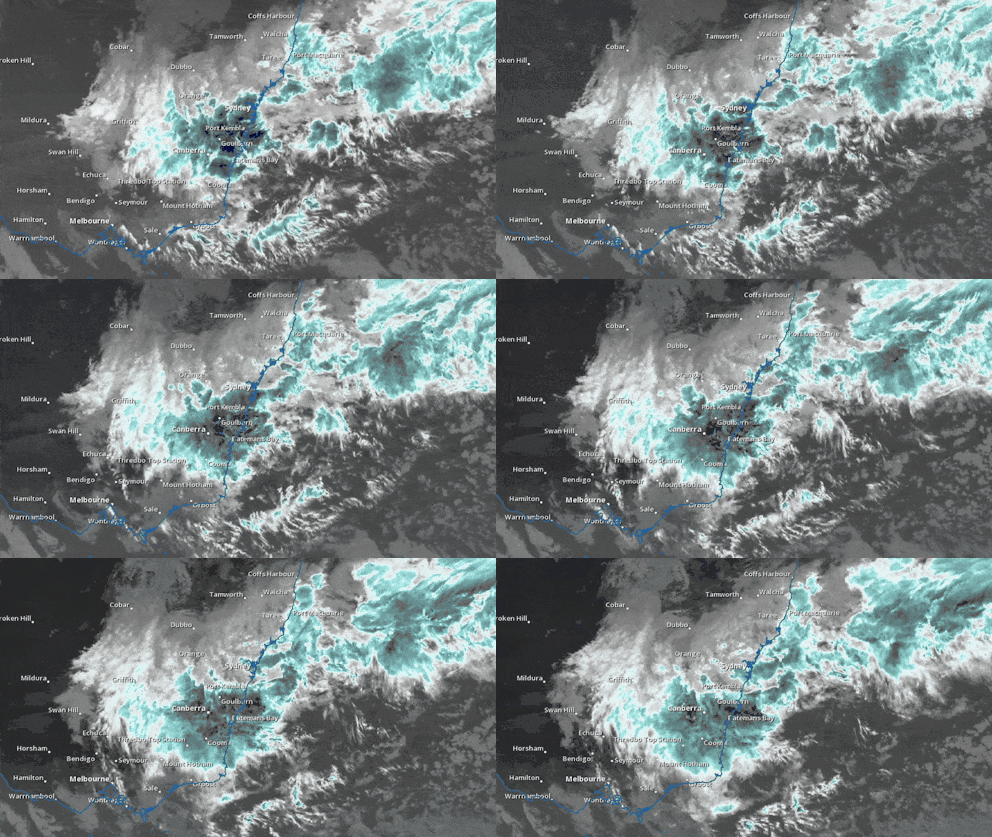
Solomon Islands political chess begins with Manasseh Sogavare re-elected in East Choiseul

By Koroi Hawkins, RNZ Pacific editor in Honiara

Solomon Islands’ incumbent prime minister Manasseh Sogavare has been re-elected in the East Choiseul constituency.

It is the opening move in the political chess match to form the country’s next government.

Returning officer Christopher Makoni made the declaration late last night after a day of counting, according to the national broadcaster SIBC.

Counting continues today in provincial centres across the country.

Solomon Islands chief electoral officer Jasper Anisi told RNZ Pacific on Tuesday all systems go
Solomon Islands chief electoral officer Jasper Anisi told RNZ Pacific on Tuesday all elections materials have been distributed and the country is ready to go to the polls. Image: RNZ Pacific/Koroi Hawkins

So far at least four members of Sogavare’s former cabinet have been re-elected.

But it is still early days as the first upset of the election also took place overnight, with George Tema unseating Silas Tausinga in the West New Georgia-Vona Vona constituency.

According to the Electoral Commission’s political party breakdown of the election results received so far, Sogavare’s Our Party was leading with 34 percent of votes counted on Saturday morning, followed by former opposition leader Matthew Wale’s Solomon Islands Democratic Party which had 26 percent.

Independent election candidates rounded out the top three with 23.4 percent of the votes counted so far. There was then a sharp drop-off to the fourth-placed People’s First Party on 8 percent.

Once all 50 members of Parliament have been officially elected, they will be whisked back from the provinces to the capital, Honiara, where lobbying camps are already being set up in hotels.

One political party leader and election candidate, whose result has yet to be declared, told RNZ Pacific the first of those camps would be at the Honiara Hotel, and that coalition talks were already underway.

Fewer women MPs
There are also likely to be less women in Parliament after another incumbent woman MP, Lillian Maefai, was ousted by Franklyn Derek Wasi in the East Makira Constituency.

Two other incumbent women MPs, Lanelle Tananganda and Ethel Vokia, did not re-contest their seats in this election, making way instead for their husbands — who had formerly lost the seats because of corruption convictions — to stand.

That left Freda Soria Comua, as the last of the four women MPs in the former parliament, still with a chance to make it back into the house.

There are 20 women among the 334 candidates contesting this election.

It is very rare for women to be elected in Solomon Islands’ male-dominated political sphere. Three out of the four women in the last parliament came into the house as proxies for their husbands.

This article is republished under a community partnership agreement with RNZ.

Print Friendly, PDF & Email

Article by AsiaPacificReport.nz

The moment of friction.

Headline: The moment of friction. – 36th Parallel Assessments

In strategic studies “friction” is a term that it is used to describe the moment when military action encounters adversary resistance. “Friction” is one of four (along with an unofficial fifth) “F’s” in military strategy, which includes force (kinetic mass), fluidity (of manoeuvre), fog (of battle) as well as uncertainty (of outcomes, which is usually referred to in military circles as the “oh F**k” factor)). Friction comes from many causes, including terrain, countervailing force, psychological factors, the adversary’s broader capabilities and more. As German strategist Karl von Clausewitz noted, friction can be encountered at the three levels of warfare: strategic, operational and tactical.In other words, “Clausewitzian friction” is not just confined to the battlefield.

The notion of friction is drawn from the physical world and has many permutations. It is not confined to one particular element or dimension. It is about opposition, even if of similar elements or forces, including the element of will. For example, when they meet, fluids and air of different weights create turbulence. Fire on different fire extinguishes or expands. Earth on earth leads to crumbling or inertial momentum. The product of the combination of these physical forces, say fluid on air or earth or fire, depends on the relative weight of each. The same goes for psychological factors in human contests. Mutatis mutandis (i.e., with the necessary changes having been made), this is applicable to international relations. It may seem like a conceptual stretch but I see the use of the notion of friction in terms of international relations more as an example of conceptual transfer, using Clausewitz as a bridge between the physical and the political/diplomatic worlds (more on this later).

In the past I have written at length about the systemic realignment and long transition in post Cold War international relations. The phrase refers to the transition from a unipolar post-Cold War international system dominated by the US (as the “hegemon” of the liberal internationalist world order) to a multipolar system that includes rising Great Powers like the PRC and India and constellations of middle powers such as the other BRIC countries (Brazil, Russia, South Africa and recently added members like Egypt, Iran, Saudi Arabia, the UAE, Ethiopia and perhaps Argentina (if it ratifies its accession)) as representatives of the rising “Global South.” In spite of their differences, these rising power blocs are counterpoised against what remains of the liberal institutionalist order, including the EU, Japan, South Korea and Australia. I have noted that the long moment of transition is characterised by international norm erosion and increased rule violations and the consequent emergence of conflict as the systems regulator until a new status quo is established (and from which that new status quo emerges). That conflict may come in many guises–economic, diplomatic, cultural and, perhaps inevitably, military or some combination thereof. When conflicts turn military, the moment of force has arrived. And when force is met by opposing force, then friction is inevitable.

Here I extend the notion of friction to include the international moment that we are currently living in. That is, I have conceptually transferred the notion of friction to the international arena because “transfer” in this instance means applying the notion of friction to a wider environment beyond the physical plane without distorting its original meaning. That allows me to avoid the methodologically dubious practice of conceptual stretching (where a term is stretched and distorted from its original meaning in order to analytically fit a different type of thing).

The long transitional moment is what has taken us to this point and allowed me to undertake the transfer, and it is here in the transitional trajectory from unipolar to multipolar international systems where the future global status quo will be defined. It is a decisive moment because it is the period where force has become the major arbiter of who rises and who falls in the systemic transitional shuffle. Given that there are many competitors in the international arena who are capable and willing to use force as well as other means to advance their interests, I suggest that the global community has reached its moment of friction, that is, the turning point in the long transitional process. Everything that has come before was the lead-in. Everything that comes after will be the result of this conflict-defined moment.

It is no exaggeration to write this. Besides the Ruso-Ukrainian war and the Israel-Hamas war, there is the armed stand-off in the Red Sea between Iran-backed Houthis and a naval coalition led but he US, the ongoing skirmishes between PRC naval forces and those of the Philippines, Vietnam and Western naval forces as well as the PRC military threats to Taiwan, the Israeli-Hezbollah conflict along the Israel-Lebanon border, Islamist violence in the Sahel and Eastern Africa as well as in Russia, Afghanistan, Pakistan and other other parts of Central Asia, ongoing conflict in Syria between Assad’s Russian-backed forces, the remnants of ISIS and Western-backed rebels, the Turkish-Kurd conflict along the Turkish, Syrian and Iraqi borders, the civil war in Libya, escalating fighting between the Democratic Republic of Congo and Rwanda over mineral rich areas in and around the eastern Congolese city of Goma (in which private military companies and irredentist militias are also involved), narco-violence in Latin America that has reached the level of challenging state monopolies over organised violence in places like Ecuador and parts of Mexico, piracy in the Indian Ocean and in the Malacca Straits, cross-border ethno-religious conflict in Afghanistan and Pakistan, ethnic cleansing in Myanmar, the PRC and Gaza, tribal conflict in Papua New Guinea and more. Norms and rules governing interstate as well as domestic forms of collective behaviour are honoured in the breach, not as a matter of course. Individuals, groups and States are increasingly atomised in their perspectives and interactions and resort to the ultimate default option–conflict–to pursue their interests in the face of other’s opposition.

Phillipines and PRC Coast Guard Ships clash in South China Sea. Source: UNN.

Friction extends to economics. The era of globalisation of free trade has ended as nations revert to post-pandemic protectionism or focus on “near-“and “friend-shoring” in order to avoid supply chain bottlenecks resultant from commodity production concentration in a small number of countries. Although not a trade pact strictly speaking, the PRC Belt and Road Initiative undermines Western trade agreements like the TPPA and lesser regional arrangements because it ties developmental assistance and financing to Chinese industries and markets. Intellectual property and technology theft is wide-spread despite International conventions against them (endnote just by the PRC). The era of Bretton Woods is over and the agencies that were its institutional pillars (like the World Bank, IMF and regional agencies such as the IADB and ADB) are now increasingly challenged by entities emerging from the Global South like the China Development Bank and BRICS common market initiatives.

In addition, as part of international norms erosion and rules violations, many diplomatic agreements and treaties such as those prohibiting the use of chemical weapons and even genocide are also now largely ignored because, in the end, there is no international enforcement capability to reinforce what is written. The International Court of Justice and International Criminal Court can impose sanctions and issue arrest warrants but have no enforcement authority of their own. The UN can authorise peace-keeping missions and issue resolutions but is subject to Security Council vetoes on the one hand and belligerent non-compliance in the other (besides Israel ignoring UN demands for a cease-fire and humanitarian pauses in Gaza, people may forget that there are UN peace keeping missions in the Sinai, Golan Heights and Israel-Lebanon border, including NZDF personnel among them, because these “blue helmet” missions have had no ameliorating impact on the behaviour of the participants in the Israel-Hamas-Hezbollah-Syria conflict). Adverse rulings in international courts have not stopped the PRC island-building and aggressive military diplomacy in the South China Sea. The examples are many. Given that state of affairs, States and other actors increasingly turn to force to pursue their interests.

Whatever restraint was promoted by the laws of war and international conflict-resolution institutions during the post-Cold War interregnum has been abandoned or become exceptions to the new anarchic rule. One might even say that the international community is increasingly living in a state of nature, even if the terms “anarchy” and “state of nature” are loose interpretations of what Hobbes wrote about when he considered the Leviathan of international politics. But the basic idea should be clear: the liberal internationalist system has broken down and a new order is emerging from the conflict landscape that characterises the contemporary international arena.

Again, the friction is not just things like the military confrontations between Russia, Russian and Iranian-backed proxies in the Middle East and the PRC against a range of Western and Western-oriented nations in the Western Pacific. The BRICS have proposed to develop a single unitary currency to rival the Euro and are openly calling for a major overhaul of international organizations and institutions that they (rightfully so), see as made by and for post-colonial Western interests. But the question is whether what they have in mind as a replacement will be any better in addressing the needs of the Global South while respecting the autonomy of the Global North. My hunch is that it will not, and will just add another front to the moment of friction.

Empty UN Security Council Chamber. Source: United Nations.

I shall not continue enunciating the reasons why I believe that we have arrived at an international moment of friction (e.g. cultural degradation and social vulgarisation, etc.). That is because I cannot specify what will be come given that push has now led to shove, nor can I offer a solution set to the problems embedded in and underwriting this sorry moment. What I can say is, just like the fact that we need to learn to embrace uncertainty in the transitional process since outcomes are not assured and guarantees cannot be offered (although some industries like tobacco, liquor, weapons and insurance all profit during times of uncertainty and market hedging strategies become the common response of risk-adverse actors to uncertain economic times, so can be calculated or anticipated), so too we must, if not embrace, then learn to prepare for an era in which friction will be the dominant mode of international transaction for some time to come.

For small countries like NZ, repeating empty mantras about foreign policy “independence” no longer cuts it even as a slogan. The moment of international friction poses some existential questions about where NZ stands in the transitional process, how it will balance competing international interests when it comes to NZ foreign and security policy, and about who to side with when conflict comes.

Because it will.

Analysis syndicated by 36th Parallel Assessments

Why the pathology bulk-billing campaign is more about driving industry profits than saving you money

Source: The Conversation (Au and NZ) – By Stephen Duckett, Honorary Enterprise Professor, School of Population and Global Health, and Department of General Practice and Primary Care, The University of Melbourne

iamharin/Shutterstock

For many people, the term “bulk billed” refers to a GP visit they don’t have to pay for out-of-pocket. But another form of bulk billing is in the news ahead of May’s federal budget – bulk billing of pathology testing, such as blood tests.

This relates to the fees pathology companies receive from Medicare to perform out-of-hospital laboratory tests, the type your GP might order to help diagnose or monitor disease.

These pathology fees have been frozen for almost a quarter of a century. Is that fair? Obviously not, argues Australian Pathology, which represents private pathology laboratories.

It has recently launched its “Keep Pathology Bulk Billed” campaign. At the core is a request for about an extra A$160 million a year for pathology companies. It argues this is needed to keep most out-of-hospital pathology tests free for the public.

But simple solutions put forward by vested interests involving more public funds are rarely in the public interest. Here’s how we might design a fairer pathology system, fit for the 21st century, that keeps tests free for the public.


Read more:
Medicare turns 40: since 1984 our health needs have changed but the system hasn’t. 3 reforms to update it


Pathology is big business

Collecting specimens and analysing them is big business. Pathology providers received almost $3.25 billion for out-of-hospital tests in 2022-23 from Medicare rebates. Pathology testing is also conducted in public and private hospitals, but these are funded under a combination of different arrangements.

Almost all (more than 99%) of out-of-hospital pathology services are bulk billed. That’s a rate much higher than that for GP visits, which stood at about 80% in the same period.

Pathology use is increasing faster than the population is growing. That’s partly because of more chronic disease in the population, and partly because new tests are becoming available.

Pathology provision is concentrated in a few hands, with a number of providers listed on the Australian Stock Exchange. Increases in pathology rebates, as Australian Pathology is calling for, would go straight to companies’ bottom lines, increasing shareholder value.

Drive-through COVID testing
Remember drive-through testing? In the early days of the pandemic, private pathology companies conducted millions of COVID PCR tests.
Christie Cooper/Shutterstock

So why are pathology companies calling for more funding now? Pathology companies’ profits burgeoned during the first years of the COVID pandemic, with the introduction of widespread PCR testing and the government funding that went with it.

But the industry was accused of profiting from “COVID-19 misery”, and the gravy train eventually ended. So pathology companies are now looking to replace that revenue, using the latest campaign to try to increase rebates.


Read more:
Worried about getting a blood test? 5 tips to make them easier (and still accurate)


Does the pathology industry have a point?

On the face of it, a 24-year freeze on pathology government rebates might seem unfair. But a look into the pathology world reveals an industry where there has been significant productivity growth.

An increased volume of standard tests, as we’ve seen in recent years, can lead to improved productivity. For instance, companies can work their testing equipment harder – running them for longer, loading them with more samples – lowering the cost per test. Improvements in equipment also allow tests to be done quicker, allowing increased economies of scale.

But a fee freeze is a lazy policy, an example of “set and forget”. While it does achieve some benefits for the taxpayer, it’s not optimal. That’s because it assumes all the productivity savings (from automation, digitisation and increased economies of scale) exactly offset any increased costs from inflation. This is never likely to be true. Given the current extent of automation and consolidation, this is probably leaving excess profits in the pockets of providers, and costing governments more than they need to pay.

More changes in pathology provision are yet to come. Advances in artificial intelligence are accelerating and automated reading of some pathology tests may reduce pathology costs further, yielding more profits for providers.

Future policies need to reflect changes in how much it costs to provide pathology services, details of which are thin on the ground.


Read more:
AI can help detect breast cancer. But we don’t yet know if it can improve survival rates


What needs to happen?

Government should step back and ask whether a fees-for-pathology-service payment system, designed a century ago when pathology provision was literally a cottage industry, is still right in an era of extensive automation and ownership concentration. The answer is clearly no.

Reform should first dump the existing uncapped, fee-for-service payment system. Pathology is a big business and should be paid as such using tenders and contracts.

Two people looking at a document, one about to sign it
Pathology providers should be invited to tender for contracts, to keep costs down.
fizkes/Shutterstock

Pathology companies should be invited to tender to provide out-of-hospital pathology services in designated geographic areas. Two or more tenders could be approved to maintain competition between providers and keep options open for the end of the tender period. Pathology contracts should involve no out-of-pocket payments by consumers.

In-hospital pathology should not be covered by the same arrangements. Instead, private hospitals should make their own contractual arrangements for pathology provision, as they do now.

Public pathology services – run by state governments or their agencies such as Pathology Queensland – are also changing.

Consolidation of public pathology services in New South Wales yielded significant improvements in productivity. Victoria has started a less ambitious reform process, consolidating into three public providers rather than the single public provider model seen in NSW, Queensland and South Australia. This will also probably yield savings.

Public providers should be invited with private providers into the tender process to enhance competition.

What’s the take-home message?

The world of pathology provision is in flux, with more changes on the horizon, whether that’s related to technology or consolidation. In this environment, paying more to private providers under a payment system that has passed its use-by date is not good policy. That’s despite its simplistic attraction and advocacy from vested interests.

So the next time you go to a pathology collection centre and see posters encouraging you to email your MP to “keep pathology bulk billed”, beware. The campaign is more about company profits than saving you money.

The Conversation

Stephen Duckett does not work for, consult, own shares in or receive funding from any company or organisation that would benefit from this article, and has disclosed no relevant affiliations beyond their academic appointment.

ref. Why the pathology bulk-billing campaign is more about driving industry profits than saving you money – https://theconversation.com/why-the-pathology-bulk-billing-campaign-is-more-about-driving-industry-profits-than-saving-you-money-228091

Restoring coastal habitat boosts wildlife numbers by 61% – but puzzling failures mean we can still do better

Source: The Conversation (Au and NZ) – By Michael Sievers, Research Fellow, Global Wetlands Project, Australia Rivers Institute, Griffith University

Chris Brown

Humans love the coast. But we love it to death, so much so we’ve destroyed valuable coastal habitat – in the case of some types of habitat, most of it has gone.

Pollution, coastal development, climate change and many other human impacts have degraded or destroyed swathes of mangrove forests, saltmarshes, seagrass meadows, macroalgae (seaweed) forests and coral and shellfish reefs. We’ve lost a staggering 85% of shellfish reefs around the world and coral is bleaching globally.

When healthy, these coastal habitats help feed the world by supporting fisheries. They are home to more than 100 species of charismatic marine megafauna, ranging from sharks to dugongs. They sequester carbon, thus helping to slow climate change. The list goes on.

a flock of red-necked stints and a couple of curlew sandpipers in flight
Restored wetlands provide vital habitat for waders like red-necked stints and curlew sandpipers, which are in sharp decline.
Michael Brown

Healthy coastal habitats are the gift that keeps on giving. We need them back, so there’s a lot of enthusiasm for restoring these habitats. For example, we can plant mangroves, build new shellfish reefs and reduce pollution to help seagrass grow back.

But we want to recover more than just the habitats. We want the animals they support too. We need to know if restoration is helping animals.

We analysed restoration projects around the world to assess how animals are benefitting. Compared to degraded sites, restored habitats have much larger and more diverse animal populations. Overall, animal numbers and the types of animals in restored habitats are similar to those in natural habitats.

So restoration works. But outcomes for animals vary from project to project. Not all projects deliver the goods. As a result, resources are wasted and humanity misses out on the huge benefits of healthy coastal habitats.

A school of rays swims in shallow waters
Coastal habitats are home to more than 100 large marine animals, including these rays.
Michael Sievers


Read more:
Global coral bleaching caused by global warming demands a global response


Animals can respond well to restoration

We collated over 5,000 data points from 160 studies of coastal restoration projects around the world.

Excitingly, animal populations and communities were remarkably similar to those in comparable undisturbed natural sites. For example, restoring seagrass off Adelaide’s coast brought back invertebrates, which are food for many fish species Australians love to catch, such as Australasian snapper. Invertebrate numbers here were comparable to nearby natural seagrass meadows.

Restored seagrass habitat along Adelaide’s coast supports populations of invertebrates that provide food for fish.


Read more:
From sharks in seagrass to manatees in mangroves, we’ve found large marine species in some surprising places


Overall, our review found animal populations in restored coastal habitats were 61% larger and 35% more diverse than in unrestored, degraded sites. So restoration produces serious benefits.

Some projects recorded dramatic increases. For instance, after oyster reefs were restored in Pumicestone Passage, Queensland, fish numbers increased by more than ten times. The number of fish species increased almost fourfold.

An underwater colony of mussels
Most of the world’s shellfish reefs have been lost.
Chris Brown

And animals can occupy newly restored sites surprisingly quickly. Fish and invertebrate numbers in restored seagrass and mangroves can match those in natural sites within a year or two. This happens even though the vegetation is far sparser in restored areas.

Our study shows that efforts to restore coastal habitat certainly can help animals thrive.


Read more:
Once the fish factories and ‘kidneys’ of colder seas, Australia’s decimated shellfish reefs are coming back


Results are not guaranteed

Although restoration generally helped animals, good outcomes are not guaranteed. We found many projects where animal numbers or diversity barely increased. It was not clear why some projects were great for animals and others had lacklustre results.

a golden bird with a black head and collar around a white throat perches in a mangrove tree
The mangrove golden whistler depends on mangroves, but much of its habitat has been degraded or lost.
Michael Brown

Some restoration sites could be in places where animals cannot easily find them.

In other cases, actions to restore the habitat may simply not work. Despite our best efforts, we failed to create suitable environments.

It could be that animals are returning to restored habitats, but we’re not capturing them with our monitoring.

We sorely need more consistent restoration outcomes. We may lose community support for restoration if, for example, it doesn’t deliver on promises of improved fisheries.

We are still working out how to restore coastlines effectively. Clearly, more work is needed to improve techniques and the monitoring of animal numbers.

Global alliances and groups are developing standardised frameworks to guide restoration practice and to report on project designs and outcomes. Such strategies and co-ordination promise to deliver more consistent benefits.

A small waterbird in a patch of restored saltmarsh
The black-fronted dotterel is one of many bird species that benefit from restoring saltmarshes.
Michael Brown


Read more:
If we protect mangroves, we protect our fisheries, our towns and ourselves


New technologies can improve monitoring

Monitoring animals and restoration outcomes in coastal habitats is challenging. These aquatic habitats are structurally complex, often impenetrable and hard to navigate, and can be dangerous.

New technologies, such as artificial intelligence (AI) and environmental DNA (eDNA), allow us to collect more and better data on which animals are present and how they use these habitats. We’re rapidly becoming less reliant on hauling in nets or diving down to count animals.

Artificial intelligence (AI) can be used, for example, to extract information from underwater cameras. We can monitor animals more often, in more places, for less cost.

AI algorithms were recently used to automatically identify, size and count fish in videos taken on restored oyster reefs in Port Phillip Bay, Melbourne. These data were then used to calculate increased fish productivity due to restoration efforts. And what an increase it was – over 6,000 kilograms of fish per hectare per year!

Combining underwater videos with automated data extraction provides a new, reliable and cost-effective method for surveying animals ethically and efficiently.

Restoring shellfish reefs greatly increased fish numbers in Port Phillip Bay, Melbourne.


Read more:
It sounds like science fiction. But we can now sample water to find the DNA of every species living there


We still face major barriers to scaling up restoration to even get close to reversing our environmental impact on the coasts. Key concerns include ongoing climate change and policies and laws that hamper restoration efforts. It can be difficult, for example, to get permits to restore habitat, with complex systems involving multiple organisations and arms of government.

Still, our synthesis shows some light at the end of the tunnel. Coastal restoration efforts are having substantial benefits for animals around the world. The evidence supports ambitious restoration targets and action.

The Conversation

Michael Sievers receives funding from the Australian Research Council, project DE220100079, the National Environmental Science Program, and philanthropic foundations.

Christopher Brown receives funding from the Australian Research Council (grant FT210100792) and the World Wildlife Fund. He is affiliated with the Global Mangrove Alliance, an organisation that promotes mangrove restoration and conservation.

Rod Connolly receives funding from the Australian Research Council, National Environmental Science Program, philanthropic foundations, Fisheries Research and Development Corporation.

ref. Restoring coastal habitat boosts wildlife numbers by 61% – but puzzling failures mean we can still do better – https://theconversation.com/restoring-coastal-habitat-boosts-wildlife-numbers-by-61-but-puzzling-failures-mean-we-can-still-do-better-227231

Rousing farewell for Kiwi doctors flying out to Gaza aid flotilla

Kia Ora Gaza

A passionate haka reverberated through Auckland International Airport as a medical team of three New Zealand doctors received an emotional farewell from a big crowd of supporters before flying to Turkey to join the international Freedom Flotilla to Gaza.

The doctors, who left Auckland yesterday, hope to be able to reach Gaza and join with other flotilla medics to deliver much-needed humanitarian aid and treat wounded patients in the war-ravaged enclave.

Their participation is facilitated by Kia Ora Gaza.

Kiwi medics, Dr Shahin, Dr Idais and Dr Ali salute
Kiwi medics, Dr Shahin, Dr Idais and Dr Ali salute the airport gathering. Image: Achmat Eesau/Kia Ora Gaza
Part of the crowd farewelling the New Zealand doctors
Part of the crowd farewelling the New Zealand doctors at Auckland International Airport yesterday. Image: Jo Currie/Kia Ora Gaza
Kia Ora Gaza organiser Roger Fowler
Kia Ora Gaza organiser Roger Fowler with the three Gaza-bound New Zealand doctors. Image: Tayyaba Khan/Kia Ora Gaza

The doctors being farewelled were Dr Wasfy Shahin and Dr Faiez Idais led by Dr Adnan Ali.

Kia Ora Gaza organiser Roger Fowler anticipated this current flotilla was “shaping up to be an historic event”.

After ignoring six months of horrific genocide in Gaza, he said, the New Zealand government had failed to take a stand.

“They haven’t even lifted a finger,” he said.

The Freedom Flotilla’s solidarity mission “is an international civil society attempt to break through Israel’s illegal siege and end the occupation and slaughter of Palestinians in Gaza”.

And it was also planned to deliver more than 5500 tonnes of urgently needed humanitarian aid.

Other speakers included Green Party co-leader, Marama Davidson, who sailed on the 2016 Women’s Boat to Gaza, PSNA secretary Neil Scott and local Palestinian community leader Maher Nazzel.

Print Friendly, PDF & Email

Article by AsiaPacificReport.nz

Eugene Doyle: Helen Clark on why AUKUS isn’t in New Zealand’s national interest

COMMENTARY: By Eugene Doyle

Helen Clark, how I miss you.  The former New Zealand Prime Minister — the safest pair of hands this country has had in living memory — gave a masterclass on the importance of maintaining an independent foreign policy when she spoke at an AUKUS symposium held in Parliament’s old Legislative Chambers yesterday.

AUKUS (Australia, UK, US) is first and foremost a military alliance aimed at our major trading partner China. It is designed to maintain US primacy in the “Indo-Pacific” region and opponents are sceptical of claims that China represents a threat to New Zealand or Australian security.

The recent proposal to bring New Zealand into the alliance under “Pillar II”  would represent a shift in our security and alliance settings that could dismantle our country’s independent foreign policy and potentially undo our nuclear free policy.

Clark’s assessment is that the way the government has approached the proposed alliance lacks transparency.  National made no signal of its intentions during the election campaign and yet the move towards AUKUS seems well planned and choreographed.

Voters in the last election “were not sensitised to any changes in the policy settings,” Clark says, “and this raises huge issues of transparency.”

Such a significant shift should first secure a mandate from the electorate.

A key question the speakers addressed at the symposium was: is AUKUS in the best interest of this country and our region?

Highly questionable
“All of these statements made about AUKUS being good for us are highly questionable,” Clark says.  “What is good about joining a ratcheting up of tensions in a region?  Where is the military threat to New Zealand?”

Clark, PM from 1999-2008, has noticed a serious slippage in our independent position.  She contrasted current policy on the Middle East with the decision, under her leadership, of not joining the US invasion of Iraq in 2003.

Sceptical of US claims about weapons of mass destruction, New Zealand made clear it wanted no part of it — a stance that has proven correct. Our powerful allies the US, UK and Australia were wrong both on intelligence and the consequences of military action.

In contrast, New Zealand participating in the current bombardment of Yemen because of the Houthis disruption of Red Sea traffic in response to the Israeli war on Gaza is, says Clark, an indication of this change in fundamental policy stance:

“New Zealand should have demanded the root causes for the shipping route disruptions be addressed rather than enthusiastically joining the bombing.”

“There’s no doubt in my mind that if the drift we see in position continues, we will be positioned in a way we haven’t seen for decades –  as a fully-signed-up partner to US strategies in the region.

“And from that, will flow expectations about what is the appropriate level of defence expenditure for New Zealand and expectations of New Zealand contributing to more and more military activities.”

Economic security
Clark addressed another element which should add caution to New Zealand joining an American crusade against China: economic security.

China now takes 26 percent of our exports — twice what we send to Australia and 2.5 times what we send to the US.  She questioned the wisdom of taking a hostile stance against our biggest trading partner who continues to pose no security threat to this country.

So what is the alternative to New Zealand siding with the US in its push to contain China and help the US maintain its hegemon status?

“The alternative path is that New Zealand keeps its head while all around are losing theirs — and that we combine with our South Pacific neighbours to advocate for a region which is at peace,” Clark says, echoing sentiments that go right back to the dawn of New Zealand’s nuclear free Pacific, “so that we always pursue dialogue and engagement over confrontation.”

Eugene Doyle is a community organiser and activist in Wellington, New Zealand. He received an Absolutely Positively Wellingtonian award in 2023 for community service. His first demonstration was at the age of 12 against the Vietnam War. This article was first published at his public policy website Solidarity and is republished here with permission.

Print Friendly, PDF & Email

Article by AsiaPacificReport.nz

It never rains but it pours: intense rain and flash floods have increased inland in eastern Australia

Source: The Conversation (Au and NZ) – By Milton Speer, Visiting Fellow, School of Mathematical and Physical Sciences, University of Technology Sydney

Before climate change really got going, eastern Australia’s flash floods tended to concentrate on our coastal regions, east of the Great Dividing Range.

But that’s changing. Now we get flash floods much further inland, such as Broken Hill in 2012 and 2022 and Cobar, Bourke and Nyngan in 2022. Flash floods are those beginning between one and six hours after rainfall, while riverine floods take longer to build.

Why? Global warming is amplifying the climate drivers affecting where flash floods occur and how often. All around the world, we’re seeing intense dumps of rain in a short period, triggering flooding – just as we saw in Dubai this week.

Our research shows east coast lows – intense low pressure systems carrying huge volumes of water – are developing further out to sea, both southward and eastward.

This means these systems, which usually bring most of the east coast’s rain during cooler months, are now dumping more rain out at sea. Instead, we’re seeing warm, moist air pushed down from the Coral Sea, leading to thunderstorms and floods much further inland.

This month, a coastal trough along the Queensland and New South Wales coasts and an inland trough resulted in unusually widespread flooding, triggering flooding in Sydney as well as inland.


Read more:
Why is Australia’s east coast copping all this rain right now? An atmospheric scientist explains


What’s changing?

On the coasts, extreme flash floods come from short, intense rains on saturated catchments. Think of the devastating floods hitting Lismore in 2022 and Grantham in 2011.

Inland, flash floods occur when intense rain hits small urban catchments, runs off roads and concrete, and flows into low-lying areas.

The April flooding in NSW and Queensland had elements of both. Early this month, the subtropical jet stream changed its course, triggering a cyclonic circulation higher in the atmosphere over inland eastern Australia.

At the same time, a low-pressure trough developed low down in the atmosphere off the coast and another inland, through southern Queensland and NSW, where they encountered warm moist air dragged by northeast winds from as far away as the Coral Sea.

The result was localised extremely heavy rain, which led to the Warragamba Dam spilling and flood plain inundation in western Sydney.

This unusual event has been referred to as a “black nor’easter”, a term coined in 1911. These are characterised by a deepening coastal trough and upper-level low pressure systems further west, over inland eastern Australia. This term, mostly known in the marine fraternity, became less common during the 20th century. But it has returned.

Why? Global warming is changing how the atmosphere circulates. As ocean temperatures keep rising, the pool of warm water in the Coral and Tasman Seas grows. This gives rise to northeasterly airstreams, which funnel thick fronts of warm, moist air down towards inland Queensland and NSW.

These low pressure systems occur higher in the atmosphere, causing unstable conditions suiting the formation of thunderstorms. And because these systems move slowly, heavy rain can fall continuously over the same area for several hours. All up, it’s a perfect recipe for flash flooding.

We saw similar systems producing flash flooding in Sydney’s Nepean and Hawkesbury rivers during November and December last year, as well as in other regions of inland eastern Australia.

Is this new? Yes. Between 1957 and 1990, flash floods struck Sydney 94 times. But during this period, fast cyclonic airflow in the upper atmosphere was not connected to the jet stream. Instead, flash floods occurred when slow-moving upper-level low pressure circulations encountered air masses laden with moisture evaporating off the oceans. However, there wasn’t enough water in the air over the inland to trigger flash flooding.

In every case between 1957 to 1990, flash floods in Sydney were not linked to slower-forming riverine floods on the Nepean-Hawkesbury River system. When these rivers did flood during that period, they came from longer duration, less intense rain falling in the catchments, and largely from east coast lows. Now we’re seeing something new.

Haven’t there always been flash floods?

Flash floods are not new. What is new is where they are occurring. These sudden floods can now form well west of the Great Dividing Range.

Previously, inland floods tended to come after long periods of widespread rain saturated large river catchments. Inland flash floods were not so common and powerful as in recent decades.

In earlier decades, inland riverine floods during extreme rainfall years occurred when the fast-moving jet stream high in the atmosphere was further north. This occurred frequently in the cooler months, with long, broad cloud bands blown by or associated with the jet stream producing widespread rain inland. Known as the “autumn break”, it often primed agricultural land for winter crops.

In recent years, these crucial air currents have begun moving polewards.

Now that it’s moving south, we have increasingly warm air over inland eastern Australia which can hold more moisture and result in heavy falls, even in the cooler months.

What about the famous inland floods which move through Queensland’s Channel Country and fill Kati Thanda/Lake Eyre?

These are slow moving riverine floods, not flash floods. Flash floods are often limited to local regions. By contrast, Channel Country floods stem from heavy monsoonal rains from November to April.

channel country
Queensland’s Channel Country is a braided landscape which periodically floods.
Ecopix/Shutterstock


Read more:
Changes in the jet stream are steering autumn rain away from southeast Australia


Short, intense rain bursts are going global

The pattern we’re seeing – more flash floods in unusual places – is not just happening in Australia. Inland areas – including deserts – are now more likely to see flash floods.

Dubai this week had a year’s rain (152 mm) in a single day, which triggered flash floods and caused widespread disruption of air travel. Other parts of the United Arab Emirates got even more rain, with up to 250 mm. In Western Australia’s remote southern reaches, the isolated community of Rawlinna recently had 155 mm of rain in a day.

This is precisely what we would expect as the world heats up. Hotter air can hold about 7% more water for every degree of warming, supercharging normal storms. And these floods can be followed by extended periods of almost no rain. The future is shaping up as one of flash floods and flash droughts.


Read more:
Flash droughts are becoming more common in Australia. What’s causing them?


The Conversation

The authors do not work for, consult, own shares in or receive funding from any company or organisation that would benefit from this article, and have disclosed no relevant affiliations beyond their academic appointment.

ref. It never rains but it pours: intense rain and flash floods have increased inland in eastern Australia – https://theconversation.com/it-never-rains-but-it-pours-intense-rain-and-flash-floods-have-increased-inland-in-eastern-australia-227777

‘It could be the death of the museum’: why research cuts at a South Australian institution have scientists up in arms

Source: The Conversation (Au and NZ) – By Elizabeth Finkel, Vice-Chancellor’s Fellow, La Trobe University

Sia Duff / South Australian Museum

In February, the South Australian Museum “re-imagined” itself. In the face of rising costs and inadequate government funds, CEO David Gaimster, who took the reins last June, declared the museum is “not a university”, and will gut its research capabilities, starting this July.

In Australia and abroad, hundreds of scientists and friends of the museum have expressed their horror at the proposal, to the media, in letters to the state government, and in interviews with the author.

“It could be the death of the museum,” says renowned mammalogist Tim Flannery, a former director of the museum.

Palaeontologist Mary Droser of the University of California, Riverside, spent two decades working on the museum’s collection of half-billion-year-old Ediacaran fossils. “To say research isn’t important to what a museum does – it’s sending shock waves across the world,” she says.

Critics say the changes will make the museum “more of a theme park”, and make South Australia “the laughing stock of the scientific world”.

What’s the plan?

Gaimster plans to replace ten “science research” positions with five junior “science curators”, and reduce the number of specialist “science collection managers” from 12 to five.

According to the museum’s website, this skeleton crew will focus on “converting new discoveries and research into the visitor experience”.

That’s quite different to what the museum has been doing for the past 168 years. Its researchers have described more than 500 new species, such as tiny crustaceans that live only in desert pools and are at risk from mining.


Read more:
Friday essay: the silence of Ediacara, the shadow of uranium


Museum researchers have also helped discover some 60 new minerals for the mining industry, some of which may help to clean up pollutants or deliver critical minerals for renewable energy technologies. Others have tackled global questions such as the evolution of birds from dinosaurs, how eyes evolved in Cambrian fossils, and Antarctic biodiversity.

What’s so special about a museum?

The museum’s record may be impressive, but couldn’t all this research be done by universities?

Their remits are different, says University of Adelaide botanist Andy Lowe, who was the museum’s acting director in 2013 and 2014. Unlike universities, he says, the museum was “established by government, to carry out science for the development of the state”.

Museum research is also unique because of its unique resources – the collections.

Visitors to the museum see the state’s treasures: the skeleton of marsupial lion Thylacoleo, the largest mammalian carnivore Australia ever had; weird fossils of our planet’s earliest multi-cellular life from the Ediacara Hills of the Flinders Ranges; glowing rocks and crystals that display the foundation of the state’s past and future wealth; and stone tools, boomerangs and bark paintings that record tens of millennia of Indigenous culture on this continent.

Photo of people walking past a glass case containing bark shields painted with elaborate patterns.
The museum’s collections are a unique resource.
Sia Duff / South Australian Museum

But these displays contain only a fraction of the full collections. The rest of the specimens reside beneath the public areas, with the researchers who continuously enrich them with new specimens and new knowledge.

“They’re crucial for what goes on above; you need experts not second-hand translators,” says University of Adelaide geologist Alan Collins. He wonders what will happen the next time a youngster comes into the museum asking to identify a rock. “There won’t be an expert on hand anymore.”

Collins also worries about a bigger looming public failure: a bid to obtain World Heritage listing for the Flinders Ranges. Collins has contributed to the bid by collaborating with museum researcher Diego Garcia Bellido to show how rocks at Brachina Gorge tell the story of how complex life first emerged.


Read more:
How algae conquered the world – and other epic stories hidden in the rocks of the Flinders Ranges


Garcia Bellido and his now-retired colleague Jim Gehling used the museum’s collections to identify dozens of Ediacaran species. Their work led to the formation of Nilpena Ediacara National Park to preserve the sites containing unique fossil beds.

The collection of Indigenous objects dates back to anthropological expeditions carried out by the museum’s Norman Tindale and Harvard’s Joseph Birdsell in the 1930s. These expeditions helped Tindale produce the first map of the territories of “the Aboriginal tribes of Australia”.

The museum’s Phillip Jones now uses this collection in his research, delivering more than 30 exhibitions, books and academic papers.

Continuity and community

Maintaining the museum’s collections takes a lot of work. Without attentive curation and the life blood of research, the collections are doomed to “wither and die”, says Flannery. “There are no collections without research; and no research without collections.”

Many of the above-mentioned researchers, vastly overqualified for the newly described positions, will likely find no home in the reimagined museum.

That raises the issue of continuity. In Flannery’s words, the job of a museum curator:

is like being a high priest in a temple. You have been passed on the sacred objects by your predecessor who has looked after them through their career. That chain of care goes back to the foundation of the state of South Australia – the foundation of the museum […] but break the chain of care and you destroy the museum.

A person looking at a display of different kinds of rock.
The museum displays seen by visitors are only the tip of the iceberg.
Sia Duff / South Australian Museum

A case in point is Jones, who knew Tindale and interviewed him when he was based at Harvard. Over Jones’ four decades at the museum, his relationships with Indigenous elders have also been critical to returning sacred objects to their traditional owners.

Besides the priestly “chain of care”, there’s something else at risk in the museum netherworld: a uniquely productive ecosystem feeding on the collections.

Here you’ll find PhD students mingling with retired academics; curators mingling with scientists; museum folk with university folk. This rich ecosystem delivers the out-sized knowledge output of the museum and brings in millions of dollars of federal research grants each year. In the year ending 2023 for instance, joint museum and university grants amounted to A$3.7 million.


Read more:
Museums are returning indigenous human remains but progress on repatriating objects is slow


But no more.

The new administration sees these joint grants as a burden. The problem, according to a museum spokesperson, is that “they did not include any remuneration for staff time or operational or administrative overheads”.

No one doubts the financial stresses the museum faces or that revamping exhibits is a desirable thing. But, as many have pointed out, the role of CEO is to knock on the doors of government and philanthropists and find the necessary funds. “It’s possible,” Flannery says. “I’ve done it.”

DNA and biodiversity

The museum has also declared it will no longer support a DNA sequencing lab it funds jointly with the University of Adelaide. The lab has worked with the museum’s collection of Australian biological tissue to help identify more than 500 new species, including 46 now listed as threatened.

“No other institute in South Australia does this type of biodiversity research,” says Andrew Austin, chair of Taxonomy Australia and emeritus professor at the University of Adelaide. “It’s the job of the museum.”

The cuts come while the SA government plans new laws to protect biodiversity.

According to Kris Helgen – chief scientist at the Australian Museum in Sydney – the South Australian Museum has been “the primary natural science museum for the interior of the continent” for 150 years.

The museum’s re-imagining puts this history at risk – and also places the future in jeopardy.

An open letter published on April 10, signed by more than 400 of Australia’s leading researchers, former state chief scientists, Aboriginal elders, politicians including a former state premier, and many others, summed up the case:

the collections housed at the South Australian Museum … are amongst the most significant in the world. They reveal to us the very beginnings of life on earth… and they help us to prevent extinction of critical species that underpin all human life …

The Conversation

Elizabeth Finkel does not work for, consult, own shares in or receive funding from any company or organisation that would benefit from this article, and has disclosed no relevant affiliations beyond their academic appointment.

ref. ‘It could be the death of the museum’: why research cuts at a South Australian institution have scientists up in arms – https://theconversation.com/it-could-be-the-death-of-the-museum-why-research-cuts-at-a-south-australian-institution-have-scientists-up-in-arms-228193

Are 2 mid-career AFL retirements a sign Australian athletes are taking brain health more seriously?

Source: The Conversation (Au and NZ) – By Alan Pearce, Professor, School of Allied Heath, Human Services & Sport, La Trobe University, La Trobe University

This week, Collingwood AFL player Nathan Murphy announced his retirement, brought on by his concussion history and ongoing issues.

The 24-year-old’s seemingly sudden retirement, following Angus Brayshaw’s in February and a number of other high-profile footballers in recent years, signals a shift in how athletes view brain trauma risks in sport.

Rather than downplaying or ignoring the potential damage being done to their health by a career filled with brain trauma, some athletes are now choosing to end their careers early. In doing so, they hope to avoid the neurodegenerative diseases which afflicted former players like Danny Frawley, Paul Green, Heather Anderson, and Shane Tuck.


Read more:
Will introducing independent doctors at games help the AFL tackle its concussion problem?


Why do athletes risk their brains?

Murphy’s retirement is a sign that concussion culture in the AFL is beginning to shift.

Although the long-term implications of multiple concussions and repetitive neurotrauma have been recognised internationally for nearly a century, scientific and health knowledge has historically battled against a warrior culture in contact sport communities.

For decades, sports have fostered a win-at-all-costs culture, with a pseudo-military flavour of sacrifice and duty to one’s teammates.

This has given rise to athletes ignoring or downplaying injuries whenever possible to continue the game.

This behaviour is particularly easy to enact when it comes to concussion, because it is often an invisible injury with health effects that may not manifest until after the initial contact.

Compounding this are expectations from spectators and fans, many of whom expect their heroes to “run through walls” and not show any weakness or vulnerabilities.

Media commentators also celebrate athletes who return to the field after sickening collisions as “courageous”, having “no fear”, or “gaining respect from teammates and opposition”.

There have been public calls since at least 2016 for commentators to change to the language around concussion.

Some AFL players are retiring early due to fears of concussion.

A shift in attitude?

To prioritise athlete welfare, outdated attitudes need to change across Australia’s multiple contact sporting codes.

Murphy’s retirement and acknowledgement of his long-term brain health is one sign the culture of valorising injury and risk may be changing. But there is other evidence of a shift.

Australian research shows risky attitudes and behaviours toward concussion have begun to dissipate over recent years.

In 2017, the first study of concussion attitudes and behaviours in Australian athletes at all levels showed that despite participants knowing the dangers of concussion, many would still choose to play through or hide concussions.

Others revealed that even if diagnosed with a concussion, they would not complete full rehabilitation in the hopes of returning to the field sooner.

However, a 2021 follow-up study, using the same survey in a separate group, showed significant improvements towards concussion. Respondents were much less likely to hide or play through a concussion, and were more likely to complete full rehabilitation before returning to competition.

This data indicates that athletes are not only more aware of the potential long-term health effects of brain injuries, but are more likely to heed medical advice if they are concussed.

Murphy’s retirement is an example of footballers’ increased willingness to listen to medical advice. His decision was informed by the findings of the AFL’s independent panel of medical experts, which was introduced in 2019 to provide players with advice about whether to continue their careers following brain trauma.

In his announcement, Murphy said he accepted the panel’s advice, something we hope to see more of in future.

It should also be noted that in October 2023, this advisory panel permitted Murphy to return to training after the athlete was knocked out during September’s AFL Grand Final.

This short turnaround indicates the line between safety and danger for athletes’ brains is razor thin, and that athletes, their families, and medical experts like those who advised Murphy have a complex job ahead of them, as more and more athletes contemplate their futures post-concussion.

Are more retirements to come?

With continued discussion, debate and independent research, it is plausible more players with multiple concussions will prioritise their long-term brain health.

Similarly, new draftees entering professional levels of these sports will need to consider the benefits of competing where multiple brain injuries are likely to occur, versus the risk for cognitive impairments later in life or even brain disease.

In the meantime, the current group of athletes – professionals and amateurs alike – must weigh up the costs of participation in high contact games.


Read more:
Concussion in sport: why making players sit out for 21 days afterwards is a good idea


The recent and tragic deaths of former professionals and many unknown people who played club football, have shown our expectations of athletes need to be tempered. We need to understand these athletes are not machines, but individuals with families who are doing a job as best they can, for the short period of opportunity they have.

We must continue to educate and change the culture around concussion at all levels of sport, and to support players who decide to give the game away when concerned about too many injuries.

It’s in the best interests for the longevity of these sports – and the athletes we love to cheer on.

The Conversation

Alan Pearce is currently unfunded. Alan is a non-executive unpaid director for the Concussion Legacy Foundation. He has previously received funding from Erasmus+ strategic partnerships program (2019-1-IE01-KA202-051555), Sports Health Check Charity (Australia), Australian Football League, Impact Technologies Inc., and Samsung Corporation, and is remunerated for expert advice to medico-legal practices.

Stephen Townsend does not work for, consult, own shares in or receive funding from any company or organisation that would benefit from this article, and has disclosed no relevant affiliations beyond their academic appointment.

ref. Are 2 mid-career AFL retirements a sign Australian athletes are taking brain health more seriously? – https://theconversation.com/are-2-mid-career-afl-retirements-a-sign-australian-athletes-are-taking-brain-health-more-seriously-228197

I wholeheartedly recommend The President: a brilliant revival of a play of decay, terror and revulsion

Source: The Conversation (Au and NZ) – By Alexander Howard, Senior Lecturer, Discipline of English and Writing, University of Sydney

Daniel Boud/Sydney Theatre Company

Decay, terror, revulsion. These are three of the central themes of Thomas Bernhard’s rarely performed play The President.

The Austrian is one of the greatest writers of the 20th century, best known in the English-speaking world as a novelist.

As literary scholar Rita Felski puts it, Bernhard’s oeuvre is generally thought of as “an oceanic heave of venom, disgust, bitterness, and loathing”.

By the same token – and this is something Felski neglects to mention – his writing can be extremely funny.

One of the great strengths of the Sydney Theatre Company’s captivating revival of the 1975 play, co-produced with Dublin’s Gate Theatre, is how it manages to balance both these aspects of Bernhard’s writing.

Directed by Ireland’s Tom Creed, the production also features two exceptional lead performances.

Hugo Weaving plays the leader of a middling, unnamed country somewhere in Europe. Grandiose and boastful, Weaving’s titular president spends half of the play hiding away in Portugal and refuses to concede his days are numbered. He insists, against all odds, he can somehow “win it all back”.

Meanwhile, Olwen Fouéré’s furious first lady spends her time physically and emotionally tormenting her maid, Mrs Frolick (Julie Forsyth), while monologuing endlessly and ominously on the topics of hate, torture and the liquidation of shadowy political factions.

A complex writer

Black and white headshot
Thomas Bernhard in 1987.
Monozigote/Wikimedia Commons, CC BY-SA

Bernhard was born in 1931 and died in 1989. Through childhood and adolescence he was unhappy and suffered from a host of life-threatening lung ailments. Eventually, his tuberculous-damaged lungs put paid to his youthful musical aspirations of being an opera singer, so he turned to writing.

After stints as a courtroom reporter and journalist, he started publishing poetry. His debut novel, Frost (1963), made him famous. His theatrical breakthrough came in 1970, with his first full-length play, A Feast for Boris.

Throughout his career, Bernhard’s feelings about his homeland were complex and fraught. Biographer Gitta Honegger, who also translated The President, notes he

came of age while Austria was digging its way out of the devastation of World War II and burying itself in silence about the Holocaust.

He was deeply suspicious about Austria’s refusal to come to terms with its Nazi past and used his standing as a prominent public figure to expose this national hypocrisy.

But these critiques didn’t sit well with everyone in Austria. He was repeatedly attacked for being a Nestbeschmutzer, which roughly translates as “one who fouls their own nest”.

The last play he wrote, Heldenplatz (1988), was an explosive account of the dangers of nationalism and anti-Semitism.

It controversially suggested things hadn’t really changed in Austria since the days of the Third Reich, with one character saying:

conditions today really are the same
as they were in thirty-eight
there are more Nazis in Vienna now
than in thirty-eight
it’ll come to a bad end
you’ll see
it doesn’t even take an extra-sharp mind
now they’re coming out again
of every hole
that’s been sealed for over forty years

The political landscape of 1975

The President was Bernhard’s response to the volatile political climate in Europe of the time.

The president of Bernhard’s demanding play – a fascist dictator in all but name – has just survived an attempt on his life. Anarchists are responsible. There is a possibility the president’s son, who has disappeared, pulled the trigger.

Production image
Weaving’s titular President is grandiose and boastful.
Daniel Boud/Sydney Theatre Company

The play opens with the president and his wife preparing for the funeral of a close confidant who was killed in the same assassination attempt (as was the first lady’s beloved dog). The characters are paranoid and panicked:

Aren’t you afraid of the terrorists
of some anarchist trying to get you
You open a book because you want to read
and you are blown into pieces
aren’t you are afraid
everybody
everybody
The whole country is ruled by fear

While Bernhard doesn’t specify, it would have been clear to contemporary audiences he had a particular band of West German terrorists in mind: the Red Army Faction.

It was no coincidence the original production opened at the Stuttgart State Theatre on May 21 1975: the same date and city where the key members of the Red Army Faction went on trial.

Also known as the Baader-Meinhof Group, the Red Army Faction was responsible for a series of assassinations of German business leaders and politicians during the 1970s.

The Red Army Faction was also vocal and scathing about Germany’s unwillingness to properly confront its Nazi past.

In the words of the group’s de facto leader and theorist, Ulrike Meinhof, they had no time for acts of historical erasure, or for those who sought to “turn 12 years of German history into a taboo subject”.


Read more:
Baader–Meinhof group member arrested after 30 years on the run – but Germany still can’t close the chapter on far-left terrorism


‘Uncomfortable truths’

The creative team behind this version of The President clearly know their history.

In his directorial program notes, Creed acknowledges the violent actions of the Red Army Faction would have loomed large in the imagination of audiences in 1975.

Production image
Olwen Fouéré’s furious first lady spends her time physically and emotionally tormenting her maid.
Daniel Boud/Sydney Theatre Company

Similarly, Weaving has spoken approvingly of Bernhard’s willingness to speak “a lot of uncomfortable truths to his own country”.

In equal measure, however, both Creed and Weaving believe Bernhard’s historically timestamped play can tell us something about the here and now. As Weaving says, The President, which takes a dim view of the performative quality of what passes for politics, is a “fascinatingly timely piece”.

I agree, and wholeheartedly recommend it.

The President is at the Sydney Theatre Company until May 19.

The Conversation

Alexander Howard does not work for, consult, own shares in or receive funding from any company or organisation that would benefit from this article, and has disclosed no relevant affiliations beyond their academic appointment.

ref. I wholeheartedly recommend The President: a brilliant revival of a play of decay, terror and revulsion – https://theconversation.com/i-wholeheartedly-recommend-the-president-a-brilliant-revival-of-a-play-of-decay-terror-and-revulsion-227685

Many prisoners go years without touching a smartphone. It means they struggle to navigate life on the outside

Source: The Conversation (Au and NZ) – By Ye In (Jane) Hwang, Postdoctoral Research Associate at School of Population Health, UNSW Sydney

Shutterstock

You’d be hard pressed to find any aspect of daily life that doesn’t require some form of digital literacy. We need only to look back ten years to realise how quickly things have changed.

In 2013, we were still predominantly buying paper bus tickets and using Facebook on a desktop computer. Now, we order food by scanning codes and tap our cards to make payments.

Digital inclusion (someone’s ability to keep up with technology) is an important health and social equity issue, amplified by the rapid digital developments that arose during the COVID pandemic.

Among those who are prone to digital exclusion, there is one group who, due to a collision of several trends, may be hit the hardest: people leaving prison and re-entering society at an older age, or after lengthy periods of imprisonment. In a new study, we interviewed former prisoners about their experiences with trying to adapt to ubiquitous technology after years of going without.


Read more:
Teaching prisoners to start businesses can help them return to society


Unfamiliar tech damaging confidence

Prison populations are getting older worldwide for a few reasons, including general population ageing, trends towards people entering prison at an older age, or staying in for longer. At the same time, Australian prisons remain highly technologically restricted environments, mostly for security reasons.

We interviewed 15 Australians (aged 47–69 years) about their experiences of reintegration following release from prison.

A tall barbed wire fence against a sunset sky
After long stints behind bars, former prisoners often don’t know how to use vital technological services.
Shutterstock

The (primarily male) interviewees recalled a tense and troublesome time. They described feeling like a stranger thrown into a world where survival depended on their ability to use technology.

Regardless of their experiences before imprisonment, the rapid digitisation of daily functions that were once familiar to them rendered their skills and confidence irrelevant. One former inmate said:

There’s a significant gap […] for anybody who’s done, I’m gonna say, probably more than five to seven years [in prison]. Because things change so quickly […] they do not know what the world looks like.


Read more:
New report reveals shocking state of prisoner health. Here’s what needs to be done


This deeply affected their sense of self and self-efficacy, and heightened the stigma they experienced, adding a weighty psychological and emotional burden to an already stressful time. They told us:

You want to fit in, you want to be invisible, to either fit in and be part of the crowd or just invisible. Because for a lot of people leaving prison, they’re still wearing their crime or their offending on their shoulders. And anything that sort of has their head pop up outside of the norm really triggers people’s anxiety.

There will be people where those trip-ups of technology are a really big deal and really impact your anxiety, really impacts your need and want to socialise and interact with other people.

Exacerbating recidivism

Post-prison reintegration is already a challenge. There’s concerning evidence around recidivism, risk of post-release mortality, social isolation, unemployment and homelessness.

Digital exclusion creates an additional barrier for those who are older, who already face a high risk of medical and social marginalisation. A former prisoner said:

Think about it, after being in ten years, well you think, okay, where do I start? And everything is hard. And sometimes this is why people fall back into their same situations because it’s just too hard.


Read more:
‘They weren’t there when I needed them’: we asked former prisoners what happens when support services fail


Technology isn’t completely absent from Australian prisons, but interviewees described the programs and technology as outdated, basic or limited in relevance to their immediate daily, post-release lives.

Recent attempts to bring in touchscreen devices to NSW prisons suggests positive change. However, our interviewees claimed there was a lack of education around these, adding to the risk of digital division even within the prison.

A hand holding a smart phone with the MyGov website on the screen
Interviewees said it would be helpful if someone worked with them on using services like MyGov in preparation for leaving prison.
Shutterstock

What can be done?

There must be investment in specific digital literacy or technology readiness programs tailored to the unique needs of this population both prior to, and following release.

The interviewees provided suggestions for how such programs could be delivered and a keenness to engage with them. They tended to focus on learning in environments free from stigma and judgement of their literacy level or histories, with hands-on experience and face to face support. Interviewees favoured learning while in prison, with additional support available on the outside. Three interviewees said:

If they could somehow incorporate it into the prisons where you know, they actually showed them how to use them and how to download an app and how to use the basic apps such as, you know, Centrelink, MyGov, it’d be a lot better life for them when they get out.

I think a lot of ex-prisoners shy away from doing these community type education stuff. Because they’re paranoid, basically.

As you’d be aware, it’s no good someone’s sitting there telling you how it works, you need to experience it yourself.

At a broader level, improving the digital inclusion of people in prison requires attitudinal change by government stakeholders and the community. Ultimately, it calls for a commitment to practices that put rehabilitation at the centre, whilst managing competing needs for security and segregation.

Based on the evidence, we can be certain this will encourage positive change for the 95% of Australian prisoners who will eventually be released.

The Conversation

Ye In (Jane) Hwang has received funding from the National Health and Medical Research Council of Australia, the Australian Association of Gerontology, and the University of New South Wales Ageing Futures Institute for this work.

ref. Many prisoners go years without touching a smartphone. It means they struggle to navigate life on the outside – https://theconversation.com/many-prisoners-go-years-without-touching-a-smartphone-it-means-they-struggle-to-navigate-life-on-the-outside-224138

Good news: midlife health is about more than a waist measurement. Here’s why

Source: The Conversation (Au and NZ) – By Rob Newton, Professor of Exercise Medicine, Edith Cowan University

Pexels/RDNE stock project

You’re not in your 20s or 30s anymore and you know regular health checks are important. So you go to your GP. During the appointment they measure your waist. They might also check your weight. Looking concerned, they recommend some lifestyle changes.

GPs and health professionals commonly measure waist circumference as a vital sign for health. This is a better indicator than body mass index (BMI) of the amount of intra-abdominal fat. This is the really risky fat around and within the organs that can drive heart disease and metabolic disorders such as type 2 diabetes.

Men are at greatly increased risk of health issues if their waist circumference is greater than 102 centimetres. Women are considered to be at greater risk with a waist circumference of 88 centimetres or more. More than two-thirds of Australian adults have waist measurements that put them at an increased risk of disease. An even better indicator is waist circumference divided by height or waist-to-height ratio.

But we know people (especially women) have a propensity to gain weight around their middle during midlife, which can be very hard to control. Are they doomed to ill health? It turns out that, although such measurements are important, they are not the whole story when it comes to your risk of disease and death.


Read more:
The body mass index can’t tell us if we’re healthy. Here’s what we should use instead


How much is too much?

Having a waist circumference to height ratio larger than 0.5 is associated with greater risk of chronic disease as well as premature death and this applies in adults of any age. A healthy waist-to-height ratio is between 0.4 to 0.49. A ratio of 0.6 or more places a person at the highest risk of disease.

Some experts recommend waist circumference be routinely measured in patients during health appointments. This can kick off a discussion about their risk of chronic diseases and how they might address this.

Excessive body fat and the associated health problems manifest more strongly during midlife. A range of social, personal and physiological factors come together to make it more difficult to control waist circumference as we age. Metabolism tends to slow down mainly due to decreasing muscle mass because people do less vigorous physical activity, in particular resistance exercise.

For women, hormone levels begin changing in mid-life and this also stimulates increased fat levels particularly around the abdomen. At the same time, this life phase (often involving job responsibilities, parenting and caring for ageing parents) is when elevated stress can lead to increased cortisol which causes fat gain in the abdominal region.

Midlife can also bring poorer sleep patterns. These contribute to fat gain with disruption to the hormones that control appetite.

Finally, your family history and genetics can make you predisposed to gaining more abdominal fat.

Why the waist?

This intra-abdominal or visceral fat is much more metabolically active (it has a greater impact on body organs and systems) than the fat under the skin (subcutaneous fat).

Visceral fat surrounds and infiltrates major organs such as the liver, pancreas and intestines, releasing a variety of chemicals (hormones, inflammatory signals, and fatty acids). These affect inflammation, lipid metabolism, cholesterol levels and insulin resistance, contributing to the development of chronic illnesses.

Man runs on treadmill
Exercise can limit visceral fat gains in mid-life.
Shutterstock/Zamrznuti tonovi

The issue is particularly evident during menopause. In addition to the direct effects of hormone changes, declining levels of oestrogen change brain function, mood and motivation. These psychological alterations can result in reduced physical activity and increased eating – often of comfort foods high in sugar and fat.

But these outcomes are not inevitable. Diet, exercise and managing mental health can limit visceral fat gains in mid-life. And importantly, the waist circumference (and ratio to height) is just one measure of human health. There are so many other aspects of body composition, exercise and diet. These can have much larger influence on a person’s health.


Read more:
Is menopause making me put on weight? No, but it’s complicated


Muscle matters

The quantity and quality of skeletal muscle (attached to bones to produce movement) a person has makes a big difference to their heart, lung, metabolic, immune, neurological and mental health as well as their physical function.

On current evidence, it is equally or more important for health and longevity to have higher muscle mass and better cardiorespiratory (aerobic) fitness than waist circumference within the healthy range.

So, if a person does have an excessive waist circumference, but they are also sedentary and have less muscle mass and aerobic fitness, then the recommendation would be to focus on an appropriate exercise program. The fitness deficits should be addressed as priority rather than worry about fat loss.

Conversely, a person with low visceral fat levels is not necessarily fit and healthy and may have quite poor aerobic fitness, muscle mass, and strength. The research evidence is that these vital signs of health – how strong a person is, the quality of their diet and how well their heart, circulation and lungs are working – are more predictive of risk of disease and death than how thin or fat a person is.

For example, a 2017 Dutch study followed overweight and obese people for 15 years and found people who were very physically active had no increased heart disease risk than “normal weight” participants.


Read more:
Climb the stairs, lug the shopping, chase the kids. Incidental vigorous activity linked to lower cancer risks


Getting moving is important advice

Physical activity has many benefits. Exercise can counter a lot of the negative behavioural and physiological changes that are occurring during midlife including for people going through menopause.

And regular exercise reduces the tendency to use food and drink to help manage what can be a quite difficult time in life.

Measuring your waist circumference and monitoring your weight remains important. If the measures exceed the values listed above, then it is certainly a good idea to make some changes. Exercise is effective for fat loss and in particular decreasing visceral fat with greater effectiveness when combined with dietary restriction of energy intake. Importantly, any fat loss program – whether through drugs, diet or surgery – is also a muscle loss program unless resistance exercise is part of the program. Talking about your overall health with a doctor is a great place to start.

Accredited exercise physiologists and accredited practising dietitians are the most appropriate allied health professionals to assess your physical structure, fitness and diet and work with you to get a plan in place to improve your health, fitness and reduce your current and future health risks.

The Conversation

Rob Newton receives funding from National Health and Medical Research Council, the Medical Research Future Fund, Cancer Council Western Australia, Spinal Cord Injuries Australia and the World Cancer Research Fund. Rob Newton is a board member of The Healthy Male.

ref. Good news: midlife health is about more than a waist measurement. Here’s why – https://theconversation.com/good-news-midlife-health-is-about-more-than-a-waist-measurement-heres-why-226019

Some families push back against journalists who mine social media for photos – they have every right to

Source: The Conversation (Au and NZ) – By Laura Wajnryb McDonald, PhD candidate in Criminology, University of Sydney

Less than 24 hours after Ashlee Good was murdered in Bondi Junction, her family released a statement requesting the media take down photographs they had reproduced of Ashlee and her family without their consent. They said it had caused her loved ones extreme distress.

Their appeal is immediately understandable – many people would be upset by seeing photos of a loved one everywhere after such a traumatic event.

The media had evidently not received permission to use these photos in their news stories. Nor had they afforded the family any ethical sense of privacy when they circulated and displayed the photos across multiple platforms.

There has been valuable commentary about the issues surrounding the common journalistic practice of mining social media after a “newsworthy” death.

My PhD research offers further insight into a perspective that is rarely shared: the view of families bereaved through homicide.

While I cannot and do not presume to speak for Good’s family, I have interviewed families bereaved through homicide and they have shared their experience of photos of their loved one being in the media.


Read more:
Why is the Sydney church stabbing an act of terrorism, but the Bondi tragedy isn’t?


Private photos in the public domain

To the bereaved, photos of loved ones are deeply meaningful. They are more than mere objects, more than random captured moments.

They are wrapped up in specific memories and treated as keepsakes. They are representations of and tangible connections to the person who was taken from them.

When these photos enter the public domain following homicide, they become photos of a victim.

In this new domain, private photos serve altogether different purposes. They furnish media stories now and into the future. Their original context and personal meaning are typically overridden or removed, often along with families’ consent.

My research indicates this is an issue that persists long into the aftermath of homicide, well after media and public interest has dissipated.

In other words, it has the capacity to traumatise families for years.


Read more:
Digital ‘death knocks’: is it fair game for journalists to mine social media profiles of victims and their families?


Judging victims

While the mining of photos is one matter, how they are then used by the media and interpreted by the public is another.

My research uncovers how details in a photo can be highlighted and twisted at the expense of others. For example, bereaved families told me how hurtful it was when the media republished unflattering and inappropriate photos of their loved one that were just meant for friends and family.

One mother recalled how her son would do a silly pose and ruin their family photos. He was being a typical teenager, but that was not how he was perceived when the media reproduced those photos alongside their chosen narrative. Instead, the mother read comments made by the public underneath the article that said her son deserved to be murdered. The public judged her son based on those photos.

Similarly, a sister was distraught when the media pulled a photo from her social media of her and her brother where he did not look his best. They were at a party and there is a heart-warming story of the moment before the photo was taken. She explained she loves the photo; it is a happy memory for her, but she said it is for his family to love, not for the public to make assumptions about her brother.

These examples highlight how significant it is for families when the media take a photo out of context, without permission, and curate it to suit specific narratives.

Certainly, it is a practice that exacerbates trauma.

The horrific stabbings in Sydney caused an outpouring of grief across Australia.

The right to control

I also spoke to families about how they decided which photographs they wanted in the public domain.

One family, whose daughter was murdered before social media was used as a journalistic tool, told me that when they were asked for photos, they were reflective and careful about the ones they shared, choosing to keep their favourite photos to themselves.

Another mother explained her reasoning behind the two photos that she handed over – one because it depicted her daughter as she was at the time of her murder, and the other where she was dressed up, because it showed what she would have been like if she had had the chance to get married.

Bereaved families want photos to be an accurate, presentable, and appropriate portrayal of their loved one.

The photos might be tied to a specific memory or feeling, they might maintain their privacy, they might be chosen because they do not require context, or they might be the one they believe their loved one would have wanted.

The bereaved deserve to be in control of that decision. Allowing them to make that choice themselves gives the bereaved agency at a time when they feel most powerless.

The Conversation

Laura Wajnryb McDonald does not work for, consult, own shares in or receive funding from any company or organisation that would benefit from this article, and has disclosed no relevant affiliations beyond their academic appointment.

ref. Some families push back against journalists who mine social media for photos – they have every right to – https://theconversation.com/some-families-push-back-against-journalists-who-mine-social-media-for-photos-they-have-every-right-to-228011

The ‘devil comet’ 12P/Pons-Brooks has finally become visible from Australia. What can we expect?

Source: The Conversation (Au and NZ) – By Jonti Horner, Professor (Astrophysics), University of Southern Queensland

Pons–Brooks visible from Utah, March 9 2024. James Peirce/Flickr, CC BY-NC-ND

If you’re a fan of all things space, you’ve doubtless heard about the “devil comet”, which has been captivating keen-eyed observers in the northern hemisphere for the past few weeks. Now it’s our turn, as comet 12P/Pons–Brooks is creeping into view for the southern hemisphere.

Before you get too excited, let me quash your hopes. Comet Pons–Brooks is visible to the naked eye, but only if you know where to look. It will look like a fuzzy glowing patch, but nonetheless promises some amazing photo opportunities for the coming weeks.

Even better, it may serve as a celestial warm-up act for an even more special comet later in the year.

Here’s everything you need to know about Pons–Brooks, and how to get the best view.

Why do people call it the ‘devil comet’?

Named after two astronomers who independently discovered it in the 19th century, Comet 12P/Pons–Brooks (its full, official name) was last visible in 1954.

It takes around 71 years to orbit the Sun, making the comet’s visits to the inner Solar System a rare treat for us here on Earth.

At its heart (its nucleus), Pons–Brooks is a dirty snowball around 34 kilometres in diameter. As the comet came swinging back towards us in its orbit, astronomers spotted it back in 2020. At that time, the comet was almost 1.8 billion kilometres from the Sun, and lay dormant.

As the comet kept falling inwards toward the Sun, its surface temperature began to rise, making it “active”. Exposed ices started to sublime, turning directly from solid to gas. This activity is how a comet gets its tail: the nucleus becomes shrouded in a diaphanous “coma” of dust and debris from its sublimated surface, which is then blown away from the Sun by the solar wind.

A green dot with a long white smudge behind it on a black background.
Comet C/2020 F3 (NEOWISE) captured in 2020 with a long, blurry tail clearly visible.
Serrgey75/Shutterstock

But comet 12P/Pons–Brooks didn’t activate gently and smoothly. Instead, it produces several large outbursts of activity, each time, emitting vast amounts of gas and dust in a very short period of time before settling down again.

In the first of those significant outbursts, on July 20, 2023, the comet brightened by a factor of a hundred times, shedding an estimated ten million metric tons of dust and ice.

The solar wind pushed the resulting dust, gas and debris away from the Sun, giving the comet an unusual appearance. To some, the comet looked like the Millennium Falcon from Star Wars. To others, it looked vaguely demonic – sporting the cometary equivalent of horns.

The moniker of “devil comet” took hold in media articles and appears to have stuck – even though the comet’s horned appearance is now a thing of the past.

A fuzzy green blob in the night sky with two horn-like protrusions.
Comet 12P/Pons–Brooks on July 27, 2023, showing the unusual horned appearance that led to its ‘devil comet’ nickname.
Juan Iacruz/Wikipedia, CC BY-SA

Where (and when) should I look?

Over the last few days, the first confirmed sightings of 12P/Pons–Brooks have come in from around Australia. It is currently visible low in the western sky after sunset, albeit almost lost in the glow of twilight.

In the next few weeks, the comet will slowly climb higher in the evening sky. The two videos below show the location of the comet’s head at 6:30pm from mid-April through to mid-June, as seen from Toowoomba and Melbourne.

Visibility of comet 12P/Pons–Brooks, as seen from Toowoomba, from mid-April to mid-June 2024.
Visibility of comet 12P/Pons–Brooks, as seen from Melbourne, from mid-April to mid-June 2024.

Remember, the comet is a diffuse object, rather than a single point of light. The head is where the comet is brightest (centred on its nucleus). The comet’s tails point away from the Sun – so will rise upwards from the western horizon in the evening sky.

While the comet is visible with the naked eye, you really need to know where to look. The best bet is to search with binoculars. Make sure to wait until the Sun is well below the horizon. Once you find the telltale blur of the comet, you will know where to look, and can switch to see if you can spot it with the naked eye.

For me, the most exciting time with Pons–Brooks will come during the first two weeks of May. At that point, the comet will be passing underneath the constellation Orion, which will serve as a signpost.

That period will be prime astrophotography season, so I expect to see many spectacular images of the comet’s tails cutting through the celestial hunter, shining next to the spectacular nebulae dotted throughout Orion’s body.


Read more:
Want to get into stargazing? A professional astronomer explains where to start


But wait… there’s more!

While comet 12P/Pons–Brooks currently basks in the limelight, a potentially great comet is currently moving sunward, promising a spectacular show later this year.

That comet, C/2023 A3 (Tsuchinshan-ATLAS), was discovered in January 2023, and astronomers soon realised it has the potential to become truly dazzling.

Comet behaviour is hard to predict, so take the following with a pinch of salt, but things still look really promising.

Current predictions suggest Tsuchinshan-ATLAS will be at least as bright as the brightest stars in late September and early October this year. During that time, it will pass almost directly between Earth and the Sun. It might even briefly become visible in broad daylight at that time.

In the days following that chance alignment, the comet will gradually become visible in the evening sky and could be an incredible sight, up to a hundred times brighter than Pons–Brooks at its best.

So, with any luck, the current apparition of 12P/Pons–Brooks is merely the warm-up act, with an even greater spectacle to come later this year. Fingers crossed!

The Conversation

Jonti Horner does not work for, consult, own shares in or receive funding from any company or organisation that would benefit from this article, and has disclosed no relevant affiliations beyond their academic appointment.

ref. The ‘devil comet’ 12P/Pons-Brooks has finally become visible from Australia. What can we expect? – https://theconversation.com/the-devil-comet-12p-pons-brooks-has-finally-become-visible-from-australia-what-can-we-expect-226625

Rugby stadiums are sold as an economic asset – but NZ needs to ask if they’re really worth it

Source: The Conversation (Au and NZ) – By Robert Hamlin, Senior Lecturer in Marketing , University of Otago

A multi-billion dollar stadium precinct has been proposed for Auckland, one of three proposals in front of Auckland Council for a new stadium in the city. The council is also considering revamping Eden Park. But is a new stadium really value for money for Auckland ratepayers?

Large stadiums are sold as an economic boon for cities. But the reality is these multimillion-dollar investments tend to require significant investment from local and regional councils.

These stadiums are often opposed by sections of the communities asked to pay for them. And once built, they stand empty most of the time.

Why then do local governments keep proposing them? The answer lies in the lofty promises from those supporting the projects – and the questionable calculations used to get them over the line.

For the love of the game

Rugby Union is the principal user of large stadiums in New Zealand. When the game was still amateur, it was expected to build and maintain its own stadiums. For example, Carisbrook in Dunedin was initially built by the Otago Rugby Football Union, while Eden Park was built by various Auckland sports associations.

But with the professionalisation of rugby in 1995 the expectation changed. Taxpayers and ratepayers started paying significant amounts for construction of rugby and “multi-use” stadiums.

Two large (over 30,000 capacity) new stadiums have been built in New Zealand since 1999 (Wellington’s Sky Stadium and Dunedin’s Forsyth Barr Stadium), with one more currently under construction (Te Kaha in Christchurch). And there is the proposed Auckland stadium, currently in front of a council working group.


Read more:
Note to governments: sports stadiums should benefit everyone, not just fans


Out of the four, only Wellington’s Sky Stadium has been designed to be used for both rugby and cricket. The others have a fixed “natural grass” rugby pitch as their main arena.

According to information released under a Local Government Official Information and Meetings Act request, there have been just 30 major events at the Forsyth Barr rugby stadium in Dunedin since 2014 – three a year. And there are no major live music acts set to perform there in the next 18 months.

The last major concert was Pink, who performed at the stadium last month. Ed Sheeran cited the shape of the stadium – rectangular rather than oval – as a reason for skipping the city on his 2023 world tour.

Costs and benefits

While Christchurch’s Te Kaha has been ratepayer funded from the outset, the consortium behind one of the proposed stadiums in Auckland claims there will be zero cost to ratepayers.

But a feasibility report commissioned by former Auckland mayor Phil Goff on the possibility of a new stadium raised questions about the cost for Auckland ratepayers, how much they would be expected to pay, and what sort of profit would be gained from a new stadium.

Whether it is there from the outset or creeps in later, the case for funding from the community is usually based on “economic impact analysis”. This argument is based on taking a large event and claiming everything the attendees do and spend in the town that day is as a direct outcome of the stadium being there.

This figure is then increased via what is known as an “economic impact multiplier” to create a topline figure in support of the stadiums. The exact calculations behind this figure are not always made clear.

However, this headline figure is flawed. Any local attendee would normally have spent the money in the community anyway, for example. And events may have been held in the community at existing venues before the new stadium was built.

All Blacks doing the haka
Since the professionalisation of rugby in 1995, ratepayers have been tasked with contributing to large sport stadiums.
Hannah Peters/Getty Images

Borrowing and interest costs

The cost of the debt that is incurred to build these stadiums is also high.

Te Kaha, which cost NZ$683 million to build, was promoted as having an annual $50 million positive economic for the region once it opened. But at the same time, Christchurch ratepayers are expected to pay the majority of the construction costs ($453m), while the crown invested $220m.

A significant part of the council investment was borrowed, meaning ratepayers will also be paying for the interest on this debt.


Read more:
Offside: The secret deals involving public money for sports stadiums


Rates increases have become a key source of funding for Te Kaha. The stadium was solely responsible for a 2% increase in Christchurch rates this year – about $94 for an average ratepayer, increasing to $209 during the 2027-28 financial year.

As Auckland councillors consider the proposed waterfront stadium, the city’s leaders need to consider both the cost and the benefit of the development – not just the headline economic impact.

For ratepayers expected to foot some or all of the bill, rates increases and other infrastructure needs could outweigh the benefits of a place to watch sport.

The Conversation

Robert Hamlin does not work for, consult, own shares in or receive funding from any company or organisation that would benefit from this article, and has disclosed no relevant affiliations beyond their academic appointment.

ref. Rugby stadiums are sold as an economic asset – but NZ needs to ask if they’re really worth it – https://theconversation.com/rugby-stadiums-are-sold-as-an-economic-asset-but-nz-needs-to-ask-if-theyre-really-worth-it-224951

- ADVERT -

MIL PODCASTS
Bookmark
| Follow | Subscribe Listen on Apple Podcasts

Foreign policy + Intel + Security

Subscribe | Follow | Bookmark
and join Buchanan & Manning LIVE Thursdays @ midday

MIL Public Webcast Service


- Advertisement -
- Advertisement -
- Advertisement -
- Advertisement -
- Advertisement -