While making the show was really fun, Steel says, it was a”nail-biting” moment presenting guests with their personalised perfumes, especially star chef Kia Kanuta.
“Because he has such a refined palate, I was like, ‘Oh my God, I’m going to get exposed … I really, really wanted him to love it,” she tells RNZ’s Afternoons.
A low pressure system is expected to bring rain to many parts of NZ later this week. File photo.123RF
New Zealand’s temperatures are getting into summer territory, but a low pressure system is expected to bring rain to many areas of the country later this week.
Maximum temperatures were expected to rise above 20°C in many areas today, with Napier forecast to reach 29°C – nearly 10°C higher than the average November maximum – and Hastings predicted to hit 31°C today.
Tuesday’s weather should also be fine for Cup Day in Christchurch, with clear skies expected over Canterbury.
But wet weather was expected to start moving down the country on Wednesday, with a low pressure system over the north Tasman Sea due to move southwards onto the North Island.
MetService said that was likely to bring warning amounts of rain in Northland, Auckland Coromandel Peninsula, and Bay of Plenty on Wednesday.
There could also be downpours in Waikato, Taupo, northern Gisborne/Tairawhiti, and Taranaki Maunga, and MetService said northeast winds could reach severe gale strength in exposed places of Northland and Auckland.
By Thursday, the low pressure system is expected to move southeastwards over northern and central New Zealand, bringing rain to many areas, including Bay of Plenty, Taupo, Gisborne/Tairawhiti north of Gisborne City, Taranaki Maunga, Tasman District west of Motueka, and the northern and eastern ranges of Marlborough.
The low pressure system should moves to the east of the county by Friday, with a front over the Tasman Sea then moving quickly over southern and central New Zealand.
The forecast for the weekend is looking clearer, with a ridge of high pressure following the front onto New Zealand.
Sign up for Ngā Pitopito Kōrero, a daily newsletter curated by our editors and delivered straight to your inbox every weekday.
– Published by EveningReport.nz and AsiaPacificReport.nz, see: MIL OSI in partnership with Radio New Zealand
In an open letter released at the Belém Climate Summit, special envoys for strategic regions have expressed their support for the COP30 presidency and for all leaders committed to advancing climate crisis action.
Former New Zealand prime minister Dame Jacinda Ardern, the “voice” for Oceania, was among the seven climate envoys signing the letter.
The document acknowledges the progress achieved through the Paris Agreement and the Dubai Consensus, while underscoring the need for further advances “in light of the Global Stocktake” and warning of the growing challenge posed by climate disinformation.
The text calls for unity and concrete action to bridge the “triple gap” between climate finance, adaptation, and mitigation.
These bottlenecks, it emphasised, could not be resolved solely through revisions to Nationally Determined Contributions (NDCs), but required tangible policy measures.
The Baku to Belém Roadmap is highlighted as a vehicle for developing innovative solutions to unlock large-scale investments while reducing financing costs.
In addressing the spread of climate disinformation, the special envoys underlined the need for coordinated responses, collective strategies, and reinforced regulatory frameworks.
The letter was signed by Special Envoys Adnan Z. Amin (Middle East), Arunabha Ghosh (South Asia), Carlos Lopes (Africa), Jacinda Ardern (Oceania), Jonathan Pershing (North America), Laurence Tubiana (Europe), and Patricia Espinosa (Latin America and the Caribbean).
The open letter to leaders in Belém and to the COP30 presidency from the special envoys for strategic regions
We, the Special Envoys for our respective regions, wish to express our strong support for the Brazilian Presidency and all leaders committed to climate action at Belém.
COP30 presents both a significant opportunity and a profound challenge. To remain aligned with the ambition of the Paris Agreement amidst an increasingly complex geopolitical environment, we must demonstrate decisive progress. Multilateralism, grounded in international law and guided by the Paris Agreement, remains our most effective framework.
A clear signal from COP30 that the international community stands united in its determination to confront climate change will resonate globally. Our shared commitment to fully implement the Paris Agreement is the strongest collective response to a crisis that is disproportionately affecting vulnerable households and countries, devastating lives, livelihoods, and the ecosystems upon which we all depend.
We should also recognise the progress achieved since the Paris Agreement in 2015. The rapid growth of clean solutions is bending the trajectory of global emissions; where we had been on track to exceed a devastating temperature increase of more than 4°C, we are now able to project a level of less than 2.5°C.
But we need greater progress. We are not on track to achieve the goals of the Paris Agreement, and in particular, we are taking insufficient action to keep 1.5°C within reach, or even enough to keep warming well below 2°C. And every tenth of a degree of additional warming will mean harsh consequences for the world.
COP30 must acknowledge and address the “triple gap” in mitigation, adaptation and finance. Doing so requires an accelerated effort across the next decade, mobilising the full range of tools, resources, and partnerships available to us. This is at the heart of the goal of COP30: to advance the full implementation of both the Paris Agreement and the UAE Consensus, informed by the Global Stocktake presented at COP28 in Dubai.
To accelerate progress, we must maintain a laser focus on concrete, coordinated action.
The Action Agenda is a powerful reservoir of those actions, which must be structured, monitored, and supported for effective delivery. Addressing the gap should not be understood solely as revising Nationally Determined Contributions (NDCs), but rather as translating ambition into policies that enable each country to overperform on its existing commitments. And the policies we take, as has been amply demonstrated in our successes to date, can marry not only climate benefits, but also contribute to growing our economies, promote our national security, improve the welfare of our citizens, and promote a healthy environment.
Tripling global renewable energy capacity is a goal within reach. Collectively, we have the technology and resources: what is required now is scaled investment in all regions. The Baku to Belém roadmap to mobilise US$1.3 trillion annually for developing countries outlines both established and innovative solutions to deliver investment at scale at reduced costs of finance. To operationalise it, clear milestones, mandates, and responsibilities are needed.
Ministers of finance should take the lead in defining the priorities. Creating fiscal space, minimizing debt burdens, effectively mobilising domestic and international finance, and ensuring enabling policy environments, alongside increased investment in the Global South, are all essential to making this roadmap credible and implementable.
Strengthening resilience and adaptation are equally critical. Climate impacts are increasingly a major barrier to sustainable economic and social development. We must work together to define the indicators that do not impose resource-intensive reporting burdens but instead help our economies and societies adapt to their local circumstances and become resilient.
We must engage the insurance sector, central banks, and private investors to close the protection gap that threatens long-term developmental gains.
Countries pursuing the transition away from fossil fuels should define roadmaps, in line with their national circumstances, while fostering dialogue between producers and buyers of fossil fuels. Roadmaps to end deforestation and restore ecosystems are equally necessary. Taken together, these pathways can allow countries to implement the long-term strategies submitted in previous years.
For the first time, COP30 will also confront the challenge of climate disinformation: a growing threat that undermines public trust and policy implementation. Combatting this challenge requires coordinated approaches, shared strategies, and strengthened regulatory cooperation. We must shine the spotlight on our collective progress, in general, but also cases in particular where countries have met their climate targets ahead of schedule, demonstrating a positive bias for action.
Lastly, we need an evolution of the climate regime that makes implementation more effective and inclusive. Progress depends on joining forces with the local authorities, economic sectors, governments, and civil society. Subnational leaders, from governors, to regional authorities, mayors, and community representatives, must be empowered to reinforce and complement NDCs and National Adaptation Plans (NAPs). COP30 is the moment to have them at the table and to craft a new approach that brings all relevant actors together in a global effort to safeguard our common future.
It is the moment to remind ourselves of the need for solidarity, and to recognise our agency — we have it within our power to change the future for the better.
Signed:
Adnan Z. Amin (Special Envoy for Middle East), chair, World Energy Council; CEO of COP28; former director-general, International Renewable Energy Agency
Arunabha Ghosh (Special Envoy for South Asia), founder-CEO, Council on Energy, Environment and Water
Carlos Lopes (Special Envoy for Africa), chair, Africa Climate Foundation; former executive secretary, UN Economic Commission for Africa
Jacinda Ardern (Special Envoy for Oceania), former Prime Minister of New Zealand
Jonathan Pershing (Special Envoy for North America); former US Special Envoy for Climate Change
Laurence Tubiana (Special Envoy for Europe), dean, Paris Climate School; CEO, European Climate Foundation; former French Special Envoy for Climate Change
Patricia Espinosa (Special Envoy for Latin America and the Caribbean), former executive secretary, UN Framework Convention on Climate Change
A wall of smoke from the Tongariro National Park fire is providing a spectacular but worrying vista for a central plateau village.
The blaze has burned through up to 2500 hectares and is 20 percent contained.
Whakapapa Village was evacuated on Sunday, and the fire has forced the evacuation of trampers and closed lodges. All tracks and huts within the Tongariro National Park are closed, and State Highway 48 leading to Whakapapa Village and State Highway 47 at the intersection with State Highway 4 at Waimarino are also closed.
Sign up for Ngā Pitopito Kōrero, a daily newsletter curated by our editors and delivered straight to your inbox every weekday.
– Published by EveningReport.nz and AsiaPacificReport.nz, see: MIL OSI in partnership with Radio New Zealand
Centre Yanni Wetzell returns to Tall Blacks for games against Australia.Supplied
The Tall Blacks’ path to the 2027 FIBA World Cup begins against familiar foes.
At the end of the month the Tall Blacks will resume their storied rivalry with the Australian Boomers in a home-away series of two World Cup qualifiers.
Coach Judd Flavell has turned to three bigs – centre Yanni Wetzell, centre Tyrell Harrison and forward Sam Mennenga – who will all pull on the black singlet for the first time in 2025, to bolster the roster.
“Two world-class centres at the top of their game, and both big pieces overall,” Flavell said.
“Not just in want we do on the court, but I also like those two (Harrison and Wetzell) and the characteristics they have as people as well, they’re going to add a lot to the culture of the Tall Blacks as well.”
Wetzell is currently plying his trade in the Japanese B-League for the Akita Northern Happinets where he averages a tick over 14 points and 7.8 rebounds per contest.
“Yanni is one of the most mobile centres you’re going to see worldwide. His ability to run the floor, that’s certainly the way the Tall Blacks have played for a while now. He’s just an unselfish guy, who leaves it all out there.”
One of the stories of the Australian NBL season has been the form of Brisbane big man Harrison, who has routinely been tallying double-doubles for the Bullets en route to averaging 16.6 points and 9.7 rebounds per game at an efficient 67 percent from the field.
“Tyrell has quickly become, certainly a guy in the NBL, who has become one of the best big men in the league. What he gives us, obviously, true size and length. He’s a presence around the basket and also someone who runs the floor as well. It’s going to be fun to have him join us again.
“We’ve got Sam Mennenga playing great basketball right now too. It’s going to be his first camp in a while, certainly his first with me.”
Mennenga will join the national team for the first time since the Tall Blacks final 2024 Olympic qualifying game against Slovenia.
The core guard rotation from August’s Asia Cup squad remains intact, with Taylor Britt, Flynn Cameron and Mojave King back from the team’s fourth place finish in Jeddah.
“Asia Cup was such an important piece for us. Not only about the tournament itself, but laying down the foundation of what this Tall Black team looks like in the next few years, and those three, great performances. Carried a lot of the weight of the team in different areas, they’re going to be big pieces for us.”
Not only will the Tall Blacks have the services of those three, but they also welcome back the Wellington Saints backcourt duo of Shea Ili and Izayah Le’afa, who between them combine for over 100 Tall Black appearances.
Ili has missed the start of the NBL season with Melbourne United with a hamstring injury but is expected to get game time this week.
Shea Ili playing against Australia in May.PHOTOSPORT
“Having Shea’s presence is going to help boost everybody. We have a genuine world-class defender, and somebody that plays the Tall Blacks way, which is just all out – every single possession.”
“We welcome Izayah Le’afa back with open arms. A combo guard, somebody who can slide to the point guard. Ball-handling, also gives us defence.”
With five genuine starting level guards, minutes in the rotation will be hard to divvy out.
The squad also sees the return of Melbourne United forward, Finn Delany, who will captain the side during this opening FIBA World Cup qualifying window.
These two games will mark the fourth and fifth times the Tall Blacks and Boomers have battled this year. It was an incredibly rare occasion in the current international basketball landscape to play the same opponent five times in one calendar year.
In May’s Trans-Tasman Throwdown the Australians picked up two wins at home in Adelaide and Gold Coast, while the Tall Blacks survived a late surge to outlast their rivals in Hamilton in the Throwdown’s conclusion.
Game one of the qualifiers is in Hobart on 28 November and the return leg is in Wellington on 1 December, with the Boomers visiting the capital for the first time in 10 years.
Tall Blacks squad for the FIBA World Cup Qualifiers – Window 1
Taylor Britt (44 games), Canterbury Rams & New Zealand Breakers
Flynn Cameron (39 games), Franklin Bulls & Adelaide 36ers
Max Darling (18 games), Canterbury Rams & New Zealand Breakers
Carlin Davison (15 games), New Zealand Breakers
Finn Delany (55 games), Melbourne United, captain
Tyrell Harrison (11 games), Brisbane Bullets
Shea Ili (73 games), Wellington Saints & Melbourne United
Mojave King (9 games), Tauranga Whai & Cairns Taipans
Izayah Le’afa (28 games), Wellington Saints & New Zealand Breakers
Sam Mennenga (7 Games), New Zealand Breakers
Tohi Smith-Milner (78 games), Canterbury Rams & Brisbane Bullets
The owner of a lodge near Tongariro National Park, says areas of the land have been reduced to ash by a raging wildfire spreading more than 2500 hectares.
The fire began on Saturday and was just 20 percent contained. It had led to the evacuation of trampers, lodges, the Hillary Outdoor Centre and Whakapapa Village.
The owner of Tongariro Crossing Lodge, Louis van Wyk, said he had walked past the area where the fire first started shortly beforehand and was shocked by how different it now looked.
“By yesterday I could see the areas we’d walked through were now just ash and burnt.”
It was devastating, van Wyk said, as it was a very sensitive and biodiverse area.
He’d spent his Sunday helping fill the planes that were dousing the flames with water and said on Monday his main job now was managing inquiries from guests trying to decided if they wanted to cancel their bookings or still come.
Firefighters continue to battle the Tongariro National Park wildfire.Fire and Emergency
“We’re hoping with the rain now things are going to settle down and once the fire is out they can see what the condition is like on the tracks.
“I’m looking forward to hearing what the results are and whether anything will be open later on in the week for people to come and view.”
Sam and Kaz Clarkson, who owned the Skotel Alpine Resort spent last night in Waimarino after Whakapapa village was evacuated.
They were hopeful they could return on Monday given the wet weather.
Sam Clarkson said he felt “relaxed” about the threat as beech trees by the village provided a “natural defence line”.
Meanwhile, Hillary Outdoors safety manager Graeme Swift can’t work today due to closure of State Highway 47.
He said schools had cancelled their visits for Monday while they waited for more news.
Gillian and John Visser, owners of the Adventure Lodge and Motel, said they had no cancellations on Monday.
They worried though about the effects on business if the Tongariro Crossing was closed.
“They’re unsure about coming here because they think they’re going to find a wall of fire and every road closed,” Gillian Visser said.
“I’ve just been telling them that there are roads open because they’ll find something lovely here.”
Sign up for Ngā Pitopito Kōrero, a daily newsletter curated by our editors and delivered straight to your inbox every weekday.
– Published by EveningReport.nz and AsiaPacificReport.nz, see: MIL OSI in partnership with Radio New Zealand
Former tennis star Monica Seles recently revealed she is living with the rare disease myasthenia gravis, which affects 12 in 100,000 people globally.
Seles explained her first symptoms appeared suddenly around three years ago. She began experiencing double vision and weakness in her arms and legs. This made everyday activities, such as drying her hair, a challenge.
So what is this condition?
Myasthenia gravis is a chronic autoimmune disorder, where your own immune system disrupts the communication between nerves and skeletal muscle.
In healthy people, nerve cells send a chemical messenger called acetylcholine. This tells muscles to contract by binding to its receptor.
In myasthenia gravis, antibodies block or destroy these receptors, so the signal is weakened or lost.
The result is muscle weakness that worsens with activity and improves with rest. This is called “fatigueability”.
What are the symptoms?
Muscle weakness can affect everyday functions such as walking, speaking, breathing and swallowing.
Symptoms, which can appear suddenly, may also affect the eyes, causing drooping eyelids and double vision.
In some cases, weakness of the muscles makes it difficult to breathe or can result in choking on food or water. This is called a “myasthenic crisis” and requires hospitalisation and sometimes life support.
In our research interviews, a young woman in her 30s living with myasthenia gravis described what it feels like to experience a crisis:
My speech slows, and I sound like I’m drunk, even though I’m fighting to breathe. Sometimes I can’t talk at all. Having my mum there to advocate for me has been life-saving, because I can’t explain what’s happening. Staying calm helps me cope.
Another man in his 70s explained just how suddenly the disease can appear:
It came on at my 70th birthday party. I developed ocular MG [a form of myasthenia gravis affecting the eyes] in the middle of my speech, and my grown children thought I was having a stroke. They rushed me to hospital – and that’s how it all began.
What causes it and who does it affect?
It’s unclear what causes the disease but it’s not thought to be hereditary.
There is some evidence it is more likely to occur with other autoimmune conditions such as autoimmune thyroid disease, lupus and rheumatoid arthritis but the evidence remains incomplete.
Myasthenia gravis can appear at any age. Early onset is more common in women (often before 40), while men are more likely to develop myasthenia gravis later in life.
How is it diagnosed?
Despite its serious impact, myasthenia gravis remains under-recognised and is difficult to diagnose. The diagnosis is “clinical”, which requires a doctor with experience in myasthenia gravis to make a judgement, based on the information available.
A handful of tests are available to support the diagnosis: blood tests for antibodies, nerve conduction studies and needle electromyography, which record the electrical activity of nerves and muscles. But these are far from perfect in establishing the diagnosis.
How is it treated?
There is currently no cure for myasthenia gravis, but a range of treatments can help manage symptoms. These include:
oral medicines called anticholinesterase inhibitors, which temporarily improve communication between nerves and muscles
immunosuppressant medications, which are generally taken by mouth. These dampen the immune system and reduce its attack
plasma exchange and intravenous immunoglobulin (IVIg), which is a blood product. These are resource-intensive therapies that remove or block the harmful antibodies. These treatments require hospital admission for at least half a day to administer via an intravenous drip
in some patients, surgery is performed to remove the thymus gland, which is located in the chest between the lungs. This plays a key role in the abnormal immune response in people with myasthenia gravis.
While most treatments are subsidised through the health system, access remains a challenge for some people. Plasma exchange and IVIg are not available in all hospitals, for example, meaning patients in regional areas may face long travel distances or delays in receiving urgent care.
What is the long-term outlook?
While myasthenic crises are life-threatening, the evidence so far suggests the disease won’t have a significant impact on life expectancy for most people. Treatments aim to reduce disease activity rather than offering a complete cure.
People with myasthenia gravis can have very different journeys with their disease. Some may need frequent hospital admissions, and around 10% have a form of disease which is difficult to treat.
Others may experience minimal symptoms requiring little to no treatment.
Many find their symptoms are unpredictable. As a woman in her 60s, who has had myasthenia gravis for ten years, told us:
I think you just get used to managing – to finding your own rhythm in all the uncertainty.
The authors do not work for, consult, own shares in or receive funding from any company or organisation that would benefit from this article, and have disclosed no relevant affiliations beyond their academic appointment.
Te Pāti Māori co leaders Debbie Ngarewa-Packer and Rawiri Waititi announce the MPs’ expulsion.RNZ/Samuel Rillstone
Te Pāti Māori’s decision to expel two of its MPs leaves it with further decisions to be made.
The decision taken by the party’s National Council overnight means Mariameno Kapa-Kingi will remain as MP for Te Tai Tokerau, and Tākuta Ferris remains for Te Tai Tonga – both as independents with no party affiliation.
Appeals
Under the party’s constitution, the MPs can appeal the decision to end their membership.
The Constitution sets out that the National Council can cancel any membership if it no longer believes the person meets its requirements of:
Working to support Te Pāti Māori kaupapa and tikanga
Acting within the party’s constitution
Abiding by decisions made under the constitution
Completing official membership forms and paying the appropriate membership fee
Not being a member of a competing political party or organisation determined to be incompatible with the party
The decision is officially made final at the party’s next national hui – its AGM set down for 7 December – which is also where the MPs can seek to have the decision appealed.
File photo. Mariameno Kapa-Kingi, who will remain as MP for Te Tai Tokerau, confirmed she would appeal the expulsion.VNP / Phil Smith
Kapa-Kingi on social media confirmed her intention to appeal. Ferris called the decisions “illegal” and said he rejected them “in the strongest possible terms”.
Also worth noting: co-leader Debbie Ngarewa-Packer confirmed leaking of details to the media was being investigated.
Members found to have broken a ban on sharing information with the media relating to a party dispute process can also be found to have brought the party into disrepute.
A member found guilty off misusing party funds could also be immediately expelled.
‘Waka-jumping’
The party could also seek to invoke the so-called “waka-jumping” or “party hopping” legislation to have Kapa-Kingi and Ferris removed from Parliament entirely.
The leaders on Monday said using the provision had not yet been considered.
Doing so would require the party leaders to write to Parliament’s Speaker Gerry Brownlee to say they believed the MPs were distorting the proportionality of Parliament.
They would need to provide reasoning to justify their claim about the distortion, as well as getting at least two-thirds of the party’s MPs to agree and giving the rogue MPs 21 days to respond – as well as following any relevant party rules.
Because the party’s constitution sets out the process for members’ removal, the requirement to get two-thirds of the party’s MPs to agree to sending the letter does not include Kapa-Kingi or Ferris.
File photo. Tākuta Ferris, MP for Te Tai Tonga, called the decisions “illegal”.RNZ / Samuel Rillstone
This means – presuming the MPs are ejected at the AGM – the party would be able to use the waka-jumping provisions with support from just three of its four remaining MPs.
Alternatively, Kapa-Kingi or Ferris could choose to invoke the legislation themselves, by writing to the Speaker to notify him of their resignation from the party.
Whaitiri retained her seat as an independent despite announcing her intentions to support Te Pāti Māori. She subsequently lost her Ikaroa-Rāwhiti seat to Labour’s Cushla Tangaere-Manual in the 2023 election.
Ejecting Kapa-Kingi and Ferris would trigger a by-election for the MPs’ electorates.
A by-election would not be held if the MPs are removed less than six months ahead of a general election (or of Parliament’s three-year term ending), but this also requires three quarters of all Parliament’s MPs to agree not to hold the by-election.
If the by-elections went ahead, any party could contest the MPs’ seats.
Sign up for Ngā Pitopito Kōrero, a daily newsletter curated by our editors and delivered straight to your inbox every weekday.
– Published by EveningReport.nz and AsiaPacificReport.nz, see: MIL OSI in partnership with Radio New Zealand
The average home value in Manawatū District is now $618,000.RNZ/Calvin Samuel
Property values in Manawatū District have dropped sharply since the last ratings valuation three years ago.
According to Quotable Value, which carries out valuations on behalf of councils, residential property values have shrunk by 7.6 percent since August 2022.
The average home value is now $618,000, while the corresponding average land value decreased by 12.3 percent to $279,000.
QV lead valuer Jason Hockly said while values had reduced, most markets in the Manawatū District had actually been “stable” since mid-2023, with the biggest slide in prices happening in the 12 months prior to that point.
“The Feilding residential market had variable value changes, with the lower-valued residential properties showing slight increases from 2022 compared to higher-valued properties showing moderate decreases since 2022,” he said.
“Some larger residential land parcels, primarily within the northern area of Feilding have shown some large decreases in the land values.”
Commercial and industrial property have seen slight increases (1.6 percent and 6.4 percent respectively), and dairy farms have largely held their value – but other rural properties have taken a hit.
Pastoral properties decreased 10.5 percent, horticultural properties were down by 8 percent, and forestry properties 19.3 percent.
“Lifestyle” properties were also down 10 to 15 percent since 2022, while land values were down 10-25 percent.
New rating values were posted to property owners from 5 November, 2025.
Those who disagree with their valuations can appeal them before 12 December.
The worlds of art, scent and Māori storytelling have come together in Journey of Scent – a new six-part series exploring memory and identity through perfume.
The kaupapa, launched on Monday, follows scent artist Nathan Taare (Ngāti Porou) and perfume enthusiast Whitney Steel (Ngāi Tai ki Tāmaki, Te Ātiawa) as they create bespoke fragrances inspired by the lives of well-known Aotearoa creatives.
Each episode sees Taare craft a perfume for a different guest – including Te Rongo Kirkwood, Troy Kingi and Ana Scotney; acclaimed poet Tayi Tibble; award winning chef Kia Kanuta; and te reo Māori expert Dr Anaha Hiini – drawing on their memories, emotions and connection to place.
Supplied
The idea for the series came unexpectedly.
Series creator and co-producer Jessica Sanderson (Ngāti Kahungunu, Te Ātiawa) first approached Taare to create a perfume for her brother’s wedding. However, she did not realise it would spark a whole new kaupapa.
“I asked Nate to create a scent for my brother’s wedding – his wife’s from the States,” she said.
“He asked her where she was from, she shared a few memories, and he put some scents under her nose. She just started crying. She said, ‘That’s my home. How did you do that?’”
That moment, Sanderson said, showed how scent connects deeply to whakapapa and emotion.
“I lost my father when I was young, and scent takes me straight there. To my loved ones of the past.
“I know how important scent is to everyone. Everyone who’s lost someone, everyone who’s felt nostalgia – it’s a universal experience. I thought, oh, this is a show.”
Supplied
Taare, the founder of niche perfume house OF BODY, first gained attention in 2023 for his scent design inspired by Auckland’s Karangahape ‘K’ Road.
Originally working in film and television as a production designer and art director, scent was never part of the plan.
“It started out as a side hustle,” he told RNZ. “Now it’s become what it is.”
Taare said that perfumery is just another way to express creativity.
“I come from a background of sound and music and visual art. So using colour and ways to communicate an idea through visuals or sound – it’s the same with scent.
“These materials just replace those mediums.”
Each episode challenges Taare to translate ideas, memories and emotions into a sensory language.
“It’s about taking those ideas … and translating them into a palette I can compose from.
“There’s a lot of obvious connections between an idea, a colour, a mood, or an emotion, and that connection to a scent material.”
Some ingredients come with deep meaning, he said.
Episode 4 features award winning Chef Kia Kanuta and the creation of his scent ‘HOROPITO’.Supplied
“Te Rongo Kirkwood’s scent was very connected to the spiritual and cosmic realm … it was esoteric, almost fantasy-like, which I love. And Anaha Hiini’s scent connected to Ngāwhāriki and the sulphur of Rotorua.”
Taare tries to weave local ingredients into every scent he makes.
“Perfumery is very Western in its construct, and they tend to take things from Indigenous cultures and remove them from context,” he said.
“So I try to bring something that’s very local to our whenua into every one of those scents. We have some of the best botanicals and rongoā in the world right here.”
He finds joy in “finding beauty in the unexpected”.
“These aroma materials offer me something that feels endless and infinite in terms of possibilities. It’s just this constant loop of learning.”
He hopes more Māori will find their own place in the art of scent-making.
“We already have it through rongoā,” he said.
“Forget the Western construct, forget the top-shelf perfume stores … just focus on what we have here. That’s what makes it special and unique on a global scale.”
Sanderson is the co-founder of production company FOURPLAIT.Todd Karehana
Sanderson, alongside her partner Olly Coddington, founded their production company FOURPLAIT in 2024.
The ingoa, named after the four-plait used to weave a poi, is a reflection of how, like a strong plait, great story-telling weaves together people, perspectives and purpose.
She said te ao Māori naturally informs how she works and the stories she wants to tell.
“What I hope this offering shares is a different version of us.
“You don’t often see Māori perfumers. Whitney and Nate are really good at what they do – and they bring such a unique way of storytelling.”
That unique storytelling runs deep within Sanderson’s whakapapa too.
Her grandfather, Martyn Sanderson, was also a filmmaker, and her nan from Ngāti Kahungunu “had a camcorder in the ’90s and would let us use it”, which she said “was unheard of”.
“She’d let us do skits, edit on the tape. So it came from both sides.”
She hopes Journey of Scent shows that Māori storytelling continues to evolve.
“As Māori, we’re a full spectrum … we’re not all the same. I hope this series just shows another side of who we are.”
In each episode, Taare is tasked by Steel with crafting a bespoke scent for a unique client, including Aotearoa artist Troy Kingi.Supplied
Sanderson also hopes that those watching are able to reflect on their own memories.
“One of the coolest reactions we had at the launch,” she said, “was someone saying, ‘I’m really thinking about what my own scent is, the smells of my own memories.’
“If people have that response, then we’ve made them feel something. That’s all you hope for when you put something out into the world.”
Journey of Scent is produced by Fourplait Productions with support from NZ On Air.
Sign up for Ngā Pitopito Kōrero, a daily newsletter curated by our editors and delivered straight to your inbox every weekday.
– Published by EveningReport.nz and AsiaPacificReport.nz, see: MIL OSI in partnership with Radio New Zealand
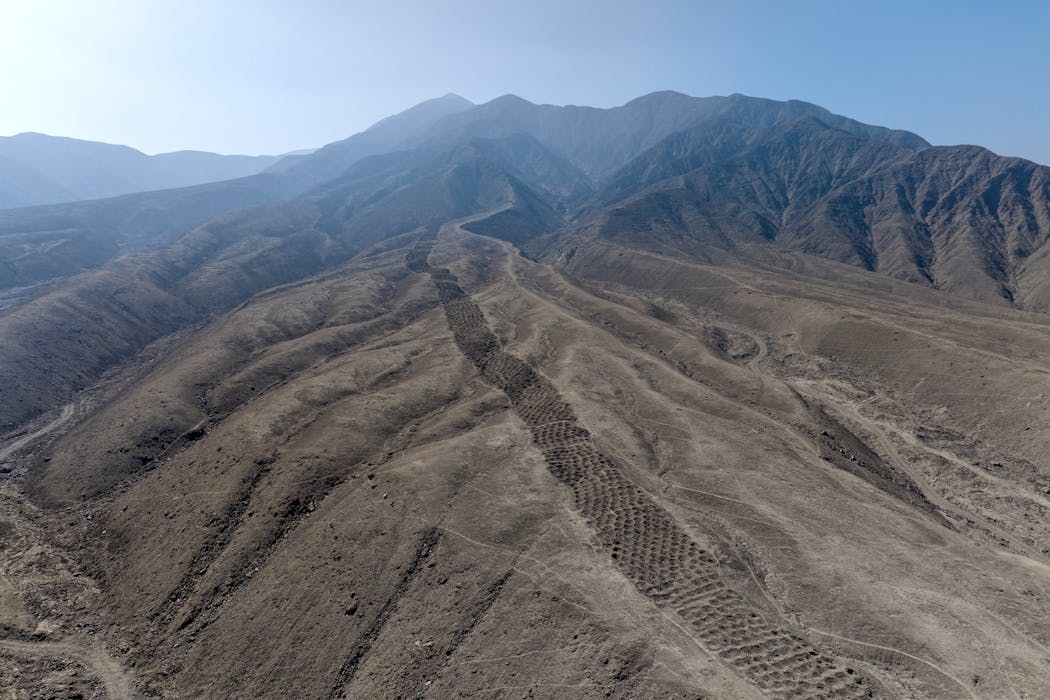
An aerial photo of Monte Sierpe, facing northeast.Jacob L Bongers
In 1931, geologist Robert Shippee and US Navy Lieutenant George R. Johnson led one of the first aerial photography expeditions in South America. They captured stunning photographs of landscapes across the Andes, including some peculiar “pockmarks” in the Pisco Valley of southern Peru.
These “pockmarks” make up the mysterious archaeological site of Monte Sierpe. Stretching 1.5 kilometres and consisting of approximately 5,200 precisely aligned holes, Monte Sierpe translates as “serpent mountain” in Spanish, but the site is also known as the Band of Holes.
The purpose of Monte Sierpe has baffled researchers and members of the public alike, but new archaeological research carried out by an international team has uncovered evidence for a new interpretation.
As we explain in a new study, published today in Antiquity, Monte Sierpe, which dates to at least 700 years ago, may have functioned as an Indigenous system of accounting and exchange centuries before the European invasion.
Drone mapping and sediment analyses
We used a drone to map Monte Sierpe. Analyses of aerial imagery revealed that the site has a “segmented” organisation, composed of around 60 sections (or blocks) of holes, some of which are separated by empty spaces.
We also found numerical patterns in layout. For example, one section has nine consecutive rows with eight holes each. Another section has at least 12 rows that alternate between counts of seven and eight holes. These patterns hint at an underlying intention in the organisation of Monte Sierpe.
Our team analysed sediment samples collected from several holes across Monte Sierpe. We identified ancient pollens of maize (corn), one of the most important staple crops in the Andes, and of Typha (bulrush) and willow, which have been traditionally used to make baskets and mats.
These unexpected findings indicate that people deposited plants in the holes, perhaps using woven baskets or bundles for transport.
Parallels with a record-keeping device
To our surprise, we discovered that the organization of Monte Sierpe is similar to the structure of at least one Inca knotted-string device used for detailed record-keeping (khipu) that was recovered near Pisco.
A knotted-string record keeping device known as a khipu found in the same region as Monte Sierpe shows some parallels to the Band of Holes. Ethnologisches Museum, Staatliche Museen zu Berlin / Claudia Obrocki, CC BY
Monte Sierpe’s 60 distinct sections of holes parallel the approximately 80 groups of cords documented in this local khipu.
This crucial discovery suggests Monte Sierpe may have played a significant role in Indigenous accounting practices.
A new model
Our results provide little support for alternative theories connecting Monte Sierpe to defence, water collection, or fog capture.
There is no evidence of fortification or weapons at Monte Sierpe.
The Band of Holes does look somewhat like the pits used for grape cultivation in Lanzarote, Canary Islands, but rainwater is effectively non-existent at these elevations (440–700 metres) in the Pisco Valley.
The site is located in an area of ephemeral fog oases (patches of dense fog that persist for up to a week), so it could have captured moisture. However, the resulting water would not be enough to grow crops, especially maize. Groundwater is not available on Monte Sierpe’s slope.
In the absence of currency or writing, Monte Sierpe may have functioned as a ‘social technology’ for exchange of goods and accounting. Charles Stanish, CC BY
Instead, we hypothesise that Monte Sierpe initially served as a barter marketplace before being turned into a large-scale accounting device under the Inca Empire (1400–1532 AD) for collecting tribute from local communities.
The Andes is one of the few world regions where large-scale societies, such as the Inca Empire, developed, but there is no strong evidence of pre-Hispanic currencies or writing systems. How did Andean societies exchange resources and administer large numbers of people without currency or writing?
Monte Sierpe may offer answers.
Barter marketplace
Barter marketplaces are built around a shared understanding among participants about how the value of one type of good compares to the value of another.
One of the thousands of holes at Monte Sierpe, with a 20cm bar for scale. Charles Stanish, CC BY
We envision the holes at Monte Sierpe as potential units of exchange. Depositing goods in the holes could have been a way of publicly displaying information about the quantity of goods available as well as the quantity of goods required for a fair exchange.
For example, a certain number of holes containing maize would have been equivalent to a certain number of holes containing another type of good, such as cotton or coca.
In our model, each section at Monte Sierpe could have been linked to a particular social group for the payment of tax. Numerical patterns in layout and variation in the number of holes across sections may reflect differences in tribute levels, or the number of taxpayers from specific villages and towns.
The thousands of holes at Monte Sierpe are divided into groups or blocks. J. L. Bongers, CC BY
In a sense, Monte Sierpe may have functioned as a large “spreadsheet” for the Inca Empire.
While our model remains tentative, our research brings us closer to unravelling the purpose behind one of the most enigmatic archaeological sites in the Andes.
This research was funded by a Franklin Research Grant, the University of South Florida office of the Dean and the Cotsen Institute of Archaeology at the University of California, Los Angeles. The authors thank the Peruvian Ministry of Culture for granting us a permit that allowed us to carry out this study. Open access funding provided by the University of Sydney.
Lions at Whangārei’s Kamo Wildlife Sanctuary, which was placed in liquidation earlier this year and closed to the public on 2 November.RNZ / Nick Monro
An animal rescue group is still racing against the clock to save five lions due to be put down at a Whangārei animal park.
She was also working with a group of “high net worth individuals” who were looking at buying the park together.
“They’re amazing, they’re very much professional, organised animal lovers, and obviously investors as well. It’s just going to come down to if we can get this done fast enough. So the time pressure is very real and still very much there,” she said.
The park’s owners, Bolton Equities, originally intended to euthanise the five remaining lions last week.
Press-McKenzie said the deadline for the big cats had been extended, and she was in contact with the owners day by day.
Lions at the Kamo Wildlife Sanctuary.RNZ / Nick Monro
Two ageing lions, Imvula and Sabili, were put down last Wednesday due to what the owners described as age and deteriorating health.
Other potential buyers were waiting in the wings in case the current plan could not go ahead, but Press-McKenzie said it was vital to find someone who was “the right fit” and could follow through on promises to safeguard the lions.
“It’s still open to anyone else who wants to drop their hat in the ring, because it’s going to come down to not just the fastest deal, but also what’s best for the lions. We need to consider everything but the lions’ future is our primary concern.”
The wildlife park, which was founded by Craig “Lion Man” Busch and has had a turbulent history, was placed in liquidation earlier this year and closed to the public on 2 November.
At its peak it was home to more than 30 lions, tigers, leopards and cheetahs.
Sign up for Ngā Pitopito Kōrero, a daily newsletter curated by our editors and delivered straight to your inbox every weekday.
– Published by EveningReport.nz and AsiaPacificReport.nz, see: MIL OSI in partnership with Radio New Zealand
A group of women who have had ongoing issues with Estradot patches says they feel like they’ve been heard after Medsafe told them it is initiating independent testing.
A number of women have reported problems with the oestrogen patches not adhering or working properly, which has caused some of their perimenopause symptoms to return
Manufacturer Sandoz told RNZ it had received about 50 complaints from New Zealand, while Medsafe said it had received 149 complaints.
On Friday, Medsafe officials met with met some of the women to better understand what issues were being experienced.
Bronda Smith, who is the administrator for an online menopause support group, told Morning Report the meeting was encouraging.
“We really felt heard, which was great.”
She said one of the biggest wins of the meeting was Medsafe initiating the process independent testing.
Smith said Manufacturer Sandoz has done some testing of stock in the US.
“So, they didn’t test the actual batches that were delivered to New Zealand.”
She said the group was also concerned the issue was wider than first thought after finding a Menopause Support Group in the UK had also raised concerns about Estradot last year.
“It’s starting to feel like we’re being a little bit being told porkies by Sandoz,” she said.
In a statement, Sandoz said it had conducted a thorough investigation following the recent complaints and have completed retesting of retained samples of batches distributed in New Zealand.
“We are in discussion with Medsafe and have provided a detailed rationale explaining why local testing in New Zealand is not feasible. This is due to the unavailability of validated laboratories to conduct the tests, the complexity of the product, the nature of the adhesive technology, and the validated processes in place at the manufacturing site.”
It said it fully supported Medsafe conducting its own independent testing and would continue to work closely with them to ensure all regulatory expectations are consistently met.
A Ministry of Health spokesperson said Medsafe took all complaints seriously and started investigating as soon as the first complaints were received.
“This included getting information from the company, their test results for the batches concerned, and assurance of quality from the manufacturing site,” they said.
“Medsafe has initiated independent testing (with PHF here in New Zealand) of batches that have arrived in New Zealand, on top of what the company has done. This may take some time but helps us to work out why we might be receiving complaints when other countries (such as Australia) are not. We are also checking in with our counterparts internationally, where the patches are also supplied.”
The spokesperson said Medsafe would continue to publish updated information on its website.
“We acknowledge that earlier communication about Medsafe’s role may have been helpful for those affected and we will continue to keep the support group and other interested stakeholders updated as the investigation continues.”
The spokesperson said the product did appear to still be working for the majority of women.
Sign up for Ngā Pitopito Kōrero, a daily newsletter curated by our editors and delivered straight to your inbox every weekday.
– Published by EveningReport.nz and AsiaPacificReport.nz, see: MIL OSI in partnership with Radio New Zealand
A group of women who have had ongoing issues with Estradot patches says they feel like they’ve been heard after Medsafe told them it was initiating independent testing.
A number of women have reported problems with the oestrogen patches not adhering or working properly, which has caused some of their perimenopause symptoms to return
Manufacturer Sandoz told RNZ it had received about 50 complaints from New Zealand, while Medsafe said it had received 149 complaints.
On Friday, Medsafe officials met with met some of the women to better understand what issues were being experienced.
Bronda Smith, who is the administrator for an online menopause support group, told Morning Report the meeting was encouraging.
“We really felt heard, which was great.”
She said one of the biggest wins of the meeting was Medsafe initiating independent testing.
Smith said Manufacturer Sandoz has done some testing of stock in the US.
“So, they didn’t test the actual batches that were delivered to New Zealand.”
She said the group was also concerned the issue was wider than first thought after finding a Menopause Support Group in the UK had also raised concerns about Estradot last year.
“It’s starting to feel like we’re being a little bit being told porkies by Sandoz,” she said.
In a statement, Sandoz said it had conducted a thorough investigation following the recent complaints and have completed retesting of retained samples of batches distributed in New Zealand.
“We are in discussion with Medsafe and have provided a detailed rationale explaining why local testing in New Zealand is not feasible. This is due to the unavailability of validated laboratories to conduct the tests, the complexity of the product, the nature of the adhesive technology, and the validated processes in place at the manufacturing site.”
It said it fully supported Medsafe conducting its own independent testing and would continue to work closely with them to ensure all regulatory expectations are consistently met.
A Ministry of Health spokesperson said Medsafe took all complaints seriously and started investigating as soon as the first complaints were received.
“This included getting information from the company, their test results for the batches concerned, and assurance of quality from the manufacturing site,” they said.
“Medsafe has initiated independent testing (with PHF here in New Zealand) of batches that have arrived in New Zealand, on top of what the company has done. This may take some time but helps us to work out why we might be receiving complaints when other countries (such as Australia) are not. We are also checking in with our counterparts internationally, where the patches are also supplied.”
The spokesperson said Medsafe would continue to publish updated information on its website.
“We acknowledge that earlier communication about Medsafe’s role may have been helpful for those affected and we will continue to keep the support group and other interested stakeholders updated as the investigation continues.”
The spokesperson said the product did appear to still be working for the majority of women.
Sign up for Ngā Pitopito Kōrero, a daily newsletter curated by our editors and delivered straight to your inbox every weekday.
– Published by EveningReport.nz and AsiaPacificReport.nz, see: MIL OSI in partnership with Radio New Zealand
The robots were taking our jobs – or so we were told over a decade ago. The same warnings are regularly heard today about the likely impact of artificial intelligence (AI).
Tech breakthroughs have long stirred fears of workplaces being wiped out by automation, with generative AI platforms such as ChatGPT inspiring the latest round of occupational angst.
We often see this dread of AI replacing our livelihoods in news articles reporting on new worker survey findings, or in online forums talking of AI “job massacres”.
A similar gloom pervaded earlier research speculating about the future impact of automation and an impending robot apocalypse.
At Oxford University, researchers Carl Benedikt Frey and Michael Osborne warned in 2013 that 47% of US jobs were at high risk of automation “perhaps in a decade or two”.
Soon after, the New Zealand Institute of Economic Research estimated some 50% of New Zealand jobs might also be vulnerable.
The media amplified such warnings with alarming headlines such as “You Will Lose Your Job to a Robot – and Sooner Than You Think”.
In 2017, Nobel Prize winner Daron Acemoglu and Pascual Restrepo provided the first concrete evidence that robots had begun displacing jobs and lowering wages in the US economy.
Their findings sparked a global wave of research, as hundreds of scholars began analysing various datasets in search of further proof.
The robo-revolution that wasn’t
More than a decade on from these forecasts first appearing, was the gloom ever justified? Did this threat to our jobs and wages really play out?
To answer these questions, my colleagues and I carried out a meta-analysis synthesising the results of dozens of academic papers published since Acemoglu and Restrepo’s landmark 2017 study.
Rather than relying on a single dataset, country or time period, we reviewed 52 studies from around the world, covering a total of 2,586 individual estimates of how robots and automation affect wages.
Across the 52 studies reviewed, we found no strong evidence that robots have a consistent impact on wages – either positive or negative.
Some studies reported wage declines, others found increases, but on average, the effect was close to zero. In fact, the estimated overall impact was so small that it fell below even the minimal threshold for economic significance.
While robots might affect wages in specific industries and countries, or among certain groups of workers, we found little global evidence to support the idea that automation is consistently driving wages up or down.
An earlier University of Canterbury-led meta-analysis found similar results when examining the impact of robots on employment.
While those initial findings by Acemoglu and Restrepo showed robots reduced employment, much of the research since has shown no overall negative effect.
Two other meta-analyses, led by researchers in Italy and Germany, also turned up scant consistent evidence for widespread, robot-driven cuts to jobs and wages.
Focus on opportunity, not anxiety
Despite these findings, we still can’t say there have been no losers – or winners – amid the rise of automation.
Our research suggests that upskilling and learning how to collaborate effectively with robots – and AI – is the right strategy for staying competitive in today’s labour markets.
Entrepreneurs and managers should also focus on adapting to and capitalising on the new opportunities that automation creates.
After all, technology advances one company death at a time.
Finally, for policymakers, our research calls for a shift away from panic-driven regulation aimed at slowing automation, and toward supporting workers in gaining those human skills that automation makes more valuable.
The author acknowledges the contributions of his co-researchers Bob Reed and Thomas Logchies from the University of Canterbury.
Tom Coupe does not work for, consult, own shares in or receive funding from any company or organisation that would benefit from this article, and has disclosed no relevant affiliations beyond their academic appointment.
Pacific civil society groups say 2025 has been a big year for the ocean.
Development Alternatives with Women for a New Era (DAWN) representative Maureen Penjueli said the Pacific Ocean was being hyper-militarised and there was a desire for seabed minerals to be used to build-up military capacity.
“Critical minerals, whether from land or from the deep ocean itself, have a military end use, and that’s been made very clear in 2025,” Penjueli said during the Pacific Network on Globalisation (PANG) 2025 State of the Ocean webinar.
“They’re deemed extremely vital for defence industrial base, enabling the production of military platforms such as fighter aircraft, tanks, missiles, submarines.
“2025 is the year where we see the link between critical minerals on the sea floor and use [in the] military.”
PANG’s Joey Tau said one of the developments had been the increase in countries calling for a moratorium or pause on deep sea mining, which was now up to 40.
“Eight of which are from the Pacific and a sub-regional grouping the MSG (Melanesian Spearhead Group) still holds that political space or that movement around a moratorium.”
Deep-sea mining rules Tau said it came as the UN-sanctioned International Seabed Authority tried to come to an agreement on deep-sea mining rules at the same time as the United States is considering its own legal pathway.
“It is a bad precedent setting by the US, we hope that the ISA both assembly and the council would hold ground and warn the US.”
He said unlike US, China spoke about the importance of multilateralism and it for global partners to maintain unity within the United Nations Convention on the Law of the Sea (UNCLOS) agreement which has not been ratified by the United States.
Also in February was the deep sea minerals talanoa, where Pacific leaders met to discuss deep sea mining.
“Some of our countries sit on different sides of the table on this issue. You have countries who are sponsoring and who are progressing the agenda of deep-sea mining, not only within their national jurisdiction, but also in the international arena,” Tau said.
In May, UN human rights experts expressed concern about the release of treated nuclear wastewater.
Japan’s government has consistently maintained the release meets international safety standards, and monitoring by the International Atomic Energy Agency shows there is no measurable impact beyond Japan’s coastal waters.
Legal and moral problem However, Ocean Vision Legal’s Naima Taafaki-Fifita said as well as being an environmental issue, it was also a legal and moral problem.
“By discharging these radioactive contaminants into the Pacific, Japan risks breaching its obligations under international law,” she said.
“[The UN special rapporteurs] caution that this may pose grave risks to human rights, particularly the rights to life, health, food and culture, not only in Japan, but across the Pacific.”
Taafaki-Fifita said it was a “deeply personal” issue for Pacific people who lived with the nuclear legacy of testing.
In September, what is known as the “High Seas Treaty” received its 60th ratification which means it will now be legally effective in January 2026.
The agreement allows international waters — which make up nearly two-thirds of the ocean — to be placed into marine protected areas.
Taafaki-Fitita said it was important that Pacific priorities were visible and heard as the treaty became implemented.
This article is republished under a community partnership agreement with RNZ.
Both PGG Wrightson and Carrfields operate out of the saleyards.Gianina Schwanecke / Country Life
There’s good money in sheep these days.Gianina Schwanecke / Country Life
A range of cattle breeds are represented at the auction.Gianina Schwanecke / Country Life
Located in the heart of the Manawatū town, the saleyards have a long history in the district.
They’re also the largest in the country, servicing farmers from all over – Linklater’s seen stock from Hokitika, cattle from D’Urville Island and the former farmer’s even bought sheep from Tokoroa.
“They cover a huge distance.”
It all started back in 1880, he explains, as the tour starts near the entrance to the yards.
“A pen of cattle were sold behind the Denbigh Hotel. Well, the Denbigh Hotel’s still here and still selling cattle.
“They were the second set of saleyards in Feilding and, by 1920 or so, there were 2829 sets of saleyards in the district. Of course, the drover and his dogs were the important method of transport between the yards.
“Nowadays, there are the trucks carrying over 1000 lambs and 400 ewes, we suddenly find that the yards have concentrated more on this area and all the minor yards in the smaller areas have gone.”
Top sheep at today’s auction fetch $226 a head.Gianina Schwanecke / Country Life
The yards have 350 sheep pens, 140 cattle pens and 45 deer pens, and more than 50,000 cattle and 450,000 sheep are sold here each year, through teams from PGG Wrightson and Carrfields.
Prime stock is sold at weekly sales on Mondays and store stock on Fridays, the day Country Life pays a visit.
Linklater says prices at the moment are “very strong”, with the yards turning over more than $2 million dollars each week.
“[PGG Wrightson], for example, used to shout their auctioneers every time they hit the three million mark at one sale, but they don’t do it now, because they hit it too often.”
Eric Linklater is one of several retired Feilding farmers that now shares his insights through tours of the local saleyards.Gianina Schwanecke / Country Life
Linklater started the tours 20 years ago to help foster connections between urban and rural New Zealand. These days. his clients are increasingly international.
Open to the public, the saleyards also attract plenty of local onlookers.
The tour kicks off at the sheep pens just after 11am. By now, most farmers have been through to have a look at what’s on offer.
It’s a social event as much as a business one, Linklater says, as he deftly weaves his way through the crowds of chatting farmers and visitors, wandering dogs and even a few runaway sheep.
“At this time of year, of course, you’re starting to see the tail-end of the sheep, because farmers are flat out lambing and most of the lambs have already been sold.
With so few lambs about, prices are higher – a classic tale of supply and demand, he says. The top lambs at today’s sale will fetch $226 a head.
“Broadly speaking, they’re paying something like $10 a kilo on the hooks and they’d be sort of 4550 kilo lambs, so you’re talking about $250 on the hooks.”
Dry conditions in Manawatū have seen an increase in sales of ewes with lambs underfoot like these ones.Gianina Schwanecke / Country Life
There’s plenty of action, with the odd runaway sheep.Gianina Schwanecke / Country Life
It’s a similar story in the cattle market where prices average about $1700 a head with a maximum price of $3590.
It makes for a tough time being a buyer like local Feilding farmer Alan McLeod who came to the yards looking for rising two-year-old steers and heifers to fatten and finish on his property.
“It’s frightening buying,” he tells Country Life.
“You just got to face the market. Yeah, everybody’s going to have grass. We’re quite dry, Manawatū is dry, and we’re right on the verge of the spring boost.”
Dry conditions in Manawatū have seen an increase in sales of ewes with lambs underfoot like these ones.Gianina Schwanecke / Country Life
From the saleyards, the livestock are swiftly loaded back onto the waiting stock trucks and carted off.Gianina Schwanecke / Country Life
The sales have also brought out-of-towners like Vic Caskey from Taranaki, also in the market for two-year-old steers and “something to grow”.
“There’s not much going on at Taranaki at the moment, so [we] have to go further afield.
“[It’s] very expensive, but if you get the right ones, the margins are still there, as long as you work out what you can sell them for, so you know your margins are safe or safe-ish is all you can do.”
The impact of drought in Hurunui in North Canterbury.Supplied / Dan Hodgen
The ebbs and flows of farming are expected to be exacerbated by future climate change effects, including more volatile weather and strained water resources, a new study has found.
Research consultancy firm Kōmanawa Solutions ran 295 million weather simulations with past weather data on a catchment in North Canterbury to understand how climate change will impact farmers’ bottom lines in the next decade.
It combined climate data, pasture growth models, farm economic models and stream health models to identify where farmers’ resilience was likely to be “overwhelmed” by climate and global volatility.
The purpose of the five-year project – supported by the Ministry for Primary Industries’ Sustainable Land Management and Climate Change Fund – was to help farmers, regional councils, government and banks plan ahead for adaptation support.
The report found farm production and profitability were already affected by climate change, and the risk of financial instability was set to increase over time.
“As our climate continues to become more volatile, we expect the effects to become much more negative, with bad years becoming worse and more frequent,” Etheridge said.
Zeb EtheridgeSUPPLIED/JULIETTE CAPALDI ETTA
The report found irrigated dairy farms were particularly at risk because water supplies were expected to become less reliable in areas with high usage pressures.
Etheridge said regulators should not look back to historical climate and river flow data to understand climate risks, but forward to understand the changing climate.
“That’s really what we’ve been trying to do with this work is give people an idea of how different things could be and give them the information to make more informed decisions.”
North Canterbury is home to a large irrigation scheme off the Waimakariri River, which is restricted during times of low river flows.
However, a new water storage facility proposal north of the Hurunui River by firm Amuri Irrigation is being considered by the Canterbury Regional Council.
The Hurunui River123RF
Etheridge said North Canterbury farmers could reduce their stocking rates to better manage climate variability in the next decade.
“Our research says that in a lot of instances, dropping your stock numbers is probably going to make you a bit more resilient and improve your financial performance long term.
“Farmers might not make quite so much money in those good years, but they’ll be much more cushioned from the effects of those bad years.”
He said storing water will provide some resilience to farmers, but was not a silver bullet.
“Putting a water storage system on your farm like a pond to give you some more irrigation reliability, that can cushion you from the effects of climate change, but it can also increase your vulnerability to the broader volatility that we see in commodity prices, interest rates and so on. So you can increase your exposure on a financial side.
“It’s a big investment and I think people should be very wary about making those decisions from looking at past records of hydrology and climate and assuming that things are going to be the same, because they’re going to be different. The question is just how different.”
The research will be presented at the international Adaptation Futures conference in Ōtautahi/Christchurch from October 13-16.
– Published by EveningReport.nz and AsiaPacificReport.nz, see: MIL OSI in partnership with Radio New Zealand
Stockmen resting after a cattle muster at MolesworthRNZ/Sally Round
It’s an early start for the musterers at Molesworth Station. The bulls are out with the cows for the mating season and the stockmen need to beat the heat. Country Life producer Sally Round spent a day with the musterers, the farmer and the cook, peeling back some of the mystique of New Zealand’s most famous farm.
Duncan, Connell, Josh and Liam are up before the birds.
Head torches on, they catch their horses before tucking into a pile of bacon and eggs in the kitchen at Tarndale.
The homestead there is one of Molesworth Station’s far-flung camps where the musterers can have a feed and bed down for the night while working on the furthest reaches of the 180,470-hectare property.
Dawn breaks over an old cob building at Tarndale, Molesworth StationRNZ/Sally Round
Molesworth, in the backcountry of Marlborough, has a mystique and mana which few other high country farms can match.
It brings out the best in people, according to farm manager Jim Ward.
“It’s land that we all have an empathy with,” he says.
“Since I’ve been here six sets of ashes of stockmen have been spread at Tarndale. It really gets inside your bones, I tell you.”
The engine of a dusty ex-army truck thrums in the dark as Duncan saddles up.
The horses, dogs and men have a lot of ground to cover so they use a Unimog for the hour-long drive to their start point on the western flank of the property.
Steep scree-laden ranges, stony river beds and a climate that can switch from achingly hot and dry to well below freezing in a matter of days mean the horses are purpose-bred on the property.
Duncan leads his horse, Roger, to the truck.
“He’s big, he’s a cruiser … nice, easy-going … yeh, he goes wherever I point him.”
A couple of dozen dogs, yelping with excitement hop in behind.
Dogs taking a rest after a morning’s work mustering cattleRNZ/Sally Round
Duncan and his fellow musterers pile in the front.
A hint of pink in the eastern sky signals another hot dry day to come.
“When I came here, a fella said to me, there’re no other places in New Zealand you can saddle your horse every morning and let your dogs off to go to work,” Duncan says.
Ex-army trucks are used to transport the horses, dogs and musterers to work on vast Molesworth StationRNZ/Sally Round
Take a look at the gallery of images below for more on the story.
A day in the life of Molesworth Station
– Published by EveningReport.nz and AsiaPacificReport.nz, see: MIL OSI in partnership with Radio New Zealand
Oceans and Fisheries Minister Shane Jones at the Aquaculture NZ conference in Nelson.RNZ / Samantha Gee
Bespoke legislation and more ocean space is needed for the farming of kai moana, says the fisheries minister, so that aquaculture can one day rival New Zealand’s beef sector.
Shane Jones opened the industry’s annual conference in Nelson today, and spoke of the need to create a new global-scale protein-based industry.
“We have an inordinate opportunity for our tamariki and grandchildren to convert the oceanic space into a platform for global-scale protein-based fish farming.”
Regulatory reform and increased capital investment were also needed to help the sector reach the government’s target of $3 billion in exports in the next decade.
Aquaculture products are projected to bring in $650 million in export revenue for the year to June, up 13 percent on last year.
Jones announced the government’s five year Aquaculture Development Plan, in March, which set out the steps to grow the industry to generate $3b a year and double the number of jobs.
He said Ministry for Primary Industry staff were working on further plans for growth in the sector, and change needed to be driven by central government.
“I just don’t think it’s tolerable that anything to do with fisheries that we surrender the authority to local government or regional government.
“As a nationalist-orientated politician, I don’t see another way of cracking this nut unless we take back a lot of the authority.”
Jones said aquaculture was a “risk-riddled industry” that was constantly confronting problems, ones it could solve with government support and without increased regulation.
Science communicator and content creator James Sibley, who is often called a “fishfluencer” due to his social media work, was in New Zealand to speak at the conference and said there were incredible opportunities for aquaculture growth in New Zealand.
“I got into aquaculture because of the potential it has to feed the world, to feed a growing population with potentially healthier proteins than a lot of the population eats today, without doing irreversible damage at the scales that we see with current farming practices around the world, is immense but it has to be stewarded correctly.”
The Blue Endeavour farm NZ King Salmon wants to build in the oceanNZ King Salmon
He said New Zealand was at the forefront of change with NZ King Salmon’s open ocean salmon farm in the Cook Strait.
“What they are trying here with the Blue Endeavour project, going offshore with these much larger pens much higher current waters, cleaner waters, highly oxygenated it has really strong potential.”
But Sibley said it came with its own challenges.
“It’s a much more hostile environment out there, they need bigger boats, more people. It has the potential to be great for the economy and coastal communities there that work those farms, but how they can maintain that, and if this trial works, then what? Do we put out another one? Do we try something new? Where do we go from there?”
It has been a tough year for the country’s biggest salmon producer who posted half year net loss of $20.8 million.
NZ King Salmon chief executive Carl Carrington said its fish went through the equivalent of having the flu or a bad cold last summer and went off their feed, forcing the company to reduce harvest volumes for an extended period, which affected earnings.
“It’s not unusual [for fish] to go off feed over the summer period but what happened this time, it was for an extended period of time and it didn’t recover until much later than what we’d usually expect and as a result, we lost a lot of biomass growth.”
Carrington said despite that, the company had $60m in the bank and a balance sheet that was getting stronger and they were “increasingly confident” about the future.
“We’re increasingly confident because we know what we’ve got in the toolkit to deal with these challenges over summer… and we think the growth pathway in front of us is now just starting to look really positive.”
General manager of aquaculture Grant Lovell said changes to its farming model in recent years meant unlike in previous summers, there was not mass mortality, the fish had just stopped growing.
It had done feed trials and other mitigation work to improve feed consumption and growth rates in the past few years.
The company was also making good progress on Blue Endeavour – which it hoped would prove up the model for open ocean aquaculture in order to see major change in export growth.
Lovell said the two pens for the open ocean farm were assembled and launched in Shakespeare Bay in April, and then were towed without nets or fish to Waihinau Bay in the outer Marlborough Sounds.
Juvenile salmon, smolt, were then transferred to adjacent holding pens and would be transferred out to the Blue Endeavour site in November.
The mooring grid was currently being installed, seven kilometres north of Cape Lambert. It was due to have been complete by now but contractors had encountered issues with weather and sea conditions, but were back on track.
Lovell said the new farm’s service vessel Whekenui, which was built in Vietnam, was due to arrive in Port Nelson next week.
The company had also purchased a $8m site at the Cloudy Bay Business Park in Blenheim, with plans to eventually move processing operations there to support the company’s growth, while maintaining the factory in Nelson to produce smoked fish and ready to eat products.
A quayside feed storage warehouse was also under construction in partnership with Port Marlborough, enabling feed to arrive directly into Picton, eliminating the need for it to be trucked over the hill from Nelson.
Lovell said “public enemy number one” was the lack of room for aquaculture to grow.
“In a sea of opportunity, in what feels like oceans of space, finding a home is actually quite hard. We obviously have Blue Endeavour now, but this alone will not grow the industry to the levels required.”
He said long term regulatory improvements were required to ensure growth and expansion in the industry.
“Although we are incredibly grateful for the marine extension bill, all freshwater farmers did not get that same benefit for freshwater salmon farms, all those consents will still expire in the coming years and we need to create the business confidence and certainty for investment.”
Sign up for Ngā Pitopito Kōrero, a daily newsletter curated by our editors and delivered straight to your inbox every weekday.
– Published by EveningReport.nz and AsiaPacificReport.nz, see: MIL OSI in partnership with Radio New Zealand
New Zealand has about 1.6 million commercial hens.RNZ/Sally Round
Friday is World Egg Day – and New Zealand has about 1.6 million commercial hens with some now laying larger eggs.
Supermarkets are working towards only stocking eggs that have come from cage free chickens following ongoing hen welfare concerns.
Woolworths said by the end of the year all its cartons of eggs would be cage-free, and Foodstuffs, which owns New World and PaknSave, said it would do the same by 2027.
The founder of eg. Free-Range Eggs, Nathan Williams, said he wanted everyone to be able to afford ethical eggs and as more egg farms transition to free range – eggs would become cheaper.
He currently had 90,000 free range Shaver hens on his farm near Bulls and they laid more than 80,000 eggs a day. He was expanding his colony and said by Christmas the number of hens he farms would be more than 100,000.
“When a chicken first comes into lay around 16 to 20 weeks they lay smaller eggs – popping out what we call piwis which is a size five, and then as they grow their eggs get bigger, the eggs will be sixes and sevens. And then size eight and nine are our jumbo sizes.”
Williams said when the birds went outside and ate bugs and grass, he had more jumbo-sized eggs, which were often double-yolkers.
That meant shoppers may start noticing more Jumbo eggs, and Williams said about fifteen percent of his eggs were potentially-double yolkers.
Williams said contrary to public opinion – chickens had their own personalities and knew where they liked to eat, lay their eggs and sleep.
He said he had been pecked and chased by several of his inquisitive birds from time to time.
The Egg Producers Federation said the welfare of hens was paramount – as the happier the hen, the better the egg.
Its chairman John McKay said eggs were as popular as they had ever been. Over the last year, New Zealanders had eaten on average 229 eggs each, and that was up from last year when people consumed about 216 eggs.
“We are really pleased with that trajectory and as we all know eggs are a highly versatile and nutritious product.”
McKay said bird flu was something the poultry industry took very seriously and the one outbreak of a highly pathogenic avian influenza was well managed late last year.
About 160,000 chickens were culled on a free range egg farm in North Otago after becoming infected with the H7N6 strain they contracted from wild waterfowl.
“That farm is now back in production and eggs are being produced off it. The most important thing is making sure there is strong biosecurity on farms across the country and keeping the egg and poultry supply as resiliant as we can.”
He said there were no safety concerns about eating eggs.
McKay said he would be having a couple of poached eggs on toast for breakfast on Friday morning to celebrate World Egg Day.
Sign up for Ngā Pitopito Kōrero, a daily newsletter curated by our editors and delivered straight to your inbox every weekday.
– Published by EveningReport.nz and AsiaPacificReport.nz, see: MIL OSI in partnership with Radio New Zealand
David Ruan grows spray-free vegetables, which he sells at the local farmers’ market under Suncakes Gardens.Gianina Schwanecke / Country Life
Rows of colourful vegetables line this plot of land just on the outskirts of Hamilton.
For more than 10 years David Ruan has been growing vegetables which he sells at the local farmers’ markets under the name, Suncakes Gardens, a nod to his Chinese heritage.
“In Chinese tradition, there is a Mooncake Festival, usually between late September and early October, that is Spring in New Zealand – a good time for a new growing season,” he told Country Life.
“The colourful fresh product in the garden are like cakes relying on solar energy, and Suncakes is a good analogy to Mooncakes.”
Ruan came to New Zealand from China almost 20 years ago, where he studied horticulture at university and later worked helping growers – mostly with rice crops and fruit like oranges.
His university research focussed on different methods for plant protection, including biological controls.
“They introduce beneficial insects, fungi which control the bugs you don’t want.”
Up until last year he was growing certified organic vegetables but found this costly, switching instead to spray-free growing while still following organic principles including making his own compost.
Ruan acknowledged it wasn’t always suitable for larger scale growers but was keen to try it out on his own land when he moved to New Zealand.
He says the colourful vegetables he grows are like little cakes relying on the sun for energy, hence the name Suncakes Gardens.Gianina Schwanecke / Country Life
For over 10 years, he’s been selling vegetables at the local farmers’ market.Gianina Schwanecke / Country Life
He said larger growers tend to focus on just a few crops, but on a smaller plot of just 2.5-hectares, he grows a more diverse mix and rotates them regularly.
“My plan is to introduce more varieties.”
His wife helps with tending the garden, as does his daughter and one of his friends when it comes time to bring in the harvest.
Meanwhile his son helps with packing the vegetables to be sold at the farmers’ markets in Cambridge and Hamilton.
Ruan said he found growing very “peaceful and relaxing” but one of the other highlights was the many market customers who had become friends.
– Published by EveningReport.nz and AsiaPacificReport.nz, see: MIL OSI in partnership with Radio New Zealand
The Three Roads kiwifruit orchard in Edgecumbe near Whakatāne.SUPPLIED/Craigmore Sustainables
The investment arm of the Church of Jesus Christ of Latter-day Saints has purchased a new kiwifruit orchard in Bay of Plenty.
The investment was set to fund the work of its owner, the United States-based church known commonly as the Mormon Church.
Utah-based agricultural investor, Farmland Reserve acquired the Three Roads property near Edgecumbe, with local firm Craigmore Sustainables set to manage it.
The deal went through the Overseas Investment Office in August, resulting from a multi-year relationship between the two firms.
Profits from the export-focussed kiwifruit business will be shared between Craigmore and Farmland Reserve.
Farmland Reserve’s first NZ investment
Farmland Reserve was a commercial, for-profit entity where its profits help fund the church’s religious, humanitarian and charitable work.
Employing thousands globally, it invested in farms and orchards in 29 of 50 US states and 10 countries across the Americas, Europe and most recently Australasia.
Farmland it owned in Australia grew crops like pistachio nuts, potatoes, onions, wheat and soya bean.
President and chief executive, Doug Rose said kiwifruit consumption continued to rise globally, and New Zealand had ideal growing conditions for them.
“What an absolutely wonderful crop we have admired from a distance for some time,” he said.
“And I don’t know that there is a more beautiful country on the Earth than New Zealand with a more beautiful people and culture.”
Doug Rose.SUPPLIED/Farmland Reserve/Cristy Powell
Rose said it was Farmland Reserve’s first investment in New Zealand.
However, the church held hundreds of millions of dollars in assets like property across the country.
He said it was grateful to fill the need for capital in New Zealand, as a “passive and patient” long-term investor, with Craigmore taking the operational lead.
“I think this need that Craigmore brought to us is showing that there is a capital need in New Zealand to support this very growing industry, because it’s very, very expensive to develop even one hectare of kiwifruit is costly and so most entities can’t do it.
“So we were excited to be able to come in and to fill that need, particularly given I believe some of the destruction that occurred after that Cyclone [Gabrielle] and several years ago, and that really created kind of a capital gap.”
He said Farmland Reserve was not planning to set up as a charity in New Zealand.
Craigmore will manage the new orchard
Around half of the “partially-developed” 45-hectare property was planted in SunGold, and orchard manager Craigmore Sustainables planned to plant a further 17 hectares in the variety.
Chief executive, Che Charteris said it was essential to use offshore investment with partners that shared the same values, in face of limited domestic capital.
“So it will be in the end about 37.5 to 38 hectares of SunGold kiwifruit orchard under canopy with good frost protection, good irrigation and hopefully some very good crops for the year to come.”
Charteris said kiwifruit orchard development was expenditure-heavy and could cost anywhere between $200,000 – $800,000 a hectare.
He said Farmland Reserve understood the long term nature of the asset and the social community aspects that come with land ownership.
“Farmland Reserve are long term in their thinking, so it’s good to have that patient capital, that is willing to to rely on New Zealand expertise.
“It’s a really good example of how New Zealand can utilise the right kind of offshore capital in a way that values local expertise and local influence and control without, limiting ourselves just to domestic capital.”
Charteris said it could be hard to find money to re-invest in farms locally, and relying only on domestic capital would see growth opportunities missed.
“New Zealand unfortunately just has a really small pool of domestic capital.
“As you can see with the latest GDP figures in New Zealand, we’re not really going anywhere at the moment. But the rural sector is humming.
“The scale of the opportunity for rural New Zealand is so great that we need to find ways of working with the right kind of offshore capital to nail these sorts of opportunities.”
Charteris said Craigmore was set up to attract “better equity capital” into the country to harness opportunities, create jobs locally and boost regional economies.
Craigmore managed more than 38,000 hectares of farmland in horticulture, dairy farms and forestry across Aotearoa.
The Church’s NZ footprint
The Church of Jesus Christ of Latter-day Saints Trust Board was a registered charity to provide religious services across dozens of sites scattered throughout New Zealand.
Charity register documents showed the Church made a surplus of $23.3 million in the year to 31 December last year, and owned $517.4m in property, plants and equipment and $10m in investment property.
StatsNZ census data showed more than 54,000 people identified as members of the church in 2023.
Sign up for Ngā Pitopito Kōrero, a daily newsletter curated by our editors and delivered straight to your inbox every weekday.
– Published by EveningReport.nz and AsiaPacificReport.nz, see: MIL OSI in partnership with Radio New Zealand
A new study has found higher concentrations of nectar from native New Zealand plant species in the drier eastern parts of the motu.
Flowers produced high-sugar nectar which fed birds and insects, and was also collected and processed to make honey.
Over two years, researchers measured nectar from more than 4200 flowers off eight native trees in a number of regions nationwide.
The “Nectar traits of New Zealand trees vary across climatic zones” study was published in Frontiers in Plant Science last month.
The plant species studied included karo (Pittosporum crassifolium), kōhūhū (Pittosporum tenuifolium), tarata (Pittosporum eugenioides), kōtukutuku (Fuchsia excorticata), pōhutukawa (Metrosideros excelsa), mānuka (Leptospermum scoparium) and kōwhai (Sophora microphylla) and tī kōuka (cabbage tree).
The regions were Auckland, Taranaki, Hawke’s Bay and Wellington in the North Island and Nelson/Tasman, Marlborough, Canterbury and Dunedin in the South.
Researchers found trees like kōwhai and pōhutakawa produced the highest concentrations of nectar in drier areas, while sunnier sites generally had lower nectar volumes though larger flowers.
Image by Avenue, Creative Commons
Results from mānuka flowers showed substantial regional variation in nectar traits, driven by climate.
University of Waikato researcher Dr Johanna van Delden said the study could benefit conservationists and beekeepers, the latter to help them decide the most optimal locations and nearby trees for their beehives.
“The trees which produced the most sugar of all the species were either found in Dunedin, Canterbury or Hawke’s Bay, which are all on our East Coast,” she said.
“And the nectar volume, so how much nectar each flower produced, was also in 50 percent of the species coming from Dunedin or Hawke’s Bay. So I think that was the clearest and easiest result we could take out of our measurements.”
She said researchers were surprised by how the plants differed across climates.
“We found that every plant is really different. So we could see that some plant traits like nectar or the flower size was climate-linked, but it really varied from species to species between 20 and 80 percent, which is a massive variation.
“It was mostly associated with sunshine hours and rain amounts to really simplify the results.”
Van Delden said farmers could look at the species which performed well in their region to encourage greater biodiversity around farms.
“When they are flowering, attracting butterflies and birds, that could enhance your backyard biodiversity and could be used also on pastures for shelter.”
She said further research should explore how the native plants adapted to local climates across the country.
“If we go one step further, so the next researcher after me, could have a look if it’s actually not the location itself having the influence on the plant, but actually that it’s genetically driven.
“So that the plants over time have evolved in that way, that they are adapted to that local climate and therefore show those adaptations in regards to producing more sugar, for example, in the South Island and East Coast.”
Part of the research was funded by the government’s Endeavour research programme by the Ministry for Business Innovation and Employment entitled, ‘Building Resilience and Provenance into an Authentic Māori Honey Industry’.
It was a joint project with the University of Waikato, Manaaki Whenua/Landcare Research and the Auckland University of Technology.
Sign up for Ngā Pitopito Kōrero, a daily newsletter curated by our editors and delivered straight to your inbox every weekday.
– Published by EveningReport.nz and AsiaPacificReport.nz, see: MIL OSI in partnership with Radio New Zealand
Steve Evans is a man who just loves old wood and just can’t bear the thought of seeing it end up in landfill or being chucked on a fire.
Much of the stock he sells at Ironbark Re-engineered in North Canterbury came from the Lyttelton wharves which were removed after being damaged in the Christchurch earthquakes.
He’s not buying any more though, as he says he has enough to last a lifetime - or two.
“I need another lifetime to get through everything that I’ve got here. And I think that worries my son who’s thinks he’s gonna have to move in here and deal to it.”
The entryway to Ironbark Re-engineered in North Canterbury, made of steel-capped piles which once held up the wharves at Lyttelton. They were removed after the Canterbury quakes. RNZ/Mark Leishman
Evans has had quite an adventurous life – baking pies, professional hunter and fisherman, jumping out of helicopters for deer recovery, running a helicopter business, working in forestry and firewood, which led to discovering ironbark.
“It’s actually an Australian hardwood,” Evans explained. “Most people don’t really know what it is, but it’s one of the Eucalyptus species. Most people know what jarrah is and ironbark is like it but actually a lot harder than what Jarrah is.”
Ironbark is an exceptionally strong Australian hardwood, making it suitable for high traffic areas and structures like bridges and wharvesRNZ/Mark Leishman
Ironbark is exceptionally strong, making it suitable for high traffic areas and structures like bridges and wharves. It ranges from reddish-brown to dark brown and is highly resistant to moisture, insects and decay. The thick bark also protects the trees from fire.
Ironbark is still being imported from Australia and being used for wharves and cladding, flooring, decking, internal beams and rafters.
However, it doesn’t have the aged look of Evans’ wood, which ends up as internal beams and rafters in new holiday homes and is a particular rustic look that suits wineries and more high end stuff.
So when the tourists arrive, the buildings look like they’ve been there for 100 years even though they may have been there for two.
The ironbark timberyard is on part of a former railway line and is guarded by rough-coated Jack Russell, Sue.RNZ/Mark Leishman
The Oxford property is on part of a former railway line and is guarded by Evans’ little rough coated Jack Russell, Sue.
“It’s two and a half acres and very long and narrow. It’s part of the old railway corridor and the trains used to come through Oxford to the sawmills in the foothills. There was a station up the end of this property.”
Evans mills his wood with a New Zealand classic circular saw. The Mahoe super mill is a friction mill which runs up and down on a big beam and is controlled by a friction lever. These mills are renowned for their safety and accuracy.
“The Mahoe saw is built in the North Island – a couple of brothers, the Bergmans, have been building them for years. It’s a marvellous piece of gear and Mahoe is where they’re built.”
Evans said ironbark was a commodity that’s becoming scarcer by the day, as wharves all over New Zealand and rail bridges get pulled down.
Sign up for Ngā Pitopito Kōrero, a daily newsletter curated by our editors and delivered straight to your inbox every weekday.
– Published by EveningReport.nz and AsiaPacificReport.nz, see: MIL OSI in partnership with Radio New Zealand
The view back to the factory from the ponds.Cosmo Kentish-Barnes
Iconic South Canterbury fruit company Barker Fruit Processors’ $60 million factory expansion will come to fruition later this year, in efforts to “future-proof” the growing business.
The company owned by the Andros Group in France was expanding its Pleasant Valley factory near Geraldine, adding new warehouses and another production line for products like its chutneys, jams, and sauces.
With the new build nearing completion, production was expected to begin there shortly before Christmas.
Operations manager, Bill Pridham said the expansion would help double production there over the next few decades.
“The main point for us is around ensuring that Barker’s is set up and ready for the future in South Canterbury, and to provide security to our current staff,” he said.
“There’ll be a few new job opportunities as well, which is great.”
Pridham said the factory produced hundreds of different products each year mostly for the domestic market, but exports largely to Australia made up about 20 percent of the business.
It employed up to 280 staff during the summer peak across the factory and sales and marketing from Auckland.
Consenting issues in Geraldine
The company held various active resource consents for discharging contaminants onto land and to air, but the Canterbury Regional Council recently investigated the company for wastewater discharge breaches.
The Department of Conservation (DoC) raised environmental concerns about the factory’s discharge onto a nearby conservation reserve near the Hae Hae Te Moana River.
Barker’s of Geraldine farm (L) and The Barker Family with the original product, Elderberry Wine.SUPPLIED: The Barker Family
The company spent $1.4 million on a 14-hectare site next door to the factory, according to the Overseas Investment Office.
Pridham said this purchase was about future-proofing its irrigation and wastewater systems.
“Historically, we’ve irrigated onto a block south of the factory, DoC land where historically it was something that had low conservational value that has recently changed, so we’ve looked for an alternative there. So that’s why we’ve looking at this other bit of land,” Pridham said.
He said it was planning to micro-irrigate to match the soil’s ability to absorb and treat the water, a system which would “help future-proof the business as we grow.”
“We’re looking at changing our irrigation system there, allowing us to irrigate all-year round, where historically we’d irrigate only in the drier months.
“We are working through that consent for the wastewater discharge with ECan, and providing them the information they need to give them assurance of our process and how we’re planning to approach it.”
Environment Canterbury’s consents planning manager, Henry Winchester said a new consent application for discharge was on “hold”, while more information was sought from the applicant.
“The new application from Barkers is to discharge factory wastewater to a new area of land which is partly forestry and partly pasture,” Winchester said.
“Barkers isn’t proposing to increase the amount of wastewater generated and we’re following the consent process in the Resource Management Act 1991 (RMA) to ensure that effects are appropriately managed.
“We continue to work with Barkers to ensure that the regulatory process is being followed.”
Winchester said its audit continued.
Sign up for Ngā Pitopito Kōrero, a daily newsletter curated by our editors and delivered straight to your inbox every weekday.
– Published by EveningReport.nz and AsiaPacificReport.nz, see: MIL OSI in partnership with Radio New Zealand
Fancy a drop of “kiwi-friendly” wine or a bite of a “kiwi-friendly” kiwifruit?
Branding fruit as “kiwi-friendly” could be a future marketing tool for producers after a study showed the North Island brown kiwi foraging for bugs in Northland vineyards and orchards, scientists say.
The study is a collaboration between Massey University and the Bioeconomy Science Institute (BSI).
The brown kiwi increasingly observed in orchards and vineyards and New Zealand’s goal of a predator free environment by 2050 prompted the research, according to BSI scientist Karen Mason.
“With Predator Free 2050, more of our taonga species will be moving into horticultural settings, so we wanted to look at, is that happening? And if it is happening, what are they doing? And are they providing any ecosystem services that will benefit the growers?”
Isabel Castro and Karen MasonRNZ/Sally Round
Masters student Wei (Xosha) Gong spent a year conducting field work on four sites in Northland, using camera and acoustic recorders, insect traps and faecal analysis to build a picture of kiwi behaviour, diet and predator presence.
From some 14,000 videos and 1000 audio recordings, and analysis of the bird’s poo, the team were able to gain new insights into the kiwi’s behaviour and diet in horticultural landscapes.
“We did get footage of them actually eating in the orchards, both probing into the ground and taking insects from just above the ground in the ground cover,” Mason told Country Life.
Wei (Xosha) Gong, Masters student involved in the kiwi studySupplied/Massey University & Biosecurity Science Institute
Further research has shown the kiwi, with its long probing beak, were eating a variety of invertebrates including horticultural pests.
“They are consuming some very interesting ones, and where I think they can be really beneficial.
“We found that they were consuming a variety of different cicadas, the whitefringed weevil and grass grub, and all of those species spend time underground.”
Apart from marketing their fruit as “kiwi-friendly”, growers might also be able to reduce pesticide use if more kiwi were encouraged into orchards, Mason said.
“If an insect is subterranean … it’s quite difficult to control because they’re difficult to monitor, they’re difficult to locate.
“If you put sprays and chemicals down, the soil can bind some of those chemicals so it doesn’t reach the insects and a couple of these insects also have a hard casing on them, so again, that makes it harder for the chemicals to reach them.
“Also, you don’t want to broadcast a whole tonne of spray onto your soil and kill all your beneficial insects, like your worms. So I think that’s where kiwi could be very interesting and very beneficial, because they are eating these when they are subterranean, when they’re underground.”
One of the “camera traps” used to record kiwi activity in a Northland orchardSupplied/Massey University & Biosecurity Science Institute
She said one pastoral farmer no longer needed to spray or to put granules down for his grass grub now that he has a high density of kiwi nearby.
Farmers and growers could encourage more kiwi onto their land by enhancing the orchard habitat and better predator control, according to Massey’s Professor in wildlife biology Isabel Castro.
She said the brown kiwi, now numbering around 26,000, lived in a variety of settings.
“They can go into grassy areas, they absolutely love swamps, they also, of course, go into forests, but not only mature forests, but also they use scrub, and they use even very, very low vegetation, so they have no problems going into orchard areas.
“In saying that, most of the kiwi that we have observed, especially in vineyards, are close to small areas, at least, of vegetation. So if, for example, farmers will have a vineyard area and then that area is surrounded by a hedge of other vegetation, the kiwi will love that better than having a completely open area.”
A collection of bugs and kiwi faeces analysed in the studyRNZ/Sally Round
Mason and Castro are excited about the prospect of farmers harnessing the habits of other birds like pīwakawaka which could eat insects in the canopy or tui whose feisty nature might scare off kākā from feasting on the orchard’s fruit.
But more research is needed.
“More different sorts of birds are going to start coming into our horticultural systems. We need to understand, how do we make them attractive? How do we keep the birds safe, and how do we keep the birds out?” Mason said.
– Video reproduced with permission
Sign up for Ngā Pitopito Kōrero, a daily newsletter curated by our editors and delivered straight to your inbox every weekday.
– Published by EveningReport.nz and AsiaPacificReport.nz, see: MIL OSI in partnership with Radio New Zealand
Linda said it was an “honour” coming back to the multi-generational farm, despite not initially planning to come back as a farmer, and she hopes they’re leaving it in a better way for the next generation.
“Everything you do for the land is such a longterm goal,” she said.
“Our input now is changing what’s going to happen down the line which is a whole different way of thinking. And all our different backgrounds help bring up different things and what we want from that.”
Dairy farming’s never been easier, with automation a key part of life on this Waikato farm.Gianina Schwanecke / Country Life
Dad Brett always planned on being a farmer but “got sidetracked” with electrical engineering, a qualification which saw him travel all around the world for various projects. It’s come in handy back on the farm too where he is chief innovator and inventor.
He said it was nice to be farming.
“It’s a different style of life.Whereas I had to deal with customers or clients and now my clients are the cows and they’re much easier to deal with.”
The herd of 150 milking Kiwi cross wear cow collars which provide valuable insights.Gianina Schwanecke / Country Life
Like Linda, it’s also taught him the value of taking a longer view.
“We come to the conclusion that you’re actually planning for over a year ahead all the time. It’s something I’ve never really thought about.
“You’re setting yourself up for the season ahead by what you’re doing now.”
One of the ways the family has tried to prepare for their future is investing in wearable technology and automation on-farm.
“Dad’s an extraordinaire in creating things and adjusting things and automating as much as we can,” Linda said.
“Our shed, it’s push a button and it does everything.”
Brett’s experience off-farm has been instrumental for today’s operations and helping automate many of the jobs on-farm.Gianina Schwanecke / Country Life
Automation in the cowshed includes automated drafting gates, cup removers, systems cleaning, and calf feeders.
“It’s set up now for a one person operation – we still milk with two people – but it can be done,” Brett said.
Eight years ago they also invested in AllFlex’s cow collars to help with heat cycling
“We’re quite unique in that we’re one of the few smaller herds that has cow collars on.”
The data they get from the cow collars has helped improve animal welfare and each year the technology gets better.
Some things the father and daughter still prefer to do the old-school way, like shifting stock themselves on foot or in the side-by-side.
– Published by EveningReport.nz and AsiaPacificReport.nz, see: MIL OSI in partnership with Radio New Zealand
The first calves of a new crossbred dairy-beef offering are now on the ground at a Pāmu, formerly Landcorp, farm near Taupō.Supplied
On a state-owned farm near Taupō, the first creamy-coloured calves of a new dairy-beef crossbreed are frolicking.
Called the Synergizer, the calves are the result of combining genetics from a Nebraskan breed developed in the 1970s, known as the Stabilizer, with that of the French Charolais from which the calves take their distinctive colouring.
It’s been a collaborative project between Pāmu, formerly Landcorp, and the farmer-owned co-operative Livestock Improvement Corporation (LIC) to develop a dairy-beef product that will benefit dairy farmers, calf rearers, beef finishers and processors
LIC chief executive David Chin said it was an exciting partnership with the genetics providing a long term gain and a “better animal all round”.
The breeding programme focussed on key traits including short gestation, ease of calving and rearing, strong growth and meat quality.
“What the diary farmer really looks for in beef animals, or beef bulls putting over their dairy cows, is an easily identifiable animal so the coat colour is very important,” Chin said.
“The coat colour is coming through from the Charolais. But calving easy, easy to rear, good live weight gains that’s coming through from the Stabilizer.”
The Livestock Improvement Corporation, has partnered with Pāmu, combining genetics from a Nebraskan breed developed in the 1970s, known as the Stabilizer, with that of the French Charolais, to create the Synergizer.Supplied
Chin said the launch of Synergizer marked an important milestone in the co-operative’s dairy-beef journey.
“Backed by world-class science, robust data and rigourous progeny testing, Synergizer has been developed to deliver a reliable, profitable and sustainable option for dairy-beef systems.”
A recent Rabobank report found dairy-beef had a potential value of more than $1.2 billion each year.
Pāmu chief executive Mark Leslie said Synergizer was also excited about the potential of the collaborative project.
“By combining genetics expertise, farming knowledge, and a shared vision, we’re creating a solution that will deliver long-term benefits across the entire dairy-beef value chain and build resilience, productivity and sustainability for future generations of farmers.”
About 350 first-cross beef on dairy calves were born this year.
The first frozen semen inseminations will be available in limited quantities from spring next year, with more available from spring 2027.
Sign up for Ngā Pitopito Kōrero, a daily newsletter curated by our editors and delivered straight to your inbox every weekday.
– Published by EveningReport.nz and AsiaPacificReport.nz, see: MIL OSI in partnership with Radio New Zealand
Wattie’s New Zealand is cutting down on local produced crops, including tomatoes, corn and beetroot.pixabay
Wattie’s New Zealand is further reducing fruit and vegetable crops it sources from its home of Hawke’s Bay, citing an ongoing struggle against cheaper imports.
Growers of key crops beetroot, corn and tomatoes will be affected by its recent crop intake review.
Just last month, it announced it would reduce production of its canned peaches.
A spokesperson for the brand, owned by food giant Kraft-Heinz of the United States, said it carried out these reviews each year to respond to market demand, increased competition from imported goods and rising input costs.
“In recent years, Wattie’s has seen a reduction in demand for home-grown canned fruit products and has not been able to recover to the levels it saw prior to the cyclone,” she said.
“Our desire, of course, is for Kiwis to return to the Wattie’s locally grown favourites, but until such time as we see an increase in demand, we are forced to adjust our intake, which has impacted crops such as peaches, beetroot, tomatoes and corn.”
She said it contacted affected growers directly, many of them had been partners for years.
“We recognise this is a difficult time for them and their businesses and are committed to helping them through this transition phase.”
Are you affected by the change? Let us know monique.steele@rnz.co.nz
The decision to reduce peach production garnered upset among New Zealand consumers online.
However, the company had already warned the government that alleged dumping of cheaper imports from countries like China into the New Zealand market would affect local production.
A spokesperson for the Ministry of Business, Innovation and Employment confirmed it was investigating these claims after Heinz Wattie’s filed an application in July into alleged product dumping.
“MBIE is currently progressing step 1 of the [trade remedy] investigation in accordance with its standard process, with input from participating stakeholders,” it said.
It was working to compile preliminary findings, essential facts and conclusions report for the applicant by 7 November.
And the findings would be presented to the Minister for Commerce and Consumer Affairs for decision, by 31 January.
“MBIE is also considering a request from [Heinz Watties] for provisional measures during the course of the investigation, in line with statutory provisions.”
It followed an earlier investigation several years prior.
Anti-dumping duties on preserved peaches from China were lifted in 2017.
Newsroom reported that Stats NZ data included in the Heinz application showed Chinese peach import volumes increased from 300,000 kilograms a quarter in 2018, to a peak of just below 831,000 kilograms in the final quarter of 2024.
Read more:
– Published by EveningReport.nz and AsiaPacificReport.nz, see: MIL OSI in partnership with Radio New Zealand
Wynne said there had been some honest and tough conversations.
“[I’m] still pretty nervous.
“We’ve got four and a bit days so we have a special general meeting in Invercargill on Monday, on the 20th and the meeting will open at 11am, voting will close 11:45.
“And then Elections NZ and KPMG will go away and count and verify, and announce the result the following day.
“So our key message to everyone is please consider the proposal and the alternative that you see fit, vote accordingly, but the main thing is please vote.”
He said they’d been upfront about Alliance’s finances, with $188m in debt due by 19 December.
Wynne said after exploring all options over the past two years, only Dawn Meats met the scale and timing needed.
Shareholders were making a decision Wynne called a once-in-a-generation choice for farmers.
Sign up for Ngā Pitopito Kōrero, a daily newsletter curated by our editors and delivered straight to your inbox every weekday.
– Published by EveningReport.nz and AsiaPacificReport.nz, see: MIL OSI in partnership with Radio New Zealand
Federated Farmers president Wayne Langford said the new targets were backed by science and had landed in a “solid” place.AgResearch
Farmers have welcomed the government’s new “science-based” biogenic methane targets for 2050.
It’s dropped the reduction target for biogenic methane from 24 to 47 percent below 2017 levels by 2050, to 14 to 24 percent – saying it reflects the findings of the independent Methane Science Review released in 2024.
Agriculture and Trade and Investment Minister Todd McClay said the government had worked closely with industry and accepted a range of advice to determine a “practical target”.
“We’ve accepted a range of advice and worked closely with industry to agree a practical target that protects food production whilst substantially reducing New Zealand’s farm emissions.”
He said the targets set under the previous government had felt “political[ly] and ideologically driven”.
“I think what’s important to understand is just how far off the last lot of targets were,” he said.
“So, 24 to 47 percent was going to put well over 20 percent of sheep and beef farms out of business, 6 or 7 percent of dairy farms. It was literally going to destroy rural communities.”
RNZ/Marika Khabazi
Langford also welcomed confirmation there would be no tax on agricultural emissions like methane.
“This is a major step forward and will be a huge relief for farming families who have had the threat of a massive tax hanging over our heads threatening the viability of our businesses.
“A methane tax would have achieved the opposite of its intent – forcing the closure of Kiwi farms, driving production to less efficient countries, and increasing global emissions.”
However, Langford said the changes don’t mean farmers are being let off the hook – farmers were already working hard to reduce their methane emissions and had made huge improvements in the last decade.
A dairy farmer himself, he said he had faced huge pressure from processors to improve.
However, last week Nestlé, announced it was withdrawing from an international partnership aimed at reducing dairy emissions.
Nestle USA headquarters. Nestle is a Swiss transnational food and beverage company and ranked on the Fortune Global 500.123RF
Langford said this was more a reflection of the cost-of-living pressures facing consumers.
He said a growing range of technologies to better calculate and reduce emissions on farm would only help farmers further improve.
Beef and Lamb chairperson Kate Acland also welcomed the new targets which she felt better reflected the science, but said it would still be a stretch for the agriculture sector to achieve.
“The previous targets were arbitrarily based on ranges used in an Intergovernmental Panel on Climate Change (IPCC) report that explicitly stated those ranges should not be used to set national targets.
“The revised targets better reflect the science around the different warming impact of short- and long-lived gases. Methane should only be asked to do what is expected of other gases, which is to achieve no additional warming.”
Acland said New Zealand’s red meat was already among the most climate-efficient in the world.
“While our sector has made significant progress on reducing warming emissions, the revised targets, particularly the upper end of the range, will still be very challenging. This is by no means letting agriculture off the hook.”
She said it was important to work towards reducing methane by investing in efficiencies on-farm, genetic improvements and tools and technologies that could help farmers.
Acland said tax on agricultural methane emissions being ruled out was especially welcome news for the sector
“Emissions from our sector are already coming down – the threat of a price was draining confidence from the rural sector and was just not justified.”
Victoria University of Wellington Professor James Renwick said the government’s decision was “disappointing” as it represented a “major step backwards in ambition and in climate action”, but he was not surprised.
“The climate is currently changing rapidly and we need to be doing all we can to slow the warming and avoid catastrophic impacts from extremes and from tipping points crossed.
“Yes, carbon dioxide emission reductions are the number one target, and we must get to zero as soon as possible.
“But methane emissions are the next most important, and emissions reductions there would quickly translate into reductions in atmospheric concentrations (because of the short lifetime of methane in the atmosphere), providing a cooling effect in the short-medium term.”
Professor Renwick said the idea of ‘no additional warming’ seemed to influenced the scientific advice to Government.
“This approach goes easy on the agriculture sector and in no way does it represent our ‘highest possible ambition’ as laid out in Article 4 of the Paris Agreement, to which New Zealand is a signatory.”
He said this was likely to concern some trading partners.
Others like Canterbury University’s Associate Professor of Atmospheric Chemistry Laura Revell said biogenic methane emissions in New Zealand had “largely stabilised so far this century”.
Revell, who was part of the independent methane science review, said the group had modelled the methane cuts needed to ensure no additional warming relative to 2017 levels.
She said they found the level of cuts needed depends on global methane emissions.
“Because atmospheric methane concentrations are continuing to increase – driven largely by emissions from other countries – steeper cuts to New Zealand’s emissions alone would have little impact on total atmospheric heating.
“If the rest of the world makes steep cuts to methane emissions, then New Zealand would need to make steeper cuts too to ensure the no additional warming target is met. Periodic reviews of the target seem sensible.”
Sign up for Ngā Pitopito Kōrero, a daily newsletter curated by our editors and delivered straight to your inbox every weekday.
– Published by EveningReport.nz and AsiaPacificReport.nz, see: MIL OSI in partnership with Radio New Zealand
Fallen trees at the side of the road in Riversdale in Wairarapa on Thursday.RNZ / Mark Papalii
Many rural communities are clearing away fallen trees, debris and repairing fences in wind battered regions, following yesterday’s storm.
Katie Wyeth, a Federated Farmers spokesperson for Wairarapa, said many farmers hadn’t even had time to clean up the damage from wind and rain earlier in the week, before yesterday’s extreme weather.
“We lost I think at least five, and these are big old man poplar trees, big trees that came down, and one in particular that’s blocked off our main track accessway to one side of the farm, pulled up half the track and blocked a culvert,” she said.
“And then the main damage after that is just falling branches and things onto all our fence lines, particularly the waterways.
“A tree came down over a power line to our pump shed, so we’ve got no power or water to one side of that farm.”
RNZ / Mark Papalii
Wyeth said falling trees killed several of their sheep.
Despite the damage and livestock deaths, she said most farmers will just roll up their sleeves and do what needs to be done.
“Probably be clearing trees, I imagine. There’ll be a lot of chainsaws running red hot over the next few days, week or so,” she said.
“There might be people having to get diggers and stuff in to clean up some damage.
“Generally, most of the people, farmers I’ve spoke to, it’s fairly typical, they’ll say, oh, … we’re not too bad compared to some people, but everyone says that, right? And they just get on with starting to get it cleared up.”
Wyeth said it was one extreme to the other for different parts of the Wairarapa region – with some farmers sloshing around in mud, while others needed more rain.
Sign up for Ngā Pitopito Kōrero, a daily newsletter curated by our editors and delivered straight to your inbox every weekday.
– Published by EveningReport.nz and AsiaPacificReport.nz, see: MIL OSI in partnership with Radio New Zealand
Alliance Group meatworks in Southland.RNZ / Nathan McKinnon
Alliance Group farmer-shareholders have voted in favour of a proposed $270 million investment from Irish meat processor Dawn Meats.
Under the agreement, Dawn Meats will acquire a 65 percent stake in Alliance Group, with farmer-shareholders retaining 35 percent ownership.
More than 2600 shareholders took part in the vote, representing 92.5 million shares – more than 88 percent of all shares on issue.
Of those, more than 87 percent supported the proposal.
Supplied
Alliance chair Mark Wynne said the result showed strong confidence from the company’s farmer-owners in its direction and leadership.
“Our farmer-shareholders have given a clear mandate for Alliance to move forward in partnership with Dawn Meats. This is a vote of trust in our people, our operations and our vision.”
Wynne said the partnership followed a two-year process to reset and recapitalise the business after challenging years for the meat sector.
“The Board explored every option to secure Alliance’s future. The Dawn Meats proposal stood out as the best strategic and financial path forward, a view confirmed by independent adviser Northington Partners.”
He said the investment would strengthen Alliance’s balance sheet, reduce debt, and enable greater capital investment in technology and efficiency.
Wynne had previously said the bank had made it clear the company’s $188 million in debt had to be paid back in full by the end of the year.
Around $200 million from the investment will be used to reduce the company’s short-term working capital facility, with the rest directed toward strategic projects.
Alliance planned to distribute up to $20 million in both the 2026 and 2027 financial years to farmer and shareholders through a mix of dividends and supply-based rebates, alongside a further $25 million dividend from the joint venture’s stronger-than-expected performance.
Mary Browne
Dawn Meats chief executive Niall Browne said the Irish company was “pleased and excited” by the vote outcome.
“We look forward to maximising the potential of the new opportunities this strategic partnership will unlock,” he said.
“Having the ability to now grow in partnership with some of New Zealand’s leading farmers, and create a year-round supply for our customers between the Northern and Southern Hemispheres, is a fantastic opportunity – and one our customers are already responding to.”
Alliance is New Zealand’s largest processor and exporter of sheep meat and a major producer of grass-fed beef, operating six plants nationwide and exporting to more than 65 countries.
Dawn Meats, established in 1980 in Ireland, is one of Europe’s largest red meat companies, processing about one million cattle and 3.5 million sheep annually through its Irish and UK facilities.
Wynne said the deal marked “a turning point” for the co-operative.
“The future looks much brighter than it did 12 months ago,” he said.
“We’re now well positioned to thrive alongside a complementary partner like Dawn Meats and deliver enduring profitability and greater value for our farmer-shareholders.”
Sign up for Ngā Pitopito Kōrero, a daily newsletter curated by our editors and delivered straight to your inbox every weekday.
– Published by EveningReport.nz and AsiaPacificReport.nz, see: MIL OSI in partnership with Radio New Zealand
Ingka Investments the parent company of furniture giant Ikea has bought 10,000 hectares of production forestry in Northland.Supplied
Ingka Investments, the parent company of furniture giant Ikea, has bought 10,000 hectares of production forestry in Northland from Greenheart Group.
It takes the company’s investment in the country’s forestland to nearly 30,000 hectares, worth about $616 million. This includes nine existing forestry blocks planted in mostly pinus radiata, and an additional 3000ha of indigenous forest, most of which will be dedicated to biodiversity conservation and other environmental purposes.
Forestland acquisition manager Simon Honour said its main focus was production forestry as opposed to carbon farming, and had hopes of using the timber for Ikea products.
“Obviously wood is an essential part of the Ikea identity and our ultimate goal is to get that wood into the Ikea supply chain.”
He said it would focus on domestic processing and was working to develop relationships with local sawmills and traders, though he did not rule out looking to develop their own further down the track.
Honour said most of the forestland was not eligible for carbon units.
Where blocks are registered under the Emissions Trading Scheme, or ETS, he said this helped quantify how many units are being sequestered and the carbon units are not traded.
“We have no focus on carbon whatsoever, and we have a pure timber focus.”
Some of the more prominent sales included Huiarua Station and Matanui Station in the Gisborne region, with a combined area of just over 6000ha.
Honour acknowledged much of the land purchased by Ingka Investments since 2021 was farmland converted to forestry.
“Even from the start, if we could buy forests we would have. Unfortunately they don’t come up for sale that often.
“We wanted to get established in New Zealand and at that time, back in 2021, acquiring farms was a way to do that.”
He said there were “pros and cons” to establishing new forestry blocks.
“Creating forests from the start where you can set your riparian zones, your set back from waterways right from the start does have some benefits.”
He would not rule out purchasing future farms for conversion, but said it was not Ingka’s focus for now.
“We would much rather procure existing forests because it just fits with our values better.”
He said the strategic acquisition underscored Ingka Investments’ long-term commitment to responsible forest management, sustainable land stewardship and regional economic development.
Planned restoration projects focused on indigenous reforestation, and enhancement of existing native vegetation will be complemented by ongoing pest-control programs designed to safeguard biodiversity, improve forest health, and support the long-term success of restoration efforts.
While pinus radiata will remain the dominant commercial species due to its proven performance, future replanting cycles will selectively introduce alternative species where appropriate.
This diversification strategy will strengthen ecosystem resilience, support biodiversity, and improve overall forest health.
The Northland forests were certified by the Forest Stewardship Council and would remain so.
New Zealand’s first Ikea opens in December.RNZ / Marika Khabazi
Honour said a commercial production forest contributed to regional employment and he hoped to grow the number of Northland jobs.
Local forestry company, Northland Forest Managers, would continue daily operations. Manager Neil Geerkens said he looked forward to the partnership.
“Together, we will maintain sustainable harvesting practices, enhance biodiversity conservation and ensure continued community access, delivering enduring environmental, social, and economic benefits for the region.”
The acquisition was subject to OIO approval, and shareholder and regulatory approvals by Greenheart Group.
Kelvin Meredith, Ingka Investments’ forestland country manager New Zealand, said it was committed to responsible forest management, including restoring natural landscapes, supporting biodiversity and collaborating with local communities to create meaningful, lasting impact.
“People value recreational access to these forests, and we’re committed to ensuring these opportunities continue.”
The Kauri Coast Mountain Bike Park, located at Baylys Forest and operated by the Kaipara Cycling Club, will continue to be free to access by the public, subject to seasonal safety restrictions.
Seasonal beehives located on parts of the estate, operated in consultation with the landowner, will also remain in place to support local apiarists and contribute to biodiversity across the forest landscape.