The Australian government has launched its News Media Assistance Program, throwing a lifeline to public interest journalism and local news.
The latest push for a more diverse and sustainable news landscape also saw community broadcasters receive a modest but much-needed boost to their funding.
The announcement, worth $180 million overall, is a welcome pre-Christmas gift for struggling media outlets.
But it largely overlooks the importance of community broadcasting in providing accessible, community-engaged news. The program falls short of meaningfully helping the chronically underfunded part of the media landscape.
Millions on the table
On paper (or in government media releases at least), the plan looks promising.
It includes $99.1 million in grants, $33 million for the Australian Associated Press and a commitment of $3 million per year for government advertising in regional newspapers. There’s also $10.5 million for the Australian Communications and Media Authority to implement its Media Diversity Measurement Framework.
This builds on the recently launched News Media Relief Program, which offers $15 million in grants to media outlets to offset journalists’ salaries.
Alongside these announcements was an extra $27 million for the community broadcasting sector. Of this, $15 million is allocated to the Community Broadcasting Program and $12 million to the Indigenous Broadcasting and Media Program.
All up, a substantial investment: $180.5 million to support local news and community broadcasting. But is it enough of a life raft for Australia’s flailing news industry?
Dire times
Australian journalism has been in trouble for years, with a range of factors contributing to the reduced availability and quality of local news.
Australia remains among the worst countries in the world for concentration of media ownership.
There has also been a swathe of regional news outlet closures over the past few years, contributing to vast news deserts.
Further, shrinking newsrooms and the relentless demands of producing ever more multi-platform content is placing immense workload pressures on journalists.
That’s not to mention the role of social media and tech companies in directing online traffic away from news websites.
Against this backdrop, it’s unsurprising the government feels the need to step in.
Yet Australians, especially those who live in regional areas, value accessible local news.
This is something the community broadcasting sector knows well. In fact, the main reason listeners tune in to their favourite community radio station is to hear local news and information.
Community broadcasting is Australia’s third tier of broadcasting. It’s separate from state-run and commercial models. Community radio and television are not-for-profit and run for and by the community.
It’s the quiet achiever of the Australian media. Our largest independent media sector, one in four Australians tune in every week to the more than 500 services across the country.
Community broadcasters provide diverse and accessible news and current affairs. In doing so, they enhance Australia’s news media landscape.
Community broadcasters serve audiences that are overlooked, ignored and silenced in the mainstream media.
Take Water Watch, for example. This program on Broken Hill’s 2DRY FM explores issues affecting local waterways every week. It won a Community Broadcasting Association of Australia award for their reporting on the Menindee fish kills.
The Multilingual News Service broadcasts on multicultural community radio stations across New South Wales and Victoria. The service was set up to address health information gaps during the pandemic and still provides an essential news service to communities in their own languages.
Then there’s the work of Ngaarda Media in the Pilbara. Through in-depth reporting in the community, it broke the story of the First Nations man wrongfully accused by the mainstream media of kidnapping Cleo Smith.
While much of this work flies under the radar of the mainstream news media, it gives voice to a range of Australians. This is especially true for marginalised people, like those with disability, LGBTQIA+ Australians and First Nations communities.
If the government’s plan is to support diverse and accessible public interest journalism, the community broadcasting sector must be meaningfully included.
The next journalistic generation
As well as providing diverse and accessible community news in its own right, community broadcasting is an important training ground for journalists and media workers.
Our research uncovered a range of stories from those who got their foot in the door of the media industry at their local community radio station. The practical and soft skills that these volunteers learn, alongside the extensive professional networks, were instrumental in their career trajectories.
Supporting community radio to further develop this training will safeguard the largely voluntary workforce of the sector. It will also help to future-proof the next generation of media workers.
Community radio can be an important training ground for young journalists. Shutterstock
Community broadcasting adds enormous yet underappreciated value to the broader news media landscape. And it does so on a shoestring budget.
The Community Broadcasting Foundation is the independent administrator of government funding for the sector. It faces annual funding shortfalls averaging $9.5 million, rising to $11 million this financial year.
Hence the prospect of $15 million over an unspecified time period is little cause for celebration.
So despite the nominal funding announcement, there remains a missed opportunity for the government to make a meaningful investment in community broadcasting.
While the news plan may offer a general sense of direction, charting the course towards a more diverse and sustainable media landscape means recognising and adequately funding community broadcasting.
Bridget Backhaus is the recipient of an Australian Research Council Discovery Early Career Award (project number DE240100416) funded by the Australian Government.
Within five years, transport is expected to be Australia’s top source of greenhouse gas emissions. While renewables and storage are bringing down emissions from the electricity sector, emissions from transport are still growing. Our fleet of cars, trucks, diesel trains, planes and ships now emit almost 20% more than they did two decades ago.
In car-dependent Australia, switching to electric vehicles will be necessary. This is beginning to happen. Despite recent drops in battery-electric vehicle sales, the hybrid market is growing strongly.
But when we drilled down into the transport sector in our research, we found clear differences on emissions between our major cities and some regional areas. Broadly, city drivers are emitting less, while regions are emitting more.
Why? There are a number of reasons. City drivers are more likely to take up lower-emitting plug-in hybrids and battery electric vehicles with zero emissions. Rural and regional drivers drive many more kilometres than city drivers, and the electric charger network is scattered. Affordability is also a key consideration. It’s also only recently that the average range of electric cars and vehicles tipped over 400 kilometres per charge.
From January 1, the New Vehicle Efficiency Standard will come into force. One effect will be the arrival of more electric vehicle models and lowering ownership costs. But by itself, this won’t be enough to bridge the city-country gap.
We will need policies targeted at making electric vehicles viable in the regions. Without this, we risk failing to meet Australia’s emission cut targets of 43% by 2035 and net zero by 2050.
In Australia, the overall transition to electric vehicles is proceeding in fits and starts. This year, sales of battery electric vehicles have dropped back, though plug-in hybrid vehicle sales have risen.
But cleaner options are being taken up faster in some areas than others.
To find out more, we analysed vehicle registration and emissions data across Australia between 2002 and 2020.
These data showed the average carbon emissions from new cars bought in capital cities are generally lower than the rest of the state.
Across this timeframe, we saw major changes in vehicle emissions by postcode.
Unfortunately, we had to limit our study to 2020 due to data availability. This means we could not cover the COVID pandemic and its aftermath in terms of how travel behaviour shifted. While we could not capture the very recent arrival of many more electric vehicle models, we developed projections based on better availability and affordability of electric vehicles.
Over our time period, we found significant falls in emissions per vehicle in major cities such as Greater Sydney (24% decline), while vehicle emissions grew in regions such as North Queensland (3.3%), the Northern Territory (about 4%) and southwest Western Australia (5%) between 2002-2020.
Why the difference? Here are 3 reasons
1: Suburban drivers are taking up low- and no-emission vehicles faster
Australians in the outer suburbs are the most likely to purchase plug-in hybrids and battery-electric vehicles due to better access to charging infrastructure, targeted incentives and a higher awareness of financial and environmental benefits.
2: Rural and regional residents drive more
Rural and regional drivers tend to travel longer distances, rely on larger vehicles such as utes and 4WDs and have limited access to electric vehicle charging networks. Affordability and range anxiety are also barriers in these regions.
3. City drivers turn over cars faster
Urban residents buy cars more often. This means they progressively replace older cars with newer models, which are often more fuel-efficient. Rural areas have slower turnover of their vehicles, meaning higher emissions cars stay on the roads longer.
This is why vehicle emissions in Greater Sydney showed the sharpest decline over the period, aligning with the national trend of lower emissions from new vehicles in metropolitan areas. By contrast, emissions in areas such as North Queensland and the Northern Territory rose, due to a higher dependency on larger vehicles and a lack of charging infrastructure.
Australian cars pollute much more than those in Europe. Across 29 European nations, the average is now 107 grams per kilometre (g/km).
In 2023, the average emissions intensity for all vehicles on Australian roads was 193 g/km. This includes the large fleet of older, highly emitting vehicles, more efficient newer cars and zero emission vehicles. Of the new cars sold in 2023, the average was 165 g/km.
To track our progress in cutting emissions from vehicles, we need good data. Our research points to the importance of keeping comprehensive, nationwide datasets to track vehicle emissions.
These datasets are important because they allow policymakers to focus on specific areas. Our research could be used to tackle the reasons rural and regional Australians are not taking up low or zero emission transport.
For instance, electric vehicle chargers could be rolled out in regions where uptake is lowest. Roadshows and information sessions could help people feel more comfortable with a new technology and see how it might work for the distances they drive and the type of roads they drive on.
Authorities could also encourage markets for secondhand electric vehicles such as by shifting their fleet to electric, which would increase availability.
Tackling the city-country divide in electric vehicles would not only help reduce the cost of living for rural residents, but it would also encourage greater uptake of electric vehicles among city residents, who would feel more confident driving their cars beyond the city limits.
Kai Li Lim is the inaugural St Baker Fellow in E-Mobility at UQ Dow Centre. His position is endowed through StB Capital Partners, but he does not receive any income from it or any of its portfolio companies. As part of this project, Kai Li Lim receives funding from AURIN.
Anthony Kimpton has received funding from the Australian Urban Research Infrastructure Network (AURIN).
Jonathan Corcoran receives funding from the Australian Research Council and the Australian Urban Research Infrastructure Network
Neil G Sipe has received funding from the Australian Research Council.
Renee Zahnow receives funding from The Australian Research Council and AURIN.
After the fall of the Bashar al-Assad’s regime in Syria, the world was moved by emotional scenes of liberation — families reuniting after years of separation and former prisoners walking free from the brutal conditions of Assad’s prisons.
These moments of joy mirrored similar scenes from the fall of past regimes in the region, such as the overthrow of Muammar Gaddafi in Libya, Hosni Mubarak in Egypt, Saddam Hussein in Iraq, and Omar al-Bashir in Sudan.
Yet, history also warns us of the challenges that come next: the initial euphoria often gives way to instability, tragedy and regret, with many longing for the perceived order of the old regime.
The question now is whether Syria can chart a different course this time, avoiding the pitfalls that have plagued other nations after similar upheavals.
A country long divided
Syria is an ethnically and religiously fragmented country, with four key groups that have conflicting political agendas:
1) The Kurds: this ethnic group of 2.5 million people controls northeastern Syria on the border with Turkey, with whom they have a hostile relationship.
As a result, there are tensions between the US-backed Kurds and Turkish-backed Hayat Tahrir al-Sham (HTS), the rebel group that led the coalition of opposition forces overthrowing Assad’s regime.
These groups agreed to a ceasefire last week, but there are already reports it has collapsed.
Complicating matters further, the Kurds are a strategic ally of Israel, which has historically supported their aspirations for an autonomous state across parts of Iraq, Syria, Turkey and Iran.
2) Hayat Tahrir al-Sham (HTS): the rebel group that now controls much of the country is made up of a spectrum of Islamist factions. These include moderates, hardline jihadists and foreign fighters from Central Asia with radical Islamist backgrounds. The group also claims to represent the Sunni Arab majority in Syria.
HTS leader Ahmed al-Sharaa (also known as Abu Mohammad al-Jolani) has attempted to rebrand the group as moderate, though he retains ambitions for an Islamic governance model. He recently told CNN:
People who fear Islamic governance either have seen incorrect implementations of it or do not understand it properly.
This is a major concern for Jordan and Egypt, both of which face political challenges from the Muslim Brotherhood, whose Syrian branch is affiliated with HTS.
3) The Druze community: Syria’s third-largest group primarily resides in the south near the Israeli border. Some Druze leaders have reportedly called to be annexed by Israel, though others in Israeli-occupied Golan Heights, seized from Syria in 1967, have called for the Golan Heights to return to Syrian control.
Israel has just approved a plan to expand settlements in the Golan Heights, and Israeli troops have advanced beyond the demilitarised zone on the border in recent days.
4) Alawite Shiites and Christians: these are the most vulnerable minorities following the collapse of the Assad regime, as no neighbouring nation or local faction has expressed an interest or has the capability to protect them.
Three possible outcomes
Now, analysing these power dynamics within Syria and the broader regional geopolitics suggests three potential scenarios for the country’s future:
1) A federal secular state. This scenario envisions a federal structure for Syria, accommodating its multi-ethnic and multi-religious composition. A federal system would allow all groups to have representation at both the local and federal levels.
The Kurds, who already enjoy de facto autonomy, along with many other minorities, support this approach.
HTS, however, has not officially commented on the Kurdish role in a new state. Speaking diplomatically, al-Sharaa has only said
in the next Syria, the Kurds will be fundamental. We will live together and everyone will get their rights by law.
Acceptance of a federal model in the broader region is also mixed.
Israel supports federalism. Foreign Minister Gideon Saar recently said a single Syrian state with effective control and sovereignty over all its area is “unrealistic”. He added:
The logical thing is to strive for autonomy for the various minorities in Syria, perhaps with a federal structure.
Other neighbouring countries like Jordan and Turkey, however, oppose the idea. They fear the influence such an arrangement could have on their own minority populations, particularly the Kurds in Turkey.
2) A strong, centralised state. This model would be based on a central government dominated by Sunni Islamist groups, such as HTS. It could result in authoritarian governance, the marginalisation of minorities and an increased role for Islamic law in governance.
Turkey strongly supports this scenario, which it sees as a way to eliminate the threat of the Syrian Kurdish YPG militia that controls portions of northern Syria. Ankara believes it is aligned with the separatist Kurdistan Workers Party (PKK) in Turkey.
A strong, centralised state would also allow Turkey to extend its influence in Syria. It has economic motivations for this, such as its ambitions to establish a gas pipeline from Qatar to Europe via Saudi Arabia, Jordan and Syria.
If this happens, the route must be secure. Hopefully, it will be, as that is our wish.
3) Prolonged conflict and de facto separation. This is the worst possible outcome for the Syrian people – continuing violence and Syria remaining divided along ethnic and religious lines.
There are numerous factors suggesting Syria could be heading in this direction, following the path of Libya and Sudan in recent years. Syria has ethnic groups with deeply held, historical grievances, which have been exacerbated by an authoritarian government. It also does not have a strong democratic tradition.
This scenario benefits Israel immensely, as it weakens one of its historical enemies. And Turkey would likely seek to expand its occupation of parts of northern Syria to further challenge the Kurdish fighters there.
What does the region want?
As all of these scenarios illustrate, Syria’s future is inextricably linked to a regional landscape in which various nations exert influence, each pursuing distinct political, economic and security interests.
Eight members of the Arab League met recently in Jordan to express their support for a “peaceful transition process” in Syria. They also met separately with the top diplomats from the US and Turkey, calling for an inclusive government that respects minority rights.
However, this conference did not result in a solid plan due to sharp differences among the attendees about the future of Syria, in addition to the absence of other key players like Israel. Under the current circumstances, forming an international framework for the future of Syria is essential.
Ali Mamouri does not work for, consult, own shares in or receive funding from any company or organisation that would benefit from this article, and has disclosed no relevant affiliations beyond their academic appointment.
Source: The Conversation (Au and NZ) – By Stephen Hickson, Economics Lecturer and Director Business Taught Masters Programme, University of Canterbury
After a slow economic year, many New Zealanders are eyeing 2025 with uncertainty but also a degree cautious optimism. Interest rates are dropping and unemployment rates remain below expectations.
However, Treasury’s Half Year Economic and Fiscal Update revealed a sluggish economy and weaker tax take than was expected. Government spending was forecast to also increase for the year ending June 2025.
This means there will be a further delay till a return to budget surplus, and an increase in borrowing. Treasury made particular mention of New Zealand’s sluggish productivity growth holding back recovery and income increases.
Factors such as high but declining inflation, tightening government spending and rising unemployment have been part of the economic story in 2024 – and they will likely continue to play a role in 2025.
But global politics will also be an important influence, with the return of Donald Trump as US president, as well as a continuing crisis in the Middle East. Three main factors will determine what happens next year.
Government spending
Government spending over the past five years has increased significantly, from $110 billion in 2018 to $156 billion in 2023 (up from a forecast $141 billion).
Treasury’s half-year update showed higher core crown expenses, forecast to grow from $139 billion in the year ending June, to $162.9 billion in the year to June 2025.
In June, Finance Minister Nicola Willis said she wanted to cut public service spending annually by $1.5 billion to meet National’s campaign promise to reduce “back-office expenditure” across 24 public agencies.
This slowdown in government spending is going to continue to have a dampening effect on the economy. Some economists have argued the government’s focus on slashing the budget deficit and reducing public debt has worsened the impact of the stagnant economy on households and businesses.
But ultimately governments need to balance their books either by reducing spending or increasing taxes – something New Zealanders will have differing views on.
The Reserve Bank was initially slow to respond to inflation – in fact, it had a hand in driving it by holding interest rates low for too long. But it has slowly got to grips with the problem this year.
The government helped by rewriting the Monetary Policy Committee Remit, which guides the Reserve Bank’s decision making on monetary policy and the official cash rate. The remit was restored to what it was before 2019, with a singular focus on inflation.
Having been unchanged from 1990 to 2019, the remit was then given a dual focus by including maximum sustainable employment as part of the target. In 2021 it was again changed to include consideration of house prices.
While the Reserve Bank might not openly say it, the latest return to a singular focus is likely to change its behaviour. Being solely focused on inflation will simplify its work.
Interest rates are also coming down. Both the Reserve Bank and the Treasury expect the economy to pick up as people feel the benefits of this drop. In particular, people paying relatively high mortgage rates will see payments decline, which will help with the cost of living.
Donald Trump and global uncertainty
We have yet to see the impact of Donald Trump’s return. He is not a globalist and tends to view trade and international interactions as a binary win-lose situation.
If he makes good on promises to raise tariffs across a broad range of goods from more than the countries already targeted, it could hurt local exporters.
The Middle East crisis, now including major uncertainty about the future of Syria, may affect New Zealand if it affects oil supplies or, more generally, if the Suez Canel is blocked.
But New Zealand is fortunate in being less reliant on oil than during the 1970s oil crisis and similar shocks are unlikely.
Looking up slowly
Overall, the signs for 2025 are more positive than negative.
This is still relatively good, considering how slow the economy has been. In 2012, following the Global Financial Crisis, unemployment reached 6.7%. That rate now would see an additional 60,000 people unemployed.
So, there is room for cautious optimism as lower inflation improves household spending power, and lower interest rates help mortgage holders. The minimum wage will increase by 1.5% to $23.50 from April 1, 2025. And starting from a relatively low level of unemployment has meant New Zealand has avoided a hard recession.
But challenges remain: the housing market, skilled labour availability, infrastructure and health system pressures will all demand attention – and investment – as the economy starts to improve.
Stephen Hickson does not work for, consult, own shares in or receive funding from any company or organisation that would benefit from this article, and has disclosed no relevant affiliations beyond their academic appointment.
You’re an independent, capable adult all year round. But when you gather with family for a holiday such as Christmas, suddenly the child in you comes out.
Maybe you find yourself fighting with a sibling over a board game, or being sulky around your parents.
Why does it feel like you regress to childhood around family? And does this happen to everyone?
Here’s the psychology behind those old dynamics – and some tips on how to take a pause and reset this festive season.
Understanding family dynamics
Attachment theory is a widely studied theory of human bonding developed in the early 20th Century.
It suggests our early experiences – especially how we “attached” to parents and primary caregivers as children – influence how we interact with family and in other close relationships.
As adults, we hold certain thoughts, beliefs and stories about these early experiences. These can be positive or negative, and guide how we act around our parents (or later in life, romantic partners).
Together these attitudes, beliefs and behaviours form our “attachment pattern”.
Around 60% of people have a secure pattern. They usually hold quite positive memories about their early relationship with parents. They can communicate openly and honestly with caregivers and turn to them for advice and comfort.
The remaining 40% have an insecure pattern. They often have negative attitudes towards early experiences with their parents. As a result, some people will act withdrawn and distant towards loved ones (known as “avoidant”). Others may need high levels of closeness and validation, and fear rejection (“anxious”).
When we’re around our parents (or primary caregivers) these attachment patterns continue to inform how we might feel or behave even as adults.
Do we treat our parents how we’ve been treated?
One of the major questions in attachment research is whether parents pass their attachment pattern onto their children. This is known as “intergenerational transmission”.
For example, a parent may be distant or withdrawn around their young child early in life. As an adult, that child may in turn treat their parent in a similar way. This would indicate the passing down of an avoidant attachment pattern.
This may be one reason we find ourselves falling into “old patterns” when we’re in the presence of our parents or other close family.
For instance, your mum withdraws, offended about the reaction to her Christmas trifle, and you find yourself anxiously reassuring her it was delicious.
But it doesn’t play out like this in all families. There are reasons why intergenerational transmission might not be strong in some parent-child relationships.
The impact of stress
The care we received from our parents is an important part of how our attachment pattern develops. But it doesn’t fully explain it.
Stressful life events – especially when we’re young – also shape us. And they may affect the quality of the care our parents or caregivers are able to provide in those situations.
Over time, extremely stressful and enduring events can take a toll on the parent-child bond and it may become less secure. Conversely, if life gets easier the relationship between parent and child may also become more secure – or simply less insecure.
Because Christmas can sometimes evoke temporary stress, this can make our insecurities more prominent and affect how we behave around family.
Our temperament matters
Your temperament also plays a role in how you develop an attachment pattern.
Children who are more sensitive, reactive or irritable are more likely to be affected by how well a parent attends to their needs and concerns.
In contrast, children who are less sensitive, and more adaptable to situations, may be less affected by the same behaviour from a parent. They may be able to develop a more secure (or less insecure) attachment pattern despite being raised by an insecure parent, where the more sensitive child cannot.
This can partly explain why adult siblings may experience family settings differently.
Siblings might have different memories and feelings about their early experiences with parents, due to different temperaments. Nadya Eugene/Shutterstock
Is there anything I can do?
It can sometimes feel like family dynamics are in control of us. But remember, there are things you can do to regain clarity if you’re feeling overwhelmed.
1. Talk to someone
In the lead-up to family time, speak to a close friend or a wise relative about your concerns. They might help you understand what felt negative in the past and workshop how to avoid repeating this and have more positive interactions.
2. Talk to yourself
All of us have a stronger and wiser self inside us. If you’re reminded of negative childhood experiences with family, you may experience feeling emotional, reactive or uncertain. Think of the part of you that’s calm and capable. Take a few moments to connect with that side – it may have some wise advice.
3. Take a break
Can you temporarily remove yourself? Find somewhere you can have a short break to calm your mind and feelings.
During this time, you might want to draw on strategies known to reduce stress and negative emotions.
For instance, you can use breathing techniques to slow down and calm your mind.
Another strategy is to call out your negative thoughts. One way to do this is by sarcastically “thanking your mind” for the negative thought. This allows you to better identify the negative thought and to put the brakes on how much you listen to that thought.
Sometimes – especially during the festive season – we feel we should put up with it and push through negative interactions with family. But this can sometimes cause more problems.
It’s OK if you’re feeling vulnerable and emotional. It may also help to find an ally (such as an understanding sibling) who can help you ride the wave of emotion and to talk through your feelings. You can rejoin festivities when you’ve regrouped.
Gery Karantzas is the founder of Relationship Science Online. He receives funding from the Australian Research Council.
The study of leadership in high-performance coaching aims to deepen the understanding of how and why coaches lead the way they do, rather than just what they do.
There has been increasing academic and applied interest in this area, particularly due to the significant impact coaches have on athlete and team performance, as well as the ethical concerns arising from sporting cultures striving for performance excellence sometimes at the expense of athletes’ mental health and wellbeing.
This evolving landscape prompted us to research what quality coaching is and what we can learn to inform future elite coach development across the world.
Serial winning coaches
There is something special about coaches who are perennially successful in different settings, and our research investigated serial winning coaches in sport.
We defined these coaches as “a coach who has won multiple gold medals and/or major professional league titles at the highest level over a prolonged period and in different contexts (athletes/teams)”.
These coaches (16 men, one woman) represented 11 nationalities from various sports (seven were involved with invasion games such as hockey, nine in time-based sports like running and one in a combat sport).
These coaches were considered outliers among the outliers – the absolute best of the best. Many revered and successful coaches did not meet our criteria.
We also interviewed 20 of these coaches’ successful athletes.
Collectively they produced 150+ gold medals at the Olympics and world championships as well as many professional league titles in multiple sports codes.
In this study, we wanted to move beyond coach behaviours – instead, we were keen to deepen our understanding of these coaches’ values, beliefs and identities using a comprehensive and multilayered approach.
Similarities between the best coaches
The work of high-performance coaches is messy, chaotic, complex, ambiguous and relentless.
Navigating that space requires advanced capabilities for the coach to get the best from themselves, their team and their athletes, within resource constraints.
Governing bodies’ and boards’ high expectations compound the stressors of these environments. They rarely (if ever) lower these expectations.
Successful coaches create positive environments, prioritise everyone’s needs, and adapt their leadership to achieve specific goals.
We found effective coaching requires social and emotional intelligence and an ability to respond to the dynamic nature of sports settings.
An interesting footnote is that all of the coaches we identified had at least one parent who worked in the helping professions, such as teaching or health.
Overall, the research underscores the need for a holistic, caring approach to coaching that balances high challenge and high support. Indeed, performance and personal development are not binary outcomes, but interdependent.
The coaches’ approach to leadership was characterised by “caring determination” – the relentless pursuit of excellence balanced with genuine and compassionate desire to support athletes and themselves.
This duality is highlighted through various quotes from coaches and athletes, illustrating the dance between demanding high performance and providing commensurate support and care. One coach told us:
I’m crazy about winning. I’m not a bad loser, I’m not a bad sport but I love to win […] it might even be part egomania but I love being great.
These coaches were passionate about “getting ahead and staying ahead” and excited by the thrill of competition.
Nevertheless, they continually shifted between reasonable self-doubt and grounded self-belief, which drove their quest for learning to be the best.
In some cases, their patriotism for their country was a deep driver of their passion for success. One coach told us: “I am at the service of my country”.
Interestingly, many of these coaches suffered difficult life events (such as car accidents or being overlooked to compete in the Olympics) that in some cases left them unfulfilled and seeking atonement. One said: “I am simply a failed athlete […] trying to make amends.”
His athlete said: “I think in his own mind he still has something to prove.”
Finding the right balance
Crucially, this obsessive pursuit of excellence did not come at the expense of athlete health and wellbeing.
As one coach said, which was verified by his athlete:
I feel that I have a role in the life of the athletes […] I think that is perhaps a better role than the role of winning another gold medal.
This caring approach is genuine for these coaches. Another told us:
Treat people right. Be a person of integrity. You’re allowed to be demanding but you’ve got to be supportive and you’ve got to put them in a culture that explains why, and that allows them to grow mentally and physically.
When you consider all of these coaches had at least one of their parents in the helping profession, it is likely they experienced first-hand care in childhood and understood the power of forming healthy and productive relationships.
Experiencing care through a critical stage of life likely fosters a sense of caring for others, because you know how helpful that care is both to you as a person and athlete.
Importantly, we found this high-quality care and support was mutual.
Mutual care between the the coach and athlete (and indeed coach-athlete-support team) creates a “greenhouse” environment that fosters thriving for everyone, as athlete and teams pursue performance success without compromising mental health and wellbeing. Indeed, they foster health and wellbeing.
Mutual care and trust are foundational to pursuing excellence in healthy ways.
Who wouldn’t want to be part of that environment?
Cliff Mallett with Sergio-Lara-Bercial received funding from the International Council of Coaching Excellence (ICCE) for conducting this research.
Source: The Conversation (Au and NZ) – By Raphaël Fischler, Professeur titulaire à l’École d’urbanisme et d’architecture de paysage, Université de Montréal
Montréal’s Plateau-Mont-Royal neighbourhood and downtown are exemplary places for functional diversity. (Shutterstock)
There are many good reasons to bring about reforms in zoning, but reducing the cost of housing is certainly not the best one. There are other far more effective strategies to make housing more affordable.
In the current housing crisis, zoning is often singled out as a major obstacle to building affordable housing. Restrictive urban planning regulations are said to limit the supply of new housing and drive up prices and rents in the process. There is some truth to this criticism. A change in practices is necessary. But the question of zoning must be placed in its historical and political-economic context and be approached with care.
The potential and problems of zoning
Research into the history and evolution of zoning – to which I have contributed since my doctoral studies and as a full professor at the Université de Montréal’s School of Urban Planning and Landscape Architecture – clearly shows that in North America, zoning was used from the outset to protect middle- and upper-class neighbourhoods, and keep poor and racial and ethnic minority households out of them. Zoning regulations were adopted with the active support of real estate developers, or even at their request, because they protected property values. Yet zoning actually serves a variety of functions.
Residential suburbia is shaped and protected by exclusive zoning. (Shutterstock)
Adopted under the police power, which allows the state to impose constraints without compensation if they promote the health, safety and well-being of the population, zoning can be used to achieve a variety of goals. In addition to protecting the financial and social capital of property owners, it can keep sources of nuisance and danger away from residential neighbourhoods, help in planning public infrastructure according to the needs of the various zones to be urbanized, shape living environments where every dwelling has good access to light and air, and create greater visual harmony in the city.
Starting in the 1960s, other issues were then added to these: protection of cultural and natural heritage, protection of agricultural land and, in a historical reversal against exclusionary zoning, the inclusion of affordable housing and public facilities in private development projects.
This article is part of our series, ‘Our cities from the past to the future.’ Urban life is going through many transformations, each with cultural, economic, social and political implications. To shed light on these diverse issues, La Conversation Canada and The Conversation Canada are inviting researchers to discuss the current state of our cities.
The rigidity of North America
Zoning presents a double problem. As Sonia Hirt, professor of landscape architecture and urban planning at the University of Georgia, has shown in her book “Zoned in the USA,” unlike European countries, the United States and Canada have used zoning in a very rigid way, strongly separating the various uses and forms of dwellings. This practice has had a particularly profound effect on the construction of North American suburbs and their monofunctional landscapes.
Montréal’s new Réseau express métropolitain (REM) has sparked strong citizen opposition to the construction of residential projects near suburban stations. (Shutterstock)
In addition, our zoning attributes significant power to individuals and associations who want to defend the local status quo. So it is prized not only by property owners, whose investments it protects, but also by defenders of local democracy, whose input can become a de facto veto. Although zoning is meant to serve the public interest, it makes rational planning of urban and regional development more difficult by giving a central place to local conflicts over individual projects.
Commercial areas offer enormous potential for redevelopment. (Shutterstock)
Secondly, the main change hoped for – the increase in project density – does not necessarily bring prices down. Aiming for affordability generally means building at good densities, but with average building heights.
Density very rarely rhymes with affordability. New condo towers near Montréal’s Place des Arts. (Shutterstock)
Finally, zoning reform will do nothing to change the fact that today’s standard housing is simply too expensive for part of the population, and that the poorest households cannot find decent housing without state assistance, as I explained in a previous article.
There are many legitimate reasons to criticize our regulatory practices in urban development. This criticism is already dated; it goes back to the 60s (e.g. under the impetus of Jane Jacobs).
However, it is wrong to think that zoning reform is the main solution to the current housing crisis. This crisis has multiple causes and will only be resolved by using a variety of strategies. Simplifying and streamlining regulations is one of these, but much better financing of the community sector is another.
Raphaël Fischler is a member emeritus of the Ordre des urbanistes du Québec and a Fellow of the Canadian Institute of Planners. He has received funding from SSHRC and FRQSC for his historical research on zoning. He has carried out mandates on zoning issues for public and private entities.
If you have any online accounts at all, you should know how best to protect them. That’s also true if you have a small or medium business.
Nearly half of all cyber attacks target small businesses with 1,000 or fewer employees, resulting in an average cost of A$46,600 for small businesses and $62,800 for medium-sized businesses in Australia.
Even if you don’t own a business, your personal savings are vulnerable, too. Last year, individuals affected by cyber crime reported an average loss of $30,700, up 17% from the previous year.
So what can you do to protect yourself? We interviewed 18 financial, legal and cyber security professionals in Australia and developed practical checklists for individuals and small-to-medium businesses. Here’s what they recommend.
Cyber security checklist for individuals
1. Use strong, unique passwords
Strong passwords are a cornerstone of cyber security. You’ve likely heard this a lot, but it bears repeating: set up a unique password for each of your online banking and email accounts, using a combination of letters, numbers and special characters.
2. Enable multi-factor authentication
Add an extra layer of security to all your important accounts by enabling two-factor or multi-factor authentication wherever possible (you can easily find this in app settings). This means that after entering your password, you also need to enter a verification code sent to your phone, for example.
3. Be cautious with email attachments and links
Avoid clicking on links or downloading attachments from unknown or unsolicited emails or text messages. Verify the sender and stay vigilant.
4. Limit what personal info you share online
Cyber criminals often use publicly available information for social engineering attacks where they pretend to be someone you know, your employer, or even a business you’ve interacted with. Be mindful of any information you share on social media and other platforms.
5. Avoid public wifi for sensitive transactions
When accessing sensitive information (like banking sites), avoid using public wifi or hotspots. It’s best to use your mobile data connection or, if you know how to set one up, use a virtual private network, or VPN.
6. Exercise caution when using artificial intelligence (AI) tools
Before uploading sensitive or confidential information to AI tools such as ChatGPT or Claude, think of the potential risks. Avoid using untrusted or unsecured platforms, check their policies to understand how your data might be shared, and be mindful of the types of information you share with these tools.
7. Use encryption for sensitive information
Encrypt personal files and sensitive communications to protect them from unauthorised access. For example, you can set a password for your document in Microsoft Word by selecting “Encrypt with Password” under the “Info” tab in the “File” menu. This ensures only people with the password can open or modify the file.
8. Stay informed about cyber security threats
Keep up with cyber security news and trends to know what types of attacks are becoming common. You can do this by subscribing to news articles on scams or checking websites like Scamwatch.
Cyber security checklist for small and medium businesses
Much of the advice for individuals also applies to business owners. But there are other things you should keep in mind when it’s not just your personal data that’s at stake.
1. Evaluate how long to keep information
Determine how long to retain information and data and assess if it’s valuable for the organisation. For example, an accounting firm may retain client tax records for five years, but delete older records no longer relevant to current business.
2. Remove unnecessary information and data
Remove information that no longer serves a purpose to reduce the risk of exposure during a breach. For example, retail businesses should periodically delete outdated customer email lists.
3. Keep software and systems up to date
Keep all systems, applications and devices updated. Software may contain vulnerabilities that cyber criminals can exploit, and updates are a way to patch these up and keep your systems secure.
4. Keep an eye on who can access what
Limit access to information based on roles within the organisation. For example, at an accounting firm, only the relevant employees should have access to the financial records of its clients, and they should be protected with multi-factor authentication.
5. Have reliable data backup procedures
Regularly back up essential data to a secure location. Having reliable backups allows for recovery in the event of data loss or ransomware attacks.
6. Conduct regular security audits
Regularly audit systems and networks to identify vulnerabilities. For example, an accounting firm that stores sensitive client data like financial records should conduct quarterly security audits to ensure the data stays safe and nobody has gained illicit access.
7. Train employees on cyber security best practices
Employees play a significant role in cyber security. Regular training can help them recognise phishing emails, suspicious links and other tactics used by cyber criminals.
8. Create an incident response plan
Develop a response plan for cyber security incidents that outlines the steps to take in case of a cyber incident or breach. If something happens, having a plan in place will help you react quickly and efficiently.
9. Consider investing in cyber security insurance
Cyber insurance can help mitigate the financial fallout from a breach, covering aspects like data restoration, legal fees and public relations efforts.
Cyber attacks are constantly evolving, so everyone must stay vigilant about their cyber security – whether it’s simply protecting the logins to your social media accounts, or ensuring the safety of your entire business.
Jing Jia receives funding from Chartered Institute of Management Accountants (CIMA).
Zhongtian Li receives funding from Chartered Institute of Management Accountants (CIMA).
Source: The Conversation (Au and NZ) – By Lisa Heap, Senior Researcher Centre for Future Work at the Australia Institute; Sessional Academic RMIT University, The Australia Institute
Non-disclosure agreements (NDAs) are again in the spotlight – mostly because of how they can affect the way companies deal with sexual harassment allegations.
Last week, class action lawsuits were launched against mining giants BHP and Rio Tinto, alleging widespread and systemic sexual harassment on their worksites in Australia.
The law firm leading the class actions, JGA Saddler, alleges NDAs have been used routinely in the mining industry to prevent women from speaking out about sexual harassment.
In response, both BHP and Rio Tinto have stated they take all sexual harassment allegations seriously. Both companies also say they no longer use NDAs in sexual harassment allegations, and won’t enforce past confidentiality terms.
A push to restrict NDAs across the business world is gaining momentum. The Victorian government is currently considering legislation to limit their use.
The effectiveness of any changes will depend on how much they put victim-survivors in the driver’s seat about when – and how – NDAs can be used.
When an employee makes a sexual harassment claim at work that is substantiated, one possible outcome is an agreement between the worker and the organisation over how the claim can be “settled”.
Sexual harassment claims are often settled out of court, subject to confidentiality clauses. William Potter/Shutterstock
Such a settlement may also involve both parties entering a contract that sets out “compensation” for the victim-survivor.
Often, to receive the agreed compensation, the victim-survivor must agree not to say anything about what happened (hence the name, “non-disclosure agreement”).
In addition, they often agree not to say anything negative about their employer.
The impacts of secrecy
Companies typically use NDAs to protect their image or brand. They’re aware the reputational damage from sexual harassment claims can be large.
But this silencing can also protect perpetrators. Australian academics Dominique Allen and Alysia Blackham have documented the extent to which secrecy has become ingrained in these practices and processes.
Secrecy around sexual harassment claims can lead to victim-survivors feeling isolated and stigmatised. It can also enable some perpetrators to remain in the same workplace or move within industries and continue harassing others.
Meanwhile, the lack of transparency means businesses can treat instances as separate and isolated. They can portray sexual harassment as the occasional action of a single “bad apple”. This ignores how the culture, systems and processes at work create the conditions for bad behaviour to flourish.
The Victorian Legal Services Board, the body that monitors the conduct of lawyers, recently warned legal practitioners that inserting confidentiality clauses into sexual harassment settlements could cross ethical boundaries.
Confidentiality agreements can leave victim-survivors feeling deeply isolated. New Africa/Shutterstock
Why do victim-survivors sign NDAs?
Facing the threat of lengthy, costly and exhausting litigation, settlement is often the most attractive option for victim-survivors. They may want to stay anonymous. The prospect of having their experience aired in public can be daunting.
Victim-survivors may be afraid to report their experience. They often handle the problem by themselves, while still processing the trauma they have experienced.
Once they have made a claim, the business may see them as a “problem” that needs to be dealt with and treat them with hostility.
There is also a power imbalance between victim-survivors and the businesses they are making claims against. So, businesses often have the upper hand over whether NDAs are used and also what conditions they contain.
Contrary to the belief that NDAs may enable higher settlements for victim-survivors, there is no independent research demonstrating this link.
An appetite for change
Following the Respect@Work Inquiry by the Australian Human Rights Commission (AHRC), voluntary guidelines were published on the use of confidentiality clauses.
Yet, there are reports these voluntary guidelines have had limited impact.
There is an appetite both in Australia and overseas for legislated, tighter restrictions on the use of NDAs. A key feature of good policy in this area is transparency. At the same time, we need to give victim-survivors more agency regarding if and how NDAs are used.
A range of policy reforms could move us in that direction.
Protecting the right to speak out
First, the use of NDAs could be limited by creating a legislative presumption that they are not necessary. Legislation could reserve confidentiality restrictions for specified circumstances.
Victim-survivors should retain the right to speak up. They shouldn’t be restricted from discussing their experience with others who can provide support and assistance.
Such groups could include friends, family, colleagues (including union officials and health and safety representatives), lawyers, medical or psychiatric professionals.
NDAs can prevent victim-survivors from sharing their stories with important support networks such as family members. fizkes/Shutterstock
A standardised process
The government could also set out a prescribed format for NDAs in legislation, and require all NDAs to be registered with a central agency – such as the human rights commission.
NDAs that deviate from these requirements could be made unenforceable, unless the agency that registers them has reviewed changes and believes they are justifiable.
Finally, businesses could be required to report on their use of NDAs on an annual basis, allowing regulators to identify and investigate where multiple NDAs are reported.
The National Sexual Assault, Family and Domestic Violence Counselling Line – 1800 RESPECT (1800 737 732) – is available 24 hours a day, seven days a week for any Australian who has experienced, or is at risk of, family and domestic violence and/or sexual assault.
Lisa Heap received an Australian Government Research Training Program Scholarship. David Peetz received funding from Australian Research Council for two projects relating to gender, including one relevant to women in the mining industry that was co-financed by the Mining and Energy Union.
The reforms discussed in this article also formed part of a recent submission by Lisa Heap and David Peetz to the Industrial Relations Victoria Inquiry on Restricting Non-Disclosure Agreements (NDAs) in Workplace Sexual Harassment Cases.
Imagine attending a concert including excerpts from Ludwig van Beethoven’s 5th Symphony, Ottorino Respighi’s Pines of Rome, George Gershwin’s Rhapsody in Blue, Dmitri Shostakovich’s 2nd Piano Concerto, Camille Saint-Saëns’s Carnival of the Animals, Paul Dukas’ The Sorcerer’s Apprentice, Edward Elgar’s Pomp and Circumstance, and Igor Stravinsky’s Firebird Suite – all packed into 74 minutes.
Sounds like a fantastic concert! But this isn’t a classical music concert in the traditional sense. This is the program for Disney’s Fantasia 2000, which premiered 25 years ago today at Carnegie Hall, New York City, as part of a five-city concert tour of live orchestra and screened animation before its theatrical release the following year.
For years, Fantasia 2000 flew under my radar; I thought the only Fantasia was Disney’s 1940 original. Like many, the original film was my introduction to classical music at an early age.
My parents, frustrated by my endless rewatching, gave me headphones to listen to the soundtrack instead. They didn’t anticipate me shouting out the names of the animated sequences for every piece (“Dancing Mushrooms!”).
Unlike my childhood enthusiasm, Walt Disney himself had a more ambivalent relationship with classical music. While he attended concerts, he famously fell asleep during a performance of Bach’s Toccata and Fugue in D Minor. That nap inspired a visual sequence that would later open the 1940 Fantasia.
For Disney, music often served his primary goals: advancing animation techniques and storytelling.
Music and animation
Disney’s interest in pairing music with animation began with the Silly Symphonies, a series of (mostly fantasy) shorts from the late 1920s to late 1930s synchronised to music.
The Old Mill (1937) was the first Disney film to use the revolutionary multiplane camera, creating depth by layering animation.
Though Disney wasn’t a musician, he demanded high-quality scores for these shorts. As historian Ross Care describes it:
[Disney] wanted class, but nothing too classy, and seriousness, but not the type of music to be taken too seriously. Ergo: Silly Symphonies.
This balance reflected the Western tension between popular and “serious” music at the time.
Fantasia (1940) evolved from this concept, framed as a concert experience. As introduced in the film by American composer and music commentator Deems Taylor, the film explored “three kinds of music”:
First, there’s the kind that tells a definite story. Then there’s the kind that, while it has no specific plot, does paint a series of more or less definite pictures. And then there’s a third kind, music that exists simply for its own sake.
However, the film’s ambitious vision was initially its downfall.
Audiences who fell in love with the character-driven musical storytelling of Snow White and the Seven Dwarfs (1937) found Fantasia’s abstract, plotless segments “baffling or boring”.
The expensive “Fantasound” format, requiring theatres to install special equipment, and World War II preventing a release in Europe, further limited its reach. Only through re-releases in later decades did Fantasia find its audience and become a beloved classic.
Fantasia 2000
Believing the concert film idea of Fantasia as “timeless”, Walt Disney originally imagined new versions of Fantasia with new musical repertoires every year. Due to the original’s financial difficulties, Disney shelved the idea.
In 1999, decades after Walt’s death and nine years of production later, that dream was realised with the release of Fantasia 2000, a new musical program interpreted by the latest Disney artists and storytellers. Fantasia 2000’s program featured seven new sequences and the return of Dukas’ The Sorcerer’s Apprentice from the 1940 original.
Shorter than its 124-minute predecessor, Fantasia 2000 focused on music that told stories or painted vivid imagery. Using then-modern computer animation, each sequence was introduced by celebrity hosts like Steve Martin, Quincy Jones and Angela Lansbury.
I first discovered Fantasia 2000 when I was a late teenager beginning my university studies many years after the film’s release. My favourite sequence is Respighi’s Pines of Rome, mainly for its bizarre pairing of an Italian tone poem depicting Pine Trees along the Appian Way in Rome with … flying whales!
A close second is Gershwin’s Rhapsody in Blue, which captures 1920s Manhattan through a mosaic of narratives, including a construction worker moonlighting as a jazz musician.
A concert without an orchestra
After its five-city concert tour, Fantasia 2000 premiered in IMAX and standard theatres in 2000 as an event film.
Despite its innovative animation and music, it met a similar commercial fate to the original, grossing US$90 million against its $80 million production cost (films generally have to return double the production costs to break even). The issues that plagued its predecessor persisted.
As well as the plotless sequences, no dialogue and unpopular music, the concert format was the primary challenge. Film music concerts are wildly popular today, but their appeal lies in nostalgia: audiences connect with the original scores and narratives. Fantasia lacks this connection.
The Fantasia films are concert films without a concert. The spectacle in today’s film music concerts is shared between the screen and the orchestra. However, Fantasia’s format as a concert film means, outside of its first five cities, its spectacle is the screen.
Without the shared spectacle of screen and live orchestra, this format struggles to hold the attention of younger audiences or those unfamiliar with classical music.
I’d love to see Fantasia 2000 – or the original – performed with a live orchestra like their premieres. Experiencing the synchronisation of animation and music in a concert hall could create a synaesthesia of sound and visuals that enhances both.
Disney’s history with music suggests the studio might eventually revisit this format. After all, Walt Disney’s interest in music and devotion to the arts culminated in a Los Angeles concert hall bearing his name. One wonders if he’d have stayed awake during a performance there.
On Fantasia 2000’s 25th anniversary, it’s worth celebrating the film as a bridge between Disney’s past and its future — one that continues to inspire awe and curiosity.
Will Jeffery does not work for, consult, own shares in or receive funding from any company or organisation that would benefit from this article, and has disclosed no relevant affiliations beyond their academic appointment.
Source: The Conversation (Au and NZ) – By Stacy Carter, Professor and Director, Australian Centre for Health Engagement, Evidence and Values, University of Wollongong
Australia’s biggest radiology provider, I-MED, has provided de-identified patient data to an artificial intelligence company without explicit patient consent, Crikey reported recently. The data were images such as X-rays and CT scans, which were used to train AI.
I-MED’s privacy policy does mention data sharing with “research bodies as authorised by Australian law”. But only 20% of Australians read and understand privacy policies, so it’s understandable these revelations shocked some patients.
So how did I-MED share patient data with another company? And how can we ensure patients can choose how their medical data is used in future?
Who are the key players?
Many of us will have had scans with I-MED: it’s a private company with more than 200 radiology clinics in Australia. These clinics provide medical imaging, such as X-rays and CT scans, to help diagnose disease and guide treatment.
I-MED partnered with the AI startup Harrison.ai in 2019. Annalise.ai is their joint venture to develop AI for radiology. I-MED clinics were early adopters of Annalise.ai systems.
Big commercial interests are at stake, and many patients potentially affected.
Why would an AI company want your medical images?
AI companies want your X-rays and CT scans because they need to “train” their models on lots of data.
In the context of radiology, “training” an AI system means exposing it to many images, so it can “learn” to identify patterns and suggest what might be wrong.
This means data are extremely high value to AI start-ups and big tech companies alike, because AI is, to some extent, made of data.
You might be thinking it’s a wild west out there, but it’s not. There are multiple mechanisms controlling use of your health-related data in Australia. One layer is Australian privacy legislation.
The law limits situations in which organisations can disclose this information, beyond its original purpose (in this case, providing you with a health service).
One is if the person has given consent, which doesn’t seem to be the case here.
Another is if the person would “reasonably expect” the disclosure, and the purpose of disclosure is directly related to the purpose of collection. On the available facts, this also seems to be a stretch.
This leaves the possibility that I-MED was relying on disclosure that is “necessary for research, or the compilation or analysis of statistics, relevant to public health or public safety”, where getting people’s consent is impracticable.
De-identified information is mostly outside the scope of the Privacy Act. If the chance of re-identification is very low, de-identified information can be used with little legal risk.
But de-identification is complex, and context matters. At least one expert has suggested these scans were not sufficiently de-identified to take them outside the protection of the law.
There are lots more layers governing health-related data in Australia. We’ll consider just two.
Organisations should have data governance frameworks that specify who is responsible, and how things should be done.
Some large public institutions have very mature frameworks, but this isn’t the case everywhere. In 2023, researchers argued Australia urgently needed a national system to make this more consistent.
Australia also has hundreds of human research ethics committees (HRECs). All research should be approved by such a committee before it starts. These committees apply the National Statement on Ethical Conduct in Human Research to assess applications for research quality, potential benefits and harms, fairness, and respect towards participants.
But the National Health and Medical Research Council has recognised that human research ethics committees need more support – especially to assess whether AI research is good quality with low risks and likely benefits.
How do ethics committees operate?
Human research ethics committees determine, among other things, what kind of consent is required in a study.
Traditionally, research involves “opt in” consent: individual participants give or refuse consent to participate before the study happens.
But in AI research, researchers generally want permission to use some of an existing massive data lake already created by regular health care.
Researchers doing this kind of study usually ask for a “waiver of consent”: approval to use data without explicit consent. In Australia this can only be approved by a human research ethics committee, and under certain conditions, including that the risks are low, benefits outweigh harms, privacy and confidentiality are protected, it is “impracticable to obtain consent”, and “there is no known or likely reason for thinking that participants would not have consented”. These matters aren’t always easy to determine.
Waiving consent might sound disrespectful, but it recognises a difficult trade-off. If researchers ask 200,000 people for permission to use old medical records for research, most won’t respond. The final sample will be small and biased, and the research will be poorer quality and potentially useless.
Because of this, people are working on alternative models. One example is “consent to governance”, where governance structures are established in partnership with communities, then individuals are asked to consent to future use of their data for any purpose approved under those structures.
Listen to consumers
We are at a crossroads in AI research ethics. Both policymakers and Australians agree we need to use high-quality Australian data to build sovereign health AI capability, and health AI systems that work for all Australians.
But the I-MED case demonstrates two things. It’s vital to engage with Australian communities about when and how health data should be used to build AI. And Australia must rapidly strengthen and support our existing infrastructure to better govern AI research in ways that Australians can trust.
Stacy Carter has received funding from the National Health and Medical Research Council, the Medical Research Future Fund, the National Breast Cancer Research Foundation, and the Australian Commission on Safety and Quality in Healthcare for research on AI in healthcare. She has received travel support to speak at conferences about consumer views on AI in health care from professional bodies, regulators, research groups and medical indemnity insurers. She has worked with consumer organisations, medical professional organisations, and state and commonwealth health departments and agencies on AI and data governance in health care.
Megan Prictor does not work for, consult, own shares in or receive funding from any company or organisation that would benefit from this article, and has disclosed no relevant affiliations beyond their academic appointment.
Around this time of year, pet owners across the country are scrambling to finalise holiday care arrangements.
Some lucky animals go to the home of a familiar family member, pet-sitter or friend. Others may have a pet sitter mind them in their own home. But another common solution is to put your dog or cat in a boarding facility while you’re away.
Boarding facilities can be small and boutique, or very large; some house hundreds of animals at once over the December-January period.
Here are five things to think about before boarding your dog or cat over the holidays.
High density pet housing can also increase the risk of illness.
2. Some animals are not suited to boarding
Some animals come into a boarding facility and adjust within a few days, appearing to be their usual happy selves. Others may adjust more gradually.
But some animals only become more distressed the longer they are boarded.
They may display repetitive behaviours or bark and meow constantly.
In extreme cases, animals may:
not eat at all
be too aggressive for staff to handle safely
lick or chew body parts
injure themselves
try to escape.
Although boarding facilities are built to keep animals in, it’s amazing what a desperate or panicking animal can get over, under, or through.
One study estimated 4% of cats are not suited to boarding because their stress levels did not decline over a two-week stay.
Think very carefully before booking commercial boarding for an animal that:
is prone to anxiety
dislikes loud noises or changes in their home environment
will lunge, snap, scratch or bite if they get overwhelmed or startled
has a history of trying to escape when panicked.
3. Boarding facility design matters
Facility design can have a big impact on how noisy or stressful it is, and how easily disease spreads.
Those with narrow passages or many kennels facing into a central walkway can provoke defensive or frustration-related behaviours in dogs, such as barking and lunging.
Large buildings packed with animals expose your pet to noise and activity, making it hard for them to relax and sleep.
It also increases the risk of spread of airborne pathogens such as Canine Infectious Respiratory Disease Complex (also known as kennel cough).
The facility may have larger common areas for exercise. These can vary enormously in design, from open spaces to yards containing play equipment and gardens.
Well designed common areas introduce more environmental complexity. That means multiple levels, different surfaces, and places where scent can collect (such as under bushes).
One study found cats appreciated environmental complexity such as shelves and scratch posts, and cats with a slightly larger enclosure were less stressed than cats with a smaller one.
The same study found that the more cats they share a space with, the more stressed a cat will get. Those that haven’t been socialised with other cats should be housed on their own.
Try to view the facility before booking. The quieter it is, the better. Think about what size space your pet will be living in, and what spatial restrictions they have experienced and coped with before.
Are there options to pay for more yard time or walks? Choose walks or one-on-one time with staff over extra yard time if there is an option, as companion animals may be missing social contact with humans during their stay and appreciate a change in scenery from their enclosure and the yard.
Are all fences, gates, kennels and other equipment clean and safe? Animals are experts at finding sharp corners, tiny gaps, and broken infrastructure to injure themselves on.
4. Preparation is key
Try to ease your animal into a boarding experience gently by:
doing short, try-out stays at quiet times so their first stay isn’t a complete shock
ensuring your pet is up-to-date with vaccinations
considering if animals already on anti-anxiety medication or at high risk for anxiety may need a higher dose for their stay. Talk to your prescribing vet, as this will need to be trialled before boarding
ensuring your animal has experience being alone, preferably in unfamiliar places
avoiding sending familiar items from home unless the facility encourages it; it’s a nice idea but most items will get soiled
avoiding group housing with unfamiliar animals unless you have a social butterfly that actively tries to make new friends at every opportunity.
Social housing is an important way to ease the stress of kennelling on dogs in shelters long-term. However, it can be stressful for pets that don’t usually spend a lot of time around unfamiliar animals of the same species.
5. Think about how you’ll bring your pet home
Your animal may be unusually quiet after a stay in a boarding facility. They likely didn’t sleep as much as usual.
They may be extra keen to do stuff they couldn’t while boarding, such as exploring outdoor areas unrestrained, rolling in the grass, running, and spending time with their human family. Make extra time for these activities.
Monitor your pet for signs of illness. The most common illnesses animals pick up while boarding are cat flu and canine cough. It can be extremely difficult to control these contagious diseases in high volume boarding facilities, and being more stressed makes animals more prone to illness in general. Take your pet to the vet if they show any symptoms of being unwell.
Melissa Starling works for Pet Behaviour Vet, a company that offers veterinary consulting for behaviour problems in companion animals. She operates Creature Teacher, an animal behaviour consulting business.
Melissa Starling previously worked for a high-volume pet-boarding company.
This could mean taxpayers would compensate corporations if exploration is unsuccessful. Resources Minister Shane Jones has stressed that no decision has been made yet, but the government accepts commercial exploration for new gas resources is unlikely without state support.
However, subsidising fossil fuel activities seems contrary to New Zealand’s recent international commitment to phase out incentives for the industry. It is also difficult to square with the government’s climate strategy to make clean energy abundant and affordable for everyone, announced last week as part of the second Emissions Reduction Plan for 2026–30.
Helping corporations potentially exploit new fossil fuel resources, thereby adding greenhouse gas emissions, may also be contrary to the government’s obligations under international human rights law.
International legal obligations
There is clear consensus that greenhouse gases drive global warming and that emissions must be cut to avoid the worst effects of climate change.
New Zealand’s government also acknowledges the effects of climate change are already being felt across communities and the economy.
Earlier this year, the Ministry of Health Manatū Hauora identified climate change as one of the leading threats to New Zealanders’ health in its Health National Adaptation Plan.
In international law, Aotearoa New Zealand also has human rights commitments relevant to decisions around new fossil fuel exploration. New Zealand ratified the International Covenant on Economic, Social and Cultural Rights (ICESCR) in 1978, and since then has been obliged to take steps to progressively realise the rights the covenant contains.
These include the right to an adequate standard of living and the right to the highest attainable standard of physical and mental health. Realising these rights requires continuous improvement of living conditions and improvement of “environmental hygiene”.
Drafted in 1954, the ICESCR does not mention greenhouse emissions and climate change, or their links to health and living conditions. Despite this, the UN Human Rights Council asserts that states’ obligations under the covenant include the following:
refrain from directly engaging in activities that cause environmental harm that interferes with the enjoyment of rights protected by the covenant
take measures to safeguard the enjoyment of economic, social and cultural rights against environmental harm
ensure environmental sustainability.
It is likely that facilitating or helping new fossil fuel exploration would run contrary to these obligations because it would undermine efforts to cut emissions. It also constitutes a regressive step (contrary to the principle of non-retrogression) in realising fundamental rights to health and healthy living conditions.
It may prove politically unpalatable to ask New Zealanders to invest in activities that may erode their human rights.
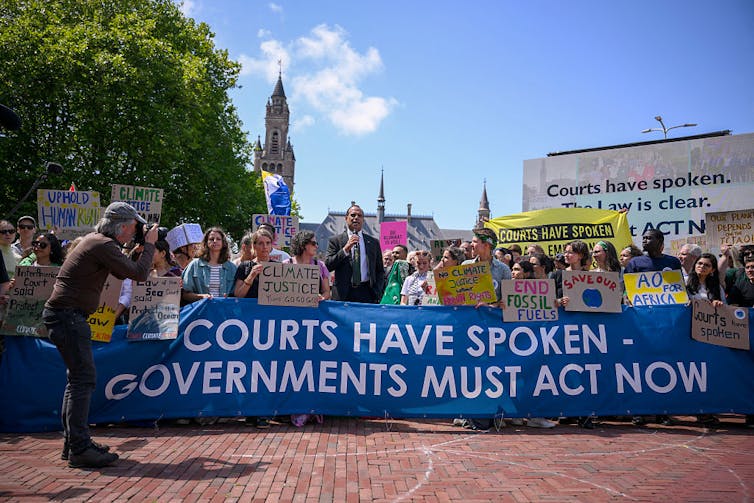
Representatives from Pacific island states gather outside the International Court of Justice. The court is preparing an advisory opinion on what countries are legally obligated to do to fight climate change. Michel Porro/Getty Images
Clearer state obligations to come
It remains unclear in international law exactly what states are obliged to do in response to climate change. But that situation should soon improve.
Hearings are underway at the International Court of Justice as part of preparations for an advisory opinion on two burning questions: what are the obligations of states under international law to protect the climate and environment from greenhouse gas emissions, and what are the legal consequences for states that have caused significant harm to the climate and environment?
Expected in late 2025, answers to these questions from the world’s highest court could be important in galvanising more effective state action on climate change. But governments shouldn’t wait for this.
The Climate Change Commission’s newly released review of New Zealand’s 2050 emissions target provides a sobering warning.
It says the country’s current 2050 target (net zero for long-lived gases and methane emissions from livestock and waste down by 24–47%) is no longer enough because the severity of climate impacts is greater and faster than expected, and other comparable countries are already doing more.
Instead, the commission recommends a “net negative” target. This would see the removal of 20 million tonnes more carbon dioxide than New Zealand produces, and more ambitious cuts to methane.
The direction of travel should be clear. New Zealand needs greater and faster action to mitigate climate change impacts. On the international front, this should be signalled by a bold and ambitious new emissions reduction pledge under the Paris Agreement, and by more climate finance for Pacific nations.
For domestic energy needs, the government should be investing in community-based renewable electricity, not considering enabling speculative exploration for more fossil fuels.
Nathan Cooper does not work for, consult, own shares in or receive funding from any company or organisation that would benefit from this article, and has disclosed no relevant affiliations beyond their academic appointment.
The shape of Australia’s school system is undergoing a significant change. Enrolments in independent schools are growing, while fewer students are going to public schools.
Why are more families choosing an independent or Catholic school, when they could send their children to a free public option?
And what does this mean for the system overall?
More families choosing private
Due to a growing population, the past two decades have seen increasing numbers of students in Australian schools overall.
But the number of students attending independent schools has grown faster than the number attending public schools, particularly in high school.
In 2006, around 13% of Australian students were enrolled in independent schools. In 2023 this proportion had increased to 16%.
Enrolments at Catholic schools have remained at just under 20%, although absolute numbers have increased from 680,000 in 2006 to 806,000 in 2023.
According to 2023 data, public schools still enrol the majority of students in primary (around 1.5 million students) and secondary (slightly more than one million students). Despite this, the proportion of students in public schools has been steadily declining. In 1996, 74% of primary students were in public schools, declining to 71% in 2006, and 69% in 2023.
Across the same time period, the proportion of students attending independent high schools jumped from 13.5% to 20%.
Why are we seeing these shifts?
There is very little current research looking at why more families are choosing private schools. But there are several clues.
One reason may be policy changes that allowed the establishment of new independent schools in Australia. In the 1990s, the Howard government changed a policy to allow funding for the establishment of new schools, even in areas that already had adequate capacity in existing schools.
New independent schools tend to charge lower fees than established elite schools, making them more accessible to middle-income families. According to Independent Schools Australia, the largest growth in enrolments is in schools charging fees of around A$5,000 per year.
In some cases, state governments have also been slow to build new schools in growing metropolitan suburbs.
New South Wales Education Minister Prue Car has spoken about this issue for her own son, who attends an independent primary school:
we were in one of the suburbs where the government didn’t build a school.
While evidence shows private schools do not necessarily mean students do better academically, there is a public perception they are better for a students’ grades. This may not be helped by frequent headlines about academic and behavioural problems in the public system.
More than one reason
It is also important to recognise school decisions can be influenced by multiple factors.
A 2016 Australian Institute of Family Studies report on primary school choice found parents consider local knowledge about schools in their area, opinions of family and friends, their own school experiences, and the interests and needs of their children.
Parents may also emphasise different things for primary and high school. For example, they might choose their local primary school for convenience, but choose a high school for its academic reputation or extracurricular offerings.
Twenty years ago, the Australian Council for Educational Research conducted a small study of 609 families asking “Why parents choose public or private schools?”.
A key finding was parents chose schools that aligned with their values. There was also a perception (right or wrong) that values differed between schools in different sectors. For example, parents with children in public schools valued the social and cultural security of the school as well as proximity to their home. Parents with children in independent schools valued discipline, religious values and school traditions.
Why is this an issue?
Compared to other countries, Australian schools have a high level of “socioeconomic segregation”. This means different types of schools tend to have students from different socioeconomic backgrounds.
The increase in students going to fee-paying private schools (even when the fees are not at the eye-watering level often publicised in the media), means we are seeing increasing segregation in our school system.
Public schools continue to educate the majority of children in regional and remote locations, those with high needs, learning disabilities and children from disadvantaged backgrounds. Independent schools enrol increasing proportions of students from the most advantaged socioeconomic backgrounds.
We still have questions
We are seeing a significant shift in the way our school system is working. But we need more research to tell us why.
This includes whether the reasons for choosing an independent, Catholic or public school for a child have changed in the last two decades.
And if we are seeing more middle and lower income families send their children to private schools.
Parents will naturally choose what they perceive to be the best school for their children. But of course not all families have a choice. This may be because there is only one school in their area, or they cannot afford the fees for a private school.
Meanwhile, these trends in enrolments raise bigger questions about how equitable our school system is, and what might be done to ensure all Australian children can access educational opportunities that allow them to succeed.
Sally Larsen does not work for, consult, own shares in or receive funding from any company or organisation that would benefit from this article, and has disclosed no relevant affiliations beyond their academic appointment.
When you wish upon a star, Jiminy Cricket told us, your dreams come true. But according to an idea doing the rounds on social media, that may not be the case:
According to astronomy, when you wish upon a star you’re a million years too late. The star is dead, just like your dreams.
Is that really true? Did Jiminy Cricket lie to us?
As an astronomer, I’m happy to say that the stars we can see in the night sky are a lot closer and live a lot longer than you would think. It’s pretty unlikely you’ve accidentally wished upon a star that’s already dead.
Stars are closer than you think
When someone hits you with the depressing factoid that the stars we wish on are already dead, they usually start by saying something about how the stars are “millions of light years away”. This means the light from the star has been travelling for millions of years to reach your eyes, so by now the star is millions of years older and – supposedly – most likely dead.
But the stars you’re wishing on probably aren’t that far away. All the stars we can see with our eyes are inside our galaxy, the Milky Way. The Milky Way is approximately 100,000 light years across, and our Solar System is about 26,000 light years from the centre of the galaxy.
So if we could see the stars at the very far edge of the galaxy, they’d still only be about 74,000 light years away. That’s nowhere near a million light years away, let alone “millions of light years”.
Visible stars are even closer
In practice, the stars we can see aren’t even that far away. On a dark night, with no Moon and with good vision (which rules me out), the faintest star we can see with our eyes has a brightness of around 6.5 magnitudes.
Brighter stars have lower magnitudes, and dimmer stars have higher ones. The brightest star in the Southern Cross has a magnitude of 0.8 while the faintest star in the Southern Cross has a magnitude of 3.6.
The visible brightness limit of 6.5 magnitudes means we can only see stars out to around 10,000 light years from Earth. So if you happen to wish on one of the more distant stars, the light has travelled 10,000 years to hit your eye.
And if we assume wishes travel at the speed of light, it’ll take another 10,000 years to reach the star. So even the most distant visible star is only 20,000 years older by the time your wish reaches it.
So the question is: do stars live longer than 20,000 years?
Stars live longer than you think
The Yale Bright Star Catalogue contains 9,096 stars that are brighter than magnitude 7, roughly the limit of what our eyes can see. Many (40%) of the stars in the catalogue are so-called giant stars, which come in three varieties: normal giants, bright giants and super giants.
The more massive the star, the shorter its life. So these giant stars are here for a good time, not a long time.
But in astronomy a “good time” is still at least a few hundred thousand years. Much longer than your wish needs to arrive at a star closer than 10,000 light years.
The rest of the visible stars are what are called main sequence (or mid-life) stars and sub-giant stars. These stick around a lot longer, up to a few billion years. So when it comes to wishes, age is just a (really big) number.
The best stars to wish upon
If you’re still feeling a bit nervous about wishing upon a dead star, there are a few safe bets.
Alpha Centauri is the closest star to Earth and the fourth brightest star in the sky. Even better, it’s actually three stars and they’re only about four light years away. They’ll definitely last longer than the eight years needed for their light to reach you and your wish to reach them.
The brightest star in the sky, Sirius, is a main sequence star only 8.6 light years away. Epsilon Eridani is approximately ten light years away. It’s similar to our Sun and a little under a billion years old. Since Sirius and Epsilon Eridani are in their mid-life, they still have millions, maybe even billions, of years left to burn.
The safest star to send your wishes to? The Sun! The Sun is only eight light minutes away and it’ll be a main-sequence star for around 5 billion years yet.
So when you wish upon a star, that star is less than 10,000 light years away and will probably live for at least hundreds of thousands of years, and maybe millions or even billions of years (just like your dreams).
Laura Nicole Driessen is a brand ambassador for the Rise & Shine Education Orbit Centre of Imagination.
At some point, Australians stopped grieving Harold Holt’s death and many started to laugh about it instead. The sudden disappearance of a prime minister at a Victorian beach in December 1967 has furnished many wisecracks and memes. Former Cronulla Sharks coach Jack Gibson famously said that waiting for the team to win was like “leaving a porch light on for Harold Holt”.
The Harold Holt Memorial Swimming Pool in Malvern, commemorated in his honour in 1969, attracts its fair share of mirth. So do the conspiracy theories, deeply unserious as they are, of “double agent” Holt’s abduction by a Chinese submarine. A few years ago, Holt’s grandson pointed out that Cheviot beach was “too shallow for such a vessel”, and the late prime minister “wasn’t a fan of Chinese cuisine” anyway.
For all its comic potential today, Harold Holt’s disappearance was no joke at the time.
Rough waters
Holt had not enjoyed 1967. The war in Vietnam – effectively his war – was increasingly divisive. Old questions about the HMAS Voyager disaster in 1964 had caused political mayhem for him in parliament. Another scandal, this one about the misuse of VIP flights, had damaged his standing and that of his government.
In the final weeks of Holt’s life, he had faced off against his deputy prime minister, Country Party leader John McEwen, over Australia’s decision not to devalue the dollar in line with Britain’s devaluation of sterling. The exchange rate affected primary and secondary producers and was politically controversial enough to almost split the Liberal-Country Party Coalition.
There were personal challenges, too. Holt’s brother Cliff died in March, and by December the prime minister was suffering with shoulder and back pains. On Saturday December 16, the front page of The Australian reported that Holt’s doctor had advised him to “swim less”.
The prime minister was a man who thrived on physical risk and loved the water, so he ignored the advice. On Sunday morning he and a few companions, including lover Marjorie Gillespie and friend Alan Stewart, went to Portsea to catch a glimpse of the world-famous sailor Alec Rose’s yacht.
They then went to Cheviot beach, where an overheating and reckless Holt insisted on swimming. As the press reported the next morning, there were “strong currents and a heavy surf”. Holt looked to be caught in a rip. He dived and never resurfaced.
Everywhere and nowhere
Stewart and Gillespie quickly raised the alarm. What followed, according to Holt’s biographer Tom Frame, was “one of the largest search operations in Australian history”. The Victorian Police, the Royal Australian Air Force and Navy Search and Rescue were all involved, providing several teams of professional divers, though the surf was too dangerous for them to work in that night. Airlines TAA and Ansett both contributed an aircraft each to the search mission.
News of the “missing VIP” quickly spread, and media outlets began breaking the story in the later afternoon. The prime minister’s wife Zara and press secretary Tony Eggleton were quickly flown from Canberra to Melbourne.
After several hours of dangerous operations, the search was suspended for the night, to be resumed at 4.54am the following morning. At dawn, there were 50 divers on hand and 340 people involved throughout the day.
Large headlines such as “PRIME MINISTER MISSING” and “MR HOLT BELIEVED DEAD” dominated the newspapers on Monday morning. Topographical pictures and maps with arrows and labels (“Mr Holt Disappeared Here”) were printed in most of the metropolitan broadsheets.
There was a constant stream of radio and television interviews with rescue personnel, and no fewer than nine press conferences at Portsea in the hours and days after the disappearance. Even Marjorie was prevailed upon to speak on camera. The journalists wanted to know whether Holt had been doing an “overarm stroke” or “the breaststroke” before he vanished.
Given the circumstances, the media were mostly well behaved. Reporters kept a respectful distance from Zara as she landed in Melbourne, and they “were fantastic” in their treatment of Eggleton, who had to repeatedly put on a brave face for the cameras despite his obvious grief.
The hunt for Holt’s body ran through to early January 1968. Nearby sharks were captured and dissected in case they had secrets to reveal. Several weeks later, another biographer notes, fisherman picked up “a thigh bone” and additional “leg bone”, but these were never identified. The live reporting on the search was grim and macabre, the lack of a body morbidly fascinating. Holt’s body was everywhere and nowhere all at once.
Saying goodbye
A blanket of respect fell where only recently there had been passionate criticism. The obituaries described the lost PM as “essentially a ‘nice bloke’”. The Courier-Mail said Holt was “the most courteous, personable, likeable and accessible Prime Minister this country has ever had”. There were tender tributes from former colleagues like Sir Robert Menzies and opponents including the new Labor leader Gough Whitlam. International tributes came thick and fast.
Holt’s memorial service, just days before Christmas, led to “the largest influx of overseas heads of state in Australian history”. There were several influential Asian leaders present. A tearful US President Lyndon Johnson flew in to mourn the loss of his “cherished friend” and commiserate with Zara before breaking off for urgent discussions about Vietnam.
Dignitaries, journalists and a handful of ticketed members of the public attended St Paul’s cathedral in Melbourne and a further 20,000 mourners lined the streets outside. Four television cameras were on hand to capture the occasion, which was broadcast live across Australia’s TV and radio networks.
For most, it was a solemn occasion. Brisbane’s Archbishop Philip Strong eulogised that Holt’s loss would be “impossible to calculate”. But according to Don Chipp, a low-ranking Liberal minister, the minds of federal politicians were elsewhere.
‘I want to be prime minister’
Australia’s Constitution offers no advice about what to do when the prime minister goes swimming and doesn’t come back. In fact, it says nothing about the job of prime minister whatsoever. Holt’s death, therefore, was followed by an unseemly power struggle.
The first problem was one for Governor-General Lord Casey: when should an acting prime minister be appointed? After two leaderless days, Casey called on McEwen as deputy prime minister to lead an interim government. McEwen accepted, promising to resign as soon as the Liberal Party chose its new leader.
The Liberal deputy leader and treasurer, Billy McMahon, was unimpressed with this. He and McEwen had been at constant loggerheads in recent times and they deeply detested one another. It only got worse from there. In a tense meeting, McEwen vetoed McMahon’s candidacy entirely. He explained to the press afterwards:
I have told Mr McMahon that neither I nor my Country Party colleagues would be prepared to serve under him as Prime Minister.
It was no empty threat, and the Liberal Party quickly moved on (though McMahon didn’t). Some Liberal operatives thought it best to keep McEwen in charge, whereas others began mobilising to elevate someone from a group of ministers who, The Bulletin thought, had been “reinforcing each other in their triviality” of late.
In the end, there were four candidates. Labour and National Service minister Leslie Bury was an early favourite. Immigration minister Billy Snedden threw his hat in the ring and was eliminated early, though he would be a future contender. Allen Fairhall, the much-liked defence minister, was thought a chance but chose not to stand. The Bulletin said his health wasn’t up to it, and he wasn’t even sure he wanted to be a politician anyway.
The two strongest contenders were the external affairs minister, the respected Paul Hasluck, and the government’s senate leader, the gregarious John Gorton. The latter had run a highly visible campaign, and the eminent journalist Alan Reid later wrote that he was different from the late Holt: Gorton “had the air of being prepared to be rough, tough and nasty if he had to be”.
On January 9, decision day for the Liberals, The Sydney Morning Herald claimed Gorton’s backers had “lost a little of their strong confidence”. He needn’t have worried. After a motion of condolence from Holt, a dignified speech from McMahon and two ballots, Gorton became prime minister.
Gorton quickly assumed the prime ministership and won a by-election to represent Holt’s electorate in the House of Representatives.
In a matter of weeks, our politics had been completely transformed. Some said it was a characteristically Australian thing to lose our prime minister in the surf. For us today, it is national folklore. At the time, it seemed an embarrassingly trivial way to let our leader go.
Joshua Black is a Postdoctoral Research Fellow at The Australia Institute, and formerly a Palace Letters Fellow at the Whitlam Institute within Western Sydney University.
Source: The Conversation (Au and NZ) – By Debra Lam, Founding Director of the Partnership for Inclusive Innovation, Enterprise Innovation Institute, Georgia Institute of Technology
Cities tackle a vast array of responsibilities – from building transit networks to running schools – and sometimes they can use a little help. That’s why local governments have long teamed up with businesses in so-called public-private partnerships. Historically, these arrangements have helped cities fund big infrastructure projects such as bridges and hospitals.
However, our analysis and research show an emerging trend with local governments engaged in private-sector collaborations – what we have come to describe as “community-centered, public-private partnerships,” or CP3s. Unlike traditional public-private partnerships, CP3s aren’t just about financial investments; they leverage relationships and trust. And they’re about more than just building infrastructure; they’re about building resilient and inclusive communities.
As the founding executive director of the Partnership for Inclusive Innovation, based out of the Georgia Institute of Technology, I’m fascinated with CP3s. And while not all CP3s are successful, when done right they offer local governments a powerful tool to navigate the complexities of modern urban life.
Together with international climate finance expert Andrea Fernández of the urban climate leadership group C40, we analyzed community-centered, public-private partnerships across the world and put together eight case studies. Together, they offer valuable insights into how cities can harness the power of CP3s.
4 keys to success
Although we looked at partnerships forged in different countries and contexts, we saw several elements emerge as critical to success over and over again.
• 1. Clear mission and vision: It’s essential to have a mission that resonates with everyone involved. Ruta N in Medellín, Colombia, for example, transformed the city into a hub of innovation, attracting 471 technology companies and creating 22,500 jobs.
This vision wasn’t static. It evolved in response to changing local dynamics, including leadership priorities and broader global trends. However, the core mission of entrepreneurship, investment and innovation remained clear and was embraced by all key stakeholders, driving the partnership forward.
• 2. Diverse and engaged partners: Successful CP3s rely on the active involvement of a wide range of partners, each bringing their unique expertise and resources to the table. In the U.K., for example, the Hull net-zero climate initiative featured a partnership that included more than 150 companies, many small and medium-size. This diversity of partners was crucial to the initiative’s success because they could leverage resources and share risks, enabling it to address complex challenges from multiple angles.
Similarly, Malaysia’s Think City engaged community-based organizations and vulnerable populations in its Penang climate adaptation program. This ensured that the partnership was inclusive and responsive to the needs of all citizens.
• 3. Robust governance structure: Effective governance is key to ensuring that CP3s operate smoothly and achieve their objectives. For example, in Melbourne, Australia, the City Professorial Chair in Urban Resilience and Innovation includes representatives from the city and a university. It has a formal communication structure where research informs policy and vice versa. It aims to harness the research to better inform and guide policymaking and in turn advance research by putting it into city practice.
In South Africa, the Gauteng City-Region Observatory bridges academia and government to drive urban development. Its governance structure, which includes a diverse board appointed by the province’s premier, ensures that the partnership remains focused and effective. It means that it goes beyond any one organization’s evolving agendas and leadership for longer-term community gains.
• 4. Commitment to innovation and growth: While we found that securing funding and in-kind support is important, demonstrating economic impact is crucial for the sustainability of CP3s.
Dublin’s Smart Docklands initiative is a prime example of this. By leveraging technology to address community needs, the partnership attracted over 3 million euros (US$3.2 billion) in investments and quadrupled the project’s funding.
The initiative not only boosted Dublin’s connectivity and tech infrastructure but also addressed public safety through solutions such as smart ring buoys. The buoys are life preservers with sensors to alert the city when its buoys are tampered with or stolen.
RTÉ reports on the smart buoys.
The case studies show that CP3s can be a globally applicable model for urban development, not merely a passing trend. By fostering collective action, sharing risks and leveraging multiple sources of funding, CP3s can be a powerful tool for cities navigating the challenges and opportunities of the 21st century.
Debra Lam does not work for, consult, own shares in or receive funding from any company or organization that would benefit from this article, and has disclosed no relevant affiliations beyond their academic appointment.
The United States is advancing the fortification of its territory closest to China with the arrival of the first Marines from Okinawa and its first interceptor missile test in Guam last week.
About 100 Marines from Japan landed on Saturday, the vanguard of about 5000 due to be relocated to Guam under a security treaty with the US.
The milestones come as the House of Representatives last week also passed the 2025 National Defence Authorisation Act — with more than US$2 billion in spending for Guam — that now goes to the Senate for approval.
Nicknamed the “tip of the spear” due to its proximity to China, Guam is considered a potential target in any conflict between the two nations. The island has no bomb shelters and the unprecedented military build-up continues to divide residents.
“The intensity of the build-up is overwhelming for citizens and public agencies trying to keep track and respond to military plans as they unfold,” said Robert Underwood, chairman of the Guam-based Pacific Centre for Island Security.
“A master plan is needed for understanding by all concerned. One must exist and we are not privy to it,” he told BenarNews.
Lays the groundwork The arrival of the first troops lays the groundwork for preparing Marine Corps Base Camp Blaz to receive thousands more.
“Relocations will take place in a phased approach, and no unit headquarters will be moving during this iteration,” a US Marine Corps press release said on Saturday.
An aerial photo shows the front gate and ongoing construction progress at Marine Corps Base Camp Blaz in Guam, pictured in March this year. Image: DVIDS/BenarNews
“Forward presence and routine engagement with allies and partners are essential to the United States’ ability to deter attempts to change the status quo by force or coercion and respond to crises in the region, to include providing humanitarian assistance and disaster relief when necessary,” the USMC said.
Japan will pay US$2.8 billion to fund some of the infrastructure projects on Naval Base Guam, Andersen Air Force Base and Camp Blaz.
A missile is fired from the Vertical Launching System at Andersen Air Force Base, Guam, as part of a ballistic missile exercise last week. Image: DVIDS/BenarNews
The Missile Defence Agency last Tuesday tested its Aegis system, firing off an interceptor from Andersen Air Force to down an unarmed, medium-range ballistic missile more than 200 nautical miles north-east of Guam.
“The event marked a pivotal step taken in the defence of Guam and provides critical support to the overall concept for the future Guam defence system,” deputy Pentagon press secretary Sabrina Singh said in a press briefing last Wednesday.
The launch was the first in a series of twice-yearly missile defence tests on Guam over the next 10 years.
16 sites planned The US Indo-Pacific Command plans to build a missile defence system with 16 sites, touted to provide 360-degree protection for Guam.
The urgency was highlighted after China conducted a rare ballistic missile test with a dummy warhead in September. Its flight path crossed near Guam, Federated States of Micronesia and Marshall Islands before falling into the ocean in the vicinity of Kiribati.
China’s short and mid-range missiles cannot reach Guam, but its intermediate-range missiles, including DF-26, nicknamed the “Guam Express,” can. Image: BenarNews
In July, US military officials had announced that the first missile defence test was set to take place in Guam “by the end of the year,” but did not provide the exact date.
Nanette Reyes-Senior, a resident of Maina village, said she was “extremely surprised” that the MDA launched the flight test “without prior notice to the public — unless there was notice that I missed.”
Underwood has called for greater transparency about the missile defence of Guam.
“The missile testing had already been announced . . . but no specific week, let alone date was announced,” Underwood said.
With more tests to be launched in the coming years, Underwood said: “The general public should be given advanced notice and especially land owners.”
No significant impact After public consultation earlier this year, the Missile Defence Agency decided the planned tests would not significantly impact humans or the natural environment.
President of the Pacific Association of Radiation Survivors Robert Celestial welcomed the US missile defense test.
“China had 23000 ballistic missiles, numerous ICBM missiles and 320 nuclear warheads. It is evident that we are preparing for war, so we should at least prepare to protect the civilian population from a nuclear attack,” he told BenarNews.
“Growing up in the 1960s we had duck-and-cover drills. I feel better prepared now than [to] suffer later.”
Guam is no stranger to war, being part of the Pacific campaign during World War II.
Taiwanese President Lai Ching-te’s visit to Guam earlier this month to strengthen ties has raised residents’ fears of the territory being further targeted in escalating tensions between Washington and Beijing.
Shelly Vargas-Calvo, a senator-elect who will assume her seat in the Guam legislature next month, said the growing tensions in the region will take Guam into the path of war.
“I applaud the successful test launch,” she said. “It is imperative to show power and capability despite having a small footprint in the region to send a message that we and our allies are not to be messed around with.”
In the upcoming federal election campaign, debate over the hypothetical costs and benefits of nuclear power will doubtless play a big role. But this conceals the real issue.
As in every election over the last 20 years, at stake will be the question of whether Australia chooses a clean energy future, or prolongs the life of coal and gas – an outcome the nuclear plan relies on.
In that sense, nuclear energy is shaping up as an election fig leaf like no other.
The 2025 election campaign is likely to feature rival energy visions of nuclear, gas, coal and renewables. Markus Distelrath/Pexels, CC BY-NC-ND
Decades until first power
Even if the Coalition’s plans go ahead, concrete will not be poured for a nuclear plant before the 2030s – three or more elections away. To see why, it’s worth examining recent international experience.
In 2006, the United Arab Emirates and other Persian Gulf states commissioned a study on the peaceful use of nuclear power. It was released in 2008 and the following year, Korean firm KHNP was selected to build four reactors.
In 2020, Czechia began the process of replacing its ageing Soviet-era reactors. This year, it reached an agreement with KNHP, though the contract is yet to be finalised. Authorities expect the reactors to begin producing power commercially in 2038.
The Czech deal indicates nuclear is hardly cheap – each reactor will cost A$12.8 billion and produce power at $225 per megawatt hour (mWH). By contrast, CSIRO has priced firmed or “backed up” renewable energy – that is, renewables combined with transmission and storage infrastructure – at between $91 and $131 per mWH.
France has long been held up as the poster child for nuclear power, because it relies on nuclear for about 70% of its power, far more than any other nation.
In 2022, President Emmanuel Macron announced a desire to go further still by building up to 14 new reactors. Construction of the first is due to start in 2027.
These examples suggest five years is a realistic minimum period from decision to construction. But Australia is highly unlikely to achieve this minimum.
Czechia and France, for example, already had well-established nuclear regulatory regimes. By contrast, Australia would need to establish and staff a nuclear power authority from scratch. Our existing organisation, ANSTO, is set up only to manage tiny research reactors.
The UAE was also starting from scratch. But the UAE is a near-absolute monarchy – so courts, environmental impact studies and public consultation did not slow the process. And plants were built by migrant workers without union representation or rights of any kind.
In Czechia and France, the reactors can be located at existing nuclear power plants. Dutton wants to build nuclear on the sites of existing coal plants to take advantage of existing transmission lines, but it’s not that simple. For instance, emergency evacuation systems are needed to deal with the small but real possibility of a catastrophic accident.
All this means a Dutton government would need at least two full terms in office before it would be in a position to commit the tens of billions of dollars necessary to fund the proposed publicly owned nuclear industry. Then comes years more of actual construction.
Nuclear plants take many years to build, even in nations with existing reactors. kaiser-v/Shutterstock
Coal and gas would fill the gap
Based on recent experience in developed countries, nuclear power is unlikely to come online before 2045, by which time our existing coal plants would be well past their expected lifespan. Many would break down. How would this energy gap be filled?
The answer is already clear. The core of Dutton’s energy policy – the part that would take effect immediately – is to keep coal plants running as long as possible, and then to switch to gas. It would also likely mean suppressing renewable energy in favour of coal and gas.
Dutton has already vowed to scrap the offshore windfarm zone planned for the Illawarra region of New South Wales, despite the fact his party passed laws paving the way for offshore wind in 2021.
Offshore wind is a missing piece of the puzzle for renewables in Australia, because winds offshore blow strongly and more consistently than on land. But the nascent sector could easily be destroyed at the stroke of a pen, using the Commonwealth’s powers over Australian waters.
Queensland’s newly elected LNP government is already showing what that might look like, spending $1.4 billion in propping up coal, while killing off plans for a major pumped-hydro facility.
Given Australia’s ageing coal-fired power stations are breaking down more often, going nuclear would mean spending billions on extending their lives while discouraging solar and wind.
This could easily produce blackouts, or the threat of blackouts in short order. Here, too, Dutton has a solution: more gas.
Only two weeks ago, Australia’s major gas producers paid for front-page stories across many Murdoch newspapers claiming gas-fired electricity would be necessary.
There is nothing new here. Under the Morrison Coalition government, a taskforce set up to deal with supply chain problems caused by the COVID pandemic produced, instead, a report advocating a gas-led recovery.
Wrong way, go back
Australia should not be distracted by nuclear power.
The Coalition plan for an Australian electricity supply, based on extended reliance on coal and gas, will rule out any chance this nation meets its commitment to reduce greenhouse gas emissions and contribute to the global climate effort.
It would also result in more expensive and less reliable electricity for Australian households and businesses.
John Quiggin is a former Member of the Climate Change Authority
In 2017, NASA discovered and later confirmed the first interstellar object to enter our Solar System.
It wasn’t aliens. But artist impressions of the object (called ‘Oumuamua, the Hawaiian word for “scout”) do resemble an alien spaceship out of a sci-fi novel. This strange depiction is because astronomers don’t quite know how to classify the interstellar visitor.
Its speed and path around the Sun don’t match a typical asteroid, but it also has no bright tail or nucleus (icy core) we normally associate with comets. However, ‘Oumuamua has erratic motions that are consistent with gas escaping from its surface. This “dark comet” has had astronomers scratching their heads ever since.
Flash forward to today, and more of these mysterious objects have been discovered, with another ten announced just last week. While their nature and origins remain elusive, astronomers recently confirmed dark comets fall into two main categories: smaller objects that reside in our inner Solar System, and larger objects (100 metres or more) that remain beyond the orbit of Jupiter.
In fact, 3200 Phaethon – the parent body of the famous Geminid meteor shower – may be one of these objects.
How do dark comets differ from normal comets?
Comets, often described as the Solar System’s “dirty snowballs”, are icy bodies made of rock, dust and ices. These relics of the early Solar System are critical to unlocking key mysteries around our planet’s formation, the origins of Earth’s water, and even the ingredients for life.
Astronomers are able to study comets as they make their close approach to our Sun. Their brilliant tails form as sunlight vaporises their icy surfaces. But not all comets put on such a dazzling display.
The newly discovered dark comets challenge our typical understanding of these celestial wanderers.
Image of comet C/2023 A3 Tsuchinshan-ATLAS taken by astronauts aboard the International Space Station. NASA
Dark comets are more elusive than their bright siblings. They lack the glowing tails and instead resemble asteroids, appearing as a faint point of light against the vast darkness of space.
However, their orbits set them apart. Like bright comets, dark comets follow elongated, elliptical paths that bring them close to the Sun before sweeping back out to the farthest reaches of the Solar System.
They go beyond Pluto, some even making it out to the Oort Cloud, a vast bubble of tiny objects at the fringe of our Solar System. Their speed and paths are what allow astronomers to determine their origins.
A comparison of dark comets and bright comets set against the Milky Way. On the left, a small, rocky, dark comet represents their typical size of one metre to a few hundred metres wide. On the right is a larger, icy, bright comet with a glowing tail, whose size ranges from 750 metres to 20 kilometres wide. The stark difference in size explains why dark comets lack the bright, visible tails of their larger, more iconic counterparts. Composition: Dr Kirsten Banks; Background image: R. Wesson/ESO; Dark comet: Nicole Smith/University of Michigan, made with Midjourney; Bright comet: Linda Davison
But what makes these comets so dark? There are three main reasons: size, spin and composition or age.
Dark comets are often small, just a few metres to a few hundred metres wide. This leaves less surface area for material to escape and form into the beautiful tails we see on typical comets. They often spin quite rapidly and disperse escaping gas and dust in all directions, making them less visible.
Lastly, their composition and age may result in weaker or no gas loss, as the materials that go into the tails of bright comets are depleted over time.
These hidden travellers may be just as important for astronomical studies, and they may even be related to their bright counterparts. Now, the challenge is to find more dark comets.
How can we find dark comets?
How do we even find these mysterious dark comets in the first place? As they get closer to the Sun, we don’t see spectacular tails of debris.
Instead, we rely on the light they reflect from our Sun.
Several astronomical images are combined to capture the faint, fast moving object ‘Oumuamua in the centre. The white streaks are stars. ESO/K. Meech et al.
These little guys might be stealthy for our eyes, but they are often no match for our large telescopes around the world. The discovery of ten new dark comets revealed last week was all thanks to one amazing instrument, the Dark Energy Camera (DECam) on a large telescope in Chile.
This camera can’t “see” dark energy directly, but it was designed to take massive photos of our universe – for us to see distant stars, galaxies and even hidden Solar System objects.
In their recent study, astronomers pieced together that some of these nightly images contained likely dark comets.
A) The Dark Energy Camera (DECam), mounted on the Victor M. Blanco four-metre telescope at the Cerro Tololo Inter-American Observatory in the Chilean Andes (Credit: Dark Energy Survey). B) Two examples of newly discovered dark comets within the DECam data, from Seligman et al. (2024).
The good news is, we are starting to focus more attention on these objects and on how to find them.
In even better news, in 2025, we’ll have a brand new mega camera in Chile ready to find them. This will be the Vera C. Rubin Observatory, with the largest digital camera ever built.
It will allow us to take more images of our night sky more quickly, and see objects that are even fainter. It’s likely that in the next ten years we could double or even triple the amount of known dark comets, and start to understand their interesting origin stories.
There could be more ‘Oumuamua-like objects out there, just waiting for us to find them.
The authors do not work for, consult, own shares in or receive funding from any company or organisation that would benefit from this article, and have disclosed no relevant affiliations beyond their academic appointment.
A person with long experience in the financial services sector, Marnie Baker, and a distinguished academic economist, Renée Fry-McKibbin, have been appointed to serve on the Reserve Bank’s new monetary policy board:
Treasurer Jim Chalmers on Monday also announced four new faces for the bank’s new governance board.
Under reforms passed just before parliament rose for the year, the bank’s new structure will have two boards rather than the existing one. The change follows an extensive inquiry into the bank, and Chalmers says the new structure will represent “international best practice”.
Baker has more than three decades’ experience in the financial services sector, focusing on retail banking and funds management. She recently served as CEO of Bendigo and Adelaide Bank and deputy chair of the Australian Banking Association.
Renée Fry-McKibbin is a distinguished professor of economics at the Australian National University’s Centre for Applied Macroeconomic Analysis, and a fellow of the Academy of Social Sciences.
She served on the panel that reviewed the RBA’s structure. Her husband, Warwick McKibbin, also a leading economist, previously served on the Reserve Bank’s board, appointed by the Howard government.
The new members of the governance board are
Jennifer Westacott, formerly CEO of the Business Council of Australia, who presently is chancellor of Western Sydney University.
David Thodey, formerly Telstra CEO and currently the chair of Xero and the chancellor of the University of Sydney.
Danny Gilbert, co-founder and chair of the corporate law firm Gilbert+Tobin. His board experience includes at NAB, the Business Council of Australia and as chair of the National Museum of Australia. He is chair of the Cape York Partnership Group.
Swati Dave, an experienced non-executive director and senior banking executive with finance experience in domestic and international markets. She was managing director and CEO of Export Finance Australia from 2017 to 2022 and is chair of the advisory board to the Centre for Australia-India Relations.
Chalmers highlighted that he was “very proud” that women had the majority on both new boards.
All members of the existing board were able, if they wished, to move to the new monetary board.
Chalmers said following consultation with board members, Carolyn Hewson, Ian Harper, Iain Ross and Alison Watkins opted to move to the monetary policy board. Carol Schwartz and Elana Rubin agreed to serve on the governance board.
“These appointments will ensure continuity on both boards, consistent with the preference of the RBA Governor,” Chalmers said.
Terms of board members have been staggered “to ensure both boards have the right balance of experience and fresh perspectives,” he said.
Chalmers stressed his wide consultations on the appointments, including with shadow treasurer Angus Taylor as far back as July, when the names of Fry-McKibbin and Baker were mentioned to him.
The opposition refused to support the legislation for the restructure of the bank, forcing the government into a deal with the Greens.
Chalmers said the appointments had all been made on advice of a three-member panel including Treasury secretary, the Reserve Bank governor and a former secretary to the Treasury and department of the Prime Minister and Cabinet, Martin Parkinson.
“An open and transparent expression of interest process was run, and candidates were shortlisted by the panel. Candidates were shortlisted against a skills matrix, to ensure there was the right mix of skills and experience on both boards.
“This is the process that was set out in the RBA Review and the government has stuck to it,” Chalmers said.
The new boards start on March 1. The first time the monetary policy board will consider interest rates will be at the meeting on March 31 to April 1.
Michelle Grattan does not work for, consult, own shares in or receive funding from any company or organisation that would benefit from this article, and has disclosed no relevant affiliations beyond their academic appointment.
A global civil society watchdog has condemned Fiji for blocking protest marches over the Palestine genocide by Israel and clamping down on a regional Pacific university demonstration with threats.
However, while the Civicus Monitor rates the state of civic space in Fiji as “obstructed” it has acknowledged the country for making some progress over human rights.
“While the government took steps in 2023 to repeal a restrictive media law and reversed travel bans on critics, the Public Order (Amendment) Act, which has been used to restrict peaceful assembly and expression and sedition provisions in the Crimes Act, remains in place,” said the Civicus Monitor in a statement on its website.
“The police have also restricted pro-Palestinian marches” — planned protests against Israel’s genocide against Gaza in which more than 44,000 people have been killed, mostly women and children.
The monitor said the Fiji government had “continued to take steps to address human rights issues in Fiji”.
In July 2024, it was reported that the Fiji Corrections Service had signed an agreement with the Fiji Human Rights and Anti-Discrimination Commission to provide them access to monitor inmates in prison facilities.
In August 2024, a task force known as Fiji’s National Mechanism for Implementation, Reporting, and Follow-up (NMIRF) was launched by the Attorney-General Graham Leung.
The establishment of the human rights task force is to coordinate Fiji’s engagement with international human rights bodies, including the UN human tights treaty bodies, the Universal Periodic Review and the Special Procedures of the Human Rights Council.
In September 2024, it was announced that a Truth and Reconciliation Commission (TRC) would be established to investigate and address human rights violations since 1987.
TRC steering committee chair and Assistant Minister for Women Sashi Kiran said that they were working on drafting a piece of legislation on this and that the commission would operate independently from the government.
“In recent months, the police once again blocked an application by civil society groups to hold a march for Palestine, while university unions were threatened with a pay dock for their involvement in a strike,” the Civicus Monitor said.
Police deny Palestine solidarity march “The authorities have continued to restrict the right to peaceful assembly, particularly around Palestine.”
On 7 October 2024, the police denied permission for a march in the capital Suva by the NGO Coalition on Human Rights in Fiji.
Fiji’s Assistant Commissioner of Police Operations Livai Driu . . . “The decision [to ban a pro-Palestine march] was made based on security reasons.” Image: FB/Radio Tarana
The Fiji Police Force ACP Operations Livai Driu was quoted as saying: “The decision was made based on security reasons.”
“The march was intended to express solidarity with the Palestinian people amidst the ongoing genocide and humanitarian crisis in Gaza. The coalition’s application to hold the march was met with repeated delays and questioning by government authorities,” said the Civicus Monitor.
“The coalition said that this was ‘reminiscent of a dictatorial system of the past’.
The coalition added: “It is shameful that the Fiji Coalition Government which has lauded itself internationally and regionally as being a promoter of human rights and peace has continued to curtail the rights of its citizens by denying permit applications calling for an end to the genocide in Gaza.”
Today, a group was given a permit to march through Suva in support of Israel + wave Israeli flag but Fijians calling for an end to #GazaGenocide for 1 year gathered @ the FWCC compound due to ongoing arbitrary restrictions on marches on #GazaGenocide & the use of Palestine flags pic.twitter.com/hOvG5y8Bwj
“The restriction around protests on Palestine and waving the Palestinian flag has persisted for over a year.
“As previously documented, the activists have had to hold their solidarity gatherings in the premises of the FWCC office as the police have restricted solidarity marches, under the Public Order (Amendment) Act 2014.
“The law allows the government to refuse permits for any public meeting or march deemed to prejudice the maintenance of peace or good order.
“It has often been misused by the authorities to restrict or block peaceful gatherings and demonstrations, restricting the right to peaceful assembly and association.
The UN Human Rights Council and human rights groups have called for the repeal of restrictive provisions in the law, including the requirement for a police permit for protests, which is inconsistent with international standards.
These restrictions on solidarity marches for Palestine are inconsistent with Fiji’s international human rights obligations under the International Covenant on Civil and Political Rights (ICCPR) which guarantees freedom of expression and peaceful assembly.
These actions also contravene Fiji’s constitution that guarantees these rights.
University threatens union members In October 2024, members of the Association of the University of the South Pacific (USP) and the University of the South Pacific Staff Union who went on strike were reportedly threatened by the university, reported the Civicus Monitor.
The human resource office said they would not be paid if they were not in office during the strike.
The unions commenced strike action on 18 October 2024 in protest against the alleged poor governance and leadership at the university by vice-chancellor Pal Ahluwalia and the termination of former staff union (AUSPS) president Dr Tamara Osborne Naikatini, calling for her to be reinstated.
“The unions expressed dissatisfaction following the recent release of the Special Council meeting outcome, which they say misleadingly framed serious grievances as mere human resource issues to be investigated rather than investigating [Professor] Ahluwalia.
“The unions say they have been raising concerns for months and called for Ahluwalia to be suspended and for a timely investigation.”
Alongside the staff members currently standing in protest were also several groups of students.
On 24 October 2024, the students led a march at the University of the South Pacific Laucala campus that ended in front of the vice-chancellor’s residence. The students claimed that Professor Ahluwalia did not consider the best interests of the students and called for his replacement.
The USP is owned by 12 Pacific nations, which contribute a total 20 percent of its annual income, and with campuses in all the member island states.
The Gulf Kingdom was the sole bidder after the Asian Football Confederation made it clear it would not support an Australian bid.
Supporters of the decision, including respected sports journalist Tracey Holmes, argue a World Cup in the kingdom offers a once-in-a-generation opportunity to foster positive change. A range of celebrities and players also congratulated the Saudi Arabian Football Association and Prime Minister Mohammed bin Salman.
Saudi Arabia will host the 2034 men’s World Cup, despite the country’s human rights record.
[There is] a near certainty the 2034 World Cup […] will be stained with pervasive rights violations.
FIFA and human rights
FIFA claims it can encourage positive human rights transformations in host nations, and since 2017 it has enshrined human rights in its guiding principles.
In 2017, FIFA’s executive committee signed onto the so-called “Ruggie Principles”, adopted by the United Nations Human Rights Council unanimously in 2011.
These principles recognise that:
states have the duty to protect human rights
businesses have the responsibility to align their activities with human rights
individuals and organisations need to have effective judicial and non-judicial remedies to human rights violations.
FIFA subsequently published its own Human Rights Policy. It makes a commitment for FIFA to “exercise its leverage, and seek to increase said leverage where necessary, in connection with adverse human rights impacts arising through its business relationships” and to “strive to go beyond its responsibility to respect human rights […] by taking measures to promote the protection of human rights.”
Of course, FIFA’s own guidelines raise the question: does evidence support the claim that hosting a World Cup promotes human rights improvements?
There is very little reason to suspect the FIFA 2034 World Cup will lead to lasting change in Saudi Arabia. Mega events rarely result in lasting human rights improvements, especially when measured against their human costs.
The reason why sports mega-events do not change societies is because FIFA’s influence is very weak compared to the power of authoritarian rulers like Mohammed bin Salman (Saudi Arabia), Tamim bin Hamad Al Thani (Qatar), and Vladimir Putin (Russia).
These leaders are adept at taking on mega-events – in sports or otherwise – and using these events’ popularity to drive their own political agendas.
The Russian 2018 World Cup bid shows how little power FIFA has to change a government’s political agenda.
Ahead of the 2022 Qatar World Cup, Qatar promised to reform its human rights record. The government made changes to improve labour relations, but hundreds if not thousands died during the construction phase.
The Qataris made very few steps to improve rights for women, religious minorities, or LGBTQIA+ people. During the event, FIFA banned rainbow captains’ armbands, previously allowed, at the request of the Qatari government, which provoked protest from players.
Human rights and the Saudi bid
In July this year, FIFA published reports on the 2034 bid and its human rights strategy in connection with the World Cup.
FIFA’s executive summary of the 2034 bid assesses the risks of a human rights issue in 2034 as medium. However, it also says there is “good potential that hosting the competition could help contribute to positive human rights impacts”.
This comes despite the possibility of labour rights violations, identity-based discrimination, violations of the rights for the disabled, and the lack of freedom of expression.
The report can offer no concrete assurances Saudi Arabia will protect religious freedom and minority rights.
What about labour rights?
The largest part of the Saudi Arabian Football Association’s report deals with labour relations. It promises to rectify the kingdom’s derisory labour rights after identifying widespread labour problems, including issues with welfare standards and forced labour.
Nevertheless, there are many reasons to doubt these promises.
The 2034 World Cup requires an astounding 11 new stadiums, transport networks, and the construction of almost 200,000 new hotel rooms.
The kingdom’s construction boom is already fuelled by approximately 13 million migrant labourers working under dire conditions. A Guardian investigation discovered high numbers of excess deaths among migrant labourers in Saudi Arabia, particularly those from Bangladesh. In 2022 alone, 1,500 Bangladeshi migrant workers died.
Why give the World Cup to authoritarian regimes?
So why does FIFA maintain that awarding hosting rights to problematic countries is a chance to drive positive change when the evidence suggests the opposite?
FIFA can only award the hosting rights to countries that bid for the World Cup. The increasingly high costs of hosting mean few countries are willing to sign onto the hosting responsibilities.
Australia was willing to host in 2034, but crucially it did not have the support of the Asian Football Confederation.
Saudi Arabia simply was willing to spend what it took to ensure their bid won. This is possibly another example of their broader effort to “sportswash” their regime’s human rights records.
For FIFA, it makes sense to award bidding rights to countries that can generate revenue through co-partnerships, sponsorships, and most importantly favourable TV contracts. In this regard, Saudi Arabia’s bid makes the most sense.
Keith Rathbone does not work for, consult, own shares in or receive funding from any company or organisation that would benefit from this article, and has disclosed no relevant affiliations beyond their academic appointment.
Opioids are central nervous system depressants, meaning they slow down brain activity and relax the muscles. They include the natural products of the opium poppy as well as synthetic (human-made) compounds derived from it.
Commonly used opioids include heroin, morphine, opium, codeine, methadone, buprenorphine, oxycodone, fentanyl and the nitazenes. They might be prescribed by a doctor for very strong pain relief or taken non-medically to induce feelings of euphoria.
A medicine called naloxone is available for Australians to take home in case of opioid overdose. Here’s how it works, when you should have it on hand and when you should use it.
What happens during opioid overdose?
All opioids depress respiration (slow or stop breathing) and overdose deaths are often the result of respiratory failure. Heart attack may also occur as following lack of oxygen.
How do you know a person has overdosed? There are three main signs of opioid overdose, the so-called “diagnostic triad”. These include:
a slow breathing rate (possibly down to four breathes a minute)
constricted or “pinpoint” pupils
being unconscious and unable to be woken up.
These and other signs, such as confusion or cold and clammy skin, can also mean potent nitazenes have been added to drugs sold as cocaine, ketamine, methamphetamine or MDMA (ecstasy) without someone’s knowledge. Synthetic nitrazenes can be up to 50 times more potent than fentanyl.
Instant death following opioid overdose is unusual and there is usually time to intervene – but a quick response is very important.
Fortunately, there is a highly effective antidote to opioid overdose.
Naloxone, known by brand names Nyxoid or Narcan, rapidly reverses the depression of the central nervous and respiratory systems caused by opioids.
It does so by attaching to the opioid receptors in the brain, and reversing or blocking the effects of the drug. It has traditionally been used in the form of pre-packaged syringes for injection into muscle but is now also available as a nasal spray, making it far more accessible and easier for bystanders to administer.
In overdose cases, an intramuscular injection or nasal spray of naloxone can be given, with repeat doses if the person does not respond or slips back into overdose.
Both are effective but the nasal spray has advantages in the community because of its ease of use and because it doesn’t carry any risk of needle-stick injury. The nasal spray is intended for use by bystanders or first responders to give to a person who has overdosed. There is no need to sniff or inhale to get the full benefit.
The Australian Drug Foundation says people who are dependent on opioids may have a strong urge to take more drugs after being revived with naloxone. They warn:
Naloxone only stays in the body for a short period of time (30–90 minutes) whereas heroin and other opioid drugs stay in the body for much longer. The effects of sustained-release opioids like OxyContin® and MS Contin® can last for over 12 hours, so naloxone will wear off long before the opioid has left the system. This means that taking more opioids after taking naloxone could cause a second overdose.
There are no dangers or side effects from using naloxone. Its sole purpose and effect is to reverse an overdose. However, naloxone can trigger sudden opioid withdrawal symptoms such as nausea, vomiting for racing heart. Naloxone works for all opioids, including the stronger ones such as fentanyl. Extra naloxone doses may be needed in cases involving the more potent forms of opioids.
Opioids might be taken with prescription, non-medically or when added to other illicit drugs. Thomas Andre Fure/Shutterstock
Should you have it on hand?
Everyone who uses opioids should have naloxone in their home. This includes people who use drugs such as heroin, as well as people prescribed opioids for pain.
Obviously, the person will not be capable of administering it to themselves. So those around them need to know where the naloxone is, and how and when to administer it. If an overdose is suspected, an ambulance should always be called even when naloxone is given, so the person is properly assessed and treated.
Opioids are dangerous substances, but overdoses can be reversed if prompt action is taken. Having naloxone around people who use opioids in whatever form can and does save lives. All people using such drugs should have naloxone available and ready to use.
Shane Darke does not work for, consult, own shares in or receive funding from any company or organisation that would benefit from this article, and has disclosed no relevant affiliations beyond their academic appointment.
The seven people hospitalised in Fiji with suspected severe alcohol poisoning are reported to be in a stable condition, says Tourism Fiji chief executive Brent Hill.
Seven people, including four Australian tourists and one American, and two other foreigners who live in Fiji, had been drinking cocktails at the 5-star Warwick Resort in the Coral Coast before they fell ill.
All have now been transferred to the larger Lautoka Hospital from Sigatoka Hospital because of the severity of their condition.
Hill told RNZ Pacific they were all now in a stable condition and there had been improvement in some symptoms.
“We don’t want to speculate on exactly the cause; we don’t know that yet,” he said.
“But what we do know is that it was limited to only seven tourists at one resort and only at one bar in that resort as well.
“Talking to the management they’re quite perplexed as to how it’s happened, and certainly there are no accusations around that something’s been put into their drink or been diluted or using a foreign substance.”
A local ‘had seizures’ A resort guest, who did not want to be named, told RNZ Pacific that his friend, a local, was having seizures on Saturday afternoon and was still too ill to get up.
The guest said he was certain the drinks had been tampered with.
“We have not received any proper communication from the Warwick team and just asked one of my friends to sign an indemnity form.”
He said that he and the group that he was with had all had one drink each at the adult pool bar.
“Everyone that I saw at the Sigatoka Hospital all drank the piña colada.
“The hospital and doctors were the saving grace . . . they were really overwhelmed, but tried their best to get everyone stable and moved out to Lautoka ICU overnight.”
Fiji’s Health Secretary Dr Jemesa Tudravu told local media two out of the seven affected individuals had been placed on life support over the weekend. However, they had since recovered and remained in critical condition.
Tudravu said all those affected were tourists, and no locals involved.
Affected locals ignored But the resort guest who spoke to RNZ Pacific claims that Tudravu has completely ignored the fact that locals were also affected.
A Fiji police spokesperson said on Monday that a 26-year-old local woman been discharged from Sigatoka Hospital.
“Others have been transferred to Lautoka Aspen Hospital and we will wait for medical authorities to clear the victims first before we can interview them,” he said.
“But police investigation is already underway.”
Fiji’s Lautoka Hospital . . . all seven people – including four Australians – involved in the suspected alcohol poisoning case were transferred there. Image: Reinal Chand/Fiji Times
Hill said the tourism industry was very conscious of the recent tainted alcohol incident in Laos, where several people died, but said it’s “a long way from that”.
“The resort has certainly given us assurance that there’s no indication around substituting substances in beverages and so on. So it’s a little bit of a mystery that a nice resort would experience something like this.”
When asked if tourists needed to be careful ordering cocktails in Fiji, Hill said people needed to be careful anywhere around the world, including at home.
‘Unfortunate experience’ “The risk is very, very small, but at the same time, we don’t want to diminish for these seven people.
“It’s obviously been a really unfortunate experience and we certainly are trying to work out what’s caused that and our investigation is continuing.”
Brent said he had never heard of anything like this happening in Fiji before.
He hoped it would not affect Fiji’s reputation as a tourist destination.
“I do understand, of course, based on recent events in Southeast Asia that people want assurance that they can be safe, and certainly from our perspective it’s a really isolated case.”
A spokesperson for Warwick Fiji told RNZ Pacific that they had “nothing to disclose”.
RNZ Pacific was told the general manager of the high-end resort would not front for an interview because the suspected poisoning was still under investigation.
This article is republished under a community partnership agreement with RNZ.
The A$140 million aid agreement between Australia and Nauru signed last week is a prime example of the geopolitical tightrope vulnerable Pacific nations are walking in the 21st century.
The deal provides Nauru with direct budgetary support, stable banking services, and policing and security resources. In return, Australia will have the right to veto any pact Nauru might make with other countries – namely China.
The veto terms are similar to the “Falepili Union” between Australia and Tuvalu signed late last year, which granted Tuvaluans access to Australian residency and climate mitigation support, in exchange for security guarantees.
And just last week, more details emerged about a defence deal between the United States and Papua New Guinea, now revealed to be worth US$864 million. In exchange for investment in military infrastructure development, training and equipment, the US gains unrestricted access to six ports and airports.
Also last week, PNG signed a ten-year, A$600 million deal to fund its own team in Australia’s NRL competition. In return, “PNG will not sign a security deal that could allow Chinese police or military forces to be based in the pacific nation”.
These arrangements are all emblematic of the geopolitical tussle playing out in the Pacific between China and the US and its allies.
This strategic competition is often framed in mainstream media and political commentary as an extension of “the great game” played by rival powers. From a traditional security perspective, Pacific nations can be depicted as seeking advantage to leverage their own development priorities.
But this assumption that Pacific governments are “diplomatic price setters”, able to play China and the US off against each other, overlooks the very real power imbalances involved.
The risk, as the authors of one recent study argued, is that the “China threat” narrative becomes the justification for “greater Western militarisation and economic dominance”. In other words, Pacific nations become diplomatic price takers.
Defence diplomacy
Pacific nations are vulnerable on several fronts: most have a low economic base and many are facing a debt crisis. At the same time, they are on the front line of climate change and rising sea levels.
The costs of recovering from more frequent extreme weather events create a vicious cycle of more debt and greater vulnerability. As was reported at this year’s United Nations COP29 summit, climate financing in the Pacific is mostly in the form of concessional loans.
At the country level, government systems often lack the capacity to manage increasing aid packages, and struggle with the diplomatic engagement and other obligations demanded by the new geopolitical conditions.
In August, Kiribati even closed its borders to diplomats until 2025 to allow the new government “breathing space” to attend to domestic affairs.
In the past, Australia championed governance and institutional support as part of its financial aid. But a lot of development assistance is now skewed towards policing and defence.
Kiribati: threatened by sea level rise, the nation closed its borders to foreign diplomats until 2025. Getty Images
Lack of good faith
At the same time, many political parties in Pacific nations operate quite informally and lack comprehensive policy manifestos. Most governments lack a parliamentary subcommittee that scrutinises foreign policy.
The upshot is that foreign policy and security arrangements can be driven by personalities rather than policy priorities, with little scrutiny. Pacific nations are also susceptible to corruption, as highlighted in Transparency International’s 2024 Annual Corruption Report.
Behind these developments, of course, lies the evolving AUKUS security pact between Australia, the US and United Kingdom, a response to growing Chinese presence and influence in the “Indo-Pacific” region.
The response from Pacific nations has been diplomatic, perhaps from a sense they cannot “rock the submarine” too much, given their ties to the big powers involved. But former Pacific Islands Forum secretary-general Meg Taylor has warned:
Pacific leaders were being sidelined in major geopolitical decisions affecting their region and they need to start raising their voices for the sake of their citizens.
Unless these partnerships are grounded in good faith and genuine sustainable development, the grassroots consequences of geopolitics-as-usual will not change.
Sione Tekiteki has provided advisory services to Pacific governments.
Now aged 95, Yayoi Kusama for many decades has been considered one of the most influential contemporary artists. She works across a wide range of art forms, including sculpture and installations, painting, graphic arts, fashion, video art, performance and writing.
Kusama’s immersive infinity rooms have mesmerised audiences around the world. The National Gallery of Victoria’s blockbuster exhibition sets out to rewrite the history books in its unveiling of her most recent infinity mirror work, My Heart is Filled to the Brim with Sparkling Light, together with nearly 200 other pieces by the artist, many never previously shown in Australia.
The earliest works in the show date from the 1930s and the most recent were made in 2024.
Kusama’s art has the rare ability to transform a personal nightmare into a vision of paradise – one that has no boundaries and defies definition through a rational intellect.
She translates her pumpkins, polka dots, river stones and flowers into a boundless universe of sensory experiences. There is no boundary between the animate and inanimate. Everything has a voice and spirit.
‘Lost in thought’
Kusama grew up on a plant nursery and flower and vegetable seed-propagating farm in rural Japan. In her autobiography, she recalls a childhood memory:
From a very young age I used to carry my sketchbook down to the seed-harvesting grounds. I would sit among the bed of violets, lost in thought.
[…]
One day I suddenly looked up to find that each and every violet had its own individual, human-like facial expression, and to my astonishment they were talking to me. The voices grew in number and volume, until the sound of them hurt my ears. I had thought that only human beings could speak, so I was surprised that the violets were using words to communicate. They were all like little human faces looking at me. I was so terrified that my legs began shaking.
Her life is punctuated with numerous hallucinations, bouts of self-doubt and depression and her desire to obliterate herself.
She reflected:
I fight pain, anxiety, and fear every day, and the only method I have found that relieved my illness is to keep creating art.
Since 1973 Kusama has lived voluntarily in a psychiatric hospital. On a daily basis, she travels to her studio to work on her art.
A profoundly moving exhibition
As with many of Kusama’s exhibitions, the show at the NGV is overwhelming. It occupies virtually the entire ground floor space of NGV International on St Kilda Road.
The immersive infinity rooms are a mind-bending experience. The recent one made in 2024, Infinity Mirrored Room – My Heart is Filled to the Brim with Sparkling Light, is mesmerising and having its international premiere here in Melbourne.
The earlier piece, The Hope of the Polka Dots Buried in Infinity Will Eternally Cover the Universe (2019), with its six-metre-high black tentacular forms covered in yellow polka dots is a highlight of the show, also premiering in Australia at this exhibition.
What are we to make of Kusama’s oeuvre as assembled in this huge and profoundly moving exhibition? What I did not expect from this exhibition was the sense of a prolonged cry of pain with the artist consciously seeking self-obliteration through her art.
Having experienced a traumatic childhood and being forced by her mother to spy on the infidelities of her father, Kusama expressed a revulsion to sex and in the 1960s and 1970s produced numerous works covered with flabby penises, including Ceremony for Suicide (1975–76).
Also having experienced hallucinations from an early age, by remaking these hallucinations in her art she could maintain her sanity. Although this strategy did not always work and she attempted suicide on a number of occasions.
Kusama has marketed herself as an extrovert character in her red wig, a little like Andy Warhol in his platinum wig.
Kusama appears in this guise in her video performance piece in this show, Song of a Manhattan suicide addict (2010).
Behind the extrovert glitter that runs throughout the exhibition, there is the sound of a suppressed scream of pain and the desire to lose identity by melting into infinity through the multiplicity of images endlessly repeated.
The Spirit of the Pumpkins Descended to the Heavens (2017) is one of her most obsessive and memorable pieces, where through a small viewing window you catch a glimpse of yourself endlessly repeated until you are completely obliterated and lost in infinity.
With about ten immersive pieces in the NGV show with their kaleidoscopic infinity rooms and with very few people permitted to enter at any one moment, queues will be long and the clatter of the selfies deafening.
Yayoi Kusama is an exhibition that everyone will want to see; those who don’t will spend a lifetime regretting it.
Yayoi Kusama is at NGV International until April 21 2025.
Sasha Grishin does not work for, consult, own shares in or receive funding from any company or organisation that would benefit from this article, and has disclosed no relevant affiliations beyond their academic appointment.
My doctoral research sought to understand this from the perspective of LGBTQ+ people of diverse cultural backgrounds in Australia. I spoke with 14 people aged 50 and above about their hopes and fears of ageing.
Together, we discussed photographs they owned or have taken to represent their thoughts.
What they shared both extended and challenged existing perceptions of ageing well.
Confronting loneliness
Being alone, lonely and vulnerable is the opposite of ageing well.
Paulo told me:
I’m staging a dreadful idea of life, losing my partner, being there by myself, growing old and lonely and powerless.
Taken at the front porch of his and his partner’s home, Paulo’s black and white photograph captures the helplessness and loneliness of ageing alone without partner and loved ones.
This fear is heightened by discrimination. Ninu* said
as a gender diverse person, I’m really worried about being treated respectfully as I age. Having my pronouns used, being mis-gendered.
Dion said:
It’d be wonderful to have an Aboriginal and Torres Strait Islander care provider who was LGBTIQ or open […] Because there’s nothing worse than [talking] about your partner and they say ‘oh, what’s her name?’ and I go ‘Steven’ [laughs].
This means not seeing LGBTQIA+, Aboriginal and Torres Strait Islander, and culturally and linguistically diverse older people as three distinct groups, but understanding people can identify as belonging to more than one of these identities.
A time of change
Ageing is a time for transformation and growth.
As mopoke* said:
a lot of the words that are now in common use […] words like genderfluid, genderqueer, nonbinary […] We didn’t have these words growing up. When I look back, I’ve always considered myself nonbinary, but I never had the word for it.
Many I spoke to built a more authentic identity in the second half of their lives.
Stephanie’s photograph and poem powerfully illustrate this:
the mother of all lost souls knits another web of threads that say again I am here
I am me
let’s dance
and no
I’ll not linger in the seventh circle of hell for the sins of those who wrote the book
I’ll burn so hot you can warm the ice that set in your veins
and together we’ll build a new world
brick by brick
In the photograph, Stephanie looks intently and directly at the camera as if to bare her soul for everyone to see or to judge. The poem highlights her struggle when transitioning, having to rebuild everything but also emerging stronger and better.
Many participants embraced their queer identities in recent years, looking forward to growth in the years ahead.
Paulo described this prospect after finally moving to Australia to be with his partner:
it’s much healthier mentally and hopefully physically. I would say there’s a much more solid perspective of growth over here from what I’m envisaging so far than in Brazil.
Among the photographs Paulo sent is one of him in his cycling gear, enjoying a sunny day. A perfectly ordinary photograph, depicting a chance to finally lead a peaceful life away from homophobia and discrimination.
Finding family
Maintaining diverse kinship and support networks are crucial. Some participants had children and maintained close ties with their biological families. Some, like Daniel in this photograph, forged new ties through lifelong partnership:
After 25 years, we’re actually celebrating together. We don’t need […] the hassle of family Christmases with all that façade and that crap or anything like that. We really want to spend it the way we want to, and that’s with each other, where we want to. That’s just us going away for Christmas, just sharing our time with each other.
Others like Masaru*, who migrated alone to Australia, found non-biological, chosen networks of support crucial:
I don’t have any immediate family here, right? Just [my] partner and I. Only us. That is why we joined [a group] to expand our LGBTQ network […] They are like our chosen family.
Queer intergenerational and multicultural community, purposefully nurtured, keeps the people I spoke to hopeful about ageing.
Participants aspired to create community living or co-living where chosen and biological family could support them as they aged and needed increased support.
Ninu spoke of imagining:
an old folks’ home that was queer and was built […] so that you had your own space looking out but also had this veranda all around that connected.
Dion imagined “one big house” where his community could live together.
These co-living aspirations differ from current residential care, which moves people into places away from kin. They are not home care, where people are supported in their own homes. Instead, they relocate communities and kinship to support ageing in place.
Ageing well
So, what does ageing well mean? Seen through the lenses of LGBTQ+ people from diverse cultural backgrounds, it is more than eating, moving, thinking and connecting well.
It is about being able to create communities and homes with diverse kin, being treated respectfully and growing on your own terms.
As John succinctly shared, talking about his photograph of a sunset:
As a metaphor, we’re getting older, in the latter part of the cycle of our lives. If you think about it, a sunset is the latter part of the day going into night. But sunsets are magnificent, absolutely magnificent, and they shouldn’t be written off otherwise you miss scenes like this. It reminds me that okay, the best is still ahead. It’s not all over.
And it is about us as a society removing barriers and creating opportunities for this to happen, for older people, LGBTQ+, multicultural or otherwise.
*Some names have been changed.
Jinwen Chen does not work for, consult, own shares in or receive funding from any company or organisation that would benefit from this article, and has disclosed no relevant affiliations beyond their academic appointment.
Men are killing themselves on the roads in large numbers. Currently, policymakers fail to recognise the different ways men and women use roads, and the resulting ways they are killed or injured.
The road toll is largely a male problem. In Australia in the 12 months to the end of October 2024, 1,295 people were killed on our roads, of whom 989 were male. Between January and September 2024, males were 81% of the drivers killed on the roads, but only 50% of the car passengers. Men were 96% of the motorcyclists and 90% of the cyclists killed on the roads.
Of the women who died in cars, only 52% were the driver (compared with 81% for men). The statistics for serious injuries on the roads are similar.
Even considering that men tend to drive more often and longer distances (and most cyclists and motorcyclists are men), these figures are startling. Here’s what contributes to this situation and how the roads can be made safer for everyone.
Different driving behaviour
The road fatality statistics do not show who was at fault in each case, but we should interpret them in conjunction with other research that shows men are more likely to speed, to drive under the influence of alcohol or drugs, and to not wear seatbelts. All these factors significantly contribute to deaths and injuries on the roads.
Women have high rates of distraction, such as texting or eating while driving, and have just as many minor injuries as men.
Men are less likely than women to wear a seatbelt while driving. Shutterstock
The difference in men’s and women’s behaviours that cause injury or death highlight the need for different driver education campaigns.
Advertising companies have long understood the link between traditional masculinity, powerful cars and dangerous driving.
On the one hand, many road safety advertisements have specifically targeted men. A memorable example is the Australian advertising campaign that cast doubt on the penis size of men who speed.
On the other hand, advertising primarily sells cars to men, depicting cars in terms of power, virility, toughness and ability to protect one’s family.
Governments fund advertising campaigns that discourage men from speeding and drink driving, yet their policies that prioritise keeping traffic moving only reinforce the dominance of cars and speed in our society.
For example, the South Australian and federal governments are putting billions of dollars into a North–South Corridor to ensure cars and trucks move freely through Adelaide’s suburbs. The New South Wales government is putting at least $20 billion into Westconnex projects in Sydney.
We shouldn’t forget the large number of Australian children killed and injured on our roads. Policymakers’ choices to prioritise car use and speed affects children’s lives, including limiting their freedom of movement.
But we also know cars are used in acts of domestic violence and coercive control.
For example, Hannah Clarke was burned to death with her children in her car by her estranged husband in 2020.
Other examples involve men deliberately running over their partners, although they are often charged with causing death by dangerous driving so the deliberate violence is under-reported.
All this is despite the fact that safety features such as seatbelts and airbags are designed for the average adult male body. Crash test dummies have traditionally been modelled on men. More research is needed with women’s bodies in mind to ensure women are equally protected when involved in an accident.
The traditional male dominance of the trucking industry and the masculine associations of large utes and four-wheel drives fuels this connection between masculinity, driving and speed (and sometimes drink driving).
State-supported car racing only entrenches these associations and encourages speeding.
And it’s not just about keeping male drivers safe from themselves. Government policy also fails to prioritise the safety of children in car parks, the safety of women on public transport, or the right to mobility of older people or people with disability.
Australian governments could look to the example of some European cities such as Vienna, which has implemented a range of “gender-sensitive” city design ideas such as improving street lighting, prioritising pedestrians at traffic lights, adding seating, widening footpaths and removing barriers to using prams.
It is time to acknowledge the associations between masculinity, power and speed are killing men and putting limits on the lives of women and children.
The author would like to acknowledge the assistance of research assistant Kate Leeson in preparing this article.
Margaret Brown does not work for, consult, own shares in or receive funding from any company or organisation that would benefit from this article, and has disclosed no relevant affiliations beyond their academic appointment.
Source: The Conversation (Au and NZ) – By Konstantine Panegyres, McKenzie Postdoctoral Fellow, researching Greco-Roman antiquity, The University of Melbourne
The Greek philosopher Plutarch of Chaeronea (1st-2nd century AD) observed that our lives are divided between relaxation and exertion.
For example, there are times when we are working and times when we are on holidays. He said rest was important:
Rest gives relish to labour.
In ancient Greece and Rome, many people also recognised that taking a holiday was an opportunity to restore the health of the body and mind.
However, not everyone was convinced holidays were healthy or even a good idea.
Take a holiday. It’ll do you good
In the ancient world, people sometimes went on holidays to try to improve their mental and physical condition. This usually meant moving from one climate to another, hoping this would help.
In one of his letters, the Roman writer and jurist Pliny the Younger (1st-2nd century AD) writes about how he tried to cure a man called Zosimus of an illness that made him spit blood.
Pliny sent him on a holiday to Egypt. Zosimus returned after a long holiday “with his health restored”.
However, Zosimus became sick again. So Pliny sent him on another holiday, this time to Gallia Narbonensis (in modern day southern France). Pliny tells us in his letter:
the air is healthy there and the milk excellent for treating this kind of [illness].
People also sought out or avoided specific places, depending on whether the places were considered healthy or not.
The physician Galen (about 129-216AD) tells us the water at Mytilene, on the Greek island of Lesbos, had qualities to treat various illnesses, including hydrops, a type of fluid build-up that leads to swelling:
This water is suitable both for those with hydrops and for the other swellings, being strongly drying. Similarly, it is also suitable for those who are obese, and particularly when someone also compels them to swim more in it quickly, and after bathing more, not to drink or eat immediately […].
Doctors also advised people to seek out or avoid specific modes of travel.
Sea voyages imperceptibly and gradually open the bodily pores, give rise to a burning effect by reason of the saltiness of the sea, and, by working a change, repair the bodily condition. We must try to arrange voyages to places where the climate is mild and the north wind prevails, conditions the opposite of those which can aggravate the disease.
Voyages on rivers, bays, and lakes are considered unsuitable, since they cause the head to become moist and cold by reason of the exhalation from the earth.
It’s easy to overdo it on holiday
Not everyone in antiquity thought holidays were healthy. Some thought holidays could be harmful, because we sometimes drank or ate too much.
For example, the physician Galen complained about how people on holidays tended to make their health worse rather than better.
In his work Hygiene, Galen observed that people who are unwell because of their difficult work routine, such as slaves, needed the opportunity to restore their health by having a holiday.
But Galen noted these people did not always use holidays to restore their health because they used holidays to eat and drink too much:
They are able to make such provision for themselves during those days on which there is some public festival, when they free themselves from the services of a slave. But due to lack of control they not only do nothing to correct those things collecting deleteriously in the body, but they also fill themselves full of these things by eating badly.
The Greek writer Athenaeus (2nd-3rd century AD) mentions how “everyone […] eagerly awaits festivals”, because on festive holidays the tables are full of drink and food. Clearly, it was easy to eat and drink too much.
Holidays waste time and are only for the lazy
In the ancient world, people sometimes complained holidays were a waste of precious time.
The philosopher Seneca (1st century BC-1st century AD) said the religious practice of taking every Sunday away from work meant people wasted “a seventh of their life”.
Similarly, the writer Claudius Aelian (2nd-3rd century AD) said holidays were simply devised as an excuse to be lazy:
Look at you men – devising endless pretexts and excuses for idling!
How do you want to spend your time?
While many of us will use our holidays to rest and recover, others will need to, or choose to, work this festive season.
The ancients would have said that holidays present new possibilities, not just for our health but for other things too. For example, Pliny the Younger sometimes used holidays to study Greek. It’s hard to disagree with that.
Konstantine Panegyres does not work for, consult, own shares in or receive funding from any company or organisation that would benefit from this article, and has disclosed no relevant affiliations beyond their academic appointment.
The Common Bronzewing is one of the birds that has increased beak size in response to climate changeRyan Barnaby.
For wildlife, climate change is a bit like the “final boss” the protagonist faces in a video game: big, hulking and inescapable.
This formidable enemy has forced wildlife to alter where and how they live. Higher temperatures exert so much stress on wildlife that over generations, they are forced to change and adapt.
We wanted to better understand how this pattern of change was playing out in Australian birds.
Our two pieces of recent research identified that, in response to warming, more than 100 species of Australian birds have developed smaller bodies and bigger beaks over time.
Shape-shifting wildlife
When we talk about shape-shifting, we’re not talking about werewolves or Ant-Man. Rather, we are referring to body size getting smaller and appendages such as beaks, tails and limbs getting bigger.
This enables animals to shed excess heat more efficiently by providing more surface area to do so – something engineers know when designing radiators, for instance.
Just as the hot water pipes in radiators help dissipate internal heat through the periphery, bird beaks are perforated with blood vessels that transfer heat from the body’s core to the beak surface, where it is then lost to the environment.
This way, for both a radiator and a beak, increasing the surface area of the structure (while minimising the distance the heat has to travel from the core) maximises the heat loss.
The link between body shape and heat loss has led to the prediction that animals will change body shape over time, in response to climatic warming.
Three years ago, Deakin University researchers published a paper showing examples of such changes occurring in a handful of diverse species all across the world.
Now, we significantly expand on this with two recently published studies focusing on Australian birds. We identified decreasing body sizes and increasing beak sizes over time, in response to climatic warming. Combined, the studies include over 100 species of birds from across Australia.
What we did and what we found
Our studies used two different data sets and methods to detect shrinking and shape-shifting.
Their monitoring includes measurements such as bill length, wing length and body mass in more than 100,000 individual birds. The data allowed us to identify increasing beak sizes and decreasing body sizes in both resident and migratory species of shorebirds in northern and southern Australia.
For example, iconic migrants like red knots and sharp-tailed sandpipers have both increased beak size over the last 50 years.
The second dataset, collected by Deakin researchers, used 3D scans of museum specimens to measure the beak surface area of specimens from the past century.
Through this approach, more than 5,000 specimens were measured for beak surface area, which was supplemented by measurements of wing length.
The results showed the same pattern of bigger beaks and smaller body sizes were identified across a vast range of birds, all the way from ducks to songbirds.
For example, the chip-stealing silver gull and dazzling common bronzewing have both increased beak size over the past century.
Australia is heating up. The shape-shifting and shrinking that we see in birds indicate ways in which they may be adapting to cope with these higher temperatures.
Short-term weather versus long-term trends
One surprising aspect, reflected in both studies, is that short-term spells of excessive heat can cause responses in bird shape that contradict the long-term trends.
While body size decreases in response to shorter-term periods of higher temperature, bill size also shrank.
Since beak sizes increase over the long-term because of climatic warming, why would they decrease in response to short-term bursts of higher temperature?
Climatic warming does not only affect the temperature birds experience, but also their environment.
In an environment with high baseline temperatures, such as Australia, periods of high temperature may mean less food. This can hamper the growth of young birds.
In this way, both body and beak size would decrease after hot temperatures due to stunted growth as food gets more scarce.
And in short-term periods of extreme temperatures, having a big beak can be a liability. Hot air from the environment will actually move into the beak, causing the bird to heat up too much, with potentially fatal consequences.
Whatever their cause, the contrasting trends between short and long-term responses to hot environments show things are complex in a changing climate.
A question of survival
It might be tempting to view shrinking and shape-shifting as proof animals are successfully adapting to climate change.
However, that would be a premature conclusion: it shows us that some species are responding, but we don’t know how these changes impact their survival prospects.
Such questions are difficult to answer but form the focus of our current research.
Importantly, while both studies show bigger beaks and smaller bodies across species overall, both also show certain species are adapting more than others.
And many are not shrinking or shape-shifting at all in response to climate change.
Is that because these species don’t need to adapt, or because they can’t?
If the former, we can breathe a small sigh of relief. If the latter, we should be very concerned.
In the aftermath of COP29, the UN Climate Change Conference in November in Azerbaijan, discussion of how climate change impacts fauna should be high on everyone’s agenda.
Sara Ryding does not work for, consult, own shares in or receive funding from any company or organisation that would benefit from this article, and has disclosed no relevant affiliations beyond their academic appointment.
Matthew Symonds receives funding from the Australian Research Council (Discovery Program).
Alexandra McQueen does not work for, consult, own shares in or receive funding from any company or organisation that would benefit from this article, and has disclosed no relevant affiliations beyond their academic appointment.
The wait is finally over. Year 12 students around Australia are receiving their Year 12 results. Victorian and Queensland students got their ATARs last week, with other states and territories finding out this week.
This is a really significant time for young people after a long and challenging year. It’s also one with lots of emotions and questions.
So after receiving your results, the next steps can feel both exhilarating and daunting.
First, take a moment
Take a moment to process your feelings – whether it’s joy, surprise, relief or disappointment.
This will help you better understand yourself and how to respond in a considered and thoughtful way.
It is important to keep things in perspective. The ATAR may seem like a “portal to your future career” but it is just a number and one that can lose its relevance very quickly.
If you go on to university or other kind of study, those results and the experience you gain (including things such as internships) will become the key things employers want to know.
If in any doubt, ask your teachers or other adults in your life how relevant their Year 12 results are to them today. Their year 12 results are likely a distant memory.
As the Universities Admission Centre notes, “many students don’t go straight into their first preference in their first year of tertiary study”.
If you think your results won’t qualify you for your chosen course, there are plenty of back ups.
Maybe this involves doing a different course of study, maybe you take a gap year, apply for a job or do some vocational training.
You can also consider alternative pathways to uni. These can include applying for special consideration from a chosen university, summer programs or a course that uses a non-ATAR admissions process (such as a portfolio).
Also remember, the ATAR system may not accurately reflect all your diverse talents. It tends to favour students who perform well in exams.
You’re in control of what you share with friends and family.
There is no obligation to share your ATAR, and it is entirely up to you who you share this information with.
Instead of asking your classmates direct questions like, “what’s your ATAR”, you may like to check in with “how are you feeling about your result?” first.
Getting your results can clarify your thinking about plans for next year and beyond.
You can re-order and add preferences through your university admissions centre account (the processes vary between states – in Victoria, the deadline to change preferences for the initial round of offers closed on Saturday).
Also check you are within individual university dates and deadlines. A word of caution before you delete preferences – some of these might have an early closing date and can’t be re-added.
University websites also have specific information for Year 12 students and offer help over the phone, online and in person.
You can also reach out to your school’s career teacher or your Year 12 coordinator.
And remember, it might feel like your ATAR is supposed to determine your entire life, but it really won’t. You are in charge of that.
Kellie Tobin does not work for, consult, own shares in or receive funding from any company or organisation that would benefit from this article, and has disclosed no relevant affiliations beyond their academic appointment.
This article is part of The Conversation’s “Retirement” series where experts examine issues including how much money we need to retire, retiring with debt, the psychological impact of retiring and the benefits of getting financial advice.
By the time they retire, women typically have about one third less superannuation than men.
This can amount to more than $500,000 when wages and super are combined over their lifetime.
The gendered super gap has narrowed over the last few decades, as women have joined the workforce in increasing numbers and the superannuation system has matured.
But progress is too slow. If we keep tracking as we are, we can’t expect parity until 2070. So why is the gap so persistent?
Making super compulsory
For most of the 20th century, Australia’s retirement incomes system produced more equal outcomes because the age pension is not linked to a person’s lifetime earnings.
But the introduction of compulsory super in 1992 linked lifetime earnings and retirement income.
The gender super gap arises because women and men have different patterns of paid work and earning over their lifetimes. Women have 14% lower average weekly earnings than men. This is due to three factors:
women are much more likely to have unpaid care responsibilities. As a result, they take career breaks, work fewer hours, or work in jobs incommensurate with their skills
discrimination, bias and lack of workplace flexibility mean better pay and career outcomes for men and fewer opportunities for people to combine work and career with care responsibilities
occupational segregation means women are concentrated in female-dominated industries, which tend to attract lower wages than male-dominated ones.
Over a lifetime, these factors limit women’s capacity to earn and to accumulate super.
Many women earn less over a lifetime as the ones most likely to fill caring roles. Stock photo/Shutterstock
On average, a woman in full-time permanent employment accumulates 17.7% less superannuation per year than a man in an equivalent role. That amounts to A$1,540 less per year. This annual shortfall compounds over time resulting in a wide gender super gap by the time women retire.
How does this work in practice?
The interruptions to work caused by providing unpaid care reduces people’s opportunities for accumulating superannuation. For example, having a child leads to substantial reductions in mothers’ workforce participation and earnings. Women’s earnings fall by an average of 55% in the first five years after entry into parenthood.
In contrast, research suggests men’s earnings are unchanged, or even increase, after they become parents. So parenthood has a much greater impact on a mothers’ super than a fathers’. One estimate suggests having a child reduces a woman’s superannuation balance at age 60 by about $50,000 and a man’s by $5,000.
It’s not just parenthood. One in 10 Australians provide care for an ageing relative or person with a disability or chronic illness. Women do most of this unpaid care. Unpaid carers often reduce their working hours, withdraw from work, or put their careers on hold. Among primary carers only 58% are in paid work.
According to a recent study, on average, by age 67, primary carers have lost $392,500 in lifetime earnings and $175,000 in super.
Some older workers, especially women, also care for their grandchildren. More than a quarter of grandparents of a child aged 13 or under provide care for the child in a typical week, usually while the parents work.
In a recent study, 70% of grandparents, mostly grandmothers, providing regular childcare reported they adjusted their work to accommodate it. One in three reported it had negative impacts on their financial security as they aged.
These factors compound over a lifetime. Many Australians provide care for multiple family members simultaneously, or at different times throughout their lives.
Women in employment are more likely to be in lower paid positions, and lower paid industries and occupations. Employees in feminised industries such as community services (including paid care workers) and retail have among the lowest median super balances, less than half of those of managers and professionals.
What is the solution?
The gender super gap reflects deep inequalities in the distribution of work, incomes and care responsibilities between women and men across their lives. How do we fix it?
Policy and public debate has focused on boosting women’s workforce participation. More women in work, means higher incomes and more saving, reducing the gender super gap, right?
More women in the workforce means higher incomes but isn’t enough to close the gender gap. Stock photo/Shutterstock
But we also know in Australia, we have a preference for some family care of young children, and for care of adults with disability and older people in the community. This means many parents and carers will continue to have at least some interruptions to paid work, reducing their super contributions.
We also know when women are encouraged to enter paid work, care responsibilities are often “redistributed” to other women. When mothers enter or re-enter paid work it’s often grandmothers who step in, frequently reducing their incomes and super. For care of ageing parents it is often non-working female siblings that step in.
As the savings potential of one group of women increases, the savings potential of another decreases.
Where care can’t be redistributed to other women within the family, it is redistributed to paid early childhood education and care, disability support, and aged care services. All of these services are dominated by women. As a highly feminised industry, the caring roles are poorly remunerated, so those doing the care, while paid, are themselves limited to save enough super.
Boosting women’s workforce participation is an important step. But another is to pay super contributions to parents during the time they are off work providing childcare, as recently agreed by the federal government.
But we need an equivalent for other kinds of unpaid carers.
Even so, as long as care continues to circulate between different groups of women – older women, low paid women – and as long as care isn’t valued for the large social and economic contribution it makes, the gender super gap will persist.
To close the persistent gender gap, we need to go further, encouraging greater men’s involvement in care, and providing better recognition and remuneration of unpaid and paid care.
Myra Hamilton receives funding from the Australian Research Council. She sits on the NSW Carers Advisory Council, partners with Carers NSW on research projects, and is on the Board of Council of the Ageing NSW.
Wednesday’s mid-year budget update will downgrade company tax receipts by $8.5 billion over the four years to 2027-28, and show “slippage’ in the bottom line in some years of the forward estimates, Treasurer Jim Chalmers says.
The company tax downgrade is the first since 2020 and reflects weaker volumes in commodity sales as the Chinese economy faces problems.
Mining exports will be downgraded by more than $100 billion over the four years to 2027-28.
Chalmers said “the global economy is uncertain, the global outlook is unsettling and that’s weighing heavily on our economy”.
The budget bottom line is also being hit with extra spending in a range of areas.
The update will include an extra $1.8 billion in payments to veterans’ “as we clear the Liberals’ claims backlog.”
Chalmers said on Sunday the update included “a number of spending pressures in areas that are very important to us, which are putting substantial pressure on the budget”.
Apart from the spending on veterans, the treasurer said there were a handful of other “very big estimates variations”, including in disaster funding, early childhood education, Medicare and some other areas.
“A combination of these things, slowing growth, a write‑down in mining exports, a write‑down in company taxes, combined with upward pressure on spending in these important areas means that there will be some slippage in some of the bottom lines over the forward estimates – even as we work very hard to get the bottom line in the current year into slightly better nick,” he said.
Chalmers also said he would announce the members of the two new Reserve Bank boards on Monday or soon after.
The opposition has accused him of wanting to stack the monetary policy board that will set interest rates.
Chalmers has offered all members of the existing Reserve Bank board a place on the monetary board and most will transition to it, although there will be room for some new members. This left a number of vacancies on the new governance board for him to also fill.
Michelle Grattan does not work for, consult, own shares in or receive funding from any company or organisation that would benefit from this article, and has disclosed no relevant affiliations beyond their academic appointment.
Fiji’s Ministry of Health has confirmed all seven foreigners who had consumed a cocktail at the Warwick Resort on the Coral Coast and became sick have now been transferred to Lautoka hospital.
The ministry said out of the seven, four were Australians, one American, and two other nationalities who are residing in Fiji.
The Ministry of Health and Medical Services said in a statement this afternoon, the seven had been taken to the Sigatoka Hospital last night with nausea, vomiting and neurological symptoms after consuming a cocktail drink prepared at a bar at the resort.
The affected patients’ age ranges from 18 to 56 years, and two patients had been transferred to Lautoka Hospital due to the severity of their condition, said the ministry.
Australia’s Department of Foreign Affairs and Trade said in a travel advisory this afternoon for Australians to be alert to the “potential risks around drink spiking and methanol poisoning through consuming alcoholic drinks”.
Police and health inspectors were reported to be investigating.
Anish Chand is managing editor digital of The Fiji Times. Republished with permission.
The remaining five members of the Bali Nine – Matthew Norman, Scott Rush, Martin Stephens, Si Yi Chen, and Michael Czugaj – arrived back in Australia from Indonesia on Sunday.
Despite earlier suggestions, and Indonesia’s preference, the men will not serve any further prison time here, because there is no legal framework to allow that. Australia does not have a prisoner swap agreement with Indonesia. The Australian government has given no quid pro quo in the negotiations for the return of the five.
Some weeks ago Special Minister of State Don Farrell said: “The proposal isn’t, as I understand it, to release these people. They would continue to serve their sentence, except they’re serving them in Australia”.
But in the end the Indonesian government was willing to accept the men’s undertaking they would continue their rehabilitation back in their home country.
The freeing of the five follows sustained representations from the Australian government including Prime Minister Anthony Albanese most recently to Indonesia’s new president Prabowo Subianto on the sidelines of APEC.
The men were sentenced to life imprisonment for their role in a heroin smuggling plot in 2005. Two of the “Bali nine” were executed, one died, and the only woman was freed some years ago.
In a statement Albanese, Foreign Minister Penny Wong and Immigration Minister Tony Burke expressed “deep appreciation” to the Indonesian government for facilitating the men’s repatriation “on humanitarian grounds”.
“This reflects the strong bilateral relationship and mutual respect between Indonesia and Australia,” they said.
The government said the men would “have the opportunity to continue their personal rehabilitation and reintegration in Australia”.
They arrived on a commercial flight and have been taken to accommodation where they will have access to medical and other services to help them begin their new lives.
Albanese said he had “conveyed my personal appreciation” to the president.
“Australia respects Indonesia’s sovereignty and legal processes and we appreciate Indonesia’s compassionate consideration of this matter.
“The five men committed serious offences.
“Australia shares Indonesia’s concern about the serious problem illicit drugs represents. The government will continue to cooperate with Indonesia to counter narcotics trafficking and transnational crime,” Albanese said.
He said these Australians had served more than 19 years and “it was time for them to come home”.
Michelle Grattan does not work for, consult, own shares in or receive funding from any company or organisation that would benefit from this article, and has disclosed no relevant affiliations beyond their academic appointment.
“Offshore operators are consolidating a significant market share of New Zealand betting — and the revenue which New Zealand’s racing industry relies on is certainly not guaranteed,” Peters told Parliament in support of the Bill.
But offshore tech companies have also been pulling the revenue rug out from under local news media companies for years, and there has been no such speedy response to that.
Digital platforms offer cheap and easy access to unlimited overseas content — and tech companies’ dominance of the digital advertising systems and the resulting revenue is intensifying.
Profits from online ads shown to New Zealanders go offshore — and very little tax is paid on the money made here by the likes of Google and Facebook.
“As the government we must ensure regulatory settings are enabling the best chance of success,” he said in a statement.
The media have been crying out for this low-hanging fruit for years — but the estimated $6 million boost is a drop in the bucket for broadcasters, and little help for other media.
The big bucks are in tech platforms paying for the local news they carry.
Squeezing the tech titans In Australia, the government did it three years ago with a bargaining code that is funnelling significant sums to news media there. It also signalled the willingness of successive governments to confront the market dominance of ‘big tech’.
When Goldsmith took over here in May he said the media industry’s problems were both urgent and acute – likewise the need to “level the playing field”.
The government then picked up the former government’s Fair Digital News Bargaining Bill, modelled on Australia’s move.
But it languishes low down on Parliament’s order paper, following threats from Google to cut news out of its platforms in New Zealand – or even cut and run from New Zealand altogether.
(The News Bargaining Incentive announced on Thursday could allow the Australian government to tax big digital platforms if they do not pay local news publishers there)
Meanwhile, news media cuts and closures here roll on.
The lid keeps sinking in 2024
The Spinoff’s Duncan Greive . . . “The members’ bucket is pretty solid. The commercial bucket was going quite well, and then we just ran into a brick wall.” Image: RNZ Mediawatch
“I’ve worked in the industry for 30 years and never seen a year like it,” RNZ’s Guyon Espiner wrote in TheListener this week, admitting to “a sense of survivor’s guilt”.
Just this month, 14 NZME local papers will close and more TVNZ news employees will be told they will lose jobs in what Espiner described as “destroy the village to save the village” strategy.
Whakaata Māori announced 27 job losses earlier this month and the end of Te Ao Māori News every weekday on TV. Its te reo channel will go online-only.
Digital start-ups with lower overheads than established news publishers and broadcasters are now struggling too.
Spinoff founder Duncan Grieve has charted the economic erosion of the media all year at The Spinoff and on its weekly podcast The Fold.
In a recent edition, he said he could not carry on “pretending things would be fine” and did not want The Spinoff to go down without giving people the chance to save it.
“We get some (revenue) direct from our audience through members, some commercial revenue and we get funding for various New Zealand on Air projects typically,” Greive told RNZ Mediawatch this week.
“The members’ bucket is pretty solid. The commercial bucket was going quite well, and then we just ran into a brick wall. There has been a real system-wide shock to commercial revenues.
“But the thing that we didn’t predict which caused us to have to publish that open letter was New Zealand on Air. We’ve been able to rely on getting one or two projects up, but we’ve missed out two rounds in a row. Maybe our projects . . . weren’t good enough, but it certainly had this immediate, near-existential challenge for us.”
Critics complained The Spinoff has had millions of dollars in public money in its first decade.
“While the state is under no obligation to fund our work, it’s hard to watch as other platforms continue to be heavily backed while your own funding stops dead,” Greive said in the open letter.
The open letter said Creative NZ funding had been halved this year, and the Public Interest Journalism Fund support for two of The Spinoff’s team of 31 was due to run out next year.
“I absolutely take on the chin the idea that we shouldn’t be reliant on that funding. Once you experience something year after year, you do build your business around that . . . for the coming year. When a hard-to-predict event like that comes along, you are in a situation where you have to scramble,” Grieve told Mediawatch.
“We shot a flare up that our audience has responded to. We’re not out of the woods yet, but we’re really pleased with the strength of support and an influx of members.”
Paddy Gower outside the Newshub studio after news of its closure. Image: RNZ/Marika Khabazi
Newshub shutdown A recent addition to The Spinoff’s board — Glen Kyne — has already felt the force of the media’s economic headwinds in 2024.
“It was heart-wrenching because we had looked at and tried everything leading into that announcement. I go back to July 2022, when we started to see money coming out of the market and the cost of living crisis starting to appear,” Kyne told Mediawatch this week.
“We started taking steps immediately and were incredibly prudent with cost management. We would get to a point where we felt reasonably confident that we had a path, but the floor beneath our feet — in terms of the commercial market — kept falling. You’re seeing this with TVNZ right now.”
Warner Brothers Discovery is a multinational player in broadcast media. Did they respond to requests for help?
“They were empathetic. But Warner Brothers Discovery had lost 60-70 percent of its share price because of the issues around global media companies as well. They were very determined that we got the company to a position of profitability as quickly as we possibly could. But ultimately the economics were such that we had to make the decision.”
Smaller but sustainable in 2025? Or managed decline?
Glen Kyne is a recent addition to the Spinoff’s board . . . “It’s slightly terrifying because the downward pressures are going to continue into next year.” Image: RNZ/Nick Monro
He is one of a handful of people who know the sums, but Stuff is certainly producing ThreeNews now with a fraction of the former budget for Newshub.
Can media outlets settle on a shape that will be sustainable, but smaller — and carry on in 2025 and beyond? Or does Kyne fear media are merely managing decline if revenue continues to slump?
“It’s slightly terrifying because the downward pressures are going to continue into next year. Three created a sustainable model for the 6pm bulletin to continue.
“Stuff is an enormous newsgathering organisation, so they were able to make it work and good luck to them. I can see that bulletin continuing to improve as the team get more experience.”
No news is really bad news If news can’t be sustained at scale in commercial media companies even on reduced budgets, what then?
Some are already pondering a “post-journalism” future in which social media takes over as the memes of sharing news and information.
How would that pan out?
“We might be about to find out,” Greive told Mediawatch.
“Journalism doesn’t have a monopoly on information, and there are all kinds of different institutions that now have channels. A lot of what is created . . . has a factual basis. Whether it’s a TikTok-er or a YouTuber, they are themselves consumers of news.
“A lot of people are replacing a habit of reading the newspaper and listening to ZB or RNZ with a new habit — consuming social media. Some of it has a news-like quality but it doesn’t have vetting of the information and membership of the Media Council . . . as a way of restraining behaviour.
“We’ve got a big question facing us as a society. Either news becomes this esoteric, elite habit that is either pay-walled or alternatively there’s public media. If we [lose] freely-accessible, mass-audience channels, then we’ll find out what democracy, the business sector, the cultural sector looks like without that.
“In communities where there isn’t a single journalist, a story can break or someone can put something out . . . and if there’s no restraint on that and no check on it, things are going to happen.
“In other countries, most notably Australia, they’ve recognised this looming problem, and there’s a quite muscular and joined-up regulator and legislator to wrestle with the challenges that represents. And we’re just not seeing that here.”
They are in Australia.
In addition to the News Bargaining Code and the just-signalled News Bargaining Incentive, the Albanese government is banning social media for under-16s. Meta has responded to pressure to combat financial scam advertising on Facebook.
To-do in 2025 “There are fairly obvious things that could be done that are being done in other jurisdictions, even if it’s as simple as having a system of fines and giving the Commerce Commission the power to sort of scrutinise large technology platforms,” Greive told Mediawatch.
“You’ve got this general sense of malaise over the country and a government that’s looking for a narrative. It’s shocking when you see Australia, where it’s arguably the biggest political story — but here we’re just doing nothing.”
Not quite. There was the holiday ad reform legislation this week.
“Allowing broadcasting Christmas Day and Easter is a drop in the ocean that’s not going to materially change the outcome for any company here,” Kyne told Mediawatch.
“The Fair Digital News Bargaining bill was conceived three years ago and the world has changed immeasurably.
“You’ve seen Australia also put some really thoughtful white papers together on media regulation that really does bring a level of equality between the global platforms and the local media and to have them regulated under common legislation — a bit like an Ofcom operates in the UK, where both publishers and platforms, together are overseen and managed accordingly.
“That’s the type of thing we’re desperate for in New Zealand. If we don’t get reform over the next couple of years you are going to see more community newspapers or radio stations or other things no longer able to operate.”
Grieve was one of the media execs who pushed for Commerce Commission approval for media to bargain collectively with Google and Meta for news payments.
Backing the Bill – or starting again? Local media executives, including Grieve, recently met behind closed doors to re-assess their strategy.
“Some major industry participants are still quite gung-ho with the legislation and think that Google is bluffing when it says that it will turn news off and break its agreements. And then you’ve got another group that think that they’re not bluffing, and that events have since overtaken [the legislation],” he said.
“The technology platforms have products that are always in motion. What they’re essentially saying — particularly to smaller countries like New Zealand — is: ‘You don’t really get to make laws. We decide what can and can’t be done’.
“And that’s quite a confronting thing for legislators. It takes quite a backbone and quite a lot of confidence to sort of stand up to that kind of pressure.”
The government just appointed a minister of rail to take charge of the current Cook Strait ferry crisis. Do we need a minister of social media or tech to take charge of policy on this part of the country’s infrastructure?
“We’ve had successive governments that want to be open to technology, and high growth businesses starting here.
“But so much of the internet is controlled by a small handful of platforms that can have an anti-competitive relationship with innovation in any kind of business that seeks to build on land that they consider theirs,” Greive said.
“A lot of what’s happened in Australia has come because the ACCC, their version of the Commerce Commission, has got a a unit which scrutinises digital platforms in much the same way that we do with telecommunications, the energy market and so on.
“Here there is just no one really paying attention. And as a result, we’re getting radically different products than they do in Australia.”
This article is republished under a community partnership agreement with RNZ.
Marwan Bishara, Al Jazeera’s senior political analyst, has condemned Israel’s extensive airstrikes on Syrian installations — reportedly 500 times in 72 hours, comparing them to historic Israeli actions justified as “security measures”.
He criticised the hypocrisy of Israel’s security pretext endorsed by Western powers.
Asked why Israel was bombing Syria and encroaching on its territory just days after the ousting of the Bashar al-Assad regime after 54 years in power, he told Al Jazeera: “Because it can get away with it.”
Al Jazeera analyst Marwan Bishara . . . Israel aims to destabilise and weaken neighbouring countries for its own security. Image: AJ screenshot APR
Bishara explained that Israel aimed to destabilise and weaken neighbouring countries for its own security.
He noted that the new Syrian administration was overwhelmed and unable to respond effectively.
Bishara highlighted that regional powers like Egypt and Saudi Arabia had condemned Israel’s actions, even though Western countries had been largely silent.
He said Israel was “taking advantage” of the chaos to “settle scores”.
“One can go back 75 years, 80 years, and look at Israel since its inception,” he said.
“What has it been? In a state of war. Continuous, consistent state of war, bombing countries, destabilising countries, carrying out genocide, war crimes, and ethnic cleansing.
“All of it for the same reason — presumably it’s security.
A “Palestine will be free” placard at today’s Auckland solidarity rally for Palestine. Image: David Robie/APR
“Under the pretext of security, Israel would carry [out] the worst kind of violations of international law, the worst kind of ethnic cleansing, worst kind of genocide.
“And that’s what we have seen it do.
“Now, certainly in this very particular instance it’s taking advantage of the fact that there is a bit of chaos, if you will, slash change, dramatic change in Syria after 50 years of more of the same in order to settle scores with a country that it has always deemed to be a dangerous enemy, and that is Syria.
“So I think the idea of decapitating, destabilising, undercutting, undermining Syria and Syria’s national security, will always be a main goal for Israel.”
“They tried to erase Palestine from the world. So the whole world became Palestine.” . . . a t-shirt at today’s Auckland solidarity rally for Palestine. Image: David Robie/APR
In an Auckland Tāmaki Makaurau solidarity rally today, protesters condemned Israel’s bombing of Syria and also called on New Zealand’s Christopher Luxon-led coalition government to take a stronger stance against Israel and to pressure major countries to impose UN sanctions against Tel Aviv.
A prominent lawyer, Labour Party activist and law school senior academic at Auckland University of Technology, Dr Myra Williamson, spoke about the breakthrough in international law last month with the International Criminal Court (ICC) arrest warrants being issued against Israeli Prime Minister Benjamin Netanyahu and former Defence Minister Yoav Gallant for alleged war crimes and crimes against humanity in Gaza.
Lawyer and law school academic Dr Myra Williamson speaking at the Auckland rally today. Video: Asia Pacific Report
“What you have to be aware of is that the ICC is being threatened — the individuals are being threatened and the court itself is being threatened, mainly by the United States,” she told the solidarity crowd in Te Komititanga Square.
“Personal threats to the judges, to the prosecutor Karim Khan.
“So you need to be vocal and you need to talk to people over the summer about how important that work is. Just to get the warrants issued was a major achievement and the next thing is to get them on trial in The Hague.”
ICC Annual Meeting — court under threat. Video: Al Jazeera
AMY GOODMAN: We begin today’s show in Syria, where tens of thousands of people gathered at the Great Mosque of Damascus for the first Friday prayers since longtime authoritarian President Bashar al-Assad was toppled by opposition fighters.
DAMASCUS RESIDENT: [translated] Hopefully this Friday is the Friday of the greatest joy, a Friday of victory for our Muslim brothers. This is a blessed Friday.
AMY GOODMAN: Syria’s new caretaker Prime Minister Mohammed al-Bashir was among those at the mosque. He’ll act as prime minister until March.
This comes as the World Food Programme is appealing to donors to help it scale up relief operations for the approximately 2.8 million displaced and food-insecure Syrians across the country. That includes more than 1.1 million people who were forcibly displaced by fighting since late November.
Israel’s Defence Minister has told his troops to prepare to spend the winter holding the demilitarized zone that separates Syria from the Israeli-occupied Golan Heights. Earlier today, Prime Minister Netanyahu toured the summit of Mount Haramun in the UN-designated buffer zone. Netanyahu said this week the Golan Heights would “forever be an inseparable part of the State of Israel”.
On Thursday, UN Secretary-General António Guterres called for an urgent deescalation of airstrikes on Syria by Israeli forces, and their withdrawal from the UN buffer zone.
In Ankara, US Secretary of State Antony Blinken met with Turkey’s Foreign Minister and the President, Recep Tayyip Erdoğan. Blinken said the US and Turkey would [work] to prevent a resurgence of the Islamic State group in Syria. Meanwhile, Erdoğan told Blinken that Turkey reserves the right to strike the US-backed Syrian Democratic Forces, led by the Kurdish People’s Protection Units (YPG), which Turkey considers “terrorist”.
For more, we go to Damascus for the first time since the fall of longtime authoritarian President Bashar al-Assad, where we’re joined by the Associated Press investigative reporter Sarah El Deeb, who is based in the Middle East, a region she has covered for two decades.
Sarah, welcome to Democracy Now! You are overlooking —
SARAH EL DEEB: Thank you.
AMY GOODMAN: — the square where tens of thousands of Syrians have gathered for the first Friday prayers since the fall of Assad. Describe the scene for us.
Report from Damascus: Searching for loved ones in prisons and morgues. Video: Democracy Now!
SARAH EL DEEB: There is a lot of firsts here. It’s the first time they gather on Friday after Bashar al-Assad fled the country. It’s the first time everyone seems to be very happy. I think that’s the dominant sentiment, especially people who are in the square. There is ecstasy, tens of thousands of people. They are still chanting, “Down with Bashar al-Assad.”
But what’s new is that it’s also visible that the sentiment is they’ve been, so far, happy with the new rulers, not outpour — there is no criticism, out — loud criticism of the new rulers yet. So, I’d say the dominant thing is that everyone is happy down there.
HAYAT AL-TURKI: [translated] I will show you the photo of my missing brother. It’s been 14 years. This is his photo. I don’t know what he looks like, if I find him. I don’t know what he looks like, because I am seeing the photos of prisoners getting out. They are like skeletons.
But this is his photo, if anyone has seen him, can know anything about him or can help us. He is one of thousands of prisoners who are missing. I am asking for everyone, not only my brother, uncle, cousin and relatives.”
AMY GOODMAN: Talk about this mad search by Syrians across the country.
SARAH EL DEEB: This is the other thing that’s been dominating our coverage and our reporting since we arrived here, the contrast between the relief, the sense of relief over the departure of Bashar al-Assad but then the sadness and the concern and the no answers for where the loved ones have gone.
Thousands — also, tens of thousands of people have marched on Sednaya [prison]. It’s the counter to this scene, where people were looking for any sign of where their relatives have been. As you know really well, so many people have reported their relatives missing, tens of thousands, since the beginning of the revolt, but also before.
I mean, I think this is a part of the feature of this government, is that there has been a lot of security crackdown. People were scared to speak, but they were — because there was a good reason for it. They were picked up at any expression of discontent or expression of opinion.
So, where we were in Sednaya two, three days ago, it feels like one big day, I have to say. When we were in Sednaya, people were also describing what — anything, from the smallest expression of opinion, a violation of a traffic light. No answers.
And they still don’t know where their loved ones are. I mean, I think we know quite a lot from research before arriving here about the notorious prison system in Syria. There’s secret prisons. There are security branches where people were being held. I think this is the first time we have an opportunity to go look at those facilities.
What was surprising and shocking to the people, and also to a lot of us journalists, was that we couldn’t find any sign of these people. And the answers are — we’re still looking for them. But what was clear is that only a handful — I mean, not a handful — hundreds of people were found.
Many of them were also found in morgues. There were apparent killings in the last hours before the regime departed. One of them was the prominent activist Mazen al-Hamada. We were at his funeral yesterday. He was found, and his family believes that — he was found killed, and his family believes his body was fresh, that he was killed only a few days earlier. So, I think the killing continued up until the last hour.
AMY GOODMAN: I was wondering if you can tell us more about —
SARAH EL DEEB: What was also — what was also —
AMY GOODMAN: — more about Mazen. I mean, I wanted to play a clip of Mazen’s nephew, Yahya al-Hussein.
YAHYA AL-HUSSEIN: [translated] In 2020, he was taken from the Netherlands to Germany through the Syrian Embassy there. And from there, they brought him to Syria with a fake passport.
He arrived at the airport at around 2:30 a.m. and called my aunt to tell her that he arrived at the airport, and asked for money. When they reached out to him the next day, they were told that air intelligence had arrested him.
AMY GOODMAN: That’s Mazen’s nephew, Yahya al-Hussein. Sarah, if you can explain? This was an activist who left Syria after he had been imprisoned and tortured — right? — more than a decade ago, but ultimately came back, apparently according to assurances that he would not be retaken. And now his body is found.
SARAH EL DEEB: I think it’s — like you were saying, it’s very hard to explain. This is someone who was very outspoken and was working on documenting the torture and the killing in the secret prisons in Syria. So he was very well aware of his role and his position vis-à-vis the government. Yet he felt — it was hard to explain what Mazen’s decision was based on, but his family believes he was lured into Syria by some false promises of security and safety.
His heart was in Syria. He left Syria, but he never — it never left him. He was working from wherever he was — he was in the Netherlands, he was in the US — I think, to expose these crimes. And I think this is — these are the words of his family: He was a witness on the crimes of the Assad government, and he was a martyr of the Assad government.
One of the people that were at the funeral yesterday was telling us Mazen was a lesson. The Assad government was teaching all detainees a lesson through Mazen to keep them silent. I think it was just a testimony to how cruel this ruling regime, ruling system has been for the past 50 years.
People would go back to his father’s rule also. But I think with the revolution, with the protests in 2011, all these crimes and all these detentions were just en masse. I think the estimates are anywhere between 150,000 and 80,000 detainees that no one can account for. That is on top of all the people that were killed in airstrikes and in opposition areas in crackdown on protest.
So, it was surprising that at the last minute — it was surprising and yet not very surprising. When I asked the family, “Why did they do that?” they would look at me and, like, “Why are you asking this question? They do that. That’s what they did.” It was just difficult to understand how even at the last minute, and even for someone that they promised security, this was — this would be the end, emaciated and tortured and killed, unfortunately.
AMY GOODMAN: Sarah, you spoke in Damascus to a US citizen, Travis Timmerman, who says he was imprisoned in Syria. This is a clip from an interview with Al Arabiya on Thursday in which he says he spent the last seven months in a prison cell in Damascus.
TRAVIS TIMMERMAN: My name is Travis.
REPORTER: Travis.
TRAVIS TIMMERMAN: Yes.
REPORTER: So, [speaking in Arabic]. Travis, Travis Timmerman.
TRAVIS TIMMERMAN: That’s right.
REPORTER: That’s right.
TRAVIS TIMMERMAN: But just Travis. Just call me Travis.
REPORTER: Call you Travis, OK. And where were you all this time?
TRAVIS TIMMERMAN: I was imprisoned in Damascus for the last seven months. … I was imprisoned in a cell by myself. And in the early morning of this Monday, or the Monday of this week, they took a hammer, and they broke my door down. … Well, the armed men just wanted to get me out of my cell. And then, really, the man who I stuck with was a Syrian man named Ely. He was also a prisoner that was just freed. And he took me by the side, by the arm, really. And he and a young woman that lives in Damascus, us three, exited the prison together.
SARAH EL DEEB: I spent quite a bit of time with Travis last night. And I think his experience was very different from what I was just describing. He was taken, he was detained for crossing illegally into Syria. And I think his description of his experience was it was OK. He was not mistreated.
He was fed well, I mean, especially when I compare it to what I heard from the Syrian prisoners in the secret prisons or in detention facilities. He would receive rice, potatoes, tomatoes. None of this was available to the Syrian detainees. He would go to the bathroom three times a day, although this was uncomfortable for him, because, of course, it was not whenever he wanted. But it was not something that other Syrian detainees would experience.
His experience also was that he heard a lot of beating. I think that’s what he described it as: beating from nearby cells. They were mostly Syrian detainees. For him, that was an implicit threat of the use of violence against him, but he did not get any — he was not beaten or tortured.
AMY GOODMAN: And, Sarah, if you could also —
SARAH EL DEEB: He also said his release was a “blessing.” Yeah.
AMY GOODMAN: If you could also talk about Austin Tice, the American freelance journalist? His family, his mother and father and brothers and sisters, seem to be repeatedly saying now that they believe he’s alive, held by the Syrian government, and they’re desperately looking for him or reaching out to people in Syria. What do you know?
SARAH EL DEEB: What we know is that people thought Travis was Tice when they first saw him. They found him in a house in a village outside of Damascus. And I think that’s what triggered — we didn’t know that Travis was in a Syrian prison, so I think that’s what everyone was going to check. They thought that this was Tice.
I think the search, the US administration, the family, they are looking and determined to look for Tice. The family believes that he was in Syrian government prison. He entered Syria in 2012. He is a journalist. But I think we have — his family seems to think that there were — he’s still in a Syrian government prison.
But I think, so far, we have not had any sign of Tice from all those released. But, mind you, the scenes of release from prisons were chaotic, from multiple prisons at the same time. And we’re still, day by day, finding out about new releases and people who were set free on that Sunday morning.
U.N. Calls on Israel to Stop Bombing Syria and Occupying Demilitarized Zone https://t.co/iHNIkKKOrs
I want to turn to Gaza. Tell us about the Palestinians searching for their family members who went missing during raids and arrests by Israeli soldiers in the Gaza Strip. And talk about the lack of accountability for these appearances. You begin your piece with Reem Ajour’s quest to find her missing husband and daughter.
SARAH EL DEEB: I talked to Reem Ajour for a long time. I mean, I think, like you said, this was a pivot, but the themes have been common across the Middle East, sadly. Reem Ajour last saw her family in March of 2024. Both her husband and her 5-year-old daughter were injured after an Israeli raid on their house during the chaotic scenes of the Israeli raids on the Shifa Hospital.
They lived in the neighborhood. So, it was chaotic. They [Israeli military] entered their home, and they were shooting in the air, or they were shooting — they were shooting, and the family ended up wounded.
But what was striking was that the Israeli soldiers made the mother leave the kid wounded in her house and forced her to leave to the south. I think this is not only Reem Ajour’s case. I think this is something we’ve seen quite a bit in Gaza. But the fact that this was a 5-year-old and the mom couldn’t take her with her was quite moving.
And I think what her case kind of symbolises is that during these raids and during these detentions at checkpoints, families are separated, and we don’t have any way of knowing how the Israeli military is actually documenting these detentions, these raids.
Where do they — how do they account for people who they detain and then they release briefly? The homes that they enter, can we find out what happened in these homes? We have no idea of holding — I think the Israeli court has also tried to get some information from the military, but so far very few cases have been resolved.
And we’re talking about not only 500 or 600 people; we’re talking about tens of thousands who have been separated, their homes raided, during what is now 15 months of war in Gaza.
AMY GOODMAN: Sarah El Deeb, we want to thank you for being with us, Associated Press investigative reporter based in the Middle East for two decades, now reporting from Damascus.
Next up, today is the 75th day of a hunger strike by Laila Soueif. She’s the mother of prominent British Egyptian political prisoner Alaa Abd El-Fattah. She’s calling on British officials to pressure Egypt for the release of her son. We’ll speak to the Cairo University mathematics professor in London, where she’s been standing outside the Foreign Office. Back in 20 seconds.
The global media freedom watchdog Reporters Without Borders (RSF) has revealed an “alarming intensification of attacks on journalists” in its 2024 annual roundup — especially in conflict zones such as Gaza.
Gaza stands out as the “most dangerous” region in the world, with the highest number of journalists murdered in connection with their work in the past five years.
Since October 2023, the Israeli military have killed more than 145 journalists, including at least 35 whose deaths were linked to their journalism, reports RSF.
Also 550 journalists are currently imprisoned worldwide, a 7 percent increase from last year.
“This violence — often perpetrated by governments and armed groups with total impunity — needs an immediate response,” says the report.
“RSF calls for urgent action to protect journalists and journalism.”
Asia second most dangerous Asia is the second most dangerous region for journalists due to the large number of journalists killed in Pakistan (seven) and the protests that rocked Bangladesh (five), says the report.
“Journalists do not die, they are killed; they are not in prison, regimes lock them up; they do not disappear, they are kidnapped,” said RSF director-general Thibaut Bruttin.
“These crimes — often orchestrated by governments and armed groups with total impunity — violate international law and too often go unpunished.
“We need to get things moving, to remind ourselves as citizens that journalists are dying for us, to keep us informed. We must continue to count, name, condemn, investigate, and ensure that justice is served.
“Fatalism should never win. Protecting those who inform us is protecting the truth.
A third of the journalists killed in 2024 were slain by the Israeli armed forces.
A record 54 journalists were killed, including 31 in conflict zones.
In 2024, the Gaza Strip accounted for nearly 30 percent of journalists killed on the job, according to RSF’s latest information. They were killed by the Israeli army.
More than 145 journalists have been killed in Palestine since October 2023, including at least 35 targeted in the line of duty.
RSF continues to investigate these deaths to identify and condemn the deliberate targeting of media workers, and has filed four complaints with the International Criminal Court (ICC) for war crimes committed against journalists.
RSF condemns Israeli media ‘stranglehold’ Last month, in a separate report while Israel’s war against Gaza, Lebanon and Syria rages on, RSF said Israel’s Communications Minister Shlomo Karhi was trying to “reshape” Israel’s media landscape.
Between a law banning foreign media outlets that were “deemed dangerous”, a bill that would give the government a stranglehold on public television budgets, and the addition of a private pro-Netanyahu channel on terrestrial television exempt from licensing fees, the ultra-conservative minister is augmenting pro-government coverage of the news.
RSF said it was “alarmed by these unprecedented attacks” against media independence and pluralism — two pillars of democracy — and called on the government to abandon these “reforms”.
On November 24, two new proposals for measures targeting media critical of the authorities and the war in Gaza and Lebanon were approved by Netanyahu’s government.
The Ministerial Committee for Legislation validated a proposed law providing for the privatisation of the public broadcaster Kan.
On the same day, the Council of Ministers unanimously accepted a draft resolution by Communications Minister Shlomo Kahri from November 2023 seeking to cut public aid and revenue from the Government Advertising Agency to the independent and critical liberal newspaper Haaretz.
‘Al Jazeera’ ban tightened The so-called “Al-Jazeera law”, as it has been dubbed by the Israeli press, has been tightened.
This exceptional measure was adopted in April 2024 for a four-month period and renewed in July.
On November 20, Israeli MPs voted to extend the law’s duration to six months, and increased the law’s main provision — a broadcasting ban on any foreign media outlet deemed detrimental to national security by the security services — from 45 days to 60.
“The free press in a country that describes itself as ‘the only democracy in the Middle East’ will be undermined,” said RSF’s editorial director Anne Bocandé.
RSF called on Israel’s political authorities, starting with Minister Shlomo Karhi and Prime Minister Benyamin Netanyahu, to “act responsibly” and abandon these proposed reforms.
Inside Israel, journalists critical of the government and the war have been facing pressure and intimidation for more than a year.