Page 215

The 60+ UN member states complicit with the Gaza genocide – why their role will haunt them

UN Special Rapporteur on Palestine Francesca Albanese talks to journalist Chris Hedges about her new report that examines how 60+ countries are complicit in Israel’s war crimes and crimes against humanity demonstrated to the world in a “livestreamed atrocity”.

INTERVIEW: The Chris Hedges Report

After two years of genocide, it is no longer possible to hide complicity in Israel’s crimes against the Palestinians. Entire countries and corporations are — according to multiple reports by UN Special Rapporteur on Palestine Francesca Albanese — either directly or indirectly involved in Israel’s economic proliferation.

In her latest report, Gaza Genocide: a collective crime, Albanese details the role 63 nations played in supporting Israel’s genocide of the Palestinians. She chronicles how countries like the United States, which directly funds and arms Israel, are a part of a vast global economic web.

This network includes dozens of other countries that contribute with seemingly minor components, such as warplane wheels.

Rejection of this system is imperative, Albanese says. These same technologies used to destroy the lives of Palestinians will inevitably be turned against the citizens of Israel’s funders.

“Palestine today is a metaphor of our life and where our life is going to go,” Albanese warns.

“Every worker today should draw a lesson from what’s happening to the Palestinians, because the large injustice system is connected and makes all of us connected to what’s happening there.”

The transcript:
Francesca Albanese, the United Nations special rapporteur on Palestine, in her latest report, Gaza Genocide: a collective crime, calls out the role 63 nations have in sustaining the Israeli genocide. Albanese, who because of sanctions imposed on her by the Trump administration, had to address the UN General Assembly from the Desmond and Leah Tutu Legacy Foundation in Cape Town, South Africa, slams what she calls “decades of moral and political failure.”

“Through unlawful actions and deliberate omissions, too many states have harmed, founded and shielded Israel’s militarized apartheid, allowing its settler colonial enterprise to metastasize into genocide, the ultimate crime against the indigenous people of Palestine,” she told the UN.

The genocide, she notes, has diplomatic protection in international “fora meant to preserve peace,” military ties ranging from weapons sales to joint trainings that “fed the genocidal machinery,” the unchallenged weaponization of aid, and trade with entities like the European Union, which had sanctioned Russia over Ukraine yet continued doing business with Israel.

The 24-page report details how the “live-streamed atrocity” is facilitated by third states. She excoriates the United States for providing “diplomatic cover” for Israel, using its veto power at the UN Security Council seven times and controlling ceasefire negotiations. Other Western nations, the report noted, collaborate with abstentions, delays and watered-down draft resolutions, providing Israel with weapons, “even as the evidence of genocide … mounted.”

The report chastised the US Congress for passing a $26.4 billion arms package for Israel, although Israel was at the time threatening to invade Rafah in defiance of the Biden administration’s demand that Rafah be spared.

The report also condemns Germany, the second-largest arms exporter to Israel during the genocide, for weapons shipments that include everything from “frigates to torpedoes,” as well as the United Kingdom, which has allegedly flown more than 600 surveillance missions over Gaza since war broke out in October 2023.

At the same time, Arab states have not severed ties with Israel. Egypt, for example, maintained “significant security and economic relations with Israel, including energy cooperation and the closing of the Rafah crossing” during the war.


Francesca Albanese talks to Chris Hedges                      Video: The Chris Hedges Report

The Gaza genocide, the report states, “exposed an unprecedented chasm between peoples and their governments, betraying the trust on which global peace and security rest.” Her report coincides with the ceasefire that isn’t. More than 300 Palestinians in Gaza have been killed by Israel since the ceasefire was announced two weeks ago.

The first major ceasefire breach on October 19 led to Israeli air strikes that killed 100 Palestinians and wounded 150 others. Palestinians in Gaza continue to endure daily bombings that obliterate buildings and homes. Shelling and gunfire continue to kill and wound civilians, while drones continue to hover overhead broadcasting ominous threats.

Essential food items, humanitarian aid and medical supplies remain scarce because of the ongoing Israeli siege. And the Israeli army controls more than half of the Gaza Strip, shooting anyone, including families, who come too close to its invisible border known as the “yellow line”.

Joining me to discuss her report, the ongoing genocide in Gaza and the complicity of numerous states in sustaining the genocide in Francesca Albanese, the United Nations special rapporteur on Palestine.

Before we get into the report, let’s talk a little bit about what’s happening in Gaza. It’s just a complete disconnect between what is described by the international community, i.e. “a ceasefire”, the pace may have slowed down, but nothing’s changed.

FRANCESCA ALBANESE: Yes, thank you for having me, Chris. I do agree that it seems that there is a complete disconnect between reality and political discourse. Because after the ceasefire, the attention has been forced to shift from Gaza elsewhere.

I do believe, for example, that the increased attention to the catastrophic situation in Sudan, which has been such for years now, all of a sudden is due to the fact that there is a need for, especially from Western countries and the US, Israel and their acolytes to focus on a new emergency.

‘There is the pretence that there is peace, there is no need to protest anymore because finally, there is peace. There is no peace.’

There is the pretence that there is peace, there is no need to protest anymore because finally, there is peace. There is no peace. I mean, the Palestinians have not seen a day of peace because Israel has continued to fire, to use violence against the Palestinians in Gaza. Over 230 Palestinians have been killed since the ceasefire, 100 of them in one day in 24 hours, including 50 children.

And starvation continues. Yes, there has been an increase in the number of trucks, but far, far below what is needed with much confusion because it’s very hard to deliver aid. All the more, Israel maintains a control over 50 percent of the Gaza Strip while the entire Gaza population is amassed in small portions, guarded portions of the territory.

So there is no peace. Meanwhile, while the Security Council seems to be ready to approve a Security Council resolution that will create a non-acronistic form of tutelage, of trusteeship over Palestine, over Gaza, the West Bank is abandoned to the violence and the ethnic cleansing pushed by armed settlers and soldiers while Israel jails continue to fill up with bodies to torture of adults and children alike. This is the reality in the occupied Palestinian territory today and so it makes absolutely no sense where the political discourse is.

CHRIS HEDGES: Two issues about Gaza. One, of course, Israel has seized over 50% or occupies over 50 percent of Gaza. And as I understand it, they’re not allowing any reconstruction supplies, including cement, in.

FRANCESCA ALBANESE: This is also my understanding. They have allowed in food, water and some essential materials needed for hospitals, mainly camp hospitals, tents. But anything related to sustainability is prohibited.

There are many food items that are also prohibited because they are considered luxurious. And the question, Chris, is, and this is why I harbor so much frustration these days toward member states because in the case of genocide, you have heard yourself the argument, well, the recalcitrance of certain states to use the genocide framework saying — and it’s pure nonsense from a legal point of view — but saying, well, the International Court of Justice has not concluded that it’s genocide.

Well, it has concluded already that there is a risk of genocide two years ago, in January, 2024. But however, even when the court does conclude on something relevant like in July, 2024, that the occupation is illegal and must be dismantled totally and unconditionally, this should be the starting point of any peace related or forward-looking discussions.

Instead of deliberating how to force Israel to withdraw from the occupied Palestinian territory, member states continue to maintain dialogue with Israel as Israel has sovereignty over the territory. See, so it’s completely dystopic, the future they are leading Palestinians out of despair into.

But they are also forcing the popular movement, the global movement that has formed made of young people and workers to stop. Because look at what’s happening in France, in Italy, in Germany, in the UK — any kind of attempt at maintaining the light turned on Palestine from Gaza to the West Bank is assaulted. Protests, conferences, there is a very active assault on anything that concerns Palestine.

So this is why I’m saying we are far, far beyond the mismanagement of the lack of understanding, I mean the negligence in approaching the question of Palestine, it’s active complicity to sustain Israel in the ethnic cleansing of Palestine.

CHRIS HEDGES: Which, as you point out in your report, has been true from the beginning despite a slight change in rhetoric recognising the two-state solution. The UK did this while only cutting back on shipments by 10 percent.

But I want to ask before we get into the report, what do you think Israel’s goal is? Is it just to slow-walk the genocide until it can resume it? Is it to create this appalling, uninhabitable, unlivable ghetto? What do you think Israel’s goal is?

FRANCESCA ALBANESE: I think that now more than ever it is impossible to separate and distinguish the goals of Israel from the goals of the United States. We tend to have a fragmented view of what happens, analysing for example the relationship between Lebanon and Israel, between Iran and Israel, or between Israel and the Palestinians.

‘One of the things that Palestine has made me realise is the meaning of “Greater Israel” because I do believe that what the current leadership in Israel has in mind and it’s supported by many willing or not in the Israeli society, many who are fine with the erasure of the Palestinians.’

In fact, do, I mean, one of the things that Palestine has made me realise is the meaning of “Greater Israel” because I do believe that what the current leadership in Israel has in mind and it’s supported by many willing or not in the Israeli society, many who are fine with the erasure of the Palestinians.

But there is this idea of Greater Israel and for a long time I have been among those who thought, who were wondering what it is, this “Greater Israel” because of course you look at the map by Israeli leaders in several occasions with this Greater Israel going from the Nile to the Euphrates and you say come on they cannot do that, they cannot occupy Egypt, Lebanon, Iraq.

But then everything changes when you look at it from a non-territorial border expansion perspective. And if you think that in fact domination can be exerted, established, other than by expanding the physical borders and through military occupation, but through domination and financial control, control from outside, power domination, you see that the Greater Israel project has already started and it’s very advanced.

Look at the annihilation of Iraq, Libya, Syria, Lebanon. So all those who were historically considered not friends of Israel have been annihilated. And the other Arab countries that remain either do not have the capacity to confront Israel and perish the thought they explored the idea of unity among them or with others. And the others are fine with it.

Ultimately, I think that Greater Israel is the quintessential explanation of the US imperialistic design in that part of the world for which the Palestinians remain a thorn in the side not just for Israel but for the imperialistic project itself because the Palestinians are still there resisting.

They don’t want to go, they don’t want to be tamed, they don’t want to be dominated so they are the last line, the last frontier of resistance, both physically and in the imagination. And therefore, you see, the fierceness against them has scaled up, with the US now getting ready with boots on the ground to get rid of them. This is my interpretation of the general design behind Israel-United States, where Israelis are going to pay a heavy price like many in the region, not just the Palestinians.

CHRIS HEDGES: So you see the imposition of American troops in Gaza as another step forward to the depopulation of Gaza.

FRANCESCA ALBANESE: Yes, yes, yes, I don’t trust any promise made to the Palestinians either by Israel or by the United States because what I’ve seen over the past two years shows me, demonstrates to all of us in fact, that they don’t care at all about the Palestinians. Otherwise, they would have seen their suffering.

‘The beginning of genocide has changed my perception of the world in a way, for me personally, it’s the end of an era of innocence when I really believed that the United Nations were a place where things could still be advanced in the pursuit of peace.’

It’s just not like people like us who can really divide their life. Is it pre-genocide? Does it happen to you as well? Are you talking of pre-genocide or after genocide? Because in fact, the beginning of genocide has changed my perception of the world in a way, for me personally, it’s the end of an era of innocence when I really believed that the United Nations were a place where things could still be advanced in the pursuit of peace.

Now I don’t think so, which doesn’t mean that I think that the UN is over, but in order not to be over, in order to make sense to the people, it is to be led by dignity, principles like dignity, equality and freedom for all. And we are absolutely far from that today.

CHRIS HEDGES: And what is it that brought you to this decision? Is it the acceptance of this faux ceasefire on the part of the UN, or was it before this moment?

FRANCESCA ALBANESE: No, it’s before. It’s before. It’s the fact that for two years most states, primarily in the West, but with the acquiescence of other states in the region have supported the Israeli mantra of “self-defence”.

Sorry, it was a mantra because again, self-defence has a very, I’m not saying that Israel had no right to protect itself. Of course Israel had suffered a ferocious attack on October 7. Some say similar to the attacks it had inflicted on the Palestinians. Others say more brutal, say less brutal. It doesn’t matter.

Israel suffered a horrible, violent attack. Israeli civilians suffered a horrible attack on October 7th. But hey, this didn’t give the possibility to Israel to invoke Article 51 of the UN Charter, meaning the right to wage a war.

This is not legal. And on this I can say I’m surprised by how conservative are member states when it comes to the interpretation of international law, except on this, in the sense that the International Court of Justice (ICJ) has already set the limits of the right of invoking self-defence for member states.

And it can only be done against states where there is a concrete threat that the state will attack which is not the case here. So yes, Israel could defend itself, but not wage a war. And while the war was clearly identifiable more for its crimes than not its tendency to avoid crimes, member states have continued to say nothing and it was very extreme violence against the Palestinians in Gaza but also against the Palestinians in the West Bank. And for two years they’ve not used their power to stop it.

So I’m convinced that in order to have a political shift vis-à-vis Israel, there must be a political shift at the country level, because governments are completely subdued to the dictates of the US. Of course, if the US wanted, this would stop, but the US with this constellation of figures in the government is not going to stop.

And plus look at how the West in particular has contributed to dehumanise the Palestinians. Even today you hear people saying yes, Palestinians have been killed in these numbers because they’ve been used as human shields when the only evidence that they’ve been used as human shields is against Israel because Israel has used Palestinians as human shields in the West Bank and in Gaza alike.

You see Palestinians have returned to be wrapped into this colonial tropism of them being the savages, the barbarians, in a way, they have brought havoc upon themselves. This is the narrative that the West has used toward the Palestinians. And by doing that, it has created, they have created the fertile ground for Israel’s impunity.

CHRIS HEDGES: Let’s talk about the nations that you single out in your report that have continued to sustain the genocide, either through weapons shipments, but also the commercial interests. I think your previous report talked about the money that was being made off of the genocide. Just lay out the extent of that collaboration and to the extent that you can, the sums of money involved.

FRANCESCA ALBANESE: Yeah, yeah, let me start with introducing generally two components, the military component and the trade and investment ones, which are quite interrelated. And states have, in general, I name 62 states, primarily Western states, but with substantive collaboration of states from the Global South, global majority, including some Arab states.

So they have altogether ignored, obscured and somewhat even profited from Israel’s violations of international law through military and economic channels. So military cooperation through arms trades or intelligence sharing has fueled Israel’s war machine during the occupation, the illegal occupation, and especially during the genocide while the United States and Germany alone have provided about 90 percent of Israel’s arms export.

At least 26 states have supplied or facilitated the transfer of arms or components, while many others have continued to buy weapons tested on the Palestinians. And this is why in my previous report, the ones looking at the private sector, I was shocked to see how much the Israeli stock exchange had gone up during the genocide.

And this is particularly because of a growth in the military industry. On the other hand, there is the trade and investment sector. Both have sustained and profited from Israel’s economy. Think that between 2023, 2024, actually the end of 2022 and 2024, exports of electronics, pharmaceuticals, energy minerals and what is called the dual-use have totaled almost US$500 billion, helping Israel finance its military occupation.

Now one third of this trade is with the European Union while the rest is complemented by North American countries, the US and Canada, who have free trade agreements with Israel and several Arab states that have continued to deepen economic ties.

Only a few states have marginally reduced trade during the genocide, but in general the indirect commercial flows, including with states that have supposedly no diplomatic relations with Israel, have continued undisturbed.

It’s a very grim picture of the reality. But let me add just one extra element. I do believe that in many respects, the problem is ideological. As I said, there is a tendency to treat Ukraine, for example, vis-a-vis Russia, in a very different fashion than Palestine versus Israel. And this is why I think there is an element of Orientalism that accompanies also the tragedy of the Palestinian people.

CHRIS HEDGES: Talk a little bit about the kinds of weapons that have been shipped to Israel. These are, and we should be clear that, of course, the Palestinians do not have a conventional army, don’t have a navy, they don’t have an air force, they don’t have mechanized units, including tanks, they don’t have artillery, and yet the weapons shipments that are coming in are some of the most sophisticated armaments that are used in a conventional war.

And as a leaked Israeli report, I think it was +972, provided, 83 percent of the people killed in Gaza are civilians.

FRANCISCA ALBANESE: Yes, yes. First of all, there are two things that are weapons, what is considered conventional weapons and dual-use. And both should have been suspended according to the decision of the International Court of Justice concerning Israel in the Nicaragua v. Germany case.

Meanwhile, there are two things: there is the transfer of weapons directly to Israel, and this includes aircraft, materials to compose the drones, because Israel doesn’t produce anything on its own, it requires components — artillery shells, for example, cannon ammunition, rifles, anti-tank missiles, bombs.

So these are all things that have been provided primarily by the United States. Germany, which is the second largest arms exporter to Israel has supplied a range of weapons from frigates to torpedoes.

And also, and then there is Italy, which has also provided spare parts for bombs and airplanes and the United Kingdom, who has played a key role in providing intelligence. And there is also the question of the UN. Not everything is easy to track because the United States have traveled … the United States are the prime provider of weapons, also because they are the assembler of the F-35 programme.

So there are 17 or 19 countries which cooperate and all of them say, well, you know, I mean, yes, I know that the F-35 is used in Israel, by Israel, but I only contribute to a small part. I only contribute to the wheels. I only contribute to the wings. I only provide these hooks or this engine.

Well, everything is assembled in the US and then sold or transferred or gifted to Israel. And it’s extremely problematic because this is why I say it’s a collective crime, because no one can assume the responsibility on their own but eventually all together they contribute to make this genocide implicating so many countries.

CHRIS HEDGES: So Francesca, Israel is the ninth largest arms exporter in the world. To what extent do those relationships have? I mean, I think one of the largest purchasers of Israeli drones is India. We’ve seen India shift its position vis-a-vis Palestine.

Historically, it’s always stood with the Palestinian people. That’s no longer true under [Narendra] Modi. To what extent do those ties affect the response by the 63 some states that you write about for collaborating with the genocide.

FRANCESCA ALBANESE: So let me first expand on this. Weapon and military technology sale is a core component of Israel’s economy. And since 2024, it has constituted one third of Israeli exports. And of course, there are two elements connected to this, is that these exports enhances Israel’s manufacturing capacity, but also horribly worsens the life of the Palestinians because Israeli military technology is tested on the Palestinians under occupation or other people under other Israeli related military activities.

Now, the fact that the arms export has increased of nearly 20 percent during the genocide, doubling toward Europe. And only the trade with Europe accounts for over 50 percent of Israeli military sales, selling to so many other countries, including in the Global South, the Asia and Pacific states in the Asia-Pacific region account for 23 percent of the purchase, with India being probably the major. But also 12 percent of the weapons tested on the Palestinians are purchased by Arab countries under the Abraham Accords. So what does it tell us?

It explains what you were hinting at in the question, the fact that this is also reflected in the political shift toward Israel that has been recorded at the General Assembly level. If you see how some African countries and Asian countries, including India, are behaving vis-a-vis Israel, it’s 180 degrees turn compared to where they were in the 1970s, 80s and 90s.

This is because on the one hand, Israel is embedded in the global economy, but also it’s a global economy that is veering toward ultra liberal, I mean, it’s following ultra-liberalist ideologies and therefore capital and wealth and accumulation of resources, including military power, comes first.

‘It’s very sad, but this is the reality . . . since the end of the Cold War that there has been an increasing globalisation of the system where the common denominator is force.’

It’s very sad, but this is the reality. And it’s important to know because this is a long, as I was hinting before, my sense is that this is a long term trajectory that didn’t start on October 7, 2023. I mean, probably since the end of the Cold War that there has been an increasing globalisation of the system where the common denominator is force.

I mean, there is this, not a common denominator, but the unifying factor for many is force, how the monopoly of force that comes with weapons, capital and algorithms. And yeah, this is where the world is going.

CHRIS HEDGES: Well, we’ve seen these weapons systems which of course are tested. They’re sold as bad. say the term is battle tested without naming the Palestinians, but they are sold to Greece to hold back migrants coming from North Africa. They are used along the border in the United States with Mexico.

And it’s not just that these weapons are “battle tested” on the Palestinians and we haven’t even spoken about these huge surveillance systems, but the very methods of control, the way they’re used are exported through military advisors.

FRANCESCA ALBANESE: Of course, because in fact, the Israeli population is made almost entirely of soldiers. Of course, there are those who do not enlist in the army for religious reasons or because they are contentious objectors, they’re a tiny minority. But the majority of the people of Israelis go through the army.

And then many of them transfer their know-how or what they have been doing into their next career steps. So the fact that Israel, as I was documenting in my previous report, Israel’s startup economy has a huge dark side to the fact that it’s connected to the military industry and to the surveillance industry.

There is a significant body of Israeli citizens who are going around providing advice, intelligence and training in the Global South both to mercenaries and states proper like Morocco. So there is an Israelisation and Palestinianisation of the international relations or rather of the relations between individuals and states.

And I think the interesting thing, this is why I’m saying Palestine is such a revealer, it’s because, as you say, eventually these tools of control and securitisation have concentrated in the hands of those who are fortifying borders at the expense of refugees and migrants.

So it’s really clear what’s happening here. There are oligarchs who are getting richer and richer and more and more protected in their fortresses where the state is providing the fertile ground to have it, but it’s not states that are benefiting from this inequality, because the majority of the people within states, look at the US, but also in Europe, are not benefiting from anything, in fact.

They’re victims. This is why you equally exploit it. This is why I’m saying it’s another degree of suffering, of course, than the Palestinians. But every worker today should draw a lesson from what’s happening to the Palestinians, because the large injustice system is connected and makes all of us connected to what’s happening there.

CHRIS HEDGES: Well, internally as well. I mean, with Sikh farmers who were protesting Modi were out on the roads, suddenly, over their heads were Israeli-made drones dropping tear gas canisters.

FRANCESCA ALBANESE: Yeah, exactly. Drones are one of the most exported devices from Israel’s technology and they are in use by Frontex to surveil the Mediterranean Sea, as you were saying, the US-Mexican border. But more and more, they’re getting into people’s lives.

Also look at the way certain technologies have been perfected across borders. I remember earlier this summer, this is very anecdotal, I’ve not done research on it, but I knew that we were seeing something quite and horribly revolutionary.

This year, this summer during the protests in Serbia, where students and ordinary citizens were taken to the streets against the government and have been protesting for one year now, people in Serbia. I saw the use of these sound weapons, oxygen-fed weapons.

So there are bombs that produce such a pain in the body who finds itself in the wave that it’s excruciating. And then of course people try to flee, but they also lose senses, et cetera. And I’ve seen this in Serbia.

And now I understand that it’s being used in Gaza as well, where the bomb doesn’t produce fire, it produces a movement of air that causes pain to the body and even to internal organs. It’s incredible. And these are weapons that have been perfected through testing here and there, and Serbia keeps on selling and buying military technology to and from Israel.

CHRIS HEDGES: I just want to close with, I mean, I think your reports, the last two reports in particular, show the complete failure on the part of governments as well as corporations to respond legally in terms of their legal obligations to the genocide. What do we do now? What must be done to quote Lenin?

How, because this, as you have pointed out repeatedly, really presages the complete breakdown of the rule of law. What as citizens must we do?

FRANCESCA ALBANESE: I think that we have passed the alarm area. I mean, we are really in a critical place and I sense it because instead of correcting itself, the system led by governments is accentuating its authoritarian traits. Think of the repressive measures that the UK government is taking against protesters, against civil society, against journalists standing in solidarity with Palestine, for justice in Palestine.

In France and in Italy at the same time, conferences academic freedom is shrinking and in the same days, conferences of reputable historians and military and legal experts have been cancelled owing to the pressure of the pro-genocide groups, pro-Israel groups in their respective countries. People, including in Germany, are being persecuted, including academics, for their own exercise of free speech.

This tells me that there is very little pretense that Western states, so-called liberal democracies, the most attached to this idea of democracy are ready to defend for real. So in this sense, it’s up to us citizens to be vigilant and to make sure that we do not buy products connected or services connected to the legality of the occupation, the apartheid and the genocide.

And there are various organisations that collect lists of companies and entities, including universities that are connected to this unlawful endeavor. BDS [Boycott, Divestment and Sanctions] is one, don’t buy into the occupation who profits profundo, but also students associations.

‘There is a need to speak about Palestine, to make choices about Palestine and not because everything needs to revolve around Palestine, but because Palestine today is a metaphor of our life and where our life is going to go is clearly evident in this.’

And this is something that has taught me, it’s very touching because it’s really the work of students, faculty members and staff that has mapped what each university does. And I think it gives the possibility to act, everyone in our own domain. Then of course there is a need to speak about Palestine, to make choices about Palestine and not because everything needs to revolve around Palestine, but because Palestine today is a metaphor of our life and where our life is going to go is clearly evident in this.

But also we need to make sure that businesses divest. Either through our purchase power, people have to step away and stop using platforms like Airbnb or Booking.com. I know that Amazon is very convenient, but guys, we might also return to buy books in libraries, ordering books through libraries.

Of course, not all of us can, but many do, many can. On the way to work, buy a book in a library, order a book in a bookstore. We need to reduce our reliance on the tools that have been used, that have been perfected through the slaughter of the Palestinians. And of course, make government accountable. There are lawyers, associations, and jurists who are taking government officials to court, businesses to court. But again, I do not think that there is one strategy that is going to be the winning one.

It’s the plurality of actions from a plurality of actors that is going to produce results and slow down the genocide and then help dismantle the occupation and the apartheid. It’s a long trajectory and the fight has just started.

CHRIS HEDGES: Thank you, Francesca, and I want to thank Thomas [Hedges], Diego [Ramos], Max [Jones] and Sofia [Menemenlis], who produced the show. You can find me at ChrisHedges.Substack.com

Article by AsiaPacificReport.nz

All Blacks named: Barrett back, loose forward and backline changes

Source: Radio New Zealand

Scott Barrett addresses the All Blacks. ActionPress

England v All Blacks

Kick-off: 4:10am Sunday 16 November

Allianz Stadium (Twickenham), London

Live blog updates on RNZ

Scott Barrett will return to lead the All Blacks for Sunday morning’s clash with England at Twickenham. The All Black captain suffered a laceration in his leg in the win over Ireland in Chicago but has been passed fit to take the field for what’s being billed as the side’s toughest challenge on this end of year tour.

His return means Josh Lord drops back to the bench, however his impressive form so far on the tour means Lord will likely get some decent minutes at the back end of the game.

Sam Darry drops out of the squad.

In another change to the forwards, Simon Parker gets the nod at blindside in a not altogether unexpected move.

Parker’s size will be useful against a big English pack, with Ardie Savea and Peter Lakai joining him in the starting loose forwards. Wallace Sititi moves back to the bench and Du’Plessis Kirifi is left out.

Leicester Fainga’anuku moves to the wing, replacing the injured Caleb Clarke. That makes room for Billy Proctor to return to centre, which brings Anton Lienert-Brown onto the bench in what must have been a very tight call.

Rieko Ioane is once again left out, while the backline reshuffle didn’t extend far enough to give Ruben Love a chance, as Damian McKenzie once again takes the 23 jersey.

Billy Proctor fends. Kerry Marshall / www.photosport.nz

Scott Robertson has kept the same front row make up as the last four tests, with Ethan de Groot and Fletcher Newell starting in what will be a crucial scrum battle with the English. Tamaiti Williams and Pasilio Tosi will come on to relieve them in the second half.

The rest of the side is similarly unchanged, with the All Blacks hoping to simply keep all their players on the field after receiving three yellow cards in the win over Scotland.

Team lists

England: 1. Fin Baxter, 2. Jamie George, 3. Joe Heyes, 4. Maro Itoje (c), 5. Alex Coles, 6. Guy Pepper, 7. Sam Underhill, 8. Ben Earl, 9. Alex Mitchell, 10. George Ford (vice-captain), 11. Immanuel Feyi-Waboso, 12. Fraser Dingwall, 13. Ollie Lawrence, 14. Tom Roebuck, 15. Freddie Steward

Bench: 16. Luke Cowan-Dickie, 17. Ellis Genge, 18. Will Stuart, 19. Chandler Cunningham-South, 20. Tom Curry, 21. Henry Pollock, 22. Ben Spencer, 23. Marcus Smith

All Blacks: 1. Ethan de Groot, 2. Codie Taylor, 3. Fletcher Newell, 4. Scott Barrett (c), 5. Fabian Holland, 6. Simon Parker, 7. Ardie Savea, 8. Peter Lakai, 9. Cam Roigard, 10. Beauden Barrett, 11. Leicester Fainga’anuku, 12. Quinn Tupaea, 13. Billy Proctor, 14. Leroy Carter, 15. Will Jordan

Bench: 16. Samisoni Taukei’aho, 17. Tamaiti Williams, 18. Pasilio Tosi, 19. Josh Lord, 20. Wallace Sititi, 21. Cortez Ratima, 22. Anton Lienert-Brown, 23. Damian McKenzie

Sign up for Ngā Pitopito Kōrero, a daily newsletter curated by our editors and delivered straight to your inbox every weekday.

– Published by EveningReport.nz and AsiaPacificReport.nz, see: MIL OSI in partnership with Radio New Zealand

Crash on major highway injures several people

Source: Radio New Zealand

RNZ / REECE BAKER

Four people have been injured in a two-vehicle crash that earlier shut a major highway north of New Plymouth.

Two people are in a critical condition and the other two are in a serious condition.

They have been taken to Taranaki Hospital.

Emergency services are at the scene on Devon Road (SH3) Sentry Hill.

The road has reopened after earlier closing due to the crash.

– Published by EveningReport.nz and AsiaPacificReport.nz, see: MIL OSI in partnership with Radio New Zealand

Conversation between British missionaries and Ngāpuhi rangatira to be re-enacted

Source: Radio New Zealand

The conversation will be re-enacted at the original location, near Kemp House at Kerikeri Basin. Peter de Graaf

A conversation between British missionaries and Ngāpuhi rangatira – including the famous chief Hongi Hika – will be re-enacted on Saturday, exactly 200 years after it took place.

Author Grant Hodgson said the conversation on 15 November, 1825, was remarkable in that it was translated by the young William Gilbert Puckey, who was fluent in te reo, and recorded by fellow missionary Richard Davis.

Hodgson said the conversation offered rare, vivid insights into the thoughts and values of both parties.

Actors from Kerikeri Theatre Company would re-enact the discussion with local hapū Ngāti Rēhia.

The “very interesting conversation”, as Missionary Henry Williams described it at the time, would take place at 10.15am on Saturday at the original location, near Kemp House at Kerikeri Basin.

The conversation formed the basis of a book written by Hodgson, with the help of Ngāti Rēhia’s Kipa Munro, called Rangatiratanga and Gentlemanship.

Sign up for Ngā Pitopito Kōrero, a daily newsletter curated by our editors and delivered straight to your inbox every weekday.

– Published by EveningReport.nz and AsiaPacificReport.nz, see: MIL OSI in partnership with Radio New Zealand

Rain doesn’t put off Canterbury’s A&P Show punters

Source: Radio New Zealand

A wet and windy day in the Garden City didn’t put off crowds of punters turning out to the first day of Canterbury’s Agricultural & Pastoral show.

An annual fixture in Christchurch, and back with a more prestigious title, the Royal A&P Show is expected to attract more than 100,000 people over three days.

Organisers are promising a return to full strength after last year’s show was scaled back because of financial troubles.

RNZ / Nate McKinnon

Swine groups were dressed up to win with their top hogs at the livestock pavilion on Thursday.

The best commercial boar competition was a lively event where groups wore matching outfits to present their pig to judges.

Boar Breeders Association president Tom Dobson – whose team opted for red checkered shirts with tweed jackets and hats – said it was a popular event with younger farmers.

“This is our 11th year of running it. This year we’ve got about 17 commercial boars being judged by two judges. My team is the Notorious Pigs, we’ve also got Peaky Swinders, names like that so all pig associated,” he said.

“We’ve got a first and second place for the best dressed competition, it’s usually some sort of farmer type dress-up – butchers clothing, tweed jackets, tweed hats, the girls usually wear something bright and pink or blue.

“Some people take it a bit more seriously than others and each year it seems to be getting better and better.”

Boar Breeders Association president Tom Dobson. RNZ / Nate McKinnon

Dobson said the boars this year were being judged on what would suit a butcher the best.

“They’re looking for a nice small, compact pig that’s got plenty of meat on it to feed everyone. We’ll try and win it this year.

“Two years ago we had a bit of an issue with our pig so it didn’t show up on the day but we’ve got it here today so hopefully it’s a winner.”

Alongside the traditional events like wood chopping and dog trials, this year there was a new wool marquee with a number of exhibitors showing off different uses for wool.

Canterbury A&P Association wool committee chairperson Anne Rogers said more than 160 fleeces were entered into a competition.

Canterbury A&P Association wool committee chairperson Anne Rogers. RNZ / Nate McKinnon

“The biggest award is the supreme white wool fleece and that’s out of the 165, it’s a huge win.

“Fleeces are judged on their fineness, their structure and the winning fleece today is a merino fleece,” she said.

Another new feature of the show was a cowboy challenge competition for horses and riders.

Organiser Trish Taylor-Ward said people of all ages got involved.

Trish Taylor-Ward. RNZ / Nate McKinnon

“It’s a really fun sport. Our youngest competitor today is seven and I’m the oldest one here today and I’m 74,” she said.

“There’s 13 obstacles in each course and you and your horse have to negotiate each obstacle. It is a race and the fastest time gets bonus points, but if you do it fast and really unruly you’re not going to get good points, it’s about the combination and how much the horse trusts you and how much you trust your horse.”

The Royal Agricultural Society connected with the Canterbury A&P Association to upgrade the status of this year’s show to Royal.

Association president Brent Chamberlain said this had brought in more exhibitors and livestock entries.

“It’s the premier show of New Zealand especially for the South Island. It’s a real honour,” he said.

Brent Chamberlain. RNZ / Nate McKinnon

The show had attracted more than 400 trade sites and livestock entries were well up on last year, with an increase in dairy cattle to 380, 267 beef cattle entries and more than 700 sheep.

The A&P Show was briefly put on ice last year after the association said it was not financially viable.

But after a $5 million injection from the Christchurch City Council, and an almost complete overhaul of the board, it was resurrected in a downscaled format by the events company Event Hire.

Cantabrians will be able to catch the A&P Show for two more days on Friday and Saturday before it wraps up for another year.

Sign up for Ngā Pitopito Kōrero, a daily newsletter curated by our editors and delivered straight to your inbox every weekday.

– Published by EveningReport.nz and AsiaPacificReport.nz, see: MIL OSI in partnership with Radio New Zealand

Homicide investigation launched after death of Hastings woman

Source: Radio New Zealand

RNZ / Angus Dreaver

The death of a Hastings woman last month is now being treated as a homicide.

Emergency services were sent to a house in Kotuku Street in Camberley on 29 October and found the body of a 37-year-old woman.

Inspector Martin James said police believe people have information about the death.

“A committed team of detectives has been assigned to the investigation, including additional staff from other districts.

“We believe there are people in our community who have vital information about this matter and the people involved.

“We urge them to come forward and speak to us.”

Sign up for Ngā Pitopito Kōrero, a daily newsletter curated by our editors and delivered straight to your inbox every weekday.

– Published by EveningReport.nz and AsiaPacificReport.nz, see: MIL OSI in partnership with Radio New Zealand

Rising costs sees price of fish and chips increase

Source: Radio New Zealand

123RF

What used to be a cheap and cheerful takeaway is now leaving hungry customers with a hefty bill.

The cost of fish and chips has risen 154 percent between September 2005 and September 2025.

But according to Fresco Fisheries owner Eamon Joe, fish and chips are still good value for money compared to other takeaways.

Joe told Checkpoint his costs have gone up “considerably” since Covid, and an increase in labour and compliance costs are having the biggest impact.

“I think it’s the cost of getting things done these days, and in the industry there’s always these added costs which you have to absorb.”

Joe said the increase in cost of staples such as beef, butter, and beef tallow, which is used as a cooking oil, is also contributing to higher prices.

Joe said he switched to using rice bran oil a number of years ago, but is now paying “probably double” for it.

“We have no control over that. We just have to either absorb [the cost] or pass it on.”

Alongside these increases, there is also the rising cost of fish.

Joe said the varying in costs from one fish and chip shop to the next can also be down to portion sizes.

“We don’t have a standard size, but we are all around the same sort of size.

“You go down to your local shop and you’ll get a piece of fish, and he may cut it slightly thinner or thicker than the guy down the road. And then you’ve got different varieties of fish which are available.”

At Fresco Fisheries, Joe said a fish and a scoop of chips was $9.20.

Joe said people will come to his shop, which also sells fresh fish, for certain types.

“They’ll want the cods, or they’ll want the terakihi or the gurnard, and those prices have gone up as well because obviously they are a seasonal fish which are available certain times and available in larger quantities, but when they’re scarce, the price of that goes up.

“Generally, most shops keep their price fixed, so if you’re buying a fish on a daily basis like I am, the price can fluctuate anything between 10 to 30/40 percent on some varieties.”

Sign up for Ngā Pitopito Kōrero, a daily newsletter curated by our editors and delivered straight to your inbox every weekday.

– Published by EveningReport.nz and AsiaPacificReport.nz, see: MIL OSI in partnership with Radio New Zealand

Growing local opposition to seabed mining decision has forced Cook Islands delay, says Greenpeace

Asia Pacific Report

Greenpeace has heralded the Cook Islands delay on a decision over whether seabed mining can go ahead until at least 2032 as “evidence of the growing opposition” to the destructive industry in the Pacific.

Greenpeace Aotearoa campaigner Juressa Lee said the decision was “a win for the moana and the Pacific Peoples” and communities fighting against this emerging threat that would risk their way of life.

Resistance to seabed mining in the Cook Islands was strong and persistent, she said in a statement today.

“We are pleased to see that the government is feeling the pressure and acknowledging that a five-year exploration period is nothing more than tokenistic when it comes to understanding this industry’s impacts.

“There is no version of seabed mining that is sustainable or safe.

Lee said that alongside Greenpeace’s allies who wanted to protect the ocean for future generations, the environmental movement would continue to say “a loud and bold no to miners who want to strip the seafloor for their profit”.

The decision that companies wanting to mine in Cook Island waters would now have to apply for a five year extension to their exploration licences was announced today by the Seabed Minerals Authority, the government agency in charge of seabed mining in the Cook Islands.

Current licences expire in 2027.

Raising alarm for years
For years, multiple civil society groups in the Cook Islands have been raising the alarm about rushing into seabed mining.

Last month, Cook Islands activists confronted the Nautilus, a US-funded deep sea mining exploration ship, as it returned to port in Rarotonga.

Four protesters in kayaks met the ship, holding banners that read: “Don’t mine the moana”.

In September 2024, civil society groups came together to peacefully demonstrate community opposition to deep sea mining, with 150 people paddling out into Avarua port and floating a giant banner reading “Protect our ocean”.

Greenpeace is calling for a ban on deep sea mining.

“The current Cook Islands government is pushing seabed mining but we know that many people oppose this emerging industry that risks irreversible damage to ocean life,” said Lee.

“We’ve already seen evidence from a test mining site in the Atlantic Ocean that was mined in the 1970s and has never fully recovered.

Not be silenced
“Pacific Peoples will not be sidelined or silenced by corporations and powerful countries that continue to try and impose this new form of extractive colonialism where it is not wanted.

“Seabed mining is not welcome in the Cook Islands or the Pacific and we will resist.”

Seabed mining is an emerging extractive industry that has not yet started on a commercial scale anywhere in the world. Miners want to extract polymetallic nodules from the seafloor to extract metals.

Three companies — Moana Minerals Limited (a subsidiary of US company Ocean Minerals), Cobalt (CIC) Limited, and CIIC Seabed Resources Limited (a partnership between Cook Islands government and Belgian company GSR) — currently hold licences for seabed mining exploration in the Cook Island waters.

Article by AsiaPacificReport.nz
Massey University’s vet school officially opens $160 million revamp

Source: Radio New Zealand

The $70 million Ngā Huia building is the final part of a $160m upgrade to vet school facilities. RNZ/Jimmy Ellingham

The final stage of a $160 million revamp to New Zealand’s only vet training school is complete.

At Massey University’s Palmerston North campus on Thursday new building Ngā Huia officially opened its doors.

It’s home to state-of-the-art research labs and student facilities for the 750 aspiring vets undergoing their five-year degrees.

Massey vice-chancellor Jan Thomas said it was a “critical piece of national infrastructure”.

The university paid for the upgrade, which included the opening of a new teaching building three years ago.

The previous quake-prone vet tower at the university was demolished. It was built in the early 1970s, not long after the vet school opened.

Universities minister Dr Shane Reti compared today’s facilities with what was available when the school opened. RNZ/Jimmy Ellingham

“Massey’s come a long way since 1963 when the inaugural class of 32 veterinary students began their studies in the Bernard Chambers vet clinic and WWII army mess hubs,” universities minister Dr Shane Reti said at the building’s opening.

“Since then Massey has produced thousands of bachelor of veterinary science graduates.”

Two students who will themselves graduate in a couple of years are 21-year-old Charlotte Cotton and 20-year-old Ryan Smoothy. Both are completing their third year of study.

“It’s really nice being in purpose-built spaces. We started after the old vet tower had been taken down so this is our first time having a big, specific place for vet [studies],” Cotton said.

“We’ve got our labs over in the other building, but it’s really exciting having our own space now.”

Ryan Smoothy and Charlotte Cotton are third-year vet students. RNZ/Jimmy Ellingham

Getting into vet school is competitive – about 400 first-year students are whittled down to 175 to move through the degree.

Cotton said in third year students started looking at specific diseases and the medications used to treat them.

“We’ve progressed more towards understanding what’s normal and how to deal with the abnormal,” Smoothy said.

Both said they wanted to start in general practice before moving into a specialist area.

Vet school research not just about animals

Ngā Huia, which cost $70m, houses modern labs, replacing the previous spaces dating from the 1970s.

“Our research is really focused on delivering what the nation needs, particularly as an island, exporting nation,” head of the school, professor Jon Huxley said.

“Our research strengths tend to be in areas such as epidemiology and food security, pathobiology and infection disease, and animal welfare.”

Head of school professor Jon Huxley says the school has world-leading researchers. RNZ/Jimmy Ellingham

The school’s research went beyond animals, he said.

“Covid was a fantastic example.

“Covid started in animals then then transferred into Man, so of course having the expertise that crosses that space between animal disease and human disease is critically important.

“We’ve got some fabulous research staff that work in that space, both at a national and a global level.”

The vet school is the top ranked one in Asia and Australasia, and is in the world’s top 20 in the QS world university rankings.

But the new facilities are about more than academic performance alone.

Warren Warbrick used the huia as the cultural narrative for the building due to the extinct bird’s nurturing nature. RNZ/Jimmy Ellingham

Warren Warbrick, of Rangitāne in Manawatū, was asked to develop a cultural narrative for the building’s design features.

“During the research I found it hard because a lot of the narratives and concepts and ideas that are traditional are really to do with the eating, preservation or preserving of food, or killing of animals, skinning of animals and using their bits of piece for tools and all kinds of things,” he said.

He came across the story of tupuna Tauto, who would communicate with huia – a bird with a nurturing nature.

“So, we’ve kind of used this nurturing concept to look at the way knowledge holders, or lecturers and teachers, nurture their students.”

Staff are expected to start moving into the new labs next month and students will use the building from next year.

Sign up for Ngā Pitopito Kōrero, a daily newsletter curated by our editors and delivered straight to your inbox every weekday.

– Published by EveningReport.nz and AsiaPacificReport.nz, see: MIL OSI in partnership with Radio New Zealand

What should you do if you find a meteorite? Space rock experts explain

Source: The Conversation (Au and NZ) – By Heather Handley, Senior Curator, Geosciences, Museums Victoria Research Institute; Monash University

NASA / Ron Garan

On Sunday November 2, people in eastern Victoria witnessed a bright streak across the sky followed by a loud sonic boom that felt like an earthquake. The event was captured by security cameras and mobile phones.

Last month, in South Australia, the SA Museum investigated whether a meteorite had struck a moving car, cracking and scorching its windscreen.

Two months earlier, in August, another fireball lit up central Victoria, prompting scientists and volunteers to search farmland near Ballarat and Bendigo for fragments, though none have yet been found.

So meteorites are more common than you might think. But what should you do if you find one?

How often do meteorites land on Earth?

Every day, Earth is showered with more than 100 tonnes of cosmic dust. Every year, hundreds of meteorites fall somewhere on Earth, but most splash unnoticed into oceans or land in remote wilderness.

Only around ten witnessed falls each year are currently recovered. Australia, with its vast deserts and sparse vegetation, is one of the world’s best places to spot and preserve these rare visitors from space.

To date, more than 78,000 meteorites have been identified worldwide. Most originate from asteroids, with some even traced to Mars or the Moon.


Read more:
Where do meteorites come from? We tracked hundreds of fireballs streaking through the sky to find out


Collecting meteorites on Earth is often described as the cheapest form of space exploration. Scientists now have over five times as much Moon rock from meteorites than was returned by the Apollo missions, and with a greater diversity of rock types, providing insights into parts of the Moon that astronauts never sampled.

Famous Australian meteorites

Australia has produced some of the world’s most notable finds. The Cranbourne meteorites (Victoria, described scientifically from 1854 onward), include massive iron specimens and are among the largest recovered in the country.

The Murchison meteorite (1969, Victoria) contains the oldest minerals to form in our solar system, amino acids – the building blocks of life – and “stardust” that formed in exploding stars billions of years before our Sun existed.

More recently, Bunburra Rockhole (2007, Western Australia) was captured on camera by the Desert Fireball Network. The meteorite’s unusual basaltic composition offers rare insights into the diversity of asteroids.

Large meteorite dug out from the surrounding ground with a chain around it
Cranbourne meteorite photographed by Richard Daintree on 21 February, 1862.
State Library of Victoria

Today, observation programs such as the Desert Fireball Network track meteors across Australian skies. These help researchers locate and recover new falls such as Murrili (2015, Kati Thanda-Lake Eyre, SA), Puli Ilkaringuru (2019, Nullarbor Plain, WA) and Pindarri Punju Puri (2025, Lake Hope, WA) meteorites. Australia’s arid regions, particularly the Nullarbor Plain, preserve meteorites exceptionally well, with more than half of Australia’s known meteorites found there.

What to do if you think you’ve found a meteorite

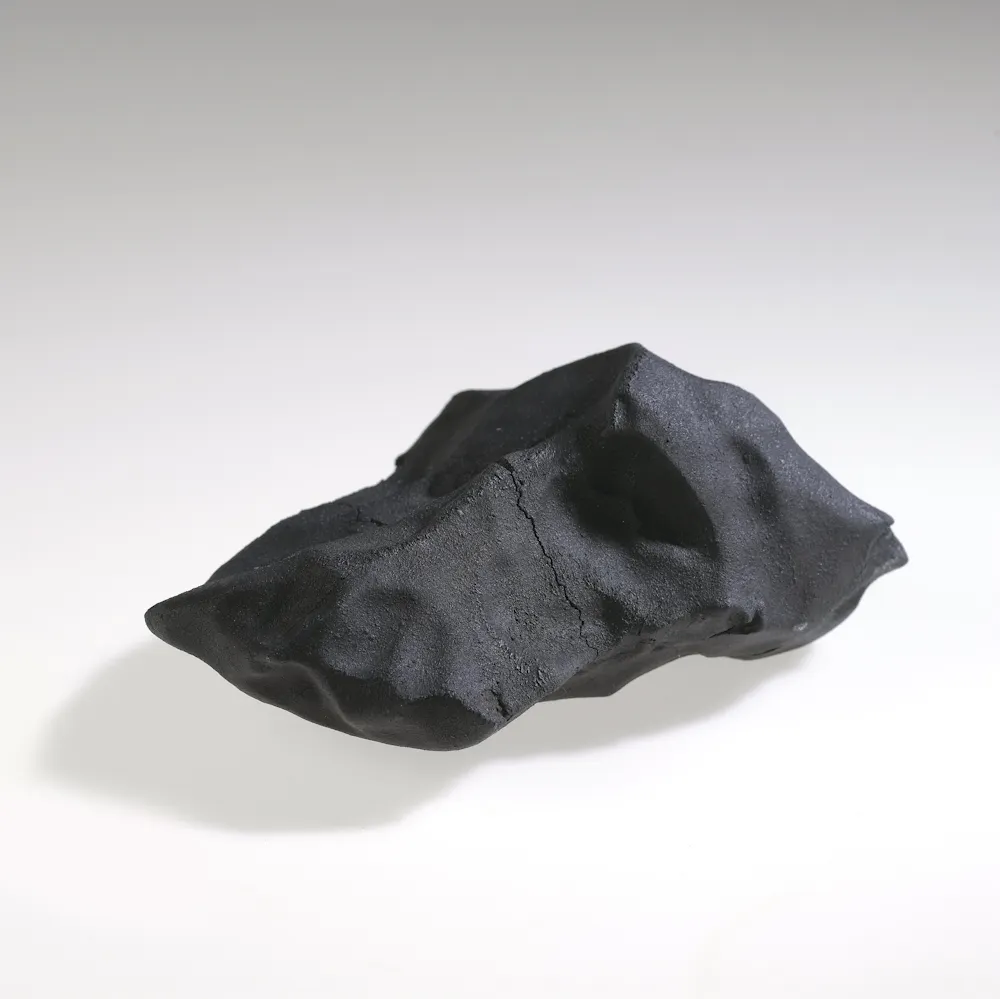
If you stumble on a dark, unusually heavy rock with a smooth, sometimes glossy or dimpled surface – known as a fusion crust – and it looks different from the surrounding stones, it could be a meteorite. Some of the most unusual meteorites, such as Murchison, are not particularly heavy, so don’t rule your possible meteorite out on weight alone.

If you think you might have found one, follow these steps to preserve its scientific value.

  1. Photograph it before touching. Include wide and close-up shots and include something for scale, such a coin.

  2. Record GPS coordinates, date and time. Your phone’s location data is fine.

  3. Don’t clean it. Avoid washing, scrubbing or polishing to preserve delicate minerals and chemical signatures.

  4. Handle carefully. Use gloves and wrap in clean aluminium foil, not plastic.

  5. Note everything. Describe the ground type and any features, including nearby rocks.

  6. Contact your state or territory museum for advice and identification.

Dark black rock with smooth bumpy surface
Fragment of the Murchison meteorite showing its black fusion crust that fell in Victoria, Australia in 1969.
Rodney Start, Museums Victoria, CC BY

When good intentions go wrong

Unfortunately, not all meteorite finds have been handled with care. Over the years, many have been damaged by well-meaning collectors who soaked them in acid, accelerating corrosion. Some have been scrubbed or hit with a sledge hammer, destroying their fusion crust. Still others were removed them from strewn fields without recording their locations.

Some were even sold or exported illegally, putting them beyond scientific reach. These actions have caused the permanent loss of valuable evidence, sometimes the only clues to a meteorite’s cosmic origin.

Who owns meteorites?

In Australia, meteorite ownership is governed by state and territory laws rather than a single national rule, so it depends on where the meteorite lands.

In WA, all meteorites are state property under the Museum Act, while in SA they belong to the Crown and are managed by the SA Museum. The Northern Territory also declares meteorites Crown property under the Meteorites Act 1987. Finders must report discoveries to the relevant museum. Museums may acknowledge the finder, but the specimens remain part of public collections for research and display.

Other states may allow finders to keep meteorites, though it’s always best to check and report the find to your state museum. Export of meteorites from Australia is regulated at the federal level and permits are required.

These rules ensure meteorites remain accessible for scientific study and for the public to see, contrasting with some other countries where ownership often passes directly to either the finder or private landowner, such as the United Kingdom, United States and some Canadian provinces.

meteorite rock samples in a display cabinet
Meteorites on display at Melbourne Museum.
Ursula Smith / Museums Victoria, CC BY

Australia’s skies are still falling – and you can help

Fireballs continue to light up Australian skies each year. By documenting finds carefully, reporting them, and respecting ownership laws, anyone can contribute to planetary science. And sometimes, the next big discovery might literally fall at your feet.


If you’re in Victoria, please contact the Ask Us team at Museums Victoria to have your potential space rock inspected.

The Conversation

Heather Handley works for Museums Victoria Research Institute. She is affiliated with Monash University.

Dermot Henry receives funding from Australian Research Council.

Oskar Lindenmayer is affiliated with the Geological Society of Australia and the International Mineralogical Association.

ref. What should you do if you find a meteorite? Space rock experts explain – https://theconversation.com/what-should-you-do-if-you-find-a-meteorite-space-rock-experts-explain-268890

Sussan Ley buries Liberal commitment to net zero, but offers a fig leaf to moderates

Source: The Conversation (Au and NZ) – By Michelle Grattan, Professorial Fellow, University of Canberra

Opposition Leader Sussan Ley announced on Thursday that the Liberal Party was dropping its commitment to net zero and said a future Liberal government would repeal Australia’s present legislated 2030 and 2050 targets for reducing emissions.

After a meeting of the Liberal shadow ministers, Ley told a news conference: “We are not pursuing net zero, we are pursuing energy affordability and emissions reduction”.

In a fig leaf for the moderates who have fought the dropping of net zero, she said “while it is not our policy […] net zero would be welcome if we can get there with technology, with choice and with voluntary markets”.

The ditching of net zero follows Wednesday’s Liberal Party meeting at which speakers overwhelmingly rejected the 2050 target that the Morrison government signed up to in 2021. Liberal shadow ministers on Thursday discussed and ticked off on the details of the Liberal policy.

Representatives of the Liberals and Nationals will now negotiate to bring the policies of the two parties together before a joint party meeting, held virtually, on Sunday.

It seems certain the Coalition will agree on a common policy. Nationals leader David Littleproud said the Liberals’ decision “gives us great hope that in the coming days that we’ll sit down constructively with them”.

Pre-empting the announcement, Prime Minister Anthony Albanese said, “The Coalition are choosing to take Australia backwards. They’re walking away from jobs for Australians and investment certainty for business that is so important. And what business has been saying.”

Under questioning, Ley and energy spokesman Dan Tehan could not provide estimates for claims that energy prices would come down under the opposition’s policy.

Ley stressed that under the Liberals’ plan, “affordable and reliable energy will always come first. Our emissions reduction goals will never come at the expense of Australian families and this principle will guide every decision we make.”

The Liberal plan says emissions would be reduced on average, year on year, for every five-year period of Australia’s Nationally Determined Contribution under the Paris Agreement. They would be brought down “as far and as fast as technology allows without imposing mandated costs on families and industry.”

Ley struggled when questioned about how Australia could stay in the Paris Agreement when the Liberals said they would scrap Australia’s already-registered targets under the pact.

“We will look Australians in the eye and say this is a plan to bring down emissions and to provide affordable energy for you. And if there are reasons why people in Paris or in some United Nations organisation don’t like it, I can deal with that,” she said.

The Liberals’ plan says that unlike Labor, a Coalition government would harness “all available technologies to bring prices down”.

“This includes maintaining baseload power, supporting all forms of generation where it is required, unlocking new gas supply, and lifting the ban on zero emissions nuclear energy, which is already used or being developed in 19 of the world’s 20 richest countries.”

The Conversation

Michelle Grattan does not work for, consult, own shares in or receive funding from any company or organisation that would benefit from this article, and has disclosed no relevant affiliations beyond their academic appointment.

ref. Sussan Ley buries Liberal commitment to net zero, but offers a fig leaf to moderates – https://theconversation.com/sussan-ley-buries-liberal-commitment-to-net-zero-but-offers-a-fig-leaf-to-moderates-269392

Major highway closed after crash injures several people

Source: Radio New Zealand

RNZ / REECE BAKER

At least four people have been injured in a two-vehicle crash that has shut a major highway north of New Plymouth.

Emergency services are at the scene on Devon Road (SH3) Sentry Hill.

The road is closed and drivers are asked to avoid the area.

Diversions are in place.

– Published by EveningReport.nz and AsiaPacificReport.nz, see: MIL OSI in partnership with Radio New Zealand

How Pacific nations plan to go from spending up to 25% of GDP on fossil fuels to running on 100% renewables

Source: The Conversation (Au and NZ) – By Wesley Morgan, Research Associate, Institute for Climate Risk and Response, UNSW Sydney

Respond Global, CC BY-NC-ND

Picture dusk falling somewhere in the Solomon Islands. A fisher’s skiff glides home using a whisper-quiet electric outboard motor. In the Cook Islands, a big battery steadies the island grid. In Papua New Guinea’s highlands, solar kits bring electric light to homes for the first time.

These aren’t prototypes – they’re already up and running across the Pacific. Put together, these stories of quiet change point to something bigger.

For decades, Pacific island countries have led the global fight on climate change. These nations are highly exposed to the damage from rising sea levels, acidifying oceans and bleached coral reefs. Pacific leaders helped secure the 2015 Paris Agreement and the global goal of holding warming to 1.5°C.

Now the Pacific is leading the way again. Island leaders have a bold plan to become the world’s first region powered entirely by renewables and energy storage.

The move isn’t symbolic. It’s extremely practical. Pacific nations spend an eye-watering percentage of their GDP (10–25%) buying fossil fuels to run power plants, generators and vehicles. Ending reliance on imports and becoming energy independent will bring major dividends. Despite widespread support, the Pacific’s clean energy transition has not yet taken off in earnest due to transport costs and gaps in financing, skills and regulation.

Leaders will formally release a renewable roadmap next week at the COP30 climate conference in Brazil. Pacific nations and Australia are bidding to host the next climate talks in 2026. Island leaders hope to leverage the global summit to attract investment in their own energy transition.

banana boat in harbour with two men.
Electric outboard motors, like this one in the Solomon Islands, make it possible for the banana boats common across the Pacific to run without fossil fuels.
DFAT, CC BY-NC-ND

Slashing fossil fuel imports will save billions

Right now, Pacific countries spend A$9–14 billion a year importing diesel for generators and fuel for vehicles and boats.

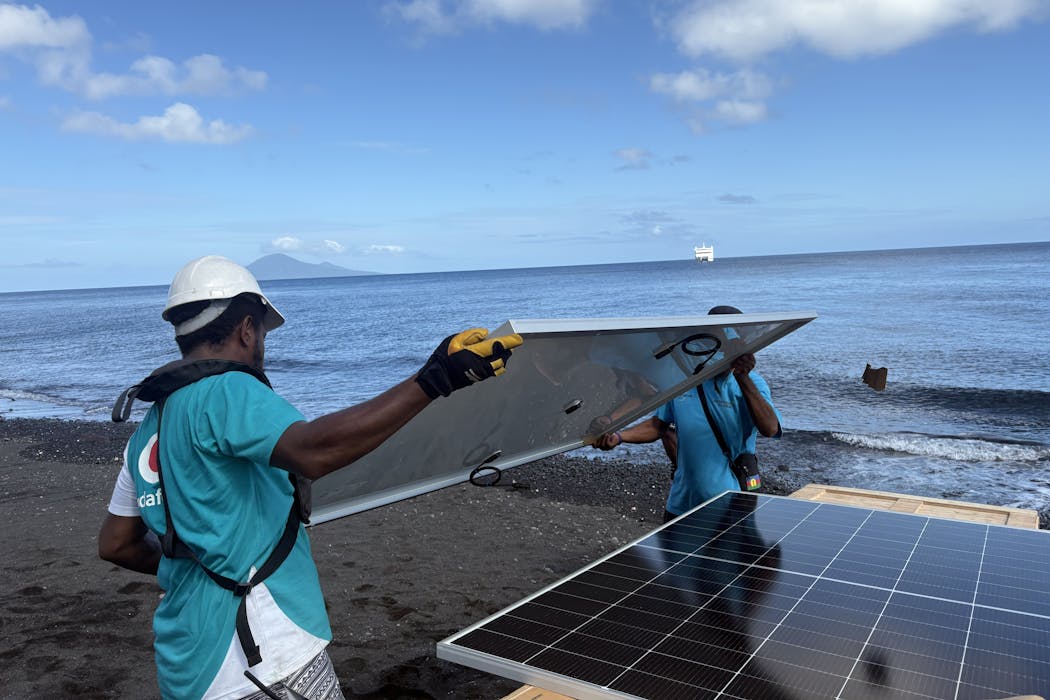
Sharp falls in renewable costs mean solar and battery systems are now clearly cheaper than fossil fuels for electricity generation.

Even with the Pacific’s logistical challenges, installed costs for solar have fallen more than five-fold since 2010. The cost of grid-scale and home batteries is falling quickly.

Replacing diesel generation with solar and batteries would cost an estimated $3–4 billion. These costs would be quickly recouped, given annual savings would be around $610–840 million.

The biggest challenge will be financing for large-scale renewables, grid infrastructure and energy storage. Many outer islands can move ahead faster by replacing diesel generators with solar and batteries. A rapid shift to electric vehicles (EVs) and vessels is also possible. Government incentives have triggered rapid uptake of EVs and hybrids in Fiji. Electric outboard motors are also ready for prime time.

Cost savings would free up funds for essential infrastructure, health, education and climate resilience. Renewables represent a powerful development strategy for the Pacific.

man standing in front of electric taxi.
Electric vehicles are slowly appearing on Pacific roads, such as this electric taxi in Fiji.
Leaf.Com, CC BY-NC-ND

Global renewable uptake is key to survival for Pacific nations

Individual Pacific countries have set ambitious renewable energy targets in national commitments under the Paris Agreement. Fiji plans to be powered 100% by renewables by 2035, while Tuvalu is aiming to get there by 2030.

These national goals can contribute to a regional target for 100% renewable energy. Pacific leaders have agreed to establish a Pacific Energy Commissioner to coordinate the transition.

Pacific island countries are not major polluters, contributing just 0.02% of global emissions. Cutting the region’s emissions will do very little to limit warming.

The importance of this new plan is showing 100% renewables is now doable.

As Vanuatu climate and energy minister Ralph Regenvanu states:

if we can manage the rapid transition of our energy systems in the Pacific Islands, it can be a beacon for the rest of the globe. Our survival depends on it.

Holding warming to 1.5°C is critical for low-lying atoll nations. Climate resettlement is already under way, as Tuvalu residents enter ballots to move to Australia while Fijian villages are relocating to higher ground.

Two years ago, nearly 200 countries agreed to triple global renewable capacity and accelerate the transition away from fossil fuels. Reaching this goal is crucial to keep 1.5°C within reach. Pacific nations can show the way. But their survival isn’t in their hands – it depends on the world following suit.

grid battery installation in Pacific islands.
Plunging costs of battery storage mean running on 100% renewables is increasingly possible.
Te Aponga Uira (Rarotonga Power Authority), CC BY-NC-ND

Next year’s climate talks could drive the change

For several years, Pacific nations and Australia have been bidding to host the 2026 COP31 climate summit. But Turkey has a rival bid. A final decision is expected next week.

As Palau President Surangel Whipps has said, hosting COP31 in the Pacific cannot just be about symbolism – it must demonstrate “tangible benefits” to Pacific peoples.

If the joint bid for COP31 gets up, Pacific leaders will be pressing for progress on their 100% renewable plan by seeking investors and technology partners.

The COP talks are more than climate negotiations – they’ve become the world’s biggest trade fair. Thousands of delegates will be looking to invest in renewable energy. More than 70% of investment in renewables in Australia comes from abroad and COP31 could attract finance for both Australia and the Pacific.

Palau will host regional leaders next year at the annual Pacific Islands Forum leaders’ meeting. Whipps, the incoming chair, will focus on building a regional renewable Pacific partnership and is planning an investment meeting next year to help attract international investment ahead of COP31.

Some investment is likely to come from Australia, both private and public. Australia is rapidly replacing coal-fired power with renewables and storage at home and is already supporting Pacific clean energy projects. But Pacific leaders have also called on Australia to “stop approving new gas and coal projects” and stop subsidising fossil fuel production.

The Pacific’s plan to run on clean power makes clear sense on financial, energy security and climate leadership grounds. The question now is – will it happen?

The Conversation

Wesley Morgan is a fellow at the Climate Council of Australia

Scott Hamilton is a Director and Senior Advisor to the not-for-profit organisation Smart Energy Council and the not-for-profit Renewable Energy Council Asia-Pacific, and is an ALP member.

ref. How Pacific nations plan to go from spending up to 25% of GDP on fossil fuels to running on 100% renewables – https://theconversation.com/how-pacific-nations-plan-to-go-from-spending-up-to-25-of-gdp-on-fossil-fuels-to-running-on-100-renewables-269402

Police name prisoner who escaped hospital escort

Source: Radio New Zealand

Escaped prisoner Paul Rehua. NZ Police

Police are searching for a man who escaped custody while on a hospital escort in Auckland last week.

A warrant to arrest 42-year-old Paul Kyle Peekay Rehua has been issued by police, who believe he is in the wider Waitematā area.

Mt Eden Corrections Facility acting general manager Edith Pattinson confirmed to RNZ on Tuesday a remand prisoner escaped from Corrections staff about 9am on Friday while on a hospital escort.

Police believed he was actively avoiding authorities.

Do you know more? Email sam.sherwood@rnz.co.nz and finn.blackwell@rnz.co.nz

They said Rehua was known to frequent both the greater Auckland and Waikato regions, and were appealing for anyone who may have seen him or those with information that could help in finding him to get in contact.

Earlier this week, Pattinson said public safety was a top priority.

“Any escape is unacceptable and an immediate review into how this incident occurred is being carried out.”

Sign up for Ngā Pitopito Kōrero, a daily newsletter curated by our editors and delivered straight to your inbox every weekday.

– Published by EveningReport.nz and AsiaPacificReport.nz, see: MIL OSI in partnership with Radio New Zealand

Serious crash on SH3 New Plymouth

Source: Radio New Zealand

RNZ / REECE BAKER

Police say people have been seriously injured in a two-vehicle crash in New Plymouth.

Emergency services are at the scene on Devon Road (SH3) Sentry Hill.

The road is closed and drivers are ask to avoid the area.

Diversions are in place.

– Published by EveningReport.nz and AsiaPacificReport.nz, see: MIL OSI in partnership with Radio New Zealand

Seaview residents warned sewage plant stench will return following ‘error’

Source: Radio New Zealand

Seaview Wastewater Treatment Plant. RNZ / Krystal Gibbens

Wellington Water is warning Seaview residents that due to an “error” by the operators of its Seaview sewage plant, locals should expect bad smells in the area.

The Seaview Wastewater Treatment Plant is notorious in the community for causing bad odours, which some have described as being so bad it made them dry retch.

Wellington Water said following an “error” on Thursday with routine operational maintenance undertaken by its contractor Veolia, the biological process for the plant has become unbalanced – which would likely cause more smells.

To manage the risk it would bring in trucks to remove wet sludge from the plant, which would give the process of the plant its best opportunity to become stable again, it said.

“It’s important that the local community are aware and they should expect increased odour from both the sludge trucking and the plant.”

The water provider’s chief executive Pat Dougherty has apologised and said they’d hold Veolia to account.

“This is completely unacceptable.

“We acknowledge that it was around the same time last year that we had issues with odour from the plant and we are gutted that this has happened yet again at the start of summer.”

Dougherty said Wellington Water was committed to reducing the impact of the issue and to ensure it did not happen again.

“We have asked Veolia to provide a robust plan so we can give our community confidence moving forward.”

Just over a year ago fire in the plant’s sludge dryer caused an increase in odour near the plant.

At the time Greater Wellington Regional Council had received hundreds of complaints about the smell at the plant.

Sign up for Ngā Pitopito Kōrero, a daily newsletter curated by our editors and delivered straight to your inbox every weekday.

– Published by EveningReport.nz and AsiaPacificReport.nz, see: MIL OSI in partnership with Radio New Zealand

‘It’s all gone already to pay off debts’: Oyster farmers react to compensation deal

Source: Radio New Zealand

Mahurangi oyster farmers have struck a $1 million compensation deal. Nick Monro

They are purveyors of some of the world’s most sought-after culinary delicacies, but Mahurangi’s oyster farmers have been reduced to eating beans on toast most days, their hair going grey, and their nerves shot.

Last month the farmers were hit with a livelihood-ruining sewage overflow after a power surge at a new wastewater treatment plant in Warkworth.

The overflow of 1200 cubic metres prevented farmers from collecting oysters for 28 days.

On Wednesday, a $1 million compensation deal was struck, but the 10 farmers say $100,000 each is only a drop in the sewage-polluted ocean compared to what they’ve lost.

Jim Aitken from Mahurangi Oysters was hauling in contaminated oysters on Thursday from his farm in the Mahurangi Harbour, north of Auckland, to see if they were still alive.

“We probably have somewhere around 80,000 to 120,000 dozen oysters and they’re all contaminated, every single one is contaminated.

“They can flush it out, but again it takes time, it takes that 28 days if the test results come back negative, but still everything stops.”

While he is relieved and grateful for the compensation from Watercare, he said it will only cover a small portion of the damage to his business.

“Pretty much it’s all gone already to pay off our debts, but it’ll get us through to Christmas, so it takes a significant weight off the shoulders so we’re very thankful that we have got some support after this very, very tough year.”

Aitken said he has lost a whole year of income and incurred debt just trying to survive.

“It has been a bit of eat beans on toast, trying to keep the wallet tight, because we don’t know what next year is going to bring, until that new main pipe is put in there might still be spills next winter, so until that’s in we could be in for another difficult season for 2026.”

The toll on his business will likely linger across the next three years.

Tom Waters of Matakana Oysters. RNZ / Kim Baker Wilson

Up the road in Matakana, Tom Waters has been spending thousands on oysters from elsewhere just to keep his businesses running.

He said despite no-one getting ill in the latest discharge, the reputation of his business, Matakana Oysters, has taken a huge blow.

“This has really damaged the reputation again so financially that’s a huge impact.

“I’ve got people saying ‘oh look we’re just not going to be trusting them’, all of the farmers have had that out there wherever they sell at farmers markets or wholesalers, that’s something that we’re going to have to continuously try and work hard to get back again.”

Waters said he has had countless sleepless nights with the stress of keeping up with bills and trying to keep on staff.

“This event the other day, that one really did hit me quite badly because it was sunny and we were starting to get everything back going again so I’m glad that they were on the front foot and have come through with something for us in this regard because in previous times it’s sort of been like you’re banging your head upon a brick wall.”

Nick Monro

He said compensation is a good start for now, but he is nervous about wet weather events in the future.

“Even though Watercare have done work to try and mitigate those effects with their temporary fixes around Warkworth and certain areas, we are still going to have this problem until the growth service pipeline goes in at the end of next year or the year after.”

Aquaculture New Zealand, the New Zealand Oyster Industry Association and Watercare are still figuring out the full extent of loss from Watercare’s system failures.

Sign up for Ngā Pitopito Kōrero, a daily newsletter curated by our editors and delivered straight to your inbox every weekday.

– Published by EveningReport.nz and AsiaPacificReport.nz, see: MIL OSI in partnership with Radio New Zealand

Timor-Leste’s Xanana Gusmão pays tribute to journalist Robert Domm over independence struggle

Pacific Media Watch

Timor-Leste Prime Minister Kay Rala Xanana Gusmão has paid tribute to the “courageous and determined” contribution of Australian journalist Robert Domm to the struggle of the Timorese people in gaining independence from Indonesia. He died last Friday.

Domm was remembered for meeting in secret with the then Timorese resistance leader Gusmão in an exclusive interview.

“The government and people of East Timor are deeply saddened by the passing of Robert Domm, whose courage and determination helped bring to the world the truth of our fight for self-determination,” Gusmão’s statement said.

“In September 1990, when few in the world were aware of the devastation in occupied East Timor, or that our campaign of resistance continued despite the terrible losses, Robert Domm made the perilous journey to our country and climbed Mount Bunaria to meet with me and the leadership from FALINTIL.

“He was the first foreign journalist in 15 years to have direct contact with the Resistance.

“Your interview with me, broadcast by the ABC Background Briefing programme, broke the silence involving Timor-Leste since 1975.

“He conveyed to the world the message that the Timorese struggle for self-determination and resistance against foreign military occupation was very much alive.

Merchant seaman
“Robert Domm visited East Timor in the 1970s, then under Portuguese colonial control, as a merchant seaman on a boat crossing between Darwin and Dili, transporting general cargo and fuel.

“He returned in 1989, when Indonesia allowed tourist entry for the first time since 1975.

“He returned in 1990, allegedly as a “tourist”, but was on a secret mission to interview me for the Australian Broadcasting Commission.

“Robert Domm’s journey to find me took extraordinary courage. His visit was organised by the Timorese resistance with, as he later recalled, “military precision”. He involved more than two hundred people from Timore who guided him through villages and checkpoints, running great risk for himself and the Timore people who helped him.

“He was a humble and gentle Australian who slept next to us on the grounds of Mount Bunaria, ate with us under the protection of the jungle and walked with our resistance soldiers as a comrade and a friend. I am deeply moved by your concern for the people of Timore.

He risked his own life to share our story. His report has given international recognition to the humanity and the resolve of our people.

“Following the broadcast, the Indonesian military carried out large-scale operations in our mountains and many of those who helped them lost their lives for our freedom.

Exposed complicity
“Robert continued to support East Timor after 1990. He spoke out against the occupation and exposed the complicity of governments that have remained mute. He was a co-author, with Mark Aarons, of East Timor: A Tragedy Created by the West, a work that deepened the international understanding of our suffering and our right to self-determination.

“He remained a friend and defender of East Timor long after the restoration of independence.

“In 2015, twenty-five years after his maiden voyage, Robert returned to East Timor to commemorate our historic encounter. Together, we walked to Mount Bunaria, in the municipality of Ainaro, to celebrate the occasion and remember the lives lost during our fight.

“The place of our meeting has been recognised as a place of historical importance.

“In recognition of his contribution, Robert Domm was awarded the Order of Timor-Leste in August 2014. This honour reflected our nation’s gratitude for its role in taking our struggle to the world. Robert’s contribution is part of our nation’s history.

“Robert’s soul now rests on Mount Matebian, next to his Timorese brothers and sisters.

“On behalf of the government and people of East Timor, we express our deepest condolences to the family, friends and colleagues of Robert Domm. His courage, decency and sense of justice will forever remain in the memory of our nation.”

Journalist Robert Domm with Timorese resistance leader Xanana Gusmão, now Prime Minister of Timor-Leste, in a jungle hideout in 1990. Image: via Joana Ruas

Article by AsiaPacificReport.nz

Wellington Phoenix player takes mental health break

Source: Radio New Zealand

Phoenix midfielder Macey Fraser challenges for the ball against Melbourne City in 2023. Photosport / Masanori Udagawa

Wellington Phoenix midfielder Macey Fraser has been granted a leave of absence to address her mental health.

Fraser re-joined the Phoenix on a three-year contract in September, but has yet to play for the club since returning from Utah Royals.

Director of football Shaun Gill said the Phoenix would continue to support Fraser while she takes time away from football.

“In conjunction with our performance psychologists and club doctor it’s been agreed Macey needs a break from the pressures of high performance sport.

“Football, like a lot of sports, can be all consuming and she is much more than just a footballer.

“We want Macey to have a long and successful football career, but that shouldn’t come at the expense of her mental health.

“We all believe a break will do her the world of good and we look forward to having Macey back in our environment when she’s ready.”

Fraser left the Phoenix in 2024 for what was a record A-League Women transfer fee at the time to join the Utah Royals in the NWSL on a three-year contract, before returning to Wellington this season.

– Published by EveningReport.nz and AsiaPacificReport.nz, see: MIL OSI in partnership with Radio New Zealand

Police name prisoner who escaped hospital escourt

Source: Radio New Zealand

Escaped prisoner Paul Rehua. NZ Police

Police are searching for a man who escaped custody while on a hospital escort in Auckland last week.

A warrant to arrest 42-year-old Paul Kyle Peekay Rehua has been issued by police, who believe he is in the wider Waitematā area.

Mt Eden Corrections Facility acting general manager Edith Pattinson confirmed to RNZ on Tuesday a remand prisoner escaped from Corrections staff about 9am on Friday while on a hospital escort.

Police believed he was actively avoiding authorities.

Do you know more? Email sam.sherwood@rnz.co.nz and finn.blackwell@rnz.co.nz

They said Rehua was known to frequent both the greater Auckland and Waikato regions, and were appealing for anyone who may have seen him or those with information that could help in finding him to get in contact.

Earlier this week, Pattinson said public safety was a top priority.

“Any escape is unacceptable and an immediate review into how this incident occurred is being carried out.”

Sign up for Ngā Pitopito Kōrero, a daily newsletter curated by our editors and delivered straight to your inbox every weekday.

– Published by EveningReport.nz and AsiaPacificReport.nz, see: MIL OSI in partnership with Radio New Zealand

Non-existent trust contracted to set up charter school

Source: Radio New Zealand

Associate Education Minister David Seymour initially told reporters on Thursday the trust did exist RNZ / Mark Papalii

Associate Education Minister David Seymour says contracting a non-existent trust to set up a charter school was “a bit of a screw up”.

But he said the sport-focused charter school would still go ahead.

The Charter School Agency signed a contract for the NZ Performance Academy Aoteaora with the NZPAA Charitable Trust, but the trust was not listed on the Charities Register.

The agency has been unable to clarify for RNZ the legal status of the contract.

Seymour initially told reporters on Thursday the trust did exist, but his office later clarified he meant the school’s sponsor existed.

He said the sponsor changed some of its arrangements, but the name of the sponsor was not changed on the contract.

“On the contract they still had the old name. So obviously, bit of a screw-up administratively but fundamentally the people are there, the students are there, the government’s there and that partnership will continue,” he said.

“There’s not actually a problem to be addressed here. The school’s going to be there, the students are going to be there. Everyone’s very excited about it and the administrative error can be easily fixed.”

Seymour said he had confidence in the agency’s processes.

“I do, because one administrative error when they’ve opened nearly 18 schools at record speed, I think is pretty good.”

He said the agency was not rushing to approve schools before next year’s election.

“I don’t think they’re being rushed for that purpose. I think they’ve been overwhelmed with interest. They’ve had over 100 different organisations that want to run charter schools. They’ve got to assess them all, contract the ones that we can afford to to open right now, and then monitor how they perform,” he said.

“There’s a huge amount of interest in charter schools, which has put pressure, but generally I’m pretty pleased with the way the charter school agency’s responded to that pressure.”

Sign up for Ngā Pitopito Kōrero, a daily newsletter curated by our editors and delivered straight to your inbox every weekday.

– Published by EveningReport.nz and AsiaPacificReport.nz, see: MIL OSI in partnership with Radio New Zealand

‘Embarrassing’: International climate expert at COP30 scorns NZ’s methane target

Source: Radio New Zealand

Dr Bill Hare has called the government’s climbdown on methane emissions dangerous and embarrassing. Supplied/The Australia Institute

New Zealand’s climbdown on its methane emissions target and an agricultural emissions tax is dangerous and embarrassing, an international climate science and policy expert says.

Speaking from the COP30 global climate summit in Brazil, Dr Bill Hare said the New Zealand government’s recent policy decisions were “completely contrary” to scientific consensus.

“It is unbelievable this has happened against a background of a rapidly warming planet, and increasing scientific concern that methane emissions have to be reduced absolutely and quickly,” he told RNZ.

The government announced last month it would lower New Zealand’s methane emissions target, from a 24-47 percent reduction by 2050 to a 14-24 percent reduction, considered sufficient to meet a ‘no additional warming’ goal, compared to 2017 levels.

Hare, a physicist and former lead author for the Intergovernmental Panel on Climate Change, is currently the chief executive of the non-profit Climate Analytics.

He was responding to remarks made to RNZ by climate change minister Simon Watts, who said he was prepared to explain the rationale for the new methane target to other delegates at COP.

“If we get questions around that, which will potentially be the case, particularly from other countries that have pastoral farming systems, then we’ll be dialoguing on that,” Watts said.

Hare said it was “difficult to understand how New Zealand can make a constructive contribution to COP30 with this kind of attitude.

“Methane has contributed to around one third of warming so far, and I would be extremely worried if New Zealand, proportionally a country with a very large agriculture sector, were to be touting its methane rollbacks here in Brazil.”

The adoption of a ‘no additional warming’ target, rather than pursuing more ambitious reductions, was “an embarrassing and humiliating capture by industry”, he said.

“[It] is very dangerous at a time we have to reduce the warming impact of methane – and very, very quickly.”

There was a global agreement to reduce methane, he said.

New Zealand remains a signatory to the Global Methane Pledge, where several dozen countries have pledged to globally lower methane emissions by 30 percent from 2020 levels, by 2030.

“There has been a global agreement to reduce methane – and what New Zealand has done is completely contrary to this. It seems hell-bent on maintaining methane at today’s high and unsustainable levels.”

Ralph Sims, an emeritus professor in sustainable energy and climate mitigation at Massey University, also said the New Zealand delegation might face awkward questions.

“I don’t think New Zealand is going to be held in high regard,” he said.

“There may be some agricultural countries … that might look over the fence to see what New Zealand’s got in mind, but I don’t think there’s going to be a huge acceptance of what the government is planning at the moment.”

Sign up for Ngā Pitopito Kōrero, a daily newsletter curated by our editors and delivered straight to your inbox every weekday.

– Published by EveningReport.nz and AsiaPacificReport.nz, see: MIL OSI in partnership with Radio New Zealand

Victoria’s groundbreaking treaty could reshape Australia’s relationship with First Peoples

Source: The Conversation (Au and NZ) – By Harry Hobbs, Associate Professor, UNSW Sydney

The first treaty between Indigenous peoples and an Australian government has been signed into law.

It is difficult to overstate the significance of Victoria’s treaty.

So, what is the treaty, will other states and territories follow suit, and how could this impact Australia as a whole?

Breaking new ground

While treaties have long formed part of the landscape in countries such as Canada, the United States and New Zealand, Australia has stood apart.

For generations, governments have resisted calls from Aboriginal and Torres Strait Islander peoples for a formal treaty or treaties.

The Victorian Statewide Treaty represents the first time an Australian government has not only listened, but acted.

This agreement answers questions that have shaped our national debate for decades.

It demonstrates that treaties with Indigenous Australians are both possible and practical – anchored not in radical change but in recognition, respect and partnership.

Rather than breaking from Australia’s system of government, the treaty provides a framework to acknowledge First Peoples’ enduring rights and to strengthen the relationship between Indigenous peoples and the state.

The settlement and negotiation process also offer valuable lessons for other jurisdictions as they consider their own paths toward treaty.

What is Victoria’s treaty?

The treaty was negotiated between the First Peoples Assembly of Victoria and the state government.

The innovative agreement establishes a new permanent representative and deliberative body for Traditional Owners and First Peoples in the state.

Intended to serve as a central institution within “the democratic life” of Victoria, the body (Gellung Warl) will advise, inform and engage with the government and the parliament – and hold the state to account.

It will bring First Peoples into the decision-making forums of the state, rectifying their longstanding exclusion.

The treaty also includes agreement on a range of other matters that reflect commitments to form a new relationship based on justice and respect.

These include commitments by government to revise the education curriculum, increasing the use of Traditional or Indigenous-language place names, and encouraging Gellung Warl to participate in the ceremonial life of the state.

What is next for Victoria?

This will not be the last treaty in Victoria.

The First Peoples Assembly and the state government have agreed that treaty-making is a “journey” that will continue “through further statewide treaties and Traditional Owner treaties”.

Statewide treaties will cover matters that affect all First Peoples in Victoria.

Future agreements are likely to strengthen Gellung Warl. This may include transferring decision-making, rule-making and advisory powers from government to Gellung Warl.

These reforms will promote self-determination and are expected to lead to better outcomes for First Peoples.

Traditional Owner treaties, negotiated by Traditional Owners, will cover matters of importance to First Nations people and will likely differ according to the aspirations and priorities of each community.

One Traditional Owner group, the Dja Dja Wurrung, has already indicated it is ready to begin negotiations.

What’s next for Australia?

The outlook across the rest of Australia remains uncertain.

While Victoria’s experience shows treaty-making is possible, it also highlights how complex and demanding the process can be.

Like any agreement, the substance of a treaty is shaped by the negotiations that produce it.

If the process is unbalanced or dominated by one side, the outcome will reflect that imbalance. When power is too unevenly distributed, meaningful agreement becomes almost impossible.

Establishing fair and trusted institutions to support genuine negotiation takes considerable time and effort.

In Victoria, it took nearly eight years of groundwork before the parties were ready to begin formal treaty discussions. While preliminary treaty consultations are underway in New South Wales, no other jurisdiction has really started down this path.

Those early steps are crucial for another reason. With no history of treaty-making, many Australians have limited understanding of what a treaty involves or represents.

Entering into a treaty relationship requires a fundamental shift in how governments view and engage with Indigenous nations.

This change in mindset can be gradual and difficult to embed.

In Victoria, the nearly decade-long preparatory phase was vital – not only for building the right structures and institutions for treaty-making, but also for giving government time to grasp what a treaty means in practice.

Treaties as living agreements

The Victorian treaty proclaims it “marks the dawn of a new era in Victoria – an era of treaty-making”.

The agreement’s impact may reach far beyond the state’s borders, offering a model for how respectful partnerships can be forged between First Peoples and the state.

In time, the signing of the treaty may come to be seen not only as a turning point for Victoria but as the beginning of a new chapter in Australia’s history – one defined by recognition, respect and shared responsibility for the future.

The Conversation

This article was written as part of an Australian Research Council grant entitled ‘A Made in Australia Model for Indigenous-State Treaty-Making’ (DE240100454). Harry has also previously served as a consultant for the Victorian Treaty Authority.

ref. Victoria’s groundbreaking treaty could reshape Australia’s relationship with First Peoples – https://theconversation.com/victorias-groundbreaking-treaty-could-reshape-australias-relationship-with-first-peoples-269699

Nearly 200 schools write to Education Minister Erica Stanford over removal of Treaty obligations

Source: Radio New Zealand

Education Minister Erica Stanford visits Rangitoto College, Auckland, 5 August 2025. RNZ / Calvin Samuel

Two of the boards that spoke out over the government’s axing of their Treaty of Waitangi obligations say they are getting strong support.

Some boards made public statements reiterating their commitment to the Treaty after the government announced it would cut a Treaty requirement from the Education and Training Act.

It was not clear how many of the more than 2000 state schools had made a statement.

However, tallies kept by the School Boards Association and lawyer Tania Waikato showed more than 200 schools had written to the Education Minister Erica Stanford or confirmed they would continue to uphold the treaty and the number was growing.

The association expected that number to rise because most boards would not have met since the government last week announced that it would cut the Treaty obligation this week.

The board of Dyer Street School in the Hutt Valley said upholding the Treaty was the right thing to do for its students.

The board’s presiding member Matt Weldon-Smith told RNZ the school wrote its own statement.

He said the Treaty was important to the school.

“I know it’s a bit of a political football, but it’s not really a political issue to us. It feels more like an ethical, educational one. So, that honouring Te Tiriti ensures every child feels valued, respected and represented in their learning,” he said.

Weldon-Smith said community reaction has been incredibly positive.

“It’s clearly touched people and it’s been one of probably our most reactive messages we put out this year,” he said.

“Looking at the comments… it’s almost overwhelmingly positive and supportive.”

The board of Queens High in Dunedin said in an online statement its commitment to the Treaty was not a compliance exercise.

Its presiding member Kate Kaddell told RNZ the Treaty was fundamental for schools in an inclusive society.

“What it means for us is that when we are making decisions, we look at them through a lens of equity and cultural responsiveness and inclusion,” she said.

She said the school made a public statement to assure its community that it followed through on what it said.

Kaddell said the school had about 600 students and reaction from its community was positive.

“As at this afternoon I can see 1600 engagements,” she said.

“If you look at the emojis as a data point, there’s only one angry red face and the rest in that number – 912 loves, 745 thumbs-up, 14 caring signs, and one sadness emoji. So that’s quite a a snapshot of affirmation for our community.”

Meanwhile, a petition by the Iwi Chairs Forum calling for reinstatement of the Treaty clause had 13,275 signatures by late Thursday afternoon.

The government has said the Treaty is an obligation for the Crown, not schools.

It said schools should be focused on ensuring high achievement for all students, not on figuring out how to give effect to the Treaty.

Sign up for Ngā Pitopito Kōrero, a daily newsletter curated by our editors and delivered straight to your inbox every weekday.

– Published by EveningReport.nz and AsiaPacificReport.nz, see: MIL OSI in partnership with Radio New Zealand

Black Caps cruise to T20 series win over West Indies in Dunedin

Source: Radio New Zealand

Devon Conway. Game 3 of the T20 international cricket series between New Zealand and West Indies at Saxton Oval in Nelson. Andrew Cornaga/www.photosport.nz

The Black Caps have won the fifth and final T20 match against the West Indies in Dunedin by eight wickets.

With the fourth T20 rained off, the Black Caps have won the series 3-1.

The West Indies set New Zealand a target of 141 after the visitors were bowled out in the 19th over. Black Caps fast bowler Jacob Duffy took four wickets.

Tim Robinson got New Zealand off to a strong start with 45 runs, while fellow opener Devon Conway anchored the innings by scoring 47 not out.

The first of three One Day Internationals against the West Indies starts on Sunday at Hagley Oval in Christchurch.

Sign up for Ngā Pitopito Kōrero, a daily newsletter curated by our editors and delivered straight to your inbox every weekday.

– Published by EveningReport.nz and AsiaPacificReport.nz, see: MIL OSI in partnership with Radio New Zealand

Coroner in Cyclone Gabrielle Inquiry defends witness following ‘unkind’ comments online

Source: Radio New Zealand

13 people died in Hawke’s Bay in relation to Cyclone Gabrielle on 14 February 2023. Supplied

The coroner in charge of the Cyclone Gabrielle Inquiry has given the public a telling off for making unkind comments online about a witness, saying no individual person is to blame for those who died in the tragic weather event.

The coroner began day 14 of the Hawke’s Bay phase of the inquiry by telling the court she was aware of “unkind” comments being made online about a witness.

Woolley said it’s very easy to judge the actions of other people with the benefit of hindsight and from behind the “shield of a keyboard”.

“I would challenge any person thinking about making negative comments about the evidence of witnesses online, to think about how well you might perform under similar scrutiny.

“I doubt many people would be able to act perfectly or to make all the right decisions in circumstances such as what unfolded in Cyclone Gabrielle,” the coroner said.

Day 14 of the Hawke’s Bay phase of the Cyclone Gabrielle Inquiry began with the coroner defending a witness. RNZ / Tess Brunton

Woolley said a Coroner’s Inquest relies on people coming to court and giving evidence, which “may inherently involve admissions about things they could have done differently or better”.

She also noted that many of the people working in Civil Defence and emergency services were volunteers, and the system relied on them taking these roles on as well as their “business as usual” jobs.

“Without people doing that work, given we are in a country facing a great deal of natural hazards, we would all be at risk of having no one come to assist us in times of need,” Woolley said.

She emphasised the importance and function of a Coronial Inquiry.

“The purpose of this process is to make positive change for future, not to blame individuals,” Woolley said.

‘I’m so sorry’

Robert Johnson, who was the Emergency Management Advisor for Communications and Public Information (PIM) during Cyclone Gabrielle, made an emotional apology to victims’ families on Thursday morning.

“The families and whanau who tragically lost their lives in the cyclone, to you I extend my heartfelt aroha and condolences.

“It is with that deep respect that I give my evidence today.”

Robert Johnson. RNZ/Alexa Cook

His voice choked with emotion as he told the court about how more than two years on from the deadly Cyclone Gabrielle, he still thought about it every day.

“It is often one of the last things on my mind at night as I got to sleep. My colleagues and I tried our very best to plan for and respond to the cyclone and keep our community safe.

“I am so sorry that our efforts could not prevent the loss of your precious loved ones,” he said.

As Johnson took a moment to gather himself, the coroner then made the unusual move of responding to his apology, telling him “no one died because of one person in this event”.

“I’m sure the families are appreciative of your comments, but I want to emphasise that I don’t think any one person should bear the feelings that they themselves are responsible for any deaths in this situation,” Woolley said.

‘I absolutely would approach things differently’

Flood damage in the Esk Valley in Hawke’s Bay. RNZ / Tess Brunton

Earlier in the week, the court heard about how Civil Defence Group Emergency Coordination Centre (GECC) was running with “skeleton staff” on the night of 13 February, when rivers burst their banks and flooded hundreds of homes.

The acting group controller for Civil Defence in Hawke’s Bay, Edaan Lennan, had explained the challenges of finding enough staff for overnight shifts, and the decision to strategically bring people back early on February 14th.

At 10pm on February 13, Robert Johnson left the HBCDEM Group office leaving Lennan to oversee communications with the public.

“I had full confidence in Edaan’s ability using the tools and channels, and what we anticipated overnight was perhaps some minor incidences at a local level that Edaan could then share on our channel.

“But in hindsight, I would not be comfortable leaving no PIM manager in place,” he said.

He became emotional as he described how hard it was to leave the office the night of February 13.

“I really struggled with leaving office that night. I had a partner and 2 year old child at home.”

He said leaving was not something he would normally do, as he’d usually “see it through”.

In his evidence, Johnson also reflected on the wording of the Facebook posts used to inform the public. A post from 8:33pm on February 13th included messaging for residents that said:

“At the moment there is no need for residents to evacuate – those who should move have already been contacted – however, if you feel concerned, please don’t hesitate to voluntarily self-evacuate to whānau and friends.

“If evacuation is required overnight, teams will be deployed to advise residents. And if you are told to evacuate, please follow the evacuation advice you are given at the time.”

Flood victims have since expressed their frustration and anger over the wording of these posts, saying it gave them a false sense of security that they could go to sleep that night and would be alerted if an evacuation was needed.

An Emergency Mobile Alert was not issued for Esk Valley until 5:19am on 14 February, by which time two people had already drowned and many more residents were clutching onto their rooftops as the floodwaters rose.

The coroner’s lawyer Matthew Mortimer-Wang asked Johnson about his Facebook posts, querying whether it was appropriate to tell residents that they’d be advised if an evacuation was needed.

“Have the events of Cyclone Gabrielle changed your sensitivity or margin of appreciation built into when we might, or might not, be able to follow though,” Mortimer-Wang asked.

“The events of Cyclone Gabrielle have changed my life. I absolutely would approach things differently,” Johnson said.

Johnson’s previous communication experience included working as a Press Secretary in Parliament for Minister Kelvin Davis, who was the Deputy Leader of the New Zealand Labour Party at the time. Since moving to Hawke’s Bay in 2021, he’d been deployed as a PIM for West Coast flooding in 2021 and the Nelson Tasman flooding in 2022.

Sign up for Ngā Pitopito Kōrero, a daily newsletter curated by our editors and delivered straight to your inbox every weekday.

– Published by EveningReport.nz and AsiaPacificReport.nz, see: MIL OSI in partnership with Radio New Zealand

Cop turned aviation boss Chris de Wattignar on leave after scathing IPCA report

Source: Radio New Zealand

Former deputy commissioner Chris de Wattignar police

A former senior leader at police is on leave from his job at the Civil Aviation Authority following the police watchdog’s scathing report into how police handled allegations of sexual offending by former Deputy Commissioner Jevon McSkimming.

RNZ earlier revealed the identities of some of the senior leaders referred to in the IPCA’s 135-page report.

Among them is Chris de Wattignar, referred to in the IPCA’s report as Deputy Commissioner PLC, now works as the Upper North head of aviation security at the Civil Aviation Authority.

Asked for comment on Wednesday, a CAA spokesperson said the matters discussed in the IPCA’s report “relate to events that occurred during Chris de Wattignar’s previous employment with New Zealand Police”.

“As this was a police matter and is now the subject of extensive public reporting and oversight, it would not be appropriate for the Civil Aviation Authority or for Chris in his current role to comment.”

  • Do you know more? Email sam.sherwood@rnz.co.nz

The CAA had no involvement in the police investigation or the IPCA’s findings, the spokesperson said.

“We are focused on our statutory responsibilities for aviation safety and security, and we continue to support our people to uphold the highest standards of professionalism and integrity.”

However, on Thursday, a CAA spokesperson confirmed de Wattingar was on leave as of Thursday.

“He will take some time away as we work through an employment process and any implications for him in his role at CAA,” the spokesperson said.

“We will work through these processes as quickly as possible. We are bound by legal processes and obligations as an employer, and we won’t be able to discuss employment matters publicly.”

The IPCA said de Wattignar had an obligation to exercise independent judgement and take any necessary action to ensure senior officers were acting in an appropriate way.

“Despite his Director of Integrity and Conduct raising her concerns with him in the clearest language, he clearly failed to fulfil that obligation.”

The IPCA acknowledged his responsibility was “to a degree mitigated” by the fact he sought advice from Coster.

“His failing lies in the fact that he simply relied upon Commissioner Coster’s and Deputy Commissioner Kura’s assurances without further enquiry of his own, despite the continued expressions of concern from Officer M.”

De Wattignar’s perception that once he became aware of concerns he lacked the necessary authority was proof of the “inadequate status and independence of Police Integrity and Conduct”.

“While we do not doubt there was significantly more he could have done, the status of Integrity and Conduct within Police no doubt needs reframing.”

RNZ asked a spokesperson for Associate Minister of Transport James Meager for comment on de Wattignar’s suitability for his role at the CAA.

The spokesperson said it was a question for the CAA to respond to.

“It’s an operational employment matter so would be inappropriate for Minister Meager to comment.”

Sign up for Ngā Pitopito Kōrero, a daily newsletter curated by our editors and delivered straight to your inbox every weekday.

– Published by EveningReport.nz and AsiaPacificReport.nz, see: MIL OSI in partnership with Radio New Zealand

Controversial Regulatory Standards Bill passes third reading

Source: Radio New Zealand

Minister for Regulation David Seymour. RNZ

The Regulatory Standards Bill has passed with the backing of the coalition parties.

National and New Zealand First agreed to pass the bill into law as part of their coalition agreements with ACT.

The bill has faced fierce pushback from the public, with more than 98 percent of public submissions opposed.

The legislation sets down principles for lawmaking which would not be enforceable in court but – if a piece of law would breach them – politicians would need to explain.

It also sets up a Regulatory Standards Board which would assess current laws for their adherence to the principles, and

Its critics say the principles are ideological, could favour big corporations, and would add delays and cost to lawmaking.

Changes were made to the bill after the select committee – but constitutional experts have warned the changes do little to address the bill’s failings and the ideological way it’s written mean it’s unlikely to have lasting impact.

ACT leader David Seymour

The bill’s primary champion, David Seymour, argued in his speech in the final reading in Parliament the legislation was about avoiding putting the costs of law changes on regular people.

“If you want to pursue some cause, then you need to be open about whether it is going to impact people’s value that they get from their property and the value they get from their time,” he said.

“The costs of the restrictions are immense and they are felt throughout our society,” he said – giving the examples of teachers who he said complained they only ended up filling out forms and complying with bureaucracy, or builders who complained it took longer to get permission to build something than to actually build it.

“Where this bill leads us is a more respectful and more civilised society.”

He said the bill’s critics “have been many, but in my view poorly informed”, arguing principles missing from the bill could still be pursued “through collective action”.

“The point of the Regulatory Standards Act and its principles is to identify the costs of those laws and those collective projects on individuals.”

Repeal guaranteed – Labour

Labour’s Justice spokesperson Duncan Webb promised Labour would repeal it within 100 days if it won the next election.

He said the bill’s critics were “overwhelming” rather than “many”, and the bill was wasteful and unnecessarily duplicated existing processes.

“It seeks to put in place a set of far-right values that come out of a theory of economics which basically says the most important right is the right to private property – it throws aside every other right we hold dear.

“What it amounts to is baking in a libertarian set of values into our lawmaking process …. yes, we can do it better – we can do better regulatory impact statements, we can do better departmental disclosure statements – but what we don’t need is another piece of paper … that public servants have to go and undertake.”

He argued the bill would mean hand-picked public servants second-guessing the work of Parliament.

“This is the place for deliberation, this is the place for scrutiny, this is the place for examination – and to say that there is another group of people who you have no control over, unelected people, it’s fundamentally undemocratic.”

The final irony of the bill, he said, was that it did not follow the proper rules for lawmaking, with “deeply flawed and skewed” public consultation, a failure to consult Māori, and had a regulatory impact statement that fell short of Treasury’s requirements.

“The idea that he stands up and says ‘I’ve got this great piece of legislation about regulatory quality’ when he doesn’t follow his own rules about regulatory quality is outrageous.”

The party’s Deborah Russell said it was “odious” and again promised to repeal it within 100 days of the next Labour government.

Cockroaches and rats – Greens

Green MP Tamatha Paul said the bill was like a cockroach – “we keep stamping it out but it just won’t die”.

“They tried this three times before … and every single time it failed. They tried it again with the Treaty Principles Bill and what happened with that … it got chucked in the bin.

“The danger in this bill is not actually in how damaging it will be … the danger of this bill is how eyewateringly boring and technical it is so that most of the general public aren’t necessarily paying attention to the consequences.

“That’s how a cockroach lives, isn’t it – in the dark, in the night, not in broad daylight being clear about the intentions of what they hope to achieve.

“Or maybe it’s like a rat … you see one, you think that’s it, there’s 20 more where that came from.”

She said the bill’s intention was erasing the Treaty of Waitangi, ransacking the environment, and putting corporate greed over the public good.

Paul harked back to a time in New Zealand when everyone could get good healthcare, a public education was available to all, university-level training was free, and parents could stay home and raise their children.

Māori Development Minister ‘didn’t know it was happening today’

Heading into the debating chamber, Māori Development Minister Tama Potaka said he was unaware the bill’s third reading was set down for later in the day.

“Didn’t know it was happening today but it was foreshadowed through a coalition agreement, it’s happening today and I’m sure Minister Seymour will carry it through.”

He acknowledged it was a big deal to Māori, but it was among “a lot of confronting challenges in front of us right now, and the most important of which is the cost of living and the economic challenges”.

He said he hoped the passing of the bill would lead to improved regulatory oversight without being overbearing – but asked if he expected that would be the case said he did and that’s what it had been set up to do.

“And if it isn’t, well, we’re going to have to look at it again.”

Asked if he welcomed the bill, he said “oh, no, I support the coalition agreement and this has come out of the coalition agreement and I stand by Minister Seymour and others as a result of that”.

Pushed on whether that meant he supported it, he only said “I’m willing to say that this is a bill the coalition agrees to, I’m part of the coalition, I’m part of the National Party, and we support this agreement.

– Published by EveningReport.nz and AsiaPacificReport.nz, see: MIL OSI in partnership with Radio New Zealand

Ousted Te Pāti Māori MP Tākuta Ferris says expulsion ‘a joke’

Source: Radio New Zealand

Te Tai Tonga MP Tākuta Ferris. RNZ/Lillian Hanly

A meeting yesterday between ousted Te Pāti Māori MPs and their former colleagues was a chance to “sit down together, spend some time, have a cup of tea” and talk through recent events, says Te Tai Tonga MP Tākuta Ferris.

The newly independent MPs, Ferris and Mariameno Kapa-Kingi, had their first day back in Parliament on Thursday since being expelled from Te Pāti Māori on Monday, posting a video to social media with a song titled ‘Welcome back’.

In a sitdown interview with RNZ, Ferris described the expulsion process as a “joke” and underhanded.

He said Te Pāti Māori MPs Oriini Kaipara and Hana-Rawhiti Maipi Clarke were now “trapped” in the party which was behaving “way below the line”.

“Our mates, they weren’t told we were getting expelled. They were told by the press release. This is the degree of the conduct, right? It’s way below the line.”

He said that would lead people to “naturally come to the conclusion, well, you can’t exist in that”.

“We’re now expelled, so now Hana and Oriini are stuck, are trapped there. What are we going to do? Just leave that there like that? I don’t think the people will agree with that.”

Ferris, Kapa-Kingi, Kaipara and a representative for Maipi Clarke held a hui on Wednesday without their co-leader.

Ferris said the meeting was simply about “getting back together” and they did not discuss the possibility of forming a new party.

The office of newly independent MPs Tākuta Ferris and Mariameno Kapa-Kingi. RNZ/Lillian Hanly

Last week, ahead of the expulsion, Ferris, Kapa-Kingi and Kaipara sent a letter to the National Council of Te Pāti Māori requesting an “immediate audience” to discuss some of their concerns about the party and the experiences of those three MPs.

Ferris said they had yet to receive a response.

“It’s just sitting there being ignored, but it’s got three signatures,” he said.

“Three current MPs have signed that letter. Fifty percent of your caucus have signed that letter – and they just ignored it and expelled two of them.”

Kaipara and Maipi-Clarke have yet to speak publicly following the expulsion, but both have posted on social media addressing their electorates.

Te Pāti Māori MP Oriini Kaipara. VNP/Phil Smith

Ferris said it was going to be “extremely awkward” and “extremely difficult” for Kaipara and Maipi-Clarke in the party’s offices at Parliament.

When asked about the meeting between the MPs, Co-leader Debbie Ngarewa-Packer said on Wednesday they were entitled to meet with “whoever they want to meet with”.

She wasn’t concerned about what was being discussed or potential implications for the party.

Back at Parliament

Ferris told RNZ he was back at Parliament to “do a job” and was planning to get on with his work as the representative of Te Tai Tonga.

He said both he and Kapa-Kingi were still Te Pāti Māori MPs when it came to the kaupapa.

“We’re here for the kaupapa of Te Pāti Māori, not the personnel of Te Pāti Māori. We’re here for the vision that Whatarangi Winiata had and that Tariana Turia had, and that Pita Sharples had.”

Te Pāti Māori MP, Mariameno Kapa-Kingi speaking in the House. VNP / Phil Smith

Ferris confirmed he intended to challenge the expulsion process, questioning why so few people were part of the meeting where the decisions was made.

He said just 11 people attended that meeting when there should have been 36, and only two MPs when there should have been six.

“The amount of holes in it, it’s just so easy to debunk.”

Ferris said no one had explained to him yet how he had breached the constitution.

“No one’s come to explain to me exactly what the breaches are and explain how the breach occurred and whether there is or was an actual breach.”

RNZ understands one breach was Ferris doubling down on racially charged comments during the Tāmaki Makaurau by-election, comments party president John Tamihere later supported in essence.

Ferris flatly rejected Tamihere’s accusation that he had been plotting a leadership coup. Asked directly if he had leadership ambitions, he said he was “leading Te Tai Tonga”.

He said a lot of meetings were still to take place before the upcoming AGM in early December, and the people of Te Tai Tonga would be issuing a ‘please explain’ about his expulsion.

“They all want answers from the executive. They expect answers.”

Ultimately though, Ferris said the party “has suffered” and “continues to suffer reputational damage” and an assessment would need to be made at some point whether that could be repaired.

“Do we have the time or the energy or the resources available to repair that, whilst we’ve got to move all our people towards making sure that the government goes away next year?” He said.

“The people will speak up. The pressure will be so immense from outside that the only option will be to reorganise the party, and the National Council will step in and do the job they’re supposed to do.”

Ferris said Tamihere needed to step down, else the party would have no future.

“No future because the people won’t follow it,” he said. “And if there’s no people, there’s no nothing.”

Te Pāti Māori has been approached for comment.

Sign up for Ngā Pitopito Kōrero, a daily newsletter curated by our editors and delivered straight to your inbox every weekday.

– Published by EveningReport.nz and AsiaPacificReport.nz, see: MIL OSI in partnership with Radio New Zealand

Codeine stocks in short supply

Source: Radio New Zealand

RNZ /Dom Thomas

Stocks of the prescription-only painkiller codeine are in short supply due to shipping delays.

Pharmac today confirmed the supply issue affected all three strengths of the subsidised Noumed brand codeine.

The next shipment was expected to arrive in the mid-November but it could take another one to two weeks for products to reach pharmacies around the country.

The drug-funding agency said there was currently no stock of 30mg tablets, and low stocks of both 15mg and 60mg.

Additional stock ‘overlabelled’

Meanwhile, some other supplies of 15mg and 30mg codeine tablets are being dispatched to wholesalers this week after being re-labelled with a new expiry date.

Previously, codeine tablets in New Zealand had a 24-month shelf-life from the date of manufacture – but this was changed to 36 months in July.

“The supplier held stock of codeine phosphate tablets that was labelled with a 24-month expiry date,” Pharmac said.

“Medsafe fast-tracked an approval to over-label this stock with the 36-month shelf-life to ensure people can still access this medicine.”

This over-labelled stock will start being distributed to wholesalers by the end of this week.

“We have prepared a flier to reassure people that the over-labelled product is safe and effective.”

– Published by EveningReport.nz and AsiaPacificReport.nz, see: MIL OSI in partnership with Radio New Zealand

‘Guess who’s coming to you’: Killer Nathan Boulter makes 600 calls to victim before fatal stabbing frenzy

Source: Radio New Zealand

Nathan Boulter appearing at the Auckland District Court in 2011. NZPA / David Rowland

A man who harassed and stalked a woman, making nearly 600 calls to her in two weeks, hid behind a tree waiting for her to get home with her children before fatally stabbing her 55 times.

In 2012, Nathan Boulter was jailed for eight years and six months for kidnapping and assaulting his ex-girlfriend over a 38 hour ordeal on Great Barrier Island.

On Thursday, Boulter pleaded guilty in the High Court at Christchurch on Thursday to murdering another woman on 23 July. The woman’s name is currently suppressed.

A summary of facts released to RNZ on Thursday reveals that Boulter and the victim had been in a brief relationship which began in May.

After Boulter was recalled to prison, the woman terminated the relationship and told him she did not want any further contact from him.

Boulter “developed an unhealthy fixation with the victim,” the summary of facts said.

“Once released, the defendant began a significant electronic harassment of the victim, by making 581 calls to the victim between 7 July 2025 and 20 July 2025, which she tried to ignore.

“In response, the victim made 0 calls.”

Boulter used multiple cell phone numbers and social media profiles to harass, stalk, and threaten the woman.

On 14 July, he sent several messages to the woman via email threatening to “chop u down to nothing…” and “one two guess who’s coming to you! Your lack of human compassion and empathy will be the

death of you one day soon my Lil hoe! Xxx”.

The woman began locking her front gate with a padlock to keep herself safe. She also told her friends and family of Boulter’s threats.

On 22 July, Boulter purchased a pig sticker knife.

The following evening, about 6.50pm, Boulter was watching the woman’s home that she shared with her children, flatmate and her flatmate’s children.

Boulter hid behind a street tree opposite her home and lay in wait.

About 7.50pm, the woman and her children returned home from the supermarket and drove up the long driveway.

The summary said that Boulter then left his hiding spot and as the woman came down to close the gates behind her leapt out and attacked her with the knife.

“He started stabbing the victim in a frenzied attack leaving behind a total of 55 stab wounds.

“The victim’s children ran into the house as the defendant was stabbing their mother.”

The woman died within minutes.

Boulter then left the property on foot, entering a home on Queenspark Dr that was occupied by a family who he did not know.

He placed the knife on their kitchen bench, and after being told to leave, went outside onto the driveway.

He then called his stepfather and then police, saying that he had just killed his ex.

“I just killed her now, I stabbed her to death, I f****d up, bro, I need you guys to come get me, I just killed her bro,” he told police.

He was arrested a short time later.

Boulter declined to be interviewed by police.

Sign up for Ngā Pitopito Kōrero, a daily newsletter curated by our editors and delivered straight to your inbox every weekday.

– Published by EveningReport.nz and AsiaPacificReport.nz, see: MIL OSI in partnership with Radio New Zealand

‘Good neighbours are essential’: the history behind the landmark Indonesia-Australia defence treaty

Source: The Conversation (Au and NZ) – By Greg Barton, Chair in Global Islamic Politics, Alfred Deakin Institute for Citizenship and Globalisation, Deakin University

Prime Minister Anthony Albanese was expansive in his sentiments about the “watershed” bilateral security treaty announced with Indonesia this week:

Australia’s relationship with Indonesia is based on friendship, trust, mutual respect and a shared commitment to peace and stability in our region. This treaty is a recognition from both our nations that the best way to secure that peace and stability is by acting together.

From the outset, Australia has enjoyed warm relations with its giant neighbour. Eighty years ago, when Indonesia declared independence in the wake of Japan’s surrender at the end of the Second World War, Dutch troops rushed back in to seize control of their former colony.

As a result, Australian wharfies launched a boycott of Dutch ships to Indonesia.

Australia’s early support for its neighbour is fondly remembered in Indonesia. However, in the decades since the war, the relationship has been marked by periods of mistrust and suspicion on both sides.

Prime Minister Robert Menzies made the country a cornerstone of his 1963 election campaign pledge to acquire long-range supersonic F-111 bombers to counter what he declared to be a growing threat from Indonesia.

The bombers came into service a decade later and, of course, were never used in anger. Nor was there ever any concrete threat from Indonesia to justify deploying them.

But Menzies’ fear campaign did come out of a genuinely dark moment during the Cold War. In the mid-1960s, President Sukarno’s Indonesia was tipping into the “year of living dangerously”, when the CIA and British intelligence backed a bloody push against the Indonesian Communist Party and the increasingly bombastic Sukarno. This saw General Soeharto replace Sukarno as president.

But even through the three decades of a right-leaning, military-backed government under Soeharto, Indonesia continued to hold fast to its foreign policy of bebas dan aktif – or, “free and active”.

From the outset, Indonesia saw itself, in the evocative words of Prime Minister Mohammad Hatta, as “sailing between two reefs”.

Becoming independent just as the Cold War commenced, the new republic was determined not to run aground on the dangerous shoal of aligning with the US-led “first world”, or side with the Soviet-led “second world”.

In the historic 1955 Asia-Africa Conference in Bandung, Indonesia led the Global South in articulating a framework of mutual cooperation while remain firmly unaligned with global powers. Indonesia has remained resolutely unaligned ever since.

The Asian–African Conference at Bandung, Indonesia, in April 1955.
Wikimedia Commons

‘No relationship is more important’

When Albanese visited Indonesia after his federal election win in May this year, it was striking the extent to which he chose to echo the words used by his predecessor Paul Keating when he made his historic visit in 1994:

I am here in Indonesia because no relationship is more important to Australia than this one.

The new treaty, too, is modelled closely on another agreement signed by Keating and Soeharto in 1995.

This groundbreaking treaty ran aground four years later when violence broke out in East Timor in the wake of the independence referendum called by President BJ Habibie, at the encouragement of Prime Minister John Howard.

But even in the dark months that followed, when Australian troops landed in East Timor to lead a peacekeeping mission, conflict between Australia and Indonesia was avoided. This was in no small measure because of the personal relationships and level of trust between the individual commanders on the ground.

The broader relationship recovered to a large extent under President Abdurrahman Wahid, who made an official state visit to Australia in mid-2001 – the first by an Indonesian leader since 1975.

When the region was rocked by the Bali bombings in 2002, the Australian Federal Police were able to lead the investigation in partnership with their Indonesia counterparts. Again, this was made possible because of existing relationships of cooperation and trust.

This success paved the way for the establishment of the Jakarta Centre for International Law Enforcement Cooperation to build Indonesian capacity in police counterterrorism operations. And this led to a flourishing relationship between both police forces and the establishment of Detachment 88. With Australian and international help, the counterterrorism unit quickly grew to become one of the most effective in the world.

Two decades of successful cooperation in countering the security threat posed by terrorism has done much to build trust and confidence between the two neighbours.

At a time when the Trump administration has ended eight decades of global confidence in predictable American leadership, the importance of finding security in regional cooperation has never been clearer.

Good neighbours are essential

This is not a case of Indonesia and Australia choosing between the United States and China.

Australia is not stepping away from its long-standing security alliance with the US, even if confidence in it has never been lower. And Indonesian President Prabowo Subianto has gone out his way to build relations with the Trump administration under difficult circumstances.

Yet, Chinese trade and investment is vitally important to both Indonesia and Australia, and any rupture with China could have devastating consequences.

But this is not to say that there are no concerns about China. ASIO chief Mike Burgess warned this week of an escalating campaign by China to penetrate critical networks in Australia.

It is fair to assume this, too, will be a key area of quiet security cooperation between Australia and Indonesia.

At its base, the agreement is about continuing to be good neighbours to one another. As Prabowo said while signing the treaty this week,

“Good neighbours are essential. […] In Indonesian culture, we have a saying: when we face an emergency, it is our neighbour that will help us. Maybe our relatives will remain far away, but our neighbours are the closest to us and only good neighbours will help us.

Greg Barton is Rector (academic head) of Deakin University Lancaster University Indonesia (DLI). Greg receives funding from the Australian Research Council. He is engaged in a range of projects funded by the Australian government that aim to understand and counter violent extremism in Australia and in Southeast Asia and Africa.

ref. ‘Good neighbours are essential’: the history behind the landmark Indonesia-Australia defence treaty – https://theconversation.com/good-neighbours-are-essential-the-history-behind-the-landmark-indonesia-australia-defence-treaty-269700

COP30: Pacific leaders now have world court backing to call countries to account over climate risk

Source: The Conversation (Au and NZ) – By John Sibanda, Research Assistant in Law, Te Herenga Waka — Victoria University of Wellington

Wagner Meier/Getty Images

At the COP30 climate summit in Brazil, Pacific Island states are making a familiar plea to keep warming at 1.5°C. But now they have the backing of a legal opinion that has transformed climate action from a moral and political aspiration into an obligation under international law.

Earlier this year, the International Court of Justice (ICJ) issued an advisory opinion rejecting the narrow view that only specific treaties such as the Paris Agreement govern state conduct on climate change.

Instead, it presented a framework based on human rights law, the law of the sea, environmental treaties, customary international law and general principles of law to reinforce that states have a legal duty to adopt and maintain ambitious climate measures.

For small island states, which contribute a fraction of global emissions yet face the gravest threats from rising seas, the opinion offers both vindication and leverage. It strengthens the shift from moral persuasion toward legal accountability.

For decades, climate diplomacy has operated in an ambiguous space between moral appeals and political compromises. With this opinion, the court has signalled the end of the age of discretionary climate governance.

States now face legal obligations that are substantive, enforceable and global in scope. The implications for Aotearoa New Zealand are particularly acute.

From diplomacy to due diligence

Days after the opinion was handed down, parliament passed the Crown Minerals Amendment Act, reopening the door to offshore oil and gas exploration.

Since then, the government has announced a new energy policy that relies on imports of liquefied natural gas, a weakened climate-related financial disclosure regime and a suite of changes to New Zealand’s landmark climate law.

Under the ICJ’s reasoning, such decisions may now carry legal consequences. For example, the repeal of the offshore oil and gas ban can no longer be seen merely as a domestic policy shift but as a move inconsistent with legal obligations.

States that issue fossil fuel licences, subsidise emissions-intensive industries or fail to adopt adequate mitigation targets could face claims of internationally wrongful acts.

Without a rigorous emissions reduction pathway reflecting “highest possible ambition” or a credible plan for a just transition, such actions risk undermining New Zealand’s international credibility and may place it in breach of emerging international legal norms.

Coral Pasisi, now the director of climate change and sustainability at the Pacific Community, giving evidence during the Court of Justice hearings.
Coral Pasisi, now the director of climate change and sustainability at the Pacific Community, giving evidence during the ICJ hearings.
Frank van Beek/ICJ, CC BY-SA

For Pacific nations, the ICJ’s opinion holds more than symbolic significance. It gives them new leverage.

In negotiations such as the annual climate summits and climate financing forums, these states can now point to the ICJ’s conclusions to press for more decisive action, greater accountability and reparations for loss and damage.

Pacific leaders have long insisted that climate obligations are real. The challenge ahead is not only to implement these obligations, but also to utilise them strategically and courageously. Without careful legal and political strategising, the full significance of this judgement may go unrealised.

What the court said

The campaign for an ICJ advisory opinion emerged from mounting frustration in the Pacific over the failure of multilateral climate diplomacy and the treaty system to deliver tangible results.

Led by Vanuatu, it gained momentum in 2019 when Pacific Island Students Fighting Climate Change took it to the ICJ. By 2020, the growing disconnect between international climate diplomacy and the day-to-day experiences of Pacific nations had become impossible to ignore.

The court’s opinion delivers clarity on several fronts. It confirms that states have binding obligations to prevent and mitigate climate harm under a range of international legal frameworks.

In light of the scientific consensus, these duties require urgent and decisive action. This includes not only setting and regularly updating robust national climate plans under the Paris Agreement but also regulating private actors.

While some states argued their pledges (known as Nationally Determined Contributions) under the Paris Agreement fall entirely within their discretion, the court disagreed. It held they must exercise due diligence when formulating pledges to ensure that, collectively, they contribute to the 1.5°C temperature goal.

The court confirmed that the obligation to prevent significant environmental harm — a principle of customary international law — applies to the climate system and binds all states, including those not party to or planning to exit climate treaties.

As part of their due diligence duty, states are expected to adopt effective laws and policies that support rapid and sustained reductions in greenhouse gas emissions.

Scientific uncertainty can no longer be used as a justification for delay. Instead, precautionary measures are required, including thorough environmental risk assessments for proposed activities with potential climate impacts.

Failure to act decisively, whether through inaction or inadequate regulation, may breach international law and result in legal consequences.

This can trigger a range of consequences under the law of state responsibility, including the obligation to cease the harmful conduct, to offer assurances of non-repetition and to provide full reparation.

The ICJ also confirmed that sea level rise, even to the extent of complete submergence, does not automatically strip a country of its rights under international law. This means Pacific Island nations can retain sovereignty over their exclusive economic zones, including access to marine resources, even if their land territory becomes uninhabitable.

The Conversation

John Sibanda does not work for, consult, own shares in or receive funding from any company or organisation that would benefit from this article, and has disclosed no relevant affiliations beyond their academic appointment.

ref. COP30: Pacific leaders now have world court backing to call countries to account over climate risk – https://theconversation.com/cop30-pacific-leaders-now-have-world-court-backing-to-call-countries-to-account-over-climate-risk-262616

The golden age of Japanese cinema: 5 Tatsuya Nakadai films you must see

Source: The Conversation (Au and NZ) – By Kristian Ramsden, PhD Candidate in English, Creative Writing and Film, University of Adelaide

Visual China Group via Getty Images

The great Japanese actor Tatsuya Nakadai has died, aged 92. Alongside fellow actor Toshiro Mifune (1920–97), Nakadai was, for many, the face of Japanese cinema across the globe.

Starring in more than 100 films, his filmography features numerous outstanding collaborations with many of the most significant directors of Japanese cinema, such as Akira Kurosawa, Masaki Kobayashi, Kon Ichikawa, Mikio Naruse, Keisuke Kinoshita and Kinuya Tanaka.

With his passing, the world loses one of the supreme titans of world cinema.

In tribute, I have chosen five performances as demonstrations of his remarkable career.

Black River (1957)

Nakadai was discovered working as a shop clerk in Tokyo by the young director Masaki Kobayashi. His first role for the director was a small uncredited bit part in The Thick Walled Room (1956), the debut feature for both. In their subsequent pairing, Black River (1957), Nakadai’s star presence would be established.

A love triangle set on the outskirts of a United States Naval Base, Nakadai plays a young yakuza named “Joe”. The film plays against the actor’s handsome and youthful appeal – while his character’s behaviour is abhorrent, the audience is drawn towards his undeniable charisma.

Dressed up in a Hawaiian shirt and sunglasses, casually smoking a cigarette, the performance oozes a contemporary cool. However, his adoption of “American” garb symbolises a casual indifference to the violence and suffering to those around him.

Kobayashi would be Nakadai’s most frequent collaborator. They would go on to make 11 feature films together, featuring classics such as The Human Condition Trilogy (1959–61), Kwaidan (1964) and Samurai Rebellion (1967).

When a Woman Ascends the Stairs (1960)

After Black River, Nakadai’s star began to rise. In 1960, he appeared in a major role in Mikio Naruse’s When a Woman Ascends the Stairs.

Directing films since the 1930s, Naruse specialised in female-centred melodramas, exploring the shifting roles of women in Japan’s modernising society. Exploring the life of a widowed bar hostess in post-war Ginza, played by Hideko Takamine, Naruse cast Nakadai as her manager.

Nakadai considered this role his most unique. He said,“I’ve played fiercer characters, or more evil” but this character had a “vagueness” and “certain ruthless” about him.

Nakadai strikes a very difficult balance between the paternalistic and the controlling. He spoke of the difficulty of externalising the character’s hidden “hot blooded” temper, deriving from unspoken romantic feelings.

Yojimbo (1961)

After an uncredited appearance in Seven Samurai (1954), the actor appeared in five other films with director Akira Kurosawa.

The first of these films was Yojimbo (1961). Nakadai played the villain, opposite Kurosawa’s regular leading man Toshiro Mifune. At the time, Mifune was the biggest star in Japan. Nakadai was a generation younger, still an up-and-comer.

Nakadai nearly steals the show as Unosuke, the ruthless gangster who brings a gun to a samurai sword fight.

Kurosawa allows his youthful tempestuousness to shine, bringing a sense of fun to his villainous performance. In one particularly striking moment, Nakadai brims with a maniacal smile as an inn burns behind him in the background.

Throughout the rest of the decade, Nakadai and Mifune would play adversaries again in Sanjuro (1962) and Samurai Rebellion (1967). As such, it is a breath of fresh air to see Nakadai play the morally upright police detective who aids Mifune’s character in Kurosawa’s procedural High and Low (1963).


Read more:
Japanese film noir High and Low is a remarkable example of nail-biting tension – and now it’s inspired Spike Lee


Harakiri (1962)

Harakiri (1962) is Nakadai’s most defining role, and the one in which he truly asserts his status as a leading man. Critic Wal Khairy said the performance “rivals even the best work by Toshiro Mifune”.

As the wandering samurai, Nakadai enters the manor of a feudal lord requesting to die by seppuku. The physicality of Nakadai’s performance is remarkable as the actor oscillates between an intensely controlled stillness and sudden outbursts movements.

The film received the Special Jury Prize at Cannes and Nakadai won the Best Actor Prize from the Association of Tokyo Film Critics. Its reputation has only increased over time, especially amongst younger audiences on Letterboxd where it is the highest rated film on the app.

Ran (1984)

Kurosawa’s last true master work, Ran (1984) is an adaptation of Shakespeare’s King Lear, transposed to medieval Japan. Originally, Kurosawa had planned for Mifune to portray Hidetora, the Lear stand-in.

However, after having played the central role in the director’s previous film Kagemusha (1980), Nakadai was cast. It is perhaps his most impressive role.

Only 53 at the time, Nakadai is transformed into a much older man with the help of his wild gray mane and expressionistic make-up inspired by the masks of classical Noh theatre. In Noh, masks are used to refine expressions down to their essence, forcing actors to convey emotions through precisely calibrated movements of the body.

Throughout the film, Nakadai’s facial expression remains relatively stable. Despite what might be thought of as restrictions, Nakadai manages to express a range of emotions through the rest of his body. At once, he appears a frail old man, hunched over and shifting slowly around, and also a commanding figure of fear, bubbling up with contemptuous anger.

Like Lear, Hidetora is a tragic figure with the character’s pride, arrogance, and vanity leading to his downfall.

The film is highly regarded as one of the great war epics featuring some of the most towering battle sequences ever shot on celluloid. However, underneath all the carnage and chaos, the film is held together by Nakadai’s towering performance as a tiny, little man of history.

The Conversation

Kristian Ramsden receives funding from The University of Adelaide in the form of a research stipend.

ref. The golden age of Japanese cinema: 5 Tatsuya Nakadai films you must see – https://theconversation.com/the-golden-age-of-japanese-cinema-5-tatsuya-nakadai-films-you-must-see-269605

Kylie Wihapi confrimed as Porirua Māori Ward councillor

Source: Radio New Zealand

There were just nine votes separating the top two candidates. RNZ / Rebekah Parsons-King

A recount has confirmed the outcome of a closely contested seat in Porirua’s local election.

Parirua Māori Ward councillor Kylie Wihapi, who was deputy mayor last term, has been confirmed winner by nine votes over candidate Jess Te Huia.

A recount in the Porirua District Court on Thursday disallowed two special votes which had previously been allowed, a Porirua City Council spokesperson said.

The recount was overseen by a Judge of the District Court, and scrutineers appointed by Te Huia, the recount applicant.

Wihapi received 934 votes, Te Huia 925 votes, Raniera Albert received 319 votes and Rawinia Rimene received 208 votes.

The council has not been able to hold its first meeting or swear in its councillors due to the recount process. Te Huia lodged a recount application in the Porirua District Court on 21 October.

Mayor-elect Anita Baker said she was “ecstatic” the council could now get started on its business.

“I’m ecstatic, we can now move forward, we’ve got a swearing in date of Tuesday the 25th.”

She said a full council on the 11 December would embark on a “huge amount of business” for the city.

Sign up for Ngā Pitopito Kōrero, a daily newsletter curated by our editors and delivered straight to your inbox every weekday.

– Published by EveningReport.nz and AsiaPacificReport.nz, see: MIL OSI in partnership with Radio New Zealand

ER Report: A Roundup of Significant Articles on EveningReport.nz for November 13, 2025

ER Report: Here is a summary of significant articles published on EveningReport.nz on November 13, 2025.

5 health benefits of line dancing – according to science
Source: The Conversation (Au and NZ) – By Danielle Le Lagadec, Senior Lecturer and Head of Course, Graduate Certificate in Nursing, CQUniversity Australia Energy Films Library/Getty Images Line dancing is enjoying a global resurgence, rising to a level of popularity not seen since Billy Ray Cyrus’ Achy Breaky Heart topped the charts in 1991. But

5 health benefits of line dancing – according to science
Source: The Conversation (Au and NZ) – By Danielle Le Lagadec, Senior Lecturer and Head of Course, Graduate Certificate in Nursing, CQUniversity Australia Energy Films Library/Getty Images Line dancing is enjoying a global resurgence, rising to a level of popularity not seen since Billy Ray Cyrus’ Achy Breaky Heart topped the charts in 1991. But

French Overseas Minister holds marathon political talks in New Caledonia
By Patrick Decloitre, RNZ Pacific correspondent French Pacific desk French Minister for Overseas Naïma Moutchou’s first visit to New Caledonia is marked by marathon political talks and growing concerns about the French Pacific territory’s deteriorating economic situation. Moutchou arrived on Monday on a visit scheduled to last until tomorrow. With a backdrop of political uncertainty

Politics with Michelle Grattan: Murray Watt on the compromises to pass new environmental laws before christmas
Source: The Conversation (Au and NZ) – By Michelle Grattan, Professorial Fellow, University of Canberra Finding the best balance between the environment and development is vital but often contested. Renewable energy projects, housing and mining approvals are all important, while Australia’s unique natural environment also requires defence. The Environment Protection and Biodiversity Conservation (EPBC) Act

‘High-impact sabotage’: spy chief issues grave warning about espionage and sabotage threat
Source: The Conversation (Au and NZ) – By Sarah Kendall, Adjunct Research Fellow, The University of Queensland; Griffith University The Australia Security Intelligence Organisation (ASIO) has given a dramatic warning that sophisticated hackers backed by foreign governments are increasingly targeting Australian infrastructure such as telecommunications and airports. ASIO chief Mike Burgess warned we are now

The world’s carbon emissions continue to rise. But 35 countries show progress in cutting carbon
Source: The Conversation (Au and NZ) – By Pep Canadell, Chief Research Scientist, CSIRO Environment; Executive Director, Global Carbon Project, CSIRO Global fossil fuel emissions are projected to rise in 2025 to a new all-time high, with all sources – coal, gas, and oil – contributing to the increase. At the same time, our new

Australia’s reluctance to rest its fast bowlers could prove disastrous during the Ashes
Source: The Conversation (Au and NZ) – By Brendon Hyndman, Associate Dean (Academic), Faculty of Arts and Education, Charles Sturt University Australia faces a huge challenge before the Ashes even begin. Captain Pat Cummins’ lower-back stress injury has ruled him out of the opening Test, with Steve Smith confirmed to captain in his absence. That

Amelia Earhart disappeared almost 90 years ago. Why are so many people still looking for her?
Source: The Conversation (Au and NZ) – By Natasha Heap, Program Director for the Bachelor of Aviation, University of Southern Queensland Getty Images It has been more than 88 years since the world’s most famous female aviator, Amelia Earhart, and her navigator Fred Noonan, disappeared on the second-last leg of their around-the-world flight odyssey. According

Menulog is closing in Australia. Could food delivery soon cost more?
Source: The Conversation (Au and NZ) – By Alex Veen, Senior Lecturer and University of Sydney Business School Emerging Scholar Research Fellow, University of Sydney Jenny Evans/Stringer/Getty It’s been a rocky road for Australia’s food delivery sector. Over the past decade, major platforms and a smattering of daring, minor players have been jostling for market

Healing, purification and holiness: how ancient Greeks, Romans and early Christians used olive oil
Source: The Conversation (Au and NZ) – By Tamara Lewit, Honorary Fellow, School of Historical and Philosophical Studies, The University of Melbourne DEA PICTURE LIBRARY / Contributor/Getty Today, olive oil is often hailed as helping to protect against disease, but beliefs in its medicinal or even sacred properties date back millennia. Olive oil was used

How former jihadist Ahmed al-Sharaa ended up being welcomed to the White House
Source: The Conversation (Au and NZ) – By William Plowright, Assistant Professor in International Security, Durham University A few years ago, you might have balked if someone told you that the US president would be photographed in the White House shaking hands with a man who was a former member of al-Qaeda, an insurgent against

Down Cemetery Road: Emma Thompson and Ruth Wilson delight in this light conspiracy thriller
Source: The Conversation (Au and NZ) – By Andrew Dix, Senior Lecturer in American Literature and Film, Loughborough University When a house mysteriously explodes in the sleepy suburbs of south Oxford and a child goes missing in the aftermath, concerned neighbour Sarah Trafford is driven to seek the truth. As an art conservator, Trafford is

Indigenous political candidates face less voter bias than parties might think: new research
Source: The Conversation (Au and NZ) – By Josh Holloway, Lecturer in Government in the College of Business, Government and Law, Flinders University Canva/The Conversation, CC BY-SA When political parties consider potential Indigenous candidates, they often worry about voter backlash. It’s a concern rooted in Australia’s troubling history of racism and the ongoing discrimination Indigenous

How do I know if my kid is worrying about food and their body too much? And what should I say?
Source: The Conversation (Au and NZ) – By Tracey Wade, Professor of Psychology, Flinders University kyotokushige/Getty Eating disorders are most likely to develop in young people aged between 12 and 25. But parents and other close adults can miss the early warning signs. For example, you might notice your child doing more exercise or choosing

You might think frogs never get enough water. Turns out, they can fare worse in floods than bushfires
Source: The Conversation (Au and NZ) – By Eli Bieri, PhD Student, Australian Museum; UNSW Sydney Jodi Rowley, CC BY-ND Frogs need water. Almost all of the world’s 7,900 known frog species breed in fresh water. And when it rains, these amphibians erupt into a chorus of calls – croaks, trills, cheeps and bellows –

How can you help your child prepare to start high school next year?
Source: The Conversation (Au and NZ) – By Jill Colton, Program Director: Secondary Programs and Senior Lecturer: English and Literacy Education, University of South Australia Tang Ming Tung/ Getty Images Moving from primary to high school is one of the biggest transitions in a child’s education. For some, it can be a really daunting time,

View from The Hill: Conservative Liberals hold ‘power walk’ before delivering coup de grâce
to net zero

Source: The Conversation (Au and NZ) – By Michelle Grattan, Professorial Fellow, University of Canberra The Liberals are set to dump net zero after a strong majority at a special party meeting spoke against the existing commitment to it. In a show of strength ahead of the debate, a phalanx of more than a dozen

View from The Hill: Conservatives Liberals hold ‘power walk’ before delivering coup de grâce
to net zero

Source: The Conversation (Au and NZ) – By Michelle Grattan, Professorial Fellow, University of Canberra The Liberals are set to dump net zero after a strong majority at a special party meeting spoke against the existing commitment to it. In a show of strength ahead of the debate, a phalanx of more than a dozen

Aurora likely tonight as string of solar flares heads for Earth
Source: The Conversation (Au and NZ) – By Laura Nicole Driessen, Postdoctoral Researcher in Radio Astronomy, University of Sydney Aurora seen near Melbourne in 2023. Chris Putnam / Getty Images Over the past few days an active sunspot has erupted multiple times, sending clouds of high-energy plasma into space. The sunspot happens to be facing

Israeli soldiers killed civilians, aid seekers in Gaza free-for-all ‘at wish of army officers’
Middle East Monitor Israeli soldiers have revealed that Palestinian civilians were killed inside Gaza in a free-for-all at the wish of army officers amid a collapse of legal and military norms during Tel Aviv’s two-year brutal war on the besieged enclave, reports Anadolu Ajensi. “If you want to shoot without restraint, you can,” Daniel, the

Coromandel rescue mission escalates after man taking photos of it was also swept off rocks

Source: Radio New Zealand

A person being winched at of the Whiritoa blowhole in Coromandel.

A person being winched at of the Whiritoa blowhole in Coromandel. Supplied / Police

Emergency crews already rescuing two people have had to rescue a third who was taking photos of the ordeal.

Police were called about 8.30am to the Whiritoa blowhole in Coromandel where the first two people got caught by the incoming tide and big surf.

One of them had a suspected broken leg.

But while that person was being winched out of the blowhole, another man taking photos from the rocks got washed into the surf.

“While we were winching the injured man out of the blowhole we heard about someone else who was watching the rescue,” Sergeant Bradley York said.

“He’d been taking photos from rocks nearby then been washed off ​​into the surf,” he said.

“We had to divert away from the initial rescue, and shift to the more urgent situation where he was in the sea.

Rescue crews went back to the first scene to rescue the remaining man after winching the bystander from the water.

Police, Fire and Emergency, Surf Life Saving and the Auckland rescue helicopter were all involved.

“This was a good reminder to members of the public to exercise caution near the sea as conditions can change rapidly,” York said.

– Published by EveningReport.nz and AsiaPacificReport.nz, see: MIL OSI in partnership with Radio New Zealand

There could be another chance to spot an aurora over southern NZ tonight

Source: Radio New Zealand

Aurora Australis

Supplied / Ian Griffin

Keen stargazers could be in for another glimpse on an aurora that lit up skies at the southern end of the country on Wednesday night.

Send us your photos: iwitness@rnz.co.nz

Tūhura Otago Museum’s director Dr Ian Griffin told Midday Report the aurora was likely to be visible in the lower South Island again this evening.

Last night’s display was particularly spectacular, he said, as two coronal mass ejections from the sun collided on their way to earth.

“[It] really boosted the visibility of the aurora last night,” he said. “So those of us who were lucky enough to have clear skies, we got a pretty amazing display that pretty much went on from sunset, all the way through to the early hours of the morning.”

Under clear skies in Middlemarch, he said he was lucky enough to see beams converging overhead in what’s known as an “aurora corona”.

“Really worthwhile going out and looking at it,” he said. “There’s a good chance if the skies are clear tonight you might see another.”

Te Whatu Stardome astronomer Josh Aoraki in October told RNZ aurora could often be caught on camera, even when they were not visible to the naked eye.

“We’re currently in a pretty high activity period with our sun, and the aurora is a direct result of solar activity interacting with the Earth’s magnetic field.”

Unedited photo of Clifden Bridge, taken about midnight last night in Otautau. Taken by Edwin Mabonga. Supplied (jpg)

Unedited photo of Clifden Bridge, taken about midnight last night in Otautau. Edwin Mabonga / supplied

The further south you went – place like Twizel, Southland and Otago – the better the view. Spots with less light pollution worked best.

Aurora Australis

Supplied / Ian Griffin

Aurora Australis

Supplied / Ian Griffin

He said aurora were notoriously hard to predict in terms of how bright they would be, but people could keep an eye on the space weather forecast on the NOAA website. It was possible the lights could be seen again on Thursday night.

Many keen starspotters shared their photos of Wednesday’s light show with RNZ.

Shot from Middlemarch, Otago, about 11pm. Credit: Ian Griffin, Tūhura Otago Museum (jpg)

Shot from Middlemarch, Otago, about 11pm. Ian Griffin, Tūhura Otago Museum / supplied

Taken at Woodlands, Southland.

Taken at Woodlands, Southland. Kelly Gladwin / supplied

Meanwhile, Transpower on Wednesday issued a grid emergency notice ahead of the G4 geomagnetic storm – which is the force behind the aurora – and took some South Island electricity transmission lines offline as a precaution to prevent damage to equipment.

Transpower said this kind of action was standard when space weather reached a particular level. A plan had been developed over several years through work with Otago University, international space agencies and others in the electricity industry.

Aurora as seen at Blackhead, Dunedin, between 10.40 and 11.15pm.

Aurora as seen at Blackhead, Dunedin, between 10.40 and 11.15pm. Debbie Rutherford

Last week, the National Emergency Management Agency and other affected agencies ran through a test scenario of a solar storm response in the Beehive’s bunker, to make sure they are adequately prepared.

Sign up for Ngā Pitopito Kōrero, a daily newsletter curated by our editors and delivered straight to your inbox every weekday.

– Published by EveningReport.nz and AsiaPacificReport.nz, see: MIL OSI in partnership with Radio New Zealand

‘Controlled burn’ near Tongariro ruled out as wildfire cause

Source: Radio New Zealand

The fire impacted varied terrain including, sub-alpine scrub, alpine scrub, wetlands, frost flats and pockets of kaikawaka forest. Supplied/DOC

Fire and Emergency has confirmed a “controlled burn” in the vicinity of the massive Tongariro wildfire was not the cause.

A spokesperson said there was a controlled burn in the area at around 1.30pm on Saturday.

“This was attended by the National Park Volunteer Fire Brigade to ensure it was under control. Once they assessed everything was under control they left it with the landowner.

“It was not linked to the later fire.”

FENZ was first alerted to the wildfire, the cause of which remains under investigation, at around 3.15pm Saturday.

In a statement, the Department of Conservation, which had now taken over management of the fire ground, said rain was dampening down the impacted land with the park.

Overnight 27mm fell, with more rain predicted on Thursday and Friday.

DOC staff were still assessing damage to tracks and structures. Supplied/DOC

DOC said ground crews and drone surveys had identified no new fire activity.

“With more precise mapping we have now got updated figures revealing fire has affected 2935 hectares of Tongariro National Park. This is over varied terrain including, sub-alpine scrub, alpine scrub, wetlands, frost flats and pockets of kaikawaka forest.”

After a tough few days, some DOC firefighters are being stood down.

“The situation will continue to be managed by the local DOC office, with out-of-town DOC firefighter crews heading home. The local office will continue to ensure appropriate fire containment and safety assessments occur as they start to look towards recovery and restoration of the impacted area.”

DOC staff were still assessing damage to tracks and structures.

“It will take some time for us to get the full picture of damage. Some structures have been significantly damaged or destroyed, while others have emerged entirely unscathed.

“Our initial understanding is that Mangatepopo Hut, the only hut in the affected area, is in good condition, but services like water supply have been affected.”

DOC said it expected to give an update on access and track conditions on Sunday 16 November

The Tongariro Alpine Crossing and tracks in the vicinity of Whakapapa Village remain closed until at least Monday.

Sign up for Ngā Pitopito Kōrero, a daily newsletter curated by our editors and delivered straight to your inbox every weekday.

– Published by EveningReport.nz and AsiaPacificReport.nz, see: MIL OSI in partnership with Radio New Zealand

Dunedin bottle store to close earlier after backlash

Source: Radio New Zealand

Bottle O Cumberland originally applied to increase its off-licence hours to 9am until 10pm each day. 123RF

A North Dunedin bottle store in the student quarter has agreed to close an hour earlier after facing backlash.

Bottle O Cumberland originally applied to increase its off-licence hours to 9am until 10pm each day.

Currently, its hours vary from 10am to 8pm on Monday and Tuesday, 10am to 10pm on Wednesday to Saturday and 10am to 6pm on Sunday.

The Dunedin City Council’s district licensing committee held a hearing on the application on Thursday, receiving opposition from the University of Otago Proctor, police, a Ministry of Health delegate, the Chief Licensing Inspector, and a member of the public.

They raised concerns about the extended hours might undermine the Local Alcohol Policy’s aim to reduce alcohol related harm

Acting Sergeant Chelsea Didham said the student population was regarded as a vulnerable community to the effects of alcohol harm.

“Statistically, the peak hours for alcohol related harm astronomically skyrocket after 9pm and don’t slow down until about 3am the following day,” Didham said.

“It’s widely known that the student quarters are a hive for alcohol-related activities, which brings with it a high proportion of alcohol-related harm.”

Company director Brendan McCarthy told the hearing that he agreed with their evidence that harm spiked after 9pm in a high risk area, saying there were definitely more people denied service closer to closing.

He amended his application to close at 9pm instead.

“The change resolves all agencies concerns and also creates a safer outcome for the community as a reduction from the current licence which permits 10pm closing on four nights a week, which I deem are the more harmful nights of the week,” McCarthy said.

He sought to extend the closing time on Sundays because local customers kept complaining the store closed too early, he said.

The police submission also questioned the suitability of applicant’s shareholders Patricia and Kenneth McCarthy who previously failed to have their off-licences renewed due to non-compliance.

The submission said Patricia McCarthy was also discharged without conviction last year after pleading guilty to one charge of selling alcohol to an unlicensed person. She was also fined $20,000 earlier this year for the unjust dismissal of an employee and upheld a personal grievance that she bullied and harassed them.

Didham said that when the application was made, Patricia McCarthy was a director and shareholder of the company Kitt Enterprises, but she was removed as a director in August and replaced by her son, Brendan McCarthy, Didham said.

Police were notified in October that Patricia and Kenneth McCarthy would not exercise any control or authority in decision making or trading, she said.

Brendan McCarthy said he had been the sole operator of the store over the past 20 years and the only things the shareholders, his parents, had done for the company was payroll which he had already taken over more than a year ago.

Public submitter Scott Stücki said McCarthy never would have asked for the initial extended hours if he understood the vulnerabilities of the community.

In North Dunedin, alcohol related harm was extremely common and the harm was commonly extreme, he said.

Stücki urged the committee to remember its responsibility to minimise the harm this vulnerable community faced.

Chief Licensing Inspector Tania Morrison told the hearing she was pleased to see the proposed change in hours, but questioned why the store sought to open an hour earlier at 9am.

“Given the locality of students, I would be surprised if there was an influx of customers that early in the morning,” she said.

She confirmed that a site visit earlier this year, checking the incident log and touring the store including the back areas where there was an extensive security system in place.

“We’re quite impressed with the systems in place and the knowledge of Mr McCarthy at the time,” she said.

Medical officer of health delegate Aaron Whipp agreed that the amended trading hours supported the minimisation of harm, but raised concerns about the extended Sunday trading hours.

The committee reserved its decision.

Sign up for Ngā Pitopito Kōrero, a daily newsletter curated by our editors and delivered straight to your inbox every weekday.

– Published by EveningReport.nz and AsiaPacificReport.nz, see: MIL OSI in partnership with Radio New Zealand