Page 21

What the coming El Niño climate pattern means for NZ in a warming world

Source: The Conversation (Au and NZ) – By Jim Salinger, Adjunct Research Fellow, Te Herenga Waka — Victoria University of Wellington

After the planet’s 11 hottest years on record, scientists are warning the return of an El Niño climate pattern could push global temperatures even higher.

Today, the World Meteorological Organisation reported that the past decade has been the warmest observed, with rising greenhouse gas emissions driving record ocean heat, melting ice and more extreme weather.

On top of those findings comes the growing prospect of El Niño, which could emerge by New Zealand’s spring and amplify the effects of global warming in the months beyond.

At this stage, the event is expected to be moderate, resulting in global mean sea surface temperatures of around 1C warmer than average. However, there is still considerable uncertainty in how it will develop.

For the planet, El Niño can bring a wide range of damaging impacts, from wildfires and drought in some regions to heavy downpours and flooding in others.

It can also have significant impacts for New Zealand and its primary sector. Some stand-out events – such as in 1982–83, 1997–98 and 2015–16 – caused severe droughts that cost the economy hundreds of millions of dollars.

Notably, it follows a rain-soaked start to the year across much of New Zealand, partly owing to the lingering, warm-and-wet influence of El Niño’s climate driver counterpart: La Niña.

As that La Niña fades out over coming weeks, as it is forecast to, scientists will be monitoring the potential seesaw-like shift to El Niño.

But, in New Zealand’s part of the world particularly, such swings do not play out in isolation: other large-scale patterns are likely to influence how El Niño’s effects are felt.

El Niño explained

The name El Niño – meaning “Christ Child” – was given by Peruvian fishers who noticed warm waters appearing off their coast around Christmas. Its global significance was recognised over time.

It occurs when the usual trade winds across the tropical Pacific weaken, sometimes reversing direction, allowing warmer water to spread eastward and raise sea surface temperatures. In contrast, La Niña features stronger trade winds and cooler waters.

Together, these phases form the El Niño/Southern Oscillation (ENSO), which typically cycles every two to seven years and is measured by sea surface temperatures in the central equatorial Pacific.

This graph illustrates how El Niño climate patterns have historically coincided with warmer mean global sea surface temperatures, while its counterpart La Niña has come with the opposite effect. The data was sourced from the Copernicus Climate Change Service and the US National Oceanic and Atmospheric Administration. CC BY-NC-ND

At a global scale, El Niño events make for warmer years by raising air temperatures and reducing the rate at which the ocean absorbs heat.

They tend to bring warmer conditions to parts of Asia and North America, wetter weather to parts of the United States and South America, and drier conditions in Australia and parts of Africa.

In New Zealand, El Niño typically shifts atmospheric circulation patterns. Winters tend to feature more southerly winds, spring more south-westerlies and summer more westerlies.

This generally leads to cooler conditions overall, although eastern areas such as Wairarapa, Hawke’s Bay and Gisborne can still experience warmer than average summers.

Rainfall patterns also change. El Niño is often associated with drier conditions in the north and east of both islands, and wetter conditions in Southland and along the West Coast of the South Island.

By contrast, La Niña tends to bring warmer temperatures and different regional rainfall patterns, often with wetter conditions in the north and east. Because El Niño produces a clearer signal for New Zealand, it is usually more predictable.

The wider picture

Alongside ENSO, longer-term climate variability also plays a role.

Another cycle called the Interdecadal Pacific Oscillation (IPO) resembles ENSO and similarly influences patterns across the Pacific Basin, but operates on timescales of 20 to 30 years.

In its positive phase, warmer-than-average sea surface temperatures occur in the central equatorial Pacific, while cooler conditions prevail elsewhere in the basin. The opposite occurs in the negative phase.

The Interdecadal Pacific Oscillation (IPO) is a climate pattern that tracks long-term shifts in ocean temperatures across the Pacific. In its positive phase, warmer waters sit in the central Pacific (2), with cooler waters to the north (1) and south (3); the pattern reverses in its negative phase. The colour scale shows temperature differences from average, with reds indicating warmer-than-normal waters and blues cooler-than-normal conditions. CC BY-NC-ND

The IPO can either amplify or dampen the effects of global warming. In New Zealand, positive phases have tended to slow regional warming, while negative phases have accelerated it.

Since 1998, the IPO has been in a negative phase. During this period, New Zealand’s warming rate has increased markedly, from about 0.14°C per decade in earlier decades to around 0.27°C per decade more recently.

The Interdecadal Pacific Oscillation (IPO) is a climate pattern that shifts between positive and negative phases over decades. Values above zero indicate a positive phase, while values below zero indicate a negative phase, each linked to different patterns of ocean temperatures and climate. These shifts influence how quickly New Zealand warms, with recent decades dominated by a negative phase that has tended to accelerate regional warming. CC BY-NC-ND

Another important influence is the Southern Annular Mode (SAM), which affects the strength and position of westerly winds around New Zealand.

In its positive phase, high-pressure systems tend to dominate, pushing the westerly winds further south and bringing calmer, warmer conditions. This can lead to drier weather in the west and south, but wetter conditions in the north.

In its negative phase, lower pressure dominates, bringing stronger westerlies, cooler temperatures and wetter conditions, particularly in western regions.

SAM operates year-round but has its strongest effects in summer, interacting with both ENSO and the IPO.

How these three drivers play off one another will ultimately influence what unfolds in the coming seasons.

With El Niño expected to develop over winter, warmer sea surface temperatures will spread across the Pacific. The IPO, meanwhile, remains firmly in its negative phase, meaning warmer conditions are likely to persist around New Zealand.

At the same time, SAM is expected to fluctuate between positive and negative phases, although it has shown a tendency toward more positive conditions as the climate warms.

Together, these influences point toward the possibility of a significant El Niño event unfolding against the backdrop of a steadily warming planet.

Whether this evolves into another severe event for New Zealand remains to be seen. The climate of each season, after all, carries its own distinct personality.

But, coming on the back of the world’s warmest period on record, it warrants our close attention.

ref. What the coming El Niño climate pattern means for NZ in a warming world – https://theconversation.com/what-the-coming-el-nino-climate-pattern-means-for-nz-in-a-warming-world-278201

‘I got goosebumps’ – Te reo Māori song in new Ryan Gosling blockbuster

Source: Radio New Zealand

A Hollywood film starring Ryan Gosling is drawing attention for featuring the track ‘Pō Atarau‘, believed to be a 1992 recording by Turakina Māori Girls’ College Choir.

Project Hail Mary, about a science teacher on a lone mission to save the Earth, topped the New Zealand box office on its opening weekend – the biggest of the year so far, according to Numero.

Aynsley Broom, a Samoan US-based content creator who reacts to film, TV and books, told RNZ she felt the words were familiar while watching, though was unsure at first because te reo Māori is rarely heard in blockbuster films.

This video is hosted on Youtube.

– Published by EveningReport.nz and AsiaPacificReport.nz, see: MIL OSI in partnership with Radio New Zealand

One dead, three injured after overnight crash in Palmerston North

Source: Radio New Zealand

One person died and three were injured after the crash. Supplied / St John

One person has died and three others are injured following a three-vehicle crash in Palmerston North overnight.

Emergency services were called to the crash on Tremaine Avenue, near Malden Street, about 2.30am.

It involved two cars, one of which caught fire, and a utility vehicle.

The crash also caused power to be cut to multiple addresses.

The Serious Crash Unit has carried out a scene examination.

Police are appealing for more information and would like to hear from anyone who may have captured CCTV prior to the crash.

Sign up for Ngā Pitopito Kōrero, a daily newsletter curated by our editors and delivered straight to your inbox every weekday.

– Published by EveningReport.nz and AsiaPacificReport.nz, see: MIL OSI in partnership with Radio New Zealand

Watch live: $50 a week for some families as fuel crisis relief package unveiled

Source: Radio New Zealand

People struggling with fuel costs will be eligible for an extra $50 a week – if they qualify for the in-work tax credit.

Finance Minister Nicola Willis announced the support package at Parliament on Tuesday afternoon.

It would be available from April 7 and eligibility would be expanded to an estimated 14,000 families.

Petrol prices in some locations have reached $4 a litre for premium, while diesel is up more than $1 a litre in the past month, Gaspy data shows.

About 20 percent of the world’s supply usually transits through the Strait of Hormuz, which Iran has cut off in retaliation over the US-Israel attack.

RNZ will be streaming the announcement from 12.30pm and blogging the updates as they happen. Refresh the page if you cannot see the video at the top of this page.

Sign up for Ngā Pitopito Kōrero, a daily newsletter curated by our editors and delivered straight to your inbox every weekday.

– Published by EveningReport.nz and AsiaPacificReport.nz, see: MIL OSI in partnership with Radio New Zealand

First kaupapa Māori centre for those living with dementia to open in Waikato

Source: Radio New Zealand

The kaumātua involved in the kaupapa at Te Whare Mahara on 21 Ridout Street, Maeroa, Hamilton. Supplied

The first kaupapa Māori centre for those living with dementia will soon open in Waikato.

Around 4500 Māori are currently living with mate wareware, but that number is expected to almost triple – to 12,000 – by 2050.

Research has found that Māori also develop it around a decade earlier than Pākehā.

The Selwyn Foundation has teamed up with Te Kōhao Health to open the Te Whare Mahara wellness centre in Hamilton.

It will be situated in the suburb of Maeroa, where mana whenua, Ngāti Mahunga, led a turning of the sod ceremony on Tuesday.

The site on Ridout Street will be renovated with support from The Selwyn Foundation.

It will open once consent and refurbishment work is completed.

The respite service will integrate te reo Māori, tikanga, and mātauranga Māori into care.

Te Kōhao Health’s managing director, Lady Tureiti Moxon. Supplied/Sarah Sparks

Te Kōhao Health’s managing director, Lady Tureiti Moxon, said it wanted to make kaumātua feel at home, rather than being in a hospital.

“They don’t want to go to a clinical space, or place – they want to go to a house, a home.”

Te Whare Mahara will operate as a day care for kaumātua, as whānau often wanted them to still live at home, Moxon said.

“Whānau often look after their own. They carry that responsibility with love, but it can also be exhausting.

“This kaupapa is about finally giving whānau a break during the day.

“A chance to replenish themselves so they can continue caring for their loved ones.”

Te Whare Mahara is the first of several that The Selwyn Foundation have planned to open – designed with Māori, for Māori.

Sign up for Ngā Pitopito Kōrero, a daily newsletter curated by our editors and delivered straight to your inbox every weekday.

– Published by EveningReport.nz and AsiaPacificReport.nz, see: MIL OSI in partnership with Radio New Zealand

‘I lost hope in humanity, but I now call myself human’: what refugees told us about settling in regional Australia

Source: The Conversation (Au and NZ) – By Eliza Crosbie, Research Fellow in Migration and Health, The University of Melbourne

While most Australians embrace multiculturalism, migration remains a contentious topic in Australia. Negative opinions, often unsubstantiated, are regularly aired in public debate.

Our new report, Settling well in regional Australia: experiences of people from refugee backgrounds, uncovers a different picture.

Our team surveyed 628 people from refugee backgrounds in cities and towns across regional Australia. We also interviewed more than 300 people, including refugees and members of the broader community.

Consistently, we encountered stories of welcome, belonging, and regional Australian towns embracing refugee communities – and benefiting from their contributions.

Regional focus

Refugees make up just a small proportion of Australia’s annual migration intake — approximately 20,000 arrive each year through the refugee and humanitarian program.

Refugees are people who’ve been forced to flee their countries due to conflicts and fear of persecution for reasons including ethnicity, religion, gender, political opinion and sexuality.

Historically, most refugees who have come to Australia have settled in major cities such as Sydney, Melbourne, or Brisbane.

Since the early 2000s, however, Australian government policy has encouraged migrants and refugees to settle regionally, to reduce population pressure in cities and boost regional economies.

The Settling Well project

Settling Well investigates the impacts of refugee settlement in regional Australia, for people from refugee backgrounds and the communities where they live.

Unlike other large studies on refugee settlement, we focus on regional Australian cities and towns: Albury, Wodonga, Mildura, Nhill, Orange, Cowra, Rockhampton and Townsville.

Our project involves 15 local community researchers who have experienced both forced migration and settling in regional Australia. We also benefit from the guidance of Gumbaynggir, Bundjalung and Dunghutti Custodian, Bernard Kelly-Edwards, around First Nations’ engagement in refugee settlement.

What we found

We found that regional towns generally support wellbeing and belonging for former refugees. Specifically:

  • 81% of survey respondents felt welcome most or all of the time when they arrived
  • 97% said their experience of living in their town has been good
  • 76% of respondents want to stay long term
  • 93% are satisfied with how safe they feel in their town.

One former refugee told us:

Every day when I walk the streets of Albury, you see people saying, “G’day. Good morning”. People are giving you a new life or birth – I call it birth because I lost hope in humanity, but I now call myself human.

Others noted how living in regional Australia makes it easier to learn to drive, find work and buy a home. One told us:

There’s still that psychology that this isn’t actually our country. But I think having a home changes that […] It’s a sense of security.

Another said:

I want to live in a tranquil place […] a quiet and peaceful place where I don’t have to deal with noise, pollution and all that […] I’m very happy in Mildura […] It’s very quiet and small and lovely […] I love it, actually.

Regional towns benefit, too

Long-time locals of the towns where our research is taking place noted that refugees boost the working age population, fill workforce gaps and allow businesses to remain open. One said:

It’s just a breath of fresh air, wanting to work, to do the overtime, to learn new skills […] without these blokes, your [business is] dead in the water.

Essential services, schools, and sporting clubs told us refugee communities make them viable. One person said:

There’d be probably four kids in our under-17 football […] To be blunt, if we didn’t have them playing we wouldn’t have a team.

Another noted:

They bring more children for the school [and] the school gets […] more funding for a support person – that’s good for everyone.

Refugee communities also introduce diversity to regional towns. One community member said:

Like anywhere else once you start to bring in more diversity it enriches a community […] the community is better for it. [There are] new ideas, new things [and] people enjoy that.

Challenges remain

Challenges include a lack of suitable rental housing, patchy public transport, discrimination, and limited access to diverse higher education opportunities:

  • 53% of survey respondents said it’s hard or very hard to find housing in their town
  • 45% have experienced racial discrimination, often on public transport or at work.

One former refugee told us:

I think the homeowners […] are worried, especially when they see many kids, they think [we] are going to trash or destroy, damage their home […] you just know it’s going to be hard.

Some former refugees told us they might need to relocate in the future for better housing, employment, or education opportunities, or to live closer to friends and family.

How can these findings be used in practice?

Overall, our research shows that regional settlement is working well in many places.

Former refugees are settling well in regional Australia, many want to stay, and local communities are reaping the benefits.

Efforts from policy makers, settlement practitioners and community stakeholders to address the challenges we have identified can ensure these benefits are sustained.

ref. ‘I lost hope in humanity, but I now call myself human’: what refugees told us about settling in regional Australia – https://theconversation.com/i-lost-hope-in-humanity-but-i-now-call-myself-human-what-refugees-told-us-about-settling-in-regional-australia-277246

Watch live: Reserve Bank governor Anna Breman warns of higher inflation, lower growth

Source: Radio New Zealand

  • RBNZ governor says NZ is likely to see higher short-term inflation
  • Rates could rise if there are effects on medium-term inflation or inflation expectations
  • Economic growth likely to be dampened

The Reserve Bank governor is warning of higher inflation and weaker economic growth due to the Middle East crisis.

The Israel and United States-led war against Iran has sent global energy prices soaring due to the closure of the Strait of Hormuz, and attacks on key energy infrastructure in the Gulf.

Economists had already warned of the inflationary impact facing the New Zealand economy.

In speech notes published on Tuesday, Reserve Bank (RBNZ) governor Dr Anna Breman echoed that sentiment.

“We are likely to see higher headline inflation over the near term, and somewhat weaker growth momentum,” Breman said.

Annual inflation was at 3.1 percent in the December quarter, above the RBNZ’s 1-3 percent target band.

The remarks come two weeks ahead of the RBNZ’s next monetary policy decision, where the Official Cash Rate is expected to remain on hold.

“A short-lived disruption and a temporary increase in petrol prices can – and should – be looked through from a monetary policy perspective if it is unlikely to have an impact on medium-term inflation outcomes,” Breman said.

“For this type of disruption, we would likely see higher inflation over the next few quarters, along with squeezed real incomes and demand.”

She said the peak impact of monetary policy on inflation took about six to nine quarters.

“So, tightening monetary policy in response to a short-lived disruption would only dampen growth without materially improving near-term inflation outcomes,” Breman said.

“If there are effects on medium-term inflation or inflation expectations, the appropriate policy response could be to increase interest rates to prevent these second round effects.”

Breman said “it is critical” for monetary policy to be forward-looking and focused on medium-term inflation pressures.

She said global supply chains were feeling the effects of the conflict, and it “will take time for the full effects of this shock on the global economy to play out”.

“We should try to avoid reacting too early to near-term inflation pressures that monetary policy can do little about – or reacting too late if above-target inflation becomes embedded in the economy.”

High near-term inflation, weaker growth

Breman said the higher short-term inflation spike would primarily be driven by higher petrol and diesel prices, which made up about 4 percent of the Consumer Price Index.

Higher fertiliser prices were another factor, and she believed it could take up to nine months to fully pass through to supermarket prices.

“Autumn fertiliser requirements are already on-hand in New Zealand, and fertiliser imports usually decrease over the winter months,” Dr Breman said.

“We expect fertiliser use to pick up for spring planting, which is when we may see more direct impacts on farms.”

Breman said the conflict meant New Zealand’s economic growth momentum would be “somewhat weaker” than the RBNZ’s previous assessments.

The bank’s February Monetary Policy Statement published forecasts of GDP growth of 1.1 percent in the March quarter, and 0.5 percent in the June quarter.

Sign up for Ngā Pitopito Kōrero, a daily newsletter curated by our editors and delivered straight to your inbox every weekday.

– Published by EveningReport.nz and AsiaPacificReport.nz, see: MIL OSI in partnership with Radio New Zealand

Fuel prices to stay high for at least 100 days, officials tell Labour

Source: Radio New Zealand

Labour leader Chris Hipkins. RNZ / Mark Papalii

It will be 100 days of hiked up fuel prices at the pump even if the conflict in the Middle East was to end today, according to government officials.

Labour leader Chris Hipkins and finance spokesperson Barbara Edmonds were briefed by officials from the Department of Prime Minister and Cabinet and the mega-ministry, MBIE, on Tuesday morning.

“They indicated to us they’re expecting, and the government is expecting this to go on for months … that the escalated price in fuel is going to go on for months,” Hipkins told media on his way to caucus.

The officials were asked to brief the Opposition and gave a number of 100 days when asked how long the pain at the pump would continue beyond the conflict ending.

Hipkins said there were a number of questions officials were unable to answer.

“They weren’t able to tell us anything about the changes in fuel specifications that they agreed to yesterday, they couldn’t tell us what that actually means in practice, they weren’t able to tell us how much storage there might be available, they weren’t able to tell us what might trigger an increase in the government’s alert level framework,” he said.

“We’re very much relying on publicly available information.”

Hipkins used that as his defence for not having an alternative plan for what Labour would do to help New Zealanders feeling the pinch, if it were in government.

He ruled out any wage subsidy support for employees but has indicated Labour would go further than the government in other support.

However, when pressed on what that means he was unwilling to give details.

The Prime Minister and Finance Minister Nicola Willis are due to announce a “temporary, timely, and targeted” support package at Parliament on Tuesday afternoon.

Later this week Willis is expected to give an update on the national fuel plan and what the various alert levels would practically mean for New Zealanders.

*RNZ will be streaming the fuel support announcement from 12.30pm and blogging the updates as they happen.

Sign up for Ngā Pitopito Kōrero, a daily newsletter curated by our editors and delivered straight to your inbox every weekday.

– Published by EveningReport.nz and AsiaPacificReport.nz, see: MIL OSI in partnership with Radio New Zealand

Live: Government’s fuel crisis relief package unveiled

Source: Radio New Zealand

Prime Minister Christopher Luxon and Finance Minister Nicola Willis are set to reveal the details of a support package aimed at helping Kiwis through the ongoing fuel cost crisis.

Willis has hinted it would be targeted towards low- and middle-income families.

There has been speculation it will involve adjustments to Working for Families, including the In-Work and Independent Earner tax credits.

Petrol prices in some locations have reached $4 a litre for premium, while diesel is up more than $1 a litre in the past month, Gaspy data shows.

About 20 percent of the world’s supply usually transits through the Strait of Hormuz, which Iran has cut off in retaliation over the US-Israel attack.

RNZ will be streaming the announcement from 12.30pm and blogging the updates as they happen. Refresh the page if you cannot see the video at the top of this page.

Sign up for Ngā Pitopito Kōrero, a daily newsletter curated by our editors and delivered straight to your inbox every weekday.

– Published by EveningReport.nz and AsiaPacificReport.nz, see: MIL OSI in partnership with Radio New Zealand

Two days of sailing cancelled for one Bluebridge Cook Strait ferry amid technical fault

Source: Radio New Zealand

The Bluebridge ferry Connemara. RNZ / Bill Hickman

Bluebridge has cancelled a further two days’ worth of sailings for one of its Cook Strait ferries due to a technical fault.

The fault on the Connemara was found on Saturday and stopped sailing for the weekend.

The company has now cancelled the ship’s trips between Wellington and Picton on Tuesday and Wednesday.

The Bluebridge website said safety was its highest priority.

“As a result, unfortunately the following sailings are cancelled while the ship awaits regulatory requirements to resume sailing.”

The cancelled sailings on Tuesday are Picton-Wellington 2pm and Wellington-Picton 8.30pm, and on Wednesday, Picton-Wellington 2.30am, and Wellington-Picton 8.15am.

Customers are being told by email and text messages but BlueBridge said there were limited re-booking options.

“Standby lists across subsequent sailings will be operating from each port, for affected customers to be added to,” Bluebridge said.

Sailings from the same ferry were also cancelled earlier this month because of a technical fault.

Sign up for Ngā Pitopito Kōrero, a daily newsletter curated by our editors and delivered straight to your inbox every weekday.

– Published by EveningReport.nz and AsiaPacificReport.nz, see: MIL OSI in partnership with Radio New Zealand

Community sport volunteers need better support to keep children safe from abuse – new research

Source: The Conversation (Au and NZ) – By Mary Woessner, Associate professor, Victoria University

Child abuse in Australian sport can happen to anyone, in any sport, at any level – during practice, in competition and online.

At community level, volunteers play an essential role. But some are not able to recognise when a child is in danger, and many don’t know how to respond when a young person tries to speak up.

Our just-published research found many volunteers had minimal confidence and organisational support, and points to the need for urgent reforms.


Read more: What parents and youth athletes can do to protect against abuse in sport


Abuse at the top levels

In recent years, several reports of abuse in elite sport have captured national media attention in Australia.

In 2021, an independent review into Gymnastics Australia found evidence of bullying, harassment, abuse, neglect, racism, sexism and ableism.

A 2022 investigation into Australian swimming was sparked by Maddie Groves quitting the Tokyo Olympic trials after saying she was sexually abused as a teenager by a man who was still working in the sport.

In 2024, Sports Integrity Australia reviewed the volleyball program at the Australian Institute of Sport and revealed systemic verbal and physical abuse of athletes, excessive punishments, body shaming, and forced isolation from family or friends.

These high-profile issues unfolded at the top levels of Australian sport. The picture at community levels is just as confronting.

Our previous research sparked questions

In 2022, we researched what was happening in community sports. We found more than 80% of Australian adults surveyed had experienced at least one type of abuse (psychological, physical, sexual) when playing youth community sport in Australia.

Most never disclosed those experiences to an adult because they feared they would not be believed or would be removed from sport.

Australia’s huge volunteer workforce – about three million people – includes coaches, team managers, committee members and canteen workers, among others. In youth sport, it is overwhelmingly made up of parents whose children play sport.

Despite the essential role volunteers play, we know very little about whether they feel prepared, confident, or supported to act when a child discloses abuse.

These realities made us ask a simple but important question: how prepared are these volunteers to notice when a child is being harmed and to respond when a young person tries to speak up?

What we found in our national survey

We surveyed more than 200 volunteers across 50 different sports nationally, examining their knowledge, confidence, beliefs and support to recognise and respond to disclosures of child abuse.

While most were highly motivated to respond to child abuse in sport, only half said their club made it clear that responding was part of their role.

One respondent shared:

In the 12-odd years of active coaching and refereeing, I have never had a face-to-face or group induction to the child reporting responsibilities I have in my sport roles.

One in five volunteers feared repercussions from their club if they raised concerns of child abuse and fewer than 40% believed current reporting systems were effective.

One volunteer shared a poignant example:

Last season, a coach made the entire team walk across a player’s back as a punishment. I spoke up. My child was then not selected … (the) coach was not stood down.

One in five volunteers also held damaging assumptions including the belief that children lie about abuse, despite evidence it is extremely rare.

Finally, 7.8% of respondents said there had been a time they suspected child abuse in sport but did not report it.

The issues were consistent across sports, highlighting a sector-wide challenge rather than isolated problems in individual clubs.

These issues existed despite the fact 65% of the respondents had undergone some form of child safeguarding training within the past 12 months.

While it’s easy to assume this is simply a training or policy gap, the reality is child safeguarding in sport cannot fall solely on the shoulders of volunteers.

So what can be done?

Insights from those who have experienced abuse

After the survey closed, our team established a committee of seven people who had experienced abuse in sport to co-develop reflections and recommendations.

In their initial response to the survey findings, the committee members collectively stated:

Overall, we’re surprised, frustrated and disappointed about the lack of progress on child safeguarding practices in sport, in light of the learnings from the 2017 Royal Commission on Institutional Response to Child Sexual Abuse.

Working with the committee members and a small cohort of community sport volunteers, we developed some priority actions for the sport sector as a whole, clubs, and volunteers.

The sport sector needs to strengthen safeguarding through targeted initiatives (education/public campaigns) that support volunteers to recognise and respond to all forms of abuse and challenge harmful myths. These must be underpinned by trauma-informed practices.

Volunteers are encouraged to take a few simple but powerful actions such as normalising conversations with kids and their parents about the club’s practices, and emailing club members about relevant child safeguarding policies.

Independent community sport platform Play by the Rules has some great templates and resources for volunteers, while we have also developed a resource to help sports organisations apply trauma-informed principles.

More is needed

These findings align with national efforts such as the Australian Sports Commission’s Play Well strategy and the Sport Volunteer Coalition Action Plan which aim to build capability, transform culture and strengthen systems that ensure safe, inclusive sport.

Our research indicates achieving this relies not only on volunteers being trained and supported to act when they see harm or hear a disclosure, but also on strong system and leadership-level commitment to create environments where safe responses are enabled, reinforced and prioritised.

ref. Community sport volunteers need better support to keep children safe from abuse – new research – https://theconversation.com/community-sport-volunteers-need-better-support-to-keep-children-safe-from-abuse-new-research-278199

Air New Zealand cancels four return flights to Samoa as airlines call for clarity

Source: Radio New Zealand

Airlines are comfortable there is currently a sufficient fuel supply, Board of Airline Representatives chief executive Cath O’Brien says. Supplied/ Air NZ

Air New Zealand says four return flights to Samoa for April and May have been cancelled because of rising fuel costs.

The cancellations are part of scheduled changes that the airline had announced at the start of this month.

Air New Zealand said it had nine services to Samoa each week and described the change as “minimal”.

It said like other airlines it was dealing with unprecedented volatility with jet fuel prices due to the conflict in the Middle East and was adjusting schedules to manage the impact.

Air New Zealand earlier said that it would cancel around 1100 flights from early March through until early May, but that most passengers would be moved to flights on the same day.

‘We might need to be careful with that jet fuel’ as supplies reduce

Airlines are pleading for assurance from the government, as the supply of jet fuel could be limited due to the conflict in the Middle East.

Board of Airline Representatives chief executive Cath O’Brien told Morning Report that New Zealand is a known as a “fuel risk destination”.

New Zealand had a history of experiencing issues with jet fuel allocation, she said.

“We saw that in 2017. We had the pipeline rupture. We saw it in 2022 and 2023 when we had insufficient jet fuel imported into the country.”

She was concerned that there had been no information, as suppliers could give 12 hours notice of rationing but airlines could not respond in the same way as usual because if there was limited jet fuel in New Zealand, the same would apply elsewhere.

“If we knew how a scarce resource of jet fuel might be managed, then we would be able to say how airlines might respond and whether that jet fuel is allocated more or less to long haul, or short haul, or freighters, or licensed flights, or regional services.

“At the moment, we’re kind of operating in this dearth of information.”

However, O’Brien said airlines were comfortable that there was currently a sufficient fuel supply, and could continue their usual operations.

“If we get to a point, as we have in the past in New Zealand, where jet fuel is 10 days away from arriving and we have a limited amount to get us through, then we might need to be careful with that jet fuel that we have as we wait for the next shipment.

“I think that’s increasingly likely as an outcome of the conflict up in the Middle East … so we need to know how we will manage that delay.”

Meanwhile, regional airlines are warning key air links are under growing pressure due to the rising fuel prices and operating costs.

Originair is poised to scrap its Wellington to Westport route, while Air Chathams has introduced a $20 fuel surcharge per ticket.

Barrier Air chief executive Grant Bacon said fuel price rises so far equated to about $15 extra per person on an average Wellington to Tākaka Golden Bay Air flight.

Reuters reports that jet fuel prices have soared from US$85-90 per barrel to US$150-200 per barrel in recent days leading to a number of airlines including Air New Zealand increasing fuel surcharges.

Sign up for Ngā Pitopito Kōrero, a daily newsletter curated by our editors and delivered straight to your inbox every weekday.

– Published by EveningReport.nz and AsiaPacificReport.nz, see: MIL OSI in partnership with Radio New Zealand

Farmer who ‘charged’ council officer fined $35,000 for effluent discharges

Source: Radio New Zealand

James Langton was fined $35,000 when he appeared for sentencing at New Plymouth District Court. Supplied / Ministry of Justice

An Ōpunake farmer who charged at a regional council staff member inspecting problems at his property has been told the courts will “not tolerate threats or intimidation” of people doing their jobs.

James Langton was fined $35,000 after pleading guilty to two charges of discharging untreated dairy effluent when he appeared for sentencing at New Plymouth District Court.

An inspection of Langton’s property on 9 October could not be completed when the dairy farmer became aggressive to staff and, on 12 October, he charged at a council officer and police had to intervene.

“This court will not tolerate threats or intimidation of council officers who are doing their job,” wrote Judge Jeff Smith in his decision which noted police were present.

Langton, who no longer operated the farm, was denied a 5 percent discount for personal remorse or otherwise good conduct due to the ‘regrettable’ charging of the council officer.

Council staff were investigating the discharge of untreated dairy effluent onto land and groundwater at the 40ha farm on Ihaia Road which could have contaminated groundwater and the Hihiwera Stream.

That visit followed seven earlier non-compliance notices from 2009 to 2022, five of which were related to effluent on the site.

Judge Smith said it was a ‘miracle’ the effluent in the 2025 incident had not made it to water after the inspection found effluent was being discharged directly from pipes rather than an irrigator and a broken outlet pipe was also discharging directly onto land.

The January sentencing was discussed at a Taranaki Regional Council Operations and Regulatory Committee on Tuesday.

The council’s compliance manager, Jared Glasgow, told the committee the decision to discard the remorse discount and the substantial fine showed the severity of the incident.

“We were appalled by the actions of the farmer. There is no place for intimidation or threats to our staff who are out in the community working to safeguard our environment,” Glasgow said.

“While we work really well with the vast majority of farmers, we hope the outcome of this case will act as a reminder that our staff are people and should be treated accordingly. Our staff are doing fantastic work and deserve to be treated with respect.

“This case is also a reminder of the importance of following resource consents and ensuring dairy effluent is disposed of correctly with zero chance of it entering waterways or groundwater.”

Sign up for Ngā Pitopito Kōrero, a daily newsletter curated by our editors and delivered straight to your inbox every weekday.

– Published by EveningReport.nz and AsiaPacificReport.nz, see: MIL OSI in partnership with Radio New Zealand

Contact Energy CEO dismisses NZ First plan to split electricity suppliers

Source: Radio New Zealand

Winston Peters said the country was paying some of the highest power prices in the world. RNZ / Mark Papalii

The head of Contact Energy has brushed aside Winston Peters’ claims saying electricity prices in New Zealand are some of the lowest in the OECD.

New Zealand First is campaigning on splitting electricity suppliers into generators and retailers, in an effort to bring prices down.

Yesterday Peters told Morning Report the country was paying some of the highest power prices in the world.

“New Zealanders are being screwed. We’ve gone from being a very competitive pricing regime for New Zealand businesses and houses – in fact it’s a cutting-edge advantage in the good old days, against overseas competition – to now paying some of the highest prices in the world.

“This is a critical industry and [New Zealanders have] lost control of it and they’ve been paying a fortune to many foreign owners as a consequence. That’s the reason why our economy’s dragging along the way it is,” Peters said.

Peters would not be drawn on how companies retailing power – after generating it themselves as wholesalers – would be compelled to step back from the model or how a proposed split would be managed.

“You’ve got these other bodies, the public bodies, saying, oh, this will be too difficult. This will just be, logistically, not possible. The answer is, get out of the way and let people who do know what they’re doing do it,” Peters said.

Peters said the government needed to step in and stop profits from energy supply being funnelled to overseas interests.

Contact dispute Peters’ claim

But on Morning Report today Contact CEO, Mike Fuge said New Zealand First was “tapping in” to concerns over fuel and the conflict in the Middle East.

“We have some of the lowest prices in the OECD. We always rank in the bottom third in terms of affordability and a lot of those other countries that we compete with in that zone are actually getting subsidies, so we’re doing that off our own bat, and I think that’s some thing a lot of Kiwis can be proud of,” Fuge said.

He said the company worked hard to be transparent in their retail arm and investments into power generation.

“We’ve invested $2.4 bil in the last five years with a further $2 bil in the next five years. We’re one of the most scrutinised sectors in this country and the Electricity Price Review looked at us very hard and came up with the conclusion that the gentailers were in the right structure,” Fuge said.

He said New Zealand’s energy prices were dictated by supply and the country needed more resilient and sustainable energy sources.

“With the energy prices globally, Kiwi households are doing it tough at the moment and I think – whether we disagree, and we do disagree, with New Zealand First’s position – they’re tapping into frustration around high energy prices – particularly petrol and diesel at the moment,” Fuge said.

Fuge said – as a wholesaler/generator – Contact had supplied package prices to second tier energy retailers as well.

“The wholesale market we have, [has] helped the growth of a tier two retail sector and we have one of the most dynamic tier two – or separated – retail sectors globally,” Fuge said.

“The reality is we are investing aggressively to bring renewable energy on in this country and the returns we make are actually lower than the regulated section of the industry and lines companies.

“We have brought on over 5% of the total demand in this country in the last five years.

“We are building for ordinary kiwi homes right now. We have already completed significant projects, Tauhara and Te Huka 3 [geothermal power stations which came online in 2024]. We have five projects in train at the moment. We are commissioning the battery at Glenbrook. The fact is we are building and we are building as fast as we can go,” Fuge said.

Fuge said the country’s sustainable energy potential could more than twice exceed the existing market.

“If we can get on and build that we can attract new industries here. We can attract food processing, we can potentially expand the aluminium smelter, we can support data centres.

“There is plenty of electricity to go round. The challenge for the nation at the moment is what’s being imported and what’s going on in the Middle East,” Fuge said.

Sign up for Ngā Pitopito Kōrero, a daily newsletter curated by our editors and delivered straight to your inbox every weekday.

– Published by EveningReport.nz and AsiaPacificReport.nz, see: MIL OSI in partnership with Radio New Zealand

Scott Base plan ready by June – Antarctica NZ

Source: Radio New Zealand

Impression of how a revamped Scott Base might look. Antarctica NZ / supplied

Antarctica New Zealand says it is aiming to get its detailed business case to revamp Scott Base in front of Cabinet for approval in June.

This is about two years after the project was reset amid concerns over cost blowouts.

The agency said the first draft of the detailed business case was ready ahead of schedule in January and shared with agencies monitoring the job.

“The timeline has not slipped,” chief executive and chief science advisor Professor Jordy Hendrikx said in a statement.

Work on detailed designs and costs was carrying on ahead of the case going to Cabinet.

The latest Treasury report available on the project, from six months ago, rated it as ‘amber’ – in the mid-range, where red shows big problems and green is good – and said it was “moving at pace, but is sure-footed”.

The report mentioned “accelerated” arrangements for getting it built, with an end date put at December 2030.

The base project was among a dozen or so public projects rated “high profile, high risk”.

A $60 million wind farm upgrade had earlier been delayed by a few months.

Sign up for Ngā Pitopito Kōrero, a daily newsletter curated by our editors and delivered straight to your inbox every weekday.

– Published by EveningReport.nz and AsiaPacificReport.nz, see: MIL OSI in partnership with Radio New Zealand

Rip Curl de-merger bid rejected

Source: Radio New Zealand

KMD Brands has rejected a proposal which would see Rip Curl de-merged into a separate dual-listed company, then merged with Stokehouse to create a new company. photosport

Retailer KMD Brands has rejected a proposal from a US surfwear company to slice off its Rip Curl label and marry the two brands together.

The NZX and ASX-listed company disclosed the details of the concept, suggested by California-based Stokehouse, on Tuesday following a report in the Australian Financial Review.

KMD Brands says the proposal would see Rip Curl de-merged into a separate dual-listed company, then merged with Stokehouse to create a new company.

“The concept proposed by Stokehouse creates no value for shareholders and is challenging from an execution standpoint,” KMD Brands chairman David Kirk said.

“In addition, the combination of multiple surf brands that directly compete with each other is not a strategy that has proven effective.”

If the deal had gone ahead as proposed, Stokehouse would own 22 percent of the new business, and Stokehouse’s chief executive would also head up the entity, according to KMD’s market update.

“This proposed ownership structure is misaligned with the earnings delivered by the Stokehouse and Rip Curl businesses given Stokehouse’s immaterial contribution to combined EBITDA [earnings before interest, taxes, depreciation and amortisation], and would unfairly dilute KMD Brands shareholders,” KMD said in a statement.

In addition to Rip Curl, KMD Brands also owns Kathmandu and Oboz brands. Stokehouse’s core brand is surf label Vissla, and is run by former Billabong chief executive Paul Naude.

The dual-listed company said it carefully considered the concept but had decided it was not in the best interest of shareholders and would instead continue with its current strategy.

Sign up for Ngā Pitopito Kōrero, a daily newsletter curated by our editors and delivered straight to your inbox every weekday.

– Published by EveningReport.nz and AsiaPacificReport.nz, see: MIL OSI in partnership with Radio New Zealand

‘Operating in this dearth of information’: Airlines pleading government for assurance

Source: Radio New Zealand

Airlines are comfortable there is currently a sufficient fuel supply, Board of Airline Representatives chief executive Cath O’Brien says. Supplied/ Air NZ

Airlines are pleading for assurance from the government, as the supply of jet fuel could be limited due to the conflict in the Middle East.

Board of Airline Representatives chief executive Cath O’Brien told Morning Report that New Zealand is a known as a “fuel risk destination”.

New Zealand had a history of experiencing issues with jet fuel allocation, she said.

“We saw that in 2017. We had the pipeline rupture. We saw it in 2022 and 2023 when we had insufficient jet fuel imported into the country.”

She was concerned that there had been no information, as suppliers could give 12 hours notice of rationing but airlines could not respond in the same way as usual because if there was limited jet fuel in New Zealand, the same would apply elsewhere.

“If we knew how a scarce resource of jet fuel might be managed, then we would be able to say how airlines might respond and whether that jet fuel is allocated more or less to long haul, or short haul, or freighters, or licensed flights, or regional services.

“At the moment, we’re kind of operating in this dearth of information.”

However, O’Brien said airlines were comfortable that there was currently a sufficient fuel supply, and could continue their usual operations.

“If we get to a point, as we have in the past in New Zealand, where jet fuel is 10 days away from arriving and we have a limited amount to get us through, then we might need to be careful with that jet fuel that we have as we wait for the next shipment.

“I think that’s increasingly likely as an outcome of the conflict up in the Middle East … so we need to know how we will manage that delay.”

Meanwhile, regional airlines are warning key air links are under growing pressure due to the rising fuel prices and operating costs.

Originair is poised to scrap its Wellington to Westport route, while Air Chathams has introduced a $20 fuel surcharge per ticket.

Barrier Air chief executive Grant Bacon said fuel price rises so far equated to about $15 extra per person on an average Wellington to Tākaka Golden Bay Air flight.

Reuters reports that jet fuel prices have soared from US$85-90 per barrel to US$150-200 per barrel in recent days leading to a number of airlines including Air New Zealand increasing fuel surcharges.

Sign up for Ngā Pitopito Kōrero, a daily newsletter curated by our editors and delivered straight to your inbox every weekday.

– Published by EveningReport.nz and AsiaPacificReport.nz, see: MIL OSI in partnership with Radio New Zealand

Fog cancels and delays flights at Christchurch airport

Source: Radio New Zealand

The fog was believed to have cleared by 8am on Tuesday but returned shortly after 9.15 am. 123rf.com

Intermittent fog at Christchurch airport is leading to flight delays and cancellations on Tuesday morning.

Eight domestic flights were cancelled when fog descended on the airport at about 7.25 am but by 8 am the initial pall had cleared.

Airport spokesperson Sean Tully said the fog had returned shortly after 9.15 am and more disruptions were likely.

“Visibility at the airport is about 400 metres so we’re in low visibility operations which slows traffic between arrivals and departures,” Tully said.

Tully said the fluctuating conditions could continue to disrupt flights and advised passengers to check with their airline for any delays or cancellations.

Sign up for Ngā Pitopito Kōrero, a daily newsletter curated by our editors and delivered straight to your inbox every weekday.

– Published by EveningReport.nz and AsiaPacificReport.nz, see: MIL OSI in partnership with Radio New Zealand

Christchurch man could have been trying to take copper from transformer when electrocuted

Source: Radio New Zealand

Superintendent Lane Todd said the incident was a reminder of the dangers of power infrastructure. RNZ / Diego Opatowski

Christchurch police are investigating the electrocution of a man who is believed to have been attempting to take copper from a transformer.

Emergency services were called to a fire at a transformer in Brooker Avenue in the suburb of Burwood about midnight.

Superintendent Lane Todd said a person was found critically injured and died at the scene.

“We are making a number of enquiries, however it appears the man may have been attempting to retrieve copper from the transformer,” Todd said.

“Emergency services were unable to reach the man immediately as the transformer was still live. Power had to be cut to the transformer and about 700 homes before first aid could be provided, but the man was unable to be revived.

“While our enquiries are ongoing, this is a reminder of the dangers of power infrastructure and why it should never be interfered with. Anyone who sees suspicious activity around power infrastructure should call Police immediately on 111.

“This was a traumatic incident and we’re making sure the officers who responded have support.”

St John sent an ambulance, two critical care units and an operations manager.

Fire and Emergency was called by St John to provide medical assistance.

The death has been referred to the coroner.

Sign up for Ngā Pitopito Kōrero, a daily newsletter curated by our editors and delivered straight to your inbox every weekday.

– Published by EveningReport.nz and AsiaPacificReport.nz, see: MIL OSI in partnership with Radio New Zealand

Reserve Bank governor Anna Breman warns of higher inflation, lower growth

Source: Radio New Zealand

Reserve Bank governor Dr Anna Breman. RNZ / Samuel Rillstone

  • RBNZ govenror says NZ is likely to see higher short-term inflation
  • Rates could rise if there are effects on medium-term inflation or inflation expectations
  • Economic growth likely to be dampened

The Reserve Bank governor is warning of higher inflation and weaker economic growth due to the Middle East crisis.

The Israel and United States-led war against Iran has sent global energy prices soaring due to the closure of the Strait of Hormuz, and attacks on key energy infrastructure in the Gulf.

Economists had already warned of the inflationary impact facing the New Zealand economy.

In speech notes published on Tuesday, Reserve Bank (RBNZ) governor Dr Anna Breman echoed that sentiment.

“We are likely to see higher headline inflation over the near term, and somewhat weaker growth momentum,” Breman said.

Annual inflation was at 3.1 percent in the December quarter, above the RBNZ’s 1-3 percent target band.

The remarks come two weeks ahead of the RBNZ’s next monetary policy decision, where the Official Cash Rate is expected to remain on hold.

“A short-lived disruption and a temporary increase in petrol prices can – and should – be looked through from a monetary policy perspective if it is unlikely to have an impact on medium-term inflation outcomes,” Breman said.

“For this type of disruption, we would likely see higher inflation over the next few quarters, along with squeezed real incomes and demand.”

She said the peak impact of monetary policy on inflation took about six to nine quarters.

“So, tightening monetary policy in response to a short-lived disruption would only dampen growth without materially improving near-term inflation outcomes,” Breman said.

“If there are effects on medium-term inflation or inflation expectations, the appropriate policy response could be to increase interest rates to prevent these second round effects.”

Breman said “it is critical” for monetary policy to be forward-looking and focused on medium-term inflation pressures.

She said global supply chains were feeling the effects of the conflict, and it “will take time for the full effects of this shock on the global economy to play out”.

“We should try to avoid reacting too early to near-term inflation pressures that monetary policy can do little about – or reacting too late if above-target inflation becomes embedded in the economy.”

High near-term inflation, weaker growth

Breman said the higher short-term inflation spike would primarily be driven by higher petrol and diesel prices, which made up about 4 percent of the Consumer Price Index.

Higher fertiliser prices were another factor, and she believed it could take up to nine months to fully pass through to supermarket prices.

“Autumn fertiliser requirements are already on-hand in New Zealand, and fertiliser imports usually decrease over the winter months,” Dr Breman said.

“We expect fertiliser use to pick up for spring planting, which is when we may see more direct impacts on farms.”

Breman said the conflict meant New Zealand’s economic growth momentum would be “somewhat weaker” than the RBNZ’s previous assessments.

The bank’s February Monetary Policy Statement published forecasts of GDP growth of 1.1 percent in the March quarter, and 0.5 percent in the June quarter.

Sign up for Ngā Pitopito Kōrero, a daily newsletter curated by our editors and delivered straight to your inbox every weekday.

– Published by EveningReport.nz and AsiaPacificReport.nz, see: MIL OSI in partnership with Radio New Zealand

More banks hike interest rates as fuel threatens to push up inflation

Source: Radio New Zealand

The changes bring ASB and Kiwibank into line with all other major banks SUPPLIED

ASB and Kiwibank have become the latest to increase interest rates, on the back of market fears the rising oil prices may push up inflation.

Wholesale rates have lifted since war broke out, even though the Reserve Bank has not yet moved the official cash rate.

Kiwibank is increasing its special one-year rate from 4.49 percent to 4.59 percent, its three-year rate from 5.25 percent to 5.35 percent, its four-year rate from 5.69 percent to 5.79 percent and its five-year rate from 5.79 percent to 5.89 percent.

Standard rates shift by a similar amount.

It is also lifting its term deposit rates by 20 basis points for one year, to 3.75 percent, 10 basis points for two years, to 4.1 percent, and 30 basis points for three- to five-year terms, to 4.4 percent, 4.6 percent and 4.7 percent, respectively.

ASB is cutting its six-month rate and increasing longer home loan terms and term deposit rates.

ASB’s two and three-year fixed home loan rates have increased by 14 and 20 basis points respectively, while the six-month rate is down 10 basis points.

It will offer 4.59 percent for a year, 4.49 percent for six months, 5.09 percent for two years and 5.69 percent for five years.

ASB has also lifted term deposit rates by up to 50 basis points across 12-month to five-year terms, including a five-year rate of 5 percent. Its one-year rate is 3.7 percent, up 20 basis points.

ASB’s executive general manager personal banking Adam Boyd said it was driven by market pricing.

“Wholesale interest rates have remained volatile and continue to trend higher. These movements reflect heightened global economic uncertainty and renewed pressures across global markets. For savers, the same environment means stronger returns, and it’s worth considering how your money could work harder.

“We understand that any increase to home loan rates is significant for households. We encourage customers to talk to us about their situation. There’s no one-size-fits-all answer, and we want to help people find the approach that works best for them.”

Westpac and ANZ announced increases last week.

Sign up for Money with Susan Edmunds, a weekly newsletter covering all the things that affect how we make, spend and invest money

– Published by EveningReport.nz and AsiaPacificReport.nz, see: MIL OSI in partnership with Radio New Zealand

Fuel ‘demand restraint’ being considered by government, Shane Jones says

Source: Radio New Zealand

Shane Jones. RNZ / Mark Papalii

The government will be hearing from officials later this week on possible steps towards “demand restraint”, Associate Energy Minister Shane Jones says.

Petrol prices have increased by almost $1 per litre on average in the past month, according to price tracker Gaspy, and diesel even more, as global energy markets react to Iran’s military grip on the Strait of Hormuz following the war launched by the US and Israel.

Around 20 percent of the world’s supply usually transits through the strait.

The government is expected to unveil a support package later on Tuesday which it says will be highly targeted and temporary. Finance Minister Nicola Willis has regularly stated there have been no plans to restrict usage, with stockpiles remaining healthy and supplies still arriving as scheduled.

The latest data from the Ministry of Business, Innovation and Employment showed stocks for about 47 days of fuel, including about 50 days worth of petrol, 46 days of diesel, and 45 of jet fuel.

Jones, speaking to Morning Report on Tuesday morning, said New Zealand consumed 24 million litres a day – nearly half of which was diesel, a third petrol and the rest aviation fuel.

Towards the end of the week… we’re going to be briefed at a granular level by the officials who are in contact with different industry groups as to the steps we would take if we move towards demand restraint.

“I am focused more on enhancing advancing, broadening and simplifying access to greater levels of supply.”

Reports from importers such as Z Energy were coming in daily, he said.

“We have never once been told that they are unable to deliver, or contracts are being terminated. Naturally, we’re watching that with a pair of hawk eyes. The challenge remains… the access of the refineries owned by Exxon and other such global giants to enough feedstock so they can produce the fuel in suitable quantities.”

Channel Infrastructure chief executive Rob Buchanan and Regional Development Minister Shane Jones atop a 30-million-litre jet fuel tank. RNZ / Peter de Graaf

New Zealand no longer refines crude oil, with the Marsden Point facility shutting down a few years ago.

“The fuel import companies are operating exactly within their statutory envelopes. They are observing what they promised to bring to New Zealand.

“If we are to increase and store more diesel fuel in New Zealand, we need to increase the storage. And I keep saying, the reason we can’t do that at scale is because they closed down the refinery, and I don’t care if you get annoyed with me saying that. I want New Zealanders to bear that in mind. This is the consequence of closing down the refinery.”

Jones has falsely claimed the Labour government closed the refinery down, repeating that claim again on Morning Report. Refining NZ (now Channel Infrastructure), a private company, made the call to end refining at the Marsden Point site and transition to being an import-only hub. The government considered stepping in, but decided against it, with advice to ministers being that risks to fuel security were “very low”, because any event that cut off the supply of refined oil would likely cut off crude as well.

Jones said the government was working with Channel to “enhance” how much product could be stored at Marsden.

“That will give us additional diesel storage. However, I don’t want any Kiwi this morning to doubt whether there’s diesel in the country on its way. There certainly is.”

Speaking to Morning Report after Jones, Labour leader Chris Hipkins said it was a “private decision made by the fuel industry” that would not have hindered New Zealand’s fuel security.

“Marsden Point was refining crude oil that was imported from overseas, so the same supply constraints would be hitting us now whether MarsdenPoint was operating or not.”

He suggested it was ironic that coalition MPs were criticising Labour for having spent “too much money” during the Covid response, yet were now saying “we should have kept a refinery that was going out of business because it was obsolete technology and because it wasn’t economic”.

Asked whether the crisis had shifted his thinking on electrification and moving away from fossil fuels, Jones said it was a “fair point” to stay open-minded.

“There is a source of hydrogen energy in New Zealand. It’s called white hydrogen. It’s called natural occurring hydrogen. I met last week with the Auckland University who are doing extraordinary work in Wairarapa, and they believe they’ve tapped into a vein of infinite power of a hydrogen character, of all places in the hills and the valleys of the Wairarapa coast.

“So I think it’s a fair point that you’re making that we need to be open-minded. And then I say to Kiwis, OK, how do you imagine we’re going to pay for it? To do that, certain things, if we are to underwrite this electrification journey, will have to go by the way.

“And that’s why we have an election. No doubt people will be contesting all of those ideas.”

Sign up for Ngā Pitopito Kōrero, a daily newsletter curated by our editors and delivered straight to your inbox every weekday.

– Published by EveningReport.nz and AsiaPacificReport.nz, see: MIL OSI in partnership with Radio New Zealand

Molesworth Station: The groups vying to take over the country’s largest farm

Source: Radio New Zealand

The Molesworth landscape. Supplied / Pamu Farms

Five groups are vying to take over the country’s largest farm.

Molesworth Station, the iconic high country property, is run as a cattle farm by state-owned Pāmu.

The area, known formally as the Rangitahi/Molesworth Recreation Reserve, at the top of the South Island, covers 180,000-hectares of land owned by the Crown and administered by the Department of Conservation (DOC) .

However, with Pāmu’s lease ending in June, DOC has been seeking new applicants to take over.

Applications closed last week with five groups putting forward applications to take over running farm operations at Molesworth.

DOC’s South Marlborough operations manager Stacey Wrenn said it was a “big decision”.

“We’re looking at the next 30 years of this absolutely, incredibly and nationally important place as well as New Zealand’s largest farm,” she said.

“So we are so excited that we have got this set of really high quality proposals. And we’re looking forward to working through those and working out who the best and most appropriate person is to take Molesworth forward into the future.”

Jim Ward, former manager of Molesworth station. PAMU / SUPPLIED

Molesworth’s former-manager of more than 20 years, Jim Ward, confirmed he had been involved in a proposal to see it run as a not-for-profit with heritage status.

“There’s three things that everything revolves around,” he told RNZ.

“The first is the vision for the proposal is we’re calling it the ‘Station for the Nation’, and the values are ensuring accessibility for all and the mission is to maintain the integrity of the land and ensure the longevity of the cultural and historic assets.”

The existing lease with Pāmu expires on the 30th June 2026. It would not confirm if it had put forward an application.

DOC and Pāmu were working together to ensure operations continue smoothly while the preferred operator is selected and new concession processed, and to work through the change of operators, if necessary.

“As the incumbent, Pāmu continues to engage closely with the Department of Conservation regarding the future of the Molesworth lease, and we’re committed to working constructively through their process,” a Pāmu spokesperson said.

Wrenn said she appreciated the effort that had gone into preparing the applications which would now be carefully assessed against set criteria with DOC hoping to select a preferred operator by the end of May.

“Assessment criteria includes the operator’s experience, skills and resources, how biodiversity and heritage values will be protected, how cultural values will be upheld, and how public access will be improved and facilitated.

“Once a preferred operator is chosen, they will be invited to apply for a concession, which will be publicly notified so people can have their say on the proposal.”

Wrenn previously said Molesworth was a special place that was home to threatened plants and animals so there would be restrictions on any lease – the farm can not be used for deer farming, forestry or for activities like game hunting or safari parks.

Sign up for Ngā Pitopito Kōrero, a daily newsletter curated by our editors and delivered straight to your inbox every weekday.

– Published by EveningReport.nz and AsiaPacificReport.nz, see: MIL OSI in partnership with Radio New Zealand

Australia’s forests are finally doing better — but ‘underwater bushfires’ hit oceans hard

Source: The Conversation (Au and NZ) – By Albert Van Dijk, Professor, Water and Landscape Dynamics, Fenner School of Environment & Society, Australian National University

Good rainfall across much of Australia in the past year has kept the vegetation green and rivers flowing. For the fifth year in a row, our national environment scorecard for Australia’s landscapes in 2025 rated them as “above average”.

Queensland had an exceptionally wet year. The Channel Country river systems in southwest Queensland flooded spectacularly, sending water surging toward Kati Thanda–Lake Eyre in South Australia. The biggest floods in at least 15 years, this flush of water triggered fish breeding and the arrival of waterbirds from across the continent.

But underneath the ocean waves, it was a different story. Marine heatwaves and the algal bloom in South Australia were a disaster for Australia’s underwater ecosystems and their unique animals and plants.

Two politicians squat on a beach and look at a dead fish washed up on the shore.

Federal Environment and Water Minister Murray Watt with Boothby MP Louise Miller-Frost look at a fish killed by the algal bloom at West Beach in July 2025. Matt Turner

How we assess environmental health

To create this scorecard we analysed large amounts of data from satellites, weather stations, river gauges and ecological surveys. For the eleventh year running we gathered information on topics like climate change, oceans and weather, and summarised it with a score between zero and ten.

This score gives a relative measure of how favourable conditions were for nature, agriculture and the Australian quality of life, compared to all years since 2000.

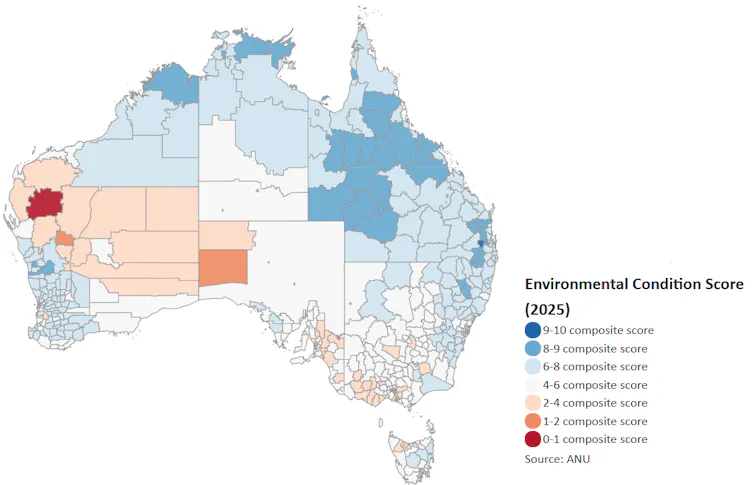
Conditions varied enormously by region this year, so for the first time we have calculated environmental condition scores right down to the suburb and locality level. You can look up your own area at ausenv.tern.org.au.

Mapping the environmental condition score to local government areas reveals poor (red) conditions in the west and the south, with good scores (blue) in the east and north. White is neutral. Australia’s Environment Explorer, CC BY

A good year but uneven on land

The country’s environmental health was split between a wetter, greener north and east, and a dry south and west. Victoria, Tasmania, the Australian Capital Territory and the Northern Territory all recorded notable declines in environmental condition.

But beyond the rainfall, there were real signs of progress. New detailed data on native forest loss and gain — a first in this year’s report — showed forest loss has declined for five consecutive years, with tree cover increasing nationally.

The amount of land cleared for grazing and native forest logging continued to fall. Vegetation canopy area and soil surface protection against erosion was at near record levels. And Australia’s greenhouse gas emissions fell by 1.9%, even as the economy grew 2.6% and the population by 1.5% — a sign growth and environmental damage are slowly being decoupled. Emissions per person have fallen 30% since 2000, though Australians still emit around three times the global average.

These improvements didn’t happen by accident. They reflect real improvements in land management and nature conservation and policy changes on emissions reduction, forest logging and land clearing accumulated over years.

Bushfires under the sea

What our scorecard doesn’t capture is what happened in our oceans in 2025 — and there the story was very different.

The Black Summer fires of 2019–20 were a climate-driven catastrophe. More than a prolonged drought, it was an extreme heat event that turned the forest into a tinderbox and caused fires of unprecedented scale. Marine heatwaves are doing the same thing underwater.

Sea surface temperatures around Australia reached their highest-ever level in 2025, breaking the record set just the year before. Our new analysis of heat stress across 24 monitored reef locations found that nearly 80% exceeded their once-in-a-decade heat threshold — more than in any previous year of the 40-year record. A sixth mass bleaching event struck the Great Barrier Reef in early 2025, following the fifth just months earlier.

Annual coral reef heat stress around Australia, 1985–2025, measured as the average extent to which water temperatures at 24 monitored reef locations exceeded levels expected in a typical once-in-ten-year event. Australia’s Environment, CC BY

Read more: Synchronised bleaching: Ningaloo and the Great Barrier Reef are bleaching in unison for the first time


The damage extended well beyond the reef. A toxic algal bloom, fuelled by a marine heatwave that pushed water temperatures well above average, spread across nearly a third of South Australia’s coastline and persisted for most of the year, killing more than 80,000 animals of 500 different species and causing respiratory symptoms in coastal residents. Elsewhere, tropical fish appeared far outside their normal ranges.

Marine heatwaves are the underwater equivalent of bushfires: large-scale, climate-driven mass mortality events that used to be rare and are now happening repeatedly. The difference is that most of us don’t see what’s happening below the ocean surface.

The extinction crisis deepens

According to the federal government’s threatened species list, 2,175 species are now listed as threatened – a 54% increase since 2000. Climate change is identified as a threat to nine in ten of the newly listed species. And the legacy of the Black Summer bushfires continues – more than half of all species listed or uplisted since 2019 were affected by those fires.

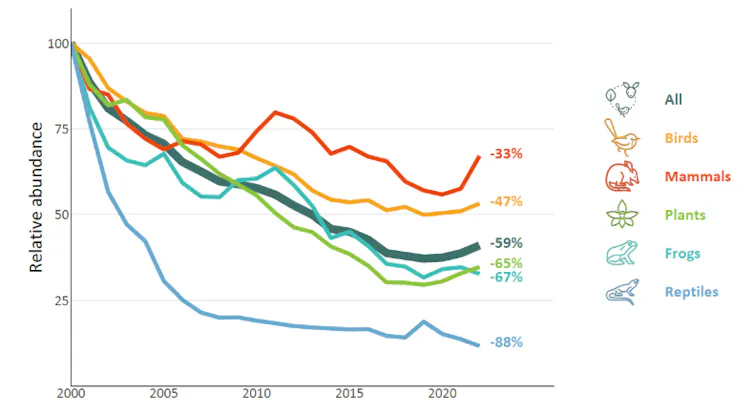
The Threatened Species Index, which tracks population trends of listed species, shows threatened species have declined by an average of 59% since 2000. In 2025 we published Australia’s first Threatened Reptile Index. Based on the monitoring data included in the index, reptile populations have declined by an average of 88% since 2000, and frogs by 67%, the steepest long-term declines of any group we have measured.

The relative abundance of different categories of species recognised as threatened under Commonwealth nature laws. The Index implements a 3-year lag, such that the latest data are for 2022. TERN Threatened Species Index, CC BY

Reasons for hope

There are some reasons for hope. The index shows that trends for threatened mammal populations have stabilised in recent years. This may reflect both wetter conditions and the impact of conservation management, such as fenced sanctuaries, predator control and habitat restoration. The data show that sustained conservation effort can make a difference.

In many respects, Australia’s environment is in better shape than it was a decade ago, and progress on emissions and land management is real. But global climate change operates on a different scale entirely. Decades of warming are already locked in, and the damage to our oceans and wildlife will worsen until global warming is brought under control.

Reducing our own emissions matters more than ever. This will also make us more resistant to the kind of energy shocks the world is experiencing right now. We cannot reverse all the damage already done, but we can certainly do much better.

ref. Australia’s forests are finally doing better — but ‘underwater bushfires’ hit oceans hard – https://theconversation.com/australias-forests-are-finally-doing-better-but-underwater-bushfires-hit-oceans-hard-278780

Trump’s ‘Venezuela solution’ to Cuba would see the island nation returned to a client state

Source: The Conversation (Au and NZ) – By Joseph J. Gonzalez, Associate Professor of Global Studies, Appalachian State University

The U.S. and Cuban governments have been at odds since the conclusion of the Cuban Revolution 67 years ago. Yet despite pressure, embargoes and various CIA plots, the communist government in Havana has resisted the wishes of its very powerful neighbor separated by just 90 miles (145 kilometers) of water.

From my perspective as an expert on Havana-Washington ties, however, this moment seems different.

For the first time since 1959, an American president, Donald Trump, appears on the verge of doing what so many of his predecessors have longed to do: depose a Cuban president and compel the Cuban government to align itself with American economic and strategic interests.

If Trump succeeds – either through military might or negotiation – then Cuba looks set to become something less than a sovereign nation and more akin to an American client state.

A partnership of unequals?

At first glance, the possibility of such a change looks epic, even monumental: an end to the Cuban Revolution as we have known it.

But deep in the annals of U.S.-Cuban history, there are echoes of Trump’s demands.

From 1898 to 1959, the American government essentially ran Cuba as a colony within its empire.

Americans repeatedly decided who would occupy the presidential palace, while Cuban politicians protected U.S. investments and supported U.S. supremacy in the Caribbean. American gangsters ran the hotels and the gambling.

That relationship ended with the revolution and Fidel Castro’s assumption of power. But if Trump has his way, the future of the U.S. and Cuba will look very much like it did in the pre-Castro era: a partnership of unequals.

Heightened tensions

During his first term, Trump turned away from President Barack Obama’s “Cuban Thaw,” which had established diplomatic relations, eased travel restrictions and raised hopes of an end to the decades-old U.S. embargo.

In place of engagement with the Cuban government, Trump strengthened the embargo, all but closed the U.S. Embassy in Havana and further restricted travel by American citizens to the island.

Trump also returned Cuba to the State Department’s list of nations that support terrorism, where it resides today.

Now, one year into his second term, Trump is using coercion backed with a tacit military threat to increase pressure on the Cuban government.

On Jan. 3, 2026, U.S. forces, seized Venezuelan President Nicolás Maduro and his wife, bringing them to New York to stand trial.

During the raid, U.S. forces killed between 75 and 100 Venezuelans and a coterie of Cubans providing security to Maduro.

Venezuela was Cuba’s closest ally, providing the island with oil at vastly reduced prices in exchange for doctors and advisers for Venezuela’s security and intelligence services.

Following Maduro’s arrest, Trump made it clear that the U.S. would no longer permit any country to supply Cuba with oil.

Without oil, Trump predicted that the Cuban government would soon collapse and suggested that Marco Rubio, his Cuban American Secretary of State, could become president of Cuba.

Secret negotiations

Cuba was in severe distress long before Maduro’s arrest.

In the years since the COVID-19 pandemic, the government has found it almost impossible to maintain adequate electricity, water, public health and public transport.

Then came the Trump administration’s oil embargo, which may push Cuba into the worst economic crisis in its history, prompting longer, deeper blackouts and further reductions in public services.

Hunger is now a widespread concern, garbage is piling up and mosquito-borne illnesses are skyrocketing. Dissent is also becoming more public – and more violent.

A man stands in a street with only car headlights lighting the scene.
Blackouts have become common in Cuba. Yamil Lage/AFP via Getty Images

Publicly, the communist government responded defiantly to the Trump administration’s aggressive actions, pledging to resist American pressure just as it had for the better part of 60 years.

Privately, however, the Cuban government agreed to talks with the Trump administration, hoping to find a way to ease American pressure.

The White House reportedly no longer considers the collapse of the Cuban government desirable, as it would precipitate a migration crisis that threatens the stability of the Caribbean, including to a South Florida that is home to the world’s largest Cuban diaspora community.

The ‘Venezuelan Solution’

Cuba’s president, Miguel Díaz-Canel, has publicly acknowledged talks with the U.S. But the particulars remain obscure.

The U.S. government reportedly wants Díaz-Canel to leave the country and permit American investment in Cuba, particularly from Cuban Americans, which has long been prohibited.

The Cuban government has already reportedly acceded to this latter demand.

The Trump administration also wants more political prisoners released and a purge of officials who were close to Fidel and Raúl Castro, his successor as president, and remained powerful after the Cuban revolutionary leader’s death in 2016. According to Amnesty International, Cuba has at least 1,000 prisoners of conscience.

In exchange, the White House would be willing to permit members of the Castro family to remain in Cuba and allow for the importation of oil. The rest of the Cuban government would also remain intact.

Cubans I know are calling this deal the “Venezuela Solution.” Much like Maduro’s successors, Cuba’s leaders would remain rulers of Cuba – provided they accept diminished political sovereignty and respect U.S. policy priorities.

Back to the future

Such a deal, if it happens, would return Cuba to the status of an American client state, the status it held long before Castro seized power and allied himself with the Soviet Union.

In 1898, the U.S. intervened in the Cuban War of Independence, the last in a series of wars fought by Cubans against their onetime Spanish colonizers.

The United States kicked out the Spanish, occupied Cuba and proclaimed its desire to turn Cuba into an independent, sovereign nation-state.

But that never happened.

Distrusting the Cubans’ ability to govern themselves, the U.S. retained the legal right to intervene in Cuban politics.

Between 1898 and 1959, the U.S. government, through its ambassador in Havana, determined who would be president of Cuba whenever a dispute arose.

Cuban politicians, eager to preserve their positions, guarded American property, despite Cuban resentments, and supported U.S. foreign policy throughout Latin America and the world.

On the eve of the revolution, Americans owned more than US$800 million in property in Cuba — the equivalent of at least $9 billion today.

Americans dominated not only the sugar industry but also public utilities, mining and tourism, which American organized crime came to control.

What’s next?

For more than 60 years, pre-revolutionary Cuba endured independence without sovereignty as an American client state.

Could such a relationship reemerge? For now, the situation between the U.S. and Cuba remains fluid, and the terms of discussions are shrouded in secrecy.

Trump, publicly, promotes a “friendly takeover of Cuba,” insisting that he could do with Cuba “anything I want.”

But one thing remains certain. While Trump remains in the White House and Rubio heads the State Department, U.S. maximum pressure on Cuba will not cease.

The Trump administration is committed to ending the Cuban government’s resistance to American power and American investment, regardless of the direct humanitarian costs in the form of the oil embargo and other penalties.

Any deal with Trump will be a bitter pill for Cuba’s political elite to swallow.

But absent an oil-rich ally, like Russia or Venezuela, and faced with an implacable enemy, Cuban officials may have no choice but to bring Cuba back into the orbit of American power, at least for now.

ref. Trump’s ‘Venezuela solution’ to Cuba would see the island nation returned to a client state – https://theconversation.com/trumps-venezuela-solution-to-cuba-would-see-the-island-nation-returned-to-a-client-state-278710

War in Iran: Why destroying cultural heritage is such a foolish strategic move in any conflict

Source: The Conversation (Au and NZ) – By Costanza Musu, Associate Professor, Graduate School of Public and International Affairs, L’Université d’Ottawa/University of Ottawa

Since the start of the ongoing United States–Israeli military campaign against Iran, the human toll of the conflict has mounted relentlessly.

Civilian casualties have been reported across the country, and the bombing campaign has caused widespread destruction to infrastructure. Alongside military targets, thousands of civilian buildings have been damaged or destroyed in the first weeks of the war.

Amid this destruction, another dimension of the conflict is increasingly drawing international concern: the damage inflicted on Iran’s cultural heritage.

Several historically significant sites, including UNESCO landmarks, have been affected. Blasts in Tehran have damaged the Golestan Palace, while strikes in Isfahan hit structures around Naqsh-e Jahan Square, including Ali Qapu Palace, Chehel Sotoun and the Masjed-e Jameh.

The destruction of such sites highlights a frequently overlooked consequence of warfare: when the rules governing the conduct of war are stretched or ignored, cultural heritage, like civilian lives, becomes collateral damage.

A man holds up a photo of a damaged heritage site at a news conference.
Iranian Ambassador to Tunisia Mir Massoud Hosseinian shows an image of damage to the historic Golestan Palace in Tehran, a UNESCO World Heritage site, during a news conference at his residence, in Tunis, on March 12, 2026. (AP Photo/Ons Abid)

Rules of engagement

Warfare is not meant to be unconstrained. It is governed by international humanitarian law, which sets limits on how military force can be used once hostilities begin. These rules are intended to reduce the human and material devastation of armed conflict by protecting civilians and civilian objects.


Read more: Israeli strikes on Tehran oil depot highlight gaps in international law


A man with slicked back hair stands behind another older man as he speaks.
Secretary of War Pete Hegseth listens as U.S. President Donald Trump speaks to reporters while traveling aboard Air Force One en route to Miami, on March 7, 2026. (AP Photo/Mark Schiefelbein)

States implement these legal obligations through rules of engagement, which guide how and when force may be used in compliance with international humanitarian law: what U.S. Secretary of War Pete Hegseth has dismissively called “stupid rules of engagement.”

International humanitarian law protects cultural heritage. After the widespread destruction of the Second World War, states adopted the 1954 Hague Convention, recognizing monuments, museums and archeological sites as specially protected cultural property, and requiring warring nations to refrain from attacking them except in cases of imperative military necessity.

Ignoring cultural property protections runs counter to a lesson many military forces, including the United States, have come to recognize: that safeguarding cultural heritage is not only a legal obligation, but also strategically smart.

Over the past two decades, this approach has increasingly been integrated into military doctrine. By protecting monuments and historic sites, military forces signal respect for a society’s identity, build trust with local populations and advance broader political objectives by fostering local civilian support.

Shifting public sentiment

In the current conflict, American officials have argued that the military campaign is aimed not at Iran’s people but at the regime that has ruled the country since the 1979 revolution.


Read more: What happens next in US-Iran relations will be informed by the two countries’ shared history


U.S. President Donald Trump has suggested that the future of Iran now lies in the hands of its citizens, implying that the weakening of the regime could allow Iranians to shape a different political future.

Initially, some voices in the Iranian diaspora and within Iran welcomed the strikes in the hope that they might open the door to political change.

Yet the scale of the destruction inflicted on cities, infrastructure and cultural landmarks appears to be shifting public sentiment, allowing the Iranian leadership to rally the population around a narrative of national unity against foreign aggression.

At the same time, the conflict is threatening cultural heritage beyond Iran. Iranian missiles have struck areas in and around Jerusalem, where its Old Town contains some of the most significant religious and historical sites in the world within barely one square kilometre. These sites are sacred to Judaism, Christianity and Islam.

If the stated objective of the military campaign is to weaken the Iranian government and open the possibility for political change, the destruction of cultural heritage will produce the opposite effect. Cultural monuments, historic cities and religious sites are not simply architectural artifacts; they are powerful symbols of collective identity and historical continuity.

When they’re damaged or destroyed by foreign military force, the attack is often perceived not only as a strike against a government but an assault on the nation itself.

A black-and-white photo shows a destroyed cathedral.
The German Luftwaffe destroyed Coventry Cathedral in 1940 during the Second World War, strengthening British resolve against the Nazis. (Imperial War Museum)

Rallying citizens

History offers many examples of how damage to cultural heritage during wars can galvanize nationalist sentiment and strengthen the legitimacy of governments under pressure. Examples include the destruction of the Old Bridge of Mostar during the Bosnian War, which became a powerful symbol of national loss and identity, to the levelling of Palmyra’s ancient temples by ISIS, which the Syrian government invoked to reinforce claims of cultural guardianship and political legitimacy.

Rather than weakening the Iranian leadership, widespread destruction, particularly when it affects cultural landmarks, may instead help it mobilize public anger and rally citizens around the defence of the country.

Both international law and historical experience point in the same direction: protecting cultural heritage is not only a humanitarian obligation, but a strategic consideration in conflicts with long-term outcomes that depend on the attitudes of the people affected.

ref. War in Iran: Why destroying cultural heritage is such a foolish strategic move in any conflict – https://theconversation.com/war-in-iran-why-destroying-cultural-heritage-is-such-a-foolish-strategic-move-in-any-conflict-277922

Spain-US rift: Pedro Sánchez’ defiance of Trump is dictated by domestic politics – but it’s also a litmus test for Europe

Source: The Conversation (Au and NZ) – By Waya Quiviger, Professor of Practice of Gobal Governance and Development, IE University

The war in Iran has yet again exposed the tensions between Spain’s Pedro Sánchez and Donald Trump. The two leaders have clashed repeatedly over the last year, including over Spain’s ongoing opposition to Israel’s conduct in Gaza, its refusal to raise Nato spending above 2% of GDP, and now its refusal to support the US war in Iran.

In late February, Spain barred the US from using its joint military bases in Rota and Morón for operations linked to the Iran war. As a result, an incensed Trump stated “We’re going to cut off all trade with Spain. We don’t want anything to do with Spain.”


Read more: Could the US cut off trade with Spain? Here’s what international law says


Sánchez has since doubled down on his opposition in a nationally televised address, where he emphatically stated the Spanish government’s position: “No a la guerra”, no to war. On social media he also asserted: “NO to violations of international law” and “NO to the illusion that we can solve the world’s problems with bombs.”

Such pointed defiance of the Trump administration could carry political risks for Sánchez. Indeed, reactions to the war from other European states have been a lot more muted. Why, then, has Sánchez adopted such an unusually confrontational stance?

The clash is being presented as a question of geopolitics or international law, but it is better understood as domestic politics shaping foreign policy. Spain’s historical anti-war political culture, the dynamics of Sánchez’s left-leaning governing coalition, and electoral incentives at home all help account for Madrid’s unusually firm position.

The shadow of Iraq

In his recent address, Sánchez made a specific reference to the 2003 war in Iraq: “Twenty-three years ago, another US Administration dragged us into a war in the Middle East,” he said. “A war which, in theory, was said at the time to be waged to eliminate Saddam Hussein’s weapons of mass destruction, to bring democracy, and to guarantee global security but… it unleashed the greatest wave of insecurity that our continent had suffered since the fall of the Berlin Wall.”

In 2003, Spanish Prime Minister José María Aznar joined the US-led coalition to topple Saddam Hussein. The decision triggered massive protests across the country and partly led to Aznar’s defeat in the 2004 elections. His opponent, the Socialist Party’s José Luis Rodríguez Zapatero, campaigned on a promise to withdraw troops from Iraq, which he fulfilled immediately after taking office.

The Iraq war fundamentally shaped Spanish public attitudes toward military intervention in the Middle East, and its legacy explains Sánchez’s instinct to distance Spain from the Iran war. His stance is not only ideological – it reflects the memory of how politically damaging it can be for a Spanish government to align itself with US interventions.

Coalition politics and early electoral signals

Sánchez’ position on the war in Iran can also be analysed in the light of current political developments at home. Sánchez governs with support from left-wing parties strongly opposed to US military intervention. Backing Washington, or even facilitating the war through US bases, could risk destabilising that coalition. But the political calculation may go even further.

Sánchez has earned a reputation for repeatedly surviving political crises. Despite declining poll numbers and ongoing scandals within his party and inner circle, he appears to be betting that Trump’s deep unpopularity in Spain will ultimately work to his advantage, particularly among his left-leaning base.

Recent electoral results suggest the strategy may be resonating with voters. In much anticipated regional elections in Castilla y León held on Sunday, Sánchez’ Socialist Party (PSOE) increased its representation, gaining two additional seats despite polls suggesting the party might lose significant ground.

While one election cannot determine national trends, the result offers an early indication that a firm anti-war stance may not carry the domestic political costs critics predicted. If anything, it may have reinforced Sánchez’s appeal across party lines among voters sceptical of military escalation, critical of Donald Trump, and supportive of a more independent European foreign policy.

If Sánchez is proven right, it would also vindicate the Spanish government’s stance on Nato. In June 2025, Spain refused to raise defence spending toward Trump’s proposed 5% Nato target, prompting harsh criticism from the US president. The dispute reflects a broader political reality: higher defence spending is unpopular among the Spanish electorate.

Seen in this context, the Iran war confrontation is part of a longer pattern in which domestic political considerations shape Spain’s position within the transatlantic alliance.


Read more: NATO has deep divisions – but why is Spain its most openly critical member?


Domestic pressures across Europe

Spain’s stance may appear unusually confrontational, but Europe’s response to the Iran war has been far from unified. Much of the variation reflects different domestic political pressures facing European leaders.

In Germany, Chancellor Friedrich Merz initially avoided direct criticism of the US strikes and has generally emphasised transatlantic unity. Nevertheless, he has warned against a prolonged conflict and stressed that Germany “is not a party to this war” and does not want to become one, highlighting concerns about economic disruption and regional instability.

The UK has taken a similarly careful stance. Prime Minister Keir Starmer insisted on clarity about US objectives and legal justification before committing military support, emphasising diplomacy and maritime security rather than direct involvement in the conflict.

Italy’s Giorgia Meloni has raised concerns about the legality of the war, but avoided outright condemnation of Washington. Her government has emphasised respect for existing agreements governing US military bases rather than blocking their use outright, reflecting both Italy’s strong security ties with the United States and Meloni’s own political alignment with transatlantic conservatives.

The overall picture is of a fragmented European response. Across the continent, governments are balancing their own domestic political constraints against broader international strategic calculations.

A litmus test for Europe

Spain’s response to the Iran war may offer the clearest example yet of how domestic politics is shaping Europe’s reaction to the conflict. Time will tell whether Sánchez’s stance proves politically sustainable at home, and whether it makes Spain the champion of a more assertive European approach toward Washington or just an outlier.

If the strategy proves successful, it could encourage other European leaders to push back against Washington. If it backfires, however, Europe’s cautious response will likely become more entrenched.

Either way, the episode illustrates a broader reality of international relations. Foreign policy decisions may be presented as matters of international law or principle, but in democratic systems they are often shaped first and foremost by the pressures of politics at home.


A weekly e-mail in English featuring expertise from scholars and researchers. It provides an introduction to the diversity of research coming out of the continent and considers some of the key issues facing European countries. Get the newsletter!


ref. Spain-US rift: Pedro Sánchez’ defiance of Trump is dictated by domestic politics – but it’s also a litmus test for Europe – https://theconversation.com/spain-us-rift-pedro-sanchez-defiance-of-trump-is-dictated-by-domestic-politics-but-its-also-a-litmus-test-for-europe-278557

Victorian teachers are on strike for the first time in 13 years – it’s about more than pay

Source: The Conversation (Au and NZ) – By Duyen Vo, Sessional Lecturer and Researcher, Faculty of Education, Monash University

Victorian public school teachers are walking off the job today. Tens of thousands of school staff, including support staff and principals, are expected to strike.

Teachers in Tasmania are also striking this week. Public schools will be closed in the state’s northwest on Tuesday, the north on Wednesday and the south on Thursday.

Public debate has understandably focused on issues around salaries and workloads, including staff shortages and unpaid overtime.

But industrial action of this scale can also signal something deeper – a breakdown of trust between teachers and the systems they work within.

Teachers want a significant pay increase

During nine months of negotiations with the state government, Victorian school staff have asked for a 35% pay increase over four years, alongside measures to improve workloads.

Teachers argue this rise is needed to keep pace with inflation and bring salaries into line with their interstate colleagues.

The Victorian government’s latest offer includes a 17% pay increase over several years, with limited practical changes to working conditions. On Monday, Victorian Premier Jacinta Allan described the offer as “strong”.

How does Victoria compare with other states?

Teachers argue the Victorian government offer falls well short of what is needed to retain teachers and stabilise the workforce.

Currently, Victorian teachers are among the lowest paid in Australia, with gaps of A$10,000–15,000 per year compared with some other states.

For example, in 2025, entry-level teachers in Victoria were paid $79,589. Over the border, in New South Wales, their colleagues earned $90,177. Victorian school principals were paid $156,335. In NSW they earned $178,812.

Teacher salaries in Australia are set at the state level. In recent years, Victorian pay scales – which are influenced by earlier industrial agreements and relatively lower school funding overall – have not kept up with larger increases in other states.

Tasmanian teachers are so far rejecting a pay rise offer of less than 9% over three years from their state government.

Concerns around workloads

Victorian teachers are also calling for improvements to work conditions. This includes smaller class sizes and increased support staff and allied health resources for students.

Class sizes in Victoria are generally capped at around 25–26 students, with smaller classes in the early years of schools and flexible arrangements in specialist schools.

Teachers say smaller class sizes are key to both equity and effective student learning, particularly if there are students with extra needs.

Class sizes in Victoria are roughly equivalent to those in NSW. But class size is an issue around the country.

On top of this, teachers are seeking measures to address administrative burden and burnout. A 2025 study found nine out of ten Australian teachers are experiencing severe stress, and nearly 70% say their workload is unmanageable.

Last week, the Allan government announced measures to cut down on teachers’ paperwork, including simpler student reports. But this has not stopped the strike action.

Teacher strikes are rare

Given the disruption strikes cause to student learning, historically, teachers tend to avoid industrial action.

This is the first major statewide strike in Victoria in 13 years, highlighting the seriousness of the current dispute.

The only recent comparison is a statewide teacher strike in Queensland in 2025. This similarly focused on pay, workload and working conditions.

Beyond pay

Teachers’ dissatisfaction about their working conditions goes beyond salaries.

Amid an ongoing teacher shortage around the country, research tells us teachers are dealing with abuse from students and parents.

Research also tells us teachers’ job satisfaction is hampered by overly prescriptive curriculum demands and administrative tasks that take them away from classrooms. This means they don’t have the time and autonomy to decide how best to teach and engage their students.

Is there an even deeper issue?

Across our studies examining teachers’ work and wellbeing in Australian schools, one theme appears repeatedly: teachers want to feel respected and trusted in their workplaces.

For example, in our 2024 study of 994 Australian teachers, they emphasised the importance of feeling valued and trusted at work as well as supported and safe.

This means teachers want to be recognised as the professionals they are. This means having their teaching judgement and expertise valued and respected by parents, education administrators, the media and the broader community.

Ultimately, teachers want a genuine say when it comes to decisions about their teaching. And they want to know the community supports them and values their work.

ref. Victorian teachers are on strike for the first time in 13 years – it’s about more than pay – https://theconversation.com/victorian-teachers-are-on-strike-for-the-first-time-in-13-years-its-about-more-than-pay-278977

How reducing ‘just in case’ purchases can help avoid empty shelves and fuel bowsers

Source: The Conversation (Au and NZ) – By Jennifer Macklin (Downes), Senior Research Fellow, BehaviourWorks Australia, Monash University

If you’ve topped up your tank at a petrol station recently, did it feel like you were “panic buying”? Or did it feel more like “I’d better buy some, just in case”?

During the COVID pandemic, our research team wrote about the psychological drivers behind Australians buying up toilet paper: scarcity mindset, anticipated regret and regaining “control”. We also warned that politicians or media coverage rebuking people for buying more at the supermarkets actually risked making it worse.

Over recent weeks, some senior politicians have repeated this mistake, berating people as “un-Australian” for “panic buying” fuel.

But one of the lessons we should have learnt from COVID – when supermarket shelves were cleared and some buying limits had to be introduced – is that most people didn’t perceive themselves as “panic buyers”.

‘Just in case’ shoppers

A 2020 survey asked 450 people in the United States and Australia “to what extent did you engage in panic buying in the first few months of the COVID-19 outbreak?”. On average, both the older US participants and mostly university-aged Australians participants scored themselves as only having “low engagement” in panic buying.

A smaller UK study published in 2022 found similar results, concluding “‘panic buying’ is not a useful concept”.

Instead, Australian and other shoppers during COVID saw buying a bit extra as playing it safe, rather than panicking.

Many Australians have lingering memories of times when supply has struggled to meet demand: from banana prices jumping from A$2 a kilogram to $15 a kilo after Cyclone Larry in 2006, to struggling to find eggs last year due to bird flu.

With little sign of the Strait of Hormuz being safe for oil tankers anytime soon, it’s entirely rational for people to think “I’d better get petrol now, before the price jumps further” – sooner than we might have refilled normally.

But when enough people buy more “just in case”, all those individual choices can collectively overwhelm our fuel and food systems.


Read more: Panic buying just makes shortages worse. Why do people do it anyway?


‘A few extras’ can empty shelves

Australia has spent decades pursuing lean supply chains – what’s known as “just-in-time” supplies, with minimal buffer stock sitting around in warehouses.

It’s a hyper-efficient system that uses sophisticated demand forecasting to keep costs low. But it also assumes that tomorrow will look exactly like today.

Supply chains here and in many other countries are now optimised for predictable demand, rather than surges in demand.

In March 2020, market research group Kantar analysed the shopping habits of more than 100,000 UK consumers. It found only a small minority of people were buying far more than usual. For instance, only 3% of shoppers were stockpiling far more packets of pasta than usual.

But a significant number of consumers were adding just a few extra products and shopping more often than usual. Kantar concluded those “just a few extras” shoppers were inadvertently emptying shelves.

For our supply systems to keep working today, we need to resist the instinct to buy more fuel or other essentials than usual – unless there’s a genuine need, like residents in Queensland and the Northern Territory needing supplies before Cyclone Narelle hit.

Buying just what you need

Our work in behavioural theory suggests two approaches that would help Australia avoid repeating some of the mistakes of the early COVID response.

First, we need to highlight what the majority are doing. Focusing on the minority – those emptying shelves of jerry cans at Bunnings – can accidentally create a powerful, negative social norm that can amplify hoarding behaviour.

Most Australians are still buying petrol and shopping as normal. Highlighting sensible behaviour normalises and stabilises it.

Two cars at a largely empty petrol station

While some regional petrol stations have reported fuel shortages, it’s still business as usual for in many parts of metropolitan Australia – like this inner Brisbane petrol station on Monday March 23, 2026. Liz Minchin/The Conversation, CC BY

Second, we should appeal to people’s collective responsibility. This means emphasising the need for collective effort to keep supplies available for everyone. Bringing values of shared responsibility to mind can encourage more considered choices.

Prime Minister Anthony Albanese appears to have realised this. Talking about surging fuel demand late last week, he put greater emphasis on what “a good Australian” would do:

My message to Australians is please do not take more fuel than you need […] It’s the Australian way to think of others, to think of their neighbours, their community and also to think of the national interest. Only take what you need.

At the same time, we also need to build greater responsiveness into our fuel and food distribution systems, balancing efficiency with resilience.

The real lesson of empty petrol stations or supermarket shelves isn’t that people are irrational. It’s that perfectly rational individual behaviour can overwhelm a fragile system.

Until more resilient systems are in place in future, we can all play our part to keep essentials like petrol and food in stock, by shifting from a “just in case” mentality to “just take what you need”.


Read more: It’s not hoarding: farmers need to buy huge amounts of diesel to keep our food secure


ref. How reducing ‘just in case’ purchases can help avoid empty shelves and fuel bowsers – https://theconversation.com/how-reducing-just-in-case-purchases-can-help-avoid-empty-shelves-and-fuel-bowsers-278307

Oil reserves last for weeks. Solar panels last for decades

Source: The Conversation (Au and NZ) – By Andrew Blakers, Professor of Engineering, Australian National University

Oil and gas prices are shooting up as war in the Middle East cuts down the supply of fossil fuels available, in what has been described as “the largest supply disruption in the history of oil markets”.

There have been several major upheavals in energy markets since 2020, including the COVID pandemic, Russia’s ongoing war on Ukraine, and US President Donald Trump’s trade and tariff war with much of the world.

What now? The closest historical comparison may be to the oil shock of the 1970s, which prompted significant moves by governments around the world to reduce the demand for fossil fuels.

This time around, things are different: relatively cheap, widely available renewable energy technology means not only governments but also companies and individuals can reduce their own reliance on fossil fuels, permanently.

The traditional case for renewables

Compared to what we get from fossil fuels, renewable energy is clean, cheap and reliable.

Solar and wind can provide virtually unlimited energy without greenhouse emissions. They also eliminate smog, strip mining, gas fracking, oil spills and oil-related warfare – not to mention avoiding the radioactive waste, accidents and weapons proliferation that go hand in hand with nuclear power.

Renewables have low requirements for raw materials, land and water. Waste from solar farms is about 1,000 times smaller than the avoided carbon dioxide from burning equivalent fossil fuels.

These technologies also come out ahead on price. Solar and wind have provided virtually all new power plant capacity in Australia over the past decade.

At a global level, solar and wind are being installed five times faster than everything else combined. This is compelling market-based evidence of their low cost.

The reliability test also favours renewables. In recent years, Australia’s shaky fleet of ageing coal power stations has become a substantial threat to grid stability. In contrast, solar and wind are very predictable, because thousands of collectors spread over a million square kilometres greatly reduces the impact of collector malfunctions and local weather.

Electric vehicles are making inroads for consumers and also heavy industry. Netze / Unsplash

Energy from solar and wind can be stored and released on demand via batteries and pumped hydro projects such as Snowy 2.0.

Consumer electric vehicles are also taking off, and heavy transport is not far behind. In China, electric truck sales have reached parity with diesel trucks. In Australia, major companies such as Fortescue are on track to drastically cut their emissions.

The spike in the price of gas following the Russian invasion of Ukraine in 2022 had a major effect on Australian energy prices because the companies exporting Australian gas charged Australian consumers world parity prices. However, apart from 2022, Australian electricity wholesale market price is unchanged over the past decade, while the renewables fraction increased from 17% to 42%.

Renewables make us more resilient

If we “electrify everything” – transport, heating and industry – clean electricity can replace most gas heating and imports of petroleum products (which cost Australia A$53 billion in 2025). This would double Australia’s electricity demand and reduce greenhouse emissions by three quarters.

At the domestic level, an all-electric home with solar panels can have no bill for gas or petrol, and a low bill for electricity. Energy storage is available via hot water tanks, electric vehicles and home batteries.

Energy from rooftop solar works out costing around 5 cents per kilowatt-hour, a fraction of the retail price.

Rooftop solar can have big benefits for homeowners. Raze / Unsplash

If grid power fails or fossil fuel prices soar, solar-powered homeowners can carry on indefinitely with nearly normal house operation.

Once an international disruption of oil and gas supply lasts for a month or so, it becomes a big problem for Australia as reserves are depleted and prices spike. In contrast, solar panels, wind turbines, transmission, batteries, pumped hydro, electric vehicles, electric heat pumps and electric furnaces last for decades – so we have much more time to see any disruption coming and work around it

And in a darker possibility, a decentralised energy system based on thousands of solar and wind farms and millions of solar rooftops would be far more resilient against military attacks than a few coal and nuclear power stations.

War, trade war and pandemics

Nobody knows the ramifications of the latest war in the Middle East. In the short term, prices for oil and gas have risen sharply.

The fundamental difference this time round is that individuals, companies and countries have remarkably cheap clean energy alternatives available.

Australia is rapidly decarbonising its electricity grid by replacing coal and gas with solar and wind. The government target is 82% renewable electricity by 2030. Gas heating is being actively discouraged in favour of electric heat pumps, and electric cars and trucks are being encouraged.

Alongside lower emissions, lower cost and greater reliability, a rapid transition to clean energy also means greater resilience in an unpredictable future. In the long run, the most important outcome of the current wars might be an acceleration of the world’s move away from fossil fuels.

ref. Oil reserves last for weeks. Solar panels last for decades – https://theconversation.com/oil-reserves-last-for-weeks-solar-panels-last-for-decades-278895

Hospital audit finds siblings of children with serious conditions are overlooked, lack support

Source: The Conversation (Au and NZ) – By Julie Blamires, Senior Nursing Lecturer, Auckland University of Technology

Imagine spending years living on the edge of your family’s story.

You know something is wrong with your brother or sister. You see the hospital visits and medication routines, the quiet worry on your parents’ faces. You piece things together from overheard conversations, wondering whether what you feel is normal and whether anyone notices what you are missing.

This is the lived reality for millions of siblings of children with long-term health conditions worldwide. In the United States, up to 30% of children grow up with a sibling who has a chronic condition such as epilepsy, cystic fibrosis, childhood cancer or cerebral palsy.

In Aotearoa New Zealand and Australia the statistics are comparable. The ASB national health survey 2022 found two in five (45%) Australian children live with at least one chronic condition.

New Zealand doesn’t have a single definitive data set but the 2023 household disability survey identified 98,000 disabled children, with asthma alone affecting 15–20% of children. When the full range of long-term conditions is considered, the number of children growing up alongside an affected sibling is likely similar to that seen in the US and Australia.

Research consistently shows the impact extends well beyond the child who is unwell.

Siblings experience higher anxiety, disrupted schooling, social isolation and major changes to family life. Yet as our work with a sibling advisory group shows, siblings remain largely invisible in clinical settings designed to support families.

They frequently sit on the sidelines while conversations happen around them rather than with them. Doctors speak to parents. Parents speak to the child with the condition. Siblings are watching and worrying but receive little direct information.

Many describe feeling overlooked or ignored during appointments and left to make sense of situations without language to understand them.

Lack of sibling support at children’s hospitals

To find out how well children’s hospitals in New Zealand and Australia support siblings, we looked not at policy documents or mission statements, but at what siblings and families can realistically access.

We audited major children’s hospital websites across both countries. Using the search term “sibling”, we examined whether any material was genuinely written for siblings, rather than for parents or clinicians. The findings were disappointing.

In New Zealand, only Starship Children’s Hospital returned search results. Of 54 results, just two grief booklets were remotely relevant, but both were still written mainly for parents.

Kidz First, Te Wao Nui and Whangārei Hospital provided nothing for siblings.

Across Australia, provision was uneven. Sydney Children’s Hospitals Network and the Royal Children’s Hospital Melbourne offered sibling‑specific material, while Queensland Children’s Hospital, Monash Children’s Hospital and Perth Children’s Hospital had little.

Even where material existed, siblings were rarely the intended audience. Most information targeted parents or mentioned siblings briefly within family resources. When siblings were acknowledged, it was in the context of grief, not the everyday reality of growing up alongside a brother or sister with a long‑term condition.

Beyond the hospital bed

In contrast, some of the richest and most thoughtful support sat outside the hospital system altogether.

Charities and non-governmental organisations such as Siblings Australia, Canteen Australia, Drenched, Kidshealth and New Zealand’s Parent2Parent offered age-appropriate information, peer support programmes, camps and opportunities for siblings to connect with others like them.

These supports matter deeply but are rarely signposted by healthcare teams and many families are unaware they exist.

For the young people we work with, these findings are unsurprising. Members of our sibling advisory group describe having felt invisible in clinical spaces, excluded from conversations about their sibling’s health, and left to fill in the gaps alone.

Research echoes this experience, showing restricted hospital access and information filtered through parents leave siblings confused and distressed.

What siblings are asking for

Siblings want clear, honest information about their sibling’s condition, shared in ways that match their age and understanding. They want to be included, not managed out of the room.

They want clinicians to recognise that this is their experience, too. Evidence shows when siblings receive accurate and timely information, anxiety decreases and fears about their own health or the future lessen.

Many want opportunities to connect with peers. These are not extraordinary requests. They are the foundations of good child and family care, recognising the whole family, not only the child in the hospital bed.

International reviews from Canada and elsewhere show similar findings to our audit, with sibling‑focused support scarce, poorly integrated and often invisible to families.

Researchers in Sweden, Canada, Australia and New Zealand are now working together to ask siblings aged five to 18 what information they need and how they would prefer to receive it, with the aim of improving sibling‑specific resources.

The message from research, practice and young people is clear. Siblings are an afterthought in systems organised around patients and parents.

For clinicians, change starts by acknowledging siblings and offering age‑appropriate explanations. For hospitals, it means ensuring sibling‑specific resources are visible.

Sibling‑inclusive care is not optional. For every child waiting outside a clinic room, watching their brother or sister disappear through doors they cannot follow, it is the right thing to do.


With thanks to research assistant Jess Gardiner and the young people who make up the New Zealand siblings advisory group.


ref. Hospital audit finds siblings of children with serious conditions are overlooked, lack support – https://theconversation.com/hospital-audit-finds-siblings-of-children-with-serious-conditions-are-overlooked-lack-support-278889

Half of psychologists assessing for ADHD don’t follow the diagnostic guidelines, new study shows

Source: The Conversation (Au and NZ) – By Clare O’Toole, Clinical Psychology Phd Candidate, University of Wollongong

Attention-deficit hyperactivity disorder (ADHD) is a condition that develops during childhood and affects 6–10% of kids and 2–6% of adults.

People with ADHD have either mainly inattentive symptoms (such as lacking concentration), mainly hyperactive and impulsive symptoms (such as speaking or acting without thinking), or a combination of the two.

Two people with ADHD can have very different symptoms and experiences. So it’s important for clinicians who diagnose the condition to have the right knowledge and expertise.

But our new research found half of psychologists who assess for ADHD don’t follow the diagnostic guidelines or criteria.

This means less-typical presentations of ADHD – such as in women and girls, quiet inattentive adults and high-achieving students – could be overlooked.

How is ADHD diagnosed?

ADHD is currently diagnosed by a psychologist, psychiatrist, or paediatrician. Queensland GPs can also diagnose ADHD, with more states and territories to follow.

ADHD can’t be diagnosed with a blood test or other single measure. It requires the consideration of multiple factors and information sources, along with clinical judgement.

Australia’s evidence-based practice guideline for ADHD, released in 2022, provides a clear standard for assessment and treatment. It recommends ADHD assessments include a full developmental, mental health and medical history.

Medical assessments should be used to rule out other factors which could look like ADHD, such as sensory impairment, thyroid disease, anaemia, or medication side effects.

The clinician must also consider the social, psychological and clinical context of a person’s symptoms. This requires input from more than one setting and person such as a teacher or family member. The assessment shouldn’t rely solely on questionnaires or looking at the person.

The diagnosis of ADHD should be made in line with diagnostic criteria from the Diagnostic and Statistical Manual of Mental Disorders (the DSM 5) or the International Classification of Disease (the ICD). These require impairments that are out of step with the person’s age, that began before they were 12, and that have impacts across multiple settings, such as home and school or work.

In practice, a comprehensive ADHD assessment could include:

  • interviews with a person and a family member covering their history and current situation
  • review of school reports
  • completion of questionnaires to assist in clarifying the diagnosis
  • investigation of any medical issues which may be causing ADHD-like symptoms.

Our study

Our recent study used an online questionnaire of 322 Australian psychologists involved in diagnosing and treating ADHD. We wanted to see how they were assessing for it, if that matched the Australian guidelines, and how well they knew the diagnostic criteria.

The study was limited to psychologists due to the low number of responses from psychiatrists and paediatricians, and because there are many more psychologists than other specialists.

The study relies on anonymous self-reported data. This reduced the likelihood that only the most confident people would participate, or that clinicians would be focused on looking good.

But there’s a chance the psychologists might not remember their assessments accurately, or apply as much effort to the questionnaire as they would to a client.

What we found

Three in four psychologists said they always followed guidelines, with more saying they followed them some of the time. But overall, fewer than half reported assessment practices that actually followed the guidelines.

This suggests people seeking an assessment can’t rely on a clinician’s assurance they’re following the guidelines and need to ask specifically what’s involved.

Almost all psychologists used client interviews and gathered a developmental history. However, only three in four completed a mental health assessment. Less than one in three assessed for other illnesses. None reported performing a sensory assessment.

This makes it much more difficult to instead diagnose a different condition or rule out other potential causes for symptoms.

Next, we gave psychologists in the study a list of the ADHD criteria, and another item from the specific learning disorder criteria (difficulties with learning and using academic skills).

While ADHD is associated with lower grades at school, it’s not a requirement for diagnosis. Someone may meet the criteria for ADHD without experiencing difficulties learning. Kids with a specific learning disorder can also have ADHD, and it’s important these learning difficulties are also detected.

But fewer than one in three psychologists surveyed correctly identified all the ADHD criteria and also rejected the non-ADHD item. This means people who do well in school but struggle in other areas of their life might miss out on a diagnosis.

Likewise, four in ten clinicians did not recognise that symptoms needed to be out of step for the person’s age and stage of development for a diagnosis. This could mean people are diagnosed when they don’t actually fit the criteria.

Overall, these inconsistencies mean people whose symptoms overlap with anxiety, depression, trauma, sleep problems, thyroid problems, hearing or vision issues, or learning disorders are at greater risk of being misdiagnosed or missing out on helpful support.

What should I look for if I’m seeking an assessment?

If you’re concerned about ADHD symptoms for yourself or your child, discuss your concerns with your GP and find out what services are available in your area.

The wait times and costs for assessments can vary widely, so compare your options before committing to an assessment.

If you’re interested in exploring medications, you will need to visit a paediatrician, psychiatrist or, in some states and territories, a GP, as psychologists aren’t able to prescribe medications.

To make sure you or your child is being properly assessed, look at the guidelines and ask before booking what’s involved in the assessment.

ref. Half of psychologists assessing for ADHD don’t follow the diagnostic guidelines, new study shows – https://theconversation.com/half-of-psychologists-assessing-for-adhd-dont-follow-the-diagnostic-guidelines-new-study-shows-277957

Mary Shelley is often underestimated on screen – does The Bride! finally get her right?

Source: The Conversation (Au and NZ) – By Fiona Wilkes, PhD Candidate, School of Humanities, The University of Western Australia

Ostensibly, Maggie Gyllenhaal’s second film, The Bride! offers a reimagining of the 1936 film The Bride of Frankenstein, in which the bride appears only briefly and does not say a single word.

This is undoubtedly rectified in Gyllenhaal’s version.

From the afterlife, Mary Shelley (Jessie Buckley) seeks a body through which to insert herself. She chooses the body of Ida (also Buckley), an escort entangled in the seedy world of crime boss Mr Lupino (Zlatko Burić) in 1930s Chicago.

After Mary forces Ida to perform a shouting outburst in front of Lupino, she is sent careening down the stairs, breaking her neck. Shortly thereafter, she is dug up from her pauper’s grave by Frankenstein (Christian Bale) and Dr Euphronious (Annette Bening).

Euphronious reanimates Ida and Mary, too, reappears.

This film offers less a story about the bride of Frankenstein, and more a commentary on the lesser-known sad second life of Mary Shelley – and all she might have said if she had the chance to rewrite Frankenstein, and her life.

Who was Mary Shelley?

Shelley is generally remembered as a kind of wunderkind.

Born in 1797 to esteemed writers William Godwin and Mary Wollstonecraft, married to the esteemed poet Percy Bysshe Shelley, she is famed for writing the first science fiction novel when she was just a teenager.

Frankenstein; or, The Modern Prometheus was published in 1818 when she was 20, just two years after she began writing the story on a fateful night in Geneva. It tells the story of an ambitious young scientist, Victor Frankenstein, who plays God with devastating consequences. He succeeds in making a man from the remnants of corpses, only to abandon his creation when he sees how monstrous it is.

The novel went on to become one of the most famous works of English literature.

This is not a simple story of a teenage girl turned creative genius. Shelley, aged just 18, had already eloped with a married man, suffered the death of a daughter, and given birth to a son.

Frankenstein was not born from a girlish wondering at the world, but rather was clawed from her grief and rage.

Within a year of Frankenstein’s publication, Shelley had buried three children and given birth to a fourth. She was just 21 years old.

Shelley’s later works were largely ignored. But at various points in the 200-plus years since Frankenstein’s publication, Shelly has been called a radical, a feminist and the mother of science fiction. She has also been called a heretic, an adulterer and “as mad as her hero”.

Mary in The Bride! is haggard, lit in a way that highlights undereye circles and the few lines Buckley has on her face. Her mouth is often downturned into a scowl, except when she releases a humourless laugh. There is nothing funny about this Mary. This is a Mary who has lived a hard life.

Depictions of Mary Shelley

This is not the Mary Shelley we know from other film versions.

The 1931 film The Bride of Frankenstein is introduced by Mary Shelley (Elsa Lanchester), when she tells Lord Byron and Percy Shelley the tale she first told them in the 1931 film, Frankenstein, has a second part.

The film is actually startling removed from its source material, and here, Mary is prim and dressed all in white. Byron commands the room; Percy writes – Mary embroiders. When she is asked to look at the storm raging outside the room, she declines, saying “You know how lightning alarms me.”

Mary, in this version, is sweet, mild-mannered and moral.

Mary Shelley (2017) saw a fresh-faced Elle Fanning playing the author from girlhood to grief-stricken motherhood.

For the majority of the film, Mary is youthful and energetic, endlessly inspired and writing at all hours of the day. Her love affair with Percy is a key plot point. Much of the film is spent dealing with the low expectations of her by the men she is surrounded by in Geneva.

Neither film offers a particularly flattering representation. In both, Shelley is at the mercy of her husband.

In The Bride of Frankenstein, Mary cannot so much as light a candle without the aid of “Shelley, darling”. The 2017 film suggests Mary wrote Frankenstein as a way of pointing out Percy’s flaws to him through the character of Victor Frankenstein.

But The Bride! asks viewers not only to reconsider what they know of Frankenstein, his monster, and his monster’s bride, but the woman we remember through them.

This Mary is a possessor, a demon. She says during her lifetime, she couldn’t say all she wanted to – in life and in her work. Now, she will take the chance, by any means necessary.

Ida refuses to be silenced. She is often seen screaming and thrashing about. Her mouth is dyed black by an inky substance, highlighting how often it is open.

Through Ida, Mary gets to call out the bad behaviour of the men who want girls like Ida, and, by extension, Mary, to be quiet. To be a good girl. To be placid and sweet and unable to light their own candles. Mary uses Ida to – literally – hold a gun to their heads and make them apologise for their behaviour, paving the way for a wave of women to fight back against the patriarchal structures that have bound both Ida and Mary.

Here, finally, we have the Mary who could stitch together literature’s favourite monster, rather than a pretty sampler.

ref. Mary Shelley is often underestimated on screen – does The Bride! finally get her right? – https://theconversation.com/mary-shelley-is-often-underestimated-on-screen-does-the-bride-finally-get-her-right-278547

Our Changing World: The tree keepers

Source: Radio New Zealand

Aaron Hewson has been studying the genetics of the trees in the orchard. RNZ / Claire Concannon

Follow Our Changing World on Apple, Spotify, iHeartRadio or wherever you listen to your podcasts.

The lines of apple trees look lush and healthy, some garlanded with a heavy crop of coloured orbs – greens, bright reds, yellow-striped. For some, the variety is apparent even on the same tree, hosting, as these trees are, two to three different apple cultivars.

And keeping this variety alive is the whole point of this orchard.

The Jim Dunckley Heritage Orchard

Ann Dunckley remembers her dad stopping to look at apple trees at the side of the road or in old orchards when they were out and about. “He liked apples,” she says, “And he was worried about the fact that the old ones were disappearing, old farm orchards were being bulldozed.”

Jim was a founding member of the Coastal Otago Branch of the New Zealand Tree Crops Association and, along with friend Paul Snyder, he started collecting different varieties of apple trees in the 1990s.

Unfortunately, Jim has passed away but the orchard lives on, having moved to a site near Mount Cargill just outside of Dunedin city, in the early 2000s.

Ann Dunckley’s father Jim established the heritage orchard, and Paul Snyder helped him to gather trees from around Otago. RNZ / Claire Concannon

Here, neat rows of about 300 root stock apple trees have different cultivars, or varieties, grafted on to them. The root stock trees are clones, chosen for their growth and disease resistance characteristics. Each cultivar is also a clone grafted on, to maintain its genetics.

The idea is that the orchard acts like a living library. New growth or scion wood can be harvested off these trees, stored over winter and then grafted on to new root stock trees to replicate the cultivar.

However, across time, notes and labels were misplaced and uncertainty about the varieties crept in.

It was a chance encounter on an orchard open day that would provide the solution.

The Jim Dunckley Heritage Orchard in Dunedin RNZ / Claire Concannon

Science to the rescue

It was their first orchard open day in 2023 that kicked it all off, says Donal Ferguson. Until recently Donal was the chair of the Coastal Otago Branch of the New Zealand Tree Crops Association. Associate Professor Lynette Brownfield from the University of Otago’s Biochemistry department came along and when she learned about the identification problem, she offered up a solution – genetic testing.

Masters student Aaron Hewson was given the task. Starting with 336 leaf samples, he used genetic analysis to compare the varieties in the orchard to those in the Bioeconomy Science Institute’s heritage orchard records. Some of them matched genetically, but were labelled differently, so he was forced to go further afield.

Luckily there has been a lot of work overseas looking into heritage apples, including compiling genetic and physical trait databases. Aaron was able to use these as a “gold standard” reference to compare his samples against.

To the team’s surprise, 80 percent of the samples matched with apple tree cultivars in this database and some of them were duplicates.

The remaining 20 percent are likely seedlings, says Aaron. While grafting an apple tree creates a clone that is genetically identical, it is quite different if you grow a tree from seed, says Aaron. “They’re quite a genetically diverse species. So, if you cross any two apples together and get a seed, it’s going to look very different to the parents. It’s going to be a random mix up.”

It’s a bit trickier to identify seedlings then, because that means working backwards to figure out a ‘family tree’ for the apple that traces back to the varieties in the database.

But these seedlings might also represent the interesting variety that the orchard was aiming to conserve – apples with desirable traits that grow well in Coastal Otago conditions.

Aaron Hewson checks the ID tag on one of the trees in the orchard. RNZ / Claire Concannon

It’s these traits that Aaron finds interesting to think about. For commercial growing, breeders are focused on characteristics like storage, resistance to bruising and disease, or a certain colour or crispness. But this orchard contains a much wider variety of colour, texture and flavours than can be found in our supermarket apples.

Now, thanks to the research, these varieties can be confidently shared with whoever might want to grow them.

Sign up to the Our Changing World monthly newsletter for episode backstories, science analysis and more.

– Published by EveningReport.nz and AsiaPacificReport.nz, see: MIL OSI in partnership with Radio New Zealand

NZ cricketers back new T20 league “You’re playing the game for the fans”

Source: Radio New Zealand

Jimmy Neesham. Andrew Cornaga/www.photosport.nz

New Zealand’s top cricketers are happy a decision has been made about the future of the domestic T20 competition and are looking forward to its development.

On Monday New Zealand Cricket decided to push ahead with a proposed NZ20 franchise league rather than entering into an expanded Australian Big Bash competition.

That immediately resulted in former international Dion Nash resigning from the board of New Zealand Cricket, saying he could no longer support the organisation’s direction.

However the players are backing the decision.

Black Caps allrounder Jimmy Neesham said a local improved competition was always their preferred option.

Neesham, who has played franchise cricket around the world, is happy there is now clarity and that all stake-holders are moving in the same direction.

“It is an exciting time for New Zealand cricket and hopefully we can move things forward quickly towards next summer,” Neesham said.

“It keeps things home-grown and in-house. The great thing about the development of players in this country is the ability to rub shoulders with international players (which) really accelerates a young players development.”

Neesham said competitions like The Hundred in Britain and the SA20 in South Africa have helped grow the game in those countries.

“At the end of the day you’re playing the game for the fans, in front of the fans.”

The Blaze players celebrate a wicket in the Super Smash. Marty Melville / PHOTOSPORT

New Zealand’s top female players compete in two domestic competitions each summer, the Supersmash (T20) and the Hallyburton Johnstone Shield 50-over competition.

Only a couple of the games top players are involved in overseas franchise leagues.

White Fern Brooke Halliday said it was important that women’s teams would be a part of the proposed new competition.

“The biggest thing for us is making sure domestic cricket for women in New Zealand is going in the right direction and we’re not going to be going back,” Halliday said.

“So having those consistent games and also competitive games is really important to us as a unit.”

NZC chair Diana Puketapu-Lyndon said the Board’s decision wasn’t a final commitment, it allows NZC to advance discussions toward a potential licence and a binding commercial arrangement.

Sign up for Ngā Pitopito Kōrero, a daily newsletter curated by our editors and delivered straight to your inbox every weekday.

– Published by EveningReport.nz and AsiaPacificReport.nz, see: MIL OSI in partnership with Radio New Zealand

Road rage of a different kind: How cranes and trucks are feeling jammed up

Source: Radio New Zealand

A truck transports wood in Wellington. RNZ / Angus Dreaver

Angry truckers have banded together with bus, crane and even combine harvester operators to hit out over rules they say make it too hard to get bigger, more efficient vehicles on the road and easily move them round.

They want far-reaching change to the 23-year-old ‘Rule’ around the size, weight and permitting system for heavy vehicles.

They said in a hardhitting letter to the Transport Agency (NZTA) that the old Rule was blocking safer, more efficient vehicles from easily being imported, envisaging a near future when the maximum 58 tonne diesel trucks were scaled up to 62 tonne electric (which allowed for the battery).

“The level of anger from our members and the risk of more pronounced public responses during an election year should not be underestimated if tangible progress is not made,” said a letter from 11 heavy vehicle associations to the Transport Agency’s chair late last month.

Transport Minister Chris Bishop promised last June the government would be “taking the handbrake off productivity through transport rule reform” – and on Monday said he heard operators “loud and clear when they tell us there are more changes they’d like to see”.

The operators had earlier talked of feeling fobbed off, though the Transport Agency late last week offered them another meeting, for Tuesday this week.

“While responsibility is often framed as sitting with the Ministry, NZTA has long led sector engagement and provided all technical advice to the Ministry and ministers. Recent ministerial correspondence shows the full extent of the lack of progress is not well understood,” their letter said.

“We seem to get pushed from pillar to post,” said signatory Dom Kalasih, head of Transporting NZ that represented 1100 firms, mostly truckers.

Dom Kalasih, head of Transporting NZ. RNZ / Phil Pennington

Crane operators, who also signed, said the old rules were holding everyone up.

“Getting a crane out for a job, the … permit and exemption process, goodness, for a large crane operation, we’re talking hours, hours a day ,” said Sarah Toase of the Crane Association.

Their next stop would be to seek a meeting with the minister, the associations told RNZ.

Bishop said the rules would be modernised.

“Important research and policy work is underway to carefully consider those ideas,” he said in a statement. “This is a complicated area and not everything can be done all at the same time.”

The question of how fast remained open though the first changes under reform were due this coming July.

‘Complex safety, infrastructure and cost considerations’

The Transport Ministry pushed back on the industry group criticism.

“Many of the changes sought by industry – particularly those enabling significantly larger or heavier vehicles – raise complex safety, infrastructure and cost considerations,” it told RNZ.

Research had to be done on the impacts on roads and what additional infrastructure investment may be required, it added.

However, the industry said “frustration … is now acute”.

The agency was unnecessarily outsourcing analysis to consultants, even though the reform’s ambition had been scaled back.

It talked of batteries and extra safety tech being blocked by the old rules.

“In some cases, safety features are being compromised to manage weight.”

Bishop had got their hopes up last year.

“Instead, the work programme was underwhelming in scope and subsequently reduced, leaving industry with no confidence that meaningful change is being prioritised.”

Transport Minister Chris Bishop. RNZ/Marika Khabazi

The reform is of what is called ‘the Rule’, the main VDAM or Vehicle Dimensions and Mass rule.

One core change being proposed was to remove the permits on trucks between 44 and 50 tonnes.

These big trucks would still have to fit the weight and design limits of what is called the ’50MAX’ class – and would still have to stick to certain roads and bridges – but they would not have to get an actual permit, as they have done since 2013 when the High Productivity Motor Vehicle (HPMV) regime was introduced. HPMV’s advent was the biggest change in the Rule.

Electronic monitoring of trucks was now widespread and would help keep them to approved routes that were strong enough, a source said.

Another proposal in the reforms would make it cheaper to comply for the likes of electric buses now tipping the scales at over a seven tonne threshold because of their batteries.

Cranes caught in the Rule

Toase told RNZ it was not enough.

Sarah Toase of the Crane Association. Supplied / Crane Association

Cranes were “always being dealt with in retrospect” and were routinely having to seek exemptions from narrow rules designed for regular trucks just to operate, she said.

They had tried to build change, for instance, through a trial that succeeded in cutting by a fifth how far overweight mobile cranes had to travel, reducing congestion and emissions.

“We’ve sent all the information through to NZTA and it’s just sitting there.”

Another example she gave was that many mobile cranes were now often failing brake tests under an electronic inspection regime.

“It doesn’t produce accurate results for cranes because they are engineered differently. So cranes are failing those tests, which means they are then deemed not roadworthy.

“They’ve failed compliance and they can’t be used.”

Operators then had to revert to manual testing in order to pass, which all took time.

Federated Farmers and Rural Contractors NZ also signed the letter.

Combine harvesters, for instance, faced very restrictive limits on what bridges they could cross which should be managed in a much less complex way, said another source.

“We’re not just talking about road freight, we’re talking about harvesting of food.”

Combine harvesters work on crops in Southland. Cosmo Kentish-Barnes

At the trucking coalface, the old Rule meant heavily specced new vehicles could not be easily imported as-is but needed bespoke modifications, in a market that was already isolated due to being minority righthand drive, the letter said.

The industry ideal for keeping up internationally, allowing for the state of NZ’s roads, was to lift the 58-tonne HPMV limit to 62 tonnes, Kalasih said.

At 62 tonnes they would not be much bigger to overtake, and the distribution of weight between the axles would spread the impact on the road, he said.

The AA did not want to comment on that from a car driver’s point of view.

‘Totally at odds’

Consultation has opened on phase two of the reform following on from phase one that began last October.

But the meetings with officials earlier this year were a final straw for the industry associations.

“The scope of that work is frankly incredibly underwhelming and lacks ambition,” said Kalasih.

“It seems to us totally at odds with what Minister Bishop has asked for.”

They felt the time was up on more reviews, research and meetings, and they were tired of being passed from NZTA to the MOT and back, he said.

But MOT said the latest research was a “necessary step to ensure that any larger changes are safe, durable, and deliver real benefits to industry and the wider transport system”.

Other changes are going on into bridge designs, which determine what weight of trucks can pass, although NZTA has played down how that work would alter old or new bridges.

NZTA said it understood the impact of the Rule’s settings on the industry.

“This is why we are engaging with industry representatives to understand the specific challenges they are facing, and the opportunities which they see for improvement,” it said in a statement.

NZ Transport Agency Waka Kotahi chair Simon Bridges, in a letter responding to the associations, acknowledged their concerns, telling them the minister made the rules and offering another meeting on Tuesday this week.

Sign up for Ngā Pitopito Kōrero, a daily newsletter curated by our editors and delivered straight to your inbox every weekday.

– Published by EveningReport.nz and AsiaPacificReport.nz, see: MIL OSI in partnership with Radio New Zealand

Waihī Estuary has original name Te Heriheri restored as part of wetland project

Source: Radio New Zealand

Iwi members and local stakeholders at the unveiling of the new sign restoring the name Te Heriheri to the Waihī estuary. Supplied/Te Wahapū o Waihī

An estuary near Maketu in Bay of Plenty has had its original name Te Heriheri restored as part of an iwi-led project to restore the health of the entire wetland ecosystem.

Te Wahapū o Waihī – the collective of Ngāti Whakahemo, Ngāti Whakaue, Ngāti Mākino, Ngāti Pikiao and Tapuika – was established by the iwi and hapū of Waihī Estuary to restore and protect the health and mauri of the wai.

The collective works with a range of organisations, including Bay of Plenty Regional Council, the Ministry for the Environment, local landowners, the Waihī Drainage Society and community members.

Project lead Professor Kura Paul-Burke (Ngāti Whakahemo, Ngāti Mākino, Ngāti Awa) told RNZ one of the factors that contributed to the poor condition of the estuary was the four freshwater contributors, which once were rivers, were now straightened canals carrying polluted sediment loads straight from the land and human activities into the estuary.

“We purchased 30 hectares of dairy farm to convert to wetland and salt marsh. And the reason we did that was we wanted to build a korowai of wetlands around our estuary, because our estuary, Te Wahapū o Waihī, is one of the top five most degraded estuaries in the country. It does not meet safe swimming guidelines. It has permanent public health warning signs for our kaimoana, our shellfish.

“High nitrogen, phosphorus loads enter the estuary with E. coli levels consistently exceeding safe food consumption levels. So it’s in a very, very poor condition.”

Converting 30 hectares of dairy farm into wetland involved 160,000 native plants and fencing off 16 kilometers of waterways for riparian planting, she said.

It also involved working with local farmers to establish environmental plans in the upper catchment, she said.

Paul-Burke said all work to do with the environment was ongoing, but this part of the project ended in June of this year, and the hope was to then start building more wetlands around the estuary.

“The power of this project has been the five iwi coming together, working together alongside the Bay of Plenty Regional Council and Ministry for the Environment. But this project is led by iwi.”

The commissioning of a new pump station at the Waihī estuary. Supplied/Te Wahapū o Waihī

Last Friday iwi members and stakeholders gathered at the wetland to commission a new pump station and unveil a new sign which restored the area’s original name, Te Heriheri.

“We had farmers, the ratepayers association, the drainage society. We had Minister Tama Potaka, representatives from all of the five iwi and local communities because it’s better when we all work together and all of us have worked together,” Paul-Burke said.

She said it was a beautiful ceremony and a chance to acknowledge the original name of the area.

Paul-Burke said Te Heriheri was a seasonal settlement where Ngāti Whakahemo would stay in the spring and summer months to harvest resources for the coming winter.

“So for us Ngāti Whakahemo, we were once known as the net makers, and Te Heriheri or this wetland played a major role in our trading economy with our neighbouring other iwi or tribes.”

It was also an ecologically significant area in terms of the range of native species, including plants, birds, tuna and inanga, she said.

Te Wahapū o Waihī the Waihī estuary. Supplied/Te Wahapū o Waihī

While the 30 hectare wetland and salt marsh restoration was ongoing, restoration projects within the estuary had started, including with tuangi or cockles, pipi, and seagrass, Paul-Burke said.

“What we used was for a baseline for those kaimoana species, we use mātauranga Māori and/or the intergenerational transmission of environmental knowledge from our ancestors through to today. And so we interviewed kaumātua, and they have all since passed on, unfortunately.

“But we interviewed them and asked them, when you were young, where did you use to go to collect your pipi and your tuangi? And they talked about when they were children, which meant that someone older took them, their nanny, their koro, their parents, etc., which then traversed different generations of knowledge.”

With that mātauranga as a baseline and they mapped and surveyed the entire estuary. Standard marine surveys had only identified 16 hectares of pipi and tuangi in the estuary, the surveys based on mātauranga identified 30 hectares plus, she said.

“The power and importance of that intergenerational knowledge has identified that there were actually more kaimoana in our estuary than modern science has been able to access by over 50 percent.

“So we are hoping to develop a new way of surveying and monitoring pipi in particular alongside tuangi so that anyone, any whānau, hapū, iwi or communities across the motu, across the country, can do surveys themselves using this Mātauranga Māori approach.”

Sign up for Ngā Pitopito Kōrero, a daily newsletter curated by our editors and delivered straight to your inbox every weekday.

– Published by EveningReport.nz and AsiaPacificReport.nz, see: MIL OSI in partnership with Radio New Zealand

Melbourne Storm say Eli Katoa may never play again

Source: Radio New Zealand

Eli Katoa received the injury during the Tonga and New Zealand Kiwis Pacific Championships match in Auckland. NRL Photos/Photosport

Tongan rugby league player Eliesa Katoa may never play the game again, according to Melbourne Storm coach Craig Bellamy.

Katoa had brain surgery in November as a result of head knocks he received during the Tonga and New Zealand Kiwis Pacific Championships match in Auckland.

The first was a head knock with a team mate during the pre-game warm up, followed by two more high hits during the match.

The 25 year old backrower was ruled out of the 2026 season but now Melbourne Storm coach Bellamy has revealed that Katoa may never return to the NRL.

“He’s doing really well at the moment,” Bellamy told Channel 7.

“I don’t know if he’ll play next year… I don’t know if he’ll play again.

“The doctors haven’t made that decision, and I don’t know when that decision will get made to be quite honest.

Melbourne Storm star Eli Katoa in the hospital following his injury after a test against New Zealand earlier this month. Instagram/Supplied

“I imagine after a certain amount of time he’ll have more tests and go from there. It was a major injury, and we want him to live the rest of his life in a normal way, so fingers crossed.”

As a part of his recovery Katoa has been working with the Melbourne Storm forward pack.

Sign up for Ngā Pitopito Kōrero, a daily newsletter curated by our editors and delivered straight to your inbox every weekday.

– Published by EveningReport.nz and AsiaPacificReport.nz, see: MIL OSI in partnership with Radio New Zealand

Will you get a solar rebate from your power company?

Source: Radio New Zealand

The Electricity Authority will soon require distributors to pay rebates to reward customers generating electricity, such as rooftop solar. Supplied/SolarZero

Electricity networks around the country will soon provide rebates for power exported during peak periods – but not every power company will pass those on to consumers directly.

From 1 April, the Electricity Authority will require distributors to pay rebates to reward customers generating electricity, such as rooftop solar, when the power network faces highest demand.

Vector was offering 5.24c per kWh for 7am to 11am export in June, July and August and 5pm to 10pm export in May through to September. WEL Networks is offering 6.35c per kWh from 7am to 9.30am and 5.30 to 8pm between 1 June and 31 August. Powerco is offering 7c on weekdays from 7am to 11am and 5pm to 8pm between 1 April and 30 September. Scanpower’s rebate reaches 13c.

Power companies separately offered their own prices to customers exporting power, and these could vary a lot.

The Electricity Authority said ensuring customers were fairly rewarded for supplying power to the network was part of its work programme.

“In January we announced the decision that electricity distribution businesses – lines companies – will need to pay rebates when households and small businesses supply power to the network at peak times, from April 1.

“This applies to those with a network connection size up to 45kVA and that can export up to 45kW of electricity back to the network.

“The electricity distribution companies’ rebates will be passed on to consumers through the electricity bills they receive from their retailer. While these rebates will be repackaged by the retailer, they may not be itemised on consumers’ power bills as a clear amount of money back. Some retailers itemise their bills more than others.”

Larger companies also needed to offer time-of-use pricing to encourage people to shift use to off-peak times.

Genesis chief revenue officer Stephen England-Hall said the company took into account distribution charges and rebates when it set its plans and pricing for customers.

“Customers on our day/night or other time-of-use plans typically benefit from lower network charges during off-peak periods, and these are already reflected in the appropriate tariffs.

“Effective from 1 July 2026, the Electricity Authority’s new regulations regarding export rebates will require retailers to offer time-varying plans that ‘provide a financial benefit’ to customers for export patterns that reduce pressure [on] the electricity system, including at peak times.

“Our range of products and plans will be updated to reflect this and enable customers to choose the one that suits them the best.

“We regularly review and update our pricing and product features, and will take the form and scale of these new rebates into account in this process.”

Mercury said it set buyback rates using a range of inputs including expected wholesale costs, network charges and network rebates. “We will factor these rebates into our time-of-use plans which we are due to launch in the next couple of months.”

Lisa Hannifin, chief customer officer at Meridian, said it offered customers 17c for solar export across all periods of the day.

“We’re pleased there are now more incentives available to encourage customers to export at peak times. We’re currently upgrading our billing system, which will allow for this new rebate to be incorporated into our solar plans and expect this will be reflected in our products from the middle of the year.”

At Octopus, chief operating officer Margaret Cooney said the full rebate should be passed on when it became available.

“The rebate will vary by network depending on what the circumstances are in that network and how much value they’re essentially getting based on the state of the grid and times of the year in which it’s of value to them.

“Some of them are much more generous than others, but we think it’s a great start. And I think one of the things that we hope to see is that networks learn that value of the distributed energy providing a more cost-effective solution rather than just building out more poles and wires.”

She said the rebates were intended to reward customers for what they were doing so it made sense to pass them on.

Sign up for Money with Susan Edmunds, a weekly newsletter covering all the things that affect how we make, spend and invest money.

– Published by EveningReport.nz and AsiaPacificReport.nz, see: MIL OSI in partnership with Radio New Zealand

Employers offering transport perks warned of tax rules

Source: Radio New Zealand

The price of 91 is now more than $3.30 a litre on average across the country, and forecast to rise further. RNZ / Dan Cook

Any businesses planning to offer extra support for their staff facing fuel cost rises will need to consider the tax implications.

Fuel prices have risen sharply in the past month as conflict in Iran has put pressure on oil supplies.

The price of 91 is now more than $3.30 a litre on average across the country, and forecast to rise further.

That adds to the cost of commuting – the Public Service Association earlier called for employers to allow staff to work from home to help offset the cost.

Deloitte tax partner Robyn Walker said any form of payment from an employer to an employee would generally be taxable through the PAYE system – even if it was a short-term fix for the petrol problem.

If it was offered in the form of goods or services, that could trigger fringe benefit tax.

But she said there were some exceptions for transport, which employers could consider.

The fringe benefit tax legislation has an exemption for ebikes, bikes, scooters and escooters provided by employers and used for commuting to work.

That means that as long as the employee is intending to use the bike mostly for commuting, it can be provided without needing to pay any fringe benefit tax (FBT).

She said there could also be significant benefits for employees taking a “salary sacrifice” arrangement.

This means their income is reduced by an amount equal to the cost of the bike. Because the cost of the bike was taken out of pre-tax income the final impact on the employee would be lower than if the bike was paid for out of after-tax income.

She said it could help someone afford a bike they might not otherwise be able to purchase. Some providers such as WorkRide and Northride have set up systems to streamline this process.

Another option is Extraordinary, which allows employers to offer public transport benefits either by salary sacrifice or as part of a total remuneration package, without attracting FBT.

This also has the potential to make public transport cheaper for employees.

Walker said employers could also start getting more claims for mileage from employees travelling for work in their own vehicles, where previously they might not have thought the administration was worth it.

“There are some quite detailed rules around how this works and generally ‘home to work’ travel can’t be reimbursed tax-free, but travel from home to a client – in excess of normal travel distances, or from work to a client is able to be paid tax exempt.

“Inland Revenue issues new reimbursement rates each year, which are based on historic costs. These are essentially a ‘safe harbour’, whereby they are comfortable that reimbursement at that level is reasonable; employers are not bound to use those rates, so could opt to pay a higher amount while fuel costs are high. This would need to be supported with some calculations to explain why the amount paid is reasonable.”

At present, the rate for a petrol car is $1.17 per kilometre.

“It is technically possible for an employer to provide tax-free allowances for employee transport costs in some limited circumstances. This exemption is targeted at scenarios where an employee’s commuting costs are more than what would ordinarily be expected – for example, if the employer operates in a remote location or if the location isn’t serviced by public transport and/or the employee is working hours where public transport isn’t available.”

Sign up for Money with Susan Edmunds, a weekly newsletter covering all the things that affect how we make, spend and invest money.

– Published by EveningReport.nz and AsiaPacificReport.nz, see: MIL OSI in partnership with Radio New Zealand