Page 2

ER Report: A Roundup of Significant Articles on EveningReport.nz for April 1, 2026

ER Report: Here is a summary of significant articles published on EveningReport.nz on April 1, 2026.

Trump underestimated Iran’s resilience. Now there is only one way out of the war
Source: The Conversation (Au and NZ) – By Amin Saikal, Emeritus Professor of Middle Eastern Studies, Australian National University; The University of Western Australia; Victoria University For all their claims of military success in their war with Iran, the United States and Israel have yet to clearly define their rationale for starting the conflict, their

Should the parliament decide if Australia goes to war?
Source: The Conversation (Au and NZ) – By Nicole Townsend, Lecturer in War Studies, UNSW Sydney As the war in Iran heads into its second month, the conflict has escalated rapidly. The effects are being felt around the world, and there is no clear sign of it ending. So far, the Australian government has said

How museums can remember war while honouring civilian trauma and resistance
COMMENTARY: By Audrey van Ryn Museums around the world present the story of war in different ways. The Imperial War Museum in London includes military history, the Holocaust, women’s roles in the two world wars, wartime artwork and the political issues of the time. This museum records both civilian and military experiences, looking at the

Albanese to address the nation on the Middle East war and fuel crisis
Source: The Conversation (Au and NZ) – By Michelle Grattan, Professorial Fellow, University of Canberra Prime Minister Anthony Albanese will address the nation at 7pm Wednesday night on the Middle East war, the fuel crisis and the government’s response to it, and what Australians can do in response. In his pre-Easter address, which will be

Australia is tightening the rules on children’s privacy – here’s how it will work
Source: The Conversation (Au and NZ) – By Tama Leaver, Professor of Internet Studies, Curtin University Australia’s privacy laws have been woefully out of date for a long time – not fit to address the realities of the digital world. As part of the long overdue update, the Privacy and Other Legislation Amendment Act in

Alpha males, Harry Styles, and going mad with desire: what to watch in April
Source: The Conversation (Au and NZ) – By Damien O’Meara, Lecturer, School of Media and Communication, RMIT University This month’s streaming slate is packed with bold, conversation-starting TV, from an expose of the toxic manosphere, to a Netflix comedy featuring a very horny Rachel Weisz. If you’re feeling nostalgic, there’s even an old classic from

How your health (and genetic results) affects your life, travel and health insurance
Source: The Conversation (Au and NZ) – By Jane Tiller, Ethical, Legal & Social Adviser in Public Health Genomics, Monash University The Australian parliament is set to pass legislation today to ban life insurers from using genetic test results to discriminate against people applying for life insurance. Once the law comes into effect in about

Why Trump’s ‘fantasy’ obsession with Kharg Island may lead to disaster
COMMENTARY: By Lim Tean US President Donald Trump has been obsessed with seizing Iran’s Kharg Island for more than 35 years — way before he became a politician. In 1990, he wrote in an American newspaper that the United States should seize Kharg. Trump thinks that by seizing Kharg, he would get hold of Iranian

Australians lost $2 billion to scams – and are still waiting for new anti-scam measures to take effect
Source: The Conversation (Au and NZ) – By Mohiuddin Ahmed, Associate Professor in Cyber Security, Adelaide University Australians lost more than A$2 billion to scams in 2025, new figures from the Australian Competition and Consumer Commission (ACCC) show. This was a 7.8% increase compared to 2024. And it’s in spite of the fact the federal

What we’ve learned from citizen science: 5 projects that made a difference
Source: The Conversation (Au and NZ) – By Signe Dean, Science + Technology Editor, The Conversation Scientists can’t be everywhere all at once, as much as they’d like to. Many of the problems citizen science helps solve are concerned with spreading the net wider – or getting more helping hands on the task. Biosecurity managers

A high-risk bird flu strain is circling the globe. How prepared is NZ?
Source: The Conversation (Au and NZ) – By Jemma Geoghegan, Professor and Webster Family Chair in Viral Pathogenesis, University of Otago Highly pathogenic avian influenza virus H5N1 – particularly the 2.3.4.4b lineage – has transformed the global disease landscape over recent years. What was once largely a poultry disease causing occasional severe illness in humans

Peaky Blinders The Immortal Man: why mythic figures like Tommy Shelby continue to captivate us
Source: The Conversation (Au and NZ) – By Adriana Marin, Lecturer in International Relations, Coventry University Tommy Shelby returns in Netflix’s new Peaky Blinders film, The Immortal Man, a figure defined by control, composure and calculated violence. He navigates risk, trauma and conflict with an almost unnatural endurance. No matter the pressure, he adapts, survives

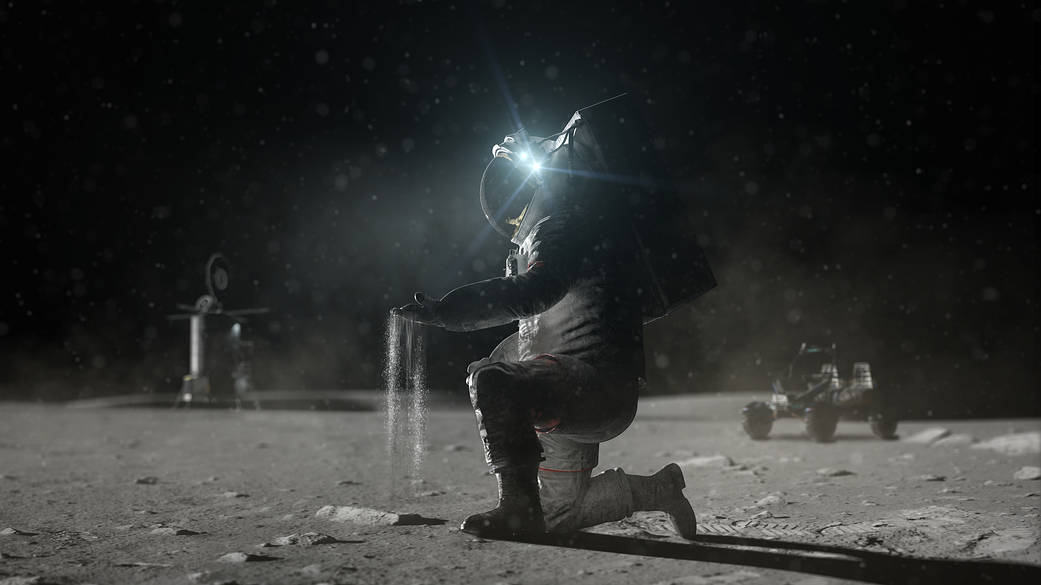
Why has it taken so long to return to the Moon?
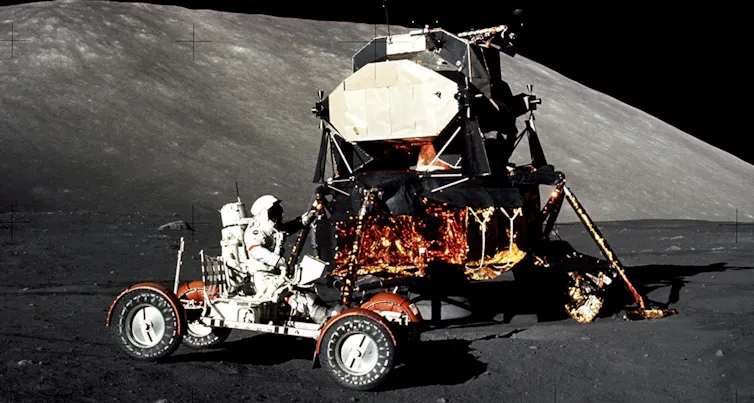
Source: The Conversation (Au and NZ) – By Domenico Vicinanza, Associate Professor of Intelligent Systems and Data Science, Anglia Ruskin University At 13:24:59 Central Standard Time on December 19 1972, the Apollo 17 command module splashed down in the Pacific Ocean, about 350 nautical miles south-east of Samoa, concluding the last mission to the Moon.

The Emperor’s New Clothes – a fairy tale for our times?
Source: The Conversation (Au and NZ) – By Nicola Welsh-Burke, Sessional Academic in Literary and Cultural Studies, Western Sydney University In mid-March, an activist group in Rutland County, Vermont, held its usual weekly rally protesting the actions of US president Donald Trump. One protester, Marsha Cassel, led the crowd, dressed as a naked Trump wearing

Jane Ward Tost was a trailblazer in natural sciences – until history forgot her
Source: The Conversation (Au and NZ) – By Jane Melville, Senior Curator, Terrestrial Vertebrates, Museums Victoria Research Institute In the 19th century, natural history was a field dominated by men: collectors, curators and naturalists. Names such as John Gould and John James Audubon are well known for their contributions to ornithology. Far less familiar is

How Taiwan is viewing the Iran war – and what it reveals about US credibility
Source: The Conversation (Au and NZ) – By Bonnie Yushih Liao, Assistant Professor of Diplomacy & International Relations, Tamkang University The United States and Israeli strikes on Iran have become increasingly concerning for the world due to the risks of further escalation and the impact on energy markets. In Taiwan, however, the focus has shifted

I’m close to retirement age. What are my options for drawing on my super savings?
Source: The Conversation (Au and NZ) – By Di Johnson, Senior Lecturer, Finance and Financial Planning, Griffith University Retiring well means making a series of decisions to ensure a financially secure post-work life. One practical step is to work out the income you need each week to survive and thrive when you stop working. If

Will medicinal cannabis help my mental health? Here are the evidence and the risks
Source: The Conversation (Au and NZ) – By Suzanne Nielsen, Professor and Deputy Director, Monash Addiction Research Centre, Monash University Anxiety, depression and post-traumatic stress disorder (PTSD) are among the most common mental health conditions for which Australians are prescribed medicinal cannabis. Most prescriptions for mental health conditions, and for other conditions more broadly, are

Cutting fuel excise is a sugar hit – we need a plan to slash dependence on imports
Source: The Conversation (Au and NZ) – By Hussein Dia, Professor of Transport Technology and Sustainability, Swinburne University of Technology As fuel prices spike, many Australians are understandably anxious. Photos of empty bowsers, long queues, and high prices create the impression of a system under strain. What we are seeing isn’t a collapse of Australia’s

From spaghetti harvests to fake news: why the glory days of April Fools gags are over
Source: The Conversation (Au and NZ) – By Phoebe Hart, Associate Professor, Film Screen & Animation, Queensland University of Technology April Fools’ Day is a funny one. Developed over centuries, it’s a tradition that gives people the permission to prank. Some leg-pulls are delightful – while others can cause distress and damage, especially if they’re


Landmark contracts for Super Rugby Aupiki

Source: Radio New Zealand

Maama Vaipulu is one of three Blues players to secure three year contracts. photosport

In a first for Super Rugby Aupiki, a trio of players have been signed to long-term contracts.

Blues players Tara Turner, Maama Vaipulu, and Jaymie Kolose have all signed on with the franchise through to the end of the 2028.

All three debuted together in 2023 and have since been called up for national duties.

Blues head coach Willie Walker said the signings represent a defining moment for the programme.

“This is huge for our club and for women’s rugby in Aotearoa. Securing Tara, Maama, and Jaymie for the next three years gives us a strong core to build around. These are players who not only perform at the highest level but drive standards every day,” Walker said.

Turner is the most recent name to earn a black jersey, named in Whitney Hansen’s first squad of the year while Vaipulu made her Black Ferns debut in 2024, Kolose having represented the Black Ferns Sevens last year.

Sign up for Ngā Pitopito Kōrero, a daily newsletter curated by our editors and delivered straight to your inbox every weekday.

– Published by EveningReport.nz and AsiaPacificReport.nz, see: MIL OSI in partnership with Radio New Zealand

Trump underestimated Iran’s resilience. Now there is only one way out of the war

Source: The Conversation (Au and NZ) – By Amin Saikal, Emeritus Professor of Middle Eastern Studies, Australian National University; The University of Western Australia; Victoria University

For all their claims of military success in their war with Iran, the United States and Israel have yet to clearly define their rationale for starting the conflict, their goals and their exit strategy.

With the Iranian regime having mounted a robust response, the Middle East has been plunged into an unnecessary confrontation with no end in sight.

When US President Donald Trump and Israeli Prime Minister Benjamin Netanyahu started this war a month ago, they didn’t have a clear understanding of the nature of the Iranian regime and its defensive capability.

They didn’t expect Tehran to counter their offensives with an unprecedented level of preparedness, striking US bases across the Persian Gulf and hitting Israel hard.

Nor did they anticipate Tehran would close the Strait of Hormuz, partially or fully, to cause a shortage of oil and gas with severe consequences for the global economy.

Driven by an embrace of military power, they acted on a belief that American and Israeli might from the air and sea would force the Islamic government to quickly capitulate, enabling the Iranian people to instigate a favourable regime change – something that has not transpired.

With a military victory now looking increasingly elusive, Trump will need to pivot to a diplomatic solution – and force Netanyahu to comply.

Why Iran has proven so resilient

Prior to the war, the Islamic government was under enormous domestic pressure and international criticism for its suppression of widespread public protests that left thousands of Iranians dead.

The regime was also struggling to come to terms with Israel’s degradation of its regional affiliates, Hamas and Hezbollah in particular, not to mention the fall of Bashar al-Assad’s dictatorship in Syria.

While distrustful of Trump, it felt compelled to enter into negotiations with the US once more for a viable settlement of its controversial nuclear program. In late February, the chief mediator, the Omani foreign minister, said a deal was within reach.

When the US and Israel attacked instead, it gave the Islamic government a different sort of opportunity: it could demonstrate the resilience it had spent decades building.

Iran’s system of authority, governance and security was structured to withstand the loss of its leaders and commanders. The regime had shown this in the 1980s in the face of stiff internal opposition, the eight-year war with Iraq, US efforts to contain it and regional hostility.

The Islamic government has also managed to survive despite its theocratic impositions, frequent public uprisings and domestic and foreign policy shortfalls. The reasons for this include:

  • the belief of many Shia Muslims in revolutionary Islamism

  • its combination of ideological rigidity and pragmatic flexibility, and

  • a dedicated and entrenched security, intelligence and administrative apparatus whose survival is dependent on the regime’s survival.

While many Iranians have wanted to see the back of the Islamic government, most are still very proud of their cultural and civilisational heritage. They don’t like to see Iran being subjected to outside aggression, destruction and humiliation.

An Iranian man holds a cartoon of US President Donald Trump in Tehran. Abedin Taherkenareh/EPA

A war of endurance

This explains why many Iranians have rallied around the flag, as they have historically done against outside aggression.

Knowing it cannot match the firepower of the US and Israel, the Islamic government has shown ingenuity in creating a “mosaic defence” strategy of asymmetrical warfare. This entails adapting and responding to US military weaknesses (for instance, by targeting US bases in Persian Gulf countries with drones and missiles) and decentralising its command structure so leaders can quickly be replaced when they are killed.

The regime has been assisted by Russia and China with supplies of dual-use technologies and revenue from oil imports. Russia has also reportedly been giving Iran intelligence on the location of US assets in the region.

And although Iran’s regional affiliates have been degraded, they are still capable of backing the Islamic Republic in the conflict. Both Hezbollah and the Yemeni Houthis have entered the war by targeting Israel. The Houthis may also attempt to disrupt shipping through the Red Sea.

In short, the Iranian government is resolved to deny the US and Israel a victory at all costs. Given this, the conflict has become a war of endurance.

A deal is the only way out

How long the US, Israel and Iran stay in the fight is a matter of conjecture. However, as the situation stands, the space for a diplomatic resolution has very much tightened. Iran has not shown a desire to back down, and the US and Israel are not united in their goals.

Trump may eventually settle for a deal on Iran’s nuclear program and a potential reopening of the Strait of Hormuz, given the costs of the war and his falling poll numbers in a year of mid-term elections.

But Netanyahu seems adamant in his pursuit. He wants to destroy the Islamic government and weaken the Iranian state as a regional actor.

What is increasingly clear is the war is unlikely to end by military means. The only way forward is a negotiated settlement. The onus will therefore fall on Trump to pull Netanyahu into line and take the lead on trying to strike a deal.

Some analysts have already concluded that no matter how the war ends, Iran is prevailing.

ref. Trump underestimated Iran’s resilience. Now there is only one way out of the war – https://theconversation.com/trump-underestimated-irans-resilience-now-there-is-only-one-way-out-of-the-war-279667

Should the parliament decide if Australia goes to war?

Source: The Conversation (Au and NZ) – By Nicole Townsend, Lecturer in War Studies, UNSW Sydney

As the war in Iran heads into its second month, the conflict has escalated rapidly. The effects are being felt around the world, and there is no clear sign of it ending.

So far, the Australian government has said it will not commit troops to the conflict.

But if it were to take such a step in the future, what would that involve?

Australian involvement in the conflict

Iran responded to US-Israeli airstrikes by lashing out against its regional neighbours in the Gulf. Gulf states requested military assistance to defend against Iranian attacks, and the Albanese government agreed to provide air-to-air missiles, a surveillance aircraft, and 85 supporting personnel.

The government has carefully emphasised the defensive character of its commitment, in line with the right to collective self-defence outlined in Article 51 of the UN Charter.

Still, legal experts have pointed out that the distinction between defensive and offensive operations means little. Australia is involved in the conflict, even if it does not partake in offensive operations against Iran.


Read more: Australia is sending an aircraft and personnel to the Middle East. Does this mean we are entering the war?


But if we do go to war, how does it happen?

If the Australian government decides to commit troops to the war, it will not need to consult parliament before doing so.

Australia’s war powers provisions are quite detailed. But, simply put, there are two key documents that determine who exercises war powers in Australia.

The first is the Constitution, which gives war powers to the governor-general as commander-in-chief of the Australian Defence Force (ADF).

The second is the Defence Act 1903, which gives the defence minister the power to direct the ADF.

In both, war powers are the prerogative of the executive, the branch of government that puts the law into action. The executive comprises the king (who is represented by the governor-general), the prime minister, and their ministers.

In practice, the National Security Committee of Cabinet (NSC) specifically exercises this power. The NSC deals with the “highest-priority, highest-risk and most strategic national security matters of the day”.

NSC decisions do not need to be endorsed by the broader Cabinet, and the executive is not required to consult parliament first. It must, however, inform parliament and facilitate debate as early as possible.

The process is similar in other Commonwealth nations, including New Zealand and Canada.

The situation in the United States is different. The US constitution gives Congress the power to declare war, but the president is commander-in-chief of the armed forces. Essentially, Congress initiates war, and the president directs the armed forces once authorised by Congress.

In practice, many presidents have deployed troops without Congress’ approval, including in the Korean and Vietnam Wars. This led Congress to pass the War Powers Resolution in 1973 to curb presidential war powers. Presidents continued to commit troops without congressional approval, and Congress has proven less willing or able to assert authority in these situations.

Responding to the current conflict, Congress debated President Donald Trump’s authority to attack Iran, but efforts by Democrats and some Republicans failed, as they had in the aftermath of recent US operations in Venezuela.

Proposals for reform in Australia

Since 1985, numerous bills have been introduced in the Senate. All sought to limit executive war powers by requiring parliamentary approval to deploy the ADF in war or warlike operations. None succeeded.

While Defence Minister Richard Marles ordered a parliamentary inquiry into war powers in 2022, he told the committee the decision to commit troops to war was “within the prerogative powers of the executive” and should remain so. Ultimately, the inquiry affirmed the executive authority of prime minister and Cabinet to decide on matters of war. It also rejected the introduction of a parliamentary veto.

This has not stopped the Greens from again calling for war powers reform amid the Iran conflict.

The Greens want the execution of war powers to be contingent on a vote in both houses of parliament – and they say public opinion is on their side. So, what do Australians think about the issue?

What do Australians think?

A national poll by Essential Research in April 2023 found 90% of those surveyed thought parliamentary approval should be required to go to war. This is the figure the Greens have cited in their current bid for reform.

Last year, the War Studies Research Group asked Australians what they thought about war powers as part of a larger national survey on public attitudes towards the ADF. The survey involved 1,500 people and was conducted from late February to early March 2025 as part of our work to measure public attitudes towards the ADF.

Overall, 76% of respondents agreed the government should always be required to consult parliament before committing the ADF to war. Of those, 37% strongly agreed, while less than 5% disagreed.

Notably, the survey indicated a remarkable consensus across Australia. 70% or more of almost all demographic cohorts supported parliamentary involvement. This included gender, age, location, income, education, military background, and nationality.

Majority agreement also held across political preference lines, with highest approval levels among respondents who voted Labor (81%) and Independent (82%).

Where to from here?

Despite the Greens’ efforts and broad public support for war powers reform, the major parties have favoured the status quo and will continue to do so.

As Labor Senator Raffaele Ciccone informed the Senate last week:

The Albanese government supports the continuation of current arrangements that govern the deployment of the Australian Defence Force to overseas engagements.

While the government remains committed to keeping the parliament updated on matters of war, it is unlikely war powers reform will occur.

ref. Should the parliament decide if Australia goes to war? – https://theconversation.com/should-the-parliament-decide-if-australia-goes-to-war-279446

Karla Epiha sentenced after running over child on pedestrian crossing

Source: Radio New Zealand

Karla Epiha was sentenced in Christchurch District Court after earlier pleading guilty to two counts of careless driving causing injury. Anna Sargent / RNZ

A woman who ran over a child on a Christchurch pedestrian crossing broke down in court as she was sentenced for careless driving.

The boy was critically injured and it took 10 people to lift Karla Epiha’s car off the 8-year-old on 24 May, 2025.

Judge Mark Callaghan sentenced Epiha to 12 months’ intensive supervision and disqualified her from driving for 10 months.

Epiha earlier pleaded guilty to two counts of careless driving causing injury – one for hitting the boy and the other relating to a woman.

The summary of facts said the 8-year-old boy, a 35-year-old woman and a 5-year-old boy pulling a 3-year-old boy in a trolley were crossing Hereford Street under a green pedestrian light.

Epiha turned onto the street and drove her car into the older boy, the woman and the trolley.

The 8-year-old landed on the car’s bonnet before falling backwards onto the road. The vehicle continued to move forward and stopped on him, leaving him trapped underneath.

“Ten members of the public were required to lift the vehicle,” Judge Callaghan said. “He suffered a fractured pelvis, fractured ribs and a head wound which required a skin graft.”

The woman was hit by the front of the vehicle and fell to the side of the car. She suffered a concussion and a split head.

Epiha claimed she had only seen the 5-year-old boy crossing the road when she turned.

She was visibly emotional during her sentencing in the Christchurch District Court on Wednesday, at times dabbing her eyes with tissues.

Judge Callaghan read a victim impact statement from the 35-year-old woman, who said her emotional and physical health had been significantly affected by the crash.

“The concussion has created vertigo, which has now settled; it’s also created regular migraines, which are still happening,” Callaghan said.

“She has ongoing neck pain. Since the crash she has difficulty with flashing lights and the wound on her head has been very slow to heal. She’s lost her ability to pick up things, particularly her child.

“She’s having difficulty remembering things and feels like she has ‘baby brain’ again. She has been diagnosed with moderate depression, she has become more isolated with a developed fear of walking anywhere.”

The woman’s 5-year-old son, who witnessed the crash, now had significant fears about crossing the road and had been hypervigilant with safety, he said.

Judge Callaghan said Epiha was not paying attention when she was driving.

“Your counsel has said that the carelessness is at the low level of the scale. I don’t agree. The carelessness here is at least at a moderate level – it’s not one where you accelerated harshly or at speed, but you just didn’t check,” he said.

“The two pedestrians that you collided with were entitled to be on the crossing, they had the green light and you failed to check, and your lack of attention in my view places it in that moderate category.”

The judge accepted Epiha was genuinely remorseful for the crash.

Sign up for Ngā Pitopito Kōrero, a daily newsletter curated by our editors and delivered straight to your inbox every weekday.

– Published by EveningReport.nz and AsiaPacificReport.nz, see: MIL OSI in partnership with Radio New Zealand

How museums can remember war while honouring civilian trauma and resistance

COMMENTARY: By Audrey van Ryn

Museums around the world present the story of war in different ways. The Imperial War Museum in London includes military history, the Holocaust, women’s roles in the two world wars, wartime artwork and the political issues of the time.

This museum records both civilian and military experiences, looking at the impact of war on people’s lives. Its Crimes Against Humanity section has a continuous film about genocide and ethnic violence in our time.

The Dutch Resistance Museum in Amsterdam focuses on the Dutch experience during the occupation of the Netherlands by Nazi Germany during World War Two, and features personal stories of those who lived during that period.

National museums in India, Pakistan, and Bangladesh musealise the memory of the 1947 Partition in different, selective ways, with oral history, survivor testimonies, and personal artefacts to document the displacement and trauma of the subcontinent’s division.

How does our own war museum remember war?

Visitors to Auckland’s War Memorial Museum find that the top floor is dedicated to the memory of New Zealand soldiers killed in World Wars One and Two.

The WWI Hall of Memories contains a sanctuary, used for commemoration. In this space are medals and badges of units in which men and women from the Auckland Province served, and British badges that acknowledge those who joined British units.

Roll of honour
In the WWII Hall of Memories, carved into marble is the permanent roll of honour of men and women from the Auckland Province who died in both World Wars, and in Korea, Malaya, Borneo and Vietnam.

The Scars on the Heart exhibition covers New Zealand’s civil wars of the 1840s and 1860s, the Anglo-Boer War, the First and Second World Wars, the Asian wars and New Zealand’s involvement in United Nations peacekeeping missions. Items on display include letters, diaries, photos, clothing and firearms.

There is a recreation of a bivouac shelter at Gallipoli and a Western Front trench from WWI.

Nagasaki bomb victims in 1945 . . . vital evidence of civilian war trauma now no longer on display at Auckland Museum. Image: Screenshot

This year, the greatest number of active armed conflicts since the end of the Second World War is taking place. The Doomsday Clock was set at 85 seconds to midnight on January 27 — the closest it has ever been to midnight.

Funding for nuclear weapons programmes is increasing and the New START treaty, the nuclear arms reduction treaty between the United States and Russia has expired, with US President Donald Trump having no interest in renewing arms limitation agreements.

Remembering the destructive and tragic consequences of war should be central to the role of museums in their telling of stories about war. However, unfortunately, around the same time as the recent removal of asbestos from the museum, some of these vital stories have been removed.

They include evidence of civilian war trauma installed in the 1990s by then head curator Lieutenant-Colonel Chris Pugsley to show impacts of war on civilians. Another removal has been the 1968 “Letter from a Vietnam Hospital” by the New Zealand surgeon and surgical team leader in Vietnam, Dr Peter Eccles-Smith, and a photo of a woman and a child who were victims of the Nagasaki atomic bomb in 1945.

No record of NZ nuclear protests
There is also no longer any text or photos showing New Zealand’s official protests against French nuclear testing at Moruroa Atoll in the South Pacific.

In addition to the reinstatement of these particular items, a more encompassing telling of stories about war at Auckland Museum than at present could include the portrayal of New Zealand’s resistance to international wars, the work of civilian and army medical personnel, photos of injured soldiers and civilians, photos and placards of anti-war demonstrators, stories of conscientious objectors, portrayals of victims of the atomic bombs in Hiroshima and Nagasaki, and photos and stories about the nuclear-free movement in NZ and the Pacific, including the fateful journey of Greenpeace’s Rainbow Warrior across Oceania into Auckland Harbour.

Auckland Museum’s 2025 plan included “Enabling commemoration opportunities to reflect the community while exploring themes of conflict and peace; and commitment to broadening our commemorative narrative to be inclusive of diverse experiences and events relevant to our communities.”

This year is 30 years since the International Court of Justice declared that the threat or use of nuclear weapons would generally contradict international law. Next year, 2027, will be the 40th anniversary of NZ’s nuclear-free legislation, a fitting time for Auckland Museum to launch an exhibition that could include NZ’s official and civil society opposition to nuclear weapons.

Veteran peace activists hope to forge a constructive working relationship with Auckland Museum to help portray people’s experience of war more fully, and create a peace gallery to tell the story of NZ’s peace history.

Audrey van Ryn is a peace activist and writer. In 2009, she created the Auckland Peace Heritage Walk on behalf of the United Nations Association of NZ. She is currently secretary of Community Groups Feeding the Homeless.

Article by AsiaPacificReport.nz

How cocaine use has skyrocketed to an all-time high in New Zealand – and why

Source: Radio New Zealand

Cocaine use in New Zealand has nearly doubled in just a year, according to new figures. 123rf

Explainer – Cocaine isn’t cheap, but its use is skyrocketing in New Zealand according to new figures. What’s driving the snowstorm?

Until relatively recently, cocaine was somewhat of a rarity in New Zealand, explained Massey University professor Chris Wilkins, leader of the drug research team at SHORE & Whariki Research Centre.

“In those times that you most associate with cocaine in the ’80s and ’90s, New Zealand really didn’t have almost any cocaine,” he said.

Our geographical and trade isolation shielded New Zealand when cocaine had its big cultural moment in those decades.

But things have changed – a global glut has now led to a surge in demand in New Zealand.

Police recently released wastewater testing figures that showed cocaine use has hit an all-time high.

The latest wastewater figures were collected between October and December 2025, and testing sites cover up to 77 percent of Aotearoa’s total population.

The testing calculates drug use from the concentration of each drug’s biomarker detected in the water and reflects the amount of pure drug being consumed, the National Drug Intelligence Bureau says.

The figures showed methamphetamine use continues to be high, averaging about 34.7kg per week.

But it’s cocaine that showed the biggest proportional jump of all.

“We are seen as a lucrative albeit small market” for cocaine dealers, said Sarah Helm, executive director of the New Zealand Drug Foundation.

So how much more cocaine are we using?

While cocaine use is still less overall than methamphetamine or cannabis, it’s the size of the rise that has drawn attention.

Cocaine nearly doubled in a year, rising to an estimated 9.4kg of use per week – 98 percent, or 4.7kg, above the average amount consumed the previous four quarters.

That’s a lot of cocaine.

Part of this is simply because there’s a lot more of it out there.

“From the global level, there’s been a real glut in coca production,” Wilkins said. Cocaine comes from the leaves of the coca plant and is primarily produced in South American countries like Colombia, Peru and Bolivia.

But there’s another reason for the rise.

In New Zealand, cocaine has sniffed out an image that it is somehow safer and hipper than methamphetamine or other drugs. Iconic images like Al Pacino’s cocaine kingpin in Scarface and white powder hitting the dance floors in American pop culture mostly passed Aotearoa by in the 1980s.

“It was (seen as) a very exotic drug,” Wilkins said. “Of course, it was associated with that kind of Hollywood glamour.”

“Cocaine I think at the moment is presenting itself as a kind of cleaner, healthy, more manageable drug, and that’s basically driving demand at the moment.”

Supplied / NZ Drug Foundation

NZ Police Assistant Commissioner Corrie Parnell told RNZ that there’s a “strong demand” for cocaine.

The New Zealand Drug Trends Survey is an anonymous online survey of 8883 people conducted in 2025 designed to provide an annual snapshot of drug market trends. It’s not a representative sample but it’s described as “broadly representing the demographic profile and regional population distribution” of New Zealand.

And what it’s got to say about cocaine use backs up the wastewater figures.

The number of those surveyed saying cocaine was “easy” to get jumped from 17 percent in 2018-19 to 43 percent in 2025, while the proportion of those using cocaine at least weekly increased from 6 percent to 10 percent over the same period.

Just 23 percent of respondents to the survey said they’d used cocaine in the last six months – but that’s higher than pretty much every other type of illegal drug other than cannabis (69 percent) and MDMA (35 percent), and far higher than meth (11 percent).

The Drug Use in Aotearoa 2023/24 Report released last year also backed up the steady rise – just an estimated 1kg per week of cocaine was consumed by New Zealanders in 2019, compared to the more than 9kg estimated in the new wastewater figures.

Is it because it’s cheap?

Just the opposite, actually. New Zealanders pay some of the highest prices for cocaine in the world.

The average price per gram of cocaine was $360 a gram, according to the drug trends survey, just above meth at $334/gram and far more than MDMA or ketamine.

“The growth of the cocaine market has occurred over the space of a few years and has largely occurred without significant reductions in street level pricing,” Parnell said.

“This indicates strong demand for cocaine, as dealers are able to offload increased quantities without dropping the price.”

Supplied / Massey University

Who’s using all this cocaine?

The New Zealand Drug Trends Survey carried some surprises.

Respondents who said they’d used cocaine in the past six months were overwhelmingly European (74 percent), male (66 percent) and financially pretty well off.

Seventy-nine percent of those surveyed worked full or part time, and 42 percent of them made more than $80,000 a year.

“It’s kind of like almost a sign of affluence and status in New Zealand just because it’s so exotic,” Wilkins said.

“The affluent association with cocaine kind of presents this veneer that it’s a high-end drug and that it can be used quite manageably. But if you do go to North America and Europe, there’s pretty clearly a lot of people that have problems.”

Cocaine use has particularly skyrocketed in Auckland, Wellington and the Bay of Plenty, police said.

Supplied / NZ Police

Is this just specific to New Zealand?

“New Zealand continues to be an attractive market for organised criminal groups to supply drugs due to the high profit margins,” Parnell said.

“New Zealand and Australia continue to have the highest prices for illicit drugs in the world. As is the case globally, there is a large supply, consumption is high and pricing is stable.”

But cocaine is booming worldwide – the United Nations’ World Drug Report 2025 said cocaine was the world’s fastest growing illicit drug market. It said cocaine use grew from 17 million users in 2013 to 25 million users in 2023.

“Police have seen an increase in large volumes of cocaine seized” with police and Customs Service operations, Parnell said.

“The increase in supply is part of a global trend and has been driven by record levels of coca cultivation, increasingly efficient methods of cocaine production, and diversification of supply chains into New Zealand,” Helm said.

“In an unregulated black market, we are at the mercy of these global changes that can alter our drug supply very quickly.”

Cocaine traffickers are breaking into new markets across Asia and Africa, the UN report notes.

“The vicious violence and competition characterising the illicit cocaine arena, once confined to Latin America, is now spreading to Western Europe,” it said.

Global instability is “empowering organised crime groups and pushing drug use to historically high levels,” the UN noted.

“The glut of supply means that cocaine is being pushed into countries that haven’t had much presence of cocaine before,” Helm said.

Supplied / NZ Police

Is cocaine truly as dangerous as other drugs?

“New Zealand culture is kind of cocaine naive … in that it has probably an exaggerated or inflated perception as a harm-free drug and a better alternative to methamphetamine,” Wilkins said.

New Zealand has had three decades to see how methamphetamine use causes harm that is “pretty cemented in the public culture,” he said.

“It looks risk free, but there’s really serious problems with cocaine related to short-term effects in terms of agitation and violence and sometimes psychosis by heavy users, and also the longer term effects on cardiovascular health and things like that.”

Like any other drug, cocaine carries risks, Helm said.

“Cocaine carries a higher risk of addiction and harm than some other drugs that New Zealanders may be used to, like MDMA, so we are concerned that the community may be less aware about what to look out for to stay safer.

“For example, mixing cocaine and alcohol can be risky as they combine to make a substance called cocaethylene, that can put more strain on your body, particularly your heart.

“Moreover, some substances like cocaine have a ‘compulsive redosing effect’, where the person taking it has an increased urge to consume more. This, coupled with its short-lived effects, adds to the risk of addiction.”

Police said that cocaine use across sample wastewater sites in the last quarter of 2025 would equate to an estimated weekly social harm cost of $3.5 million, as calculated by the New Zealand Illicit Drug Harm Index.

People need to be informed and seek out information about the health risks, Wilkins said.

“At the moment now (cocaine) is kind of in this honeymoon phase,” meaning it’s harder to communicate any dangers in a credible way, as people often rely on information from their peers and there hasn’t been as much negative experience with cocaine here.

“In terms of harm, it’s a lot to do with how frequently you’re using and how much you’re using it,” he added.

“If you’re just using a drug once a month, once every six months, the risk of you having problems is much lower than weekly or daily use.”

People should also keep in mind what their underlying risks are, in terms of health conditions and their mental health.

How you use cocaine is also a factor in the harm it can cause, Wilkins said.

“Nasal use has physical issues, but it’s probably the low risk option, whereas smoking cocaine, of course, crack, really changed the image of cocaine in North America and other places.”

Smoking or injecting cocaine are “extremely high risks,” he said.

“If people plan to use cocaine, we’d advise visiting thelevel.org.nz for tips on how to stay safer,” Helm said.

Thirty-three kilograms of cocaine were seized at the Port of Tauranga. Supplied NZ Customs

So what is New Zealand doing about all this cocaine?

Parnell said police are focused daily on enforcement of drug laws.

“Our message to the community is that we can all play a part in reducing the social harm and misery that drugs cause by reporting any suspicious activity or information which may help us to stop those involved in these types of crimes.”

Large shipments of cocaine have been seized at ports and Operation Matata, a joint Customs/police operation, targeted a syndicate smuggling drugs through unattended baggage at Auckland Airport.

“This operation resulted in eight associates from the TwoEight Brotherhood arrested. Twenty consignments of methamphetamine and cocaine were seized, weighing 630 kilograms and 112 kilograms respectively,” Parnell said.

There have also been massive cocaine seizures intercepted in the Pacific by other nations.

French armed forces seized five tonnes of cocaine from a vessel, which was said to be bound for Australia. ABC/Facebook: Haut-commissaire de la République en Polynésie française

Parnell said police are working with many agencies and community groups to tackle the drug problem.

“One initiative to break the cycle of harm is the Resilience to Organised Crime in Communities (ROCC) programme, a collaborative, community-led initiative designed to address the social conditions that enable organised crime,” he said. “The programme recognises that enforcement alone is not enough.”

The drug foundation has also called for a “fundamental shift” in drug policies.

Helm said that current laws aren’t doing the job.

“For the past 50 years, New Zealand’s approach has been to focus heavily on banning the drug and then undertaking supply busts and criminalising people for using drugs, but this is clearly not working,” she said.

“Across every measure, this approach has been a failure – not only has drug use continued to grow and diversify, but addiction has increased, overdoses now claim three lives a week, and more new potent drugs are entering the market.

There needs to be more investment in help and harm reduction, she said, and the foundation has also issued a report calling for changes to drug laws.

“We need to learn from the evidence and stop making the same mistakes,” Helm said.

She said other countries can also lead the way.

Two decades ago, Portugal removed criminal penalties for drug use and increased their investment into health and harm reduction,” she said, as a result overdose death rates fell and pressure on the justice system eased without an increase in drug use.

“No one has all the answers on solving drug issues, but it’s very clear that our current approach is not it.”

Minister for Mental Health Matt Doocey recently told RNZ it was “incredibly important for the health system to step up and respond to the harm caused by drugs”.

The Ministry of Health has put forth a four-year action plan to reduce addiction.

Doocey said the government had no intention of liberalising drug laws.

“Our focus is on strengthening prevention, reducing overdose harm, and improving access to treatment and recovery support.”

Sign up for Ngā Pitopito Kōrero, a daily newsletter curated by our editors and delivered straight to your inbox every weekday.

– Published by EveningReport.nz and AsiaPacificReport.nz, see: MIL OSI in partnership with Radio New Zealand

Albanese to address the nation on the Middle East war and fuel crisis

Source: The Conversation (Au and NZ) – By Michelle Grattan, Professorial Fellow, University of Canberra

Prime Minister Anthony Albanese will address the nation at 7pm Wednesday night on the Middle East war, the fuel crisis and the government’s response to it, and what Australians can do in response.

In his pre-Easter address, which will be carried by all television channels, Albanese’s message to the public will be that it should be business-as-usual over the holiday period.

Prime ministerial addresses-to-the-nation are rare but have been used during COVID and the Global Financial Crisis.

United States President Donald Trump will address the American people on Thursday Australian time.

In a fresh government announcement in response to the fuel crisis, small businesses hit by fuel issues will get more flexibility with their tax obligations.

Treasurer Jim Chalmers said businesses unable to meet their tax obligations because of fuel supply problems will be able to receive temporary relief from the Australian Taxation Office.

This will include more generous payment plans, remission of interest and penalties, and support in varying PAYG instalments where taxable income has turned down.

The tax office will also limit some compliance action for the worst affected industries. Some debt collection may also be paused.

To help small business access credit more easily and faster, the Small Business Responsible Lending Obligation exemption will be extended for another ten years.

This obligation requires lenders to make rigorous checks of borrowers’ financial situation to ensure that the loan is not unsuitable. During COVID small businesses were accorded an exemption. This was due to run out in October.

The government said the extension would “ensure small businesses aren’t slugged with additional regulatory burdens and delays when accessing loans”.

Chalmers announced the changes at a news conference with representatives of big business, small business and the banks.

Meanwhile the federal government is still waiting for the states to sort out arrangements relating to the extra GST revenue they will receive from higher fuel prices.

They agreed at national cabinet on Monday to provide some GST relief but are still working on the detail.

Chalmers told his news conference: “I’m not going to take shots at them. I’m not going to be part of a kind of unseemly brawl about this.”

“But we don’t want to see this drag out for ever. We don’t want to see the states and territories at war over this. We want to see the relief flow to motorists.”

ref. Albanese to address the nation on the Middle East war and fuel crisis – https://theconversation.com/albanese-to-address-the-nation-on-the-middle-east-war-and-fuel-crisis-279208

Australia is tightening the rules on children’s privacy – here’s how it will work

Source: The Conversation (Au and NZ) – By Tama Leaver, Professor of Internet Studies, Curtin University

Australia’s privacy laws have been woefully out of date for a long time – not fit to address the realities of the digital world.

As part of the long overdue update, the Privacy and Other Legislation Amendment Act in 2024 directed the Office of the Australian Information Commissioner (OAIC) to develop a code to better protect the privacy of young Australians in the digital world.

This is urgently needed. By the time a child turns 13, around 72 million pieces of data will have been collected about them.

This week, the OAIC published a draft of the Children’s Online Privacy Code, which is now open for public comment.

What’s in the code?

The code’s scope is much wider than just social media. It encompasses most online services, spaces and platforms that children use. Importantly, it also includes services that may contain children’s personal data but are used by adults.

Everything from educational platforms to infant tracking apps will be subject to the code. The best interests of the child are embedded in it, and services will be expected to interpret and implement it.

Data minimisation

This specifies children’s personal data can only be collected by online services where there’s a clear and direct purpose for that collection, and that data should only be kept while it’s necessary to perform that purpose.

Any further data collection requires explicit consent requested in a way that’s age-appropriate for the child.

This ensures platforms only request what’s actually mission critical. The onus is on services to delete that personal data as soon as it’s not needed, to help prevent children’s data being caught up in data breaches.

The right to delete

Where platforms and services hold children’s personal data, children will now have a clear and explicit right to request that data is deleted.

The “right to be forgotten” has been on privacy advocates’ wishlist for decades. It recognises individuals own their own data and should maintain control over it where possible.

Geolocation transparency

When children consent to having their geographic location tracked by digital devices and services, or their parents consent to this on their behalf for those under 15, children regardless of age will be notified when tracking services are sharing that information.

Geolocation data can be particularly tricky, even within families. While some might find location tracking helpful, others view it as intrusive surveillance.

Ensuring it’s at least transparent to children will help ensure they’re active and aware participants in these services.

Age-appropriate explanations

Saying you’ve read an app’s terms of service or privacy policies is one of the most common white lies told.

That’s mostly because these are long, impenetrable, almost unreadable documents. When children are asked to consent to share their data, the code specifies the explanation for this request must be understandable and age-appropriate. If the request is aimed at a child who might be ten, the explanation needs to be clear to the average ten-year-old.

This is vital. Not only does it allow children to make better choices, it also increases their digital literacy as they make meaningful choices about their own data.

As part of this, deceptive design elements that might trick children into sharing personal data are explicitly not allowed.

We can expect pushback from big tech

There will undoubtedly be considerable pushback from big technology platforms about the scope of the code. It seeks to disrupt business as usual, and requires that children’s data is only collected for specific purposes, with explicit consent, and retained for as little time as possible.

That’s the opposite of the “grab and keep as much data for as long as possible” logic that drives most tech companies and platforms today. Big data is still imagined to be the big oil of the digital world. Private, personal data is among its most valued forms. Artificial intelligence companies are even more thirsty for that personal data to train their systems.

We’ll need more digital literacy

For children under 15, the code relies on parental consent. That consent is visible to children, which is important in keeping them informed. However, there’s work to do to equip every parent with the tech literacy they need to make informed choices with their children.

In some cases, children don’t easily have a parent or carer to turn to. For children in the most at-risk and challenging situations, there may be difficulties in ensuring that the consent process really can work in children’s best interest.

In our Manifesto for a Better Children’s Internet, colleagues and I from the ARC Centre of Excellence for the Digital Child offer a roadmap for an internet better aligned with children’s needs and experiences.

Crucially, we argue there should be more focus on protecting children within the digital environment, rather than from it.

Maximising children’s opportunities in the digital world means trying to make as many digital spaces available to them, while ensuring those spaces are designed to be as safe and age appropriate as possible.

The Children’s Online Privacy Code is set to make an important contribution in achieving that aim. It recognises children’s right to participation as much as their right to protection.

What happens next?

The OAIC has launched a Privacy for Kids website, which offers age-appropriate explanations of the code for children and adults.

It provides a variety of tools and age-appropriate resources to allow children and adults to offer their thoughts on the draft code. That consultation is open until June 5 this year.

After responding to the public consultation, the final version of the code must go live by December 10 2026.

ref. Australia is tightening the rules on children’s privacy – here’s how it will work – https://theconversation.com/australia-is-tightening-the-rules-on-childrens-privacy-heres-how-it-will-work-279661

Alpha males, Harry Styles, and going mad with desire: what to watch in April

Source: The Conversation (Au and NZ) – By Damien O’Meara, Lecturer, School of Media and Communication, RMIT University

This month’s streaming slate is packed with bold, conversation-starting TV, from an expose of the toxic manosphere, to a Netflix comedy featuring a very horny Rachel Weisz. If you’re feeling nostalgic, there’s even an old classic from French New Wave filmmaker Agnès Varda. So settle in and get watching!

Homebodies

SBS On Demand

When Nora (Claudia Karvan) breaks her leg, her son Darcy (Luke Wiltshire) – a trans man – returns home to see her for the first time since he came out. It doesn’t take long before Darcy realises there’s another presence in his childhood home: a ghost of his younger pre-transition self, Dee (Jazi Hall).

Homebodies gives space for an exploration of the challenging, interpersonal relationship between Darcy and his mother through the haunting of an unresolved rift. Refreshingly, this is done without Darcy ever doubting his understanding and acceptance of himself.

Dee is a haunting of something left behind. This includes some obvious aspects: she uses Darcy’s deadname and she/her pronouns. But Dee also represents a version of Darcy where his existence was not yet a consideration. In the moments where he clashes with Nora, it seems like Dee is a manifestation of what his mother wants him to be.

In some ways that feels true, but Dee is also part of a past Darcy is not acknowledging. Dee is not just a dramatic foil to allow for the exposition of how Darcy came to this place in his life. Rather, he is sharing that journey with who he was before it started.

The value of such conversations stems from the authenticity behind the story. From writer and director AP Pobjoy, Homebodies strikes an effective balance in its specificity, while feeling like a story audiences will be able to connect with in big or small ways.

– Damien O’Meara


Read more: Homebodies: bold TV about a trans man, his mother and the conversations they never had


Vladimir

Netflix

The new Netflix limited series Vladimir centres on erotic desire. It’s a story about “limerence”, a psychological state first identified by American psychologist Dorothy Tennov, in which a person’s thoughts and fantasies become dominated by another, and are accompanied by an overwhelming, obsessive desire for that feeling to be returned.

Rachel Weisz plays M, an English professor who develops an intense fixation on a newly arrived colleague, the self-consciously handsome Vladimir (Leo Woodall). M comes across as disturbingly shallow until it becomes clear her fixation has incapacitated her. As the show unfolds, it seems her imagined intimacy with Vladimir might be more enthralling than reality could deliver.

M’s husband John (John Slattery), also a professor, is suspended for sexual misconduct involving students. When pressured to say what she thinks, M dismisses the opportunity to support the young exploited women, instead saying “it was another time”. This refrain of providing generational justifications and avoiding accountability is emphasised throughout the series.

M divulges directly to the camera (in one of many instances of breaking the fourth wall) that middle age has rendered her invisible. However, despite menopausal asides about chin hair, she is too beautiful for us to believe this. It’s more likely her students no longer connect with her outdated ideas.

This adaptation of Julia May Jonas’s provocative 2022 debut novel Vladimir is likely to divide audiences, but its discomfort is compelling and original. I highly recommend it.

– Lisa French

Harry Styles. One Night in Manchester

Netflix

The “one night only” music performance is relatively new for streamers like Netflix, but quite an established format for its broadcast predecessors; think Elvis’ 68 Comeback Special, for example. And like Elvis, Styles is a master of mainstream pop music, perfectly pitched at an intersectional audience and dripping with charisma.

From his One Direction roots in the early 2010s, to becoming a fully fledged solo icon, One Night In Manchester showcases Styles’ latest album Kiss All The Time, Disco Occasionally. It’s a huge event for parent record company Columbia Records (owned by Sony Music Entertainment).

One Night is staged to bring Styles’ multi-stadium persona back to a relatively small audience, providing intimacy and immediacy for those watching at home. The performance is supported by incredible musicians such as the House Gospel Choir. And unlike the ’68 leather-clad Presley, Styles himself appears relatively understated – save for some delightful (if not daggy) dancing and swift movements from lead singer to piano, guitar and synth.

The audience in the room play a vital part too. Their singalongs to Aperture and Dance No More make these new songs sound like canon, while close-ups of fans embracing older hits such as Sign Of The Times remind us how good music can continue to connect us.

– Liz Giuffre

Scarpetta

Prime Video

Chief medical examiner Dr Kay Scarpetta first emerged in Patricia Cornwell’s 1990 debut novel Postmortem, and has appeared in nearly 30 books since then. So it’s no surprise Prime Video’s decision to adapt the mystery-thriller series for TV has been eagerly awaited by fans. Unfortunately, Scarpetta is muddled at best – and a hot mess at worst.

The series unfolds over two timelines. In the present day, Scarpetta (Nicole Kidman) is called to a crime scene where the naked body of a female victim is bound and displayed. Flashbacks to 30 years earlier reveal a young Scarpetta (Rosy McEwen) on the hunt for a serial killer with a similar modus operandi. The suggestion that she may have got the wrong man back in 1998 threatens to blow up her career.

The ethical implications of this are never properly explored, however, as the series focuses instead on the fraught dynamics of Scarpetta’s present-day family. These include her vodka-swilling, histrionic sister Dorothy (Jamie Lee Curtis), tech-genius niece Lucy and, quite bafflingly, a chatbot imitating Lucy’s dead wife.

Careening between soapy family drama and police procedural, Scarpetta suffers from serious bloat. And despite its bizarre AI subplot, it is curiously dated especially in its treatment of gender politics: the misogyny the young Scarpetta navigates is significantly diluted, while the series’ treatment of female victims recalls the sensationalism of pre-#metoo shows such as Law & Order: SVU.

The 90s might be having a revival, but Scarpetta’s failings suggest some things are best left in the past.

– Rachel Williamson

Vagabond

Mubi

I was delighted to see Vagabond (Sans toit ni loi, or “without roof or law”) return to MUBI as part of its ongoing Agnès Varda collection. Having only seen the film once, years ago, I was eager to rewatch one of Varda’s (countless) masterpieces. Like earlier titles such as Cleo from 5 to 7 (Cléo de 5 à 7) and Le Bonheur, Vagabond is a daring display of narrative filmmaking.

True to Varda’s distinctive style, the film probes the limits of cinematic storytelling. Infusing documentary elements – such as testimonial-like sequences and cleverly placed fourth wall breaks – Vagabond stitches together the story of Mona, a rebellious young drifter who, in the film’s opening sequence, is discovered frozen to death in a ditch.

Backtracking from this initial encounter, Varda explores the enigma of Mona through the characters she encountered during her final weeks, crafting a fragmentary portrait of the young woman via flashbacks, memories and impressions. As other characters discuss their brief encounters with Mona, their testimonies often reveal more about social prejudices and taboos than they do about her.

Mona’s psychological interiority remains a mystery, as the viewer is only led to speculate upon the circumstances that led to her futile reality. Subverting the prominent trope of the male drifter, Varda does not sensationalise the protagonist’s circumstances. Rather, she presents both an opaque and brutal portrait of loneliness and liberty, humanism and cruelty.

– Oscar Bloomfield

Louis Theroux: Inside the Manosphere

Netflix

By now most of us have encountered the “manosphere” – the online ecosystem that repackages misogyny, anti-feminism and male grievance into a form of “self-improvement”.

Journalist Louis Theroux has further lifted the lid on this dangerous ideology in his new documentary, Inside the Manosphere, which exposes some of the key individuals driving this culture. In his measured and sometimes risky style, Theroux traces not only the rhetoric of so-called “high-value men”, but also the business model that sustains them. The result is both illuminating and unsettling.

Through interviews and the influencers’ own content, we see the defence of a regressive gender hierarchy and attempts to restore it. All the while, subscription “academies” set up by leading figures convert young mens’ insecurities into income.

Running alongside the hustle narrative is a thread of conspiratorial thinking. Interviewees invoke the “matrix” as a metaphor for institutional systems trying to keep men compliant, and blind to alternative paths to power.

While the documentary doesn’t dive too deep into the real-world harms of the manosphere (on both women and young men), it does provide some important context for the rise of misogynistic attitudes in our schools and workplaces. Theroux is right to suggest we all are, in some sense, now living inside the manosphere.

– Steven Roberts


Read more: Louis Theroux’s Inside the Manosphere exposes the business model of misogyny


ref. Alpha males, Harry Styles, and going mad with desire: what to watch in April – https://theconversation.com/alpha-males-harry-styles-and-going-mad-with-desire-what-to-watch-in-april-278987

Fonterra settles activists’ misleading packaging lawsuit for ‘100 percent NZ grass-fed’ claims

Source: Radio New Zealand

Fonterra’s Anchor brand butter, showing the label claiming it is ‘100 percent New Zealand grass-fed’. Supplied/ Greenpeace

Greenpeace Aotearoa has won a lawsuit against dairy giant Fonterra’s brands business for misleading butter packaging it labelled “greenwashing”.

The activist group filed the lawsuit in September 2024 for logos featured on Fonterra Brands’ Anchor butter sold between December 2023 and April 2025 that said “100-percent New Zealand grass fed”.

But it argued the co-operative’s dairy cows were also fed imported supplementary feed like palm kernel expeller (PKE), produced in countries like Indonesia.

The use of the two phrases “100 percent New Zealand” and “grass-fed” in combination were found to be misleading and breached the Fair Trading Act 1986.

Fonterra will discontinue using the logo on its Anchor butter packaging, however the co-operative has sold its consumer brands business Mainland Group, that Anchor sits under, to French dairy giant Lactalis.

Greenpeace spokesperson Sinéad Deighton-O’Flynn serving Fonterra with a lawsuit on 30 September, 2024. Supplied/ Greenpeace

Greenpeace spokesperson Sinéad Deighton-O’Flynn said it was a win against corporate greenwashing.

“This admission from the world’s biggest dairy exporter is a win against corporate greenwash,” she said.

“It exposes the cynicism of Fonterra and its intensive dairy model: instead of ending its links to rainforest destruction, Fonterra just slapped a misleading label on its packaging and continued business as usual.”

She said New Zealanders were getting ripped off during a cost-of-living crisis.

“We’ve been paying at times upwards of $20 a kilo for butter, while also being misled about the quality of that butter.”

But a spokesman for Fonterra said it stood by its grass-fed claims.

“However, [Fonterra] recognises that the combined use of the two phrases would have been likely to mislead some consumers and has accepted this in the settlement with Greenpeace, the details of which are confidential.”

He said the co-op’s cows were 96 percent grass-fed, including grass, grass silage, hay and forage crops like legumes and brassicas.

The two parties settled outside court on Wednesday.

Greenpeace was a staunch opponent to the use of imported feed products due to its links to deforestation, such as in Southeast Asian rainforests.

“Most New Zealanders would be horrified to know that rainforests are being destroyed, with precious wildlife pushed to the brink of extinction, to grow cheap feed for Fonterra’s oversized dairy herd. And that’s likely why Fonterra tried to hide the truth.”

A worker at a palm plantation area in Indonesia’s Sumatra island. Palm kernel expeller (PKE) is a by-product of the palm oil industry. AFP

Deighton-O’Flynn said PKE was a dry, gravelly feed that originated from destroyed rainforests.

“The reality is Fonterra has only changed the label. It hasn’t changed its destructive practices. Instead of greenwash tactics, Fonterra should take action to phase out palm kernel on all of its farms.”

New Zealand imported around 2 million tonnes of PKE each year largely for the dairy industry.

Sign up for Ngā Pitopito Kōrero, a daily newsletter curated by our editors and delivered straight to your inbox every weekday.

– Published by EveningReport.nz and AsiaPacificReport.nz, see: MIL OSI in partnership with Radio New Zealand

One dead after car crashes into hedge in Auckland’s Stanmore Bay

Source: Radio New Zealand

Hato Hone St John says it was notified of the incident on Vipond Road, at 10.26am today. RNZ/Nick Monro

One person has died after a single vehicle crash in Stanmore Bay, on the Whangaparāoa peninsula north of Auckland.

Hato Hone St John says it was notified of the incident on Vipond Road, at 10.26am on Wednesday.

It sent one ambulance, one operations manager and one rapid response vehicle to the scene.

Police say Vipond Road is closed between Doyly Drive and Lea Place.

The Serious Crash Unit is at the scene.

Hato Hone St John says it was notified of the incident on Vipond Road, at 10.26am today. RNZ/Nick Monro

Sign up for Ngā Pitopito Kōrero, a daily newsletter curated by our editors and delivered straight to your inbox every weekday.

– Published by EveningReport.nz and AsiaPacificReport.nz, see: MIL OSI in partnership with Radio New Zealand

How your health (and genetic results) affects your life, travel and health insurance

Source: The Conversation (Au and NZ) – By Jane Tiller, Ethical, Legal & Social Adviser in Public Health Genomics, Monash University

The Australian parliament is set to pass legislation today to ban life insurers from using genetic test results to discriminate against people applying for life insurance.

Once the law comes into effect in about six months, it will apply to all new life insurance contracts. These include for death cover, income protection, disability and trauma/critical illness cover.

So what does the new legislation mean for people taking out life insurance later this year? How about travel insurance or health insurance?

Here’s what we know, don’t know and need to clarify.

What’s changing with life insurance?

The new law will prohibit life insurers from using “protected genetic information” in underwriting.

Protected genetic information includes all health information that predicts or infers someone’s risk of future disease based on the results of genetic testing. In other words, life insurers cannot deny you cover or charge you higher premiums if you took a genetic test that predicted a higher risk of cancer, for example.

The definition does not include someone’s actual diagnosis (even if that was via a genetic test). The same goes for someone’s family history of disease, which can still be used by life insurers when underwriting. So if you or your sibling have been diagnosed with cancer, that could still be legally taken into account.

Underwriting is the process some insurers undertake when assessing the risk you bring as an insured person. They ask many questions when you apply for cover to gather information for underwriting.

Life insurance is usually risk-rated (except with some group insurance through superannuation). This means people with different risk profiles can receive different terms – including different premium costs, having things excluded from their cover, or having insurance rejected altogether.

Life insurers can ask about the medical history of an applicant or their first-degree relatives (parents, siblings or children). This isn’t restricted to conditions that still have symptoms. Any medical history at any stage is relevant.

You must answer in “good faith” when you apply for cover. This includes a requirement to “not make a misrepresentation” about matters relevant to your life insurance application.

If you conceal health information from a life insurer, or deliberately mislead them about your health history, this is “fraudulent nondisclosure”. This can lead to policies being voided, meaning they have no effect at all, and all premiums paid over time are forfeited.

How about travel insurance?

Travel insurance is also risk-rated, and travel insurers can ask for health information in deciding whether to offer cover, its cost and/or exclusions.

Travel insurance will not be subject to the new laws, which are restricted to life insurance. This means travel insurers are legally allowed to consider genetic test results to assess your future risk of disease as part of their underwriting.

When you apply for cover, travel insurers will mainly ask about your personal medical history (including pre-existing conditions and procedures you’ve had). Your family history may become relevant in certain circumstances (such as where you have a hereditary medical condition).

Is health insurance the same?

Health insurance in Australia is community-rated, meaning it pools risk across groups of people, rather than underwriting individuals.

So health insurers cannot deny cover or charge a higher premium based on personal or family history of disease, or other health risk factors.

But they can vary premiums based on where you live, and depending on the level of your cover (gold, silver or bronze).

Health insurers can take risk into account by applying waiting periods. This doesn’t affect the cost of premiums, but if you have an existing medical condition, a health insurer can offer you a policy but not cover any treatment for that condition until you have been insured for no more than 12 months. For psychiatric, rehabilitative or palliative care, the period is no more than two months, even for pre-existing conditions.

For health insurance, a pre-existing condition is defined as:

an ailment, illness or condition; and in the opinion of a medical practitioner appointed by the insurer […], the signs or symptoms of that ailment, illness or condition existed at any time in the period of 6 months ending on the day on which the person became insured under the policy.

This means you must disclose any condition for which signs or symptoms existed in the six months before your application. This doesn’t include childhood conditions that no longer have signs or symptoms.

However, it is the medical adviser appointed by the health insurer who ultimately decides this, not you or your doctor. The best advice is to answer questions honestly, and provide letters of evidence from your doctor if any potential uncertainty arises.

One aspect that does need clarification, though, is genetic testing. If you’ve had a genetic test to diagnose a condition with signs or symptoms, you must disclose this to a health insurer and they can apply a waiting period.

However, if the genetic test indicates a risk of future disease – such as the BRCA1 gene variant which increases the risk of breast, ovarian and prostate cancer – the situation is murkier.

While medically, a person with a BRCA1 variant does not have any signs or symptoms of cancer, health insurers could categorise this as a pre-existing condition and apply a 12-month waiting period for preventive care. This might include a preventive mastectomy, for example. Regulatory clarification on this issue would be helpful.


If you have a dispute about premiums or cover, and your insurer has not adequately addressed them, you can complain to the Australian Financial Complaints Authority about life or travel insurance, and to the Commonwealth Ombudsman about health insurance.

ref. How your health (and genetic results) affects your life, travel and health insurance – https://theconversation.com/how-your-health-and-genetic-results-affects-your-life-travel-and-health-insurance-270572

Rule change to make ‘green’ bonds easier to use

Source: Radio New Zealand

The Financial Markets Authority has granted a class exemption for ‘green’ bonds. Wikipedia

Bond issuers will now have less paperwork to deal with when taking a so-called ‘green offer’ to market.

The Financial Markets Authority has granted a class exemption allowing bond issuers to make offers of green, social, sustainability or sustainability-linked (GSSS) bonds to forgo the full disclosure requirements.

“The exemption levels the playing field, if you like,” said Liam Mason, FMA executive director of governance, policy and strategy.

“If I have bonds listed at the moment and I want to do a second offer, they’re both vanilla bonds, then I can just do it with a simple term sheet. It’s called a cleansing notice and it’s straight to market.”

The exemption allowed the same with green, social, sustainability and sustainability-linked bonds, he said.

“If I’ve already got bonds listed and I want to offer a green bond, or I want to offer a sustainability-linked bond, I just have to set out in a simple term sheet what the sustainability projects are, how it’s going to be measured, and then it allows me to get into market quickly, which is really important in the debt markets.”

Mason said the change stemmed from talks with the finance sector as well as the FMA’s own research, which suggested burdensome disclosure requirements could be holding issuers back from offering more GSSS products.

“What we’re hearing from investors is that they want to be able to invest consistently with their values, whether it’s products that have an environmental link, whether it’s social or sustainability-linked projects that the issuer commits to as part of their offering, there’s real demand for this.

“This [change] makes it easier for these products to be offered to public investors.”

Sign up for Ngā Pitopito Kōrero, a daily newsletter curated by our editors and delivered straight to your inbox every weekday.

– Published by EveningReport.nz and AsiaPacificReport.nz, see: MIL OSI in partnership with Radio New Zealand

Should students qualify for fuel relief?

Source: Radio New Zealand

RNZ / Yiting Lin

Auckland university students are asking for free public transport and financial support as the fuel crisis continues.

The Auckland University of Technology and the University of Auckland students associations, have launched a joint petition, saying fuel prices are impacting university students disproportionately.

AUT student association president James Portegys said they were calling on the government to give them free public transport as long as the fuel crisis lasts and to include them in the government $50 support package.

Full-time tertiary students in Auckland receive a 40 percent discount on their bus and train fares but Portegys said students were finding it too much with the increases in the price of food and petrol.

Some students were having to travel across town in Auckland just to get to campus, he said.

“So students, particularly AUT, they live at least half an hour from any of our campuses usually. We don’t have much accommodation within the city due to cost and just due to students choosing to live further out cause it’s cheaper.”

There were also a number of nursing students who had to travel some distance for their placements, he said.

At the moment, the university was following the government’s four-step plan and monitoring the situation, but “it’s businesses as usual”, he said.

Research based on an Auckland University survey of nearly 350 students which was published on Tuesday indicated there were high levels of food insecurity amongst students with about 45 percent of those surveyed saying they were lacking reliable access to affordable and healthy food.

Food insecurity was significantly more common among students living away from home, compared with those living at home with parents or family, the survey showed.

Portegys said the experience at AUT backed that up.

“Since 2020 year-on-year we’ve seen an increase in our foodbanks, so we were in the 150 sort of packages a week in 2020 and we’re well into the 1800s last year in 2025.”

Portegys said like other students he was finding that food was much more expensive, it was difficult to get around and you had to plan on how to get from one campus to another with some students skipping lectures due to the cost of fuel.

The rising costs meant that it was becoming increasingly difficult for students to move away from home, he said.

He said he wanted the government to give students access to the $50 support package.

“We’d love to see free public transport given to students throughout this fuel crisis to get us to and from campus and help us out just that little bit.”

Sign up for Ngā Pitopito Kōrero, a daily newsletter curated by our editors and delivered straight to your inbox every weekday.

– Published by EveningReport.nz and AsiaPacificReport.nz, see: MIL OSI in partnership with Radio New Zealand

Why Trump’s ‘fantasy’ obsession with Kharg Island may lead to disaster

COMMENTARY: By Lim Tean

US President Donald Trump has been obsessed with seizing Iran’s Kharg Island for more than 35 years — way before he became a politician. In 1990, he wrote in an American newspaper that the United States should seize Kharg.

Trump thinks that by seizing Kharg, he would get hold of Iranian oil, which he has admitted he wants badly. Either he is deliberately misleading the world or he is not well informed.

Kharg is nothing more than a loading terminal. It is a small island, only about 90 sq km in size, some 28 km from the Iranian mainland.

It’s main advantage is that it is surrounded by very deep waters which allows what are known as Very Large Crude Carriers (VLCCs) to come alongside and load huge quantities of crude oil. A VLCC can easily load up to 2 million barrels of crude.

At today’s price of US$116 per barrel, the value of the cargo would exceed $232 million.

Kharg itself is not an oilfield. It does not produce crude. Every drop of oil which is stored in its many storage tanks are piped there from the mainland through underwater pipes.

All the Iranian oil fields are on the mainland. Now that the Iranians have known well in advance that Trump might seize the island, do you know what they will do? They will turn off the spigot.

No more oil flow
No more oil will flow from the mainland to the island. What oil there is stored in the tanks on the island would have been loaded onto vessels which would have departed Kharg.

I am willing to put a wager that if the Americans seize the island, they will not find any oil. Maybe there will be some residue left in the tanks but the amounts would be so miniscule that in law it would be known as de minimis.

Trump can seize the island and I am sure the Iranians will allow him to do so. But what will happen after that?

The marines and the paratroopers from the 82nd Airborne Division will be slaughtered by the Iranian Revolutionary Guard Corps (IRGC). I pity the American mothers and wives who will be receiving the bodies of their sons and husbands.

Iranian missiles and drones will descend on the American troops like fire and brimstone. There is absolutely no way the Americans can hold the island. The Iranians know this and have dared the Americans to come because they know that it is an invitation to hell for the enemy.

The trouble with the Americans is hubris. They think the rest of the world can easily be walked over by their unbeatable marines and other elite troops.

Napoleon too thought that his Old Guards or Imperial Guards were invincible until they came up against the British Grenadier, Coldstream and Scots Guards at Waterloo. And for the first time ever in the Napoleonic Wars, the agonising cry from the French generals of “En arriere!“ meaning “backward” or “retreat” was heard in the ranks of this legendary unit.

Best trained, fanatical
When the Americans face the Iranian Revolutionary Guards, whether at Kharg or Hormuz, they will be coming up against some of the best trained and fanatical soldiers in the world, who are equipped to the hilt with modern weaponry.

All their generals are veterans of the bloody 8 year Iran-Iraq war. If there are soldiers who know what war is, it is the IRGC.

And to me it is the height of absurdity for the Americans to think that they can accomplish their missions with only about 17,000 ground troops.

I think the scale of the slaughter is going to be gut-wrenching and awful. It will be the modern day equivalent of the battle of Cannae where Hannibal destroyed the entire Roman army, killing 80,000 enemy soldiers in a single day and taking another 10,000 as prisoners.

In 1980, America was humiliated when their military helicopters floundered in the failed Operation Eagle Claw rescue mission to extract the embassy hostages. Nearly half a century later, I fear America will again be humiliated in Iran.

Lim Tean is a Singaporean lawyer, politician and commentator. He is the founder of the political party People’s Voice and a co-founder of the political alliance People’s Alliance for Reform.

Article by AsiaPacificReport.nz

Latest fuel stock update shows overall figures down

Source: Radio New Zealand

RNZ / Unsplash

There is a slight decrease in national fuel stock across petrol, diesel and jet fuel since the last update, but “supply remains within normal levels”.

That’s according to the latest fuel stocks update, which says the change remains within expectations and shows normal patterns.

Data released on Wednesday afternoon by the Ministry of Business, Innovation, and Employment showed that as of 11.59pm on Sunday evening, there were 58.7 days of petrol available, 52.2 days of diesel and 46.2 days of jet fuel.

The data combines the stocks that are in-country, on the water within New Zealand’s exclusive economic zone (meaning ships with fuel unloading, ships at berth yet to unload, and ships moving between ports), or on the water outside the EEZ (up to three weeks away).

There were 29.3 days of petrol, 21.6-day supply of diesel, and 22.1 days’ jet fuel in-country.

There were six ships on the water within New Zealand’s EEZ, containing 4.3 days’ petrol, 8.4 days’ diesel, and 11.4 days’ jet fuel.

A further 10 ships were on the water outside the EEZ, carrying 25.1 days’ petrol, 22.2 days’ diesel, and 12.6 days’ jet fuel.

Data released on Monday showed there was 59.3 days’ cover of petrol, 54.5 days’ cover of diesel, and 50.4 days’ cover of jet fuel.

The US and Israel’s ongoing war on Iran has caused a global fuel crisis which is now in its fifth week as Iran continues to block most shipping through the Strait of Hormuz which is used to transit about one-fifth of the world’s oil and gas.

It has hugely disrupted key supply chains and pushed Brent crude oil over $115 a barrel, pushing up prices at the pump.

In New Zealand on Wednesday morning, the Gaspy website showed the price of unleaded 98 was $3.75 a litre, diesel was $3.51, unleaded 95 was $3.63 and unleaded 91 was $3.43.

The government has a National Fuel Plan in place outlining measures that would be taken if supplies start running dry.

It has four phases and New Zealand is currently in phase one.

Phase 2 would see homes, businesses and the public sector encouraged to conserve fuel.

The higher phases are still under consultation.

Phase 3 would see fuel prioritised for life-preserving services and phase 4 would see stricter intervention in fuel distribution.

Moving up or down levels is decided by a ministerial oversight group based on fuel stocks, restrictions and supply chain data.

Sign up for Ngā Pitopito Kōrero, a daily newsletter curated by our editors and delivered straight to your inbox every weekday.

– Published by EveningReport.nz and AsiaPacificReport.nz, see: MIL OSI in partnership with Radio New Zealand

Australians lost $2 billion to scams – and are still waiting for new anti-scam measures to take effect

Source: The Conversation (Au and NZ) – By Mohiuddin Ahmed, Associate Professor in Cyber Security, Adelaide University

Australians lost more than A$2 billion to scams in 2025, new figures from the Australian Competition and Consumer Commission (ACCC) show.

This was a 7.8% increase compared to 2024. And it’s in spite of the fact the federal government passed legislation in February 2025 enforcing strict anti-scam obligations on banks, telcos and social media platforms.

Those obligations, however, aren’t yet in force. So what explains the delay? And what can Australians do to protect themselves from scams in the meantime?

Top tactics used by scammers

The National Anti-Scam Centre reported five major types of scam:

  1. Investment: victims are tricked into investing in fake opportunities. This was the top tactic used by scammers, responsible for more than A$837 million in losses last year.
  2. Payment redirection: scammers pose as a supplier or business owner and advise changes of bank account to redirect an invoice payment.
  3. Romance: victims fall for fake profiles and get emotionally manipulated to send money.
  4. Phishing: scammers try to collect sensitive information by impersonating legitimate organisations via calls, texts or email. 5.Remote Access: victims are tricked by scammers to allow access to their smart devices online.

The common aspect among all these different types of scams is the human factor – the scammers were successful because a human interaction was involved. It’s not only the sophistication of the scam tactics but also the human psychology that gets exploited. Scammers rely on victims’ emotion, trust, greed, urgency and fear to manipulate them into doing something they should not.

New anti-scam measures

The Scams Prevention Framework passed Australian parliament in February 2025 and reiterated its emphasis on banks, telcos and digital platforms including social media companies such as Meta (owner of Instagram and Facebook).

The framework aims to address scams by requiring regulated businesses to take reasonable steps to:

  1. prevent scams from reaching the victims
  2. detect scams as they are happening or already happened, and
  3. disrupt suspected activities to avoid potential losses.

Reasonable steps need to be treated with context and the type of organisations and scams.

For example, banks can incorporate advanced technologies to detect high-risk payments. Social media companies such as Meta can use algorithms to detect and disrupt fake investment opportunities. And telcos can prevent scam calls or texts reaching their customers.

Businesses must also have a transparent internal dispute resolution process to address their customer complaints. When this is unable to resolve a complaint, victims can go to an external dispute resolution body, such as the Australian Financial Complaints Authority.

Although this framework has already passed federal parliament, it is not yet active.

That’s because the federal government is still in the process of finalising the mandatory industry codes of conduct that will outline the obligations for each sector.

These sector codes are being developed in consultation with the industry and consumers.

The finer details of the internal and external dispute resolution processes are also expected to be included in further legislation.

The subtle difference between hacking and scamming also makes it really difficult to define the scope of the framework – and could lead to further delays in enforcement down the track.

According to the scam prevention framework, cybercrime such as gaining personal information via a data breach or hacking is not considered a scam.

But in reality, scamming and hacking both fall under the umbrella of cybercrime or technology-based crime. Hackers can collect mobile numbers from a data breach. They can then launch sophisticated scam campaigns via text messages or calls.

Take the following hypothetical example of an investment scam.

A group of hackers access the server of bank X and obtain the personal information of one of the bank’s former customers. They then use this information for a successful investment scam, leading to the victim losing thousands of dollars from their new account with bank Y.

Who has the obligation to protect the victim? Is it bank X or bank Y?

Such complexities can lead to significant delays in making the scam prevention framework an active law.

Know your scams

It is impossible to fully stop scammers as they are continuously evolving their tactics. Advances in artificial intelligence are making it even easier for scammers to deceive people.

While the scam prevention framework will likely help when it’s eventually operational, it’s also important we all improve our skills to better identify scams.

One way to do this is by taking “scam quizzes” which test your ability to detect scams.

Governments – both state and federal – could also establish initiatives to develop scam resilience tests to help people learn more and improve their scam-spotting skills, similar to driving theory tests.

ref. Australians lost $2 billion to scams – and are still waiting for new anti-scam measures to take effect – https://theconversation.com/australians-lost-2-billion-to-scams-and-are-still-waiting-for-new-anti-scam-measures-to-take-effect-279549

What we’ve learned from citizen science: 5 projects that made a difference

Source: The Conversation (Au and NZ) – By Signe Dean, Science + Technology Editor, The Conversation

Scientists can’t be everywhere all at once, as much as they’d like to. Many of the problems citizen science helps solve are concerned with spreading the net wider – or getting more helping hands on the task.

Biosecurity managers can’t make it to every regional town in their state. But if members of the public report suspicious species, such as through the popular iNaturalist app, they can take action.

Astronomers need more eyes to sift through vast databases of stellar explosions. Climate scientists can learn from our history, but deciphering the records takes time.

Below we introduce five citizen science projects where large numbers of people have contributed impactful results, or yielded new knowledge. Some of them even have new project stages you may be able to participate in.


Science lives far beyond the lab, and it’s not just done by scientists.

In this series, we spotlight the world of citizen science – its benefits, discoveries and how you can participate.


Atlas of Living Australia’s Biosecurity Alerts Service

Andrew Turley, Team Leader – Applications and Biosecurity – Atlas of Living Australia, CSIRO

Australia is one of the world’s most biodiverse continents, but we’re constantly at risk from introduced and invasive species. Even with current border controls, some pests, weeds, and diseases inevitably slip through.

The Atlas of Living Australia (ALA) is the nation’s largest open source biodiversity data source. In partnership with the Department of Agriculture, Fisheries and Forestry, a Biosecurity Alerts Service was set up to connect this trove of data – much of it collected through citizen science – with biosecurity managers across Australia.

The service delivers weekly email notifications to biosecurity managers about new reports of introduced and invasive species of concern in their area. In 2020, this led to the first report of globally invasive Asian shore crab (Hemigrapsus sanguineus). In 2024, an iNaturalist user recorded the first report of the invasive freshwater gold clam (Corbicula fluminea). Early detection allowed biosecurity managers to monitor and mitigate these species’ spread to other areas.

In 2025, an iNaturalist citizen scientist recorded Siam weed north of Brisbane. This record was more than 1,000km from the nearest known infestation, near Townsville. The resulting alert allowed Biosecurity Queensland to eradicate the new infestation. Likewise, reports of the tree cholla cactus, red imported fire ants, honey fungus and many other species have triggered local responses.

This work ultimately helps protect our environment and agricultural systems from the impacts of these introduced and invasive species.

The Biosecurity Alerts Service is ongoing, and every week we send alerts to biosecurity managers across the country. If you use one of the ALA-linked apps – such as iNaturalist, eBird or FrogID, among many others – and choose to share your data publicly, the data you collect will be automatically checked as part of the service.

If you’re lucky, you may even be contacted by a biosecurity officer for more information or to collect a sample to help confirm the species. To get involved, just be curious, visit the outdoors with a biodiversity app, and make sure to record anything that looks odd or out of place.

Person's hand holding a small pinkish crab.

The Asian shore crab was detected in Victoria thanks to reports such as this one on iNaturalist. Melissa Allen/iNaturalist, CC BY-NC

Climate History Australia

Linden Ashcroft, Senior Lecturer, Climate Science and Science Communication, University of Melbourne

There are millions of valuable weather observations scattered across the world that only exist on paper. It would take thousands of lifetimes for scientists to transcribe these precious records on their own.

But with the help of citizen scientists, we’ve been able to rescue these vital observations from being lost to time. The data they provide have improved the coverage and accuracy of global data models used to understand how our climate is changing.

Climate History Australia was modelled on similar projects from the United Kingdom and New Zealand. Scanned images of historical weather data from the National Archives were split into chunks, allowing people to help us rescue these observations in a manageable way at home.

Across two projects in 2020 and 2021, more than 1,700 citizen scientists transcribed at least 67,400 weather observations recorded in the 19th century. The journals contained meticulous weather data including descriptions of the clouds, type of rainfall, and other activities of the day. The project attracted amazing volunteers, including students, historians, and people who wanted to contribute to climate science.

Thanks to the recovered data, we have now filled gaps in weather observations in Adelaide and Perth, allowing us to build near-continuous records of the weather of these two cities back to 1830 and 1843 respectively. We now know more about extreme weather events in Australia, which is so important because changes in the extremes are what will affect us the most as the world warms.

The rescued data have also fed into global weather and climate datasets, improving our understanding of weather and climate change in the entire Southern Hemisphere. While there are no active Climate History Australia data rescue projects, similar activities are happening in Ireland, Africa and Italy.

Weather observations such as these journal pages from the 1840s have helped reveal the past climate of South Australia. National Archives of Australia

Kilonova Seekers

Duncan Galloway, Associate Professor in Astrophysics, Monash University

Since 2023, the Kilonova Seekers citizen astronomy project has been sharing the excitement of transient astronomy, engaging citizen scientists in the discovery of some of the most exciting and energetic events in the universe.

Transient astronomy refers broadly to the study of cosmic objects that vary with time. Many types of normal stars, particularly those that have an orbiting companion, vary in brightness.

But of particular interest are short-lived explosive events that produce gamma-ray bursts, such as the supernova explosions of massive stars, or rare collisions between pairs of neutron stars.

Kilonova Seekers provides observations from the Gravitational-wave Optical Transient Observer (GOTO) telescope network to members of the public. GOTO collaboration members Lisa Kelsey from the University of Cambridge and Tom Killestein from the University of Warwick built an image comparison platform on the popular Zooniverse website.

To contribute, participants were invited to play “spot the difference” by comparing new images to old and looking for changes. This work helps astronomers to distinguish genuine new objects in the sky from imaging artefacts and other spurious signals.

Animation of the GOTO0650 outburst, made from GOTO’s all-sky survey images. GOTO, T. Killestein, University of Warwick and K. Ulaczyk

The project has attracted thousands of volunteer observers and yielded more than 200 discoveries to date. A major discovery was published last year – an extremely bright star explosion, GOTO0650, captured as it took place. Once flagged, astronomers were able to look at it more closely with Earth-based and space observatories. The object was so bright, amateur astronomers could capture high-quality images, too.

Kilonova Seekers has just gone through a hardware and software upgrade and relaunched in February this year – so you too can have a hand in trying to discover new objects in space.


Mozzie Monitors

Craig Williams, Professor and Dean of Programs (STEM), Adelaide University

Mosquitoes are the world’s deadliest animal. It’s crucial for health departments and local governments to keep up mosquito surveillance to protect public health. But it takes a lot of resources to do so, leading to gaps in the system.

Launched by the University of South Australia in 2018, the Mozzie Monitors program comprised two main activities citizen scientists could help with. The first was setting low-tech mosquito traps at home and taking photos of the collections so experts could identify them remotely. The second was submitting mosquito images to the project page on the iNaturalist platform. It has been an amazing collaborative effort nationwide, with thousands of records submitted.

Originally, the program aimed to expand mosquito surveillance in Australia, detect exotic mosquitoes entering the country, and educate the public about mosquitoes and the diseases they carry.

It has since evolved to assisting remote communities in exotic mosquito surveillance, tracking mosquito-borne viruses, and running an education program in South Australian and Northern Territory schools. Hundreds of students aged 5–17 have participated in learning activities and even trapped some mosquitoes.

We designed and built Mozzie Monitors as we went along. It’s led to new mosquito trapping methods citizen scientists can use, has taught the participants a lot about mosquitoes, helped to establish a mosquito database with new species records, and even led to the discovery of mosquitoes not previously known to be in Australia.

The project continues to grow and evolve. In the Northern Territory, the small town of Tennant Creek has experienced repeated invasions of exotic dengue mosquitoes. Currently, readers in the Northern Territory anywhere between Katherine and Alice Springs, can become involved in Mozzie Monitors Tennant Creek. While Tennant Creek is the focus, we would dearly love to have participants across the region.

Citizen scientists on iNaturalist can report observations of exotic mosquitoes, such as Aedes aegypti which carries dengue. grace-murray/iNaturalist, CC BY-NC

WomSAT: Wombat Survey and Analysis Tool

Julie Old, Associate Professor in Biology, Zoology and Animal Science, Western Sydney University

Hayley Stannard, Associate Professor in Animal Anatomy and Physiology, Charles Sturt University

Wombats are ecological engineers – they dig burrows to sleep in during the day and protect them from predators, but these burrows also provide shelter for other animals. Turning over the soil when they dig their burrows also helps plants grow, moving nutrients and water through the soil.

Due to their importance to ecosystems, there is a need to understand more about wombats and where they live, so that we can manage threats and aid their conservation. Sadly, wombats are at risk from several threats – these include collisions with vehicles, a devastating disease called sarcoptic mange, and habitat loss.

Started in 2015, WomSAT is a citizen science program that allows the public, researchers and wildlife carers to record evidence of wombats across Australia. It collects real-time data on wombat sightings – dead or alive, the location of their burrows, and whether they appear to be affected by mange. Wildlife carers also use WomSAT to track the treatment of sarcoptic mange.

To date, the impacts have been significant: WomSAT has been pivotal to determining roadkill hotspots and tracking sarcoptic mange, and even the factors that affect mange occurrence. In collaboration with the Wombat Protection Society of Australia, the project also created online training courses for the public who have an interest in wombats and wish to learn more, and for wildlife carers on how to safely treat sarcoptic mange in the field.

WomSAT is an ongoing project. Anyone can become a “wombat warrior” by logging sightings of wombats on WomSAT to help identify roadkill hotspots and track the occurrence of sarcoptic mange. You can also follow #WombatWednesday on social media.


ref. What we’ve learned from citizen science: 5 projects that made a difference – https://theconversation.com/what-weve-learned-from-citizen-science-5-projects-that-made-a-difference-279096

Kiwis aren’t getting their five-plus a day – vege boss

Source: Radio New Zealand

Process Vegetables New Zealand chair David Hadfield said there has been a significant drop in the demand for frozen vegetables. Unsplash/ Yoav Aziz

At a time when both Wattie’s and McCain have announced factory closures, supermarket retailer Woolworths says sales of frozen vegetables have been declining.

Process Vegetables New Zealand chairman David Hadfield said there has been a significant drop in the demand for frozen vegetables, noting that diets and demographics are changing in Aotearoa.

“With Uber Eats etc, there’s not a lot of vegetables in the package that you get to eat. You know there will be a piece of meat, potentially some rice, or you might have potato and a sprinkling of vegetables on top – not the amount that you would have if you cooked the meal at home.”

Hadfield added that they were pushing through programmes in schools to teach year seven and eight children how to cook vegetables, but despite this “consumption seems to be dropping”.

He said with the current cost-of-living pressures they expect demand for cheaper frozen vegetables will increase, but added supermarket profit margins were not helping the situation.

According to Woolworths, 62 cents of every dollar spent in stores went to suppliers, describing their business as “low-margin, high-volume”.

“We keep about 2.3 cents and the remainder goes to paying wages and other operational costs, and investing in our store network,” a spokesperson said.

According to Stats NZ, the cost of fruit and vegetables combined [https://www.stats.govt.nz/information-releases/selected-price-indexes-february-2026/

increased by 9.4 percent between February 2026 and the same time last year].

Meanwhile,Ministry of Health figures for the 2024-2025 year showed just 6.8 percent of adults on average were eating the recommended portions of vegetables.

President of United Fresh New Zealand Incorporated and 5+ A Day, Jerry Prendergast, said he had not seen a drop in demand for fresh vegetables, but he echoed Hadfield’s comments about having to compete with more processed fast food options.

Prendergast said he felt for families under pressure and there was a place for the likes of Uber Eats, but said fresh produce from supermarkets or other retailers remained a cheaper and healthier alternative to takeaways.

“There’s some exceptionally good value out there. Right now you’re into the change of seasons with your autumn crops, so we’re seeing more of the celery, silver beets, spinach being available [and] cabbages and cauliflower and even broccoli at this time of year.

“So, utilising what’s in season is the ideal for consumers to reduce their cost of living.”

Sign up for Ngā Pitopito Kōrero, a daily newsletter curated by our editors and delivered straight to your inbox every weekday.

– Published by EveningReport.nz and AsiaPacificReport.nz, see: MIL OSI in partnership with Radio New Zealand

Car crashes into hedge in Auckland’s Stanmore Bay

Source: Radio New Zealand

Hato Hone St John says it was notified of the incident on Vipond Road, at 10.26am today. RNZ/Nick Monro

Emergency services have rushed to a single vehicle crash in Stanmore Bay, on the Whangaparāoa peninsula north of Auckland.

Hato Hone St John says it was notified of the incident on Vipond Road, at 10.26am on Wednesday.

It responded sending one ambulance, one operations manager and one rapid response vehicle to the scene.

Hato Hone St John says it was notified of the incident on Vipond Road, at 10.26am today. RNZ/Nick Monro

Sign up for Ngā Pitopito Kōrero, a daily newsletter curated by our editors and delivered straight to your inbox every weekday.

– Published by EveningReport.nz and AsiaPacificReport.nz, see: MIL OSI in partnership with Radio New Zealand

A high-risk bird flu strain is circling the globe. How prepared is NZ?

Source: The Conversation (Au and NZ) – By Jemma Geoghegan, Professor and Webster Family Chair in Viral Pathogenesis, University of Otago

Highly pathogenic avian influenza virus H5N1 – particularly the 2.3.4.4b lineage – has transformed the global disease landscape over recent years.

What was once largely a poultry disease causing occasional severe illness in humans is now a multi-species threat, affecting wild birds, mammals and increasingly, entire ecosystems.

Despite more than five years without incursion, H5N1 2.3.4.4b is edging closer to New Zealand, raising questions about how long our isolation will hold.

Importantly, spillover events – when a virus jumps between species – have become more common, with large outbreaks reported among poultry and dairy cattle in North America.

Human infections remain rare and are mostly linked to close contact with infected animals. But every spillover event gives the virus another chance to evolve, even without sustained human-to-human transmission.

Why hasn’t it reached Oceania yet?

The current H5N1 strain is unprecedented in both scale and scope.

Its host range now spans hundreds of bird species and an increasing number of mammals, including foxes, mink, cattle and marine mammals. This expansion reflects increased exposure and the virus’s ability to adapt to new hosts.

Geographically, the virus has spread across Europe, Asia, Africa, the Americas and, more recently, the Antarctic and sub-Antarctic regions, with sustained transmission among wild bird and mammalian populations.

Yet Oceania has so far remained free of H5N1 2.3.4.4b. This is largely due to geography and bird migration patterns. Many migratory birds that carry H5N1 move along northern hemisphere flyways and do not typically reach New Zealand.

However, New Zealand hosts large numbers of migratory birds via the East Asian-Australasian Flyway, including shorebirds that can carry avian influenza viruses, although they are considered a lower-risk reservoir.

This map shows locations where confirmed or suspected cases of highly pathogenic avian influenza virus in Antarctica and subantarctic islands have been reported to the Scientific Committee on Antarctic Research. Scientific Committee on Antarctic Research, CC BY-NC-ND

There is also the possibility of a “growing our own” problem. Low pathogenic influenza viruses circulate naturally in wild birds in New Zealand. Under the right conditions, particularly in poultry, these can evolve into highly pathogenic forms.

This risk is not hypothetical. A recent poultry outbreak in New Zealand caused by an H7N6 subtype likely arose from local low pathogenic viruses in wild birds.

While distinct from H5N1 incursion, the consequences could be similarly devastating. Although this outbreak was contained to a single farm, it underscores how quickly events could escalate if early transmission is not controlled, stretching resources and prolonging response efforts.

Given the close proximity of New Zealand’s poultry and cattle populations, transmission to dairy cattle could challenge our key primary industries. This has happened independently on several occasions in North America.

Risks to New Zealand’s wildlife

New Zealand’s wildlife is particularly vulnerable to H5N1. Many native species are already under pressure from habitat loss, climate change and introduced predators.

The arrival of a highly pathogenic avian influenza virus would add a new and potentially severe threat, particularly for small or isolated populations.

Taonga species, including seabirds, shorebirds and endemic waterfowl, may be especially at risk. New Zealand wildlife has had little to no exposure to these viruses, and therefore limited opportunity to develop any resilience.

Species that breed in dense colonies, such as tītī, albatross and penguins, could be particularly vulnerable to rapid spread and mass mortality events.

The risks are not confined to birds. The impact of H5N1 2.3.4.4b on marine mammals has been severe. This is well illustrated by the plight of elephant seals.

Recent deaths of northern elephant seals in critical breeding colonies in California are concerning, but the impact of the virus on southern elephant seals threatens the viability of populations in South America and the sub-Antarctic.

Transmission between marine mammals may be important, highlighting risks to other vulnerable populations.

Southern elephant seals and pakake, the New Zealand sea lion, share similar habitats, including beaches in New Zealand’s South Island. An outbreak of H5N1 in breeding colonies in the sub-Antarctic and populations in Otago and Rakiura could set back recent conservation efforts.

Why vigilance is NZ’s best protection

Vaccination has been explored internationally, particularly in poultry, as a way to reduce disease burden and transmission.

In New Zealand, precautionary vaccination programmes have been implemented for a small number of taonga species held in captivity.

However, vaccination is not currently a practical or effective option for free-ranging wildlife populations. As such, prevention and early detection remain the primary tools available.

Wildlife surveillance has increased in recent years, including targeted sampling of wild birds and environmental monitoring at high-risk sites. To date, there is no evidence of H5N1 2.3.4.4b in New Zealand.

However, surveillance systems are limited in their ability to detect rare or early incursions. Ongoing vigilance, including public reporting of sick or dead wildlife, will be critical for early detection and response.

Ultimately, New Zealand’s strongest defence remains time and preparedness

The country’s geographic isolation has bought it a window to strengthen surveillance, improve coordination across wildlife and agricultural sectors and build public awareness. But that window will not remain open indefinitely.

The global trajectory of H5N1 suggests that incursion is a matter of when, not if.

Ensuring rapid detection, strong biosecurity measures and the capacity to scale interventions will be critical to limiting impacts on Aotearoa’s wildlife, primary industries and ecosystems.

ref. A high-risk bird flu strain is circling the globe. How prepared is NZ? – https://theconversation.com/a-high-risk-bird-flu-strain-is-circling-the-globe-how-prepared-is-nz-278541

Do you have travel plans this year? What you need to keep in mind

Source: Radio New Zealand

Christopher Walsh, the founder of the financial advice website Moneyhub, is halfway through an extensive business and pleasure trip through Europe, Africa, the US, and various stopovers in between, including Qatar.

When I first spoke to him for this story, he was in Sierra Leone. By the time I got around to asking some follow-up questions, he was in Liberia.

The Middle East conflict and the resulting fuel price surge have upended his trip, just as they have for other New Zealanders overseas. His return flight is – or was – through Qatar, under bombardment of Iranian drones and missiles. The result is a closed airspace and limited flights through what is normally a busy travel corridor for New Zealanders.

Christopher Walsh, the founder of personal finance website, Moneyhub, at a restaurant in Liberia during a recent trip.

supplied

– Published by EveningReport.nz and AsiaPacificReport.nz, see: MIL OSI in partnership with Radio New Zealand

Hunt for the Wilderpeople: Ten years of ‘the most New Zealand film ever made’

Source: Radio New Zealand

Sam Neill has seen iconic New Zealand film Hunt for the Wilderpeople twice. The first time was its premiere at the 2016 Sundance Film Festival, and the second was last night at a 10th anniversary screening in Auckland.

“You had no idea what was going to happen there [at Sundance], whether the American audience are going to respond to it at all, but they were amazing,” Neill told RNZ at the Auckland cinema screening on Tuesday night.

The film tells the story of young urban misfit Ricky Baker (Julian Dennison), who sparks a national manhunt when he and foster ‘uncle’ Hector (Neill) escape into the bush.

New Lynn Reading Cinema was packed with fans for the special event, some young enough to be seeing the Taika Waititi-directed film for the first time.

A rollcall of stars showed up to mark the occasion including Waititi and actors Neill, Rachel House, Rima Te Wiata, Rhys Darby, Oscar Kightley, Troy Kingi, Tioreore Ngatai-Melbourne, Cohen Holloway, Mike Minogue and Hamish Parkinson.

Noticeably absent was the film’s young star, Julian Dennison, currently overseas filming How to Train Your Dragon 2.

Rhys Darby said the movie struck a cord with international audiences because it captured the Kiwi spirit in a way few had.

“I think this is the most New Zealand film ever made in some ways because of the comedy, because of the plethora of characters… how we kind of interact with each other,” Darby said.

“It’s so New Zealand and I think that really resonated with everyone overseas because it was like, ‘wow, these people are different, but they’re funny’.”

– Published by EveningReport.nz and AsiaPacificReport.nz, see: MIL OSI in partnership with Radio New Zealand

Gurjit Singh murder: Rajinder sentenced to 17-year jail term

Source: Radio New Zealand

Rajinder was found guilty of murder following a High Court jury trial last year. RNZ

The man who murdered Gurjit Singh at his Dunedin home will spend at least 17 years behind bars.

The 35-year-old, known only as Rajinder, was jailed for life with a 17-and-a-half year non-parole period, when he appeared in the High Court on Wednesday morning.

Justice Dunningham told Rajinder he callously killed a man who trusted him.

She also ordered him to pay more than $8000 in reparation payments.

Singh, 27, was found dead on the lawn of the property in January in 2024 after being stabbed more than 40 times.

Rajinder was found guilty of murder following a High Court jury trial last year.

During the trial, the Crown said Rajinder left DNA evidence at the scene and lied to police, while Rajinder’s defence lawyer called the evidence flawed and said his client had no motive for murdering his former employee.

A complicated love triangle was aired during the trial involving Singh, his widow Kamaljeet Kaur and Rajinder.

Prosecutor Richard Smith said Kaur rejected Rajinder’s marriage proposal through a broker in 2022 before marrying Singh the following year, and Singh had also rejected Rajinder’s plan to marry his sister.

He said both rejections were motive for murder, with the killing happening shortly before Kaur was due to arrive from India to live with Singh.

But Defence lawyer Anne Stevens KC called the argument a Crown “fantasy”, saying Rajinder was not upset to find out she had married Singh and it was instead Kaur’s family who approached his family twice to pursue a marriage.

She said he had been happily married since January 2023.

Smith said the day before the murder Rajinder had bought a “murder kit” including gloves, a knife and neck gaiter, but Stevens said it did not make sense for her client to buy the items using his own bank account, suggesting they were brought for his work as a fibre-optic cable technician.

In summing up, Justice Dunningham said there was no dispute that Singh was violently attacked but the jury needed to decide whether Rajinder was responsible.

Meanwhile, on Tuesday Rajinder’s wife Gurpreet Kaur admitted getting rid of evidence in the murder investigation.

Evidence of her involvement was suppressed during the trial until she pleaded guilty to perverting the course of justice at the High Court.

She admitted hiding her husband’s shoes in a bathroom bin after police visited her workplace and told her Rajinder was being charged. Tiny fragments of glass consistent with a shattered window from the murder scene were found on the shoes.

Gurpreet Kaur will be sentenced in July.

Sign up for Ngā Pitopito Kōrero, a daily newsletter curated by our editors and delivered straight to your inbox every weekday.

– Published by EveningReport.nz and AsiaPacificReport.nz, see: MIL OSI in partnership with Radio New Zealand

Allbirds set to be bought by American Exchange Group

Source: Radio New Zealand

Allbirds footwear company was founded by former All Whites and Phoenix footballer Tim Brown but is now based in the US. Supplied

New Zealand-founded but US-listed footwear company Allbirds is set to be bought by American Exchange Group, a brand management company known for acquiring under-performing consumer labels.

Its US valuation once peaked at US$4.2 billion, but the company was recently threatened with delisting from the Nasdaq after years of falling sales and widespread store closures.

Allbirds’ board has accepted a US$39 million offer from the group, though shareholders still need to approve the deal. The deal is worth around $NZ69m.

The sale would see the Allbirds brand, its intellectual property, and parts of its operations transferred to the buyer – and the listed company wound down.

Allbirds, known for its merino wool sneakers, was founded in 2015 by former All White Tim Brown and Joey Zwillinger, and listed on the Nasdaq in 2021.

Sign up for Ngā Pitopito Kōrero, a daily newsletter curated by our editors and delivered straight to your inbox every weekday.

– Published by EveningReport.nz and AsiaPacificReport.nz, see: MIL OSI in partnership with Radio New Zealand

Beauty pageant contestant breaks norm, busting out hectic moves

Source: Radio New Zealand

A Thailand beauty pageant contestant is making waves on social media after busting out some bold dance moves on stage.

Darathorn Yoothong, a professional dancer, made headlines around the world for going against the tide in the scene as fellow contestants stood swaying to the music in their spot during the swimsuit segment dance.

More than 70 contestants from various provinces in Thailand were competing for a chance to represent the country at the Miss Grand International competition.

“I just truly be myself but this is honestly unbelievable than i ever imagine,” Yoothong wrote on her Instagram after seeing all the attention online.

“Thank you so much for the love from everyone all around the world. I promise I’ll be back stronger and even more fun.”

The judges placed her withing the top 20 of the final rankings.

– Published by EveningReport.nz and AsiaPacificReport.nz, see: MIL OSI in partnership with Radio New Zealand

Business pressures mostly out of owners’ control – survey

Source: Radio New Zealand

Insurer Vero’s annual SME Insurance Index indicates more than one in five (21 percent) businesses were not confident in their own business. 123RF

Business confidence is under pressure, with nearly two-thirds of small- and medium-sized businesses experiencing a drop in revenue over the past year – with income down a quarter for a further 17 percent.

Insurer Vero’s annual SME Insurance Index indicates more than one in five (21 percent) businesses were not confident in their own business, with just 36 percent feeling confident.

Vero executive general manager Sacha Cowlrick said businesses were under pressure to cut costs, but warned against dropping insurance.

“Having adequate [insurance] cover could be the difference between folding under pressure and finding a way through.”

External concerns dominate

The survey of 550 SME business owners found most were experiencing pressures outside of their direct control, including increasing costs (88 percent) and the economic downturn (83 percent).

Political upheaval was also a concern for many. Changes to tax policy (69 percent), regulatory changes (61 percent) and political instability (61 percent) were top of the list.

“This is compounded by the current volatile global landscape, adding another layer of unpredictability to an already complex operating environment for SMEs,” Cowlrick said.

“There is no doubt that there are very real macro-pressures concerning SMEs, but it’s critical that business owners focus on the things they can control in order to give them the best chance of weathering the storm.”

Resilience tested

Nearly half (47 percent) of businesses said they never or rarely conducted formal risk analyses, with more than half (53 percent) operating without any structured risk management framework, though six in 10 businesses expected to face at least one major operational risk this year.

The survey found about a quarter (24 percent) believed their business was very resilient.

“Business resilience isn’t just about bouncing back after an event. It’s about understanding your exposures and making informed decisions before something happens,” she said, adding that an insurance broker could help businesses develop a resilience strategy.

Sign up for Ngā Pitopito Kōrero, a daily newsletter curated by our editors and delivered straight to your inbox every weekday.

– Published by EveningReport.nz and AsiaPacificReport.nz, see: MIL OSI in partnership with Radio New Zealand

Commerce Commission receptive to $1.14 billion Cook Strait power cable request

Source: Radio New Zealand

Three power cables run across Cook Strait and Transpower would like to add a fourth. Supplied / Transpower

  • Commerce Commission set to approve $1.14 billion replacement of the Cook Strait power cables
  • National grid operator Transpower needs regulator approval to spend
  • Current cables 35 years old, near end of life
  • Transpower wants to add fourth cable to improve capacity and resilience
  • ComCom seeks public submissions

The Commerce Commission says it is inclined to approve a Transpower request to spend $1.14 billion to upgrade, replace, and expand the Cook Strait power cables.

The state-owned national grid operator wants to replace the current 35-year-old cables, which are coming to the end of their operational life, and add an extra cable.

Major capital spending by Transpower and electricity lines companies must be approved by the regulator to ensure they do not take advantage of their monopoly positions.

Associate Commissioner Nathan Strong said the cables were critical electricity transmission infrastructure and vital for national security of supply.

“Installing a fourth cable at the same time unlocks an additional 200MW of capacity, which can reduce long-term electricity market costs and enable the development of lower cost renewables generation in the South Island.”

The commission is asking for [https://www.comcom.govt.nz/regulated-industries/electricity-lines/projects/hvdc-link-upgrade/

public submissions] on the proposal.

Strong said approval of the first stage of the project now would allow necessary ordering of equipment and cable and for work to start in 2028, and cable replacement in the early 2030s.

“The investment would be added to Transpower’s total asset base and recovered gradually over the many decades the equipment is in service.

“Under the benefits based pricing method, these costs would be shared between electricity consumers and generators who benefit from the HVDC (high voltage direct current) link,” Strong said.

Sign up for Ngā Pitopito Kōrero, a daily newsletter curated by our editors and delivered straight to your inbox every weekday.

– Published by EveningReport.nz and AsiaPacificReport.nz, see: MIL OSI in partnership with Radio New Zealand

‘Not an easy decision’: Corrections chief executive Jeremy Lightfoot leaving organisation

Source: Radio New Zealand

National Commissioner of Corrections Jeremy Lightfoot. RNZ / Diego Opatowski

Corrections chief executive Jeremy Lightfoot has been appointed as the new boss of the Ministry for Cities, Environment, Regions and Transport.

Lightfoot, who has held the role since 2020, emailed staff on Wednesday morning saying he wanted to “share some personal news”.

“This has not been an easy decision, and it is not an easy message to write.

“What makes leaving hardest is, without question, the people. Over my time in Corrections, I have had the privilege of working alongside exceptional people in every part of this organisation; people who care deeply, work hard in often demanding circumstances, and make a real difference through the critical work we do each day.”

  • Do you know more? Email sam.sherwood@rnz.co.nz

Lightfoot said Corrections was an organisation with a “serious purpose”.

“The work we do matters enormously, for public safety, for the people in our care, for whānau, and for the communities we serve. That sense of purpose, and the commitment of our people to it, is something I will carry with me always.

“After more than six years as chief executive, I believe the time is right to hand over the reins to someone new. There is never a perfect time to leave a role like this, but with some really important foundations now laid, and a clear direction for where the organisation is heading, I believe Corrections is well set for the future”.

Lightfoot said his focus remained on supporting a “good transition, maintaining momentum, and doing all I can to leave the organisation well”.

“I know I will not have the opportunity to see and thank many of you personally before I leave, and I regret that. So, I want to say this now, clearly and sincerely: thank you.

“Thank you for what you do. Thank you for the professionalism, resilience and humanity you bring to this work. And thank you for all you have contributed during my time as chief executive.”

Public Service Commissioner Sir Brian Roche announced Lightfoot as the secretary and chief executive for the new Ministry for Cities, Environment, Regions and Transport in a statement.

He said the new ministry would “will tackle many of New Zealand’s major economic and environmental challenges, working to unlock the potential of our cities and regions to drive economic growth, resilience and quality of life”.

“The secretary for Cities, Environment, Regions and Transport will lead the new ministry, working with local government, Māori, and the private sector to coordinate planning, investment, and regulations to deliver local solutions.”

Sir Brian said Lightfoot was an “impressive, experienced leader with a reputation for delivery”.

“Mr Lightfoot has led large workforces, including front‑line and multi-specialist workers. He knows how to bring that mix of skills together to achieve results,” said Sir Brian.

“He understands how to get policy, funding and delivery working in step and has worked closely with councils, Māori and communities – experience that matters for the challenges the Ministry has been established to address.”

Lightfoot has been appointed for five years and will take up his new role on 27 April.

According to Corrections’ website Lightfoot joined Corrections in May 2010 as the Public Private Partnership (PPP) Director for the Wiri Prison Project where he was responsible for the design, development and procurement of New Zealand’s first PPP to combine design, build, financing and operation of a prison.

“He’s since held various leadership roles within Corrections, including general manager of Finance, Technology and Commercial, and National Commissioner, where he was accountable for the operation of 18 prisons and 165 community corrections sites. Before his appointment as chief executive, he was deputy chief executive, Corrections.

“Jeremy has extensive public sector and commercial experience both in New Zealand and the United Kingdom.”

His departure comes after RNZ earlier revealed Corrections commissioner of custodial services Leigh Marsh was facing an employment investigation in relation to allegations of bullying.

Sign up for Ngā Pitopito Kōrero, a daily newsletter curated by our editors and delivered straight to your inbox every weekday.

– Published by EveningReport.nz and AsiaPacificReport.nz, see: MIL OSI in partnership with Radio New Zealand

Restrictions on Good Friday, Easter Sunday alcohol sales could be gone by weekend

Source: Radio New Zealand

Alcohol sale restrictions could be gone by long weekend. RNZ / Samuel Rillstone

Some restrictions on Good Friday and Easter Sunday alcohol sales could be gone as soon as this long weekend.

A member’s bill from Labour MP Kieran McAnulty would amend the Sale and Supply of Alcohol Act to allow allow premises that are already open on Good Friday, Easter Sunday, Anzac Day morning, and Christmas Day to sell alcohol under normal licence conditions.

Currently, bars or restaurants can only sell alcohol if the patron is “residing or lodging” on the premises, or “present on the premises to dine”.

McAnulty said the legislation would clear up a “confusing law” that had been in place for a long time.

“Just because something’s always been that way doesn’t mean that that’s a good reason to keep it,” he said.

The general requirement is that patrons have to order a ‘substantial meal’, but McAnulty said that was not defined, and patrons were not required to eat it anyway.

“That is a bit of a farce of a situation. So all we’re doing is clearing it up that those businesses that are already able to operate anyway can do so under normal conditions, and those that can’t like off-licences and supermarkets, they remain restricted, but for those on-licences that are already operating, they can do so normally.”

The bill is up for its third reading on Wednesday. Exactly when depends on other legislation scheduled to be debated first.

If the bill passes, it is possible it may receive Royal Assent on Thursday, in time for Good Friday.

Kieran McAnulty RNZ / Angus Dreaver

McAnulty said the timing was a “sticking point,” but as some government bills were scheduled to receive Royal Assent on Thursday he was hopeful his could be included alongside those.

“It’s quite fortuitous timing, I think, the way that it’s played out. And really, we’re at the mercy and availability of Her Excellency, and I’m not of a mind to flick a text to the Governor-General and ask for a solid, so I’m quite happy with the way that it’s played out, and hopefully it does follow through.”

Parliament treats alcohol legislation as a conscience matter, meaning MPs vote according to their personal view or what they think is best for their electorate or community, rather than as a party bloc.

It means some of McAnulty’s own Labour colleagues may choose to oppose his bill, but the MP was optimistic he had the numbers across the House to pass.

McAnulty’s original intent was to allow any premises that was allowed to operate on those public holidays to sell alcohol, which would have included supermarkets but not bottle shops.

But he said it was changed to keep things simple, and only apply it to on-licence venues.

“It’s proven to be the right decision, because we’ve maintained enough support in Parliament,” he said.

“I know that if we’d stuck with off-licences or supermarkets, there are people that would have withdrawn their support, and it probably wouldn’t have passed.”

An amendment proposed by ACT MP Cameron Luxton has been adopted into the bill.

ACT MP Cameron Luxton. VNP / Phil Smith

Luxton’s amendment means bars can open after midnight on Anzac and Easter holidays. McAnulty said that was consistent with the intention of the bill, and he was happy to support it.

“I know that the hospitality businesses in Christchurch are very happy about that, because when their stadium opens and people leave, they won’t have to then be kicked out of the hospitality businesses at midnight because it’s Anzac Day the following day.”

McAnulty, a Catholic, was less concerned with religious opposition to the bill, but understood why people might be opposed on health grounds.

“It’s a valid concern, but because the bill only targets those on-licensed premises that are already able to operate, it’s actually not going to expand the number of premises that can provide alcohol. It just means they don’t have to jump through these ridiculous hoops in order to be able to do it.”

This is not the only piece of legislation that would liberalise alcohol trading laws to pass through Parliament this term.

The government is working through its own piece of legislation to allow restaurants with on-site retail spaces to sell take-home alcoholic beverages, if they also sell takeaway food or non-alcoholic beverages prepared by the business.

Luxton’s own member’s bill to repeal alcohol restrictions on Good Friday and Easter Sunday was voted down at first reading in 2024.

Another bill by National’s Stuart Smith to allow winery cellar doors to charge visitors for samples and add off-licence categories for wineries holding an on-licence passed successfully through the House in 2024.

Sign up for Ngā Pitopito Kōrero, a daily newsletter curated by our editors and delivered straight to your inbox every weekday.

– Published by EveningReport.nz and AsiaPacificReport.nz, see: MIL OSI in partnership with Radio New Zealand

Easter weather: Calm before a possible storm – heavy rain forecast for parts of country

Source: Radio New Zealand

MetService said it had “moderate confidence” a heavy rain warning will be needed for the ranges of central and northern Westland. Julia Sudnitskaya / 123RF

A calm start to the Easter break will be followed by potential heavy rain to parts of the country, forecasters say.

“It’s a little bit windy at the moment but that southwesterly is starting to ease and then we get to bask in the calmness of high pressure for the next couple of days before the high moves to the east on Friday,” Heather Keats, MetService head of weather news, said.

“There will be a couple of little features leading up to the weekend with the next series of fronts approaching the South Island on Friday. Those fronts move over the island on Saturday.”

That will allow a “northwesterly flow over southern and central New Zealand to strengthen ahead of a series of fronts approaching from the northwest”, MetService said in its severe weather outlook update.

“There is low confidence of rainfall accumulations reaching warning amounts during the second half of the day in the ranges of Westland, also also for southern Fiordland.”

[embedded content]

In the lead-up to the long weekend, Wednesday will see isolated showers nationwide, but otherwise “quite settled” weather.

“Thursday, which this week is the new Friday, is even better with the only real showers likely for Fiordland and for Stewart Island,” Keats said.

“On Friday … the North Island is still fairly decent, but those showers develop in the west of the South Island early in the day and will turn to rain later in the day.

“And on Saturday, those fronts will dish up heavy rain to both western and eastern parts of the south. Could be some watches and warnings for the start of Easter.”

The forecast for Sunday, 5 April. MetService

MetService said it had “moderate confidence” a heavy rain warning will be needed for the ranges of central and northern Westland, and low confidence for southern Westland and Fiordland before noon.

“There is also low confidence of heavy rain for central and southern Canterbury, eastern Otago and northern parts of Central Otago.”

On Sunday, the bad weather will move slowly north across the South Island.

“There is low confidence of warning amounts of heavy rain during the first half of the day for the ranges of central and northern Westland, and for all of Canterbury. There is also low confidence of heavy rain for northwest Tasman and Buller, but this continues all day.”

Sign up for Ngā Pitopito Kōrero, a daily newsletter curated by our editors and delivered straight to your inbox every weekday.

– Published by EveningReport.nz and AsiaPacificReport.nz, see: MIL OSI in partnership with Radio New Zealand

Australians ‘getting better deal on Easter eggs’

Source: Radio New Zealand

An economist has compared the price of New Zealand Easter eggs with those in Australia. Cybèle and Bevan / Unsplash

New Zealanders are paying more for their Easter eggs than shoppers across the Tasman, one senior economist says.

Westpac economist Satish Ranchhod has compared the price of Easter treats in New Zealand with those in Australia.

He found a chocolate bunny had the biggest price difference – one that was NZ$9 here was NZ$5.99 in Australia.

A bag of mini chocolate eggs was NZ$7 in New Zealand and the equivalent of NZ$5.39 in Australia.

A 10-pack of chocolate hollow eggs was 73c cheaper in Australia.

Even hot cross buns were 73c cheaper across the ditch. A multi-pack of cream-filled mini chocolate eggs was NZ$1.61 cheaper in Australia.

Only a single cream-filled chocolate egg was cheaper in New Zealand. It was 40c dearer in Australia.

Earlier, RNZ reported that Easter egg prices this year are higher than last year’s, probably on the back of higher prices for ingredients.

Ranchhod said he considered whether the difference in price could be due to GST but that did not seem to explain it.

“It could be that there’s higher import costs in New Zealand, since we’re slightly further away from some of those big markets. But it’s quite surprising that the Aussies are getting these better prices for these sweet treats at Easter.”

He said items seemed to be on special at the same time in both Australia and New Zealand, so it was also not due to different discounts.

Waiting a bit longer could help reduce the price, he said.

“We do tend to get a little bit of last-minute discounting for these items, and if you’re really frugal, maybe you can wait till Tuesday after Easter and pick up a few bargains on those items that didn’t sell.”

Ranchhod said people who wanted chocolate and weren’t worried about what it looked like could save money by buying traditional blocks.

“If we looked at the price of that chocolate, it was still a much better deal to get a block than it was to go get the chocolate eggs or the bunnies. It’s not as much fun, but it’s much better value for money.”

Sign up for Money with Susan Edmunds, a weekly newsletter covering all the things that affect how we make, spend and invest money.

– Published by EveningReport.nz and AsiaPacificReport.nz, see: MIL OSI in partnership with Radio New Zealand

Trucking firm says fuel bill has increased 110% due to Middle East conflict

Source: Radio New Zealand

The trucking and tourism sectors are struggling with rising fuel costs. RNZ / Unsplash

A trucking sector veteran says the soaring price of diesel is the worst he’s seen in his 35 years in the industry.

The US and Israel’s ongoing war on Iran has caused a global fuel crisis which is now in its fifth week as Iran continues to block most shipping through the Strait of Hormuz which is used to transit about one-fifth of the world’s oil and gas.

It has hugely disrupted key supply chains and pushed Brent crude oil over $115 a barrel, pushing up prices at the pump.

The price of diesel has nearly doubled in the space of a month since the conflict in the Middle East.

In New Zealand on Wednesday morning, the Gaspy website showed the price of diesel was $3.51 on average – more expensive than the price of unleaded 91 priced at $3.43.

David Hill, general manager of Hawke’s Bay’s Emmerson Transport, said their fuel bill had gone up 110 percent, and they had no choice but to pass that on to their customers.

“In the 35 years I’ve been involved in the road transport industry, we’ve never seen increases of this magnitude,” he said.

“Most operators obviously are having issues with funding that,” he added.

The huge increase in the price of diesel is hitting the trucking sector. 123RF

Hill said prudent operators would take into account the “Fuel Adjustment Factor” (FAF), and set their rates at the end of the month for the following month.

However, he said some operators were on fixed price arrangements – such as quarterly pricing – and would not be able to adjust their prices.

Hill said his company had taken a hardline approach to FAF, and their customers had been understanding.

“Most responsible corporates these days accept what the situation is and work with their providers… because we’re gonna do nobody any favours the stakeholders or our staff – if we go outta business due to the fact that we’ve not recovered the fuel FAF.”

Hill said the current situation was comparable to the diesel spike during the Global Financial Crisis – but he added that even then, the New Zealand currency had a stronger exchange rate to the US dollar than now.

Tour bus operator forced to implement fuel surcharge

Meanwhile, a tour bus operator has had to implement a fuel surcharge to accommodate for the growing diesel prices.

Ready 2 Roll offers tours and airport transfers in the central North Island.

Director Carleen Dahya told Morning Report they had seen nearly a $100 increase at the pump in just over a week.

“Already a vehicle that was costing us $140 to fill up a week and a half ago is now $250.”

Dahya said they were currently charging a 12 percent surcharge, but the effects would take time to flow through.

“We’re not going to start to recover that until sort of a month’s time because we’ve honoured bookings that we’ve already got because it’s not their fault – it’s not our fault, but we’re the ones who have to wear it.”

She said even with adding the 12 percent on, with the cost of diesel, the numbers were tight.

“It’s going to be an interesting process moving forward, how many times we have to increase our surcharge to keep up with the fuel increases.”

Dahya said the current situation was a nightmare.

“With the diesel prices as well as road user [charges], it’s going to kill us.”

She said they were also seeing a trend of people cancelling due to disruption the fuel crisis was having their travel plans.

Finance Minister says tax relief won’t work

Finance Minister Nicola Willis has rejected any tax relief for the transport industry saying it would not work.

Nicola Willis faces questions on the fuel crisis last month. RNZ / Samuel Rillstone

She acknowledged the diesel price was very high saying it reflected the fact that diesel was one of the fuel’s that had been most disrupted by the crisis in the Middle East.

“It’s cost to get into New Zealand has gone up considerably and that’s where you’ve seen the biggest price rises.”

Diesel users pay their road tax through the road user charge, where as petrol users just pay it at the pump as the tax is added to the price of their fuel, she said.

“The challenge we face is that if we were to take away that tax that would put a half billion dollar hole in our road funding which would only multiply every time you extended that reduction … and then we would simply not have enough funding available to maintain our roads.”

She said officials have also been clear that there may come a time when road users would be asked to conserve fuel.

“Our officials have been very clear that sending a price signal that you’re taking away a tax at the same time as you’re asking for restraint doesn’t make sense, it’s very contradictory.”

Sign up for Ngā Pitopito Kōrero, a daily newsletter curated by our editors and delivered straight to your inbox every weekday.

– Published by EveningReport.nz and AsiaPacificReport.nz, see: MIL OSI in partnership with Radio New Zealand

New Zealand WWII pilot’s watch found in Germany more than 80 years later

Source: Radio New Zealand

The watch found in Germany. Supplied

When Tom Metcalfe left for England to fly bombers in the second world war, he took a watch given to him by his parents for his 18th birthday in 1941.

His little sister Sandra was just 12 when he left. She is now 97, and does not like to talk on the phone. Her daughter Louise Taylor, who lives with her in Kaitaia, told First Up Sandra’s memories of her brother leaving are tinged with sadness: “She didn’t see him after that.”

Metcalfe and his crew were killed when their Wellington bomber was shot down near the German city of Cologne as they returned from a night raid in September 1942.

Their bodies were buried near Cologne before being moved to the Rheinberg war cemetry.

Years, possibly decades later, a local man found a mangled watch with an inscription in English. “Tom, from Dad and Mum”, with the date 18th of July 1941.

After the man died, his widow saw Uwe Benkel being interviewed on TV about his work identifying servicemen who were missing in action. Benkel’s helped recover more than 150 aircraft, including the remains of 60 missing crew members. It was a deeply personal mission for Benkel. Two of his uncles were killed on the eastern front in World War Two, he was able to locate the grave site of one shortly before his father’s death.

“When I told him where his brother is buried in the cemetery in Russia, he was crying like a little kid,” Benkel told First Up.

He was tasked with finding the owner of the watch, but was incorrrectly told it was from a Wellington bomber that had crashed much later in the war.

“I didn’t get a connection from the crash to the watch, so I kept the watch in my archives until nine years later,” he said.

On the other side of the world, New Zealander Paul Kercher was doing his own research. Kercher’s great uncle Walter was another casualty of the Second World War.

Walter had been a frontgunner in a Wellington bomber, and several years ago Kercher found an online article stating Walter’s plane had crashed near Cologne, with a reference to a watch being found years later.

Late last year, Kecher found another German website with details of the crash, including his great uncle’s death certificate. Through that he got in touch with Manfred Weichert, another german crash researcher, and Benkel.

They were able to work out the flight number, and the crew list. The pilot was listed as Thomas Metcalfe, and his birthday matched the date on the watch.

“All of a sudden those pieces connected like a puzzle,” said Benkel.

The next task, establishing if Metcalfe had any surviving relatives. Kercher put a post on the New Zealand Remembrance Army Facebook page.

Soon he was in touch with Greg Bennett, Tom’s nephew, who then put him in touch with Louise and Sandra, Tom’s sister.

The precious watch was currently on its way to Kercher from Germany. Kercher planned to personally hand it to Tom’s sister Sandra this month, with Anzac Day a distinct possibility.

“It’s still hard for us to believe” said Louise Taylor. “I think it’ll be more believable for us when we actually get it in our hands.”

For Benkel, he was glad the watch could finally be returned: “We don’t make no difference if it was Germans, Americans, British, New Zealand, because they all were young guys and they had to fight and they had to give the only thing they had, they gave their lives.”

Sign up for Ngā Pitopito Kōrero, a daily newsletter curated by our editors and delivered straight to your inbox every weekday.

– Published by EveningReport.nz and AsiaPacificReport.nz, see: MIL OSI in partnership with Radio New Zealand

Murderers, money troubles and Malcolm: April’s Best TV

Source: Radio New Zealand

Margo’s Got Money Troubles

This new dramedy from uber-TV producer David E. Kelley (Ally McBeal, Big Little Lies) stars Elle Fanning as Margo, a college dropout navigating unexpected motherhood and a mountain of debt. To make some fast cash, she launches an OnlyFans account, which quickly gains success after she uses pro-wrestling branding tactics learned from her estranged father.

Based on the novel of the same name, the show has spared no expense assembling a powerhouse cast that includes Nick Offerman as Margo’s wrestling dad, Michelle Pfeiffer as Margo’s mum and Nicole Kidman as a family mediator.

Michelle Pfeiffer and Elle Fanning in Margo’s Got Money Troubles.

Apple TV+

Watch: Apple TV+

When: 15 April

Should I Marry a Murderer?

Well, no, obviously. But what if you didn’t know the love of your life was a murderer until after all the wedding invitations had been sent out? Still, a no to be honest, but this is the horrific question Caroline Muirhead had to face after her fiancé confessed that he’d literally gotten away with murder.

This new true crime series investigates the case of ‘The Vanishing Cyclist’ named after a charity rider who disappeared in the UK without a trace, and shows how Muirhead covertly gathered evidence against the love of her life and the emotional turmoil his confession wrought.

Caroline Muirhead in Should I Marry a Murderer?

Netflix

Watch: Netflix

When: 29 April

Kevin

Breakups are never easy, yet for all the debate over who “gets” the pet, surprisingly little thought is given to the animal’s own preferences. This new adult animated comedy runs with that idea and sees the titular house cat choosing to break up with both of his owners after their relationship implodes. The show follows his journey into independence as he navigates life as a freshly single cat.

The voice cast is impressive. Aubrey Plaza, the show’s co-creator, voices one of the spurned owners and is joined by Jason Schwartzman as Kevin, alongside Whoopi Goldberg, Amy Sedaris, and John Waters. With the talent involved, Kevin should be the cat’s pyjamas.

Adult animated comedy Kevin.

Amazon Content Services LLC

Watch: Netflix

When: 20 April

Euphoria

The show that was a lightning rod for controversy due to its unflinching, high-fashion and, some would say, gratuitous depiction of teenage life, returns after a four-year break.

The eight-episode third season follows the original cast members, Zendaya, Sydney Sweeney, and Jacob Elordi, as they leave their wild teen years behind and transition into a (presumably) more mature adulthood.

With series creator Sam Levinson teasing a new film noir aesthetic, the addition of Natasha Lyonne and Sharon Stone to the cast, and themes of sobriety, student debt, ongoing trauma and the trifecta of drugs, sex and love, it sounds like the show has no plans to settle down.

Zendaya in Euphoria.

Neon

Watch: Neon

When: 13 April

David Lomas Breakthrough

The veteran investigative journalist returns with a brand new series that, admittedly, is a lot like his previous shows. Once again, Lomas accepts the seemingly impossible cases and helps New Zealanders solve lifelong mysteries or track down their long-lost loved ones.

Expect plenty of emotional journeys as Lomas looks for the breakthrough that will bring closure, relief or reunite people.

David Lomas Breakthrough

ThreeNow

Watch: Three

When: 14 April

Malcolm in the Middle: Life’s Still Unfair

Hot on the heels of the Scrubs revival, another beloved noughties sitcom returns to our screens. This four-part miniseries finds an adult Malcolm, now a father himself, reluctantly returning home for his parents’ 40th wedding anniversary.

With the original creator back at the helm and most of the original cast returning (bar a recast Dewey), initial reports are promising that the revival has successfully recaptured the show’s manic, middle-class chaos, already sparking rumours that a full new season could be on the cards.

Malcolm in the Middle: Life’s Still Unfair.

Disney+

Watch: Disney+

When: 10 April

Extra Viewing

My House My Castle

Comedian Hayley Sproull looks for the funny in the housing market while experts help regular houseproud Kiwis renovate or relocate.

Comedian Hayley Sproull.

Matt Dwen

Watch: Three / Three Now

When: 8 April

Apex

Charlize Theron stars in this high-stakes survival thriller about a woman being hunted by a ruthless predator through the Australian wild.

Taron Egerton as Ben and Charlize Theron as Sasha in APEX.

Kane Skennar/Netflix

Watch: Netflix

When: 24 April

The Great British Bake Off

The 16th season of the popular baking competition show pops out of the oven as new contestants look to impress the judges with their sweet delights.

Presenters and judges on The Great British Bake Off.

Laura Palmer

Watch: TVNZ 1

When: 9 April

Karl Puschmann is an arts and entertainment journalist, and also runs Screen Crack, a popular Substack dedicated to deep-diving into film and television. screencrack.substack.com.

– Published by EveningReport.nz and AsiaPacificReport.nz, see: MIL OSI in partnership with Radio New Zealand

Peaky Blinders The Immortal Man: why mythic figures like Tommy Shelby continue to captivate us

Source: The Conversation (Au and NZ) – By Adriana Marin, Lecturer in International Relations, Coventry University

Tommy Shelby returns in Netflix’s new Peaky Blinders film, The Immortal Man, a figure defined by control, composure and calculated violence. He navigates risk, trauma and conflict with an almost unnatural endurance. No matter the pressure, he adapts, survives and remains in charge.

The Immortal Man follows Shelby as he navigates a tightening web of political intrigue and criminal threats beyond Birmingham, forced to operate at a higher, more dangerous level while struggling to maintain control. As power shifts and new alliances form, he is pushed into more dangerous territory, balancing strategy, loyalty and survival, while his past continues to shape his decisions.

Irish actor Cillian Murphy delivers a masterful performance, capturing Shelby’s authority while hinting at the strain beneath the surface.

As the film’s title suggests, Shelby reflects a broader cultural archetype: the “immortal man”. He is not literally invincible, but rather resilient – a character who absorbs damage without collapsing, who endures where others fall apart.

This figure appears consistently in crime drama – Vito and Michael Corleone in The Godfather, Jimmy Conway in Goodfellas, Tony Soprano in The Sopranos – and its popularity reveals something important about how we understand crime, masculinity and power.

Criminology has long challenged the idea that criminal figures are inherently irrational or chaotic. The “enterprise model” of organised crime reframes criminal activity as structured, profit-driven and responsive to market conditions.

From this perspective, participants resemble entrepreneurs operating within illicit economies rather than criminals. Tommy Shelby fits this model closely. His actions are calculated, with violence deployed as a means to an end rather than an impulse.

The emphasis falls on strategy, recognising opportunity, managing risk and consolidating power in ways that echo legitimate business practices. This framing shifts crime away from images of chaos and unpredictability, presenting it instead as controlled and methodical. Yet rationality alone is not enough to account for his appeal.

Masculinity, control and contradiction

Cultural criminology, particularly the work of Jeff Ferrell, draws attention to the symbolic and emotional dimensions of crime. It is not only about material gain, it is also about identity, meaning and representation. Shelby is not just an economic figure but a cultural performer. His authority is constructed through style, symbolism and reputation.

Control, in this sense, is not only exercised but communicated: his presence, speech and appearance are tightly managed, projecting authority through restraint as much as action. This stylisation makes organised crime seem structured and, for some audiences, appealing. The “immortal man” is therefore not just a survivor, but a figure who appears to master both his environment and himself.

This performance of control is inseparable from masculinity. Sociologist R.W. Connell’s concept of “hegemonic masculinity” (the dominant form of masculinity in society that shapes expectations of how men should behave) helps explain Shelby’s appeal.

He embodies authority, emotional restraint and the capacity to command. He leads decisively, conceals vulnerability and maintains dominance across different spheres of life. Yet what makes the character compelling is the tension within this model. Shelby’s authority is shaped by trauma – war, loss and psychological strain.

He aligns with the ideals of dominance while simultaneously revealing their cost. The “immortal man” is defined not by being invincible, but by his ability to endure and keep going under pressure.

In this sense, masculinity is not just power, but the ability to maintain control while carrying internal damage. Shelby intensifies this model, presenting a form of dominant masculinity rooted in survival, where dominance is sustained through emotional containment rather than the absence of vulnerability.

This tension reinforces a familiar expectation: that masculinity is proven through resilience without visible collapse. At the same time, it adds complexity, presenting strength and fragility as intertwined rather than oppositional.

An older man and his son sitting in a garden talking.
In The Godfather both Michael Corleone and his father Vito exhibit the same tight control in terms of their own emotions and the people around them. Pictorial Press / Alamy

Sociologist Robert Merton’s strain theory suggests that when access to legitimate success is limited, individuals adapt by pursuing alternative routes.

Shelby’s trajectory reflects this logic. He does not reject the pursuit of wealth, status or influence, but he reworks the means of achieving them. Organised crime becomes a rational response to constraint, blurring the boundary between legitimate and illegitimate enterprise.

This is what gives the figure such resonance. Shelby appears to overcome structural limits while maintaining control, offering a version of success that feels both transgressive and recognisable. His appeal lies not only in what he achieves, but in how he achieves it: with certainty, authority and self-possession in contexts where those qualities feel increasingly scarce.

The endurance of this figure reflects wider cultural anxieties. In periods of instability, characters who impose order and act decisively become especially attractive. At the same time, as traditional models of masculinity are questioned, the “immortal man” offers a reassertion of clarity: an identity grounded in independence and dominance.

Shelby represents more than a criminal figure. He becomes a cultural response to uncertainty, embodying a form of masculinity and authority that promises control, even as it quietly reveals the strain required to sustain it.

Rethinking the ‘immortal man’

The issue is not that audiences engage with these narratives, but that their underlying assumptions often go unexamined. The “immortal man” ties together masculinity, power and violence in ways that appear natural but are, in fact, constructed. Authority is best demonstrated through domination, that emotional restraint is a marker of strength, and that success justifies the means by which it is achieved.

These associations are reinforced through repetition. Criminological research offers a more complex picture. Organised crime is rarely as stable or controlled as it appears on screen. It is often characterised by volatility, exploitation and harm, frequently directed at the most vulnerable.

What figures like Shelby offer, then, is not a reflection of reality, but a compelling simplification of it, one that continues to resonate because it speaks to enduring questions about power, identity and control in uncertain times.

There is, ultimately, nothing immortal about men like Tommy Shelby. What endures instead is the narrative itself: a story that continues to resonate because it speaks to persistent anxieties about inequality, control and the limits of legitimate success.

ref. Peaky Blinders The Immortal Man: why mythic figures like Tommy Shelby continue to captivate us – https://theconversation.com/peaky-blinders-the-immortal-man-why-mythic-figures-like-tommy-shelby-continue-to-captivate-us-279417

Why has it taken so long to return to the Moon?

Source: The Conversation (Au and NZ) – By Domenico Vicinanza, Associate Professor of Intelligent Systems and Data Science, Anglia Ruskin University

At 13:24:59 Central Standard Time on December 19 1972, the Apollo 17 command module splashed down in the Pacific Ocean, about 350 nautical miles south-east of Samoa, concluding the last mission to the Moon.

During his career, Apollo 17’s commander, Eugene A. Cernan, logged 566 hours and 15 minutes in space, of which more than 73 hours were spent on the surface of the Moon. Cernan was the second American to have walked in space, and the last person to leave his footprints on the surface of the Moon.

The conclusion of the Apollo 17 journey marked not only the end of a mission, but the close of an era. Between 1969 and 1972, 12 astronauts walked on the Moon over the course of six separate landings.

Half a century later, Nasa is preparing to return under its Artemis programme. For the Artemis II mission, set to launch on April 1 2026, four astronauts will travel in a loop around the Moon in Nasa’s next-generation Orion crew capsule.

More than 50 years is a long gap, and it is only natural to ask if Americans could reach the Moon routinely in the early 1970s, why did it take so long for them to try to go back?

The Apollo 17 mission in 1972 marks the last time humans set foot on the Moon. Nasa

The answer is not simple. It has little to do with technology and much more with how politics, money and global support work. The place to start is with Apollo itself: its model of exploration was not built to last, and was clearly not sustainable.

On May 25 1961, before a joint session of Congress, President John F. Kennedy committed the US to the goal, before the decade was out, of landing a man on the Moon and returning him safely to the Earth.

After Kennedy’s assassination in 1963, President Lyndon B. Johnson ensured that this Moon landing goal was met. But rising costs from the Vietnam war and domestic reforms reduced his appetite for further space investment.

John F Kennedy’s speech at Rice University in 1962 reaffirmed America’s commitment to landing on the Moon. JFK Library

In fact, Nasa’s budget peaked in 1966 and began falling even before Apollo’s success, undermining prospects for sustained exploration. Further funding was declined, planned missions were cancelled, and Apollo ended in 1972 – not because it failed, but because it had accomplished its task.

Sustainable exploration (in space as on Earth) requires stable political commitment, predictable funding, and a clear long-term purpose. After Apollo, the US struggled to maintain all three at once.

Policymakers began to ask what direction Nasa should take next. In 1972, President Richard Nixon directed the space agency to begin building the space shuttle. It would lead Nasa to shift its focus away from deep space exploration towards operations in low-Earth orbit.

‘Space truck’: the shuttle was marketed as providing affordable access to low-Earth orbit. The reality was somewhat different. Nasa

Marketed as a reusable “space truck”, the space shuttle was intended to make orbital access routine and affordable. However, it would turn out to be a vehicle of incredible complexity, marred by technical failures and human tragedies – the Challenger and Columbia accidents in which 14 astronauts’ lives were lost.

Eight years into the shuttle programme, some in the space community believed it was time for the US to once again set its sights on the Moon – and the tantalising prospect of a landing on Mars. On July 20 1989, the 20th anniversary of Apollo 11’s first Moon landing, President George H.W. Bush announced the Space Exploration Initiative (SEI).

The plan aimed for a long-term commitment to construct Space Station Freedom, return astronauts to the Moon “to stay”, and finally send humans to the red planet.

However, the high estimated costs of SEI, reaching hundreds of billions of dollars, led to its downfall. Weak support in Congress along with other factors led to its cancellation under Bill Clinton’s presidential administration.

The ISS became a symbol of scientific cooperation, but consumed resources that might have been used for deep space exploration. Nasa

During the 1990s, the International Space Station (ISS) project cemented low-Earth orbit as the priority for human exploration. The space shuttle was the US’s means of building the station and transporting crews to and from the orbiting outpost.

The ISS became a symbol of scientific cooperation and technical prowess. Experiments carried out on the station generated valuable insights into everything from medical research to materials science. However, it also soaked up resources that might otherwise have supported deep-space exploration.

The Columbia disaster in 2003 – in which a space shuttle broke up over Texas with the loss of its crew – led to another rethink of America’s direction in space. As a result, President George W. Bush announced the Vision for Space Exploration.

The aim of this proposal, which would give rise to what was known as the Constellation programme, was to rebuild Nasa’s capability for reaching the Moon, with Mars as its longer-term goal. But independent reviews warned that costs and schedules were unrealistic. Congress never really gave full financial support to Constellation, leading to its cancellation in 2010 during Barack Obama’s presidency.

This repeated cycle of cancelled space projects exposes some inherent limitations to the system for funding lunar exploration. A sustainable Moon programme needs strong multi-sector commitment, and mechanisms in place for guaranteed multi-decade funding.

Constellation would have sent astronauts to the lunar surface on a lander called Altair. Nasa

But such large programmes must compete each year with defence, healthcare and social spending. Electoral turnover and shifting committee leadership in the US further weaken the prospect of continuity.

Lunar exploration has also suffered from an unresolved strategic question: why go back at all? Apollo’s purpose was largely geopolitical, and after the cold war no equally compelling justification really emerged.

Scientific returns from human space missions are limited compared with robotic exploration. Commercial prospects remain uncertain, and prestige alone rarely sustains or secures large budgets.

Maybe a more fitting question is: why does Artemis appear to have escaped the pattern? Well, Nasa argues that sending astronauts back to the lunar surface – and in particular, establishing a sustained presence there – will help researchers learn “how to live and work on another world as we prepare for human missions to Mars”. That is true, up to a point.

Nasa also emphasises that Artemis will be built through commercial partnerships and international cooperation, creating the first long-term human foothold on the Moon.

With Artemis, has Nasa finally found a rationale to maintain a more enduring presence on the Moon? Nasa

The programme seems to sit at a carefully crafted intersection of US government leadership, commercial launch capabilities, and a broad coalition of international partners brought together under the Artemis Accords. The accords are a set of common principles regarding the use of the Moon and other targets in outer space, agreed between the US and other countries.

The main difference from previous promises to return to the Moon is that this, at least in theory, spreads risk and widens the base of political support. In practice, though, Artemis remains costly and exposed to shifting budgets and priorities.

There is also a cultural dimension to this question. Apollo created a powerful – albeit fragile – myth of swift, heroic technological advance. Artemis is building its large technological base in societies and democratic contexts where investments and commitments tend to evolve slowly, shaped by negotiation, compromise and competing interests.

If Artemis succeeds, it will be because all the political, economic, societal and scientific incentives have finally aligned in a durable way. But until that alignment is proven, the 50-year gap between Apollo and Artemis is less an engineering puzzle than a reminder of how difficult sustained exploration is for modern democracies.

ref. Why has it taken so long to return to the Moon? – https://theconversation.com/why-has-it-taken-so-long-to-return-to-the-moon-274640

The Emperor’s New Clothes – a fairy tale for our times?

Source: The Conversation (Au and NZ) – By Nicola Welsh-Burke, Sessional Academic in Literary and Cultural Studies, Western Sydney University

In mid-March, an activist group in Rutland County, Vermont, held its usual weekly rally protesting the actions of US president Donald Trump. One protester, Marsha Cassel, led the crowd, dressed as a naked Trump wearing a crown and holding a staff. Cassel was followed by another protester holding a sign proclaiming “THE EMPEROR HAS NO CLOTHES!”.

This is not the first time Trump has been compared to Hans Christian Andersen’s bumbling emperor, who marched naked through the streets while claiming to be dressed in finery – a fiction many of his subjects willingly indulged.

Who was Andersen, what aspects of his life informed this particular story and why might this be useful to know in the age of Trump?

Andersen was born in Odense, Denmark, in 1805. While his grandfather supposedly claimed noble origins for the family, Andersen’s father was a cobbler and his mother an illiterate washerwoman.

Goodreads

After his father died, Andersen moved to Copenhagen for work, where he found a patron, theatre director Jonas Collin, who paid for his education. Andersen started writing after graduating from university, becoming well known for his fairy tales, which he began publishing in the 1830s.

The Emperor’s New Clothes is in his 1837 work, Fairy Tales Told for Children, which featured other memorable tales such as The Steadfast Tin Soldier and The Little Mermaid.

The story follows a vain and clothes-obsessed emperor who commissions clothing from two travelling conmen. These men, posing as weavers, visit his court to show off a new kind of material, which is supposedly rendered invisible to a man “unfit for the office he held”, or “extraordinarily simple in character”.

Afraid to reveal that he cannot see the material, the emperor sends in several aides to review the process, who all lie about being able to see the clothes being made.

llustration by Edmund Dulac from Stories from Hans Andersen, published 1938. Universal Images Group via Getty Images

Once the “outfit” is finished, the emperor dons it and parades naked through the town. The townsfolk compliment the garments, until a small child bursts the bubble, yelling out that the emperor has no clothes.

Unable to admit this, the emperor continues on his way. But the townsfolk now laugh.

This simple tale powerfully criticises rulers who tell untruths, performing intelligence and leadership, as well as those who uncritically allow this.

An outsider looking in

Like many fairy tales, the origins of this one stretch back centuries. Older versions date to medieval times. All feature people in power being duped by conmen who play on their vanities about their own intelligence. Literary scholar Hollis Robbins suggests Andersen’s version reflects a newly-emerging working class culture where “professional competence” was “quickly overtaking legitimacy and heritage as a source of aristocratic anxiety”.

In his book The Enchanted Screen: The Unknown History of Fairy-Tale Films, fairy tale scholar Jack Zipes claims Andersen was “embarrassed by his proletarian background” and “rarely mingled with the lower classes” once he found success as a writer.

Andersen never married and more recently, has been understood as a bisexual man. He had infatuations with both men and women, including Edvard Collin (the son of his patron Jonas) and Swedish opera singer Jenny Lind. After a fall in 1872, from which he never recovered, he died in 1875.

Hans Christian Andersen in an 1836 portrait. Wikimedia Commons

Andersen’s lower class background, argues Zipes, meant he was particularly well suited to biting cultural commentary about the difficult path for those escaping poverty.

In one translation of The Emperor’s New Clothes, the child who proclaims the nudity of the emperor is called “the voice of innocence” by his father. This voice spreads through the crowd, leading to the comical image of the naked emperor’s aides striving to lift the invisible train of his outfit even higher.

Regardless of one’s position in life, this story suggests you cannot escape “suffering, humiliation, and torture,” writes Zipes.

Indeed, many of Andersen’s tales feature characters (often frail, young women) who suffer immensely before dying nobly. The Emperor’s New Clothes, with its child character as the voice of reason, has an ending that, while not “happily ever after”, is as lighthearted as Andersen gets.

The power of fairy tales

The fairy tale is one of the most recognisable literary genres. We hear them from such a young age it is almost like we were born knowing them. Beginning as oral folktales, many of the tales we know today were first written down in 16th and 17th century France, Italy and Germany as social commentary and educational stories.

It is difficult to identify the “originals” of many tales, given their folkloric origins. Still, while it is almost stereotypical now to note that the “original fairy tales” (before contemporary Disney adaptations) were surprisingly dark Andersen’s are noticeably, and notably, bleak.

The Emperor’s New Clothes has been retold many times, with print, screen and musical adaptations. As Donald Trump, in the words of one pundit, continues to “construct a narrative, declare it to be true and relentlessly force the world to submit to it”, the story resonates today.

Indeed, literary academic Naomi Wood has argued that in a post 9/11 world, a “terrifying possibility” emerges in readings of the tale.

The truth of the fairy tale is not its glorification of the voice of innocence, free from corruption and untruth. Rather, it is that adults will continue to believe their own lies, even when they are clearly revealed. As a result, we allow the parade to continue, even while knowing it is farcical.

ref. The Emperor’s New Clothes – a fairy tale for our times? – https://theconversation.com/the-emperors-new-clothes-a-fairy-tale-for-our-times-279558

Jane Ward Tost was a trailblazer in natural sciences – until history forgot her

Source: The Conversation (Au and NZ) – By Jane Melville, Senior Curator, Terrestrial Vertebrates, Museums Victoria Research Institute

In the 19th century, natural history was a field dominated by men: collectors, curators and naturalists. Names such as John Gould and John James Audubon are well known for their contributions to ornithology.

Far less familiar is Jane Catherine Tost (nee Ward, 1816–1889), a skilled taxidermist and naturalist who worked alongside leading figures of her era, and became the first woman employed in a professional role at an Australian museum.

Recent archival research has brought new attention to Tost’s life and career, revealing the extent of her contribution to 19th century natural history. While, to our knowledge, no images of her have survived, many of her works are still in museum collections.

Tost’s story is the subject of my new book, For Her Love of Birds, published by Museums Victoria.

Early life in London

Jane Catherine Ward was born in 1816 into a family closely connected to the London bird trade. Her father was a bird breeder, and her older brothers, like Jane, were taxidermists.

In 1825, her eldest brother, James Frederick Ward, entered a partnership with the young naturalist John Gould. Operating from Golden Square, London, the pair advertised themselves as “bird stuffers to the King”, preparing specimens for elite clients.

Evidence uncovered for this book confirms James Frederick Ward was Gould’s first business partner, a detail not recognised in previous histories. The partnership ended in 1828 after Gould was appointed to a curatorial role at the Zoological Society of London.

But the Ward family remained active in scientific circles. They developed an association with the naturalist John James Audubon, and Jane’s brothers travelled to the United States to assist him in collecting bird specimens. Her brother Edwin Henry Ward accompanied Audubon on his first trip into the Florida Territories in 1831.

Jane remained in London, where she developed her own expertise as a taxidermist. By 1838, at the age of 21, she was working for Gould, preparing bird specimens for his projects – including those from his travels across Australia.

A Tasmanian masked owl (Tyto novaehollandiae castanops), from the John Gould Collection, at the time Jane Tost worked for Gould in London. Jon Augier/Museums Victoria

Her position was unusual, considering how few women worked in paid scientific fields back then. Indeed, in 1838, of the 18 taxidermists listed in the trade directories, none were women.

But in the 1841 census, Jane listed herself as a taxidermist (or bird stuffer, as they were known then).

Hardship and emigration

Jane married Charles Tost, a Prussian-born pianoforte maker, in 1839. Yet she continued working while raising a family.

During the 1840s they experienced financial hardship. And, like many others living in London during this period, they faced the threat of disease, instability, and personal tragedy.

Moving from London to Nottingham 1850, Jane opened her own business, advertising herself as a leading naturalist and using her maiden name “Ward” alongside her married name. Her work as an independent, professional naturalist gathered considerable attention in the local papers.

Newspaper advertisement introducing Jane Ward Tost’s new business as a naturalist and ‘bird stuffer’ to Nottingham. Published in the Nottingham Journal, August 16 1850. British Library, St Pancras – London.

In 1855, the family emigrated to Australia. Although it has been previously reported they travelled to Australia on the Indian Queen, research for this new book uncovered documentation they sailed on the fast-clipper Schomberg, bound for Melbourne.

The voyage was fraught with problems, which came to a head on a stormy night two days after Christmas when the ship wrecked on the Victorian coast. Although all passengers were rescued, the ship was lost.

The Tost family eventually continued on to Tasmania, all their belongings at the bottom of the sea.

Schomberg leaving Liverpool, 1855. Colour Lithograph by T G Dutton

A new career in Australia

In Hobart Town, Jane began working for the Royal Society of Tasmania, preparing specimens for their new museum, which would later become the Tasmanian Museum and Art Gallery. Her work was well regarded, and she contributed to displays that would be shown internationally, including in an 1862 exhibition held at the Crystal Palace.

Seeking broader professional opportunities, Jane moved her family to Sydney. There she established a taxidermy business and undertook work for private clients and public exhibitions. Her work, including a well-publicised display of alpacas that won medals at the International Exhibition in London in 1862, helped establish her reputation.

Her most significant appointment came when Australian Museum director and curator Gerard Krefft employed her as a taxidermist in 1863. She was paid £10 per week, the same wage as the men. In this role, she repaired and prepared specimens for display when the museum’s collections required extensive restoration.

Her employment marked a milestone: she was the first woman appointed to a professional position at the Australian Museum, and likely one of the first at a museum globally.

The Australian Museum in Sydney, 1860s, with Gerard Krefft (right) pictured in the skeleton gallery. Henry Barnes Snr © Australian Museum (only for use with this article)

Her legacy

Despite her achievements, Jane’s career was not free from difficulty. Heated disputes within the museum led to the dismissal of her husband, who had also been employed there, and she subsequently lost her position. The family again faced financial strain.

Irrawaddy squirrel (Callosciurus pygerythrus) specimens prepared by Jane Tost while she worked as a taxidermist at the Australian Museum, Sydney, in the 1860s. Photo by M. Dean-Jones © Australian Museum (only for use with this article)

Following further tragedies, Jane and her daughter Ada established a taxidermy business opposite the museum. Over time, it became one of the leading taxidermy establishments in Australia, supplying specimens to museums and private collectors globally.

Jane continued working until her death in 1889, exhibiting at international exhibitions in London, Paris, Calcutta and Chicago.

Although her name faded from mainstream accounts of scientific history, Jane Ward Tost played a significant role in the development of natural history collections in both Britain and Australia.

The full extent of her life – spanning professional achievement, migration, personal loss and resilience – is finally being fully documented.

Her story offers a new perspective on the people who underpinned 19th century museums and natural history, and on the women whose expertise helped build museum collections that still exist today.

Plains pocket gopher (Geomys bursarius) specimen prepared by Jane Tost while she worked as a taxidermist at the Australian Museum, Sydney, in the 1860s. Photo by M. Dean-Jones © Australian Museum (only for use with this article)

ref. Jane Ward Tost was a trailblazer in natural sciences – until history forgot her – https://theconversation.com/jane-ward-tost-was-a-trailblazer-in-natural-sciences-until-history-forgot-her-276764