The measles virus, the US CDC says measles is very contagious and can be serious, and anyone who is not protected against the virus is at risk.Supplied/ US CDC
Another measles case has been confirmed, taking the national total to 28 – 22 of which are no longer infectious.
Health New Zealand said the latest case is in Wellington.
New locations of interest include Dunedin Hospital’s Emergency Department waiting room and triage on the afternoon of Tuesday, 2 November.
Health New Zealand said it’s highly likely that several of the cases confirmed on Wednesday can be linked back to exposure at Auckland Airport’s domestic terminal last month.
Health NZ said people should stay up-to-date with locations of interest online, check their immunisation status, and if need be get vaccinated – especially if planning to travel overseas.
“Two doses of the MMR vaccine (after the age of 12 months) protect about 99 percent of people from getting measles.”
It said people should allow two weeks for immunity to develop following vaccination, and also encouraged those returning from overseas to monitor for symptoms.
Those with measles symptoms, including fever, cough, runny or red eyes, and a rash starting at the face, should contact Healthline on 0800 611 116, or their usual healthcare provider.
Sign up for Ngā Pitopito Kōrero, a daily newsletter curated by our editors and delivered straight to your inbox every weekday.
– Published by EveningReport.nz and AsiaPacificReport.nz, see: MIL OSI in partnership with Radio New Zealand
Three people robbed Opawa Discounter dairy in an early morning raid and left owner Kamlesh Patel with serious injuries.
The offenders fled in a car, taking a till and other items.
Canterbury District Commander superintendent Tony Hill said the Eagle helicopter would be temporarily sent to Christchurch on Friday.
“This operation is being launched to disrupt offending patterns, hold offenders to account and deter any further offending,” he said.
“We understand there is a lot of frustration among the community following recent offending, and we hear you.
“We know the impact this has on business owners and their staff. Nobody should turn up to work in fear of becoming the next victim of this violent offending.”
Police said they were also boosting the ‘youth targeting team’ with extra staff.
On Tuesday Hill called for public help to find people involved in the dairy robbery and any sightings of a silver Toyota MarkX with the registration number NRP221.
“We would like anyone who may have seen this vehicle in the Opawa or surrounding areas to please contact police immediately,” he said.
In a post on social media, Kamlesh Patel’s daughter Nidhi Patel said the attack on her father was “shocking and heartbreaking”.
“My dad works 16-18 hours a day, 7 days a week. He pours his heart into supporting his community and genuinely loves what he does. The dairy is not just his work – it’s his home, his safe place,” she said.
Patel said the family had been left shaken and frustrated.
She said her father was in a stable condition but had a long road to recovery.
Sign up for Ngā Pitopito Kōrero, a daily newsletter curated by our editors and delivered straight to your inbox every weekday.
– Published by EveningReport.nz and AsiaPacificReport.nz, see: MIL OSI in partnership with Radio New Zealand
No mow trials at Carterton’s parks aim to encourage more wild flowers to grow, helping the area’s ecosystems.LDR / Stuff
A Wairarapa council’s climate-change adaptation programme is showing early signs of success.
From no-mow trials in public parks, to soft plastic recycling and addressing water processing issues, Carterton council is adopting sustainable practices across its business units.
The council’s policy and projects subcommittee was updated on the programme’s progress at its meeting on Wednesday.
“We are doing really well,” a spokesperson said.
“There is some great stuff happening. Things like the composting trials, waste-minimisation and progress on our district plan. There are good things in there from a climate perspective.”
A report presented to the committee described climate-adaptation successes in the council’s parks and reserves, water, waste, planning, community development and facilities.
“Climate change, natural hazard risk, and resilience are central themes woven throughout the proposed district plan,” the report said.
“The strategic direction chapter outlines the key matters to guide decision-making and introduces objectives that focus on: climate change mitigation, adapting to climate change, resilience to natural hazards, water resilience and renewable energy.”
A no-mow trial had started in selected parks from September.
This is a land management initiative where areas like parks, road verges, or reserves are left unmown for a time to study the benefits of reduced mowing.
The current trial is at Sparks Park, Carrington Park, Feist Street Reserve, Bird Reserve, Howard Booth Park, and South End Park.
“It’s not the entire park, it’s just a strip of the area – encouraging the wild flowers to grow,” a spokesperson said.
The first two climate community forums, on afforestation and freshwater happened in October and November, with more planned.
Soft plastic recycling was now available through a local supermarket, and community engagement had been encouraged through “plastic free July”, “clean-up” week in September, and similar projects.
The council had switched domestic rubbish bags to ones with higher recycled content, and provided support for Carterton’s community gardens, foodbank and composting initiatives.
“The Waignawa process water project (first stage) was opened in September providing low-cost, non-potable water to businesses within the Waingawa industrial area.
“This will reduce the use of chemicals and power by not using potable water for process water,” the report said.
The council’s climate change strategy – adopted in April – aimed to enhance knowledge and understanding and build a culture of change so that, as an organisation, the council would lead by example.
LDR is local body journalism co-funded by RNZ and NZ On Air
– Published by EveningReport.nz and AsiaPacificReport.nz, see: MIL OSI in partnership with Radio New Zealand
Customers who feel they have not been given enough notice about their Sky TV contracts rolling over should ask for a refund or cancel, Consumer NZ says.
RNZ was contacted by a Sky TV customer who said he was upset with how his automatic renewal was handled.
He said he was an annual Sky Sport Now subscription holder, with annual rollover, autorenewal and auto payment clauses in the contract.
But he said he did not receive any notice of the automatic rollover this year. Last year, Sky TV had got in touch a month ahead of time.
He said the annual subscription price rose by 50 percent from a promotional $365 to $549.
Sky also offered an active promotion of $399 but would not apply it to him, he said.
“I emailed within two hours of our card being charged yesterday to see if they would offer us the promotion, but they have not and are sticking to charging us the full $549.
“I am particularly concerned regarding the price aspect here, and whether an annual rollover is fair when the price of the contract increases by 50 percent. We can’t find any notice of that price increase either.”
Sky TV has not yet responded to requests for comment. The $399 offer was a Black Friday deal.
On Facebook, other customers expressed similar concerns. One advised other users to log into their accounts and deactivate automatic renewal.
Consumer NZ said it thought any term that allowed a business to roll over a contract or subscription without adequate notice or the ability top cancel was likely to be a breach of the Fair Trading Act.
“An automatic renewal clause is less likely to raise concerns where a customer is provided with reasonable notice that the contract is about to renew, a reasonable period in which to stop the renewal, and the ability to exit the contract without penalty.
“If Sky TV did not provide adequate notice to the customer, we think it should either allow the customer to cancel their subscription or offer a refund of the difference in price.”
Marlborough mayor Nadine Taylor said that council may struggle to renew key infrastructure such as roading under the Government’s proposed rates cap.LDR / Supplied
The government’s proposed rates cap could put future core infrastructure projects at risk, Marlborough mayor Nadine Taylor says.
The government has proposed capping rates rises at a target range of 2-4 percent a year across all general and targeted rates, excluding water charges and non-rates revenue such as fees and charges.
Local Government Minister Simon Watts said the proposal was “about stopping the runaway rate hikes” that had impacted families and those on fixed incomes.
Councils would have to start factoring the cap into their planning from 2027, with the full cap coming into effect in 2029.
Taylor said no-one, including her, wanted to see rates rises like those of recent years, with Marlborough’s increase this year at 8.61 percent.
“Those rates rises we’ve had have been very much outside of council’s control,” Taylor said
High rates rises had been largely tied to inflation, Taylor said.
“Local government inflation isn’t measured against things like butter or mince, things that households buy. It’s measured against steel and bitumen and the cost of building a bridge.
“Those costs have essentially just gone crazy in the last few years.”
The Spring Creek stopbank on the Wairau River. Taylor says a rates cap may hamper future infrastructure needed to protect towns.LDR / Supplied
Local government inflation was 3.3 percent this year, meaning almost all of a 4 percent rates cap would have been used to cover inflation, Taylor said.
Taylor said that while she understood why water charges were exempted from the rates cap, with $413m of infrastructure investment needed in the next 10 years, she didn’t understand why roading was not also exempt.
“Many councils across the country are looking at a bell wave of renewals in roading,” she said.
“A lot of those renewals are around quite expensive items like bridges … that roading is key infrastructure should be treated the same as water.”
Watts said he did not envisage a situation where councils would let the conditions of their roads deteriorate.
But Taylor said that without exemptions, councils would struggle to fund road renewals under the cap.
Under the proposed cap, councils would need to apply to a regulator to raise rates beyond the cap, which would only be granted under exceptional circumstances such as natural disasters.
The Marlborough Roads Recovery project repairing storm damage from previous years, now in its third and final stage, was partially funded by gradually increasing targeted rates until 2034. Under a rates cap, that funding would be at risk.
“We could be an early example of a council that needs to apply for an exemption,” Taylor said.
The Marlborough Roads Recovery project was funded by targets rates for the next decade, this funding is at risk under the Government’s proposed rates cap.LDR / Supplied
It was important the exemption process be flexible and fast-moving to support communities when responding to natural disasters or infrastructure needed for climate change resilience, Taylor said.
“The central government seems to like the term fast-track, so they’re going to need a fast-track process for exemptions in order to keep the country moving,” she said.
Marlborough would need significant climate resilience infrastructure in the future, including raising stopbanks along the Wairau River to protect towns from the increased risk of flooding, Taylor said.
“We don’t want to be having a conversation with our communities to say to them, ‘we can’t do this work, we can’t protect you, we can’t renew that bridge’.
“But if there is not enough flexibility built into this system of exemptions, then that’s a conversation that we might end up having over the next 10 and 20 years.”
While most infrastructure investment was funded through debt, council had to be cautious as to how much they allow debt to make up funding shortfalls, she said.
On Tuesday, credit rating agency Standard & Poor’s said that a rates cap could lead to a greater debt burden as council’s could be forced to rely more heavily on debt to finance capital expenditure.
Councils that responded to the rates cap by loading up on debt could see their credit ratings downgraded, making it more expensive to borrow.
Uncertainty around funding and exemptions meant councils could be reluctant to take on new projects, Taylor said.
“The one that springs to my mind immediately is the homeless, the issue that we’re seeing rising here in Marlborough.
“We will struggle to consider to take on any more obligations … where the community is very, very keen for us to take a lead, we just won’t be able to.”
LDR is local body journalism co-funded by RNZ and NZ On Air.
– Published by EveningReport.nz and AsiaPacificReport.nz, see: MIL OSI in partnership with Radio New Zealand
Senior Sergeant Stephen McDaniel says that Police are happy to have the brazen tagger off the streets.RNZ / Nate McKinnon
Police arrested a North Canterbury resident for over 500 tags in various locations throughout Kaikoura, Canterbury and Dunedin.
The 23-year-old man will be appearing at the Christchurch District Court on 5 December on charges of entering agricultural land with intent and wilful damage for graffiti.
Senior Sergeant Stephen McDaniel said that Police are happy to have the brazen tagger off the streets.
“Not only was the offender spray painting his ‘tag’ everywhere, he was also taking videos of his offending and posting them to social media and benefiting from the notoriety.”
The offending tag was found on public bridges, toilets, walls, rubbish bins, walkways, light posts, former gun emplacements, train tracks, water tanks and drainage pipes.
“The offending leaves a lasting piece of graffiti on the public structures, and in some instances the offender has spray painted the same spot after councils have cleaned up their prior graffiti.”
“Graffiti or tagging is considered as intentionally damaging property, and we’ll hold offenders to account,” says Senior Sergeant McDaniel.
Police are asking the public to report any illegal graffiti they witness.
Sign up for Ngā Pitopito Kōrero, a daily newsletter curated by our editors and delivered straight to your inbox every weekday.
– Published by EveningReport.nz and AsiaPacificReport.nz, see: MIL OSI in partnership with Radio New Zealand
For a supposedly obsolete music format, audio cassette sales seem to be set on fast forward at the moment.
Cassettes are fragile, inconvenient and relatively low-quality in the sound they produce – yet we’re increasingly seeing them issued by major artists.
Is it simply a case of nostalgia?
Press play
The cassette format had its heyday during the mid-1980s, when tens of millions were sold each year.
However, the arrival of the compact disc (CDs) in the 1990s, and digital formats and streaming in the 2000s, consigned cassettes to museums, second-hand shops and landfill. The format was well and truly dead until the past decade, when it started to reenter the mainstream.
According to the British Phonographic Industry, in 2022 cassette sales in the United Kingdom reached their highest level since 2003. We’re seeing a similar trend in the United States, where cassette sales were up 204.7% in the first quarter of this year (a total of 63,288 units).
A number of major artists, including Taylor Swift, Billie Eilish, Lady Gaga, Charli XCX, the Weeknd and Royel Otis have all released material on cassette. Taylor Swift’s latest album, The Life of a Showgirl, is available in 18 versions across CDs, vinyl and cassettes.
The physical product offerings for Taylor Swift’s latest album, The Life of a Showgirl. Taylor Swift
Many news article will tell you a “cassette revival” is well underway. But is it?
I would argue what we’re seeing now is not a full-blown revival. After all, the unit sales still pale in comparison to the peak in the late 1990s, when some 83 million were reportedly sold in one year in the UK alone.
Instead, I see this as a form of rediscovery – or for young listeners, discovery.
Meanwhile, cassettes break and jam quite easily. Choosing a particular song might involve several minutes of fast forwarding, or rewinding, which clogs the playback head and weakens the tape over time. The audio quality is low, and comes with a background hiss.
Why resurrect this clunky old technology when everything you could want is a languid tap away on your phone?
Analogue formats such as cassettes and vinyl are not prized for their sound, but for the tactility and sense of connection they provide. For some listeners, cassettes and LPs allow for a tangible connection with their favourite artist.
There’s an old joke about vinyl records that people get into them for the expense and the inconvenience. The same could be said for cassette tapes: our renewed interest in them could be read as a questioning (if not rejection) of the blandly smooth, ubiquitous and inescapable digital world.
The joy of the cassette is its “thingness”, its “hereness” – as opposed to an intangible string of electrical impulses on a far-flung corporate-owned server.
The inconvenience and effort of using cassettes may even make for more focused listening – something the invisible, ethereal and “instantly there” flow of streaming doesn’t demand of us.
People may also choose to buy cassettes for the nostalgia, for their “retro” cool aesthetic, to be able to own music (instead of streaming it), and to make cheap and quick recordings.
Mix tape mania
Cassettes did (and still do) have the whiff of the rebel about them. As researcher Mike Glennon explains, they give consumers the power to customise and “reconfigure recorded sound, thus inserting themselves into the production process”.
From the 1970s, blank cassettes were a cheap way for anyone to record anything. They offered limitless combinations and juxtapositions of music and sounds.
The mix tape became an art form, with carefully selected track sequences and handmade covers. Albums could even be chopped up and rearranged according to preference.
Consumers could also happily copy commercial vinyl and cassettes, as well as music from radio, TV and live gigs. In fact, the first single ever released on cassette, Bow Wow Wow’s C30,C60,C90,Go! (1980), extolled the joys and righteousness of home taping as a way of sticking it to the man – or in this case the music industry.
Unsuprisingly, the recording industry saw cassettes and home taping as a threat to its copyright-based income and struck back.
In 1981, the British Phonographic Industry launched its infamous “home taping is killing music” campaign. But the campaign’s somewhat pompous tone led to it being mercilessly mocked and largely ignored by the public.
A chance to rewind
The idea of the blank cassette as both a symbol of self-expression and freedom from corporate control continues to persist. And today, it’s not only corporate control consumers have to dodge, but also the dominance of digital streaming platforms.
Far from being just a pleasant yearning sensation, nostalgia for older technology is layered, complex and often political.
Cassettes are cheap and easy to make, so many artists past and present have used them as merchandise to sell or give away at gigs and fan events. For hardcore fans, they are solid tokens of their dedication – and many fans will buy multiple formats as a form of collecting.
Cassettes won’t replace streaming services anytime soon, but that’s not the point. What they offer is a way of listening that goes against the grain of the digital hegemony we find ourselves in. That is, until the tape snaps.
Peter Hoar does not work for, consult, own shares in or receive funding from any company or organisation that would benefit from this article, and has disclosed no relevant affiliations beyond their academic appointment.
Analysis – The 2027 World Cup draw has happened, just under two years from when the tournament will be held in Australia. That in itself is worth questioning, but it is worth remembering this format was heavily scrutinised for the last World Cup and World Rugby obviously hasn’t listened or doesn’t care.
The only really possible explanation for doing it this far out is so fans have plenty of time to plan their travel to Australia. But even that is questionable, as it feels like a really unsustainable way of making sure the tournament is making enough ticket revenue.
Here’s what else it means for the 24 teams that have qualified:
Déjà vu
New Zealand’s Tamaiti Williams reacts after South Africa won the 2023 Rugby World Cup Final.AFP / MIGUEL MEDINA
Whatever the case is, it’s meant that the All Blacks are in a very similar situation to 2023 anyway. Potentially one big game to start, then a real lull until a projected quarter-final against the Springboks.
How did the top two seeds end up on the same side of the draw?
This is a very strange one from World Rugby, because you would think surely the teams ranked one and two at the time of the draw would automatically go to opposite ends and sent on a path to meet in the final. That hasn’t happened (again), with the Springboks and All Blacks likely to end one of their campaigns in the quarter-finals.
The overstayers
Maro Itoje of England lifts the Hilary Shield. England v All Blacks at Twickenham Stadium, 2025.www.photosport.nz
Meanwhile, England couldn’t have had a better draw if they’d organised it themselves. Their path through to the business end is pretty clear, however at least this time the English actually look to be building a serious challenge rather than falling arse-first into a semi like they did in 1991, 2007 and 2023. From a hosting perspective, the prospect of having big-spending Poms in Australia for all those weeks is an early victory though.
Vamos Los Pumas
Argentina’s wing Mateo Carreras is tackled in a match against Wales, 2025.PAUL ELLIS / AFP
One side that will be very happy is Argentina, who have drawn a relatively easy pool and path to a semi-final. It’s not like the Pumas need any sort of leg up anyway, not only are they consistently beating everyone put in front of them now, they have historically been very good at World Cups with semi-final appearances in three of the last six tournaments.
There’s no reason to think that if things go their way, they can win the whole thing.
A date with France
Whoever wins the projected All Blacks v Springboks quarter-final will then likely meet France, who will still be very sore over their one point loss to the South Africans at the last World Cup.
What about the Wallabies
Filipo Daugunu grabs a high ball.Daniel Carson/Photosport NZ
If there’s one team that really embodies the fact that an awful lot can change between now and October 2027, it’s the host nation. Just four months ago the Wallabies had knocked off the Springboks at Ellis Park, since then they’ve lost 10 of the next 12 tests.
Can it swing back? Rumours of players switching codes from the NRL may be just that, but the Wallabies will ride a wave of public momentum into their big pool match with the All Blacks regardless.
Hong Kong action
Guy Spanton of Hong Kong in action during the rugby international between Hong Kong and Japan XV at Kai Tak Stadium.Lampson Yip – Clicks Images
One of the All Blacks’ most famous World Cup results was their 145-17 demolition of Japan in 1995, but that isn’t even second biggest winning margin recorded by the teams in their pool. The Wallabies walloped Namibia 142-0 in 2003, but the actual world record is Hong Kong’s 164-13 result over Singapore in 1994. Hong Kong winger Ashley Billington still holds the individual points scoring record, with 50 (10 tries).
However, given their team are entirely locally based amateurs, Hong Kong might be in the dubious position of being on the other end of some sort of record scoreline by the time this pool stage is over.
It’s ages away
On his media call this morning Scott Robertson really summed up how far away all this is, noting that between now and the World Cup the All Blacks and Springboks play each other six times.
2027 Rugby World Cup pools
Pool A: All Blacks, Wallabies, Chile, Hong Kong China
Pool B: Springboks, Italy, Georgia, Romania
Pool C: Argentina, Fiji, Spain, Canada
Pool D: Ireland, Scotland, Uruguay, Portugal
Pool E: France, Japan, USA, Samoa
Pool F: England, Wales, Tonga, Zimbabwe
Sign up for Ngā Pitopito Kōrero, a daily newsletter curated by our editors and delivered straight to your inbox every weekday.
– Published by EveningReport.nz and AsiaPacificReport.nz, see: MIL OSI in partnership with Radio New Zealand
The asbestos scare prompted a recall of several brands of children coloured play sand.Supplied
The Ministry of Education says early childhood services and school boards are legally responsible for funding asbestos-contaminated sand removal, after a kindergarten operator estimated a $350,000 clean-up to decontaminate her sites.
Whānau Manaaki chief executive Amanda Coulston told Checkpoint on Wednesday test results showed three of 13 of its kindergartens returned positive results for asbestos contamination.
The not-for-profit group had spent $40,000 on the tests so far, and she estimated the final cost to between $300,000 and $350,000 – a clean-up that is not covered by insurance, Coulston said.
That includes rounds of testing, removing carpet and soft toys, and refurnishing the sites, she said.
The Ministry of Education had been “pretty hands off in terms of all of this”, and they’d been told to try for reimbursement from suppliers, Coulston said.
When asked for a response on these issues, the Ministry of Education’s Helen Hurst early learning service managers and school boards were responsible for managing abestos risks on their sites, including removing it, under health and safety legislation.
Early learning service managers and school boards are considered the Person Conducting a Business or Undertaking (PCBU) under the Health and Safety at Work Act, she said.
An asbestos sand disposal spot in Auckland Central on 20 November 2025.RNZ/Calvin Samuel
“While the Ministry does not fund asbestos remediation because it falls under the health and safety responsibilities of early learning services, we do not underestimate the impact this can have,” Hurst said.
Centres forced to close could request funding if they were impacted by asbestos contamination that could not be safely isolated, and the service had to shut for a short time, Hurst said.
Dozens of schools and early childhood centres had to shut following the revelation that popular children’s play sand products have been contaminated with asbestos last month.
Three early childhood centres are closed on Thursday due to the contamination.
“We want to acknowledge the significant effort early learning services and schools have put into responding to this issue,” Hurst said.
“They have acted quickly and responsibly to protect learners and staff, in a situation that is no fault of their own. Their commitment to safety has been evident in the way they have managed this challenge.”
The Ministry of Education was working closely with the Ministry of Business, Innovation and Employment (MBIE) as the lead agency dealing with the issue, and WorkSafe as the regulator, Hurst said.
More advice could be found on the website, and the Ministry is focused on supporting centres and schools by providing step-by-step guidance and practical support to help them stay open, she said.
Sign up for Ngā Pitopito Kōrero, a daily newsletter curated by our editors and delivered straight to your inbox every weekday.
– Published by EveningReport.nz and AsiaPacificReport.nz, see: MIL OSI in partnership with Radio New Zealand
ER Report: Here is a summary of significant articles published on EveningReport.nz on December 4, 2025.
Why are some people extremely competitive while others are so chill? Source: The Conversation (Au and NZ) – By Inge Gnatt, Psychologist, Lecturer in Psychology, Swinburne University of Technology Catherine Falls Commercial/Getty Images If you’ve ever been on the sidelines at an under-12’s team sport, you will know that some children are fiercely competitive, while others are there simply to socialise. In the workplace, two colleagues
Why Tasmania’s politicians couldn’t say no to a once-in-a-century AFL opportunity Source: The Conversation (Au and NZ) – By Tim Harcourt, Industry Professor and Chief Economist, University of Technology Sydney It is now (almost) official: Tasmania will finally take its place in the Australian Football League (AFL). Tasmania, a foundation state of the nation’s homegrown game of Australian rules football, has trod a tortuous route, with
Women told they have dense breasts don’t know what to do next, new study shows Source: The Conversation (Au and NZ) – By Brooke Nickel, NHMRC Emerging Leader Research Fellow, University of Sydney Andrii Zastrozhnov/Getty Imagine a 57-year-old woman, let’s call her Maria, who’s just opened a letter about her mammography results. She’s had several mammograms before, but this time reads new information: “Your breasts are dense”. While the letter
K’gari’s unique ancient lakes once dried out. Could this happen again? Source: The Conversation (Au and NZ) – By John Tibby, Associate Professor in Environmental Change, University of Adelaide Duncan McNab/UnSpash, CC BY-ND The lakes on the world’s biggest sand island, K’gari, are famous. Pivotal to the World Heritage listing of the Queensland island formerly known as Fraser Island, their turquoise waters feature in international tourism
Spotify Wrapped ghosted NZ music again. Local artists and audiences deserve more Source: The Conversation (Au and NZ) – By Jesse Austin-Stewart, Lecturer, School of Music and Screen Arts, Te Kunenga ki Pūrehuroa – Massey University Getty Images Spotify has just released Spotify Wrapped, its annual end-of-year viral promotional exercise. For New Zealand musicians, however, there was little to get excited about. Spotify Wrapped aims to reflect
How scientists are growing computers from human brain cells – and why they want to keep doing it Source: The Conversation (Au and NZ) – By Bram Servais, PhD Candidate Biomedical Engineering, The University of Melbourne A microelectrode array covered with neurons. Bram Servais As prominent artificial intelligence (AI) researchers eye limits to the current phase of the technology, a different approach is gaining attention: using living human brain cells as computational hardware.
Myanmar’s military will no doubt win this month’s sham elections. But could a shake-up follow? Source: The Conversation (Au and NZ) – By Nicholas Coppel, Honorary Fellow, The University of Melbourne Myanmar’s military regime has announced elections will be held in three phases, starting on December 28 and concluding in January. Two outcomes are certain: first, the military-aligned party will be recorded as winning and, second, the government in exile
Are mozzie repellents safe to use? And do I really need them in Australia? Source: The Conversation (Au and NZ) – By Cameron Webb, Clinical Associate Professor, School of Medical Science & Sydney Infectious Diseases Institute; Principal Hospital Scientist, University of Sydney Summer’s here and after a wet spring in many parts of Australia, mosquitoes are out in force. Insect repellent has become a routine requirement for time outdoors.
As music festival season ramps up, artists can help shine a light on an ‘invisible’ workforce Source: The Conversation (Au and NZ) – By Deanna Grant-Smith, Professor of Management, University of the Sunshine Coast Vishnu R Nair/Pexels Around Australia, music festival season is once again kicking into high gear. Yet behind every headline act is a vast and often invisible workforce of stage crew, sound engineers, lighting techs, riggers, truck drivers,
The scariest stuff is what you can’t see: how we got the sound of horror films Source: The Conversation (Au and NZ) – By Will Jeffery, Sessional Academic, Discipline of Film Studies, University of Sydney Psycho (1960) I was recently watching a scene from the 2025 film Weapons for a monograph I’m writing and noticed a familiar sound: a low, unsettling drone as a character walks down a hallway. It’s the
Is the focus on NAPLAN’s ‘top’ schools a good idea? Source: The Conversation (Au and NZ) – By Sally Larsen, Senior Lecturer in Education, University of New England On Wednesday, the Australian Curriculum, Assessment and Reporting Authority released the school-level results for this year’s NAPLAN tests. This reporting includes scores for years 3, 5, 7 and 9 across literacy and numeracy. Parents received children’s individual
Kim Kardashian’s brain scan shows ‘low activity’ and holes. I’m a brain expert and I have questions Source: The Conversation (Au and NZ) – By Sarah Hellewell, Senior Research Fellow, The Perron Institute for Neurological and Translational Science, and Research Fellow, Faculty of Health Sciences, Curtin University A recent episode of the The Kardashians shared some startling news about Kim Kardashian’s brain. Discussing Kim’s recent brain scan, her doctor pointed out “holes”
Prada buys Versace in a €1.25 billion deal. Here’s what that means for fashion Source: The Conversation (Au and NZ) – By Jye Marshall, Lecturer, Fashion Design, School of Design and Architecture, Swinburne University of Technology Prada will become the new owners of the Versace brand, under a €1.25 billion (A$2.2 billion) deal. Versace has recently struggled both financially and in keeping up with the larger luxury fashion houses.
Struggling to believe Stranger Things’ Jim Hopper as the ‘good guy’? You’re not alone Source: The Conversation (Au and NZ) – By David Marshall, Emeritus Professor, New Media, Communication and Cultural Studies, Deakin University Netflix The first half of Stranger Things’ (2016–) final season has received almost 60 million views in five days – making it Netflix’s largest ever English language debut. But the reception has been marred by
Australian economic growth is solid but not spectacular. Rate cuts are off the table Source: The Conversation (Au and NZ) – By Stella Huangfu, Associate Professor, School of Economics, University of Sydney Australia’s economy grew by a softer-than-expected 0.4% in the September quarter, slowing from 0.6% growth in the June quarter. It confirms the recovery is tracking forward but without strong momentum. Still, figures from the Australian Bureau of
Trump’s ratings recover a little after slump; Australian Labor retains large poll leads Source: The Conversation (Au and NZ) – By Adrian Beaumont, Election Analyst (Psephologist) at The Conversation; and Honorary Associate, School of Mathematics and Statistics, The University of Melbourne Donald Trump’s net approval is up a little after a slump to a term low on November 23, as Republicans hold a federal seat at a special
Like night and day: why Test cricket changes so much under lights Source: The Conversation (Au and NZ) – By Vaughan Cruickshank, Senior Lecturer in Health and Physical Education, University of Tasmania Cricket’s first Test match was played between Australia and England in 1877. The next Ashes match, starting at the Gabba in Brisbane on Thursday, will be Test number 2,611. Read more: The ‘Bazball’ game style
Thunderstorms are noisily kicking off summer in NZ – what’s driving them? Source: The Conversation (Au and NZ) – By James Renwick, Professor of Physical Geography (Climate Science), Te Herenga Waka — Victoria University of Wellington Hulton Archive/Getty Images The rumble of thunderstorms across the country this week is a noisy reminder that summer is arriving – and with it, the mix of heat, humidity and unstable
The town supply for Paihia, Ōpua and Waitangi comes from a treatment plant drawing water from the Waitangi River, just upstream of Haruru Falls.RNZ/ Peter de Graaf
People in three Far North towns – including the summer holiday hotspot of Paihia – have been warned to boil their tap water before drinking or cooking with it.
The boil-water notice was issued at 2pm on Thursday after tests showed the presence of E coli bacteria in the water.
It applies to all households and businesses in Paihia, Ōpua and Waitangi connected to the town supply.
A council spokesman said the test results indicated “a very low risk” to public health, but that could not be confirmed until further testing was completed on Friday morning.
The boil water notice includes the Bay of Islands holiday hotspot of Paihia.RNZ / Peter de Graaf
Water used for drinking, ice, food preparation, oral hygiene and pets should be boiled for at least one minute.
Residents in the affected area should not rely on water filters alone, he said.
Anyone who developed gastroenteritis (“tummy bug”) symptoms should seek advice from a medical practitioner.
The spokesman said a reservoir at Te Haumi, just south of Paihia, had been isolated to prevent any risk of wider contamination while the investigation and water testing continued.
Taumata Arowai, the national water services regulator, had been notified.
Sign up for Ngā Pitopito Kōrero, a daily newsletter curated by our editors and delivered straight to your inbox every weekday.
– Published by EveningReport.nz and AsiaPacificReport.nz, see: MIL OSI in partnership with Radio New Zealand
They could not say at the time if the weapon, found in vegetation at Maybury reserve, was used in the killing.
“What I can say is that it is a large bladed weapon, and we are looking for a large bladed weapon, we are not at Maybury reserve by accident,” Detective Inspector Glenn Baldwin said at the time.
“We remain open minded in relation to this weapon, forensic testing is underway but we won’t know the results for some time.”
It has been two months since the announcement.
After Wednesday’s announcement of a further murder charge, RNZ asked if forensic testing results for the machete had been returned.
Police were not able to say.
“I’m conscious we have laid further charges in this investigation,” Baldwin said.
“As matters are before the court, I’m not able to comment on specifics around evidential matters,” he told RNZ.
The revelation of the machete from police came at the same time a 16-year-old was also facing charges of murder and aggravated robbery.
Sign up for Ngā Pitopito Kōrero, a daily newsletter curated by our editors and delivered straight to your inbox every weekday.
– Published by EveningReport.nz and AsiaPacificReport.nz, see: MIL OSI in partnership with Radio New Zealand
By Noam Mānuka Lazarus, Massey University journalism student
“Track closed” safety sign torn down.SUPPLIED
A mountain biking instructor says Wellington mountain bike trails have again been littered with logs, dug up and blocked with wooden barriers.
Police and the Wellington City Council have been investigating the damage to the Matairangi/Mt Victoria trails this week.
On Thursday, police told RNZ they had “exhausted all available lines of inquiry” in the attempt to find those responsible.
Timber on the trailsSUPPLIED
Inspector Jason McCarthy, the Wellington area prevention manager, urged members of the public to come forward with any information that might help.
Rod Bardsley, a mountain biking instructor who rode the trails regularly, said the trails had been cleaned up since the initial damage, but he saw last night that had been vandalised again.
Bardsley said holes had been dug in the ground, and support structures which held the dirt tracks together had been pulled out. One trail had even been fenced off, with wooden beams put up between trees on either side of the track.
Holes had been dug up along the trackSUPPLIED
Bardsley said the trails were well used by bikers, and damage to the tracks could be extremely dangerous for bikers who rode at high speeds.
RNZ has approached Wellington City Council for comment.
Sign up for Ngā Pitopito Kōrero, a daily newsletter curated by our editors and delivered straight to your inbox every weekday.
– Published by EveningReport.nz and AsiaPacificReport.nz, see: MIL OSI in partnership with Radio New Zealand
*This article has been updated to correct the size of the pay offer rejected by school support staff
The secondary teachers’ union says its members accepted the government’s pay offer because they wanted to clear the decks before the start of next year.
It says the settlement is a foundation, not a finish line in terms of teachers’ pay and conditions.
The Post Primary Teachers Association announced on Thursday afternoon its members voted to accept a deal providing two pay rises totalling 4.6 percent over two years.
The offer was put to a ballot after facilitated bargaining with the Public Service Commission.
Association president Chris Abercrombie said the union’s members wanted to settle the pay deal so they had a clean start to next year.
“I think they really wanted to settle it to get a settled start to the year next year,” he said.
“There’s significant change in our sector at the moment, we know there’s curriculum, there’s assessment, there seems to be changes coming out of the government weekly in the education space, sometimes daily it feels, and so I think they just wanted a settled environment so they could focus on the other areas they needed to focus on.”
Abercrombie said the settlement provided a better pay rise and fewer clawbacks than offers teachers had previously rejected.
He said the pay rises of 2.5 and 2.1 percent delivered in January 2026 and in January 2027 were over a term of 24 months, whereas the previous offer had similar increases over a 30-month term.
Some wins
Abercrombie said the settlement also increased allowances for teachers who had extra duties and did not include a previous government claim for more teacher-only days outside of the school term.
He said the pay rises kept pace with current inflation but did not get teachers’ ahead of rising costs.
“So there was some wins, but there was also some clear areas that we didn’t get,” he said.
“So I think we need to see this settlement as a foundation and definitely not a finish line. There’s some key areas that we want this government to be working on and we’ll be watching carefully to make sure they occur in the future.”
Education Minister Erica Stanford said the settlement recognised the effort and hard work of secondary teachers.
Public Service Commissioner Brian Roche said the settlement meant 80 percent of trained secondary teachers would have a base salary of more than $100k from 28 January 2026.
Meanwhile, the Educational Institute Te Riu Roa said primary and area school teachers were waiting for new offers and had further talks scheduled for next week.
It said primary principals have been in further negotiations and were expecting an offer while area school principals had negotiations scheduled and were expecting an offer.
The NZEI said support staff, kaiārahi i te reo, guidance counsellors and therapists rejected offers this week that included pay rises totalling 4.3 percent over 30 months.
In October about 500 principals represented by the Primary Principals Collective Bargaining Union accepted an offer that increased their pay by 4.7 percent over two years.
Primary, secondary and area school teachers held a one-day strike on 23 October.
Education sector pay talks
Secondary school teachers
Accepted a deal providing a 2.5 pay rise in January 2026 followed by a further 2.1 percent in January 2027.
The settlement followed facilitated bargaining between the PPTA and Public Service Commission.
Primary school teachers
Still in negotiations. Previously rejected an offer that provided pay rises ranging from 1.4 to 2.5 percent in the first year and 1.3 to 2.1 percent in the second year.
Primary school principals
About 500 principals represented by the Primary Principals Collective Bargaining Union accepted in October an offer worth 4.7 percent over two years.
Principals represented by the Educational Institute Te Riu Roa have yet to settle and were expecting a new offer from the government.
Area school teachers
Refused an offer of 4.7 percent over two years. Represented by NZEI and PPTA. Talks scheduled for next week.
School support staff
Refused government offer of cumulative increase of 4.35% within 12 months of ratification, in a vote that closed on Wednesday this week. Represented by NZEI.
Community education
PPTA members voted to accept a deal that provided about 440 staff including tutors a 3.8 percent pay rise over the term of the agreement. Some non-teaching staff would get increases of 2-3.5 percent.
Residential special school staff
Members of the Public Service Association accepted a settlement in October. It provided residential staff with pay rises of 2.1 to 2.8 percent, and administrative staff with 1.2 to 2.7 percent over a 22-month term.
The Education Ministry said it would apply to 144 union members and 97 others.
Sign up for Ngā Pitopito Kōrero, a daily newsletter curated by our editors and delivered straight to your inbox every weekday.
– Published by EveningReport.nz and AsiaPacificReport.nz, see: MIL OSI in partnership with Radio New Zealand
If you’ve ever been on the sidelines at an under-12’s team sport, you will know that some children are fiercely competitive, while others are there simply to socialise.
In the workplace, two colleagues might respond differently to the same piece of feedback, where one will go into overdrive to prove themselves, while the other will easily move on.
And we all know what happens on family Monopoly nights. It’s the ultimate reminder that competitiveness can test even the closest relationships.
Being more or less competitive has advantages and disadvantages, and these depend entirely on the context. But what actually shapes these differences in how competitive we are, and can we choose to change?
What exactly is competitiveness?
Competitiveness is more than just wanting to win. It is a complex tendency to strive to outperform others, and evaluate success by comparing ourselves to those around us. People may enjoy aspects of being competitive, with satisfaction coming from both the effort involved, and from performing well.
Competitive behaviour may be related to motivation for self improvement as well as individual achievement. If we’re highly motivated to win, improve performance and evaluate ourselves in comparison to others, we may be more prone to be highly competitive.
From an evolutionary perspective it has also helped us to survive. As a social species, our competitiveness can allow us to gain resources, status and, importantly, relationships.
The personality traits of extraversion and conscientiousness have been found to be higher among individuals who are more competitive. These traits are related to goal-directed striving, persistence and assertiveness – all integral when it comes to competitiveness.
For instance, research has found that higher parental involvement and expectations can positively influence academic achievement, but also may make children more competitive.
Competitiveness is also interpreted and expressed differently across cultures. Traditionally individualistic cultures may be more outwardly competitive, while collectivist cultures may be more indirectly competitive in an effort to preserve group cohesion.
If you’re being indirectly competitive, this might manifest as withholding useful information from others, comparing yourself to others a lot, or closely watching the success of your peers.
Can we measure competitiveness?
Research suggests competitiveness is multifaceted, and different measures emphasise different psychological processes.
While there are several questionnaires available that measure someone’s level of competitiveness, there’s still debate around what underlying dimensions these measures should capture.
For example, a 2014 study developed a measure that involved four dimensions: general competitiveness, dominance, competitive affectivity (how much the person enjoys competing), and personal enhancement.
In addition, another attempt to measure competitiveness published in 2018 found that enjoyment of competition (motivation and perceived value), and conscientiousness (being assertive) were the most important dimensions to measure.
All this shows that competitiveness is not a single trait. Instead, it’s a cluster of related motivations and behaviours.
What are the pros and cons of being highly competitive?
Studies suggest that if individuals are more focused on their social rank, and rank themselves unfavourably, they may be more likely to experience symptoms of depression and anxiety. In fact, one process of competitiveness – social comparison – has been consistently linked to poor mental health outcomes.
In the context of individual performance, competing against a higher performer may enhance performance, according to a study where participants were asked to perform a neurocognitive test. However, cooperation, even with a lower-performing partner, was associated with equal levels of achievement.
What’s more, this study found that competition was associated with increased physiological arousal and stress, while cooperation was not.
Is it possible to become less competitive?
While there are some personality traits we might not have control over, we can change some aspects of our competitiveness.
Behaving in a more pro-social way – through greater cooperation, sharing and helping – may reduce your competitiveness.
Additionally, revisiting the ways in which we evaluate and relate to ourselves may contribute to developing a more balanced and adaptive relationship to competitiveness. Acceptance and commitment therapy and compassion-focused therapy can be helpful in supporting these changes.
Ultimately, the research in this space is complex and there is more to learn. While a moderate level of competitiveness can be beneficial, it’s important to balance the cost. Think about your goals – are you in it to win at all costs? Or to do your best and make friends?
The authors do not work for, consult, own shares in or receive funding from any company or organisation that would benefit from this article, and have disclosed no relevant affiliations beyond their academic appointment.
It is now (almost) official: Tasmania will finally take its place in the Australian Football League (AFL).
Tasmania, a foundation state of the nation’s homegrown game of Australian rules football, has trod a tortuous route, with great drama, over its plan for a 23,000-seat indoor stadium precinct at Macquarie Point on Hobart’s picturesque waterfront.
To cement the club (known as the Devils, and featuring the state colours of myrtle green, primrose yellow and rose red) as the AFL’s 19th team, Tasmania needed parliament to approve the ambitious and costly project.
But it was no sure thing to pass the upper house, with many independents either against the project or unsure about the mooted A$1.13 billion price tag.
For a small state, this is a huge commitment: Tasmania will pay $375 million plus the remainder in borrowings, and costs have already blown out since initial estimates.
The federal government ($240 million) and AFL ($15 million) will also chip in.
As part of the Devils’ licence, the club will receive $360 million from the AFL. Much of this will be earmarked for grassroots investment – upgrades to local grounds, talent pathways and a high performance centre.
By securing the support of independents Bec Thomas, Tania Rattray, Dean Harriss and Casey Hiscutt, there are now enough votes for the stadium precinct to pass.
The final vote is likely to happen late on Thursday or even early on Friday morning.
The Devils will now almost certainly enter the AFL and AFLW in 2028, although the stadium won’t be ready until 2029 at the earliest (the team will play at existing AFL venues in Launceston and Hobart until then).
I analysed the economics
I addressed the state’s Legislative Council sub-committee last week on the economic and social benefits of the team and the stadium precinct.
Rattray and Thomas both asked constructive questions. The Greens, who had grilled others during this emotive debate, were absent from the chamber when I spoke.
The independents were rightly concerned about governance principles, fiscal sustainability and commitment to grass roots as well as elite sports.
The Tasmanian government has committed to all of those areas, enabling them to support the stadium-precinct.
During the lead-up to the vote I delved into the economics of the team and stadium precinct with many people at the heart of the issue. These included Brendon Gale (Devils CEO), Tasmanian Tourism Chair Grant O’Brien, business leader Kelly Elphinstone, Christine Finnegan (CEO of the state’s highly successful basketball team the JackJumpers) and Brad Van Wheely (a sports and technology expert).
I analysed not only at the up-front costs of the team but also the long-term benefits.
Gale told me:
[There will be a huge] economic, financial, social, cultural, psychological uplift […] and also an uplift that gives to the state and to our youth.
You know, this gives a reason for people to stay. It gives pathways, jobs, people work productively, pay taxes.
I also drilled into the cost-behefit analysis of the project, the downstream costs and benefits, and the psychological boost of Tasmania having its own team on the national stage.
Another crucial benefit will be the impact an AFL team will have on sports participation in the state and the social capital benefits across Tasmanian regional communities as well as Hobart and Launceston.
I also looked at smart stadium technology and sports innovation, benchmarking across international stadiums as well as the “JackJumper effect” of Tasmania’s basketball team. This would be turbocharged by the Devils, given Tasmanians are some of the most passionate supporters of Aussie rules football.
My conclusion was this was a once-in-a-century opportunity to build a multi-purpose stadium precinct that will host multiple elite sports as well as a range of creative and cultural activities, and business events.
More hard work begins now
The triumph for the Devils and stadium supporters in the Legislative Council finally ends this long saga, and puts the Devils on a smoother path to 2028.
The AFL has long stated the Devils would not go ahead without the new stadium.
Now it has been given the green light, and the Devils can get to work in building the footy side of things ahead of becoming the AFL’s 19th team.
Tim Harcourt does not work for, consult, own shares in or receive funding from any company or organisation that would benefit from this article, and has disclosed no relevant affiliations beyond their academic appointment.
Air NZ said it had now reached agreements “in principle” with unions representing its regional turboprop and widebody jet cabin crew.AFP
Air New Zealand says there will no longer be strike action affecting long-haul or regional travellers, but disruptions to its domestic, Tasman and Pacific services are still possible.
Cabin crew announced last month they were planning to walk off the job for 24 hours after failing to reach an agreement with the airline over pay and conditions.
Air NZ said it had now reached agreements “in principle” with unions representing its regional turboprop and widebody jet cabin crew.
“As a result, the strike notices for these fleets have been withdrawn,” a spokesperson said.
“We are continuing to make progress with our narrowbody jet cabin crew agreements and will provide further updates as soon as we can.”
There were currently no changes to flights, the airline said.
“Our focus remains on reaching agreements that avoid disruption.”.
Andrew Coster when he was in charge of the police.RNZ / Angus Dreaver
Analysis – Headline writers have had their fun calling it ‘Coster’s Last Stand’, and like the general’s doomed battle, it ended with a crushing fall.
The comparison falls apart pretty quickly after that. Yes, Andrew Coster leaves behind a mixed legacy, but the former police boss will never gain the folk-hero sheen of his near-namesake.
Public Service Commissioner Brian Roche struck a somewhat conflicted tone in his interviews on Wednesday.
“It was sobering to read of a number of missed opportunities which should have proceeded differently and more appropriately,” Coster wrote.
One of the most startling sections of the IPCA report described how Coster tried to shut down an official investigation, even contacting the IPCA directly to encourage a quick wrap-up.
“He sought to bring a serious criminal investigation to an unduly rapid conclusion so that it did not impact on a job application process,” the report found.
With rhetoric like that, it is little wonder some people may be wondering why Coster is not facing criminal charges.
The answer lies in that IPCA report. As both Coster and Roche pointed out on Wednesday, it did not uncover corruption or an intentional cover-up.
What it found was a colossal lapse in judgement and an almost inexplicable disregard for proper process. That is serious misconduct, but not criminal offending.
That nuance partly explains why the saga dragged on for three weeks. It is a fair question as to why it took so long when the conclusion felt obvious.
Roche’s explanation is that he had to tread carefully to ensure the process was lawful and defensible. It’s noteworthy that Coster’s failings occurred in a previous job, not his current one.
Certainly, the outcome would have been far worse had it ended up in the courts.
Coster leaves with three months’ salary in lieu of notice – roughly $130,000.
Roche insists the payout was required under the contract, though it’s not clear whether that would’ve been the case had Roche formally dismissed him, as he says he was prepared to do.
Again though, the situation could’ve been much worse for the taxpayer. Coster still had four years left on his contract.
In his statement, Coster began the work of repairing his reputation. There was no hedging, nor deflecting. He accepted “full responsibility” for police shortcomings and apologised both to the woman at the centre of the case and to the wider police force.
Coster ended with a simple admission: “I am prepared to take responsibility – I got this wrong.”
What we have not yet heard are those words spoken aloud. Coster has not fronted media or taken questions.
He closed his statement with a suggestion he might return to public service “at some point in the future”.
If he hopes to return to a leadership role, it will take far more than just a written apology to rebuild trust.
Despite warnings of motorway gridlock and potential delays finding a carpark, traffic was free flowing in the area with Google Maps showing a 16-minute trip from Auckland CBD and no congestion at the Mt Wellington off-ramp.
Eager shoppers gathered outside the Mt Wellington store, with some telling RNZ they arrived as early at 4.45am.
Drivers had been warned to expect 40-minute queues today, with traffic analysts expecting crowds of up to 20,000 a day to visit the store.
In a “worst case” scenario, they predicted a 40-minute crawl on the nearby motorway and another 40 minutes to find a car park.
The Swedish furniture store opened officially at 11am, while the carpark was opened to shoppers at 8.30am.
An RNZ reporter at the store estimated around 800 were gathered outside including Bernie, who had driven over two-and-a-half hours from Papamoa, saying he and hsi wife had waited six years for the opening.
“We chose to open at 11am so that we avoid the morning traffic,” IKEA’s NZ manager Johanna Cederlöf said.
Other shoppers told RNZ traffic had not been as bad as anticipated, and the carpark was not yet full.
Speaking to media following the ribbon cutting, Christopher Luxon welcomed what he said was a “long time coming” and evidence of “really good foreign investment in New Zealand”.
“This is great for competition, this is great for consumers across New Zealand and actually, you’ve seen other retailers welcome the move as well.”
Hundreds lined up to enter NZ’s first IKEA store.Marika Khabazi / RNZ
Asked whether welcoming the Swedish retailer with open arms is a slap in the face for local businesses, Luxon said competition will “make them better”.
“They should step up and compete, and I know they will.
“There are a lot of retailers that are welcoming the competition. It will make them better and it will actually be a good thing for New Zealanders.”
What will the roads be like?
Auckland Transport and NZTA encouraged road users to plan ahead for the day and allow plenty of extra time for their journeys.
Auckland Transport Operations Centre (ATOC) Manager Claire Howard said substantial crowds were expected at IKEA for weeks or even months which would have a substantial effect on the transport network across Auckland.
“Surrounding streets in Mt Wellington will also be busy, with forecast delays of up to 40 minutes on Mt Wellington Highway in peak traffic.”
ATOC – a joint Auckland Transport and NZTA venture for managing the network in real time – has been working with the retail giant to ensure their traffic management plan minimises the traffic impact as much as possible. It would be actively managing light signals and diverting traffic where possible as congestion levels increase.
Congestion was expected to be at its worst during peak hour during the week and on Saturdays between 1 and 4pm – particularly heading northbound from South Auckland toward Mt Wellington.
Staff would be on the ground at Sylvia Park Train Station to help direct people to the store who were travelling by train.
IKEA’s NZ manager Johanna Cederlöf, said for anyone who wasn’t in Auckland or who wanted to avoid the opening day crowds, they could shop online from midnight as a way to beat the crowds.
Ulla Bennett drove from the North Shore at 4am to be one of the first in line.RNZ / Marika Khabazi
Shoppers enter the store.Marika Khabazi / RNZ
More shoppers enter the store.Marika Khabazi / RNZ
Prime Minister Christopher Luxon was on hand for the ribbon cutting.Marika Khabazi / RNZ
Prime Minister Christopher LuxonMarika Khabazi / RNZ
People queue to enter IKEA on its opening day in AucklandMarika Khabazi / RNZ
Mel has been waiting here since 4.45am, she says.RNZ / Finn Blackwell
IKEA’s famous meatballMarika Khabazi / RNZ
Shoppers gathered outside.Marika Khabazi / RNZ
IKEA is opening at 11am to avoid morning traffic.Marika Khabazi / RNZ
Traffic analysts are predicting a 40-minute wait to enter the IKEA carpark at peak timesMarika Khabazi / RNZ
Sign up for Ngā Pitopito Kōrero, a daily newsletter curated by our editors and delivered straight to your inbox every weekday.
– Published by EveningReport.nz and AsiaPacificReport.nz, see: MIL OSI in partnership with Radio New Zealand
The proactively-released document said changing references to the treaty in the Education and Training Act was significant and controversial and could lead to conflict that would distract from the government’s education goals.
The advice preceded the government’s surprise decision to delete a clause in the act that required schools to give effect to the treaty.
The government said the treaty was the Crown’s obligation, and the clause could be confusing for schools’ governing boards.
The ministry report dated 19 September said the treaty’s articles were relevant to education in multiple ways.
It said the Crown had an obligation to support Māori educational success and to support kaupapa Māori education.
“In summary, we do not recommend changes to Te Tiriti provisions in the Act without further engagement and design with Māori. This is because of the clear guidance to Ministers and public service departments on the constitutional position of Te Tiriti,” the report said.
Evidence supported the importance of reflecting students’ language and culture to achieve good results, it said.
“We recommend retaining an emphasis on inclusivity in schools, including providing an environment that recognises and values a Māori student’s culture, and, where possible, uses te reo Māori. While this principle of inclusivity can be applied to any group of students, the rationale for having legislative codification of this for Māori is based on the Crown’s obligations towards Māori under Te Tiriti.
“Whether to change the existing legislation, as with questions of fairness, turns on the constitutional position of Te Tiriti. Under current constitutional settings, we recommend retaining reference to the role of Tikanga and te reo in supporting the educational success of ākonga Māori,” the report said.
The education system included multiple taonga and the Crown was obliged to ensure Māori had the right to make decisions over resources and taonga they wished to maintain, it said.
Officials had discussed the Act’s treaty references with the Education Minister’s Māori advisory group, the report said.
The group’s key points included that: “high-level Tiriti clauses in legislation have significant direction-setting effect, and are important as a signal to Māori of the Crown’s intentions, it said.
“Educational success for ākonga Māori is dependent on institutions and teaching staff who understand and have the capability to deliver on their responsibilities under Te Tiriti.”
The group also indicated that it was important the Crown worked in good faith with Māori on the development of treaty references, it said.
There was evidence that ensuring te reo and tikanga Māori were supported in schools was good for Māori students’ achievement.
“Learning in an environment where a culturally responsive pedagogy is the norm significantly improves outcomes for Māori,” the report said.
The government’s reforms to introduce a more knowledge-rich curriculum, regulate the teaching profession and schools’ accountability for their outcomes would also benefit Māori learners, it added.
Sign up for Ngā Pitopito Kōrero, a daily newsletter curated by our editors and delivered straight to your inbox every weekday.
– Published by EveningReport.nz and AsiaPacificReport.nz, see: MIL OSI in partnership with Radio New Zealand
Imagine a 57-year-old woman, let’s call her Maria, who’s just opened a letter about her mammography results. She’s had several mammograms before, but this time reads new information: “Your breasts are dense”.
While the letter assures her that dense breasts are common, it also indicates it could make it harder to see breast cancer on the mammogram.
Maria is confused about what to do next and wonders if she should be worried. Does she need to see her GP?
Maria may be fictional but she reflects the findings from the first trial of its kind we publish today.
We show women notified they have dense breasts alongside their mammogram result are more confused and anxious, do not feel more informed, and have greater intentions to see their GP for advice.
Remind me, what is breast density?
Dense breast tissue appears white on a mammogram and can hide (or mask) a cancer, which also appears white.
Dense breasts are very common. About 25–40% of women are considered to have dense breasts.
Breast density is one of several independent risk factors for breast cancer. After years of consumer advocacy, more women are being told about their breast density when they get their results from breast cancer screening.
The idea is simple: let women know if they have dense breasts – something that can raise cancer risk and make mammograms harder to read – so they can decide whether to get extra testing, such as an ultrasound or MRI.
Notifying women about their breast density is now legislated in the United States, recommended in Australia, and is being considered in other jurisdictions, such as the United Kingdom.
This is despite the lack of robust evidence on whether the benefits of notifying breast density at screening outweigh potential harms for women, and the impact on health services.
What we did and what we found
Our trial was co-designed with BreastScreen Queensland. From September 2023 to July 2024 we randomised 2,401 women (average age 57) who had a clear mammogram (their mammogram didn’t show cancer), but had dense breasts, into three categories:
Control: no notification of dense breasts (standard care)
Intervention 1: notification of breast density as part of the screening results letter plus extra written information in a leaflet
Intervention 2: notification of breast density as part of the screening results letter plus a link to extra information in an online video.
Eight weeks after screening, we found women notified they had dense breasts felt more anxious and confused about what to do about their breast health compared to the control group.
They also did not feel more informed to make decisions about their breast health, and had greater intentions to discuss this with their GP.
We haven’t followed participants for long enough yet, nor was the trial specifically designed to see if notifying women about their breast density led to extra cancers being detected.
The trial also had some limitations. For example there was a low proportion of women from non-English speaking backgrounds.
However, this is the first randomised trial world-wide to evaluate the immediate impact of breast density notification on women in the context of mammography screening.
It provides evidence for breast screening programs internationally to carefully consider the potential impact of such notification.
What next?
In Australia, where breast density notification is now recommended, it is important we acknowledge that the topic of breast density may be confusing and some women may be worried.
Communicating about breast density, including public messaging, should be focused on density being one of many risk factors for breast cancer and that there are other potentially modifiable ways to reduce a woman’s overall risk.
This includes maintaining a healthy weight, being physically active, reducing alcohol intake, and not smoking. Messaging should also emphasise that mammograms remain the best way to screen for breast cancer in most women even if they have dense breasts.
GPs need to be prepared to have conversations with women about breast density and their overall risk of breast cancer. This includes discussing the benefits and harms of extra screening (via ultrasound, MRI or contrast-enhanced mammograms) that can detect cancers not found on mammograms.
Extra screening may lead to adverse effects such as false-positives – apparent abnormalities that, after further evaluation, are found not to be cancer.
Extra screening is also not equitable for all women due to out-of-pocket costs and limited availability through public services.
We need better pathways for evidence-based, equitable care in Australia so the benefits of notifying women about their breast density indeed outweigh any adverse consequences for women and the health system. These pathways need to be evaluated to ensure they are feasible, acceptable, effective and equitable.
Brooke Nickel receives fellowship funding from the National Health and Medical Research Council (NHMRC). She is on the Executive Committee for Wiser Healthcare and the Scientific Committee of the Preventing Overdiagnosis Conference.
Nehmat Houssami receives funding from the National Breast Cancer Foundation (NBCF), and the National Health & Medical Research Council (NHMRC). She is a member of the Expert Advisory Group for the BreastScreen Australia National Policy & Funding Review (2023–25).
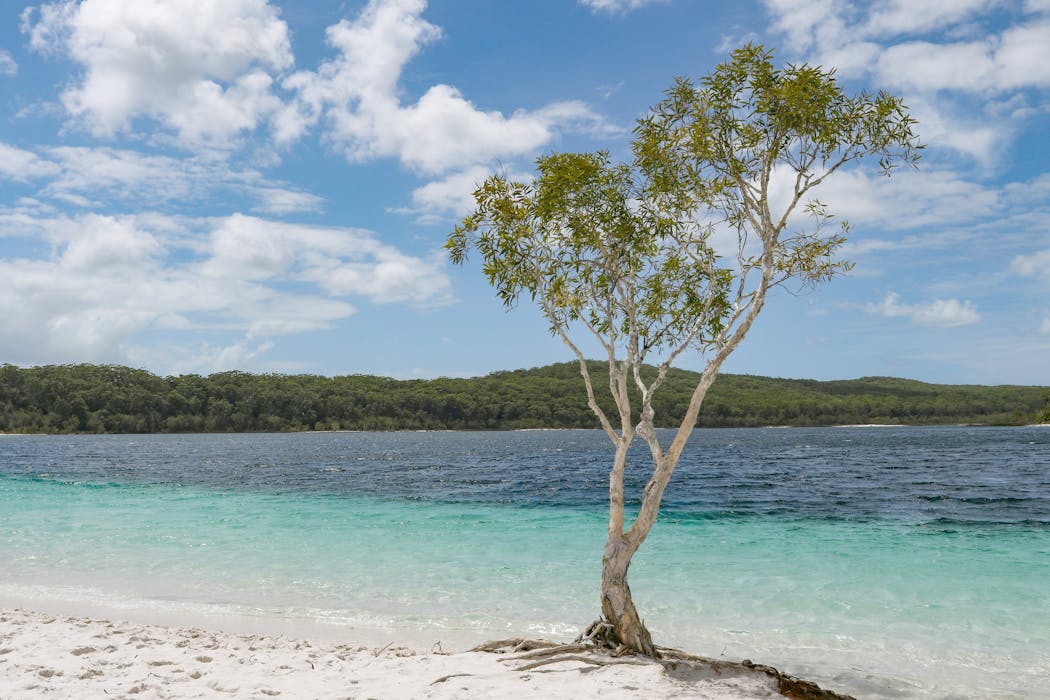
The lakes on the world’s biggest sand island, K’gari, are famous. Pivotal to the World Heritage listing of the Queensland island formerly known as Fraser Island, their turquoise waters feature in international tourism campaigns and social media posts.
K’gari has more than 40 unique lakes, some more than 55,000 years old. They range from the photogenic clear waters of Boorangoora (Lake McKenzie), pictured above, which filters through the sand dune it rests in, to the emerald-green waters of Lake Wabby, a window lake which is (very) slowly being swallowed by a giant sand dune.
In fact, K’gari is home to more than half of the world’s perched lakes, more than 50, including Boorangoora. Perched lakes form when sand is cemented together with decomposed organic matter (such as leaves and bark), aluminium and iron. This creates an impermeable layer well above sea level. It’s remarkable these lakes exist, given water usually passes quickly through sand.
Until now, it was believed K’gari’s lakes would have contained water since the last ice age ended, about 11,500 years ago. But our new research found some of the island’s deepest lakes dried out only 7,500 years ago. In the current era of climate change, it’s possible this could happen again.
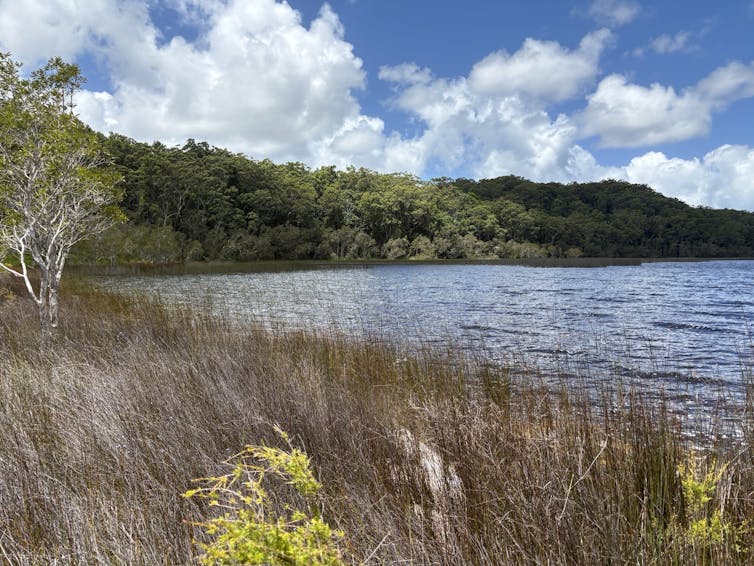
Lake Garawongera is a tannin-stained perched lake, which is isolated from deeper, larger groundwater sources. John Tibby, CC BY-ND
The eyes of K’gari
For the island’s Traditional Owners, the Butchulla people, these lakes are the “eyes of K’gari” and their waters are sacred. The Butchulla believe they have been entrusted with an eternal responsibility: to preserve K’gari’s beauty, spirit, waterways and lakes so future generations may experience the same connection.
K’gari is home to two key types of lakes. Perched lakes (described above) are the best-known type, while window lakes, filled by rain and groundwater, are so named because they offer a “window” to groundwater below the land.
The climate history of these lakes is recorded in their muddy sediment. What happens in and around the lake gets “written” into the layers: plant pollen tells us about local vegetation while greater amounts of sand might indicate erosion.
Ocean Lake. In the foreground is a day waterlily, an invasive species on K’gari. Dave Sternberg, CC BY-ND
A gap in the record
In our research we found this sediment was missing from some of K’gari’s oldest lakes between 7,500 and 5,500 years ago. This gap in the record was identified by radiocarbon dating of sediments from K’gari’s Lake Boorangoora, Lake Allom and Basin Lake.
This gap in sediment suggests the lake basins were not then covered by water. This can happen when there is not enough rainfall over decades. Many Australian lakes dried up during more than the decade-long Millennium Drought.
Our findings were unexpected. We would not have expected the lakes to dry up, as the sediment gap happened during the current Holocene geological epoch, during which global temperatures have varied by less than one degree and moisture has been abundant.
Recent sediment research from another major sand island, Minjerribah (or North Stradbroke Island), shows this island was wetter than K’gari during the same period. Why, at a time of relatively mild climate variation, was it generally wetter just 250 kilometres south? We think southeasterly trade winds supplied rainfall to Minjerribah but not K’gari.
Researchers at Lake Garawongera. From left to right are Conway Burns, Caitlin Jones, Margaux Dupuy, Harald Hofmann and Bob Broome. John Tibby, CC BY-ND
Future of a special place
Our findings highlight the pressing need to know much more about K’gari’s beautiful lakes. In a warming climate expected to become drier but punctuated with more intense rainfall, are these lakes at risk of evaporating? At the moment, we simply don’t know.
For most lakes on K’gari, there’s no information about how much water they hold or even how deep they are. The little information available from a few simple surveys hints that lakes were generally deeper in the 1970s.
In response, we have started surveying the underwater depth and topography of the lakes, using automated monitoring devices to measure how much they fill and drop. Gathering data to understand the water inputs and outputs of today’s lakes will help us better interpret the past – and possibly model the future.
While we are concerned about the future of these lakes, K’gari hosts the greatest diversity of fish and amphibians of any Australian island, hinting at a resilience to climate-driven changes.
In our scientific work, we also try to follow Butchulla teachings. These are: what is good for Country comes first; do not touch or take anything that does not belong to you; and if you have plenty, you must share.
“Gung K’gari Marigurim Yaa”: K’gari’s water makes voice strong.
John Tibby received project funding from the Australian Research Council, the Queensland government and the Environment Institute at the University of Adelaide.
Harald Hofmann has received funding from the Queensland government and CSIRO.
Conway Burns does not work for, consult, own shares in or receive funding from any company or organisation that would benefit from this article, and has disclosed no relevant affiliations beyond their academic appointment.
New Zealand weightlifter Litia Nacagilevu.All Shots Media
Weightlifting New Zealand is hoping Aotearoa will have its first female Commonwealth Games gold medalist next year as an impressive group of young lifters come through the ranks.
The sport has just completed its national championships, with more than 100 lifters taking part from around the country and the South Pacific.
Significantly, almost two-thirds of the athletes competing were women.
Two world-ranked teenagers were the stars of the event, Olivia Selemaia and Litia Nacagilevu dominating their divisions.
Selemaia, 19 – who finished eighth at this year’s world championships – set Oceania and national records in winning the 69kg class, while 18-year-old Nacagilevu – who finished ninth at the world champs – also broke records in the 86kg class.
While the two have impressed on the world stage, Weightlifting New Zealand president Simon Kent said the depth in the sport had grown significantly and they were now seeing the results of investment at the school level.
“Especially the women’s depth has grown in the last half-a-dozen years,” Kent told RNZ.
“The number of clubs has grown and there is good involvement with our community schools programme Lift for Gold. We’ve really invested, there is more exposure and more young people are getting to have a crack at the sport.
“From a high-performance perspective, we’ve really targeted investing in these young ones over the last couple of years and they’re now coming through.”
New Zealand weightlifter Olivia SelemaiaAll Shots Media
As a result, Kent expected as many as a dozen lifters (six men and six women) could compete at the 2026 Commonwealth Games in Glasgow, with the hope that a woman could come away with New Zealand’s first weightlifting gold medal.
New Zealand has won 40 weightlifting medals at the Commonwealth Games over the years, including 12 gold. They have included victories for legends of the sport like Precious McKenzie, Tony Ebert, Don Oliver, Graham May, Darren Liddel, Richie Patterson and David Liti.
Since women’s weightlifting was added to the Games programme in 2002, the closest a Kiwi has come was the silver medal won by Olivia Baker in 2002.
“The one thing missing is we’ve never had a female win a gold medal, and we think with this young group coming through there is every possibility that that could happen next year,” Kent said.
“What Olivia [Selemaia] has done over the last year proving that she is genuinely a world class athlete and not far behind is Latia [Nacagilevu], who is also demonstrating that she has wonderful potential.”
Both those lifters have stiff competition in the Commonwealth, but Kent was confident they could contend for titles, and as teenagers they still had a long way to go in their careers.
All the major contenders for the New Zealand Commonwealth Games weightlifting team will compete at the Oceania Championships in Samoa in April, which will be the last qualifying event before the Games.
Selemaia, Nacagilevu and David Liti were all ranked in the top three in the Commonwealth and all-but assured of selection for the Games.
Robertson spoke to media on Thursday following the draw for the 2027 Rugby World Cup in Australia, which has New Zealand in Pool A with hosts the Wallabies, Hong Kong China and Chile.www.photosport.nz
The All Blacks end of season review will be completed by the end of January and coach Scott Robertson is ready for the “interrogation” headed his way.
Robertson spoke to media on Thursday following the draw for the 2027 Rugby World Cup in Australia, which has New Zealand in Pool A with hosts the Wallabies, Hong Kong China and Chile.
The All Blacks are coming off a year in which they won 10 of 13 tests with three defeats. They retained the Bledisloe Cup but couldn’t win back the Rugby Championship nor complete the Grand Slam on their end of year tour and fell to a record loss at the hands of South Africa.
Those defeats, a pattern of poor second half performances and the team’s struggles to adapt to their rivals’ change of tactics have left many pundits questioning whether the All Blacks are getting better.
Scott Robertson said the review process was nothing new.www.photosport.nz
Consequently, there is plenty of interest in the end of season review and Robertson said it had begun.
“It’s pretty much an interrogation, right from the top to the bottom,” Robertson said.
“It’s a great tool for us to get feedback as coaches, and the whole group from the players and all the management.
“People are gathering (info now). But in the new year, that’s when the information is disseminated out.
“We have an All Blacks camp (in January) and then the team (input) and the board (input) and all that (review) information will be had by the end of January.”
The review process was nothing new, Robertson said.
“We have someone that travels with us the whole time that’s reviewing.
“There’s online stuff, there’s also the group stuff that the team do while they’re on tour, you sit down one-on-one, you talk to all the leaders and get their feedback, so there’s a personal touch to it as well, so that’s all being gathered.”
George Ford of England celebrates victory over the All Blacks.www.photosport.nz
The players would be involved in the review and it would be full and frank, Robertson said.
He was confident the review would show the team was improving less than two years out from the next Rugby World Cup.
“There’s a lot to do before that. There’s a lot of rugby, there’s a lot of chances for us to go and get better in areas, and as a team, and hone in like everyone else. Like I said before, World Rugby is the closest it’s ever been.
“We’ve got some really good competition across the squad and there’s a lot of depth in our squad. This year we had the most injuries we’ve ever had as an All Black squad and so it did create opportunities for other players.
“We want to be four deep in each position and we’re starting to get there and we’ve got another super rugby competition for someone to come in and play really well and put pressure on the current side to play well and pick themselves for the All Blacks next year.”
Sign up for Ngā Pitopito Kōrero, a daily newsletter curated by our editors and delivered straight to your inbox every weekday.
– Published by EveningReport.nz and AsiaPacificReport.nz, see: MIL OSI in partnership with Radio New Zealand
Police have yet to find any trace of a man who went missing near Te Aroha three weeks ago.
Waikato man Louis Van Der Walt, 44, was last seen on the morning of 13 November when he parted company with family during a walk on Mt Te Aroha.
“Police Search and Rescue teams and LandSAR volunteers have searched the area extensively since Louis was reported missing, alongside a number of other enquiries,” Detective Senior Sergeant Kristine Clarke said on Thursday.
“Unfortunately we have not yet located any sign of Louis, and we are appealing for anyone out and about in the area to be vigilant for anything which may assist us in locating him.”
He was wearing a blue T-shirt, brown shorts and jandals.
Louis Van Der Walt.Supplied / NZ Police
Anyone with information was urged to call 105 and quote file number 251114/9651.
The Vega (formerly Aratera) is currently in Nelson Harbour.Supplied / Jason Grimmett
Former Interislander ferry Aratere is still in New Zealand waters despite being retired in August and sold for scrap in October.
So why is it still here?
It was taken out of service to make way for port infrastructure needed for the arrival of two new rail enabled ferries which are due to be delivered in 2029.
In October, Interislander executive general manager Duncan Roy said it was not suitable to be used for most ferry operators due to its age and the fact it would require significant modification or specialist port infrastructure.
“Therefore, we have pursued a safe, efficient and environmentally responsible recycling option.”
Since then, the ship has been bobbing around Wellington Harbour, and at the time of reporting, was in Nelson Harbour.
It had a new name, Vega, and all its Interislander logos removed – including the ferns on its exhausts which had been painted over.
Why has it not left New Zealand yet?
The reason the ship was not on a beach in India right now was because of the Basel Convention – an international treaty which controls the movement of hazardous waste.
For New Zealand, the Environmental Protection Authority makes sure the country met its obligations to the convention.
One of those was ship dismantling which the convention noted does have sustainability benefits through recycling materials.
But the practice has had a history of taking advantage of developing countries and exposing people to health and environmental risks such as asbestos and oils.
Supplied / Jason Grimmett
For the Aratere (now Vega) to be released under this practice, its new owners had to complete an application with the EPA.
The authority said it was now complete but its counterpart organisation in India had not given permission for the ship to enter India yet.
“We cannot finalise the export application until the Competent Authority in India has granted consent for import.”
Sign up for Ngā Pitopito Kōrero, a daily newsletter curated by our editors and delivered straight to your inbox every weekday.
– Published by EveningReport.nz and AsiaPacificReport.nz, see: MIL OSI in partnership with Radio New Zealand
The tino rangatiratanga haki (flag) outside Parliament on the day of the Treaty Principles Bill introduction.RNZ / Emma Andrews
The country’s largest education union, NZEI Te Riu Roa, is backing a claim by Northland iwi and hapū for an urgent Waitangi Tribunal inquiry into the government’s decision to remove school boards legal obligations to give effect to Te Tiriti o Waitangi.
A statement of claim was filed on 19 November 2025 on behalf of Ngāti Hine and Te Kapotai, alongside a joint application for urgency.
The claimants say amendments to the Education and Training Act, and the reset of the New Zealand Curriculum – Te Mātaiaho, undermine Māori rangatiratanga, partnership, and equity in education.
Education Minister Erica Stanford said at the time that Te Tiriti was the Crowns responsibility and not schools.
“School boards should have direction and we are giving very clear direction. You need to ensure equitable outcomes for Māori students, you need to be offering te reo Māori and you need to be culturally competent,” she said.
A map of schools across the country who have reaffirmed their commitment to give effect to Te Tiriti o Waitangi despite the government removing schools boards legal duty to do so.Supplied / Google Maps / Chris Abercrombie
NZEI President Ripeka Lessels said principals and school boards were frustrated the change was made without any engagement.
“It seems to be the preferred pathway of this government to not consult about a whole lot of things,” she told RNZ.
“Not consulting shows this government is absolutely hell-bent on dismantling the Treaty of Waitangi in every aspect of the law.”
Lessels said the move risks weakening commitments to tikanga Māori, mātauranga Māori and te ao Māori within school plans and the local curriculum, “preventing ākonga Māori from ever seeing themselves or their culture reflected in what they learn.”
“The education system has under-served ākonga Māori, and this move to remove Treaty obligations from school boards is a regressive step that can only lead to further systemic disadvantage.”
She said the effects would be wider than just Māori learners, and the issue was ultimately about ensuring all ākonga see their language and identity valued in the place they spend most of their day.
“Language, culture and identity matter. They absolutely matter for children, irrespective of whose language, culture or identity it is. And in Aotearoa today, the Treaty of Waitangi is our founding document.”
NZEI President, the head of the country’s largest education sector union.NZEI supplied
In the last few weeks, Te Rārangi Rangatira, the list of schools who have reaffirmed their commitment to continue giving effect to Te Tiriti, has drawn criticism from government MPs.
Education Minister Erica Stanford previously told media she had heard from principals who felt “very unfair” and “nasty” pressure to sign the statements.
At that same standup, Stanford also reinforced her commitment to “fight for our kids.”
“My message to schools is what we expect is achievement to improve, especially for our tamariki Māori and if those schools are doing all of the things that we’re asking of them in section 127, including offering to being culturally responsive and ensuring that tamariki Māori have equal outcomes, and then if they wish to… honour the treaty or uphold the treaty over and above that, then they’re absolutely welcome to do that.”
In a Facebook post, National MP for Tauranga Sam Uffindell also described the statements from schools as “frankly disgusting” and alleged that unions were “standing over principals” to pressure them to sign what he described as “an anti-govt pledge.”
Lessels rejected claims that schools were being “pressured.”
“I think both of those MPs are out of touch with how schools operate,” she said.
“Schools are independent, autonomous bodies, and they’re self-managing … I don’t know a principal or a board that would ever let anything happen that they didn’t believe was right.”
A growing number of schools across Aotearoa are reaffirming their commitment to Te Tiriti o Waitangi, despite the government removing school boards’ Treaty requirement from the Education and Training Act.Supplied
Many schools had shifted their practice since the Education and Training Act was introduced four years ago, Lessels said, integrating Māori language, culture and identity into teaching and school planning.
“Since 2020, schools have understood the importance of children’s culture, identity and language …They can see there is value in endorsing the Treaty of Waitangi in their schools or working towards it.”
Evidence showed that centring children’s identity improved outcomes a particularly for Māori learners in kura kaupapa Māori – and that removing the legal duty to honour Te Tiriti went against that evidence, she said.
“It’s not rocket science. This removal is definitely not based in sound educational policy or even educational evidence at all. It’s an ideological political move.”
If the Tribunal granted urgency, the claim sought intervention preventing the repeal from taking effect.
The outcome they wanted was for the government to “reverse the policy,” and she encouraged whānau to remain strong through the process, Lessels said.
“Our schools genuinely want to make a difference for their children, and honouring Te Tiriti is the foundation of that.”
The Education Minister declined RNZ’s request for comment.
Sign up for Ngā Pitopito Kōrero, a daily newsletter curated by our editors and delivered straight to your inbox every weekday.
– Published by EveningReport.nz and AsiaPacificReport.nz, see: MIL OSI in partnership with Radio New Zealand
RNZ earlier revealed about 130 staff were under investigation throughout the country after 30,000 alcohol breath tests were “falsely or erroneously recorded”.RNZ
The New Zealand Transport Agency has halted $6m worth of funding to police until it’s satisfied police have met their breath test targets.
Transport Minister Chris Bishop says it’s a “prudent decision” by NZTA which he welcomes, calling the breath testing issue “very concerning”.
RNZ earlier revealed about 130 staff were under investigation throughout the country after 30,000 alcohol breath tests were “falsely or erroneously recorded”.
Following an Official Information Act request from RNZ, police released 150-pages of information in relation to the breath screening tests investigation.
On October 7, after an initial request for information from police, NZTA sent several follow-up questions to police including details as to other avenues police were investigating to detect further irregular breath tests outside of the existing algorithm.
Do you know more? Email sam.sherwood@rnz.co.nz
The 30,000 breath tests related to an algorithm that determined if a second test took place within 90 seconds of the first, whilst the distance between the two indicated a speed of more than 20 km/h.
Police have released 150-pages of information in relation to the breath screening tests investigation.Supplied / NZ Police
In response, Acting Deputy Commissioner Mike Johnson said while the algorithm had “proven effective” in identifying tests conducted while the device was in motion, “there remains limitations in detecting all forms of irregular testing, including those undertaken in specific locations”.
“Work remains underway to identify what, if any, options exist for removing these limitations.”
Then, on 16 October, NZTA’s Road Policing Investment manager Neil Macrae emailed several people including Johnson and director of road policing, Superintendent Steve Greally.
In the email Macrae referenced the government’s $1.3 billion Road Policing Investment Programme (RPIP).
The programme includes increased alcohol breath tests with a target of 3.3 million roadside alcohol breath tests per year and a focus on high-risk items, with a requirement that 65 per cent of breath tests are done at high or extreme alcohol risk times.
Macrae said while NZTA recognised “current limitations” in detecting all forms of irregular testing, they supported and “encourage” police to identify what, if any, options exist for removing the limitations and to look beyond current detection methods “to ascertain the true scale of irregularities”.
He said that while the police’s investigation into irregularities continued, NZTA’s reporting was “on hold”.
“NZTA’s reporting includes the RPIP Quarterly report to Minister(s), assessment of RPIP Q1 (2025/26) delivery dependant funding and the Annual Assurance report to the NZTA Board that was due to be presented 23 October 2025.
“Delaying the assurance report to the board also delays the approval process for variations to the current programme including the ‘open roads speed measure’.”
Macrae said the decision to delay the assurance report was taken at chief executive level. NZTA would also meet with Audit NZ to discuss implications on their public statutory reporting.
In response to questions from RNZ, an NZTA spokesperson said they had requested police provide assurance that delivery numbers for breath screening tests and the wider road policing activity measures for the 2024/25 financial year were correct.
“We are working with police to verify the final results. We paused our usual end-of-year reporting to the NZTA Board and the Minister of Transport until we are satisfied that the final results are a full and accurate record of police delivery during the 2024/25 financial year.”
The bulk of funding for road policing activity (of $103 million per quarter) continued to be available to policePolice
Each year, $24 million of funding from the National Land Transport Fund (NLTF) for the RPIP is dependent on the successful delivery of all speed and impairment activities to agreed specified annual levels, known as delivery dependent funding (DDF).
“Delivery against these measures is assessed on a quarterly basis, and a pro-rated amount of DDF is available to be authorised to spend ($6 million per quarter).
“Until the current issue with reporting on breath testing is resolved, NZTA has paused assessment of the $6m in delivery dependent funding for the first quarter of the 2025/26 financial year.”
The spokesperson said any funding from a quarter where DDF was not met remained available for subsequent authorisation in the same financial year, if targets are met.
“Any funding not authorised to be spent at the end of the financial year is required to be returned to the NLTF.”
The bulk of funding for road policing activity (of $103 million per quarter) continued to be available to police, the spokesperson said.
In a statement to RNZ, Bishop said “this is a prudent decision by NZTA and I welcome it. The breath testing issue is very concerning and it is important it is resolved.”
Transport Minister Chris BishopRNZ/Mark Papalii
NZTA warns of ‘clear breach’ of no surprises expectation
On 25 September, more than a month after the tests were identified, NZTA’s group general manager Richard Forgan wrote to Johnson and said they were notified of the matter on 22 September.
Forgan said that given NZTA’s role as investor and providing monitoring and assurance in relation to the Road Policing Investment Programme (RPIP) the integrity and accuracy of the delivery against the measures was “paramount”.
Forgan instructed the Road Policing Investment team in NZTA to look further into the data integrity issue with “urgency” and requested a series of information from police.
Forgan also took issue with the length of time it took NZTA to be notified.
“In addition to the issue regarding the data irregularity, the memorandum of understanding between us clearly states a ‘no surprises’ expectation.
“The fact this issue was first discovered in late August, the Minister of Police was briefed on 12 September and NZTA only informed via the Minister of Transport’s office on 22 September is a clear breach of this expectation. I reinforce NZTA’s expectation that we are to be advised of such matters early.”
– Published by EveningReport.nz and AsiaPacificReport.nz, see: MIL OSI in partnership with Radio New Zealand
The most popular search topics in New Zealand in 2025 on Google included Kiwi sports stars and celebrities like David Parker, Liam Lawson and Lorde, overseas celebrities like Ozzy Osbourne and Jimmy Kimmel, and notable news stories like the death of Charlie Kirk.File / RNZ / AFP
Labubu. Viral ice cream. Tom Phillips, wind warnings, and how to make butter.
Google has announced the top trending searches for New Zealand in 2025, and it’s a snapshot of the wild, weird year that’s nearly over.
The single biggest search term in Aotearoa this year had little to do with New Zealand – it was the American conservative activist Charlie Kirk, who was not well known here before his death in September.
But right up there in the top ten were also the death of Tom Phillips after a four-year search for the missing man and his children, weather events like Cyclone Alfred and the long-dead American serial killer Ed Gein, subject of a popular Netflix series.
Oh, and the All Blacks. There’s always the All Blacks.
Google New Zealand’s communications and public affairs manager Carrie Jones told Morning Report the results provided interesting data about what Kiwis are thinking about.
“This list of top trending searches spanned pop culture, lifestyle, sports, news – and they’re the queries that had the greatest spike in interest this year as compared to last year.
“So they give us a really good insight into what Kiwis were curious about.
“This year the searches paint a picture of a population that was pragmatic, hyper-vigilant and digitally aware.
“One thing that is consistent year on year is we are sports mad and the All Blacks are actually the most-referenced search term of the past five years.”
With a new album out, Lorde remained a top search topic in New Zealand this year.Supplied / Universal Music
When it came to Kiwi searches, boxer Joseph Parker, ACT Party deputy leader Brooke van Velden, former Green MP Benjamin Doyle, singer Lorde and F1 driver Liam Lawson were among the top queries.
Celebrities who passed away in 2025 were also frequently searched, such as Ozzy Osbourne, Gene Hackman and Diane Keaton.
Another hot spot in the top 10 was health searches.
“Interestingly in our overall searches list we saw searches for COPD treatment and osteoporosis treatment, perhaps showing Kiwis taking health matters into their own hands,” she said.
Jones said Google has also seen a sharp increase in people using search as a real-time safety tool for events like cyclones, tsunami warnings and storms.
“Our desire for information about these immediate weather hazards has never been more pronounced.”
“Kiwis are searching for urgency around local matters such as wind warnings, rainfall warnings and tsunami warnings and also showing interest in engagement and political processes. So we saw searches for how to make a submission for the Treaty Principles Bill, for example.”
Jones said that last search showed a desire to participate rather than just gather information.
“We see a shift from lots of reading, maybe just looking for headlines, moving more to actionable paths to engagement. So, ‘how to make a submission to the Treaty Principles Bill’ shows Kiwis’ interest and a desire to be involved, rather than just participate and read.”
“I think there is a natural scepticism of new technology. I think there is real excitement around the opportunity that AI can present and how it can make a real difference in our society, whether it’s through health care or across different industries.”
And with food, “There were two main flavours that came through our searches this year,” Jones said.
“So we had Dubai chocolate, pistachio cream and matcha coming through, people wanted to know how to make Dubai chocolate, how to make pistachio cream. That was sort of the unexpected flavour duo of 2025.”
Courtesy of Google, here’s the full lists of trends in New Zealand for 2025:
Slain American political commentator Charlie Kirk was New Zealand’s top overall search in 2025.ANGELA WEISS / AFP
Overall searches
Charlie Kirk
COPD treatment
Osteoporosis treatment
Tom Phillips
All Blacks vs France
Ozzy Osbourne
Cyclone Alfred
Iran
Ed Gein
Club World Cup
Kiwis
Joseph Parker
Benjamin Doyle
Lorde
Liam Lawson
Daniel Hillier
Kai Kara France
David Nyika
Brooke Van Velden
Chris Wood
Stuart Nash
Deaths
Charlie Kirk
Tom Phillips
Michelle Trachtenberg
Gene Hackman
Hulk Hogan
Diane Keaton
Val Kilmer
David Lynch
Robert Redford
Jane Goodall
People
Belle Gibson
D4vd
Diogo Jota
Pope
Andy Byron
Luke Combs
Jimmy Kimmel
Tyler Robinson
Kendrick Lamar
Prince Andrew
Local moments
Wind warning
Rainfall warning
Tsunami warning
Thunderstorm warning
Cyclone Tam
Treaty Principles Bill Submission
Metallica Auckland
Tongariro Fire
Measles
Sail GP Auckland
Global moments
Cyclone Alfred
Iran
Day of the Dead
LA Fires
Labubu
Russia Earthquake
KPop Demon Hunters
Bianca Censori Grammys
67
Air India Crash
How to…
How to make butter
How to invest money in shares
How to make buttermilk
How to get rid of bed bugs
How to screenshot on Macbook
How to watch All Blacks vs France
How to soft boil an egg
How to say Happy Matariki in te reo Maori
How to clear cache on Chrome
How to calculate a tax refund
Definitions:
Plancha
Taki
Parens
Loris
Hubris
Atria
Ziti
Ouroboros
Orgo
Seitan
Internet trends/memes
Action Figure Trend
Mango Ice Cream
Barbie AI Trend
Revenge Saving Financial Trend
Peach Ice Cream
What is the 6 7 Trend
Squishy Toy Trend
Polaroid Trend
Starter Pack Trend
Sports events
Club World Cup
India vs England
Auckland FC
India vs Australia
Champions Trophy
New Zealand vs Pakistan
Super Rugby Fantasy
All Blacks vs Australia
New Zealand vs West Indies
Sign up for Ngā Pitopito Kōrero, a daily newsletter curated by our editors and delivered straight to your inbox every weekday.
– Published by EveningReport.nz and AsiaPacificReport.nz, see: MIL OSI in partnership with Radio New Zealand
Johnathan Tamihana was sentenced to preventative detention with a minimum non-parole period of five years at the High Court in Auckland on Wednesday.RNZ / Simon Rogers
A man has been sentenced to preventative detention following two sexual attacks against women nearly a year apart.
The two women were both indecently assaulted at the Ōtara Creek Reserve, one in February 2023 and the other in February 2024.
In the first incident, police said a French national was indecently assaulted at the reserve in broad daylight.
“The woman was understandably distraught by what had happened on her visit to New Zealand,” Detective Senior Sergeant Dean Batey said in a statement.
At that time police identified a suspect on a BMX bike using CCTV footage, but despite an investigation and a public appeal they were unable to identify the unknown male, he said.
Nearly a year later, on 18 January 2024, a local woman reported to police that she had been indecently assaulted by a man.
“The woman was out jogging at around 6.30am when a man had followed her into the Ōtara Creek Reserve.
“He subjected her to a disturbing indecent assault.
“Our team was conscious of the previous incident and were determined to stop him from committing any further harm.”
Investigations managed to identify Johnathan Tamihana as the offender in both attacks.
Tamihana has since pleaded guilty to three counts of indecent assault, threatening to kill and assault with intent to commit sexual violation.
On Wednesday, the 33-year-old Ōtara man was sentenced to preventative detention with a minimum non-parole period of five years, at the Auckland High Court.
Sign up for Ngā Pitopito Kōrero, a daily newsletter curated by our editors and delivered straight to your inbox every weekday.
– Published by EveningReport.nz and AsiaPacificReport.nz, see: MIL OSI in partnership with Radio New Zealand
No seriously, what are you wearing to bed? Because it can affect the quality of your sleep.
“What you sleep in can alter the temperature, [that] is the main thing in terms of how it may affect your sleep,” explains Kathleen Maddison from the Centre for Sleep Science at The University of Western Australia.
“Temperature change is super important in helping us fall asleep and then helping us stay asleep.”
Preferences are very much climate dependent, says Kathleen Maddison, from the Centre for Sleep Science at The University of Western Australia. (file image)
Finance Minister Nicola Willis.RNZ / Samuel Rillstone
The government’s finances are slightly worse than expected, as the tax take fell more than expenses.
Treasury figures, which exclude ACC finances, showed a deficit of $4.9 billion for the four months ended October – about $700 million higher than forecast in May’s Budget.
The deficit including ACC costs was $5.2b, $400m above forecast.
The tax take was down $600m because of lower company and provisional tax receipts.
The Black Caps face the West Indies for day three of their first test of the summer from Hagley Oval in Christchurch.
New Zealand has played just two Test matches so far in 2025, beating Zimbabwe 2-0 in Bulawayo in August.
Since then they’ve played 17 white-ball games against Australia, England and West Indies.
“The team is clear in their test match identity, they’ve done incredibly well as a unit, so just to fall back into that,” coach Rob Walter said on the eve of the three match series.
New Zealand is ranked fifth in the World Test rankings, with West Indies eighth.
First ball is at 11am.
Sign up for Ngā Pitopito Kōrero, a daily newsletter curated by our editors and delivered straight to your inbox every weekday.
Michael BracewellAndrew Cornaga / www.photosport.nz / Photosport Ltd 2025
– Published by EveningReport.nz and AsiaPacificReport.nz, see: MIL OSI in partnership with Radio New Zealand
Rajinder was on trial at the High Court in Dunedin.RNZ
A man has been found guilty of murdering Gurjit Singh in his Dunedin home.
The jury retired to consider its verdict at the High Court in Dunedin on Wednesday morning and returned on Thursday.
The 35-year-old, known only as Rajinder, killed Singh at his home in January last year.
In summing up, Justice Rachel Dunningham told the jury there was no dispute that Gurjit Singh was attacked and it was up to them to decide if Rajinder was responsible or not.
Rajinder’s defence lawyer said he had no motive and the evidence against him was flawed.
In closing arguments on Tuesday, prosecutor Richard Smith asked the jury to apply their common sense, saying it was not “rocket science”.
“His blood and hair in the scene. His hair in the victim’s hands, his injury and the thumb of the glove left at the scene. Him buying a murder kit. Him saying he didn’t even know where the victim lived yet here he is searching out a route to the victim’s house on the night of the murder,” he said.
A forensic expert had testified that the blood samples taken from the murder scene were 500,000 million times more likely to be Rajinder’s than a random person, he said.
Defence lawyer Anne Stevens KC said Rajinder had spoken to police in two interviews voluntarily and had consistently denied murdering Singh, describing the other man as honest and hard working.
While the numbers sounded large, DNA presented a degree of likelihood, she said.
“The numbers do not make certainty, however large. Numbers go to infinity. Don’t be misled by high numbers being a certainty, that high enough is good enough,” she said.
During the more than two-week-long trial, the court heard of a complicated love triangle involving Singh, his widow Kamaljeet Kaur and Rajinder.
The Crown said Kaur rejected Rajinder’s proposal through a marriage broker in 2022, while his lawyer said it was Kaur’s family who had approached Rajinder’s family twice about marrying the man and he was not upset to find out she had instead married Singh.
Singh also rejected Rajinder’s plan to marry his sister, saying she was too young.
The Crown said the rejections were motive for murder, while the defence called it a “fantasy of the Crown’s”.
The night of Singh’s death started with a pizza party with friends in Helensburgh on 28 January 2024.
His friends said he was in a good mood, with his wife soon leaving India and moving to New Zealand to live with him. Singh had planned a three-day trip to pick her up from Christchurch.
They last saw him alive at 10.30pm when he left the party.
Dhruval Aery testified that he went to Singh’s home after receiving multiple panicked messages from a mutual friend because he could not be reached.
He found Singh’s bloodied body on the lawn.
“I can tell that he is no more,” Aery told the court.
Singh’s widow Kamaljeet Kaur said her bags were packed for her move to Dunedin when she found out her husband had been killed.
Videos from officers at the property showed blood stains on the ground, hand rail, furniture and wall, a broken large window and signs of a struggle inside.
Rajinder will be sentenced in April.
Sign up for Ngā Pitopito Kōrero, a daily newsletter curated by our editors and delivered straight to your inbox every weekday.
– Published by EveningReport.nz and AsiaPacificReport.nz, see: MIL OSI in partnership with Radio New Zealand
Invercargill City Council confirmed the gear was owned by arborist Treetech and was essential to the ongoing efforts to restore the park after extensive storm damage.
Treetech managing director Chris Walsh said the company would need to bring in replacement equipment to get the job done.
“If someone has intentionally set fire to our trucks and equipment, that would be devastating for our team. It’s more than a million dollars’ worth of damage, but we’re pulling out all the stops to keep going.
“We’re a resilient bunch, and we’re going to do whatever it takes to get the job done.”
Council parks and recreation manager Caroline Rain said the fire would very likely delay the reopening of the final section of Queens Park.
It was incredibly lucky that the fire did not spread further beyond the maintenance yard, she said.
“It’s distressing to think that someone would deliberately destroy the tools we need to reopen the rest of this beloved park.
“Our staff and contractors have been working tirelessly over the past few weeks to ensure Queens Park is safe for the community.”
Anyone with information relating to the fire was encouraged to contact police.
Counsel for MPI said the company faced a penalty of around $50,000-$55,000.
At the time the charge was laid, New Zealand Food Safety deputy director-general Vincent Arbuckle said Woolworths had failed to ensure a significant rodent infestation was promptly identified and escalated in accordance with its food control plan.
Woolworths New Zealand is due to be sentenced in March next year.
Sign up for Ngā Pitopito Kōrero, a daily newsletter curated by our editors and delivered straight to your inbox every weekday.
– Published by EveningReport.nz and AsiaPacificReport.nz, see: MIL OSI in partnership with Radio New Zealand
Dairy giant Fonterra has increased its first quarter profits to $278 million, $15m more than a year ago.
Key numbers for the quarter ended 31st October:
Net profit $278m up $15m
Forecast FY earnings unchanged at 45-65cps
Midpoint milk price forecast $9.50 per kgMS
Lactalis gains OIS approval to buy Mainland
Chief executive Miles Hurrell said earnings were in line with last year on the back of higher commodity prices, and first quarter profits were the equivalent of 17 cents per share.
“When excluding the costs associated with the Consumer divestment, Fonterra’s normalised earnings per share are 18 cents, up slightly on last year.”
“We maintain our full year earnings range for continuing operations of 45-65 cents per share,” Hurrell said.
Fonterra said it is making good progress implementing its strategy to become a global B2B (business to business) dairy provider after it completes the sale of its consumer Mainland Group.
“We are firmly focused on delivering the commitments we’ve made, not least our target to lift earnings back to FY25 levels by FY28, offsetting the impact of the divestment of Mainland Group,” Hurrell said.
Fonterra intended to invest $1 billion over the next three to four years in projects to generate operational efficiencies.
Mainland sale and capital return
Fonterra said the sale of its consumer brands remained on track and the French based buyer, Lactalis, had secured approvals from the Overseas Investment Office.
Separately, Fonterra said it was continuing to work through other regulatory approvals.
The co-operative expects the sale to close in the first half of 2026 after its farmer shareholders vote on the capital return in February.
Shareholders are set to receive $2 per share tax free from the sale, equivalent to $3.2b.
Last week Fonterra lowered its forecast farmgate milk price to between to between $9.00 and $10.00 a kilo of milk solids as increasing global milk production sent prices lower.
Sign up for Ngā Pitopito Kōrero, a daily newsletter curated by our editors and delivered straight to your inbox every weekday.
– Published by EveningReport.nz and AsiaPacificReport.nz, see: MIL OSI in partnership with Radio New Zealand
Mobile network company 2degrees says it is aware some customers are experiencing issues with connecting, receiving, or making calls on their mobile devices.
2degrees’ website says a nationwide fault was under repair since about 4am on Thursday morning.
The company said it was sorry for the inconvenience and their technical team was working to resolve the issue quickly.
Sign up for Ngā Pitopito Kōrero, a daily newsletter curated by our editors and delivered straight to your inbox every weekday.
– Published by EveningReport.nz and AsiaPacificReport.nz, see: MIL OSI in partnership with Radio New Zealand