Page 161

L’Authentique Chicken & Duck Parfait recalled following food safety failure

Source: Radio New Zealand

Supplied

A specific batch of L’Authentique Chicken & Duck Parfait is being recalled following a failure of food safety controls.

The recall was published on the Ministry for Primary Industries website on Wednesday.

MPI said the parfait with a use by date on 24/08/26 was affected by the recall.

The parfait comes in a 100 gram glass jar and is sold throughout New Zealand at supermarkets and other retailers.

The product has not been exported, MPI said.

“Customers are asked to check the date mark on the lid of the product.

“Affected product should not be consumed. There have been no reports of associated illness. However, if you have consumed any of this product and have any concerns about your health, seek medical advice.

“Customers should return the product to their retailer for a full refund.”

For any retailers selling the parfait, they are expected to download a notice of the recall and display it in store for one month.

Anyone with questions can contact Charcuterie du Pacifique Sud Limited on 09 303 2444.

Sign up for Ngā Pitopito Kōrero, a daily newsletter curated by our editors and delivered straight to your inbox every weekday.

– Published by EveningReport.nz and AsiaPacificReport.nz, see: MIL OSI in partnership with Radio New Zealand

All EB Games stores in NZ to close at end of month

Source: Radio New Zealand

All EB Games stores will close for the last time on 31 January. Supplied

EB Games is shutting down its New Zealand business and closing all its stores at the end of the month.

In a letter sent to employees last week, EB Games Australia & New Zealand managing director Shane Stockwell said the company was proposing to close all remaining EB Games New Zealand stores and the New Zealand Distribution Centre.

Another letter sent on Wednesday confirmed that EB Games will close its New Zealand operation on 31 January. The remaining stores will close on that day, with the distribution centre permanently closing on 28 February

Stockwell said the company had “numerous” third parties approach the company after it was revealed it was considering shutting down, but “these parties did not present any proposals or solutions about how to keep the New Zealand business sustainable”.

EB Games is an Australian-based video game and pop culture merchandise retailer, owned by GameStop since 2005.

There are currently 38 stores in New Zealand, according to GameStop’s latest annual report, and 336 in Australia.

It is uncertain how many jobs would be lost, and the letter to NZ employees did not mention anything about the future of the Australian stores.

The chain has been facing stress for some time, including closures of stores in both Australia and New Zealand.

In the earlier letter, Stockwell described the New Zealand business as no longer commercially viable, with a “multi-million dollar loss during the 2024 fiscal year”.

He said the retail market continued to be sluggish and the company was not confident its performance would improve.

“We are saddened to be in this position having already made significant and repeated efforts to turn the business around,” Stockwell wrote.

The company said that there may be opportunities for New Zealand employees to relocate and take up work in the Australian EB Games operations.

Sign up for Ngā Pitopito Kōrero, a daily newsletter curated by our editors and delivered straight to your inbox every weekday.

– Published by EveningReport.nz and AsiaPacificReport.nz, see: MIL OSI in partnership with Radio New Zealand

Sports car driven at four times the speed limit through Southland town

Source: Radio New Zealand

The black 2016 Chevrolet Corvette Z06 has been impounded for a month. Supplied / NZ Police

A 63-year-old man who allegedly drove over four times the speed limit through a Southland town has had his Chevrolet Corvette impounded for a month.

A Southland man is due to appear in court charged with recklessly driving four times over the speed limit in Edendale

Multiple complaints of a black sports car speeding through the town of Edendale were received on Christmas Eve.

Constable Julie Russell said the driver allegedly returned to the area multiple times, and took several people for rides.

The black 2016 Chevrolet Corvette Z06 was found to have allegedly travelled over four times the posted speed limit, as well as doing burnouts in the area.

“Not only is this a ridiculously dangerous speed, but this reckless driving may have had the potential to cause serious harm to a number of people,” Russell said.

A black 2016 Chevrolet Corvette Z06 is impounded after a motorist was spotted driving at four times the posted speed limit. Supplied / NZ Police

Police searched a nearby property on 13 January, where the man was suspended from driving for 28 days and summonsed to court.

The Chevrolet Corvette – worth $160,000 – was seized and impounded for 28 days.

“We appeal to anyone who may have witnessed this incident or has CCTV or dashcam footage and is yet to contact us to please do,” Russell said.

“If you have information that can assist in our enquiries, you can contact us online at 105.police.govt.nz, clicking ‘Update Report’, using the reference number 251227/2052.”

The 63-year-old man is due to appear in Gore District Court next month charged with sustained loss of traction and reckless driving.

Sign up for Ngā Pitopito Kōrero, a daily newsletter curated by our editors and delivered straight to your inbox every weekday.

– Published by EveningReport.nz and AsiaPacificReport.nz, see: MIL OSI in partnership with Radio New Zealand

Tennis: Top seed advances at ASB Classic

Source: Radio New Zealand

USA’s Ben Shelton during his first round singles match at the ASB Classic Men’s ATP 250 tennis tournament at Manuka Doctor Arena, Auckland, New Zealand. Wednesday 14 January 2026. © Andrew Cornaga / www.photosport.nz Andrew Cornaga/www.photosport.nz

Such is the draw of top seed American Ben Shelton that fans flocked to centre court and packed the house before midday at the ASB Classic in Auckland.

Despite the early start, the atmosphere was electric as Shelton advanced to the quarter finals with a straight sets win over Argentina’s Francisco Comesana 7-5, 6-4.

“Being the first match of the day, I wasn’t sure if it was going to be half empty. But it was pretty much packed. And that’s one of the great things about playing here, why I love playing here and why I keep coming back every year,” Shelton said following the win.

He admitted the match was much closer than the scoreline would suggest.

“It wasn’t perfect. I didn’t expect it to be. But I thought I competed well and I got better as the match went on. It wasn’t straightforward, but I’m just happy to be out there competing and figuring things out.”

Despite the early start, the atmosphere was electric in Auckland. Andrew Cornaga/www.photosport.nz

Shelton wore his emotions on his sleeve while on court, as he let out several roars after winning key points which translates to his playing style.

“I think that at times last year I was almost too passive. Aggressive tennis wins here and wins in Australia. I know that for sure. That means coming to net, taking the ball early, taking time away, and that’s what I was focusing on.”

He admitted there was plenty to work on ahead of tomorrow’s quarter.

“Tennis is a game of very, very small margins and some days that’s not going to go my way. Today it did. And I’m just happy that I have the opportunity now to improve on some things.”

Shelton said he was proud of the fight he showed as managed to save three set points with Comesana coming out firing.

“I feel like I’m evolving really well, doing a lot of stuff well at the net and I want to utilise that, take advantage of it, and put pressure on the other guys.”

Also through to the top eight is American Marcos Giron, who upset sixth seed and compatriot Alex Michelsen in straight sets 6-4, 6-4.

Britain’s Cam Norrie is also in action today as he meets Fenchman Giovanni Mpetshi Perricard while sixth seed Nuno Borges will play Eliot Spizzirri.

The evening session will see second seed Casper Ruud meet Fábián Marozsán, while in the final match of the day, Hamad Medjedovic takes on Jakub Menšík.

Sign up for Ngā Pitopito Kōrero, a daily newsletter curated by our editors and delivered straight to your inbox every weekday.

– Published by EveningReport.nz and AsiaPacificReport.nz, see: MIL OSI in partnership with Radio New Zealand

ER Report: A Roundup of Significant Articles on EveningReport.nz for January 14, 2026

ER Report: Here is a summary of significant articles published on EveningReport.nz on January 14, 2026.

Jewelled eels, beards of gold and unfathomable cruelty: 5 of ancient Rome’s most eccentric leaders
Source: The Conversation (Au and NZ) – By Peter Edwell, Associate Professor in Ancient History, Macquarie University Ancient Roman political leaders could be violent and cruel. Some had odd tastes and were out of touch. Others had wildly eccentric habits that might seem amusing today. But eccentric behaviour combined with almost unlimited power, made some

Takeaway coffee cups release thousands of microplastic particles
Source: The Conversation (Au and NZ) – By Xiangyu Liu, Research Fellow, School of Environment and Science and Australian Rivers Institute, Griffith University Katerina Holmes/Pexels It’s 7:45am. You grab a takeaway coffee from your local cafe, wrap your hands around the warm cup, take a sip, and head to the office. To most of us,

FLNKS boycotts Macron-convened Paris talks over future this week
The Kanak and Socialist National Liberation Front (FLNKS), one of the main components in New Caledonia’s pro-independence Kanak movement, has confirmed it will not take part in a new round of talks in Paris this week called by French President Emmanuel Macron. In mid-December 2025, Macron invited New Caledonia’s politicians back to the negotiating table

A ‘cosmic clock’ in tiny crystals has revealed the rise and fall of Australia’s ancient landscapes
Source: The Conversation (Au and NZ) – By Maximilian Dröllner, Adjunct Research Fellow, School of Earth and Planetary Sciences, Curtin University; Georg-August-Universität Göttingen The remnants of violent stellar explosions where cosmic rays are born. NASA/ESA/The Hubble Collaboration/R. A. Fesen/J. Long, CC BY Australia’s iconic red landscapes have been home to Aboriginal culture and recorded in

The World Trade Organization is on life support. Will Trump’s new rules finish it off?
Source: The Conversation (Au and NZ) – By Jane Kelsey, Emeritus Professor of Law, University of Auckland, Waipapa Taumata Rau Chip Somodevilla/Getty Images The United States has now withdrawn from 66 international organisations, conventions and treaties, illegally invaded Venezuela, and promoted an “America First” agenda in its new National Security Strategy. This all signals the

From bolts to blue jets, lightning comes in many strange forms
Source: The Conversation (Au and NZ) – By Andrew Dowdy, Principal Research Scientist in Extreme Weather, The University of Melbourne Lightning has captured people’s fascination for millennia. It’s embedded in mythology, religion and popular culture. Think of Thor in Norse mythology or Indra in Hinduism. In Australia, lightning is also associated with important creation ancestors

What’s the difference between a sprained ankle and a twisted ankle?
Source: The Conversation (Au and NZ) – By Hunter Bennett, Lecturer in Exercise Science, Adelaide University Kindel Media/Pexels After the summer break, you’re ready to get back into exercise. You put on your shoes, pop on your headphones and head out the door on your first run of the new year. But as you step

As we begin to assess the fire damage in Victoria, we must not overlook these hidden costs
Source: The Conversation (Au and NZ) – By Sonia Akter, Associate Professor, Crawford School of Public Policy, Australian National University Devastated by widespread fires, Victoria has declared a state of disaster. More than 500 structures have reportedly been destroyed and 1,000 agricultural properties have been affected. Tragically, there has also been one fatality. On Monday,

Why the Heated Rivalry TV series understands gay men better than the book
Source: The Conversation (Au and NZ) – By Harry Stewart, PhD Candidate in Queer Male Romance, Flinders University HBO Heated Rivalry, written and directed by Jacob Tierney, has become a massive hit, going viral among gay romance fans and gathering millions of likes on the show’s official TikTok page. Tierney’s adaptation of Rachel Reid’s 2019

NZ’s health data hack needs a proper diagnosis – and a transparent treatment plan
Source: The Conversation (Au and NZ) – By Dylan A Mordaunt, Research Fellow, Faculty of Education, Health, and Psychological Sciences, Te Herenga Waka — Victoria University of Wellington; Flinders University; The University of Melbourne Getty Images Two cyber hacks have highlighted the vulnerability of New Zealand’s digital health systems – and the vast volumes of

From flammable neighborhoods to moral hazards, fire insurance maps capture early US cities and the landscape of discrimination
Source: The Conversation (Au and NZ) – By Jack Swab, Assistant Professor Department of Geography & Sustainability, University of Tennessee 1909 Sanborn map of Suffolk County in Boston, Mass. Library of Congress Imagine a map that allows you to see what your neighborhood looked like a century ago in immense detail. What you’re thinking of

Indonesia accused of being ‘unfit’ for UN rights council presidency
Asia Pacific Report A West Papuan advocacy group has condemned Indonesia over taking up the presidency of the United Nations Human Rights Council, saying it was “totally unfit” and the choice  “makes a mockery” of the office. Indonesia was the sole candidate for the Asia-Pacific bloc at the council (HRC), which also includes China, Japan

Adelaide Writers Week: Cancelled – no decorum without a quorum
By Kim Wingerei and Michael West in Sydney Adelaide Writers’ Week, a core part of South Australia’s premier cultural event, the Adelaide Festival, has finally been cancelled in its 40th year. There are own goals. And then there is the board of the Adelaide Festival (ably assisted by referee, Premier Peter Malinauskas). After yesterday’s resignation

This is the playbook the Iranian regime uses to crack down on protests – but will it work this time?
Source: The Conversation (Au and NZ) – By Amin Naeni, PhD Candidate in International Relations, Deakin University In late December, Tehran’s bazaar merchants began protesting against Iran’s theocratic rulers over the sharp collapse of the currency. These protests quickly spread nationwide, although the level of participation remained limited, initially. The situation changed when Reza Pahlavi,

Three early January polls have Labor down, but disagree on One Nation’s vote
Source: The Conversation (Au and NZ) – By Adrian Beaumont, Election Analyst (Psephologist) at The Conversation; and Honorary Associate, School of Mathematics and Statistics, The University of Melbourne Three early January national polls have Labor sliding to between 52–53% two party preferred against the Coalition, down from around 55% to Labor before Anika Wells’ expenses

View from The Hill: Kevin Rudd, a controversial energy ball as ambassador to US, quits early
Source: The Conversation (Au and NZ) – By Michelle Grattan, Professorial Fellow, University of Canberra Kevin Rudd’s premature departure in March from his post of Australia’s ambassador to the United States is a surprise, but perhaps not as unexpected as it might initially appear. Rudd’s term had another year to run. Any extension would have

ER Report: A Roundup of Significant Articles on EveningReport.nz for January 13, 2026
ER Report: Here is a summary of significant articles published on EveningReport.nz on January 13, 2026.

Jewelled eels, beards of gold and unfathomable cruelty: 5 of ancient Rome’s most eccentric leaders

Source: The Conversation (Au and NZ) – By Peter Edwell, Associate Professor in Ancient History, Macquarie University

Ancient Roman political leaders could be violent and cruel. Some had odd tastes and were out of touch. Others had wildly eccentric habits that might seem amusing today.

But eccentric behaviour combined with almost unlimited power, made some Roman leaders dangerous and unpredictable.

Hortensius

One oddball was the orator and politician Hortensius (114–50 BCE) of the late Roman republic.

He loved the plane trees on his estate so much he watered them with wine. Receiving news that one of them was dying, Hortensius hastily adjourned a legal case to be by its side.

Crassus

Marcus Licinius Crassus, a contemporary of Hortensius, was a powerful Roman general and politician who kept pet eels in an expensive fishpond.

He adorned his favourite eel with jewellery. When the eel died, Crassus held a funeral and mourned it for three days.

Ancient accounts of eccentric behaviour weren’t just for entertainment. Crassus’ intense devotion to his favourite eel satirised his aristocratic vanity.

Crassus later died in Mesopotamia (southern Turkey) in a disastrous battle against the Parthians (rulers of ancient Iran) in 53 BCE. The Parthian generals lured Crassus into a hot and waterless plain where they destroyed his army. Due to Crassus’ impetuosity, 20,000 men died along with him and his son.

The orator and statesman, Cicero, lampooned the piscanarii (fishpond lovers), of whom Hortensius was also one, for their obscure indulgences. They should have focused more on affairs of state, he believed.

Caligula

The eccentricities of Roman leaders continued under the emperors, after the era of the republic ended. Now, however, almost unlimited power meant eccentricities could easily devolve into violence and cruelty.

The notorious emperor Caligula (ruled 37–41 CE) toyed with appointing his horse as consul. The horse, named Incitatus, was lavished with splendidly appointed stables and its own slaves.

Caligula was known for other unique tastes. He often dressed in the garb of four different divinities, including Venus. Sometimes he wore a beard of gold and held a thunderbolt in his hand to emulate Jupiter.

Increasingly paranoid, perhaps after a breakdown, Caligula held treason trials. Senators and at least one potential imperial rival were executed on trumped up charges. Some claimed he even sexually abused his sisters.

But reports of Caligula’s personal excesses were probably exaggerated. His strong disagreements with the senate got him offside with the class that often wrote the histories.

Caligula’s reputation for eccentric leadership and paranoia saw his assassination in 41 CE.

Nero

Nero is perhaps the most (in)famous Roman politician of all. The nephew of Caligula, Nero’s reign (54–68 CE) was known for brutality, excess and indulgence.

The legend of Nero singing and playing the fiddle (probably a stringed instrument called a cithara) while Rome burned in 64 CE remains strong.

A bust of Nero
The nephew of Caligula, Nero was known for brutality, excess and indulgence.
The Met, Bequest of Phyllis Massar, 2011

Many doubt this actually happened but what we do know is that after the fire Nero built a 300-room palace – the Golden House (Domus Aurea) – on land cleared of buildings by the fire.

Nero’s penchant for singing and playing the cithara on stage was mocked during and after his reign. He even established a festival called the Neronia and competed on stage as a singer.

In 59 CE, Nero hatched a plan to murder his mother, Agrippina. At first he sent her to sea on a pleasure cruise in a collapsible boat. She survived and swam ashore but was killed soon after by one of Nero’s agents.

For these reasons, and many more, Nero was declared a public enemy in 68 CE and took his own life. He discovered there was a limit to what political elites and the public would accept.

Commodus

Over a century later, emperor Commodus expressed some wildly eccentric behaviour. Known to many of us from the Gladiator movies, Commodus actually did appear in the Colosseum. One (likely exaggerated) ancient source claimed he appeared in the arena 735 times.

Commodus liked to dress up as Hercules, his favourite mythological hero. A famous sculpture in Rome depicts him as such.

Commodus’ reputation for cruelty and erratic behaviour was widespread. The murder of his sister Lucilla in 182 CE on suspicion of involvement in a coup struck fear into many. Commodus was eventually strangled in the bath after all his allies abandoned him.

Elagabalus

Perhaps the most eccentric of all Roman emperors came to power a few decades later. Elagabalus, only 14 on becoming emperor in 218 CE, scandalised Rome with his religious and personal life.

Elagabalus broke time-honoured Roman customs. He married one of the Vestal Virgins, traditionally sacred in Roman religious traditions.

He built a temple in Rome to the god Elagabal whom he was named after. A black stone (probably a meteorite) was central to the god’s worship. Elagabalus brought the stone to Rome from Emesa (modern Homs), his family’s home town in Syria.

The historian Cassius Dio claimed Elagabalus’ fifth spouse was a man named Hierocles – an ex-slave and charioteer – and that Elagabalus liked to be called “wife, mistress, and queen.”

The emperor reportedly played some of the traditional roles of women in this marriage, including spinning wool. It is possible that Elagabalus was transgender but the bias of ancient sources makes this difficult to judge.

Ultimate power

Depictions of the eccentricities of Roman leaders were (and remain) interesting. But such leaders were often also dangerous, unpredictable and out of touch.

With the power of life and death often in their hands, a reign of terror was possible. In some cases, it was a frightening reality.

The Conversation

Peter Edwell receives funding from the Australian Research Council.

ref. Jewelled eels, beards of gold and unfathomable cruelty: 5 of ancient Rome’s most eccentric leaders – https://theconversation.com/jewelled-eels-beards-of-gold-and-unfathomable-cruelty-5-of-ancient-romes-most-eccentric-leaders-267749

Takeaway coffee cups release thousands of microplastic particles

Source: The Conversation (Au and NZ) – By Xiangyu Liu, Research Fellow, School of Environment and Science and Australian Rivers Institute, Griffith University

Katerina Holmes/Pexels

It’s 7:45am. You grab a takeaway coffee from your local cafe, wrap your hands around the warm cup, take a sip, and head to the office.

To most of us, that cup feels harmless – just a convenient tool for caffeine delivery. However, if that cup is made of plastic, or has a thin plastic lining, there is a high chance it’s shedding thousands of tiny plastic fragments directly into your drink.

In Australia alone, we use a staggering 1.45 billion single-use hot beverage cups every year, along with roughly 890 million plastic lids. Globally, that number swells to an estimated 500 billion cups annually.

In new research I coauthored, published in Journal of Hazardous Materials: Plastics, we looked at how these cups behave when they get hot.

The message is clear: heat is a primary driver of microplastic release, and the material of your cup matters more than you might think.

What are microplastics?

Microplastics are fragments of plastic ranging from about 1 micrometre to 5 millimetres in size – roughly from a speck of dust to the size of a sesame seed.

They can be created when larger plastic items break down, or they can be released directly from products during normal use. These particles end up in our environment, our food, and eventually, our bodies.

Currently, we don’t have conclusive evidence on just how much of that microplastic remains in our bodies. Studies on this subject are highly prone to contamination and it’s really difficult to accurately measure the levels of such tiny particles in human tissue.

Furthermore, scientists are still piecing together what microplastics might mean for human health in the long term. More research is urgently needed, but in the meantime, it’s good to be aware of potential microplastic sources in our daily lives.

Temperature matters

My colleagues and I first conducted a meta-analysis – a statistical synthesis of existing research – analysing data from 30 peer-reviewed studies.

We looked at how common plastics such as polyethylene and polypropylene behave under different conditions. One factor stood out above all others: temperature.

As the temperature of the liquid inside a container increases, the release of microplastics generally increases too. In the studies we reviewed, reported releases ranged from a few hundred particles to more than 8 million particles per litre, depending on the material and study design.

Interestingly, “soaking time” – how long the drink sits in the cup – was not a consistent driver. This suggests that leaving our drink in a plastic cup for a long time isn’t as important as the initial temperature of the liquid when it first hits the plastic.

Testing 400 coffee cups

To see how this works in the real world, we collected 400 coffee cups of two major types around Brisbane: plastic cups made of polyethylene and plastic-lined paper cups which look like paper but have a thin plastic coating inside.

We tested them at 5°C (iced coffee temperature) and 60°C (hot coffee temperature). While both types released microplastics, the results revealed two major trends.

First, material matters. The paper cups with plastic linings released fewer microplastics than the all-plastic cups at both temperatures.

Second, heat triggers a significant release. For the all-plastic cups, switching from cold to hot water increased the microplastic release by about 33%. If someone drinks 300 millilitres of coffee in a cup made of polyethylene per day, they could ingest 363,000 pieces of microplastic particles every year.

But why exactly does heat matter so much?

Using high-resolution imaging, we examined the inner walls of these cups and found that all-plastic cups had much rougher surfaces – full of “peaks and valleys” – compared to the plastic-lined paper cups.

This rougher texture makes it easier for particles to break away. Heat accelerates this process by softening the plastic and causing it to expand and contract, creating more surface irregularities that eventually fragment into our drink.

Managing risks

We don’t have to give up our morning takeaway habit, but we can change how we approach it to manage the risk.

For hot drinks, the best option is to use a reusable cup made of stainless steel, ceramic, or glass, as these materials do not shed microplastics. If we must use a disposable cup, our research suggests that plastic-lined paper cups generally shed fewer particles than pure plastic cups, though neither is microplastic free.

Finally, since heat is the factor that triggers plastic release, avoid putting boiling liquids directly into plastic-lined containers. Telling the barista to make our coffee slightly cooler before it hits the cup can reduce the physical stress on the plastic lining and lower the overall exposure.

By understanding how heat and material choice interact, we can design better products and make better choices for our daily caffeine fix.


The author acknowledges the contribution of Professor Chengrong Chen to this article.

The Conversation

Xiangyu Liu does not work for, consult, own shares in or receive funding from any company or organisation that would benefit from this article, and has disclosed no relevant affiliations beyond their academic appointment.

ref. Takeaway coffee cups release thousands of microplastic particles – https://theconversation.com/takeaway-coffee-cups-release-thousands-of-microplastic-particles-273348

Winston Peters tells RBNZ governor Anna Breman to ‘stay in her New Zealand lane’

Source: Radio New Zealand

In a post on social media, Peters said the Reserve Bank had no role in US politics and should not involve itself. RNZ

Foreign Minister Winston Peters has urged the Reserve Bank governor to stay in her lane when it comes to United States domestic politics.

Anna Breman signed a letter of support for Jerome Powell overnight, after the Federal Reserve chair said subpoenas against him are retaliation for serving the American public rather than the preferences of the president.

In a post on social media, Peters said the Reserve Bank had no role in US politics and should not involve itself.

“The Reserve Bank of New Zealand is statutorily independent of Central Government on matters of monetary policy. However, the RBNZ has no role, nor should it involve itself, in US domestic politics.

“We remind the Governor to stay in her New Zealand lane and stick to domestic monetary policy. That would have been the advice of the Ministry of Foreign Affairs and Trade if the Governor had sought its advice, which she did not.”

The Reserve Bank in a statement to RNZ earlier said Breman had signed the statement because she and the RBNZ believed strongly in the independence of central banks.

“Dr Breman’s signature on the statement indicates the support of the Reserve Bank of New Zealand, which is statutorily independent from the New Zealand Government.”

Peters declined an interview request from RNZ.

Sign up for Ngā Pitopito Kōrero, a daily newsletter curated by our editors and delivered straight to your inbox every weekday.

– Published by EveningReport.nz and AsiaPacificReport.nz, see: MIL OSI in partnership with Radio New Zealand

Mental health callouts: Police ‘wiping their hands’ – union

Source: Radio New Zealand

The PSA is concerned changes to the response have left staff more vulnerable to violence. RNZ / Richard Tindiller

Police failed to respond to emergency calls from mental health workers who were allegedly assaulted by a patient, according to a complaint laid by the Public Service Association (PSA).

The union has complained to the Independent Police Conduct Authority (IPCA), saying despite assurances police would respond to immediate risks to life or safety, assistance never arrived.

The PSA also wants a wider review into police procedures around mental health callouts, concerned that changes to the response have left staff more vulnerable to violence.

According to the PSA’s complaint, on 21 November three emergency calls by a mental health worker went unanswered in the space of 90 minutes.

PSA national secretary Fleur Fitzsimons said union members were concerned changes to the Police Mental Health Change Response programme had set a precedent where police were “wiping their hands” of mental health-related callouts.

Police have been phasing in changes to how they respond to mental health-related callouts, including spending less time at patient handovers, and higher thresholds for whether police assistance was required at non-emergency requests.

A PSA survey of mental health staff showed 91 percent of workers thought the changes would increase safety risks.

“All of this was preventable. Mental health workers told Health New Zealand, the Police, and the government that the consequences of Police withdrawing would be significant. We need the Police to revisit this decision urgently, or the results will be tragic,” Fitzsimons said.

Auckland City West area commander Inspector Jacqui Whittaker said police were limited in further comment given a complaint had been made, but would work with the IPCA should it require any further information.

She said when police were contacted about the reported assault, the victims had moved away from the address out of immediate danger, and the offender had left the area.

“Based on this information, a unit wasn’t immediately dispatched, however follow up enquiries commenced at the time,” she said.

Police subsequently located and charged a 35-year-old man with two counts of assault on 29 November.

“Police will always respond to any report of offending taking place where is an immediate risk to life or safety,” Whittaker said.

In 2024, police started to phase in changes to how officers responded to mental health-related callouts.

Police began cutting back how long officers would spend at emergency departments handing a person over to health workers.

New guidelines were brought in on when officers would transport a patient to hospital, and when they would attend mental health facility call-outs.

The changes were designed to lead to an increased health-led response, freeing up Police for other duties.

At the time, then-Police Commissioner Andrew Coster said mental health demand accounted for 11 percent of calls to the Emergency Communications Centre, and it was impacting on police’s ability to deliver core services.

It meant in the year to June 2025, police attended 7370 fewer mental health-related requests.

Since November, non-emergency mental health-related requests have been assessed against updated guidance, to determine if Police assistance is required.

This includes requests for assistance under legislation, requests for assistance in inpatient mental health units, and other requests from mental health services to police.

A fourth and final phase – still to be introduced – will see police handing over to health staff and departing within 15 minutes, unless there is an immediate safety risk.

Police will also consider their response to welfare checks, when there is no risk to criminality, or to life or safety.

Fitzsimons said prior to the changes, mental health workers had a direct line to police for emergency situations, and were able to request assistance ahead of time for transporting patients in crisis or those known to become aggressive.

“We’re deeply concerned that mental health workers are unable to access police support when they need it. They deal with difficult situations with hostile and aggressive mental health patients, and they need police support when they deem it necessary,” Fitzsimons said.

Police Minister Mark Mitchell said the government had been clear that police were not mental health workers, and the managed transition meant people who needed a health response rather than a law response would receive that.

“The transition is being managed with extreme care, with patient and staff safety a top priority. Police have been clear that they will always respond when there is an offence or an immediate risk to life or safety,” Mitchell said.

“It has been good to see the work done across government agencies to ensure the correct response and support is provided. It’s not a perfect world and a challenging area but great work is being done by both health and police.”

But Fitzsimons said the experience showed police were not responding to an urgent situation.

“That’s why we need the Independent Police Conduct Authority to investigate. And that’s why we’re calling on police to overturn the change in policy.”

Sign up for Ngā Pitopito Kōrero, a daily newsletter curated by our editors and delivered straight to your inbox every weekday.

– Published by EveningReport.nz and AsiaPacificReport.nz, see: MIL OSI in partnership with Radio New Zealand

Police arrest man after assault on Northland store owner Dallas Gurney

Source: Radio New Zealand

Dallas Gurney was pushed off the deck of his Whananaki Store from behind. DALLAS GURNEY / SUPPLIED

Police have arrested a man after the owner of a small town store in coastal Northland was violently pushed to ground.

Dallas Gurney, once the boss of short-lived news station Today FM, was left with a fractured shoulder after being pushed off the deck of the Whananaki General Store which he runs and owns with his wife Donna Gurney.

Police said they had found and arrested a 36-year-old Whangārei man, charging him over the incident.

He is expected to appear in Whangārei District Court next week, charged with injuring with intent.

Sign up for Ngā Pitopito Kōrero, a daily newsletter curated by our editors and delivered straight to your inbox every weekday.

– Published by EveningReport.nz and AsiaPacificReport.nz, see: MIL OSI in partnership with Radio New Zealand

‘Close-knit community’ rocked by shooting in Waitārere Beach

Source: Radio New Zealand

Police were at the scene of the shooting on Wednesday morning RNZ/Mark Papalii

A small community has been rocked by a shooting involving a local family.

A woman and two young men are in critical condition and one man is dead after a shooting in Waitārere Beach, a small settlement located west of Levin.

Emergency services were called to a property on Waitārere Beach Road where they found four people with gunshot wounds.

The three survivors were taken to hospital and police said they were not searching for anyone else in relation to the shooting. Another young person who was at the address is physically unharmed and was being given wrap-around support, police added.

Neighbour Elizabeth Taylor told RNZ she was woken up last night by helicopters and lights.

Robert Sotheran and Murray Powell from the Waitārere Ratepayers Association. RNZ/Mark Papalii

“We thought, ‘What the heck is going on?’” She said.

She said a handful of neighbours gathered in the street.

The only road in and out of the small beachside community was closed on Wednesday morning, later reopening with traffic management.

A Waitārere resident, who didn’t want to be named, told RNZ they were confronted by stop/go traffic control and said it had been “absolutely horrible” as more details came to light.

It was the sort of small community where everyone knew everyone, they said.

“Very surprised because it is a very close-knit community … and very very safe.”

Waitārere Volunteer Fire Brigade said its team responded to the “horrific” overnight incident.

In a post on social media it said its thoughts were with the victims and emergency responders, and urged people to be mindful of commenting online.

“Events like these impact small communities like ours in different ways, please look after yourselves, others, be kind, check in with each other and be respectful.”

Murray Powell, president of the local ratepayers organisation, thanked the first responders involved.

“Our fire brigade in particular, they come across a lot of accidents, but this is outside the box of what they’re used to, so our thoughts are really with them.”

Powell said the family was known by many in the community, and he said locals were mostly being very respectful when it came to sharing information about the incident.

Waitarere Ratepayers Association member Robert Sotheran said those first on the scene were all locals, many of whom are volunteers.

He said such incidents are “very rare”.

“The only other times that they may respond to something is a car accident, but this one’s a little bit different because it’s locals that are involved,” Sotheran said.

“I mean that’s … quite sad.”

A police presence would remain in the area.

Where to get help:

  • Need to Talk? Free call or text 1737 any time to speak to a trained counsellor, for any reason
  • Lifeline: 0800 543 354 or text HELP to 4357
  • Suicide Crisis Helpline: 0508 828 865 / 0508 TAUTOKO. This is a service for people who may be thinking about suicide, or those who are concerned about family or friends
  • Depression Helpline: 0800 111 757 or text 4202
  • Samaritans: 0800 726 666
  • Youthline: 0800 376 633 or text 234 or email talk@youthline.co.nz
  • What’s Up: 0800 WHATSUP / 0800 9428 787. This is free counselling for 5 to 19-year-olds
  • Asian Family Services: 0800 862 342 or text 832. Languages spoken: Mandarin, Cantonese, Korean, Vietnamese, Thai, Japanese, Hindi, and English.
  • Rural Support Trust Helpline: 0800 787 254
  • Healthline: 0800 611 116
  • Rainbow Youth: (09) 376 4155
  • OUTLine: 0800 688 5463
  • Aoake te Rā bereaved by suicide service: or call 0800 000 053

If it is an emergency and you feel like you or someone else is at risk, call 111.

Family Violence

Sign up for Ngā Pitopito Kōrero, a daily newsletter curated by our editors and delivered straight to your inbox every weekday.

– Published by EveningReport.nz and AsiaPacificReport.nz, see: MIL OSI in partnership with Radio New Zealand

FLNKS boycotts Macron-convened Paris talks over future this week

The Kanak and Socialist National Liberation Front (FLNKS), one of the main components in New Caledonia’s pro-independence Kanak movement, has confirmed it will not take part in a new round of talks in Paris this week called by French President Emmanuel Macron.

In mid-December 2025, Macron invited New Caledonia’s politicians back to the negotiating table in Paris on Friday, January 16.

In his letter, Macron wrote that the anuary 16 session came in the footsteps of the July 2025 talks that led to the signing of an agreement project since dubbed the Bougival Agreement.

Macron said the intent was to “pursue dialogue with every partner” in the form of a “progress report” aiming at “opening new political prospects” to allow the French government to then continue discussions.

The main perceived goal of the Paris meeting was to attempt one more time to involve the FLNKS in a form of resumed talks so as not to exclude any political stakeholder.

In July 2025, after 10 days of intense negotiations in the small town of Bougival (west of Paris), a text was signed by all of New Caledonia’s political parties.

The project agreement intended to pave the way for the creation of a “state of New Caledonia” within France and its correlated “New Caledonian nationality”, as well as the gradual transfer of more powers from France to its Pacific territory.

‘Lure’ of independence
But just a few days later, on 9 August 2025, FLNKS denounced the Bougival text, saying it was a “lure” of independence.

It therefore rejected it in block because it did not address its claims of short-term full sovereignty.

Part of their demands was that just the FLNKS, as New Caledonia’s “only legitimate liberation movement”, should be engaged with the French state and that the talks should aim at reaching a deal for a short-term full sovereignty — what they term a “Kanaky deal”.

Speaking at a media conference yesterday, FLNKS president Christian Téin confirmed there would be no delegation in Paris on behalf of his party.

“The [French] government is trying to lock us and all of New Caledonia’s players into the Bougival agreement. We cannot condone that,” he told local media, stressing once again a “forceful” approach.

He said solutions to the current deadlock should be found “not in Paris, but here in New Caledonia”.

Aiming for elections
“One of the main objectives of the FLNKS, the party said, was now to aim for as many seats as possible at the next two elections scheduled for 2026: the municipal poll and the crucial provincial elections, scheduled to take place no later than the end of June 2026.

“For us, this is a strategic lever so we can affirm our independence project” . . .  “to send our message loud and clear to the whole of the country, to [mainland] France and at the international level,” FLNKS official Marie-Pierre Goyetche said.

New Caledonia’s other parties who signed the same Bougival document, both pro-independence and pro-France, all resolved to honour their signatures and to continue defending it and advocating for it with their respective supporters.

In the pro-independence camp, the “moderate” parties, including PALIKA (Kanak Liberation Party) and UPM (Progressist Union in Melanesia) who had split from the FLNKS, citing profound differences, later voiced some reservations and wished for more clarifications and possible amendments on the text.

This regarded, for instance, questions as to how the envisaged transfers of powers would legally materialise and translate.

Pro-French parties react
Reactions to the FLNKS’ latest announcement to snub the Paris talks were swift on Tuesday.

They mainly came from the pro-France camp, which finally resolved to respond to Macron’s invite.

“FLNKS won’t come and it was predictable . . .  because an agreement is not in their interest”, said outspoken pro-France MP for New Caledonia Nicolas Metzdorf, who has been increasingly critical of France’s approach in relation to the FLNKS.

“FLNKS boycotts discussions in Paris. Unfortunately, this is no surprise,” said Rassemblement-Les Républicains (LR) leader Virginie Ruffenach.

She said it was now up to the French state to maintain the cycle of discussions “without giving in or going backwards”.

“There shouldn’t be a reward for empty chairs,” she said, adding that she saw the FLNKS boycott announcement as a “proof of irresponsibility”.

“Because New Caledonia is at the end of its tether and that, in this context, our responsibility is to go and finalise an agreement in Paris,” she said, in reference to New Caledonia’s dire economic situation.

‘Empty chair’ v ‘democracy’
“To accept that their absence should win over dialogue would be to admit that in the French Republic, boycott has more weight than votes, that an empty chair is worth more than democracy,” she wrote on social networks.

New Caledonia’s Finance Minister Christopher Gygès also commented on the recent announcement, saying: “It’s now time for this situation to cease. New Caledonia needs to move forward and rebuild itself.

“The [French state] cannot remain prisoner of postures. It needs to work with those who sincerely wish to move forward.”

Moderate pro-France Calédonie Ensemble party leader Philippe Dunoyer, who has been advocating for an inclusion of the FLNKS in future talks, said he was “disappointed” and “very surprised, in a negative way”.

“When there is no agreement, there are no prospects”, he told public broadcaster Nouvelle-Calédonie la 1ère.

Most of New Caledonia’s politicians are already on their way to Paris.

Agree to disagree on no agreement until 2027?
Since Macron’s invitation for fresh talks in Paris was issued, it was already met with reluctance from all sides across New Caledonia’s political chessboard.

Even on the pro-France side, the general feeling was that if fresh talks were meant to question the already fragile balances arrived at in Bougival, then they would be very wary.

“Because, you know, they were scared of fresh violence in New Caledonia because of a possible boycott from FLNKS,” Metzdorf said in December 2025.

“I think everyone is paralysed with fear.

“But I want to say it right now. If this new meeting wants to take us further than Bougival, it will be no.”

He said earlier in 2025, before Bougival, at a “conclave” held in New Caledonia with then-French Minister for Overseas Manuel Valls, his pro-France political camp had already rejected a previous proposal of New Caledonia as an associated state of France precisely because it would lead to independence.

“We did this once and we will reject all the same any form of independence association a second time.

“We will vote against, including in Parliament and there will be no agreement at all, until 2027.”

Presidential election 2027
France’s next presidential election is set down for 2027.

In a letter sent to Macron in December 2025, Metzdorf and other like-minded loyalist (pro-France) political groups responded to stress the same: “If the exchanges that you are proposing on next 16 January 2025 were to revisit the political equilibriums of the Bougival Agreement, then the Loyalists will simply not support it”.

FLNKS already had strong reservations when Macron’s invitation was issued.

It recalled its outright rejection of anything related to the Bougival document and said under the current circumstances, these kind of talks “does not allow to create the conditions of a sincere and useful dialogue”.

A delegation from the FLNKS, including its president Christian Téin, was also in Paris for one week in mid-December and sought an interview with Macron.

It was envisaged to request an appointment with Macron in order to “clarify the framework, the objectives and the method for a possible resumption of talks” and “go back on the right track”.

But the meeting did not eventuate.

New Caledonia’s recovery
New Caledonia was engulfed in civil unrest in May 2024, following a series of protests staged by a “Field Actions Coordinating Cell” set up a few months earlier by Union Calédonienne (UC), the main remaining component of FLNKS.

The ensuing riots, burning and looting led to the death of 14 people, more than 2 billion euros (NZ$4 billion) of damage, thousands left jobless and a drop of 13.5 percent in the French territory’s GDP.

During the Paris talks on Friday, a significant part is also scheduled to focus on New Caledonia’s economic recovery and French assistance.

In December, French Prime Minister Sébastien Lecornu mooted a plan totalling more than 2 billion euros over a five-year period to help the French Pacific territory’s recovery.

But the plan would also involve, beyond five years, that France should cease funding areas and powers that had already been transferred to local authorities over the past 20 years, under the previous 1998 Nouméa autonomy Accord.

Meanwhile, the French assistance plans cannot yet be translated into actions: they largely depend on passing the 2026 appropriation (budget) Bill, which has not been endorsed yet by a divided French Parliament with no clear majority.

There is also a recurrent backdrop of no confidence motions and — this week again — the spectre of a possible dissolution of the National Assembly to try and solve the current deadlock.

This article is republished under a community partnership agreement with RNZ.

Article by AsiaPacificReport.nz

Public Service Association says southern hospitals experienced major IT outage

Source: Radio New Zealand

There is no suggestion the outage is related to hacking, a senior employee says. RNZ

A major IT outage across southern hospitals prevented clinicians from accessing applications that track dosage information, lab results and patient notes, the Public Service Association [PSA] says.

On Tuesday, Clinicians had to resort to paper-based workarounds, resulting in delays for patients, the union said.

PSA national secretary Fleur Fitzsimmons said it was a significant outage, lasting most of the day.

“The systems that were affected were absolutely critical, including those which track medications a patient is on – the dosage and when it’s due next, important systems around results, including X-rays, MRIs and blood tests, and also the applications which store patient data,” she said.

“Going through manual paper processes is not ideal. We have data and digital systems and our hospitals for a reason.”

Health NZ has not responded to requests for comment.

A senior Health NZ employee who RNZ agreed not to name said he first received an email about the outages at 7.35am on Tuesday.

Health NZ provided further updates throughout the day, then sent an email at 8.16pm that night saying the issue had been resolved, he said.

However, the employee said he and colleagues were still having issues on Wednesday with at least one of the applications, which was not pulling data through correctly.

There was no suggestion the outage was related to hacking, he said – in its emails to staff, Health NZ said the outage was hardware related.

The employee said it may have been an unforeseeable fault, but Health NZ needed to front up on whether it was caused by old hardware that should have been better maintained or replaced already.

The outage follows a decision to cut a third of all Health NZ’s IT roles in April 2025.

The employee said the impact of the job losses, and significant cuts to Health NZ’s digital and data budget, were beginning to become apparent.

A colleague who had significant issues with their profile had to make repeated requests and wait a week to have someone fix the problem, he said.

“We used to deal with people who knew you by name and knew where you worked, and if they couldn’t resolve it, they’d escalate it to an app specialist or infrastructure specialist, and generally respond within 24 hours. Now when you ring IT, you don’t get the usual ‘you’re third in the queue’ message, you’re just told to log a ticket and wait for someone to get back to you,” he said.

Fitzsimmons said the latest outage was also evidence of why the cuts should not have gone ahead.

“This really can be sheeted home to the government who imposed cuts on the data and digital team in Health NZ when actually those teams needed more resourcing,” she said.

Health NZ’s IT systems were in a mess, she said.

“What they need is significant investment to bring them up to a modern standard. We’re dealing with legacy IT systems and we’ve lost very experienced people who understand the quirks and nuances of how these systems operate.”

Sign up for Ngā Pitopito Kōrero, a daily newsletter curated by our editors and delivered straight to your inbox every weekday.

– Published by EveningReport.nz and AsiaPacificReport.nz, see: MIL OSI in partnership with Radio New Zealand

Two-vehicle crash closes all northbound lanes on Auckland’s southern motorway

Source: Radio New Zealand

Motorists are advised to expect delays and avoid the area if possible. RNZ / Marika Khabazi

A person is seriously hurt after a two-vehicle crash near Papakura which has closed all northbound lanes on Auckland’s SH1.

Police said the crash – involving a bus and car – had left one person with serious injuries .

The New Zealand Transport Agency said the crash had closed the motorway’s northbound lanes between Drury and Papakura, near the Papakura on-ramp.

NZTA said a detour route was in place via the Drury Off-ramp.

Motorists are advised to expect delays and avoid the area if possible.

A Serious Crash Unit is at the scene.

Sign up for Ngā Pitopito Kōrero, a daily newsletter curated by our editors and delivered straight to your inbox every weekday.

– Published by EveningReport.nz and AsiaPacificReport.nz, see: MIL OSI in partnership with Radio New Zealand

Live: Auckland Aces v Canterbury Kings Super Smash T20 cricket

Source: Radio New Zealand

The Auckland Aces take on the Canterbury Kings in the T20 cricket Super Smash at Eden Park outer oval in Auckland.

First ball is at 12.40pm.

Squads

Auckland Aces: Sean Solia, Cam Fletcher (WK), Adithya Ashok, Rohit Gulati, Martin Guptill, Ryan Harrison, Harjot Johal, Bevon-John Jacobs, Simon Keene, Angus Olliver, Dale Phillips and Lachlan Stackpole.

Canterbury Kings: Cole McConchie, Mitchell Hay (WK), Tom Latham (WK), Matt Boyle, Henry Nicholls, Chad Bowes, Kyle Jamieson, Leo Carter, Cameron Paul, Ish Sodhi, Sean Davey and Fraser Sheat.

Harjot Johal of the Auckland Aces Hagen Hopkins

Sign up for Ngā Pitopito Kōrero, a daily newsletter curated by our editors and delivered straight to your inbox every weekday.

– Published by EveningReport.nz and AsiaPacificReport.nz, see: MIL OSI in partnership with Radio New Zealand

Serious crash closes SH79 in Geraldine

Source: Radio New Zealand

State Highway 79 intersection with Lewis Street. Google Maps Street View

A serious crash involving powerlines has closed State Highway 79 in Geraldine.

Emergency services were called shortly before midday to the crash near the intersection with Lewis Street.

The Transport Agency says delays are possible as the road is closed in both directions.

More to come

Sign up for Ngā Pitopito Kōrero, a daily newsletter curated by our editors and delivered straight to your inbox every weekday.

– Published by EveningReport.nz and AsiaPacificReport.nz, see: MIL OSI in partnership with Radio New Zealand

Job numbers edge up in November, but still down on last year

Source: Radio New Zealand

Stats NZ’s found seasonally adjusted filled jobs rose by 0.3 percent. Unsplash / Anu Priya

New Zealand’s job market showed a small lift in November, but overall employment remains weaker than a year ago, new figures show.

Stats NZ’s latest Employment Indicators report found seasonally adjusted filled jobs rose by 0.3 percent (6569 jobs) in November versus October, bringing the total to 2.35 million.

Primary industries led the job increase, up 0.8 percent, while goods-producing industries rose 0.1 percent and services gained 0.2 percent.

But compared with November 2024, the number of actual filled jobs fell 0.4 percent (9113 jobs).

The biggest annual changes were:

  • Construction – down 3.6 percent (7,172 jobs)
  • Professional, scientific & technical services – down 2.2 percent (4,198 jobs)
  • Manufacturing – down 1.6 percent (3,820 jobs)
  • Health care & social assistance – up 1.8 percent (4,995 jobs)
  • Public administration & safety – up 2.1 percent (3,471 jobs).

Compared with November 2024, Auckland and Wellington saw declines, down 0.7 percent and 1.5 percent respectively, while Canterbury and Otago posted gains of 0.7 percent.

Jobs fell for men by -0.8 percent (9014), and women by -0.5 percent (6421).

By age, the biggest drop was among 15-19-year-olds at -5.2 percent, while 35-39-year-olds had the biggest gain, rising by 2.7 percent.

Despite November having fewer jobs overall, gross earnings rose by $380 million (2.4 percent) compared with a year ago, totalling $15.9 billion for the month.

Overall, employment is inched up in November, but the labour market remains softer than last year, led by weakness in construction and professional services.

Sign up for Ngā Pitopito Kōrero, a daily newsletter curated by our editors and delivered straight to your inbox every weekday.

– Published by EveningReport.nz and AsiaPacificReport.nz, see: MIL OSI in partnership with Radio New Zealand

A ‘cosmic clock’ in tiny crystals has revealed the rise and fall of Australia’s ancient landscapes

Source: The Conversation (Au and NZ) – By Maximilian Dröllner, Adjunct Research Fellow, School of Earth and Planetary Sciences, Curtin University; Georg-August-Universität Göttingen

The remnants of violent stellar explosions where cosmic rays are born. NASA/ESA/The Hubble Collaboration/R. A. Fesen/J. Long, CC BY

Australia’s iconic red landscapes have been home to Aboriginal culture and recorded in songlines for tens of thousands of years. But further clues on just how ancient this landscape is come from far beyond Earth: cosmic rays that leave telltale fingerprints inside minerals at Earth’s surface.

In our new study, published in the Proceedings of the National Academy of Sciences, we show how this “cosmic clock” uncovers the evolution of rivers, coasts and habitats.

It also shows how giant mineral deposits formed. Products from these deposits end up in everyday ceramic objects – but carry a hidden landscape story.

Looking through deep time

Earth’s surface is constantly changing as the opposing forces of erosion and uplift compete to sculpt the landscape around us – one example of this is mountains rising, then being worn down by weathering.

To understand today’s environments and predict their response to future change, we need to know how landscapes behaved through deep time – millions to billions of years ago.

Until now, directly measuring how ancient landscapes changed has been a big challenge. A new technique finally gives us a window into the distant past of Earth’s surface.

Panoramic view of a river valley with characteristic outback red rocks and green foliage.
An ancient Australian landscape shaped by millions of years of slow erosion, Kalbarri National Park, Western Australia.
Maximilian Dröllner

By drilling straight down into the subsurface, we recovered samples that reveal ancient beaches fringing the Nullarbor Plain in southern Australia.

Now located more than 100 kilometres from the ocean, these buried shorelines record extraordinary transformations of the landscape. It was once a seabed, later a woodland with giant tree kangaroos and marsupial lions, and today is one of the flattest and driest places on Earth.

These ancient beaches contain unusually high amounts of zircon, a mineral loved by geologists because it is a sturdy time capsule. Inside these tiny crystals, about the width of a human hair, lies a cosmic secret.

Hunting for cosmogenic krypton

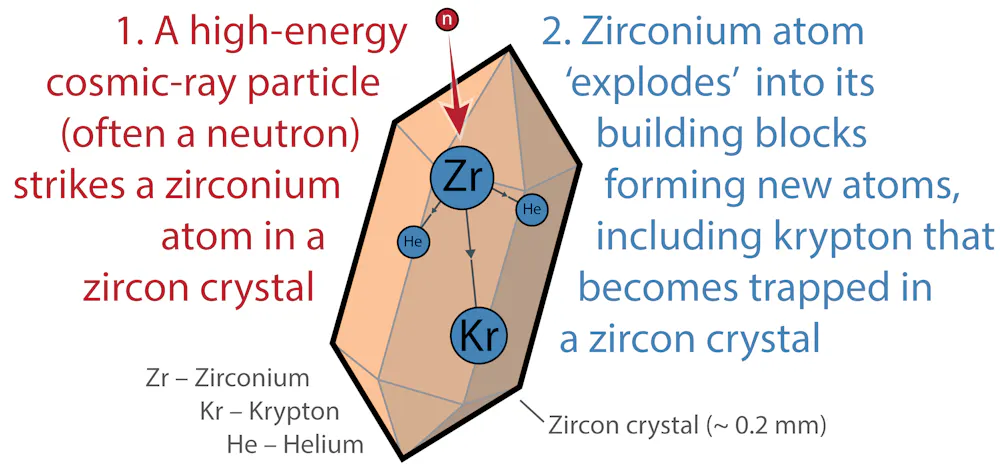
Earth is constantly bombarded by cosmic rays – high-energy particles from space produced when stars explode. Unlike larger meteorites that hit our planet, cosmic rays are smaller than atoms. But when they strike atoms within minerals near Earth’s surface, the microscopic “explosions” produce new elements, known as cosmogenic nuclides.

Measuring these nuclides is a popular way to work out how quickly landscapes change. But many nuclides are very short-lived, making them unsuitable for understanding ancient landscapes.

For our measurements, we used cosmogenic krypton stored inside naturally occurring zircon crystals. This technique has only recently become possible thanks to technological advances. It works because krypton does not decay but preserves information for tens or even hundreds of millions of years.

Simplified sketch showing how cosmogenic krypton is produced and trapped inside a zircon crystal.
Maximilian Dröllner

To unlock this “cosmic clock”, we used a laser to vaporise several thousand zircon crystals and measured the krypton released from them. The more krypton a grain contains, the longer it must have been exposed at the surface before getting buried by younger layers of sediment.

A remarkably stable land

The results show that around 40 million years ago, when Australia was warm, wet and covered by lush forests, landscapes in southern Australia were eroding extremely slowly – less than one metre per million years.

This is far slower than in mountain regions such as the Andes in South America or the Southern Alps in New Zealand. However, this rate of erosion is similar to some of the most stable regions on Earth today, such as the Atacama Desert or the dry valleys of Antarctica.

Comparison of our erosion rate estimates (a key measure of landscape change) with other Australian and global landscapes, highlighting the very slow rates of landscape evolution.
Maximilian Dröllner

We calculated that the zircon-rich beach sands took about 1.6 million years to move from their place of erosion to a final burial site on the coast. During this very slow sediment transport, many less durable minerals were gradually broken down or dissolved by weathering. What remained were the most resilient minerals, such as zircon, which became progressively concentrated.

Over time, this natural filtering process produced beach sand deposits very rich in economically valuable zircon and other stable minerals.

The results also capture a turning point in the region’s landscape evolution. After a period of relative stability, a shifting climate, Earth movements and sea levels triggered faster erosion. The sediments started to move faster as well.

A new crystal clock

This “cosmic clock” helps explain the mineral wealth along the edges of the Nullarbor Plain, including the world’s largest zircon mine: Jacinth-Ambrosia. This mine produces about a quarter of the global zircon supply.

A lot of zircon is used in ceramics manufacturing, so chances are high many of us have already had contact with these minerals that spent far longer at Earth’s surface than our own species has existed.

A large mine opening up red earth in outback Australia.
A sweeping view across the worlds largest zircon mine.
Milo Barham

By reading cosmic ray fingerprints in zircon, we now have a new geological clock for measuring ancient processes on our planet’s surface.

Investigating modern landscapes, where surface processes can be measured independently, will help refine and broaden its use – but the potential is enormous. Because krypton and zircon are stable, the technique can be applied to periods of Earth history hundreds of millions of years ago.

This opens the possibility of studying landscape responses to some of the biggest events in Earth history, such as the rise of land plants about 500–400 million years ago, which transformed the planet’s surface and atmosphere.

To do this, we could analyse zircon crystals preserved in river sediments from that time, likely allowing us to measure how strongly the arrival of land plants reshaped erosion, sediment transport and landscape stability.

Earth’s landscapes hold memories trapped in minerals formed by cosmic rays. By learning to read this “cosmic clock”, we’ve found a new way to understand the history behind iconic landscapes. Perhaps even more importantly, it provides a blueprint for the changes that may lie ahead.

The Conversation

Maximilian Dröllner has received funding from the Minerals Research Institute Of Western Australia.

Chris Kirkland has received research funding from the Minerals Research Institute of Western Australia and Iluka Resources to investigate heavy mineral sand resources.

Milo Barham has received research funding from the Minerals Research Institute of Western Australia and Iluka Resources to investigate heavy mineral sand resources.

ref. A ‘cosmic clock’ in tiny crystals has revealed the rise and fall of Australia’s ancient landscapes – https://theconversation.com/a-cosmic-clock-in-tiny-crystals-has-revealed-the-rise-and-fall-of-australias-ancient-landscapes-271751

Two-vehicle crash closes two southern motorway lanes

Source: Radio New Zealand

Motorists are advised to expect delays and avoid the area if possible. RNZ / Marika Khabazi

A person is seriously hurt after a two-vehicle crash near Papakura.

Police said the crash – involving a bus and car – had closed two of the southern motorway’s northbound lanes near the Papakura on-ramp.

They said one person had sustained serious injuries and the Serious Crash Unit would be attending.

Motorists are advised to expect delays and avoid the area if possible.

Sign up for Ngā Pitopito Kōrero, a daily newsletter curated by our editors and delivered straight to your inbox every weekday.

– Published by EveningReport.nz and AsiaPacificReport.nz, see: MIL OSI in partnership with Radio New Zealand

Employee confidence still in the negative

Source: Radio New Zealand

Westpac senior economist Michael Gordon said New Zealanders still see jobs as being in short supply. 123rf

Employee confidence has improved slightly, but remains deeply pessimistic.

The Westpac-McDermott Miller Employment Confidence Index rose by 3.9 points to 93.8 in the three months ended December, its highest reading since March 2024.

A level below 100 indicates more households are pessimistic about the outlook than optimistic.

Westpac senior economist Michael Gordon said New Zealanders still see jobs as being in short supply.

“However, there was a slight improvement in the December quarter, consistent with our view that the unemployment rate has peaked at its current level of 5.3 percent,” he said.

Gordon noted the index was improving, but from very low levels. He said there was greater confidence about job security and opportunities in the year ahead, but cautioned the labour market would be one of the last parts of the economy to recover.

“There’s a growing sense that the economy has reached a turning point, although the labour market is typically one of the more lagging aspects of the economic cycle.

“For that reason, we expect only a gradual improvement in the unemployment rate over the course of 2026.”

Current and expected earnings growth remained subdued because of excess capacity in the labour market.

Gordon noted workers would have less bargaining power as inflation returned to target and cost-of-living pressures eased.

Regional variations

Results were mixed across the country, with confidence rising in seven regions and falling in four.

Gordon said confidence had weakened in dairy-intensive regions such as Northland, Waikato, Canterbury and Southland, adding that Fonterra lowering its milk price forecast may have dampened sentiment.

“The recent falls in dairy prices may be weighing on earnings expectations across these regions.”

Nelson/Marlborough/West Coast, Otago and Auckland were the most confident regions.

Wellington was the country’s least confident region, falling 3.2 points to 80.5.

Sign up for Ngā Pitopito Kōrero, a daily newsletter curated by our editors and delivered straight to your inbox every weekday.

– Published by EveningReport.nz and AsiaPacificReport.nz, see: MIL OSI in partnership with Radio New Zealand

RBNZ governor signs letter of support for US Fed boss Jerome Powell

Source: Radio New Zealand

Jerome Powell, left, and Dr Anna Breman AFP / RNZ

RBNZ governor Anna Breman is one of the international central bankers who have signed a letter supporting US counterpart Jerome Powell, the Reserve Bank has confirmed.

Powell has been back to maintain the Federal Reserve’s independence after being served criminal charges by the Justice department.

President Donald Trump has been pushing for the central bank to drop cash rates.

The letter signed by 14 central bankers so far says Powell has served with integrity and the independence of the bank is a cornerstone of economic stability.

More to come..

– Published by EveningReport.nz and AsiaPacificReport.nz, see: MIL OSI in partnership with Radio New Zealand

Eleven people arrested after ute crashes in Palmerston North

Source: Radio New Zealand

Police officers had seen the vehicle, which was reported stolen, on Pioneer Highway just before 4am on Wednesday. RNZ / Nate McKinnon

Eleven people driving in a ute have been arrested after a crash in Palmerston North early this morning.

Police officers had seen the vehicle, which was reported stolen, on Pioneer Highway just before 4am on Wednesday.

They caught up and signalled the vehicle to stop, which it failed to do.

Before police could pursue, the ute crashed into a traffic light pole, injuring several occupants.

A police spokesperson said 10 youths and a 21-year-old woman, all occupants of the vehicle, were arrested at the scene.

Police are considering charges.

– Published by EveningReport.nz and AsiaPacificReport.nz, see: MIL OSI in partnership with Radio New Zealand

Person who died in Christchurch apartment fire was community housing tenant

Source: Radio New Zealand

The tenant was taken to hospital in a critical condition but later died. Marika Khabazi / RNZ

A person killed following a fire at a Christchurch apartment was a tenant of a community housing provider.

Fire and Emergency (FENZ) and Police were continuing to investigate Tuesday afternoon’s destructive blaze at Korimako Lane in Sydenham.

Four crews were called to the one-bedroom upstairs apartment shortly after 4pm following reports of a fire alarm sounding and the smell of smoke.

The tenant was taken to hospital in a critical condition but later died.

In a statement, Ōtautahi Community Housing Trust tenancy general manager Bob Hardie said it was saddened by the death of one of its tenants.

“Our sincere thoughts are with their family, whanau, friends and neighbours at this very difficult time. Members of our tenancy team were onsite [on Tuesday] and will return [on Wednesday] morning to further support our tenant community and to learn more about the damage to the property,” he said.

“We understand neighbouring homes were not affected by the fire. The cause of the fire is being investigated, and we will assist [FENZ] and police as we can as a landlord. We are unable to comment further while this work continues.”

A FENZ investigator was at the scene on Wednesday morning.

Sign up for Ngā Pitopito Kōrero, a daily newsletter curated by our editors and delivered straight to your inbox every weekday.

– Published by EveningReport.nz and AsiaPacificReport.nz, see: MIL OSI in partnership with Radio New Zealand

How realistic is Mattel’s new autistic Barbie?

Source: Radio New Zealand

Autistic people are so rarely depicted in media and entertainment, it’s no wonder most people don’t really understand much about the neurotype.

So we were pleased to see the launch of autistic Barbie.

Autism is a life-long neurodevelopmental difference, meaning autistic children grow into autistic adults. As autistic researchers, who advocate for the increased meaningful representation of our community, it was a good sign that multinational toy company Mattel worked with an autistic-led advocacy organisation based in the US, the Autistic Self Advocacy Network, in creating this new toy.

The autistic Barbie doll.

Mattel

– Published by EveningReport.nz and AsiaPacificReport.nz, see: MIL OSI in partnership with Radio New Zealand

House prices are up – but what’s going on in Wellington?

Source: Radio New Zealand

QV has released its latest house price index, showing for the country as a whole, prices were up 1.1 percent over the three months to December. 123RF

Auckland house prices are showing signs of picking up, but Wellington’s continue to fall and increased supply is keeping townhouses cheaper.

QV has released its latest house price index, showing for the country as a whole, prices were up 1.1 percent over the three months to December.

The national average value was now $910,118 – 0.9 percent higher than the same time last year, but still 13.1 percent below the peak of January 2022.

Christchurch prices were up 2.5 percent in the quarter, and Hamilton 2.1 percent. Auckland turned around a decline of 2.2 percent in the October quarter and a 1.1 percent fall in three months to November to lift 0.8 percent.

Wellington was the only main centre where values were still falling, down 0.5 percent.

Invercargill was up 3.3 percent, Rotorua 2.6 percent and Whangārei 2.5 percent.

“A clear majority of the areas we measure recorded quarterly growth, indicating that value movements are now occurring across a broader range of regions,” spokesperson Andrea Rush said.

“With the number of homes for sale nationwide at the highest level in a decade, buyers continue to have the upper hand, with more choice and the ability to negotiate. This is keeping value movements in check, even as activity improves in some areas.

“That dynamic is also contributing to improved affordability in relative terms, particularly for first-home buyers, who remain active across many parts of the country.”

She said apartments and townhouses were under price pressure in Auckland and Christchurch because of high levels of supply as well as higher building and servicing costs, and the fact standalone houses had dropped in price.

There were 35,969 new homes consented in the year ended November 2025, up 7 percent compared with the year before, Stats NZ said.

“In the year to November 2025 multi-unit homes drove the increase in new homes consented,” Stats NZ economic indicators spokesperson Michelle Feyen said. “That’s reflected in the number of townhouses, flats, and units being consented.”

There were 9.6 percent more townhouses, flats and units than a year earlier.

“In many cases, buyers are choosing houses on their own sections – offering more storage, privacy, living space and carparking – over townhouses or apartments that lack these amenities and are often not significantly cheaper to purchase,” Rush said.

“Agents also report that buyers are favouring developments that do offer these features, particularly those in popular locations, over those that lack parking, storage, privacy and outdoor space.”

She said there had been a “reset” in development land values in some areas such as Waitākere, Manukau and Papakura.

“Building costs remain elevated compared to pre-peak levels, alongside higher interest rates, some developers who paid a premium for land during the peak can no longer afford to develop or hold it, resulting in land being resold in some cases at significantly lower prices than originally paid.”

Wellington emptying out

Rush said Wellington prices were now 3.6 percent lower than a year ago, but the 0.5 percent drop was more of a stabilisation than a fall.

“You still are having the impact of job losses in the public sector, people leaving, students leaving, people going overseas. So what you’ve sort of got is an excessive housing supply not only in terms of rentals but also in terms of properties that are on the market and that demand for housing with fewer people looking for housing across the board is seeing pressure on values continue.”

Townhouses are bringing prices down. RNZ/Calvin Samuel

Some parts of the city were 30 percent below their previous peak values. She said that was positive for first-home buyers who wanted to enter the market.

“However interest rates remain much higher than during the previous peak, so servicing debt is still a barrier to potential buyers… But you know, there’s a positive to this. There was a period there where rents were very high in Wellington and house prices were, too. So there’s always a positive side to the reset that we’ve seen since the previous peak.”

Property investment coach Steve Goodey said Wellington felt flat.

“There are some green shoots – there are not as many listings for a summer period as we would normally expect.

“With rental demand, rents have gone down 7 percent to 10 percent meaning landlords are reducing their rents to get a better occupancy… suddenly places are starting to fill up. I had a boarding house with 11 bedrooms and a whole pile of people left before Christmas and I couldn’t get new tenants over Christmas – now it’s back to nine rooms out of 11.

“There’s decent rental demand in Wellington and good quality properties are being snapped up fairly quickly.”

Wellington real estate salesperson Mike Robbers said he was optimistic about the year ahead. The first big round of open homes would happen this weekend, he said. “Normally you find quite a few people milling around… in the last few years the last few weeks of January have generally been quite buoyant.”

Rush said she expected a stable 2025.

“An election year can create a degree of caution and that sometimes restrains activity.

“Buyers and sellers take a more wait-and-see approach. So that tends to happen towards the end of the year during the election year.

“However, as we head into the summer months activity was on the rise previous to Christmas, we do have the situation where across the country we have more properties listed for sale than has been seen in a decade.

“Buyers have plenty of choice, which keeps pressure on prices.”

Sign up for Money with Susan Edmunds, a weekly newsletter covering all the things that affect how we make, spend and invest money.

– Published by EveningReport.nz and AsiaPacificReport.nz, see: MIL OSI in partnership with Radio New Zealand

The World Trade Organization is on life support. Will Trump’s new rules finish it off?

US President Donald Trump raised a fist in defiance after an assassination attempt on his life in Pennsylvania, Saturday, July 13, 2024 (USEDST).

Source: The Conversation (Au and NZ) – By Jane Kelsey, Emeritus Professor of Law, University of Auckland, Waipapa Taumata Rau

Chip Somodevilla/Getty Images

The United States has now withdrawn from 66 international organisations, conventions and treaties, illegally invaded Venezuela, and promoted an “America First” agenda in its new National Security Strategy.

This all signals the collapse of a global system that has operated for the past 60 years. The old world order – driven by hyper-globalisation and US hegemonic power – is in its death throes, but a new era is yet to be born.

We now face a deepening ideological, strategic and military conflict over what shape it will take. The global “free trade” regime, overseen by the World Trade Organization (WTO), is one such battleground.

Largely designed to serve its strategic and corporate interests, the US now sees the WTO as a liability because of the economic ascendancy of China and a domestic populist backlash against globalisation and free trade.

But US antipathy to the current multilateral trade regime is not exclusive to the Trump administration. America has long resisted binding itself to the trade rules it demands other countries obey.

Congress reserved the power to review US membership when it authorised joining the WTO in 1994. Since then, both Republican and Democrat administrations have undermined its operation by:

  • calling for an end to the Doha Round of negotiations launched in 2001

  • breaking the WTO dispute mechanism by defying rulings that go against it, and refusing to appoint judges to the WTO Appellate Body so it is now moribund (effectively allowing rules to be breached)

  • and starving the WTO’s budget during the latest US review of international organisation memberships.

To date, Trump has not withdrawn the US from the WTO. But his administration seeks instead to reinvent it in a form it believes will restore US geostrategic and economic ascendancy.

Rewriting the rulebook

In December 2025, the newly-arrived US Ambassador to the WTO warned its General Council:

If the WTO does not reform by making tangible improvements in those areas that are central to its mission, it will continue its path toward irrelevancy.

“Reform” in this context means abandoning the cornerstone most-favoured-nation rule that requires all WTO members to be treated equally well, which is the bedrock of multilateralism.

The US wants to reinterpret the WTO’s “security exceptions” (which apply to arms trade, war and United Nations obligations to maintain peace and security) to allow countries absolute sovereignty to decide when the exception applies – effectively neutralising the rules at will.

The WTO would also cease to address issues of “oversupply” and “overcapacity”, “economic security” and “supply chain resilience”, which the US believes have enabled China’s growing economic dominance, leaving the way open for unilateral action outside the WTO.

In the stripped-down WTO, decision-making by consensus would be abandoned and multilateral negotiations replaced by deals that are driven by more powerful players on cherry-picked topics.

Unilateral action is not an idle threat. Trump has imposed arbitrary and erratic tariffs on more than 90 countries for a variety of “national and economic security” reasons, demanding concessions for reducing (not removing) them.

Those demands extend way beyond matters of trade, and impinge deeply on those countries’ own sovereignty. There is nothing the WTO can do.

Weaponising tariffs is also not a new strategy. President Joe Biden maintained the tariffs imposed on China during the first Trump presidency, triggering WTO disputes which remain unresolved.

But Trump’s embrace of raw coercive power strips away any chimera of commitment to multilateralism and the model that has prevailed since the 1980s, or to the development of Third World countries that have been rule-takers in that regime.

Where now for the WTO?

Some more powerful countries have bargained with Trump to reduce the new tariffs. China’s retaliation generated an uneasy one-year truce. Brazil held firm against Trump’s politically-motivated tariffs at considerable economic cost. Australia made a side-deal on critical minerals.

The European Union remains in a standoff over pharmaceutical patents and regulating big tech. India has diversified to survive relatively unscathed, ironically forging closer ties with China.

Less powerful countries are much more vulnerable. Among other obligations, the full texts of “reciprocal trade agreements” with Malaysia and Cambodia, signed in October, require them to:

  • replicate US foreign policy and sanctions on other countries

  • consult the US before negotiating a new free trade agreement with a country that “jeopardises US essential security interests”

  • promise to make potentially crippling investments in and purchases from the US

  • involve the US in regulating inward investment and development of Malaysia’s rare earth elements and critical minerals (Malaysia has large unmined repositories, an alternative to China)

  • and not tax US tech giants, regulate their monopolies or restrict data flows.

If implemented, these agreements risk creating economic, fiscal, social and political chaos in targeted countries, disrupting their deeply integrated supply chains, and requiring they make impossible choices between the US and China.

In return, the 2025 tariffs will be reduced, not reversed, and the US can terminate the deals pretty much at will.

This poses an existential question for WTO members, including New Zealand and Australia, at the 14th ministerial conference in Cameroon in late March: will members submit to US demands in an attempt to keep the WTO on life support?

Or can they use this interregnum to explore alternatives to the hyper-globalisation model whose era has passed?

The Conversation

Jane Kelsey is affiliated with a number of international NGOs that monitor and advise on developments in international trade law and the WTO.

ref. The World Trade Organization is on life support. Will Trump’s new rules finish it off? – https://theconversation.com/the-world-trade-organization-is-on-life-support-will-trumps-new-rules-finish-it-off-273216

New Zealand passport drops down global power rankings

Source: Radio New Zealand

The Henley Passport Index for 2026 ranks New Zealand 24th-equal in the world in terms of destinations passport holders can travel to without a prior visa. Customs / supplied

Global rankings show New Zealand’s passport is less powerful than last year.

The Henley Passport Index for 2026 ranks New Zealand 24th-equal in the world in terms of destinations passport holders can travel to without a prior visa.

People with New Zealand passports have easy access to 183 countries, compared to 190 last year. Countries in which travellers can get a visa on arrival are included in the calculation.

The ranking puts New Zealand in the sixth tier, on par with nations such as Croatia, Estonia and Poland and in front of the United Kingdom, Australia and Canada.

Last year New Zealand was in 17th-equal place, in the fifth tier with easy access to 190 countries.

Singapore remains the most powerful passport in the world, with access to 192 countries without a prior visa, followed in second-equal place by Japan and South Korea.

Henley said its rankings were based on “exclusive data from the International Air Transport Association (IATA) – the largest, most accurate travel information database” and enhanced by its own research team.

The top passports were:

  • 192 countries – Singapore
  • 188 – Japan, South Korea
  • 186 – Denmark, Luxembourg, Spain, Sweden, Switzerland
  • 185 – Austria, Belgium, Finland, France, Germany, Greece, Ireland, Italy ,Netherlands, Norway
  • 184 – Hungary, Portugal, Slovakia, Slovenia, United Arab Emirates
  • 183 – Croatia, Czechia, Estonia, Malta, New Zealand, Poland
  • 182 – Australia, Latvia, Liechtenstein, United Kingdom
  • 181 – Canada, 180 Iceland, Lithuania
  • 180 – Malaysia
  • 179 – United States

The weakest passports belonged to Pakistan, Yemen, Iraq, Syria and Afghanistan. Holders of an Afghan passport only have easy access to 24 countries.

Sign up for Ngā Pitopito Kōrero, a daily newsletter curated by our editors and delivered straight to your inbox every weekday.

– Published by EveningReport.nz and AsiaPacificReport.nz, see: MIL OSI in partnership with Radio New Zealand

Young driver going 80km/h over limit hits spikes, collides with oncoming truck

Source: Radio New Zealand

Police say the vehicle hit two sets of road spikes before eventually colliding with an oncoming truck. AFP / Andri Tambunan

A young driver has died in a fiery crash after seen dangerously driving in Hamurana, north of Rotorua.

The silver Lexus, carrying the driver and two young passengers, was reportedly seen cutting people off and driving 80kmh over the speed limit on Tuesday.

Police said the vehicle hit two sets of road spikes before eventually colliding with an oncoming truck.

Bay of Plenty Road Policing Manager, Inspector Phil Gillbanks, says officers and members of the public put themselves at risk to put flames out and save the two passengers.

He said people ran to the scene with extinguishers and about 18 were used to put the fire out.

“Their actions were courageous and saved lives of the trapped passengers.”

The passengers were taken to hospital in a serious condition, while the young driver was found dead at the scene.

Several officers were also treated for minor burns and smoke inhalation.

Gillbanks said police recognised the vehicle as it was of interest following an aggravated robbery in Tauranga on Monday.

A scene examination was completed on Tuesday night and the road was reopened at midnight.

A critical incident investigation is also under way and the IPCA has been notified.

Sign up for Ngā Pitopito Kōrero, a daily newsletter curated by our editors and delivered straight to your inbox every weekday.

– Published by EveningReport.nz and AsiaPacificReport.nz, see: MIL OSI in partnership with Radio New Zealand

Person dead, three critically wounded in Waitārere Beach shooting

Source: Radio New Zealand

Police at the scene at Waitārere Beach, a small settlement 13km south of Foxton. RNZ/Mark Papalii

Warning: This article discusses family harm.

Horowhenua’s mayor says a shooting overnight that left a man dead and three people critically hurt was a family harm incident.

Police were called to a Waitārere Beach address near Levin at about 12.40am on Wednesday.

They found four people with gunshot wounds when they arrived.

Hato Hone St John said it sent two helicopters, two ambulances, one operations manager and two rapid response vehicles to the scene.

Waitārere Beach Road. Google Maps

Manawatū Area Commander Inspector Ross Grantham said a woman and two teenage boys have been taken to hospital in a critical condition. The woman was taken to Palmerston North Hospital by ambulance and the two teenagers were flown to Wellington Hospital.

“Another young person who was at the address is physically unharmed and they are being given wrap-around support,” Grantham said.

He said the gun was found at the scene and a forensic examination of the property will take place on Wednesday.

Police were not looking for anyone else in relation to the shooting. RNZ/Mark Papalii

Access to State Highway 1 from Waitārere Beach Road was closed overnight; however, it has since reopened under traffic management.

Horowhenua Mayor Bernie Wanden told RNZ it was a family harm incident and described the shooting as tragic.

“As far as I am aware, it is only family members who have been involved in this incident,” he said.

Neighbour Elizabeth Taylor told RNZ she was woken up last night by helicopters and lights.

“We thought, ‘What the heck is going on?’” She said.

She said a handful of neighbours gathered in the street.

Police at the scene of the shooting. RNZ/Mark Papalii

Grantham said police were not looking for anyone else in relation to the shooting, and officers would be visible around the area while an investigation is underway.

“This is a shocking incident for Waitārere Beach and the district,” Grantham said.

“This was a confronting scene, and I want to acknowledge the emergency personnel who responded to the call for help.

“We are still in the very early stages of our enquiries, but we are focused on understanding how and why this tragic event occurred.”

Manawatū Area Commander Inspector Ross Grantham RNZ Mark Papalii

He said police will release more information when it becomes available.

The police presence had reduced on Wednesday morning, with two officers and a patrol car parked outside the address.

Another family killing

The latest incident comes just over ten years after a horrific crime shook the small township.

In 2016, 26-year-old Eric McIsaac was sentenced to life imprisonment after he admitted murdering his brother, 10-year-old Alex Fisher, at Waitārere Beach the previous year.

Alex’s body was found after a three-day search involving more than 100 people helped by helicopters, police dog units, search and rescue teams, and Air Force personnel.

McIsaac was sentenced to life in jail with 14 years without parole for the murder.

Where to get help:

  • Need to Talk? Free call or text 1737 any time to speak to a trained counsellor, for any reason
  • Lifeline: 0800 543 354 or text HELP to 4357
  • Suicide Crisis Helpline: 0508 828 865 / 0508 TAUTOKO. This is a service for people who may be thinking about suicide, or those who are concerned about family or friends
  • Depression Helpline: 0800 111 757 or text 4202
  • Samaritans: 0800 726 666
  • Youthline: 0800 376 633 or text 234 or email talk@youthline.co.nz
  • What’s Up: 0800 WHATSUP / 0800 9428 787. This is free counselling for 5 to 19-year-olds
  • Asian Family Services: 0800 862 342 or text 832. Languages spoken: Mandarin, Cantonese, Korean, Vietnamese, Thai, Japanese, Hindi, and English.
  • Rural Support Trust Helpline: 0800 787 254
  • Healthline: 0800 611 116
  • Rainbow Youth: (09) 376 4155
  • OUTLine: 0800 688 5463
  • Aoake te Rā bereaved by suicide service: or call 0800 000 053

If it is an emergency and you feel like you or someone else is at risk, call 111.

Family Violence

Sign up for Ngā Pitopito Kōrero, a daily newsletter curated by our editors and delivered straight to your inbox every weekday.

– Published by EveningReport.nz and AsiaPacificReport.nz, see: MIL OSI in partnership with Radio New Zealand

Heavy rain warning as more 110mm of rain forecast to hit South Island

Source: Radio New Zealand

Up to 110 millimetres of rain is expected to fall in the top of the South Island. MetService

Heavy rain is forecast to hit the top of the South Island as a low-pressure system moves in this evening.

MetService has an orange heavy rain warning in place for Marlborough Sounds, Richmond Range and the Rai Valley from 7pm on Wednesday until Thursday afternoon.

Up to 110 millimetres of rain is expected to fall and people in the area are encouraged to prepare by clearing their drains and gutters and avoiding low-lying areas.

Heavy rain watches have also been issued for parts of Nelson, Tasman, Buller, Wellington, the Kaikoura Coast and Marlborough south of the Richmond Range.

MetService said there was a moderate chance of them being upgraded to warnings.

Taranaki has a severe thunderstorm watch in place from 2am until 11pm on Thursday due to a moist unstable northwesterly flow.

Intense, localised rainfall of 25 to 40 millimetres an hour is predicted with the potential for surface or flash flooding.

Sign up for Ngā Pitopito Kōrero, a daily newsletter curated by our editors and delivered straight to your inbox every weekday.

– Published by EveningReport.nz and AsiaPacificReport.nz, see: MIL OSI in partnership with Radio New Zealand

Auckland scientists hope to develop melanoma treatments with million-dollar boost

Source: Radio New Zealand

Molecular basis for melanoma cell motility. (Julio C. Valencia Public Domain)

Scientists at the University of Auckland hope a $1 million grant will help them develop groundbreaking new therapies for deadly skin cancers.

New Zealand has the world’s highest melanoma death rate, with almost 300 people losing their lives to the cancer each year.

Associate Professor of Pharmacology Stephen Jamieson and his team are developing new treatments to kill deadly skin cancers caused by a specific type of gene mutation.

The Winn Trust has granted $1 million for research into melanoma led by Jamieson and Dr Dean Singleton from the university’s Auckland Cancer Society Research Centre and Centre for Cancer Research.

“It just enables us to put all our resources into trying to develop new therapies for melanoma,” Jamieson said.

He is using cutting-edge gene editing technologies to try to develop new treatments to tackle melanomas caused by a mutation of the NRAS gene. This mutation is found in about 15 to 20 percent of melanomas, but there is no specific treatment at present.

“Melanoma is a major issue in New Zealand – with Australia, we have the highest incidence and mortality rates in the world,” he said.

“Immunotherapy can be used to treat melanomas, but if that fails, there are no effective treatment options for NRAS-mutant melanomas and there’s a very poor prognosis – so there’s an urgent need for new treatments.”

Every year, more than 7,000 melanomas are diagnosed and approximately 300 people die from the skin cancer in New Zealand.

Under Jamieson’s supervision, former PhD student Andrea Gu investigated weaknesses in melanoma’s genetic makeup, before making a groundbreaking discovery – that the SHOC2 gene is essential for the growth of melanoma cells with the NRAS mutation.

This research, funded by Cancer Society New Zealand and Cancer Research Trust New Zealand, was published in the journal, Cancer Communications, last year.

Gu won a John Gavin Postdoctoral Fellowship from Cancer Research Trust New Zealand and Melanoma New Zealand to research at the Wellcome Sanger Institute at Cambridge University in the UK. She plans to return to the University of Auckland to share her knowledge.

With $200,000 from Cancer Society New Zealand, Jamieson’s research team plans to investigate billions of compounds to see if they can block the SHOC2 protein and kill melanoma cells with NRAS mutations.

Promising compounds will be tested, with the goal of developing a new drug or combination of drugs to treat this type of melanoma.

Jamieson hopes a new treatment will be ready to test in patients in just over five years.

Singleton’s research is focused on finding out why immunology treatments are not helping about 60 percent of patients with metastatic melanomas – those which have spread from the skin to other parts of the body, such as the lungs, brain or liver.

Melanoma cells were complex and could take many forms, some of which were not recognised by new treatments that used the body’s immune cells to fight cancer, Singleton said, who is a senior lecturer in molecular medicine and pathology.

Singleton hopes discovering how some melanoma cells dodge existing treatments and finding their vulnerabilities might pave the way to developing new treatments with higher success rates.

“Immunology treatments aim to kill melanoma cells, but sometimes they make the cells change. Then cancer cells can hide from the treatment and are less able to be recognised and killed,” he said.

“We’re investigating what’s going on in those different melanoma cell differentiation states and how best to target them.”

Cancer Society Auckland Northland has funded research supervised by Singleton and led by PhD student Claire Palma that is investigating the PHD2 gene and oxygen sensing pathways in melanoma cells. This gene seems like a weak point that drugs could potentially alter to wipe out some melanomas.

“It’s exciting to be involved in this project, which is trying to make new medicines that will block PHD2 and will hopefully work better at killing melanoma cells,” Singleton said.

Both Jamieson and Singleton said a valuable resource powering their search for cures for melanoma is the New Zealand Melanoma living biobank. It holds more than 100 cell lines grown in the lab from samples donated by New Zealand melanoma patients.

Sign up for Ngā Pitopito Kōrero, a daily newsletter curated by our editors and delivered straight to your inbox every weekday.

– Published by EveningReport.nz and AsiaPacificReport.nz, see: MIL OSI in partnership with Radio New Zealand

‘Our food culture wasn’t destroyed, it was buried’

Source: Radio New Zealand

A collective of chefs is working to revive classical Māori cooking knowledge and reconnect Māori to traditional sources of kai.

That includes teaching people to forage for edible native plants including the spicy horopito, fragrant tarata or lemonwood, and kawakawa with its range of culinary and medicinal uses, as well as using traditional cooking techniques such as tīpoti, a type of basket for cooked food.

For chef Joe Mcleod reconnecting people to their classical kai Māori culture and the native flora and fauna that underpins it, happens “one chef at a time”.

– Published by EveningReport.nz and AsiaPacificReport.nz, see: MIL OSI in partnership with Radio New Zealand

From bolts to blue jets, lightning comes in many strange forms

Source: The Conversation (Au and NZ) – By Andrew Dowdy, Principal Research Scientist in Extreme Weather, The University of Melbourne

Lightning has captured people’s fascination for millennia. It’s embedded in mythology, religion and popular culture. Think of Thor in Norse mythology or Indra in Hinduism.

In Australia, lightning is also associated with important creation ancestors such as shown in First Nations rock art.

There are many different types of lightning – and many ways in which it influences our society and environment.

What exactly is lightning?

Lightning occurs due to a buildup of electric charge in clouds. This is similar to when you brush your hair or jump on a trampoline making your hair stand up on end, but to a much more extreme level.

This buildup in clouds happens due to different types of frozen and liquid water bumping into each other in the updrafts and downdrafts that occur due to convection – that is, from hotter air rising and colder air falling. The buildup of electric charge can become so extreme that electricity flows through the air. This is what we see as lightning.

We see the flash of the lightning almost as soon as it happens, but the sound of thunder comes later.

Sound takes about three seconds to travel one kilometre. Counting the time between the flash and the thunder can tell you the distance to the lightning. Just count the number of seconds and divide by three to find the distance in kilometres.

Earth also isn’t the only place where lightning is found. Scientists have also recently detected it on Mars for the first time.

A lightning bolt striking the ground.
Cloud-to-ground lightning is a real risk for human safety, with many deaths globally each year.
Philippe Donn/Pexels

The main types of lightning

There are two main types of lightning found on Earth:

  • Intra-cloud (or cloud-to-cloud) lightning goes from one part of a cloud to another part of a cloud, without ever reaching the ground. It might look like a cloud momentarily glows, often with the whole cloud appearing illuminated, sometimes without seeing the actual thin path that the lightning takes. It occurs when the build-up of electric charge is very different between different parts of a cloud, and is common because the lightning typically doesn’t have to travel far.

  • Cloud-to-ground lightning can occur when the build-up of electric charge becomes very different between a part of the cloud and the ground. This is perhaps the most famous type of lightning. While impressive to witness, cloud-to-ground lightning is a real risk for human safety, causing many recorded deaths each year.

The rare types of lightning

There are also some other rarer, even more spectacular types of lightning:

  • Pyrogenic lightning occurs alongside extreme bushfires in some cases. These fires can sometimes generate lightning in their smoke plumes, known as pyrocumulonimbus clouds. This lightning can then ignite new fires far away as occurred on Black Saturday near Melbourne in 2009. Similarly, lightning can also sometimes occur in other hot plumes such as from volcanic eruptions or nuclear bombs.

  • Upper atmospheric light phenomena related to lightning, also known as “transient luminous events” include sprites, blue jets, ELVEs and PIXIES. Science is still trying to understand details on why these have different characteristic shapes and colours. For example, sprites look like glowing red jellyfish, while blue jets are giant sapphire beams that shoot upwards into the sky. ELVEs look like glowing red halos while PIXIES are flashes of electric blue light atop a thunderstorm.

  • Ball lightning is claimed to have been seen by many people over the years, but similar to claims of other strange things being seen such as the Loch Ness Monster or aliens, it is yet to be scientifically verified. For example, there might be various other explanations for floating balls of light that people see, such as proposed for the Min Min lights in outback New South Wales potentially due to distant car headlights.

Lightning in a warming world

The thunderstorms that cause lightning are often seen as tall billowing clouds known as cumulonimbus. They look like giant cauliflowers floating in the sky, with an anvil shape at their top in mature thunderstorms.

Our recent study on thunderstorms and other weather systems suggests trends since the 1970s towards fewer thunderstorms in northern Australia and more near the southeast. There are still considerable uncertainties around how climate change influences thunderstorms and lightning.

In general, we know warmer air can hold more water vapour, which might help fuel more intense convective storms and lightning.

If more lightning occurs in a warmer world, the increase could in turn create more warming. That’s because lightning splits nitrogen and oxygen molecules in the atmosphere to produce ozone which has a warming effect on the atmosphere. Ozone also contributes to air pollution as it is a respiratory irritant.

However, lightning is far from the main cause of global warming, and more research is needed on these potential feedback processes to understand how important lightning could be in a warming climate.

So next time you are watching the spectacular light show during a storm, you might like to consider the various forms that lightning can take. It is one of the marvels of the world we live in, as well as of other worlds, to be enjoyed – from a safe distance.

The Conversation

Andrew Dowdy receives funding from University of Melbourne, as well as supported by the Australian Research Council including as a member of the Centre of Excellence for 21st Century Weather.

Jennifer Catto receives funding from The Natural Environment Research Council and the US Department of Energy. She is a fellow of the Royal Meteorological Society, and a past member of AMOS.

Robyn Schofield receives funding from the University of Melbourne, the Australian Research Council, Medical Research Future Fund, the Reef Restoration and Adaptation Program and the Murujuga Rock Art Monitoring program. She is a member of expert advisory group of The Safer Air Project, a member of CASANZ, member of AMOS and is past president of the Australian Council of Environmental Deans and Directors.

ref. From bolts to blue jets, lightning comes in many strange forms – https://theconversation.com/from-bolts-to-blue-jets-lightning-comes-in-many-strange-forms-268197

What’s the difference between a sprained ankle and a twisted ankle?

Source: The Conversation (Au and NZ) – By Hunter Bennett, Lecturer in Exercise Science, Adelaide University

Kindel Media/Pexels

After the summer break, you’re ready to get back into exercise. You put on your shoes, pop on your headphones and head out the door on your first run of the new year.

But as you step out onto the footpath, disaster strikes. You trip and land awkwardly.

A sharp pain shoots along the outside of your ankle. Before you know it, your ankle has swollen like a balloon. Did you sprain it or twist it? Is there’s even a difference?

People often use the terms “sprained” and “twisted” ankle interchangeably. But in practice, there is a small difference.

The ankle is complex and vulnerable

The ankle is a complex joint. It’s made up of three bones, the:

  • tibia (the shin bone)
  • fibula (the thinner bone on the outside, next to it)
  • and talus (the bone underneath these two that connects the shin to the foot).

Several strong bands of tissue, known as ligaments, hold these three bones together to keep the joint stable. Several muscles and tendons that surround the ankle also help you maintain balance and allow you to move your ankle.

While the ankle needs to be stable enough to support your weight, it also needs to be mobile enough to allow you to walk, run and jump. This means it can move in a lot of different, and sometimes unexpected, ways.

This also makes it more vulnerable to injury. For example, when you land with your foot turned inwards, a lot of force is placed through a small area on the outside of your ankle, which can lead to injury.

In fact, the ankle is the most commonly injured joint in the lower body.

What is a sprained ankle?

A sprained ankle occurs when the ligaments around the ankle stretch or tear. This most commonly happens when the foot rolls inwards (known as an inversion or a lateral ankle sprain) and ligaments on the outside of the ankle are damaged. However, a sprained ankle can also happen in other ways.

Ankle sprains are typically graded based on their severity:

Grade 1: the ligaments are stretched but not torn or have had a very small tear. There will be minor swelling, and the ankle will be tender to touch.

Grade 2: the ligament is torn, but not all the way through. There will be moderate pain, moderate swelling, and it will hurt to move.

Grade 3: the ligament is completely torn all the way through. There will be significant swelling, bruising and it will be very painful to move.

So an ankle sprain refers to damage to the ankle ligaments.

This is what a clinician will diagnose after assessing your swelling, tenderness and pain. Depending on what they find, they may send you off for an X-ray to make sure you haven’t fractured any ankle bones.

What is a twisted ankle?

A twisted ankle is not a specific diagnosis, but a broad term. It normally relates to the ankle rolling or twisting awkwardly.

In short, you can think of a twisted ankle as how the injury occurred, and a sprained ankle as what the injury is.

You can twist your ankle without spraining it. For example, you might land awkwardly, feel a tweak of pain, but then walk away with no structural damage.

But twisting the ankle has also been linked to more severe injuries, such as ankle breaks and fractures.

How should we treat them?

When it comes to treatment, we should really consider how the ankle feels rather than how it happened.

The first thing is to make sure you haven’t fractured any of the bones in your ankle.

Clinicians use the Ottawa ankle rules to decide whether you need to get an X-ray. This is based on assessing your swelling, tenderness and pain.

If you don’t need an X-ray, the priority is to manage the pain and swelling.

The first step is to temporarily limit the amount of weight you put through your ankle. You can lie on the sofa with a cushion under your ankle or you can use crutches. You might also want to wear some form of compression bandage, which can reduce swelling and reduce pain.

After about 48–72 hours, your ankle will generally start to feel a bit better. This is when you can start doing some basic exercises to restore your ankle’s range of motion, strengthen the muscles around the ankle, and improve balance.

These exercises are important. If you’ve had one ankle sprain, this is the biggest risk factor for having another. These exercises can restore muscle strength and stability back to your ankle, which may help prevent future sprains.

There is some debate about whether the common recommendation to apply ice to the ankle improves recovery. Evidence seems to suggest that simply limiting swelling and starting exercise early will be more effective.

So, is a sprained or twisted ankle the same?

Well, kind of – but not exactly.

Most people who say they twisted their ankle probably had a mild sprain. But not all twisted ankles are sprained ankles.

If you think you have sprained your ankle, it might be worth getting it checked out by a medical professional just in case.

The Conversation

The authors do not work for, consult, own shares in or receive funding from any company or organisation that would benefit from this article, and have disclosed no relevant affiliations beyond their academic appointment.

ref. What’s the difference between a sprained ankle and a twisted ankle? – https://theconversation.com/whats-the-difference-between-a-sprained-ankle-and-a-twisted-ankle-270055

As we begin to assess the fire damage in Victoria, we must not overlook these hidden costs

Source: The Conversation (Au and NZ) – By Sonia Akter, Associate Professor, Crawford School of Public Policy, Australian National University

Devastated by widespread fires, Victoria has declared a state of disaster. More than 500 structures have reportedly been destroyed and 1,000 agricultural properties have been affected. Tragically, there has also been one fatality.

On Monday, the Victorian government announced new assistance payments of up to A$52,250 to help uninsured home owners and renters “re-establish their principal place of residence”.

This builds on a joint state and federal $19.5 million package offering food, emergency housing, mental health support, a recovery hotline, agricultural support and case-specific assistance.

People in impacted areas may also be eligible for the federal Disaster Recovery Payment ($1,000 per adult and $400 per child) and the Victorian government’s Personal Hardship Assistance Program ($680 per adult and $340 per child, up to a family cap of $2,380). They may also be eligible for Disaster Recovery Allowance income support.

All of these supports and payments are important and are being rolled out rapidly. But much more can be done, especially when decision-makers recognise that treating everyone affected by bushfires the same does not actually produce fair outcomes – as our research has shown.

The divide disasters reveal

Many Australians think disaster-hit regions are all, more or less, the same if they suffer the same size of area burned or other immediate measures of fire loss.

But when viewed through a more comprehensive lens, such as key Australian Bureau of Statistics measure of disadvantage data, and for suburbs affected by the most recent fires, a different story emerges.

Harcourt and Longwood sit in the lower half of the the state’s rankings for socio-economic disadvantage. That is, on average, there are proportionally more households in these locations that have lower incomes and fewer financial buffers to cope with a shock like a bushfire.

Yet, in some cases right next door, the localities of Harcourt North, Ruffy and Ravenswood South are ranked among the top most advantaged areas in Victoria.

This isn’t to argue we shouldn’t support all impacted communities. But a uniform $1,000 disaster payment, for example, treats a renter in Harcourt the same as a property owner in Harcourt North.

Most property owners have insurance, some savings and an ability to borrow to tide them over. In contrast, a low-income renter with little or no savings risks falling into a poverty trap. For some, a week of lost wages spirals into rent arrears and long-term debt.

Australia needs to do more about underinsurance

The Victorian government’s newly announced payments of up to $52,250 will go some way to helping uninsured homeowners and renters get back on their feet. But the announcement also highlights a problem it doesn’t solve: underinsurance.

Many households did have insurance, yet their cover may fall far short of today’s rebuild costs. That shortfall will push families to run down savings, take on debt, or stay stuck in expensive rentals, despite having done the “right thing” by being insured.

Underinsurance, especially for disadvantaged households, turns short-term shocks into long-term setbacks. When policy limits don’t match real rebuild costs after years of rising construction prices, families stay in rentals longer and drain savings.

In California, repeated wildfires have pushed some major insurers to stop writing new home policies. Premiums soared, and the state’s last-resort insurance program, the FAIR Plan, ballooned.

After the Los Angeles fires of January 2025, reports documented illegal rent gouging and sharp rent spikes in nearby cities as thousands of people searched for temporary housing.

How we measure hidden costs

In Australia, we typically measure disaster impacts by insured losses and property damage. That’s because those numbers are visible, immediate and easy to collect. But they’re only part of the picture. They show where assets were lost, not where people’s wellbeing took the hardest hit.

Two studies into the 2019-20 Black Summer fires explain why focusing only on assets misses the full story.

First, fires really do discriminate. This is because socio-economic disadvantages raise exposure before the fire and widen gaps after it. More disadvantaged communities are, we found, closer to major burns.

That starting point means having fewer savings and weaker safety nets when bills arrive for clean-up and rebuilding.

Second, further losses after the fires matter. Some are non-economic and they may take time to manifest.

One year after the Black Summer fires, for example, rents in disadvantaged areas had risen by about $20–$26 per week, crowded living conditions increased, and incomes fell. Disadvantaged areas saw more households reporting zero or negative income in the years that followed, widening existing income and wealth gaps.

And fires are not gender neutral. Unpaid domestic work skyrocketed for women everywhere, but for men it rose significantly in disadvantaged, high-burn communities.


Read more:
New research shows Black Summer’s megafires left lasting scars far beyond property damage


What we need to get right

To prevent this natural disaster from becoming an ongoing socio-economic failure, governments need to adjust how they respond to accommodate geographic disadvantages that make it much harder to recover in some locations than others.

Evidence suggests cash support should be determined based on disadvantage and how badly areas were burned, so that economic inequality does not worsen.

Beyond cash, governments must broaden the metrics of measuring bushfire impacts. Official recovery dashboards need to track rent changes, overcrowding and the unpaid work burden for men and women.

As a country, we also need to confront a growing insurance gap by creating rebuild-gap top-ups that account for increasing construction costs and fund “build back safer” standards.

We can and must do better by explicitly considering the hidden and longer-term costs of bushfires and other disasters. If we did, Victoria could rebuild fairer and faster without leaving the most disadvantaged further behind.


If you’ve been impacted by the January 2026 Victorian bushfires, you can find out what support you may be eligible for, either online or by calling the Emergency Recovery Hotline on 1800 560 760 from 9am to 5pm. Press 9 for an interpreter or call for translation help on 131 450.

The Conversation

Sonia Akter receives funding from the Australian Centre for International Agricultural Research (ACIAR).

Manh-Tien Bui and Quentin Grafton do not work for, consult, own shares in or receive funding from any company or organisation that would benefit from this article, and have disclosed no relevant affiliations beyond their academic appointment.

ref. As we begin to assess the fire damage in Victoria, we must not overlook these hidden costs – https://theconversation.com/as-we-begin-to-assess-the-fire-damage-in-victoria-we-must-not-overlook-these-hidden-costs-273218

Why the Heated Rivalry TV series understands gay men better than the book

Source: The Conversation (Au and NZ) – By Harry Stewart, PhD Candidate in Queer Male Romance, Flinders University

HBO

Heated Rivalry, written and directed by Jacob Tierney, has become a massive hit, going viral among gay romance fans and gathering millions of likes on the show’s official TikTok page.

Tierney’s adaptation of Rachel Reid’s 2019 novel turns Reid’s words into a beautiful exploration of queer male love and sex.

Reid’s romance novel was written for a mainly female readership, and it doesn’t quite capture all of the nuances of a gay male relationship. Under a gay male director, the TV series brings a whole new understanding to the intricacies of gay love.

Not just a pretty face

Heated Rivalry follows the romantic relationship between two rising professional hockey players: the Canadian captain of the Montreal Metros, Shane Hollander (Hudson Williams), and the Russian captain of the Boston Raiders, Ilya Rozanov (Connor Storrie).

Reids’ original novel boxes the characters into their corners. Shane is the “pretty” boy who is “like a doll”, naturally “smooth” and “like a swimmer”. Ilya is “masculine” and “big” and has a “muscular chest”, “muscular arms” and “thick, muscular thighs”.

Based on these physical descriptions it comes as no surprise that Shane is the “bottom” in this pairing, depicted as softer in appearance and more emotional. Ilya is the “top” – a more masculine, imposing figure.

Tierney doesn’t change these roles, but instead doesn’t draw attention to how Ilya’s traits are more “manly” and Shane’s more “feminine”. Rather, Tierney focuses on how Shane and Ilya’s personal lives make them who they are – in and out of the bedroom.

Production image: Ilya in the change room.
As Ilya, Connor Storrie gives us a bisexual man who is muscular and masculine – but he is also vulnerable.
HBO

Ilya’s dominance and masculinity in the books isn’t a focal point in the show. Instead, we see more of him as a vulnerable bisexual man who fights against his emotions and his family, but just wants to be held in the arms of a person that he loves.

Shane isn’t just a pretty face for the audience either, with his Asian-Canadian heritage expanded upon. We get the pressures of his identity as a representative figure in the media, and softer moments that he shares with his mother after coming out.

Tierney’s perspective makes the pair fully realised people who are each battling their own demons. He emphasises that queer men’s lives aren’t just full of spicy, sexy moments. Often, our sexuality can be a point of difference in how we are perceived in our careers, family lives, relationships and on the wider world stage.

Production image: the couple have a drink.
Tierney’s perspective makes the pair fully realised people.
HBO

Consent is sexy

One of the biggest changes is how Tierney handles consent. Shane and Ilya have a lot of sex both in the book and in the show. In a famous scene from the book, Shane receives a call from his teammate. Ilya takes it as a chance to perform oral sex on Shane. Reid writes Shane “was soft, so maybe he really didn’t want Ilya to be doing this”, and Shane describes it as “fucking creepy”.

The show adjusts this dubious consent and silent protest. Instead – after slight push back – Shane physically moves into a position that enables Ilya better access to his groin and gives facial clues that imply consent is clear.

Tierney has said adding explicit consent to this scene “makes it hotter”. The line between what is acceptable is far clearer in Tierney’s show than Reid’s book because of these changes.

Production image: the couple in a shower.
By foregrounding consent, Heated Rivalry makes the sex scenes ‘even hotter’.
HBO

Consent is prevalent and very much an expectation in the gay community. Tierney’s lens adds these conversations about consent to the show, and makes it clear that Shane and Ilya are so in-tune with each other that there are boundaries, and that’s still sexy.

Tierney lets Ilya and Shane feel less like tough athletes, and more like two people learning to be vulnerable with each other. Ilya’s character is softened, and portrayed as a kinder masculinity.

In the book, when they both say “I love you”, Ilya is stoic and “scared”. In the show he cries, happily.

In the sex scenes, Tierney peels back layers of tough, male energy and instead focuses on showing a tenderness and emotional depth more aligned with real life gay male relationships. Tierney understands the need for emotion in this scene, and his addition shows an awareness of his gay male viewership’s need for vulnerable, fulfilling queer men on screen.

Finding an audience

In adapting the sex to the screen, Tierney spoke about how he wanted to “script the fuck out of these sex scenes” because he knew fans of the book “love this stuff”. He also wanted to emphasise “horny good sex for gay people on TV”, sex that “is not going to end in misery or AIDS or punishment”.

Tierney’s adaptation honours both the women who will come to the show from the novel, and the show’s new male audience. He understood the show had to be spicy and honour the books, but also be authentically gay.

In this, Tierney follows in the footsteps of other amazing queer male directors and writers, such as Greg Berlanti’s Love, Simon (2018) and Peter Paige’s The Thing About Harry (2020).

Tierney’s Shane and Ilya cry, have good sex, share their hurts and worries, and work through their vulnerabilities together. All while still being active, attractive and complicated queer men.

The Conversation

Harry Stewart does not work for, consult, own shares in or receive funding from any company or organisation that would benefit from this article, and has disclosed no relevant affiliations beyond their academic appointment.

ref. Why the Heated Rivalry TV series understands gay men better than the book – https://theconversation.com/why-the-heated-rivalry-tv-series-understands-gay-men-better-than-the-book-273001

Coroner calls for urgent support for prisoners as parolee dies after 30 years in jail

Source: Radio New Zealand

123RF

Warning: This article discusses suicide.

A coroner is calling for urgent psychological support for prisoners before and after their release, following the death of a man who served almost 30 years of a life sentence for murder.

Lee Rawiri Kohiti was sentenced in 1996 for the murder of his cousin. He was released on parole in May 2025.

Two months later, Kohiti was found dead at the Hamilton parole address he had been living at.

He was 19 when he entered prison.

According to the coroner, on his release at 49 years old, he wasn’t visited by friends or family and he expressed a desire to return to the prison environment.

“His closest support had been his mother; however, her health had deteriorated, and she had recently passed away,” Coroner Bruce Hesketh said.

Kohiti’s death has been ruled a suicide.

It’s a story that’s all to familiar to University of Auckland professor Tracey McIntosh.

“We’ve a parole board that largely looks at risk, with particular focus, as we can understand, on risk to community, but perhaps far less is done in actually determining the risk for individuals, particularly around their wellbeing,” she said.

McIntosh wanted more support on the inside to prepare prisoners for re-integrating into society.

“We’re letting people down … it’s very difficult for me to understand why these people wouldn’t be the highest priority, given that they’ve been in prison for such a long time because of the reasons of what they were convicted with.

“We do need to look at community, Corrections, probation, is there emphasis, particularly in that first six months, on the right things,” she said.

It was a significant and urgent issue, McIntosh said.

“When we think about how we do reintegration, I don’t know if there’s any country that really does integration extremely well, but we certainly, we’ve got so much more work to be done at the reintegration level,” she said.

“If you’re really going to talk about community safety, then it has to be a much broader view, and there has to be a much more nuanced understanding of safety.”

Work with other agencies needed

Coroner Hesketh’s ruling on Kohiti’s death recommended the Department of Corrections work with other agencies to address systemic issues in providing services to prisoners on release.

He also suggested Corrections collaborate with relevant partners to collate and review data on suspected suicide deaths after release, within a relevant time period.

“I add a further recommendation that long-term prisoners should have their cases marked as ‘urgent’ to receive psychological services support in preparation for their release in the critical weeks and months both before and after their release,” he said.

Corrections chief mental health and addictions officer Dr Emma Gardner said there were teams that regularly assess inmates’ risk of suicide.

“If a person becomes unwell after they have left prison, they will be having, if they are on probation, regular connections with their probation officer. That probation officer would be doing wellbeing checks on an individual and if they became concerned about their mental health then they would be able to refer them to services in the community…,” she said.

Gardner said a lot of work had been done for those in prison, such as expanding the mental health services across the prison network.

“We are now starting to turn our attention to ‘what does support in the community look like, how do we ensure that the relevant agencies that are already available out in the community are connecting with our people’, but it’s early days on that work and we’ve got a lot more to do,” she said.

Gardner said the Corrections executive have commissioned a piece of work looking at community support.

She said there was always room for improvement, but that Corrections had done a lot of work over the last four to improve internal services for inmates.

Gardner believed the systemic issues mentioned by the coroner were being addressed.

“We really do take every death in custody very, very seriously, and obviously every death for people on community sentences is an absolute tragedy, and we are really, really focused on doing everything we can to improve the support we offer those people and their whānau.”

Where to get help:

  • Need to Talk? Free call or text 1737 any time to speak to a trained counsellor, for any reason
  • Lifeline: 0800 543 354 or text HELP to 4357
  • Suicide Crisis Helpline: 0508 828 865 / 0508 TAUTOKO. This is a service for people who may be thinking about suicide, or those who are concerned about family or friends
  • Depression Helpline: 0800 111 757 or text 4202
  • Samaritans: 0800 726 666
  • Youthline: 0800 376 633 or text 234 or email talk@youthline.co.nz
  • What’s Up: 0800 WHATSUP / 0800 9428 787. This is free counselling for 5 to 19-year-olds
  • Asian Family Services: 0800 862 342 or text 832. Languages spoken: Mandarin, Cantonese, Korean, Vietnamese, Thai, Japanese, Hindi, and English.
  • Rural Support Trust Helpline: 0800 787 254
  • Healthline: 0800 611 116
  • Rainbow Youth: (09) 376 4155
  • OUTLine: 0800 688 5463
  • Aoake te Rā bereaved by suicide service: or call 0800 000 053

If it is an emergency and you feel like you or someone else is at risk, call 111.

Sign up for Ngā Pitopito Kōrero, a daily newsletter curated by our editors and delivered straight to your inbox every weekday.

– Published by EveningReport.nz and AsiaPacificReport.nz, see: MIL OSI in partnership with Radio New Zealand

‘Dilbert’ comic creator Scott Adams dies

Source: Radio New Zealand

Scott Adams, the creator of the popular comic strip Dilbert, has died, according to an announcement on his social media pages.

Adams, who was 68, announced in May that he’d been diagnosed with an aggressive form of prostate cancer.

Dilbert, a chronicle of the indignities of American office work, was one of the country’s most widely read comic strips from its breakout success in the 1990s until February 2023, when Adams made racist comments against Black Americans, calling them a “hate group” that white people should “get the hell away from,” in response to a dubious poll about whether it’s “OK to be white.” Hundreds of newspapers stopped carrying Dilbert within days, and the strip was soon dropped by its distributor.

Dilbert, a fictional character created by Scott Adams.

Scott Adams, Fair use

– Published by EveningReport.nz and AsiaPacificReport.nz, see: MIL OSI in partnership with Radio New Zealand

Tougher fines for power companies that play unfair a ‘credible deterrent’ – minister

Source: Radio New Zealand

Simon Watts. RNZ/Mark Papalii

Tougher fines are on the way for electricity providers and retailers that breach the rules, in a move to give the Electricity Authority more teeth to maintain a fair and competitive market.

Energy Minister Simon Watts said this year the authority will be able to hand out instant infringement fines of up to $2000 for minor breaches.

And from next year, heavier duty penalties will increase from $2 million to the highest of three options – a $10m fine, 10 percent of a company’s turnover or three times the gain made from the breach.

“This is about being a credible deterrent to not meeting the rules and not playing fairly in the market,” Watts said.

“It’s making sure that the penalties and infringements are significant enough to ensure that they are a credible threat.”

Watts said a stronger Electricity Authority will improve competition and should mean more affordable power.

There have been calls to split the generation and retail arms of the large power companies, with the aim of increasing competition and lowering prices.

Last year the Auckland Business Chamber released a survey showing 49 percent of people wanted power gentailers broken up, and 62 percent wanted the government to underwrite the cost of new electricity generation.

Watts said the new penalties will match what the Commerce Commission can do and allow better monitoring of the electricity market.

“Kiwis are feeling the pressure of high power bills. The government is moving quickly to fix this by strengthening the Electricity Authority, which oversees the electricity market and makes sure power companies play by the rules.”

The changes will require amendments to the Electricity Industry Act.

Watts said good progress had been made on National’s energy plan, announced in October:

  • commenced the first stage of the procurement process for an LNG facility to provide New Zealand with greater security of supply
  • assessed new energy projects under the Fast-Track Approvals process which will increase supply and unlock investment in new generation
  • started work on a new regulatory framework to prevent dry-year shortages that drive up prices.

“These steps are about making sure New Zealand has the affordable, abundant, reliable energy our economy needs,” Watts said.

“It’s critical to have strong leadership at the Electricity Authority to ensure it can support the market to deliver abundant and affordable energy.”

The government has also agreed to the appointment of new members to the Electricity Authority Board.

Sign up for Ngā Pitopito Kōrero, a daily newsletter curated by our editors and delivered straight to your inbox every weekday.

– Published by EveningReport.nz and AsiaPacificReport.nz, see: MIL OSI in partnership with Radio New Zealand

Locals want popular Kerikeri swimming spot reopened

Source: Radio New Zealand

Tommy Lodge backflips from the top of the falls at Charlie’s Rock, on Kerikeri’s Waipapa River. RNZ / Peter de Graaf

Record temperatures in Kerikeri have highlighted a long-standing bugbear in the Northland town – declining access to once-popular swimming spots.

According to MetService, last Saturday’s maximum of 32.3C set a new January record for the town.

That was broken just 24 hours later by Sunday’s high of 32.7C.

Sweltering temperatures send Northlanders, like 17-year Te Moemoea Milne, flocking to streams and waterholes.

“It’s been ridiculously hot. Just boiling,” he said.

When RNZ caught up with him he was cooling off by doing bombs off Charlie’s Rock, a scenic waterfall on Kerikeri’s Waipapa River.

“If I have money, I just ask the boys to come and pick me up and go somewhere. Anywhere with a wharf or any jumping spots.”

Over recent decades, however, the fast-growing town has lost access to beaches due to the coastal property boom and the closure of privately owned roads once used by the public.

The most recent swimming spot to become off-limits is Fairy Pools, on the Kerikeri River, which used to be accessed from a public road in the town centre.

Fairy Pools Lane was closed by the Far North District Council in November 2024 for what was supposed to be a four-month period, due to a major housing development on the surrounding land.

Long-time Kerikeri resident Anne Trussler describes Fairy Pools as “a serene and beautiful place”. RNZ / Peter de Graaf

Late last month, the closure, already three times longer than originally intended, was extended indefinitely.

At the time a council statement said the closure was for safety reasons, and the extension was because the developer’s work programme had expanded.

“Heavy machinery, tree felling, bush clearance, and earthworks in and around the accessway make public entry unsafe,” the council said. To ensure public safety during the ongoing works, a full closure of access to the reserve is required… The extended closure will remain until all major development works have been completed.”

Young swimmers told RNZ that Charlie’s Rock was far superior for its jumping-off places and cool water, but Fairy Pools was close to the town centre and easy to access.

Charlie’s Rock was reached via a 20-minute, bouldery path, which was challenging for less mobile residents.

Tommy Lodge, 17, said Charlie’s Rock was easily the town’s best freshwater swimming spot.

“But Fairy Pools is nice and accessible, real close and still good for a swim.”

He described the closure as “pretty stupid”.

“I reckon it should be open, especially for people that don’t have as much access to cars or transport.”

In recent days, when no tree felling is taking place, the access road to Fairy Pools has been open – though the council sign says it is still officially closed. RNZ / Peter de Graaf

RNZ contacted the Matakana-based developer, Turnstone, and the council for an estimate of when Fairy Pools Lane would officially reopen. Neither had responded before this story was due to be published.

Long-time Kerikeri resident Anne Trussler lamented the loss of what she described as “a serene and beautiful spot”.

She said Fairy Pools was her late father’s favourite place, where he used to take his dog for daily walks. Now she was unable to go there to remember him.

“More and more of these very, very special places, uniquely Kerikeri places, are slowly being denied to us. It’s wrong, and nobody’s really looking out for the people of Kerikeri. So I am deeply concerned.”

Fairy Pools Lane and reserve was until recently surrounded by the Bing property, named after a previous owner, and planted in gum and redwood trees about 90 years ago.

The roughly 20-hectare property, between Kerikeri’s town centre, the Heritage Bypass and Kerikeri River, was sold to a developer in 2021. Transfer of the land was delayed by a legal dispute until 2024.

Plans for the land included up to 350 homes, a “lifestyle village”, new roads, and commercial premises.

Most of the trees have now been cut down but felling is continuing this week alongside the river, prompting a two-day closure of part of the Rainbow Falls Track in the nearby Department of Conservation reserve.

Updated council signs at Fairy Pool Lane in Kerikeri now state the closure of the popular swimming spot is “until further notice”. Supplied

Firefighters were called to at least two fires in the property late last year.

In the most recent blaze, on 14 December, two helicopters and firefighters from five Far North brigades were needed to bring the flames under control.

FENZ said the fire started when high winds fanned a burn pile back into life.

Recent record-breaking temperatures prompted community group Our Kerikeri to compile a list of the town’s remaining swimming spots.

As well as Charlie’s Rock, the list included the pool at the bottom of Rainbow Falls, Waipapa Landing, and waterholes along Wairoa Stream, accessed via a bush track off Cobham Road.

The nearest beach was Wharau Bay, 14km away at the entrance to Kerikeri Inlet.

Sign up for Ngā Pitopito Kōrero, a daily newsletter curated by our editors and delivered straight to your inbox every weekday.

– Published by EveningReport.nz and AsiaPacificReport.nz, see: MIL OSI in partnership with Radio New Zealand