Page 136

Politics with Michelle Grattan: Jonno Duniam on the ‘frenzy’ over hate speech laws and the Coalition split

Source: The Conversation (Au and NZ) – By Michelle Grattan, Professorial Fellow, University of Canberra

Last week, the Coalition fell apart for the second time since the last federal election – which was just eight months ago.

Both the Liberals and Nationals are in crisis. Sussan Ley’s leadership of the Opposition now appears to be terminal. And Nationals MP Colin Boyce today declared he would call for a spill of that party’s leadership next week.

Only weeks ago, it was the Albanese government with its back against the wall, after extensive criticism of its handling of the aftermath of the December 14 Bondi massacre.

But after Parliament returned early to pass restrictions on guns and take further measures against hate speech and organisations promoting hate, it ended up splitting the Liberals and their former Coalition partners, the Nationals.

Liberal Senator Jonathon (Jonno) Duniam, the shadow minister for home affairs, was one of the key players in last week’s events. He joins us today to discuss whether the Liberals will end up facing off against the Nationals at the next election, a surge in public support for One Nation and more.

On vocal concerns that new hate speech laws would limit freedom of speech, Duniam says the bill now has adequate safeguards – and blames “social media influencers” who had “whipped up a frenzy” of misinformation.

One thing that’s become apparent to me over the course of the last three weeks is that there are a huge number of social media influencers who seem more interested in boosting their algorithm and boosting their subscribers or viewer numbers than they are in facilitating passage of true information. And that is something that is very concerning to me.

When you’ve got people suggesting that political parties like One Nation might end up as a hate group, which is just patently false […] it’s just nuts. But yet there are people out there spreading this stuff through their 30-second videos, and of course it has whipped up this frenzy.

On the Coalition split, Duniam says he would like it to be re-formed, but at the moment it’s “impossible”.

I think it is probably a good thing for the Liberals and the Nationals to have time apart. I think that the Nationals have a range of issues they need to work through internally. Some of those were on display for all to see in the last sitting week, as they couldn’t agree amongst themselves on their position on legislation and various elements of those bills.

And let’s not forget, it’s the second time in 12 months that the Nationals have precipitated a separation of this nature […] When the Nationals are willing to be a part of such a coherent opposition then I think that it would be great to have them back. But at this point in time I don’t think they are.

Duniam said Boyce’s new push to spill the Nationals leadership “could indeed change things” – but “we don’t need to rush back into Coalition”, even if that meant Liberals and Nationals running against each other at the next election.

Indeed, that is a possibility. And I’m not going to predict anything here, but on the current course we’re on, that’s what’s going to happen.

On the rise of One Nation in recent polls, Duniam acknowledges there’s more the Liberals could do to win back voters.

I think there’s a job for us in centre-right parties to certainly call out [minor] parties that have been all care and no responsibility […] They can say whatever they like and vote however they do in Parliament, with no regard for some of the bigger problems that come along for parties of government.

We need to be clearer in our communication, we need to be clearer in making sure people understand what it is we stand for. And I take responsibility for this as well. I don’t think we’ve done a very good job with that – not just in the last nine or whatever months it’s been since the election, but the last term, too. That’s why we’re in opposition. That’s why we got smashed at the last election.

On bridging the ideological gulf between the Liberal Party’s moderates and conservatives, Duniam says that divide is not as great as people make out.

I think we have been able to do that quite a lot and it’s lost in the froth and bubble of everything that’s going on at the moment. I mean, let’s look at the last six months. Sussan Ley was able to settle a net zero position where the moderates, as they’re called, while they might have had concerns and issues with particular elements of what we were doing, they came along. They didn’t leave the party.

[…] I don’t think there is quite the gulf. What we do need to do is clearly tell people what we stand for, and why, and how much better off they will be as a result of that. I think we can happily work – conservative and moderate – in our party. Because at the end of the day we’re all Liberals and we all want the best for our country.

[…] And at this point in time, we’re spending a bit too much time talking about ourselves and not the people of Australia. So the sooner that settles down, the better.

The Conversation

Michelle Grattan does not work for, consult, own shares in or receive funding from any company or organisation that would benefit from this article, and has disclosed no relevant affiliations beyond their academic appointment.

ref. Politics with Michelle Grattan: Jonno Duniam on the ‘frenzy’ over hate speech laws and the Coalition split – https://theconversation.com/politics-with-michelle-grattan-jonno-duniam-on-the-frenzy-over-hate-speech-laws-and-the-coalition-split-274516

As Syria’s new government consolidates its power, the Kurdish minority fears for its future

Source: The Conversation (Au and NZ) – By Ali Mamouri, Research Fellow, Middle East Studies, Deakin University

Renewed fighting in Syria in recent weeks between government-aligned forces and the Kurdish-led Syrian Democratic Forces (SDF) isn’t just a local issue. It has serious implications for the stability of the rest of the Middle East.

Syrian government forces launched an offensive in early January into areas of northeastern Syria controlled by Kurdish forces. The operation enabled the government to gain control of key oil and gas fields and major border crossings with Iraq and Turkey.

Of particular concern to Syria’s neighbours, though, is the thousands of former Islamic State (IS) fighters who have been held in prisons run by the SDF in the region. One camp, al-Hol, reportedly held about 24,000 detainees, primarily women and children. There were also diehard IS supporters from around the world at the camp.

Amid concerns the prisoners would escape with the SDF retreat, the US military began moving detainees from Syria to other facilities in Iraq last week. Some prisoners, however, were able to escape.

Though both sides agreed to a ceasefire that would see the SDF forces incorporated into the Syrian armed forces, it remains shaky.

The government’s offensive has also resulted in mass displacement, mistreatment of civilians and what the SDF claims are Islamic State-style killings of its forces and civilians.

And there are concerns the Islamic State will take advantage of the chaos to regroup and try to destabilise the region once again.

A pattern of violence

The fighting has followed a pattern disturbingly similar to other violent episodes following the fall of Bashar al-Assad’s government to forces led by now-President Ahmed al-Sharaa in late 2024.

Al-Sharaa has pledged to protect minorities in the new Syria he is building, but religious and ethnic minorities have specifically been targeted. This includes the Druze in southern Syria and Alawite communities in the west.

There have been credible reports of summary executions, arbitrary killings and kidnappings.

When the Islamic State controlled large portions of Syria around 2014, its violent actions against civilians – in particular, minorities such as the Yazidis and Kurds – were widely condemned as potential war crimes and crimes against humanity.

In al-Sharaa’s Syria, the violence has allegedly been carried out by government security forces, as well as armed factions affiliated with the government, including foreign fighters.

And al-Sharaa’s government has been supported – or at least tolerated – by international actors, most notably the United States. US President Donald Trump praised al-Sharaa earlier this month for his “tremendous progress”, adding, “I think he’s going to put it all together.”

Trump even met al-Sharaa during a visit to Saudi Arabia in May at the behest of Saudi Crown Prince Mohammed bin Salman.

As a result, violent actions that once triggered airstrikes and global outrage are now met largely with silence, caution or political justification.

This shift is most stark in the treatment of Kurdish forces, particularly the Syrian Democratic Forces. These forces have been among the US government’s most effective local partners in the fight against Islamic State for years.

Despite this record, violence against Kurdish civilians has elicited little meaningful reaction. Instead, US policy has focused on supporting the Syrian government structure and urging Kurdish leaders to accept the new political order and fully integrate into state institutions.

For Kurdish communities, this demand carries profound risks. The experiences of the Druze and Alawites offer little assurance that disarmament and territorial concessions will be met with protection or political inclusion.

Many Kurds fear laying down arms without security guarantees could expose them to similar attacks.

A return of Islamic State

Another destabilising consequence of the fighting in eastern Syria has been the collapse of the detention network built to prevent the return of IS.

The US has said up to 7,000 detainees could be transferred from Syria to detention facilities in Iraq in its operations.

While framed as a logistical and security necessity, the announcement immediately triggered alarm across Iraq, where memories of the 2014 Islamic State invasion remain vivid. That was fuelled, in part, by prison breaks from poorly secured detention facilities in Iraq and Syria.

In response to these concerns, Iraqi security forces have deployed in large numbers along the Syrian border to prevent escaped IS detainees from infiltrating the country.

US and Turkish agendas

At the centre of this unfolding crisis is the US, which favours a centralised Syrian state under a single trusted authority. This is easier to manage diplomatically and militarily than a fragmented country with competing armed factions.

This approach also aligns with Trump’s broader regional ambitions, including expanding the Abraham Accords by persuading more regional countries to normalise ties with Israel.

Turkey, a NATO member and key US ally, also has a vested interest in the future of Syria. Ankara, a key backer of al-Sharaa, has long viewed any form of Kurdish autonomy in Syria as an existential threat, fearing it would embolden Kurdish demands inside Turkey.

Together, these overlapping agendas reveal why the international response to the fighting in eastern Syria has been so muted. Concerns over civilian protection or the potential regrouping of the Islamic State have been trumped by the strategic realignment taking place with a post-Assad Syria.

Kurdish forces, once indispensable partners, now find themselves caught between shifting alliances and competing regional interests — another casualty of a new international order defined by convenience rather than principle.

The Conversation

Ali Mamouri does not work for, consult, own shares in or receive funding from any company or organisation that would benefit from this article, and has disclosed no relevant affiliations beyond their academic appointment.

ref. As Syria’s new government consolidates its power, the Kurdish minority fears for its future – https://theconversation.com/as-syrias-new-government-consolidates-its-power-the-kurdish-minority-fears-for-its-future-274110

Xi Jinping has dismissed two of China’s most senior generals. What does this mean?

Source: The Conversation (Au and NZ) – By David S G Goodman, Director, China Studies Centre, Professor of Chinese Politics, University of Sydney

Last weekend, China’s Ministry of National Defence announced that the country’s two most senior generals – Zhang Youxia and Liu Zhenli – would be removed from office and placed under investigation for serious disciplinary violations.

Zhang had been the People’s Liberation Army’s most senior general since October 2022. He was the highest ranking military member of the Politburo of the Communist Party of China (CCP), the party-state’s 24-member executive policy-making body.

Zhang was also the senior vice chairman of the Central Military Commission, which controls the armed forces.

Liu was the former commander of the PLA’s Ground Force and had most recently been in charge of the Central Military Commission’s Joint Staff Department.

The reaction to these developments outside China has led to dramatic headlines. A BBC headline initially focused on a “military in crisis”, while the Australian Broadcasting Corporation called it an “astonishing” purge that leaves Chinese leader Xi Jinping almost alone at the top of the world’s biggest army.

Certainly, the moves were surprising. But so little is known about the internal workings of the CCP’s leadership, including Xi’s relations with his colleagues in the Politburo, that interpreting these developments is difficult, if not impossible.

What we know

For historical and political reasons, the PLA is an organisation of the CCP. Both fall under the direct purview of Xi, who is chair of the Central Military Commission, general secretary of the CCP and president of the country.

The removal of Zhang and Liu at least temporarily leaves military leadership under just Xi and General Zhang Shengmin. Three other members of the Central Military Commission have lost their positions since 2024 and not been replaced.

Though the Chinese leadership is notoriously opaque, it is clear there have been disciplinary problems within the military in the last few years, particularly related to corruption and procurement in the more technically advanced departments of the PLA. Some two dozen senior military figures have been dismissed or investigated since 2022.

Zhang and Liu were fairly recent appointments to even more senior positions. Both were also seen as personal supporters of Xi. The fathers of Xi and Zhang had a close relationship dating back to the early days of the CCP in the 1930s before the establishment of the People’s Republic of China in 1949.

Moreover, the removals of Zhang and Liu happened more quickly than other senior military dismissals of recent years – and there were fewer warning signs. Both men had appeared in public as recently as a month ago.

Perhaps of even greater surprise, the Wall Street Journal reported that Zhang is accused of providing the United States with information about China’s nuclear weapons program, alongside allegations of accepting bribes and forming “political cliques”.

So, how to read the tea leaves?

Past practice suggests without a doubt that once a senior figure loses their status or is dismissed – for whatever reason – their downfall results in accusations of a litany of crimes.

The Politburo has also seen its share of intense internal politics in the past, though the precise circumstances of such conflicts usually take years to surface. A good example is the mysterious death of Lin Biao in 1971, another former PLA commander who at the time was Mao Zedong’s designated successor.

Given the broader context at play here with the management of the military and the development of government programs in recent years, as well as the claims Zhang and Liu violated “discipline and the law”, there are two possible explanations for their dismissals.

Both may have had direct involvement in corruption, taking bribes to appoint officials or ensure contracts for suppliers. It is equally likely they are being held responsible for corruption that has undoubtedly occurred in military procurement under their watch.

Then there is the possibility of a difference of opinion within the Central Military Commission and the Politburo on how to deal with corruption, particularly within the military.

Xi has repeatedly stressed the importance of the fight against corruption since he became general secretary of the CCP in 2012.

In recent weeks, he has made this an even more important crusade in the context of the about-to-be-announced 15th Five-year Plan for Economic and Social Development. On January 12, he designated the issue of corruption as a “major struggle” in a speech to China’s top anti-corruption agency:

Currently, the situation in the fight against corruption remains grave and complex […] We must maintain a high-pressure stance without wavering, resolutely punishing corruption wherever it exists, eliminating all forms of graft, and leaving no place for corrupt elements to hide.

To meet China’s developmental goals, he added, the CCP “must deploy cadres who are truly loyal, reliable, consistent and responsible”.

It is difficult to see Zhang and Liu or indeed anyone else currently willing or able to challenge Xi. Or, indeed, that Xi might feel immediately threatened by Zhang, Liu or others.

To that extent, Xi’s personal position is neither strengthened nor weakened by these dismissals.

Other analysts have suggested that the disruptions caused by the dismissals could lower Xi’s confidence in his military. Some have even said the potential for an invasion of Taiwan has now been lowered.

The removal of so many leaders may indicate the PLA is now expected to undergo culture change. At the same time, it would be drawing a very long bow to suggest its military capacity generally or in relation to Taiwan has either been strengthened or weakened.

The Conversation

David S G Goodman does not work for, consult, own shares in or receive funding from any company or organisation that would benefit from this article, and has disclosed no relevant affiliations beyond their academic appointment.

ref. Xi Jinping has dismissed two of China’s most senior generals. What does this mean? – https://theconversation.com/xi-jinping-has-dismissed-two-of-chinas-most-senior-generals-what-does-this-mean-274425

Animal rights group wants government to ban all caged hens

Source: Radio New Zealand

Up to 80 chickens can be placed in colony cages. Supplied

Animal rights charity SAFE is calling on the government to follow the UK, where the government is consulting on banning caged hens.

Battery cages have been banned in New Zealand since 2023, however, larger colony cages – which are much larger but house dozens of hens – are still allowed.

In January, the UK government sought public consultation on its proposal to phase out the caging of layer hens by 2032.

SAFE head of campaigns Jessica Chambers said cages had been recognised to cause harm, frustration and distress for hens, and the government should ban them.

“Overseas dozens of countries and states including the UK and the EU are either in the process of ending cruel cage animal farming or are in the beginning stages of that where they’re consulting with the public,” she said.

“In the meantime, over 1.2 million hens in New Zealand remain confined in colony cages every year because our government has failed to act.”

Cages were cruel, Chambers said.

“One colony cage can house up to 80 birds, where they are given space about the size of an A4 sheet of paper. These birds don’t get outside, they don’t see sunlight, their entire lives are spent in dark, crowded cages,” she said.

“It would be very logical for New Zealand to start assessing why these cages are still in use in New Zealand and begin the process of phasing them out. Unfortunately our government hasn’t reviewed these systems in a very, very long time.”

Associate Minister for Agriculture Andrew Hoggard said the National Animal Welfare Advisory Committee (NAWAC) was reviewing the poultry code at present.

It would initially focus on enabling contingency planning for a possible incursion of Highly Pathogenic Avian Influenza, he said.

“NAWAC will provide its advice to me in due course but there are already plenty of options for people who want to buy cage-free eggs and can afford it,” Hoggard said.

“At a time when the economic recovery is building and people are still battling with the cost of living I don’t think it’s in the best interests of New Zealanders to heap more costs on food producers which will then just get passed on to consumers.”

Sign up for Ngā Pitopito Kōrero, a daily newsletter curated by our editors and delivered straight to your inbox every weekday.

– Published by EveningReport.nz and AsiaPacificReport.nz, see: MIL OSI in partnership with Radio New Zealand

Curtains down for Crusher Collins, one of politics’ leading players

Source: Radio New Zealand

RNZ / Samuel Rillstone

Analysis: Perhaps now we’ll finally get a Judith Collins’ memoir that actually ‘Pulls No Punches’.

No question a full account of her storied history in New Zealand politics would make a rip-roaring read, one with high highs, low lows and extraordinary comebacks.

Collins’ retirement from politics will close the chapter on a more-than-two-decade stint as one of Parliament’s main characters.

“I’m sort of over it,” she says of the so-called ‘bear pit’ at Parliament. “I’ve done my dash.”

You wouldn’t think that from Wednesday’s media conference, where she displayed her trademark twinkle, dismissing previous scandals as “rubbish” and telling one reporter off for his “naughty” question line.

Collins is one of New Zealand’s most formidable and polarising political figures, an MP who has achieved the status of household name. She is regarded “Mother of the House” as its current longest serving female MP.

Does she leave with regrets? At first, Collins hedges, then reverts to type. “It’s a tough environment,” she says. “You’ve got to be prepared for the rough and tumble.”

Collins entered Parliament in the 2002 intake, along with one John Key, and went straight into Cabinet after National’s 2008 victory.

In little time she built a reputation as a hard-nosed, no-nonsense operator, leaning into a ‘tough-on-crime’ image as Police Minister and winning the enduring moniker of ‘Crusher Collins’ for her crackdown on boyracers.

Collins has mixed feelings about the nickname, but acknowledges it sent a message: “As long as they’re calling you something, it’s probably better than calling you nothing.”

Behind the scenes, her staff often spoke of a softer side, acknowledging her deep loyalty and kindness, characteristics not always seen in Beehive offices.

Collins’ Cabinet portfolios have stacked up over the years, numbering 18 different roles in total – proof she was considered highly competent, even if controversial.

And, yes, she was no stranger to controversy. Collins notes she leaves with some scars on her back.

The first major ruptures came in early 2014 with a series of scandals, including a perceived conflict of interest related to dairy company Oravida and Nicky Hager’s ‘Dirty Politics’ allegations.

Media surround Judith Collins before she enters the debating chamber during the Oravida controversy in 2014. RNZ / Diego Opatowski

The scandals culminated in her resignation from Cabinet after a leaked email suggested Collins had undermined the former head of the Serious Fraud Office (SFO).

“What a load of rubbish,” Collins says now. “And I was exonerated.”

In late 2015, she was reinstated to Cabinet after an inquiry found no evidence she had been involved in the smear against the SFO boss.

Despite obvious ambitions on the leadership, Collins had great difficulty securing the support of enough of her caucus colleagues to take power.

It took the peculiar circumstances of 2020 for Collins to finally be elevated to the role of Opposition leader, after her predecessor Todd Muller flamed out spectacularly just weeks into the job.

Her stint as leader, however, also proved short and turbulent.

The conditions were far from ideal, with then-Prime Minister Jacinda Ardern at the height of her pandemic popularity and the National caucus riven with leaks and ill discipline.

Collins’ own performance left a lot wanting too as she spearheaded what could only be described as a trainwreck of a campaign.

Judith Collins announcing National Party policies during the 2020 election campaign, alongside Simon Bridges (left). RNZ / Simon Rogers

She led National to a crushing election defeat. “Yeah, that wasn’t great,” Collins wryly recalls. “[But] it could have been worse.”

Not by much. The caucus limped on, demoralised and divided.

In late 2021, Collins announced the shock late-night demotion of her rival Simon Bridges in what was seen as an attempt to strengthen her hold on the leadership.

Instead, it brought about its abrupt end, with a caucus vote of no confidence. Christopher Luxon was installed as her replacement days later.

Many politicians would have taken the opportunity to exit.

But Collins was due yet another comeback.

Rather than retreating, she won the friendship and respect of Luxon, returning to Cabinet as one of the most senior ministers, trusted with weighty portfolios like Attorney General and Defence.

It underscores what is perhaps Collins’ most defining political trait: resilience.

“How come I’m so resilient?” Collins says. “Well, actually, it’s because I’ve had to be.”

She is not quite out the door yet. Collins has delayed her departure for several months to avoid the need for a by-election and will remain in her ministerial roles for at least some of that time.

Luxon is no rush to replace her. He was effusive in his praise of Collins on Wednesday but dismissed suggestions her exit would leave an experience gap.

“We’ve got talent coming through our system,” Luxon said.

Chris Penk is widely expected to enter Cabinet and pick up the Defence portfolio.

Collins, meanwhile, will take up a new position as president of the Law Commission.

The move itself is somewhat contentious given the independent nature of the role. Opposition MPs have raised eyebrows, but Collins says she’ll play a straight bat: “I’m a lawyer, you know.”

She says she expects her time will soon be taken up writing a lot of reports: “I won’t be writing anything… too spicy.”

That next book may have to wait a little while then.

Sign up for Ngā Pitopito Kōrero, a daily newsletter curated by our editors and delivered straight to your inbox every weekday.

– Published by EveningReport.nz and AsiaPacificReport.nz, see: MIL OSI in partnership with Radio New Zealand

Nearly 40% of voters think Treaty of Waitangi has too much influence on government decisions – poll

Source: Radio New Zealand

The latest RNZ-Reid Research poll asked respondents what they thought about the Treaty of Waitangi in terms of its influence on the government’s decision-making. RNZ / REECE BAKER

More voters think the Treaty of Waitangi has too much influence on government decisions rather than too little, according to the latest RNZ-Reid Research poll.

Voters have also had their say on whether New Zealand’s Prime Minister should be in Waitangi for Waitangi Day commemorations, with a majority thinking attendance is very or somewhat important.

This term has seen Treaty issues come to prominence, and often met with protest.

While ACT’s Treaty Principles Bill, which according to its text sought to define the principles to “create greater certainty and clarity to the meaning of the principles in legislation,” was voted down at second reading last year, ACT leader David Seymour has promised to reignite the debate this election year.

The government is undertaking a separate piece of work, borne out of National’s coalition agreement with New Zealand First, to review references to the Treaty principles in 23 different laws, and will either replace the reference with specific wording that explains their relevance or application, or remove them entirely.

It is also reviewing the Waitangi Tribunal.

A thousand respondents were asked “thinking about the influence the Treaty of Waitangi has over government decision making, do you think it is too much, about the right amount, or too little?”

The most popular response was “too much,” with 38.1 percent, but “about right” was close behind on 31.4 percent.

Just under 17 percent thought the Treaty had “too little” influence, while 11 percent did not know.

Broken down by party lines, it follows a reasonably predictable track.

Just under half of Labour supporters thought it was “about right,” while those thinking it was “too much” or “too little” were relatively split.

That is compared to just over half of National voters who thought the influence was “too much”.

Just under two thirds of New Zealand First supporters also think there is “too much” influence, as do a majority ACT supporters – overwhelmingly on 81.6 percent.

More Green Party and Te Pāti Māori supporters meanwhile believe there is “too little” influence.

Should the PM go to Waitangi?

The Prime Minister is yet to share his plans for Waitangi Day this year.

Last year, Luxon did not attend the National Iwi Chairs Forum on the 4th or the ‘political day’ at Waitangi on the 5th, and spent Waitangi Day itself with Ngāi Tahu at Ōnuku Marae.

That will not be an option this year, with Ngāi Tahu heading to the Treaty Grounds.

Voters were asked “how important is it for New Zealand’s Prime Minister to be in Waitangi on Waitangi Day?”

Most said it was very or somewhat important, with 32 percent saying it was very important the Prime Minister attends, and 29.8 saying it was somewhat important.

Just over 15 percent said it was not very important, while just over 16 percent said it was not at all important.

Supporters of opposition parties were more likely to say it was important for the Prime Minister to attend, with 51.1 percent of Labour voters, 48.5 percent of Green Party supporters, and 55.6 percent of Te Pāti Māori supporters saying it was “very” important.

On the government side, 12 percent of National supporters thought it was very important, along with 10 percent of ACT supporters.

New Zealand First supporters were more evenly split.

This poll of 1000 people was conducted by Reid Research, using quota sampling and weighting to ensure representative cross section by age, gender and geography. The poll was conducted through online interviews between 15-22 January 2026 and has a maximum margin of error of +/- 3.1 percent at a 95 percent confidence level.

Sign up for Ngā Pitopito Kōrero, a daily newsletter curated by our editors and delivered straight to your inbox every weekday.

– Published by EveningReport.nz and AsiaPacificReport.nz, see: MIL OSI in partnership with Radio New Zealand

Roads closed, traffic rerouted in Lower Hutt as $1.5b works continue

Source: Radio New Zealand

Heavy traffic on State Highway 2 and Hutt Rd at Dowse interchange at 5.40pm earlier this week. Phil Pennington/RNZ

A raft of public works in Lower Hutt is causing headaches for commuters, closing roads and rerouting traffic.

It is linked to Te Wai Takamori o Te Awa Kairangi, formerly known as the RiverLink project – with electricity renewal work in the area also underway, as well as council roading maintainence.

The $1.5 billion works included flood protection and river restoration work, improvements to public transport links and walking and cycling routes as well as upgrading the Melling interchange which linked the city to State Highway Two.

A new pedestrian bridge was also planned to link the relocated Melling Railway Station – which closed for an estimated three years in December last year – to the city.

Multiple people say in recent weeks there’s been a marked increase in delays and heavy congestion – extending beyond peak times – around the already busy choke point between the city, hospital and housing on one side Hutt River and the motorway to Wellington City (south) and the Upper Hutt and Wairarapa in the north.

The Melling train line to Wellington continued to run from the Western Hutt Station – further south – and each weekday Metlink bused nearly 370 Melling passengers from line’s former end.

Across the river – towards the city – Block Road as well as a section of Pharazyn Street, north of Marsden Street, were permanently closed earlier this month.

While Queens Drive, between Rutherford Street and High Street, was being prepared for the added traffic expected through the area and would remain closed until 2029.

Heavy traffic on State Hughway 2. Phil Pennington/RNZ

Te Wai Takamori o Te Awa Kairangi works to carry on through 2031

Jon Kingsbury from Hutt City Council said the full extent of the Te Wai Takamori o Te Awa Kairangi works was not expected to be completed until some time in 2031.

People should expect longer travel times and were encouraged to plan ahead, he said.

“Different elements of the work will be delivered at different times, and disruption will vary as projects moves through scheduled phases.

“We appreciate people’s patience while this critical work is underway. While the disruption is significant, these projects are about making Lower Hutt safer, more resilient and better connected for the long term.”

Kingsbury said the council appreciated the cumulative effect of the multiple works could feel significant especially during peak travel times.

“Project partners are working closely together, alongside local businesses, residents, and transport providers, to plan, sequence and manage disruption as much as possible.

“Traffic management plans and local detours are in place across the city. While alternative routes are available, people should expect longer travel times and are encouraged to plan ahead,” the spokesperson said.

Works overlap regular road maintenance season

The early stages of the work on Te Wai Takamori o Te Awa Kairangi had also co-incided with Hutt City Council’s road maintenance season.

Beginning in last November and set to continue through the summer to March the program would resurface and reseal around 15 kilometres of road in the area.

Outside of Hutt Central, construction of Tupua Horo Nuku – a 4.4 kilometre seawall and shared path along Marine Drive between Ngau Matau/Point Howard and Eastbourne – had also added to the congestion, with up to three-lane closures, stop/go traffic controls, and a reduced speed limit on the road accessing the Eastbourne Bays.

Later in March, Hutt City Council would also close the intersection of Queens Drive and High Street as the nearby roundabout was removed and replaced by traffic lights.

That piece of the puzzle would be completed near the end of the year and was expected to bring an extra layer of commuter chaos to the city’s centre.

Electricity works clear substations and cables from construction zone

This week – south of the main works – Wellington Electricity also closed the Ewen Bridge on-ramp and a lane across the bridge which linked the city to Alice town, the Hutt Road and the Western Hutt Railway station.

The electricity supplier would be laying trenches for cable removal or installation in the area as cables and substations in the Te Awa Kairangi construction zone were relocated.

Lanes on Market Grove, Marsden Street, and Connolly Street would also be blocked – as new cable was laid down as a part of the project.

Lower Hutt closures at a glance:

  • Queens Drive is closed between Rutherford St and High St until approximately 2029
  • The northern section of the Riverbank car park is permanently closed to vehicles and pedestrians.
  • The Hutt River Trail on the western side of the river (from 800m south of Kennedy Good Bridge to 500m north of Ewen Bridge) is closed.
  • Pharazyn Street is closed from near Marsden Street to Block Road until approximately 2029
  • Block Road and the pedestrian crossing from Tirohanga Rd over SH2 to Block Rd are permanently closed.

Sign up for Ngā Pitopito Kōrero, a daily newsletter curated by our editors and delivered straight to your inbox every weekday.

– Published by EveningReport.nz and AsiaPacificReport.nz, see: MIL OSI in partnership with Radio New Zealand

NZ Post mistakenly included rural Waikato community’s only post shop on closure list

Source: Radio New Zealand

RNZ / Richard Tindiller

A rural Waikato community will not be losing its only post shop after NZ Post admitted it mistakenly included it on the list of almost 150 sites earmarked to close.

But the state-owned company has indicated the service could be on the chopping block in future.

This week, NZ Post confirmed it would be removing 142 service counters in partnering convenience stores, pharmacies and libraries around New Zealand by the end of the year.

A total 567 post shops would remain open nationwide and rural post shops would not be affected.

The Te Kauwhata site was initially listed for closure, sparking bewilderment from the local convenience store owner who runs the service.

For residents, it would have meant the nearest postal store was more than 15 kilometres away.

On Wednesday, NZ Post confirmed the changes do not apply to the Te Kauwhata service.

“Their name appeared on our website in error, and we’ve now corrected this and spoken with them by phone. We remain available and continue to engage with them as needed,” a spokesperson said.

NZ Post said it had provided “early visibility of potential longer term plans” for the Te Kauwhata site.

“As part of the careful, evidence-based approach taken across the retail network, we’ve been transparent that, over time, NZ Post services in their area may move as we develop a future retail network with the right services in the right places,” a spokesperson said.

“This planning involves making sure we’re in the right environment to maintain services in this area, rather than withdrawing services.”

Sign up for Ngā Pitopito Kōrero, a daily newsletter curated by our editors and delivered straight to your inbox every weekday.

– Published by EveningReport.nz and AsiaPacificReport.nz, see: MIL OSI in partnership with Radio New Zealand

Kiwi Khol Gillies loses leg after fighting in Ukraine

Source: Radio New Zealand

New Zealander Khol Gillies had to wait days to be evacuated from the battlefield in Ukraine. Supplied

A New Zealander who was severely injured while fighting in Ukraine said he sang Aotearoa’s national anthem to keep himself going as he was rescued.

Twenty-five-year-old Khol Gillies had to wait days to be evacuated from the battlefield, with his foot all but blown off, because fierce fighting made it nearly impossible to reach him.

Gillies, who is originally from Hawke’s Bay, had been in Ukraine for six months fighting as a volunteer.

It’s been three months since he was shot multiple times during a drone and ground attack. He’s now recovering in a hospital in Europe after having his leg amputated.

Gillies told Checkpoint he still hasn’t processed the day he was injured.

“We were manning our positions, and we came under a heavy attack. My comrades’ weapons were destroyed and we were running out of ammunition,” he said.

“Mine was the only functioning firearm, so I had to take point and obviously protect the group. Amongst all that, we started getting hit with drones, artillery bullet fire, small arms fire. My training and instincts really kicked in, and I wasn’t really thinking too much. I was just doing.”

During the attack, Gillies said his ankle was “blown off”, leaving his knee shattered and a 10-to-15-centimetre gash down his leg.

“I knew from then on, we had to really get out of there quick. [But] as we’re making our way out amongst what was happening, I sustained more injuries,” he said.

“My left eardrum had been blown out, so I couldn’t quite hear the drones coming. But I do remember looking down, seeing my injuries and thinking ‘shit, I want to live.’ So, I just started running.

“The adrenaline was pumping and as soon as I got to safety, I just dived in the hole. First thing I did, I reached down and checked my reproductive organs. Those were still intact and so I was very happy.”

He said he had to wait nearly five days in the bunker with his comrades, and waiting for the weather to turn.

“Fog is the only time that you can really manoeuvre around, so the drones can’t use their thermals and all their optics. It’s pretty much a no-fly zone when the fog is out, so that’s all we’re waiting for – some bad weather, which is good weather.”

Despite his injuries, he still did what he could to support his fellow comrades.

“I was still pulling radio and guard duty. I mean, it wasn’t too bad. I was just laying down, watching the door, manning the radio. My comrades were attending to my needs and pretty much being my medics for me.

“At one point, I did think about dying because of the pain. I can’t describe the pain. It was horrible.”

During one of the nights in the bunker, Gillies was woken up by the sound of nibbling.

“I looked down at my leg and I saw two bloody rats there. And I think ‘holy shit, they’re eating my leg,” he said.

Khol Gillies is recovering in a hospital in Europe after having his leg amputated. Supplied

After over four and a half days, Gillies was pulled out of the bunker during a foggy morning on a stretcher by three of his comrades.

“We had to navigate me through a minefield and that was tough,” he said.

He was then placed on a ground drone, a type of vehicle that is used to evacuate wounded soldiers.

“That lasted about four hours to get me out. These things go maybe 10… at the maximum 15km’s an hour. During that trip, I ended up getting hypothermia and it was really cold.”

He said the trip was agonising.

“The machine that I was on was a bit smaller than me, so my legs were hanging out the front, and I had to keep holding them up because they kept getting caught on the dirt and foliage.”

“There were also other enemy drones that would hover above me and I was just wondering, will I get hit and die here or something?”

Gillies sang the New Zealand National Anthem and ‘Stayin’ Alive’ by the Bee Gees to pass the time and take his mind off his wounds.

‘I have no regrets about going’

Gillies said he knew instantly from the first day after being hit and staying in the bunker that he was going to lose his leg.

“I had two tourniquets on for those five days, and I lost I think 50 percent of my blood. We couldn’t stop the bleeding.”

“From then on, I just knew that it had to come off, it didn’t look good. But my reproductive organs were good. I still had my hands so I can play the PlayStation. So, I was quite happy, but I was somewhat content with my injuries.”

“I mean it still sucks having no leg. Yeah, it’s not as bad as it could have been. I’m one of the lucky ones.”

But despite his injuries, he said he has no regrets about going to Ukraine.

“Maybe putting my wife through all of this. But no, I have no regrets. My comrades are saying if I didn’t do what I did, they most likely would have died and I would have still had my leg, but I’m very happy that wasn’t the outcome.”

Khol Gillies said one of the reasons why he wanted to serve in Ukraine is because of hearing stories during his childhood from one his grandfathers, the late Sir Robert Bob Gillies.

“That was very inspiring to me and I’ve always just felt good about helping out. I feel like it’s an honour to serve and help, no matter where it is, as long as you know the cause is righteous in some sort of sense.”

“I felt like I had the capacity and the will to do something and me just being back at home, knowing that I had those things and was doing nothing about it was eating away at me and I probably wouldn’t be happy with myself, knowing that I could have helped do something.

‘This was something he felt strongly about.’

Jasmine Gillies, Khol’s wife, supported him when he decided to go to Ukraine. Khol left New Zealand for Ukraine at the end of June last year.

“Initially, when he first told me, I had mixed emotions about it, but I supported what he wanted to do. I knew this was something he felt strongly about.”

Jasmine said a few days after Gillies was injured, she had a feeling that something bad had happened.

“I reached out to one of his friends in his unit and he got back to me, and he confirmed my suspicions that something had happened to Khol,” she said.

“I think he didn’t want to worry me too much, but he did explain to me that it was quite serious and that Khol was in the middle of being evacuated and it had something to do with his leg.”

Although it worried Jasmine that Gillies was overseas fighting in a war, she always believed he would come out alive.

“I booked my tickets within two days of finding out that he had been injured. I just knew I just needed to get there to be with him and support him in any way that I could.”

Jasmine arrived in Europe two weeks ago with help from Kiwi K.A.R.E, a charity led by former NZ Army Colonel Tenby Powell that provides medical aid and evacuations to New Zealand soldiers.

“I was nervous to see him. I hadn’t seen him for six months and I was trying to stay strong for him. I didn’t want to cry when I saw him because I knew he would already be going through it,” she said.

“I [didn’t] want to put any more stress on him or put my emotions on him or anything like that. It was extremely hard.”

She said it has been difficult being away from home and her family.

“We would have been more comfortable; I guess if we were going through this process back at home so he could get visitors and familiar faces.

“It’s been hard just having each other, although I am grateful, we have at least that.”

The journey back home

It’s a long path forward for Khol Gillies.

Once he leaves the hospital, he will be going into rehabilitation to learn how to walk again and to have a prosthetic leg made.

“I’m starting to do as much as I can here now. I will start doing press-ups again just to gain some strength. I’m looking at maybe three months it’ll take me; I’m healing pretty quick.”

Gillies said he’s aiming to come to back to his home in Hawke’s Bay.

“I dearly miss home and everything we have at home; I have such a deeper appreciation for everything in our country.

“Just the way of life, like every little thing that I used to take for granted before, that’s completely vanished. I am thoroughly looking forward to a steak and cheese pie and some pavlova.”

He said he’s been grateful to receive support from the Weatherman Foundation and the Ukrainian military.

“The Weatherman Foundation has helped me a lot, they’ve organised my hospital care. Ukrainian military will be helping me out with the prosthetic because I am under contract with them.”

But he’s got a GiveaLittle page to help fundraise for travel back to New Zealand and things he’ll need to help his recovery back at home.

“Extensions for like [the] shower, bathroom, toilet, just ramps, just stuff I haven’t really thought about at the moment. But I know I’ll need it.”

Sign up for Ngā Pitopito Kōrero, a daily newsletter curated by our editors and delivered straight to your inbox every weekday.

– Published by EveningReport.nz and AsiaPacificReport.nz, see: MIL OSI in partnership with Radio New Zealand

Jonathan Cook: Trump’s ‘Board of Peace’ is the nail in Gaza’s coffin

Report by Dr David Robie – Café Pacific.

Feckless European leaders like Starmer let Israel and the US tear up international law in Gaza. Now, faced with Greenland and Ukraine, they are suffering from a severe case of buyer’s regret.

ANALYSIS: By Jonathan Cook

US President Donald Trump has declared the three-month “ceasefire” in Gaza a great success, and now wants to move on to phase two of his so-called “peace plan”.

What does success look like? Israeli soldiers have killed more than 460 Palestinians since October, including at least 100 children.

Israel has levelled another 2500 buildings, the last of the few that were still standing.

And amid a continuing humanitarian catastrophe engineered by Israel through its blockade of food, water, medicines and shelter, at least eight babies are known to have frozen to death as winter temperatures plummet.

Marking the transition to the new phase, Trump announced earlier this month a “Board of Peace” to determine the enclave’s future.

“Peace” here is being used in exactly the same Orwellian sense as “ceasefire”. This is not about ending Gaza’s suffering. It is about creating Big Brother-style narrative control, selling as “peace” the final eradication of Palestinian life in Gaza.

The narrative spin is that, once Hamas is disarmed, the board will take on the job of Gaza’s reconstruction.

Implicit assumption
The implicit assumption is that life will gradually return to normal for the survivors of the two-year genocide Israel has carried out — though no Western leader is acknowledging it as a genocide, or cares to find out how many Palestinians have actually been killed in the onslaught.

But, as we shall see, peace is definitely not what the board is aiming to achieve. This is a cynical exercise in smoke and mirrors.

The term “board” hints not only at Trump’s preference for the language of business over politics. It alludes too to the business opportunities he intends to make from Gaza’s “transformation”.

His plan is to strip the United Nations — and thereby the international community — of any oversight of Gaza’s fate.

We are back to the time of viceroys. Colonialism is again out and proud.

Trump’s “Board of Peace” has much grander ambitions than simply managing Gaza’s takeover. In fact, the enclave and its future is not even mentioned in the board’s so-called “charter” sent out to national capitals.

In a leaked invitation to the president of Argentina, Trump referred to the board as a “bold new approach to resolving global conflicts”.

‘Results-orientated’
The charter says it will be “results-orientated” and have the “the courage to depart from approaches and institutions that have too often failed”.

Some of us have long warned that Israel and the US view the Palestinians as lab rats, both for testing weapons and surveillance technologies and for changing the norms developed after the Second World War to safeguard against the return of fascist, militaristic and expansionist ideologies.

The critical legal and humanitarian architecture put in place in the post-war era included the UN and its various institutions, including the International Court of Justice (ICJ) and the International Criminal Court (ICC).

Israel and the US stress-tested this system to destruction from the very start of the two-year genocide in Gaza, as Israel carpet-bombed the enclave’s homes, schools, hospitals, government buildings and bakeries.

Trump’s second presidency has pushed this agenda into overdrive.

Only this month the White House announced that the US was pulling out of 66 global organisations and treaties — some half of them affiliated with the UN.

Meanwhile, the judges and prosecutors of the ICC have been under draconian US sanctions for issuing an arrest warrant for Israeli Prime Minister Benjamin Netanyahu and his former defence minister, Yoav Gallant. The ICJ, which is investigating Israel for genocide, appears to have been cowed into silence.

Dysfunctional world order
Trump’s kidnapping of Venezuela’s President Nicolas Maduro and his imminent seizure of Greenland are evidence enough that the already dysfunctional, international “rules-based order” is now in tatters. Both the UN and Nato, the West’s so-called “defence” alliance, are on the ropes.

The US president hopes his “Board of Peace” will deliver the knockout blow, supplanting the UN and the system of international law it is there to uphold.

The reconstruction of Gaza may be its first task, but Trump has much larger aspirations.

The board stands at the heart of a new world order being shaped in Trump’s image. Billionaires and their hangers-on will openly decide the fate of weak nations, based on the power elite’s naked, predatory instincts to make money.

In a petulant letter sent to Norway’s prime minister, Trump advised that, after being passed over for the Nobel peace prize: “I no longer feel an obligation to think purely of Peace.” What in that case, one might wonder, is the point of a “Board of Peace”?

The answer is that Orwell’s moment is truly upon us: “War is peace.”

Trump, of course, has sat himself atop this new imperial business venture, an updated East India Company — the gargantuan, militarised corporation licensed by England’s Queen Elizabeth I that went on to pillage much of the globe for more than two centuries, spreading death and misery in its wake.

Trump’s lone veto
As chairman, Trump hand-picks the other members — he is reported to have sent out invitations to some 60 national leaders. He can terminate their participation whenever he sees fit. He decides when the board sits and what it discusses. He alone has a veto.

His term as chair, it seems, may extend even beyond his time as US president.

Members are granted a three-year term. A permanent seat at Trump’s new alternative to the UN Security Council can be bought for $1 billion in “cash funds”.

Hungary’s far-right leader Viktor Orban was among the first out of the blocks. He was joined by Netanyahu. Other early participants include the United Arab Emirates, Vietnam, Uzbekistan, Kazakhstan, Morocco, Belarus and Argentina.

Russia’s Vladimir Putin is reported to be considering a place at the top table.

The significance of this is not lost on the diplomatic community. One told Reuters: “It’s a ‘Trump United Nations’ that ignores the fundamentals of the UN charter.”

Similarly, in a desperate attempt to hold the line, the French Foreign Ministry issued a forlorn statement that “reiterates [France’s] attachment to the United Nations charter”.

White House shredder
But the founding UN document, with its formal commitments to non-aggression, self-determination, multilateral obligations and the protection of human rights, has been put through the White House shredder.

Gangsters have no time for rules.

For decades, Israel has been dreaming of this moment: of taking a wrecking ball to the UN and its legal and humanitarian institutions.

With a record number of UN resolutions against it, Israel believes the world body has too often limited its room for manoeuvre. Now it will hope Trump frees it to finish its long-cherished plan of eradicating the Palestinian people from their homeland.

As if in celebration, Israeli bulldozers swept into occupied East Jerusalem to demolish the buildings of Unrwa, the UN refugee agency that has served as the main aid lifeline for Gaza’s people.

Unrwa called Israel’s action an “unprecedented attack” and one that “constitutes a serious violation of international law and the privileges and immunities of the United Nations”.

Don’t hold your breath waiting for the “Board of Peace” to raise any objections.

Sidelining of UN
Trump’s sidelining of the UN means its assessments of the realities facing Gaza, after Israel’s two-year campaign of genocidal destruction, can be quietly shunted into the shadows.

Trump has set a five-year timeline for Gaza’s transition. But the figures simply don’t add up.

The world body has warned that, even if Israel stops its blockade tomorrow, it will take decades to reconstruct Gaza, effectively from scratch, to house those of its 2.1 million inhabitants who survive.

According to estimates from the UN Development Programme, on the best-case scenario it could take seven years to clear some 60 million tonnes of rubble. Other surveys by the UN suggest a more realistic timetable of 20 years, with 10 years to clear unexploded ordnance.

The UN’s trade and development arm further warns that Israel has erased 70 years of human development in Gaza, and destroyed nearly 90 percent of cropland, leading to “the worst economic collapse ever recorded”.

Gaza’s schools, universities, hospitals, libraries and government offices are all gone. And Israel’s so-called “Yellow Line” that divides Gaza into two has annexed in all but name almost 60 percent of what was already a tiny territory, one of the most densely populated on the planet.

The fact is that these enormous hurdles to restoring life in Gaza to anything approximating “modernity” barely register in Trump’s peace plan. There is a good reason for that: strip away the fanfare and the plan has nothing substantive to say about the welfare of Gaza’s population.

Gaza’s population ignored
Or to put it more bluntly, Trump’s Gaza’s plan is not interested in Gaza’s population because it does not envision them being present in the enclave for much longer.

Israel’s barely veiled goal over the past two years has been the wholesale ethnic cleansing of Gaza. The carpet bombing was intended to make the territory entirely uninhabitable.

Trump’s plan does not conflict with that ambition. It complements it. His “Board of Peace” is the means to arrive at the final destination willed by Israel.

The first practical function of the “Board of Peace” will be to entrench the complicity of Western and Arab states in Israel’s eradication of Gaza. None can wriggle out of their responsibility for what follows.

Real decision-making powers, however, will reside not in the Board but in an executive body comprising seven figures close to Trump. The “Board of Peace” will presumably be expected to sign off on — and fund — whatever they decide.

This “Founding Executive Board”, like the “Board of Peace”, will have no Palestinian representatives.

Instead, Palestinians will be present only on a technocratic, dogsbody committee, called the National Committee for the Administration of Gaza. It will oversee the administration of day-to-day affairs in the so-called Red Zone, where Gaza’s people are penned up, in place of Hamas.

Revamped UN peacekeeping force
Finally an “International Stabilisation Force”, a revamped UN peacekeeping force, will be led by a US major-general, and presumably partner closely with Israel’s genocidal army.

Even assuming that Trump has the Palestinians’ welfare at heart — he doesn’t — no progress can be made by any of these bodies until Israel gives its approval.

In the meantime, their role will be to provide a veneer of legitimacy for further inaction, while more of Gaza’s survivors die from the Stone Age conditions engineered for them by Israel.

Note well the three real power brokers appointed to the “Founding Executive Board”: Jared Kushner, Steve Witkoff and Tony Blair. Gaza’s fate is effectively in their hands.

It was Jared Kushner, Trump’s son-in-law and scion of a real estate business family, who way back in February 2024 — long before Trump took office — framed Israel’s genocide in Gaza as “a real-estate dispute”.

It was then that Kushner first publicly floated the idea of developing the enclave into a “very valuable” waterfront property, once it had been “cleaned up”.

Steve Witkoff, a New York real estate mogul and Trump’s special envoy, has spent long months with Kushner — as Israel has been busy clearing out Old Gaza — working on a 40-page prospectus for their proposed New Gaza.

Kushner’s panic
In October, on the US TV news show 60 Minutes, panic was etched on Kushner’s face as Witkoff observed that the pair had been working on a “masterplan” for Gaza’s reconstruction for two years — long before Gaza was levelled by the Israeli military.

He added: “Jared has been pushing this.”

Witkoff’s slip suggested Trump’s team had known from the outset of Israel’s bombing campaign that the intention was to eradicate the whole of Gaza rather than just Hamas. They therefore began working on a business plan to cash in on the carnage.

Through a so-called GREAT Trust — an oh-so-clever acronym for Gaza Reconstitution, Economic Acceleration and Transformation — they have reimagined the enclave as a glitzy seaside resort and a tech hub generating billions of dollars in annual revenue.

A surreal video Trump posted on social media nearly a year ago gave an early idea of what the pair may have in mind. It showed the US president and Netanyahu sipping cocktails on sun loungers in their swimwear amid high rises on Gaza’s ethnically cleansed beachfront.

Gaza’s population — impoverished and malnourished by decades of isolation and blockade, even before the genocide — is viewed as an obstacle to the plan’s realisation.

The enclave’s Palestinians must first be resettled elsewhere, on terms that are as yet unclear, seemingly even to the plan’s formulators.

Misleading Tony Blair
Also popping up on the Executive Board, like a bad penny, is Tony Blair, the former British prime minister who misled Parliament and the public to make the case for joining President George W Bush’s illegal invasion of Iraq in 2003.

A subsequent, long, violent US-led occupation resulted in the collapse of Iraqi society, a vicious sectarian civil war, the development of an extensive US torture programme, and the deaths of more than a million Iraqis.

Those seem like exactly the kind of qualifications Trump needs from someone overseeing his Gaza plan.

His administration is therefore selling Blair as a safe pair of hands, a statesman apparently well-acquainted with navigating the yawning gap between the imperious demands of Israel and the forlorn hopes of the Palestinian leadership.

Blair’s skill set, we are assured, will be critically important as the board turns its attention to rebuilding Gaza.

In fact, the last person Gaza needs is Blair, as he proved during his disastrous eight-year stint as special envoy to the Middle East, shoe-horned in by the US in 2007 on behalf of a little-missed, defunct international body known as the Quartet.

At the time, most observers mistakenly assumed Blair’s mandate would be to revive a moribund “peace process” between Israel and the Palestinians.

Diplomatic pressure avoided
But Blair avoided bringing any diplomatic pressure to bear on Israel and remained silent about what was then a newly instituted blockade of Gaza in 2007 that rapidly eviscerated its economy and left much of its population destitute and poorly fed.

One of his key battles as envoy was lobbying Israel — over the Palestinians’ heads — to let a British-led consortium drill for natural gas in Gaza’s territorial waters, where large reserves are known to exist.

According to reports, he sought to entice Israel into approving a $6 billion deal by promising that the pipeline would head directly to Israel’s port of Ashkelon. Israel would be the only customer permitted to buy the Palestinians’ gas and could therefore dictate the price.

Israel, preferring to maintain its chokehold on Gaza’s people, refused.

Blair claimed he promoted the Gaza gas project at the behest of the Palestinians. But even the supine Palestinian leadership of the Palestinian Authority, based in the West Bank, had no love for him.

In 2011, Nabil Shaath, then one of Palestinian leader Mahmoud Abbas’ most trusted advisers, observed of Blair: “Lately, he talks like an Israeli diplomat, selling their policies. Therefore he is useless to us.”

Another official called him “an obstacle to the realisation of Palestinian statehood”.

No interest in Palestinians
Like Blair, Trump has no interest in the Palestinians ever benefiting from their own resources. But doubtless he will be keen to leverage the former UK prime minister’s “experience” as envoy to assist in plundering its gas fields.

The centrality of Israel to Blair’s moral worldview was underscored in a comment by him in 2011 about the Arab Spring, in which peoples across the Middle East tried to liberate themselves from the toxic grip of tyrants. The former British prime minister chiefly saw these democratic uprisings as likely to “pose a problem for Israel”.

Blair has denied any personal dealings with Kushner and Witkoff’s Gaza Riviera plan — now sometimes referred to as the Sunshine Project — of luxury beachfront resorts and a “smart manufacturing zone” named for billionaire Elon Musk.

But a version leaked last July suggests his fingerprints are all over the plan, including a proposed “voluntary relocation” scheme to buy out Palestinian landowners with minor sums to leave Gaza.

It emerged that two key members of his think tank, the Tony Blair Institute for Global Change, had been liaising behind the scenes with Israeli businessmen and the Boston Consulting Group on the project.

A statement from the institute welcomed Blair’s role on Trump’s Executive Board, noting: “For Gaza and its people, we want a Gaza which does not reconstruct Gaza as it was but as it could and should be.”

It is hard to believe that Blair’s “should” connotes anything other than Israel’s dream of a Palestinian-free Gaza and Trump’s vision of Gaza as a playground for the rich.

Trumpian world template
The template for a new Trumpian world order is being crafted in Gaza. The US president’s road to the takeover of Venezuela and Greenland is being paved in this tiny Palestinian territory.

Feckless European leaders, like Britain’s Keir Starmer, who helped arm Israel and provided it with diplomatic cover as it levelled the enclave, were the ones who emboldened Trump.

Those now trying to assert the primacy of international law and the “rules-based world order” — whether in Greenland or Ukraine — were the ones who helped Washington destroy that order. They are now suffering from a severe case of buyer’s regret.

They could still stymie Trump’s latest, sinister vanity project by refusing to join the “Board of Peace” and instead defend the United Nations and its legal institutions like the International Court of Justice and the International Criminal Court.

Will they do so? Don’t bet on it.

Jonathan Cook is a writer, journalist and self-appointed media critic and author of many books about Palestine. Winner of the Martha Gellhorn Special Prize for Journalism. Republished from the author’s blog with permission. This article was first published by Middle East Eye.

This article was first published on Café Pacific.

Australian inflation jumps, adding to chances of an RBA interest rate hike

Source: The Conversation (Au and NZ) – By John Hawkins, Head, Canberra School of Government, University of Canberra

Inflation has risen further above the Reserve Bank of Australia’s 2–3% target. There is now a very real prospect the Reserve Bank will feel it needs to increase interest rates at its meeting next week, with an announcement due on Tuesday afternoon.

Inflation rose 3.8% in the year to December, up from 3.4% in the year to November, according to the latest Australian Bureau of Statistics consumer price index (CPI) report.

The Reserve Bank will look at the data for the December quarter at its February 2-3 meeting.

Financial markets and economists had been leaning towards the possibility of an interest rate rise, as inflation proved stubbornly high in recent months and the jobs market picked up. Today’s inflation data has led markets to regard an interest rate increase as more likely.

Where prices moved the most

Comparing prices in the December quarter of 2025 with the same period in 2024, strong rises were recorded for beef and veal, up 10.7%, reflecting strong overseas demand for Australian red meat.

The ending of rebates saw electricity prices rise 26%, reversing previous sharp declines. The cost of child care was up 11.3%. The prices of some food items, such as pork, poultry, seafoods and cheese, were little changed over the year. So were prices of furniture and pharmaceuticals. But very few goods and services showed significant price falls.


The Reserve Bank’s preferred indicator for the underlying trend in inflation is the “trimmed mean”, which takes out items with the most extreme price changes. This measure was 3.4% in the December quarter, up from 3.0% in the September quarter.


This is significantly above the top of the target range and almost 1% above the mid-point of the range, which is where the central bank would like to see inflation. It is also above the RBA’s most recently published forecast.

This measure of underlying inflation initially dropped rapidly from its 6.8% peak at end of 2022, once the Reserve Bank started raising interest rates. Progress in returning to the target range, unsurprisingly, slowed going into 2025. But inflation has now risen again.

The International Monetary Fund recently warned Australia is “projected to see some drawn-out persistence in above-target inflation”.

But another international body, the Organisation for Economic Co-operation and Development, was more optimistic, commenting “if, as expected, inflation turns back down during 2026, there may be some space for further easing” in interest rates.

The more volatile monthly series

As well as the long-running quarterly series, the Bureau of Statistics has recently published monthly data. The December 2025 data is only the third complete monthly CPI issued.

Previously, the monthly update was called an “indicator” because it covered fewer goods and services than the long-running quarterly CPI report.

But the complete monthly CPI is not only new, it is also more volatile than the long-running quarterly series. So this increase in reported inflation needs to be interpreted with care.

As you can see from the chart above there have been periods such as August–September 2023 when the monthly measure briefly spiked up but inflation was still on a downward trajectory. So the annual increase of 3.8% in December may be exaggerating the problem.

Why the latest jobs data matters too

The recent jobs data showed a very healthy labour market. About 65,000 more people were employed in December than November. The unemployment rate dropped from 4.3% to 4.1%.

Low unemployment is a good thing. Indeed, full employment is explicitly an objective of the Reserve Bank.


Read more:
Reserve Bank says unemployment rise was not a shock, inflation on track


The RBA would only be concerned about lower unemployment if they thought the labour market was overheating and causing inflationary pressures. Wages growth has been 3.5% or less for the past year. The RBA’s latest forecast is for it to slow to 3%. If labour productivity can grow close to 1%, as the bank expects, that would be consistent with inflation around the middle of the RBA’s 2–3% target range.

Nor is the latest annual growth in the economy, around 2%, indicating an economy that is overheating.


Read more:
Australian economic growth is solid but not spectacular. Rate cuts are off the table


What it all means for interest rates

The increase to 3.4% in the RBA’s preferred measure of underlying inflation means the bank will seriously consider lifting its key interest rate, the “cash rate”.

This would be an unusually rapid turnaround after the recent interest rate cuts. Generally, the RBA will hold rates steady for a longer time – perhaps a year or so – before reversing course.

The Reserve Bank would want to be sure there has truly been a sustained increase in the inflationary pressures in the economy, or that they had earlier been underestimating them.

The central bank would want to avoid a situation where, after cutting rates last August, it raised them again in February – then had to cut again soon after if the economy slowed again.

John Hawkins formerly worked as a senior economist at the Reserve Bank.

ref. Australian inflation jumps, adding to chances of an RBA interest rate hike – https://theconversation.com/australian-inflation-jumps-adding-to-chances-of-an-rba-interest-rate-hike-274195

Do trees prevent landslides? What science says about roots, rainfall and stability

Source: The Conversation (Au and NZ) – By Martin Brook, Professor of Applied Geology, University of Auckland, Waipapa Taumata Rau

DJ Mills/Getty Images

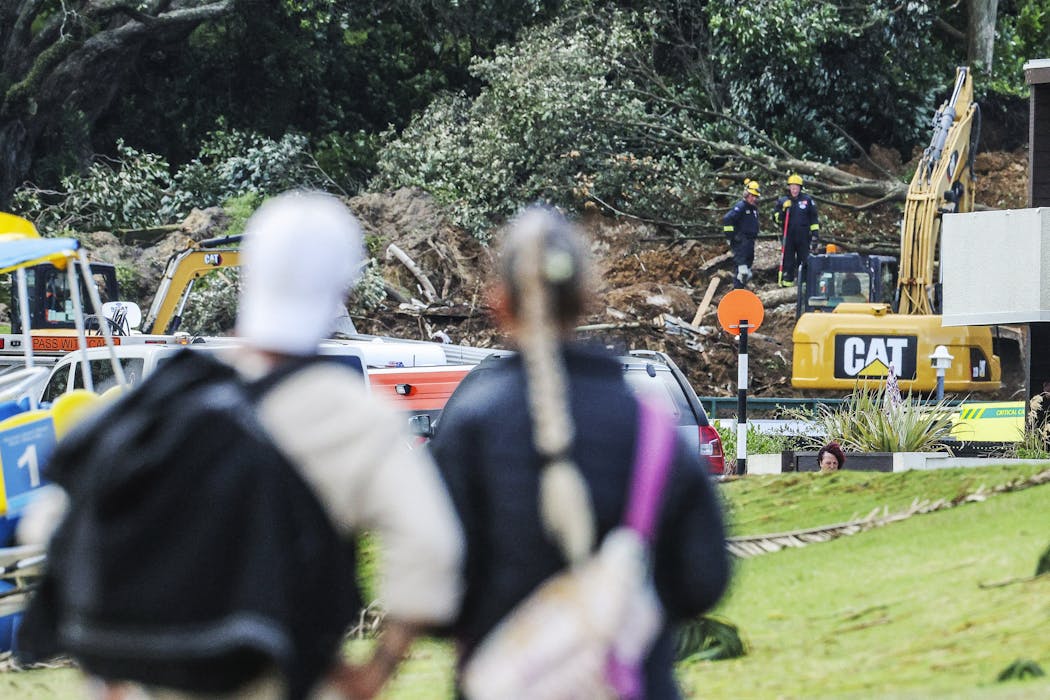
In the days since last week’s fatal landslides at Mount Maunganui, there has been widespread discussion about what may have caused the slopes above the campground to fail, including the possible role of recent tree removal on Mauao.

In the aftermath of such tragedy, it is natural to search for clear explanations. But landslides typically reflect a complex combination of factors – from geology and long-term slope evolution to weather, climate and land use.

A landscape prone to failure

The Tauranga region is underlain by volcanic materials that are well known for their instability. Over time, volcanic rock weathers into clay-rich soils, including a problematic mineral known as halloysite.

During heavy rainfall, water infiltrates these clay-rich soils, increasing porewater pressure between soil particles. This reduces the soil’s shear strength, making slopes more prone to failure.

Similar processes have driven devastating landslides elsewhere: dozens of people were killed in rainfall-triggered landslides in Indonesia’s West Java region just days ago, on comparable volcanic clay soils.

Recognising this risk, Tauranga City Council commissioned landslide susceptibility mapping following the extreme weather events of 2023. These datasets allow the public to view landslide-prone areas and “relic slips” – ancient landslides that still leave visible imprints on the landscape.

Importantly, they indicate where land has failed in the past – and remains potentially vulnerable during intense rainfall or after land-use changes.

While most of the Tauranga district is comprehensively covered by these mapping tools, there is one notable omission: the area west of Adam’s Avenue, where Mauao and the campground are located. Landslide hazard layers for this zone are absent from public web portals, despite Mauao being particularly landslide-prone.

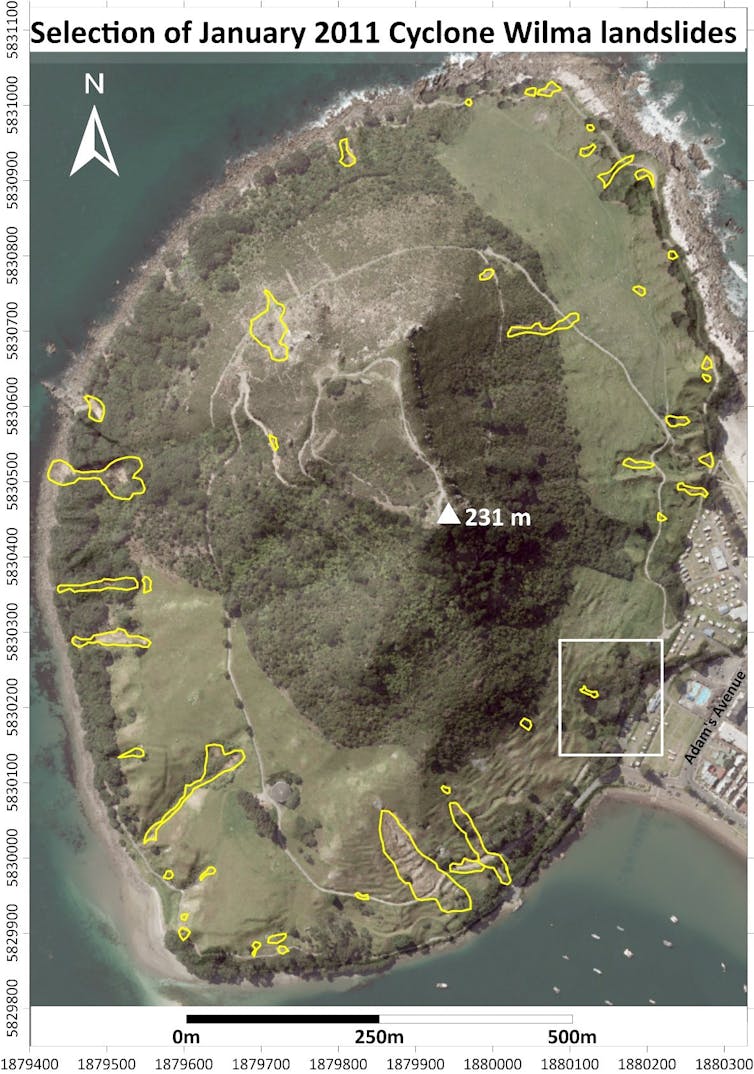
Historical aerial imagery dating back to 1943 reveals dozens of landslides on Mauao’s slopes. Some of the most significant occurred during Cyclone Wilma in January 2011, when 108mm of rain fell in 24 hours.

A detailed University of Auckland study identified at least 80 landslides from that single storm, including debris avalanches extending up to 120 metres downslope. Some of these failures have partially reactivated since, following later heavy rainfall.

A March 2011 aerial image of Mauao (Mount Maunganui), with some of the larger landslides triggered by heavy rain during Cyclone Wilma in January 2011 outlined in yellow. The white box marks the area in which last week’s landslide occurred. Author provided.
CC BY-NC-ND

Trees, slopes and stability

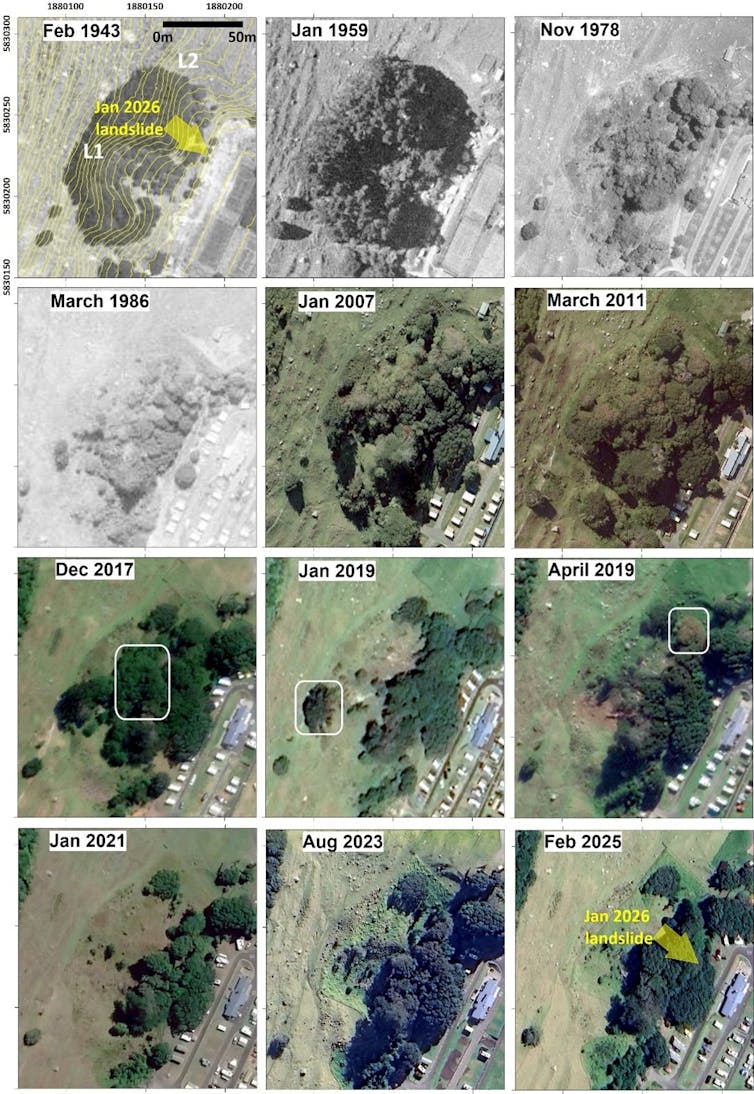
In addition to these historic events, older “paleo-landslides” exist on Mauao, including two on slopes above the campground. It was from this general zone that the January 22 landslide appears to have initiated – and much online discussion has also centred on tree removal within it.

Some media reports have pointed to vegetation clearance during 2022–23, but historical imagery suggests removal in this specific area likely occurred earlier, around 2018–19. More broadly, vegetation cover above the campground has declined gradually since the mid-20th century.

A series of aerial images from 1943 to 2025 show changes in vegetation and landform on the slopes above the campground. White boxes mark key areas, and arrows show the approximate location of the January 2026 landslide. Author provided.
CC BY-NC-ND

However, the relationship between vegetation and landsliding on Mauao is not straightforward. During Cyclone Wilma, major landslides occurred across both densely vegetated slopes and grass-covered areas.

Trees typically enhance slope stability in two main ways: their canopy intercepts rainfall, slowing water infiltration, and their roots reinforce soil strength. This is why widespread landsliding associated with forestry harvesting – particularly radiata pine – has long been a serious problem in parts of New Zealand.

But trees can also contribute to slope failure under certain conditions. Large leafy trees can act like sails during extreme winds, transmitting powerful forces into saturated soils.

After the 2023 Auckland Anniversary storm, research showed wind loading likely initiated some landslides on the slopes of Maungakiekie/One Tree Hill, as trees were rocked back and forth until they uprooted, dragging soil downslope.

As well, when trees grow near the tops of steep slopes, their weight – known as “surcharge” – can increase destabilising forces. In some clay soils, this effect may exceed the stabilising benefit of root reinforcement. Tree roots can also promote long-term weathering by growing into fractures in underlying rock.

All of this means vegetation is only one factor among many.

Why simple explanations fall short

Landslides in New Zealand’s hilly terrain typically result from a combination of preconditioning factors, many of which are influenced by human activity.

These can include reshaping slopes to create building platforms, cutting into slope toes for roads or structures, loading slopes with buildings, redirecting stormwater onto vulnerable terrain, and constructing poorly designed retaining walls that trap water within slopes.

While some trees were certainly removed from the broader source area of last week’s landslide, their role in destabilising the slope remains uncertain.

The slope had already experienced multiple historical failures, was underlain by volcanic clays and was subjected to intense rainfall – conditions that together are well known to trigger landsliding.

There is still much we do not yet know about the precise mechanisms that caused last week’s failures on Mauao. That is precisely why independent investigations and technical reviews are so important.

The Conversation

Martin Brook receives funding from the Natural Hazards Commission.

ref. Do trees prevent landslides? What science says about roots, rainfall and stability – https://theconversation.com/do-trees-prevent-landslides-what-science-says-about-roots-rainfall-and-stability-274518

Sex offending by priest Rowan Donoghue ‘deeply disturbing’, school says

Source: Radio New Zealand

Former St Bede’s College Friar Rowan Donoghue arrives at the Christchurch District Court for an appearance on January 28, 2026. Nathan McKinnon / RNZ

The rector of St Bede’s college says a former staffer’s sexual offending against boys more than two decades ago “makes me feel sick”.

It comes after RNZ reported that the Society of Mary was made aware of allegations against the priest nearly 20 years ago.

RNZ revealed on Wednesday that Fr Rowan Donoghue had pleaded guilty to six charges, five of which are representative, including indecent assault on a boy aged 12-16, indecent assault on a boy 16 and over and sexual violation by unlawful sexual connection.

The offending related to four boys who were boarding at St Bede’s College between 1996 and 2000.

  • Do you know more? Email sam.sherwood@rnz.co.nz

St Bede’s College rector Jon McDowall told RNZ the details outlined through the court process were “deeply disturbing”.

“As Rector, it makes me feel sick to think that young people entrusted to an adult’s care were abused in this way. I am deeply sorry that this happened to them, and my thoughts are with the victims and survivors who continue to live with the impact of that harm.”

McDowall said the school had worked openly with police throughout the process.

“We will continue to cooperate fully with the authorities should any further information come to light.

“Abuse has no place at St Bede’s – past, present, or future. The College has an established policy in place to respond and support victims of historical abuse, alongside safeguarding policies and practices to protect the wellbeing and safety of students today. Our focus remains on providing a safe and supportive environment for all members of our community.”

McDowall extended an open invitation for victims in the case, and others who may have been impacted, or anyone with concerns to contact him directly.

McDowall earlier told RNZ the school was “formally notified” of the allegations by police and had “worked openly with them since that time”.

“We hold victims and survivors in our thoughts and remain focused on providing a safe and supportive environment for all members of our community – past, present and future.”

In response to questions from RNZ on Wednesday, the Society of Mary confirmed an anonymous complaint of a sexual nature was made against Donoghue in 2007.

“The Society of Mary sought to investigate the complaint, but was unable to gain sufficient information to verify the allegations. Even so, the Society of Mary determined that Donoghue should be removed from public ministry, with a safety plan enacted. That has stayed in place since that time.”

The Society was not aware of the allegations to which Donoghue entered guilty pleas until police laid charges, the spokesperson said.

“Our first thoughts are with those who came forward and described what happened to them. We extend our apologies to them, and will seek to do so personally at an appropriate time. We deeply regret the hurt or harm caused.”

The society was “committed to ongoing efforts to ensure the safety of all people in Church settings”.

Asked whether police were told, the spokesperson said the complainant was “encouraged to contact the police”.

In early 2023, police were contacted about the allegations of sexual abuse by Donoghue in relation to his time at St Bede’s College.

In response to questions from RNZ, St Patrick’s Silverstream rector Rob Ferreira said the school had not been made aware of any allegations of abuse in care while Fr Donoghue worked at the school between 1982 to 1992.

“We have not had any inquiries from the police either.

“We operate according to clearly set out guidelines and best practice and you should note that our primary concern is the wellbeing of our students. Given that – our protection of the privacy and any other rights of survivors of abuse and other individuals would be paramount.”

He said the school had informed the community that Donoghue’s name suppression had lifted.

St Patrick’s College Wellington rector Mike Savali confirmed to RNZ that Donoghue was on the college staff from 2003 to 2007.

The Society of Mary encouraged anyone who has a concern or complaint about one of our members to contact the Police, the National Office for Professional Standards 0800 114 622, or the Society’s confidential helpline 021 909 749.

Where to get help

If it’s an emergency and you feel that you or someone else is at risk, call 111.

If you have been abused, remember it’s not your fault.

Sign up for Ngā Pitopito Kōrero, a daily newsletter curated by our editors and delivered straight to your inbox every weekday.

– Published by EveningReport.nz and AsiaPacificReport.nz, see: MIL OSI in partnership with Radio New Zealand

Scale of flood-damage starting to sink in for East Coast

Source: Radio New Zealand

Flood damage in Punaruku, Te Araroa on the East Coast. Supplied

Local authorities say the adrenaline has worn off and in its place is the scale of the damage in flood-hit East Coast communities.

Te Araroa on the East Coast has been described as a ‘war zone’ and was one of the worst hit during last week’s torrential rainfall.

Communities remain separated from each other, with work to clear slips on State Highway 35 continuing.

In a post on Wednesday, Tairāwhiti Civil Defence urged the public to be kind after receiving reports of people bullying roadworkers.

Te Araroa Civil Defence coordinator Tash Wanoa said the priority was still ensuring the 27 households cut off on the East Cape Road, toward Horoera, had food and supplies, but the recovery work was also underway.

“We’re now moving into clean-up mode with our crews, making assessments and going around the community and asking who needs help.”

She said it was important for help to be visible.

“I think now we’re at the critical point where people are starting to process what’s gone on,” Wanoa said.

“So, the adrenaline and the fight or flight has kicked off, and people are starting to realise, ‘Oh yep, okay’.”

Damage to State Highway 35 from a landslide. Supplied / NZTA

Wanoa said locals were grateful for the support they’d received – it was community helping community – but said the “scale of the damage in their homes and township area” was starting to sink in.

“I imagine there’s a few areas where people are feeling a little bit anxious about what the next steps are, especially in terms of insurance processes and timelines for returning to their homes.”

The numbers fluctuated, but Wanoa said between 14 and 19 people, including tourists, were still staying at the Civil Defence hub at Hinerupe Marae.

Over the weekend, homes in Te Araroa and Onepoto in Hicks Bay had been evacuated due to the risk of landslides.

Te Araroa residents have since been given the all-clear to return, and following geotechnical assessments, 66 households in Onepoto were also deemed safe to live in.

The Gisborne District Council said assessing the safety of homes (flood or structural damage, landslide risk) would continue on Wednesday in Potaka, Rangitukia, and on the East Cape Road.

On Tuesday, red stickers had been given to eight buildings in Punaruku, Te Araroa, and three in Onepoto.

Four properties in each place had also been yellow-stickered, meaning they could be inhabited following remedial work.

Gisborne’s mayor Rehette Stolz told Checkpoint the region would need around $21.5 million following the latest damage, excluding roading costs.

Work to restore access to and between communities was ongoing, with State Highway 35 shut between Pōtaka, west of Hicks Bay, and the Taurangakoau Bridge, about 3km south of Te Araroa.

Slip clearing on the East Coast’s SH35 between Tikitiki and Te Araroa, 25 January 2026. Supplied/ NZTA

Tairāwhiti Civil Defence said reports of people bullying roadworkers were unacceptable.

It said the closure included the Pōtaka to Hicks Bay section.

“The road is incredibly dangerous and unnecessary movement could cause even more damage. When it is safe to be open, you will be the first to know!

“We’ve reports of people bullying the traffic management crews – let’s be clear on this – it is not acceptable.”

It urged the public to be kind, considerate, and to abide by the safety measures.

Hicks Bay and Te Araroa, usually a short drive from one another, remained separated by multiple slips on the highway, including a massive one estimated by the Transport Agency (NZTA) to be around 6500 tuck loads of soil.

A spokesperson said access between the communities remained challenging.

They said engineers were carrying out assessments and would have a better idea of a timeframe for reopening the road later this week.

SH35 between Te Araroa and Taurangakoau Bridge, reopened for essential services and residents three times a day on Monday, with NZTA announcing an extended midday window for Wednesday and Thursday.

Sign up for Ngā Pitopito Kōrero, a daily newsletter curated by our editors and delivered straight to your inbox every weekday.

– Published by EveningReport.nz and AsiaPacificReport.nz, see: MIL OSI in partnership with Radio New Zealand

Marae welcome recovery funding boost but say more could be done

Source: Radio New Zealand

Hinerupe Marae in Te Araroa is a Civil Defence base and has sheltered evacuees. Te Araroa Civil Defence / supplied

Marae are welcoming the governments funding boost as a “good start” for the marae communities who turn out time and time in the wake of severe weather events.

Tauranga Moana iwi representative Roimata Ah Sam said 23 marae across the Tauranga region were able to open their doors and provide shelter and not for the first time.

“It is pretty incredible that time and time again, our marae communities, our Māori communities, turn out to respond. And we’ve seen that in complete action over the last week of how Māori turn out, regardless of where you’re from, to ensure that people are looked after in some of the most challenging times of people’s lives.”

Dozens of marae across Northland, Coromandel, Bay of Plenty and Tairāwhiti opened their doors in the wake of last weeks severe weather, sheltering evacuees, providing kai and serving as Civil Defence hubs. https://www.rnz.co.nz/news/national/585204/te-araroa-evacuees-overwhelmed-by-aroha-extended-to-them-at-east-coast-marae

On Tuesday the government announced it would make $1.2 million available to mayoral relief funds for affected regions, and another $1 million would go to marae that have helped communities in need.

Prime Minister Christopher Luxon praised support from marae as “exceptional”. https://www.rnz.co.nz/news/political/585163/political-parties-respond-to-government-funding-for-communities-hit-by-severe-weather

“They have provided shelter, food and care to people in need, and I cannot speak more highly of them.”

Ah Sam said she is proud of how marae have responded in way that exercises a level of resilience and manaakitanga, even in challenging times.

“We’ve had to reopen some doors as of this afternoon. So one of our marae… out at Ngāti Pūkenga is having to open up their doors for an evacuated area. So we’re still seeing that being practised.

“The beauty of marae is that the ability for whānau and for Māori to activate and practice manaakitanga means that those doors get open pretty quickly.”

Earlier on Wednesday residents were evacuated from Mangatawa, including Mangatawa marae, in Pāpāmoa where a slip poses a risk to life and property. https://www.rnz.co.nz/news/national/585216/new-slip-prompts-emergency-evacuations-in-tauranga

Ah Sam said Tauranga iwi welcomed the funding announcement saying that it would be a good start.

“Our marae are the first to open our doors and provide support to our communities. And in effect, they need to be resourced to do that. So whilst we’re incredibly proud of the work that our marae and our communities are able to exercise, we do need to make sure that we’re providing them with the level of support to continue to do that sustainably.”

Marae themselves are often vulnerable to floods and landslides and Ah Sam said once attention shifts from recovery to review the iwi would welcome a conversation around making marae more resilient. https://www.rnz.co.nz/news/te-manu-korihi/512771/survey-finds-third-of-marae-in-flood-prone-areas-up-to-30-percent-prone-to-landslides

Multiple marae across Tauranga were impacted by the floods, she said.

The challenges ahead are incredible, particularly for the whānau who are grieving for loved ones, and the thoughts of Tauranga Moana are with the whānau who are grieving, she said.

Paora Glassie, Civil Defence lead for Ōtetao Reti Marae at Punaruku on Northland’s storm-ravaged east coast. RNZ / Peter de Graaf

Ōtetao Reti marae in Punaruku, five minutes drive from hard-hit Ōakura in Northland, has been sheltering members of the community and providing help during the storm. https://www.rnz.co.nz/news/national/584867/marae-provides-community-lifeline-following-northland-floods

The marae’s Civil Defence lead Paora Glassie, told Morning Report, he was grateful the government were reimbursing marae that provided welfare, but believed the money was not enough. https://www.rnz.co.nz/national/programmes/morningreport/audio/2019020692/marae-to-be-reimbursed-for-help-provided-during-weather-event

“I think it’s not enough, but at the end of the day we should be grateful we have been offered some money.”

Glassie hoped the money would help ease the burden for those who had lost loved ones during the storms.

He said his area had major floodings and slips which cut the community off from the outside world, but luckily some roads had been cleared now.

With events like this, he said it was important marae were prepared with Civil Defence readiness plans and that they had basic resources to take care of people.

“Making sure that you have a good Civil Defence team too, to work alongside, so that you’re not stuck with all the load at the time of a major event.”

For his marae, he said it was “lucky” as the only real problem was access in and out of the area as the marae was equipped with solar power and generators for when the power was out.

“Just making sure that the basic things are in place, generators, you’ve got gas and that, so that when you come into… that situation the marae can continue to survive or continue to help the people in the area.”

The $1 million allocation has been added to the Māori Development Fund, enabling Te Puni Kōkiri to provide one-off reimbursement grants to marae that delivered welfare support during the January 2026 severe weather event.

Marae or related organisations that provided welfare support can apply for reimbursement grants by contacting their regional Te Puni Kōkiri office to begin the process.

Funding can be used to cover eligible costs incurred while supporting communities, including food, accommodation, utilities and other essential welfare expenses.

Sign up for Ngā Pitopito Kōrero, a daily newsletter curated by our editors and delivered straight to your inbox every weekday.

– Published by EveningReport.nz and AsiaPacificReport.nz, see: MIL OSI in partnership with Radio New Zealand

Telecommunications Bill raises questions about encryption, Free Speech Union says

Source: Radio New Zealand

The Free Speech Union says planned changes to telco regulations could open the back door to encrypted communication channels. 123rf

The Free Speech Union is concerned proposed changes to telecommunications regulations will open the back door to encrypted communications channels, but the tech industry says the horse has already bolted.

The Telecomunications Bill introduces a new enforcement power to allow the Ministry for Business, Innovation and Employment (MBIE) to suspend or revoke licences if providers fail to comply with regulatory requirements, including services provided by overseas providers, such as WhatsApp, Signal, Telegram and Starlink.

“That power effectively gives a government official the ability to switch off a communications service in New Zealand,” Free Speech Union chief executive Jillaine Heather said.

“That raises serious questions about whether genuinely private communication would remain available in New Zealand at all.”

Tech Users Association chief executive Craig Young said the technology behind end-to-end encryption was already under pressure from developments in quantum technology, which was capable of breaking current encryption standards.

“I do understand their concern, but in my mind, the encryption battle is going to be ongoing no matter what happens,” Young said.

“I think technology will always be ahead of how fast governments react. At least (with) the New Zealand government, we have a level of trust with them around not abusing any powers that they that might be in place.

“But I don’t think that is a concern we should be worried about at the moment.”

Still, Heather said communication was the first thing a government would pull or restrict, if there was an emergency or civil unrest, as had been seen in Iran and Myanmar over the past couple of years.

“There’s a real hole in the fact that they want to break encrypted communications because it makes it so unsafe for everyone.”

Young said it was unclear why the government had included the new enforcement power in the proposed legislation.

“It’s not completely clear from reading (the bill). I mean, you have to read quite a lot into the legislation to find that because it’s in with other things that we’re obviously quite keen to see happen around the telco space.”

Heather said the union would be sharing its concerns and questioning the Parliamentary Select Committee about its reasons for inclusion of the new powers, later this week.

Sign up for Ngā Pitopito Kōrero, a daily newsletter curated by our editors and delivered straight to your inbox every weekday.

– Published by EveningReport.nz and AsiaPacificReport.nz, see: MIL OSI in partnership with Radio New Zealand

Plenty on the agenda as Anthony Albanese heads to Timor-Leste as PM for the first time

Source: The Conversation (Au and NZ) – By Melissa Conley Tyler, Honorary Fellow, Asia Institute, The University of Melbourne

Australian Prime Minister Anthony Albanese is in Timor-Leste today, making his first official visit.

Known in English as East Timor, Timor-Leste is one of Australia’s closest neighbours.

The countries have shared interests in everything from fishing to biosecurity.

Australia’s foreign policy has consistently identified Timor-Leste as a country of “fundamental importance”.

It’s in Australia’s interests that Timor-Leste is successful and stable.

Challenges in Timor-Leste

Timor-Leste faces significant challenges.

Despite being about 700 kilometres from Darwin, the United Nations considers it one of the world’s least developed countries. Its per person GDP is $1,502, compared to Australia’s $64,604.

In many ways, the period since Timor-Leste gained independence in 2002 is the first opportunity its people have had to shape their destiny.

Timor-Leste endured centuries as a Portuguese colony before political turmoil in Portugal caused it to drop its colonies in 1975.

Then, a declaration of independence was followed by annexation and 24 years of occupation by Indonesia.

Now it is full of hope as a new democratic nation with a rapidly growing youth population.

But it needs support. One in two children under five are stunted – not getting enough nutrition to grow in their early years – which will have lifetime effects on their health, education and productivity.

Encouragingly, a recent external review of Australia’s development cooperation program shows evidence that long-term partnerships are paying off, with local civil society organisations in Timor-Leste steadily strengthening their capacity over time.

Why visit now?

Timor-Leste is right in the middle of what President José Ramos Horta describes as “a crucial period for the future of our nation”.

Revenue from oil and gas fields has dried up. Past profits were saved in a petroleum fund, but that may soon be depleted.

Timor-Leste’s economy is not growing fast enough to create youth jobs.

However, Timor-Leste has just joined the Association of Southeast Asian Nations (ASEAN) after a long process, with hopes it will open up economic opportunities.

When I visited last year, Malaysian Prime Minister Anwar Ibrahim was in town talking up the potential of trade links.

Australia also needs to prepare for eventual political change in Timor-Leste.

Until now, top political posts have been held by those who fought for independence. At some point there will be a generational transfer of power.

There was some political unrest last year in the form of student protests against politicians perceived to be granting themselves perks.

Australia does not want democratic regression or a failed state on its doorstep.

What’s on the agenda?

Not much information has been released ahead of Albanese’s visit.

We know the prime minister will be meeting with Ramos Horta and Prime Minister Xanana Gusmão.

He will be addressing parliament, which he describes as an honour.

The fact Albanese will be receiving Timor-Leste’s highest civilian award suggests the mood will be positive.

The biggest news would be if there are any further developments on the Greater Sunrise gas field, located in the Timor Sea, about 450km northwest of Darwin.

This A$50 billion project has not yet been developed due to disagreement over whether processing would take place in Darwin or Dili, Timor-Leste’s capital.

It is not expected to be a focus of the visit.

Other big news would be an enhanced security treaty.

Given concerns about China’s security cooperation with countries in the region, Australia has signed significant security agreements in the past year with Tuvalu, Nauru, Papua New Guinea and Indonesia.

But the prime minister has been at pains to stress this visit is not about China.

More likely it could be celebrating and expanding things that are going well. One example is the Pacific Australia Labour Mobility scheme which enables Timorese workers to come to Australia to develop skills and earn money.

Another is the New Colombo Plan which supports young Australians to study and immerse themselves in the region. This has just been extended to Timor-Leste in 2026.

It may be there is nothing new from the visit, just a clear statement of how seriously Australia takes the relationship with Timor-Leste.

It may be as simple – and as important – as that.

Beyond government

The Timor Leste-Australia relationship has a lot of buy-in beyond the federal government.

Across Australia, there are friendship groups that raise funds for schools in Timor-Leste or sell Timorese coffee through local councils.

I’ve met Australians who came to Timor-Leste as students and are still there.

A great example is the MP for Darwin, Luke Gosling, who will be accompanying the prime minister on the visit.

After his Army service in the peacekeeping mission that led to Timor-Leste’s independence, he established a volunteer charity to build schools, provide running water and deliver maternal health care.

It’s important to keep these sorts of initiatives going and to extend them. The needs in Timor-Leste are so great that individual Australians can have a huge impact.

Surprisingly, given the complicated history between the two countries, most Timorese seem to have a real sense of friendship with Australia.

Having a neighbour that is stable, prosperous and friendly is something that is well worth our prime minister’s time.

The Conversation

Melissa Conley Tyler is executive director at the Asia-Pacific Development, Diplomacy & Defence Dialogue (AP4D), an initiative funded by the foreign affairs and defence portfolios and hosted by the Australian Council for International Development.

ref. Plenty on the agenda as Anthony Albanese heads to Timor-Leste as PM for the first time – https://theconversation.com/plenty-on-the-agenda-as-anthony-albanese-heads-to-timor-leste-as-pm-for-the-first-time-274023

Democratic congresswoman Ilhan Omar sprayed by unknown substance during speech

Source: Radio New Zealand

A man is tackled after spraying an unknown substance at US Representative Ilhan Omar. AFP / Octavio Jones

US Democratic congresswoman Ilhan Omar has been targeted during a speech by a man who sprayed an unidentified liquid at her from a syringe before being tackled by security guards, according to an AFP journalist at the scene.

The man was led out of the premises as Omar, a frequent target of attacks by President Donald Trump, continued her speech saying “we will stay resilient in the face of whatever they might throw on us.”

The incident took place during a town hall in the US city of Minneapolis, where two US citizens have been killed this month in a violent anti-immigration crackdown, provoking growing unrest.

Omar had just finished calling for the Trump administration to reverse its current course when the attack occurred.

“ICE cannot be reformed, it cannot be rehabilitated. We must abolish ICE for good,” Omar said, to applause. “And (Department of Homeland Security) Secretary Kristi Noem must resign or face impeachment.”

After Omar uttered those words, a man sprang up from the front row, made a remark and sprayed the congresswoman, as security leapt to grab him. Omar raised a fist and stepped toward the attacker before returning to the podium.

After uttering a few expletives, and against her team’s vocal concerns that she should not continue, the congresswoman took the microphone.

“Here’s the reality that people like this ugly man don’t understand: We are Minnesota strong. And we will stay resilient in the face of whatever they might throw on us,” Omar said.

Earlier Tuesday, Trump blasted Omar and Somalia during a speech in Iowa, saying the Mogadishu-born congresswoman “comes from a country that’s a disaster.”

Trump has ordered 143 strikes against Somalia in his second term, according to US think tank New America, and has pulled back diplomatic relations, including recently stopping humanitarian aid.

AFP

– Published by EveningReport.nz and AsiaPacificReport.nz, see: MIL OSI in partnership with Radio New Zealand

Ikea hikes staff pay to minimum $29 as other retailers told to ‘step up’

Source: Radio New Zealand

IKEA’s first Auckland store opens on December 4 Marika Khabazi / RNZ

New Zealand retailers need to “step up” to keep up with the wages and conditions offered by international businesses coming into New Zealand, one union says.

Ikea said on Wednesday it was hiring an extra 85 staff for logistics and food services, and adding evening shifts for stock replenishment.

That will take its total New Zealand workforce to 561.

It is also paying staff an entry level rate of $29, which increases to $31 as they progress to the next level.

They can also access a subsidised transport programme offering 75 percent off commuting costs, five weeks of leave, subsidised meals and a staff discount.

“The response from New Zealanders since opening has been incredible, and we’re proud to be growing our team to meet that demand while staying true to our values,” said New Zealand people and culture manager Lauren Clegg.

“Opening in a new market has its share of challenges and learnings for our team. We’re committed to listening, improving and supporting our co-workers along the way. By investing in competitive pay, meaningful benefits and everyday support, we want people choose to grow their careers with us as we continue building Ikea in Aotearoa together.”

Rudd Hughes, retail secretary for Workers First Union, said Ikea’s offer was a good one.

The union is due to initiate collective bargaining in the next week for staff at Ikea.

But he said the union had spoken to Ikea before the shop even opened.

“They have made it quite clear that their wages will be living wage and above. And so, although they didn’t start off with a living wage, they’ve now gone to the living wage… we’ll be looking to improve that, but also not just on the wages, but also other conditions.”

He said Costco and Kmart also offered the living wage or more.

“Other New Zealand-based brands or Australian-based brands like Woolworths, Foodstuffs, Briscoes, Warehouse, they’re all lagging behind and lagging significantly.

“Kiwi businesses really need to kind of step up to the market and pay their workers what they need to actually live in a society.”

He said Ikea’s hiring would have an impact on other retailers.

“It’s a significant player in the economy, I’m sure they’ll probably branch out as well. We welcome that. We also welcome the way in which they have worked alongside us to develop a relationship with the union, which isn’t that common.”

He said the union would use examples like Ikea as benchmarks in bargaining with other employers.

“The living wage should be the minimum for any worker in this country, but particularly retail workers as well. We have a large number of retail workers in this country.

“Why shouldn’t they have a living wage so they can partake in society, they can be part of society and they don’t have to scrimp and save?”

Sign up for Money with Susan Edmunds, a weekly newsletter covering all the things that affect how we make, spend and invest money.

– Published by EveningReport.nz and AsiaPacificReport.nz, see: MIL OSI in partnership with Radio New Zealand

ER Report: A Roundup of Significant Articles on EveningReport.nz for January 28, 2026

ER Report: Here is a summary of significant articles published on EveningReport.nz on January 28, 2026.

What can Australia learn from Europe’s housing plan?
Source: The Conversation (Au and NZ) – By Hal Pawson, Emeritus Professor of Housing, UNSW Sydney Liene Ratniece/Pexels, CC BY-SA The European Commission recently released its first-ever Affordable Housing Plan. Property prices have outpaced incomes across Europe over the past decade. Home ownership has been pushed out of reach for many. But for economically successful

Pacific delegates warn against US fast-tracking seabed mining
By Mark Rabago, RNZ Pacific Commonwealth of the Northern Marianas correspondent Pacific delegates in the United States Congress are warning efforts to fast-track deep-seabed mining could sideline island communities and cause irreversible damage to fragile ocean ecosystems. The concerns were raised at a House Natural Resources Committee hearing in Washington last week, held a day

Great white sharks grow a whole new kind of tooth for slicing bone as they age
Source: The Conversation (Au and NZ) – By Emily Hunt, PhD Candidate, School of Life and Environmental Sciences, University of Sydney Ken Bondy/iNaturalist, CC BY-NC A great white shark is a masterwork of evolutionary engineering. These beautiful predators glide effortlessly through the water, each slow, deliberate sweep of the powerful tail driving a body specialised

New fear unlocked: runaway black holes
Source: The Conversation (Au and NZ) – By David Blair, Emeritus Professor, ARC Centre of Excellence for Gravitational Wave Discovery, OzGrav, The University of Western Australia A runaway black hole leaving a streak of new stars in its wake. James Webb Space Telescope / van Dokkum et al. Last year, astronomers were fascinated by a

Should I take a fish oil supplement for my heart, joints or mood?
Source: The Conversation (Au and NZ) – By Mary Bushell, Clinical Associate Professor in Pharmacy, University of Canberra Fish oil, also known as omega-3, is one of the most popular dietary supplements. It’s often promoted to protect the heart, boost mood, reduce inflammation and support overall health. But how much of this is backed by

Swap muesli bars for homemade popcorn: 5 ways to pack a lower-waste lunch box
Source: The Conversation (Au and NZ) – By Neha Lalchandani, Research Fellow, Global Centre for Preventive Health and Nutrition, Deakin University, Deakin University Antoni Shkraba Studio/ Pexels If you pack school lunchboxes for your children, you’ll know it can sometimes feel like a real slog. It needs to be easy to prepare, nutritious and something

A new company tax mix has been proposed. We need to be careful how we assess it
Source: The Conversation (Au and NZ) – By Janine Dixon, Director, Centre of Policy Studies, Victoria University Steven Wei/Unsplash Australia has a problem. Across the economy, business investment has been sluggish for the past decade, leaving policymakers reaching for solutions. Weak business investment can leave the economy stuck in low gear, operating without enough equipment

Rocket or arugula? How a salad vegetable mapped the Italian diaspora
Source: The Conversation (Au and NZ) – By Matt Absalom, Senior Lecturer in Italian Studies, The University of Melbourne sheri silver/Unsplash If you watch American cooking shows, you’ve likely experienced “salad confusion”. You see a chef preparing what looks like rocket, but they call it arugula. It’s the same plant (Eruca sativa). It has the

NZ’s sodden January explained: what’s driven this month’s big wet?
Source: The Conversation (Au and NZ) – By James Renwick, Professor of Physical Geography (Climate Science), Te Herenga Waka — Victoria University of Wellington Smith Collection/Gado/Getty Images It has been a month of umbrellas rather than sunscreen across much of New Zealand, with persistent rain, low sunshine and deadly storms dominating headlines and daily life.

In Gaza, university scholarships are now a matter of survival
By Haya Ahmed In Gaza today, university scholarships have taken on a whole new meaning. No longer are they a step towards self-development, educational attainment or an academic experience in a different country. For a whole generation of Gazan students, a foreign university scholarship has become a lifeline and one of the few remaining legal

View from The Hill: Dysfunctional federal opposition is in gridlock
Source: The Conversation (Au and NZ) – By Michelle Grattan, Professorial Fellow, University of Canberra A week out from the resumption of parliament, the federal opposition is in a state of paralysis. The Liberals have a full-blown leadership crisis. A majority of the party believe Sussan Ley can’t survive for long. But leadership contenders Angus

Where did southern Australia’s record-breaking heatwave come from?
Source: The Conversation (Au and NZ) – By Steve Turton, Adjunct Professor of Environmental Geography, CQUniversity Australia Kevin Chen/Pexels, CC BY-NC-ND Millions of people in southeastern Australia are sweating through a record-breaking heatwave. The heat this week is likely to be one for the history books. The heat began on Saturday January 24th. On Australia

Red flowers have a ‘magic trait’ to attract birds and keep bees away
Source: The Conversation (Au and NZ) – By Adrian Dyer, Associate Professor, Department of Physiology, Monash University Joshua J. Cotten For flowering plants, reproduction is a question of the birds and the bees. Attracting the right pollinator can be a matter of survival – and new research shows how flowers do it is more intriguing

5 years on from the junta’s coup, Myanmar’s flawed elections can’t unite a country at risk of breaking apart
Source: The Conversation (Au and NZ) – By Adam Simpson, Senior Lecturer in International Studies in the School of Society and Culture, Adelaide University Five years ago, on February 1 2021, Myanmar’s top generals decapitated the elected government. Democratic leaders were arrested, pushed underground or forced into exile. Since then, the economy has spluttered and

Jakarta at crossroads – can President Prabowo connect with Papuan hearts?
ANALYSIS: By Laurens Ikinia in Jakarta The logbook of presidential flights in Indonesia reveals an unusual pattern — from the Merdeka Palace to the Land of the Bird of Paradise. By 2023, then President Joko “Jokowi” Widodo had set foot in Papua at least 17 times — a record in the republic’s history, surpassing the

Pilot, passenger dead after helicopter crash in Paekākāriki Hill

Source: Radio New Zealand

Police officers on guard near the scene of the crash. RNZ/ Charlotte Cook

Police say two people have died in a helicopter crash near Wellington today.

Emergency services were called to a helicopter crash in the Paekākāriki Hill area, north of Wellington, by an automated crash alert at 7.30am.

Inspector Renée Perkins said both the pilot and sole passenger were found deceased following the crash.

She said police were working to remove the bodies from the area and cordons were in place around the Battle Hill campground.

Police would work alongside the Civil Aviation Authority to examine the scene.

A police vehicle with a trailer is seen at the site this afternoon. RNZ / Charlotte Cook

A man who discovered a body in the “unrecognisable” wreckage of a helicopter that crashed says he was checking for vital signs as the Westpac helicopter arrived at the scene.

The witness said they checked the vital signs of one of the people on the helicopter and they were deceased.

Shortly afterwards, he said another person was located some distance from the wreckage on steep terrain in thick scrub.

“It’s not my first. I spent 27 years in search and rescue – so it’s not something new to me,” the man said.

He said he attempted to shut the helicopter off as fuel was running out of the aircraft, but could not access the switch to do so.

“Because there’s fuel leaking out and the machine was still turned on, we took the safe option and we moved out of the way,”

The man said he understood the helicopter was involved in goat culling in the area.

A police vehicle with a trailer is seen at the site this afternoon. RNZ / Charlotte Cook

Police, Maritime NZ’s Rescue Coordination Centre and Fire and Emergency responded to the crash.

Fire and Emergency had sent two crews from Porirua, along with their “line rescue team”. Also known as rope rescue personnel, they are trained in high-angle, vertical, or challenging terrain, often handling rescues at height or in confined spaces.

RNZ / Charlotte Cook

The newly appointed Police Assistant Commissioner, currently District Commander, Corrie Parnell has arrived on site. RNZ understands authorities are currently in meetings and they are struggling to access the site because of the area.

Park rangers and teams on ATVs were trying to make the scene more accessible.

While helicopters have been in the air this morning, an RNZ reporter at the scene says Flight Radar is no longer showing helicopters in the area.

A helicopter flies over the search scene. RNZ / Charlotte Cook

The search area is near Pukerua Bay, where three people died in a crash involving an Air Force helicopter on Anzac Day in 2010.

Sign up for Ngā Pitopito Kōrero, a daily newsletter curated by our editors and delivered straight to your inbox every weekday.

– Published by EveningReport.nz and AsiaPacificReport.nz, see: MIL OSI in partnership with Radio New Zealand

What can Australia learn from Europe’s housing plan?

Source: The Conversation (Au and NZ) – By Hal Pawson, Emeritus Professor of Housing, UNSW Sydney

Liene Ratniece/Pexels, CC BY-SA

The European Commission recently released its first-ever Affordable Housing Plan.

Property prices have outpaced incomes across Europe over the past decade. Home ownership has been pushed out of reach for many.

But for economically successful cities and tourist regions, price and rent trends have been even more stark. For example, the commission reports that “in cities and regions in high demand, even one third of average income is often not sufficient to pay the rent on a 25 square metre apartment”.

The commission’s plan, therefore, is mainly a response to the growing worries about the socially destructive effects of failing housing systems.

Equally concerning, though, is the economic damage wreaked by housing affordability stress. The commission sees this as “impairing labour and educational mobility, weighing on economic growth, innovation, and competitiveness”. It’s a highly pertinent assessment for Australia.

So what does the European plan suggest, and what lessons does it hold for Australia?

Tackling housing unaffordability

As in Australia, the commission’s top prescription for enhanced housing affordability is ramped-up home building. Here, it’s estimated that EU-wide industry output needs to rise by 40% to match current demand.

This is in the same ballpark as the Australian government’s five-year aspiration to enable the construction of 1.2 million new homes from 2025. That’s a 33% increase over the 2005–25 norm.

As desirable as such an objective may be, the scope for significantly enhancing affordability in this way remains questionable. It’s particularly doubtful in light of recently published Australian modelling on the relationship between house building and house prices.

This analysis suggests that, without complementary policies, generating even a very modest affordability improvement would be challenging. It would require housing industry output to be boosted by a third, not just for five years, but consistently for two decades.

Wisely, though, the commission’s plan recognises many complementary efforts are also needed. These include “maximising the efficient use of the existing building stock”. In other words, policymaker attention to expanding new housing production is illogical without a parallel emphasis on reducing the large numbers of vacant and under-used homes nowadays present in many countries.

With one million Australian dwellings unoccupied on census night in 2021 and another million owner-occupied properties grossly underutilised, this point resonates here, too.

Fundamental land tax reform, widely supported by economists and other housing experts, is the most obvious solution in Australia, just as in other countries.

The role of other property tax settings

Similarly highlighted as problematic by the European Commission is how “increased financialisation and speculation” is putting further pressure on housing affordability.

In response, EU member states are encouraged to implement measures including “effective taxation policies” and “[assigning] a set share of new housing developments to social and affordable housing, reflecting local housing needs”.

If transposed to the Australian setting, these messages would reinforce growing calls for winding back private landlord tax concessions.


Read more:
How many of Australia’s 2.2 million property investors would lose out under a new plan to curb negative gearing?


The European Commission recommendations also align with Australian calls to expand affordable housing contribution requirements. That is, developer obligations to include below-market rental units within market-rate housing projects in pricey areas.

Not only does this effectively source housing subsidy from land value, it can also help to ensure a degree of social mix in areas otherwise dominated by higher income populations.

The plan also addresses the need for improved energy efficiency and building quality to lower living costs. These important housing policy issues are largely neglected in Australia.

More social and affordable rentals

The European Commission’s advocacy on housing for low-income groups rejects any suggestion that stepped-up market house building (if achieved) can be solely relied upon to “naturally” address such needs.

This idea, termed “market filtering”, is the process sometimes described as “trickle-down housing”.

Rather, the plan contends that “expanding social and affordable housing is particularly important to support low- and middle-income households”.

To facilitate this, restrictive state aid rules are to be relaxed to encourage more affordable housing investment.

This measure has no direct Australian parallel. But the commission’s stance here chimes with the National Housing Supply and Affordability Council view. It says “significant investment is needed to increase [Australia’s] stock of social and affordable housing”.

Spending has been recently stepped up by both federal and state governments in Australia, but current commitments remain insufficient in both scale and duration.

The importance of ambition

The EU plan, of course, has limitations.

Its problem analysis is stronger than its pledged responses. Consistent with EU traditions, these lean heavily towards market-enabling measures rather than active interventions.

And the union’s powers over member states in areas such as property tax and land use planning are very limited.

But perhaps the plan’s greatest significance to nations beyond the EU is simply its existence and ambition.

Here in Australia, federal Labor pledged in 2022 to produce a long-term housing and homelessness strategy during the last parliament. Regrettably, this commitment remains unfulfilled.

There is an echo of the EU’s constrained position in the Commonwealth’s limited authority over state and territory governments on housing.

But, unlike Brussels, Canberra controls key housing-related policy levers on taxation, financial regulation and social security. The federal government also has financial firepower vastly superior to the states.

Other countries show it can be done. Most notably, in developing its own National Housing Strategy in 2017, federal Canada has provided an instructive model for federal Australia.

Though recent Australian housing policy innovations have been both many in number and generally positive in nature, they remain piecemeal and patchy. There is no coherent road map for the deeper reforms needed for transformative change.

Given the inherent complexity of housing, this is an especially challenging policy domain. As argued in our new book, therefore, a purposeful housing reform agenda demands a long-term, federally-led national housing mission and strategy, underpinned in legislation.

The Conversation

Hal Pawson receives funding from the Australian Housing and Urban Research Institute (AHURI), from the Lord Mayor’s Charitable Fund (City of Melbourne), and from Crisis UK. As an unpaid advisor, he is affiliated with Senator David Pocock. He is a non-exec director of Community Housing Canberra.

Vivienne Milligan receives funding from the Australian Housing and Urban Research Institute. She is a committee member of the Australian Community Land Trust Network.

ref. What can Australia learn from Europe’s housing plan? – https://theconversation.com/what-can-australia-learn-from-europes-housing-plan-272999

Police? Council? FENZ? Who knew what and when before the Mount Maunganui landslide?

Source: Radio New Zealand

Six people were killed when a landslide hit the Mount Maunganui Beachside Holiday Park Shirley Thomas

Nearly a week after six people were killed in a landslide at the Mount Maunganui campground, questions remain on who knew what, when they were notified, and what action could or should have been taken. National Crime Correspondent Sam Sherwood reports.

It was about 5am, when Lisa Anne Maclennan began waking her fellow campers in Mount Maunganui, warning them about a slip that had pushed her campervan about a metre forward.

Nearly five hours later a massive chunk of land came down at the Beachside Holiday Park, smashing into campervans, tents, vehicles and an ablution block near the Mount Hot Pools. Six people remain missing, Maclennan, 50, Måns Loke Bernhardsson, 20, Jacqualine Suzanne Wheeler, 71, Susan Doreen Knowles, 71, Sharon Maccanico, 15, and Max Furse-Kee, 15.

RNZ has asked authorities in the days since the landslide what they knew and what actions they took.

I think everyone should move’

A woman, who did not want to be named, told RNZ she had been at the campground for about three weeks and was staying right next to Maclennan and her husband.

She said she was woken shortly before 5am on 22 January by Maclennan banging on her window.

“She’s like ‘Oh I’m so sorry I’m waking you up’, but the slip had pushed her campervan about a metre forward, so she said, ‘I’m just waking everyone up because I think everyone should move’.”

The woman moved her campervan straight away and Maclennan’s campervan was moved parallel to the shower block.

The woman said the group then went to the office, but there was no-one there.

She said Maclennan had tried ringing the emergency number at the campground and could not get hold of anybody.

The woman said Maclennan told her she was going to try calling Civil Defence. It was at that moment the woman called police.

Shortly before, she took some photos and video of one of three slips, including one right at her campsite. An image, supplied to RNZ, was timestamped at 6.15am and the video, which shows the slips, was taken a minute later.

A call log provided by the woman confirms she called police at 6.18am. The outgoing call lasted eight minutes.

“I explained to them about the slips. I said, ‘look, I understand that you guys will be really busy, and this might not be anything, but this is what’s happened here’. 

“It was enough to push the ladies’ campervan forward, and there’s a homeless man in the toilet block, and he was actually going crazy and sort of banging on the walls and smashing things.

“And so I said, maybe you should send someone to have a look at that, just in case. You know, there’s a lot of kids here… and they said, yeah, it is a really busy night. It’s been a busy night. It’s a busy morning, we’ll try and get a unit there.”

The woman said no-one arrived until about 7.45am, when she said she saw what she described as a ute that was sign-written with Tauranga City Council. The ute stopped and the woman says she called out, “Look, I don’t know if you can see them from where you are, but there’s these slips up here, I think, you know, someone should look at them.”

The woman was unsure the man heard her. The woman said the ute then drove through the Pilot Bay side of the campground slowly past the slips that she had filmed directly in front of several campsites.

“I figured, well, everything will be fine. Someone from the council’s come, they’ve seen the slips, he’s driven past them, he’s driven through the water that was coming down from that corner that collapsed. So I had no worries after that.”

FENZ has confirmed it first received a 111 call at 5.48am on Thursday, 22 January. Alan Gibson – GIBSON IMAGES LTD

Fire and Emergency New Zealand

In response to earlier questions from RNZ, deputy national commander Megan Stiffler confirmed FENZ received a 111 call at 5.48am on Thursday from a person reporting a slip near the Mount Maunganui Beachside Holiday Park.

“Our call takers made contact with the Tauranga City Council, the landowners of the camping ground, and notified them of this information at 5.51am.

“The landslip that was referenced in the 111 call received at 5.48am did not impact life or property and therefore Fire and Emergency did not respond firefighters to attend, instead we notified Tauranga City Council as the landowner responsible.”

Speaking to the NZ Herald, Tauranga City Council chief executive Marty Grenfell said there was no record of a 111 call being referred to the council.

However, a council statement released only hours later backtracked on this version of events.

“After further enquiries, we can confirm that the Tauranga City Council’s main Contact Centre received a call from Fire and Emergency New Zealand at around 5.50am on Thursday, 22 January.”

The council said the chief executive’s earlier comments referred specifically to information logged in the council’s Emergency Operations Centre, which did not receive a call.

Tauranga Mayor Mahé Drysdale confirmed council staff were at the campground at the time of the slip. RNZ

Tauranga City Council

Tauranga mayor Mahé Drysdale spoke with Midday Report on Wednesday. Asked whether he thought the campground could or should have been evacuated, he said he was not going to be “drawn on a conclusion yet”.

“Until we’ve actually seen you know exactly the timeline, exactly who knew what when, but I can absolutely assure people, you know when, when we’ve got all that information in front of me, that… we will act appropriately. We will understand and and obviously, you know, the important thing is learning from this tragedy.”

Drysdale confirmed some staff were at the campground at the time of the slip.

He was unable to say how many, as there were several different teams.

Drysdale did not know what the Council did after they were notified by FENZ at 5.51am.

Asked about RNZ’s article about a local council representative driving through the Mount Maunganui campground and directly past three slips about two hours before the landslide, Drysdale said he he did not “have the absolute detail”.

“This is the problem… there’s a lot of information, and we need to verify that information absolutely,” he said.

“I don’t have a accurate or verified, you know, case of where all our staff were when they were there, what they knew, what they didn’t know. That is absolutely something that we need to find out.”

Police

In response to questions from RNZ, a police spokesperson confirmed police received an emergency call at 6.18am in relation to a disorder incident that had occurred at the campsite.

“During the call, the informant also referenced a potential landslip.

“Police did not attend as it was unclear whether the disorder resulted in any property damage.

“Fire and Emergency New Zealand were earlier alerted to the slip, and the council was in turn notified.”

Between 5am and 9.30am in the Mount Maunganui area, Police received one other call about a slip on the base track.

“The informant left the area safely and noted cones had been placed to restrict further access.”

Three of the landslide victims Max Furse-Kee, Sharon Maccanico and Susan Knowles. SUPPLIED

What about a review?

On Tuesday, the Prime Minister Christopher Luxon said there was a “strong case” for a government inquiry into the landslide.

He announced the possibility during a media conference and said many questions about last Thursday’s slip were being asked, including whether there was a missed opportunity to evacuate people sooner.

“Six families are grieving the unimaginable loss of their loved ones, and they deserve answers. I acknowledge that the Tauranga City Council has ordered its own inquiry into the events leading up to the landslide at the campground.

“However, I do believe there is a strong case for an independent government inquiry, and we’ll be talking to Tauranga City Council about that.”

Luxon said it would be important not only for the grieving families but for helping to ensure lessons were learned to prevent similar tragedies in the future.

While an independent inquiry had already been announced by local council, Luxon said there were concerns it would not be impartial if it was conducted by the council.

“There’s a potentially an inherent conflict between the ownership of the campground and the council, but it’s also coming from conversations directly with the families that Mark and I had in the last 48 hours with people in Tauranga at the Mount, and their big desires to actually understand what did happen here.

“I think doing that dispassionately, being able to do that very objectively, through an independent government inquiry would be the way forward.”

Prime Minister Christopher Luxon said there is a “strong case” for a government inquiry into the landslide. Calvin Samuel / RNZ

Asked about a review on Wednesday, Drysdale said the council would “certainly do something”.

“We just don’t want to, I guess, stamp on the government’s toes. So we’re just working in with them at the moment, understanding what they’re doing, and that will help shape exactly what we do.

“But we need to know the actions of our employees. We need to know what was done, what the facts were, establish exactly what happened, and then understand whether everyone within our organisation acted appropriately and the decisions were made when they should have been.”

Sign up for Ngā Pitopito Kōrero, a daily newsletter curated by our editors and delivered straight to your inbox every weekday.

– Published by EveningReport.nz and AsiaPacificReport.nz, see: MIL OSI in partnership with Radio New Zealand

Tributes flow for Wellington’s beloved Aro Park cat, Lola

Source: Radio New Zealand

Claire Naughton with Lola. SUPPLIED

Well-wishers have come out in force for a Wellington cat considered to be Aro Park royalty.

Lola the Cat was a regular fixture in Aro Park for many years.

She died in December last year, her death was announced on her Facebook page on Monday.

“Lola lived one of the fullest lives a little cat could,” the post said.

Most of you will remember the big moments that shaped her life: surviving a greyhound attack (and losing her front leg), and surviving a second dog attack, and a subsequent surgery with just a 10 percent chance of survival,” the post said.

“But those of you lucky enough to pass Lola on your commute will know that her life was made up of so many more small, seemingly insignificant moments. It was in these moments that you all came to love Lola, and it feels only right to thank you as we say goodbye.”

The post said Lola reigned over Aro Park until after the second dog attack, spending her last year’s perched in a basket at home, where she received many visitors, and deliveries of smoked salmon.

“Thank you to everyone who cuddled her, fed her, and treated her to Wellington’s best fish and chips,” the post said.

Aro Park’s beloved cat Lola has died, inspiring hundreds of tributes online. SUPPLIED

“Thank you also to the endless stream of Vic Uni Students who befriended Lola every year (even those of you who drunkenly kidnapped her, only to call the next morning full of apologies and asking to return her – I can only imagine the hangxiety). We are endlessly grateful to you all for the love and care you showed our beautiful girl.”

The Facebook post has attracted more than 100 comments with people reminiscing about their times with Lola.

“May we all live lives as full as this sweet and sassy gal! Lola was my first local friend when I studied abroad in Wellington in 2016,” said Claire Naughton. “Rest easy, sweet Lola! You truly were loved around the world.”

“I’m sitting on my couch crying now,” said Courtney Hutchinson. “Lola was so special, I loved seeing her on my walk to work and back home when I lived in Aro Valley years ago.”

“Very sad, but what an amazing life Lola has had,” said Simon Dartford. “I briefly lived up Aro Valley approx 14 years ago and the highlight of each day was sharing some cuddles and rubs with Lola.”

Lola first arrived in Aro Valley in 2008 and was cared for by Josephine Brien from 2014. Brien’s daughter Zeni, runs the Facebook page.

Brien said she’d received many well-wishes since Lola’s passing.

A drawing of Lola the cat. SUPPLIED

“This boy came around with this beautiful oil painting he’d done of her, which is just so lovely, and […] another beautiful drawing has come through the letterbox as well, lots of cards.”

Brien said people used to spend ages at her fence talking to Lola.

“We used to think that we should put a little sign up, like in that Peanuts cartoon, ‘psychiatric help 5 cents or whatever’, because […] people would talk to her for ages.

Brien said for a little cat, Lola had left behind an enormous hole.

Sign up for Ngā Pitopito Kōrero, a daily newsletter curated by our editors and delivered straight to your inbox every weekday.

– Published by EveningReport.nz and AsiaPacificReport.nz, see: MIL OSI in partnership with Radio New Zealand

Pacific delegates warn against US fast-tracking seabed mining

By Mark Rabago, RNZ Pacific Commonwealth of the Northern Marianas correspondent

Pacific delegates in the United States Congress are warning efforts to fast-track deep-seabed mining could sideline island communities and cause irreversible damage to fragile ocean ecosystems.

The concerns were raised at a House Natural Resources Committee hearing in Washington last week, held a day after the National Oceanic and Atmospheric Administration (NOAA) finalised new rules streamlining permits for seabed mining.

The changes allow companies to apply for exploration and potential commercial recovery through a single process, replacing regulations dating back to the 1980s.

NOAA says the update reflects advances in deep-sea science and technology and does not weaken environmental safeguards.

But Guam Delegate James Moylan said decisions made in Washington had real and lasting consequences in the Pacific.

“The ocean is how we live. It feeds our families, holds our history, and connects our people to generations before us,” Moylan said.

American Samoa Delegate Aumua Amata Radewagen warned seabed mining could threaten fisheries, which she described as the lifeblood of island economies.

Northern Marianas Delegate Kimberlyn King-Hinds said Pacific territories “don’t get the luxury of being wrong” on ocean policy, warning that damage to the seabed would be permanent.

Industry representatives told lawmakers the streamlined process would provide certainty without weakening environmental reviews, while scientists warned deep-sea ecosystems could take decades to recover, if at all.

For Pacific delegates, the message was clear — faster permitting must not come at the expense of island voices or ocean protection.

This article is republished under a community partnership agreement with RNZ.

Article by AsiaPacificReport.nz

Mayor confirms council staff were at scene of Mount Maunganui fatal slip

Source: Radio New Zealand

Tauranga Mayor Mahe Drysdale. Calvin Samuel / RNZ

Tauranga’s mayor has confirmed council workers were at the fatal Mount Maunganui campground landslide when it happened.

There have been several accounts of warnings that were made to Tauranga City Council and other agencies about landslips at Mauao in the hours before the tragedy.

Mayor Mahe Drysdale told Midday Report that council staff were there when the slip came down at about 9:30am on Thursday.

“There were some staff at the campground at the time of the slip.

“Our City Ops workers were doing a job, and we have camp workers. Those facts will all be established so we can understand exactly where they were and what they were doing.”

Drysdale said a timeline of what staff knew and when would be made public.

He said they were working to verify a large amount of information.

Sign up for Ngā Pitopito Kōrero, a daily newsletter curated by our editors and delivered straight to your inbox every weekday.

– Published by EveningReport.nz and AsiaPacificReport.nz, see: MIL OSI in partnership with Radio New Zealand

Wētā FX scores BAFTA nomination for Avatar: Fire and Ash

Source: Radio New Zealand

Wētā FX’s visual effects work on Avatar: Fire and Ash has been nominated at the BAFTA Film Awards, alongside major contenders F1, How to Train Your Dragon and Frankenstein.

Directed by James Cameron, the film also received Academy Award nominations last week for best visual effects and best costume design, the latter by Wētā Workshop.

More than 1200 Wētā FX artists contributed to the project, delivering more than 90 percent of the film’s visual effects. Only about 11 seconds did not contain special effects.

Jake Sully (Sam Worthington) in Avatar: Fire and Ash.

Supplied / 20th Century Studios

– Published by EveningReport.nz and AsiaPacificReport.nz, see: MIL OSI in partnership with Radio New Zealand

Client documents caught up in law firm cyber attack

Source: Radio New Zealand

Unsplash / RNZ

A Napier-based law firm says it’s been hit by a cyber attack affecting internal information about the firm as well as client documents.

Langley Twigg Law said it’s working with digital forensics and cyber specialists over the attack, which occurred on 11 January.

In a statement on its website on 26 January, the firm said the specialists’ investigation confirmed a “malicious third-party” attack launched a virus on the firm’s IT network, which was not protected by its cyber security software.

The law firm said the “third-party extracted a portion of the data from our file server, which contained both internal information relating to Langley Twigg’s operations and some client documents”.

It said it’s working to understand exactly what information was leaked, and will then contact affected clients.

“We are working intensively on this process but please understand that this may take some time to work through. We will provide further updates as our investigation progresses.”

The firm says it’s contacted the Office of the Privacy Commissioner and the police.

The police are investigating.

“We are extremely sorry that this has happened,” the firm said.

“We are working hard to identify whose personal information may have been compromised and ensure that those affected receive appropriate notifications.”

The firm said it had taken immediate steps once it was alerted to the attack on 11 January, including switching off and disconnecting the IT network from the internet.

“At the time of the attack, we were in the process of moving to a cloud-based document management system; this process will be completed shortly and will reduce the risk of any future incidents.”

It advised clients to “be extra vigilent” and keep an “especially keen eye” on bank account and credit card transactions, as well as to stay alert to suspicious messages.

Langley Twigg law has been approached for further comment, as well as the Office of the Privacy Commissioner.

– Published by EveningReport.nz and AsiaPacificReport.nz, see: MIL OSI in partnership with Radio New Zealand

Wellington’s beloved cat, Lola, drawn tributes from many who passed her by in Aro Park

Source: Radio New Zealand

Claire Naughton with Lola. SUPPLIED

Well-wishers have come out in force for a Wellington cat considered to be Aro Park royalty.

Lola the Cat was a regular fixture in Aro Park for many years.

She died in December last year, her death was announced on her Facebook page on Monday.

“Lola lived one of the fullest lives a little cat could,” the post said.

Most of you will remember the big moments that shaped her life: surviving a greyhound attack (and losing her front leg), and surviving a second dog attack, and a subsequent surgery with just a 10 percent chance of survival,” the post said.

“But those of you lucky enough to pass Lola on your commute will know that her life was made up of so many more small, seemingly insignificant moments. It was in these moments that you all came to love Lola, and it feels only right to thank you as we say goodbye.”

The post said Lola reigned over Aro Park until until after the second dog attack, spending her last years perched in a basket at home, where she received many visitors and deliveries of smokes salmon.

“Thank you to everyone who cuddled her, fed her, and treated her to Wellington’s best fish and chips,” the post said.

Aro Park’s beloved cat Lola has passed inspiring hundreds of tributes online. SUPPLIED

“Thank you also to the endless stream of Vic Uni Students who befriend Lola every year (even those of you who drunkenly kidnapped her, only to call the next morning full of apologies and asking to return her – I can only imagine the hangxiety). We are endlessly grateful to you all for the love and care you showed our beautiful girl.”

The Facebook post has attracted more than 100 comments with people reminiscing about their times with Lola.

“May we all live lives as full as this sweet and sassy gal! Lola was my first local friend when I studied abroad in Wellington in 2016,” said Claire Naughton. “Rest easy, sweet Lola! You truly were loved around the world.”

“I’m sitting on my couch crying now,” said Courtney Hutchinson. “Lola was so special, I loved seeing her on my walk to work and back home when I lived in Aro Valley years ago.”

“Very sad, but what an amazing life Lola has had,” said Simon Dartford. “I briefly lived up Aro Valley approx 14 years ago and the highlight of each day was sharing some cuddles and rubs with Lola.”

Lola first arrived in Aro Valley in 2008 and was cared for by Josephine Brien from 2014. Brien’s daughter Zeni, runs the Facebook page.

Brien said she’d received many well-wishes since Lola’s passing.

A drawing of Lola the cat by Josephine Brien. SUPPLIED

“This boy came around with this beautiful oil painting he’d done of her, which is just so lovely, and […] another beautiful drawing has come through the letterbox as well, lots of cards.”

Brien said people used to spend ages at her fence talking to Lola.

“We used to think that we should put a little sign up, like in that Peanuts cartoon, ‘psychiatric help 5 cents or whatever’, because […] people would talk to her for ages.

Brien said for a little cat, Lola had left behind an enormous hole.

Sign up for Ngā Pitopito Kōrero, a daily newsletter curated by our editors and delivered straight to your inbox every weekday.

– Published by EveningReport.nz and AsiaPacificReport.nz, see: MIL OSI in partnership with Radio New Zealand

Religious group was warned about now-convicted sex offending priest Rowan Donoghue 20 years ago

Source: Radio New Zealand

Former St Bede’s College Friar Rowan Donoghue arrives at the Christchurch District Court for an appearance on January 28, 2026. Nathan McKinnon / RNZ

The Society of Mary was made aware of allegations against a priest now convicted of sexual abusing several boys nearly 20 years ago, RNZ can reveal.

The religious group says they tried to investigate the complaint, but didn’t have enough information to verify the anonymous complaint. The priest was then put on a “safety plan”.

The anonymous correspondent was encouraged to contact the police.

RNZ revealed on Wednesday that Friar Rowan Donoghue had pleaded guilty to six charges, five of which are representative, including indecent assault on a boy aged 12-16, indecent assault on a boy 16 and over and sexual violation by unlawful sexual connection.

The offending related to four boys who were boarding at St Bede’s College between 1996 and 2000.

  • Do you know more? Email sam.sherwood@rnz.co.nz

In response to questions from RNZ on Wednesday, the Society of Mary confirmed an anonymous complaint of a sexual nature was made against Fr Donoghue in 2007.

“The Society of Mary sought to investigate the complaint, but was unable to gain sufficient information to verify the allegations. Even so, the Society of Mary determined that Donoghue should be removed from public ministry, with a safety plan enacted. That has stayed in place since that time.”

The Society was not aware of the allegations to which Donoghue entered guilty pleas until Police laid charges, the spokesperson said.

“Our first thoughts are with those who came forward and described what happened to them. We extend our apologies to them, and will seek to do so personally at an appropriate time. We deeply regret the hurt or harm caused.”

The society was “committed to ongoing efforts to ensure the safety of all people in Church settings”.

Asked whether police were told, the spokesperson said the complainant was “encouraged to contact the police”.

In early 2023, police were contacted with allegations of sexual abuse by Fr Donoghue that he has since pleaded guilty to in relation to his time at St Bede’s College.

RNZ asked St Bede’s College rector Jon McDowall for comment this week on when the school was first notified of any allegations regarding Fr Donoghue.

He said the school was “formally notified” of the allegations by police and had “worked openly with them since that time”.

“We hold victims and survivors in our thoughts and remain focused on providing a safe and supportive environment for all members of our community – past, present and future.”

In response to questions from RNZ, St Patrick’s Silverstream rector Rob Ferreira said the school had not been made aware of any allegations of abuse in care while Fr Donoghue worked at the school between 1982 to 1992.

“We have not had any inquiries from the police either.

“We operate according to clearly set out guidelines and best practice and you should note that our primary concern is the wellbeing of our students. Given that – our protection of the privacy and any other rights of survivors of abuse and other individuals would be paramount.”

He said the school had informed the community that Fr Donoghue’s suppression had lifted.

The Society of Mary encouraged anyone who has a concern or complaint about one of our members to contact the Police, the National Office for Professional Standards 0800 114 622, or the Society’s confidential helpline 021 909 749.

Where to get help

If it’s an emergency and you feel that you or someone else is at risk, call 111.

If you have been abused, remember it’s not your fault.

Sign up for Ngā Pitopito Kōrero, a daily newsletter curated by our editors and delivered straight to your inbox every weekday.

– Published by EveningReport.nz and AsiaPacificReport.nz, see: MIL OSI in partnership with Radio New Zealand

UK High Commissioner fronts after confusion over dual-citizen changes

Source: Radio New Zealand

UK High Commissioner Iona Thomas is trying to clear up confusion over changes for British and dual nationals travelling to the UK.

It comes after RNZ revealed earlier this month that from February, anyone who was born in Britain – or has citizenship there – will no longer be able to travel to the UK without a British passport.

From 25 February, people travelling to the UK will need a visa, an electronic travel authority (ETA) or a valid UK passport. What documentation travellers need depends on their nationality and the purpose of their visit.

“New Zealand nationals going to the UK for a visit will need an electronic travel authorisation. This can be applied for online,” Thomas told reporters.

“However, the UK’s ETA system only applies to non-British nationals. If you have held, or currently hold British citizenship, including if you are a dual national, you cannot use an ETA to enter the UK. You must travel on a British passport or another passport with a certificate of entitlement.”

These changes apply even for short visits.

The British High Commission said it did put out notifications last year to make people aware of the change.

“Our message is simple: check your documents early and apply well ahead to avoid travel disruption,” Thomas said.

Previously, dual citizens have been able to visit on a New Zealand passport, more recently with an ETA, an electronic online declaration costing about $37.

The British government said that was only ever meant to be a transitional measure.

Citizens of other countries said they too are affected by a similar global tightening of borders and passport rules.

If people are unsure about whether they have British citizenship, they can check online here.

– Published by EveningReport.nz and AsiaPacificReport.nz, see: MIL OSI in partnership with Radio New Zealand

New slip prompts emergency evacuations in Tauranga

Source: Radio New Zealand

A police cordon at the corner of Sandhurst St and Truman lane, Mangatawa. LAUREN CRIMP / SUPPLIED

Tauranga City Council has evacuated residents in an area of Papamoa, where a slip poses a risk to life and property.

Residents near the southern end of Truman Lane, which includes the Mangatawa Marae and Papakāinga housing up to State Highway 2, have been evacuated.

The council said after last week’s heavy rainfall, a slip has occurred near a watermain pipe to the reservoir above the Marae, which has the potential to break should the land subside further.

Tauranga City Council Emergency Controller Tom McEntyre said the evacuation order will remain in place while the risk is investigated.

Residents near the southern end of Truman Lane, which includes the Mangatawa Marae and Papakāinga housing up to State Highway 2, have been evacuated. Google Maps

– Published by EveningReport.nz and AsiaPacificReport.nz, see: MIL OSI in partnership with Radio New Zealand

October storm payout set to climb to $50m, insurer FMG says

Source: Radio New Zealand

A property badly damaged in last October’s storm. RNZ/ Katie Todd

The storm that lashed Canterbury, Otago and Southland with severe winds in October has resulted in the second-most claims for an event in rural insurer FMG’s 120-year history.

New Zealand’s largest rural insurer has already paid out $20 million, but expects that figure to rise to about $50 million.

The storm toppled trees, tore roofs from buildings, and downed power lines leaving thousands without power.

Some of the trees that were toppled in Invercargill. RNZ / Calvin Samuel

An FMG spokesperson told RNZ nearly 5000 claims had been lodged with about half of those now closed.

The only event resulting in more claims for the insurer was the Auckland Anniversary floods and [https://www.rnz.co.nz/news/national/484213/widespread-damage-cyclone-gabrielle-in-pictures

Cyclone Gabrielle] in 2023.

“Three months on, we continue to see claims lodged and we encourage anyone who still needs to make a claim or is feeling overwhelmed about their claim to get in touch with FMG,” the spokesperson said.

“We can see that the wait for repairs in some cases will mean it takes people a while to get back on their feet.”

Insurance claims did not reflect the full extent of the damage and disruption experienced by communities, FMG said.

A number of farmers have told RNZ they discovered in the wake of the storm their insurance did not cover damaged fencing or fallen trees.

FMG said it was too early to know how this month’s heavy rain across the north would compare.

Some of the storm damage in Otago. RNZ/ Katie Todd

IAG – which operates the AMI, NZI and State insurance brands – said it had received 5000 claims relating to October’s storm.

The majority – about 3600 – were from customers in Southland and Otago, it said.

AMI, State and NZI executive general manager Steph Ferris said that included smashed windows and doors, blown away roofs and sheds, and spoiled food as a result of power outages.

Tower Insurance said it had received 996 claims with 330 lodged by customers in Southland and 200 in Otago.

Head of natural disaster response Lisa Maxwell said the majority of claims were for minor damage and more than 650 claims had been settled.

This week a logging contractor in Clutha District told RNZ there were more than 150,000 tonnes of trees still on the ground at private properties three months on from the storm.

Clutha District Council said the cost of repairing damaged community amenities had climbed to $991,000.

Sign up for Ngā Pitopito Kōrero, a daily newsletter curated by our editors and delivered straight to your inbox every weekday.

– Published by EveningReport.nz and AsiaPacificReport.nz, see: MIL OSI in partnership with Radio New Zealand

Great white sharks grow a whole new kind of tooth for slicing bone as they age

Source: The Conversation (Au and NZ) – By Emily Hunt, PhD Candidate, School of Life and Environmental Sciences, University of Sydney

Ken Bondy/iNaturalist, CC BY-NC

A great white shark is a masterwork of evolutionary engineering. These beautiful predators glide effortlessly through the water, each slow, deliberate sweep of the powerful tail driving a body specialised for stealth, speed and efficiency. From above, its dark back blends into the deep blue water, while from below its pale belly disappears into the sunlit surface.

In an instant, the calm glide explodes into an attack, accelerating to more than 60 kilometres per hour, the sleek torpedo-like form cutting through the water with little resistance. Then its most iconic feature is revealed: rows of razor-sharp teeth, expertly honed for a life at the top of the food chain.

Scientists have long been fascinated by white shark teeth. Fossilised specimens have been collected for centuries, and the broad serrated tooth structure is easily recognisable in jaws and bite marks of contemporary sharks.

But until now, surprisingly little was known about one of the most fascinating aspects of these immaculately shaped structures: how they change across the jaw and to match the changing demands throughout the animal’s lifetime. Our new research, published in Ecology and Evolution, set out to answer this.

From needle-like teeth to serrated blades

Different shark species have evolved teeth to suit their dietary needs, such as needle-like teeth for grasping slippery squid; broad, flattened molars for crushing shellfish; and serrated blades for slicing flesh and marine mammal blubber.

Shark teeth are also disposable – they are constantly replaced throughout their lives, like a conveyor belt pushing a new tooth forward roughly every few weeks.

White sharks are best known for their large, triangular, serrated teeth, which are ideal for capturing and eating marine mammals like seals, dolphins and whales. But most juveniles don’t start life hunting seals. In fact, they feed mostly on fish and squid, and don’t usually start incorporating mammals into their diet until they are roughly 3 metres long.

This raises a fascinating question: do teeth coming off the conveyor belt change to meet specific challenges of diets at different developmental stages, just as evolution produces teeth to match the diets of different species?

Previous studies tended to focus on a small number of teeth or single life stages. What was missing was a full, jaw-wide view of how tooth shape changes – not just from the upper and lower jaw, but from the front of the mouth to the back, and from juvenile to adult.

Seven shark jaws laid out on a steel table.
An array of jaws from sharks ranging from 1.2m to 4.4m.
Emily Hunt

Teeth change over a lifetime

When we examined teeth from nearly 100 white sharks, clear patterns emerged.

First, tooth shape changes dramatically across the jaw. The first six teeth on each side are relatively symmetrical and triangular, well suited for grasping, impaling, or cutting into prey.

Beyond the sixth tooth, however, the shape shifts. Teeth become more blade-like, better adapted for tearing and shearing flesh. This transition marks a functional division within the jaw where different teeth play different roles during feeding, much like how we as humans have incisors at the front and molars at the back of our mouths.

Even more striking were the changes that occur as sharks grow. At around 3m in body length, white sharks undergo a major dental transformation. Juvenile teeth are slimmer and often feature small side projections at the base of the tooth, called cusplets, which help to grip small slippery prey such as fish and squid.

As sharks approach 3m, these cusplets disappear and the teeth become broader, thicker, and serrated.

In many ways, this shift mirrors an ecological turning point. Young sharks rely on fish and small prey that require precision and an ability to grasp the smaller bodies. Larger sharks increasingly target marine mammals: big, fast-moving animals that demand cutting power rather than grip.

Once great whites reach this size, they develop an entirely new style of tooth capable of slicing through dense flesh and even bone.

Some teeth stand out even more. The first two teeth on either side of the jaw, the four central teeth, are significantly thicker at the base. These appear to be the primary “impact” teeth, taking the force of the initial bite.

Meanwhile, the third and fourth upper teeth are slightly shorter and angled, suggesting a specialised role in holding onto struggling prey. Their size and position may also be influenced by the underlying skull structure and the placement of key sensory tissues involved in smelling.

We also found consistent differences between the upper and lower jaws. Lower teeth are shaped for grabbing and holding prey, while upper teeth are designed for slicing and dismembering – a coordinated system that turns the white shark’s bite into a highly efficient feeding tool.

Two people measuring a large jaw in a scientific lab.
Scientists measured teeth from nearly 100 white sharks.
Emily Hunt

A lifestory in teeth

Together, these findings tell a compelling story.

The teeth of white sharks are not static weapons but living records of a shark’s changing lifestyle. Continuous replacement compensates for teeth lost and damaged, but at least equally important, enables design updates that track diet changes through development.

This research helps us better understand how white sharks succeed as apex predators and how their feeding system is finely tuned across their lifetime.

It also highlights the importance of studying animals as dynamic organisms, shaped by both biology and behaviour. In the end, a white shark’s teeth don’t just reveal how it feeds – they reveal who it is, at every stage of its life.

The Conversation

This research has received in kind support for collection of specimens from the New South Wales Department of Primary Industries and Regional Development through the Shark Management Program. David Raubenheimer has no other relevant relationships or funding to declare.

Ziggy Marzinelli is an Associate Professor at The University of Sydney and receives funding from the Australian Research Council, the Ian Potter Foundation and the NSW Environmental Trust.

Emily Hunt does not work for, consult, own shares in or receive funding from any company or organisation that would benefit from this article, and has disclosed no relevant affiliations beyond their academic appointment.

ref. Great white sharks grow a whole new kind of tooth for slicing bone as they age – https://theconversation.com/great-white-sharks-grow-a-whole-new-kind-of-tooth-for-slicing-bone-as-they-age-272805

New fear unlocked: runaway black holes

Source: The Conversation (Au and NZ) – By David Blair, Emeritus Professor, ARC Centre of Excellence for Gravitational Wave Discovery, OzGrav, The University of Western Australia

A runaway black hole leaving a streak of new stars in its wake. James Webb Space Telescope / van Dokkum et al.

Last year, astronomers were fascinated by a runaway asteroid passing through our Solar System from somewhere far beyond. It was moving at around 68 kilometres per second, just over double Earth’s speed around the Sun.

Imagine if it had been something much bigger and faster: a black hole travelling at more like 3,000km per second. We wouldn’t see it coming until its intense gravitational forces started knocking around the orbits of the outer planets.

This may sound a bit ridiculous – but in the past year several lines of evidence have come together to show such a visitor is not impossible. Astronomers have seen clear signs of runaway supermassive black holes tearing through other galaxies, and have uncovered evidence that smaller, undetectable runaways are probably out there too.

Runaway black holes: the theory

The story begins in the 1960s, when New Zealand mathematician Roy Kerr found a solution of Einstein’s general relativity equations that described spinning black holes. This led to two crucial discoveries about black holes.

First, the “no-hair theorem”, which tells us black holes can be distinguished only by three properties: their mass, their spin and their electric charge.

For the second we need to think about Einstein’s famous formula E = mc ² which says that energy has mass. In the case of a black hole, Kerr’s solution tells us that as much as 29% of a black hole’s mass can be in the form of rotational energy.

English physicist Roger Penrose deduced 50 years ago that this rotational energy of black holes can be released. A spinning black hole is like a battery capable of releasing vast amounts of spin energy.

A black hole can contain about 100 times more extractable energy than a star of the same mass. If a pair of black holes coalesce into one, much of that vast energy can be released in a few seconds.

It took two decades of painstaking supercomputer calculations to understand what happens when two spinning black holes collide and coalesce, creating gravitational waves. Depending on how the black holes are spinning, the gravitational wave energy can be released much more strongly in one direction than others – which sends the black holes shooting like a rocket in the opposite direction.

If the spins of the two colliding black holes are aligned the right way, the final black hole can be rocket-powered to speeds of thousands of kilometres per second.

Learning from real black holes

All that was theory, until the LIGO and Virgo gravitational wave observatories began detecting the whoops and chirps of gravitational waves given off by pairs of colliding black holes in 2015.

One of the most exciting discoveries was of black hole “ringdowns”: a tuning fork-like ringing of newly formed black holes that tells us about their spin. The faster they spin, the longer they ring.

Better and better observations of coalescing black holes revealed that some pairs of black holes had randomly oriented spin axes, and that many of them had very large spin energy.

All this suggested runaway black holes were a real possibility. Moving at 1% of light speed, their trajectories through space would not follow the curved orbits of stars in galaxies, but rather would be almost straight.

Runaway black holes spotted in the wild

This brings us to the final step in our sequence: the actual discovery of runaway black holes.

It is difficult to search for relatively small runaway black holes. But a runaway black hole of a million or billion solar masses will create huge disruptions to the stars and gas around it as it travels through a galaxy.

They are predicted to leave contrails of stars in their wake, forming from interstellar gas in the same way contrails of cloud form in the wake of a jet plane. Stars form from collapsing gas and dust attracted to the passing black hole. It’s a process that would last for tens of millions of years as the runaway black hole crosses a galaxy.

In 2025, several papers showed images of surprisingly straight streaks of stars within galaxies such as the image below. These seem to be convincing evidence for runaway black holes.

One paper, led by Yale astronomer Pieter van Dokkum, describes a very distant galaxy imaged by the James Webb telescope with a surprisingly bright contrail 200,000 light years long. The contrail showed the pressure effects expected from the gravitational compression of gas as a black hole passes: in this case it suggests a black hole with a mass 10 million times the Sun’s, travelling at almost 1,000km/s.

Another describes a long straight contrail cutting across a galaxy called NGC3627. This one is likely caused by a black hole of about 2 million times the mass of the Sun, travelling at 300km/s. Its contrail is about 25,000 light years long.

If these extremely massive runaways exist, so too should their smaller cousins because gravitational wave observations suggest that some of them come together with the opposing spins needed to create powerful kicks. The speeds are easily fast enough for them to travel between galaxies.

So runaway black holes tearing through and between galaxies are a new ingredient of our remarkable universe. It’s not impossible that one could turn up in our Solar System, with potentially catastrophic results.

We should not lose sleep over this discovery. The odds are minuscule. It is just another way that the story of our universe has become a little bit richer and a bit more exciting than it was before.

The Conversation

David Blair receives funding from the Australian Research Council. He is a member of the ARC Centre of Excellence for Gravitational Wave Discovery and is director of the Einstein-First education project that is developing a modern physics curriculum for primary and middle school science education.

ref. New fear unlocked: runaway black holes – https://theconversation.com/new-fear-unlocked-runaway-black-holes-272429

Live: Council staff were at scene of Mount Maunganui slip when it happened, mayor says

Source: Radio New Zealand

Follow the latest updates in RNZ’s blog

Crews continue to search for six people buried in a landslide at Mount Maunganui, while police say they will investigate whether there is any criminal liability.

A rāhui is in place at the site where six people – including two teenagers – were caught in the slip, which came down on the holiday camp.

Police say they did not attend the campground after receiving a call about a disorder incident that referenced a potential landslip about three hours before a deadly landslide as it was unclear if the disorder resulted in any property damage.

The government is mulling an independent inquiry into the disaster.

For all the latest updates, check RNZ’s blog at the top of this page.

Sign up for Ngā Pitopito Kōrero, a daily newsletter curated by our editors and delivered straight to your inbox every weekday.

– Published by EveningReport.nz and AsiaPacificReport.nz, see: MIL OSI in partnership with Radio New Zealand

Watch live: UK High Commissioner fronts after confusion over dual-citizen changes

Source: Radio New Zealand

UK High Commissioner Iona Thomas is hosting a press conference to provide practical guidance for travellers to UK and what changes mean for British and dual nationals from February 25.

It comes after RNZ revealed earlier this month that from February anyone who was born in Britain – or has citizenship there – will no longer be able to travel to the UK without a British passport.

The British High Commission said it did put out notifications last year to make people aware of the change.

Until now, dual citizens have been able to visit on a New Zealand passport, more recently with an ETA, an electronic online declaration costing about $37.

The British government said that was only ever meant to be a transitional measure.

The livestream is due to start at about 12.20pm.

– Published by EveningReport.nz and AsiaPacificReport.nz, see: MIL OSI in partnership with Radio New Zealand

Derelict quarry transformed into a thriving arboretum

Source: Radio New Zealand

The transformation of a quarry just outside of Hamilton is the culmination of 30 years’ hard graft by landowners John and Dorothy Wakeling.

The couple bought the quarry in the mid-1990s, Dorothy told RNZ’s Nine to Noon.

“We thought it had immense potential because of the landscape of cliffs and waterways and big rocks we could move around. So, we could see that we could make it into something extraordinary if we tried hard enough,” she says.

A pond left behind by the quarrying is now a beautiful oasis.

Waitakaruru Arboretum

– Published by EveningReport.nz and AsiaPacificReport.nz, see: MIL OSI in partnership with Radio New Zealand

Motorcyclist dies in crash with car

Source: Radio New Zealand

RNZ / Nate McKinnon

A motorcyclist has died in a crash with a car south of Whangārei.

Police said the crash occurred at the intersection of Port Marsden Highway and McCathie Road, in Ruakākā, just after 6.30am on Wednesday.

The rider suffered critical injuries and died on the way to hospital, police said.

The Transport Agency said the highway reopened at 9am.

Sign up for Ngā Pitopito Kōrero, a daily newsletter curated by our editors and delivered straight to your inbox every weekday.

– Published by EveningReport.nz and AsiaPacificReport.nz, see: MIL OSI in partnership with Radio New Zealand

Helicopters dropping essential supplies into communities cut off by storm

Source: Radio New Zealand

Last week the helicopters assisted with the evacuation of flood-affected residents on the East Coast. Supplied / Byron Glover

Food and fuel are being dropped by helicopter into upper North Island communities left isolated following recent storms.

Slips have shut roads and cut off parts of eastern Bay of Plenty and Tai Rāwhiti, disrupting the flow of goods and transport.

The Waioweka Gorge was shut on 16 January after heavy rain caused about 40 slips.

One of the slips in the gorge area. Supplied

Rural Support Trusts across Northland, Coromandel, Bay of Plenty and Tai Rāwhiti are set to receive an additional $200,000 from the government, announced on Tuesday, to assist with recovery efforts.

Prime Minister Christopher Luxon said he was advised there were around 500 people as of Tuesday who had been displaced by the storms.

Follow updates on RNZ’s blog

The regional coordinator for Bay of Plenty Rural Support Trust, Jodie Craig, said road access was difficult in parts of the area, particularly at the eastern end.

“State Highway 35 is closed and then the Waioweka Gorge is closed, so then the only way to get to Gisborne and up that way is through State Highway 5. So yeah, this eastern Bay is quite impacted with the cut-off of roads.”

The charitable trust works closely with local councils and Civil Defence to ensure farmers, growers and rural people get the help they need.

Craig said the hardest hit areas, like Te Araroa and Pāpāmoa, were “very badly affected”.

She said while there had not been many feed supply issues due to the wet summer, but demand for support was ongoing.

“When you go look at a lot of the paddocks in the area, they are not brown, they’re not dead, so that’s good news,” she said.

“But there are impacts from the water, as well. But that might take time. There could be maize issues down the line with the wet soil.

“And hopefully the kiwifruit are OK, so we’re waiting to see if that water has dissipated because they can’t have water under their vines for very long.”

Craig said the trust’s thoughts were with the local families who have lost loved ones during the floods, and it was also helping provide psychosocial support with government agencies.

The New Zealand Transport Agency said it estimated about 1000 more truck loads of debris around the Waioweka Gorge needed to be removed from the area, and it was too early to know when it would be re-opened.

Sign up for Ngā Pitopito Kōrero, a daily newsletter curated by our editors and delivered straight to your inbox every weekday.

– Published by EveningReport.nz and AsiaPacificReport.nz, see: MIL OSI in partnership with Radio New Zealand