Political Roundup by Dr Bryce Edwards.
[caption id="attachment_4808" align="alignleft" width="150"]

Dr Bryce Edwards.[/caption]
The travails of celebrity newsreaders and corporate CEOs don’t normally occupy a central role in politics. Yet this week the resignations of Hilary Barry and Mark Weldon have been lightening rods for concerns about the state of the media and political debate.
A healthy democracy relies on a strong and challenging media. That’s why there continues to be so much concern over what’s going on with New Zealand’s largest private broadcaster, Mediaworks and it’s TV3 channel. The decline of the media company’s role in its fourth estate functions has been the substance behind the highly personalised focus on figures such as Hilary Barry, John Campbell and Mark Weldon. Ultimately these people might not be centrally important to the future of the media, but they have become vital symbols for political concern about public debate and the distribution of information in this country.
There’s certainly been plenty of dancing on Weldon’s grave, with some very strong reactions to his resignation on Wednesday – you can see some of the more interesting of these in my compilation blog post, Top tweets about Mediaworks, Mark Weldon and Hilary Barry.
There were also some interesting public statements from TV3 insiders in reaction to Hilary Barry’s resignation. For instance Jon Bridges (@jonbridges66) tweeted “As a Mediaworkser I am really sad, really very sad, concerned, disturbed, upset and really a bit sad to hear you are leaving”.
Of course, concern turned to jubilation when the CEO then resigned. Summing up the Twitter joy, Dovil (@Dovil) commented, “it’s like tapping in to what sports people must feel when they win, but for nerds.” And former editor-in-chief of the Herald, Tim Murphy (@tmurphyNZ) pondered: “The Weldonfreude might be getting a little out of hand…..”
For other examples of the extraordinary celebrations occurring amongst former and current staff of the company, see David Farrier’s I yelped for joy when I found out Mark Weldon had left, and Stuff’s Mediaworks staff say ‘cheers’ to departure of CEO Mark Weldon.
What Mark Weldon did to the media
A personal account of life under Weldon is given by former broadcaster Jeff Hampton, who says the CEO arrived and changed the whole ethic and nature of TV3: “The man with no media experience then set about dismantling an organisation which had credibility and stood for the underdog, in an effort to turn it into money-spinner based on reality television” – see: Former TV3 reporter says Mediaworks ‘disintegrating’.
For a more substantial explanation for why many politicos have been disgruntled with Mark Weldon’s tenure at Mediaworks, see Colin Peacock’s Mark Weldon’s MediaWorks legacy. In this he outlines the shift from a company serious about news and public broadcasting to a one orientated to entertainment: “MediaWorks TV channels were refocused on entertainment and reality shows. Mr Weldon said news and current affairs – which had been regarded a strength for TV3 – were not performing commercially. Concerns about damage to the company’s reputation or brand were brushed aside.”
Likewise, Tom Pullar-Strecker relays how the Weldon era unfolded, detailing how the CEO “talked about how shows like The Bachelor, X Factor, The Block, MasterChef and Dancing with the Stars had become his life. The former Olympic swimmer sat down on the couch with his wife, branding consultant Sarah Eliott, to watch X Factor, personally fired misbehaving X Factor judges and phoned ‘bachelorettes’ exposed by other media for almost forgotten convictions” – see: Olympic swimmer Mark Weldon jumped in the deep end at MediaWorks.
“When MediaWorks chief executive Mark Weldon resigned” writes Raybon Kan, “the tribute flowed in. That’s not a typo. There was only one tribute.” Kan continues with a cutting commentary on where the type of “vision” espoused by Weldon takes us – see: Bravo TV – numbing us all to the world’s problems.
On the political left, Weldon was hated, not only because of his close connection with the prime minister, but also, The Standard argues, because he had left “TV3 a dessicated husk. That’s a real shame, because for many, many years, the rivalry between the private company and the state owned TVNZ inspired some excellent reporting. But recently, both networks have gloried in dumbing down, and we are the real losers” – see: Mark Weldon Wins NZ’s Biggest Loser. His legacy is described as “successfully retooling TV3 as a comedy channel”.
The criticism is clearly that Mediaworks was putting more emphasis on “dumbed-down” TV at the expense of the important function of holding power to account. As Martyn Bradbury put it, “A democracy needs watchdogs on power, TV3 stopped being a watch dog and became a lap dog the moment Weldon took over” – see his blog post, Was Hilary Barry’s departure that much of a shock and what most analysis of TV3 has missed.
And it hasn’t just been leftwing bloggers making this argument. After Hilary Barry resigned, the Herald expressed strong concerns about the direction the company was going in: “Since it set up in competition to the state broadcaster, TV3 has given TVNZ a serious run for its money. Serious, because against most predictions at the time, the private channel did not go for the lowest common denominator in cheap, commercial entertainment. It became from the outset, and has remained, a strong and conscientious broadcaster of news and current affairs” – see: MediaWorks’ loss of talent worrisome.
Of course, changes in the media landscape have affected many other media outlets too. And arguably this is leading to the public losing their faith in journalists and broadcasters, with two recent opinion polls indicating a decline in public trust. Victoria University’s Institute for Governance and Policy Studies recently published a Colmar Brunton survey, which showed that only eight per cent of the public have a strong trust in TV and print media, and respondents report that their trust is declining – see the report, Who do we trust?
Likewise, another recent survey found that the public mistrust the media more than they do business or government – see Holly Bagge’s In purpose and peers we trust, but in media we don’t.
Obviously, therefore, the problems in the media go well beyond anything that Mark Weldon has done. And economist Shamubeel Eaqub explains that “Mark Weldon’s time in MediaWorks is emblematic of the harsh reality of the media sector, the changes that must happen and the inevitable human cost of these changes” – see: Mark Weldon – a casualty of the brutal rationalisation in the media sector.
Following Jennings’ departure, Karl du Fresne wrote an interesting column surveying the media landscape after the digital media revolution and says “’Spotlight’ reminds us what we’ve lost”.
And for an even bigger picture of what’s going on in the media industry as well as Mediaworks, see Peter Thompson’s Normal Service Will Not Be Resumed: Contextualising the Demise of Campbell Live One Year On. He argues that changes at Mediaworks “should be understood as a symptom of deeper structural problems, including the financialisation of news media, intensified competition across the value chain in response to convergence, and efforts to consolidate and restructure news production.”
What went on behind the scenes?
For the best account of why Hilary Barry’s resignation was a big deal, see Duncan Greive’s Can TV3 survive Hilary Barry’s departure? He argues that the network was happy for many of the other staff to depart, but Barry’s resignation was different: “It’s a cataclysmic event for the organisation, a multi-pronged nightmare with implications stretching from dawn to dusk and across all platforms. Barry is the most universally beloved figure in New Zealand television, a woman who managed to embody everything TV3’s brand once stood for – smart, funny and relatable in a way that TVNZ’s slightly aloof figures have struggled to match”
Barry’s resignation then set events in motion that eventually toppled the CEO, with other senior figures such as her co-presenter Mike McRoberts apparently lobbying management and the board for Weldon to be axed – see Ellen Read’s MediaWorks staff called for board action on Weldon.
And it was the way Weldon handled Barry’s departure that seemed to seal his fate – see Hayden Donnell’s Mark Weldon’s final Hilary Barry screw up.
Perhaps one of the most revealing insider accounts comes from another recently-departed senior executive – see David Fisher’s Former MediaWorks news chief Mark Jennings on Mark Weldon’s resignation: ‘It was always going to end in tough situation’. This article also quotes Massey University journalism lecturer Dr Cathy Strong as saying Weldon’s departure was “really good news for journalism”. She explains that the harsh judgement of Weldon “shows that the purge of solid journalism was not acceptable to the New Zealand public”.
So, what will happen next for Hilary Barry? For speculation on whether she might rescind her resignation, and who might replace Weldon as CEO, see Corazon Miller’s With Mark Weldon gone will Hilary Barry rethink her resignation?
Whatever happens, Barry’s place in the pantheon of TV news presenters is now assured – alongside luminaries such as Lindsay Perigo (who pronounced TVNZ as “braindead” when he resigned), John Hawkesby, Carol Hirschfeld, Judy Bailey and Angela D’Audney – see James McOnie’s Where will Hilary Barry rank in the TV Newsreader Hall of Fame?
But has the media lost the plot in its coverage of the Barry departure? John Drinnan writes on his new media-focused blog site about how the “Media have got caught up in the idea that Hilary Barry is a Princess Of The People for New Zealand TV” – see: An angel at our newsdesk. Drinnan advises, “If you love Hilary, let her go.”
And has Weldon been given an overly harsh time? Given that he was only doing the job he was hired by Mediaworks to do, some have sympathy for the departing executive. For example, see the parody account of what the CEO might be saying on the NZ’s Got Talent’s blog site: My Work Here Is Done – by Mark Weldon.
And for another account of Weldon’s success at Mediaworks, see Andrew Dickens’s Online attacks on Weldon classless and rude. He argues that “Weldon has been a success. The books are healthier and as of today the ratings are rising. The Newshub restructure is genius”. What’s more, according to Dicken’s, the “brutal and ugly evisceration of Weldon” has been “classless, rude and lacking any grace and style.”
No matter, says Toby Manhire. Weldon may have found himself “whooshing along the rubbish chute down which he’d previously ushered so many TV3ers”, but his legacy will live on as “the MediaWorks board has emphasised that the strategy remains firmly in the Weldonian mode.” To that end, Manhire says the solution is clearly to present the news in a reality TV format. He has some suggestions in Dancing with the Cops and other reality TV ideas.
Finally, for satire about recent changes in the media, and Mediaworks in particular, see my blog post, Cartoons about the state of the New Zealand media in 2016.
—
]]>







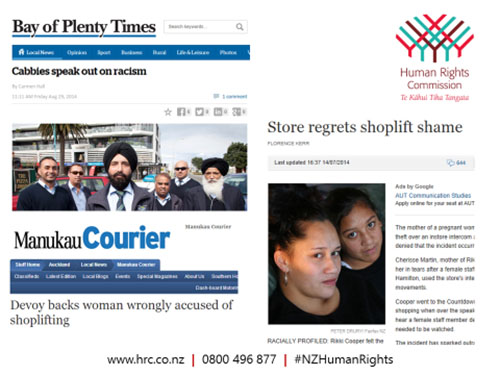
 Māori are viewed as “different” whereas Pakeha things are viewed as “normal”.
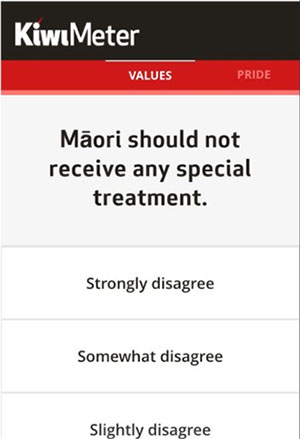 The Kiwimeter was touted as the biggest survey of national identity ever undertaken and in one question the survey stated:
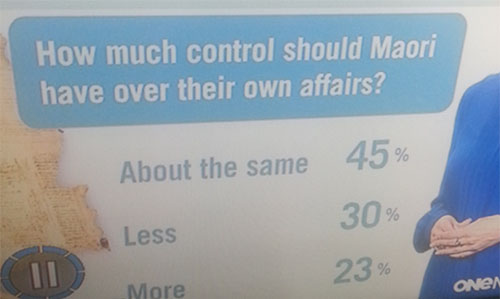 If the question was “How much control should Pakeha have over their own affairs?” it is unlikely this question would have made it onto our television screens.