Page 1212

Southern Cross: Media climate study, free speech in Indonesia and Timor-Leste PM’s gag

]]>

AsiaPacificReport.nz

Baseline media and climate change study by a team of researchers led by the University of the South Pacific. Image: Climate Change

Pacific Media Watch News Desk

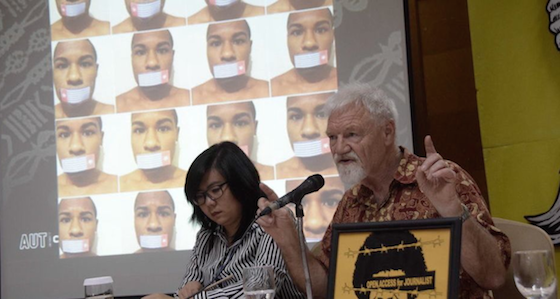
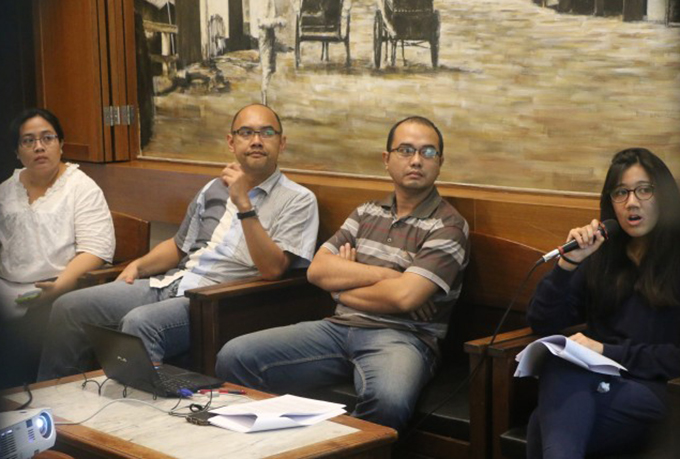
Pacific Media Centre’s Kendall Hutt speaks with host of Radio 95bFM’s The Wire Amanda Jane Robinson about a study on how journalists cover climate change, free speech in the case of Indonesia’s blasphemy law, and Timor-Leste journalists facing jail for defamation over criticising the Prime Minister.

]]>

Indonesian student Afi’s blog items inspirational – but her FB ‘frozen’

]]>

AsiaPacificReport.nz

The Facebook account of Afi Nihaya has been suspended. This was her last post before being blocked.

Translated by Khairiah A. Rahman

The Facebook account of Afi Nihaya Faradisa, an Indonesian high school student from the village of Banyuwangi in eastern Java who has inspired thousands of netizens, has been suspended.

Afi Nihaya Faradisa … an online inspiration to thousands of Indonesians. Image: Rappler

This suspension of Afi’s account has raised many questions on social media since she has been posting many inspirational entries that are loaded with values and insights about nationality and nationalism.

At the same time that the account was “frozen”, Afi was featured on TV as a valued inspirational figure.

The following is Afi’s last entry, entitled “Heritage”:

As it happens, I was born in Indonesia from a Muslim couple, therefore my religion is Islam. If I had been born in Sweden or Israel, from a Christian or Jewish family, is there any guarantee that today I would embrace Islam as my religion? No.

I cannot choose my place of birth and where I will live after I am born.
My citizenship is inherited, my name is inherited, and my religion is also inherited.

-Partners-

Fortunately, I have never argued with those of different heritage because I know they too cannot choose what they have inherited from their parents and nation.

A few minutes after we are born, the environment decides our religion, race, clan and nationality. After that, we defend till death all matters that even we have never decided for ourselves.

Since infancy, I have been indoctrinated that Islam is the one religion that is true. I pitied those who are not Muslim, as they are non-believers and upon death will go to hell.

Clearly, my friends who are Christian also has the same supposition about their religion. They pity people who do not take Jesus as God, because such people will go to hell; that is the teaching of their religion.

Therefore, imagine if we do not stop pulling one another to convert to another faith, imagine if the followers of different faiths continue to compete for superiority like that, even though there will never be a meeting point.

Jalaluddin Rumi said, “The truth is a mirror in the hands of God. It fell and broke into pieces. Everybody took a piece of it, and they looked at it and thought they had the truth.” Indeed, one characteristic of followers of a religion is to claim the truthfulness of their religion. They also do not need verification; this is “faith”.

Indeed, people have the right to convey the words of God, but do not occasionally try to be God. There is no need to label others as entering heaven or hell for we are also servants.

The background of all disputes is because each heritage claims, “my group is the best because God himself said so.”

So, my question is if not God, who else created the Muslims, Jews, Christians, Buddhists, Hindu, even Atheists and looked over them all until today?

There is none that question the power of God. If He wanted, He could easily have made us all the same. Identical. One religion. One nation.

But no, right?

Does it mean that if a country is occupied by citizens of the same religion, it would guarantee harmony? No!

In fact, several countries are tumultuous even though their citizens share the same religion.

Do not be surprised that when the sentiments of the majority versus minority dominate, then our humanity suddenly disappears to who knows where.

Imagine also if each religion demands that their holy book be used as the country’s foundation. Then just wait for the downfall of our Indonesia.

Because of this, what is used by our country for policy making in politics, sentencing or humanity is not Al Quran, the Bible, Tripitaka (Buddhist scripture), Weda (Hindu scripture) or the holy book of any religion, but Pancasila, Foundational Law ’45, and the motto “Unity in diversity”.

From the perspective of Pancasila, everyone who embraces a religion is free to believe and practise their faiths, but they have no right to impose their views and religious teachings as a benchmark for assessment against the believers of other faiths.

Just because of self-righteousness, the believer of religion A has no right to intervene in the policy of a country that consists of various beliefs.

One day in the future, we will tell our descendants how the country came close to destruction not because of bombs, weapons, bullets, or missiles, but because its people claim superiority over one another, fussing over their respective heritage on social media.

While other countries have been to the moon or are planning technology that advances civilisation, we are still fussing over the question of heritage.

We don’t need to have the same thinking, but let us all have the same thought.

]]>

PNG’s media council unveils updated code of ethics as guide for elections

]]>

AsiaPacificReport.nz

President Alexander Rheeney (top centre) and a section of the new MCPNG website and code of ethics.

Pacific Media Watch News Desk

Journalists, reporters and media practitioners in Papua New Guinea have been urged to use the industry’s revised code of ethics to guide their conduct during next month’s 2017 General Election.

The General Code of Ethics for the News Media was reviewed and updated by the Australian Press Council in October last year after the MCPNG approached and asked for their assistance, due to the growth of the PNG media industry and the arrival of social media and online news services.

The MCPNG board met and agreed to give the revised edition of the code its stamp of approval in December last year and distribute it to all media personnel on the eve of Papua New Guinea’s 2017 general election.

“I must thank the Australian Press Council for the collaboration and partnership by agreeing to review and revise our General Code of Ethics for the News Media — especially Professor David Weisbrot, chair of the Australian Press Council, who played a major part in the review,” said MCPNG president Alexander Rheeney.

“The revised code covers all aspects of a growing PNG media industry including online news services. I appeal to all media personnel to use it as a guide when covering the 2017 general elections, as it will ensure that the news content you produce will be of a high standard for your Papua New Guinean listeners, readers and viewers.”

The release of the revised code coincides with the launching of the MCPNG’s new website

-Partners-

Rheeney said the availability of the new website would ensure that the code, the work as well as the goals and objectives of the MCPNG was now available for media industry people and the PNG public to check.

“I urge the public to log on to our website and check out the code so you are aware of the conduct that all media practitioners including journalists are expected to benchmark themselves against when covering news in Papua New Guinea.”

Should there be instances of abuse of the revised code; said Rheeney, the aggrieved member of the public should not hesitate to contact the respective media organisations or the MCPNG to take it up on their behalf.

Expatriates in police training
Meanwhile, Loop PNG reports that the National Security Advisory Committee (NSAC) chair and Chief Secretary to Government has condemned statements on social media about the recruitment of expatriates in police training.

Isaac Lupari has expressed appreciation for the recent demonstration of police training that would “strengthen police tactical response capability”.

He criticised some social media commentators who had sought to make “misleading comments” that were not related to the training demonstration.

Lupari said the National Security Advisory Committee had been briefed by Police Commissioner Gari Baki and would present its recommendations to the National Executive Council.

He said there was no such thing as a private army or security operation — these rumours were created by people with a political agenda, he claimed.

Many social media websites last week carried images of heavily armed white expatriates, often seen alongside police officers.

]]>

Pacific media internship offers chance to follow regional issues

]]>

AsiaPacificReport.nz

One of the PCF interns coming to New Zealand, Shivika Mala of the University of the South Pacific, talks to the Pacific Media Centre about climate change. Video: PMC’s Bearing Witness project

By Kendall Hutt in Auckland

Journalism students from across the Pacific will have the opportunity to understand one another’s news cultures as the Pacific Cooperation Foundation’s media programme enters its third year.

Two final year student journalists from New Zealand will head to the Pacific next month, while three Pacific-based student journalists will travel to New Zealand for the two-week internship.

Michelle Curran, project manager of the PCF media programme, says the exchange aims to offer a regional perspective to participating interns.

“Our hope is for interns to gain a broader awareness of how media operates in different countries, the differences in resources available, and to broaden their network.

“The ideal outcome is to produce journalists with an in-depth regional perspective and knowledge of Pacific issues.”

-Partners-

One of these journalists is Auckland University of Technology’s Brandon Ulfsby, who is bound for Samoa.

Ulfsby says his motivation for applying stems from the fact Pacific news is an area which can be expanded on.

‘Make Pacific mainstream’
“I definitely think there is a lot more room to kind of build on existing platforms and really make the Pacific the mainstream, because I feel at the moment it’s quite situated in itself, that it’s separate news, it’s Pacific news that only people who are interested in it sort of focus on it.”

This absence is something the PCF has identified, Curran says.

“These students will eventually help raise the standard of journalism in the region, and increase the awareness of Pacific issues in New Zealand.”

AUT’s Brandon Ulfsby … “make the Pacific mainstream”. Image: Kendall Hutt/PMC

Ulfsby, who is of Cook Islands descent, says he is looking forward to highlighting the human face of the Pacific.

“Really delving into the lives of people is something I want to cover.”

Having the ability to network and work alongside senior journalists and editors is also an important opportunity, Ulfsby says.

“It’s just experiencing a different newsroom culture and at the same time I want to elevate Pacific stories and give those people a voice, so that other people can hear them and possibly influence change.”

‘Every day reality’
For Shivika Mala and Linda Filiai, both from the University of the South Pacific, bringing awareness to climate change while in New Zealand will be key.

“I will try to inform New Zealanders about the effects of climate change in the Pacific. I do understand that New Zealand and the Pacific Islands prioritise different issues.

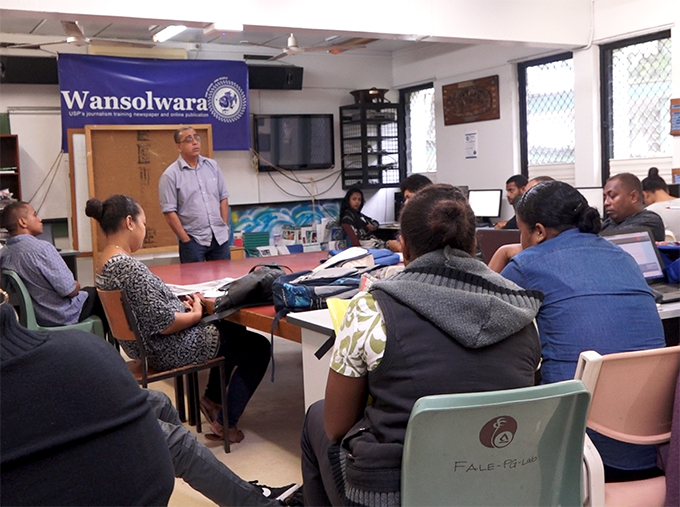
USP journalist Linda Filiai … bringing awareness to climate change key. Image: Wansolwara

“It’s important for the people in New Zealand to know that some people in the Pacific Islands are suffering from extreme weather events such as cyclones, coastal erosion, droughts, and water shortages.

“Sea level rise is one of the greatest challenges,” Filiai says.

Mala, however, is determined to convey that climate change is an every day reality for the Pacific.

“It’s funny how some people are not aware about climate change and how the Pacific Island countries are vulnerable to its effects.

Third year University of the South Pacific journalism student Shivika Mala … “it’s funny how people are not aware about climate change. Image: Shivika Mala

“It is our everyday reality and people must know about it because sadly, we are the ones who contribute to it.”

Filiai and Mala acknowledge they have been given a rare opportunity.

“This is a great opportunity for us in the Pacific to experience how news media operates in a developed country like New Zealand.”

Joshua Kiruhia of Divine Word University in Papua New Guinea will join Filiai and Mala in New Zealand, while Massey University’s Safia Archer will also head to the Pacific.

The Pacific Media Centre at AUT will host the Pacific regional students for half a day on their New Zealand programme.

The PCF media programme will take place between June 26-July 11.

]]>

Thousands support Indonesian petition to repeal blasphemy law

]]>

AsiaPacificReport.nz

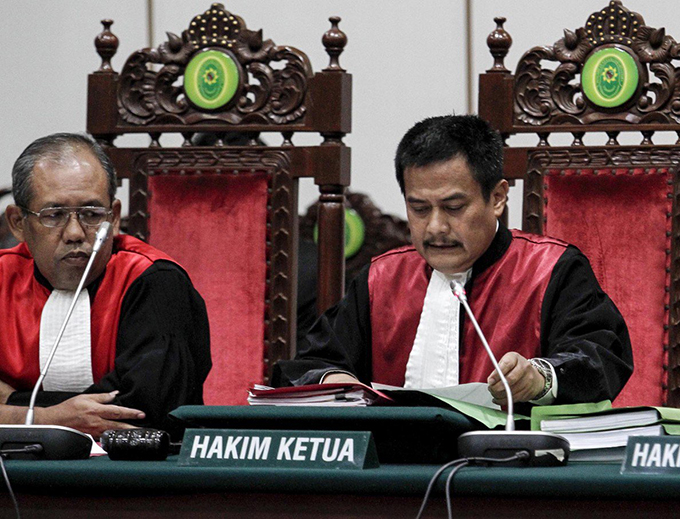
North Jakarta District Court chief judge Dwiarso Budi Santiarto reads out a guilty verdict against non-active Jakarta Governor Basuki “Ahok” Tjahaja Purnama. Image: Kurniawan Mas’ud/Jakarta Post

By Marguerite Afra Sapiie in Jakarta

Indonesians have called on President Joko “Jokowi” Widodo to immediately repeal Article 156a on religious blasphemy of the Criminal Code (KUHP), with thousands of people having signed an online petition urging the government to do so.

Through an online petition entitled “President Jokowi, Scrap Article 156a on Blasphemy from KUHP Revision” registered at change.org, two petitioners, Gita Putri Damayana and Gita Syahrani, raised the call.

In less than a week since the petition was submitted online, more than 10,000 people have endorsed it.

The petition was created following the decision of the North Jakarta District Court to sentence non-active Jakarta Governor Basuki “Ahok” Tjahaja Purnama, a Christian and ethnic Chinese, to two years in prison for “defaming religion” last week.

“Ahok’s conviction is one among many cases […] that shows that Article 156a of the KUHP is used to judge someone’s beliefs and ideas, and that difference is something that is seen as wrong,” the petitioners wrote in the petition as quoted by change.org.

The petition, directed toward Jokowi and Law and Human Rights Minister Yasonna Laoly, urged the President through the minister to push legislators at the House of Representatives, which is currently amending the KUHP, to scrap the article.

-Partners-

“There is still time for the public to push for the agenda to scrap Article 156a from the KUHP,” the petition read.

]]>

‘I want my children back’ – Fighting for Australia’s indigenous children

]]>

AsiaPacificReport.nz

Laura Lyons … “I clearly became a target because I supported my daughter.”

SPECIAL REPORT: Laura Lyons has been battling the New South Wales and Australian government to have her three children returned to her since they were forcibly removed on 4 December  2015. The children were taken from their local school because of allegations of alcohol abuse, drug abuse and neglect. Laura — who says that she has not drunk alcohol in 27 years nor does she take drugs —  claims that the children were taken from her because of a vengeful social worker and a “racist corrupt child welfare system that provides exorbitant financial rewards to foster caregivers”.

Dr Camille Nakhid continues her series on Australia’s shame, the unending Stolen Generation.

Following strong advocacy and persistent lobbying from Laura Lyons, the Grandmothers Against Removals (GMAR), and Werribee, two of Laura’s children, aged 12 and 9, were finally removed from the homes of strangers and placed with family. However, Laura’s 11-year-old daughter, was placed in a specialised therapeutic placement in Newcastle. The child has since reported being abused by the caregivers in the placement and by the manager who, during an incident, sat on the girl’s back in an attempt to forcibly restrain her, resulting in the young girl being admitted to hospital.

The daughter has run away from the centre on numerous occasions and has fallen prey to strangers who have offered her cigarettes and “drugs to snort up her nose”.

Laura Lyons’ complaint to one of the New South Wales police/station officers in October 2016 about the claims of abuse made by her daughter Laura was met by Detective McClarke from the Marrickville Police Station who confirmed that indigenous children are routinely abused in foster care.

Laura claims that the placement of her daughter with strangers has resulted in psychological and emotional trauma for both her and her daughter.

Laura’s children, who had previously been moved from one placement because of sexual abuse claims made by the daughters against the 17-year-old son of a foster caregiver had, on several occasions, begged the Department of Family and Community Services to be returned to their mother’s home.

-Partners-

Laura’s four grandchildren who were also removed from their mother’s home in 2014 is still in the custody of caregivers of the state.

Laura is aware that it is a long process to get her children and grandchildren back but with the support of GMAR and Werribee she vows to continue fighting. GMAR operates to visit and support grandmothers who have had their grandchildren taken away from their parents. GMAR is aware that it is not only the children and parents that are left traumatised by these events but the wider family and community.

Laura Lyons with Dr Camille Nakhid … GMAR has developed a set of guiding principles. Image: Camille Nakhid/PMC

Fathers have also been affected by the forced removal of their children. Laura claimed that in the central tablelands of New South Wales, as many as 26 children were removed from single fathers in one month.

In December 2016, GMAR, along with other interest groups and organisations focused on human rights joined together to support each other and to fight for the future of Australia and of Australia’s children.

GMAR has developed a set of guiding principles about the removal and placement of Indigenous Australian children. The principles include:

  • placing the child in an environment where the child is raised with a positive awareness and knowledge of their culture,
  • parents are consulted,
  • children are placed with family members, and
  • siblings are not separated from each other.

Laura says the social workers need to be aware of, and trained about, these principles.

Laura believes that the ongoing problems with her youngest daughter are because of her being placed in isolation at the residential facility and disconnecting her from her family.

“For Aboriginal people, that’s the most important thing — family and culture. Without that, you got nothing. You’ve got absolutely nothing. You will lose your self-identity”.

Update: After moRe than a year of fighting to bring awareness of the harmful and discriminatory practice of the forced removal of Indigenous Australian children from their families, Laura’s children have all been restored to her care in April with the help and support of GMAR and Werribee.

“Now my children have been restored to my care, it’s time to commence the healing process and that’s going to be quite challenging,” says Laura.

Laura Lyons continues to fight to bring about change within a “racist genocidal system”. She continues with her dedication to support other families who are also victims to this system.

“With the over representation of Indigenous children in ‘out of home’ care, we need to form solutions to reduce these numbers and prevent our children from getting lost in the system”.

Laura’s grandchildren have also been returned to their mother.

* Werribee is a self-help support group founded by Laura Lyons and her daughter Bianca. Werribee is a Wiradjuri word that means backbone.

Associate Professor Camille Nakhid has written a series of articles about the Stolen Generations. Other articles can be viewed here. Pacific Media Watch contributing editor Kendall Hutt assisted with today’s publication by transcribing the interview.

Other Stolen Generation stories on Asia Pacific Report:

More about Grandmothers Against Removals

If you wish to donate to GMAR, click on this link:

Contact | Donate

If you want to sign the petition, click here

]]>

Indonesia must step up over Papuan development, says ELSAM

]]>

AsiaPacificReport.nz

Speakers at the Elsam “Decolonialisation to Marginalisation” seminar yesterday. Image: ELSAM

The Indonesian government needs to change the policy of development which makes Papuan community a subject, says a non-government organisation that specialises in West Papuan development issues.

This has emerged in the launch of research results and discussion “From Decolonialisation to Marginalisation: Portrait of Government Policy in Tanah Papua for the Last 46 Years” held by ELSAM in Jakarta yesterday.

Research coordinator on Papuan issues Budi Hernawan said that the research focused on three issues — demographic changes in Papua and the impact of development policy, environmental degradation, and militarisation.

ELSAM provided several recommendations related to the three issues.

According to the coordinator of information and documentation of ELSAM, Ari Yurino, the transmigration programme in Papua has evidently brought negative impact to the social life of Papuan natives.

Due to the uneven transmigration and development programme, it has caused the increase of the number of migrants in Papua and the rise of conflict between the newcomers and the indigenous Papuans.

The transmigration programme must be terminated and its policy must be evaluated, Yurino said.

-Partners-

‘Alternative solution’
“As an alternative solution of regional development, the national government should facilitate the cooperation among regions to strengthen the local government in order to be able to seek for autonomous development,” he said.

One of the recommendations to the local government, he added, was to also formulate Perdasi (Provincial Regional Regulations) and Perdasus (Special Regional Regulations) which would encourage the assimilation of the migrants into Papuan culture through formal and informal education.

Meanwhile, in the context of environmental degradation, ELSAM’s programme staff, Kania Mezariani, said the national government needed to urgently conduct environmental auditing on all national scale projects in Papua, especially in the plantation and mining sectors.

According to her, those two sectors often became the triggers of conflicts, both locally and nationally

“The national government should focus on economic development which directly connects to the peoples’ needs,” she said.

Mezariani added that the local government should establish spatial planning in Papua and West Papua provinces in order to guarantee the life space of the indigenous Papuan people, especially related to the domination of the rainforests and lands of Papua.

Also the coordinator of human rights defenders capacity building of ELSAM, Mike Verawati, spoke about the importance of reviving community police in Papua.

‘NZ-aided community police’
“In Java, such a pattern is applied. Previously, the community police was run — through assistance from the Netherlands and New Zealand police institutions — quite successfully.

“That project should be run again. The government officers assigned in Papua should also receive the briefing about anthropology in order to understand and use the approach in accordance with Papuan characteristics,” she said.

Other than that, she also called on the national government to terminate the extension of authority to the Indonesian National Army over the defence role as specified in Law No 34/2002 on Indonesian National Army.

Budi Hernawan saisd ELSAM also urged Komnas HAM and the Attorney-General to immediately complete the documentation of human rights violations cases in Papua.

Hernawan added that local government must immediately establish a human rights protection instrument, especially like the Regional Commission on Human Rights, Human Rights Court, and Truth and Reconciliation Commission in Papua and West Papua, as mandated by Law No 21/2001 on Special Autonomy.

ELSAM’s website

]]>

Four killed, eight wounded in bungled Indonesian military exercise

]]>

AsiaPacificReport.nz

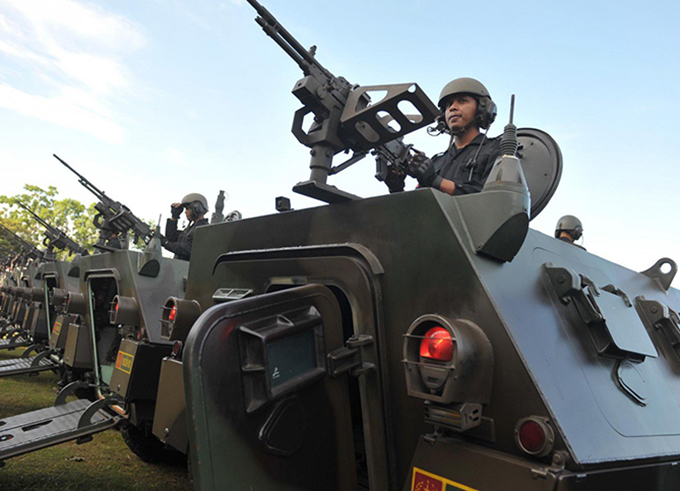
Soldiers in position during a VVIP security exercise in Nusa Dua, Bali, in March. Image: Nyoman Budhiana/Jakarta Post/Antara

By Fadi In Batam, Ruiau Islands, Indonesia

A Chinese-made cannon has malfunctioned and fired off shots randomly during military exercises in Indonesia’s Tanjung Datuk, Natuna, Riau Islands province, on Wednesday. Four soldiers were killed and eight were wounded.

During the exercises, held by an Indonesian Army quick response team (PPRC TNI AD) at the Air Defence Artillery 1/K compound, soldiers were undergoing target practice with the Giant Bow cannon.

The exercises were reportedly part of preparations ahead of an event scheduled for today during which a military parade was to be be conducted in front of President Joko “Jokowi” Widodo.

READ MORE: Air force proposes new base in Batam

However, Army spokesperson Colonel Alfret Denny Tuejeh denied the exercises were connected to a parade, saying they were just regular exercises.

He had previously confirmed that the incident occurred during a “rehearsal”.

-Partners-

“The incident occurred during the second round of exercises [on Wednesday],” he said, adding that the incident happened about 11 a.m.

The gears “malfunctioned”, Tuejeh said.

The first round of exercises proceeded smoothly, he said.

Denny said there were 12 victims, including the four fatalities. The eight wounded soldiers were taken to Natuna General Hospital.

]]>

Bryce Edwards Analysis: New Zealand’s democracy and its discontents

Analysis by Dr Bryce Edwards: New Zealand’s democracy and its discontents
[caption id="attachment_13635" align="alignleft" width="150"] Dr Bryce Edwards.[/caption] The big theme of this year’s general election could turn out to be disinterest and disengagement in democracy. Can our low voter turnout be solved? Or is there a deeper problem with our democracy?
All over the world there’s said to be a “crisis of democracy”. Discontent with politics and the status quo is rising, and it’s being expressed in all sorts of ways – in particular, voting for populists and radicals, increased protest, and people choosing not to vote at all.
Here in New Zealand we have been relatively immune from some of the more dramatic backlashes against politicians and elites, and there’s been no comparable leap in support for populism. But there are plenty of signs of discontent, and recently there has been some colourful and meaningful debate about the health of New Zealand’s democracy, as well as some proposed solutions put forward.
Democracy’s discontents
In the last few weeks there have been three opinion pieces published expressing some sort of discontent and critique of contemporary representative democracy. All three articles come from quite different points of view, but all express strong reservations about the health of democracy and a lack of faith in how well representative elections are working for society.
The first – and most damning – was Herald columnist Rachel Stewart’s Are we in the dying days of democracy? In this, Stewart channelled the sort of leftwing anger about the state of democracy and politics normally seen from the likes of Russell Brand and Bernie Sanders. She declares that “In a world gone mad – or, at least, out and proudly neo-liberal – democratic values appear to have entered the ever-tightening circles of the death spiral.”
Stewart says that she will cast a vote this year, but: “I also know, in the rational part of my brain, that voting is now about as pointless as rooting for your favourite rugby team to win. It’s fleeting, ultimately quite meaningless, and changes nothing much in the overall scheme of things. It’s essentially just tribalism. If I thought that most politicians were serving the folks who put them there, and not the powerful money grubbers who both run the world while destroying it, I’d likely enjoy giving their box a tick. As it stands, I’m leaning more towards giving them all the great, big flick.”
It’s not only opinion columnists expressing such dissenting views – Leonid Sirota, a lecturer in constitutional law at AUT Law School, then published an equally-provocative, and very well-argued opinion piece to say, As a way to express one’s views about public affairs, a vote is remarkably ineffective. Although ostensibly an argument against proposals to introduce compulsory voting, this piece also makes the case that voting is over-rated as a component of democracy: “Assuming that citizens have a duty to care about public affairs (which is doubtful), voting is only one way among many to do so. One can discuss politics with one’s friends; go to protests and meetings; write letters to the editor to condemn the politicians’ misdeeds; or one can vote. Voting hardly contributes more to the community than any of the other things an active citizen might do. No one believes that we have a duty to write a prescribed number of letters to the editor in each electoral cycle. Is voting different?”
On compulsory voting, Sirota argues “there are no compelling arguments for, and some serious ones against it.” One of these arguments is that it would force those who are uninterested in politics – which he defends as a rational choice – and this might have unintended consequences on how politicians operate: “In attempting to reach out to the least interested, and thus often the least knowledgeable, voters, politicians are likely to adopt campaign tactics and policies that could well harm democracy more than they would help it. Instead of a more deliberative and inclusive political climate, they would foster a more populist one, in which sloganeering and simplistic appeals would be even more important than they already are. The supporters of compulsory voting should be careful what they wish for.”
The whole concept of elections themselves are the problem, according to University of Canterbury political scientist Nicholas Ross Smith who advocates an improvement to democracy entailing “real systemic change. Bluntly, any system of government which has elections as the centrepiece of its popular participation is inherently flawed. Elections reward candidates with power, status, and money while also enabling interest groups to influence candidates” – see: The problem with elections.
Ross Smith is a fan of citizens’ juries and assemblies that involve ordinary people randomly selected, based on an ancient model that he argues is a superior form of democracy: “The Athenians used a lottery system called sortition to randomly select citizens”. By this method, political decisions would be made by such groups of citizens, somewhat in the way the jury trials currently work in the justice system.
He proposes that “sortition” is a radical means of reinvigorating democracy: “In an age where democracy is seemingly dying, re-emphasising the demos, even by just undertaking modest steps as suggested above, is surely the path we have to take to reinvigorate our democracy. Otherwise, no matter what superficial adjustments we make, we will continue to live in an oligarchy masquerading as a democracy.”
Democracy’s defenders
These radical critiques of the status quo have been seen by some as attacks on democracy itself, and a dangerous route to go down. For example, leftwing commentator Chris Trotter says “dissing democracy is never, ever, a good idea” – see: Not dead yet: A response to Rachel Stewart’s musings on democracy.
Trotter admits that democracy is “having a rough time at the moment”, but says “that only reinforces the need to get stuck in and organise it back into robust good health.” He maintains the status quo is worth protecting in light of the possibility that things could get much worse: “a corrupt democracy is always – always – better than a virtuous tyranny”.
A much more detailed defence of representative democracy is put forward by Victoria University of Wellngton’s Jack Vowles, who strongly takes issue with the arguments of both Stewart and Sirota, suggesting their arguments are simplistic and their solutions are counterproductive to their aim of increasing the political influence of the marginalized in society – see: Voting under attack as election approaches.
Vowles, a political scientist, suggests that “Sirota and Stewart ignore one of the most powerful lessons of political science: ‘If you don’t vote, you don’t count’.” By this he means that politicians will only direct their policies towards those who are actually likely to vote, and therefore, “If public policy in democratic societies is biased toward the rich, property owners and the old, all else being equal there is likely to be a simple reason: these are classes of people who tend to vote. The poor, those who own little or no property, and the young are less likely to do so.”
He also makes a case that, although politics in this country is far from perfect, “Democracy is a work in progress and the battle to enhance and defend it is ongoing. Internationally, there have been recent democratic reversals. But it is not helpful if those who believe in democratic values simply give up electoral politics and encourage others to do so.”
These critiques prompted Rachel Stewart to respond in the Herald, wondering why “my mere musings would hit so many raw, jangly nerves”, and suggest that the negative reaction could be understood in terms of identity politics – see: Pesky ECGs (elderly Caucasian gents) need to get out more.
Leonid Sirota also responded to Vowles’ arguments to reiterate that his own concerns were to argue against compulsory voting, but again to emphasise that he wants to expand democracy, not limit it further – see: A critique of democracy, not an attack.
Discontent with this year’s election
Not all of the current discontent with the state of democracy revolves around the theoretical principles and (arguably) esoteric disputes about ways of running society. Some critics are simply bemoaning that there’s not enough quality election debate going on.
For example, TV reviewer Jane Bowron thinks politicians aren’t fronting up enough for debate: “I can’t remember such a quiet lead-up to an election, and an urgent need for so many important issues to be thrashed out, or at least given a proper public airing. Housing, immigration, climate change, water degradation, dairying, health – particularly the state of mental health, education, road and rail, infrastructure … take your pick. It isn’t just a case of New Zealand being overshadowed by world politics, our politicians simply aren’t in clear sight” – see: What election? Who’s seen the politicians?
Former National Cabinet minister Wyatt Creech has also expressed strong doubts that quality debate and discussion is going to occur this year, especially in light of the health of the media: “In fact, it’s the reverse; this diet of superficiality and sensationalism eats away at real debate. That is not just unfortunate from the perspective of those of us interested in public policy; it’s seriously sapping of the true lifeblood of democracy. It is no wonder interest in politics and voting, especially amongst milliennials, wanes. It is no wonder surveys show the general public’s increasingly low respect for politicians, the media and the system. I think we all would like to see this dis-interest reversed; I sure hope so. The question is how to do it” – see: How to drive voting & policy debate this election… and how not to.
Solutions to New Zealand’s democratic malaise
So, should we make it illegal not to vote? That’s the putative solution that is fast gaining ground in the debate about democracy in New Zealand at the moment. The idea got a major boost last month, when three former prime ministers came out in support: “Jim Bolger, Mike Moore and Sir Geoffrey Palmer want New Zealand to follow Australia’s lead and introduce compulsory voting” – see RNZ’s Former PMs support compulsory voting in NZ.
The three former PMs all spoke out in Guyon Espiner’s series of RNZ interviews, which you can watch here: The 9th Floor. They all have strong concerns about the declining participation in politics. For example, Geoffrey Palmer says there’s a “crisis” in democracy throughout the western world, including here: “Hardly anyone votes. Are they turned off by it? Do they think it doesn’t matter? If you are going to live in a democracy which is supposed to be conducted by the people for the people then the people should have some duties. They should participate and they should vote.”
But politicians are mostly against the proposal. Current PM, Bill English, says “no one’s made the case for it”, and “Part of the job of politicians is to persuade people it’s worth voting”. Similarly David Seymour suggests it’s a dead end: “You can lead a voter to the ballot booth, but you can’t make them think” – see Craig McCulloch’s Former PMs support compulsory voting in NZ.
Herald columnist Brian Rudman argues that the decline in participation is partly driven by the decline in the power of politics, and that compulsion would be artificial: “Now that central government has taken a major step back from interfering in citizens’ lives, it should have been no surprise that those most disadvantaged have begun to decide there’s nothing here for them either and drifted off. Australian-style compulsory voting will certainly make the figures look better. But forcing the unwilling to participate under threat of a fine is hardly democracy of the willing” – see: Compulsory voting not the answer to low turnout. Rudman proposes, instead, that greater state funding be given to the political parties to foster their outreach to voters.
Finally, a week ago two Wellington scholars – Emily Beausoleil and Max Rashbrooke – published their own diagnosis of the problem: “Rather than pushing people to the ballot box, we need to address the reasons they are failing to turn up under their own steam. People are turned off by an increasing distrust in MPs, a widening gap between political elites and everyday citizens, and politicians’ growing failure to represent ‘the people’ as the tentacles of money reach ever deeper into political campaigning. If we want people to turn out to vote, we need better parliamentary politics.” They therefore propose a series of “everyday democracy” initiatives to “put many more decisions into the hands of citizens” – for more about these ideas, see: More direct democracy better than compulsory voting.
Today’s content
 
All items are contained in the attached PDF. Below are the links to the items online.
Housing
Brian Fallow (Herald): Shelter is for people, not tax
Foreign Affairs and Trade
Patrick Gower (Newshub): Bill English bids to seal TPP deal
Patrick Gower (Newshub): Bill English has saved TPP
Immigration
Democracy
Jesse Mulligan (RNZ): Engaging youth in civics
Constitution Aotearoa NZ: The case for economic rights
Education
Virginia Larson (North and South): White noise: When white privilege drowns out reality
Lynda Stuart (Spinoff): Charter schools: the case against
Colin Craig vs Cameron Slater
Peter Aranyi (The Paepae): The defamation case that never was
Health
TOP cannabis reform
Justice
National Party
Ports of Auckland sale
David Farrar (Kiwiblog): Go Goff go
Other
Matthew Hooton (NBR): Winston’s top job ambitions on track (paywalled)
Katherine McDonald (Southland Times): Taking health and safety seriously
Phil Pennington (RNZ): MBIE drags heels on steel testing
John Drinnan (Herald): Time to defrost RNZ funding
]]>

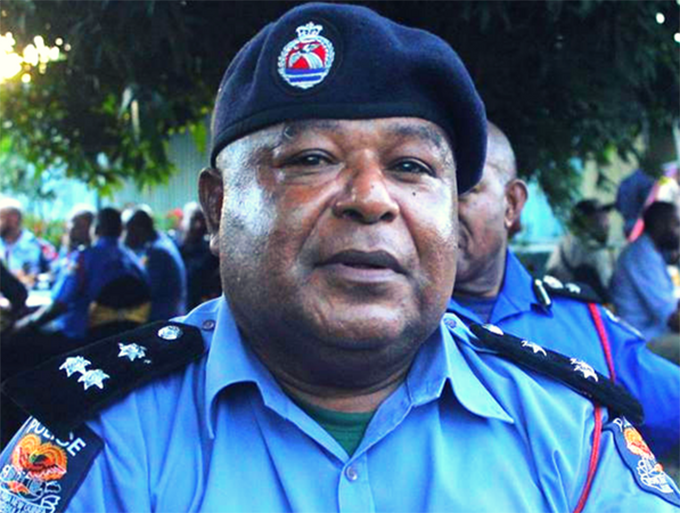
PNG police chief stands down expat security contractor over ‘illegals’

]]>

AsiaPacificReport.nz

Some of the images circulated on social media such as the PNG Development Forum and carried by TV Wan News. Image: Harley Geita/PNG Development Blog

Pacific Media Centre News Desk

A group of United States security contractors engaged by Papua New Guinea’s police chief to give firearms training have been stood down from their duties, ABC’s Pacific Beat reports.

Only a day earlier, Commissioner Gary Baki had said the men — from the US firm Laurence Aviation and Security — were in Port Moresby investigating what type of training PNG police needed ahead of next year’s APEC summit.

But Baki revealed the men – described by former prime minister Sir Mekere Morauta as “mercenaries” — as also having conducted police operations, something that may be illegal according to PNG’s Constitution, reported Pacific Beat.

As a result, there had been calls for the police commissioner to resign and be investigated.

National Broadcasting Corporation News reported that 15 contracted men would be deported.

ABC Pacific Beat’s Joy Kisselpar reported that Commissioner Baki said five men currently in PNG with Laurence Aviation had been stood down until the National Security Advisory Committee considered his submission.

-Partners-

Intense speculation
The identity and purpose of the armed security men have been the subject of intense speculation and conflicting reports since social media reports and images of their presence last weekend, reports Pacific Media Watch.

In February 1997, the Sandline affair involving foreign mercenaries threw Papua New Guinea into turmoil.

The PNG military arrested 44 mercenaries brought into the country from Australia, Britain and South Africa to be engaged in the Bougainville war by the Sir Julius Chan government.

Chan was forced to resign the following month. The crisis was named after Sandline International, a British-based private security contractor.

]]>

Timor-Leste journalists facing jail for defamation over PM criticism

]]>

AsiaPacificReport.nz

Lourenco Martins, former editor of the Timor Post (from left); and Oki Raimundos, current editor of the Timor Post, at the first interview with the prosecutor in April 2016. Image: Jim Nolan/IFJ

Pacific Media Watch News Desk

The International Federation of Journalists (IFJ) has joined its affiliates Media, Entertainment and Arts Alliance (MEAA) and the South East Asia Journalist Unions (SEAJU) in strongly condemning the latest development in the slanderous denunciation case against Timor-Leste journalists Oki Raimundos and Lourenco Martins, reports the IFJ Asia-Pacific bureau.

The IFJ, MEAA and SEAJU have called for the charges to be immediately withdrawn.

The lead prosecutor in the case against Oki Raimundos and Lourenco Martins yesterday put forward the final allegations in the case calling for Oki to be jailed for one year and Martins to be jailed for one year with a further two years suspended sentence.

The court will deliver the verdict on June 1 in Dili, Timor Leste.

READ MORE: Timor-Leste PM presses defamation case against editor

The allegations against Oki and Martins stem from an article authored by Oki and published by the Timor Post – when Martins was the editor-in-chief — in November 2016 which referred to the now Prime Minister of Timor-Leste, Rui Maria de Araujo, in his previous role as adviser to the Minister for Finance.

-Partners-

According to the article published on November 10, Araujo, recommended the winning bid for a project to supply and install computer equipment to the new Ministry of Finance building in 2014.

As outlined under the Press Law, Article 34, the right of reply is guaranteed. As such, the Timor Post published the Prime Minister’s reply to the article on the paper’s front page on 17 November 2015.

The Timor Post then published a clarification of Oki’s report in its 18 November 2015 issue.

On April 11, 2016, the Timor-Leste prosecutor began an investigation into the report, after a “slanderous denunciation” lawsuit was filed by the Prime Minister.

The interview was the first step in the process of a decision whether to lay charges against the journalists under the Timorese criminal code.

The IFJ, South East Asian Journalist Unions (SEAJU), Committee to Protect Journalists (CPJ) and Freedom House wrote to the Prime Minister calling for the charges to be dropped. However, he responded to the letter saying: “I will not trade press freedom and freedom of expression with ‘press irresponsibility’ and ‘irresponsible freedom of expression’”.

The IFJ and MEAA have advocated on behalf of Oki and Martins to have the charges against them withdrawn throughout the process. Both Oki and Martins have been banned from leaving Timor-Leste without prior permission from the prosecutor.

In 2017, Oki was named as one of the recipients of the Balibo Five-Roger East Fellowship recipients.

Young Timorese journalists interview former prime minister Jose Ramos-Horta at the World Press Freedom Day conference on May 3 in Jakarta, Indonesia. Image: David Robie/PMC

Australian barrister and IFJ legal adviser Jim Nolan said: “If the two are convicted this will represent a significant stain on the reputation of democratic East Timor. The case is all the more grave as it involves an article which attacked the Prime Minister.

“The charges have been instituted at his behest. Any decision will also be an encouragement to authoritarian governments in the region which has been marked by increasing attacks upon the press.

“Until these charges emerged, Timor-Leste was one of the few remaining democracies in the region which enjoyed a free press and where journalists could pursue their craft free from the threat of state prosecution.”

Jose Belo, former president of the Timor-Leste Press Union (TLPU), said: “The prosecutor’s announcement yesterday is a worry for press freedom in Timor-Leste, and puts the press under threat.

“The leaders, the government of Timor-Leste are using the laws that they themselves produced to oppress the media. When Oki and Lourenco from the Timor Post, go to jail, that’s the beginning of a new era of the country’s leaders killing the free press. We really hope IFJ and journalist friends around the world will help us fight this battle.”

MEAA chief executive Paul Murphy said: “This legal assault on an individual journalist is an outrageous over-reach. It uses a draconian law to keep pursuing a journalist long after an error has been acknowledged and the record corrected.

“This law has been condemned by MEAA and many other press freedom groups around the world because it allows the government to pursue, intimidate and silence journalists.”

SEAJU said: “SEAJU regrets that East Timor, a country born from a long struggle for freedom, should now suppress one of the most essential freedoms, that of expression, and jump aboard the bandwagon of worsening repression of the press in Southeast Asia.”

The IFJ said: “We stand with our colleagues in Timor-Leste in deploring this campaign against them led by the Prime Minister. Slanderous denunciation or criminal defamation by any other name is a brutal attack on press freedom and an attempt to silence critical voices.”

#FreeTimorJournalists petition here.

]]>

Freeport mine in Papua sacks 840 striking workers following May Day

]]>

AsiaPacificReport.nz

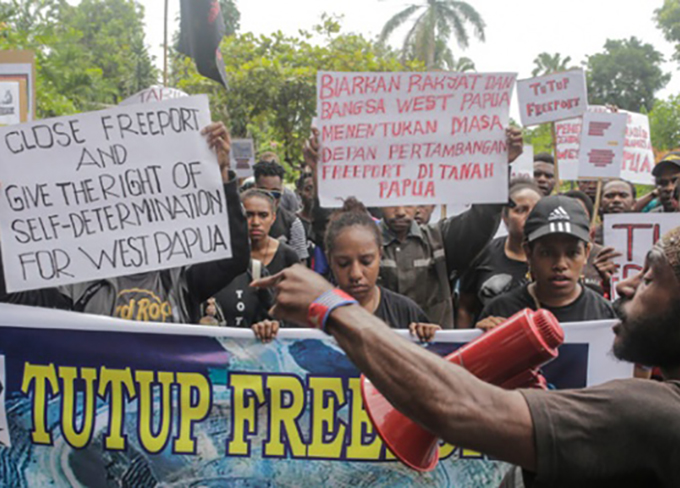
Protesters target Freeport mine and West Papuan self-determination on May Day, kicking off the month-long strike at Timika. Image: Johannes P. Christo/Tempo.co

Pacific Media Centre News Desk

Gold and copper mining firm PT Freeport has reportedly laid off 840 employees for going on strike in Timika in the Indonesian-ruled province of Papua from May Day onwards.

Septinus Soumilena, Head of the Immigration, Transmigration and Public Housing Office, confirmed he had received a report from PT Freeport about the dismissal of some 840 employees.

“We have received a letter of notification from the management of PT Freeport stating 840 employees had been laid off. Of course, this is a cause of major concern for all of us,” he said.

The Immigration, Transmigration and Public Housing Office in Mimika tried its best to prevent the layoff by writing to the management of PT Freeport on but to no avail, he revealed.

“It turns out that the letter we have sent was late, because by the time it was sent, about 430 workers had been laid off.

“Today, we sent a letter urging the management of PT Freeport to cancel the layoff. The number of employees discharged has reached 840,” he said.

-Partners-

The Mimika district government will act, as soon as possible, to facilitate a meeting between the management of PT Freeport and leaders of labor unions, he stated.

Thousands striking

Tempo reports that thousands of Freeport Indonesia’s workers in Mimika, Papua, had gone on strike from May 1 to 30, following a deadlocked negotiation with the company’s management.

Yafet Panggala, head of the organisation unit at the Chemical, Energy and Mining Workers Union (SP-KEP) of Freeport Indonesia, said that the strike in Timika commencement coincided with the International Workers Day — May Day.

Panggala had said that Freeport’s Workers Union would continue to be in communications with the company’s management.

Yafet guaranteed that the strike would cease if there was a deal with the management.

“The strike is not our goal, but it’s a means of our struggle. So, there should not be an allegation saying that we want to go on strike all the time. It’s not like that,” Yafet said.

Yafet revealed that the union and Freeport had not reached an agreement related to the disciplinary actions against workers who violate the Cooperation Agreement and the Industrial Relationship Guidelines (PKB-PHI) 2015-2017.

]]>

CPJ condemns attack on Afghan state television — at least 6 dead

]]>

AsiaPacificReport.nz

Al Jazeera’s report on the attack on the National Radio Television of Afghanistan office in Jalalabad.

The Committee to Protect Journalists has strongly condemned the attack on a state television station in Jalalabad, Afghanistan, reports Pacific Media Watch.

The four-hour attack on the Jalalabad office of National Radio Television of Afghanistan (RTA) yesterday killed at least six people and injured at least 18 others, according to media reports.

The Islamic State group in Afghanistan claimed responsibility for the attack, according to the Site Intel Group, which monitors websites used by violent extremist groups.

Four RTA employees were killed — Ilias Alami, operations manager for the Afghan Journalists Safety Committee, a press freedom group, told CPJ.

“This attack is a brazen assault not just on one television station but on the entire media in Afghanistan, which is struggling against forces that want to control the flow of information,” said CPJ deputy executive director Robert Mahoney.

“Afghan authorities should do everything in their power to prevent these attacks.”

-Partners-

RTA did not immediately respond to calls or emails. Police said four attackers and two guards were also killed, and that one assailant was arrested, according to TOLO News.

Impunity index
Afghanistan ranked seventh in CPJ’s 2016 Impunity Index, which highlights countries where journalists are killed and their killers go free.

Al Jazeera English reports that Afghanistan suffered its deadliest year on record for journalists in 2016, according to the Afghan Journalists’ Safety Committee (AJSC), adding that the country is the second most dangerous for reporters in the world after Syria.

At least 13 journalists were killed last year, AJSC said, claiming the Taliban was behind at least 10 of the deaths.

In January 2016, seven employees of popular TV channel Tolo, which is often critical of fighters, were killed in a suicide bombing in Kabul in what the Taliban said was revenge for “spreading propaganda” against them.

It was the first major attack on an Afghan media organisation since the Taliban were toppled from power in 2001.

Dan Coats, head of US intelligence agencies, said last week that the security and political situation in Afghanistan would “also almost certainly deteriorate through 2018, even with a modest increase in the military assistance by the US”.

US-led forces have been fighting in Afghanistan for almost 16 years, making it America’s longest war.

]]>

PNG Media Council blasts assault on EMTV election news crew

]]>

AsiaPacificReport.nz

EMTV’s head of news Neville Choi reports on the assault on the television crew — see item at 4min01sec. Video: EMTV News

Pacific Media Watch News Desk

The Media Council of Papua New Guinea today condemned the “unacceptable … harassment and violence” targeting media workers covering the country’s 2017 general election campaign.

An EMTV camera crew was “harassed and assaulted” last Thursday in the Moresby South electorate in the National Capital District of Port Moresby and was covered by the television network.

The MCPNG said in a statement the harassment and violence on May 11 was “unacceptable and unwarranted”.

The media had an important role to play in the dissemination of information and awareness about the 3331 candidates contesting the 89 open electorates and 22 provincial seats, said council president Alexander Rheeney.

“Papua New Guinea’s 4 million-plus eligible voters are depending on the media for critical information on the 2017 general election, the candidates as well as political parties and their policies,” he said.

-Partners-

“The media should be allowed to report without fear or favour in this general election as they have in previous elections.

“The incident last Thursday involving an EMTV camera crew and the supporters of a particular candidate is unacceptable,” Rhenney said

‘Accept responsibility’
“All candidates should accept responsibility for the conduct of their supporters so any unruly behaviour should and will be reported to the appropriate authorities.”

Rhenney said the media industry remained united and vigilant in striving to inform and educate the public. He called on candidates or supporters who “had issues” with the media to take their complaints to the MCPNG.

EMTV senior cameraman Konts Kara … harassed and assaulted. Image: EMTV News

EMTV reports that its crew was verbally assaulted and a senior cameraman punched and hit in the back with a 16 kg tripod by supporters of sitting Moresby South Member of Parliament Justin Tkatchenko.

“The mob demanded footage[to be] deleted and threatened to assault four crew members in an EMTV vehicle on Lawes road,” EMTV reports.

Journalists Bethanie Harriman and Stanley Ove Jr were collecting generic pictures of election banners around Port Moresby with senior cameraman Konts Kara when the assault happened.

After collecting pictures at Gerehu, the crew stopped in Moresby South.

On Lawes Road in Konedobu, supporters loyal to sitting MP Justin Tkatchencko attacked senior cameraman Kara.

Threatened over footage
“Mr Kara was verbally assaulted by the mob who then threatened to break a camera if the footage wasn’t deleted,” EMTV reports.

“The crowd advanced on the company vehicle banging on the windows, taking the keys off the driver, and forcing the cameraman to delete footage of the sitting MP’s campaign banners.

“A senior coordinator of the minister’s campaigning team accused EMTV of being biased in reports while swearing at the crew.”

Tkatchenko’s first secretary Keith Puairia was contacted by journalist Harriman and Puairia contacted the campaign coordinator, confirming the incident.

Elections in Papua New Guinea have traditionally been considered a time of great risk.

Media Niugini Limited management made a statement saying that EMTV News remained independent and impartial.

]]>

Solomon Islands arms police force after 14 years

]]>

AsiaPacificReport.nz

Members of the Solomon Islands’ Police Response Team…now able to bear arms after 14 years. Image: RAMSI Public Affairs

After almost 14 years, the Solomon Islands police force has been rearmed.

At a ceremony in Honiara on May 8, 2017, the police force launched its limited rearmament program which will see 125 officers from the Police Response Team (PRT) and Close Personal Protection (CPP) bear arms when on duty.

‘Ready for responsibility’
Speaking at the launch, Commissioner of Police Matthew Varley said it marked an important day in the history of the Royal Solomon Islands Police Force (RSIPF) and the Solomon Islands.

“For almost 14 years the RSIPF has been without arms, but today as Commissioner of the RSIPF I am proud to announce that the RSIPF is ready for the responsibility of rearmament.”

Rearmament remains a sensitive subject in the Solomon Islands.

During the five-year period of ethnic violence, known locally as ‘The Tensions’, some officers became part of the conflict with the police armoury in Honiara being raided and the guns used to threaten the population.

The conflict, between 1998 and 2003, was centred between militants from Guadalcanal Island and settlers from Malaita and saw the Regional Assistance Mission to Solomon Islands (RAMSI) move in and take control.

-Partners-

The RAMSI force is set to leave next month. This has made some people in the community nervous, but the ceremony on Monday, May 8, was all about one word: trust.

Delivering the keynote address, Prime Minister Manasseh Sogavare said the Solomon Islands government also has a duty of care not to force RSIPF to compromise its position of trust.

‘Duty of care’
“The Solomon Islands Government also has a duty of care not to place the force in a situation where it is forced to compromise its position of trust,” he said.

“Now that we have regained that confidence, we have a duty to ensure that we maintain the people’s confidence in the force and by extension, the government.

“That responsibility lies squarely on the shoulders of each and every police officer will be entrusted with the use of firearms in the discharge of their official duty.”

]]>

Pacific-wide study aims to understand how journalists cover climate change

]]>

AsiaPacificReport.nz

Pacific-wide study of journalism culture … spearheaded by University of the South Pacific’s Dr Shailendra Singh. Image: Eliki Drugunalevu/Wansolwara

By Kendall Hutt

Climate change is at the heart of a unique regional study into journalism culture in the Pacific.

The study, focusing on journalism’s role in democracy amid cultural, economic, environmental, political and technological changes throughout the University of the South Pacific’s 12 member states, aims to assess journalists’ understanding and reportage of climate change.

“The goal is to assess journalists’ capacity for reporting climate change to help formulate approaches to training programmes in this area,” says USP’s senior journalism lecturer and programme leader Dr Shailendra Singh, the study’s project manager and one of its lead authors.

Climate change journalism
Researchers hope to learn how prepared journalists are in reporting climate change, which is one of the most imminent threats facing the Pacific.

Dr Singh says the media’s role in accurately conveying this threat will also be considered by the study.

“Journalists play a very important role in educating the population about the science of climate change, and how it may affect them in their daily lives.”

-Partners-

More importantly, the study is one of only a few to address the issue of climate change in the context of Pacific journalism, Dr Singh adds.

“This study will therefore contribute valuable knowledge about journalists’ understanding of climate change, allowing us to identify potential training requirements.”

The study, a partnership between the University of the South Pacific (USP), Pacific Islands’ News Association (PINA), Auckland University of Technology’s Pacific Media Centre and the Pacific Media Assistance Scheme (PACMAS), also aims to involve young researchers.

“Besides the lead researchers, we have a team of young USP tutors who are doing the field work and gathering data. This is part of their development. It’s part of capacity building for our upcoming academics and researchers.”

‘At our doorstep’
Eliki Drugunalevu, a teaching assistant in journalism at USP, is one of the researchers. He says having the opportunity to be involved in a project which focuses on climate change means a lot.

Research assistant and coordinator Eliki Drugunalevu … climate change “is at our doorstep”. Image: Wansolwara

“Climate change is at our doorstep. And reporting, highlighting it is critical in telling the stories of people who are affected by climate change.

“Not only in that, but helping people, particularly people in influential places, such as policy makers, fully understand that every decision that they make has consequences to those that are on the ground.”

Drugunalevu, who works as both a research assistant and research coordinator for the study, says the regional project is unique in its focus on climate change because it focuses on the issue from a media, rather than scientific, perspective.

“People have this perception that doing research on climate has to do with the sciences – measuring the rise of the sea level, rainfalls and so on – but this project is quite different by looking at it from the media’s perspective and how much attention the media gives to climate change in a vulnerable region like ours.”

Drugunalevu explains he and his fellow researchers are attempting to grasp journalists’ levels of understanding in what he says is “actually dissecting a story that deals with climate change rather than just looking at it as another climate change story”.

He says the current trend on climate change is reporting it “as it is and then moving onto the next story”, which is alarming.

Greater recognition needed
“Climate change means loss of land. It means loss of livelihood. It means potential loss of identity. We’ve heard of stories of people being relocated from a place where they have been settled for generations.

“While it may not mean much to the outside world, to us and to those who experience this, it means the world to them having to move from a place they have called home for generations to a new place. It can quite be an overwhelmingly emotional experience having to witness it and read it as well.”

Drugunalevu and his colleagues would like to see an understanding of how journalists’ report climate change come out of the project, but also hope their findings encourage greater recognition of climate change on the political scale.

“Getting policy makers and people in influential places to recognise the role of the media and see the bigger picture and the impact of the decisions they make on the people on the ground and with regards to climate change is important.”

The study is expected to be completed within the next two years, with research on Cook Islands, Fiji, Kiribati, Marshall Islands, Solomon Islands and Tuvalu carried out by the end of this year.

Research on Samoa and Tonga has already been completed.

Julie Cleaver and Kendall Hutt have been in Fiji for the Bearing Witness project. A collaborative venture between the University of the South Pacific’s journalism programme, the Pacific Centre for the Environment and Sustainable Development (PaCE-SD), the Auckland University of Technology’s Pacific Media Centre and documentary collective Te Ara Motuhenga, Bearing Witness seeks to provide an alternative framing of climate change, focusing on resilience and human rights.

]]>

Abrupt increase in minimum wage may hit Fiji economy, warns academic

]]>

AsiaPacificReport.nz

Campaign for $4 minimum wage dented in a review of the Fiji National Minimum Wage. Image: Fiji One TV

Pacific Media Centre News Desk

An abrupt increase in Fiji’s national minimum wage for workers in the informal sectors could have an adverse impact on the economy, says a consultant tasked with reviewing Fiji’s minimum wage.

University of the South Pacific academic Professor Partha Gangopadhyay is conducting the review of the National Minimum Wage and the Wages Regulations, reports Newswire Fiji.

Professor Partha Gangopadhyay presenting the outcome of Fiji’s National Minimum Wage and Wages Regulations review during the public consultation in Lautoka. Image: Newswire Fiji

The national minimum wage for the informal sector is currently $2.32 an hour since 2015. It was increased from $2.00 an hour after being first enforced in 2014.

Professor Gangopadhyay said in Lautoka that although Fijians needed a reasonable wage rate, its impact on the economy needed to be looked at holistically.

“Our preference is for $2.68 since we find strong evidence that the national minimum wage of 2015 did not have any negative impact on the efficiency in the sectors we examined.”

The academic said the productivity gains anticipated in 2015 seemed to have materialised.

-Partners-

“On the contrary, from the sample survey of workers, we find concrete evidence that labour productivity has increased in Fiji after the enactment of the new minimum wage in 2015,” Professor Gangopadhyay added.

Intended for ‘unskilled’ people
Employment Minister Jone Usamate earlier told Parliament that the National Minimum Wage was intended for “unskilled” people who did not have any agreement to guide their employment.

The Fiji Trade Unions Congress last year launched a campaign to increase the national minimum wage to $4.00 an hour.

The Fiji Commerce and Employers Federation had said that FTUC’s proposed increase was “premature” as the 80 percent increase demanded was unprecedented. The FCEF said most of its members were already paying workers more than $4.00 an hour.

FTUC added that according to its research, the proposed $4 an hour minimum wage rate was affordable to SMEs and small employers.

The Attorney-General said that the minimum wage was for “unskilled” workers in the informal sector.

“Those who are fishermen who go out to catch fish, most of them don’t have a TIN. Some of them employ their nephews from the village. They may catch the fish, and they share the profits of the sale.”

The Wage Regulation Orders supervised the National Minimum Wage, and they articulated the minimum conditions within different sectors:

printing trade
wholesale and retail trade
hotel and catering trade
garment industry
sawmilling and logging industry
road transport
building and civil engineering
electrical engineering trade
manufacturing industry
mining and quarrying industry
security services

The National Minimum Wage review began in April, with 88 people conducting a nationwide survey.

]]>

Ahok is innocent — Indonesia needs him and renewed faith in future

]]>

AsiaPacificReport.nz

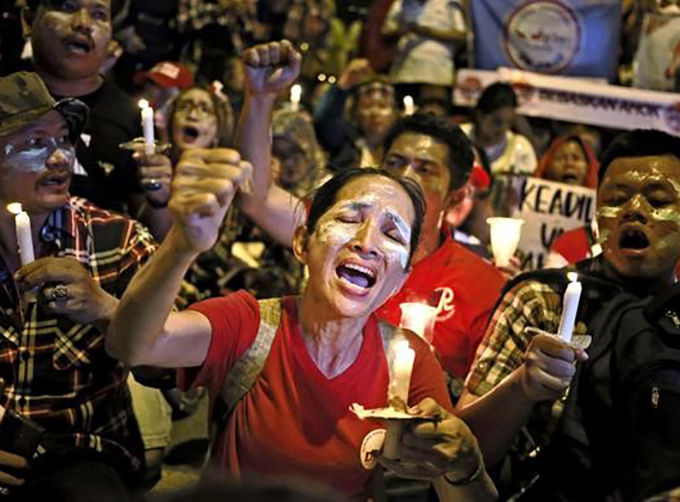
Supporters of Jakarta Governor Basuki “Ahok” Tjahaja Purnama light candles and shout slogans during a rally outside Cipinang Prison where he is being held after a court sentenced him to two years in prison earlier this month. Image: Jakarta Post

ANALYSIS: By Pat Walsh

The recent sentencing of Basuki “Ahok” Tjahaja Purnama, the Christian Chinese-Indonesian Governor of Jakarta, to two years in jail for blasphemy will leave many people in the Asia-Pacific region confounded if not, sadly, further averse to Indonesia.

The court’s decision is not a small thing. Jakarta alone has a population roughly that of New South Wales and Victoria in Australia combined – and more than double the entire population of New Zealand.

Jailed Jakarta Governor Basuki “Ahok” Tjahaja Purnama … admired for his competency and opposition to corruption. Image: Malaysiakini

Jailing its governor is the equivalent of putting an Australian state premier or the New Zealand prime minister behind bars, conceivable only for the most egregious of crimes.

When the official in question is also widely admired for his competency, opposition to corruption, and drive to reform the massive mess which is Jakarta, one could be forgiven for assuming his blasphemy must have been of medieval proportions.

Did he denounce Islam as “evil’ like the American evangelist Franklin Graham? Did he publicly denounce God as ‘stupid’ like Stephen Fry, now the subject of investigation for blasphemy by the Irish police?

On the contrary. Ahok is deeply respectful of Islam and has many Muslim supporters. Though a Christian, he is also impressively Islam-literate and can quote the Koran, an unusual ability for a Christian.

-Partners-

Ironically, it is this knowledge that worked against him. He asked an Indonesian audience not to be persuaded to vote against him by opponents who claimed the Koran prohibits Muslims from voting for non-Muslims. The implication that leaders should be chosen for their competence not their religion or ethnic background will sound like common sense rather than blasphemy to most people.

Huge numbers mobilised
But extreme Muslims claimed his comment vilified the Koran and that voting for an infidel is apostasy. Their campaign mobilised huge numbers, mainly from outside Jakarta, and resulted in Ahok losing the recent election for the governorship — and his freedom.

Unless his appeal to the Supreme Court succeeds, the blasphemy finding also means he will be banned for life from running for public office.

The affair has already done a serious disservice to Indonesia. It presents Indonesia as fanatical, racist and sectarian. While these perceptions are patently unfair, the affair also reveals some aspects of contemporary Indonesia that are obscured by Canberra’s often lavish praise of our important neighbour.

Radical Islam is increasing in strength and confidence in Indonesia. “Be careful what you wish for,” an Indonesian academic said to me during the anti-democratic Suharto years.

He went on to observe that democracy would allow Muslim organisations sidelined during the Suharto years to operate freely and accept generous funding from benefactors like the Saudi regime whose King Salman recently made a historic visit to Indonesia. The majority of Muslims are moderate and disagree with the hard right but the Ahok case shows that, in a country of 240 million people, a minority can comprise millions and exercise significant political influence.

This influence extends to the nominally independent judiciary whose pronouncement on Ahok is widely considered to have been dictated by the protesters. In effect Ahok was “lynched”.

Aggressive sectional politics
Most fair-minded people in Indonesia and beyond, not least in places like England and Wales where blasphemy laws have been abolished, would struggle to see what was blasphemous about Ahok’s reference to the Koran. The court put aggressive sectional politics ahead of its duty to comply with the rule of law and the International Covenant on Civil and Political Rights to which post-Suharto Indonesia is a signatory.

As with Indonesia’s mock trials on human rights violations in East Timor when the court absolved the powerful military, the court has compromised its independence and bowed to external pressure.

The sidelining of Ahok also demonstrates the continuing power of entrenched political and economic interests in Indonesia. Ahok stood for clean government. He is a vigorous opponent of corruption, a vice roundly condemned in the Koran. Arguably Ahok’s opposition to this Indonesian curse should have earned the admiration of all Muslims, not jail.

Ahok’s removal is also a victory for Prabowo Subianto, recently headlined by The Age as Indonesia’s possible next president. The ex-general’s candidate beat Ahok in the governship elections, thereby delivering Prabowo a major platform from which to conduct his assault on the presidency, currently held by Joko Widodo, himself a former governor of Jakarta.

The Age reported that Prabowo forbids the killing of insects on his ranch. Timorese would laugh in disbelief. Their truth commission report lists him as having command responsibility for war crimes and crimes against humanity committed during the many years he was active in East Timor.

The Catholic archbishop of Jakarta has publicly condemned growing fundamentalism and intolerance in Indonesia and the Protestant Council of Churches has called for Ahok’s release and the revocation of the blasphemy law.

Nuns, priests, seminarians and laity have rallied in support of Ahok. One sincerely hopes that the Supreme Court will overrule in Ahok’s favour and that the campaign to scrap the blasphemy law will succeed.

Both measures would do much to restore faith in Indonesia and its future.

Pat Walsh is a human rights activist and former adviser to the Timor-Leste Commission for Reception, Truth and Reconciliation. He co-founded Inside Indonesia magazine.

]]>

PNG needs maturity in political debates and on education

]]>

AsiaPacificReport.nz

ANALYSIS: By Peter S. Kinjap in Port Moresby

Papua New Guinea has entered the third week of the eight-week election campaign before polling commences next month.

Unlike previous elections, this year’s campaign appears not as noisy as in the past.

Social media has played an important role in the campaign so far with political parties buying Facebook pages to launch their awareness messages.

Almost all the 15 political parties in PNG contesting the election now have a paid Facebook Page.

The ruling People’s National Congress (PNC) has reportedly disseminated a lot of information about its polices and continues running social media ads.

One of the PNC’s major party platforms is the Free Education policy. As the ruling party, it has implemented and PNG has felt its impact since 2012.

-Partners-

Like any other government policy, the PNC free education policy has its weaknesses. In order to defend this policy, party leader and Prime Minister Peter O’Neill said recently he wanted to make the PNC’s free education policy government policy so that future governments will continue implementing it.

‘Politically suicide’
In what looks like a counter attack, its rival Triumph Heritage Empowerment Party (THE) has issued a “politically suicidal” statement by party leader and Opposition Leader Don Polye saying it would scrap free education instead introduce a “compulsory and subsidised education” as it policy.

Polye went on to say that this policy would be a national policy if THE formed the next government, making it illegal for parents not to send children to school.

Firstly, THE party’s policy would make school compulsory, and secondly parents would need to pay from elementary to grade 12, but not at technical colleges and universities.

THE party wants government to take full responsibility to pay for develop the skills of those in tertiary institutions.

This policy sparked a response from Prime Minister O’Neill condemning the Opposition for developing “reckless policies” that could only set the country back, reverse development and undermine economic growth.

“This is the most reckless Opposition campaign to be seen in elections for a long time,” O’Neill said.

“These Opposition policies would hurt families, would see people miss out on education and have funding decisions taken away from the local level and returned to Waigani bureaucrats.

“How could anyone think that ending free education could be a good thing?

“Under our government, it does not matter if a family is rich or poor, urban or rural, we will make sure all of their children are able to attend school,” O’Neill said.

Some implications
Let us look at some of the implications of THE Party and PNC on their education polices, leaving aside other issues for a while.

Under PNC’s policy, there would be more children going to school because it is free to attend school from elementary to high school and perhaps colleges (some colleges are still paying fees this year at some colleges).

This will see an increase in the grades 8, 10 and 12 dropouts. These dropouts will add to the number of unemployed youths and unskilled laborers. After 10-20 years, there will be an increase in the number of school leavers compared with today.

This is a situation whereby students from well-off families may enroll further in private schools or take further studies abroad but this number is always a minority. PNC’s free education policy creates issues in the long-term but it may look good in a short-term.

THE party’s policy on education will put pressure on poor parents to firstly send their children to school or they be jailed for not sending and to pay their fees in full.

This is a harsh policy by THE party whereby parents would need more counselling on family planning as any child born must be educated by law and they have to meet the cost up to grade 12.

It is tough for parents but in the long-term it will benefit the country largely. Firstly, by concentrating on paying fees for higher education and colleges will ease parents of their financial burden.

Literate population
Secondly, compulsory education would produce a literate population and that is good for a developing country. Today, many young people are not going to school and are roaming the streets — even if it is free to go to school.

But when there is a law to force students to attend school, there will be no children on the street begging as we see today in cities like Port Moresby, Lae and Mount Hagen.

The PNC and THE party’s policies on education have both negative and positive implications.

The term or the phrase “free education policy” is in fact not proper because nothing is free, it would be better to say subsidised fees than to say free education.

Nothing is really free. It is not free to get educated, rather the government is using people’s tax money to subsidise the cost of education.

The full Paias Wingti “free education” policy poster. Image: Peter S. Kinjap/PMC

This confused phrase of free education is a brainchild of the People’s Democratic Movement (PDM)  which led two governments under Paias Wingti and Sir Mekere Mourata as Prime Ministers who implemented this policy.

The policy was fully implemented during Sir Mekere’s term as Prime Minister in 2000.

Before the Bougainville war
Before the Bougainville civil war, tertiary education at the universities and colleges was fully subsided (students were also given monthly allowances) when Panguna mine was in operation.

But after the Bougainville conflict there was a new “user pay” policy so all the benefits of allowances and fully subsidised fees for tertiary studies were withdrawn and students had to pay for university and college education.

This means that Don Polye’s education policy will bring back the glory days prior to the Bougainville conflict when PNG enjoyed a fully subsided education at the tertiary level.

All in all, Peter O’Neill’s education policy is short-lived and may put pressure on the government budget to continue funding as the population increases each year.

Don Polye’s policy may look tough from the start but it is not a new policy in PNG to fully subsidise education at the tertiary studies. The new thing will be compulsory for every child in PNG to attend school.

For a country like PNG, we need a good policy on education and Don Polye’s policy will save Papua New Guinea for the years to come.

Peter O’Neill’s short-lived policy might mean Papua New Guinea would face social and unemployment problems and economic problems as the population increases.

Don Polye’s policy will also have an impact to control the population and I think this is a very good proposal for PNG.

It is my personal guess that Polye’s policy is what PNG needs and it speaks of more maturity than O’Neill’s, which lacks sustainability.

You decide which policy you need at the polls.

]]>

Mike Treen: ‘Extend the amnesty’ – facing NZ’s ‘inhuman’ migrant plan

]]>

AsiaPacificReport.nz

Unite Union’s Mike Treen critiques the injustices of the New Zealand migrant policies and their fraud on foreign students, especially Asian. Skykiwi journalist Leon Li gets a shot. Video: Café Pacific

OPINION: By Mike Treen

Unionists and other progressive minded people need to put a stake in the ground in opposition to the latest immigration proposals from the New Zealand government.

Tens of thousands of workers in this country have been brought here under false pretences. Many have been conned into paying tens of thousands of dollars towards courses that they hoped would open the door to jobs and the chance for permanent residence.

The promises have proved to be nothing more than a fraud perpetrated by the government.

These students and workers had the rules changed on them after they arrived. Many have studied and worked here for up to a decade.

The government has now increased the points required to get permanent residence under the skilled worker category and imposed a minimum income requirement of almost $50,000 that many will not be able to meet. Those who don’t meet the new requirements will have a maximum of three years before they are kicked out.

-Partners-

READ MORE: Prediction: Crash in migrant numbers coming — let people stay

At the same time, the government is proposing to continue bringing temporary work visa holders for lower skilled and lower paid occupations but for a maximum of three years and no right to bring family members.

This will most likely lead to either a massive drop in numbers coming or those who do being so desperate they will be wide open to abuse and exploitation.

One-off ‘amnesty’
In their plan, the government has made a proposal for what they have called an “amnesty” for a group of workers in the South Island as a one-off pathway to residency for around 4000 temporary migrant workers and their families.

In the words of Immigration Minister Michael Woodhouse:

“Many of these migrants are already well settled in New Zealand and make a valuable contribution to their communities.

“It will also enable employers to retain an experienced workforce that has helped meet genuine regional labour market needs.

“My National colleagues in the South Island have advocated strongly on behalf their constituents throughout the development of this policy, so I’m pleased the government has been able to deliver on our commitment to enable this cohort of migrant workers to remain in their communities.”

Many of these workers will be working on dairy farms run by National Party stalwarts who have lobbied their MPs to keep these workers.

The “amnesty” being allowed these workers from the requirement to meet the new points or income thresholds for permanent residence should be extended to the whole country. The restrictions in the current amnesty proposal to bind workers to particular employers should also be removed. This is a form of bonded labour that needs to be got rid of as part of any genuine immigration reform.

Parties that want to reduce the number of permanent and long-term net arrivals to New Zealand from the current 70,000 plus number can also support this humanitarian policy towards those already here.

There are currently around 250,000 temporary work visas issued each year.

It makes no sense to throw out people who want to stay and have invested a significant part of their lives to creating homes in this country while continuing to bring in people on temporary visas only to throw them out again after three years.

The new policies are inhuman.

Extend the amnesty to all workers on temporary visas who want to make New Zealand their home.

]]>

Radio New Zealand International: Reporting the Pacific in tight times

]]>

Pacific Media Centre

Artists impression of Kacific-1 satellite over the Pacific. Image: RNZI

Pacific Journalism Review

Tuesday, May 16, 2017

Abstract

New Zealand International (RNZI) broadcasts from New Zealand into the South Pacific and is relayed to South Pacific listeners by their various national news services. In 2006, American academic Andrew M. Clark characterised the role of RNZI as ‘providing a service for the people of the South Pacific’ that also provided ‘an important public diplomacy tool for the New Zealand government’ (Clark, 2006). A decade on, this article evaluates the ongoing use and utility of RNZI as a taxpayer-funded voice of and from New Zealand, as a service for the diverse peoples of the South Pacific and as a tool of New Zealand’s transnational diplomatic efforts.  RNZI is still a key source of local and regional information and connection for the distinct cultures and nations of the vast South Pacific area, whose peoples have strong links to New Zealand through historical ties and contemporary diasporas living in the country. But, RNZI now faces mounting financial pressure, a government swinging between indifferent and hostile to public broadcasting and questions of legitimacy and reach in the ‘digital age’. With RNZI under pressure in 2016, key questions arise about its present and future. What is RNZI doing well and not so well? What role should New Zealand’s domestic and international politics play in the organisation and its outputs? And how might its importance and impact be measured and understood in such a culturally and geographically diverse region as the South Pacific? Using a variety of sources, including documents released to the author under the New Zealand Official Information Act, this article explores the role of RNZI in the contemporary New Zealand and South Pacific media environments.

]]>

From Pacific Scoop to Asia Pacific Report: A case study in an independent campus-industry media partnership

]]>

Pacific Media Centre

A typical Asia Pacific Report “display top” on the home page — a Sri Lankan refugee makes a distraught “shoot me” gesture after Indonesian authorities refused food, water or any help, 21 June 2016.

Pacific Journalism Review

Tuesday, May 16, 2017

Abstract

Media convergence within the news and current affairs landscape over the past two decades has opened opportunities for competing newspapers, television stations and online publishers to form alliances to approach digital and editorial challenges with innovative strategies. The partnerships have often enabled journalists to embrace multimedia platforms with flexibility and initiative. This has fostered a trend in ‘gatewatching’ and a citizen responsive and involved grassroots media rather than legacy mainstream gatekeeping, top-down models. Such committed media attempts in search of investigative journalism accompanied by ‘public’ and ‘civic’ journalism engagement initiatives have also been emulated by some journalism schools in the Asia-Pacific region. This has paralleled the evolution of journalism as a research methodology with academic application over the past decade. Selecting two New Zealand-based complementary and pioneering Pacific digital news and analysis publications, Pacific Scoop (founded 2009) and Asia-Pacific Report (2016), produced by a journalism school programme in partnership with established independent media as a combined case study, this article will demonstrate how academia-based gatewatching media can effectively challenge mainstream gatekeeping media. Pacific Scoop was established by an Auckland university in partnership with New Zealand’s largest independent publisher, Scoop Media Limited, and launched at the Māori Expo in 2009. The article also explores the transition of Pacific Scoop into Asia-Pacific Report, launched in partnership with an innovative web-based partner, Evening Report. The study analyses the strategic and innovation efforts in the context of continuing disruptions to New Zealand’s legacy media practices related to the Asia-Pacific region.

]]>

Rabuka’s message to 1987 Fiji coup victims: ‘To you I say, I am sorry’

]]>

AsiaPacificReport.nz

FLASHBACK: A-Preparing for a “banana republic” mock raid on the Fijian Consulate in Auckland in the wake of the first coup in Fiji on 14 May 1987. Image: Nik Naidu/Coalition for Democracy in Fiji

By Litia Cava in Suva

Social Democratic Liberal Party leader and former military coup maker Sitiveni Rabuka says the rioting and assault on some Fijians of Indian descent 30 years ago were the deliberate actions of “selfish people” and he has apologised for it.

Lieutenant-Colonel Sitiveni Rabuka 30 years ago … he staged Fiji’s first two coups. Image: Matthew McKee/Pacific Journalism Review

“Many of [the culprits] have been dealt with according to law,” he said at the weekend about the violence of Fiji’s first coup on 14 May 1987.

“I pray that God Almighty will grant all those hurting the grace to forgive me. To you I say, I am sorry.”

Looking back 30 years, the former prime minister said he had on many occasions apologised publicly to Fijians of Indian descent and he continued to make reparations for 1987.

And as Fijians remembered the 30th anniversary of the events of Fiji’s first coup yesterday, Rabuka said he emphatically acknowledged that coups were not the way to resolve any type of national situation in a civilised society.

Coups went directly against the very basic principles of human decency and rights and his Christian beliefs, he said.

-Partners-

‘Fiji at crossroads’
“Fiji is at a crossroads and there are many wounds that need healing,” Rabuka said.

“It is important that our leaders are more responsible with their actions and works, to encourage and promote peace and goodwill among Fiji’s religious and ethnic communities.”

He reassured all minority religious and ethnic communities that the opposition SODELPA was committed to assuring their security in Fiji because they also belonged to Fiji with the indigenous Fijians.

“We respect and appreciate your contributions to Fiji.

“We want to work together with you for a more peaceful, prosperous Fiji.”

Rabuka added SODELPA would promote closer inter-ethnic cooperation, partnership and goodwill which would be the mainstay of a lasting peace that would prevent future political crises.

However, he said he did not start the “coup culture” in Fiji.

Litia Cava is a Fiji Times reporter.

Sitiveni Rabuka was then a lieutenant-colonel and ranked third-in-command in the Royal  — now Republican — Fiji Military Forces (RFMF) on 14 May 1987 and he staged a second coup in September 1987. Fiji has had four coups and the last military coup leader, Commander Voreqe Bainimarama, in 2006 was elected prime minister in a much criticised return to democracy in 2014.

]]>

Armed men ’cause confusion’ in PNG capital – election observers announced

]]>

AsiaPacificReport.nz

Some of the images circulated on social media such as the PNG Development Forum and carried by TV Wan News. Image: Harley Geita/PNG Development Blog

An online and television news service has reported concerns over “confusion” about recent sightings of armed expatriate men in the Papua New Guinean capital of Port Moresby.

TVWan News and Loop PNG carried reports at the weekend and some social media outlets and blogs have also carried images and sketchy reports.

“Pictures were posted online causing people to question and speculate about the reasons behind the men being in the country,” reported Loop PNG along with a video clip, saying that TVWan News would “investigate more”.

In February 1997, the Sandline affair involving foreign mercenaries threw Papua New Guinea into turmoil.

The military arrested 44 mercenaries brought into the country from Australia, Britain and South Africa to be engaged in the Bougainville war by the Sir Julius Chan government.

Chan was forced to resign the following month. The crisis was named after Sandline International, a British-based private security contractor.

Meanwhile, Loop PNG also reported that more than 100 international electoral observers would be arriving in the country to support Papua New Guinea’s 2017 National Election.

-Partners-

International observers would arrive and depart at different times from May through to July.

The sponsors of international observer teams – such as the Commonwealth, Australian National University and various diplomatic missions in Port Moresby- will be arranging their own logistics to cover the event.

A media statement issued by the United Nations Development Programme (UNDP) on Sunday said more than 12 groups would be taking part in the 2017 National Elections Observer Mission.

100 international observers
UNDP  is supporting the 2017 National Election in Papua New Guinea (PNG) by coordinating more than 100 international observers.

However, in accordance with UN policy on electoral assistance, UNDP is not observing the elections and will not issue any statement on the elections or involve itself in the substance of any of the international observers’ work or statements.

UNDP is responding to a request from the PNG Electoral Commissioner, Patilias Gamato,

Roy Trivedy, UN Resident Coordinator and UNDP Resident Representative, welcomed the invitation by the PNG Electoral Commission to provide support to the election: “We’re delighted to be able to coordinate the presence of international election observers across the country to help ensure free and fair elections.

“These observers play a critical role in helping promote and protect the civil and political rights of participants in elections. They will help monitor things like freedom of movement and their presence will help to deter  manipulation as well as strengthen reporting of such problems if they do occur,”

UNDP is the largest provider of electoral assistance in the UN system. It has been involved in supporting the electoral cycle in more than 58 countries and most recently in Papua New Guinea in Bougainville’s 2015 General Elections.

]]>

Uncle Shane on Australia’s shame: ‘We’re the vulnerable ones, the ones without a voice’

]]>

AsiaPacificReport.nz

SPECIAL REPORT: It was early November 2016. As I waited for Laura Lyons from Grandmothers Against Removal (GMAR), a tall, thin, old-looking man with a young, energetic walk and an even younger grin approached me. He said he was here with Laura who would be arriving soon. Laura arrived looking distressed. Her 10-year-old daughter had just the day before run away again from the residential facility where she was being held.

Following my interview with Laura, Uncle Shane, as he introduced himself to me, said he wanted to tell his story. He said he wanted people to know what it was like being taken away from home and placed in state foster care or in residential care facilities. Uncle Shane said he was here to support GMAR and the work that they do as he never wanted to hear of another Indigenous Australian child being taken away from their family and culture.

As Uncle Shane told his story, he became angry at what had happened to him and others he knew, and at what was still taking place. Despite his anger, I was in awe at his apparent lack of bitterness and the enthusiastic and positive approach he had. But his past must have had some impact because I had thought Uncle Shane was in his mid-70s. In fact, Uncle Shane had just turned 59.

This is the story that Uncle Shane wanted to share as told to Camille Nakhid:  

Uncle Shane: I’ve written to them, to the government, and to the opposition — suggesting to them that they should start concentrating on those who’ve perpetrated the crimes against us, you know, ex-state wards – against the children such as us. We are the vulnerable ones, the ones without the voice.

Uncle Shane had been removed from an abusive family home only to be placed in an even more abusive state system from 1959-1982.

Which we had none. We had no choice. It was all forced on us, including the abuse, the abuse of drugs to testing for pharmacies, and the abuse of the slavery of the hours, long hours. Five in the morning until 11 at night, seven days a week. That’s long hours. No play, no birthday cards, no presents, nothing.

-Partners-

In the morning, I’d have to get up at five o-clock, we’d do the dairy. That finishes at nine. We’d do that, we go up to the house, polish all the floors.

And then we do the laundry, all day, and then we do the dairy in the afternoon, then we go back up the house and scrub all the pots. Or, you know, other chores that need to be done in the house. Polish all the floors by hand. With long hours, no play. You know, that’s all gone. The time you spent playing in parks with kids, that’s all gone. I see that today and I’m really angry. Because we didn’t get it. You know, it’s gone.

We’ve lost that. We’ll never get that back. And no human being has the right to take that away from us. You know, we couldn’t even go to our – you can’t even have friends. Outside, outside they go to their friend’s place and they play, and they go to beaches, they go to – forget about that, that’s all gone. That wasn’t allowed. All we did was work. And all we did was whatever they wanted us to do. We were at the mercy of them. That’s terrible. That’s not a way to treat a human being.

But I’m angry with the government because it hasn’t done anything. You know, it holds a royal commission, it’s only to shut up people, you know, because of the talk. When the abuse come out to the public, what’s the best way to shut the public up? What do you do as a government?

‘You get a media spin together’
You panic, you quickly get a media spin together, and you quickly turn it into a spin, a song and dance. And you say: “We’re going to hold a royal commission”. That should shut everything down. That should shut down the public talking and getting angry with the government of the day.

So you’re no better off.

How are you better off? You’re not safe at home, so you’re taken away and even then if you’d read the reports, the very DoCS department was at the home when these things were happening. And still nothing happened to protect you. They didn’t step up to the plate. Not a way to treat a human being – is it?

No clothes on a kid, walking around, smelly, wet urine all over the place – and you’re not going to go and write a report about that and take the kid away somewhere safe? You’re not going to step up to the plate and help that kid?

Now, I’m hoping to wake the people up, you know. To shake them up and to wake them up to the injustice out there of children like us, you know, people like us.

I forget my tribe. I don’t know the name of it but I’ve been accepted down here in Sydney by my step-brother, which is the Wiradjuri.

We’ve got a lot of injustice, as you know, in Australia. It’s not like any other – some countries have some, which I’ve watched injustice there – But we have a lot here.

I fail to see the benefit of taking children away from their parents. I don’t see the benefit. If DoCS is trying to punish the children, then they’re doing a good job. If they’re trying to punish the parents, they’re doing a good job. So I don’t understand what they’re trying to do.

‘They should set up a home visiting programme’
I believe that they should set up a home visiting programme where the department should come into the home and work with the parents.

It’s not what the parents can do for the department, but what the department should be doing for the children and the parents.

There’s so much injustice – the culture is stolen right beneath us. Their culture is being pushed, you know, into the children of today. What they should be doing, is doing what people are doing in New Zealand and letting the elders take over and letting them decide how their children should be brought up.

Not like these government departments. They’re, to me, government departments only amp up the situation and make the situation worse, as you’ve seen.

I just think that, you know, the United Nations should’ve been doing more. All they’ve done is close their eyes on all this. They must’ve seen what was going on. They must see, they must know what’s going on. But they don’t raise their eyebrows to the abuse.

In the Northern Territory — the children that were abused there, they’re only now being mentioned by the UN Human Rights giving the Australian government a stern warning. But what they should’ve done is do that years ago. This has been going on for many, many years. This is not just a one-year off, you know, or a two-year trick.

It should be the community that should decide what should happen to the children. It should be the parents and the whole community to be involved in what they want for their own community and what they want for their own parents, you know, from what they want for their own children. And their housing, their legal services, all that has been cut as you are aware.

‘You never know what fight’s next’
Uncle Shane is a volunteer with GMAR.

GMAR teaches us further stuff as well, which is good. You never know what’s going to come around that corner. You never know what fight’s there for you.

It was only two months ago we held a rally in Campbelltown and we set that up, put it together with everybody and the first time they didn’t bite.

The second time outside the courthouse they bit. At the end I did ring them up and I told them: “We’re gonna keep doing this, we’re gonna keep coming back until the woman’s kids were given back. The next job we’re gonna do after the court case, we’re coming into your office –  And we’re not moving”.

We’ve got a hell of a struggle ahead.

Look at my case. The royal commission said to me, wanted to ask one question: “How the hell…did you survive?” Hope.

And hope’s a dangerous word for people like us. Hope is a very dangerous word. You’re hoping, you’re just praying that you get out of there one day. You know, they could have kept me further – You know, much more than 22 years. And in there, you probably notice, that they did pretend I was 80 percent retarded.

So these are the names you’re left with. The stigma that they put on you. When, if anything, the only thing you don’t have is the education — because of them.

Other Stolen Generation stories on Asia Pacific Report:

More about Grandmothers Against Removal

If you wish to donate to GMAR, click on this link:

Contact | Donate

If you want to sign the petition, click here

]]>

Ahok’s defeat marks tough future for democratic, tolerant Indonesia

]]>

AsiaPacificReport.nz

By Muhamad Al Azhari and Eko Prasetyo in Jakarta

Incumbent Jakarta Governor Basuki “Ahok” Tjahaja Purnama’s defeat at the hands of rival candidate Anies Baswedan in the recent runoff election raised alarms among many observers that Indonesia’s young democracy still has a long way to go in combating religious and ethnic discrimination.

However, the capital was calm in the evening after the nail-biting election last month, defusing fears among some residents that mass gatherings or rallies would consume city streets during and in the wake of Wednesday’s vote.

READ MORE: ASEAN lawmakers alarmed at ‘blasphemy’ conviction of Ahok

Investors seemed relieved as well, as the country’s benchmark stock index dropped only slightly the day after the election, with businessmen observing that risks or uncertainties in Indonesian markets were largely dispelled due to the peaceful election turnout.

Indeed, more relief came later in the week, as state prosecutors pushed for reduced charges in a blasphemy case against Jakarta’s first ethnic Chinese and Christian leader in the post-Suharto era.

However, this came to nought when the trial judges ignored the prosecutors and imposed a harsher sentence of two years’ imprisonment on Ahok after finding him “guilty”.

-Partners-

However, rhetoric and methods used by politicians in defeating Ahok have nevertheless raised concerns among local and foreign political observers concerned about the future for democracy in the world’s largest Muslim-majority nation.

Stigma
Poet and senior journalist Goenawan Mohamad wrote a comment on his official Facebook account analysing what the defeat of Ahok – an outspoken governor who often drew ire from his political opponents – could mean for the path ahead.

“Ahok has lost; this has now been settled by the 2017 regional election. All that noise surrounding it will soon become history. Many are relieved ¬ either because Anies has won, or because the campaign, poisoned with hate that shattered many friendships, has finally passed,” said the former editor-in-chief of investigative magazine Tempo.

“But I hope one thing will not be forgotten. Ahok has entered the arena bound in fetters and labeled as ‘a blasphemer’. He can move and talk, but he is not entirely free.

“His achievements as the region’s head, which have been acknowledged by many and made him unparalleled, are now almost no longer seen or heard of.

“The use of the label against Ahok is probably the most successful stigmatisation technique in the history of Indonesian politics. A stigma derived from slander. He did not insult Islam, but the charge had been continuously repeated.

“If you repeat a lie often enough, it becomes ‘the truth,’ the Nazi’s propaganda chief used to say. We hear it at mosques, in social media, in everyday conversations; the allegation has been turned into a conviction,” Goenawan said.

“Now Ahok is tried by the court, charged under the anti-blasphemy law that was produced by the New Order regime ¬ a law with unclear provisions, unclear even on who has the right to represent the religion that had been insulted. As a result of it, Ahok has been treated unjustly in three ways: through slander, by being presumed guilty before the court’s verdict and by being tried under a dubious law.

“It is hypocritical to pretend to recognise this injustice while cheering his immutable political defeat. Ahok has lost, he may even be sentenced in a court process informed by mass pressure. The truth may also lose ¬ as it is wont to do in this ‘post-truth’ era,” Goenawan said.

Identity politics
Concerns over the future of democracy in the Southeast Asian country were shared by foreign observers as well.

Reuters news agency reported that international rating agency Fitch said in a statement previous religious tensions during the Jakarta gubernatorial election could resurface in the run-up to the country’s next presidential race in 2019.

“The early results of the tense Jakarta elections seem to suggest that religious factors could play an increasingly significant role in future Indonesian elections,” the statement said, as cited by Reuters.

Three mass rallies against Ahok were led by hardline Muslim groups in the campaign period before last week’s vote, threatening to erode the country’s longstanding tradition of practising a moderate form of Islam.

However, the rating agency still acknowledged Indonesia’s recent progress, explaining that the country has made “substantial” strides in improving good governance over the past two decades. The country’s democratic electoral processes, the statement said, were still intact.

Still, experts and academics around the world say that religious and ethnic discrimination should be expected to play a greater role in future elections if the government and high-ranking Muslim figures do not take significant steps to promote tolerance.

“Going forward, the politics of religion is going to be a potent force,” Keith Loveard, an analyst at Jakarta-based Concord Consulting and an author of books about Indonesian politics, said in a report on Wednesday.

Reluctant to vote
According to Loveard, some residents may have been reluctant to vote for Ahok due to worries of “five more years of protests on the streets by Muslim hardliners”.

Muhammad Najib Azca, a professor of social and political sciences at Gadjah Mada University in Yogyakarta, viewed religious and ethnic intolerance as a driving factor in the election’s outcome.

“What happened in Jakarta was an anomaly. Ahok and Djarot were unable to translate their high approval rating […] into real political support,” Najib said.

“There were variables beyond public approval ratings, including strong undertones of religious-based identity politics,” he added.

Najib argued that identity politics has become a main force in driving public opinion, even in the face of successful governance programmes directed by Ahok. “This intervening variable has affected voters through a very sophisticated and elaborate political process.”

Ian Wilson, a lecturer in politics and security studies and a Research Fellow at Murdoch University’s Asia Research Center, said – in an article published by newmandala.org – the election results will most likely have a lasting impact on national politics for years to come.

“Judging from national and international headlines, Jakarta’s gubernatorial election on April 19 represents not just a major turning point for the nation’s capital and city of 12 million, but potentially for the entire country,” he wrote.

“The alarmist tone is largely due to the unsettling direction campaigning has taken over the past eight months, that has seen any possible substantive policy debates over how to best tackle Jakarta’s complex infrastructural, economic and social problems subsumed by sectarian identity politics.”

Economic inequality
Wilson, whose research touches on the political economy of gangs, organised crime and violence in Indonesia, went on to say that: “While the campaigns present, at one level of analysis, a stark contrast between ‘diversity’ on the one hand and sectarian populism on the other, a shared point of commonality is the respective silence regarding a significant shaping force in Jakarta, and arguably the election: rising levels of economic inequality.”

He pointed to data from the country’s Bureau of Statistics – which shows a steady increase in levels of economic inequality in Jakarta – that reflects a broader trend that has been sweeping the nation over the past decade.

“The country’s much-heralded economic growth has been marked by growing concentrations of that wealth in the hands of a few, and a stagnation if not deterioration in the standard of living of a vast majority of Indonesians,” he said.

Wilson also pointed to a 2017 Oxfam report on the widening wealth gap in Indonesia, in which “inequality has been driven by a combination of ‘market fundamentalism,’ high concentrations of land ownership,” and the fact that Indonesia registered the second lowest rate of tax collection in Southeast Asia.

“The poor and precarious bear the most drastic and damaging impacts of economic inequality, though in a densely populated megacity like Jakarta, it is felt by all social and economic classes ¬ albeit in often vastly different ways and with a range of social and political consequences,” he said.

Wilson continued, “For Jakarta’s upper middle classes the desire for security, lifestyle and convenience ¬ together with the push by developers for profitable all-inclusive developments ¬ has meant increasingly self-imposed spatial separation from other social and economic groups within gated estates, apartment towers, shopping malls and private vehicles.”

“Once a city of economically mixed neighborhoods, large parts of the city are spatially divided by class and ethnicity. This can be seen in the city’s north, where remaining kampung sit in uneasy tension alongside luxury apartments and gated communities,” Wilson said.

Old political and business elites emerge
For President Joko “Jokowi” Widodo, the election outcome poses a new challenge of rising Islamism and the renewed influence of Indonesia’s old political and business elites in the public sphere.

Many old guard figures have shown support for Anies during the election campaign, including moguls Aburizal Bakrie, Hashim Djojohadikusumo and Hary Tanoesoedibjo and retired general and failed 2014 presidential candidate Prabowo Subianto.

All were prominent businessmen or military officers linked to the three-decade authoritarian regime of Suharto before his ouster in 1998.

Reconciliation
While Jakarta remains hampered by a dizzying array of social and political hurdles, scholar Komaruddin Hidayat, dean of Syarif Hidayatullah State Islamic University in Banten, Jakarta, called on city residents to eliminate any racial, religious or ethnic intolerance.

“We should eliminate the notion of majority and minority, and the government should establish a way to bridge any gaps through the improvement of people’s welfare,” Komaruddin said.

Komaruddin, a widely known liberal Muslim scholar and author of several books on religious diversity, said minority groups in Indonesia have existed long before the country achieved independence in 1945-48 and have worked hard to personify the ideals of the state ideology, Pancasila.

“Therefore, they should be granted equality in our society and government,” he said.

Indeed, Ahok is not the first Chinese Christian governor of Jakarta. From 1964-65, Hendrik Hermanus Joel Ngantung, known as Henk Ngatung, served as the capital’s chief executive and was instrumental in installing artistic statues and monuments throughout the city as befitted his status as one of the country’s leading painters at that time.

Various reports show that ethnic Chinese, who currently comprise about 15 percent of the country’s population, have historically fought alongside local freedom fighters, known as pribumi, against the Dutch – Indonesia’s colonial masters – and the Japanese.

Sadly, their participation in building modern Indonesia has been expunged from the country’s historical consciousness.

Muhamad Al Azhari and Eko Prasetyoare journalists with the Jakarta Globe. This article includes some news agency content.

]]>

PNG police launching islands region security operation for elections

]]>

AsiaPacificReport.nz

Acting Manus Provincial police commander Senior Inspector David Yapu in Port Moresby. Image: Loop PNG

By Sally Pokiton inn Port Moresby

The 2017 New Guinea Islands national security operation for the general elections will be launched on Manus Island today.

Police Commissioner Gari Baki was due to launch the security operations for Manus, East New Britain, New Ireland and West New Britain provinces (NGI) in Lorengau.

Host and Acting Manus Provincial police commander, Senior Inspector David Yapu, said all preparations for the launch were in place, and he thanked Commissioner Baki for choosing Manus to launch the NGI operations.

For Manus province alone, a combined security operation will consist of Police, Correctional Service and PNG Defence Force personnel, with some assistance to come from the East New Britain province.

A total of 121 service members will be involved in Manus Elections operations.

Acting PPC Yapu said that from out of that number 60 were regular police officers while 40 were reserve officers.

-Partners-

Yapu said five Correctional Service officers would be engaged along with 12 PNG Defence Force soldiers from Lombrum Naval Base, while 10 Mobile Squad members from the Tomaringa Police Barracks in East New Britain Province would assist.

“This will be a big event for the people of Manus Province and I expect to see lot of people attend the event,” he added.

Sally Pokiton is a Loop PNG reporter.

]]>

An Indonesian oasis of progressive creativity emerges in culture city

]]>

AsiaPacificReport.nz

Dr Max Lane, pictured here with Faiza Mardzoeki, talks about his project to establish a community and activist library for the student city of Yogyakarta in Indonesia. Video: Café Pacific

By David Robie in Yogyakarta

A vision for a progressive activists, writers and researchers retreat in the lush outskirts of Indonesia’s most cultural city, Yogyakarta, is close to becoming reality.

Catastrophe in Indonesia … one of Dr Max Lane’s many books.

The Indonesian Community and Activists Library (ICAL) is already an impressive “shell” in the front garden of Australian author and socio-political analyst, intellectual and consultant Max Lane, arguably the most knowledgeable English-language writer on Indonesian affairs.

Dr Lane, who has been writing and commenting about cultural and political developments in Indonesia, Philippines, Timor-Leste and his homeland since the 1970s, is delighted that completing the centre is so close.

“We have almost completed this building, the library, which will have a reading room, an office, and also some accommodation for those who would like to stay for a few days, or even longer to use the library,” he says, gesturing towards the empty rooms at the complex in the rice-producing village of Ngepas.

“The library will have about 4000 to 5000 books in the field of social sciences, humanities, history, feminism and so on.”

-Partners-

The books have been donated, but they mainly comprise the collections of some of Australia’s leading activists, such as John Percy, over more than five decades of his life.

Percy was a veteran socialist who co-founded the radical youth organisation Resistance and the Socialist Workers Party in Australia. He edited Direct Action for many years and helped establish Green Left Weekly. He died in 2015 and his passing inspired the library project with Lane, a close friend.

Filling a gap
The progressive book collection will help fill a gap in the literature for young activists and lecturers.

The entrance to Ngepas village with rice-laden mats drying in the sun. Image: David Robie/PMC

“We think the books are going to be very much put to use because this particular collection is probably still very difficult to find in Indonesia because of 35 years of authoritarian rule. Many books were not allowed, or difficult to be positioned, in libraries,” Lane says.

Under the Suharto regime between 1965 and 1998, book acquisitions for Indonesian school, university and community libraries were “underfunded and, when funded, narrow and censored”.

Lane hopes that ICAL will, in a “small but effective way”, help improve the situation.

“The books will comprise the collections of Australian progressive activists and intellectuals,” he says.

“The complex here is a very nice area to work in. It is less than half an hour from the three main university campuses and we expect university students, lecturers, NGO activists, political activists and others to be using the facilities here.

“It’s almost finished. We are still short of funds — we need US$3000 or $4000 to finish the central part of the library so people can start to use it. And probably another $5000 or $6000 to finish the accommodation area so people can stay over.

Team managing
“So I can say it is 80 percent or 90 percent funded and it will only take one or two months for the builder to complete work on it.”

Dr Max Lane and his wife, Faiza Mardzoeki, will manage the centre. She is one of Indonesia’s leading women playwrights and theatre directors, whose works include the 2006 play Nyai Ontosoroh (Madame Ontosoroh). She will be the day-to-day manager of the library programme.

Dr Max Lane with playwright Faiza Mardzoeki and a travelling kiwi beside the ICAL building. Image: David Robie/PMC

Their home is a bungalow next door, on the banks of an attractive stream. Dr Lane injected about US$25,000 into the project himself and provided the land on their property.

Between them, Lane and Mardzoeki hope to see the centre become a lively base for creative and cultural activity. Classes, forums, discussions, short course training sessions on a range of topics relating to social sciences and humanities, and literature will be on the bucket list.

Dr Max Lane and Faiza Mardzoeki’s bungalow next to the ICAL building. Image: David Robie/PMC

Dr Lane introduced the English-speaking world to the celebrated revolutionary Indonesian author Pramoedya Ananta Toer, who was imprisoned by Suharto for a decade on the Maluku island of Buru, by translating his classic Buru Quartet novels, starting with Bumi Manusia (The Earth of Mankind) in 1980. He was an officer working at the Australian Embassy at the time and it was not a popular move among his superiors.

According to an Asymptote profile of Dr Lane by Fadli Fawzi and Nazry Bahrawi, it was a dangerous era.

“At this time, Indonesian president Suharto’s New Order regime (the Partai Golongan Karya — Party of the Functional Groups, known as Golkar) was in power, propped up by foreign investment and backed by the army.

Heavy-handed repression
“It was also when heavy-handed repression was the norm in Southeast Asia, and Suharto’s New Order government was no exception. In the early 1980s, corpses began surfacing in public places as a result of extrajudicial killings.”

This was also a period when the Indonesian military was involved in bloody repression in East Timor after the country was invaded at the end of 1975.

Dr Lane’s own extraordinary literary outputs, apart from his translations, include his Unfinished Revolution: Indonesia Before and After Suharto (2008), Catastrophe in Indonesia (2010), and Unfinished Nation (2014) and collections of poetry.

Currently, Dr Lane is visiting senior fellow at the Institute for Southeast Asia Studies in Singapore. Previously he has lectured at universities across the region, including the University of Sydney in Australia and Gadjah Madah University in Yogyakarta, and internationally.

The ICAL venture will be supported by a membership drive with the original members being invited on the basis of recommendations from of a panel of university professors and social justice activists.

Prospective new members will need to be recommended by two existing members.

More information about ICAL and a donations link is on the centre’s crowdfunding page.

The stream in the backgarden adds to the tranquil setting of the literary retreat. Image: David Robie/PMC ]]>

Tokelau suspends two officials following helicopter row review

]]>

AsiaPacificReport.nz

The official badge of Tokelau … controversial helicopters will now be sold off. Image: Wikipedia

By Mackenzie Smith in Auckland

Tokelau has suspended two of its public servants in Samoa, after a review into the purchase of two helicopters found the pair went behind officials’ backs.

This follows restrictions on Tokelau’s spending placed by Administrator David Nicholson after Minister Murray McCully slammed the millions of dollars spent on the helicopters, which Tokelau will now sell off.

Administrator David Nicholson … review found Tokelau Public Service Commission “did not have authority” for purchase. Image: MFAT

A summary of the review carried out by a New Zealand company on behalf of Administrator Nicholson found the Tokelau Public Service Commission, operating out of Apia, “did not have the authority to make the purchase”.

Aleki Silao, an adviser to the public service, told Asia Pacific Report in an email that “two senior officials have been suspended” with full pay by Commissioner Casimilo Perez, pending the outcome of the commissioner’s investigation into their actions.

Silao said the terms of reference for the investigation were still being considered by Tokelau’s government and lawyers.

The review revealed the helicopters came as “a surprise” to both Tokelau’s government and the administrator, who were not consulted by public service officials.

-Partners-

It said New Zealand also “offered technical assistance” which wasn’t accepted by Tokelau but the review did not clarify what this was for.

Although the governments of New Zealand and Tokelau approved bigger picture plans for an interim transport solution, this was still thought to be in a “preparation phase”. 

Also highlighted was the role the “disjoint” between public service officials in Apia and decision-makers in Tokelau had in the purchases.

Part of the Tokelau review findings.

At Tokelau’s General Fono in March, Ulu Siopili Perez announced the Apia public service offices would be relocated to Tokelau by the end of the year.

The review concluded by making a number of recommendations, including improving Tokelau’s governance and undertaking “a capacity building programme to support the planning and implementing of capital development”.

]]>

‘We’ll not be safe with Indonesia,’ says West Papua’s Benny Wenda

]]>

AsiaPacificReport.nz

By Kendall Hutt in Auckland

A lifelong campaigner for a free and independent West Papua has issued a stark warning to New Zealand politicians as he visits the country this week.

Benny Wenda with wantok students at the Auckland University of Technology this week. Image: Del Abcede/PMC

Benny Wenda, a tribal chief of West Papua exiled to the United Kingdom by Indonesia, told Asia Pacific Report that time was running out for West Papua if governments such as New Zealand do not act.

“If we live with Indonesia for another 50 years, we will not be safe. We will not be safe with Indonesia.”

He said the purpose of his visit to New Zealand was to highlight the importance of West Papua returning to its Melanesian family.

“We really need Pacific Islanders, our sisters and brothers across the Pacific – particularly New Zealand and Australia – to bring West Papua back to its Pacific family. Then we can survive. Otherwise, it will be very difficult to survive with Indonesia,” he said.

Since Indonesia took over West Papua following a controversial Act of Free Choice – dubbed by critics as an “Act of no choice” – in 1969, Wenda said his people had suffered.

-Partners-

“Everyday someone is dead, or has been killed, and someone has been stabbed, but no one is brought to justice.”

Human rights violations
In its rush to claim former Dutch colonies in the Asia-Pacific region following West Papua’s self-declared independence from the Netherlands in late 1961, Indonesia has subjected West Papua to continued human rights violations.

Many West Papuans have been imprisoned for non-violent expressions of their political views and widespread allegations of torture have been consistently made against Indonesian authorities.

Raising West Papua’s flag – the Morning Star – can incur 15 years in prison.

Wenda, the 42-year-old founder of the Free West Papua Campaign, has himself been imprisoned, accused of inciting an attack on a police station — despite the fact he was not even in the country at the time.

With foreign media all but denied access to West Papua – despite apparent lifting of restrictions by President Joko Widodo in 2015 – much of Indonesia’s atrocities remain secret, hidden.

It is for these very reasons, Wenda said, that West Papua was fighting.

“We are fighting for our independence, but we are also fighting for our land, our forest, our mountains.”

“Lifelong” Free West Papua advocate Benny Wenda says New Zealand support is integral to the global campaign. Image: Kendall Hutt/PMC

New Zealand support sought
Wenda is calling for the New Zealand government’s integral commitment to the campaign for a free West Papua.

He said this was because New Zealand had a duty, as a part of the Pacific, to raise awareness of the atrocities in West Papua.

“West Papua is a very close neighbour, so that’s why I hope the New Zealand government will speak more about the human rights situation in West Papua.”

Wenda said it was high time for New Zealand to pull away from its business, trade and investment focus with Indonesia and speak about Indonesia’s human rights abuses.

New Zealand “needs to do more” as a country, he said, because New Zealand is a country which is meant to value human rights, respect the rule of law, freedom of speech and the right to self-determination in other parts of the world.

It is therefore time for New Zealand’s foreign policy on West Papua to change.

“West Papua’s hope is Australia and New Zealand. This is a regional issue, this will never go away from your eyes and this is something you need to look at today. Review your foreign policy and look at West Papua.”

‘We are the gatekeepers’
“Australia and New Zealand need West Papua. We are the gatekeepers, and for security reasons, West Papua is very important,” Wenda said.

Catherine Delahunty, a Green Party MP who has campaigned strongly for West Papua on New Zealand’s political front, echoed Wenda’s views.

“They are insistent – the New Zealand government – that West Papua is part of the territorial integrity of Indonesia, so we can’t get past that critical issue.”

She said she therefore did not have much faith in the current government to step up and was looking for future leadership, such as through the Labour-Greens alliance, to move the campaign for West Papuan self-determination forward on the home front.

“I really do think we need a different government that actually has some fundamental commitment to human rights over and above trade and being part of the US military complex around the world. We have to have change to get change. It’s not going to happen through these guys.”

In her eight years in Parliament, Delahunty said the situation in West Papua was the toughest she had had to face.

“This issue, for me, has been one of the most disturbing things I’ve ever worked on. It’s been one of the most horrible and one of the most powerful examples of the cynical use of power and the way in which people can just completely close their eyes.”

Mainstream media role
Both Wenda and Delahunty said in light of the resounding silence surrounding West Papuan media freedom during Indonesia’s hosting of World Press Freedom Day last week that raising awareness of West Papua was key for the world to finding out about the atrocities there.

The mainstream media had a large role to play in this, both acknowledged.

“West Papua really needs the media in terms of the publicity. Media publicity is very important,” Wenda said.

Wenda said it was time for New Zealand’s mainstream to pick up the baton from smaller, independent news agencies and carry stories of West Papua’s atrocities themselves.

“I really hope the mainstream media here carries this. It’s very important. We need more mainstream media. They really need to pick up on this issue.”

Paris-based Reporters Without Borders (RSF) has reported that it was not unusual for both local and foreign journalists in West Papua to be threatened anonymously or by authorities. Data by the Alliance for Independent Journalists (AJI) has revealed there has been an increase in the number of assaults on journalists in the region over the past two years.

There were 78 violent attacks on journalists in 2016, up from 42 attacks in 2015 and 40 in 2014.

The AJI found only a few attackers from those 78 attacks had been brought to justice.

Only last week, independent photojournalist Yance Wenda was arrested and beaten by police while covering a peaceful demonstration, prompting condemnation from RSF that Indonesia was ‘double-dealing’ over media freedom.

‘Everything swept under the carpet’
Wenda said there was deep-seated inaction on Indonesia’s part because of its prejudice in prosecuting people who have attacked and tortured and beaten both West Papuans and also West Papuan journalists.

“Indonesia is getting away with impunity. Nobody is brought to justice. Everything is swept under the carpet.”

Delahunty reflected, however, that the world was seeing the lack of free and frank reporting play out in West Papua.

“We see the consequences of nearly fifty years of no honesty about West Papua and it’s just up the road. It breaks my heart, but it also fires me up because I really believe there are some very, very brave young people, including journalists, who are committed to this issue and I guess it’s that thing: if you have a voice, use it.”

This was Wenda’s call to an audience gathered at his talk at the Pacific Media Centre-hosted Auckland University of Technology on Tuesday evening.

“Today you are the messengers for West Papua.”

Wenda highlighted a “united” Pacific was key in raising awareness of the “Melanesian genocide” occurring in West Papua.

Benny Wendy with wantok students…representing a “united” Pacific for West Papua. Image: Del Abcede/PMC

‘United’ Pacific key
He called on his “brothers and sisters”, but was deeply thankful of the support given already by several Pacific nations for West Papua’s cause.

These nations raised grave concerns regarding human rights violations in West Papua at the 34th session of the United Nations (UN) Human Rights Council in March.

Recent declarations by both the Solomon Islands and Vanuatu were also acknowledged by Wenda.

“We cried for 50 years, but then these countries sacrificed to take on this issue.”

Wenda told the Solomon Islanders and the people of Vanuatu gathered they should “be proud” and that their action was something to “take away in your head and heart”.

Wenda also told the remainder of his audience it was “ordinary people” and “mostly young generations” who were needed to continue the fight, with social media being their greatest tool.

Delahunty added people power and the growing solidarity movement across the globe were also central.

“The only way they’ll speak and respond to this issue at all is if we have growing public pressure and that’s the job of all of us, both inside parliament and outside parliament to raise the issue and to make it something people will feel accountable for, otherwise we just ignore the plight of our neighbours and the killing, torture, environmental desecration and human rights abuses continue.”

Wenda and Delahunty both closed their interviews with a clear message for Indonesia: “Start talking, start listening, and stop thinking that you can ever brow beat people into the dust because you want their resources because in the end, the human spirit doesn’t work like that and these people will never give up. It’s up to us to support them.”

Kendall Hutt is contributing editor of Pacific Media Watch.

Free West Papua advocate Benny Wenda…presents Pacific Media Centre Professor David Robie with a koha for his support of West Papuan freedom. Image: Kendall Hutt/PMC ]]>

ASEAN lawmakers alarmed at ‘blasphemy’ conviction of Ahok

]]>

AsiaPacificReport.nz

Al Jazeera’s Step Vaessen reports from Jakarta on the sentencing of Ahok to two years in prison for insulting the Quran.

Pacific Media Centre newsdesk

Parliamentarians from across Southeast Asia have expressed concern over the sentencing of Jakarta’s Christian governor Basuki Tjahaja Purnama, known as “Ahok”, to two years in prison for blasphemy.

“The verdict is deeply disconcerting not only for Indonesia, but for the entire ASEAN region. Indonesia was thought to be a regional leader in terms of democracy and openness,” says Charles Santiago, a member of the Malaysian Parliament and chair of ASEAN Parliamentarians for Human Rights (APHR).

Supporters of Jakarta Governor Basuki “Ahok” Tjahaja Purnama hold banners saying “Free Ahok” during a protest near the Agriculture Ministry in South Jakarta, the venue of Ahok’s blasphemy trial, on May 9. Image: Akbar Nugroho Gumay/Antara

“This decision places that position in jeopardy and raises concerns about Indonesia’s future as an open, tolerant, diverse society.

“Ahok has become a victim of rising extremism and religious identity politics.

“But this decision has impacts beyond justice for one individual. It is a triumph for intolerance and an ominous sign for minority rights.

-Partners-

At a time when fundamental freedoms, including freedom of expression and freedom of religion, are under increasing threat region-wide, this verdict sends the wrong signal to Indonesia’s neighbors in the ASEAN community,” Santiago added.

Ahok, Jakarta’s first Christian governor in five decades, was convicted of blasphemy by an Indonesian court and sentenced to two years in prison yesterday, despite the prosecution in the case having recommended conviction on a lesser charge and no jail time.

He has vowed to appeal the decision.

The charges stemmed from a September campaign speech, in which he invoked a verse from the Quran in criticising the arguments of those who suggested that Muslims could not vote for a Christian leader.

Discussion of the charges and trial dominated coverage of his campaign for reelection, which he lost to rival Anies Baswedan on April 19.

APHR said the ruling could embolden religious hardliners in the country and called into further question Indonesia’s harsh blasphemy law, which permits jail sentences of up to five years for those found guilty.

“This case demonstrates the need for Indonesia to take steps to address rising religious intolerance and revise its legislation to ensure compliance with international human rights standards, including freedom of thought, expression, and belief,” Santiago said.

APHR vice-chair Eva Sundari, a member of the Indonesian House of Representatives, said: “These blasphemy accusations are often used by majority conservative groups to silence political opponents and minorities, and it’s causing Indonesian democracy to move backward.

“ASEAN must find ways to ensure that democracy will not be eroded by religious intolerance and groups that take advantage of religious divisions to pursue political agendas.

“This has already happened in countries like Myanmar, and now we’re seeing the same in Indonesia, which is a barometer of regional democracy.”

]]>

Vanuatu switches to recovery mode after Cyclone Donna moves on

]]>

AsiaPacificReport.nz

A Vanuatu government building left hanging at Tagabe after Cyclone Donna flooding. Image: Joel Ates/Vanuatu Digest

By Bob Makin in Port Vila

Cyclone Donna has moved on from Vanuatu towards New Caledonia and is now weakening.

The only major damage so far reported – except for garden damage – was along the length of the Forestry Department HQ at Tagabe, where a deep gorge has been carved out by floodwater from Cyclone Donna overflowing the Bauerfield airport runway stormwater drain.

The Forestry Department’s building, untouched by the cyclone, now sits precariously on the edge of the eroded drain, reports the Vanuatu Daily Post.

Knowing the extent of damage in the Torres after a cyclone is never easy, their mobile phone tower generally being the first victim.

However, the teleradio service remained effective, said the Daily Post and with it the Red Cross had reported that 165 households — which total about 1022 people — had just a two-week supply of food remaining.

Both the NDMO and Red Cross are planning their first rollouts of shelter kits. About a thousand Torres islands people sheltered in emergency evacuation centres such as the large cave on Loh.

-Partners-

Food assistance will depend on surveillance flights of all affected areas from the Torres down through the Banks and western sides of Santo and Malekula.

Such flights will determine the damage on extremely isolated hillsides, and coast roads, will most likely be photographed too.

Schools and public buildings, especially those which had reported damage would also be assessed from the air, said the Daily Post.

Cyclone Donna spares New Caledonia

Map: meteo.nc

Radio NZ International reports that civil defence authorities in New Caledonia have lifted all alerts for the territory as Cyclone Donna moves south.

“The storm is now a category 2 and weakening as it moves southeast over cooler waters.

“The cyclone has moved on a more easterly path than predicted and spared the islands of Ouvea and Lifou a direct hit with the storm’s centre,” says RNZ International

But gales and high seas were still likely to affect the southern Loyalty Islands later today.

]]>

Destruction and construction – Tukuraki’s lonely story of survival

]]>

AsiaPacificReport.nz

Tukuraki after the landslide … video by Julie Cleaver.

In January 2012, a small Fijian village on Viti Levu was almost wiped off the map by a deadly landslide. In the same year, the barely recovered village of Tukuraki was hit by Cyclone Evan. Four years later, Tukuraki was devastated once again by the wrath of Tropical Cyclone Winston, scattering the community far and wide across the northwest of the island. The inland village near Ba is now in the process of relocating to a new site. The Pacific Media Centre’s Kendall Hutt and Julie Cleaver travelled to the remote village to find out how the people are adapting.

By Kendall Hutt and Julie Cleaver in Tukuraki, Fiji

Vilimaina Botitu was fast asleep when the earth from a nearby hill tumbled down, burying her uncle’s house in mud, trees, and rock.

Her small Fiji village of just 10 houses, located in the mountainous highlands of Ba, Viti Levu, had been pummelled by rain for a week prior to the landslide in January 2012.

The people of Tukuraki are no strangers to heavy downpours — even as we sit cross-legged on a flax-weaved mat in Botitu’s new temporary home, located just 10km away from the old village, the rain moves in quickly and heavily, seemingly out of nowhere.

But on the day of the landslide, Botitu knew something was wrong.

-Partners-

“I begged Uncle Anare to bring his family to stay with me, because where I live it is safe,” she tells us through tears. “But he didn’t listen. He just said, ‘If God thinks it is my time to go, then I am okay with that.’”

Botitu tells us the ridge behind her uncle’s house was unstable, as it had unknowingly been destabilised by the removal of pine trees from a nearby timber farm above. She says the hill near her place was made of rock and therefore less likely to slip.

Flashback to January 2012: Mud and rock buried Tukuraki village, killing Anare Taligo and his family. Image: Janet Lotawa/Rise Beyond The Reef

Despite this, Uncle Anare was reluctant to move his family to sleep at her house, and that night he, his wife, and two daughters, aged just only six months old and a year-and-a-half, were buried alive in their sleep.

Access to the village via the road was wiped out in the fatal landslide, as was the community’s path to fresh water. The villagers of Tukuraki were subsequently cut-off from the outside world for three days and left to recover the bodies of Anare Taligo and his family themselves.

Tukuraki villagers use their bare hands … to recover the bodies of the Taligo family. Image: The Fiji Times

“It was very hard because there was no machine to help us … so they were struggling to take out the bodies.”

Botitu was in shock. It was hard to imagine that just a few hours ago, she was drinking grog with her uncle, having a good time.

“You know, it was family time, teasing each other, laughing at each other, having fun.”

Now, she was staring at the Taligo’s home, completely covered by mud and rock.

“I didn’t know what to do,” she tells us through tears.

Girls walked to safety
In a grief-filled daze and to keep her two daughters safe, Botitu walked her girls to a nearby cave to take shelter, half-an-hour away from the village. She then rushed back to the village to help the elders who were left behind. Once the bodies of the Taligo family had been recovered, it was Botitu who volunteered to wash them and prepare them for burial.

Tukuraki villagers recover the body of one of the landslide’s victims … “I didn’t know what to do”. Image: The Fiji Times

“The first body out of the mud was their mother. I washed the mother, but we couldn’t see her face. It was black and the tongue was popping out. The two daughters – the eldest one, she was smashed on the head, and the small one, it’s just like she’s sleeping.

“Then at 1.30pm, they took out the father’s body. The father — there were not even any clothes on the body. His hands were covering his ears, I thought maybe for the thunder storm, but his body was good. So I washed them properly, then lay them down in the hall.”

The landslide not only destroyed 50 percent of the village, but also left the community traumatised. Botitu tells us, as we struggle to hold in our own tears, that after the burial ceremony the small village of 10 houses was in shock. It was a sleepless and fearful night for the people of Tukuraki.

“It took me three months for the smell of their bodies to go away, because during the time I bathed them, I didn’t have any gloves. I didn’t use any protection.”

Today, the pain of losing her Uncle, Aunty-in-law and nieces is still fresh.

“When I go to Tukuraki [the old village] I can’t stay there for very long. Every time I go there, as soon as I reach the village, it’s too hard. It brings back too many memories.”

Relocation decision
Due to such damage and loss, the Fijian government made the decision to relocate the Tukuraki community soon after the landslide. This was a unique move, as the past three relocations to take place in Fiji — Vunidogoloa village in the province of Cakaudrove, Yadua in Bua province, and the partial relocation of Vunisavisavi village, also in Cakaudrove — have all taken place due to rising sea levels caused by climate change.

Tukuraki is therefore the first relocation to take place inland.

In early 2014, the site for the new Tukuraki village was gifted to the community by a neighbouring clan. But for the villagers, who were living in makeshift shelters made out of what the landslide left behind, tragedy would strike again only 11 months later, when Cyclone Evan, a category four tropical cyclone, struck them.

Gifted by a neighbouring clan…relocation site provides new hope for Tukuraki villagers. Image: Fiji National Disaster Management Office

Cyclone Evan wiped out what homes and belongings had been salvaged from the landslide at their temporary site, a few kilometres down the road, and also destroyed more of Tukuraki’s livelihood — its crops.

“This place, there’s no working, we just do the farming and sell in the market,” Botitu says.

But despite being in the midst of relocating to a new site, climate change was not quite done with Tukuraki just yet. In 2016 severe Tropical Cyclone Winston destroyed what remained of the small mountainous village. The caves, which had kept Botitu’s daughters safe following the landslide, were the residents of Tukuraki’s only shelter from the wrath of Winston.

“We had a very hard time after the cyclone because everything we owned was lost,” Botitu explains.

Salvaged belongings
What belongings she managed to salvage now sit in boxes in her temporary home. The villagers crops, consisting of vegetables and fruit trees, were once again ruined.

“We used to sit under the mango trees and drink grog,” Botitu reflects, “we led a simple life, but we were rich.”

Six years on from the fatal landslide, the forest and a broken church are all that remain of Tukuraki. But as the buildings of the relocated village near completion, there is hope: the displaced community will have the chance to come together again, something Botitu is looking forward to.

Left: The location of Tukuraki village roughly 60km from Lautoka on Viti Levu island (above). Maps: Google Old Tukuraki village … invisible from the road. Image: Julie Cleaver/PMC

“It gets very lonely up here, with just your family and construction workers around.”

For George Dregaso, project manager of the relocation, seeing the villagers return to a normal way of life is what motivates him.

“I just want to see them become a community again. That’s what really drives me.”

However, the relocation and adapting to climate change has not been an easy journey. Although the people of Tukuraki are grateful for the relocation, the process has been long and gruelling.

“It happened in 2012 and now it’s 2017. For that long period of time we have had to struggle.

“It’s been very challenging for us. It’s taken a very long time.”

Significant setbacks
The relocation project was meant to be completed in November 2016, but has faced significant setbacks due to a shortage of building supplies following Cyclone Winston. Dregaso says the lack of materials is not unique to the project, but “endemic to Fiji as a whole”.

“But we’ve researched and found more building materials.”

The project is now due to be completed in July this year, ending six years of limbo for the Tukuraki community. Sadly, the new village is not without its drawbacks. The relocated village site is mostly bare and Botitu says this is the hardest part about leaving Tukuraki behind.

“The old Tukuraki, it was a nice village. The relocated site just gives us a place to sleep. There is no place to do the farming.”

Relocated Tukuraki village … “just a place to sleep”. Image: Kendall Hutt/PMC

This means the villagers have to walk approximately 10km across hilly ground to get to their old crops. As we stand on a hill overlooking the site with Dregaso, it is easy to understand Botitu’s disappointment. All of the houses bar one have been completed and the Methodist church is yet to be built, and there are no trees in sight.

Strands of grass are barely visible against the red-brown clay, and the only way to traverse the village easily is in gumboots, which were kindly donated to us by a couple of the contractors.

The lone house….and the Methodist Church are yet to be built. Image: Kendall Hutt/PMC

The only consolation seems to be that the villagers now have access to clean, running water, flushable toilets, showers, and shelter from future storms. The community hall, which doubles as an evacuation centre, can withstand a category five cyclone, meaning the villagers will no longer be forced to take shelter in the caves.

If the reinforcement of the evacuation centre is anything to go by, it is certain the people of Tukuraki, and indeed people across the Pacific, will continue to face head-on the effects of a warming planet.

800 communities hit by climate change
Fiji’s Ministry of Foreign Affairs states that approximately 800 communities within the country have been affected by climate change. In the Pacific alone, the London School of Economics estimates 1.7 million people could be displayed by 2050.

For Fiji’s main island, Viti Levu, home to the village of Tukuraki, the impacts of climate change are expected to cause economic damages of up to F$52 million (NZ$35.7 million) a year. That is four percent of the country’s total gross domestic product.

For Tukuraki, the everyday, ongoing effects of climate change are visible. “It shouldn’t be raining now,” Botitu comments.

Vilimaina Botitu’s children Siti and Maya … sleeping in the heat of the day, while eldest daughter Kinisimere watches over them. Image: Julie Cleaver/PMC

She highlights that evenings are hotter than they used to be, meaning her family eats and sleeps later: their lifestyle is changing. Also, every time it rains, the roads are washed out and unusable: if the villagers are not busy in the fields, they are working on the road. As we drove in we passed Botitu’s husband and several other men busy at work on the road, and as the truck’s tires continued to spin uselessly in the loose gravel, it is easy to see why.

Even at lunch, as we sit eating soup filled with noodles, pumpkin, potato, bacon and spinach, surrounded by the contractors, we were warned by Dregaso: “If we don’t leave now, we’ll have to stay the night, maybe for a couple of nights, would you girls be happy with that?”

Hot soup and cassava … with the workers welcome. Image: Julie Cleaver/PMC

We left promptly after that and were confronted by a grader and steam roller on the way out. For two city girls from New Zealand, this was a shock, but for the people of Tukuraki, it’s a normal, daily occurrence. It makes the difficulty of accessing the village all the more challenging.

Dregaso tells us that only a month ago Tukuraki was inaccessible for almost three weeks.

Coming across a grader and steam roller … common sight for the villagers of Tukuraki. Image: Julie Cleaver/PMC

Because of this all, the contractors are forced to live on-site, and if it was not for Dregaso bringing up much-needed supplies, such as bags brimming with food and large fuel cans, both the villagers and contractors would be forced to live off what little crops remain.

Without project manager George Dregaso’s food supplies … work would grind to a halt. Image: Kendall Hutt/PMC

For Fiji, a giant question mark looms over the future of climate change relocations. Potentially 45 villages have been earmarked for relocation, although Fiji’s Climate Change Unit says this number is not final. These relocations are also not expected to occur within the next five to 10 years.

A source from the Ministry of Economy’s Climate Change Unit says: “I doubt it. Relocation is a long process and quite expensive.”

The source says the Fijian government therefore cannot realistically afford to complete all of these relocations. “It can only be possible with the help of donor funds, financial institutions, and co-finance with the community itself.”

In Fiji, climate change is not coming, it is already there. For Vilimaina Botitu and the community of Tukuraki, global warming is not an idea: it is a lived and daily experience. When asked if she was mad at industrialised countries for changing her way of life, Botitu had no anger, only sadness: “I pray to God that climate change will stop.”

Vilimaina Botitu, her four children – Siti, Maya, Vasemaca, and Kinisimere – and aunty Uliamila Matalau … “pray to God climate change will stop”. Image: Kendall Hutt/PMC

Julie Cleaver and Kendall Hutt are in Fiji for the Bearing Witness project. A collaborative venture between the University of the South Pacific’s journalism programme, the Pacific Centre for the Environment and Sustainable Development (PaCE-SD), the Auckland University of Technology’s Pacific Media Centre and documentary collective Te Ara Motuhenga, Bearing Witness seeks to provide an alternative framing of climate change, focusing on resilience and human rights.

]]>

Cyclone Donna leaves northern Vanuatu, heads for New Caledonia

]]>

AsiaPacificReport.nz

Imagery by Vanuatu’s Meteorological Service showing Cyclone Donna covering Vanuatu’s vast archipelago. Image: Vanuatu Meteorological Service

Cyclone Donna has left destruction in its wake in Vanuatu’s north and is now tracking towards New Caledonia.

Authorities have issued a level one alert for New Caledonia’s northern province and the islands of Ouvea and Lifou, Radio New Zealand International reported.

This alert was extended to the rest of New Caledonia from 2pm today, requiring people to prepare for the cyclone’s impact.

But as New Caledonia prepares to face the now category 5 cyclone – the most powerful in the Southern Hemisphere ever recorded in May – Vanuatu’s northern islands have not quite escaped her wrath just yet.

The Torba, Sanma and Malampa provinces continue to be affected, as strong winds and flash flooding are expected to prevail over the course of this week.

Vanuatu hard-hit
Cyclone Donna battered Vanuatu’s northern islands for three consecutive days since it made landfall on Friday.

A “yellow alert” had been issued for the provinces of Torba and Penama, requiring people to take shelter as 185km/h winds were expected.

-Partners-

Meanwhile, a ‘blue alert’ had been put in place further south and west in the provinces of Sanma and Malampa.

Authorities advised people to secure homes and valuables, cut down dangerous trees, organise food and water, and have charged phones and torches available ahead of the cyclone’s landfall.

However, reports over the last couple of days have revealed it is the Torres islands which have been the worst hit.

Reports of damage initially emerged on Saturday, as the northern part of Vanuatu continued to be battered for the second consecutive day.

Vanuatu Daily Post‘s Glenda Willie reported a number of homes had been destroyed in various islands across Torba Province while the roof was torn off a school classroom in Vanua Lava.

Limited communication
Winds that ranged from 165km/h to 235km/h tore through the region, resulting in limited communication.

Both the National Disaster Management Office and the Red Cross have confirmed trees and houses have toppled, while food crops have been destroyed.

In Torba, people on the islands of Banks and Torres were forced to take shelter in caves and evacuation centres.

Glenda Willie of the Daily Post reported all schools in the provinces Torba, Penama and Malampa closed their doors last Thursday, following instructions from the Ministry of Education and Training.

The move was to ensure students remained safe as Cyclone Donna battered the northern part of the country.

Domestic flights have been grounded until tomorrow, while international flights continued to fly out during the cyclone but on a case-by-case basis as the cyclone’s movements were “closely monitored”, reported Anita Roberts of the Daily Post.

Bad weather in the area continues to hamper relief efforts and attempts to gauge the damage.

Climate change blamed
Professor Jim Salinger, a climate scientist with Otago University, told Radio New Zealand International that Cyclone Donna’s late appearance and intensity was indicative of a changing climate.

Dr Salinger said sea temperatures around Vanuatu and New Caledonia were too warm for this time of year, being temperatures normally seen in March.

“Well we’re not in an El Niño and we’re not in a La Niña, so you would not expect temperatures to be that warm, though they can be on occasions. So what we’re seeing happening here is, I’d say, there’s a bit of global warming going on,” he said.

Scientific predictions of stronger, more intense cyclones over a longer season as a result of climate change were starting to be borne out, Dr Salinger added.

Cyclone Donna had sustained winds of 185km/h at its centre, gusting as high as 235km/h, while it pummeled Vanuatu. 

It was expected to weaken as it headed toward New Caledonia.

]]>

Papuan street art, freedom seminar pose challenge at Jakarta’s WPFD2017

]]>

AsiaPacificReport.nz

Photographs by David Robie and Bernard Agape in Jakarta

The World Press Freedom Day organisers, UNESCO and the Indonesian Press Council, marginalised the highly sensitive issue of West Papuan media and human rights violations in Jakarta last week.

But they failed to silence West Papuan media freedom advocates.

This seminar, at one of the other WPFD cluster of hotels, was a resounding success at raising the issues.

1. Papuan street art on display at WPFD2017 freedom seminar. Image: Davd Robie/PMC

2. World Press Freedom Day (WPFD2017) conference logo. Image: David Robie/PMC

3. Free Press in West Papua poster. Note the bird of paradise and pen nib logo.

4. “Free” Papua symbolic puppets. Image: David Robie/PMC

5. Save Papuan journalists. Image: David Robie/PMC

6. Lining up screen shots. Image: David Robie/PMC

7. Human rights lawyer Asep Komarudin speaking. Image: David Robie/PMC

8. Panel: Victor Mambor (from right); human rights lawyer Usman Hamid (centre) of Amnesty International Indonesia; and David Robie. Image: Bernard Agapa

9. PMC’s David Robie (from left); a human rights lawyer; and Jubi chief editor Victor Mambor. Image: Bernard Agapa

10. PMC’s Dr David Robie; flanked on his right by human rights lawyer Veronica Korman; and on his right Image: Bernard Agapa

11. PMC’s Pacific Media Centre director Dr David Robie at WPFD2017. Image: Bernard Agapa

12. The “tell it how it is” panel on West Papua at WPFD2017. Image: David Robie/PMC

13. “Tell no lies” panel with David speaking.

]]>

Rave hospitality, but Indonesia fails West Papua with media freedom hypocrisy

Report by David Robie. This article was first published on Café Pacific – Al Jazeera’s coverage of the Papuan protest at WPFD2017 in Jakarta. By David Robie in Jakarta INDONESIAN hospitality was given a rave notice last week for hosting World Press Freedom Day 2017, but it was also given a huge black mark for its “gagging” of free discussion over West Papua violations. Four days before the WPFD event got under way, prominent Papuan journalist Victor Mambor had warned in the New Internationalist that Indonesian double standards had imposed a silence over West Papua. Even a Papuan protest outside the Jakarta Conference Centre venue was kept at the margins, ensuring most of the 1300 journalists, media academics and communication policy makers from 90 countries were unaware of the shocking press and human rights violations that continue almost daily in the Melanesian provinces of Papua and West Papua (collectively known as West Papua). Al Jazeera broadcast the most comprehensive television report from its Jakarta bureau on media freedom and West Papua with both Titro.id website and The Jakarta Post also carrying reports. But for the rest, mostly silence. Brutal attack on Yance Wenda This was in spite of the brutal attack by police on Yance Wenda, a photographer for the Papuan news website Jubi, on the eve of the WPFD2017.

West Papuan journalist Yance Wenda documents his abuse at the hands of police on the eve of World Press Freedom Day after covering a peaceful demonstration in Sentani. Image: Asia Pacific Report/FWPC
Wenda was arrested and beaten by police while covering a peaceful demonstration in support of a proposed United Nations referendum on self-determination in Sentani, a suburb of Jayapura, West Papua’s largest city and regional capital. Global media freedom organisations such as Reporters Without Borders (RSF) and the International Federation of Journalists (IFJ) immediately carried reports but this astonishingly didn’t spill over into repercussions at WPFD. As director of the Pacific Media Centre taking part in the Southeast Asian Consultative Roundtable on a Special Mechanism for the Protection of Safety of Journalists, I raised a plenary question about the “silence” over West Papua violations and got an informative answer from Atnike Sigiro of Forum Asia. But then back to the silence. Impressive ‘side forum’ on Papua I was privileged to be one of the three main speakers at the public “side forum” on a “Free Press in West Papua” seminar that night along with Victor Mambor, chief editor of Jubi and a former chair of the Papuan chapter of the Aliansi Jurnalis Independen (AJI); human rights lawyer Usman Hamid of the newly formed Amnesty International Indonesia; and moderator human rights lawyer Veronica Koman.
Pacific Media Centre’s Dr David Robie sapeaking at the “Free West Papua Media” seminar. Seated next to him is Indonesian human rights lawyer Veronica Koman. Photo: Titro.id
The poster for the West Papuan seminar, including the bird of paradise with pen logo.
The seminar had a packed audience, including the IFJ’s media rights barrister Jim Nolan, and impressive Papuan theatre props and the bird of paradise pen logo. During the evening, I spoke about President Joko “Jokowi” Widodo’s broken promises on West Papua and developments about independent media coverage and the success of solidarity networks, including the Pacific Media Watch freedom project. “Indonesia as host of WPFD wanted to convince the international community that media freedom is in fact a priority,” says Mambor. “Unfortunately, the Indonesian government’s record does not match its rhetoric, particularly in Papua and West Papua. These two provinces [that make up the region of West Papua] have faced serious issues: restrictions are placed on foreign journalists, while violence and discrimination against Papuan journalists and bribery are common occurrences.” Indonesia ranks 124th out of 180 on the RSF 2017 Press Freedom Index – a slight improvement on last year. The Indonesian government has claimed that 39 foreign journalists have been given permission to report in the West Papua region since President Widodo declared in May 2015 that access restrictions for foreign journalists would be lifted. Journalists face harassment However, research by the independent journalists union AJI shows that only 15 foreign journalists – including two New Zealand radio television crews – had been allowed into the region since then. And many face serious obstacles or actual harassments and detentions. Writing in the New Internationalist, France 24 journalist Cyril Payen, whose 2015 documentary Indonésie: la guerre oubliée des Papous (Papua’s Forgotten War) was condemned by Indonesian authorities and led to the journalist’s “banning”, said the president’s promise was “too good to be true”. The French Ambassador in Jakarta was summoned to the Ministry of Foreign Affairs, says Payen. “During the tense meeting, the diplomat was told I had ‘betrayed’ their trust and that my film was ‘biased’. And as a result, I would be denied any Indonesian visa from that day onwards. “The president’s promises had not lasted long.”
Papuans protest over violations at the World Press Freedom Day event in Jakarta. Photo: Titro.id
The Jakarta Declaration In spite of the absence of any mention of West Papua, the participants at WPFD2017 adopted the Jakarta Declaration “unanimously” during the closing session. The declaration has set down 74 articles that call for the commitment of all stakeholders to support free, independent and pluralistic media through the promotion of freedom of the press and expression in the advancement of the Sustainable Development Goals (SDGs). “We see the importance of Agenda 2030 on SDGs, particularly goal 16 on promoting peaceful and inclusive societies for sustainable development,” Zabrina Holmstrom of the Finland National Commission to UNESCO told the conference. “Let’s use the adopted Jakarta Declaration preluded in the Finlandia Declaration [last year],” she said. “We need critical minds for critical times. Stand up for your rights. There can’t be a compromise in freedom of expression.” But that also means no compromise over West Papuan freedoms and justice. Professor David Robie is director of the Pacific Media Centre at Auckland University of Technology and was present at WPFD2017 as part of the media academic stream at the conference. This is his personal view.]]>

Bryce Edwards on Labour’s demographically challenging party list

]]>

Dr Bryce Edwards.[/caption]
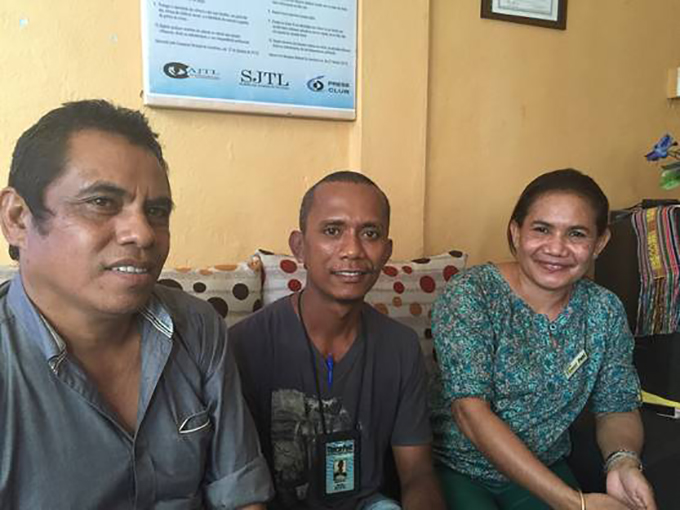
Analysis by Dr Bryce Edwards – Labour’s demographically challenging party list

Challenging demographic requirements in Labour played a part in causing this week’s difficulties with its party’s list. 

Creating and announcing Labour’s party list for the 2017 election was clearly a challenging affair. Part of this difficulty was due to the very strong desire and, in fact, requirement that the party improve the demographic diversity of its caucus make up. The party has struggled in the past to elect enough women – currently only 39 per cent of Labour’s caucus – as well as ethnic minorities to Parliament (as have other parties). 

But the party list creation has also been challenging due to other factors, with various incumbents and new candidates being promised high list places. As debated earlier in the year, renegade Maori politician and broadcaster, Willie Jackson was strategically recruited from the Maori Party, in a deft move to attempt to stymie the looming alliance between the Maori and Mana parties, which had looked likely to be a major challenge to Labour’s hold on the Maori seats. 

Labour’s new talent on show

For the clearest roundup of who’s benefitted or been disadvantaged by the manovering and various agendas in Labour, see Jo Moir’s Winners and losers: Who is up and who is down on the Labour Party list? She says the winners are: Priyanca Radhakrishnan, Jan Tinetti, Raymond Huo, and Willow-Jean Prime. The losers are deemed to be Trevor Mallard and Greg O’Connor, while Willie Jackson is categorised as an “inbetweener”.

Despite much controversy and internal party drama about its release, there’s actually been plenty of positive commentary about the list. For example, yesterday’s Dominion Post editorial declares it “a relatively strong list” – see: Botched announcement masks a reasonable list. The newspaper comments that “it’s been clear for several election cycles that Labour’s rump caucus has too many MPs who are past it. This list helps some of them to move on, and puts a bunch of new faces into winnable positions”.

Leftwing blogger No Right Turn makes some similar points: “The most obvious feature is the generational shift within Labour – the old guard time servers are out, retired or shoved down, while MPs elected at the end of the Clark years are firmly in charge. There’s also a greater emphasis on new blood rather than incumbent protection, which should help overcome the stale feeling of the party” – see: Labour’s list

Patrick Gower points out that the Jackson controversy was allowed to overshadow what should have been a story about the great new talent in the party: “It is unfortunate because it should be about the rise of newcomer Willow-Jean Prime. Rather than Willie’s falling star, the story should be about Willow-Jean’s rising one. This should have been a story about how Willow-Jean Prime was an outstanding new candidate with a high list spot. She is a lawyer, young mother, a Far North district councillor. She does it all – and has got it all. She is Maori, likeable, she fights for the North, is battle-hardened after the Northland by-election – and most importantly, she’s real” – see: Labour’s list is about Willow-Jean Prime, not ‘sooky-bubba’ Willie Jackson.

The likely demographics of the next Labour caucus

There’s been plenty of congratulations for Labour’s presentation of a more demographically representative party list. But what will the next caucus actually look like? 

The most interesting analysis comes in David Farrar’s Labour’s likely demographics. Any such analysis has to be based on a prediction of what sort of party vote figure Labour will get, and in this case Farrar bases his “on an assumption of them having 35 MPs, being 27 electorate and eight list, representing 29% party vote.”

In terms of gender, Farrar suggests Labour MPs will be 54 percent male (compared to 48 percent of the adult population), and only 46 percent female (compared to 52 percent of society). Farrar comments: “So once again Labour has ignored their requirement to have gender equality. Only at 35% party vote do they get equal number of women and men in caucus.”

In terms of ethnicity, the following categories are likely: European 49% (69%), Maori 31% (13%), Pasifika 14% (6%), and Asian 6% (12%). Farrar comments: “A huge over-representation of Maori and Pasifika in their caucus and under-representation of Europeans and Asians (compared to population).”

For an alternative analysis, see Simon Wilson’s It’s not just about Willie: sizing up the Labour Party list. He illustrates what the party list will mean in practice under different party vote results. 

Perhaps the most interesting point he makes is that under numerous party vote scenarios, the party will have failed to produce the required 50:50 gender ratio in its caucus. For example, if Labour gets 35 percent of the vote, its caucus is likely to have “a male-female ratio of 23:19”, and if the party gets only 30 percent of the vote, the ratio is likely to favour men, 19:17.

So, has the party actually adhered to its own constitutional rules? It needs to ensure 50 percent of the caucus are women. And if it hasn’t, then could legal action be taken? This is entirely unlikely according to public law expert Andrew Geddis – see his blog post, Why Matthew Hooton is wrong – again

And in terms of Labour’s improving Asian representation, there might still be cause for unrest. Yes, there are high list spots for Priyanca Radhakrishnan and Raymond Huo, but according to Richard Harman, “the next Asian candidate on the list after them is Philippino Romy Udanga in position 46. There are another six Asian candidates below him, but they are unlikely to make Parliament” – see: Dodging Labour’s Indian mutiny.

Harman reports that “there appears to be trouble within its ethnic base in Auckland”, especially with the withdrawal from the list of former candidate Sunny Kaushal, who explains he withdrew because of “ongoing hostilities and bullying from some of the Party Membership and Hierarchy that I have been subject to”. See also, Harman’s Mallard bottom MP on Labour list.

Demographic wars in Labour

The controversy over Willie Jackson’s list placing has come about because of the difficulty Andrew Little has had in delivering on his promise that his new recruit would secure a top ten list position. Although Little, as leader, was central to the list ordering process, it seems that he was outmanoeuvred in his attempts to get Jackson a more winnable position. 

Getting Jackson a higher position was made more difficult because of the new rule in the Labour Party constitution that requires the caucus to be at least 50 percent female. Sam Sachdeva explains: “A further wrinkle is the party’s requirement for gender balance: rule 8.47 of its constitution states the ranking committee must ensure that at least half of its MPs are women, taking into account likely electorate results. Based on current polling, Labour could win 36 seats. However, if it retains the 27 electorates it currently holds (15 of which have male candidates, and 12 female) that leaves space for only nine list MPs – at least six of which would have to be women to ensure gender parity. That is in part responsible for the predicament Jackson finds himself in” – see: Labour list delay reveals cracks in unity

Little’s promise of a high list place for Jackson was necessary to lure Jackson away from what was seen by many as a sure win for him in Tamaki Makaurau for the Maori Party. And it is significant that Little was not able to deliver on the promise. 

As Audrey Young writes, this was a blow to Little’s leadership and authority: “It was not unreasonable of Little to have made the public promise to Jackson. Having lured him away in February from a high-paying broadcasting job and a likely candidacy with the Maori Party, a public statement by Little was a signal to the party that this was his call. It wasn’t a decision made by Little because of the calibre of the candidate. It was a perfectly legitimate ‘Captain’s Call’ made by Little for legitimate strategic reasons in the wider interests of the party” – see: Labour leader deserves more respect from his party executive

Young says that Labour’s party hierarchy – the list committee and New Zealand Council – “blocked Little’s bid to make good on his pledge, and that “Little deserves more respect from the party’s New Zealand Council.”

According to Chris Trotter, the agenda of gender equality was simply stronger than Little strategic maneuvering with Jackson: “Willie failed to grasp I think, and maybe even Andrew did too, just how firm Labour is – in terms of the party organisation – in ensuring gender equality” – see Newstalk ZB’s Willie Jackson’s list placement down to gender equality – analyst.

Some voters might be put off by the apparent reduced emphasise on meritocracy in the creation of the party list. And for arguments about this, watch Mike Hosking’s Labour’s list another bungle

But for a defence of Labour’s mechanism to ensure gender diversity in its caucus, Simon Wilson says: “No, it’s not a ‘man ban’. Men are obviously not banned. It’s gender balancing to reflect the party’s desire to overcome unconscious and historical biases, and if you’re worried about that ask yourself if there’s a better way of getting roughly equal numbers of men and women in Parliament. Yes, it does frustrate the ambitions of some male candidates and their supporters. But it will also delight some women candidates and their supporters. And is there anyone who wants to argue our Parliament will be worse off for having more women in it? Didn’t think so” – see: It’s not just about Willie: sizing up the Labour Party list.

And for an even more strongly-worded case for Labour’s diverse demographic project, see Gordon Campbell’s On the kerfuffle over Willie Jackson’s list ranking. He paints a picture of any opposition to such identity politics as being misogynistic and racist, and even accuses the Labour leadership of playing into that: “Willie Jackson has already been brought on board, to show us the fun-loving side of misogyny.”

Campbell actually foresees this latest split as merely the beginning of a gender/culture identity politics divide in New Zealand politics for the election campaign, and that “All up, this year is shaping up to be a testing time politically for the nation’s blokes.” He concludes, “In the end, the likes of Willie Jackson and Shane Jones will cost their respective parties as many votes (especially among women) as they attract. Essentially, Jackson and Jones represent a nostalgia trip back to an era that really wasn’t so great at the time, especially for women and ethnic minorities. Which could help explain why, beneath their surface jollity, both men seem to be so angry.”

Poor political management

Regardless of the merits of Labour’s candidates and their demographics, there’s clearly been some poor political management of Labour’s list. This is spelt out best by Barry Soper, who says: “One would have thought before Labour made public when it’d be announcing its list, it would have ironed out those who could have been disgruntled with it. Yet again they’re spilling their guts in public, being forced to delay their announcement until this morning to give them time to either placate Jackson or to send him up the political creek without his waka” – see: Willie Jackson ranking latest headache for Andrew Little

In failing to get a high list spot, Willie Jackson seems to have been given the consolation prize of being made Labour’s “Maori campaign director”. But could this be a big mistake? Rob Hosking thinks so: “That leaves him incentivised to pull in a different direction. On the face of it, he has been told to deliver those electorates for Labour, and certainly, they will be critical to the party’s chances of forming a government at the end of September. But the fewer Maori electorates Labour wins, the better Mr Jackson’s chances are of getting into Parliament on the party list. Most of Labour’s Maori electorate candidates are below a winnable position on the list: This is a deliberate challenge to voters in those seats to vote Labour, and not the Maori Party. So, depending on Mr Jackson’s performance as campaign director, this could yet backfire on Mr Little” – see: Willie Jackson’s 21st party fizzer (paywalled). 

And it’s clear that Jackson’s integration into Labour – as a candidate and campaign manager – still isn’t accepted entirely accepted by many in the party – see Jo Moir’s Willie Jackson’s role in the Labour Party is still a bone of contention. She reports that Labour MP Poto Williams still appears reluctant to show any support for him, and Tamaki Makaurau MP Peeni Henare was less than enthusiastic in his response to Jackson getting the new party job.

Finally, how much does the Labour Party really care about championing those MPs who achieve progress for working women? For although much of the focus of Labour’s party list has been on Willie Jackson and the demographics involved, less attention has been given to the surprise resignation of Labour MP Sue Moroney, who was essentially demoted by her party. For the best analysis of this, see Chris Bramwell’s Labour Party listing early in election voyage. She reports: “RNZ understands she was blindsided by her party. Ms Moroney is a hard-working, tireless MP who pushed hard for an extension to Paid Parental Leave and on closing the gender pay gap. However, she was a huge David Cunliffe supporter and it’s possible that counted against her with the committee that decides the list placings.”

Today’s content

All items are contained in the attached PDF. Below are the links to the items online.

Media merger rejection

Herald: Editorial: Blocking this merger is a big mistake

Dominion Post: Editorial: The Commerce Commission doesn’t get it

The Press: Editorial: Rejection of Fairfax NZ/NZME merger makes fight for quality journalism tougher

ODT: Editorial – The future of journalism

Fran O’Sullivan (Herald): Media merger should be buried

TVNZ: ‘I think we are going to see carnage between NZME and Fairfax now’

Fiona Rotherham (NBR): Who might buy Fairfax NZ’s assets? (paywalled)

Tim Murphy (Newsroom): 345 pages of unanimous rejection

Clive Lind (RNZ): StuffMe solution lies in local news

Peter Thompson (Stuff): NZME-Fairfax merger decision leaves a regulatory challenge

Ross Patterson (Stuff): Loss of diversity through Fairfax/NZME merger would affect all NZers

Raybon Kan (Herald): Visions of the future can confuse the best of us

Herald: Media chief looks at options after watchdog shoots down merger

Herald: Fairfax mulls newspaper cut after merger denied

State surveillance

David Fisher (Herald): Spies’ database of secrets about Kiwis ignored basic security rules and standards, report finds

Jane Patterson (RNZ): Watchdog critical of SIS security clearance system

Newshub: SIS’ sensitive information security systems flawed for years – report

No Right Turn: Incompetent, trust-abusing muppets II

Raybon Kan (Herald): This spying game has a funny side

Nathan Smith (NBR): Five Eyes meeting ‘shows NZ pulling its weight,’ former SIS officer (paywalled)

Immigration

Lincoln Tan (Herald): Many migrant workers to lose pathway to residency

Alex Tarrant (Interest): Winston Peters hits back at criticisms of NZ First’s immigration stance

Michael Reddell (Croaking Cassandra): A world-leading debate on immigration?

NBR: Is immigration the cause of Auckland’s woes?

Hamish Rutherford (Stuff): Record migration could push up unemployment, despite strong economy

Eminem vs National

Ben Irwin (Newshub): National paid under $5000 for song at centre of ‘Lose Yourself’ court battle

Melissa Nightingale (Herald): National Party campaign manager Jo de Joux sought ‘complete assurances’ Eminem-Esque was safe to use for video

Stuff: Advice sought on Eminem ‘soundalike’ copyright, but not from a lawyer  

RNZ: National party received assurances about sound-alike track

David Farrar (Kiwiblog): The Eminem trial

The Budget, economy and social investment 

Herald: Budget 2017: What we know so far

Rob Hosking (NBR): English outlines budget – and election – social policy priorities (paywalled)

Richard Harman (Politik): Here comes the Budget

Isobel Ewing (Newshub): Budget boost for ‘million-dollar problem’ children

Paul McBeth (BusinessDesk): English flags $321m social investment package for needy Kiwis

David Farrar (Kiwiblog): $321 million social investment package

Dominion Post Editorial: Yes to infrastructure, no to excessive fretting over the debt

Stuff Editorial: Rising population the backdrop to Steven Joyce’s pre-Budget economic announcements

Audrey Young (Herald): Winston Peters wants greater diversity in economy away from dairy and tourism

Audrey Young (Herald): Finance Minister rules out tax cuts but lifts infrastructure spending

Newswire: Joyce ‘just playing with numbers’, says Labour

Shamubeel Eaqub (Stuff): Good news, the Government is spending up big

Election

Herald: More than half of young voters haven’t picked a party

Newshub: Fears youth won’t turn out to vote again

Martyn Bradbury (Daily Blog): 5 months out from 2017 election

James Borrowdale (Vice): The Making of Chlöe Swarbrick

Jason Walls (NBR): Winston Peters wants to be more than a kingmaker (paywalled)

Nathan Smith (NBR): Cooling the cyber ‘politricking’ threat to New Zealand’s election (paywalled)

Justice and police

Demelza Leslie (RNZ): Govt softens target for reducing violent crime

Dan Satherley and Matthew Hutching (Newshub): Prisoner’s sperm donation petition: No right to ‘jizz in a cup’ – David Seymour

Nicholas Jones (Herald): Let us give sperm to become fathers: Murderer petitions Parliament

International relations

Sam Sachdeva (Newsroom): Brownlee’s change of tact as Foreign Minister

Jane Patterson (RNZ): Brownlee: NZ should not intervene on Israel/Palestine conflict

Audrey Young (Herald): Brownlee moves quickly to restore relations with Israel

Jo Moir (Stuff): New Foreign Affairs Minister Gerry Brownlee knee-deep in restoring relations with Australia and Israel

Health

TVNZ: Children’s Commissioner slams Government’s refusal to ban second hand smoke in cars

Nicholas Jones (Herald): More mental health spending in Budget 2017: Jonathan Coleman

Jared Nicoll (Stuff): Porirua kids swapping schools more often and living in overcrowded houses

Employment

Eric Crampton (Offsetting Behaviour): Smokin’

Eric Crampton (Offsetting behavior): Pay and equity

John Braddock (World socialist website): New Zealand: Gender pay deal used to promote unions, government

Education

Simon Collins (Herald): High-paying private schools lure five state school principals

Adele Redmond (Stuff): Call to extend limits on student visas as ‘inappropriate’ English language testing persists

Sue Cherrington (Newsroom): An open letter to the new education minister on early childhood policies

Jenny Ritchie (Newsroom): Early childhood care should be an election priority

Peter O’Connor (Newsroom): Interpreting Hekia Parata’s legacy

Foreshore and seabed claim

Audrey Young (Herald): Ngati Whatua’s Auckland claim among hundreds to test coastal rights

Morgan Godfery (Spinoff): Relax, Māori aren’t banning you from the beach. Or are we?

Leigh McLachlan (RNZ): Coastline claims ‘not about ownership’ – Māori

Rape

Anna Leask (Herald): Rape – why Kiwi victims won’t report

Tony Wall (Stuff): Police are telling rape victims their hands are tied if the accused denies it

Tommy Livingston (Stuff):‘Obnoxious’ Defence Force slammed over failing to provide care for former naval officer raped while on duty

RNZ: Call to shift burden of proof to rape-accused

Environment

No Right Turn: Climate change: But why would we want to do that?

Rachel Clayton (Stuff):Little being done to tackle issue of plastic packaging in supermarkets

Geoffrey Palmer (Constitution Aotearoa): The case for environmental rights

AUS-NZ relations

Isaac Davison (Herald): Australia now a ‘frightening’ place for Kiwis

Isaac Davison (Herald): Brownlee: No chance of reversing Oz uni fee hike

Isaac Davison (Herald): Most New Zealanders’ study fees to rise by $8700 in Australia

Kapiti and Maori names and language

Stuff: Former State Highway One through Kapiti to get new names

Joel Maxwell (Dominion Post): It’s political correctness gone historic: The people behind the PC road names

Aaron Smale (Spinoff): The Kapiti Expressway, Māori road names, and the media outrage machine

Adam Poulopoulos (Stuff): Otaki in the running to be New Zealand’s first officially bilingual town

Herald: Otaki could be first bilingual town in New Zealand

John Key

Hamish McNicol (Stuff): Former prime minister John Key to become an Air NZ director

Herald: John Key joins Air New Zealand’s board

The Civilian: Opinion: Well, I like planes

Other

Max Rashbrooke (The good society):Is there much wealth mobility in New Zealand?

Lisa Marriott (Newsroom): The hypocrisy of NZ’s approach to fraud

Megan Whelan (The Spinoff): Mike Moore is ‘boring’, Jenny Shipley’s a ‘vile hag’ – the gender bias in Facebook comments

Andrew Geddis (Pundit): Word spread because word will spread

Richard Swainson (Stuff): Inequities mean revolution may not be so far-fetched

Rodney Hide (NBR): Governments fool most people most of the time (paywalled)

Steve Maharey (NBR): Tax cuts won’t bring benefits of globalization (paywalled)

Eugene Sparrow (NBR): Budget 2017: time for a rethink about renting (paywalled)

]]>

NZME, Fairfax merger declined over ‘risk of causing harm’ to NZ democracy

]]>

AsiaPacificReport.nz

New Zealand’s Commerce Commission has declined a merger which would have seen two of the country’s largest media outlets merge.

Commerce Commission chairman Dr Mark Berry, in a statement, described the merger as a harmful move to democracy because it would have seen NZME and Fairfax collectively own 90 per cent of the daily newspaper circulation and a majority of traffic to online sources.

“This merger would concentrate media ownership and influence to an unprecedented extent for a well-established modern liberal democracy. The news audience reach that the applicants have provide the merged entity with the scope to control a large share of the news consumed by a majority of New Zealanders.

“This level of influence over the news and political agenda by a single media organisation creates a risk of causing harm to New Zealand’s democracy and to the New Zealand public,” Dr Berry said.

Media plurality, diversity
More importantly, the merger would have spelled the end of media plurality and diversity in the country, the commission warned.

“Our primary concerns remain that this merger would be likely to reduce both the quality of news produced and the diversity of voices (plurality) available for New Zealanders to consume.”

This is due to the fact current, healthy competition between the media outlets would have come to an end.

-Partners-

“In our view, the merged entity’s competitors would not be able to constrain it in any real way from making cost-cutting decisions that reduce quality and plurality.”

The commission did, however, acknowledge that their decision left NZME and Fairfax in a precarious position. The media outlets currently face a challenging commercial environment as they seek to transition from traditional print products to a sustainable online model, the commission noted.

Job cuts looming
“In our view, without the merger NZME and Fairfax will be increasingly focused on their online businesses as their print products diminish in number and comprehensiveness over time,” Dr Berry said.

“We accept there is a real chance the merger could extend the lifespan of some newspapers and lead to significant cost savings anywhere between $40 million to around $200 million over five years. However these benefits do not, in our view, outweigh the detriments we consider would occur if it was to proceed.”

Several hours after the Commerce Commission’s decision, Fairfax’s stuff.co.nz reported job cuts with the owner’s regional papers were likely.

Fairfax’s acting managing director Andrew Boyle stated the no decision on the merger brought into stark reality the need to address what publishing model was sustainable for the company. He was quoted as saying: “Tough decisions will have to be made in terms on ensuring that ongoing viability.”

Declined decision welcome
The Commerce Commission’s decision to reject the merger has been welcomed by Auckland University of Technology’s Centre for Journalism, Media and Democracy (JMAD).

“I think the decision is in the public’s interest if you think that there’s now no single company which controls most of the online and print news assets in New Zealand. So I welcome that decision,” said Merja Myllylahti, JMAD’s project manager.

“I congratulate the Commerce Commission on keeping their head cool and do the best available decision at the time.”

Myllylahti warned however that the decision was not entirely something to be celebrated.

“We should actually remember that there is no winner in this situation. We really shouldn’t gloat and celebrate this because the future of the New Zealand media is actually very gloomy.”

She explained this is because the industry is likely to face “drastic changes” namely in the form of job cuts and closures.

If the merger had gone ahead, Myllylahti said it would have affected media freedom.

“We would have had less competition, less voices, less diversity, less plurality in the market.”

More importantly, the merger would have meant “more junk food news”, Myllylahti added.

Dr Peter Thompson, a senior lecturer in media at Victoria University, shared Myllylahti’s views.

“I think it was absolutely the right ruling, so I congratulate the Commerce Commission in having the courage to uphold its draft determination.

“Ultimately the Commerce Commission has done the right thing in prioritising the interests of the New Zealand public over the interests of Australian shareholders.”

However, Thompson said the commission’s decision highlights that the media in New Zealand is in crisis.

Media in crisis
This was not only down to the fact regional and local papers were under threat from the decision, but also because of weaknesses in current legislation.

The rejected merger therefore represents the opportunity for the government to rethink its regulatory framework, Thompson said.

“This decision makes the Commerce Commission incumbent upon the current government to recognise that our news media are in crisis and they need to look at the regulatory levers available to remedy that.”

Thompson, who is also part of the Coalition for Better Broadcasting, added the controversy over the merger – an “absolutely ridiculous, completely unthinkable scenario” – speaks to the weakness of the Commerce Act.

Both Fairfax and NZME have 20 working days to appeal the ruling and if this happens, Thompson said, a virtual monopoly in the print media sector will be created.

“If it goes to court and the unthinkable happens and the ruling gets overturned, then it’s going to be a very dark day for our news media and it’s going to be a very dark day for democracy in New Zealand and it will underline the urgent need, regardless of the current decision, to revise and review the Commerce Act and to revise and review the overall media regulation settings in New Zealand.”

]]>

Indonesia is ‘double-dealing’ on media freedom, says RSF

]]>

AsiaPacificReport.nz

“We firmly condemn the police violence against Yance Wenda and we call for an investigation so that both the perpetrators and their superiors, who endorse their brutality, can be brought to justice,” said Benjamin Ismaïl, the head of Reporters San Frontiéres (RSF) Asia-Pacific desk.

“Indonesia is in the bottom third of the 2017 World Press Index and this beating, the latest in a long series of attacks on media freedom in West Papua in recent months, constitutes yet further evidence that it did not deserve to host the World Press Freedom Day celebration.

“UNESCO and all the political figures gathered in Jakarta must condemn the violence and ask President Joko Widodo to stop playing a double game that consists of promoting media freedom with the international community while continuing to crack down in West Papua.”

-Partners-

Media freedom lacking
Indonesia is ranked 124th out of 180 countries in the 2017 World Press Freedom Index that RSF published on April 26. It is not unusual for both local and foreign journalists to be threatened anonymously or by the authorities and to be forced to censor themselves, RSF said.

Last week, police in West Papua seized TV reporter Richardo Hutahaen’s camera and deleted its contents. Hutahaen, who heads an association of Papuan TV journalists, and two colleagues also received death threats after covering a court hearing on a dispute between local politicians.

Due to the alarming media freedom situation in West Papua, the harassment of journalists and the frequent refusal to give press visas to foreign journalists, human rights organisations plan to protest during the events organised by UNESCO and the Indonesian government.

The aim of the protest is to press the international community to react. RSF has expressed its support for the Legal Aid Centre for the Press (LBH Pers), which organised a public discussion on media freedom in West Papua yesterday.

Foreign media are usually prevented from working in West Papua and are kept under close surveillance on the rare occasions when they are allowed to operate in the Indonesian-ruled region.

In March, French journalists Franck Escudie and Basile Longchamp were deported after arriving in West Papua to film for a documentary. Another French journalist, Cyril Payen, was refused permission to return Indonesia in 2016 after France 24 broadcast a documentary he made about West Papua, entitled ‘Forgotten War of the Papuans.’ Payen had obtained all the necessary authorisations before visiting West Papua to film for the documentary in 2015.

‘Open the door’
Pacific Media Centre director Professor David Robie called on the Indonesian authorities to “honour” the president’s promise and “open the door to genuine press freedom and an end to human rights violations against journalists and the indigenous Papuan people.”

Meanwhile, the Australian Press Council has issued a call to all media organisations, editors and journalists in the country to stand firm against what it said is “the alarming erosion of access to information, privacy and protection of sources”.

“In light of the litany of threats to free speech, press freedom and to journalists themselves, it is now, more than ever, time for media outlets to work energetically and cooperatively together with the Australian Press Council to safeguard these pillars of our democracy,” said Council Chair David Weisbrot in a statement.

Indian journalist attacked 
Similar causes for alarm were issued in India, following a police assault on The Quint reporter Meghnad Bose on Monday, May 1 the Committee to Protect Journalists reported.

The Committee to Protect Journalists (CPJ) has subsequently called for Indian authorities to identify and discipline the New Delhi police officers who assaulted Bose.

“Authorities should swiftly discipline the police officers responsible for assaulting Meghnad Bose simply for doing his job,” CPJ Asia Program Director Steven Butler said from Washington, D.C. “The police should train officers to protect the legal activities of journalists, and not to harass them.”

Pacific Media Watch sources on the ground in Indonesia said police are expected to try and stop the West Papua protest at World Press Freedom Day today.

]]>