Page 1207

‘They get up in the morning, sing their dreams’ – PNG doco explores shaman cult

]]>

AsiaPacificReport.nz

Sorcery and magic in Papua New Guinea is something that is celebrated at the same time it is feared.

Every year, hundreds of suspected sorcerers and witches are killed and only in 2013 did the government repeal a law that criminalised the practice.

It is usually a taboo subject and not openly talked about in a region where religion is strong and people are “Christian in one form or another”.

But what about the shamanistic practice of Buai in East New Ireland?

This is the premise of What Lies That Way by New Zealand filmmaker Paul Wolffram.

Premiering at the New Zealand International Film Festival, Wolframm takes his audience on a personal journey to the rainforests of southern New Ireland and inside the spiritual world of the Lak people.

Having spent time with the Lak people in the early 2000’s for his documentary Stori Tumbuna: Ancestors’ Tales and gaining an understanding of their musical and dance traditions, Wolframm returns in 2015 and What Lies That Way for more of a spiritual understanding of this isolated and remote community.

-Partners-

By undergoing the dangerous initiation process into their Buai shaman cult, which involves fasting for four days and five nights, Wolframm hoped to do so.

Despite being the only white man to undergo such a secretive practice, Wolframm told the audience of last night’s screening in a Q and A session it is in danger.

“There are only four shamans remaining in the Lak region,” he said.

Wolffram explained this is due to the fact young men can now more easily travel outside of the community, where smartphones and internet is readily available.

“Technology is closer.”

But after showing the documentary to the Lak people in May this year, many have expressed their desire to become a shaman too, he said.

Although not allowed to impart the knowledge of his initiation and the psychoactive substances involved to anyone, the Victoria University film lecturer-turned shaman admitted the centrality of Buai is creativity.

“Dreams are songs. For those who have accepted the Buai spirit, they get up in the morning and sing their dreams.”

Touted as the film “by and about magic”, Wolffram hopes the audience will gain an insight into the people of Papua New Guinea and its culture.

“It’s not about me, I’m the vehicle through which the audience will experience this very different way of understanding the world,” he said.

]]>

Report reveals US, Chinese companies linked to PNG land theft, deforestation

]]>

AsiaPacificReport.nz

Landowner-turned activist Paul Pavol talks about the widespread land theft and deforestation occurring in Papua New Guinea at the hands of foreign companies. Video: Global Witness.

Major hardware companies in the US and China have been forced to halt sales of exotic wood flooring and review supply chains after a report has revealed potential links to the devastating and illegal logging trade in Papua New Guinea.

This follows a three-year investigation by international NGO Global Witness into the land theft and deforestation at the heart of Papua New Guinea’s controversial land leases.

Their new report, ‘Stained Trade’, reveals how a third of the country’s timber has been illegally obtained by clear-cutting rainforests on land owned by local communities.

US hardware giant Home Depot and its supplier, Home Legend, along with China’s largest flooring seller, Nature Home, are allegedly involved in this trade worth US$15 billion (NZD$20 billion) a year.

Home Depot and Home Legend have stated they have taken all necessary steps and complied with the Lacey Act, a US law which bans the import of illegal wood, but Global Witness claims wood from Papua New Guinea is readily available on US markets in the form of flooring manufactured in China.

“Papua New Guinea’s government has illegally handed over vast tracts of indigenous land to logging companies who are gutting virgin rainforests at breakneck speed. Responsible logging companies should not be dealing in this wood,” Rick Jacobsen of Global Witness said.

-Partners-

“Tens of thousands of people have been affected. Many who tried to speak out have been threatened, arrested or beaten up by police on the payroll of logging companies.”

Land given away
One of those people is landowner-turned-activist Paul Pavol.

Pavol believes the lease the government used to “give away” his land to logging and palm oil interests involved fraud and forgery.

Despite challenging the move in court, he faces an uphill battle in the face of police intimidation, legal harassment, and a better-funded opponent, Global Witness stated.

“These people say they own the land now, and they do whatever they want. Police came to our community at night. People were scared that they might burn down our houses. That’s the reason we raise our voices. Something’s got to be done to save our forest,” Pavol said.

Global Witness has also called out recently re-elected prime minister, Peter O’Neill, for his involvement in such issues.

“Prime Minister Peter O’Neill has been promising for years to cancel illegal leases, but has failed to follow through. Clear-cutting of forests under the leases is destroying sources of food, water and medicine on which indigenous communities rely.”

Apparent widespread abuse of the land leasing scheme – Special Agriculture and Business Leases – has seen 12 per cent of Papua New Guinea given away to foreign interests for up to 99 years, Global Witness said.

End complicity calls
The NGO has therefore called on US companies selling flooring potentially made from Papua New Guinea’s wood to end their complicity in fueling the theft of indigenous land and deforestation.

“US companies need to take steps to ensure wood products they buy from China are not linked to the abuses of the kind we’re seeing in Papua New Guinea,” Jacobsen said.

According to Global Witness, only half of the ten companies contacted about their potential involvement have responded.

]]>

Bryce Edwards Analysis: Reality check on Jacindamania

New Zealand Prime Minister, Jacinda Ardern.

Bryce Edwards Analysis: Reality check on Jacindamania

[caption id="attachment_13635" align="alignleft" width="150"] Dr Bryce Edwards.[/caption] It’s wall-to-wall Jacinda Ardern in the news, with a level of hype that suggests she’s already turned the Labour Party’s fortunes around, and National is now on the back-foot. Yesterday’s column – Jacindamania – showed just how much excitement there is about Labour’s new leader.  But amongst the fanfare there are voices sounding a note of caution. Below are the most interesting reality checks on Jacindamania.
[caption id="attachment_6928" align="aligncenter" width="612"] Labour Party leader Jacinda Ardern. Image courtesy of Jacinda.org.nz.[/caption]
1) Veteran political journalist John Armstrong is not inclined to go along with hype, and today he gives the strongest reality check about the meteoric rise of the new Labour leader, saying what “Labour could do with is a lot more caution before casting its new leader as the Wonder Woman of New Zealand politics” – see: Ardern gives Labour a chance, but she has hard choices to make.
Armstrong says the “prevailing wisdom” is that Ardern will win back all those former Labour voters, but there is “little evidence as yet to make such an assumption”. Here’s his main point: “you could have been excused for thinking Labour had just won the general election, rather than indulging in a last-minute exercise in survival. Amidst such euphoria, it is easy to forget the scale of the leap required to bridge the gap between leader and deputy leader. In her prior capacity as deputy, Ardern had run up all of four months’ experience in a senior management position in the party. She has never stamped a particular personal vision on the policies that have emerged from the shadow portfolios she has held during her nine years as an MP. Neither has she shown that she possesses the finely-tuned political instincts of a John Key, a Richard Prebble or, crucially in her case, a Bill English.
Perhaps most important of all, she has never landed a sustained hit which really rattled Labour’s old foe.”
2) Mike Hosking doubts that Ardern is a saviour for Labour, raising questions about her lack of experience, and saying “I am not sure how relatable she is to middle New Zealand – see: Jacinda Ardern would have been better to wait. Hosking also wonders how different she’ll really be to Little: “She’s promising new policy but it will have to be dramatically different than what they’ve already rolled out and judging by her opening comments in her first press conference, it was the same old stuff: closing gaps, more money, an inclusive society”. See also his video: Jacinda Ardern has a credibility issue.
4) National Party blogger David Farrar makes a positive assessment of Ardern, concluding that “Overall the pros clearly outweigh the cons. I think she will do better than Andrew Little” – see: The pros and cons of Jacinda. But Farrar points to some important drawbacks: “Is she ready to be PM? NZ has never elected someone PM who has been a party leader for just eight weeks. She is untested as a leader. Does the public think she can run the country? Running a country is vastly different to running a club of youth wings.” And on economic issues, he asks: “Will the public think her and Grant Robertson will be better economic managers than Bill English and Steven Joyce?” Her electoral track record is also brought up: “She is popular and liked but she did fail to win Auckland Central (a previous safe seat for Labour) in both 2011 and 2014”.
5) Also on the right, Matthew Hooton has long been the most vocal commentator forecasting that Ardern would take over from Andrew Little and lead Labour into the election, but he wasted no time in declaring her not up to the task: “I think she’ll fail. I think she’s an absolute flake but obviously Labour Party caucus knows her better than I do and feels she’s the right person to fill the shoes of Savage and Fraser and Lange and Clark” – see the Herald’s Matthew Hooton: Jacinda Ardern ‘will fail, I think she’s a flake’.
6) While we might expect right wing commentators to express strong reservations about Ardern’s ability to turn her party’s fortunes around, one of the most challenging responses has come from Gordon Campbell, who actually thinks Labour’s situation could worsen under Ardern: “It isn’t entirely beyond the realm of possibility that this episode could mark the end of the Labour Party as a major political force” – see: The Labour leadership change.
Campbell’s main point is that Ardern appears to be just another in a long list of ideologically-centrist leaders who aren’t willing to make radical changes to the party: “All of them tried and all failed to sell the public on a political brand that consisted of loudly bewailing the social outcomes of the market, while quietly embracing its core precepts about how a modern economy should be run. Since Labour appears to lack any appetite for fundamental change (much less any idea of what that might entail) Labour’s political messaging has been almost entirely negative. On the doorstep, Labour candidates have been left promoting a culture of complaint. In this void, Gareth Morgan – so help us –is now seen as the visionary alternative. Even the social spending on health and education that Labour is offering at election 2017 is almost entirely dependent on the surpluses that National’s economic policies have generated. Point being, a lot more than a change of leader is required, longer term. That will have to wait until next year, and beyond. No one will be blaming Jacinda Ardern if she fails to win this election; her immediate job is to lessen the scale of the defeat.”
7) There are plenty of others who might be seen as sympathetic to Labour’s reinvigoration, also pausing before declaring Ardern a “game changer”. For example, University of Otago’s Andrew Geddis has been reported as believing “Ardern must prove she has substance, as at present her new deputy has more credibility” – see Eileen Goodwin’s Leader needs to prove herself: prof. Geddis says: “One of the things about Jacinda that will be raised is what she’s actually achieved… With Kelvin Davis, you can point to a lot of stuff that he’s done… He’s got a lot more gravitas than I think perhaps Jacinda could claim at this moment”.
Furthermore, he says that questions about Ardern’s lack of achievement have a ‘”fair basis in reality”. The article reports that “She had not steered a member’s Bill through Parliament, and nor had she been a leading figure in public debate”. Geddis says: “It’s hard to think of many issues on which she’s been a leading figure to engage the public conversation.”
8) The Dominion Post also says today that Ardern needs to show she has some substance: “she will have to prove her worth. Relying on personal popularity and connecting with younger voters is a start, but it won’t be enough. She has to foot it with English on policy detail that will somehow resonate with the kind of voters her party has not been able to capture at the last three general elections” – see: Talent, temperament and tenacity paramount to leading the country. The editorial adds: “Ardern may have more charisma and a boost in momentum, but there’s more to being prime minister than a feelgood honeymoon period and the platitudes of the past couple of days.”
9) Veteran leftwing activist John Minto says he’s also sceptical whether “Ardern can breathe some life into Labour’s neo-liberal corpse” and argues that her “election, alongside that of Kelvin Davis as deputy, represents a shuffle further to the right” – see: Labour’s last throw of the neo-liberal dice. He worries that Labour is simply making cosmetic change at the expense of getting the party in sync with today’s more radical mood: “Labour believes it has a perception problem so it keeps changing the packaging. But the packaging isn’t the problem. It’s the content of the package that leaves them in a political backwater. Unlike the UK for example where Jeremy Corbyn has performed well as UK Labour leader, Labour in New Zealand has no bold, progressive policies.”
10) Ardern seems to be backtracking on her self-described “democratic socialist” label, with the emphasis now on being a “pragmatic idealist”, and this is concerning leftwing blogger Steven Cowan, who says this term “could mean anything. And this should raise alarm bells given her long held admiration for a ‘Third Way’ exponent like Helen Clark. If Ardern’s intention is to simply ‘cherry pick’ which policies that Labour should emphasise while leaving the logic of market capitalism unchallenged, then this will not be the ‘bold’ Labour she says that she wants. It will not shift Labour from its failed centrist path and present the electorate with a clear political and economic alternative” – see: Jacinda Ardern: Will she swing Labour to the left?
11) Ardern is no Jeremy Corbyn, according to Finlay Macdonald, who says the British Labour has undergone quite a different transformation to Ardern’s Labour Party: “Labour in New Zealand has had no such genuine reckoning. Here, beneath the squabbling over policy and scandal, lies a cosy bipartisan pact never to frighten the horses with talk of higher taxes and full employment” – see: Ardern’s new role: ‘People’s Princess versus Dreary of Dipton’. Even under Ardern, “despite crises in housing, health and the environment, Labour is not perceived as the rightful champion of the dispossessed and disenchanted. Changing that at this late stage will take a fresh approach indeed.”
12) Jane Patterson makes some similar points: “Ms Ardern is now the sixth leader of the Labour Party in nine years, and while she may provide a ‘fresh face’, the party’s problems run deeper. They need to define what they stand for and present a clear vision of what New Zealand would look like under a Labour government, as opposed to the current administration” – see: Ardern a ‘fresh face’, but Labour’s problems run deeper.
13) Jacinda Ardern will be announcing a number of policy changes over the next day or so, and this will be the test for Chris Trotter, who points forward a number of must-do policies to adopt if Labour is to succeed – see: Labour Can Win If … Defining Jacinda’s Political Mission. He is pushing her to be truly radical and authentic: “Labour can win if … Jacinda resists any and all attempts to make her the promoter of policies which clash with her self-definition as a “pragmatic idealist”. If Labour’s so-called “strategists” dismiss the “idealist” half of her descriptive pairing and load Jacinda up with the same highly pragmatic (but utterly uninspiring) policy baggage that drove its poll ratings below 25 percent, then the candle of hope which she has ignited will be snuffed out”.
14) Labour appear to be adopting a new campaign slogan of “Let’s do this!” – see Anna Bracewell-Worall’s ‘Let’s Do This’: Labour’s new campaign slogan? But is their sales pitch going to be successful? Political marketing expert Jennifer Lees-Marshment has some doubts: “In political marketing terms, Labour is more in touch with voters’ concerns than National. They have raised all the right issues and focus on the problems facing ordinary New Zealanders. But their problem is political management. They have not demonstrated that they can do anything about the problems they raise. They have spent too much time talking about National, and too little about their own solutions” – see: Labour’s problem with political management.
And changing leaders could be making this worse: “A change of leadership at this stage shows disunity and lack of political management, and these are all things Labour was weak on already. They needed to plug a hole in their delivery capability, not blow it wide open.”
15) “Beware cries of a Labour miracle” says Tim Watkin, because “While Jacinda Ardern is ‘a young proposition’, she’s not just been pulled from the bullrushes, and while the past 36 hours have seen a remarkable ‘Jacinda Effect’, she’s not the saviour” – see: How the Jacinda Effect changes everything & nothing. Also, rather than moving to the left, Watkin says Ardern needs to take Labour towards the centre: “Labour isn’t suddenly no longer a bit of a mess. The change of leadership has made some things possible again, but it’s far from a slam dunk. The next week and whatever new policy Ardern announces to make her mark is vital. It must appeal to the centre, not the left, of her party.”
Finally, for more cartoons on the new Labour leader, see my new blog post, A History of Jacinda Ardern through cartoons.
Today’s content – All items are contained in the attached PDF. Below are the links to the items online.
Labour Party
Claire Trevett (Herald): Will Jacinda Ardern eat the Greens?
Gwynn Compton (Libertas Digital): Brand Bill vs Brand Jacinda – Game on
Michael Reddell (Croaking Cassandra): A fresher approach for ordinary New Zealanders
Steven Cowan (Against the current): Jacinda Ardern: Will she swing Labour to the left?
No Right Turn: The Jacinda effect
Ben O’Connor and Scott Palmer (Newshub): Public reacts to new Labour leader Jacinda Ardern
Greg Presland (Standard): The big mo #LetsDoThis
Jacinda Ardern’s baby plans
Barry Soper (Herald): Ardern the flip up
Election
Sarah Dowie (Southland Times): Govt is backing the regions
Metiria Turei benefit fraud
Housing
Employment
Life on a benefit
Andrea Black (Let’s talk tax): #WeareallMetiria
Health
Marewa Glover & David Sweanor (Herald): Vaping can make us smoke-free by 2025
Euthanasia
No Right Turn: Pissing on the public
Mental Health
No Right Turn: Not a good look
Education
Stuart McCutcheon and Harlene Hayne (Stuff): Opinion: A university by any other name
Kim Dotcom
Other
Southland Times Editorial: A sororal state of affairs
Anna Bracewell-Worrall (Newshub): Window washers to be banned under new law
]]>

Deported NZ missionary to push for reform on return to PNG

]]>

AsiaPacificReport.nz

Set to return to Papua New Guinea … New Zealand missionary Douglas Tennent’s “moral obligation” to push for deportation reform. Image: Kendall Hutt/PMC.

By Kendall Hutt in Auckland

Deported New Zealand missionary Douglas Tennent will hopefully be returning to Papua New Guinea in the next week.

This comes after the court ordered immigration services to issue Tennent a new visa last month which will see him return by or before August 8.

Tennent is scheduled to fly out on Friday, but is not confident his visa will come together in time.

“It doesn’t look like that’s happening,” he says.

Tennent was deported on June 12, 2017, over an alleged breach of visa conditions.

Authorities claim Tennent was deported due to “blatant abuse” of his special exemption/religious worker visa after engaging in “sensitive landowner issues in East New Britain Province”.

-Partners-

Tennent was deported after some landowners lodged a complaint regarding his involvement in such “sensitive landowner issues”.

‘Just doing his job’
It is believed the complaint comes due to Tennent’s involvement in remedying a special agricultural business lease regarding Malaysian multinational Rimbunan Hijau’s Sigite Mukus oil palm project in West Pomio.

Both Tennent and Archbishop Francesco Panfilo hold firm to the belief Tennent is “just doing his job”, however.

Returning to Papua New Guinea in the coming week will mark a seven week absence from his duties as the administrator for the Archdiocese of Rabaul.

Tennent told Asia Pacific Report this morning the actions of immigration and the acting chief migration officer therefore have put not only himself, but Archbishop Francesco Panfilo under undue stress as the Archdiocese continues to settle disputes.

“The Archbishop is getting very stressed out. He’s had to put off a very much-needed holiday at 75 until I get back.”

“It’s just a matter of picking up the pieces,” Tennent therefore says of negotiations with Rimbunan Hijau.

Tennent’s deportation has also “knocked off track” the giving back of 160 hectares of land to four local communities which was purchased illegally.

‘It needs to be sorted out’
The case was due to be heard in court on July 11, but that never happened due to Tennent’s absence.

“It needs to be sorted out in court and this has had adverse effects on the Kokopo community,” he says.

Despite criticisms he should be suing immigration for damages, Tennent is just looking forward to returning to work.

“The Archbishop and I have decided we’re not in to that. We just want to get back, carry on with the job.”

But Tennent will be making submissions to the Ombudsman, Constitutional Law Reform Commission and immigration calling for a change in the deportation process.

“I don’t want this sort of thing to happen again. If you’ve got a concern about somebody, you go to them firstly and you let them respond. That was not done at all.

“I think we’ve got a moral obligation to try and address that.”

Tennent says he would like to see potential deportees given fair notice around the reason for their deportation and ensure associated evidence is provided to them so they are allowed to respond to the allegations.

He would also like to see careful and thorough investigation carried out by immigration before people are deported and says reasonable time needs to be given for them to sort out their affairs.

“The number of deportations are not large in PNG, so there’s no excuse for not getting them right.”

]]>

O’Neill re-elected PNG prime minister following ‘chaotic’ day in parliament

]]>

AsiaPacificReport.nz

Prime Minister Peter O’Neill re-elected amid parliamentary ‘chaos’ … Alliance will take government “to task”. Image: PMO

Peter O’Neill has been re-elected as Prime Minister of Papua New Guinea amid a chaotic day inside parliament.

The tenth sitting of parliament suffered a delay and tensions broke out between Nick Kuman from the People’s National Congress and Lukas Dekena of the PNG party over who was the MP-elect for the Gumine seat, Radio New Zealand International reported.

EMTV’s Your Vote 2017 reported there was “commotion” as both members refused to move from their seat when asked by parliamentary staff to do so.

Dekena was declared on July 28 and Kuman on July 30, so the matter is currently before the court.

Due to such issues and the fact several seats are still to be declared — only 105 of the 111 writs have been returned — Kerenga Kua, MP-elect for Sinasina-Yonggamugl Open, visibly voiced his concerns, urging the Chief Justice to stop proceedings as members of the Alliance and PNC yelled at one another from across the room.

This prompted his Alliance colleagues to stand in solidarity with him before things eventually calmed down as newly elected MPs were sworn in.

O’Neill was the only candidate put forward by PNC after the party was invited to do so by new speaker Joe Pomat (PNC) on advice of the Governor-General, Loop PNG reported.

-Partners-

PNC holds majority
Pomat beat Allan Marat of the Melanesian Liberal Party 60 votes to 46, while PNC was invited to nominate a candidate for Prime Minister because the PNC coalition had the majority of seats (60), compared to the Alliance’s 47, Your Vote 2017 reported just after 10am.

Both camps had been confident they had the numbers going in today’s sitting.

O’Neill’s appointment marks the end of Papua New Guinea’s tumultuous election period which began in April.

The country’s 2017 general election has been marred with electoral roll issues, shortages of ballot papers, disputed ballot boxes and violence, as reported by Asia Pacific Report.

For those wanting a change of government, the only consolation seems to be the decrease in O’Neill’s majority and the Alliance’s determination to stand by “the cry of the people” following a press conference.

Kua says the Alliance is not a lost cause and O’Neill’s government can expect to be “taken to task” over every policy.

With several seats still undeclared, the make-up of Papua New Guinea’s tenth parliament is still to be cemented.

]]>

Bryce Edwards Analysis: Jacindamania

Bryce Edwards Analysis: Jacindamania

[caption id="attachment_1983" align="aligncenter" width="635"] Labour Party leader, Jacinda Ardern.[/caption]
New Labour leader Jacinda Ardern is promising to run an election campaign characterised by “relentless positivity”. And, so far, there’s been an almost relentlessly positive response to her rise to the top. It appears that Ardern’s extraordinary elevation is going to lift this election campaign out of the ordinary, too. Below are some of the more interesting examples of “The Jacinda Effect” taking hold.
1) Jacinda Ardern dominates the newspaper front pages today – see my blog post aggregating how the media has responded: Media coverage of Jacinda Ardern as Labour leader.
2) Newshub’s political editor Patrick Gower is not afraid of attacking or grilling politicians, but he seems to have been struck by Jacindamania, writing two very positive accounts of the new leader. In his report, Ardern could capitalise on the mood for change, he says “Jacinda Ardern represents one thing that Bill English and National never can – change. And if you can harness change, it is one of the most powerful political weapons there is.”
3) In a second opinion piece, Jacinda’s on fire, National should be frightened, Gower really lets loose, summing up Ardern’s first media appearance like this: “Powerful, composed, eloquent – and actually quite funny.” He adds: “Ardern brings energy…. She has presence. She isn’t anxious – she looks in control. She doesn’t look reluctant – she looks ready. And importantly, Jacinda Ardern has got that valuable political ingredient – vibe. She has got serious vibe. One of her weaknesses was supposedly that ‘she doesn’t want it’. Well, she has got it now – and looks like she really wants it. If National aren’t scared now – they should be. Because if anyone can cause a political ‘youthquake’, it’s Jacinda.”
4) Other political editors also have high praise for Ardern. Fairfax’s Tracy Watkins reports on her power: “I’ve seen her on the campaign trail and it is clear she has the x-factor. At a gathering in New Plymouth she was supposedly the warm up act to Little. But it was clear she was the main event. Ardern had the audience in the palm of her hand – when Little took over he spent 50 minutes talking into a microphone and it was clear he had lost them after the first 10. The people who left that pub that night would have voted for Ardern – but I’m not sure they would have voted for Little. Even the party faithful among them” – see: Can the Ardern factor save Labour?
Watkins believes Ardern and Kelvin Davis “are potential game changers.” She says they “will shake up the political landscape. And they ring the generational changes after three terms of National.”
5) Herald political editor Audrey Young believes that Ardern will inject some dynamism into the election campaign: “Jacinda Ardern will have what the billboard promises: a fresh approach. When people turn on their screens to watch Bill English debate the Labour leader over the next two months, they are now less likely to change channels or scroll away. Bill English vs Andrew Llttle was a gift for the likes of Winston Peters and Metiria Turei. English vs Ardern will inject a level of interest in this election and a fresh hope for Labour to recover some dignity from the result. It is still not inconceivable that Labour could be part of the next Government” – see: Ardern is fresh, impressive and interesting.
6) Audrey Young also suggests that Ardern is going to make National’s re-election more difficult: “Jacinda Arden’s elevation as Labour leader has sent a chill through the National Party in inverse proportion to the sheer radiance emanating from the Labour caucus over the change” – see: Ardern does not need to be Labour’s Joan of Arc. Again, on Ardern’s first media appearance: “Arden’s press conference was a command performance of a competent new leader that stunned most of those watching, and especially those who have believed she was not a woman of substance.”
7) TVNZ political editor Corin Dann was also impressed by Ardern, saying she clearly energises people. He describes the change in leadership as a circuit breaker for the Labour campaign, saying it gets them back in the game as they now have a leader who can communicate their policies effectively – see: “She absolutely convinced everyone she wants the job” – Corin Dann impressed by Jacinda Ardern’s first day in charge.
8) The political editor of The Spinoff website hedges his bets with the pros and cons of the new leadership team, but his pros are worth citing: “Jacinda Ardern is Labour’s greatest hope, a potential breath of fresh air, a vital contrast with the grey familiarity of prime minister Bill English”, and, “the centre-left alternative now looks decisively more diverse and modern than the status quo” – see: Jacinda Ardern and Kelvin Davis: why this is terrible for Labour, and why it is brilliant.
9) Also at The Spinoff, Simon Wilson predicts big things for the new leadership team: “Jacinda Ardern is going to try hope. She’ll keep flashes of the anger, that’s plain enough, but she knows what it really takes: project a warm, winning confidence, make people like you so they want to listen to you, identify with them and inspire them with the belief that you are there for them and have the skills to help them. It’s what Bill English does, and Metiria Turei and Winston Peters too. It’s what John Key did. It’s what Andrew Little couldn’t do. But Jacinda Ardern has already demonstrated that she can” – see: Why Jacinda is the answer and Andrew didn’t understand the question.
Wilson also comments on Ardern’s strong performance at her first press conference: “She reduced the assembled hacks of the press gallery to laughter, several times. She reduced ol’ hatchet man Paddy Gower to something you might almost call adulation. Imagine what that takes.”
10) Veteran political journalist Richard Harman of the Politik website declares that “Ultimately this has made the election more difficult for National to win”, and he reports that National is worried about how to deal with the new Leader of the Opposition: “National fears that any attacks on Ardern, a relentlessly positive person, could be seen as bullying” – see: What will Ardern mean for the Nats. He also notes that Ardern might even steal votes off National: “Whether she will win over National votes is less clear. But during the Mt Albert by-election earlier this year there was some evidence that she picked up votes in National voting parts of the electorate.”
11) Writing just before the leadership change, Newsroom’s Tim Murphy argued why Ardern was the best choice to take Labour into the election – see: Cometh the hour, cometh Jacinda. He makes plenty of arguments in her favour, which include: “She matches Peters too, in being familiarly known by her first name – and being able to flash a smile that could burst a ballot box. She’s urban but not too urban, being from Morrinsville and the University of Waikato. She’s young, having turned 37 last week, but Emmanuel Macron is 39 and vying for leadership of the free world. She’s been an MP for nearly nine years, has claimed a lifetime seat in Mt Albert, and worked under four Labour leaders. She worked as a researcher for Helen Clark before that.”
12) The leftwing blogosphere appears to be highly favourable towards the new leader. And Martyn Bradbury represents this best in his blog post, Why is Jacinda popular and can she turn Labour’s fortunes around? Bradbury puts forward a generational argument in Ardern’s favour: “She’s part of a kinder Generation taught and brought up in a culture that was desperate to be inclusive of others and that ignoring inclusivity was the greatest sin. This is why she is so widely popular. She brings with, she doesn’t talk down to, she is all about getting agreement to move forward because that was how decision making was being taught in our education system. Jacinda is a product of her generation, and because most of the pundits are older than her, they judge her by their own generations combativeness and cynicism. Which is why they don’t get her. I think her skills to quietly bring together and find unoffensive ways to work alongside each other for a common good came incredibly early for Jacinda.”
13) The political commentariat are increasingly using the term “game changer” about Ardern. And that spans the likes of both Chris Trotter and Matthew Hooton – see Anna Bracewell-Worrall’s Jacinda Ardern is a ‘game changer’ – commentators.
14) “The Jacinda Effect” is galvanising Labour’s support base. Isaac Davison reports Labour’s General secretary Andrew Kirton: “We’ve never seen anything remotely like this. It was coming in at something like $700 a minute” – see: New Labour leadership has lifted fundraising and galvanised Maori, Kelvin Davis says. Kelvin Davis also claims that the change of leadership “has brought in more than $100,000 and 600 new volunteers for Labour in 24 hours”.
15) So far the only public opinion polls providing any feedback on how the public feel about the leadership change are online (unscientific) ones. Nonetheless, they suggest that Jacindamania is widespread. The Herald’s online survey says “43 per cent said they would now consider switching their vote to Labour” – see: Labour’s new leader Jacinda Ardern gets a warm welcome from voters. Similarly, on the Herald Facebook site, “Of the 3700 people who responded, 2400 said they would now vote for her, or 65 per cent”. And the Interest.co.nz website also records very positive results for Labour – see: Interest.co.nz readers believe installing Ardern and Davis was the right move and that it’ll help their election chances.
16) Radio talkback land is also apparently positive about Labour’s new line-up. Newstalk ZB’s Mark Dye reports on what he heard from callers yesterday: “if the feedback I witnessed in the four hours of talkback Kerre and I did on the subject on Tuesday is anything to go by, this is a step in the right direction. No more Little, and Ardern in his place has people excited. I know this will upset the policy wonks amongst us, but the populace like warm and personable. As a wonk myself, I hope an approachable demeanour is not the only reason a person chooses to vote for a particular party, but it certainly warms them to it. Time and time again we heard that this is why people liked Key. Ardern has this” – see: Old and worn versus fresh and new.
17) Finally, to see how satirists are dealing with the new leader, see my blog post, Cartoons about new Labour leader Jacinda Ardern.
Today’s content All items are contained in the attached PDF. Below are the links to the items online.
Labour Party leadership
Fran O’Sullivan (Herald): Can Ardern pull bunny out of new hat?
Southland Times Editorial: Labour goes full speed Ardern
Sam Sachdeva and Shane Cowlishaw (Newsroom): Taking stock of Jacinda Ardern’s stocktake
David Farrar (Kiwiblog): The pros and cons of Jacinda
Jennifer Lees-Marshment (Newsroom): Labour’s problem with political management
Tim Beveridge (Newstalk ZB): One fact hasn’t changed for Labour
Tracy Watkins (Stuff): Can the Ardern factor save Labour?
Richard Harman (Politik): What will Ardern mean for the Nats
Eileen Goodwin (ODT): Selection review urged
Gordon Campbell (Werewolf): The Labour leadership change
Greg Presland (Standard): Solidarity forever
Willie Jackson (Daily Blog): Jacinda’s mana shines through
Tim Murphy (Newsroom): What Jacinda Ardern wants
No Right Turn: The big gamble
Daphna Whitemore (Redline): Jacinda – Labour’s most pleasant leader
Russell Brown (Public Address): That escalated quickly …
Martyn Bradbury (Daily Blog): Jacinda Ardern – First impressions as Leader
Emma Hurley (Newshub): Politicians react to Jacinda Ardern
Election
Bryce Edwards (Newsroom): Make NZ vote again
Election – Greens 
Shane Cowlishaw (Newsroom): Making the Greens green again
Election – Labour
Mike Yardley (Press): Does Raf Manji have a prayer?
Todd Barclay scandal
Mental health
Katie Kenny, Laura Walters and Alex Liu (Stuff): Take a walk Through the Maze of New Zealand’s mental health journey
Health
Economy and trade
Michael Reddell (Croaking Cassandra): A radical alternative to macro policy?
Solid Energy
Other
Michael Littlewood (Kiwiblog): Guest Post: The politics of superannuation
]]>

Public interest journalism at a ‘crossroads’, says MEAA

]]>

AsiaPacificReport.nz

Desolate newsrooms may become more common … public interest journalism at a “crossroads” thanks to social media. Image: MEAA

Australia’s Media, Entertainment and Arts Alliance (MEAA) says public interest journalism is at a “crossroads” in its submission to the country’s Senate inquiry into the future of the form.

The union for Australian media workers therefore feels it is time for the government to step in and support independent journalism in order to preserve democracy.

“The digital disruption that has transformed the media has shaken everything we knew about out industry.

“There is no certainty. The audience is fragmented,” the MEAA noted in a statement.

The MEAA’s submission details the blow the internet and social media has dealt journalism in Australia, robbing media of its revenue — part of a growing global trend.

A series of recommendations have also been made to the Senate inquiry, namely around increases in funding and the establishment of further protections.

However, the MEAA acknowledges there is no “magic bullet” which will restore the media to its former glory of six years ago.

-Partners-

‘No going back’
“Digital disruption has and will continue to reshape the industry. There is no going back.”

This may mean the industry undergoes more hardships as improvements are potentially made, the MEAA says.

“It is true that, unless something urgent and comprehensive is done the media will continue to collapse.

“It is time for government to foster, encourage, promise and support the media so that it can continue to function for all Australians.”

The MEAA’s submission to the public interest journalism inquiry comes amid increasing surveillance attempts on the media by the Turnbull government as previously reported by Pacific Media Watch.

]]>

NZ climate change approach must ‘transcend government’, says report

]]>

AsiaPacificReport.nz

By Kendall Hutt in Auckland

Concerns have emerged New Zealand may not meet its obligations under the Paris Agreement if a law on emissions is not enacted and soon.

This is the view of New Zealand’s Parliamentary Commissioner for the Environment, Dr Jan Wright, which was revealed in her final report ‘Stepping stones to Paris and beyond: Climate change, progress, and predictability’ released this week.

“There is no direct link between New Zealand climate policy and reaching the Paris target,” she says.

“My chief concern in this report is not the level of our targets, but the lack of a process for achieving them.”

Dr Wright therefore believes the government should take a note out of the UK’s book and implement a climate change act which puts emissions targets in legislation and sets up a process for reaching them.

This is because between 1990 and 2015 New Zealand’s emissions have risen by 64 per cent, while the UK’s have fallen by 38 per cent in the same period.

-Partners-

Under the 2015 Paris Agreement, New Zealand’s emissions should be 11 per cent below those of 1990 levels by 2030.

Paris target unreachable
But if the concerns raised in Dr Wright’s report are anything to go by, that target may not be reached.

Dr Wright herself acknowledges our 2030 greenhouse gas target may not be “ambitious enough” so charting a pathway to that target and beyond is the “bigger issue”.

New Zealand’s Paris Agreement emissions target … “not ambitious” according to Dr Jan Wright. Image: Parliamentary Commissioner for the Environment.

So what would such a pathway look like?

Firstly, New Zealand’s emission targets would become law, with “carbon budgets” approximately every five years ensuring these targets are met.

An expert body would also be established to provide successive governments objective analysis and advice about how their targets are tracking and what steps could be taken to improve.

But Dr Wright warns this legislation must transcend the current government.

“Support across political parties is vital. Climate change is the ultimate inter-generational issue, and governments change.”

Climate ‘transcends governments’
As a result, Dr Wright sees the implementation of this act being via a “apolitical long-term approach”, which means businesses largely pick up the baton from government.

“Climate change transcends governments and our approach must do the same,” she says.

However, New Zealand currently has no strong policy on emissions or mitigating and adapting to climate change, Dr Wright says.

“Currently, New Zealand has no climate change target in law.”

This is also something climate change minister Paula Bennet herself has acknowledged.

She told The AM Show: “We’re just not quite there. I don’t think the time is right for us to be doing the legislation.”

New Zealand’s climate change policy is seen by some as ad hoc, so much so that a 26-year-old law student took the government to court in June over its climate policy “failure”.

Government ‘shirked responsibilities’
“So far the New Zealand government has shirked its responsibilities, set unambitious and irrational targets, and justified it all by saying we’re too small to make a difference,” Sarah Thomson told Asia Pacific Report.

“I’m young and I’m terrified of a time when I might have to look my kids in the eye and explain to them how we let this happen.”

Currently, the Emissions Trading Scheme is New Zealand’s main policy for making the much-needed transition to a low carbon-economy.

However, with no restrictions on the number of carbon units New Zealand purchases from other countries, New Zealand’s emissions can appear more rosy than they actually are.

13 years shy of reaching its Paris target, the “clean energy revolution” taking place across the globe does not appear to have reached New Zealand’s shores yet, but it could.

A 2013 report by Greenpeace New Zealand ‘The future is here: New jobs, new prosperity and a new clean economy’ reveals New Zealand could have an economy based entirely on renewables by 2050.

New Zealand is already a world leader in geothermal energy, but if the country invested more in smart electricity and smart transport over 25,000 jobs would be created while New Zealand’s carbon footprint would reduce to 1.8 million tonnes.

Clean, green reputation
Currently, 50 per cent of the country’s jobs rely on New Zealand’s “clean, green reputation” while 70 per cent of its exports rely on that same reputation.

If New Zealand makes the switch and invests more in renewable sources, those percentages are sure to climb.

Already, 70 per cent of New Zealand’s electricity needs are met by renewable sources.

“Only a small proportion of New Zealand’s electricity is generated by burning coal and gas,” Dr Wright acknowledges.

Along with the Asian Development Bank, she has recognised the opportunities for more renewable energy in the region.

“New Zealand is rich in geothermal energy, and with the best wind in the world, we have a great opportunity for decarbonising transport.”

Renewable costs decreasing
In a July 2017 report, the Asian Development Bank note: “The rapidly decreasing costs of wind and solar power generated clearly indicates that consumption and production of the future could be driven by renewable energy sources.”

It is, however, difficult to pin down the “when and where” of this transition, they note.

But if New Zealand continues down its current “business as usual” path, the outlook for the country and its neighbours in the Pacific is bleak.

“The scientific understanding, and our daily experience, is that climate change is happening at a faster rate than was appreciated at the time of the Paris Agreement,” the 13 nations of the Pacific Small Island Development States (PSIDS) said in a joint July statement.

Sea levels around the world are expected to rise between 75cm and 1.5 metres by the end of the century and none are more at risk than the low-lying coral atolls and islands of the Pacific.

Already, the people of Kiribati are expected to relocate 200km away to Fiji by 2020 as stories across the Pacific region have emerged of the sea swallowing land.

In Palau, at its peak, high tide is 30cm higher than when the President of Palau, Tommy Remengesau, built his house in 1989.

For Vilimaina Naqalevuki climate change is personal… “we’re going to lose our land, our culture, our identity”. Image: Julie Cleaver/PMC

Sea swallowing land
Remengesau observed such a change four years ago, when seaweed and tidal debris drew ever closer to his home.

In the Torres Strait, the cemetery on Boigu Island faces inundation while roads are being washed into the sea because the seawall is “already failing”.

For the people of Masig Island, there are fears they may have to abandon their ancestral home.

In Vanuatu, the islands of Nguna, Espiritu Santo and Tanna are facing water scarcity, food shortages, and an increase in natural disasters.

As Vilimaina Naqelevuki of the village of Narikoso on Ono Island in the Kadavu Group told the Bearing Witness project: “We’re going to lose our land, we’re going to lose our culture, our identity, if we don’t do anything about climate change at all.”

There are also concerns that even under the Paris Agreement, in which global warming is limited to 1.5 to two degrees Celsius above pre-industrial levels, the Pacific will not survive.

“For Pacific Island countries, because of our vulnerable ecosystems, we can manage up to 1.5°C, but beyond that we’re going to start losing our ecosystems and livelihood, our resources, and then the survival of our people,” Dr Morgan Wairiu, an expert in food security and climate change with the University of the South Pacific’s Pacific Centre for Environment and Sustainable Development (PaCE-SD), told Asia Pacific Report.

Professor Morgan Wairiu … beyond 1.5 degrees Celsius the people of the Pacific will not survive. Image: Julie Cleaver/PMC.

‘Decisive action’ call
However, it is important to remember Pacific Island countries are fighting.

As PSIDS themselves note: “Our solemn obligation and responsibility is to ensure that the international community takes immediate and decisive action to address the underlying causes of global climate change.”

Perhaps the greatest evidence of this “solemn obligation” is Fiji’s presidency of COP23 in Bonn, Germany, in November this year.

But the importance of clean energy in New Zealand cannot be more clear, both for the country and the Pacific region.

As Dr Wright asks: “What will our responsibility be towards our neighbours who live on low-lying coral atolls?”

]]>

Former chief justice slams Gamato’s ‘premature’ PM election move

]]>

AsiaPacificReport.nz

Papua New Guinea’s Sir Arnold Amet … wrong move legally for Electoral Commissioner to recommend that O’Neill should form government. Image: PNG Blogs

Pacific Media Centre Newsdesk

A former Chief Justice of Papua New Guinea, Sir Arnold Amet, today condemned the actions of the beleagured Electoral Commissioner in calling on the Governor-General to invite incumbent Prime Minister Peter O’Neill to form a government without the elections counting having been completed.

Commissioner Patilias Gamato took this controversial step with the Governor-General, Sir Bob Dadae, while 23 out of the 111 seats in Parliament were still undeclared.

Sir Arnold, himself an unsuccessful candidate in the elections having stood for Sumkar Open, said the commissioner’s move was “principally wrong and premature”.

“By yesterday afternoon 23 writs had not been returned because counting was still progressing,” Sir Arnold wrote on his Facebook page.

“The Electoral Commissioner had the responsibility to seek a further extension to allow those 23 electorates’ counting to be completed and for their writs to returned first before he determined which party returned the most nominated candidates to advise the GG to issue the letter of invitation.

“As we now understand the nation is grateful to the Ombudsman Commission for the brave and responsible initiative to go to the Supreme Court to obtain the order to extend the return of writs to Monday.”

-Partners-

From a practical legal perspective, the Supreme Court order meant that the Electoral Commissioner must return all the remaining writs before it is determined which party has the strongest support,” Sir Arnold wrote.

“That may still be PNC [O’Neill’s People’s National Congress]. That is not the issue. The EC had misapplied [his] responsibility and it was wrong and we, the nation, [are] pleased that the OC took the initiative to seek the intervention of the Supreme Court.

Sir Arnold appealed to Gamato to “not keep abusing and misapplying the law”.

Gamato was been widely condemned for the conduct of the elections.

]]>

Keith Jackson: From cusp of defeat, O’Neill’s stunning attempt to ‘steal’ PNG election

]]>

AsiaPacificReport.nz

The headlines variously read “O’Neill ‘invited’ to form government”, “O’Neill gets tap to form government” and “People’s National Congress invited to form PNG government“.

Naive headlines that gave a hint of legitimacy and respectability to what occurred in Papua New Guinea yesterday.

But the day had witnessed the most breathtaking ploy yet in what has been a national election liberally laced with fraud, deceit, bribery, violence and manipulation.

With counting in 23 of the 111 seats still incomplete, Electoral Commissioner Paulias Gamato – already under a cloud for his conduct of the election – advised the Governor-General that Peter O’Neill’s People’s National Congress commanded enough seats to form a government – a palpable lie.

By Friday afternoon PNC had won only one-quarter of the seats declared.

“I certify that the People’s National Congress party has won the largest number of declared seats in the 2017 national election, Your Excellency,” Gamato said, “accordingly I advise that you call on the public officer of the PNC to receive the invitation on behalf of the party.”

-Partners-

As political commentator and prominent blogger Martyn Namorong tweeted: “We’ve essentially witnessed a coup unfold in Port Moresby this afternoon.”

A ‘coup’ to be tested
Of course it was a “coup” that will have to be tested in Parliament – should it be recalled – but the very fact that O’Neill can wear the prime ministerial badge during the period when loyalties are being tested is a ploy to drag wavering members-elect to the PNC and so attempt to consolidate its numbers on the floor of the house.

With the numbers seeming to be very close between the PNC coalition and its newly invigorated and numerically stronger opposition, every vote is important.

But nothing in conventional politics explains what has been O’Neill’s breathtaking attempt to steal an election that was apparently slipping out of his grasp.

Parliament is due to sit next Friday for the formation of government and it has yet to be seen whether a prime minister who has dishonoured many of the conventions and protocols so far will honour one of the most important of all, the ability of an elected Parliament to freely determine who shall govern the country.

“We’re look forward to forming government in the coming days and we believe the PNC has been given a mandate under the laws of this country governing the electoral process,” O’Neill told a media conference.

Electoral Commissioner Gamato, whose performance in this election has been appalling, professed that it was “unfortunate” that so many seats were undeclared.

Meanwhile, the PNG Ombudsman Michael Dick made an heroic effort to preserve democratic values by filing an urgent application for the extension of writs, which the courts granted until Monday.

Registrar outraged
At the time of writing it was uncertain whether the government would comply.

An outraged Registrar of Political Parties, Alphonse Gelu, also called for an extension of time for the return of writs.

But it seemed all in vain; the Governor-General, Sir Bob Dadae, was entertaining Prime Minister O’Neill and besuited cohorts William Duma and Powes Parkop and sharing a glass of celebratory orange juice with them (see top picture).

At the same time, reports SBS’s Stefan Armbruster, violent post-election clashes and gun battles continued in Duma’s backyard in the Highlands and there was an attempted kidnapping of a candidate at gunpoint at Port Moresby international airport by alleged PNC elements.

Mt Hagen is in lockdown and local media have posted footage showing crowds of people fleeing gunfire in the streets. Tensions escalated as results were progressively declared and challenged, Armbruster reported.

While O’Neill was having his faux government sworn in, the growing Alliance of parties  determined to remove him from power said it was confident it would have the support of enough MPs to form a new government next week.

Opposition MPs .. numerically stronger than O’Neill’s PNC and allies. Image: PNG Attitude blog

The coalition includes the next two biggest parties after PNC, National Alliance and Pangu Pati.

Radio New Zealand International said it was unclear how many of the remaining MPs-elect to be declared would attend the crucial first sitting of Parliament.

In Canberra, Australia’s foreign minister Julie Bishop refused to say whether she considered the election free and fair until after “final reports” from four Australian parliamentarians who observed the poll, according to PNG commentators in circumstances that would have left them without much idea of what had transpired.

But Ms Bishop admitted that “Australia provided extensive technical advice and logistical support to PNG’s election authorities”. This included assistance in compiling the catastrophically inadequate and criminally rorted common roll.

Beyond that, there was no substantive comment other than an unintentionally ironic “we will continue to work with PNG to help strengthen its electoral system.”

As Australian reader David Harley‏ tweeted, “Hey @JulieBishopMP how long are we going to ignore these goings on to our north?”

]]>

PNG Ombudsman wins court order to extend electoral writs deadline

]]>

AsiaPacificReport.nz

EMTV News reports on the election writs court order.

Pacific Media Centre Newsdesk

The Ombudsman Commission has obtained an interim court order to extend the return of the general election writs until 2pm on Monday as uncertainty continued over Papua New Guinea’s new government.

Chief Ombudsman Michael Dick said this was to ensure the remaining seats were returned within legal boundaries to ensure elected MPs could participate in the election of the Speaker and Prime Minister.

The Governor-General, Sir Bob Dadae, today invited incumbent Prime Minister Peter O’Neill to form a government, reports Loop PNG.

But Electoral Commissioner Patilias Gamato recommended that O’Neill be invited on the basis of incomplete writs – only those for 80 seats out of the 111-seat Parliament were presented, although 88 seats are understood to have been declared.

O’Neill’s People’s Congress Party (PNC) won the highest number of seats – 24 elected members. But O’Neill depends heavily on coalition partners to be able to form a government.

-Partners-

EMTV News reports that Chief Ombudsman Dick said Gamato must abide by the court order to hand over all the writs on Monday.

The Chief Ombudsman was accompanied by legal counsel Dr Vergil Narokobi and Ombudsman Richard Pagen.

Chief Ombudsman Dick resssured the electorates whose writs have not yet been returned that this court order would allow their elected members to participate in the first sitting of parliament.

It is unclear when that sitting will take place.

Asia Pacific Report is publishing electoral news from Papua New Guinea’s EMTV with permission.

]]>

Climate change in Asia-Pacific, advocacy journalism in PJR

]]>

AsiaPacificReport.nz

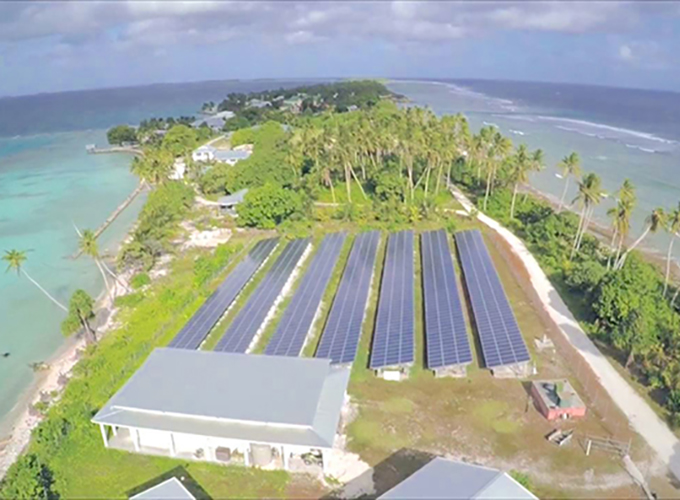
Powering a people – The Solar Nation of Tokelau. Image: © Documentary by Ulrich Weisbach, Pacifica Productions

Pacific Media Watch Newsdesk

Climate change research ranging from Australia and Indonesia to Fiji and Vietnam feature in the latest Pacific Journalism Review in the first publication to focus on media and global warming in the region.

The edition, published next week, is timely as Fiji prepares to co-host the COP23 global climate change summit in Bonn, Germany, in November.

The latest Pacific Journalism Review with a featured cover cartoon by Malcolm Evans.

Canadian media academic professor Robert A Hackett argues for an overhaul of the approach by journalists and media groups to “address the need for public engagement and a sense of urgency in the context of global climate crisis”.

He advocates peace journalism as a component of a strategy for “both journalists and the public to recover a sense of political agency”.

New Zealand investigative journalist Phil Vine, now attached to Greenpeace as a journalist, writes about the dilemmas facing seasoned journalists when joining non-government organisations in an independent media role.

“In order to stem plunging levels of credibility and adapt to the fast changing digital environment while recognising existing biases within traditional reporting, it may be that mainstream media needs to embrace a more inclusive attitude towards so-called ‘NGO journalism’,” he writes.

-Partners-

Documentary maker Ulrich Weissbach offers a case study on his film The Solar Nation of Tokelau while David Robie and Sarika Chand also file a case study on the “Bearing Witness” climate change collaboration between the Fiji-based University of the South Pacific and AUT’s Pacific Media Centre by postgraduate student journalists.

Staff and researchers at USP’s Pacific Centre for Environment and Sustainable Development and School of Government, Development and International Affairs have contributed several papers in the peer-reviewed edition.

Introducing this edition, Wendy Bacon and Chris Nash write in the editorial about the contribution and demise of the Australian Centre for Independent Journalism (ACIJ), which has been a trailblazer for university based investigative journalism for a quarter century.

Paying tribute to the many journalists who have contributed over the years and the collaboration between ACIJ and PJR, they write: “It is important that the sense of crisis in the journalism profession and the threat of increasing concentration of mainstream media ownership does not overwhelm the many worthwhile initiatives and projects that continue to be undertaken.”

In the journal’s unthemed section, research papers include defamation and the “hazards of relying on the ‘ordinary, reasonable person’ fiction”, news media representations of the “brown” community in New Zealand, and citizen news podcasts and the counter-public sphere in South Korea.

This edition has been co-edited by professors David Robie (AUT) and Chris Nash Monash), Dr Shailendra Singh (USP) and Wendy Bacon (PMC) with associate editor Dr Philip Cass (Unitec).

Full papers from the edition are already available online at the INFORMIT database.

]]>

Rights, cultural activists among winners of Asia’s Nobel Prize

]]>

AsiaPacificReport.nz

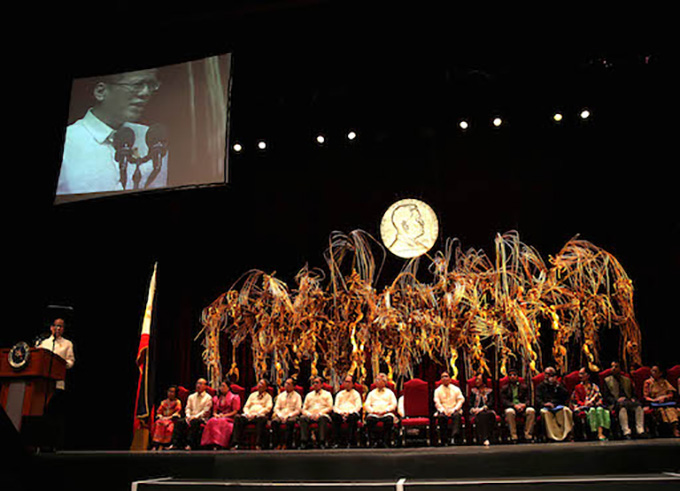
Then President Benigno S. Aquino III delivers his speech during the Ramon Magsaysay Award Foundation 2015 presentation ceremony at the Main Theatre of the Cultural Center of the Philippines in Pasay City. Image: Benhur Arcayan/Malacañang Photo Bureau

By Joe Torres in Manila

An Indonesian tribal rights activist, a Sri Lankan woman who has helped civil war victims, and a Japanese man working for the preservation of Cambodia’s Angkor Wat are among this year’s winners of the Ramon Magsaysay Award, considered Asia’s equivalent to the Nobel Prize.

The formal presentations will be made next month.

Indonesian Abdon Nababan has been recognised for “his brave, self-sacrificing advocacy to give voice and face to his country’s indigenous people communities, his principled, relentless, yet pragmatic leadership of the world’s largest tribal rights movement, and the far-reaching impact of his work on the lives of millions of Indonesians.”

Gethsie Shanmugam of Sri Lanka has been recognised for her “compassion and courage in working under extreme conditions to rebuild war-scarred lives” and for her “tireless efforts” in building Sri Lanka’s capacity for “psychosocial support, and her deep, inspiring humanity” in caring for women and child victims of war.

Yoshiaki Ishizawa from Japan will receive the award for “his selfless, steadfast service to the Cambodian people, his inspiring leadership in empowering Cambodians to be proud stewards of their heritage, and his wisdom in reminding us all that cultural monuments like the Angkor Wat are shared treasures whose preservation is thus, also our shared global responsibility”.

From the Philippines, former PEZA director-general Lilia de Lima was recognised for “her unstinting, sustained leadership in building a credible and efficient [economic zone], proving that the honest, competent and dedicated work of public servants can, indeed, redound to real economic benefits to millions of Filipinos.”

-Partners-

Also given recognition was Tony Tay of Singapore for his “quiet, abiding dedication to a simple act of kindness – sharing food with others – and his inspiring influence in enlarging this simple kindness into a collective, inclusive, vibrant volunteer movement that is nurturing the lives of many in Singapore”.

Shaping theatre arts
Also a recipient of this year’s award is the Philippine Educational Theatre Association of the Philippines for its “bold, collective contributions in shaping the theatre arts as a force for social change, its impassioned, unwavering work in empowering communities … and the shining example it has set as one of the leading organizations of its kind in Asia”.

Established in 1957, the Ramon Magsaysay Award is Asia’s highest honour aimed at celebrating the memory and leadership example of the third Philippine president after whom the award is named.

It is given every year to individuals or organisations in Asia who manifest “selfless service and transformative influence”.

Carmencita Abella, president of the Ramon Magsaysay Award Foundation, said this year’s awardees “are all transforming their societies through their manifest commitment to the larger good. Each one has addressed real and complex issues, taking bold and innovative action that has engaged others to do likewise”.

“The results of their leadership are palpable, generating both individual efficacy and collective hope,” Abella said in a statement.

“All are unafraid to take on large causes. All have refused to give up, despite meager resources, daunting adversity and strong opposition,” she added.

The six awardees will join a community of 318 other laureates who have received Asia’s highest honour to date.

This year’s winners will each receive a certificate, a medallion bearing the likeness of the late president Magsaysay, and a cash prize.

They will be formally conferred the award during formal presentation ceremonies in Manila on August 31.

]]>

Only 10% NZ school leavers ‘Asia-ready’ and just one-third ‘in zone’

]]>

AsiaPacificReport.nz

Only 37 percent of New Zealand school leavers believe Asia-related skills and knowledge will be important for the country’s future workforce. Image: Asia NZ Foundation

Pacific Media Centre Newsdesk

Less than 10 percent of school leavers are “Asia-ready” and only 36 percent are “in the zone” when it comes to Asia readiness, shows new research released by the Asia New Zealand Foundation.

The Foundation’s Losing Momentum – School Leavers’ Asia Engagement report also finds that while 69 percent of senior secondary school students believe Asia is important to New Zealand’s future, only 37 percent believe Asia-related skills and knowledge will be important for the country’s future workforce.

In 2012, when the foundation first surveyed school leavers, 46 percent believed it would be important.

The Losing Momentum report on NZ attitudes towards Asian countries and culture. Image: Asia New Zealand Foundation

High school students studying Asian languages discuss why more students are not taking an interest in learning about Asia and what could be done to raise the numbers.

The survey also reveals 18 percent either “do not believe Asia is important to our future” or “have no interest in Asia or Asian cultures”.

“This is a concerning trend given New Zealand’s present and future – economically, culturally and socially – are tied to Asia,” says Asia New Zealand Foundation executive director Simon Draper.

-Partners-

“If this continues, our kids will likely miss out on life-changing opportunities brought about by the rise of Asia’s influence and relevance to New Zealand.”

Businesses seeking Asian-related skills
Draper noted businesses were increasingly looking for employees who had Asia-related skills and knowledge – and they are not getting those skills.

“All indicators show Asia will play a critical role in young New Zealanders’ careers, their personal relationships, and their life experiences. Developing Asia-related competencies will be a necessity for their future.”

The survey also shows general knowledge of Asia has decreased. Students scored less than six out of nine on basic Asia questions, a small drop from 2012.

“These trend lines are in the wrong direction. There needs to be a course correction if we want school leavers to thrive in the Asian century,” says Draper.

The survey revealed an urban-rural and socio-economic divide.

Those who feel they know nothing about Asian countries – about one in five students – are more likely to come from the two lowest deciles, are likely to be Māori or Pasifika, and live in a small town or rural area.

“We don’t want a two-tier system when it comes to Asia-readiness. This is a bad outcome and is unfair,” says Draper.

‘Meaningful conversation’
“We hope this report prompts schools, parents, students, educators, officials, and community groups to engage in a meaningful conversation about whether we should formalise learning about Asia in our education system.”

On the positive side, the survey revealed those who said they could not describe anything about any Asian country tended to answer four out of nine Asia-knowledge questions correctly.

“These kids obviously know more than they give themselves credit for and this is similar to what we found in our annual Perceptions of Asia survey released earlier in the year, said Draper.

The research is based on the foundation’s Asia-Readiness Framework and this report is drawn from the foundation’s findings.

Only 3 percent are “passionate” about Asian cultures and 30 percent are “not interested”, according to the research findings. Image: Asia NZ Foundation
]]>

Constable Jimmy dies in PNG elections ambush – ‘being a cop’s no mistake’

]]>

AsiaPacificReport.nz

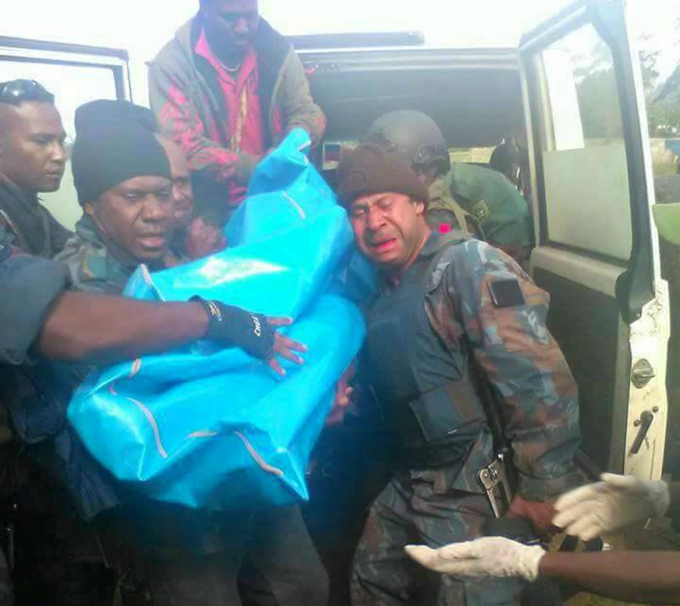
Highlands police colleagues with the body of Constable Glenn Jimmy, shot in an elections ambush at Wabag. Image: EMTV News

By Elizah Palme in Wabag, Papua New Guinea

Duty called for two police officers and other members of Papua New Guinea’s Mt Hagen Mobile Squad 6 (MS 6) last weekend.

It took them out of the Tambul area in the Western Highlands province to provide security for the 2017 national election in neighbouring Enga province.

Obeying their call, constables Glenn Jimmy, Alex Kopa and team served in Enga until fate met them at the front gate of My Kids Inn, Sangurap residential area, last Saturday morning.

These officers started off the new day by preparing to tackle the usual struggles – included the heat, crowd control, monitoring the counting area, officials and unexpected events.

Constable Glenn Jimmy … killed during Papua New Guinean election duties. Image: EMPTV News

Little did they know that day would be a tragic one for the Mt Hagen Mobile Squad 6 and the Royal Constabulary of Papua New Guinea (RPNGC).

Walking out of their camp that morning, Constables Glen Jimmy and Alex Kopa – along with their colleague Constable Mathew Kassap – were hit by a hail of bullets from high-powered M16 rifles fired by Papua New Guineans who did not care about casualties.

-Partners-

The two gunmen were shot dead after MS6 members reacted quickly.

PNG police detain election scrutineers after a Highlands rampage on Friday. Image: PNG police

Two constables die
However, while being rushed to Wabag General Hospital Emergency Unit for initial treatment before being evacuated by helicopter to Port Moresby, Constables Jimmy and Kopa died. Constable Kasap was left fighting for his life in a hospital in Port Moresby.

The family of late Constable Glenn Jimmy are left only with the memories. Who was Glenn Jimmy and how should we remember him?

Glenn Jimmy, from the Tongai Tribe, Menspi Clan, a small village of Panjin, was the eldest of three siblings.

Jimmy, a Christian, was a person of good character to those who knew him – a leader and God-fearing man.

He was the TSCF president during his time at the Goroka Technical College (2013-2014) prior to joining the police and was an outstanding young man.

Constable Jimmy showed true patriotism in what he did when he made his final posting on Facebook:

“Being a cop it’s not a mistake, no matter what I will always be the servant to the public… if you asleep I’m awake thinking of your wealth for 2moro….and when you enjoying with your loved ones, I’m standing static guard to your properties (boxes) in any weather conditions…no matter how u criticizes us, I will still give the best to serve my citizens of the nation PNG until I leave…I’m 4 U PNG & die as PNG.”

Constable Jimmy’s testimony in the line of duty stands out and has been shared by many of his colleagues.

Jimmy leaves behind his two-year-old son, Simon, wife Hadassah – who is also four months pregnant – and his grieving parents and relatives.

New PNG government? … Coalition leaders Powes Parkop (SDP), incumbent PM Peter O’Neill (PNC), Sir Julius Chan (PPP), and William Duma (URP) show their unity in Port Moresby last night. Image: EMTV News

New PNG government?
In Port Moresby last night, the People’s National Congress (PNC) party announced it had formed a coalition group with independent members of Parliament to form the new Papua New Guinea government.

In a joint statement released to the media, party leaders of the People’s Progress Party (PPP), United Resources Party (URP), Social Democratic Party (SDP) and the People’s National Congress (PNC) said the incumbent Prime Minister Peter O’Neill’s party now anticipated being called upon by the Governor-General to form government.

The statement said, “during the past five years, the government has delivered unprecedented growth through the delivery of clear, and targeted policies,” reports EMTV News.

“There have been programs and policies that could have been run with greater efficiency, and lessons have been learnt. The new government will increase its capability to meet the expectations of our people.”

The joint statement signatories were PNC leader Peter O’Neill, PPP leader Sir Julius Chan, URP leader William Duma, and SDP leader Powes Parkop.

This has been the strongest claim to numbers to date, following PNC’s latest declaration of Wake Goi and the potential declaration of Robert Atiyafa for the Henganofi seat, taking the total PNC declared members to 23 in the 111-member Parliament.

Elizah Palme studied chemistry at the University of Papua New Guinea and is current vice-president of Jiwaka Students and Graduates Association Inc.

]]>

Keith Rankin Analysis: What’s happened to Labour Productivity?

]]>

Keith Rankin Analysis: What’s happened to Labour Productivity? [caption id="attachment_14932" align="aligncenter" width="976"] Productivity plummets despite high annual growth. Graph copyright 2017, Keith Rankin.[/caption] Labour productivity is an important economic concept, that should equate to living standards. It is rising labour productivity that makes it possible to remunerate people with rising incomes. Productivity, by definition, is economic outputs divided by economic inputs. Thus labour productivity for a country is its GDP (gross domestic product) divided by some measure of labour input. The chart shows productivity change in New Zealand from 1990, using two different measures of labour inputs. It also shows annual economic growth rates, which are simply annual percentage increases in real GDP. In individual industries, labour productivity growth is a measure of the output (economic value-added) of the industry, divided by the amount of labour employed in that industry. In some industries, productivity growth has been very high, thanks mainly to increased knowledge and connectivity, for the most part expressed through improved technology. Indeed the whole ‘future of work’ debate is predicated on the possible social consequences of forecast rapid rises in labour productivity in the industries that could be most affected by ‘robotics’. Looking at productivity in a single firm or industry is looking at productivity at the ‘micro’ level. However, what affects society most is productivity at the ‘macro’ level. It is possible that, under prevailing institutional arrangements which prevent productivity gains from being properly disseminated throughout the population, productivity gains in some industries actually cause productivity to decline in other industries. Looking at the chart, we see that productivity changes generally have been aligned with the business (GDP growth) cycle. Further, the gaps between economic growth and productivity growth can, for the most part, be explained by faster population growth during periods of economic expansion. When we look at the two different measures of labour productivity, the ‘dark red’ measure includes unemployed labour. (The fulltime-equivalent labour force measure counts each part-time employed and unemployed person as half a labour force participant.) So, at times of rising unemployment – such as the early 1990s – the red measure is typically lower than the blue measure; and at times of falling unemployment the red measure of productivity growth tends to be higher. The ‘light blue’ productivity data for 2009/10 reflects declines in labour inputs rather than growth of output. What is happening in 2017? There’s a sign of something new happening. Productivity appears to have fallen by two percent in 2016/17, despite a high annual economic growth rate of over three percent. There are two important issues that reflect a substantial disconnection between economic reality and orthodox rhetoric. The first issue relates to the growth process itself. Sustainable economic growth is largely a consequence of improved public inputs, such as knowledge and infrastructure. Good growth is a consequence of economic improvement, not a cause of it. Yet we treat economic growth – all forms of growth – as the font of ‘wealth creation’. Governments – blue ones and red ones – want increased labour supply (more workers) as well as productivity growth to generate an accelerated ‘expansion of wealth’. What we see in this chart is a substantial increase of labour supply. While this is partly due to immigration, it is also due to unequipped beneficiaries being increasingly tormented into becoming ‘independent from the state’. The result is that these marginal workers (not the immigrants) are increasingly augmenting the productivity denominator while having minimal impact on measured economic output. The policy of increasing labour force participation rates is undermining the goal of productivity improvement. The second issue relates to the service sector – in particular the precarious personal service ‘industries’. A few examples: liquor supply, touting, hospitality, domestic service, and the (now legal) prostitution industry. A combination of labour‑shedding in traditional industries (industries which are showing productivity gains) and increased cajoling of poor, underskilled, overstressed and undercapitalised people into the labour force, means that the available work in these personal‑service industries must be increasingly shared among an increasing supply of workers offering these services. What does it mean to increase productivity in industries like prostitution? In a country like Germany it would mean satisfying the market with fewer workers – ‘professionalising’ the industry – allowing displaced sex workers to move into ‘other activities’. But in New Zealand, where the only alternative employment opportunities may be in the borderline criminal sectors (eg scams, drugs), ‘independent’ undercapitalised labour force participants have few options other than to overpopulate sectors of diminishing productivity such as prostitution. Rising denominators – falling productivity – in personal services in New Zealand is simply the flipside to rising productivity in agriculture, manufacturing and other labour-shedding activities. In China and India, people wanting employment are migrating from low productivity (especially agriculture) to high productivity industries. New Zealand is starting to see the opposite, a relative and absolute expansion of employment in the inherently low‑productivity personal service activities. In New Zealand, coming off a benefit to become a self‑reliant prostitute is now accounted for as a contribution to one measure of economic success. Beneficiaries becoming prostitutes represents an increase in labour supply. Payment of a public equity dividend – a Universal Basic Income – would enable the benefits of productivity gains realised in some sectors to be dispersed throughout our communities, and would give those displaced workers – and the young people who would otherwise have taken jobs lost through natural attrition – options other than low productivity ethically dubious personal and touting services.]]>

No mercy for Indonesian drug dealers, says Widodo in ‘just shoot’ policy

]]>

AsiaPacificReport.nz

Indonesian President Joko Widodo … “no mercy” drug policy announcement mirrors Duterte’s “war on drugs”. Image: Amnesty International

By Dames Alexander Sinaga in Jakarta

President Joko “Jokowi” Widodo has ordered law enforcers to shoot drug traffickers to deal with what he called a narcotics emergency facing the country.

“No mercy for foreign drug traffickers. We are currently in an emergency in terms of drug abuse,” Widodo said.

The president spoke after police seized a ton of crystal methamphetamine worth Rp 1.5 trillion ($151 million NZD) in Serang, Banten, on July 13, 2017. The narcotic, locally known as shabu-shabu, was smuggled from China and constitutes the Indonesia’s largest seizure to date, reports the state-run news agency Antara.

Police arrested four Taiwanese men who allegedly attempted to distribute the drugs in the greater Jakarta area. One of them was shot dead while resisting arrest.

Widodo said the police and the Indonesian Military (TNI) were working together to act decisively against drug traffickers.

“Now, the police and the TNI are really firm, particularly against international drug dealers who enter Indonesia. Just shoot them if they even show a little resistance,” he added.

-Partners-

National police chief General Tito Karnavian was quoted by Antara as saying that drug smugglers were targeting Indonesia because they deemed the country’s law enforcement efforts weak – unlike Singapore, Malaysia and the Philippines.

Drug traffickers ‘rampant’
“Drug traffickers have noticed that, apart from the potential market, law enforcement officers may be weak to act. Our laws are considered weak; that causes them to become rampant in Indonesia,” Karnavian said.

He said international drug traffickers have been given a stern warning not to consider Indonesia as one of their main destinations for the illegal drug trade.

“I have ordered the police to crack down and act tough, especially against foreign drug dealers. I have also told officers to act in accordance with their standard operational procedure, which also means shooting them if they resist arrest,” Karnavian said.

Indonesia is not the only Southeast Asian country under threat from the widespread distribution of illicit drugs. The Philippines government under President Rodrigo Duterte declared war on drug pushers last year.

Extrajudicial killings in the Philippines have drawn condemnation from the international community and human rights groups.

Usman Hamid, country director for the United Kingdom-based rights group Amnesty International in Indonesia, said the statements by Jokowi and Tito may result in law enforcement officials on the ground committing unlawful actions, such as extrajudicial killings or summary executions, which constitute gross human rights violations.

“Duterte’s war on drugs is the wrong kind of approach for a democratic country. Indonesia must look for a better approach or best practices from other countries,” Hamid told the Jakarta Globe.

Shoot-on-sight policy
He added that Duterte declared war on drugs after the state imposed martial law with the approval of Congress. The implementation of Duterte’s shoot-on-sight policy violates the country’s constitutional law and other regulations.

Hamid said Jokowi and Tito’s remarks could be regarded as a move to implement martial law in Indonesia. He added that their statements show a lack of understanding of basic norms of human rights and the rule of law.

Jakarta Globe also reports an overdue election bill has finally been approved, which will serve as the legal basis for the 2019 presidential vote.

The bill, which is waiting to be signed into law by Widodo, requires presidential candidates to gain the support of a political party or coalition of parties with 20 per cent of the seats in the legislature as of the 2014 poll.

Candidates can also be supported by parties that won 25 percent of the vote in the election.

However, this has drawn criticism as fears emerge that the new threshold may limit the right to stand for election.

This comes as Indonesians will, for the first time in 2019, choose the legislature and executive on the same day.

Dames Alexander Sinaga is a reporter with Jakarta Globe. 

]]>

Global media freedom summit slams Gulf states, supports Al Jazeera

]]>

AsiaPacificReport.nz

International media freedom conference delegates inside Al Jazeera’s main studio in Doha. The network broadcast messages of support from conference delegates. Image: Joseph M Fernandez/PMC

By Dr Joseph M Fernandez in Doha, Qatar

The international freedom of expression conference in Doha has ended with a strong condemnation of the threats by a group of Gulf states against Qatar and an expression of “total solidarity” with journalists and workers at Al Jazeera and other media targeted by the group.

The conference also issued recommendations on the safety of journalists, media freedoms and on workers rights.

On the safety of journalists the conference expressed concern at the chilling effect of the attacks on journalists and other media workers and on the public’s right to information and freedom of expression.

The Gulf group comprises Saudi Arabia, the UAE, Egypt and Bahrain who recently issued a list of 13 demands including one calling for the closure of the Al Jazeera network and other media outlets including Arabi21, Rassd, Al Araby Al-Jadeed and Middle East Eye.

On media freedoms the conference reaffirmed freedom of expression as a fundamental right enshrined in Article 19 of the Universal Declaration of Human Rights and called on nations to observe their duty to ensure that legislation designed to address national security and crime concerns do not override source protection laws other than in narrowly defined exceptional circumstances.

It called on governments to legislate to protect the rights of sources.

-Partners-

It also called on governments to recognise the media’s right to report freely and without interference from government and to allow citizens to access information on their own governments and institutions “in the cause of transparency and accountability”.

The conference acknowledged the vital role played by trade unions in supporting freedom of expression and defending the right of journalists to hold power to account.

On workers rights the conference called on governments to honour Article 23 of the Universal Declaration of Human Rights and to comply with the conventions of the International Labour Organisation.

At the end of the conference, the delegates visited the Al Jazeera network headquarters in Doha in a further show of solidarity with the journalists and workers.

Associate Professor Joseph M Fernandez is head of journalism at Curtin University and also the Australian correspondent for the Paris-based Reporters Without Borders. He is attending the “Freedom of Opinion” conference on the invitation of Australia’s Media, Entertainment and Arts Alliance. This is a special commissioned report by Asia Pacific Report/Pacific Media Watch.

]]>

Panguna priest wins Bougainville seat – Alliance claims to have numbers

]]>

AsiaPacificReport.nz

Tension is high in Mt Hagen after the declaration of former Public Enterprises Minister William Duma – illegally, claim critics, before the counting of an additional 28 ballot boxes. Video: EMTV News

Pacific Media Centre Newsdesk

Newcomer Fr Simon Dumarinu has narrowly defeated former Mining Minister Sam Akoitai  in the Central Bougainville Open seat in the Papua New Guinea general election.

The Marist Catholic priest of Deomori in Panguna is from the Social Democratic Party led by National Capital District Governor Powes Parkop.

He polled 7782 votes to beat Akoitai,  who gained 7770 votes after the 19th elimination of sitting member and Communications Minister Jimmy Miringtoro who was running third.

“The declaration of the seat for Central Bougainville did not come easy as the counting started in Arawa Central Bougainville then transferred to Buka for the final count,” reports Aloysius Laukai of Radio New Dawn.

New member for Central Bougainville Open Fr Simon Dumarinu signing the writs after his declaration in the Papua New Guinea general election. Image: New Dawn

“It went through several checks and rechecks and suspensions until counting experts from South Bougainville, led by the Returning Officer for South Bougainville came and assisted.”

-Partners-

The newly elected member has pledged to work for Bougainville in unity with the Autonomous Bougainville Government (ABG) and the three Bougainville members of the National Parliament.

Speaking after his declaration last night at the United Church in Buka, Fr Dumarinu thanked the Electoral Manager for Bougainville, supporters, counting officials, police, media, all candidates and their supporters.

The North Bougainville Open seat was won by a National Alliance (NA) candidate William Nakin while  the South Bougainville Open seat was retained by Timothy Masiu, also of the NA.

The Alliance teaming up
Meanwhile, Loop PNG’s Glenda Popot reports that the National Alliance, National Party, PANGU Pati and People’s Progress Party are teaming up with several other parties and independent candidates and claim to have the numbers to form the next government.

PANGU Pati Leader Sam Basil met Sir Mekere Morauta, who represents the Independents, and National Party leader Kerenga Kua in Port Moresby to discuss “camping arrangements” for their groups.

The parties in the group, known as The Alliance, are preparing to form the next government. Besides the National Alliance, PANGU and PPP as the major players, other parties include the National Party, PNG Party, Coalition for Reform Party, Melanesian Liberal Party, Melanesian Alliance, New Generation, People’s Movement for Change, THE Party, PNG First and Independents.

The smaller group of parties and Independents combined is expected to contribute more than 20 members to The Alliance in an 111-member Parliament. Only half the parliamentary seats have been decided and the Electoral Commission has extended the writs deadline by four days until Friday.

]]>

RSF condemns media freedom ‘violations’, gag in PNG election

]]>

AsiaPacificReport.nz

Martyn Namorong … gagged by the PNG National Court. Image: MN

Pacific Media Watch Newsdesk

Reporters Without Borders (RSF) has condemned many media freedom violations during the general elections held in Papua New Guinea from 24 June to 8 July, including a gag order on a popular blogger as a result of a complaint by the head of the PNG Electoral Commission.

Journalists who went to cover the elections in the northern province of Madang were kept at bay by the police and the Electoral Commission, said the Paris-based RSF.

In the capital, Port Moresby, the media were barred from filming or taking photos in the city’s main vote-counting centre.

PNG general election … allegations of vote-buying and violence. Image: Torsten Blackwood/AFP/RSF

Amid many reports on social networks of allegations of vote-buying and violence, the authorities also took alarming measures against citizen-journalists, most notably blogger Martyn Namorong after he referred to Electoral Commissioner Patilias Gamato as a “tomato” in one of his many posts criticising the chaotic elections.

As reported by Asia Pacific Report and Pacific Media Watch, Gamato brought a suit claiming that he had been “seriously injured in his character, credit and reputation” in Namorong’s post, which went viral.

Defending his decision to sue, Gamato said: “I don’t look like a tomato, I’m a human being. So that’s defamatory, so I had to take him to court.”

-Partners-

The National Court, located in the Port Moresby administrative district of Waigani, responded by issuing a gag order, banning Namorong from publishing further “defamatory remarks” on Facebook and Twitter.

‘Duty to inform’
“Journalists and citizen-journalists have a duty to inform the public about what has gone wrong during an election.” RSF said.

“The courts and the authorities must recognise that Martyn Namorong committed no crime and must therefore lift the censorship order imposed on him.”

Gagged Martyn Namorong … ““A country cannot claim to be democratic just because it holds elections,” says RSF. Image: Asia Pacific Report

An international NGO that defends the freedom to inform, RSF added: “A country cannot claim to be democratic just because it holds elections. It must also respect and protect media freedom, which is the cornerstone of every democracy.”

Namorong’s lawyer, Christine Copland, said her client had no chance to speak when the gag order was imposed because court officials said they “could not locate him” to serve the documents, as reported by Asia Pacific Report.

Namorong’s response to the order was to post a photo of himself blindfolded and gagged. After another hearing was scheduled for today, he tweeted: “I am as cool as a cucumber about [the] hearing as my lawyers are no couch potatoes.”

Papua New Guinea is ranked 51st out of 180 countries in RSF’s 2017 World Press Freedom Index.

]]>

Fretilin’s win ‘victory for all’ but coalition will rule Timor-Leste

]]>

AsiaPacificReport.nz

Fretilin’s former Prime Minister Dr Mari Alkatiri … “we look forward to guaranteed stability, ongoing development and to bring people out of poverty” in Timor-Leste. Image: Agora Timor

The emergence of opposition parties in Timor-Leste’s parliamentary election this weekend shows growing dissatisfaction with the status quo, reports SBS from Dili.

Former Prime Minister Dr Mari Alkatiri, the current secretary-general of the Revolutionary Front for an Independent East Timor (Fretilin), described his party’s win of about 30 percent of the vote as a “a victory for all people”.

“Now we will look forward to guaranteed stability, ongoing development and to bring people out of poverty,” Dr Alkatiri told reporters yesterday afternoon after 92 percent of the vote had been counted.

The party has come out ahead of Timor-Leste’s other major political force – the National Congress for Timorese Reconstruction (CNRT) – headed by former president and independence leader Xanana Gusmao, which picked up about 28 percent of the vote, according to official numbers.

However, Dr Alkatiri said his party’s “victory” was also a win for Gusmao’s CNRT, with which they formed a de facto coalition in 2015, ushering in a new era of political unity in a country previously racked by conflict and instability.

Their cornering of about 58 percent of the vote showed an “endorsement” of this stability, said Professor Michael Leach, a Timorese specialist from Swinburne University.

But a reflection of a lower level of satisfaction with the government is the emergence of the newly established People’s Liberation Party (PLP) and the “disenfranchised youth” party Khunto, which picked up about 10.2 and 6.9 percent of the vote respectively.

-Partners-

Anti-corruption platform
Riding on a platform of anti-corruption, the PLP has called for an end to life pensions for government members and a re-routing of funds from big infrastructure projects into grassroots areas like health, education, water and sanitation.

A key concern has been the country’s over-reliance on oil and gas revenue to fund projects, salaries and services, with fears that unless the economy diversifies quickly, the country will run out of money within 10 to 15 years.

Professor Leach said Khunto had tapped into “disenfranchised youth unable to get a job”.

“They very much pitched their campaign at jobless youth and have done rather well and they will be in parliament more than doubling their 2012 vote,” he said.

Professor Leach said it would be interesting to see where the parliament goes from here.

It is yet unclear whether Fretilin, whose win will mean they get “first bite of the cherry”, will continue their de facto partnership with CNRT or forge new ties.

Another question is whether these emerging parties are offered and accept ministries – making them a less effective opposition.

Votes for the already established Democratic Party remained steady at about 10.2 percent – similar to their 2012 result.

]]>

O’Neill’s government loses ministers, Speaker and deputy PM in PNG vote

]]>

AsiaPacificReport.nz

The Peter O’Neill-led coalition government partners were this weekend counting the cost from a series of defeats in the general election. Image: EMTV News

By Scott Waide in Port Moresby

With time running out before the official end of Papua New Guinea’s elections, partners of the Peter O’Neill-led coalition government are counting the casualties from election results all over the country.

Four senior ministers, the Speaker and the Deputy Prime Minister have all lost their jobs.

The Health Minister is also expected to follow suit.

Housing Minister Paul Isikel was the first to be excluded during second preference counts in Markham Open, losing to Pangu’s Koni Iguan.

Within 24 hours, news came from Tewai-Siassi that political novice Dr Kobie Bomareo had unseated Fisheries Minister and Deputy Leader of the ruling People’s National Congress, Mao Zeming. Bomareo was the third Pangu candidate declared in a space of two days.

Then, in a tight finish, a 30-year-old unknown, Renbo Paita, took down another PNC strongman, Speaker of Parliament Theo Zurenuoc.

-Partners-

The carnage continued.

Biggest upset
Mining Minister Byron Chan lost the Namatanai seat to Walter Schnaubelt. But in the biggest upset in the New Guinea Islands region, Deputy Prime Minister Leo Dion suffered an embarrassing defeat, beaten in the second preference counts by former MP Nakikus Konga.

Within minutes of Dion’s defeat, Facebook users were posting that the Communications Minister Jimmy Miringtoro had lost the Central Bougainville seat.

As heads of coalition members rolled all over the country, Health Minister Michael Malabag’s political life hung in the balance, slowly stifled by an ever expanding 7000 vote margin separating him from former Prime Minister Sir Mekere Morauta in the Moresby North West race.

In Morobe, the home province of the Deputy Opposition leader, Sam Basil, voters went to the polls with a vengeance and rejected the PNC in five out of nine seats.

But Pangu ranks are further expected to be bolstered with the possible inclusion of Ginson Saonu who is leading in the Morobe regional count with a 20,000 vote margin separating him from former National Alliance “fullback” Luther Wenge.

The incumbent, Kelly Naru has also become one of many other MPs rejected at the polls. He is bearing the brunt of voter anger after his support of the PNC led coalition during the attempted vote of no confidence motion in 2016.

Serious contender trailing
In the Northern province, PNC’s David Arore, who expected to be a serious contender in the regional seat has been trailing on fourth place.

Arch political rival Gary Juffa, moved rapidly up the ladder within the first three days giving him a commanding 30,000 vote lead ahead of his nearest rival and wife of NCD Governor Powes Parkop, Jean Parkop.

While the losses stung the PNC, their numbers were at the weekend double those of Pangu. Both parties are working to woo independents with Pangu pushing the anti-corruption line while PNC was claiming “government stability”.

Scott Waide is the Lae bureau chief and began his career with EMTV in 1997 as a news and sports reporter and anchor. He has been a media professional for more than 19 years. EMTV News coverage of the PNG elections is being published by Asia Pacific Report with permission.

]]>

Bearing Witness 2016: A Fiji climate change journalism case study

]]>

Pacific Media Centre

Figure 1: Daku village, Tailevu, Viti Levu, at low tide surrounded by mangroves: Tackling climate change resilience. Image: Ami Dhabuwala

David Robie, Pacific Media Centre

Friday, July 21, 2017

Abstract

In February 2016, the Fiji Islands were devastated by Severe Tropical Cyclone Winston, the strongest recorded tropical storm in the Southern Hemisphere. The category 5 storm with wind gusts reaching 300 kilometres an hour, left 44 people dead, 45,000 people displaced, 350,000 indirectly affected, and $650 million worth of damage (Climate Council, 2016). In March 2017, the Secretariat of the Pacific Regional Environment Programme (SPREP) launched a new 10-year Strategic Plan 2017-2026, which regards climate change as a ‘deeply troubling issue for the environmental, economic, and social viability of Pacific island countries and territories’. In November, Fiji will co-host the UN Framework Convention on Climate Change (COP23) climate change conference in Bonn, Germany. Against this background, the Pacific Media Centre despatched two neophyte journalists to Fiji for a two-week field trip in April 2016 on a ‘bearing witness’ journalism experiential assignment to work in collaboration with the Pacific Centre for Environment and Sustainable Development (PaCE-SD) and the Regional Journalism Programme at the University of the South Pacific. This article is a case study assessing this climate change journalism project and arguing for the initiative to be funded for a multiple-year period in future and to cover additional Pacific countries, especially those so-called ‘frontline’ climate change states.

Bearing Witness project grant from the Research and Innovation Office, Auckland University of Technology.

]]>

Why Pacific and Māori communities are rising up for a free West Papua

]]>

AsiaPacificReport.nz

ANALYSIS: By James Borrowdale in Auckland

Like apartheid South Africa, I kept hearing. For a long time, the horrors behind the curtain thrown up by South Africa’s racist government weren’t widely known in this country. It wasn’t until the 1981 Springboks tour that the small band of activists, who had all the time been committed to the cause, were able to turn that affair into a nation-splitting episode—and to put increased international pressure on the regime.

West Papua hasn’t had its Springbok tour yet; it is often called the world’s forgotten occupation.

Indonesia has held formal control over West Papua since 1962’s New York Agreement granted the South East Asian superpower the former Dutch colony, with the promise of a fair vote on self-determination by 1969. That never arrived: 1969’s Act of Free Choice, in which just 0.2 percent of the population voted—under extreme duress—determined that West Papua was to remain part of Indonesia, a country with which it had no linguistic, cultural, or racial links.

Oceania Interrupted during an “artistic intervention”. Image: Sangeeta Singh/Oceania Interrupted

Ever since, the repression of the indigenous population has been ruthless. The figure of 100,000 people killed by Indonesian security forces is commonly cited, but estimates run as high as 500,000. Mass killings of Papuans in the tribal highlands in the 1970s met the criteria for genocide, the Asia Human Rights Commission reported.

And the brutality continues: a 2016 report conducted by the Archdiocese of Brisbane titled We Will Lose Everything contains reports of atrocities committed throughout 2015, including extrajudicial executions, torture, and firing on peaceful protestors. Methods of torture, another report claims, include rape, slashing with bayonets, and electrification.

Clearly, something horrific is happening—and has been for a long time—in the South Pacific. New Zealand’s response? Successive governments, perhaps wary of aggravating an important trading partner, have refused to dispute Indonesia’s territorial borders. The media hasn’t done much better—VICE NZ was one of just a handful of outlets (including the Pacific Media Centre) to cover a visit to New Zealand by Benny Wenda, the leader-in-exile of the West Papuan independence movement and a man twice nominated for the Nobel Peace Prize, earlier this year.

-Partners-

He’s a man with a fascinating tale to tell—a childhood spent on the run in the bush, horrors witnessed, arrest, escape, a life-long commitment to the cause of his people. And it’s a story that is percolating at some political level, with 11 New Zealand MPs across four parties now signatories of the International Parliamentarians for West Papua declaration.

Where in the media?
Where, then, I wondered, were the profiles in the Saturday newspapers, the coverage on Sunday-night current-affairs shows?

Benny Wenda (centre) and Dr Pala Molisa (to his left) with Ngāti Whātua members at Ōrakei Marae, Auckland Image: Clare Harding/Free West Papua

Dr Pala Molisa, of Victoria University’s School of Accounting and Commercial Law, is a long-time supporter of West Papuan independence. Addressing why the New Zealand media is reluctant to take on the story of the subjugation of an entire people, happening so close to home, he says, means confronting an “uncomfortable thing”.

“It shouldn’t be too controversial [to say] today that black and brown lives, when you look at the patterns—socioeconomic, police shootings, mass-incarceration—are devalued when compared to white lives.”

Molisa is from Vanuatu, a country that also had to fight for its independence from colonial rule. He bemoans how dependent Pākehā awareness is upon coverage in established media: “Most of our educated Pākehā population is highly reliant on mainstream media. As long as [West Papua is] kept out, that’ll affect the amount of participation.”

Professor David Robie, director of the Pacific Media Centre and editor of the Asia Pacific Report, has, as a journalist, been reporting on West Papua since the early 1980s, and finds the lack of interest “puzzling”. A veteran journalist (“I think I’ve got a reasonable handle on what is international news”), he wonders why the majority of the press has for so long largely ignored West Papua.

“It has so many elements that have resonance with New Zealand—indigenous issues, land issues, development issues. And in the past we’ve had an affinity with the people of the Pacific, going right back to the nuclear-free policies, which were very intertwined in Polynesia with indigenous self-determination.”

Pacific Media Centre’s Professor David Robie speaking at an “open access for journalists in a free Papua” during World Press Freedom Day events in Jakarta in early May. Image: Bernard Agape/West Papua media

Momentum gathering
In the wider Pacific, at least, there is some momentum gathering. In March this year, seven nations—Vanuatu, Tonga, Tuvalu, Palau, Nauru, the Marshall Islands, and the Solomon Islands—addressed the United Nations Human Rights Council in Geneva, raising concerns about human rights abuses in West Papua.

“Within their suffering we see our own.”

Māori, too, have been vocal about West Papua. When Wenda visited Auckland, he was welcomed onto Ōrākei Marae by Ngāti Whātua. Wayne Pihema, a Ngāti Whātua Board Trust member who helped organise the hui, says shared experiences of colonialism motivated the invitation to Wenda to speak.

“We’ve got somewhere in our genetic history a memory of that kind of experience… We can relate to people in West Papua as being part of the Pacific and being indigenous Pacific people like us. Within their suffering we see our own.”

Oceania Interrupted is an Auckland-based group of Pacific and Māori women who use visual and performance art to raise awareness of the suffering of West Papuans. The group, which has included women from as many as 13 different Pacific ethnicities or nations, has staged 10 of the 15 “artistic interventions” it plans to hold—15 years being the mandatory prison sentence for raising the West Papuan Morning Star flag within the Indonesian-occupied territory.

Leilani Salesa … “an ideological commitment” to West Papua in Pacific solidarity. Image: Sangeeta Singh/Oceania Interrupted.

In a similar fashion to Pihema, spokesperson Leilani Salesa calls the group’s duty to West Papua an “ideological commitment”, one borne of a sense of Pacific solidarity. “The ocean is what binds us together, the ocean is our sea of islands… the ocean is what our ancestors conquered.”

Salesa, though, highlights the role that Pākehā activists have played in raising awareness, singling out veteran campaigner and writer Maire Leadbeater: “If it wasn’t for her, I wouldn’t know who I know and what I know.”

Māori, Pacific groups taking the lead
I put it to Leadbeater that Māori and Pacific groups within New Zealand are now taking the lead, something she said was “amazing”.

“I see it in the context that the interest in West Papua has extended so much through the Pacific recently. Communities here are linking up with really strong movements in the Solomons and Fiji, and to some extent in Tonga and Samoa, and so on. It’s really important people here are getting engaged because they are in touch with their families in those countries, and it’s those countries that are actually taking action at the moment—it’s not New Zealand, unfortunately.”

While it’s great, Leadbeater says, that impetus comes from Māori and Pacific communities, it’s important there is wider—and whiter—support. “Look at the tino rangatiritanga movement in this country: it’s always had strong allies in the Pākehā community, hasn’t it? And that’s always been important to the success of campaigns.”

“The anti-apartheid activists would’ve felt like they were just spitting into a cyclone…you just need to keep having faith.”

She remains upbeat about the effect protest and public opinion have on government action, citing her previous research that, she says, proves the government is attuned to public opinion on Indonesian activity, especially as it has related to atrocities committed in East Timor and, to a lesser extent, in West Papua. “You think the government is not taking any notice, but they do have to take account of public opinion and the stronger it gets the more they have to take notice. [But] you can’t expect people to identify with an issue they’ve hardly ever heard of.”

Molisa, too, is optimistic. “What gives me faith, to put it in that historical perspective, is that this is in the early stages, and the anti-apartheid activists would’ve felt like they were just spitting into a cyclone. If you look at the long arch of history, that tells you that you just need to keep having faith because these sorts of things have a way of building in ways you can’t expect.”

James Borrowdale is an Auckland-based writer for VICE. This article is republished with the permission of VICE NZ and the author.

]]>

In Timor-Leste, more power-sharing likely but election hard to pick

]]>

AsiaPacificReport.nz

ANALYSIS: By Dr Michael Leach in Dili

Twenty-one parties will contest 65 parliamentary seats and decide who governs Timor-Leste in national elections this Saturday.

In a population with a median age of just under 19 years and a voting age of 17, a fifth of Timor-Leste’s 750,000 registered voters will be participating for the first time. This is just one of the factors making the exact composition of the new Parliament, and the complexion of the government, hard to pick.

The current government was formed in extraordinary circumstances in early 2015, when former independence movement leader and prime minister Xanana Gusmão handed the prime ministership to an opposition Fretilin figure, Rui Araújo.

Best seen as a power-sharing executive rather than a formal government of national unity, this de facto “grand coalition” between Timor-Leste’s two largest parties – the National Congress for Timorese Reconstruction (CNRT) and Fretilin – was a remarkable development. As recently as 2012, bitter tensions had existed between the two parties.

Power-sharing executives are not uncommon in the Pacific region, and generally award ministries to any parties winning a significant number of seats. They tend to facilitate political stability, but they can also reduce the accountability of government to Parliament by incorporating all significant parties into the executive government.

The fact that the smaller Partido Democrático, or PD, kept its ministries when its formal alliance with CNRT ended in 2015 suggests that this is an emerging informal feature of the East Timorese political system. Its dynamics are likely to influence the result of this month’s election.

-Partners-

Members will be elected under Timor-Leste’s proportional system, with voters selecting a party rather than individual candidates. Each party registers a list of 65 candidates in order of election, giving party leaders substantial power over candidates anxious to appear high on the list.

Progressive features
But the system also allows for progressive features, like the requirement that every third candidate be a woman, which has given Timor-Leste one of the highest percentages of female MPs in Asia-Pacific, at 38 percent.

The system isn’t strictly proportional. To get any of its candidates into Parliament, a party needs at least 4 percent of the vote, up from 3 percent in 2012, which effectively awards a bonus to parties that clear the hurdle.

The 4 percent might be a substantial barrier, but the large number of parties participating in the election attests to the relative ease of party registration and political participation. This feature reflects Timor-Leste’s relatively open society and pluralist culture, which saw it ranked as the most democratic country in Southeast Asia in The Economist’s 2016 Democracy Index.

The March election to the presidency of Fretilin’s Francisco “Lú-Olo” Guterres appeared to solidify the de facto accord between the major parties, with Gusmão’s endorsement helping Guterres draw some 60 percent of the national vote. The figure suggests that voters like the power-sharing arrangement between CNRT and Fretilin, which could continue beyond this election, though not necessarily in the same form.

Seeking to challenge the major parties, immediate past president Taur Matan Ruak and his new Partidu Libertasaun Popular (Popular Liberation Party – PLP) have focused on basic health and education spending rather than the megaproject-led development favoured by the government.

The PLP vocally opposes the unpopular life pensions for politicians, and has also raised allegations of patrimonialism and the growth of “money politics” in awarding government contracts.

While these issues have the clear potential to resonate in the electorate, the present government’s success in maintaining political stability and reducing political conflict within Timor-Leste’s political elite remains a major electoral asset.

History of conflict
In a country with a long history of conflict and memories of the 2006–07 political crisis, this factor alone undoubtedly means that CNRT and Fretilin will remain highly competitive. Irrespective of which major party comes first, their ability to coexist will remain central to political stability in Timor-Leste.

Nevertheless, the PLP and other smaller parties will take encouragement from recent polls suggesting that far fewer people are happy with the direction of the country than three years ago, including just 50 percent of those under 25, down from 80 percent in 2014. While anti-corruption campaigns have rarely swayed votes in the way spending programmes can, alternative development visions focused on basic development indicators may resonate in communities where infrastructure spending programmes have provided few benefits to date.

The parties’ electoral campaigns have played to their respective strengths. Xanana Gusmão’s personal legitimacy and popularity as the former resistance commander remains the cornerstone of the CNRT’s appeal. Though the party also includes extremely competent and senior ministers, including minister of state Agio Pereira, the CNRT has been criticised for being little more than a political vehicle for Gusmão and entirely reliant on his charismatic legitimacy – a perception reinforced when a new PM was not chosen from within the party, and again when the party decided not to field a presidential candidate.

In fact, posters featuring the wider CNRT team of ministers were dropped in the early weeks of the parliamentary campaign in favour of images of Gusmão alone. The current party slogan, “Vote for our future,” suggests continuity with earlier CNRT campaigns focused on rapid modernisation through government-led infrastructure spending, in line with Gusmão’s Strategic Development Plan.

For its part, Fretilin’s parliamentary campaign seems the most modern and professional, reflecting its status as the most disciplined and well-established of the East Timorese parties. With the slogan “For a more developed Timor-Leste,” Fretilin’s campaign materials promise improved outcomes in education and health using images of East Timorese making a “plus” sign with crossed fingers.

Because resistance credentials remain central to political fortunes in Timor-Leste, the loss of the party’s most senior Falintil veteran, Lú-Olo, who can’t campaign actively as president, has been notable.

Fretilin’s social media campaign has been at pains to counter suggestions that the current government represents a coalition with CNRT, reiterating their view that prime minister Araújo and other ministers participate in the current government as individuals. The party says that it remains committed to working with Gusmão after the election in the interests of stability, but that formalised cooperation with the CNRT more broadly is a different proposition.

Tough decisions necessary
It is by no means clear that Fretilin would again accept ministries if it finished in second place, though it acknowledges that tough decisions may need to be made in the interests of national stability.

For the PLP, the focus on Taur Matan Ruak as leader draws on two sources of symbolic strength: his legacy as the final commander of Falintil during the resistance era, and his more immediate presidential legacy as the closest thing to a national opposition leader from 2015. Ruak attacked the government in Parliament over accountability issues in early 2016, and vetoed the initial version of its budget; his relationship with Gusmão has yet to recover from this episode.

Supported by a host of younger Western-educated East Timorese from Dili’s intelligentsia, the PLP campaign represents a transitional point between an older mode of resistance legitimacy and generational change. Campaign rallies have focused on opposing discrimination, criticising the vast expenditure on “megaprojects,” and urging the greater focus on basic health, education and agriculture spending frequently recommended by Dili’s civil society organisations.

Reflecting its position at 12th place on the national ballot, the PLP has talked of using “Vitamin 12” to combat corruption. More controversially, it backs obligatory military service, though it argues this is best seen as a nation-building programme of public works projects and employment creation.

Unlike the large setpiece rallies of CNRT and Fretilin, which see supporters (known as “militants”) trucked in from elsewhere in the district, the PLP has focused on smaller rallies at the posto, or subdistrict, level. The smaller scale reflects its smaller budget, and the idea that it is running a grassroots campaign.

At rallies, the party points out that millions have been spent on the south-coast Tasi Mane petroleum project while the locals still have poor educational and health outcomes, and that – despite the brand new south-coast highway – the more important road from the southern town of Suai to Dili remains poor.

The PLP also campaigns against the new “unelected leaders” of the exclave of Oecusse – a clear dig at Fretilin’s leadership of the Special Social Market Economy Zone project in the Oecusse district, known as ZEESM.

Ruak has been joined onstage at rallies by some important characters, including well-known Falintil veteran “L4” and one of Fretilin’s early leaders, Abílio Araújo, who was later expelled from the party.

Different implications
PLP sources privately estimate winning between 10 and 20 seats, though local political commentators assess the likely range more modestly at between five and 15. Either way, these low and high estimates have very different implications. At the low end, the PLP would at least represent a welcome reinvigoration of parliamentary opposition. At the upper end, it would become a potential coalition partner.

Many have written off the PD, the CNRT’s former alliance partner, but what little polling exists in Timor suggests its support is alive and well – if somewhat diminished by the untimely death of leader Fernando “Lasama” De Araújo in 2015, and by the rise of the PLP, which draws on some of the same clandestine youth resistance networks and associated imagery.

The PD’s profile was boosted by the surprisingly sound performance of António da Conceição in the presidential campaign in March, in which he received the backing of the PLP. By contrast, the fourth party in the current parliament, Frente Mudansa, appears to be in considerable trouble after one of its key figures, Jorge Teme from the exclave of Oecusse, threw his lot in with the PLP.

With an outright majority for any one party unlikely, and in the absence of reliable polling, local commentators have been looking for reasons why the major-party vote shares from 2012 (CNRT 36 percent, Fretilin 30 percent) might change in 2017. Some point to growing popular dissatisfaction with the direction of the country, arguing that it opens space for the PLP to gain seats.

But it is also possible that new entrants like the PLP will take votes from smaller parties, which together received 20 percent in 2012, and were excluded by the hurdle requirements. Others argue that the political value of stability will prevail, and that there is a real chance of a “business as usual” result.

Reinforcing this sense, the election campaign has been very sedate, and even dull, with the most interesting question being how well the PLP can perform.

For Fretilin, positive comments by José Ramos-Horta about the role of Mari Alkatiri and Lú-Olo in stabilising East Timorese democracy in recent years have been welcomed by the party and highlighted in social media. More recently, Ramos-Horta has made the same comments about Gusmão, and has also encouraged Ruak to reconcile with him.

Fretilin’s stewardship
At the district level, the impact of Fretilin’s stewardship of the ZEESM project will be interesting to watch in Oecusse, as will the CNRT vote in the district of Covalima, where the massive Tasi Mane project is closely associated with Gusmão’s party.

It is too early to say whether the “build it and they will come” approach to attracting private investment has been successful. Certainly, the rapid development of new infrastructure has resulted in some high-quality bridges and roads, but it has also created resentment and displacement in local communities governed by older customary land use practices. These two district votes will therefore offer an interesting mini-analysis of the local reception of ambitious development plans.

Overall, the key question for July 22 is whether the CNRT and Fretilin can withstand the challenge from the former president’s PLP, and what sort of reconstituted cross-party government would follow. While the March presidential poll suggested a welcome reinvigoration of parliamentary opposition, it also raised the real possibility of a “business as usual” outcome in the parliamentary elections, at least in terms of seats.

The nature of any arrangement between the major parties may, however, change considerably. Meanwhile, the PLP and other parties have had another four months to campaign widely and expand their national vote. Sources inside the PLP expect to do well in Ruak’s home district of Baucau, where the personal vote is strong, in the populous Western town of Maliana, and in Oecusse.

With a new Fretilin president already installed, a key question will be the identity of a new prime minister in the event that CNRT and Fretilin return to some form of power-sharing arrangement. While it seems likely that a new PM would come from CNRT, no one in Dili seems sure who this might be.

Obvious candidates include Agio Pereira and state administration and justice minister Dionísio Babo-Soares. Certainly, it seems clear that Gusmão himself no longer desires the role, happy to direct the government from the Ministry of Planning and Strategic Development.

For its part – assuming it is unable to form government – the PLP will need to decide if it will accept ministries if they are on offer, and thus effectively join a power-sharing executive. Or will it act as an unfettered parliamentary opposition? The poor relations between Gusmão and Ruak suggest that ministries are not likely to be on offer immediately, though this might be somewhat more likely in the event that the biggest party is Fretilin, where relations are more cordial.

‘Hugging it out’
Either way, given the capacity of the East Timorese leadership to “hug it out” over apparently insoluble grievances, this issue may confront the PLP sometime in the life of the next government.

For East Timorese society in general, the 2017 elections represent an important transitional moment, with a full fifth of the electoral roll voting for the first time. These new voters don’t remember the Indonesian era, nor necessarily the political crisis of 2006–07.

The election has also seen the welcome rise of domestic political commentary for an international audience, written by an increasingly confident and well-informed East Timorese commentariat.

Despite these shifts, a generational transition of power from the “1975 generation” of leaders seems further away than five years ago. The last two years have seen a stronger reassertion from the older generation of leaders, including Gusmão and Alkatiri, of the need for patience among younger political leaders – a notable change in tone from the “transitional” rhetoric of 2012.

The promised transition to younger leaders at the Fretilin party congress didn’t occur, and Gusmão himself has remained firmly in control despite moving from centre stage. While the key roles of prime minister and chief justice are indeed filled by the younger generation, as the major parties point out, the 1975 generation remains the key power-holder behind the scenes.

For Australia, there appears to be little prospect of a change in direction in the foreign policy positions that unite the major East Timorese parties, including the determination to demarcate maritime boundaries between the neighbouring states. Both parties to the current Timor Sea conciliation process in The Hague privately report substantial progress in recent negotiations, though numerous difficult issues remain to be addressed.

On balance, the likelihood that Canberra will face a substantially different government in Dili after July 22 seems low.

Dr Michael Leach is professor of politics and international relations at Swinburne University of Technology, Victoria. This article is republished from Inside Story with permission of the author.

]]>

Indonesian nun offers lifeline to refugees who fled Timor-Leste

]]>

AsiaPacificReport.nz

Holy Spirit Sister Sisilia Ketut with a group of women to whom she loaned money to start small businesses in Atambua, Western Timor. Image: ucanews.com

By Konradus Epa in Atambua, Indonesia

Rostiana Bareto experienced tough living conditions as a refugee when she and her family settled in Atambua, western Timor, on the border with Indonesia.

Despite the fundamental challenge of making ends meet, 49-year-old Bareto and her husband decided to stay and avoid the political instability back home.

More than 250,000 people fled Timor-Leste or were forcibly transferred west following violence that escalated around an independence referendum, August 30, 1999.

The initial attacks on civilians by anti-independence militants expanded to general violence throughout the country.

Many returned to Timor-Leste after the declaration of independence in 2002. But about 100,000 people chose to continue their lives in East Nusa Tenggara province, including 60,000 people in Belu regency.

Since her arrival, Bareto, now widowed, has not received any assistance from the government, causing great frustration for her family and many others living in similar conditions.

Their lives began to change when they met Holy Spirit Sister Sesilia Ketut. Seven years ago the nun gave Bareto some money to start her own cloth-weaving business. Working in a group of widows she learned to weave and cook, and make bags, rosaries, flowers and wallets, which were then sold to markets.

-Partners-

Weaving every day
“Every day our job was weaving and we never stopped, although the products were sold at a cheap price,” said the mother of six.

Rostiana Bareto, a former East Timorese refugee, weaves and Holy Spirit Sister Sisilia Ketut. Bareto’s daughter stand behind her in Atambua, western Timor. Image: ucanews.com

Now, more than 300 widows – whose husbands either died before or after the 1999 conflict – are receiving help from the 59-year-old nun.

Sister Ketut said she decided to work with the widows because she felt moved by their suffering in the early days when they first sought shelter in western Timor.

To help those in Belu regency, Sister Ketut established the Forum for Women and Children in 2000. The forum continues its operations today providing aid to the people in cooperation with non-government organisations such as the Jesuit Refugee Service, UNICEF and Save the Children.

They provide critical support services to domestic violence and rape victims and deliver much-needed education.

Lourdes Clara Dedeus, 23, a former refugee from Timor-Leste who became a volunteer for the forum in 2013 said she helped Sister Ketut because of her noble service to the people.

“I was educated by the nun,” Dedeus said and now she accompanies the nun in helping victims of domestic violence and rape.

Trained in business
According to Sister Ketut, besides helping the widows, she also trains other former refugees in business and education and helps them to reconnect with their relatives back home.

Each year, she offers loans with low interest to more than 30 former refugees. Sadly, only a few people succeed, while others spend the money on parties and other non-essentials.

“Most of them cannot return the money,” she said. “So there’s a need to train them in business.”

In the early years, many children born to former refugees had no access to school in the settlement areas. This inspired the nun to establish early childhood education and development services. “We started the school under trees because there were no facilities,” she said.

When Save the Children joined the fold in 2010, a school house was constructed. Now there are two schools that accommodate more than 60 children.

Yosep Benediktus Lake, chairman of a school committee, said each family has five to eight children and most of them do not go to school.

“The sister has helped the children free of charge but many parents were unaware of the importance of education for their children,” he said.

Reconnecting in Timor-Leste
Every year, dozens of former refugees return to Timor-Leste, and since 2000 the nun has facilitated the return of more than 400 people to their homeland.

“We accompany them until they reunite with their families and they are welcomed with custom rituals and parties,” she said.

But lately, the number of those repatriating to Timor-Leste has decreased due to the high US$384 (NZ$520) fee for administration costs and the long waiting times for passports to be issued.

Bishop Dominikus Saku of Atambua gave high praise, saying “I see her service is good for the former East Timorese refugees and I support her.”

Bareto, who is the head of a community unit, said the local government has also expressed its gratitude to Sister Ketut for her extensive work and commitments to the former refugees.

]]>

€4.5m plan to build El Niño resilience in FSM, Marshall Islands and Palau

]]>

AsiaPacificReport.nz

During an El Niño Southern Oscillation, the pressure over the eastern and western Pacific changes, causing the trade winds to weaken. This leads to an strong, eastward counter current of warmer waters along the equator. Map: Google Earth

Pacific Media Centre Newsdesk

The European Union and the Pacific Community have signed an agreement to build resilience to future El Niño-related droughts in the Federated States of Micronesia, Republic of Marshall Islands and Republic of Palau.

At the end of 2016, the EU confirmed its decision to mobilise €4.5 million (NZ$7 million) from the European Development Fund (EDF) global reserve for the Federated States of Micronesia, the Republic of the Marshall Islands and the Republic of Palau to build resilience for future El Niño events.

This is in recognition of the severe impacts of the 2015–2016 El Niño-related drought in the three Northern Pacific countries, especially in the outer islands, when disruptions to agriculture, tourism and industrial production caused severe economic losses, many households faced food and water shortages, and the provision of health and education services was severely impacted on.

The Head of Infrastructure and Natural Resources at the Delegation of the EU for the Pacific, Jesús Lavina, said: “The EU is committed to support the Pacific countries to face the negative impact of climate change. Extreme events, such as the 2015-2016 El Niño, severely affected the Pacific region: the EU works together with partner governments and regional organisations to answer in a timely manner their urgent needs.

“The European Union North Pacific Readiness for El Niño project is a clear example of EU commitment that covers a large range of EU-funded actions to strengthen resilience and promote climate change adaptation and mitigation measures.”

The Pacific Community (SPC) is implementing the project and is preparing to hold consultations with the North Pacific countries to design activities that will build resilience to future droughts in the water and agriculture sectors.

-Partners-

The Director-General of the Pacific Community, Dr Colin Tukuitonga, said: “We are very pleased to help build capacity in the three Northern Pacific countries to strengthen resilience and readiness for future El Niño-related droughts, which past experience has shown caused so many hardships for all residents, both those living in towns and those in rural communities.”

The 2015 – 2016 El Niño event was one of the most severe on record, comparable with the 1997-1998 and 1982-1983 events, and impacted millions of people around the world including in most of the Pacific Island countries.

According to the Australian Bureau of Meteorology, the tropical Pacific Ocean is in a neutral phase with neither El Niño or La Niña expected to influence the climate this year.

]]>

NZ protesters bring ‘human face’ to suffering of Manus, Nauru refugees

]]>

AsiaPacificReport.nz

By Kendall Hutt in Auckland

Forty minutes of solidarity marked New Zealand’s stand with refugees imprisoned in Australia’s offshore detention centres across the Pacific today.

More than 60 people stood outside Australia’s Auckland consulate to protest over more than 1000 refugees stuck in limbo in processing centres likened to open-air prisons.

“The Australian government’s policies are inhumane, so we want to highlight the human. That the impact of Australia’s ill-treatment of people seeking asylum and refugees amounts to torture, but remind people that these refugees are humans too,” said Margaret Taylor, Amnesty New Zealand’s activism support manager.

“We’re humans standing out here to put a human face to the torture and highlighting how inhumane Australia’s policy is.”

Amnesty New Zealand’s Auckland spokesperson Meg de Ronde told Asia Pacific Report before the protest this morning:

“We’re sending a clear message to the Australian government that after four years the offshore detention centres have to close.

-Partners-

“The men, women and children who are on Manus and Nauru have to be evacuated now. We have more than 8000 New Zealanders who believe human rights abuses need to end,” de Monde said.

Two girls have a warm welcome for refugee children. Image: Megan Hutt/PMC.

8000 signature petition
In Wellington, more than 40 people also stood in solidarity while a petition with more than  8000 signatures was delivered to the Australian High Commission in a sister event also organised by Amnesty International New Zealand.

Since 2013, Australia has controversially and forcibly deported asylum seekers who have attempted to arrive in the country via boat to Manus and Nauru islands.

Therefore for four years, Amnesty International says, some of the “most vulnerable people in the world” have been subject to human rights abuses – physical abuse, sexual assault, poor living conditions – at the hands of Australia’s government.

De Ronde says the purpose of this morning’s protest was to ensure Australia has not forgotten the human rights abuses it is carrying out in its own backyard.

“We hope they’ll hear New Zealanders haven’t forgotten that for four years Australia’s been holding people on Manus and Nauru, people that have a right to be resettled and have a right to flee and seek safety.”

It is Australia’s reported human rights abuses which drew people of all walks of life to the protest.

Armed with placards calling for the closure of Manus and Nauru’s centres, the group of men, women and children silently protested outside the consulate while passing motorists tooted their horns in a show of support.

‘Ridiculous’ detention centres
Alex O’Connor of Lush Cosmetics said it was “ridiculous” detention centres even existed.

“I think it’s just ridiculous they still have these detention centres when there’s all these human rights abuses happening.

“I also think it’s just ridiculous that people don’t have access to basic human rights when they’re fleeing war-torn areas.”

Marika Czaja is so disappointed in Australia’s refugee policy she intends to return her citizenship papers.

“I’m going to say ‘no thank you’. I don’t want to be part of it, not in my name.

Australian citizen Marika Czaja … “not in my name”. Image: Kendall Hutt/PMC.

“I’ve got no option but to protest. One of the more powerful countries in the world is boasting how it took in half a million or so refugees after World War II and now they can’t take in a few thousand. It’s just despicable. I really haven’t got the words to explain how I feel about it all,” Czaja said.

The youngest protester was four-year-old Atlas Geronde.

‘Issue for everyone’
His father, Edwin Geronde, said the detention centres on Manus and Nauru were an “issue for everyone”.

“We feel for what it must be like for people with children stuck in some of these concentration camps and I think everyone needs to understand that it could be them one day too, so they’ve got to stand up against what’s going on.”

Echoing earlier calls by Amnesty New Zealand executive director Grant Bayldon, Geronde called on New Zealand to condemn Australia’s actions and remain firm in its commitment to resettle 150 refugees a year – a commitment Australia is currently reluctant to indulge.

Edwin Geronde and his five-year-old son Atlas … “this is an issue for everyone”. Image: Kendall Hutt/PMC.

“New Zealanders – neighbours of Australia – need to stand up in this region as the voice of what needs to be done.

“I hope the Australian government understands that they’re out of step with the rest of the world and what they’re doing is simply wrong and it’s against international law.”

Takapuna Grammar students Alba Garcia and Anna Jacobs were also some of the protest’s younger participants.

They told Asia Pacific Report the proximity of the issue to New Zealand was “shocking”.

Close to home
“It has just kind of shocked everyone how close it is to home,” Jacobs said of her school’s Amnesty Club.

“Everyone needs to be aware of it because it’s not very far away from us,” Garcia added.

But in calling for the closure of Manus and Nauru on the streets of Auckland today, de Ronde thanked protesters for not forgetting the islands’ refugees, but also encouraged them to make New Zealand politicians and political parties more aware of the issue.

“Ask our Prime Minister, our government in this election year to carry these messages.”

Joining hands in solidarity may have marked the end of the protest today, but with Broadspectrum’s contract up in October – the company responsible for administering the offshore processing system – protest to these centres is sure to continue, Amnesty said.

Krishna Narayanan, a food science student with the University of Auckland, is certain widespread protest will continue until Australia reverses its policy on Manus and Nauru detention.

“Refugees are just locked up and they feel incredibly isolated and depressed. They escaped war and tried to come to a place of safety, but they’re not safe.”

My message to those inside the Australian consulate here and Australia’s government is accept refugees or at least let other nations accept them.

“Don’t cover this up.”

Protesters join hands, link arms in a show of solidarity. Image: Kendall Hutt/PMC ]]>

Indonesian woman in Saudi Arabia unpaid for 22 years – wins $44,000

]]>

AsiaPacificReport.nz

An Indonesian migrant worker cries during a protest in front of the Saudi Arabian embassy in 2007 in Jakarta, Indonesia, during which a dozen migrant workers urged Saudi Arabia’s government to punish the killers of two Indonesian workers. Image: Jurnasyanto Sukar/EPA

By Euan Black in Jakarta

An Indonesian woman who worked in Saudi Arabia for 22 years has been paid for the first time after being escorted home by an Indonesian state-run agency that had been alerted to her case by concerned family members, according to Coconuts Jakarta.

Sukmi bint Sardi Umar had been working in the Middle Eastern country since 1995 when she was 18 years old.

After her family did not hear from her from her for years, they brought her case to the state-run Center for Manpower Domestic Worker Protection and Placement Service (BP3TKI), which was able to locate Sukumi with the help of the Indonesian embassy in Riyadh.

Upon finding Sukmi, they learned she had not yet been paid for her 22 years of work. After negotiations with her employer, the Indonesian government agreed to a $44,000 (NZ$60,000) payout for Sukmi – the equivalent of $166 per month in back pay.

While the details surrounding Sukmi’s case have yet to be revealed, Gatot Hermawan, the head of BP3TKI, told reporters trying to interview her at Jakarta’s Soekarno-Hatta Airport last Saturday that her time in Saudi Arabia had left her “depressed” and with “communication problems”.

It is the latest in a series of cases of Indonesian migrant workers being kept in conditions that have been likened to “virtual slavery” by the US-based Human Rights Watch.

-Partners-

Migrant workers struggle to escape such abusive conditions as their employers often withhold their passports or threaten them with jail once they have overstayed their visas – a real danger due to the country’s kafalah system, which ties workers’ visas to sponsorship from their employers.

In 2015, the Indonesian government banned domestic workers from working in 21 Middle East countries, including Saudi Arabia, after two Indonesian maids were executed by the  conservative Islamic country for murder without any prior consultations with Jakarta.

But the blanket ban was met with fierce criticism from rights groups who said that far from eliminating the practice of Indonesians working abroad, it would drive the industry underground, making it even more difficult to protect the rights of domestic workers.

Yet the ban, which respected pre-existing arrangement or contracts, remains in place.

]]>

Investigative journalism – from the NZ wars to Pike River

]]>

Evening Report
Evening Report
Investigative journalism – from the NZ wars to Pike River
Loading
/

AsiaPacificReport.nz

A Moral Truth … investigative journalism is in good heart despite the difficulties being faced by media companies.

BOOKS: By Jeremy Rose of RNZ Mediawatch

It’s often been said there are just seven stories in all of literature. If a new collection of a 150 years of investigative journalism in New Zealand is any guide, investigative journalism has even fewer.

http://podcast.radionz.co.nz/sun/sun-20170716-0910-investigative_journalism_from_the_nz_wars_to_pike_river-02.ogg


A Moral Truth: 150 years of investigative journalism in New Zealand
opens with an extract from Te Hokioi, which the book’s editor, James Hollings, describes as the first truly independent Māori newspaper. The paper’s editor, Wiremu Patara Te Tuhi discovered on the eve of the Waikato Wars in 1863 that a large new “school” built by the government well within the King Country’s borders was in fact a military fort.

James Hollings outside the hangman’s house in Thorndon, Wellington Image: Jeremy Rose/RNZ

It was a case of a government and its military speaking the language of peace but involved in the machinations of war; a story that will be familiar to those who have read this year’s Hit and Run by Jon Stephenson and Nicky Hager.

James Hollings says Te Tuhi’s story has all the elements of good investigative journalism.

“It brought hidden facts to light, it verified those facts, it put those facts to the authorities at the time and questioned them. It was a remarkable piece of journalism.”

Another remarkable piece of journalism is Truth’s 1911 campaign to save the life of Tahi Kaka – a youth who the crusading newspaper was convinced had killed in self-defence but had been convicted of murder. There are discomforting echos of the Teina Pora story, which also features in A Moral Truth.

During its campaign to save Tahu Kaka, Truth revealed the identity of the nation’s hangman: Steven John Smart, of 10 St Mary’s St, Thorndon, Wellington.

-Partners-

Bricklayer was hangman
Being a hangman was a part-time gig and Smart worked as a bricklayer for the Wellington City Council. Truth reported that his continued employment became untenable once his co-workers discovered his role as the country’s part-time hangman and he was fired on the grounds that he hadn’t been entirely truthful about his absences.

Truth continued to campaign against the death penalty right up until it was finally abolished in 1961. And one of the most graphic and moving chapters in the book deals with the execution of Albert Black in 1955. The story is told with clinical detail. And the reader can’t but sympathise – not only with Albert Black but the Sheriff of Auckland who is unable to carry out the hanging due to having had a nervous breakdown following the previous two hangings.

“Careful planning goes into preparing a man who is to be hanged,” Truth wrote. “The idea is that he should be as a rigid log of wood as possible when he is dropped.

“For this reason he is dressed in a stiff canvas coat, and steps out of his own shoes into a pair of heavy boots.”

Individual miscarriages of justice account for 10 of the 33 chapters in A Moral Truth: 150 years of investigative journalism in New Zealand. Many of them will be familiar to New Zealand readers, Arthur Allan Thomas, David Dougherty and Louise Nicholas to name just a few.

Pat Booth’s dogged investigation revealed that the police had framed Thomas by planting a bullet casing in his garden. Incredibly, all these years later Arthur Allan Thomas is still waiting for an apology from the police.

So is there a danger that investigations into the likes of the Arthur Allan Thomas case end up being viewed by the public as real life whodunnit stories rather than examinations of systemic failures and sometimes outright crimes committed by those charged with upholding the law?

Dirty dairying
James Hollings doesn’t think so. “You can argue till the cows come home with people about what is the theoretical problem or the systemic problem but people don’t really notice or listen until you put a particular example in front of them.”

And speaking of cows, dirty dairying seems like a very 21st century story. The New Zealand of the 1970s is generally remembered as the a land of 70 million sheep with dairy cows as bit extras.  The recently formed green movement largely concerned itself with the chopping down of the country’s native forests.  But in 1972 Jim Tucker, then the chief reporter on the Taranaki Herald, spent six months walking around the region exposing the country’s most “dishonourable discharges” (to pinch the title of the chapter of the book dealing with Tucker’s work.)

Forty five years later Jim Tucker is working on a follow-up to that story.

And the damage caused by those seeking ever greater profits in under regulated environments continue to be a source of investigative stories. Rebecca Macfie is the author of Tragedy at Pike River: How and why 29 men died.

In the extract from the book republished in A Moral Truth, Rebecca Macfie shares the blame around for those 29 deaths:

“…a regulator that was submissive and unwilling to use the powers at its disposal; a board that was incurious, bereft of knowledge and experience of underground coal mining, and unable to see the symptoms of failure; management that was unstable, ill equipped for the environment, and incapable of pulling together all the piece of its own frightening picture, and a union that was marginalised and irrelevant.”

But what about the journalists? Was the fact that 29 men had to die before the gutting of the mining inspectorate became a political issue a failure of journalism?

“Yes that story was there to be told. And there was some quite live action on that story in the year or two before Pike blew up,” Rebecca Macfie says.

‘Kind of normal’
“In some ways I think we’d all got so used to deregulation and light-handed regulation by the late 2000s, that it was kind of normal. It wasn’t necessarily something that you would have seen as a problem for a brand new mining company like Pike was proposing to be.”

James Hollings, Jim Tucker and Rebecca Macfie all agree that investigative journalism is in good heart despite the difficulties being faced by media companies.

Rebecca Macfie says “There’s a lot of interesting work going on and in a lot of new places, like Newsroom, and a lot of the work that’s going on in the Herald – if you can only find it. If they didn’t just bury it on their website.”

And Jim Tucker adds: “There’s a lot of damn good journalism happening which suggests it’s more than just having resources. I think it’s an individual thing.”

Jeremy Rose is a Mediawatch and Sunday producer for Radio New Zealand.

]]>

O’Neill accepts outcome in spite of Morobe election losses to Pangu

]]>

AsiaPacificReport.nz

EMTV News interview with PNC leader Peter O’Neill after the Morobe defeats. Video: EMTV News

Pacific Media Centre Newsdesk

Despite losing four People’s National Congress (PNC) members to Pangu in open seats in Morobe, incumbent Prime Minister Peter O’Neill has accepted the defeats for his party.

O’Neill said people and leaders must respect the process as voters had spoken through the ballot, reports EMTV News.

The defeats have sent shockwaves through the party.

PNC lost deputy party leader and former Fisheries Minister Mao Zeming to Kobby Bomareo for the Tewae Siassi Open and former Housing Minister Paul Isikiel to Koni Igua in Markham.

Pangu Pati candidate Thomas Pelika also defeated incumbent MP and PNC candidate Benjamin Philip to win the Menyamya Open seat in Morobe, reports The National.

-Partners-

Pelika surged to victory in the 20th elimination after third-placed candidate Jacky Tyotipo was excluded from the race.

Pelika’s victory brings the number of seats won by Pangu in Morobe to four so far.

Party leader Sam Basil retained his Bulolo seat.

Pelika was declared Member-elect for Menyamya at by returning officer Nande Awape at the Menyamya station. He polled 12,125 after collecting 650 votes in the 20th elimination.

He polled 4027 votes ahead of Philip who had 8098.

Loop PNG reports that PNC’s Finschhafen MP Theo Zurenuoc has lost to Rainbo Paita.

]]>

PNG’s ruling party has 300,000 ‘ghost voters’ in election, claims analysis

]]>

AsiaPacificReport.nz

Counting at the Rigo Open seat at Kwikila in the Papua New Guinea general election this week. Image: EMTV News

Pacific Media Watch Newsdesk

Statistical indicators suggest the Peter O’Neill government in Papua New Guinea has used its power of incumbency to “cook the books” in its favour, claims a new analysis by the independent website PNG Economics.

Comparing the 2017 electoral roll with population estimates by electorate based on the 2011 census, the Electoral Commission has created nearly 300,000 “ghost voters” in O’Neill’s People’s Congress Party (PNC) controlled electorates.

“This is 5682 ‘ghost voters’ for every PNC sitting member. This is over 10 times the number of ‘ghost voters’ for non-PNC sitting members. PNC members are also being declared elected based on ‘mathematical impossibilities’,” the website said.

PNG Economics declares on its website that it provides “timely, accurate, frank and fearless advice”.

Key researcher of the website is Paul Flanagan who has a longstanding interest in public policy issues in Australia, PNG and the Pacifjc region. His 35-year public service career was evenly shared between Treasury/Finance and AusAID and he is director of Indo-Pacific Public Policy and Economics, a leading commentator on economic developments in PNG, and is a frequent contributor to the Devpolicy Blog.

“Papua New Guinea’s vibrant democracy, including its extraordinary diversity and combination of individual choice and clan loyalties, may still be able to overcome such electoral bias in favour of O’Neill,” said the economic analysis.

-Partners-

“This may depend on the Biblical and moral choices about to be made by new Independent members. May they choose wisely and morally, not just chasing the money politics of the PNC and its likely manipulation of the election, when they decide on PNG’s new government.
PNC’s army of ‘ghost voters’.”

O’Neill’s massive win
Just 14 of the 111 members of the new Parliament have been declared so far — including Prime Minister O’Neill with a massive 32,424 votes in his Ialibu-Pangia seat in the Southern Highlands — as counting continues after the two-week election that ended last weekend.

PNG Economics said that one “extraordinary indicator of electoral bias” was that O’Neill PNC supported electorates had — on average — an “extra” 5682 people on the electoral roll relative to their population.

Papua New Guinea’s “ghost voters”. Image: PNG Economics

The number of these “ghost voters” was more than 10 times larger than the average of 507 for non-PNC electorates, the website said.

“Overall, there were nearly 300,000 more people on the electoral roll in PNC electorates than the latest population census would suggest. This is much greater than the extra 20,000 in non-PNC electorates.

“It seems the cleansing of the 2017 electoral roll, assisted by Australia, was able to find nearly all the ‘ghost’ electors in non-government seats, but failed abysmally in seats held by the government.

Total “ghost voters” … “it seems the cleansing of the 2017 electoral roll, assisted by Australia … failed abysmally in seats held by the government.” Image: PNG Economics

“This is also a very sad comment on the quality of [the] Electoral Commissioner’s management of the election. Combined with his failure to maintain the confidence of the independent Electoral Advisory Committee, he should resign and give power to a more independent body,” PNG Economics said.

“This type of electoral bias has provided nearly 300,000 extra votes available to government electorates.”

As the election count continued — a key third stage of the four stage election process — there was still a great need for integrity from officials, scrutineers and police, PNG Economics said.

Key decisions ahead
“There are still key decisions ahead for the Electoral Commissioner and even the Governor-General. These decisions would be better informed if there was greater information sharing – this could help confirm the legitimacy of the election, the commentary said.

“Looking ahead, such analysis can also provide some benchmarks for hopefully making the 2022 election a much better and fairer election for whatever government emerges from this election.”

There was also a key stage for government coalition formation, the website said.

“As expected, no party will win an absolute majority. There is a clear coalition of parties that are anti-O’Neill, including former coalition partner National Alliance headed by the former Treasurer (who was sacked in part for exposing other budgetary games played by the O’Neill government on the debt to GDP ratio and economic growth – the type of games indicating a willingness for the O’Neill government to play games with the electoral numbers).”

]]>

The insecurity legacy of the Rainbow Warrior Affair: A human rights transition from nuclear to climate-change refugees

]]>

Pacific Media Centre

Figure 4: A scene on board the Rainbow Warrior with nuclear refugees bound for Mejato from the Eyes of Fire multimedia microsite project in May 2015. CREDIT: © DAVID ROBIE/NUCLEAR EXODUS VIDEO 1986

David Robie

Friday, July 7, 2017

Abstract

State-backed terrorism as exemplified by the bombing of the Rainbow Warrior, the Amsterdam-registered flagship of the Greenpeace environmental movement, on 10 July 1985 in New Zealand, and the assassination of pro-independence leaders and, allegedly, at least one journalist in French Pacific territories by secret agents or military officers in subsequent years, has left a legacy of insecurity. In July 2015, New Zealand marked the thirtieth anniversary of the bombing in a more subdued manner than a decade earlier. While there was considerable focus on a rehashing of the French spy drama from a narrow “how we covered it” perspective, there was little introspection or reflection on broader issues of regional security. For example, the sabotage of the environmental flagship was not addressed in the wider context of nuclear-free and independence movements active in New Caledonia, New Zealand’s near Pacific neighbour, or of nuclear refugees such as those from Rongelap Atoll, from where the Rainbow Warrior had relocated an entire community to a safer environment following United States nuclear tests in the Marshall Islands. At the time of the second anniversary, Le Monde exposed the responsibility of President François Mitterrand for Opération Satanique and later revealed much of the detail about the so-called “third team” of bombers. This paper examines the broader context of the bombing in the Pacific geopolitical challenges of the time and the legacy for the region, from a journalist’s perspective, as the region has moved from the insecurity of nuclear refugees to that of climate change refugees, or climate-forced migrants. The paper also contextualises a research and publication multimedia project by some forty student journalists in a university partnership with Little Island Press from the perspective of media and terrorism, deliberative journalism (DJ) and human rights journalism (HRJ).

Eyes of Fire – 30 Years On microsite

]]>

Dire year for journalists under state of emergency in Turkey

]]>

Pacific Media Centre

Backgrounder on the first anniversary of the failed coup in Turkey by the Reporters Sans Frontières team. The trial of 19 journalists and other employees of the republican daily newspaper Cumhuriyet will start in Istanbul next week. Pacific Media Centre is an associate of RSF’s Asia-Pacific media freedom research activity.

A year after an attempted coup, the level of media freedom in Turkey is abysmal, as the following assessment by Reporters Sans Frontières (RSF) shows. President Recep Tayyip Erdoğan’s government has used a state of emergency to step up a witch-hunt against critics. Turkish journalism is in a desperate situation.

A year ago, on 15 July 2016, the Turkish people managed to thwart a bloody coup attempt. But instead of reflecting the people’s democratic aspirations in its response, the government has carried out an unprecedented crackdown on the pretext of combatting those responsible for the failed coup.

The state of emergency declared five days after the coup attempt has allowed the government to summarily close dozens of media outlets. Turkey, which is ranked 155th out of 180 countries in RSF’s 2017 World Press Freedom Index, is now the world’s biggest prison for professional journalists, with more than 100 detained.

“We call on the Turkish authorities to immediately release all Turkish journalists who have been imprisoned in connection with their work and to restore the pluralism that has been eliminated by the state of emergency,” said Johann Bihr, head of RSF’s Eastern Europe and Central Asia desk.

“Prolonged arbitrary detention without reason and the isolation of detainees must be regarded as forms of mistreatment. Until Turkey restores real possibilities of legal recourse, we call on the European Court of Human Rights to issue a ruling as quickly as possible in order to end this tragedy.”

Prison first, trial later
The arrival of the first anniversary of the coup attempt at the weekend means that most of the detained journalists have marked the first anniversary of their arrest. But the indictments only began being issued in the spring and the big trials are only now starting to get under way.

The “justices of the peace,” the regime’s new henchmen, systematically order pre-trial detention and usually reject release requests without taking the trouble to offer legal reasons.

Thirty employees of the daily newspaper Zaman – 20 of whom have been held for nearly a year – will finally begin being tried in Istanbul on September 18. These journalists, who include Şahin Alpay, Mümtazer Türköne and Mustafa Ünal, are each facing three life sentences.

Their crime is simply having worked for an opposition newspaper that was closed by decree in July 2016. The indictment describes Zaman as the “press mouthpiece” of the movement led by Fethullah Gülen, the US-based Turkish cleric who is accused of masterminding the attempted coup.

This means they are charged with “membership of an illegal organisation” and involvement in the coup attempt. Orhan Kemal Cengiz, a lawyer and former columnist, is also facing life imprisonment simply for having acted as Zaman’s defence lawyer.

The release of 21 other journalists was blocked at the last moment on March 31 and the judges who had ordered their release were suspended.

The Istanbul prosecutor’s office provided the grounds for this U-turn by initiating new proceedings against 13 of these journalists – including Murat Aksoy and Atilla Taş – for “complicity” in the coup.

They are due to appear in court on 16 August on this additional charge as well as the previously existing one of membership of the Gülen Movement. Each of them is now facing the possibility of two life sentences.

The well known journalists Ahmet Altan, Mehmet Altan and Nazlı Ilıcak will have spent a year in detention when their trial resumes on September 19 in Istanbul. They are accused of transmitting “subliminal messages” in support of the coup during a broadcast. They and 14 other journalists who are co-defendants are facing the possibility of three life sentences plus an additional 15-year term.

In the provinces, conditional releases have slowly been granted to some journalists accused of complicity with the Gülen Movement. In Antalya, Zaman correspondents Özkan Mayda and Osman Yakut were released on May 24 after eight months in provisional detention.

But in Adana, Aytekin Gezici and Abdullah Özyurt, two journalists who are part of a group of 13 people accused of membership of the Gülen Movement, are still in prison. The trials continue in both cases, with the possibility of long prison sentences.

New spate of arrests
The trial of 19 journalists and other employees of the republican daily newspaper Cumhuriyet will start in Istanbul next week on July 24. Twelve of them, including editor Murat Sabuncu, columnist Kadri Gürsel, cartoonist Musa Kart and investigative reporter Ahmet Şık, have been held for the past seven to nine months. Charged with links to various “terrorist” groups because of the newspaper’s editorial policies, they are facing up to 43 years in prison.

But the harassment of this newspaper has not stopped there. On the grounds of a tweet deleted after 55 seconds, Cumhuriyet website editor Oğuz Güven is now facing the possibility of ten and a half years in prison on a charge of Gülen Movement propaganda. He was freed conditionally in mid-June after a month in pre-trial detention.

Sözcü, a national daily that is one of the few remaining government critics, is now also being targeted. Mediha Olgun, the news editor of its website, and Gökmen Ulu, one of its reporters, were jailed on 26 May for publishing an article on the eve of the failed coup about where Erdoğan was on holiday. They are charged with the “attempted murder of the president” and supporting the Gülen Movement.

Universal state of exception
The systematic use of pre-trial detention is not just applied in case of alleged complicity in the coup attempt. Not a week goes by without more arbitrary arrests of journalists. They include Tunca Öğreten and Ömer Çelik, who have been detained since late December in connection with their revelations about Erdoğan’s son-in-law, Energy Minister Berat Albayrak.

Documentary filmmaker Kazım Kızıl spent nearly three months in provisional detention in Izmir before being released under judicial control on July 10. Arrested while covering a demonstration, he was accused of “insulting the president” in his tweets.

The authorities have also used the state of emergency to silence the remaining critics on the Kurdish issue. The justice system, which is more politicised than ever, tends to treat anything related to this issue as “terrorist” in nature.

In the trials of participants in a campaign of solidarity with the pro-Kurdish newspaper Özgür Gündem, a prison sentence was issued for the first time on May 16 against journalist and human rights defender Murat Çelikkan.

Appalling prison conditions
Şahin Alpay, a 73-year-old former Zaman columnist, has respiratory and cardiac problems, and is diabetic. He cannot sleep without the aid of a respiratory mask in his cell in the top-security prison in Silivri. But this has not stopped the judicial authorities from extending his provisional detention for the past year.

The situation is the same for 72-year-old Nazlı Ilıcak, a veteran of Turkish journalism and politics. Ayşenur Parıldak, a young Zaman reporter detained since August 2016, has been in very poor psychological health ever since her release, ordered by an Ankara court, was blocked at the last minute in May. Her family fears that she could take her own life.

RSF regards the prolonged isolation of Turkish detainees – including the reduction of visits to the barest minimum and a ban on correspondence – as a form of mistreatment. Its victims include Die Welt correspondent Deniz Yücel, a journalist with Turkish and German dual nationality who has been in pre-trial detention since February.

He is charged with “propaganda for a terrorist organisation” for interviewing Cemil Bayık, one of the PKK’s leaders. But in reality he is a hostage of the diplomatic dispute between Turkey and Germany, with President Erdoğan referring to him publicly as a “traitor” and a “terrorist.”

His lawyer, Veysel Ok, said: “He is in total isolation, denied contact with anyone aside from the visits from his lawyers and members of his family. With one or two exceptions, he is not allowed to send or receive letters. His indictment has still not been prepared. And we have still not been able to see his case file, because of judicial investigation confidentiality.”

Like other civil society activists, RSF’s Turkey representative, Erol Önderoglu, has sent postcards to many imprisoned journalists. But these postcards have never been delivered.

Trampling on defence rights
Veysel Ok is also defending the well-known novelist and columnist Ahmet Altan. He described to RSF how the state of emergency is violating this client’s right to legal defence.

“I am allowed only one hour a week to discuss the indictment and the dozens of appended files with my client,” Ok said. “An exchange of documents with him takes at least 20 days. The papers have to go through the prison management, the Bakırköy prosecutor’s office, the Çağlayan prosecutor’s office and finally the court that is handling the case. It is impossible to prepare for the trial properly under these circumstances.”

European Court – last hope for jailed journalists
Turkey’s constitutional court used to play a key role in efforts to ensure respect for free speech, but it has been paralysed since the state of emergency was declared. The cases of many of the imprisoned journalists have been referred to the court but it has yet to issue a ruling on any of them.

In the absence of any effective legal recourse, more and more imprisoned journalists have turned to the European Court of Human Rights, whose decisions are binding on the Turkish state. So far, the appeals of around 20 of these imprisoned journalists have been registered with the court, including Şahin Alpay, Murat Aksoy, Ahmet Altan, Deniz Yücel and Ahmet Şık.

RSF organised a demonstration outside the court’s headquarters in Strasbourg on May 29 to highlight the fact that all hopes are now pinned on the court. A few days later, after 10 months of waiting and negotiating, the court amended its statutes, allowing it more flexibility in the order in which it handles cases. The court can now give priority to cases from Turkey, Russia and Azerbaijan even if they do not involve “the right to life or health.”

No recourse for pluralism
More than 150 media outlets have been closed without reference to the courts. They have been closed by decrees issued under the state of emergency. Media pluralism has been reduced to a handful of low-circulation newspapers.

Around 20 of the closed media outlets were eventually allowed to reopen, but the overwhelming majority have had no right of recourse. The left-wing TV channel Hayatın Sesi, the pro-Kurdish daily Özgür Gündem and many other outlets have appealed to the constitutional court in vain. Given this inaction, the lawyers of the pro-Kurdish TV channel, IMC TV, have also referred its closure to the European Court of Human Rights.

The constitutional court may nonetheless relinquish part of its responsibilities to a new Commission of Appeal that the Turkish authorities created in February 2017 in an attempt to avoid international condemnation.

This commission is supposed to examine the appeals of some 200,000 individuals who have been targets of administrative sanctions, and the appeals of media outlets, associations and foundation that have been liquidated under the state of emergency.

However, the Commission of Appeal is not yet operational. It will begin receiving cases on July 23. And there are serious doubts about its independence, given that five of its seven members are named by the government.

Arbitrary administrative sanctions
The lack of legal recourse has also affected the many journalists who have been the targets of administrative sanctions in the past year, including the withdrawal of press cards, the cancellation of passports and the seizure of assets.

The targeted journalists include Kutlu Esendemir, who learned at the Istanbul airport on April 2 that his passport had been cancelled as part of an investigation into Karar, a newspaper he worked for. There has so far been no response to the appeal that he filed three days later with the Istanbul prosecutor’s office.

It was almost a year ago that Dilek Dündar was banned from leaving Turkey to join her husband, Can Dündar, a journalist forced to flee to Germany. After waiting for months for an explanation from the justice ministry, she appealed to the constitutional court, but the court has yet to respond.

Read RSF’s previous reports on the crackdown in Turkey since the coup attempt:

Creative Commons Licence

This work is licensed under a Creative Commons Attribution-NonCommercial 3

]]>

Bryce Edwards Analysis: Get ready for Prime Minister Winston Peters

Analysis byBryce Edwards: Get ready for Prime Minister Winston Peters

[caption id="attachment_13635" align="alignleft" width="150"] Dr Bryce Edwards.[/caption] Winston Peters made a mixture of colourful, grandiose, and rather ridiculous statements in the weekend that will infuriate many, and delight others. Much of it was in riddles, but all made with his customary swagger. These ranged from stating complete confidence in New Zealand First’s ultimate victory at the coming election through to repeated scathing references to the “shiny bums” of Wellington and “fake news” in the media.
“Explosive” policies announced
His party conference also announced new policy and stances. The most important of these were referendums on getting rid of the Maori seats, and reducing the size of Parliament to 100 MPs – see Nicholas Jones’ The two binding questions Winston Peters will ask the nation if NZ First is in Government.
This policy has the potential to make a major impact on the election campaign, and on New Zealand First’s popularity – especially if it acts as some sort of lightning rod for popular discontent about political elites and race relations. The referendum could even morph into New Zealand’s own version of Brexit or Trump.
There were also region-based policies, such as a Northport rail project to Marsden Point, costed at up to $1 billion – see Newshub’s Northland rail ‘going to happen’, Winston Peters promises.
None of the policies announced were particularly surprising. In fact, it was really business as usual for the Peters party. As Jo Moir explains, Peters already has a winning formula that hardly needs updating, and he has “absolutely no need for an election strategy. Why? Because what Peters is pitching to voters this year is no different to the message he has been selling them for decades. It explains why he doesn’t discuss policy until the moment he delivers it – it’s not uncommon for him to just do it on the hoof – because when you’re messaging doesn’t change you don’t need a whole lot of prep time” – see: Winston Peters can relax as election strategy hasn’t changed in decades.
A highly confident Winston Peters
There was all the usual posturing against Peters’ rivals, including the warning that Labour’s leader might lose his place in Parliament – see Jo Moir’s Peters: Andrew Little is on the verge of not even getting back into Parliament.
Notably, Little responded strongly to this – see Isaac Davison’s Labour leader Andrew Little slams ‘blowhard’ Winston for doubting his re-election chances. And now, Little is also accusing Peters as being the source of the leak of an internal UMR poll, which showed Labour dropping from 34 per cent to just 26 per cent – see Isobel Ewing’s Andrew Little accuses Winston Peters of leaking poll that made Labour look bad.
Peters has even challenged the right of Andrew Little to be accorded the title of Leader of the Opposition, given Labour’s low poll ratings – see Winston Peters – new leader of the Opposition? This follows on from Peters also declaring he must be included in any leaders debates against Bill English – see Jo Moir’s Peters: Leader debates without NZ First would be ‘deliberately anti-democratic’.
Clearly Winston Peters is currently in a highly confident mood. So, it’s a question of just how confident he might be after the election if New Zealand First gets a strong result. If he his party is the third party, perhaps not too far behind Labour, would that embolden him to chase a bigger prize?
Could Winston Peters be seeking out the role of Prime Minister?
The most interesting article on New Zealand First from the weekend was Audrey Young’s New Zealand First party leader Winston Peters: How the Kingmaker could become PM. This must-read feature explains how “At 72, the kingmaker of New Zealand politics could make a final play to snare the top job for himself”.
Here’s Young’s main point: “The chances of Peters becoming Prime Minister this election are not high. But they are not impossible, despite Bill English and Andrew Little having ruled it out, as they must. There are several ways it could happen. New Zealand First could go into coalition with National, conditional on Peters leading the Government for half of the term. No other support would be required, but after three terms leading the Government, National is likely to be the least receptive to being led by Peters. Any deal involving Peters leading the Government is more likely to be with Labour, which has been in Opposition for three terms, and the Greens who have been outside Government for six terms terms. New Zealand First could go into coalition with Labour, conditional on Peters leading the Government for half a term, say the first half, which would give Labour the benefit of incumbency at the 2020 election and half the term to decide who its PM would be.”
Although the idea of a minor party leader becoming PM might seem ridiculous, “The idea that the country could be led by head of the smaller party in a coalition is not without precedent. Peters himself has cited the early 1930s, when George Forbes of the United Party was Prime Minister in a coalition with the Reform Party, led by Gordon Coates.”
But would Peters really have the nerve to chase the top job? Young details how New Zealand First made some attempt to win this role when it last negotiated with both Labour and National – back in 1996.
A Herald editorial in the weekend also examined this issue, saying “Peters’ prospects of becoming Prime Minister, for at least part of a term, may depend on the strength of the leading party in the coalition he joins. To come out of the election with 27 per cent, or anything much below 35 per cent, would not leave Labour in a strong position. The Labour leader would be bearing the blame for such a dismal result and might be persuaded to give Peters the role, especially if Labour wanted to change its leader” – see: Low-polling Labour Party might make Peters PM.
Today, Patrick Gower has also come out as a proponent of the plausibility of Peters becoming PM. Gower says: “I have always doubted the “Winston as PM” scenario, especially the “shared Prime Minister” version (where Peters gets to be Prime Minister for part of a term) which is in my view is totally unrealistic. However, I now see that Peters has a workable strategy to get there in a certain scenario” – see: Winston reveals his plan to become Prime Minister.
According to Gower, “Winston Peters has revealed his strategy to become Prime Minister – and it involves collapsing Labour’s vote and destroying Andrew Little. Peters dropped a big hint during his interview with me on The Nation on Saturday, and for the first time I saw exactly what his audacious but workable plan to get the top job is. The moment came when Peters questioned whether Labour leader Andrew Little would make it back on Labour’s list if it polls poorly.”
Peters has a strategy, Gower says, of deliberately targeting Labour’s vote: “Peters’ tour of the regions was all about attacking National – which is all about taking potential Labour voters. When he starts attacking Labour and the Greens – which he will – that’s when he will start trying to take National’s vote. But his priority right now is Labour.” And Gower even mentions a “political earthquake” scenario: “where he manages to overtake Labour (eg. NZ First 21 percent, Labour 20 percent)”.
Also dealing with the “Peters as PM” issue in the weekend, Newsroom’s Tim Murphy looked at Peters’ age, and the age of some other PMs: “If Peters truly thinks he could become Prime Minister after the election, stitching together the remnants of Labour, the Greens and his party or strong-arming a marooned National Party into acknowledging his prime-ness, he would be the third oldest leader of the country after Walter Nash (75) and Francis Bell (74). The latter lasted 20 days in office in 1925” – see: It’s NZ Second vs NZ Third.
Theories about Peters as PM
The original proponent of the “Winston Peters for PM” theory is rightwing political commentator Matthew Hooton, who explained this back in April 2015 in his NBR column, Don’t laugh: Winston’s plan to be PM (paywalled).
Hooton argued that, for Peters, this role would be seen as the pinnacle of his career: “To date, Mr Peters has served as deputy and acting prime minister, treasurer and foreign minister. There is only one post that remains and one last chance to get it. National and Labour/Green strategists should not be naïve, no matter what is said between now and the start of post-election negotiations: a substantial amount of time in the prime minister’s office will be Mr Peters’ price for their party controlling the cabinet.”
Hooton believes that either Labour or National will cave in the demand: “Whichever side gives him at least some time as prime minister will become government, with the alternative an utterly unstable three years of Mr Peters sitting on the cross-benches, deciding legislation vote by vote. One side or the other will blink.”
The same theory was put forward in 2016 by Tracy Watkins: “Peters will only retire after he has fulfilled his ambition of one day being prime minister” – see: Arise Sir Winston, Prime Minister of New Zealand?
Watkins admitted it might appear farfetched: “It might seem outlandish to give the keys to the ninth floor of the Beehive to a minor coalition partner. So too, seemingly, would be installing as prime minister someone who has nothing like the popular support of the major Opposition leader.”
But she also pondered what would happen if New Zealand First really did breakthrough with a high vote: “Under that scenario, NZ First would almost be a first among equals. And Peters would be the only one among the other leaders with Cabinet experience. He was even deputy prime minister once.”
Hooton has written about the theory again this year, pointing out that when he first suggested it, New Zealand First was only at seven per cent in the polls, but now the party has twice that support – see: Winston’s top job ambitions on track (paywalled).
Furthermore: “As preferred prime minister, Mr Peters is second only to Bill English and ahead of the leading Labour candidate, Jacinda Ardern, with Mr Little bringing up the rear. Yet Mr Peters hasn’t even got started yet. His attacks on immigration have so far been muted compared with what is to come and he is now able to speak with a new authority on the subject, being proven to have had a point for at least 20 years and now being tacitly endorsed by every major party including even the Greens.”
Hooton has – like Peters – reflected on the fact that if Labour tanks further in the polls, Andrew Little won’t even be in Parliament after the election, which would make this theory even more plausible: “The result might be something like 23% for Labour, 17% for NZ First and 12% for the Greens. The crisis in the Labour Party would be readymade for Mr Peters to step in, declare that he will be prime minister, Ms Ardern his deputy, Mr Robertson finance minister, Mr Jones foreign minister, Phil Twyford transport and housing minister, and James Shaw climate change minister. Ms Ardern would then become prime minister after 18 months and Mr Peters would retire”. You can also see Hooton discuss this all on TV3’s AM Show with Duncan Garner: Could Winston Peters be New Zealand’s next Prime Minister?
And Gower has painted this picture of post-election coalition negotiations in which Little isn’t in Parliament: “With Labour having no leader, Winston Peters puts forward a combination that with him as Prime Minister. There is a joint policy agenda with concessions for all sides. Labour MPs would be in senior roles like Finance, and Green MPs would also get top jobs. Labour and the Greens can either take that deal – or Winston Peters goes into Government with National and they are out of power for three more years. Labour and the Greens accept the Peters plan – and Winston Peters is Prime Minister of New Zealand.”
But others are far from convinced that such a scenario could even occur. Blogger Danyl Mclauchlan wrote about the idea back in 2015, protesting that “there’s no way you’d get the whole of the Labour caucus to back this. And I’m pretty confident the same is true of National.”
Mclauchlan saw the theory more as an attempt to scare Labour voters: “No one who knows anything about politics believes this could work. And Hooton knows a lot about politics. It’s a line, manufactured to create fear about the potential dire consequences of voting Labour, without any relationship to political reality. It’s stupid.”
More comprehensive objections were put forward by Andrew Geddis, who drew parallels between the theory and Scandinavian politics – see: What Winston Peters could learn from binge-watching Danish drama.
Geddis’ first objection is that the public wouldn’t like it: “Politically, the idea of a PM from a party that is not the largest on the government side runs counter to public expectations. We just assume that the leader of the party that “won” the election will be the country’s leader.”
The second, more substantial, objection is that Peters couldn’t govern as PM, because his party would be in a small minority in Cabinet, which would require “Winston to preside over a collective decision-making body where his people can be outvoted constantly. You may very well ask whether Winston has the sort of personality that would deal well with being overruled by his cabinet colleagues on a frequent basis. Equally, you may very well ask if anyone could serve as PM, having to front repeatedly for collective government decisions that she or he disagrees with.”
Finally, there might be other titles that could be created for Peters, and Toby Manhire has previously speculated on the appropriateness of such roles as Premier, Minister of State, First Minister, Chairman, Rangatira, Primo Minister, Uncle Winston, Prime Minister At Large, Top Dog, or just King – see: Introducing Winston Peters, New Zealand’s Prime Minister At Large.
Today’s content
 
All items are contained in the attached PDF. Below are the links to the items online.
Election – NZ First
Tim Murphy (Newsroom): Peters breaks habit of a lifetime
David Farrar (Kiwiblog): Who should debate Bill English?
Tim Murphy (Newsroom): It’s NZ Second vs NZ Third
Pete George (Your NZ): Q+A – Winston Peters
Election – Greens
Simon Wilson (The Spinoff): The Greens roar into election mode
Tim Murphy (Newsroom): Greens go for the big bang
Martyn Bradbury (Daily Blog): Greens smash Winston out of the park
Gia Garrick (Newstalk ZB): Is Metiria Turei’s fib acceptable?
Eric Crampton (Offsetting behaviour): Green investment
Steven Cowan (Against the current): Labour: A fly in the Green’s welfare ointment
Pete George (Your NZ): Green options
Tim Murphy (Newsroom): Time for Greens to play their game
Chris Trotter (Bowalley Road):A Special Kind Of Prejudice
Martyn Bradbury (Daily Blog): Why the NZ First-Green war will escalate
Election – Labour
Chris Trotter (Daily Blog): The Boxer
Anna Bracewell-Worrall (Newshub): Watch Andrew Little’s Scottish accent attempt
John Braddock and Tom Peters (World socialist website): Pseudo-lefts promote Corbyn as model for New Zealand Labour Party
Election
Heather du Plessis-Allan (Herald): How much is an election win worth?
Greg Presland (The Standard): Election 2017: the battle lines are drawn
Patrick Gower (Newshub): Labour’s confidential polling leaked
Roman Travers (Newshub): The quick guide on how to vote
Greg Presland (The Standard): Who are the real enemies of the centre left?
Health
Danielle Clent and Torika Tokalau-Chandra (Stuff): GP consultations range from free to more than $70
Gender politics
Joan Withers (Stuff): A Woman’s Place extract
Todd Barclay
Anna Bracewell-Worrall (Newshub): Where’s Todd Barclay? MP accused of going MIA
]]>

UPNG students make ballot voice heard in spite of challenge over IDs

]]>

AsiaPacificReport.nz

Papua New Guinea election counting continues with disputed University of PNG ballot boxes included. Image: EMTV News

By Elizah Palme in Port Moresby

University of Papua New Guinea students have spoken through the ballot in spite of being provided 2000 ballot papers less than needed due to discrepancies in the electoral roll.

One of their representatives, Gerald Peni, was a scrutineer to make sure their ballot boxes were counted during weekend counting.

EMTV News Your Vote Special

Scrutineers of some candidates have raised concerns regarding these ballot boxes, claiming a breach of electoral process during the polling.

Some said many students used their ID cards to vote which is unconstitutional hence the votes should be declared informal.

However, Peni, stood up and explained why the boxes should be counted.

He said ballot papers issued were less than the total population in UPNG and there were also discrepancies in the electoral roll which denied many students their right to vote.

-Partners-

“The students felt that they were deprived of their right and they asked the presiding officer to get the Electoral Commission to provide extra ballot papers for especially registered 2000 plus residential students.”

He said the EC should have got the registered students list from the university to update its electoral roll for UPNG which had been the case in previous elections.

“Those who have voted, actually had their names on the common rolls, but had to show their student ID cards to prove their identity,” Peni said.

This was because names of former students who had already graduated and left the university were still on the electoral roll.

Peni later told EMTV Online, only 1348 of the 5000 plus eligible voters of UPNG had voted.

“The rest of us have not voted. We were deprived of our constitutional rights that we exercise every five years.”

Pacific Media Watch reports that many students at UPNG were at the centre of campus protests last year calling on Prime Minister Peter O’Neill to stand down pending police investigations into corruption allegations. The protests came to an end on June 8 when police opened fire at a student demonstration, wounding about 23 people.

A scrutineer for Moresby North West also told EMTV Online that voting using ID cards or any form of ID was unconstitutional. In some cases in Hohola, two longtime residents whose names were not on the electoral roll used their NID [national identity] cards to vote.

“This election has seen people voting using their ID cards and that is against the law,” the scrutineer said.

UPNG Drill Hall boxes were counted in the counts 77, 78 and 79 on Saturday.

Elizah Palme studied chemistry at the University of Papua New Guinea and lists among his achievements being president of UPNG Jiwaka Students Fellowship in 2015 and is current vice-president of Jiwaka Students and Graduates Association Inc. EMTV News Your Vote electoral coverage is republished with permission.

]]>

The world climate leaders’ summit you didn’t hear about

]]>

AsiaPacificReport.nz

Fiji Prime Minister Voreqe Bainimarama giving a keynote speech at the Australian-funded CAPP climate talks in Suva … a behind-the-scenes gag on criticism of Australian fuels and influence in the Pacific. Image: The Fiji Times

ANALYSIS: By Rod Campbell

As much of the world watched the G20 last week, another leaders’ summit was on in Fiji.

Fiji will chair the next UN climate conference in November. Pacific leaders gathered in Suva to discuss how they can use this opportunity to call for serious climate action.

This meeting did not attract Australia or New Zealand’s big name journalists or even many Australians at all.

Had they been there at the COP23 Climate Action Pacific Partnership (CAPP) talks, Australians might have been surprised at what was and wasn’t talked about in Suva.

There was much discussion on how the Pacific can reduce its own (globally miniscule) emissions. Plenty was also said about how islanders can prepare for climate change with better farming techniques.

On the other hand, almost nothing was said about how the Pacific can get the rest of the world to do something meaningful on climate.

TAI’s Rod Campbell talks to Fiji Prime Minister Voreqe Bainimarama in Suva. Image: TAI

-Partners-

This is not an accident.

Emissions ‘declining rapidly’
Australia sent our Minister for International Development and the Pacific, Concetta Fierravanti-Wells. She boasted to Pacific leaders that our emissions are declining rapidly on a per capita basis and emphasised that Australia had put up $6 million to fund these talks.

She omitted to say that Australia’s overall emissions are actually increasing and those per capita reductions just reflect that our population is increasing faster than our emissions.

She also didn’t mention that the $6 million for the talks represents nearly 1/10th of the annual budget for climate aid to the Pacific. Or that much of our climate aid isn’t new money, but comes at the expense of other aid programmes.

Another Australian speaker was from the Clean Energy Finance Corporation (CEFC), there to tell the Pacific how to increase investment in renewable energy. Surprisingly, he didn’t say that renewable investment in Australia has stalled due to policy uncertainty such as the government’s repeated attempts to abolish his own organisation.

When I asked what lessons the Pacific could take from the toxic politics around renewable energy in Australia, the moderator, an official from the Asian Development Bank, refused to let the panel answer the question. He said the session was about looking forward, not backward.

Maybe he just didn’t realise that the Australian government is currently changing legislation to let the CEFC invest in coal, or that in August it will appoint goodness-knows-who to the CEFC board in a near complete turnover.

Or maybe he did know this and just didn’t care. Because it was very clear at these talks that no one is supposed to say anything that might upset Australia and risk a cut to the 2 percent of our record-low aid budget that goes to Pacific climate aid.

Fiji Climate Champion Inia Seruiratu (from left), President of Federated States of Micronesia Peter M. Christian and Fiji Prime Minister Bainimarama at the CAPP talks in Suva. Image: TAI

Uncomfortable truths
The only people who can point out these uncomfortable truths in the Pacific are either very brave, or are Australians with no links to the Federal government. That’s how I found myself on a panel in Suva to talk about fossil fuels with a prominent civil society advocate, Emele Duituturaga, and a diplomat from the Marshall Islands, whose President has called on Australia to end new coal approvals.

It was up to us to discuss the elephants in the room – like Australia’s plans to double coal exports and the $1 billion subsidised loan to Adani that will contribute to this.

Another elephant in the room was the opportunity that Fiji and the Pacific have in chairing the COP23 talks. Putting a moratorium on new coal mines on the agenda will send a powerful message to fossil fuel exporters like Australia.

In addition to Pacific Island countries, a call for no new coal mines could find support from countries that have already restricted new coal development, such as China and Myanmar.

France has gone further with restrictions on all new fossil fuel exploration.

These countries realise that by allowing existing mines to produce, but not replacing them at the end of their economic lives, disruption to the industry is minimised. A moratorium on new mines also keeps coal prices higher, helping the transition to cleaner energy sources.

Putting a moratorium on the agenda for November’s talks could give the Pacific a powerful diplomatic tool to force real climate progress and reduce the influence of the fossil fuel industry.

Helping the Pacific
It’s important to remember that some Pacific countries have populations smaller than Australian suburbs. Imagine a group of under-resourced Australian councils taking on the coal industry on behalf of the rest of the world. They shouldn’t have to.

Public support from Australian local and state governments, unions and other organisations would go a long way to helping the Pacific tackle our coal industry and its supporters in the Federal government.

Australia and our coal has a big influence on people’s lives in the Pacific. It’s about time

Australians started giving not just aid, but giving help. Make a start via the petition at www.nonewcoalmines.org.au

Rod Campbell is the research director at The Australia Institute. Republished with the permission of TAI.

@R_o_d_C

Rod Campbell with climate activists outside the Suva meeting. Image: TAI
]]>

Wansolwara student journalist among 10 chosen for COP23 Pacific team

]]>

AsiaPacificReport.nz

COP23 Pacific-sponsored reportage. Image: Flickr/birdyartworks/UNFCCC

Pacific Media Watch Newsdesk

A Wansolwara second-year student journalist from the University of the South Pacific has been included among 10 Pacific journalists who have been chosen to report from this year’s United Nations climate conference (COP23) taking place in Bonn, Germany, on November 6-17.

USP’s Mereoni Mili is one of two radio journalists selected.

The journalists from print, online and radio/TV will receive sponsored participation in the conference, media training at the DW Akademie and access to UN and other experts.

The Pacific Island journalism competition reflects the important role the small island developing state of Fiji will be playing at the 23rd Conference of Parties to the UN Framework Convention on Climate Change – the official title of the conference.

Fiji will be presiding over COP23 and the Fijian Prime Minister, Voreqe Bainimarama, will undertake the key role of COP President on behalf of all countries attending.

The competition was generously funded by the German government’s Ministry of Foreign Affairs.

-Partners-

Nick Nuttall, Director of Communications of the UNFCCC and Spokesperson for COP23, said:

High standard
“We are impressed by the high standard of the entries to the competition and would have liked to invite everyone who submitted their work under the competition, but that is unfortunately not possible.

“We’re now looking forward to welcoming the 10 winners in Bonn in November.

“I would like to express my deep gratitude to the Germany’s Ministry of Foreign Affairs for financially supporting this competition, and to the Fijian COP23 Presidency for its advice and getting the message out about the competition in the Pacific region.

“The presidency, the government of Germany and the UNFCCC were concerned that the costs of getting to and from Bonn would have been prohibitive for many journalists from that region.”

“We all acknowledged that it was vital to have media from that location here to report to their publics and witness the negotiations, the rich array of global climate action events taking place and the cultural activities that surround such conferences,” he added.

The 10 participants were selected by a judging committee consisting of two members of the UNFCCC; two from the Ministry of Foreign Affairs communications branch; and two independent judges representing the Fijian COP23 Presidency.

The decision of the jury was final.

The jury selected six winners from print and online, two from radio and two from TV.

The winners are:
Print and online:
Ofani Eremae (Solomon Star, Solomon Islands)
Iliesa Tora (The Nuku’alofa Times, Tonga)
Lani Wendt Young (Samoa Planet, Samoa)
Jared Koli (The Island Sun, Solomon Islands)
Lice Movono (The Fiji Times, Fiji)
Anita Roberts (Vanuatu Daily Post, Vanuatu)

Radio:
Mereoni Mili (Wansolwara, University of the South Pacific, Fiji)
Georgina Kekea (Solomon Islands Broadcasting Corporation, Solomon Islands)

TV:
Elenoa Turagaiviu (FBC News, Fiji)
Florence Jonduo (EMTV, Papua New Guinea)

]]>

PNG activist blogger Martyn Namorong protests online in defiance of gag order.

]]>

Report by David Robie. This article was first published on Café Pacific

By Mong Palatino of Global Voices

A Papua New Guinea court has issued a gag order against Martyn Namorong, a prominent political blogger and activist accused of defaming Patilias Gamato, the country’s Electoral Commissioner.

Gamato this week sued Namorong after Namorong compared him to a “fruit” (tomato) on social media, as reported by Pacific Media Watch. When Namorong learned about the court order, he posted this image on Twitter before adding the above blue gag selfie image:


He added that he also needed a lawyer.

Before the gag order came down, Namorong had written critically about Gamato’s role in overseeing this month’s two-week-long general election held June 24-July 8, 2017.

But Namorong is not the only one critical of Gamato.

News reports mentioned complaints of alleged irregularities in the recent election such as discrepancies in voter rolls, inadequate support for polling staff, and inefficient counting of results.

Even members of the Papua New Guinea Election Advisory Committee tendered their resignation due to the failure of the Election Commission to adequately address the mounting discrepancies.

Former Prime Minister Sir Mekere Morauta believes the resignation of the Election Advisory Committee has “sent a loud and clear signal that the conduct of the election had been hijacked” and called for the resignation of Gamato:

    “All honest and concerned Papua New Guineans value their decision, but lament the causes of it. It is a very sad day for Papua New Guinea, and sends shivers of fright about the future of democracy in our country. The utter chaos of this election is deliberately organised. It is rigged.”

Morauta also defended Namorong and accused Gamato of being thin-skinned. He advised the election officer to concentrate on more important issues like fixing the problems of the electoral system.

But Gamato insisted that despite “few incidents,” the election process has been “progressing well.”

    “So far the election is progressing well despite a few incidents reported in some parts of the country. I am confident to deliver this election successfully.”


Martyn Namorong … far from phased by the court order. He says
people should be worried about Papua New Guinea’s future,
not him. Image: MN Facebook
The counting is expected to be finalised by July 23 or 24. Namorong’s next court hearing is scheduled on July 25.

It’s not clear why Gamato chose to single out Namorong in filing the defamation case. Whatever his intentions, the case put a greater spotlight on the numerous weaknesses of the general elections system.

Namorong has vowed to continue posting a gagged image of himself on social media while the gag order remains in effect. This was his image on Day 2 of the gag – and he now has a lawyer.

Mong Palatino is the Global Voices regional editor for Southeast Asia. His blog is republished on Cafe Pacific by arrangement.


]]>

Indonesian crackdown on peaceful West Papuan UN vote petition signers

]]>

AsiaPacificReport.nz

Yanto Awerkion … arrested late last month by Indonesian authorities for gathering signatures on a petition calling for a new United Nations referendum on West Papuan self-determination. Image: Benny Wenda

Yanto Awerkion, a West Papuan local independence leader, remains imprisoned after being arrested the Indonesian security services for collecting signatures on an Avaaz petition calling for a new referendum on independence from Indonesia.

Awerkion, deputy chairperson of the Timika branch of the pro- independence West Papua National Committee (KNPB), remains behind bars since his arrest on June 23.

Minutes after Awerkion took to the stage at a rally supporting the global petition, Indonesian security services surrounded the gathering and arrested Awerkion.

Yanto Awerkion … still behind bars. Image: Benny Wenda

The arrest forms part of a growing Indonesian strategy to arrest and imprison any Papuan who voices support for independence or self-determination in the territory.

Between June 30 and July 6, about 150 Papuans were arrested – many of them beaten and tortured – for non-violent acts of resistance to Indonesian rule.

The International Coalition for Papua documented 321 political arrests of West Papuans in the second quarter of 2017.

West Papuans have been fighting for independence against Indonesia since 1963, in what has become one of the world’s longest-running military occupations.

-Partners-

Regular reports of torture
Hundreds of thousands of West Papuans have lost their lives in the occupation, and reports of Papuans being shot, imprisoned, kidnapped and torture regularly filter out of the provinces.

Global attention on West Papua has been steadily growing in recent years with the unification of the Papuan representative bodies under the United Liberation Movement for West Papua,  the formation of the Pacific Coalition for West Papua and the launching of a petition to the UN calling on the international community to support a new referendum in West Papua.

The petition has already gained 33,000 signatures across the globe, with tens of thousands of signatures being collected by hand in West Papua itself.

Awerkion was arrested at one of the mass manual signings of the petition in Timika, West Papua.

At the end of August this year, the petition will be swum almost 70km for 30 hours up Lake Geneva to the UN offices by a British swim team.

Speaking before his arrest, Awerkion said: “I thank people all over the world for standing up for political prisoners in West Papua.”

British-based Benny Wenda said of the gathering where Awerkion was arrested: “I am proud that the people of West Papua remained calm and peaceful, singing hymns as their gathering was raided by the Indonesian military and police.

“We are showing the Indonesian government that we will not be provoked by their terror and brutality. Like Mahatma Gandhi, we will fight successfully for our freedom through peace and love.”

]]>