Page 120

One family’s ocean paddle almost ended in tragedy. It reminds us coastal weather is notoriously changeable

Source: The Conversation (Au and NZ) – By Samuel Cornell, PhD Candidate in Public Health, School of Population Health, UNSW Sydney

Fernando Garcia/Unsplash

The extraordinary rescue this week in Geographe Bay, Western Australia has been described as heroic. A 13-year-old boy swam four hours to shore in rough seas after his family was swept far from the beach. This boy’s bravery in raising the alarm is to be commended.

For the public, it’s useful to consider how the family found itself in this predicament. The boy’s mother told the ABC the weather conditions had rapidly changed. This is similar to other recent marine rescues.

According to the boy’s mother, conditions were calm when she and her three children set out on inflatable paddle boards and a kayak. But in a short time, strong winds and waves pushed them steadily out to sea, leaving them clinging to a board about 14 kilometres from shore.

How does weather change so quickly at sea – and why does it catch even careful people by surprise?


Read more:
The ocean can look deceptively calm – until it isn’t. Here’s what ‘hazardous surf’ really means


Why ‘good’ weather can change rapidly

Coastal weather is notoriously dynamic. Unlike conditions on land, which are shaped by friction from terrain, the atmosphere over the ocean can change rapidly as wind systems move unobstructed across large distances.

In southern WA, afternoon sea breezes are a key factor, such as the Fremantle Doctor. On warm days, air rises over land and draws cooler air in from the ocean. These sea breezes can strengthen rapidly in the late afternoon or early evening, sometimes increasing by around 10 knots or more over a few hours.

In Geographe Bay, about 220 kilometres south of Perth, a strengthening afternoon south-westerly sea breeze could plausibly drive a light inflatable craft away from shore. Owing to the orientation of the Quindalup–Dunsborough coastline, prevailing summer sea breezes strike the coast obliquely, creating cross-shore drift that can steadily increase the distance from land once paddlers lose their ability to make headway.

Sudden wind shifts can also occur when cold fronts approach. Even if a front is hours away, pressure changes ahead of it can cause winds to freshen unexpectedly, particularly later in the day.
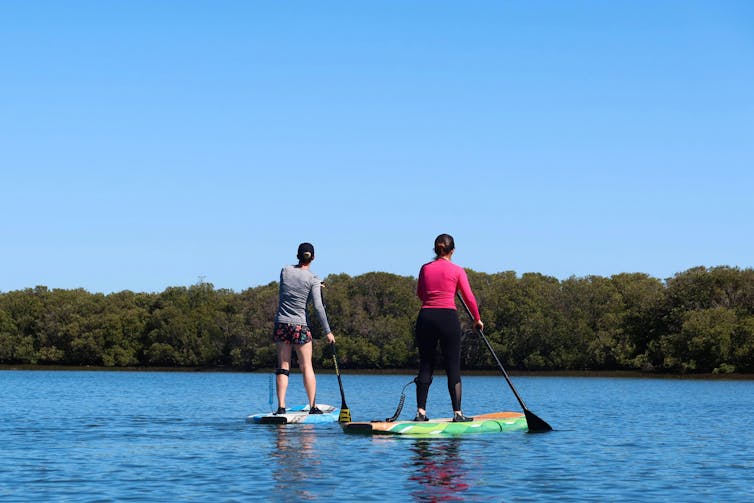
Two paddleboards on calm water.
Paddleboarding has become extremely popular as ocean craft become more affordable.
Oxk/Unsplash, CC BY-ND

Winds, waves and currents

Wind alone is dangerous enough, but when combined with waves and currents it can dramatically reduce a person’s ability to return to shore, even with a craft.

Strong winds striking the coast obliquely create surface drift, pushing lightweight vessels – such as inflatable paddleboards and kayaks – steadily offshore. At the same time, wind-driven waves increase drag, making paddling or swimming far more exhausting.

Ocean currents compound the problem. Even modest currents of 1–2 knots can exceed a swimmer’s sustainable speed over long distances. Against waves and wind, fatigue sets in quickly, increasing the risk of panic, hypothermia and drowning.

Research consistently shows people overestimate their ability to swim or paddle against environmental forces. Once offshore drift begins, the distance to shore can increase much faster than people realise.

Inflatables – a boon and a potential bane

Inflatable craft, such as stand-up paddle boards, are increasingly popular as they’re often cheap, portable and easy to use.

But they’re also particularly vulnerable to wind, even light breezes.

Because inflatables sit high on the water and have little mass, they act like sails. Even moderate winds can overpower a paddler’s strength, especially when conditions deteriorate. Marine safety agencies repeatedly warn inflatables should only be used close to shore, in light winds, and with constant attention to changing conditions.

In coastal Australia, large-scale wind changes often unfold over hours, but conditions on the water can feel dramatically worse within minutes once waves build and fatigue sets in. The weather can shift from benign to hazardous within minutes, particularly in the afternoon and early evening.

This is why marine forecasts often emphasise timing, not just wind strength.

A forecast of “10–15 knots increasing to 20 knots in the afternoon” may sound manageable. But for paddlers and swimmers, that increase can mark the difference between control and crisis.

Clouds developing, rising wind, whitecap waves forming further offshore and a sudden drop in temperature are all warning signs that conditions are changing, and a cold front is approaching.

What to do if caught out

First, stay calm. Staying with the craft, such as the inflatable paddle board, is imperative. It provides flotation and – crucially for rescue – visibility. If you have a life jacket, you should keep it on.

If you don’t have a flotation device, you should float on your back. Remember, Float to Survive. Floating on your back, keeping limbs relaxed, and pacing your effort can extend survival time significantly.

If you must swim, swimming diagonally across waves or with the waves, rather than directly against them, may help reduce exhaustion. Crucially, raise the alarm as soon as possible. Early notification gives rescue crews a far greater chance of success.

How to avoid this situation

Prevention remains the most effective safety strategy.

Before heading out, check marine forecasts – not just general weather apps – and pay close attention to wind strength, direction and timing. Avoid inflatables when winds are forecast to increase later in the day.

Always wear a life jacket, even in calm conditions, and carry a waterproof communication device if possible.

Stay close to shore, set clear limits on how far you’ll go, and be prepared to turn back early. Always let other people know you’re heading out to sea, even if you plan on staying very close to shore.

The Geographe Bay rescue had a remarkable outcome, thanks to the extraordinary courage and determination of the young boy. But it also highlights a sobering reality: the ocean doesn’t need to be stormy to become dangerous. Sometimes, it just needs the weather to change – and it often does, faster than we expect.

The Conversation

Samuel Cornell does not work for, consult, own shares in or receive funding from any company or organisation that would benefit from this article, and has disclosed no relevant affiliations beyond their academic appointment.

ref. One family’s ocean paddle almost ended in tragedy. It reminds us coastal weather is notoriously changeable – https://theconversation.com/one-familys-ocean-paddle-almost-ended-in-tragedy-it-reminds-us-coastal-weather-is-notoriously-changeable-275077

A Harry Potter villain is now an unlikely new-year mascot in China

Source: Radio New Zealand

Draco Malfoy, Harry Potter’s privileged teen nemesis in J.K. Rowling’s wildly successful book series, is popping up in festive displays in the country ahead of the Lunar New Year.

The good fortune is in the name: “Malfoy” is transliterated as “Ma Er Fu” in Mandarin. The first word “Ma” means “horse” (马), while the third refers to good fortune (福). Read together, it sounds like horses are bringing good luck.

Videos on Chinese social media show people adorning their homes with red posters carrying well-wishing phrases, known as fai chun or chunlian, in an annual festive ritual.

Only this time, alongside messages wishing for wealth and health is the signature grin of the blond bully from Hogwarts school.

The Year of the Horse begins on 17 February with the end of the Year of the Snake (an animal equally apt for Malfoy, as the symbol of Slytherin, his house at Hogwarts).

The Harry Potter franchise has been a hit in China. Nearly 10 million translated copies of books were sold even before the last instalment was released in 2007, its Chinese publisher told state broadcaster CCTV that year.

When the re-mastered version of the first Harry Potter movie was released again in 2020, the film raked in US$27.6 million (NZ$46m) at China’s box office, state news agency Xinhua reported.

Tom Felton, who played Malfoy in the Harry Potter film series for a decade from 2001, marked his most famous role’s unlikely crossover.

He posted a picture on his Instagram of a giant banner hanging at the atrium of a Chinese shopping mall, featuring the character in a wizard costume.

A short clip on Douyin, China’s version of TikTok, shows someone sticking their Malfoy-faced fai chun on their fridge. The video garnered more than 60,000 likes, with another user commenting: “You’re genius.”

Some in China have spotted an opportunity to make a few bucks, selling the posters on Chinese e-commerce platforms.

“The fu has arrived,” one customer wrote on Pinduoduo, another e-commerce platform.

“Bring me some fortune in 2026, young master,” they said.

– Published by EveningReport.nz and AsiaPacificReport.nz, see: MIL OSI in partnership with Radio New Zealand

‘Hero’ saves family of four from drowning

Source: Radio New Zealand

Kai Iwi Lakes. RNZ / Peter de Graaf

A family of four have been saved from drowning by a fast-thinking local man being described by police as a “hero”.

The rescue happened earlier this month at Kai Iwi Lakes, north of Dargaville.

Haruru man Aaron Stott was walking along the beach with his wife, family and a friend one early evening when they saw “a couple of kids in the water and noticed something wasn’t quite right”.

“Then all of a sudden the mum ran in and basically just went under,” he said in a statement released by police on Thursday.

He ran after them, and pulled the mother and a child into shallow water.

“And then I thought, ‘Oh thank goodness, I’ve got them out and they’re okay.’”

Then someone yelled out there were two more people in trouble. Stott could not see anyone, so dove under – and found two more people at the bottom of the lake.

He pulled them up to the surface.

“Someone grabbed the father and he was okay, but I was holding the boy who was blue and unresponsive.

“I carried him up to the beach and whacked him on the back a couple of times before putting him on his side and he started breathing again.”

By then a nurse had arrived on the scene and paramedics were on their way.

“If I was 10 seconds later I think it would have been a really different outcome.”

A Hato Hone St John ambulance crew treated family members at the scene.

“He’s a hero – there’s no two ways about it,” Senior Sergeant Dave Wilkinson said. “He didn’t hesitate, he dove in and rescued four people and he deserves to be recognised for his actions.”

Kai Iwi Lakes. Supplied / NZME

Stott said he hoped sharing the experience would encourage others to stay safe around water.

“Just don’t go in if you’re not experienced in the water, and if you are going on any type of craft then always wear a life jacket.”

Water Safety NZ Interventions lead Esther Hone said while Stott undoubtedly saved lives, not every rescue attempt was successful.

“The instinct to save others is a natural human instinct, however around water it can be very dangerous. Every year we lose New Zealanders who drown attempting to rescue others.”

Hato Hone St John encouraged people to call 111 immediately in water-related emergencies, and urged people to learn first aid and CPR.

Sign up for Ngā Pitopito Kōrero, a daily newsletter curated by our editors and delivered straight to your inbox every weekday.

– Published by EveningReport.nz and AsiaPacificReport.nz, see: MIL OSI in partnership with Radio New Zealand

Wellington surfers fear return of ‘turds in the waves’ era after Moa Point failure

Source: Radio New Zealand

Untreated waste water is leaking onto the capital’s south coast beaches due to the Moa Point Treatment Plant flooding. RNZ / Samuel Rillstone

Surfers and surf lifesavers are devastated Wellington’s south coast is off-limits while sewage spews into the sea, worrying it’s a return to a time when there were “turds in the waves”.

An equipment failure at the Moa Point wastewater treatment plant has flooded the site, and sewage is flowing into the coastline, with no timeline on a fix.

Wellington mayor Andrew Little labelled it a “catastrophic failure” and an “environmental disaster”.

Wellington Water is focusing on cleaning up the flooding so it can safely restore power and allow sewage – still untreated – to be pumped through the long outfall pipe nearly 2km into Cook Strait, rather than into Tarakena Bay close to shore.

People have been told not to swim in the water, RNZ / Samuel Rillstone

That could take days.

In the meantime, people are being urged not to enter the water, collect seafood, or walk their dogs on the beach, and a rāhui is in place.

Jamie McCaskill from Wellington Boardriders told Morning Report he was gutted and devastated.

“We’ve got a few events coming up, this is a bad time for us … it’s just really not a good time, especially at this time of year.”

The worst part was not knowing when the water would be safe, McCaskill said. He wanted clear communication from Wellington Water about that.

McCaskill worried it would be a return to decades prior, before the long outfall pipe was built.

“I’ve been talking to a few of the legend surfers, and kind of before 1989 there was just … raw sewage, smells on the rocks, on the wall, surfing in barrels with turds in the waves,” he said.

“There were sicknesses, ear infections, skin infections, gastro, so we’re just trying to avoid that, that’s for sure.”

Wellington’s Moa Point wastewater treatment plant has been shut down and staff evacuated from the site, after an equipment failure flooded multiple floors. RNZ / Samuel Rillstone

There were no other places nearby to surf, he said.

“We could go to Wainuiomata or over to the Wairarapa but it’s just such a long way, it’s a bit of a bummer that we just can’t go locally.”

‘It’s really concerning’

Lyall Bay Surf Lifesaving Club chairperson Matt Flannery said his members were as disappointed as the rest of the community.

“We can’t use what is a beautiful part of the city,” he said.

“It’s really concerning.”

The club has had to reschedule this weekend’s planned competitions, and it has disrupted members’ training for national competitions.

“We’re at the final part of the season where we’ve got very regular use on the beach, with probably 70 or 80 club members in the water on a daily basis, so that’s a fairly big impact,” Flannery said.

“It’s at a time of the year that we’re training for national championships four weeks out, and obviously the uncertainty about when the beach will reopen is of a major concern for us.”

That uncertainty made their rejigged training plans “a bit of a guessing game”, Flannery said.

Lifeguards would not be patrolling the beach this weekend, and a red flag would fly at the club to show the beach was unsafe.

The mayor told Morning Report he shared residents’ anger and frustration.

“This is my neighbourhood, this is where I take my dog for a walk, and along that coastline is where I spend my time, that’s where I go kayaking and swimming,” Andrew Little said.

Wellington Water is taking water samples from a wide area and expected to provide an update later on Thursday.

Sign up for Ngā Pitopito Kōrero, a daily newsletter curated by our editors and delivered straight to your inbox every weekday.

– Published by EveningReport.nz and AsiaPacificReport.nz, see: MIL OSI in partnership with Radio New Zealand

Schools, Education Ministry at odds over what counts as an official school day

Source: Radio New Zealand

The Education Ministry says schools now have to add extra days to the end of the school year to make up for so-called staggered starts. Unsplash/ Taylor Flowe

Schools and the Education Ministry are at odds over whether welcoming new students a day or two before other students return to class counts as an official school day.

The ministry says schools now have to add extra days to the end of the school year to make up for so-called staggered starts – principals say they should not have to.

School websites show multiple secondary schools opted to started with only one or two year levels, such as Year 9 students, present on the first day or two of the school term.

The ministry last year ruled such days could not be counted against the minimum number of half-days they must be open this year – 378 for primary and intermediate schools and 376 half-days for secondaries, assuming they used four government-mandated teacher only half-days.

It said schools were only open for instruction if all year levels were learning, either on or off-site.

The interpretation also meant schools could only require staff to be present by using one of 10 “call-back days” they could use each year for work outside of term time.

Some principals said the ministry’s interpretation was legally incorrect and impossible to comply with during end-of-year exams when senior students were granted exam leave for the duration of the exam period.

Burnside High School principal Scott Haines said his school welcomed 755 new students, most of them Year 9s, on Monday and Tuesday this week with an induction to ensure they got off to a good start.

Burnside High School principal Scott Haines. Supplied / Burnside High School

He said the potential for chaos was too high to risk starting all 2776 students that had enrolled this year on the same day and the days should count as “open for instruction”.

“The well-established, well-trodden path for decades for schools around the country is that yes, we could count those days because students are legitimately at school undertaking legitimate courses of learning, teachers are at work doing the same,” he said.

“But the new guidance from the ministry suggests that in fact no, these can’t be counted as … schools open for instruction and so the ministry’s expectation would be that we would be adding days at the other end of the year.”

Asked if Burnside would count the induction days as days it was open for instruction, Haines said he was still seeking to get to the bottom of the matter.

He said the Secondary Principals Association and Post Primary Teachers Association had legal opinions that the ministry’s interpretation was not enforceable and the ministry was expected to provide further guidance.

Haines said if his school’s first days did not count as being open for instruction, then the same would apply to the senior exam period at the end of the year and that would be totally unmanageable.

“Principals are really worried about this and the potential impacts for students, because we sweat the detail here, we want the very best for our students. No one is going about this trying to, I guess, play the system and not be open for the requisite number of half days,” he said.

Hutt Valley High School principal, Denise Johnson, said the school shortened its usual one-and-a-half-day staggered start for new students to just one day because of the ministry’s ruling.

Hutt Valley High School principal, Denise Johnson. Supplied / Hutt Valley High School

She said the school would not count the day as an official school day and had added an extra day to the end of its year.

But she was not happy about it.

“The teachers that worked that day, which was the majority of the school, were fronting for kids – I would be pretty hard pushed to suggest to them they hadn’t worked their butts off all day. It’s a bit of an anomaly where they suggest it isn’t a day where you’re doing business as usual. You clearly are,” she said.

Johnson said her school was in the midst of a major building project and it would not cope if the ministry’s ruling open for instruction interpretation was applied to the end-of-year exam period.

“I don’t know how we’d do some of those big say Year 12 English exams. We can’t do them if everyone was on-site, we can’t fit. I don’t know where we’d go. We have a hall that only fits probably 350. It’s a physical impossibility,” she said.

Auckland Grammar headmaster Tim O’Connor said the school’s 2800 boys started on the same day, but it took a couple of days before classes started in earnest.

He said students needed to finalise their options and some would be relying on NCEA results to confirm enrolment in limited-entry classes.

O’Connor said the ministry needed to clarify its rules because strictly speaking those days might count as “open for instruction” under the ministry’s interpretation.

“We think it’s pretty reasonable to get on to a full timetable with 2800 students within two days, then full teaching. But is that open for instruction? I guess we need some clarity on what is and what isn’t,” he said.

Auckland Grammar headmaster Tim O’Connor. RNZ Insight/John Gerritsen

Principals said they had been told the Education Review Office would monitor compliance with the rules.

O’Connor said the ministry should actively monitor compliance too.

“What about them actually entering a school and having those conversations and seeing how a school is operating? Those things will actually be meaningful to a school and tell principals across the country including me that this is important and that you’re accountable for student learning,” he said.

The ministry said from this year schools were expected to record the days they were not open for instruction and the reason.

Sign up for Ngā Pitopito Kōrero, a daily newsletter curated by our editors and delivered straight to your inbox every weekday.

– Published by EveningReport.nz and AsiaPacificReport.nz, see: MIL OSI in partnership with Radio New Zealand

Inland Revenue standing improves but frustrations persist

Source: Radio New Zealand

RNZ

Tax accountants say interactions with Inland Revenue (IR) are improving but inconsistencies, inflexibility and inexperienced staff continue to be a frustration.

Chartered Accountants (CAANZ) and Tax Management’s (TMNZ) 2025 IR satisfaction survey indicates 82 percent of its tax agents who responded to the survey had clients with unpaid tax debt, though about 75 percent believed they would be able to make their tax payments.

Still, members gave IR’s handling of debt recovery a rating of 5.8 out of 10, which matched last year’s result, though there was a high degree of satisfaction when it came to online digital services.

TMNZ’s strategic advisor Chris Cunniffe said most of the issues with IR arose from one-on-one interactions, as the department stepped up efforts to recover $9.3 billion in unpaid tax.

“They are unsurprisingly throwing a lot of resource at it, which then means there’s a lot of interaction with tax agents,” Cunniffe said.

Debt management issues

Many tax agents said they did not understand IR’s current debt strategy, with inconsistent case handling, delayed follow-ups and misplaced enforcement focus.

The survey found there was a strong perception that outcomes often depended on which IR staff member managed the case, creating uncertainty and inefficiency.

Many respondents believed IR was intervening too late to collect debts, with debts already escalated to unmanageable levels.

Respondents were also concerned that small debts were chased aggressively while larger debts attracted less attention.

Recurring concern with audit and review activity

About 40 percent of tax agents said they were concerned about the standard of IR’s reviews or audits of clients, as inexperienced auditors lacked practical commercial understanding or the confidence to manage reviews effectively.

“Members experienced variation in how similar issues were handled across Inland Revenue teams, and many highlighted the impact of inexperienced staff.

“A further concern was Inland Revenue’s declining ability to understand the issue being raised, despite improved responsiveness. These gaps continue to affect predictability and the quality of the overall experience.”

Members were also concerned by IR’s increased attention on GST, PAYE, land transactions, and emerging activity in crypto-related matters.

“While satisfaction with final outcomes was generally moderate, the process often felt uneven,” the survey indicated.

Working to resolve issues

Cunniffe said CAANZ and TMNZ were working with IR to resolve the issues raised by the survey.

“What we’re looking for here is a collaborative approach . . . and look to get alignment on how tax agents and Inland Revenue can work to address this debt mountain that we face,” he said.

“We don’t see any point in just throwing stones at the Inland Revenue and saying, you’re not good enough.”

IR deputy commissioner Lisa Barrett said IR’s approach had been effective, with more than $4b in debt repaid.

“We’re pleased that accountants have noticed our increased efforts in audit and debt collection and are working with us and their clients to resolve any issues,” she said.

“Any time an organisation rapidly increases activity there are areas to improve, and we’re grateful for CAANZ feedback and their positive attitude to working through those with us.”

Sign up for Money with Susan Edmunds, a weekly newsletter covering all the things that affect how we make, spend and invest money.

– Published by EveningReport.nz and AsiaPacificReport.nz, see: MIL OSI in partnership with Radio New Zealand

In the Australian outback, we’re listening for nuclear tests – and what we hear matters more than ever

Source: The Conversation (Au and NZ) – By Hrvoje Tkalčić, Professor, Head of Geophysics, Director of Warramunga Array, Australian National University

ANU Media

Tyres stick to hot asphalt as I drive the Stuart Highway from Alice Springs northward, leaving the MacDonnell Ranges behind. My destination is the Warramunga facility, about 500 kilometres north – a remote monitoring station I’ve directed for the Australian National University for nearly 19 years, and one of the most sensitive nuclear detection facilities on Earth.

When I started exploring Earth’s inner core in 1997, I had no idea my calling would lead me here, or that I’d spend years driving this highway through the red expanse of the Australian outback.

And today, as the New START treaty curbing the US and Russian nuclear weapons programs expires, the work we do in the red centre has become more important than ever before.

A giant telescope pointed at Earth’s centre

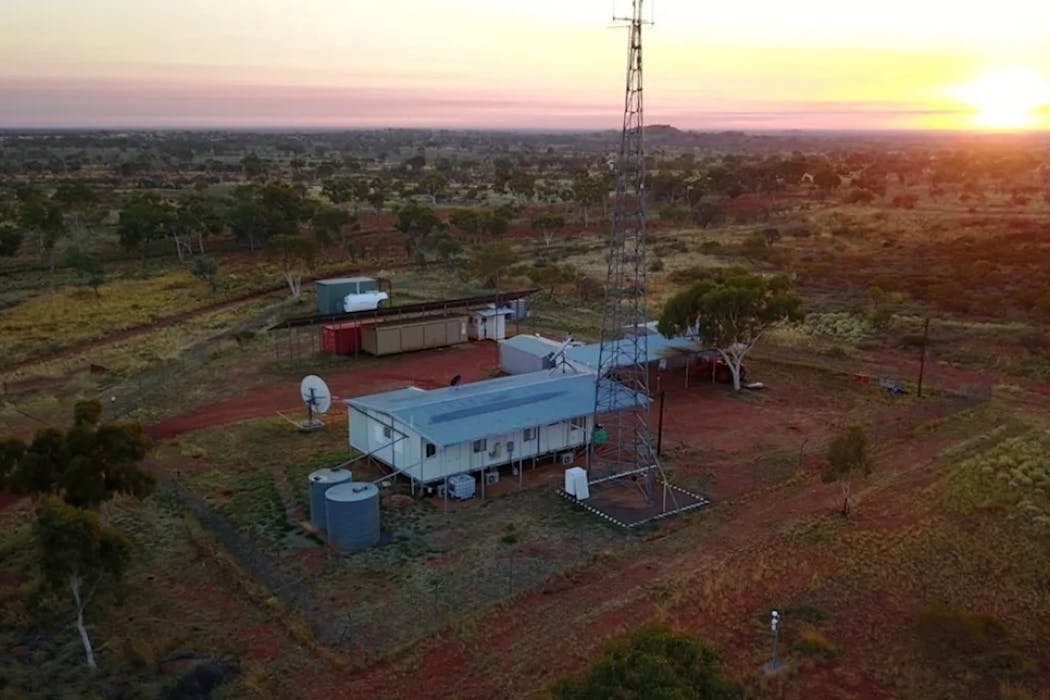
Located 37km southeast of Tennant Creek – or Jurnkkurakurr, as it’s known in the local Warumungu language – Warramunga consists of what might generously be called a demountable building, surrounded by sensors lined up across 20km of savannah, covered by red soil and long, white spinifex grass.

The facility operates two sophisticated arrays. One consists of 24 seismometers detecting vibrations through Earth, the other eight infrasound sensors picking up ultra-low-frequency sound waves inaudible to human ears.

When North Korea detonated its largest nuclear device in September 2017 – about 7,000km away – our instruments captured it clearly. Warramunga detected all six of North Korea’s declared nuclear tests, and our data was among the first to reach the International Data Centre in Vienna.

Aerial photo showing buildings in a red, scrubby landscape.
The Warramunga station is near Tennant Creek in the Northern Territory.
Nearmap, CC BY

The geological stability and remoteness mean we detect events that might be masked elsewhere. When a wild brumby gallops past our sensors, we pick it up. When a nuclear bomb is tested on the other side of the world, we definitely know about it. We can distinguish it from an earthquake because of the different kinds of vibrations it produces.

Warramunga detects more seismic events than any other station in the global network. With multiple instruments in a carefully designed configuration, far from the coast and human activity, you have something like a giant telescope pointed at the centre of Earth.

An unusual partnership

Warramunga’s story began in 1965 when Australia and the United Kingdom jointly established it for nuclear test detection during the Cold War. In 1999, it was upgraded and later certified as a primary station in the Comprehensive Nuclear-Test-Ban Treaty Organization’s International Monitoring System.

The CTBTO, headquartered in Vienna, operates a global network of more than 300 facilities designed to detect any nuclear explosion anywhere on Earth. Australia hosts 21 of these facilities – the third-largest number globally.

But Warramunga is unique. It’s operated by a university on behalf of both the CTBTO and the Australian government, located on Warumungu Country. The location of sensors was determined in consultation with Traditional Owners to ensure the instruments would not interfere with sacred sites.

The Research School of Earth Sciences at the Australian National University in Canberra has managed Warramunga for more than 50 years, and we still do.

Life at the station

The station requires constant attention. Two dedicated technicians drive from Tennant Creek to the array each morning. By the time they arrive, the Sun is already high above the red land across which the array’s elements and termite mounds are spread.

They keep a careful watch on the world’s earthquakes and explosions, enduring extreme heat, dust, flies, fires, floods, thunderstorms and the occasional visit from wildlife. They ensure data flows continuously via satellite to Vienna.

After one infrastructure reconstruction, we found two large goannas wrapped around a seismometer, having decided to spend their nights in the firm embrace of our equipment. You don’t learn about this kind of challenge in Vienna’s United Nations offices.

Metal devices on red soil
Detectors at Warramunga.
Hrvoje Tkalčić, CC BY

From Canberra, I coordinate between the on-site team, the Australian government, and our partners at the CTBTO. At least once a year, I make the drive up the Stuart Highway to Warramunga, checking equipment and discussing challenges with the technicians.

I also meet regularly with colleagues at the United Nations in Vienna. Managing this facility means bridging two worlds: the practical realities of maintaining sensitive equipment in a harsh environment and the international diplomacy of nuclear verification.

Why it matters now

For more than 30 years, the world has observed a de facto moratorium on nuclear explosive testing. The last US test was in 1992. Russia’s was in 1990.

This norm has been crucial in limiting nuclear weapons development. Verification systems such as Warramunga make this possible, because would-be violators know any significant nuclear explosion will be detected.

But this system faces its greatest challenge in decades. In October 2025, President Donald Trump announced the United States would begin testing nuclear weapons “on an equal basis” with Russia and China.

Days later, President Vladimir Putin directed Russian officials to prepare for possible nuclear tests. If this moratorium collapses, it opens the door to a new era of nuclear arms racing.

This is when verification becomes most crucial. The CTBTO’s network doesn’t just detect violations – its existence deters them. If the world knows a country has carried out a nuclear test and tried (but failed) to hide it, the testing country will face political consequences.

A hidden contribution

Warramunga’s data also helps researchers understand earthquakes, study Earth’s deep interior, such as the solid inner core, and track phenomena from meteorite impacts to Morning Glory clouds – extraordinary atmospheric waves travelling 1,400km from Cape York, first scientifically documented with Warramunga’s infrasonic array in the 1970s.

What strikes me after nearly two decades is how this unique partnership represents a remarkable example of academic institutions contributing directly to global security.

Few people realise that a university research school operates one of the world’s most crucial nuclear verification facilities. It’s an arrangement that brings together fundamental scientific research with practical obligations under international treaties – a model for how researchers can engage with pressing global challenges.

As nuclear rhetoric intensifies globally, the quiet technical work in the Australian outback gains new significance. Nuclear test monitoring is essential to deter would-be nuclear nations – and that’s a mission worth maintaining, even from the remote red centre of Australia.

The Conversation

Hrvoje Tkalčić receives funding from the Australian Research Council. The Australian National University operates and maintains the Warramunga Seismic and Infrasound Facility with funding from the CTBTO at the United Nations in Vienna.

ref. In the Australian outback, we’re listening for nuclear tests – and what we hear matters more than ever – https://theconversation.com/in-the-australian-outback-were-listening-for-nuclear-tests-and-what-we-hear-matters-more-than-ever-272892

Digital ghosts: are AI replicas of the dead an innovative medical tool or an ethical nightmare?

Source: The Conversation (Au and NZ) – By Jon Cornwall, Senior Lecturer and Education Adviser, University of Otago

Elise Racine, CC BY-NC-ND

For centuries, work with donated bodies has shaped anatomical knowledge and medical training.

Now, digital technologies and artificial intelligence (AI) are reshaping education and we can imagine a future where AI-generated representations of dead people – chatbots specifically developed as “thanabots” – are used to support students’ learning.

The term thanabot is derived from thanatology, the study of death. Such AI replicas are already used to assist people during bereavement and could be integrated into medical education.

Thanabots based on information and data from a body donor could interact with students during dissections, providing personalised guidance drawn from medical records, linking clinical history to anatomical findings and improving factual learning.

They might even support the learner’s humanistic development through an intensive first encounter with a dead body who comes “alive” through AI.

At this point, thanabots remain hypothetical in educational settings, but the technology exists to make them a reality. At first glance, this looks like an educational breakthrough – a “first patient” brought to virtual life to enhance both anatomical factual learning and the acquisition of skills such as empathy and professionalism in students.

But as we show in our new research, there are many unknown risks associated with the development of such applications that might raise the question of what it actually means to be dead or even “not quite dead”.

The evolution of thanabots

Thanabots, also called deadbots or griefbots, already exist. They are, at present, mostly being used as tools to help comfort the bereaved, though thanabots of famous people are also available.

Technologies such as Project December, which simulates text-based conversations with the dead, and Deep Nostalgia, which animates old photos, show how digital afterlives are increasingly represented and even normalised.

Extending these tools to anatomy education seems a logical step. An educational version of a thanabot could answer student questions, guide dissection and provide contextual clinical narratives. These interactions would likely improve clinical reasoning and potentially help students navigate emotionally challenging encounters with the dead.

Yet significant risks accompany such innovation. AI-generated content is prone to error, and incorrectly interpreted medical records or hallucinations about data could mislead students. Also, emotional engagement with a digitally “resurrected” donor could overwhelm learners, or engender unhealthy parasocial attachments.

The illusion of a human presence risks trivialising the body donor’s physical reality and could compromise the leaners’ authentic encounter with mortality and respect for the deceased.

Cultural norms and individual grief may be disrupted, especially for students already sensitive to exposure to the dead or from backgrounds with strong constraints around postmortem representation.

This includes instances where death and the dead are considered sacred and further engagement with their likeness is considered taboo. In many cultures, the dead should be respectfully left to rest, not “brought back to life”.

Risks of using thanabots in anatomy education

The ethical and legal frameworks covering thanabot use are underdeveloped because specific legislation and guidelines are scant or non-existent. This leaves many ethical and legal questions unanswered.

In a scenario where a thanabot were generated for use in anatomy education, who would own a digital donor? How would consent for AI use be obtained from families or estates, medical records ethically managed or privacy and dignity safeguarded?

Any implementation of thanabots would need to address these questions to ensure that potential educational gains don’t come at the cost of psychological well-being, ethical integrity or societal unease.

Beyond these practical concerns lies a deeper philosophical issue. What does it mean to be dead in an age of AI “resurrection”?

Anatomy education has long been shaped by societal understanding of mortality and the human body. Use of thanabots might alter these boundaries, blurring the line between life and death, providing representations of something “different” that is neither one nor the other.

Thus, even with the best intentions, students could experience emotional dissonance, confusion about mortality or a distorted understanding of what it means to be human if that understanding is tied to an AI proxy rather than a real person.

We are not suggesting that AI cannot play a role in anatomy education. Carefully designed tools that respect donor dignity, support reflection and augment (not replace) human interaction can enrich learning.

But the allure of technological novelty should not override caution.

Before bringing digital “ghosts” into anatomy laboratories, educators must ensure ethical governance and critically examine what these tools truly teach students about life, death and human dignity.

The Conversation

The authors do not work for, consult, own shares in or receive funding from any company or organisation that would benefit from this article, and have disclosed no relevant affiliations beyond their academic appointment.

ref. Digital ghosts: are AI replicas of the dead an innovative medical tool or an ethical nightmare? – https://theconversation.com/digital-ghosts-are-ai-replicas-of-the-dead-an-innovative-medical-tool-or-an-ethical-nightmare-273212

Can One Nation turn its polling hype into seats in parliament? History shows it will struggle

Source: The Conversation (Au and NZ) – By Kurt Sengul, Research fellow, Far-Right Communication, Macquarie University

One Nation is no stranger to the headlines, but it’s been a long time since the party has been talked about as a serious political force. Operating on the fringes of Australian political life for years, suddenly Pauline Hanson is in the news every day.

A significant part of this is the party’s well-documented meteoric rise in the polls. It’s prompted speculation about One Nation becoming Australia’s official opposition party, leaving the Liberals and Nationals in the dust.

But while politics is a fast-moving beast, you only need to look back a couple of years to be reminded of the long history of dysfunction that’s plagued the party.

So will this ascendancy amount to a lasting realignment of conservative politics in Australia? Can One Nation overcome its scandal-ridden past to emerge as the dominant force in Australian right-wing politics?

A tale of peaks and troughs

The 1998 Queensland state election remains One Nation’s electoral high point. It was the only time the party polled above 20%. The election saw the party pick up 11 of 89 seats, propelling it to the third largest party in the state parliament.

But One Nation’s stunning rise was over almost as soon as it started. The party was beset with internal disunity, political scandals and poor management. Most of the party’s Queensland parliamentarians abandoned it after demands to democratise the party organisation were ignored.

Hanson lost her seat in parliament soon after, narrowly failing to win the newly-formed Queensland seat of Blair at the 1998 federal election.

One Nation managed to gain the upper house balance of power in the 2001 Western Australian state election. However, Hanson’s resignation from the party in 2002 and conviction for electoral fraud in 2003 (later overturned) helped plunge the party into political irrelevance.

Returning to the party in 2014, and the leadership in 2015, Hanson led One Nation to its second breakthrough on the national stage at the 2016 double dissolution election. Four One Nation senators, including Hanson, were elected from just 4.29% of the first preference vote.

But the party was again wracked by defections and scandal. Rodney Culleton, Fraser Anning, and Brian Burston – all elected on the One Nation ticket – abandoned the party after falling out with Hanson.

One Nation was reduced to two Senate seats until the 2025 federal election, where it picked up a seat in New South Wales and WA, bringing the party back to four senators.

What’s driving this polling surge?

It’s useful to think of One Nation’s rising support as a combination of short-term factors and longer-term trends.

In the short term, dysfunction within the (former) Coalition parties and conservative voters’ dissatisfaction with moderate Liberal leader Sussan Ley have been a boon for One Nation.

As she did after the 2014 Lindt cafe siege, Hanson has connected the 2025 Bondi terror attack to immigration and multiculturalism, criticising the government for allowing “the wrong people” to migrate to Australia.

The party has also benefited from increased salience of immigration and national security, connecting housing and cost-of-living pressures to so-called “mass migration”.

Long-term, the party has been buoyed by the mainstreaming of far-right politics globally, profound shifts in media and communication landscapes, and the decline in support of the major political parties in Australia.

Succeeding in spite of itself

One Nation’s polling surge appears to defy conventional wisdom about the viability of a far-right party in Australia.

Parties like One Nation perform relatively poorly compared with their European counterparts. It’s typically assumed this reflects a lack of supply of effective leadership and strong party organisation, rather than a shortage of demand for a far-right party.

Of course the test for One Nation is translating their current polling boost into electoral success. If they succeed, it will challenge long-held ideas that features of our electoral system, such as compulsory voting, provide a bulwark against more extreme forms of politics.

One of the greatest barriers One Nation has faced to electoral success has been itself. Research has shown the party has a history of serious organisational dysfunction.

One Nation has struggled to properly vet candidates for election. Candidates have resigned or been disendorsed by the party for potential breaches of election law and making sexist and homophobic comments. One candidate made headlines for mowing a swastika into their lawn.

Issues of candidate quality have been exacerbated by the lack of on-the-ground support and campaign co-ordination. Recent claims about booming One Nation membership should be viewed sceptically, unless accompanied by actual membership numbers. But most parties, including Labor and the Liberals, rarely publish such figures.

Likewise, claims the party has branches in all 151 federal electorates require qualification. Though a significant milestone for the party, the existence of a branch doesn’t automatically mean there is an active grassroots body able to knock on doors and hand out how-to-vote cards. One Nation has historically struggled with these things, outside of a handful of seats.

On top of this, while the defections of former Nationals leader Barnaby Joyce and former Liberal Senator Cory Bernardi have kept One Nation in the spotlight, Hanson’s history of falling out bitterly with elected representatives (think Mark Latham) raises questions about whether such partnerships can last.

Crucially, this kind of polling – with One Nation well ahead of the Coalition –should bring greater scrutiny from media and voters alike. The problem One Nation faces as it tries to reposition itself from a party of protest to a potential party of government is that people will rightly expect policy detail and costings.

One Nation’s strength is the politics of identity and grievance, not policy substance.

Proceeding with caution

There are many reasons to treat One Nation’s surge with caution. We should be circumspect about prematurely declaring the death of the Coalition parties or a realignment of Australian conservative politics. Infighting and dysfunction have been constant features of One Nation since its inception. There is little evidence to expect this will change.

Yet the scale of One Nation’s support in the polls and the collapse of the Coalition’s primary vote is uncharted territory. Despite its many challenges, the next federal election may for the first time see a well-funded One Nation pose a serious threat to the Coalition’s dominance of the Australian right. If their polling remains above 20%, it’s entirely possible there will be serious pressure to include Hanson in televised leaders’ debates.


Read more:
View from The Hill: Hanson nabs ex-Liberal for One Nation’s real time test in SA election


Essential questions remain about One Nation’s electoral viability on polling day. The party’s success will rely on its ability to run a disciplined campaign, endorse quality candidates, and manage intra-party conflicts – all of which the party has previously struggled with.

The first test of whether One Nation can translate polling support into electoral success will come at the upcoming South Australian election, where the party plans to field candidates in every seat.

The Conversation

Kurt Sengul receives funding from The Australian Research Council, NSW Government and the NSW RNA Research & Training Network

Jordan McSwiney receives funding from the Australian Research Council, NSW Government, and NSW RNA Research & Training Network.

ref. Can One Nation turn its polling hype into seats in parliament? History shows it will struggle – https://theconversation.com/can-one-nation-turn-its-polling-hype-into-seats-in-parliament-history-shows-it-will-struggle-274632

The ‘hot flush gold rush’: how women feel about being flooded with menopause marketing

Source: The Conversation (Au and NZ) – By Samantha Thomas, Professor of Public Health, Deakin University

Every person with functioning ovaries will eventually experience menopause. While the biology is relatively universal, the experience varies dramatically between individuals and in the same person over time.

Menopause has long been shrouded in stigma and shame but recently burst into mainstream attention. This may have reduced stigma but has also created confusion, as media, celebrity and commercial interests recognise a new marketing opportunity.

New research from one of us (Samantha) has found women are frustrated at being bombarded with marketing for menopause “solutions” that simply don’t work.

How menopause is marketed

Pharmaceutical companies, the wellness industry, workplace consultancies, coaches and influencers have all jumped on the menopause market. The “hot flush gold rush” is projected to reach US$24.4 billion by 2030.

One common tactic is creating feminised narratives of empowerment and care, positioning companies and influencers as supportive allies for women.

They encourage individuals to take charge of their menopause experiences by consuming a range of products and services. These include teas, supplements, chocolates, shakes, cooling blankets, pillows and creams promising relief from a wide range of symptoms that might not be related to menopause. There are apps which track symptoms, workplace accreditation programs, and even a “hot flush survival kit”.

Weight-loss companies now offer menopause-specific programs, marketed by celebrities such as Queen Latifah:

Companies frame how we think about menopause

Most online information about menopause has a commercial “for profit” interest.

This information shapes women’s expectations and fears by often positioning menopause as the defining, catastrophic challenge of midlife.

This raises concerns about the commercial exploitation of vulnerable women, encouraging purchasing of unproven and inappropriate treatments and products.

This hormone focus may overshadow the broad range of midlife stressors that many women experience in midlife, including intergenerational care-giving responsibilities, financial worries, workplace challenges, and gendered ageism.

Such an approach may also fuel health inequalities by ignoring structural issues that make life hard for women in midlife.


Read more:
Midlife adults are overextended with multiple roles


Concerns about commercial exploitation

A recent qualitative survey of over 500 Australian women aged 45–64 years demonstrated support for greater awareness of menopause but also concern about the commercialisation of menopause.

Women reported that companies and some social media influencers would “push anything to make a dollar”.

They were also worried that exaggerated and catastrophising narratives about the impact of menopause could unnecessarily fuel women’s fears and concerns about ageing:

There are very vulnerable women out there who are ripe for the picking […] and the influencers, marketing firms and companies seeking profits fully understand this and will exploit this.

Women also described feeling misled and disappointed when wellness “solutions” ultimately did “fuck all”.

Complex and conflicting information on social media sites left women struggling to determine what information to trust:

It is concerning as a lot will be preying on the insecurities of women. Women are going through changes they don’t understand and are reaching out to find a solution. There is conflicting information, you really need to fact check everything.

What would actually help?

Women deserve to be listened to and provided with trustworthy information and supportive environments. Here’s what would make a meaningful difference:

1. Better access to high-quality information to support decision-making

There is a tsunami of low-quality information online which is drowning out credible information.

Women need to know what to expect, how to prepare, and where to get help if needed. Independent, evidence-based information and critical media literacy tools can help women consider their options based on risks versus benefits and preferences.

2. Stop scaring women

Catastrophising menopause is unhelpful. Like all life transitions, menopause carries both losses and gains.

Most do not experience severe symptoms and those entering menopause with negative attitudes may have a worse experience.

Some women express relief when periods stop and report feelings of liberation, freedom, autonomy and the start of a new phase of life.

3. Better regulation of product claims and misinformation

Greater scrutiny and standards from federal government agencies will be essential in helping to safeguard women from misleading product claims, promotions, or inappropriate treatment.

4. Recognise that environmental adjustments can help support women in midlife

Simple workplace adjustments – such as flexible hours, supportive managers, cooler spaces, or regular breaks – can support the diverse experiences that women may have in midlife.

5. Protect policy from vested interests

We need a strong, clear commitment to women’s health and research that addresses women’s priority questions. This should support sustained funding, evidence-based care, equity and long-term wellbeing.

This process must be protected from commercial vested interests, including the pharmaceutical and wellness industries, and clinicians and researchers with conflicts of interest. This will ensure policy decisions are in the best interests of women, not for profit agendas.

Cutting through the commercial noise that has been created about menopause is essential. Only then can we create the social and structural changes need to support women’s health and wellbeing in midlife and beyond.


Read more:
Feminist narratives are being hijacked to market medical tests not backed by evidence


The Conversation

Samantha Thomas has received research funding from the Australian Research Council, ACT Office of Gaming and Racing, Department of Social Services, VicHealth, Victorian Responsible Gambling Foundation, Healthway, NSW Office of Responsible Gambling, Deakin University. The research mentioned in this article was supported by Jean Hailes for Women’s Health. She is currently Editor in Chief for Health Promotion International, an Oxford University Press journal. She receives an honorarium for this role.

Martha Hickey receives funding from the NHMRC, MRFF, Medical Research Council (UK), Wellcome LEAP and Global Challenge on Women’s Cardiovascular Health

ref. The ‘hot flush gold rush’: how women feel about being flooded with menopause marketing – https://theconversation.com/the-hot-flush-gold-rush-how-women-feel-about-being-flooded-with-menopause-marketing-269810

School breaks make up more than an hour of the day. Should they be considered part of learning?

Source: The Conversation (Au and NZ) – By Brendon Hyndman, Associate Professor of Education and Associate Dean (Academic), Faculty of Arts and Education, Charles Sturt University

Johnny Greig/ Getty Images

Most public debate about schooling focuses on what happens inside the classroom – on lessons, tests and academic results.

But students also spend significant time at school outside formal classes. While break times vary between Australian schools, a 2026 study suggests average recess and lunch periods take up about 12-16% of school time. This is between 62-82 minutes per day across both primary and high school. By comparison, Finland – regarded as one of the world’s leading education systems – sets aside more than 19% of the school day for breaks.

Recess and lunch are generally regarded as “breaks” from learning – where children can play or have free time. But given they make up such a significant part of the school day, should schools and education systems give them more consideration?

Our study

In a new study, we surveyed 130 primary and high school teachers about their views on school break times.

Teachers came from 25 countries and were recruited by targeted posts on social media. The majority of participants were female, from co-educational schools, had taught for more than 11 years and were working within early elementary/primary grade levels up to Year 2.

Teachers completed an online survey that included short, rating questions and longer, open-ended responses.

We deliberately included teachers from outside Australia. Schools across the world face similar pressures in terms of crowded curricula, accountability demands, risk management requirements and growing concerns about students’ wellbeing.

Teachers from Australia, the United States, Canada, the United Kingdom, New Zealand and other countries told remarkably similar stories.

Why breaks are important

Teachers in our study were clear that time outside the classroom supports learning. As well as recharging students, other studies show outdoor play and exploration are linked to stronger social skills, self-regulation, confidence, physical health and classroom engagement.

One New Zealand teacher noted:

physical strength via play supports academic learning, ability to concentrate, and the importance of risky play […] supports resilience.

Several teachers said when this time was supported well, it helped them build relationships and understand students in ways classroom teaching alone could not.

Research also tells us active supervision from teachers can strengthen students’ sense of belonging at school, which is a powerful protective factor against bullying.

It’s demanding for teachers

Teachers described rostered playground supervision during recess and lunch (often labelled “yard duty”) as demanding, unpredictable work.

Teachers need to constantly scan outdoor areas for safety risks, manage injuries and conflicts, support distressed or dysregulated students and make rapid decisions about inclusion and behaviour. This includes decisions about when to allow children to work things out and when to step in, when there is rough-and-tumble play and minor conflicts.

But there’s no training

Despite the benefits and demands of recess and lunch periods, teachers consistently reported they were rarely given preparation or professional learning to support students and give them opportunities to learn during these times.

On average, teachers rated their preparation to support in this area at just two out of ten (one UK teacher said they had to source their own training). As a result, decisions were often driven by risk avoidance rather than developmental value.

But with more training and expertise, teachers could support play by scanning for early signs of harm or exclusion, then using brief coaching prompts. For example, “What do you think would make this activity work for everyone?”, “How could you solve this so it feels fair?” and “What rule do you want to agree on before you restart?” can help students negotiate, reset boundaries and re-join the group.

This helps students to learn social skills and resilience, rather than relying on teachers to sort things out.

What about the weather?

Amid episodes of extreme heat and wild weather, teachers also need to be able to make rapid safety decisions about outdoor time.

Teachers in our study reported they have limited guidance here, beyond students needing to come indoors at certain temperatures. This highlighted the need for clearer preparation about handling weather. As one Australian high school teacher noted, colleagues “dread” wet weather days or extreme heat, with multiple classes in a confined space.

Further support for teachers could include flexible timetabling (having outdoor play earlier, when the day is cooler) and resources to support consistent decisions and safe adaptation when conditions allow.

Do we need a name change?

Teachers also identified broader barriers around break times. These included limited funding for outdoor spaces and school policies that frame breaks as a supervision “duty” rather than as a legitimate part of education.

Many teachers felt terms such as “recess” or “break time” signal this time is less important. Several suggested reframing it as “discovery time” or “outdoor exploration” to better reflect what children are actually doing and learning.

Teachers also expressed concern that opportunities for outdoor time decline sharply in high school. Even though young people face increasing mental health and wellbeing challenges and may benefit from more support to be outside.

What else could we do?

Improving learning beyond the classroom requires a shift in mindset from school leadership and education policy makers.

Schools can start by recognising this time as a legitimate part of learning. This includes providing teachers with basic professional guidance on play, inclusive supervision and risk-benefit decision making in the playground.

Allowing teachers to supervise students they know well can also help build relationships. This may include setting up simple play opportunities (such as helping to set up a student-led play zone or theme).

At a broader level, clearer links between learning beyond the classroom and curriculum goals are needed. This can give teachers evidence and guidance to help them get the most of this time, not just for students’ wellbeing but for their learning.

The Conversation

Brendon Hyndman does not work for, consult, own shares in or receive funding from any company or organisation that would benefit from this article, and has disclosed no relevant affiliations beyond their academic appointment.

ref. School breaks make up more than an hour of the day. Should they be considered part of learning? – https://theconversation.com/school-breaks-make-up-more-than-an-hour-of-the-day-should-they-be-considered-part-of-learning-274199

City skylines need an upgrade in the face of climate stress

Source: The Conversation (Au and NZ) – By Mohamed Shaheen, Lecturer in Structural Engineering, Loughborough University

The downtown district of Hong Kong city. Lee Yiu Tung/Shutterstock

When structural engineers design a building, they aren’t just stacking floors; they are calculating how to win a complex battle against nature. Every building is built to withstand a specific “budget” of environmental stress – the weight of record snowfalls, the push of powerful winds and the expansion caused by summer heat.

To do this, engineers use hazard maps and safety codes. These are essentially rulebooks based on decades of historical weather data. They include safety margins to ensure that even if a small part of a building fails, the entire structure won’t come crashing down like a house of cards.

The problem is that these rulebooks are becoming obsolete. Most of our iconic high-rises were built in the 1970s and 80s – a world that was cooler, with more predictable tides and less violent storms. Today, that world no longer exists.

Climate change acts as a threat multiplier, making the consequences of environmental stress on buildings much worse. It rarely knocks a building down on its own. Instead, it finds the tiny cracks, rusting support beams and ageing foundations and pushes them toward a breaking point. It raises the intensity of every load and strain a building must weather.

To understand the challenge, I have been studying global hotspots where the environment is winning the battle against engineering.

The 2021 collapse of Champlain Towers South in Miami, Florida, killed 98 people. While the 12-storey building had original design issues, decades of rising sea levels and salty coastal air acted as a catalyst, allowing saltwater to seep into the basement and garage.

When salt reaches the steel rods inside concrete that provide structural strength (known as reinforcement), the metal rusts and expands. This creates massive internal pressure that cracks the concrete from the inside out — a process engineers call spalling. The lesson is clear: in a warming world, coastal basements are becoming corrosion chambers where minor maintenance gaps can escalate into catastrophic structural failure.

While the Miami case affected a single building, the historic coastal city of Alexandria, Egypt, is more widely at risk. Recent research shows that building collapses there have jumped from one per year to nearly 40 per year in the past few years.

Not only is the sea rising, the salt is liquefying the soft ground beneath the city foundations. As the water table rises, saltwater is pushed under the city, raising the groundwater level. This salty water doesn’t just rust the foundations of buildings; it changes the chemical and physical structure of soil. As a result, there are currently 7,000 buildings in Alexandria at high risk of collapse.

white sail boat on blue sea with city skyline in background
The historic city of Alexandria, Egypt, is widely affected by the retreating coastline.
muratart/Shutterstock

In Hong Kong during Super Typhoon Mangkhut in 2018, wind speeds hit a terrifying 180 miles per hour. When strong winds hit a wall of skyscrapers, they squeeze between the buildings and speed up — like water sprayed through a narrow garden hose.

This pressure turned hundreds of offices into wind tunnels, causing glass windows to pop out of their frames and raining broken glass onto the streets below. With 82 deaths and 15,000 homes destroyed across the region, skyscrapers became “debris machines”, even if they didn’t fully collapse.

Supercomputer simulations of Japan’s river systems show that in a world warmed by 2°C, floods of today’s “once in a century” magnitude could recur about every 45 years. With 4°C of warming, they could be every 23 years. These surges in water volume will expand flood zones into areas previously considered safe, potentially overflowing sea walls and flood defences. In a critical region like Osaka Bay, storm surges could rise by nearly 30%.

In the US, a study of 370 million property records from 1945 to 2015 found over half of all structures are in hazard hotspots. Nearly half are facing multiple threats like earthquakes, floods, hurricanes and tornadoes. In the UK, climate-driven weather claims hit £573 million in 2023, a 36% rise from 2022. Annual flood damage to non-residential properties in the UK is also projected to nearly double from £2 billion today to £3.9 billion by the 2080s.

Maintenance is our best defence

Much of the world’s building stock is therefore entering its middle age under environmental conditions it was never designed to face. Instead of panicking or tearing everything down, the solution is to adapt and treat building maintenance as a form of climate resilience – not as an optional extra.

Mid-life building upgrades can help protect our skylines for the next 50 years. Our hazard maps must look at future climate models — not just historical weather — to set new safety standards. Regular structural health monitoring is essential – by using sensors to track invisible stresses in foundations and frames before they become fatal, dangerous situations can be foreseen.

Buildings can stay strong by focusing retrofits on the weakest and most vulnerable parts. This includes glass facades, the underground drainage, the foundation piles and corrosion protection.

Climate change isn’t rewriting the laws of engineering, but it is rapidly eating away at our margins of safety. If we want our cities to remain standing, we must act now – before small, invisible stresses accumulate into irreversible failure.


Don’t have time to read about climate change as much as you’d like?

Get a weekly roundup in your inbox instead. Every Wednesday, The Conversation’s environment editor writes Imagine, a short email that goes a little deeper into just one climate issue. Join the 47,000+ readers who’ve subscribed so far.


The Conversation

Mohamed Shaheen does not work for, consult, own shares in or receive funding from any company or organisation that would benefit from this article, and has disclosed no relevant affiliations beyond their academic appointment.

ref. City skylines need an upgrade in the face of climate stress – https://theconversation.com/city-skylines-need-an-upgrade-in-the-face-of-climate-stress-267763

What will a rebuilt Gaza look like? The competing visions for the Strip’s future

Source: The Conversation (Au and NZ) – By Timothy J. Dixon, Emeritus Professor in the School of the Built Environment, University of Reading; University of Oxford

A girl walks along a street in Gaza to get food during the war between Hamas and Israel. Jaber Jehad Badwan / Wikimedia Commons, FAL

Following a visit to Gaza in January, the UN undersecretary general, Jorge Moreira da Silva, called the level of destruction there “overwhelming”. He estimated that, on average, every person in the densely populated territory is now “surrounded by 30 tonnes of rubble”.

This staggering level of destruction raises urgent questions about how, and by whom, Gaza should be rebuilt. Since 2023, a variety of reconstruction plans and other initiatives have tried to imagine what Gaza could look like when the conflict ends for good. But which of these visions will shape Gaza’s future?

The Israeli government’s Gaza 2035 plan, which was unveiled in 2024, lays out a three-stage programme to integrate the Gaza Strip into a free-trade zone with Egypt’s El-Arish Port and the Israeli city of Sderot.

AI renderings show futuristic skyscrapers, solar farms and water desalination plants in the Sinai peninsula. The plan also shows offshore oil rigs and a new high-speed rail corridor along Salah al-Din Road, Gaza’s main highway that connects Gaza City and Rafah.

The US government has proposed a similar futuristic vision for Gaza. Its August 2025 Gaza Reconstitution, Economic Acceleration and Transformation Trust plan shows a phased series of modern, AI-powered smart cities developed over a ten-year time frame. The plan, which would place Gaza under a US-run trusteeship, suggested that poor urban design lies at the heart of “Gaza’s ongoing insurgency”.

Jared Kushner presenting the ‘Gaza Riviera’ Project at World Economic Forum in Davos, January 2026.

The latest iteration of this vision was unveiled by Donald Trump’s son-in-law, Jared Kushner, at the recent World Economic Forum in Davos.

He presented slides showing Gaza reconstructed as a “Riviera” of the Middle East, with luxury beachfront resorts, gleaming tower blocks, residential zones and modern transport hubs. Kushner suggested it was “doable” to complete the construction of a “new” Rafah city in “two to three years”.

It has been reported that the US and Israeli visions are heavily influenced by US-based economics professor Joseph Pelzman’s economic plan for Gaza. This plan, Pelzman said on a podcast in 2024, would involve destroying Gaza and restarting from scratch.

In contrast to the US and Israeli visions, the February 2025 Gaza “Phoenix” plan includes input from the people of Gaza. It has a much stronger focus on maintaining and reconstructing the existing buildings, culture and social fabric of the enclave.

The plan was developed by a consortium of international experts together with professionals and academics from Gaza, the West Bank and the Palestinian diaspora, and suggests a reconstruction and development phase of at least five years.

Other plans from the Arab world take a more technocratic view of reconstruction, but still have a short timescale for reconstruction. These include a five-year plan by the United Arab Emirates-based Al Habtoor Group, which promises to grant 70% of ownership in the holding company that will manage Gaza’s reconstruction to the Palestinians.

Feasibility of rebuilding Gaza

So, how feasible are these different visions and how inclusive are they for the people of Gaza? Rebuilding cities after war takes time and money, and also requires local resources. Even in China, a country with plentiful resources and abundant skilled labour, major new cities are rarely completed in less than 20 years.

And in Gaza rebuilding will be complicated by the fact that there are now 61 million tonnes of rubble there, as well as other hazardous debris such as unexploded munitions and human remains. This will need to be removed before any reconstruction can commence, with the UN estimating that clearing the rubble alone could take as long as 20 years.

For comparison, the Polish capital of Warsaw experienced a similar level of destruction during the second world war and it took four decades to rebuild and reconstruct the city’s historic centre. The time frames for reconstruction outlined in all of the plans for Gaza are far shorter than this and, even with modern construction methods, are unlikely to be feasible.

The US and Israeli visions also fail to include Palestinians in the planning of Gaza’s future, overlooking any need to consult with Gazan residents and community groups. This has led critics to argue that the plans amount to “urbicide”, the obliteration of existing cultures through war and reconstruction.

Reports that suggest Gazan residents will be offered cash payments of US$5,000 (£3,650) to leave Gaza “voluntarily” under the US plan, as well as subsidies covering four years of rent outside Gaza, will not have alleviated these concerns.

At the same time, the US plan does not propose a conventional land compensation programme for Gazan residents who lost their homes and businesses during the war. These people will instead be offered digital tokens in exchange for the rights to redevelop their land.

The tokens could eventually be redeemed for an apartment in one of Gaza’s new cities. But the plan also envisages the sale of tokens to investors being used to fund reconstruction. The Council on American-Islamic Relations, the largest Muslim civil rights and advocacy organisation in the US, says the “mass theft” of Palestinian land through the token scheme would amount to a war crime.

With their emphasis on community engagement and the repair and renewal of existing structures, the Phoenix plan and the other Arab-led visions are at least a step forward. But without a fully democratic consensus on how to rebuild Gaza, it is difficult to see how the voices of the Gazan people can be heard.

Whichever vision wins out, history shows that post-war reconstruction succeeds when it involves those whose lives have been destroyed. This is evidenced somewhat ironically by the US Marshall Plan, which funded the reconstruction of many European economies and cities after the second world war, and involved close engagement with civil society and local communities to achieve success.

The Conversation

Timothy J. Dixon does not work for, consult, own shares in or receive funding from any company or organisation that would benefit from this article, and has disclosed no relevant affiliations beyond their academic appointment.

ref. What will a rebuilt Gaza look like? The competing visions for the Strip’s future – https://theconversation.com/what-will-a-rebuilt-gaza-look-like-the-competing-visions-for-the-strips-future-274591

Why cheaper power alone isn’t enough to end energy poverty in summer

Source: The Conversation (Au and NZ) – By Duygu Yengin, Associate Professor of Economics, Adelaide University

Declan Young/Unsplash

Australia is an energy superpower. We have abundant natural resources, high average incomes and one of the highest per-capita rates of rooftop solar uptake in the world.

Yet every summer, many households across the country skimp on cooling, fear their next energy bill, or risk disconnection during extreme heat. Economists call this phenomenon “summer energy poverty” which can force households to make impossible choices between staying cool or putting food on the table.

Australia’s January heatwave broke multiple temperature records and led to significant spikes in emergency room visits. Climate change means such extreme weather events are likely to become more common in future.

Energy stress is often framed as an affordability problem, driven by electricity prices that are too high or incomes that are too low. But it both reflects and drives wider social and economic inequality, extending well beyond the simple cost of power bills.

Our research shows key drivers of energy stress are differences in wealth, a lack of emergency savings and whether people are renters. This is the case even comparing people with similar income.

More than an affordability issue

First, it’s important to understand the difference between income and wealth, which are related but not the same thing. Broadly speaking, income is the money you earn from work, benefits or investments. Wealth is the total value of what you own – your savings, property or other assets – minus any debts.

Importantly, income fluctuates. Wealth reflects a household’s ability to absorb shocks.

Our research suggests wealth matters more than income in energy hardship. Households without savings or emergency funds of a few thousand dollars are far more exposed to energy stress.

Even small shocks, such as hotter summers, rent increases and unexpected expenses can lock households into repeated bill arrears. Those who previously struggled to pay bills were 47% more likely to face similar struggles next year.

Energy stress can be less a temporary setback and more a poverty trap.

A system built for households with buffers

Energy systems work best for households with secure housing, financial buffers and control over their energy choices. Time-of-use pricing is one example. It charges more for electricity during peak hours and less when demand is lower.

This is designed to shift demand away from peak periods, improving efficiency. But peaks often coincide with essential needs: cooling during heatwaves, cooking after work or running medical equipment.

For households with caring responsibilities, chronic illness or inflexible work hours, it can be very difficult to move their power use without real harm.

What is often presented as “smart” market design can impose higher costs on those with the least flexibility and higher needs for cooling or heating.

In Australia, dynamic tariffs are being rolled out, particularly in states with high solar uptake, because electricity is cheapest when the sun is shining and more expensive at other times.

However, wealthier households can much more easily respond to dynamic tariffs, by investing in rooftop solar, battery storage, electric vehicles and automated energy management systems.

Owners and renters

A further divide appears between those who own their own homes and those who rent.

Solar panels and batteries mostly benefit households that can afford upfront investment and own their homes. Government incentives
have boosted uptake, but mainly help those who are already wealthy.

This leaves renters, lower-income households and those in public housing behind.

Housing quality matters too. Poor insulation and inefficient appliances increase energy vulnerability. Renters, particularly in social housing and Indigenous households are most exposed.

The problem of prepaid power

Our research also found Indigenous households are at least 14% more likely to experience energy stress through being unable to pay bills on time.

Energy stress is even worse in remote Australia. Around 65,000 Indigenous Australians rely on prepayment systems and experience an average of 49 disconnections a year. These systems, meant to help households budget better by requiring payment in advance, often worsen energy insecurity because power is automatically cut off when credit runs out.

As heatwaves become the norm, is energy a basic right?

Affordable energy for everyday needs is central to health and wellbeing. However, what looks efficient for the energy system can leave some households worse off – with the benefits flowing mostly to those who are already well-off.

An energy-just system treats energy as essential infrastructure, not a market luxury. Equity will not emerge automatically from markets or technology.

Recent electricity rebates went to all households, but arguably would have helped more if targeted to those in greatest need. Our research suggests policy responses need to go beyond short-term fixes.

As parts of Australia may become “unliveable” under extreme heat, improving housing standards is a must. Seven-star energy efficiency standards and large-scale retrofits in low-income housing can reduce energy stress for all households, including renters.

Access to clean energy should also expand beyond the reach of wealth and homeowners, through subsidised solar in public housing and shared programs such as community solar banks, which let renters and apartment residents benefit from solar power and battery storage.

Ultimately, policy should tackle the deeper drivers of energy stress, inequalities in wealth and housing, while helping households build financial resilience, for example through access to emergency funds for bills.

The Conversation

Duygu Yengin is affiliated with the Economic Society of Australia as its South Australia branch president and serves as deputy chair of the Women in Economics Network.

Andrew Taylor, Maneka Jayasinghe, and Rohan Best do not work for, consult, own shares in or receive funding from any company or organisation that would benefit from this article, and have disclosed no relevant affiliations beyond their academic appointment.

ref. Why cheaper power alone isn’t enough to end energy poverty in summer – https://theconversation.com/why-cheaper-power-alone-isnt-enough-to-end-energy-poverty-in-summer-274963

AC/DC in surgery and lo-fi beats in the office: what the science says about working to music

Source: The Conversation (Au and NZ) – By Emery Schubert, Professor, Empirical Musicology Laboratory, School of the Arts and Media, UNSW Sydney

Vitaly Gariev/Unsplash

Phil is in prep for surgery. As the anaesthetic is about to be administered, the anaesthetist says: “Oh, and by the way, during the procedure the surgical team will be listening to the hard rock classic, You Shook Me All Night Long.”

Does Phil say, “STOP! I’m getting out of here”?

Perhaps he shouldn’t. According to one study, by listening to AC/DC during surgery, doctors can improve their performance. Use of music in operating theatres has had mixed results but the study – which looked at young surgeons working on laparoscopic procedures at a hospital in Dresden while listening to various different kinds of background music – found background music reduced surgeons’ anxiety. And who wants an anxious surgery team, right?

Particularly for boring, repetitive jobs, music can help. Locking into the beat (psychologists call this “rhythmic entrainment” means your actions sync with the beat of the music, which can make routine tasks feel smoother and faster.

Put melody and beat together and, after a bit of practice, you too might be working like this postal officer – who even supplies his own melody.

When else does music help you at work?

Background music often doesn’t help with memory and language tasks, such as reading comprehension and reading speed, especially when the music contains lyrics. When you’re processing words, extra words supplied by the song are competing for attention.

Difficult, complex tasks are also hindered by music.

But what about that surgery team? Aren’t they performing among the highest-stakes tasks of all? The key is expertise. An experienced medical professional typically carries a lower “cognitive load” for familiar procedures, leaving mental bandwidth to spare. In those circumstances, a bit of music might steady the nerves without crowding out attention.

But personality matters: people on the shy or introverted side are more likely to find background music distracting than extroverts who thrive on stimulation.

The music genre matters, too. Jazz standards might help one person focus, and drive another around the bend, while the latest K-pop hits might do no more than help you procrastinate from that already overdue task.

And volume matters. Not too soft, and the music can cover up or “mask” unwanted, unpredictable, distracting noise like office chatter, café clatter, library whispers, or (heaven help you), shopping centre din. The goal isn’t loudness; it’s control over your soundscape.

Why is music such a popular work companion?

Music occupies your ears. That leaves your eyes – and your hands – free to get on with the job.

Music can sometimes support tactile and kinaesthetic work, such as our postal worker cancelling stamps with a beat and a ditty. He was able to watch what he was doing, while singing and stomping away.

Intriguingly, even though music is a sound signal, the ear can deal with the auditory airwaves containing other sounds more gracefully than the eye can with visuals. Trying to work while listening to music is very different than trying to work while watching television. This holds true even when you need to be listening to something as part of your work.

A woman wearing headphones sits at a laptop.
Task type and individual preference both matter.
Julio Lopez/Unsplash

Our brains are surprisingly good at separating simultaneous sound sources. This ability is called “auditory scene analysis”: the brain’s way of separating mixed sounds into distinct sources – like picking out one voice in a noisy room.

So audio tasks – such as listening to instructions or taking dictation – can still be performed with background music, though performance may be somewhat reduced compared with silence. But the ear can juggle streams in a way the eye often can’t.

Music also provides us with joy. Music can spark powerful experiences – belonging, awe, tenderness, thrills – states that can boost mood and motivation. That’s why some people can’t help plugging in.

If music ever starts to get in the way of focused work, another strategy is to take a “music break”: get a quick hit of your favourite tracks to elevate mood, then return to the task refreshed.

Putting it into practice

If you want to experiment, try this quick checklist:

  • match the music to the task: embrace rhythm for repetitive or motor tasks; favour instrumentals for reading, writing or anything word heavy

  • mind the lyrics: words in your music compete with words in your head

  • keep it moderate: play music at a volume enough to mask distractions, not enough to dominate attention

  • know thyself: if you’re easily overstimulated, keep sessions short or choose calmer genres such as lo fi, ambient or soft classical

  • use breaks strategically: if music distracts while you work, save it for short “fuel up” breaks to restore mood and focus.

But there is no hard and fast rule. Recall our hard rock–loving surgeons? No lo-fi for them. But for the record, the surgery went just fine with the gentler Beatles classic, aptly titled Let It Be. And music’s not for everyone. For some, the surest way to stay tuned in to work is to not tune in at all.

The Conversation

Emery Schubert does not work for, consult, own shares in or receive funding from any company or organisation that would benefit from this article, and has disclosed no relevant affiliations beyond their academic appointment.

ref. AC/DC in surgery and lo-fi beats in the office: what the science says about working to music – https://theconversation.com/ac-dc-in-surgery-and-lo-fi-beats-in-the-office-what-the-science-says-about-working-to-music-273237

Months of preparation and a shipping container: The kai at Waitangi

Source: Radio New Zealand

From a granola bar to eye fillet steak, the menu at the Treaty Grounds is extensive in the lead-up to Waitangi Day.

Head of visitor experience Shania Howard says it’s taken months of preparation to get kai ready for the commemorations, and very early mornings.

“We’re talking a shipping container full of food and quite a few chillers being brought in,” she says.

“It’s taken months of preparation to get to this point.”

Howard told First Up that people started heading to Waitangi earlier in the week, with her team having the “privilege” of catering hui and gala dinners before Waitangi Day on Friday.

Breakfast buffets included the usuals – scrambled eggs, bacon and “we’ll chuck some rēwena (bread) in there, some tomatoes…”

Formal dinner offerings include eye fillet, prawns and mango salsa, where smaller and more intimate morning teas offer blueberry muffins, quiches and spinach tarts.

“It’s quite a spread of kai. It can be anything from a piece of fruit and a granola bar right up to fine dining options.”

Howard says she is lucky to get to taste some of the food along the way.

“I am a bit of a foodie so that is a little bit of a lucky win for me.”

The team will be setting their alarms for 3am tomorrow morning to make sure everything runs smoothly.

“It is long days, early starts, everyone looks forward to Waitangi Day tomorrow of course, but it’s for the break as well.”

And it’s all hands on deck – no matter who you are or what you do.

“If you can pick up a tea towel, then you will be all hands on deck”

“If it’s swung your way, you need to pick it up and take it. If some dishes are swung your way and you’re told to put them away, that’s what you’re going to do. And if it’s an aunty, who’s going to say no?”

– Published by EveningReport.nz and AsiaPacificReport.nz, see: MIL OSI in partnership with Radio New Zealand

Jigsaw puzzle racing winners crowned at Masters Games

Source: Radio New Zealand

Competitors focus during the jigsaw puzzle racing. RNZ / Tess Brunton

Seven seconds – that was the difference between first and second place as competitors tackled a 500-piece jigsaw puzzle against the clock.

Jigsaw puzzle racing was a new addition at the last Master Games in Dunedin and it sold out within a day when it returned this year.

Individuals have a maximum of six hours to complete it, but the competition is fierce.

Walking through the door, the room is reduced to the clack of puzzle pieces on the table and muffled whispers.

Adrenaline is high and the tension is palpable.

Competitors sit intently focused on the pieces laid out in from of them, some with headphones on and snacks beside them.

The quicker competitors are expected to take between two to three hours, but some have the borders nearly finished within 15 minutes.

Games manager Vicki Kestila watches on.

“It’s very intense, very quiet. You can sort of hear the hearts beating,” she says.

Around the 39 minute mark, all eyes are on two competitors who only have a handful of pieces left to go.

A hand goes up and the room applauds as Dunedin resident Julie Eyles finishes her puzzle in 39 minutes, 38 seconds.

Dunedin resident Julie Eyles wins gold after finishing her puzzle in 39 minutes, 38 seconds. Supplied / Media Matters

Seconds later, another hand goes up and more applause as Karen Easterbrook records a time of 39 minutes and 45 seconds.

Julia Eyles is excited to win gold after competing for the first time about two years ago.

“The good thing is I had no idea it was eight seconds until second place. I was just focused on what I was doing, I had an audiobook going and … I had no idea where anyone else was at,” she says.

“I always do the edges first … I have to do the edge, I can’t go to the middle until I’ve done the edge so I just turn them all up the right way, pull the edge out. Make the edge and then decide where I am going next.”

She is hoping to compete in an international competition in Spain in 2028.

Karen Easterbrook is stoked with silver after travelling down from Whangārei especially to compete.

She was hooked after doing a few Jigsaw Puzzle Association competitions.

“I’m pretty pleased with myself. I’ve done a lot of practice – a 500 piece puzzle pretty much every evening for the last couple of months so I’m pretty proud,” she says.

“I like to listen to a podcast so I’m really just in the zone of looking at all the different puzzle pieces, trying to match the colours mostly for different areas.

“Colours and patterns are the most important, rather than shape, and then I’ll just get a bunch of them together and figure it out.”

Karen Easterbrook was only seven seconds off the leader, recording a time of 39 minutes and 45 seconds. Supplied / Media Matters

The puzzling community is really welcoming and anyone who wants to give it a go can look on the Jigsaw Puzzle Association website for more details, she says.

Bronze goes to Sonja Dobson with a time of 50 minutes and 31 seconds – she only started doing puzzles after arriving in New Zealand just over three years ago.

She got into puzzling to relax while doing a PhD and usually likes to take her time with longer puzzles.

“I came here to do a PhD, I finished my PhD and now I’m puzzle racing,” she says.

“I like animals. I think those are really fun to do, not the biggest fan of most landscapes or really artsy ones cos it’s quite hard to see what the picture is on all the small pieces. I’ve done a few circular ones which are pretty cool.”

Most competitors get their photo taken with the puzzle before it gets scrunched and packed up minutes after finishing.

“You did it. Now what? Sit around, looking at it? Well it’s not as exciting. I guess the exciting part is actually doing the puzzle and then once it’s done, on to the next thing.”

Sonja Dobson gets a bronze medal with a time of 50 minutes and 31 seconds. RNZ / Tess Brunton

Next on her list is a 3000 piece puzzle and she recommends people keep an eye out for puzzles at op shops if they are interested in giving it a go.

Donnalouise Watts took fourth place in 54 minutes and 28 seconds – her best competition time yet.

She travels internationally to compete and loves to meet other puzzlers as it is often a solo activity.

“I’ve always loved jigsaw puzzles and I wanted to use them for art on my walls. Well, when my walls got full, I thought ‘I need to justify buying more puzzles’ so I started a YouTube channel. So that’s what I do now – content creation all about jigsaw puzzles.”

After retiring as an engineer, she now puzzles 40 to 50 hours a week.

Jigsaw puzzle racing started as a fun event in the 2024 Masters Games, but they have since made changes to align with the official racing rules.

Donnalouise Watts welcomes the changes that mean the time is displayed and anyone who does not finish in the allotted time gets all their connected pieces counted up and recorded.

“Imagine they’re nearly done and they have 20 pieces left, you don’t want to give them a ‘do not finish’.”

Dunedin resident Donnalouise Watts got her best competition time yet, finishing in 54 minutes and 28 seconds. RNZ / Tess Brunton

She also completed a 54,000 piece puzzle that was like walking through a gallery with famous artworks on the wall.

“It was in 27 bags of 2000 pieces each so I love ginormous puzzles that just come together and make just a beautiful image.”

It was more than eight metres by two metres and took several months to do.

The group jigsaw puzzle racing is on Thursday.

Sign up for Ngā Pitopito Kōrero, a daily newsletter curated by our editors and delivered straight to your inbox every weekday.

– Published by EveningReport.nz and AsiaPacificReport.nz, see: MIL OSI in partnership with Radio New Zealand

State of Origin Game II to be played at Eden Park in 2027 – reports

Source: Radio New Zealand

Hamiso Tabuai-Fidow of the Maroons celebrates after scoring a try during the State of Origin game two match between the Queensland Maroons and the NSW Blues. AAP / Photosport

A State of Origin game will be played at Eden Park next year, according to reports in Australia.

The Australian and Code Sports report that a deal, worth about $5 million, has been finalised, with game two of rugby league’s State of Origin series between Queensland and NSW to be held in Auckland in 2027.

The game will reportedly kick off at 9.30pm NZT to suit Australian viewers in Queensland and NSW.

Max King of the Blues. Dave Hunt/ Photosport

Last October it was reported that the New Zealand Government was in talks with the Australian Rugby League Commission (ARLC) to bring a game to Aotearoa.

The deal is reportedly part of the $70m Events Attraction Package.

ARLC boss Peter V’landys last year said New Zealand was a possible future venue.

“Next year we’re going to the MCG and then 2027 is available, so Origin in New Zealand is on our hit list,” he said.

Brian To’o of the Blues celebrates scoring a try during the State of Origin game one, Brisbane, 2025. DARREN ENGLAND / PHOTOSPORT

State of Origin is an annual three match series between Queensland and New South Wales.

It has been held at neutral venues in recent years with Perth, Adelaide and Melbourne all hosting games.

The last time an Origin match was played outside of Australia was in 1987 when an exhibition game was played in Los Angeles, California.

Sign up for Ngā Pitopito Kōrero, a daily newsletter curated by our editors and delivered straight to your inbox every weekday.

– Published by EveningReport.nz and AsiaPacificReport.nz, see: MIL OSI in partnership with Radio New Zealand

Winter Olympics like world champs ‘on crack’ – snowboarder Dane Menzies

Source: Radio New Zealand

New Zealand snowboarder Dane Menzies finishes third in the Aspen Snowmass Men’s Snowboard Slopestyle Finals, 2026. MICHAEL REAVES / AFP

New Zealand snowboarder Dane Menzies admits the hype at the Winter Olympics is something special.

Menzies will be one of the first Kiwi athletes in action on Friday morning in qualifying for the Big Air.

“It’s kind of like a world championships on crack,” Menzies told First Up.

“There is a lot of excitement around this one, it was a bit of a gong show when we rocked in, but it has been good.”

Menzies was born in Calgary to a Canadian mother and a New Zealand father.

He initially trained at the Calgary Olympic Park, but his allegiance was with New Zealand and he was now based in Wānaka.

The 20-year-old had been competing globally since late 2022 and was at his first Olympics.

He was enjoying the experience in northern Italy and had nothing to complain about with the accommodation, which did not include the cardboard beds that were a feature of the Tokyo and Paris Summer Olympics.

“Yeh we lucked out hard, we all got our own rooms with non-cardboard beds which is epic – and mine could even be king-sized.”

Dane Menzies from New Zealand in action at the Winter Games at Cardrona. Iain McGregor / PHOTOSPORT

However there were some rules.

“We’ve been told we’re not allowed to trade clothing yet, which is a bit of a bummer.”

While some Canadian gear would be nice, Menzies said: “Mongolia has a crazy looking jacket which would be cool.”

Menzies, Rocco Jamieson and Lyon Farrell were all competing on the Livigno Snow Park on day one with three runs of Big Air qualifying.

“We’ve been training on it for two days and we’ve had some feedback meetings afterwards, so it is shaping up to be a nice one, for sure.”

Slopestyle was Menzies’ preferred event, but he was excited about the Big Air competition.

In slopestyle, athletes slide down and perform acrobatic manoeuvres on a course that contains various features like jumps, boxes and rails.

“I like the steel for sure, it is nice to have jumps in there too as I do like getting in the air, but I am a big fan of rails.”

Sign up for Ngā Pitopito Kōrero, a daily newsletter curated by our editors and delivered straight to your inbox every weekday.

– Published by EveningReport.nz and AsiaPacificReport.nz, see: MIL OSI in partnership with Radio New Zealand

‘Catastrophic failure’: Wellington mayor describes plant’s leak as environmental disaster

Source: Radio New Zealand

Wellington’s Moa Point wastewater treatment plant has been shut down and staff evacuated from the site, after an equipment failure flooded multiple floors. RNZ / Samuel Rillstone

An average of around 70 million litres of untreated wastewater has been pouring into the capital’s South Coast since Wednesday morning.

Wellington’s mayor Andrew Little told Morning Report there must be an independent inquiry into what happened, which he’s labelled a “catastrophic failure” and an “environmental disaster”.

“This is a sewage plant processing the sewage for a big city, and it has completely failed, it just completely stopped,” he said.

“Plants like this should not suffer the kind of catastrophic failure that we’ve seen.”

The volume of water and sewage were within safe working limits, he said.

“There seems to have been a blockage or some other factor that has led to the failure of the system.”

Little said residents’ anger and frustration were justified.

Andrew Little RNZ / Mark Papalii

“I share it with them. This is my neighbourhood, this is where I take my dog for a walk, and along that coastline is where I spend my time, that’s where I go kayaking and swimming,” he said.

“It’s a priority for me personally to get to the bottom of what happened, to ensure that every resource available is going into restoring the plant, and then doing the remedial work on getting the environment cleaned up as well.”

Authorities were doing all they could to ensure people knew the water and beaches were unsafe for swimming, walking dogs and collecting seafood, he said.

But he acknowledged some eager beachgoers might ignore that advice.

“We can’t physically stop people entering the water if that’s what they wish to do, but as long as they are aware of the risk, then it’s our job to make sure they get the right information to assess that.”

Meanwhile, some locals have described a Wellington sewage plant shutdown as gross, sad and unacceptable.

An average of around 70 million litres of untreated wastewater had been pouring into the capital’s South Coast since Wednesday morning.

The Moa Point plant’s lower floors had been completely flooded when sewage backed up in the 1.8km outfall pipe, which normally sent treated wastewater into the Cook Strait.

Wellington Water chief executive Pat Dougherty said it was critical the company understood why the pipe failed.

RNZ went out to Wellington’s South Coast on Wednesday evening.

Lyall Bay on a bright summer evening would normally have been humming with surfers out in the waves and locals on their post-work walks.

But instead, the area was deserted – the only people there were Wellington Water staff members in large fluro coats warning people about the sewage.

RNZ spoke to locals from the safety of concrete paths and car parks.

Angus was planning to go down to the water for a surf, but decided against it after looking at the water.

“I didn’t want to go there because it looked like I don’t know… toilet paper or jellyfish, so I was like I don’t really want to go in on either of those.”

Stacey said she came down to the beach to enjoy the view and that the plant breakdown was “pretty shocking” and “pretty gross”.

She held concerns about how Wellington Water managed the pipes and plants.

RNZ / Samuel Rillstone

“Where I live Ngaio there’s water out quite a lot, so this is just sort of on top of ongoing issues that they seem to have with the infrastructure.”

Kristina said the news was horrible.

“Really unacceptable, this is a beach where you might see a lot of surfers and they are all in the water all year around,” she said.

“I think it is pretty toxic.”

Leila Martley told RNZ it was a “hugely sad” situation.

“I really feel for Wellington Water.”

She also felt for Tiaki Wai – the new organisation set to take over Wellington, the Hutt Valley and Porirua’s water operations.

The wastewater plant. RNZ / Samuel Rillstone

“It is just an awful thing to set off with.”

Further to the east of the coast at Tarakena Bay Alishba said she was about to go swimming but was warned by a local not to get in the water.

“It is pretty gross; I don’t know how that would happen though.”

A Rahui was in place throughout the South Coast, with people told not to gather food and to keep themselves and their dogs out of the water.

Wellington Water said it was taking water samples from a wide area and was expected to provide an update later on Thursday.

Sign up for Ngā Pitopito Kōrero, a daily newsletter curated by our editors and delivered straight to your inbox every weekday.

– Published by EveningReport.nz and AsiaPacificReport.nz, see: MIL OSI in partnership with Radio New Zealand

Police hold serious concerns for missing woman Nicola O’Connor

Source: Radio New Zealand

Nicola O’Connor Supplied / NZ police

Police hold serious concerns for a Pāpāmoa woman who has gone missing while travelling around the central North Island in a house bus.

Nicola O’Connor’s grey-coloured Nissan house bus was found on Rapurapu Track in the Kaimai Ranges on Tuesday.

Area Manager Investigations Waikato East Detective Senior Sergeant Kristine Clarke said a search and rescue team has been unable to find her after a day of searching the popular walking track near Matamata.

The 42-year-old was known to be travelling in Bay of Plenty and Matamata in the days before her house bus was found.

Clarke said they have serious concerns for the missing woman’s welfare and are appealing to anyone who might have seen her or can help them locate her to come forward.

“We would also like to hear from anybody who was on the Rapurapu track or in that area on Tuesday that may have seen Nicola or any activity that may assist the enquiry to locate her.”

The Rapurapu track is a popular day walk for trampers located off SH29 on the Matamata side of the Kaimai Ranges.

Anyone with information on O’Connor is asked to contact police via 105 quoting file number 260203/1626.

Sign up for Ngā Pitopito Kōrero, a daily newsletter curated by our editors and delivered straight to your inbox every weekday.

– Published by EveningReport.nz and AsiaPacificReport.nz, see: MIL OSI in partnership with Radio New Zealand

Message to house buyers: You’ve got time

Source: Radio New Zealand

RNZ

There is likely to be another six months of little house price movement, property data firm Cotality says.

It has released its latest data, which shows property values fell 0.1 percent in January.

The median value was $802,617, 1 percent lower than a year earlier and 17.5 percent below the early 2022 peak.

Standalone houses fell 0.7 percent over the 12 months to January. Townhouses were down 1.7 percent and apartments 4.1 percent.

Auckland values were down 0.3 percent in January and 1 percent over three months, and Wellington’s were down 0.1 percent and 0.5 percent over three months. Hamilton and Christchurch were flat while Tauranga values lifted 0.3 percent and Dunedin’s 0.4 percent. Queenstown prices lifted 0.8 percent in the month and 1 percent over three months.

Chief property economist Kelvin Davidson said it was a continuation of the flat activity seen through last year.

“At the moment buyers still seem to be in the ascendancy and values are flatlining,” Davidson said.

“New borrowers and also existing mortgage holders will be feeling the benefits of lower interest rates and be more able to act in the market.

“But there’s still a good stock of listings out there for buyers to choose from and a cautious attitude persists, especially as the recovering economy has yet to improve job security and employment levels.

“The net result is that buyers aren’t in a rush to bid up prices, although vendors aren’t generally having to drop their expectations much either.”

He said it would be interesting to see what housing market policies were presented by politicians heading into the election and what that might mean for buyers and sellers.

Davidson said recent talk about the potential for earlier official cash rate increases might have made some households nervous, but weak unemployment data on Wednesday may have changed the picture again.

“For a while there it was a growing view that we’d see OCR increases sooner rather than later but maybe that view’s being back-pedalled a bit off the back of the labour market numbers.

“I think the tone of the commentary is just shifting a bit towards there’s no rush and the OCR increases might not be coming through straight away, so that probably gives some reassurance to the housing market. But at the same time, there’s other possible restraints in the form of debt-to-income ratio limits and housing supply has increased.

He said it was likely that house prices would rise slowly this year.

“It’s not hard ot image things trending sidewards a bit further.

“Sentiment still seems to be fairly cautious… Some of these forces are pushing against each other at the moment. I think probably what it really takes is that economic recovery to get a bit more strength and really start to push the unemployment rate down. That might not be a consideration until maybe the second half of the year.

“It could be a year of two halves in some ways for house prices – the first half of the year is trending sideways.”

He said first-home buyers might not remain such a high share of activity, but were likely to be a strong force this year.

“Meanwhile, investors have also returned to the market but will be keeping a close eye on the politics, particularly around a possible capital gains tax and any discussions about interest deductibility.

“All in all, it could prove to be another relatively subdued year for housing in 2026.”

Sign up for Money with Susan Edmunds, a weekly newsletter covering all the things that affect how we make, spend and invest money.

– Published by EveningReport.nz and AsiaPacificReport.nz, see: MIL OSI in partnership with Radio New Zealand

One dead after single-vehicle crash in Tasman District

Source: Radio New Zealand

123rf

Police say one person has died following a crash in Lower Motuere on Wednesday night.

The single vehicle crash at the intersection of Waiwhero and Edwards Roads was reported at around 8.25pm.

The sole occupant of the vehicle died at the scene.

The road was closed for some time after the crash but has since re-opened.

Sign up for Ngā Pitopito Kōrero, a daily newsletter curated by our editors and delivered straight to your inbox every weekday.

– Published by EveningReport.nz and AsiaPacificReport.nz, see: MIL OSI in partnership with Radio New Zealand

Live: PM and other politicians to be welcomed onto Waitangi Treaty Grounds

Source: Radio New Zealand

A pōwhiri is being held this morning as the Prime Minister and other parliamentarians arrive at the lower Treaty Grounds.

The past few years at Waitangi have delivered political fireworks and MPs bracing for, if not necessarily expecting, a reprise when politicians are welcomed with a pōwhiri about 11am.

Prime Minister Christopher Luxon, who was absent from the Treaty Grounds last year, promised to bring a message of unity.

After meeting with Māori leaders at the Iwi Chairs Forum on Wednesday, he said they were “aligned” on issues like localism, devolution and lifting Māori outcomes in health, education and law and order.

Follow our live coverage of all the action through the day at the top of this page.

Sign up for Ngā Pitopito Kōrero, a daily newsletter curated by our editors and delivered straight to your inbox every weekday.

– Published by EveningReport.nz and AsiaPacificReport.nz, see: MIL OSI in partnership with Radio New Zealand

Nervous wait for British passports as deadline looms

Source: Radio New Zealand

123RF

Families waiting for news on British passports fear planned holidays to the United Kingdom will be upended by processing times and delivery delays.

Sue Sands (back) has not been to the UK in 67 years and has never owned a British passport. She is pictured with her half-sister Rhiannon, who has visited from her home in Britain. Supplied

In three weeks’ time, all UK citizens in the world will need to travel with a British passport or an endorsement (COE) when they visit there – previously dual citizens could choose to use a different passport.

Sue Sands, of Te Kuiti, left Britain with her parents when she was one and was returning there for the first time with her partner next month, to see her half-sister and other relatives.

“I was born in England and came out here as a baby. And so consequently I’ve never thought about being a British citizen because I already had my New Zealand citizenship and passport.

“And so this is the first chance in 67 years to go back and see what family’s left over there. So we’re going to London for about a week, and then Jersey for a couple of weeks where my half-sister lives.”

Those plans all depended on getting her first British passport in time. Otherwise, she may fly to France, and cross to Jersey from there using her NZ passport and an ETA (electronic travel authorisation) – having to miss out on seeing an uncle in London, who is 88, and other family in the UK.

Insurance cover

Changing flight destinations and dates also costs money.

Earlier this week, the Insurance and Financial Services Ombudsman warned travellers to check both the new UK passport rules and their travel insurance.

“Travel insurance usually won’t cover situations where a traveller doesn’t meet passport or visa requirements and can’t travel,” said ombudsman Karen Stevens.

“We commonly see travel insurance claims declined because of this. If someone can’t board a flight because they don’t have the correct passport or visa, that can turn out to be a very expensive situation.”

New Zealanders with no British citizenship also needed to be aware of the requirement for an ETA before flying, which has been in force since last year, and the upcoming changes to European Union (EU) requirements, which had been delayed but were expected by the end of the year.

“These are new, unfamiliar requirements, and it’s understandable travellers may not be aware of them,” Stevens said. “Airlines won’t generally make their customers aware of entry and passport requirements, it really is the responsibility of the traveller to make sure they know what they need.”

New Zealand-based Britons have been rushing to get passports, and noticed their applications were taking time to get to the UK via an NZ Post express tracked service.

Delivery times

They had shared NZ Post tracking information with RNZ, which suggested the $121 fast-track service had been held up in Auckland.

NZ Post tracking shows mail has been delayed at Auckland’s outbound depot. Screenshot / NZ Post

Other people reported good experiences, with one man saying his renewal application sent away on 15 January took 16 days door-to-door.

“I understand that many people are in a more difficult situation with a looming travel date and/or children without passports, but my advice would be don’t waste time, just get the applications away.”

Sands, who found out about the border rule change three weeks ago and had to get a copy of a marriage certificate, sent her passport application with documents to the UK on Friday, 23 January. It got to Auckland’s outbound depot swiftly, but remained there until the following Friday.

“Once in the DHL system it was quickly in the UK,” she said, reporting it was delivered to the UK passport office by Monday. “I’m told there is about a four-week [passport] processing time, then of course I need to rely on getting it back. I wonder how many others are also in limbo.”

If the passport processing estimate was accurate, and the delivery time was similar to the outward-bound one, she would potentially get the passport back a week before they were due to fly.

NZ Post did not answer questions about its current international delivery timeframes or whether it was dealing with a surge in demand. It said Customs declarations were sometimes not fully filled out, though no-one who had contacted RNZ about delays reported getting queries about missing information.

“Sensitive documents like passports and passport applications are treated as restricted items when being sent overseas, including to the UK,” said a spokeswoman. “This means passports and passport applications must be sent through our express service, to make sure these important documents remain as safe as possible throughout the journey. This is our most secure service with regular tracking notifications provided and the cost to send reflects this.

“We’re focused on getting these documents delivered safely, as quickly as possible. However, in order for us to do this it’s essential that customers correctly complete their customs declarations and provide all the information required – including a recipient phone number and an accurate contents description. Unfortunately, incomplete customs declarations can cause delays, as NZ Post needs to contact senders to make sure the correct information is captured.”

NZ Post was reminding its stores about the specific requirements for international mail to help minimise delays, she added.

Sign up for Ngā Pitopito Kōrero, a daily newsletter curated by our editors and delivered straight to your inbox every weekday.

– Published by EveningReport.nz and AsiaPacificReport.nz, see: MIL OSI in partnership with Radio New Zealand

Lower Hutt house fire extinguished

Source: Radio New Zealand

File photo. Pretoria Gordon / RNZ

Fire and Emergency says it responded to a significant house fire in Lower Hutt overnight.

A spokesperson said four fire trucks were dispatched to a house on Wainuiomata Road after reports of a house fire shortly after midnight.

They say the house was well aflame when crews arrived, and it took several hours to extinguish.

No one was injured in the fire.

A fire investigator will return to the scene on Thursday to determine the cause.

Sign up for Ngā Pitopito Kōrero, a daily newsletter curated by our editors and delivered straight to your inbox every weekday.

– Published by EveningReport.nz and AsiaPacificReport.nz, see: MIL OSI in partnership with Radio New Zealand

Is pushing on with a ruptured ACL a good idea?

Source: Radio New Zealand

American skier Lindsey Vonn announced she would still race in the Winter Olympics’ despite a ruptured anterior cruciate ligament, but an expert warns this is not something he advises.

The 41-year-old was injured in a downhill crash in Crans-Montana, in Switzerland less than a week ago but plans to fight it out for an Olympic medal this weekend.

Physiotherapist and Auckland University of Technology (AUT) lecturer Duncan Reid said while an athlete knows their own body better than anyone else, taking part in the race was not something any medical team would advise.

A ruptured anterior cruciate ligament (ACL), was a common injury for athletes and the general public alike – but skiing posed a high-risk due to the high speeds and high levers against the joint, he said.

ACL injuries are relatively common. (File photo)

PEAKSTOCK / AFP

It was likely Vonn would be wearing a knee brace with strapping tape on race day to help her feel more comfortable.

“[But] her knee could do exactly the same thing.,” Reid said. “The risk is it could do more damage to the knee and tear more ligaments, which would make what’s already there a lot worse.”

Best case scenario, Vonn was fine during the race and was able to win a medal, Reid said.

“Some people have very good balance, coordination and muscle control, with a brace she may have that extra bit of confidence.”

Worst case scenario however, was when she hit the first gate her knee could go one way and her body the other, tearing more ligaments.

Reid said it was “inevitable” – whether she competed or not – that in 10 to 15 years she would develop osteoarthritis in her knee.

For some people, it wasn’t too disruptive, but in some cases a person would end up needing a knee replacement. That’s something Reid himself had at age 55 following an ACL injury at 17.

“Athletes don’t care about what’s happening down the track. She would’ve sat down with her team and made the decision.

American skier Lindsey Vonn.

Pierre Teyssot / PHOTOSPORT

“In a normal world, a person would have time for their knee to settle down,” Reid said.

“You do rehab, and then a decision is made to have surgery or see if the knee copes with life and getting strong again.”

It was “50-50” on whether people would need a surgery following a rupture.

In Vonn’s case Reid said at 41, she was nearing the end of her Olympic career and probably felt internal pressure to continue.

“She’s probably thinking, what do I have to lose?”

What message is Vonn sending to the public?

By competing in such a highly publicised event it was possible Vonn could be giving the message to those watching it was okay not to listen to medical advice, Reid said.

It was something that had been seen time and time again with sports – including when cricketer Kane Williamson returned to the game less than a year after rupturing his, he added.

“He had extensive rehab and was back between the six-to-nine-month mark, but it actually takes one to two years to recover.

“If you go back too soon you can reinjure yourself or get another injury.”

Being patient was the way to go, Reid said.

“But what happens is, the public see things like this and go ‘oh if they can do it so can I’ – so there’s some mixed messages there.”

He fears there would be people who watched Vonn race and, if it went well, would want to speed up their recovery or take risks.

What is it like to rupture an ACL?

Rupturing an ACL was equivalent to breaking a bone and would be accompanied by a loud crack or popping sound.

“It happened to me during rugby and I heard a loud crack, it’s pretty painful,” Reid said.

“Sometimes there is a typical ‘pop’ sound. There’s a sound, the person falls to the ground and the knee immediately begins to swell.”

About 3500 New Zealanders experience the injury in a year, and while there has been an increase in the number of women sustaining the injury, it was still more common in men, Reid said.

More women have been sustaining the injury in recent years. (File photo

123RF

“More women are now injuring their ACL’s than before, but this could be because more women are now playing high level sport. Participation could be driving numbers up.”

There was some evidence, he said, of women being more susceptible to the injury at certain times in their menstrual cycle due to hormonal influences.

How common is the injury for a non-athlete?

A ruptured ACL was still a pretty common injury for people from all walks of life – not just professional athletes – Reid said.

“You have your weekend warriors… sometimes it can happen from just carrying washing out to the line and slipping.

“Even if you just twist your knee the wrong way it can happen. But it’s always the twisting motion that causes it.”

Because of this, Reid said it was important for everyone to work on their balance and keep muscles around the knee and thigh strong.

He said anyone playing sports socially should make sure to prepare their body for what they’re about to do with a warm up before heading onto the field.

“Don’t rush in and do it. Warm up, keep your muscles strong and keep active.”

– Published by EveningReport.nz and AsiaPacificReport.nz, see: MIL OSI in partnership with Radio New Zealand

Two studies link child ADHD diagnoses to poor performance and unhappiness at school

Source: Radio New Zealand

Clinicians are warning ADHD diagnoses might have unexpected side effects for children. AFP / Thom Leach / Science Photo Library

Clinicians are warning ADHD diagnoses might have unexpected side effects for children, after two independent studies have linked it to poor performance and unhappiness at school.

The studies involving hundreds of adolescents have independently shown those with an ADHD diagnosis tended to have worse outcomes in areas like reported happiness, academic grades, even their likelihood of self-harm.

But while some clinicians are concerned by these results, it remains true that for many people, a diagnosis brought validation and life-changing help.

Meanwhile, behavioural experts say labels and medication are far from the only solution.

The two studies, one in Irelandpublished in 2020 and one in Australia in 2022 compared children with behaviours such as hyperactivity and inattentiveness (H/I) who did have an ADHD diagnosis, to those with the same behaviours but no diagnosis.

The Australian study found diagnosed teens had a worse sense of belonging, believed in themselves less, displayed more negative social behaviours and were more likely to self-harm themselves.

Among the Irish cohort, they displayed more emotional and relationship problems, worse prosocial behaviour, and poorer self-concept.

New Zealand clinical psychologist Giselle Bahr told RNZ the results were surprising, even to the authors.

“When you compare them a few years down the track, when they’ve all become adolescents, the adolescents who have been given a formal diagnosis did worse on every measure than the children who had the same behaviours but weren’t given a diagnosis,” she said.

New Zealand clinical psychologist Giselle Bahr. Supplied

She said it was possible a diagnosis lead to children developing a negative view of themselves, or receiving different treatment from teachers and parents.

“I know that there’s also … people feel like they belong to a community, and they feel a relief and they feel like they finally have an answer, but the research shows that this happens, but so does this other process of stigmatisation.”

The Australian authors – Luise Kazda, Kevin McGeechan and Katy Bell – found a diagnosis had “significant negative associations with academic self-concept, negative social behaviours, sense of school membership, self-efficacy, and self-harm”, with no difference between boys and girls.

They wrote they had expected the inverse effect – that a diagnosis would have improved outcomes, and concluded a large, randomised clinical trial with long-term follow-up was needed.

The authors of the Irish study – Cliodhna O’Connor and Fiona McNicholas – identified no significant differences in the demographic characteristics or socio-emotional wellbeing of 9-year-olds with hyperactivity/inattention who had and who had not received a diagnosis of ADHD.

“However, by age 13, those who had held a diagnosis at 9 years showed more emotional and peer relationship problems, worse prosocial behaviour, and poorer self-concept. Further research is required to clarify the developmental pathways responsible for these effects.”

Bahr said while correlation did not equal causation, it would be unwise to ignore these studies – clinicians should be aware of the risks, and inform parents of the risk of a diagnosis having this effect.

“I think it’s really off for us to not be at least letting parents know that this is what studies have shown,” she said. “And you can see that with a study like that, some researchers aren’t going to want to explore that more.”

For her, it sat in the context evidenced already – like the immaturity bias, wherein the youngest child in the class was far more likely to be diagnosed with ADHD than the eldest.

The authors of the Australian study concluded a large, randomised clinical trial with long-term follow-up was needed. 123RF

[https://www.rnz.co.nz/news/national/585715/first-gp-prescriptions-for-adult-adhd-patients-issued

Changes to ADHD prescription rules] this week mean GPs can now prescribe ADHD medication for adults, meaning easier access to medication.

And of course, for many, a diagnosis could be life-changing for the better.

Kelly Cuff, who lives in Wairarapa, told RNZ she often thought about the person she could have been, had she been diagnosed and had access to medication earlier.

She said she got lucky in childhood, attending a small rural primary school in which the student-teacher ratios were small, which meant less chance for her to slip through the cracks.

But when she moved to intermediate and then high school, she said she had trouble focusing, found school work difficult, and was often sent out of the classroom on errands to stop her distracting her classmates, meaning she missed big chunks of learning time.

“I just sort of was constantly sort of confronted by my limitations, which was wildly frustrating.”

She observed other students who had a diagnosis receiving the help of a laptop and extra time during exams.

Outside of the classroom, she was making decisions in search of immediate rewards. “I was drinking when I was younger, I was making sort of questionable relationship choices,” she said.

“If I had support and if I had, at least, just the medication to sort of pause my thinking a little, I might not have taken so many sort of personal risks.”

It was not until about four years ago, finding herself struggling to focus in a new job, that she sought a diagnosis and medication. That had been life-changing, she said.

“I look at my dishes and I go, I should do those dishes. And then I stand up and I do them, and it’s not something that I have to force myself to do. I don’t have to bribe myself with treats or bully myself into doing it. There’s no guilt there.”

Wellington-based ADHD coach Jayne Fox. Supplied

Jayne Fox, a Wellington-based ADHD coach, said plenty of adults sought a diagnosis in order to have access to medication to help them focus at work, or regulate their emotions.

A diagnosis could also provide “that feeling of legitimacy” and “self-compassion”.

But it was not the only solution.

“For some people, they may already have some level of self-understanding and self-identification with those ADHD traits, and may not be seeking that validation from a doctor,” she said. “And it may be that they are quite happy to look at what strategies can support them without an actual diagnosis of ADHD.”

Her coaching played to people’s strengths, rather than putting the emphasis on where they were lacking.

Carolyn Robertson, who works with parents of children with ADHD. Supplied

Carolyn Robertson, who works with parents of children with ADHD, told RNZ some kids responded to charts, others to a rush of dopamine from doing something they love, before settling into a difficult task.

“For us, it’s more about meeting them where they’re at, and looking at tapping into what your child is interested in and can find success in, and therefore gain a better understanding of themselves, and more confidence in themselves.”

She said sometimes differences could be a strength, and tapping into what kids were excited about could be a path to a solution.

Sign up for Ngā Pitopito Kōrero, a daily newsletter curated by our editors and delivered straight to your inbox every weekday.

– Published by EveningReport.nz and AsiaPacificReport.nz, see: MIL OSI in partnership with Radio New Zealand

The return of the property flipper

Source: Radio New Zealand

RNZ

Property flippers are back, at a rate not seen since before the global financial crisis.

A recent case in which an Auckland re-seller was ordered to pay $1 million to a couple he left out of pocket highlighted the perils of the practice.

Robert and Margaret Smallridge took their case against Paljeet Singh to the High Court in Auckland, where Justice Tracey Walker ruled in their favour.

The couple sold their Avondale home to Singh at the peak of the property market, in November 2021, for $1.925 million.

He intended to sell it on before the settlement date, but the market dropped. The couple eventually resold the property to another buyer for significantly less.

Singh was told to pay more than $750,000 in damages as well as contractual interest at 14 percent from 23 November, 2022 to the resale on 14 April, 2023, to a total of $99,604.48. He also had to pay a contractual interest on the net loss on resale at $268.01 per day from 15 April 2023 until it was paid.

Nick Goodall, head of research at property data firm Cotality, said the number of contemporaneous sales – where a property is sold to one person and then on to another at the same time – had lifted significantly last year after a sharp fall in 2023.

“There was a lift in these types of transactions last year, almost double 2024, and even more than what we saw through the Covid boom times.

“Perhaps this reflects the position of some vendors being more inclined to shift a property – given the decline of the market and weakness of the broader economy – rather than being able to hold on for a better price. Though this activity is still less prevalent than in the lead up to the Global Financial Crisis.”

The peak of this activity, according to Cotality’s data, was in 2007, but last year was the busiest year for it since then.

“It probably also speaks to the fact we’ve seen more activity at that lower end, which I suspect is going to be where more of the flipping activity happens as well,” Goodall said.

“When you look at the growth or lack of in prices that we’ve seen at the lower to middle end, where first-home buyers have been active, that hasn’t actually been as bad as perhaps the overall market has, which has been affected by the middle section of the market where the movers aren’t moving at the moment.”

He said people who made it work were selective in what they bought.

“You might find a property that’s been on the market for a while. It’s going to be experienced people and maybe they understand where a vendor might want a quicker sale in terms of moving on, but they can open up a different market to sell that on once they get to a certain state.”

He said it would happen less frequently when the market was soft, but there would still be buyers making it work on some properties.

But the Auckland case showed it did not always succeed.

“If the market’s not going so well, the economy’s not going so well, the buyers just aren’t there, they’re not seeing value on the property you’ve got, whatever it might be… It’s certainly not foolproof or faultless, but there’s probably always opportunities for this type of activity to continue,” Goodall said.

‘Lazy investors’

Property investment coach Steve Goodey said there were a number of “buyers’ advocates” in the market who would find properties that appeared to be a good deal and sell them on to investors with a small margin.

“I’ve done quite a few contemporaneous settlements in the last few months – four in December and two in January.

“There’s an investor market out there that doesn’t really know how cheap you can actually buy stuff at the moment, so if you’re a professional buyer and negotiator and can find equity, a discount or a high-yielding property, it’s not terribly hard to pass it on for a moderate fee.

“There are lots of lazy investors out there who don’t mind taking something off someone if the numbers make sense.”

Sign up for Money with Susan Edmunds, a weekly newsletter covering all the things that affect how we make, spend and invest money.

– Published by EveningReport.nz and AsiaPacificReport.nz, see: MIL OSI in partnership with Radio New Zealand

What are the best fish and chip shop sides?

Source: Radio New Zealand

Fish and chips are an essential feature of any Kiwi summer. That first bite – flaky terakihi, gurnard, hoki or snapper encased in crisp batter with a huge handful of golden chips is practically a seasonal rite of passage.

But while we argue passionately about batter styles, chip colour and the tastiest species, what about those unsung heroes playing best supporting roles?

To find out, we conducted some highly unscientific (but extremely earnest) research, ringing chippys around the country to see what flies out the door alongside our fish. And according to the ‘data’, these are the six sides New Zealanders love the most.

Fish and chips.

Unsplash

– Published by EveningReport.nz and AsiaPacificReport.nz, see: MIL OSI in partnership with Radio New Zealand

‘Everyday living is just so hard’: Families going into debt to pay for school uniforms

Source: Radio New Zealand

An Auckland grandmother looking after two of her mokopuna says she went into debt with their school to pay for uniforms and fees.

Fiona Marks recently moved to secure a bigger state house, which also meant a new school and new uniforms to buy for grandchildren under her long-term care.

Then there was footwear, yet another cost.

“You’ve got to have two different sets of shoes because they are in the high school side of the kura so they need their normal school shoes but when they get dressed into their number one uniform, when they’re representing the kura whether its powhiri or whatever, they have to have dress shoes.”

Fiona Marks has two mokopuna in her care. RNZ / Marika Khabazi

Her grandchildren wore blazers, shirts and ties as part of their school uniform.

“It’s around $700 for one child.”

Otago University research showed secondary school uniforms could cost anywhere from $250 to about $1000.

Charities and politicians are calling on school boards to keep the price of uniforms in check.

Last year, more than 38,000 hardship payments were granted to help parents with school expenses, including uniforms, totalling $11 million.

Marks said it was hard to keep up – she needed a grant from Work and Income (WINZ) to pay off debt owed to the children’s previous school.

“Last year I ended up, with the school trips, the uniforms and everything for the whole year, I ended up still owing the school around $500 at the end of the year.”

The debt parents and guardians owe schools was unknown – both the Ministry of Education and School Boards Association said they did not keep such data.

Marks receives an invalids benefit and two unsupported child benefits which, after household expenses, left $160 a week for food.

“Everyday living is just so hard and my grandson is coming up 15 in April, I mean he eats like a horse so it’s just constant in the cupboard. He can have dinner then he’s back in the cupboard.”

Trophies at Marks’ home. RNZ / Marika Khabazi

Her granddaughter was at high school and said her Nan did an amazing job providing for them.

A teenager, she also worried about the cost of school uniforms.

She did not have the exact uniform required for Monday – and did not end up going to school.

Variety sponsors Fiona Marks’ two grandchildren and chief executive Susan Glasgow said moving to a new area could put huge pressure on families.

The charity recently helped a father to pay for his children’s third school uniform after he moved the family out of transitional housing.

“When they were moved to a third transitional house, they were moved to a third school requiring yet another uniform and they couldn’t borrow any more money from WINZ so they came to us,” Glasgow said.

“He was in tears at our door asking for our help so we provided the funding for him to get a school uniform for his children.”

Variety chief executive Susan Glasgow. RNZ / Marika Khabazi

She said some families were forced to move if they were in temporary housing.

“That’s the reality of the situation, families are being moved so they require more than one school uniform. It’s really hard for many members of our community.”

This year Variety had recorded a 16 percent increase in requests for help to pay for school uniforms and fees.

Glasgow said it would help if schools allowed generic school uniform basics to be bought anywhere.

“One of the things that schools might consider is this notion that they have in Britain of the uniform uniform, where a family or a child is only expected to have a maximum of three branded items.”

Variety sponsored more than 7000 children and there were 3000 on its waitlist.

Fiona Marks. RNZ / Marika Khabazi

Now in her 60s, Marks had looked after grandchildren off and on since she was in her 40s and has had custody of two for over a decade.

“I am enjoing life with my grandchildren but I should be able to be sitting in my home just relaxing doing what I want to do without responsibilities of grandchildren, but I wouldn’t give them up for anything.”

Even so, she would like the government to do more to support grandparents looking after their mokopuna.

Sign up for Ngā Pitopito Kōrero, a daily newsletter curated by our editors and delivered straight to your inbox every weekday.

– Published by EveningReport.nz and AsiaPacificReport.nz, see: MIL OSI in partnership with Radio New Zealand

Snow, speed, and surveillance at the Winter Olympics

Source: Radio New Zealand

Zoi Sadowski-Synnott of New Zealand competes in the Women’s Snowboard Big Air on day two of the X Games Aspen 2026. Michael Reaves/ Getty Images via AFP

This year, the most contested “ice” at the Winter Olympics isn’t on the rink – it’s US Immigration and Customs Enforcement

For Kiwis, the Winter Olympics no longer feels like we’re on the outside looking in.

RNZ First Up presenter and sport reporter Nathan Rarere says New Zealand has a great team of 17 for the Italian games which start on Friday.

In a Games that has long been dominated by Northern Hemisphere countries – specifically, Norway – our young snow athletes are really starting to make their mark. And that should add excitement to what has long been a thrilling spectator event.

Today on The Detail, Winter Olympics tragic Rarere talks about the highlights, the anticipated wins, and the controversies of the Games.

And before the world’s spotlight has even reached the Italian snow, a different kind of ICE has secured a part in the 2026 Winter Olympics story, dominating headlines, causing anger, and a chilling unrest.

The focus is meant to be on tomorrow’s opening ceremony, but away from the slopes, controversy has followed reports of ICE agents operating around Olympic infrastructure to support American security operations during the 19-day-long Games, hosted in Milan and Cortina.

“This is a militia that kills… of course they’re not welcome in Milan,” the city’s mayor, Beppe Sala, was quick to tell an Italian broadcaster.

An ICE spokesperson responded by saying that “all security operations remain under Italian authority”.

But still, hundreds of protestors took to Italian streets at the weekend, arguing it risks chilling effects – on athletes, spectators, and media – particularly those travelling on complex visas or from politically sensitive regions.

Rarere, a long-time Winter Games follower who covered the most recent Summer Olympics in Paris, tells The Detail that while the locals aren’t happy about the arrival of ICE agents, teams have been known to send security with their athletes in the past.

“When I did Paris [in 2024] … the security was incredible, I had never seen so many actual soldiers,” he says.

“And on the Champs Élysées, I think it was the second to last day, I saw a group of about 12 of them coming along, all the mirrored glasses and what-have-you, and then there was a guy walking along and then up goes the finger to the earpiece and there was a nod, and then they all turned and follow, and they completely enveloped him and demanded to have a look in his bags.

“The security everywhere was massive, even coming in from the airport… my cab driver was so excited, he said ‘the German police are doing the motorway, they are the best, you watch them’, and they were just right up to cars – vans in particular, they were very worried about vans, they would bang on the side of them…. so, security is always massive at these Games.

“I don’t think America really needed to send their own. I don’t understand why they did. I don’t think the rest of the world understands either, and I know from the Europeans, they were like ‘hey, we have it covered, we are fine’.”

Sports not politics

He says the focus should be on the athletes and their performances, not the politics.

This year’s Games, he says, will be spread across two distinct hosts: the fashion capital of Milan and the dramatic peaks of Cortina d’Ampezzo in the Italian Dolomites. It will be “visually stunning”.

For New Zealand athletes the road to get there is always longer than most – geographically, financially, and often psychologically.

Rarere says competing isn’t just about medals. It’s about legitimacy – proving New Zealand belongs in winter sports’ biggest arena.

“From a New Zealand point of view, these games are all about where we stand in the world now, in these sports, because we have made massive strides.”

He says, “Possibly, we have three medals coming our way, which will be massive.”

“That’s if [alpine skier] Alice Robinson can recapture her form, if [free ski halfpipe athlete] Ben Harrington can keep his as well, and if [women’s snowboard slopestyle and Big Air athlete] Zoi Sadowski-Synnott can keep hers as well, I think those are the three medallists.”

It should be noted that Kiwi gold medal Olympian Nico Porteous won’t compete at the Games; he walked away from competitive free skiing last year, retiring at age 23.

Rarere did point out that the difference between winning an Olympic medal in ski jumping or being disqualified this year could come down to a tiny piece of fabric.

In an unusual cheating scandal, it’s been discovered that the cold temperature on the ski jump ramp has an indirect effect on aerodynamics.

Dubbed the “crotch-enlarging scandal” or even “Penisgate”, the controversy centres on Norwegian team officials who were caught illegally modifying athletes’ suits to gain an aerodynamic edge, specifically by enlarging the crotch area for extra lift and distance.

“They can jump an extra five to six metres… that’s the difference.”

Regulators have now added new measures to ensure all competitors play by the same rules after the scandal rocked the sport.

All up, about 2800 of the world’s best athletes will participate in the 2026 Winter Games, which run until February 22.

The Winter Paralympic Games will be from March 6-15.

Ski mountaineering will make its Olympic debut, featuring three events – men’s and women’s sprints, and a mixed relay.

Skeleton will also feature a mixed team event for the first time in the Games’ history, while separate men’s and women’s doubles events will be held in luge, replacing the open doubles event.

The alpine skiing mixed team parallel event has been removed, with the men and women set to compete at separate resorts.

But the question hanging over these Games isn’t just who will win.

It’s whether the Olympics can still be a place where the hardest part of the journey begins at the start gate – not at passport control.

Check out how to listen to and follow The Detail here.

You can also stay up-to-date by liking us on Facebook or following us on Twitter.

– Published by EveningReport.nz and AsiaPacificReport.nz, see: MIL OSI in partnership with Radio New Zealand

Leaders encourage Māori to vote in upcoming election as Waitangi draws near

Source: Radio New Zealand

A pōwhiri for Te Arikinui Kuiini nga wai hono i te po and the Kiingitanga at Waitangi. Layla Bailey-McDowell / RNZ

With the immenent arrival of government politicians at Waitangi, Māori leaders are encouraging Māori to register and vote in the upcoming election.

Politicians from all parties, including Prime Minister Christopher Luxon, will be welcomed to the Waitangi Treaty Grounds around 11am on Thursday.

Waikato-Tainui executive chair and Iwi Chairs Forum member Tukoroirangi Morgan said Māori needed to be participants in democracy rather than bystanders.

“There 255,000 thousand people, registered voters who are aged between 30 and 18, and they are ready to go. But there are also thousands and thousands of our young ones who haven’t registered and the onus is on our people and our leaders to get out and their grandchildren and our communities, vote.”

Politicians from all parties will be welcomed to the Waitangi Treaty Grounds around 11am on Thursday. Layla Bailey-McDowell / RNZ

The National Iwi Chairs Forum met with the prime minister on Wednesday, and with the leader of the opposition, Chris Hipkins, the day before that.

Luxon called the talks with the forum “positive and constructive”.

Morgan said the message to the prime minister was that treaty settlements are sacrosanct and should not be meddled with.

“Even despite the fact that there are changes to the RMA (Resource Management Act) and other pieces of legislation you cannot compromise or minimise treaty settlements they are sacrosanct.

“And even the pathway to those who haven’t settled should also be protected.”

Te Arikinui Kuiini nga wai hono i te po (C) and the Kiingitanga are welcomed at Waitangi. Layla Bailey-McDowell / RNZ

Sign up for Ngā Pitopito Kōrero, a daily newsletter curated by our editors and delivered straight to your inbox every weekday.

– Published by EveningReport.nz and AsiaPacificReport.nz, see: MIL OSI in partnership with Radio New Zealand

Milano Cortina Winter Olympics – what you need to know

Source: Radio New Zealand

NZ Winter Olympic selections Alice Robinson, Zoi Sadowski-Synnott, Luca Harrington, Fin Melville Ives, Cam Melville Ives, Ben Barclay and Ruby Star Andrews. James Allan/Photosport

2026 Winter Olympics

6-22 February

Milano and Cortina d’Ampezzo, Italy

Live blog updates on RNZ Sport

History

The inaugural Olympic Games were created by Frenchman Baron Pierre de Coubertin in 1894, inspired by the ancient Greek Olympics held at Olympia.

The first summer games were held at Athens 1896 and the winter version was introduced at Chamonix 1924. The five original sports consisted of bobsleigh, curling, ice hockey, Nordic skiing (military patrol, cross-country skiing, Nordic combined and ski jumping) and skating (figure and speed).

Like the Summer Olympics, the winter event is held every four years and, until 1992, they held in the same year. In 1994, the Winter Olympics skipped out of sequence and are now held between summer games.

Historically, Norway has been the most successful nation in terms of medals, with 148 gold, 134 silver and 123 bronze, 405 in total, with United States next (114 gold/330 total) and Germany (105 gold/267 total).

‘Miracle on Ice’

Perhaps the most famous Winter Olympics event was the men’s ice hockey clash between USA and Soviet Union at Lake Placid 1980.

Played against a political backdrop of the long-running Cold War and the 1979 Soviet invasion of Afghanistan, which would later spark a boycott of the summer games at Moscow, this clash between the hardened Soviet pros and US amateurs would become the subject of two documentaries and two movies.

US President Donald Trump hosts the 1980 USA ice hockey team at the Oval Office. ANNA MONEYMAKER/AFP

The Soviet Union had won five of the previous six gold medals and were favourites to win again, with a team consisting of essentially fulltime athletes at a time when the Olympics still had an amateur-only policy.

They also beat the Americans 10-3 in an exhibition game in the lead-up to the Olympics, but during the medal rounds at Lake Placid, USA turned the tables for a 4-3 victory. Under the round-robin format, the home team still needed a win over Finland to secure gold and trailled 2-1 after two of the three periods.

They scored three unanswered goals in the final period to win, while the Soviets overwhelmed Sweden 9-2 for silver.

Winter Kiwis

Assembling a team for the Winter Games has historically been difficult for a nation better know for its maritime legacy. The Games have never been staged in the southern hemisphere, which means NZ athletes have also had to compete out of season.

New Zealand first appeared at Oslo 1952 – the sixth Winter Olympics – where we were represented by alpine skiers Herbert Franklin, Bill Hunt and Annette Johnson.

Annelise Coberger at the Albertville 1992 Winter Olympics. Photosport

Teams were made up exclusively of skiers until Calgary 1988, when New Zealand first fielded teams in the two-man and four-man bobsleigh.

Skier Annelise Coberger claimed our first medal, when she finished second in the women’s slalom at Albertville 1992, and she would remain our only medallist for quarter of a century, until snowboarder Zoi Sadowski-Synnott (women’s big air) and freestyle skier Nico Porteous (men’s halfpipe) won bronze on the same day at Pyeongchang 2018.

At 16 years 353 days, Sadowski-Synnott became New Zealand’s youngest-ever Olympic medallist, eclipsing swimmer Danyon Loader (17 years 100 days), but she later lost that distinction to Porteous (16 years 91 days).

Both returned four years later at Beijing to win gold – Sadowski-Synnott in slopestyle and Porteous in halfpipe, while ZSS also took silver in big air.

New Zealand now has two Winter Olympic golds, two silver and two bronze.

Milano Cortina 2026

The joint Italian bid was awarded hosting rights, beating out another joint proposal by Stockholm and Are (Sweden) in 2019.

It will become the first Winter Olympics hosting by two cities, but in reality, events will be spread over a variety of venues, with Milan staging ice events, and the others in clusters around Cortina, and the Valtellina and Fiemme valleys.

Cortina d’Ampezzo previously hosted the 1956 Games. Italy has now hosted three Winter Olympics, as well as the 1960 Rome summer games.

Athletes celebrate their arrival at the games village at Cortina d’Ampezzo. KOJI ITO/AFP

Events

The 2026 Winter Olympics will be contested across 16 sports and 116 medal events.

The new sport is ski mountaineering, contested in men’s and women’s sprint, and a mixed relay.

New Zealand will only be represented in three sports – snowboarding, freestyle skiing and alpine skiing.

Canadian bobsleigh team in action at Pyeongchang 2018. Tobias Hase

Alpine skiing, biathlon, bobsleigh, cross-country skiing, curling, figure skating, freestyle skiing, ice hockey, luge, Nordic combined, short-track speed skating, skeleton, ski jumping, ski mountaineering, snowboarding, speed skating

NZ team schedule

Friday, 6 February

7.30am

Men’s big air snowboard qualifying – Lyon Farrell, Rocco Jamieson, Dane Menzie

Saturday, 7 February

10.30pm

Women’s slopestyle freestyle skiing qualifying – Ruby Star Andrews, Sylvia Trotter

Sunday, 8 February

2am

Men’s slopestyle freestyle skiing qualifying – Lucas Ball, Ben Barclay, Luca Harrington

7.30am

Men’s big air snowboard final

11.30pm

Women’s downhill skiing final – Alice Robinson

Monday, 9 February

8.30am

Women’s big air snowboard qualifying – Lucia Georgalli, Zoi Sadowski-Synnott

Lucia Georgalli in action at the 2023 world junior snowboard championships. Iain McGregor/Photosport

Tuesday, 10 February

12.30am

Women’s slopestyle freestyle skiing final

7.30am

Women’s big air snowboard final

Wednesday, 11 February

12.30am

Men’s slopestyle freestyle skiing final

Thursday, 12 February

7.30am

Men’s halfpipe snowboard qualifiers – Campbell Melville Ives

11.30pm

Women’s Super-G final – Alice Robinson

Saturday, 14 February

7.30am

Men’s halfpipe snowboard final

Sunday, 15 February

7.30am

Women’s big air freestyle skiing qualifying – Ruby Star Andrews, Sylvia Trotter

10pm

Women’s giant slalom final – Alice Robinson

Monday, 16 February

7.30am

Men’s big air freestyle skiing qualifying – Lucas Ball, Ben Barclay, Luca Harrington

10.30pm

Women’s slopestyle snowboard qualifying – Lucia Georgalli, Zoi Sadowski-Synnott

Ben Barclay in action at the 2020 Winter Youth Olympics. Simon Bruty/OIS

Tuesday, 17 February

2am

Men’s slopestyle snowboard qualifying – Lyon Farrell, Rocco Jamieson, Dane Menzie

7.30am

Women’s big air freestyle skiing final

Wednesday, 18 February

1am

Women’s slopestyle snowboard final

7.30am

Men’s big air freestyle skiing final

Thursday, 19 February

12.30am

Men’s slopestyle snowboard final

10.30pm

Men’s halfpipe freestyle skiing qualifying – Luke Harold, Ben Harrington, Finley Melville Ives, Gustav Lagnavsky

Friday, 20 February

7.30am

Women’s halfpipe freestyle skiing qualifying – Mischa Thomas

Saturday, 21 February

7.30am

Men’s halfpipe freestyle skiing final

Sunday, 22 February

7.30am

Women’s halfpipe freestyle skiing final

Kiwi medal hopes

Zoi Sadowski-Synnott enters these games as reigning champion in slopestyle and a big air medallist at the last two Winter Olympics.

She took some time off in 2024, but returned last year to win her third world crown and fifth X Games title at slopestyle, and tuned up for the Olympics with second at the X Games last month.

Zoi Sadowski-Synnott celebrates her slopestyle gold medal at Beijing 2022. AFP

Despite Porteous’ retirement from competition, New Zealand still has a freestyle skiing halfpipe medal contender in Finley Melville Ives, who won the world championship at Engadin last year and underscored his form with X Games gold last month.

He also currently leads the FIS Freestyle Ski World Cup halfpipe standings with victories at Secret Garden in December and Aspen in January.

Big air exponent Luca Harrington is another worth watching in freestyle skiing, with three podium finishes in as many events on the World Cup. He briefly led the standings after finishing second at Beijing in December, but now trails American Troy Podmilsak on a countback.

He is also reigning world champion.

Alice Robinson in World Cup skiing at St Moritz. FABRICE COFFRINI / AFP

Alpine skier Alice Robinson has also been in hot form on the World Cup circuit, with three wins and two other podiums across giant slalom and super-giant slalom. She currently sits second on the super-G rankings and fourth on overall prizemoney for the season.

Robinson finished second in giant slalom at last year’s world championships.

Event descriptions

Alpine skiing – the traditional form of skiing and one of the original Winter Olympics sports. Contested over downhill, slalom, giant slalom and super-giant slalom (Super-G).

Downhill is the fastest of the disciplines, reaching speeds of up to 130km/h, as athletes assume aerodynamic positions for maximum velocity.

Slalom involves skiing between poles or gates, which are spaced closer than the other alpine events, requiring tighter turns. Men traditionally negotiate 55-75 gates, women 40-60.

Giant slalom has poles set wider apart and Super-G is wider still, although it is regarded as a speed event, as opposed to slalom and giant slalom, which are more technical.

Super-G and downhill competition consists of just one run each, while slalom and giant slalom are contested over two runs for a combined time.

Snowboarding – contested across slopestyle, big air, halfpipe, parallel slalom and snowboard cross, although the Kiwis are only entered in the first three.

Slopestyle sees athletes travel down a course of obstacles, including rails, jumps and other features, with points awarded for amplitude, originality and qualify of tricks.

Big air is an extreme version of slopestyle, with bigger jumps and more hangtime to perform tricks, but bigger landings.

Luca Harrington competes in the freestyle skiing big air final at the Beijing World Cup. JU HUANZONG / AFP

As the name suggests, halfpipe is contested on a course with steep curved walls, with athletes using the walls to gain height and perform tricks.

Big air consists of three runs, with the best two counting towards final placings. Halfpipe also has three runs, but only the best counts, as with slopestyle.

Freestyle skiing – contested over aerials, moguls, cross, halfpipe, slopestyle and big air, although New Zealand only has entries in halfpipe, slopestyle and big air. Basically the same format as snowboarding.

Sign up for Ngā Pitopito Kōrero, a daily newsletter curated by our editors and delivered straight to your inbox every weekday.

– Published by EveningReport.nz and AsiaPacificReport.nz, see: MIL OSI in partnership with Radio New Zealand

Super Rugby Pacific preview: Highlanders

Source: Radio New Zealand

Super Rugby Pacific is back after a real return to form last year, with the competition kicking off in Dunedin on 13 February. As usual, each team has gone through an eventful off season, so today we’re checking in on the Highlanders.

Overview

Jamie Joseph Coach of the Highlanders © Photosport Ltd 2025 www.photosport.nz

The Highlanders certainly started last season well, winning two out of their first three games, but then fell off a cliff and only managed one more victory in the next 10. That meant they finished outside the playoffs in a very disappointing 10th spot. Right now the most pressing concern is if they’ll have a coach for much longer, with Jamie Joseph now strongly linked to the vacant All Blacks job.

The Good

Fabian Holland of New Zealand Andrew Cornaga/www.photosport.nz

There’s certainly enough talent in this side to trouble the other teams with the likes of Finn Hurley, Jacob Ratumaitavuki-Kneepkens and Caleb Tangitau, while Fabian Holland now brings his experience as an All Black back to pass on to fresh players.

Once again, they’ve gone outside the box with recruitment, bringing in Pumas hard man Tomas Lavanini and All Blacks Sevens rep Andrew Knewstubb, while Stanley Solomon has massive potential after having two seasons in the NZ Under 20s.

The Bad

Tamaiti Williams scores the winning try during the Crusaders v Highlanders, Super Rugby Pacific match, Apollo Projects Stadium, Christchurch. Joseph Johnson/ActionPress

The Highlanders once again will be praying for no serious injuries as their depth will be ruthlessly exposed. They’ve already suffered one major blow, losing halfback Dylan Pledger for the season, also like Moana Pasifika they need results to shed the tag of simply being a place for players to sign before they move on to bigger and better things.

That may well be the case for Joseph soon though, which will leave the Highlanders with their second in-season coaching change in five years.

Big boots to fill

Folau Fakatava on attack against the Brumbies in round four of Super Rugby Pacific at Forsyth Barr Stadium in Dunedin. Photosport

Folau Fakatava was probably thinking he’d be in a tight race with Pledger for the starting halfback spot, now he’s facing the possibility of having to do it all himself. With Sam Gilbert gone, Fakatava is now easily the most experienced player in the backline, so plenty will be riding on him to be the general.

What makes Highlanders fans different

Highlanders v Crusaders, round 12 of the Super Rugby Pacific competition at Forsyth Barr Stadium, Dunedin. Michael Thomas

They’re mostly students, which gives Forsyth Barr Stadium the most unique atmosphere when they’re there and a very different one when they go home for the holidays. ‘The Zoo’ is the only place where the music keeps going throughout the game, and while a lot of the track choices seem pretty old fashioned, it seems to be the most direct connection rugby has with a Gen Z fanbase right now.

Big games

They have the Crusaders twice in the first five rounds, so the Highlanders can gain some serious confidence if they can jag a win in one of them. Three out of the last five weeks should be targeted as wins against Moana, the Drua and the Waratahs, before a tough last couple against the Chiefs and Hurricanes.

Highlanders 2026 squad

Props: Angus Ta’avao, Daniel Lienert-Brown, Ethan de Groot, Josh Bartlett, Saula Ma’u, Sosefo Kautai

Hookers: Henry Bell, Jack Taylor, Soane Vikena

Locks: Fabian Holland, Mitch Dunshea, Tai Cribb, Tomas Lavanini, Will Stodart

Loose forwards: Hugh Renton, Nikora Broughton, Oliver Haig, Sean Withy, Te Kamaka Howden, Veveni Lasaqa

Halfbacks: Adam Lennox, Folau Fakatava

First fives: Andrew Knewstubb, Cameron Millar, Taine Robinson

Midfield: Jake Te Hiwi, Josh Whaanga, Reesjan Pasitoa, Tanielu Tele’a, Timoci Tavatavanawai

Outside backs: Caleb Tangitau, Finn Hurley, Jacob Ratumaitavuki-Kneepkens, Jona Nareki, Jonah Lowe, Stanley Solomon, Xavier Tito-Harris

Sign up for Ngā Pitopito Kōrero, a daily newsletter curated by our editors and delivered straight to your inbox every weekday.

– Published by EveningReport.nz and AsiaPacificReport.nz, see: MIL OSI in partnership with Radio New Zealand

Rugby: Wallaby weighs in on World Cup opener

Source: Radio New Zealand

Wallabies fullback Tom Wright said the decision was always going to divide opinion. PHOTOSPORT

The news that the Wallabies will be kicking off the World Cup against tournament newcomers Hong Kong China was met with a collective groan across the rugby world.

While the team’s inclusion marks a significant expansion of the sport as just the second Asian country to appear, fans couldn’t help but feel an opportunity had been missed.

From a showpiece perspective, a blockbuster match-up between two of the world’s most storied rugby rivals appeared a gimme.

Alas, organisers have opted to save the All Blacks vs Australia clash for week two in Sydney.

Wallabies fullback Tom Wright said the decision was always going to divide opinion.

“Oh, it’s hard, right? Do they want to put the fireworks at the start and then maybe it’s lesser spectacle for the next two? I don’t know what their thinking was. We all know that we were going to be playing those three sides anyway, so when we play them you could make a case for it being better, worse or the same, whatever order it ended up being in.”

The Brumbies flyer did feel for the Western Australian supporters.

“What I do know is a lot of friends and family that get to see the Wallabies versus All Blacks game in Sydney were pretty happy. But all the people that live in Perth that wanted to see that first game as well will also be disappointed. You can never really appease everyone.”

Wright also weighed in on the drama surrounding Scott Robertson’s sacking as All Black coach.

“You’ve given the word drama to me, it’s part of the game, right? I’ve had less than a handful of interactions with Scott as a coach and as a man. Shared a really nice conversation with him last year and he was lovely to me, gave me his time. He’s not the first coach to go, and I’m assuming he won’t be the last coach to go. But sad to see him go after a short stint, he’s a good man.”

Though still a long way out, Wright felt Australia would be competitive on home soil as they looked to lift their first World Cup since 1999.

“It’s not long ago it feels like the Lions tour was upon us and that came and went pretty quickly after such a big build-up, the atmosphere and it lived up to every sort of hype and expectation that I had for it. The experience is something I’ll never forget and now the sort of attention turns to Super Rugby and laying a foundation into the World Cup.”

Sign up for Ngā Pitopito Kōrero, a daily newsletter curated by our editors and delivered straight to your inbox every weekday.

– Published by EveningReport.nz and AsiaPacificReport.nz, see: MIL OSI in partnership with Radio New Zealand

Coalition and opposition MPs face Waitangi crowds

Source: Radio New Zealand

A pōwhiri for Te Arikinui Kuiini nga wai hono i te po and the Kiingitanga at Waitangi. Layla Bailey-McDowell / RNZ

Coalition and opposition MPs will face the Waitangi crowds on Thursday morning, making their election year pitch after being officially welcomed to the Treaty Grounds.

The past few years at Waitangi have delivered political fireworks and MPs bracing for, if not necessarily expecting, a reprise when politicians are welcomed with a pōwhiri from about 11am.

Prime Minister Christopher Luxon, who was absent from the Treaty Grounds last year, promised to bring a message of unity.

After meeting with Māori leaders at the Iwi Chairs Forum on Wednesday, he said they were “aligned” on issues like localism, devolution and lifting Māori outcomes in health, education and law and order.

“Got a lot of work to do, but we’re making some good progress on a number of areas we want to continue to accelerate.”

PM Christopher Luxon (C), with Finance Minister Nicola Willis (L) and Māori Crown Relations Minister Tama Potaka (R) at Waitangi. Screengrab

While there may be tensions in Crown-Māori relations, he said he was focused on finding and building on common ground.

He rejected Labour leader Chris Hipkins’ claims the government was anti-Treaty and therefore anti-Māori.

Hipkins, who committed to rolling back the Regulatory Standards Bill and ending the review of Treaty clauses, argued the government did not understand the consequences of its actions.

“They’re actually opening up a whole lot of areas that previously had been settled, and they’re opening up the Crown to a whole lot of additional potential legal challenges in doing so, and they’re just not being upfront with people about that.”

He said his speech at Waitangi would be future-focused.

“Creating a New Zealand where everybody can thrive, where we focus on bringing people together to address the challenges that face our country. I’ll be talking a bit about the fact I want to create a New Zealand where young people want to stay and create their futures.”

Green co-leader Marama Davidson – who stood alongside Hipkins in a show of unity on Tuesday – said the party was in Waitangi to make clear that Te Tiriti o Waitangi was an important part of creating an Aotearoa that people deserved.

“Te Tiriti is unity. I’ve been up here for the week now and even already we can see the hou kainga, the hosts here, they’re just about looking after people, keeping people safe, hoping that people have a good time, enjoy themselves – and that this is what Te Tiriti is all about.

“We’ve seen that come through … more and more people are showing us the leadership on the ground. It’s time for politicians to act.”

Hipkins expected the coalition parties to be in for a rough ride, saying New Zealand First deputy Shane Jones’ questioning of the reasons behind senior MP Peeni Henare’s resignation was an attempt to distract from 24 hours that were “probably not going to turn out very well for them”.

Jones said he would give as good as he got.

“If anyone thinks they’re going to serve invective up to the Matua and not get return fire, turn your cameras on tomorrow,” he said.

“There’s quite a lot of volatility happening in Māori politics at the moment, but as I said in my speech, we’re here to affirm. The governor said he iwi tahi tātou, together we are one people … sadly the day is blighted by performative antics year after year, but this year we’re going to make sure that Kiwis bear in mind this is our national day.”

It’s a safe bet ACT leader David Seymour will again provoke a reaction. He told RNZ he was expecting the usual spectrum of views.

“There’ll be those who don’t want to engage and are quite rude, there’ll be those who are very grateful that the ACT party’s message and voice is included in the day,” he said.

His message would be that ACT believed in an entitlement to equal rights and dignity “regardless of when our ancestors settled here”, but deflected when asked if the Treaty Principles Bill’s demise would dampen the rhetoric.

“I suspect that the temperature will drop a notch because Te Pāti Māori have turned on each other rather than the rest of New Zealand.

“There’ll be the usual angry people. What I always say to people about Waitangi is, if you’ve spent time there, don’t just go by the few seconds that make the six o’clock news.”

How Te Pati Māori is received given its months of internal turmoil will be keenly observed by all sides of politics.

A court case to resolve a dispute between the leadership and ousted MP Mariameno Kapa-Kingi is ongoing.

Kapa-Kingi will be present for the pōwhiri.

Te Pāti Māori will be present too. Its co-leaders did not respond to requests for comment.

Sign up for Ngā Pitopito Kōrero, a daily newsletter curated by our editors and delivered straight to your inbox every weekday.

– Published by EveningReport.nz and AsiaPacificReport.nz, see: MIL OSI in partnership with Radio New Zealand

Tauranga mayor says it’s unlikely Mt Maunganui landslide area will remain a campsite

Source: Radio New Zealand

The cordon in Mount Maunganui following the deadly landslide is covered in tributes for the people who lost their lives. RNZ / Lauren Crimp

The Tauranga mayor said any decisions on the land immediately surrounding the fatal Mount Maunganui landslide will be months away, but feels it is unlikely that the area will remain a campsite in the future.

Six people died after a section of the maunga collapsed into a campground during the extreme weather event two weeks ago.

On Wednesday, Mayor Mahé Drysdale announced that Tauranga is moving to a “transition period” for a month, focusing on assessing damage and making plans for what reopening Mauao looks like.

The mayor said any decisions on the future of the land surrounding the landslide will require conversations with iwi, communities, and people closely affected by the tragedy.

“We’ve got a number of conversations to have with the families of those that lost loved ones, because we also want to be respectful and understand what they’d like to see,

“I think I can probably confidently say we don’t have a campground where the slip happened, we got to make some decisions around what we do with that land and how we remember this very tragic event,” he said.

Access to Mauao is restricted, and cordons remain along parts of Marine Parade and Adams Avenue, as geotechnical experts assess conditions.

Drysdale said the current focus is to mitigate risks around the Mount Maunganui landslip, so that businesses nearby can open before the Waitangi weekend.

Tauranga Mayor Mahé Drysdale. Calvin Samuel / RNZ

He said three businesses remain closed on Adams Avenue, but he’s hopeful that they can safely open by Friday.

Drysdale said shipping containers have been put in as a precaution, and more work will be done on Thursday to stabilise the land.

“By putting these mitigations in place, and this is always subject to geotechnical advice, we’re confident that we can make it safe enough that we’re happy to open that,” he said.

Drysdale said businesses have had a hard time since the tragedy, and he hopes that visitors can still come and support them during the Waitangi weekend.

“We hope that people still come down to the area and support these businesses, this was a natural disaster and no doing of themselves, but they have been caught in the crossfire, so we’re doing what we can to support them,” he said.

Sign up for Ngā Pitopito Kōrero, a daily newsletter curated by our editors and delivered straight to your inbox every weekday.

– Published by EveningReport.nz and AsiaPacificReport.nz, see: MIL OSI in partnership with Radio New Zealand

‘Pretty gross’: Locals shocked as raw sewage flows into Wellington sea

Source: Radio New Zealand

Wellington’s Moa Point wastewater treatment plant has been shut down and staff evacuated from the site, after an equipment failure flooded multiple floors. RNZ / Samuel Rillstone

Some locals have described a Wellington sewage plant shutdown as gross, sad and unacceptable.

An average of around 70 million litres of untreated wastewater had been pouring into the capital’s South Coast since Wednesday morning.

The Moa Point plant’s lower floors had been completely flooded when sewage backed up in the 1.8km outfall pipe, which normally sent treated wastewater into the Cook Strait.

Wellington Water chief executive Pat Dougherty said it was critical the company understood why the pipe failed.

RNZ went out to Wellington’s South Coast on Wednesday evening.

Lyall Bay on a bright summer evening would normally have been humming with surfers out in the waves and locals on their post-work walks.

But instead, the area was deserted – the only people there were Wellington Water staff members in large fluro coats warning people about the sewage.

RNZ spoke to locals from the safety of concrete paths and carparks.

Angus was planning to go down to the water for a surf, but decided against it after looking at the water.

“I didn’t want to go there because it looked like I don’t know… toilet paper or jellyfish, so I was like I don’t really want to go in on either of those.”

Stacey said she came down to the beach to enjoy the view and that the plant breakdown was “pretty shocking” and “pretty gross”.

She held concerns about how Wellington Water managed the pipes and plants.

“Where I live Ngaio there’s water out quite a lot, so this is just sort of on top of ongoing issues that they seem to have with the infrastructure.”

Kristina said the news was horrible.

“Really unacceptable, this is a beach where you might see a lot of surfers and they are all in the water all year around,” she said.

“I think it is pretty toxic.”

Leila Martley told RNZ it was a “hugely sad” situation.

“I really feel for Wellington Water.”

She also felt for Tiaki Wai – the new organisation set to take over Wellington, the Hutt Valley and Porirua’s water operations.

“It is just an awful thing to set off with.”

Further to the east of the coast at Tarakena Bay Alishba said she was about to go swimming but was warned by a local not to get in the water.

“It is pretty gross; I don’t know how that would happen though.”

A Rahui was in place throughout the South Coast, with people told not to gather food and to keep themselves and their dogs out of the water.

Wellington Water said it was taking water samples from a wide area and was expected to provide an update later on Thursday.

Sign up for Ngā Pitopito Kōrero, a daily newsletter curated by our editors and delivered straight to your inbox every weekday.

– Published by EveningReport.nz and AsiaPacificReport.nz, see: MIL OSI in partnership with Radio New Zealand

West Papua Solidarity Forum, mini film festival aim to educate

Asia Pacific Report

A two-day West Papua Solidarity Forum and mini film festival is being held in Auckland Tāmaki Makaurau next month featuring West Papuan and local academics, advocates and journalists.

Hosted by West Papua Action Tamaki and West Papua Action Aotearoa, keynote speeches, panels and discussion on the opening day, March 7, will focus on updates from West Papuan speakers from the frontlines and activist/academic contexts with responses and regional perspectives from solidarity groups.

Themes will include military occupation updates, colonial expansion, environmental issues, community organising and human rights abuses, said a statement from the organisers.

Speakers include: Viktor Yeimo (online from West Papua), Dorthea Wabiser, Victor Mambor, Ronny Kareni, Kerry Tabuni, Hilda Halkyard Harawira, Emalani Case, Nathan Rew, Arama Rata, Dr David Robie, Maire Leadbetter, Teanau Tuiono, Te Aniwaniwa Paterson.

The evening event is a public mini festival of Papuan films introduced by journalist and editor Victor Mambor from Jubi Media in Jayapura.

The second day, March 8, is dedicated to solidarity development and relationship building across the region and opportunities to support West Papua in Aotearoa, with cultural and political kōrero and talanoa.

This event is an opportunity for students, community groups, media, unions, academics and activists to learn more about West Papua and the current regional and political context.

A media seminar featuring Victor Mambor and organised by the Asia Pacific Media Network (APMN) will also be held at the Whānau Community Centre and Hub on Monday, March 9.

  • Note: The Forum event is being held at two venues — the Auckland University Old Choral Hall, 7 Symonds Street, on Saturday, March 7 (9.00am-4.30pm), and at “The Taro Patch”, 9 Dunnotar Road, Papatoetoe, Auckland (close to train station) on Sunday, March 8  2026(9.00am-4.00pm).
  • More details, koha and registration at Humanitix by February 20 2026

Article by AsiaPacificReport.nz