The Prime Minister will be visiting regions affected by severe weather.Angus Dreaver / RNZ
Prime Minister Christopher Luxon has pulled out of Rātana celebrations on Friday to visit regions hard hit by this week’s weather bomb.
A spokesperson from his office confirmed Luxon was making arrangements to travel to East Cape and Bay of Plenty instead.
They said the Prime Minister had spoken to Rātana church leaders on Thursday afternoon who asked he pass on their well wishes to those affected by the storm.
The National Party will still be represented at Rātana by Nicola Willis and Tama Potaka.
Labour, the Greens, New Zealand First and Te Pāti Māori are expected to be at the event.
The ACT Party doesn’t typically attend Rātana.
– Published by EveningReport.nz and AsiaPacificReport.nz, see: MIL OSI in partnership with Radio New Zealand
Police earlier said two people were unaccounted for after a slip came down towards properties on the road overnight.
Another person at the property had been seriously injured.
At least one house on Welcome Bay Rd suffered damage in the early-morning slip, with others also evacuated.
Police said they were working to support the pair’s loved ones, and the deaths would be referred to the Coroner.
Emergency Management Minster Mark Mitchell confirmed the news during an interview with Australian news outlet ABC.
Meanwhile, multiple people remain unaccounted for at a Mt Maunganui campsite, after a large slip came down on campervans and a shower block just after 9.30am on Thursday.
Sign up for Ngā Pitopito Kōrero, a daily newsletter curated by our editors and delivered straight to your inbox every weekday.
– Published by EveningReport.nz and AsiaPacificReport.nz, see: MIL OSI in partnership with Radio New Zealand
Wellington had the largest drop of the main centres, down 9.7 percent. (File photo)RNZ / REECE BAKER
New Zealand’s average weekly rent has dropped for the first time in a decade – but one representative for renters says it’s not necessarily a sign they have it easy.
Realestate.co.nz said, based on its data, the national average weekly rent was down 1.8 percent in 2025 compared to 2024.
Wellington had the largest drop of the main centres, down 9.7 percent. Auckland was down 2.5 percent.
Realestate.co.nz spokesperson Vanessa Williams said there were a few factors driving the change.
“Just after National got in, there was all this talk about legislative changes around the bright-line test, loan-to-value rules and interest deductibility.
“What we saw was a bunch of rental properties come off the market, be done up to get ready for sale, and then the realisation that the property market hadn’t moved at all in terms of price so they came back on to the rental market at an elevated price point because they had been done up.
“Then basically that was when we saw a real shift in the volume of listings coming on to the market and saw that shift to more properties than renters.
“You couple that with the increased exodus of people going outside of New Zealand, more specifically to the Australian market, especially people who would typically rent like tradies, frontline workers and nurses… and there is also this phenomenon of younger people just not moving out of home.”
Stats NZ data for December showed an annual drop in rents of 0.3 percent based on the flow measure of new rental properties, and growth of 0.1 percent in the stock measure.
But Realestate.co.nz data showed over the ten years to 2025, the national average was still up almost 50 percent.
“Over the past 10 years, the national average weekly rental price has shown consistent growth, from an average of $424 in 2015 to $638 in 2024. To see weekly rents fall 1.8 percent between 2024 and 2025 is a clear signal the market has shifted,” Williams said.
“We’re seeing the effects of sustained rental supply meeting softer demand. Rental prices will need to remain realistic to be competitive.”
Over the ten years to 2025, the national average rental price increased 47.8 percent compared to inflation of 35.3 percent over the same period.
Gisborne’s rent more than doubled over the decade, from $290 in 2015 to $641.
Southland and Manawatu/Whanganui also doubled.
Luke Somervell, spokesperson for Renters United, said the increase in national rent over 10 years was “extraordinary”.
“This $214 increase in just 10 years, that’s a lot of money for people. That’s a lot of cash, let alone the capital gains that people will also make when they cash in after they pay off their mortgages and so on.”
He agreed many of the young people who had left the country recently were likely to have been renters.
“The fact that it’s only dropped a couple of percent is not that encouraging, especially when we know the average wages haven’t even been able to keep pace with inflation…Maybe rents have decreased a little bit but it’s definitely not a party for renters at the moment, that’s for sure.”
He said no steps had been taken to help renters get a fair deal.
“They’re just sort of getting buffeted by these trends. And investors are happy about that… they’re looking at this and they’re thinking, great, we’re going to be able to cash in in the next 10 years. Hopefully this is just going to be a little dip for now. But don’t worry, you’ll still get your profits, no problem.”
He said more properties needed to be built, but people also needed to be supported to negotiate with their landlords and dispute their rents.
Williams said people who thought they were paying more than market rent could have a conversation with their landlords.
“Say ‘hey look, I’ve been looking around these other three-bedroom houses for $50 less a week, this week, can we have a little bit of negotiation here, I don’t really want to move, but I also would like to save myself $50 a week if I can do that…”
Auckland FC have had Jake Brimmer, Hiroki Sakai and Francis de Vries all take the captain’s armband this season.Photosport
The captain’s armband has been on high rotation at Auckland FC this season.
Hiroki Sakai, Jake Brimmer and Francis de Vries have been captain at kick-off in different A-League matches. The trio have also all had been hit by injury of varying degrees.
Club captain Sakai will not play in Saturday’s home game against Central Coast Mariners as he returns to fitness from a hamstring injury.
Earlier this season Sakai injured a hamstring and spent the longest period of his professional career sidelined when he missed four matches spread across 41 days.
He then came off the bench in three games, started in three more before he once again succumbed to what coach Steve Corica said was a “slight strain, low grade” injury to that same hamstring.
“It’s more precautionary this week, it probably would have been pushing him as well, he’s an older player obviously we don’t want to force him we don’t want him to come back and do it again and be out for a longer period of time.”
Hiroki Sakai leaves the field in November with his first hamstring injury.Andrew Cornaga/www.photosport.nz
Sakai could also miss next week’s away game against Perth Glory while the club weighed up taking the 36-year-old on the long journey.
Brimmer, who is Sakai’s first deputy, started as skipper three times this season but he has also dealt with two different injuries.
He started off the bench last week and got 19 minutes as he worked to get back into the starting lineup.
“I’ve had some upsets throughout the year, I did my shoulder and then my hamstring a couple of days before the Sydney game got cancelled so just trying to find my feet again and get to full fitness,” Brimmer said.
“I’m back full training now which is good and hopefully get more minutes in the legs this week.”
While Brimmer wanted to be playing he praised those who had filled in for him and other injured players this season.
“You look at the depth we have this year it’s pretty outrageous to be fair, you look at the bench and they could almost play in any other team in the league and it just shows the recruitment.”
Brimmer also felt the leadership duties could be spread among the squad members.
“You could put any one of the boys in our team as captain. It shows the spirit we have here as a team and how [close] as a group we are.”
Defender de Vries twice started a game as captain, once in November and again on New Year’s day, and has taken the armband during games when the other two players weren’t on the field, including early in last round’s loss against Melbourne City when Sakai went down.
Going into Auckland’s first home game after three on the road, de Vries is still sporting the wounds of a clash that he said he was “lucky” did not do more damage.
de Vries got blindsided in a tangle of bodies against City and ended up getting his head bandaged, an egg under his eye and a cut near his temple glued back together.
He played on despite taking the knock. It was the kind of resilience and leading by example that saw him given the captain’s armband.
“With the way football how it’s going now days more players within the squads are leaders and it’s a shared model without one person telling everyone else what to do, at least that’s how it feels in our changing room,” de Vries said.
“It’s nice to see different guys stepping up in different games in different ways because obviously guys have different roles on the field and they can lead in their different areas.”
Corica agreed with de Vries’ assessment of captaincy.
“For me it’s not really about who wears the armband, we’ve got a lot of senior players there they can all take responsibility and lead by example,” Corica said.
Corica believed some players had stepped up their leadership.
“It’s important that they grow as footballers, last year they probably didn’t do that, there is opportunity for them to do it now and take more responsibility on the field be more verbal, get a bit louder as well, and that will help them with their game as well.”
Sign up for Ngā Pitopito Kōrero, a daily newsletter curated by our editors and delivered straight to your inbox every weekday.
– Published by EveningReport.nz and AsiaPacificReport.nz, see: MIL OSI in partnership with Radio New Zealand
A police complaint has been laid about the alleged incident at Pt Erin Pools in Herne Bay. (File photo)Google Maps
Two teenagers were allegedly indecently assaulted at a public pool in Auckland this week, sparking a police investigation.
The pair were approached at the Pt Erin Pools in Herne Bay and had laid a complaint with police, Detective Senior Sergeant Vanessa Pratt said.
“We are in the process of speaking further with the young people to understand what has occurred and supporting them through the process,” she said.
“Inquiries are being made with staff working at the facility.”
Police were urging anyone who might have been at the pools on Tuesday and saw a man acting suspiciously to get in contact.
Know more? Email finn.blackwell@rnz.co.nz
Meanwhile, a parent of one of the boys told RNZ they had been told not to return to the pools for their own safety.
He said the lifeguard who was at the scene did not intervene.
“I feel so let down, to a point that, there’s nothing I can do…”
Auckland Council’s head of service partner delivery for pools and leisure, Garth Dawson, sincerely apologised to the boys involved and their families for the distressing experience.
“The council takes all reports of unacceptable behaviour seriously and is supporting the pool operator, Community Leisure Management (CLM), in their cooperation with the police inquiry,” he said.
Dawson said they would work closely with CLM to implement any improvement identified in the investigation to stop something like this happening again.
CLM’s general manager of marketing & business development Tom Mann said staff on the day reported no unusual behaviour, and were at no time required to intervene.
“We work hard to ensure our facilities are safe and welcoming spaces for all to enjoy,” he said.
“We’ll continue to work closely with the police and family as the matter is investigated.”
Sign up for Ngā Pitopito Kōrero, a daily newsletter curated by our editors and delivered straight to your inbox every weekday.
– Published by EveningReport.nz and AsiaPacificReport.nz, see: MIL OSI in partnership with Radio New Zealand
Days of downpours have caused widespread damage to multiple areas of the North Island this week with Whangārei, Thames-Coromandel, Bay of Plenty, Hauraki and Tairāwhiti experiencing the brunt.
Footage showing the level of devastation for communities has come in from Gisborne, Northland, Whitianga and Tauranga.
Thousands have spent Thursday without power, mostly on the East Coast, and people remain missing in Auckland, Mt Maunganui and Pāpāmoa.
MetService had now cancelled its red heavy rain warnings, but states of emergency remained in place for Northland, Coromandel, Tairāwhiti, Bay of Plenty and Hauraki.
Sign up for Ngā Pitopito Kōrero, a daily newsletter curated by our editors and delivered straight to your inbox every weekday.
– Published by EveningReport.nz and AsiaPacificReport.nz, see: MIL OSI in partnership with Radio New Zealand
A Canadian tourist staying at the Beachside Holiday Park says it was only later that he realised how close his family came to danger after a landslide tore through the campground at the base of Mauao, Mount Maunganui, leaving several people unaccounted for, including children.
Emergency services continue to search the site after the slip came down about 9.30am on Thursday, smashing into campervans, tents, vehicles and an ablution block near the Mount Hot Pools.
Fire and Emergency New Zealand’s Urban Search and Rescue (USAR) teams have been working overnight in what authorities describe as a complex and high-risk environment.
Dion Siluch, who was visiting Mount Maunganui with his wife and two young daughters, told Checkpoint he was getting a massage inside the hot pools complex when the landslide struck.
“The whole room just started shaking, and we couldn’t quite figure out what was happening,” Siluch said.
“And for a moment we actually continued the massage until a big, large knock at the door happened and someone yelled and screamed emergency.”
When he looked outside, the scale of what had happened became clear.
“We looked out the window and saw a caravan landed about 30 feet from the front door of the massage room and the end of the mudslide,” he said.
Dion Siluch was getting a massage inside the hot pools complex when the landslide struck.Alan Gibson – GIBSON IMAGES LTD
“It was kind of disastrous… we could see that we were very close to being hit by the mudslide.”
Siluch said the scene was initially confusing, with some people struggling to grasp what they were seeing.
“It almost seemed like somebody had driven their caravan off the road and maybe it had rolled down the hill,” he said.
“But when you saw the mud, and you realised that it actually collapsed in the side of the hot pools and the retaining wall, it was like, ‘Oh, the mountain is collapsing’. This is a real disaster.”
Emergency Management Minister Mark Mitchell has confirmed a young girl is among those missing, and RNZ understands other children may also be unaccounted for. Police said the number of missing is in single figures.
Siluch said reactions among campers and bystanders were mixed in the immediate aftermath.
“Some people were ready to dig. Some people were wanting to take action. And then there was another camp of people that wanted to hike up the mount to get a clearer view,” he said.
“I recommend that they didn’t get anywhere near the mount because it could be unstable and it could come down again.
“There was a lot of confusion.”
Officials work at the scene of the landslide at the Beachside Holiday Park in Mt Maunganui.Alan Gibson / Gibson Images Ltd
Emergency services soon descended on the area, including helicopters.
“Search and rescue were flying quite low,” Siluch said.
“I believe they must have been looking for any signs of distress… the military helicopter arrived, and then the police helicopter arrived.”
He said a police helicopter landed about 30 feet from his cabin, which was used as a staging area, before campers were ordered to evacuate.
It was only later that the emotional impact of the near miss hit home.
“When I realised it was a landslide… my wife and my two daughters, who were four and one, were standing there and my wife was crying,” he said.
“She just wrapped her arms around me and said, ‘Oh my God, I can’t believe you’re okay.’”
“Only then did it sink in that, oh, I was very close to danger,” Siluch said.
“It really took an hour for it to settle in and for me to understand how lucky I am.”
The slip at Mauao, Mount Maunganui as seen from the air.Screengrab / Amy Till
Siluch said there had been warnings after an earlier slip near the Mount’s lower walking track, which had been taped off and closed.
“They did a wonderful job of protecting people from the first landslide,” he said.
“I think the second one, I don’t think anyone saw that coming… I don’t think there was even an indication that any of us were at risk.”
Fire and Emergency said USAR teams are continuing to remove layers of debris carefully, supported by heavy machinery and sniffer dogs.
Authorities have urged the public to stay away from the area while the search continues and geotechnical assessments are carried out.
The Mount Maunganui Surf Life Saving Club is being used as a triage and evacuation centre, and the rest of the campground has been evacuated as investigations and rescue efforts continue.
Sign up for Ngā Pitopito Kōrero, a daily newsletter curated by our editors and delivered straight to your inbox every weekday.
– Published by EveningReport.nz and AsiaPacificReport.nz, see: MIL OSI in partnership with Radio New Zealand
Of all the arts, dance has a special capacity to create worlds. Centred around the moving body, these worlds draw on other art forms – music, visual art, design, projection – to fill-out visions in time-space.
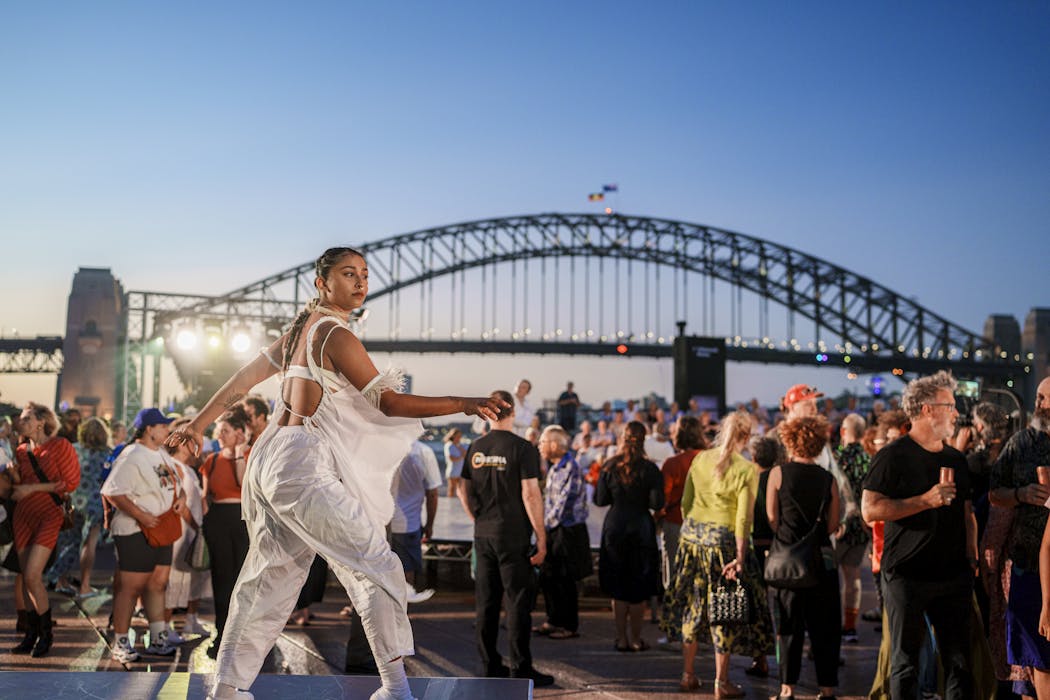
Dance at this year’s Sydney Festival ranged from a 20 minute, salon-style performance for two dancers, to an outdoor, multimedia, participatory sunset event with Sydney Harbour as a backdrop.
Garrigarrang Badu
Jannawi Dance Clan’s premiere of Garrigarrang Badu by Peta Strachan is the perfect work to orient audiences to the Dharug Country at the heart of Sydney Festival.
Jannawi is an all-female group with members from across the country who work collaboratively with artistic director Strachan, a Dharug woman of the Boorooberongal clan. Strachan’s role as a Dharug Knowledge Holder informs the language-revitalisation-in-action that grounds and filters through this work.
In this full-length dance work in local language, lyrics to a song-cycle by Matthew Doyle are linked to places, materials, costumes and objects that fill each dance in a series that flows.
In Dharug, garrigarrang means salt water and badu fresh water. The title speaks to where the two meet in our water systems at Sydney Harbour where we gather on the sweltering night of the performance.
The work is shaped around women’s knowledge, artisanship, music and movement. They present to us an intergenerational connection to land, water, sky and all that they hold.
Garrigarrang badu is shaped around women’s knowledge, artisanship, music and movement. Stephen Wilson Barker/Sydney Festival
To see this all female performance, intimately and proudly connected to Country, is a moving occasion. Dancers Dubs Yunupingu and Buia David are stand-outs as the central protagonists of the loose narrative.
Digging sticks, eel traps and Nawi (canoes) focus our attention on a skilful, ethical and balanced collaboration with resources. Alongside the ephemeral cultural materials of music and dance, the whole presents as a living archive of the Dharug people.
Strachan’s choreography, with co-credits for the cast, Albert David and Beau Dean Riley Smith, reflects influences from her time at NAISDA (Australia’s National Indigenous Dance College) and with Bangarra (2000–04), and as a cultural performer and teacher.
Low shuffling walks, softly curved spines and mimetic hand gestures are combined with contemporary elements such as barrel jumps and high-leg extensions, reminiscent of the Bangarra vocabulary.
Garabari
We later moved outside for Melbourne-based, Wiradjuri choreographer Joel Bray’s Garabari, one of Bray’s first full-length, ensemble works, following his earlier solo pieces.
He describes himself as a gay Indigenous man raised in a white Pentecostal home, training at both NAISDA and the West Australian Academy of Performing Arts, and with an international career as a dancer prior to his first solo choreographies.
Garabari was developed across multiple cultural and artistic encounters. Time as a performer and artist-in-resident with Chunky Move may have supported the lean into popular culture in his work. The movement language draws on traditional, contemporary and popular vocabularies with a formal or shaped-based quality that perhaps reflects ten years Bray spent dancing in Israel, where a certain modern aesthetic associated with Ohad Naharin’s Gaga technique dominates.
In Joel Bray’s work, gradually we all become part of a whirling human garabari. Stephen Wilson Barker/Sydney Festival
At a language workshop I attended, led Bray and his father Christopher Kirkbright, Bray explained how this work came about. Consultation with the Wiradjuri community in Wagga Wagga led to conversations with local Elder, the late Uncle James Ingram.
Ingram shared the story of the birth of the Murrumbidgee River with Bray, the greedy Goanna men thwarted by a heroine, Ballina, which forms the core narrative of the work.
Garabari begins with some words of welcome from Bray, explaining that the title of the show is an Anglicised Wiradjuri word for corrobboree.
As the sky darkens, we are led to the furthest boardwalk of the Opera House where the Harbour Bridge looms large. We move through a smoking ceremony and wander among quiet dancers in white on multiple open-air stages. We hear recounted stories and watch danced dramas.
Gradually we become part of a whirling human garabari, with music by Byron Scullin and projections by Katie Sfetkidis coming into their own. The crowd swarms and pulses under the dancers’ instructions.
Featuring excellent dancers such as Luke Currie-Richardson and Zoe Brown Holten, this is a work with an inclusive, celebratory and contemporary spirit.
Exxy
A few days later I am back at the house to enter another world – Dan Daw Creative Project’s Exxy.
Based in the United Kingdom, this disabled-led company’s model of “theatre, dance and activism” is connected to Australia’s Restless Dance company in Adelaide through Daw, an ex-performer in the company.
The suburban, slightly grimy and claustrophobic scenography becomes a platform for vibrant truth-telling and venting. Emotional charge and physical excess go head-to-head in this relentless work that ends with both performers and audience crying to The Power of Love.
Dan Daw Creative Project’s Exxy is a work of vibrant truth-telling and venting. Neil Bennett/Sydney Festival
In the opening scenes, Daw takes time to care for his audience and introduce his collaborators Tiiu Mortley, Sofia Valdiri and Joe Brown. This introduction gives little indication of what is to come.
Like Garabari, this work grows in complexity and mood as each artist on stage shares autobiographical snippets through word and action.
The performers tell stories of lying about sports injuries and offensive sexual encounters. They perform drooling, running under duress and shaking. These stories and actions are connected by a repeated skipping or tripping movement to create a circle of unity. Interspersed are solo dances of delicate devastation.
Daw dances high and light on his feet with arms reaching above and around him. Mortley maps dramatic shapes with her arms and torso. Brown repeats actions punishingly in response to commands from off-stage and Valdiri stims violently on the floor.
Saltbush – a plant that can thrive in the harshest environments – becomes a central metaphor in this work about being not only unapologetic about disability, but expressing it with relish, abandon and anger.
Save the Last Dance for Me
Two shows at Sydney Town Hall in the Vestibule Room top off the dance program with lessons in refinement.
Italian choreographer Alessandro Sciarroni’s Save the Last Dance for Me is a 20 minute piece of perfection.
Dancers Gianmaria Borzillo and Giovanfrancesco Giannini, simply with a sound score and stylish outfits, perform a dance from the early 20th century Bologna called Polka Chinata.
Save the Last Dance for Me is a 20 minute piece of perfection. Stephen Wilson Barker/Sydney Festival
Recently rediscovered by Italian dance historians, like the Argentinian tango Polka Chinata is a male social dance form created to seduce a female audience.
Sciarroni simply adds a contemporary frame and the dance does the rest. It is intense, virtuosic and sexy.
Echo Mapping
Azzam Mohammed has emerged from the hip hop community in Sydney, winning competitive events and performing in Nick Power’s contemporary-street dance works.
A recent Sydney Festival staple, his new collaboration with composer and artist Jack Prest is Echo Mapping.
Echo Mapping is mesmerising. Victor Frankowski/Sydney Festival
This pared-back duet is mesmerising. Mohammed, trance-like, summons movement and vocalisations that shift across Africanist angular static forms, percussive geometric patterning and echoes of the most recent iteration of this deep lineage in the popping and locking that Mohammed excels in.
The music-dance dialogue between the two artists matches yearning trumpet calls to melodic cries and drum beats to looping running steps.
The perfect venue for this intimate spectacle.
Erin Brannigan does not work for, consult, own shares in or receive funding from any company or organisation that would benefit from this article, and has disclosed no relevant affiliations beyond their academic appointment.
Canadian Prime Minister Mark Carney gave a speech at Davos this week that signals there may still be a leader in the West worth following.
“Middle powers must act together because if we’re not at the table, we’re on the menu,” he warned.
The Canadian PM was brutally honest about Western conduct in the world but shone a bright light on a better path forward.
At a time when the US has pivoted to a smash-and-grab deployment of hard power that now extends to its closest allies, Carney stepped up.
The speech wasn’t a rhetorical tour de force; it was better than that: it was a declaration by the leader of a major, middle ranked Western power that the snivelling compliance, the fawning and the keep-your-head-down approach that has typified the collective West’s response to Trumpism is at a strategic dead end.
Nostalgia is not a strategy “We know the old order is not coming back. We shouldn’t mourn it. Nostalgia is not a strategy,” Carney said.
At a time when the US is led by a criminal toddler who can’t stop whining about not getting the Nobel Peace Prize even as he attacks country after country, it is refreshing to encounter a leader who thinks and speaks like a statesman of the first rank.
“We are in the midst of a rupture, not a transition. Over the past two decades, a series of crises in finance, health, energy and geopolitics have laid bare the risks of extreme global integration.
“But more recently, great powers have begun using economic integration as weapons, tariffs as leverage, financial infrastructure as coercion, supply chains as vulnerabilities to be exploited,” Carney said.
A modern non-aligned movement Carney did not reference the Non-Aligned Movement formed at the Belgrade Conference in September 1961 but it leapt to my mind when I heard him say:
“In a world of great power rivalry, the countries in between have a choice: compete with each other for favour or to combine to create a third path with impact.”
Carney also reaffirms the importance of the institutions that the West itself, including Canada, has severely weakened in recent years — WTO, UN and COP to name three. Russia, with its invasion of Ukraine, comes in a distant second in this regard.
With an assertive, aggressive US hell-bent on getting whatever it wants, Carney looks on the times we have entered with much-needed clarity. His call is for an alliance of middle powers.
In a word: collectivism.
The Non-Aligned Movement (NAM) and what Carney is proposing have similarities, particularly structurally, but also significant differences, particularly ideologically.
Not least Carney is a reformer and not at heart an anti-imperialist. He is the former head of both the Bank of England and the Bank of Canada and will not be seen in a Che Guevara t-shirt any time soon.
As with the NAM, however, Carney advocates collective leverage, resistance to client-state dependency and using internationalism to resist divide-and-rule by great powers.
“When we only negotiate bilaterally with a hegemon, we negotiate from weakness. We accept what is offered. We compete with each other to be the most accommodating. This is not sovereignty. It’s the ‘performance’ of sovereignty while accepting subordination.”
The giants who formed the Non-Aligned movement were Josip Broz Tito (Yugoslavia), Gamal Abdel Nasser (Egypt), Jawaharlal Nehru (India), Kwame Nkrumah (Ghana), and Sukarno (Indonesia). They gathered nations around the “Five Principles of Peaceful Coexistence”: mutual respect for territorial integrity and sovereignty, non-aggression, non-interference, equality and mutual benefit, peaceful coexistence.
In a nutshell: the polar opposite of the Western Rules-Based Order. Carney’s speech echoed many of the same sentiments.
“The powerful have their power. But we have something too — the capacity to stop pretending, to name reality, to build our strength at home and to act together.
“And it is a path wide open to any country willing to take it with us.”
Brilliant. But converting a speech into a movement that mobilises countries in an effective way requires commitment and resources we need to see emerge at pace.
In the 1960s and 70s, it was about small and middle powers navigating a course between two superpower blocs — a passage between Scylla (Soviet Union) and Charybdis (United States). Today we all must navigate the rough and rowdy world of the US, China and a resurgent Russia.
Canada’s astonishing resistance to the Empire What is astonishing is that this time around, the impulse to rally together comes not from a socialist country like the former Yugoslavia or a “black Third World country” (in 1960s parlance) like Tanzania, but from the beating heart of the white-dominated Western world – from Canada, one of the capitals of the Western empire. My, how times have suddenly changed.
This should act as shock therapy to somnolent countries like Australia and New Zealand who cleave to a past that no longer exists. Carney has shown the power of looking at the world through untinted lenses (though Macron did look pretty cool in Davos in his blue sunnies).
A rare moment of honesty about Western conduct I don’t recall a Western leader being so open about the ear-splitting hypocrisy and double-dealing of the West. Most impressively, Carney gives a clear signal of what needs to be done to survive in this world of jostling hegemons.
More submissive leaders like Christopher Luxon of New Zealand and Australia’s Anthony Albanese should take careful note because, as Carney says, we are at a turning point in the world.
Carney, who previously mumbled his way through issues like Venezuela and Gaza, made a valuable contribution to confronting the desolation of reality:
“First it means naming reality. Stop invoking ‘rules-based international order’ as though it still functions as advertised. Call it what it is: a system of intensifying great power rivalry where the most powerful pursue their interests using economic integration as a weapon of coercion.”
In time, this may open the door to Truth and Reconciliation. The genocide in Gaza is an example par excellence of the falsity of the rules-based order; Venezuela’s recent rape by the Americans, greeted with shuffling indifference by the West, traduced international law. The lawless bombing of Iran, the starvation of hundreds of thousands of Yemeni civilians in a blockade imposed by Saudi Arabia and armed by the US and UK are just a few of many such examples.
“We knew the story of the international rules-based order was partially false. That the strongest would exempt themselves when convenient. That trade rules were enforced asymmetrically. And we knew that international law applied with varying rigour depending on the identity of the accused or the victim,” Carney said.
Noting the standing ovation Carney received, the threat to Greenland has clearly acted on the Western countries as a shock therapy that the Gaza genocide, the bombing of Iran and the attack on Venezuela failed to deliver.
Carney stands on the shoulders of giants I would point out that former leaders like prime minister Helen Clark of New Zealand have been arguing along these lines for years, advocating, for example, for a nuclear free Pacific and recommending “that we always pursue dialogue and engagement over confrontation.”
Warning that Trump was too unstable to be relied on, she told a conference in 2025 that New Zealand “should join forces with other countries across regions who want to be coalitions for action around these issues, not just little Western clubs.”
I’ll give the last word to the late Julius Nyerere, first President of Tanzania, from a 1970 speech to the Non-Aligned Movement. It expresses a worldview in accord with Carney’s speech but which is the polar opposite of 500 years of Western conduct from Christopher Columbus to Donald Trump:
“By non-alignment we are saying to the Big Powers that we also belong to this planet. We are asserting the right of small, or militarily weaker, nations to determine their own policies in their own interests, and to have an influence on world affairs which accords with the right of all peoples to live on earth as human beings equal with other human beings.
“And we are asserting the right of all peoples to freedom and self-determination; therefore expressing an outright opposition to colonialism and international domination of one people by another.”
Eugene Doyle is a writer based in Wellington. He has written extensively on the Middle East, as well as peace and security issues in the Asia Pacific region, and he contributes to Asia Pacific Report. He hosts the public policy platform solidarity.co.nz
The short-lived split between the Nationals and the Liberal Party after last year’s election has been followed by another breakup less than nine months later.
The Nationals are publicly stating they cannot work under Sussan Ley’s leadership. Provided there’s no rekindling of the relationship, this is the end of a coalition arrangement that’s survived for more than a century, albeit with the occasional hiccup.
As dramatic as this seems, it’s not the first time it has happened. Earle Page resigned as leader of the (then) Country Party in 1939 because he could not work under Liberal prime minister Robert Menzies, leading to a temporary breakup.
Even earlier, the Country Party made it a condition of establishing the first Coalition that Prime Minister Billy Hughes be replaced by the Nationalist Party’s Stanley Bruce.
But this time, the Nationals are much weaker than they were in the past. Facing perceived political threats from One Nation and a revolving door of leaders in the past decade, the party may benefit from some time to regroup.
Access to power
The Country Party emerged as a rural counterweight to the perceived urban bias of the other political parties in the first quarter of the 20th century.
In a clear statement of independence, the Country Party’s first federal leader, William McWilliams told the parliament in March 1920 the party was not seeking any alliances or “collusion”. It would steer its own course.
This, however, did not last long. The Coalition has been a consistent feature of the political landscape since 1923.
The Country Party, which would go on to become the National Party, is Australia’s second oldest, after Labor. Because of the coalition arrangement, it has been in government more often than not over that period. As a result, the party has wielded policy power arguably out of proportion to the number of votes it attracts.
The Liberal National Party arrangement in Queensland aside, the Nationals have resisted calls for the parties to amalgamate. Both the Liberals and the Nationals have benefited from the coalition.
The Liberals have relied on National Party numbers on all but two occasions to form government. Meanwhile, the Nationals have gained access to key cabinet posts of importance to rural Australia, such as trade and commerce.
Particularly under John “Black Jack” McEwen – who had a brief prime ministerial stint in the 1960s – the party wielded real influence over Australia’s economic policy direction. For instance, he drove the negotiation of a trade agreement with Japan. More broadly, McEwen successfully pushed for tariff protection for Australia’s manufacturing industries.
Over the years, the Nationals have crossed the floor over tariff policy, the restructure of the Australian Wheat Board and other issues of direct concern to the party’s constituency.
Each time, these events have highlighted something that many tend to forget: the Coalition was never one party, but two distinctly different ones, with different constituencies and often different priorities.
History repeating
The events of this week are also not the first time the parties have disagreed while in opposition, with the Liberals supporting a Labor government bill and the Nationals voting against it.
In 1973, the Nationals opposed the Whitlam government’s Industries Assistance Commission Bill. They argued the commission (the predecessor to the Productivity Commission) would introduce central planning by stealth and “be usurping the functions of many government departments”.
But there’s an important difference. Between 1972 and 1974, the then Country Party and the Liberals were not in coalition. They did not re-form the Coalition after Labor won the 1972 election. In the interim, both parties were free to vote in parliament in line with their own policies.
Why stay together?
While coalition makes sense to form government, the persistence of the arrangement when in opposition is more perplexing.
The Liberal-National Party Coalition is a very peculiar beast. It’s unlike any coalition arrangement anywhere in the world. Elsewhere, minor parties come together only after an election and negotiate a way to form government.
The apparent permanence of the Australian arrangements has contributed to the current unedifying situation. There is no reason why two different political parties in opposition would agree with one another on everything and vote accordingly in parliament.
The crisis here is a direct result of the two parties, largely for historical reasons, persisting with an uncomfortable coalition that is not necessary while they are in opposition, as was demonstrated between 1972 and 1974.
And over the past four decades, the Nationals have faced a different Australia from the one in which McEwen was so influential. The deregulation of the economy in the 1980s and 1990s, which included reduced support for the agricultural sector, put the Nationals on the back foot in policy terms.
Rather than being the driver of pro-rural policies, they were defending Coalition policies their supporters disliked. Gun reforms introduced after the Port Arthur tragedy in 1996 is a case in point. Nationals leader Tim Fischer played a central role in supporting Liberal Prime Minister John Howard’s position.
It’s left the Nationals in a weaker electoral position over time. In the current parliament, Labor and the Liberals (including Liberal-aligned Liberal National Party members) each hold more rural seats than the Nationals. Ironically, given recent events, Tim Fischer’s old seat is now held by Ley.
There’s also the rural independents, making inroads into former National Party strongholds.
Depending on what recommendations are in the currently unpublished report into the Liberals’ performance at the 2025 election, the Nationals may find that this time, the Liberals will decide the coalition agreement is not worth the grief while in opposition.
A break would provide Sussan Ley and her team with the opportunity to reassess their party’s values and rebuild in a way that improves their chances of picking up the urban seats they so desperately need to form government. They may conclude this is easier to do without the Nationals.
Linda Botterill has in the past received funding from the Australian Research Council.
On 14 December 2025, a father and son, reportedly linked to the ISIS clerical fascist organisation, committed a murderous attack on innocent participants at a Jewish celebration on Sydney’s famous Bondi Beach. Fifteen were killed and around 40 seriously injured.
There is no way this horrific event can be minimised. It was murderous, it was antisemitic, the victims and their loved ones were completely innocent.
It also can’t be remotely justified by Israel’s genocide in Gaza and increasing repression on the West Bank.
Nor did it in anyway serve the interests of Palestinians and their fight for peace and self-determination — if anything it gave “pro-genociders” a deceitful propaganda weapon.
Extraordinary heroism also powerful message of interfaith kindness There is no “notwithstanding high point” in this murderous tragedy. But there was much heroism.
Understandably the overwhelming impact of the sheer horror of the slaughter meant that this was not reported as much as it deserved.
The heroism of Ahmed al-Ahmed saved lives and prevented more serious injuries. Image: politicalbytes.blog
But prominent was the extraordinary courage of Ahmed al-Ahmed who wrestled the gun from one of the attackers and was severely wounded — being shot five times — as a result.
Ahmed al-Ahmed is an Australian of Syrian origin. He is also Muslim. His bravery saved many Jewish lives.
Sickening contrast This makes the sickening response of the Israeli government even more deplorable. It attempted to blame the terrorist attack on the Palestinian resistance to Israel’s ethnic cleansing and genocide, and to opponents of this warmongering.
Israeli Prime Minister Benjamin Netanyahu . . . response dishonest and deplorable. Image: politicalbytes.blog
Israeli Prime Minister Benjamin Netenyahu even went so far as to dishonestly claim Australia’s recognition of Palestine as a state was to blame.
Two newspaper opinion pieces from New Zealanders who deny the reality of ethnic cleansing and genocide by Israel repeat this disgraceful “blame Palestinians” response.
The first was by Deborah Hart, chair of the Holocaust Foundation New Zealand. Her paywalled piece was published by The New Zealand Herald (December 15): Never again.
The second was by Juliet Moses, a spokesperson for the New Zealand Jewish Council. Her piece was published by Stuff (December 17): New Zealand should pay attention.
While both justifiably describe the horrific nature of the slaughter, they also reiterated the above-mentioned theme of the Israeli government thereby whitewashing its ethnic cleansing and genocide.
The fact that they both write in a softer, non-brazen and more subtle style does not diminish this observation.
The heroic Ahmed al-Ahmed is similarly whitewashed presumably because the heroism of a Muslim is considered inconsistent with Israel’s unconscionable narrative.
The implied narrative of Hart and Moses is that the life of an Israeli trumps the life of a Palestinian — including a child — and the right of Israelis to self-determination overrides the right of Palestinians to self-determination.
Further, Palestinian refusal to accept this narrative is consequentially responsible in some way for the Bondi Beach slaughter.
It is bad enough to hold this position; it is even worse to tar the Bondi victims with this same brush.
An aside: Jewish exceptionalism As an aside, this narrative is reinforced by a Zionist claim of Jewish exceptionalism that is used to justify an untenable position that granting equal rights to others in Israel would be “tantamount to suicide.”
This exceptionalism argument is effectively rebutted by a paywalled article by Peter Beinart in the October 2025 issue of Le Monde Diplomatique: Jewish exceptionalism not so exceptional.
Beinart points out that the past experiences of South Africa, Northern Ireland and the American South where “. . . time and again dominant groups have loudly claimed that granting equal rights would be tantamount to suicide . . .” were always wrong.
It was appalled by the antisemitic terror attack, sided with the Jewish community, and acknowledged that for more than two years it had marched with Jews and Jewish groups against the genocide in Gaza.
Further, it criticised the use of the Bondi Beach slaughter by Benjamin Netanyahu and others to condemn and blame Palestinians and others for opposing Israel’s genocide in Gaza.
For completion, the statement from national co-chair John Minto is published below:
“PSNA was appalled and shocked at Sunday’s antisemitic terror attack targeting the Jewish community in Australia on the first day of the celebration of Hanukkah.
“The best antidote to race hatred is community solidarity and we stand with the Jewish community in the face of such horror.
“For many decades, and the past two years in particular, we have protested and marched side by side with Jews and Jewish groups to condemn the genocide in Gaza and stand with the Palestinian people in their struggle for liberation.
“We have always made clear our campaign targets Israel’s genocide, apartheid, and ethnic cleansing. Jews are not responsible for these policies, despite Netanyahu claiming he is acting and speaking as ‘Prime Minister’ of all Jews.
“Palestine supporters were also appalled when Israeli Prime Minister Netanyahu, and leaders of the pro-Israeli lobby in Australia and New Zealand, tried to exploit the horror in Bondi by blaming it on condemnation of Israel’s genocide and the Australian government’s (largely non-existent) support for Palestinian rights.
“This blaming almost invariably comes from people who support Israel’s actions in Gaza. Their strategy is to exploit the killing in Bondi to help the Israel government carry on its genocide and ethnic cleansing without criticism.”
“We are concerned that the strategy will cross the Tasman to panic the New Zealand government into introducing the International Holocaust Remembrance Alliance definition of anti-semitism into New Zealand legislation.
“This definition is used to target people supporting Palestine. The Israeli government has managed to get it into government legislation, university rules and local government policy in many parts of the Western world.”
“It’s all part of Netanyahu’s ‘Eighth Front’ to silence Israel’s critics.
“It has no place here.”
Apart from agreeing with it, there is nothing I could say that could add to its persuasive and powerful message. It speaks for itself.
Ian Powell is a progressive health, labour market and political “no-frills” forensic commentator in New Zealand. A former senior doctors union leader for more than 30 years, he blogs at Second Opinion and Political Bytes, where this article was first published. Republished with the author’s permission.
The Paris-based global media freedom group Reporters Without Borders (RSF) has condemned the guilty verdict against Filipino journalist Frenchie Mae Cumpio whose case has been challenged since her arrest almost six years ago.
Cumpio was found guilty today on a charge of “financing terrorism” in the Philippines, and now faces a sentence of between 12 and 18 years in prison.
RSF released a statement condemning the verdict and questioning the Philippines government’s commitment to a free press.
“We are appalled by this verdict. Three RSF investigations and evidence presented in court by Frenchie Mae Cumpio’s lawyers clearly show how fabricated this case has been from the very beginning,” said RSF Asia-Pacific Bureau advocacy manager Aleksandra Bielakowska in the statement in Taipei today.
Local and international groups have condemned the conviction of 26-year-old community journalist Cumpio, saying it sends a “chilling message” to media, activists, and even ordinary people in the Philippines, reports Rappler.
“Frenchie Mae Cumpio’s conviction represents a devastating failure on the part of the Philippine justice system and the authorities’ blatant disregard for press freedom,” said Bielakowska.
“The Philippines should serve as an international example of protecting media freedom — not a perpetrator that red-tags, prosecutes and imprisons journalists simply for doing their work.
‘Highlights systemic issues’ “This sentence only highlights the systemic issues in the country and the urgent need for comprehensive reforms.
“We renew our call on President Ferdinand Marcos Jr. to act without delay to end this injustice and release Frenchie Mae Cumpio immediately.
“Without his decisive action, there will be no meaningful difference from previous administrations that showed no regard for upholding a free press.”
Committee to Protect Journalists Asia-Pacific director Beh Lih Yi said the court ruling was “absurd” and that the promises made by President Ferdinand Marcos Jr. to uphold press freedom were “nothing but empty talk”.
She added that the Philippines must stop criminalising journalists.
Jack Oliver-Hood, 37, was pulled from the water at Hahei Beach shortly after 3pm on Monday but could not be resuscitated and died at the scene.Supplied
Former colleagues are mourning the loss of a “bright” Auckland lawyer who died while swimming at a Coromandel beach.
Jack Oliver-Hood, who was 37, was pulled from the water at Hahei Beach shortly after 3pm on Monday.
Despite rescuers performing CPR, he could not be resuscitated and died at the scene.
Barrister Kevin Glover KC said he first met Oliver-Hood while he was a junior barrister at Shortland Chambers in Auckland from 2015 to 2016.
After completing his Master’s at Columbia University in the US, Glover said Oliver-Hood returned to Auckland and had been working as an independent barrister since 2020.
“Jack was a bright and very able lawyer. He did fantastic work, and he was very good on his feet.
“People had a huge and genuine affection for Jack.”
Glover said they had worked on several cases together, including representing LEGO in a trademark dispute with toy company Zuru.
“I have been talking to people overseas who we worked with on the LEGO case, and they’re absolutely gutted. Jack did a really good job connecting with people.
“He was a very good lawyer across quite different areas of practice that people don’t normally combine, with this strength in IP [Intellectual Property], which is where I worked with him, and also criminal cases, where he worked with very senior practitioners on very high-profile cases.”
“The IP community all knows each other and has been pretty hard hit by this.”
Oliver-Hood also worked on the high-profile murder appeals of Mark Lundy and Gail Maney.
He was the only son of well-known music producer and engineer Doug Hood, who died in 2024.
Glover said they had a shared interest in music.
“I used to see Jack at gigs. He was very intertwined in the alternative music scene.”
Sign up for Ngā Pitopito Kōrero, a daily newsletter curated by our editors and delivered straight to your inbox every weekday.
– Published by EveningReport.nz and AsiaPacificReport.nz, see: MIL OSI in partnership with Radio New Zealand
The appearance industry covers many procedures, including waxing, manicure or pedicures, derma-blading, microneedling, tattooing and body piercing.123RF
Marlborough District Council is considering whether to implement a bylaw for the appearance industry, after reports of sub-standard hygiene at some beauty salons.
The industry covers many procedures, including waxing, manicure or pedicures, derma-blading, microneedling, tattooing and body piercing.
At an Environment & Planning Committee meeting on Thursday, environmental health officers Georgia Murrin and Mary Ann Douthett told councillors they had received an increasing number of formal and informal notifications of concerns regarding practices at some Marlborough appearance industry providers.
In some cases, they had found sub-standard hygiene practices.
She said some appearance industry procedures had the potential to cause adverse health outcomes if not done hygienically. This included the risk of infection, burns or scarring and can result in time off work for patients, medical costs or even hospitalisation so standards were important to manage and avoid risk.
Murrin said complaints could be investigated under the Health Act 1956, but the council’s enforcement powers were limited.
There are 16 councils around the country that have bylaws in place to register and regulate the appearance industry.
“There are currently no national regulations that apply to New Zealand’s appearance industry although our professional body, the New Zealand Institute of Environmental Health, is actively lobbying Government to develop national legislation.”
Murrin said initial enquiries with some industry appearance businesses had shown support for industry regulation and it planned to engage in further consultation to consider whether a bylaw should be adopted.
Sign up for Ngā Pitopito Kōrero, a daily newsletter curated by our editors and delivered straight to your inbox every weekday.
– Published by EveningReport.nz and AsiaPacificReport.nz, see: MIL OSI in partnership with Radio New Zealand
A drone image captures the massive slip at Helena Bay Hill in Northland, cutting off Ōakura Bay.Supplied / Ngātiwai Trust Board
Whangārei Mayor Ken Couper says it could take weeks to fix a massive slip blocking the road to Ōakura.
Couper said the slip came down on Wednesday night at Helena Bay Hill on what was known as the Old Russell Road.
With the road to the north closed since Sunday by a bridge washout, Ōakura was now cut off in both directions.
“That slip is a bit of a problem because we have to get some heavy machinery up to the top of it, because it’s so big they won’t be able to excavate at the bottom without danger,” he said.
“It could take a couple of days before they even start to get a good idea on how long it’s going to take to clear it.”
Fixing the slip was likely a matter of weeks, not days, he said.
Whangārei mayor Ken Couper looks at the latest information.Kim Baker Wilson / RNZ
Ōakura and other settlements such as Punaruku were also cut off to the north by damage to Ngaiotonga Bridge.
Couper said repairs to the bridge approach, which was in the Far North District, were progressing.
Goods could now be handed across the bridge but it was not yet capable of taking traffic.
The only other option was a “very tricky” back road which was suitable only as an emergency lifeline. It was also used when a giant slip closed Helena Bay Hill for several months in 2007.
A drone image captures the massive slip at Helena Bay Hill in Northland, cutting off Ōakura Bay.Supplied / Ngātiwai Trust Board
Couper said another concern was the failure of the wastewater treatment plant at Ōakura.
A team was heading there on Thursday with generators to rectify the plant.
If they managed to reach Ōakura through the “lifeline” road, they would be followed by building inspectors who would examine beachfront homes evacuated after Sunday’s deluge.
Sixteen people and seven pets were evacuated, he said. Most were staying with friends and family but some were being looked after by local marae.
Inside the Emergency Operations Centre at Whangārei District Council.Kim Baker Wilson / RNZ
Couper said it was disappointing the massive slip had hit just as the district was almost at the end of the four-day storm.
“We were nearly there, and then this has come down. The roading crews have done a fantastic job out there, the locals, the farmers have responded really well and kept the resilience going, and then this happened. It’s very, very upsetting, really, but it’s just a fact of life.”
His message to residents in cut-off areas was to “lean on each other, keep up the cooperation that you’ve demonstrated so far, and keep in touch with the council so if you need help, we can get it to you”.
Police inspect a section of Falls Road near the Mahurangi River where a person and their vehicle is believed to have been swept into the riverLucy Xia
The wife of a man who was swept away in his car at Mahurangi River, north of Auckland, says she is holding out hope that her husband is still alive.
The woman, who RNZ has agreed not to name, says her husband is strong, wise and – as a fisherman – familiar with the water.
About 20 people, drones, helicopters and white water rafts were searching for the man until evening on Wednesday. Water levels were still too high on Thursday for a search but Police used drones to carry out aerial searches for the car. Neither the man nor his car have been located.
His wife said her husband, 47, was a fisherman back home in Kiribati. They had moved to New Zealand in 2023 with their four children.
The woman, who did not want to be named, said her husband and her nephew – who had just moved to New Zealand in December – were taking their usual route to work in Warkworth early morning when they were swept away by water on Falls Road.
Both worked at Southern Paprika, a company specialising in growing greenhouse vegetables.
The woman said she was still sleeping when the police and her nephew – who managed to get onto land – came knocking at the door.
“The police came with my nephew, I don’t know how I feel… it’s horrible when I… I think I lose my breathing,” she said of hearing the news.
“I just have time to grab my nephew, and hug him strongly and I thank God for keeping him alive,” she said.
The woman said both her husband and her nephew had fallen into the water with the vehicle, and her husband had pushed her nephew so that the young man could grab onto a branch, but did not manage to get back onto land himself.
“When [the nephew] held on the branch, he called, ‘Uncle please come and grab on my leg and both go to the land.’
“Then [my] husband tried to grab, but then he knows that he’s so heavy, because he’s bigger than his nephew. I think like, when he saw his nephew like that, he didn’t want to pull him back, so he untied his hand and says ‘Go on, go and find life, while I’m going to swim this way and find another branch.”
The woman said she was hopeful that her husband would survive and be found.
“I know his personality is strong, wise, according to his decisions with the community and the church community, and he’s religious.”
She said he was a fisherman in Kiribati and knew how to swim, had seen big waves, been in canoes and knew how to dive.
The woman said she was at home supporting her four children on Wednesday to give them courage to face the traumatic event. She said she and her nephew, and another family member, would continue to search for her husband.
The incident
Fire and Emergency were called to the rescue at a river crossing on Falls Road – near the intersection with Woodcocks Road – at about 7.51am on Wednesday.
Police night shift staff conducted checks in the area overnight, but were unable to locate the man.
The Mahurangi River on Wednesday.Lucy Xia / RNZ
A police search and rescue would redeploy to the area on Thursday once water levels had subsided and it was safe to continue searching.
An eagle helicopter was also expected to do a flyover of the river.
Police were in contact with the man’s family.
“We acknowledge they must be going through a very uncertain and upsetting time while he remains missing,” Waitematā North Police Senior Sergeant Carl Fowlie said.
“Our thoughts are with them.”
A section of Falls Road near the Mahurangi River is flooded over, it is in the area where a person and their vehicle is believed to have been swept into the riverLucy Xia
On Thursday, a resident of the area said the crossing could be dangerous.
“When people go to drive straight, but it’s got a curve in the bridge, in the ford, that’s what gets you into danger – because the wheels go off one side, then the flow of the water will just carry them away,” Dawn Ferguson said.
Ferguson said she was devastated to hear what happened.
Auckland Mayor Wayne Brown also said he was alarmed to hear of the disappearance.
About 20 people were involved in the search on Wednesday, including firefighters, police officers and whitewater rafters.
Sign up for Ngā Pitopito Kōrero, a daily newsletter curated by our editors and delivered straight to your inbox every weekday.
– Published by EveningReport.nz and AsiaPacificReport.nz, see: MIL OSI in partnership with Radio New Zealand
ER Report: Here is a summary of significant articles published on EveningReport.nz on January 22, 2026.
Trump sows ‘chaotic cruelty’ while Canadian PM Carney reminds the world it doesn’t have to play along Source: The Conversation (Au and NZ) – By Emma Shortis, Adjunct Senior Fellow, School of Global, Urban and Social Studies, RMIT University In what has become a familiar, exhausting cycle, the rest of the world is left with the futile task of trying to dredge meaning from the wreckage left behind by US President Donald
The United States’ new military strategy is a case of ‘AI peacocking’ Source: The Conversation (Au and NZ) – By Zena Assaad, Senior Lecturer, School of Engineering, Australian National University The United States is set to become “the world’s undisputed [artificial intelligence-enabled] fighting force”. At least that’s the view of the country’s Department of War, which earlier this month released a new strategy to accelerate the deployment
Pro-independence FLNKS ‘unequivocally’ reject latest agreement for New Caledonia By Patrick Decloitre, RNZ Pacific correspondent French Pacific desk The signing of a new agreement on New Caledonia’s political and financial future has triggered a fresh wave of reactions from across the French territory’s political chessboard. The Elysée-Oudinot agreement was signed on Monday, January 19, in the presence of French President Emmanuel Macron as well
Nationals break Coalition, declaring it ‘untenable’ and blaming Ley Source: The Conversation (Au and NZ) – By Michelle Grattan, Professorial Fellow, University of Canberra The federal Coalition is dead, with Nationals leader David Littleproud on Thursday morning declaring it “untenable” after Liberal leader Sussan Ley stared down the Liberals’ minor partner. This followed all Nationals frontbenchers resigning from the shadow ministry on Wednesday night,
Australia’s frightening new ‘hate speech’ laws are clearly aimed at pro-Palestine groups COMMENTARY: By Caitlin Johnstone Australia’s Labor government has successfully passed a “hate speech” bill that’s plainly aimed, at least in part, at suppressing pro-Palestine organizations as “hate groups”. Free speech advocates are sounding the alarm about the new laws, saying their extremely vague wording, lack of procedural fairness and low thresholds for implementation mean groups
Beneath Antarctica’s largest ice shelf, a hidden ocean is revealing its secrets Source: The Conversation (Au and NZ) – By Craig Stevens, Professor in Ocean Physics, University of Auckland, Waipapa Taumata Rau; National Institute of Water and Atmospheric Research (NIWA) Stevens/NIWA/K061, CC BY-NC-ND Beneath Antarctica’s Ross Ice Shelf lies one of the least measured oceans on Earth – a vast, dark cavity roughly twice the volume of
NZ is again being soaked this summer – record ocean heat helps explain it Source: The Conversation (Au and NZ) – By Kevin Trenberth, Distinguished Scholar, NCAR; Affiliate Faculty, University of Auckland, Waipapa Taumata Rau Sanka Vidanagama/Getty Images For many people this summer – especially those across Northland Auckland and Coromandel – showery days and bursts of heavy rain have become all too familiar. This week, fresh downpours on
Humanity’s oldest known cave art has been discovered in Sulawesi Source: The Conversation (Au and NZ) – By Maxime Aubert, Professor of Archaeological Science, Griffith University Supplied When we think of the world’s oldest art, Europe usually comes to mind, with famous cave paintings in France and Spain often seen as evidence this was the birthplace of symbolic human culture. But new evidence from Indonesia
View from The Hill: Coalition crisis explodes after Sussan Ley wields the whip against defiant Nationals Source: The Conversation (Au and NZ) – By Michelle Grattan, Professorial Fellow, University of Canberra The federal Coalition was imploding on Wednesday night, with all Nationals frontbenchers, including leader David Littleproud, quitting the shadow ministry. They were retaliating against Opposition Leader Sussan Ley’s insistence three Nationals senators must resign for defying shadow cabinet solidarity. The
Grains of sand prove people – not glaciers – transported Stonehenge rocks Source: The Conversation (Au and NZ) – By Anthony Clarke, Research Associate, School of Earth and Planetary Sciences, Curtin University Ask people how Stonehenge was built and you’ll hear stories of sledges, ropes, boats and sheer human determination to haul stones from across Britain to Salisbury Plain, in south-west England. Others might mention giants, wizards,
Provocateur attacks Australian Palestine peace activists protesting over Gaza genocide By Sarah Hathway in Djilang/Geelong A group of Australian Palestine supporters in the state of Victoria have been attacked as tensions continue over the right to protest against Israel’s genocide in Gaza in the wake of the Bondi massacre last month. As Geelong and Victoria Southwest branch members of Independent Peaceful Australia Network (IPAN) were
Hate crime laws may have unintended consequences – including chilling free speech Source: The Conversation (Au and NZ) – By Anne Twomey, Professor Emerita in Constitutional Law, University of Sydney What impact will the criminal hate provisions in the Albanese government’s Combatting Antisemitism, Hate and Extremism Act 2026 have on the ability of ordinary Australians to protest? An earlier version contained a criminal offence of promoting or
As Trump’s threats over Greenland escalate, will Europe use its ‘trade bazooka’? Source: The Conversation (Au and NZ) – By Markus Wagner, Professor of Law and Director of the UOW Transnational Law and Policy Centre, University of Wollongong The renewed campaign by United States President Donald Trump to acquire Greenland has escalated, with tariff threats against European allies. Asked on Tuesday how far he is willing to
‘We kill enemies’ – spy firm Palantir secures top Australian security clearance US cybersecurity company Palantir has received a high-level Australian government security assessment despite concerns about its surveillance and complicity in the Gaza genocide in occupied Palestine. In November 2025, Palantir Technologies was assessed as meeting the protected level under the Australian Information Security Registered Assessors Programme (IRAP). This protection is a key requirement for companies
‘We kill enemies’ – spy firm Palantir secures top Australian security clearance US cybersecurity company Palantir has received a high-level Australian government security assessment despite concerns about its surveillance and complicity in the Gaza genocide in occupied Palestine. In November 2025, Palantir Technologies was assessed as meeting the protected level under the Australian Information Security Registered Assessors Programme (IRAP). This protection is a key requirement for companies
‘We kill enemies’ – spy firm Palantir secures top Australian security clearance US cybersecurity company Palantir has received a high-level Australian government security assessment despite concerns about its surveillance and complicity in the Gaza genocide in occupied Palestine. In November 2025, Palantir Technologies was assessed as meeting the protected level under the Australian Information Security Registered Assessors Programme (IRAP). This protection is a key requirement for companies
High Seas Treaty welcome news for SPREP in uncertain times By Johnny Blades, RNZ Pacific bulletin editor In an otherwise mixed month for the Pacific Regional Environmental Programme (SPREP), its leadership is hailing a win for Pacific conservation efforts with the UN Treaty on the High Seas coming into effect. The legally binding UN High Seas Treaty officially received more than 60 ratifications, and following
Keith Rankin Analysis – Greenland: National Politics versus Geopolitics Analysis by Keith Rankin, 21 January 2026 Truth in world affairs is not a single expert-narrated story. National Politics In our ‘official’ ‘United Nations’ world – the world referenced by the expression the international rules-based order – there are about 200 sovereign nation states (ie ‘countries’) which are equal members of the global community of
Former All Black halfback Justin Marshall thinks that a number of All Blacks will have a point to prove during this year’s Super Rugby Pacific season. The Sky Sport commentator said that the dramatic axing of Scott Robertson should force a mindset change among the incumbent playing group, no matter who gets the head coaching role.
“Those players probably have a bit of complacency in their systems, because they’re used to getting picked. They’re used to going out and doing what they’ve been doing for the last six years, 10 years, whatever it might be,” said Marshall, who played alongside Robertson in both the Crusaders and All Blacks.
“That coach is going to be announced, so all those players that were working under (Robertson) have to reset.
Scott Robertson.SANKA VIDANAGAMA
“Because they now have to think about ‘do I fit into this with the thinking of a new coach? Is he going to see from me every week that I want to be an All Black?’ That could be a total mindset change, and they want to make sure they’re performing each week.”
Marshall said he knows full well the position the players are in now, as he experienced several All Black head coaching changes during his 81-test career.
“I came in when Laurie Mains moved on, then John Hart moved on after the World Cup, then Wayne Smith moved on prematurely. It does make you wonder about where you sit because all of a sudden you are not communicating with that coach regularly. Where they saw you in that environment is no longer relevant because that environment doesn’t exist anymore.”
11 October, 2003. Telstra Dome, Melbourne, Australia. Rugby World Cup. Pool D. Italy v New Zealand. Justin Marshall. The All Blacks won the match, 70 -7. Pic: Andrew Cornaga/PhotosportPhotosport
However, Marshall doesn’t see that as a negative, rather something that will make the All Blacks and Super Rugby Pacific stronger.
“It’s good to be put in that position of pressure, particularly when you’ve been around that environment for a long time and have that familiarity of where you sit,” he said.
“Because it means that you need make sure that you’re performing and maybe showing a little bit of something that we haven’t seen out of your game in a while. That might be what the coaches are looking for.”
Marshall also made the point that the Australian players in Super Rugby Pacific will have more or less the same mindset, with Joe Schmidt set to be replaced by Queensland Reds coach Les Kiss after the Wallabies’ July Nations Cup fixtures.
“I think that’ll add a real edge to this competition as well,” he said.
NZ Rugby hasn’t set a timeline for Robertson’s replacement to be named, although it’s believed that it will be at least a month – after the Super Rugby Pacific season has commenced. The frontrunner for the job is Jamie Joseph, who is currently coaching one of the teams that will play in the first game on 13 February. His Highlanders take on the defending champion Crusaders at Forsyth Barr Stadium, so it’s likely plenty of attention will be on that fixture both on and off the field.
Marshall said the task was pretty straightforward for whoever comes in as All Black head coach.
“There’s a World Cup in two years. But what we want to stop with All Black rugby are those fluctuations in performance, which we’ve seen over the last six years.”
Sign up for Ngā Pitopito Kōrero, a daily newsletter curated by our editors and delivered straight to your inbox every weekday.
– Published by EveningReport.nz and AsiaPacificReport.nz, see: MIL OSI in partnership with Radio New Zealand
Health New Zealand said the latest outage impacted the hospital administration system across the South Island.123rf
Another IT outage has struck southern hospitals, impacting access to patient health records for several hours on Wednesday.
It was the latest in a series of outages that have impacted hospitals on both islands this month including South Island clinicians losing access to patient records that tracked medication and lab results for more than 12 hours last week.
Health New Zealand (HNZ) said the latest outage impacted the hospital administration system across the South Island from early in the morning until it was restored before 9.30am, but patient care continued safely throughout.
A HNZ employee, who RNZ has agreed not to name, said the most recent outage meant they could not access real-time data as they were left with paper forms.
They were frustrated as they had been left in the dark about what happened, and no one seemed to follow up to find out how staff and patients were impacted or the clinical risk, they said.
The outage alert, which RNZ has seen, told clinicians to use “offline downtime forms” as the South Island’s patient care system was experiencing issues site wide with users facing error messages and delays.
It was being treated as a high priority and was impacting applications including whiteboards and MedChart, the alert said.
HNZ Te Waipounamu regional digital director Kirsty Martin said the outage was not related to previous outages or a cybersecurity incident.
“The system holds a record of the patient journey through the hospital and passes information to downstream applications such as Health Connect South, which were temporarily impacted,” she said.
“Normal business continuity plans were enacted during the incident, which included manual processes to keep services running safely, while digital staff worked with vendors to fix the issue.”
HNZ was undergoing a debrief to identify the cause, the extent of the outage and potential ways to improve its systems, she said.
In what has become a familiar, exhausting cycle, the rest of the world is left with the futile task of trying to dredge meaning from the wreckage left behind by US President Donald Trump.
As Trump departed the World Economic Forum meeting in Davos, Switzerland, much was made of the content of his rambling, hour-long speech because the president had so escalated his rhetoric over Greenland.
Trump had said the United States would take the semi-autonomous Danish territory “whether they like it or not”. He had threatened direct tariffs on NATO allies that opposed him. Europe was considering reciprocal tariffs and had even gotten to the point of sending troops to Greenland as a demonstration of resolve.
NATO itself seemed on the verge of collapse.
While some analysis suggests a reprieve, there is no permanence to Trump’s statements. This president plays with lives, and the future of entire countries, with no care for the consequences.
‘Big, beautiful piece of ice’
Those who seek clarity in the chaos may have been relieved to hear the president make what may seem, on the face of it, a definitive statement of his position on Greenland:
I don’t have to use force. I don’t want to use force. I won’t use force.
That may well seem a clear statement of intent. But attempting to impose clarity by stripping sentences of their context risks dramatically misinterpreting that intent.
Even the sentences around this one hint that Trump has far from given up on acquiring that “big, beautiful piece of ice”.
All the United States is asking for is a place called Greenland. Where were we already had it as a trustee but respectfully returned it back to Denmark not long ago after we defeated the Germans, the Japanese, the Italians and others in World War Two. We gave it back to them. We were a powerful force then, but we are a much more powerful force now.
Never mind that Greenland was never the US’ to “give” or “take” back – this is a president who has long demonstrated himself impervious to fact checking.
Trump went on to describe, in detail, his plan to build new battleships for the US Navy. The implication is fairly straightforward. Trump’s United States may not have to use force, but it can if it wants to.
Be grateful, or else
In this same section of the speech, Trump fell back on a familiar theme – that the US bears all the burden of global security, with none of the benefits. As he put it,
We’ve never gotten anything except we pay for NATO.
(Never mind the hundreds of NATO troops who died fighting with the Americans in Afghanistan after September 11, the only time Article 5 of the NATO alliance has been invoked).
That Trumpian resentment was only fuelled, unsurprisingly, by a striking speech by Canadian Prime Minister Mark Carney.
Carney’s excoriation of the Trump administration’s attacks on the world order was unlikely to be met with anything else from Trump.
Canada gets a lot of freebies from us, by the way. They should be grateful also. But they’re not. I watched their prime minister yesterday. He wasn’t so grateful, they should be grateful to us. Canada, Canada lives because of the United States. Remember that Mark [Carney], the next time you make your statements.
The Trump administration is seeking “ownership” of the western hemisphere – that is, all of the continents of north and south America and surrounds. By implication, that leaves the other hemispheres to other great powers and strongmen, with whom Trump “has always had a very good relationship”.
This is the violent world Trump wants to create – a world divided into fiefdoms run by Mafia-style bosses paid simpering tributes by their weaker supplicants.
The rhetoric of white supremacy
Trump went to Europe to give a speech dripping with disdain for the people who live there. In contrast to those leaders with whom he has a “great relationship” (Putin, Xi, Kim Jong Un, et al), the Trump administration sees Europe and European leaders not just as weak, but as responsible for the demise of western civilisation – something only he can reverse.
After a racist rant directed at Somali immigrants, Trump claimed:
The explosion of prosperity and conclusion and progress that built the West did not come from our tax codes. It ultimately came from our very special culture. This is the precious inheritance that America and Europe have in common.
Trump’s talk of inheritance, of his pure European bloodlines, of the “mass import of foreign cultures” reveal, once again, the ideological drive behind his administration and its attempt to radically remake not just the US but the world.
While the president may have softened his rhetoric on Greenland specifically, this drive is a constant for the administration.
Live the truth
This is why Carney’s speech was so striking. It identified, in clear language, the truth of what the Trump administration is doing.
We knew the story of the international rules-based order was partially false. That the strongest would exempt themselves when convenient. That trade rules were enforced asymmetrically. And we knew that international law applied with varying rigour depending on the identity of the accused or the victim.
This fiction was useful. And American hegemony, in particular, helped provide public goods: open sea lanes, a stable financial system, collective security and support for frameworks for resolving disputes.
So, we placed the sign in the window. We participated in the rituals. And we largely avoided calling out the gaps between rhetoric and reality.
This bargain no longer works.
Trump may have temporarily “backed down” on Greenland, but as Carney put it, the “rupture in the world order” cannot be undone. But what comes next is not inevitable, and it does not have to be left up to Trump.
Carney’s speech is a clear indication that while the American president will not break his constant cycle of chaotic cruelty, the rest of the world may be attempting to step outside it.
There is meaning in that.
Emma Shortis is Director of International and Security Affairs at The Australia Institute, an independent think tank.
The warning comes after the Commission analysed the range review processes of all major supermarkets.Samantha Gee/RNZ
The Commerce Commission has warned Woolworths New Zealand for what it believes is a likely breach of the Grocery Industry Competition Act, following a review of the major supermarkets’ product delisting processes.
The warning comes after the Commission analysed the range review processes of all major supermarkets to assess whether they were meeting their obligations under the Grocery Supply Code.
As part of range reviews, supermarkets assess which products they will continue to stock. In some cases, products may be “delisted”, meaning they are removed from shelves.
The updated Grocery Supply Code is due to come into force on 1 May. The revised code gives suppliers clearer rights to challenge delisting decisions and greater transparency in their dealings with major supermarkets.
Commerce Commission head of groceries Dr Alice Hume said Woolworths, Foodstuffs North Island and Foodstuffs South Island together controlled about 82 percent of New Zealand’s grocery market. She warned losing access to supermarket shelves could effectively be the end of the road for smaller suppliers.
“The possibility of products being removed from shelves is a significant weight on suppliers that can reinforce the power imbalance between major supermarkets and smaller suppliers,” Hume said.
“The risk of losing market access can lead to suppliers accepting conditions that aren’t beneficial to them, and a lack of trust about how supermarkets make these decisions.”
During the Commission’s review, it identified and investigated instances where it considered Woolworths was at risk of failing to meet its obligations under the code.
The Commission said it issued Woolworths with a warning for what it believe was a likely breach of the act, noting that only a court can determine whether a breach had occurred.
Woolworths has since updated its processes to meet its obligations, the Commission said.
In reply, Woolworths supplied the following statement.
“We take our obligations under the Grocery Supply Code seriously and we are proud of the strong relationships we have with our suppliers.
“We work hard to make sure we comply with all of our obligations under the code. If we become aware of potential issues, we fix them as quickly as we can.
“We reviewed and updated all of our templates when the code first came into force, but the Commission expressed concerns about whether one of our template letters included specific language that was required under the code.
“We fully cooperated with the Commission’s enquiries, and have updated our template letter in light of the Commission’s views.”
Levelling the playing field
Hume said the updated code played a crucial role in helping level the playing field between major supermarkets and smaller suppliers, and that the Commission took compliance seriously.
She said range reviews remained an ongoing area of focus for the regulator.
Hume also urged suppliers to come forward if they had concerns about delisting or other potentially unfair treatment.
“You can contact the Commission directly, or through the anonymous reporting tool on our website.”
Former All Black halfback Justin Marshall thinks that a number of All Blacks will have a point to prove during this year’s Super Rugby Pacific season. The Sky Sport commentator said that the dramatic axing of Scott Robertson should force a mindset change among the incumbent playing group, no matter who gets the head coaching role.
“Those players probably have a bit of complacency in their systems, because they’re used to getting picked. They’re used to going out and doing what they’ve been doing for the last six years, 10 years, whatever it might be,” said Marshall, who played alongside Robertson in both the Crusaders and All Blacks.
“That coach is going to be announced, so all those players that were working under (Robertson) have to reset.
Scott Robertson.SANKA VIDANAGAMA
“Because they now have to think about ‘do I fit into this with the thinking of a new coach? Is he going to see from me every week that I want to be an All Black?’ That could be a total mindset change, and they want to make sure they’re performing each week.”
Marshall said he knows full well the position the players are in now, as he experienced several All Black head coaching changes during his 81-test career.
“I came in when Laurie Mains moved on, then John Hart moved on after the World Cup, then Wayne Smith moved on prematurely. It does make you wonder about where you sit because all of a sudden you are not communicating with that coach regularly. Where they saw you in that environment is no longer relevant because that environment doesn’t exist anymore.”
11 October, 2003. Telstra Dome, Melbourne, Australia. Rugby World Cup. Pool D. Italy v New Zealand. Justin Marshall. The All Blacks won the match, 70 -7. Pic: Andrew Cornaga/PhotosportPhotosport
However, Marshall doesn’t see that as a negative, rather something that will make the All Blacks and Super Rugby Pacific stronger.
“It’s good to be put in that position of pressure, particularly when you’ve been around that environment for a long time and have that familiarity of where you sit,” he said.
“Because it means that you need make sure that you’re performing and maybe showing a little bit of something that we haven’t seen out of your game in a while. That might be what the coaches are looking for.”
Marshall also made the point that the Australian players in Super Rugby Pacific will have more or less the same mindset, with Joe Schmidt set to be replaced by Queensland Reds coach Les Kiss after the Wallabies’ July Nations Cup fixtures.
“I think that’ll add a real edge to this competition as well,” he said.
NZ Rugby hasn’t set a timeline for Robertson’s replacement to be named, although it’s believed that it will be at least a month – after the Super Rugby Pacific season has commenced. The frontrunner for the job is Jamie Joseph, who is currently coaching one of the teams that will play in the first game on 13 February. His Highlanders take on the defending champion Crusaders at Forsyth Barr Stadium, so it’s likely plenty of attention will be on that fixture both on and off the field.
Marshall said the task was pretty straightforward for whoever comes in as All Black head coach.
“There’s a World Cup in two years. But what we want to stop with All Black rugby are those fluctuations in performance, which we’ve seen over the last six years.”
– Published by EveningReport.nz and AsiaPacificReport.nz, see: MIL OSI in partnership with Radio New Zealand
Many New Zealanders’ summer holidays have ended with a washout as wild weather battered the North Island.
Campers packed up tents, plans to travel to beach towns were abandoned and road trips turned around.
But what are your rights if you have to abandon plans?
Your accommodation
If you’ve booked an Airbnb or a hotel that you now won’t use, your rights will depend a bit on the terms and conditions you agreed to.
A spokesperson for Consumer NZ said it recommended reading these before making a booking.
“Pay particular attention to clauses about what happens if the accommodation can’t be used for reasons like a storm – this might be referred to as ‘act of God’ or ‘ force majeure’. Cancellation terms must be fair, otherwise the accommodation provider risks breaching the Fair Trading Act (FTA).”
If there is nothing in the terms and conditions to state what would happen, then people could rely on the Contract and Commercial Law Act (CCLA).
“The CCLA applies when a contract can’t be fulfilled for reasons outside the parties’ control. It gives people the right to request a refund and limits what the company can charge to reasonable administration costs.”
Consumer NZ said not all terms and conditions would be appropriate, though. If a company had given itself the right to keep a large amount of money, that was likely to be unfair.
If someone was entitled to a refund but refused it, they could ask their bank for help with a charge back.
Sometimes, you might be charged a fee to change a booking. This is allowed if it is outlined in the terms and conditions, but still needs to be reasonable.
Airbnb’s policy for cancellations in New Zealand is generally that you can have a refund if there is a severe and unforseeable event but normal bad weather won’t usually qualify unless the host agrees.
It says it encourages guests and hosts to find mutually acceptable solutions such as partial refunds or a change of dates.
Camping
The Department of Conservation said if a facility was closed due to weather, people would usually get a refund.
Visitor services manager Cameron Hyland said if the site was open but people chose not to travel because of the weather, refunds would not automatically be available.
“Weather conditions can vary and are outside DOC’s control. However, when severe weather may make travel unsafe, DOC may assess refund requests on a case-by-case basis. For example, we may consider a refund if someone was travelling through or from an area where a weather warning was in effect, even if the booked destination itself was unaffected.
“These situations are discretionary and aren’t guaranteed under DOC’s published terms and conditions. Refunds also aren’t applied automatically, customers need to contact the DOC bookings team to request one.”
Travel
Consumer NZ said if a flight was cancelled or delayed by the weather, travellers’ rights would be limited.
“For cancellations, the airline will usually offer you a credit or rebook you on the next available flight. Any additional costs you incur, such as accommodation or taxis, are on you. For ferry travel that’s disrupted by the weather, your entitlement will depend on the operator. You could be entitled to a refund, rebooking or a credit. Read the operator’s terms and conditions to see what you’re entitled to, or contact the operator directly.”
What about insurance?
You may find you have some cover if you have travel insurance.
A spokesperson for Southern Cross said it would usually cover situations where travel plans had been cancelled or postponed unexpectedly, or where costs had been incurred. It would not usually cover cases where someone had changed their mind about going.
In the year to June 2025, Southern Cross paid out more than $7000 for a tour that was cancelled because of severe weather, Consumer NZ said.
It said the top three most common claims for domestic travel were changes to journeys.
“I went on a four week holiday at a rehab facility”, Smith told the podcast. “It’s something I couldn’t more highly recommend for people who are dealing with issues. Mine was alcohol and mental health, and abuse of pretty much every nature.
“Throughout the last five years of my career.. I had this identity as a party boy.. and I played up to that…
“When I came out of that facility, the whole thing was about re-identifying myself as a professional athlete. I’m not Brandon Smith, the party boy, I’m Brandon Smith, the rugby league player.”
Smith said it was his decision to go into rehab, but his South Sydney club had been supportive.
“For so long I enjoyed the rugby league and party life, but I’m a little bit allergic to alcohol now,’ Smith said. “I’m doing everything I can to stay on the straight and narrow. I attend AA (Alcoholics Anonymous) meetings and GA (Gamblers Anonymous) meetings. I do everything I can to just stay on this path.
“The life I am living right now is so much better than the life I was living this last couple of years.
“Since I’ve left (rehab), I’ve gone to at least three team functions where all the boys were having a fun time. But I managed to do it without alcohol…. I’m still an annoying larrikin, a pest of a bloke. I didn’t need alcohol to do all that. It was refreshing to know I could do it without alcohol.”
Brandon Smith celebrates with Kiwis fans after the team’s win over Australia at the then-Mt Smart Stadium in 2022.Andrew Cornaga/Photosport
Smith said he was continuing to have regular meetings with a psychologist.
He said he met a lot of great people at the rehab facility where he was only allowed access to his phone for 20 minutes a day.
He said he had been trying to focus on more healthy activities. For example, he was watching the sunrise every morning.
Smith has resumed training and said he now had no excuse not to be at his best on the field. “I could show up on Monday after a big weekend where I had 20 beers and so I understand why I feel like shit. Now I have a lot of ownership of my own performance because I’m doing all the right things.”
Smith said he hoped to rekindle the love he had for rugby league. “I’d be f…ed if I wasn’t a NRL player, it was what I was brought on earth to do!”
“I’ve had my struggles and I’m going to continue to have them, it’s never going to be smooth sailing… but I’m on the right trajectory.”
Smith did not refer directly to his criminal charges but in November, his lawyer said he would plead not guilty.
Sign up for Ngā Pitopito Kōrero, a daily newsletter curated by our editors and delivered straight to your inbox every weekday.
– Published by EveningReport.nz and AsiaPacificReport.nz, see: MIL OSI in partnership with Radio New Zealand
Cystic fibrosis drugs Trikafta and Alyftrek could become available for all children, regardless of age, with drug-buying agency Pharmac opening consultation on funding the two drugs.
Currently only funded for children aged six and over, Pharmac is consulting on making Trikafta available for all children with an eligible diagnosis, and fund a new treatment, Alyftrek.
It would also make the drug Kalydeco available for everyone with an eligible diagnosis.
If accepted, the proposal would effect from 1 April.
Pharmac said around 35 people were expected to benefit in the first year, increasing to 47 people after five years.
Associate health minister David Seymour, who holds minsterial responsibility for Pharmac, said the drugs were “lifechanging” for people living with cystic fibrosis, and their families.
“If approved, this proposal would give children access to these life changing treatments as soon as clinically appropriate. Cystic fibrosis can cause harm very early in life, so waiting to meet age-based eligibility criteria is not an option.”
Seymour said the proposal had already received significant support from the cystic fibrosis community, and showed Pharmac’s commitment to working with them.
“It is a great example of what is possible when Pharmac works alongside patients,” he said.
Australia’s Pharmac equivalent, the Therapeutic Goods Administration, approved funding for Alyftrek in November, for patients aged six and older.
Trikafta has been funded for children aged over six in New Zealand since April 2023.
Since then, parents of children younger than six have lobbied for Pharmac to extend eligibility. It was added to Pharmac’s Options for Investment List for two-to-five year olds late last year.
Pharmac’s pharmaceuticals director Adrienne Martin said over 400 people had benefitted so far.
“Cystic fibrosis starts causing harm very early in life. Funding these medicines for all age groups would help more young children with Cystic fibrosis live longer, healthier lives,” she said.
“Funding these treatments would also benefit the health system. People wouldn’t need to visit the hospital as often and they’d need less treatment.”
Consultation on the funding proposal closes on 11 February.
Sign up for Ngā Pitopito Kōrero, a daily newsletter curated by our editors and delivered straight to your inbox every weekday.
– Published by EveningReport.nz and AsiaPacificReport.nz, see: MIL OSI in partnership with Radio New Zealand
New Zealand First leader Winston Peters.RNZ / Mark Papalii
New Zealand First has soared to nearly 12 percent in the latest Taxpayers’ Union-Curia Poll, its highest result since the survey launched in early 2021.
The coalition parties have extended their lead over the left bloc, but Labour remains the highest polling party.
Labour, National, and New Zealand First are all up on the previous poll in December, while ACT and the Greens, and Te Pāti Māori have all taken dips.
Labour: 34.4 percent, up 2.8 points (43 seats)
National: 31.5 percent, up 1.5 (39 seats)
New Zealand First: 11.9 percent, up 3.8 (15 seats)
Greens: 7.7 percent, down 3.1 (10 seats)
ACT: 7.0 percent, down 1.9 (9 seats)
Te Pāti Māori: 3.0 percent, down 0.1 (4 seats)
For parties outside of Parliament, TOP is on 0.7 percent (-0.9 points), NZ Outdoors and Freedom on 0.6 percent (-0.4 points), New Conservatives on 0.3 percent (-0.7 points), and Vision NZ is on 0.3 percent (no change).
The results would give the coalition 63 seats (up 2), while the opposition would have 57 (down 2).
The TPU-Curia poll’s calculation assumes there would be no overhang seats for National and Te Pāti Māori, but that Te Pāti Māori would retain at least one electorate seat.
Christopher Luxon is still ahead of Chris Hipkins as preferred Prime Minister, on 19.5 percent (down 0.2), while Hipkins is on 18.0 percent (up 0.2).
Winston Peters is on 9.7 percent (up 1.2), David Seymour is on 7.1 percent (up 1.1), and Chlöe Swarbrick is on 5.5 percent (down 2.1).
Net country direction, or ‘right track, wrong track,’ was on -16.4 percent, a drop of 9.8 points.
The survey showed 32.6 percent of people said the country was heading in the right direction (-5.7 points), while 49.0 percent believe the country is heading in the wrong direction (+4.1 points).
The poll was conducted by Curia Market Research Ltd for the NZ Taxpayers’ Union. It is a random poll of 1000 adult New Zealanders and is weighted to the overall adult population. It was conducted by phone (landlines and mobile) and online between Wednesday 14 January and Sunday 18 January 2026. It has a maximum margin of error of +/- 3.1 percent.
Curia is a long-running and established pollster in New Zealand. In 2024 it resigned its membership from the Research Association New Zealand (RANZ) industry body.
Polls compare to the most recent poll by the same polling company, as different polls can use different methodologies. They are intended to track trends in voting preferences, showing a snapshot in time, rather than be a completely accurate predictor of the final election result.
Sign up for Ngā Pitopito Kōrero, a daily newsletter curated by our editors and delivered straight to your inbox every weekday.
– Published by EveningReport.nz and AsiaPacificReport.nz, see: MIL OSI in partnership with Radio New Zealand
The United States is set to become “the world’s undisputed [artificial intelligence-enabled] fighting force”.
At least that’s the view of the country’s Department of War, which earlier this month released a new strategy to accelerate the deployment of AI for military purposes.
The “AI Acceleration Strategy” sets an unambiguous objective of setting up the US military as the frontrunner in AI warfighting. But all of the hype in the strategy ignores the realities and limitations of AI capabilities.
It can be thought of as a kind of “AI peacocking” – loud public signalling of AI adoption and leadership, which clouds the reality of unreliable systems.
What does the US AI strategy entail?
Several militaries around the world, including China and Israel, are incorporating AI into their work. But the AI-first mantra of the US Department of War’s new strategy sets it apart.
The strategy seeks to make the US military more lethal and efficient. It suggests AI is the one way to achieve this goal.
The department will encourage experimentation with AI models. It will also eliminate what it calls “bureaucratic barriers” to implement AI across the military, support investment in AI infrastructure and pursue a set of major AI-powered military projects.
One of these projects seeks to use AI to turn intelligence “into weapons in hours not years”. This is concerning, given how this kind of approach has been used elsewhere.
For example, there are ongoing reports about the increased civilian death toll in Gaza resulting from the Israeli military’s use of AI-enabled decision support systems, which essentially turn intelligence into weaponised targeting information at an unprecedented speed and scale. Further accelerating this pipeline risks unnecessary escalation of civilian harm.
Another major project seeks to put American AI models – presumably ones intended to be used in military contexts – “directly in the hands of our three million civilian and military personnel, at all classification levels”.
It is not made clear why three million civilian Americans need access to military AI systems. Nor what the impacts would be of widely disseminating military capabilities across a civilian population.
The narrative vs the reality
In July 2025, an MIT study found 95% of organisations received a zero return on investment in generative AI.
The main reason was technical limitations of generative AI tools such as ChatGPT and Copilot. For example, most can’t retain feedback, adapt to new contexts or improve over time.
This study was focused on generative AI in business contexts. But the findings apply more broadly. They point to the shortcomings of AI, which are too often hidden by the marketing hype surrounding the technology.
AI is an umbrella term. It’s used to encompass a spectrum of capabilities – from large language models to computer vision models. These are technologically different tools with different uses and purposes.
Despite varying significantly in their applications, capabilities and success rates, most AI applications have been bundled together to form a globally successful marketing agenda.
This is reminiscent of the dotcom bubble from the early 2000s, which treated marketing as a valid business model.
This approach now seems to have bled into how the US wants to posture itself in the current geopolitical climate.
A guide to ‘AI peacocking’
The Department of War’s AI-first strategy reads more like a guide to “AI peacocking” than a legitimate strategy to implement technology.
AI is posited as the solution to every problem – including those which do not exist. The marketing behind AI has created a fabricated fear of falling behind. The Department of War’s new AI strategy feeds off of that fear by alluding to a technically advanced military strategy.
However, the reality is these technology capabilities fall short of their claimed effectiveness. And, in military settings, these limitations can have devastating consequences, including increased civilian death tolls.
The US is leaning heavily into a marketing-led business model to implement AI across its military without technical rigour and integrity.
This approach will likely expose a vulnerable vacuum across the Department of War when these brittle systems fail – and likely in moments of crisis when deployed in military settings.
Zena Assaad does not work for, consult, own shares in or receive funding from any company or organisation that would benefit from this article, and has disclosed no relevant affiliations beyond their academic appointment.
The signing of a new agreement on New Caledonia’s political and financial future has triggered a fresh wave of reactions from across the French territory’s political chessboard.
The Elysée-Oudinot agreement was signed on Monday, January 19, in the presence of French President Emmanuel Macron as well as most of New Caledonia’s politicians.
But the pro-independence FLNKS (Kanak and Socialist National Liberation Front), the largest component of the pro-independence movement, had chosen not to travel to Paris.
PALIKA and UPM are formed into a Parliamentary caucus called “UNI” (Union Nationale pour l’Indépendance).
The Elysée-Oudinot text was described as being a “complement” bearing “clarifications” to a previous agreement project, signed in July 2025 in the small city of Bougival, west of Paris.
They said the Bougival text and all related documents were in substance “lures” of independence and that they regarded the French state as being responsible for a “rupture of dialogue”.
As the Bougival initial text, its Elysée-Oudinot complement maintains the notion of creating a “state of New Caledonia”, its correlated “nationality” and introduces a new set of commitments from France, including a package to re-launch the local economy, severely damaged as a result of the riots that broke out in May 2024.
The new text also mentions granting more powers to each of New Caledonia’s three provinces (North, South and the Loyalty Islands group), including in terms of revenue collection by way of taxes.
This, the FLNKS protested, could erode the powers of New Caledonian provinces and reinforce economic and social inequalities between them.
Reacting to the signing in Paris in their absence, the FLNKS, in a media release on Wednesday, condemned and rejected the new text “unequivocally”.
New Caledonia’s territorial President Alcide Ponga signs the Elysée-Oudinot agreement in Paris . . . endorsed by most parties but minus the pro-independence FLNKS. Image: Jean Tenahe Faatau/Outremers360/LNC
FLNKS President Christian Téin, in the release, said the new agreement endorses a “passage en force” (forceful passage) and is “incompatible” with the way the FLNKS envisages Kanaky’s “decolonisation path”, including in the way it is defined under the United Nations decolonisation process.
It also criticises a document signed “without the Indigenous people” of New Caledonia.
The pro-independence party also expressed its disapproval of what it calls a “pseudo-accord”.
“We will use every political tool available to us to re-alert, again and again the public”, FLNKS politburo member Gilbert Tyuienon told public broadcaster Nouvelle-Calédonie La Première at the weekend.
French Minister for Overseas Naïma Moutchou had reiterated, even after the signing in Paris, that the door remained open to FLNKS.
In reaction to the signing, other parties have also expressed their respective points of view.
“Why didn’t they come [to Paris] to defend their positions, since they were invited?” Southern Province President (pro-France) Sonia Backès wrote on social networks.
“Does UNI not represent the Kanak people too?” she added.
French Minister for Overseas Naïma Moutchou said this new set of agreements reflected a “shared will to look at the future together”.
“Now the territory can walk on its two legs”.
Some of the pro-France parties, who want New Caledonia to remain a part of France, have however acknowledged that even though the new documents were signed, the road ahead remained rocky in terms of its implementation in the French Parliament, through a local referendum and related constitutional amendments.
‘We’ve done the easiest part’ — Metzdorf New Caledonia’s MP at the French National Assembly, Nicolas Metzdorf said a huge challenge still remained ahead.
“We’ve done the easiest, the hardest part remains . . . This is to obtain the [French] Parliament’s support, both Houses, to enact the accords in the French Constitution.”
Following a very tight schedule in the coming weeks, the texts will be submitted to the vote of both Parliament Houses, first separately, then in a joint chamber format (the Congress, for constitutional amendment purposes).
Then the text is also to be submitted to New Caledonia’s population for approval through a referendum-like “consultation”.
In a way of foretaste of what promises to be heated debates in coming weeks, with a backdrop of strong divisions in the French Parliament, Moutchou and far-left MP Bastien Lachaud (La France Insoumise, LFI) waged a war of words on Tuesday in the National Assembly.
Responding to Lachaud’s accusations which echoed those from FLNKS, Moutchou denounced the “passage en force” claim and the absence of “consensus”.
“FLNKS was never excluded from anything. It was invited, it was approached, it was awaited, just like the other ones. It chose not to turn up,” Moutchou said.
“The politics of empty chair was never conducive to a compromise,” she said as Assembly Speaker Yaël Braun-Pivet had to call the LFI caucus back to order.
Strong financial component Some of the financial aspects of the deals include a five-year “reconstruction” plan for New Caledonia, for a total of 2.2 billion euros (NZ$4 billion), presented to New Caledonia’s politicians by French Prime Minister Sébastien Lecornu.
This chapter also comes with revisiting previous French loans for more than 1 billion euros, which New Caledonia found almost impossible to repay (with an indebtedness rate of 360 percent).
The loans, under the agreement’s financial chapter, would be renegotiated, re-scheduled and possibly converted into non-refundable grants.
Meanwhile a two-year repayment holiday (2026-2027) would be applied, while a far-reaching reform programme is expected to be pursued.
“What people really expected was [economic] prospects. This is the main part of this accord, the economic refoundation,” commented Vaimu’a Muliava, from Wallis-based Eveil Océanien party after the Paris talks.
The new financial arrangements would also provide a much-needed lifebuoy to critically threatened mechanisms in New Caledonia, such as its retirement scheme or the power supply company.
More injections for the nickel industry Another 200 million euros is also earmarked to bail out several nickel mining companies facing critical hardships.
This includes assistance aimed at supporting business and employment for French historical Société le Nickel (SLN), Prony Resources and NMC (Nickel Mining Company, which has ties to Korea’s POSCO).
The French government has also pledged to follow-up on a request to New Caledonia’s nickel mining and refining declared a “strategic” sector by the European Union.
“The agreement’s economic chapter was as necessary as the political one,” said New Caledonia’s President Alcide Ponga after the signing.
Another cash injection was directed to this year’s budget for New Caledonia, which benefits from a direct cash injection of 58 million euros.
This article is republished under a community partnership agreement with RNZ.
Ōakura Bay Reserves Board member Malcolm Devereux, left, and chairman Glenn Ferguson start the cleanup of the devastated Ōakura Hall.RNZ / Peter de Graaf
Residents of Northland’s Ōakura Bay say they could be cut off for days after major slips obliterated the road to Whangārei.
Glenn Ferguson, who heads the local reserves board, said the road to the north had been closed since Sunday’s deluge washed out a bridge approach at Ngaiotonga.
Another 200mm of rain on Wednesday triggered a massive slip at Helena Bay Hill on the road south to Whangārei.
There were other, smaller slips between Helena Bay and Ōakura.
A drone image captures the massive slip at Helena Bay Hill in Northland, cutting off Ōakura Bay.Supplied / Ngātiwai Trust Board
Ferguson said the latest slip was so big it could take days to clear, but locals were in good spirits and well prepared with plenty of supplies.
“So we can’t go north, we can’t go south. We’ve had it before, and I guess we’ll have again in the future. I think it’s just part of living in paradise out here.”
He said residents were making the most of today’s sunshine to carry on cleaning up and pumping out their properties.
Ferguson said he had checked the Ōakura Community Hall on Thursday morning to see if it had suffered any further damage overnight.
The much-used, and newly renovated, hall was hit by a slip on Sunday that smashed through the back wall, poured over the stage, and filled the hall with an estimated 60 cubic metres of mud, trees and debris.
Floodwaters at Ōakura Bay as seen from the air.Supplied / Ngātiwai Trust Board
Ferguson said water was continuing to flow through the hall, but at a reduced rate, and the slip did not appear to have worsened in the overnight rain.
An insurance assessor had inspected the building before the road closed, and now it was a case of waiting for council and EQC engineers to inspect the rear of the building where it had been hit by the slip.
“They were due here on Friday, but I don’t know when they’ll be able to get though.”
The hall would likely have to be cleared out by volunteers using buckets and wheelbarrows, but it was possible sucker trucks could at least remove the mud.
Locals were upbeat and just getting on with the clean-up, Ferguson said.
“They’re out in the sunshine, we’ve got all the pumps that we can muster, and we’re pumping sections out so people get into their garages and low-lying properties so we can ascertain what’s happened.”
Floodwaters at Ōakura Bay as seen from the air.Supplied / Ngātiwai Trust Board
Sign up for Ngā Pitopito Kōrero, a daily newsletter curated by our editors and delivered straight to your inbox every weekday.
– Published by EveningReport.nz and AsiaPacificReport.nz, see: MIL OSI in partnership with Radio New Zealand
Repeat vandalism and theft from flood and weather monitoring stations in Taranaki is putting lives at risk, according to the Taranaki Regional Council.
The monitoring site on the Waiwhakaiho River near The Valley in New Plymouth has been vandalised three times since its installation in 2020, and twice in the last three months.
The lower Waiwhakaiho River gauge had been repaired and police were investigating the incident which occurred on 11 January at 1.20am.
Environmental data team leader Craig Pickford said the theft and destruction of monitoring equipment could seriously impact the timeliness of alerts to the public about rising river levels when the region experiences significant weather events.
“The Waiwhakaiho River is a particularly dynamic waterway and can change very quickly after heavy rainfall so we need to be able to rely on real-time data if the river is rising and could pose a threat to those living and working nearby.
“We saw last July just how fast it can change. We had to undertake repairs after a berm near Mitre 10 was washed away as the nearby gauge recorded 535m³/sec river flow.”
Pickford said the monitoring station was now being repeatedly targeted by thieves, with the most recent incident involving the door being ripped off and the loss of equipment.
“Our message to those committing these senseless acts is to stop and think about their actions, as these stations provide the crucial information we need to keep the public informed about when to get to safety in the event of a flood.”
The regional council worked with Civil Defence Emergency Management Taranaki to alert the public about potential flooding when the region experienced heavy rainfall which Taranaki rivers to rapidly rise.
Pickford said while these events were rare, TRC maintained a number of flood defence schemes and critical monitoring stations – including on the Waiwhakaiho and Waitara rivers – to protect homes and businesses in at-risk locations which had historically been prone to flooding.
“While we accept some monitoring stations are damaged by severe weather events, it’s hard to understand why anyone would intentionally put people’s lives at risk.”
Other monitoring stations had also been the target of vandalism and theft including the Waiwhakaiho station at Rimu Street and the Mangati station at SH3.
These sites were part of a region-wide monitoring network managed by the TRC which provided real-time environmental data including rainfall, river levels, wind speed, air temperature, water quality and river flow.
Sign up for Ngā Pitopito Kōrero, a daily newsletter curated by our editors and delivered straight to your inbox every weekday.
– Published by EveningReport.nz and AsiaPacificReport.nz, see: MIL OSI in partnership with Radio New Zealand
The Professional Firefighters’ Union and the PSA said they would argue at the ERA on Thursday they were not consulted properly.
FENZ had dumped a 265-page proposal on workers last November with just 10 days to respond, PSA National Secretary Fleur Fitzsimons said.
“You can’t consult on a near-completed plan full of errors that was prepared in a process from which you completely excluded the very people the law requires you to involve,” she said in a statement.
Earlier, after union protests FENZ extended the time for feedback and delayed finalisation of the proposal from mid-December to late January.
The firefighters’ union said the restructure was “hatched secretly by a very select few, almost all with no operational experience, deliberately refusing to involve those that do the work”.
FENZ would be at Thursday’s hearing and looked forward to a productive conversation about the interpretation of the consultation clause in its collective employment agreements.
“We will continue to engage with the unions and associations through the process,” chief executive Kerry Gregory said in a statement.
The changes were aimed at enabling FENZ to respond to a rapidly changing operating environment as well as “respond to known and unknown cost pressures without asking levy-payers for more money”, he said.
“Our dedicated team does incredible work looking after New Zealand’s communities and this proposal is focused on ensuring we can continue doing that.”
The unions estimate the changes would cut 97 roles and “significantly” change 66 others, “impacting critical emergency response capability across the country”.
Sign up for Ngā Pitopito Kōrero, a daily newsletter curated by our editors and delivered straight to your inbox every weekday.
– Published by EveningReport.nz and AsiaPacificReport.nz, see: MIL OSI in partnership with Radio New Zealand
Several people are unaccounted for following a slip near a campsite in Mount Maunganui.Shirley Thomas
Several people are missing after a landslide came down on several structures at campground at the base of Mauao, Mount Maunganui.
Emergency Management Minister Mark Mitchell has confirmed a young girl was among the missing, and RNZ understands other children may be unaccounted for.
There are sniffer dogs at the scene as emergency services try to find anyone trapped in the slip at the Beachside Holiday Park,
The slip came down around 9.30am, hitting campervans, cars, tents and a toilet and shower blocked.
A Tauranga resident living near the campground said she watched emergency staff digging through the mud.
Robyn, who lives in an apartment nearby, said nobody had been found yet.
People were digging through the dirt for about an hour before stopping, she said.
She said she saw ambulances leaving the scene without anybody inside, but police were still at the scene.
Tauranga Mayor Mahe Drysdale said it was an evolving situation.
“We’re having to work through all the lists of those who are checked in… we don’t know the exact number.
“The ablution block is the biggest area of concern, but there is a campervan and tents that were around that area as well.”
A witness, Nix Jaques, was about to walk up the mountain when she heard an incredibly loud noise.
“I turned around and I could see the land coming down onto some structures,” she said
“There were some vehicles that were moved. It came down on an ablutions block – I believe there were some people in the showers – and it shifted a campervan, there was a family with a campervan.”
She spoke to a couple missing a child and tried to help in the early stages but said emergency services arrived quite quickly afterwards.
St John declared a major incident and there police, firefighters and ambulance workers at the scene.
Fire and Emergency’s shift manager Paul Radden said 40 firefighters, including urban search and rescue team, were responding.
The slip was in the south-eastern corner of the holiday park.
The Mount Maunganui Surf Life Saving Club was being used as a triage centre and evacuation point.
The rest of the campsite has been evacuated.
Bay of Plenty MP Tom Rutherford confirmed there were people unaccounted for.
He asked members of the public to keep those impacted in their thoughts – and not to come to the area to allow clear access for rescuers.
Sign up for Ngā Pitopito Kōrero, a daily newsletter curated by our editors and delivered straight to your inbox every weekday.
– Published by EveningReport.nz and AsiaPacificReport.nz, see: MIL OSI in partnership with Radio New Zealand
The federal Coalition is dead, with Nationals leader David Littleproud on Thursday morning declaring it “untenable” after Liberal leader Sussan Ley stared down the Liberals’ minor partner.
This followed all Nationals frontbenchers resigning from the shadow ministry on Wednesday night, in protest at Ley’s retaliation against three Nationals senators, Bridget McKenzie, Ross Cadell and Susan McDonald, breaking shadow cabinet solidarity.
“We can not be part of a shadow ministry under Sussan Ley”, Littleproud told a news conference early Thursday.
“No one in our ministry could work in a Sussan Ley ministry.”
This leaves the Liberals alone as the opposition, with the Nationals as a crossbench party with no role in the official opposition.
Littleproud said the parties would be “two different armies” going forward for “the time being”.
The crisis dramatically increases the threat to Ley’s leadership, which was already unstable and not expected to last. Although Littleproud would not acknowledge it, the Nationals are encouraging a change in the Liberal leadership.
Most immediately, Ley will have to reshuffle her frontbench with Liberal members only.
Littleproud said the “sovereign position of the National party had been disrespected” and the three senators had been “courageous”.
“We were not going to stand by and have three of our senators be made scapegoats. We were going to stand with them because they did the right thing.”
The senators voted against the government’s hate crimes legislation, which passed with Liberal support. Their action was in accord with the Nationals’ decision to oppose the legislation. The Nationals disagreed in particular with the bill’s provision to enable the banning of hate-spruiking organisations. The party argued it was too wide and would endanger free speech.
Ley insisted there had been a shadow cabinet decision to obtain changes to the bill and then support it. Littleproud said a final decision on the legislation had not been made by the shadow cabinet or the joint parties.
Littleproud accused Ley of mismanaging the situation.
He stressed he had warned Ley of the consequences if she accepted the three senators’ resignations.
He spoke to her again early Thursday morning before announcing the decision. She held to her position.
This is the second break in the Coalition since the election.
Michelle Grattan does not work for, consult, own shares in or receive funding from any company or organisation that would benefit from this article, and has disclosed no relevant affiliations beyond their academic appointment.
Australia’s Labor government has successfully passed a “hate speech” bill that’s plainly aimed, at least in part, at suppressing pro-Palestine organizations as “hate groups”.
Free speech advocates are sounding the alarm about the new laws, saying their extremely vague wording, lack of procedural fairness and low thresholds for implementation mean groups can now be banned if they make people feel unsafe or upset without ever actually posing any physical harm to anyone.
For me the most illuminating insight into what these laws are actually designed to do came up in an ABC interview with Attorney-General Michelle Rowland on Tuesday.
Over and over again throughout the interview Rowland was asked by ABC’s David Speers to clarify whether the new laws could see activist groups banned for criticising Israel and opposing its genocidal atrocities in a way that causes Jewish Australians to feel upset feelings, and she refused to rule out the possibility every single time.
Australia’s hate speech law Video: ABC 7.30
“Let’s just go to what it means in practice: would a group be banned if it accuses Israel of genocide or apartheid, and as a result, Jewish Australians do feel intimidated?” Speers asked.
Rowland didn’t say no, instead saying “there are a number of other factors that would need to be satisfied there” and saying that agencies like the AFP and ASIO would need to make assessments of the situation.
“Okay, just coming back to the practical example though, if a group is suggesting that Israel is guilty of genocide, what other measures or factors would need to be met before they can be banned?” Speers asked.
“Under the provisions that are now before the Parliament, there would also need to be able to demonstrate that there are for example, some aspects of state laws that deal with racial vilification that have been met as well,” Rowland responded, again leaving the possibility wide open.
Australia’s frightening new ‘hate speech’ law Video reading by Tim Foley
(It should here be noted that Greens justice spokesperson David Shoebridge has pointed out that “state laws that deal with racial vilification” can include “tests like ‘ridicule’ and ‘contempt’,” meaning people could wind up spending years in prison for associating with groups that were essentially banned for upsetting someone’s feelings.)
The only reason the Attorney General wouldn’t rule out the criminalisation of dissent and criticism of foreign countries and heads of state is if that’s exactly what Labor intends to cover here. pic.twitter.com/rV3e8TRB0l
“Just to be clear, if a group is saying Israel is engaged in genocide, or they’re saying that Israel should no longer exist, that is not enough for that group to be banned?” asked Speers.
“Well, again, that would depend on the other evidence that is gathered, David, so I would be reluctant to be naming and ruling in and ruling out specific kinds of conduct that you are describing here,” Rowland replied.
All this waffling can be safely interpreted as a yes. Rowland is saying yes.
Speers pushed this question three different times from three different angles because it’s the most immediate and obvious concern about these new laws, and instead of reassuring the public that they can’t be used to target pro-Palestine groups and aren’t intended for that purpose, the nation’s Attorney General confirmed that it was indeed possible.
So that’s it then. Under the new laws we can expect to see the Israel lobby crying about Jewish Australians feeling threatened and unsafe by every pro-Palestine group under the sun, and then from there all it takes is the thumbs-up from ASIO to put the group on the banned list and cage anyone who continues associating with it for up to 15 years.
The bill that ended up making it through Parliament is actually a narrowed down version of an even scarier bill that was scrapped by Labor due to lack of support which went after individuals as well as groups.
The earlier version contained “racial vilification” components which could have been used to target any individual who voices criticisms of Israel or Zionism – so it doesn’t look like I’ll be doing any prison time for my writing any time soon. The new version moved its crosshairs to groups with the obvious intent to disrupt pro-Palestine organising in Australia.
So we can expect the Australian Israel lobby to both (A) push to get pro-Palestine groups classified as “hate groups” under the new laws and (B) keep pushing to make it illegal for individuals to criticize Israel in the form of new “racial vilification” laws.
They’ll keep trying over and over again, from government to government to government, until they get their way.
This comes after Australia/Israel and Jewish Affairs Council executive manager Joel Burnie publicly stated that he wants to ban pro-Palestine protests and criticism of Israel throughout the nation, and as prosecutors drag an Australian woman to court for an antisemitic hate crime because she accidentally butt-dialed a Jewish nutritionist and left a blank voicemail.
So things are already ugly, and they’re getting worse.
It’s so creepy knowing I share a country with people who want to destroy my right to normal political speech. It would never occur to me to try to kill Zionists’ right to free speech, but they very openly want to kill mine.
They want to permanently silence me and anyone like me. I find that profoundly disturbing.
Israel supporters are horrible people. And I hope my saying that hurts their feelings.
Prime Minister Christopher Luxon – with Nicola Willis – announces the general election will be held on 7 November.RNZ / Nathan Mckinnon
Analysis – In 2011, when John Key surprised voters with his early announcement of a November election, a Waikato Times cartoon captured the public mood with a reeling voter despairing “296 days of campaigning”.
This time, at least, our emblematic voter has just 290-odd days to endure.
One would not want to overstate the lateness of the date. Since the advent of MMP, New Zealand has held one election in July, three in September, three in October and three in November.
So November is not exceptional. It is, however, on the later side of the ledger and leaves a long runway between now and polling day.
Asked about his motivations, Luxon danced around the question, calling November the “logical” choice given the options available on the calendar and various competing occasions.
He eventually conceded that “every day makes a difference” to the economic recovery.
ACT’s leader and deputy prime minister David Seymour was a bit more candid: “I think it’s only fair that people get to judge the government on the benefits of its policies delivered before they choose.”
In other words: a later election gives the government more time for the emerging “green shoots” to fully bloom – and for voters to feel the economic recovery in their wallets.
Treasury forecasts are picking GDP to pick up in the back half of the year, with unemployment beginning to trend down.
The coalition parties are banking on that improvement feeding through into confidence, optimism, and ultimately votes. Support for the status quo.
It’s not an unreasonable assumption – if those forecasts do indeed eventuate. The past few years have proved how fragile those forecasts can be.
The flipside to the late date is that it also leaves plenty of time and opportunity for things to go awry, either at home or abroad.
Few would bet against US President Donald Trump throwing a spanner in the works and upsetting the road back to recovery.
The still-unfolding Greenland negotiations are a fresh reminder of how quickly overseas shocks can derail domestic recoveries.
Closer to home, the long runway also allows more time for internal coalition tensions to mount, undermining Luxon’s claims on providing “strong, stable government”.
Late last year gave just a taster of that building friction as Winston Peters vowed to repeal ACT’s Regulatory Standards Act. David Seymour fired back, effectively accusing him of disloyalty.
That stoush will not be the last. All three coalition parties will be under pressure to differentiate themselves throughout the year.
And then there are the persistent leadership murmurings, with every day another chance for the various caucus factions to contemplate the polls and their futures.
Luxon is banking on his ability to keep all those variables in check right up to voting day.
The other point to make is that 7 November does not leave much time at all for negotiations to form a government before Christmas.
The final results are not expected until 20 days after polling day, and in 2023 coalition talks dragged on for another 20 days beyond that.
A similar timetable this year would push the finish line to around 17 December which is well into the festive season.
And that’s assuming the talks are as straightforward as last time. Current polling points to a razor-sharp contest and the potential for more complicated arrangements than last time.
Forget the despairing cartoon voter. Politicians and party staffers would do well now to cancel their Christmas plans.
Sign up for Ngā Pitopito Kōrero, a daily newsletter curated by our editors and delivered straight to your inbox every weekday.
– Published by EveningReport.nz and AsiaPacificReport.nz, see: MIL OSI in partnership with Radio New Zealand
Labour leader Chris Hipkins says the odds are against his party this year given the rarity of one-term governments – but he’s determined to buck the trend.
“Christopher Luxon has exactly 290 days left as prime minister,” Hipkins said on Thursday. “The clock is ticking.”
Speaking at a campaign event near Auckland’s waterfront, Hipkins vowed to “build the biggest grassroots campaign Labour has ever run.”
Hipkins said the election date’s announcement “truly” kickstarted the work to change the government, name checking both National and ACT in his speech. Curiously, New Zealand First escaped a mention.
Labour leader Chris Hipkins speaking at a campaign event near Auckland’s waterfront on Thursday.RNZ / Lillian Hanly
Hipkins told volunteers that Labour was fighting for a simple idea: “this country should work for everyone.”
He said the election would come down to a choice: “A choice between a National government led by Christopher Luxon that looks after the few at the top. Or a Labour government that works for the people who get up and actually do the hard grind every day.”
Hipkins said as prime minister, he would be sure to deliver on his promises.
“You deserve a prime minister who answers the questions, who takes responsibility,” he said. “Not one who’s more interested in what you think of his Spotify playlist than what you’re paying for your groceries.”
RNZ / Lillian Hanly
Hipkins said government ministers were out of touch with New Zealanders when they told them “don’t take it personally” when they lost their job.
“That’s not the New Zealand I believe in, and it’s not the New Zealand I’m going to lead.”
Hipkins said the odds were are against his party, as New Zealanders don’t often “change a government after just one term.” But he said New Zealanders “cannot afford to give Christopher Luxon another three years.”
The two party leaders will go head-to-head in the general election in November.RNZ
Hipkins asked the audience who was “actually feeling” a difference when it came to the economy.
“Are you better off than you were three years ago? Are your groceries cheaper? Is the power bill easier to pay? Is it easier to see the local doctor than it was three years ago?
“Is it easier for your kids to find a job here at home than it was before Christopher Luxon became the prime minister?”
Hipkins said Luxon would ask for “more time… but more time for what?”
“More time for GP visits to hit over $100 dollars? More time for your kids to move to Australia? More time for power bills to keep climbing? More time to cut the public services we call rely on?”
Hipkins described stories he’d heard of people and families doing it tough, laying the blame squarely on the government.
“It’s because the system isn’t working for them. And that’s on this government. National, ACT and all their friends…. They don’t want to change the system.”
Hipkins concluded his speech by calling on supporters to be part of the campaign, which “won’t be won on TV or on billboards.”
“It will be won by ordinary New Zealanders talking to their neighbours, their workmates, their families.”
Sign up for Ngā Pitopito Kōrero, a daily newsletter curated by our editors and delivered straight to your inbox every weekday.
– Published by EveningReport.nz and AsiaPacificReport.nz, see: MIL OSI in partnership with Radio New Zealand
Robert and Margaret Smallridge sold their Avondale home to Paljeet Singh at the peak of the property market, in November 2021, for $1.925 million.RNZ
A property reseller caught out by the falling housing market has been told to pay an Auckland couple more than $750,000 in damages, plus more than $100,000 in interest.
Robert and Margaret Smallridge took their case against Paljeet Singh to the High Court in Auckland, where Justice Tracey Walker ruled in their favour.
The couple sold their Avondale home to Singh at the peak of the property market, in November 2021, for $1.925 million. The price was significantly more than the Ray White real estate agents handling the sale had valued the property at.
He was to have a year to settle the deal, giving him time to find a new buyer and on-sell the property.
But in the interim, property prices in Auckland fell sharply. Real Estate Institute data shows that in the year to November 2022, Auckland prices were down 18 percent.
Six weeks before he was due to settle, Singh alleged that the couple had breached a clause of the agreement, which gave him access to the property to show potential buyers. He argued he could cancel the contract as a result and should get his deposit back.
But the Smallridges said they were only asked for access once and co-operated immediately. They wanted compensation for their losses.
Walker said, shortly after Singh won the auction, he engaged Barfoot & Thompson to sell the property for him.
Two weeks later, the agency put a “for sale” sign in front, to which the Smallridges objected, saying no one had consulted them.
Their son, Tom, spoke to an employee of Barfoot & Thompson, who emailed the office and told them that the sign needed to be removed, and the house occupants had not given permission for viewings.
Tom Smallridge said this meant that they were happy to give access on request but did not want regular viewings or an open home plan, as had been communicated to Singh before his purchase.
Salesperson Kapil Rana said he went to the property ask about access and was not allowed.
But the Smallridges denied this and said they would have allowed access if they were asked.
Singh told the court he had an offer from a buyer who was willing to spend more than $2.1m on the property, but who walked away because of a lack of access.
Rana said access was important to the buyer so when it could not be arranged, he asked to look for another property instead.
But Walker noted that under cross-examination, Rana agreed the buyer had walked away because Singh countersigned his offer wanting $2.45m. The buyer would not increase his offer beyond $2.155m.
“Rana also gave evidence that throughout the period through to August 2022, during which time he was telling anyone who made enquiries that the price guide was $2.3m to $2.4m, the interest in the property was low. He confirmed that no party had requested access.”
In August 2022, there was a meeting held with Ray White salespeople. One salesperson, Jason Cooper, said Singh told them he needed to reduce the purchase price to go ahead with his settlement.
His colleague, Mark Bryant, who had handled the Smallridge’s sale, said that was not something he had the authority to do and it would need to go through lawyers.
A week later, Singh and Rana visited the property to talk to the couple.
“The Smallridges insist that Singh indicated he wanted to back out of the agreement because he was unable to obtain lending,” Walker noted.
“They say that Singh appeared upset at the time. They vehemently deny that anything about access was discussed or that Mr Smallridge said that there would be no access until there was settlement.”
Singh denied telling them he wanted to back out and said his concern was only about access.
But two weeks later, he asked for access for a valuer and that was immediately granted.
In November, there was a call between Singh, Bryant and auctioneer Craig Dafroch, who had knew the Smallridges’ solicitor. He had met with her and they had decided to contact Singh to suggest a discounted sale price to ensure the settlement took place.
“Darroch’s evidence was that he explained to Singh his concerns regarding the crash in property prices and Singh’s purported cancellation,” Walker’s judgement noted.
“He advised Singh that he was dealing with motivated vendors and suggested that he should offer to settle for a reduced purchase price. He suggested starting off by seeking a $400,000 reduction in the purchase price. His evidence is that Singh had no interest in a reduced price and responded saying he had found a lawyer who would get him out of the contract.”
The Smallridges’ lawyer issued a settlement notice on 24 November, 2022, giving Singh 12 days to settle but this did not happen.
They went on to resell the property, with a much larger marketing campaign, but only received $1.13m.
That left them with a total loss of $753,803.25, including the difference between the two sale prices, the commission on the resale, marketing costs and more legal costs – offset by the $96,250 deposit they had received.
Walker said the single issue to decide was whether they had refused reasonable access, and they had not.
She said it was clear there was little interest in the property overall.
“Combined with this, the development character lessened any need to physically view the property, particularly the dwelling, even if there had been interest.”
Walker said negotiations with the one interested buyer did not stop because of access but because the price could not be agreed on.
“The issue with the ‘for sale’ sign shortly after Mr Singh purchased is immaterial… At best, it is equivocal but more likely consistent with Tom Smallridge’s recall of that conversation. While he has no recollection of using the word ‘viewings’, it is just as likely that he said his parents did not want to have any ‘open homes’ scheduled.”
Walker said there were no grounds to cancel the agreement.
Singh was told to pay damages, as well as contractual interest at 14 percent from 23 November, 2022 to the resale on 14 April, 2023, to a total of $99,604.48 and contractual interest on the net loss on resale at $268.01 per day from 15 April, 2023 until it was paid.
Dame Prue Leith is set to leave The Great British Bake Off after nearly a decade as a judge on the show.
The 86-year-old, who replaced Dame Mary Berry in 2017, said in a social media post that “now feels like the right time to step back”, describing the show as “a fabulous part of my life for the last nine years”.
“I have genuinely loved it and I’m sure I’ll miss working with my fellow judge Paul, Alison and Noel, and the teams at Love Productions and Channel 4,” she wrote.
Dame Prue also stepped down from Celebrity Bake Off in 2024.
Tributes followed from her co-stars. Noel Fielding called her “an actual national treasure”, praising her energy, humour and “colourful fabulousness”, while Alison Hammond said she would miss her. Paul Hollywood shared photos of the pair together, writing: “You’re the best, Prue!”
Former contestants also posted messages of thanks in the comments.
In a statement, Love Productions thanked Dame Prue for her “much-loved presence”, highlighting her expertise, encouragement of bakers and “innocent innuendos” that often reduced the tent to laughter.
Channel 4’s chief content officer Ian Katz said she had left “an indelible mark on the show and all its bakers”.
“We will miss her wry, gentle judgement but look forward to working with her on new projects.”
A replacement judge has not yet been announced. Dame Prue said she was looking forward to enjoying her summers.
“Whoever joins the team, I’m sure they’ll love it as much as I have. I feel very lucky to have been part of it.”
– Published by EveningReport.nz and AsiaPacificReport.nz, see: MIL OSI in partnership with Radio New Zealand
Several people are unaccounted for following a slip near a campsite in Mount Maunganui.Shirley Thomas
Several people are missing after a landslide came down on several structures at campground at the base of Mauao, Mount Maunganui.
There are sniffer dogs at the scene as emergency services try to find anyone trapped in the slip at the Beachside Holiday Park,
The slip came down around 9.30am, hitting campervans, cars, tents and a toilet and shower blocked.
A witness, Nix Jaques, was about to walk up the mountain when she heard an incredibly loud noise.
“I turned around and I could see the land coming down onto some structures,” she said
“There were some vehicles that were moved. It came down on an ablutions block – I believe there were some people in the showers – and it shifted a campervan, there was a family with a campervan.”
She spoke to a couple missing a child and tried to help in the early stages but said emergency services arrived quite quickly afterwards.
St John declared a major incident and there police, firefighters and ambulance workers at the scene.
Fire and Emergency’s shift manager Paul Radden said 40 firefighters, including urban search and rescue team, were responding.
The slip was in the south-eastern corner of the holiday park.
The Mount Maunganui Surf Life Saving Club was being used as a triage centre and evacuation point.
The rest of the campsite has been evacuated.
Bay of Plenty MP Tom Rutherford confirmed there were people unaccounted for.
He asked members of the public to keep those impacted in their thoughts – and not to come to the area to allow clear access for rescuers.
Sign up for Ngā Pitopito Kōrero, a daily newsletter curated by our editors and delivered straight to your inbox every weekday.
– Published by EveningReport.nz and AsiaPacificReport.nz, see: MIL OSI in partnership with Radio New Zealand