Source: The Conversation (Au and NZ) – By Cassandra Pybus, Adjunct Professor in History, University of Tasmania
This piece is republished with permission from GriffithReview 63: Writing the Country (Text), ed Ashley Hay.
When I was in my middle thirties, I abruptly abandoned a long-term relationship and impulsively moved from Sydney to Melbourne, having accepted a job as a senior policy advisor on affirmative action for which I was manifestly unfit.
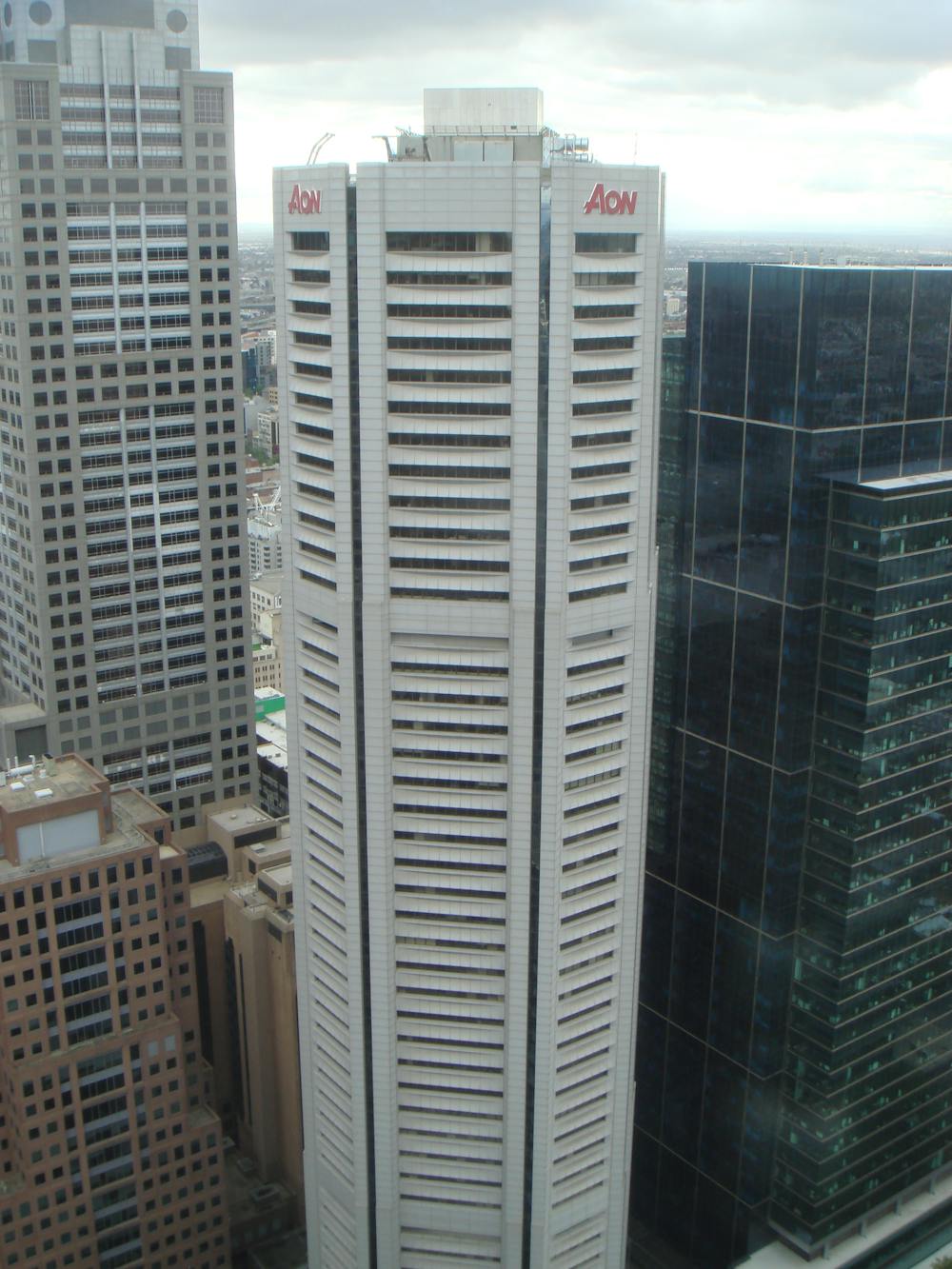
Marooned in my office on the 23rd floor of Nauru House, I would survey the smog-drenched city and bitterly resent the lonely burden of trying break the glass ceiling. Behind my desk I installed an oversized picture of Simone de Beauvoir to reinforce my stance of aggressive self-assurance. Every day, stern Simone looked over my shoulder, but she never managed to quell the insistent voice in my head: “Stupid girl! I told you so! Now no one will ever love you.”
Nauru House in Melbourne. timsdad/Wikimedia Commons, CC BY-SA
After a day spent wrestling with my own accusations of inadequacy, I would stumble back to my dark cottage in ungentrified Collingwood and pour a stiff drink. My house was a scene of domestic mutiny: clothes left where I had stepped out of them, meandering trails of damp towels, the remains of half-eaten takeaways hardening in their foil containers, overflowing ashtrays and empty wine bottles. Altogether too many wine bottles. In my befuddled state I would rail at feminists who sold me a shoddy bill of goods by urging me to be strong, independent, ambitious and self-directed. I was none of those things.
I read and re-read Elizabeth Smart’s By Grand Central Station I Sat Down and Wept (Editions Poetry, 1945), a rendering of self-deluded emotion as raw and throbbing as a fresh cut. And always there was Judy Garland, my midnight companion, belting out lyrics while I pulled the cork in yet another bottle of Cabernet Shiraz.
The night is bitter,
The stars have lost their glitter…
Alone in my disordered cell through a long, grey winter I spiralled into a deep depression where suicide hovered as a pathological flicker at the edge of my perception. I came to regard commonplace items in my kitchen and bathroom as ready-to-hand vehicles of annihilation.
Walking without destination
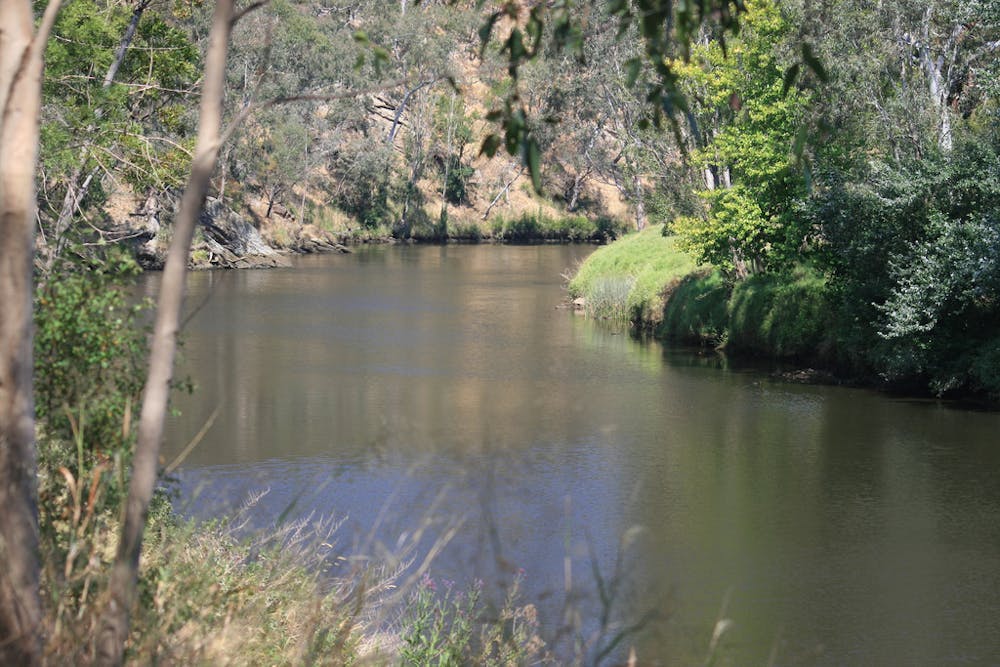
Sundays saved me. As the weather warmed I got into the habit of wandering down to the nearby Collingwood Farm where a series of garden allotments permitted access to the Yarra River. After admiring the neat rows of vegetables I would drift aimlessly onto the foot-worn path that ran along the riverbank. Once on the path, my steps became a steady stride, fitting the involuntary rhythm of my beating heart.
Walking is the most natural thing in the world. Heel to toe, heel to toe, without conscious effort, my body perambulated to the steady intake and output of breath. Paying no attention to my feet, I moved forward effortlessly, obeying my body’s intuition in a kind of loping dream. On rare occasions a person would pass from the other direction, but in the main my only companions were startled ducks flapping out of the sedges to glide to the safety of the river.
The Yarra River in Melbourne. Mick Stanic/flickr, CC BY-NC
Unbidden thoughts floated in and out of consciousness like the twigs and leaves on the surface of the river while I absorbed the sunlight dancing on the variegated trunks of the river gums, the ripples in the sepia-toned water and the perpetual forming and reforming of the clouds. I heard myself repeating lines from a favourite poem by Wallace Stevens:
In my room, the world is beyond my understanding;
But when I walk I see that it consists of three or four hills and a cloud.
I would walk without destination until the slanting golden light of impending dusk forced me to regretfully turn on my heels and retrace my steps. The delicate call of the bellbirds, like the continuous tinkling of a glass bell, never failed to melt whatever tension remained locked in my tired body. For the first time I comprehended the simple proposition that my life was unfolding without my willing it.
Arrival
Taking stress leave from my job, I made a spur-of-the-moment decision to have a holiday in Tasmania because it was only a short plane ride away. To all intents I had forgotten this was the place where I spent my early childhood.
Suspended beneath Australia like a heart-shaped pendant of sapphire, emerald and tourmaline, Tasmania is where the world peters out in a succession of rugged peninsulas that ultimately crumble into the vast expanse of the Southern Ocean. Peering through the small window as the plane descended across the jagged Freycinet Peninsula into the tiny Hobart airport, I felt an inexplicable surge of pure satisfaction. It was as if Constantine Cavafy spoke directly to me: Arriving there is what you are destined for.
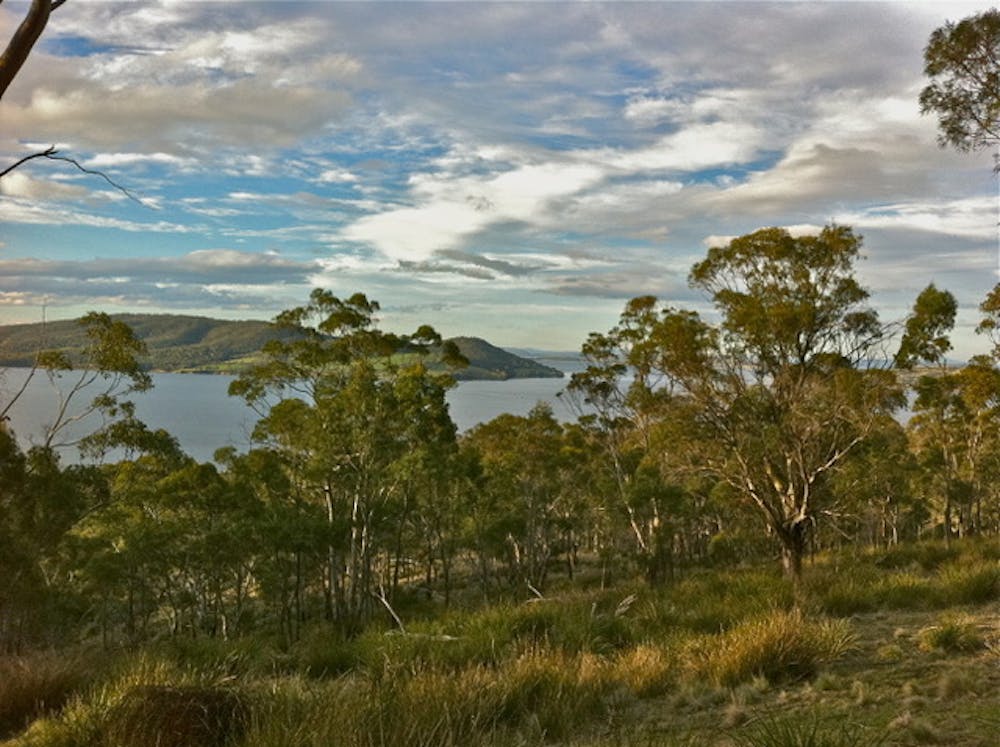
Looking across to Bruny Island, Tasmania. Cassandra Pybus
I hired a car and drove toward the long, brooding brow of Mount Wellington, with its cap of snow gleaming against a cornflower blue sky. Entering the town I admired the fine stone warehouses that lined the docks and the handsome Georgian buildings along the main thoroughfare. In the blink of an eye, it seemed, I had driven through the modest town and was climbing up the lowering mountain, passing grand colonial mansions in elaborate gardens that made me whistle through my teeth.
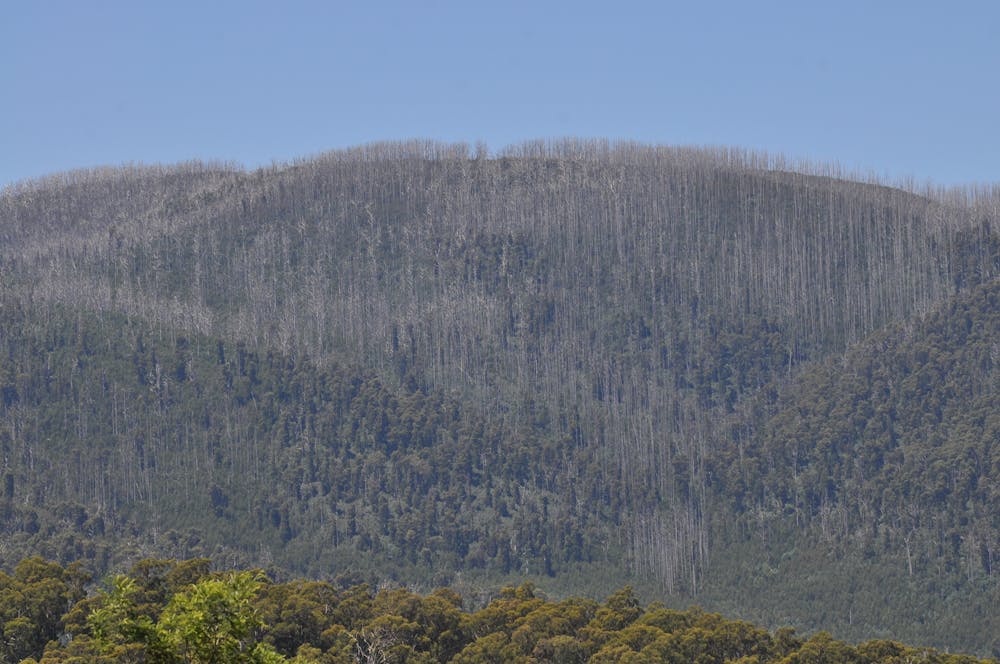
Soon there was nothing but the road and untamed bush. Silver spars of thousands of dead gum trees rose above the forest cover, stretching their twisted, ghostly limbs toward the dolerite columns of the pinnacle’s snow-capped face. As the road continued to climb and narrow, eucalypt forest encroached on both sides, progressively obscuring the eerie view. Negotiating the hairpin bends, I drove on as if mesmerised, somehow knowing what to expect around each bend, knowing where the road was taking me.
At the tiny village of Fern Tree I stopped and stepped out to look at a diminutive wooden church nestled in a bower of tall fern trees. A potted history pinned in the porch entry told me a massive bushfire swept across the mountain in 1967, destroying every building except for this lovely church. Walking about the grounds, I was swept into a vivid memory of my four-year-old self, cake-smeared, snotty-nosed and wailing because I hadn’t won the Princess Doll in a raffle at the church fete, while my mother, her pretty face flushed with angry embarrassment, was roughly shaking me to make me stop.
Fern trees were a source of solace for Cassandra Pybus as a child. Cassandra Pybus
A mile or so further along the road a break in the trees revealed the quilted blue of the Derwent River estuary as it swept around the tail of the Tasman peninsula and into the wide expanse of Storm Bay. The sight caused my breath to quicken with anticipation. At the next hairpin bend tears flooded my eyes. Nothing but the contour of the road triggered this surge of emotion, but I knew exactly what it was.
Catastrophic bushfire had swept away every vestige of my childhood home, yet my mind’s eye could conjure a dilapidated timber cottage nestled in an unfenced, rambling garden that had largely surrendered to the bush. Absurdly named “Bide-a-Wee”, the house was set high on a steep bush block above the highway that connected Hobart with the hinterland of the Huon Valley. My earliest memory of that house was hiding in a hollowed-out space under an unruly mass of mauve and magenta rhododendrons while sucking sticky sweetness from the end of each blousy flower.
About the spaces I inhabited inside Bide-a-Wee, I could recall little, except the deep sunroom with a wooden floor that ran the length of the house. I saw myself curled up in the L-shaped window box, devouring the many books that littered the ramshackle house. Sometimes I would lift my eyes to the glass and look out over the blue water broken by grey-green fingers of land dissolving into an endless expanse of ocean. It seemed as if I was living on the rim the world.
My young mother was much distracted by her excoriating unhappiness and the gruelling demands of domestic chores in a primitive house, where the sole source of heating and cooking was a fuel stove that needed to be kept alight day and night. My father was rarely home. Left largely to my own devices, I would scramble through the back garden, up a rough track that wound through the rhododendrons and past the chook pen, where I might steal an egg or two, to the back boundary where a gate hung precariously on one hinge to open onto the Pipeline.
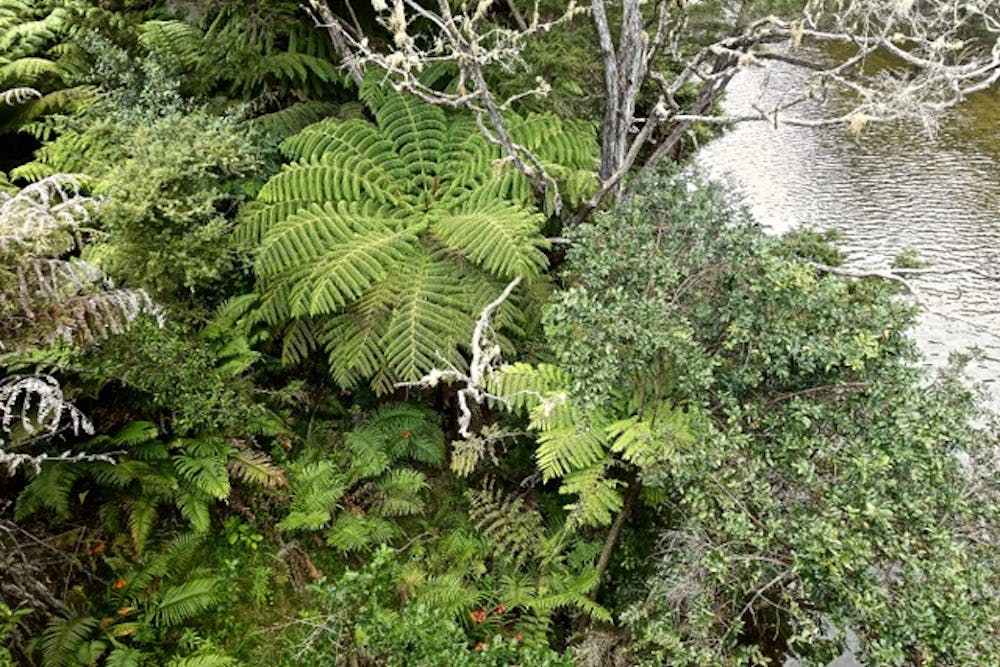
Built nearly a hundred years earlier to carry water to Hobart, the Pipeline ran from the village of Fern Tree, a couple of kilometres away from Bide-a-Wee, all the way around the side of the mountain to the water source. Cutting a wide swathe through the towering forest, the Pipeline track was framed on either side by resplendent fern trees. Delicate tendrils of water seeped from every crevice in the rockface and a spongy carpet of variegated moss and tiny ferns colonised the decomposing leaf litter beneath.
Tasmanian tree ferns. Cassandra Pybus
In winter, a dusting of snow hung on the fern fronds and a thin crackle of ice glittered in the leaf litter. It was my fantasy land: dank, magical and, above all, secret. My mother permitted my solitary excursions onto the Pipeline on the understanding that I would only walk toward Fern Tree where there were friendly neighbours for me to visit. I was not allowed to go in the other direction where the Pipeline continued for many kilometres around the mountain. The track was regularly maintained by the water corporation and perfectly safe. I had sturdy boots and knew to stamp my feet to warn any sunbaking snakes that I was approaching.
About 200 metres along the Pipeline the track diverged around an old stone well, covered by a strong metal mesh cage. Pulling myself up onto the lichen-encrusted lip I would peer into the mysterious depths, listening for the melodious plink of my pebble making contact with the water. Nearby, in a deep glade of tree ferns, I created a little den beneath a cascade of drooping fronds with a soft underfloor of fallen fern litter that was completely obscured from view. In this musty, magical hideaway, the sun filtering through the delicate malachite filigree of fern, I would enter the realm of wood sprites absorbed from Arthur Rackham’s intoxicating illustrations of the Brothers Grimm.
Freed from surveillance in my ferny den, I took to making cakes in imitation of my mother, who seemed to be perpetually beating eggs with sugar, sifting flour and greasing tins to make cakes for the weekly stall at the church to raise money to establish a kindergarten at Fern Tree. Breaking my purloined eggs into a chipped enamel bowl, I would beat them with a stick, mixing in soil and leaf litter to make a batter that I would turn out to harden in the sun. My father would have been furious if he ever found out about my cakes. It was such a source of exasperation that his hens laid so few eggs.
At age six I became a pupil at Princes Street Primary School, located below the mountain in the elite suburb of Sandy Bay, where my predilection for noisy chatter and mess-making caused me no end of grief. I was taunted and humiliated by a succession of teachers, which made me a target for playground bullies. Children of unconventional parents who lived on the mountain were considered to lower the tone of the school.
“Riff-raff” was the term applied by the headmaster on the occasion that my infuriated teacher dragged me along to his office for punishment. Having encountered schoolteachers, I became much more distrustful of authority. It was inevitable that I would turn in the opposite direction on the Pipeline toward the forbidden unknown, intrigued to know what might be around the next bend. From my first brief foray in the wrong direction the track beckoned me around more and more bends. There was nothing for me to find around these bends, no paths leading down to welcoming houses, only the forest of massive eucalyptus trees offering a muted colour palette of olive and brown, tawny and beige.
Eucalyptus trees in Tasmania. flickr
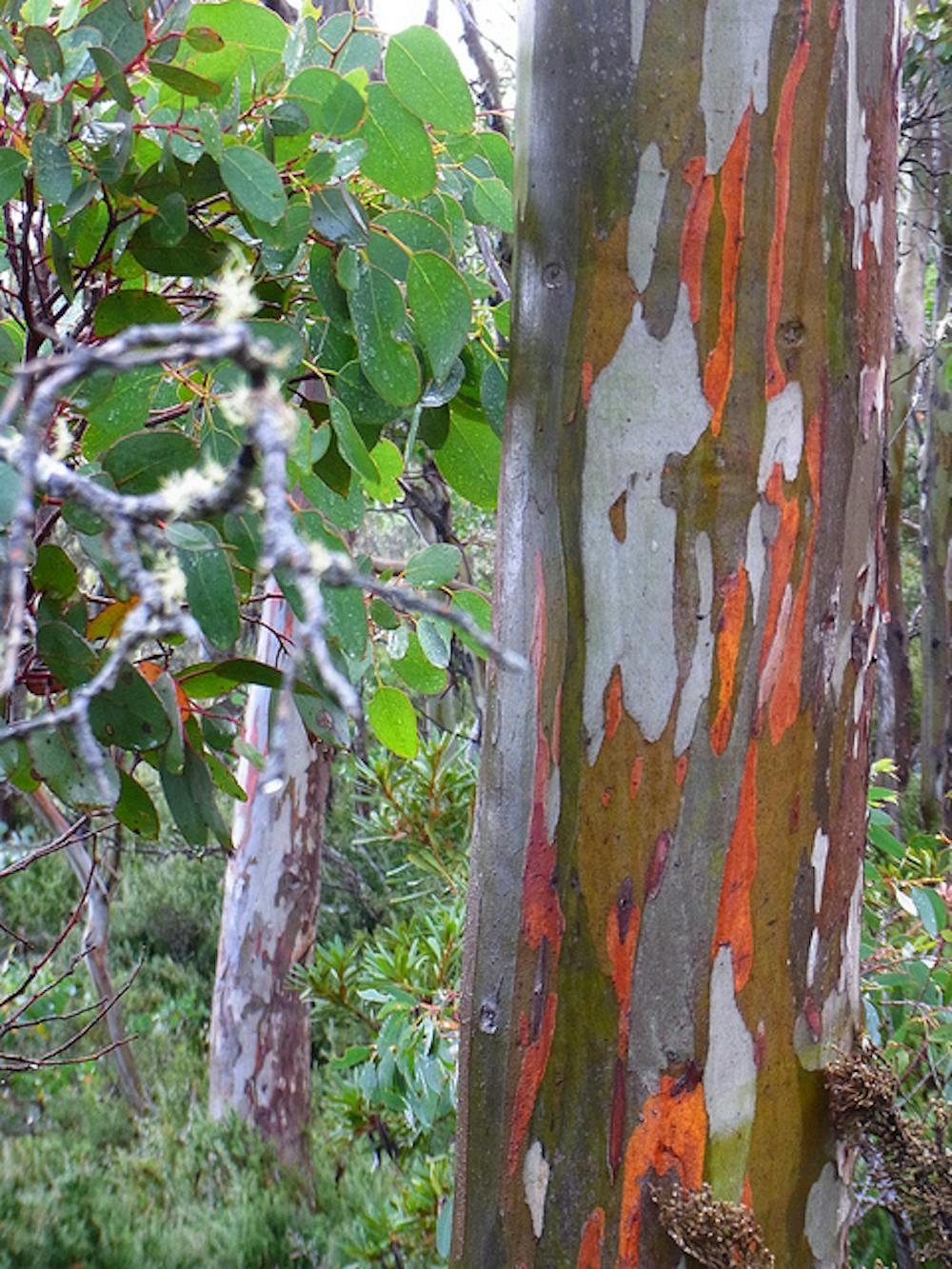
As I walked further the majestic ferns disappeared and pressing in on both sides of the track was a thicket of spindly sassafras trees with dark, narrow leaves that I liked to crush between my palms to release their pungent, peppery smell. I would lose my unhappy self in the aromatic smells of the bush, the cascade of tawny bark peeling from the massive blue gums, the sun striking the marbled cream and grey of their new skin, the peeping of little wrens scratching among the tangled floor of bark, and flashes of rainbow as a flock of rosellas lifted off from the high branches.
Returning home
Over a quarter of a century later, unexpectedly back at the site of my lonely, unhappy childhood, I still knew where to locate the track up to the Pipeline. And it was just the same: the old wishing well and the giant fern trees. Stepping along the Pipeline I could vividly recall my child self, dreamily putting one foot in front of the other, processing the trauma of the perpetual tension between my parents and the bullying and rejection of school. None of which I had explicitly remembered till that moment. Yet somehow, 30 years later when I was again mired in misery, the implicit memory of it had kicked in.
“Neurons that fire together, wire together.” Like a nursery rhyme, I could chant this melodic phrase first coined by Canadian psychologist Donald Hebb. It serves as snappy shorthand for the way the brain anticipates and responds to the immediate future by accessing associative linkages that were formed in the distant past, then automatically firing off clusters of neurons that had fired together in past situations where there were associative linkages. So even though the encoded memories of my early childhood did not enter my awareness, the implicit memory of my childhood had impelled me onto the path along the Yarra in order to save myself from despair.
After retracing my steps back along the Pipeline, I drove my hire car along the highway as it wound down into the long verdant Huon Valley, where I drank cold white wine in a rose-filled garden beside the river. The tannin-stained river was the colour of chewy toffee and mirrored in the limpid water were orchards in blossom, emerald hills and the snowy saw-edge of a distant mountain range. Gazing at those jagged white peaks I reminded myself that I had reached Ultima Thule: the end of the known universe. Beyond the mountains lay a terrible vastness of empty ocean and the continent of ice.
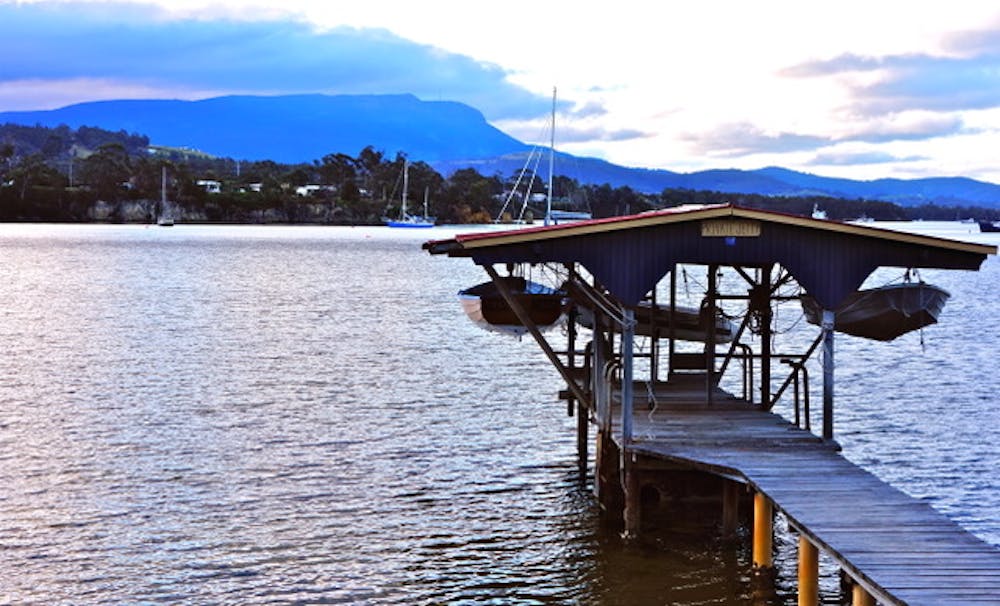
Continuing to drive along the highway down to North-West Bay, I passed through the village of Snug, where the highway dipped down to graze the edge of the bay. Here I took an impulsive turn onto a narrow dirt road barely wide enough for the car. The old station road was cut between a wall of sandstone, and the glistening water that lapped at the road’s ragged edge meandered toward a picturesque jetty where four rowboats were winched up under a red roof.
The Pybus Jetty at Lower Snug. Cassandra Pybus
I could scarcely believe what my eyes were seeing. I had walked along this road so many times in my dreams, without ever knowing what it was or where it might be taking me. Coming close I saw, painted on the side of the jetty in big red letters, the name of my father’s brother, Ken Pybus. Then the road took a right-angled turn away from the water to climb to the brow of a hill where the broad waterway of the D’Entrecasteaux Channel opened out before me.
Wind and currents created swirls of cobalt and cerulean so that the surface of the water looked like the endpapers of an old book. Across this marbled water, Bruny Island was two craggy fists of land, joined by a long thin neck and dominated by the blue defiance of the great fluted cape at its distant southern end. I knew Bruny Island because my father had boasted that thousands of hectares on this offshore island and the land across the channel at Oyster Cove had once belonged to our family. Spread out before me was the home to my family for six generations. My Ithaca. Arriving there was what I was destined for.
Returning along the old station road I came to a stop just above the jetty next to a vertical-board house in faded turquoise. Leaving the car I opened the gate and walked in. My uncle Ken welcomed me as if I had never been away. Over a cup of tea he told me the place was getting too much for him and so I arranged to buy it, then and there. A month later I was unemployed in Lower Snug. Not knowing what would become of me I decided to just wait and see.
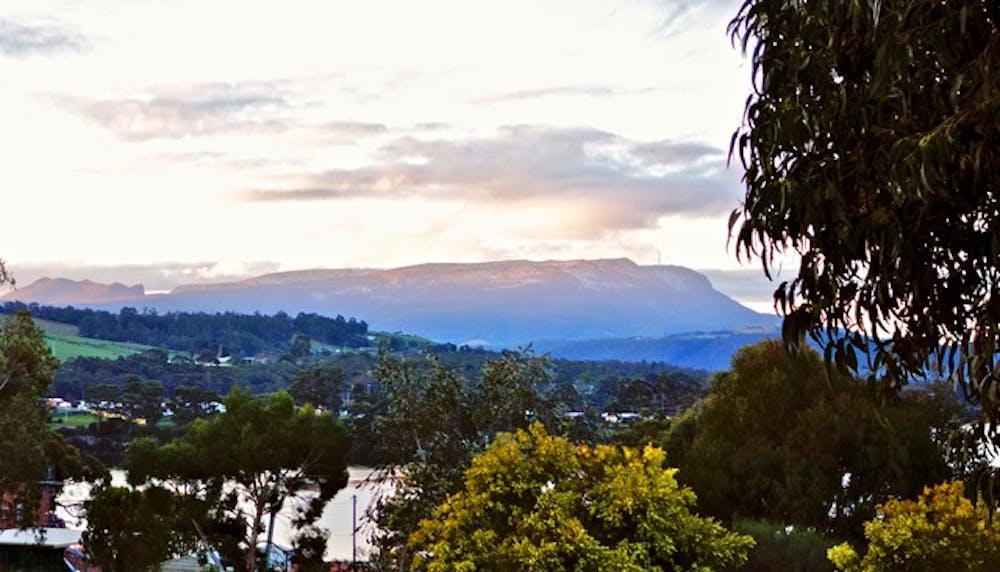
Each morning I would pull apart the curtains to reveal the shimmering water of North-West Bay framed by the Prussian-blue silhouette of the Wellington mountain range, which looked for all the world like Walt Disney’s Sleeping Beauty. Behind my house a vast area of bush reserve extended over the hills between North-West Bay and D’Entrecasteaux Channel, providing me with crucial space for self-transcendence.
The silhouette of the Wellington mountain range. Cassandra Pybus
I would spend hours following faint trails that crisscrossed the bush, impulsive short cuts that over generations of use had become imprinted on the land. Such habits of the landscape are known as desire lines. I could never resist the desire to follow where they led. I would set out on a walk with a sense of purpose to resolve some troubling concern, but such thoughts would soon dissipate in the play of light and shade through the ragged forest, the pair of sea eagles coasting effortlessly on the wind currents high above their nest, the delicate logarithmic spiral of the unfurling bracken, the startling red of the native heath fallen like droplets of blood into the leaf litter.
Hours of walking alone did not empty my mind so much as fill it with an entirely different sense of purpose. The French philosopher Frédéric Gros has suggested that by walking we escape our constructed identity and ego-driven narrative of self because the walking body is just an eddy in the stream of immemorial life. I did not understand it that way then, just knew that every day it was an imperative for me to head into the bush, steadily putting one foot in front of the other.
More often than not I would get completely lost in the maze of desire lines, never so lost that I could not eventually find my way home, though not in good time, and never quite the same person who started out so many hours before. I see now that I was wilfully losing myself in a landscape where there were no signals, no signposts, and no well-rehearsed strategies to direct my steps. Immersing myself in the uncertainty and transience of life, I was getting lost in order that I might be found.
Henry Harrison Pybus’s house at Oyster Cove. Cassandra Pybus
Contained within the landscape is our accumulated past as well as our immediate present, and traversing the landscape of one’s life – putting one foot in front of another – is a way to arrive at a special sort of knowledge. As Rebecca Solnit has observed, the rhythm of walking generates a rhythm of thinking and the passage through a landscape simulates the passage through a series of thoughts. Which suggests that the mind is also a landscape of sorts and that walking is a way to traverse it. Certainly that was how it was for me. Putting one foot in front of the other along the desire lines behind my house slowly revealed to me how to be in the world. Walking made me into a writer.
‘Every path tells’
My first book was written as a direct result of a long walk I took on the bicentennial of British settlement, 28 January 1988, following the old station road beside my house to its end on the D’Entrecasteaux Channel. This was the original carriage road built in the 1820s to run over the hills to the old convict station at Oyster Cove that was next to the homestead of my colonial ancestor, Henry Harrison Pybus.
The old station was built on sour and swampy ground, too low and damp for prolonged dwelling, so no convicts ever lived there. Instead it was the place where the very last of the original people of Tasmania were sent to die, their remains unceremoniously buried in unmarked graves on land that belonged to Henry Harrison Pybus and his business partner, William Crowther. Later Crowther and his son located these graves, dug them up and sent the skulls and bones to collectors in England.
Walking the old station road to its melancholy terminus, I was following in the footsteps of another of my colonial kin, James Calder, the author of Some Account of the Wars, Extirpation, Habits, &c., of the Native Tribes of Tasmania. On a sunny April morning in 1855, Calder walked from Hobart to the old convict station to observe the few survivors of the native tribes who continued to cling to life at that place.
Read more: Friday essay: journey through the apocalypse
Walking over the hills between North-West Bay and the Channel, he described passing through huge forests with an occasional opening that revealed a magnificent vista of hills and waterways, but at his journey’s end his joy at the glory of the landscape was obliterated by the forlorn spectre of the derelict station. Shocked and indignant, Calder insisted something had to be done to improve the awful conditions to “repay the debt we owe a race whom we have forcibly dispossessed of everything but mere existence”. No one paid him any heed.
Walking along behind him, over 130 years later, I too felt a wave of the melancholy that infused the long-deserted station. Standing at the entrance my emotions were in havoc, nothing as intimate and corrosive as guilt, just a powerful sense of complicity. Unable to will my feet into the station I kept walking to the house of Henry Harrison Pybus, inherited by my great-grandfather, where my grandfather was born, where I visited with my family as a small child.
Across the road in the Oyster Cove churchyard I located the overgrown grave of my great-grandfather. Kneeling to clear away the weeds, I felt my whole body trembling. On my knees beside the grave of my ancestor I understood it was my moral responsibility to write about this place, to recover the intimate pathos of those individual lives that were extinguished to make way for me. “A walk is only a step away from a story”, Robert Macfarlane reminds me, “and every path tells”.
– ref. Friday essay: lost and found in the Tasmanian bush – http://theconversation.com/friday-essay-lost-and-found-in-the-tasmanian-bush-110876








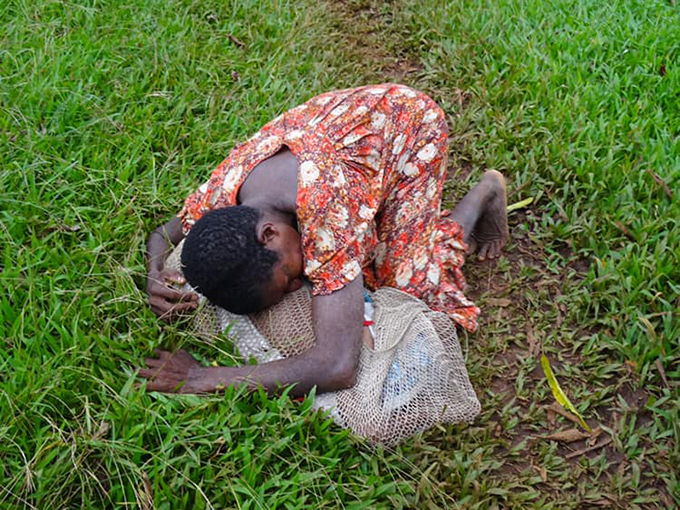
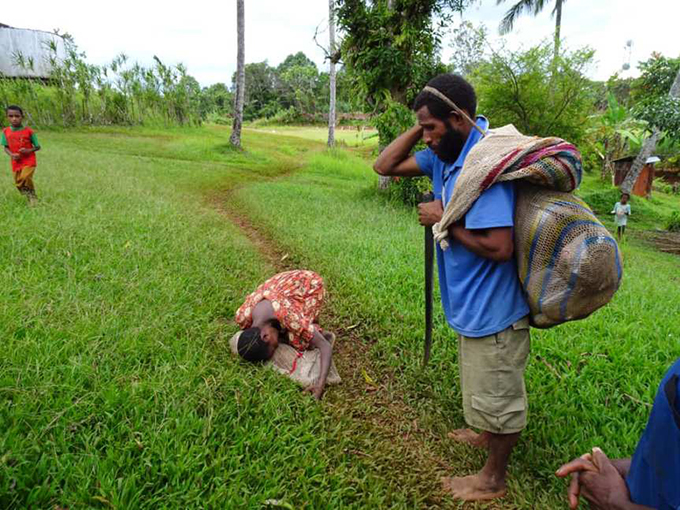 Family grief. Image: Sally Lloyd/My Land, My Country
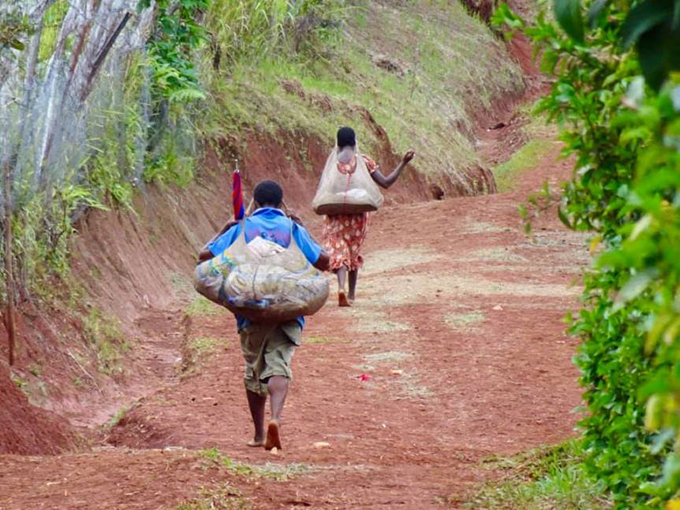 The long walk. Image: Sally Lloyd/My Land, My Country