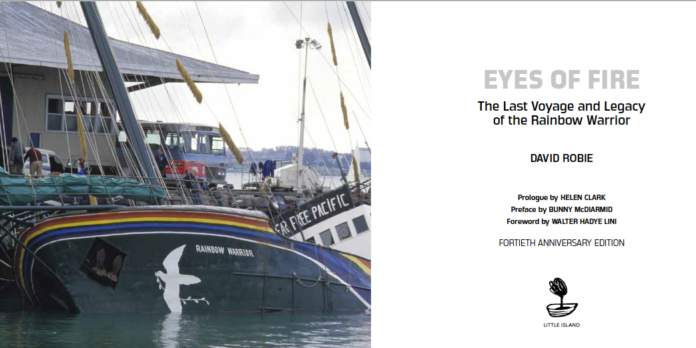
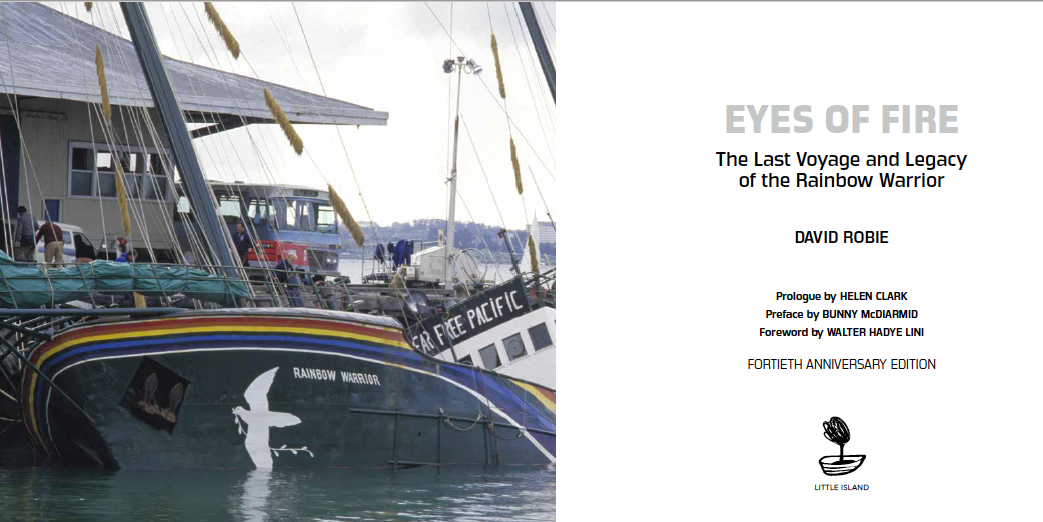
Eyes of Fire: The Last Voyage and Legacy of the Rainbow Warrior, by David Robie, isn’t only a gripping tale of adventure and tragedy but also a testament to the enduring spirit of environmental activism. It serves as an important reminder of the power of collective action and the indomitable human spirit in the face of adversity.’
This book is a compelling narrative that delves into a poignant moment in history and its lasting repercussions. Set against the backdrop of Pacific activism, the book meticulously chronicles the ill-fated journey of the Greenpeace vessel, the Rainbow Warrior, in a vividly detailed account that captures the tension and ideals of environmental advocacy.
The story unfolds as the Rainbow Warrior embarks on a critical mission to protest nuclear testing in the Pacific. The ship’s crew, a resolute group of environmental activists, intends to disrupt nuclear tests that threaten to devastate the delicate ecology of the region. Traversing the vast and often perilous waters of the Pacific, the campaigners demonstrate unwavering commitment to their cause.
Traversing the vast and often perilous waters of the Pacific, the campaigners demonstrate unwavering commitment to their cause.
However, their journey turns tragic on the night of 10 July 1985, when French secret agents carry out a covert sabotage operation in Auckland Harbour, New Zealand, bombing the ship in a stunning act of violence that reverberates globally.
David Robie, a veteran journalist and witness to the events, offers an insightful account filled with his personal experiences and observations. Through his lens, readers gain a comprehensive understanding of the geopolitical dynamics at play and the fierce dedication of those aboard the vessel.
40 years on: The Rainbow Warrior, the bombing and French colonial culture in Pacific – David Robie talks to the Fabian Society
Dr Robie incorporates a deeply human perspective, portraying the hope, courage, and grief that accompany such a devastating loss.
The tragedy claimed the life of Fernando Pereira, a courageous Portuguese-born photographer who tragically perished in the attack, igniting international outrage and drawing widespread attention to both the cause of environmental protection and the political tensions underlying the act of sabotage.
Dr Robie’s narrative goes beyond the immediate incident, reflecting on the far-reaching consequences for Greenpeace and the environmental movement at large.
Following the attack, the remnants of the Rainbow Warrior were repurposed into a living reef in a New Zealand bay in 1987, a symbol of resilience and renewal. Subsequently, Rainbow Warrior II was commissioned, and later still, Rainbow Warrior III, carrying on the legacy of their predecessor in the fight for environmental justice.
The prologue in the 2025th edition is by former Prime Minister Helen Clark and the foreword by former Greenpeace International co-executive director Bunny McDiarmid. This edition has major new sections on climate crisis and updates.
Original 1985 Rongelap mission Rainbow Warrior crew members Bunny McDiarmid and Henk Haazen return to the Marshall Islands in March 2025.
Takapuna CBD – shopping and retail genericRNZ/Nick Monro
Business confidence retreats 10 points from a 30-year high but still seen as strong
Businesses own expectations drop 9 points, but still historically high at 52 percent
Wage pressures start to lift modestly with inflation expectations the highest in 15 months.
More firms expect to raise prices over the next in two years
January’s business confidence is down 10 points from December’s 30-year high but is still considered to be extremely strong.
ANZ Bank’s business outlook’s headline confidence indicates a net 64 percent expected better economic conditions.
While businesses’ own expectations fell by 9 points to 52 percent, that reading was also historically high.
“The economy has clearly turned higher,” ANZ chief economist Sharon Zollner said.
“Reported past employment is also rising and is back in the black for all sectors. That hasn’t been the case since late 2022,” she said.
She said reported past activity, which was the best indicator of GDP, rose 3 points to 26 — the second highest reading since August 2021.
“The less-good news is re-emerging signs of inflation pressure.”
Inflation indicators rose to the highest reading in nearly three years (March 2023) with prices expected to rise by 2.1 percent, with wage pressures also expected to increase.
– Published by EveningReport.nz and AsiaPacificReport.nz, see: MIL OSI in partnership with Radio New Zealand
Hospitals in Auckland and Northland were impacted by the outage. (File photo)123rf.com
A massive IT outage at hospitals in Auckland and Northland is being blamed on cuts to Health NZ’s digital team, by a union representing public service workers.
The Public Service Association (PSA), said its members were forced to use pen and paper during a computer systems outage lasting more than twelve hours from Wednesday night to Thursday morning.
It said the outage had prevented clinicians from accessing patient information, and blocked communications.
“The government has to take the blame for this – these failures are a direct result of its short-sighted decision to underfund and cut roles at Health NZ’s digital services team,” PSA national secretary Fleur Fitzsimons said.
“The government oversaw the loss of the very experts who maintain and upgrade these critical systems, and now we’re seeing the predictable consequences – hospitals forced onto whiteboards and paper forms while trying to deliver modern healthcare.”
Fitzsimons called for the government to immediately review funding for digital health services and “admit its mistakes in cutting digital services expertise.”
RNZ approached Health NZ and the Ministry of Health for comment.
Sign up for Ngā Pitopito Kōrero, a daily newsletter curated by our editors and delivered straight to your inbox every weekday.
– Published by EveningReport.nz and AsiaPacificReport.nz, see: MIL OSI in partnership with Radio New Zealand
Tongans have been barred from short-term visits to the US under new restrictions. (AP: Rebecca Blackwell)AP / Rebecca Blackwell
Tongan citizen Lionel Funaki fears a United States policy of “collective punishment” has ended his dream of studying in Hawaii.
He is one of many in the Pacific Island nation grappling with the Trump administration’s new travel restrictions affecting Tongan nationals.
Under new immigration restrictions that came into effect on 1 January, the US has suspended issuing visas to Tongans for short-term visits, tourism and business purposes.
Lionel Funaki studied at a university in the US state of Hawaii.Supplied / Lionel Funaki
Only two weeks after the new rules came into effect, the US State Department, in a separate measure, also said it would suspend processing immigrant visas for people from 75 countries including Fiji.
Funaki, who is based in Tonga and used to study in Hawaii at Brigham Young University, said he was saddened by the new measures imposed on Tongan nationals.
“I was looking forward to continuing my educational journey, but unfortunately, that now looms in limbo,” he said.
“I understand that in the name of national security and the interests of the United States, certain measures have to be made, but collective punishment seems to be a bit extreme.”
Tonga was named alongside 20 other countries in a round of full and partial travel restrictions imposed in December by the Trump administration, as it continued its sweeping immigration crackdown.
The White House said it included Tonga on the list due to the high number of its nationals – about 14 percent – who overstayed their visas.
It also said Tonga had unreliable civil documents and criminal records, lacked birth registration systems, and that its government had refused to share data and repatriate deportees.
“I would tell everyone that America is a land of hospitality, we love to have visitors – but they have to come here legally,” US Homeland Security Secretary Kristi Noem said in a November press conference.
“When they’re done visiting, then they need to go home.”
Donald Trump’s broad immigration crackdown has reached across the United States. (Reuters: Evelyn Hockstein)Reuters / Evelyn Hockstein
In a December statement, US President Donald Trump said countries listed for the new travel restrictions had failed to address concerns raised by his administration about their screening, vetting, and the information they provided about their citizens.
“Such countries warrant continued or new travel restrictions,” he said.
Restrictions stir frustrations in Tonga
The US travel restrictions have caused frustrations in Tonga, which has a large diaspora of citizens living in states such as Utah, Hawaii and San Francisco.
About 78,000 people of Tongan heritage were living in the US during the most recent census in 2020, and many regularly travel between the countries.
The diaspora in the US is an important part of Tonga’s economy, having long been the largest source of remittances to the Pacific nation.
The US has long been viewed as a “land of opportunity” for Tongans seeking education, wealth and a higher standard of living overseas.
“Since the 60s, most of the immigration was the result of Tongans coming through the Church of Jesus Christ [of] Latter-Day Saints,” said Tongan-born American citizen Semisi Fa’asolo, who lives in Phoenix, Arizona.
“It’s a pity that Tonga is experiencing this … there’s a possibility that Trump maybe cancels [the ban] so Tonga needs to step up its diplomacy.”
Experts have also warned that travel bans could pose problems for families hoping to visit US-based relatives on religious or cultural occasions, or to provide support.
The ABC approached newly elected Tongan Prime Minister Lord Fakafanua, but he declined to comment.
His predecessor, ‘Aisake Eke, was critical of travel restrictions while in office and signalled his government’s displeasure at a proposed ban last year, telling local media it was “unacceptable”.
It was a turn in relations nearly three years after Washington opened a new embassy in Tonga’s capital, Nuku’alofa – a move meant to symbolise that America was re-engaging with the Pacific.
Critics link ban to ICE arrests
Many in the US have also condemned the move, accusing the Trump administration of racism and of being motivated by anti-immigrant sentiment.
“We need not enact these draconian restrictions,” Hawaii state senator Jarrett Keohokalole said.
He said visa overstay rates among Tongans living in the US could instead be solved through diplomacy.
Jarrett Keohokalole has described the travel restrictions as “draconian”.Supplied
Senator Keohokalole said the new restrictions went overboard and came off the back of a Supreme Court ruling interpreted as empowering US Immigration and Customs Enforcement (ICE) to racially profile suspects.
“They’re allowed to take into account a person’s skin colour … and speech in their investigations,” he said.
“Basically what the law now allows is for [ICE] agents to stop, investigate, detain, and potentially arrest anyone that they think resembles a Tongan national.”
ICE officers have ramped up arrests since Donald Trump returned to power last year. (AP: Alex Brandon)AP / Alex Brandon
The ABC approached the US government for comment.
Other critics have linked the US travel restrictions to the Trump administration’s controversial ramp-up in arrests of suspected illegal immigrants.
National Tongan American Society executive director Fahina Pasi said Mr Trump’s policies – enforced by ICE on streets around the US – had caused anxiety among the Tongan diaspora.
Fahina Pasi says some Tongans in the US are afraid to leave the country in case they are refused re-entry. (Supplied: National Tongan American Society)Supplied / National Tongan American Society
“Not too many people are travelling [overseas] for fear that something might happen … that immigration [officials] might not let them back in for whatever reasons they have,” Ms Pasi said.
“[Mr Trump is] very racist and is always trying to put people of colour down.”
Pasi said her organisation had been actively advising the community about their legal rights and protections against arrest by ICE personnel.
“What we tell our people is, ‘If you see some strange people coming to your door that look kind of fishy, don’t open your door,’” she said.
“Slide this red card under and the red card basically says, ‘Contact our attorney.
-ABC
– Published by EveningReport.nz and AsiaPacificReport.nz, see: MIL OSI in partnership with Radio New Zealand
Auckland FC and Wellington Phoenix won’t be part of Australia Cup in the future.Photosport
Pre-season for A-League clubs Auckland FC and Wellington Phoenix will look different after Football Australia move to kick them out of the Australia Cup competition.
The Australia Cup is a domestic knockout competition pitting amateur club sides against A-League teams and was played last year from July to October, during the A-League pre-season.
A revamped model for the Cup will come into play this year and Auckland and Wellington are not part of the new-look structure.
Auckland made their debut in the latest edition of the Cup making it as far as the semi-final stage, while the Phoenix had to go through qualifying to get into the competition and lost at the quarterfinals.
The Phoenix and Auckland both said participation in the the Cup was expensive for the clubs and disruptive to pre-season plans.
Auckland FC chief executive officer Nick Becker said he would “not lose any sleep” over being omitted from the Australia Cup.
He said he was neither “blindsided” or “bothered” by Football Australia’s decision.
“It cost us money to do it, any pre-season is going to cost a bit of money, but all our games were in Australia, because of the knockout nature of the tournament you wouldn’t know who you were playing until a week out or two weeks out so it made it incredibly difficult to plan a proper pre-season.”
The the club now had different pre-season plans to play opponents close to home and from further afield.
“It gives us a real opportunity to plan a pre-season where we can actually get some quality opposition, we know what’s happening… create our own little tournaments down here or there will be Premier League teams that are touring that might be interested in coming to Auckland.
“I think it’s more exciting for us than anything else.”
Becker felt that Football Australia wanted to keep the ‘Australia’ in the Australia Cup but also believed Auckland FC’s involvement in the OFC Pro League was a factor in the club being left out.
Auckland’s team in the Pro League is not the A-League side.
“For us the OFC Pro League is a huge opportunity if we win it we qualify for the FIFA Intercontinental Cup each year and if we’re the most successful team over four years we end up going to the FIFA Club World Cup.
“If you win Australia Cup you get something like Australian $25,000, you go to the Intercontinental Cup it’s more like $1.5 million and Club World Cup is a $10 million plus pay day so for us we know where our priorities and our focus lies.”
Sign up for Ngā Pitopito Kōrero, a daily newsletter curated by our editors and delivered straight to your inbox every weekday.
– Published by EveningReport.nz and AsiaPacificReport.nz, see: MIL OSI in partnership with Radio New Zealand
Wellington City Council has found a second mistake in its rates bill calculation – but this time it is good news for ratepayers.
Late last year, Wellington City Council discovered an error, which meant it had undercharged the household and commercial sludge levy in the quarterly rates invoices sent in August and November 2025.
At the time, the council said it would review its billing system to discover how the mistake happened.
That review has shown Wellington City Council has invoiced its own rates correctly – but Greater Wellington rates have been overcharged by an average of $10 per residential account.
The city council’s strategy and finance officer, Andrea Reeves, said the impact of the error over the year was small, but it was “still a mistake that should not have happened”.
“We want to sincerely apologise for these errors,” she said.
“We are fixing the sludge levy error and Great Wellington rates error in the rates invoices people will receive in the week beginning 3 February 2026.
“Ratepayers will see a credit to reverse the overcharge, and an amount for the sludge levy undercharge – so ratepayers will have a lower catch up than we initially expected.”
The council would not be charging any penalties or interest as a result of either error, she said.
Meanwhile, ratepayers can expect a detailed apology and explanation letter with their rate invoices sent next week.
Sign up for Ngā Pitopito Kōrero, a daily newsletter curated by our editors and delivered straight to your inbox every weekday.
– Published by EveningReport.nz and AsiaPacificReport.nz, see: MIL OSI in partnership with Radio New Zealand
It’s hard to generalise about the motivations of those involved. Politicians representing Pauline Hanson’s One Nation party attended. So did members of the wider community who oppose immigration policies and a smaller number of more extreme agitators.
The neo-Nazi group National Socialist Network formally disbanded to avoid the new hate offences passed earlier this month. But links have been uncovered between its former members and rally organisers. It remains to be seen how the authorities will approach far-right groups who continue to operate while skirting the law’s boundaries.
The strong anti-immigration sentiment expressed at these rallies raises complex questions about freedom of speech, rights to political protest and growing threats of extremism.
A fundamental source of these challenges is the difficulty in saying – especially in a democracy that values freedom of speech – when someone crosses the line from legitimate social and political beliefs into “extremism”.
It now seems rare for a day to go by without some mention of extremism in the news. But the meaning of this important word is also rarely explained or interrogated.
So what is extremism really, and how do we decide who and what is extremist?
Extremism: violent or not?
Defining extremism is difficult in part because most counter-terrorism policies target violent extremism.
acts of or support for violence to achieve social, political or legal outcomes or in response to specific political or social grievances.
If someone commits a violent act or supports violence, it’s easier to say they have crossed the line into behaviour worthy of government intervention.
Violent extremism can be a crime, such as advocating terrorism, urging violence or inciting racial hatred. Depending on the seriousness of the conduct and a person’s individual circumstances, though, the authorities might instead recommend a different type of intervention. This could include counselling or other support.
Confusing definitions
If we consider just the “extremism” part of violent extremism, things get much trickier.
The United Kingdom, in its “Prevent” strategy, has long targeted extremism, without requiring a link to violence. Until recently, it favoured a broad definition that said extremism meant actively opposing “fundamental British values”.
This is particularly unhelpful. Who gets to say what are fundamental British values, and what’s normal?
After the Hamas terrorist attacks on Israel on October 7 2023, the UK government responded to these criticisms and offered a new definition of extremism. It focuses on threats to democracy:
Extremism is the promotion or advancement of an ideology based on violence, hatred or intolerance, that aims to:
negate or destroy the fundamental rights and freedoms of others; or
undermine, overturn or replace the UK’s system of liberal parliamentary democracy and democratic rights; or
intentionally create a permissive environment for others to achieve the results in (1) or (2).
This definition improves on the previous one, though it blurs the boundaries between non-violent extremism, violent extremism and terrorism.
On the one hand, it could involve a plot to overthrow the UK government or destroy the fundamental rights of a group based on their ethnicity or religious beliefs.
On the other hand, it could mean someone seeking to deny a group’s rights based on hatred and intolerance. That would still be highly problematic, but it would be more in the realm of hate speech and hate crime than a terrorist coup.
Without a link to violence, extremism can be understood as views and behaviours that undermine the health of our democracy, or discriminate against groups based on their race, religion or other attributes, while creating permissive environments for serious harm.
Extremism may still breach civil or criminal laws, including for hate speech. But it would not trigger more serious terrorism offences – or else we would be in the realm of violent extremism.
How do we decide?
By calling something or someone extremist, we are saying the beliefs and behaviours fall outside legitimate contributions to the public sphere. This must mean something more than views we consider to be highly controversial, offensive or generally unpalatable.
Agreeing on this thin dividing line is probably an impossible task. Extremism occupies a liminal space where someone’s beliefs and behaviours do not involve or advocate violence, but there is a strong public sense that they are, nonetheless, undermining the terms of our (increasingly fragile) social contract.
Still, we should not be afraid to call out extremist behaviour where we see it. But we should take into account what the term means and consider whether the behaviour fits the definition.
Then, extremism will not just be another buzzword, but a term with real meaning that can help us all to determine appropriate limits for democratic debate.
Keiran Hardy receives funding from the Australian Research Council for a Discovery Project on conspiracy-fuelled extremism.
Since 2013, more than $400 million in tax-deductible donations have flowed through an Australian charity, including direct to IDF soldiers.
United Israel Appeal (UIA) Australia has remitted $376m to Israel via its global partner Keren Hayesod, according to Australian Charities and Not-for-profits Commission (ACNC) financial disclosures.
In 2024 alone, UIA Australia received $50.9 million in tax-deductible donations and sponsorships.
Financial statements from Keren Hayesod, the Israel-based body that receives and distributes UIA funds, show it received A$323 million in global donations in 2024, with 98.5 percent originating overseas.
On that basis, Australian fundraising accounted for roughly 13 percent of Keren Hayesod’s worldwide donation base last year.
United Israel Appeal Australia donations. Source: Australian Charities and Not-for-profits Commission (ACNC)
‘Every dollar aligned with Israel’s national priorities’ At the UIA Victoria AGM in November 2025, UIA leadership were explicit about the organisation’s role in Israel. David Slade, president of UIA Victoria, told members:
“We are the only organisation in Australia raising funds for Israel that holds a seat at every table of decision-making authority mandated to rebuild the country from the north to the south.”
“We are proud that every dollar we distribute is aligned with Israel’s national priorities.”
Julian Black, outgoing federal treasurer of UIA, reported that $39.2 million had been sent to Israel nationally, including $14.4 million from Victoria, in the 2025 campaign period to mid-November.
UIA Australia describes its central mission as supporting aliyah, “ascent”, referring to Jewish immigration to Israel, and strengthening Israeli society. They state that they “raise funds within Australia and transfer them directly to Keren Hayesod-UIA”.
Keren Hayesod, founded in 1920, describes itself as the “preeminent worldwide fundraising arm for the people of Israel,” operating in dozens of countries. UIA Australia functions as its Australian partner, channelling hundreds of millions of dollars in tax-deductible donations to the fund.
At the 2025 AGM, Slade said:
“This is not theory. It’s delivery. It’s national in scale, national in scope. It aligns with Israel’s priorities and is executed by our global partners.”
Support for ‘lone immigrant soldiers’ Among the programmes UIA promotes in Australia is assistance for “lone immigrant soldiers”, individuals who migrate to Israel and serve in the Israel Defense Forces (IDF) without immediate family support in the country.
Through the “Wings Programme”, UIA partners with the Jewish Agency for Israel to provide grants and assistance to immigrant IDF soldiers. UIA states that they supported 2200 lone immigrant soldiers in 2024.
According to a report compiled by the Knesset, in August 2024, there were 6731 lone soldiers serving in the IDF.
At the same AGM, Slade disclosed that his own son is currently serving in the IDF as a lone soldier, describing himself as “a lifelong Zionist”.
UIA also funds the Net@ programme, which provides technology education for youth. Promotional materials for the programme state that graduates are “strong candidates for elite IDF units”.
Overseas funding networks and settlement links In 2022, Pastor Larry Huch raised $8 million for Keren Hayesod through his ministry to help “settlements take over produce farms in the West Bank”.
“One of the main Bible prophecies is helping Jews return to the nation of Israel, so we started working with Keren Hayesod with projects such as making aliyah. We help settlements take over produce farms in the West Bank, which is Judea and Samaria,” Pastor Hutch said.
According to an analysis by Canadian human rights organisation Just Peace Advocates, public filings by UIA Canada show that funds linked to the broader Keren Hayesod network have supported organisations assisting IDF veterans and institutions located in Israeli settlements in the occupied West Bank.
Comparable programme-level detail is not disclosed in Australian ACNC filings, which aggregate remittances to Keren Hayesod.
UIA Australia did not respond to questions regarding whether they have oversight of which initiatives are supported by the funds they provide to Keren Kayesod and whether they engage in due diligence practices to ensure that these programmes comply with ACNC External Conduct Standards and DGR conditions.
A charity operating in a genocide UIA’s fundraising expansion has occurred during the Gaza genocide and escalating violence across the occupied Palestinian territories.
A January 2026 report by the UN Office of the High Commissioner for Human Rights found that Israeli laws, policies and practices have created “asphyxiating” conditions for Palestinians in the West Bank and East Jerusalem.
The report stated that there has been an “unprecedented deterioration of the human rights situation” since October 2023, as Israeli government “further expanded the use of unlawful force, arbitrary detention and torture, repression of civil society and undue restrictions on media freedoms, severe movement restrictions, settlement expansion and related violations in the occupied West Bank”.
In his National Press Club address, Chris Sidoti, a commissioner on the UN Commission of Inquiry on Palestine and Israel, stated that in light of the commission’s finding that Israel has committed genocide in Gaza,
“anyone who has served in any arm of the Israeli military in Gaza should be treated as a suspect.”
UIA CEO Yair Miller previously told Michael West Media that “the United Israel Appeal is fully compliant with Australian law”. They did not respond to a follow-up request for comment regarding the matters discussed in this article.
Stephanie Tran is a journalist with a background in both law and journalism. She has worked at The Guardian and as a paralegal, where she assisted Crikey’s defence team in the high-profile defamation case brought by Lachlan Murdoch. Her reporting has been recognised nationally, earning her the 2021 Democracy’s Watchdogs Award for Student Investigative Reporting and a nomination for the 2021 Walkley Student Journalist of the Year Award.This article was first published by Michael West Media and is republished with permission.
Messages written on an Auckland fire engine protesting firefighters’ working conditions.RNZ / Rayssa Almeida
Fire and Emergency says some of its firefighters are afflicted by angst over union signs on fire trucks, feeling their image is being tarnished.
The signs – such as ones saying ‘dire emergency’ – have been emblazoned on trucks and fire stations for months.
National MPs questioned what FENZ was doing about the signs – and about damaging fires during strikes – at a parliamentary select committee on Wednesday.
The agency said it could not do anything about the signs, and the firefighters’ union said nor should it.
The industrial dispute has gone on for over a year and a half, and the two sides remained far apart, according to both FENZ and the union on Thursday.
MPs had been quizzing the agency over its plans to both save $150 million – the money does not return to the government’s consolidated fund but will be reinvested or act as a buffer because levy income has become more volatile – and adapt to the likes of more wildfires and extreme storms, during the routine annual review of FENZ.
‘That can’t be what a professional workforce does’
Ōtaki MP Tim Costley raised the issue of the protest signs, stating, “That can’t be what a professional workforce does can it?”
FENZ chairperson Rebecca Keoghan responded: “We have asked the same thing at board level and I know the team has looked into it.”
Chief executive Kerry Gregory then said he was picking up on “a lot of angst” – even from some career firefighters – but mostly volunteers.
“I get a lot of feedback from our volunteers saying we need to do something about this, you know, it’s disrespectful, it’s not professional, it’s affecting our image.”
He had checked legally to ensure there was nothing they could do, and confirmed the signs were covered by the notified strike action.
“Effectively you haven’t done anything because you believe you can’t?” Costley asked.
“Essentially,” Gregory said.
The Professional Firefighters’ Union national secretary Wattie Watson said it was FENZ that had disrespected personnel in the dispute.
“Putting information on the appliances so that the public can understand what we are fighting for is not disrespectful.”
People regularly came up to ask firefighters to explain the signs, she told RNZ on Thursday.
The large fire at a business in Pakuranga on 9 January.EAST SKATE CLUB / SUPPLIED
‘There are delays and the risk of those almost daily’
It took volunteer crews half an hour to get to the Pita House shop run by Syrian brothers. One brother went to hospital from stress and heat.
FENZ executives and Keoghan told MPs they had asked the union multiple times if it could budge but it would not.
“To not be able to sit down and say when human life or property is at risk these are the conditions our firefighters can be made available I think is unacceptable,” deputy chief executive Megan Stiffler said.
On 9 January in an online post, FENZ accused the union of “gambling with the public’s safety”. Government ministers also criticised the union at the time, which the union rejected.
Stiffler told the select committee on Wednesday that senior officers who went to the fire had to stand and wait, causing stress.
“I spoke with the incident controller – it had a huge impact on him, seeing that family’s livelihood go.
“We have to find a solution where the community is safe,” she said.
Gregory said they should be able to reach an agreement with the union and would keep trying, adding it was pleasing the union called off another one-hour strike due during last week’s storms.
“We’re not seeking legislative change in there,” he said.
FENZ had presented them with a “long list” of types of incidents the union might call off the strikes for, though the action had strict legal parameters around it, including advance notice.
“FENZ is attempting to go behind that notice, and any change that we give them would give them an argument that these notices are no longer valid,” she said.
The Pakuranga fire was not an insolated event.
“Unfortunately that fire occurred, but those fires occur and there are delays and the risk of those almost daily in FENZ.”
The agency did not inform the public when it did not have enough staff to cover shifts, or trucks were out of action.
“That hour that the firefighters are striking, yes, there is that risk but we want the public to understand that risk can occur at any time … and they won’t know that.”
The agency should more focus on settling the industrial dispute, Watson said.
The two sides were in talks early this week and meet again next week.
Sign up for Ngā Pitopito Kōrero, a daily newsletter curated by our editors and delivered straight to your inbox every weekday.
– Published by EveningReport.nz and AsiaPacificReport.nz, see: MIL OSI in partnership with Radio New Zealand
Mould on the bathroom walls of one of the rental properties.Supplied/MBIE
A landlord and his property management business have been ordered to pay more than $60,000 in exemplary damages after tenants at 34 properties complained of cockroaches, sewage overflows and holes in their walls and floors.
Quan Shu, also known as Marshall, and ARent1 Ltd were investigated by the Ministry of Business, Innovation and Employment’s Tenancy Compliance and Investigations Team after complaints from tenants in Auckland and Rotorua.
They were jointly ordered to pay $61,150.44 by the Tenancy Tribunal for breaches across 34 different tenancies. The co-landlords have also been restrained from committing the same unlawful acts, including failing to provide premises in a reasonable state of cleanliness and failing to lodge bonds, for a period of three years.
That means any further breach can attract more serious penalties.
Shu is the director of ARent1.
A hole in the ceiling at one of the rental properties.Supplied/MBIE
The tribunal said a range of recurring issues were identified during site visits by TCIT, including smoke alarms and extractor fans not working or not installed, damaged gutters, excessive rubbish and no ground moisture barrier.
Tenants also complained of a cockroach infestation, sewage overflows, and holes in the walls and floorboards.
Mould on the bedroom ceiling of one of the properties.Supplied/MBIE
The tribunal said Shu and ARent1 had also unlawfully entered clauses in tenancy agreements, allowing for immediate termination if tenants did not pay rent on time. There were also damaged gutters and drainage systems, and excess rubbish and poor sanitation, it said.
The adjudicator noted Shu’s operation was sizeable and he would have been aware of his obligations under the Residential Tenancies Act, including the requirement to comply with Healthy Homes Standards and to lodge bonds within 23 working days.
Shu accepted that he had breached his obligations under the Act in multiple instances but argued his actions were not intentional and partly arose from the fact that he was an inexperienced landlord who had not intended to operate large numbers of tenancies.
Bare floorboards with no underfloor insulation at one of the properties.Supplied/MBIE
TCIT national manager Brett Wilson said landlords legally had to comply with the law.
“It is not an excuse to say that they had not intended to operate as a large-scale landlord. Operating a tenancy is a business and that comes with responsibilities for landlords to comply with all legal requirements,” he said.
“Mr Shu and ARent1 Limited displayed a pattern of neglect and non-compliance across dozens of individual properties, including failing to lodge tenants’ bond on time and including unlawful clauses in tenancy agreements.
“Mr Shu acknowledged some bond payments deposited into his bank account were directed towards the payment of personal loans. Bond payments are not the landlord’s own money, and it is simply not acceptable for them to use tenant funds to pay for their own personal financial obligations.”
A disconnected downpipe at one of the rentals.Supplied/MBIE
The tribunal noted that unlawful clauses in tenancy agreements, which included allowing for immediate termination of a tenancy if the tenants did not pay rent on time or the landlord wanted to sell or repair the property, directly attempted to defeat and evade the protections available to tenants under the Residential Tenancies Act.
Sarina Gibbon, of Tenancy Advisory, said it was not reasonable for a landlord to claim naiveté.
“I think this is a continuation of the old guard, a very bygone time of landlording, which unfortunately we’re still seeing some of it in the market at the moment… For so, so long in New Zealand, we’ve allowed landlords to get away with so much and profit off these horrendous properties that essentially profit off people’s miseries, right? So, that is what the last 15 years of residential tenancy law development has been all about, continuously dragging our rental sector into 2026.”
A gap in the window frame at one of the properties.Supplied/MBIE
Gibbon said she thought the TCIT absolutely did its job.
“Ignorance of the law is no excuse. That’s well accepted across our legal system… I think if anything, anyone who owns that many should take more care because their ability to do harm is even greater,” she said.
“With any sort of regulator funded by the public kitty, they’ll have to look at cost-benefits… in this instance, I can see why TCIT looked into this matter, because (this particular landlord has 34 separate tenancies, and the scope to do harm is so much greater than a landlord who has one tenancy with one disgruntled tenant.
“If you are somehow aware that your landlord is operating a big portfolio, or you’re with a property management agency, and you know that they operate a sizable portfolio, and the bad practices are endemic throughout the entire business practice up and down, I would characterise TCIT as perhaps a more efficient way to get some redress.”
She said tenants should have more power in the current market, where rents are softer and there is less competition.
When most of us look out at the ocean, we see a mostly flat blue surface stretching to the horizon. It’s easy to imagine the sea beneath as calm and largely static – a massive, still abyss far removed from everyday experience.
But the ocean is layered, dynamic and constantly moving, from the surface down to the deepest seafloor. While waves, tides and currents near the coast are familiar and accessible, far less is known about what happens several kilometres below, where the ocean meets the seafloor.
Our new research, published in the journal Ocean Science, shows water near the the seafloor is in constant motion, even in the abyssal plains of the Pacific Ocean. This has important consequences for climate, ecosystems and how we understand the ocean as an interconnected system.
Enter the abyss
The central and eastern Pacific Ocean include some of Earth’s largest abyssal regions (places where the sea is more than 3,000 metres deep). Here, most of the seafloor lies four to six kilometres below the surface. It is shaped by vast abyssal plains, fracture zones and seamounts.
It is cold and dark, and the water and ecosystems here are under immense pressure from the ocean above.
Just above the seafloor, no matter the depth, sits a region known as the bottom mixed layer. This part of the ocean is relatively uniform in temperature, salinity and density because it is stirred through contact with the seafloor.
Rather than a thin boundary, this layer can extend from tens to hundreds of metres above the seabed. It plays a crucial role in the movement of heat, nutrients and sediments between the pelagic ocean and the seabed, including the beginning of the slow return of water from the bottom of the ocean toward the surface as part of global ocean circulation.
Observations focused on the bottom mixed layer are rare, but this is beginning to change. Most ocean measurements focus on the upper few kilometres, and deep observations are scarce, expensive and often decades apart.
But the finer details of how these waters interact with seafloor features in ways that intermittently stir and reshape the bottom layer of the ocean has remained largely unknown.
Deep sea ecosystems are under immense pressure from the ocean above. NOAA Photo Library
Investigating the abyss
To investigate the Pacific abyssal ocean, my colleagues and I combined new surface-to-seafloor measurements collected during a trans-Pacific expedition with high-quality repeat data about the physical features of the ocean gathered over the past two decades.
These observations allowed us to examine temperature and pressure all the way down to the seafloor over a wide range of latitudes and longitudes.
We then compared multiple scientific methods for identifying the bottom mixed layer and used machine learning techniques to understand what factors best explain the variations in its thickness.
Rather than being a uniform layer, we found the bottom mixed layer in the abyssal Pacific varies dramatically. In some regions it was less than 100m thick; in others it exceeded 700m.
This variability is not random; it’s controlled by the seafloor depth and the interactions between waves generated by surface tides and rough landscapes on the seabed.
In other words, the deepest ocean is not quietly stagnant as is often imagined. It is continually stirred by remote forces, shaped by seafloor features, and dynamically connected to the rest of the ocean above.
Just as coastal waters are shaped by waves, currents and sediment movement, the abyssal ocean is shaped by its own set of drivers. However, it is operating over larger distances and longer timescales.
Topographic features of the seafloor intermittently stir and reshape the bottom layer of the ocean. NOAA Photo Library
Connected to the rest of the world
This matters for several reasons.
First, the bottom mixed layer influences how heat is stored and redistributed in the ocean, affecting long-term climate change. Some ocean and climate models still simplify seabed mixing, which can lead to errors in how future climate is projected.
Second, it plays a role in transporting sediment and seabed ecosystems. As interest grows in deep-sea mining and other activities on the high seas, understanding how the seafloor environment changes, and importantly how seafloor disturbances might spread, becomes increasingly important.
Our results highlight how little of the deep ocean we actually observe.
The deep ocean is not a silent, static place. It is active, connected to the oceans above and changing. If we want to make informed decisions about the future of the high seas, we need to understand what’s happening at the very bottom in space and time.
Jessica Kolbusz receives funding from the marine research organisation Inkfish LLC. The funder was not involved in the study design, collection, analysis, interpretation of data, the writing of this article, or the decision to submit it for publication.
After the tragic death of Canadian backpacker Piper James on K’gari (Fraser Island) on January 19, a coroner found the 19–year–old had been bitten by dingoes while she was still alive, but the most likely cause of death was drowning.
Days later, the Queensland government announced it would cull the entire pack of ten dingoes seen near where Piper’s body was found. Most of those animals have now been killed.
Authorities justified the targeted cull on “public safety” grounds, while also signalling a strong desire to keep tourism moving. Queensland Tourism Minister Andrew Powell reassured tourism operators “the island is open” and urged people to continue to visit.
The cull took place without the knowledge or approval of the Butchulla people, the Traditional Owners of K’Gari. James’ parents also publicly opposed a cull, saying it was “the last thing” their nature-loving daughter would have wanted. There has been backlash from scientific experts, as well as the public.
So, does killing dingoes actually make K’gari safer for people?
The perfect storm
K’gari’s dingoes (called Wongari by the Butchulla) are a population of high conservation and cultural value on this World Heritage–listed sand island. Estimates put their numbers at between 70 and 200.
Huge visitor numbers (about 450,000 per year) to the roughly 1,600 square kilometre island means dingoes and humans share the same beaches and come into contact in ways they generally don’t on the mainland. Most encounters are harmless, even enjoyable. Less than 1% of visitors experience a negative interaction and many tourists visit the island specifically to see the dingoes.
Of course, risk increases when dingoes and people are in close proximity. Dingoes are often deliberately or carelessly rewarded with food scraps or find rubbish, which encourages loitering.
Most injuries caused by dingoes are minor, such as nips, bites and scratches. Serious attacks by dingoes are rare on K’gari and the mainland. Children are most vulnerable given their smaller size.
The Queensland Parks and Wildlife Service has consistently worked to reduce incidents. Their “Be dingo safe” campaign includes education, signs, fenced areas and even “dingo sticks” to deter the animals from approaching. But too often these safety warnings are not heeded. People feed dingoes or leave food in their tents or bags, come too close to dingoes and let kids roam unsupervised.
For an apex predator, dingoes are relatively small and dog-like. To many visitors, they don’t look especially dangerous, and people forget dingoes are wild predators.
A “dingo-safe” storage cage for visitors to secure food and belongings on K’gari. Bradley Smith, CC BY-ND
Decades of lethal control
Authorities have long relied on lethal control of dingoes on K’gari. Between 2001 and 2013, 110 dingoes were killed. In 2001, after the death of nine-year-old Clinton Gage, 28 were immediately killed. In a typical year, one to two are killed.
Removing up to ten dingoes carries serious costs for a small island population. Genetically, the K’gari population has low diversity and an effective population size of about 25 (meaning only about 25 animals are effectively passing genes on, even though more dingoes exist). Studies have found inbreeding, genetic isolation and declining genetic variation in K’gari dingoes over the past two decades.
High levels of inbreeding may lead to physical deformities, reduced breeding success and an increased risk of local extinction. On an island, there is limited scope for “new” dingoes and their genes to arrive, so every avoidable death is important.
That is why our 2025 population viability analysis was sobering. We found if the number of dingo deaths stays close to natural levels, the population could remain stable. But extra deaths due to mass culls or disease outbreaks expose the animals to higher extinction risk. This makes it more likely the island’s dingoes could die out. In the highest-risk scenarios we modelled (that includes several mass culling events), the risk of extinction becomes substantial in about 50 years. Survival can fall close to zero by 100 years.
A dingo becomes a photo opportunity for tourists on K’gari’s shoreline. Bradley Smith, CC BY
Culling rarely solves safety problems
Records of dingo incidents on K’gari offer little evidence killing dingoes delivers lasting safety. Our analysis of the “highest severity” incidents reported found the island had an average of 10.7 reports a year from 2001 to 2015. There was no clear downward trend in incidents, even though more than 110 dingoes were destroyed in that period.
What we did find was a predictable seasonal pattern. About 40% of serious incidents took place during breeding season (March to May) and 30% during whelping (June to August). These are periods when dingoes are more active and social dynamics intensify. During breeding, dingoes (especially younger males) may range more widely and test boundaries. During whelping, adults can become more vigilant and take greater foraging risks to meet the demands of pups.
The chance of serious incidents rose and fell with dingo life history and behaviour, as well as what people did around them. Incidents are not explained by visitor numbers alone.
When a dingo approaches people or loiters near them, they can be labelled as “problematic” and are more likely to be culled. But these behaviours aren’t abnormal in a wildlife tourism setting. They are predictable responses to people, food and opportunity. Younger males are often the most persistent around people, but become less exploratory as they mature or disperse.
A dingo rests beside rubbish bins on K’gari. These bins have now been fenced. Bradley Smith, CC BY-ND
A people problem, not a dingo problem
K’gari’s dingoes are doing what wild predators do, just as sharks and crocodiles do in Australia’s oceans and rivers.
Our safety depends on how we behave in wild places. To reduce risky encounters with wildlife, secure your food and waste, keep your kids close, don’t venture out alone, respect park guidelines and stop giving rewards such as food.
Killing dingoes won’t make K’gari safer. Changing human behaviour and attitudes will.
Bradley Smith is an unpaid director of the Australian Dingo Foundation, a non-profit environmental charity that advocates for dingo conservation. He is also a member of the International Union for the Conservation of Nature (IUCN) dingo working group.
Kylie M. Cairns receives scientific research funding from the Australian Dingo Foundation, the Australia and Pacific Science Foundation, the NSW and ACT state governments and donations from the general public. She is an unpaid director of the Paddy Pallin Foundation and provides scientific advice to the Australian Dingo Foundation and the New Guinea Highland Wild Dog Foundation. She serves as co-coordinator of the International Union for the Conservation of Nature (IUCN) dingo working group.
Donald Trump took time out this week from dramatic events at home and abroad to reveal three new design concepts for his proposed “Independence Arch” in Washington DC.
All three renderings resemble the famous Arc de Triomphe in Paris, although one features gilded livery not unlike Trump’s chosen adornments to the Oval Office in the White House.
Commissioned in preparation for the 250th anniversary of the signing of the Declaration of Independence on July 4, the triumphal arch draws on a long history of celebrating military conquest, from Roman emperors to Napoleon Bonaparte.
As such, it aligns seamlessly with Trump’s foreign policy and his stated mission for the United States to control the western hemisphere – as he has dubbed it, the “Donroe Doctrine”.
But as many have been asking, while the design is a copy of an iconic monument, is a personal tribute necessarily the best way to mark the anniversary of America’s break with absolute rule and the British monarchy?
The ‘Arc de Trump’
When Trump first displayed models of the proposed arch last October, a reporter asked him who it was for. Trump replied “Me. It’s going to be beautiful.”
In a December update, the president said the new arch “will be like the one in Paris, but to be honest with you, it blows it away. It blows it away in every way.”
There was one exception, he noted: “The only thing they have is history […] I always say [it’s] the one thing you can’t compete with, but eventually we’ll have that history too.”
The president clearly believes his arch will be part of creating that history. “It’s the only city in the world that’s of great importance that doesn’t have a triumphal arch,” he said of Washington DC.
Set to be located near Arlington National Cemetery and the Lincoln Memorial, the site would put the new structure in a visual conversation with many of the most famous landmarks in the national capital.
This also aligns with other projects that will leave Trump’s mark on the physical fabric of Washington: changes to the White House last year that included paving over the famous Rose Garden, decorating the Oval Office in rococo gold, and demolishing the East Wing for a US$400 million ballroom extension.
The “Arc de Trump” (as it has been branded) is now the “top priority” for Vince Haley, the director of the Domestic Policy Council for the White House.
Triumph and design
The Arc de Triomphe in Paris, located at the top of the Champs-Élysées, was commissioned by Napoleon Bonaparte in 1806 to honour the French imperial army following his victory at the Battle of Austerlitz. It was not finished until 1836, under the reign of King Louis Philippe I.
Architects for the project, Jean-François Thérèse Chalgrin and Jean-Arnaud Raymond, drew on classical arches for inspiration, with Rome’s Arch of Titus (circa 85 CE) as the main source. It was built by Emperor Domitian (51–96 CE), a cruel and ostentatious tyrant who was popular with the people but battled with the Senate and limited its power to make laws.
Domitian commissioned the arch to commemorate the deification of his brother Titus, and his military victory crushing the rebellion in Judea.
Given its inspiration, Trump’s proposed arch doesn’t reference any uniquely American design features. But the neoclassical style recalls earlier monuments that also reference antiquity.
The Washington Monument, for example, is built in the form of an Egyptian obelisk. A four-sided pillar, it tapers as it rises and is topped with a pyramid, a tribute to the sun god Ra.
But it also incorporated an element that was meant to symbolise American technological advancement and innovation – a pyramid cap made of aluminium.
When the obelisk was completed in 1884, aluminium was rare because the process for refining it had not been perfected. The top of the monument was the largest piece of cast aluminium on the planet at that time.
‘Truth and sanity’
Trump’s triumphal arch is likely destined to join a long debate about the merits of public monuments and what they represent.
During the Black Lives Matter movement, many statues of historical figures were removed from public display because they were seen as celebrations of racism and imperialism.
Trump has since restored at least one Confederate statue toppled during that time, and his desire to add a new monument to himself should come as little surprise.
During the Jim Crow era of racial segregation and throughout the civil rights movement, there was a sharp spike in the number of monuments erected to Confederate soldiers and generals.
Just as tearing down those statues was a statement, so is the creation of a new memorial to promote Trump’s positive interpretation of the nation’s past. It is also consistent with his administration’s declared mission of “restoring truth and sanity to American history”.
Maybe the more immediate question is whether the Independence Arch can even be built by Independence Day on July 4, a tall order even for this president. As for its reception, history will have to be the judge.
Garritt C. Van Dyk has received funding from the Getty Research Institute.
Trade Minister Todd McClay has confirmed New Zealand First pulled its support for the India free trade agreement (FTA) before it had been officially secured.
National and New Zealand First have been clashing over the deal, with NZ First leader Winston Peters claiming it could mean “tens of thousands of people” arriving onshore and taking opportunities “away from New Zealanders”.
National has strongly denied this. Prime Minister Christopher Luxon said Peters was “wrong” about the China FTA and “he’s wrong on this one too”.
Appearing before a Parliamentary select committee on Thursday morning, McClay clarified the government had agreed to a temporary three-year work permit for 1670 Indian nationals from a number of categories on the country’s green list.
“They have the ability to apply for a visa, come and work here for three years, and at the end of the three years, they must return home. They have no right of extension under the FTA.
“It gives them no right to bring a family member to New Zealand under this temporary visa, albeit in New Zealand if you get a visa that is more than one year as a work permit, you do have the ability to bring those people in.
“They don’t have the right to work, and a current or future government can look at that and alter it should they choose too. The trade agreement doesn’t restrict our ability to do that but it doesn’t extend any additional or greater rights.”
‘Agree to disagree’
Speaking to RNZ afterwards, McClay confirmed NZ First pulled its support for the India FTA before it was secured.
“Before it was concluded and announced,” he said.
McClay would not say exactly when National became aware New Zealand First did not back the FTA, only that it was part of a Cabinet conversation.
“We have an agree-to-disagree process that sits amongst all three coalition partners that was used in this case.”
Indian Commerce Minister Piyush Goyal and Trade Minister Todd McClay speak to reporters at a press conference in Auckland on 5 November 2025.RNZ / Blessen Tom
The India FTA will require legislative changes to the Tariff Act, meaning without New Zealand’s First’s backing National will need Labour to vote for it.
The Labour caucus met on Tuesday morning to discuss concerns around investment and immigration. It is understood those discussions are ongoing.
McClay said he was confident he had done all he could to reach across the political divide and build support for the deal with Labour.
“New Zealand exporters and New Zealand citizens don’t want us fighting over things that are good for us internationally.
“You’ve seen many parties work together on Foreign Affairs and in Trade. I’ve worked hard to continue that but it’s not unreasonable for Labour to want to take a little bit of time to understand the agreement before they come forward.
“I expect that they will support it. The one thing I would say is, I think the New Zealand business community, New Zealand exporters, and the New Zealand Indian population, is pretty keen to hear from them quite soon.”
The Taxpayers’ Union also weighed in on Thursday, calling for the government to release the paperwork in full to clear up the coalition’s internal disagreement.
“Kiwis shouldn’t have to rely on hearsay and rumour to work out what their government has committed them to,” spokesperson James Ross said.
“When two of New Zealand’s most senior politicians are sniping at each other over a deal the public still can’t read, it’s absurd to not give Kiwis the chance to work out the truth for themselves.”
National and Labour are joining forces to get modern slavery legislation into Parliament, using a new process to skip the biscuit tin for the first time.
The MPs backing it say the process was needed because the ACT Party and its Workplace Relations Minister Brooke van Velden refused support.
National’s Greg Fleming and Labour’s Camilla Belich have agreed to co-sponsor the bill.
The bill strengthens reporting to Parliament, brings in public naming and potential liability for directors and senior managers, along with fines up to $200,000 for companies that failed to report on modern slavery, or which made false or misleading statements.
“Large companies will have to report on modern slavery that they find in their supply chain, that they have to report that to a registrar that keeps those reports – it provides for ministerial oversight and it also provides greater support and focus for victims,” Belich said.
This would apply to all companies operating in New Zealand making more than $100 million a year. It would also introduce civil penalties of up to $600,000, give the Human Rights Commission a formal role and create a public register of reports.
A capacity for future reviews would include the potential for establishment of an anti-slavery commissioner.
Camilla Belich (Labour) and Greg Fleming (National).Samuel Rillstone / RNZ
The move marks the first time Parliament has used a new rule allowing a bipartisan majority to have a member’s bill progress without being pulled from the ‘biscuit tin’ ballot.
In a statement, Fleming said the issue of modern slavery was close to his heart and he had been working on the legislation since coming to Parliament.
“It’s time that New Zealand has a coordinated framework to deal with modern slavery, and this bill does just that,” he said.
Belich said the legislation would also bring New Zealand into line with partners like the United Kingdom and European Union.
“Workers in New Zealand and around the world should never face the horrors of modern slavery. It’s time New Zealand stood with other countries and acted,” she said.
“When we signed free trade agreements with these partners, we said we would act on modern slavery, and through this joint Bill we are keeping that promise. I’m proud that both sides of the House have come together to stand against exploitation, and grateful to the advocates, organisations and businesses who have pushed for this change.”
Parliament’s internal rules – called standing orders – were updated as part of a 2020 review with a new process enabling the automatic introduction of a member’s bill if it gets formal expressions of support from at least 61 non-executive MPs – those who are not ministers or Parliamentary under-secretaries.
The bill was lodged Thursday morning, and with that rule – standing order 288 – invoked, it will be introduced to Parliament on the next sitting day, 10 February.
The MPs said with “member’s days” every second sitting Wednesday, they hoped to have the bill passed before the election on 7 November.
They said there would be no transition time, so companies would need to get up to speed on reporting requirements before the law received royal assent.
“Not a priority for her, certainly a priority for National,” Fleming said. “For the legislation to get through Cabinet it obviously needed the full support of Cabinet, and ACT weren’t supportive of it, which is why Camilla and I have worked through this route.”
He said it would be for ACT to explain the party’s opposition to the bill, but it had something to do with business regulation.
Asked how it felt to have a workplace relations minister that did not support modern slavery laws, Fleming said ACT might see the merit in the law before it passed.
“That’s how coalitions work,” he said. “I mean, I understand their critique of it – I don’t agree with it. I’m in full support of this legislation.”
Belich said ACT had already shown a “complete disregard for workers’ rights”.
“From Labour’s perspective, it’s not surprising to see they’ve failed to stand up for workers not only in New Zealand but that are being exploited worldwide. That’s the reality – we found a way to move past the fact that particular political party is not willing to take steps to stop modern slavery.”
Fleming said there were “different views” on it and Prime Minister Christopher Luxon was particularly supportive.
Luxon in 2022 – the year after being installed as National leader – told RNZ’s Guyon Espiner the topic was what he would have marched in the streets for.
His daughter had visited children in the Philippines who had been rescued from trafficking, and he had joined Tearfund, a charity which tackled the problem.
In a statement, van Velden said she would consider the bill and indicated it was a matter of priorities.
“At the start of my term as minister for workplace relations and safety, I made it clear what my priorities are, and I’ve worked for the past two years to progress those,” she said.
“They are reforms to the Holidays Act, health and safety, and an Employment Relations Amendment Bill. All three will progress through the House this year. I will look to consider this bill put forward by other parliamentarians as a caucus member of the ACT Party.”
An ACT party spokesperson said the party had not formed a view on the bill “because it has not been introduced to Parliament”.
“While slavery is already illegal, we understand the bill introduces a reporting regime for New Zealand businesses. We will review the practicality of this regime and then come to a position.”
World Vision backs legislation
In a statement, children’s charity World Vision’s head of advocacy and justice Rebekah Armstrong described it as a “momentous” move on “something that really matters”.
“Kiwis don’t want to be complicit in exploitation. This new law will require companies to take responsibility and gives New Zealanders confidence that the goods they are buying are slavery-free,” Armstrong said.
“Investors and businesses accounting for more than $215 billion in funds have also joined calls for the introduction of modern slavery legislation, while a poll in 2023 found that 80 percent of New Zealanders wanted such legislation.
“It’s reassuring to see that the issue of modern slavery isn’t going to stagnate for another election cycle and that Parliament will work to address an issue of such immense importance.”
Thousands enslaved
One tracker estimated 8000 people in New Zealand were living in modern slavery, comparatively low compared to other countries – placing it 148th out of 160 states for slavery prevalence.
Police in August last year said they had 31 ongoing investigations into the matter.
New Zealand Police have issued a warning, reminding parents to think safety when posting back-to-school photos of their kids online.
This time of year means a steady parade of images posted by proud parents on social media of smiling kids in school uniforms, sometimes in front of the family home or a child’s school.
A diagram from an Australian organisation that shows information that could be gleaned from an image of a child.
ThinkUKnow Australia
– Published by EveningReport.nz and AsiaPacificReport.nz, see: MIL OSI in partnership with Radio New Zealand
Lola, a real deal celebrity in central Wellington.Supplied/Josephine Brien
For years Lola the Cat was the undisputed Queen of Aro Park in Wellington – a mural was even painted with the proclamation. News this week of her death sparked an outpouring of emotion from fans on social media.
Her adventures started back in 2008 when she and another kitten Mickey were bought from Animates.
Josephine Brien, who looked after Lola for several years, says it was her ex’s partner who first got the feline.
She said her partner lived on one side of Aro Park and she on the other.
“The kids would walk through from their dad’s. Lola, I think she just sort of got used to sort of following us around.”
Brien said even back then Lola would visit her house.
Supplied/Josephine Brien
“She knew so many people, and, you know, for a small cat, she brought a lot of love out of everybody.”
Lola wasn’t however always the three-legged cat she was remembered as in later years.
Brien said Lola was attacked by dogs twice, once around 2017 and again around 2019.
“The first one, she did lose her leg [and] that really curtailed her movements,” she said.
“But, you know, she’d still limp on into the park. It’s like she had her public, she had to look after.”
Claire Naughton with Lola.SUPPLIED
Brien said after a second attack Lola mostly vanished from the park, instead sitting in a basket near the house.
“We used to think that we should put a little sign up, like in that Peanuts cartoon, ‘psychiatric help 5 cents or whatever’, because […] people would talk to her for ages.”
She said she’s received lots of messages since Lola’s death in December.
“This boy came around with this beautiful oil painting he’d done of her, which is just so lovely, and […] another beautiful drawing has come through the letterbox as well, lots of cards.”
A local celebrity
RNZ visited Aro Park and shops to see what people’s memories of Lola were.
“I used to date a guy who lived next to her owners so every day I’d go and I’d see the little tripod stumbling around her little kind of soggy pet bed,” Koda said.
“Then she just disappeared.”
Koda said she eventually found out the cat had died.
“I knew that there was a whole lot of like cats of like inner city Wellington that you had to know when you moved to Wellington and she was one of them,” Liz told RNZ.
Liz said when she saw Lola she then told her friend and her daughter about her.
News that Aro Park’s beloved cat Lola had died inspired hundreds of tributes online.SUPPLIED
“Then we came here once to play basketball altogether and we saw Lola.”
“Since then, my daughter and I have come down regularly to play at the park and visit Lola on the way in and the way out and give her some love and pets and admire her little house,” her friend Natalie said.
“I haven’t broken the news [of her death] to my daughter.”
People who had left Aro Valley, Wellington and even New Zealand, also remembered their years with Lola fondly.
Lola Stoodley said the cat helped her a lot during her first year flatting in a cold flat in Aro Valley while dealing with “crazy life events”.
“My mental health wasn’t like amazing, and then I would go for a walk in the park and she would be sitting there on the benches by the basketball court.
“So she helped me through a lot actually that year.”
Stoodley also liked that the cat shared her name.
Sarah Fa’avale lived in Aro Valley during her last year of university.
“Being poor students back then, we would walk down to uni every day and we were always greeted at the park by Lola walking towards us with big meows and she was always happy to have a pet.”
Fa’avale said for her 21st birthday her friends did a scavenger hunt in which one of the clues was also by Lola.
Simon Dartford was going through a breakup when he first moved to Aro Valley and met Lola.
“My first morning I was walking to the office, I walked through Aro Park and I couldn’t believe my luck. This cat just wandered up to have a bit of a chat, and a cuddle, and it really, it was the highlight of my day actually.”
Courtney Hutchinson said seeing Lola in her basket on her morning walk to work was always a highlight.
She said Lola lapped up the attention.
“Cuddling her just felt so welcoming. It was a beautiful way to start my day.”
Alex Paterson said when she first moved to Aro Valley she saw the mural of Lola.
“I immediately wanted to know who the little celebrity was.”
“It wasn’t long before I found her sitting on her usual spot, a little planter box in the corner and she was a super duper friendly little cat.”
Alex said she’d look forward to seeing Lola when she walked down to the city.
“She’d always be there and I’d stop and say hi, maybe give her a cheeky little treat sometimes.”
Sign up for Ngā Pitopito Kōrero, a daily newsletter curated by our editors and delivered straight to your inbox every weekday.
– Published by EveningReport.nz and AsiaPacificReport.nz, see: MIL OSI in partnership with Radio New Zealand
Earlier this afternoon, a gazebo was erected on the Mt Maunganui slip site and a crew in white suits continued work on the ground nearby, while diggers stopped for about half an hour.Nick Monro/RNZ
Rescue efforts at Mount Maunganui following a deadly slip have been paused for a second time.
In a statement, police said work was temporarily suspended just after 10.30am on Thursday.
Technology that had been installed to monitor land movement was triggered and work suspended.
Detective Inspector Lew Warner said the safety of all staff working at the scene is front of mind.
“The systems installed are designed to trigger any potential land movements, and excess water within the scene,” Warner said.
“Geotechnical experts will now conduct a thorough examination of the area before clearance to return to work is given.
“All staff working at the scene have been withdrawn, pending further assessments.”
Warner said police would give an update when it was able to.
Over the weekend, work was halted for about 24 hours due to a potential slip occurring.
At the time, police said the victim’s families were understandably frustrated by the delay in the recovery work but they understood why it needed to happen.
Sign up for Ngā Pitopito Kōrero, a daily newsletter curated by our editors and delivered straight to your inbox every weekday.
– Published by EveningReport.nz and AsiaPacificReport.nz, see: MIL OSI in partnership with Radio New Zealand
Settled and warm weather is forecast this weekend, with temperatures expected to reach the high-20’s for some places.
It comes as a welcome relief for those who enjoy warmer and drier weather after last week’s heavy rain.
“It’s pretty much settled weather, maybe the lower South Island might see some showers, especially in the southern and western regions on Saturday, otherwise it’s mostly dry,” MetService meteorologist Samkelo Magwala told RNZ.
Magwala said the east of the North Island is forecast to see the warmest temperatures, with Gisborne, Napier and Hastings expected to reach the high-20’s on Thursday.
It comes after the east coast experienced the brunt of the severe weather last week. Tauranga, Whitianga, and Whakatāne all saw their wettest day on record on Wednesday. Tauranga received 274mm of rain, while Whitianga saw 247.6mm, and 114.2mm for Whakatāne.
A ridge of high pressure brings settled weather to much of the country on Saturday and Sunday, with temperatures forecast to be in the mid-20’s for most places in the North Island, and slightly cooler for the South Island.
But don’t get used to the warmer weather, MetService said a frontal rain band, preceded by a strong northwest flow, is expected to move over the South Island on Monday and on to the North Island later in the day.
“Things are changing on Monday, with another system coming, giving us some rain in most parts of the country,” Magwala said.
Magwala said the front was expected to mostly affect western parts of the South Island and bring some showers to the central North Island.
There is low confidence for warning amounts of rain in Fiordland, the ranges of the districts of Westland, Grey and Buller, the west of the Tasman District, the headwaters of the Otago and Canterbury lakes and rivers, and also about the Tararua Range.
Additionally, there is low confidence northwest winds could reach severe gale strength in exposed places of Southland, including Stewart Island, Clutha, western parts of Otago, the Marlborough Sounds, Wellington and Wairarapa.
“The change of weather on Monday might affect the school openings, so people should keep an eye on the MetService website to keep up to date,” Magwala said.
MetService’s forecast temperatures this weekend:
Friday
Auckland – High of 25C, low of 16C
Hamilton – High of 27C, low of 12C
Tauranga – High of 25C, low of 17C
Wellington – High of 20C, low of 14C
Christchurch – High of 18C, low of 9C
Dunedin – High of 19C, low of 11C
Invercargill – High of 16C, low of 9C
Saturday
Auckland – High of 25C, low of 16C
Hamilton – High 26C, low of 12C
Tauranga – High of 25C, low of 14C
Wellington – High of 19C, low of 15C
Christchurch – High of 23C, low of 11C
Dunedin – High of 20C, low of 12C
Invercargill – High of 19C, low of 10C
Sunday
Auckland – High of 25C, low of 18C
Hamilton – High 25C, low of 12C
Tauranga – High of 27C, low of 15C
Wellington – High of 19C, low of 15C
Christchurch – High of 22C, low of 14C
Dunedin – High of 22C, low of 13C
Invercargill – High of 21C, low of 10C
Sign up for Ngā Pitopito Kōrero, a daily newsletter curated by our editors and delivered straight to your inbox every weekday.
– Published by EveningReport.nz and AsiaPacificReport.nz, see: MIL OSI in partnership with Radio New Zealand
Messages written on an Auckland fire engine protesting firefighters’ working conditions.RNZ / Rayssa Almeida
Fire and Emergency says some of its firefighters are afflicted by angst over union signs on fire trucks, feeling their image is being tarnished.
The signs – such as ones saying ‘dire emergency’ – have been emblazoned on trucks and fire stations for months.
National MPs questioned what FENZ was doing about the signs – and about damaging fires during strikes – at a parliamentary select committee on Wednesday.
The agency said it could not do anything about the signs, and the firefighters’ union said nor should it.
The industrial dispute has gone on for over a year and a half, and the two sides remained far apart, according to both FENZ and the union on Thursday.
MPs had been quizzing the agency over its plans to both save $150 million – the money does not return to the government’s consolidated fund but will be reinvested or act as a buffer because levy income has become more volatile – and adapt to the likes of more wildfires and extreme storms, during the routine annual review of FENZ.
‘That can’t be what a professional workforce does’
Ōtaki MP Tim Costley raised the issue of the protest signs, stating, “That can’t be what a professional workforce does can it?”
FENZ chairperson Rebecca Keoghan responded: “We have asked the same thing at board level and I know the team has looked into it.”
Chief executive Kerry Gregory then said he was picking up on “a lot of angst” – even from some career firefighters – but mostly volunteers.
“I get a lot of feedback from our volunteers saying we need to do something about this, you know, it’s disrespectful, it’s not professional, it’s affecting our image.”
He had checked legally to ensure there was nothing they could do, and confirmed the signs were covered by the notified strike action.
“Effectively you haven’t done anything because you believe you can’t?” Costley asked.
“Essentially,” Gregory said.
The Professional Firefighters’ Union national secretary Wattie Watson said it was FENZ that had disrespected personnel in the dispute.
“Putting information on the appliances so that the public can understand what we are fighting for is not disrespectful.”
People regularly came up to ask firefighters to explain the signs, she told RNZ on Thursday.
The large fire at a business in Pakuranga on 9 January.EAST SKATE CLUB / SUPPLIED
‘There are delays and the risk of those almost daily’
It took volunteer crews half an hour to get to the Pita House shop run by Syrian brothers. One brother went to hospital from stress and heat.
FENZ executives and Keoghan told MPs they had asked the union multiple times if it could budge but it would not.
“To not be able to sit down and say when human life or property is at risk these are the conditions our firefighters can be made available I think is unacceptable,” deputy chief executive Megan Stiffler said.
On 9 January in an online post, FENZ accused the union of “gambling with the public’s safety”. Government ministers also criticised the union at the time, which the union rejected.
Stiffler told the select committee on Wednesday that senior officers who went to the fire had to stand and wait, causing stress.
“I spoke with the incident controller – it had a huge impact on him, seeing that family’s livelihood go.
“We have to find a solution where the community is safe,” she said.
Gregory said they should be able to reach an agreement with the union and would keep trying, adding it was pleasing the union called off another one-hour strike due during last week’s storms.
“We’re not seeking legislative change in there,” he said.
FENZ had presented them with a “long list” of types of incidents the union might call off the strikes for, though the action had strict legal parameters around it, including advance notice.
“FENZ is attempting to go behind that notice, and any change that we give them would give them an argument that these notices are no longer valid,” she said.
The Pakuranga fire was not an insolated event.
“Unfortunately that fire occurred, but those fires occur and there are delays and the risk of those almost daily in FENZ.”
The agency did not inform the public when it did not have enough staff to cover shifts, or trucks were out of action.
“That hour that the firefighters are striking, yes, there is that risk but we want the public to understand that risk can occur at any time … and they won’t know that.”
The agency should more focus on settling the industrial dispute, Watson said.
The two sides were in talks early this week and meet again next week.
Sign up for Ngā Pitopito Kōrero, a daily newsletter curated by our editors and delivered straight to your inbox every weekday.
– Published by EveningReport.nz and AsiaPacificReport.nz, see: MIL OSI in partnership with Radio New Zealand
Steven Adams posts from hospital.Steven Adams / Instagram
New Zealand basketballer Steven Adams will sit out the rest of the NBA season after the Houston Rockets centre had ankle surgery.
Adams injured his left ankle late in the game against the New Orleans Pelicans on 19 January while attempting to block a layup. He had to be helped from the court by medical staff as he could not stand unassisted.
Immediately after the game, Rockets head coach Ime Udoka gave a brief update on Adams’ condition.
“Nothing broken, not a high ankle sprain, not sure about anything as far as time wise but quite a bit of swelling and pain and obviously couldn’t put much weight on it,” Udoka said.
However, Adams has reportedly since had surgery and will not take the court again this season.
Steven Adams is out injured for remainder of NBA seasonAFP
The 32-year-old posted on social media: “All went well. Grateful for all your thoughts and prayers.”
Adams has had a tough run of injuries – he missed a few games earlier this season with a right ankle injury and missed the entire 2023-24 season with a knee injury.
Steven Adams in hospital.Steven Adams / Instagram
The Rockets are currently fourth in the Western Conference.
Jordi Viljoen of the Hurricanes scores a try during the Super Rugby Pacific Round 1 match between the Western Force and the Hurricanes at HBF Park in Perth, Friday, February 23, 2024. (AAP Image/Richard Wainwright / www.photosport.nz)RICHARD WAINWRIGHT
While he is set to share halfback duties with one of the top number nines on the planet, Jordi Viljoen is not content with a spot on the bench.
The second generation Hurricane is looking to nip at the heels of incumbent and All Black Cam Roigard, who has rapidly risen to be regarded among the world’s best.
“I’m a competitive human and player, I want to be the best in the world as well. I don’t ever try and take a back seat, it’s in my nature to push everyone and I want to be the best in any team, it doesn’t matter who’s there.”
Viljoen said it was a privilege to compete with Roigard.
“If you are always trying to compete with the best, that’s going to accelerate your game and I don’t think there’s another halfback going around that you’d want to be alongside, learn from, or pick the brains of, he’s a great player and I’m lucky to have him here.”
However, should he get his chance, Viljoen is ready to prove his worth.
“I’m just trying to be the best version of myself, focus on what I can, and when there’s an opportunity, take it.”
Now in his third season of Super Rugby, the 22-year-old said he is feeling far more at home and finding his voice with the Hurricanes.
Jordi Viljoen of the Hurricanes is congratulated by Ruben Love after scoring a try during the Super Rugby Pacific Round 1 match between the Western Force and the Hurricanes at HBF Park in Perth, Friday, February 23, 2024. (AAP Image/Richard Wainwright / www.photosport.nz)RICHARD WAINWRIGHT
“Time helps with that, so I definitely feel a lot more comfortable and I’ve been able to speak up at times.”
With the likes of Jordie Barrett returning to the capital, Viljoen said there was plenty of depth in the ranks.
“It’s like another coach going around, his presence on the field helps as well. It’s pretty fresh squad. Some new faces coming in, some returning, some international players coming over. New and returning coaches, it’s a fresh feeling and I think there’s really something special here.”
It was a special off-season for Viljoen, who got married during the Christmas break.
“It was just a small wedding. Both of our families are quite extended so we just wanted to have it nice and intimate, it was a perfect day for us.”
A third generation player, Viljoen’s connection to South Africa is well documented.
He is the son former Hurricanes and Springboks halfback Joggie Viljoen, who played for Manawatū in the mid-2000s when Jordi moved to Aotearoa.
With both his father and grandfather having played for the Boks, Viljoen is open to either a black or a green and gold jersey in the future.
“I’m just taking each year as it comes, trying to focus on the present and just allow those pathways to open and whatever’s meant to happen will happen.”
Jordi Viljoen of Manawatu celebrates winning the match. Auckland v Manawatu, Week 4 of the 2023 Bunnings Warehouse NPC domestic rugby union competition at Eden Park, Auckland, New Zealand on Wednesday 30 August 2023. Mandatory credit: Andrew Cornaga / www.photosport.nzAndrew Cornaga/www.photosport.nz
A third generation halfback, Viljoen’s younger brother has bucked the family trend by not only playing first five, but signing with the Chiefs development side.
Jordi was hopeful though that Jamie would one day make the move to the ‘Canes.
“I’m just happy that he’s happy and he’s got an awesome opportunity there if the Chiefs and Taranaki, but never say never. Obviously the goal is to play together one day and that’ll be amazing, but I’m just happy that he’s got an opportunity and he’s going to really thrive there in that environment.”
After finishing fourth in the 2025 Super season, Viljoen believes the ‘Canes can go deep and win their first title since 2016.
“With the new faces here, and a lot of experience, I think we can definitely go all the way.”
Sign up for Ngā Pitopito Kōrero, a daily newsletter curated by our editors and delivered straight to your inbox every weekday.
– Published by EveningReport.nz and AsiaPacificReport.nz, see: MIL OSI in partnership with Radio New Zealand
The gang funeral of Mossey Hines dad, William “Bird” Hines, in 2023. (File photo)RNZ / Jimmy Ellingham
A gang funeral procession is expected to make the six-hour journey from Auckland to Foxton this week, after the death of the son of a former Head Hunters gang leader.
Mossy Hines, the son of late William “Bird” Hines, died on Monday, aged 49, according to posts from whānau on social media.
His body was taken to Haven Falls Funeral Home in Henderson, Auckland, and would make the journey to Foxton on Friday, to be buried at the Motuiti Pā Marae beside his father, who died in November 2023.
A funeral service was expected at 11am.
Inspector Steve Richards said police were aware a large group of mourners, including gang members, would be arriving in Foxton over the coming days.
There would be more officers in the area than usual, to ensure the safety of everyone in the small community.
“We do not expect any major disruption to road users or the public, however State Highway 1 in the area of the Urupā may experience delays for a short period of time, and we ask motorists for patience during this time.”
He said police would be monitoring the roads to ensure safe driving, and to remind those travelling that any breaches of the law would be either dealt with at the time or followed up later.
Horowhenua mayor Bernie Wanden said police had a template for these kinds of events, and he wasn’t expecting any major disruption.
“This is not new for us,” he said. “Police have had to deal with a similar event only about a year or so ago, so I’m sure they’re planning well for it. The last event went without any hiccups, and I’m hoping that this does the same.”
As the marae was north of the town, he didn’t expect the funeral procession would disrupt daily activities for most residents.
He hadn’t spoken to police, but he expected they would keep him informed of logistics across the weekend.
The funeral for Mossy Hines’ father briefly blocked State Highway 1, but police said there were no significant issues reported – although police said one person was arrested for a driving-related matter immediately after the tangi.
Mossy Hines was jailed in 2009 for “a prolonged attack” with a Stanley knife on someone he thought was a nark.
According to a judicial decision available online, in March 2021, police executed a search warrant at Mossy Hines’ home in Pakuranga, Auckland “and found a total of $63,610 in cash, including $20,000 hidden in his underpants”.
They also found a gun, ammunition, and small amounts of controlled drugs, and he was arrested and charged with various offences.
In June 2022, they arrested Mossy Hines again, this time at the SkyCity casino in Auckland, after a search warrant at his home in Howick uncovered ammunition and what appeared to be a cannabis plant.
In September 2022, police searched a Gucci bum bag he was carrying while walking in Highland Park and found 43 grams of methamphetamine, some cannabis plant, and $15,296 in cash.
Sign up for Ngā Pitopito Kōrero, a daily newsletter curated by our editors and delivered straight to your inbox every weekday.
– Published by EveningReport.nz and AsiaPacificReport.nz, see: MIL OSI in partnership with Radio New Zealand
Emergency services were called to the scene of the fight at 3.40am in late December, which police believed involved over 50 people.
Three men, aged 27, 33, and 46 were hospitalised with serious injuries.
Police charged a 21-year-old man with wounding with intent to cause grievous bodily harm, but had previously asked the public for information about two identified through CCTV.
In the video of what appeared to be the December brawl posted to social media, a group of men could be seen stomping and kicking another man as he lay motionless on the ground outside of the shops on Karangahape Rd.
Do you know more? Email finn.blackwell@rnz.co.nz
It panned quickly to show another man laying on the pavement as someone tried to pull him up.
The video then cuts to a man shirtless, standing with his fists up before another fight breaks out.
He was knocked to the ground and kicked repeatedly.
After a second cut, the video jumped to a number of people trying to break up the fight, getting in between those involved, as the shirtless man staggered away.
Small pools of blood could be seen on the pavement.
It wasn’t long until more fighting spilled onto the street.
The mass brawl involved over 50 people on Karangahape Rd in December, police said.SCREENSHOT
The video continued with more people knocked to the ground and screaming could be heard from onlookers.
Detective senior sergeant Martin Friend said police were aware of video clips being shared on social media.
He said no further arrests had been made.
Friend said they were still appealing for information around three assaults.
They wanted to hear from anyone with information about serious assaults on December 28, at roughly 4.15am outside Crown Bar on Queen St, 4.30am, on Cobden St just off Karangahape Rd, and about 5am, at the Mobil petrol station on the coroner of Karangahape and Ponsonby Rds.
Sign up for Ngā Pitopito Kōrero, a daily newsletter curated by our editors and delivered straight to your inbox every weekday.
– Published by EveningReport.nz and AsiaPacificReport.nz, see: MIL OSI in partnership with Radio New Zealand
Source: The Conversation (Au and NZ) – By Adrian Beaumont, Election Analyst (Psephologist) at The Conversation; and Honorary Associate, School of Mathematics and Statistics, The University of Melbourne
Five federal polls have been released in the last week, with three of them having some fieldwork after the Coalition split on January 22. One Nation is in second place on primary votes in the YouGov and DemosAU polls, leading the Coalition by five points in YouGov and three points in DemosAU.
In Morgan, the Coalition and One Nation are tied at 22.5% each, while Essential gives the Coalition a three-point lead. The Freshwater poll was conducted before the Coalition split, and gives the Coalition a nine-point lead.
Two polls have given a Labor versus One Nation two-party estimate. In YouGov, Labor led One Nation by 57–43, compared with a 55–45 Labor lead against the Coalition. This was despite primary votes of 31% Labor, 25% One Nation and 20% Coalition.
An early January Fox & Hedgehog poll gave Labor a 56–44 lead against One Nation, compared with 53–47 against the Coalition, from primary votes of 29% Labor, 25% Coalition and 21% One Nation.
Analyst Kevin Bonham said that in the Senate at the 2025 election, with exhaust removed, nationally Coalition preferences favoured One Nation over Labor by 75.6–24.4, while Greens preferences were stronger for Labor against One Nation than against the Coalition.
As the Senate uses an electronic distribution of preferences, all preference flows can be obtained from the electoral commission’s data. This is not the case for the House of Representatives, where only minor party preference flows between Labor and the Coalition are recorded.
Furthermore, the Coalition has already lost its right-wing supporters to One Nation, so preferences of remaining Coalition voters may be better for Labor.
Compared with late December or early to mid-January issues of the same polls, there have been primary vote gains for Labor, suggesting the Bondi effect is fading. The last issue of Freshwater was in October and the last issue of Essential in early December.
YouGov poll has One Nation second
A national YouGov poll for Sky News, conducted January 20–27 from a sample of 1,500, gave Labor 31% of the primary vote (up one since an unpublished late December YouGov poll), One Nation 25% (up five), the Coalition 20% (down four), the Greens 12% (down one), independents 6% (steady) and others 6% (down one).
Video included in the poll article has Labor leading the Coalition by 55–45 and One Nation by 57–43, presumably using respondent preferences.
In rural seats, One Nation led the Coalition by 35–21 on primary votes, putting them on track to gain many conservative rural seats from the Coalition.
Anthony Albanese’s net approval was -16 with 55% dissatisfied and 39% satisfied. Sussan Ley’s net approval was -31. Albanese led Ley as better PM by 47–29. On immigration, 64% wanted it decreased, 28% stay about the same and just 8% increased.
On Bondi, 28% thought Albanese had responded very badly, 21% not as well as can be expected, 38% as well as can be expected and 5% very well.
Morgan poll has One Nation and Coalition tied
A national Morgan poll, conducted January 19–25 from a sample of 1,653, gave Labor 30.5% of the primary vote (up two since the January 12–18 Morgan poll), the Coalition 22.5% (down 1.5), One Nation 22.5% (up 1.5), the Greens 13% (down 0.5) and all Others 11.5% (down 1.5).
By respondent preferences, Labor led the Coalition by 56.5–43.5, a three-point gain for Labor. By 2025 election preference flows, Labor led by 54.5–45.5, a 1.5-point gain for Labor. No Labor vs One Nation two-party figure was provided.
Essential poll best for Coalition
A national Essential poll, conducted January 20–23 from a sample of 1,022, gave Labor 31% of the primary vote (down three since early December), the Coalition 25% (down one), One Nation 22% (up five), the Greens 9% (down one), all Others 7% (down one) and undecided 6% (up one).
Essential hasn’t updated its two-party chart. A Labor vs Coalition two-party estimate based on 2025 election flows would give Labor about a 51.5–48.5 lead. This is the best poll for the Coalition of these five polls.
Albanese’s net approval slumped 12 points to -14, with 53% disapproving and 39% approving. Ley’s net approval was down eight points to -17. By 56–36, respondents thought Albanese had handled Bondi badly.
DemosAU poll has One Nation second
A national DemosAU poll, conducted January 13–21 from a sample of 1,933, gave Labor 30% of the primary vote (up one since the January 5–6 DemosAU poll), One Nation 24% (up one), the Coalition 21% (down two), the Greens 13% (up one) and all Others 12% (down one).
No two-party estimate was given by DemosAU, but seat estimates gave Labor 87–95 of the 150 House seats, One Nation 29–38, the Liberals 9–17, the Nationals 1–5, the Greens 0–2 and all Others 6–11.
A three-way preferred PM question had Albanese on 39%, Pauline Hanson 26% and Ley 16%. Albanese’s net approval was down two points since early January to -14, while Ley was down seven to -18. Hanson had a -5 net approval.
Freshwater poll
A national Freshwater poll for the News Corp papers, conducted January 16–18 (before the Coalition split) from a sample of 1,050, gave Labor a 53–47 lead over the Coalition by respondent preferences, a two-point gain for the Coalition since an October Freshwater poll.
Primary votes were 33% Labor (steady), 28% Coalition (down three), 19% One Nation (up nine), 11% Greens (down three) and 9% for all Others (down two). By 2025 election preference flows, Labor would have led by about 52.5–47.5.
Albanese led Ley as preferred PM by 45–32 (48–31 previously). Albanese’s net favourability was down two points to -9, while Ley’s was steady at -5. Hanson’s net favourability was +6, One Nation’s was +4, Barnaby Joyce’s was -8, federal Labor’s was net zero, the federal Liberals were +2, the federal Greens were -16 and Donald Trump was -34.
By 44–26, respondents thought the Australian economy would worsen rather than improve in the next 12 months. On current immigration levels, 65% thought them too high, 27% about right and just 4% too low. However, by 41–37 respondents thought immigration improves Australia’s economy rather than worsens it.
Australia Day questions in federal Resolve poll
I previously covered the mid-January federal Resolve poll for Nine newspapers. In further questions, by 68–16 respondents wanted Australia Day kept on January 26 rather than moved to another date.
Support for Australia Day on January 26 has surged since January 2023 (47–39 support). By 66–9, respondents thought Australia Day adds to social cohesion rather than detracts.
NSW Resolve poll: Minns gains but not Labor
The next New South Wales state election is in March 2027. A Resolve poll for The Sydney Morning Herald, conducted with the early December and mid-January federal Resolve polls from a sample of 1,145, gave Labor 37% of the primary vote (steady since November), the Coalition 27% (down one), the Greens 10% (steady), independents 11% (down four) and others 15% (up four).
No two-party estimate was given by Resolve, but The Poll Bludger thought Labor led by about 60–40, though this would overstate Labor if One Nation makes up most of the “others”.
Labor Premier Chris Minns’ net likeability surged 11 points since November to +25, his best since May 2023. In late November, Kellie Sloane replaced Mark Speakman as Liberal leader. Sloane’s initial net likeability was +10. Minns led as preferred premier by 40–18 over Sloane (31–19 over Speakman in November).
I previously covered questions on Bondi from the January sample of this poll.
Adrian Beaumont does not work for, consult, own shares in or receive funding from any company or organisation that would benefit from this article, and has disclosed no relevant affiliations beyond their academic appointment.
National and Labour are joining forces to get modern slavery legislation into Parliament, using a new process to skip the biscuit tin for the first time.
National’s Greg Fleming and Labour’s Camilla Belich have agreed to co-sponsor the bill.
The bill strengthens reporting to Parliament, brings in public naming and potential liability for directors and senior managers, along with fines up to $200,000 for companies that fail to report on modern slavery.
The move marks the first time Parliament has used a new rule allowing a bipartisan majority to have a member’s bill progress without being pulled from the ‘biscuit tin’ ballot.
It would also introduce civil penalties of up to $600,000, give the Human Rights Commission a formal role and create a public register of reports.
A capacity for future reviews would include the potential for establishment of an anti-slavery commissioner.
Camilla Belich (Labour) and Greg Fleming (National).Samuel Rillstone / RNZ
In a statement, Fleming said the issue of modern slavery was close to his heart and he had been working on the legislation since coming to Parliament.
“It’s time that New Zealand has a coordinated framework to deal with modern slavery, and this bill does just that,” he said.
Belich said the legislation would also bring New Zealand into line with partners like the United Kingdom and European Union.
“Workers in New Zealand and around the world should never face the horrors of modern slavery. It’s time New Zealand stood with other countries and acted,” she said.
“When we signed free trade agreements with these partners, we said we would act on modern slavery, and through this joint Bill we are keeping that promise. I’m proud that both sides of the House have come together to stand against exploitation, and grateful to the advocates, organisations and businesses who have pushed for this change.”
Parliament’s internal rules – called standing orders – were updated as part of a 2020 review with a new process enabling the automatic introduction of a member’s bill if it gets formal expressions of support from at least 61 non-executive MPs – those who are not ministers or Parliamentary under-secretaries.
The bill was lodged this morning, and with that rule – standing order 288 – invoked, it will be introduced to Parliament on the next sitting day, 10 February.
Thousands enslaved
One tracker estimated 8000 people in New Zealand were living in modern slavery, comparatively low compared to other countries – placing it 148th out of 160 states for slavery prevalence.
Police in August last year said they had 31 ongoing investigations into the matter.
Philippa Wright says they’re “extremely lucky” the water didn’t go inside their home.Supplied / Philippa Wright
A grandmother who fled rising floodwaters with her moko is overwhelmed by the scale of destruction in her East Coast community.
“I’ve probably walked around in circles a thousand times,” Philippa Wright told RNZ from her Te Araroa home, “not really knowing where to begin”.
Logs have ended up on the property.Supplied / Philippa Wright
As a digger shifted mud and logs on the property, Wright said she, her 10-year-old grandson, and husband Steve were “extremely lucky” to survive the storm that laid waste to the township last week.
“Seeing what they’re digging out … I knew it was deep, but it’s deep alright, and you couldn’t see the logs for the mud, but now … they’re scraping them all out.”
As the rain came down on 21 January, Wright and her moko sat in the car, poised to evacuate.
She periodically flicked the headlights on watching the water, while her husband monitored the levels from inside their tiny home.
The property, which now had a few dwellings and a deck, was just a bare paddock with some trees when they bought it five years ago.
“And as soon as we walked on this land we just knew it was us,” Wright said, and after years of work, they had finally made it their off-the-grid dream.
“Punaruku Stream is our boundary between us and the camping ground, and it was just a little trickler.”
That night, however, her neighbours told her that the stream was climbing up the bridge – and that this time, the rain and the water levels were different.
“The first thing I noticed was the smell changed, the earth, the debris.
“I flicked on my lights and all I could see was this wall of water – logs, debris, in the neighbour’s section come flying towards me … and I just planted it.”
Supplied / Philippa Wright
On the phone to Steve, she yelled at him to “get the hell out of there”.
“He just heard the logs hitting our tiny home. He couldn’t go out the front door because of the water level and the debris.”
While he escaped with the dog out the back, Wright and her grandson found a “pocket” at the base of the hill – but with slips in front of them and the bridge impassable behind them, they were trapped.
“There were slips going all around us, so we were having to shuffle backwards and forwards because we could hear the crackling and stuff coming down.”
It was a sleepless night.
Wright’s neighbours had escaped with their five children onto the roof of their house and on the phone to Te Araroa Civil Defence, all she could do was flash her headlights at them.
“They were asking us if we could see them, and thankfully … one of them had a high-vis on … so I could tell them, “Yes, they’re still on the roof”.”
A former Education Ministry employee says development of the new school curriculum was heavily politicised, causing extensive rewrites and sidelining subject experts.
Claire Coleman made the allegations during a submission to Parliament’s Education and Workforce Select Committee on the government’s Education and Training (System Reform) Amendment Bill.
She told the committee the bill would politicise the education system by giving the government more direct control over the curriculum and over teachers’ professional standards.
“I know from my recent experience at the Ministry of Education the dangers of allowing a public service to be politicised,” she said.
“As a curriculum writer, I was asked to disregard the evidence, the research, and decades of my own experience.
“I watched colleagues run back and forth to the Beehive for approval, watched academics and sector experts be removed from writing teams in favour of corporate resource creators, and saw curriculum documents change radically over a matter of hours in response to the latest red-pen notes from ministers.
“Public servants and their expertise were routinely disregarded, bullied, and removed for not aligning with a predetermined outcome.”
The Education Ministry told RNZ ministerial approval of curriculums was normal.
“The ministry is responsible for writing the curriculum and has taken advice and worked with a wide range of local education experts, teachers and other stakeholders over a long period, to produce a knowledge-rich curriculum grounded in the science of learning,” it said.
“The curriculum-writing process is rigorous and includes multiple cycles of review and refinement. It combines evidence, insights, and experiences over the last 20 years with formal feedback and input from a wide range of groups from across the education sector.”
“Ministers have always been responsible for the curriculum sign-off as part of the process.”
Sign up for Ngā Pitopito Kōrero, a daily newsletter curated by our editors and delivered straight to your inbox every weekday.
– Published by EveningReport.nz and AsiaPacificReport.nz, see: MIL OSI in partnership with Radio New Zealand
NZ Transport Agency regional transport services manager Mark Owen told Morning Report crews were making progress and a section of State Highway 25 at Kuaotunu had reopened.
However, the highway remained closed between Whangamatā and Whiritoa.
“Quite a lot of major work in there and we’ll have an update later this week when we hope to have that section of State Highway 25 open,” Owen said.
Owen said there were dozens of slips through the Waioweka Gorge, which connected Gisborne and the Bay of Plenty.
“State Highway 2 is closed through the Waioweka Gorge between Ōpōtiki and Mātāwai, unfortunately there’s been massive damage in there. Crews are beavering away at each end, they’re doing a full assessment and once we know more we hope to be able to give some indications later this week as to when it may open,” he said.
“If and when it does it will still probably be many sections of one lane, and lots of longer term recovery work required through the gorge.
“Teams are working, we’ve got all the expertise we need, it’s just going to take some time.”
Owen said crews were also carrying out remediation work.
“When we put back we do try and put back better. We do sort of try and factor in the fact that we’re getting more of these intense weather events,” he said.
“The good news is what we’re seeing post Cyclone Gabrielle is a lot of those areas we have repaired have stood up really well. So it’s not now other more vulnerable sections of the highway that have been impacted.”
Sign up for Ngā Pitopito Kōrero, a daily newsletter curated by our editors and delivered straight to your inbox every weekday.
– Published by EveningReport.nz and AsiaPacificReport.nz, see: MIL OSI in partnership with Radio New Zealand
A landslide at State Highway 35, Punaruku, on the way to Hicks Bay on the East Coast.Supplied
A crew of volunteers on quad bikes are delivering essentials and doing welfare checks for residents with cut off homes in the flood-hit East Cape.
The volunteers had been dropping off gas bottles and food to residents along with helping clear up rubbish and debris from the area.
Te Hemara Rau-Hihi, was one of those volunteers, he told Checkpoint, Wednesday involved a run to the dump for volunteers who went over to the rural community of Horoera to collect everyone’s rubbish.
He said he didn’t have many words to describe the devastation to the East Cape.
Slip clearing on the East Coast’s SH35 between Tikitiki and Te Araroa.Supplied/ NZTA
“Some have said it’s a war zone… I think we’re lucky it was only a whole day’s worth [of flooding], and we’ve actually had a lot of sunshine since. Right now it’s dusty.”
Rau-Hihi said many gardens which residents used to grow food had been water-logged and there was stock which hadn’t been accounted for due to fences being knocked over in the storm.
People in the area were used to cutting tracks, he said.
“We’ve got farmers and daredevils to a certain point, but we’re cutting a track as a lifeline to someone who is 90 plus years old needing their medicine and so on…”
Many of the problem areas were the same problem areas from previous storms, Rau-Hihi said, which he said was “not good enough”.
Aerial view of Onepoto, one of the areas where evacuations are underway.Supplied/Ben Green.
“The money that comes through isn’t enough. I’m no expert on roading but if stuff keeps on happening in the same places there’s something wrong there.”
The East Cape community was however, resilient, he said, and a proud community who had been in the area for generations.
“So regardless of what the weather will bring these people are going to be here for 100 more years, so it’s problem-solving on how we can limit the problems that arise.”
What the community needed most at the moment from the general public was donations, Rau-Hihi said.
“People here are not keen on putting their hand out and saying ‘I need this, I need that’, but donations count, any little resource counts. I know for a fact that it’s just not good enough what our situation at the moment is.
He noted a fund had been set up by Manaaki Matakāoa to help with essential supplies, fuel, recovery efforts and heli-transport for goods and stranded whānau and there was a Givealittle for a family who had to be rescued from their rooftop in Punaruku.
Sign up for Ngā Pitopito Kōrero, a daily newsletter curated by our editors and delivered straight to your inbox every weekday.
– Published by EveningReport.nz and AsiaPacificReport.nz, see: MIL OSI in partnership with Radio New Zealand
Kāpiti-Mana Area Commander Inspector Renée Perkins said in an update on Thursday that a significant recovery operation took place to recover both victims from the crash site.
“Police are working to formally confirm the identity of those who were recovered, but are unable to do so at this stage of the investigation,” Inspector Perkins said.
“Our thoughts remain with their families and friends at this time.”
The area where a helicopter crashed on Wednesday.RNZ/Samuel Rillstone
A witness told RNZ he understood the helicopter was involved in goat culling in the area.
The man, who was first to reach the crash, said he was checking a body for vital signs as the Westpac rescue chopper arrived.
He said he could not find any sign of life before he made the call to get clear of the aircraft.
The man said the Westpac crew soon spotted another body in thick scrub, on steep terrain some distance from the wreckage.
Cordons remain in place around the Battle Hill campground while police examine the scene.
Civil Aviation Authority investigators have completed their preliminary scene examination.
Sign up for Ngā Pitopito Kōrero, a daily newsletter curated by our editors and delivered straight to your inbox every weekday.
– Published by EveningReport.nz and AsiaPacificReport.nz, see: MIL OSI in partnership with Radio New Zealand
National and Labour are joining forces to get modern slavery legislation into Parliament, using a new process to skip the biscuit tin for the first time.
National’s Greg Fleming and Labour’s Camilla Belich have agreed to co-sponsor the bill.
The bill strengthens reporting to Parliament, brings in public naming and potential liability for directors and senior managers, along with fines up to $200,000 for companies that fail to report on modern slavery.
The move marks the first time Parliament has used a new rule allowing a bipartisan majority to have a member’s bill progress without being pulled from the ‘biscuit tin’ ballot.
It would also introduce civil penalties of up to $600,000, give the Human Rights Commission a formal role and create a public register of reports.
A capacity for future reviews would include the potential for establishment of an anti-slavery commissioner.
Labour’s Camilla Belich and National’s Greg Fleming.RNZ / Samuel Rillstone / Phil Smith
In a statement, Fleming said the issue of modern slavery was close to his heart and he had been working on the legislation since coming to Parliament.
“It’s time that New Zealand has a coordinated framework to deal with modern slavery, and this bill does just that,” he said.
Belich said the legislation would also bring New Zealand into line with partners like the United Kingdom and European Union.
“Workers in New Zealand and around the world should never face the horrors of modern slavery. It’s time New Zealand stood with other countries and acted,” she said.
“When we signed free trade agreements with these partners, we said we would act on modern slavery, and through this joint Bill we are keeping that promise. I’m proud that both sides of the House have come together to stand against exploitation, and grateful to the advocates, organisations and businesses who have pushed for this change.”
Parliament’s internal rules – called standing orders – were updated as part of a 2020 review with a new process enabling the automatic introduction of a member’s bill if it gets formal expressions of support from at least 61 non-executive MPs – those who are not ministers or Parliamentary under-secretaries.
The bill was lodged this morning, and with that rule – standing order 288 – invoked, it will be introduced to Parliament on the next sitting day, 10 February.
Thousands enslaved
One tracker estimated 8000 people in New Zealand were living in modern slavery, comparatively low compared to other countries – placing it 148th out of 160 states for slavery prevalence.
Police in August last year said they had 31 ongoing investigations into the matter.
Julian Barnes, author of 14 previous novels, ten volumes of nonfiction, and three collections of short stories under his own name, plus four crime novels under the pseudonym Dan Kavanagh, has announced that his new novel, Departure(s), will be his last. The narrator – who both is and is not Barnes – tells us this directly and the information has accompanied advance notice from his publisher. This kind of framing necessarily invites the reader to judge the book as a capstone to his career.
For more than four decades, in ways distinct from near contemporaries like Martin Amis and Ian McEwan, Barnes has tried to awaken the English novel from its long fantasy of isolation, reminding it of its relation to European – and particularly French – literature.
For many years, his novel Flaubert’s Parrot (1984) was a foundational work in undergraduate courses in postmodern literature. But it has always felt to me as though this obscured the importance of the intervention Barnes was making.
His close reading of French literature translated formal experiment from the continental into the late-20th century English novel. Doing so, he opened the avant-gardism of anglophone late-modernism once again to the possibilities of a more European sensibility.
Illness and memory
It is no surprise to open Departure(s) and find Barnes employing fragmentation, lists, notes and quasi-philosophical musings, while refusing almost entirely to engage with any narrative structure that might resemble a plot.
There is a story of sorts, and the narrator tells us early on that one will be coming, though it is, he says, a story with no middle. Indeed, the five-part form of Departure(s) bookends and bisects the “story”. There is a central section about Barnes himself, and meditative opening and closing sections that reflect on larger questions – not only in relation to literature, but life more broadly.
This makes sense for a writer whose life over the past 25 years has been marked by great career successes – including the Booker Prize for The Sense of an Ending (2011), after a succession of shortlistings – as well as the tragedy of his wife Pat Kavanagh’s sudden death from brain cancer in 2008 and, more recently, his own chronic illness.
In 2020, Barnes, and the semi-fictional Barnes who narrates Departure(s), learned he had a form of blood cancer. He tells us that it will be with him until the end of his life, even if it is not the disease that kills him.
Grappling with this new condition, he turns to last things: to an accounting of his own shortcomings and to memory more generally.
Here we have reflections on Proust’s madeleine-induced stream of recollection, alongside Barnes’s thinking about the phenomenon of Involuntary Autobiographical Memory, or “IAM”. Barnes notes the case of a stroke victim, who claimed that eating a piece of pie released recollections of every pie he had ever eaten in order of consumption. He is at first horrified by the prospect of experiencing such a thing, until he realises that “IAMs would certainly help with autobiography”, particularly when recalling “moral actions and inactions”.
The novel’s “story” proper, when we get to it, concerns the narrator’s role in twice bringing together a couple: Stephen and Jean. He met them when all three were students at Oxford in the 1960s, and they met again 40 years later. Their “friendship”, such as it was, lasted little more than two periods of a year and a half either side of that 40-year gap.
The Barnes character had once been Jean’s lover, and his “moral actions and inactions” come to the fore in his account of these friends, now dead, for he promised Stephen and swore to Jean on a Bible that he would never write about them. There is here a return to some of Barnes’s longstanding interests as a novelist. Gaps in characters’ knowledge of one another become points of fixation or rupture.
One of the fears besetting some novelists is that they may fall victim to their own Rumsfeldian “unknown unknowns”. We know what we know about characters, story, theme, and so on. And we think we know what we don’t know (the discernible limits of our knowledge). But there is always the risk of a work being fractured internally by a force whose presence has remained beyond thinkability. This might be as simple as a hole in a plot, or as significant as an ideological blind spot.
Tics and irritants
Though I suspect Barnes would assert that he was in total control of this book, there were moments when I wondered. For instance, odd tics create a distancing effect where they might have been intended to do the opposite. Barnes has a habit of addressing the reader with self-conscious asides (“don’t you find?”) that feel more conversational than writerly.
There is also a curious refusal to name the male anatomy by its proper terms (though not so with the female). He uses schoolboy constructions such as “bum cancer”, rather than, say, “colon” or “rectal”. This is despite his being medically precise about his actual illness, its names, and its diagnosis and treatment.
There are also a few uncomfortable moments referring to homosexuality. We have “old Muckface, who turned out gay in the end”. The narrator suggests it would have been especially disturbing to find “a collection of dildos with dried blood on them” in Stephen’s home and refers to “schoolmasters we thought dodgy”. The latter are the only examples of gay people the narrator claims to have encountered as a child.
Barnes hastens to welcome progress that makes society more accepting, but this does not, for this reader, counterbalance the implied equation of “dodgy” character or predatory habits with homosexuality, nor his vivid and horrified amusement when imagining his friend might have a secret inclination towards anal eroticism.
In another vein, we have the narrator choosing to call Uluru by its colonial name, almost intentionally, it seems, to irritate a certain kind of reader.
These demurs might suggest significant irritation, but this is not the case. What I want from a writer of Barnes’s intelligence, however, is a handling of identity and representation worthy of his mind and talent.
I’m on Barnes’s side for much – though certainly not all – of the book. It is refreshing to open a contemporary novel in English and find that story and plot are second-order concerns, and that revealing the story in a review would not risk ruining the pleasure – and interest – of reading the book. Spoilers spoil nothing here.
But then I reach a conundrum, for Barnes offers this summary of a writer’s aims:
All writers want their words to have an effect. Novelists want to entertain, to reveal truth, to move, to provoke reverie. And beyond? Do they want their readers to act as a result of their words? It depends.
This seems to sketch the limits of Barnes’ aspirations for his art, assuming he thinks of his novels as art and not as mere entertainments. What, for me, is missing from that list is the possibility that a novelist might want to make readers think about the larger questions in more than a state of “reverie”, a word that implies the amorphousness of daydream.
Barnes appears to be placing himself in a tradition running parallel to but separate from that of British novelists-of-ideas of an earlier generation like Iris Murdoch, or his contemporary Ian McEwan, and younger writers like Zadie Smith. For all of these writers, I suspect that provoking serious thought is as important – and likely more important – than producing an emotional response (its own kind of thought, to be sure) or simply to entertain.
It is an odd final manoeuvre because Barnes is a novelist interested in thinking and thought. He has made a career of circling big ideas. But in the end, assuming this is truly the end, it is hard not to feel that he seems embarrassed to find himself so seriously interested in those larger questions, or so interesting to the readers who may continue to turn to his books for more than mere reverie.
Patrick Flanery does not work for, consult, own shares in or receive funding from any company or organisation that would benefit from this article, and has disclosed no relevant affiliations beyond their academic appointment.
School uniforms can cost hundreds of dollars.RNZ / Richard Tindiller
The head of an Auckland high school is defending high uniform costs, arguing it is in students’ best interests.
Westlake Boys High School headmaster Paul Fordham told Morning Report while he acknowledged the start of the year was an expensive time for families, wearing a uniform was more economical long-term.
“It’s a high-quality uniform that we believe to be quite accessible. The fact that it’s high-quality means it lasts longer.
The Westlake Boys uniform set, which includes a formal blazer, costs roughly $550 a year – a similar cost to several other high schools.
Fordham said there were also social and cultural benefits to requiring a uniform.
Students at Westlake Boys.Facebook
“Boys at our school are proud to wear the uniform. It gives them a strong sense of identity and belonging.
“It aligns with our school image. We consider ourselves a relatively high-performing, conservative, traditional boys’ school.
“The uniform being a shirt, a tie, and a blazer, when the boys put that on to come to school each day, they’re prepared and ready to go and understand the expectations of the school and the school day ahead of them.
“I believe it contributes to a better learning environment.
The school also expected students to wear their blazers at assemblies twice a week and at special events throughout the year.
“They also wear them as extra layers of clothing,” Fordham said.
“They might wear that as an alternative to a jersey or a jumper in winter. It’s a really warm garment to be wearing.”
He said the school sold second-hand uniforms at a lower cost and families could both buy and sell uniform pieces.
Education Minister Erica Stanford told The Poston Tuesday it was up to “individual schools to make sure that school uniforms are affordable for families, and it’s my expectation that they do that”.
“I have noticed that other countries are moving in that direction, and it’s certainly something I’ll take a look at.”
The media KiwiSaver balanced fund returned 1.7 percent for the quarter. (File photo)Unsplash
Warnings of impending share market doom didn’t play out in 2025, and the year ended with solid returns for KiwiSaver investors – and some change at the top of the performance tables.
Actuarial firm MJW has released its latest investment survey for the December quarter, which shows most funds, both within KiwiSaver and outside the scheme, had a small but positive return in the three months and solid performance over a longer period.
It said the median KiwiSaver balanced fund returned 1.7 percent for the quarter, after costs and before tax, and 9.8 percent for ther year.
“This caps a particularly healthy three-year period with the median growth, balanced and conservative KiwiSaver funds returning 13.3 percent, 10.9 percent and 7.4 percent per annum respectively.”
MJW principal Ben Trollip said developed markets equities were a big driver of results.
“In local currency terms, the MSCI World Index rose 3.4 percent over the quarter. While US markets did well, stronger performance came from Japan, up 12 percent, and the UK, up 6.2 percent. Emerging markets were led by India which rose 6.2 percent.”
The New Zealand dollar weakened compared to most currencies which meant that the returns were better in unhedged terms.
Trollip said although a lot of the noise in the year was about the performance of the US tech giants – such as Nvidia – the MSCI Emerging Index, which tracks companies in countries such as China, Brazil, Taiwan and India, had returned 30 percent, compared to 20 percent for the Nasdaq over 2025.
In KiwiSaver, Simplicity was first in growth, conservative and balanced funds for the quarter.
Over a year, Westpac was first in the growth and balanced categories, with 12.8 percent and 11 percent respectively, and AMP was first in moderate, with 9.5 percent. ASB was first among conservative funds, with 7.6 percent.
Over three years, Simplicity was first in the growth funds, with returns of 15.7 percent a year, ASB first in balanced, with 12.6 percent, AMP first in moderate with 10.9 percent in its moderate/balanced fund and ASB first in conservative with 8 percent.
Over 10 years, Milford was first in growth, with 10.2 percent, and balanced, with 8.1 percent a year, AMP was first in moderate with 5.8 percent and Milford was first in conservative with returns of 5.1 percent a year.
Trollip said the survey only assessed the largest KiwiSaver providers.
It did not include new entrant Sharesies, which said it had received 10 percent of all scheme transfers in October.
“In global markets, for example, there was a bit of a sell-off from memory in around November, and then things rebounded,” Trollip said.
“Also, in a similar vein, New Zealand interest rates fell quite sharply on the back of a weak GDP number, and then have subsequently risen back. So there was a bit of a down and then back up again over the three-month period.
“But zooming out, it was a pretty solid year and capping a solid three-year period.”
He said the returns over three years were more than many people would expect.
He said it was noticeable that Simplicity had topped the growth category, whereas providers that had traditionally been strong, such as Generate and Milford, had a weaker quarter.
Simplicity could have been helped by its global allocation being higher than others in the growth category, he said.
“I think the other thing that might have helped them is that their New Zealand fixed interest – I think that’s where they put their home loans, things like that. With interest rates moving around it was a bad quarter for traditional New Zealand fixed interest but Simplicity’s allocation to home loans and the like might have been what drove their better performance relative to their peers.”
But he said there could be a lot of movement in three-month periods, and it was better to take a longer view.
He said Milford’s active growth fund, which has been a long-term top performer, had grown from $3.3 b million in December 2022 to $8.5b.
Trollip said it was noticeable that five or 10 years ago, New Zealand shares were outperforming global equities.
But that had not been the case for the last three to five years.
“And New Zealand equities still have been less volatile than global equities, but they haven’t given you much of a return boost.
“In fact, they’ve been quite a drag on performance. So, one of the things I’ve been contemplating with potentially the New Zealand economy turning around low interest rates and all that, is the sector poised for a rebound or not? But it’s very hard to pick the timing of that, I think.”
The report said Indeed, over the long term New Zealand equities had brought useful diversification from global equity markets with little give-up in return.
“Add to that the fact that local investors may have an advantage in picking (and monitoring) good active managers, and may have a tax advantage, and the case for a home bias feels somewhat stronger despite the poor recent run from our domestic bourse.
“Moreover, with global equity markets becoming even more concentrated on the AI thematic, a little diversification would seem welcome. Worries abound given the strong run in US equities in particular, with that geography representing some 70 percent of global indices due to its strong momentum.
“As 2025 drew to a close, there was increasing fear of a correction in the value of technology stocks. In fact, going on search traffic alone, one would say enthusiasm peaked in September 2025.”
Most Australian children bring their lunch to school through a “lunchbox system”. But there is a growing push for schools to provide students with lunch.
Despite decades of efforts to promote better nutrition, it is estimated nearly half (44%) of the foods Australian children eat at school are energy-dense and nutrient-poor (or “discretionary foods”). This is alarming as our previous research with children aged nine to eleven shows an association between a poor diet and lower NAPLAN scores.
School programs providing students with a nutritious lunch are common around the world. Research shows school-provided lunches can increase social equity and improve nutritional, health and learning outcomes.
But wider school lunch programs would be a significant change to how children access food at school in Australia.
In our new research, we look at what parents think about school lunch programs. If school lunch programs are going to work in Australia, families’ support will be crucial.
Our research
In our study, we surveyed almost 400 parents of primary school students across Australia, to seek their views about school lunch programs. We recruited parents through paid social media advertisements. They came from a range of backgrounds and household incomes.
Based on different school food programs in the United Kingdom, France, Sweden and Australia, we tested six key components of a school-provided lunch model:
cost
nutrition and quality
environmental sustainability
menu options
access (should programs be optional or provided to all students regardless of their background)
a whole-school approach (is the lunch program integrated with classroom learning and other school messaging).
We also asked parents how much they would be willing to pay for different lunch approaches.
Most parents are keen on school lunch programs
We found 93% of parents surveyed were interested in school-provided lunches.
Parents told us nutrition and food quality was the key driver of their interest in a school lunch program. It was also the most important consideration when designing a school program.
Menu variety was the next most important consideration, with a strong preference for having two meal options. This was similar to our previous findings, which show parents and children value choice for school-provided lunches. Parents in the new study also expressed an interest in children trying a wider range of foods.
The next most important consideration for parents was taking an environmentally sustainable approach to the food program, followed by integrating food education and healthy eating across the school day.
Many parents in our survey were also motivated by the idea all children would have access to the same meal, with 70% saying they valued the potential for equal and stigma-free food provision.
Parents would pay about $6 per day
Globally, national school meal programs vary in payment models, ranging from free to subsidised/means tested or fully paid by students and families.
Parents unsurprisingly preferred lower-cost options over higher-cost options. But they also showed a willingness to pay more for programs that focused on food quality, sustainability and links to the curriculum – not just filling bellies.
Parents in our study currently spent around A$6 per day on lunchboxes (most spent between $4–10). They said they were happy to pay a similar amount for a school-provided lunch.
Most were even willing to pay a little more to subsidise lunches for others to ensure all children receive a meal or larger portions for older children.
Why this matters
Packing lunchboxes can be a real slog, putting lots of pressure on families.
In another study we did, parents have talked openly about their “lunchbox guilt”. Parents have to pack lunchboxes as they balance busy work and family lives, children’s preferences and social expectations of “what’s OK to send to school”.
We also know many kids end up at school with food that is not healthy.
Our research suggests Australian parents are willing to invest in a different approach to school food. By highlighting what matters most to them – food quality – we get an important insight into what is more likely to make new programs successful and sustainable.
These results give policymakers valuable guidance on what families consider essential for a school-provided meal program.
Brittany Johnson receives funding from The Hospital Research Foundation Group, the Australian Research Council (LP240200796) and The Channel 7 Children’s Research Foundation for a project that involves School Food Matters (Tasmania) and The School Food Project (NSW) as partner organisations.
Alexandra Manson has received funding from the Australian government Research Training Program Scholarship and the King and Amy O’Malley Trust Postgraduate Research Scholarship, and receives funding from the Heart Foundation South Australian Kick Start Fellowship.
Rebecca Golley receives funding from The Australian Research Council (LP240200796) and The Channel 7 Children’s Research Foundation for a project that involves School Food Matters (Tasmania) and The School Food Project (NSW) as partner organisations.
You might say you have a “bad memory” because you don’t remember what cake you had at your last birthday party or the plot of a movie you watched last month. On the other hand, you might precisely recall the surface temperature of the Sun any time when asked.
So, is your memory bad, or just fine? Memory is at the very heart of who we are, but it’s surprisingly complex once we start looking at how it all fits together.
In fact, there’s more than one type of memory, and this determines how we recall certain facts about the world and ourselves.
How do we classify memory?
Cognitive psychologists distinguish between declarative memory and non-declarative memory. Non-declarative memories are expressed without conscious recollection, such as skills and habits like typing on a keyboard or riding a bike.
But memories you’re consciously aware of are declarative – you know your name, you know what year it is, and you know there is mustard in the fridge because you put it there.
However, not all of our memories are stored in the same way, nor in the same place in our brains. Declarative memory can be further broken down into semantic memory and episodic memory.
Semantic memory refers to general knowledge about the world. For example, knowing that cats are mammals.
Episodic memory refers to episodes of your life, typically with elements of “what”, “where” and “when”. For example, I remember cuddling my pet cat (what) in my home office (where) just before sitting down to write this article (when).
A sense of self-awareness is strongly involved in episodic memory. It’s the feeling of personally remembering.
For semantic memories, this sense is not as strong – you can have detached knowledge without the context of “how” and “when”. For instance, I know that Canberra is the capital city of Australia (semantic memory), yet I can’t remember specifically when and where I learnt this (episodic memory).
Lessons from amnesia
In the mid-20th century, famous case studies of amnesic patients were the early evidence of this distinction between semantic and episodic memory.
For example, Henry Molaison and Kent Cochrane both experienced brain damage that severely impacted their episodic memory abilities.
They couldn’t recall events from their lives, but knew many things about the world in general. In effect, their personal past had vanished, even though their general knowledge remained intact.
In one interview after the accident that caused his brain damage, Cochrane was able to describe how to change a flat tire in perfect detail – despite not remembering having ever done this task.
There have also been reports of cases of people whose ability to recall semantic memories is largely impaired, while their episodic memory abilities seem mostly fine. This is known as semantic dementia.
Your age affects how your memory works
Young children have both memory systems, but they develop at different rates. The capacity to form strong semantic memories comes first, while episodic memory takes longer.
In fact, true episodic memory ability may not fully develop until around the age of three or four years. This helps explain why you have scant memories of your earliest childhood. We gain greater self-awareness around the same age too.
While episodic memory ability develops more slowly in early life, it also declines more quickly in old age. On average, older adults tend to remember fewer episodic details compared to younger adults in memory recall assessments.
In older adults with more severe cognitive decline, such as dementia, the ability to recall episodic memories is typically much more affected, compared to semantic memories. For example, they might have difficulty remembering they had pasta for lunch the day before (episodic memory), while still having perfect knowledge of what pasta is (semantic memory).
Ultimately, it all works together
Brain imaging studies have actually revealed that overlapping areas of the brain are active when recalling both semantic and episodic types of memories. In a neurological sense, these two types of memory appear to have more similarities than differences.
In fact, some have suggested episodic and semantic memory might be better thought of as a continuum rather than as completely distinct memory systems. These days, researchers acknowledge memory recall in everyday life involves tight interaction between both types.
A major example of how you need both types to work together is autobiographical memory, also called personal semantics. This refers to personally relevant information about yourself.
Let’s say you call yourself “a good swimmer”. At first glance, this may appear to be a semantic memory – a fact without the how, why, or when. However, recall of such a personally relevant fact will likely also produce related recall of episodic experiences when you’ve been swimming.
All this is related to something known as semanticisation – the gradual transformation of episodic memories into semantic memories. As you can imagine, it challenges the distinction between semantic and episodic memory.
How our memories form over time. Shane Rogers/The Conversation
Ultimately, how we remember shapes how we understand ourselves. Episodic memory allows us to mentally return to experiences that feel personally lived, while semantic memory provides the stable knowledge that binds those experiences into a coherent life story.
Over time, the boundary between the two softens as specific events are condensed into broader beliefs about who we are, what we value, and what we can do. Memory is not simply a storehouse of the past. It’s an active system that continually reshapes our sense of identity.
Shane Rogers does not work for, consult, own shares in or receive funding from any company or organisation that would benefit from this article, and has disclosed no relevant affiliations beyond their academic appointment.
For people with migraine, summer can be a double-edged sword. You may be able to relax more, sleep in, enjoy the sunshine, and spend time with family and friends.
But other factors – such as glare, heat, and changes to sleeping and diet – can make migraine attacks more likely or more severe.
Triggers for attacks vary from person to person and seasonal changes don’t affect everyone. But if you find your migraine attacks are worse or more likely in summer, knowing why can help you prepare.
The effect of hot weather
Normally when it is hot, you sweat more to regulate your core temperature. Your body becomes cooler when sweat evaporates off your body.
In summer when the air is hotter and there is more humidity, your brain’s hypothalamus causes blood vessels close to the skin to dilate so that heat can escape.
But people with migraine often have hypersensitive nerves and blood vessels. When blood vessels dilate in the heat, it can irritate nearby nerves and cause inflammation, which the migraine brain interprets as pain. This is due to the brain’s stress response, not an infection.
Dehydration
Sweating helps regulate your core body temperature, cooling you down as the sweat evaporates off your skin. But when the air is hot and humid, it’s harder for the sweat to evaporate and cool us down.
This can lead to dehydration – another potent trigger.
Why is dehydration so bad?
Imagine your brain like a sponge that is floating in spinal fluid within your skull. If you are dehydrated, the brain shrinks like a dry sponge and pulls on the attachments to the skull, which can trigger pain.
If you are well hydrated, the brain can expand to fill the space within the skull so there is less “pulling” and therefore less pain.
Sensitivity to light
For many people with migraine, glare is more than a minor annoyance – bright lights and reflection can cause pain and trigger attacks.
When light enters the back of the eye, special cells (retinal ganglion cells) process this signal and send messages to the brain’s sensory centre (the thalamus).
In migraine, these sensory pain pathways involving the thalamus are hypersensitive. Any extra light – or flickering or moving lights – is perceived as pain, rather than merely brightness, and can also lead to dizziness.
Glare also reduces the contrast of incoming light signals, so the brain’s visual centre (the visual cortex) needs to work extra hard to process signals. Certain wavelengths can also be harder to process (including blue and fluorescent light, or sunlight reflecting off screens). This can cause pain.
Disrupted routines
The migraine brain does not like change. But longer days in summer can mean changes to our routines.
Changes that might trigger a migraine include sleeping at inconsistent times on holidays, skipping or delaying meals, or changes in stress levels. This means new stress, increased stress – or even relaxing after a stressful period.
Changes in sensory information that the brain processes can also worsen migraine. This may include new smells (such as sunscreen or insect repellent), louder noises (excited children on holidays), and brighter light or glare.
Even exercising more than usual may be a trigger for some people.
Thunderstorms
Pollen, humidity and thunderstorms trigger allergy flares in people with asthma, hayfever and eczema. This makes the immune system release chemicals called histamine, which can trigger migraine attacks in some people.
Asthma and allergy action plans are doubly important for wellbeing in this group.
Sudden changes in air pressure (in aeroplanes and during storms) can also be a strong trigger for some people. Your friend who says they can predict the weather by their migraine symptoms may be right.
Know your triggers
Regardless of the season, being prepared is the key.
Keep a diary of your headache days and impacts of weather (temperature, humidity, glare) or activities (for example, how much you’re socialising or exercising). Headache neurologists can use this data to give you a targeted migraine plan.
In summer, you can also:
plan outings for cooler days of the week or times of day
limit sun and pack a hat and sunglasses. Lenses that are polarised or FL41-tinted may help beat glare
carry water bottles and electrolyte-rich fluids to avoid dehydration
set phone alarms so that you go to bed and wake up at consistent times
try to maintain regular balanced meals, without excess sugar, alcohol and processed foods.
Taking care of your medication
It’s also important to plan and correctly store your migraine medication, especially if you’re going on a trip. You should:
take acute migraine medications with you and make sure they’re up-to-date
check your scripts are current and you have repeats left
protect medications from heat. Don’t store them in the glovebox or bag in the sun for long periods. Injectable medications should be stored in the fridge below 4°C until use.
When travelling, you may need to adjust timing of doses or use a cooler bag to keep medication cool.
If you think you’re sensitive to seasonal changes, it’s best to talk to your neurologist about a migraine management plan. This can help you identify and manage key triggers and prevent and treat acute attacks.
Dr Lakshini Gunasekera receives funding from the Victorian Government Catalyst grant program to investigate hormonal therapies for menstrual migraine.
Dr Elspeth Hutton works for Alfred Health, is the President of the Australian & New Zealand Headache Society and has collaborated with Migraine and Headache Australia and Migraine Australia. She has previously served on advisory boards for Abbvie, TEVA, Lundbeck and Novartis, and received funding for an investigator-led study from Ipsen, as well as engaging in industry-sponsored clinical trials. She receives no current funding outside of salary.