Source: The Conversation (Au and NZ) – By Rebecca Allen, Swinburne Space Office Project Coordinator | Manager Swinburne Astronomy Productions, Swinburne University of Technology
Thanks to the audio recordings of distant rumblings on Mars released this week by NASA, we finally know what the red planet sounds like.
NASA’s InSight lander captured a range of sounds, most tantalisingly the low rumbles of “marsquakes” – seismic ripples rumbling through Mars’ interior.
So does this mean Mars is noisy, or quiet? Do these terms even make sense on a different planet? Does sound travel in the same way on Mars?
If a tree falls in Australia (even if no one is there to hear it), it makes a whooshing sound followed by a ground-shaking thud. These sounds travel by causing air molecules to vibrate, which in turn cause their neighbours to vibrate, and before you know it you have a sound wave.
Mars certainly doesn’t have any trees that we know of, but many things can cause vibrations, such as wind. Mars has an atmosphere too, albeit quite different from the air here on Earth. For a start, there’s a lot less of it and it’s more spread out. It’s also made mostly of carbon dioxide, whereas our air thankfully contains plenty of oxygen.
These important details affect how those vibrations travel as sound waves. If you were to drop a tree on Mars (let’s pretend the gravity is the same), the whoosh would be much quieter. But that doesn’t mean it’s less likely to drown out other sounds, because they would all be quieter too.
Sounds and vibrations are important, they tell us about the medium they’re travelling through. With some very sensitive tools, we can hear the sounds of Mars like never before. So what do these martian sounds tell us?
The song of its history
On the surface, Mars looks like a planet long past its prime. There is no water, no lush forests, not much of an atmosphere, and the Solar system’s biggest volcano lies dormant.
But we do see clues it has had an interesting history. It has water ice at its poles, and its surface shows signs flowing liquid water was once present.
What makes this red world so different from our own? To answer this, astronomers need to know more about how Mars formed.
We are pretty certain all four of the rocky or terrestrial planets formed in a similar way (well, maybe not Mercury, but we’ll leave that for another day). We’re also pretty sure their interiors have similar structures: rocky outer crust, liquid rock mantle, and metallic core.
The interiors of rocky worlds.NASA/JPL
These layers form as the molten planets cool down in the aftermath of their violent formation. Denser elements such as metals sink to the centre; whereas lighter materials rise up to form the outer layers.
While we can confirm this for Earth, doing so for the other planets requires we go there and listen to them.
Insights from InSight
When NASA’s InSight lander touched down on Mars almost a year ago, its aim was to probe the interior of the red planet to understand more about its formation and current geological activity. Equipped with sophisticated instruments, InSight could measure vibrations from things like wind above ground and detect any rumblings from beneath the surface too.
The InSight lander fitted with instruments to listen to Mars.NASA/JPL
In the same way we monitor earthquakes on Earth, InSight’s seismometer would be able to detect even very weak “marsquakes” – seismic waves travelling through the red planet. These waves would reveal information about Mars’ interior and could confirm whether its structure is similar to Earth’s.
It took months for InSight to sense anything below the surface. But since April 2019 it has made more than 100 detections. Not all of them are marsquakes – there are other sounds too. Meteor impacts on Mars’ surface would also cause sound waves to traverse the planet. And InSight itself pings and creaks as its parts move and its components expand and contract with the changes in temperature.
To understand just what was detected, NASA’s scientists had to decode the data.
A sleeping giant
This week, engineers and scientists from NASA’s Jet Propulsion Laboratory confirmed at least 20 of the detections are bona fide marsquakes. The quakes are very weak and would only register around a magnitude 3 on our earthquake scale.
This remarkable achievement highlights the sensitivity and capability of InSight’s German-made seismic sensor. The next step is to try to understand exactly what caused these mini-marsquakes. This is quite challenging with only one instrument on the planet and hopefully more detections will help reveal the cause of these soft vibrations.
But what about our original question? What does it sound like on Mars? Thanks to InSight, we can hear the martian wind, the pings and scrapes of Insight’s movements, and now even the planet’s faint seismic heartbeat.
University of Canberra Vice-Chancellor Professor Deep Saini discusses with Michelle Grattan the consequences of the New York Times revelation that Donald Trump called Scott Morrison to assist with an inquiry looking into the origins of the Mueller probe into Russian interference in the 2016 election. They also talk about the Prime Minister’s address at the Lowy Institute, in which he warns against “negative globalism”, and the Reserve Bank’s latest interest rate cuts.
Diaspora, a production by Chamber Made, sets out to explore the nature of consciousness as society moves closer to the post-human digital realm.
It is a concept inspired by Australian Greg Egan’s eponymous science fiction novel. As creator Robin Fox (who collaborated with artistic director Tamara Saulwick and co-composer Erkki Veltheim) explains, “Diaspora is a science fiction revelation which we are already experiencing”.
A feast for the senses reminiscent at times of an all-night rave or the film Bladerunner, the work bathes the entire SUBSTATION space with broad spectrum frequencies of light and sound.
Fox delivers full sonic immersion through sub-bass pulsations – felt by the audience’s bodies more than heard – using undulating “old-school” synthesizers to represent the past’s vision for our future-present. The moog analog synthesizer and ondes musicales (a 1920s electronic keyboard) are beautifully played by Madeline Flynn.
Alongside her theremin (an instrument noted for its eerie tones and hands-free playing technique), Georgina Darvidis’ compelling vocals – filtered through synthesizer and a vocoder to reduce their bandwidth – create the sonic illusion of a posthuman melody for Somewhere Over the Rainbow.
Another sonic layer features the extraordinarily virtuosic electric violin of Veltheim, which helps to bridge digital and analogue sound worlds. At one point a Bach partita emanates from his violin, but so heavily filtered that only fragments could be heard. The effect was ethereal.
The holographic centrepiece of the performance morphs from nucleus to disembodied consciousness.Pia Johnson
But despite the impressive sonic techniques, the highlight of the performance was the high definition suspended three-dimensional hologram-like image. This centrepiece evolves over the course of the show from an embryo to an artificially intelligent consciousness.
Beginning as nucleus it moves from womb to human brain to the representation of active neural networks engaged in transmitting complex code. Eventually is morphs into a single suspended eyeball, reminiscent of Samuel Beckett’s plays or Janet Frame’s short story Solutions, in which the body is gradually deconstructed over the course of the work.
Conversely, Diaspora gradually constructs, piece by piece, a virtual being. Using a 19th-century theatrical illusion technique known as Pepper’s Ghost, Fox alongside video artist and system designer Nick Roux create effective illusions by bouncing images off Perspex surfaces to produce a spectre performer.
As a musician, I became aware I was continually drawn to the visual, fixated by the projections. The music, then, sonifies these images, creating a multidimensional sensory environment in which ultimately the visual reigns.
The eyeball becomes a writhing three-armed figurine, gliding sensually to the rhythms supplied by only vaguely human musicians. The glitchy, distorted human voice becomes the ultimate sonic metaphor for the posthuman body. We still hear Roland Barthes’ Grain of the Voice, but in this choppy, vocoder rendition, it no longer communicates in a language we understand.
Other disembodied limbs start to dance, suspended in midair, accompanied by an upbeat jig on the fiddle, drum machine, and synthesised vocals reminiscent of Paul Lansky and Laurie Anderson.
Finally, out of a lit galaxy of zeros and ones, a lifelike apparition emerges, set against a raw, palpably human vocal canon, poignantly singing No Place Like Home. Is this the artificial, genderless, multitudinous consciousness singing from its soul? And where is this “home” they speak of? Is it made of the stars from which we all ultimately emerged? The audience might feel the urge, as I did, to plunge hands and feet into real soil, to feel firm ground.
Sensory saturation has a profound effect on the audience.Pia Johnson
As our society frets about the potential power of artificial intelligence, Fox urges us not to “overlook the prospect that technology could not only save us, but could also be a beautiful moment in the evolution towards an ethereal and non-body consciousness”.
Diaspora is quixotic, atmospheric, visually and sonically spectacular. It is a powerful immersion for the senses, a meditation on a posthuman future that is upon us. Does this work’s digital dream represent the promised utopia that it sets out to portray? This rendition seems chillingly apocalyptic.
The work aims to show the evolution of a new lifeform, but ultimately, through sensory saturation, it is the audience themselves who achieve the altered state of consciousness – a profoundly moving out-of-body experience.
If you have a question you’d like an expert to answer, send it to curiouskids@theconversation.edu.au.
Why does my older sister, aged 13, not want to play LEGO with me anymore and stays in her room the whole day? – Beth, age 10, Australia.
I am sorry to hear your 13-year-old sister does not want to play LEGO with you anymore and stays in her room all day. This must make you feel sad and maybe a bit rejected.
It is not your fault. There are many reasons why this could be happening and I can’t say for sure what it is. In this article, I am going to talk mostly about one of the possible reasons that could be involved (but it may not explain everything).
Like many 13-year-old girls, your sister is going through a change in her mind and body called puberty. It may be making her behave differently. Puberty is when your body changes from being a child to becoming an adult.
During puberty, a person’s brain and body suddenly starts to produce a lot more hormones. Hormones are chemical messengers that send signals from the brain to body glands.
The main hormones that cause puberty changes are found in two parts of the brain – the hypothalamus and the pituitary. These brain parts make hormones called luteinising hormone and follicle stimulating hormone. The main puberty gland in girls are the ovaries, and in boys it is the testes.
The main hormones that drive puberty changes are found in two parts of the brain – the hypothalamus and the pituitary.Shutterstock
In girls, eggs are stored in the ovaries, which are in the lower belly. The ovaries make other hormones called estrogen and progesterone.
Estrogen and progesterone in girls cause lots of body changes like growing breasts and having periods (bleeding from the vagina) once a month.
Hormones can affect how we feel
The increase in all of the hormones in the brain also affects other parts of the brain to cause some people (girls and boys) to become sad and angry. They might be upset at times or really happy at other times.
As hormone levels go up and down, that can trigger changes in brain chemicals called “serotonin” and “dopamine”. Serotonin and dopamine can change a person’s mood and behaviour. Some people get very moody and feel really irritated by small things that did not bother them before.
Puberty changes in the brain can also make kids start to feel more grown up. Your sister might also look more like an adult woman in her body and feel that she is too grown up to play LEGO anymore. She might want more of her own space to chill out.
But it is important for your parents to find out why she is staying in her room so much – in case she is feeling too sad or actually depressed (which is severe sadness) and wanting help.
Your sister may want more space these days.wwww.shuttershock.com, CC BY
What do you do now?
I suggest that you keep being nice to your sister and let her know that you care about her. Try waiting for her to chat to you. Change is tough for everyone. Your sister is trying to cope with the changes of puberty, and you are trying to deal with the changes in your sister.
Most brothers and sisters end up being good friends again – but it can take a bit of time.
Hello, curious kids! Have you got a question you’d like an expert to answer? Ask an adult to send your question to curiouskids@theconversation.edu.auPlease tell us your name, age and which city you live in. We won’t be able to answer every question but we will do our best.
This exclusive interview with Martin Lee took place in Hong Kong’s Wan Chai district last weekend.
Martin Lee Chu-ming is affectionately known as the “grandfather of Hong Kong democracy”.
A practising barrister, former parliamentarian and founding chairperson of the United Democrats, Hong Kong’s first political party, Lee played a leading role in the group that drafted the Basic Law that specified the fundamental constitutional rights and freedoms of Hong Kong citizens when the former British territory was handed back to China in 1997.
Now in his ninth decade, Lee still looks boyishly young and he is still heavily invested in Hong Kong’s pro-democracy movement. As the unrest in the city enters its fifth month, Lee says the “fortunes of democracy are everywhere now at rock bottom.”
“That’s why what’s happening here is so important,” he tells me at a cafe in Hong Kong’s Wan Chai district last weekend. “We’re proving that Beijing’s power is not invincible or inevitable. We’re demonstrating that failure is not falling down but refusing to stand up.”
Lee says he’s not surprised by the rising levels of counter violence from the protesters, who are known as martyrs, or their active cooperation with the “peaceful, reasonable and non-violent” (he uses the Cantonese words wo lei fei) citizens who ferry helmets, goggles, bricks, sticks and railings to the front line.
“[Chief Executive] Carrie Lam’s administration is dysfunctional. The police are now in effect governing Hong Kong. The extreme tactical force they’re using has bred public loathing and resentment.”
He sees no end to the police’s use of rubber bullets, tear gas, sponge grenades and blasts of cobalt-blue water mixed with pepper spray. The protesters’ street fires, rock throwing and petrol bombs will continue, too. Lee fears the violence on both sides will soon spiral out of control.
“Each evening I watch the live television coverage and don’t go to bed until I see the kids have made it home safely.”
The 70th anniversary of the founding of the People’s Republic of China triggered some of the most violent clashes between protesters and police in Hong Kong.Jerome Favre/EPA
‘Long litany of broken promises of democracy’
Lee dislikes the way Beijing and local officials are whipping up talk of “riots”, “chaos” and “terrorism” and mischievously conflating the legally significant difference between acts of “violence against persons” and “damage to property”.
Public anger has been deepened by Beijing’s slow-motion strategy of degrading Hong Kong institutions by pressuring them to clamp down on the uprising. Many of these institutions once enjoyed strong public support – bodies such as MTR public transport, Cathay Pacific, the police and the District Court.
“The kids know it. We all know it. We fear Hong Kong will become just another Chinese city.”
The primary cause of the unfinished uprising is the “long litany of broken promises of democracy”, Lee continues.
The British were never angels with luminous wings, he explains.
“We now know that in the early 1970s, as a concession to China, they removed Hong Kong from the United Nations list of colonies entitled to self-government. During the early handover negotiations, their diplomats often said we were only interested in money, not democracy.
“When it came to introducing elections, they dragged their feet. There should have been free and fair elections right from the beginning of the handover negotiations. The British delayed and delayed, until it was too late.”
Beijing’s weaknesses
Lee is just as tough on Beijing. He played a leading role in the opening negotiations about the future of Hong Kong with top Communist Party officials who gave reassurances, he says, that little would change.
“They urged us to be confident about Hong Kong’s autonomy. Only the flag and the governor would change, they said. I compared our situation to a see-saw game: balancing big China and little Hong Kong required granting us democracy and limited interference by Beijing. They understood.”
But a flip-flop happened. Beijing began gradually to clamp down on Hong Kong’s vibrant civil society. Lee says the half-million-strong demonstration that forced the scrapping of a draft anti-subversion law in 2003 was the tipping point.
“[Chinese] Premier Wen Jiabao happened to be here. On the day of the massive rally, instead of returning to Beijing, he watched the day’s events live on television, from just across the border in Shenzhen. He was told by his officials that there were at most 50,000 demonstrators. He saw otherwise.
“From that moment, things changed. Beijing went from hands-off to hands-on Hong Kong.”
A rally this week against the use of unchecked force by police in Hong Kong.Fazry Ismail/EPA
Understating Hong Kong’s importance
The legacy of broken past promises is taking its toll, the veteran democrat says. Things are now coming to a head. Chinese President Xi Jinping “will soon make up his mind about what is to be done”, Lee says.
“If Xi orders a full crackdown there’s a good chance things will calm down. But that will kill Hong Kong.”
Lee also doubts the viability of the Communist Party’s State Council plan to integrate the southern mainland city of Shenzhen with neighbouring Hong Kong and Macau.
“We were never consulted about this ‘one country, three systems’ plan, which would make Hong Kong citizens subject to Beijing’s new social credit scheme. The plan seriously underestimates Hong Kong’s strategic economic importance.”
Lee points out that when handover negotiations began in the early 1980s, Hong Kong produced 20% of China’s GDP. It reached a peak of 27% in 1993, but today is only around 3%.
But what’s important is that a great deal of foreign direct investment is still sluiced through Hong Kong and the city’s currency is pegged to the US dollar, with backing from the Hong Kong Monetary Authority, the local currency regulatory body.
A full Beijing takeover of Hong Kong faces other obstacles. Internet cables in the city are locally owned, and new super-fast data circuits linking Hong Kong to the wider Asia-Pacific region are planned.
Lee agrees that Hong Kong is up against an emergent Chinese global empire. Another Cold War with the United States seems “inevitable”, he says, which is why there’s rising global awareness of what’s at stake in Hong Kong.
The protests have been fuelled by the anger of citizens against a government they see as captive to Beijing.Fazry Ismail/EPA
Then there’s the unfinished business of Hong Kong elections. District Council elections are scheduled for late November, and he says pro-democrats will for the first time contest every seat.
“[These elections are] pretty important. And Legislative Council elections are coming next year.”
As for where the current protest movement is headed, Lee tells me “talk of revolution is just talk. It’s out of the question.” He pauses. “Things look impossible”, he says. “We need miracles.”
With street battles in Wan Chai again about to rage long into the night, I press him to be more exact. Can the birds of civil society, free elections and constitutional democracy now move mountains, a few stones at a time? What are their chances of success?
His eyes light up. “I’d say 1%”, he replies. “That’s quite high, don’t you think?”
Extradition cases are relatively rare but often controversial. Many in Australia are following the case of former Melbourne principal Malka Leifer, currently under house arrest in Israel. Leifer is wanted for extradition to Victoria on 74 charges of child sexual assault.
It is widely accepted that offenders should not be able to evade justice by crossing borders. Over thousands of years, countries have developed processes to apprehend and transfer accused and convicted people to other jurisdictions to face trial and/or imprisonment.
In the contemporary process of extradition, the “requesting state” is the country where a relevant crime has been committed. The “extraditing state” is the country from which extradition is requested.
Extradition in international and Australian law
Extradition is a matter of international law, in the sense that it requires the participation of two or more countries. It also relies on principles that have emerged through international customary and treaty law.
The key related concept is jurisdiction. Article 2 of the United Nations Charter makes clear the significance of political independence, territorial integrity and domestic jurisdiction to the status of a country. The international legal system is built on an assumption that states (countries) are equally entitled to non-interference in their domestic affairs.
According to the territoriality principle, crimes committed within a country’s territorial jurisdiction are subject to prosecution there. This is so whether the person accused of the crime is a national of the prosecuting country or not.
However, extradition as a process is not governed by an international treaty regime or overseen by the United Nations. It typically involves a treaty between two states. If one country agrees to extradite a person to another, this is done as a matter of comity rather than because of a legal obligation.
Australian law governs extradition through the Extradition Act 1988. The act sets a framework for courts to determine if a person is to be extradited from Australia. It also empowers the government to make extradition requests of other governments.
The Australian government can consider extradition requests from countries designated under domestic regulations as extradition countries. The majority of these are countries with which Australia has bilateral extradition treaties.
Australia also has extradition obligations through multilateral treaties that focus on specific forms of crime. It may consider extradition requests from other Commonwealth countries through the non-binding London Scheme.
In a case where Australia is the requesting state, it can request extradition from any other country. However, it cannot expect extradition.
How are extradition decisions made?
Under the Extradition Act, extradition matters are formally dealt with by the Commonwealth Attorney-General. Exceptional arrangements operate with New Zealand, with extradition matters largely being dealt with police-to-police rather than between the national governments.
If another country makes an extradition request of Australia, the Attorney-General will issue a written notice to the Federal Circuit Court. A judge must then determine if the person subject to the request is eligible to be extradited.
dual criminality – an act must be criminal under Australian law as well as under the law of the requesting state
if any extradition objections exist – Australia will refuse extradition if, for example, a person has already been punished for the offence in Australia or is unlikely to receive a fair trial if extradited
whether a person will face execution if extradited – Australia would not permit extradition if capital punishment was a possible outcome.
After a judge finds a person is eligible for extradition, the Attorney-General has the final say.
In the reverse case, where Australia is the requesting state, the process will depend on the law of the extraditing state. This is painfully apparent in the Leifer case for her alleged victims.
Leifer fled to Israel in 2008 when allegations first surfaced publicly. Israeli police arrested her in 2014 following Australia’s 2013 extradition request. However, she was later bailed. She has claimed to be too unwell to attend multiple subsequent hearings and over 30 psychiatrists have given various reports of her mental health.
In 2018, Leifer was again jailed when it emerged she had been living and socialising normally in an orthodox Israeli settlement. This week, she was again bailed into house arrest with her sister.
Israel’s Deputy Health Minister has been accused of altering medical records to insure against Leifer’s extradition.
Attorney-General Christian Porter has committed to personally raising the case when he visits Israel this year. He said this week the lack of progress towards Leifer’s extradition is “regrettable”, considering Australia lodged its request with Israel in 2013.
Indeed, the substantive issues in Australia’s extradition request have not yet been addressed at all in the Israeli courts. A December hearing will determine if Leifer is mentally fit to face trial.
Dassi Erlich, one of Leifer’s alleged victims, called the latest decision to release Leifer “intolerable” and reported it was a “massive betrayal of justice” that “left us reeling”.
Should Leifer eventually face extradition proceedings in an Israeli court, some special features will apply under Israeli law. The court must determine a clear case exists against Leifer to permit extradition. Israel may also require Australia to stipulate it will return Leifer to Israel to serve any term of imprisonment.
Extradition is inherently political
At any given moment, cases around the world highlight the deeply politicised nature of extradition.
Australian national Julian Assange, now serving a prison sentence in England for parole violations, will face likely extradition to the United States once that term ends. His lawyers will surely argue that he would face a political prosecution in the US.
Meanwhile, in Hong Kong, mass protests have continued for almost five months. The spark for the protest movement was an attempt by the the Special Administrative Region government to amend its extradition law and permit extradition to Taiwan and mainland China.
Australia and all countries must tread carefully when managing extradition requests or amending extradition laws. When problems arise, they reveal the frustration inherent in a system that relies on good will and cooperation between countries.
International law supposes that cooperation is a shared and essential goal. Yet domestic political concerns so often trump good intentions.
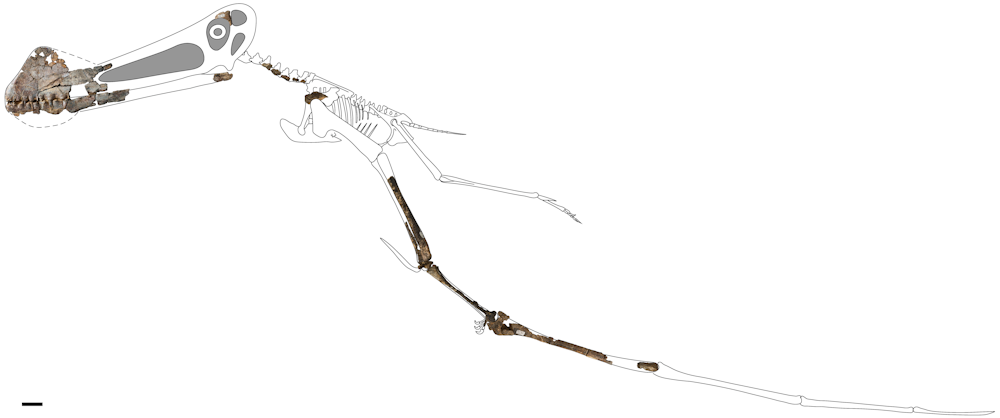
The most significant pterosaur fossil ever discovered in Australia has been unearthed in the Winton area of central western Queensland.
The newly discovered species, which my colleagues and I have named Ferrodraco lentoni, had a wingspan of about 4 metres. It lived around 96 million years ago, and was surprisingly similar to other pterosaurs from England, suggesting that these huge flying reptiles could traverse the globe with relative ease.
Pterosaurs are quite rare in the fossil record, as their bones are hollow and the outer bone in most instances is only 1mm thick. Only 15 pterosaur specimens have ever been scientifically described from Australia, many of them incomplete.
Until recently, only two species of Australian pterosaur had been described: Mythunga camara and Aussiedraco molnari, both based on fossil skull fragments.
Although more complete fossils of similar pterosaurs are known from Brazil and China, until this discovery, our understanding of the pterosaurs that lived in Australia during the Cretaceous period was limited.
This particular individual represents a fully grown adult, based on the fusion seen in several bones. Judging by its wing bones and the dimensions of similar pterosaurs, Ferrodraco would have had a wingspan of about 4 metres, with a skull probably reaching 60cm in length. It is likely that it ate mainly fish.
The genus name Ferrodraco refers to the fact that this winged reptile was found preserved in ironstone. And the species name lentoni honours former Winton Shire mayor Graham “Butch” Lenton, in recognition of his service to the community. The Winton area has within recent decades produced several well-preserved dinosaur fossils.
Ferrodraco lived 96 million years ago, around lake and river systems surrounded by conifer forests. Based on other fossil evidence, this pterosaur shared its environment with several dinosaurs including the sauropods Diamantinasaurus and Savannasaurus, theropods such as Australovenator, ornithopods and ankylosaurs. Competing with Ferrodraco for fish in the freshwater river systems were crocodylomorphs (such as Isisfordia) and plesiosaurs.
Game-changer
The Ferrodraco specimen was discovered by Winton grazier Bob Elliott in April 2017 when he was spraying weedkiller along the banks of a creek on Belmont Station. It’s not the first major fossil find on Belmont Station – the unique sauropod dinosaur Savannasaurus elliottorum was discovered just 10km from the pterosaur site.
Unlike other fossil sites in the Winton area, the pterosaur remains were found in the banks of a creek and had likely been exposed to the elements for several years. One bone from the wing had even been kicked away from the main site by livestock travelling through the creek. Had the bones not been infiltrated by iron-rich fluids, which ultimately became ironstone, these precious fossils would have been lost to erosion many years ago.
Unlike many other fossils, the bones were covered by a thin layer of rock. This meant that Ferrodraco had an unusually quick journey (by palaeontological standards) from discovery to scientific publication.
Preparation of the specimen was finished within a week by preparator Ali Calvey. Even before the bones had been fully prepared, our team was able to make detailed observations and determine which family of pterosaurs this specimen belonged to.
Surprisingly, Ferrodraco shows closer ties with similarly aged pterosaurs from England than it does to those from South America. This suggests that these pterosaurs, collectively known as ornithocheirids, could easily fly across oceans and disperse between continents.
This idea has been put forward by other palaeontologists, but the dearth of material from Australia had made it difficult to verify until now.
Ferrodraco has changed the game in that regard, demonstrating that it was living at least as recently as its Northern Hemisphere ornithocheirid cousins. In fact, it might represent one of the geologically youngest ornithocheirids ever found. Although more work needs to be done to demonstrate this, Ferrodraco is nevertheless one of the most important pterosaur specimens ever found in Australia.
The next 13 months will see American politics completely dominated by the fate of Donald Trump. As the House of Representatives moves towards impeaching him, leading to a hearing which then moves to the Senate, the Democrats will be engaged in an increasingly bitter contest for the nomination to run against Trump in the November 2020 elections.
At this stage, it appears there are the numbers in the house for impeachment, which entails formally charging the president with “high crimes and misdemeanors”. Their indictment then moves to the Senate, which can remove the president by a two-thirds majority, in a hearing chaired by the chief justice.
Because 2020 is an election year, both sides will manage proceedings with an eye to the November poll. It is possible the house will vote before the end of the year: the decision to impeach Bill Clinton for lying under oath was made in the last three months of 1998.
Clinton was cleared by the Senate by the following February, so it is also possible the Senate will hold its own proceedings before most of the presidential primaries commence. It takes two-thirds of the Senate to remove a president from office, which has never happened.
While several Republican house representatives have expressed concern about the president’s behaviour, the overwhelming majority of Republican politicians are either supporting him or remaining silent.
Rather as Boris Johnston seems to have captured the British Conservative Party, so Trump has imposed himself on the Republicans. Those who three years ago assailed his unfitness for the presidency, such as Lindsey Graham and Ted Cruz, are now his loudest defenders. Meanwhile, several of his opponents are withdrawing from political office.
However, Senator Mitt Romney, Republican candidate for president in 2012, has indicated his disquiet, which is almost certainly shared by others. If the house uncovers more apparently illegal activity on Trump, and if public opinion seems to be turning against the president, there are several other senators who may follow, if only to preserve their own positions. Republican senators are facing re-election in states such as Colorado, Iowa, Maine and North Carolina, where they are increasingly vulnerable.
There is an odd historical parallel with the history of Senator Joe McCarthy, who led increasingly virulent anti-Communist crusades in the early 1950s and whose protégé, Roy Cohn, in turn influenced Trump.
Eventually, Republican senators turned on McCarthy, and censured but did not expel him. But this happened only once it was clear that public support for McCarthy was collapsing, which is so far not evident for Trump.
Faced with possible impeachment and loss of support, Richard Nixon resigned. It is difficult to see Trump doing this – it is more likely he will become even more irrational and vengeful as the process winds on. Right-wing media will echo the president’s claim that the impeachment hearings represent treason, with real danger of violent clashes between supporters and opponents of Trump.
For the Democrats, the best outcome would be a split within Republican ranks, which leaves Trump in office but weakened and vulnerable to a challenge for re-nomination. Removing Trump would place Vice President Mike Pence in office, and presumably ensured of nomination in 2020.
The dilemma for the Democrats is that the impeachment process will dominate the news cycle as they jockey for position going into next year’s long battle for the presidential nomination. Trump will use the allegations to focus attention on former Vice President Joe Biden, whose son’s business dealings in Ukraine triggered the impeachment inquiry.
Biden may hope this will allow him to emerge as the injured defender of political propriety, but he will be tarnished through guilt by association, and is likely to slip further in the polls. Biden represents some of the traditional working class and African American base of the Democratic Party, and how they react could determine the ultimate Democrat candidate.
At the moment, Elizabeth Warren challenges Biden’s lead in the polls, with Bernie Sanders the only other candidate consistently supported by more than 10% of Democrats. None of the others in a crowded field — 12 have qualified to take part in the next televised Democratic debate — have much support, and they will start to drop out once the primary season begins in February 2020.
If Biden continues to lose support, there is room for someone to emerge as the moderate front-runner, given that both Warren and Sanders represent the more radical instincts of the party. This is presumably why so many candidates are determined to continue campaigning, even when some of them rarely muster 2% in the polls.
Were Sanders’ current health problems to lead to his withdrawal most of his support would presumably switch to Warren. Predictions are risky, and my record is poor. But it is increasingly likely that the Democrats will nominate someone other than an old white man in 2020, betting on a figure like Barack Obama who can galvanise a bitterly divided nation and persuade people to turn out and vote.
Source: The Conversation (Au and NZ) – By Catherine Waldby, Professor and Director, Research School of Social Sciences, Australian National University
This is one of our occasional Essays in Health. It’s a long read. Enjoy!
I think they collected […] maybe, six eggs. I think we got four embryos out of that […] One was transferred and three were frozen. So, the fresh cycle didn’t work. Tried a frozen one, didn’t work. Went to try the third frozen and they told me that one didn’t survive unfreezing, so then we had one left and that didn’t work, so we had no embryos left. So we did a fresh egg cycle again, and they got even less this time […] So I was thinking this is all going to be wasting time. But […] I think they fertilised four eggs, and then there was only one viable one, which is my baby.
Many women and couples, encouraged by success stories and marketing, hope their years of unsuccessful attempts to conceive a child naturally are over, and fertility treatment will work.
Assisted reproductive technologies cover a range of procedures, including in vitro fertilisation or IVF. And they are big business. Australia’s fertility industry is estimated to generate revenues of A$550 million a year and A$630 million by 2022. Some of the biggest clinics are publicly listed companies.
Globally, the industry is estimated to be worth US$25 billion and is predicted to grow to US$41 billion by 2026.
But it’s easy to forget that before the business of IVF, human egg cells were just that — cells. Not an entity to be manipulated in the laboratory, not something to be bought or sold, not a valuable commodity that crosses international borders.
The story of how human eggs went from cells to valuable commodity starts in a unlikely place: the sex lives of farm animals. How far the commodification of human eggs will go is up to us, as a society, to decide.
From the 1920s, farmers used techniques like artificial insemination for their animal herds. And from the 1950s, scientists in the US, UK and Australia developed in vitro fertilisation techniques to harvest eggs from rabbits, mice, sheep and dogs, fertilise them in a laboratory, then implant the embryos into the uterus (womb).
The birth of healthy animals through these techniques reassured some doctors and scientists the approach could be adapted for humans.
But it took over 20 years of experiments and failed treatments, involving thousands of women, before the first IVF baby was born, Louise Brown, in 1978.
Louise Brown, the first IVF baby, made headlines around the world when she was born in 1978.
Eventually, the controversy died down. In 2017,a total of 14,882 babies were born in Australia through assisted fertility technology, including IVF.
Bought, sold, interstate and internationally
Since the early days of IVF, human eggs have become valuable commodities, but in many different ways.
Australia’s Medicare subsidises fertility treatments for couples diagnosed with medical infertility. But there are few public fertility clinics. So most people go to private clinics, at considerable expense.
At Australian private clinics in 2018, patients paid an average A$3,500-$5,000 per stimulated cycle (from hormone treatment to egg collection).
By the time you’ve added fees for anaesthesia, embryo storage and other costs, patients can spend tens of thousands of dollars if they have more than one cycle.
Then there’s the market for eggs. In some parts of the world, women who cannot conceive with their own eggs can buy someone else’s. This service is also used by gay or straight couples when engaging a surrogate.
If you live in California, New York, and many other states in the US, you can buy eggs from young women, usually students trying to pay for tuition or student debt, in your own state.
Usually a woman will ovulate one egg per menstrual cycle. But if she is donating eggs, she can take medication to produce several eggs at once.
A cycle of eggs costs US$6,000-$15,000 depending on the qualities of the egg provider and where the clinic is. If the donor is athletic, beautiful, musical and has good university grades, she may be able to command a higher price.
If you live in Australia, it is illegal to exchange money for eggs. However, eggs can be donated, in the same way that blood or kidneys are donated: as a gift. Donors may be compensated for direct expenses.
As egg donation is a difficult, time consuming medical procedure, few Australian women are prepared to donate them. In Australia in 2017, 983 cycles (from hormone stimulation to egg collection) were carried out on women prepared to give their eggs.
Then there’s the international market for eggs. This is when women and couples from more restrictive countries such as Australia, Germany or France, which prohibit egg purchase, can contact clinics overseas in countries that are less restrictive, like some states in the US, Spain and South Africa.
They can arrange to buy eggs from younger, more fertile, and generally poorer women, and have IVF in an overseas clinic. As couples travel to escape national regulation, there are no reliable estimates of the market value of this cross-border fertility travel.
Couples generally want a donor who resembles them, as they often don’t want others to know that their child is not their genetic offspring. So clinics specialise in matching patients’ looks and colouring (for instance, blue eyes, black hair, tall).
In some places, like California, patients can request a range of other qualities (a doctorate, for example), if they are prepared to pay for them.
The big freeze
Since about 2010, women have been encouraged to freeze their own eggs while young (and fertile) to thaw and use years later when their fertility would otherwise decline.
This “personal” or “social” egg freezing is different to freezing eggs for medical reasons, when women undergoing cancer treatment have their eggs frozen beforehand, as chemotherapy and radiotherapy can destroy egg fertility in even very young women and girls.
Women have been encouraged to freeze their eggs for personal or social reasons, rather than for medical ones. But it’s costly.from www.shutterstock.com
In Australia it is estimated to be around A$10,000. Women may be advised to have two or three cycles, depending on their age. The older they are, the less likely any individual egg will be fertile.
In Victoria in 2018, 2,411 women had frozen eggs in storage, and 134 cycles of IVF used previously frozen eggs.
A ‘smart, stylish career-girl move’
Egg freezing for personal or social reasons has become a popular topic in women’s magazines, like Vogue and Glamour, where the prospect is framed as a smart, stylish career-girl move.
In 2014, the media reported how Google, and other big technology and law firms, offered egg-freezing to its new female staff as part of their remuneration package.
In the US, where maternity leave is not mandatory, an egg freezing package means women can delay having children until their careers and finances are more established. The idea is they can use their frozen eggs in their 30s or 40s to conceive.
In a more recent development, egg freezing “boutiques” in the US are challenging the fertility clinic sector for what is seen as a more and more lucrative business.
The boutiques even offer fertility loans to younger clients, who lack the disposable income of their older ones.
Clients go into debt for frozen eggs they may never use. We can see how 20-something women could readily end up with student loans and egg freezing debts, making it even harder for them to become financially independent.
It’s unclear whether boutique private egg freezing clinics could be set up in Australia.
No wonder women need help conceiving
For many women, by the time they finish university education, establish their careers, find a partner and create a stable household before they can consider children, time has marched on.
As housing becomes less affordable, people are studying for longer and the demands of the workplace escalate, it becomes more and more difficult for women to have children when their eggs are fertile, during their 20s or early 30s.
As more women choose later childbearing, they look to fertility clinics and egg freezing as a way to manage their dwindling fertility.
However, once they start treatment, women rapidly discover no medical procedure can compensate for declining fertility of their own eggs. IVF can produce more eggs in a cycle than women routinely produce via normal ovulation (that is, one). However, it cannot make eggs themselves more fertile.
We know that women’s fertility declines after the mid-thirties. So IVF success rates drop rapidly by the age of 40, and by 45, conception with women’s own eggs is very rare.
As eggs become more and more precious, women will pay well, if they can, to preserve and manage them. If that’s not possible in their home country or state, the hunt for eggs can take them overseas or interstate, again for a price.
More public fertility clinics, as recommended by a recent Victorian report, might change the landscape. The same report recommended a public sperm and egg bank.
Such moves might give women access to evidence-based treatments without running up huge bills. It might provide fertility preservation services that are less likely to send clients into debt and less likely to be driven by the need to pay dividends to shareholders or return profits on private equity. A public egg bank might also encourage altruistic egg donation, although the demanding nature of such donation will always remain.
However, the very best way to decommodify eggs, would be to have social policy that supports women who want children to conceive before their fertility declines. More generous and extended maternity leave would be a good start.
American farmer and poet Wendell Berry said of the first Europeans in North America that they came with vision, but not with sight. They came with vision of former places but not the sight to see what was before them. Instead of adapting their vision to suit the place, they changed the landscape to fit their vision.
The same can be said of the first Europeans in Australia. They modified the landscape to suit their domesticated plants and animals. They sowed seeds to create pasture for sheep and cattle and opened up areas to cultivate crops brought from the northern hemisphere.
This eye for the open parts of the Australian landscapes likely contributed to a view that Aboriginal people, too, almost exclusively preferred open vegetation types such as woodland and grasslands.
But findings from our recently published study of archaeological records challenge this notion. They show that Aboriginal people also inhabited Tasmania’s forests, in particular wet sclerophyll forests.
It’s important to understand how people used, affected and related to the natural environment. The way Tasmanian Aboriginal people hunted, gathered and used fire had a major influence on the structure, function and distribution of today’s plant and animal communities. This has big implications for conservation today.
The painting Group of Natives of Tasmania, 1859, by Robert Dowling.Wikimedia
In recent years, a series of books have examined Aboriginal land management over at least 50,000 years. Bill Gammage’s Biggest Estate on Earth, Billy Griffiths’ Deep Time Dreaming: Uncovering Ancient Australia, and Bruce Pascoe’s Dark Emu have all helped us read the country as a cultural landscape that Aboriginal people managed intensively – shaping it intelligently over tens of thousands of years through fire, law and seasonal use.
A valley near Hobart in Tasmania. From the book The Last of the Tasmanians’ (1870), by James Bonwick.
Gammage in particular emphasised Aboriginal people’s unvarying dependence on open vegetation sustained by frequent burning. Our findings question this dogma, which has prevailed for centuries.
Our research suggests imposed visions of former places – and the nostalgic license of colonial artists – had previously skewed our perception of preferred Aboriginal landscapes towards those that match a northern hemisphere ideal of human habitat, rooted in the theory of prospect and refuge.
Prospect refers to a view over open ground affording sight of game and forewarning of danger. Refuge refers to features offering safety such as easy-to-climb trees. The ideal combination of prospect and refuge is a view of water over closely cropped grass, framed by the horizontal branches of a mature tree. This ideal dominates real estate advertising to this day.
What we found will surprise you
Our study used archaeological data in an ecological model to identify habitats most likely occupied by Aboriginal people in Tasmania during the Holocene – the last 10,000 years of the Earth’s history following the end of the last ice age.
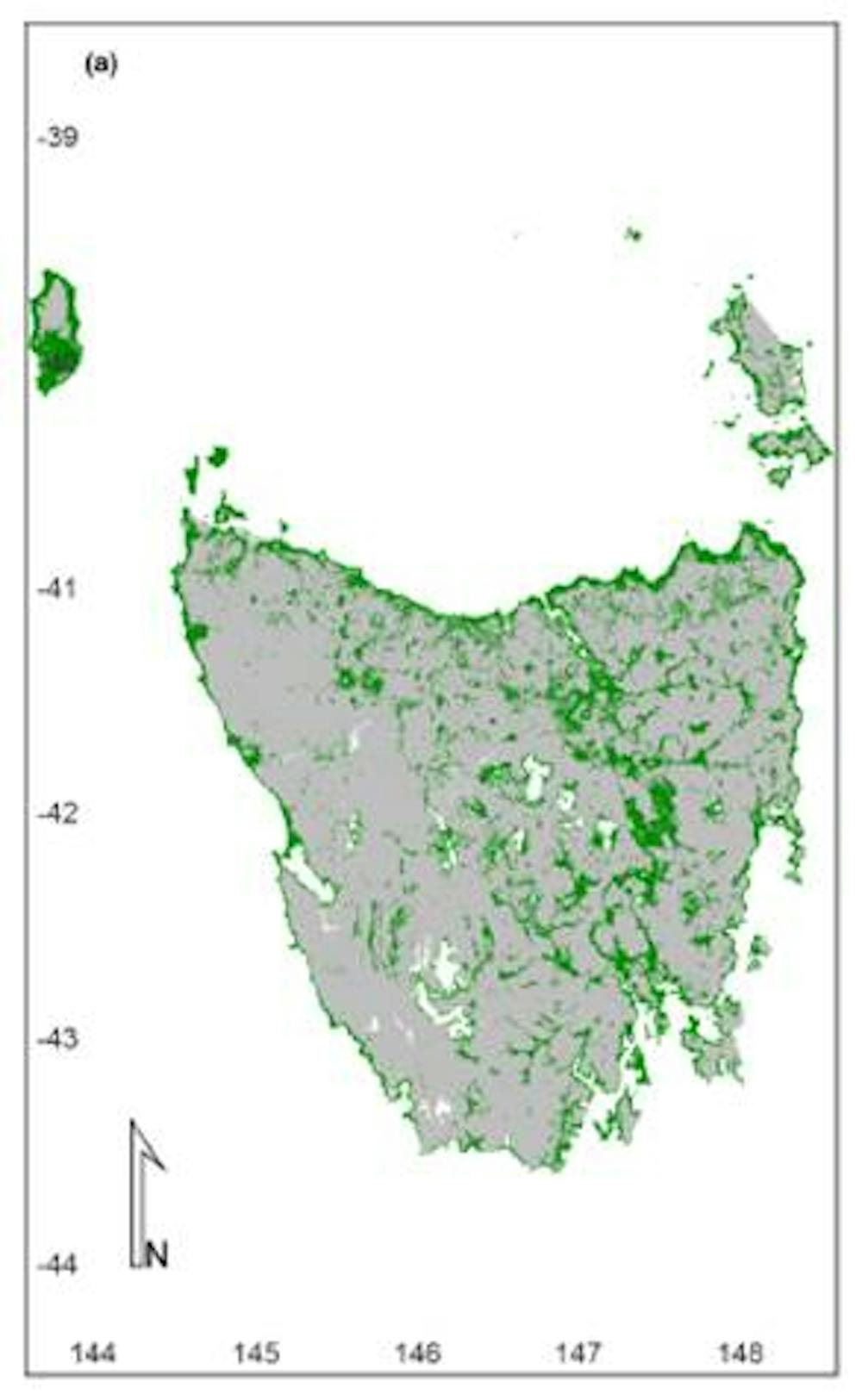
The model identified the environmental characteristics of 8,000 artefact sites in the Tasmanian Aboriginal Heritage Register, including features such as altitude, slope, aspect, soil type, pre-1750 vegetation, distance to the coast and distance to fresh water. We then mapped all parts of the island that shared the environmental characteristics associated with artefact sites.
Where Tasmanian Aboriginal people probably spent most of their time over the last 10,000 years based on environmental features associated with over 8,000 artefact sites.https://onlinelibrary.wiley.com/doi/full/10.1111/jbi.13684
The spread of artefacts showed us that while Tasmanian Aboriginal people occupied every type of habitat, they targeted coastal areas around the whole island, and drier, less steep, environments of the central lowlands.
Few archaeological materials from the last 10,000 years of the Holocene have been found in the wet, rugged western interior. However archaeological materials from the preceding Pleistocene period indicates the western interior was more intensively occupied during the last ice age.
The most important finding of our analysis, however, is that physical aspects of landscape proved to be stronger predictors of Tasmanian Aboriginal occupation than vegetation type. The strongest predictors proved to be flat ground, clay soil as an indicator of fertility, low altitude, proximity to the coast and proximity to inland waters. In particular, our results indicate Holocene Tasmanian Aboriginal people exploited wet eucalypt forests as much as open vegetation types.
Why these findings matter
This result points to a more complex and interesting relationship between Tasmanian Aboriginal people and forests, such as if and how frequently fire was used in these environments.
Fishery of the Wild People of Van Diemen’s Land, probably by artist Friedrich Wilhelm Goedsche (1785-1863)
More archaeological surveys, particularly in the Tasmanian Wilderness World Heritage Area, are needed to test whether our analysis is a true reflection of Aboriginal resource use. An upside to the recent bushfires in Tasmania is that such surveys are more easily carried out in burnt environments. So we have a perfect opportunity to discover more about how Aboriginal people shaped their island home.
Our research contributes to restoring Tasmania’s cultural heritage, reclaiming the history of the island and dispelling the myth of the nomad. All of this supports Tasmanian Aboriginal and non‐Aboriginal people in working towards culturally sensitive conservation and land management.
The impacts of climate change on weather, sea levels, food and water supplies should be seen as an investment opportunity for our cities, says global investment banking firm Goldman Sachs.
In a report out last month the bank says cities need to adapt to become more resilient to climate change and this could “drive one of the largest infrastructure build-outs in history”.
The bank says cities will be on the frontline of any need to adapt because they are home to more than half the world’s population and generate roughly 80% of global GDP.
The report comes at a time when scepticism and wait-and-see approaches are still permeating the debate on climate action globally. The discussion on reducing emissions is dogged by disagreement on targets and actions to be undertaken.
On the contrary, less emphasis has been placed on adapting to global warming, the consequences of which will play out for decades to come even if we meet the goals of the Intergovernmental Panel on Climate Change (IPCC).
Goldman Sachs has already said it acknowledges the scientific consensus that climate change is a reality and human activities are responsible for increasing concentrations of greenhouse gases in Earth’s atmosphere.
Much global attention has focused so far on the need for climate change mitigation and the reduction of CO₂ emissions. But the bank’s latest report addresses the urban adaptation strategies that are urgently required:
Greater resilience will likely require extensive urban planning, with investments in coastal protections, climate-resilient construction, more robust infrastructure, upgraded water and waste-management systems, energy resilience and stronger communications and transportation systems.
It acknowledges mitigation measures are essential to reduce global temperature in the medium and long term. But it argues we need to act immediately to minimise the current and future effects of climate change in urban areas.
The question is, why would a bank would endorse such a vision?
Banking on climate change
The bank’s report is a collection of data and analysis on climate change from well-known sources, such as the IPCC, and a detailed list of expected impacts on cities.
For example, higher temperatures, more frequent and intense storms, and rising sea levels could affect economic activity, damage infrastructure and harm vulnerable residents.
Does the report represent a last call to brace for impact? Or is a more nuanced and somehow optimistic view of the process emerging?
In reality, it’s not surprising this call is coming from an international financial institution such as Golden Sachs. This report needs be read in parallel with the environmental policy framework of the bank which is its “commitment to addressing critical environmental issues”.
The latest report identifies urban adaptation responses and initiatives as market solutions and financial opportunities. It clearly points out where investments should be addressed.
The directions outlined range over infrastructural initiatives to measures that require financial investment. Our cities need better coastal protection, more resilient buildings and open spaces, sustainable water and waste management, and upgraded transport systems.
A call for action
There is a positive takeaway emerging from the bank’s viewpoint which is a pragmatic call for action.
This could reinstate a more optimistic view of climate change. It could overcome the wait-and-see approach by moving the discussions beyond mitigation only.
And the report has the merit to outline some major challenges emerging from the need of financing a comprehensive urban adaptation.
First, the need for innovative sources of financing and new ways to support climatic transition.
Secondly, the need to look at equity issues emerging from an adaptation process. For example, should a city strengthen flood defences in the CBD or should it upgrade public housing in flood-prone areas? Given the scale of the aims we need to evaluate carefully where best to invest the limited resources available.
But in this respect, no solutions are proposed.
This report is one of the many financial reports on climate change we have seen recently, about the risks and opportunities for the banking and insurance system. It’s probably the first to acknowledge clearly the need for comprehensive adaptation investments to make our cities more resilient.
But in concentrating on the infrastructure needs for cities, the report seems to miss the big picture.
There is still a need to understand how more integrated actions will include the social and environmental dimensions of adapting to climate change to create more sustainable and equitable cities.
With the Reserve Bank of Australia cutting official rates to 0.75% on Tuesday, has been a wave of commentary about the move doing little to help the economy apart from boosting housing prices.
There are two parts to assessing this claim. First, do rate cuts drive up property prices? Second, is that all they do?
Do rate cuts drive up property prices?
Economists have a precise answer to this question, and also a more practical one.
The precise answer is that all assets – stocks, bonds, property, stamps, vintage baseball cards, you name it – can be priced using what is known as the stochastic discount factor (SDF).
This says that in pricing an asset you should factor in all the future cash flows the asset will generate (rent or dividends or capital gains) and then translate those returns into today’s money, adjusting for the riskiness of those cash flows.
An easier way to think about how rate cuts might affect property prices – consistent with the asset-pricing approach – goes like this.
People look at how much money they can borrow based on what they can afford to pay back. An interest rate cut boosts their borrowing power.
Even though the major banks have only passed on about half of the Reserve Bank’s latest cut (owner-occupied mortgage rates have been cut by 13-15 basis points), that’s enough to give a household with income of $150,000 about another $12,000 to $14,000 in borrowing power.
They thus spend more and, because there is a limited supply of properties, this pushes prices up. So, yes, lower interest rates do tend to boost property prices.
Is that all rate cuts do?
But boosting property prices is not all that rate cuts do.
Higher prices for new dwellings help developers. They often lead to an increase in construction jobs as developers anticipate better conditions for selling properties. New property construction has a number of other effects, too, such as changing the average quality of the rental stock and spurring more retail spending (because those new homes need to be furnished).
Perhaps even more important is the pseudo-psychological effect of existing home owners feeling wealthier when house prices go up. This can lead to increased consumer spending – and this can have a big economic effect, given consumer spending accounts for about 60% of GDP.
This “wealth effect”, rational or not, seems to be real. It is part of the reason the Reserve Bank’s governnor, Philip Lowe, appeared to be concerned about Sydney and Melbourne house prices falling in the past couple of years. It is also why federal treasurer Josh Frydenberg is happy to see property prices again on the rise.
Finally, lower interest rates do make business investment cheaper.
Would corporate tax cuts provide a bigger boost to investment? You bet. Are there diminishing returns to rate cuts as the cash rate approaches zero? That’s very likely to be the case.
But would businesses invest more if rates were two percentage points higher? No way. And would business like rates to be higher? I seriously doubt it.
Rate cuts do something to drive down unemployment, drive up consumer prices, and boost investment generally.
Are rate-cut driven prices increases bad?
But they certainly do also drive up residential property prices.
The important question is whether that’s bad or not. The answer to this question is a little murkier.
Let’s start with the fact borrowers should be thinking about how much to borrow.
If they borrow too much and are unable to repay their loans, that’s very bad news for them. Defaulting on a mortgage is a wrenching experience. Most people try hard to avoid that.
That said, sometimes people make poor choices through lack of information, lack of thought or lack of willpower. Occasionally an unscrupulous third party will encourage them to borrow more than they should.
But it’s not in the interest of banks to make too many loans that don’t get repaid. If borrowers are the first line of defence again bad price increases, lenders are the second line of defence.
So property prices increasing a few percent on the back of the rate cuts is unlikely to be problem – though as the Reserve Bank governor is fond of saying, “time will tell”.
She would go on to receive seven perfect tens over the course of the 1976 games.
Nadia Comăneci, here in competition at the 1976 Olympics, became the face of gymnastics.Wikimedia Commons
Comăneci became an icon for the sport, and the image of a young, lithe girl, has endured.
Even through the loss of the perfect ten and the introduction of open scoring – favouring strength and power – women’s gymnastics is still too often dismissed as a sport of frivolity, dominated by children, meek and prepubescent, discouraged from expressing themselves.
Simone Biles – a confident, powerful woman at the peak of her powers in her early 20s – is a change to gymnastics that was inevitable, but is simultaneously one she has come to symbolise.
She is both the greatest gymnast ever, and unlike any gymnast the world ever has seen.
A punishing gymnastics monarch
Comăneci had her run in ‘76 thanks to husband-and-wife coaching team Bela and Márta Károlyi. To understand the pair is to understand the image of the Olympic champion.
A young Béla Károlyi with gymnasts Teodora Ungureanu and Nadia Comăneci.Wikimedia Commons
Bela was a former boxing champion and member of the national hammer throwing team, later studying gymnastics while at the Romania College of Physical Education.
In his final year at the college he coached the women’s team, which included Márta. After starting their own class in the town where Bela grew up, they were invited to create a national school for gymnastics.
It was when he was training young girls, handpicked for the sport based on their specific body types, he first encountered six-year-old Comăneci.
The Karolyis produced outstanding athletes who seemingly achieved the impossible with focus and ease. In 1981, they defected to the United States, and continued their reign in a new country, building a gym in rural Texas they named Károlyi Ranch. By 1984, Bela had coached new Olympic champions in Mary Lou Retton and Julianne McNamara.
In 1999, Bela was appointed the national team coordinator; and the isolated Károlyi Ranch was designated as the US Women’s National Training Centre. For many years, this gym was a mythologised site of gymnast creation: it would later extensively figure into the sexual abuse trial of former national team doctor Larry Nassar.
The Károlyis had exacting – and often damaging – standards. Gymnasts felt compelled to train and compete with broken bones and other injuries. They divested from the diverse body shapes which once filled the sport for a perpetual state of prepubescence, maintained by punishing overtraining and disordered eating: 1996 Olympic champion Dominique Moceanu has said the athletes were restricted to 900 calories per day.
As hundreds of women would later say in victim impact statements against Nassar, this environment would not only create the “ideal” gymnastic body, but would also create demure girls taught to never talk back.
In 2008, Moceanu spoke about the abuse she had faced as a young gymnast – in 2018 she told Deadspin this decision to speak out had ruined her career.
Some of the Karolyis’ athletes have only praised them; others, like Betty Okino in Little Girls in Pretty Boxes, have argued the medals justified the means.
But under their reign from the 1980s until Martha’s retirement in 2016, the US women’s gymnastics team became a superpower.
Competing until they break
Gymnastics is a sport requiring strength and endurance to withstand the G-forces of landings onto the floor, a narrow bar, or thin mat. But it had come to favour bodies possessing neither. As a result, young bodies were pushed to breaking point – with athletes disappearing from the sport in their mid-teens.
Within three years of commencing her senior career, Retton won two American Cups, two American Classics, the all-around competition at the Olympics, and retired.
Within two years, Okino had won two National Championship medals, three at World Championships, contributed to the first American Olympic team victory in 1992, and retired.
In 2016, Laurie Hernandez made her senior debut, winning the City of Jesolo Trophy in Italy, gold for the team at the Pacific Rim Championships, four medals at the US Nationals, and a gold and a silver at the Olympics. She hasn’t competed since.
Countless others followed the same trajectory.
It remains a sport of youth. Olympic gold medallist Jordyn Wieber joined the elite level of the sport at 11, and at 13 she became the second youngest American Cup champion ever; her fellow 2012 gold Olympian, Kyla Ross was 12 when she beat more seasoned future teammates Aly Raisman and McKayla Maroney at the US Classic.
Biles bucked the trend from the beginning. When she was 13, she placed 44th in the pre-elite national championships.
In 2013, when they were both 15, Katelyn Ohashi won gold at the American Cup and Biles won silver. It would be Ohashi’s last elite competition.
It was also the last time anyone would ever beat Biles at the all-around event.
At the 2016 Olympics, Simone Biles walked away with five medals – four of them gold.Tatyana Zenkovick/EPA
At 19-years-old at the 2016 Rio Olympics, she was already considered old for the sport. She collected five medals – four of them gold.
It was a performance of a lifetime.
A new mould of gymnast
Watching Biles is the opposite to watching Comăneci.
Like the Romanian, she stands under five feet at 142 centimetres – diminutive when compared to many other athletes.
However, Biles has something the 1976 champion did not – explosive strength. She is, as Deadspin describes her, a “power gymnast” who “racked up difficulty on beam using tumbling skills instead of dance elements”.
Comăneci was a consummate performer, but frequently displayed a sense of apprehension, as though liable to snap from a bad landing: a body not built to withstand the force demanded of it.
But Biles competes with the muscle mass and power of male athletes, performing with toned quads, pectorals, and triceps. Her skills defy gravity, going beyond what was thought to be possible in the sport.
Frequently possessing so much energy she bounces out of bounds even after a long pass, she gives a feeling of boundless possibility.
In gymnastics, a new skill becomes named after the first athlete to perform it at an intentional competition. “The Biles” on floor is two flips and half a twist, in a laid-out position, backwards.
At the 2019 World Championships, we will likely have the Biles II: three twists and two flips. Watching footage of this pre-championships, you get the sense she needs to add at least another twist.
But she is not only a revelation in her difficult skills. Her candour – playfulness, jazzy artistry, and irresistible entertainment value – is refreshing, a departure from the strait-laced discipline viewers had become accustomed to, freely incorporating Latin-inspired beats and choreography.
The racism Biles has faced is often disguised as critiques not of her, but of her athleticism and performance. In 2013 David Ciaralli, the Italian Gymnastics Federation’s spokesperson, wrote on Facebook:
the Code of Points is opening chances for coloured people (known to be more powerful) and penalising the typical Eastern European elegance, which, when gymnastics was more artistic and less acrobatic, allowed Russia and Romania to dominate the field.
As recent as this past August, former US National coordinator Valeri Liukin said:
In the Code of Points, difficulty is very valued now. Of course, this suits African Americans. They’re very explosive – look at the NBA, who’s playing and jumping there?
Showing the difficulty
The child prodigies of the sport once telegraphed an air of effortlessness: a confidence and ease that presented tumbling across an inches-wide bar as little more than frivolity in the playground.
But as Biles constantly pushes higher difficulty, she also performs with the gravitas of effort. Despite her ability to turn an exhausting tumbling pass and still be left with energy to burn, she exudes difficulty.
Biles hasn’t been beaten in an all-around competition since 2013.Robert Perry/EPA
After close to a decade in the training cycle of elite gymnastics – a lengthy tenure in a world of quick rises and falls – her body is likely growing tired from repetitive pounding, regardless of deft pacing.
But there’s another difference to Biles that has become more pronounced with the passing of time: her personality.
Just as the sport was previously a place for girls’ bodies, the athletes were expected be softly spoken with childlike politeness.
But Biles is brave and outspoken.
When Mary Bono was appointed CEO of USA gymnastics in 2018, she lasted three days after Biles publicly called her out for racism against black athletes.
In the wake of the Nassar sexual abuse scandal embroiling peak body USA Gymnastics, Biles has been a rare and consistent voice from a current elite athlete – vocal at competitions and on social media as more failings of accountability and athlete welfare emerge, wisened and hardened with each new revelation.
“You had one job,” she said in August.
You literally had one job and you couldn’t protect us, and it is just really sad because now every time I go to the doctor or training, I get worked on. I don’t want to get worked on, but my body hurts, I’m 22 and at the end of the day that’s my fifth rotation and I have to go to therapy.
In January 2018, as Nassar was being sentenced, Biles tweeted a statement about the trauma she associated with the Károlyi Ranch:
It breaks my heart even more to think that, as I work towards my dream of competing in Tokyo 2020, I will have to continually return to the same training facility where I was abused.
This would not eventuate. Thanks to Biles’ criticism, USA Gymnastics ended its nearly four-decade relationship with the Károlyi Ranch.
The end of an era
Biles has declared the 2020 Olympics will be her last meet.
“I feel like my body’s gone through a lot and it’s kind of just falling apart – not that you can actually tell but I really feel it a lot of the time,” she said in London last year.
If only measuring her career with the hardware she has collected, it would be remarkable – even now, as she goes into the preliminary rounds of the 2019 World Championships in Stuttgart, Germany, she stands with the most all-around titles in the history of the competition – and the most decorated American gymnast of all time.
Simon Biles’ first medal at the 2016 Olympics was in the team competition – she would go on to win three more golds and four more medals.How Hwee Young/EPA
But the way Biles has shaped the sport with her displays of strength – as an athlete and as an advocate – will arguably be the biggest mark she leaves on the sport.
Biles is a far cry from Comăneci and the diminutive gymnasts of the 70s. But the world of gymnastics is also changing around her.
Internationally, she’s far from the oldest current competitor – in recent years, smaller programs have nurtured more and more experienced athletes through their 20s, 30s, and beyond in the name of retaining top talent.
Among others, at the 2019 Championships Biles will compete against the Netherlands’ Sanne Wevers (aged 28), Germany’s Kim Bui (30), Brazil’s Jade Barbosa (28), and longtime fan-favourite Aliya Mustafina (25) from Russia, who declared “it was easier to give birth than to restore inbars” when recommencing training as a new mother in 2017.
Also competing will be Oksana Chusovitina – 44 years old, in her 17th World Championships, and still one of the best vaulters in the world.
Biles heads into the 2019 World Gymnastics Championships as firm favourite. She is 22, and at the peak of her powers. By this time next year, we will have seen her perform for the final time, undoubtedly having added a new clutch of medals to her collection and leaving more eponymous skills behind.
It’s difficult to predict who will follow in her footsteps, but she’ll leave behind a legacy to be felt for years to come: a trend of women staying in the sport longer, training smarter, and owning their strength as athletes, and as women.
Diversity in race and physique among elite gymnastics is becoming increasingly common. It’s a far cry from decades ago – the US didn’t have Luci Collins, its first African-American Olympic gymnast, until 1980.
For the spectators, the sport is perhaps now less about the artistry of gymnastics, and more about gymnastics as a sport of agility and strength.
Today, 43 years after Comăneci became the face of gymnastics, the sport has a new image.
Prime Minister Scott Morrison has foreshadowed his government will have Australia play a more active role in seeking to set global standards.
Delivering the Lowy Lecture on Thursday night, Morrison said Australia “cannot afford to leave it to others to set the standards that will shape our global economy”.
He has asked the foreign affairs department for an audit of global institutions and rule-making processes where Australia had the greatest stake, and he plans to tap Australian expertise in expanding its role.
Morrison’s initiative, which follows his recent United States trip and his criticisms during it of China’s behaviour on trade, has particularly in mind the World Trade Organisation which is seen to need reform.
In comments that seemed to have an eye to Brexit and Donald Trump’s recent comments lauding patriotism over globalism, Morrison said that “Australia does and must always seek to have a responsible and participative international agency in addressing global issues.” He dubbed this “practical globalism”.
Australia was not served by isolationism and protectionism, he said. “But it also does not serve our national interests when international institutions demand conformity rather than independent cooperation on global issues.
“The world works best when the character and distinctiveness of independent nations is preserved within a framework of mutual respect. This includes respecting electoral mandates of their constituencies.
“We should avoid any reflex towards a negative globalism that coercively seeks to impose a mandate from an often ill defined borderless global community. And worse still, an unaccountable internationalist bureaucracy. Globalism must facilitate, align and engage, rather than direct and centralise. As such an approach can corrode support for joint international action.
“Only a national government, especially one accountable through the ballot box and the rule of law, can define its national interests,” he said. “And under my leadership Australia’s international engagement will be squarely driven by Australia’s national interests.”
The Prime Minister sought to put a positive spin on his comments in the US last week about China as a “newly developed” economy – which the Chinese contest.
“China has in many ways changed the world, so we would expect the terms of its engagement to change too. That’s why when we look at negotiating rules of the future of the global economy, for example, we would expect China’s obligations to reflect its greater power status.
“This is a compliment, not a criticism.
“And that is what I mean when describing China as a newly developed economy.
“The rules and institutions that support global cooperation must reflect the modern world. It can’t be set and forget,” he said.
Morrison told his audience that his passions had always been for domestic politics – he did not naturally seek out international platforms. But as prime minister he had to be directed by Australia’s national interest.
He said he would be visiting India in January and also Japan early next year. This follows a busy international schedule in 2019.
In this age of celebrity, Jacqui Lambie fits the narrative to a tee in the political sphere. She’s a rough-talking woman with a struggle-town back story who has landed centre stage because she has a lot of power – and sometimes the crucial vote – on contested issues in the Senate.
You get the impression Lambie loves both the drama and the influence. She revelled in getting the government to deliver big money to obtain her vote on the tax relief legislation. With chutzpah, she later lamented coming cheap.
But soon Lambie will face a decision with more complexities than tax cuts, affecting relatively few lives but those lives in a huge way. As things stand she’ll be the determining vote on the legislation to repeal medevac, the law that facilitates medical transfers from Papua New Guinea and Nauru.
Lambie, everyone says, is “keeping her cards close to her chest”.
Meanwhile, behind the scenes a race is on to get as many people as possible with medical needs to Australia ahead of the vote, in case the government wins Lambie’s support.
A Senate inquiry on the repeal legislation is due to report on October 18. The government could try to push through its bill in the week of October 21-24.
Those pursuing transfers on behalf of applicants claim the government is attempting to “run down the clock”, dragging out the transfers where it can.
The number of people offshore is now relatively small, after 632 have departed to the United States (with another 263 going through the approval process) and more than 1000 transfers, including accompany family members, to Australia over the years (these mostly not under the new legislation).
According to government figures as of Thursday, there are 281 people in Papua New Guinea (including refugees, non-refugees and some that are still being processed) and 279 in Nauru.
In relation to medevac, the government says there have been 283 notifications for medical transfer, with 127 transferred, 23 in the process of transfer and “numerous others” engaged at various levels. It says the minister has refused 54 cases for transfer and the Independent Health Advisory Panel (IHAP) agreed with the refusal.
The Asylum Seeker Resource Centre (which is a member of the Medical Evacuation Response Group set up to manage transfer requests under the medevac law), operating on slightly different figures – its numbers were as of September 29 – says the minister had given approval in 133 cases, while in 15 cases, the minister had been overridden by the IHAP. Refusals had numbered 39, ASRC says.
It says some 79% of all medevac applications that had been determined won approval. In 71% of cases decided, the minister approved the application in the first instance.
The medevac legislation passed when the Coalition was in minority at the end of the last parliamentary term. The government at the time warned of dire consequences, including that rapists and paedophiles would get to Australia.
It re-opened Christmas Island and said transferees would be sent there. No one has been. (Only the Tamil family is there. That family has lived in Australia for years but has failed in its bids for refugee status and will be deported if it loses its current court case.)
The government insisted medevac would trigger a reopening of the people smuggling trade. That hasn’t happened, and the several boats (not a flotilla) that have set out in recent months have been intercepted by the efficient turnback operation. Any “pull” factor is also offset by the medevac law only applying to people who came before it passed.
Is medevac a way of clearing everyone from PNG and Nauru by the backdoor? No and yes. Not directly, because people have to be demonstrably ill. But after so many years, most of these people are or will be sick, mainly though not entirely with mental illnesses. Which of us would not be, in their circumstances?
Given there is not evidence medevac has compromised border security since its passage early this year, the government’s quest to repeal the legislation seems driven by anger (that it was imposed on it by Labor and the crossbench), ideology and politics.
If it were looking at the matter strictly logically, surely it would reason that the remaining people offshore present, in policy terms, what the political scientists call a “wicked problem” which medevac is helping solve.
These people can’t stay where they are for ever (and should not have been there anything like this long). More have been transferred to Australia than are now offshore. People who’ve been brought here under medevac remain in detention facilities (various places can be designated a detention facility) at the discretion of the minister.
If the medevac law helps end the offshore issue, isn’t this an upside for Australia without a demonstrable downside? That’s just putting things in crude policy cost-benefit terms. Behind this, of course, lies the compelling humanitarian case.
In the end, everyone waits on Lambie. The government is in her ear. So are those wanting medevac preserved. Her office says she is still taking “soundings”, although there has been a long time to get across the arguments, which aren’t particularly complicated. The Senate inquiry, chaired by the government, can be expected to come down on party lines, rather than adding much new.
Gross horse trading is now a feature of dealing with legislation in the Senate. While sometimes the Senate acts as a genuine house of review, at others it seems the proportional representation voting system, which has delivered so much clout to crossbenchers representing relatively few voters, has a lot to answer for.
No doubt the government would be willing to put a feast on Lambie’s table to get a win on what has become this totemic issue for it.
But this is a piece of legislation on which Lambie should not contemplate any deals, whether in response to carrots for Tasmania or anything else the government might hold out or she might want.
The key crossbencher’s decision should involve only judgements about morality, the medical needs and future lives of vulnerable people, and border security. On those criteria how she should vote seems pretty clear, even while she keeps everyone guessing how she will vote.
Research Checks interrogate newly published studies and how they’re reported in the media. The analysis is undertaken by one or more academics not involved with the study, and reviewed by another, to make sure it’s accurate.
Judging by some media headlines this week, you’d be forgiven for thinking researchers, clinicians and the Australian Dietary Guidelines have it all wrong when it comes to eating red and processed meat:
But that’s not the case.
The World Cancer Research Fund continuously evaluates the evidence. To reduce your risk of bowel cancer they advise limiting your weekly intake of unprocessed cooked red meat to 350-500g. For processed meat, the advice is to eat little, if any at all.
This is consistent with advice in the Australian Dietary Guidelines to reduce risk of chronic diseases such as heart disease, type 2 diabetes and some cancers.
So, why all the headlines?
This week’s coverage comes from four systematic reviews published in the journal Annals of Internal Medicine. The four reviews looked at the risk of heart disease, type 2 diabetes, some cancers and death (during the follow-up period) among those with the highest versus lowest intakes of red and processed meats.
The authors also published recommendations advising that people shouldn’t change their meat eating habits, implying they shouldn’t cut back on meat. This is in direct opposition to national and international guidelines.
Let’s take a closer look at what the evidence says and how the authors got to their conclusions.
This systematic review of 105 existing studies looked at associations between low and high intakes of red and processed meat combined, rates of death during the study follow-up, and getting heart disease, diabetes and cancer.
When the authors pooled data from all studies, they found lower intakes of red and processed meats were associated with significantly lower relative risks of many conditions, although absolute risks were small.
Relative risk compares disease rates in one group (high meat eaters) to another group (lower meat eaters), while absolute risk takes into account how common the disease or likelihood of dying from the condition is in the first place.
Compared to people who ate the most red and processed meat, people with lowest intakes were:
This review examined the relationship between intake of red and processed meat, and cancer incidence and death. It included 118 studies from 56 groups of people.
This review looked at the data in a slightly different way. Risk was assessed based on reducing intakes of meat to three serves per week. This level of intake was set based on the authors’ conclusion that people weren’t likely to reduce their intakes below this level. However, it’s unclear exactly how much meat those with “high intakes” consumed.
The results indicated that lower intakes of red meat were associated with a 7% lower risk of death from any cause compared to those with higher intakes. For processed meat, there was an 8% lower risk of dying from any type of cancer and a 23% lower risk of dying from prostate cancer.
Review 3: heart disease, stroke, type 2 diabetes
This systematic review examined the association between red and processed meat, and a lower life-expectancy, heart disease, stroke and type 2 diabetes. There were 61 studies on 55 cohorts of people.
This review also looked at health risk, with the lowest-intake group consuming three serves a week.
For a lower intake of red meat, there was a 7% lower relative risk of death from any cause, a 10% lower risk of dying from heart disease, a 6% lower risk of stroke, a 7% lower risk for having a heart attack, and a 10% lower risk for developing type 2 diabetes.
For processed meat, a lower intake was associated with an 8% lower risk of dying from any cause, a 10% lower risk for dying of heart disease, a 6% lower for having a stroke, a 6% lower risk of having a heart attack, and a 22% lower risk for developing type 2 diabetes.
Review 4: low vs high intake in randomised trials
This review evaluated the impact of lower – versus higher – red meat intakes on the incidence of heart disease, stroke, diabetes and cancer outcomes in 12 randomised trials.
Randomised trials are a type of study where one group is given a treatment or intervention at random; the other group is given a different or no intervention, or given usual medical care or advice.
While the researchers identified 12 eligible trials, they were so varied – ranging from having just 32 participants followed for one year, up to over 48,000 women followed over eight years – that it makes the review results almost meaningless.
The recommendation ended up being predominantly based on that one large trial – of postmenopausal women advised to follow a low-fat diet. The authors found no difference in health outcomes when they compared the combined red and processed meat intakes of women in the low-fat group compared to the usual-care group.
First, red and processed meat were not consistently separated out across the reviews. This is a problem because research shows processed meats increase the risk of health problems from very low intakes. For red meat, health risks don’t increase until a certain threshold. That’s why red and processed meat cannot be considered the same food group.
Second, the researchers decided to exclude cohort studies (where participants are observed over time without any specific intervention) with fewer than 1,000 participants. This means some fairly large studies will have been excluded, which could alter the results.
Third, when talking about a small reduction in absolute risk, the researchers don’t acknowledge the potential impact at the population level.
In these studies, the difference in the actual number of diagnosed diseases or deaths was relative small between those with the lowest meat intakes compared to the highest. This difference ranged from three fewer people per 1,000 people having a stroke, to 15 fewer per 1,000 people dying from any cause.
But a small reduction in disease at the population level can translate to thousands of people not experiencing a particular health condition over time.
Finally, the authors don’t present full diagrams, called Forrest Plots, to allow us to see how much individual studies influence the overall results. This would show whether the studies are all having about the same effect, or if the results are due to just one or two particular studies.
The researchers used an extremely stringent approach to evaluate the quality of the evidence. This led to authors downgrading every outcome to a “low” or “very low” certainty of evidence.
Based on their assessment of the evidence, the authors advised adults to continue their current unprocessed meat and processed meat intakes, which they termed as a “weak recommendation” with “low certainty evidence”.
While the authors question the validity of observational cohort studies, the reality is that long-term randomised controlled trials would be impossible, and unethical to conduct. You can’t assign large numbers of people to a lifetime diet high in processed and red meat, versus a low meat diet, and then wait for ten to 20 years or more to see what diseases they get and what they die from.
Poor diets are a leading contributor to chronic disease and need to be addressed with preventative health policies. If all Australians ate like the current dietary guidelines, we could expect to see heart disease drop by 62%, as well as 41% less type 2 diabetes, 34% fewer strokes and 22% less bowel cancer. – Clare Collins
Blind peer review
This is a reasonable critique of these reviews and has picked up the fact that the methodology used to assess studies automatically graded the results from cohort trials as low or uncertain. This ignores the fact that large, long-term, well-conducted cohort studies involving over six million people have yielded valuable data on dietary patterns and health.
omitted some studies and rejected others such as the Lyon Heart Study because its results seemed to be too good to be true
excluded studies comparing vegetarian diets with those containing meat
ignored social, political and economic factors that influence food selection
ignored the fact that no diet can be judged on the basis of a single food.
Part of the recommendation was based on their paper which found that most meat-eaters were reluctant to eat less meat and doubted their ability to prepare meals without meat.
The self-appointed panel who did these the reviews did not agree on the conclusions, with three out of the 14 recommending a reduction in red and processed meat. Interestingly, only two of the 14 personally consumed more than the amount of red meat recommended in most dietary guidelines.
A previous paper by some of the same authors rejected guidelines that recommend consuming less sugar. On that occasion, four of the five authors declared funding during their study from the International Life Sciences Institute, a major lobby group for processed food companies. – Rosemary Stanton
After a chimpanzee named Flint recently lost his mother, renowned primatologist Dr Jane Goodall wrote:
the last short journey he made, pausing to rest every few feet, was to the very place where Flo’s body had lain. There he stayed for several hours, sometimes staring and staring into the water. He struggled on a little further, then curled up—and never moved again.
Dr Goodall’s anecdote of Flint’s grief illustrates the concept of animal sentience – that animals have their own subjective experiences and feelings, including positive feelings like happiness and pleasure, as well as negative feelings like pain and suffering.
In this respect, scientific research is clear that most animals are sentient. In particular, many animals are able to experience physical and psychological pain in a similar manner to humans.
A 59-year-old chimp’s emotional reaction to an old friend when he comes to visit.
In fact, the concept of animals’ sentience has become increasingly important and was recently enshrined in law in the Australian Capital Territory, an Australian first. Here’s what that means for animals, and for future legislation.
recognise that animals are sentient beings that are able to subjectively feel and perceive the world around them.
The Act will also recognise the “intrinsic value” of animals and impose a “duty of care” on people to ensure good animal welfare.
But while the legislation will acknowledge animal sentience, it’s really only likely to impact our pets. The term “animal” is defined in the legislation to broadly include vertebrates such as mammals (excluding human beings), birds, fish and reptiles.
However, the animal welfare offences created by the act don’t apply where the relevant conduct is in accordance with a code of practice. In other words, animal industry practices that might otherwise be considered animal cruelty are exempted from the requirements of the legislation.
The ACT is the first Australian jurisdiction to recognise animal sentience, but many other countries have already done so.
The European Union first recognised animal sentience in 1997 in the Treaty of Amsterdam. And it was recognised by New Zealand in 2015 in its Animal Welfare Act 1999, and by Quebec in a 2015 amendment to its Civil Code.
The international organisation World Animal Protection views animal sentience recognition as so important it’s the first indicator in its Animal Protection Index, which ranks 50 countries on the basis of their legal and policy commitments to animals.
Animals as property
For animals in Australia, legal recognition of their sentience is a small but important step forward because it indicates a shift in thinking about the relationships between humans and animals.
Although animals’ ability to feel emotions may seem self-evident, historically the law has categorised animals as property. In other words, a dog is no more a legal person than the bed she is lying on.
While recognising animal sentience does not mean animals are persons under the law, it does represent a shift away from categorising them as property.
A dog passes out from being overcome with joy seeing its owner.
Legally recognising animals as sentient is primarily a symbolic gesture. Nevertheless, this does not mean such recognition will have no real consequences.
Analysis of the European Union provision, for example, indicates it has played a role in assisting legislative interpretation and in motivating further legislative protections for animals.
And New Zealand jurisprudence suggests the purpose of the New Zealand Act, including recognition of animal sentience, will have some influence on interpretation of the Act’s provisions. This may also be the case with the ACT legislation.
Will other states follow the ACT?
It seems likely other Australian states will follow the ACT’s lead in this area. Both the ACT and Victoria have already recognised animal sentience in their policy, although the ACT amendments are the first time it will be recognised in Australian law.
In the Northern Territory, a number of submissions were made to the Social Policy Scrutiny Committee when undertaking an Inquiry into the Animal Protection Bill 2018 to legally recognise animal sentience.
Those making submissions in favour of legal recognition of animal sentience included the Animal Law Institute, RSPCA, Australian Veterinary Association and Lawyers for Animals. Ultimately, however, the committee declined to recommend recognition of animal sentience in the bill, because:
[the committee was] of the view that recognition of such is implicit in the Bill and does not need to be explicitly stated.
The committee’s view, unfortunately, overlooks the deeper meaning of recognising animal sentience. Anti-cruelty legislation tends to focus on preventing physical harm to animals. Acknowledging sentience, however, recognises that animals feel emotions too, which should be taken into account in regulating human conduct towards animals.
Still, following the ACT’s lead may be attractive given the view recognition is largely symbolic. It means states and territories would be able to boast of their animal welfare credentials without putting animal-related industries offside.
We can hope the international trend towards legal recognition of animal sentience is continued in other Australian states and territories. But what’s more important will be the extent to which the scientific consensus that most animals are sentient can actually change human relations with animals.
Corporate Australia is taking action on climate change. Most recently, at the UN Climate Summit, Atlassian cofounder Michael Cannon-Brookes announced the A$26 billion Australian software company’s commitment to net zero emissions by 2050.
Net zero pledges like this are becoming more common but currently there is no way to really track momentum towards net zero emissions across different sectors of the economy.
Now, a Net Zero Momentum Tracker initiative has been established by ClimateWorks Australia and the Monash Sustainable Development Institute to track emissions reduction commitments made by major Australian companies and organisations, as well as state and local governments.
The tracker aims to place all commitments to net zero emissions in Australia in one place and evaluate how well they align with the Paris climate goals.
Property sector tracking towards net zero emissions
We began by assessing Australia’s property sector. Last week we released a report examining all property companies listed in the ASX 200, plus all of those required to report their emissions under the National Greenhouse and Energy Reporting Act.
Among the companies we looked at are Dexus, Mirvac, Stockland Corporation, GPT Group, and Lendlease. They develop, own or manage some of Australia’s largest corporate offices, commercial properties, retail centres, retirement villages, and residential developments.
The report found almost half – 43% – of Australia’s largest listed property companies have made commitments that closely align with the Paris Climate Agreement, aiming to achieve net zero greenhouse emissions before 2050 for their owned and managed assets.
Significantly, the six companies with the most ambitious net zero targets represent 36% of the ASX 200 property sector. Among these six, several major companies – Dexus, Mirvac, GPT Group, and Vicinity – are aiming for net zero emissions by 2030, demonstrating the business case for strong climate action.
Sector leaders can inspire copycat action
By highlighting what action organisations are taking and how, the Net Zero Momentum Tracker initiative aims to encourage more organisations to make and strengthen commitments to reduce their emissions, in line with the goal of net zero emissions by 2050.
For example, Australia’s largest owner and manager of office property, Dexus, has a comprehensive strategy for reaching its goal of net zero emissions across the group’s managed property portfolio. This includes reducing energy use, shifting to renewable electricity, electrifying their buildings, and reducing their non-energy emissions from waste, waste water and air conditioning.
Of particular significance is Mirvac’s pledge to be “net positive” by 2030. This means the company aims to go beyond net zero, reducing emissions by more than its operations emit. Mirvac has established an energy company to install rooftop solar on their commercial buildings and is selling power to occupants, among other initiatives. The company also has a “house with no bills” pilot project, to explore how their upstream indirect emissions can be minimised for residential developments.
Another major company, the GPT Group, has extended its commitment beyond the assets it owns and manages to all buildings it has an ownership interest in, including buildings it co-owns or does not manage.
These companies will get multiple benefits from their action, including reduced operating costs, better health and productivity for occupants, and increased sales prices, rents and occupancy rates.
Need to accelerate action
While many property companies are tracking in the right direction, none of the companies we considered had net zero targets which comprehensively covered all of their emissions – such as those from co-owned assets, their supply chains and investments.
There is still significant opportunity for property companies to strengthen their commitments towards net zero emissions. This requires targets which address the full scope of direct and indirect emissions within each company’s influence, supported by detailed plans to achieve this.
By making these public commitments to reduce emissions, the property sector is helping build momentum towards achieving this goal across the entire Australian economy.
The next assessments to be undertaken by the Net Zero Momentum Tracker initiative include the banking sector and state and local governments.
For 74-year-old Teaga Esekia, a chief from the Tuvalu island of Vaitupu, the ocean is a lifeblood.
“Tuvaluans, they have different types of months, not like January to December,” said the elderly but agile man, who still climbs coconut trees every day.
“They have their seasons according to fish and planting. We tell the time by fish.”
Esekia was sitting at the edge of the lagoon on Tuvalu’s main island, Funafuti, where he had travelled for a medical appointment. As he sat beneath a tree, sheltering in the breeze from the harsh afternoon sun, he told of how that ocean has changed.
“Some of the common fish, they’re very hard to find now in Tuvalu. That’s a problem we’re facing nowadays.”
– Partner –
His people on Vaitupu also sustained themselves by planting pulaka, a type of swamp taro, which are grown in pits.
“I can see most of the pits are now not growing because if you taste the water there, it’s salt. When we were young, these pits were growing very well. Nowadays it’s very hard,” he said.
IPCC Report The changes seen by Esekia were starkly highlighted last week in the latest report from the Intergovernmental Panel on Climate Change (IPCC).
The report, which was written by more than 100 scientists and experts – including several from New Zealand, Australia and the Pacific – is based on more than 7000 scientific studies, providing one of the most comprehensive insights into the state of the oceans today.
It concluded that the oceans are heating at such a rate that their chemistry is being altered which, in turn, is threatening seafood supplies, fuelling more extreme cyclones and floods, and posing a profound threat to millions of people who live in low-lying areas.
For the Pacific Islands, it painted a grim picture.
“We already see in the Pacific these impacts,” said Helene Jacot des Combes, a scientist at the University of the South Pacific and adaptation advisor to the Marshall Islands government, who was one of the report’s contributing authors.
“It is true that all the changes in the ocean in terms of temperature, in terms of ocean acidification, will have a very important impact on the marine ecosystems and on the distribution of fish and other marine life,” she said. “We can already see some variation.”
‘Grim picture’ Jens Krüger, the manager for oceans affairs at the Secretariat of the Pacific Community, who was not involved with the IPCC report but is on the executive planning group for the UN Decade of Ocean Science, said the conclusions painted a grim picture: the effects would be most keenly felt in the Pacific.
“It really confirms that our ocean is at a breaking point. It’s getting hotter, sea levels are rising, the ocean is becoming more acidic, and of course all of this is happening as our planet heats up,” said Dr Krüger.
“For us in the Pacific, the report also highlights that all these changes, and the rate and the magnitude of the changes which are already being observed, are highest in our region.”
The oceans act as a crucial buffer against global warming, absorbing about a quarter of the carbon dioxide that’s emitted, as well as taking much of the excess heat that’s trapped in the Earth’s atmosphere. But the report says there’s so much that the oceans are becoming hotter and more acidic.
“These positive aspects of the ocean in the climate change is having a side effect in the ocean with the change in the chemistry, and that will have a lot of impact,” said Dr Jacot des Combes.
“For the Pacific, where people depend so much on the ocean, it’s very problematic.”
Ecosystems in disarray These warming waters are throwing marine ecosystems into disarray, the IPCC said, as habitats wither. The frequency of marine heat waves – which kill fish, sea birds and coral reefs – has doubled since the 1980s, it said, while many fish populations are migrating far from their usual locations – like Vaitupu, in Tuvalu, where Esekia has noticed a decline – as they try to find cooler waters.
Already, Dr Krüger said, this was being keenly felt in the Pacific. This year alone, severe coral bleaching events have whitened reefs in French Polynesia and Guam, and fears have grown about whether they’ll recover as bleaching events become more common.
Heatwaves in the ocean are expected to become 20 to 50 times more frequent this century, depending on how much emissions increase, the report said, with vibrant underwater ecosystems like coral reefs and kelp forest all expected to suffer serious damage.
“Warm water coral reefs, for us in the Pacific, that’s our major ecosystem,” said Dr Krüger. “The report confirms that we are actually creating a world that is incompatible with our way of life.”
In the Pacific, reefs are some of the main sources of food, income and defence. Their fish and plants provide sustenance for locals, and income from fish exports and tourism. They also act as a barrier, dissipating the force of waves as they charge towards vulnerable islands and atolls, especially as sea’s rise, which is another of the report’s conclusions.
Rising seas As ice sheets and glaciers melt, it said, ocean levels are being pushed up, making extreme flooding that was once rare become annual events.
That is already being seen in places like Kiribati and Marshall Islands, Dr Jacot des Combes said, where inundations were happening with increasing regularity.
Hotter ocean temperatures and rising sea levels also provide fuel for more destructive cyclones, which further imperil the coastal regions and low-lying states of the Pacific.
“We have seen that the number of category four and category five cyclones are increasing in the total number of annual cyclones,” said Dr Jacot des Combes.
While the report said the severity of the threats it outlined could be reduced if nations sharply cut their greenhouse gas emissions, it also pointed out that many countries would need to adapt to many changes that have now become unavoidable.
Dr Krüger said this included most Pacific countries, especially in the northwest Pacific, where sea level rise was already three to four times the global average.
Urgent priority “We’re definitely not moving fast enough,” said Dr Krüger. “Really, the report concludes by highlighting, you know, that we have this urgency, we have to prioritise, we need to do it now.”
Esekia was sitting at the edge of Funafuti lagoon on the day of the leaders’ retreat of the Pacific Islands Forum in August, where the region’s leaders were meeting to try and thrash out a declaration on climate change.
That agreement was taken to the United Nations in New York last week, where world leaders again met to discuss climate change as a mass of youth-led climate strikes were held around the world, coinciding with the IPCC report’s release.
Most industrialised countries aren’t on track to meet their Paris Agreement targets, let alone the drastic changes called for in last week’s report.
Marshall Islands President Hilda Heine is calling for greater action.
“There is no excuse for large, wealthy and polluting nations not to act,” said Heine at a news conference.
“We are most heavily threatened and impacted and we are least equipped to tackle what are overwhelming challenges as we seek to cope or to respond.”
This article is published under the Pacific Media Centre’s content partnership with Radio New Zealand
The term “vegan” was coined in 1944 by a group of people in the UK to describe a diet excluding meat, fish, dairy, and eggs. In 1988, the UK Vegan Society settled on a definition of veganism that described it as:
“… a way of living which seeks to exclude, as far as is possible and practicable, all forms of exploitation of, and cruelty to, animals for food, clothing or any other purpose”.
For many years, veganism had relatively few adherents, and was largely dismissed as a fringe movement, if not met with outright hostility.
In his 2000 book, Kitchen Confidential, Anthony Bourdain, didn’t mince his words:
Vegetarians, and their Hezbollah-like splinter faction, the vegans, are a persistent irritant to any chef worth a damn. To me, life without veal stock, pork fat, sausage, organ meat, demi-glace, or even stinky cheese is a life not worth living.
Bourdain was by no means alone in his view of vegans. An analysis of stories run in UK national newspapers in 2007 that used the words “vegan”, “vegans”, or “veganism” found that 74% of articles portrayed veganism negatively – describing vegans as hostile, oversensitive, or ridiculous.
Despite an initial bad rap, interest in veganism has been growing, particularly in the past decade. Data from Google Trends indicates that the relative frequency of Google searches for “vegan” has approximately quadrupled since 2012.
A number of prominent public figures, such as Moby, Angela Davis, Bill Clinton, and Ellen Degeneres, have drawn attention to veganism. At the same time, numerous studies and reports have discussed links between meat consumption and health and environmental outcomes.
As veganism becomes more prominent, a number of people are challenging conventional beliefs, particularly the idea that one needs to eat animal products to be strong and healthy.
Touring at film festivals in 2018, and reaching mainstream Australian cinemas in August, The Game Changers draws on a mixture of dramatic footage, scientific studies, and celebrity glamour.
Executive produced by a team including James Cameron, Arnold Schwarzenegger, Jackie Chan, Lewis Hamilton, Novak Djokovic, and Chris Paul, The Game Changers bills itself as “a revolutionary new documentary about meat, protein, and strength”, and challenges the old stereotype of vegans as weak.
Vegan athletes stand in stark contrast to old-fashioned portrayals of hippie vegetarians.
The film follows combat instructor and UFC fighter James Wilks as he travels around the world meeting people like world surfing champion Tia Blanco, eight-time US national cycling champion Dotsie Bausch, and strongman Patrick Baboumian. Sitting down with the chair of nutrition at Harvard University, Dr Walter Willett, Wilks discusses the benefits of plant-based diets.
Chef and activist Bryant Terry has written and spoken extensively on the health and food justice aspects of veganism. Youth climate activist Greta Thunberg adopted a vegan diet for environmental reasons. The Forest Green Rovers Football Club transitioned the food in their stadium to be 100% vegan in 2015, out of concern for animal welfare and environmental sustainability.
While in many Western countries, vegans may be negatively stereotyped or face social alienation, responses to those following plant-based diets in other cultures differ markedly.
In India, for example, the present day food hierarchy places a plant-based diet at the top as it is associated with a higher status. The slaughter of animals and meat-eating is associated with a certain baseness and physical and spiritual pollution.
Similarly, many people in China regard plant-based eating as central to physical, mental, and spiritual well-being. In 2016, the Chinese government released updated dietary guidelines encouraging their population of more than 1.3 billion to reduce their meat consumption by 50% between now and 2030 for primarily health-related reasons.
Reaction to veganism in other cultures is not always positive though. Japanese media has expressed concern about how vegan tourists and locals can maintain their diet in a nation “hooked on meat”.
Is the future plant-based?
Today, countries with traditionally meat-based diets – such as Germany, France, Italy, Spain, and South Africa – are among the world’s top ten when it comes to the global share of vegan product launches.
In 2017, the global plant protein market was valued at US$10.5 billion (A$15.65 billion) and this number is predicted to increase to USD $16.3 billion (A$24.3 billion) by 2025.
In the future we can expect to see and hear more from those who choose not to consume animal products.
Australia’s space industry is set to grow into a multibillion-dollar sector that could provide tens of thousands of jobs and help replenish the dwindling stocks of precious resources on Earth. But to make sure they don’t flame out prematurely, space companies need to learn some key lessons about sustainability.
Sustainability is often defined as meeting the needs of the present without compromising the ability of future generations to meet their own needs. Often this definition is linked to the economic need for growth. In our context, we link it to the social and material needs of our communities.
We cannot grow without limit. In 1972, the influential report The Limits to Growth argued that if society’s growth continued at projected rates, humans would experience a “sudden and uncontrollable decline in both population and industrial capacity” by 2070. Recent research from the University of Melbourne’s sustainability institute updated and reinforced these conclusions.
Our insatiable hunger for resources increases as we continue to strive to improve our way of life. But how does our resource use relate to the space industry?
There are two ways we could try to avert this forecast collapse: we could change our behaviour from consumption to conservation, or we could find new sources to replenish our stocks of non-renewable resources. Space presents an opportunity to do the latter.
Asteroids provide an almost limitless opportunity to mine rare earth metals such as gold, cobalt, nickle and platinum, as well as the resources required for the future exploration of our solar system, such as water ice. Water ice is crucial to our further exploration efforts as it can be refined into liquid water, oxygen, and rocket fuel.
But for future space missions to top up our dwindling resources on Earth, our space industries themselves must be sustainable. That means building a sustainable culture in these industries as they grow.
How do we measure sustainability?
Triple bottom-line accounting is one of the most common ways to assess the sustainability of a company, based on three crucial areas of impact: social, environmental, and financial. A combined framework can be used to measure performance in these areas.
In 2006, UTS sustainable business researcher Suzanne Benn and her colleagues introduced a method for assessing the corporate sustainability of an organisation in the social and environmental areas. This work was extended in 2014 by her colleague Bruce Perrott to include the financial dimension.
This model allows the assessment of an organisation based on one of six levels of sustainability. The six stages, in order, are: rejection, non-responsiveness, compliance, efficiency, strategic proactivity, and the sustaining corporation.
Sustainability benchmarking the space industry
In my research, which I presented this week at the Australian Space Research Conference in Adelaide, I used these models to assess the sustainability of the American space company SpaceX.
Using freely available information about SpaceX, I benchmarked the company as compliant (level 3 of 6) within the sustainability framework.
While SpaceX has been innovative in designing ways to travel into space, this innovation has not been for environmental reasons. Instead, the company is focused on bringing down the cost of launches.
SpaceX also relies heavily on government contracts. Its profitability has been questioned by several analysts with the capital being raised through the use of loans and the sale of future tickets in the burgeoning space tourism industry. Such a transaction might be seen as an exercise in revenue generation, but accountants would classify such a sale as a liability.
SpaceX’s culture also rates poorly for sustainability. As at many startups, employees at SpaceX are known to work more than 80 hours a week without taking their mandatory breaks. This problem was the subject of a lawsuit settled in 2017. Such behaviour contravenes Goal 8 of the UN Sustainable Development Goals, which seeks to achieve “decent work for all”.
What’s next?
Australia is in a unique position. As the newest player in the global space industry, the investment opportunity is big. The federal government predicts that by 2030, the space sector could be a A$12 billion industry employing 20,000 people.
Presentations at the Australian Space Research Conference by the Australian Space Agency made one thing clear: regulation is coming. We can use this to gain a competitive edge.
By embedding sustainability principles into emerging space startups, we can avoid the economic cost of having to correct bad behaviours later.
We will gain the first-mover advantage on implementing these principles, which will in turn increase investor confidence and improve company valuations.
To ensure that the space sector can last long enough to provide real benefits for Australia and the world, its defining principle must be sustainability.
For autistic children, online social interactions can be just as fraught as those in the offline world. The community at Autcraft, which is built around a customised version of the popular game Minecraft, has set out to create a safe virtual playground.
In the process, they may be demonstrating the kind of filtered, structured environment in which more and more socialisation will occur as online and offline worlds collide.
In my research, I have worked with members of the Autcraft community to better understand how they are keeping autistic children safe while they play. I found they use a combination of modifying the software of Minecraft itself (called “modding”) and social structure or rules.
Autcraft uses Minecraft to do four key things for autistic children: it gives them structure, creates a safe social space, lets them filter their experience in various ways, and helps them unleash their imaginations.
A structured playground
The Minecraft game world is structured to begin with, as the game contains boundaries and rules that players must follow. The Autcraft community uses extra software plug-ins to make the game world a little easier, especially for younger players.
For example, players can mark out their own plots of land so that they, and specified friends, are the only ones who can build there. This keeps other players from changing their houses and other creations without permission.
On top of this sort of “physical” structure, the Autcraft community also has social structure. This takes the form of rules that all community members must follow, as well as norms around friendliness and helpfulness. These norms are built into the game through tools such as community chests where players can leave things they no longer need for others to use.
‘Community chests’ are places to leave unwanted items for others to collect.Kathryn Ringland, Author provided
Autcraft uses the game world of Minecraft as a safe social space. Children come to play with friends after school – often friends they only know through the game, not in the physical world. Hanging out in Minecraft looks like hanging out in the playground. Some children are building, some are playing games such as hide and seek, and some are just hanging out and talking via text chat.
Filtered interactions
Minecraft, as a game, filters and simplifies things in ways that can be helpful for autistic players. Characters are fairly crude representations of people. They do not have facial expressions or much in the way of body language. Everything is communicated through character movements (such as jumping around or giving away items) or via text.
While the text chat can be overwhelming at times (even for a researcher such as me), it’s still a filtered version of human interaction that makes socialising less stressful and more fun for autistic youth.
People with autism also often need to adjust their sensory intake to suit their needs. Volume and brightness can easily be adjusted in Minecraft, and players also vary their sensory intake by moving their characters around. For example, I saw one player bury their character underground to make their screen go dark for a small visual sensory break.
Autcraft has also built virtual sensory rooms that offer a variety of sensory inputs and moods, ranging from a bright multicoloured room with spider webs for texture to a serene garden, rooms where the door shuts for darkness, and a cozy library.
A sensory room filled with rainbow colours and spiderwebs for texture.Kathryn Ringland, Author provided
Just as important for many players is unleashing their imaginations.
In Autcraft I saw buildings that looked like giant pink ponies, statues of people the size of buildings, Doctor Who’s TARDIS, and everything in between. Community members would sometimes work alone, but also worked together, forming teams to accomplish building goals.
I interviewed autistic youth who would take on leadership positions to lead their friends to finish large castles and create whole villages together. For children who have difficulty communicating, making friends, and learning in a classroom environment, this is a very big deal.
The shape of things to come?
Minecraft is much like a playground in the physical world. This allows for a deeper engagement for the player, and deeper learning as well.
This is especially true for the autistic youth of Autcraft, who use the accessible interface of Minecraft to help support their social play – without some of the barriers that can make offline play difficult for them.
As physical and virtual spaces blend together, filtered ways of socialising and interacting will become a norm for everyone. We can expect the already tenuous distinction between “virtual” and “real” life to dissolve further – and worlds like Autcraft will simply be a part of life.
Source: The Conversation (Au and NZ) – By Greg Barton, Chair in Global Islamic Politics, Alfred Deakin Institute for Citizenship and Globalisation, Deakin University
This is part of a new series looking at the national security challenges facing Australia, how our leaders are responding to them through legislation and how these measures are impacting society. Read the rest of the series here.
Until the terror attack in Christchurch in March, the threat of far-right terrorism in Australia was one we knew was coming, but believed was well over the horizon.
The sordid story of the Christchurch attacker – “ordinary Australian” turned hateful bigot turned mass-murdering terrorist – contains some uncomfortable truths for our country, not least of which is the fact that the threat of far-right extremism has arrived in the here and now.
Just as troubling, yet even more challenging because it is so insidious, are the clear links between the Christchurch shooter’s motivations and our mainstream political discourse. Facing up to this threat requires us changing our approach both to hateful extremism and toxic political discourse.
Police and counter-terrorism officials have long been warning us of the rising threat of far-right violent extremism. Over the past decade, this has emerged as the number one terrorist threat in America and a persistent and growing threat in Europe.
It’s tempting to say that had more resources been committed to tracking and monitoring far-right groups and individuals in Australia, the Christchurch terrorist perhaps could have been stopped.
But even in hindsight, things are not so clear. The Christchurch gunman was a lone actor with no previous history of significant violence, although his involvement in hateful extremism was well-known to family and friends.
This is the particular threat that keeps counter-terrorism experts awake at night, when so-called “cleanskins” (people with ostensibly spotless records) turn into lone-actor terrorists.
We are flying blind on far-right extremism
One clear lesson from Christchurch is that we need to pay more attention to hate speech and hate crimes.
It is true that “shit-posting” is a common occurrence on social media, and among all those people spouting off, it is extremely difficult to see who might become a violent extremist.
But clearly, we don’t understand the world of far-right extremism nearly as well as we should. We need a better way of monitoring and tracking far-right forums, social networks and the links between far-right individuals through their histories of travel and extremist communications.
The result is that we are flying blind. We don’t get to see the patterns between far-right groups and internet “shit-posters” because we are not collecting the data.
If we made it a priority at the state and federal level to document hate incidents, whether crimes or not, we would at least have a sense of when and where the problem is growing and who is most significantly involved.
This wouldn’t eliminate the threat of far-right extremism, but it might help stop the next massacre and it would certainly contribute to making Australian society more healthy, welcoming and just.
Anti-immigrant protesters at a Reclaim Australia rally in Sydney in 2015.David Moir/AAP
A disproportionate focus on Islamist terror threats
The September 11 attacks in America, and subsequent attacks by al-Qaeda in Bali, Madrid, London and elsewhere, triggered an enormous investment in counter-terrorism efforts in Australia.
This had barely begun to abate when the formation of the Islamic State (IS) caliphate in mid-2014 alerted us to the high rates of terror recruitment in Australia and prompted the raising of the national terrorism alert to the penultimate level in September 2014.
Just last month, for example, a new national survey found that 82% of Asian Australians, 81% of Australians of Middle Eastern background and 71% of Indigenous Australians had experienced some form of discrimination.
One reason why we are not yet ready to face up to this problem is that our national political discourse has for decades become bound up with the politics of fear, “othering”, and scapegoating minority communities.
When we demonise “illegal arrivals” and give license to the toxic rhetoric that we are being “swamped by Asians”, as Pauline Hanson put it in the late 1990s, or more recently “flooded by Muslims”, then we are buying into the core element of the narrative of terrorists like the Christchurch gunman.
In his manifesto, the gunman referenced the far-right extremist trope of “the great replacement” – the fear that white Christian society is being overrun by brown-skinned, non-Christian people who are changing its culture and society irrevocably.
He picked up this idea from parts of Europe where there is strong antagonism to migrants and Muslims. But he referenced it directly from the writings of the Norwegian far-right terrorist who shot dead 69 people and blew up another eight in July 2011.
These alt-right terrorists are driven in part by a fantasy of going from “zero to hero” in the alt-right internet world and becoming renowned as “warrior defenders”.
White nationalist manifestos are a recurring feature of far-right extremist attacks, like the one in El Paso this year.Larry W. Smith/EPA
Prioritising far-right extremism
Prior to Christchurch, kicking the can down the road and prioritising other threats to our national security seemed an understandable, if not ideal response.
And while there is reason to hope the problem will never become quite so serious in Australia (despite the fact an Australian far-right extremist has murdered 51 people in another country), we need to do what we can now to counter the rise of hate speech and hate crimes – not later.
There are no quick fixes or guaranteed solutions, but these steps will make society better in ways that go far beyond the immediate threat of another terrorist attack.
Fears switching the painkiller codeine to a prescription only medicine would lead to more people misusing stronger painkillers are unfounded, according to research published today.
Our research, in the journal Addiction, found the 2018 switch resulted in a 50% drop in codeine overdoses and sales. There was also no increase in overdoses with stronger opioids or high strength codeine, as some had feared.
Australia has a love affair with codeine. It has historically been our most used opioid, and 2013 data showed we took more codeine as a country than the USA, despite having roughly 7% the population.
However, from February 2018, you could only buy codeine in Australia with a prescription. Before then, you could buy low strength codeine (up to 15mg per tablet) in combination with paracetamol, ibuprofen and aspirin over-the-counter (OTC) at pharmacies. Higher strength codeine has always required a prescription.
The 2018 change was not an overnight decision. Codeine has been on the government’s radar for over a decade; the Therapeutic Goods Administration (TGA) set up a codeine working party in 2008 in response to increasing misuse. Codeine is an opioid analgesic, meaning people can become dependent on it, and there is a risk of harm from overdose.
There was also an earlier attempt at reducing harm when in 2010, all codeine painkillers were moved behind the counter at pharmacies. Before that, the lower strength products could be picked up off the pharmacy shelf without consulting a pharmacist.
The 2016 National Drug Strategy Household Survey reported codeine available from behind the counter at a pharmacy was the most misused legal opioid in Australia and misuse was particularly common in adolescents.
This left the TGA with little choice but to bring Australia in line with most other countries that restrict codeine to prescription only. The TGA announced the change in December 2016 following a lengthy consultation, and the change took effect on February 1, 2018.
Some people were concerned the move would drive people to use higher strength codeine. This was because people wanting codeine would need to see their doctor, so they might request the stronger products that had always been prescription only. There was also concern the change would push people towards even stronger painkillers, like oxycodone and morphine.
What happened next?
In our work at the NSW Poisons Information Centre we get hundreds of calls about opioid overdoses every month. So we were keen to evaluate whether the change in codeine availability affected the number of overdoses. We, like others, were also worried there might also be unintended consequences of the change in its availability.
In the year after the change, we saw a 51% drop in codeine poisonings overall. This mainly affected low strength preparations (the category no longer available without prescription), where poisonings dropped by 79%.
There was no increase in poisonings with high strength codeine or other opioids. Similarly, sales data showed overall use of codeine dropped by almost 50%, with use of low strength codeine most affected, dropping by 87%. Again, there was no increase in use of high strength codeine.
Your genetics are also important
Concerns over misuse and addiction were not the sole reason behind the change in codeine availability. A person’s response to codeine is determined by their genes, specifically a gene that codes for the enzyme CYP2D6. This enzyme activates codeine by converting it to morphine in the body.
So, depending on their DNA, some people don’t get any effect from codeine, some get a “normal” effect, while others find it toxic at what is normally considered a safe dose.
The latter is the most dangerous scenario, and has resulted in several deaths. This has included a newborn baby who died after their mother had a normal dose of codeine for pain after childbirth. The mother was later found to have the gene that results in excessive codeine activation, and a lethal dose of morphine was transmitted to her baby in her breast milk.
Even if the misuse problems disappeared overnight, people who advocated codeine be available only by prescription argued that a medicine with such a variable effect should only be available after seeing a doctor.
How about unintended consequences of the codeine switch?
Future research needs to look into possible unintended consequences of the change in codeine availability.
For instance, people may have switched to simple analgesics, like paracetamol and ibuprofen. These don’t have the same potential to be abused, are generally safer, and are more effective than low-strength codeine products. Yet they can still be toxic when overdosed.
Our research didn’t look at whether the codeine switch led to more people using paracetamol or ibuprofen, or were harmed by them.
Limiting availability works
Prescription drug misuse and overdoses are problems that are very much driven by drug availability. And when the availability of other medicines in Australia and internationally have been restricted, we’ve seen the benefits, namely reductions in misuse and poisoning.
Our study shows a good example of how effective simple strategies can be in tackling opioid misuse. Codeine is just one small piece of the puzzle, and we would like to see further investment and a systematic strategy to address causes of the rise in fatal poisonings from prescription drugs in the past decade.
We would like to see a National Centre for Poisoning Research set up, which would bring together and support existing and new researchers. This would focus on preventing and managing poisoning, to provide a national response to this clinical and public health problem.
We know that our planet has experienced warmer periods in the past, during the Pliocene geological epoch around three million years ago.
Our research, published today, shows that up to one third of Antarctica’s ice sheet melted during this period, causing sea levels to rise by as much as 20 metres above present levels in coming centuries.
We were able to measure past changes in sea level by drilling cores at a site in New Zealand, known as the Whanganui Basin, which contains shallow marine sediments of arguably the highest resolution in the world.
Using a new method we developed to predict the water level from the size of sand particle moved by waves, we constructed a record of global sea-level change with significantly more precision than previously possible.
The Pliocene was the last time atmospheric carbon dioxide concentrations were above 400 parts per million and Earth’s temperature was 2°C warmer than pre-industrial times. We show that warming of more than 2°C could set off widespread melting in Antarctica once again and our planet could be hurtling back to the future, towards a climate that existed three million years ago.
Last week we saw unprecedented global protests under the banner of Greta Thunberg’s #FridaysForFuture climate strikes, as the urgency of keeping global warming below the Paris Agreement target of 2°C hit home. Thunberg captured collective frustration when she chastised the United Nations for not acting earlier on the scientific evidence. Her plea resonated as she reminded us that:
With today’s emissions levels, that remaining CO₂ budget [1.5°C] will be entirely gone in less than eight and a half years.
At the current rate of global emissions we may be back in the Pliocene by 2030 and we will have exceeded the 2°C Paris target. One of the most critical questions facing humanity is how much and how fast global sea levels will rise.
According to the recent special report on the world’s oceans and cryosphere by the Intergovernmental Panel on Climate Change (IPCC), glaciers and polar ice sheets continue to lose mass at an accelerating rate, but the contribution of polar ice sheets, in particular the Antarctic ice sheet, to future sea level rise remains difficult to constrain.
If we continue to follow our current emissions trajectory, the median (66% probability) global sea level reached by the end of the century will be 1.2 metres higher than now, with two metres a plausible upper limit (5% probability). But of course climate change doesn’t magically stop after the year 2100.
To better predict what we are committing the world’s future coastlines to we need to understand polar ice sheet sensitivity. If we want to know how much the oceans will rise at 400ppm CO₂, the Pliocene epoch is a good comparison.
Back in 2015, we drilled cores of sediment deposited during the Pliocene, preserved beneath the rugged hill country at the Whanganui Basin. One of us (Timothy Naish) has worked in this area for almost 30 years and identified more than 50 fluctuations in global sea level during the last 3.5 million years of Earth’s history. Global sea levels had gone up and down in response to natural climate cycles, known as Milankovitch cycles, which are caused by long-term changes in Earths solar orbit every 20,000, 40,000 and 100,000 years. These changes in turn cause polar ice sheets to grow or melt.
While sea levels were thought to have fluctuated by several tens of metres, up until now efforts to reconstruct the precise amplitude had been thwarted by difficulties due to Earth deformation processes and the incomplete nature of many of the cycles.
Our research used a well-established theoretical relationship between the size of the particles transported by waves on the continental shelf and the depth to the seabed. We then applied this method to 800 metres of drill core and outcrop, representing continuous sediment sequences that span a time period from 2.5 to 3.3 million years ago.
We show that during the Pliocene, global sea levels regularly fluctuated between five to 25 metres. We accounted for local tectonic land movements and regional sea-level changes caused by gravitational and crustal changes to determine the sea-level estimates, known as the PlioSeaNZ sea-level record. This provides an approximation of changes in global mean sea level.
Antarctica’s contribution to sea-level rise
Our study also shows that most of the sea-level rise during the Pliocene came from Antarctica’s ice sheets. During the warm Pliocene, the geography of Earth’s continents and oceans and the size of polar ice sheets were similar to today, with only a small ice sheet on Greenland during the warmest period. The melting of the Greenland ice sheet would have contributed at most five metres to the maximum 25 metres of global sea-level rise recorded at Whanganui Basin.
Of critical concern is that over 90% of the heat from global warming to date has gone into the ocean. Much of it has gone into the Southern Ocean, which bathes the margins of Antarctica’s ice sheet.
Our study has important implications for the stability and sensitivity of the Antarctic ice sheet and its potential to contribute to future sea levels. It supports the concept that a tipping point in the Antarctic ice sheet may be crossed if global temperatures are allowed to rise by more than 2℃. This could result in large parts of the ice sheet being committed to melt-down over the coming centuries, reshaping shorelines around the world.
Australia has one of the most sophisticated water markets in the world, particularly notable for the ways in which government can return water to the environment.
Water markets allow the return of this water through two main mechanisms. The first is buybacks, in which the government purchases water licences directly from willing irrigators via an open tender process.
The second involves subsidising irrigation infrastructure on (and off) farms to improve water efficiency, with a percentage of the assumed water savings being transferred to a licence held by the government.
However, open tender buybacks essentially stopped in 2014 in favour of infrastructure projects. This was due to the widespread belief that buybacks were inflating the price of water and causing economic hardship in rural communities.
Our research, published in Resource and Energy Economics, set out to test this assumption of the impact of water recovery on water markets. We found that water scarcity (due to seasonal change or water allocation reductions) had far more influence on water prices than government water recovery. In fact, voluntary, open tender buybacks are the most cost-effective and low-risk option for increasing river flow.
By ignoring this option, we are hamstringing Australia’s ability to flexibly cope with drought conditions and long-term climate change.
Lessons from 20 years of data
My colleagues and I wanted to understand the impact of government water recovery on the Murray-Darling Basin’s water markets. To do so, we needed to understand the dynamics and drivers of the markets both before and after buybacks began.
We looked at monthly prices over twenty years in the Goulburn catchment in New South Wales (1A Greater Goulburn) – both for permanent water markets (where a water licence is permanently transferred) and temporary ones (a seasonal transfer of water).
The drivers of water market prices in temporary and permanent water markets are different, but market dynamics are similar: market volatility shocks go from prices to volumes.
Temporary water trade is driven by water scarcity, caused by factors such as seasonal fluctuation in water allocated to licences and the weather. Conversely, permanent water trade is influenced by a combination of past prices and temporary water prices.
What about government intervention?
We found no evidence that government water recovery influenced water prices in either market in a statistically significantly way.
However, we did find that increases in the amount of water recovered by the government reduced the volume of temporary water traded. This is probably due to the fact that many irrigators who sold water to the government had been selling surplus temporary water, and this volume was then taken out of the market.
We also found that government water recovery increased the volatility of temporary market prices and volumes, signalling potential increased risk and uncertainty for irrigators engaging in temporary water markets.
These results are significantly different to previous estimates by consultants, some of which suggest government buybacks cause temporary water market prices to double.
This is partly because government buybacks simply do not create large enough changes in the amount of seasonal water available to affect prices, given that variability. A 1% increase in water buybacks caused a 0.1% drop in temporary water volume traded. In addition, farmers are very good at adapting to changes in water, and have a number of strategies and options available to them in most years.
Unfortunately, commonly held perceptions about the impacts of buyback on rural communities and water markets has had serious policy ramifications.
Irrigation schemes are not enough
As noted earlier, buybacks are now off the table. Funding for water recovery is now directed exclusively to infrastructure projects, which are deficient in a number of key respects.
Since water buybacks started in 2008, A$2.5 billion has been spent to recover 1,227 gigalitres of water licences. At the same time, A$3.9 billion has been spent so far on things like lining channels and building dams, which has saved 695 gigalitres.
Water recovery by infrastructure schemes now cost at least three times as much as buybacks per megalitre recovered. These infrastructure projects may not return as much water to the environment as assumed, while they also also create the risk of environmental harm.
Irrigation infrastructure subsidies can also expand total irrigation areas and increase water use, and encourage a conversion from seasonal crops to permanent plantings such as orchard trees. These permanent crops demand a fixed amount of water every year, making farms less adaptable in the face of drought and climate change.
How did policy get this wrong?
The results of our water market study show that there are key differences between high quality, peer-reviewed economic science on the one hand, and short-term consultancies and people’s perceptions on the other.
High quality economic science takes time, expertise and requires reputable, consistent and long-term datasets that control for the myriad of influences on economic change. Short-term consultancies and inquiries (such as the Northern Basin Review) are often rushed, not representative and are often not based on reliable datasets.
Inquiries also often amplify the voices of lobby groups and the people who are most aggrieved by water recovery, while other voices – floodplain irrigators, indigenous representatives, irrigators who want water reallocated to the environment – may be silenced.
There are currently two inquiries looking at water markets and socio-economic conditions in the basin. It is vitally important they capture all voices equally and are supplemented by independent, high quality analysis.
If we can’t understand the real drivers of change in the Basin, we can’t identify the best options for improving the social and economic health of its communities – particularly in the face of drought and climate change.
This article is part of a series on academic freedom where leading academics from around the world write on the state of free speech and inquiry in their region.
Over the last two decades, industry funding for medical research has increased globally, while government and non-profit funding has decreased. By 2011, industry funding, compared to public sources, accounted for two-thirds of medical research worldwide.
Research funding from other industries is increasing too, including food and beverage, chemical, mining, computer and automobile companies. And as a result, academic freedom suffers.
Industry sponsors suppress publication
An early career academic recently sought my advice about her industry-funded research. Under the funding contract – that was signed by her supervisor – she wouldn’t be able to publish the results of her clinical trial.
Another researcher, a doctoral student, asked for help with her dissertation. Her work falls under the scope of her PhD supervisor’s research funding agreement with a company. This agreement prevented the publication of any work deemed commercial-in-confidence by the industry funder. So, she will not be allowed to submit the papers to fulfil her dissertation requirements.
I come across such stories often and they all have one thing in common. The blocked publications present the sponsoring companies’ products in an unfavourable way. While the right to publish is a mainstay of academic freedom, research contracts often include clauses that give the funder the final say on whether the research can be published.
Early career researchers are particularly vulnerable to publication restrictions when companies fund their research. Scientific publication is vital to their career advancement, but their supervisors may control the research group’s relationship with industry.
A study found generic drugs were the same quality as branded drugs, which led to the drug company going to great lengths to suppress the findings.from shutterstock.com
Senior researchers can also be vulnerable to industry suppressing their research. In the 1980s, a pharmaceutical company funded a researcher to compare their brand’s thyroid drug to its generic counterparts. The researcher found the generics were as good as the branded products.
The funder then went to great lengths to suppress the publication of her findings, including taking legal action against her and her university.
And there is little institutional oversight. A 2018 study found that, among 127 academic institutions in the United States, only one-third required their faculty to submit research consulting agreements for review by the institution.
And 35% of academic institutions did not think it was necessary for the institution to review such agreements. When consulting agreements were reviewed, only 23% of academic institutions looked at publication rights. And only 19% looked for inappropriate confidentiality provisions, such as prohibiting communication about any aspect of the funded work.
Industry sponsors manipulate evidence
The definition of academic freedom boils down to freedom of inquiry, investigation, research, expression and publication (or dissemination).
Internal industry documents obtained through litigation have revealed many examples of industry sponsors influencing the design and conduct of research, as well as the partial publication of research where only findings favourable to the funder were published.
For instance, in 1981 an influential Japanese study showed an association between passive smoking and lung cancer. It concluded wives of heavy smokers had up to twice the risk of developing lung cancer as wives of non-smokers and that the risk was dose related.
Tobacco companies then funded academic researchers to create a study that would refute these findings. The tobacco companies were involved in every step of the funded work, but kept the extent of their involvement hidden for decades. They framed the research questions, designed the study, collected and provided data, and wrote the final publication.
Tobacco companies set up their own study to refute findings of the harms of passive smoking.from shutterstock.com
This publication was used as “evidence” that tobacco smoke is not harmful. It concluded there was no direct evidence passive smoke exposure increased risk of lung cancer. The tobacco industry cited the study in government and regulatory documents to refute the independent data on the harms of passive smoking.
Industry sponsors influence research agendas
The biggest threat to academic freedom may be the influence industry funders have on the very first stage in the research process: establishing research agendas. This means industry sponsors get unprecedented control over the research questions that get studied.
We recently reviewed research studies that looked at corporate influence on the research agenda. We found industry funding drives researchers to study questions that aim to maximise benefits and minimise harms of their products, distract from independent research that is unfavourable, decrease regulation of their products, and support their legal and policy positions.
The sugar industry funded university researchers to find evidence that would shift the blame of heart disease from sugar to fat.from shutterstock.com
In another tobacco-related example, three tobacco companies created and funded The Center for Indoor Air Research that would conduct research to “distract” from evidence for the harms of second-hand smoke. Throughout the 1990s, this centre funded dozens of research projects that suggested components of indoor air, such as carpet off-gases or dirty air filters, were more harmful than tobacco.
The sugar industry also attempted to shift the focus away from evidence showing an association between sugar and heart disease. It was only recently revealed that, in the 1960s, the sugar industry paid scientists at Harvard University to minimise the link between sugar and heart disease, and to shift the blame from sugar to fat as being responsible for the heart disease epidemic
The paper’s authors suggested many of today’s dietary recommendations may have been largely shaped by the sugar industry. And some experts have since questioned whether such misinformation can have led to today’s obesity crisis.
Coca-Cola and Mars have also funded university research on physical activity to divert attention away from the association of their products with obesity.
How do we protect academic freedom?
In a climate where relations between academia and industry are encouraged and industry funding for research continues to grow, academics must guard against threats to academic freedom posed by industry support.
Academic freedom means industry funding must come with no strings attached. Researchers must ask themselves if accepting industry funding contributes to the mission of discovering new knowledge or to an industry research agenda aimed at increasing profits.
Governments or independent consortia of multiple funders, including government and industry, must ensure support for research that meets the needs of the public.
When research is supported by industry, funders should not dictate the design, conduct or publication of the research. Many universities have and enforce policies that prevent such restrictions, but this is not universal. Open science, including publication of protocols and data, can expose industry interference in research.
Scientists should never sign, or let their institution sign, an agreement that gives a funder power to prevent dissemination of their research findings. Universities and scientific journals must protect emerging researchers and support all academics in fending off industry influence and preserving academic freedom.
Read the first article in the academic freedom series here
Not according to our research which highlights 119 issues that need fixing if Geelong, Victoria, wants to be a model “city for all”.
Clearly there’s a shortfall between aspiration and reality, which is surprising given that in the last Census count, about 6% of Geelong’s population reported they needed help because of disability. That’s higher than the national figure of 5.1%.
Geelong is also home to the National Disability Insurance Agency, WorkSafe, and the Traffic Accident Commission, so it should be a shining example of what is termed access and inclusion (A&I) for people with a disability.
A city for everyone
The challenge for Geelong is to identify what is a model city for people with a disability.
There are a few examples to consider. Many cities around the world have tackled disability access through technological solutions to help people get around, such as personal navigation with smartphones.
Central to all these efforts is the collaborative design of solutions, working with people who have experience of disability access.
The need for change
In Geelong, more than 100 people responded to a visitor’s survey, and 75 people with experience of disability participated in a series of three workshops and three focus groups.
Tapping into local knowledge at a workshop at Deakin University.Deakin University, Author provided
We found there are a series of things that could be implemented to improve accessibility and exclusion in Geelong.
Some things are simple, such as providing ramps instead of steps, and adequate restroom facilities; others involve remaking the city and may seem more difficult.
But the response from people with disability was typically modest, with one participant saying “we don’t expect the Taj Mahal”.
In all, we recommend six priority areas for action.
Deakin University, Author provided
A number of problems continue to undermine efforts to rectify city-wide problems and these must be addressed. These include amendments to legislation to define and ensure “access” and “inclusion” are within the planning framework.
There also needs to be significant change to the business-as-usual approaches to housing, instead prioritising the supply of public and community housing in general, but especially for people with disability.
On employment, we need to co-design workplace arrangements so both the needs of people with disability and employers are met. This is key to ensuring those with a disability who seek work are able to attain it.
Access to information
One action identified was to build an Inclusive Geelong Visitor Centre (IGVC) run and managed by people with disability, with accessibility support staff. The centre would provide accessibility information and serve as a landing pad where people can gather information before exploring the city.
It helps to know where to go to find information on disabled access and services.Deakin University, Author provided
Many participants noted this idea has been discussed in various forums for the past 30 years, but nothing had ever happened.
Projects like this are often seen as luxuries that are more symbolic than tangible. Our analysis shows that if implemented in coordination with a series of other actions, such as providing disability support services and empowering people with disability to lead conversations, it could encourage further change and reform.
In isolation, an IGVC was evaluated by the community as having a high impact rating (10/10), but a low feasibility rating (3/10). The low perception of feasibility perhaps explains why this project has never come to fruition.
At a bare minimum, an IGVC must have a full suite of accessibility support services and provide spaces for all abilities where people can access up-to-date information and plan activities for the length of their stay.
The centre would allow people with disability to make informed choices about accessible travel, accommodation, services, and other aspects of urban participation.
It should be staffed by qualified support workers and people with disability, connect people to different support agencies and work with providers to bring accommodation up to accessible standard.
But no meaningful impact can be realised by isolating any actions from the list of fixes. There needs to be consideration of how all other factors relate to issues of accessibility and inclusion across multiple scales.
These lessons are not just for Geelong, other cities could also follow these steps to make themselves more inclusive and accessible.
The bipartisan parliamentary vote to transform the A$3.9 billion Building Australia Fund into a pot of cash to drought-proof Australia, the Future Drought Fund, should not be taken as universal endorsement.
Rather, it simply shows that Australian politicians coalesce on some things: few miss the opportunity to be photographed with an affectionate child, and even fewer are willing to be critical of public funds being handed to drought-stricken farmers.
But support something (or feeling too scared not to oppose something), doesn’t necessarily make it the right policy.
Australian governments have sought to drought-proof parts of inland Australia through publicly funded irrigation schemes for much of the past century.
Whenever dryland farmers experienced drought, they were viewed as having experienced a natural disaster, even though the variability of dryland rains was well understood.
Then, from the 1960s, things changed.
First there was a growing realisation that public monies spent on irrigation were not the best means of dealing with a variable climate.
We’ve moved away from thinking about drought as disaster
Second, governments started to describe drought differently, culminating in a 1992 National Drought Policy that required farmers to be more self-reliant and absorb the impacts of drought as something to be expected.
The decades that followed continued this trend with all states and the Commonwealth agreeing on national principles in 2013. Concessional loans and a farm management deposit scheme with taxation advantages were available to help farmers, but would only be useful to those that were viable in the long term.
A Farm Household Allowance, set at the level of Newstart and available for up to four years in return for setting out a plan to improve the farmer’s financial circumstances, was also introduced in 2015 and refined in 2018.
Part of the thinking was that climate change is expected to make droughts more common and severe, although there are good reasons for encouraging adaptation to the existing climate in any case.
However, getting the balance right between “supporting” farm businesses and encouraging them to adapt and be self-reliant isn’t straightforward, especially when the climate and political cycles coincide.
It’s hard to imagine politicians being fiscally prudent when they know they have access to a drought slush fund and are heading into an election during a drying phase.
So, what’s wrong with the new drought fund?
First, there is mounting evidence that farm businesses can actually benefit from drought in the longer term. This seems to occur because businesses that go through a drought develop coping strategies that when invoked in good years produce much greater profits.
That is not to say that droughts are financially a good thing – but it does mean that shielding farm businesses from drought runs the risk that they will not adapt.
Second, an obsession with drought undoes much of the good work done in reclassifying it as something to be expected rather than a natural disaster. Nearly all of the natural disaster payments made in the decade leading up to 2012-13 – one of the driest on record – were spent on rebuilding after floods and storms rather than droughts.
Third, while repurposing the Building Australia Fund as the Future Drought Fund is designed to appeal to rural and regional voters, it is unlikely to help them. Agriculture simply does not generate the jobs that it once did and public pronouncements about drought-proofing will not change the underlying economics of farm businesses and regional communities.
Farming is generally helped by scale, and that means bigger farms with bigger machines displacing smaller farms. The upshot is fewer jobs and the shutdown of small towns, allowing only the larger regional centres to survive. Finding ways to manage this social phenomenon should be the priority rather than shielding farms from drought.
But it’s hard to be optimistic. Politicians love handing cheques to farmers as much as they love photographs with adoring children.
The product of hundreds of years of musical and storytelling tradition married to computer technology, video game music has gone from a technological curio to something vitally creative. Next week in Melbourne, some of the nation’s best video game composers will gather at the APRA AMCOS High Score conference to discuss the state of the industry.
How did the sound of video games go from beeps and wipe-out sounds to complex musical scores in their own right?
Video game music gathers massive audiences on YouTube.
A tale told musically
In one sense, video game music is closely related to the classical composition of film soundtracks, opera, and ballet – musical scores created to accompany and complement a story that is being told by other means.
Video game music often follows in this tradition. There are musical melodies for characters, for places, even for themes, that mirror what is referred to as the leitmotif in opera, ballet or film scores. Wagner gave Siegfried a melody for The Ring Cycle; John Williams gave Darth Vader an Imperial March; and in video games, our heroes and villains get their own musical brands, too.
But for all its similarities, video game music has always been a different beast. The music does more than just accompany images and narratives, it reacts to the action too.
This is because players don’t just watch when it comes to video games. They also perform actions – they press buttons, they move characters, they make decisions. In turn, video games respond by acting on the player – displaying choices, providing rewards and taking them away. Music must exist as part of this delicate system.
Video game scores have always been responsive but have come a long way since the arcade days.www.shutterstock.com
Rolling the dice
Responsiveness changes the nuts and bolts of how making video game music works. How do you write a melody for a game menu that might be left on screen by a player for five seconds, or three hours? How do you develop a theme for a character that some players might spend hours with, but other players will speed by on their way to another scene? How does suspense music work if you aren’t sure how scared your players will be, or for how long?
Perhaps the earliest example of reactive music came about accidentally. In 1978, the musical tempo of Taito’s arcade game Space Invaders steadily increased as players got further into the game. The more alien spaceships the player shot down, the faster the music played. That this was partially due to a quirk of the game’s hardware (fewer on-screen enemies meant that the game ran more easily) did not lessen its impact on the games industry.
The sounds of Space Invaders: accidentally responsive to play.
Today, things can be a bit more complicated. For my own work on the recently released Untitled Goose Game, I split a piece of music for solo piano written by composer Claude Debussy more than a century ago into several hundred two-to-three second sections. Then I created two performances of each: one with high energy and one with low energy. The game’s developers used this music to design a system that allows the software to choose whether it will play the high or low energy performance – or even silence – at any given moment.
The result is something that sounds a little bit like a pianist is in the corner of your room, watching you play the game, like an accompanist from a silent movie hall a hundred years ago. But it’s the result of a lot of code, a lot of problem solving, and a lot of creative thinking. This kind of approach has more in common with the avant-garde music of a John Cage, or a work by Karlheinz Stockhausen, who pioneered aleatoric music, where some element of the performance was left to chance, such as the rolling of dice.
Tradition meets technology
There is far from one model of video game music, though, and the four decades since Space Invaders have seen an impossible variety of not just different technical approaches, but different musical sounds.
Melbourne-made video games alone have featured funk from The Bamboos for De Blob 2, an orchestral score played by the Melbourne Symphony Orchestra for Jurassic Park: Operation Genesis, and an emotive work for cello and piano for Florence. We also have a thriving “chiptune” scene, where people make new music from samples via old video game consoles.
Around the world, the sound of the video game has become a kind of lingua franca for more than one generation of players. Videogame music is sometimes seen through a nostalgic haze. Director Edgar Wright described Nintendo’s music as “the nursery rhymes of a generation”, while making his film Scott Pilgrim vs The World.
A version of the Zelda soundtrack on marimba, filmed over three days.
Indeed, it’s hard to overstate just how integral a lot of video game music has become to players’ lives. A simple YouTube search for cover versions of the music from Nintendo’s Zelda franchise for example, yields more than six million results, with top videos including videos featuring guitars, a capella singing, marimbas, and even one musical performance on wine glasses.
Video game music is the sound of one of our most popular contemporary cultural forms. Anchored by history and tradition, and enabled by cutting edge technology. Video game composers today create musical worlds loved by millions.
Tim Watts is Labor member for the Victorian seat of Gellibrand, one of the most diverse electorates in Australia. His own family is a microcosm of diversity – Watts comes from a long line of Australians with some ancestors deeply rooted in the old attitudes of “white Australia”, while his wife is from Hong Kong, and his children Eurasian-Australian.
In his new book, The Golden Country, Watts reconciles the past and present in his family, as well as examining immigration, race and national identity in modern Australia.
In this podcast with Michelle Grattan he also explores the “bamboo ceiling” in our politics, business and other areas, and talks about his efforts to encourage Asian-Australians to climb the ranks in Labor, which presently has ALP Senate leader Penny Wong as the only Asian-Australian face among its federal MPs.
New to podcasts?
Podcasts are often best enjoyed using a podcast app. All iPhones come with the Apple Podcasts app already installed, or you may want to listen and subscribe on another app such as Pocket Casts (click here to listen to Politics with Michelle Grattan on Pocket Casts).
You can also hear it on Stitcher, Spotify or any of the apps below. Just pick a service from one of those listed below and click on the icon to find Politics with Michelle Grattan.
Ranitidine is a medicine used for the short-term treatment of heartburn. Available in supermarkets and pharmacies, a prescription is only needed when a higher dose of the medicine is required over a longer period of time.
Ranitidine (sold under brand names Zantac, Rani 2, and Ausran) is currently in the news because regulators have found that most formulations are contaminated with a chemical called NDMA, which is as a probable carcinogen.
Peptic ulcer disease had been a significant health issue affecting millions of people around the world and at the time of ranitidine coming to market, approximately four million people in the United States had active peptic ulcers, which resulted in 6,000 deaths per year.
However, the drug is now off-patent (available in cheap generic formulations) and is included on the World Health Organisation’s (WHO) list of essential medicines as an anti-ucler medicine.
How and why is it used?
Antacids work by either neutralising acid or reducing the production of stomach acid.
Ranitidine reduces the amount of acid produced in the stomach and is part of a larger family of drugs called H2-histamine receptor antagonists.
It is a type of antihistamine, but not the type used for treating allergies. This is because the chemical histamine, although involved in allergic reactions, also stimulates the production of stomach acid. So blocking the effect of histamine also reduces the production of stomach acid.
Ranitidine is commonly used to relieve the symptoms of heartburn and indigestion but has also been used in the past to treat more serious conditions, such as peptic ulcers.
In recent times, longer lasting medications called proton pump inhibitors, that are more effective at reducing acid production, have largely replaced ranitidine for more serious conditions.
The most common formulations of ranitidine sold in pharmacies are oral tablets. For those patients who have difficulty swallowing, the medicine is also available as effervescent tablets (fast dissolving in a glass of water) and as a pre-prepared oral liquid.
What’s the link with cancer?
Ranitidine is currently in the news after the Australian Therapeutic Goods Administration (TGA) issued an alert stating many formulations of the drug were contaminated with a chemical called N-nitrosodimethylamine, abbreviated as NDMA. This should not be confused with the illegal party drug MDMA (ecstasy), which is a completely different chemical.
Contamination of ranitidine formulations is a problem because the World Health Organisation lists NDMA as a probable carcinogen, meaning it may cause cancer.
But it’s important to note most people are exposed to NDMA as part of their normal lives. NDMA can be found in cooked and smoked meats, from smoking cigarettes, beer, and even some toiletry and cosmetic products.
It’s not clear how the ranitidine formulations have become contaminated with NDMA. A similar chemical, dimethylamine, is used in the synthesis of ranitidine, and it may be possible some NDMA is created when the drug is made. Alternatively, ranitidine may be broken down, producing NDMA, during storage.
It will be important to determine the source of the contamination if new formulations are to be made free from NDMA.
The response in many countries has been the recall of ranitidine formulations. In the United States, the companies Sandoz and Apotex have voluntarily withdrawn their brands from sale. In Canada, the government has asked companies to stop distributing the medicine.
On September 17, Australia’s TGA said it anticipated a recall of ranitidine and until then would be working with international regulators and companies to investigate the problem. The TGA also announced it was doing batch testing of products to determine the extent of the contamination in Australia.
Since that announcement two products have been recalled, Apotex Ranitidine and Sandoz Ranitidine, but further recalls and shortages may occur.
What if you’re currently taking ranitidine?
If the medicine works for you and you wish to keep taking it, there is no immediate health risk. The only issue is from long-term use and could mean a possible increase in your risk of cancer later in life.
If you do wish to stop taking ranitidine, your pharmacist or general practitioner will be able to recommend other heartburn medicines that may be effective for you.
Last week the Association of Tennis Professionals (ATP) sentenced Australian tennis player Nick Kyrgios to a probationary period of six months that could lead to a suspension if certain conditions are not adhered to.
This probation follows a series of widely publicised controversial events and an “aggravated pattern of behaviours” on tour over the past few months.
Our research examines controversial athletes and how breaking the rules can have positive effects for sponsoring companies, even making an athlete more attractive. Sports celebrities often cultivate personal brands, not unlike traditional brands, to increase their marketability.
Despite his faults, Kyrgios is a draw card for a new generation of tennis fans. This makes him highly valuable for the sport and sponsors trying to expand their market.
With the strategic timing of the probation, immediately following the Laver Cup and just as Kyrgios announced he was pulling out of the current series of tournaments in Asia because of a collarbone injury, some have been led to believe important stakeholders don’t want Kyrgios out. In fact, many will likely be on the edge of their seats to see if he breaks the rules. Seems he is good for business.
Known as the bad boy of tennis, Kyrgios is no stranger to controversies on and off the tennis court. One of his first and most talked about episodes happened in 2015 in Montreal when he was fined for making an insulting remark to fellow player Stan Wawrinka about his then girlfriend, provoking a storm of criticism.
The past few months have been no exception. His Wimbledon tournament was punctuated with partying before an important clash with Rafael Nadal as well as a heated argument with the umpire and a volley shot aimed directly at Nadal. The North American hard court season was no better as Kyrgios was fined US$167,000 over a violent outburst at the Cincinnati Masters. These multiple incidents led to an investigation by the ATP, which resulted in the probationary period.
Polarising athlete
In one of the most formal sporting environments where even spectators have rules to follow, Kyrgios clearly clashes with the image of a traditional tennis player. Not only do his earrings, distinctive haircut and popped collar make his look stand out, his loud and opinionated personality is also a mismatch with the conventional world of tennis.
While his regular tantrums, antics and meltdowns make him the most controversial athlete in the current tennis era, Kyrgios is also perceived to be one of the most talented and entertaining players on the circuit. Indeed, his immense talent is undeniable. Often cited as one of the most physically gifted players, Kyrgios has an impressive range of shots with a rare combination of power, speed and finesse.
His ascension to one of the next generation of tennis players to watch was quick with a junior Australian Open title in 2013 and beating then-world champion Rafael Nadal at Wimbledon in 2014. He also has an impressive record against top-ten opponents in 2019 and is the only active player in tennis history to beat each of the “Big Three” – Roger Federer, Rafael Nadal and Novak Djokovic – in their first meetings.
While he is loved by many for his undeniable talent, being different and highly entertaining, he is also hated by others for his perceived disrespect to the game of tennis. Australia’s tennis “wild child” is the most polarising player in the tennis community.
Kyrgios is different from the rest and he consciously plays this card. He is colourful, authentic and fans can relate to him, and the way is he unapologetically himself is attractive especially for the younger generation.
Academic research has shown athletes are important social referents in terms of high standards of achievement to which consumers aspire. This is why they are frequently used in endorsements.
Celebrities’ influence has been widely linked to expertise and physical attractiveness, but more recent emphasis has been put on how accessible or relatable athletes are. Kyrgios is perceived as approachable when he agrees, for example, to hitting with a fan at practice in Montreal or asks fans in the stands where he should serve. On social media, he is one of the most followed male tennis players, fifth in line after Nadal, Federer, Djokovic and Murray.
In a sport that’s trying to appeal to a new fan base without alienating loyal traditional tennis fans, Kyrgios gets bums on seats. When fans come to watch Kyrgios play, one thing is certain: they will be entertained by his spectacular tweeners, tricky shots and fast serves, but his temper creates frequent opportunities for sensational tantrums.
All of these elements, the good, the bad, and the ugly make up his human brand, and companies are interested in endorsers with exciting personalities.
Recently, controversial athletes with a rebellious image have gained appeal to specific target markets. Smart brands are leveraging this opportunity. In the case of Kyrgios, his sense of fashion and passion for hip hop and basketball have led to partnership collaborations with Nike and NBA star Kyrie Irving, making him an asset for both the sport and sponsors.
When Kyrgios plays, we all watch, whether to see him succeed or fail. But it’s difficult to dispute his entertainment value. Kyrgios is arguably the greatest showman of modern day tennis.
Advertising agencies are full of confidence and self-belief, but only a few have the chutzpah to think they can take on the world. In the 1980s, Mojo was one such agency.
With the goal of becoming Australia’s first multinational agency, Mojo’s founders believed their success lay in their distinctive culture. While their unwavering faith in themselves and their approach would see Mojo briefly realise its goal, it also formed the basis of the agency’s demise.
The ABC’s recent documentary, How Australia Got Its Mojo, hosted by Gruen’s Russel Howcroft, presented a nostalgic account of the Mojo story. The real story is more complex – and offers a more fascinating insight into the world of advertising.
An Australian voice
In the 1960s, many Australian advertising creatives were tiring of the formulaic practices of the multinational agencies that dominated Australia’s industry. Hoping to create their own type of advertising, creatives such as Alan “Mo” Morris and Allan “Jo” Johnston took matters into their own hands.
Mo and Jo had worked for small creative agencies and large multinational agencies. Smaller agencies provided creative freedom but lower salaries; multinationals offered larger clients and generous salaries, but significantly less creative freedom. By establishing Mojo as their own creative consultancy, Mo and Jo hoped to get the best of both worlds.
The cornerstone of Mojo’s identity was its ordinariness. Their simple but catchy jingles sung in Jo’s unmistakably Aussie voice resonated with local audiences.
On the business side, ordinariness meant rejecting the multinationals’ structured approaches. Mojo’s outlook drew heavily on egalitarianism, unpretentiousness, and a blokey sense of mateship.
In 1979, billings of A$14 million gave Mo and Jo the confidence to convert Mojo into a full-service agency, embracing public relations alongside advertising. Client billings continued to climb, with Mojo producing some of the nation’s most memorable campaigns – including You Ought to be Congratulated for Meadow Lea, C’mon Aussie, C’mon for World Series Cricket, and Come and Say G’day for Tourism Australia.
By 1985, Mojo was the third largest Australian-owned advertising agency.
‘We might become big, but we’ll never be boring’
In July 1986, Mojo surprised the advertising world when it announced it would be merging with another local agency, Monahan Dayman Adams (MDA).
The two agencies had collaborated on the Commonwealth government’s bicentenary campaign. With few conflicting accounts and a shared commitment to creativity, the merger seemed a logical step. The new agency’s principals proudly proclaimed: “We might become big, but we’ll never be boring.”
MDA’s small network of international offices plunged Mo and Jo into the international market. Within months of the merger, Mojo-MDA opened offices in Malaysia, Taiwan and Thailand. However, the main game was the USA and the UK.
In November 1986, Mojo-MDA bought out a San Francisco agency, enabling it to link the Qantas and Australian Tourism accounts in the lucrative US market.
London operations started from scratch – agency principals believed Mojo’s Australianness was a major advantage as “advertising in the UK [was] crying out for a fresh approach.”
Perhaps the most audacious move was the opening of a new office on New York’s Madison Avenue: the home of advertising.
The honeymoon soon wore off. Differences between the agencies’ cultures began to affect everyday practices – from the sacking of staff to office locations. Mojo won the cultural war. Mojo was identified as the creative heart of the new agency, while MDA’s heritage was dismissed as the bland business side.
While Australian staff spread the Mojo ethos with missionary zeal, they struggled to convert local clients and audiences. Explaining the “way they wanted to sell themselves would have gone down in New Zealand like a ton of bricks”, a local staffer revealed Mojo’s Australian outlook was problematic.
In San Francisco, Amanda Moody, a creative assistant, recalled “the guys were a bit overconfident that they’d succeed here,” adding “what worked for advertisers in Australia just didn’t carry here.”
Leigh Clark, managing director of the Hong Kong branch echoed similar sentiments: “They just thought they could impose their culture and the same formula would work.”
By 1989, the Mojo-MDA network was under strain. With few international clients and an ethos that did not sit well with international audiences, it seized the opportunity to sell out to Chiat/Day, the West Coast American creative giant.
The Americans’ interest was the agency’s network of offices – not its unique culture. Chiat/Day staff were highly dismissive of Mojo’s creative output. Mo and Jo were soon sidelined and disillusionment set in.
Mo exited in 1991, Jo followed in 1994. While Mojo agency continued through to 2016, it was never the same.
Too rigid before the fall
Viewed some thirty years later, it’s difficult not to see hubris at the heart of Mojo’s rise and fall. Mojo’s unique culture saw Mo and Jo become national heroes. It also gave them the confidence to take on the world. But Mojo’s rigid adherence to its culture meant it lacked the flexibility to sustain a viable global operation.
While Mojo had hoped to emulate Paul Hogan’s spectacular international rise, the reality was their story was more Vegemite than Hogan – an easy product to package and export, but a difficult taste for foreign palates.
Australia’s ability to compete with other nations in a technology-enabled world is declining, according to a report recently released by the Committee for Economic Development of Australia (CEDA).
In 2019 Australia dropped to 14th on the global league table of digital competitiveness, down from 13th last year and ninth in 2015.
The results, from the World Digital Competitiveness rankings compiled by the Swiss-based International Institute for Management Development, show that Australia is becoming complacent in areas such as science education, information and communication infrastructure, and digital literacy.
What is digital competitiveness?
Digital competitiveness is a standardised measure of a country’s ability to develop cutting-edge digital technologies as well as its willingness to invest in research and development (R&D) and promote digital literacy training to create new knowledge, all of which are key drivers for economic development.
Proactive countries put money and effort into this process, regarding it as nation-building that hedges against future uncertainty. These countries score highly in the rankings. Countries further down the list tend to be reactive, sitting back and letting others go first.
In what areas are we behind?
The overall digital competitiveness score has three components: knowledge, technology, and future readiness.
Australia’s scores across these categories show we need to try much harder in future readiness. Our scores are also falling in the sub-categories of adaptive attitudes, business agility, and IT integration.
In a field of 63 countries, Australia comes 44th on current digital and technological skills and employers’ willingness to train their staff in these areas.
Which countries are doing it right?
The top ten countries in 2019 are the United States, Singapore, Sweden, Denmark, Switzerland, Netherlands, Finland, Hong Kong, Norway, and South Korea.
Looking at the strategic approach of the top five, all emphasise knowledge generation, but beyond that there are different approaches to digital competitiveness. The US and Sweden put equal emphasis on knowledge generation, creating a conducive environment for technology development, and fostering a willingness to innovate. Singapore, Denmark and Switzerland each place heavier emphasis on one or two of the factors.
More STEM graduates
At 53rd place, Australia ranks abysmally in the proportion of our university graduates in science and mathematics – the people who do research and development now and will continue to do it in the future. Our universities are among the best in the world, so that is not the problem. If jobs for these graduates existed, universities would be meeting the demand.
Australia’s information and communication technologies, including internet infrastructure, also score very poorly at 54th. This will not surprise the many Australian businesses and individuals who put up with slow, patchy internet connections. With more computing services and data moving into the cloud, fast internet is essential.
The news is not all bad though. Australia rates highly as a desirable destination for international students. It also scores well on digital access to government services, and ease of starting a business.
Why is Australia slipping?
Australia has grown complacent in certain areas, and we have been unwilling to invest sufficiently in building our digital capability in the areas mentioned. “Sufficient” is the key word. The fact that we are falling behind other countries means we cannot say we are investing enough.
The CEDA report indicates that one key reason for the investment shortfall is the disparity between the public’s and employers’ perspectives on how much it is needed. Industry sees a greater need than the general public does, but government policy tends to align with public sentiment for electoral reasons.
Funding is limited and there are many voices competing for a share of government spending. It is the squeaky wheel that gets the oil.
Building digital capability
Nation-building projects at scale need a coordinated approach across public and private sectors. Building the physical infrastructure to meet future needs is no different in principle to building the nation’s digital capabilities, which includes creating the communication technology, the means to develop new knowledge and ways of applying it to good effect. This is no less important than roads, power stations and hospitals for the nation’s future.
A national conversation
Australia needs to have a long conversation in national, state and local forums about the importance of investing in our digital future. We need to talk about all the ways R&D can benefit the Australian community, and why businesses need to embrace cutting-edge technology.
If we don’t get consensus on staying competitive we will fall further and further behind as more proactive countries accelerate their efforts. In time the economy will suffer, unemployment will rise and quality of life decline. It is no legacy to leave our children.
We are indeed a lucky country with our resources, but that will take us only so far in the 21st century. For the sake of future generations we have to make a new kind of luck and level up our digital game.
There is a revolution taking place in burger joints and supermarkets across Australia. Plant products that taste and behave like meat are increasingly making their way onto the plates of consumers as concern grows over the environmental impact of food production.
This week the CSIRO launched its plant-based meat venture, v2food. Over the next year we plan to develop a range of wholly Australian meat alternatives to be sold in supermarkets and restaurants across the country. The products include protein from legumes, fibre from plants, and oils from sunflower and coconut.
Hungry Jack’s will be the first major fast food chain to stock our product. Meat-free burger patties will soon be available in their stores. Our mince will also be available in grocery stores in the near future.
The venture is a partnership between CSIRO, Main Sequence Ventures (CSIRO’s investment fund) and food retailer Competitive Foods Australia.
The alternative protein market is already worth billions of dollars in the United States. A recent CSIRO analysis of emerging food trends in Australia estimated the revenue from domestic consumption and exports of plant-based protein products could be A$6.6 billion in 2030.
Hungry Jack’s will soon offer a plant-based burger patty alongside traditional meat options.Dave Hunt/AAP
There’s a science to getting a meaty taste from plants
v2food’s plant-based meat alternatives are not solely designed for vegans. Meat-eaters are a key target, particularly those who are concerned about the impact of food production on the environment.
Building a burger out of plants that will appeal to a meat-eater is no simple task. The product not only has to have the texture of meat but also the flavour, including that chargrilled taste, and should perhaps even “bleed” like meat cooked just right on the barbecue.
It took US companies Beyond Meat and Impossible Foods several years to bring a “beef” product onto the market. CSIRO’s specialists in food texture and flavour science achieved this in eight months.
v2food’s mini hotdogs and sliders. CSIRO food scientists and nutritionists helped develop the products.Tara Pereira
Known as sculptured food, the plant-based meat alternatives we’re working on comprise different ratios of plant proteins combined with carbohydrates from varying sources.
By studying the interactions of the ingredients at a molecular level and analysing the textures resulting from different processing techniques, it has been possible to develop products with the most appropriate texture, structure and bite – from soft to fibrous to cartilaginous.
Through formulation and processing, we coaxed proteins and carbohydrates to interact in different ways to form different textures.
We have also ensured the products are nutritious by introducing components such as pre-biotic fibres for a healthy gut, omega-3 plant-based or algal oils and micronutrients that provide extra vitamins and minerals.
More sustainable than meat
Meat production’s environmental impact has been the main driving force behind the development of plant-based protein alternatives. It contributes to climate change through the greenhouse gases emitted by livestock and deforestation to create grazing land.
As we developed the product we assessed the environmental impacts of different ingredients and made the most environmentally friendly choices.
We still have a way to go in reducing v2food’s environmental profile. For example, the processing technology required to make the meat alternatives doesn’t yet exist in Australia, so we sourced a soy protein from offshore and combined this with other natural ingredients rich in carbohydrates.
Within the next year, v2food will have the equipment to process local ingredients, which will go a long way towards providing a more sustainable alternative.
Meat on display at a Woolworths supermarket in Everton Park, Brisbane. The v2food venture is catering to meat eaters concerned about the environmental impact of food production.Dan Peled/AAP
Plant-based products we’re working on, such as the burger patty, have less fat than their meat counterparts sold in fast food chains – in particular less saturated fat. They contain similar amounts of protein and have the added bonus of fibre, which is not found in animal protein and is inadequate in the diet of most Australians.
There is still room for improvement and nutritionists and food technologists are working on ways to make v2food products healthier and more nutritious – for example, bringing down the salt content.
Animal protein sources including red meat, poultry and seafood remain important components of a healthy diet in Australia because they provide nutrients that contribute to a healthy diet, including high-quality protein, iron, zinc, vitamin B12 and healthy omega-3 fats.
In Australia, chicken and red meat comprise 70 per cent of both lean meats and their alternatives. So incorporating plant-based meat alternatives can increase the diversity of protein sources in our diet.
What does this mean for Australian agriculture?
For now, v2food is calling its product “meat made from plants”. There are calls – in Australia and abroad – to limit the use of terms such as meat, milk and seafood to animal-derived products. However, global protein demand is expected to grow to such an extent that all protein producers, whether they be cattle farmers or legume growers, will be called on to fill the gap.
Currant and mint kofta by v2food.Tara Pereira
In the US, demand for Canadian yellow peas – a main ingredient in plant-based protein products – is outstripping supply. We’re mapping out what the supply chain might look like for plant-based proteins in Australia and the opportunities for plant breeders, growers and producers. Once we have the required processing capability within Australia, this will open the door to higher value uses of legumes.
By harnessing innovation across science disciplines of food, agriculture, sustainability and nutrition, we can achieve a healthy, sustainable and locally grown and produced product.
There is a revolution taking place in burger joints and supermarkets across Australia. Foods made from plants that taste and behave like meat are increasingly making their way onto the plates of consumers as concern grows over the environmental impact of food production.
This week the CSIRO launched its plant-based meat venture, v2food. Over the next year we plan to develop a range of wholly Australian meat alternatives to be sold in supermarkets and restaurants across the country. The products include protein from legumes, fibre from plants, and oils from sunflower and coconut.
Hungry Jack’s will be the first major fast food chain to stock our product. Meat-free burger patties will soon be available in their stores. Our mince will also be available in grocery stores in the near future.
The venture is a partnership between CSIRO, Main Sequence Ventures (CSIRO’s investment fund) and food retailer Competitive Foods Australia.
The alternative protein market is already worth billions of dollars in the United States. A recent CSIRO analysis of emerging food trends in Australia estimated the revenue from domestic consumption and exports of plant-based protein products could be A$6.6 billion in 2030.
Hungry Jack’s will soon offer a plant-based burger patty alongside traditional meat options.Dave Hunt/AAP
There’s a science to getting a meaty taste from plants
v2food’s plant-based meat alternatives are not solely designed for vegans. Meat-eaters are a key target, particularly those who are concerned about the impact of food production on the environment.
Building a burger out of plants that will appeal to a meat-eater is no simple task. The product not only has to have the texture of meat but also the flavour, including that chargrilled taste, and should perhaps even “bleed” like meat cooked just right on the barbecue.
It took US companies Beyond Meat and Impossible Foods several years to bring a “beef” product onto the market. CSIRO’s specialists in food texture and flavour science achieved this in eight months.
v2food’s mini hotdogs and sliders. CSIRO food scientists and nutritionists helped develop the products.Tara Pereira
Known as sculptured food, the plant-based meat alternatives we’re working on comprise different ratios of plant proteins combined with carbohydrates from varying sources.
By studying the interactions of the ingredients at a molecular level and analysing the textures resulting from different processing techniques, it has been possible to develop products with the most appropriate texture, structure and bite – from soft to fibrous to cartilaginous.
Through formulation and processing, we coaxed proteins and carbohydrates to interact in different ways to form different textures.
We have also ensured the products are nutritious by introducing components such as pre-biotic fibres for a healthy gut, omega-3 plant-based or algal oils and micronutrients that provide extra vitamins and minerals.
How do you make it more sustainable than meat?
Meat production’s environmental impact has been the main driving force behind the development of plant-based protein alternatives. It contributes to climate change through the greenhouse gases emitted by livestock and deforestation to create grazing land.
As we developed the product we assessed the environmental impacts of different ingredients and made the most environmentally friendly choices.
We still have a way to go in reducing v2food’s environmental profile. For example, the processing technology required to make the meat alternatives doesn’t yet exist in Australia, so we sourced a soy protein from offshore and combined this with other natural ingredients rich in carbohydrates.
Within the next year, v2food will have the equipment to process local ingredients, which will go a long way towards providing a more sustainable alternative.
Meat on display at a Woolworths supermarket in Everton Park, Brisbane. The v2food venture is catering to meat eaters concerned about the environmental impact of food production.Dan Peled/AAP
Plant-based products we’re working on, such as the burger patty, have less fat than their meat counterparts sold in fast food chains – in particular less saturated fat. They contain similar amounts of protein and have the added bonus of fibre, which is not found in animal protein and is inadequate in the diet of most Australians.
There is still room for improvement and nutritionists and food technologists are working on ways to make v2food products healthier and more nutritious – for example, bringing down the salt content.
Animal protein sources including red meat, poultry and seafood remain important components of a healthy diet in Australia because they provide nutrients that contribute to a healthy diet, including high-quality protein, iron, zinc, vitamin B12 and healthy omega-3 fats.
In Australia, chicken and red meat comprise 70 per cent of both lean meats and their alternatives. So incorporating plant-based meat alternatives can increase the diversity of protein sources in our diet.
What does this mean for Australian agriculture?
For now, v2food is calling its product “meat made from plants”. There are calls – in Australia and abroad – to limit the use of terms such as meat, milk and seafood to animal-derived products. However, global protein demand is expected to grow to such an extent that all protein producers, whether they be cattle farmers or legume growers, will be called on to fill the gap.
Currant and mint kofta by v2food.Tara Pereira
In the US, demand for Canadian yellow peas – a main ingredient in plant-based protein products – is outstripping supply. We’re mapping out what the supply chain might look like for plant-based proteins in Australia and the opportunities for plant breeders, growers and producers. Once we have the required processing capability within Australia, this will open the door to higher value uses of legumes.
By harnessing innovation across science disciplines of food, agriculture, sustainability and nutrition, we can achieve a healthy, sustainable and locally grown and produced product.
Homosexuality has been a controversial topic across the legal and moral domains in China. Homosexual acts were officially decriminalised in 1997, but Chinese laws have yet to properly recognise or protect same-sex couples in the forms of marriage or de facto relationships.
However, a recent development has given hope to some that changes may be on the way.
On July 19, an article titled “Guardianship appointment: bridging love within the LGBT community” went viral in Chinese social media. It was first published on the WeChat subscription account of Nanjing Notary Public Office, and detailed how the legal guardianship system could “sufficiently protect LGBT rights”.
“Guardianship appointment (yiding jianhu)” is a mechanism that gives the freedom for someone to appoint their own guardian through a legal agreement.
Then, on August 5, Beijing Guoxin Notary Public Office announced the first notarisation of mutual guardianship agreement requested by “special people” in Beijing on their WeChat.
The development means same-sex couples were, for the first time, legally recognised for their relationship in China outside of a traditional marriage framework.
The screenshot of the non-deleted Nan Jing WeChat article.Sina Weibo
Both of these two WeChat articles were later deleted by the respective authors (there were no reasons given, but the government’s online policy may have played a role). Still, Chinese social media managed to preserve the original content of the articles, as well as discussions around LGBT rights, including supportive voices and homophobic discourses.
This sheds light on the Chinese government’s possible changing attitude and strategy in dealing with the Chinese LGBT community.
The government can exploit the ambiguous line between morality and law in Chinese traditions. Instead of punishing any LGBT related content or acts, the government tends to silence relevant discussions in the public arena.
What is ‘guardianship appointment’?
Initially, guardianship appointment was designed for elderly people to assign their legal guardianship for medical emergencies, and manage and assign the beneficiary for their commonly owned assets.
This right has been accessible to all Chinese adult citizens who are able to carry out duties in civil affairs (decisions on one’s assets, wealth and inheritance) according to the law since October 1, 2017.
Fo Ge (the pseudonym name of a Chinese lesbian) and her girlfriend were reportedly the first same-sex couple to successfully obtain such a legal right and recognition in China.
They had been together for ten years when they decided to conceive a baby with the help of IVF in 2017. But they realised they could not act as each other’s legal guardian in the case of medical emergency.
The couple then consulted their local notary public office, who later formalised their legal obligation to each other through the “guardianship appointment” mechanism. Many Chinese provincial-level regions also follow this act in approving same-sex guardianship.
But in most notarial documents, the couple’s relationship was stated as “friend” rather than “spouse”.
To understand the implications of this legal system on Chinese LGBT rights, we need to understand the state’s consistent framing of homosexuality from a social moral perspective rather than a legal perspective.
Being gay was considered ‘hooliganism’
First and foremost, homosexuality has been treated as a form of “hooliganism” (liu mang) – a reference to any acts contrary to social and public order.
Yet, it was never a law during Mao’s era. Hooliganism only became law in 1979 under Deng Xiaoping’s reform agenda, which pushed the need for spiritual reform to support social economic transformations.
The legal implication of “hooliganism” is two-fold. First, it’s considered a threat to society and so should be “treated” with “re-education” (gai zao).
And importantly, the legal provision here opens the door for the state to denounce homosexuality as an antisocial behaviour that requires attention.
So even though “hooliganism” has been removed from Chinese law since 1997, the moral conviction of homosexuality remains.
Nonetheless, the decriminalisation of homosexuality has given the oxygen LGBT+ communities needed to survive. Despite the lack of official recognition and the slow change of social attitudes, the gay scene is active and even vibrant in urban China.
Promotional movie of Shanghai Pride 2016.
LGBT+ activists have been openly challenging bureaucracy, legal uncertainty and entrenched social norms to assert their place in society in recent years.
The Chinese government backed UN recommendations of LGBT+ rights in March 2019, which further illustrated the gradual shift in the country’s legal system.
So while the government has yet to fully empower China’s gay community, homosexuality is no longer “hidden” or “shut down”.
China uses the ‘three no’s’
The Chinese government now has a policy of “Three No’s”: homosexuality receives “no approval, no disapproval, and no promotion”.
Indeed, there was no news coverage in China about the government’s backing of the UN Human Right’s Council’s LGBT+ recommendations.
This ambiguous policy provides great flexibility to the state’s regulating apparatus to deal with issues relating to the LGBT communities.
At the same time, policy ambiguity also leaves some flexibility for the formation of Chinese LGBT communities.
And we can read the notarisation of guardianship agreement within same-sex couples as a survival tactic for members of LGBT communities. What’s more, the agreement is a strategic policy implementation under the “Three Nos” principles.
In fact, the Commission of Legislative Affairs of the National People’s Congress (NPC) Standing Committee made it clear on August 21 that same-sex marriage is not on the horizon in China.
heterosexual monogamy aligns with Chinese contemporary and traditional cultural norms.
This statement highlights how the state consciously frames homosexuality against China’s moral tradition. They position it as the key rationale for eliminating any potential legal loopholes that will make governments offer official blessings to same-sex couples.
Allowing same-sex couples to have a guardianship arrangement is consistent with the state’s continuous strategy of neutralising LGBT-related topics.
The strategy allows the state great flexibility to exclude any open discussions about the topic in a public arena.
Yet, it also protects the state from being accused of using oppressive mechanisms to suppress or punish the marginalised voices in the society.
This is part of a new series looking at the national security challenges facing Australia, how our leaders are responding to them through legislation and how these measures are impacting society.
In August, the intelligence officer known as Witness K indicated he would plead guilty to a conspiracy charge under section 39 of the Intelligence Services Act. That section prohibits the disclosure of information acquired or prepared by the Australian Secret Intelligence Service (ASIS).
Concerns have been raised about the use of the National Security Information Act (NSIA) in the Collaery trial. Anthony Whealy, a former judge who presided over several of Australia’s recent terrorism trials, said
This could be one of the most secretive trials in Australian history.
Both cases will be back in court this month. A hearing is also scheduled to consider how national security information will be dealt with in the Collaery trial.
There has been significant media discussion around the ASIS bugging that Witness K and Bernard Collaery exposed, but less about the NSIA.
So what is the National Security Information Act? Why was it introduced and how could it lead to secretive trials?
Having its cake and eating it, too
The purpose of the NSIA is to protect national security information while allowing it to be used in Australian courtrooms. It applies in federal court proceedings, both civil and criminal.
Before the NSIA, prosecutors faced a difficult choice. They could prosecute someone for terrorism, national security or secrecy offences and risk having sensitive information disclosed publicly, or they could keep the information secret and possibly have the prosecution fail.
Now, the government can have its cake and eat it too: it no longer needs to choose between protecting sensitive information and prosecuting someone for disclosing it.
Australia’s defence, security, international relations or law enforcement interests.
There are two circumstances in which the NSIA procedures can be triggered. The first is when the parties know in advance they are likely to reveal national security information during the trial. The parties must notify the attorney-general of this, or face two years in prison.
The second set of circumstances relates to when a witness is being questioned on the stand and an answer has the potential to reveal national security information. If a lawyer or the defendant knows this could happen, he or she must stop the witness from answering and notify the court, or the same penalty applies.
In either of these circumstances, the attorney-general can issue a non-disclosure certificate that prohibits the information from being revealed or allows it to be revealed in summary or redacted form. The court then holds a closed hearing in which the judge will determine whether and how the information may be used.
In a closed hearing, not only are journalists and members of the public barred from attending, but also the jury. The judge may even exclude the defendant, the defendant’s lawyer or a court official if revealing the information to them would be likely to compromise national security.
Supporters of Bernard Collaery and Witness K protesting outside Supreme Court in Canberra in August.Lukas Coch/AAP
Withholding information from defendants
That the legislation permits closed hearings is not necessarily the main issue, though this certainly undermines the principles of open justice. However, closed hearings are an option in other sensitive cases, such as those involving child victims of sexual assault.
The main problem with the NSIA is that it creates a situation in which national security information can be used in a courtroom without the defendant, jury, media or general public knowing the details of that information.
Producing evidence in summary or redacted form means that the gist of the information is provided, but key details are kept secret. In fact, it is not even clear under Australian law that something approximating a gist needs to be given.
This undermines the defendant’s ability to argue their innocence. A core aspect of procedural fairness and the right to a fair trial is that defendants must know the case against them. This allows their lawyers to contest the veracity of the evidence through cross-examination.
Without knowing when or how the prosecution’s evidence was collected, or even the precise claims the evidence is making, lawyers cannot adequately defend their clients. They are fighting with one hand tied behind their backs.
Weighing national security vs a fair trial
Moreover, in deciding how potentially sensitive information can be used in court, judges must give greater weight to national security than the defendant’s right to receive a fair hearing.
In other words, the NSIA does not require a judge to balance national security and a fair trial equally. More weight must be given to the former under the law.
It may be that judges can still strike an appropriate balance so defendants receive a fair hearing in cases like these. But if a contest between national security and a fair trial needs to be decided, it is clear which one wins.
Using the NSIA in the Collaery trial is also significant because the accused is a whistleblowing lawyer and not someone accused of terrorism.
It is likely, given the sensitive nature of the ASIS bugging scandal, that information will be withheld from Collaery’s defence team for national security reasons. This is a significant test case for whether whistleblowers can receive a fair trial in the current climate of government secrecy.