Page 1050

In contrast to Australia’s success with hepatitis C, our response to hepatitis B is lagging

Source: The Conversation (Au and NZ) – By Benjamin Cowie, Director, WHO Collaborating Centre for Viral Hepatitis, The Peter Doherty Institute for Infection and Immunity

Around one-third of Australians living with hepatitis C have been cured in the last four years.

Hepatitis means inflammation of the liver. Hepatitis C is one of five varieties of viral hepatitis (A-E), and alongside hepatitis B, is responsible for the majority of illness caused by hepatitis.

Australia’s response to hepatitis C is seen as a leading example around the world, and the elimination of the disease as a major public health threat is looking like an increasingly achievable goal.


Read more: Australia leads the world in hepatitis C treatment – what’s behind its success?


But the situation is much less promising for Australians living with hepatitis B, which is now the most common blood-borne viral infection in Australia. It affects more people than hepatitis C and HIV combined.

In our research published today, we show Australia is falling short of its targets to reduce the burden of hepatitis B. Looking to the way we’ve responded to hepatitis C may set us on a better path.

Hepatitis C treatment

There were an estimated 182,144 people living with chronic hepatitis C in Australia at the end of 2017.

A number of important drugs were listed on the Pharmaceutical Benefits Scheme (PBS) from 2016, making curative treatments available to nearly all Australians living with hepatitis C.

The number of treatments being initiated has fallen significantly since the early peak, and significant differences exist in who has accessed the treatments across Australia. Nonetheless, Australia’s response to hepatitis C is highly regarded as an example of how to rapidly scale up hepatitis C treatment in a population, including among people who inject drugs.

Recent data from New South Wales demonstrate access to hepatitis C cures has led to a drop in the number of people with hepatitis C dying from liver cancer, with the bend in the curve coinciding with listing of these new treatments on the PBS in 2016.


Read more: Explainer: the A, B, C, D and E of hepatitis


Hepatitis B treatment

There were an estimated 221,420 people living with chronic hepatitis B in Australia in 2017. Along the trajectory of the disease, those who have liver disease or are at risk of developing liver disease require treatment.

Unlike hepatitis C, hepatitis B cannot be cured with current treatments, so ongoing antiviral therapy is required. This is similar to the treatment received by someone with HIV.

Although not a cure, the available treatments are effective. Current hepatitis B treatments have been associated with reducing the risk of liver cancer by around 50% in the first five years of treatment.

Scaling up such treatment and care will be a critical element in reversing the increasing tide of liver cancer deaths in Australia.

Hepatitis can cause mild to severe liver damage. From shutterstock.com

Targets

By 2030, the World Health Organisation has set out that 90% of people with hepatitis B should be diagnosed, 80% of those who meet criteria for treatment should be treated, and deaths due to hepatitis B should be reduced by 65% relative to 2015 globally.

In Australia, our Third National Hepatitis B Strategy sets targets to be achieved by 2022, including diagnosing 80% of people, engaging 50% of people in care, treating 20% of people, and reducing deaths due to hepatitis B by 30%.


Read more: Three charts on: cancer rates in Australia, where liver cancer is on the rise while other types fall


Measuring progress towards these targets is complicated and requires consideration of a range of demographic and other factors. Considering most people living with hepatitis B in Australia were born overseas or are Aboriginal or Torres Strait Islander peoples, up-to-date estimates of Indigenous status and migration flows into and out of Australia are essential. Estimates of the prevalence of hepatitis B in different groups and detailed information about the natural history of hepatitis B in individuals over time is also important.

Our research

Taking these complexities into account, we’ve constructed a mathematical model simulating the burden of hepatitis B in the Australian population from 1951 to 2030. We wanted to see how Australia is faring in terms of meeting national and international targets.

By 2022, if current trends continue, the proportion of people diagnosed will reach 71% (short of the 80% goal). Some 11.2% of Australians living with hepatitis B will be on treatment (short of the 20% target). But we estimate the proportion who actually need treatment is around 30%, so we have a long way to go.

In related work mapping the burden of hepatitis B and estimating differences in treatment and care nationally we estimate only 20% of people living with hepatitis B are engaged in care (either being appropriately monitored or receiving treatment). Again, this is well short of the 50% target.

So why aren’t we meeting these targets?

Broader inequities in health access and outcomes for culturally and linguistically diverse groups and Aboriginal and Torres Strait Islander peoples play a substantial role. Together they represent over two-thirds of Australians living with hepatitis B.

Current delivery of treatment and care differs across the country. The experience and strategies used in those areas with higher levels of treatment and care should be examined and shared to address the inequities observed across Australia.


Read more: Eliminating hepatitis C – an ambitious but achievable goal


Like hepatitis C, Australia’s response to the needs of people living with HIV is viewed as being of a high standard. Two elements central to our responses to hepatitis C and HIV are currently missing for hepatitis B.

The first is strong, ongoing community engagement and leadership of the response by those affected. While organisations representing people living with HIV have existed since the 1980s and for hepatitis C since the 1990s, engagement with people living with hepatitis B has lagged well behind.

The second is treatment and care primarily being delivered in the community by primary care clinicians (especially GPs) – rather than in hospitals and by specialists, as is the case for most people living with hepatitis B. Many patients prefer seeing GPs and find this more convenient than waiting for hospital appointments and seeing specialists. This can be especially true for people living far from major hospitals, reflected in the fact hepatitis B treatment uptake is much lower than average in regional and rural areas of Australia.

Making it happen

Although both factors are priorities for action in the National Hepatitis B Strategy, progress will require ongoing funding and coordinated efforts by the Commonwealth, state and territory governments, primary health networks, and other partners.

The impact will be measured, not just in modelled estimates, but in real lives saved. While we’re not yet on track to meet our targets for hepatitis B in Australia, our modelling suggests even with the relatively low current uptake of treatment and care, 2,300 Australian lives were saved between 2000 and 2017, which otherwise would have been lost to liver cancer and liver failure caused by hepatitis B.

If we can translate what has been learned in our HIV and hepatitis C responses to increase access to essential care for Australians living with hepatitis B, thousands more lives can be saved in the next decade and beyond.


Read more: Dr G. Yunupingu’s legacy: it’s time to get rid of chronic hepatitis B in Indigenous Australia


ref. In contrast to Australia’s success with hepatitis C, our response to hepatitis B is lagging – http://theconversation.com/in-contrast-to-australias-success-with-hepatitis-c-our-response-to-hepatitis-b-is-lagging-122547

Bryce Edwards’ Political Roundup: Labour’s “Year of non-Delivery” bites

Jacinda Ardern addresses the United Nations Private Sector Forum, September 2019.
New Zealand Prime Minister, Jacinda Ardern. Image AsiaPacificReport.nz/RNZ.

Commentators across the political spectrum seem to agree – the Labour-led Government’s popularity is being damaged by its failure to deliver in Jacinda Ardern’s self-proclaimed “Year of Delivery”.

Instead, the delivery of bad news to Labour and the Government has come in two opinion polls out this week. Last night’s 1News-Colmar Brunton poll gave Labour its worst result in this poll for nearly two years, with National polling at its highest since it lost office in 2017 – see the poll results in Jessica Mutch McKay’s National and Act have numbers to form a government in latest 1News Colmar Brunton Poll.

For Monday night’s Newshub Reid-Research’s poll, see Tova O’Brien’s Jacinda Ardern, Labour take massive tumble in new Newshub-Reid Research poll, and Jacinda Ardern’s personal brand takes a bashing, Simon Bridges gets a bump and Judith Collins loses her mojo.

The two polls do differ. 1News has Labour dropping three points to 40 percent, Ardern’s popularity down three points to 38 per cent, and National up by two points to 47 per cent. Whereas Newshub has Labour falling by nine percentage points to 42 per cent, Ardern’s popularity falling by 11 points to 38 per cent, and National up by seven points to 44 per cent.

Although not entirely in sync, there are some basic similarities between the two. As blogger David Farrar says, both polls show the following: “National ahead of Labour; National up; Labour down; NZ First below 5%; Greens over 5%” – see: David Farrar: Latest poll.

Farrar also quite rightly says that it’s these broad trends that are the most important take away, suggesting a very competitive election is on the cards for next year: “What both polls say is that an election at the moment would be a very very close result, either way. And they both say that Labour is losing support and National gaining. Individual polls are not as important as the trend.”

Analysing the 1News poll, the Herald’s Jason Walls points out that the twelve versions of this particular poll since the election have had National between 40 and 45 per cent, but this one puts them at their highest yet – at 47 per cent, which even Labour haven’t surpassed at its heights – see: Latest political poll: National surges to highest level since 2017.
In terms of Ardern’s declining popularity, Luke Malpass and Henry Cooke compare this decline with that of John Key, who they say took longer to fall to similar levels: “the lowest preferred Prime Minister rating former prime minister John Key ever received in the same poll was 36 per cent after almost a decade in government in November 2016” – see: New opinion poll has National in a winning position to form government with Act.

Labour’s “Year of Non-delivery”

Jacinda Ardern famously framed 2019 as the Government’s “Year of Delivery”, yet increasingly both the public and commentators are disappointed with how much is actually being delivered. The best evidence of this came in a Newshub poll result revealed last night, which Tova O’Brien says “shows even Labour supporters are being put off their party over its housing decisions” – see: Voters not satisfied with Government’s progress on housing – Newshub-Reid Research Poll.

Here are the key poll results: “Most people – 49.7 percent – said the Government is not doing enough to help first-home buyers, while 41.8 percent felt the Government is doing enough. Green voters really don’t think the Government is cutting it, with 60.1 percent saying not enough is being done, compared to just 27 percent who are satisfied.”

Labour voters seem particularly unimpressed by the Government’s non-delivery and other problems. According to this poll, of Labour voters “22.3 percent would change over the scrapping of the capital gains tax; 20.4 percent would change over KiwiBuild failures; 8.2 percent would change over Ihumatao”. Furthermore, “17.4 percent of Labour voters would consider a switch over its handling of the sexual assault investigation.”

Labour’s traditional supporters in the union movement are also impatient with the lack of significant employment relations reform. The CTU held its biennial conference today, and has hit out at the lack of progress, with president Richard Wagstaff urging Labour to get moving with its promises on gender equity and the introduction of Fair Pay Agreements (FPAs).

1News reports: “The leader of New Zealand’s union movement is urging Prime Minister Jacinda Ardern to get on with industrial reforms, warning that she risks falling short on an election promise” – see: Unions urge Ardern to move on industrial relations reform.

According to this, “The delay has caused concerns within the union movement that the reforms may have slipped down Ms Ardern’s pecking order”, and Wagstaff complains that the “prime minister talked about two being down by the time of the election. That’s looking like an unrealistic target now and when she announced that it sounded modest”.

Labour-aligned commentator Josie Pagani went on TVNZ’s Q+A programme last night, giving her verdict on what is going wrong for the party: “people think the country’s on the right track. Unemployment’s low, inflation’s low, interest rates are low. So it has to be something around people just not feeling like enough is being done, and when it is being done that it’s not being done competently” – see: Kiwis seeing Government ‘doesn’t know what it’s doing’ says Simon Bridges as National rises in 1News poll.

TVNZ’s political editor has some similar analysis about the lack of delivery by Labour: “We’re not seeing those big, expensive election promises being doled out yet. And there have been a number of issues that haven’t played out well for the Government” – see Jessica Mutch McKay’s Government that’s lost some ‘excitement’ sees voters ‘looking to National’.

Mutch McKay says: “I think the big thing is that we’re two years in for this Government and it’s just not quite as exciting as it was before. So people are looking to National”. Furthermore, the sexual assault allegations and how they have been handled by Labour are possibly damaging the party: “Labour has lost votes from middle aged women, suggesting the issue didn’t play well with them.”

Similarly, Newshub’s political editor Tova O’Brien focused on Labour’s non-delivery this year in explaining their current polling decline, as well as pointing to the various crises besetting Ardern’s administration. She says: “Jacinda Ardern’s personal popularity has been tarnished by a cacophony of cock-ups and controversies.”

Here’s her main point: “For a while, the rise and rise of Jacinda Ardern seemed unstoppable. She had political capital to burn – but then she started blazing it up. The Prime Minister and her party have been beset by a string of scandals and controversies, including the Labour sexual assault investigation, failing first-home buyers, the land dispute at Ihumātao and KiwiBuild flopping.”

The Herald’s Claire Trevett also explains what’s gone wrong for the Government: “Over the past two months, Labour churned out publicity material and online advertisements about the Government’s achievements. But it has struggled to dampen negative publicity about programmes such as KiwiBuild and to get over internal problems, such as its handling of allegations against a staffer. The most damaging element of that is in not the details about who did what. Rather it is damaging because it raises the question of whether a party that cannot run itself can run the country” – see: Polls put Jacinda Ardern and Simon Bridges in white-knuckle ride to election (paywalled).

In contrast, Trevett says the poll “marks the end of a strong couple of months for [Simon] Bridges and National, who have hammered home messages on business confidence and government effectiveness.”

She also makes a good point about the increase in undecided voters at the moment: “The 1 News poll also showed how much ground is still in play. The percentage of undecided voters had rocketed from 13 per cent to 18 per cent. That means almost one in five voters are going begging with less than a year until the election. All parties will be now preparing their engines to try to get them.”

Newstalk ZB’s Barry Soper has drawn parallels between the poll results and the downfall of Wellington mayor Justin Lester, saying that the Government could suffer the same fate as him – a Labour mayor losing after only one term in a Labour city – see: Worrying signs for Labour as Jacinda Ardern disowns Justin Lester. He also comments that the PM’s performance has been “great on the international stage, but far from stellar on the home front”.

For the AM Show’s Duncan Garner, the latest poll results are hardly a surprise given the lack of progress achieved this year by Labour: “Ardern was promising the year of delivery but it’s mid-October now and we’re still waiting by the letterbox” and “this Government has been found out big on talk, little to show for it” – see: Labour Government is big on talk with little to show for it.

Similarly, Newstalk ZB morning host Mike Hosking says: “Where Labour are so badly compromised is in delivery. They are a mess. Let’s not go down the list, but this is a Government whose reputation is now confirmed by polls to be a lot of noise and not a lot of delivery. The voters are calling them out” – see: Political polls confirm Labour Government is a lot of noise and not a lot of delivery.

Although it’s bad news for Labour that the party is losing votes to National, Hosking says he doesn’t believe the Newshub poll’s even worse ratings for Labour, calling it a “rogue poll”.

It’s actually the 1News poll that will be more alarming to Labour, according to Newsroom’s Sam Sachdeva, given it “shows National able to govern with Act” – see: Ardern still standing, but shaken by duo of poor polls.

Sachdeva says the scandal over the sexual assault allegations has obviously hurt both the PM and the Government, but “there are also problems on the policy front, with KiwiBuild beset by failure and broader concerns from left and right about the Government’s failure to invest in infrastructure and public services.”

Finally, is Labour being hurt by its ideological cautiousness? That’s the argument being put today by leftwing commentator Chris Trotter, who argues that both the party’s leadership and its cheerleaders are too invested in bland and centrist ways of thinking about politics, and this is ultimately turning voters off – see: Losing Labour’s Mills-Tone.

Australia is facing a looming cyber emergency, and we don’t have the high-tech workforce to counter it

Source: The Conversation (Au and NZ) – By Greg Austin, Professor UNSW Canberra Cyber, UNSW

This is part of a new series looking at the national security challenges facing Australia, how our leaders are responding to them and how these measures are impacting society. Read other stories in the series here.


Australia’s social scientists and the intelligence agencies have a new joint role in protecting the country, but may need a more tech-savvy workforce to get there.

There are historical precedents for this kind of cooperation. In September 1939, just as war broke out in Europe, the Cambridge University scholar Alan Turing arrived at Bletchley Park to take up a position helping the UK government break the German codes and cipher machines.

Australia’s current geopolitical situation is obviously not as dire. But we are facing the same institutional problem. The country has not been able to develop an intelligence workforce that can keep up with the speed of advancing technologies today and their intensifying threat to our national security.


Read more: Explainer: how the Australian intelligence community works


New technological threats

In 2012, Nick Warner, then-director general of the Australia Secret Intelligence Service (ASIS), first advocated the need for greater attention to the threat posed by advanced cyber technologies.

Seven years later, as the new director-general of the Office of National Intelligence (ONI), Warner again publicly asserted that accelerating technological change is

not only changing the business of intelligence; it’s changing the entire world.

Warner specifically mentioned recent innovations in nanotechnology, quantum computing, synthetic biology and facial recognition technology as among the most critical for our intelligence agencies to better understand.

As it stands, there are gaping holes in our capability to grasp both the threats posed by these new technologies, as well as the opportunities for our intelligence agents to use them in their missions.


Read more: The ethics of ‘securitising’ Australian cyberspace


On the threat side, one area where Australia and most other countries are weak is the need to have advanced, 24-hour monitoring and immediate remediation of cyber-intrusions for nationally connected systems.

This can only be done through the development of artificial intelligence applications unique to the country, its cyber-infrastructure, and the threat profile of potential adversaries. An algorithm for Australia’s system, for instance, will not work for the United States.

But how many Australians are qualified in this area? This shortfall in the number of candidates with high-tech qualifications to help remake our intelligence workforce is probably the main reason why leaders like Warner are going public with their concerns.

Enter the scholars

Around the time Warner made his speech this April, the Office of National Intelligence (ONI) asked the Academy of Social Sciences in Australia (ASSA) to advise it on how scholars could assist the agencies in doing their job better, including in the area of addressing new, advanced technologies.

ONI was following the lead of the chief intelligence agency in the United States, the Office of the Director of National Intelligence (ONDI), which had asked the US National Academies of Sciences, Engineering and Medicine to do the same thing.

Their report was released in March 2019 after two years of work, 100 working papers and a cost of A$15 million.

The American scholars’ report revealed how the richest, most technologically advanced country in the world was struggling to maintain confidence in its intelligence capabilities at a time of emerging, often invisible or untraceable threats in cyberspace.

The most surprising conclusion of the American scholars was that the solutions would be found in areas of social policy and workforce development.

The report gave prominence to the emerging concept of social cyber-security. The focus, they said, had to be in forecasting the changes in human behaviour that have been caused by new cyber-technologies.

Developing a future high-tech workforce

Building off the US report, the Australian scholars’ most important recommendation was that our country needs a strategic plan for workforce development in the intelligence community that can deal with emerging cyber-threats.

They want to see a commitment to developing a bigger pipeline of more diverse and capable intelligence analysts, schooled as deeply in the social and political aspects of cyber-space as in the technical dimensions.

As I argued in a 2017 discussion paper on this topic – and as many others have also argued – Australia is not even close to a national workforce plan for a high-tech future.


Read more: Australia’s quest for national security is undermining the courts and could lead to secretive trials


The Coalition government, like the opposition, is happy to leave the universities to set the pace in terms of educating a future high-tech workforce. Only token amounts of money have been invested in new cyber-education programs by the government. That investment has come without any corresponding strategy at the federal level.

In spite of some small successes, the universities are not delivering. We need to know why. Are traditional universities even the appropriate venue for advanced cyber-social research and education?

We certainly need a greater sense of urgency. In May, the US declared a national “cyber emergency”, the third time it’s done so in the past four years. At the same time, it released a new cyber workforce strategy as a primary plank of its emergency response plan.

Australia should adopt this urgency to create a new workforce capable of countering the high-tech threats of the future.

ref. Australia is facing a looming cyber emergency, and we don’t have the high-tech workforce to counter it – http://theconversation.com/australia-is-facing-a-looming-cyber-emergency-and-we-dont-have-the-high-tech-workforce-to-counter-it-124776

Comprehensive gun register part of next stage of firearms law reform post Christchurch shootings

Source: The Conversation (Au and NZ) – By Alexander Gillespie, Professor of Law, University of Waikato

Following the Christchurch mosque shootings, the New Zealand government’s first response was to ban the firearms the alleged gunman had used to murder 51 people.

Seven months later, the second tranche of this process is underway. This new law which emphasises that the the possession and use of firearms is a privilege (as opposed to a legal right), aims to ensure that people in lawful possession of their firearms act responsibly in the interests of personal and public safety.

To achieve these goals the proposed law will seek improvements in the licensing of shooting clubs. It will also refine who is “fit and proper”, with prima facie restrictions on, among others, gang members and people who show patterns of behaviour that exhibit or promote violence, hatred or extremism. In addition, the new law aims to improve general safety and compliance considerations, as well as stopping the flow of firearms being obtained by criminals, to which a comprehensive register of all firearms is mooted.


Read more: Why NZ needs to follow weapons ban with broad review of security laws


This is the third time in recent history New Zealand has attempted to reintroduce a firearms register. If it is approved this time, it will give authorities better information to trace hundreds of thousands of legally owned weapons, solves crime and slow the flow of firearms to criminals.

The impact of firearms

If the firearms register is accepted, about 237,000 New Zealanders who are lawfully licensed to possess firearms but do not have to currently disclose what is in their possession will have to join some 7,500 licenced owners of restricted firearms who require registration because their guns present a higher risk. Before the current buy-back scheme, this included 13,294 military style firearms, 40,387 pistols, 4,930 machine guns and 1,262 other restricted firearms.

These 60,000 or so registered firearms, of which the authorities know their location, are a small subset of the (upper estimate) of 1.2 million firearms in the civilian stockpile in New Zealand. There is no certainty about where 95% of these other firearms are located.

It is necessary to keep a number of issues in perspective. New Zealand’s homicide rate was, until Christchurch, at a 40-year low (35 murders in 2017). Of these deaths, only one in ten involved the use of firearms. Stabbing or cutting weapons were responsible for a quarter of all homicides.

Nonetheless, prior to the Christchurch attack, there were 69 murders between January 2008 and December 2017 that involved a firearm. 2018 appeared to show a spike in this trend with seven shootings with criminal or gang connections.


Read more: Why overhauling NZ’s gun and terrorism laws alone can’t stop terrorist attacks


Of the firearms used (before the Christchurch shootings), two thirds of gun homicides were committed with .22 calibre rifles (30%) or shotguns (33%). The more tightly regulated (and registered) pistols (7%) and previously lawful military style semi-automatics (7%) are less common in homicides.

Firearms in criminal offences

It’s not just the worst case scenarios of murder by firearm that demand attention. Between March 2018 and 2019, there were 3,043 instances where police recorded an offence that involved the use of a firearm unlawfully. More specific evidence suggests 97 instances in the decade from 2008 to 2018 where firearms were used, or threatened, against law enforcement officers.

Most firearms offences are committed by people who are not licensed to be in possession of a gun. But a minority of these crimes is committed by people licensed to possess firearms.

A register of all firearms is one tool to deal with such offences. Some countries, including the United States and Canada, have opted to avoid a registry. Others, including Australia, Japan, South Africa, Germany, Norway, France, the Netherlands, Ireland and Britain have created firearms registers.

At the international level, such tools to help with the traceability of firearms have also become part of the toolbox to confront organised crime. They also help meet some of the sustainable development goals.

Gun register history

For most of its history, New Zealand had a gun register. This emerged during the 1860s and the Land Wars when the government was trying to control a free flow of firearms into the country. But some 120 years later, in a very different context, the pre-computer registration system was unfit for purpose. Only about 7% of all registered firearms could be located.

The replacement Arms Act of 1983 did away with the general register and put more emphasis upon ensuring all firearms users were “fit and proper”. Only pistols and military style semi-automatics had to be registered.


Read more: Will the New Zealand gun law changes prevent future mass shootings?


Every new firearm imported into the country (52,000 in 2018) has an identification number, which is recorded as part of the importation process. But unless these are highly controlled firearms (such as pistols, and previously lawful military style firearms) this record ends at the point a dealer sells it to a lawful purchaser.

This approach was criticised following the 1990 Aramoana mass shooting, in which 13 people were murdered. In 1997, Justice Thorpe recommended a reintroduction of a firearms register because “total reliance on personal vetting does not meet the reasonable needs of our society”.

In 2016, the Law and Order Committee inquiry into issues relating to the illegal possession of firearms in New Zealand came to a similar conclusion. They also recommended the law be amended to require police to record the serial numbers of all firearms possessed by licensed holders upon renewal of their licence or inspection of their premises.

Benefits of gun registration

Both times, politicians rejected the recommendations for comprehensive gun registration. Had gun registration been obligatory, the police would have known what type of firearms the alleged Christchurch shooter had lawfully acquired. They would have also known how many he had, where he obtained them and the frequency with which he was acquiring them.

We can’t know whether this information would have raised a red flag, but it does highlight the possibility that such information may be useful to the authorities. Potential benefits could arise during normal police business. Similarly, when a firearm licence expires, police could identify any associated firearms of the former licence-holder and make sure they are taken out of circulation correctly.

The second reason gun registration is beneficial is that it helps solves crime. When a firearm can be traced to a particular owner, the forensic results can prove instrumental in a conviction or exculpation for either the crime or wrongful supply of the firearm.

The third reason a comprehensive gun register would be valuable is that it will help the authorities begin to understand the pipeline of firearms to criminals. If authorities know where all firearms are to begin with and can trace them, they can then start to work out when and where they are being stolen, lost or diverted.

It is for reasons of accountability, traceability and safety that we register vehicles, dogs, some livestock and even over-the-counter pharmaceuticals such as pseudoephedrine in New Zealand.

In the case of firearms, the necessity to understand how criminals are obtaining their firearms is critical. As it stands, the best estimate for illegal firearms in New Zealand is 25,000. However, that guess is over 20 years old, and does not match what we currently know, and what we do know if filled with more gaps than answers. For example, although the theft of firearms (the most likely pipeline for criminals) from licensed holders has been growing, the current number of reported thefts of military style firearms, shotguns, rifles and pistols (623 in 2018) is less than half of what the police seized (1,335) in the same year.

Unless this most basic information is available for the authorities, in the form of a gun register for all firearms, we will be living in a society where criminals have access to weapons we cannot account for; where the tools for solving crimes are limited, and information which may be useful to the police is kept invisible.

ref. Comprehensive gun register part of next stage of firearms law reform post Christchurch shootings – http://theconversation.com/comprehensive-gun-register-part-of-next-stage-of-firearms-law-reform-post-christchurch-shootings-125082

Double counting of emissions cuts may undermine Paris climate deal

Source: The Conversation (Au and NZ) – By Frank Jotzo, Director, Centre for Climate and Energy Policy, Crawford School of Public Policy, Australian National University

In the four years since the Paris climate agreement was adopted, countries have debated the fine print of how emissions reduction should be tracked and reported. One critical detail is proving particularly hard to work out – and a weak result would threaten the environmental integrity of the entire deal.

The sticking point is rules for carbon markets: specifically, how to prevent double counting of emissions reductions by both the country selling and buying carbon credits.

These rules are proving a major barrier to reaching consensus. In December, the negotiations move to Chile for this year’s major climate talks, known as COP25. The double counting issue needs to be resolved. It will not be an easy job, and the outcome matters to many countries, including Australia.


Read more: The good, the bad and the ugly: the nations leading and failing on climate action


The Morrison government says Australia will meet the Paris emissions targets by 2030 without international trading – partly by counting old carbon credits towards its Paris efforts. But in future Australia may adopt a stronger target in line with global climate goals. This may entail government and businesses buying carbon credits from overseas.

In an article just published in the journal Science, we and our co-authors* explain why double counting could undermine the Paris goals, and how a robust outcome could be achieved.

The Port Kembla industrial works in Wollongong. Industrial activity is a major contributor to overall global emissions. AAP/Deal Lewins

What’s the problem here?

International carbon trading allows two or more countries to achieve their emissions targets more cheaply than if going it alone. Countries where cutting emissions is relatively cheap do more than is required by their targets. They then sell the additional emissions reductions, in the form of credits, to countries that find it harder to achieve their targets.

Carbon credits could be produced through activity such as replacing fossil fuels with zero-emissions energy, greater energy efficiency and electrification in transport and buildings, new technologies in industry and better practices in agriculture and forestry.

Rules for carbon trading are defined under Article 6 of the Paris agreement. Trading under the deal could be big: almost half the parties to the agreement have signalled they want to use carbon markets. Airlines might also become major buyers of emissions credits, under rules requiring them to offset increases in carbon emissions from international flights above 2020 levels.

The cost savings from using carbon markets could make it easier for countries to adopt more ambitious targets – ultimately resulting in greater emissions reductions.


Read more: There are three types of climate change denier, and most of us are at least one


But if trading rules are not watertight then the use of carbon markets could lead to greater emissions, undermining the agreement.

One fundamental risk is double counting: a country selling a carbon credit might claim the underlying emissions reduction for itself, while at the same time the country buying the credit also claims the same emissions reduction.

Obviously any international transfer of emission reductions should not lead to higher total emissions than if participating countries had met their targets individually. This could be ensured through a form of double-entry bookkeeping, wherein the country selling carbon credits adjusts its emissions upwards, and the country acquiring the carbon credits adjusts, by the same amount, downwards.

But the devil lies in the detail – and in the self interest of the parties involved.

Planes lined up at Sydney Airport. The aviation industry will likely buy carbon credits to offset its emissions growth from 2020. AAP

The bones of contention

Countries are wrangling over what double counting is, how it should be avoided and whether it should sometimes be allowed.

Some countries hoping to sell emissions credits, notably Brazil, propose rules under which emissions reductions sold to another country could effectively also be claimed by the selling country. Such rules existed under the Kyoto Protocol, which came before the Paris agreement. However under Kyoto developing countries did not have emission targets. All major countries have emissions targets under Paris, making the method unsuitable now.


Read more: Feeling flight shame? Try quitting air travel and catch a sail boat


Another potential pitfall lies in the potential purchase by international airlines of large amounts of credits to offset increases in their emissions. Aviation emissions are not counted in national emissions inventories. So it would be logical to adjust the selling country’s inventory for any emissions reduction sold to airlines.

But some countries, notably Saudi Arabia, argue that this should not be done because the airline industry is governed by a separate international treaty. This approach would allow emissions reductions to be included in both agreements and counted twice.

In a separate point of debate some countries – including Australia, Canada, Japan, and the United States – oppose the idea of a single international body overseeing carbon trading under the Paris agreement, arguing for more national sovereignty and flexibility between nations buying and selling.

Making things even more complex, the Paris agreement allows each country to determine how to frame their emissions target. Some countries frame them as absolute emissions, others as a reduction relative to business-as-usual, or as a ratio of emissions to gross domestic product. Some countries’ targets are simply unclear.

A deforested area in the Amazon forest in Brazil. Carbon credits can be earned by nations that retain forest rather than cutting it down. Marcelo Sayao/EPA

Letting each country determine its own ambitions and approach was key in making the Paris agreement a reality. But it makes accounting for carbon markets more complex.

There are also questions over whether a portion of carbon trading revenue should be allocated to help pay for climate change resilience in developing countries, and whether old credits from a trading scheme under the Kyoto Protocol, the Clean Development Mechanism, should be tradable in the new scheme.

The way forward in Chile

The solutions to all these issues will be nuanced, but will require that governments agree on some fundamentals.

The first is that a single set of common international accounting rules should apply, irrespective of which carbon market mechanism is used by countries or groups of countries.

The second is to ensure robust emissions accounting, regardless of how mitigation targets are expressed.

The third is that over time, all countries should move toward economy-wide emissions targets, as the Paris Agreement foresees.

The need to reach a political deal in Chile must not result in loopholes for international carbon markets. The rules must ensure environmental integrity and avoid double counting. If this is achieved, emissions reductions can be made more cheaply and global ambition can be more readily raised. If not, then the accord could be seriously undermined.

The article in the journal Science “Double counting and the Paris Agreement rulebook” is authored by Lambert Schneider, Maosheng Duan, Robert Stavins, Kelley Kizzier, Derik Broekhoff, Frank Jotzo, Harald Winkler, Michael Lazarus, Andrew Howard, Christina Hood. See here for the full manuscript.

ref. Double counting of emissions cuts may undermine Paris climate deal – http://theconversation.com/double-counting-of-emissions-cuts-may-undermine-paris-climate-deal-125019

Why the winners of this year’s Nobel Prize for Economics matter for me

Source: The Conversation (Au and NZ) – By Gabriela D’Souza, Affiliate, Monash department of business statistics and econometrics, Monash University

For most people the second week in October probably doesn’t hold much promise.

Longer days for some, perhaps. But for those is us in the economics profession, come the second week of October we’re furiously compiling lists and discussing odds – about who is likely to win the coveted Nobel prize in Economics.

More formally known as the “Sveriges Riksbank Prize in Economic Sciences in Memory of Alfred Nobel”, the prize has been awarded since 1969 for outstanding contributions to the field of economics.

The puzzle of who receives the novel prize is in itself a bit like an equation.

It often depends on who else is in the running and the chosen field is cyclical. It’s highly unusual for the prize to be awarded to theorists from the same field several times in a row.


Read more: Economics Nobel 2019: why Banerjee, Duflo and Kremer won


Age plays a factor too, both because the prize cannot be awarded posthumously and because the younger you are, the less likely you are to be in contention because you’ve got years more in which to make a contribution.

Which makes this years’ winners remarkable.

At 46 (ten days shy of 47) Esther Duflo is the youngest recipient of the award in its 51 year history and only the second female.

This year’s trio of winners – Abhijit Banerjee, Esther Duflo and Michael Kremer received the Nobel for “their experimental approach to alleviating global poverty”.

By designing experiments at a small level, they were able to provide real world answers about what works in alleviating poverty.

What works matters

In doing it they sought to actually understand the lives of the people they were trying to help.

Notably, Kremer’s first experiment – providing textbooks at schools – failed.

He found that the impact on test scores from the textbooks (and the induced enrolment of students) was zero.

Duflo and Banerjee spell out what works and explain how small interventions can create lasting change in their important book Poor Economics: A Radical Rethinking of the Way to Fight Global Poverty.

Along the way they’ve created a movement.

Their work with the Abdul Lateef Jameel Poverty Action Lab (J-PAL) inspired a new generation of economists to see, and search for, impact in their research.

During my own time in economics, I have lost count of the number of students who said they wanted to work in development economics in part because of J-PAL.

Some took to Twitter to say it was the only reason they took up development economics.

And women matter

Beyond that the prize is going to inspire a generation of female economists who have long been sidelined in university economics departments, both as students as academics.

It is well known that the often harsh and abrasive way academic economists treat each other and confront each other in seminars is unhelpful to the image of the profession. And it is likely that we are seeing this reflected in the low take-up of economics by women.

The pipeline of female economists is leaky at all stages – graduate studies, assistant professorships, tenure and beyond. As a result, not many women make it to the top of their professions, and even fewer are recognised.

It’s is not only an American problem.

Analysis I have conducted of economics departments across Australia finds very low proportions of women on academic staffs.


Read more: Why women in economics have little to celebrate


At one major university only one in 16 professors was female – a mere 6.25%. The ratio improved further down the promotion ladder.

If you were to Google economists in Australia, the images that would come up would be mainly men, even more so than in economics departments themselves.

The Australian economics profession could learn a lot from those overseas where there is growing recognition that the combative nature of the field puts off minorities (including women) who could make valuable contributions. This does economists, and the entire field of economics, a huge disservice.

ref. Why the winners of this year’s Nobel Prize for Economics matter for me – http://theconversation.com/why-the-winners-of-this-years-nobel-prize-for-economics-matter-for-me-125288

Pope Francis and the Catholic church continue to look towards science, and that can only be a good thing

Source: The Conversation (Au and NZ) – By Peter Ellerton, Lecturer in Critical Thinking; Curriculum Director, UQ Critical Thinking Project, The University of Queensland

It’s not uncommon for science and religion to be framed as two opposing forces.

The Catholic church has famously struggled to accommodate scientific research in its past, but recently there has been evidence of a healthier relationship developing.

In many ways, Pope Francis has embraced science as a way of learning about the world. Notably, his encyclical has urged people to care more for the environment and climate change.

His message moves away from the concept of having dominion over the earth, and instead encourages stewardship of it. This stance has resonated with Catholics and other religious people world over.

By aligning the papal agenda more closely with what science tells us, what impact does Pope Francis have on how people of faith engage with and appreciate science?

Catholics accepting science

There are a few potential motivators behind Pope Francis and the modern church’s dedication to the discussion of scientific issues.

First, it becomes harder all the time to refute basic scientific findings. Thus, it makes sense to accommodate new findings rather than isolate yourself from them.


Read more: God, why do scientists have such a hang-up with religion?


Apart from the pardoning of Galileo for the heresy of believing in the heliocentric solar system, an interesting example of this comes in the form of Vatican Observatory director Guy Consolmagno saying he would happily baptise an alien.

Another factor is that some scientific findings and advances are so significant that they present urgent moral issues. It is here, in the ethical implications of developing science, that the church finds traction.

In 1936, Pope Pius XI started the Pontifical Academy for Life to advise the church on scientific matters.

Today, the academy explores solutions to ethical issues in topics such as artificial intelligence, bioethics, human genome editing, and robo-ethics.

Furthermore, it’s possible the church has a genuine interest in promoting and contributing to science through its own research initiatives, of which the most famous is the Vatican observatory.

The observatory was originally created because of the need to precisely moderate the religious calendar. For centuries it has contributed significantly to modern astronomical research.

Faith and facts are not always at war

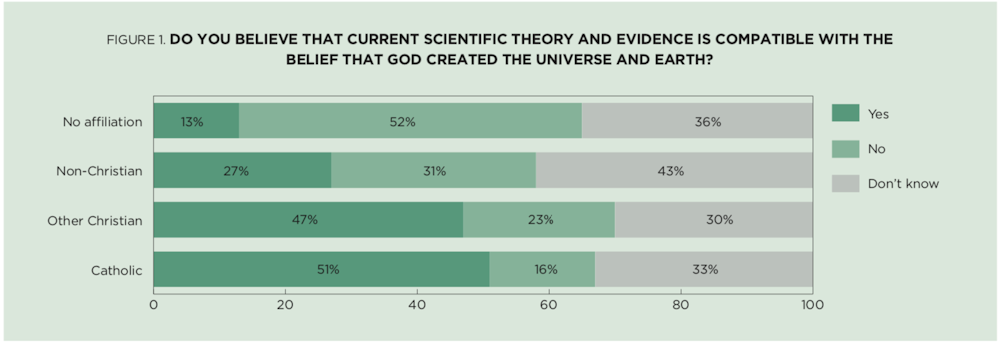
Catholics as a group seem quite amenable to the idea that science is compatible with the theory that God created the Universe.

In 2017, the Center for Applied Research in the Apostolate found that Catholics, compared with other religious groups, were more accepting of scientific world views.

1,927 people responded to the CARA poll, which resulted in 1010 interviews with self-identified Catholics. CENTER FOR APPLIED RESEARCH IN THE APOSTOLATE

As an example of this relative ease with science, the Church has allowed serious discussion around evolution since at least 1950, when Pope Pius XII said evolution could coexist with Catholic doctrine (even though the following paragraph of his statement mentions the Biblical Adam as a real person).


Read more: How can scientists believe evolution is compatible with religion?


This engagement with evolution was strengthened by John Paul II, who said evolution was much more than a hypothesis. He also won a lot of scientists over by formally acquitting Galileo of heresy.

Today, Pope Francis is quite open about his belief in evolution, albeit as a means by which God created humankind.

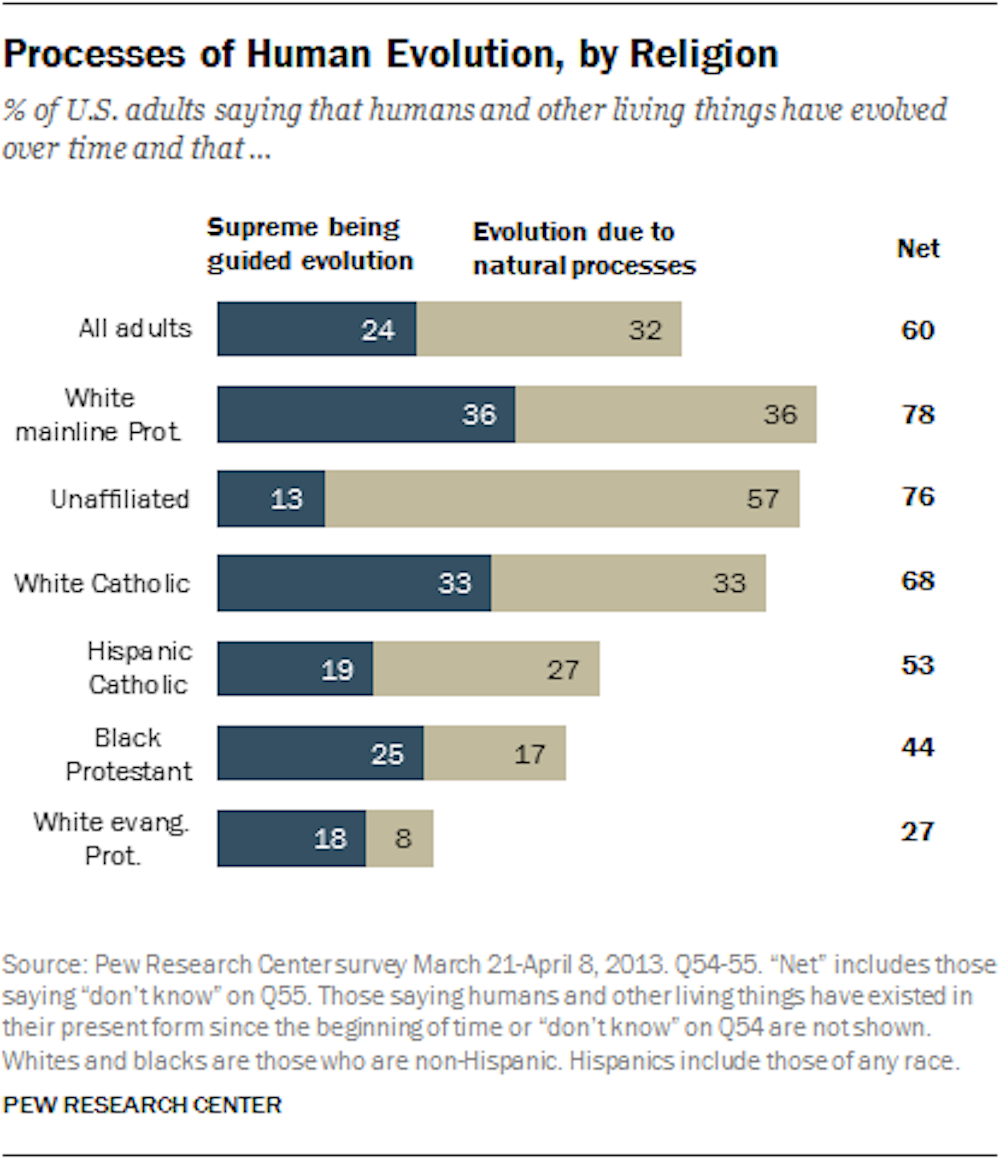
Perhaps because of this series of developments, American Catholics are ahead of their evangelical counterparts in accepting that life has evolved, rather than being created in its current form.

The Pew Research Centre has conducted various surveys detailing the presence of religiosity among Americans. Pew Research Centre

Of science, faith, or both?

There’s an old adage that science is about discovering empirical facts about the world and religion is about the meanings we find in it, but this is a shallow conception of both.

Religious teachings are often grounded in simple and immediate acts of living, and science gives us powerful narratives that help us understand our place in the Universe.

Many great scientists were Catholics, including Nicolaus Copernicus, Isaac Newton, Francis Bacon, Gregor Mendel, and Louis Pasteur. One could argue this was the result of cultural and philosophical norms at the time.


Read more: Yes, there is a war between science and religion


Of course, many modern scientists are people of faith, but the percentage of scientists who profess no faith is much higher than among the general public.

Even so, The Pontifical Academy for Life includes some of the world’s leading academics and scientists. While they may not be Catholics themselves, their willingness to engage with the church and advise them on critical issues is noteworthy.

This would not happen if the church and Pope Francis himself were not seen to value scientific expertise.

Leading the way ahead

The Catholic church is not a scientific institution, and it would be foolish to suggest it is.

Its religious purpose may be compatible with many aspects of science but, unlike science, its core tenants are not open to revision, even though these core tenants have seemed somewhat malleable over the centuries.

Despite this, the relationship between science and the church looks better now than ever before. The development of this relationship will have a significant impact on the public’s understanding of and engagement with science.

Considering the crucial role science and technology play in our prosperity as a species, we can only hope future popes continue to respect and act on the best scientific advice possible.

I would be happy to take that imperative as an article of faith.

ref. Pope Francis and the Catholic church continue to look towards science, and that can only be a good thing – http://theconversation.com/pope-francis-and-the-catholic-church-continue-to-look-towards-science-and-that-can-only-be-a-good-thing-123640

The biggest hurdle for the Coalition’s religious discrimination bill: how to define ‘religion’

Source: The Conversation (Au and NZ) – By Erin Wilson, Associate Professor of Politics and Religion, University of Groningen

The Coalition government’s proposed religious discrimination bill has been criticised for the potential problems it poses for women, the LGBTQI+ community, people with disabilities and people from diverse ethnic and cultural backgrounds.

Yet, there is another group who may also be adversely affected if the bill becomes law – religious people themselves, especially minorities.

In a recent submission to the attorney-general’s office, I highlighted a key problem of the bill and one that could impact religious minorities in particular – that it does not explain what is meant by the terms “religion” and “religious”.

What is religion?

Though “religion” is not defined in the bill, “religious belief or activity” is. It is characterised in one of four ways:

  • holding a religious belief

  • engaging in lawful religious activity

  • not holding religious belief

  • not engaging in, or refusing to engage in, lawful religious activity.

Underlying the bill is the implicit assumption that “religion” has a clear definition – everyone knows what it is.

But this assumption is flawed. Scholars of religion have long debated this question, with no agreement. Many conclude that, in fact, it is impossible to have a clear, universal definition of religion.

Attempts to carve out a definition encounter a wide variety of exceptions:

  • Is “religion” defined by “belief in God”? If so, does that mean Buddhism is not a religion?

  • Is “religion” a set of precepts and guidelines for how to live a moral life? If so, does that make veganism a religion?

  • Is “religion” an institution or community brought together around shared belief in something greater than oneself? If so, couldn’t communism or nationalism be considered a religion?

  • Does “religion” require a group of people meeting in a church or other place of worship? Does that mean that ancestor or nature worship, or Indigenous spirituality do not count as religion?

Because of complexities like this, the Australian Human Rights Commission has noted that the concepts of “belief” and “religion” should be interpreted broadly in Australian law.

And using a specific concept of religion as the basis for making new laws can have serious repercussions.


Read more: Politics with Michelle Grattan: Father Frank Brennan on Israel Folau and religious freedom


Even people within the same religion can have very different values and belief systems. Two people who identify as Christian, for example, may hold opposing views on abortion,climate change, gender equality, marriage equality, to name a few. The same is true for people who identify as Muslim, Jewish, Buddhist and every other tradition.

Two cases from the European Court of Human Rights highlight this problem. In one case, the court ruled that a Swiss Muslim teacher could not wear her headscarf while teaching because it was an “active” religious symbol that violated the principle of neutrality in the classroom.

In another case brought by an atheist parent, the court ruled that a crucifix on the wall of an Italian state-run school was a “passive” religious symbol and did not violate the principle of classroom neutrality.

Two cases involving religious symbols, two people claiming violation of their religious rights, two very different outcomes.

Australia’s Christian past

What makes this ambiguity particularly troubling in European and post-colonial societies such as Australia is that understandings of “religion” are broadly informed by Christian historical experiences and influences.

Thus, what counts as “religious belief or activity” is often determined according to models inherited from Christianity, which may not align with belief structures and practices in other traditions.

And because of the lack of clarity over what is or isn’t considered “religious” in the Coalition’s bill, it may be left to the discretion of individual judges – relying on their personal views of “religion” – to determine whether discrimination has indeed occurred.


Read more: Why Australia needs a Religious Discrimination Act


There are two important contextual factors that further aggravate this concern.

First, the impetus for the bill came from two key events that have galvanised Christians: the Religious Freedom Review, undertaken following the marriage equality plebiscite, and the sacking of Israel Folau by Rugby Australia over his anti-gay social media posts.

Second, contemporary Australian politics and society are characterised by heightened suspicion of non-Christian religions, especially Islam.

This raises important questions about how the bill’s implementation could affect religious minorities.

What counts as “discrimination”?

The definition of “religion” is not the only problem. Another difficulty concerns how the bill determines whether or not “discrimination” has occurred.

For example, statements of religious belief would not be protected by the bill if they are deemed “malicious” to another person.

Yet, as the Australian Federation of Islamic Councils noted in its submission to the attorney-general’s office, the bill does not clearly define what kind of speech constitutes a “malicious” statement. There is, however, a suggestion that this may be determined on the basis of whether a statement will cause “harm”.

Research on free speech and religious discrimination notes there is often a line that can be drawn between “offensive” and “harmful” speech. But where and how do you draw that line?


Read more: In long-awaited response to Ruddock review, the government pushes hard on religious freedom


Let’s take Folau’s comments as an example. Under the bill, it could be argued that Folau’s comments about LGBTQI people (amongst others) were merely offensive, not “malicious” or likely to cause “harm”.

Yet LGBTQI people have experienced intense stigma, abuse and exclusion throughout Australia’s history. This context matters. It makes it more likely that statements like Folau’s could be harmful, inciting abuse against the community or causing psychological harm to those who were offended.

Rugby Australia sacked Folau after deeming his Instagram post ‘unacceptable’. Peter Rae/AAP

Could the law work in practice?

One way to address these concerns would be to provide accompanying advice to judges and lawyers who are interpreting the religious discrimination law in future cases.

Consider a case in which a Muslim woman is denied employment at a Muslim school because she refuses to wear a headscarf. How should such a case be decided? Is the Muslim woman experiencing religious discrimination because she is denied employment based on her choice to not wear a headscarf? Or would forcing the Muslim school to hire a woman who chooses not to veil constitute religious discrimination?

In such a case, lawyers could consult with Muslim religious leaders and scholars from a wide variety of traditions and perspectives as expert witnesses. These experts could examine the context of the case and offer advice regarding who is or isn’t experiencing religious discrimination.

Yet because the challenge of deciding what counts as “religion” in a just and equitable way is so fraught, there is a case to be made for not implementing the legislation at all.

Instead, existing legislation protecting freedom of speechand freedom of thought and conscience could be revised and strengthened, paying particular attention to the views and experiences of marginalised religious groups and minority traditions.

ref. The biggest hurdle for the Coalition’s religious discrimination bill: how to define ‘religion’ – http://theconversation.com/the-biggest-hurdle-for-the-coalitions-religious-discrimination-bill-how-to-define-religion-125214

Changing the terminology to ‘people with obesity’ won’t reduce stigma against fat people

Source: The Conversation (Au and NZ) – By Cat Pausé, Senior Lecturer in Human Development, Massey University

The British Psychological Society is calling for changes for how we talk about fatness, suggesting we should no longer use the phrase “obese people”, but instead, “people with obesity” or “people living with obesity”.

These changes are being proposed to recognise that fatness is not about personal choice and that fat shaming and fat stigma are harmful.

But this suggested language change is based on the idea obesity is a disease to be cured and fat people are not a natural part of the world. This serves to reinforce stigma, rather than prevent it.


Read more: Discrimination against fat people is so endemic, most of us don’t even realise it’s happening


How does stigma and shame affect fat people?

Fat stigma can harm people’s physical health, mental health, and relationships.

Independent of body mass index (BMI), fat stigma increases blood pressure, inflammation, and levels of cortisol in the body, due to the activation of the fight or flight response.

Fat stigma reduces self-esteem and increases depression. It isolates fat people, making them less likely to engage with the world. It also impacts on fat people’s relationships with family, colleagues, and friends.

Fat stigma erodes self-esteem and isolates people. Motortion Films/Shutterstock

People around the world, and of all ages, hold negative attitudes about fatness and fat people. In a study in the United States, for example, more than one-third of the participants reported:

one of the worst things that could happen to a person would be for [them] to become obese.

How terminology reinforces stigma

While many people are uncomfortable with the term fat, fat activists prefer the term. They see it as both as an act of rebellion – to adopt a word that has been wielded against them – but also because they argue it’s the most appropriate word to describe their bodies.

To be overweight implies there is a natural weight to be; that within human diversity, we should all be the same proportion of height and weight.

Obesity is a medical term that has pathologised the fat body. The British Psychological Society’s acknowledgement that rather than saying “obese people”, we should call them “people with obesity” reinforces that obesity is a disease; a chronic illness people suffer from.


Read more: What does fat discrimination look like?


The British Psychological Society’s desire to shift to person-first language is understandable. Person-first, or people-first, language is an attempt to not define people primarily by their disease, or disability, or other deviating factor.

Person-first language recognises people as individuals with rights to dignity and care, and puts the person, rather than their “condition”, first.

But others have argued person-first language attempts to erase, deny, or ignore the aspect of the person that isn’t “normal”, and reinforces that there is something shameful or dehumanising about their disability or disease.

They promote identity-first language, which allows people to take pride in who they are, rather than separating a person from that aspect of themself.

The problem with person-first language, they argue, is that those identities are stigmatised. But without the stigma, there would be no concern with calling someone a disabled person, for instance, rather than a person with disabilities.

So what should we do?

Ask people what they want to be called. Rawpixel.com/Shutterstock

The best approach, especially for health-care professionals, is to ask people what they prefer their designation to be.

And for the rest of us, to acknowledge that what an individual wants to be called or how they want to talk about their experiences is up to them, not us. If a fat person wants to call themselves fat, it is not up to non-fat people to correct them.

Shifting the language we use to talk about fatness and fat people can reduce fat stigma. But continuing to frame fatness as a disease is not a helpful contribution.


Read more: Study finds obesity stigma erodes will to exercise, socialise


ref. Changing the terminology to ‘people with obesity’ won’t reduce stigma against fat people – http://theconversation.com/changing-the-terminology-to-people-with-obesity-wont-reduce-stigma-against-fat-people-124266

Snowy 2.0 will not produce nearly as much electricity as claimed. We must hit the pause button

Source: The Conversation (Au and NZ) – By Bruce Mountain, Director, Victoria Energy Policy Centre, Victoria University

The federal government’s much-vaunted Snowy Hydro expansion is supposed to smooth out the bumps in electricity supply as Australia transitions to renewables. But not only is the project a bad deal for taxpayers, our analysis suggests it will deliver a fraction of the energy benefits promised.

Fossil-fuel power generators store coal or gas at the point of production. This means electricity can mostly be created on demand when homes and businesses need it. Renewable energy cannot do this. If wind or sun is not abundant, solar panels and wind turbines may not produce enough electricity to meet demand. At other times they might produce more than required.

The Snowy 2.0 project is supposed to provide a solution to this problem – storing renewable energy for when it is needed.

The project’s cost and time estimates have blown out massively. It would now be surprising if Snowy 2.0, including the transmission upgrades it relies on, comes in at less than A$10 billion or is finished before 2027.

But there is another serious problem. Our analysis has revealed that of the extra pumped hydro capacity promised by the project, less than half can be delivered. There is now overwhelming evidence the project should be put on hold.

The Tumut 3 scheme, with which Snowy 2.0 will share a dam. Snowy Hydro Ltd

The problems we know about: cost and time blowouts

The list of possible alternatives to Snowy 2.0 is long. Aside from other pumped hydro projects, it includes chemical batteries, encouraging demand to follow supply, gas or diesel generators, and re-orienting renewable generators to capture the wind or sun when it is less plentiful.

But despite this plethora of options, the federal government announced the Snowy 2.0 project without a market assessment, cost-benefit analysis or indeed even a feasibility study.


Read more: The government’s electricity shortlist rightly features pumped hydro (and wrongly includes coal)


When former Prime Minister Malcolm Turnbull announced the expansion project in March 2017 he said it would cost A$2 billion and be commissioned by 2021. This was revised upwards several times and in April this year, a A$5.1 billion contract for partial construction was awarded. This excludes the costs of transmission and other considerable expenses.

The main contractor says the project will take eight years to build – bringing us to 2027 before the full scheme is completed. We will happily wager that more delays and cost increases will be announced.

Then prime minister Malcolm Turnbull during a tour of Tumut 3 power station when announcing the expansion in 2017. Lucas Cochairs/AAP

Snowy Hydro has not costed the transmission upgrades upon which the project depends. TransGrid, owner of the grid in New South Wales, has identified options including extensions to Sydney with indicative costs up to A$1.9 billion. Massive extensions south to Melbourne will also be required.

Snowy Hydro contends it should not pay for the new transmission lines because the benefits would flow to the entire grid, not just its venture. In other words Snowy Hydro argues, conveniently, that we should count the benefits but ignore the costs when thinking about their project.

The numbers simply do not add up

The Snowy 2.0 project grandly claims it could generate at its full 2,000 megawatt capacity for 175 hours – or about a week. This capacity can also be expressed as 350 gigawatt hours (GWh).

Energy Minister Angus Taylor has talked up the project’s superiority to smaller-capacity alternatives such as batteries.

But the maximum additional pumped hydro capacity Snowy 2.0 can create, in theory, is less than half this. The reasons are technical, but worth taking the time to understand.

The figure below outlines the main physical features that define Snowy 2.0. It includes four dams: Tantangara, Talbingo, Jounama and Blowering. For simplicity, we have numbered these from 1-4 in the following explanation.


The Conversation, CC BY-ND

When Snowy 2.0 generates electricity, water will be released from Dam 1 at the top of the system. It will flow through a long tunnel to the smaller Dam 2. The flow of water drives turbines which generate energy. When the turbines are reversed, the water is pumped back to the top to continue the cycle.

For Snowy 2.0 to produce the 350 GWh of electricity claimed, the top dam must be full and all that water released through the system. But replenishing the top dam after this event would take many months of pumping water from elsewhere in the system, and use up 40% more electricity than was originally generated. So the 350 GWh would never be achieved because it is extremely inefficient and inflexible.

In reality, the pumped hydro capacity of Snowy 2.0 is defined by the amount of water that the smaller Dam 2 can hold. If the scheme was a closed system, with no other water flowing in or out, it could produce around 230 gigawatt hours (GWh) of electricity.

But the system does not exist in isolation. Part of the existing Snowy Hydro scheme, known as Tumut 3, also uses Dam 2. It creates pumped hydro electricity by cycling water between that dam and the even smaller Dam 3 below it.

For Snowy 2.0 to operate at full cyclical capacity, Dam 2 must be empty to receive the water. That would entail emptying Dam 2 into the smaller Dam 3 and from there to Dam 4 at the bottom of the system. This water could not be used again to generate electricity. This “lost” water would have generated 60 GWh worth of electricity in the Tumut 3 scheme.

Khancoban Dam, part of the soon-to-be expanded Snowy Hydro scheme. Snowy Hydro Ltd

This means that as a cyclical pumped hydro system, Snowy 2.0 does not add 230 GWh of capacity. When you subtract the 60 GWh from the 230 GWh, Snowy 2.0 adds just 170 GWh of recyclable pumped hydro. This is less than half the claimed storage capacity.

And this is the maximum cyclical capacity in theory only. Snowy 2.0 would never produce continuously for the time needed to generate and then pump 230 GWh because it would never be economically viable to run it this way.

In practice if Snowy 2.0’s lower dam is operated in future as it is now – almost always close to full – the cycling capacity of Snowy 2.0 may be as low as 40 GWh – around one tenth of the promised number.

What does all this mean?

These facts put Snowy 2.0 in a completely different light. There are many competing alternatives that can provide storage far more flexibly for a fraction of Snowy 2.0’s price tag. These alternatives would also have far fewer environmental impacts or development risks, in most cases none of the transmission costs and could be built much more quickly.

It is always difficult to press the pause button on a major project once it has begun. But the evidence for doing this is overwhelming. In pursuit of the public interest, the federal government should put the project on hold and ask a reputable investment bank to publicly advise, perhaps through the Productivity Commission, what Snowy 2.0 would be worth if built.

A credible independent valuation would establish with some confidence how deeply Snowy Hydro will have its hands in the public’s pockets. A panel of independent experts should then be asked to publicly advise whether taxpayer money is needed to meet the demands of a renewables-dominated power system, and if so, the best way it should be spent.

ref. Snowy 2.0 will not produce nearly as much electricity as claimed. We must hit the pause button – http://theconversation.com/snowy-2-0-will-not-produce-nearly-as-much-electricity-as-claimed-we-must-hit-the-pause-button-125017

Rail works lift property prices, pointing to value capture’s potential to fund city infrastructure

Source: The Conversation (Au and NZ) – By Chyi Lin Lee, Associate Professor of Property, UNSW

Value capture has been advocated as an innovative way to fund infrastructure, including by the Australian government. However, its effectiveness in Australia has been questioned. Our research, based on railway level crossing removals in Victoria, suggests infrastructure projects do lead to higher property values, which could be captured to contribute towards project funding.

At sites close to where level crossings were removed, property values increased by as much as a quarter. This highlights the opportunity to use a value capture model.


Read more: Explainer: what is ‘value capture’ and what does it mean for cities?


What’s the idea of value capture?

Infrastructure investment improves connectivity, leading to higher land or property values in areas that benefit from this. Value capture taps into this increased value – usually using some form of taxation – to help finance the infrastructure responsible for the increase.

Value capture has been widely used overseas. In the United Kingdom and Hong Kong, it has proved to be an effective way to fund major infrastructure.

This approach is not common in Australia, where most infrastructure projects are government-funded. Gold Coast Light Rail was developed with the aid of a levy on ratepayers.

However, a lack of funding means many large-scale infrastructure projects are not being funded at the same time. This highlights the need to find innovative ways to fund infrastructure, which includes exploring the potential benefits of value capture.


Read more: Why Gold Coast light rail was worth it (it’s about more than patronage)


Financing infrastructure by value capture has been widely discussed and was considered by a parliamentary inquiry. The concept features prominently in the federal government’s Smart Cities Plan and would complement the Smart Cities vision for 30-minute cities.

Would it work in our low-density cities?

But there is a debate over how well this model would work in Australia. It’s argued the low-density nature of Australian cities would result in a lower level of value creation to be captured. Nevertheless, little empirical evidence is available on value creation in Australia.

Despite clear policy interest in how much land values increase following a new rail investment, and to what extent this can be attributed to the investment, much remains to be explained.


Read more: Value capture: a good idea to fund infrastructure but not easy in practice


Our research based on the level-crossing removal project in Victoria found property values near each site could be enhanced significantly. The state government began the project in 2015. It aims to eliminate 75 dangerous and congested level crossings to improve traffic flows across metropolitan Melbourne. Our yet-to-be-published research is to be presented at the Pacific Rim Real Estate Society annual conference.

Importantly, this is one of the largest rail infrastructure projects in the state’s history. As of December 2017, the estimated budget for removing 50 level crossing sites was A$8.3 billion. The ultimate cost is likely to be greater as another 25 sites were added to the project in 2018 and 2019.

The work has caused inconvenience to local residents during construction and has limited capacity to ease traffic congestion. The pace of progress and budget blowouts “present risks to achieving value for money”, the state auditor-general reported.

Despite the temporary inconvenience during the construction phase, transport connectivity will be enhanced once the project is complete.

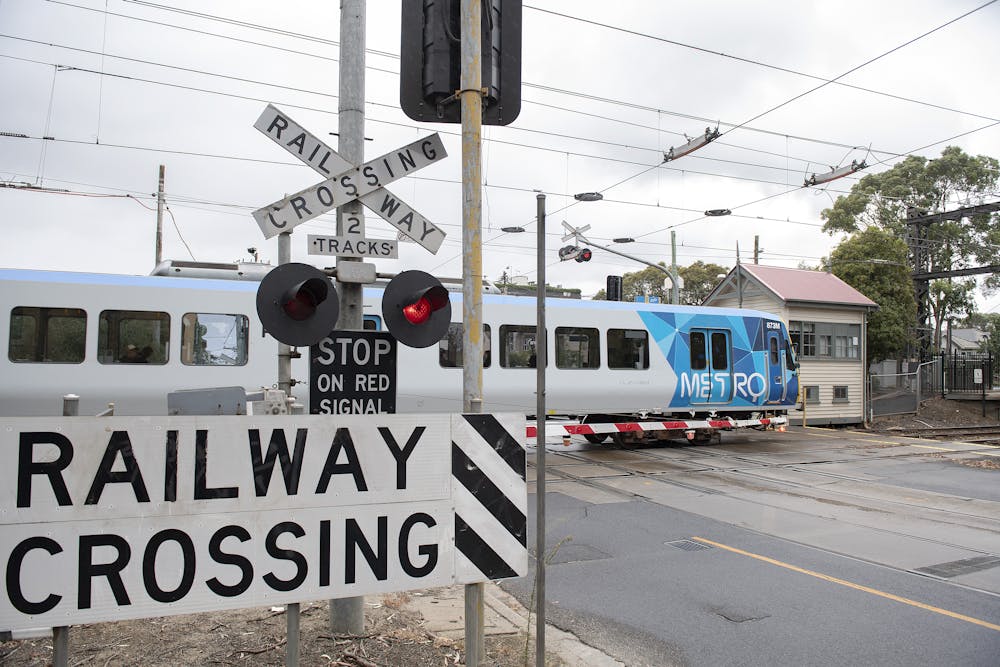
The level crossing removals are intended to eliminate the delays motorists experience while waiting for trains to cross the road. Ellen Smith/AAP

Read more: The ‘sky rail’ saga: can big new transport projects ever run smoothly?


House values have risen, but variably

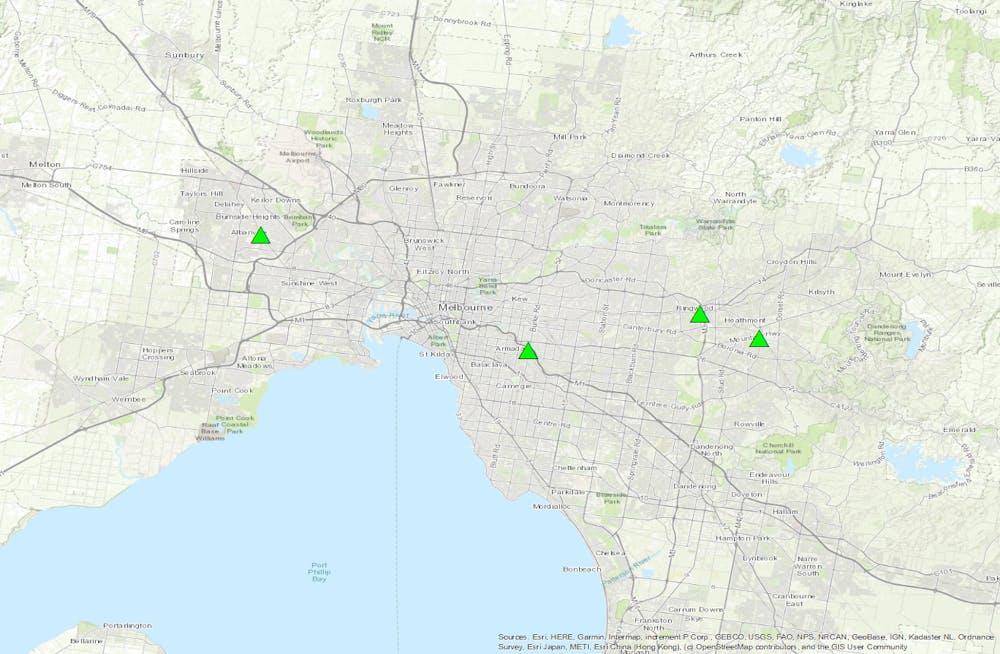
To offer some empirical evidence on the benefits created by level crossing removal projects enhancing housing value, we considered four sites in Bayswater, Mitcham, Glen Iris and St Albans.

We found the completion of a level crossing removal leads to an increase of 9% in house value, on average, within the area surrounding the site. This positive impact diminishes as the distance from the site increases. It vanishes beyond 1,400 metres.

We also found the impact of level crossing removals varies from site to site. House values in surrounding affected areas increased by 8.81% in Bayswater, 28.6% in Glen Iris, and 10.5% in St Albans, but by only 2.1% in Mitcham.

Comparable evidence is found for units in these areas: prices increased by 2.35% in Bayswater, 7.3% in Glen Iris and 6.53% in St Albans, but there was no significant increase for Mitcham.

Locations of the four level crossing study sites in Melbourne. Author provided

Read more: Paying for infrastructure means using ‘land value capture’, but does it also mean more tax?


Key takeouts

There are three takeouts from our research.

1) The level crossing removal project in Victoria did lead, in general, to higher property values. This highlights the need for a comprehensive plan aimed at maximising value capture opportunities.

2) Value capture is potentially a feasible model despite the low-density nature of Australian cities. However, its likely effectiveness varies considerably with location. This reinforces the importance of a comprehensive plan.

3) Given infrastructure is critical for urban development, governments should consider using value capture to fund infrastructure in a way that helps meet urban development needs and reduces the shortfall of dwellings in Australia.

ref. Rail works lift property prices, pointing to value capture’s potential to fund city infrastructure – http://theconversation.com/rail-works-lift-property-prices-pointing-to-value-captures-potential-to-fund-city-infrastructure-123757

Location, location, location: why up to two-thirds of property investors may get it wrong

Source: The Conversation (Au and NZ) – By María Yanotti, Lecturer of Economics and Finance Tasmanian School of Business & Economics, University of Tasmania

The housing market is moving again. In the past month, national prices have climbed 0.9%.

What matters most to buyers (and especially to investors), along with price and value, is location.

The cliché suggests that in the long run that’s all that matters.

So it would be unfortunate if investors were getting it wrong. Our examination of proprietary data from a major bank covering 1.15 million residential mortgage applications over the six years between 2003 and 2009 suggests they might be.

Published this month in the Pacific-Basin Finance Journal under the title Home advantage: the preference for local residential real estate investment, it finds that more than two in every three Australians buying an investment property pick one close to where they live.

This means that someone who lives in Manly is far more likely to invest in Manly over anywhere else in Sydney or in Australia and so on.


Read more: Three charts on: who is the typical investor in the Australian property market?


There are several good reasons for this. First, the time, effort and travel costs are typically lower when investing in your local area than investing further away.

Second, property investors sometimes plan to self-manage without an agent, making proximity an advantage. The Real Estate Institute of Australia believes 1 in 5 investors self-manage.

And property investors might believe that they have a “home advantage” in knowing their location better than non-locals.

Home bias means eggs in one basket

Home bias is well-documented in other markets. For example, investors in the stock market are more likely to hold shares in Australian rather than international companies.

This is even the case for superannuation funds, who set aside a sizeable portion of their assets for investment in Australian stocks – far more than the Australian stock market would represent in a global stock portfolio.

It brings with it problems alongside the advantages of convenience and local knowledge.

Most investors hold only one investment property alongside their place of residence, making it one of the few chances they have to diversify away from the risk embodied in that suburb.

Instead, most double down on that investment.


Read more: The Game of Homes: how the vested interests lie about negative gearing


If you are wondering whether this is unwise, or unwise enough to outweigh the advantages of local knowledge, consider this question: How likely is it that the location you happen to live in will always outperform every other location?

Interestingly we find that “sophisticated” investors are more likely to invest outside of the suburb where they live than less sophisticated investors.

Investing non-locally is more likely among investors who own shares, already receive rental income, and work as professionals or in management positions.

And a more fragile financial system

The risks that doubling down on locations impose on unsophisticated investors extend to the financial system itself.

Higher geographical concentration of property investments increase the risk of defaults and foreclosures in a market downturn, amplifying economic cycles.

Australians have a lot of wealth tied up in property, and the property market in turn is highly connected to the financial system through bank lending.

Our study suggests there is an opportunity to strengthen Australia’s financial system by educating potential investors about risk. It could make them, and the Australian economy, better able to withstand downturns.

ref. Location, location, location: why up to two-thirds of property investors may get it wrong – http://theconversation.com/location-location-location-why-up-to-two-thirds-of-property-investors-may-get-it-wrong-121735

Guan Wei review: feng shui for a vision of a world in harmony

Source: The Conversation (Au and NZ) – By Joanna Mendelssohn, Principal Fellow (Hon), Victorian College of the Arts, University of Melbourne. Editor in Chief, Design and Art of Australia Online, University of Melbourne

It seems appropriate that a painting titled Feng Shui dominates the new exhibition of Guan Wei’s work at Sydney’s Museum of Contemporary Art (MCA). He is the master of working and living between two cultures: the China of his birth and Australia, his home for most of the last three decades.

A rhythmically moving ocean where creatures great and small leisurely swim in tranquillity between continents: this is Guan’s vision of a world in harmony.

Clouds of good fortune blow to encourage the swimmers on their journeys; a fleet of sailing ships join their voyage. Taking up two adjoining walls of the gallery, the work takes on a three-dimensional appearance as swimmers and fish advance towards the viewer.

Guan has a long fascination with both antique maps and mythical creatures. At the core of this work is a giant map: patterns in shades of blue echo isobars and weather maps. The grid of the 120 individually painted panels appear to define latitude and longitude.

Taking up two adjoining walls, the figures seem to advance towards the viewer. Anna Kucera/MCA

Feng shui is central to the Taoist belief of balance and harmony of nature. The words translate literally into “wind” (feng) and “water” (shui): the painting becomes both an illustration of its underlying concept, and a visual pun.


Read more: Our oceans are out of balance – can we learn some tips from feng shui?


From China to Australia

Guan is from that remarkable generation of Chinese artists who, in the 1980s, began to exhibit in private homes because the work they made was not acceptable to the state. In this scene, Guan befriended a young Nicholas Jose, who would later become Australia’s cultural counsellor in Beijing.

In 1988, an exhibition of Australian art at the embassy in Beijing led to invitations from touring curators for Chinese artists to visit Australia. At the invitation of Geoff Parr, the director of the Tasmanian School of Art, Guan spent the early months of 1989 as artists-in-residence in Hobart.

Guan returned to China before the climax of the events at Tiananmen Square, but through the support of Parr and the Australian arts community, several Chinese artists were able to emigrate to Australia.

Australia in the 1990s was especially open to contemporary Chinese artists. The MCA exhibited Mao Goes Pop shortly after opening; in 1993, the Queensland Art Gallery started its ground-breaking series of Asia Pacific Triennials.

Guan, with his wife and daughter, settled first in a small apartment in Enmore in inner Sydney, before relocating to a large house in Glenmore Park in the western suburbs. It was here, in the cavernous space of the Casula Powerhouse Arts Centre, he painted Feng Shui.

Strength and endurance

In 1992, the MCA became the first public gallery to collect his work. The 48 postcard-size paintings, Two Finger Exercises (1989), were painted in Beijing, and in the current exhibition they are framed by a mural of an angel, a demon, and red flags – a reference to the conflict at the time of their making.

Two Finger Exercises (1989) was the first of Guan’s work collected by a public gallery. Anna Kucera/MCA

The blob-like figures in various poses and relationships all hold up two fingers. Some appear defiant, others hectoring; one is upside down. The two-fingered sign was popular with the student radicals as they stared down the might of the bureaucracy in the occupation of Tiananmen Square.

The two fingered symbol can mean a “V for Victory” and also a defiant “up yours” gesture to authority. There is also another, specifically Chinese meaning. Ancient masters of Qigong, the meditative movement now popular with fitness classes, were supposed to be able to concentrate their Qi (life-force energy) with such strength they could balance on two fingers. In this, Guan’s paintings are a reminder of strength and endurance.

The 48 postcard-size paintings are ‘a reminder of strength and endurance.’ Guan Wei, Two-finger exercise no.48, 1989, Museum of Contemporary Art, gift of the artist, 1993, image courtesy and © the artist, photograph: Jessica Maure

Shortly after he arrived in Australia, Guan made a series of collage works, Certificate (1990), using stamps, symbols and red ink as commentary on China’s officious bureaucracy, and family photos manipulated to define, confine and sometimes eliminate particular figures.

Guan’s family were direct descendents of Qing dynasty courtiers, and so were eliminated from public life in the Cultural Revolution of the 1960s and 70s. He has a particularly intimate experience of the whims of bureaucracy.


Read more: Why China still can’t make sense of the Cultural Revolution


The question of how an artist living today may react to both the events of the present and the beauty of traditional art and nature is addressed in Paper War (2003), where a facsimile of a 17th century scroll painting by the Nanjing master Gong Xian has been overlaid by silhouettes showing military invasion and death by an unnamed enemy.

Paper War is a reaction to both the ‘events of the present and the history of traditional art.’ Anna Kucera/MCA

In 2014, Guan reworked Paper War as a video, which intersperses the scroll with animated figures of fighter planes and soldiers parachuting in to create destruction. There is no land so beautiful it can’t be despoiled by war.

Finding feng shui in migration

In 2016 Guan entered the Archibald Prize with Plastic Surgery, a wry comment on the nature of immigration and acceptance.

A series of faces transition from the heavily regulated persona demanded by Chinese officialdom in the 1980s to the compromises made by immigrants to fit in with a new culture.

Guan’s art suggests it is far better for those moving between cultures to adopt another path – to find harmonious connections, to seek humorous twists in even difficult circumstances – and be guided always by the equilibrium of feng shui.

Guan Wei: MCA Collection is on view at the Museum of Contemporary Art, Sydney, until 9 February 2020

ref. Guan Wei review: feng shui for a vision of a world in harmony – http://theconversation.com/guan-wei-review-feng-shui-for-a-vision-of-a-world-in-harmony-125064

Who is Judge Dredd and why it matters that media invoke the cartoon character

Source: The Conversation (Au and NZ) – By Justin Matthews, Lecturer in Digital Media and Popular Culture Researcher, Auckland University of Technology

According to a recent study, the sixth leading cause of death for young men in the United States is the warranted and unwarranted use of police force.

With the US president himself frequently alluding to America’s military prowess and right-wing media hosts suggesting the US embrace a police state after each mass shooting, it is not surprising journalists are invoking the image of Judge Dredd, a character in the science fiction comic 2000AD.

The parallels between Judge Dredd and contemporary society appear uncanny. They symbolise the demise of democracy and freedom in favour of an authoritarian regime.


Read more: Why Australia should be wary of the rise of the warrior cop, with tools to match


Psycho cop with no feelings

The character of Judge Dredd was first introduced in the 1977 second issue of the comic 2000AD. His creators envisioned the character as a no-nonsense cop – as writer John Wagner put it, “a psycho character with no feelings”.

From the outset, the Dredd comics were designed to be satirical. They depicted “the ultimate draconian cop”, who acts as judge, jury and executioner and polices the streets of Mega-City One, itself a hyper-constructed metropolis riddled with criminal activity.

The aesthetic of the character is reminiscent of the iconography of fascist Spain and with 70s punk-style overtones. It further established that Dredd was to be received as extreme. It is interesting to note that today the riot uniforms of police, with their padding, shields and knee pads, put even Dredd’s uniform to shame.

The world of Dredd was to be an exaggerated depiction of Western society. A radical population spike coupled with a lack of liveable land (because it was all radioactive), sets the scene for a dystopian comic. In this world, the only course of action to maintain order and overcome lawlessness is through instant justice.

When popular culture becomes reality

Drawing on the cultural capital of Dredd is a shortcut to justify his particular brand as a solution to rampant crime. It can also be invoked as a warning to avoid the dilution of civilian freedoms and ideals. But it seems that Dredd is increasingly becoming prophetic rather than fiction.

In Western society, a perceived prevalence of shoot-to-kill responses, the militarising of the police, the invasive surveillance of people and the urbanisation in response to over-population mimics the fictive universe of Judge Dredd comics.

For instance, in 2005, a top ranking British police officer, metropolitan police commissioner Sir Ian Blair, was accused of embracing the Judge Dredd ideology when he suggested that police officers should have more autonomy. He believed they should be able to confiscate licenses and vehicles, and issue infractions for anti-social behaviour, circumventing the rules of law and moving towards a process of instant justice.

The world of Dredd emphasises authoritarianism in relation to the police and government. The comics include harsher penalties and laws against outsiders, walls that encase cities and a system of rule that is so restrictive it denies people basic human rights. It also takes no responsibility for the brutality and injustice felt by those who have become collateral damage.

It’s unsurprising then, that media use the symbol of Dredd in discussions of countries where similar trends are becoming apparent. This includes the continued debate about a wall between the US and Mexico and tighter immigration policies in the US, France, post-Brexit Britain and Australia.


Read more: UK’s new post-Brexit immigration plan is surreal and cynical


The Dredd comics become a cautionary tale suggesting that, if we continue down the authoritarian path proposed in the comics, it may have real-world consequences for global citizens.

The boiling frog syndrome

A recent study explored if increased militarisation of law enforcement agencies leads to an increase in violent behaviour among officers. It found that when law enforcement is supplied with military materials, it inevitably becomes more militarised and affects the relationship between police and citizens.

Writing about their study, the researchers argued that adopting a more militarised approach to police practice and procedures could lead to more citizens killed by the police force. To support their point, they say when a county goes from receiving no military hardware to a large quantity (more than US$2.5 million to one agency) the number of civilians killed within a county is likely to double.

When social systems, such as the police force, are under pressure to respond to increased population density, criminal activity and acts of terrorism, it’s not surprising society is seeing the devolution of police powers towards Dredd-like mechanisms of control. But what is the cost?

If society were to continue paralleling the Dredd universe, police may no longer be considered civic guardians that maintain community values or upholders of moral authority. Citizens could be forced to forfeit freedoms in favour of perceived protection, and an authoritarian regime could reign supreme.

For the moment, Dredd remains a fictitious world, but there is a deep and inherent trust that underlines the process of civilian policing. Devolving this fragile balance even a little bit may well be the difference between living in a policed state versus a police state.

ref. Who is Judge Dredd and why it matters that media invoke the cartoon character – http://theconversation.com/who-is-judge-dredd-and-why-it-matters-that-media-invoke-the-cartoon-character-124412

Four questions about mortgages the ACCC inquiry should put to the big four banks

Source: The Conversation (Au and NZ) – By Mark Humphery-Jenner, Associate Professor of Finance, UNSW

The Australian Competition and Consumer Commission conducted an inquiry into mortgage pricing as recently as last year.

Now Treasurer Josh Frydenberg has asked it to do another, broader one, in order to ensure the banks’ pricing practices are “better understood”, and perhaps also to concentrate their minds on the wisdom of fully passing on the next collection of rate cuts.

Australian Competition and Consumer Commission

There’s a lot to better understand.

The last inquiry found that the banks used “opaque pricing” that “stifled price competition” and made it hard for borrowers to shop around, both when looking for a new mortgage and when considering switching when they already had one.

Seven in ten of the borrowers surveyed for the inquiry said they had obtained only one quote before taking out their residential mortgage.

The inquiry concluded the big four “profit from the suppression of borrower incentives to shop around.”

So, what else is there to find out?

I reckon there are four big questions the inquiry ought to be asking, the most important of which is whether the big four are making unreasonable profits.

Question 1: Are bank profits super-profits?

The inquiry isn’t specifically asked to examine banks’ profits, but the question of whether their profits are unreasonably large (so-called super-profits) lies behind questions about whether they are charging more than they should.

It turns out that the big four banks’ profit ratios have not shot up egregiously over the past few years. Their returns on equity are high, much higher than those of banks in other developed countries, but have not been increasing.

While data for the most recent year is not yet available, it looks as if banks have not been dramatically ramping up their profit seeking behavior and may have suffered declines.


Return on equity, the big four

Years correspond to financial report years. Aspect Huntley FinAnalysis/ DataAnalysis

But these totals tell only part of the story.

They don’t tell us which services are profitable or where banks’ profits come from.

It might, for instance, be useful to know whether residential mortgages are especially profitable, and whether those profits have been climbing.

Question 2: How do the banks set rates?

The inquiry has been asked how banks set mortgage rates and why they often do not “pass on” official cash rate cuts.

It’ll be useful information. Banks function as intermediaries. They can be thought of as obtaining money from various sources, including depositors to whom they pay interest.

Their profits come come from the interest margin, which is the difference between how much they pay for the money and how much they get when they lend it out.

The borrowing rate can vary between customers, in the same way that the rate airlines charge for seats varies between customers.

This interest margin is not unearned. Banks provide services to borrowers and depositors. Further, they take on risk by giving depositors immediate access to the money while knowing they will only receive it back gradually in a process that itsn’t guaranteed.


Read more: Our leaders ought to know better: failing to pass on the full rate cut needn’t mean banks are profiteering


As the ACCC found last time, the margin is opaque. While we have access to statistics on average margins, we haven’t had access to the margins for specific products.

The overall net interest margin appears to be declining, and it might explain why the big four have become reluctant to pass on the latest Reserve Bank rate cuts.

To maintain the margin they had, they would have to cut deposit rates by as much as are cutting borrowing rates and with deposit rates. With deposit rates close to zero, that’s becoming harder.


Net interest margins, the big four

Years correspond to financial report years. Bank financial reports. Aspect Huntley FinAnalysis/DataAnalysis

Question 3: Why do they charge different rates?

The inquiry has been asked to examine differences in rates, of the kind airlines have become extraordinarily good at imposing.

There are four kinds.

New vs old customers: Banks sometimes offer lower rates to new customers than to existing customers. But how common this actually is is open to question. Banks’ have an incentive to poach new customers by offering low rates, but they also have an incentive to keep the customers they have by keeping their rates low enough to deter them from leaving. At the moment we don’t know much at all about how new and existing customers’ rates differ. What we find out will tell us how much banks take their customers for granted.

Headline reference rates vs actual rates: Some banks quote reference rates which they discount for particular customers. Other banks appear to just quote their lowest rate. Often it is not clear how, or why, banks offer these discounts. Anecdotally, it appears to relates to whether the customer is low risk and how big the loan is.

Variance in rates across banks: The inquiry will, at least indirectly, shed some light on why rates differ between banks. The big variance, even across the big four, is difficult to explain. It isn’t clear how they are tied to different cost structures or even whether the big four have different cost structures.

Cash rate cuts: Banks often don’t pass on full official cash rate cuts. As mentioned, there might be good reasons for this. Banks can only maintain their existing margin if they adjust both deposit and loan rates, and cutting deposit rates further is almost impossible. However, it isn’t clear how banks decide how much of each cut to pass on and why different banks do it differently. While there is no evidence of collusion, the ACCC would probably like to find out how each bank influences the other.

Question 4: Is switching easy?

The inquiry has been asked to investigate how easy it is to switch, but even this isn’t straightforward..

Switching involves more than transferring data between banks. To switch, people must lodge an application. This involves proving income and satisfying credit checks. Customers have to approach banks – or a mortgage broker – to do it. They are often charged for it, although often not directly. Transferring property titles and the right to right to receive interest payments isn’t costless.

The government itself imposes barriers. The Australian Prudential Regulation Authority requires banks to lend responsibly and to ensure borrowers are credit-worthy. They are hard barriers to streamline.


Read more: Below zero is ‘reverse’. How the Reserve Bank would make quantitative easing work


The inquiry might focus on other barriers. These could include whether banks themselves make it unnecessarily onerous to leave. This might include administrative fees, which opens up the question of fees generally, something that is likely to become increasingly more important as banks look for ways to cut effective deposit rates as they approach zero.

The Commission says it will produce a preliminary report by the end of March, and a final report by September 2020.

ref. Four questions about mortgages the ACCC inquiry should put to the big four banks – http://theconversation.com/four-questions-about-mortgages-the-accc-inquiry-should-put-to-the-big-four-banks-125224

Former USP Vice Chancellor ‘violated’ norms, say staff and students

Pacific Media Watch Newsdesk

University of the South Pacific staff and students have released a rebuttal to former Vice Chancellor Professor Rajesh Chandra’s claim that he has been “vindicated” from any wrong-doing during his tenure at the university.

The rebuttal was prepared and sent to the Fiji Sun on September 20 in response to Chandra’s September 14 opinion piece claiming that the BDO Report into allegations of USP mismanagement had found nothing against him.

USP staff and students said that despite frequent regular follow up emails and calls to the Fiji Sun editor-in-chief and publisher, the rebuttal went unpublished, with the editorial team claiming legal advice from their lawyers was pending.

READ MORE: Vanuatu Daily Post: ‘Serious Concerns’ in USP Audit Report

Due to the lack of response, representatives of the 500 staff and students behind the rebuttal decided to release it publicly via social media.

“Concerned staff believe that Fiji Sun has been given fair and adequate opportunity to confirm or decline the rebuttal for publication,” a press release read.

– Partner –

“For good governance to prevail at USP, the rebuttal is attached for your information and necessary action.”

The rebuttal contested a number of Chandra’s claims, namely that the BDO Report found no fraud, corruption or abuse against him.

“BDO reported that four remuneration mechanisms at the University were collectively exploited, leading to instances of ‘significant cash leakages’ over a number of years,” the rebuttal read.

“These leakages of public funds from USP was a serious observation which calls for explanation and, in our opinion, possible police inquiry.”

The rebuttal also challenged Chandra’s argument that everything he did during his tenure was within the statutes governing the delegations of the VC, staff ordinances and other ordinances and policies.

“If that were true, then we pose several questions for Prof. Chandra to consider. Which Statutes or Ordinances entitles him to cash in on professional development leave three to four months from his retirement?”

It also queried his alleged spending of the incoming Vice Chancellor contingent funds, his alleged appointment of staff on three-year renewal contracts without adhering to the staff review process and other indiscretions, alleged in the initial report which prompted the investigations.

“The fact of the matter is that Prof. Chandra assumed powers that violated the previously established norms and conventions at the university. A university is a place where best practices are established, not where they are violated.”

In his opinion piece, Chandra claimed that his actions were within the statutes governing staff ordinances: “The Vice Chancellor shall have the authority to adjust terms and conditions of service of staff members in specific cases when it is in the interest or the University.”

The rebuttal claimed that the above only applies if the Vice Chancellor had sound reason, good advice and made that decision for the good of the University.

“When he took professional development leave in September, three months before his retirement in December 2018, one could ask, was that leave for the good of the University?” the rebuttal asked.

The rebuttal also contested Chandra’s claim that the Fiji Independent Commission Against Corruption found no wrong-doing against him, arguing that FICAC’s investigations were simply halted to avoid duplicating findings with BDO, which was conducting an independent investigation.

“For FICAC to demonstrate it’s independence it must insist on getting the BDO report and formulate appropriate charges. We are quite certain this will happen in due course, if not in Fiji, then in any jurisdiction of an appropriate member country of USP.”

The BDO investigation resulted in a range of complex and competing findings which corroborated many of the claims of the university staff.

“BDO found that bonuses and, in some cases, multiple bonuses have been paid extensively to staff which is in breach of the USP policies,” it read.

However, it stopped short of levying responsibly on anyone and found that most “of the decisions investigated were made within the boundaries of the VCP’s Ordinance.”

“While the allegations highlighted in the paper have arisen in an unfortunate manner, they have raised serious concerns that require attention and action,” it concluded.

Print Friendly, PDF & Email

Article by AsiaPacificReport.nz

‘I wish you were murdered’: some students don’t know the difference between bullying and banter

Source: The Conversation (Au and NZ) – By Grace Skrzypiec, Senior Lecturer, Flinders University

Many Australian students don’t know the difference between banter and bullying, with some saying they joke about wishing their friend would “drown” or “die in a car crash”.

More than 800 Australian students aged 11-16 took part in a survey asking about experiences of peer aggression. Almost half (48%) said they had been harmed, very harmed or extremely harmed by an act of peer aggression.

Bullying is a subset of peer aggression. For an act of peer aggression to be defined as bullying it must be repeated, deliberately harmful and involve a power imbalance in which the victim feels powerless. If any of these criteria is missing, it is not defined as bullying.


Read more: If you want to cut bullying in schools, look at the ‘invisible violence’ in our society


But that doesn’t mean the experience isn’t harmful. In a lot of research on bullying, young people are simply provided with the definition of bullying and then asked questions about it. Because most people have their own idea about what bullying is, they are not likely to change their mind in one instant after they have read the definition in a questionnaire (if they read it at all).

Our survey asked about specific experiences of peer aggression. Around 30% of students thought their experience – such as being teased, laughed at, picked on, being called names, being hit, kicked, or treated meanly – was not harmful or was just “banter”.

How the survey worked

In 2017, 843 students from South Australia and the Northern Territory completed a questionnaire on peer aggression. One of the authors developed the questionnaire to distinguish harmful peer aggression from bullying and harmless banter.

Rather than being asked directly “were you bullied?”, the questions consisted of 20 items about experiences of victimisation (“Another person(s) spread rumours (false stories) about me”) and perpetration of aggression (“I told false stories or spread rumours about another person(s)”).

Many students thought saying mean things wasn’t harmful. from shutterstock.com

Students answered whether they had experienced or perpetrated the aggression in the last school term.

If they said they had experienced aggression, they were then asked to indicate:

  • the level of harm experienced: “How harmful was it to you/them?”
  • the intent: “Did they/you deliberately intend to do this?”
  • the frequency: “How often did they/you do this?”
  • the power imbalance: “How powerful (important, liked, strong) are you compared to the person(s) concerned?”

The questionnaire allowed experiences of aggression to be classified along a spectrum. These ranged from no involvement and harmless participation, to harming with no intention to harm others and bullying others.

We then classified experiences that were repeated, intentionally harmful and involved a power imbalance as bullying.

In our results, we found:

  • 17% had no experience of peer aggression in the last school term
  • 30.1% experienced peer aggression but saw it as fun, joking around or banter (didn’t consider it harmful)
  • 2.9% were involved (as either perpetrators or victims) in harmful joking but didn’t repeatedly intend to harm others
  • 32.5% were victims of harmful peer aggression (and were sometimes bullied, under the three criteria) and also had no intention of harming others
  • 9.6% were victims of peer aggression and also harmed others – some of these were bullies or had been bullied (but not both)
  • 4.8% had perpetrated aggression and deliberately sought to harm, but were not victims themselves – some in this group were bullies under the three criteria
  • 3% were bullied and also bullied others.

So, overall, around 48% of students were harmed by peer aggression. The proportion of victims (those who did not cause harm themselves) was almost one in three. Of the remainder, 12.6% said they were harmed and also harmed others, while 4.8% harmed others and were unharmed themselves.

‘I wish you would die’

The questionnaire also asked students an open-ended question about student interaction in their schools. Some students were adamant not all aggression was harmful. One Year 11 boy: “most of the time it’s a joke, calm down”.

Some students provided drawings to illustrate their point. One Year 10 girl drew a picture titled “Banter with friends”. It contained the following text:

“Bullying never that scary”

Person 1: “You’re a faggot”

Person 2: “I sure am”

and

“Sounds horrible but it’s funny”

Person 1: “I wish you’d drown”; “I wish you’d die in a car crash”

Person 2: “I wish you’d die”; “I wish you were murdered”

While students may believe such comments aren’t harmful, it is difficult to determine where the joke ends and the abuse begins.

Respondents were, on average, around 14 years old. Around half of the sample (50.6%) were males, and three-quarters (76.4%) were 14 years old or younger.

We saw differences across the age groups. Victimisation decreased and harmless participation increased with age.

We also collected data with the same questionnaire in 11 other countries – Italy, Spain, Poland, Indonesia, the Philippines, Greece, Israel, Taiwan, mainland China, South Korea and India.

Harmful peer aggression was greatest in India (91.0%) and lowest in Taiwan (12.8%). Mainland China (47.0%) and Poland (41.7%) had figures similar to Australia.

Harmless “banter” was evident in other countries such as Italy (40.2%), Poland (35.0%) and mainland China (31.4%).

Student well-being

We also assessed respondents’ social, emotional and psychological well-being. Questions included: “How often did you feel happy?” and “How often did you feel that you had experiences that challenged you to grow and become a better person?”

We assessed whether the student was languishing (exhibiting low satisfaction both with general life and with their productivity and function in society), had moderate mental health, or was flourishing.


Read more: Not every school’s anti-bullying program works – some may actually make bullying worse


Student well-being appeared to be worsening in Australia. More than 10% of students were “languishing”. Girls were languishing more and flourishing less than their male counterparts. Girls also scored lower on how often they felt good about themselves.

Schools need more assistance and support if bullying is to be seriously dealt with. Evidence-based anti-bullying programs should continue to be evaluated, improved and implemented in schools.

ref. ‘I wish you were murdered’: some students don’t know the difference between bullying and banter – http://theconversation.com/i-wish-you-were-murdered-some-students-dont-know-the-difference-between-bullying-and-banter-124272

Solomons’ deal with Chinese developer sparks ‘concern’

By RNZ Pacific

A Solomon Islands province has agreed to lease a large island to a Chinese developer to develop into a special economic zone, weeks after the country opened diplomatic ties with China.

But already cracks abound; there has been no official announcement and the provincial premier says the deal is on ice.

Experts say the arrangement in Central Province would give the developer and other Chinese firms a strategic inlet into Solomon Islands, which until last month was one of Taiwan’s dwindling allies in the Pacific.

READ MORE: PNG and Solomons governments call for changes to forestry

The government traded Taiwan for China in a move that it said would promise more development for the nation.

The Central Province agreement, signed 22 September, would give Beijing-based Sam Group an exclusive five-year development lease for Tulagi island and its surrounding islands, according to a copy which was shared on Facebook on Friday by a Solomon Islands youth group which is pro-Taiwan.

– Partner –

RNZ Pacific has verified the leaked copy’s authenticity with two sources who are familiar with the agreement’s contents.

Central Province premier, Stanley Manetiva, confirmed he had signed the “strategic cooperation agreement” in Honiara with representatives of Sam Group, but said it was not legally binding and the company would have to comply with local laws and respect landowner rights on Tulagi.

“To be honest here, leasing Tulagi will not be possible,” he said in an interview. “Nothing will eventuate on the agreement.”

A phone number for Sam Group’s office in Beijing listed on its website was disconnected on Friday. Another company listed as a party to the lease agreement, Xiamen International Trade Group, could not be reached for comment.

According to a statement posted to Sam Group’s website, a Solomon Islands delegation visited its headquarters in August.

The two parties “hoped to carry out comprehensive cooperation in energy, chemical industry, investment, trade and other fields in addition to existing cooperation,” the statement said. It was unclear whether the visiting delegation was from Central Province.

“We want the investors to come to our province,” said Manetiva, adding the diplomatic switch had opened investment opportunities for Solomon Islands. “But we must be mindful, mindful in a sense that we must see that the people are our priority.”

Not everyone’s convinced the deal with Sam Group is as non-binding as Manetiva claims.

Solomon Islands’ deputy opposition leader, Peter Kenilorea Junior, was worried the lease would still go ahead.

“It raises a lot of concern for me, I didn’t see any protection, or at least any obligation in the agreement that I saw that also safeguards the interests of Central islands province peoples and the resources.”

As part of the Tulagi lease, Sam Group would be able to survey the island for oil and gas developments, despite what Kenilorea Junior described as a sizeable anti-mining movement on the island.

Central province, which hosted the former capital under British-ruled Solomon Islands, has a relatively small population of around 26,000 people, but covers a vast area of more than 600km2 of mostly-ocean. The province is also located close to the Guadalcanal, where the current capital Honiara is.

Kenilorea Junior said the province’s strategically central location might have made it a target for a Chinese developer like Sam Group.

“This may be a means to sort of piggybacking other companies into the Solomons,” said Anna Powles, a senior lecturer in security studies at Massey University in New Zealand.

She questioned whether one of Sam Group’s subsidiaries, China Jing An, was privately-owned because it was previously part of China’s Public Security Ministry.

“My sense from other research and other companies similarly, is that there are still very strong ties there.”

Still, local businesses on Tulagi have welcomed what they say is sorely-needed development on the island.

“We don’t have any banks and services here is quite low, and having investors to come and improve the place would be really great,” said Teika Dennis, the owner of the Vanita Motel and Restaurant.

  • This article is published under the Pacific Media Centre’s content partnership with Radio New Zealand
Print Friendly, PDF & Email

Article by AsiaPacificReport.nz

We need to count LGBTI communities in the next census – here’s why

Source: The Conversation (Au and NZ) – By Brendan Churchill, Research Fellow in Sociology, University of Melbourne

There’s an old maxim: not everything that can be counted counts, and not everything that counts can be counted.

But there are some things we should count, and gender and sexual diversity are among them.

The Australian Bureau of Statistics has abandoned preparations to ask questions about sexual orientation and more detailed questions about gender identity during its upcoming census test later this month.

This follows a consultation process in which many public submissions from researchers, advocacy and community groups and individuals strongly pushed for the bureau to include more detailed questions about gender identity and sexual orientation.


Read more: Mum, dad and two kids no longer the norm in the changing Australian family


The forthcoming census test will, however, ask respondents whether they identify as male, female or non-binary. This does not mean this question will eventually make it onto the questionnaire for census night in 2021. It also does not mean questions about sexual orientation or more detailed questions about gender identity will be excluded.

So there is still time to consider the inclusion of questions that will better reflect Australia’s diverse demography.

Why including gender and sexuality matters

Simply and perhaps most importantly, including questions in the census that adequately capture gender and sexual diversity is an important act of recognition of LGBTIQ people and their lives. Those who do not identify as male or female or heterosexual often feel invisible to the wider community.

The 2016 census tried to be more inclusive by making changes to the way it collected information about sex. This allowed respondents to select “other”, with the option of providing more detail. But in order to answer “other”, respondents needed to request this option. The rationale was that there was some apprehension about how the public would respond to an “other” category.

There were 1,260 people gave a valid response to this question. The ABS acknowledges this figure under-reports the actual numbers of people in Australia who do not identify as male or female.

But “other” is not very inclusive and compounds feelings of invisibility. An individual submission to the Review of the 2021 Census Topics noted:

I am a trans-woman and the last census effectively rendered me invisible along with the rest of my community by making a non-binary gender response difficult to enter.

While the test for the 2021 census will include a response category for non-binary, which is a significant improvement on many fronts, the lack of questions or response categories that recognise respondents who are intersex, transgender or gender-queer and so on means these groups are not counted. This in turn means they remain invisible from a census perspective.

This is true for sexually diverse groups as well. While Australia has come a long way with the recent legal recognition of same-sex marriage, including these questions in the census will be another step towards greater recognition of sexually diverse people.

Other countries are counting these populations

Other countries are moving towards including questions about gender identity and sexual orientation in their censuses. The UK, for example, has recently passed a bill allowing trans people to choose their gender in the 2021 census.

Closer to home, researchers are doing their best to capture this information themselves. For example, the Scrolling Beyond Binaries project, which seeks to understand how young (aged 16-35) LGBTIQ+ people in Australia use digital social media, asked respondents about their gender identity, the gender assigned at birth, sexual orientation and their intersex status.

But research such as this is limited in its ability to make population-level findings about LGBTIQ+ people because it’s unable to derive a representative sample. Only the census could collect these data in a reliable way.

Why the numbers count

The ABS already collects some data on these populations. The 2014 General Social Survey captured some information about sexual orientation, but not about gender diversity. Some information about same-sex couples can be derived from the census using data about relationships within households.

We know the proportion of same-sex couples has been growing steadily over the past 20 years. We also know around 25% of female same-sex couples and 4.5% of male same-sex couples have children.


Read more: Six months after marriage equality there’s much to celebrate – and still much to do


But our picture of same-sex families is incomplete because the census can only tell us about families that live together in the same household. We do not know how many gay or lesbian lone-parent households there are because the census does not collect information about sexual orientation. Moreover, not all lesbian and gay people are in relationships and, even if they were, not all of them reside in the same household.

Australians who identify as lesbian or gay have higher rates of depression, anxiety and suicidal ideation than their heterosexual counterparts. Transgender and sexually diverse people fare even worse.

These facts are well documented among state and federal government policies, programs and strategies, but knowing how much of the general population this affects, where these groups reside and the communities they belong to using census data will mean governments can begin to address these issues more adequately.

Census night in 2021 is still a long way off. It is imperative these questions about gender and sexual diversity are included if we are to recognise LGBTIQ Australians and address the issues and challenges that affect them the most.

ref. We need to count LGBTI communities in the next census – here’s why – http://theconversation.com/we-need-to-count-lgbti-communities-in-the-next-census-heres-why-124769

Australia could see fewer cyclones, but more heat and fire risk in coming months

Source: The Conversation (Au and NZ) – By Jonathan Pollock, Climatologist, Australian Bureau of Meteorology

Northern Australia is likely to see fewer cyclones than usual this season, but hot, dry weather will increase the risk of fire and heatwaves across eastern and southern Australia.

The Bureau of Meteorology today released its forecast for the tropical cyclone season, which officially runs from November 1 to April 30.


Read more: It’s only October, so what’s with all these bushfires? New research explains it


Also published today is the October to April Severe Weather Outlook, which examines the risk of other weather extremes like flooding, heatwaves and bushfires.

Warmer oceans means more cyclones

On average, 11 tropical cyclones form each season in the Australian region. Around four of those cross the coast. The total number each season is roughly related to how much cooler or warmer than average the tropical oceans near Australia are during the cyclone season.

Map showing the average number of tropical cyclones through the Australian region and surrounding waters in ENSO-neutral years, using all years of data from the 1969-70 to 2017-18 tropical cyclone season.

One of the biggest drivers of change in ocean temperatures is the El Niño–Southern Oscillation, or ENSO. During La Niña phases of ENSO, the warmest waters in the equatorial Pacific build up in the western Pacific and to the north of Australia. That region then becomes the focus for more cloud, rainfall and tropical cyclones.

But during El Niño, the warmest water shifts towards the central Pacific and away from northern Australia. This decreases the likelihood of cyclones in our region.


Read more: Explainer: El Niño and La Niña


And when ENSO is neutral, there is little push towards above or below average numbers of cyclones.

Temperatures in the tropical Pacific Ocean have been ENSO-neutral since April and are likely to stay neutral until at least February 2020. However, some tropical patterns are El Niño-like, including higher-than-average air pressure at Darwin. This may be related to the current record-strong positive Indian Ocean Dipole – another of Australia’s major climate drivers – and the cooler waters surrounding northern Australia.

The neutral ENSO phase alongside higher-than-average air pressure over northern Australia means we expect fewer-than-average tropical cyclones in the Australian region this season. The bureau’s Tropical Cyclone Season Outlook model predicts a 65% chance of fewer-than-average cyclones.

At least one tropical cyclone has crossed the Australian coast every season since reliable records began in the 1970s, so people across northern Australia need to be prepared every year. In ENSO-neutral cyclone seasons, this first cyclone crossing typically occurs in late December.


Read more: El Niño has rapidly become stronger and stranger, according to coral records


Other severe weather

While cyclones are one of the key concerns during the coming months, the summer months also bring the threat of several other forms of severe weather, including bushfires, heatwaves and flooding rain.

With dry soils inland, and hence little moisture available to cool the air, and a forecast for clear skies and warmer days, there is an increased chance that heat will build up over central Australia during the spring and summer months. This increases the chance of heatwaves across eastern and southern Australia when that hot air is drawn towards the coast by passing weather systems.

Australian seasonal bushfire outlook, as of August 2019. Vast areas of Australia, particularly the east coast, have an above-normal fire potential this season. Bushfire and Natural Hazards CRC/Australasian Fire and Emergency Service Authorities Council

Likewise, the dry landscape and the chance of extreme heat also raise the risk of more bushfires throughout similar parts of Australia, especially on windy days. And with fewer natural firebreaks such as full rivers and streams, even greater care is needed in some areas.

Widespread floods are less likely this season. This is because of forecast below-average rainfall and also because dry soils mean the first rains will soak into the ground rather than run across the landscape.

However, as we saw in northern Queensland in January and February this year, when up to 2 metres of rainfall fell in less than 10 days, localised flooding can occur in any wet season if a tropical low parks itself in one location for any length of time.


Read more: Catastrophic Queensland floods killed 600,000 cattle and devastated native species


Most of all, it’s always important to follow advice from emergency services on what to do before, during and after severe weather. Know your weather, know your risk and be prepared. You can stay up to date with the latest forecast and warnings on the bureau’s website and subscribe to receive climate information emails.

ref. Australia could see fewer cyclones, but more heat and fire risk in coming months – http://theconversation.com/australia-could-see-fewer-cyclones-but-more-heat-and-fire-risk-in-coming-months-125139

Define the boundaries in new phase of Australia-China relationship: Wong

Source: The Conversation (Au and NZ) – By Michelle Grattan, Professorial Fellow, University of Canberra

Shadow foreign minister Penny Wong says Australia needs to “define the boundaries” of its engagement with China now the relationship between the two countries is in a new phase.

Focusing on China policy in a Monday address – released ahead of delivery – Wong acknowledges the “substantial and growing differences” in the bilateral relationship.

“It is inevitable that Australia will make more decisions that China doesn’t like. This means that the way the relationship is handled will become even more important,” she says in the speech, to the Australian Institute of International Affairs.

“Although there continues to be convergence of interests, the divergences have become more apparent and acute – due to both Beijing’s increasing assertiveness and greater awareness in Australia as to the implications of the [Chinese Communist Party’s] behaviour and ambitions. We must look at how best to engage effectively with China while always standing up for our values, our sovereignty and our democratic system.”

Wong says where limitations around engagement are needed, the “boundaries should be as restricted as possible and as robust as necessary,” with opportunities and risks identified.

Boundaries and terms of engagement would differ between issues and between sectors.

Thus on research collaboration, engagement shouldn’t be ruled out across entire fields, but export controls and visa checks could be used for “a narrow set of the most sensitive defence oriented technology”.


Read more: ‘Developing’ rift points to growing divisions between Coalition and Labor on China


Wong says while the government has to provide the leadership all stakeholders, including the opposition, foreign policy community and business, “need to work together to identify those opportunities for deeper engagement where our interests coincide and to manage differences constructively”.

She puts the onus on the media “not only to hold the government of the day to account but to ensure they themselves don’t unthinkingly or inadvertently reinforce China’s tactics or narrative”, including by amplifying CCP claims.

Wong says Labor wants to engage in a bipartisan way on China policy, but the government isn’t willing to do so and Scott Morrison “has no plan for dealing with this new phase in Australia’s relations with China”.

“There’s no doubt Scott Morrison is the best political tactician in Australia right now… Is it enough to be a clever political tactician, when key relationships with our nearest neighbours are at stake? Is it enough to play short term political tactics on something so profoundly important as the integrity of our political system or the assertion of our national interests?

“Australia’s Prime Minister needs to look beyond the next manoeuvre, stop undermining his foreign minister and trade minister, and develop a serious long-term plan for Australia’s engagement in the region and the world.

“A serious and long-term plan that can proactively navigate us through the strategic competition between the US and China, and manage this new phase in our relationship with a more assertive China.”


Read more: View from The Hill: To go to China you have to be invited: Morrison


In a series of sharp criticisms of Morrison’s handling of the government’s policy towards China and foreign policy more generally, Wong includes as examples the PM’s claim Labor was using racism in its attack on Liberal MP Gladys Liu, his labelling of China a developed economy, and his attack on globalism.

Wong’s speech follows the blunt words on China on Friday from Home Affairs minister Peter Dutton, who said the government had a very important relationship with China, but it was going to “call out” instances where the wrong thing was done.

“We have a very important trading relationship with China, incredibly important, but we’re not going to allow university students to be unduly influenced. We’re not going to allow theft of intellectual property and we’re not going to allow our government bodies or non-government bodies to be hacked into,”he said.

Dutton stressed the issue was not with the Chinese people or the local Chinese community in Australia, but with the Chinese Communist Party.

The Chinese embassy reacted with an angry statement, saying that Dutton’s “irrational accusations” were “shocking and baseless”, and a “malicious slur on the Communist Party of China” and “outright provocation to the Chinese people”.

“Such ridiculous rhetoric severely harms the mutual trust between China and Australia and betrays the common interests of the two peoples,” the statement said.

Morrison at the weekend sought to play down the Dutton comments. “What Peter was talking about was the fact that there are differences between Australia and the People’s Republic of China. Of course there are,” he said. Australia was a liberal western democracy; China was a Communist Party state. “I would warn against any sort of over-analysis or over-reaction to those comments. Because I think they just simply reflect the fact that we’re two different countries”.

ref. Define the boundaries in new phase of Australia-China relationship: Wong – http://theconversation.com/define-the-boundaries-in-new-phase-of-australia-china-relationship-wong-125210

There’s no airport border ‘crisis’, only management failure of the Home Affairs department

Source: The Conversation (Au and NZ) – By Regina Jefferies, Affiliate, Andrew and Renata Kaldor Centre for International Refugee Law, UNSW

In the past five years, more than 95,000 people who arrived by plane have lodged a claim for asylum in Australia, new statistics show.

Labor’s Immigration Spokesperson, Senator Kristina Keneally, has labelled this a “crisis”, stating:

Peter Dutton’s incompetence and recklessness has allowed people smugglers to run riot and traffic record-breaking numbers of people by aeroplane to Australia.

But the “crisis” is not that visa-holding travellers are flying to Australia, then later lodging a claim for asylum. It’s not unprecedented for tourists or students to later lodge a claim for asylum due to circumstances beyond their control.


Read more: Peter Dutton is whipping up fear on the medevac law, but it defies logic and compassion


In 1989, for example, after events in Tiananmen Square, Australia provided refuge to thousands of Chinese students who had entered Australia with visas.

Instead, the “crisis” is the Australian government’s failure to properly manage the refugee-processing system. It gutted the ranks of experienced decision-makers and made organisational changes that undermine the quality of decisions, contributing to long processing delays and backlogs.

These organisational failures may have contributed to the increase in asylum applications over the last five years.

High staff turn-over

Protection visa decisions are highly complex. They must examine a variety of factors, including country-specific conditions and individual circumstances.

Yet, as the Australian National Audit Office noted in 2018, the Home Affairs department experienced a significant loss of “corporate memory” due to staff turn-over, “with almost half of SES officers present in July 2015 no longer in the department at July 2017”.

In a Senate Estimates hearing last year, Home Affairs officials said the average processing time for permanent protection visas, from lodgement to primary decision (not including appeals), was 257 days, or 8.5 months.

Senator Kristina Keneally blasted Peter Dutton for allowing record numbers of asylum seekers to arrive by plane. AAP/James Ross

And the department’s training deficiencies are well-documented. The most recent Australian Public Service Employee Census put the department’s organisational management problems into stark relief: only 35% of employees said the department inspired them to do their best work, while two-thirds of respondents said they did not consider department senior executives to be of “high quality”.

These publicised problems raise important questions about the quality of decision-making at the primary level.

Stacking the AAT with political allies

Poor decision-making at the primary level can lead to higher numbers of appeals. So it’s perhaps unsurprising that appeals to the Administrative Appeals Tribunal (AAT) from people who arrived by plane are also experiencing significant blowouts.

The number of active refugee cases to the AAT has ballooned from 8,370 two years ago, to 23,063 in 2019.


Read more: Cruel, and no deterrent: why Australia’s policy on asylum seekers must change


This results in a backlog. In 2017, the tribunal made 5,153 decisions on refugee claims, and this year only 815 refugee claims have been concluded.

In part, these worrying figures are due to the federal government appointing people with Liberal Party ties to the AAT over the last couple of years.

The Attorney-General recognised these problems in the 2019 Report on the Statutory Review of the Tribunal, which pointed to “competencies of members” as a key contributor to complications in the operation of the tribunal.

Stacking the AAT with political allies, many of whom are not lawyers and who are not appointed on merit, has removed independent expertise from the tribunal, risking errors and further delays.


Read more: How the Biloela Tamil family deportation case highlights the failures of our refugee system


And with more errors come further appeals in the courts. This not only places a heavy burden on the resources of the Federal Circuit Court and Federal Court, but also leads to more delays and backlogs in the AAT, where the court sends matters which were unlawfully decided for re-determination.

Address organisational failures

The solution is in proper organisational management. Instead of blaming refugees for fleeing persecution by safe means, the government must address the failures of its refugee processing system.

To this end, an urgent review of the Department of Home Affairs policies and organisational failures is needed. A review could find out whether there’s a management culture stopping Home Affairs from attracting and retaining staff who can make reasoned and well-supported decisions in an environment they can be proud of.


Read more: ‘Stop playing politics’: refugees stuck in Indonesia rally against UNHCR for chronic waiting


Similarly, there must be a transparent and independent system for appointing AAT members that prioritises skills and experience over politics – exactly what was recommended by the Attorney-General’s recent review.

If people seeking asylum can have their claims assessed quickly and fairly, then those who are not refugees can be sent home, while those needing safety could receive it.

Without the chance to remain in Australia for years while their claims are assessed, there would be no loophole for traffickers and others to exploit.

In turn, the number of non-genuine claims will go down, allowing decision-makers to focus on those who are actually fearing persecution.


Read more: Yes, Peter Dutton has a lot of power, but a strong Home Affairs is actually a good thing for Australia


We should be supporting refugees to access safety by air. If people fleeing persecution can access a flight to Australia, they won’t risk a dangerous journey by boat to find safety.

This is not an airport border “crisis”, it’s a management failure that can be fixed with more staffing, better resourcing, and transparent and meritorious appointments of decision makers.

ref. There’s no airport border ‘crisis’, only management failure of the Home Affairs department – http://theconversation.com/theres-no-airport-border-crisis-only-management-failure-of-the-home-affairs-department-125068

Organs ‘too risky’ to donate may be safer than we think. We crunched the numbers and here’s what we found

Source: The Conversation (Au and NZ) – By Karen Waller, PhD candidate, University of Sydney

Organs from potential donors once rejected as being unsafe to transplant may not be as risky as once thought, new Australian research shows.

Our study, published in the Medical Journal of Australia, suggests organs from injecting drug users or men who have sex with men, for instance, could safely open up the pool of available organs. That’s so long as donors test negative for blood-borne infections, such as HIV, and hepatitis B and C.

Currently, organs from this and other groups considered high risk are often rejected outright, for fear of transmitting hidden infections to the recipient.

If transplant criteria were based on viral status rather than belonging to a particular group, we estimate this could mean up to 30 more people could receive a transplant a year in NSW alone.


Read more: Why are only some viruses transmissible by blood and how are they actually spread?


Which high-risk groups are usually rejected as donors?

Many infections can potentially be transmitted as a result of an organ transplant. But this happens very rarely due to strict governance, involving careful screening and selection of donors.

Blood-borne viruses, such as hepatitis B, hepatitis C or HIV, are a particular concern, because historically these had the most potential to have devastating consequences for the organ recipient.

Some potential organ donors have behaviours that put them at increased risk of infection. National and international guidelines perceive high-risk groups for these viruses to include:

  • people who inject illicit drugs

  • men who have sex with men

  • sex workers

  • people who have recently been in jail

  • sexual partners of any of these groups, or of people with a blood-borne virus.

People from these groups are often declined as organ donors, even when tests for blood-borne viruses are negative, and sometimes without even being tested.

That’s because of the worry about the risk of the donor being recently infected but that infection not yet showing up in blood tests. This is know as the “window period”. If a window-period infection occurred, people could unwittingly transmit the virus.

When we used Australian data, here’s what we found

So how big a risk are we talking about?

Until recently, Australian guidelines have relied on US estimates of risk, although there are important differences in the prevalence of blood borne viruses in the US and elsewhere compared with Australia.

We believed the risk of window-period infection in Australia was likely to be lower, possibly much lower, than was appreciated. So, we were concerned some potential donors might be turned away who could actually have donated safely.

So, we identified data from sources including journal articles, government reports and conference abstracts between Jan 1, 2000 and Feb 14, 2019 to see how common blood-borne viruses were in people with high-risk behaviours in Australia.


Read more: Charlie Sheen and ten million dollars worth of HIV stigma


We found, as expected, men who have sex with men have the highest risk of HIV in Australia. But for each person who tests negative for HIV, the risk of transmitting the virus was around one in 6,500. This is lower than the US estimate, which sits at one in 2,500. The difference was more pronounced for injecting drug users in Australia, where one in 50,000 would have a window period infection, compared to one in 2,000 in the US.

The window period risk was higher for hepatitis C. Among the riskiest groups, this was around one in 500, similar to overseas studies. There were no studies overseas to compare to for hepatitis B. We found the risk of a window period infection was at most one in 200 from the riskiest group (although we may being cautious and over-estimating this risk).


Read more: Explainer: the A, B, C, D and E of hepatitis


What does this mean?

First, we suggest all potential organ donors with high-risk behaviours be assessed with the test that gives the shortest window period, to minimise the chance of missing a recent infection.

All potential donors with an increased risk of infection should have blood tests, then their risk of transmission assessed. from www.shutterstock.com

This means testing for the presence of the virus itself (via DNA or RNA testing) rather than relying on tests that look for markers of infection (serological testing).

For potential donors who test negative, our data can be used to help clinicians put the small risks of infection transmission in context for organ recipients.

What’s the alternative?

For most people, an organ transplant is the best treatment for organ failure and can be life-saving.

For people with kidney failure, the alternative is dialysis. But this gives shorter survival, poorer quality of life, and incurs higher costs to the health system than treatment with a kidney transplant. For the heart, liver and lungs, there are no other long-term options; without a transplant, people whose organs fail will eventually die.

But there are not enough organ donors to go round. Around 1,500 Australians are waiting for a transplant.

Even so, the option of receiving a donor organ with even a very small risk of transmitting infection may not seem immediately appealing. But this needs to be balanced against the considerable health consequences of foregoing a transplant and remaining on the waiting list.

For most people, an organ transplant is the best treatment for organ failure and can be life-saving. from www.shutterstock.com

In 2018 in Australia there were 554 deceased donors who donated organs to 1,543 transplant recipients. Over the same period, 39 people died while waiting for a transplant, and a further 236 were removed from the waiting list due to ill health.

Even with our newly calculated low risk of transmission, there are ways of minimising the risks further, or with new treatments, curing the viral infections if they are transmitted.

For instance, with HIV, medications could be provided to recipients, to further reduce the risk of transmission. If the recipient develops hepatitis C, there are now drugs that can cure it completely. And, for hepatitis B, many people are now vaccinated, which prevents transmission.


Read more: Three ethical ways to increase organ donation in Australia


What’s happening internationally?

Donors at increased risk of blood-borne viruses are used internationally.

In the US, over 25% of organ donors now fit these criteria, mainly due to the opioid epidemic and associated increased deaths from overdose.

This strategy has led to an increase in hepatitis C transmissions from donors to recipients. But hepatitis C can be cured with an eight-week course of treatment, even among transplant recipients.

Researchers have also shown an increase in survival for patients who accepted kidneys from people at increased risk of viral infection compared to those who opted to remain on the waiting list.

Does this mean more people could have transplants?

So could our work make a tangible impact on the number of Australians receiving transplants?

Our preliminary work suggests there could have been up to a 5% increase in donors in NSW alone between 2010-2015, if we had accepted donors with risk behaviours but negative test results. There could have been five more donors a year, who can each donate to up to six recipients (so up to 30 additional recipients a year).

Our early results on the risk of infection were recently incorporated into national guidelines produced by the Transplantation Society of Australia and New Zealand for organ transplantation.

In Victoria, people waiting for a kidney transplant can now consent to receiving organs with these risks when they are put on the waiting list.

We hope our research sparks discussion among patients and doctors to consider what risks are important to patients, and where their values and preferences lie. Better evidence for decision-making should certainly help.

ref. Organs ‘too risky’ to donate may be safer than we think. We crunched the numbers and here’s what we found – http://theconversation.com/organs-too-risky-to-donate-may-be-safer-than-we-think-we-crunched-the-numbers-and-heres-what-we-found-124993

Asylum seekers have a right to higher education and academics can be powerful advocates

Source: The Conversation (Au and NZ) – By Merrilyn Delporte, PhD Candidate, Queensland University of Technology

Australia’s refugee policy has led to a two-track education system. Those processed offshore, and deemed refugees by the time they have arrived in Australia, are entitled to fee support for university. But the almost 30,000 boat arrivals, considered illegal entrants, can only access temporary visas. This means a degree has to be paid in full, making it the impossible dream for most.

Policies limiting education follow a political narrative that labels boat arrivals “illegal”. This narrative is difficult to change without widespread community support.

Groups like the Asylum Seeker Resource Centre are training members of the public in how to talk about people who escape harm, rather than debating the legalities of seeking asylum (“It’s not illegal to seek asylum”). These efforts require a range of community leaders, not just stereotypical activists, to rewrite the narrative.

My PhD research on advocacy communications indicated many academics are unsure of how to support people seeking asylum. Advocacy is often seen as an activity for seasoned activists. But like the campaign to get kids off Nauru, led by Australian doctors, academics can play an important role as thought leaders who can influence the hearts and minds of a younger generation.

The right to education

Education is often interrupted for children in conflict situations and when escaping harm such as war or ethnic persecution.

Children who have arrived by boat and sought asylum in Australia will have experienced even longer periods of education disruption in detention centres. In terms of education, these are suitable only as transitory environments, as they lack adequate teaching staff or resources for longer-term schooling.

Children’s education is interrupted when they flee conflict and spend long periods in detention. Eoin Blackwell/AAP

Australia has no law specifying how long children may be kept in detention. One report estimated this was an average of eight months in 2014, though it can be as long as two to three years.

The Research Council of Australia commissioned research in 2015 to capture the human cost of disrupted and limited education for these children. One Iraqi teen said:

I lost my dad, I lost my brother and I couldn’t stay anymore. I came to be safe here. I came here in 2012. I’m not allowed to work, there are no funds for me to study. When I arrived I was 17. Imagine if you are 17 and you are not allowed to go to school. There are not funds for you to go to school. Now I’m almost 20 […] When can I go to school? When can I go to college? When can I have an education?

An estimated 4,000 children recognised as asylum seekers were in Australian schools in 2015. Under current legislation, they would be denied fee support for university.

Asylum seekers are only entitled to temporary three-to-five-year visas, which require them to pay A$30,000 on average for a degree. This is because Commonwealth-supported degrees are given to citizens or permanent visa holders only.


Read more: How people seeking asylum in Australia access higher education, and the enormous barriers they face


Improving access to higher education can improve social inclusion and resilience, and help people seeking asylum make a positive contribution to society.

Working migrants are thought to balance an ageing Australian population and shrinking tax base. This is particularly true for recent arrivals from Africa and the Middle East with a high number of children, or second-generation refugees, who will be schooled in Australia.

One study found 80% of these children would be employed in white-collar professions if they earned a bachelor degree or higher. They would also be twice as likely to be employed than if they had only a diploma.

Academics can be activists

Several Australian universities clearly support people seeking asylum. For example, there are 21 full-fee-paying scholarships available to asylum seekers to offset the otherwise impossible costs of a university education.

Other initiatives include Academics for Refugees, with representatives from a number of universities, who want to add their voice to campaign issues. Many academics are using research and teaching to question assumptions and influence students as well as decision-makers.

Academics may not feel confident being advocates, but the potential of a professional voice is clear. #KidsOffNauru was initiated by a group of doctors with access to children in detention. They called on the government to release children on the grounds that long periods of detention were detrimental to their health.

The campaign to get kids off Nauru started with an open letter written by over 5,000 Australian doctors. Lukas Coch/AAP

Medics may be unlikely lobbyists, but they added a credible voice on childrens’ physical and mental safety. Advocacy groups credited the campaign with the release of more than 100 children from detention in 2018, though the Australian government claimed it had already been reducing these numbers.


Read more: Here’s another reason kids don’t belong in detention: trauma changes growing brains


Universities have championed significant improvements for migrants in the past through narratives that challenged dominant political discourse. For example, the 1960s DREAMers movement led to the tabling of the DREAM (Development, Relief and Education for Alien Minors) Act. This would have granted legal status to certain undocumented immigrants who were brought to the US as children and went to school there.

These teens had grown up in the US without permanency. They told stories about their American dream and initiated sit-ins and pray-ins across college campuses. The DREAMers campaign transformed the immigration debate in the US, keeping the plight of undocumented migrant youth on the radar.

There are clear parallels between the Australian and US debates around who deserves a permanent visa, with the education rights that come with it. However, an Australian narrative around the ethics of education access is yet to emerge.

Australian academics can help write this narrative through coordinated advocacy and existing research networks, or creative campus initiatives that give a voice to students impacted by immigration policy.

Academics are well placed to shine a spotlight on the human and economic costs of limiting higher education pathways for people seeking asylum.

ref. Asylum seekers have a right to higher education and academics can be powerful advocates – http://theconversation.com/asylum-seekers-have-a-right-to-higher-education-and-academics-can-be-powerful-advocates-121753

Three charts on: why congestion charging is fairer than you might think

Source: The Conversation (Au and NZ) – By Marion Terrill, Transport and Cities Program Director, Grattan Institute

Congestion charging should be introduced in Australia’s largest cities, as Grattan Institute’s latest report shows. Our analysis also finds that the people who commute to the Melbourne and Sydney CBDs by driving are two to three times as likely to earn six-figure salaries as other Australian workers.

One of the main concerns about charging drivers who use the busiest roads at the busiest times has been about fairness. But sensible congestion charges could be designed to avoid burdening financially vulnerable people who lack alternatives to using particular roads at busy times.

Congestion charging is gaining traction in cities around the world as a proven method to manage congestion. London, Singapore, Stockholm and Milan all have congestion charging schemes. New York City legislators have approved plans to introduce it in Manhattan.


Read more: Traffic congestion reconsidered


It’s better than building new infrastructure

Sydney and Melbourne are big, global cities, but with growth and prosperity comes congestion. The solution from the federal, New South Wales and Victorian governments has been to throw money at huge infrastructure projects. Politicians like promising infrastructure because large benefits can be targeted at key voters, while the costs are spread across all taxpayers.

But this means many people are paying to alleviate some people’s congestion. And the relief from new infrastructure tends to be short-lived. In Australia’s fast-growing cities, extra public transport capacity at peak times gets chewed up quickly, while new freeways tend to fill with new traffic soon after opening.


Read more: Do more roads really mean less congestion for commuters?


This doesn’t mean governments should stop investing in infrastructure. But it does raise the question of whether spending billions of taxpayer dollars is the best or fairest way to tackle congestion.

We usually think of congestion as a force that slows us down, without thinking about how we slow everyone else around us. Congestion charging fixes this by charging a modest fee to use the busiest roads. Drivers then have to decide whether it’s worth making their trip at that time on that road.

Drivers who need to travel at peak times are always able to do so – they just need to pay a fee. Heavy users will end up paying more for using an in-demand resource. The most flexible drivers will save money by travelling later, or elsewhere, or by another mode. And this means getting out of everybody else’s way.


Read more: City-wide trial shows how road use charges can reduce traffic jams


Charging is also fairer than the licence-plate approach of Mexico City or Beijing, where cars are banned from driving on certain days depending on their licence plate numbers. These heavy-handed restrictions ignore the fact that people’s travel needs vary from day to day. Why ban a driver on the day of a job interview?

But what about all the drivers on low incomes?

It’s fair to ask whether congestion charging will burden the most vulnerable people in society. And the answer depends on the design of the scheme.

First, the people who we should really worry about are those who: are struggling financially; frequently or urgently need to travel on charged roads or to a charged area; and lack good alternatives to driving at that time on those roads.

A sensible congestion charge would target only the busiest roads and areas – think central business districts (CBDs), major freeways and key arterial routes – and only at times of high demand such as peak hour.

So if Sydney or Melbourne were to introduce a peak-period congestion charge around their CBDs, how many vulnerable people would be affected? Hardly any.

Our research shows the drivers who would pay the charge tend to be doing just fine. It’s mostly commuters and people driving as part of their job – think tradespeople and couriers. Those travelling for work could pass the cost on to their customers – every tradie driving to the CBD would face the same charge, so no one would gain or lose a competitive advantage.


Read more: Don’t blame parcel delivery vans for clogging up city traffic, look to the tradies


Most CBD drivers are well-off

And the CBD commuters? They tend to earn much more than the typical Australian.

Grattan Institute analysis shows most people driving to the Sydney CBD for work each day earn six-figure salaries. Their median income is nearly A$2,500 a week – about A$1,000 a week more than the typical income for full-time workers in Sydney.

It’s a similar story in Melbourne. The median full-time worker driving to the CBD earns nearly A$2,000 a week – about A$650 more than the typical full-time worker in Melbourne.

And these CBD commuters are also generally well-served by public transport. The CBD is the most accessible location in Sydney and Melbourne, with multiple train lines and bus or tram routes running through it.

That’s why most people travel to the CBD by public transport. In Sydney, barely one in six full-time CBD workers actually commute by private vehicle. In Melbourne, it’s only a quarter. But these workers typically earn a lot more than the people on CBD-bound buses, trams and trains.

Grattan Institute, Author provided

Perhaps surprisingly, drivers to the CBD are more likely to come from inner, richer parts of the city – think Mosman and Double Bay, not Penrith or Parramatta. It’s the same in Melbourne: more people drive from Kew and Richmond than Broadmeadows or Dandenong. Even those driving in from lower-income areas typically earn more than most of their neighbours.

This means the number of genuinely disadvantaged people who would be burdened by a congestion charge is small. As for one-off trips to the CBD – maybe for a specialist appointment – these are by definition infrequent and can often be rescheduled to the middle of the day.

State governments should consider discounts for low-income people with impaired mobility. However, wide-ranging exemptions would badly undermine the effectiveness of the congestion charge – as happened in London.

Grattan Institute, Author provided

Congestion charging is a smarter way to improve Australia’s largest cities and fears that it would be unfair are overblown. It should be the centrepiece of a mixed strategy to tackle congestion. The NSW and Victorian governments should introduce cordon charging around the CBDs of their capitals within the next five years.


Read more: Flexible working, the neglected congestion-busting solution for our cities


ref. Three charts on: why congestion charging is fairer than you might think – http://theconversation.com/three-charts-on-why-congestion-charging-is-fairer-than-you-might-think-124894

Lesson for Australia. Make it hard for people to get benefits, and they’ll stop, but they mightn’t get jobs

Source: The Conversation (Au and NZ) – By David C. Ribar, Professorial Research Fellow, University of Melbourne

Australia, like the United States, makes it hard for people who get benefits to stay on them.

It’s not simply a matter of withdrawing benefits as people get jobs and work more hours – something Australia’s does more severely than most of the rest of the world – it’s also a matter of imposing onerous conditions on people who want to keep them.

Centrelink generally requires evidence of looking for 20 jobs per month in order to keep receiving Newstart, a demanding requirement the Abbott government tried to double to 40 jobs per month in 2014.

In our new book, Food Stamps and the Working Poor, Professors Peter Mueser, Erdal Tekin, and I examine the impact of similar requirements in the United States, taking advantage of decisions by some US counties to abandon them.

Foodstamps are like Newstart

Unlike Australia, which provides most of its assistance in the form of cash, the United States offers it through a bewildering set of in-kind programs for food (SNAP; the Special Supplemental Nutrition Program for Women, Infants, and Children; and different school meal programs), housing (the Housing Choice Voucher program), utilities (the Low-Income Home Energy Assistance Program), health care (Medicaid), and other services.

In 1996 the United States introduced strict work-readiness requirements and time limits into SNAP for able-bodied adults without dependents (ABAWDs).

ABAWDs had to work or participate in work-readiness activities at least 30 hours per week. If they didn’t, they were only eligible for three months of SNAP in any three-year period.


Read more: Are most people on the Newstart unemployment benefit for a short or long time?


But almost immediately the requirements were relaxed. Individual states were allowed to request waivers for people living in economically distressed areas. As well, all states got the option of exempting up to 15 percent of recipients from the ABAWD restrictions.

The US changed requirements country by county

Our book examines SNAP participation in three states that obtained waivers on a county by county basis.

This provides a natural experiment to test the impact of work requirements, enabling us to compare program outcomes across counties and time periods when the requirements were and were not in effect.

Our findings are striking, at first glace appearing to indicate that tough requirements work.

In two states, SNAP spells for non-elderly, childless people who were subject to the requirements were about 30% shorter than spells for similar people who were not subject to them. In the other state, they were 7% shorter.

We did not see similar differences for elderly people or for parents who would not have been subject to the requirements in any event, suggesting that the differences in the time spent on SNAP are due to the requirements rather than to other conditions applying to the counties at those times.

Almost all the changes in program participation occured in the first few months of being on SNAP, before the the three-month time limit kicked in.


Read more: It’s Newstart pay rise day. You’re in line for 24 cents, which is peanuts


It looked like successs – tough requirements had got people off benefits – until we examined what happened to those people who stopped receiving benefits.

In a separate study we examined whether the people who left SNAP because of the work requirements found jobs. We found that only half did. Half did not, meaning that many people were forced off benefits without having an independent means to provide for themselves.

Implications for Australia

Several Australian assistance programs, including Newstart, Youth Allowance for job seekers and Parenting Payment single for parents of school-age children, have mutual requirements like those in the US.

These include entering into job plans, actively searching for work and interacting with service providers. People who fail to meet the requirements risk losing some or all of their benefits.

Over time, the proportion of people covered by these requirements has grown.

Sometimes it has happened directly, such as the recent widening in the age range of people subject to the rules.

Sometimes it has happened indirectly as assistance programs without requirements have been terminated and replaced with Newstart.


Read more: Robo-debt class action could deliver justice for tens of thousands of Australians instead of mere hundreds


It might be happening by using the prospect of so-called robo-debt audits to frighten people away from claiming benefits, and it might soon be done by imposing indignities such as drug tests on Newstart recipients.

If Australia is like the US, these measures will get far more people off benefits than they get into work.

We don’t know what will happen to them. One of the downsides of studying administrative records is that when people are no longer included in the records they vanish from sight.

But it won’t mean they will actually disappear. Getting people off benefits shouldn’t be an end in itself, unless we really don’t care what will happen to them.

ref. Lesson for Australia. Make it hard for people to get benefits, and they’ll stop, but they mightn’t get jobs – http://theconversation.com/lesson-for-australia-make-it-hard-for-people-to-get-benefits-and-theyll-stop-but-they-mightnt-get-jobs-124170

No god but God: a breathtaking exhibition bringing Islamic art out of the shadows

Source: The Conversation (Au and NZ) – By Ana Silkatcheva, Doctoral Candidate (Oriental Studies – Islamic Art and Archaeology), University of Oxford; Curatorial Researcher, Nicholson Collection, Chau Chak Wing Museum, University of Sydney

In 2005, the Art Gallery of South Australia (AGSA) opened Australia’s first permanent galleries of Islamic art. In the media release, gallery director Christopher Menz proclaimed:

Art is universal – it is a great educator and a bridge between cultures, religion and time. Now, more than ever, it is vitally important for Australian collecting institutions to embrace the art and culture of the Islamic world, to encourage understanding and respect within our own country.

Nearly 15 years later, following a string of mostly modest exhibitions towards this aim, AGSA presents its most expansive and ambitious exhibition of Islamic art yet: No god but God: The art of Islam.

Usually, objects from AGSA’s Islamic art collection are displayed in a single small hall nestled between European and Asian art and rotated relatively infrequently so only a few highlights are ever seen. In No god but God, curator James Bennett has taken over adjacent halls in a magnificently broad exploration of objects produced from one side of the Islamic world to the other and spanning over 1,000 years.

Cobalt walls create a meditative atmosphere in the exhibition. Art Gallery South Australia/Saul Steed

In a subtle evocation of Islamic architecture, the four gallery spaces are connected by portals fashioned into pointed arches. Inside, cobalt walls and soft lighting create a meditative atmosphere, enhanced by a melodic recitation of the Quran and devotional music.

Each space is loosely devoted to the major accepted tenets of Islamic art: endlessly expandable patterns representing the infinity of God; flowers evoking gardens of Paradise; calligraphy expressing the word of God; and the depiction of human and animal figures – contrary to popular belief, these are common in secular contexts, but avoided in religious contexts.

The title references the most basic principle of Islam: the declaration of faith in the one God. As a rule, objects of Islamic art – even those with mundane utilitarian functions – are highly decorated in a demonstration of religious exaltation (according to the Prophet Muhammad, “God is beautiful and He loves beauty”).

There are masterpieces on display here, breathtaking in their craftsmanship.

A 20th century Quran ‘evokes awe.’ Indonesia, Quran, c.1900, Bangkalan, Madura, East Java, Indonesia, paper, ink, pigment, gold leaf, leather, 43.0 x 29.0 x 3.0 cm (two volumes each); d’Auvergne Boxall Bequest Fund 2011, Art Gallery of South Australia, Adelaide.

A small Quran from Indonesia at the turn of the 20th century evokes awe in the precision of the calligrapher’s pen in the measured and level script and the intricately gilded, minutely detailed floral and geometric patterns filling the pages’ frames.

From Morocco, a pair of 19th century doors are covered in interlaced geometric patterns, evidence of Muslim artisans’ mastery of complex mathematical concepts. Banal in their everyday function, their striking ornamentation commands notice.

On a ceramic bowl from 14th century Iran, a dynamic school of fish is painted swimming just out of reach beneath the cool, teal surface.

The fish on this ceramic bowl from 14th century Iran seem ‘just out of reach.’ Iran, Bowl, with fishes, 14th century, Kashan or Sultanabad, Iran, stone-paste earthenware, decorated earthenware, 20.8 cm; (diam.) Gift of William Bowmore AO OBE through the Art Gallery of South Australia Foundation 2003, Art Gallery of South Australia, Adelaide.

Just as important as the objects are the labels. Extended text appears next to most objects. It is enlightening, imparting insight into original function and significance, historical context, and meanings that might be derived from their artistic content.

The sensitivity and thought Bennett has given to the labels shows a deep respect for visitors’ interest in learning more about the Islamic world.


Read more: Islamic art at the National Museum is spectacular, but misses opportunities to bridge a cultural gap


In preempting visitor questions, he doesn’t leave them hanging, hoping but struggling to learn more. And by giving a glimpse into the lives of these objects and their roles in the lives of the people who used them, he humanises Muslim people.

Despite having their own sets of rituals, traditions and understanding of the world, this is a diverse group who share with everyone the same basic human wants and needs: a place among family, esteem and recognition in public life, and enjoyment of food, drink, and – above all – beauty.

This is important. As AGSA’s former director pointed out, art has a role to play beyond the merely aesthetic. For Islamic art, this role is inherently political. After the tragedy of September 11, Islam and its adherents have been under scrutiny in an ever-brighter spotlight.

Countering harmful myths

Islamophobia is rife in Australia. Attacks on members of Australian Muslim communities have increased. In 2017, 25% of Australians had negative views of Muslims.

Through the display and sensitive curation of Islamic art, galleries have the opportunity to change the dominant rhetoric and counter prevailing, damaging myths.


Read more: Islamophobia is still raising its ugly head in Australia


Many hold the idea Islam is monolithic: all Muslims are from the Middle East, look the same, and hold the same interpretations of their religion with the same fortitude.

Displays of Islamic art such as this quickly expose the lie in this presumption: Muslim people historically formed large communities from Spain to Indonesia, their religious practice as varied as the countries they inhabit.

Many believe there is no place for tolerance of others in Islam, either in the present day or in history. Countless objects can show this to be false, evidencing peaceful coexistence of people with different beliefs.

On display in this exhibition is a tile from 19th century Iran depicting Jesus crucified, surrounded by the Twelve Apostles. In Islamic understanding, Jesus was a prophet, granted the same respect as Muhammad, but did not die on the cross. This is evidently a tile made for or by the Christian community in Persia under Islamic rule.

Myth-breaking is important for the Muslim community as well. The multitudes of human and animal figures in art produced by or for Muslims show this depiction was acceptable for a long period of history.

Portraits of the Prophet Muhammad are widely believed to be forbidden, but are actually part of a rich historical tradition. India, Portrait of the Prophet Muhammad riding the Buraq, 1820-30, Lucknow, Uttar Pradesh, or Dehli, India, opaque watercolour and gold on paper, 17.7 x 10.9 x 6.6 cm; Gift of Barrie and Judith Heaven 2009, Art Gallery of South Australia, Adelaide

Most striking is a 17th century illuminated manuscript folio on display featuring a depiction of the Prophet Muhammad. Widely believed to be forbidden across the modern Islamic world, this object is representative of a rich historical tradition.


Read more: Why there’s opposition to images of Muhammad


While some institutions have shied away from showing objects like this, this is not the first time it has been displayed in this gallery.

Islamic art refutes misconceptions about Islam

Islamic art” is used as shorthand to describe objects produced across parts of the world where Islam was a dominant religion, even if they were created by or for non-Muslims. Aesthetic styles are influenced by religious teachings and local cultural tastes.

Although “Islamic” suggests art was principally religious, many objects had utilitarian functions, more to do with everyday life than religious context.

Objects of Islamic art generally have an aesthetic value transcending cultural understanding, their motifs harmonious, recognisable and even common in our globalised world today.

In 2015, Sam Bowker wrote for The Conversation Islamic art tends to be invisible and inaccessible in Australia. To this day, Islamic art is rarely seen outside Adelaide.


Read more: The invisibility of Islamic art in Australia


Particularly remarkable in this show is the number of objects that are either new donations from private collectors around Australia or on loan from them.

Islamic art is not a strong point of Australian collecting institutions, and, as Bowker notes, exorbitant market prices of Islamic art objects render it impossible to begin large collections now.

This community of private collectors is a significant resource that could be harnessed to bring Islamic art out of the shadows.

The display of Islamic art in Australia gives us opportunities for learning and understanding. India, Religious standard (alam), in the form of the Hand of Fatima , 18th century, Deccan Region, India, gilt silver, 63.0 x 33.0 cm; Gift of Geoffrey Hackett-Jones in memory of his brother Frank through the Art Gallery of South Australia Foundation 2007

Art by itself may not be the solution to all social ills, but the display of Islamic art creates opportunities for learning and cross-cultural understanding where few currently exist.

In response to Islamophobia on our streets and in our media, collecting institutions have a duty to show a counter-narrative based on historical evidence.

Constructive interpretation and the facilitation of dialogue is critical. Australian galleries should put historical Islamic art on display for the advantage of all.

No god but God shows how it should be done.

ref. No god but God: a breathtaking exhibition bringing Islamic art out of the shadows – http://theconversation.com/no-god-but-god-a-breathtaking-exhibition-bringing-islamic-art-out-of-the-shadows-124507

Labor announces inquiry by former attorney-general Lavarch into scandal-ridden NSW head office

Source: The Conversation (Au and NZ) – By Michelle Grattan, Professorial Fellow, University of Canberra

The ALP has announced an inquiry into the head office of the NSW ALP, after weeks of shocking revelations at the Independent Commission against Corruption about scandals in the handling of donations.

The review, announced by NSW opposition leader Jodi McKay and federal opposition leader Anthony Albanese will be led by Michael Lavarch – who was attorney-general in the Keating government – and will be in two stages.

The first stage will examine the roles, responsibilities and oversight of the NSW branch’s general secretary, with a report next month.

Evidence to ICAC has discredited the last two secretaries – Kaila Murnain, who was suspended during the ICAC hearings, and her predecessor Jamie Clements.

The ICAC inquiry has centred on a $100,000 cash donation before the 2015 state election. Allegedly it was delivered to the ALP headquarters in an Aldi shopping bag by Chinese property developer Huang Xiangmo, and its origin disguised by the use of false names. Donations from property developers are banned by NSW electoral law.

McKay said there had been “some shocking and appalling evidence” from the ICAC hearings. “Out of the ICAC inquiry it’s become obvious that there is far too much power vested in the general secretary,” she said, as well as there being a cultural problem in the head office.

The second part of the review will look at the head office’s mechanisms, processes and governance which, McKay said, “just seem to be lax and deficit right now”.

The broad-ranging review will examine the role and structure of the state administrative committee, fund raising activities and the reporting of donations.

“It is clear that we need to let the sun shine in to our head office”, McKay said, adding that she had been “distressed by the evidence that has emerged.

“It is no longer ‘whatever it takes’ [the title of the book by Graham Richardson, a one time NSW general secretary]. That ended a long time ago, but our head office has to reflect that. This is about accountability, transparency and honesty.

“It’s also about living up to the expectations of our thousands of decent party members and it’s about ensuring that people can have confidence in who we are as a party as we seek to rebuild trust in New South Wales Labor.”

Albanese told their joint news conference that “clearly party officers have let the party membership down”.

Lavarch’s recommendations would go to both the NSW administrative committee and to the ALP’s national executive. That would mean changes could be implemented immediately, rather than having to wait for a state conference.

Albanese stressed the need for cultural change in the party, while saying the ICAC proceedings reinforced the need for a national integrity commission.

The opposition leader also recalled that many years ago at a NSW Labor conference he had said part of the cultural problem was that the NSW secretary was seen to possess “a Papal infallibility” and “that it was time the white smoke was raised for the last time”.

What had now occurred was “a recognition across the party from senior levels down to rank-and-file members, that that culture needs to change. That the culture whereby the general secretary makes a directive and people fall into line needs to change”. This was something being looked at very explicitly by Lavarch.

McKay said a new secretary would not be appointed until after the Lavarch report. “There will be no appointment of a general secretary until we have a firm definition around the roles and responsibilities, and indeed how this position works within the broader party structure,” she said. There might be some additional roles created as well.

The party is currently recruiting for an assistant general secretary following the resignation of Pat Garcia to head up Catholic Health Australia. He has been acting general secretary since the suspension of Murnain.

McKay said it would be preferable not to have to recruit now “but we have to have someone leading our administrative part of our party”.

She was scathing about both Murnain and Clements.

ref. Labor announces inquiry by former attorney-general Lavarch into scandal-ridden NSW head office – http://theconversation.com/labor-announces-inquiry-by-former-attorney-general-lavarch-into-scandal-ridden-nsw-head-office-125209

VIDEO: Michelle Grattan on the Extinction Rebellion protests – and Australia’s responsibility at the Turkish-Syrian border

Source: The Conversation (Au and NZ) – By Michelle Grattan, Professorial Fellow, University of Canberra

University of Canberra Vice-Chancellor Professor Deep Saini and Michelle Grattan discuss the acts of civil disobedience by climate activist group Extinction Rebellion – including the harsh bail conditions faced by protesters, and whether the tactics they use will be helpful to their cause.

They also talk about America’s withdrawal from Syria and the ensuing Turkish military offensive, and consider what Australia’s responsibility is in the conflict.

ref. VIDEO: Michelle Grattan on the Extinction Rebellion protests – and Australia’s responsibility at the Turkish-Syrian border – http://theconversation.com/video-michelle-grattan-on-the-extinction-rebellion-protests-and-australias-responsibility-at-the-turkish-syrian-border-125136

Can Eliud Kipchoge run a sub-2hr marathon? It all comes down to 15 extraordinary seconds

Source: The Conversation (Au and NZ) – By Simon D Angus, Associate Professor, Monash University

“Where were you on October 12, 2019?”

Could this be the question we are all asking ourselves in 50 years’ time as we remember the moment a male runner finally broke the 2-hour marathon barrier — the “four-minute mile” of our time?

This weekend marks the beginning of a week-long window of opportunity for the greatest marathon runner of all time, Eliud Kipchoge of Kenya, to break the fabled barrier.

Kipchoge will run an exacting 9.6km, pinball-straight course along Vienna’s Prater Hauptallee, 4.4 times, with only the clock for competition.


Read more: How long before we break the two-hour barrier in the men’s marathon?


This isn’t an official marathon race – far from it. Kipchoge is running as part of the dedicated, privately funded 1:59 Challenge sponsored by UK chemicals firm Ineos.

But still, official or not, Kipchoge must put one foot in front of the other, at the frighteningly fast average pace of 2m 52s per km (or 4m 38s per mile), for 42.195km.

So will he do it?

Probably. But let me explain.

Earlier this year, I ran the ruler over more than 50 years of world record marathon times for men and women, applying statistical tools to answer this very question for official marathon attempts.

My research, published in Medicine and Science of Sports and Exercise, found that, with 10% chance of breaking the 2-hour barrier on a given day, we would have to wait until May 2032 for the glorious moment.

However, my analysis was confined to official International Association of Athletics Federations (IAAF) times. Here, runners must compete in a sanctioned IAAF competition in which the course, the competitors, the timing, and myriad other factors must all fall within strict rules.

Kipchoge’s attempt this weekend is thoroughly unofficial, and he knows it. Indeed, Kipchoge has form at this kind of singular attempt, having previously attempted breaking the sub-2 barrier with a different major sponsor back in May 2017 at the Monza Formula 1 circuit in Italy.

There, as in Vienna, he ran with dozens of dedicated pacers, whose deliberate efforts to shield Kipchoge from wind resistance rendered the attempt unofficial.

Neverthless, even the closed track, slick tarmac, high-tech shoes, and army of pacers couldn’t give Kipchoge the performance gain he needed. He fell agonisingly short, just 25 seconds outside the 2-hour mark.

The official story

Despite the unofficial nature of the attempt this weekend, the official analysis proves very helpful at answering our question.

The graph on the left below shows the progression of the official men’s marathon world record over more than 50 years.

The progression does not follow a straight line; rather, it is steep in the early years, and shallow towards the present. This means the faster elite marathoners get, the longer we have to wait for them to improve that little bit more.

The progression of the men’s marathon world record over 50 years, with a focus on the most recent four years and the key milestones in Kipchoge’s official and unofficial attempts. SD Angus/Monash University

Using statistical tools, I also fit prediction curves (in red) to the progression. These curves tell us the likelihood that a given time will be run, taking into account both the average performance improvement over time, and the inherent randomness of other factors.

Zooming in on recent years (the graph on the right), we can see that Kipchoge’s current official world record of 2h 1m 39s, set in Berlin on September 16, 2018, sits on the “1 in 4” line. This means we would have expected to see a time like this, on that day in history, with around a 1 in 4 chance.


Read more: Why Kipchoge’s spectacular Berlin run sets the stage for faster marathons


In other words, without taking anything away from Kipchoge’s amazing effort, his Berlin world record was not a huge deviation from the expected historical progression.

His Monza run in May 2017, on the other hand, was entirely different.

If Kipchoge’s time of 2h 0m 25s had been run in an official event, it would have been expected with just a 1 in 23 chance, or around 4%. This gives a strong clue to the huge performance gains available in these privately sponsored “moonshot” attempts.

So, will he do it in Vienna?

With this analysis in hand, we can have a good go at working out the chances for this weekend’s Vienna moment.

Suppose Kipchoge and his team produce an equivalent performance to Monza in 2017. Given the official progression, we would expect a marginal improvement in the time.

As can be seen on the figure, if we step forward the “1 in 23” prediction curve from May 6, 2017, to October 12, 2019, we discover that Kipchoge would be expected to run 2h 0m 14s.

Simply by waiting around 2.5 years, Kipchoge effectively gains 11s “for free”. Of course, it’s not actually free – it comes at the usual cost of intensive research, hard-fought training adaptations, equipment upgrades, and so on. But theoretically, we naturally expect these improvements to happen in time as long as everyone involved in the sport is doing their job and pursuing their goals.

What’s left is 15 extraordinary seconds.

Chasing history

So where will the extraordinary come from?

First, the team of elite pacers seem to have significantly refined their approach. Video footage of a training session a month ago showed groups of pacers running in exact arrow-like positions, with precisely rehearsed transitions.

Second, all this exquisite coordination will only be possible on the day because of a custom-built electric pacing car driving ahead of the runners, beaming precision laser patterns onto the road to define the exact location of each pacer. The car apparently provides pacing accuracy to within 1 metre over the marathon distance.

Of course, this being an attempt funded by Britain’s wealthiest individual, an identical car will follow in the wings should anything happen to the first.

Eliud Kipchoge’s pacemaking team.

Third, and perhaps crucially, whereas Kipchoge ran his Monza attempt at a near-deserted motor racing circuit, the Vienna course will host a crowd hoping to witness history.

Kipchoge clearly thrives on crowd energy. He has invited the world to come to Vienna or watch online – in effect, to help shoulder the mental burden of expectation. This time he will not run alone.


Read more: Kipchoge’s marathon success remains a mystery: some clues from my research


Taken together, are all these extraordinary factors enough to push Kipchoge into uncharted territory?

By Monday we’ll know. But I’m willing to say that he’ll probably do it.

While I can’t put a definitive number on it, my sense is that in Kipchoge’s head, the barrier has been broken already. All he needs to do is run.

ref. Can Eliud Kipchoge run a sub-2hr marathon? It all comes down to 15 extraordinary seconds – http://theconversation.com/can-eliud-kipchoge-run-a-sub-2hr-marathon-it-all-comes-down-to-15-extraordinary-seconds-124981

Cattle prods and welfare cuts: mounting threats to Extinction Rebellion show demands are being heard, but ignored

Source: The Conversation (Au and NZ) – By Piero Moraro, Lecturer in Criminal Justice, Charles Sturt University

Scores of arrests have been made across Australia as the Extinction Rebellion enters its fifth day of protests.

The activists are desperately trying to force the Australian government to take serious and effective action against climate change. And their brand of civil disobedience has caused major inconveniences, from hanging off bridges to locking themselves to gates, vehicles or cement blocks.

But while inconvenient, their protests are still non-violent. This is an important point to stress, as the members of state and federal government peddle the view that they are criminals and anarchists.

In fact, as the movement grows stronger, so do the governments’ attempt to stop it. It shows the Extinction Rebellion’s demands are actually being heard, but at the same time, the drastic responses make it clear policy-makers will still choose to ignore them.

Draconian responses to social protest

Queensland premier Annastacia Palaszczuk last month used social media to denounce the “sinister” tactics of “stupid” protesters. She claims the current XR protests are “absolutely ridiculous” and are endangering people’s lives.

Her government is now fast-tracking new legislation that would mean possessing a locking device could lead to a jail term of up to two years, or a fine of up to $6,000.

Pauline Hanson has said Queenslanders should use cattle prods on climate change activists, whom she labelled “unwashed idiots”. And a few days ago, Studio 10 host Kerri-Anne Kennerley said motorists should run over XR protesters.


Read more: Animal rights activists in Melbourne: green-collar criminals or civil ‘disobedients’?


Peter Dutton and Michaelia Cash added fuel to the fire. The Home Affairs minister labelled the XR protesters “fringe-dwellers”, and claimed they should face mandatory jail sentences and welfare cuts.

Senator Cash added: “taxpayers should not be expected to subsidise the protests of others”, since protesting is not an exemption from a welfare recipient’s obligation to look for a job.

What’s more, NSW Police have imposed stringent bail conditions on protesters, traditionally used with members of bikie gangs. The bail conditions prevent them from “going near, or contacting or trying to go near or contact (except through a legal representative) any members of the group Extinction Rebellion”. They’re also not allowed to be within 2.5 kilometres of Sydney’s CBD.

These conditions had the curious result of also preventing defendants from attending court in the Sydney CBD.

Ad hoc laws

Yesterday, former Greens Senator Scott Ludlam had his bail conditions revoked by deputy chief magistrate Jane Mottley, who said they were not necessary given the low seriousness of the offences. It’s expected many more cases will be dismissed on the same ground.

Peter Dutton has urged Extinction Rebellion protesters should have their welfare cut. AAP/Mick Tsikas

Nevertheless, this use of bail conditions against XR activists raises serious concerns, as citizens are threatened with jail if they insist on partaking in political activism.

The conditions appear to violate basic democratic rights, namely, freedom of opinion, movement and assembly, according to the International Covenant on Civil and Political Rights.


Read more: Why does international condemnation on human rights mean so little to Australia?


But it’s not the first time we see these kinds of ad hoc responses to social protest. Earlier this year, the federal government introduced The Criminal Code Amendment (Agricultural Protection) Bill 2019, specifically targeting the growing animal rights movement in Australia.

Before then, the NSW government introduced the Inclosed Lands, Crimes and Law Enforcement Legislation Amendment (Interference) Bill 2016, targeting anti-mining protests.

And some have expressed concerns that Palaszczuk’s efforts to crack down on civil disobedience are reminiscent of the authoritarian Bjelke-Petersen era, when the QLD government allowed extreme police violence against peaceful protesters.


Read more: Issues that swung elections: the dramatic and inglorious fall of Joh Bjelke-Petersen


But it’s worth remembering these XR protests have so far only caused traffic disruptions. While it constitutes a punishable offence, they are fine-only offences at most, as the judge noticed in Ludlam’s case.

Laws already exist to sanction those who breach traffic regulation. With reference to Queensland’s proposed anti-protest legislation, the Human Rights Law Centre noticed:

devices such as sleeping dragons, monopoles and tripods are commonly used in peaceful protest across Australia — our criminal laws already adequately cover their use when they cause major disruption.

The new laws may allow the police to search and arrest anyone who engages in a peaceful protest.

Communicative nature of protest

As I argue in my recent book on civil disobedience, this form of illegal protest has an inherent communicative nature. It seeks to elicit a reply from governments concerning the necessity of changing a law or policy.

The goverment’s responses show their unwillingness to entertain the activists demands. AAP/David Crosling

From this standpoint, the tough, and seemingly unnecessary, responses to the XR movement are, paradoxically, encouraging. They reveal governments cannot continue to ignore the voices of environmental activists.

On the other hand, the way state and federal governments have chosen to respond show their unwillingness to entertain the activists’ demands.

Besides the mere goal of deterring people from engaging in further protest, governments are also following a familiar strategy involving the use of patronising language, aiming to dismiss XR activists as not worthy of its attention. For instance, the millions of young people who took part in the School Strike for Climate were just “skipping school”.


Read more: ‘Lock-on devices’ are a symbol of non-violent protest, but they might soon be banned in Queensland


These are all ways for governments to avoid having to answer for the legitimate questions about its controversial policies and careless attitude about scientists’ warning about rising global temperatures.

As they strives to come up with more demeaning labels for the XR movement, we are left to hope they may eventually apply their creative skills towards finding ways to finally cut Australia’s carbon emissions.

ref. Cattle prods and welfare cuts: mounting threats to Extinction Rebellion show demands are being heard, but ignored – http://theconversation.com/cattle-prods-and-welfare-cuts-mounting-threats-to-extinction-rebellion-show-demands-are-being-heard-but-ignored-124990

We thought Australian cars were using less fuel. New research shows we were wrong

Source: The Conversation (Au and NZ) – By John Quiggin, Professor, School of Economics, The University of Queensland

In several speeches of late, Prime Minister Scott Morrison insisted with a straight face that Australia is doing its bit on climate change. The claim was swiftly and thoroughly debunked. The truth is that the Morrison government is piggybacking on the efforts of others, to varying degrees of success.

We saw it in electricity generation, where the federal government has rejected a string of schemes to reduce emissions. Nonetheless the electricity sector is getting cleaner as ageing coal-fired power stations are replaced by renewables. This outcome owes nothing to federal government action. It reflects state government policies and the residual effects of the previous Labor government’s Renewable Energy Target, and public pressure that forced banks and insurance companies to stop supporting fossil fuels.

In the transport sector, after decades of inaction, the government rejected recommendations from the Climate Change Authority to impose fuel efficiency standards on passenger vehicles, leaving Australia as the only OECD country without such standards. It has similarly derided action to promote the use of electric vehicles.


Read more: Australians could have saved over $1 billion in fuel if car emissions standards were introduced 3 years ago


Instead, the Coalition is relying on the hope that carbon dioxide emission rates of Australia’s new passenger vehicle fleet will reduce over time without any effort by governments, because vehicle emissions legislation overseas, where Australia’s cars are made, is delivering technological improvements. Official projections state that some, but not all, of this improvement will flow through to Australia.

Unfortunately, this assumption is not reliable. New research shows that for the first time, fuel efficiency in Australia is getting worse, not better. In the absence of positive action from governments, transport emissions will continue to grow, and even accelerate.

Department of Environment and Energy, CC BY

A nation of car lovers, and carbon belchers

Total road travel in Australia rose from 181 billion km in 2000 to 255 billion km in 2018 – a 41% increase.

Total CO₂ emissions from road transport increased by 31% between 2000 and 2017, rising from 16% of total emissions in 2000 to 22% in 2017. With no action, transport emissions are projected to reach 111 million tonnes of CO₂ by 2030.

Emissions have grown more slowly than kilometres travelled, which suggests that improvements in fuel efficiency have partially mitigated the effect of increased travel. Reducing emissions from transport will require a stronger decline in emissions intensity (CO₂ emissions per kilometre travelled) from our vehicles. Under current policies, this will not happen.

Our assumptions are all wrong

A recent analysis by Transport Energy/Emission Research (TER) found the actual emissions intensity of new Australian passenger vehicles has stabilised and likely increased in recent years.

This finding directly contradicts projections that emissions intensity will fall without government intervention.

The chart below shows the average fleet emission rates officially reported in Europe, the US and Japan, and based on laboratory tests. When compared to these jurisdictions, Australia’s new passenger vehicles have significantly higher average CO₂ emission rates, and thus fuel consumption, than other countries, but all show a decline.

Official new private vehicle fleet average CO₂ emission rates 2000-17

Real-World CO2 Emissions Performance of the Australian New Passenger Vehicle Fleet 2008-2018, TER

Unfortunately, real-world emissions and fuel consumption deviate substantially – and increasingly – from laboratory tests that are used to produce the officially reported CO₂ figures. This discrepancy is often referred to as “the gap”. So in reality, the reduction in CO₂ emission rates is not as large as official laboratory results suggest.

There are multiple reasons for this gap, such as the laboratory test protocol itself, and strategies used by car manufacturers -and allowed by the test – to achieve lower emissions in laboratory conditions.

TER corrected the official Australian figures to reflect real world emissions. It found that carbon emission intensity stopped declining around 2014 and is now increasing. This suggests that, for the first time, fuel efficiency is no longer improving and is actually getting worse.

Official vs real-world CO₂ emission rates for Australia’s new private vehicle fleet

Real-World CO2 Emissions Performance of the Australian New Passenger Vehicle Fleet 2008-2018, TER

The upshot is that total CO₂ emissions from road transport are increasing, and will accelerate in the future.

The TER study identified the likely reasons for this: increased sales of heavy vehicles, such as four-wheel drives, and diesel cars. The latter may have a reputation for fuel efficiency, but they still emit, on average, about 10% more CO₂ than petrol cars. Australian diesel cars are, on average, about 40% heavier than petrol cars, and have 15% higher engine capacity.

The road ahead

The worsening picture in road transport emissions will increasingly drag down Australia’s efforts to meet its modest climate goals set in Paris – even with the accounting tricks the government plans to deploy to reduce the task. Of course it also means Australia is far less likely to make the much sharper emissions reductions needed by all nations to stabilise the global climate.

What can be done about this? The most obvious first step is to implement mandatory fuel efficiency or vehicle emission standards. This policy, fundamental in other countries, would significantly lower weekly fuel costs for vehicle owners.

The federal government must adjust policy settings to encourage the uptake of electric vehicles. AAP

Read more: Clean, green machines: the truth about electric vehicle emissions


Second, a rapid shift to electric cars will help, and increasingly so as the electricity supply transitions to renewables. Deep emission cuts are then possible.

The third is to provide better information about actual emissions. This could be achieved by restoring the large testing programs conducted in Australia up to 2008, involving hundreds of Australian vehicles over different real-world Australian test cycles which generated large databases of raw measurements.

For the moment, Australia’s national greenhouse gas emissions strategy seems to be: do nothing, rely on the work of industry, state governments and other nations, and hope that nobody notices. But climate change is not going away. Dodging it now will only increase the costs we accumulate in the long run.

ref. We thought Australian cars were using less fuel. New research shows we were wrong – http://theconversation.com/we-thought-australian-cars-were-using-less-fuel-new-research-shows-we-were-wrong-122378

Tropic of Shakespeare: what studying Macbeth in Queensland could teach us about place and shipwrecks

Source: The Conversation (Au and NZ) – By Claire Hansen, Lecture in English/Writing, James Cook University

When you imagine the setting for Macbeth, misty heaths, battlefields, and the brooding highlands spring to mind. Teaching the play in the midst of a tropical summer in Townsville, far north Queensland, highlights disjunctions and surprising correlations between play and place.

In their 2011 book Ecocritical Shakespeare, Lynne Bruckner and Dan Brayton consider this relationship between our environment and our practices of reading, writing about, and teaching Shakespeare:

What does the study of literature have to do with the environment? … What is the connection between the literary and the real when it comes to ecological conduct, both in Shakespeare’s era and now?

One way of answering these questions is through the use of place-based education. Educational theorists Amanda Hagood and Carmel E. Price reason that “student learning is enhanced when course content is grounded in a particular place of meaning”.

This approach is neither new nor (on the surface) complex. Educational philosopher John Dewey prioritised experiential learning such as nature studies. More recently, Swansea University educators have published research on the benefits of curriculum-based outdoor learning for primary school students.

But preliminary research on outdoor Shakespeare education conducted with Townsville secondary school students shows contradictory responses: some students found the location “calming” and “less stressful” than classrooms. Others believed that learning did not “rely on location”.

Christopher Gaze founded Vancouver’s Bard on the Beach Shakespeare Festivalin 1990. Attendance at the beachside performances has since topped 91,000.

Students’ sense of place

In 2019, 60 first-year English students at James Cook University were asked to rate the importance of setting in Shakespeare plays, and the importance of their own place to the study of Shakespeare.

Of those surveyed, 85% felt that the setting was important to the play, while 96% believed that Shakespeare had little or no relevance to their local area. Few felt that their real life location was important in their study of the playwright’s work.

These results show a contrast between the perceived value of literary and of lived place. This is problematic: how do students engage with fictional, imagined literary places if their own lived experience of place is devalued?

When asked to explain their ratings, students said:

I believe the setting plays a big part in the play as it allows the audience to understand why the characters are doing what they are doing. Shakespeare isn’t important in Townsville.

I live in a rural area. There is not a lot of room for Shakespeare – though given small town conflicts you would see his plots acted out in real life.

There is slippage here between the student’s reference to physical place and their conceptual space, which does not have a lot of cultural room for Shakespeare.

A third student wrote:

My family doesn’t really care about Shakespeare, but I do enjoy some of his works personally.

Here, place was understood to refer to relationships, not environment – an understanding backed by British social scientist and geographer Doreen Massey’s theories.

The disparity between students’ conceptualisations of place and their devaluation of their own location as relevant to their studies may be symptomatic of what Alice Ball and Eric Lai identify as “an ethos of placelessness in education”. In Canada, David Gruenewald has argued that the curriculum is largely “placeless”, with educational reforms and high stakes testing increasingly disconnected from our places.

Shakespeare’s shipwrecks

One approach to teaching Shakespeare through place-based education could centre on shared spaces in lived place and text. As a Shakespeare scholar living near the Great Barrier Reef, I’m interested in what Steve Mentz identifies as the “blue ecology” of Macbeth; the play’s many references to the ocean, liquids, and bodily fluids.

One blue image common to both Shakespeare and Townsville is that of the shipwreck – a favourite trope of Shakespeare’s, essential to plays including The Comedy of Errors, Twelfth Night, The Tempest, The Winter’s Tale, and Pericles.

Macbeth invokes shipwreck imagery with a tale of changed fortune after Macbeth’s victory over the traitor Macdonald:

As whence the sun ‘gins his reflection,

Shipwrecking storms and direful thunders break,

So from that spring, whence comfort seemed to come,

Discomfort swells.

The Witches offer a literal description of a ship or “bark”:

1 WITCH

Though his bark cannot be lost,

Yet it shall be tempest-tossed.

2 WITCH

Show me, show me.

1 WITCH

Here I have a pilot’s thumb,

Wrecked as homeward he did come.

Shipwreck is something that Shakespeare and Townsville have in common. Two of the most famous shipwrecks off Townsville’s coast are the SS Yongala (which sank in 1911 and is now a popular diving site) and the HMS Pandora (hulled on the Great Barrier Reef in 1791 after capturing some of the Bounty mutineers; remnants of the wreckage are on display at the Museum of Tropical Queensland in Townsville).

HMS Pandora was wrecked on the Great Barrier Reef off north Queensland in 1791, while shipwrecks are a common Shakespearean trope. Museum of Tropical Queensland/AAP

Our students could both explore Shakespeare through the shipwreck and engage more with the history and culture of their own local places. This approach requires us to think about place as real and imagined; fitting for Macbeth, a play defined as a “tragedy of imagination”.

ref. Tropic of Shakespeare: what studying Macbeth in Queensland could teach us about place and shipwrecks – http://theconversation.com/tropic-of-shakespeare-what-studying-macbeth-in-queensland-could-teach-us-about-place-and-shipwrecks-119819

Bees can learn higher numbers than we thought – if we train them the right way

Source: The Conversation (Au and NZ) – By Adrian Dyer, Associate Professor, RMIT University

Bees are pretty good at maths – as far as insects go, at least. We already know, for example, that they can count up to four and even understand the concept of zero.

But in a new study, published today in the Journal of Experimental Biology, we show honeybees can also understand numbers higher than four – as long as we provide feedback for both correct and incorrect responses as they learn.

Even our own brains are less adept at dealing with numbers greater than four. While we can effortlessly estimate up to four items, processing larger numbers requires more mental effort. Hence why when asked to count, a young child will sometimes answer with “1, 2, 3, 4, more”!

If you don’t believe me, try the test below. The various colour groupings representing 1-4 stars are easy to count quickly and accurately. However, if we try estimating the number of all stars at once by ignoring colours, it requires more concentration, and even then our accuracy tends to be poorer.

For numbers of elements ranging from 1-4, as represented here in different colours, we very efficiently process the exact number. However, if we try estimating the number of all stars at once by ignoring colour, it requires a lot more cognitive effort.

Read more: Can bees do maths? Yes – new research shows they can add and subtract


This effect isn’t unique to humans. Fish, for example, also show a threshold for accurate quantity discrimination at four.

One theory to explain this is that counting up to four isn’t really counting at all. It may be that many animals’ brains can innately recognise groups of up to four items, whereas proper counting (the process of sequentially counting the number of objects present) is needed for numbers beyond that.

By comparing the performance of different animal species in various number processing tasks we can better understand how differences in brain size and structure enable number processing. For example, honeybees have previously been shown to be able to count and discriminate numbers up to four, but not beyond. We wanted to know why there was a limit at four – and whether they can go further.

Best bee-haviour

Bees are surprisingly good at maths. We recently discovered that bees can learn to associate particular symbols with particular quantities, much like the way we use numerals to represent numbers.

Bees learn to do this type of difficult task if given a sugary reward for choosing the correct association, and a bitter liquid for choosing incorrectly. So if we were to push bees beyond the four threshold, we knew success would depend on us asking the right question, in the right way, and providing useful feedback to the bees.

We trained two different groups of bees to perform a task in which they were presented with a choice of two different patterns, each containing a different number of shapes. They could earn a reward for choosing the group of four shapes, as opposed to other numbers up to ten.

We used two different training strategies. One group of ten bees received only a reward for a correct choice (choosing a quantity of four), and nothing for an incorrect choice. A second group of 12 bees received a sugary reward for picking four, or a bitter-tasting substance if they made a mistake.

In the test, bees flew into a Y-shaped maze to make a choice, before returning to their hive to share their collected sweet rewards.

Each experiment conducted with a single bee lasted about four hours, by which time each bee had made 50 choices.

Bees were individually trained and tested in a Y-shaped maze where a sugar reward was presented on the pole directly in front of the correct stimulus. Author provided

The group that only received sweet rewards could not successfully learn to discriminate between four and higher numbers. But the second group reliably discriminated the group of four items from other groups containing higher numbers.

Thus, bees’ ability to learn higher number discrimination depends not just on their innate abilities, but also on the risks and rewards on offer for doing so.

Bee’s-eye view of either four or five element displays that could be discriminated. Inserts show how we normally see these images.

Read more: Our ‘bee-eye camera’ helps us support bees, grow food and protect the environment


Our results have important implications for understanding how animals’ brains may have evolved to process numbers. Despite being separated by 600 million years of evolution, invertebrates such as bees and vertebrates such as humans and fish all seem to share a common threshold for accurately and quickly processing small numbers. This suggests there may be common principles behind how our brains tackle the question of quantity.

The evidence from our new study shows bees can learn to process higher numbers if the question and training are presented in the right way. These results suggest an incredible flexibility in animal brains, of all sizes, for learning to become maths stars.

ref. Bees can learn higher numbers than we thought – if we train them the right way – http://theconversation.com/bees-can-learn-higher-numbers-than-we-thought-if-we-train-them-the-right-way-124887

A virus is attacking koalas’ genes. But their DNA is fighting back

Source: The Conversation (Au and NZ) – By Keith Chappell, Senior Research Fellow, School of Chemistry and Molecular Biosciences, The University of Queensland

A virus that infects koalas is steadily integrating itself into their DNA, ensuring that it is passed down from generation to generation. But the koala genome is defending itself, revealing that DNA has its own immune system to shut down invaders.

The virus, called koala retrovirus (KoRV), is linked to weakened immunity, cancer, and chlamydia infection in koalas. All retroviruses hijack the DNA in some cells of their host’s body, but not all of them manage to be transmitted to the host’s offspring.

Your DNA is 8% virus

Over the millions of years of evolutionary history, retroviruses have at one time or another made their way into the genomes of all species of vertebrates that we have studied.

We know about these ancient infections because retroviruses sometimes infect the animal’s sperm or egg cells, which means the virus incorporates its own DNA sequences into the genome that is passed from generation to generation.


Read more: An ancient retrovirus has been found in human DNA – and it might still be active


These viral sequences can contribute to disease, but have also been “co-opted” by the host animals for processes that are essential to normal development. As much as 8% of the human genome is made up of the remnants of infectious viruses.

While we know that retroviruses have frequently appeared during evolutionary history, we don’t know much about how retroviral sequences infiltrate sperm and egg cells, or how these cells react.

Catching a retrovirus in the act

Almost all known retrovirus genome invasions happened millions of years ago. However, KoRV is a recently identified exception. The virus spreads between individuals, but is also infecting sperm and egg cells, so many koalas are born with this pathogen as part of their genome.

My colleagues and I at the University of Queensland are collaborating with scientists from the University of Massachusetts Medical School to analyse how koala sperm and egg cells respond to KoRV-A infection.

Our findings, published today in Cell, suggest these cells mount a novel “innate genome immune response” to viral infection, which may help control the spread of infectious KoRV.

Within this project, the team analysed DNA and RNA from different tissue samples from deceased wild koalas from South East Queensland. (Like DNA, RNA also contains genetic information about the koalas – but it is also what KoRV’s own genome is made of.)

The team specifically looked for short sequences of RNA, between 23 and 35 nucleotides long, known as PIWI Interacting RNAs (piRNAs). Clusters of piRNA sequences are retained within the genome and serve as a kind of memory bank of undesirable sequences – signatures of invading viruses – to be targeted.

An immune system for the genome

Based on our new findings, we suggest that there is a specialised immune system to defend against retroviral genome invasion. Like the ordinary immune system, this one includes an innate response – a sort of general-purpose defence against attackers – and an adaptive response, which learns to recognise specific pathogens and take them down.

At the early stages of egg or sperm infection, the altered DNA sequence results in a “molecular pattern” that is recognised by an innate genome immune system, which stops the activity of the virus and starts producing signature piRNA sequences to recognise the invader.


Read more: Koalas sniff out juicy leaves and break down eucalypt toxins – it’s in their genome


The innate immune response works until a memory of the genome invader is created and a sequence-specific adaptive response kicks in.

We propose a framework through which a sequence from an invading retrovirus can first have its genes “silenced”, and then through targeted processes it eventually becomes an integral part of the host genome.

This “genome immune system” changes our understanding of what shapes the genomes of all animals. No more can we view the genome as a defenceless entity governed purely by natural selection – it fights back.

ref. A virus is attacking koalas’ genes. But their DNA is fighting back – http://theconversation.com/a-virus-is-attacking-koalas-genes-but-their-dna-is-fighting-back-124896

As Turkish troops move in to Syria, the risks are great – including for Turkey itself

Source: The Conversation (Au and NZ) – By Mehmet Ozalp, Associate Professor in Islamic Studies, Director of The Centre for Islamic Studies and Civilisation and Executive Member of Public and Contextual Theology, Charles Sturt University

Turkey did not waste much time in launching an attack on Syrian soil just days after US President Donald Trump announced he would withdraw US forces from northern Syria. As this development opens a new chapter in Syria, Turkey maybe unwittingly sinking deeper into that country’s civil war.

This is not the first time president Trump has mentioned withdrawal from Syria – he voiced it in April 2018.

Alleged gas attacks by the Syrian President Bashar al-Assad’s incumbent government followed, which resulted in the US continuing its stay in Syria despite its reluctant president.

The US government has always been tentative with its Syrian policy, which was openly exploited by Russia in its bid to support the Assad government’s grip on power in the embattled country.


Read more: Trump decision to withdraw troops from Syria opens way for dangerous Middle East power play


It is also not the first time Turkey has talked about a military presence in Syria. In January 2018, it sent troops to north-western Syria, establishing its control over lands to the west of the Euphrates river. Turkey has increased its military build up on the Syrian border ever since.

The US contained any further Turkish advances by making it clear Turkey was not welcome to the east of the river, especially when the US needed the support of Kurdish forces in ending Islamic States’s presence in Syria.

Why does Turkey want to increase its military presence in Syria?

There are three main reasons Turkish President Recep Tayyip Erdogan is eager to send more troops in to northern Syria east of the Euphrates river.

The first is the prospect of free Kurdish states near its borders inspiring the sizeable Kurdish populations in the south east of Turkey to seek similar aspirations. Northern Iraq is slowly moving towards independence. If Kurds in northern Syria were to establish an autonomous region, it would only be a matter of time before the same demands were raised in Turkey.

Fearing this development, Erdogan has pursued an increasingly tough policy on Kurdish political activities in Turkey. The leader of pro-Kurdish party HDP, Selahattin Demirtas, has been in jail for almost three years.

Turkey’s second concern is the reported 3.5 million Syrian refugees living in Turkey since the conflict began in 2011. Although they were initially welcomed with open arms, there is growing discontent in the Turkish media and society, with many calling for their return.

Opposition parties have been critical of the Erdogan government’s inability to effectively manage the refugee crisis, which was one of the key issues that led to Erdogan’s loss in this year’s Istanbul elections.

Erdogan plans to create a safe zone in Northern Syria, establish new settlements within this region and slowly move Arab Syrian refugees back to Syria. This will change the demographics of the region and undermine Kurdish dominance.

Erdogan’s third aim is to make a political investment for future elections. This may be the most important reason, as Erdogan first mentioned a military offensive in Syria soon after his local government election loss in June 2019.

The Turkish leader needs the coalition with MHP, the nationalist party, to maintain his grip on power and enhance his chance of re-election. He needs a war to unify his electorate, please his coalition partner and silence the growing critical voices in the midst of a worsening Turkish economy.

Erdogan made strong hints in August he would send troops to northern Syria against the US-allied YPG, which Turkey considers to be a terrorist group. He was most likely testing international, especially US, reaction. The US responded by offering a joint operation in the region.

It appears Erdogan thought the US involvement was limiting his goals and wasting his time. Perhaps he reasoned the timing was right to make a bold move when Trump was politically weakened by an impeachment inquiry.

It seems Erdogan’s strategy worked. Trump agreed to withdraw from Syria on the condition Turkey took responsibility for handling thousands of IS prisoners and their families in camps.

Trump added a threat to “totally destroy and obliterate the Economy of Turkey” if it was to do anything considered “off-limits”. But the move was still a green light for Turkey to send troops to Syria.

What is likely to happen now?

Trump’s announcement does not mean the US is pulling out of Syria completely. It’s likely the US will continue to have a presence in eastern Syria to watch developments closely and intervene if the situation deteriorates.

A total pull-out would further weaken Trump. He would not want to risk the already-waning Republican party’s support over concerns about a resurgence of IS in Syria.

Russia seems to be pleased with the developments. Putin knows the US withdrawal means greater Russian influence and shores up the Assad government. Since Erdogan does everything with full Russian endorsement, their close collaboration gives Russia leverage in its political and diplomatic struggle with the NATO.


Read more: Further strikes on Syria unlikely – but Trump is always the wild card


One possibility is that Turkish forces do not face much resistance. They would then only advance to a limited region, with their stated aim of establishing a safe zone and returning Syrian refugees back to Syria. This may contain the situation without further escalation.

Another possibility is that the US abandoning its protection of the Kurdish YPG forces in northern Syria will have a cascading effects. A sizeable portion of Kurdish civilians may be displaced, and some may flee in advance, fearing the worst.

The Kurdish YPG forces may initially avoid open conflict with the advancing Turkish forces, and look for new alliances in Syria. The most likely candidate for this is Assad, who may see an opportunity to bring the Kurdish populations and regions under his control.

If an Assad-Kurdish partnership eventuates, Turkish forces may be drawn into the war within Syria.

Kurdish populations in Turkey may then become involved, threatening Turkey with what it fears the most – a Kurdish insurrection within its own borders.

ref. As Turkish troops move in to Syria, the risks are great – including for Turkey itself – http://theconversation.com/as-turkish-troops-move-in-to-syria-the-risks-are-great-including-for-turkey-itself-124782