Page 1038

Climate Change – The most important issue facing Australia? New survey sees huge spike in concern

Source: The Conversation (Au and NZ) – By Andrew Markus, Pratt Foundation Research Chair of Jewish Civilisation, Monash University

While most Australians still view the economy as the most important issue facing the country, a new survey released today shows climate change is rapidly becoming a major concern, as well.

Now in its 12th year, the Scanlon Foundation survey is the largest- and longest-running poll tracking public opinion on social cohesion, immigration, population and other issues in Australia. The 2019 survey was administered by telephone and the internet in July-August to a representative sample of 3,500 respondents. 

The largest change in the survey from 2018 to 2019 came with the open-ended question: “What do you think is the most important problem facing Australia today?”

Both years, the economy ranked as No. 1. But this year, climate change jumped to a clear second with the equal-largest increase from one year to the next, up from 10% to 19% in our telephone-administered survey and from 5% to 17% in the self-completed online survey.


Responses to the most important problem facing Australia in telephone-interview survey. Author provided

As would be expected, there were major variances in the responses depending on demographics.

Nearly half (43%) of those aged 18-24 viewed climate change as the biggest problem facing Australia, compared to 12% of those aged 35-44 and just 8% of those over the age of 75.

The responses also varied by state – 20% of Victoria residents and 18% of NSW residents said climate change was the biggest problem, compared to 8% in Western Australia.

And there was a stark difference depending on political affiliation, with 54% of Greens voters saying climate change was the most important issue, compared to 21% of Labor, 7% of Coalition and just 3% of One Nation voters.


Read more: The science of drought is complex but the message on climate change is clear


Less worry about immigration numbers

Last year, immigration was a major political issue in Australia. Several polls, variously worded and with different approaches to sampling, found majority support for a reduction in the numbers of immigrants permitted into Australia each year.

Prime Minister Scott Morrison said his government was listening to the public’s concerns and responded with changes, including a reduction in the annual immigration target.

This year, however, there is evidence of a decline in public concern.

The percentage of people who agreed the immigration intake was too high in the annual Lowy Institute poll fell from 54% in 2018 to 47% in 2019.

And in our poll, the proportion of those who agreed with a reduction in the number of immigrants fell marginally from 43% in 2018 to 41% in 2019 in our interviewer-administered survey and from 44% to 41% in the self-completed version.


Responses to the question about the number of immigrants in Australia in telephone survey. Author provided

Endorsement of the value of immigration

There is continuing endorsement of the value of immigration by a substantial majority of Australians.

In the self-completed version of this year’s survey, 76% agree that immigration is good for the economy, 78% agree that immigration “improves Australia by bringing new ideas and cultures” and 80% agree that multiculturalism has been good for Australia.

Since 2015, the survey has tested public support for immigration restrictions on the grounds of race, ethnicity or religion, which have been advocated by minor right-wing and populist parties. The consistent finding is that a large majority – 70% to 80% of Australians – do not support such policies.

But concerns remain over the impact of immigration

While public opinion is generally positive with regard to immigration today, many are concerned about the impact of rising immigrant numbers on their daily lives.


Read more: Australians think immigration should be cut? Well, it depends on how you ask


Seventy percent of respondents said they were concerned about “overcrowding”, 60% by the impact of immigration on housing prices and 58% by the impact on the environment.

A new question in 2019 asked for responses to the proposition that “too many immigrants are not adopting Australian values”. Nearly two-thirds of respondents (67%) agreed with the statement.

Policy towards asylum seekers

In 2018 and 2019, a new question asked respondents “are you personally concerned that Australia is too harsh in its treatment of asylum seekers and refugees?”

Opinion was found to be almost evenly divided. In 2019, 49% said they were “a great deal” or “somewhat” concerned, 50% “only slightly” or “not at all” concerned.

Here, too, there were major variances in viewpoints depending on demographics.

For instance, 87% of Greens voters and 61% of Labor voters were “a great deal” or “somewhat” concerned, compared to just 30% of Coalition voters and 16% of One Nation.

A similar split could also be seen with age, with 70% of those aged 18-24 “a great deal” or “somewhat” concerned, compared to just 39% of those aged 55-64. And with location: 55% of Victoria residents were “a great deal” or “somewhat” concerned, compared to 37% of those in Western Australia.

Social cohesion still relatively stable

On the much broader question of social cohesion, our survey continues to find a large measure of stability in Australia.

One indication is provided by the Scanlon Monash Index (SMI), which aggregates responses to 18 questions and measures attitudes in five areas of social cohesion: belonging, worth, social justice, political participation and acceptance of diversity.

Over the course of our 12 national surveys, the SMI registered the highest level of volatility during 2009-2013, the period of the Rudd and Gillard governments, when it declined by more than 10%. It has been largely stable since 2014.

On the individual factors that comprise the SMI, however, there have been some significant changes. When it comes to sense of belonging, for instance, just 63% said they felt this to a “great extent” in 2019, compared to 77% in 2007.

And on the acceptance of diversity, 19% of respondents said they had experienced discrimination on the basis of race, ethnic origin or religion, which was significantly higher than the 9%-10% from 2007 to 2009.

ref. The most important issue facing Australia? New survey sees huge spike in concern over climate change – http://theconversation.com/the-most-important-issue-facing-australia-new-survey-sees-huge-spike-in-concern-over-climate-change-127688

Greedy doctors make private health insurance more painful – here’s a way to end bill shock

Source: The Conversation (Au and NZ) – By Stephen Duckett, Director, Health Program, Grattan Institute

Large bills are one of the main reasons people are dissatisfied with their private health insurance – especially when these bills come as a surprise.

Doctors charge what they like, and patients rarely have any information about what they are getting for their money. Even patients with top-level cover are left paying large and unexpected out-of-pocket costs when they use their insurance.

Patients have little power to bargain with their doctors about fees and have almost no information about whether their doctor has higher or lower complication rates than other doctors.


Read more: It’s perfectly legal for doctors to charge huge amounts for surgery, but should it be allowed?


A Grattan Institute report released today proposes that patients’ fees should be negotiated between doctors and private hospitals, rather than between the doctor and the patient.

We propose that hospitals issue one “bundled” bill after a patient is treated, rather than the confusing and seemingly ad hoc array of bills patients get at present.

Under the plan, patients would still choose their specialist, and still be treated in the hospital where their specialist practices.

The difference would be that private hospitals would issue a single bill to the patient’s insurer, and the private hospital would pay the specialist, the anaesthetist, the assistant, and any other medical practitioners on the patient’s behalf.

An insured patient would get one bill – from their insurer – which would include their excess and any additional cost the hospital has advised them about in advance.

An uninsured patient would also get a single bundled bill, but from the hospital.

Bill shock is one of the biggest problems Australians have with private health insurance. Miljan Zivkovic

Why it’s needed

Medical fees are currently partly reimbursed by Medicare (75% of the schedule fee), partly reimbursed by the insurer (25% of the schedule fee), and doctors often charge more on top of this.

The extra is paid by the patient as an out-of-pocket charge. This results in an incoherent shambles of payments.


Read more: Specialists are free to set their fees, but there are ways to ensure patients don’t get ripped off


Patients are in the worst position to negotiate fees with their specialist. Quaint pamphlets which encourage patients to ask their surgeons about fees shift responsibility from those who can effect change – doctors, private hospitals, insurers, and government – to those who can’t: powerless patients.

A handful of doctors is causing the problem

Only about one-quarter of hospital specialists’ services are charged at the Medicare schedule fee or below.

Many doctors feel this government-determined fee is not fair, possibly because it has not been consistently indexed with inflation.

More than two-thirds of services are charged up to 50% above the schedule fee.

But a very small proportion of services (7%) are charged at more than twice the Medicare schedule – and for these services, the average amount charged is more than three times the Medicare fee.

This small number of expensive services account for almost 90% of all medical gaps. The small minority of specialists who charge more than twice the schedule fee should be called out and labelled as greedy.


Read more: Doctors’ fees shouldn’t just be transparent, they should be fair and reasonable


To some extent it’s fair that specialists with demonstrably better skills than their colleagues in the same specialty should charge more.

But since neither the public nor specialists have information about relative skill, such as complication rates after taking account of the complexity of the patient, it is hard to justify charging higher fees.

What’s more, higher fees are more prevalent in some locations than others, suggesting the higher fees have nothing to do with either skill or the adequacy of the Medicare Benefits Schedule, but rather are more about what these doctors think the market can bear.

A single bill would help

Bundling medical fees into a single bill would require doctors to negotiate with private hospitals about what the doctor charges.

Hospitals are in a better position than patients to negotiate with doctors about fees. Private hospitals already negotiate about whether to appoint a specialist to the hospital; those negotiations should include consideration of what the doctor will charge patients.

If doctors have to negotiate with private hospitals about the fees they charge, they’re likely to be lower. ESB Professional/Shutterstock

Patients would benefit directly. They would still have choice of doctor but would face fewer and lower out-of-pocket costs for these choices.

Importantly, the doctor-patient relationship would continue; the change would be to the doctor-payment relationship.

Of course, some doctors – especially the greedy billers – would oppose this reform, because it would bring accountability into the medical market. Their squeals should be ignored.


Read more: We need more than a website to stop Australians paying exorbitant out-of-pocket health costs


ref. Greedy doctors make private health insurance more painful – here’s a way to end bill shock – http://theconversation.com/greedy-doctors-make-private-health-insurance-more-painful-heres-a-way-to-end-bill-shock-127227

Australia’s tertiary education spending grew while commentators cried otherwise: we explain in 6 charts

Source: The Conversation (Au and NZ) – By Geoff Sharrock, Honorary Senior Fellow, Centre for Vocational and Educational Policy, University of Melbourne

Each year universities check the latest OECD Education at a Glance report to see how Australian tertiary spending compares with peer countries.

The good news is that every report since 2012 has shown our tertiary sector revenue growth outpacing the OECD average.

But this trend doesn’t feature in Australian commentary. Instead, the folklore goes, our public spending on tertiary institutions (university degrees and VET diplomas) ranks near the bottom of the OECD as a share of GDP; and this makes our universities among the lowest-funded in the OECD.


Read more: Demand-driven funding for universities is frozen. What does this mean and should the policy be restored?


Some even say our total (public and private) spending on tertiary institutions has been flat since 2000, while rising elsewhere in the OECD.

So, what is the actual story?

University revenue has risen (in domestic data)

Let’s take that last claim first, on total tertiary spending. It’s from a Universities Australia budget submission for 2017-2018. As a view on university spending it’s clearly at odds with domestic data.

From 2001-2016, total revenue for our universities doubled – from A$15.5 to A$30.8 billion. By 2016, Commonwealth grants for research and teaching reached A$11 billion, up from A$6.2 in 2001.


Private spending grew even more. In 2016 international students put in A$6.5 billion or 20%. Domestic students put in A$6.7, but about A$1 billion in HELP loans won’t be repaid. So, net Commonwealth funding was about A$12 billion or 40% of A$30.8. All told, students and the government each put in about 40% in 2016.

… and in OECD data, total tertiary spending also went up

In 2000 Australia’s total (public and private) spending rate for tertiary institutions (degrees and diplomas) was 1.4% of GDP (the OECD average was 1.3).

From 2009-2012, Australia’s rate mirrored the OECD’s 1.6%. Then between 2013 and 2016 it rose to 1.9% as the OECD’s rate slid to 1.5%.

In total public spending on tertiary education, our rate was well below the OECD average between 2005 and 2012. But by 2016 it was 1.4%, higher than the OECD average of 1.2%.


Australian public spend is lower after transfer of HELP loans

For years we’ve heard our public spending is second-lowest in the OECD. While never actually true, the claim arose in 2014, 2015, 2016, 2017 and 2018.

A problem here is GDP growth. But first, let’s look at HELP loans.

The OECD treats HELP loans as public in initial government spending but as private in final government spending (after government transfers to individuals). In last year’s report the OECD put our initial public spending on degrees and diplomas at 1.3% of GDP, compared with an OECD average of 1.1%.

Chart 3 shows the annual gap in final public rates that underpins Australian folklore. It’s why Universities Australia still says we rank near the bottom of the ladder for public investment.


Read more: How does being second-last in the OECD for public funding affect our unis?


Australia’s final public rate was lower than the OECD average in 2016 – 0.75% of GDP compared to 0.93%. But here all HELP loans become private – whether repaid or not.


Few dare dwell on how highly we rank for total spending. Except to say it seems unethical for students to foot so much of the bill, with more than 60% of income taken from private sources.

But recall chart 1 – students put in 40%. And as chart 3 shows, there’s no ideal OECD norm such as 60% public.

GDP growth masks real rises (and falls) in spending

GDP based comparisons can be misleading. Chart 4 shows how spending as a share of GDP rose in every sample country over 2008-09. This helped lift the OECD average rate from 1.5% to 1.6%.

Finland’s rate surged from 1.6% to 1.9%. Sweden’s also surged from 1.5% to 1.8%. Australia’s rose less, from 1.5% to 1.6%. The others saw modest rises also.

By 2013, all still had higher rates than in 2008. So chart 4 suggests that in all cases, spending rose.


But chart 5 shows that in Portugal, Spain and Italy real spending fell between 2008 and 2013. In fact Australia’s real spending grew the most, by 28%. But since its GDP also grew the most, chart 4 suggests more modest spending growth.

As chart 5 shows, Finland’s 2008-09 “surge” was mainly a 9% slide in GDP. Sweden’s story was similar, with a 5% GDP slide. In Spain, Portugal and Italy, falls in real spending look like rises in chart 4. But only because GDP shrank even more sharply than spending over 2008-2013.

GDP based factoids underpin Australian folklore. Claims such as Portugal invests far more in public spending are common. But over 2010-2016 Australia’s total tertiary spending grew by 36% (see chart 6), while in Portugal it fell by 19%.


We do need better funding, but based on reliable data

The real spending trends highlighted in the 2008 Bradley Review of Australian higher education, back when we did lag the OECD average in spending growth, have been reversed:

  • in the 2013 OECD report Australia’s spending rose by 26% over 2005-2010, as the OECD average rose by 20%.
  • in the 2016 report Australia’s spending rose by 28% over 2008-2013, as the OECD average rose by 17%
  • in the 2019 report Australia’s spending rose by 36% over 2010-2016. In a dozen other countries, spending fell (such as Portugal, by 19%).


Incredibly, these trends have been ignored. Since 2008 we’ve been peering through the prism of GDP based data, to declare the result a global “ranking” – as if the financial crisis never happened. From a sector that sanctifies evidence and expertise, it’s irresponsible.

But there’s still a case for better tertiary funding in Australia.

That case must be made with more current and relevant domestic data. This should include properly tracked trends in real tertiary spending, projected rises in the number of school leavers, and labour market demand for skills and knowledge.


Read more: Enrolments flatlining: Australian unis’ financial strife in three charts


ref. Australia’s tertiary education spending grew while commentators cried otherwise: we explain in 6 charts – http://theconversation.com/australias-tertiary-education-spending-grew-while-commentators-cried-otherwise-we-explain-in-6-charts-126492

Geographical narcissism: when city folk just assume they’re better

Source: The Conversation (Au and NZ) – By Timothy Baker, Associate Professor and Director, Centre for Rural Emergency Medicine, Deakin University

A self-proclaimed “farmer’s wife” triggered a groundswell of activity on Twitter this month from frustrated rural professionals across Australia. Kirsten Diprose is an ABC metropolitan journalist turned regional reporter. In an article for the ABC, she declared she always felt the need to play up her city-based credentials and experience to justify her professional worth. She wrote:

Many people in the country feel they have to justify their careers, whether it’s in the media, health, education or business. Some people think if you’re not working in the metropolitan centre then you must not be good enough at what you do. You never ‘cracked the big time’ or you were too afraid to try.


Read more: Bust the regional city myths and look beyond the ‘big 5’ for a $378b return


As academics with professional backgrounds in health care and media respectively who work in regional Victoria, we couldn’t agree more with Diprose’s observations. What she describes is known in academic scholarship as “geographical narcissism”. Swedish clinical psychologist Malin Fors used the term to explain the rural-urban interactions she encountered while working in a small town north of the Arctic circle in Norway.

The concept has also been described in other terms such as “urban splaining” – rural people are “talked down to” by their city counterparts – and “geographical judgment” as journalist Gabrielle Chan puts it in her book Rusted Off.

Academic literature, from Immanuel Wallerstein’s world systems theory to the work of cultural theorist Raymond Williams, has long discussed the economic and cultural causes of the rural-urban divide. Geographical narcissism looks at the psychological consequences.

Anyone outside the city is ‘camping out’

When big cities are seen as the centre of everything, it gives rise to a narcissistic view in city dwellers that subtly, often unconsciously, devalues rural knowledge, conventions and subjectivity. It fosters a “belief that urban reality is definitive”.

For example, rural health-care professionals are often asked by their urban contacts why they left the city. And when will they be going back? It’s assumed nobody would voluntarily move to a country town for professional work, especially if they have no family or social ties to the area.


Read more: Should I stay or should I go: how ‘city girls’ can learn to feel at home in the country


There is also a suspicion, as Fors points out, that people with ethical or personal problems are banished to the country. It is a classic film and television trope for the brilliant city specialist to be obliged to work as a rural GP because of alcoholism, cocaine addiction, fear of blood, or crime punished by community service. (A favourite example is the French-Canadian film La grande séduction/The Grand Seduction where a plastic surgeon must work in a small fishing village while coping with the twin deviations of cocaine use and a love of cricket.)

La grande séduction/The Grand Seduction epitomises the trope of a flawed medical specialist who has to work outside the city.

This year we have each been invited to speak at regional professional conferences and events about this topic. It’s clear many rural professionals who encounter this urban mindset struggle to be identified (or see themselves) as equals.

Take this tweet responding to Diprose’s article:

And another:

It’s also our personal observation in health care and higher education that geographical narcissism affects professional life by warping perceptions of time and distance. It always seems longer for city-based professionals to travel to the country to visit regional campuses and hospitals than for their regional colleagues to travel to the city.

Many rural workers will identify with the expectation that they travel both ways in a day to attend a meeting in the city. As for employees of the city office, they need a night’s accommodation and a little narcissistic praise for their intrepid travel to the country.

This lack of appreciation can also interfere with the effectiveness of well-meaning urban professionals who want to improve rural practice. An urban professional seeking to reorganise an area of rural practice may feel bewildered at the passive-aggressive behaviour of their rural colleagues. As Fors observed, they are mistrusted as colonisers when they had expected to be welcomed as rescuers.


Read more: Settling migrants in regional areas will need more than a visa to succeed


Stereotypes are internalised too

Rural professionals often laugh with recognition when hearing of geographic narcissism. But it’s confronting when they realise they themselves have internalised and ultimately reinforce the same stereotypes.

As Diprose experienced, many rural professionals will legitimise their skills to an urban colleague by listing their urban education and work credentials – as if these are the experiences that matter. This leads to a rural dialectic, where rural professionals hold the seemingly opposing views that rural work is, and is not, of high quality.

Juggling these polarised views can lead to unhelpful psychological compromises. One of these is to split elements of rural practice into good and bad. Of particular concern is the belief that an individual professional is of high quality, but the rest of the rural organisation is not, so they must leave to progress their career.

There are, of course, social spaces and professional fields where geographical narcissism is not apparent. It’s less of problem when those who work and live regionally have their key economic, professional and social connections within one location. But when one competes with or is exposed to resources based at the “centre” – so often in the big cities – you can’t miss it.

The rise of digital technology – with its promise to eradicate issues of distance – has perhaps exposed the prevalence and unspoken acceptance of geographical narcissism.

Rural and urban environments bring different challenges for working professionals. Good and bad practices can occur in both. But it is narcissistic to believe geography is a key determinant of quality.

ref. Geographical narcissism: when city folk just assume they’re better – http://theconversation.com/geographical-narcissism-when-city-folk-just-assume-theyre-better-127318

The RBA has a new brain. It has thoughts on what’ll happen after interest rates hit zero

Source: The Conversation (Au and NZ) – By Isaac Gross, Lecturer, Monash University

MARTIN stands for “Macroeconomic Relationships for Targeting Inflation”, or perhaps merely for “Martin Place” which is the location of the Reserve Bank’s headquarters in Sydney.

It’s the bank’s new computer model of the Australian economy, made up of 147 equations working in concert. Some are quite simple, such as how global oil prices affect domestic petrol prices, whereas others are more complex, such as how a rise in the unemployment rate affects household spending.

Reserve Bank of Australia

Unveiled in August in a discussion paper entitled “MARTIN has its place”, the model is available for use by analysts outside the bank for whom it can serve as something of a guide as to what the bank might be thinking.

It provides useful insights into what the bank will do next, after it has cut its cash rate as close to zero as possible and needs to stimulate the economy further.

It’s a topic Governor Philip Lowe will expand on tonight in a landmark speech to business economists in Sydney.

What’s MARTIN, what’s a model?

Economists use models like drivers use maps – to take a large and complicated country and simplify it to its essential ingredients in the hopes of providing a useful guide to navigating it.

A map doesn’t tell you everything about a route – that would be hard to come to grips with – but it highlights important features or paths you should watch for. Models do the same – simplifying the complex Australian economy into the paths that matter.

But instead of breaking Australia down into rivers and roads, or cities and states like a map might do, MARTIN divides the Australian economy into different sectors such as households, firms and the government with the 147 equations describing the ways they interlink with each other.

This map is principally designed for two purposes.

  • The first is forecasting. Every three months the bank looks inside its crystal ball to try and divine how the economy will evolve in the years to come. MARTIN has become a key input into that process.

  • The second use is the ability to run “what if” simulations to see how the economy would react in different scenarios. For example, what would happen if the price of iron ore crashed tomorrow, or what would be the impact if the government ramped up its spending on infrastructure?

What does MARTIN say about quantitative easing?

MARTIN will have been put to work pondering the implications of deploying so-called “quantitative easing” after the Reserve Bank’s cash rate gets too low to cut.

Quantitative easing involves the Reserve Bank buying financial assets, such as government or mortgage bonds, in order to continue to supply money to the economy after its cash rate has fallen to zero.

I have used MARTIN to model three different scenarios for quantitative easing in the Australian economy.

The first is what would happen if quantitative easing isn’t used at all.

The second is what would happen if the bank started a modest quantitative easing program in early 2020 lasting around a year.

The third is what would happen if the bank commenced an aggressive quantitative easing program to simulate the economy for 18 months.


Read more: Below zero is ‘reverse’. How the Reserve Bank would make quantitative easing work


I assume the bank would purchase assets in a similar manner to how the US conducted quantitative easing after the global financial crisis, buying bonds to lower interest rates on two year and ten year government securities.

MARTIN says quantitative easing would have two major effects on the economy. First, it would lower the cost of borrowing for Australian businesses. They would be expected to increase investment as more projects become viable as the interest rates they were charged fell.

Second, the lower rate structure would weaken the Australian dollar by as much as 5 US cents. A cheaper dollar would make our exports more competitive and make foreign imports more expensive.

MARTIN thinks it could work

MARTIN predicts quantitative easing would boost manufacturing, agriculture and mining exports relative to where they would be without it.

The depreciation would also encourage Australian households to spend more on local goods and less on what would be dearer imports. This should lead to higher wages, increased household incomes and spending, and improved economic growth.

In fact, MARTIN predicts that, by boosting economic growth, quantitative easing would actually lead to higher interest rates as inflation returns to the Reserve Bank’s target, allowing interest rates to return to more normal levels.


Read more: We asked 13 economists how to fix things. All back the RBA governor over the treasurer


Combining these two effects, MARTIN suggests a large quantitative easing program would reduce unemployment by 0.3 percentage points, equivalent to 40,000 extra jobs, and boost wages across the economy.

The output of any model is only as good as the information and data that are fed into it, but the output of MARTIN is why more and more economists expect the bank to quantitatively ease in the new year. Its brain says it should work.

ref. The RBA has a new brain. It has thoughts on what’ll happen after interest rates hit zero – http://theconversation.com/the-rba-has-a-new-brain-it-has-thoughts-on-whatll-happen-after-interest-rates-hit-zero-126765

Designer fashion, nostalgia magnet – what’s behind the rise and rise of the sneaker?

Source: The Conversation (Au and NZ) – By Emily Brayshaw, Lecturer, Fashion and Design History, Theory, and Thinking, University of Technology Sydney

In June this year, hundreds of Australian shoppers queued – some overnight – to buy a pair of Yeezy Boost 350 V2 Black Static Adidas sneakers the moment they went on sale. Before lining up, customers had to register and go into a draw to determine whether they could buy a pair. The shoes sold for a few hundred dollars but are now being traded for up to A$3000.

This quest to obtain limited edition sneakers designed by rapper Kanye West is not an isolated phenomenon. People have long gone to extreme lengths to get their hands on the latest kicks.

There have been reports of sneaker violence since the 1980s.

For those wishing to form a more orderly queue, the internet has responded with news services and dedicated message boards to help people get the latest kicks. Other sites treat sneakers like stock market commodities.

But how does society’s sneaker love tally with our awareness of the environmental and human cost of consumerism?

Prized sneaker specimens on display. www.shutterstock.com

A brief history

The first sneakers appeared in 1830s England, when Liverpool Rubber bonded a canvas outer onto a vulcanised rubber sole, creating the original sand shoe for the Victorian middle classes to wear on the beach.

Different styles of the shoe were developed in the UK and the US throughout the 19th century to respond to athletic pursuits like running, tennis, jumping and sailing. The term “sneaker” was coined in the US in the 1870 to describe the shoe because it was noiseless. Athletes in Paris wore sneakers at the first modern Olympic Games in 1900.

The American pro-basketball player Charles H. Taylor, passionately promoted the sneakers designed by Marquis M. Converse in 1917. By 1923, Taylor’s improvements had been incorporated into the shoe, his signature added to their design, and Converse “Chucks” have remained unchanged since.

Classic and well-loved ‘Chucks’ Converse. www.shutterstock.com

Adidas was founded by the Dassler brothers in Germany in 1926, and Puma was founded in 1948 when the Dassler brothers split. Onitsuka Tiger (ASICS) were founded in Japan in 1949 and Reebok started making sneakers in 1958. New Balance started creating their “Trackster” sneakers in 1961, and Nike was founded in 1972. At every point, sneakers were created to support athletes, but also to promote lifestyles that connected leisure with physical activity.

Since the 1970s, sneakers have been linked to skateboarding and hip-hop culture, including break dancing; urban pursuits that require a high degree of comfort and ease of movement. The explosion of hip-hop from the mid-1980s and its global dominance in the 1990s meant that sneakers quickly became a visual symbol of hip-hop and a symbol of its separation from the mainstream.

Run DMC’s 1986 track, My Adidas was as much about the band’s love for sneakers as it was about how quickly people judged black youth who wore sneakers to be troublemakers.

Sneaker love grew with the rise of hip-hop music.

Likewise, when rave culture blossomed in the 1980s and 1990s, sneakers became the footwear of choice for the 24-hour party people who dressed to sweat.

Sneakers today

The current nostalgia in sneakers extends to design imagery, styles, and colour combinations. In April this year, Adidas issued a limited edition version of the My Adidas Superstar 1986 sneaker.

Balenciaga sneakers at Paris Fashion Week. www.shutterstock.com

Luxury brands have also taken note, capitalising on historical references, status concerns and a relaxation in social dress codes.

Leading high-fashion brands, including Chanel, Louis Vuitton and Balenciaga now consider sneakers a must-have fashion item in their collections.

Balenciaga’s recent Triple S sneakers (priced at around A$1300) echo the platform sneaker trends of the 1990s, with the company’s CEO Cédric Charbit, noting “sneakers … blend nicely with the way we live”.

Where once 1980s women swapped their commuter sneakers for power heels at the office, people now wear their sneakers all day.

Charbit believes the sneaker has become, “very versatile, it goes from day to night, it goes for the weekend, it goes for work”.

Sustainability and ethical production

While many sneaker fans continue to prioritise style over environmental concerns, others are demanding transparency around the ethics and impact of production, leading to the rise of the sustainable sneaker.

Meghan, The Duchess of Sussex, favours Veja sneakers made from wild Amazonian rainforest rubber.

Adidas has been making sneakers using recycled ocean plastic since 2015, but says it wants to go further. It launched the Futurecraft Loop in April, a sneaker made exclusively from 100% reusable Thermoplastic polyurethane that can be recycled again and again.

The reality of sneaker production is less glamorous – but shopping guides can inform ethical choices. www.shutterstock.com

Adidas, Brooks, Reebok, and Salomon showed positive working conditions at their factories in a 2018 survey, but there was still a problem with low wages.


Read more: Sustainable shopping: how to rock white sneakers without eco-guilt


Sites like the Good Shopping Guide can help customers can make more informed choices. But sustainable fashion expert Mark Liu notes, “Sneakers are still extremely problematic because of all their toxic petrochemical components, glues and the amount of greenwash in the industry”.

Sneakerium by Parisian artist Christophe Guinet, aka Monsieur Plant.

Supply and demand

One key to enduring sneaker love is scarcity. Adidas only released 1986 of their limited-edition My Adidas Superstar 1986 shoes. West also generates exclusivity with low production numbers – only 40,000 pairs of Yeezys are made worldwide for each drop and shops in Australia may only have 25 pairs of each incarnation.

Kylie Jenner spruiks Adidas Originals. AAP

The combination of rarity, and the myriad cultural meanings embedded in sneakers creates an emotional pull for collectors like DJ Jerome Salele’a that ties them to sneaker, hip-hop, skater and rave communities around the globe.

The ultimate sneaker is a comfortable vehicle for the body to move through the world that expresses the wearer’s desires, dreams and aspirations and crosses social, geographic and language boundaries.

ref. Designer fashion, nostalgia magnet – what’s behind the rise and rise of the sneaker? – http://theconversation.com/designer-fashion-nostalgia-magnet-whats-behind-the-rise-and-rise-of-the-sneaker-123766

View from The Hill: ASIO investigating allegation China wanted a horse in the democratic race

Source: The Conversation (Au and NZ) – By Michelle Grattan, Professorial Fellow, University of Canberra

ASIO boss Mike Burgess is known to be more open in his approach than many in the world of spooks. Even so, it was startling when late Sunday night he tweeted a pointer to his statement that ASIO is investigating a claim China had tried to put a plant in the federal parliament.

The Burgess statement is immediately important for two reasons.

By (very unusually) confirming the investigation, it gives credibility to the Nine story that made the claim.

And it puts some obligation on ASIO, or the government, to inform the public of the results of that investigation.

Nine newspapers and Sixty Minutes have reported two extraordinary spy stories in the past few days.

One is the bid for Australian protection by Wang Liqiang, who says he has been a spy for China. “Wang ‘William’ Liqiang is the first Chinese spy to ever publicly blow his cover in Australia,” Sixty Minutes said.

The government is examining whether his case stacks up. But it is in an awkward position – given Wang has spoken out, he’d be in serious danger if his claim were rejected.

But the other story in the Nine package – the alleged attempted penetration of federal parliament – is the more significant, given (if true) its deep implication for Australia’s democratic system.

It is reported that a Chinese espionage group offered a young Melbourne car dealer and Liberal party member, Bo “Nick” Zhao, A$1 million in campaign funding if he would run in the marginal seat of Chisholm, which has a high Chinese vote. Zhao declined, and went to ASIO. Later he was found dead in a motel room in March, with how he died a mystery.


Read more: Grattan on Friday: Asking questions about Gladys Liu is not racist


At the May election Chisholm was won by Hong Kong-born Liberal Gladys Liu, whose past connections with organisations with links to the Chinese Communist Party and spectacular fund raising record became highly controversial.

Scott Morrison fended off questions about Liu, and denounced her detractors. He tabled a statement from her in parliament, which she declined to make personally.

Well placed security sources say there’s no problem with Liu. But there is every reason why she should speak for herself, and quite odd she won’t.

Burgess’s statement homes in on the Zhao case, and its wider context.

“I am committed to protecting Australia’s democracy and sovereignty. Australians can be reassured that ASIO was previously aware of matters that have been reported today, and has been actively investigating them.

“Given that the matter in question is subject to a coronial inquiry, and as not to prejudice our investigations, it would be inappropriate to comment further,” he said.

He added: “Hostile foreign intelligence activity continues to pose a real threat to our nation and its security. ASIO will continue to confront and counter foreign interference and espionage in Australia.”

ASIO has been putting itself out there in this debate for a while. Its former chief Duncan Lewis made frequent broad references to foreign interference (out of the job, he was more explicit in targeting China in an interview with the Sydney Morning Herald’s Peter Hartcher published last week).


Read more: Inside China’s vast influence network – how it works, and the extent of its reach in Australia


While cautioning against jumping to premature conclusions, Scott Morrison on Monday said he found the allegation China had tried to infiltrate the Liberal party “disturbing and troubling”.

He shouldn’t have found it surprising, after the amazing evidence over recent years of China’s tentacles reaching deep into Australian politics.

Former Labor senator Sam Dastyari allowed himself to be cultivated to the extent he had to quit parliament when the scandal became too hot to handle.

Chinese billionaire Huang Xiangmo – ubiquitous until he was banned from the country on security grounds – had an apparently endless desire to pour money into the coffers of the major parties, whether delivered by Aldi bag or more conventional means.

The closed eyes of ALP officials in particular about Huang’s unexplained generosity was breathtaking, causing immense harm to the party and individuals.

It ranks as the most spectacular recent example of how the lure of the dollar can blind political players, who’d be expected to be more cautious.

The government has acted to combat the foreign threat to Australia’s democracy, notably with the foreign interference legislation and the ban on foreign donations.

But the parties were tardy in coming to grips with what was happening, because they wanted the money.

Alleged attempted infiltration of parliament takes concern to another level.


Read more: Paul Keating attacks media for ‘pious belchings’ over China


As the chair of parliament’s committee on intelligence and security Andrew Hastie said on Sixty Minutes, “this isn’t just cash in a bag, given for favours. This is a state sponsored attempt to infiltrate our parliament, using an Australian citizen and basically run them as an agent of foreign influence in our democratic system”.

This raises challenging issues for Australia’s multicultural society.

With large numbers of Chinese migrants and students coming here, and Chinese authorities active among this diaspora, the placing of “plants” into state and federal parliaments could become easier.

The flip side is aspiring politicians of Chinese heritage, whose loyalty to Australia is total, could be falsely tarred with the “foreign agent” suspicion.

The argument about China’s influence is not running in only one direction. Last week Paul Keating renewed his attack the intelligence chiefs, lashing out at what he identifies as their anti-China stand.

“The subtleties of foreign policy and the elasticity of diplomacy are being supplanted by the phobias of a group of national security agencies which are now effectively running the foreign policy of the country,” Keating said.

What Keating condemns as “phobias”, others see as alertness to a growing danger that’s become increasingly complicated to counter.

ref. View from The Hill: ASIO investigating allegation China wanted a horse in the democratic race – http://theconversation.com/view-from-the-hill-asio-investigating-allegation-china-wanted-a-horse-in-the-democratic-race-127744

Tesla’s Blade Runner-inspired pickup truck kind of flopped. Here’s why

Source: The Conversation (Au and NZ) – By Evie Kendal, Lecturer in Bioethics and Health Humanities, Deakin University

Tesla’s new “Blade Runner-inspired” electric cybertruck has the world turning its head.

The internet has had a field day since the vehicle’s launch on Thursday, with users finding creative ways to ridicule the truck’s eccentric design.

This isn’t the first time Tesla chief executive Elon Musk has invoked science fiction in his product designs. In 2017, his space agency SpaceX introduced a new type of sleek, form-fitting space suit – in contrast with NASA’s bulky astronaut attire.

Some have accused Musk of tapping into “the public’s science fiction fantasies” as a marketing ploy.

Whether or not this is the case, Tesla’s newest product proves it is possible to go too far on the sci-fi fantasy train.

A sparkling finish, but not a sparkling reception

When it comes to technologies of the future, vehicles and transportation are in the limelight.

In a 2014 Pew Research Centre survey, Americans were asked to describe “futuristic inventions they themselves would like to own”. One of the most common answers was “travel improvements like flying cars and bikes”.


Read more: Tesla’s gamble on its ‘affordable’ electric car


Similarly, if you consult real estate blogs, you’ll come across debates regarding the merits of upgrading to stainless steel or mirror finish appliances before selling a house. Those on the pro side argue the futuristic look will inspire purchases by projecting a more modern image.

So why did the same stainless steel aesthetic fail Tesla completely?

It’s already known Tesla’s consumer base is motivated by a variety of factors, including emotional engagement with new products.

But a more important element at play here is the fact that many customers’ purchasing habits reflect Tesla products as being symbols of self-identity.

When cast in this light, the fact that the cybertruck has been labelled “ugly” goes a long way towards explaining why fans of the brand have shunned the newest family member.

Before Thursday’s reveal, Musk said he “doesn’t care” if people aren’t interested in buying his “futuristic-like cyberpunk, Blade Runner pickup truck”. But from a business perspective, that seems an unlikely opinion for a chief executive to hold.

On Sunday, Musk tweeted claiming the truck had received 187,000 orders (not the same as sales) since the unveiling, up from 146,000 announced in a tweet on Saturday.

This is comparable to demand for Tesla’s 2016 Model 3, which supposedly received 200,000 orders within 24 hours.

It doesn’t seem safe

According to Raphael Zammit, who heads a transportation design program at Detroit’s College for Creative Studies, the Tesla cybertruck’s design “failed” because it focused on style rather than consumer perception.

Zammit says the roof doesn’t “look stable” to a consumer’s non-specialist eye. It’s not that the structure isn’t expected to be sound, it’s that it goes against the standard design principles intended to instil public trust.

Another factor that may have contributed to the truck’s critical reception is the botched “transparent metal” window demonstration during the unveiling. The vehicle’s glass was visibly damaged after being hit with a steel ball.

Nothing undermines consumer confidence like a supposedly armoured window being smashed in the middle of a product launch.

The news for the company’s bottom line is not good, feeding a trend of losses over the year.

The impact of sci-fi on technological progression

The Tesla cybertruck is just the most recent node in ongoing speculation around what future technologies will look like.

There are countless examples in recent media, ranging from discussions of CRISPR and gene testing, to artificial intelligence and flying cars.

Tesla’s sci-fi-inspired cybertruck design is making the headlines, but draws attention away from the greatest contribution sci-fi cinema makes to society. That is, it provides a safe space to explore the possible harms and benefits of new developments, before they become reality.


Read more: Science fiction could save us from bad technology


Sci-fi worlds “test” potential futures for us. Utopian and dystopian sci-fi, in particular, raise questions around ethical and legal structures we might want to pursue or avoid, to achieve the future we want.

Science fiction professor Sherryl Vint notes the genre occupies a unique position, by allowing us to work through our anxieties about our rapidly changing world.

She provides the example of Orphan Black as a sci-fi show that discusses fears associated with human cloning, while also considering the complexities of medical patenting and personalised medicine.

Even if Orphan Black doesn’t end up shaping the technical future of gene technology (let’s hope not), it has certainly made many people think about its possible impact.

Orphan Black is a science fiction thriller television series which focuses on genetic tinkering, among other technology-related themes.

And this is probably where the true value of sci-fi lies: in raising questions around the consequences of our emerging technologies, rather than inspiring their designs.

The chicken and egg dilemma

One could even argue it’s problematic to say futuristic technologies are inspired by sci-fi at all.

It may just as easily be the case that such technologies were inspired by early scientific thought, which simply didn’t receive as much attention as the resulting products.

After all, many early sci-fi authors were themselves scientists and engineers, and described possible future developments that were an extension of what they were working on in real life.


Read more: Scientists on their favourite science fiction


It could be argued that real science inspires sci-fi, rather than the other way around.

In either case, sci-fi should be a shared language through which we can discuss technological change, rather than a marketing ploy for companies looking to capitalise on people’s love of futurism.

Plus, as Musk’s cybertruck demonstrates, styling your vehicles on cyberpunk visions of the future may not be the soundest business strategy anyway.

ref. Tesla’s Blade Runner-inspired pickup truck kind of flopped. Here’s why – http://theconversation.com/teslas-blade-runner-inspired-pickup-truck-kind-of-flopped-heres-why-126679

145 years after Jules Verne dreamed up a hydrogen future, it has arrived

Source: The Conversation (Au and NZ) – By Alan Finkel, Australia’s Chief Scientist, Office of the Chief Scientist

In 1874, science fiction author Jules Verne set out a prescient vision that has inspired governments and entrepreneurs in the 145 years since.

In his book The Mysterious Island, Verne wrote of a world where “water will one day be employed as fuel, that hydrogen and oxygen which constitute it, used singly or together, will furnish an inexhaustible source of heat and light, of an intensity of which coal is not capable”.

Australia now has a map to help realise Verne’s vision. Over the past 11 months, I have led the development of a National Hydrogen Strategy. On Friday, the draft and its 57 strategic actions were unanimously adopted at a meeting of the nation’s energy ministers.

The strategy for the next decade creates the foundation for Australia to capture the hydrogen opportunity and become a leading player in a growing global market.

So why hydrogen?

Clean hydrogen is produced from water using renewable energy, or from fossil fuels with technology that captures and stores carbon.

To grasp hydrogen’s incredible potential as a fuel source, it first helps to understand its energy density. Just 1kg of hydrogen is enough to travel up to 100km in a Hyundai Nexo SUV, or power a 1,400 watt electric split-cycle air conditioner for 14.5 hours.


Read more: Enough ambition (and hydrogen) could get Australia to 200% renewable energy


About 1 tonne of hydrogen is equivalent to 3.4 times the average annual consumption of an Australian house with gas heating.

Hydrogen is just the fuel the world needs to support a clean energy future: zero-emissions, flexible, storable, and safe.

A diagram showing the myriad potential uses for hydrogen. National hydrogen strategy

Australia is well placed to make hydrogen its next big export. We have the natural resources needed to produce it, a track record in building large-scale energy industries, and a reputation as a proven partner to Asia’s biggest energy importers.

An Australian hydrogen industry could generate thousands of jobs and add billions of dollars to gross domestic product. It could help us reliably integrate renewable generation into the electricity grid and reduce dependence on imported fuels. And it could lower carbon emissions, in Australia and around the world.

A hydrogen roadmap

The 57 actions in the strategy outline how to remove market barriers, build supply and demand, and make us cost-competitive globally. This will enable Australia to scale up quickly as markets develop.

The first development phase to 2025, which is already underway, requires:

  • pilot projects, trials and demonstrations to test business models and prove the supply chain needed to produce and distribute clean hydrogen

  • developing global markets, including international outreach to harmonise standards and encourage trade

  • improving workforce skills and establishing training regimes.

Hyundai’s driverless, hydrogen-powdered heavy goods truck unveiled last month in the US. Hyundai

The second phase to 2030 involves scaling up the supply chain and activating the market at a large scale. This requires:

  • expanding projects to support export needs. This might include government financing and policies to stimulate investment

  • increasing domestic hydrogen demand, such as blending hydrogen in gas networks and using it for long-distance heavy transport

  • building infrastructure such as power lines, pipelines, storage tanks, refuelling stations, and railway lines.

Achieving such measures by 2030 would indicate we’ve successfully built an Australian hydrogen industry, and set us up for the decades to follow.

Using hydrogen

We’re already seeing unprecedented growth in low-emissions electricity generation. But in other energy-consuming sectors such as heavy transport and industry, the journey is less advanced. Decarbonising these sectors is an urgent challenge.


Read more: Hydrogen fuels rockets, but what about power for daily life? We’re getting closer


Hydrogen will complement batteries in sectors such as transport. Batteries are suitable for cars and city-bound buses and trucks, whereas hydrogen, which has a higher energy density, is better suited to cargo ships, interstate freight trains, and big trucks.

Alan Finkel and federal energy minister Angus Taylor speaking before a meeting in Perth on Friday. RICHARD WAINWRIGHT/AAP

Clean hydrogen has no equal when it comes to capturing and exporting solar and wind electricity. Energy-importing countries are hungry for hydrogen as part of their emissions reduction agenda, and Australia has the potential to supply much of their needs.


Read more: How hydrogen power can help us cut emissions, boost exports, and even drive further between refills


Hydrogen can be used like natural gas, or blended with it, to heat homes and industry and for cooking.

Australian energy companies and investors are ready to activate the supply of hydrogen. The challenge is to develop the early demand that will lower costs for producers.

Hydrogen can be used for domestic cooking, including by blending it with natural gas. Lukas Coch/AAP

The future is ours to seize

For the anxious, progress towards a hydrogen future is too slow. But look back a few decades from now and history will record the hydrogen industry as an overnight success.

The best way to start this journey is for governments, industry and communities to work together, focusing on streamlining regulation, ensuring safety, opening international markets, and catalysing commercial investment.

Travelling around the country I have witnessed an extraordinary degree of passion for this industry from ministers, public servants, investors, industrialists and the public. Hydrogen’s future is bright and ours to seize.


Extracts of this piece have been taken from the draft National Hydrogen Strategy.

ref. 145 years after Jules Verne dreamed up a hydrogen future, it has arrived – http://theconversation.com/145-years-after-jules-verne-dreamed-up-a-hydrogen-future-it-has-arrived-127701

Genetic testing IVF embryos doesn’t improve the chance of a baby

Source: The Conversation (Au and NZ) – By Karin Hammarberg, Senior Research Fellow, Global and Women’s Health, School of Public Health & Preventive Medicine, Monash University

If you’re going through IVF, you may be offered a test to look at your embryos’ chromosomes.

Pre-implantation genetic testing for aneuploidy (chromosome abnormalities), known as PGT-A, is an “add on” used to help choose embryos with the right number of chromosomes. It’s promoted by IVF clinics as a way to increase the chance of success, especially for women over 35.

But the evidence shows that in most cases, PGT-A doesn’t improve the chance of a baby.


Read more: The business of IVF: how human eggs went from simple cells to a valuable commodity


What is aneuploidy?

Human cells usually contain 46 chromosomes. Aneuploidy is a term that describes a chromosome number that is different from 46 – either too many or too few chromosomes.

In human embryos, most aneuploidies are lethal, resulting in miscarriage, or do not result in pregnancy at all.

The chance of aneuploidy increases with the age of the woman; by the time a woman reaches age 40, approximately 80% of her embryos are aneuploid.

What is PGT-A?

All couples produce some aneuploid embryos, whether they conceive naturally or with IVF. The idea behind PGT-A is that if the aneuploid embryos can be identified they can be discarded, so that only embryos capable of producing a healthy pregnancy are used.

PGT-A involves the woman having fertility drugs to produce several eggs. When they are mature, they are retrieved and mixed with sperm to create embryos.

Embryos are grown in the laboratory for five to six days. At this time, two types of cells are distinguishable: the cells that will develop into the placenta and the cells that will become the baby.


Read more: Considering using IVF to have a baby? Here’s what you need to know


A few cells are removed from the future placenta for testing and the embryos are frozen until test results are available.

If the test shows there are normal embryos, one is thawed and transferred to the woman’s uterus. Any remaining normal embryos will be kept frozen for transfer later if the first transfer is unsuccessful.

Importantly, PGT-A doesn’t “correct” chromosomally abnormal embryos, it simply allows couples to avoid transferring them.

Who might be offered PGT-A?

Many clinics recommend PGT-A for women over 35 (more than half of women who have IVF) and those who have had repeated miscarriages or failed IVF treatments. This is because women over 35 and women with previous losses are more likely to produce aneuploid embryos.

Women over 35 are more likely to have embryos with chromosomal abnormalities than younger women. Natalia Lebedinskaia/Shutterstock

Does PGT-A work?

While the theory behind PFT-A makes sense, randomised controlled trials (the gold standard evidence to tell us if an intervention makes a difference) have not demonstrated a clear benefit.

Of the two most recent trials of PGT-A, one reported fewer embryo transfers and fewer miscarriages in the PGT-A group but neither showed benefits in terms of improving the live-birth rate.

The pitfalls of PGT-A

PGT-A actually has the potential to reduce the chance of a baby. It can do this in two ways.

First, PGT-A is not 100% accurate. This means that inevitably, some embryos that have the capacity to form a healthy baby will be discarded.

The most common reason for these “false positive” results is that a proportion of embryos are “mosaic” – they have a mix of normal and abnormal cells. Surprisingly, mosaic chromosome abnormalities are quite common in early human embryos, and do not seem to prevent the embryo developing into a healthy baby.

However, if abnormal cells are removed and tested, the embryo will be misclassified as abnormal and discarded – a lost opportunity for a healthy pregnancy.


Read more: Fertility miracle or fake news? Understanding which IVF ‘add-ons’ really work


Many healthy babies have been born to people who have elected to have mosaic embryos transferred because they were the only embryos they had.

In a recent study of 98 women who had mosaic embryos, 32 (33%) elected to have at least one transferred. Of these, 11 (34%) had a successful pregnancy with apparently healthy babies born.

Second, while the risk is small, embryos can be damaged in the biopsy procedure and some embryos don’t survive the freezing and thawing process.

Some women elect to have mosaic embryos transferred. Rawpixel.com/Shutterstock

To have or not to have PGT-A?

PGT-A costs around A$700 per embryo which adds up to A$2,800 if there are four embryos to test.

While doctors likely offer their patients detailed and individualised information about different treatment options, information about the possible benefits of PGT-A on clinic websites can be difficult to interpret.

That’s why independent information about the pros and cons of PGT-A is needed to help people make informed decisions. The Victorian Assisted Reproductive Treatment Authority (VARTA) has developed a downloadable resource about the current state of knowledge about PGT-A.

Some clinics are now offering a less invasive technique where, rather than removing cells from the embryo, they test the fluid that the embryo is grown in to determine if the embryo has the right number of chromosomes. Time will tell of this will improve the chance of having a baby with IVF.

In the meantime, it may help to ask the five questions recommended by Choosing Wisely:

  • do I really need this test?
  • what are the risks?
  • are there safer, simpler options?
  • what happens if I don’t do anything?
  • what are the costs?

And in the case of IVF: how will this improve my chance of a live birth?


Read more: Your questions answered on donor conception and IVF


ref. Genetic testing IVF embryos doesn’t improve the chance of a baby – http://theconversation.com/genetic-testing-ivf-embryos-doesnt-improve-the-chance-of-a-baby-126839

How Westpac is alleged to have broken anti-money laundering laws 23 million times

Source: The Conversation (Au and NZ) – By Ian Fargher, Lecturer in Accounting, University of Wollongong

Australia’s second-biggest bank, Westpac, is poised to overtake the biggest, the Commonwealth Bank. Not in terms of assets, earnings or market capitalisation, but in having to pay the heftiest fine in Australian corporate history.

Westpac is accused of breaching laws aimed at hindering criminal money laundering and the financing of terrorism. With some of those breaches involving supicious transactions in South-East Asia, it is alleged Westpac has potentially facilitated the most heinous of crimes – the commerce of child sex abuse.

Each breach carries a penalty of up to A$63,000. Westpac is accused of 23 million breaches.


Read more: Westpac’s scandal highlights a system failing to deter corporate wrongdoing


That means it could potentially be fined more than A$1 trillion. The actual fine is likely to be bargained down, as Commonwealth Bank did in agreeing to pay A$700 million in 2018 for its own breaches of anti-money-laundering provisions.

Even so, Westpac is still likely to be up for more than A$1 billion.

So what exactly is it accused of doing wrong, and what should it have done? Here’s a quick guide to how Australia’s anti-money-laundering laws work.

Know your customer

Know your customer. AUSTRAC poster

The Australian Transaction Reports and Analysis Centre (AUSTRAC) requires organisations that handle big amounts of money, such as banks and casinos, to monitor transactions and report suspicious ones.

AUSTRAC assembles intelligence and passes it onto partner agencies such as the Australian Federal Police.

The requirements spring from Australian legislation and obligations under international agreements.

One of the better-known requirements is an obligation to report any cash transaction exceeding A$10,000.

Less well-known, but perhaps more onerous, is the obligation to “know your customer”.

Know your customer” means banks and other financial services organisations must collect information about their customers and assess their legitimate business behaviours before entering into an agreement, such as the provision of international money transfer services.


Read more: VIDEO: Michelle Grattan on the Westpac scandal – and changes to robo-debt


Banks must then monitor ongoing customer transactions. If, for example, a business makes a large number of small cash transactions remitted to one overseas address then the bank needs to understand the purpose of the transactions and the legitimacy of the receiver.

What it’s alleged Westpac did

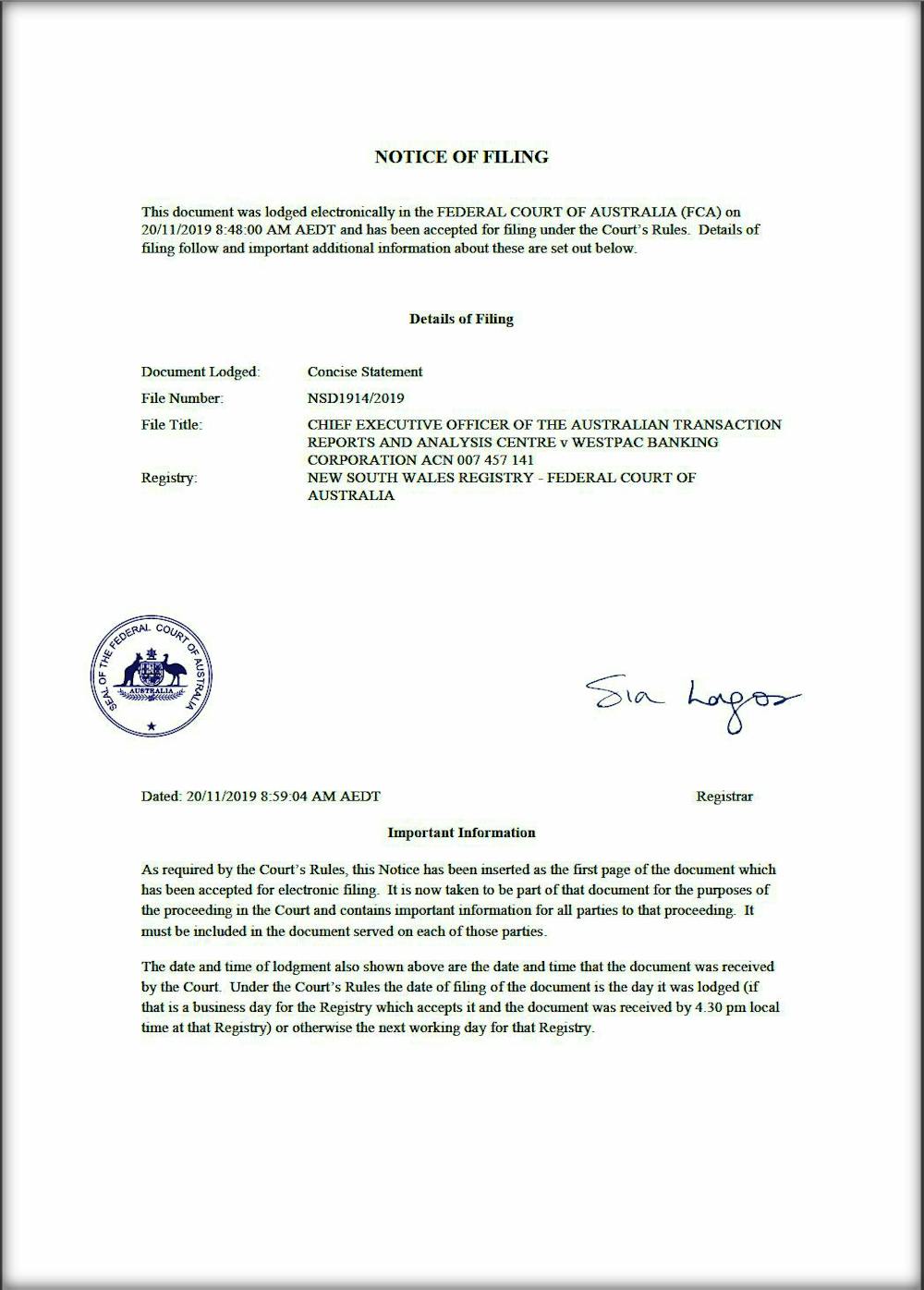
Federal Court notice of filing

AUSTRAC expects each organisation to identify patterns of risky transactions, such as third parties undertaking transfers to and from accounts for no apparent reason, or regular international funds transfers to high-risk jurisdictions.

AUSTRAC claims Westpac failed to appropriately assess transactions to the Philippines and South East Asia that have known financial indicators relating to potential child exploitation risks.

Westpac is also accused of failing to understand and monitor transactions of money from its accounts to small intermediary banks located in countries where terrorist organisation are known to operate.

This does not necessarily mean money was transferred to terrorists. It does mean there was a risk, and AUSTRAC should have been informed.

“Fallen short”

The senior management of banks and other cash-handling organisations is expected to fully support anti-money-laundering and counter-terrorism-financing efforts. Among other things, a compliance officer is expected report to the board and be given the authority and resources to ensure the organisation is meeting its obligations.

On Wednesday AUSTRAC accused Westpac’s senior management of indifference and failure to adequately invest in the technology and programs needed to monitor and report patterns of potentially suspicious transactions.

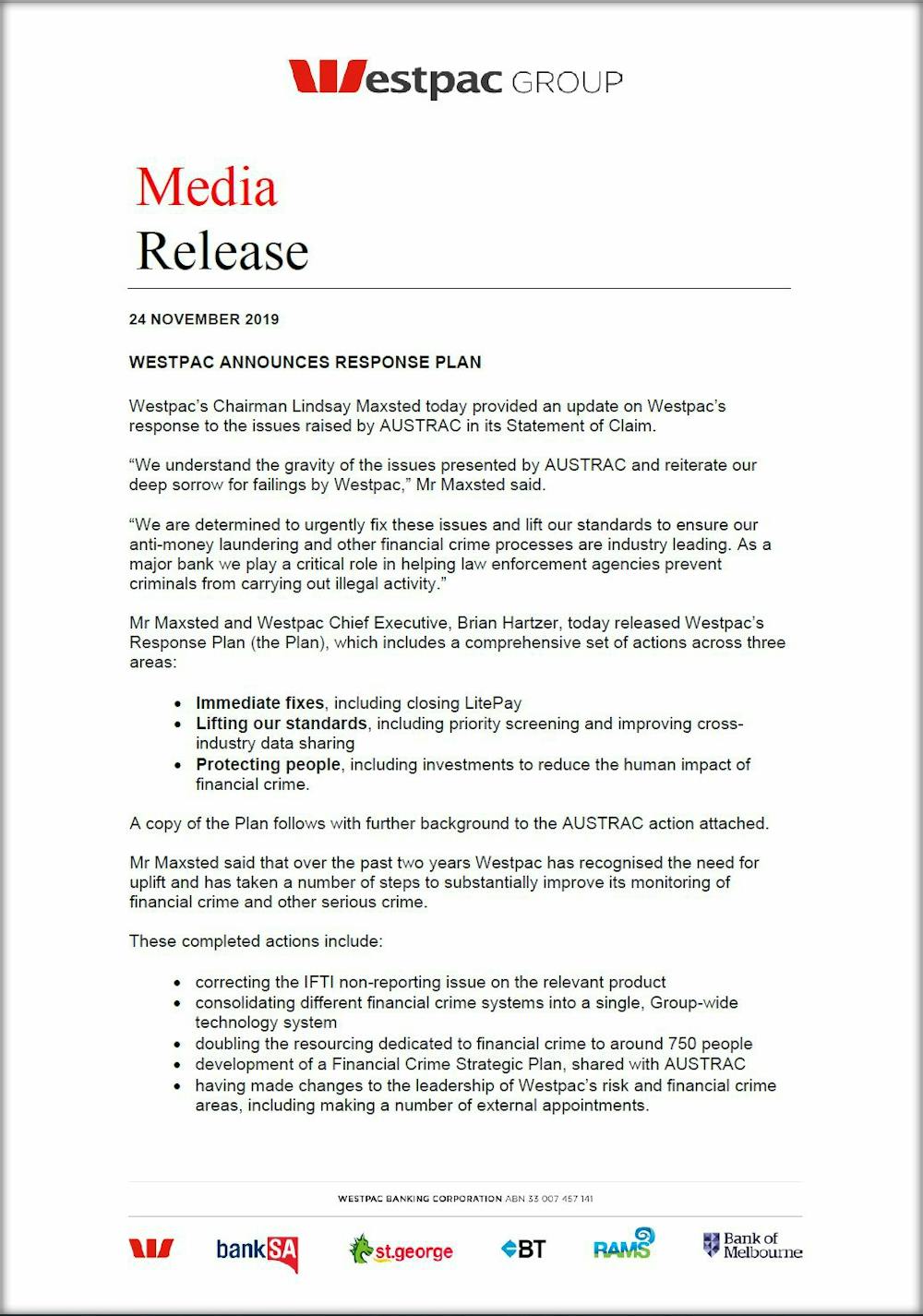
Westpac’s weekend response.

On Sunday Westpac’s chairman Lindsay Maxsted said based on its current understanding, the board did not believe that there has been any indifference by any member of the executive team, including its chief executive.

But he said Westpac had “fallen short”.

He understood “the gravity of the issues” and had “deep sorrow for failings by Westpac”.

The bank would withhold all or part of bonuses from its executive team subject to the outcome of an external investigation, which would be made public.

In the meantime Westpac announced a response plan that includes closing one of the products used to facilitate transactions, lifting screening standards, and “protecting people” by, among other things, spending A$18 million over three years to tackle online sexual exploitation of children in the Philippines.

Extract from Westpac’s weekend response.

Not alone

Two years ago it was Commonwealth Bank that fell foul of AUSTRAC for allowing money to go out of the country without checks.

Easrlier this month the National Australia Bank confirmed that it too was also in discussions with AUSTRAC.

The banking royal commission exposed ways in which elements within financial institutions seemed to regard strict compliance with the law as optional. AUSTRAC has has made it clear it is not, when it comes to money laundering.

ref. How Westpac is alleged to have broken anti-money laundering laws 23 million times – http://theconversation.com/how-westpac-is-alleged-to-have-broken-anti-money-laundering-laws-23-million-times-127518

What are lost continents, and why are we discovering so many?

Source: The Conversation (Au and NZ) – By Maria Seton, ARC Future Fellow, University of Sydney

For most people, continents are Earth’s seven main large landmasses.

But geoscientists have a different take on this. They look at the type of rock a feature is made of, rather than how much of its surface is above sea level.

In the past few years, we’ve seen an increase in the discovery of lost continents. Most of these have been plateaus or mountains made of continental crust hidden from our view, below sea level.

One example is Zealandia, the world’s eighth continent that extends underwater from New Zealand.

Several smaller lost continents, called microcontinents, have also recently been discovered submerged in the eastern and western Indian Ocean.

But why, with so much geographical knowledge at our fingertips, are we still discovering lost continents in the 21st century?

We may have found another

In August, we undertook a 28-day voyage on the research vessel RV Investigator to explore a possible lost continent in a remote part of the Coral Sea. The area is home to a large underwater plateau off Queensland, called the Louisiade Plateau, which represents a major gap in our knowledge of Australia’s geology.


Read more: Explainer: the RV Investigator’s role in marine science


On one hand, it could be a lost continent that broke away from Queensland about 60 million years ago. Or it could have formed as a result of a massive volcanic eruption taking place around the same time. We’re not sure, because nobody had recovered rocks from there before – until now.

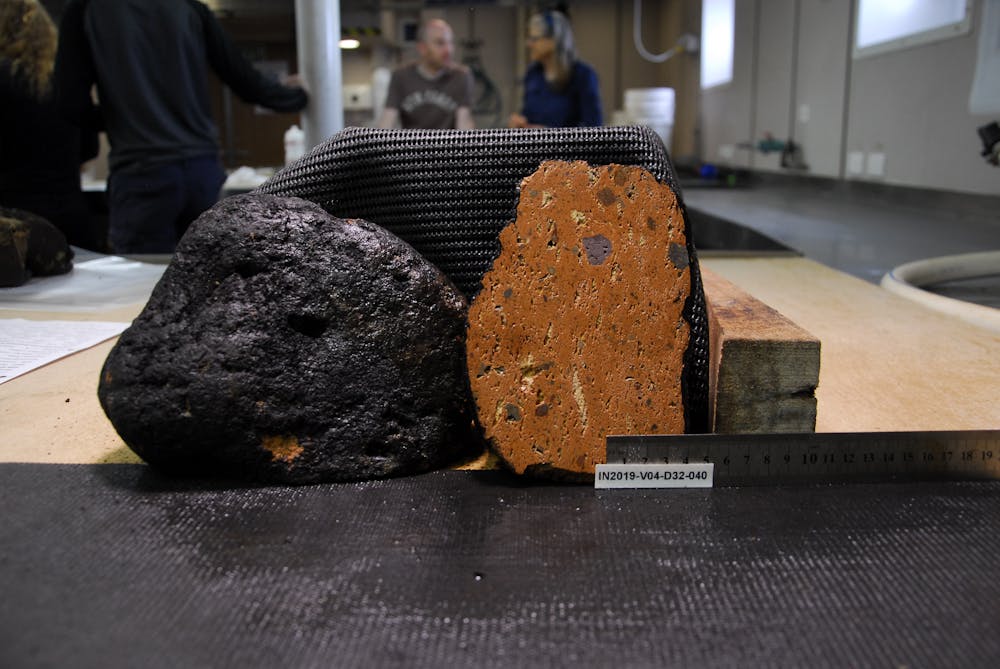
An extremely violent eruption formed this volcanic rock we recovered. Author supplied

We spent about two weeks collecting rocks from this feature, and recovered a wide variety of rock types from parts of the seafloor as deep as 4,500m.

Most were formed through volcanic eruptions, but some show hints that continental rocks are hiding beneath. Lab work over the next couple of years will give us more certain answers.

Down to the details

There are many mountains and plateaus below sea level scattered across the oceans, and these have been mapped from space. They are the lighter blue areas you can see on Google Maps.


However, not all submerged features qualify as lost continents. Most are made of materials quite distinct from what we traditionally think of as continental rock, and are instead formed by massive outpourings of magma.

A good example is Iceland which, despite being roughly the size of New Zealand’s North Island, is not considered continental in geological terms. It’s made up mainly of volcanic rocks deposited over the past 18 million years, meaning it’s relatively young in geological terms.

The only foolproof way to tell the difference between massive submarine volcanoes and lost continents is to collect rock samples from the deep ocean.

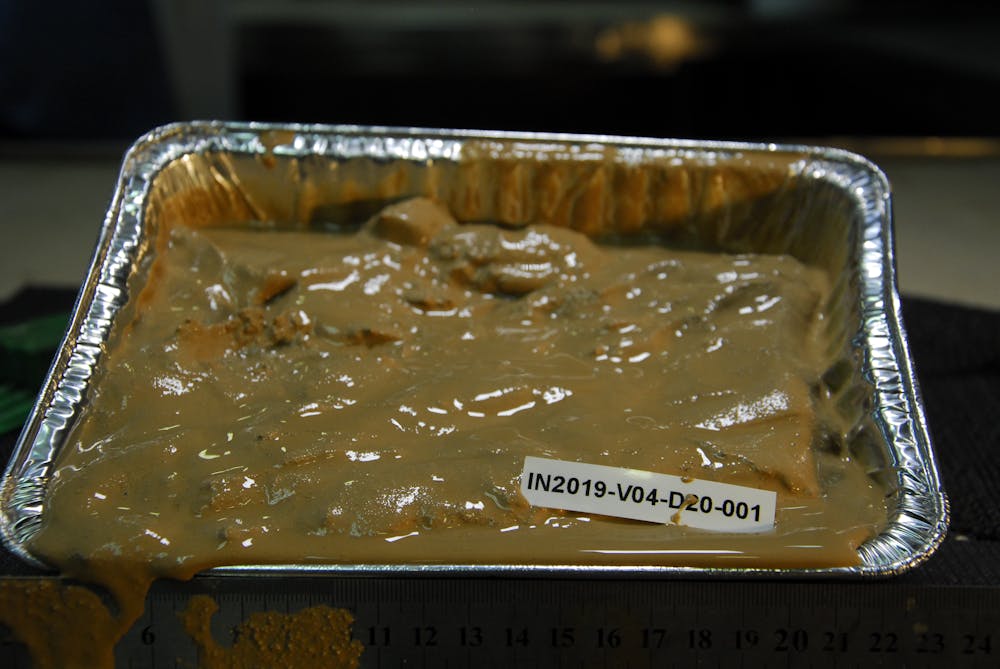
Plenty of soft, gloopy sediment covers the bottom of the Coral Sea. Author provided

Finding the right samples is challenging, to say the least. Much of the seafloor is covered in soft, gloopy sediment that obscures the solid rock beneath.

We use a sophisticated mapping system to search for steep slopes on the seafloor, that are more likely to be free of sediment. We then send a metal rock-collecting bucket to grab samples.

The more we explore and sample the depths of the oceans, the more likely we’ll be to discover more lost continents.

The ultimate lost continent

Perhaps the best known example of a lost continent is Zealandia. While the geology of New Zealand and New Caledonia have been known for some time, it’s only recently their common heritage as part of a much larger continent (which is 95% underwater) has been accepted.


Read more: Explorers probe hidden continent of Zealandia


This acceptance has been the culmination of years of painstaking research, and exploration of the geology of deep oceans through sample collection and geophysical surveys.

Continental rocks recovered from a microcontinent in the Indian Ocean are similar to rocks found in Western Australia. Author supplied

New discoveries continue to be made.

During a 2011 expedition, we discovered two lost continental fragments more than 1,000km west of Perth.

The granite lying in the middle of the deep ocean there looked similar to what you would find around Cape Leeuwin, in Western Australia.

Other lost continents

However, not all lost continents are found hidden beneath the oceans.

Some existed only in the geological past, millions to billions of years ago, and later collided with other continents as a result of plate tectonic motions.

Their only modern-day remnants are small slivers of rock, usually squished up in mountain chains such as the Himalayas. One example is Greater Adria, an ancient continent now embedded in the mountain ranges across Europe.

Due to the perpetual motion of tectonic plates, it’s the fate of all continents to ultimately reconnect with another, and form a supercontinent.

But the fascinating life and death cycle of continents is the topic of another story.


Read more: How Earth’s continents became twisted and contorted over millions of years


ref. What are lost continents, and why are we discovering so many? – http://theconversation.com/what-are-lost-continents-and-why-are-we-discovering-so-many-126355

Government’s Commonwealth Integrity Commission will not stamp out public sector corruption — here’s why

Source: The Conversation (Au and NZ) – By Yee-Fui Ng, Senior Lecturer, Faculty of Law, Monash University

Attorney-General Christian Porter added a little more flesh to the bones of the long-awaited Commonwealth Integrity Commission this week. In a National Press Club address, Porter argued there must be a balance between having a powerful investigative body and fairness to individuals investigated by the commission.

Yet commentators have roundly criticised the government’s model for being watered down and a sham.


Read more: Why the federal government’s new integrity commission isn’t up to the job


Queensland LNP MP Llew O’Brien has warned he may cross the floor and vote against the government on this issue. O’Brien believes politicians and their staff should be held to the same standards as law enforcers.

Crossbench MPs have also called on the government to establish a national integrity commission “with teeth”.

The government intends to release a draft bill this year.

So, what is the government’s model? And why has it been criticised?

The government’s model

The government’s proposed CIC has two parts: the law enforcement division and the public sector division.

The law enforcement division applies only to law enforcement agencies and those with coercive powers. The public sector integrity division covers the rest of the public sector, federal service providers, subcontractors, as well as MPs and their staff. The commission will have the power to conduct public hearings only through its law enforcement division.

By contrast, the public sector division will not have the power to hold public hearings or make public findings of corruption. Instead, it will investigate and refer potential criminal conduct to the director of public prosecutions.

This is a far more limited jurisdiction compared to its equivalent state counterparts, such as the New South Wales Independent Commission Against Corruption (ICAC), which can conduct public hearings and make findings of corruption in the public sector.

All states now have an anti-corruption commission and the federal government is lagging behind.

Why not everyone is happy with the government’s model

The government’s model has been criticised for a few reasons.

The first is that it would fail to achieve its main aim of exposing corruption in the public sector.

The bar for investigation is too high, requiring a reasonable suspicion of corruption amounting to a criminal offence before an investigation can even begin. This is a difficult hurdle to clear.

Lessons from the state anti-corruption commissions show evidence of corruption has been unveiled through investigations based on allegations, rather than before an investigation begins.

Another major criticism is that the proposed CIC will not have the power to hold public hearings.

Public hearings ensure proceedings are not cloaked in secrecy and will increase public trust. Notable inquiries in Australia have exposed major corruption through public hearings. This includes the Fitzgerald inquiry that revealed widespread corruption in the Queensland police force, leading to the resignations and imprisonments of various former ministers and officials.

But the attorney-general has raised legitimate issues about damage to individual reputations where a person subject to a public hearing has their reputation tarnished in the media, but is ultimately found not guilty by the courts.

This can be ameliorated by having the option of public and private hearings. Public hearings should be used only when it is in the public interest, balanced with considerations of individual reputation.


Read more: The proposed National Integrity Commission is a watered-down version of a federal ICAC


Critics have also complained about the CIC’s inability to initiate investigations itself and to receive complaints directly from the public. It can only investigate after a referral from the public sector, or if the CIC is conducting an investigation and discovers additional corrupt conduct in a different department. This is a significant limitation.

Other comparable investigative bodies have “own motion” powers to investigate issues based on public complaints.

There is no principled reason why we should keep MPs, their staff and public servants to a lower standard than law enforcement agencies. Corruption can manifest equally within the ranks of MPs, the public sector and law enforcement agencies.

The need for a national integrity commission

The public is calling out for a national integrity commission, with two-thirds (67%) of Australians in favour of one.

A group of judges have signed a letter calling for a national integrity commission with strong powers and the ability to hold public hearings.

Australians want a robust and well-resourced national integrity commission that has strong powers to achieve its mandate. The government should reconsider its model in light of public criticism.

ref. Government’s Commonwealth Integrity Commission will not stamp out public sector corruption — here’s why – http://theconversation.com/governments-commonwealth-integrity-commission-will-not-stamp-out-public-sector-corruption-heres-why-127502

Teens with at least one close friend can better cope with stress than those without

Source: The Conversation (Au and NZ) – By Tracy Evans-Whipp, Research Fellow, Australian Institute of Family Studies

Teenagers who have at least one close friendship are better able to bounce back from stress. This is one of the latest findings from the Growing Up In Australia study.

Growing Up in Australia has been following the lives of around 10,000 children since 2004. In 2016, the older children in the study were aged 16–17. We asked them about aspects of their lives including their peers, school environment and mental health.

One aspect of teen well-being we looked at was resilience. This is the ability to bounce back from stressful life events and learn and grow from them.

Stressful life events may include arguments with friends, sporting losses and disappointing test results. A more serious setback may be family breakdown, the illnesses or death of a family member, or being the victim of bullying.

Overall, teens said they displayed characteristics of resilience often, but boys significantly more so than girls. Our findings also show a strong relationship between not having a close friend and a low resilience score.

Boys more resilient than girls

Research suggests a person’s resilience is determined by a variety of factors. These include individual biological and psychological characteristics, relationships with family and peers, and environmental influences such as those in the school and broader community.

Our study asked teens to rate themselves on ten different aspects of resilience including their ability to adapt to change, how well they can achieve goals despite obstacles and how easily they are discouraged by failure. Together these gave a score from 0 to 40 (the higher the score, the higher the resilience).


Read more: Combatting online bullying is different for girls and boys: here’s why


The average total resilience score for adolescents was 26.5 out of 40. This suggests the “average” 16–17 year old views themselves as displaying resilient characteristics often.

Boys had significantly higher resilience scores than girls – 27.6 out of 40 for boys compared to 25.5 for girls. For example:

  • 51% of boys and 37% of girls said they were not easily discouraged by failure

  • 63% of boys and 45% of girls said they can usually handle unpleasant feelings

  • 50% of boys and 39% of girls responded “often or nearly always true” to the statement “coping with stress can strengthen me”

  • 67% of boys and 58% of girls felt they could (often or always) deal with whatever comes.


Longitudinal Study of Australian Children 2019, CC BY

It is possible that when answering the survey questions boys may be more likely to want to appear strong in the face of stress than girls. But other studies have also shown significantly higher levels of resilience in boys.


Read more: ‘I wish you were murdered’: some students don’t know the difference between bullying and banter


Close relationships make kids stronger

We also looked at how supportive environments – such as family, school community and friends – affected teens’ resilience.

Of the 16–17 year olds we interviewed, 84% said they had at least one good friend. These teens had average resilience scores of 27, compared to 23 for the 16% who said they did not have a good friend (this is a statistically significant difference).

We also found the nature of the friendship important. Average resilience scores were higher for teenagers who had

  • high levels of trust in their friends — average resilience scores were three points higher than for those with low levels of trust

  • good communication with their friends — average resilience scores were 3.5 points higher, compared to those who reported poorer communication.


Longitudinal Study of Australian Children 2019, CC BY

The flipside to having a close friend is being a victim of bullying. The average resilience scores of teens who had been bullied in the previous 12 months were almost two points lower than those who had not.

But even the harmful experience of being bullied is not as damaging to teens’ resilience as not having a close friend to confide in. A good friend raised average resilience scores by four points.


Read more: Adolescence can be awkward. Here’s how parents can help their child make and maintain good friendships


We also found teens who felt close to their parents and other family members had higher resilience.

Around 16% of young people lacked family support consistently through their early adolescent years (10–13 years old) and these teens reported significantly lower resilience levels at age 16–17.

Lacking family support means a teen doesn’t have people in their immediate or extended family who they trust when they want to talk about things that upset or worried them.

The average resilience score at age 16–17 for those who lacked family support in early or mid-adolescence was 25.3, compared to 26.8 for those who had support at one or both ages.

Our findings do not demonstrate a causal relationship between friendship and resilience. Because teens reported on friendships and resilience at the same time, it was not possible to tell whether those who have no close friends were so because they were less resilient, or whether they were less resilient because they had no close friends.

But our findings do highlight the vulnerability of teenagers lacking close relationships.


Read more: Poor kids hit puberty sooner and risk a lifetime of health problems


Resilience can change as people interact with and respond to other people in their lives and their environments. This creates opportunities to promote resilience in young people in different settings.

For anyone caring for or working with teens, a key finding from our research is that one of the best things you can do to foster resilience in a young person is to help them find and make friends. One good friend can make a big difference.

ref. Teens with at least one close friend can better cope with stress than those without – http://theconversation.com/teens-with-at-least-one-close-friend-can-better-cope-with-stress-than-those-without-126769

Making every building count in meeting Australia’s emission targets

Source: The Conversation (Au and NZ) – By Timothy O’Leary, Lecturer in Construction and Property, University of Melbourne

Buildings in Australia account for over 50% of electricity use and almost a quarter of our carbon emissions but the failures, frailties and fragmentation of the construction sector have created a major obstacle to long-term reductions. Reducing our carbon footprint plays second fiddle to the multibillion-dollar work of replacing flammable cladding, asbestos and other non-compliant materials and ensuring buildings are structurally sound and can be safely occupied.

Buildings – whether residential, commercial or institutional – do not score well under the nation’s main emissions reduction program, the A$3.5 billion Climate Solutions Package. This is intended to help meet Australia’s 2030 Paris Agreement commitment to cut emissions by 26–28% from 2005 levels.

This climate fund has very successfully generated offsets under the vegetation and waste methods – these projects account for 97% of Australian carbon credit units issued. But built environment abatements have been very disappointing.


Read more: Buildings produce 25% of Australia’s emissions. What will it take to make them ‘green’ – and who’ll pay?


Australians have very high emissions per person. That’s partly due to how we use our buildings.

Our states and territories control building regulations. This year the Council of Australian Governments (COAG) set ambitious energy-reduction trajectories for buildings out to 2022 and beyond. This was to be achieved through amendments to national codes and implementing energy-efficiency programs.

Making the best use of our buildings

Last month, the Green Building Council and Property Council launched a policy toolkit, called Making Every Building Count. The councils urged governments to adopt practical plans to reduce emissions in the building sector.

The toolkit contains no fewer than 75 recommendations for all tiers of government. These are the result of work done through industry and university research partnerships in places like the Low Carbon Living Collaborative Research Centre – now disbanded after its seven-year funding ended.


Read more: We have the blueprint for liveable, low-carbon cities. We just need to use it


Most energy-efficiency studies and programs focus solely on the operational aspect of buildings, such as the energy used to heat and cool them. However, various studies have proved that the energy and emissions required to manufacture building products, even energy-saving products such as insulation, can be just as significant.

A more holistic approach is to look at the embodied energy already in our building stock, which then poses a serious question about our consumption. So, besides aspirational codes for net zero-energy buildings, we should be asking: can we meet our needs with fewer new buildings?


Read more: The other 99%: retrofitting is the key to putting more Australians into eco-homes


In Melbourne, for example, an estimated 60,000 homes are sitting unused. Commercial property has very high vacancy rates – up to one in six premises are unoccupied in parts of the city. This points to a less-than-effective market in valuing our embodied carbon emissions in property.

If we are to get serious about reducing emissions, we need to tackle inefficient space use.

Empowering people to cut emissions

In occupied commercial buildings, some evidence suggests most building managers are grappling with complexity and challenging tenant behaviours. They also don’t get the clear information they need to continually improve their building’s performance beyond a selected benchmark.

In residential property, home energy performance is very much in our own hands. So we need to consider the means, motivations and opportunities of households, which I did in my doctoral study. A major barrier is that most of us don’t even know what we are getting when we buy or rent an ageing stock of more than 9 million homes.

Europe and the United States moved to mandatory residential energy disclosure at point of sale and lease well over a decade ago. If you rent or buy a home in these countries you get an energy performance certificate. It identifies emissions intensity and gives advice on how to operate the home more efficiently and hence with lower emissions.

In Australia, we have just sat on a commitment made by COAG back in 2009 to introduce a nationwide scheme.

Size matters, too. Residential space per person is high by international standards. Although McMansions are on the wane, our apartments are getting a bit bigger. The average size of freestanding houses built in 2018-19 shrank by 1.3% from 2017-18 to a 17-year low of 228.8 square metres.

And we are putting more solar on our roofs as a carbon offset. As of September 30 2019, Australia had more than 2.2 million solar photovoltaic (PV) installations. Their combined capacity was over 13.9 gigawatts.

However, the trend towards high-rise living is not helpful for emissions. Solar for strata apartments is tricky.

The trend towards apartment housing in Australian cities makes it harder for residents to use solar power. Darren England/AAP

I recently worked with colleagues in Australia and overseas in a study of the user experience of PV. We found residents face a range of issues that limit emission reductions. These issues include:

  • initial sizing and commissioning with component failures such as faulty inverters
  • lack of knowledge about solar and expected generation performance
  • regulatory barriers that limit the opportunity to upgrade system size.

Looking to improve regulations and codes and billion-dollar funds may be sensible ways to meet emission targets, but human empowerment is the secret weapon in improving energy performance and lowering emissions. Good low-carbon citizens will help create good low-carbon cities.


Read more: Cutting cities’ emissions does have economic benefits – and these ultimately outweigh the costs


A set of clear guides on how to use a building is a good starting point. The low-carbon living knowledge hub provides these.

What will make every building count in lowering emissions is the behaviour of occupants, the commitment of owners to make their buildings low-carbon and building managers’ ability to become more adept at reducing building-related emissions.

ref. Making every building count in meeting Australia’s emission targets – http://theconversation.com/making-every-building-count-in-meeting-australias-emission-targets-126930

We’re delaying major life events, and our retirement income system hasn’t caught up

Source: The Conversation (Au and NZ) – By Rafal Chomik, Senior Research Fellow, ARC Centre of Excellence in Population Ageing Research (CEPAR), UNSW

Asked to conduct an independent review of Australia’s retirement income system, the panel appointed by treasurer Josh Frydenberg reported on Friday that it was all tied up with the family home.

At every age range, Australians have more money saved through home ownership than they do through superannuation or anything else, much more:

Retirement Income Review consultation paper, November 22, 2019

The report is a consultation paper. The panel wants submissions by February 3.

It raises questions about how retirees without mortgage-free homes cope. The proportion is growing.

In part that’s because prices have skyrocketed. Over the past 20 years home prices have grown at about twice the pace of income.


Read more: Fall in ageing Australians’ home-ownership rates looms as seismic shock for housing policy


That is in part because of the growth in migration. About 3.7 million migrants have settled in Australia in the past two decades creating new demand for housing.

It is also because of the growth in credit, much of which went to Australians who already had homes rather than those who didn’t yet have them.

And it is also because housing supply has been slow to respond.

But the complex dynamics of high house prices don’t tell the full story.

A wide-ranging review of home ownership just published by the ARC Centre of Excellence in Population Ageing Research finds something else at play.

It’s the expansion of our lives.

Living longer, waiting longer

The typical age of a first home-buyer began climbing at the start of the 1980s, after dipping in the 1960s and 1970s as home ownership became widespread.

Between 1981 and 2016 the typical age increased by nine years from age 24 to age 33 at around the peak of the house price boom.

It was accompanied by a deferral in almost every other important life event:


Median age of major lifetime events 1966 – 2016

Source: CEPAR Research Brief ’Housing in an Ageing Australia: Nest and nest egg?’

In part this might be because the canvas of our lives has grown. The median age at death has grown by 12 years since the 1960s, from age 70 to 82.

Longer lives have meant longer adolescences and later ages at which we finish studying, find work, and start families.

The typical age of getting a first job is two years later than it was 50 years ago; the typical age of finishing education is five years later, the typical age of having a child is seven years later, and the typical age of getting married is eight years later.

At the same time the typical age of leaving the labour force is only four years later: it has climbed from 61 to 64. It’ll probably have to grow further, because mortgages aren’t typically paid off until age 62, ten years later than in the 1960s.

Delay is the new normal

Australia is not unusual in leaving things til later, even though house prices here have grown more than in most other countries.

There’s something more universal at play. Younger age groups may prefer the flexibility that renting offers. Longer lives mean they have more time to buy their homes. Even the nine year deferral in home purchase we have had so far should still see today’s young generations enjoying home ownership for longer than their parents.

Of course, many will choose not to buy. An increasing minority of mostly low income Australians look like being locked out of the market forever, and many who own homes will surrender them as a result of relationship breakups or other life events.


Read more: The edges of home ownership are becoming porous. It’s no longer a one-way street


Some will regain them. Others will retire with mortgage debt: 36% of homeowners do so now, up from 23% ten years ago. Many will use super to pay off debt instead of using it to fund retirement.

Our retirement income system is little help

The odd thing about the pension is that the payment is the same for both owners and renters. In fact, over A$6 billion of age pension payments go to people living in houses worth more than a million dollars.

Renters receive rental assistance but it is pegged to the wrong index, so it has grown more slowly than rents.

The oft-quoted statistic, that old-age poverty in Australia is high, is wrong.

But our analysis, which takes account of housing, suggests that old age Australian renters do indeed have some of the worst relative poverty rates in the OECD.


Relative old age poverty rate of renters

Source: CEPAR Research Brief ’Housing in an Ageing Australia: Nest and nest egg?’

Older renters have greater housing affordability stress than both older home owners and younger renters.

About 37% of renters aged 64-74 have both a low income and pay more than a third of it in rent, up from 21% in 1996.

While increases in homelessness among older women appear to be largely due to greater population numbers, their increased use of homelessness services is disproportionate.


Read more: Generation Share: why more older Australians are living in share houses


The population of women aged 55+ increased by about 3% per year between 2011 and 2016. Their use of homelessness services increased 11% per year.

Even if the typical Australian continues to become a homeowner by retirement, a growing minority will not, and will be treated poorly by our retirement income system.

The government’s review of the retirement income system is an opportunity to redress the balance.

ref. We’re delaying major life events, and our retirement income system hasn’t caught up – http://theconversation.com/were-delaying-major-life-events-and-our-retirement-income-system-hasnt-caught-up-127231

And I will always love you: how marketers measure Dolly Parton’s magic

Source: The Conversation (Au and NZ) – By Louise Grimmer, Senior Lecturer in Marketing, Tasmanian School of Business and Economics, University of Tasmania

Hit podcast Dolly Parton’s America is a love letter to the icon of American country music. It reveals Dolly’s broad and enduring appeal, which crosses generations, class, race and even musical tastes.

Dolly, 73, is having a “moment” that includes the podcast, 9:5 The Musical (coming to Australia in April), and the new Netflix series Heartstrings, which dramatises a Dolly song for each episode.

In a divided America, Dolly stands as the great unifier. The podcast cites her as being in the top 10 most loved celebrities globally – but also one of the least hated – based on extensive polling. Her popularity has been measured using a celebrity scoring system called the Q Score.

How do we quantify a public figure in terms of cultural cachet? And who would be Australia’s Dolly?

Here she comes again. Dolly – with fans in Honolulu in 1983 – has enduring appeal. Photo by Alan Light/Wikimedia, CC BY

What is a Q score?

Created in 1963 by Jack Landis, the Q Score scoring system is owned by the US-based Marketing Evaluations Inc.

The Q Score is a quotient (or percentage) that indicates the proportion of people who have heard of a given celebrity who also consider them as one of their favourites. This is sometimes referred to as a “positive Q Score”. A “negative Q Score” can be calculated too, being the proportion of people who have heard of a given celebrity who also consider them “poor” or “fair”.

Twice a year, a representative sample of female and male adults are presented with a list of 1,800 celebrities and asked to rate them on a six-point scale from “Never heard of” to “One of my favourites”.

The data is added to the full Q Score database, which amounts to about 25,000 celebrities at any given time.

From Sammy Davis junior to Taylor Swift, celebrities sure know how to sell stuff.

A Q Score is a measure of both familiarity and positivity. This is important, as likeability can be highly subjective, so assigning a score provides some sense of objectivity.

The score puts a price on a celebrity’s “likeability” and therefore how much their popularity is worth – handy for those looking for people to represent their products.

In the world of advertising and celebrity endorsement, the higher a celebrity rates, the more companies will be willing to pay them to promote their products and services.

Celebrities behaving badly – Charlie Sheen, Tiger Woods, Felicity Huffman – show endorsement can be a fickle business. The Q Score provides some comfort to a company or brand that a celebrity is likely to be a safe bet.

Ratings are also helpful in revealing celebrities people love to hate. Before he was US President, Donald Trump was a reality TV star with a very low Q Score (and a very high negative Q Score).

Q Scores have attracted criticism, mostly that they are “normative” and therefore often don’t reflect the views of minorities. There is a Hispanic Q Score which rates 400 Hispanic personalities; however, the sampling process inevitably leads to a hegemonic outcome reflecting the dominant social influence.

Better off dead

Deceased celebrities also have enormous value. Their images and even reanimated footage of them is used regularly in advertising (think Marilyn Monroe, Bruce Lee, James Dean or Audrey Hepburn).

The “dead celebrity” industry is worth approximately US$2.25 billion (A$3.3 billion) every year. The most popular are ranked using a similar system to Q scores, called the Dead Q, which is updated every two years.

Some celebrities earn more dead than they did alive, bringing in millions for their estates in royalties.

Deceased celebrities are very attractive to marketers because they don’t age or change the way they look, they don’t get involved in scandals (Michael Jackson notwithstanding), and they stay famous.


Read more: Chat bots, James Dean … can the digital dead rest in peace?


Australia’s own

In Australia, celebrities are also rated, though the local rating systems are not exactly the same as in the USA. Until 2010, there was a Q Score system undertaken by Audience Development Australia, which has recently been reported as set to return in 2019. However, this system is TV-oriented and mostly rates Australian TV presenters and brands. Of more relevance here is the Encore Score.

Triple threat Hugh Jackman scores highly on Australia’s Encore Score of popularity. WENN

The Encore Score is sponsored by Mumbrella and was last issued in 2016.

The methodology is similar to the American Q Score, and asks a sample of 3,000 respondents to rate 1,000 TV, radio, film and media celebrities from “One of my favourites” to “I hate them”, as well as how familiar they are with the person.

In this way, the Encore Score mimics the Q Score in terms of familiarity and positivity.

In 2016, the top three Australian celebrities using Encore scoring were Hugh Jackman, Jamie Oliver and Chris Hemsworth (yes, one of these is actually British). Other notable scorers included Cate Blanchett and Nicole Kidman, Rebecca Gibney and Russell Crowe (both New Zealanders).

The 2016 Encore Score also ranked the least liked celebrities. The number one on this list: Kyle Sandilands. Shane Warne and Eddie McGuire also got mentions.

Robert Irwin, Chris Hemsworth and Terri Irwin have been deemed marketable by Tourism Australia. Bianca De Marchi/AAP

Tourism Australia’s latest campaign – featuring Hemsworth, Paul Hogan, Kylie Minogue, Terri Irwin, Kylie Kwong, Curtis Stone, Adam Hills and surfer Mick Fanning – is probably the best current gauge of who market research has identified as our favourite Australian faces, at least the ones we’re prepared to share with the rest of the world.

Our Australian Dolly? Nominate your favourite celebrities of stage, screen and airwaves in the comments below.

ref. And I will always love you: how marketers measure Dolly Parton’s magic – http://theconversation.com/and-i-will-always-love-you-how-marketers-measure-dolly-partons-magic-126688

Josh Frydenberg turns up heat on Westpac chiefs as bank issues a ‘response plan’

Source: The Conversation (Au and NZ) – By Michelle Grattan, Professorial Fellow, University of Canberra

The government at the weekend piled on more pressure for Westpac heads to roll over the bank’s money laundering scandal, with Treasurer Josh Frydenberg saying the affair had a long way to play out.

“These issues develop a momentum of their own. They’ve got an AGM on December 12 – and, no doubt, there’ll be some very hard discussions between now and then,” Frydenberg said.

The treasurer also revealed the Australian Prudential Regulation Authority (APRA) had become involved. APRA supervises banks and other institutions in the financial sector.

“APRA has the ability, under the Banking Executive Accountability Regime (BEAR), to disqualify boards and to disqualify executives where there’s a failure to appropriately enforce and uphold the duties under the legislation,” Frydenberg said.

“That legislation came into force in 2018. It’s not retrospective, and some of those alleged breaches date back to 2013. But … I know that APRA is looking at it”.

23 million breaches

Westpac last week was accused by AUSTRAC of 23 million breaches of the anti-money laundering and counter-terrorism financing law, with the alleged breaches include transfers of money to the Philippines for child sex exploitation. AUSTRAC has begun civil proceedings against Westpac.

AUSTRAC is an official agency that uses financial intelligence and regulation to disrupt money laundering, terrorism financing and other crimes.

Frydenberg’s comments came as Westpac on Sunday announced a “response plan” across three areas. These included

  • “immediate fixes” – among them, closing the LitePay international funds transfer system, which facilitated low-value international payments

  • lifting standards – including priority screening and improving cross-industry data sharing

  • protecting people – with what the bank described as “investments to reduce the human impact of financial crime”. This will involve multi million dollar funding for programs to counter child sexual exploitation.

In political terms, the latest bank scandal comes at an awkward time for the government, which has its ensuring integrity legislation, to crack down on rogue unions and union officials, before parliament on Monday.

After accepting amendments from both Centre Alliance and Pauline Hanson, the government said on Sunday it was confident the legislation, strongly opposed by Labor, will pass.


Read more: Westpac’s scandal highlights a system failing to deter corporate wrongdoing


Asked on the ABC what form the Westpac board’s accountability should take, Frydenberg said: “There must be accountability, and that will obviously involve decisions that they take about the futures of senior management, as well as the board”.

So far, there has been no sign of Westpac taking heed of the hints and calls for resignations.

The government’s position had consistently been that membership of boards were matter for shareholders and boards determined executive teams, Frydenberg said.

“That being said, these are very serious issues. There must be accountability.

Federal Court notice of filing

“AUSTRAC have been highly critical in their statement. And now APRA is looking into it.

“So I don’t think there’s any doubt as to the seriousness of these issues and the government’s position,” he said.

“We’re talking about a failure to adequately assess customers with links to child trafficking and child pornography.

“And we’ve seen, from AUSTRAC, a statement that there has been indifference by the board, that there’s been a systematic failure by the bank and there’s been inadequate oversight”.

Frydenberg said the Westpac board and management were “all seized of this issue, and they’re now going through a process. But with APRA providing additional focus, as well as AUSTRAC, certainly the heat is on the company”.

He said he had spoken to the bank’s chairman, Lindsay Maxsted, and CEO, Brian Hartzer.

Obviously I made very clear the seriousness of these issues. But they also made very clear to me that they have a process now underway where they’re bringing independent experts in, and they’re determined to provide a way forward. And, of course, this is before the courts too.

‘Truly sorry’

Westpac’s board has issued an unreserved apology. Maxsted said after a board meeting on Friday: “The notion that any child has been hurt as a result of any failings by Westpac is deeply distressing and we are truly sorry”.

“Our board, CEO and management team are fully committed to fixing these issues and we are taking all steps necessary to urgently close any remaining gaps and fix our policies and procedures so that this can never happen again.”

Westpac’s weekend response.

He said significant improvements had already been made “including reviewing and taking action on all of the individual customers mentioned by AUSTRAC and establishing a multi-layered review.”

In Westpac’s Sunday statement Maxsted said, “We accept that we have fallen short of both our own and regulators’ standards and are determined to get all the facts and assess accountability”.

In the interim the board had decided that either all or part of the 2019 bonuses would be withheld for the full executive team and several of the general managers “subject to the assessment of accountability”.

Under its “protecting people” measures Westpac will

  • match the International Justice Mission’s current funding, investing $18 million over three years to fight online sexual exploitation of children in the Philippines

  • match the federal government’s current funding for its SaferKidsPH partnership with various organisations, investing $6 million over six years to raise awareness of online sexual exploitation of children and support programs to protect children in the Philippines

  • convene an expert advisory roundtable to develop a program to support prevention of online child exploitation. The bank will provide up to $10 million a year for three years to implement these recommendations.

ref. Josh Frydenberg turns up heat on Westpac chiefs as bank issues a ‘response plan’ – http://theconversation.com/josh-frydenberg-turns-up-heat-on-westpac-chiefs-as-bank-issues-a-response-plan-127698

That moving graph of US tax rates that went viral, it’s probably wrong. Here’s why

Source: The Conversation (Au and NZ) – By Robert Breunig, Professor of Economics and Director, Tax and Transfer Policy Institute, Crawford School of Public Policy, Australian National University

Over the past month a huge political dispute has sprung up in the US about the fairness of its tax system. It is fuelling debates between Democratic presidential rivals, and it is raising questions about the fairness of tax systems everywhere, including in Australia.

It began with a New York Times article entitled The Rich Really Do Pay Lower Taxes Than You.

It was accompanied by one of the most evocative graphics you are likely to see:

Here’s what the graphic shows.

The vertical axis is total tax (US federal, state and local) as a proportion of income. The horizontal axis is income band, from lowest to highest.

At first the yellow line displays the graph for 1950 which is sloping upwards, showing that the highest earners paid the highest proportion of their income in tax (70%) and the low earners the lowest (less than 20%).

It shows what is known as a “progressive” tax system, in which those with the highest income sacrifice the greatest proportion of their income.


Read more: So you want to tax the rich – here’s which candidate’s plan makes the most sense


Hit “play” on the graphic, and the yellow line gets less progressive over time until 2018 when it becomes pretty flat, except for the few very rich Americans at the very top of the income distribution who pay less of their income in tax than everyone else.

The Triumph of Injustice, by Emmanuel Saez and Gabriel Zucman. W.W. Norton

The graph is derived from a new book by economics professors Emmanuel Saez and Gabriel Zucman entitled The Triumph of Injustice: How the Rich Dodge Taxes and How to Make them Pay.

Their claim that the US has sleepwalked away from progressive taxation is compelling partly because it is so different from the conventional wisdom.

Warren Buffet might pay less tax than his Secretary, but the traditional story is that the US tax system is progressive, along the lines of Australia’s.

That’s been the view of the US Treasury, the US Congressional Budget Office, and the US Tax Policy Centre.

It’s also the finding of the Organisation for Economic Co-operation and Development and a peer-reviewed 2018 Quarterly Journal of Economics article by Saez and Zucman themselves.

It depends on what you think is income

Heavyweights such as Nobel Prize winner Paul Krugman and former US treasury secretary Larry Summers have chimed in, taking opposing positions pn #econtwitter about the veracity of the graph.

More helpfully, David Splinter from the US Joint Committee on Taxation points out that Saez and Zucman’s measure of income differs from the traditional measure in two significant respects:

  • It assumes that underreported, untaxed income goes primarily to high-income earners. This under-reporting occurs when US taxpayers report less income than they earn, or claim more deductions, exemptions or tax credits than they are entitled to (a large and underappreciated issue. That explains much of the apparent low rate of tax on income at the top end.

  • It excludes from its definition of income government payments other than social insurance payments and deducts payroll taxes. Given that government payments are directed more to those at the bottom end than the top, this has the effect of pushing down apparent income at the bottom and pushing up the apparent tax rate.

The impact of the first is that if a top earner gets, say, $10 million of taxable income and pays $6 million of it in tax, but is assumed to earn an extra $3 million in untaxed income and $1 million in untaxed retirement income, that person’s implied overall tax rate falls from 60% to 43%.


Read more: What did the rich man say to the poor man? Why spatial inequality in Australia is no joke


The impact of the second can be illustrated by this thought experiment: imagine increasing the marginal tax rate of those earning more than $1 million to as much as 100%, and then returning all the tax to them via a government payment.

Saez and Zucman’s method would treat this as a genuine tax rate of 100% for high earners and find that the system had become extraordinarily progressive, even though no-one’s cash position would have changed.

Without these peculiarities of measurement, calculations by Wojciech Kapczuk of Columbia University suggest that the tax system has remained pretty progressive, retaining its upward sloping graph.

Kapczuk and other economists have also questioned the imprecision of some of the data, particularly the guesses needed to calculate the tax paid by the top 400 taxpayers since 1950, and the latest data, which was incomplete when the book was published.

Harvard University’s Larry Summers and Greg Mankiw demolished Saez in a rather unforgiving fashion during a debate at a recent Peterson Institute workshop on combatting Inequality.

It might damage the cause of research

To their credit, Saez and Zucman have welcomed scrutiny and released a partial working paper responding to critiques and a Q&A dealing with some of the issues on the book’s website.

The graph has alarmed many people, and by being released in a popular book during the US primaries has had a more immediate impact than it would have had it been subject to the slower and more painful academic process designed to establish the truth.

The credibility of Saez and Zucman’s work hangs in the balance. Should it ultimately be discredited, trust in economic research more generally will suffer. We will all lose.

ref. That moving graph of US tax rates that went viral, it’s probably wrong. Here’s why – http://theconversation.com/that-moving-graph-of-us-tax-rates-that-went-viral-its-probably-wrong-heres-why-127233

NZ deputy PM under fire, but maintains no laws broken in party donations scandal

Source: The Conversation (Au and NZ) – By Andrew Geddis, Professor, University of Otago

New Zealand’s deputy prime minister, Winston Peters, is under pressure following a complaint to the New Zealand Electoral Commission about his party’s mysterious funding arrangements.

Under electoral law, political parties have to disclose all donations above NZ$15,000. But the New Zealand First party, a coalition partner in the Labour-led government, has a somewhat opaque relationship with a trust called the New Zealand First Foundation, which has loaned the party tens of thousands of dollars in the past three years.

Those giving money to the foundation can remain anonymous because under electoral law, loans are not subject to the same disclosure requirements as donations.

But the foundation’s trustees are the New Zealand First party’s lawyer and an ex-member of parliament, who is now a lobbyist. This raises questions about the legality of the funding.


Read more: New Zealand politics: how political donations could be reformed to reduce potential influence


Money, politics and scandal

The relationship between private wealth and public power bedevils all democracies. In particular, constant tension surrounds the use of such wealth to fund political parties and candidates that contest public office.

This issue often emerges in the form of a scandal, where some practice or behaviour is revealed that challenges current legal or social norms. New Zealand is in the midst of such a moment.

While the loans from the foundation are legal, they have the practical effect of preventing the public disclosure of whoever provided the money in the first place. Reporting based on leaked internal documents reveals that the foundation’s funding sources include “companies and individuals who work in industries that have benefited from a NZ$3 billion Provincial Growth Fund” overseen by a New Zealand First minister.

As further reported, the foundation also appears to have directly paid for some of New Zealand First’s activities without those payments being disclosed as donations to the party. If correct, that practice looks to be at least questionable under existing electoral law.

While the New Zealand Electoral Commission is now examining the matter, its investigatory role is somewhat limited as it cannot require anyone to produce additional documentation. But should the commission conclude that the recent revelations show New Zealand First (or, more specifically, its party secretary) has committed an offence against the Electoral Act, it has a statutory obligation to refer the matter to police.

Such a referral would, of course, be politically very damaging to the party. Unfortunately, it would not be unprecedented. The country’s Serious Fraud Office already is examining allegations relating to the opposition National Party’s treatment of some NZ$100,000 in donations. To have two of New Zealand’s political parties under police investigation for possible illegal activity is hardly a ringing endorsement of the country’s political culture.

Is the law fit for purpose?

The alternative may not be all that much better. Consider what it means if, after discussing the matter with the party and the foundation, the commission concludes that no laws have been broken. After all, the leader of the New Zealand First party, Winston Peters, maintains this to be the case.

It would demonstrate New Zealand’s electoral law simply is not fit for purpose.

It would mean a key part of the government can be intimately connected to a legally opaque foundation that has raised hundreds of thousands of dollars from primary industry leaders, wealthy investors and multi-millionaires; that the foundation can use that money for the benefit of a party and its MPs; and that no one outside of the party and those who gave the money need know what is going on.

Such a state of affairs surely would threaten New Zealand’s ranking as the world’s second least corrupt nation in the world. It is important to note there is no indication that any form of quid pro quo actually exists here, but this would make it hard to sustain public trust and confidence in our governing arrangements.


Read more: A full ban on political donations would level the playing field – but is it the best approach?


For this reason, the current scandal is already generating calls for change to New Zealand’s electoral laws. Former National Party prime minister, Jim Bolger, advocates an end to private donations to political parties and a system of public funding. Author Max Rashbrooke advocates a combination of low limits on private donations and the use of “democracy vouchers”, which give every citizen a small amount of money to donate to the political party of their choice.

Those are proposals that New Zealand ought at least to consider seriously. For as long as the country continues to leave the funding of political parties and candidates up to those individuals and groups with wealth to spare, we will see scandals like the current one reoccur.

ref. NZ deputy PM under fire, but maintains no laws broken in party donations scandal – http://theconversation.com/nz-deputy-pm-under-fire-but-maintains-no-laws-broken-in-party-donations-scandal-127596

Westpac’s scandal highlights a system failing to deter corporate wrongdoing

Source: The Conversation (Au and NZ) – By Elise Bant, Professor of Law, University of Melbourne

The news that Australia’s anti money-laundering regulator has accused Westpac of breaching the law on 23 million occasions points to the prospect that powerful members of corporate Australia are still behaving badly.

This despite the clear lessons offered by the Banking Royal Commission.

Regulators are still struggling to find the right balance between pursuing wrongdoers through the courts – an admittedly costly, time-consuming and highly risky business – and finding other means to punish and deter misconduct.

Australia’s anti money-laundering regulator, AUSTRAC, is seeking penalties against Westpac in the Federal Court.

Each of the bank’s alleged contraventions attracts a civil penalty of up to A$21 million. In theory, that could equate to a fine in the region of A$391 trillion. In practice, it is likely to be a mere fraction of that sum. Commonwealth Bank breached anti-money-laundering laws and faced a theoretical maximum fine of nearly A$1 trillion, but settled for A$700 million.

No doubt the reality that companies can minimise penalties is a factor in why breaches continue.

This impression is reinforced by revelations last week that financial services company AMP continued to charge fees to its dead clients despite the shellacking it received at the hands of the royal commission.

Last month a Federal Court judge refused to approve a A$75 million fine agreed between the Australian Competition and Consumer Commission and Volkswagen to settle litigation over the car company’s conduct in cheating emissions tests for diesel vehicles. The judge was reported to be “outraged” by the settlement, which meant Volkswagen did not admit liability for its misconduct.

The A$75 million is a drop in the ocean of the likely profits obtained from this systemic wrongdoing and pales into insignificance next to fines imposed in other countries.

Proposals for law reform

So business as usual, right?

Maybe not for long. The Australian Law Reform Commission has just released a discussion paper on corporate criminal responsibility.

It points out that effective punishment and deterrence of serious criminal and civil misconduct by corporations in Australia is undermined by a combination of factors.

These include a confusing and inconsistent web of laws governing the circumstances in which conduct is “attributed” to the company. Similar problems of inconsistency arguably also undermine other key areas, such as efforts to give courts the power to impose hefty fines based on the profits obtained by the wrongdoing

The repeated attempts to come up with new and more effective attribution rules arise because corporate wrongdoers are “artificial people”. For centuries, courts and parliaments have struggled with how to make them pay for what is done by their human managers, employees and (both human and corporate) agents. All too often a company’s directors disclaim all knowledge of the wrongdoing.


Read more: Three simple steps to fix our banks


To fix this, the ALRC recommends having one single method to attribute responsibility. It builds on the attribution rule first developed in the Trade Practices Act 1974 (Cth) and now used, in various forms, across various statutes.

The ALRC proposes that the conduct and state of mind of any “associates” (whether natural individuals or other corporations) acting on behalf of the corporation should be attributable to the corporation.

This goes well beyond the traditional focus on directors and senior managers and would provide some welcome consistency in the law.

Importantly, serious criminal and civil breaches that require proof of a dishonest or highly culpable corporate “state of mind” can be satisfied either by proving the state of mind of the “associate” or that the company “authorised or permitted” the conduct.

A “due diligence” defence would protect the corporation from liability where the misconduct was truly attributable to rogue “bad apples” in an otherwise a well-run organisation. There would be no protection in the case of widespread “system errors” and “administrative failures” so pathetically admitted during the royal commission.

The ALRC also proposes that senior officers be liable for the conduct of corporations where they are in “a position to influence the relevant conduct and failed to take reasonable steps to prevent a contravention or offence”.

This would place the onus on those in a position to change egregious corporate practices to show they took reasonable steps to do so.

Removing the penalty ceiling

These recommendations, if adopted could prove a game-changer for regulators asking themselves “why not litigate?” and corporations used to managing the fall-out of their misconduct as simply a “cost of business”.

The ALRC’s recommendations that the criminal and civil penalties should be enough to ensure corporations don’t profit from wrongdoing will be welcomed by many. Some academics have gone further and argued that the law should be changed to make it clear that civil, not just criminal penalties, should be set at a level that is effective to punish serious wrongdoing.


Read more: How courts and costs are undermining ASIC and the ACCC’s efforts to police misbehaving banks and businesses


The ALRC also raises the question whether current limits on penalties should be removed. The Westpac scenario might be just the kind of case to make that option attractive.

ref. Westpac’s scandal highlights a system failing to deter corporate wrongdoing – http://theconversation.com/westpacs-scandal-highlights-a-system-failing-to-deter-corporate-wrongdoing-127619

How to manage your essential medicines in a bushfire or other emergency

Source: The Conversation (Au and NZ) – By Andrew Bartlett, Associate Lecturer Pharmacy Practice, University of Sydney

Some people find managing their medication difficult at the best of times. But in an emergency, like a bushfire or cyclone, this can be harder still.

As catastrophic bushfires burn across Australia, here’s what to think about as part of your emergency planning to make sure you have access to the medicines you need.


Read more: What you can do about the health impact of bushfire smoke


As part of your emergency plan, list your medications and where you keep them, along with contact details for your doctor and pharmacist and any other relevant emergency services.

If you have advanced warning of emergency conditions, check both your supply of tablets and any prescriptions you may need. Your prescription label will tell you how many repeats you have left. Try and keep at least one week’s medication on hand.

I need to evacuate. Now what?

If you need to evacuate, know how best to store and transport your medication. Most medications for conditions such as blood pressure or cholesterol need to be stored below 25-30℃. These medications will be OK if temperatures are higher than this for short periods of time, while you transport them.

Medicines sensitive to temperature will need to be stored or transported with cold packs in an insulated container of some sort, such as an esky. Putting them in a ziplock bag will help protect them from moisture.


Read more: Evacuating with a baby? Here’s what to put in your emergency kit


Insulin is one common medication you need to store cold. Your current insulin pen can be stored at room temperature. But store unused pens with a cold pack in an esky until you find refrigeration.

This also applies to thyroxine tablets. Fourteen days supply (usually one strip of tablets) is OK if stored at room temperature. But keep the rest with a cold pack. If you don’t think it will be possible to keep the rest below 25℃ for a long time, also keep these with the cold pack.

Many antibiotic syrups, such as cefalexin, also need to be kept cold. But check the dispensing label or speak to your pharmacist if you are not sure.

What if I run out of medicine?

If you are caught without essential medication, doctors and pharmacists can help in a number of ways.

This is easier if you have a regular GP and pharmacist who will both have a complete record of your medication. Your pharmacist can call your GP and obtain verbal approval to supply your medication. Your GP will then need to fax or email the prescription to your pharmacist as soon as possible and mail the original script within seven days.

Pharmacists can also dispense emergency supplies of cholesterol medicines and oral contraceptives, so long as you already take them. Under so-called continued dispensing arrangements, pharmacists can dispense a single pack of these medicines once every 12 months.

If you cannot get in touch with your GP, in an emergency, most states allow a pharmacist to dispense a three-day supply of your medication. But this is only if the pharmacist has enough information to make that judgement.

Some medicines, such as strong pain medications and sleeping tablets, are not covered by these provisions.

Medicines for people with lung conditions, like asthma

People with existing lung conditions (such as asthma, chronic obstructive pulmonary disease or bronchitis), older people, young children and pregnant women are most likely to be vulnerable to the effect of bushfire smoke. They can also have symptoms long after a bushfire if fine particulate matter is still in the air.


Read more: How does poor air quality from bushfire smoke affect our health?


If you have a respiratory condition, follow the action plan you will have already discussed with your doctor, which outlines what to do in an emergency.

This plan includes instructions on what you should do if your asthma gets worse, such as taking extra doses or additional medication. It also tells you when you should contact your doctor or go to the emergency department.

If you have a respiratory condition, such as asthma, and live in a bush fire prone zone, this action plan needs to be part of your fire safety survival plan.


Read more: Thunderstorm asthma: who’s at risk and how to manage it


You also need to make sure you have enough preventer and reliever medications, for asthma for example, to hand just in case there is an emergency.

If you don’t have an action plan, taking four separate puffs of your reliever medication may relieve acute symptoms. This applies for adults and children.

In a nutshell

Being prepared for an emergency, like a bushfire, goes a long way to keeping you and your family safe. That applies to thinking about your supply of medicines well in advance, if possible.

But if conditions change rapidly and you need to evacuate, an esky containing medicines for a few days, and contact numbers for your GP and pharmacist, could save your life.

ref. How to manage your essential medicines in a bushfire or other emergency – http://theconversation.com/how-to-manage-your-essential-medicines-in-a-bushfire-or-other-emergency-127516

A push to make social media companies liable in defamation is great for newspapers and lawyers, but not you

Source: The Conversation (Au and NZ) – By Michael Douglas, Senior Lecturer in Law, University of Western Australia

At his Wednesday address to the National Press Club, Attorney-General Christian Porter said the federal government is pursuing “immediate” defamation law reform.

The announcement seemed a bit odd, as defamation is a subject for state and territory governments to legislate on. A NSW-led law reform process has been ongoing for years.

Last June, the NSW Department of Justice released a report on its statutory review of the NSW legislation. In February, a further discussion paper was published by a NSW-led Defamation Working Party.

The theme of these documents, and the various public submissions that followed, is that Australian defamation law is not suited to the digital age.

Holding social media companies responsible as publishers

Porter suggests we should “level the playing field” by holding social media companies responsible for defamation.

Under current laws, liability depends on an entity being a “publisher” of defamatory content. A publisher is not the same as an author.


Read more: Can you sue someone for giving you a bad reference?


For example, a newspaper can be held liable for publishing a defamatory letter to the editor. This is why they have lawyers on staff, to ensure defamatory content is filtered.

Porter’s proposal seems to be that Facebook, Twitter and other social media companies be held to the same standards as traditional media companies such as News Corp.

This means, if you write something defamatory on Facebook, not only could you be sued, but Facebook could be too.

One way the government could make this happen is by amending the Broadcasting Services Act 1992. The Act essentially provides that state and territory laws have no effect to the extent they make “internet content hosts” liable.

This could mean “internet intermediaries”, including social media companies, have some protection from defamation law.

The potential hurdles

The proposal to make social media companies responsible for defamation is problematic for a few reasons.

First, it assumes these companies cannot currently be held responsible. If the recent Dylan Voller case is anything to go by, perhaps they can.

In June, the NSW Supreme Court held media companies such as Nationwide News (a News Corp subsidiary) could be responsible in defamation for posts by users on the Facebook pages of newspapers such as The Australian. The contentious decision is currently being appealed.


Read more: Can you be liable for defamation for what other people write on your Facebook page? Australian court says: maybe


Second, even if Australian defamation law allowed Facebook and Twitter to be held liable, how would you enforce such a judgement?

The companies behind these platforms are based overseas. Some are based in the United States, where section 230 of the Communications Decency Act states “no provider or user of an interactive computer service shall be treated as the publisher or speaker of any information provided by another information content provider”.

Relying on this law, a US company subject to an Australian defamation judgement may simply ignore it. Or worse, it may get an order from an American court declaring it doesn’t have to comply. Google has done this before.

Third, a common theme of defamation reform rhetoric is that current laws are harsh on freedom of speech. If this reform goes through, plaintiffs will have high incentive to litigate: they’ll be able to reach into the deep pockets of tech companies.

Defamation lawyers will be licking their lips. Meanwhile, the change wouldn’t stop the average citizen who posts defamatory content from being sued. It may actually increase litigation against members of the public, sued in tandem with tech companies.

Less trivial defamation claims

Another reform flagged by Porter is the introduction of a threshold of serious harm, inspired by UK legislation introduced in 2013. This means people who aren’t actually seriously harmed by defamation would no longer be able to sue.

This may see fewer petty claims clogging up the courts, which is good.

Disputes between regular people over social media mudslinging form an increasing share of courts’ defamation work. The law should assume we have thicker skin.

But arguably, we don’t need it. A few cases have already held a publication that doesn’t cause serious harm is not “defamatory”. This proposal’s value is largely symbolic.

More substantive reforms to look out for

Porter flagged some other reforms that could have consequences. The way current legislation “caps” defamation damages, theoretically preventing huge awards of money, is controversial. If that is changed, smaller damages awarded will mean less incentive to sue.

Porter also flagged a “public interest defence”, protecting responsible communication on a matter of public interest.

But we kind of already have one, called “qualified privilege”. How a new defence interacts with what we already have could pose tricky issues even lawyers may struggle with. When it comes to law reform, trickiness is not a virtue.


Read more: Defamation in the digital age has morphed into litigation between private individuals


In my view, the biggest issue to address is corporate defamation. Currently only small companies can sue. This means McDonald’s can’t sue you for defamation over a harsh happy meal review. If this changes, freedom of speech could be massively curtailed.

Getting the balance right is not easy

There’s a lot of technical detail in defamation law, reflecting centuries of development.

Even Chief Justice Susan Kiefel describes it as complex. We all agree this area of law needs an update, but disagree on the best way forward.

In my view, enhancing media freedom is an important goal of the reform process. But that doesn’t mean we should get rid of defamation altogether.

In an environment where media power is dangerously concentrated in the hands of a few, defamation law is one of the few tools people have to protect themselves from destructive media commentary.

As Porter acknowledged, striking a balance between competing values, like freedom of speech and reputation, can be difficult. Whether these reforms will get it right remains to be seen.

ref. A push to make social media companies liable in defamation is great for newspapers and lawyers, but not you – http://theconversation.com/a-push-to-make-social-media-companies-liable-in-defamation-is-great-for-newspapers-and-lawyers-but-not-you-127513

VIDEO: Michelle Grattan on the Westpac scandal – and changes to robo-debt

Source: The Conversation (Au and NZ) – By Michelle Grattan, Professorial Fellow, University of Canberra

University of Canberra Vice-Chancellor Deep Saini discusses the Westpac scandal with Michelle Grattan. They then delve into the government’s recent changes to the robo-debt program, and Scott Morrison’s announcement that the government will be bringing forward infrastructure projects. They also talk about what to expect in the last parliamentary sitting fortnight, which starts on Monday.

ref. VIDEO: Michelle Grattan on the Westpac scandal – and changes to robo-debt – http://theconversation.com/video-michelle-grattan-on-the-westpac-scandal-and-changes-to-robo-debt-127610

What do Sydney and other cities have in common? Dust

Source: The Conversation (Au and NZ) – By Malini Sur, Senior Research Fellow, Institute for Culture and Society, Western Sydney University

Sydney and its suburbs have been enveloped in haze over the past few days. The haze is a mixture of bushfire smoke and dust blown in from western New South Wales. As particles move from rural locations, like Gospers Mountain in this case, they make grey cities.

In Australia, dust blurs the distinction between the bush and the city. Elsewhere it blurs the farmlands with the concrete jungles, and nation-states with regions.


Read more: Explainer: how a dust storm, and hazardous air quality, can harm your health


Spiralling dust challenges our usual ways of thinking about bush, farm, industry, rich city and poor city divides. It travels across geographical and socioeconomic boundaries. There is no easy way to stop it.

A dust storm hit Mildura in northwestern Victoria this week.

Dust’s composition and unfettered mobility make it a global epidemic. Once airborne, dust spares no one in its path. It sits in the lungs of cities and citizens. It is stubbornly difficult to eradicate.

The harms of dust

The dust brings with it old and new anxieties about life, death and disease. Air pollution caused 2.4 million deaths in India and China in 2017.

Last week, Delhi and Singapore reported serious air pollution from agricultural fires and industrial emissions. Particles from crop burning in the neighbouring states of Haryana and the Punjab and power plants took Delhi’s air quality index to dangerously high levels.

Dust is also generated from within cities, particularly from construction sites. Regulatory bodies seek to contain these sites within enclosures. Where the regulatory frameworks are weak, environmental bodies impose fines.

Construction dust adds significantly to air pollution in Indian cities. In Kolkata, construction materials are stored on sidewalks and roads. Even with fines, it is nearly impossible to make barriers that can contain dust.

Workers spray water as a dust control measure at a construction site in Parramatta, Sydney. Malini Sur, Author provided

Haze can be seen, but the threats of dust are often invisible. Dust plumes can carry bacteria and viruses. Dust can cause a variety of respiratory and circulatory diseases.

In Singapore, dust mites have been claimed to be the main cause of respiratory allergies.


Read more: Increased deaths and illnesses from inhaling airborne dust: An understudied impact of climate change


The colours of dust

Dust gathers colour. In Australia, dust storms are typically red.

The so-called “Asian dust storms” are yellow. Originating in the deserts of Northern China and Mongolia, strong winds carry yellow dust all the way to the Korean Peninsula via the jet stream.

These storms have increased in China, and the levels of industrial pollutants in the dust often have too. Yellow dust also carries viruses, fungi, bacteria and even heavy metals, none of which is good for respiratory health.

A motorcyclist rides through thick haze in Palangkaraya, Indonesia. Hugo Hudoyoko/EPA

Earlier this year, Thailand was affected by yellow dust. Authorities in Bangkok used water cannons and even cloud seeding in attempts to limit the dust’s effects.

Singapore is periodically enveloped in grey dust.

The history of dust

Today, talk of smoke, haze and smog is common to the world’s cities. Once dust settles, we become habituated to it. Dust resides in landscapes and humans. And dust tells stories about historical wrongs.

Australia has a long history of death from exposure to asbestos dust. Dust wiped out the town of Wittenoom in Western Australia.

The first documented asbestos death was recorded in the UK in 1906. Although asbestos has been known since then to be deadly, it continues to be a stubborn presence around the world. Worldwide consumption of asbestos is nearly as high as it has ever been.

In the early 1930s, overcultivation of wheat on the Great Plains of the US created the Dust Bowl. Overploughing, poor land management and severe drought left the topsoil exposed. Spring winds picked up this loose soil, resulting in “black blizzards”.

‘Black blizzards’ added to the misery of inhabitants of the impoverished Dust Bowl.

The dust affected huge swathes of the country, including the cities of Chicago and New York. It deepened the economic crisis of the Great Depression and caused mass migration.

Haze from forest fires has been a regular occurrence in Singapore since at least the 1970s. These have originated in the south of Malaysia, Borneo and Sumatra. In the 1990s, transboundary pollution became the subject of two regional summits, leading to the ASEAN Agreement on Transboundary Haze Pollution in 2002.

In 2014, Singapore passed the Transnational Haze Pollution Act. This law enables regulators to prosecute companies and individuals, even beyond the nation-state’s borders, that cause air pollution.


Read more: We built an app to detect areas most vulnerable to life-threatening haze


A pervasive challenge for cities

Our bodies create dust and dust enters our bodies. Species emerge that live off dust.

What makes dust harder to reckon with in our imaginations is that its particles are almost invisible and its source is generally unknown. It is an amalgam of an uncountable number of sources, often from many different countries and producers.


Read more: African dust storms double air particle concentration in Texas


Whether resulting from geological events, deforestation, construction or some indeterminate combination of each, our inability to pinpoint dust’s source makes climate accountability extremely difficult.

A key focus for cities now and in the future is to think about how we manage dust, the plans and practices we put in place to limit dust creation and contain its spread.

ref. What do Sydney and other cities have in common? Dust – http://theconversation.com/what-do-sydney-and-other-cities-have-in-common-dust-127515

140th out of 146: Australian teens do close to the least physical activity in the world

Source: The Conversation (Au and NZ) – By Brendon Hyndman, Senior Lecturer in Personal Development, Health & Physical Education / Course Director of Postgraduate Studies in Education, Charles Sturt University

In a study published in The Lancet today, we find out how 1.6 million adolescent school students from across 146 countries are faring in terms of the World Health Organisation’s (WHO) physical activity recommendations.

The answer: pretty dismally. And Australia is among the worst, ranked 140 out of the 146 countries studied.

The WHO guidelines for this age group recommend a minimum of one hour of moderate to vigorous physical activity each day. That’s a jogging-like intensity that gets you sweating and puffing.


Read more: How much physical activity should teenagers do, and how can they get enough?


This benchmark has been set based on what we know about the benefits of regular movement for good physical health (fitness, strong muscles and bones) and preventing disease (such as type 2 diabetes, cancer, and heart disease). Not getting enough physical activity is one of the leading causes of death worldwide.

So if young Australians are losing out on these benefits, it’s concerning. While it’s a huge problem to tackle, we can take important steps at school and at home.

The study

The researchers analysed data students aged 11 to 17 provided in surveys. Although movement devices (such as accelerometers and pedometers) are generally the most accurate way to measure physical activity, surveys can reach large populations and provide valuable insights on a national and even global scale.

The study provided figures for two time points – 2001 and 2016. In 2016, an average of just one in five adolescents across the 146 countries met the recommended physical activity levels. More boys meet these guidelines than girls.

Australia came in seventh from the bottom when it came to the proportion of adolescents not getting enough physical activity. This placed Australia ahead of only Cambodia, Philippines, South Korea, Sudan, Timor-Leste and Zambia.

Kids’ physical activity levels tend to decline when they move from primary school to high school. From shutterstock.com

These findings align with recent national report cards that graded Australian adolescents’ physical activity as a lowly “D-”.

The researchers predicted just over one in ten Australian adolescents were meeting global physical activity recommendations in 2001 (87% were not) and in 2016 (89% were not). So if anything, things are getting worse.


Read more: How physical activity in Australian schools can help prevent depression in young people


Why is this age group doing so poorly?

Research continues to show a child’s physical activity participation has often peaked in primary school, before they transition into secondary school.

In high school, there tend to be less areas conducive to outdoor physical activities, like playgrounds. High school students are often exposed to more spaces for sitting and socialising, and research shows they can start to develop negative attitudes towards physical education.

Sedentary behaviour also increases during secondary schooling, with a higher proportion of students using electronic devices for longer than the recommended two hours per day for recreation and entertainment.


Read more: Teenagers who play sport after school are only 7 minutes more active per day than those who don’t


By secondary school, teenagers have had seven years of primary schooling to develop fundamental movement skills, so will require more advanced movement opportunities to test themselves. This can be difficult if schools don’t prioritise facilities to encourage physical activity.

The blocks of recess time for physical activity can be less in secondary school, with guidance for 30 minute periods, compared with an hour for primary. This can vary according to the priorities of each school, particularly when recess time is competing with lessons, time to eat, and other activities.

Health and physical education requires improved status, resources and time allocation across the board.

How can we improve things?

The WHO is aiming to increase the number of young people meeting physical activity guidelines by 15% in 2030. So we need to consider how we can make some positive changes.

A new national physical literacy framework and campaign is a good start.

According to Sport Australia, physical literacy is about more than playing sport – it’s about holistic development.

Here are some other things we should be focusing on:

  1. we need to place more value on recess periods by ensuring there is at least one hour of mandatory recess time scheduled each day for teenagers to be as active as possible. We also need to prioritise quality and accessible facilities for students to test themselves physically (for example, climbing and fitness facilities)

  2. families should dedicate one hour after school each day to turning off electronic devices with the goal of moving more

  3. school teachers should work to identify teenagers’ physical activity interests, levels and needs as they enter secondary school, looking to provide more physical challenges. If facilities are not available, they should plan for and include relevant excursions

  4. schools should encourage more opportunities for safe active transport (travelling to and from school by walking or cycling), organised sport and recreation, student-centred PE classes (promoting choice for more enjoyable activities), and activity opportunities before and after school

  5. during unavoidable and prolonged periods of using digital devices (like during classroom lessons), teachers should provide short bursts of movement tasks for even one minute, such as moving to music

  6. school staff and training teachers should receive professional development for learning about, accommodating and encouraging physical activities within the context of secondary schools (especially beyond scheduled classes)

  7. schools should be engaged with stakeholders such as families and community leaders in a collective effort to improve and model the value of physical activity opportunities in secondary schools.


Read more: Adapting to secondary school: why the physical environment is important too


Leaders from across sectors need to prioritise the development of physical activity strategies and resources for secondary schools. This is not a new concept, but the findings of this research make it impossible to ignore. Trialled programs or policies that encourage physical activity in secondary schools should now be brought in on a larger scale.

ref. 140th out of 146: Australian teens do close to the least physical activity in the world – http://theconversation.com/140th-out-of-146-australian-teens-do-close-to-the-least-physical-activity-in-the-world-127434

Why New Zealand courts should take poverty into account in sentencing decisions

Source: The Conversation (Au and NZ) – By Lisa Marriott, Professor of Taxation, Victoria University of Wellington

A Court of Appeal decision in New Zealand set a precedent last month, allowing offenders to argue their drug addiction should be considered a mitigating factor.

Methamphetamine dealers who can prove their personal addiction played a role in their offending are now eligible for a shorter sentence, reduced by up to 30%.

This change is part of an overhaul of guidelines used by judges since 2005. Another update is that lawyers and judges are encouraged to adjourn sentencing to give offenders time for rehabilitation.

The judgement follows a new law that gives police discretion to use a “health-centred approach” in some cases where individuals are found in possession of illegal drugs for personal use.


Read more: New law gives NZ police discretion not to prosecute drug users, but to offer addiction support instead


Here I argue we should extend this approach to other crimes where poverty, deprivation or addiction play a key role in the offending. My research into financial crime shows white-collar offenders are privileged in the New Zealand justice system.

Privilege for offenders who are already advantaged

In my recently published research, I have analysed the sentencing decisions in 30 high-profile white-collar financial fraud cases. I have also reviewed a similar number of blue-collar financial crime cases, such as welfare fraud.

I used judges’ sentencing notes from five years of Serious Fraud Office (SFO) prosecutions in New Zealand. This included significant mortgage fraud (the highest value was NZ$54 million) and ponzi schemes (highest value NZ$17.5 million). The average value of the prosecuted cases was NZ$3.5 million.

I analysed the extent to which factors such as good character, reputation damage, the ability to pay reparation and to provide strong references affected sentencing outcomes favourably for white-collar offenders.

These mitigating factors are frequently the benefits of privilege. It is unusual for factors such as good character or loss of community standing to be considered in determining the sentences in blue-collar financial crimes.


Read more: The global war on money laundering is a failed experiment


Changing sentencing

The sentencing process and outcome is an important part of the justice system. Not only does it determine the short- and long-term future of the offender, it also communicates society’s perspectives on crime and criminals. Therefore, increased debate is welcome.

The purposes of sentencing in New Zealand are set out in the Sentencing Act 2002. In summary, they are to hold the offender accountable, create deterrence, denounce criminal conduct, rehabilitate, provide for the interests of the victim, provide reparation and protect the community.

In sentencing, the court must consider the offender’s personal, family, community and cultural background. Relevant aggravating and mitigating factors must also be taken into account.

Aggravating factors include the particular circumstances of the offending and the culpability of the offender, the impact on the victim, whether there was a vulnerable victim, whether there was an abuse of trust or authority, any prior convictions of the offender and any loss, damage or harm from the offending.

Relevant mitigating factors include the age of the offender, whether and when the offender pleaded guilty, whether the offender had limited involvement in the offence, any remorse shown by the offender and evidence of the offender’s previous good character.

As the table below shows, in my study the good character of the offender was referred to in all 30 Serious Fraud Office cases.

It is relevant to note it’s often the good character of these offenders that facilitates the crime because they were in a position of trust.

Buying justice

The quality of references and testimonials was referred to in 50% of the fraud cases. Access to superior networks of people who can vouch for one’s prior good character and good works, despite the presence of crime, may result in a shorter sentence.

Reference to other hurt such as shame or loss of community standing was referred to in 27% of cases. The academic literature suggests white-collar offenders are in a better position to recover and maintain stable employment after committing a crime, unlike those who commit blue-collar crimes.

Restitution is another mitigating factor that can result in a sentence discount. In the cases I examined, reparation was evident in eight cases, with two offenders offering full reparation and the others offering partial reparation. Where reparation was provided, it resulted in a sentence discount.

This leads to the suggestion offenders can “buy justice”. Those who have resources to provide financial recompense may benefit from a sentence discount, when their equivalent poorer counterparts may not.

The majority of the cases outlined in the table received a discount for at least some of the mitigating factors. This is despite the presence of a range of aggravating factors (also shown in the table) such as vulnerable victims, significant harm, systematic offending over long periods of time and abuses of trust.

I propose three changes to sentencing decisions:

1. the “good character” of white-collar offenders should not be considered as a mitigating factor when the good character has been an enabler of the offending because people trusted them

2. restitution should not be treated as a mitigating factor of the offending, but rather the absence of restitution should be considered as an aggravating factor

3. other harms, such as loss of reputation or feelings of shame are a natural corollary of the offending and do not justify sentence discounts.

ref. Why New Zealand courts should take poverty into account in sentencing decisions – http://theconversation.com/why-new-zealand-courts-should-take-poverty-into-account-in-sentencing-decisions-125799

Albanese promises a ‘productivity project’ in an economic vision statement harking back to Hawke and Keating

Source: The Conversation (Au and NZ) – By Michelle Grattan, Professorial Fellow, University of Canberra

Anthony Albanese puts a “productivity project” at the centre of his economic agenda in the second of his “vision statements”, which seeks to further distance him from the Shorten era.

“Productivity is the key to economic growth, international competitiveness and, ultimately, rising living standards underpinned in large part by long-term, sustainable wage growth,” he says in an address to be delivered in Brisbane on Friday but released beforehand.

Albanese describes Australia as presently in a “productivity recession”.

“When Labor left office in 2013, annual productivity growth averaged 2.2%. Under the Coalition this rate has halved. In the last two quarters it has actually gone backwards.”

Albanese says he wants to pursue his “productivity project” in partnership with business, unions and civil society, but argues the focus should be much wider than just on industrial relations and work practices.

“I want to focus our productivity debate on managing the next wave of challenges.”


Read more: Unlocking Australia’s productivity paradox. Why things aren’t that super


These include increasing wages; population settlement and the management of cities and regions; climate change, energy and environmental sustainability; an ageing population, and entrenched intergenerational poverty.

“The priorities of our productivity renewal project will be to lift investment in infrastructure, lift business investment and invest in our people.”

He links the productivity agenda to Labor’s strong support for the superannuation guarantee’s legislated rise – which has become controversial – from its present 9.5% to 12%, saying an ALP government would partner with the private sector, including the superannuation industry, in investing in infrastructure.

The speech continues Albanese’s pitch to improve Labor’s relations with business. “I want to see business confidence restored and investment renewed,” he says.

One central theme of the speech highlights the importance of micro-economic reform. “I have long been a champion of micro-economic reform,” Albanese says.

“Labor’s productivity renewal project will restart the process of micro-economic reform and the forensic analysis of how economic activity is regulated and where changes have to be made”.

Lauding the Hawke-Keating record on micro-economic reform, Albanese says “through the sheer power of their actions, they reminded us all that there is a natural and central role for the state”.

“But we have now reached the limits of the Hawke-Keating reforms. And new challenges require new impetus.”


Read more: Labor looks to boost protections for workers in insecure jobs: Albanese


In the speech Albanese essentially paints himself as a fiscal conservative well removed from Bill Shorten’s approach of big spending and higher taxation.

He stresses the reform agenda must be complemented by sound fiscal policy.

“I want our economic framework to have a soft heart and a hard head,” he says. The speech is laced with references to his personal experience growing up in straitened circumstances.

“As the child of a single mother on the invalid pension, I appreciate the value of a dollar and the importance of managing money.

“And having grown up in public housing, I also know all too well the value and the big difference government assistance can make to the lives of struggling families.

“Prudence and mutual obligation are values I learned growing up and they are values that I will take to fiscal policy,” he says.

“Our fiscal priorities will be integrated with our long-term objectives to increase our productivity and, in turn, our living standards and social mobility,” he says, putting social mobility “at the heart of Labor’s mission”.

ref. Albanese promises a ‘productivity project’ in an economic vision statement harking back to Hawke and Keating – http://theconversation.com/albanese-promises-a-productivity-project-in-an-economic-vision-statement-harking-back-to-hawke-and-keating-127534

Curious Kids: why does wood crackle in a fire?

Source: The Conversation (Au and NZ) – By Rachael Helene Nolan, Postdoctoral research fellow, Western Sydney University


Why does wood crackle in a fire? – Rocco, age 6 (nearly 7!)


Hi Rocco, that’s a great question. I love sitting in front of a fire, listening to it crackle and pop.

These noises are caused by pockets of trapped steam suddenly escaping, making a mini explosion!

To know why this happens, we need to understand what happens when you place a wooden log on a fire. First, the wood starts getting hotter. Inside the wood are pockets of trapped water and tree sap, which is the sticky stuff you sometimes see on trees.

In the same way water in a kettle heats up and turns into steam, so does the water trapped inside the log. So as the fire gets hotter, the water and sap inside start to boil and turn into gas. As the fire gets even hotter, these gases start to take up more space and expand (get bigger).

How do the gases burst out?

While the water and sap turn into steam, something also happens to the wood. Wood contains something called cellulose, which is the stuff that plants are mostly made out of.

When cellulose is heated, it starts to break down, or “decompose”. If you’ve ever forgotten an apple in your lunchbox over the weekend, and it turns brown and yucky, that means it has decomposed. When something in nature (like a piece of fruit) decomposes, it changes.


Read more: Curious Kids: when I swipe a matchstick how does it make fire?


When wood in a fire gets hot enough, the cellulose inside starts to turn into gas. This is when we see smoke coming out of the wood, sometimes even before that piece of wood has burst into flames.

The flames happen when the gas escaping from the wood starts to mix with the oxygen in the air. Oxygen is like food for fires – it makes them burn really bright.

As wood burns, the mix of expanding gases and cellulose breaking down makes the pockets of trapped steam burst open from the wood, one by one. This is why you hear the crackling and popping noises.

So the more water and sap there is inside the wood, the noisier the fire will be. If you’ve ever put damp wood on a fire, you may have noticed it makes a lot more noise than really dry wood.

How does the wood get water inside it?

But how does water and sap get inside wood in the first place?

Well, wood isn’t quite as solid as it looks. It has many tiny holes, too small for our eyes to see, and these holes have water and sap inside them.

We know wood comes from trees. And when trees are alive, they stay healthy by carrying water up their trunk through these tiny holes, which are called xylem vessels. When the tree is chopped down to make firewood, there is still water trapped inside these xylem vessels.

There are other ways water can get inside wood. If firewood is left out in the rain, it can soak up water that way. Or sometimes insects make small holes in the wood, which let water in.


Read more: Curious Kids: how do bushfires start?


Sitting in front of a fire watching the flames and listening to the wood crackle and pop can be fun. Most of the time the mini explosions of the steam escaping are small.

But sometimes they can be big, and might even cause small chunks of burning wood to fly out of the fire! This is why it’s important always to keep a safe distance from a fire, or to use a fireguard.


The author thanks her nephews Aldous Nolan (6) and Fergus Nolan (5) for helping to improve this answer.


Hello, curious kids! Have you got a question you’d like an expert to answer? Ask an adult to send your question to curiouskids@theconversation.edu.au

ref. Curious Kids: why does wood crackle in a fire? – http://theconversation.com/curious-kids-why-does-wood-crackle-in-a-fire-126346

These young Muslim Australians want to meet Islamophobes and change their minds. And it’s working

Source: The Conversation (Au and NZ) – By Ihsan Yilmaz, Research Professor and Chair in Islamic Studies and Intercultural Dialogue, Deakin University

The political influence of the far-right, along with a more salient national security agenda, has spurred a growing anti-Muslim sentiment and deep social division in Australia.

In fact, a new report from the Islamophobia Register looked at hundreds of Islamophobic incidents in 2016 and 2017. It found that while the number of incidents is steady, the attacks are becoming bolder and more physical, with the overwhelming majority directed at women.

In the face of this growing division, our new research offers hope to our multicultural society.

We looked at the experiences between Muslims and non-Muslims in Australia from the perspective of 28 young Muslim Australians. We wanted to understand how contact between these two groups shape young Muslims’ experiences of discrimination and their perceptions of integrating in Australian society.

Sadly, but unsurprisingly, all our participants said they had experienced discrimination at various times. One respondent said:

The fact that I don’t look Australian, the fact that I look brown, and no matter where I go, the first thing I’ll be asked is where I’m from because of my name and because of the way I look […] I heard things like ‘oh, you have a terrorist-sounding last name’ said to me. I’ve had comments about my skin colour.

Social psychology research on the effects of contact between cultural groups shows interaction isn’t always positive. And when there’s a negative experience, prejudice and conflict between these groups can rise.

Yet, we found Islamophobic experiences didn’t deter these young Muslim Australians from engaging with non-Muslim Australians. In fact, they indicated they were keen on engaging with the very group of Australians likely to be prejudiced against them.


Read more: How to tackle Islamophobia – the best strategies from around Europe


These participants, who said they see themselves as representatives of all Australian Muslims, not only want to be accepted as Muslims, but also say their identity can add value to Australian society.

Breaking down Islamophobia

Our research participants said they’re well aware not all Anglo-Australians hold negative attitudes towards them. But they also understand that certain groups of the population – mostly older in age and based in rural areas with little contact with Muslims – are more likely to have these prejudices.

It’s exactly this group many of our respondents want to engage with. They argue the negative views about Islam and Muslims are largely due to biased media coverage, or when people have never met a Muslim in person.

Some of these respondents even talked about how they seek opportunities to talk to Anglo-Australians about Islam to help break down the barriers between cultures.

The overwhelming majority of Islamophobic attacks are directed at women. Unsplash

They’re confident in their ability to change their perceptions after having had positive experiences in the past when encounters started negative, but evolved into something positive.

Often, our respondents didn’t take biased comments they received personally, stating they “do not take negative comments to heart”, “just ignore”, “walk away” and sometimes “laugh at it”. One participant described what he did in response to a woman criticising his political activism:

I approached the lady very nicely and very gently to describe that I consider myself an Australian citizen, and it is my duty to stand up for my community. We had a very short conversation.

At the end of the conversation […] she seemed very happy, she apologised for saying what she said […] at the end it had a positive result.

This was a key finding in our research: although the majority of our respondents anticipate prejudice against them from some Anglo-Australians, they believe in the power of contact, dialogue and exchange to transform negative attitudes and prejudices.


Read more: Why Muslim women wear a hijab: 3 essential reads


Even when such willingness was not expressed explicitly, this “intergroup contact” was still seen to be a good thing.

Diversity isn’t a threat

Diversity has the potential to generate deeper and more sustainable social glue that binds all Australians together through a shared commitment to inclusion, respect and intercultural understanding.

The key condition for this outcome is not suspicion, exclusion and mutual rejection. Rather, as our research shows, the key condition is empathy, mutual acceptance and meaningful contact involving everyone.

Our relatively multicultural policy can improve on mainstreaming the diversity agenda so all Australians – not only migrants from non-English speaking backgrounds – become stakeholders in the social cohesion challenge. This starts with creating the conditions for intercultural contact and exchange at the local level.

In fact, many local councils and cities across Australia are now introducing strategies for building social cohesion on the basis of improved contact, dialogue and exchange between all citizens, and not exclusively involving non-English speaking background migrants.


Read more: Morrison wants Muslim leaders to do more to prevent terrorism, but what more can they do?


Similarly, some Australian schools have led the way in incorporating intercultural understanding in curriculums to help their students develop the knowledge, attitudes and behaviours to respect others from different communities.

Australia must go beyond accepting diversity, a well-established demographic fact, to enshrining the foundations for a genuinely inclusive and harmonious society.

ref. These young Muslim Australians want to meet Islamophobes and change their minds. And it’s working – http://theconversation.com/these-young-muslim-australians-want-to-meet-islamophobes-and-change-their-minds-and-its-working-127115

From Marie Kondo’s tuning fork to vibrators for ‘hysteria’: a short, shaky history of curing with vibrations

Source: The Conversation (Au and NZ) – By Philippa Martyr, Lecturer, Pharmacology, Women’s Health, School of Biomedical Sciences, University of Western Australia

You might remember how Gwyneth Paltrow’s health and well-being website Goop was selling “medical” products with no proven measurable health benefits.

Decluttering expert Marie Kondo may be going down the same path.

Kondo now has a tuning fork and rose quartz crystal for sale in her online shop for US$75 (around A$110).

Striking the fork against the crystal creates pure tones that help to restore a sense of balance […] The rose quartz crystal in this set is associated with purification, connection and comfort.

Kondo’s decluttering approach draws on her personal blend of Zen Buddhist and traditional Shinto beliefs. Traditional Buddhism sees sound and vibration as building blocks of the universe. Buddhists believe chanting creates a healing resonance and reverberation that benefits the universe.

Much media discussion has focused on how Kondo’s decluttering seems at odds with running an online store. But her tuning fork does appear to reflect the philosophy that underpins her decluttering.

Her tuning fork is also part of a long history of humans using vibrations to understand our world, to treat illness, and to improve well-being. So why are we so fascinated with using vibrations to heal? And is there any evidence to back it?


Read more: Time for a Kondo clean-out? Here’s what clutter does to your brain and body


From vibrations in the womb

Human beings have always been instinctively drawn to vibration. It may go back to our experiences in the womb, where we live daily with our mother’s heartbeat and vibrating breathing.

The idea of the music of the spheres — that the universe produces vibrations that are harmonic and hold everything in place — goes back to the ancient Greek thinker Pythagoras.

Marie Kondo’s tuning fork and crystal set promises to purify, connect and comfort you and your home. from www.konmari.com

But it wasn’t until the 1960s that English osteopath Sir Peter Guy Manners developed tuning fork therapy. He believed sound vibrations could provide comfort and healing for a range of conditions: chronic inflammation, arthritis, and even bacterial infections. This was based on ideas that were common to Western alternative practitioners and traditional Eastern practitioners.

These practitioners argued all created things, including the body, are a network of living energies. These energies could be disrupted and restored by different interventions into this force field.

You will find this idea today in acupuncture (qi), Ayurvedic medicine (prana), and reiki energy healing.


Read more: From Ayurveda to biomedicine: understanding the human body


Certainly, energy is real and used in modern medicine all the time. Lasers, electricity and radiation are all forms of energy. Magnetic energy and sound vibrations also appear to have some therapeutic properties. However, we don’t fully understand these yet.

The existence of other forms of physical energy like qi or prana or “biofield energy” is unverifiable. We can’t prove scientifically they exist, even though many schools of healing believe in them and build their practice around them.

Back to the tuning fork

Kondo’s tuning fork is tuned to a frequency of 4,096 hertz. The idea is that you strike the crystal with the fork, and this sets up a reverberation of 4,096Hz in the crystal.

Quartz is an unusual mineral. It acts like a tuning fork all by itself: it transforms energy applied to it into mechanical energy, which keeps the quartz vibrating almost indefinitely.

This is very useful if you are making watches. A watch battery can run a charge through the quartz and keep it oscillating. This is why quartz movement watches are incredibly accurate until the quartz begins to deteriorate.

The Kondo tuning fork also comes with a choice of three types of quartz: clear, rose, and smoky quartz, each with different apparent effects.

Crystals can’t really do anything by themselves, except refract light. But many people believe in their healing properties. from www.shutterstock.com

However, there’s no scientific evidence to suggest crystals are associated with anything other than different structures and colours. There is also no scientific evidence connecting particular quartz frequencies with health or psychological effects. Crystals can’t really do anything by themselves except refract light.

But if you believe strongly enough that crystals are healing you — or are bringing you confidence and joy or peace or stability — then there may be a placebo effect. If you culturally associate healing or peace with a particular type of crystal, then it may help you — but again only because you believe in it. Crystals are also comparatively harmless.

Vibrators, weight loss and massage devices

With the industrial revolution, more doctors in the United Kingdom and Europe began to integrate electricity — known then as “medical galvanism” — into their treatments. This included using electricity to stimulate wasted muscles, which actually works, as does shocking a stopped heart back into action. So it’s not surprising doctors also tried to use vibration as a therapy.

In the late 19th century, it’s alleged doctors used vibrators to treat women with “hysteria”. However, this may be a myth, and a salacious one at that. There’s no real evidence to suggest this was normal practice, or even experimental practice.


Read more: Vibrators and hysteria: how a cure became a female sexual icon


Today, vibrators have moved into the sexual entertainment industry (and the home). But “massage devices” are still sold by mainstream retailers.

Then there’s the long history of why your hairdresser gives you a scalp massage while shampooing and conditioning. At the beginning of the 20th century, Australian hair salons used very popular vibrating devices to provide customers with “vibro-massage”. This was believed to keep away grey hair and stop hair loss.

Vibrating pads and belts were also popular for decades because they promised easy weight loss with no effort. However, it’s not possible to lose weight unless you are actually doing the moving, rather than the machine — that’s what burns the kilojoules.

This hasn’t stopped “fitness” vibrating devices and belts still being marketed enthusiastically today.

Vibration belts were once thought to help you lose weight, and are still marketed today for a variety of uses.

There’s also the idea about vibrating your whole body to lose weight at the gym. But again this hasn’t been fully tested and verified.


Read more: Whole body vibration: a genuine therapy or just another ‘weight loss’ fad?


As you read about these products, it’s possible to see the same appeal to unverifiable energies. These can’t be proven to exist. But this also means they cannot be proven not to exist.

The Australian Women’s Weekly advertises an electric face massager in 1961. Author provided

Practitioners of this so-called “energy medicine” like to appeal to quantum theory to explain and legitimise their therapies.

The idea of “quantum healing” is that electrical and electromagnetic activity takes place at a subatomic and molecular level to bring about healing in individual cells in the body.

We have no equipment specialised enough to detect these changes in individual cells in the human body, or to measure it over time. So it can’t be proven. It also can’t be distinguished from the placebo effect.

We also need to remember there’s a difference between energy and vibrations we can’t perceive naturally (such as from oscillating crystals), and those we can perceive. Most people can tolerate or even enjoy a small amount of vibration, but too much can induce discomfort, nausea, or even injury.

Ultimately, if you want to buy Marie Kondo’s crystals and tuning forks, feel free, but buyer beware. Or you can choose to use healing techniques that have been shown to make a real difference in people’s health at a much lower cost. Some of these, like walking and singing, are free.

ref. From Marie Kondo’s tuning fork to vibrators for ‘hysteria’: a short, shaky history of curing with vibrations – http://theconversation.com/from-marie-kondos-tuning-fork-to-vibrators-for-hysteria-a-short-shaky-history-of-curing-with-vibrations-127443

Five ways parents can help their kids take risks – and why it’s good for them

Source: The Conversation (Au and NZ) – By Linda Newman, Associate Professor, University of Newcastle

Many parents and educators agree children need to take risks. In one US study, 82% of the 1,400 parents surveyed agreed the benefits of tree-climbing outweighed the potential risk of injury.

Parents cited benefits including perseverance, sharing, empowerment and self-awareness. One parent thought it allowed her son to learn what his whole body was capable of.


Read more: Should I let my kid climb trees? We asked five experts


Taking risks and succeeding can motivate children to seek further achievements. Failing can lead to testing new ideas, and finding personal capabilities and limits. In this way, children can overcome fears and build new skills.

We mentored a group of educators in a research project trialling how to best introduce kids to risk.

Parents identified sharing and collaboration as one benefit of letting kids climb trees. from shutterstock.com

Parents can use some of the lessons these educators learnt to help their own children take more risks and challenge themselves.

What was the research?

Adamstown Community Early Learning and Preschool (NSW) wanted to conduct research around risky play. “Risky play” is a term which has evolved from a trend to get more children out into nature to experience challenging environments.

Adamstown wanted to find out whether adult intervention to promote safe risk-taking would play a significant role in developing children’s risk competence.

Educators engaged children in conversations about risk, asked prompting questions and helped them assess potential consequences.

The Adamstown research built on 2007 Norwegian research that identified six categories of risky play:

  • play at great heights, where children climb trees or high structures such as climbing frames in a playground

  • play at high speed, such as riding a bike or skateboarding down a steep hill or swinging fast

  • play with harmful tools, like knives or highly supervised power tools to create woodwork

  • play with dangerous elements, such as fire or bodies of water

  • rough and tumble play, where children wrestle or play with impact, such as slamming bodies into large crash mats

  • play where you can “disappear”, where children can feel they’re not being watched by doing things like enclosing themselves in cubbies built of sheets or hiding in bushes (while actually being surreptitiously supervised by an adult).

The educators examined their practices in these areas to see how and whether they were engaging children in risky play, and how children were responding.

Skating down a hill is one way kids can engage in risky play. from shutterstock.com

Here are five lessons educators learnt that parents can apply at home.

1. Have real conversations with children (don’t just give them instructions)

Adamstown educators found children were more likely to attempt risky play when adults talked to them about planning for, and taking, risks.

Parents can use similar strategies with their children, helping them question what they are doing and why.

Phrases like “be careful” don’t tell children what to do. Instead, say things like

That knife is very sharp. It could cut you and you might bleed. Only hold it by the handle and cut down towards the chopping board.

Equally, praise with meaning, using phrases like

You cut the cake, thinking about how you held the knife and didn’t slip or cut yourself. Well done!

It is important for children to provide insight into their own problem solving. You could ask their thoughts on what might happen if they used the knife incorrectly or what safety measures they could put in place. This will help develop their risk competence.

2. Introduce risk gradually

Allow your children to try new things by slowly increasing the levels of difficulty.

At Adamstown, a process of introducing children to fire spanned nine months. First – on the advice of an early childhood education consultant – they introduced tea-light candles at meal times. This then moved to a small fire bowl in the sandpit, before children were introduced to a large open fire pit.


Read more: Ensuring children get enough physical activity while being safe is a delicate balancing act


The fire pit is now used for many reasons. In winter, children sit around it in a circle and tell stories. Educators show them cooking skills, referencing the ways Australia’s First Nations People cook. The fire pit is also used to create charcoal for art.

Encourage your children to think about risk when they’re in a safe situation. from shutterstock.com

Children have been made aware of the safe distance they need to keep and about the potential hazard of smoke inhalation.

During the research process, as children were introduced to more risk, there were no more injuries than before and all were minor. There were also no serious incidents such as broken bones, or events requiring immediate medical attention.

3. Assume all your children are competent – regardless of gender

Adamstown educators were surprised to discover that, although they weren’t excluding girls from risky play, the data indicated they challenged and invited participation more often with boys.

Parents may hold intrinsic biases they are not necessarily aware of. So, check yourself to see if you are:

  • allowing boys to be more independent

  • assuming boys are more competent or girls don’t really want to take as many risks

  • dressing girls in clothes that limit their freedom to climb

  • saying different things to boys and girls.

4. Be close-by but allow children to have a sense of autonomy

Children don’t always want to be supervised. Search for opportunities to allow them to feel as if they are alone, or out of sight. Be close-by, but allow them to think they are playing independently.

5. Discuss risk at times that don’t directly involve it

When walking together to the shops, talk about the risks involved in crossing roads, such as fast cars. You can note safe and unsafe situations as well as encouraging your child to notice these as you go about your daily life. This can also be done in relaxed situations like in the bath.

This way, when the time comes for your child to learn a new skill like crossing the road alone, they have already had some opportunity to consider measures to keep themselves safe in a non-stressful situation.

If your child has a fall or other mishap, when everything is settled again, ask your child about why it happened and how they might suggest it could be prevented next time.


Read more: Kids learn valuable life skills through rough-and-tumble play with their dads


This article was written with Kate Higginbottom, Service Director and Nominated Supervisor at Adamstown Community Early Learning and Preschool Centre.

The Adamstown centre was part of a larger research project, in which four Australian early childhood centres in Newcastle took part as practitioner researchers.

ref. Five ways parents can help their kids take risks – and why it’s good for them – http://theconversation.com/five-ways-parents-can-help-their-kids-take-risks-and-why-its-good-for-them-120576

How 1 bright light in a bleak social housing policy landscape could shine more brightly

Source: The Conversation (Au and NZ) – By Julie Lawson, Honorary Associate Professor, Centre for Urban Research, RMIT University

In the year since the Australian government created the National Housing Finance and Investment Corporation (NHFIC), its bond aggregator, AHBA, has raised funds for affordable housing providers, allowing them to refinance loans under better conditions. Its first, A$315 million bond issue was in March. The second A$315 million bond issue this week offers providers 2.07% for ten-year interest-only loans.

The NHFIC has released its first annual report. So what progress has been made? And what could be done better?


Read more: Australia’s social housing policy needs stronger leadership and an investment overhaul


Providers get better loans

Community housing providers are certainly getting finance through the NHFIC on much better terms than their previous short-term bank loans. An example is BlueCHP’s $A70 million ten-year loan.

BlueCHP CEO Charles Northcote talks about the benefits of borrowing through the NHFIC.

Borrowers’ terms should improve further as the market for quality, government-guaranteed bonds grows. This has been the experience of Swiss government-backed intermediary EGW. This month, its 62nd bond issue of CHF195 million (A$289 million) had all-in borrowing costs of 0.32% p.a. (only slightly more than the government bond) over 20 years.


Read more: Government guarantee opens investment highway to affordable housing


A good time to invest directly in new housing

To be even more effective the NHFIC needs to go beyond refinancing loans to support long-term investment in building much-needed affordable and green housing. With construction in the doldrums, experts are calling for a second Social Housing Initiative to meet critical housing needs and provide jobs. The first initiative stimulated the construction sector and the wider economy, secured 14,000 skilled jobs and inspired innovative design.

With interest rates for government borrowing near zero, the NHFIC’s impact could be maximised if coupled with long-term public investment – tied to performance targets – as exemplified by Scotland.

Government bond yields – effectively the rates at which governments can borrow money – are close to zero. Data: Federal Reserve Bank of St Louis

Many countries – including Finland, the UK, Austria and France – have long-term programs that bridge the funding gap to make green social housing a reality. Clear guidelines and responsible oversight guide direct equity investment.

AHURI has helped develop the Affordable Housing Assessment Tool to estimate the number and location of dwellings required, as well as the most effective ways of funding affordable housing.


Read more: Australia needs to triple its social housing by 2036. This is the best way to do it


The approach taken by the Housing Finance and Development Centre of Finland is widely considered Europe’s most effective. It’s an “expert partner, developer and moderniser of housing and promotes ecologically sustainable, high-quality and reasonably priced housing”.

Finland has a clear national strategy in response to well-researched market challenges. The Finnish model provides tailored grants and interest rate subsidies and selectively applies a government guarantee to drive long-term investment in affordable housing. This ranges from homelessness prevention, student housing and shared ownership for young starters to affordable home ownership and supported accommodation for the aged.

Not all social landlords qualify

Only registered not-for-profit providers that comply with the National Regulatory System for Community Housing can get a loan through the NHFIC. A review of the system is under way.

In Europe, social bonds are open to providers that satisfy basic criteria: be not-for-profit and for a social purpose, meet local needs, promote social inclusion and apply affordable rent-to-income ratios.

Despite the obvious need in Australia, NHFIC funding excludes public housing, which is also constrained by caps on public investment.

In the UK, public investment has been lifted after decades of constraint. This has generated a flurry of social house building, particularly in Scotland.

Good regulation is vital

Scotland, Finland, Switzerland and Austria are particularly careful to ensure only not-for-profit organisations with a social purpose can use special purpose funds. Australia’s regulatory system also needs to ensure social bonds serve a social purpose. For instance, the Water Bank Affordable Housing Bond has very specific guidelines on the type of provider, rent regime, household eligibility and income allocation.

Most importantly, regulation protects funds from extraction by shareholders – public or private.

Revolving funds are the lifeblood of well-maintained and growing social housing. Operating surpluses (such as savings from NHIFC refinancing or sales of social dwellings) are used for maintaining and renovating housing, or building more of it, as in Scotland and the Netherlands. They also ensure rent increases are manageable for tenants following renovations and improvements, as in Denmark and Austria.

Governments can also revolve public loan repayments to sustain supply programs, as in Austria and Finland. Even in Slovakia, the scene of mass housing privatisation in the 1990s, far-sighted policymakers established a revolving fund to ensure owners and tenants live in the best-maintained former Soviet housing today.

Board expertise matters too

The Hayne Royal Commission stressed the vital role of boards in ensuring the good conduct of their organisations and quality outcomes for stakeholders. In the case of the NHFIC, its board must have a range of relevant skills.

Land development, infrastructure and real estate experts dominate the relatively small NHFIC board. It lacks capabilities in the corporation’s core tasks of banking (credit risk assessment), treasury management, housing policy, not-for-profit regulation and development finance. The term of the only member experienced in social housing expires in 2021.

The boards of similar bodies overseas, such as Switzerland, Ireland and the UK, have capabilities in affordable housing policy, not-for-profit housing provision, public banking and treasury management.

Most boards also include representatives of governments and regulators. Both are missing from the NHFIC board.

Missing pieces of the puzzle

AHURI and the Affordable Housing Working Group have long argued that, beyond efficient financing, social housing requires other key conditions for growth. The working group recommended:

… the Commonwealth and State and Territory governments progress initiatives aimed at closing the funding gap, including through examining the levels of direct subsidy needed for affordable low-income rental housing, along with the use of affordable housing targets, planning mechanisms, tax settings, value-adding contributions from affordable housing providers and innovative developments to create and retain stock.

AHURI research has found the most effective policy levers are pro-social land policy (involving purposeful land banking and regulatory planning), needs-based direct equity investment (nuanced to match needs, land and construction costs), efficient revolving loans and not-for-profit management.

Without these features, the government will miss its own targets and underinvest in this much-needed social infrastructure. Both the precariously housed and productivity growth in the wider economy will suffer.


Read more: Is social housing essential infrastructure? How we think about it does matter


3 recommendations

We suggest the following:

  1. Develop key indicators focused on the number of additional affordable dwellings and the discount to market rents achieved across different submarkets. Targets should be derived from a national housing strategy to guide the NHFIC, its corporate plan and the board’s KPIs.

  2. Design a nuanced capital investment program to drive construction of green, social housing together with NHFIC loans that deliver more than refinancing.

  3. Benchmark NHFIC performance against similar guaranteed bond issues, all-in loan costs and intermediary running costs and governance expertise. This would reassure government and the affordable housing sector about its cost-effectiveness.

The NHFIC is an innovative and promising initiative. It is one bright light in an otherwise bleak policy landscape. It could shine even more brightly when combined with complementary funding and land policies to end homelessness and ensure access to affordable housing for all.

ref. How 1 bright light in a bleak social housing policy landscape could shine more brightly – http://theconversation.com/how-1-bright-light-in-a-bleak-social-housing-policy-landscape-could-shine-more-brightly-126922

Australia: Smoke haze hurts financial markets as well as the environment

Source: The Conversation (Au and NZ) – By Naomi Soderstrom, Professor of Accounting and Deputy Head of Department, University of Melbourne

Sydney is currently blanketed by smoke haze from severe bushfires that have burned through New South Wales.

Air pollution levels on Thursday reached hazardous levels for the second time in a week. The NSW Rural Fire Service has warned that haze could be around for days.

On Thursday, several locations in Sydney had air quality index levels above 1,000. Anything over 200 is considered hazardous. Health authorities in Sydney have asked children to stay indoors.

You might be surprised to hear that while air pollution is bad for our health, it can also be bad for the economy.

In our forthcoming study in the Journal of Corporate Finance we show that air pollution impairs forecasts by financial analysts. This has implications for our financial system, which relies on accurate and timely information.


Read more: How does poor air quality from bushfire smoke affect our health?


Air pollution has been rising worldwide. Currently, four in every five city dwellers are exposed to dangerous levels of outdoor pollution. We know that as well as harming physical health, it hurts worker productivity.

We investigated whether it also harms the decision-making ability of financial analysts. This is important because their reports play a crucial role in the functioning of capital markets.

Beijing smoke haze, November 2018. ROMAN PILIPEY/EPA

China is an ideal place to study it.

Over the past 20 years China has faced severe air pollution, including the infamous “airpocalypse” which struck Bejing in 2013, when average air quality levels remained hazardous for much of the year.

Recently China has made headway in reducing air pollution, but it remains a significant issue.

China is not alone – emerging and developing nations such as Brazil, India and Iran face similar problems – so our study is useful for understanding the economic effects of pollution elsewhere.

We examined the pollution levels in different cities on the days Chinese companies announced their earnings.

The more hazy the location, the more hazy the thinking

Most Chinese companies are followed by analysts in a number of Chinese cities. On earnings days, some are experiencing haze and others are not.

We were able to examine more than 59,000 publicly available forecasts from more than 2,000 analysts. We used published phone numbers to identify their locations.

We found those that were exposed to haze produced less bold forecasts, less timely forecasts, and less accurate forecasts

Analysts exposed to pollution were

  • 4.8% less likely to differentiate their forecasts from those of other analysts

  • 4% less likely to incorporate the new information from the announcements into their forecasts

  • 14% less likely to revise their forecasts at all within two days the announcements.

Hazy thinking matters

We are not sure why. We know that air pollution has negative effects on physical health and mood and we know that financial analysts are exposed to pollution not only when outside, but also at home and in the office, since filtering systems cannot completely clean the air.

Investors rely on analysts to provide information. Earnings announcements are key information events. Poor forecasts resulting from those events are an indirect negative effect of high levels of pollution.

Those indirect negative effects might be widespread, extending as far as manufacturing, schools and services industries. They add to the case for cleaning up air.


Read more: How rising temperatures affect our health


ref. Smoke haze hurts financial markets as well as the environment – http://theconversation.com/smoke-haze-hurts-financial-markets-as-well-as-the-environment-127511

Vital Signs. Untaxing childcare is a bold idea that seems unfair, but might benefit us all

Source: The Conversation (Au and NZ) – By Richard Holden, Professor of Economics, UNSW

Australia’s system of childcare support is pretty good.

It ensures high-quality care is provided to a large number of children, it is targeted through income-based subsidies, and it is attentive to the needs of disadvantaged children and families.

But it has significant weaknesses.

It is extremely complex, with four different rates of subsidy based on the type of care involved, six different income thresholds plus a sliding scale for how household income affects the subsidy, an annual cap of $10,373 per child for households earning more than $188,163, and an activity test to determine eligibility.

Worse, many families find it hard to get good childcare. Children are added to waiting lists from birth.


Read more: New childcare policy still leaves vulnerable families behind


And, as the Productivity Commission and others have pointed out, the sliding income scale and caps can mean that a parents looking to expand their working hours from 3 days to 4 days a week can face effective marginal tax rates approaching 100%.

This is not a good way to give parents choice about whether to work inside or outside of the home. By restricting (mainly female) choice it restricts the potential size of the workforce.

And that, in turn, contributes to the gender pay gap. On average, women earn only 86% of what men do.

Time out of the workforce is one of the key reasons.

How to do it

UNSW New Economic Policy Initiative

This week the New Economic Policy Initiative at the University of NSW launched a report coauthored by Rosalind Dixon, Melissa Vogt and myself entitled (Un)Taxing Childcare .

Our proposal would allow households who want to to continue to use the current arrangements without modification. Household twho wanted to forego the current arrangements could instead receive a tax deduction for childcare expenses of up to A$60,000 per year.

The money could be spent on centre-based childcare, home-based care, or a nanny.

In two-parent households that took advantage of it, each parent would be able to deduct 50% of the cost at their marginal rate up to the limit.

High earners would gain a lot…

Modelling of the plan by Ben Phillips of the Australian National University finds our policy would leave more than 205,000 households better off – one in five households with children. The ability to pick systems means none would be worse off.

The average couple with children would be $618 per year better off. Highest-earning households would benefit the most, with an average benefit for the top fifth of $1,080 per year.

But the benefit for the second bottom fifth would also be high, at $626 per year, adding 1.9% to their disposable incomes.

Objections will include the skew of benefits toward higher earners, an initial hit to budget of $608 million per year, and the possibility that the deduction will allow private providers to push up prices.

…but the economy would gain the most

Against them needs to be set the boost in the size of the potential workforce big enough to make the budget cost pay for itself, and an increase in the options available to parents considering returning to work.

We estimate that if half of all eligible households took up the tax deduction option the economic benefit from additional work would amount to $3.9 billion per year, which is about the output of the entire Australian dairy industry.


Read more: Election FactCheck Q&A: does the government spend more on negative gearing and capital gains tax discounts than on child care or higher education?


The hybrid nature of our proposal means that low earners who stayed on the existing scheme would be no worse off.

But the economy would be more vibrant, skills that have been built up would be retained and enhanced, and the gender pay gap could narrow.

ref. Vital Signs. Untaxing childcare is a bold idea that seems unfair, but might benefit us all – http://theconversation.com/vital-signs-untaxing-childcare-is-a-bold-idea-that-seems-unfair-but-might-benefit-us-all-127430

Friday essay: George Eliot 200 years on – a scandalous life, a brilliant mind and a huge literary legacy

Source: The Conversation (Au and NZ) – By Camilla Nelson, Associate Professor in Media, University of Notre Dame Australia

Mary Ann Evans took the pseudonym “George Eliot” because she wanted to be taken seriously as a writer.

Other female authors – Maria Edgeworth and Jane Austen, for example – had penned work under their own names, but Evans feared that if her identity was discovered her books would be dismissed as “light” and “sentimental”.

Astonishingly, in an age of patriarchy, this was not the case.

Eliot’s reputation has grown steadily in the 200 years since her birth. And her Middlemarch (1871-2) is often claimed to be the greatest novel in the English language.

Eliot’s “incognito” was shattered shortly after her first bestselling novel, Adam Bede, was published in 1859. Critics were left marvelling not only that the author they collectively imagined to be a kindly country clergyman was a woman, but also that she was an atheist living openly with another woman’s husband.

In an age in which few women were educated or owned property, and few middle class women engaged in paid employment, Eliot overcame every obstacle.

She lived a scandalous life by Victorian standards. But she was one of Queen Victoria’s favourite writers.

And in the thousands of words that were to spill across the pages of the literary quarterlies about Eliot’s books, there was far less interest in salacious gossip than in the question of whether she had drawn a picture of the world as it “really” was.

No matter how much these 19th century – mostly male – critics attacked Eliot’s novels for their political and cultural heresies, it was obvious – indeed, astonishing – that they took them seriously as fundamentally important works.

A ‘great, horse-faced bluestocking’

Born in Nuneaton, Warwickshire, England, on November 22, 1819, the third daughter of Robert and Christiana Evans, Eliot was afforded the sort of education not usually granted to women in this period. She was not considered physically attractive, and her father believed this would severely limit her prospects of marriage.

Eliot’s father believed her looks would limit her marriage prospects. Wikimedia Commons

In 1850, Eliot – then calling herself Marian Evans – moved from Coventry to London, determined to become a writer.

Just a few years before, she had published her English translation of David Strauss’s The Life of Jesus, Critically Examined. Notoriously, Strauss argued that the “miracles” of the New Testament were myths and fabrications. The Earl of Shaftesbury promptly castigated Eliot’s translation as “the most pestilential book ever vomited out of the jaws of hell”.

Eliot took up residence in the house of the radical publisher John Chapman, who appointed her assistant editor of the Westminster Review. She was deeply influenced by John Stuart Mill, particularly his groundbreaking essay on gender equality, Subjection of Women.

She sympathised with the 1848 revolutions on the continent. She held great hopes for women’s education. She supported female suffrage.

At this time, Eliot formed a series of attachments to married men, including Chapman and Herbert Spencer, before meeting the critic George Henry Lewes, with whom she shared a committed, life-long relationship.

George Henry Lewes (1817-1878) Wikimedia Commons

Lewes was married to Agnes Jervis, with whom he had three children. Unlike other unconventional literary liaisons of the period, Lewes and Eliot did not keep their relationship a secret.

Like so many other men, Lewes was drawn to the luminosity of Eliot’s intelligence. She had an awesome curiosity, an endless appetite for ideas.

Henry James famously characterised her as “magnificently ugly, deliciously hideous”.

And yet in his snarky, entitled way he also marvelled at his reaction to the force of Eliot’s personality. “Behold me, literally in love with this great horse-faced bluestocking!”

Her practical humanism

In 1854, Eliot translated Ludwig Feurerbach’s The Essence of Christianity, in which he declared God to be a figment of the human imagination. Instead, he wanted to think about what he called “species being” – that is, to consider what it means to think from the standpoint of being human, of being part of the wider social fabric.

Feurerbach’s ideas were fundamental in shaping the practical humanism that forms the beating heart of Eliot’s novels.

Eliot’s social consciousness, her vivid critiques of capitalism, are keenly displayed in her 1861 novel about a linen weaver, Silas Marner, and her 1876 masterpiece Daniel Deronda – a sprawling tale about a fatally self-absorbed heroine, Gwendolen Harleth, and the easy, ingrained prejudice of British society against the Jews.

Trailer for the television adaptation of Daniel Deronda.

But it is their capaciousness – perhaps – that is the real theme of Eliot’s books. Her novels are held together by elaborate patterns of imagery, threads of gossip, networks of feeling and connection, linking character to character.

Background scenes of the social world are interwoven with the deeper dimensions of private life and even the fabric of human consciousness, so the novelistic structure reflects the fragile, web-like ties that hold society together.

Her characters’ motivations may be ego-satisfying, self-deceiving, or concealed, even from themselves, or all of these at once. And the tangled paradoxes they encounter as they journey through their novelistic worlds force readers to reassess themselves and their perspectives.

Nobody, in short, does honesty or frailty quite like Eliot. If you read her work, and really pay attention, you will likely find out things about yourself you didn’t know, and maybe would rather not.

As Virginia Woolf famously declared of Middlemarch, it is “one of the few English novels written for grown up people”.

A photographic portrait (albumen print) of George Eliot circa 1865. Wikimedia Commons

Middlemarch – the greatest novel in the English language

Middlemarch was published serially in eight parts at two monthly intervals from December 1871. It went on sale in December 1872 as four volumes for two guineas, selling 8,500 copies. But it was only when the cheap edition went on sale in 1874 that the novel found its real audience, selling another 31,000 copies by 1878.

The story – like those found in all Eliot’s novels – is multifaceted. It revolves mostly around Dorothea Brooke, an heiress who makes a terrible marriage to Edward Casaubon, a dusty clergyman, and the character of Tertius Lydgate, a London-trained doctor who wants to bring modern medicine to the Midlands, but chooses an unsuitable wife.

Trailer for the BBC adaptation of Middlemarch.

But the deeper theme of Middlemarch is the moral drama around the interaction between character and social environment that is fundamental to contemporary appreciations of 19th century realism – but was often merely puzzling to Victorian critics.

They loved the scale of the novel’s social panorama, “like a portrait gallery” that has been “photographed from the life”; they even came to see that it had, as the Times put it, a “philosophical power”. But they did not immediately grasp that it was Eliot’s most important book. They bemoaned it was not as “delightful” as Adam Bede, her earlier bucolic tale about – among other things – seduction, infanticide, class and education.

In Middlemarch, Dorothea has money; unlike in Austen, there is no threat of penury hanging over her head. Indeed, there is no need for her to marry at all. And yet she does.

She has freedom, up to a point. But her largeness of soul is circumscribed by narrowness of opportunity. Nor is provincial society entirely to blame. Dorothea yearns to do something; to achieve something; but she knows not what. This is her – and our own – tragedy.

When Dorothea, in all her married misery, is confronted by an extraordinary vision of a suffering human society, we encounter one of the most heartbreakingly beautiful passages in Eliot’s ouevre. She writes,

If we had a keen vision and feeling of all ordinary human life, it would be like hearing the grass grow and the squirrel’s heart beat, and we should die of that roar which lies on the other side of silence. As it is, the quickest of us walk about well wadded with stupidity.

This is the anguish that lurks in dark corners of Eliot’s novels – it is the measure of her greatness, and of our struggle to read her.

Dorothea’s quest for a substantial and meaningful life has resonated with the sensibilities of successive generations of feminists. How is she to achieve something? Where should she put her energies? How can she affect the lives of others?

We are all of us “Dorotheas”; all tragically yearning for something. As Virginia Woolf put it, Dorothea and the rest of Eliot’s heroines feel “a demand for something — they scarcely know what — for something that is perhaps incompatible with the facts of human existence.”

ref. Friday essay: George Eliot 200 years on – a scandalous life, a brilliant mind and a huge literary legacy – http://theconversation.com/friday-essay-george-eliot-200-years-on-a-scandalous-life-a-brilliant-mind-and-a-huge-literary-legacy-127438

Grattan on Friday: Scott Morrison will go into 2020 with a challenging cluster of policy loose ends

Source: The Conversation (Au and NZ) – By Michelle Grattan, Professorial Fellow, University of Canberra

Scott Morrison’s government is heading to the end of 2019 amid a debate about its economic judgement and with a number of substantial policy moves started but not completed.

Morrison this week delivered to an audience from big business what was described as his most important speech for the rest of the year. He wanted the voters to know the government is not – underscore NOT – panicking about the economy.

Even so, it is putting in a little extra stimulus by fast tracking some infrastructure.

Whether the government should be panicking is the question – we’ll be able to better answer that when the September quarter national accounts are released next month.

Morrison points out that since the election the Coalition has injected an additional $9.5 billion for 2019-20 and 2021-22 – through tax relief, the infrastructure bring-forwards and extra funding, and drought assistance to communities.

This week’s modest infrastructure initiative will amount to little in itself in terms of economic activity – it is a holding message as the government waits to see whether it will have to do more in the near term while firming up plans for its preferred timetable of some action in the budget.

Next week begins the year’s final parliamentary fortnight, with the main attention on the fate of two bills.

The ensuring integrity legislation, to crack down on bad behaviour in the union movement, seemed set to pass the Senate last week. After amendments had been promised to Centre Alliance, the government needed just one extra vote out of the combined three votes of One Nation and Jacqui Lambie.


Read more: Grattan on Friday: Courting ‘quiet Australians’ from ‘bubble central’, it’s been a remarkable first year for Scott Morrison


Lambie had earlier declared she’d support the legislation if maverick construction union official John Setka didn’t quit his post (which he has no intention of doing).

Then Lambie baulked, worried about the danger of some unions being caught on technical breaches. Pauline Hanson’s attention, meanwhile, was on other things. Hanson has now engaged with amendments; the government has done more tweaking; the legislation again seems set to pass.

The other bill in the spotlight would repeal medevac. The government’s determination on this is driven by its desire to look tough (and reverse the humiliation the passage of medevac inflicted on it) rather than by need. Medevac applies only to the dwindling number of people still in Papua New Guinea and Nauru, not to any future arrivals; the people smuggling trade hasn’t restarted.

Lambie is the swing vote on the repeal bill and, for reasons unclear, she has been refusing to disclose her position. The bill is on the Senate notice paper for Wednesday.

Beyond immediate legislation, and despite the conventional commentary about it lacking an “agenda”, the government in fact has set itself quite a lot of work.

Much of it falls under Christian Porter, who as attorney-general and industrial relations minister is one of the busiest people in the Morrison ministry.

The issues he’s dealing with bring fierce battles. As he lamented at the National Press Club on Wednesday: “Every new task I am allotted does seem to inevitably support the observation that rights in practice collide with each other rather than neatly contouring into each other.”


Read more: Grattan on Friday: Jackie Lambie should not horse trade on medevac repeal bill


Religious freedom is an obvious case, as he’s found in consultations with more than 90 different stakeholders. He announced this week the draft bill will be changed so religious groups running hospitals and aged care facilities would be able to discriminate in favour of employing people on faith grounds, in the same way religious schools can.

Originally it had been hoped the legislation would be done and dusted this year, but this proved impossible. Indeed its eventual fate remains in question; the government will engage with Labor to try for a unity ticket.

Also in Porter’s bailiwick is press freedom, which became a hot issue after the raids on the ABC and a News Corp journalist.

Much of the government’s remaining agenda falls under Christian Porter, who as attorney-general and industrial relations minister is one of the busiest people in the Morrison ministry. Mick Tsikas/AAP

A report on some aspects by the parliamentary joint committee on intelligence on security has been delayed until near Christmas. Chairman Andrew Hastie explained the committee is “endeavouring to achieve a bipartisan report, which delivers tangible areas for reform and consideration”.

One crucial area is whistle blower protection. Porter said the government would soon respond to an earlier review of this to ensure “the act is easily and readily understandable to the people who need to use it”.

How much ground the government is willing to give on media freedom is yet to be seen. It would prefer to yield as little as possible; its default position is secrecy. Porter is open to some reforms, including on problems in the freedom of information system and on whistle blowers, but it’s a matter of their degree.

Also still to come is legislation for an integrity commission. This was a reluctant pre-election commitment, essentially forced by the politics.

The body would be heavily circumscribed; as Porter reaffirmed this week, it wouldn’t be able to make “corrupt conduct findings” against politicians or public servants. Rather, in such cases it would investigate and send evidence to the Commonwealth Director of Public Prosecutions.

Porter is also following up Morrison’s concern – which has sparked a sharp reaction – about resource companies being targeted by environmental activists.

As well as all this, Porter is running the government’s industrial relations reform process, which is taking a softly-softly-catchee- monkey approach, gradually moving through specified issues.


Read more: The Coalition’s approach to religious discrimination risks being an inconclusive, wasteful exercise


This week Morrison flagged another priority area – reducing the “administrative clutter” around awards as well as in other parts of the system.

“While the number of awards has reduced, it appears that they have not become simpler – indeed many believe that they have become more complex,” he told his business audience, again exhorting them to make the case for reform (meaning, not to leave the jawboning to him and his colleagues).

In his speech, Morrison gave the government’s plans to deregulate procedures for the approval of major projects a push along, saying environmental approval processes were “overly complex, duplicative and they take too long”.

Simplifying them seems a no brainer. The issue will always be, however, whether that goes further and cuts into proper scrutiny and environmental protections.

Among the initiatives the government has put on its plate since the election is the pursuit of indigenous recognition in the constitution.

Minister for Indigenous Australians Ken Wyatt again asserted this week: “I am committed to delivering constitutional recognition of Indigenous Australians in this term of parliament.” It is a desirable but very ambitious aspiration that will be extremely hard, if not impossible, to land.

In sum, the government will finish 2019 with a cluster of loose ends. The challenges ahead in managing the politics of trying to tie them up should not be under-estimated.

ref. Grattan on Friday: Scott Morrison will go into 2020 with a challenging cluster of policy loose ends – http://theconversation.com/grattan-on-friday-scott-morrison-will-go-into-2020-with-a-challenging-cluster-of-policy-loose-ends-127527