Page 1037

Robodebt failed its day in court, what now?

Source: The Conversation (Au and NZ) – By Terry Carney, Emeritus Professor of Law, University of Sydney

Three years after legal experts laid out their reasons why robodebt was wrong in law and wrong in maths, the government has folded its tent, conceding all points just before trial of the test case conducted in the name of 33 year old local government employee Deanne Amato.

Deanna Amato found out about her alleged robodebt in January when her full tax return was intercepted and taken from her, all $1709.87 of it. Centrelink said she owed a debt of $2,754 for Austudy support it said she was overpaid while studying in 2012.

It had sent letters to her old address.


Read more: Government makes changes to error-prone robo-debt collection


A week before court orders were finalised on Wednesday, a Centrelink internal email dated November 19 advised that debts would no longer be asserted on the basis of overpayments suggested by data-matched estimates of averaged fortnightly earnings, but only by overpayments calculated on the basis of actual earnings in the relevant fortnights.

All past debts would be “methodically” reviewed, starting with those where people had not previously made contact.

Why the government caved

Wednesday’s court order

Wednesday’s court order makes clear why the government folded.

It confirms that averages provide no evidence at all, and that Centrelink cannot “reverse the onus of proof” to require people to prove they do not have a debt. It must itself establish that there is a debt.

There are no acceptable half measures on either point, so this should mean that robodebt has ended and all 300,000 or so alleged debts collected on this basis should be refunded with interest, and perhaps also an apology for distress caused by acting unlawfully.

With as much as A$660 million of ill-gotten (if not all yet collected) revenue is at stake, there are indications that government is yet properly to understand what the law requires of it.**

It is talking as if it hasn’t understood

Instead of accepting that Wednesday’s court ruling requires that any future or past debt be based on earnings in each and every fortnight, the minister, Stuart Robert, speaks only of needing “additional proof points”, of there being “no change” to the construct of the onus of proof and of this being just another “refinement” which affects a “small cohort”.

He has even talked about “continuing to use income averaging as part of a range of options to ask a welfare recipient to engage with the department of human services if there is a discrepancy”.


Read more: Robo-debt class action could deliver justice for tens of thousands of Australians instead of mere hundreds


The initial script issued to Centrelink call centre staff when fielding calls from people enquiring about past debts in light of the changes brought about by the Federal court test case are also worryingly similar to “business as usual”. They simply invite people to collect payslips and other documents to “prepare for a reassessment,” leaving the very clear impression that is is still up to the person to disprove the debt.

It acted without outside advice

It appears from press reports that the attorney general has confirmed that for over three years the government failed to obtain other than in-house legal advice before belatedly obtaining the external advice that revealed that robodebt was the proverbial Emperor without (legal) clothes.

It is to be hoped that it gets it now as it works out what is required to bring debt recovery into compliance with the law.

There is an old legal saying that the lawyer who advises and represents themselves “has a fool for a client”.

Unfortunately on this occasion robodebt has not only made the government look foolish – the kind of failures of program design, basic mathematical reasoning and legal research that would leave a failed third world state feeling embarrassed – but in the course of its life has imposed untold hardship on and trauma on some hundreds of thousands of the most vulnerable members of Australia’s community.


Read more: Danger! Election 2016 delivered us Robodebt. Promises can have consequences


Less than six weeks ago the UN Special Rapporteur on Extreme Poverty and Human Rights (the expat Australian Philip Alston), in a report to the UN General Assembly, warned of the risk of a “digital welfare dystopia,” citing robodebt as one of the leading examples of how much human and reputational damage can be caused by bad design.

The Amato ruling exposes the flagrant breach of the rule of law at the heart of the welfare dystopia that robodebt created.

Government must as a matter of urgency establish an open and fully representative oversight body to ensure justice is fully and quickly delivered to its past victims and that no future debts are asserted other than in proper compliance with Centrelink’s legal obligations, now so clearly laid out for all to see.

ref. Robodebt failed its day in court, what now? – http://theconversation.com/robodebt-failed-its-day-in-court-what-now-127984

A hot and dry Australian summer means heatwaves and fire risk ahead

Source: The Conversation (Au and NZ) – By Catherine Ganter, Senior Climatologist, Australian Bureau of Meteorology

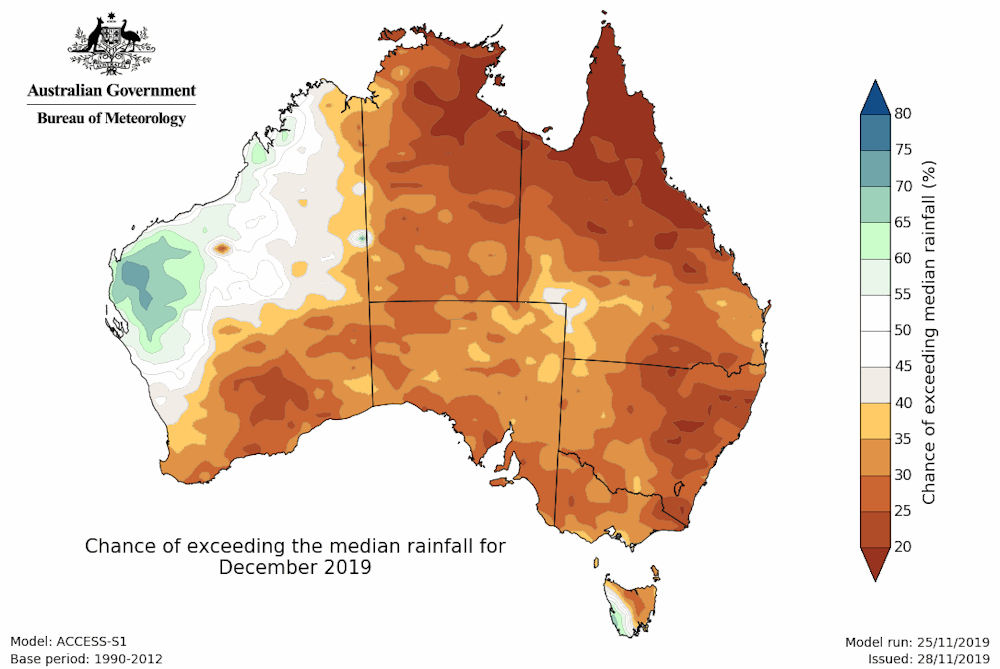
Summer is likely to start off hot and dry, according to the Bureau of Meteorology’s summer outlook, released today.

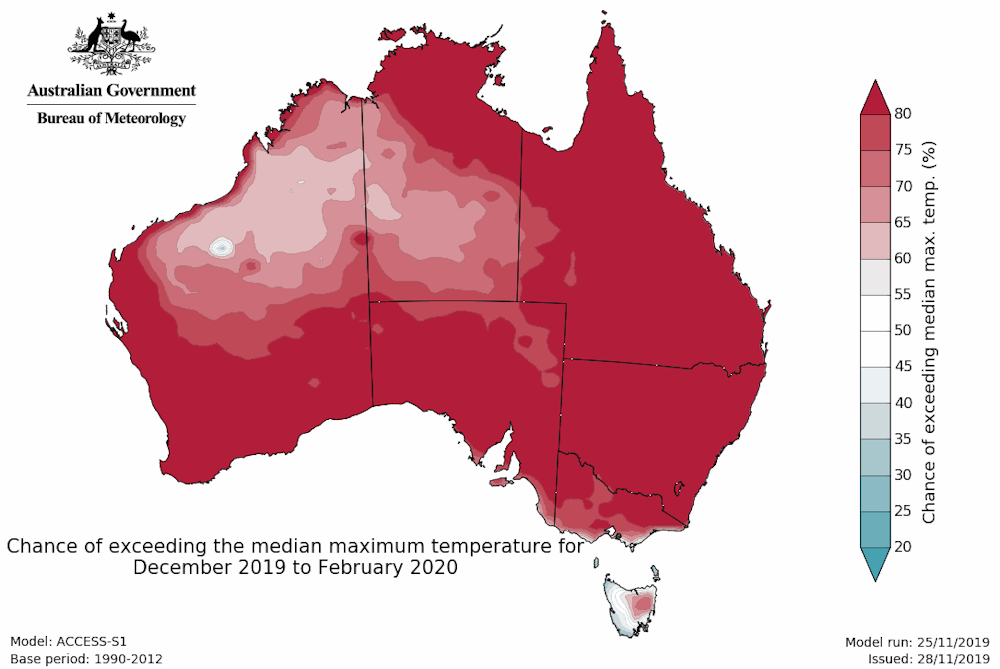
Much of eastern Australia is likely to be hotter and drier than average, driven by the same climate influences that gave us a warmer and drier than average spring.


Read more: Drought and climate change were the kindling, and now the east coast is ablaze


But these patterns will break down over summer, meaning these conditions may ease for some areas in the second half of the season. Despite this, we’re still likely to see more fires, heatwaves, and dust across eastern Australia in the coming months.

Rainfall outlook for December 2019. BOM

What drove the climate in 2019

Our current weather comes in the context of a changing climate, which is driving a drying trend across southern Australia and general warming across the country.

In southern Australia, rain during the April to October “cool season” is crucial to fill dams and grow crops and pasture. However, like 17 of the previous 20 cool seasons, 2019 was well below average, meaning a dry landscape leading into the summer months.

The frequency of high temperatures has also increased at all times of year, with the greatest increase in spring.

But summer, like spring, will also be influenced by two other significant climate drivers: a change in ocean temperatures in the Indian Ocean, and warm winds above Antarctica pushing our weather systems north.

Indian Ocean

The first driver is a near-record strong positive Indian Ocean Dipole (IOD). A positive IOD occurs when warmer than average water develops near the Horn of Africa, and cooler waters emerge off Indonesia.

This pattern draws moisture towards Africa – where in recent weeks they have seen flooding and landslides – and produces higher pressures over central and southern Australia. This means less rain for Australia in winter and spring.

Usually the IOD events break down by early summer, when the monsoon arrives in the southern hemisphere. However, this year the monsoon has been very sluggish moving south – in fact it was the latest retreat on record from India – and international climate models suggests the positive IOD may not end until January.

Rainfall outlook for summer 2019-20. BOM

Southern Ocean

The other unusually persistent climate driver is a negative Southern Annular Mode (SAM), which means weather systems over the Southern Ocean – the fronts and lows and wild winds – are further north than usual. This means more days of westerly winds for Australia.

In western Tasmania, where those winds are coming off the ocean, it means cooler and wetter weather. In contrast, in southeast Queensland and New South Wales, where westerlies blow across long fetches of land, this air is dry and hot.

This persistent period of negative SAM in 2019 was triggered by a sudden warming of the stratosphere above Antarctica – a rare event identified in early September.


Read more: Government didn’t walk away from the Greens, but Milne needed to ditch Labor


Models suggest the negative SAM will decay in December. This means the second half of summer is less likely to be influenced by as many periods of these strong westerlies.

But while both these dry climate drivers are expected to be gone by midsummer, their legacy will take some time to fade.

The positive IOD and the dry conditions we have seen in winter and spring are associated with severe fire seasons for southeast Australia in the following summer.

And while the drying influences are likely to ease, the temperature outlook indicates that days are very likely to remain warmer than average.

We also know that any delay in the monsoon will keep air drier for longer across Australia, and potentially aid in heating up the continent.

Maximum temperature outlook for summer 2019-20. BOM

What about the wet season?

For areas of southern Queensland and northeastern NSW, the wet season will eventually bring seasonal rains, although heatwaves are likely to continue through summer.

So, while the outlook for below average rainfall may ease over summer months for some areas, the lead-up to summer means Australia’s landscape is already very dry. Even a normal summer in the south will mean little easing of the dry until at least autumn.

With dry and hot conditions looking likely this summer, it’s important to stay safe, have an emergency plan in place, look after your friends and neighbours in the hot times, and always listen to advice from your local emergency services.


Read more: Climate change will make fire storms more likely in southeastern Australia


You can visit the Bureau of Meteorology website to view the latest outlook, or subscribe to receive climate outlooks via email.

ref. A hot and dry Australian summer means heatwaves and fire risk ahead – http://theconversation.com/a-hot-and-dry-australian-summer-means-heatwaves-and-fire-risk-ahead-127990

Vale Clive James – a marvellous low voice whose gracious good humour let others shine

Source: The Conversation (Au and NZ) – By Liz Giuffre, Senior Lecturer in Communication, University of Technology Sydney

Australian writer and broadcaster Clive James has died at 80 years of age after a long illness.

Along with Germaine Greer, Barry Humphries and Robert Hughes, he was known as part of an elite group of “brilliant creatures” that emerged out of Australia at a cultural moment of change in the mid twentieth century.

He will be remembered for his dry wit, distinctive voice and his unlikely yet hugely appealing screen presence.

Kogarah kid

Pan Macmillan

There was much to admire about the proud kid from Kogarah in Sydney’s south, not least the breadth and energy of his writing. His collections about growing up, Unreliable Memoirs, began in that small and apparently unremarkable spot of suburbia, continuing on into future volumes to cover young adulthood, university, the big trip to Blighty, and beyond.

There was always something so distinct about James’ Australianness. Although he’d been away much longer than he’d been here, his connection to the culture of his birthplace remained.

In an interview with the Australian Women’s Weekly in 1980, James explained the appeal:

Australians have made me laugh all my life. I don’t mean the crude jokes. It’s a blend of two things, that marvellous low voice you keep hearing and the language. It’s a combination of strength and sexiness. It’s a good combination.

The marvellous low voice of Australia serves as an excellent euphemism for defiance and dignity. James embodied it when as young Vivian James, as he was born in 1939, renamed himself Clive and began to question, observe and ultimately argue for a different way to see the world.

The difficulty of leaving Australia was more the fear of returning and finding the country you left had left you behind, said James in 1983.

A hugely prolific writer who continued to publish books, essays, columns, poems and opinions until the end (including a forthcoming anthology The Fire of Joy to be released next year), one of his greatest strengths was finding the beauty in television.

Watching with love and nuance

As the television critic for The Observer from 1972 to 1982, he took what many then (and still now) consider to be the lowest form of public entertainment and gave it a good seeing to.

Following the academic and commentator Raymond Williams, who James called “the most responsible of television critics”, he reviewed everything from drama to talent and talk shows, always with his steady “low voice” that never quite let on what he loved and loathed.

Margarita Pracatan tweeted a heartfelt tribute to James, with whom she shared the screen. Margarita Pracatan/Twitter

In his 1972 review of the BBC’s broadcast of Miss World called Liberating Miss World, James noted that the pageant participants “find host [Michael Aspel] wonderful because they’ve been told to” – leaving just enough ambiguity to make us wonder who the real butt of the competition was. He continued to play with the concept of power and influence as part of his television work throughout his life.

Clive James on Television vowed not to do too much deep cultural analysis – but sometimes French adverts with topless women demanded wry interrogation.

Soon James left the page to take on the screen directly, and his own show Clive James on Television set a stage for critic-turned-presenter that produced a wonderful legacy. As Black Mirror and Screen Wipe writer Charlie Brooker wrote “Thank God for Clive James”:

He has a way of gliding through sentences, effortlessly ironing a series of complex points into a single easily-navigable line, illuminating here and cogitating there, before leading you face-first into an unexpected punchline that makes your brain yelp with delight.

The power of a commentator like James putting his money where his mouth (or pen) was inspired many. It’s a style that has also given us wonders like Sarah Millican and Working Dog’s Have You Been Paying Attention.

No showpony

James’ ease with superstar guests allowed them room to shine, while also asking questions just far enough off the press release to resonate with the viewer at home.

When Clive sat down with Billy Connolly and David Attenborough hilarity ensued as the comedian confessed his love of the hairy-nosed wombat.

What made James appealing on screen was his apparent unsuitedness to it. He didn’t have the devastating visual appeal of some of the greats – in fact he was perhaps as far away as possible from the Arnold Schwarzenegger style “condom full of walnuts” that screen seems to adore. Of course though, words were all he needed.

Behind a desk, championing the otherwise overlooked or unchallenged, he drew our attention to the absurdity of apparently small scale story telling with a genuine energy and charm. It was just enough to make your ears prick up, but subtle enough to let the viewer also come to their own conclusions.

Before today’s internet age, when culture from almost every corner of the globe is available to us for us to consume and critique, he championed the Japanese game show Endurance. In doing so, he taught us about the comic tension between content as guilty pleasure or the beginning of the end. He seemed to say: You, dear remote control holder, can decide. More “low voice” to draw us in.

The wonderful performer who closed the The Clive James Show each week, Margarita Pracatan, left a final note for James on Twitter today, “Thank you, #CliveJames from the bottom of my heart. You live forever with us”.

Start spreading the news, I’m leaving today.

ref. Vale Clive James – a marvellous low voice whose gracious good humour let others shine – http://theconversation.com/vale-clive-james-a-marvellous-low-voice-whose-gracious-good-humour-let-others-shine-127992

More carers’ leave may help Australians look after elderly parents and stay in work

Source: The Conversation (Au and NZ) – By Melanie Zeppel, Senior Research Fellow, Macquarie University

Carers’ advocates are urging a rethink of the way we support middle-aged Australians caring for ageing parents.

Sydney-based organisation Your Side, which supports older people and their carers, has called for a new type of leave – similar to paid parental leave – to ease the burden on carers and help them stay in the workforce.

While the details are yet to be fleshed out, the idea has merit and could alleviate some of the problems with our current system, which relies on informal carers, many of whom are stressed and struggling financially.


Read more: Confused about aged care in the home? These 10 charts explain how it works


Who are the carers?

Australia has 2.65 million informal carers who provide unpaid help or supervision to people with a chronic condition, disability, or those aged 65 or older. About 57% of informal carers are women and more than two-thirds are 45 or older. In 2015, almost half a million informal carers in Australia were of working age.

While caring can be fulfilling, it can significantly impact workforce engagement and career trajectories. The most common impacts are reduced working hours and leaving employment altogether. This can reduce the carer’s income, assets and superannuation, placing them at risk of financial hardship and poverty.

Impacts are felt most severely by people from lower socioeconomic backgrounds, young people and women, especially if they’ve already taken time time out of the workforce to raise children, as recently demonstrated by Annabel Crabb.

Women are disproportionately impacted by caring responsibilities. Myibean/Shutterstock

Lost income and taxes

When otherwise productive Australians drop out of the workforce, this costs the government through lost taxes and increases in welfare payments.

A recent study by GenIMPACT at Macquarie University estimated that nationally, the income lost to informal carers leaving the workforce was A$3.58 billion in 2015. This is projected to grow by 49%, to A$5.33 billion, in 2030.

The difference in income between those working full-time and those out of the workforce due to informal caring was estimated at A$936 per week in 2015 (A$48,000 a year), rising to A$1,137 (or A$59,000 a year) in 2030.

And carers who leave their jobs are unlikely to return after their care-giving period ends.


Read more: Here’s how much it would cost the government to pay everyone who takes care of family with mental illness


Carers’ leave would enable longer workforce participation, increasing both income and taxes paid, one of the federal treasurer’s goals.

What are the psychological impacts on carers?

Many informal carers, particularly those out of the workforce, experience isolation, increased mental stress and high levels of psychological distress.

A study from Carers Queensland found 30% of carers felt socially isolated and 39% have chronic anxiety.

Government-subsidised aged care services are available to older Australians, but these services don’t necessarily enable carers to work. In many cases they’re not available when and where a carer needs them.

Carers’ leave could improve not only carers’ financial stability, but also their mental health, reducing isolation.

Isn’t carers’ leave already available?

Employed carers are already entitled to some carers’ leave. This allows them to take time off work to care for a family or household member. But this often comes out of an employee’s sick leave, which is taken a day at a time.

While informal carers have the right to request flexible working arrangements, employers can still say no on reasonable business grounds.

Many workers are only able to take the carers’ leave that comes out of their sick leave to look after ageing parents. Toa55/Shutterstock

Some large organisations, including universities, already have carers’ leave, in addition to sick leave. This allows staff to take time off (days or weeks) to care for family members and then return to work, without needing to leave the workforce. This is the model an expanded carers’ leave scheme should emulate.

What are the solutions?

Multiple strategies are needed to solve problems of workforce participation for informal carers. These include:

1) increasing carers’ awareness of their existing entitlements to carers’ leave and flexible work

2) expanding these provisions to accommodate longer periods of leave, either with government or employer support, using the parental leave model. The details of such a scheme, including eligibility and the amount of leave, would need to be developed

3) improving funding and access to aged care services, including home care packages and

4) encouraging innovation in the workplace through flexible working arrangements and a culture supportive to carers. This can boost productivity of care-giving employees and reduce staff turnover.

Introducing longer periods of carers’ leave, similar to parental leave, could better support people with ongoing caring responsibilities to stay in the workforce in the longer term.

This could allow informal carers to support the older person to transition into residential aged care, to recover from a hospital admission due to an age-related illness or fall, or to set up longer-term caring arrangements within the family.


Read more: How to check if your mum or dad’s nursing home is up to scratch


Caring for an ageing parent could therefore result in a relatively short break from a long and productive career, rather than being a trigger for leaving the workforce.

ref. More carers’ leave may help Australians look after elderly parents and stay in work – http://theconversation.com/more-carers-leave-may-help-australians-look-after-elderly-parents-and-stay-in-work-127496

Grace Millane’s murder trial shows social attitudes continue to minimise gendered violence

Source: The Conversation (Au and NZ) – By Nicola Gavey, Professor of Psychology, University of Auckland

Last Friday, a New Zealand jury returned a guilty verdict in the Grace Millane murder trial. The 21-year-old British woman was killed by a 26-year-old man in his Auckland apartment in December 2018.

The high-profile trial drew criticism for its attention to Millane’s sexual history and its attempt to argue that she had consented to the violent act that caused her death.

I attended the trial and argue that bold misunderstandings about gender, power, sex, and violence were allowed to shape a defence case in ways that disrespected Millane, likely harmed courtroom witnesses and may have come close to thwarting justice.


Read more: Grace Millane’s trial exposes a dark trend in media coverage of violence against women


Gender, power, sex and violence

The murder trial for Grace Millane’s killer poignantly demonstrated it is still possible to question a woman’s behaviour without understanding the specifically gendered nature of violence against women. I observed many ways this happened, as defence lawyers crafted a case that was heavy on the myth of egalitarian sexual adventure and light on the reality of gendered power that still shapes the contemporary heterosexual landscape.

Contrary to the picture they painted, study after study shows that both young men and young women still expect that men will pressure women to have sex when they don’t want it, and to engage in sexual acts they are not keen on.

Failing to understand these dynamics of men’s violence against women makes the path to courtroom justice unnecessarily rocky. It makes it potentially traumatic for surviving women who take the witness stand, and in a high profile case like this it feeds into social attitudes that misrepresent and minimise gendered violence.


Read more: We won’t stop lone-actor attacks until we understand violence against women


Dynamics of men’s violence against women

A month before he killed Grace Millane, the man convicted of her murder non-fatally suffocated another woman. With his knees on the side of the bed, facing her feet, he pinned down her forearms with all his weight and sat on her face with so much force that she could not breathe. She was terrified she was going to die.

This woman was cross-examined relentlessly by the defence lawyer, who dissected her behaviour during and immediately after the attack, and in the month afterwards. He told her she had “exaggerated” what happened and asked her repeatedly why she did not leave earlier. He interrogated her about why she maintained regular text message contact with him over the following month.

The woman on the witness stand was impressive, articulate and bold. At one point, after being told yet again that she was not a reliable witness to her own experience, she told the lawyer, “You can’t minimise what happened to me. It happened.”


Read more: The latest action plan to tackle violence against women isn’t perfect, but it takes a much-needed holistic approach


As the lawyer persevered with this line of questioning, it became clear just how little he understood about the dynamics of men’s violence against women. He judged her experience from his own masculine point of view, perhaps imagining what he would have done in that situation.

He failed to understand how threat manifests differently for a woman who has been violently assaulted by a man. He appeared not to comprehend that a woman might behave differently in assessing danger, safety and risk.

Modern forms of risk and self defence

As this woman pointed out through her evidence, the defendant knew a lot about her and her movements. She knew he would be able to find her, and she worried that if she cut him off cold he would show up in her life. As a New Zealand Law Commission report notes, strangulation or suffocation “is a uniquely effective form of intimidation, coercion and control”, as it demonstrates “he can kill”.


Read more: Forceful and dominant: men with sexist ideas of masculinity are more likely to abuse women


Encountering a violent man on a Tinder date is a modern form of risk. We need to better understand what survival skills would look like in that particular kind of relationship, formed in isolation from off-line social networks and through communication technologies that can leave a person exposed through the trails of their online activity.

As this woman later worked to placate the man who attacked her, keeping him at a safe distance, while managing to avoid him in person, she was able to diffuse or delay the risk of him stalking her or turning up in person. These actions make perfect sense as a modern form of self-defence for our technology-mediated social world.

What other choices did she have? Keeping in mind that, as we now know, she had accurately assessed the defendant as a tinderbox man, prone to unpredictable, explosive, and as it turned out deadly, violence.

Improving knowledge about men’s violence against women

Moving forward, we have the opportunity to learn from this case and work for improvements. Many voices are calling for a rethink of the rules of evidence that place no limits on publicly airing deeply personal private information about the victim in a murder trial.

We also need to insist that lawyers and judges get up to date with the current state of knowledge about the nature and impact of men’s violence against women.

While defence lawyers have a duty to zealously defend their clients’ legal rights, we must debate the ethical questions about how far that can reasonably be pushed, and at what cost to justice for innocent and victimised others.

ref. Grace Millane’s murder trial shows social attitudes continue to minimise gendered violence – http://theconversation.com/grace-millanes-murder-trial-shows-social-attitudes-continue-to-minimise-gendered-violence-127796

A surprisingly big black hole might have swallowed a star from the inside out, and scientists are baffled

Source: The Conversation (Au and NZ) – By Roberto Soria, Professor, National Astronomical Observatories, Chinese Academy of Sciences

About 15,000 light years away, in a distant spiral arm of the Milky Way, there is a black hole about 70 times as heavy as the Sun.

This is very surprising for astronomers like me. The black hole seems too big to be the product of a single star collapsing, which poses questions for our theories of how black holes form.

Our team, led by Professor Jifeng Liu at the National Astronomical Observatories, Chinese Academy of Sciences, has dubbed the mysterious object LB-1.

What’s normal for a black hole?

Astronomers estimate that our galaxy alone contains about 100 million black holes, created when massive stars have collapsed over the past 13 billion years.

Most of them are inactive and invisible. A relatively small number are sucking in gas from a companion star in orbit around them. This gas releases energy in the form of radiation we can see with telescopes (mostly X-rays), often accompanied by winds and jets.


Read more: Like a spinning top: wobbling jets from a black hole that’s ‘feeding’ on a companion star


Until a few years ago, the only way to spot a potential black hole was to look for these X-rays, coming from a bright point-like source.

About two dozen black holes in our galaxy have been identified and measured with this method. They are different sizes, but all between about five and 20 times as heavy as the Sun.

We generally assumed this was the typical mass of all the black hole population in the Milky Way. However, this may be incorrect; active black holes may not be representative of the whole population.

The unusual black hole was spotted using the LAMOST telescope at Xinglong Observatory in China. NAOC, Chinese Academy of Sciences

New tools bring an old idea to life

For our black hole search, we used a different technique.

We surveyed the sky with the Large sky Area Multi-Object fibre Spectroscopic Telescope (LAMOST) in north-east China, looking for bright stars that move around an invisible object. This let us detect the gravitational effect of the black hole, regardless of whether any gas moves from the star to its dark companion.

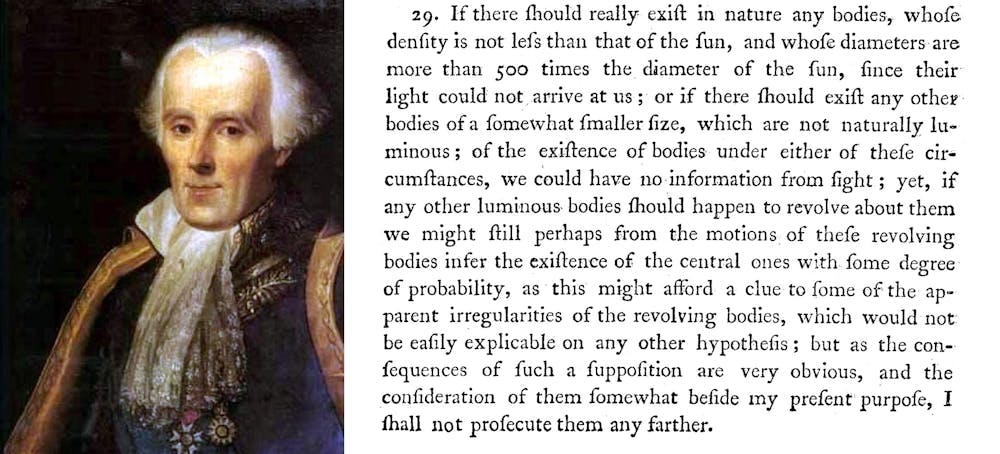
This technique was proposed by the British astronomer John Michell in 1783, when he first suggested the existence of dark, compact stars orbiting in a binary system with a normal star.

However, it has become practically feasible only with the recent development of large telescopes which let astronomers monitor the motion of thousands of stars at once.

John Michell (1724–1793) was the first scientist to predict the existence of compact stars from which light cannot escape. In 1783 he explained how to find them. Public domain / Philosophical Transactions of the Royal Society of London

How we spotted LB-1

LB-1 is the first major result of our search with LAMOST. We saw a star eight times bigger than the Sun, orbiting a dark companion about 70 times as heavy as the Sun. Each orbit took 79 days, and the pair are about one and a half times as far away from each other as Earth and the Sun.

We measured the star’s motion by slight changes in the frequency of the light we detected coming from it, caused by a Doppler shift as the star was moving towards Earth and away from it at different times in its orbit.

We also did the same for a faint glow coming from hydrogen gas around the black hole itself.


Read more: Observing the invisible: the long journey to the first image of a black hole


Where did it come from?

How was LB-1 formed? It is unlikely that it came from the collapse of a single massive star: we think that any big star would lose more mass via stellar winds before it collapsed into a black hole.

One possibility is that two smaller black holes may have formed independently from two stars and then merged (or they may still be orbiting each other).

Another more plausible scenario is that one “ordinary” stellar black hole became engulfed by a massive companion star. The black hole would then swallow most of the host star like a wasp larva inside a caterpillar.

The discovery of LB-1 fits nicely with recent results from the LIGO-Virgo gravitational wave detectors, which catch the ripples in spacetime caused when stellar black holes in distant galaxies collide.

The black holes involved in such collisions are also significantly heavier (up to about 50 solar masses) than the sample of active black holes in the Milky Way. Our direct sighting of LB-1 proves that these overweight stellar black holes also exist in our galaxy.

Neutron stars (yellow) are as heavy as 1 to 2 Suns. Black holes discovered from X-ray radiation (purple) have masses between 5 and 20 Suns. Colliding black holes detected from gravitational waves each weigh up to about 50 Suns. LB-1, detected from its orbital motion, has a mass of about 70. LIGO-Virgo / Frank Elavsky / Northwestern / Universita Statale Milano, Author provided

The black hole family

Astronomers are still trying to quantify the distribution of black holes across their full range of sizes.

Black holes weighing between 1,000 and 100,000 Suns (so-called intermediate-mass black holes) may reside at the heart of small galaxies or in big star clusters. The space-based Laser Interferometer Space Antenna (LISA) gravitational wave detector (scheduled for launch in 2034) will try to catch their collisions.

Black holes weighing a million to a few billion solar masses are already well known, in the nuclei of larger galaxies and quasars, but their origin is actively debated. We are still a long way away from a complete understanding of how black holes form, grow, and affect their environments, but we are making fast progress.

ref. A surprisingly big black hole might have swallowed a star from the inside out, and scientists are baffled – http://theconversation.com/a-surprisingly-big-black-hole-might-have-swallowed-a-star-from-the-inside-out-and-scientists-are-baffled-127795

Adoption law should be reformed to give children legal connections to both of their families – here’s why

Source: The Conversation (Au and NZ) – By Karleen Gribble, Adjunct Associate Professor, School of Nursing and Midwifery, Western Sydney University

When children are unable to live safely at home with their parents, they may enter out-of-home care. Most of these children are in foster or kinship care and many are able safely to go home after a period of time.

But for more than 23,000 children in out-of-home care in Australia, the courts have determined they cannot ever safely return home.

Adoption is one way these children can be given permanency and avoid moving from placement to placement in foster care.


Read more: Explainer: how hard is it to adopt in Australia?


But the adoption of children from out-of-home care is extremely contentious. This is partly because adoption laws in all Australian states and territories require children to be legally severed from their birth family when they’re adopted. This is called “plenary adoption”.

Our new research, launched this week in parliament in Canberra, found Australians with personal or professional experience of out-of-home care or adoption want a new form of adoption legislated in Australia. One which would allow children to have legal ties to both their adoptive family and their birth family at the same time. This is called “simple adoption”.

As one adopted person in our study described:

Simple adoption seems to protect everyone, the child is not displaced, does not feel like an item trafficked between two worlds, the child belongs to everyone but is safest with the adoptive parents.

To me, this option protects the child’s right to identity, family and safety, the right to flourish.

Outdated legislation

The current requirement to cut the legal relationship with birth family is a legacy of Australia’s history, with legislation across all states and territories derived from laws enacted in the 1960s.

This was a time when unwed mothers were often coerced into allowing their babies to be adopted, and the legislation was designed to hide “sexual immorality” illegitimacy and infertility.

Adoption required a complete legal and physical separation of children from their birth family, and was often hidden even from the adopted person.

Over time, the harm of these adoption practices was recognised, and laws have gradually reformed to remove secrecy from adoption.

Erasing identity

Today, almost all adoptions in Australia are “open” and children often have ongoing contact with their birth families.

Despite this, legal severance from birth family and identity erasure has remained in plenary adoption and adopted children are no longer legally related to their birth parents, birth siblings or extended birth family.

Australian adoption laws were first drafted in the 1960s. Kevin Gent/Unsplash

Plenary adoption creates a new legal identity for the child and erases their first legal identity. This means their original birth certificate is no longer a legal identity document.

Instead, a new birth certificate is made that replaces the names of their birth parents with their adoptive parents’ names.

This legal separation and the erasure of identity is extremely painful for many adopted people. Some of whom have, as adults, even gone to the extreme of having their adoption discharged to regain their legal connections and identity.

As one adopted person said:

Loss of identity, heritage and false birth certificates are huge issues for adoptees. Forever into the future my genealogy has changed. I can never be legally related to my family.

It’s also extremely difficult for birth parents and extended birth family, who, while they may not be able to care for their children, generally still love them dearly.

An additive adoption

Our research gathered the views of a range of people with connection to foster care and adoption. This included adopted people, former foster children and their birth parents, foster carers, adoptive parents and child welfare professionals.


Read more: Adoption has a role in child protection but it’s no panacea


We asked participants to rank aspects of the potential permanency options, including long term foster care, guardianship, plenary adoption and simple adoption.

Overwhelmingly, the more than 1,000 participants scored simple adoption as their most preferred.

Simple adoption means children are full legal members of both their adoptive and birth families at the same time, creating a new legal identity for children without legally severing them from their birth family or erasing birth identity.

While children are still related to their birth family, parental rights are held by the adoptive parents in simple adoption. This means legal authority and decision making is the responsibility of the adoptive parents.


Read more: Adoption and fostering: matching children to parents from same religion and ethnicity makes for happier families


Simple adoption is not a new concept, and is currently in place in countries as diverse as France, Brazil, Thailand and Ethiopia. But we have never had simple adoption in Australia.

Many study participants had never heard of simple adoption, but were enthusiastic about its possibilities. Among the excited responses were: “sounds too good to be true! In a perfect world… MAKE IT HAPPEN!” and “simple open adoption sounds fabulous! Please bring it to Australia”.

The legal belonging in two families that simple adoption provides was linked to emotional well-being and was a central reason why it was viewed positively.


Read more: How shared parental leave gives adoptive parents real time to build a new family unit


This research suggests it’s again time for legislative reform so children are able to remain a legal member of their birth family when they’re adopted, and have their identity preserved.

It’s important to remember that regardless of any improvements made to adoption, supporting birth families so they’re able to care for their children must have the highest priority.

But for when it’s not possible for children to safely live in their birth families, the research is clear: simple adoption should be an option.

ref. Adoption law should be reformed to give children legal connections to both of their families – here’s why – http://theconversation.com/adoption-law-should-be-reformed-to-give-children-legal-connections-to-both-of-their-families-heres-why-127521

Curious Kids: how do guide dogs know where their owners want to go?

Source: The Conversation (Au and NZ) – By Carmel Nottle, Lecturer – Human Movement / Clinical Exercise Physiology, University of South Australia


How do guide dogs know where their owners want to go? – Mia, age 6.


Mia, thank you for your question. I know a bit about this topic because I have some experience training and using an assistance dog myself. Also, as part of my job teaching at a university, I’m working with a number of students doing research projects on assistance dogs.

The answer to your great question is actually quite simple. Guide dogs, which are assistance dogs for people who are blind or vision impaired, know where to go because they practise.

Practice makes perfect – just like how you might learn to walk from home to school, or how adults know how to drive to different places without getting lost.


Read more: Curious Kids: is it true dogs don’t like to travel?


As part of their training a guide dog will practise getting around to some of the most common places the person they will guide needs to go. This may include the shops near their home, or from their home to the bus stop.

So, in simple terms, guide dogs only know how to get to and from familiar places they have practised the routes for.

What most people don’t realise, though, is the person the dog is guiding still needs to know where they are going too.

Just like people train for their jobs, dogs have to do special training to become guide dogs. From shutterstock.com

Identifying obstacles

There is a lot of training a guide dog will do before they are taught familiar places. This is because making sure they guide a person safely is much more than knowing where to go.

Say you are walking to school and the branch of a tree has fallen across the path you normally walk on.

If that branch was small you might just step over it. If it is big you might go around it or even cross to the other side of the road.

Since a blind person may not be able to see the branch, it’s up to their guide dog to let them know it is there. How they do this will depend on how big the branch is.


Read more: Curious Kids: why do pets have dark eyes while humans have mostly white eyes?


If it is small the dog may help safely guide the person around it. If it is large and they can’t get around easily, they will block the person so they know there is something in the way.

It is then up to the person to work with their dog to help them safely find a way past the branch.

This means a big part of being a guide dog is letting the person they are guiding know when there is an obstacle in their way.

To a blind person an obstacle can include things like the step down off the path onto the road, or a step up into a shop. These are things you probably don’t even think of as an obstacle when walking.

Training and team work are key for a guide dog and their human partners.

Working as a team

A lot of people may think a guide dog tells a person when they can cross a road. But this is not actually true.

The dog will block the person from stepping onto the road to let them then know they have reached the end of the path.

It is then up to the person to listen to their surrounds and decide if it is safe to cross the road.

It is the person who tells the dog it is safe to cross the road – not the other way around.


Read more: Curious Kids: Why don’t dogs live as long as humans?


Hello, curious kids! Have you got a question you’d like an expert to answer? Ask an adult to send your question to curiouskids@theconversation.edu.au

ref. Curious Kids: how do guide dogs know where their owners want to go? – http://theconversation.com/curious-kids-how-do-guide-dogs-know-where-their-owners-want-to-go-125567

How drought is affecting water supply in Australia’s capital cities

Source: The Conversation (Au and NZ) – By Ian Wright, Senior Lecturer in Environmental Science, Western Sydney University

The level of water stored by Australia’s capital cities has steadily fallen over the last six years. They are now collectively at 54.6% of capacity – a decline of 30% from 2013.

We’re going into a hot summer and Sydney has just announced level 2 restrictions, the toughest for any capital. Data from the Bureau of Meteorology shows other capital cities facing mixed results.

The results show that Darwin’s water supply has lost about 25% over the last year. On the plus side, Melbourne’s supply actually increased over 2019, having fallen below 50% earlier this year, and now sits on 63.9%.

While the national average is trending downwards, the patterns for each city are very different. Sydney and Perth water supplies have had contrasting journeys over the last six years. In October 2013 Perth’s supply was a very low 33.8% and Sydney was a comfortable 91%.

Now, for the first time in many years Perth does not have Australia’s lowest level of all capital city water storages. As of last week, Sydney has taken this unwanted distinction from Perth.

For Perth residents, the news is good as their surface water storages are at a six-year high of 46.4%. In Sydney they are worried, as they have a six-year low of 46.2%.

Sydney has experienced a steep decline over the last 30 months, from nearly full storages (96%) in April 2017. The speed and severity of the Sydney drought is starting to resemble previous dry spells. One was in the 1940s and the other was the Millennium drought.

Perth has lived with the most water stress of any capital city. They have had to contend with a steady 45-year decline in rain. The inflow of water into Perth’s dams has also fallen dramatically.

Perth has adapted to its drying climate by sourcing water from many different supplies. It now uses its surface water storages for about 10% of its water supply. Much larger proportions of Perth’s supply comes from its two desalination plants, which unlike the other capitals are constantly in operation. It makes greater use of groundwater and highly treated recycled water. Perth also has permanent water restrictions.

Sydney’s desalination plant, after hibernating for 7 years, is now supplying water. It was switched on in late January 2019 when Sydney supply hit 60%, and can supply 15% of water demand. Unusually perhaps, the desalinated water does not reach all parts of Sydney.

Sydney Water has announced plans to double the capacity of the desalination plant. Construction is expected to begin soon.

Melbourne and Brisbane water supplies are currently at similar levels. However, since 2013 Melbourne’s storages have generally been lower than Brisbane’s. Melbourne’s supply has risen in 2019 after good winter rainfall in its catchments. The storages have increased from under 50% (49.6%) in late May 2019. Today, Brisbane storage levels are now at 59.2%.

Melbourne residents use less water than the other capital cities. In 2018 the average Melbourne resident used 161 litres per day, approximately 30% less than Sydney residents.

Melbourne’s supplies have also been supplemented with the reactivation of its Wonthaggi desalination plant in 2019. It is Australia’s largest desalination plant, capable of producing 410 million litres a day.


Read more: Why Sydney residents use 30% more water per day than Melburnians


Brisbane also built a desalination plant after the Millennium Drought. In addition, they also made very large investments in Australia’s largest waste water recycling scheme. The Western Corridor recycled water scheme opened in 2008, cost $2.5 billion and features three advanced waste water treatment plants, with more than 200 km of pipelines and three advanced waste water treatment plants.

Hobart, Darwin and Canberra are the three Australian capital cities without desalination plants. Canberra has had a steady decline in its supply over three years. It was full in October 2016, gradually dropping to 51.6% in November 2019. Hobart’s storages were above 80% for most of the last six years. They were just above 90% 12 months ago and have since fallen to their current level of 72%.


Read more: Fish kills and undrinkable water: here’s what to expect for the Murray Darling this summer


Darwin’s water supply was full as recently as April 2018. Now, 18 months later, it is just touching 54%. This is its lowest level in six years. Darwin, our tropical capital, has the most seasonal rainfall of Australia’s capitals. Typically, they have almost no rain June to September during their dry season, and a wet season of heavy rains from October to April. However, the last wet season was one of the driest on record.

Adelaide’s water storage has fluctuated over the last 6 years. Adelaide gets more rain in winter and has dry summers, an opposite pattern to that of Darwin. Over the last 3 years the level has dropped from over 97% in October 2017 to just below 58%.


Read more: Up the creek: the $85 million plan to desalinate water for drought relief


The desalination plant in Adelaide can supply up to 50% of its water supply. It has been operating in 2019, although not in the wetter months of July and August. The Murray also continues to supply a large proportion of Adelaide’s water supply. The Commonwealth has agreed to use drought funding for the Adelaide desalination plant, so more river water can be used by farmers upstream to grow fodder for livestock.

Australia is set for a dryer and hotter summer than average, particularly in the east. Coupled with continued high levels of household demand, we can expect further declines in water storage levels through the first half of 2020.

ref. How drought is affecting water supply in Australia’s capital cities – http://theconversation.com/how-drought-is-affecting-water-supply-in-australias-capital-cities-127909

Before you let your child quit music lessons, try these 5 things

Source: The Conversation (Au and NZ) – By Timothy McKenry, Professor of Music, Australian Catholic University

The Australian Bureau of Statistics shows children are mostly likely to start studying music between the ages of nine and 11.

Researchers in a 2009 UK study suggested the dramatic drop in music tuition after age 11 was linked to children starting high school.

The study also revealed the main reasons for children ending music lessons were boring lessons, frustration at a lack of progress, disliking practice and competition from other activities. Some children regretted stopping music lessons.

Stopping as soon as a child experiences difficulty or expresses frustration denies that child the benefits of music and reinforces the message that, if something is hard, it’s not worth doing. But continuing lessons for someone who has come to resent them is futile.

Fortunately, there are some things parents can try which might keep kids in music class longer. And if that doesn’t work, it’s OK to stop.

1. Find out the reason

Sometimes a child likes the music lessons but has stage fright, doesn’t like exams or feels inferior to other musicians their age. These issues can be managed. Although they might result in a change of teacher, or repertoire or pattern of learning, they’re not of themselves a reason to stop.

2. Choose the right instrument

Music tuition can go wrong quickly when the wrong instrument is chosen. One study suggests if children select the right instrument (determined by simple aptitude tests and a preference for the sound of the instrument) they will keep on with lessons longer.

The choice of instrument can depend on the child’s preference, a parent’s suggestion or the availability of the instrument. Parents should take advice and, where possible, rent an instrument prior to making a financial commitment.

Gender expectation can influence instrument choice. Research shows guitarists, saxophonists and drummers are overwhelmingly male; violinists, flautists and singers overwhelmingly female.

Particularly where a parent’s preference differs from that of their child, it’s wise to reflect on what is motivating the preference. Kids shouldn’t feel they have to conform to a stereotype.

More boys take guitar lessons than girls. Try to not let traditional gender biases influence their choice of instrument. from shutterstock.com

3. Make practising less of a burden

Around 70% of 5-14 year olds who play an instrument or sing spend two hours or less per week on the activity. But most children will not always want to practise and many won’t know how.

Some children feel they are letting their parents down by not practising. This can make learning music miserable. Parents can help by:

  • creating a household routine that makes time and space for practice

  • being present with younger children during practice and asking older children how practice is progressing

  • understanding how the teacher wants their child to practise. Whether via a practice diary or through communication during the weekly lesson, knowing the purpose of practice helps target the encouragement parents can provide

  • being realistic about how long their child can practise. Different teachers will have different approaches to how long their students should practise, but regular practice sessions are better than a longer session the night before a lesson

  • being flexible. If a child is exhausted or there has been a disruption to their routine, give them permission to take a night off

  • encouraging their child to simply begin a session, however short – rather than fixating on completing 20, 30 or 40 minutes of practice – will help establish a routine

  • celebrating small victories. Learning an instrument can be hard and children will sometimes feel they haven’t accomplished a great deal. Praising incremental improvements can help motivate your kid.

4. Help your child take control

Learning music is challenging but must be rewarding. Given lack of progress is a leading reason for stopping lessons, it is vital, particularly for teenagers, that they develop agency as musicians.

Examples of fostering agency include:

  • encouraging them to select some of the music they play

  • giving them space and encouragement to compose their own music

  • allowing them to choose where, when and with whom they play

  • valuing a learning journey that explores a breadth of repertoire, rather than repertoire of ever-increasing difficulty

  • letting them take responsibility for their learning.

This last point might mean parents gradually let go of monitoring practice. An interim step is for a parent to offer to help keep the teenager accountable.

I know you often practise at 7pm […] would you like me to ask you how it’s going or remind you if it seems you’ve forgotten?

Competing interests represents a leading cause for stopping music tuition. The transition to high school is a pressure point in this regard.

Getting your child to just start practice is enough to establish routine. from shutterstock.com

When a child becomes over-scheduled or overwhelmed, parents should consider offering a break from music lessons. The break should be for a defined period (typically a term) and it is wise to keep the teacher informed.

5. Frame the ending positively

When a teenager wants to stop lessons but the parents are unsure of whether the desire is genuine or the time is right, it is sometimes possible to strike a deal.

You’ve come so far and done so well […] how about you keep going until after the concert in three months and if you still feel the same way, you can stop.

Most teenagers ultimately do stop and that’s OK. The best thing parents can do is help their child frame that ending positively.

Rather than seeing their child as “quitting” or “giving up”, parents should describe this transition as “moving on” or “graduating”.

Celebrate what they have accomplished and encourage them to keep playing for pleasure – their own, and that of others.

ref. Before you let your child quit music lessons, try these 5 things – http://theconversation.com/before-you-let-your-child-quit-music-lessons-try-these-5-things-125944

Driverless vehicles and pedestrians don’t mix. So how do we re-arrange our cities?

Source: The Conversation (Au and NZ) – By Peter Newman, Professor of Sustainability, Curtin University

Videos showing autonomous or self-driving vehicles weaving in and out of crossroads at speed without colliding suggest this technology will solve traffic problems. You almost never see pedestrians or cyclists in these videos. The reality is that they don’t fit.

The vision of autonomous traffic is either of a large convoy of vehicles just a metre apart moving along road corridors at 100km/h, or of vehicles in an urban setting where their sensors are picking up every pedestrian movement and slowing or stopping. In the first case, the vehicles form an impenetrable barrier to pedestrians or cyclists (who, like on a freeway, will probably be banned). In the second case, pedestrians and cyclists are able to ruin traffic flow and are likely to just take over streets.

What’s missing from the demonstration of autonomous vehicles flowing through an intersection is the human element of cyclists and pedestrians.

Read more: Nothing to fear? How humans (and other intelligent animals) might ruin the autonomous vehicle utopia


It occurs to me this is a really good thing for our cities. I worried that the vision some had (mostly car makers, I suspect) was of a city completely taken over by self-driving vehicles.

All public transport would be gone as thousands of these vehicles scattered along every street looking for on-demand passengers. Historic centres and tram corridors would be ruined and we would no longer be able to appreciate their walkable character.

However, we may instead be able to take the best features of autonomous mobility technology to create cities that are more productive, liveable, inclusive and sustainable.

How would we do this?

The first thing is to realise that for 20-30 years cities around the world have been getting rid of cars in their centres and subcentres, drawing on the ideas of urban designers like Jan Gehl. This trend includes Australian cities. These centres are where the knowledge economy workers who drive innovation want to live and work.

Cities are not going to easily give up their cherished walkability to thousands of self-driving vehicles. Cities mostly are planning more walkable centres with even more public transport and fewer cars; they are unlikely to yield to autonomous vehicle ideology.

It’s more likely cities will ban self-driving vehicles from these centres, with just one small entry and exit point to enable vehicle access. Cities will not want to kill off the economic and social golden goose of walkable centres, let alone abandon climate change plans to reduce car use.


Read more: Why driverless vehicles should not be given unchecked access to our cities


The second thing is that these active walkable centres are being heavily supported by quality public transport. Fortunately, autonomous technology is also being applied to transit services such as the trackless tram. These are guided but not driverless, like high-speed rail and metros, as they need drivers at times.

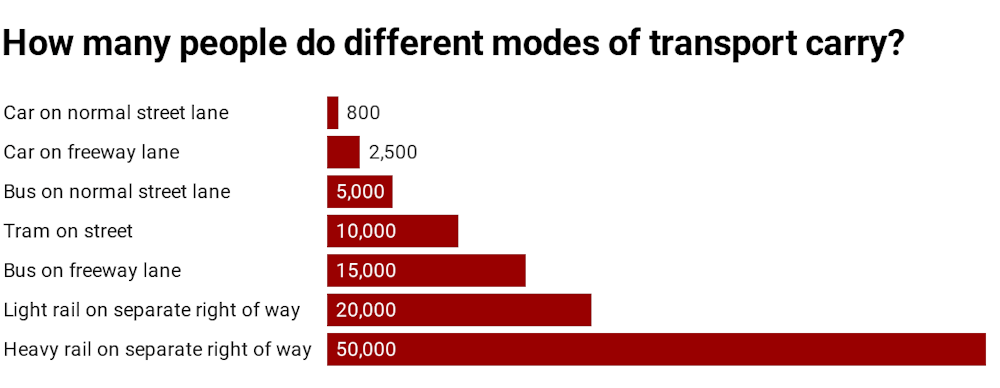
Not only could autonomous technology improve transit services, it could also take over some major road corridors that are failing at peak times. This could create an alternative rapid transit route carrying the equivalent of six to eight lanes of traffic.

Data source: author provided

The ‘movement and place’ approach

Around the world and in Australia, cities are looking to make roads into combined “movement and place” sites – some places will remain highly walkable and some will be just for movement but special corridors will be for both so theykeep people and goods moving and are places for people to live, work and enjoy. This approach gives priority to fast public transport using light rail or trackless trams combined with higher-density development around their stations.


Read more: Trackless trams v light rail? It’s not a contest – both can improve our cities


The big issue on such corridors is how to get rid of cars so mass transit services have a fast, free lane to travel along as well as walkable station precincts to enter. Such a system would be much more efficient in traffic terms, but car users don’t easily give up their right to space.

However, the inherent problem with self-driving vehicles is that they will make a corridor impenetrable and travel through a dense precinct ridiculously slow and unpredictable. The politics will therefore shift towards a fast transit corridor along main roads together with walkable, car-free station precincts.

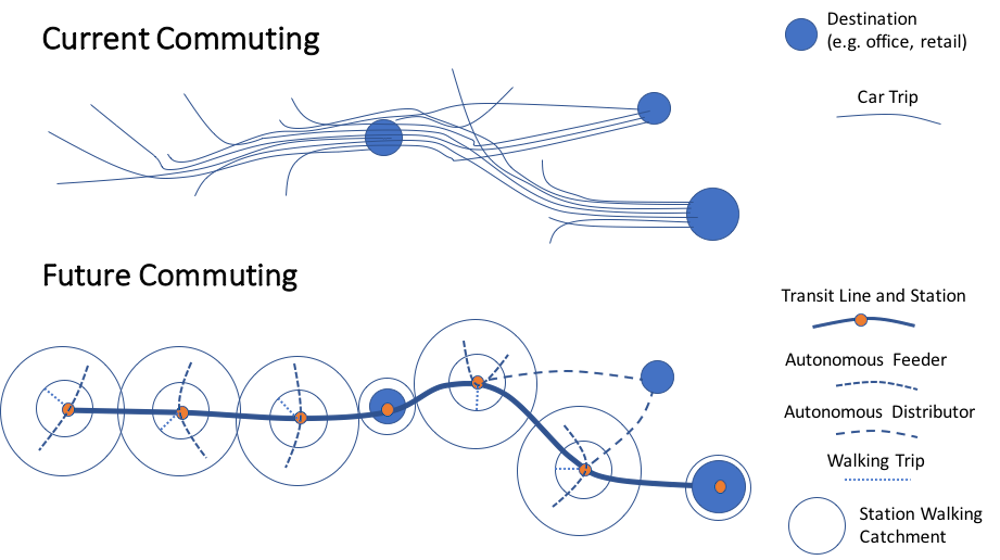
Self-driving cars can help make the fast corridor work as they are ideal for bringing on-demand passengers to the precincts where people can access local services and transfer to the fast transit line. This integrated service enables the best of both mobility solutions: fast and effective access, without destroying either the corridor or centres, and an on-demand local service as shown below.

Author provided

Each centre will have micro-mobility options feeding into the transit system and the station precinct services. These options will provide “first mile-last mile” connectivity on demand. They include walking, electric bikes, scooters, skateboards and autonomous shuttles or cars that travel to and from the centre along a specific isolated route.

Certain main roads would have to be declared as clearways for autonomous electric transit, with a set of stations serving high-density centres for urban regeneration. Autonomous vehicles could reign supreme out in the suburbs that were built around the car, but would not interfere with existing or new transit corridors as well as the historic and new centres where pedestrians would reign supreme. Such is the vision of the City of Liverpool for a trackless tram route to Western Sydney Airport.

Liverpool City Council’s vision of an autonomous transit link to Western Sydney Airport.

This vision is not anti-autonomous vehicles. It is enabling innovations to serve us rather than being our master. We cannot simply give up our cities to cars just when we are learning to overcome such dependence.

To make the most of autonomous vehicles’ advantages and avoid the disadvantages, we must choose to shape our cities. Autonomous transit services with feed-in autonomous cars and micro-mobility can achieve the walkability and civility we need for a good city in the future.


Read more: Utopia or nightmare? The answer lies in how we embrace self-driving, electric and shared vehicles


ref. Driverless vehicles and pedestrians don’t mix. So how do we re-arrange our cities? – http://theconversation.com/driverless-vehicles-and-pedestrians-dont-mix-so-how-do-we-re-arrange-our-cities-126111

Uber might not take over the world, but it is still normalising job insecurity

Source: The Conversation (Au and NZ) – By Peter Fleming, Professor, University of Technology Sydney

The effective exclusion of Uber from London, one of the digital platform’s most lucrative markets, adds to a small but significant list of places putting up roadblocks to “uberisation”.

Governments in Bulgaria, China, Denmark, Hungary and Australia’s Northern Territory have all made conditions hostile to Uber. There are partial bans in Finland, France, Germany, Italy and the Netherlands.

Specific reasons for the bans differ. In the case of London it is thousands of cases of unauthorised, insured drivers using verified driver accounts to pick up passengers.

Behind safety concerns, though, is also a deep resentment towards Uber itself circumventing regulations. This has led, in 2016 and 2014, to thousands of drivers of London’s traditional black cabs jamming the city in protest.

London cab drivers block Whitehall in central London in February 2016 to protest against Uber being allowed to operate. Andy Rain/EPA

Uberisation refers to the use of a computing platform to facilitate transactions between service providers and customers, often bypassing a traditional organisational intermediary. Uber pioneered this in “ride-sharing” and has pushed aggressively into food delivery. Its most controversial bypass is the traditional employment relationship.

This is epitomised by the case of Amita Gupta, the Australian Uber Eats driver fired for being ten minutes late in delivering a food order. Gupta’s claim of unfair dismissal was rejected by Australia’s federal Fair Work Commission on the basis she was an independent contractor, not an employee, and therefore not covered by the protections of Australia’s Fair Work Act. (She is now appealing to the full bench of the Fair Work Commission.)


Read more: How to stop workers being exploited in the gig economy


The good news, as the London ban on Uber signals, is that uberisation is not an unstoppable force. For all its attractions to companies keen to hire labour while circumventing costly labour laws, it is destined to clash with the controls required to keep capitalism ticking over.

That’s no cause for complacency, though, because even if uberisation has its limits, we are seeing the apparent normalisation of all forms of precarious and insecure work.

The revolution that never happened

In 2015, with a crush of Uber-inspired startups rushing to market, a Huffington Post article predicted the combination of “realtime data, mobile payments, instant gratification and dynamic pricing” was the beginning of “an on-demand revolution that will ‘Uberize’ the entire economy.”

This hasn’t happened.

In the United States the percentage of workers in precarious employment – including agency temps, contract workers, independent contractors, freelancers and the like – rose from 10.7% in 2005 to 15.8% in 2015. Only an estimated 0.5% were involved with online intermediaries like Uber.

A 2018 report for Britain’s Department for Business, Energy and Industrial Strategy estimated less than 1% of British workers relied on the gig economy for the majority of their income.

In Australia, our analysis of the data presented by Deloitte Access Economics for the NSW Department of Finance, Services and Innovation suggests 1.6% of the population earn money in the gig economy, often as supplement to other income.

The limits of capitalism’s logic

Uber and other labour-based digital platforms reveal the limits of the logic of contemporary capitalism: a logic based on the assumed value of deregulated markets that operate best with minimal interference by the state.

Their business models follow a textbook formula of unfettered capitalism. It eliminates employment obligations in favour of a spartan market-based economic exchange between capital and labour. Paid holidays, pension contributions, minimum wage, sick leave and protection from unfair dismissal – with a click on an app, all these hard-won rights disappear.


Read more: A new definition of ‘worker’ could protect many from exploitation


If this were to become the dominant economic model, it would undermine the system rather than help it flourish. More workers would find themselves among the “working poor”, unable to sustain themselves and their families. The burden on the welfare state would increase. Conflict and industrial unrest would escalate, as it has wherever Uber has set up shop, be it in New York, London, Paris, Madrid, Rome, Berlin, Nairobi, Johannesburg, Delhi, Jakarta or Melbourne.

Drivers and taxi owners demonstrate against Uber and Cabify in Buenos Aires, Argentina, November 7 2019. Juan Ignacio Roncoroni/EPA

The business model is parasitical. It depends on the regular economy to subsidise it. And yet this is still not enough. To date Uber has never recorded a profit. When it listed on the New York Stock Exchange, its Initial Public Offering filing revealed its plan to further “reduce driver incentives to improve our financial performance”.

Normalising precarious work

While we can be relieved the gig economy hasn’t become more widespread, it is a concern that these platforms’ high profiles and extensive marketing have helped normalise and sanitise business models with parasitical employment practices.

Celebrities to have fronted Uber Eats advertisements in Australia, for example, include Boy George, Sophie Monk, Naomi Watts, Nic Naitanui, Ryan Moloney, Peter FitzSimons, Rebel Wilson, Ruby Rose, Lee Lin Chin and Ray Martin. Its most recent campaign features Jimmy Barnes, John Farnham and Anh Do.

Such endorsements have arguably helped to make Uber Eats and all forms of precarious work more acceptable.


Read more: The costs of a casual job are now outweighing any pay benefits


In Australia, some research suggests the number of workers who feel insecure in their jobs has been relatively stable for the past two decades, as have casualisation and self-employment. But Australia also tops the OECD in its levels of casual and contract work. Given stagnant wage growth, widening inequality, falling housing affordability, a mounting wage theft crisis and growing corporate power, it is clear that feelings of insecurity and precariousness about work are painfully real for many.

So even without Uber taking over the world, we might all end up damagingly closer to the situation workers like Amita Gupta have found themselve in.

ref. Uber might not take over the world, but it is still normalising job insecurity – http://theconversation.com/uber-might-not-take-over-the-world-but-it-is-still-normalising-job-insecurity-127234

Crafting in times of crisis helps critters and creators

Source: The Conversation (Au and NZ) – By Emily Brayshaw, Lecturer, Fashion and Design History, Theory, and Thinking, University of Technology Sydney

The bushfires burning across Australia are having a devastating impact on our unique native wildlife.

But while record numbers of injured and orphaned animals are being treated, tens of thousands of people across Australia and from as far away as France and the Netherlands are responding to the animals’ plight by knitting, crocheting and sewing pouches to soothe and keep them warm and quiet when they come into care.

Their efforts are the latest in a long history of crafting in times of crisis.

Home comforts

Craft has long provided comfort to both creators and recipients. It has also shaped the fabric of our society.

More than 115 years ago, the suffragettes embroidered banners and cloths to display at their rallies for the right to vote.

Knitting soldier comforts was seen as a way for those at home to do their bit in wartime. Photographer: Mrs. W. Durrant/Wikimedia

During World War I, thousands of Australian women and children knitted more than a million pairs of socks for soldiers serving in the trenches in France. The practice of crafting in a crisis continued into World War II with Australian government departments issuing knitting patterns and guidelines for suitable garments that soldiers could wear to war.

More recently, groups like the Knitting Nannas Against Gas have tapped into the history of using knitting as a tool for non-violent political activism.

Likewise, in 2017, the Women’s Electoral Lobby published the pussy hat knitting pattern in solidarity with women’s marches around the world.

Women around the globe knitted ‘pussy hats’ as a bright visual signal of the need for recognition of equal rights. Nikolai Linares/EPA

Australia’s wildlife in need has a strong appeal for crafters.

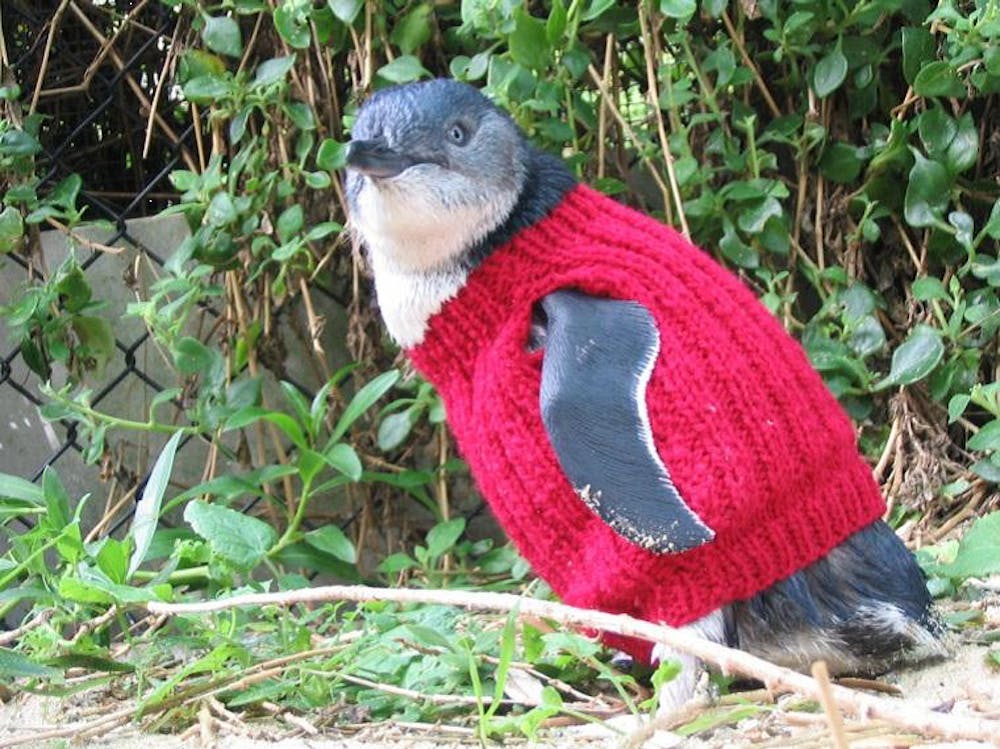
Philip Island’s Knits for Nature project began after oil spills in the late 1990s and the early 2000s threatened the area’s penguins. Thousands of knitters worldwide rallied to support the cause and continue to donate.

In 2012, German volunteers knitted 40,000 jumpers for Victoria’s little penguin population at Phillip Island. AAP

Today, Australia is experiencing an early and extreme bushfire emergency linked to climate change.


Read more: Drought and climate change were the kindling, and now the east coast is ablaze


Kristie Newton, campaign manager for animal rescue group WIRES, says that timing of the fires has made things worse for animal rescue groups:

It’s spring, which is our busiest time of year. We’re getting many hundreds of calls each day about orphaned and injured wildlife because it’s breeding season, but so many of our resources have been taken up by the bushfire emergency.

Community members and organisations are mobilising to crochet and knit marsupial pouches, make pouches and linings for orphaned joeys or sew bat wraps. WIRES has received donations from Australia, NZ, UK, USA, Sweden, Norway and Japan and delivered hundreds of pouches to carers.

Many hands

Sydney-based fibre artist Jacqui Fink is one person helping to co-ordinate donations of pouches and linings for wildlife welfare groups. She agrees with Newton that, “The fires are so huge and horrific that people are desperate to help as many animals as possible in any way they can”.

“Lots of school teachers have asked me to send patterns so that the kids can make pouches and linings. Church groups have been amazing, and even a women’s prison in South Australia has been in contact asking for information. I’ve received packages of pouches and linings from all over the Australia,” Fink says.

Newton also says that many schools have been in touch with WIRES for information about how to make pouches and the phone has been ringing off the hook with offers of help.

It is not just the local crafting community rallying around the cause.

“I’ve received more than 10,000 emails from as far away as Estonia, Finland, South Africa, Canada, Germany and New Zealand from people looking for patterns to make pouches to help our wildlife,” Fink notes.

Sewing enthusiasts have responded to the call to help orphaned joeys with snug pouches. WIRES, Author provided (No reuse)

Making pouches and linings is a low-cost, sustainable way for people to help. As long as the pouches are made from pure wool and the linings are cotton or flannelette, they’ll meet the fabric requirements to keep the animals safe and snug.

“We crafters are a practical mob. We love a job and we often have huge stashes of fabric and yarn lying around the house,” Fink says.

Pouches and linings can also be made from woollen blankets and old cotton sheets, saving them from landfill.

Creating agency

People are often keen to get involved in crafting during a crisis because it gives them a sense of purpose.

There is evidence that the acts of knitting,crochet and sewing can all help people to feel less anxious and deal with traumatic events.

And although the scale of the Australian bushfires is overwhelming, making pouches for animals feels like a practical step.

“It’s a meaningful way to help and people can know that something they’ve made with their hands will keep an animal warm at night. That’s a beautiful gift to give,” Newton says.


Read more: How craft is good for our health


The pouch and lining patterns are so basic that it’s an opportunity to learn new skills and carry on traditional crafts. Crafting pouches and liners can also allow kids to focus on something positive.

Youth health nurse Debbie Downie from Kirwan State High School in Townsville organised for students and teachers to sew koala mittens at lunchtime. Parents and other local community members also got involved by donating fabric or coming in to sew with the children. They’ve now made more than 150 koala mittens for animals affected by the bushfires.

How to make a pouch for critters in need.

In a crisis, small acts of crafting can be among the most powerful.

“All those incredible volunteers on the frontline can feel so alone and frustrated, but rising up and rallying with craft lets them know that out there people care,” Fink says.

Newton agrees. “We’ve been overwhelmed by the kindness of people and it’s helping us keep going, now and into the future.”

In times of crisis, we can echo the wartime slogan: Keep calm and craft on.

ref. Crafting in times of crisis helps critters and creators – http://theconversation.com/crafting-in-times-of-crisis-helps-critters-and-creators-127616

What is the Pharmacy Guild of Australia and why does it wield so much power?

Source: The Conversation (Au and NZ) – By Lesley Russell, Adjunct Associate Professor, Menzies Centre for Health Policy, University of Sydney

Across Australia around 5,700 community pharmacies are responsible for dispensing the majority of prescriptions subsidised under the Pharmaceutical Benefits Scheme (PBS).

These community pharmacies are represented nationally by the Pharmacy Guild of Australia.

Every five years the Australian government consults with the Pharmacy Guild before delivering the Community Pharmacy Agreement. This agreement governs how pharmacies are reimbursed for dispensing medicines listed on the PBS, and the sorts of services you can access at the pharmacy.

The 6th Community Pharmacy Agreement expires on June 30, 2020. Negotiations are currently underway for the 7th agreement, expected to cost some A$20 billion over five years.


Read more: Explainer: what is the Community Pharmacy Agreement?


The Pharmacy Guild is the major player involved in negotiating with the government how much money is spent through the Community Pharmacy Agreement, and where the money goes.

Given the funds at stake, and the importance of ensuring the availability of PBS medicines, it’s pertinent to look at what the Pharmacy Guild is and where its power comes from.

Ensuring community pharmacies are sustainable

The Pharmacy Guild of Australia was founded in 1928 as an employers’ organisation for the owners of community pharmacies. Pharmacy owners must be registered pharmacists, but the pharmacy profession is represented separately by the Pharmaceutical Society of Australia.

The Pharmacy Guild’s key focus is the financial sustainability of community pharmacy. Over the years they’ve sought to protect pharmacists’ income generated from the PBS (between 41% and 46% of their total income, depending on location).

This is highlighted, for example, by the 2013 fight over dispensing fees for cancer drugs. The Pharmacy Guild was able to recoup A$82.2 million to increase dispensing fees for chemotherapy drugs, after it protested changes in funding arrangements for chemotherapy services left pharmacies with a A$277 million shortfall.

Similarly, the Pharmacy Guild was able to coerce the government into providing A$210 million in the 2017-18 budget to community pharmacies as compensation for lower than forecast prescription volumes.

Negotiations for the 7th Community Pharmacy Agreement are currently underway. From shutterstock.com

Further, the Pharmacy Guild has fiercely and successfully opposed efforts to change the location rules which govern the clustering of pharmacies, to allow pharmacies in supermarkets, and other efforts to increase competition.

The guild has also pushed for pharmacies to receive funding to deliver primary care services to patients. Both the Pharmacy Guild and the Pharmaceutical Society of Australia regard the community pharmacy sector as an ideal environment to host preventative health initiatives, such as immunisations and screening services.

Under the 6th Community Pharmacy Agreement, funding for these sorts of services has exceeded A$1.26 billion. It’s highly likely funding for these activities will be increased in the next Community Pharmacy Agreement.


Read more: Pay pharmacists to improve our health, not just supply medicines


Despite the fact uptake of these programs is described as “alarmingly low”, this has generated turf fights between doctors and pharmacists.

Some of the medical opposition is because evaluations of a number of long-running pharmacy programs have failed to demonstrate their value. In most cases, there has been insufficient data to enable any assessment of the impact of these programs on health outcomes.

So why are they so powerful?

The lobbying capabilities of the Pharmacy Guild executive and its members, the reach into every community, and the substantial political donations they make, mean politicians are always nervous about treading on community pharmacies’ toes.

Community pharmacies have a unique ability to garner public support for their causes from loyal customers. This can be a potent deterrent for any politician proposing changes the Pharmacy Guild views as adverse.

We saw this during the 2013 election campaign when customers were petitioned to save their local pharmacies, supposedly under threat after a move by the Rudd government to reduce the price of prescription medicines.

Community pharmacies are often able to cultivate loyal customers. From shutterstock.com

In terms of political donations, the Pharmacy Guild was ranked as the 14th largest political donor in 2017-18 (the latest period we have data for).

Their political contributions in that financial year totalled A$220,000. More than half of this (A$139,500) went to the Labor Party, with the remainder going to the Liberal and National Parties.

Most recently a donation of A$15,000 to One Nation generated controversy.


Read more: How rivalries between doctors and pharmacists turned into the ‘turf war’ we see today


The Pharmacy Guild has been open about its ability to work within political processes, regardless of who is in government.

Its many critics, however, see the approach as one of manipulation. Former chair of the Australian Competition and Consumer Commission, Graeme Samuel, has described some of the guild’s tactics as “political blackmail”.

Towards the 7th Community Pharmacy Agreement

We don’t yet know what’s going to be contained in the 7th Community Pharmacy Agreement.

Regrettably, despite the large sums of money involved and the importance of community pharmacy as a public asset, there’s no transparency around the negotiations.

There’s also been little apparent consultation with other key stakeholders, particularly consumers. The Pharmacy Guild – and with it the interests of its members – appears, unsurprisingly, to be driving where health minister Greg Hunt will go with this agreement.


Read more: Relaxing pharmacy ownership rules could result in more chemist chains and poorer care


ref. What is the Pharmacy Guild of Australia and why does it wield so much power? – http://theconversation.com/what-is-the-pharmacy-guild-of-australia-and-why-does-it-wield-so-much-power-127315

Explainer: the story of Demeter and Persephone

Source: The Conversation (Au and NZ) – By Chris Mackie, Professor of Classics, La Trobe University

The student of Greek mythology is often struck by the fact that some gods and goddesses have extensive roles in the mythical narratives, and others have very limited parts to play. The goddess Demeter is an interesting case of this. As an Olympian goddess and fertility figure, she is very important in ancient Greek religion and life, but she has a rather small role in its literature and mythology.

She is mentioned a little bit in Homeric epic, especially the Iliad, but has no actual part to play either in the Iliad or the Odyssey. Nor does she feature at all as a character in extant Greek drama.


Read more: Guide to the classics: Homer’s Iliad


There is, however, a rather beautiful poem called the “Homeric Hymn to Demeter” in which Demeter and her daughter Persephone are the central focus of attention. It probably dates to the first half of the 6th century BC. It is 495 lines long and composed in hexameters, the same poetic metre as the Iliad and Odyssey. Despite its connections to epic poetry, however, and the title “Homeric”, the hymn is of uncertain authorship.

A mother’s love

The focus of the poem is one of the most renowned narratives from Greek mythology – the rape of Persephone by Hades, the god of the Underworld, and the response of Demeter to her loss. It is a remarkable narrative, built fundamentally on the power of a mother’s love for her only child.

Demeter mourning Persephone by Evelyn de Morgan, 1906. Wikimedia Commons

The ancient Greek word for “mother” [meter] is actually embedded in Demeter’s name. The Hymn describes the primordial maternal power brought to bear upon the male sky-god Zeus, who had secretly (ie without Demeter’s knowledge) given over his daughter Persephone to a marriage with his brother Hades.

Demeter is one of the “older” generation of Olympian gods. Her siblings are Zeus, Poseidon and Hades on the male side, and Hera and Hestia on the female side. Zeus, the sky god, has sexual relations with two of his sisters – Hera, who is a kind of long-suffering queen of heaven; and Demeter, who is more earth-focused. In a famous passage in Iliad 14, Zeus recounts to Hera herself some of his sexual exploits, and he names Demeter in his long list of amours.

Persephone is not mentioned in the passage as the product of this particular sexual encounter, but that is definitely the idea. Demeter and Persephone are often thought of together as “The Two Goddesses”. This name helps to emphasise the power of their bond, and the gravity of Zeus’s action in violently separating them.

The Hymn tells the story of Persephone and other young girls gathering flowers in a meadow. As she bends down to pick a beautiful flower, the earth opens up and Hades emerges on his horse-drawn chariot. She gives out a scream, but he carries her off into the depths of the earth.

Hades abducting Persephone, fresco in the small royal tomb at Vergina, Macedonia, Greece, circa 340 BC. Wikimedia Commons

A blight on the land

Her mother hears her cry, and begins a search for her throughout the whole world. Whilst ever Persephone is missing Demeter creates a blight on the land in which nothing germinates and nothing grows. She would have destroyed humanity altogether if Zeus hadn’t taken notice, and acted accordingly.

A human genocide is clearly not in the gods’ interest. It would deprive them of the honours that they receive from mortals. Their existence without honours from humans would be intolerable, and Zeus, as ruler of the world, can’t allow it to happen. But Demeter will not let go of her fury at the loss of her daughter. She won’t go to Olympus, the home of the gods, and she won’t let the fruit grow on earth until she sees Persephone again.

Zeus is forced to relent and sends the messenger Hermes to the Underworld to get the girl back. But, just as she is going, Hades prevails on her to eat the seed of a pomegranate to prevent her from staying with her mother above the earth all her days. Persephone is therefore forced to spend one-third of each year under the earth with Hades, and two-thirds with her mother and the community of gods on Mount Olympus.

Persephone’s transition from the feminised world of a flowery meadow to the unrelenting male world of Hades could scarcely be more fundamental.

The male gods who perpetrate the deed, Zeus and Hades, have no redeeming features whatever in the Hymn, and they are really undone by the sheer force of Demeter’s love for her daughter. The main narrative of the Hymn has some similarities to Achilles’ response to the loss of Patroclus in the Iliad, but Demeter’s wrath is universal with a kind of cosmic maternal power to it.

A new cycle of life and death

Persephone’s eating of the pomegranate seed means that a compromise is set up, in which the world changes forever. Whereas she might have expected an immortal existence with her mother on Olympus, Persephone becomes the central figure in a new cycle of life and death.

She is both queen of the Underworld, as wife of Hades, and associated with the new life that rises with the spring. Death and life are no longer mutually exclusive, but co-exist in both the upper and lower worlds. There is life in death, and death in life.

Frederic Leighton, The Return of Persephone, 1891. Wikimedia Commons

The Demeter Hymn contains the foundation myth of the Eleusinian Mysteries – renowned religious rites which took place at Eleusis, near to Athens. Initiation into the Mysteries held out the prospect of making death less threatening.

The establishment of Persephone as a feminine presence in the Underworld, as described in the Hymn, corresponds to the notion that death is not as terrifying as it could have been had Hades alone been present as ruler in the world of the dead.

Like many Greek myths the story of Persephone’s descent into the realm of Hades, and her emergence from it, has resonances in contemporary arts, most especially the notion of death and rebirth.

One parallel worth noting is the Phantom of the Opera in the version by Andrew Lloyd-Webber (et al.) in which Erik leads Christine down into the cellars of the opera house on to a boat and across a subterranean lake.

Emmy Rossum and Gerard Butler in The Phantom of the Opera (2004) Warner Bros., Odyssey Entertainment, Really Useful Films

Erik then sings to Christine of the attractions of his isolated world of darkness and night:

Slowly, gently night unfurls its splendor
Grasp it, sense it, tremulous and tender
Turn your face away from the garish light of day
Turn your thoughts away from cold, unfeeling light
And listen to the music of the night

The plea of Hades to Persephone is quite different in the Hymn, but the desperate loneliness of the two males in their dark realms is something that they have in common.

It is worth noting, finally, that phrases like being “carried off by Hades” or “marrying Hades” were used as metaphors more broadly to describe the deaths of young girls. This again shows how significant the myth of Demeter and Persephone was in the lives of women and girls in Greek antiquity.

ref. Explainer: the story of Demeter and Persephone – http://theconversation.com/explainer-the-story-of-demeter-and-persephone-110898

The internet’s founder now wants to ‘fix the web’, but his proposal misses the mark

Source: The Conversation (Au and NZ) – By Terry Flew, Professor of Communication and Creative Industries, Queensland University of Technology

On March 12, the 30th anniversary of the World Wide Web, the internet’s founder Tim Berners-Lee said we needed to “fix the web”.

The statement attracted considerable interest.

However, a resulting manifesto released on Sunday, and dubbed the Contract for the Web, is a major disappointment.

Endorsed by more than 80 corporations and non-government organisations, the campaign seeks a return to the “open web” of the 1990s and early 2000s – one largely free of corporate control over content.

While appealing in theory, the contract glosses over several key challenges. It doesn’t account for the fact that most internet content is now accessed through a small number of digital platforms, such as Google and Facebook.

Known as the “platformisation of the internet”, it’s this phenomenon which has generated many of the problems the web now faces, and this is where the focus should be.


Read more: Who controls the internet? The debate is live and clicking


An undercooked proposal

Berners-Lee identified major obstacles threatening the future of the web, including the circulation of malicious content, “perverse incentives” that promote clickbait, and the growing polarisation of online debate.

Having played a central role in the web’s development, he promised to use his influence to promote positive digital change.

He said the Contract for the Web was a revolutionary statement.

In fact, it’s deeply conservative.

Berners-Lee claims it’s the moral responsibility of everybody to “save the web”. This implies the solution involves engaging civic morality and corporate ethics, rather than enacting laws and regulations that make digital platforms more publicly accountable.

The contract views governments, not corporations, as the primary threat to an open internet. But governments’ influence is restricted to building digital infrastructure (such as fast broadband), facilitating online access, removing illegal content and maintaining data security.

Missing links

The contract doesn’t prescribe measures to address power misuse by digital platforms, or a solution to the power imbalance between such platforms and content creators.

This is despite more than 50 public inquiries currently taking place worldwide into the power of digital platforms.


Read more: Country rules: the ‘splinternet’ may be the future of the web


The most obvious gaps in the contract are around the obligations of digital platform companies.

And while there are welcome commitments to strengthening user privacy and data protection, there’s no mention of how these problems emerged in the first place.

It doesn’t consider whether the harvesting of user data to maximise advertising revenue is not the result of “user interfaces and design patterns”, but is instead baked into the business models of digital platform companies.

Its proposals are familiar: address the digital divide between rich and poor, improve digital service delivery, improve diversity in hiring practices, pursue human-centered digital design, and so forth.

But it neglects to ask whether the internet may now be less open because a small number of conglomerates are dominating the web. There is evidence that platforms such as Google and Facebook dominate search and social media respectively, and the digital advertising connected with these.

Not a civic responsibility

Much of the work in the contract seems to fall onto citizens, who are expected to “fight for the web”.

They bear responsibility for maintaining proper online discourse, protecting vulnerable users, using their privacy settings properly and generating creative content (presumably unpaid and non-unionized).

The contract feels like a document from the late 1990s, forged in the spirit of “militant optimism” about the internet.

It offers only pseudo-regulation for tech giants.

It also implies if tech giants can demonstrate greater diversity in hiring practices, allow users to better manage their privacy settings, and make some investments in disadvantaged communities, then they can avoid serious regulatory consequences.

Legacies of internet culture

A big question is why leading non-government organisations such as the Electronic Frontier Foundation and Public Knowledge have signed-on to such a weak contract.

This may be because two elements of the original legacy of internet culture (as it started developing in the 1990s) are still applicable today.

One is the view that governments present a greater threat to public interest than corporations.

This leads non-governmental organisations to favour legally binding frameworks that restrain the influence of governments, rather than addressing issues of market dominance.

The contract doesn’t mention, for instance, whether governments have a role in legislating to ensure digital platforms address issues of online hate speech. This is despite evidence that social media platforms are used to spread hate, abuse and violent extremism.

The second is the tendency to think the internet is a different realm to society at large, so laws that apply to other aspects of the online environment are deemed inappropriate for digital platform companies.

An example in Australia is defamation law not being applied to digital platforms such as Facebook, but being applied to the comments sections of news websites.


Read more: A push to make social media companies liable in defamation is great for newspapers and lawyers, but not you


Berners-Lee’s manifesto for the future of the web is actually more conservative than proposals coming from government regulators, such as the Australian Competition and Consumer Commission’s (ACCC) Digital Platforms Inquiry.

The ACCC is closely evaluating issues arising because of digital platforms, whereas the Contract for the Web looks wistfully back to the open web of the 1990s as a path to the future.

It fails to address the changing political economy of the internet, and the rise of digital platforms.

And it’s a barrier to meaningfully addressing the problems plaguing today’s web.

ref. The internet’s founder now wants to ‘fix the web’, but his proposal misses the mark – http://theconversation.com/the-internets-founder-now-wants-to-fix-the-web-but-his-proposal-misses-the-mark-127793

Scott Morrison under fire for calling NSW police commissioner over Angus Taylor investigation

Source: The Conversation (Au and NZ) – By Michelle Grattan, Professorial Fellow, University of Canberra

The political furore around Angus Taylor has escalated, with Prime Minister Scott Morrison having to defend his unconventional action of ringing NSW Police Commissioner Mick Fuller to inquire about the investigation into an alleged doctored document used by the energy minister.

Critics of Morrison’s call included former Prime Minister Malcolm Turnbull, who said while he was sure the call was “innocuous … it would have been much better had it not been made”.

“It is vitally important that that inquiry … is seen to be conducted entirely free of political influence,” he said. “Being blunt about it, it’s a call that I would not have made.”

After NSW police announced it was investigating the circumstances surrounding the document – containing highly inflated figures that Taylor used to try to discredit the city of Sydney over its travel expenses – Morrison said he would “take advice” from the police before assessing Taylor’s situation.

After ringing Fuller, he indicated Taylor would not be stood down during the investigation.

On Wednesday, Morrison told parliament: “What I did yesterday is what I told the house I would do.”

“The purpose of my call was to fulfil my undertaking to the house and to discharge my responsibility under the statement of ministerial standards to inform myself of the nature, substance and instigation of the investigation under way.

“I do not intend to base serious assessments of my duties under the statement of ministerial standards on media reports or comments made by the Labor Party.”

Fuller, who knows Morrison personally, defended the prime minister’s action when questioned on Wednesday.

“The prime minister was trying to confirm or deny whether or not there was an investigation into one of his cabinet members,” the commissioner said.

Fuller said he had received a letter from the shadow attorney-general, Mark Dreyfus, about the Taylor matter. Given the positions of Dreyfus and Taylor, “it was appropriate that we look into the matter to see if there was any criminality and to see if there was potentially a person responsible for that.”


Read more: Scott Morrison stands by energy minister Angus Taylor, who faces police probe


Fuller said Morrison “didn’t ask me any questions that were inappropriate. He didn’t ask for anything that was inappropriate and I’m comfortable with the discussion that we had over a few minutes”.

The commissioner said “the allegation itself is around a complex piece of criminal law. We are unsure at this stage even if we have reached a benchmark of it being a criminal matter. Now that needs to be the first port of call. Is this a criminal matter or is it not?”

He added he wanted the matter wrapped up as quickly as possible.

Fuller also played down the closeness of his relationship with Morrison, saying the prime minister was his local member and he had met him a few times but “I have never had dinner at the Lodge”.

“I certainly don’t have a personal relationship with the prime minister.”

Fuller once told 2GB’s Ben Fordham that when Morrison was his neighbour, the then-treasurer used to bring in his rubbish bin. When asked about that on Wednesday, he said this was just a joke. “Of course, he has never brought my bins in.”

Morrison was also previously asked by Fordham about whether he’d brought Fuller’s bin in, and responded, “That’s what good neighbours do”.

In parliament, Morrison defended not requiring Taylor to stand aside during the investigation by pointing to instances where Labor figures had not stood aside.

When asked by the media whether it had been inappropriate for Morrison to ring Fuller, opposition leader Anthony Albanese said:

“I’ll tell you what Australians will be thinking today … They will think to themselves, ‘If one of my mates was under investigation, can I pick up the phone to the head of the police and ask for the details of that investigation on the day that it’s launched?’ I think not.”

ref. Scott Morrison under fire for calling NSW police commissioner over Angus Taylor investigation – http://theconversation.com/scott-morrison-under-fire-for-calling-nsw-police-commissioner-over-angus-taylor-investigation-127922

Fish kills and undrinkable water: here’s what to expect for the Murray Darling this summer

Source: The Conversation (Au and NZ) – By Jamie Pittock, Professor, Fenner School of Environment & Society, Australian National University

A grim summer is likely for the rivers of the Murray-Darling Basin and the people, flora and fauna that rely on it. Having worked for sustainable management of these rivers for decades, I fear the coming months will be among the worst in history for Australia’s most important river system.

The 34 months from January 2017 to October 2019 were the driest on record in the basin. Low water inflows have led to dam levels lower than those seen in the devastating Millennium drought.

No relief is in sight. The Bureau of Meteorology is forecasting drier-than-average conditions for the second half of November and December. Across the summer, rainfall is also projected to be below average.

So let’s take a look at what this summer will likely bring for the Murray Darling Basin – on which our economy, food security and well-being depend.

A farmer stands in the dry river bed of the Darling River in February this year. Dean Lewins/AAP

Not a pretty picture

As the river system continues to dry up and tributaries stop flowing, the damaging effect on people and the environment will accelerate. Mass fish kills of the kind we saw last summer are again likely as water in rivers, waterholes and lakes declines in quality and evaporates.

Three million Australians depend on the basin’s rivers for their water and livelihoods. Adelaide can use its desalination plants and Canberra has enough stored water for now. But other towns and cities in the basin risk running out of water.


Read more: Paddling blind: why we urgently need a water audit


Governments were warned well before the drought to better secure water supplies through infrastructure and other measures. But the response was inadequate.

Some towns such as Armidale in New South Wales have been preparing to truck water to homes, at great expense. Water costs will likely increase to pay for infrastructure such as pumps and pipelines. The shortages will particularly affect Indigenous communities, pastoralists who need water for domestic use and livestock, irrigation farmers and tourism business on the rivers.

Water in major storages as reported at 13 November 2019. Murray Darling Basin Authority

As we saw during the Millennium drought, when wetland soils dry some sediments will oxidise to form sulfuric acid. This kills fauna and flora and can make water undrinkable.

Red gum floodplain forests and other wetland flora will continue to die. Most of these wetlands have not had a drink since 2011. The desiccation, due to mismanagement and drought, is likely to see the return of hypersalinity – a huge excess of salt in the water – with river flows too weak to flush the salt out to sea.


Read more: Murray-Darling report shows public authorities must take climate change risk seriously


If drought-breaking rains do come, as they did in 2010-11, this would create a new threat. Floodwaters would inundate leaf litter on the floodplains, triggering a bacterial feast that depletes the water of oxygen. These so-called “blackwater” events kill fish, crayfish and other aquatic animals.

The risk of blackwater events has largely arisen because government authorities have failed to manage water as they had agreed. In particular, the NSW and Victorian governments have not worked with farmers to allow managed river flows to inundate floodplains.

The prospect of thousands of dead fish in the Murray Darling Basin looms large again this summer. AAP/GRAEME MCCRABB

How did we get here?

The severity and impacts of this drought should not come as a surprise. In the 1980s, the CSIRO’s first projections of climate change impacts in the basin foreshadowed what is unfolding now.

Despite the decades-old warnings, water management authorities in some catchments favoured water extraction by irrigators over rural communities, pastoralists and the environment. For example, the NSW Natural Resources Commission in September found that state government changes to water regulations brought forward the drying up of the Darling River by three years.


Read more: We can’t drought-proof Australia, and trying is a fool’s errand


Since the basin plan was adopted in 2012 our federal and state political leaders have reduced the volume of real water needed to keep the rivers healthy, supply water to people and flush salt out to sea. For example, in May 2018 the federal government and Labor opposition agreed to reduce water allocated to the environment by 70 billion litres a year on average, without a legitimate scientific basis.

The basin plan is based on historical river flow records, without explicitly allowing for diminished inflows resulting from climate change. Australian water management has followed what’s been termed a “hydro-illogical cycle” where drought triggers reform, but government leaders lose attention once it rains. This suggests meaningful reform must be implemented when drought is occurring and politicians are under pressure to respond.

Severe drought and mismanagement means a dire summer for the Murray-Darling river system. Dean Lewins/AAP

How to fix this

Governments must assume that climate-induced drought conditions in the basin are the new normal, and plan for it.

Action should include:

  • Revising water allocations consistent with climate change projections

  • Investing in managed aquifer recharge to supply more towns with reliable and safe water

  • Restoring rivers by reallocating enough water to sustain their health

  • Increasing wetland resilience by reconnecting rivers to their floodplains in wetter years

  • Improving river health, such as by fencing out livestock.

Investing in these adaptation actions now would provide jobs during the drought and prepare Australia for a much drier future in the Murray-Darling Basin.

ref. Fish kills and undrinkable water: here’s what to expect for the Murray Darling this summer – http://theconversation.com/fish-kills-and-undrinkable-water-heres-what-to-expect-for-the-murray-darling-this-summer-126940

Does our child protection system cause young people to commit crimes? The evidence suggests so

Source: The Conversation (Au and NZ) – By Tamara Walsh, Professor, The University of Queensland

Removing a child from their home for their own protection should be an absolute last resort. Before we remove a child, we should be sure that we can offer them a safer, more nurturing alternative – their new home should improve their current circumstances and their life chances.

Yet, for a significant proportion of children who end up in out of home care, this is not happening. Many children are being charged with criminal offences while they are in the “care” of the state.

The Australian Institute of Health and Welfare recently reported that 50% of young people under youth justice supervision in Australia have also received child protection services.

The link is even more prevalent in Queensland – the Independent Review into Youth Detention reported in 2017 that 76% of children in the youth justice system are known to the child safety department.

The Northern Territory Royal Commission also found children on child protection orders are five times more likely to commit an offence than other children.

And my research has found the chain of causation goes in one direction in these matters: children come into the child protection system first and then commit offences, not the other way around.


Read more: Nothing to see here? The abuse and neglect of children in care is a century-old story in Australia


Does out of home care lead to offending?

If a child commits an offence while in the care of the state, questions should be asked about the quality of care and supervision being provided. Is the care environment somehow causing the criminal behaviour? Or is the association just coincidental?

It could be coincidental, in the sense that young people who interact with both the child protection and youth justice systems share certain characteristics.

Many suffer from mental health or behavioural conditions, are homeless or have experienced trauma or abuse. Indigenous children are also more likely to be known to child protection services, and more likely to appear before the criminal courts.

Yet, international research suggests the nature of a child’s placement influences their chances of offending. Research from the US has also found that children who are known to child protection services but remain at home are less likely to offend than those who are placed in out of home care.


Read more: The problem with child protection isn’t the money, it’s the system itself


It is all too easy to conclude these kids are just “troubled” or even “bad”. We might assume since they come from difficult homes, and they have psycho-social problems, this trajectory is inevitable.

But my research suggests there is more to this story. I interviewed 24 Brisbane-based lawyers and youth workers who deal with children who “cross over” between child protection and youth justice.

They overwhelmingly agreed the child protection system itself is leading many children to commit offences.

Charges for minor offences

The criminal charges these children receive appear to be unnecessary and avoidable. According to my interview subjects, many children who commit offences are driven by necessity.

For example, many children are charged with public transport fare evasion. Others are charged with shoplifting. These offences arise directly out of material disadvantage, but this is happening while they are supposed to be being in the care of the state. Why don’t they have transport cards? Why do they feel the need to steal food or clothing?

My participants said other charges result from the trauma or mental health conditions these children are dealing with. They described situations where their young clients had been charged with wilful damage for punching a wall, or assault for lashing out at a carer.

As one lawyer said,

This doesn’t happen in an ordinary family home – you don’t call the police because there’s a hole in the wall.

Other types of offending involved trivial incidents that really just amounted to “kids being kids”.

My participants described situations where children were charged with theft for taking food out of the fridge, assault for whacking each other with tea towels, wilful damage for knocking down a locked bathroom door to use the toilet, break and enter for “breaking into” their own house, and trespass for bringing in a friend.


Read more: How resilience can break the link between a ‘bad’ childhood and the youth justice system


Importantly, the lawyers and social workers I interviewed emphasised that most often, the children who are charged with offences are living in residential care settings, rather than foster care situations.

Residential care is a placement option where children live in share houses in the community that are staffed by youth workers around the clock. These units house some of Australia’s most vulnerable children. Yet, the youth workers who staff them are often young themselves, and under-skilled.

What these kids most often need is a nurturing, home-like environment, but the youth workers may lack the life experience necessary to provide this. Calling police becomes a fall-back option to deal with difficult situations.

Better environments for troubled children

These children have fallen through all the cracks of the systems that should have supported them: family, education and child protection. Often, every adult in their lives has let them down.

As the UK criminologist Claire Taylor has said, we need to be “ambitious” on behalf of these children. They need, and have a legal right to, the best possible start the community can give them.

If we remove them from an “unsafe” environment, we must ensure we are placing them into a safe one – one where they will not be vulnerable to offending or criminal charges but rather will be nurtured and supported.

As one youth worker told me,

it sounds a bit corny, but I reckon it all comes back to love – the offending and stuff is just a symptom.

ref. Does our child protection system cause young people to commit crimes? The evidence suggests so – http://theconversation.com/does-our-child-protection-system-cause-young-people-to-commit-crimes-the-evidence-suggests-so-127024

Now we know. The Reserve Bank has spelled out what it will do when rates approach zero

Source: The Conversation (Au and NZ) – By Stephen Kirchner, Program Director, Trade and Investment, United States Studies Centre, University of Sydney

Last night, in a much anticipated speech broadcast live on the Reserve Bank’s website, Governor Phil Lowe laid out in very clear terms the circumstances in which the bank would resort to quantitative easing and the way in which it would implement it.

Quantitative easing is simply a change in the way it eases monetary policy when the official interest rate approaches zero.

Usually it does it by cutting the so-called cash rate, which is the rate banks pay each other for money deposited overnight.

Eight years ago the cash rate was 4.5%. Three years ago it was 1.5%. After the most recent three cuts in June, July and October, it is just 0.75%


Source: RBA

Last night, Governor Lowe said the effective lower bound was 0.25%. Rather than let the cash rate get any lower or negative (an option he explicitly ruled out), the bank will push down other longer-term rates buy buying government bonds.

It’s the “quantitative easing” approach adopted by the US Federal Reserve between 2009 and 2014.


Read more: Below zero is ‘reverse’. How the Reserve Bank would make quantitative easing work


Government bonds are sold by governments in return for money, a means of borrowing. The buyer gets guaranteed interest payments and a guarantee that their money will be returned in full after three, five, ten or even 20 years depending on the length of the bond.

Once issued, bonds can be traded on a market, and the price at which they change hands can be expressed as an implied interest rate, which becomes the risk-free rate against which all other interest rates are benchmarked.

How quantitative easing would work

Buying bonds from investors would push down that risk-free rate, pushing down the entire structure of long-term interest rates.

All other things being equal, this should also push down the exchange rate by reducing the return on Australian dollar denominated financial investments.

Governor Lowe indicated he might buy state government bonds as well as Commonwealth bonds.

Importantly, he argued that although the bank would be mindful of the need to ensure private banks had enough access to the bonds they needed to hold for regulatory purposes, those holdings would not be an impediment to quantitative easing.

He ruled out buying residential mortgage-backed securities and other private assets given that those markets are currently functioning well and Reserve Bank purchases could distort them.


Read more: RBA update: Governor Lowe points to even lower rates


The approach borrows heavily from the US Fed.

As in the US, Lowe says quantitative easing would be complemented by “forward guidance,” where the Reserve Bank would signal early how long-term interest rates would be kept low and the circumstances in which it expected to raise them again.

The guidance is designed to influence market expectations for future interest rates, enhancing the effectiveness of cuts in long term interest rates.

When it would happen

RBA governor Philip Lowe addressed business economists in Sydney on Tuesday night. DEAN LEWINS/AAP

In addition to “how,” Governor Lowe spelled out “when” – the economic circumstances in which the bank would resort to quantitative easing.

It would do it when the cash rate was at 0.25% and inflation and unemployment were moving away from its objectives.

The bank targets 2-3% inflation on average over time and has recently identified 4.5% as the “full employment” unemployment rate.

Importantly, Lowe emphasised that the Australian economy has not yet reached the point where a cash rate as low as 0.25% would be needed and argued quantitative easing was unlikely to be needed in future.

The cash rate is at present 0.75%. Setting 0.25% as the effective lower bound gives the Governor 0.5 percentage points left to cut before implementing quantitative easing.

Implicitly, Governor Lowe is saying that those cuts of 0.5 percentage points will be enough to stabilise the economy.

A pause for a breath at 0.25%

Lowe also indicated the bank would not seamlessly transition to quantitative easing.

He implied there was an additional hurdle or threshold that would need to be crossed, suggesting he would be reluctant to make the transition.

His big problem is that neither inflation nor the unemployment rate are moving in the right direction.

The bank has undershot its inflation target since the end of 2014, giving the economy a weak starting point going into an emerging global downturn.

My research on the US experience for the United States Studies Centre shows that the main problem with is quantitative easing was that it was not done soon enough or aggressively enough.

It might be better to be bold

While quantitative easing was effective, it could have been made more so had what was going to happen been made clearer.

The Fed went out of its way to limit the transmission of quantitative easing to the rest of the economy, fearful it would be too potent and lead to excessive inflation.

Those concerns proved misplaced. By pulling its punches, the Fed ended up being less effective and having to pursue quantitative easing for longer than if it had used it more aggressively.

Governor Lowe’s very obvious reluctance to go down the quantitative easing route suggests the Reserve Bank is in danger of making the same mistake, but it is not too late to learn from what happened in the US.

ref. Now we know. The Reserve Bank has spelled out what it will do when rates approach zero – http://theconversation.com/now-we-know-the-reserve-bank-has-spelled-out-what-it-will-do-when-rates-approach-zero-127697

How weather radar can keep tabs on the elusive magpie goose

Source: The Conversation (Au and NZ) – By Rebecca Rogers, PhD Candidate, Charles Darwin University

You’re probably familiar with weather radar that shows bands of rain blowing in to ruin your plans for the day, or the ominous swirling pattern of a cyclone.

But rain isn’t the only thing that shows up on the radar screen. Anything moving through the sky will – like a large group of birds in flight.

Ecologists have begun to realise that weather radar data have huge potential to reveal the movements of flying animals all over the country.

At the forefront of this research is the magpie goose, an occasionally controversial waterbird prized by some and detested by others.

It’s a lovely day in northern Australia, and you are a magpie goose. These waterbirds are an ideal test case for weather-radar tracking. Shutterstock

Chasing angels

To understand how we got to this point, first we need to go back 80 years. Prior to World War II, engineers were racing to improve radar systems to detect enemy aircraft when they noticed strange unexplained rings on their screens that they called angels.

Some of these angels, they realised later, were caused by groups of birds and bats taking off and flying through the radar beam. Since this discovery, there has been a steady increase in researchers using weather radar to understand how and why animals move through the air.

How weather radar works

Radar works by sending out a sweeping beam of radio waves and listening for echoes. It processes these echoes to map the positions of objects around it.

With weather radar, the radar beam won’t only bounce off raindrops – it will also reflect back from birds. Some weather radars send out these pulses at a precise frequency, which allows them to use the Doppler effect to determine how fast objects are moving towards or away from the radar.

Meteorologists have ways to filter out clutter caused by flying animals, so they can see where it is raining. Ecologists are doing the reverse, filtering out rain from the raw data collected by weather radars in order to track the movements of birds, bats and even insect swarms.

Weather radars cover a good part of the Australian continent, which makes them very useful for tracking birds. Rogers et al. (2019) – Austral Ecology

Most weather radars can give us a three-dimensional picture of what is happening in the air every 5–10 minutes. In Australia the data is archived for years and even decades in some places, and it is all available free of charge for researchers. This means we can not only understand how animals are using the airspace now, but also how these movement patterns may have changed over time.

Is it a bird? Is it a plane?

So how do we actually tell whether those pixels on the screen are caused by rain, birds or something less common like bushfire smoke?

This is where things can get a bit more tricky. For some cases, like tracking bats coming out of a cave or roost tree, the job for the ecologist is fairly simple. For roosting species like these, we often observed very characteristic rings on the radar similar to the angels described by those early radar engineers. Examples of the rings can be found all over Australia caused by flying foxes.

Flying animals leave traces in weather radar images. The image at left shows an ‘angel echo’ caused by flying foxes coming out of a roost in NSW, while the one on the right reveals ‘blooms’ of activity on the Darwin radar, likely to be caused by magpie geese and other waterbirds taking off for their morning feeding flights. Rogers et al. (2019) – Austral Ecology

For broadly distributed species, like the magpie geese found all across northern Australia, the picture is not so easy to interpret. These animals tend to produce patterns best described as blooms of activity: they appear across the radar image, spreading out and then blending together like a bunch of flowers blooming all at once.

These patterns can look similar to rain clouds to the untrained eye. However, with some understanding of how the radar works and the behaviour of the birds – like when they are active or how high they fly – we can quickly begin to narrow down what might be causing different patterns on radar images.

Why track magpie geese?

Magpie geese cross paths with humans in many different ways.

They are hunted by Indigenous people for food, they are considered a pest for mango farmers and a strike risk for planes, and they could be vectors for disease.

Tracking magpie geese can help us better understand this native species and ensure it thrives long into the future.


Read more: Most native bird species are losing their homes, even the ones you see every day


Like many waterbirds, magpie geese have distinct daily patterns of movement, which makes them ideal candidates for trialling the use of weather radar to track Australian birds.

In Darwin, blooms of activity occur all over the radar in the morning and evening when magpie geese are taking off from wetlands and mango orchards for their daily feeding flights.

By using GPS tracking collars and annual survey data, we are starting to see how these patterns in the radar data correspond to real behaviour. These results are showing how weather radar could be repurposed to track the movement of magpie geese – and after that, many other kinds of birds in Australia.

ref. How weather radar can keep tabs on the elusive magpie goose – http://theconversation.com/how-weather-radar-can-keep-tabs-on-the-elusive-magpie-goose-126278

As bushfires intensify, we need to acknowledge the strain on our volunteers

Source: The Conversation (Au and NZ) – By Blythe McLennan, Research Fellow, Centre for Urban Research, RMIT University

The early and ferocious start to the bushfire season in Australia this year has raised questions about the impact on those at the frontline – the tens of thousands of volunteers helping to put out the blazes.

In Australia, the vast majority of bushfire fighters are volunteers. In the Queensland Fire and Emergency Services, for instance, volunteers account for 89% of the workforce.

And with fire seasons due to become longer and bushfires more intense due to the impacts of climate change, this will place even more demands on the men and women undertaking this vital and demanding work.

Given this, it’s important for us to understand how our worsening bushfires are affecting the mental and physical health of volunteers. Is this causing burnout? And if so, is that making it more difficult for fire and emergency services to recruit new volunteers and keep the ones they have?

Challenges for volunteer recruitment and retention

Of course, the impact of today’s bushfires needs to be viewed within the context of other challenges to volunteer recruitment and retention.

Two of the key factors are greater competition for people’s time – for example, due to changes in the nature of paid work – and the increasing difficulty of balancing work, family and volunteer commitments.


Read more: Why rural Australia is facing a volunteer crisis


The ways people choose to volunteer are also changing. Many people are choosing more flexible, shorter-term and cause-driven ways of volunteering and eschewing the kind of structured, high-commitment volunteering that is common in the emergency services.

At the same time, rural communities are facing a shrinking volunteer base as people either leave for better opportunities in cities or can no longer perform strenuous volunteering roles.

Father and son volunteers with the NSW Rural Fire Service. Dan Peled/AAP

Meanwhile, a lot has been said about younger generations being less motivated by altruistic values to volunteer.

However, there is considerable evidence that younger people are highly committed to making a positive contribution to society. They are just doing it differently than their parents – they are tapping into the power of social media and working outside of formal, structured organisations.

Changes to emergency management services are also at play. One of the most significant shifts has been the professionalisation, corporatisation and modernisation of volunteer-based emergency services in recent years.

While this has undeniably brought improvements to volunteer safety and the quality of service, it has also caused headaches for volunteers in the form of more bureaucracy and additional training requirements.

There is a risk this could drive a wedge between the corporate goals of fire and emergency service agencies that focus on risk management and efficiency, for example, and their more traditional, community-based roots – the reason many people choose to volunteer in the first place.


Read more: Stop calling young people apathetic. For many, volunteering and activism go hand-in-hand


Improving support for volunteers

This type of volunteering can be demanding. Bushfire volunteers face a range of significant stresses that can be physical, mental and emotional. Volunteer fatigue and burnout are real concerns.

There are also economic burdens for both volunteers and their employers, as well as strains on their family members.

Additionally, with the likelihood of more intense bushfires in the future, volunteers will increasingly be asked to travel outside their own communities to fight fires in other regions, further complicating their lives.

Having said this, support for volunteers is available and improving. In my ongoing research with other academics at the Bushfire and Natural Hazard Cooperative Research Centre, interviewees report improvements in operational equipment, technology and procedures that are enhancing volunteer safety.

Emergency services are also increasing mental health and well-being support for volunteers and developing more diverse and flexible ways for people to fit volunteering into their lives.

There is also a strong commitment to improving diversity and inclusion across the sector.

The reasons people want to help

Even though fighting fires is obviously demanding work, it is also extremely fulfilling and rewarding. Core reasons that people choose to volunteer include helping the community, learning new skills, feeling useful and doing something worthwhile, and experiencing camaraderie with others.

In our ongoing research, we are consistently hearing that the personal fulfilment and rewards of volunteering are not being adequately communicated to the public. If they were, a lot more people would offer their services.

In addition, many volunteering roles do not require people to be on the front lines at all. There are a large number of opportunities to support fire prevention, response and recovery well beyond the fires themselves.

A volunteer-run donation center in Taree, NSW. Dean Lewins/AAP

We also know that everyday people are deeply motivated to help others in the face of disaster. Indeed, NSW RFS and QFES are likely to see an upswing in people inquiring about volunteering in the aftermath of the current fires.

However, there is one important thing to note: the best time to approach emergency services about volunteering is before an event, rather than during one.

Volunteering at a crossroads

If we are fighting bushfires into the next decade with the same or declining numbers of volunteers, using the same approaches we use today, then clearly the job will be much harder and the demands on volunteers will become more extreme.

The key variable that will make the most difference for volunteers is the willingness and commitment of emergency services, governments, society and volunteers themselves to embrace change to current practices.


Read more: 70 years before Black Saturday, the birth of the Victorian CFA was a sad tale of politics as usual


This includes a greater investment in risk reduction, new operational approaches and involving volunteers more in organisational decision making. Emergency services providers should also be working more closely with community organisations to better understand and target the particular needs of different communities.

Whatever choices we make, we cannot leave it to our front line volunteers to bear an increasing burden of fighting the bushfires of the future.

ref. As bushfires intensify, we need to acknowledge the strain on our volunteers – http://theconversation.com/as-bushfires-intensify-we-need-to-acknowledge-the-strain-on-our-volunteers-127517

Antibiotic resistant superbugs kill 32 plane-loads of people a week. We can all help fight back

Source: The Conversation (Au and NZ) – By Sunanda Creagh, Head of Digital Storytelling

You might think antibiotic resistance is something to worry about in the distant future. But it’s already having a deadly impact today.

The number of people dying globally every week from antibiotic resistant infections is equivalent to 32 Boeing 747s full of people. And if that sounds scary, the projections for the future are even scarier.

On today’s episode of Trust Me, I’m An Expert we ask you to imagine a future where more and more antibiotics don’t work any more – and hear from researchers about how you can help scientists fight back.


Read more: ‘This is going to affect how we determine time since death’: how studying body donors in the bush is changing forensic science


New to podcasts?

Podcasts are often best enjoyed using a podcast app. All iPhones come with the Apple Podcasts app already installed, or you may want to listen and subscribe on another app such as Pocket Casts (click here to listen to Trust Me, I’m An Expert on Pocket Casts).

You can also hear us on Stitcher, Spotify or any of the apps below. Just pick a service from one of those listed below and click on the icon to find Trust Me, I’m An Expert.


Read more: Trust Me, I’m An Expert: what science says about how to lose weight and whether you really need to


Additional audio

Kindergarten by Unkle Ho, from Elefant Traks.

Airliner by Podington Bear from Free Music Archive.

Images

Shutterstock

ref. Antibiotic resistant superbugs kill 32 plane-loads of people a week. We can all help fight back – http://theconversation.com/antibiotic-resistant-superbugs-kill-32-plane-loads-of-people-a-week-we-can-all-help-fight-back-125813

Climate explained: how much does flying contribute to climate change?

Source: The Conversation (Au and NZ) – By Shaun Hendy, Professor of Physics, University of Auckland

CC BY-ND

Climate Explained is a collaboration between The Conversation, Stuff and the New Zealand Science Media Centre to answer your questions about climate change.

If you have a question you’d like an expert to answer, please send it to climate.change@stuff.co.nz

How much does our use of air travel contribute to the problem of climate change? And is it more damaging that it is being created higher in our atmosphere?

The flight shaming movement has raised our awareness of air travel’s contribution to climate change. With all the discussion, you might be surprised to learn that air travel globally only accounts for about 3% of the warming human activities are causing. Why all the fuss?

Before I explain, I should come clean. I am writing this on the train from Christchurch to Kaikoura, where I will give a talk about my recent book #NoFly: walking the talk on climate change. I have some skin in this game.


Read more: Flight shame: flying less plays a small but positive part in tackling climate change


Staying grounded

Taking a train around New Zealand is no mean feat. In the North Island, the train between Auckland and Wellington runs only every second day. If you get off at a stop along the way, you have to wait another two days to continue your journey. You can catch a bus, but you’ll spend that bus journey fantasising about the possibility of an overnight train service.

So why do it? A good deal of global carbon emissions come from industrial processes or electricity generation under the control of governments and corporations, rather than individual citizens. For many of us, a decision not to fly might be the most significant reduction in emissions we can make as individuals.

As Swedish climate activist Greta Thunberg has shown, refusing to fly also sends a powerful signal to others, by showing that you are willing to change your own behaviour. Politicians and corporate sales departments will take note if we start acting together.

Impacts of aviation

Aviation affects the climate in a variety of ways.

Because any carbon dioxide you emit stays in the atmosphere for hundreds of years, it doesn’t matter much whether you release it from the exhaust pipe of your car at sea level or from a jet engine several kilometres high. Per passenger, a flight from Auckland to Wellington will put a similar amount of carbon dioxide into the air as driving solo in your car. Catching the train will cut your carbon emissions seven-fold.

When aircraft burn jet fuel, however, they also emit short-lived gases like nitrogen oxides, which can react with other gases in the air within a day of being released. When nitrogen oxides are released at altitude they can react with oxygen to put more ozone into the air, but can also remove methane.

Ozone and methane are both greenhouse gases, so this chain of chemical reactions can lead to both heating and cooling effects. Unfortunately the net result when these processes are added together is to drive more warming.

Depending on the atmospheric conditions, aircraft can also create contrails: clouds of tiny ice crystals. The science is not as clear cut on how contrails influence the climate, but some studies suggest they could have an effect as significant as the carbon dioxide released during a flight.

There is also considerable uncertainty as to whether aircraft exhaust might affect cloud formation itself – this could be a further significant contribution to warming.


Read more: Climate explained: why don’t we have electric aircraft?


Growing demand for air travel

Offsetting, by planting trees or restoring natural wildlands, will take carbon dioxide back out of the atmosphere. But we would have to do this on a massive scale to feed our appetite for flight.

Emissions from international air travel are not included in the Paris Agreement, although the United Nations has been working on the Carbon Offsetting and Reduction Scheme for International Aviation (CORSIA), which may begin to deal with these. Initially, the scheme will be voluntary. Airlines flying routes between countries that join the scheme will have to offset any emissions above 2020 levels from January 2021.

Emissions from flying stand to triple by 2050 if demand for air travel continues to grow. Even if air travel became carbon neutral through the use of biofuels or electric planes, the effects from contrails and interactions with clouds mean that flying may never be climate neutral.

With no easy fixes on the horizon, many people are thinking hard about their need to fly. This is why I took a year off air travel (alongside my colleague Quentin Atkinson) in 2018.


Read more: Costly signals needed to deliver inconvenient truth


I have been back on planes in 2019, but I have learned how to reduce my flying, by combining trips and making better use of video conferencing.

Fly if you must, offset if you can, but – if you are concerned about climate change – one of the best things you could choose to do is to fly less.

ref. Climate explained: how much does flying contribute to climate change? – http://theconversation.com/climate-explained-how-much-does-flying-contribute-to-climate-change-127707

What actually is an ATAR? First of all it’s a rank, not a score

Source: The Conversation (Au and NZ) – By Tim Pitman, Senior Research Fellow, Curtin University

The Australian Tertiary Admissions Rank (ATAR) is a number mainly used by universities to select which students, out of high school, will be offered a place in a particular course.

The ATAR is not a score, it’s a rank. If a student gets an ATAR of 80, this doesn’t mean they averaged 80%. It means they performed as well as, or better than, 80% of the other students also graded.

How is an ATAR calculated?

Each state and territory does their own calculation of students’ ATAR. Although differing in certain details, they follow the same principles.

A student must be studying a minimum number of subjects that can be used in the final calculation. The specifics depend on state and territory.

In WA the calculation is based on a student’s four ATAR subjects and the student has to satisfy English competency requirements. In NSW, you have to study at least eight ATAR “units”, of which six have to be what are called Category A, plus two units of English. Category A units are defined as having “academic rigour” and a “depth of knowledge” required for tertiary studies. They include maths, English, science and history, as well as some arts and physical education subjects.

Queensland traditionally used something called an Overall Position, not the ATAR, but is moving to an ATAR in 2020.


Read more: Don’t stress, your ATAR isn’t the final call. There are many ways to get into university


In most cases, students are marked on how they did in the school assessments that count towards the ATAR. Again, this can differ across states.

In NSW, the assessments that count form part of the Higher School Certificate (HSC). In Victoria, it’s the Victorian Certificate of Education (VCE). In VCE, units 1 and 2 are generally taken in year 11, and units 3 and 4 in Year 12. Units 3 and 4 generally count for the ATAR, but sometimes the first two units also count, such as in some VET programs.

The purpose of providing these examples is to highlight how complicated the creation of an ATAR is and how much it is affected by local factors, including the state or territory you are in.

Using the relevant units, a raw score for each subject is created.

A raw score is then scaled to get a rank of where the student sits relative to their peers. from shutterstock.com

But remember, an ATAR is a rank, so the scores need to be re-interpreted as a rank. Each mark needs to be scaled, which means adjusting it so it can be more fairly compared with the marks for other students and subjects.

Scaling takes into account how competitive, not how difficult, a subject is.

One type of scaling considers where each subject’s mark ranks the student compared to the other students at the same school doing the same subject. Say a student gets 85% for a subject, if the average mark for their class was 90%, they will be ranked lower.

Another type of scaling considers how many students take a subject, and their average marks, compared to other subjects. This is because some subjects have relatively small numbers of students compared to others.

Unfortunately, advice – often on the internet – on how to “game” the system and get a higher ATAR is mostly incorrect. The best advice to ensure your best ATAR is, in the words of one admission centre,

to choose your studies according to what you are interested in; what you are good at; and what studies you need for future study.

What is the ATAR used for?

The main purpose of the ATAR is to determine who gets offered a place in a university course. Think of a queue. When places are limited, the closer to the front of the queue the student is, the more likely they will get in.

Some years there are less people in the queue, or more places in the course. These affect the ATAR required to get in.

Universities sometimes set minimum ATARs, either for a course or the university. So, the student can only apply to the university/course if they achieve this minimum.

A minimum might be set because the university believes this is the minimum ATAR required to succeed. It might also be a way of branding a course, or an entire university, as elite.

It could be a combination of both. And again, because it’s a queue, achieving the minimum still doesn’t guarantee a place.

Universities can and do sometimes make adjustments to its ATAR requirements. This might be due to special consideration – perhaps illness – or because the student received a bonus for studying a language other than English.

For example, for 2019 applicants, Curtin University published advice the minimum ATAR for the Bachelor of Advanced Science (Honours) in Coastal and Marine Science was 95. The minimum selection rank for that course actually ended up being 98.9 – above the university minimum. But at least one student was selected with an ATAR of 94.25 – slightly below the published minimum.

Why is the ATAR contentious?

An ATAR is primarily designed, and works best when it is used, as an efficient way of allocating limited places in a course in a first-come, first-served basis.

But because it’s a rank, it is not a direct representation of a student’s academic ability or potential to succeed in higher education. However, there is a correlation.


Read more: FactCheck: does your entrance score strongly correlate with your success at university?


A recent study by the University Admission Centre found:

the ATAR is the best available predictor of university success[…] The higher the ATAR, the higher the student’s first-year GPA is likely to be.

It also cautioned:

[…] the ATAR is not perfect. There will be instances where the prediction will ‘miss the mark’. Also, there will be cases where selection based on the ATAR alone would not be optimal.

There are always exceptions to the rule that ATAR can predict success. And these exceptions are not just numbers on a spreadsheet but people. For this and other reasons, many would like to see the ATAR scrapped.

But so far, agreement has not been reached on an alternative system that is fairer than the ATAR or as efficient.

In the meantime, it’s important to have alternative pathways to higher education for students who do not have the required ATAR but nonetheless have the capacity to succeed in higher education.

ref. What actually is an ATAR? First of all it’s a rank, not a score – http://theconversation.com/what-actually-is-an-atar-first-of-all-its-a-rank-not-a-score-126594

‘New Bradfield’: rerouting rivers to recapture a pioneering spirit

Source: The Conversation (Au and NZ) – By Patrick White, PhD Candidate in History and Politics, James Cook University

The “New Bradfield” scheme is more than an attempt to transcend environmental reality. It seeks to revive a pioneering spirit and a nation-building ethos supposedly stifled by the bureaucratic inertia of modern Australia.

This is not a new lament. Frustrated by bureaucracy, politicians in North Queensland have long criticised the slow pace of northern development.


Read more: You can’t boost Australia’s north to 5 million people without a proper plan


In 1950, northern local governments blamed urban lethargy. One prominent mayor complained:

… these young people lack the pioneering spirit of their forebears, preferring leisure and pleasure to hardships and hard work.

These sentiments were inspired by an agrarian nostalgia that extolled toil and toughness. Stoic responses to the challenges of life on the land are part of the Australian legend.

With drought devastating rural and urban communities and a state election looming in Queensland in 2020, both sides of politics have proposed a “New Bradfield” scheme.

An idea with 19th-century origins

Civil engineer John Bradfield devised the original scheme in 1938. His plan would swamp inland Australia by reversing the flow of North Queensland’s rivers. Similar proposals go back to at least 1887, when geographer E.A. Leonard recommended the Herbert, Tully, Johnstone and Barron rivers be turned around to irrigate Australia’s “dead heart”.

Blencoe Falls, on a tributary of the Herbert River, North Queensland, during the dry season. Patrick White, Author provided

As the “dead heart” became the “Red Centre” in the 1930s, populist writers revived the dreams of big irrigation schemes.

These schemes have always been contested on both environmental and economic grounds. A compelling history of Bradfield’s proposal reveals many errors and miscalculations. But what the scheme lacked in substance it made up for in grandiose vision.

Water dreaming has been a powerful theme in Australian history. The desire to transform desert into farmland retains appeal and discredited schemes like Bradfield keep reappearing.


Read more: The keys to unlock Northern Australia have already been cut


Contempt for nature and country

While less ambitious than the original plan, the “New Bradfield” scheme still engineers against the gradient of both history and nature. It would have irreversible consequences for Queensland’s environment, society and culture.

What’s more, the new scheme manifests much the same mindset as the old.

It’s an attitude that privileges the conquest of nature: in this case literally up-ending geography by turning east-flowing rivers westward. Its celebration of the human struggle against defiant nature reprises the pioneering ethos.

Like many pioneers, “New Bradfield” proposals disregard the interests and land-management practices of Indigenous people. The bushfires ravaging the eastern states show the folly of ignoring traditional ways of caring for country .

Overlooking native title realities can also cost governments and communities.


Read more: Remote Indigenous Australia’s ecological economies give us something to build on


Polarising debate neglects more viable projects

“New Bradfield” is promoted as “an asset owned by all Queenslanders for all Queenslanders”. But environmental destruction and disputes over water sales in the Murray-Darling Basin sound a warning.

The Queensland Farmers Federation has cautiously welcomed the new scheme. Others have dismissed it as a “pipe dream”.

Thus, northern Australia again sits amid a polarised debate about its utility to the nation. Such polarising contests diminish the likelihood of more viable projects being implemented.

Extravagant expectations of “untapped” northern resources have been proffered for nearly two centuries. Distant governments have fantasised the Australian tropics as a land of near-limitless potential. Northern communities have many times been disappointed by the results.

Today’s promises to “drought-proof” large areas of Queensland rely on similar images. “Drought-proofing” aims to keep people on the land but often defies economic and social reality.


Read more: We can’t drought-proof Australia, and trying is a fool’s errand


Dam developments have an underwhelming record

The “New Bradfield” rhetoric echoes the inflated expectations of myriad disappointing northern development plans in the past. The Ord River project was touted as an agricultural wonder that would put hundreds of thousands of farmers into the Kimberley. Its success lies forever just over the horizon.

Much closer to the present proposal is the Burdekin Falls Dam. It sits in the lower reaches of the same river earmarked for the Hells Gates Dam that would feed the “New Bradfield” scheme. Damming Hells Gates has been advocated since at least the 1930s and has new supporters.

The proposed site for Hells Gates Dam is on Gugu Badhun country on the Burdekin River. Dr Theresa Petray, Author provided

Back in the 1950s, damming the Burdekin was expected to generate hydro-electric power and irrigate vast swathes of farmland. After decades of political squabbling, the dam was completed in 1988. It does not generate hydro power. Although it irrigates some land downstream, the anticipated huge agricultural expansion never happened.

The Burdekin Falls Dam has helped the regional economy and could help to overcome the water shortages of the nearby city of Townsville. But it has not met the inflated expectations widely proffered decades earlier. The benefits that would flow from another dam further upstream are likely to be even more meagre.


Read more: Damming northern Australia: we need to learn hard lessons from the south


Grandiose visions of northern development have a habit of failing. A “New Bradfield” scheme, animated by an old pioneering ethos, is unlikely to be different.

Drought-affected communities would derive more benefit from sober proposals that acknowledge the past, integrate Indigenous knowledge and incorporate agricultural innovation.

ref. ‘New Bradfield’: rerouting rivers to recapture a pioneering spirit – http://theconversation.com/new-bradfield-rerouting-rivers-to-recapture-a-pioneering-spirit-127010

What the US defence industry can tell us about how to fight climate change

Source: The Conversation (Au and NZ) – By David C Mowery, Professor Emeritus of New Enterprise Development, University of California, Berkeley

Achieving the large-scale cuts in greenhouse gas emissions that will be needed will require the development and adoption of new technologies at a rate not seen since the information technology revolution.

Which presents a fairly obvious idea. Why not do what we did in the information technology revolution?

There’s no mystery about what that was.

The IT revolution was sparked by the work of the US defence department and associated agencies in three related fields: semiconductors, computer hardware, and computer software.

More recently it has spawned the system of GPS global positioning satellites that can give us a readout on our locations wherever we are.


Read more: Australia could fall apart under climate change. But there’s a way to avoid it


The lessons from how the US military industrial complex transformed information technology throughout the world can tell us a lot – but not everything – about what might succeed in stalling climate change.

It did it by spending a huge amount on research and development in its own right (as much as 80% of all government R&D spending during the late 1950s) and acting as a “lead customer,” for early and often very costly versions of technologies developed by private firms, enabling them to improve their innovations over time.

Seeds sown during the cold war

The improvements reduced costs and enhanced reliability, facilitating their penetration into civilian markets.

The US made the money available because of the cold war. Universities were also harnessed for the task, training the scientists and engineers who later assumed key leadership roles in emerging R&D enterprises.

As well, similarities in the technologies and operating environments of early military and civilian versions of new information technology products meant civilian markets for many of them expanded rapidly.

The defence programs also had a “pro-competition” bias.


Read more: Happy birthday, SA’s big battery, and many happy returns (of your recyclable parts)


New firms played important roles as suppliers of innovations such as integrated circuits, and – in a series of largely coincidental developments – the rigorous enforcement of US antitrust laws meant potentially dominant firms as IBM or AT&T found it hard to impede others.

As a result, intra-industry diffusion of technical knowledge occurred rapidly, complementing high levels of labour mobility within the emerging sector.

The very success of these military research and development programs in spawning vibrant industries means defence markets now account for a much smaller share of the demand for IT products than they did at the time.

Today’s challenges are different…

Climate change is different from post-war research and development in that it is as much an issue of technological substitution as development.

The urgency of the challenge will require the blending of support for the development of new technological solutions with support for the accelerated adoption of existing solutions, such as replacing coal-fired electricity generation with renewable generation.

“Stranded assets” such as abandoned coal-fired power stations and related political and economic challenges will loom large.


Read more: To feed the world in 2050 we need to build the plants that evolution didn’t


The geographic and technological breadth of the responses needed to limit climate change also dwarf that faced by the US defence establishment during the Cold War.

Also different is the fact that the prospective users of new technologies are by and large not the funders or developers of it. When US defence-related agencies acted as “venture capitalists,” beginning in the 1950s, they were focused primarily on supporting their own needs.

…but there are lessons we can learn

There are some things the diffusion of defence-related information technology can tell us.

One is the importance of rapid adoption.

Much of the large-scale investment in technology improvement and deployment will be the responsibility of private firms. They will require policies that create supportive, credible signals that their innovations will have a market – policies such as carbon taxes.

Another is that what’s needed is a program of research and development that spans an array of institutions throughout the developing and industrial economies.

Yet another is the importance of policies that encourage competition and co-operation among innovators rather than patent wars.

The success of the US military industrial complex in creating one revolution provides pointers to (but not a complete guide to) the next.


Emeritus Professor David C. Mowery will be presening the Tom Spurling Oration at Swinburne University on Wednesday 27 November at 5.45pm.

ref. What the US defence industry can tell us about how to fight climate change – http://theconversation.com/what-the-us-defence-industry-can-tell-us-about-how-to-fight-climate-change-126762

Humour, justice, belonging, danger, and wonder: 5 story senses and the art of writing for children

Source: The Conversation (Au and NZ) – By Sean Williams, Lecturer, Flinders University

At the heart of every adult writer lies a novel they adored as a child. No wonder then so many try to write for kids themselves. So why do they often fail?

Perhaps it’s because, on the whole, adults are taught to write for adults, utilising the full power of the five regular senses – sight, sound, touch, taste, and smell – to evoke meaning in even the most trivial of everyday events.

This approach is less successful with younger readers, for one very simple reason: there are five other senses that speak more potently to them.

Consciously or unconsciously, successful writers use these other senses to hook young readers (and open their parents’ wallets) in ways that seem almost magical.

It’s not magical at all, though.

Here are the five story senses guaranteed to stir a child’s literary heart.

1. Humour

Everyone with kids in their lives knows the horror of a joke compendium: the same old gags we learned in childhood, repeated over and over, quickly lose appeal.

The only thing worse would be forcing kids to stop telling them.

Humour is the key to anyone’s heart. Ben White/Unsplash, CC BY

It is easy to forget jokes are hilarious the first time around, and funny doesn’t mean trivial. Humourist Terry Pratchett understood a reader can learn just as much from a book that provokes a laugh as from one that doesn’t – and he was the bestselling UK author until J K Rowling came along.

Make a kid laugh and they’ll be a fan forever.

2. Justice

People develop a sense of fairness at a very early age, some studies suggesting it kicks in as early as 12 months. Who doesn’t love seeing justice done? For this reason, crime fiction is one of the biggest genres in the world – and kids are no different to adult readers.


Read more: Young morals: can infants tell right from wrong?


Few people would seriously suggest a sense of justice should be drummed out of children, but it can definitely be quashed when parental authority is under assault. Kids therefore are constantly on the pointy end of injustice, or feel they are.

This is why Rowling takes Harry back to the despicable Dursleys at the end of every book. Exploiting the sense of justice ensures her readers never lose interest.

3. Belonging

The one genre bigger than crime is romance.

While not all kids will be into romantic love (The Princess Bride notwithstanding), they will have a keen sense of belonging. They have friends, family and pets in their lives, and stories engaging this sense helps them navigate these relationships, particularly when loss or denial is involved.

Mark Twain’s The Adventures of Tom Sawyer remains a classic because, beneath everything else, it is a story about a young boy finding his place in the world, and in people’s hearts.

4. Danger

The Adventures of Tom Sawyer also contains scenes of terrible peril, as does Doctor Who. Children love to be scared by fictional stories because in life, alas, many find themselves in very real peril. Fiction gives kids a safe way to activate their sense of danger, and maybe learn a life-saving strategy or two, as well.

Fiction is a safe way for children to explore danger. Anuja Mary Tilj/Unsplash, CC BY

The sense of danger is so fundamental to our psyche that it might actually be hardwired into us: the Moro, or “startle”, reflex is innate in healthy newborns.

There are limits, of course, but no one ever ever lost a young audience by trying to push them. (Parents are a different matter.)

5. Wonder

Everyone will have some of these senses, but some people won’t have all of them. This sense, my personal favourite, is very hard to explain to someone who doesn’t possess it. It is the engine that drives fantasy and science fiction. When something makes a reader go “wow”, their sense of wonder has been engaged.

Kids understand this sense very well, because everything to them is big and new: just note how many synonyms they have for “awesome”. While it too may be drummed out of young people as they age, it can be revived under particular circumstances. Reading JRR Tolkien’s The Lord of the Rings has been one for many avid readers.

It is easy to forget The Hobbit predated this work, and, although no less awe-some, it was originally created for children.

These senses are just the start

Hefty doses of humour, justice, belonging, danger, and wonder will go some way towards compensating for deficiencies in other aspects of the writing craft. Children, and many adults, will often choose a good story badly written over a well-made dud.

This formula will also work for other media. Take Star Wars and Avengers movies, for example: both rich in the five story senses, and both part of the Disney stable, home to many other examples.

Any author wanting to pen a bestseller could do worse than start here. As always, though, there is no substitute for hard work – and luck.

ref. Humour, justice, belonging, danger, and wonder: 5 story senses and the art of writing for children – http://theconversation.com/humour-justice-belonging-danger-and-wonder-5-story-senses-and-the-art-of-writing-for-children-125223

Treasurer Frydenberg to announce $520 million fund for small businesses investmnt

Source: The Conversation (Au and NZ) – By Michelle Grattan, Professorial Fellow, University of Canberra

A new fund to provide small businesses with an alternative source of financing will be set up with a A$100 million contribution from the government.

The fund will have an initial investment capacity of more than $500 million, with the aim of that growing to $1 billion.

The government has agreed to terms with the four big banks – CBA, ANZ, NAB and Westpac – and HSBC to establish the fund, called the Australian Business Growth Fund. It will be formally announced by treasurer Josh Frydenberg at an Australian Chamber of Commerce and Industry dinner on Wednesday night.

Each bank will contribute $100 million and HSBC will put in $20 million. The government is also talking to other financial institutions to have them invest.

The fund was promised at the election.

It will offer established Australian small-to-medium enterprises in both metropolitan and regional areas patient capital and strategic support to help them grow.

Fund investment could be used, for example, by a small business to invest in equipment to expand its operations, or to extend into another state or region.

These businesses will be eligible for long term equity capital investments of between $5 million and $15 million, where they have generated annual revenue of between $2 million and $100 million and can show three years of revenue growth and profitability.

The fund’s investment stake will be between 10% and 40%.

This level is set to enable the business’s owners to maintain their controlling interest, while giving the fund adequate influence. The support provided will be non-financial as well as financial. The non-financial assistance will include strategic advice, mentoring, talent management and network referrals

The fund will operate commercially and be independent of the government and the banks that participate. Investment decisions will be made by professional managers and performance will be assessed on a fully commercial basis.

Participating banks will be able to refer customers to the fund when equity financing might be more suitable than debt funding.

Frydenberg said: “Small businesses are the engine room of the Australian economy and access to a range of funding sources, including equity, is crucial for a thriving SME sector”.

The government sees the fund as filling a gap in the market for small and family businesses, which need better access to patient capital to grow. Patient equity capital funds in the United Kingdom and Canada have shown the benefits of this type of financing.

In his speech Frydenberg will say that “with nine out of every ten jobs being in the private sector, it is critical that government and business work effectively together.

“An area of key focus for the government is backing small and medium sized businesses who together employ more than seven million Australians. These businesses are central to every sector of the economy”.

“While there are many important issues affecting small business, including regulation, tax, skills and infrastructure, one that is also front of mind is access to the necessary capital to enable the business to innovate and grow.

“It is a point acknowledged by the Reserve Bank who has said of small business ‘it is not the absence of entrepreneurial spirit, it’s the absence of entrepreneurial finance that’s been the main factor holding that part of the economy back.

“This is echoed by SMEs themselves, with 35% of respondents in November’s Sensis survey saying it is relatively difficult to access finance”.

ref. Treasurer Frydenberg to announce $520 million fund for small businesses investmnt – http://theconversation.com/treasurer-frydenberg-to-announce-520-million-fund-for-small-businesses-investmnt-127842

Kevin Rudd urges Australia to reduce its economic dependence on China

Source: The Conversation (Au and NZ) – By Michelle Grattan, Professorial Fellow, University of Canberra

Kevin Rudd has warned Australia is too “China dependent” in economic terms, and must diversify its international economic engagement.

Setting out principles he believes should govern the way forward in dealing with China, the former prime minister said for too long Australia had been “complacent in anticipating and responding to the profound geo-political changes now washing over us with China’s rise, America’s ambivalence about its future regional and global role, and an Australia which may one day find itself on its own”.

Launching journalist Peter Hartcher’s Quarterly Essay, Red Flag: Waking up to China’s challenge, Rudd said Australia needed a regularly-updated “classified cabinet-level national China strategy”.

This should be based on three understandings. The first was that “China respects strength and consistency and is contemptuous of weakness and prevarication”.

The others went to awareness of China’s strengths and weaknesses, and of Australia’s own strengths, weaknesses and vulnerabilities.


Read more: Paul Keating attacks media for ‘pious belchings’ over China


Rudd, who was highly critical of the government, declared “Australia needs a more mature approach to managing the complexity of the relationship than having politicians out-competing one another on who can sound the most hairy-chested on China”. This might be great domestic politics but did not advance the country’s security and economic interests.

Australia should “maintain domestic vigilance against any substantive rather than imagined internal threats” to its political institutions and critical infrastructure.

He fully supported the foreign influence transparency act, but he warned about concern over foreign interference translating “into a form of racial profiling”.

“These new arrangements on foreign influence transparency should be given effect as a legal and administrative process, not as a populist witch-hunt” – a return to the “yellow peril” days.

Rudd said Australia must once again become the international champion of the South Pacific nations, arguing the government’s posture on climate change had undermined Australia’s stand with these countries and given China a further opening. “The so-called ‘Pacific step-up’ is hollow.”

Australia should join ASEAN, Rudd said; this would both help that body and assist Australia to manage its long term relationship with Indonesia.


Read more: Chinese ‘spy’ case may be the greatest challenge to Australian security since Petrov – but caution is needed


On the need to diversify Australia’s international economic engagement, Rudd said: “We have become too China-dependent. We need to diversify further to Japan, India, Indonesia, Europe and Africa – the next continent with a rising middle class with more than a billion consumers. We must equally diversify our economy itself.”

Rudd argued strongly for Australia to continue to consolidate its alliance with the United States.

But “Australia must also look to mid-century when we may increasingly have to stand to our own two feet, with or without the support of a major external ally.

“Trumpist isolationism may only be short term. But how these sentiments in the American body politic translate into broader American politics with future Republican and Democrat administrations remains unclear.”

Rudd once again strongly urged a “big Australia” – “a big and sustainable Australia of the type I advocated while I was in office.

“That means comprehensive action on climate change and broader environmental sustainability,” he said.

“Only a country with a population of 50 million later this century would begin to have the capacity to fund the military, security and intelligence assets necessary to defend our territorial integrity and political sovereignty long term. This is not politically correct. But it’s yet another uncomfortable truth.”

ref. Kevin Rudd urges Australia to reduce its economic dependence on China – http://theconversation.com/kevin-rudd-urges-australia-to-reduce-its-economic-dependence-on-china-127828

Scott Morrison stands by energy minister Angus Taylor, who faces police probe

Source: The Conversation (Au and NZ) – By Michelle Grattan, Professorial Fellow, University of Canberra

Scott Morrison has resisted calls for Angus Taylor to stand aside while NSW Police investigate an allegedly doctored document the energy minister used in making false claims about Sydney City Council’s travel costs.

The long-simmering affair re-ignited on Tuesday when the NSW Police said it was “in the early stages of investigating information into the reported creation of fraudulent documentation”.

“Detectives from the State Crime Command’s Financial Crimes Squad have launched Strike Force Garrad to investigate the matters and determine if any criminal offences have been committed,” NSW Police said.

The affair started when Taylor wrote to Sydney Lord Mayor Clover Moore after the council declared a climate emergency.

Seeking to score a political point, Taylor suggested the council should look at its own carbon footprint, alleging its travel costs had been $1.7 million on international travel and $14.2 million on domestic travel. The letter was given to the Daily Telegraph.

Moore immediately pointed out the figures were wrong.

The correct figures for 2017-18 were $1727.77 for international travel and $4206.32 for domestic travel.

Taylor has repeatedly claimed the figures he used were downloaded from the council website. But the council provided metadata showing the website information had not been changed, and this was confirmed by other searches.

The ALP referred the matter to the NSW Police.

Labor on Tuesday seized on the police statement, demanding that Taylor go immediately.

Questioned about the police statement Morison told parliament the matters hadn’t been presented to him by the NSW Police.

Answering a subsequent question he said: “I will be taking advice from the New South Wales Police on any matter that they are currently looking at.” He would then “form a view …based on taking that advice”.

In a statement to the house later, Morrison said he had spoken to the NSW police commissioner (Mick Fuller) about “the nature and substance” of the police inquiries.

The commissioner had advised him these were “based only on the allegations referred to by the shadow attorney-general [Mark Dreyfus]”.

“Based on the information provided to me by the commissioner, I consider there is no action required by me.”

Opposition leader Anthony Albanese said he was “astounded that the prime minister has shown such contempt to come into this parliament and to stonewall again further for this minister.

“This minister must go. This minister must go.”

Albanese told a news conference Taylor had deliberately misled parliament by claiming the document was downloaded from the council website. “This document did not come from the website. We don’t know where it came from,” he said.

“The prime minister, if his ministerial standards mean anything at all, should have stood aside this minister well before now.”

Taylor again on Tuesday rejected any suggestion that he or his staff altered the document. Taylor has not yet heard from the police.

ref. Scott Morrison stands by energy minister Angus Taylor, who faces police probe – http://theconversation.com/scott-morrison-stands-by-energy-minister-angus-taylor-who-faces-police-probe-127818

Researchers allege native logging breaches that threaten the water we drink

Source: The Conversation (Au and NZ) – By David Lindenmayer, Professor, The Fenner School of Environment and Society, Australian National University

The Victorian government’s logging business is cutting native forests on steep slopes, in an apparent rule breach that threatens water supplies to Melbourne and rural communities.

Our research indicates that across vital water catchments in the Central Highlands of Victoria, state-owned VicForests is logging native forest on slopes steeper than is allowed under the code of practice. Logging also appears to be occurring in other areas supposedly excluded from harvesting.

Logging operations are prohibited from taking trees from slopes steeper than a certain gradient, because it can lead to soil damage which compromises water supplies. There are far better commercial alternatives to this apparent contravention of the rules, which must immediately cease.

A steep slope recently logged measuring 33 degrees on site near Mount Matlock in the Upper Goulburn Catchment. Chris Taylor

Logging on steep slopes matters

Water catchments are areas where the landscape collects water. They are defined by natural features such as mountain ridgelines and valleys. Rain drains into rivers and streams, which supply water to reservoirs.

Forest cover protects the soil in water catchments by preventing erosion and other damage which can pollute water.

Areas that provide water for drinking, agriculture and irrigation are known in Victoria as special water supply catchments. Under the state’s Code of Forest Practice, logging in these catchments is prohibited on slopes steeper than 30 degrees (or 25 degrees in some catchments). VicForests claims it does not log trees on such slopes.

Sobering evidence

Water in some affected catchments ends up in Melbourne’s drinking water supply.

We analysed slopes across multiple special water supply catchments. We first examined the relationships between slope and logging disturbance using data from the Victorian government, Geoscience Australia, and the European Space Agency. To confirm the results, we visited multiple sites in the Upper Goulburn catchment, which supplies water to Eildon Reservoir, to measure the slopes ourselves.

We found logging in many areas steeper than 30 degrees. In larger catchments such as the Upper Goulburn, around 44% of logged areas contained slopes exceeding this gradient. In many instances, logged slopes were far steeper than 30 degrees and some breaches covered many hectares.

In the Thomson, Melbourne’s largest water supply catchment, 35% of logged areas contained slopes steeper than 30 degrees.

We also found areas that should have been formally excluded from logging but where the forest had been cut. Many of these exclusion zones were around steep slopes. In the Upper Goulburn catchment, nearly 80% of logged areas contained exclusion zones that should not have been cut.

Recently logged areas near Mount Matlock in the Upper Goulburn Water Catchment. The top map shows where we detected slopes exceeding 30 degrees in logged areas (red). The bottom map shows areas designated by the Victorian government as exclusion zones (magenta). DELWP 2019, ESA 2019, Gallant et al. 2011

Why is this happening?

Last week, VicForests rejected our allegations of slope breaches. VicForests claimed it was complying with a rule under which 10% of an area logged can exceed 30 degrees. This rule applies to general logging areas; our interpretation is this exemption does not apply to the special water supply catchments.

Forest on steep and rugged terrain is economically marginal for wood production because the trees are relatively short and widely spaced. Almost all timber from these areas is pulpwood for making paper.

So why are such areas being logged at the risk of compromising the water catchments that supplies Melbourne and regional Victoria?

We suspect pressure to log steep terrain is tied to the Victorian government’s legal obligation to provide large quantities of pulp logs for making paper until the year 2030 (coincidentally the year the government plans to phase out native forest logging).

This pressure is reflected in recent reductions in log yields. Some commentators have blamed efforts to protect the critically endangered Leadbeater’s possum for this trend. However, only 0.17% of the 1.82 million hectares of forest allocated to VicForests for logging has been taken out of production to protect this species.

In our view, other possibilities for declining yields are past over-cutting and bushfires. VicForests failed to take into account the effects of fire on its estimates of sustained timber yield – despite some of Victoria’s forests being some of the world’s most fire-prone environments.

There are alternatives

Pulp logs sourced from native forests is not a commercial necessity; there are viable alternatives. Victorian hardwood plantations produced 3.9 million cubic metres of pulp logs last year. Most of this was exported.

If just some of these logs were processed in Victoria, it would be enough to replace the pulpwood logged from native forests several times over. Plantation wood is better for making paper than native forest logs, and processing the logs in Victoria would boost regional employment.

Degrading soil and water by logging steep terrain is not worth the short-term, marginal gain of meeting log supply commitments, especially when there are viable alternatives. The Victorian government must halt the widespread breaches of its own rules.


In a statement, VicForests said it “strongly rejects” the allegations raised by the authors.

In addition to the refutations included in this article, the company said:

  • Any concerns about its practices should be referred to the Office of the Conservation Regulator

  • VicForests does very little harvesting in catchments, where restrictions are in place

  • In the Thompson catchment, VicForests only harvests on average 150ha a year out of about 44,000ha in the catchment – which is 0.3%, or around 3 trees in 1000

  • VicForests only asks contractors to harvest on slopes if it complies with regulation.

ref. Researchers allege native logging breaches that threaten the water we drink – http://theconversation.com/researchers-allege-native-logging-breaches-that-threaten-the-water-we-drink-127509

The ugly truth: tech companies are tracking and misusing our data, and there’s little we can do

Source: The Conversation (Au and NZ) – By Suranga Seneviratne, Lecturer – Security, University of Sydney

As survey results pile, it’s becoming clear Australians are sceptical about how their online data is tracked and used. But one question worth asking is: are our fears founded?

The short answer is: yes.

In a survey of 2,000 people completed last year, Privacy Australia found 57.9% of participants weren’t confident companies would take adequate measures to protect their data.

Similar scepticism was noted in results from the 2017 Australian Community Attitudes to Privacy Survey of 1,800 people, which found:

• 79% of participants felt uncomfortable with targeted advertising based on their online activities

• 83% were uncomfortable with social networking companies keeping their information

• 66% believed it was standard practice for mobile apps to collect user information and

• 74% believed it was standard practice for websites to collect user information.

Also in 2017, the Digital Rights in Australia report, prepared by the University of Sydney’s Digital Rights and Governance Project, revealed 62% of 1,600 participants felt they weren’t in control of their online privacy. About 47% were also concerned the government could violate their privacy.

The ugly truth

Lately, a common pattern has emerged every time malpractice is exposed.

The company involved will provide an “opt-out” mechanism for users, or a dashboard to see what personal data is being collected (for example, Google Privacy Checkup), along with an apology.

If we opt-out, does this mean they stop collecting our data? Would they reveal collected data to us? And if we requested to have our data deleted, would they do so?

To be blunt, we don’t know. And as end users there’s not much we can do about it, anyway.

When it comes to personal data, it’s extremely difficult to identify unlawful collections among legitimate collections, because multiple factors need to be considered, including the context in which the data is collected, the methodology used to obtain user consent, and country-specific laws.

Also, it’s almost impossible to know if user data is being misused within company bounds or in business-to-business interactions.

Despite ongoing public outcry to protect online privacy, last year we witnessed the Cambridge Analytica scandal, in which a third party company was able to the gather personal information of millions of Facebook users and use it in political campaigns.

Earlier this year, both Amazon and Apple were reported to be using human annotators to listen to personal conversations, recorded via their respective digital assistants Alexa and Siri.


Read more: What if the companies that profit from your data had to pay you?


More recently, a New York Times article exposed how much fine granular data is acquired and maintained by relatively unknown consumer scoring companies. In one case, a third-party company knew the writer Kashmir Hill used her iPhone to order chicken tikka masala, vegetable samosas, and garlic naan on a Saturday night in April, three years ago.

At this rate, without any action, scepticism towards online privacy will only increase.

History is a teacher

Early this year, we witnessed the bitter end of the Do-Not-Track initiative. This was proposed as a privacy feature where requests made by an internet browser contained a flag, asking remote web servers to not track users. However, there was no legal framework to force web server compliance, so many web servers ended up discarding this flag.

Many companies have made it too difficult to opt-out from data collections, or request the deletion of all data related to an individual.

For example, as a solution to the backlash on human voice command annotation, Apple provided an opt-out mechanism. However, doing this for an Apple device is not straightforward, and the option isn’t prominent in the device settings.

Also, it’s clear tech companies don’t want to have opting-out of tracking as users’ default setting.

It’s worth noting that since Australia doesn’t have social media or internet giants, much of the country’s privacy-related debates are focused on government legislation.

Are regulatory safeguards useful?

But there is some hope left. Some recent events have prompted tech companies to think twice about the undeclared collection of user data.

For example, a US$5 billion fine is on air for Facebook, for its role in the Cambridge Analytica incident, and related practices of sharing user data with third parties. The exposure of this event has forced Facebook to take measures to improve its privacy controls and be forthcoming with users.

Similarly Google was fined EU$50 million under the General Data Protection Regulation by French data regulator CNIL, for lack of transparency and consent in user-targeted ads.

Like Facebook, Google responded by taking measures to improve the privacy of users, by stopping reading our e-mails to provide targeted ads, enhancing its privacy control dashboard, and revealing its vision to keep user data in devices rather than in the cloud.


Read more: Imagine what we could learn if we put a tracker on everyone and everything


No time to be complacent

While it’s clear current regulatory safeguards are having a positive effect on online privacy, there is ongoing debate about whether they are sufficient.

Some have argued about possible loopholes in the European Union’s General Data Protection Regulation, and the fact that some definitions of legitimate use of personal data leave room for interpretation.

Tech giants are multiple steps ahead of regulators, and are in a position to exploit any grey areas in legislation they can find.

We can’t rely on accidental leaks or whistleblowers to hold them accountable.

Respect for user privacy and ethical usage of personal data must come intrinsically from within these companies themselves.


Read more: If you’ve given your DNA to a DNA database, US police may now have access to it


ref. The ugly truth: tech companies are tracking and misusing our data, and there’s little we can do – http://theconversation.com/the-ugly-truth-tech-companies-are-tracking-and-misusing-our-data-and-theres-little-we-can-do-127444

Westpac’s panicked response to its money-laundering scandal looks ill-considered

Source: The Conversation (Au and NZ) – By Louis de Koker, Professor of Law, La Trobe University

Westpac’s board has jettisoned its chief executive, Brian Hartzer, just hours after he reportedly told his team mainstream Australia was not overly concerned about the bank’s 23 million alleged breaches of anti-money-laundering laws, including handling transactions potentially involving child sex abuse.

Westpac’s announcement to the Australian Securities Exchange.

Harzter will receive a year’s salary in lieu of notice, worth A$2.68 million. Had he stayed on, he would have been eligible for share rights worth $20 million.

Westpac’s chairman, Lindsay Maxted, will bring forward his own retirement to the first half of 2020.

But far more customers have already been thrown overboard.

The emergency response Westpac rushed out a few days ago abandoned thousands throughout the Pacific and other regions.

Westpac announced its “immediate fixes” included immediately shutting down “LitePay”, its low-cost system for customers to transfer money from one country to another.

Extract from Westpac’s weekend response.

Customers used LitePay to send “remittances” to family members outside Australia.

The bank’s response statement implicitly acknowledged the importance of these remittances. It noted LitePay was launched as part of a broader initiative with Australia’s Department of Foreign Affairs “to improve the livelihoods of men and women in the Pacific”.

Shutting down LitePay, without providing customers viable alternatives, is likely to do the opposite.

Westpac has abandoned customers who need it

The United Nations recognises remittances as vital in helping millions out of poverty. It estimates about one in nine people around the world rely on remittances from family members working abroad.

Remittances are particularly important throughout the Pacific, from the Philippines to a small island nation like Tonga, where the money adults working abroad send home accounts for more than 40% of their GDP.


Read more: If Australia cares about Pacific nations, we should also invest in their care givers


A Western Union branch facade in Cebu City, Philippines. Shuttersock

Remittances can be sent via companies like Western Union and Moneygram, but these are relatively expensive and generally focused on urban customers. In Australia members of expatriate communities with connections to their home countries established lower-cost remittance services. These small businesses facilitated the transfer of small amounts – generally less than A$500 a month – at an affordable price. They did so using accounts with banks like Westpac.

From 2011, remitters were required to register with the anti-money-laundering agency, AUSTRAC, and comply with anti-money-laundering laws. Compliance obligations include identifying customers and verifying their identities, generally known as “know your customer” or “KYC” measures.

Then, in 2013, Australian banks joined a global trend to “de-bank” small remitters, due to money-laundering and terrorist-financing risks. Over the next few years the accounts of more than 700 small Australian remitters, many of which were AUSTRAC-registered, were closed.

Compliance obligations

Westpac was the last of Australia’s big four banks to withdraw from servicing remitters. In November 2014 then chief executive Gail Kelly said:

The regulatory requirements for anti-money laundering are you need to know your customer and, in the case of remitters, you need to know your customer’s customers. That’s quite a responsibility. You do millions of these transactions and if one goes wrong and is connected with terrorism financing, that’s a real problem.

The need to “know your customer’s customers” was not, however, a clear regulatory obligation. In 2015 the global standard-setter for controls on money laundering and terrorist financing, the Financial Action Task Force (FATF), stated it did not require this.

The task force had also stated since 2014 that risks relating to remittances should be assessed on a case-by-case basis. The low risk of criminals or terrorism financiers sending money through remittance providers from Australia to Pacific island countries has since been confirmed by a 2017 report by AUSTRAC and the Department of Foreign Affairs and Trade.


Read more: With increased anti-money laundering measures, banks are shutting out women


Whatever the potential risk small remitters pose, the fact of de-banking created real risks. As research by myself and Supriya Singh into the effect on African communities found:

Some worry that if the money stops their parents will starve. Young people will join terrorist groups or decide to flee hunger by joining the boats. One Eritrean community leader said his cousin fled to the Mediterranean shores and died in the attempt to reach Europe.

De-banking remitter accounts lessened the compliance obligations of Westpac and others. But it had the ironic effect of reducing the transparency of remittance flows for law enforcement. In many cases payments continued to flow using unregulated channels and even cash, giving rise to crime risks to users and to Australia.

Leaving customers high and dry

It is a further irony that having de-banked small remittances services due to compliance concerns, Westpac ran afoul of anti-money-laundering obligations with LitePay, which it launched in 2016.

AUSTRAC’s charges against Westpac outline 12 cases involving repeated suspicious payments to the Philippines using LitePay. The money transfers matched known child-exploitation transaction patterns. Westpac failed to identify and report these prior to 2018 because it lacked appropriate detection measures for those transaction patterns.

But AUSTRAC says Westpac fixed the problems with LitePay in June 2018. Instead, AUSTRAC alleges, it is in its non-LitePay channels where the bank has still not implemented such measures. It is therefore in those channels that it continued to fail “to identify activity indicative of child exploitation risks”.

So why shut down LitePay? Why leave high and dry all its honest customers and the families who depend on remittances?


Read more: How states rocked by conflict could harness funds from their diasporas


Westpac has options. It could improve its control measures further. It could launch a collaborative, risk-based program aimed at re-banking small registered community-based remitters, starting with those servicing low-risk regions in the Pacific.

These remitters know their communities and users well. Together with Westpac’s improved systems, they could deliver an even safer system.

Jettisoning LitePay looks like a classic case of throwing out the baby with the bathwater – and doing so with scant regard for Westpac’s corporate social responsibilities.

ref. Westpac’s panicked response to its money-laundering scandal looks ill-considered – http://theconversation.com/westpacs-panicked-response-to-its-money-laundering-scandal-looks-ill-considered-127700

The evidence shows pharmacist prescribing is nothing to fear

Source: The Conversation (Au and NZ) – By Greg Merlo, Postdoctoral Research Fellow, Primary Care Clinical Unit, The University of Queensland

Prominent GP and former member of parliament Kerryn Phelps has entered the turf war between doctors and pharmacists over who gets to prescribe.

Pharmacy groups have long called for changes to allow pharmacists to prescribe specified medications, such as the oral contraceptive pill and antibiotics for urinary tract infections.

But Phelps argues allowing pharmacists to prescribe will lead to perverse incentives – where pharmacists prescribe inappropriately – because they have a financial interest in the sale of medicines.

Phelps has a point. Studies in countries where doctors have dispensing roles have found evidence of financial profits influencing prescribing behaviour.

A Swiss study, for instance, found physician dispensing leads to a 34% increase in drug costs per patient, as doctors overprescribe and prescribe more expensive medications.

An evaluation of pharmacist prescribing in the United Kingdom found it was safe, clinically appropriate, and was generally viewed positively by patients.

Similarly, two Canadian studies of pharmacist prescribing for urinary tract infections and patients at risk of heart problems found pharmacist prescribing led to better clinical outcomes. The researchers also found it was safe, cost effective, and associated with a high level of patient satisfaction.


Read more: Over-the-counter contraceptive pill could save the health system $96 million a year


Extending the scope of practice for pharmacists has the potential to lower costs to the health system because of fewer GP visits, be more convenient for consumers, and free up busy general practitioners to spend time on high-value care.

So what’s behind the concerns about pharmacist prescribing? And what does the research evidence say about them? Let’s look at three economic concepts that help us understand the benefits and risks of pharmacist prescribing.

1. Supplier-induced demand

Supplier-induced demand arises from information asymmetry – when the consumer is reliant on information from the supplier in order to make a decision.

In health care, supplier-induced demand occurs when a health professional shifts the demand that a consumer has for a drug or medical service beyond what they would demand if the consumer had perfect information.

What Phelps is suggesting is that a pharmacist may manipulate a consumer into purchasing an unnecessary drug.

When there is no information asymmetry, supplier-induced demand disappears. Paracetamol, for instance, is unlikely to be subject to supplier-induced demand despite direct sale from pharmacists because consumers have experience of using the product regularly and understand its effects.

Pharmacists can’t really shift demand for common drugs like paracetamol and ibuprofen. Mr Doomits/Shutterstock

There is no reported evidence of inappropriate prescribing by pharmacists in any countries that have introduced regulated, controlled models of pharmacist prescribing.

2. Product bundling

The Royal Australian College of General Practitioners (RACGP) has argued that if pharmacists prescribe oral contraceptives, patients would miss valuable services they would have received during the consultation with the GP. RACGP Queensland Chair Dr Bruce Willett told newsGP:

Limited repeats on medications such as oral contraceptives and cardiovascular disease medicines ensure patients can continue to be monitored by their GP while receiving treatments and medications, ensuring the right medication is prescribed at the right time.

This reflects the economic concept of product bundling — where several products or services are sold in a single package.

The classic example is the bundling of newspapers with classified ads. These ads subsidised the newspaper’s journalism. But when online classifieds for cars and jobs began to compete with newspaper classifieds, newspapers lost the revenue that subsidised reporting and journalists lost their jobs.

Pharmacist prescribing could result in similar debundling. In this scenario, the pharmacist’s expanded role may result in prescribing being decoupled from the product bundle that is a GP consultation. Healthy women may not see the value of a GP consultation if they can obtain a prescription for oral contraceptives from their pharmacist with no consultation fee.


Read more: Leave pill prescribing to GPs, not pharmacists, for the sake of women’s health


3. Externality

Some medicines have an impact on not only the person taking the medicine but society more broadly. This is what economists call an externality – a cost or benefit that is borne by an individual who did not choose to take on that cost or benefit.

Antibiotic resistance due to overuse, for instance, is estimated to have a global burden of A$140 trillion.

The social cost of opiod addiction is another example. In the United States alone this cost was estimated to be over US$600 billion between 2015 and 2018.

When codeine was rescheduled as a prescription-only drug in Australia, there was a 50% reduction in sales and a significant reduction in codeine poisonings.


Read more: Here’s what happened when codeine was made prescription only. No, the sky didn’t fall in


Conversely, a United Kingdom study of when antibiotic eye drops were rescheduled to be available over-the-counter found a doubling of sales.

Making medicines such as antibiotic eye drops easier to access can increase their use. Jelena Stanojkovic/Shutterstock

Any increase in pharmacists’ scope of practice needs to be introduced with caution, with clear protocols and limited prescribing rights.

It also requires consideration of potential problems arising from increased availability, and robust monitoring and evaluation of the appropriateness and volume of prescriptions.

Neither side of the doctor-pharmacist turf war is showing signs of giving up. Rather than sweeping statements about conflicts of interest, we need an evidence-based framework to determine where it’s appropriate to extend pharmacists’ scope of practice.


Read more: How rivalries between doctors and pharmacists turned into the ‘turf war’ we see today


ref. The evidence shows pharmacist prescribing is nothing to fear – http://theconversation.com/the-evidence-shows-pharmacist-prescribing-is-nothing-to-fear-127497

Nebuchadnezzar explained: warrior king, rebuilder of cities, and musical muse

Source: The Conversation (Au and NZ) – By Louise Pryke, Honorary Research Associate and Lecturer, University of Sydney

Kanye West’s first operatic work, Nebuchadnezzar, has just premiered at the Hollywood Bowl in Los Angeles. Set in the 6th century BCE, the opera is based on the biblical story of Nebuchadnezzar II, a powerful ruler and the longest-reigning king of Babylon.

Kanye West: has spoken of parallels between himself and the Babylonian king. EPA/Etienne Laurent

Nebuchadnezzar was a warrior-king, often described as the greatest military leader of the Neo-Babylonian empire. He ruled from 605 – 562 BCE in the area around the Tigris-Euphrates basin. His leadership saw numerous military successes and the construction of building works such as the famous Ishtar Gate.

Thousands of years after his rule, Nebuchadnezzar’s name lives on in his buildings and in ancient literature. Interestingly, his name and life have inspired numerous musical works by artists such as jazz pianist Marcus Roberts, Italian composer Giuseppe Verdi, and now, West.

The name Nebuchadnezzar in Akkadian (an ancient Semitic language that is an early cognate of Hebrew) is Nabu-Kudurri-usur, which means “O Nabu, protect my first-born son.” Nabu was a major Mesopotamian deity associated with literacy and the work of scribes.

An engraving on an eye stone of onyx with an inscription of Nebuchadnezzar II. Wikimedia Commons

The late Iron Age in the Near East saw the end of the mighty Assyrian Empire around 609 BCE – partly fuelled by climate change.

The area became the focus of political manoeuvring between two regional superpowers – the Egyptian and the Babylonian empires. Under Nebuchadnezzar’s reign, Neo-Babylonian armies swept through the area, leaving a trail of destruction including that of the biblical kingdom of Judah, which was besieged and destroyed.


Read more: Climate change fueled the rise and demise of the Neo-Assyrian Empire, superpower of the ancient world


Redbuilding Babylon

Nebuchadnezzar appears prominently in the Book of Daniel, as well as in Kings, Ezekiel, Jeremiah, Ezra, and Nehemiah, and rabbinical literature. The fall of the kingdom of Judah is presented in detail in 2 Kings 24-25.

Many scholars have noted that the historicity of the biblical account is supported by cuneiform sources. Indeed, this biblical account of the destruction is remarkably close to descriptions of the event found in Neo-Babylonian chronicles.

Nebuchadnezzar Chronicle. Clay tablet; New Babylonian. Chronicle for years 605-594 BC. © Trustees of the British Museum. Wikimedia Commons

Nebuchadnezzar’s military might looms large in the biblical text, but evidence from Neo-Babylonian sources from around the time of his reign offers a different emphasis. These sources focus on the king’s outstanding record in building and construction, and his religious piety.

Nebuchadnezzar was committed to rebuilding Babylon (in modern-day Iraq) after it had been freed from Assyrian rule. He turned the city into one that was famed for its opulence and majesty throughout the ancient world.

The famous Ishtar Gate, part of the processional way leading into the heart of the city, was constructed under Nebuchadnezzar’s rule, and carries his dedication. The walls of the processional way were decorated with images of lions, the sacred animal of Ishtar, goddess of love.

Bricks from the blue-glazed wall bearing Nebuchadnezzar’s inscription have been discovered in their thousands.

A reconstruction of the blue Ishtar Gate of Babylon, decorated with extinct aurochs and mythological creatures, at the Pergamon History Museum. shutterstock

Read more: Friday essay: the legend of Ishtar, first goddess of love and war


Legend has it that the mysterious Hanging Gardens of Babylon were built by Nebuchadnezzar as a gift for his wife, Amuhia.

The story goes that Amuhia was homesick for the forested landscape of her homeland Medea (which in the modern-day includes parts of Turkey, Turkmenistan and Uzbekistan), so Nebuchadnezzar built the gardens to provide her with some comforts of home. The Hanging Gardens of Babylon are one of the seven wonders of the ancient world, but their exact historical location remains unknown.

The Hanging Gardens of Babylon, painting by Ferdinand Knab (1834-1902) Wikimedia Commons

Nebuchadnezzar’s building works are described in the works of Classical writers such as the 5th century historian, Herodotus. Several ancient sources, including inscriptions ascribed to Nebuchadnezzar, suggest the king constructed a giant reservoir that was 200km in length. (However, alternate sources suggest the construction was the work of the ancient queens Nitocris or Semiramis.)

Musical connections

In a much-quoted interview with DJ Zane Lowe, Kanye West has explained his connection to the Babylonian monarch. West noted parallels between the exceptional successes enjoyed by Nebuchadnezzar and himself, and the relationship between their achievements and their religion.

He has also observed that Nebuchadnezzar’s mental illness as described in the Bible (there is a passage where he believes himself to be a cow) has resonated with his own health issues.

Nebuchadnezzar Recovering His Reason, Robert Blyth, 1782. Wikimedia Commons

Several ancient sources also connect Nebuchadnezzar to hymns and musical performances. In the Book of Daniel, for instance, Nebuchadnezzar builds a giant golden statue in his own image. The king’s attendants decree that when people “hear the sound of the horn, flute, harp, lyre, and psaltery, in symphony with all kinds of music” they should fall down and worship this gold image.

Following Nebuchadnezzar’s death around 562 BCE, three different kings held the Babylonian throne in six years.

Two were assassinated – suggesting perhaps that Nebuchadnezzar’s many achievements made him a hard act to follow. While the king’s rule was undoubtedly complicated, his story is still providing inspiration for modern artists and diverse new tellings.

ref. Nebuchadnezzar explained: warrior king, rebuilder of cities, and musical muse – http://theconversation.com/nebuchadnezzar-explained-warrior-king-rebuilder-of-cities-and-musical-muse-127498