Page 1036

How weather radar can keep tabs on the elusive magpie goose

Source: The Conversation (Au and NZ) – By Rebecca Rogers, PhD Candidate, Charles Darwin University

You’re probably familiar with weather radar that shows bands of rain blowing in to ruin your plans for the day, or the ominous swirling pattern of a cyclone.

But rain isn’t the only thing that shows up on the radar screen. Anything moving through the sky will – like a large group of birds in flight.

Ecologists have begun to realise that weather radar data have huge potential to reveal the movements of flying animals all over the country.

At the forefront of this research is the magpie goose, an occasionally controversial waterbird prized by some and detested by others.

It’s a lovely day in northern Australia, and you are a magpie goose. These waterbirds are an ideal test case for weather-radar tracking. Shutterstock

Chasing angels

To understand how we got to this point, first we need to go back 80 years. Prior to World War II, engineers were racing to improve radar systems to detect enemy aircraft when they noticed strange unexplained rings on their screens that they called angels.

Some of these angels, they realised later, were caused by groups of birds and bats taking off and flying through the radar beam. Since this discovery, there has been a steady increase in researchers using weather radar to understand how and why animals move through the air.

How weather radar works

Radar works by sending out a sweeping beam of radio waves and listening for echoes. It processes these echoes to map the positions of objects around it.

With weather radar, the radar beam won’t only bounce off raindrops – it will also reflect back from birds. Some weather radars send out these pulses at a precise frequency, which allows them to use the Doppler effect to determine how fast objects are moving towards or away from the radar.

Meteorologists have ways to filter out clutter caused by flying animals, so they can see where it is raining. Ecologists are doing the reverse, filtering out rain from the raw data collected by weather radars in order to track the movements of birds, bats and even insect swarms.

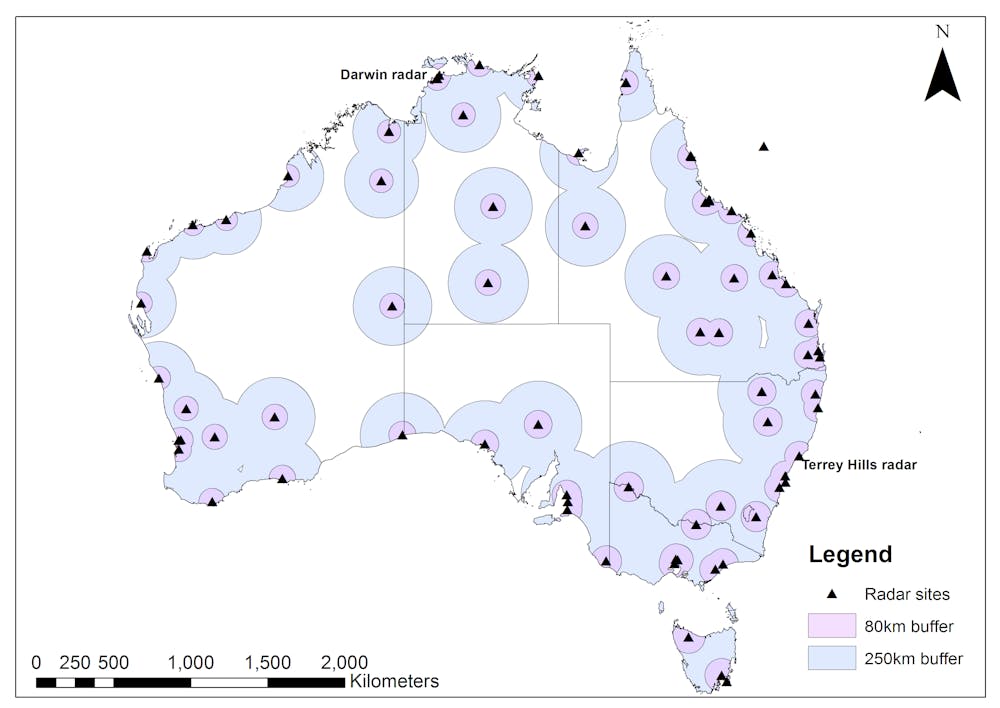
Weather radars cover a good part of the Australian continent, which makes them very useful for tracking birds. Rogers et al. (2019) – Austral Ecology

Most weather radars can give us a three-dimensional picture of what is happening in the air every 5–10 minutes. In Australia the data is archived for years and even decades in some places, and it is all available free of charge for researchers. This means we can not only understand how animals are using the airspace now, but also how these movement patterns may have changed over time.

Is it a bird? Is it a plane?

So how do we actually tell whether those pixels on the screen are caused by rain, birds or something less common like bushfire smoke?

This is where things can get a bit more tricky. For some cases, like tracking bats coming out of a cave or roost tree, the job for the ecologist is fairly simple. For roosting species like these, we often observed very characteristic rings on the radar similar to the angels described by those early radar engineers. Examples of the rings can be found all over Australia caused by flying foxes.

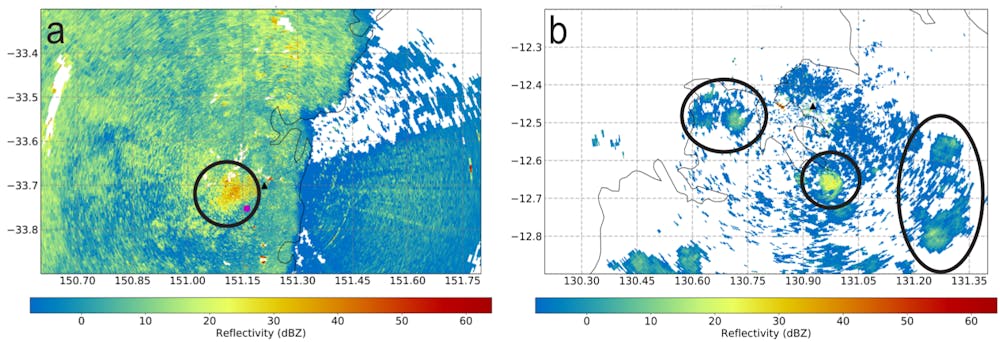
Flying animals leave traces in weather radar images. The image at left shows an ‘angel echo’ caused by flying foxes coming out of a roost in NSW, while the one on the right reveals ‘blooms’ of activity on the Darwin radar, likely to be caused by magpie geese and other waterbirds taking off for their morning feeding flights. Rogers et al. (2019) – Austral Ecology

For broadly distributed species, like the magpie geese found all across northern Australia, the picture is not so easy to interpret. These animals tend to produce patterns best described as blooms of activity: they appear across the radar image, spreading out and then blending together like a bunch of flowers blooming all at once.

These patterns can look similar to rain clouds to the untrained eye. However, with some understanding of how the radar works and the behaviour of the birds – like when they are active or how high they fly – we can quickly begin to narrow down what might be causing different patterns on radar images.

Why track magpie geese?

Magpie geese cross paths with humans in many different ways.

They are hunted by Indigenous people for food, they are considered a pest for mango farmers and a strike risk for planes, and they could be vectors for disease.

Tracking magpie geese can help us better understand this native species and ensure it thrives long into the future.


Read more: Most native bird species are losing their homes, even the ones you see every day


Like many waterbirds, magpie geese have distinct daily patterns of movement, which makes them ideal candidates for trialling the use of weather radar to track Australian birds.

In Darwin, blooms of activity occur all over the radar in the morning and evening when magpie geese are taking off from wetlands and mango orchards for their daily feeding flights.

By using GPS tracking collars and annual survey data, we are starting to see how these patterns in the radar data correspond to real behaviour. These results are showing how weather radar could be repurposed to track the movement of magpie geese – and after that, many other kinds of birds in Australia.

ref. How weather radar can keep tabs on the elusive magpie goose – http://theconversation.com/how-weather-radar-can-keep-tabs-on-the-elusive-magpie-goose-126278

As bushfires intensify, we need to acknowledge the strain on our volunteers

Source: The Conversation (Au and NZ) – By Blythe McLennan, Research Fellow, Centre for Urban Research, RMIT University

The early and ferocious start to the bushfire season in Australia this year has raised questions about the impact on those at the frontline – the tens of thousands of volunteers helping to put out the blazes.

In Australia, the vast majority of bushfire fighters are volunteers. In the Queensland Fire and Emergency Services, for instance, volunteers account for 89% of the workforce.

And with fire seasons due to become longer and bushfires more intense due to the impacts of climate change, this will place even more demands on the men and women undertaking this vital and demanding work.

Given this, it’s important for us to understand how our worsening bushfires are affecting the mental and physical health of volunteers. Is this causing burnout? And if so, is that making it more difficult for fire and emergency services to recruit new volunteers and keep the ones they have?

Challenges for volunteer recruitment and retention

Of course, the impact of today’s bushfires needs to be viewed within the context of other challenges to volunteer recruitment and retention.

Two of the key factors are greater competition for people’s time – for example, due to changes in the nature of paid work – and the increasing difficulty of balancing work, family and volunteer commitments.


Read more: Why rural Australia is facing a volunteer crisis


The ways people choose to volunteer are also changing. Many people are choosing more flexible, shorter-term and cause-driven ways of volunteering and eschewing the kind of structured, high-commitment volunteering that is common in the emergency services.

At the same time, rural communities are facing a shrinking volunteer base as people either leave for better opportunities in cities or can no longer perform strenuous volunteering roles.

Father and son volunteers with the NSW Rural Fire Service. Dan Peled/AAP

Meanwhile, a lot has been said about younger generations being less motivated by altruistic values to volunteer.

However, there is considerable evidence that younger people are highly committed to making a positive contribution to society. They are just doing it differently than their parents – they are tapping into the power of social media and working outside of formal, structured organisations.

Changes to emergency management services are also at play. One of the most significant shifts has been the professionalisation, corporatisation and modernisation of volunteer-based emergency services in recent years.

While this has undeniably brought improvements to volunteer safety and the quality of service, it has also caused headaches for volunteers in the form of more bureaucracy and additional training requirements.

There is a risk this could drive a wedge between the corporate goals of fire and emergency service agencies that focus on risk management and efficiency, for example, and their more traditional, community-based roots – the reason many people choose to volunteer in the first place.


Read more: Stop calling young people apathetic. For many, volunteering and activism go hand-in-hand


Improving support for volunteers

This type of volunteering can be demanding. Bushfire volunteers face a range of significant stresses that can be physical, mental and emotional. Volunteer fatigue and burnout are real concerns.

There are also economic burdens for both volunteers and their employers, as well as strains on their family members.

Additionally, with the likelihood of more intense bushfires in the future, volunteers will increasingly be asked to travel outside their own communities to fight fires in other regions, further complicating their lives.

Having said this, support for volunteers is available and improving. In my ongoing research with other academics at the Bushfire and Natural Hazard Cooperative Research Centre, interviewees report improvements in operational equipment, technology and procedures that are enhancing volunteer safety.

Emergency services are also increasing mental health and well-being support for volunteers and developing more diverse and flexible ways for people to fit volunteering into their lives.

There is also a strong commitment to improving diversity and inclusion across the sector.

The reasons people want to help

Even though fighting fires is obviously demanding work, it is also extremely fulfilling and rewarding. Core reasons that people choose to volunteer include helping the community, learning new skills, feeling useful and doing something worthwhile, and experiencing camaraderie with others.

In our ongoing research, we are consistently hearing that the personal fulfilment and rewards of volunteering are not being adequately communicated to the public. If they were, a lot more people would offer their services.

In addition, many volunteering roles do not require people to be on the front lines at all. There are a large number of opportunities to support fire prevention, response and recovery well beyond the fires themselves.

A volunteer-run donation center in Taree, NSW. Dean Lewins/AAP

We also know that everyday people are deeply motivated to help others in the face of disaster. Indeed, NSW RFS and QFES are likely to see an upswing in people inquiring about volunteering in the aftermath of the current fires.

However, there is one important thing to note: the best time to approach emergency services about volunteering is before an event, rather than during one.

Volunteering at a crossroads

If we are fighting bushfires into the next decade with the same or declining numbers of volunteers, using the same approaches we use today, then clearly the job will be much harder and the demands on volunteers will become more extreme.

The key variable that will make the most difference for volunteers is the willingness and commitment of emergency services, governments, society and volunteers themselves to embrace change to current practices.


Read more: 70 years before Black Saturday, the birth of the Victorian CFA was a sad tale of politics as usual


This includes a greater investment in risk reduction, new operational approaches and involving volunteers more in organisational decision making. Emergency services providers should also be working more closely with community organisations to better understand and target the particular needs of different communities.

Whatever choices we make, we cannot leave it to our front line volunteers to bear an increasing burden of fighting the bushfires of the future.

ref. As bushfires intensify, we need to acknowledge the strain on our volunteers – http://theconversation.com/as-bushfires-intensify-we-need-to-acknowledge-the-strain-on-our-volunteers-127517

Antibiotic resistant superbugs kill 32 plane-loads of people a week. We can all help fight back

Source: The Conversation (Au and NZ) – By Sunanda Creagh, Head of Digital Storytelling

You might think antibiotic resistance is something to worry about in the distant future. But it’s already having a deadly impact today.

The number of people dying globally every week from antibiotic resistant infections is equivalent to 32 Boeing 747s full of people. And if that sounds scary, the projections for the future are even scarier.

On today’s episode of Trust Me, I’m An Expert we ask you to imagine a future where more and more antibiotics don’t work any more – and hear from researchers about how you can help scientists fight back.


Read more: ‘This is going to affect how we determine time since death’: how studying body donors in the bush is changing forensic science


New to podcasts?

Podcasts are often best enjoyed using a podcast app. All iPhones come with the Apple Podcasts app already installed, or you may want to listen and subscribe on another app such as Pocket Casts (click here to listen to Trust Me, I’m An Expert on Pocket Casts).

You can also hear us on Stitcher, Spotify or any of the apps below. Just pick a service from one of those listed below and click on the icon to find Trust Me, I’m An Expert.


Read more: Trust Me, I’m An Expert: what science says about how to lose weight and whether you really need to


Additional audio

Kindergarten by Unkle Ho, from Elefant Traks.

Airliner by Podington Bear from Free Music Archive.

Images

Shutterstock

ref. Antibiotic resistant superbugs kill 32 plane-loads of people a week. We can all help fight back – http://theconversation.com/antibiotic-resistant-superbugs-kill-32-plane-loads-of-people-a-week-we-can-all-help-fight-back-125813

Climate explained: how much does flying contribute to climate change?

Source: The Conversation (Au and NZ) – By Shaun Hendy, Professor of Physics, University of Auckland

CC BY-ND

Climate Explained is a collaboration between The Conversation, Stuff and the New Zealand Science Media Centre to answer your questions about climate change.

If you have a question you’d like an expert to answer, please send it to climate.change@stuff.co.nz

How much does our use of air travel contribute to the problem of climate change? And is it more damaging that it is being created higher in our atmosphere?

The flight shaming movement has raised our awareness of air travel’s contribution to climate change. With all the discussion, you might be surprised to learn that air travel globally only accounts for about 3% of the warming human activities are causing. Why all the fuss?

Before I explain, I should come clean. I am writing this on the train from Christchurch to Kaikoura, where I will give a talk about my recent book #NoFly: walking the talk on climate change. I have some skin in this game.


Read more: Flight shame: flying less plays a small but positive part in tackling climate change


Staying grounded

Taking a train around New Zealand is no mean feat. In the North Island, the train between Auckland and Wellington runs only every second day. If you get off at a stop along the way, you have to wait another two days to continue your journey. You can catch a bus, but you’ll spend that bus journey fantasising about the possibility of an overnight train service.

So why do it? A good deal of global carbon emissions come from industrial processes or electricity generation under the control of governments and corporations, rather than individual citizens. For many of us, a decision not to fly might be the most significant reduction in emissions we can make as individuals.

As Swedish climate activist Greta Thunberg has shown, refusing to fly also sends a powerful signal to others, by showing that you are willing to change your own behaviour. Politicians and corporate sales departments will take note if we start acting together.

Impacts of aviation

Aviation affects the climate in a variety of ways.

Because any carbon dioxide you emit stays in the atmosphere for hundreds of years, it doesn’t matter much whether you release it from the exhaust pipe of your car at sea level or from a jet engine several kilometres high. Per passenger, a flight from Auckland to Wellington will put a similar amount of carbon dioxide into the air as driving solo in your car. Catching the train will cut your carbon emissions seven-fold.

When aircraft burn jet fuel, however, they also emit short-lived gases like nitrogen oxides, which can react with other gases in the air within a day of being released. When nitrogen oxides are released at altitude they can react with oxygen to put more ozone into the air, but can also remove methane.

Ozone and methane are both greenhouse gases, so this chain of chemical reactions can lead to both heating and cooling effects. Unfortunately the net result when these processes are added together is to drive more warming.

Depending on the atmospheric conditions, aircraft can also create contrails: clouds of tiny ice crystals. The science is not as clear cut on how contrails influence the climate, but some studies suggest they could have an effect as significant as the carbon dioxide released during a flight.

There is also considerable uncertainty as to whether aircraft exhaust might affect cloud formation itself – this could be a further significant contribution to warming.


Read more: Climate explained: why don’t we have electric aircraft?


Growing demand for air travel

Offsetting, by planting trees or restoring natural wildlands, will take carbon dioxide back out of the atmosphere. But we would have to do this on a massive scale to feed our appetite for flight.

Emissions from international air travel are not included in the Paris Agreement, although the United Nations has been working on the Carbon Offsetting and Reduction Scheme for International Aviation (CORSIA), which may begin to deal with these. Initially, the scheme will be voluntary. Airlines flying routes between countries that join the scheme will have to offset any emissions above 2020 levels from January 2021.

Emissions from flying stand to triple by 2050 if demand for air travel continues to grow. Even if air travel became carbon neutral through the use of biofuels or electric planes, the effects from contrails and interactions with clouds mean that flying may never be climate neutral.

With no easy fixes on the horizon, many people are thinking hard about their need to fly. This is why I took a year off air travel (alongside my colleague Quentin Atkinson) in 2018.


Read more: Costly signals needed to deliver inconvenient truth


I have been back on planes in 2019, but I have learned how to reduce my flying, by combining trips and making better use of video conferencing.

Fly if you must, offset if you can, but – if you are concerned about climate change – one of the best things you could choose to do is to fly less.

ref. Climate explained: how much does flying contribute to climate change? – http://theconversation.com/climate-explained-how-much-does-flying-contribute-to-climate-change-127707

What actually is an ATAR? First of all it’s a rank, not a score

Source: The Conversation (Au and NZ) – By Tim Pitman, Senior Research Fellow, Curtin University

The Australian Tertiary Admissions Rank (ATAR) is a number mainly used by universities to select which students, out of high school, will be offered a place in a particular course.

The ATAR is not a score, it’s a rank. If a student gets an ATAR of 80, this doesn’t mean they averaged 80%. It means they performed as well as, or better than, 80% of the other students also graded.

How is an ATAR calculated?

Each state and territory does their own calculation of students’ ATAR. Although differing in certain details, they follow the same principles.

A student must be studying a minimum number of subjects that can be used in the final calculation. The specifics depend on state and territory.

In WA the calculation is based on a student’s four ATAR subjects and the student has to satisfy English competency requirements. In NSW, you have to study at least eight ATAR “units”, of which six have to be what are called Category A, plus two units of English. Category A units are defined as having “academic rigour” and a “depth of knowledge” required for tertiary studies. They include maths, English, science and history, as well as some arts and physical education subjects.

Queensland traditionally used something called an Overall Position, not the ATAR, but is moving to an ATAR in 2020.


Read more: Don’t stress, your ATAR isn’t the final call. There are many ways to get into university


In most cases, students are marked on how they did in the school assessments that count towards the ATAR. Again, this can differ across states.

In NSW, the assessments that count form part of the Higher School Certificate (HSC). In Victoria, it’s the Victorian Certificate of Education (VCE). In VCE, units 1 and 2 are generally taken in year 11, and units 3 and 4 in Year 12. Units 3 and 4 generally count for the ATAR, but sometimes the first two units also count, such as in some VET programs.

The purpose of providing these examples is to highlight how complicated the creation of an ATAR is and how much it is affected by local factors, including the state or territory you are in.

Using the relevant units, a raw score for each subject is created.

A raw score is then scaled to get a rank of where the student sits relative to their peers. from shutterstock.com

But remember, an ATAR is a rank, so the scores need to be re-interpreted as a rank. Each mark needs to be scaled, which means adjusting it so it can be more fairly compared with the marks for other students and subjects.

Scaling takes into account how competitive, not how difficult, a subject is.

One type of scaling considers where each subject’s mark ranks the student compared to the other students at the same school doing the same subject. Say a student gets 85% for a subject, if the average mark for their class was 90%, they will be ranked lower.

Another type of scaling considers how many students take a subject, and their average marks, compared to other subjects. This is because some subjects have relatively small numbers of students compared to others.

Unfortunately, advice – often on the internet – on how to “game” the system and get a higher ATAR is mostly incorrect. The best advice to ensure your best ATAR is, in the words of one admission centre,

to choose your studies according to what you are interested in; what you are good at; and what studies you need for future study.

What is the ATAR used for?

The main purpose of the ATAR is to determine who gets offered a place in a university course. Think of a queue. When places are limited, the closer to the front of the queue the student is, the more likely they will get in.

Some years there are less people in the queue, or more places in the course. These affect the ATAR required to get in.

Universities sometimes set minimum ATARs, either for a course or the university. So, the student can only apply to the university/course if they achieve this minimum.

A minimum might be set because the university believes this is the minimum ATAR required to succeed. It might also be a way of branding a course, or an entire university, as elite.

It could be a combination of both. And again, because it’s a queue, achieving the minimum still doesn’t guarantee a place.

Universities can and do sometimes make adjustments to its ATAR requirements. This might be due to special consideration – perhaps illness – or because the student received a bonus for studying a language other than English.

For example, for 2019 applicants, Curtin University published advice the minimum ATAR for the Bachelor of Advanced Science (Honours) in Coastal and Marine Science was 95. The minimum selection rank for that course actually ended up being 98.9 – above the university minimum. But at least one student was selected with an ATAR of 94.25 – slightly below the published minimum.

Why is the ATAR contentious?

An ATAR is primarily designed, and works best when it is used, as an efficient way of allocating limited places in a course in a first-come, first-served basis.

But because it’s a rank, it is not a direct representation of a student’s academic ability or potential to succeed in higher education. However, there is a correlation.


Read more: FactCheck: does your entrance score strongly correlate with your success at university?


A recent study by the University Admission Centre found:

the ATAR is the best available predictor of university success[…] The higher the ATAR, the higher the student’s first-year GPA is likely to be.

It also cautioned:

[…] the ATAR is not perfect. There will be instances where the prediction will ‘miss the mark’. Also, there will be cases where selection based on the ATAR alone would not be optimal.

There are always exceptions to the rule that ATAR can predict success. And these exceptions are not just numbers on a spreadsheet but people. For this and other reasons, many would like to see the ATAR scrapped.

But so far, agreement has not been reached on an alternative system that is fairer than the ATAR or as efficient.

In the meantime, it’s important to have alternative pathways to higher education for students who do not have the required ATAR but nonetheless have the capacity to succeed in higher education.

ref. What actually is an ATAR? First of all it’s a rank, not a score – http://theconversation.com/what-actually-is-an-atar-first-of-all-its-a-rank-not-a-score-126594

‘New Bradfield’: rerouting rivers to recapture a pioneering spirit

Source: The Conversation (Au and NZ) – By Patrick White, PhD Candidate in History and Politics, James Cook University

The “New Bradfield” scheme is more than an attempt to transcend environmental reality. It seeks to revive a pioneering spirit and a nation-building ethos supposedly stifled by the bureaucratic inertia of modern Australia.

This is not a new lament. Frustrated by bureaucracy, politicians in North Queensland have long criticised the slow pace of northern development.


Read more: You can’t boost Australia’s north to 5 million people without a proper plan


In 1950, northern local governments blamed urban lethargy. One prominent mayor complained:

… these young people lack the pioneering spirit of their forebears, preferring leisure and pleasure to hardships and hard work.

These sentiments were inspired by an agrarian nostalgia that extolled toil and toughness. Stoic responses to the challenges of life on the land are part of the Australian legend.

With drought devastating rural and urban communities and a state election looming in Queensland in 2020, both sides of politics have proposed a “New Bradfield” scheme.

An idea with 19th-century origins

Civil engineer John Bradfield devised the original scheme in 1938. His plan would swamp inland Australia by reversing the flow of North Queensland’s rivers. Similar proposals go back to at least 1887, when geographer E.A. Leonard recommended the Herbert, Tully, Johnstone and Barron rivers be turned around to irrigate Australia’s “dead heart”.

Blencoe Falls, on a tributary of the Herbert River, North Queensland, during the dry season. Patrick White, Author provided

As the “dead heart” became the “Red Centre” in the 1930s, populist writers revived the dreams of big irrigation schemes.

These schemes have always been contested on both environmental and economic grounds. A compelling history of Bradfield’s proposal reveals many errors and miscalculations. But what the scheme lacked in substance it made up for in grandiose vision.

Water dreaming has been a powerful theme in Australian history. The desire to transform desert into farmland retains appeal and discredited schemes like Bradfield keep reappearing.


Read more: The keys to unlock Northern Australia have already been cut


Contempt for nature and country

While less ambitious than the original plan, the “New Bradfield” scheme still engineers against the gradient of both history and nature. It would have irreversible consequences for Queensland’s environment, society and culture.

What’s more, the new scheme manifests much the same mindset as the old.

It’s an attitude that privileges the conquest of nature: in this case literally up-ending geography by turning east-flowing rivers westward. Its celebration of the human struggle against defiant nature reprises the pioneering ethos.

Like many pioneers, “New Bradfield” proposals disregard the interests and land-management practices of Indigenous people. The bushfires ravaging the eastern states show the folly of ignoring traditional ways of caring for country .

Overlooking native title realities can also cost governments and communities.


Read more: Remote Indigenous Australia’s ecological economies give us something to build on


Polarising debate neglects more viable projects

“New Bradfield” is promoted as “an asset owned by all Queenslanders for all Queenslanders”. But environmental destruction and disputes over water sales in the Murray-Darling Basin sound a warning.

The Queensland Farmers Federation has cautiously welcomed the new scheme. Others have dismissed it as a “pipe dream”.

Thus, northern Australia again sits amid a polarised debate about its utility to the nation. Such polarising contests diminish the likelihood of more viable projects being implemented.

Extravagant expectations of “untapped” northern resources have been proffered for nearly two centuries. Distant governments have fantasised the Australian tropics as a land of near-limitless potential. Northern communities have many times been disappointed by the results.

Today’s promises to “drought-proof” large areas of Queensland rely on similar images. “Drought-proofing” aims to keep people on the land but often defies economic and social reality.


Read more: We can’t drought-proof Australia, and trying is a fool’s errand


Dam developments have an underwhelming record

The “New Bradfield” rhetoric echoes the inflated expectations of myriad disappointing northern development plans in the past. The Ord River project was touted as an agricultural wonder that would put hundreds of thousands of farmers into the Kimberley. Its success lies forever just over the horizon.

Much closer to the present proposal is the Burdekin Falls Dam. It sits in the lower reaches of the same river earmarked for the Hells Gates Dam that would feed the “New Bradfield” scheme. Damming Hells Gates has been advocated since at least the 1930s and has new supporters.

The proposed site for Hells Gates Dam is on Gugu Badhun country on the Burdekin River. Dr Theresa Petray, Author provided

Back in the 1950s, damming the Burdekin was expected to generate hydro-electric power and irrigate vast swathes of farmland. After decades of political squabbling, the dam was completed in 1988. It does not generate hydro power. Although it irrigates some land downstream, the anticipated huge agricultural expansion never happened.

The Burdekin Falls Dam has helped the regional economy and could help to overcome the water shortages of the nearby city of Townsville. But it has not met the inflated expectations widely proffered decades earlier. The benefits that would flow from another dam further upstream are likely to be even more meagre.


Read more: Damming northern Australia: we need to learn hard lessons from the south


Grandiose visions of northern development have a habit of failing. A “New Bradfield” scheme, animated by an old pioneering ethos, is unlikely to be different.

Drought-affected communities would derive more benefit from sober proposals that acknowledge the past, integrate Indigenous knowledge and incorporate agricultural innovation.

ref. ‘New Bradfield’: rerouting rivers to recapture a pioneering spirit – http://theconversation.com/new-bradfield-rerouting-rivers-to-recapture-a-pioneering-spirit-127010

What the US defence industry can tell us about how to fight climate change

Source: The Conversation (Au and NZ) – By David C Mowery, Professor Emeritus of New Enterprise Development, University of California, Berkeley

Achieving the large-scale cuts in greenhouse gas emissions that will be needed will require the development and adoption of new technologies at a rate not seen since the information technology revolution.

Which presents a fairly obvious idea. Why not do what we did in the information technology revolution?

There’s no mystery about what that was.

The IT revolution was sparked by the work of the US defence department and associated agencies in three related fields: semiconductors, computer hardware, and computer software.

More recently it has spawned the system of GPS global positioning satellites that can give us a readout on our locations wherever we are.


Read more: Australia could fall apart under climate change. But there’s a way to avoid it


The lessons from how the US military industrial complex transformed information technology throughout the world can tell us a lot – but not everything – about what might succeed in stalling climate change.

It did it by spending a huge amount on research and development in its own right (as much as 80% of all government R&D spending during the late 1950s) and acting as a “lead customer,” for early and often very costly versions of technologies developed by private firms, enabling them to improve their innovations over time.

Seeds sown during the cold war

The improvements reduced costs and enhanced reliability, facilitating their penetration into civilian markets.

The US made the money available because of the cold war. Universities were also harnessed for the task, training the scientists and engineers who later assumed key leadership roles in emerging R&D enterprises.

As well, similarities in the technologies and operating environments of early military and civilian versions of new information technology products meant civilian markets for many of them expanded rapidly.

The defence programs also had a “pro-competition” bias.


Read more: Happy birthday, SA’s big battery, and many happy returns (of your recyclable parts)


New firms played important roles as suppliers of innovations such as integrated circuits, and – in a series of largely coincidental developments – the rigorous enforcement of US antitrust laws meant potentially dominant firms as IBM or AT&T found it hard to impede others.

As a result, intra-industry diffusion of technical knowledge occurred rapidly, complementing high levels of labour mobility within the emerging sector.

The very success of these military research and development programs in spawning vibrant industries means defence markets now account for a much smaller share of the demand for IT products than they did at the time.

Today’s challenges are different…

Climate change is different from post-war research and development in that it is as much an issue of technological substitution as development.

The urgency of the challenge will require the blending of support for the development of new technological solutions with support for the accelerated adoption of existing solutions, such as replacing coal-fired electricity generation with renewable generation.

“Stranded assets” such as abandoned coal-fired power stations and related political and economic challenges will loom large.


Read more: To feed the world in 2050 we need to build the plants that evolution didn’t


The geographic and technological breadth of the responses needed to limit climate change also dwarf that faced by the US defence establishment during the Cold War.

Also different is the fact that the prospective users of new technologies are by and large not the funders or developers of it. When US defence-related agencies acted as “venture capitalists,” beginning in the 1950s, they were focused primarily on supporting their own needs.

…but there are lessons we can learn

There are some things the diffusion of defence-related information technology can tell us.

One is the importance of rapid adoption.

Much of the large-scale investment in technology improvement and deployment will be the responsibility of private firms. They will require policies that create supportive, credible signals that their innovations will have a market – policies such as carbon taxes.

Another is that what’s needed is a program of research and development that spans an array of institutions throughout the developing and industrial economies.

Yet another is the importance of policies that encourage competition and co-operation among innovators rather than patent wars.

The success of the US military industrial complex in creating one revolution provides pointers to (but not a complete guide to) the next.


Emeritus Professor David C. Mowery will be presening the Tom Spurling Oration at Swinburne University on Wednesday 27 November at 5.45pm.

ref. What the US defence industry can tell us about how to fight climate change – http://theconversation.com/what-the-us-defence-industry-can-tell-us-about-how-to-fight-climate-change-126762

Humour, justice, belonging, danger, and wonder: 5 story senses and the art of writing for children

Source: The Conversation (Au and NZ) – By Sean Williams, Lecturer, Flinders University

At the heart of every adult writer lies a novel they adored as a child. No wonder then so many try to write for kids themselves. So why do they often fail?

Perhaps it’s because, on the whole, adults are taught to write for adults, utilising the full power of the five regular senses – sight, sound, touch, taste, and smell – to evoke meaning in even the most trivial of everyday events.

This approach is less successful with younger readers, for one very simple reason: there are five other senses that speak more potently to them.

Consciously or unconsciously, successful writers use these other senses to hook young readers (and open their parents’ wallets) in ways that seem almost magical.

It’s not magical at all, though.

Here are the five story senses guaranteed to stir a child’s literary heart.

1. Humour

Everyone with kids in their lives knows the horror of a joke compendium: the same old gags we learned in childhood, repeated over and over, quickly lose appeal.

The only thing worse would be forcing kids to stop telling them.

Humour is the key to anyone’s heart. Ben White/Unsplash, CC BY

It is easy to forget jokes are hilarious the first time around, and funny doesn’t mean trivial. Humourist Terry Pratchett understood a reader can learn just as much from a book that provokes a laugh as from one that doesn’t – and he was the bestselling UK author until J K Rowling came along.

Make a kid laugh and they’ll be a fan forever.

2. Justice

People develop a sense of fairness at a very early age, some studies suggesting it kicks in as early as 12 months. Who doesn’t love seeing justice done? For this reason, crime fiction is one of the biggest genres in the world – and kids are no different to adult readers.


Read more: Young morals: can infants tell right from wrong?


Few people would seriously suggest a sense of justice should be drummed out of children, but it can definitely be quashed when parental authority is under assault. Kids therefore are constantly on the pointy end of injustice, or feel they are.

This is why Rowling takes Harry back to the despicable Dursleys at the end of every book. Exploiting the sense of justice ensures her readers never lose interest.

3. Belonging

The one genre bigger than crime is romance.

While not all kids will be into romantic love (The Princess Bride notwithstanding), they will have a keen sense of belonging. They have friends, family and pets in their lives, and stories engaging this sense helps them navigate these relationships, particularly when loss or denial is involved.

Mark Twain’s The Adventures of Tom Sawyer remains a classic because, beneath everything else, it is a story about a young boy finding his place in the world, and in people’s hearts.

4. Danger

The Adventures of Tom Sawyer also contains scenes of terrible peril, as does Doctor Who. Children love to be scared by fictional stories because in life, alas, many find themselves in very real peril. Fiction gives kids a safe way to activate their sense of danger, and maybe learn a life-saving strategy or two, as well.

Fiction is a safe way for children to explore danger. Anuja Mary Tilj/Unsplash, CC BY

The sense of danger is so fundamental to our psyche that it might actually be hardwired into us: the Moro, or “startle”, reflex is innate in healthy newborns.

There are limits, of course, but no one ever ever lost a young audience by trying to push them. (Parents are a different matter.)

5. Wonder

Everyone will have some of these senses, but some people won’t have all of them. This sense, my personal favourite, is very hard to explain to someone who doesn’t possess it. It is the engine that drives fantasy and science fiction. When something makes a reader go “wow”, their sense of wonder has been engaged.

Kids understand this sense very well, because everything to them is big and new: just note how many synonyms they have for “awesome”. While it too may be drummed out of young people as they age, it can be revived under particular circumstances. Reading JRR Tolkien’s The Lord of the Rings has been one for many avid readers.

It is easy to forget The Hobbit predated this work, and, although no less awe-some, it was originally created for children.

These senses are just the start

Hefty doses of humour, justice, belonging, danger, and wonder will go some way towards compensating for deficiencies in other aspects of the writing craft. Children, and many adults, will often choose a good story badly written over a well-made dud.

This formula will also work for other media. Take Star Wars and Avengers movies, for example: both rich in the five story senses, and both part of the Disney stable, home to many other examples.

Any author wanting to pen a bestseller could do worse than start here. As always, though, there is no substitute for hard work – and luck.

ref. Humour, justice, belonging, danger, and wonder: 5 story senses and the art of writing for children – http://theconversation.com/humour-justice-belonging-danger-and-wonder-5-story-senses-and-the-art-of-writing-for-children-125223

Treasurer Frydenberg to announce $520 million fund for small businesses investmnt

Source: The Conversation (Au and NZ) – By Michelle Grattan, Professorial Fellow, University of Canberra

A new fund to provide small businesses with an alternative source of financing will be set up with a A$100 million contribution from the government.

The fund will have an initial investment capacity of more than $500 million, with the aim of that growing to $1 billion.

The government has agreed to terms with the four big banks – CBA, ANZ, NAB and Westpac – and HSBC to establish the fund, called the Australian Business Growth Fund. It will be formally announced by treasurer Josh Frydenberg at an Australian Chamber of Commerce and Industry dinner on Wednesday night.

Each bank will contribute $100 million and HSBC will put in $20 million. The government is also talking to other financial institutions to have them invest.

The fund was promised at the election.

It will offer established Australian small-to-medium enterprises in both metropolitan and regional areas patient capital and strategic support to help them grow.

Fund investment could be used, for example, by a small business to invest in equipment to expand its operations, or to extend into another state or region.

These businesses will be eligible for long term equity capital investments of between $5 million and $15 million, where they have generated annual revenue of between $2 million and $100 million and can show three years of revenue growth and profitability.

The fund’s investment stake will be between 10% and 40%.

This level is set to enable the business’s owners to maintain their controlling interest, while giving the fund adequate influence. The support provided will be non-financial as well as financial. The non-financial assistance will include strategic advice, mentoring, talent management and network referrals

The fund will operate commercially and be independent of the government and the banks that participate. Investment decisions will be made by professional managers and performance will be assessed on a fully commercial basis.

Participating banks will be able to refer customers to the fund when equity financing might be more suitable than debt funding.

Frydenberg said: “Small businesses are the engine room of the Australian economy and access to a range of funding sources, including equity, is crucial for a thriving SME sector”.

The government sees the fund as filling a gap in the market for small and family businesses, which need better access to patient capital to grow. Patient equity capital funds in the United Kingdom and Canada have shown the benefits of this type of financing.

In his speech Frydenberg will say that “with nine out of every ten jobs being in the private sector, it is critical that government and business work effectively together.

“An area of key focus for the government is backing small and medium sized businesses who together employ more than seven million Australians. These businesses are central to every sector of the economy”.

“While there are many important issues affecting small business, including regulation, tax, skills and infrastructure, one that is also front of mind is access to the necessary capital to enable the business to innovate and grow.

“It is a point acknowledged by the Reserve Bank who has said of small business ‘it is not the absence of entrepreneurial spirit, it’s the absence of entrepreneurial finance that’s been the main factor holding that part of the economy back.

“This is echoed by SMEs themselves, with 35% of respondents in November’s Sensis survey saying it is relatively difficult to access finance”.

ref. Treasurer Frydenberg to announce $520 million fund for small businesses investmnt – http://theconversation.com/treasurer-frydenberg-to-announce-520-million-fund-for-small-businesses-investmnt-127842

Kevin Rudd urges Australia to reduce its economic dependence on China

Source: The Conversation (Au and NZ) – By Michelle Grattan, Professorial Fellow, University of Canberra

Kevin Rudd has warned Australia is too “China dependent” in economic terms, and must diversify its international economic engagement.

Setting out principles he believes should govern the way forward in dealing with China, the former prime minister said for too long Australia had been “complacent in anticipating and responding to the profound geo-political changes now washing over us with China’s rise, America’s ambivalence about its future regional and global role, and an Australia which may one day find itself on its own”.

Launching journalist Peter Hartcher’s Quarterly Essay, Red Flag: Waking up to China’s challenge, Rudd said Australia needed a regularly-updated “classified cabinet-level national China strategy”.

This should be based on three understandings. The first was that “China respects strength and consistency and is contemptuous of weakness and prevarication”.

The others went to awareness of China’s strengths and weaknesses, and of Australia’s own strengths, weaknesses and vulnerabilities.


Read more: Paul Keating attacks media for ‘pious belchings’ over China


Rudd, who was highly critical of the government, declared “Australia needs a more mature approach to managing the complexity of the relationship than having politicians out-competing one another on who can sound the most hairy-chested on China”. This might be great domestic politics but did not advance the country’s security and economic interests.

Australia should “maintain domestic vigilance against any substantive rather than imagined internal threats” to its political institutions and critical infrastructure.

He fully supported the foreign influence transparency act, but he warned about concern over foreign interference translating “into a form of racial profiling”.

“These new arrangements on foreign influence transparency should be given effect as a legal and administrative process, not as a populist witch-hunt” – a return to the “yellow peril” days.

Rudd said Australia must once again become the international champion of the South Pacific nations, arguing the government’s posture on climate change had undermined Australia’s stand with these countries and given China a further opening. “The so-called ‘Pacific step-up’ is hollow.”

Australia should join ASEAN, Rudd said; this would both help that body and assist Australia to manage its long term relationship with Indonesia.


Read more: Chinese ‘spy’ case may be the greatest challenge to Australian security since Petrov – but caution is needed


On the need to diversify Australia’s international economic engagement, Rudd said: “We have become too China-dependent. We need to diversify further to Japan, India, Indonesia, Europe and Africa – the next continent with a rising middle class with more than a billion consumers. We must equally diversify our economy itself.”

Rudd argued strongly for Australia to continue to consolidate its alliance with the United States.

But “Australia must also look to mid-century when we may increasingly have to stand to our own two feet, with or without the support of a major external ally.

“Trumpist isolationism may only be short term. But how these sentiments in the American body politic translate into broader American politics with future Republican and Democrat administrations remains unclear.”

Rudd once again strongly urged a “big Australia” – “a big and sustainable Australia of the type I advocated while I was in office.

“That means comprehensive action on climate change and broader environmental sustainability,” he said.

“Only a country with a population of 50 million later this century would begin to have the capacity to fund the military, security and intelligence assets necessary to defend our territorial integrity and political sovereignty long term. This is not politically correct. But it’s yet another uncomfortable truth.”

ref. Kevin Rudd urges Australia to reduce its economic dependence on China – http://theconversation.com/kevin-rudd-urges-australia-to-reduce-its-economic-dependence-on-china-127828

Scott Morrison stands by energy minister Angus Taylor, who faces police probe

Source: The Conversation (Au and NZ) – By Michelle Grattan, Professorial Fellow, University of Canberra

Scott Morrison has resisted calls for Angus Taylor to stand aside while NSW Police investigate an allegedly doctored document the energy minister used in making false claims about Sydney City Council’s travel costs.

The long-simmering affair re-ignited on Tuesday when the NSW Police said it was “in the early stages of investigating information into the reported creation of fraudulent documentation”.

“Detectives from the State Crime Command’s Financial Crimes Squad have launched Strike Force Garrad to investigate the matters and determine if any criminal offences have been committed,” NSW Police said.

The affair started when Taylor wrote to Sydney Lord Mayor Clover Moore after the council declared a climate emergency.

Seeking to score a political point, Taylor suggested the council should look at its own carbon footprint, alleging its travel costs had been $1.7 million on international travel and $14.2 million on domestic travel. The letter was given to the Daily Telegraph.

Moore immediately pointed out the figures were wrong.

The correct figures for 2017-18 were $1727.77 for international travel and $4206.32 for domestic travel.

Taylor has repeatedly claimed the figures he used were downloaded from the council website. But the council provided metadata showing the website information had not been changed, and this was confirmed by other searches.

The ALP referred the matter to the NSW Police.

Labor on Tuesday seized on the police statement, demanding that Taylor go immediately.

Questioned about the police statement Morison told parliament the matters hadn’t been presented to him by the NSW Police.

Answering a subsequent question he said: “I will be taking advice from the New South Wales Police on any matter that they are currently looking at.” He would then “form a view …based on taking that advice”.

In a statement to the house later, Morrison said he had spoken to the NSW police commissioner (Mick Fuller) about “the nature and substance” of the police inquiries.

The commissioner had advised him these were “based only on the allegations referred to by the shadow attorney-general [Mark Dreyfus]”.

“Based on the information provided to me by the commissioner, I consider there is no action required by me.”

Opposition leader Anthony Albanese said he was “astounded that the prime minister has shown such contempt to come into this parliament and to stonewall again further for this minister.

“This minister must go. This minister must go.”

Albanese told a news conference Taylor had deliberately misled parliament by claiming the document was downloaded from the council website. “This document did not come from the website. We don’t know where it came from,” he said.

“The prime minister, if his ministerial standards mean anything at all, should have stood aside this minister well before now.”

Taylor again on Tuesday rejected any suggestion that he or his staff altered the document. Taylor has not yet heard from the police.

ref. Scott Morrison stands by energy minister Angus Taylor, who faces police probe – http://theconversation.com/scott-morrison-stands-by-energy-minister-angus-taylor-who-faces-police-probe-127818

Researchers allege native logging breaches that threaten the water we drink

Source: The Conversation (Au and NZ) – By David Lindenmayer, Professor, The Fenner School of Environment and Society, Australian National University

The Victorian government’s logging business is cutting native forests on steep slopes, in an apparent rule breach that threatens water supplies to Melbourne and rural communities.

Our research indicates that across vital water catchments in the Central Highlands of Victoria, state-owned VicForests is logging native forest on slopes steeper than is allowed under the code of practice. Logging also appears to be occurring in other areas supposedly excluded from harvesting.

Logging operations are prohibited from taking trees from slopes steeper than a certain gradient, because it can lead to soil damage which compromises water supplies. There are far better commercial alternatives to this apparent contravention of the rules, which must immediately cease.

A steep slope recently logged measuring 33 degrees on site near Mount Matlock in the Upper Goulburn Catchment. Chris Taylor

Logging on steep slopes matters

Water catchments are areas where the landscape collects water. They are defined by natural features such as mountain ridgelines and valleys. Rain drains into rivers and streams, which supply water to reservoirs.

Forest cover protects the soil in water catchments by preventing erosion and other damage which can pollute water.

Areas that provide water for drinking, agriculture and irrigation are known in Victoria as special water supply catchments. Under the state’s Code of Forest Practice, logging in these catchments is prohibited on slopes steeper than 30 degrees (or 25 degrees in some catchments). VicForests claims it does not log trees on such slopes.

Sobering evidence

Water in some affected catchments ends up in Melbourne’s drinking water supply.

We analysed slopes across multiple special water supply catchments. We first examined the relationships between slope and logging disturbance using data from the Victorian government, Geoscience Australia, and the European Space Agency. To confirm the results, we visited multiple sites in the Upper Goulburn catchment, which supplies water to Eildon Reservoir, to measure the slopes ourselves.

We found logging in many areas steeper than 30 degrees. In larger catchments such as the Upper Goulburn, around 44% of logged areas contained slopes exceeding this gradient. In many instances, logged slopes were far steeper than 30 degrees and some breaches covered many hectares.

In the Thomson, Melbourne’s largest water supply catchment, 35% of logged areas contained slopes steeper than 30 degrees.

We also found areas that should have been formally excluded from logging but where the forest had been cut. Many of these exclusion zones were around steep slopes. In the Upper Goulburn catchment, nearly 80% of logged areas contained exclusion zones that should not have been cut.

Recently logged areas near Mount Matlock in the Upper Goulburn Water Catchment. The top map shows where we detected slopes exceeding 30 degrees in logged areas (red). The bottom map shows areas designated by the Victorian government as exclusion zones (magenta). DELWP 2019, ESA 2019, Gallant et al. 2011

Why is this happening?

Last week, VicForests rejected our allegations of slope breaches. VicForests claimed it was complying with a rule under which 10% of an area logged can exceed 30 degrees. This rule applies to general logging areas; our interpretation is this exemption does not apply to the special water supply catchments.

Forest on steep and rugged terrain is economically marginal for wood production because the trees are relatively short and widely spaced. Almost all timber from these areas is pulpwood for making paper.

So why are such areas being logged at the risk of compromising the water catchments that supplies Melbourne and regional Victoria?

We suspect pressure to log steep terrain is tied to the Victorian government’s legal obligation to provide large quantities of pulp logs for making paper until the year 2030 (coincidentally the year the government plans to phase out native forest logging).

This pressure is reflected in recent reductions in log yields. Some commentators have blamed efforts to protect the critically endangered Leadbeater’s possum for this trend. However, only 0.17% of the 1.82 million hectares of forest allocated to VicForests for logging has been taken out of production to protect this species.

In our view, other possibilities for declining yields are past over-cutting and bushfires. VicForests failed to take into account the effects of fire on its estimates of sustained timber yield – despite some of Victoria’s forests being some of the world’s most fire-prone environments.

There are alternatives

Pulp logs sourced from native forests is not a commercial necessity; there are viable alternatives. Victorian hardwood plantations produced 3.9 million cubic metres of pulp logs last year. Most of this was exported.

If just some of these logs were processed in Victoria, it would be enough to replace the pulpwood logged from native forests several times over. Plantation wood is better for making paper than native forest logs, and processing the logs in Victoria would boost regional employment.

Degrading soil and water by logging steep terrain is not worth the short-term, marginal gain of meeting log supply commitments, especially when there are viable alternatives. The Victorian government must halt the widespread breaches of its own rules.


In a statement, VicForests said it “strongly rejects” the allegations raised by the authors.

In addition to the refutations included in this article, the company said:

  • Any concerns about its practices should be referred to the Office of the Conservation Regulator

  • VicForests does very little harvesting in catchments, where restrictions are in place

  • In the Thompson catchment, VicForests only harvests on average 150ha a year out of about 44,000ha in the catchment – which is 0.3%, or around 3 trees in 1000

  • VicForests only asks contractors to harvest on slopes if it complies with regulation.

ref. Researchers allege native logging breaches that threaten the water we drink – http://theconversation.com/researchers-allege-native-logging-breaches-that-threaten-the-water-we-drink-127509

The ugly truth: tech companies are tracking and misusing our data, and there’s little we can do

Source: The Conversation (Au and NZ) – By Suranga Seneviratne, Lecturer – Security, University of Sydney

As survey results pile, it’s becoming clear Australians are sceptical about how their online data is tracked and used. But one question worth asking is: are our fears founded?

The short answer is: yes.

In a survey of 2,000 people completed last year, Privacy Australia found 57.9% of participants weren’t confident companies would take adequate measures to protect their data.

Similar scepticism was noted in results from the 2017 Australian Community Attitudes to Privacy Survey of 1,800 people, which found:

• 79% of participants felt uncomfortable with targeted advertising based on their online activities

• 83% were uncomfortable with social networking companies keeping their information

• 66% believed it was standard practice for mobile apps to collect user information and

• 74% believed it was standard practice for websites to collect user information.

Also in 2017, the Digital Rights in Australia report, prepared by the University of Sydney’s Digital Rights and Governance Project, revealed 62% of 1,600 participants felt they weren’t in control of their online privacy. About 47% were also concerned the government could violate their privacy.

The ugly truth

Lately, a common pattern has emerged every time malpractice is exposed.

The company involved will provide an “opt-out” mechanism for users, or a dashboard to see what personal data is being collected (for example, Google Privacy Checkup), along with an apology.

If we opt-out, does this mean they stop collecting our data? Would they reveal collected data to us? And if we requested to have our data deleted, would they do so?

To be blunt, we don’t know. And as end users there’s not much we can do about it, anyway.

When it comes to personal data, it’s extremely difficult to identify unlawful collections among legitimate collections, because multiple factors need to be considered, including the context in which the data is collected, the methodology used to obtain user consent, and country-specific laws.

Also, it’s almost impossible to know if user data is being misused within company bounds or in business-to-business interactions.

Despite ongoing public outcry to protect online privacy, last year we witnessed the Cambridge Analytica scandal, in which a third party company was able to the gather personal information of millions of Facebook users and use it in political campaigns.

Earlier this year, both Amazon and Apple were reported to be using human annotators to listen to personal conversations, recorded via their respective digital assistants Alexa and Siri.


Read more: What if the companies that profit from your data had to pay you?


More recently, a New York Times article exposed how much fine granular data is acquired and maintained by relatively unknown consumer scoring companies. In one case, a third-party company knew the writer Kashmir Hill used her iPhone to order chicken tikka masala, vegetable samosas, and garlic naan on a Saturday night in April, three years ago.

At this rate, without any action, scepticism towards online privacy will only increase.

History is a teacher

Early this year, we witnessed the bitter end of the Do-Not-Track initiative. This was proposed as a privacy feature where requests made by an internet browser contained a flag, asking remote web servers to not track users. However, there was no legal framework to force web server compliance, so many web servers ended up discarding this flag.

Many companies have made it too difficult to opt-out from data collections, or request the deletion of all data related to an individual.

For example, as a solution to the backlash on human voice command annotation, Apple provided an opt-out mechanism. However, doing this for an Apple device is not straightforward, and the option isn’t prominent in the device settings.

Also, it’s clear tech companies don’t want to have opting-out of tracking as users’ default setting.

It’s worth noting that since Australia doesn’t have social media or internet giants, much of the country’s privacy-related debates are focused on government legislation.

Are regulatory safeguards useful?

But there is some hope left. Some recent events have prompted tech companies to think twice about the undeclared collection of user data.

For example, a US$5 billion fine is on air for Facebook, for its role in the Cambridge Analytica incident, and related practices of sharing user data with third parties. The exposure of this event has forced Facebook to take measures to improve its privacy controls and be forthcoming with users.

Similarly Google was fined EU$50 million under the General Data Protection Regulation by French data regulator CNIL, for lack of transparency and consent in user-targeted ads.

Like Facebook, Google responded by taking measures to improve the privacy of users, by stopping reading our e-mails to provide targeted ads, enhancing its privacy control dashboard, and revealing its vision to keep user data in devices rather than in the cloud.


Read more: Imagine what we could learn if we put a tracker on everyone and everything


No time to be complacent

While it’s clear current regulatory safeguards are having a positive effect on online privacy, there is ongoing debate about whether they are sufficient.

Some have argued about possible loopholes in the European Union’s General Data Protection Regulation, and the fact that some definitions of legitimate use of personal data leave room for interpretation.

Tech giants are multiple steps ahead of regulators, and are in a position to exploit any grey areas in legislation they can find.

We can’t rely on accidental leaks or whistleblowers to hold them accountable.

Respect for user privacy and ethical usage of personal data must come intrinsically from within these companies themselves.


Read more: If you’ve given your DNA to a DNA database, US police may now have access to it


ref. The ugly truth: tech companies are tracking and misusing our data, and there’s little we can do – http://theconversation.com/the-ugly-truth-tech-companies-are-tracking-and-misusing-our-data-and-theres-little-we-can-do-127444

Westpac’s panicked response to its money-laundering scandal looks ill-considered

Source: The Conversation (Au and NZ) – By Louis de Koker, Professor of Law, La Trobe University

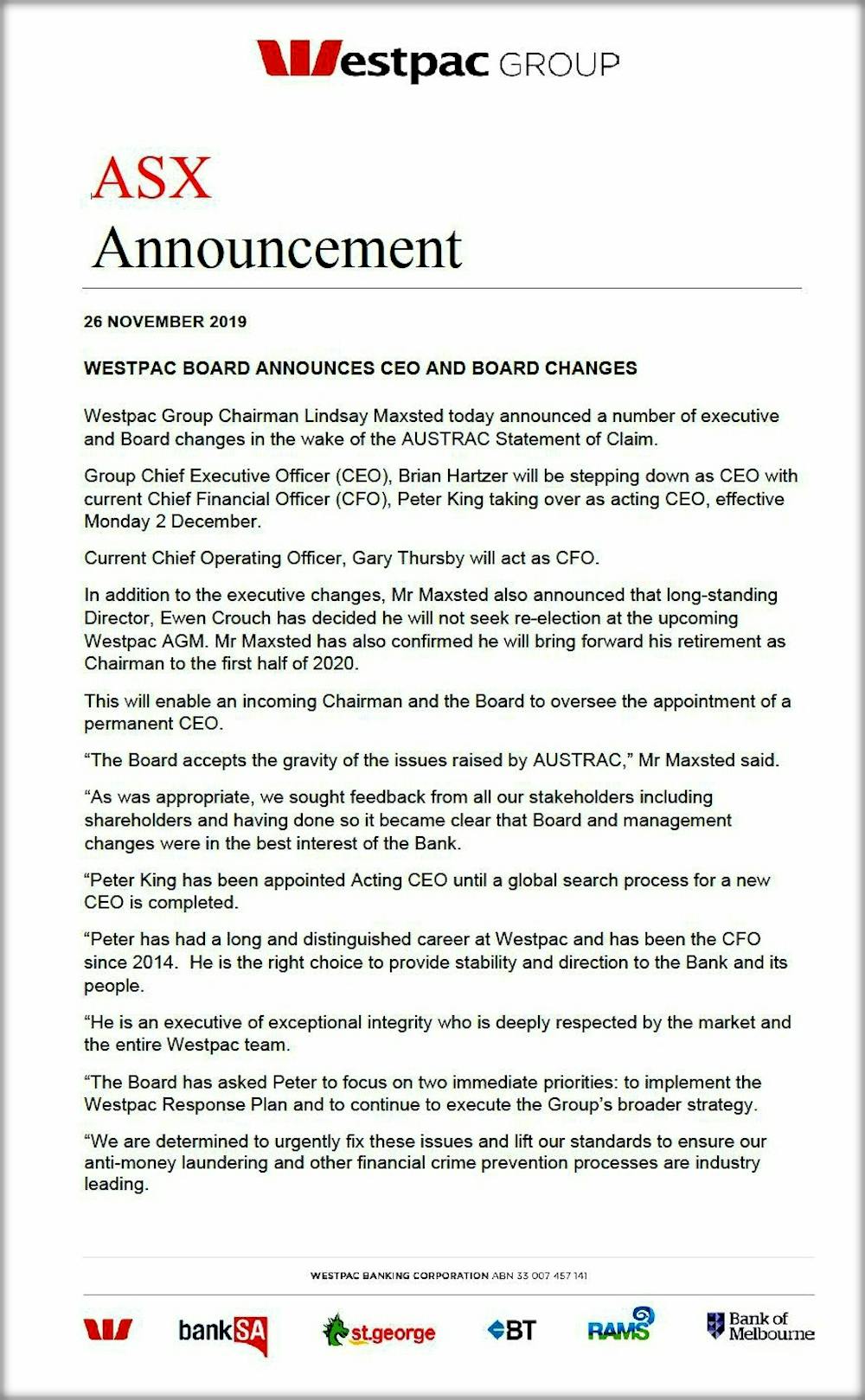
Westpac’s board has jettisoned its chief executive, Brian Hartzer, just hours after he reportedly told his team mainstream Australia was not overly concerned about the bank’s 23 million alleged breaches of anti-money-laundering laws, including handling transactions potentially involving child sex abuse.

Westpac’s announcement to the Australian Securities Exchange.

Harzter will receive a year’s salary in lieu of notice, worth A$2.68 million. Had he stayed on, he would have been eligible for share rights worth $20 million.

Westpac’s chairman, Lindsay Maxted, will bring forward his own retirement to the first half of 2020.

But far more customers have already been thrown overboard.

The emergency response Westpac rushed out a few days ago abandoned thousands throughout the Pacific and other regions.

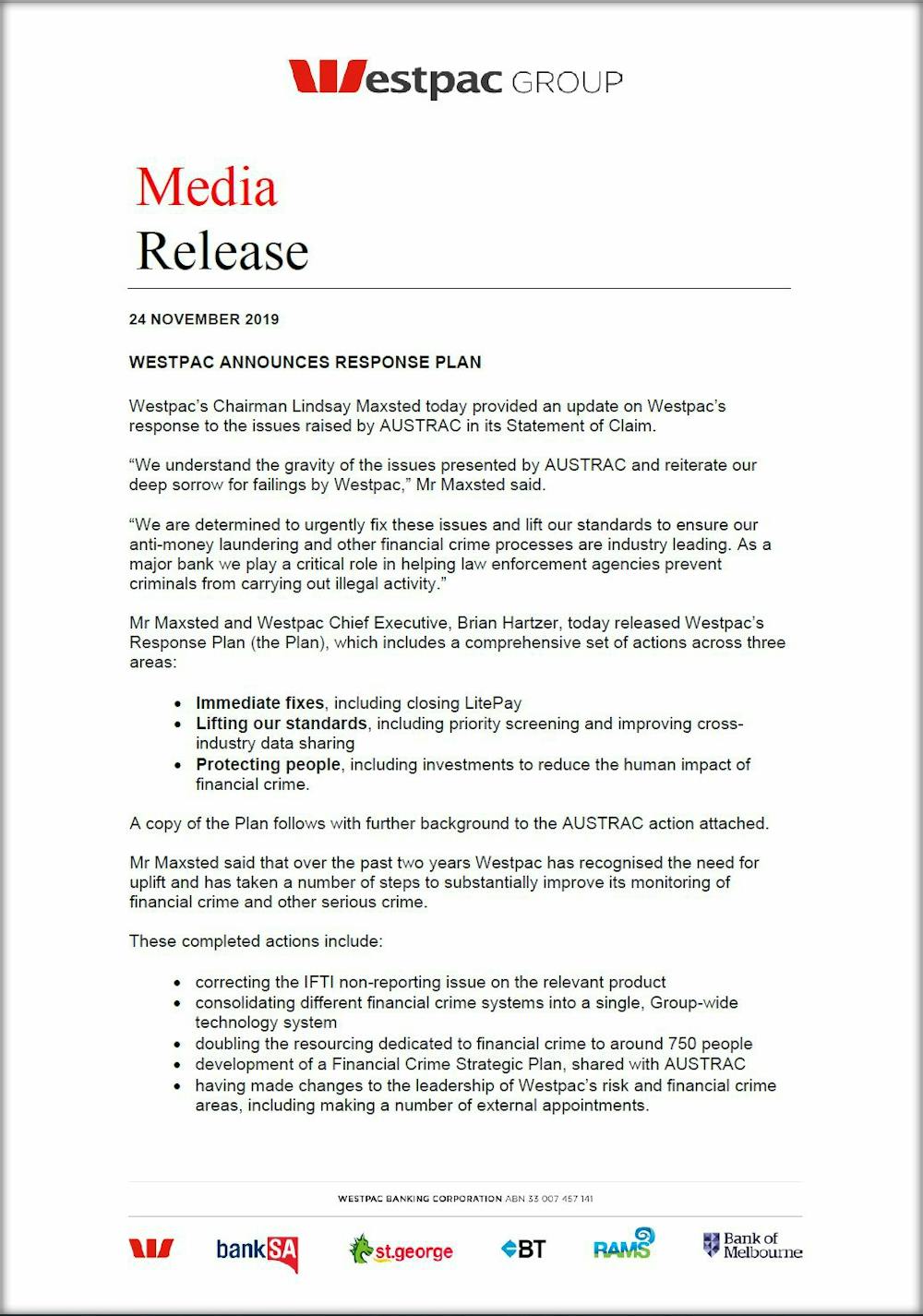
Westpac announced its “immediate fixes” included immediately shutting down “LitePay”, its low-cost system for customers to transfer money from one country to another.

Extract from Westpac’s weekend response.

Customers used LitePay to send “remittances” to family members outside Australia.

The bank’s response statement implicitly acknowledged the importance of these remittances. It noted LitePay was launched as part of a broader initiative with Australia’s Department of Foreign Affairs “to improve the livelihoods of men and women in the Pacific”.

Shutting down LitePay, without providing customers viable alternatives, is likely to do the opposite.

Westpac has abandoned customers who need it

The United Nations recognises remittances as vital in helping millions out of poverty. It estimates about one in nine people around the world rely on remittances from family members working abroad.

Remittances are particularly important throughout the Pacific, from the Philippines to a small island nation like Tonga, where the money adults working abroad send home accounts for more than 40% of their GDP.


Read more: If Australia cares about Pacific nations, we should also invest in their care givers


A Western Union branch facade in Cebu City, Philippines. Shuttersock

Remittances can be sent via companies like Western Union and Moneygram, but these are relatively expensive and generally focused on urban customers. In Australia members of expatriate communities with connections to their home countries established lower-cost remittance services. These small businesses facilitated the transfer of small amounts – generally less than A$500 a month – at an affordable price. They did so using accounts with banks like Westpac.

From 2011, remitters were required to register with the anti-money-laundering agency, AUSTRAC, and comply with anti-money-laundering laws. Compliance obligations include identifying customers and verifying their identities, generally known as “know your customer” or “KYC” measures.

Then, in 2013, Australian banks joined a global trend to “de-bank” small remitters, due to money-laundering and terrorist-financing risks. Over the next few years the accounts of more than 700 small Australian remitters, many of which were AUSTRAC-registered, were closed.

Compliance obligations

Westpac was the last of Australia’s big four banks to withdraw from servicing remitters. In November 2014 then chief executive Gail Kelly said:

The regulatory requirements for anti-money laundering are you need to know your customer and, in the case of remitters, you need to know your customer’s customers. That’s quite a responsibility. You do millions of these transactions and if one goes wrong and is connected with terrorism financing, that’s a real problem.

The need to “know your customer’s customers” was not, however, a clear regulatory obligation. In 2015 the global standard-setter for controls on money laundering and terrorist financing, the Financial Action Task Force (FATF), stated it did not require this.

The task force had also stated since 2014 that risks relating to remittances should be assessed on a case-by-case basis. The low risk of criminals or terrorism financiers sending money through remittance providers from Australia to Pacific island countries has since been confirmed by a 2017 report by AUSTRAC and the Department of Foreign Affairs and Trade.


Read more: With increased anti-money laundering measures, banks are shutting out women


Whatever the potential risk small remitters pose, the fact of de-banking created real risks. As research by myself and Supriya Singh into the effect on African communities found:

Some worry that if the money stops their parents will starve. Young people will join terrorist groups or decide to flee hunger by joining the boats. One Eritrean community leader said his cousin fled to the Mediterranean shores and died in the attempt to reach Europe.

De-banking remitter accounts lessened the compliance obligations of Westpac and others. But it had the ironic effect of reducing the transparency of remittance flows for law enforcement. In many cases payments continued to flow using unregulated channels and even cash, giving rise to crime risks to users and to Australia.

Leaving customers high and dry

It is a further irony that having de-banked small remittances services due to compliance concerns, Westpac ran afoul of anti-money-laundering obligations with LitePay, which it launched in 2016.

AUSTRAC’s charges against Westpac outline 12 cases involving repeated suspicious payments to the Philippines using LitePay. The money transfers matched known child-exploitation transaction patterns. Westpac failed to identify and report these prior to 2018 because it lacked appropriate detection measures for those transaction patterns.

But AUSTRAC says Westpac fixed the problems with LitePay in June 2018. Instead, AUSTRAC alleges, it is in its non-LitePay channels where the bank has still not implemented such measures. It is therefore in those channels that it continued to fail “to identify activity indicative of child exploitation risks”.

So why shut down LitePay? Why leave high and dry all its honest customers and the families who depend on remittances?


Read more: How states rocked by conflict could harness funds from their diasporas


Westpac has options. It could improve its control measures further. It could launch a collaborative, risk-based program aimed at re-banking small registered community-based remitters, starting with those servicing low-risk regions in the Pacific.

These remitters know their communities and users well. Together with Westpac’s improved systems, they could deliver an even safer system.

Jettisoning LitePay looks like a classic case of throwing out the baby with the bathwater – and doing so with scant regard for Westpac’s corporate social responsibilities.

ref. Westpac’s panicked response to its money-laundering scandal looks ill-considered – http://theconversation.com/westpacs-panicked-response-to-its-money-laundering-scandal-looks-ill-considered-127700

The evidence shows pharmacist prescribing is nothing to fear

Source: The Conversation (Au and NZ) – By Greg Merlo, Postdoctoral Research Fellow, Primary Care Clinical Unit, The University of Queensland

Prominent GP and former member of parliament Kerryn Phelps has entered the turf war between doctors and pharmacists over who gets to prescribe.

Pharmacy groups have long called for changes to allow pharmacists to prescribe specified medications, such as the oral contraceptive pill and antibiotics for urinary tract infections.

But Phelps argues allowing pharmacists to prescribe will lead to perverse incentives – where pharmacists prescribe inappropriately – because they have a financial interest in the sale of medicines.

Phelps has a point. Studies in countries where doctors have dispensing roles have found evidence of financial profits influencing prescribing behaviour.

A Swiss study, for instance, found physician dispensing leads to a 34% increase in drug costs per patient, as doctors overprescribe and prescribe more expensive medications.

An evaluation of pharmacist prescribing in the United Kingdom found it was safe, clinically appropriate, and was generally viewed positively by patients.

Similarly, two Canadian studies of pharmacist prescribing for urinary tract infections and patients at risk of heart problems found pharmacist prescribing led to better clinical outcomes. The researchers also found it was safe, cost effective, and associated with a high level of patient satisfaction.


Read more: Over-the-counter contraceptive pill could save the health system $96 million a year


Extending the scope of practice for pharmacists has the potential to lower costs to the health system because of fewer GP visits, be more convenient for consumers, and free up busy general practitioners to spend time on high-value care.

So what’s behind the concerns about pharmacist prescribing? And what does the research evidence say about them? Let’s look at three economic concepts that help us understand the benefits and risks of pharmacist prescribing.

1. Supplier-induced demand

Supplier-induced demand arises from information asymmetry – when the consumer is reliant on information from the supplier in order to make a decision.

In health care, supplier-induced demand occurs when a health professional shifts the demand that a consumer has for a drug or medical service beyond what they would demand if the consumer had perfect information.

What Phelps is suggesting is that a pharmacist may manipulate a consumer into purchasing an unnecessary drug.

When there is no information asymmetry, supplier-induced demand disappears. Paracetamol, for instance, is unlikely to be subject to supplier-induced demand despite direct sale from pharmacists because consumers have experience of using the product regularly and understand its effects.

Pharmacists can’t really shift demand for common drugs like paracetamol and ibuprofen. Mr Doomits/Shutterstock

There is no reported evidence of inappropriate prescribing by pharmacists in any countries that have introduced regulated, controlled models of pharmacist prescribing.

2. Product bundling

The Royal Australian College of General Practitioners (RACGP) has argued that if pharmacists prescribe oral contraceptives, patients would miss valuable services they would have received during the consultation with the GP. RACGP Queensland Chair Dr Bruce Willett told newsGP:

Limited repeats on medications such as oral contraceptives and cardiovascular disease medicines ensure patients can continue to be monitored by their GP while receiving treatments and medications, ensuring the right medication is prescribed at the right time.

This reflects the economic concept of product bundling — where several products or services are sold in a single package.

The classic example is the bundling of newspapers with classified ads. These ads subsidised the newspaper’s journalism. But when online classifieds for cars and jobs began to compete with newspaper classifieds, newspapers lost the revenue that subsidised reporting and journalists lost their jobs.

Pharmacist prescribing could result in similar debundling. In this scenario, the pharmacist’s expanded role may result in prescribing being decoupled from the product bundle that is a GP consultation. Healthy women may not see the value of a GP consultation if they can obtain a prescription for oral contraceptives from their pharmacist with no consultation fee.


Read more: Leave pill prescribing to GPs, not pharmacists, for the sake of women’s health


3. Externality

Some medicines have an impact on not only the person taking the medicine but society more broadly. This is what economists call an externality – a cost or benefit that is borne by an individual who did not choose to take on that cost or benefit.

Antibiotic resistance due to overuse, for instance, is estimated to have a global burden of A$140 trillion.

The social cost of opiod addiction is another example. In the United States alone this cost was estimated to be over US$600 billion between 2015 and 2018.

When codeine was rescheduled as a prescription-only drug in Australia, there was a 50% reduction in sales and a significant reduction in codeine poisonings.


Read more: Here’s what happened when codeine was made prescription only. No, the sky didn’t fall in


Conversely, a United Kingdom study of when antibiotic eye drops were rescheduled to be available over-the-counter found a doubling of sales.

Making medicines such as antibiotic eye drops easier to access can increase their use. Jelena Stanojkovic/Shutterstock

Any increase in pharmacists’ scope of practice needs to be introduced with caution, with clear protocols and limited prescribing rights.

It also requires consideration of potential problems arising from increased availability, and robust monitoring and evaluation of the appropriateness and volume of prescriptions.

Neither side of the doctor-pharmacist turf war is showing signs of giving up. Rather than sweeping statements about conflicts of interest, we need an evidence-based framework to determine where it’s appropriate to extend pharmacists’ scope of practice.


Read more: How rivalries between doctors and pharmacists turned into the ‘turf war’ we see today


ref. The evidence shows pharmacist prescribing is nothing to fear – http://theconversation.com/the-evidence-shows-pharmacist-prescribing-is-nothing-to-fear-127497

Nebuchadnezzar explained: warrior king, rebuilder of cities, and musical muse

Source: The Conversation (Au and NZ) – By Louise Pryke, Honorary Research Associate and Lecturer, University of Sydney

Kanye West’s first operatic work, Nebuchadnezzar, has just premiered at the Hollywood Bowl in Los Angeles. Set in the 6th century BCE, the opera is based on the biblical story of Nebuchadnezzar II, a powerful ruler and the longest-reigning king of Babylon.

Kanye West: has spoken of parallels between himself and the Babylonian king. EPA/Etienne Laurent

Nebuchadnezzar was a warrior-king, often described as the greatest military leader of the Neo-Babylonian empire. He ruled from 605 – 562 BCE in the area around the Tigris-Euphrates basin. His leadership saw numerous military successes and the construction of building works such as the famous Ishtar Gate.

Thousands of years after his rule, Nebuchadnezzar’s name lives on in his buildings and in ancient literature. Interestingly, his name and life have inspired numerous musical works by artists such as jazz pianist Marcus Roberts, Italian composer Giuseppe Verdi, and now, West.

The name Nebuchadnezzar in Akkadian (an ancient Semitic language that is an early cognate of Hebrew) is Nabu-Kudurri-usur, which means “O Nabu, protect my first-born son.” Nabu was a major Mesopotamian deity associated with literacy and the work of scribes.

An engraving on an eye stone of onyx with an inscription of Nebuchadnezzar II. Wikimedia Commons

The late Iron Age in the Near East saw the end of the mighty Assyrian Empire around 609 BCE – partly fuelled by climate change.

The area became the focus of political manoeuvring between two regional superpowers – the Egyptian and the Babylonian empires. Under Nebuchadnezzar’s reign, Neo-Babylonian armies swept through the area, leaving a trail of destruction including that of the biblical kingdom of Judah, which was besieged and destroyed.


Read more: Climate change fueled the rise and demise of the Neo-Assyrian Empire, superpower of the ancient world


Redbuilding Babylon

Nebuchadnezzar appears prominently in the Book of Daniel, as well as in Kings, Ezekiel, Jeremiah, Ezra, and Nehemiah, and rabbinical literature. The fall of the kingdom of Judah is presented in detail in 2 Kings 24-25.

Many scholars have noted that the historicity of the biblical account is supported by cuneiform sources. Indeed, this biblical account of the destruction is remarkably close to descriptions of the event found in Neo-Babylonian chronicles.

Nebuchadnezzar Chronicle. Clay tablet; New Babylonian. Chronicle for years 605-594 BC. © Trustees of the British Museum. Wikimedia Commons

Nebuchadnezzar’s military might looms large in the biblical text, but evidence from Neo-Babylonian sources from around the time of his reign offers a different emphasis. These sources focus on the king’s outstanding record in building and construction, and his religious piety.

Nebuchadnezzar was committed to rebuilding Babylon (in modern-day Iraq) after it had been freed from Assyrian rule. He turned the city into one that was famed for its opulence and majesty throughout the ancient world.

The famous Ishtar Gate, part of the processional way leading into the heart of the city, was constructed under Nebuchadnezzar’s rule, and carries his dedication. The walls of the processional way were decorated with images of lions, the sacred animal of Ishtar, goddess of love.

Bricks from the blue-glazed wall bearing Nebuchadnezzar’s inscription have been discovered in their thousands.

A reconstruction of the blue Ishtar Gate of Babylon, decorated with extinct aurochs and mythological creatures, at the Pergamon History Museum. shutterstock

Read more: Friday essay: the legend of Ishtar, first goddess of love and war


Legend has it that the mysterious Hanging Gardens of Babylon were built by Nebuchadnezzar as a gift for his wife, Amuhia.

The story goes that Amuhia was homesick for the forested landscape of her homeland Medea (which in the modern-day includes parts of Turkey, Turkmenistan and Uzbekistan), so Nebuchadnezzar built the gardens to provide her with some comforts of home. The Hanging Gardens of Babylon are one of the seven wonders of the ancient world, but their exact historical location remains unknown.

The Hanging Gardens of Babylon, painting by Ferdinand Knab (1834-1902) Wikimedia Commons

Nebuchadnezzar’s building works are described in the works of Classical writers such as the 5th century historian, Herodotus. Several ancient sources, including inscriptions ascribed to Nebuchadnezzar, suggest the king constructed a giant reservoir that was 200km in length. (However, alternate sources suggest the construction was the work of the ancient queens Nitocris or Semiramis.)

Musical connections

In a much-quoted interview with DJ Zane Lowe, Kanye West has explained his connection to the Babylonian monarch. West noted parallels between the exceptional successes enjoyed by Nebuchadnezzar and himself, and the relationship between their achievements and their religion.

He has also observed that Nebuchadnezzar’s mental illness as described in the Bible (there is a passage where he believes himself to be a cow) has resonated with his own health issues.

Nebuchadnezzar Recovering His Reason, Robert Blyth, 1782. Wikimedia Commons

Several ancient sources also connect Nebuchadnezzar to hymns and musical performances. In the Book of Daniel, for instance, Nebuchadnezzar builds a giant golden statue in his own image. The king’s attendants decree that when people “hear the sound of the horn, flute, harp, lyre, and psaltery, in symphony with all kinds of music” they should fall down and worship this gold image.

Following Nebuchadnezzar’s death around 562 BCE, three different kings held the Babylonian throne in six years.

Two were assassinated – suggesting perhaps that Nebuchadnezzar’s many achievements made him a hard act to follow. While the king’s rule was undoubtedly complicated, his story is still providing inspiration for modern artists and diverse new tellings.

ref. Nebuchadnezzar explained: warrior king, rebuilder of cities, and musical muse – http://theconversation.com/nebuchadnezzar-explained-warrior-king-rebuilder-of-cities-and-musical-muse-127498

‘Gay gene’ testing apps aren’t just misleading – they’re dangerous

Source: The Conversation (Au and NZ) – By Kate Lynch, Postdoctoral Research Fellow, University of Sydney

The launch of a genetic app titled “How gay are you?” prompted a well-deserved outcry from scientists and the public last month, with media coverage branding it “disgusting” and “the latest bad idea”.

The app, which has since been withdrawn from sale, was just one of many available from online app store GenePlaza. Billing itself as “a marketplace for genetic reports”, this site offers a wide range of genetic tests that promise to reveal unassailable truths about your sleep, health, neuroses, ancestors, and even your intellect.

The genes tested in each “genetic app” are sourced from scientific reports that have established links between particular genetic variants and particular traits. But the tests are not directly affiliated with the scientists or their studies, and the interpretation and communication of the data produced by the apps is done solely by the developers.

The science behind the test

“How gay are you?” used data from a paper published earlier this year in the prestigious journal Science, showing that sexual orientation has a significant genetic component. According to the research, 8-25% of same-sex sexual behaviours can be accounted for by leafing through a few specific pages of the (very) lengthy book that represents your personal genome.

Sexual orientation is complex – thought to be the product of many genes, as well as environmental effects. Although certain gene variants are weakly related to same-sex attraction, the authors of this paper took pains to point out that genetics cannot be used to predict sexual orientation.


Read more: ‘Gay gene’ search reveals not one but many – and no way to predict sexuality


So what use is a genetic test if it can’t predict individual differences? Not much, most scientists think.

Benjamin Neale, an author on the paper from which the genetic data was derived, sent a letter to GenePlaza asking it to take down the app. A change.org petition to remove the test has attracted around 1,700 signatures. “How gay are you?” now appears on GenePlaza under the name “122 shades of gray”, is no longer available for purchase, and carries a disclaimer stating that it does not predict same-sex attraction and is not associated with the authors of the Science study.

Genetic explanation and sexuality

These tests are not just useless, but potentially dangerous. Information about the genetic basis of traits can have profound effects on the way we understand ourselves and others.

For sexual orientation, the impacts of genetic information seem mixed. One study reported that learning about a biological basis for homosexuality increased anti-gay attitudes, whereas another found the opposite.

Although many people who identify as homosexual endorse a genetically determined view, among sexual minorities this belief seems to be a double-edged sword. Gay men who perceive their sexuality as biological are more certain about their sexual identity, but also view themselves as more different from heterosexuals and in turn experience more self-stigma.

For heterosexual and LGBT populations alike, more research is needed to know what psychological effects the results of genetic tests of this kind might have.

Self-fulfilling prophecy

For some other traits, it is already clear that belief in a genetic basis has a negative effect. Women given biological explanations of gender differences are more likely to hold negative self-stereotypes. In one study, women who were informed that women have genetically inferior mathematical ability went on to perform relatively poorly on a maths test.

This suggests that even if there is no genetic basis for a behaviour or ability, receiving a genetic explanation can become a self-fulfilling prophecy. GenePlaza itself offers a Math Ability app, which promises to tell you how you stack up against the rest of humanity.

Obesity has also been shown to be affected by how we think about genes. Even the most common gene variant associated with obesity only explains a tiny fraction of the variability between individuals. Despite this, a whole cottage industry has sprouted to offer “genetically tailored” diets.

Not surprisingly, GenePlaza offers a My Weight app, with the tagline “can genes determine the size of your jeans?” The answer is possibly yes, albeit via your brain.

Learning that obesity has a genetic basis leads people to discount the importance of exercise and a healthy diet. In one study, participants given information about a link between genes and obesity ate more cookies than those who read a non-genetic explanation.

Perhaps most concerning is GenePlaza’s Depression App, which uses data from a 2018 Australian study to provide information about one’s genetic risk of depression (although it does feature a disclaimer that its results are “not a diagnosis, a prediction, or a predisposition score”).

Social psychologists have shown that when people are told they have a predisposition to depression they are less confident in their ability to cope, and even remember more depressive episodes in their recent past.

Belief in a genetic basis to mental illness not only affects our self-perception, but our attitudes to others too. When thought to be genetically based, people are more negative towards those with a mental illness and more likely to perceive them as dangerous.


Read more: Gene testing for the public: a way to ward off disease, or a useless worry?


These apps are marketed as a curiosity or as harmless fun. But there is danger in claiming to be able to use genetics to predict any aspect of someone’s identity, abilities, mental health or sexual orientation. Misunderstanding of genetic information can have grave consequences for those receiving it.

ref. ‘Gay gene’ testing apps aren’t just misleading – they’re dangerous – http://theconversation.com/gay-gene-testing-apps-arent-just-misleading-theyre-dangerous-126522

Climate Change – The most important issue facing Australia? New survey sees huge spike in concern

Source: The Conversation (Au and NZ) – By Andrew Markus, Pratt Foundation Research Chair of Jewish Civilisation, Monash University

While most Australians still view the economy as the most important issue facing the country, a new survey released today shows climate change is rapidly becoming a major concern, as well.

Now in its 12th year, the Scanlon Foundation survey is the largest- and longest-running poll tracking public opinion on social cohesion, immigration, population and other issues in Australia. The 2019 survey was administered by telephone and the internet in July-August to a representative sample of 3,500 respondents. 

The largest change in the survey from 2018 to 2019 came with the open-ended question: “What do you think is the most important problem facing Australia today?”

Both years, the economy ranked as No. 1. But this year, climate change jumped to a clear second with the equal-largest increase from one year to the next, up from 10% to 19% in our telephone-administered survey and from 5% to 17% in the self-completed online survey.


Responses to the most important problem facing Australia in telephone-interview survey. Author provided

As would be expected, there were major variances in the responses depending on demographics.

Nearly half (43%) of those aged 18-24 viewed climate change as the biggest problem facing Australia, compared to 12% of those aged 35-44 and just 8% of those over the age of 75.

The responses also varied by state – 20% of Victoria residents and 18% of NSW residents said climate change was the biggest problem, compared to 8% in Western Australia.

And there was a stark difference depending on political affiliation, with 54% of Greens voters saying climate change was the most important issue, compared to 21% of Labor, 7% of Coalition and just 3% of One Nation voters.


Read more: The science of drought is complex but the message on climate change is clear


Less worry about immigration numbers

Last year, immigration was a major political issue in Australia. Several polls, variously worded and with different approaches to sampling, found majority support for a reduction in the numbers of immigrants permitted into Australia each year.

Prime Minister Scott Morrison said his government was listening to the public’s concerns and responded with changes, including a reduction in the annual immigration target.

This year, however, there is evidence of a decline in public concern.

The percentage of people who agreed the immigration intake was too high in the annual Lowy Institute poll fell from 54% in 2018 to 47% in 2019.

And in our poll, the proportion of those who agreed with a reduction in the number of immigrants fell marginally from 43% in 2018 to 41% in 2019 in our interviewer-administered survey and from 44% to 41% in the self-completed version.


Responses to the question about the number of immigrants in Australia in telephone survey. Author provided

Endorsement of the value of immigration

There is continuing endorsement of the value of immigration by a substantial majority of Australians.

In the self-completed version of this year’s survey, 76% agree that immigration is good for the economy, 78% agree that immigration “improves Australia by bringing new ideas and cultures” and 80% agree that multiculturalism has been good for Australia.

Since 2015, the survey has tested public support for immigration restrictions on the grounds of race, ethnicity or religion, which have been advocated by minor right-wing and populist parties. The consistent finding is that a large majority – 70% to 80% of Australians – do not support such policies.

But concerns remain over the impact of immigration

While public opinion is generally positive with regard to immigration today, many are concerned about the impact of rising immigrant numbers on their daily lives.


Read more: Australians think immigration should be cut? Well, it depends on how you ask


Seventy percent of respondents said they were concerned about “overcrowding”, 60% by the impact of immigration on housing prices and 58% by the impact on the environment.

A new question in 2019 asked for responses to the proposition that “too many immigrants are not adopting Australian values”. Nearly two-thirds of respondents (67%) agreed with the statement.

Policy towards asylum seekers

In 2018 and 2019, a new question asked respondents “are you personally concerned that Australia is too harsh in its treatment of asylum seekers and refugees?”

Opinion was found to be almost evenly divided. In 2019, 49% said they were “a great deal” or “somewhat” concerned, 50% “only slightly” or “not at all” concerned.

Here, too, there were major variances in viewpoints depending on demographics.

For instance, 87% of Greens voters and 61% of Labor voters were “a great deal” or “somewhat” concerned, compared to just 30% of Coalition voters and 16% of One Nation.

A similar split could also be seen with age, with 70% of those aged 18-24 “a great deal” or “somewhat” concerned, compared to just 39% of those aged 55-64. And with location: 55% of Victoria residents were “a great deal” or “somewhat” concerned, compared to 37% of those in Western Australia.

Social cohesion still relatively stable

On the much broader question of social cohesion, our survey continues to find a large measure of stability in Australia.

One indication is provided by the Scanlon Monash Index (SMI), which aggregates responses to 18 questions and measures attitudes in five areas of social cohesion: belonging, worth, social justice, political participation and acceptance of diversity.

Over the course of our 12 national surveys, the SMI registered the highest level of volatility during 2009-2013, the period of the Rudd and Gillard governments, when it declined by more than 10%. It has been largely stable since 2014.

On the individual factors that comprise the SMI, however, there have been some significant changes. When it comes to sense of belonging, for instance, just 63% said they felt this to a “great extent” in 2019, compared to 77% in 2007.

And on the acceptance of diversity, 19% of respondents said they had experienced discrimination on the basis of race, ethnic origin or religion, which was significantly higher than the 9%-10% from 2007 to 2009.

ref. The most important issue facing Australia? New survey sees huge spike in concern over climate change – http://theconversation.com/the-most-important-issue-facing-australia-new-survey-sees-huge-spike-in-concern-over-climate-change-127688

Greedy doctors make private health insurance more painful – here’s a way to end bill shock

Source: The Conversation (Au and NZ) – By Stephen Duckett, Director, Health Program, Grattan Institute

Large bills are one of the main reasons people are dissatisfied with their private health insurance – especially when these bills come as a surprise.

Doctors charge what they like, and patients rarely have any information about what they are getting for their money. Even patients with top-level cover are left paying large and unexpected out-of-pocket costs when they use their insurance.

Patients have little power to bargain with their doctors about fees and have almost no information about whether their doctor has higher or lower complication rates than other doctors.


Read more: It’s perfectly legal for doctors to charge huge amounts for surgery, but should it be allowed?


A Grattan Institute report released today proposes that patients’ fees should be negotiated between doctors and private hospitals, rather than between the doctor and the patient.

We propose that hospitals issue one “bundled” bill after a patient is treated, rather than the confusing and seemingly ad hoc array of bills patients get at present.

Under the plan, patients would still choose their specialist, and still be treated in the hospital where their specialist practices.

The difference would be that private hospitals would issue a single bill to the patient’s insurer, and the private hospital would pay the specialist, the anaesthetist, the assistant, and any other medical practitioners on the patient’s behalf.

An insured patient would get one bill – from their insurer – which would include their excess and any additional cost the hospital has advised them about in advance.

An uninsured patient would also get a single bundled bill, but from the hospital.

Bill shock is one of the biggest problems Australians have with private health insurance. Miljan Zivkovic

Why it’s needed

Medical fees are currently partly reimbursed by Medicare (75% of the schedule fee), partly reimbursed by the insurer (25% of the schedule fee), and doctors often charge more on top of this.

The extra is paid by the patient as an out-of-pocket charge. This results in an incoherent shambles of payments.


Read more: Specialists are free to set their fees, but there are ways to ensure patients don’t get ripped off


Patients are in the worst position to negotiate fees with their specialist. Quaint pamphlets which encourage patients to ask their surgeons about fees shift responsibility from those who can effect change – doctors, private hospitals, insurers, and government – to those who can’t: powerless patients.

A handful of doctors is causing the problem

Only about one-quarter of hospital specialists’ services are charged at the Medicare schedule fee or below.

Many doctors feel this government-determined fee is not fair, possibly because it has not been consistently indexed with inflation.

More than two-thirds of services are charged up to 50% above the schedule fee.

But a very small proportion of services (7%) are charged at more than twice the Medicare schedule – and for these services, the average amount charged is more than three times the Medicare fee.

This small number of expensive services account for almost 90% of all medical gaps. The small minority of specialists who charge more than twice the schedule fee should be called out and labelled as greedy.


Read more: Doctors’ fees shouldn’t just be transparent, they should be fair and reasonable


To some extent it’s fair that specialists with demonstrably better skills than their colleagues in the same specialty should charge more.

But since neither the public nor specialists have information about relative skill, such as complication rates after taking account of the complexity of the patient, it is hard to justify charging higher fees.

What’s more, higher fees are more prevalent in some locations than others, suggesting the higher fees have nothing to do with either skill or the adequacy of the Medicare Benefits Schedule, but rather are more about what these doctors think the market can bear.

A single bill would help

Bundling medical fees into a single bill would require doctors to negotiate with private hospitals about what the doctor charges.

Hospitals are in a better position than patients to negotiate with doctors about fees. Private hospitals already negotiate about whether to appoint a specialist to the hospital; those negotiations should include consideration of what the doctor will charge patients.

If doctors have to negotiate with private hospitals about the fees they charge, they’re likely to be lower. ESB Professional/Shutterstock

Patients would benefit directly. They would still have choice of doctor but would face fewer and lower out-of-pocket costs for these choices.

Importantly, the doctor-patient relationship would continue; the change would be to the doctor-payment relationship.

Of course, some doctors – especially the greedy billers – would oppose this reform, because it would bring accountability into the medical market. Their squeals should be ignored.


Read more: We need more than a website to stop Australians paying exorbitant out-of-pocket health costs


ref. Greedy doctors make private health insurance more painful – here’s a way to end bill shock – http://theconversation.com/greedy-doctors-make-private-health-insurance-more-painful-heres-a-way-to-end-bill-shock-127227

Australia’s tertiary education spending grew while commentators cried otherwise: we explain in 6 charts

Source: The Conversation (Au and NZ) – By Geoff Sharrock, Honorary Senior Fellow, Centre for Vocational and Educational Policy, University of Melbourne

Each year universities check the latest OECD Education at a Glance report to see how Australian tertiary spending compares with peer countries.

The good news is that every report since 2012 has shown our tertiary sector revenue growth outpacing the OECD average.

But this trend doesn’t feature in Australian commentary. Instead, the folklore goes, our public spending on tertiary institutions (university degrees and VET diplomas) ranks near the bottom of the OECD as a share of GDP; and this makes our universities among the lowest-funded in the OECD.


Read more: Demand-driven funding for universities is frozen. What does this mean and should the policy be restored?


Some even say our total (public and private) spending on tertiary institutions has been flat since 2000, while rising elsewhere in the OECD.

So, what is the actual story?

University revenue has risen (in domestic data)

Let’s take that last claim first, on total tertiary spending. It’s from a Universities Australia budget submission for 2017-2018. As a view on university spending it’s clearly at odds with domestic data.

From 2001-2016, total revenue for our universities doubled – from A$15.5 to A$30.8 billion. By 2016, Commonwealth grants for research and teaching reached A$11 billion, up from A$6.2 in 2001.


Private spending grew even more. In 2016 international students put in A$6.5 billion or 20%. Domestic students put in A$6.7, but about A$1 billion in HELP loans won’t be repaid. So, net Commonwealth funding was about A$12 billion or 40% of A$30.8. All told, students and the government each put in about 40% in 2016.

… and in OECD data, total tertiary spending also went up

In 2000 Australia’s total (public and private) spending rate for tertiary institutions (degrees and diplomas) was 1.4% of GDP (the OECD average was 1.3).

From 2009-2012, Australia’s rate mirrored the OECD’s 1.6%. Then between 2013 and 2016 it rose to 1.9% as the OECD’s rate slid to 1.5%.

In total public spending on tertiary education, our rate was well below the OECD average between 2005 and 2012. But by 2016 it was 1.4%, higher than the OECD average of 1.2%.


Australian public spend is lower after transfer of HELP loans

For years we’ve heard our public spending is second-lowest in the OECD. While never actually true, the claim arose in 2014, 2015, 2016, 2017 and 2018.

A problem here is GDP growth. But first, let’s look at HELP loans.

The OECD treats HELP loans as public in initial government spending but as private in final government spending (after government transfers to individuals). In last year’s report the OECD put our initial public spending on degrees and diplomas at 1.3% of GDP, compared with an OECD average of 1.1%.

Chart 3 shows the annual gap in final public rates that underpins Australian folklore. It’s why Universities Australia still says we rank near the bottom of the ladder for public investment.


Read more: How does being second-last in the OECD for public funding affect our unis?


Australia’s final public rate was lower than the OECD average in 2016 – 0.75% of GDP compared to 0.93%. But here all HELP loans become private – whether repaid or not.


Few dare dwell on how highly we rank for total spending. Except to say it seems unethical for students to foot so much of the bill, with more than 60% of income taken from private sources.

But recall chart 1 – students put in 40%. And as chart 3 shows, there’s no ideal OECD norm such as 60% public.

GDP growth masks real rises (and falls) in spending

GDP based comparisons can be misleading. Chart 4 shows how spending as a share of GDP rose in every sample country over 2008-09. This helped lift the OECD average rate from 1.5% to 1.6%.

Finland’s rate surged from 1.6% to 1.9%. Sweden’s also surged from 1.5% to 1.8%. Australia’s rose less, from 1.5% to 1.6%. The others saw modest rises also.

By 2013, all still had higher rates than in 2008. So chart 4 suggests that in all cases, spending rose.


But chart 5 shows that in Portugal, Spain and Italy real spending fell between 2008 and 2013. In fact Australia’s real spending grew the most, by 28%. But since its GDP also grew the most, chart 4 suggests more modest spending growth.

As chart 5 shows, Finland’s 2008-09 “surge” was mainly a 9% slide in GDP. Sweden’s story was similar, with a 5% GDP slide. In Spain, Portugal and Italy, falls in real spending look like rises in chart 4. But only because GDP shrank even more sharply than spending over 2008-2013.

GDP based factoids underpin Australian folklore. Claims such as Portugal invests far more in public spending are common. But over 2010-2016 Australia’s total tertiary spending grew by 36% (see chart 6), while in Portugal it fell by 19%.


We do need better funding, but based on reliable data

The real spending trends highlighted in the 2008 Bradley Review of Australian higher education, back when we did lag the OECD average in spending growth, have been reversed:

  • in the 2013 OECD report Australia’s spending rose by 26% over 2005-2010, as the OECD average rose by 20%.
  • in the 2016 report Australia’s spending rose by 28% over 2008-2013, as the OECD average rose by 17%
  • in the 2019 report Australia’s spending rose by 36% over 2010-2016. In a dozen other countries, spending fell (such as Portugal, by 19%).


Incredibly, these trends have been ignored. Since 2008 we’ve been peering through the prism of GDP based data, to declare the result a global “ranking” – as if the financial crisis never happened. From a sector that sanctifies evidence and expertise, it’s irresponsible.

But there’s still a case for better tertiary funding in Australia.

That case must be made with more current and relevant domestic data. This should include properly tracked trends in real tertiary spending, projected rises in the number of school leavers, and labour market demand for skills and knowledge.


Read more: Enrolments flatlining: Australian unis’ financial strife in three charts


ref. Australia’s tertiary education spending grew while commentators cried otherwise: we explain in 6 charts – http://theconversation.com/australias-tertiary-education-spending-grew-while-commentators-cried-otherwise-we-explain-in-6-charts-126492

Geographical narcissism: when city folk just assume they’re better

Source: The Conversation (Au and NZ) – By Timothy Baker, Associate Professor and Director, Centre for Rural Emergency Medicine, Deakin University

A self-proclaimed “farmer’s wife” triggered a groundswell of activity on Twitter this month from frustrated rural professionals across Australia. Kirsten Diprose is an ABC metropolitan journalist turned regional reporter. In an article for the ABC, she declared she always felt the need to play up her city-based credentials and experience to justify her professional worth. She wrote:

Many people in the country feel they have to justify their careers, whether it’s in the media, health, education or business. Some people think if you’re not working in the metropolitan centre then you must not be good enough at what you do. You never ‘cracked the big time’ or you were too afraid to try.


Read more: Bust the regional city myths and look beyond the ‘big 5’ for a $378b return


As academics with professional backgrounds in health care and media respectively who work in regional Victoria, we couldn’t agree more with Diprose’s observations. What she describes is known in academic scholarship as “geographical narcissism”. Swedish clinical psychologist Malin Fors used the term to explain the rural-urban interactions she encountered while working in a small town north of the Arctic circle in Norway.

The concept has also been described in other terms such as “urban splaining” – rural people are “talked down to” by their city counterparts – and “geographical judgment” as journalist Gabrielle Chan puts it in her book Rusted Off.

Academic literature, from Immanuel Wallerstein’s world systems theory to the work of cultural theorist Raymond Williams, has long discussed the economic and cultural causes of the rural-urban divide. Geographical narcissism looks at the psychological consequences.

Anyone outside the city is ‘camping out’

When big cities are seen as the centre of everything, it gives rise to a narcissistic view in city dwellers that subtly, often unconsciously, devalues rural knowledge, conventions and subjectivity. It fosters a “belief that urban reality is definitive”.

For example, rural health-care professionals are often asked by their urban contacts why they left the city. And when will they be going back? It’s assumed nobody would voluntarily move to a country town for professional work, especially if they have no family or social ties to the area.


Read more: Should I stay or should I go: how ‘city girls’ can learn to feel at home in the country


There is also a suspicion, as Fors points out, that people with ethical or personal problems are banished to the country. It is a classic film and television trope for the brilliant city specialist to be obliged to work as a rural GP because of alcoholism, cocaine addiction, fear of blood, or crime punished by community service. (A favourite example is the French-Canadian film La grande séduction/The Grand Seduction where a plastic surgeon must work in a small fishing village while coping with the twin deviations of cocaine use and a love of cricket.)

La grande séduction/The Grand Seduction epitomises the trope of a flawed medical specialist who has to work outside the city.

This year we have each been invited to speak at regional professional conferences and events about this topic. It’s clear many rural professionals who encounter this urban mindset struggle to be identified (or see themselves) as equals.

Take this tweet responding to Diprose’s article:

And another:

It’s also our personal observation in health care and higher education that geographical narcissism affects professional life by warping perceptions of time and distance. It always seems longer for city-based professionals to travel to the country to visit regional campuses and hospitals than for their regional colleagues to travel to the city.

Many rural workers will identify with the expectation that they travel both ways in a day to attend a meeting in the city. As for employees of the city office, they need a night’s accommodation and a little narcissistic praise for their intrepid travel to the country.

This lack of appreciation can also interfere with the effectiveness of well-meaning urban professionals who want to improve rural practice. An urban professional seeking to reorganise an area of rural practice may feel bewildered at the passive-aggressive behaviour of their rural colleagues. As Fors observed, they are mistrusted as colonisers when they had expected to be welcomed as rescuers.


Read more: Settling migrants in regional areas will need more than a visa to succeed


Stereotypes are internalised too

Rural professionals often laugh with recognition when hearing of geographic narcissism. But it’s confronting when they realise they themselves have internalised and ultimately reinforce the same stereotypes.

As Diprose experienced, many rural professionals will legitimise their skills to an urban colleague by listing their urban education and work credentials – as if these are the experiences that matter. This leads to a rural dialectic, where rural professionals hold the seemingly opposing views that rural work is, and is not, of high quality.

Juggling these polarised views can lead to unhelpful psychological compromises. One of these is to split elements of rural practice into good and bad. Of particular concern is the belief that an individual professional is of high quality, but the rest of the rural organisation is not, so they must leave to progress their career.

There are, of course, social spaces and professional fields where geographical narcissism is not apparent. It’s less of problem when those who work and live regionally have their key economic, professional and social connections within one location. But when one competes with or is exposed to resources based at the “centre” – so often in the big cities – you can’t miss it.

The rise of digital technology – with its promise to eradicate issues of distance – has perhaps exposed the prevalence and unspoken acceptance of geographical narcissism.

Rural and urban environments bring different challenges for working professionals. Good and bad practices can occur in both. But it is narcissistic to believe geography is a key determinant of quality.

ref. Geographical narcissism: when city folk just assume they’re better – http://theconversation.com/geographical-narcissism-when-city-folk-just-assume-theyre-better-127318

The RBA has a new brain. It has thoughts on what’ll happen after interest rates hit zero

Source: The Conversation (Au and NZ) – By Isaac Gross, Lecturer, Monash University

MARTIN stands for “Macroeconomic Relationships for Targeting Inflation”, or perhaps merely for “Martin Place” which is the location of the Reserve Bank’s headquarters in Sydney.

It’s the bank’s new computer model of the Australian economy, made up of 147 equations working in concert. Some are quite simple, such as how global oil prices affect domestic petrol prices, whereas others are more complex, such as how a rise in the unemployment rate affects household spending.

Reserve Bank of Australia

Unveiled in August in a discussion paper entitled “MARTIN has its place”, the model is available for use by analysts outside the bank for whom it can serve as something of a guide as to what the bank might be thinking.

It provides useful insights into what the bank will do next, after it has cut its cash rate as close to zero as possible and needs to stimulate the economy further.

It’s a topic Governor Philip Lowe will expand on tonight in a landmark speech to business economists in Sydney.

What’s MARTIN, what’s a model?

Economists use models like drivers use maps – to take a large and complicated country and simplify it to its essential ingredients in the hopes of providing a useful guide to navigating it.

A map doesn’t tell you everything about a route – that would be hard to come to grips with – but it highlights important features or paths you should watch for. Models do the same – simplifying the complex Australian economy into the paths that matter.

But instead of breaking Australia down into rivers and roads, or cities and states like a map might do, MARTIN divides the Australian economy into different sectors such as households, firms and the government with the 147 equations describing the ways they interlink with each other.

This map is principally designed for two purposes.

  • The first is forecasting. Every three months the bank looks inside its crystal ball to try and divine how the economy will evolve in the years to come. MARTIN has become a key input into that process.

  • The second use is the ability to run “what if” simulations to see how the economy would react in different scenarios. For example, what would happen if the price of iron ore crashed tomorrow, or what would be the impact if the government ramped up its spending on infrastructure?
What does MARTIN say about quantitative easing?

MARTIN will have been put to work pondering the implications of deploying so-called “quantitative easing” after the Reserve Bank’s cash rate gets too low to cut.

Quantitative easing involves the Reserve Bank buying financial assets, such as government or mortgage bonds, in order to continue to supply money to the economy after its cash rate has fallen to zero.

I have used MARTIN to model three different scenarios for quantitative easing in the Australian economy.

The first is what would happen if quantitative easing isn’t used at all.

The second is what would happen if the bank started a modest quantitative easing program in early 2020 lasting around a year.

The third is what would happen if the bank commenced an aggressive quantitative easing program to simulate the economy for 18 months.


Read more: Below zero is ‘reverse’. How the Reserve Bank would make quantitative easing work


I assume the bank would purchase assets in a similar manner to how the US conducted quantitative easing after the global financial crisis, buying bonds to lower interest rates on two year and ten year government securities.

MARTIN says quantitative easing would have two major effects on the economy. First, it would lower the cost of borrowing for Australian businesses. They would be expected to increase investment as more projects become viable as the interest rates they were charged fell.

Second, the lower rate structure would weaken the Australian dollar by as much as 5 US cents. A cheaper dollar would make our exports more competitive and make foreign imports more expensive.

MARTIN thinks it could work

MARTIN predicts quantitative easing would boost manufacturing, agriculture and mining exports relative to where they would be without it.

The depreciation would also encourage Australian households to spend more on local goods and less on what would be dearer imports. This should lead to higher wages, increased household incomes and spending, and improved economic growth.

In fact, MARTIN predicts that, by boosting economic growth, quantitative easing would actually lead to higher interest rates as inflation returns to the Reserve Bank’s target, allowing interest rates to return to more normal levels.


Read more: We asked 13 economists how to fix things. All back the RBA governor over the treasurer


Combining these two effects, MARTIN suggests a large quantitative easing program would reduce unemployment by 0.3 percentage points, equivalent to 40,000 extra jobs, and boost wages across the economy.

The output of any model is only as good as the information and data that are fed into it, but the output of MARTIN is why more and more economists expect the bank to quantitatively ease in the new year. Its brain says it should work.

ref. The RBA has a new brain. It has thoughts on what’ll happen after interest rates hit zero – http://theconversation.com/the-rba-has-a-new-brain-it-has-thoughts-on-whatll-happen-after-interest-rates-hit-zero-126765

Designer fashion, nostalgia magnet – what’s behind the rise and rise of the sneaker?

Source: The Conversation (Au and NZ) – By Emily Brayshaw, Lecturer, Fashion and Design History, Theory, and Thinking, University of Technology Sydney

In June this year, hundreds of Australian shoppers queued – some overnight – to buy a pair of Yeezy Boost 350 V2 Black Static Adidas sneakers the moment they went on sale. Before lining up, customers had to register and go into a draw to determine whether they could buy a pair. The shoes sold for a few hundred dollars but are now being traded for up to A$3000.

This quest to obtain limited edition sneakers designed by rapper Kanye West is not an isolated phenomenon. People have long gone to extreme lengths to get their hands on the latest kicks.

There have been reports of sneaker violence since the 1980s.

For those wishing to form a more orderly queue, the internet has responded with news services and dedicated message boards to help people get the latest kicks. Other sites treat sneakers like stock market commodities.

But how does society’s sneaker love tally with our awareness of the environmental and human cost of consumerism?

Prized sneaker specimens on display. www.shutterstock.com

A brief history

The first sneakers appeared in 1830s England, when Liverpool Rubber bonded a canvas outer onto a vulcanised rubber sole, creating the original sand shoe for the Victorian middle classes to wear on the beach.

Different styles of the shoe were developed in the UK and the US throughout the 19th century to respond to athletic pursuits like running, tennis, jumping and sailing. The term “sneaker” was coined in the US in the 1870 to describe the shoe because it was noiseless. Athletes in Paris wore sneakers at the first modern Olympic Games in 1900.

The American pro-basketball player Charles H. Taylor, passionately promoted the sneakers designed by Marquis M. Converse in 1917. By 1923, Taylor’s improvements had been incorporated into the shoe, his signature added to their design, and Converse “Chucks” have remained unchanged since.

Classic and well-loved ‘Chucks’ Converse. www.shutterstock.com

Adidas was founded by the Dassler brothers in Germany in 1926, and Puma was founded in 1948 when the Dassler brothers split. Onitsuka Tiger (ASICS) were founded in Japan in 1949 and Reebok started making sneakers in 1958. New Balance started creating their “Trackster” sneakers in 1961, and Nike was founded in 1972. At every point, sneakers were created to support athletes, but also to promote lifestyles that connected leisure with physical activity.

Since the 1970s, sneakers have been linked to skateboarding and hip-hop culture, including break dancing; urban pursuits that require a high degree of comfort and ease of movement. The explosion of hip-hop from the mid-1980s and its global dominance in the 1990s meant that sneakers quickly became a visual symbol of hip-hop and a symbol of its separation from the mainstream.

Run DMC’s 1986 track, My Adidas was as much about the band’s love for sneakers as it was about how quickly people judged black youth who wore sneakers to be troublemakers.

Sneaker love grew with the rise of hip-hop music.

Likewise, when rave culture blossomed in the 1980s and 1990s, sneakers became the footwear of choice for the 24-hour party people who dressed to sweat.

Sneakers today

The current nostalgia in sneakers extends to design imagery, styles, and colour combinations. In April this year, Adidas issued a limited edition version of the My Adidas Superstar 1986 sneaker.

Balenciaga sneakers at Paris Fashion Week. www.shutterstock.com

Luxury brands have also taken note, capitalising on historical references, status concerns and a relaxation in social dress codes.

Leading high-fashion brands, including Chanel, Louis Vuitton and Balenciaga now consider sneakers a must-have fashion item in their collections.

Balenciaga’s recent Triple S sneakers (priced at around A$1300) echo the platform sneaker trends of the 1990s, with the company’s CEO Cédric Charbit, noting “sneakers … blend nicely with the way we live”.

Where once 1980s women swapped their commuter sneakers for power heels at the office, people now wear their sneakers all day.

Charbit believes the sneaker has become, “very versatile, it goes from day to night, it goes for the weekend, it goes for work”.

Sustainability and ethical production

While many sneaker fans continue to prioritise style over environmental concerns, others are demanding transparency around the ethics and impact of production, leading to the rise of the sustainable sneaker.

Meghan, The Duchess of Sussex, favours Veja sneakers made from wild Amazonian rainforest rubber.

Adidas has been making sneakers using recycled ocean plastic since 2015, but says it wants to go further. It launched the Futurecraft Loop in April, a sneaker made exclusively from 100% reusable Thermoplastic polyurethane that can be recycled again and again.

The reality of sneaker production is less glamorous – but shopping guides can inform ethical choices. www.shutterstock.com

Adidas, Brooks, Reebok, and Salomon showed positive working conditions at their factories in a 2018 survey, but there was still a problem with low wages.


Read more: Sustainable shopping: how to rock white sneakers without eco-guilt


Sites like the Good Shopping Guide can help customers can make more informed choices. But sustainable fashion expert Mark Liu notes, “Sneakers are still extremely problematic because of all their toxic petrochemical components, glues and the amount of greenwash in the industry”.

Sneakerium by Parisian artist Christophe Guinet, aka Monsieur Plant.

Supply and demand

One key to enduring sneaker love is scarcity. Adidas only released 1986 of their limited-edition My Adidas Superstar 1986 shoes. West also generates exclusivity with low production numbers – only 40,000 pairs of Yeezys are made worldwide for each drop and shops in Australia may only have 25 pairs of each incarnation.

Kylie Jenner spruiks Adidas Originals. AAP

The combination of rarity, and the myriad cultural meanings embedded in sneakers creates an emotional pull for collectors like DJ Jerome Salele’a that ties them to sneaker, hip-hop, skater and rave communities around the globe.

The ultimate sneaker is a comfortable vehicle for the body to move through the world that expresses the wearer’s desires, dreams and aspirations and crosses social, geographic and language boundaries.

ref. Designer fashion, nostalgia magnet – what’s behind the rise and rise of the sneaker? – http://theconversation.com/designer-fashion-nostalgia-magnet-whats-behind-the-rise-and-rise-of-the-sneaker-123766

View from The Hill: ASIO investigating allegation China wanted a horse in the democratic race

Source: The Conversation (Au and NZ) – By Michelle Grattan, Professorial Fellow, University of Canberra

ASIO boss Mike Burgess is known to be more open in his approach than many in the world of spooks. Even so, it was startling when late Sunday night he tweeted a pointer to his statement that ASIO is investigating a claim China had tried to put a plant in the federal parliament.

The Burgess statement is immediately important for two reasons.

By (very unusually) confirming the investigation, it gives credibility to the Nine story that made the claim.

And it puts some obligation on ASIO, or the government, to inform the public of the results of that investigation.

Nine newspapers and Sixty Minutes have reported two extraordinary spy stories in the past few days.

One is the bid for Australian protection by Wang Liqiang, who says he has been a spy for China. “Wang ‘William’ Liqiang is the first Chinese spy to ever publicly blow his cover in Australia,” Sixty Minutes said.

The government is examining whether his case stacks up. But it is in an awkward position – given Wang has spoken out, he’d be in serious danger if his claim were rejected.

But the other story in the Nine package – the alleged attempted penetration of federal parliament – is the more significant, given (if true) its deep implication for Australia’s democratic system.

It is reported that a Chinese espionage group offered a young Melbourne car dealer and Liberal party member, Bo “Nick” Zhao, A$1 million in campaign funding if he would run in the marginal seat of Chisholm, which has a high Chinese vote. Zhao declined, and went to ASIO. Later he was found dead in a motel room in March, with how he died a mystery.


Read more: Grattan on Friday: Asking questions about Gladys Liu is not racist


At the May election Chisholm was won by Hong Kong-born Liberal Gladys Liu, whose past connections with organisations with links to the Chinese Communist Party and spectacular fund raising record became highly controversial.

Scott Morrison fended off questions about Liu, and denounced her detractors. He tabled a statement from her in parliament, which she declined to make personally.

Well placed security sources say there’s no problem with Liu. But there is every reason why she should speak for herself, and quite odd she won’t.

Burgess’s statement homes in on the Zhao case, and its wider context.

“I am committed to protecting Australia’s democracy and sovereignty. Australians can be reassured that ASIO was previously aware of matters that have been reported today, and has been actively investigating them.

“Given that the matter in question is subject to a coronial inquiry, and as not to prejudice our investigations, it would be inappropriate to comment further,” he said.

He added: “Hostile foreign intelligence activity continues to pose a real threat to our nation and its security. ASIO will continue to confront and counter foreign interference and espionage in Australia.”

ASIO has been putting itself out there in this debate for a while. Its former chief Duncan Lewis made frequent broad references to foreign interference (out of the job, he was more explicit in targeting China in an interview with the Sydney Morning Herald’s Peter Hartcher published last week).


Read more: Inside China’s vast influence network – how it works, and the extent of its reach in Australia


While cautioning against jumping to premature conclusions, Scott Morrison on Monday said he found the allegation China had tried to infiltrate the Liberal party “disturbing and troubling”.

He shouldn’t have found it surprising, after the amazing evidence over recent years of China’s tentacles reaching deep into Australian politics.

Former Labor senator Sam Dastyari allowed himself to be cultivated to the extent he had to quit parliament when the scandal became too hot to handle.

Chinese billionaire Huang Xiangmo – ubiquitous until he was banned from the country on security grounds – had an apparently endless desire to pour money into the coffers of the major parties, whether delivered by Aldi bag or more conventional means.

The closed eyes of ALP officials in particular about Huang’s unexplained generosity was breathtaking, causing immense harm to the party and individuals.

It ranks as the most spectacular recent example of how the lure of the dollar can blind political players, who’d be expected to be more cautious.

The government has acted to combat the foreign threat to Australia’s democracy, notably with the foreign interference legislation and the ban on foreign donations.

But the parties were tardy in coming to grips with what was happening, because they wanted the money.

Alleged attempted infiltration of parliament takes concern to another level.


Read more: Paul Keating attacks media for ‘pious belchings’ over China


As the chair of parliament’s committee on intelligence and security Andrew Hastie said on Sixty Minutes, “this isn’t just cash in a bag, given for favours. This is a state sponsored attempt to infiltrate our parliament, using an Australian citizen and basically run them as an agent of foreign influence in our democratic system”.

This raises challenging issues for Australia’s multicultural society.

With large numbers of Chinese migrants and students coming here, and Chinese authorities active among this diaspora, the placing of “plants” into state and federal parliaments could become easier.

The flip side is aspiring politicians of Chinese heritage, whose loyalty to Australia is total, could be falsely tarred with the “foreign agent” suspicion.

The argument about China’s influence is not running in only one direction. Last week Paul Keating renewed his attack the intelligence chiefs, lashing out at what he identifies as their anti-China stand.

“The subtleties of foreign policy and the elasticity of diplomacy are being supplanted by the phobias of a group of national security agencies which are now effectively running the foreign policy of the country,” Keating said.

What Keating condemns as “phobias”, others see as alertness to a growing danger that’s become increasingly complicated to counter.

ref. View from The Hill: ASIO investigating allegation China wanted a horse in the democratic race – http://theconversation.com/view-from-the-hill-asio-investigating-allegation-china-wanted-a-horse-in-the-democratic-race-127744

Tesla’s Blade Runner-inspired pickup truck kind of flopped. Here’s why

Source: The Conversation (Au and NZ) – By Evie Kendal, Lecturer in Bioethics and Health Humanities, Deakin University

Tesla’s new “Blade Runner-inspired” electric cybertruck has the world turning its head.

The internet has had a field day since the vehicle’s launch on Thursday, with users finding creative ways to ridicule the truck’s eccentric design.

This isn’t the first time Tesla chief executive Elon Musk has invoked science fiction in his product designs. In 2017, his space agency SpaceX introduced a new type of sleek, form-fitting space suit – in contrast with NASA’s bulky astronaut attire.

Some have accused Musk of tapping into “the public’s science fiction fantasies” as a marketing ploy.

Whether or not this is the case, Tesla’s newest product proves it is possible to go too far on the sci-fi fantasy train.

A sparkling finish, but not a sparkling reception

When it comes to technologies of the future, vehicles and transportation are in the limelight.

In a 2014 Pew Research Centre survey, Americans were asked to describe “futuristic inventions they themselves would like to own”. One of the most common answers was “travel improvements like flying cars and bikes”.


Read more: Tesla’s gamble on its ‘affordable’ electric car


Similarly, if you consult real estate blogs, you’ll come across debates regarding the merits of upgrading to stainless steel or mirror finish appliances before selling a house. Those on the pro side argue the futuristic look will inspire purchases by projecting a more modern image.

So why did the same stainless steel aesthetic fail Tesla completely?

It’s already known Tesla’s consumer base is motivated by a variety of factors, including emotional engagement with new products.

But a more important element at play here is the fact that many customers’ purchasing habits reflect Tesla products as being symbols of self-identity.

When cast in this light, the fact that the cybertruck has been labelled “ugly” goes a long way towards explaining why fans of the brand have shunned the newest family member.

Before Thursday’s reveal, Musk said he “doesn’t care” if people aren’t interested in buying his “futuristic-like cyberpunk, Blade Runner pickup truck”. But from a business perspective, that seems an unlikely opinion for a chief executive to hold.

On Sunday, Musk tweeted claiming the truck had received 187,000 orders (not the same as sales) since the unveiling, up from 146,000 announced in a tweet on Saturday.

This is comparable to demand for Tesla’s 2016 Model 3, which supposedly received 200,000 orders within 24 hours.

It doesn’t seem safe

According to Raphael Zammit, who heads a transportation design program at Detroit’s College for Creative Studies, the Tesla cybertruck’s design “failed” because it focused on style rather than consumer perception.

Zammit says the roof doesn’t “look stable” to a consumer’s non-specialist eye. It’s not that the structure isn’t expected to be sound, it’s that it goes against the standard design principles intended to instil public trust.

Another factor that may have contributed to the truck’s critical reception is the botched “transparent metal” window demonstration during the unveiling. The vehicle’s glass was visibly damaged after being hit with a steel ball.

Nothing undermines consumer confidence like a supposedly armoured window being smashed in the middle of a product launch.

The news for the company’s bottom line is not good, feeding a trend of losses over the year.

The impact of sci-fi on technological progression

The Tesla cybertruck is just the most recent node in ongoing speculation around what future technologies will look like.

There are countless examples in recent media, ranging from discussions of CRISPR and gene testing, to artificial intelligence and flying cars.

Tesla’s sci-fi-inspired cybertruck design is making the headlines, but draws attention away from the greatest contribution sci-fi cinema makes to society. That is, it provides a safe space to explore the possible harms and benefits of new developments, before they become reality.


Read more: Science fiction could save us from bad technology


Sci-fi worlds “test” potential futures for us. Utopian and dystopian sci-fi, in particular, raise questions around ethical and legal structures we might want to pursue or avoid, to achieve the future we want.

Science fiction professor Sherryl Vint notes the genre occupies a unique position, by allowing us to work through our anxieties about our rapidly changing world.

She provides the example of Orphan Black as a sci-fi show that discusses fears associated with human cloning, while also considering the complexities of medical patenting and personalised medicine.

Even if Orphan Black doesn’t end up shaping the technical future of gene technology (let’s hope not), it has certainly made many people think about its possible impact.

Orphan Black is a science fiction thriller television series which focuses on genetic tinkering, among other technology-related themes.

And this is probably where the true value of sci-fi lies: in raising questions around the consequences of our emerging technologies, rather than inspiring their designs.

The chicken and egg dilemma

One could even argue it’s problematic to say futuristic technologies are inspired by sci-fi at all.

It may just as easily be the case that such technologies were inspired by early scientific thought, which simply didn’t receive as much attention as the resulting products.

After all, many early sci-fi authors were themselves scientists and engineers, and described possible future developments that were an extension of what they were working on in real life.


Read more: Scientists on their favourite science fiction


It could be argued that real science inspires sci-fi, rather than the other way around.

In either case, sci-fi should be a shared language through which we can discuss technological change, rather than a marketing ploy for companies looking to capitalise on people’s love of futurism.

Plus, as Musk’s cybertruck demonstrates, styling your vehicles on cyberpunk visions of the future may not be the soundest business strategy anyway.

ref. Tesla’s Blade Runner-inspired pickup truck kind of flopped. Here’s why – http://theconversation.com/teslas-blade-runner-inspired-pickup-truck-kind-of-flopped-heres-why-126679

145 years after Jules Verne dreamed up a hydrogen future, it has arrived

Source: The Conversation (Au and NZ) – By Alan Finkel, Australia’s Chief Scientist, Office of the Chief Scientist

In 1874, science fiction author Jules Verne set out a prescient vision that has inspired governments and entrepreneurs in the 145 years since.

In his book The Mysterious Island, Verne wrote of a world where “water will one day be employed as fuel, that hydrogen and oxygen which constitute it, used singly or together, will furnish an inexhaustible source of heat and light, of an intensity of which coal is not capable”.

Australia now has a map to help realise Verne’s vision. Over the past 11 months, I have led the development of a National Hydrogen Strategy. On Friday, the draft and its 57 strategic actions were unanimously adopted at a meeting of the nation’s energy ministers.

The strategy for the next decade creates the foundation for Australia to capture the hydrogen opportunity and become a leading player in a growing global market.

So why hydrogen?

Clean hydrogen is produced from water using renewable energy, or from fossil fuels with technology that captures and stores carbon.

To grasp hydrogen’s incredible potential as a fuel source, it first helps to understand its energy density. Just 1kg of hydrogen is enough to travel up to 100km in a Hyundai Nexo SUV, or power a 1,400 watt electric split-cycle air conditioner for 14.5 hours.


Read more: Enough ambition (and hydrogen) could get Australia to 200% renewable energy


About 1 tonne of hydrogen is equivalent to 3.4 times the average annual consumption of an Australian house with gas heating.

Hydrogen is just the fuel the world needs to support a clean energy future: zero-emissions, flexible, storable, and safe.

A diagram showing the myriad potential uses for hydrogen. National hydrogen strategy

Australia is well placed to make hydrogen its next big export. We have the natural resources needed to produce it, a track record in building large-scale energy industries, and a reputation as a proven partner to Asia’s biggest energy importers.

An Australian hydrogen industry could generate thousands of jobs and add billions of dollars to gross domestic product. It could help us reliably integrate renewable generation into the electricity grid and reduce dependence on imported fuels. And it could lower carbon emissions, in Australia and around the world.

A hydrogen roadmap

The 57 actions in the strategy outline how to remove market barriers, build supply and demand, and make us cost-competitive globally. This will enable Australia to scale up quickly as markets develop.

The first development phase to 2025, which is already underway, requires:

  • pilot projects, trials and demonstrations to test business models and prove the supply chain needed to produce and distribute clean hydrogen

  • developing global markets, including international outreach to harmonise standards and encourage trade

  • improving workforce skills and establishing training regimes.

Hyundai’s driverless, hydrogen-powdered heavy goods truck unveiled last month in the US. Hyundai

The second phase to 2030 involves scaling up the supply chain and activating the market at a large scale. This requires:

  • expanding projects to support export needs. This might include government financing and policies to stimulate investment

  • increasing domestic hydrogen demand, such as blending hydrogen in gas networks and using it for long-distance heavy transport

  • building infrastructure such as power lines, pipelines, storage tanks, refuelling stations, and railway lines.

Achieving such measures by 2030 would indicate we’ve successfully built an Australian hydrogen industry, and set us up for the decades to follow.

Using hydrogen

We’re already seeing unprecedented growth in low-emissions electricity generation. But in other energy-consuming sectors such as heavy transport and industry, the journey is less advanced. Decarbonising these sectors is an urgent challenge.


Read more: Hydrogen fuels rockets, but what about power for daily life? We’re getting closer


Hydrogen will complement batteries in sectors such as transport. Batteries are suitable for cars and city-bound buses and trucks, whereas hydrogen, which has a higher energy density, is better suited to cargo ships, interstate freight trains, and big trucks.

Alan Finkel and federal energy minister Angus Taylor speaking before a meeting in Perth on Friday. RICHARD WAINWRIGHT/AAP

Clean hydrogen has no equal when it comes to capturing and exporting solar and wind electricity. Energy-importing countries are hungry for hydrogen as part of their emissions reduction agenda, and Australia has the potential to supply much of their needs.


Read more: How hydrogen power can help us cut emissions, boost exports, and even drive further between refills


Hydrogen can be used like natural gas, or blended with it, to heat homes and industry and for cooking.

Australian energy companies and investors are ready to activate the supply of hydrogen. The challenge is to develop the early demand that will lower costs for producers.

Hydrogen can be used for domestic cooking, including by blending it with natural gas. Lukas Coch/AAP

The future is ours to seize

For the anxious, progress towards a hydrogen future is too slow. But look back a few decades from now and history will record the hydrogen industry as an overnight success.

The best way to start this journey is for governments, industry and communities to work together, focusing on streamlining regulation, ensuring safety, opening international markets, and catalysing commercial investment.

Travelling around the country I have witnessed an extraordinary degree of passion for this industry from ministers, public servants, investors, industrialists and the public. Hydrogen’s future is bright and ours to seize.


Extracts of this piece have been taken from the draft National Hydrogen Strategy.

ref. 145 years after Jules Verne dreamed up a hydrogen future, it has arrived – http://theconversation.com/145-years-after-jules-verne-dreamed-up-a-hydrogen-future-it-has-arrived-127701

Genetic testing IVF embryos doesn’t improve the chance of a baby

Source: The Conversation (Au and NZ) – By Karin Hammarberg, Senior Research Fellow, Global and Women’s Health, School of Public Health & Preventive Medicine, Monash University

If you’re going through IVF, you may be offered a test to look at your embryos’ chromosomes.

Pre-implantation genetic testing for aneuploidy (chromosome abnormalities), known as PGT-A, is an “add on” used to help choose embryos with the right number of chromosomes. It’s promoted by IVF clinics as a way to increase the chance of success, especially for women over 35.

But the evidence shows that in most cases, PGT-A doesn’t improve the chance of a baby.


Read more: The business of IVF: how human eggs went from simple cells to a valuable commodity


What is aneuploidy?

Human cells usually contain 46 chromosomes. Aneuploidy is a term that describes a chromosome number that is different from 46 – either too many or too few chromosomes.

In human embryos, most aneuploidies are lethal, resulting in miscarriage, or do not result in pregnancy at all.

The chance of aneuploidy increases with the age of the woman; by the time a woman reaches age 40, approximately 80% of her embryos are aneuploid.

What is PGT-A?

All couples produce some aneuploid embryos, whether they conceive naturally or with IVF. The idea behind PGT-A is that if the aneuploid embryos can be identified they can be discarded, so that only embryos capable of producing a healthy pregnancy are used.

PGT-A involves the woman having fertility drugs to produce several eggs. When they are mature, they are retrieved and mixed with sperm to create embryos.

Embryos are grown in the laboratory for five to six days. At this time, two types of cells are distinguishable: the cells that will develop into the placenta and the cells that will become the baby.


Read more: Considering using IVF to have a baby? Here’s what you need to know


A few cells are removed from the future placenta for testing and the embryos are frozen until test results are available.

If the test shows there are normal embryos, one is thawed and transferred to the woman’s uterus. Any remaining normal embryos will be kept frozen for transfer later if the first transfer is unsuccessful.

Importantly, PGT-A doesn’t “correct” chromosomally abnormal embryos, it simply allows couples to avoid transferring them.

Who might be offered PGT-A?

Many clinics recommend PGT-A for women over 35 (more than half of women who have IVF) and those who have had repeated miscarriages or failed IVF treatments. This is because women over 35 and women with previous losses are more likely to produce aneuploid embryos.

Women over 35 are more likely to have embryos with chromosomal abnormalities than younger women. Natalia Lebedinskaia/Shutterstock

Does PGT-A work?

While the theory behind PFT-A makes sense, randomised controlled trials (the gold standard evidence to tell us if an intervention makes a difference) have not demonstrated a clear benefit.

Of the two most recent trials of PGT-A, one reported fewer embryo transfers and fewer miscarriages in the PGT-A group but neither showed benefits in terms of improving the live-birth rate.

The pitfalls of PGT-A

PGT-A actually has the potential to reduce the chance of a baby. It can do this in two ways.

First, PGT-A is not 100% accurate. This means that inevitably, some embryos that have the capacity to form a healthy baby will be discarded.

The most common reason for these “false positive” results is that a proportion of embryos are “mosaic” – they have a mix of normal and abnormal cells. Surprisingly, mosaic chromosome abnormalities are quite common in early human embryos, and do not seem to prevent the embryo developing into a healthy baby.

However, if abnormal cells are removed and tested, the embryo will be misclassified as abnormal and discarded – a lost opportunity for a healthy pregnancy.


Read more: Fertility miracle or fake news? Understanding which IVF ‘add-ons’ really work


Many healthy babies have been born to people who have elected to have mosaic embryos transferred because they were the only embryos they had.

In a recent study of 98 women who had mosaic embryos, 32 (33%) elected to have at least one transferred. Of these, 11 (34%) had a successful pregnancy with apparently healthy babies born.

Second, while the risk is small, embryos can be damaged in the biopsy procedure and some embryos don’t survive the freezing and thawing process.

Some women elect to have mosaic embryos transferred. Rawpixel.com/Shutterstock

To have or not to have PGT-A?

PGT-A costs around A$700 per embryo which adds up to A$2,800 if there are four embryos to test.

While doctors likely offer their patients detailed and individualised information about different treatment options, information about the possible benefits of PGT-A on clinic websites can be difficult to interpret.

That’s why independent information about the pros and cons of PGT-A is needed to help people make informed decisions. The Victorian Assisted Reproductive Treatment Authority (VARTA) has developed a downloadable resource about the current state of knowledge about PGT-A.

Some clinics are now offering a less invasive technique where, rather than removing cells from the embryo, they test the fluid that the embryo is grown in to determine if the embryo has the right number of chromosomes. Time will tell of this will improve the chance of having a baby with IVF.

In the meantime, it may help to ask the five questions recommended by Choosing Wisely:

  • do I really need this test?
  • what are the risks?
  • are there safer, simpler options?
  • what happens if I don’t do anything?
  • what are the costs?

And in the case of IVF: how will this improve my chance of a live birth?


Read more: Your questions answered on donor conception and IVF


ref. Genetic testing IVF embryos doesn’t improve the chance of a baby – http://theconversation.com/genetic-testing-ivf-embryos-doesnt-improve-the-chance-of-a-baby-126839

How Westpac is alleged to have broken anti-money laundering laws 23 million times

Source: The Conversation (Au and NZ) – By Ian Fargher, Lecturer in Accounting, University of Wollongong

Australia’s second-biggest bank, Westpac, is poised to overtake the biggest, the Commonwealth Bank. Not in terms of assets, earnings or market capitalisation, but in having to pay the heftiest fine in Australian corporate history.

Westpac is accused of breaching laws aimed at hindering criminal money laundering and the financing of terrorism. With some of those breaches involving supicious transactions in South-East Asia, it is alleged Westpac has potentially facilitated the most heinous of crimes – the commerce of child sex abuse.

Each breach carries a penalty of up to A$63,000. Westpac is accused of 23 million breaches.


Read more: Westpac’s scandal highlights a system failing to deter corporate wrongdoing


That means it could potentially be fined more than A$1 trillion. The actual fine is likely to be bargained down, as Commonwealth Bank did in agreeing to pay A$700 million in 2018 for its own breaches of anti-money-laundering provisions.

Even so, Westpac is still likely to be up for more than A$1 billion.

So what exactly is it accused of doing wrong, and what should it have done? Here’s a quick guide to how Australia’s anti-money-laundering laws work.

Know your customer

Know your customer. AUSTRAC poster

The Australian Transaction Reports and Analysis Centre (AUSTRAC) requires organisations that handle big amounts of money, such as banks and casinos, to monitor transactions and report suspicious ones.

AUSTRAC assembles intelligence and passes it onto partner agencies such as the Australian Federal Police.

The requirements spring from Australian legislation and obligations under international agreements.

One of the better-known requirements is an obligation to report any cash transaction exceeding A$10,000.

Less well-known, but perhaps more onerous, is the obligation to “know your customer”.

Know your customer” means banks and other financial services organisations must collect information about their customers and assess their legitimate business behaviours before entering into an agreement, such as the provision of international money transfer services.


Read more: VIDEO: Michelle Grattan on the Westpac scandal – and changes to robo-debt


Banks must then monitor ongoing customer transactions. If, for example, a business makes a large number of small cash transactions remitted to one overseas address then the bank needs to understand the purpose of the transactions and the legitimacy of the receiver.

What it’s alleged Westpac did

Federal Court notice of filing

AUSTRAC expects each organisation to identify patterns of risky transactions, such as third parties undertaking transfers to and from accounts for no apparent reason, or regular international funds transfers to high-risk jurisdictions.

AUSTRAC claims Westpac failed to appropriately assess transactions to the Philippines and South East Asia that have known financial indicators relating to potential child exploitation risks.

Westpac is also accused of failing to understand and monitor transactions of money from its accounts to small intermediary banks located in countries where terrorist organisation are known to operate.

This does not necessarily mean money was transferred to terrorists. It does mean there was a risk, and AUSTRAC should have been informed.

“Fallen short”

The senior management of banks and other cash-handling organisations is expected to fully support anti-money-laundering and counter-terrorism-financing efforts. Among other things, a compliance officer is expected report to the board and be given the authority and resources to ensure the organisation is meeting its obligations.

On Wednesday AUSTRAC accused Westpac’s senior management of indifference and failure to adequately invest in the technology and programs needed to monitor and report patterns of potentially suspicious transactions.

Westpac’s weekend response.

On Sunday Westpac’s chairman Lindsay Maxsted said based on its current understanding, the board did not believe that there has been any indifference by any member of the executive team, including its chief executive.

But he said Westpac had “fallen short”.

He understood “the gravity of the issues” and had “deep sorrow for failings by Westpac”.

The bank would withhold all or part of bonuses from its executive team subject to the outcome of an external investigation, which would be made public.

In the meantime Westpac announced a response plan that includes closing one of the products used to facilitate transactions, lifting screening standards, and “protecting people” by, among other things, spending A$18 million over three years to tackle online sexual exploitation of children in the Philippines.

Extract from Westpac’s weekend response.

Not alone

Two years ago it was Commonwealth Bank that fell foul of AUSTRAC for allowing money to go out of the country without checks.

Easrlier this month the National Australia Bank confirmed that it too was also in discussions with AUSTRAC.

The banking royal commission exposed ways in which elements within financial institutions seemed to regard strict compliance with the law as optional. AUSTRAC has has made it clear it is not, when it comes to money laundering.

ref. How Westpac is alleged to have broken anti-money laundering laws 23 million times – http://theconversation.com/how-westpac-is-alleged-to-have-broken-anti-money-laundering-laws-23-million-times-127518

What are lost continents, and why are we discovering so many?

Source: The Conversation (Au and NZ) – By Maria Seton, ARC Future Fellow, University of Sydney

For most people, continents are Earth’s seven main large landmasses.

But geoscientists have a different take on this. They look at the type of rock a feature is made of, rather than how much of its surface is above sea level.

In the past few years, we’ve seen an increase in the discovery of lost continents. Most of these have been plateaus or mountains made of continental crust hidden from our view, below sea level.

One example is Zealandia, the world’s eighth continent that extends underwater from New Zealand.

Several smaller lost continents, called microcontinents, have also recently been discovered submerged in the eastern and western Indian Ocean.

But why, with so much geographical knowledge at our fingertips, are we still discovering lost continents in the 21st century?

We may have found another

In August, we undertook a 28-day voyage on the research vessel RV Investigator to explore a possible lost continent in a remote part of the Coral Sea. The area is home to a large underwater plateau off Queensland, called the Louisiade Plateau, which represents a major gap in our knowledge of Australia’s geology.


Read more: Explainer: the RV Investigator’s role in marine science


On one hand, it could be a lost continent that broke away from Queensland about 60 million years ago. Or it could have formed as a result of a massive volcanic eruption taking place around the same time. We’re not sure, because nobody had recovered rocks from there before – until now.

An extremely violent eruption formed this volcanic rock we recovered. Author supplied

We spent about two weeks collecting rocks from this feature, and recovered a wide variety of rock types from parts of the seafloor as deep as 4,500m.

Most were formed through volcanic eruptions, but some show hints that continental rocks are hiding beneath. Lab work over the next couple of years will give us more certain answers.

Down to the details

There are many mountains and plateaus below sea level scattered across the oceans, and these have been mapped from space. They are the lighter blue areas you can see on Google Maps.


However, not all submerged features qualify as lost continents. Most are made of materials quite distinct from what we traditionally think of as continental rock, and are instead formed by massive outpourings of magma.

A good example is Iceland which, despite being roughly the size of New Zealand’s North Island, is not considered continental in geological terms. It’s made up mainly of volcanic rocks deposited over the past 18 million years, meaning it’s relatively young in geological terms.

The only foolproof way to tell the difference between massive submarine volcanoes and lost continents is to collect rock samples from the deep ocean.

Plenty of soft, gloopy sediment covers the bottom of the Coral Sea. Author provided

Finding the right samples is challenging, to say the least. Much of the seafloor is covered in soft, gloopy sediment that obscures the solid rock beneath.

We use a sophisticated mapping system to search for steep slopes on the seafloor, that are more likely to be free of sediment. We then send a metal rock-collecting bucket to grab samples.

The more we explore and sample the depths of the oceans, the more likely we’ll be to discover more lost continents.

The ultimate lost continent

Perhaps the best known example of a lost continent is Zealandia. While the geology of New Zealand and New Caledonia have been known for some time, it’s only recently their common heritage as part of a much larger continent (which is 95% underwater) has been accepted.


Read more: Explorers probe hidden continent of Zealandia


This acceptance has been the culmination of years of painstaking research, and exploration of the geology of deep oceans through sample collection and geophysical surveys.

Continental rocks recovered from a microcontinent in the Indian Ocean are similar to rocks found in Western Australia. Author supplied

New discoveries continue to be made.

During a 2011 expedition, we discovered two lost continental fragments more than 1,000km west of Perth.

The granite lying in the middle of the deep ocean there looked similar to what you would find around Cape Leeuwin, in Western Australia.

Other lost continents

However, not all lost continents are found hidden beneath the oceans.

Some existed only in the geological past, millions to billions of years ago, and later collided with other continents as a result of plate tectonic motions.

Their only modern-day remnants are small slivers of rock, usually squished up in mountain chains such as the Himalayas. One example is Greater Adria, an ancient continent now embedded in the mountain ranges across Europe.

Due to the perpetual motion of tectonic plates, it’s the fate of all continents to ultimately reconnect with another, and form a supercontinent.

But the fascinating life and death cycle of continents is the topic of another story.


Read more: How Earth’s continents became twisted and contorted over millions of years


ref. What are lost continents, and why are we discovering so many? – http://theconversation.com/what-are-lost-continents-and-why-are-we-discovering-so-many-126355

Government’s Commonwealth Integrity Commission will not stamp out public sector corruption — here’s why

Source: The Conversation (Au and NZ) – By Yee-Fui Ng, Senior Lecturer, Faculty of Law, Monash University

Attorney-General Christian Porter added a little more flesh to the bones of the long-awaited Commonwealth Integrity Commission this week. In a National Press Club address, Porter argued there must be a balance between having a powerful investigative body and fairness to individuals investigated by the commission.

Yet commentators have roundly criticised the government’s model for being watered down and a sham.


Read more: Why the federal government’s new integrity commission isn’t up to the job


Queensland LNP MP Llew O’Brien has warned he may cross the floor and vote against the government on this issue. O’Brien believes politicians and their staff should be held to the same standards as law enforcers.

Crossbench MPs have also called on the government to establish a national integrity commission “with teeth”.

The government intends to release a draft bill this year.

So, what is the government’s model? And why has it been criticised?

The government’s model

The government’s proposed CIC has two parts: the law enforcement division and the public sector division.

The law enforcement division applies only to law enforcement agencies and those with coercive powers. The public sector integrity division covers the rest of the public sector, federal service providers, subcontractors, as well as MPs and their staff. The commission will have the power to conduct public hearings only through its law enforcement division.

By contrast, the public sector division will not have the power to hold public hearings or make public findings of corruption. Instead, it will investigate and refer potential criminal conduct to the director of public prosecutions.

This is a far more limited jurisdiction compared to its equivalent state counterparts, such as the New South Wales Independent Commission Against Corruption (ICAC), which can conduct public hearings and make findings of corruption in the public sector.

All states now have an anti-corruption commission and the federal government is lagging behind.

Why not everyone is happy with the government’s model

The government’s model has been criticised for a few reasons.

The first is that it would fail to achieve its main aim of exposing corruption in the public sector.

The bar for investigation is too high, requiring a reasonable suspicion of corruption amounting to a criminal offence before an investigation can even begin. This is a difficult hurdle to clear.

Lessons from the state anti-corruption commissions show evidence of corruption has been unveiled through investigations based on allegations, rather than before an investigation begins.

Another major criticism is that the proposed CIC will not have the power to hold public hearings.

Public hearings ensure proceedings are not cloaked in secrecy and will increase public trust. Notable inquiries in Australia have exposed major corruption through public hearings. This includes the Fitzgerald inquiry that revealed widespread corruption in the Queensland police force, leading to the resignations and imprisonments of various former ministers and officials.

But the attorney-general has raised legitimate issues about damage to individual reputations where a person subject to a public hearing has their reputation tarnished in the media, but is ultimately found not guilty by the courts.

This can be ameliorated by having the option of public and private hearings. Public hearings should be used only when it is in the public interest, balanced with considerations of individual reputation.


Read more: The proposed National Integrity Commission is a watered-down version of a federal ICAC


Critics have also complained about the CIC’s inability to initiate investigations itself and to receive complaints directly from the public. It can only investigate after a referral from the public sector, or if the CIC is conducting an investigation and discovers additional corrupt conduct in a different department. This is a significant limitation.

Other comparable investigative bodies have “own motion” powers to investigate issues based on public complaints.

There is no principled reason why we should keep MPs, their staff and public servants to a lower standard than law enforcement agencies. Corruption can manifest equally within the ranks of MPs, the public sector and law enforcement agencies.

The need for a national integrity commission

The public is calling out for a national integrity commission, with two-thirds (67%) of Australians in favour of one.

A group of judges have signed a letter calling for a national integrity commission with strong powers and the ability to hold public hearings.

Australians want a robust and well-resourced national integrity commission that has strong powers to achieve its mandate. The government should reconsider its model in light of public criticism.

ref. Government’s Commonwealth Integrity Commission will not stamp out public sector corruption — here’s why – http://theconversation.com/governments-commonwealth-integrity-commission-will-not-stamp-out-public-sector-corruption-heres-why-127502

Teens with at least one close friend can better cope with stress than those without

Source: The Conversation (Au and NZ) – By Tracy Evans-Whipp, Research Fellow, Australian Institute of Family Studies

Teenagers who have at least one close friendship are better able to bounce back from stress. This is one of the latest findings from the Growing Up In Australia study.

Growing Up in Australia has been following the lives of around 10,000 children since 2004. In 2016, the older children in the study were aged 16–17. We asked them about aspects of their lives including their peers, school environment and mental health.

One aspect of teen well-being we looked at was resilience. This is the ability to bounce back from stressful life events and learn and grow from them.

Stressful life events may include arguments with friends, sporting losses and disappointing test results. A more serious setback may be family breakdown, the illnesses or death of a family member, or being the victim of bullying.

Overall, teens said they displayed characteristics of resilience often, but boys significantly more so than girls. Our findings also show a strong relationship between not having a close friend and a low resilience score.

Boys more resilient than girls

Research suggests a person’s resilience is determined by a variety of factors. These include individual biological and psychological characteristics, relationships with family and peers, and environmental influences such as those in the school and broader community.

Our study asked teens to rate themselves on ten different aspects of resilience including their ability to adapt to change, how well they can achieve goals despite obstacles and how easily they are discouraged by failure. Together these gave a score from 0 to 40 (the higher the score, the higher the resilience).


Read more: Combatting online bullying is different for girls and boys: here’s why


The average total resilience score for adolescents was 26.5 out of 40. This suggests the “average” 16–17 year old views themselves as displaying resilient characteristics often.

Boys had significantly higher resilience scores than girls – 27.6 out of 40 for boys compared to 25.5 for girls. For example:

  • 51% of boys and 37% of girls said they were not easily discouraged by failure

  • 63% of boys and 45% of girls said they can usually handle unpleasant feelings

  • 50% of boys and 39% of girls responded “often or nearly always true” to the statement “coping with stress can strengthen me”

  • 67% of boys and 58% of girls felt they could (often or always) deal with whatever comes.


Longitudinal Study of Australian Children 2019, CC BY

It is possible that when answering the survey questions boys may be more likely to want to appear strong in the face of stress than girls. But other studies have also shown significantly higher levels of resilience in boys.


Read more: ‘I wish you were murdered’: some students don’t know the difference between bullying and banter


Close relationships make kids stronger

We also looked at how supportive environments – such as family, school community and friends – affected teens’ resilience.

Of the 16–17 year olds we interviewed, 84% said they had at least one good friend. These teens had average resilience scores of 27, compared to 23 for the 16% who said they did not have a good friend (this is a statistically significant difference).

We also found the nature of the friendship important. Average resilience scores were higher for teenagers who had

  • high levels of trust in their friends — average resilience scores were three points higher than for those with low levels of trust

  • good communication with their friends — average resilience scores were 3.5 points higher, compared to those who reported poorer communication.


Longitudinal Study of Australian Children 2019, CC BY

The flipside to having a close friend is being a victim of bullying. The average resilience scores of teens who had been bullied in the previous 12 months were almost two points lower than those who had not.

But even the harmful experience of being bullied is not as damaging to teens’ resilience as not having a close friend to confide in. A good friend raised average resilience scores by four points.


Read more: Adolescence can be awkward. Here’s how parents can help their child make and maintain good friendships


We also found teens who felt close to their parents and other family members had higher resilience.

Around 16% of young people lacked family support consistently through their early adolescent years (10–13 years old) and these teens reported significantly lower resilience levels at age 16–17.

Lacking family support means a teen doesn’t have people in their immediate or extended family who they trust when they want to talk about things that upset or worried them.

The average resilience score at age 16–17 for those who lacked family support in early or mid-adolescence was 25.3, compared to 26.8 for those who had support at one or both ages.

Our findings do not demonstrate a causal relationship between friendship and resilience. Because teens reported on friendships and resilience at the same time, it was not possible to tell whether those who have no close friends were so because they were less resilient, or whether they were less resilient because they had no close friends.

But our findings do highlight the vulnerability of teenagers lacking close relationships.


Read more: Poor kids hit puberty sooner and risk a lifetime of health problems


Resilience can change as people interact with and respond to other people in their lives and their environments. This creates opportunities to promote resilience in young people in different settings.

For anyone caring for or working with teens, a key finding from our research is that one of the best things you can do to foster resilience in a young person is to help them find and make friends. One good friend can make a big difference.

ref. Teens with at least one close friend can better cope with stress than those without – http://theconversation.com/teens-with-at-least-one-close-friend-can-better-cope-with-stress-than-those-without-126769

Making every building count in meeting Australia’s emission targets

Source: The Conversation (Au and NZ) – By Timothy O’Leary, Lecturer in Construction and Property, University of Melbourne

Buildings in Australia account for over 50% of electricity use and almost a quarter of our carbon emissions but the failures, frailties and fragmentation of the construction sector have created a major obstacle to long-term reductions. Reducing our carbon footprint plays second fiddle to the multibillion-dollar work of replacing flammable cladding, asbestos and other non-compliant materials and ensuring buildings are structurally sound and can be safely occupied.

Buildings – whether residential, commercial or institutional – do not score well under the nation’s main emissions reduction program, the A$3.5 billion Climate Solutions Package. This is intended to help meet Australia’s 2030 Paris Agreement commitment to cut emissions by 26–28% from 2005 levels.

This climate fund has very successfully generated offsets under the vegetation and waste methods – these projects account for 97% of Australian carbon credit units issued. But built environment abatements have been very disappointing.


Read more: Buildings produce 25% of Australia’s emissions. What will it take to make them ‘green’ – and who’ll pay?


Australians have very high emissions per person. That’s partly due to how we use our buildings.

Our states and territories control building regulations. This year the Council of Australian Governments (COAG) set ambitious energy-reduction trajectories for buildings out to 2022 and beyond. This was to be achieved through amendments to national codes and implementing energy-efficiency programs.

Making the best use of our buildings

Last month, the Green Building Council and Property Council launched a policy toolkit, called Making Every Building Count. The councils urged governments to adopt practical plans to reduce emissions in the building sector.

The toolkit contains no fewer than 75 recommendations for all tiers of government. These are the result of work done through industry and university research partnerships in places like the Low Carbon Living Collaborative Research Centre – now disbanded after its seven-year funding ended.


Read more: We have the blueprint for liveable, low-carbon cities. We just need to use it


Most energy-efficiency studies and programs focus solely on the operational aspect of buildings, such as the energy used to heat and cool them. However, various studies have proved that the energy and emissions required to manufacture building products, even energy-saving products such as insulation, can be just as significant.

A more holistic approach is to look at the embodied energy already in our building stock, which then poses a serious question about our consumption. So, besides aspirational codes for net zero-energy buildings, we should be asking: can we meet our needs with fewer new buildings?


Read more: The other 99%: retrofitting is the key to putting more Australians into eco-homes


In Melbourne, for example, an estimated 60,000 homes are sitting unused. Commercial property has very high vacancy rates – up to one in six premises are unoccupied in parts of the city. This points to a less-than-effective market in valuing our embodied carbon emissions in property.

If we are to get serious about reducing emissions, we need to tackle inefficient space use.

Empowering people to cut emissions

In occupied commercial buildings, some evidence suggests most building managers are grappling with complexity and challenging tenant behaviours. They also don’t get the clear information they need to continually improve their building’s performance beyond a selected benchmark.

In residential property, home energy performance is very much in our own hands. So we need to consider the means, motivations and opportunities of households, which I did in my doctoral study. A major barrier is that most of us don’t even know what we are getting when we buy or rent an ageing stock of more than 9 million homes.

Europe and the United States moved to mandatory residential energy disclosure at point of sale and lease well over a decade ago. If you rent or buy a home in these countries you get an energy performance certificate. It identifies emissions intensity and gives advice on how to operate the home more efficiently and hence with lower emissions.

In Australia, we have just sat on a commitment made by COAG back in 2009 to introduce a nationwide scheme.

Size matters, too. Residential space per person is high by international standards. Although McMansions are on the wane, our apartments are getting a bit bigger. The average size of freestanding houses built in 2018-19 shrank by 1.3% from 2017-18 to a 17-year low of 228.8 square metres.

And we are putting more solar on our roofs as a carbon offset. As of September 30 2019, Australia had more than 2.2 million solar photovoltaic (PV) installations. Their combined capacity was over 13.9 gigawatts.

However, the trend towards high-rise living is not helpful for emissions. Solar for strata apartments is tricky.

The trend towards apartment housing in Australian cities makes it harder for residents to use solar power. Darren England/AAP

I recently worked with colleagues in Australia and overseas in a study of the user experience of PV. We found residents face a range of issues that limit emission reductions. These issues include:

  • initial sizing and commissioning with component failures such as faulty inverters
  • lack of knowledge about solar and expected generation performance
  • regulatory barriers that limit the opportunity to upgrade system size.

Looking to improve regulations and codes and billion-dollar funds may be sensible ways to meet emission targets, but human empowerment is the secret weapon in improving energy performance and lowering emissions. Good low-carbon citizens will help create good low-carbon cities.


Read more: Cutting cities’ emissions does have economic benefits – and these ultimately outweigh the costs


A set of clear guides on how to use a building is a good starting point. The low-carbon living knowledge hub provides these.

What will make every building count in lowering emissions is the behaviour of occupants, the commitment of owners to make their buildings low-carbon and building managers’ ability to become more adept at reducing building-related emissions.

ref. Making every building count in meeting Australia’s emission targets – http://theconversation.com/making-every-building-count-in-meeting-australias-emission-targets-126930

We’re delaying major life events, and our retirement income system hasn’t caught up

Source: The Conversation (Au and NZ) – By Rafal Chomik, Senior Research Fellow, ARC Centre of Excellence in Population Ageing Research (CEPAR), UNSW

Asked to conduct an independent review of Australia’s retirement income system, the panel appointed by treasurer Josh Frydenberg reported on Friday that it was all tied up with the family home.

At every age range, Australians have more money saved through home ownership than they do through superannuation or anything else, much more:

Retirement Income Review consultation paper, November 22, 2019

The report is a consultation paper. The panel wants submissions by February 3.

It raises questions about how retirees without mortgage-free homes cope. The proportion is growing.

In part that’s because prices have skyrocketed. Over the past 20 years home prices have grown at about twice the pace of income.


Read more: Fall in ageing Australians’ home-ownership rates looms as seismic shock for housing policy


That is in part because of the growth in migration. About 3.7 million migrants have settled in Australia in the past two decades creating new demand for housing.

It is also because of the growth in credit, much of which went to Australians who already had homes rather than those who didn’t yet have them.

And it is also because housing supply has been slow to respond.

But the complex dynamics of high house prices don’t tell the full story.

A wide-ranging review of home ownership just published by the ARC Centre of Excellence in Population Ageing Research finds something else at play.

It’s the expansion of our lives.

Living longer, waiting longer

The typical age of a first home-buyer began climbing at the start of the 1980s, after dipping in the 1960s and 1970s as home ownership became widespread.

Between 1981 and 2016 the typical age increased by nine years from age 24 to age 33 at around the peak of the house price boom.

It was accompanied by a deferral in almost every other important life event:


Median age of major lifetime events 1966 – 2016

Source: CEPAR Research Brief ’Housing in an Ageing Australia: Nest and nest egg?’

In part this might be because the canvas of our lives has grown. The median age at death has grown by 12 years since the 1960s, from age 70 to 82.

Longer lives have meant longer adolescences and later ages at which we finish studying, find work, and start families.

The typical age of getting a first job is two years later than it was 50 years ago; the typical age of finishing education is five years later, the typical age of having a child is seven years later, and the typical age of getting married is eight years later.

At the same time the typical age of leaving the labour force is only four years later: it has climbed from 61 to 64. It’ll probably have to grow further, because mortgages aren’t typically paid off until age 62, ten years later than in the 1960s.

Delay is the new normal

Australia is not unusual in leaving things til later, even though house prices here have grown more than in most other countries.

There’s something more universal at play. Younger age groups may prefer the flexibility that renting offers. Longer lives mean they have more time to buy their homes. Even the nine year deferral in home purchase we have had so far should still see today’s young generations enjoying home ownership for longer than their parents.

Of course, many will choose not to buy. An increasing minority of mostly low income Australians look like being locked out of the market forever, and many who own homes will surrender them as a result of relationship breakups or other life events.


Read more: The edges of home ownership are becoming porous. It’s no longer a one-way street


Some will regain them. Others will retire with mortgage debt: 36% of homeowners do so now, up from 23% ten years ago. Many will use super to pay off debt instead of using it to fund retirement.

Our retirement income system is little help

The odd thing about the pension is that the payment is the same for both owners and renters. In fact, over A$6 billion of age pension payments go to people living in houses worth more than a million dollars.

Renters receive rental assistance but it is pegged to the wrong index, so it has grown more slowly than rents.

The oft-quoted statistic, that old-age poverty in Australia is high, is wrong.

But our analysis, which takes account of housing, suggests that old age Australian renters do indeed have some of the worst relative poverty rates in the OECD.


Relative old age poverty rate of renters

Source: CEPAR Research Brief ’Housing in an Ageing Australia: Nest and nest egg?’

Older renters have greater housing affordability stress than both older home owners and younger renters.

About 37% of renters aged 64-74 have both a low income and pay more than a third of it in rent, up from 21% in 1996.

While increases in homelessness among older women appear to be largely due to greater population numbers, their increased use of homelessness services is disproportionate.


Read more: Generation Share: why more older Australians are living in share houses


The population of women aged 55+ increased by about 3% per year between 2011 and 2016. Their use of homelessness services increased 11% per year.

Even if the typical Australian continues to become a homeowner by retirement, a growing minority will not, and will be treated poorly by our retirement income system.

The government’s review of the retirement income system is an opportunity to redress the balance.

ref. We’re delaying major life events, and our retirement income system hasn’t caught up – http://theconversation.com/were-delaying-major-life-events-and-our-retirement-income-system-hasnt-caught-up-127231

And I will always love you: how marketers measure Dolly Parton’s magic

Source: The Conversation (Au and NZ) – By Louise Grimmer, Senior Lecturer in Marketing, Tasmanian School of Business and Economics, University of Tasmania

Hit podcast Dolly Parton’s America is a love letter to the icon of American country music. It reveals Dolly’s broad and enduring appeal, which crosses generations, class, race and even musical tastes.

Dolly, 73, is having a “moment” that includes the podcast, 9:5 The Musical (coming to Australia in April), and the new Netflix series Heartstrings, which dramatises a Dolly song for each episode.

In a divided America, Dolly stands as the great unifier. The podcast cites her as being in the top 10 most loved celebrities globally – but also one of the least hated – based on extensive polling. Her popularity has been measured using a celebrity scoring system called the Q Score.

How do we quantify a public figure in terms of cultural cachet? And who would be Australia’s Dolly?

Here she comes again. Dolly – with fans in Honolulu in 1983 – has enduring appeal. Photo by Alan Light/Wikimedia, CC BY

What is a Q score?

Created in 1963 by Jack Landis, the Q Score scoring system is owned by the US-based Marketing Evaluations Inc.

The Q Score is a quotient (or percentage) that indicates the proportion of people who have heard of a given celebrity who also consider them as one of their favourites. This is sometimes referred to as a “positive Q Score”. A “negative Q Score” can be calculated too, being the proportion of people who have heard of a given celebrity who also consider them “poor” or “fair”.

Twice a year, a representative sample of female and male adults are presented with a list of 1,800 celebrities and asked to rate them on a six-point scale from “Never heard of” to “One of my favourites”.

The data is added to the full Q Score database, which amounts to about 25,000 celebrities at any given time.

From Sammy Davis junior to Taylor Swift, celebrities sure know how to sell stuff.

A Q Score is a measure of both familiarity and positivity. This is important, as likeability can be highly subjective, so assigning a score provides some sense of objectivity.

The score puts a price on a celebrity’s “likeability” and therefore how much their popularity is worth – handy for those looking for people to represent their products.

In the world of advertising and celebrity endorsement, the higher a celebrity rates, the more companies will be willing to pay them to promote their products and services.

Celebrities behaving badly – Charlie Sheen, Tiger Woods, Felicity Huffman – show endorsement can be a fickle business. The Q Score provides some comfort to a company or brand that a celebrity is likely to be a safe bet.

Ratings are also helpful in revealing celebrities people love to hate. Before he was US President, Donald Trump was a reality TV star with a very low Q Score (and a very high negative Q Score).

Q Scores have attracted criticism, mostly that they are “normative” and therefore often don’t reflect the views of minorities. There is a Hispanic Q Score which rates 400 Hispanic personalities; however, the sampling process inevitably leads to a hegemonic outcome reflecting the dominant social influence.

Better off dead

Deceased celebrities also have enormous value. Their images and even reanimated footage of them is used regularly in advertising (think Marilyn Monroe, Bruce Lee, James Dean or Audrey Hepburn).

The “dead celebrity” industry is worth approximately US$2.25 billion (A$3.3 billion) every year. The most popular are ranked using a similar system to Q scores, called the Dead Q, which is updated every two years.

Some celebrities earn more dead than they did alive, bringing in millions for their estates in royalties.

Deceased celebrities are very attractive to marketers because they don’t age or change the way they look, they don’t get involved in scandals (Michael Jackson notwithstanding), and they stay famous.


Read more: Chat bots, James Dean … can the digital dead rest in peace?


Australia’s own

In Australia, celebrities are also rated, though the local rating systems are not exactly the same as in the USA. Until 2010, there was a Q Score system undertaken by Audience Development Australia, which has recently been reported as set to return in 2019. However, this system is TV-oriented and mostly rates Australian TV presenters and brands. Of more relevance here is the Encore Score.

Triple threat Hugh Jackman scores highly on Australia’s Encore Score of popularity. WENN

The Encore Score is sponsored by Mumbrella and was last issued in 2016.

The methodology is similar to the American Q Score, and asks a sample of 3,000 respondents to rate 1,000 TV, radio, film and media celebrities from “One of my favourites” to “I hate them”, as well as how familiar they are with the person.

In this way, the Encore Score mimics the Q Score in terms of familiarity and positivity.

In 2016, the top three Australian celebrities using Encore scoring were Hugh Jackman, Jamie Oliver and Chris Hemsworth (yes, one of these is actually British). Other notable scorers included Cate Blanchett and Nicole Kidman, Rebecca Gibney and Russell Crowe (both New Zealanders).

The 2016 Encore Score also ranked the least liked celebrities. The number one on this list: Kyle Sandilands. Shane Warne and Eddie McGuire also got mentions.

Robert Irwin, Chris Hemsworth and Terri Irwin have been deemed marketable by Tourism Australia. Bianca De Marchi/AAP

Tourism Australia’s latest campaign – featuring Hemsworth, Paul Hogan, Kylie Minogue, Terri Irwin, Kylie Kwong, Curtis Stone, Adam Hills and surfer Mick Fanning – is probably the best current gauge of who market research has identified as our favourite Australian faces, at least the ones we’re prepared to share with the rest of the world.

Our Australian Dolly? Nominate your favourite celebrities of stage, screen and airwaves in the comments below.

ref. And I will always love you: how marketers measure Dolly Parton’s magic – http://theconversation.com/and-i-will-always-love-you-how-marketers-measure-dolly-partons-magic-126688

Josh Frydenberg turns up heat on Westpac chiefs as bank issues a ‘response plan’

Source: The Conversation (Au and NZ) – By Michelle Grattan, Professorial Fellow, University of Canberra

The government at the weekend piled on more pressure for Westpac heads to roll over the bank’s money laundering scandal, with Treasurer Josh Frydenberg saying the affair had a long way to play out.

“These issues develop a momentum of their own. They’ve got an AGM on December 12 – and, no doubt, there’ll be some very hard discussions between now and then,” Frydenberg said.

The treasurer also revealed the Australian Prudential Regulation Authority (APRA) had become involved. APRA supervises banks and other institutions in the financial sector.

“APRA has the ability, under the Banking Executive Accountability Regime (BEAR), to disqualify boards and to disqualify executives where there’s a failure to appropriately enforce and uphold the duties under the legislation,” Frydenberg said.

“That legislation came into force in 2018. It’s not retrospective, and some of those alleged breaches date back to 2013. But … I know that APRA is looking at it”.

23 million breaches

Westpac last week was accused by AUSTRAC of 23 million breaches of the anti-money laundering and counter-terrorism financing law, with the alleged breaches include transfers of money to the Philippines for child sex exploitation. AUSTRAC has begun civil proceedings against Westpac.

AUSTRAC is an official agency that uses financial intelligence and regulation to disrupt money laundering, terrorism financing and other crimes.

Frydenberg’s comments came as Westpac on Sunday announced a “response plan” across three areas. These included

  • “immediate fixes” – among them, closing the LitePay international funds transfer system, which facilitated low-value international payments

  • lifting standards – including priority screening and improving cross-industry data sharing

  • protecting people – with what the bank described as “investments to reduce the human impact of financial crime”. This will involve multi million dollar funding for programs to counter child sexual exploitation.

In political terms, the latest bank scandal comes at an awkward time for the government, which has its ensuring integrity legislation, to crack down on rogue unions and union officials, before parliament on Monday.

After accepting amendments from both Centre Alliance and Pauline Hanson, the government said on Sunday it was confident the legislation, strongly opposed by Labor, will pass.


Read more: Westpac’s scandal highlights a system failing to deter corporate wrongdoing


Asked on the ABC what form the Westpac board’s accountability should take, Frydenberg said: “There must be accountability, and that will obviously involve decisions that they take about the futures of senior management, as well as the board”.

So far, there has been no sign of Westpac taking heed of the hints and calls for resignations.

The government’s position had consistently been that membership of boards were matter for shareholders and boards determined executive teams, Frydenberg said.

“That being said, these are very serious issues. There must be accountability.

Federal Court notice of filing

“AUSTRAC have been highly critical in their statement. And now APRA is looking into it.

“So I don’t think there’s any doubt as to the seriousness of these issues and the government’s position,” he said.

“We’re talking about a failure to adequately assess customers with links to child trafficking and child pornography.

“And we’ve seen, from AUSTRAC, a statement that there has been indifference by the board, that there’s been a systematic failure by the bank and there’s been inadequate oversight”.

Frydenberg said the Westpac board and management were “all seized of this issue, and they’re now going through a process. But with APRA providing additional focus, as well as AUSTRAC, certainly the heat is on the company”.

He said he had spoken to the bank’s chairman, Lindsay Maxsted, and CEO, Brian Hartzer.

Obviously I made very clear the seriousness of these issues. But they also made very clear to me that they have a process now underway where they’re bringing independent experts in, and they’re determined to provide a way forward. And, of course, this is before the courts too.

‘Truly sorry’

Westpac’s board has issued an unreserved apology. Maxsted said after a board meeting on Friday: “The notion that any child has been hurt as a result of any failings by Westpac is deeply distressing and we are truly sorry”.

“Our board, CEO and management team are fully committed to fixing these issues and we are taking all steps necessary to urgently close any remaining gaps and fix our policies and procedures so that this can never happen again.”

Westpac’s weekend response.

He said significant improvements had already been made “including reviewing and taking action on all of the individual customers mentioned by AUSTRAC and establishing a multi-layered review.”

In Westpac’s Sunday statement Maxsted said, “We accept that we have fallen short of both our own and regulators’ standards and are determined to get all the facts and assess accountability”.

In the interim the board had decided that either all or part of the 2019 bonuses would be withheld for the full executive team and several of the general managers “subject to the assessment of accountability”.

Under its “protecting people” measures Westpac will

  • match the International Justice Mission’s current funding, investing $18 million over three years to fight online sexual exploitation of children in the Philippines

  • match the federal government’s current funding for its SaferKidsPH partnership with various organisations, investing $6 million over six years to raise awareness of online sexual exploitation of children and support programs to protect children in the Philippines

  • convene an expert advisory roundtable to develop a program to support prevention of online child exploitation. The bank will provide up to $10 million a year for three years to implement these recommendations.

ref. Josh Frydenberg turns up heat on Westpac chiefs as bank issues a ‘response plan’ – http://theconversation.com/josh-frydenberg-turns-up-heat-on-westpac-chiefs-as-bank-issues-a-response-plan-127698

That moving graph of US tax rates that went viral, it’s probably wrong. Here’s why

Source: The Conversation (Au and NZ) – By Robert Breunig, Professor of Economics and Director, Tax and Transfer Policy Institute, Crawford School of Public Policy, Australian National University

Over the past month a huge political dispute has sprung up in the US about the fairness of its tax system. It is fuelling debates between Democratic presidential rivals, and it is raising questions about the fairness of tax systems everywhere, including in Australia.

It began with a New York Times article entitled The Rich Really Do Pay Lower Taxes Than You.

It was accompanied by one of the most evocative graphics you are likely to see:

Here’s what the graphic shows.

The vertical axis is total tax (US federal, state and local) as a proportion of income. The horizontal axis is income band, from lowest to highest.

At first the yellow line displays the graph for 1950 which is sloping upwards, showing that the highest earners paid the highest proportion of their income in tax (70%) and the low earners the lowest (less than 20%).

It shows what is known as a “progressive” tax system, in which those with the highest income sacrifice the greatest proportion of their income.


Read more: So you want to tax the rich – here’s which candidate’s plan makes the most sense


Hit “play” on the graphic, and the yellow line gets less progressive over time until 2018 when it becomes pretty flat, except for the few very rich Americans at the very top of the income distribution who pay less of their income in tax than everyone else.

The Triumph of Injustice, by Emmanuel Saez and Gabriel Zucman. W.W. Norton

The graph is derived from a new book by economics professors Emmanuel Saez and Gabriel Zucman entitled The Triumph of Injustice: How the Rich Dodge Taxes and How to Make them Pay.

Their claim that the US has sleepwalked away from progressive taxation is compelling partly because it is so different from the conventional wisdom.

Warren Buffet might pay less tax than his Secretary, but the traditional story is that the US tax system is progressive, along the lines of Australia’s.

That’s been the view of the US Treasury, the US Congressional Budget Office, and the US Tax Policy Centre.

It’s also the finding of the Organisation for Economic Co-operation and Development and a peer-reviewed 2018 Quarterly Journal of Economics article by Saez and Zucman themselves.

It depends on what you think is income

Heavyweights such as Nobel Prize winner Paul Krugman and former US treasury secretary Larry Summers have chimed in, taking opposing positions pn #econtwitter about the veracity of the graph.

More helpfully, David Splinter from the US Joint Committee on Taxation points out that Saez and Zucman’s measure of income differs from the traditional measure in two significant respects:

  • It assumes that underreported, untaxed income goes primarily to high-income earners. This under-reporting occurs when US taxpayers report less income than they earn, or claim more deductions, exemptions or tax credits than they are entitled to (a large and underappreciated issue. That explains much of the apparent low rate of tax on income at the top end.

  • It excludes from its definition of income government payments other than social insurance payments and deducts payroll taxes. Given that government payments are directed more to those at the bottom end than the top, this has the effect of pushing down apparent income at the bottom and pushing up the apparent tax rate.

The impact of the first is that if a top earner gets, say, $10 million of taxable income and pays $6 million of it in tax, but is assumed to earn an extra $3 million in untaxed income and $1 million in untaxed retirement income, that person’s implied overall tax rate falls from 60% to 43%.


Read more: What did the rich man say to the poor man? Why spatial inequality in Australia is no joke


The impact of the second can be illustrated by this thought experiment: imagine increasing the marginal tax rate of those earning more than $1 million to as much as 100%, and then returning all the tax to them via a government payment.

Saez and Zucman’s method would treat this as a genuine tax rate of 100% for high earners and find that the system had become extraordinarily progressive, even though no-one’s cash position would have changed.

Without these peculiarities of measurement, calculations by Wojciech Kapczuk of Columbia University suggest that the tax system has remained pretty progressive, retaining its upward sloping graph.

Kapczuk and other economists have also questioned the imprecision of some of the data, particularly the guesses needed to calculate the tax paid by the top 400 taxpayers since 1950, and the latest data, which was incomplete when the book was published.

Harvard University’s Larry Summers and Greg Mankiw demolished Saez in a rather unforgiving fashion during a debate at a recent Peterson Institute workshop on combatting Inequality.

It might damage the cause of research

To their credit, Saez and Zucman have welcomed scrutiny and released a partial working paper responding to critiques and a Q&A dealing with some of the issues on the book’s website.

The graph has alarmed many people, and by being released in a popular book during the US primaries has had a more immediate impact than it would have had it been subject to the slower and more painful academic process designed to establish the truth.

The credibility of Saez and Zucman’s work hangs in the balance. Should it ultimately be discredited, trust in economic research more generally will suffer. We will all lose.

ref. That moving graph of US tax rates that went viral, it’s probably wrong. Here’s why – http://theconversation.com/that-moving-graph-of-us-tax-rates-that-went-viral-its-probably-wrong-heres-why-127233