The privatisation of services in Australian cities has weakened public control of key infrastructure. This is likely to accelerate as governments look to market-led proposals to provide infrastructure.
Now, the increasing resort to market-led infrastructure proposals means even the minimal safeguard of “competition” is disappearing. These unsolicited proposals by private firms have not been subject to competitive assessment.
Market-led proposals present a risk for how our cities function. If infrastructure is built in the interests of private actors, the outcomes will favour them, not citizens. Privatising key public assets that are natural monopolies, such as railways, opens the door to rent-seeking.
While allowing governments to conveniently avoid the capital costs appearing on public balance sheets, market-led proposals seem engineered to deliver monopoly rents from users to private interests.
To stop this exploitation, governments need to reassert the public interest in procuring and operating key infrastructure. This includes ensuring new infrastructure is integrated with existing networks and meets the needs of all citizens. Governments must explicitly guard against financial or user-charging arrangements that disguise exploitative rents to private operators.
A lack of transparent government oversight will result in even more public protest and resistance in the planning of cities.
Concerns about market-led proposals are important because the planning of Australian cities and regions is no longer the sole domain of government. Often market-led proposals emerge where governments have vacated policy and planning by simply not having a plan.
At the national scale, a consortium of property interests has proposed the CLARA (Consolidated Land and Rail Australia) project to build high-speed rail between Melbourne and Sydney. The scheme would give the consortium the monopoly right to develop land, building new “CLARA” cities along the route.
In the capital cities, private consortia are filling voids in government planning by proposing, planning and building “city-shaping” infrastructure. We see this in Melbourne, where market-led proposals to build an airport rail link and the West Gate Tunnel have appeared in the absence of a metropolitan transport plan.
Although the Victorian government has been considering preferred options for an airport rail line, a private consortium has produced an unsolicited proposal along an alternative route.
Comprising Melbourne Airport, Southern Cross Station, Metro Trains Australia and IFM Investors, AirRail Melbourne’s A$5 billion bid is being assessed under the Victoria government’s market-led proposal guidelines.
If approved, the AirRail model would hand control of a key link in Melbourne’s metropolitan rail network to a private company, allowing monopoly pricing and servicing that puts profit before public interest. The consortium is proposing a fare of up to A$20, thus placing the link outside the zone-based public transport ticketing system. Currently, travel is viewed as a public service available to all passengers at a uniform fare.
In both Sydney and Brisbane, privatised airport rail lines operate on separate fare structures that reflect their private financing.
Lack of transparency is a problem
According to the Victorian guidelines, unsolicited proposals are meant to follow “a transparent and fair process while maintaining the highest level of probity and public accountability”.
But there are plenty of examples of problems wrought by market-led proposals.
This lack of transparency raises questions about the impacts market-led proposals have on the integrity and effectiveness of infrastructure planning. How can the public interest be defended if the mechanisms in place to ensure this are compromised?
In terms of transparency, government has yet to finalise how it communicates the costs, funding, rationale and expected benefits of committed unsolicited proposals. Current approaches to reporting on infrastructure projects do not adequately convey this information to the community.
The auditor-general’s report on market-led proposals last week also raised doubts about the assessment process for the West Gate Tunnel. The project was nominally “bundled” with the Monash Freeway widening, with the latter gifting its higher benefits to the tunnel project.
Concerns have also been raised at the national level.
In 2016, the chair of the Australian Competition and Consumer Commission, Rod Simms, warned against a model of privatisation that gives monopolies and oligopolies control over pricing the maintenance of what are really public assets.
We haven’t yet lost all public control of our cities. But if we are not paying attention, the path we are on is a worrying one.
A sure way to avoid further erosion of the public good in infrastructure planning is to abandon the approach of market-led projects. These shadowy, inequitable processes are surely undermining public confidence in the governance of cities, and in government in general.
We urge governments not to further privatise more public, especially monopoly, assets, as proposed in the airport rail bid. Governments must ensure infrastructure is built in the public interest, not shaped by the needs of private capital.
Source: The Conversation (Au and NZ) – By Ronald F Pol, Senior researcher NZ – views expressed are author’s and do not necessarily reflect those of, La Trobe University
But the Westpac case obscures another serious issue: the anti-money laundering system’s compliance focus has a puny impact on crime, including child sex trafficking.
The 23 million figure really involves a handful of different types of breach.
About 19.5 million alleged breaches involve what are known as “international funds transfer instructions” (IFTIs). These are arrangements between Westpac and overseas banks (known as correspondent banks) to process each others’ customer transactions. These must be reported to AUSTRAC within ten days, with funds origin details included in data passed on to other banks for processing.
AUSTRAC’s claim says Westpac reported 19,489,427 incoming and 10,771 outgoing transfer instructions late (often very late). It says another 10,521 were given to correspondent banks without information about the money’s origin.
Westpac also allegedly didn’t report 2,314 outgoing transfer instructions sent through its “LitePay” international funds transfer system.
A further 3,516,238 alleged breaches involved the bank’s data retention system deleting records of incoming transactions before the seven years required.
Many reports, few arrests
Westpac’s alleged “free pass to paedophiles” isn’t about these millions of transactions. It’s about 3,057 transactions with 12 customers.
AUSTRAC expects transactions matching patterns known to have been used by criminals to be reported as “suspicious” (not necessarily criminal). AUSTRAC says the relevant transfers were made to countries with known risks, consistent with known patterns indicative of child exploitation. Average payments for the 12 customers were between A$43 and A$333. One customer, with ten payments totalling A$2,612, had a prior conviction.
Westpac shirking its reporting responsibilities is bad, obviously. But the context is also important. Consider the sheer number of reports banks are expected to file automatically with the number of reports involving suspicious transactions, and the number leading to actual arrests and convictions.
In 2018, according to AUSTRACs annual report, 155 million transfer instructions and 246,458 suspicious matter reports were filed (the latter is a fraction of millions of alerts initially raised by banks’ systems and staff).
According to its annual report, this led AUSTRAC’s joint taskforce with Australian law-enforcement agencies to arrest ten people over alleged criminal activities relating to 163 bank transactions.
AUSTRAC’s Fintel Alliance with public and private sector agencies (including Westpac) also contributed to 73 arrests, with 35 victims saved or protected from child exploitation.
This is not an exhaustive account of AUSTRAC’s successes, because it also helps investigations by other agencies in Australia and overseas, but it indicates the tiny proportion of reported transactions leading to arrests.
Needles in haystacks
Don’t get me wrong. The system catches some criminals. That’s a good thing. But very little of the vast amounts of data generated points to crime. Sure, it can be said that if Westpac reported on time, more crime might have been found. (And hindsight and a multi-million litigation budget makes it easier afterwards). But it’s a big ‘might’. If Westpac had filed everything on time, it would still have been like searching for a proverbial needle in a continent of haystacks.
Overall, there’s almost no impact on crime. As I’ve noted previously, in 2011 the United Nations estimated just 0.2% of the global proceeds of crime were seized by anti-money laundering efforts. My update of the UN’s estimate (not yet published) suggests the figure might be 0.1% or less. Other research, albeit with poor data, suggests Australia’s recovery rate might be 0.38%.
The bottom line is simple, if stark. The modern anti-money laundering experiment finds some criminals but is terrible at finding enough to have any real impact on crime. Banks are a much easier target for regulators.
Knowing the unknowns
The trouble with looking for transactions that can be ticked off against regulatory checklists is that countless legitimate payments exhibit similar features.
It also means banks have little incentive to figure out better ways to find the “needles”, because they still must deliver the whole field of haystacks or face serious consequences not reporting everything “consistent” with “known” patterns “indicative” of payment to “known” risk countries.
Law enforcement has always been focused on crime, but the overlay of modern anti-money laundering regulations rewards compliance, and punishes non-compliance. Catching criminals features more in well-meaning intent and rhetoric than system design.
My specialty is policy effectiveness and outcomes. This means not just asking if we have rules, or if firms comply. We need to ask if the rules work. When “success” is measured by compliance activity and notching up record penalties against banks, we’re stuck with lousy results.
We might see justice for some people and discomfit for banks, but the real tragedy is the harm we fail to stop: almost all of it.
Right now the system penalises banks for not ticking boxes that scarcely prevent crime. We need to stop mostly focusing on the “known” patterns of crime and think more about the 99.9% “unknown” zone where most criminals actually operate.
Review: Keith Haring | Jean-Michel Basquiat: Crossing Lines, National Gallery of Victoria
In the 1980s, Jean-Michel Basquiat and Keith Haring were the bad boys of the New York art scene who meteorically rose from street art notoriety to main street fame and glory.
In recent years, the National Gallery of Victoria has established a reputation for bold, startling and unexpected pairing of artists, for example Escher X Nendo or the Terracotta Warriors and Cai Guo-Qiang. With Basquiat and Haring, it is a case of natural selection.
The two artists were friends and occasional collaborators. They both – to some extent – came from a street art graffiti background. They were both exceptionally prolific. They both combined image and text and they were active participants in “the scene” where Andy Warhol was the undisputed godfather. They also both died tragically young – Basquiat was 27 and Haring 31.
However, the two artists each developed a unique and distinctive pictorial language that had a profound impact on the course of American art and, more broadly, on art internationally. The vigour and energy of punk music, dress and dance, and the broader frame of reference of street culture morphed into an art form that found a place in museums.
New York art of the preceding generation saw the triumph of formalism – abstraction primarily concerned with the properties of the medium or Euclidean geometry, but turned away from society and the economic and political reality of the day. From the outset Basquiat and Haring engaged with everyday reality and shone a light on social and political causes. The world was out of joint and they each saw themselves as having a role in doing something about it.
Basquiat, in particular, fought against racism in America and against apartheid in South Africa. Haring fought the discrimination experienced by the gay and lesbian communities. Both were opposed to state coercion and police violence and protested the oppressive policies of Ronald Reagan with the punitive and destructive effects of Reaganomics.
It is possible America under Trump brings back echoes of America under Reagan, making this exhibition appear particularly timely and relevant. There is nothing dated about this show – it tragically strikes as being about the here and now.
Raw and uncompromising
The National Gallery of Victoria exhibition brings together over 230 of the most significant works by the two artists. There is visual overload as the show snakes along from the early graffiti-like images (Haring reputedly did about 10,000 subway drawings), through to the classic hard-hitting paintings of the mid-80s, the spectacular “black light” room and their final works.
After Basquiat’s death from an overdose on 12 August 1988, Haring painted A Pile of Crowns for Jean-Michel Basquiat – a stunningly powerful work which, with visual lucidity, distilled Basquiat’s crown emblem into a tortured triumphant monument. Almost simultaneously, realising he was losing his battle with AIDS, Haring painted some of his final testament pieces before his own death on 16 February 1990.
Keith Haring | Jean-Michel Basquiat: Crossing Lines may well be the riskiest exhibition the NGV has staged in its more than 150-year history. It is a raw and uncompromising show tackling many of the critical social, ethical and sexual issues that confront society head-on.
I spent quite a bit of time in New York in the 1980s, viewing a fair amount of the work of both artists, both inside and outside the galleries, and saw the Basquiat retrospective at the Whitney in 1992. However, nothing quite prepares you for the impact of this exhibition. It is confronting, highly emotional, intimate, intensely personal and, at times, excruciatingly honest.
Basquiat was an intellectual artist. When confronting one of his major paintings, there is a considerable amount of unpacking of his rich frames of reference. These include not only his well-thumbed copy of Gray’s Anatomy or references to the writer, poet and intellectual William Burroughs, but also Fyodor Dostoevsky and a broad cross-section of art history.
Haring stripped his images down to bare essentials with a starkness and deceptive simplicity. Both artists had developed their own repertoire of emoji, or little visual ideograms – for example Haring’s radiant child and Basquiat’s crown – and these constantly recur throughout their art. Neither artist practised self-censorship and there is a substantial flow of consciousness in their art characteristic of artists coming from a graffiti background.
Considerable effort has been made in the display to provide a rich context for the show. This is done partly through video installations, including one showing Haring being arrested for drawing graffiti in subways, as well as others with dance and fashion sequences.
There are also numerous exquisite photographs from “the scene”, not only with the omnipresent Andy Warhol, but also of Basquiat’s girlfriend, later better known as the pop singer Madonna, and of Haring’s collaboration with the singer and performer Grace Jones. A beautifully edited, user-friendly and well-written, brick-like catalogue accompanies the show.
Source: The Conversation (Au and NZ) – By Greg Barton, Chair in Global Islamic Politics, Alfred Deakin Institute for Citizenship and Globalisation, Deakin University
Can prison rehabilitation programs work, and is it sensible to try and rehabilitate seriously radicalised individuals convicted on terrorism charges?
These are questions not just for Great Britain, in the wake of the second London Bridge attack over the weekend, but for the entire world, including Australia and its near neighbours.
There are no easy answers and no simple options. As the numbers of people detained and eventually released on terrorism charges mount up around the world, so too does the question of what to do with them. Politicians find it easy to speak in terms of “lock them up and throw away the key”. But our legal systems don’t allow this and the results, even if allowed, would almost certainly be worse.
Some answers, and some difficult questions, can be found in the lives of four participants in Saturday’s tragic drama in London: Jack Merritt, Saskia Jones, Marc Conway and James Ford.
All four were participating in an event organised to reflect on the first five years of the University of Cambridge’s Learning Together program. Merritt was a young graduate who was helping coordinate the program. Jones was a volunteer in the program. Tragically, their idealism and desire to give back to society saw them lose their lives to a man whom they thought they had been able to help.
Jack lived his principles; he believed in redemption and rehabilitation, not revenge, and he always took the side of the underdog.
In her tribute to her murdered daughter, Jones’s mother said:
Saskia had a great passion for providing invaluable support to victims of criminal injustice, which led her to the point of recently applying for the police graduate recruitment programme, wishing to specialise in victim support.
Jones, 23, and Merritt, 25, were both Cambridge University graduates working at the Learning Together program. They lost their lives to a knife-wielding terrorist murderer who does not deserve to have his name remembered. Their 28-year-old assailant had been released from prison 12 months earlier, having served but eight years of a 16 year sentence.
In a catastrophic system-failure, his automatic release was processed without his case ever being reviewed by a parole board, despite the sentencing judge identifying him as a serious risk who should only ever be released after careful review. He had gamed the system, presenting himself as repentant and reformed.
In fact, he had never undergone a rehabilitation program in prison and only had cursory processing on his release. Systemic mistakes and the lack of resources to fund sufficient and appropriate rehabilitation programs meant he was one of many whose risk was never adequately assessed.
Conway had formerly served time at a London prison and is now working as a policy officer at the Prison Reform Trust. He witnessed the fatal attack and rushed directly towards the attacker, joining others who sought to pin him down.
Another man participating in the offender rehabilitation event was James Ford. He too saw the attack unfolding and immediately confronted the assailant.
In a deeply tragic irony, the two victims who lost their lives to a man who made a mockery of their idealism were assisted by two others who appear to have genuinely benefited from prison rehabilitation programs. But even here, the complexities and ambiguities of this sort of difficult endeavour were played out as clearly as any playwright could ever conceive of scripting.
Ford was a convicted murderer attending the Learning Together conference on day-release. He had brutally killed 21-year-old Amanda Campion, a young women who was particularly vulnerable because of her intellectual disability. In the eyes of Campion’s family, Ford is no hero.
However, Professor of Criminology at Birmingham City University David Wilson, who chairs the Friends of Grendon Prison program, says that Ford underwent extensive rehabilitation initiatives, including an intensive period of psychotherapy.
On this occasion, the convicted murderer did the right thing. Even though this doesn’t make him a hero, it does give some reason for hope. For Wilson, the murderous terrorist and the convicted murderer who rushed to contain him represent a tale of two prisoners:
I know through my work that people do change and they change as a consequence of innovative but challenging regimes such as the one at HMP Grendon.
In the wake of the attack, UK Prime Minister Boris Johnson said the cases of 74 people released early after being jailed for terror offences will be reviewed. This is certainly sensible and necessary, but much more is required. Indefinite detention is not an option in the majority of cases, and the UK is dealing with hundreds of people convicted of terrorism offences either currently in prison or recently released. https://www.bbc.com/news/uk-48185759
The numbers in Australia are only a fraction of this but still run into the high dozens and are growing every year. For Australia’s near neighbours, Indonesia, Malaysia and the Philippines, the numbers, including projected returnees from the Middle East, run into the thousands.
Professor Ian Acheson, who has advised the government on how to handle extremist prisoners, told the BBC it was not “a question of an arms race on sentencing toughness”, but about what is done when offenders are in custody.
Acheson said his panel’s recommendations had been agreed to but not implemented due to “the merry-go-round of political replacements of secretaries of state”, and the “fairly recalcitrant and unwilling bureaucracy”. He also cited “crazy failed and ideological austerity cuts” to the police, prison and probation services.https://www.bbc.com/news/uk-47225797https://www.theguardian.com/uk-news/2019/may/02/criminals-going-unpunished-because-of-cuts-says-police-chiefhttps://www.theguardian.com/uk-news/2019/mar/28/britains-police-chiefs-leader-sara-thornton-says-she-wants-end-to-blame-culture
Jack Merritt and Saskia Jones were not naïve idealists. They had studied the problem closely and believed rehabilitation programs could make a difference. Their tragic deaths speak to the challenges involved. To give up and do nothing is not merely cynical, but self-defeating. Without adequate resourcing and reforms the problem everywhere will only become much worse.
The antibiotic resistance threat is real. In the years to come, we will no longer be able to treat and cure many infections we once could.
We’ve had no new classes of antibiotics in decades, and the development pipeline is largely dry. Each time we use antibiotics, the bacteria in our bodies become more resistant to the few antibiotics we still have.
The problem seems clear and the solution obvious: to prescribe our precious antibiotics only when absolutely needed. Implementing this nationally is not an easy task. But Australia could take cues from other countries making significant progress in this area, such as Sweden.
Antibiotic use was rising steadily in Sweden during the 1980s and 1990s, causing an increase in antibiotic resistant bacteria. A group of doctors mobilised to tackle this threat, and brought together peak bodies across pharmaceuticals, infectious diseases and other relevant areas to form a national coalition.
The Swedish Strategic Programme Against Antibiotic Resistance (Strama) was founded in 1995.
Since then, Strama has been working on a national and regional level to reduce antibiotic use. Between 1992 and 2016, the number of antibiotics prescriptions decreased by 43% overall. Among children under four, antibiotics prescriptions fell by 73%.
Levels of antibiotic use and resistance in Sweden are now among the lowest of all OECD countries, both in humans and animals.
What has Australia done so far – and what more can we do?
In 2017, Australia’s chief medical officer sent a letter to all high-prescribing general practitioners. Over the following six months, this resulted in around a 10% reduction in antibiotic prescriptions among those GPs.
While an excellent start, this is just one of several interventions needed to avert the looming antibiotic crisis.
The idea of audit and feedback sees GPs provided with a summary of their antibiotic prescribing rates over a specified period of time.
In Australia, antibiotic prescribing data are currently collected by the Pharmaceutical Benefits Scheme (PBS) and periodically used by the National Prescribing Service (NPS MedicineWise) to provide feedback to some GPs.
In Sweden, regular meetings between local Strama members and primary health care clinics serve to reinforce treatment guidelines. Strama representatives review individual doctors’ antibiotic prescribing as well as trends across the area, and discuss targets for optimal prescribing.
The Australian Commission on Safety and Quality in Health Care keeps a list of antibiotics that should only be used as a last line of defence. An example is meropenem, which is commonly used to treat infections with multidrug-resistant organisms such as septicaemia.
Current restrictions stipulate these antibiotics can only be used in hospitals under the supervision of a hospital antimicrobial stewardship team. This team usually consists of an infectious disease specialist, a microbiologist and a pharmacist. The team reviews the request and either approves it or recommends using another antibiotic.
Strama takes a similar approach.
But the way this is enforced differs between Australian hospitals. We may need to strengthen these restrictions if resistance continues to increase.
Doctors can educate patients about when antibiotics are and aren’t appropriate.From shutterstock.com
Stop default repeat prescriptions
Prescriptions which include a “repeat” could leave patients believing another course of antibiotics is needed, when this is not always the case. They may hold on to the prescription with a “just in case” attitude to take when they feel it’s necessary, or even give the prescription to someone else.
In Sweden, there are no default repeat prescriptions for antibiotics and this is reinforced by appropriate package size.
Pleasingly, Australia’s Pharmaceutical Benefits Advisory Committee has recently recommended the removal of default repeat options for a range of common antibiotics in high usage, where no repeats are deemed clinically necessary.
Delayed prescribing
Delayed prescribing is when a GP provides a prescription during the consultation, but advises the patient to see if the symptoms will resolve first before using it (a “wait-and-see” approach).
GPs use delayed prescribing in situations of uncertainty as a safety measure, or when patients appear anxious and require additional assurance antibiotics are accessible in case the infection gets worse.
In Sweden, national treatment guidelines for common infections in primary health care support GPs delaying antibiotic prescribing.
Public engagement
To change public attitudes around antibiotic use and preservation, it’s important to communicate the negative effects of the unnecessary use of antibiotics and the risk of antibiotic resistance for the individual as well as the community.
Continuous awareness campaigns are essential (for example, via the media) to keep the public tuned in to the issue. The French campaign “antibiotics are not automatic” is a good example.
Further, enabling patients to be involved in the decision of whether to use antibiotics or not encourages discussion between the doctor and the patient around the benefits and harms of potential treatments. Using shared decision making in consultations has proven effective in reducing antibiotic prescribing by about one-fifth.
Each of these strategies contributes a small amount to improving antibiotic usage. Like the Swedish Strama program, the combination will need to be sustained and reinforced over many years to reach levels of antibiotic use comparable to the lowest prescribing OECD countries, like Sweden.
How many of these words, shortlisted by The Macquarie Dictionary in its search for the 2019 Word of the Year, have you used? Anecdata, big minutes, cancel culture, cheese slaw, cleanskin, drought lot, eco-anxiety, flight shaming, healthwashing, hedonometer, mukbang, ngangkari, robodebt, silkpunk, thicc, and whataboutism?
I confess the only one on this list (whittled down from 75 words), that has passed my lips has been “cleanskin”, but I wasn’t referring to someone with no tattoos – the new definition.
I may not have used these shortlisted words, but I have certainly experienced the effect of some of them and can appreciate the value of others. (“Whataboutism”, for instance, a technique used “in responding to an accusation, criticism or difficult question in which an opposing accusation or criticism is raised”, will come in very handy when describing many politicians. )
I doubt, though, whether I’ll be able to remember and use many of these words, colourful and tinged with negativity as many are.
The Macquarie Dictionary committee has chosen “cancel culture” as its Word of the Year. The term is used to describe community attitudes that
…call for or bring about the withdrawal of support from [for] a public figure, such as cancellation of an acting role, a ban on playing an artist’s music, removal from social media, etc., usually in response to an accusation of a socially unacceptable action or comment by the figure.
Unfortunately, there have been any number of recent examples in Australia of ostracism through “cancel culture”, whose cases have progressed to the courts. I hesitate to mention Geoffrey Rush here.
The committee chose “cancel culture” because it believes the term “captures an important aspect of the past year’s zeitgeist”.
In looking over the list, I’m not sure that I like any of these words. I think a couple of them are ridiculous, in particular “hedonometer”, an algorithm using language data from Twitter to analyse levels of happiness.
To qualify as Macquarie’s word of the year, a word must be newly added to the dictionary in that year or, as is the case with “cleanskin”, an old word with an additional new meaning.
Macquarie points out that it differs from other dictionaries, as some simply choose the most common word being searched, or most topical word, regardless of its status as “new”. The people at Cambridge Dictionary, which chose “upcycling” for 2019, relied on their Instagram account to make the call.
If the Macquarie committee had done this, its 2019 Word of the Year would have been “cheese slaw” (a salad of grated carrot, grated cheese, and mayonnaise), which it admits would have been a “niche and controversial” choice.
Macquarie has posted a photo on its website of a cheese slaw (stuffed into a sandwich), as well as an equally unappetising photo of a companion food word “mukbang”. A mukbang, by the way, describes a live online broadcast in which someone eats, often a large amount, while simultaneously speaking to their audience.
Criteria apart from “new” for Macquarie appear to be that a word is ubiquitous, timely, influential, and makes a valuable contribution to Australian English. So, does “cancel culture” qualify? Kind of.
Macquarie sorts the year’s new words into 15 categories, and one could spend an enjoyable time and several hours cruising through them: agriculture, arts, business, communications, eating and drinking, environment, fashion, health, politics, sport, and technology.
ngangkari and thicc
Two of the most interesting new additions – both runners-up as word of the year (along with eco-anxiety) – are “ngangkari”, adopted unaltered from Pitjantjatjara, for an Indigenous practitioner of bush medicine, and “thicc” from African American English, which “celebrates body positivity that does not conform to conventional white standards of beauty”.
The environment figures strongly in this year’s shortlist, in “eco-anxiety”, “flight shaming”, and “drought lot”. Still, the folk at Collins Dictionary named their Word of the Year for 2019 as “climate strike”. The Oxford Dictionary chose “climate emergency” as its Word of the Year.
Flight shaming is an anti-flying movement that originated in Sweden last year, which encourages people to stop taking flights to lower carbon emissions.shutterstock
The Macquarie Committee has now opened the voting for People’s Choice Word of the Year 2019. Only once in the past five years has the committee’s and the people’s choice aligned. In 2015, “captain’s call” won both categories.
You may wonder why the competition is even called “word of the year” when it comprises two words, or even three. In 2016 the people’s choice was “halal snack pack”. As the website points out, it’s the lexical unit of meaning that the committee considers, what’s called the “headword” in a dictionary.
In the meantime, if you are interested in chasing up the Macquarie shortlist and maybe voting, you have until midnight on Sunday December 8 to do so.
Source: The Conversation (Au and NZ) – By Mark Collard, Canada Research Chair in Human Evolutionary Studies, and Professor of Archaeology, Simon Fraser University
The remains of thousands of Aboriginal Australians are scattered around the world in museums and universities. Many institutions accept these remains should be returned to descendant communities, but it’s not always easy to do.
A major problem is that we often lack detailed information about where in Australia the remains came from. It has been estimated that up to a quarter of the human remains in Australian museums have poor contextual information.
Recently, we completed an Australian Research Council-funded project project that focused on human remains from the Cape York Peninsula of Queensland, in collaboration with several local Aboriginal communities.
What we found suggests no single method such as DNA testing or using geological clues will be enough to reliably determine the origin of remains – an interdisciplinary approach using all available evidence will be required.
Over the past few years there has been considerable interest in the possibility that genetic testing can solve the repatriation problem. One aim of our project was to see if this approach would work in the Australian context.
In a study reported last year, we extracted genetic information from ancient human remains of known provenance and compared them to genomes obtained from living Aboriginal Australians.
We looked at two different kinds of DNA: nuclear DNA (this is the DNA that contains the genetic code for building your body) and mitochondrial DNA (the DNA of the tiny cell units called mitochondria that help to power your body’s cells).
When we used nuclear DNA, we were able to link ancient remains and living individuals from the same area with a high degree of accuracy. But when we only employed mitochondrial DNA from the ancient remains, the accuracy dropped markedly. The nuclear DNA analyses had a success rate of 100%, whereas the mitochondrial DNA analyses failed to identify a region of origin for 31% of the individuals and suggested the wrong region for 7% of them.
This is an issue because, for very old remains, it’s much more likely that we will be able to recover mitochondrial DNA than nuclear DNA. The reason is simply numbers: each cell contains hundreds or thousands of copies of the mitochondrial DNA but only one or two of the nuclear DNA.
There are other problems with relying solely on DNA for repatriation. The complexities of human social life (such as inter-tribal marriage) and the impacts of colonisation on Aboriginal Australians (such as displacement) mean that even full genome comparisons may not correctly identify an individual’s tribal affiliation.
Excavating the remains of a woman buried more than 3000 years ago at Duyfken Point on Cape York revealed no nuclear DNA.Author provided
Mapping strontium also won’t be enough
Another way to get information about where human remains are from is to measure the strontium in their bones and teeth.
Strontium is a common element, and our bodies use it as a building block. There are different types of strontium, called isotopes, and the ratio of these isotopes in the ground varies from place to place. So, if you measure the strontium isotope ratios in some remains and have a map of the different ratios at different places, it can help you work out where the remains came from.
Strontium isotope ratios have been used to guide repatriation elsewhere in the world, but our research in Cape York suggests this approach also won’t solve the problem of repatriating Australian Aboriginal remains by itself.
A map of strontium isotope ratios in Cape York, derived from measurements of soil, water and plants.Shaun Adams, Author provided
In the course of our Cape York project, we completed the first regional scale analysis of strontium isotope variability in Australia. This involved collecting a large number of water, soil, and plant samples and creating a strontium isotope map or “isoscape”.
We found that locations often did not have unique values. This suggests that strontium ratios can narrow down the range of possible areas to which a set of remains could be returned, but on their own they are unlikely to pinpoint the exact area.
Based on the results of our studies with genomes and isotopes, we think a reliable protocol for repatriating Aboriginal remains will take more than one scientific technique. Genomics alone won’t solve the problem. Nor will isotope geochemistry.
Instead, we need to develop an integrated interdisciplinary approach using DNA, isotopes, and whatever other lines of evidence are available (such as detailed analysis of bones, and even linguistics).
In order for this approach to work, we need to avoid creating a hierarchy among the scientific disciplines involved and focus instead on how they complement each other. In addition, we need to devise mechanisms that encourage sustained interaction and knowledge transfer between scientists from different disciplines.
Aiming higher
We drew another major conclusion from our Cape York project: those of us involved in repatriation projects should aim higher. We need to put more time and energy into developing new techniques and assessing the accuracy of existing ones.
Equally importantly, we need to seek new ways of fostering collaboration among scientists from different fields and between scientists and Aboriginal communities.
Lastly, the repatriation of Aboriginal remains deserves the same level of rigour as the repatriation of historical military remains and modern missing person cases. Crucially, this means that we should employ the standard of proof for coronial investigations, which is “on the balance of probabilities”.
Jacinda Ardern addresses the United Nations Private Sector Forum, September 2019.
Dr Bryce Edwards.
Labour held a very successful annual party conference in the weekend, projecting a strong degree of unity, progress, and positivity. And perhaps most importantly, it showed it was willing to deliver a major dose of spending where it will yield results, reiterating that this is a government focused on traditional Labour concerns.
This was all best conveyed by veteran political commentator Richard Harman, whose conference wrap-up title said it all: Labour finds its happy space. He begins like this: “For over 30 years the Labour Party could have only dreamed of the conference it has just held. Labour has finally found its happy space; devoid of factional rivalries; bitter personality feuds or fundamental challenges from the party activists to the Parliamentary wing. Delegates who were there for the fights of the 80s or even more recently the Cunliffe challenge in 2012, were left reminiscing about the bad old days.”
Yet, Harman also concludes his insightful column by pointing out that there’s not much about Labour’s latest big announcement for National to disagree with: “That maybe defines this weekend’s conference as much as anything else. This was not a conference that strayed very far from the political centre.”
Generally, the media coverage of the conference was very positive. For the best example of this, see Laura Walters’ article, which reports: “An invigorating, young energy was inescapable at the Labour Party annual conference” – see: Labour aims to balance the old and the new.
Walters draws attention to some of the changes of personnel in the party, which perhaps “signalled the party’s transition to a younger, more vibrant organisation”. She says “there was an unmistakable emphasis on the young” throughout the conference.
Although there was attention on new blood in the party – especially the election of the party president, Claire Szabó – some pointed to the party potentially still keeping too much power with the “old guard” and the Labour leader. Reporting from the weekend, Henry Cooke argued that Labour can still “can feel dominated by people who have done their time with the party”, and he pointed to some candidates for next year’s election who seem stale – see: Labour needs to be more than just Jacinda Ardern.
Cooke’s larger argument was that the party is now entirely reliant on the pulling power of their leader. He pointed to the conference programme to illustrate this: “The booklet for this weekend’s Labour Party conference features 13 separate photos of its leader, Prime Minister Jacinda Ardern, and none of any other MP. Grant Robertson gets in to one picture on the side, but only alongside his leader. Leaders are always important to political parties, but the degree to which Ardern defines Labour is extreme. This is a party supposedly built on the backs of cooperation between workers and not a single person, no matter how strong their brand is.”
From “Let’s Do This” to “We’re Doing This”
The major focus of conference organisers was to attempt to dispel a sense the Labour-led Government was failing on its self-declared “Year of Delivery” slogan. The problem they were seeking to neutralise was described on Saturday by Jason Walls in his column:Spirits high ahead of Labour’s conference – but has the party been transformational enough?. In this, commentators discuss some of the “embarrassing” failures and lack of progress that might concern supporters of the party.
Such is the level of concern, “it is understood Labour are facing increasing pressure from it’s base to revamp its [Budget Responsibility Rules] altogether and scrap the debt and spending limits.”
Similarly, Herald political editor Audrey Young wrote in advance of the conference about growing disgruntlement within the party – see: Jacinda Ardern’s Labour Party is less forgiving and patient (paywalled). But she wasn’t forecasting any major dissent at the weekend: “In the tightly choreographed conference programme there simply isn’t any opportunity for any public grumbling. But in the backrooms and side meetings, Ardern will be getting the strong message that the year of delivery has yet to be felt by some important elements of her party.”
Such dissatisfaction was also discussed by Thomas Coughlan in his pre-conference report, in which he suggests that “Labour’s ‘year of delivery’ is starting to look pretty ropey”. He compares John Key and Jacinda Ardern because they have both been inclined to “hoard political capital” instead of spending it on things they believe in – see: Jacinda Ardern heads to party conference ready to assert herself.
However, he felt the party’s popularity would mean discontent wasn’t likely to bubble up to the surface at the conference: “Ardern is winning wider political arguments and laying the groundwork for a long period in government. The sacrifices the party made in moving to the centre appear to have worked.”
Nonetheless, it was important for the party leadership to emphasise to supporters that the Government is making some serious progress on its agenda. Hence, the conference unveiled its new slogan: “We’re Doing This” – an update on the highly successful “Let’s Do This” from the election campaign.
Sexual assault allegations lead to a new party president
The other major negative that the party wanted to neutralise at the conference was the ongoing sexual assault allegations, which led to the resignation of the party president. Unsurprisingly, there was an enthusiasm for having a woman elected to the role of President, and Claire Szabó staved off a challenge from Labour’s Māori vice president and unionist Tane Phillips. Laura Walters reported: “Szabó ticked all the right boxes: her experience running a large organisation, her experience in Labour, and the fact she’s a woman” – see: Claire Szabó named new Labour Party president.
Szabó played down those identity issues in explaining her new position: “I think young women have played roles in the Labour Party traditionally, I don’t think that’s particularly new. The fact two young-ish women are playing leadership roles in the party is actually unremarkable… I think there’s plenty of precedent for two people of the same gender to play leadership roles in a party.”
They report that the situation is the “elephant in the room” for the party, overshadowing everything else, as the official investigation into the matter continues. Cooke and Devlin argue: “Obviously having a woman – and a woman with serious experience outside of the party – would make sense as the party deals with the results of those reviews.”
The “nation-building” school spend-up
The big policy announcement of the weekend was designed to reassure supporters that this Government is still making progress on its “transformative” agenda. For months, critics have been scathing about Finance Minister Grant Robertson’s refusal to loosen the fiscal purse strings in order to deal with some of the problems in society such as infrastructure. See an earlier political roundup about the building pressure on the Government: Shouldn’t the Government be spending more?.
Robertson and Labour have shown they’re listening, committing to announcing both increased spending on infrastructure and on schools in particular. For the details of this, see Jason Walls’Revealed: 2000 schools to get $400m bonus – what yours will get.
Not only is the Government making “the largest spend on school infrastructure in 25 years”, but it is also extending “the living wage to all non-teaching staff in schools, including cleaners, caretakers and grounds people.”
According to Audrey Young, such a policy will help the public forget about the rifts in the Labour Party, while being unlikely to get any real criticism from National: “If you were on the right of politics, you would complain that it is not targeted spending, that it is determined only by the number of pupils, not the condition the school is it. But is not one that you’d complain too hard about without sounding like Scrooge. She might not be delivering what everyone wants, but she is ending the year delivering the dosh” – see: PM Jacinda Ardern no longer feeling her way like some experimental PM (paywalled).
To get a sense of how favourably the policy will be received by struggling schools, see Tom Hunt’s article,Government funding boost for school like 40 fairs rolled into one. According to the principal of one Wellington school, the new funding would be “roughly 40 times what it made in a school fair. The money that would likely be spent re-cladding parts of the school before leaks started.”
RNZ’s political editor, Jane Patterson, says the school spend-up will be highly successful: “it’s a policy that will affect every community and families will be able to see tangible results, and in government terms relatively quickly, clearly a bonus as the party readies for next year” – see: Labour gears up for the 2020 election.
Furthermore, she says “it won’t do Labour’s relationship with the teaching sector any harm either”, and will allow the Government to argue it is part of their programme to “rebuild the nation” after National’s “nine years of neglect”.
There might still be some big questions about whether the Government has got the allocation model right for the schools. Although the total spend for the scheme might be calculated as about $700 per student, the funding is not actually being allocated on the basis of student numbers. Hence, it’s being pointed out that smaller schools are effectively getting much higher per-student funding than bigger schools.
Another Auckland principle says the funding model is mysterious, arguing there could be iniquitous allocations, for example: “The rollout’s just a little perplexing. You take a school like Avondale with 2700… they’ll be lucky to paint two or three blocks compared to a school of 580 which gets the same amount” – see RNZ’s Schools welcome maintenance funding boost, criticise allocation.
Finally, the most colourful moment of the Labour Party’s conference in the weekend was the traditional story told by the party’s deputy leader about how “the coalition ending nine years of blue darkness”, and “preparing for the return of an election year taniwha”. You can read it in full here – see Kevin Davies’ The speech that delighted Labour.
Using hydrogen as a clean fuel is an idea whose time may be coming. For Australia, producing hydrogen is alluring: it could create a lucrative new domestic industry and help the world achieve a carbon-free future.
The national hydrogen strategy released last month argues Australia should be at the forefront of the global hydrogen race. Led by Chief Scientist Alan Finkel, the strategy takes a technology-neutral approach, by not favouring any one way of making “clean” hydrogen.
But it matters whether hydrogen is produced from renewable electricity or fossil fuels. While the fossil fuel route is currently cheaper, it could end up emitting substantial amounts of carbon dioxide.
Dr Finkel and Energy Minister Angus Taylor ahead of a meeting about the hydrogen strategy.RICHARD WAINWRIGHT/AAP
Not all ‘clean’ hydrogen is the same
Hydrogen can be produced using electricity through electrolysis, which splits water into hydrogen and oxygen. When renewable electricity is used, this does not produce any carbon dioxide and is known as green hydrogen.
Hydrogen can also be produced from coal or gas. This process releases carbon dioxide. Most hydrogen produced today is made this way.
Some – but critically, not all – carbon dioxide from this process can be trapped and stored in underground reservoirs – a process known as carbon capture and storage (CCS).
But CCS is technically complex and expensive. Only two plants producing hydrogen from fossil fuels currently use it: one in Canada, with a carbon dioxide capture rate of 80%, and one in the US with a lower retention rate.
The hydrogen strategy uses the term “clean hydrogen” for hydrogen produced from renewable electricity, and from coal or gas with carbon capture. And it assumes a “best-case” scenario where 90-95% of carbon dioxide is captured from fossil fuels.
Such rates are technically possible, but have not been achieved to date. Lower capture rates are not examined in the strategy.
At 90-95% capture rates, coal- and gas-based hydrogen is much less carbon-intensive than traditional fossil fuel uses. But a capture rate of 60% means hydrogen from coal has a similar emissions-intensity to burning natural gas directly.
Emissions intensity of fuels with and without CCS. Hydrogen numbers are for production only; emissions intensity is higher for exported hydrogen. Source: authors’ calculations, using data from the International Energy Agency and US Energy Information Administration
The national strategy does not describe a mechanism to ensure best-case capture rates are met. Production of hydrogen might ramp up much faster than the facilities required to capture emissions, allowing large amounts of greenhouse gas to enter the atmosphere – similar to the Gorgon case.
Another risk is that carbon capture will not be able to achieve the best-case rates for technical or cost reasons.
Some future importers may not care how cleanly our hydrogen is produced, but others might.
To illustrate why carbon-free exports matter, we calculated emissions if Australia produced 12 million tonnes of hydrogen for export per year – equivalent to about 30% of our current liquified natural gas exports and in line with production estimates in the national strategy.
Filling up a hydrogen car in Dresden, Germany. Hydrogen has huge potential to cut transport emissions.Sebastian Kahnert/AAP
It would require roughly 37 million tonnes of natural gas or 88 million tonnes of coal. If 90% of carbon dioxide was captured, emissions from gas would total 1.9% of Australia’s current (2018) annual greenhouse gas emissions, or 4.4% using coal.
If only 60% of the carbon dioxide was captured, hydrogen from gas and coal would account for an additional 7.8% and 17.9% of current national emissions respectively – making it much harder for Australia to achieve existing and future emissions targets.
Where to invest
Right now, producing hydrogen from fossil fuels is cheaper than from renewables, even with carbon capture and storage.
Australia also has large and ready reserves of brown coal in Victoria’s Latrobe Valley that will not be used by the declining coal-fired power industry. Captured carbon could be stored under Bass Strait. And the nation’s plentiful gas reserves could be turned into hydrogen, in addition to or partly replacing liquefied natural gas exports. So, it is unsurprising that the national strategy left all options on the table.
A diagram showing the myriad potential uses for hydrogen.National hydrogen strategy
However establishing hydrogen production facilities with carbon capture would mean huge spending on equipment with very long lifetimes. This is risky, as the capital would be wasted if the market for emissions-intensive hydrogen collapsed, either through public attitudes or a global imperative to move to zero-emissions energy systems.
The world is already far off the pace needed to meet its emissions reduction targets, and must ultimately get to net-zero to prevent the worst climate change impacts.
Australia should invest in research and development to make green hydrogen cheaper. This requires driving reductions in the cost of electrolysis, and further reductions in large-scale renewable energy production. It could lead to big benefits for the climate, and Australia’s future export economy.
Source: Council on Hemispheric Affairs – Analysis-Reportage
Former Brazilian president grants an interview for the first time since leaving prison on November 8
By Erick Gimenes Originally published inPortuguese on Brasil de Fato
Lula granted this exclusive interview – for the first time since leaving prison on November 8 – to journalists Fernando Morais, Aline Piva (editor at the Council on Hemispheric Affairs, COHA), and Ana Roxo of the Nocaute blog.
“After reading a lot about slavery, I have the thesis that we need to retell the history of Brazil. The true Brazilian heroes are not in the photos. They are anonymous, because they were beheaded, hanged, and did not appear in the pictures,” said the Workers Party (Partido dos Trabalhadores, PT) leader.
Citing riots such as Cabanagem and the resistance of the Palmares Quilombo led by Zumbi and Dandara, Lula stressed that the richness of history has to be told to the youth: “Kids know more about the history of the Russian Revolution than the struggles that were waged here in Brazil”.
“That’s why people say that Brazilians do not like fighting, that we like to reach agreements. They say it because those who fought before were killed.”, he said.
The former president reaffirmed his insurgent spirit and said that he will travel around the country to fight for the strengthening of the Workers Party, the social struggles, and the Latin American left.
Lula also spoke about the congressional maneuvers against his release after the sentence in second instance, the PT’s next steps, alliances with other progressive parties, the political crisis in South America and the Bolsonaro government’s strategies.
See the main excerpts from the interview:
To the streets
The PT leader stated that he must go to the streets to reunite the left, which, according to him, is now disheartened. “I don’t know how long I can travel around this country, but I will walk. That’s what I can do: discuss politics with the people and encourage the troops. The troops are demoralized,” he said.
The former president assures that he will face the Bolsonaro government by dialoguing with the people: “Bolsonaro wants to rule with fake news, to lie everywhere; Guedes takes advantage and goes selling off Brazil, all that was built as the patrimony of the people; and the country is being broken. My role is talking to the people. And don’t ask me for patience with Bolsonaro, Moro, or Dallagnol.”
Second instance and Supreme Court
Lula hopes that the National Congress will be wise in analyzing the maneuvers proposed through Proposals for Amendment of the Constitution (Propostas de Emenda à Constituição, PEC) and bills (Projetos de Lei, PL) that discuss the arrest:
“A Constitution is not a newsletter, a manuscript, something you can rip and throw away all the time. Regrettably, there is a narrow-minded Brazilian elite that now says that the Constitution is obsolete for the country. I hope that Congress has sufficient backbone to not overturn the principles of res judicata”, he said.
He also expects the Supreme Federal Court (Supremo Tribunal Federal, STF) to recognize his innocence.
“I hope the Supreme Court will have the wisdom of recognizing its role in ensuring compliance with the Constitution and in judging the merits of a case like mine. I’m not asking anyone for a favor. What I want is for this country to return to normality. And to get back to normality, the process against me has to be annulled, and the responsible parties have to be punished.”
Polarization and alliances
Lula said it is necessary to polarize political discussions so that progressive ideas are propagated and effective. According to him, PT will polarize the next elections to forcefully project its ideas.
“If you don’t want to polarize, don’t have a party. PT was born to polarize. We will polarize in 2022; polarize and win”, he said.
He acknowledged that PT made mistakes, although “more right than wrong”, but stressed again that it is not the party’s role to make self-criticism. “Why do you want PT to do self-criticism? If I do self-criticism, then there is no need for opposition. They ask for self-criticism because they know that no matter how much PT has been wrong, no party has done more for the country than PT; no party has taken care of the people more than PT.”
Lula said the party must prioritize its own candidates in all electoral offices, although he agrees to make alliances with progressive parties in cases such as an electoral runoff, for example.
“I am not against PT supporting Freixo, making alliances in São Paulo, but a party the size of PT has to have its own candidates, even to defend the party’s theses. If PT does not go to the runoff, then it can support a progressive candidate, a candidate from the left.”
Regarding the break with Lula announced by Ciro Gomes after his release, the former president said he had only gratitude for the former minister of his government. “I am grateful to him for working with me and being loyal. Ciro is not a man of political debate. He is a man of only one truth, that of his own.”
Fake news and the right
Lula acknowledged that the left needs to evolve in the political use of social networks, as the right has massively done.
“The PT has to be clear that the right has a role, that the right has learned to use social networks better than we do, because a lie goes by plane, and a truth goes crawling”.
For him, opposing fake news involves spreading true speech on the street, off the internet. “We have to prepare ourselves to fight lies by saying things in the most serious way possible. It is street speech that can help our people when they go on the internet. One has to have a political message.”
He assured that PT will prioritize the use of the internet in future campaigns. “PT is still crawling. By its size, we should have an almost unbeatable network. But let’s get there. I can tell you it’s a party concern.”
Latin America
Lula said he has been closely following the politics of governance in neighboring countries. He said that although he is concerned about the US threat, it is good that there is alternation of power, citing the trend change in Argentina with the election of Alberto Fernández.
“There is no party that rules forever. I think it’s good for democracy to have these alternations. It’s important that one day you win and another you lose. What we have to prove is that the right is incompetent in addressing the main problems the country is experiencing, which is the quality of life of its people.”
He said he had doubts about Evo Morales’ fourth mandate in Bolivia. “I didn’t understand why Evo resigned. Maybe he has a motive that I don’t know. Since I don’t understand much of these things, I want to be sure before commenting.”
For Lula, there is a clear interference of the United States in the policies of Latin American countries. “I am convinced that the Americans have decided to make Latin America their backyard again. They don’t want any country here being the protagonist of its own future,” he said. “What is unfortunate is that a country the size of Brazil submits to it,” he added.
Historic release
Lula was released on November 8, after 580 days in detention at the Federal Police Superintendence in Curitiba.
The release was made possible by the decision of the Supreme Federal Court that ruled that defendants may remain free while they exhaust appeals in criminal cases.
The former president was prosecuted for corruption and money laundering in the case of the Guarujá triplex, with a sentence set by the Supreme Federal Court at 8 years, 10 months and 20 days in prison. There is still a possibility of an appeal.
Lula has another sentence, at first instance, in the case of the Atibaia country house. The punishment in this case is 12 years and 11 months in prison for corruption and money laundering.
Source: Council on Hemispheric Affairs – Analysis-Reportage
We, the undersigned US organizations condemn the civic-military coup in Bolivia and the brutal repression unleashed by the police and military authorized by the self-proclaimed anti-Indigenous “President” of Bolivia, Senator Jeanine Áñez.
The regime has burned the Wiphala, flag of the Indigenous nations of Bolivia; decreed an exemption to prosecution for the police and military for the use of lethal force against demonstrators; and has criminalized democratically elected officials and rank and file members of organizations associated with the deposed government. These decrees led to the massacre in Cochabamba on November 15 in which police and the armed forces opened fire on demonstrators killing five people and wounding more than 100, as well as the massacre of Senkata on November 19 in which at least 8 people were killed and at least 30 wounded. They have also led to the deployment of military, police and private intelligence agencies to hunt down and arrest political opponents of the coup regime.
We urge an immediate investigation by the UN of the killing of at least 32 people and the wounding of more than 700 by the police and security forces since the coup against President Evo Morales on November 10, 2019, based on official data from the Office of the People’s Defender (“Defensoría del Pueblo”). We also call for the release of all political detainees.
We support calls by the constitutional President, Evo Morales as well as the United Nations, for dialogue to avoid further bloodshed. We call for the return of security forces to the barracks and an investigation into the crimes committed by the police and military, as well as those who authorized the use of lethal force, to hold perpetrators accountable.
We also reject the illegal self-proclamation as “President” of Senator Jeanine Áñez, elected without a quorum and without the presence of MAS members of congress, whose safety is under permanent threat. This self-proclamation also violates article 161 of the Bolivian Constitution, according to which Congress must accept the President’s resignation in order for it to be valid, which so far hasn’t taken place.
We urge the US Congress and the Organization of American States (OAS) to condemn the coup against the constitutional government and support the path of dialogue over escalating confrontation.
WE DEMAND AN IMMEDIATE END TO THE KILLING OF INDIGENOUS BOLIVIANS!
PEACE FOR BOLIVIA!
SIGNATURES
Forum of Sao Paulo, Executive Committee in Washington DC, Maryland and Virginia
CODEPINK, USA
ANSWER Coalition, USA
Democratic Socialists of America, Richmond, Virginia chapter
Socialist Unity Party, USA
International Committee for Peace, Justice and Dignity, USA
Friends of the Congo, Washington DC
National Network on Cuba, USA
Popular Resistance, Washington DC
Party for Socialism and Liberation, Washington DC
Black Alliance for Peace, Washington DC
Women’s Institute for Freedom of the Press, Washington, DC
Communist Party, USA
Central Committee of the Peace and Freedom Party of California, San Diego, California
Council on Hemispheric Affairs, COHA, Washington DC
Peace Council, Greater New Haven, Connecticut
Red Nacional de Salvadoreños en el Exterior, RENASE, USA
Carolina Peace Resource Center, South Carolina
Leonard Peltier Defense Committee, San Diego, California
Congreso de los Pueblos, Colombia, international committee in DC
FigTree Foundation, USA,
Comité de Salvadoreños en Washington DC
Friends of Latin America, Columbia, Maryland
Rutilio House, Takoma Park, Maryland
Committee Against Police Brutality, San Diego, California
Women in Struggle, Washington DC
Committee in Solidarity with the People of El Salvador, CISPES, Washington DC
International Womxns Alliance-DC (DIWA)
Comité del FMLN de Washington DC
All-African People’s Revolutionary Party (GC), Washington, DC
World Development Alliance, South Carolina
Protest in front of the OAS in Washington DC, against the Coup in Bolivia (Photo-Credit: Cele León)
Source: Council on Hemispheric Affairs – Analysis-Reportage
Frederick B. Mills, Washington DC
Today Bolivia is in morning. On November 15, 2019, police and military forces opened fire on anti-coup protesters in Cochabamba, killing five and wounding scores more. (1) These are conservative figures. The Mexico Hospital in Cochabamba received so many wounded protesters that it was treating victims outside the hospital building, exceeding its capacity. The video transmitted by independent journalist Marco Teruggi, who was at the scene, shows bodies tagged with the names of the deceased: Juan Lopez, Omar Calle, Emilio Colque, Cesar Cipe, and an as yet unidentified victim. (2) This information has been confirmed by the Defensoria del Pueblo, an official government body created in 1994 by constitutional mandate. (3)
On the eve of this atrocity, Ambassador of Bolivia to the UN, Sacha Llorenti, implored “Help us to denounce this please. This occurred in Cochabamba, Bolivia. Today, 15 of November 2019.” (4)
Inside Bolivia there is a virtual media blackout on news about the repression. Although most of the international mainstream media has given sparse coverage of the repression by police, security forces, and irregular shock troops at the service of the coup leaders, the BBC News Mundo headline this morning reads “‘the disproportionate use of force’ against followers of Evo Morales in Bolivia receives the repudiation of international organizations.” (5)
As of this writing, the Defensoria reports 18 killed, 542 wounded, and 624 detained (of which 44 are still detained) since the start of the coup against the democratically elected president of Bolivia, Evo Morales, last Sunday. The Defensoria calls for investigations into these casualties.
In response to the news of the killings in Cochabamba, President Evo Morales, from Mexico where he has asylum, said “we ask the Armed Forces and the Bolivian Police to stop the massacre. The uniform of the institutions of the country cannot be stained with the blood of our people.” (6)
The US has recognized the self proclaimed “interim president” of Bolivia, right-wing Senator Jeanine Áñez. Áñez was appointed without a legislative quorum on November 12 and promptly put together a shadow cabinet with no Indigenous members. Meanwhile the constitutional president is still Evo Morales because, per article 161 (3) of the Bolivian constitution, the legislative branch of government has not accepted his resignation.
Marco Teruggi reports on Nov. 15 that, based on information from Radio “Kausachun coca” two more persons have died of their wounds at the Viedma hospital. This has not been confirmed by the Defensoria.
Source: The Conversation (Au and NZ) – By Janine M. Cooper, Founder, Everyday Neuro & Honorary Fellow Manager, Clinical Sciences, Murdoch Children’s Research Institute
As smartphone ownership surges, we’re seeing a drastic rise in the use of mobile apps, many of which are marketed towards impressionable young audiences.
One such app is Episode – Choose Your Story, a free game with more than 50 million downloads and five million weekly users.
Episode is coming under scrutiny by parents and users, many as young as 10, for its inappropriate themes. Such apps are far-reaching, and parenting their use can be tricky.
According to a US report published this year, which surveyed 1,677 kids, 41% of tweens (aged 8-12) and 84% of teens (aged 13-18) owned a smartphone.
There’s an increasing number of games targeted at these age groups, of which many follow a “choose your story” format.
The stories are divided into episodes and the user, or “reader”, can interact with storylines and even create their own. Readers can choose from a list of responses to influence things such as a character’s appearance, dialogue and reaction to events.
While most storylines focus on romance and high school relationships, many have raised alarm bells in parents. A number of parents have voiced concerns on Common Sense Media, a leading source of entertainment recommendations for families.
What your child engages with online
Episode features numerous storylines about sexual discrimination, underage sex and pregnancy. Many of these glorify adultery and are potentially promoting reckless decision making, pettiness and unkind acts.
On inspection, there are several issues with the app.
First, storylines can be written by anyone, even those aged 13-17. And while there are more than 12 million creators, there is little content regulation, even when the Episode community expresses concern.
One story regarding sexual consent raised uproar with users, who were concerned at the poor moral message of a young female character being “blind drunk” and not consenting to a sexual liaison with an older male character.
Yet, the story was not removed, and the author did little to address the backlash.
Another concerning aspect of the game is that in many situations, users have to pay money to make morally correct decisions, yet reckless choices are free. This reinforces inappropriate reactions to events. This is also where players can unwittingly spend huge amounts of money.
On the Common Sense Media website, parents have given Episode a parental advisory rating of 14+, whereas kids have rated it suitable for ages 13+.
On the Apple App Store, the game is rated 12+ and on Google Play it’s rated “Mature”.
That said, players of Episode are often impressionable older children and teens. A 12+ rating offers little guidance to parents, and ratings overall don’t seem to deter children from playing.
This is hardly surprising. At this stage of development, peer relationships are highly rewarding. Many players are introduced to apps such as Episode by siblings or friends, and are enticed by the excitement they offer.
Research shows several areas of the brain make adolescents more sensitive to the rewards of peer relationships than adults. This motivates teens to focus on their peers in decision-making situations that involve risky behaviour.
This is apparent in one comment from a 13-year-old made on a Common Sense Media forum about Episode:
WOW!!! The best app!!!!! I love it!!!!! P.S. – kids, make sure your parents don’t know you’re using Episode! 😉
No universal standard
Although different countries offer their own classifications for online sites and gaming, there’s no universal standard apps have to meet in order to establish suitability for children and teens.
Due to the discrepancy in app store ratings, the best prevention of a child or teen using inappropriate apps is to refer to guidance sites such as Common Sense Media.
But an even better defence is for parents to test questionable apps themselves. From those adults who offer valuable feedback online for childrens’ apps, many are parents who have personally tried the apps.
Until there’s an improved consensus on app classification, parental monitoring remains best practice.
Other things parents can do
To prevent the use of unsuitable apps by children and teens, parents can try establishing a verbal and written contract with their child before they are allowed to own a smartphone, or other smart device.
It should contain guidelines for when, how long and what can be viewed on the device. There should also be transparency around what’s being downloaded, with parents checking the device(s) on a regular basis.
Furthermore, due to the tendency of apps such as Episode to encourage consumerism, children and teens should not buy gems, tokens, cards or any app-related digital currency, without first discussing this with an adult.
A major criticism of screen time and app use is that it’s passive and requires little or no involvement from users.
Research suggests typing on a keyboard to calculate times tables, rather than writing by hand or using a smartphone, can hinder long-term learning and memory.
Instead of encouraging device usage, children benefit from more reading, storytelling and imaginative play. As they mature, such activities enable greater fluency, theory of mind (which is understanding that others may have different beliefs and desires to you), and moral reasoning abilities.
Source: The Conversation (Au and NZ) – By Nicholas Faulkner, BehaviourWorks Australia, Monash Sustainable Development Institute, Monash University, Monash University
Australians like to think of themselves as living in the land of the “fair go”. Problem is, not all of us get one.
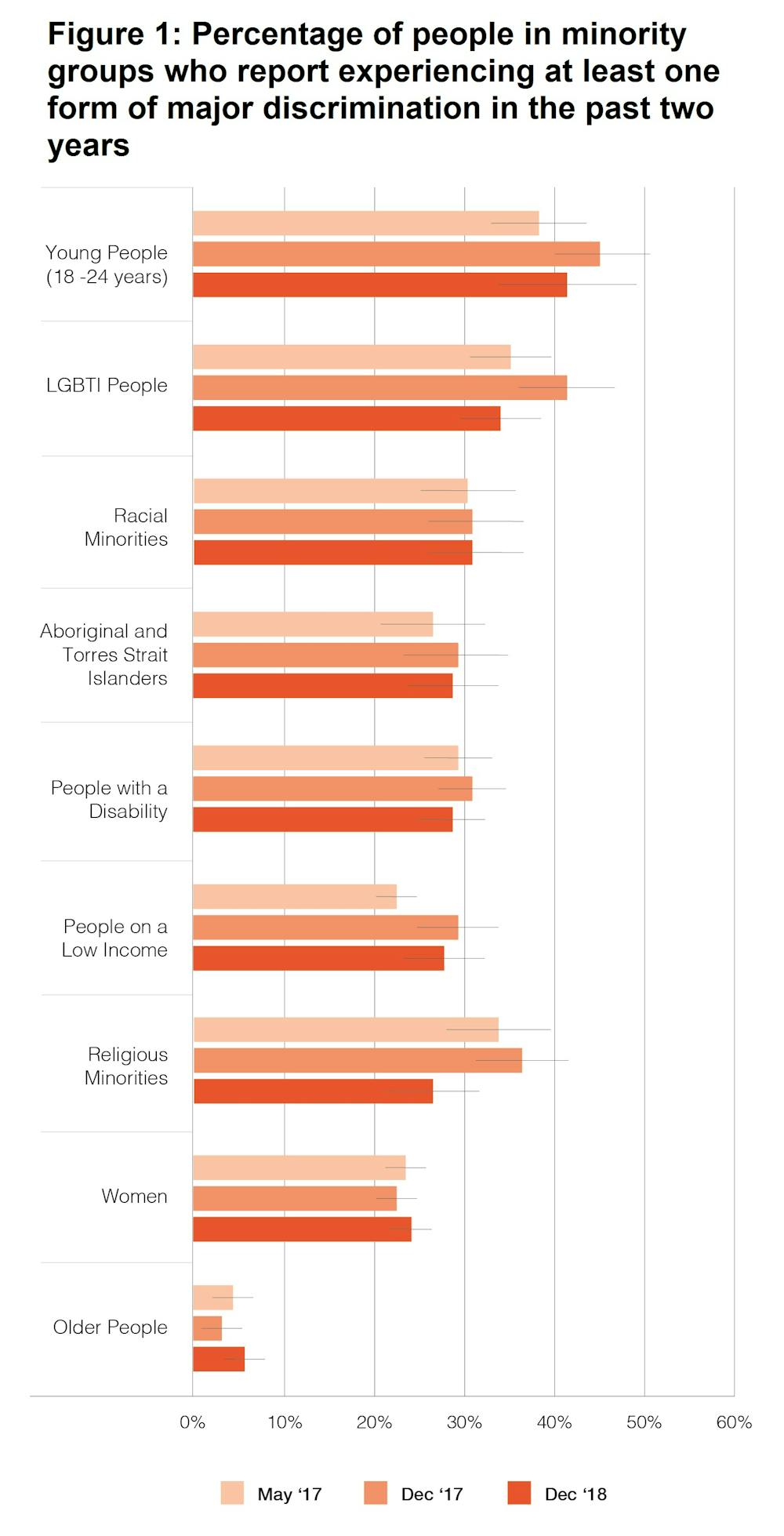
As part of a new research project, we surveyed nearly 6,000 Australians over three waves between May 2017 and December 2018, and found that almost a quarter of Australians have experienced a major form of discrimination. This includes being unfairly denied a promotion or job, refused a bank loan, or discouraged from continuing education.
People under the age of 25, LGBTI people, and racial minorities are most likely to report experiences of major discrimination.
And 27% of Australians have experienced other forms of “everyday” discrimination at least weekly, such as being treated with less respect, harassed, or called names.
We also found that people who have experienced discrimination have a lower sense of well-being and a weaker identification with Australia than those who have not.
The outcome of this research is a new Social Inclusion Index, released today to coincide with the launch of Inclusive Australia, an alliance of individuals and organisations seeking to promote social inclusion using techniques informed by behavioural science.
We asked participants about their views and experiences of social inclusion in Australia based on the following aspects:
prejudicial attitudes and experiences of discrimination
Social inclusion is the process of ensuring that all people – regardless of their race, religion, sexual orientation, age, gender, or disability – are able to fully contribute to society and feel accepted.
Inclusion matters for a healthier and more economically and socially productive population. And in recent decades, governments around the world have devoted substantial attention to improving social inclusion. The World Bank has called it a “moral imperative”.
Overall, our research shows we have some way to go to become a truly inclusive nation. Australia scored somewhat above the mid-point on the index (62 out of 100), suggesting room for improvement.
Levels of prejudice and contact with minorities
To gauge the level of prejudice that Australians have towards others, we asked our participants if they agreed or disagreed with a series of statements, such as “most politicians care too much about racial minorities” or “women are too easily offended”.
While we found that most Australians are not highly prejudiced, a sizeable minority are.
About one in four people are highly prejudiced against religious minorities (27%), racial minorities (27%) and Aboriginal and Torres Strait Islander people (25%).
About one in five people are highly prejudiced against LGBTI people (21%) and one in six against women (17%). Fewer people held highly prejudiced views toward older people (4%) or those with disabilities (6%).
However, nearly one in three (29%) people with disabilities still reported experiencing major discrimination in the past two years.
Behavioural science research has shown that contact between different groups is one of the most effective ways to cultivate empathy and reduce prejudice.
But on this, Australians also have a way to go. We found people had limited interactions with those who are different from them.
For instance, about one in five people “never” have any contact with Aboriginal and Torres Strait Islander people or LGBTI people. One in four “never” have contact with religious minorities.
Willing to speak up
One positive finding from our research was the number of participants who were willing to take action to support social inclusion.
While most were reluctant to be involved in political action, such as demonstrations, more than half were willing to do small but important things every day to promote social inclusion.
These included saying hello to people from other groups, speaking up in the face of discrimination, and listening to and validating the stories of people from other groups.
As a first step towards eliminating discrimination and prejudice, Inclusive Australia is launching an Instagram campaign to encourage people to interact with people from different groups.
Starting today, a different Australian will curate a series of posts every day on the Instagram account @_somebodydifferent.
To counter the echo chambers of social media, in which we tend to communicate only with people who are similar to us, this account will allow followers to see posts about the everyday lives of people who may have very different backgrounds to them.
It is a small but significant step to promoting a more inclusive Australia.
Source: The Conversation (Au and NZ) – By Julie Willis, Professor of Architecture and Dean of the Faculty of Architecture, Building & Planning, University of Melbourne
Welcome to the first article of our Designing Hospitals series, where we explore how architecture and design shape our hospitals and medical centres. Today, we look at changes in hospital design since convict times, from simple huts to supportive spaces that reduce patient anxiety and stress.
Although architecture surrounds us and we engage with it daily, most assume design is benign or inert. Yet it shapes our actions and interactions. In the hospital, design can make the difference between life and death.
Architecture has played a crucial role in the hospital: as an instrument of status, of hygiene, of therapy, of control and, more recently, of support.
As far as we know, the first hospital in Australia was built in Sydney in 1788 and Governor Phillip quickly prioritised building it. It was just the third permanent building colonists erected after the governor’s house and commissariat store (which provided food and other supplies).
The hospital was little more than a dirt-floored hut. It was soon replaced by a prefabricated hospital that arrived with the Second Fleet.
Sydney’s third hospital — the infamous Rum Hospital — was a grand Georgian-style edifice.
The creation and design of these three hospitals said much about their status as key buildings in the colony, but little about the care provided within.
The design of early hospitals in Australia was based on military barracks, rather than the hospital design traditions of Britain. They housed the sick and dying with minimal, if any, provision made for adequate ventilation, sanitation, treatment or medical supervision.
Florence Nightingale revolutionalised design
Reform of hospitals came with the work of nurse Florence Nightingale. Her experiences in the Crimean War led her to write Notes on Hospitals (1858), which revolutionised the way hospitals were designed.
The Nightingale ward was a pavilion containing 24-30 beds in two rows, with a nurses’ station and public entry at one end and an ablution (washing) block at the other.
Windows were placed between each bed, and each bed was a set distance apart, to minimise cross-infection. Each pavilion was separate, for ventilation purposes; later examples stacked the still-separated pavilions into multi-storey blocks.
Florence Nightingale revolutionised hospital design. Note the placement of the beds and windows in this Nightingale ward at St Thomas’s Hospital, London.Wellcome Trust
Australian hospitals from the 1870s to the early 1920s used Nightingale’s principles and are known as pavilion hospitals. You can still see examples at the former Queen Victoria Hospital, Melbourne, and the Royal Prince Alfred Hospital, Sydney.
Then our understanding of how disease was transmitted changed. We moved away from the theory of miasma (where bad air was thought to carry disease), undermining the need for the Nightingale ward.
Instead, the work of Louis Pasteur and Joseph Lister, reinforced by microbiologist Robert Koch in the 1870s, became prominent. This was the idea that certain diseases were caused by germs invading the body.
Nevertheless, emphasis was still placed on a “broad environmentalism” for the hospital. This included ventilation, hygienic surfaces, and restorative natural settings such as gardens.
Technology and therapy shaped design
In the 1920s, two distinct trends in hospital design were evident.
In the first, the Americans focused on technology (ventilation, air conditioning, therapeutic and diagnostic equipment), efficiency (industrial kitchens and laundries, centralised stores) and scale (planning, position, function). One example was the behemoth of the Columbia-Presbyterian Medical Center in New York (1928).
In the second, the Europeans were designing hospitals as instruments of therapy. Patients had access to fresh air and sunlight (heliotherapy, particularly to treat tuberculosis and skin diseases).
To directly access sun and air, bed-bound patients were placed on wide balconies and fully glazed rooms (solaria). Examples here include the Krankenhaus Waiblingen, Germany (1928-30), and the Paimio Sanatorium, Finland (1929-32).
By the early 1930s, these trends had been distilled by the entrepreneurial architect Arthur Stephenson into a series of world-leading Australian hospitals. These included the Mercy Hospital, Melbourne (1933-35), and the King George V Hospital for Mothers and Babies, Sydney (1939-41).
The Mercy Hospital, built in Melbourne in the 1930s, combined the best American and European ideas to reform hospital design in Australia.State Library of Victoria, Author provided
Off to surgery
Inside the hospital, design made a dramatic difference to patients. In the operating theatre, for example, the needs of both patient and surgeon dictated design innovations.
The presence of oxygen and ether (for anaesthesia) made explosion a distinct possibility. So designers paid particular attention to flooring (to minimise the buildup of static electricity) and the temperature and humidity of the air (to minimise sparks).
Lighting had to be shadowless, dustless and not too hot; the surgeon and anaesthetist needed to be able to see but not be blinded by the lights.
Instruments had to be sterile, operating theatre personnel needed to scrub and gown up, and air needed to be purified.
King George V Hospital operating theatre (c1941). Note the hemispherical ceiling shape, lighting and gleaming surfaces. Architects: Stephenson & Turner.Author provided (No reuse)
This led to the first air-conditioned spaces in the hospital and experimentation with paraboloid-shaped theatres with embedded lighting; green walls, drapes and gowns (to minimise eye fatigue) became ubiquitous; and there were separate pathways or systems for instruments, patients, staff, and air handling (such as HEPA filters) to maintain the highest possible levels of cleanliness.
For the patient, these innovations increased their likelihood of survival and decreased their rates of infection.
Towards sealed boxes
The development of drug-based therapies, particularly penicillin, from the 1950s meant hospitals no longer needed balconies for sun therapy. And the push to air-condition the whole hospital led to them becoming hermetically sealed boxes.
Less emphasis was placed on the restorative and healing power of the environment, more on precision and efficiency of medical practice.
Architecturally, hospitals serviced the needs of medicine rather than the patient. Concern was for efficiency of the doctor or nurse, with a focus on function rather than feeling.
From the 1970s, there was increasingunderstanding of the interconnections between humans, health and environments.
A seminal paper in 1984 on how a view from a hospital window could influence recovery from surgery validated the links between patient outcomes and building design. Hospital design needed to change to benefit patients.
Like shopping malls, for the people
A revised approach was evident from the 1980s. This saw the public spaces of hospitals consciously de-institutionalised and modelled as shopping malls — busy places of apparent normality.
More recently, there has been emphasis on patient-centred design that considers ways hospital design can support patients at every point, reducing stress and anxiety and making them more receptive to treatment.
A fly-through of the Peter MacCallum Cancer Centre in Melbourne (built in 2016) shows its emphasis on patient-centred design.
Australian hospitals have led the way in this approach, such as the Peter MacCallum Cancer Centre, Melbourne (2016) and Queensland Children’s Hospital (2014), Brisbane.
Architecture has played an active role in the effectiveness of hospitals over centuries. They’ve not just been containers for care. Hospital design has enabled, encouraged and supported patients and medics to better standards of therapy and treatment.
It’s well established that unsustainable human activity is damaging the health of the planet. The way we use Earth threatens our future and that of many animals and plants. Species extinction is an inevitable end point.
It’s important that the loss of Australian nature be quantified accurately. To date, putting an exact figure on the number of extinct species has been challenging. But in the most comprehensive assessment of its kind, our research has confirmed that 100 endemic Australian species living in 1788 are now validly listed as extinct.
Alarmingly, this tally confirms that the number of extinct Australian species is much higher than previously thought.
A southern black-throated finch, which conservationists say is threatened by the Adani coal mine.ERIC VANDERDUYS/BirdLife Australia
The most precise tally yet
Counts of extinct Australian species vary. The federal government’s list of extinct plants and animals totals 92. However 20 of these are subspecies, five are now known to still exist in Australia and seven survive overseas – reducing the figure to 60.
The states and territories also hold their own extinction lists, and the International Union for Conservation of Nature keeps a global database, the Red List.
An endangered Manning River turtle.AUSTRALIAN REPTILE PARK
Our research collated these separate listings. We excluded species that still exist overseas, such as the water tassel-fern. We also excluded some species that, happily, have been rediscovered since being listed as extinct, or which are no longer recognised as valid species (such as the obscure snail Fluvidona dulvertonensis).
We concluded that exactly 100 plant and animal species are validly listed as having become extinct in the 230 years since Europeans colonised Australia:
4 frogs, including two species of the bizarre gastric-brooding frog which used its stomach as a womb
3 reptiles including the Christmas Island forest skink
1 fish, the Pedder galaxias.
A 19th century illustration of the Pig-footed bandicoot.Wikimedia
Our tally includes three species listed as extinct in the wild, with two of these still existing in captivity.
The mammal toll represents 10% of the species present in 1788. This loss rate is far higher than for any other continent over this period.
The 100 extinctions are drawn from formal lists. But many extinctions have not been officially registered. Other species disappeared before their existence was recorded. More have not been seen for decades, and are suspected lost by scientists or Indigenous groups who knew them best. We speculate that the actual tally of extinct Australian species since 1788 is likely to be about ten times greater than we derived from official lists.
And biodiversity loss is more than extinctions alone. Many more Australian species have disappeared from all but a vestige of their former ranges, or persist in populations far smaller than in the past.
The geographical spread of extinctions across Australia. Darker shading represents a higher extinction tally.
Dating the losses
Dating of extinctions is not straightforward. For a few Australian species, such as the Christmas Island forest skink, we know the day the last known individual died. But many species disappeared without us realising at the time.
Our estimation of extinction dates reveals a largely continuous rate of loss – averaging about four species per decade.
Continuing this trend, in the past decade, three Australian species have become extinct – the Christmas Island forest skink, Christmas Island pipistrelle and Bramble Cay melomys – and two others became extinct in the wild.
Cumulative tally of Australian extinctions since 1788.
The extinctions occurred over most of the continent. However 21 occurred only on islands smaller than Tasmania, which comprise less than 0.5% of Australia’s land mass.
This trend, repeated around the world, is largely due to small population sizes and vulnerability to newly introduced predators.
We must learn from the past
The 100 recognised extinctions followed the loss of Indigenous land management, its replacement with entirely new land uses and new settlers introducing species with little regard to detrimental impacts.
Introduced cats and foxes are implicated in most mammal extinctions; vegetation clearing and habitat degradation caused most plant extinctions. Disease caused the loss of frogs and the accidental introduction of an Asian snake caused the recent loss of three reptile species on Christmas Island.
The causes have changed over time. Hunting contributed to several early extinctions, but not recent ones. In the last decade, climate change contributed to the extinction of the Bramble Cay melomys, which lived only on one Queensland island.
The prospects for some species are helped by legal protection, Australia’s fine national reserve system and threat management. But these gains are subverted by the legacy of previous habitat loss and fragmentation, and the ongoing damage caused by introduced species.
Our own population increase is causing further habitat loss, and new threats such as climate change bring more frequent and intense droughts and bushfires.
But now is not the time to weaken environment laws further. The creation of modern Australia has come at a great cost to nature – we are not living well in this land.
The study on which this article is based was also co-authored by Andrew Burbidge, David Coates, Rod Fensham and Norm McKenzie.
What many are wondering about the results tomorrow include
where does Australia’s education system sit internationally?
which countries are doing better than we are and which are doing worse?
how are we doing internally – across states and territories, between girls and boys, or children from different socioeconomic and cultural backgrounds?
The last PISA 2015 report, published in 2016, showed Australia was behind countries such as Singapore, Canada and China in maths and science, and below Singapore, Canada, New Zealand and Ireland in reading.
The first PISA test was in 2000. The three assessment domains are rotated every three years, so one domain is the major focus (the major domain). A larger amount of the assessment time is devoted to this domain compared to the other two (the minor domains).
Reading was the major domain in 2000 and 2009, and again in PISA 2018. This means Australia will now have PISA reading results from three different time points. This allows us to investigate trends in average performance (up or down or flat) as well as look at reading in greater detail.
The last results showed Australia had been slipping in maths, science and reading since 2012.from shutterstock.com
The last cycle showed Australia had slipped in each domain since 2012, which means we were getting worse at preparing students for the everyday challenges of adult life. All eyes with be on this report to see whether these declines have been arrested.
What is PISA?
PISA is a two-hour test to see how well students in secondary schools across all 36 OECD countries, and 43 other countries or economies, can apply reading, maths, science and other skills to real-life situations.
Rather than focusing on a particular grade or year level, PISA tests 15 year olds – or more specifically, students who are between 15 years and three months and 16 years and two months at the beginning of the testing period and are enrolled in an educational institution, either full-time or part-time.
This is because, in many of the countries that participated in PISA in the early years, students of this age are usually nearing the end of their compulsory schooling.
The assessment takes place every three years and students are tested in the three areas each cycle. Assessments areas such as financial and computer literacy, or collaborative problem-solving, change from cycle to cycle.
It would be hugely costly and time-consuming to test every 15 year old in the more than 70 participating countries. So a representative random sample of schools is drawn from all schools in each system being tested. Then, a representative sample of students is drawn from within each of those schools.
PISA was not designed to provide scores for individual students or schools – students don’t even complete the same test as the other students in the room. In PISA 2018, for example, there were more than 36 different test forms, covering different parts of the assessment.
In Australia, 740 schools and just over 14,200 students participated in PISA 2018.
What the test looks like
There is major difference between PISA and some other international student assessments such as the Trends in International Mathematics and Science Study (TIMSS). This focuses on how well students have learned the content of a defined curriculum.
PISA questions are designed to test students’ applied knowledge in reading, mathematics or science.
For instance, a science question (below) in the last cycle concerned bird migration.
Most migratory birds gather in one area and then migrate in large groups rather than individually. This behaviour is a result of evolution. Which of the following is the best scientific explanation for the evolution of this behaviour in most migratory birds?
birds that migrated individually or in small groups were less likely to survive and have offspring
birds that migrated individually or in small groups were more likely to find adequate food
flying in large groups allowed other bird species to join the migration
flying in large groups allowed each bird to have a better chance of finding a nesting site.
The next question asks students to identify a factor that might make the volunteers’ counts of migrating birds inaccurate, and explain how that will affect the count.
The type of testing has also changed in line with the way our societies have changed in the two decades PISA has been around. Students now take the assessments using computers, for instance.
The nature of reading has changed too, drastically. In the past, reading was mainly about extracting knowledge from linear texts in established sources. When students did not know the answer to a question, teachers could direct them to look in an encyclopaedia and the answer would be trustworthy.
Today, digital search engines provide students with millions of answers, and it is up to students to figure out what is accurate and what is misleading and potentially dangerous. PISA is now testing how students navigate multiple-source texts, deal with ambiguity, distinguish between fact, opinion and sensationalism, and triangulate different sources to construct knowledge.
Why we need PISA
There are many criticisms of PISA. From the fact the OECD allows some countries to test just regions – like B-S-J-Z (China) – to criticisms of the argument an increase in a country’s PISA scores will result in an increase in that country’s economic wealth.
Despite these criticisms, PISA is robust, and provides an idea of how countries are performing comparative to each other. It provides a birds-eye view of a country’s average student performance, or a state’s average student performance.
This allows us to look deeply and identify groups that might not be performing as well as we hope, or skill areas students aren’t grasping well.
And by the way, the answer to the bird question is option one.
In the 1990s, central Dandenong in Melbourne’s southeast was in decline. But, over the past decade and a half, this trend has been halted and in some areas reversed. Our research has identified key elements in this revitalisation, including strong roles for both public sector and non-government participants.
Importantly, the approach has delivered new opportunities for the culturally diverse local community.
At the time these efforts began, a shrinking manufacturing sector and poor urban planning decisions had drained vitality from the centre. New shopping malls and suburban estates enticed people to live and shop elsewhere. Public spaces were dilapidated. Many retail buildings were vacant.
Unsurprisingly, local population levels were stagnating. Affordable rents and a community with strong networks of support attracted some new residents, most from culturally and linguistically diverse backgrounds. However, once settled, many people faced barriers to employment, training and adequate public facilities.
Who is behind the project?
The Victorian government and the City of Greater Dandenong were keen to reverse these trends. They wanted to reinstate the neighbourhood as Melbourne’s second-most-important urban centre. The state government funded the Revitalising Central Dandenong project from 2006.
Since then, and particularly since 2011, the process has also been propelled by local government action and the coordinated efforts of local leaders. They represent business, education, faith communities and social services. These interlinked activities across sectors have arguably been effective in kick-starting the project.
However, some important shortcomings have limited the potential for revitalisation. In particular, the benefits have not reached all of the community.
For example, many female migrants have not had access to suitable employment opportunities. Services are lacking for some marginalised community members, including asylum seekers.
Other concerns include persistent barriers to retail activation (including rising rents and parking costs), emergent threats of gentrification and a lack of major private investment in residential and office development.
Our research briefing explains our findings in detail, including some of these problems.
The development of central Dandenong is continuing.Photo: Hayley Henderson, Author provided
What are the key elements that work?
1. A commitment to redistributive policy
A significant one-off Victorian government investment of A$290 million was the cornerstone of the project, and it has been carefully designed. Experienced professionals appointed to the government development agency, then known as VicUrban, crafted the program.
The early focus was on catalyst projects and the removal of roadblocks to the considered development to follow. These actions included:
special zoning
transferring planning powers to the state government
acquiring about 150 sites for reconfiguration and development.
Given the entrenched decline, revitalisation was unlikely to occur without significant public commitment.
Following the state government’s energetic program start, the local government has taken the reins since 2011. The council gave priority to revitalising works in the centre (see the table of major project spending below) and to covering gaps in the original strategy. This included a housing strategy in response to emerging gentrification.
Data source: City of Greater Dandenong annual reports, 1999-2016, Author provided
Because macro-policy in urban planning often fluctuates, local communities cannot depend on secure, long-term funding for discretionary renewal projects. To achieve revitalisation through redistribution, local government leadership is vital for maintaining focus on one area over others.
Refined skills in urban planning strategy and financial management have also been indispensable to the project.
2. Strong local networks
The public program was enhanced because community leaders already knew each other and were predisposed to work together. They ranged from education providers (such as Chisholm TAFE and Deakin University) and faith groups (such as Interfaith Network) to trade associations (such as South East Melbourne Manufacturers Alliance) and private sector groups (such as the Committee for Dandenong). These groups worked both together with and separately from the publicly funded program.
Active and organised local leaders provided vital input on strategy design, partnered or led delivery of specific initiatives and put their organisations to work on gaps in the program. They also powerfully advocated for governments to remain focused on revitalisation.
Overall, these strong local networks enabled smoother policy development and delivery. Having an organised and receptive community to engage with was important.
Our research underscores the value of acknowledging the effectiveness of existing local strategies and community capacities. It highlights the need to work collaboratively. This includes a focus on the “soft side” of practice – that is, building relationships.
Enhanced opportunities have been created for many culturally and linguistically diverse communities. How so?
Policies generally support cultural pluralism, as diversity is accommodated and promoted.
Affordability across diverse housing types has been maintained. This supports social mixing between people and a place identity based on cultural diversity.
Diversity in housing types in Dandenong and Greater Melbourne
Changes in housing diversity in Dandenong and Melbourne (% houses versus units/terraces), 2001-2016.Source: developed from ABS Census data 2001, 2006, 2011 & 2016, Author provided
The well-curated mix of land uses in the centre brings in many people and activates public spaces. This approach supports safety, casual encounters and understanding between people.
Dandenong Market has been refurbished by the City of Greater Dandenong.Photo take by Hayley Henderson, Author provided
We found some local services also provided opportunities for people to make lasting connections – for example, language courses run by churches and neighbourhood houses.
Many migrants took up local education, training and employment opportunities (with some important exceptions, especially female migrants).
Our forthcoming analysis on Policy Forum further explains the ethic of cultural pluralism in policy and society.
Overall, urban centres cannot avoid fallout from broader economic restructuring, nor are they immune to poor strategic planning decisions or funding cuts that affect their prospects. Central Dandenong shows revitalisation can occur despite significant disadvantage. It has been achieved through a combination of public sector leadership and an interconnected and active local community.
Productivity growth matters. In advanced economies over the past 15 years it has fallen by half.
Which is why it doesn’t make much sense to risk damaging one of the most important potential sources for future growth in productivity: the rollout of 5G.
5G is the next generation of wireless technology. Download speeds will be many times faster than what is possible under 4G.
And it’s not just speed. It’ll cut latency, which is the time it takes for signals to start travelling – something that will be critically important for the Internet of Things.
Nurtured well, 5G has the potential to become a “general-purpose technology”, analogous to electricity.
It holds open he possibility of creating new markets for goods and services that we can’t yet imagine.
The best suppliers of the gear required for 5G are in China, most notably Huawei, which has made the heaviest investments in the relevant technology but the problem is that Huawei caught up in security concerns.
There is a risk that the rejection of Huawei by some will end up, in the longer term, dividing the world into zones committed to different standards, limiting interconnection.
One estimate suggests that banning Huawei could push up costs 30%.
Huawei poses risks…
In announcing what amounted to bans on Huawei (and also China’s ZTE), the Australian government said 5G required a change in the way the networks operate compared to previous mobile technologies.
These changes will increase the potential for threats to our telecommunications networks, and these threats will increase over time as more services come online.
The government had found “no combination of technical security controls that sufficiently mitigate the risks”.
Vendors likely to be subject to extrajudicial directions from foreign governments risked failure to adequately protect 5G networks from unauthorised access or interference.
Southeast Asian economies are considering degrees of engagement with Huawei.
Worth continuing attention by Australia is what former US defence secretary Robert Gates calls the “small yard, high fence” approach.
It means defining exactly where the risks lie and intervening directly to manage them, something Europe is working on.
The US appeared to be struggling after Trump’s May order. The Commerce Department was given 150 days to come up with regulations to implement it. It released a draft only last week.
There were reports of tension in the US between those who would take the risk-based approach and others who would simply keep Huawei on the banned provider list.
Commerce has, finally, proposed a case by case approach, and has not named any particular provider. But the Federal Communications Commission has banned Huawei from access to its universal services subsidies.
International cooperation could give us room to solve the problem. It could include cooperation with China. China and Australia share concerns about cybersecurity and could together in the same way as we do over other standards to facilitate trade.
Attempting to completely eliminate risk could lumber us with big costs. Some would be financial, others might come from stunting the next technological revolution.
Source: The Conversation (Au and NZ) – By Joanna Mendelssohn, Principal Fellow (Hon), Victorian College of the Arts, University of Melbourne. Editor in Chief, Design and Art of Australia Online, University of Melbourne
Review: Hugh Ramsay, National Gallery of Australia, Canberra
Hugh Ramsay’s Two girls in white, known for many years as The sisters, is one of my first memories of the Art Gallery of New South Wales.
I was intrigued by these women wearing fancy clothes, who were interesting rather than pretty.
Later I came to appreciate how Ramsay used obvious strokes of paint to imply texture, as well as the many different colours that were white. When I studied art history, I realised the painting was in part an homage to the virtuoso treatment of fabric by John Singer Sargent and the tonality of James McNeil Whistler.
However, the faces don’t fit the model of fashionable Edwardian portraiture. There is no flattery here. Their strong, raw features imply honesty and strength of character. Who were they, and why were they staring so intently?
The answer lies in the date, 1904, two years before Ramsay died of tuberculosis at the age of 28.
Two girls in white is a composite study of three of Ramsay’s sisters, looking at the brother who has been told that the decision to paint them will shorten his life. And those red flushed cheeks on one of the two? The figure on the right is a combination of the elegant Madge and Jessie, who nursed the acutely ill Ramsay when he returned from Paris. Jessie died four years later from the same illness. Rosy cheeks are one symptom of the disease.
The Ramsay exhibition is a visual record of the pathways leading to this work.
It opens with the rigorous but dull teachings of Bernard Hall at Melbourne’s National Gallery School. Ramsay excelled in painting the precise backs of nudes so valued by his teacher, but he recognised the limitations of Hall’s pedagogy.
Instead, he sought the company of artists recently returned from Paris, befriending the older John Longstaff, who would become a lifelong mentor.
Self-portrait in white jacket (1901-1902).National Gallery of Victoria
Ramsay’s father, who had brought the family from Scotland when the artist was a baby, objected to his career choice. He had some financial help from an older brother but the young artist raised most of his own money to travel to Paris. The cold and malnutrition he experienced as a result of poverty was one of the triggers for his final illness.
With the exception of some commissions, most of Ramsay’s subjects were his sisters, his friends, and himself. One advantage of such a limited repertoire is that it is easier to track how his art developed in Paris.
There is a liberation of paint, but a continuance of the muted palette first seen in Melbourne. He ventured into fashionable decorative symbolism, but for the most part he placed himself in the academic tradition of Velázquez, with a nod to Whistler and sometimes Sargent with his virtuoso frills and furbelows.
At NGA, a series of self-portraits dominates one wall, each giving subtly different approaches to tone, using his body as an element in the overall composition.
Interior of artist’s studio (1901)National Gallery of Victoria
There is no figure in Interior of an artist’s studio, but this exquisite small study, balancing forms and shapes in tonal harmony, gives an idea of one direction his art may have taken if illness had not intervened.
Then there is the deliberately angular Jeanne, a Whistler inspired portrait of his concierge’s daughter. The muted tones of the thinly applied paint are lifted by the red bow in the little girl’s hair.
The grandest of patrons was Patterson’s relative by marriage, Nellie Melba. The exhibition includes a small study for the grand portrait that Ramsay planned to paint of her. He travelled to London for the commission but just as his talents were being noticed, he was diagnosed with tuberculosis.
Melba lent him money to return to Australia, where she hosted a solo exhibition at her house in Toorak. She continued her support him with commissions to paint a portrait of her ailing father and her niece, Nellie Patterson.
It seems Ramsay was determined to leave a legacy that would endure. After he was told painting would exacerbate his illness, Ramsay painted his largest work, An equestrian portrait, a study of his doctor’s son.
An equestrian portrait (1903).National Gallery of Victoria
He painted portraits of his sisters, culminating in Two girls in white, which he completed in 1904. It is not his final painting. There was another, incomplete, self-portrait, focusing on his solemn face, looking at the underlying structure of his bones, painted just months before his death.
Ramsay was perhaps luckier in his afterlife than in his life. For well over a century, his family have worked to ensure his place in Australian art history. As well as donating many works to public collections, they have endowed the Hugh Ramsay Chair of Australian Art History.
If he were not such an outstanding artist this familial devotion to his memory would be awkward. As it is, the Ramsay family have done us all a service in keeping Ramsay’s name alive in the narrative of Australia’s art history.
Hugh Ramsay is showing at the National Gallery of Australia until March 2020
Whether or not this would “modernise” the law, these are media-friendly reforms that will make it harder for people to succeed in suing a news organisation in defamation. The campaign for media freedom by Australia’s news organisations has paid off.
A new public interest defence
Perhaps the most significant aspect of this proposal is a new defence of “responsible communication in the public interest” – a version of a defence developed in New Zealand.
The defence protects certain communications made by the person being sued, like a newspaper or a journalist. It requires the defendant to prove, firstly, that the matter is of public interest, and secondly, that its publication is responsible.
The defence will probably become the focus of a lot of litigation.
For example, if an issue is interesting to the public, does that mean that reporting on it is in the public interest? The public may be interested in what happened to the Prime Minister at Engadine Maccas in 1997, but that doesn’t mean reporting on it is in the public interest.
When is a publication “responsible”? The proposed changes set out a list of relevant factors, which include
the extent to which the matter published relates to the performance of the public functions or activities of the person.
In other words, reporting on politicians is more likely to be “responsible” than reporting on what your neighbour is up to.
Another factor relevant to whether reporting is “responsible” is the sources of the information in the matter published, including the source’s integrity.
This is a good addition. It means journalists won’t have a defence if they engage in dodgy journalism.
We do already have a version of this public interest defence called “qualified privilege”. This defence remains, with some tweaks, under the proposed reforms. But the new public interest defence is stronger.
A key difference between qualified privilege and the new defence is qualified privilege is defeated if the publication was made with malice.
Inspired by UK legislation, it means a person cannot even sue unless they have actually suffered, or are likely to suffer, serious harm.
Although this will stop petty stuff clogging up the courts, it may create a whole new source of work for defamation lawyers, such as mini fights, called interlocutory disputes, over whether the harm caused by a publication is “serious” enough.
On the other hand, this change may deter some people from suing at all.
Less money for defamation plaintiffs
Other proposed reforms include tweaks to the cap on damages for non-economic loss. There is already an upper limit on the amount of damages that may be awarded for defamation which does not cause measurable economic loss but still harms the plaintiff’s reputation.
The cap can be exceeded if the defendant was particularly dodgy, where “aggravated damages” are justified. In cases like that brought by Geoffrey Rush, courts have interpreted the legislation to mean massive awards are available if the defendant has done something to “aggravate” the plaintiff’s suffering.
The proposed change clarifies that the cap applies even if aggravated damages are justified. But aggravated damages may then be awarded on top of the capped amount in serious cases.
Basically, this means we’ll probably see smaller sums of money being awarded to winners of defamation cases.
A single publication rule
Under legislation called Limitation Acts, a person wronged by another only has a certain amount of time they can sue.
For defamation, time starts running out when “publication” occurs.
But under existing laws, there is a new publication each time something is downloaded from the internet. This is called the “multiple publication rule”. It means online publishers, like news organisations, are under perpetual threat of being sued.
Under the proposed changes, there will be a “single publication rule”. Time starts running when the matter is first posted or uploaded, and then “runs out” after one year, or after three years in certain cases. It’s another significant improvement for the media.
A big win for the media
These proposed reforms adjust the balance between freedom of speech and protection of reputation struck by defamation law, expanding freedom of speech and enhancing media freedom.
Is that a good thing? It cuts both ways.
Freedom of speech is great until a smear campaign ruins your life. We should not buy into the far-right dogma that “freedom good” no matter what.
Media freedom is good, but absolute media freedom will lead to a nastier, more brutish public discourse. I worry these changes will embolden some sections of the media to engage in more aggressive political take-downs – more “gotcha” journalism.
This is not much of a victory for mainstream Australia. More than anyone else, this is a win for the lucky few who hold they keys to Australia’s media, whose support is essential to the political survival of those proposing these changes.
What next?
These proposed reforms are just that: proposed. Those in charge of the reform process are inviting submissions.
If the reforms are carried out in mid-2020, they will be “stage one”. A second stage of reforms will look at the liability of digital platforms like Facebook and Twitter.
If traditional media companies have their way, these companies eating into their advertising revenue could also be sued in defamation law. That would be great for media barons, journalists with insecure employment, and defamation lawyers like me.
Many remember Clive James as the wry television presenter, but long before his small screen success, he honed his performing and writing skills at the University of Sydney.
As James himself recognised, they were the lucky beneficiaries of a generous Commonwealth Scholarship Scheme:
Menzies educated the whole generation that would later on vilify his memory. That made all the difference as we were all at university.
It was right time, right place, and these students revitalised drama on campus, drawing the attention of mainstream critics with their stylish productions of the classics, and some of the most innovative contemporary drama from England and Europe, in addition to the irreverent, political and satirical annual university revues they themselves wrote and staged.
Sydney University’s season of three plays.Author provided (No reuse)
In revues
James was a prolific writer, contributing a steady stream of articles, poems and reviews to the student newspaper, Honi Soit. He documented the torrent of productions, including the world stage premiere of Beckett’s radio play All That Fall, Leo Schofield’s somewhat subversive production of HMS Pinafore, and he especially loved Ken Horler’s direction of Capek’s satirical Insect World, singling out Rosaleen Smyth as “a star” in the making.
“I can think of no other thing to say about her that could convey the way I see this actress,” wrote James, although as he was well known to be smitten with Smyth, his journalistic objectivity was shaky at best.
By 1958 he had launched himself into writing for the university revues: his skits were so good that they were recycled in revues for years to come.
His funny take on the Helen of Troy myth featured in the 1960 revue. In it actor Jenny Towndrow burst onto the stage (“like a nuclear explosion” according to Honi Soit), as Cassandra, singing:
Zippy de do dah
Zippy de eh
I’ve had a hint of a horrible day
Hordes of destruction heading our way
Zippy de do dah
Zippy de eh…
Having completed her calamitous prophesy she skipped off again, and Priam and Hecuba deadpanned:
Priam: She’s a gloomy girl.
Hecuba: Never liked to play with the other children.
Inherent vice
In 1961, James not only directed the revue, Wet Blankets, but also wrote eight of its 14 skits. He had, according to his contemporaries, very clear ideas on how his work should be performed – indeed, some believed he wanted to perform all his own work himself.
Clive James and Brian Sommers co-directed Wet Blankets.Author provided (No reuse)
James was keenly aware of the powerful lure of the stage. The previous year the Sydney University Players staged an ambitious season of plays, with profits being donated to the Sydney Opera House Building Fund.
Schofield directed the Australian premiere of Brecht’s Good Woman of Setzuan, and Horler (later one of the founders, along with Bell, of the Nimrod Theatre) created a highly acclaimed production of Twelfth Night, starring Bell as Malvolio and Gaden as Sir Toby Belch. But the season kicked off in a city theatre, with Lysistrata.
In this classic Greek comedy, set in the Trojan Wars, the womenfolk deny their fighting men sex as a strategy to end the wars. This “sex theme” attracted the attention of the state censor, who two years later would ban one of Bruce Beresford’s early student films, It Droppeth As the Gentle Rain, for obscenity.
Two policemen dutifully attended the first performance of Lysistrata but no further action was taken. On the second night of the season, with the vice squad safely out of the way, James bounced on stage as a Spartan herald – with a large, rolled scroll strategically angled under his very short Grecian tunic. James revelled in the audience’s delighted reaction.
One-time girlfriend Jill Kitson (who became an ABC broadcaster), was also in the cast, and vows this was the moment from which James set out to publicly perform as part of his brilliant career. Writing decades later, Schofield reflected that those who had seen the production “recognised early two … of Clive’s ruling passions, sex and showbiz”.
James was among the Brilliant Creatures who led the cultural revolution of the 1960s.
Lasting legacy
The friendships and collaborations formed while television was in its infancy have flourished for over six decades and enriched cultural life in Australia and beyond.
In an interview for our book The Ripples Before the New Wave: Drama at the University of Sydney 1957-63, James modestly told Robyn Dalton and myself he was convinced:
One day we’ll all be remembered, if we are, because we once knew Madeleine St John. She was the genius; we didn’t know it at the time.
St John, the first Australian nominated for the Booker Prize, wrote a series of sparkling novels James loved. Her book Women in Black follows the lives of a group of department store employees in 1959 Sydney and includes a main character based on another of James’ university friends. James recommended it to Beresford who optioned the film rights.
The character of Lisa (Angourie Rice) in Ladies in Black was based on Colleen Olliffe (Chesternan) – a university friend of James, Beresford and St John.IMDB
Beresford’s acclaimed 2018 film, Ladies in Black, is a loving tribute to the era when this group of young people were taking their first steps in their adult lives.
James’ contributions then, and since, will ensure that he too, will be long and fondly remembered.
We all want to reduce drug-related harm and ensure young people don’t take unnecessary risks. But decades of research shows fear isn’t an effective way to do this.
This week, Newscorp Australia released The Ripple Effect, a series of articles and accompanying videos about party drugs, aimed at parents of young people.
Rather than drawing on the science about reducing harm, the series overstates the nation’s drug problem and the likelihood of problems from taking MDMA (ecstasy). And it’s likely to scare the wits out of parents of teens.
So, what do parents really need to know about party drugs?
Most young people don’t use drugs
Illicit drug use among teens is low and has been in decline for nearly a decade.
Although Australians overall have a relatively high rate of MDMA use compared to similar countries, only a small proportion of teenagers (around 3%) and young adults (7%) have used MDMA in the last year. Among high school students, the overwhelming majority (94%) have never tried MDMA.
Normalising the idea that drug use isn’t that common is a key prevention strategy in drug education. If young people think “everyone” is using drugs, they are more likely to want to do it too.
Scare tactics don’t work
As the Ripple Effect notes, NSW Health decided to drop a “shock campaign” on MDMA. The evidence shows scare tactics don’t help reduce young people’s drug use.
Fatal overdoses are relatively rare. Most people who use party drugs have no adverse consequences. So when young people see messages suggesting all drug use is dangerous, they know it’s not true and may switch off, ignoring effective harm reduction messages.
Describing drugs as “deadly” or “dangerous” can actually make them more appealing, encouraging some people to seek out more of the potent product.
The idea we can eliminate drugs from society by telling young people to “just say no” is, at best, misguided. Campaigns with a prohibition approach are not effective.
These interventions fail for many reasons. They don’t teach teens the interpersonal skills needed to refuse drugs; they don’t address internal motivation to experiment or take risks; and they don’t take into account the “forbidden fruit” effect in which restricted or banned activities become more desirable.
Young people who use drugs say the threat of police and drug dogs does not deter them from taking drugs. The NSW Coroner recently noted that some police practices at festivals, such as strip searches and sniffer dogs, can result in young people making more dangerous decisions about drug use, such as taking multiple doses at once.
The reality is that a small percentage of people will experiment with drugs and some will continue to use them. Harm reduction accepts that reality and seeks to keep those who choose to use drugs as safe as possible. Most people who use drugs do so only occasionally and for a short time in their lives.
While all drug use carries risks, most drug-related problems, including fatal overdoses, are preventable. This is because drug-related harms are heavily dependent on a range of factors such as temperature, knowledge of what you are taking, and how you take a drug.
How events such as music festivals are regulated impacts the kinds of harms that arise. Freely available water, medical staff who understand drug use, peer support and education can greatly reduce risks.
Data from a dance festival pill testing initiative in Portugal found 74% of participants would not use the tested drug after receiving unanticipated results; they said they were concerned about the “unknown” nature of the adulterants or potential harms of known adulterants.
Talk early, openly and often to young people about drugs
Remember, few young people use recreational drugs. And if they do, their drug use is most likely to be occasional. More than half the people who use MDMA use only once or twice a year.
Preventing drug use and reducing harms can start at an early age, even before school. Early and age-appropriate education about medicines, tobacco, alcohol and illicit drugs means a young person already has well-formed attitudes before the influence of their peers kicks in.
Children are strongly influenced by their parents’ attitudes when it comes to alcohol and other drug use. For example, exposure to parents’ drinking or drug use can increase risk of teens drinking and using drugs; an inattentive approach to monitoring children’s activities is associated with teen alcohol and other drug use; and openness to discussing drugs is associated with lower rates of substance use.
Young people with parents who keep an open and honest dialogue about drugs are more likely to discuss difficult issues with them.
Source: The Conversation (Au and NZ) – By Sarah Webber, Research Fellow in Human-Computer Interaction and Animal-Computer Interaction, University of Melbourne
Earlier this week, Russian farmers announced they are testing virtual reality (VR) for dairy cows.
Conducted at the RusMoloko farm near Moscow, the trials supposedly use specially adapted goggles to show the animals a view of a pleasant field in summer. The idea is to make the cows happier, which in turn could make them produce more milk.
Some have doubts over whether the tests are real, and it wouldn’t be the first time pictures of animals in VR headsets have been used to capture public attention. Similar images of CatVR and “virtual free range” chickens have appeared in the past.
But to take the idea seriously, at least for a moment: can animals perceive virtual reality the same way we do? And would it do them any good?
The grass may be greener in virtual reality, but you can’t eat it.Moscow Ministry of Agriculture and Food
Virtual entertainment for animals
Unfortunately for the emerging VR industry, there is little to suggest that gazing on a virtual landscape will make cattle happier.
Could virtual reality for animals ever be a good idea? Cognition researchers working with chimpanzees have given the animals access to a virtual maze environment to study their spatial cognition abilities.
In this research the chimps were given food rewards when they successfully located objects in the maze. There’s no evidence they enjoyed the VR experience for its own sake. And the chimps didn’t wear VR headsets; the virtual world was displayed on a computer screen and the animals navigated using a joystick.
A visual VR experience might be appealing to humans, but would likely have less inherent value for animals. Humans can understand symbolic imagery, complex language-based events, and the written word. So visual technologies such as television, smartphones and VR can provide us with long-lasting entertainment, intellectual stimulation, and social connection.
This is not so for other species. While some dogs might watch TV, their interest is usually short-lived unless it has a meaningful outcome, such as the opportunity to chase and bark at animals on the screen. Similarly, some cats play with iPads and digital toys for short periods, but usually only keep up the behaviour if they are intermittently given a reward when they catch the “prey”.
At the same time, there is interest in providing cattle with “environmental enrichment”. This takes the form of objects and activities to provide physical and mental stimulation, in the same vein as toys and puzzles for pets and zoo animals. As well as improving the animals’ well-being, it seems to improve dairy production outcomes.
Good animal enrichment addresses the physical and behavioural needs of different species that are not already met in their existing environment. Good enrichment can also give animals more agency – more control over their lives and their environment. For cows, enrichment might look more like a sophisticated brush than a VR headset.
Cows can choose how and when to use the brushing machine.
In our research, we have investigated approaches to designing technology-based enrichment that responds to animals’ real needs. In 2016 we trialled digital enrichment for orangutans at Melbourne Zoo, offering the animals a range of games and apps that could be made more complex as animals learn.
How tech for animals can change humans
There seems to be something inherently fascinating in seeing animals using technology that is “meant for humans”.
When we provided digital games for orangutans at Melbourne Zoo, we investigated the effect on visitors’ perceptions of the primates. We found that seeing the animals using technology influenced people’s empathy for the orangutans. Others have also proposed that digital games for pigs might encourage people to reflect on the needs of farm animals.
So while VR for cows may not directly improve their well-being, it just might encourage people to think more about what animals need.
University of Canberra Deputy Vice-Chancellor Professor Leigh Sullivan and Michelle Grattan discuss the “unexpected” loss of the government’s union legislation. They also talk about the ongoing saga with Angus Taylor’s letter to the Mayor of Sydney, Clover Moore. They then look towards the last parliamentary sitting week of the year, where the government will have another challenging legislation to pass through the Senate – the repeal of the Medevac bill.
There has been little real debate on an important Government announcement made last weekend. Justice Minister Andrew Little said the Government had decided to give the right to vote back to prisoners with sentences of three years or less.
Perhaps it’s appropriate that there was no great reaction. After all, the change affects so few prisoners – about 1900 – and is likely to have no real electoral impact. And, in fact, the Government was probably keen for as little publicity as possible, given their fear of any negativity from conservative voters about being too liberal on crime.
The National Party sought to create a backlash over the issue, with leader Simon Bridges calling the decision “soft on crime” and promising to reverse the decision once in government. But, despite the rhetoric, there isn’t actually a huge difference between the major parties on the issue, as Labour has decided to retain the voting ban on prisoners with longer sentences. Essentially, they’ve agreed to revert to the pre-2010 situation in which only those prisoners with sentences of more than three years are prohibited from voting.
I’ve written about this today in the Guardian, arguing that this amounts to a half-measure, and is the bare minimum the Government could get away with given recent declarations against the ban from the Waitangi Tribunal and the Supreme Court – see: Ardern’s prisoner voting compromise exposes the cynicism of NZ politics.
I argue this compromise “solution” falls short of what progressives might really want: “Progressives – and possibly even most Labour MPs – support all prisoners being given the right to vote. But the government fears this would be too unpopular and so has compromised, hoping to appease progressive voters with an improvement, but not scare conservatives by retaining the voting ban for the worst criminals.”
Essentially the Labour-led Government is allowing the National Party to set the agenda on law and order issues, and it “doesn’t augur well for next year’s election campaign, which could descend into an auction of awfulness on crime and punishment.”
Other commentators have also lamented that the Government hasn’t been braver. Blogger No Right Turn says the decision “raises a number of questions. Most obviously, why they’re not going the whole way, and restoring voting rights to every prisoner, rather than just going back to the status quo ante? Because the arguments for short-term prisoners being able to vote apply just as powerfully to long-term ones. But Labour is the government of half-measures, so I guess that’s all we’ll ever get from them” – see: Erasing the infamy.
Former Alliance MP Liz Gordon has challenged the decision to re-introduce the three-year prison sentence as the threshold for voting rights: “While National can be criticised for its essentially nonsensical position, the Labour coalition really are not much better. What the government has done is applied exactly the same test as National but simply drawn the line higher. Those people sentenced to more than three years in prison are beyond the pale. They should not be allowed to vote. Really? Why three years, and not two or four?” – see: Votes for all.
Gordon ponders whether Labour’s argument for excluding some prisoners from voting amounts to some sort of slippery slope: “Are ‘prisoners’ the only category we may want to exclude? How about ‘white supremacists’, for example, or men who watch child pornography. That’s the tricky thing about values – they are a slippery slope down which the principles of a universal suffrage can quickly disappear.”
Similarly, Gordon Campbell puts the case against the three-year “arbitrary” threshold for human rights: “Usually when the state imposes subsequent restrictions on rights in the wake of criminal sentences being served – eg on the future ability to own weapons, or to drive vehicles – there is a direct connection between the original offence and this subsequent restriction of rights. Cancelling the right to vote though, bears no such connection to the original offence. It seems utterly gratuitous” – see: On restoring prisoners’ right to vote.
A moderate path had to be found, because “the Labour Party again finds itself in a halfway house pleasing no one between the ‘hard on crime’ coalition partner New Zealand First and the ‘soft on crime’ confidence and supply partner in the Greens.”
Elaborating on this, the Otago Daily Times pointed out earlier that liberalising too much would be seen as “soft on law and order” and would not be “a winning strategy” – see the editorial, Prisoners and the right to vote.
The newspaper endorsed a compromise solution: “The middle road, that established before 2010, might not satisfy the purists on each end of the debate. But sometimes such approaches are pragmatic and as just as possible.”
But is the issue even that important? Not according to talkback radio host Andrew Dickens, who says Anger over prisoner voting rights is a lot of hot air. He says both sides of the debate are engaging in “hollow virtue signalling” over something of little consequence – especially as few prisoners are likely to take up the opportunity to vote anyhow.
Similarly, columnist Martin van Beynen thinks it’s a non-issue: “The kerfuffle reflects a trend where a minor issue distracts from more important problems much more deserving of attention. Those relatively trivial issues then become like a scout badge for the bleeding heart left, another box to tick to prove their empathy with the oppressed” – see: Prisoners have forfeited the right to vote.
Van Beynen also succinctly explains why prisoners shouldn’t be allowed to vote: “Some have asked what purpose the disfranchisement serves. Pretty obvious, I would have thought. A prison sentence is essentially treating adults like naughty and sometimes dangerous toddlers.”
Liam Hehir gives a more theoretical explanation: “The basic premise of the social contract is that people exchange total freedom of action for the protection the rules the legitimate government. If you are found unwilling to adhere to those rules, being stripped of your right to influence them for the period of your ostracisation. After all, what is prison but a period of suspended freedom? When the prisoner is restored to the community, he or she is then, of course, permitted to participate in the act of governing once more. The return full democratic and civil rights is mark of the former prisoner’s restoration to society” – see: Prisoner voting ban: Not required; not not required.
But what does the public think about the issue? According to a recent Colmar Brunton survey, there’s a majority in favour of liberalisation: “The poll found 26 per cent of people believed all prisoners should vote and 28 per cent wanted just prisoners serving sentences with three years or less to be able to vote – pulling total support for sentences three years or less to 53 per cent. Forty-four per cent were against any prisoner voting” – see 1News’ Pressure to reinstate prisoner voting rights grows as 1News poll reveals over 50 per cent public backing.
One prisoner is quoted, making the case against the prisoner voting ban: “I’ve voted in every other election prior to coming to jail and I had hoped that my human rights would have been upheld… It raises the concern that if they’re willing to overlook our human rights, who’s next? People in the community – the disabled, mental health facilities – who else is at risk of losing their vote?”
Source: The Conversation (Au and NZ) – By Ian Olver, Professorial Research Fellow. School of Psychology, Faculty of Health and Medical Sciences, University of Adelaide
Clive James has left a valuable legacy of astute observation and witty interpretation of his world through his writing. He has also left another legacy. He has increased public awareness of leukaemia by sharing his cancer diagnosis over the decade before his recent death.
I’m getting near the end. I’m a man who is approaching his terminus.
So, many people may be surprised to hear he died nine years after this diagnosis.
What is leukaemia?
Leukaemia is a cancer in the bone marrow where the white blood cells are formed. This results in the production of greatly increased numbers of abnormal white cells in the blood. These crowd out the production of normal blood cells.
The condition is called acute leukaemia if it develops rapidly, or chronic leukaemia if it progresses slowly.
The type of leukaemia is defined by what type of white cells are affected. For example, lymphocytes are a type of white blood cell that help the body fight infection by producing antibodies. If they become cancerous, lymphocytic leukaemia results.
Leukaemia develops when the genes which help control the growth of the lymphocytes become altered. What causes this damage is not clear but there can be an increased risk in some families.
Clive James had chronic lymphocytic leukaemia. Around 1,000 Australians each year are diagnosed with this type. It’s most common in people over 60, and more common in men than women.
People can go to their doctor looking pale, and complaining of tiredness and breathlessness when exercising. They are anaemic (have low levels of red blood cells), and have high levels of white blood cells.
They may bruise easily and are prone to infections. Glands in the neck, the armpits and the groin may be swollen or there may be discomfort under the left rib cage because of a swollen spleen. They may have lost weight and have started to sweat at night.
Some people do not have any symptoms. They find out they have chronic lymphocytic leukaemia after having a blood test for some other reason.from www.shutterstock.com
Many of these symptoms could be due to other causes such as a viral infection. But a diagnosis of leukaemia is made with a blood test showing increased numbers of white blood cells or a bone marrow biopsy (a sample taken of the bone marrow), which reveals the overgrowth of the abnormal white blood cells.
Some people do not have any symptoms. They find out they have chronic lymphocytic leukaemia after having a blood test for some other reason.
People with chronic lymphocytic leukaemia don’t need to be treated until they have symptoms. So it may be several years before treatment starts.
Then, the treatment is chemotherapy, commonly with the drugs fludarabine and cyclophosphamide. These are often combined with an antibody, rituximab, which targets the abnormal white cells.
These treatments will not cure the disease, but can help control it for long periods of time. Further drugs are also being developed.
People with chronic lymphocytic leukaemia are also advised to avoid infections, which may overwhelm a vulnerable or weakened immune system. Avoiding contact with people who are unwell, maintaining good personal hygiene and having flu shots are among what’s recommended.
What’s the life expectancy?
The life expectancy of a person diagnosed with chronic lymphocytic leukaemia can range from a few months to several decades. The mid-range is around ten years, as it was with Clive James.
Just over 80 out of 100 adults diagnosed with chronic lymphocytic leukaemia will still be alive after five years.
This shows the type of leukaemia is vital to determining the time-course of the disease. Adults with chronic leukaemias survive much longer than those with acute leukaemias, where only a quarter of those diagnosed are expected to be alive five years after diagnosis.
About just under half of people with chronic lymphocytic leukaemia die when the disease progresses. Others die of infections because their immune system is not working as well as normal, and one-fifth of people die of other cancers. One-quarter die of illnesses unrelated to their leukaemia.
People can become very unwell when multiple illnesses add to their symptoms, reducing their quality of life.
An example is emphysema, permanent damage to the lungs often associated with heavy smoking. This restricted Clive James from flying and therefore returning to visit his Australian birthplace in his last years.
Although unrelated to chronic lymphocytic leukaemia, emphysema could increase the likelihood of lung infections when paired with it. Other illnesses can also make a person too weak to tolerate the side effects of their leukaemia drugs.
Clive James entertained and informed us as he shared his observations on his life through decades of writing. So it is fitting he should be publicly sharing the health issues that resulted in his death. As such, he provided one last opportunity to educate his readers — in this instance about leukaemia.
Christmas is a stressful time for many, so not surprisingly it’s also known as the season for arguments.
Some assume it’s because we share the time with family members, who we’re more likely to argue with because of bottled-up resentment or some other annoyance we’ve been secretly nurturing. Others put it down to alcohol.
But, in either case, under normal circumstances people are usually adept at keeping potentially hurtful comments to themselves. So why is it that we’re more likely to say things we might later regret during Christmas?
Over the past three years we’ve been studying why people say things they later regret. Released this week in the Journal of Experimental Social Psychology, our research discovered in eight experiments over three years the same variable consistently explains why people disclose things that cause them anguish.
From innocuous faux pas to more serious disclosures of secretive information, in each experiment we found “arousal” explains tendencies to disclose information that probably should have been concealed.
Christmas is stressful, and stress leads to chronic arousal. When people are aroused, they’re more likely to say things they probably shouldn’t.
So what is arousal? And why does it cause people to say things they later regret?
Essentially, arousal is the degree to which an individual is awake and alert. You might assume being awake and alert would increase rather than decrease the accuracy of what we say – but this appears not to be the case.
The reason is because arousal uses up so-called “cognitive resources” — basically brain power. Because there are less conscious cognitive resources available for controlling what comes out of our mouths, our minds default to more automatic, and seemingly less considered, responses. When we lose conscious control over what we say, it becomes more likely we’ll disclose information that we would otherwise keep to ourselves.
Our research finds that information we’re usually careful about concealing, such as secrets and very personal information, is more likely to be disclosed when we default to more automatic responses. We found arousal makes people reveal more personal information, disclose secrets, reveal incriminating information and share frowned-upon experiences with strangers.
In our first experiment, we asked participants to write dating profiles. We evoked arousal with half the participants. They disclosed more embarrassing, emotional, intimate and even incriminating information on their dating profiles than those who were relatively relaxed.
A post-hoc study found those people who disclosed such information were less likely to be chosen for a date. The study suggests people who aren’t chilled out are viewed as less ideal partners.
In our second experiment, we found people were more likely to disclose times when they said mean or malicious things to others online, suggesting that arousal increases the disclosure of information that people do not normally like to disclose. Relaxed people, it seems, are better at concealing information and keeping secrets.
In our third study, we evoked arousal by getting people to jog on the spot for 60 seconds. The results found participants were more likely to share embarrassing stories (open up to others) after physical exercise. Usually people might disclose personal information like this to friends and family, but it seems people are more likely to open up to strangers when aroused. This finding suggests that doing physical exercise together might be a better way of getting to know someone than more docile pursuits such as sitting around.
It seems that lowering arousal is the key to gaining more control over what we say. The problem is that the times when we ought to be careful — such as job interviews, media engagements, important work meetings, or romantic encounters — are often arousing, and it is not easy to remain calm and relaxed.
So what are some things people can do to minimise unintended disclosures and save the family from a memorable Christmas for the wrong reasons?
Some techniques are known to reduce daily stress levels and are useful for situations when we’re most riled up. These approaches include consciously controlling your breathing and listening to chilled music. Other techniques for longer-term benefits mirror the advice of health professionals – reduce how much coffee you drink, eat a balanced diet and get enough sleep.
Not only do these steps make you healthier, they also reduce your stress levels and ultimately your control over what you say.
So when you’re opening your pressies or digging into your turkey this Christmas, try to chill out and relax. Turn on the music, breath deeply, and reduce the chance of saying something you might later regret.
Twenty years ago, a group of Australian activists invented open source online publishing, by creating a website that went on to be pivotal in the Battle of Seattle protests.
The violent clash, which took place on November 30, 1999, between anti-globalisation activists and Seattle police, caught the world’s attention. It was also the first large-scale use of technology that allowed anyone to upload stories, photos, and video in a live feed to a website.
Today, online publishing allows multiple people to post text and multimedia content simultaneously to websites in real time, and have others comment on posts.
But this format, used on sites like Facebook and Twitter, was first conceptualised, coded and adopted by a handful of Sydney-based activists back in the 1990s.
These individuals were pioneers in kickstarting the digital disruption of mainstream media, and their actions enabled the world to openly and easily share content online.
Street-based activism
Just days before the events in Seattle, two software programmers, Matthew Arnison in Sydney and Manse Jacobi in Colorado, posted a message on indymedia.org, a new website they had developed.
It read:
The resistance is global… a trans-pacific collaboration has brought this web site into existence. The web dramatically alters the balance between multinational and activist media.
The Seattle Independent Media Centre (Indymedia) website coordinated the protest and allowed reporters to share events to the world, live.
The original Indymedia logo used on the website in 1999, in all its 90s low-pixel glory.Matthew Arnison
The site received 1.5 million hits that week. Arnison had created a movement.
The lead-up
Indymedia’s model was developed by activists in Sydney, several months before it went live on November 30 from a small shopfront in Seattle.
A Reclaim the Streets protest on November 6, 1999, at the corner of King and Wilson streets at Newtown, Sydney.(Private collection)
It was the protest-related needs of these collectives that spurred coders’ efforts to find solutions. Programmers including Arnison began writing code that allowed the sharing of stories, images, and live webcasting.
They built a website (j18.cat.org.au/) to allow global coordination and sharing of live video – what Arnison at the time called “frozen media nuggets”.
When the adapted and fine-tuned model went live in Seattle on November 30, word got out.
Arnison told me that before then, “it was very difficult to share photos and post text and stories online, it was impossible to do in real time and without technical skill and special type of access”.
Imagine a world where sharing a photo or a story online required complex computer skills and often took up to a day. And a “Kids Guide to the Internet” (in VHS) was required for “all that cybernet stuff”.
The start of Active Sydney
Arnison was also part of the groups Community Activist Technology (CAT) and Active Sydney, which prompted the development of software code that let people upload multimedia media stories, links, photos, video or sound material anywhere, anytime, to go live.
In January 1999, the Active Sydney website was launched.
Active Sydney inspired the Seattle site in the way it created an online space for activists to share information about events and actions, using open source code that Arnison made available to anyone around the world wishing to do the same.
Sydney resident and cofounder Gabrielle Kuiper described the site at an Amsterdam conference in March that year as:
…an online interactive forum for information and inspiration about social change in Sydney… It’s the only website which is linked to an email list operating at a city scale.
Political motives
These days we’re used to the idea of information as a commodity owned and exploited by global online corporations.
In the pioneering days of the internet, the beginnings of data commercialisation existed alongside the notion that “information wants to be free”. Hackers and cyberpunks created open source software that enabled the free flow of online content.
In a post written just two months after Wikipedia went live in 2001, Arnison said:
Open publishing is the same as free software. They’re both (r)evolutionary responses to the privatisation of information by multinational monopolies.
Looking back today, this seems ironic. But in 1999 there was a feeling that information and self-expression would tip the scales towards protesters.
Arnison notes there’s “a different type of asymmetry” at play now. He echoed theorist McKenzie Wark by saying that in today’s world, political economies rely on the asymmetry of information as a form of control.
Twenty years after the Seattle clashes, the roles of protester and politician are reversed.
In 1999, protesters used new online tools to challenge free trade. They deployed a form of citizen journalism that countered mainstream reporting, in a bid to share and obtain authentic messages.
Today, populist politicians want to be perceived as authentic, so they use live platforms like Twitter to get messages out directly and avoid the filter of mainstream media.
Back then, protesters challenged world leaders beholden to the decision-making power of multinational free trading bodies. Now, some leaders seek to exit large trading blocks and pursue nationalist trade wars.
What we didn’t see coming
When Arnison spoke to me, he noted that one thing early activist communities didn’t predict was the proliferation of online trolling and hate speech.
Hateful and toxic posts were rare in those eventful early days, when a core activity drove content sharing.
Kuiper said at the time they “had no problems with people writing inappropriate or even boring news”.
“Twenty years ago we didn’t envisage how (the internet) could be corporatised or how personal data could be monetised,” she said.
Perhaps the internet will continue to mature and flip on its head yet again.
Arnison hopes so: “I am hoping … there will be a third stage … where we figure out how to manage that toxic behaviour which made this network so wonderful in the first place.”
As the world struggles to keep tabs on biodiversity decline, conservation largely relies on a single international database to track life on Earth. It is a mammoth and impressive undertaking – but a glaring omission from the list may be frustrating conservation efforts.
The International Union for the Conservation of Nature’s Red List aims to be a “complete barometer of life”. But non-native wildlife is excluded from the list.
Our study, published today in the journal Conservation Biology, questions the wisdom of this omission. It means, for example, vulnerable species facing existential threats in their “home country” may be exterminated freely in another. Excluding these animals, such as wild camels in Australia, and rare Australian frogs living overseas, distorts conservation science.
What counts as ‘native’?
The concept of “native” draws a sharp line between species that count and those that don’t. It is essentially an ethical choice, and a disputed one at that. Regardless of whether one defends or disputes the concept, it is problematic to use a moral term to filter a critical source of scientific data.
Trash Animals: How We Live with Nature’s Filthy, Feral, Invasive, and Unwanted Species.
The invisible components of biodiversity – those populations excluded from conservation’s definition of life – can be found in trash lists, where they are described as invasive, aliens, pests, and feral.
So what does the world look like if we include all wildlife in biodiversity assessments? We rummaged around in the “trash piles” to find out.
When all life counts
By focusing on Australian non-native vertebrate species – amphibians, birds, fishes, mammals, and reptiles – we did something many conservationists would find unthinkable. We added unloved species such as feral cats, cane toads, the Indian myna, and carp to Australia’s biodiversity counts.
We created maps showing the range of 87 species whose ancestors were introduced into Australia, and 47 species native to Australia that were introduced elsewhere, since European colonisation.
Many of these so-called invasive species are at risk of extinction in their native ranges; 32% are assessed as threatened or decreasing in the Red List. For 15 of them, non-native ranges provide a lifeline.
Australia’s vertebrate species that are threatened or near threatened in their native ranges with significant populations overseas. From left-to-right: Indian hog deer, banteng, wild cattle, wild water buffalo, wild camel; wild goat, carp, wild donkey, brumby, Mozambique tilapia; European rabbit, Javan rusa, sambar deer, and (emigrants) green and golden bell frog, growling grass frog.Arian Wallach et al
Not only does Australia contribute to the survival and flourishing of these species, but immigrant vertebrates have also added 52 species to the number of vertebrate species in Australia (after accounting for extinctions).
This number in no way indicates that non-native species replace or make up for those that have been lost. And it does not exonerate humans of their role in causing extinctions. But the current data do not even allow us to acknowledge that these species exist.
Because they are not counted in conservation, these non-native populations are subjected to mass eradication programs. Paradoxically, in assessing how such programs are justified, we found conservation is the most frequently cited reason for killing these wild animals.
Dromedary camels were extinct in the wild for some 5,000 years until they “went feral” in Australia, where they are now endemic. Rather than celebrating what is arguably the most extraordinary rewilding event in the world, wild camels were declared a pest. Between 2009 and 2013, Australia spent A$19 million to gun down 160,000 individuals of a species found nowhere else on Earth in the wild.
Likewise, 89% of the global distribution of Javan rusa, a deer species vulnerable to extinction, is in Australia. As pest, they are culled and hunted for sport.
Stated motivations for killing Australia’s immigrant vertebrate wildlife, shown as percentages of species targeted per taxonomic group. Numbers above bars indicate absolute number of species targeted.
Mass killing of non-native species, if questioned at all, is generally explained as protecting native species. But ecology is complex. But one cannot simply assume that all non-native populations, in all contexts, do nothing but harm.
Where non-native species do contribute to the loss of native species, humans need to confront the ethical complexities and shoulder real responsibility, rather than simply reach for a gun as a first solution.
In many situations changing harmful human behaviours, like persecuting apex predators such as dingoes, can solve problems that appear to be caused solely by non-native species.
Irrespective of whether we value non-native species or not, there is no scientific justification for expunging large swaths of the living world from conservation data. Smuggling ethically dubious distinctions into data harms conservation science, and has grave repercussions.
Persisting with the assumption that we have the right to pick and choose which species “count” looks like playing God. By now, we should have learned we must not.
More than half of year 10 music students in NSW dropped the subject by the time they reached year 12. Their teachers said this was so they could choose subjects that would help them get a higher ATAR.
These are the findings of my PhD study where I looked at data across NSW schools and conducted interviews with music teachers.
An average of 56% of students in year 10 music courses dropped out by the time they reached year 12 between 2008 and 2016. This comes to an average of around 7,200 music students lost between year 10 and 12.
Interviews with 50 teachers at 23 schools around NSW – including comprehensive, selective, independent and Catholic – suggest many of their best music students opt for subjects that will perform better when it comes to their ATAR.
I took figures from every school across NSW that offered music at the Higher School Certificate (HSC) level.
There were 13,005 students taking year 10 music in 2014. This dropped to 7,001 by year 11, in 2015. By the time year 12 rolled around in 2016, only 5,294 of the student cohort were enrolled in an HSC music subject.
That’s an average loss of 58.6% of music students.
The numbers are similar for every year 12 graduating cohort from 2007 to 2015.
Music is often scaled down
Students starting year 11 must choose the subjects they want to study for the next two years. These choices can be made for a range of reasons: what they’re good at, what they’re interested in and what may help them in the future.
But a student may also be aiming to get into a university degree with a particular ATAR cut-off. Then, it may be reasonable, and even somewhat responsible, for that student to consider both what they may be good at and what has historically scaled well, to maximise their chance of getting the ATAR they’re hoping for.
Scaling is the process by which all student marks in HSC courses are adjusted to become “the marks the students would have received if all courses had the same candidature and the same mark distribution”.
This means a mark in one subject, such as music, can be scaled lower than the same mark in another subject, such as physics. For instance, in 2018 in NSW, a total mark of 93 in Music 1 (one of the two senior music courses available) was scaled down to 72.2. While a total mark of 89 in physics was scaled to 84.4.
The Universities Admission Centre’s report on scaling in HSC recommends students don’t “choose courses on the basis of what you believe is the likely effect of scaling”.
But students also have access to online ATAR calculators where they can put their predicted marks in for their subjects to determine where their ATAR will most likely lie, and to see how those marks have scaled in previous years.
It’s reasonable then, for a student to use such information to decide which subjects they should pursue for their HSC.
Several of the teachers I interviewed acknowledged the ATAR effect on music enrolments.
One said music was a “negative drag on the ATAR”. Another said Music 1 is “just going to lower your ATAR”. One teacher told me music was “not rated very highly among the ATAR”.
One teacher said a particular student was advised by her curriculum co-ordinator to drop music so she could get the ATAR to become a doctor. And another teacher was constantly losing music students at his school because of the perception of scaling.
The teacher said
I’ve lost a lot of very good musicians to science and maths, because they’ve decided to drop the subject, which has been pretty devastating at times.
Teachers should consider allowing their high performing music students to complete their HSC music course early, in Year 11. This is known as acceleration.
As one teacher put it, accelerating high-achieving music students allows them to get their Band 6 (meaning they’ve received a mark from 90-100) for music so they can focus on other subjects in year 12. A student’s ATAR in NSW is calculated from their best ten units, including English. Going into year 12 with two units already completed can alleviate study time and boost confidence.
Some schools in NSW already use the acceleration option for music students. It allows their musically gifted students to still keep music as a HSC subject, and helps maintain healthy senior music cohorts at their school.
According to my analysis, around 20% of schools in NSW offer accelerated courses in the HSC for courses including modern history, studies of religion, physics, economics and, most commonly, mathematics.
Given this prevalence of acceleration, particularly in the HSC, teachers and schools should consider this a reasonable and achievable strategy to accommodate their musically gifted students.
One reaction is it’s not that big a deal – along the lines of now-ousted chief executive Brian Hartzer reportedly telling senior executives “this is no Enron” and “for people in mainstream Australia going about their daily lives this is not a major issue, so we don’t need to overcook this”.
A second reaction is this is a massive failure of management that typifies a culture of arrogance and greed that requires wholesale change. Home Affairs Minister Peter Dutton encapsulated this sentiment when he told parliament: “Westpac banking bosses, through their negligence, have given a free pass to paedophiles and there is a price to pay for that and that price will be paid and we have been very clear about it.”
A third is to blame the board of directors for inadequate oversight of the bank’s management.
While there is little support for Hartzer’s nothing to see here and sorry for cancelling the boozy Christmas party view, there is probably some truth to the other two positions.
Indeed, two board members are on their way out – chairperson Lindsay Maxsted and Ewen Crouch, who has chaired the board’s risk & compliance committee – along with Hartzer for his leadership failures. There are calls for other directors to follow.
But it is worth reflecting on how the board might have done better and what tools could have helped them do their jobs more effectively.
It’s not easy being a director
I don’t expect many readers to weep for the plight of directors who earn north of A$250,000 per board on which they sit. But let’s consider what the job entails.
A company like Westpac is large and complex. It has nearly a trillion dollars in assets, earns about A$10 billion a year in profit before tax, operates in complicated financial markets, and is subject to requirements from multiple regulators both in Australia and around the world.
The board papers – the reading directors are given to prepare themselves for each meeting of the board – often run to more than 900 pages.
Those 900 pages aren’t the intellectual equivalent of a romance novel. They’re not even Tolstoy. They’re about credit default swaps and the effect of US monetary policy on funding costs in the wholesale market. They’re about demographic shifts driving consumer preferences for multi-platform product offerings. And, yes, they’re about regulatory compliance to prevent facilitating paedophilia or terrorism.
We could simply expect more of these well-paid folks. But it might be more constructive to look for ways to help them do their jobs better.
Analyst support for independent directors
One old idea that should definitely be new again is to give independent directors their own analytic support.
It would be the counsel of wisdom and in the interest of shareholders and the public to provide outside directors with the means whereby they could discharge their fiduciary responsibilities in the conduct of corporate affairs.
Goldberg’s terminology is a little out of date but the issue he identified is all too current.
Boards are supposed to oversee management on behalf of shareholders. The interests of managers aren’t always aligned with those of shareholders; they understandably care more than shareholders about their own remuneration and their career prospects. They may want to make big acquisitions or expand internationally because it gives them a larger and more impressive business to run, even if it is not in the interests of shareholders.
Managers also have a big edge over directors. They are the ones running the business day to day, so have superior information. On top of that, they have a whole team of people to do analysis and run numbers for them.
A board member who wanted to challenge the financial analysis of an acquisition proposed by management would have to do their own valuation supported by swathes of analysis about market conditions, financing arrangements, synergies from combining the businesses, and so on.
That’s an impossible load for one person, no matter how smart or well-paid.
Better boards
There has been a lot of focus in recent times on diversity of company boards, and the pros and cons of quotas.
These are very important issues. But so too is equipping board members, whoever they may be, with the tools and resources to be effective.
A pool of five well-qualified financial analysts for a large public company board (for instance in the ASX 100) might cost $750,000 a year.
That’s peanuts in the scheme of things.
The smallest of the ASX 100 companies has a market capitalisation of A$2.3 billion. Those in the top 10 are all more than A$45 billion. Fourth-placed Westpac’s market cap was about A$98 billion at the start of November.
That’s a lot of shareholder value to protect – and due to compulsory superannuation a lot of it is our money.
So, yes, we should expect much of the directors of our public companies. But we should also ensure they have tools they need to succeed.
Source: The Conversation (Au and NZ) – By Aaron Corn, Professor of Music · Director, Centre for Aboriginal Studies in Music (CASM) · Director, National Centre for Aboriginal Language and Music Studies (NCALMS), University of Adelaide
In 1983, the prolific Yolŋu (Yolngu) educator and musician, Mandawuy Yunupiŋu, composed his first ever popular song, Djäpana: Sunset Dreaming. A decade later, this song would become an iconic Australian hit as Yunupiŋu’s band, Yothu Yindi, rose to stardom in the early 1990s.
At a time when other Yolŋu popular bands were emulating imported country and gospel styles, the composition of Djäpana: Sunset Dreaming changed music history. It drew on the Manikay tradition, the vast body of public ceremonial songs that were bestowed on Yolŋu clans of northeast Arnhem Land countless generations ago by the original ancestors who named, shaped and populated their homelands.
This revolutionary artistic act initiated an entirely new genre of popular music from Arnhem Land, with Yothu Yindi at its vanguard, which would build new bridges with audiences worldwide. Yet, unknown to most listeners is that this song echoes long histories of early engagements with Southeast Asian visitors that remain integral to Yolŋu ceremonial law to this day.
Music video for Djäpana: Sunset Dreaming (Radio Mix) performed by Yothu Yindi (1992)
A song of homesickness
While other early hit songs by Yothu Yindi like Treaty and Mainstream inspire hope for a better future, the mood of Djäpana: Sunset Dreaming is sorrowful. It was composed when Yunupiŋu was working away from home as an Assistant Principal at Shepherdson College in Galiwin’ku on Elcho Island in Arnhem Land, while his wife and young children remained on the mainland some 150 kms to the east on the Gove Peninsula.
After work one evening, Yunupiŋu sat with his guitar and, in the fading light of the setting sun, channelled his homesickness into song. The lyrics that came to him reminded him of home: warwu (sorrow), djäpana (coral sunset), rräma rrämani (coral sunset clouds), dhurulaŋala galaŋgarri (fading coral sunset).
They affirmed Yunupiŋu’s own deep ancestry through the Gumatj Yolŋu clan and drew on a Gumatj Manikay series of distinct song subjects for the clan’s country of Bawaka on Port Bradshaw. The series remembers early Southeast Asian visitors. Specifically, the lyrics were drawn from a terminal song subject from this Manikay series, Djäpana (Coral Sunset).
A Gumatj clan Manikay item on subject on the Rräma (Coral Sunset Clouds) performed by Yothu Yindi in 1999.
Before the first wave
The long histories of trade between commercial trepang (sea cucumber) harvesters from the port of Makassar in the pre-Indonesian Sultanate of Gowa on Sulawesi, and Indigenous Australian peoples of the Kimberley and Arnhem Land coastlines have been widely discussed by scholars since the release of Campbell Macknight’s seminal 1976 book, The Voyage to Marege’. Articles about this contact in magazines such as Walkabout appeared as early as 1934.
A trepang feeding on gravel in Sydney Aquarium.Erin Silversmith
Based on Dutch colonial records from Jakarta dating from 1754, the Makassan trepang industry gained momentum in the 1750s. The trade with trepang harvesters predated British colonial contacts with most local Indigenous Australians by more than 50 years.
This is not a history of British exploration and conquest from the first wave of colonial expansion in Australia. Rather, it is one of lengthy exchanges with Southeast Asian neighbours in Australia’s north that predate the founding of New South Wales as a British Crown Colony in 1788. The exchanges left an enduring legacy that continues to influence language, culture and memory among Indigenous peoples of north Australia.
Trepang was a lucrative commodity, and is still sold at a premium throughout East and Southeast Asia. Used in Chinese cooking since the 17th century, it was coveted by Chinese buyers in Makassar both as a culinary delicacy and as a medicinal enhancer of male virility.
Dried trepang in an Asian market.Bare Dreamer
For at least 150 years, Makassan vessels known as perahu sailed to north Australia to harvest trepang from its warm coast waters. They arrived on the northwest monsoon each January, and returned home with hulls full of trepang, pearl shell, beeswax and ironwood around April.
The crews of these vessels were mostly speakers of the Makassan and Bugis languages, but also likely included people of Sama (Bajau), Butonese and other ethnicities. They knew the Kimberley by the name of Kayu Jawa and Arnhem Land as Marege’.
Macknight estimated that at the height of this trade, some 30–60 Makassan vessels carried at least 1,000 sailors from Sulawesi to Arnhem Land each year. In 1803, during their voyage on the HMS Investigator, Matthew Flinders and Robert Brown met a fleet of 60 Makassan vessels off Arnhem Land’s coast and spoke at length with one of their captains, Pobassoo.
Harvesting trepang in Arnhem Land for Asian markets began to ebb in 1884 following the 1883 eruption of Krakatoa and the imposition of new taxes upon Makassan vessels landing in the Northern Territory. One final Makassan perahu captained by Otching Daeng Rangka, the Bunga Ejaya, sailed to Arnhem Land in 1906 and its departure in 1907 brought the exchanges to an end.
Trade and autonomy
Long before the first Methodist missionaries arrived in northeast Arnhem Land at Milingimbi in 1923, the Yolŋu held extensive knowledge of their Southeast Asian neighbours. Some Yolŋu people even travelled to Makassar and made families with shared Makassan ancestry.
Makassan religion, culture, goods and seacraft are recorded in many Yolŋu ceremonies still practised today. In return for rights to harvest their resources, the Yolŋu received goods imported by the Makassans including rice, tamarind, tobacco, alcohol, cloth, axes and knives.
Consequently, Yolŋu languages still retain hundreds of Makassar and Bugis words including rrupiya (money), bandirra (flag), buthulu (bottle), lipalipa (canoe), and baŋ’kulu (axe). Many Yolŋu Manikay series also refer to these historical visitations extensively.
Accordingly, most Manikay series for the Dhalwaŋu clan homeland of Gurrumuru sing of Makassan exchanges through song subjects including yiki’ (knife), ŋarali’ (tobacco), manydjarrka (cloth), dhamburru (drum), djuliŋ (flute), dopulu (playing cards), ŋänitji (alcohol), barrundhu (drunken fighting), parrurru (flag), berratha (rice) and watjpalŋa (rooster). Other subjects sung by the Warramiri and Gumatj clans include wurramu (a ghost Makassan captain), djakura ga lanytja (kickboxing), waraliny (pipe smoking), wayathul’ (scrub fowl), Luŋgurrma (northerly trade wind) and djäpana (coral sunset).
The Yolŋu elder, David Burrumarra MBE, explained that the Makassans’ god was absorbed into Yolŋu ceremonial law as a kind of ancestral mokuy (ghost) called Walitha’walitha after the devotional Islamic recitation, Lā ʾilāha ʾillā llāh (There is no god but God). The purpose of Walitha’walitha in Yolŋu law is to provide an ancestral basis for the existence of foreign peoples beyond Australia’s shores.
Makassan captains were also immortalised in Yolŋu law as ancestral ghosts with the potential for malevolence. This reflected the reality that, while Makassan seafarers imported goods that were useful and desirable to the Yolŋu, their presence could also bring conflict.
The Yolŋu developed an elaborate system of colour-coded flags made from imported cloth that marked beaches owned by different clans where Makassan visitors could land. Used prominently in public ceremonies, these flags remain strongly linked to Yolŋu clan identities to this day.
Yet, Yolŋu ceremonies also record that, whenever Makassan visitors failed to observe Yolŋu law, the country itself would expel them. Many are remembered for meeting unfortunate ends including being chased by swarming bees into a boiling cauldron for cooking trepang, and having their vessels capsized amid torrents of seawater and entrails projected by the trepang themselves.
Music video for Djiliwirri by Joe Gumbula and Fred Dhamarrandji performed by Soft Sands (1997).
In the Daygurrgurr Gupapuyŋu clan homeland of Djiliwirri, the trespassing Makassan captain, Nuwa, was repelled with such great force that sparks flew down the escarpment creating fires and termite mounds at the wellspring, Buŋu. Gupapuyŋu ceremonies also recount how the ancestor, Djunranydjura (Dingo), refused Makassan offers of trade to remain free from foreign influence.
Women who travelled with foreign crews were also observed. For instance, in the Birrkili Gupapuyŋu clan homeland of Luŋgutja, a trespassing vessel captained by Bäpa-djambaŋ was unable to weigh anchor and devoured whole by the ancestor, Mundukul (Water Python), in the form of a thunder storm.
Its wreckage is now a coral reef. A young girl who was kept chained in its hold, Wurrathithi, also remains there as an ancestral ghost, watching over Luŋgutja’s waters as she tends to the Gupapuyŋu clan’s recently deceased.
The Birrkili Gupapuyŋu clan homeland of L̲uŋgutja.Aaron Corn
Reenactment and revival
In 1986, 10 Aboriginal students from Batchelor Institute accompanied the historian Peter Spillet to Makassar. They were amazed to find many words and images that their own languages and traditional designs had absorbed. Since then, several initiatives have commemorated the long history of Makassan exchanges with Yolŋu communities.
For the Australian Bicentenary of 1988, Spillet commissioned a replica perahu called the Hati Marege’ (Heart of Arnhem Land) to reenact the old sea voyage from Makassar to Galiwin’ku. Its captain was Mansjur Muhayang, whose late father had been the last surviving crewman to have sailed to Arnhem Land on the Bunga Ejaya in 1906.
In Sydney, the Bicentenary’s reenactment of the 1788 landing of the British First Fleet was met by more than 40,000 protesters for Indigenous rights. Yet, the landing of the Hati Marege’ in Galiwin’ku returned Makassan mariners to Arnhem Land for the first time in 82 years.
The Hati Marege’s crew were greeted by their Yolŋu hosts as family through ceremony. Witnessing their moving arrival even inspired the prolific local band, Soft Sands, to compose a new rock ballad, Land, Our Mother, which captured the warmth of the Hati Marege’s welcome to Galiwin’ku, while simultaneously asserting the enduring rights of the Yolŋu in their ancestral homelands.
Land, Our Mother by Joe Gumbula and Frank Garawirrtja (1988) performed by Soft Sands (2006).
In 1993, the celebrated Yolŋu artist, John Bulunbulun, led an ensuing visit from Maningrida to Makassar, where he directed a three-night Marayarr Murrukundja diplomacy ceremony. It involved the creation of an elaborate ceremonial pole that represents the mast and rigging of a Makassan perahu.
Two subsequent initiatives were championed by the noted Indigenous anthropologist, Marcia Langton. The first, Trepang: An Indigenous Opera, premiered in Makassar in 1997, and reunited an intermarried Yolŋu–Makassan family who had been separated since the Bunga Ejaya’s departure from Arnhem Land in 1907.
The second, the Trepang exhibition, opened at the Capital Museum in Beijing in 2011 and explored the historical sale of Australian trepang into China. I was honoured to play yidaki (didjeridu) for Bulunbulun’s stepson, Paul Pascoe, as he sang Manikay to launch this exhibition.
Ochre and Ink (2011) documents the Trepang exhibition.
Such initiatives continue to widen public awareness of the most recent wave of Makassan trade in Arnhem Land (1750–1907). However, the prominence of Southeast Asian contact histories in Yolŋu ceremonies still practised today has never waned, and retains intriguing allusions to even earlier waves of international exchange.
How far back?
While we know Southeast Asian trade in northeast Arnhem Land ended in 1907, we do not know when it began or how many different foreign peoples sailed to Australia before 1750. Recent radiocarbon dating in Arnhem Land tells us that a Southeast Asian pottery shard from Groote Eylandt was made as early as 1107, that rock art depicting a perahu in Wellington Range was painted before 1664, and that a person of Southeast Asian origin perished at Anuru Bay before 1730.
It is difficult to know who these early Southeast Asian visitors might have been or why they visited Arnhem Land. Yolŋu ceremonial law is a heterogeneous system incorporating dozens of different clans across northeast Arnhem Land, who maintain their own unique ancestral traditions of ceremonial names, songs, dances and designs.
These traditions encode knowledge in ways that necessitate interpretation by ceremonial leaders and through firsthand experience of specific sacred sites on country. Consequentially, Yolŋu Manikay series that address contact histories typically reference earlier waves of seafaring visitors in cryptic and multilayered ways.
Burrumarra recalled that the first wave of foreign visitors were whale, dugong and turtle hunters, who the Yolŋu saw as equals. Unlike the commercially motivated Makassans who arrived much later, they shared the Yolŋu’s dark skin, and came from north(east) of Arnhem Land in dugout sailing canoes.
A humpback whale in Australian waters.Skeeze
These hunters were followers of Allah. But, like the Yolŋu, they also held ceremonial law for Whale and Octopus, and possessed a colour-coded flag of their own with two horizontal bands of black over white representing their camp at Motatj in the Wessel Islands.
They remain known to the Yolŋu by various names including the Bäpayili, Wurramala, Gelurru and Dhurrutjini. This latter name suggests a Sama origin, as Turijene is a Makassan moniker for the Sama clans who settled in Sulawesi and Kalimantan in the 16th century, and later spread to nearby islands including Lesser Sunda, Maluku and Raja Ampat.
Coral Sunset
Burrumarra also mentioned an ensuing wave of visitors with distinctive golden skin, who did not harvest trepang, and instead built boats, made pottery, grew rice, dug wells and loomed cloth. They mostly respected the Yolŋu and participated in their ceremonies, yet kept their technological secrets to themselves, which led to conflict and their eventual departure.
The Yolŋu associate this intermediate wave of seafarers with a class of women ancestors known as the Bayini. The Bayini presence at Bawaka informs the sorrowful mood of Gumatj clan Manikay for Djäpana (Coral Sunset), which later imbued Yunupiŋu’s composition of Djäpana: Sunset Dreaming and sparked the creative impetus towards his band, Yothu Yindi.
At Bawaka, there was a beautiful Bayini woman named Djotarra, who was enslaved by a foreign captain, Gurrumulŋa, in his vessel, the Mätjala. In a recurring theme found in various Yolŋu Manikay series, Djotarra was chained in the Mätjala’s hold and, as it set sail from Bawaka into the djäpana sunset, it stuck a submerged rock in the shallows drowning all aboard.
The island of Binanhaŋay in the waters of Bawaka.Photo: Aaron Corn, Author provided
The Mätjala’s wreckage remains in Port Bradshaw’s waters as the island of Binanhaŋay, while the tragedy of Djotarra serves as another Yolŋu exemplar for exercising caution in dealings with foreigners. This wariness of foreign motivations would also imbue Yunupiŋu’s composition of Djäpana: Sunset Dreaming, which warns, “Don’t be fooled by the Balanda [European] ways”.
Such assertions remain an intrinsic trait of how the Yolŋu understand and negotiate the otherness of foreigners in the contemporary world. They stem from an enduring legacy of extensive engagements with Southeast Asia that long predate the 1788 landing of the British First Fleet in Sydney and continue to affirm the ancestral rights of Indigenous peoples in Australia.
The strange affair of Angus Taylor and the allegedly doctored document of dubious provenance he used to try to discredit Sydney’s lord mayor Clover Moore and her council over climate change is replete with lessons for political players.
One: avoid gratuitous point scoring, but if you must do it, make sure your facts are correct.
Two: when you are caught out in a mistake, make a clean breast of things, and as quickly as possible – don’t dally with your apology.
Three: if you are the prime minister, and your embattled minister is facing a police investigation, do nothing that might suggest, even if wrongly, that you are intervening in the course of justice.
Four: when, as PM, you are defending your man or woman in parliament, make sure the material you use has been triple checked.
Failure to observe these obvious and sensible practices has created a distracting issue for the government and then damagingly escalated it. In the process, Taylor has been discredited, and Scott Morrison has been embroiled and embarrassed – or embarrassed himself. Every twist and turn has been entirely self-created by the government. The whole thing was avoidable.
Taylor’s self-image and the political reality of his career have sharply diverged since he was elected to parliament in 2013, with the hope, indeed the expectation in his own mind, of eventually becoming prime minister.
It did not seem at the time an unreasonable aspiration. A Rhodes scholar, a McKinsey man who became a director at Port Jackson Partners, Taylor presented well and looked the part.
He identified with the conservative wing of the Liberals (supporting Peter Dutton’s leadership bid and criticising Malcolm Turnbull), although certain people who knew him well and worked with him in his previous career are surprised at some of the positions he takes today including on issues related to climate change.
Belying his early promise, Taylor has been embroiled in controversies (including over his interest in a family company investigated about land clearing), and since becoming energy minister under Morrison he has performed poorly in what’s admittedly a very challenging portfolio.
In general, Taylor has fallen victim to a combination of hubris and stubbornness.
His response to the City of Sydney’s declaration of a climate emergency was to point to what he claimed were the councillors’ huge travel costs – and thus large carbon footprint – with the imputation of hypocrisy. His letter to Moore was given to the Daily Telegraph just to hype his attack.
But the figures he used were wrong – so wrong it is amazing Taylor, with a background dealing with numbers, did not immediately spot a problem.
When the error was inevitably revealed, Taylor insisted the document providing the basis for his claim “was drawn directly from the City of Sydney website”. He said his office on September 9 accessed a report on that site. Taylor sticks by this story publicly, and reportedly says the same thing privately to Morrison.
But the council report on the site contained the correct figures, and the evidence so far – notably the City of Sydney metadata – indicates that report was not altered.
So where did Taylor’s allegedly doctored and certainly inaccurate document come from?
The most likely explanation appears to be the Taylor office somehow accessed a draft, and then a staffer misread that draft, inflating the very modest travel costs into millions of dollars that Taylor claimed.
But why, if something like that is what happened, Taylor did not ‘fess up with the full story immediately is inexplicable.
This week’s announcement of a NSW Police investigation took the affair to a new level, raising the question of whether Taylor should be stood aside while that proceeds. This can be argued both ways: in my view there’s a reasonable case for not standing him aside. There are precedents, and anyway the probe will be finished quickly.
What was not reasonable was for Morrison to ring NSW police commissioner Mick Fuller to ask about the investigation. Not least because he and Fuller are well acquainted personally – they previously lived near each other.
(As a side point, Fuller was caught out in relation to this neighbourliness. A while ago he told 2GB Morrison used to take in his, Fuller’s, rubbish bin. This week, playing down his closeness to Morrison, Fuller said that never happened.)
Apart from the proprieties, a leader with any appreciation of process should know that by directly contacting the commissioner he was opening himself to attack.
To do so was a misjudgement. Then Morrison added carelessness when, raising Labor examples of people not standing aside while under police investigation, he attributed the words of radio presenter Ben Fordham to a Victorian detective.
This was another instance of somebody being sloppy. While many journalists will identify with mixing up a quote – there but for the grace of god, etc – if you’re a prime minister doing it in the middle of a stoush, the political fallout is nasty.
With one week of the parliamentary year remaining, Labor has decided to deny Taylor a pair next Wednesday and Thursday for him to go to the International Energy Agency conference in Paris. It could be another rough few days for the minister, unless he gets a very quick all-clear from the the NSW police.
By late Thursday the government was hoping its very difficult week would finish with an important win – the passage of its Ensuring Integrity legislation to crack down on recalcitrant unions and union officials. But there things went horribly wrong.
Pauline Hanson, despite securing concessions, voted with Labor and the legislation was lost on a tie.
The government was visibly shocked, with attorney-general Christian Porter saying it would seek to reintroduce the legislation “at an appropriate time” – whenever that might be.
Hanson said she was firing a warning shot across the bows of both union bosses and the government – the former should get their act together and the latter should clean up white collar crime.
“What I pick up from the public is a crystal-clear view that this government, and past governments, have one rule for white-collar crime and a much harsher rule for blue-collar crime,” she had said earlier. The shocking revelations about Westpac came at a very bad time for a government pressing its case for cracking down on unions.
As it looks to the final sitting week, the government is desperately trying to wrangle Jacqui Lambie, who’s playing hardball, into voting for the repeal of medevac.
Another rebuff on what it regards as critical legislation would be deeply humiliating.
After several months of hearings, and many harrowing stories painting a picture of a system in dire need of reform, the Royal Commission into Victoria’s Mental Health System has today released its interim report.
The report contains a number of recommendations as to how the state should go about improving its approach to mental health care.
These include providing additional hospital beds, boosting the mental health workforce, increasing supports for people who have attempted suicide, and creating a dedicated Aboriginal Social and Emotional Wellbeing Centre. The commissioners have also recommended Victorians pay a new tax to enable increased funding for mental health.
Each of these recommendations responds to pressing problems, including difficulties in accessing services (even for people with severe mental health problems), a high suicide rate among people in contact with services, and the greater prevalence of mental health problems among Aboriginal Victorians compared to Victorians overall.
Given Victorian Premier Daniel Andrews has committed to implementing all the commission’s recommendations, this is a major opportunity for sweeping reform.
But achieving broad system change will require streamlining state and Commonwealth responsibilities, away from the current model where blurred lines see many people falling through the cracks.
The state versus Commonwealth divide
Historically, the states had total responsibility for health. But over time, the Commonwealth has taken on progressively more responsibility, and so we find ourselves with a hybrid system.
The report notes Victoria provides A$1.7 billion worth of mental health services each year, covering specialist clinical care, community support services, emergency departments and ambulance.
Meanwhile, the Commonwealth provides A$1.3 billion for services in Victoria annually. This covers medical and psychological services subsidised through Medicare, medications subsidised through the Pharmaceutical Benefits Scheme, Headspace centres, support for various non-government organisations, and support for people with severe mental illness under the National Disability Insurance Scheme.
Broadly speaking, Victoria supports people with more severe mental illness, while the Commonwealth provides services for people with mild to moderate mental health problems.
The challenge of adequately resourcing the mental health workforce is complicated by the state/Commonwealth divide.From shutterstock.com
‘Patchworked and fragmented’ services
Many of the problems the commission has identified relate to this state/Commonwealth divide. The interim report refers to “patchworked and fragmented” services, noting it’s “hard for people to know what services might be suitable and to navigate between different services”.
For example, the commission received complaints about the “missing middle”. These are people whose needs are too complex for the Commonwealth-funded primary care services, but not considered severe enough for the state-funded specialist mental health services.
The report recognises “A major contributor to the system’s complexity is the fact that no one entity has complete oversight or control of the mental health system”.
Another example relates to the mental health workforce. The report notes the poorer access to services in rural and regional areas compared to metropolitan Victoria. However, this inequity partly relates to the Commonwealth’s Medicare-funded services, which allow private medical and allied health practitioners to choose where they wish to work. Most choose to work in the city and the Medicare funding system offers them no incentive to choose otherwise.
Similarly, the commission heard Victoria has an adequate supply of psychologists. However, it’s difficult to retain them in state-funded services because of the attraction of private practice, which is supported by Medicare.
The state/Commonwealth split in responsibility for mental health services in Australia represents a significant roadblock to truly reforming the system.
Is there a solution?
The commission has emphasised its recommendations are only interim measures, and that its ultimate aim is major system redesign, which will be outlined in its final report in October 2020.
While these initial measures will help many Victorians who experience mental illness in the future to receive better care than those who have gone before them, Victoria cannot achieve major system redesign alone. The state will need to work with the federal government if we want to see substantial and sustained change moving forward.
One solution is to transition to a completely Commonwealth controlled mental health system. However, this is unlikely to be accepted in Australia’s federal system, as it would substantially erode the role of the states and territories. Nevertheless, the Commonwealth is likely to play a progressively greater role over time.
A more likely solution is to move to a system based on local regions. This already exists in part through the Commonwealth’s Primary Health Networks, which were formed in 2015 to coordinate primary care services. We now need to see an integration of control for mental health services at this regional level, so one regional authority can have complete responsibility for all services in that area. This would make for a less fragmented system for consumers to navigate.
The Royal Commission has committed to creating a new mental health system for Victoria. It has recognised this requires an examination of the adequacy of services across the state, whatever the funding source.
If the recommendations in the commission’s final report can bridge the state/Commonwealth divide, this will have implications beyond Victoria and could potentially set the stage for major reform nationally.
New Zealand National Party leader, Simon Bridges. Image: Wikimedia Commons.
New Zealand National Party leader, Simon Bridges. Image: Wikimedia Commons.
A thorn in the side of National, former MP Chester Borrows punctured his party’s “law and order week” before it even started, by framing its new crime and punishment stances as ignorant and dangerous. Appearing in the media early in the week, he painted National’s discussion document as populist, opportunist, and a knee-jerk response where a more sophisticated one is desperately needed.
On Monday Borrows published a must-read opinion piece, lamenting that “Kiwis are addicted to punishment” and suggesting politicians keep feeding this by trying to outbid each other on nonsensical crackdowns on crime – see: ‘Tough on crime’ rhetoric is cheap, easy and terrifyingly effective.
Chester Borrows, former National Party MP and Minister of Courts (2011–2014).
Borrows, who is a former Minister of Corrections, is advocating that political parties take an evidence-based approach to law and order solutions. Of course, he’s the head of the Government’s Safe and Effective Justice Advisory Group. He says his invitation to the launch of National’s new discussion document must have been lost in the post: “Funnily enough, even though I am a card-carrying member of that organisation, and my subscription has been banked, I have not received my flyer or invitation for this event.”
He suggests National’s stances on law and order issues, such as opposing the Government giving some prisoners the right to vote, are based on an electoral strategy of sinking NZ First: “National Party leader Simon Bridges has vowed to reverse the law. Not based on evidence, of course, other than the evidence that these policies buy votes and probably votes National already holds. But they will also buy votes from New Zealand First and those votes are gold.”
Here’s Bridges key point: “I hope Chester takes the opportunity to read the law and order policy document I released today because he might just be pleasantly surprised. Chester listed nine things he wanted to see. We have five of them in our document. Five more than Labour has plausibly come up with, despite being in government.”
Borrows said: “We need to take a sensible approach to this. The tough on crime stuff hasn’t worked… We need to ask ourselves the question whether we want to have policy that’s evidence-based or policy that just tickles the ears of those who might vote for us.”
When asked if National was dog-whistling on these problems, Borrows said: “it’s sad to see the go back to the rhetoric because I think in Government there was a bit more understanding about that… We have to be less reactive and far more innovative and concentrate on what we know works instead of being so afraid of our own shadow that we’re going to stop ourselves from doing anything that looks like innovative or looks like it could be successful.”
The National Party document contained 43 proposals the party is considering adopting as policy for the next election – you can read these here: National is the Party of law and order. This explains the various policies including banning gang patches in public, making prison work compulsory, refusing parole for murderers who don’t give the location of a body and, most controversially, creating an elite police unit to crack down hard on gangs.
Reactions from commentators have been quite scathing. Richard Harman claimed the party was making a major shift to the right: “National Leader Simon Bridges yesterday broke with years of liberal traditions in his Party and swung it sharply to the right with a new hardline law and order policy. This follows on an increasing shift to the right under Bridges with policies like his promise to pull New Zealand out of the UN Compact on Migration” see: Simon: That’s not what English, Joyce and even Collins said.
He pointed out that previous senior National figures had been noticeably less gung-ho about policies that would lead to higher incarceration rates, citing examples such as Bill English’s statement that prisons were “a moral and fiscal failure”. And he pointed out that “National has not provided an estimate of how much their crackdown would increase the prison population by, nor the cost of building new facilities.”
Barry Soper also sees the new proposals as fairly cynical, saying “We’ve heard it all before – smash the gangs, dismantle their fortresses, ban the patches – and we’ll no doubt hear it all again in three years’ time as we enter another election year” – see: Simon Bridges takes ‘tough on crime’ to a new level.
He points to some of the potential civil liberties issues with the suggested clampdown on gangs: “This country has a Bill of Rights – and that means no matter how unpopular the organisation you belong to might be, or even if you have broken the law, everyone is entitled to be treated the same under the law. You are innocent until you are proven guilty.”
Soper suggests a different target: “Consider this: more than half a billion dollars a year is generated by organised crime in this country – and many of those who generate it prefer a Pierre Cardin suit to a patch. It might not be as electorally popular, but perhaps it’s time to cast the law-and-order net wider.”
Similarly, Heather du Plessis-Allan argues a more sophisticated approach is necessary to combat the real reasons people are joining gangs: “The only way you stop kids from wanting to join up is if you give them an alternative. A chance to be good at sport, a job to earn cash, anything other than this nonsense” – see: National’s gang plan is welcome, but will it work?
Nonetheless, in lieu of such progressive policies, she considers National’s proposals “a welcome idea”. Also, “it’ll play well with voters”.
The idea of creating an elite anti-gang policing unit modelled on an Australia version has received the most criticism. For the most comprehensive critique, see Laura Walters’ Strike Force Raptor unit won’t stop organised crime. According to this, “an Australian gang expert says a lot of resources go into the unit’s work, with little reward”.
An even harsher evaluation came from an Australia academic who previously worked as an undercover detective dealing with the gangs. Mike Kennedy calls the Australian experience a “disaster” and says Bridges “needs to pull his head out of whatever it’s stuck in because … [gangs] exist. They’re always going to exist. They just go underground” – see Craig McCulloch’s Australian ex-cop blasts National’s ‘Strike Force Raptor’ plan.
Perhaps the most even-handed evaluation came from the Herald’s Derek Cheng who points to the mix of liberal and conservative policy in the document, but concludes: “the overwhelming impression is one of an election-year document that seems to make no apology for populism” – see: Populism alive and well in National’s law and order proposals (paywalled).
Cheng points to some of the more liberal or evidence-based policies in the new document: “These include having mental health nurses at police watch houses and attending incidents alongside police and paramedics. Social Investment attempts to use data to find those most at risk from an early age and intervene accordingly. More and earlier treatment for remand prisoners and more education, training and work to help keep prisoners from re-offending seems to be one area where National and Labour can agree. Such proposals show National’s document attempting to appeal to the evidence as well as the voter.”
Here’s his key point: “The discussion document, running across thousands of words and dozens of pages, is not as repulsive as some commentators describe. Despite pandering to ‘tough on crime’ platitudes, references to law and order being in ‘National’s DNA’, and occasional unself-conscious bluster, the party has published some nuanced proposals. These include concessions a ‘social investment’ approach is needed to save at-risk youth and help first-time offenders. The ‘no body no parole’ idea will thankfully not affect many people, but is hard to oppose.”
The most notable of these was from University of Auckland Criminologist Ron Kramer, who labelled them “transparently pathetic” and “overblown propaganda”. On the Strike Force Raptor proposal, he said: “It’s just rhetoric. It’s completely empty… it’s a completely erroneous way of thinking about the problem… In fact, it’s probably going to make life more miserable for a lot of people. This kind of criminalisation just stigmatises and creates a permanently excluded group of individuals from society.”
On the gang patch ban, Kramer stated: “It’s not evidence based. It’s not about what actually works. It’s just pure political rhetoric and the public should demand better… I don’t think it’s going to do anything. I think all this law and order discourse is just all about political posturing to win votes… It’s all just stupid policies to appease popular anger and resentment… I’m surprised people aren’t so sick and tired of this political bulls…”.
Simon Bridges responded to the article on Twitter, saying “So who are the ‘experts’ plural who know so much about criminology in this piece? Some sweary bear Ron Kramer, gang apologist Denis O’Rielly, Chester Borrows & Mob Pres Sonny Fatupaito. Really?”
Kramer’s university hit back on Twitter: “for the record, the ‘Sweary Bear’ you refer to is Dr Ronald Kramer, a senior lecturer in criminology at the university. Dr Kramer has a PhD in sociology from Yale, has been published in the British Journal of Criminology and elsewhere and is a respected commentator. #expertbear” – see 1News’ Auckland University retaliates after Simon Bridges calls academic ‘sweary bear’.
Bridges also hit out at a tweet from Newsroom editor Tim Murphy, who wrote: “Is there anything more unimaginative in opposition policy-making than ‘work for the dole’ ‘get the gangs’ or ‘hard labour for prisoners’?” Bridges’ response was: “Is there anything more unimaginative than a middle-class journalist sneering predictably about a centre-right political party arguing for policies in line with its long-held principles?”
Maria Exposto, a Sydney grandmother who fell victim to a romance scam and became an unwitting drug mule, couldn’t have known what was before her when she left Australia to sign documents for her fiancé so he could retire and marry her.
At 50-years-old, Exposto had fallen for a widowed special forces soldier doing his bit for his country.
They have never met, which was easily explained – he was deployed in Afghanistan. She described being “blindly in love” with a man who wooed her online, serenading her with love songs and long, deep conversations.
Exposto recently walked free after facing a death sentence in Malaysia for attempting to smuggle a kilogram of ice five years ago. Since she was caught, she has maintained she was a victim of a romance scam.
Sadly, Exposto’s story is not unique. Like Exposto, victims of romance scams tend to be between 45 to 54-years-old, impulsive, respond to elaborate stories and are well-educated.
Romance scammers prey on people to build a relationship and defraud their victims. They are clever, well organised and have a number of tried techniques that make them highly successful.
The extreme emotional ties formed can make victims easy to manipulate and leave them vulnerable to knowingly or unknowingly engaging in criminal activity.
More than 10 million Australians are exposed to at least one personal fraud scam each year.
And with more than 3.5 million Australians using Tinder alone, the opportunities for romance scammers is growing rapidly. In fact, online dating fraud rose by 150% in a year from 2011, with criminals recognising the opportunities to exploit those looking for a partner.
Scammers are in for the long haul
In Exposto’s case, the “relationship” had been ongoing for more than a year. This is not surprising, as romance scammers are in for the long haul and see the process as a long term investment to establish intimacy and trust. They often use teams of people to “hook” and “woo” the victim.
Scammers typically fake profiles with stolen photographs, often mimicking army officers, and frequently create a story of tragic or desperate circumstances. Armed force identities are common, as it easily explains their inability to meet in person.
Could the handsome military officer’s picture actually come from a stock image website? It’s a good idea to reverse image search the photo of your online partner.Shutterstock
It’s this willingness of the scammer to engage in a prolonged, sustained interaction that creates the belief the relationship is “real” and leading to something more permanent.
Eventually, the scammer has ensnared a person who has heavily invested in the relationship, has a strong emotional attachment and has been groomed to believe they “know and understand” their partner.
After the bond is established, scammers frequently request money to pay fictitious medical bills, help partners out of dangerous situations or pay for tickets.
Money mules
In some cases, victims can become involved in illegal activities including money laundering and bank fraud, and are at risk of being charged. These types of victims are often referred to as “money mules”.
And “mule recruitment” is when the scammer attempts to get a person to receive stolen funds and then transfer those funds to criminals overseas.
Many victims of fraud related crimes can also suffer their own financial loss, on top of facing the sudden loss of, what was to them, an important and significant intimate relationship – a “double hit”.
Victims have described the loss of the relationship as more devastating than their financial loss.
Shame and humiliation
Their experience is more psychologically damaging than other types of fraud, and is often compounded by a total lack of understanding from family and friends.
Some victims remain in denial and are unable to accept the scam or separate the fake identity with a criminal. Some realise they’ve exposed themselves or performed sexual acts online, and feel humiliated and violated. They report feeling depressed, and even suicidal.
And victims have said they lost trust in others, severed social ties, and suffered a lower sense of self-worth and confidence.
This social withdrawal and isolation can make victims vulnerable to a second wave of the scam, believing their online partners excuses or explanations that they really are “real”.
But victims don’t often receive social support, reporting that family, friends and colleagues thought they were stupid, or were angry with them because of the financial loss, such as losing inheritance.
Many victims keep their experience a secret or don’t disclose the entire story for fear of these types of reactions.
How can you avoid being duped?
There are ways you can avoid being scammed by a one-sided romance.
Read and take heed of the instructions on dating websites. Most have clear guidelines of how to avoid online fraud, such as being suspicious about early declarations of love, requesting or receiving money.
It’s also a good idea to use their photos to do some sleuthing online, and see what information pops up when you do a reverse image search on Google. Look for any inconsistencies, see if what they’ve told you about themselves adds up.
You can also run their email address through RomanceScams.org which lists names of known scammers.
And if you become aware a friend or family member has been victimised, remember it’s a time to provide support and understanding to break the isolation, allowing the victim to grieve over the lost relationship, rebuild their self-esteem, and try again.
A few weeks ago, the Federal Court of Australia ordered a farmer in New South Wales to pay A$290,000 to a blueberry-producing company because he had grown and sold a proprietary variety of the fruit without permission.
At issue in the blueberry case were questions of intellectual property. Who owns the plant varieties that are commercialised in Australia and other countries? Who can grow them? If you are the owner of a particular variety, how can you prove someone else has grown it without your permission, and what can you do about it?
The case is an important one in an area of law that may affect how we develop new varieties of plants. This type of work is important to address challenges such as food security and climate change adaptation.
Australia’s intellectual property law was changed last February to give courts more options to protect plant breeders’ rights. This case is one of the first to take those revisions into account, which give courts more options to impose sanctions for infringements.
The plant breeders’ rights system works like a patent or trademark for plant varieties: when breeders create a new variety, they can register it and obtain exclusive rights to grow and sell it.
The system is designed to encourage breeders – who may include scientists, companies, or growers themselves – to develop innovative plant varieties. In other words, the possibility of commercial exclusivity functions as a profit incentive.
The case of Ridley 1111
The recent case (Mountain Blue Orchards v. Chellew) was about a blueberry variety named Ridley 1111. It has appealing characteristics for growers and consumers alike: the berries ripen early and have a notable dark blue colour and firmness.
The NSW-based growers Mountain Blue Orchards obtained plant breeders’ rights for Ridley 1111 in September 2010.
This March, Mountain Blue filed a claim before the Federal Court. They alleged that a grower based near Grafton in NSW named Jason Chellew had obtained, grown, and sold Ridley 1111 blueberries without authorisation.
Earlier this month, the Federal Court found in Mountain Blue’s favour. The court ordered Chellew to destroy the infringing plants and pay Mountain Blue A$290,000 in damages. This sum included compensatory damages, additional damages, interest, and litigation costs.
How do you prove someone has pirated your plants?
Establishing infringement for plant varieties is more difficult than for products protected with other kinds of intellectual property.
If someone is using your trademarked brand name, or is selling a widget that you patented, it is relatively straightforward to show infringement by deconstructing these things into their component elements.
In contrast, plants are complex living organisms that change based on human and non-human influences alike.
DNA testing played a role in the Ridley 1111 case, but this alone may not be enough to prove infringement. A protected variety may have only minor genetic differences from other varieties. Likewise, two individual plants of the same variety may have tiny genetic differences due to random mutations.
Furthermore, plant breeders’ rights infringement may occur at a small scale over diffuse areas, making it difficult for rights owners to enforce their rights.
Finally, it is difficult to collect evidence of possible infringement. If plants are grown on private property they can be hard to see, and third parties may be reluctant to help. Rights owners may also be wary of possible adverse business or public image consequences from pursuing a case.
A new kind of damages
Another difficulty in plant breeders’ rights infringement cases relates to the limits of how much impact even a successful case might have.
Until last February, courts could only award damages based on a calculation of the actual loss suffered by the rights owner. It can be difficult to put a number on this loss, which meant that many in the agricultural industry saw plant breeders’ rights infringement as having few practical consequences.
The Ridley 1111 case is a sign that this may be changing, however. It is one of the first the Federal Court has considered since February’s comprehensive amendments to Australian intellectual property law, which now allows judges to award additional damages.
Courts can now consider several factors when setting damages in an infringement case, including how flagrant the infringement is and the need to deter future infringements. This brings plant breeders’ rights into line with other forms of intellectual property law such as patents and trademarks.
The resulting penalties can now be much higher. This could encourage growers to pursue licensing deals with the owners of protected varieties, when in the past they might have risked a lawsuit to save on royalty payments.
However, this assumes growers are aware of the possibility of heightened penalties, and that rights owners can prove that infringement actually occurred.
What effect will these changes have on the ground? It is probably too ambitious to argue that these changes alone will lead to increased innovation in plant breeding, as some industry groups have claimed.
The development of new plant varieties involves significant investments of time and other resources. What’s more, breeding often relies on substantial collaborations between the private sector and public or academic research institutions.
So while the possibility of obtaining additional damages in an infringement action may have some effect, other factors will continue to affect the development of new plant varieties.
These include the ongoing need for governmental support of plant breeding initiatives, the development of effective partnerships between the public and private sectors, and an accurate understanding of the kinds of crops that would be best suited to Australia’s climatic and agronomic peculiarities and to the desires of Australian consumers.