

Source: The Conversation (Au and NZ)
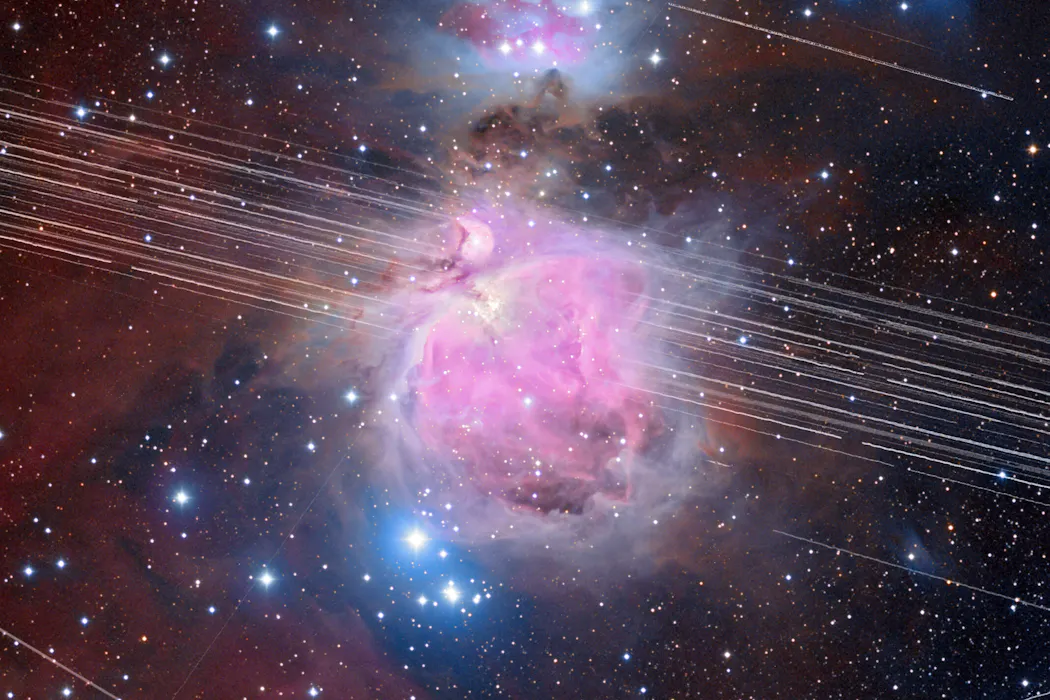
This week, on the eve the Thanksgiving holiday, the United States Federal Communications Commission approved SpaceX’s plan to launch one million “Starmind” artificial intelligence (AI) data centre satellites. This decision reflects the convergence of a satellite boom, an AI bubble and the Trump administration’s disregard for environmental regulation.
If Starmind proceeds in full, the number of operational satellites will be multiplied by a factor of 50. Space and our night skies will become vastly busier places.
SpaceX’s pitch is to take the impact of data centres away from Earth, using a million solar-powered satellites to do AI data crunching in space and beam the results to Earth.
But what is the impact of one million satellites, both in space and on Earth? Why has the Federal Communications Commission made this decision? And will a million satellites actually end up in orbit?
Ups and downs
We are currently in a satellite boom, and constellations of hundreds or thousands of satellites are a key feature.
The Starlink internet satellites (another SpaceX project) is the best known example of such a constellation. Orbital rocket launches have increased to almost one per day, while the number of operational satellites is creeping towards 20,000.
But Starmind represents something else. A million satellites.
To get so many satellites into orbit would be a vast undertaking. If the satellites have a lifetime of five years (similar to Starlink satellites), then roughly 500 satellites would need to be launched every day.
This also implies that roughly 500 satellites would eventually need to be disposed of every day. For satellites less than 2,000 kilometres above Earth, disposal usually means reentry and burning up in the atmosphere. And this has consequences.
When satellites burn up in the atmosphere, their materials react with and are deposited into the upper atmosphere. We now have satellites depositing far more aluminium, titanium, copper and lead into the atmosphere than the natural quantities from meteors.
Aluminium is of particular concern, as alumina can lead to the destruction of ozone in the upper atmosphere. This could increase ultraviolet light on Earth and the risk of skin cancers.
It’s getting busy
Increasing the number of satellites by a factor of 50 is going to change our view of the sky.
If you look up during the early evening, you will see the stars your ancestors saw. But within a minute or two you will see a satellite. A point of light silently moving from horizon to horizon.
Our view of the night skies could fundamentally change.
Each satellite would be 75 metres wide and in the early evening they will be brighter than any star. And with a million satellites in orbit, there will be hundreds of Starmind satellites above the horizon irrespective of where you are.
The orbital clutter comes with real risks.
Satellites travel at speeds of roughly seven kilometres per second, and collisions produce clouds of debris that can produce further collisions. A nightmare scenario is the Kessler Syndrome – a runaway cascade of debris producing collisions that render low Earth orbit unusable.
Of course, SpaceX is aware of the risks of orbital collisions, and it already mitigates this risk with Starlink by manoeuvring satellites away from potential collisions. However, such manoeuvres require operational satellites and it is inevitable some satellites will fail.
Those uncontrolled satellites will pose a real danger.
Regulator or promoter?
The Federal Communications Commission has been a key regulator for American satellites. This has included regulating the radio frequencies that satellites use for communications to and from Earth, the disposal of satellites at the end of their useful lives and environmental impacts.
However, under the Trump administration, the commission is taking a looser approach to regulating satellites. This includes no consideration of environmental impacts, which is reflected in the commission’s decision on Starmind. It says the commission “will not require further environmental review under the National Environmental Policy Act […] for SpaceX’s Starmind system”.
There are also some statements from the commission on Starmind that are, quite frankly, bizarre. For example, it claims Starmind “promises to bring the human race closer to a Kardashev II civilization – one that can harness the full power of the sun”.
This is sci-fi silliness. A Kardashev II civilisation would need many trillions of square kilometres of technology in orbit around the Sun. Starmind is not a stepping stone to a vast “Dyson sphere” – a hypothetical megastrucutre that would surround the Sun and capture its energy.
But can it work?
One reason data centres are so unpopular on Earth is their use of precious resources, including water for cooling hot computer processors. But cooling in space is harder still. When stuck in a vacuum, one can only radiate heat away. And if you are familiar with vacuum flasks, you will know this can be a slow process.
Of course, it is possible to regulate heat in space, and satellites do it all the time. But they typically aren’t pouring out heat like data centres do.
Google recently launched an AI demonstrator satellite into orbit and tasked it with undertaking AI calculations. But it had to have downtime between calculations to dispose of excess heat.
And apart from the physics there’s the finance.
Right now we are in an AI boom, with the inflow of investment being vastly higher than revenues. And the cost of deploying AI in orbit will be vastly higher than equivalent AI on Earth.
If the AI boom is a bubble, then the burst can bring Starmind back to Earth.

Michael J. I. Brown does not work for, consult, own shares in or receive funding from any company or organisation that would benefit from this article, and has disclosed no relevant affiliations beyond their academic appointment.
Original source: https://analysis1.mil-osi.com/2026/11/26/elon-musk-has-approval-to-launch-1-million-satellites-an-astronomer-explains-how-this-would-impact-the-sky/