

Source: The Conversation – UK
The latest UN climate summit, Cop31, held in Antalya, Turkey, was being branded “possibly the worst Cop in history” even before its sorry conclusion.
I was there, and the conference was badly managed from start to finish: initial traffic jams and queues sapped energy and goodwill, while the final plenary was one embarrassment after another, with the summit president sniping at the UN’s climate chief (to audible gasps from delegates), and the closing “Antalya pact” being comprehensively rejected.
This sad outcome was not merely the fault of the conference’s Turkish-Australian presidency, however. The bigger issue is that climate diplomacy is stuck – and has been for several years. Structural changes are required, three in particular.
1. Climate finance is not an optional extra
First, climate finance – money provided to developing countries to help them tackle climate change – has to be increased, in particular public, grant-based finance from developed states.
This may seem an odd place to start for those weaned on the mainstream western media, where most accounts of Cop31’s failure focused on the stand off over fossil fuels. But climate finance is not an optional extra under the Paris agreement: it is the glue that holds the entire arrangement together. Ensuring adequate finance flows is one of the agreement’s three main stated aims (alongside limiting global temperature rises and supporting adaptation). And these flows are meant to progressively increase in line with mitigation ambitions and adaptation needs.
But in recent years they have not. At Cop29 in Baku, an ambitious new finance goal was planned. But instead, the conference saw a pushed-through decision that failed to offer the “progression beyond previous efforts” required by Paris and drew widespread condemnation from developing states. Nigeria termed the deal “an insult” to the UN Climate Convention.
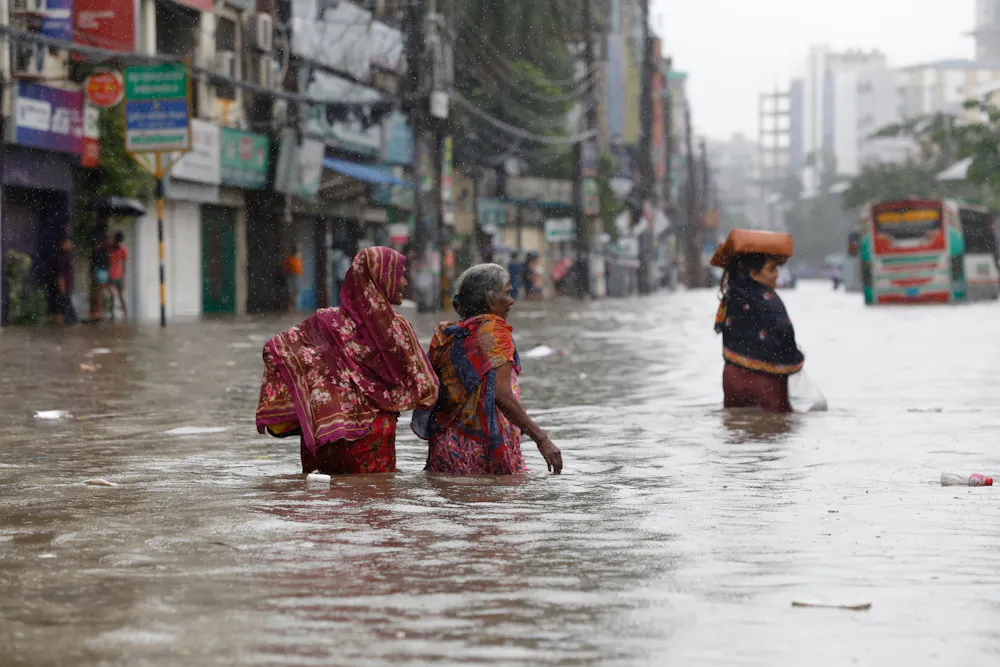
Actual country pledges and disbursements have been falling short too. This year has seen a 70% drop in total developed country finance pledges. Meanwhile, the UK is cutting its development assistance to 0.3% of gross national income, while halving its climate finance.
The consequences have been profound. By no coincidence, within a year of the finance debacle in Baku the other side of the global climate bargain had unravelled too. The 2025 round of national mitigation plans were barely more ambitious than their previous iterations, mostly late, and collectively non-compliant with the goals of the Paris agreement.
Rehman Asad / Shutterstock
Cop31 continued this pattern. On the conference’s eve, EU Commissioner Wopke Hoekstra declared the prospects for additional climate finance “dead in the water”. New developed world pledges for the Adaptation Fund, which helps countries prepare for and cope with the effects of climate change, totalled just US$50 million, less than half the cost of a single F-35 fighter jet.
The predictable result was deadlock on most key negotiation tracks. Indeed, for many developing countries, as well as NGOs, it was above all this climate finance issue – and not the question of whether “fossil fuels” should be named or not – that most underpinned their rejection of the Antalya pact.
The lesson should be clear: to unblock future climate summits, vastly improved finance offerings will be needed from developed countries. And that means that money will have to be diverted from elsewhere, including from the US$2.9 trillion being spent globally on militaries and war.
2. Climate coalitions need to become alliances
More money will not be enough though. Sharper political strategies are also needed, ones that are appropriate to a geopolitically fractured world and to tackling fossil fuel interests.
Cop30 in Belém, Brazil, brought a big step forward on this, with its recognition that “coalitions of the willing” are needed to overcome the UN’s consensus rules. Right now, these rules effectively give fossil fuel-dependent countries a veto on meaningful action. This led to a new process explicitly focused on “transitioning away from fossil fuels”, which began with a 57-country summit in Santa Marta, Colombia, in early 2026.
The risk, though, is that such coalitions just become new talking shops, and lack teeth. The “national roadmaps” that countries in the Santa Marta coalition are producing seem to illustrate this: the first wave of published roadmaps contains not a single new major policy commitment.
But other coalitions show us what might be possible. On the greenhouse gas methane (the focus of my current research), a powerful network of international partnerships, NGOs, funders and regulatory initiatives has transformed policy and practice over the last five years.
And building on the EU’s world-leading methane regulation, this coalition is now constructing a global marketplace that rewards cleaner producers with preferential market access, in order to help drive down methane emissions.
To really work, however, both this and other such coalitions will need commitment, regulation and enforcement. Voluntary initiatives will not be enough. And over time, such ad hoc “climate clubs” will need to transform into something much firmer – binding, treaty-based climate alliances.
3. Public pressure and protest matter
Last, it should be stressed that progress in international climate politics is not the responsibility of diplomats alone. Whatever they achieve, or do not, always reflects diverse lobbying and social pressures.
And sadly, on this front there has been a sharp regression. Since a peak in 2020, mass climate activism has largely died out. Media coverage of climate change has declined worldwide. And, spurred on by the Trump administration and war, fossil fuel interests are ascendant.
These things will only be changed through education, mobilisation and a widespread taking to the streets.
As Tasneem Essop, executive director of the NGO Climate Action Network, put it during an early Cop31 press conference: “We cannot give up on multilateralism … But if we can’t win back home, we cannot expect to win things in this space.”

Jan Selby receives funding from the European Research Council. He is a member of the Green Party of England and Wales.
Original source: https://analysis1.mil-osi.com/2026/11/25/climate-diplomacy-is-stuck-these-three-big-changes-would-get-it-moving-again/