

Source: The Conversation – UK

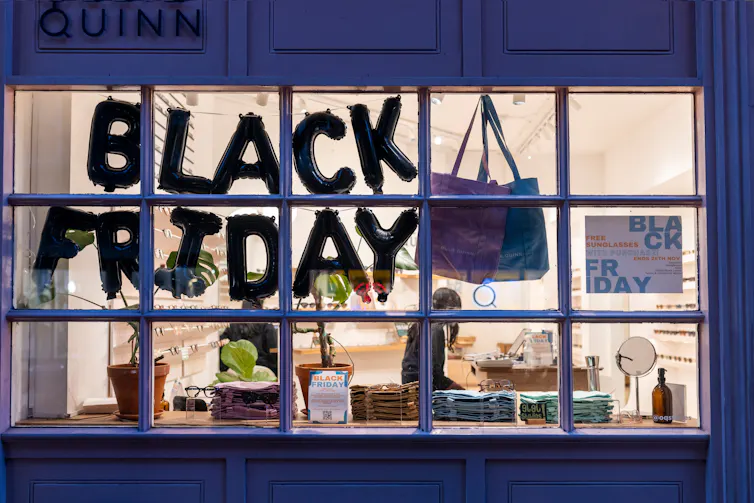
Black Friday is a highly successful US export. The retail strategy designed to kickstart festive shopping has become a global phenomenon.
But are the hype and the pressure (and the occasional fight over electrical hardware) worth it? After all, most products on offer during Black Friday are available at the same price (or even less) at other times of the year.
So why do so many people still join in? Here are some of the marketing tricks and psychological drivers that help to explain the appeal of Black Friday.
Marketing push
Offers that exist for a limited time period are among the oldest retail marketing tricks in the book. And there is plenty of research which shows that they reliably increase a shopper’s intention to buy.
If we think a deal will disappear after Black Friday, the fear of missing out on a bargain can push us towards buying that air fryer or scented candle. Or we might buy it to avoid the potential feelings of regret that may come if we don’t.
Price tags also have a big effect. Psychologists have shown that when making value judgments, the first number we see disproportionately shapes how we evaluate subsequent numbers.
So when a price tag reads: “”Was £100! Now £60!”, the £100 figure is the one we latch on to. This makes £60 feel like a £40 saving rather than a £60 expense, even if the item was never really worth £100 in the first place.
Consumer pull
While many people will be aware of these kinds of retail marketing tricks, they will still willingly participate in Black Friday. This may be partly due to its timing, but also to the psychological rewards that shopping could offer.
In the northern hemisphere at least, Black Friday coincides with the “winter blues”, potentially offering a source of excitement as the days get colder and darker. We may also shop to improve our mood with a little “retail therapy”.
One explanation for the effectiveness of retail therapy is that negative emotions often come from situations we cannot change. Making choices about what we want and then buying those things might help us to restore a feeling of personal control.
Another reason is that buying generally might bring more positive than negative emotions. But studies have also shown that the temporary uplift from purchasing does not last as long as we often think it will.
Landing a bargain can also make us feel good about ourselves. Being a “smart shopper” has been linked to a personal sense of achievement and pride when we secure a good deal. Buying things at a (genuine) discount can also demonstrate competence and good financial management to others.
But that is not the only social appeal of Black Friday. Even the most independently minded consumer can be influenced by what other people do. And engaging in an activity at the same time as others, even among strangers, can temporarily enhance feelings of social connection.
What are we really buying?
Despite the thrill of a bargain, or joining in with a commercial social event, what feels rewarding in the moment may not necessarily contribute to our longer-term wellbeing.
Research in consumption has shown that spending money on things that fit our personality or that help us with personal goals might be a good idea. For example, an extrovert or someone looking to develop new connections will probably benefit more from spending money on social activities than buying a discounted item.
Read more:
Eight ways to resist spending too much on Black Friday bargains
But why we buy is as important as what we buy. In a recent study, my colleagues and I found that spending money in response to social pressure, to gain status or to seek others’ approval was linked to low wellbeing. So even experiences do not always bring more happiness.
Our expectations can also mislead us. In another study I worked on, my colleagues and I found that people of thought that buying new clothes would make them feel better about themselves than buying second-hand clothes. But it turned out that buying old and new clothes had pretty much the same effect.
Elena Rostunova/Shutterstock
More broadly, research shows that focusing on economic gains and consumption brings a lower sense of wellbeing and is detrimental to our personal relationships.
In contrast, choosing to live more simply or buying less is consistently linked with greater wellbeing. People who become less focused on material goals tend to become happier over time.
So perhaps Black Friday should not simply be about how much money we are saving or how much temporary joy our purchases might bring us. Maybe it’s a time to reflect on what we gain from spending more money on more stuff, and whether there might be more sustainable and lasting alternatives.

Olaya Moldes Andrés had received funding from the British Academy and the Academy of Marketing.
Original source: https://analysis1.mil-osi.com/2026/11/25/black-friday-consumer-behaviour-expert-on-whats-really-behind-our-need-to-chase-bargains/