

Source: The Conversation (Au and NZ)
State elections don’t often get this much attention. But the votes cast by Victorians for November 28th’s election will have greater resonance this year.
Potholes, costly infrastructure projects and the cost of living are dominating election coverage so far.
Amid these issues, it’s easy to overlook crucial climate and energy policies. If the longstanding Labor government is swept from power in Victoria, the new government is likely to roll back climate action measures.
The Coalition has taken a stance against net zero and key transmission line projects, while One Nation is strongly opposed to renewables, net zero and the Paris Agreement.
What progress has Victoria made?
When Labor took office in Victoria in 2014, renewables provided about 11% of Victoria’s power. Now, 12 years later, that figure is more than 44%. Labor recently approved large new wind farms and battery projects.
While positive, there are real question marks over the future. Ageing coal plants are soon to retire. Victoria has long been the most gas-reliant state, but the wells in Bass Strait are almost empty.
Labor’s plan to reduce the state’s reliance on fossil gas is showing some success, but the pace of transition is slow.
What are major parties promising?
At this election, Labor has largely downplayed energy and climate policies. The government has announced two new gas projects, claiming they will bring down costs for consumers.
The Coalition is similarly focused on finding new supplies of gas. It also wants to keep coal plants “running as long and hard as possible”.
The Coalition has promised to scrap a major new transmission line meant to boost renewables and strengthen the grid.
The Coalition isn’t totally opposed to renewables – it has flagged plans for new urban solar parks and to support business to go solar.
The Greens are promising a faster transition to renewables, sharper emissions cuts and the removal of fossil fuel subsidies.
One Nation has pledged to scrap all net-zero targets and subsidies, cancel two major transmission line projects, seek more local gas and push to remove the ban on nuclear power.
In June, One Nation leader Pauline Hanson even declared “global warming is a hoax” – a line borrowed from US President Donald Trump.
An important reminder of the science
What can get lost in political debates is how the science of the greenhouse effect is extremely well established.
It’s more than 200 years since French mathematician Joseph Fourier realised Earth’s distance from the sun should have led to a much colder planet. In 1822, he proposed the greenhouse effect to explain it – the fact that gases in the atmosphere trap heat and warm the planet. By the 1850s, scientists had figured out one gas was particularly important – carbon dioxide.
Without greenhouse gases, our planet would be a ball of ice, hovering around -18°C. These potent gases stop a great deal of the sun’s heat from escaping, despite only making up ~0.1% of the atmosphere. This is why we have a very liveable global average temperature of +15°C.
The problem is, humans have rapidly increased the volume of these potent warming gases, largely by turning long-buried carbon (in the form of coal, oil and gas) into atmospheric CO₂, methane and other greenhouse gases.
Over the last 800,000 years, atmospheric CO₂ hovered around 280 parts per million (ppm). After we started burning fossil fuels, it climbed past 300ppm. CO₂ levels are now at 425 ppm – an increase of more than 50% in just a century.
In 1896, Swedish scientist Svante Arrhenius calculated if atmospheric CO₂ doubled, it would warm the earth about 5-6°C. We now know that figure is very likely to be between 2 and 5°C).
Scientific hoaxes rarely last two months, let alone two centuries. As our data gathering methods have improved, ever more proof has come in. Satellites can now directly measure the energy trapped by greenhouse gases, giving us clear, empirical evidence that the world is getting rapidly hotter.
Many other lines of evidence converge showing the fingerprint of climate change, from Antarctic ice cores to melting glaciers and sea ice to rising sea levels.
This is why the world’s climate scientists can state it is “unequivocal that human influence has warmed the atmosphere, ocean and land since pre-industrial times”.
We are undeniably trashing our own home by increasing climate pollution. Calling climate change a hoax must be called for what it is – disinformation.
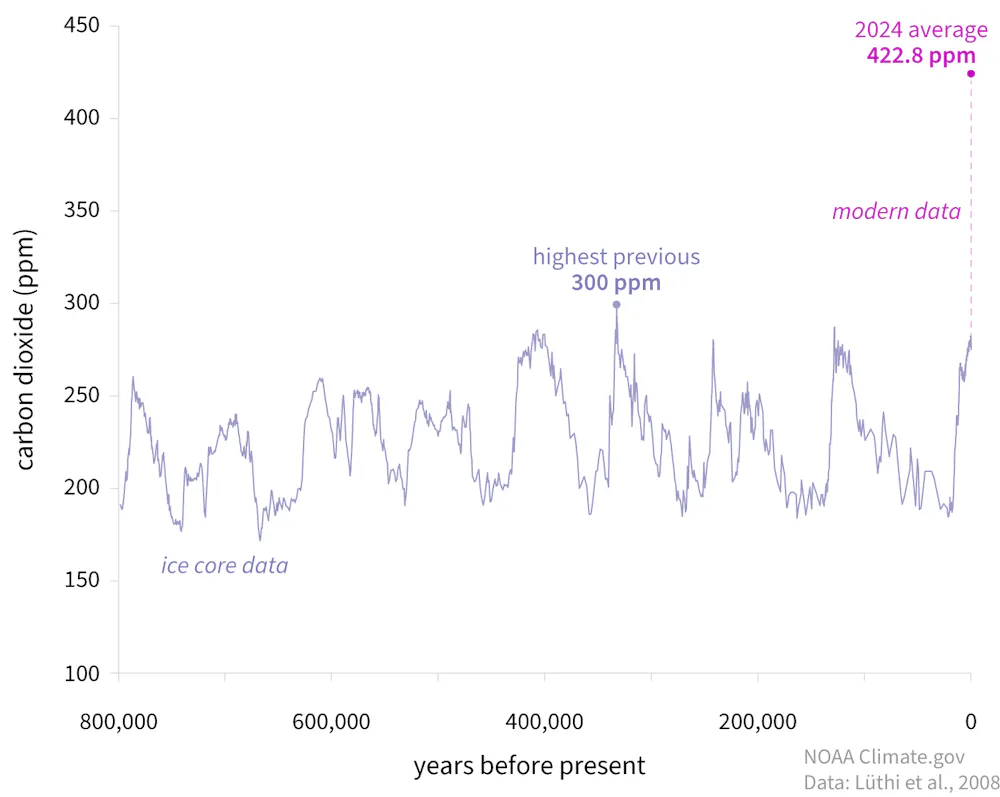
NOAA, CC BY-NC-ND
Victoria is not immune to climate change
At a federal level, the Labor government acknowledges climate change is an urgent and existential problem. The extent of the threats were made clear last year when Climate Minister Chris Bowen released the National Climate Risk Assessment.
But the government has taken limited action since, approving several more coal and gas projects.
It doesn’t matter where oil, gas or coal is burned. Greenhouses gases enter the same atmosphere we all share. Every government must accept accountability for every tonne of CO₂ extracted from their lands and seas.
Victoria faces many climate risks, as the assessment made very clear. If the world warms 3°C by 2100, heat-related deaths in Melbourne will more than double, according to the assessment.
By 2050, the state could see almost A$30 billion dollars each year in insured losses due to climate extremes, according to the assessment. That figure includes $18.7 billion due to bushfire, $6.9 billion due to floods and $5.6 billion due to storm damage.
Rising seas and storm surges are projected to cost Victorians living on the coast at least $167 billion by 2100. Half of these costs are due to direct impact on coastal properties.
In recent months, there’s been a backlash against pro-fossil fuel politics in Brazil and the United States.
If Victoria bucks the trend and votes to scrap existing clean energy policies, it would be a clear backward step. Any savings from supporting fossil fuels today will be dwarfed by the costs we will pass to future generations.

David Karoly is a part-time councillor on the Climate Council of Australia. He retired from full-time employment in the CSIRO Climate Science Centre at the end of January 2022. He is an internationally recognised expert on climate change and climate variability.
Andrew B. Watkins is a Climate Councillor with the Climate Council, a member of the Science Alliance at Protect Our Winters, and a Fellow of the Ausralian Meteorlogical and Oceanographic Society. He was lead author on Australia’s National Climate Risk Assessment.
Original source: https://analysis1.mil-osi.com/2026/11/24/energy-and-climate-have-been-overlooked-at-victorias-election-but-theres-a-lot-at-stake/