

Source: The Conversation – UK
When Stan Shih, the founder of electronics company Acer, arrived in the southern Chinese city of Shenzhen to represent Taiwan at the Asia-Pacific Economic Cooperation summit recently, his company was already in the news.
Acer and fellow Taiwanese computer maker Asus were reportedly moving some production from Thailand and Vietnam back to China. Rising memory-chip costs globally had made computers more expensive to build, and Chinese manufacturers could offer lower prices.
At the same summit, Chinese president Xi Jinping raised Taiwan in talks with his US counterpart, Donald Trump. Xi urged Trump to “do the right thing” on Taiwan, warning that any major disruption over the island could damage relations between Beijing and Washington.
Beijing claims the democratically governed island as its own and, while maintaining it prefers peaceful “reunification”, has not ruled out using military force to bring Taiwan under its control. China regularly conducts military and naval drills around the island.
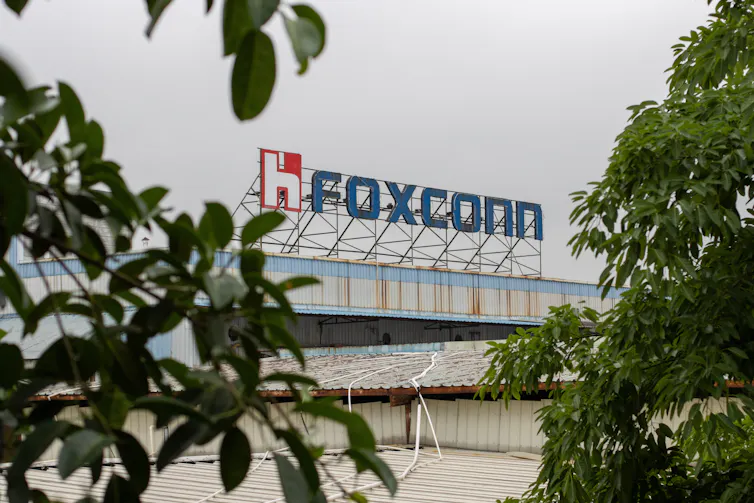
Yet many Taiwanese entrepreneurs in China, known as Taishang, are reluctant to leave as long as their Chinese operations remain viable. Some are building up operations elsewhere to reduce their exposure to political pressure as tensions rise.
Staying in China is not just about costs or customers. For many of the entrepreneurs I have interviewed, it is also about keeping people on both sides of the Taiwan Strait in contact when relations between their governments are strained.
Less investment does not mean leaving
Taiwanese firms helped fuel China’s economic miracle in the 1990s and 2000s by building factories to supply overseas markets. They made everything from footwear in Dongguan to laptops in Kunshan, near Shanghai. Later, as US tariffs made it harder to export from China to the US, some Taiwanese firms turned to Chinese buyers to keep their factories running.
China’s share of Taiwanese outbound investment has gradually fallen. In 2010, mainland China received nearly 84% of Taiwan’s approved outward investment. By 2025, its share had sunk to 3.8%. But that tells us where Taiwanese companies are putting new money, not whether they are closing factories or giving up on Chinese customers.
At the end of March 2026, about two-thirds of Taiwan’s publicly traded companies still had investments in mainland China. Together, these companies earned NT$145 billion (£3.35 billion) from those investments in the first three months of the year.
As part of a so-called “China+1” strategy, some Taiwanese firms are expanding abroad while continuing to invest in China. In October, Taiwanese circuit board materials maker Ventec opened its first factory in Thailand and committed about US$50 million (£38 million) to expand in Kunshan.
The plants serve different needs. Thailand gives Ventec another base to supply industries such as aerospace and medical technology, while the Kunshan expansion lets it add capacity quickly as demand grows for materials used in AI hardware. A second site also gives Ventec options if conditions change in either location. Many Taiwanese companies think that way.
At the same time, Chinese officials are giving Taiwanese firms more reasons to stay. In 2023, Beijing designated the south-eastern province of Fujian a pilot zone for closer economic ties with Taiwan. But the courtship extends well beyond Fujian.
At a business forum held in China’s Anhui province in 2024, participants signed agreements for 47 Taiwanese-funded manufacturing projects, including in electric vehicles. And an AI forum in Kunshan in August 2026 brought together hundreds of entrepreneurs from both sides.
Staying does not mean taking sides
Taiwanese firms can take up these opportunities without sharing Beijing’s goal of unification. In my years of fieldwork with Taiwanese entrepreneurs in China, I’ve often heard the same golden rule: “Never leave the Chinese market.”
Once you’re out, you never get back in. Leaving means more than closing a factory. Customers switch to competitors, and supplier relationships built up over years fall apart. If firms try to return, they have to start from scratch.
Many Taishang I interviewed over the years went back to Taiwan to vote but rarely discussed their political views in public on the mainland. Keeping quiet helps protect their businesses.
It does not mean they back Beijing. Nor are they indifferent to what happens across the Taiwan Strait. Many firmly believe that doing business together can ease tensions by building amicable relationships between people on both sides. They see value in keeping those ties alive even when their governments are at odds.
As one experienced Taishang recently told me, echoing a view I’ve heard from many others: “Chinese and Taiwanese people have no problems with one another. It’s politics that drives us apart. As long as people meet, speak and work together, they can deepen their mutual understanding, and this helps maintain peace across the Taiwan Strait.”
Tada Images / Shutterstock
But keeping politics out of the conversation does not keep it out of the factory. In 2021, after Chinese authorities penalised Taiwan’s Far Eastern Group conglomerate over alleged regulatory violations, Beijing warned Taiwanese firms to distance themselves from supporters of formal independence.
Washington can narrow their options, too. As the Shenzhen summit unfolded, Reuters reported that Taiwanese chipmaker TSMC had paused some orders for advanced chips from Chinese customers after the US tightened its export rules. Yet turning down some orders is not the same as giving up the market. TSMC still runs factories in China.
The Taishang remain both a risk and an opportunity for Taiwan, as they have always been. They do not readily comply with repeated demands from their own government and US authorities to move their operations out of China. This contributes to Taiwan’s economic and political exposure to China.
But the Taishang keep people on both sides working together and, arguably, understanding each other. This cannot guarantee peace between China and Taiwan, but helps to maintain channels of contact that no summit can create on its own.

Gunter Schubert receives funding from the Deutsche Forschungsgemeinschaft (DFG).
Original source: https://analysis1.mil-osi.com/2026/11/20/why-taiwanese-firms-are-reluctant-to-leave-china-even-as-tensions-rise/