

Source: The Conversation – USA (2)
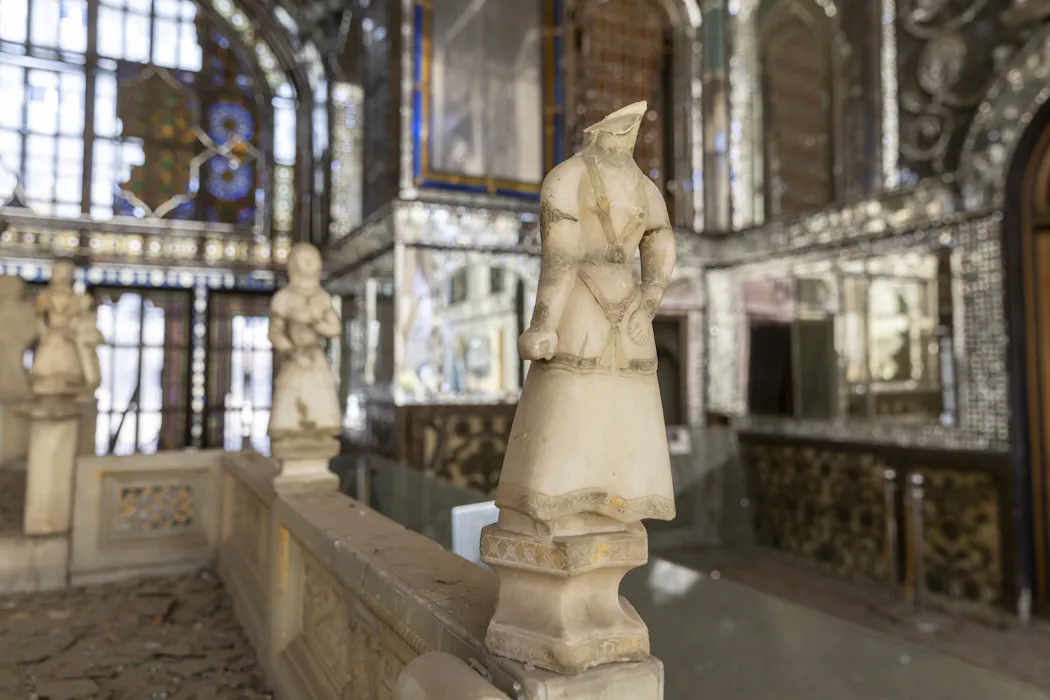
When a U.S. airstrike struck Tehran’s Arg Square on March 2, 2026, Golestan Palace was not the target. But it was close enough.
The missile’s impact blew out windows across the palace complex and damaged some of its elaborate 19th-century interiors. In photographs taken afterward, pieces of its celebrated mirrorwork lay scattered across the floor.
Golestan is a UNESCO World Heritage Site and one of the great surviving monuments of Iran’s Qajar dynasty, which ruled from 1789 until 1925. Within hours of the strike, UNESCO reported the damage and noted that cultural property is protected under international law during armed conflict.
The palace was not only an early casualty of the U.S.-Iran war, but a symbolically potent one, too. And as my colleague Mehrnoush Soroush at the Center for Ancient Middle Eastern Landscapes has documented, Golestan is not alone. Since the war in Iran began in February 2026, reports of damage to heritage sites have poured in from all across Iran.
I know that damaged buildings — no matter how valuable — cannot compare with the human costs of war. But the images from Golestan have particular resonance to me, an archaeologist who studies the history of relations between Iran and the United States. It also cuts against a history of cooperation between American and Iranian archaeologists, in which Americans worked to preserve, rather than destroy, Iranian heritage.
Digging in, together
I have spent years researching how archaeologists, museums and cultural officials from the two countries worked together before the Iranian Revolution of 1979.
My earlier research has examined how archaeology became entangled with American foreign aid and Iranian development programs during the 1960s, and I am currently writing a book on the history of U.S.-Iranian heritage diplomacy over the past century.
I believe that history offers another way of thinking about what has been lost in the current conflict. Long before Iran and the U.S. became adversaries, cultural heritage provided a setting in which people from the two countries learned how to work together.
American archaeologists began excavating in Iran in the early 1930s. In those days, the relationship was unequal: American museums sought access to archaeological sites and, under agreements with the Iranian government, received portions of the objects they excavated under the colonial system of partage. As a result, museums across the U.S. still hold substantial collections of Iranian antiquities.
Wikimedia Commons, CC BY
The terms of the relationship changed considerably during the 1960s, as the U.S. and Iran intensified their connections. At the same time that thousands of American professionals, educators, businesspeople, scholars and others came to work and live in Iran, the country revised its antiquities laws and expanded its own archaeological institutions, universities and museums, resulting in, among other things, a major tourism boom.
American archaeologists still wanted permission to dig at Iranian sites, but they increasingly operated within a system controlled by Iranian officials. In return, American institutions contributed funding and access to laboratories, specialist knowledge, graduate education and connections to an international scholarly community.
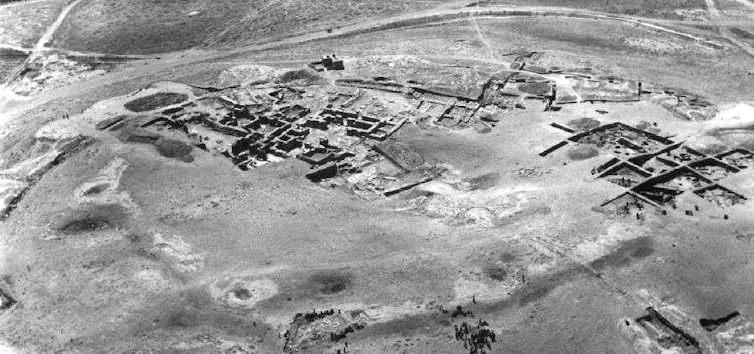
American archaeological projects in Iran drew on large networks of such connections. Scholars working on the Deh Luran Plain in southwestern Iran, for example, depended on Iranian government agencies, the U.S. Embassy, American universities and museums, development organizations and scientific laboratories. Botanical remains, animal bones and other materials moved through specialist laboratories abroad, while Iranian officials worked alongside foreign researchers in the field.
Collaboration under the shah
By the 1970s, fieldwork projects were increasingly becoming joint enterprises, based on formal partnerships between institutions and cooperative leadership. Iranian archaeological authorities employed American specialists to help survey areas threatened by dams and other development projects, while Iranian archaeologists increasingly took leading roles in the field. Meanwhile, students moved in greater numbers between Tehran, Chicago, Philadelphia and New York. Museums organized traveling exhibitions, and Iran hosted international scholarly congresses devoted to its history and archaeology.
It can’t be ignored that these collaborations flourished during a period when Iran, under Mohammad Reza Shah Pahlavi, was a close American ally.
While the terms of the relationship increasingly favored Iran, they were still marked by geopolitical inequalities. American universities and museums possessed resources that Iranian institutions often lacked – not only financially and in terms of human capital, but physically, in the form of collections of artifacts that had previously been taken out of Iran.
Yet the collaborations also developed lives of their own, as American scholars returned year after year.

Wikimedia Commons, CC BY-SA
Post-revolutionary changes
The Islamic Revolution exposed both how extensive and fragile this network was. Even as the crisis that began in 1978 deepened, American archaeologists did not initially assume that their Iranian partnerships were finished. At Malyan, the remains of ancient Anshan, archaeologist William Sumner proposed continuing to pay a watchman to protect the site, while maintaining contact with Iranian colleagues so research could eventually resume.
That did not come to pass. And much of the American-Iranian archaeological enterprise collapsed as diplomatic relations between the two countries soured after the Islamic Republic took 52 American diplomats and civilians hostage in 1979 and Washington sided with Baghdad during the Iran-Iraq War in the 1980s.
But the example of the 1960s and ‘70s points toward a sometimes less visible part of diplomacy: relationships accumulated through repeated practical work.
International relations expert Trita Parsi makes this point in his history of the negotiations that produced the 2015 Iran nuclear agreement. In “Losing an Enemy,” based on interviews with participants on both sides, Parsi describes the working relationship that developed between U.S. Secretary of State John Kerry and Iranian Foreign Minister Mohammad Javad Zarif.
This is not to say that their personal rapport produced the nuclear agreement by itself. Naturally, presidents had to authorize negotiations, diplomats at all levels had to find compromises, and both governments had to conclude that an agreement served their interests. But contemporary reporting described that relationship as one built on professional respect and repeated close proximity. In other words, Kerry and Zarif spent enough time negotiating together to understand each other’s constraints and establish a working relationship despite the hostility between their two governments.
That kind of personal working relationship can assist diplomacy – not just at the highest levels but more broadly across civil society. Sports diplomacy has long been acknowledged; so too the sharing of zoological “gifts.” My research shows that archaeology has long had an important a place in these kinds of cultural exchanges as well.
Atta Kenare/AFP via Getty Images
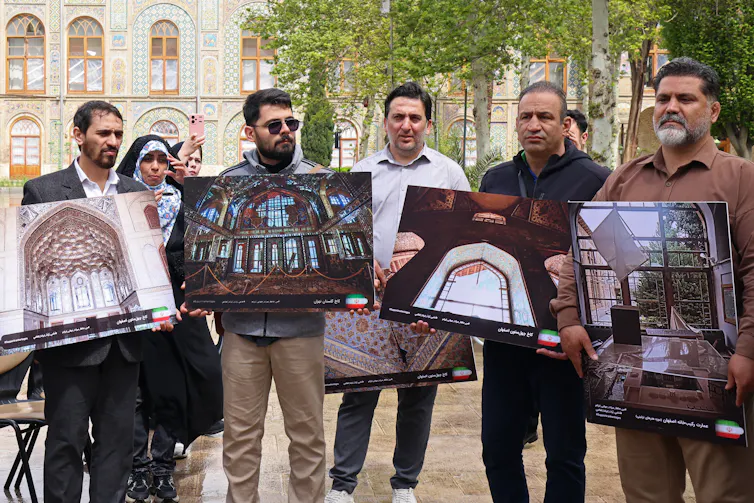
Today, Iranian conservation specialists are sorting and cataloging shattered fragments from Golestan Palace while attempting to repair damage at heritage sites around the country.
At the same time, American and Iranian officials are still looking for ways to end the conflict. I don’t know what U.S.-Iranian relations will look like when the fighting eventually ends, but damaged buildings and monuments will need to be repaired and conserved. If my inbox is anything to go by, Iranian scholars still want to work together with American colleagues.
And if a larger political opening for U.S.-Iranian rapprochement ever arrives, the relationships built by those who steward and study Iran’s heritage may matter more than they first appear.

Kyle Olson does not work for, consult, own shares in or receive funding from any company or organization that would benefit from this article, and has disclosed no relevant affiliations beyond their academic appointment.
Original source: https://analysis1.mil-osi.com/2026/11/19/us-and-iran-once-practiced-diplomacy-through-archaeology-that-legacy-need-not-lie-in-ruins/