

Source: The Conversation – UK
There was no dramatic raid and no armed police storming the building to make multiple arrests. The end of Novaya Gazeta, one of Russia’s last remaining independent newspapers, was more humdrum.
Drawers were emptied, files packed away and a sign was hastily nailed above the entrance to the paper’s central Moscow office on November 9. It read simply: “Novaya Gazeta lived here.”
For more than three decades, Novaya Gazeta had exposed corruption, investigated abuses of power and provided a home for some of Russia’s bravest reporters.
Six journalists associated with the paper were murdered for their work, among them Anna Politkovskaya, whose reporting on the war in Chechnya reached far beyond Russia.
Announcing the closure, the paper’s co-founder and recipient of the 2021 Nobel peace prize, Dmitry Muratov, did not mince his words.
He told reporters gathered to witness the closure of the Moscow newsroom: “Those in our country who advocate for peace have been denied the right to read what they choose.”
Many commentators have treated the closure as the death of independent media in Russia. But that interpretation misses a bigger story.
The end of Novaya Gazeta is significant not just because one newspaper has closed, but because it was one of the last survivors of a much broader independent media ecosystem that has been slowly dismantled over the past decade.
A steady erosion
Russia did not lose its independent media in a single act of repression. Long before the closure of Novaya Gazeta, the authorities had already weakened or sidelined many of the organisations that once dominated independent reporting.
TV Rain, RBK, Vedomosti, Lenta.ru and Meduza, to name just a few, all faced different forms of pressure. Some experienced ownership changes. Others lost access to audiences, investors or advertisers. Many were forced into exile.
The methods varied, but the result was the same: the steady erosion of editorial independence.
That process emerges clearly from interviews I conducted with leading Russian journalists for my doctoral research earlier in 2026. One of them, Svetlana Reiter, rejected the idea that independent media disappeared overnight.
Looking back, she reflected that “everything happened in steps”. Small changes accumulated over time, often appearing manageable in isolation but gradually transforming the environment in which journalists worked.
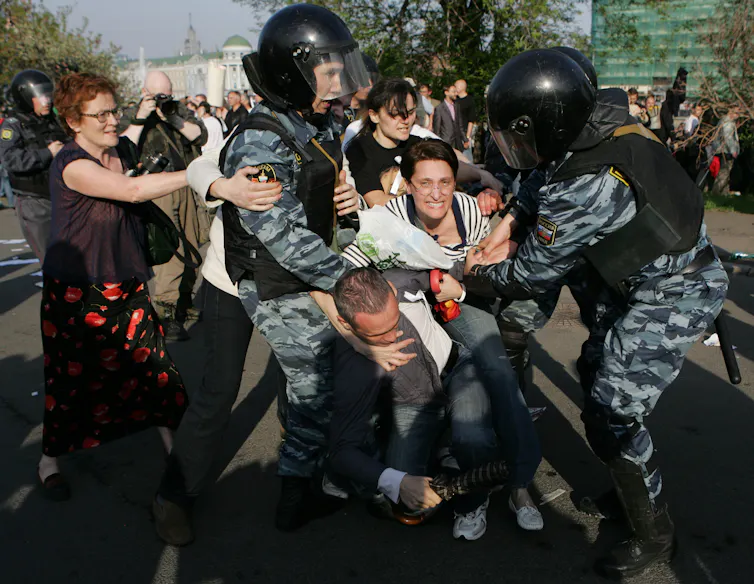
Another journalist, Ilya Barabanov, traced the beginning of the shift to 2012, when protests erupted following alleged fraud in parliamentary elections. These elections saw Vladimir Putin return to the presidency having previously stepped aside to serve as prime minister since 2008.
Barabanov recalled that, during the presidency of Dmitry Medvedev, “there had been a feeling that perhaps the country would follow some sort of civilised path of development”. Those hopes vanished after Putin’s return.
“Everything went wrong in 2012,” Barabanov told me. “That’s when it became clear that everything was going to go in a completely different direction.”
kojoku / Shutterstock
The turning point came in 2014. Internationally, the year is remembered for Russia’s annexation of Crimea. Inside Russia’s independent media, many reporters remember something else: the removal of Galina Timchenko as editor of Lenta.ru, then one of the country’s most influential news websites.
The publication itself survived, but dozens of journalists resigned in protest. One of them, Ilya Azar, later described the decision bluntly to me in an interview: “That was direct censorship.”
The significance of the affair lay in what it revealed. The state did not need to close media organisations outright. Pressure could be applied through owners, regulators and business interests. Editorial independence could be weakened without banning publications or imprisoning journalists.
Over the following years, the same pattern would appear repeatedly across the Russian media landscape. Journalists increasingly found themselves fighting not only for the right to publish stories, but for the survival of the institutions that allowed those stories to be reported in the first place.
From that perspective, the closure of Novaya Gazeta looks less like a sudden death and more like the final chapter in a much longer story.
Together with other tenacious, independent news organisations, the paper formed an ecosystem that once reached millions of Russians and offered an alternative to state-controlled narratives.
Since the full-scale invasion of Ukraine in 2022, and the introduction of laws that label journalists as foreign agents who face up to 15 years in prison for reporting on the war, that ecosystem has largely disappeared from Russia itself.
But it has not vanished entirely. Many of the journalists who built it continue to report from abroad through media organisations in exile. In that sense, the story of Russian independent journalism is not simply one of suppression. It is also a story of adaptation.
The lights may have gone out in the Moscow newsroom of Novaya Gazeta, but the traditions the newspaper represented endure.

Chloe Arnold Lowe receives funding from the ESRC.
Original source: https://analysis1.mil-osi.com/2026/11/17/novaya-gazeta-lived-here-russias-media-ecosystem-has-been-slowly-dismantled-over-the-past-decade/