

Source: The Conversation – USA (3)
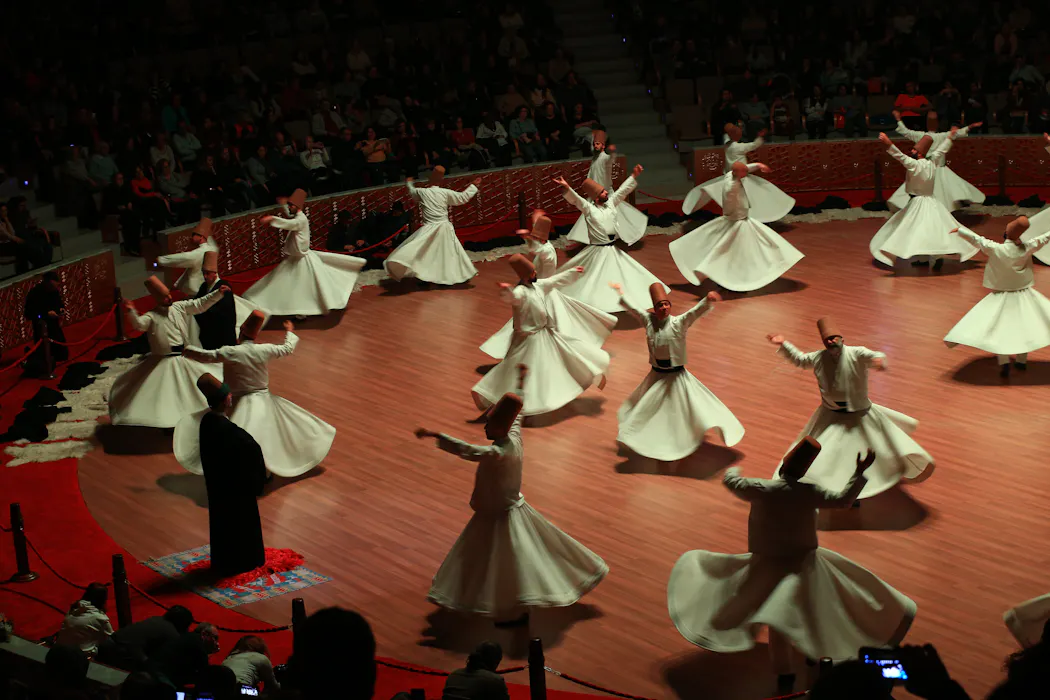
Every December, thousands of visitors gather in Konya, Turkey, to mark the death of the 13th-century poet Jalal al-Din Rumi. His followers call the night “Shab-e ‘Arūs,” the wedding night, and it is the moment they believe he was united with God.
Following Rumi’s death in 1273, his disciples formed the Mevlevi order, a Sufi brotherhood whose members are known in the West as the “whirling dervishes.” A dervish, from a Persian word for a poor person, is a member of a Sufi order who has committed to a life of spiritual discipline under a teacher. The Mevlevi order spread, and its lodges became centers of music and poetry. Mevlevi musicians helped shape Ottoman classical music, and the whirling dervish remains one of Turkey’s most recognizable cultural symbols today.
On the anniversary of Rumi’s death, white-robed dervishes perform a ceremony known as Sema. The ceremony opens with a hymn praising the Prophet Muhammad, followed by the sound of the “ney,” or reed flute. Accompanied by drums and chanted poetry, the dervishes then turn slowly around the hall, right palm raised to receive God’s blessing and left palm lowered to pass it on to others. For the Mevlevis, the whirling is not a performance but a form of worship, a remembrance of God carried out with the whole body.

Hossein Behzad via Wikimedia Commons
In the United States, thousands of miles away, the same poet’s words appear on wedding programs, yoga studio walls and social media feeds. Rumi is one of the best-selling poets in the U.S. Despite this, many Americans may not know how deeply the Muslim legal scholar and preacher’s poetry is steeped in religion.
As a scholar of Sufism, the mystical tradition within Islam, I see a gap between these two Rumis – the Muslim mystic revered in Konya and the spiritual sage quoted on Instagram. The popular English translations that made Rumi famous strip the spiritual depth of his writing, which comes from his Islamic faith.
Who was Rumi?
Rumi was born in 1207 in Balkh, in present-day Afghanistan. As armies of the Mongol empire – the largest contiguous land empire in history, which at its height stretched from Korea to Eastern Europe – advanced across Central Asia, his family moved west, eventually settling in Konya.
Like his father, the preacher Baha al-Din Walad, Rumi trained in Islamic law and theology and became a respected teacher. His life changed in 1244, when he met Shams of Tabriz, a wandering Sufi teacher. Their intense companionship upended Rumi’s scholarly life.
After Shams disappeared a few years later, Rumi poured his longing into thousands of lyric poems, later gathered as the Divan-e Shams. Most of these are ghazals: short love poems built on a single repeating rhyme, many of them composed during gatherings of music and dance.
Rumi’s masterpiece came later and took a different form – the “masnavi.”
What is a ‘masnavi’?
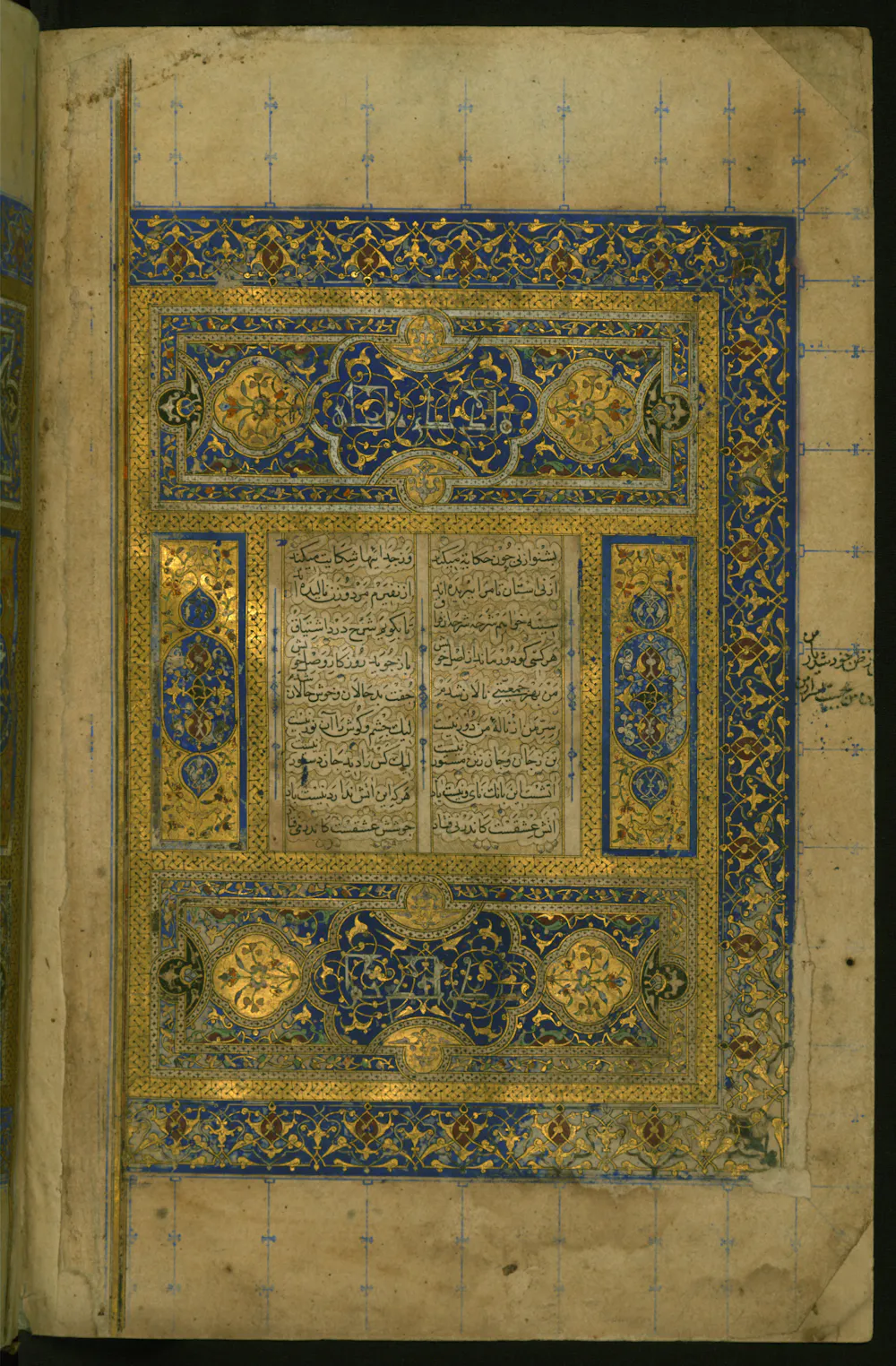
A “masnavi” is a type of Persian poetic form built from rhyming couplets.
The two lines of each couplet rhyme with each other, and the next couplet can switch to a new rhyme. Because the poet never has to sustain a single rhyme across the whole poem, the form can run on almost indefinitely, which made it a favored vehicle for long poems. Other Sufi poets used it to compose spiritual epics.
Walters Art Museum via Wikimedia Commons
Rumi’s own “Masnavi-ye Ma’navi,” or “Spiritual Couplets,” better known as “the Masnavi,” is one of the genre’s most celebrated examples. At the urging of his disciple Husam al-Din Chelebi, Rumi began dictating it around 1258 and continued until his death, producing some 25,000 couplets across six books.
Rumi’s “Masnavi” opens with the song of a reed flute lamenting its separation from the reed bed, an enduring Sufi metaphor of the soul longing to return to its divine source. What follows is less a single story than a vast, winding conversation that includes animal fables, bawdy tales, Quranic stories and reflections on the sayings of the Prophet Muhammad and those who came before him.
Rumi held his “Masnavi” in high regard. In the Arabic preface to its first book, he described it as “the roots of the roots of the roots of religion” and “the explainer of the Quran.” That is a bold claim, but it reflects how the poem works. Its couplets are threaded with Quranic verses, often quoted in the original Arabic, which Rumi then unfolds through stories and images to draw out their deeper meanings.
Later admirers went further. A famous Persian verse calls Rumi’s Masnavi “the Quran in the Persian tongue,” a line traditionally attributed to the 15th-century poet Jami. For centuries, Muslims from the Balkans to South Asia have gathered in circles to read and study the “Masnavi” line by line.
Lost in translation
Translating any poem involves trade-offs – between sound and sense, between keeping the original’s rhyme and meter and capturing its meaning, and between staying close to the text and making it feel natural to a new audience. With Rumi, the stakes are especially high because so much of his meaning lives in the religious world his poems draw on. Faithful translations exist, but they are not the ones most Americans read.
Scholars such as Reynold Nicholson produced careful English translations of Rumi in the early 20th century, but the versions most Americans know are something different.
The most popular are by the American poet Coleman Barks, whose books popularized Rumi from the 1970s onward. Barks did not read Persian. Instead, he reworked earlier scholarly translations into free-verse American English, a process Duke University scholar Omid Safi calls “a double translation.”
Jawid Mojaddedi, who translated the “Masnavi” starting in 2004, told The New Yorker: “The Rumi that people love is very beautiful in English, and the price you pay is to cut the culture and religion.”
References to the Quran, the Prophet and Muslim ritual are often softened or dropped. Where Rumi writes “God,” Barks sometimes substitutes “the Beloved.”
Take one of Barks’ best-loved lines – “There are hundreds of ways to kneel and kiss the ground.” As Safi points out, Rumi’s Persian refers to “ruku” and “sujud,” the bowing and prostration of the Muslim ritual prayer performed five times a day. The English is lovely, but it turns a specific Muslim act of worship into a general image of reverence.
Or consider one of Rumi’s most quoted lines in English – “Out beyond ideas of wrongdoing and rightdoing, there is a field. I’ll meet you there.” A closer rendering of the Persian reads: “Beyond Islam and unbelief, there is a desert plain.”

ruzgar344/iStock/ Getty Images Plus
In other words, Rumi is not dismissing faith or morality. He is making a classic Sufi claim that the deepest love of God lies beyond the labels people use to sort believers from unbelievers. That is a striking thing for a Muslim jurist and preacher to say, and it carries its full force only when the reader knows who is saying it. The popular version turns it into generic advice about not judging others.
These are not isolated choices. Across the popular versions, the world Rumi lived in — the Quran he quoted, the prayers he performed, the prophets whose stories he retold — is largely absent.
Why should we care?
It might be tempting to treat all this as a debate for specialists, but for millions of Americans, Rumi is one of the few Muslim voices they have ever read. How he is translated shapes how they understand not only the poet, but the tradition he came from.
Safi has described the erasure of Islam from these New Age versions as “spiritual colonialism,” a process of bypassing and erasing a spiritual landscape that has been lived and breathed by Muslims across the world. Western readers embrace the beauty of Rumi’s poetry while setting aside the faith that produced it and the communities that have treasured it for centuries.
None of this means Americans should stop reading Rumi in English. Barks and others have introduced millions of people to a poet they might never have encountered. Additionally, newer verse translations of the “Masnavi,” such as Mojaddedi’s six-volume edition, try to carry over both its form and its Islamic framework.
The larger task is to read Rumi as Muslims from Turkey and Iran to Afghanistan and South Asia have read him for centuries – as a poet whose expansive vision grew out of his faith, not in spite of it.
At a time when Muslims are often cast as outsiders in American public life, presenting one of the world’s most beloved poets as spiritual in spite of Islam, rather than because of it, reinforces a damaging story.

Peter Dziedzic received a funded fellowship from the American Council of Learned Societies in 2026.
Original source: https://analysis1.mil-osi.com/2026/11/16/rumi-is-one-of-americas-most-popular-poets-but-translations-often-strip-his-poetry-of-its-islamic-roots/