

Source: Asia Pacific Report
By Justin Latif, RNZ Pacific news editor
While the general election result might be too close to call, Labour has again drawn strong support from communities with a large Pacific voter base.
National and Labour finished in a near dead heat for the party vote — with Labour on 29.4 percent percent and National on 29.2 percent, but with almost 400,000 special votes still to be tallied, who can form a coalition is not yet certain.
Based on preliminary results it is fairly clear there will be eight Pacific members of Parliament, increasing representation in the previous term from seven.
And for those Pacific Labour MPs who won their electorates, support for many of them has also significantly increased since 2023 — assuming special votes do not swing back to the right.
Labour’s Barbara Edmonds, who is of Samoan descent, won Kenepuru with 17,294 votes, almost 10,000 more than the next best placed candidate (which she won by 7324 votes in 2023 when the electorate was called Mana) and fellow Samoan Lemauga Lydia Sosene regained Māngere with 14,815 votes and an increased 11,970 margin (having previous won by 11,712).
Three-term Tongan MP Jenny Salesa is also back, winning Ōtāhuhu for Labour with 13,826 votes with a margin of over 10,000 (having previously won by 7,970) and Labour’s Samoan-Tongan deputy leader Carmel Sepuloni won Glendene with 14,478 votes with a 6,940 margin (having won by 4,396 when her electorate was previously called Kelston).
Labour’s Tangi Utikere, who is Cook Islands descent, also retained his seat of Palmerston North with a similar margin as 2023, while fellow Cook Islander and former National Party minister Alfred Ngaro re-enters Parliament after a six-year absence, but this time under the NZ First banner thanks to his fifth place ranking on its list.
The Greens won 13.3 percent of the party vote according to preliminary results, meaning Teanau Tuiono, who is of Cook Islands descent, returns to Parliament thanks to his third place ranking, while first-time MP Tānia Waikato, who is of Māori, Samoan and Hawai’ian heritage, also enters due to her list placing of 13.
None of National’s three Pacific list candidates of Rosemary Bourke, Angee Nicholas and Agnes Loheni will make it into Parliament, given their party’s lower party vote percentage and the unusual situation where the party won 42 electorates — creating an overhang.
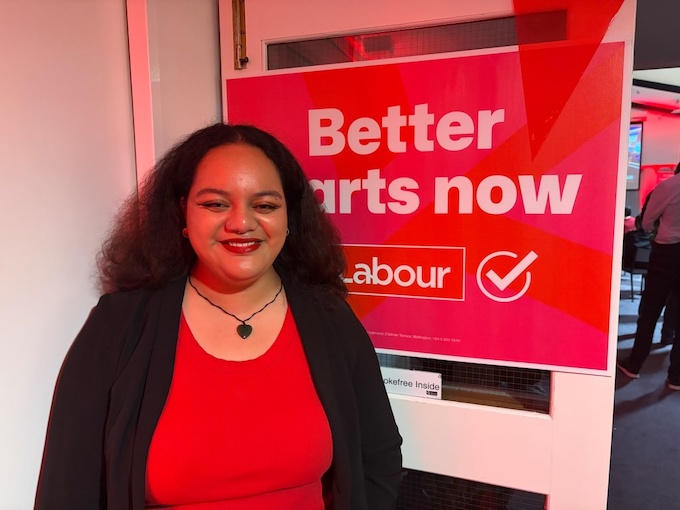
Pacific Labour voters react
While election night did not fall strongly in Labour’s favour, it was clear for Pacific voters at Labour’s post-election event in Tamaki why their support swung left.
For Rua Rio and Koro Tuarae, Cook Islanders from Glen Innes, Labour was who they felt would do the most to address the cost of living.
“There’s a lot of things we’ve seen that this government has been doing that makes it hard,” Tuarae said.
“Things like the length of stay with hospital, there’s [a shortage of] nurses, doctors and so when you go to hospital you can sit there for so many hours before they see you.”
For Rio, the lack of jobs and the price of petrol were two factors in his support for a left-wing government.
“It’s so hard to get a job now because three years ago I had a factory job, but it was closed but I know if Labour comes on board, people always work aye.”
While failure to turn around cost of living pressures during this term has hurt the National Party electorally, its finance spokesperson told the public that the signs of a turnaround in the economy are starting to appear.
Nicola Willis, who has not made it back into Parliament, said that the National-led coalition has been laying the foundations for a economic rebound during trying times, but that improvement can take time.

Volunteered for Labour
Fania Kapao, who is of Cook Islands and Samoan descent, volunteered for Labour in Glendene. She felt excited to see more young people involved in this campaign than in previous years even though overall voter turn out was down almost 4 percent from last election.
“I hope that Pacific people feel a lot more represented and seen [by this result],” Kapao said.
“And I’m feeling very hopeful with the new and fresh blood that’s coming through.”
For Gloria Tu’itupou, a 24-year-old Tongan-New Zealander youth leader, she was inspired by how Labour’s Tāmaki candidate Max Harris engaged the Pacific community in her neighbourhood.
“I loved what Max Harris has been doing, centering Pacific communities in Glen Innes and Point England,” she said.
“I like that he’s been out and about in the community and talking to heaps of people in the community about what problems we have been facing, especially because our problems might get overshadowed by the wealthier areas.”
Turnout impacted
She was also concerned how the turnout was impacted by the decision to scrap same-day voter enrollment.
“I feel like the way that they’ve set it up not being able to enrol and vote on the same day really impacts a lot on our communities.
“Our Pacific communities are more disenfranchised by this government and that’s what motivated me to get out and be a bit more vocal.
“Even if it meant not supporting Labour, I was just encouraging my friends and family to get out and have their voice heard.”
This story was first published on

Original source: https://analysis1.mil-osi.com/2026/11/13/voters-in-areas-with-large-pacific-populations-clear-on-who-should-lead-new-zealand/