

Source: The Conversation (Au and NZ)
A fossil hippo tooth is an unlikely find in the middle of a desert. The vast sandy expanse of Arabia’s Empty Quarter or Rub’ al Khali stretches across the southern part of the peninsula, covering parts of Saudi Arabia, Oman, Yemen and the United Arab Emirates. Yet its ancient sands preserve evidence of a very different landscape.
About 125,000 years ago, a freshwater lake filled the Mundafan basin in southern Saudi Arabia. Hippos lived in its waters, while giant buffalo, gazelles and oryx roamed the surrounding grasslands.
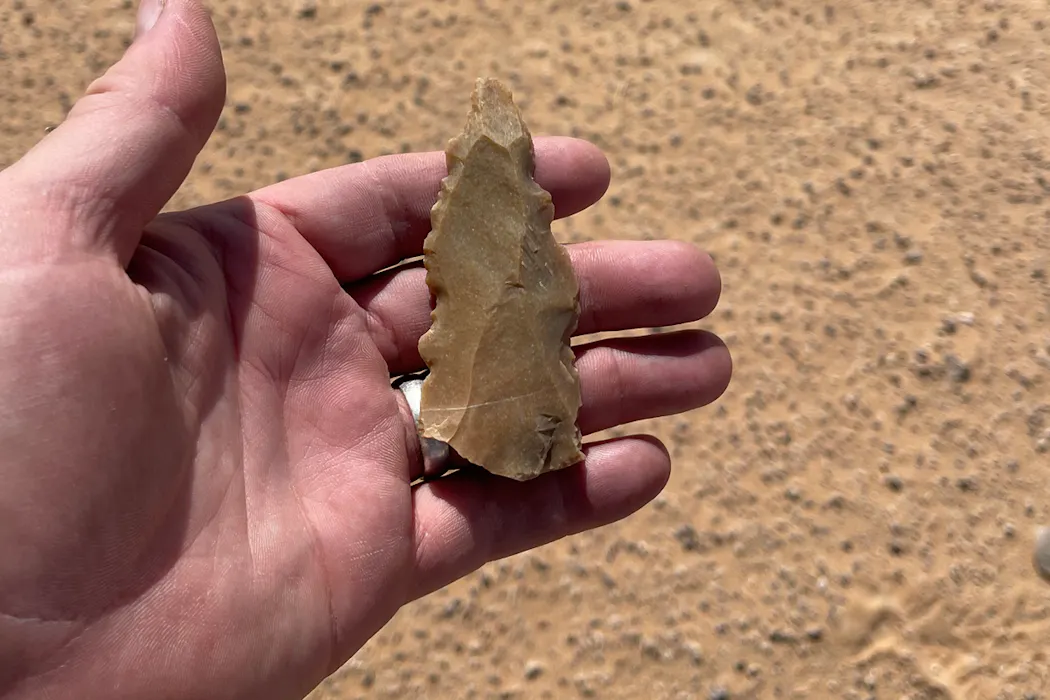
People lived and worked along the shore, leaving behind stone tools that still preserve microscopic traces of their activities.
Our new study, published in Science, reveals how these people made hunting weapons and processed plants. Chemical traces on some stone points suggest they used plant poisons to hunt.
These findings offer a rare view of life in Arabia during an early period of human expansion beyond Africa. They help us understand the skills and resources that allowed humans to live in a place now dominated by desert.

Google Maps (2026)
Beyond Africa
Our species evolved in Africa, where fossils show early Homo sapiens existed by about 300,000 years ago. Our subsequent expansion into other continents involved repeated movements, with many questions about their timing and consequences still unresolved.
Fossils show our species reached parts of Asia well before the major expansion about 60–70,000 years ago. Homo sapiens fossils in Greece and Israel, for example, place our species outside of Africa by about 200,000 years ago, while a human finger bone from northern Arabia places Homo sapiens on the Arabian peninsula at least 85,000 years ago.
Researchers continue to debate which routes people took and how these earlier populations relate to later ones.
Arabia occupies a central position between Africa and Asia. Earlier research documents repeated human occupation over the past 400,000 years, involving different human groups during wetter climatic phases.
These periods of “Green Arabia” created lakes and grasslands within today’s deserts. Our study examines how people lived in one such environment.
Evidence on stone-tipped weapons
Our international team investigated ‘Uruq Aljelibah, beside the ancient Mundafan lake.
We collected more than 5,500 stone tools and pieces left from making them, and mapped their positions alongside animal fossils. Some flakes refit together, helping us identify places where people made tools.

Chris Clarkson
We dated the lake and shoreline deposits using luminescence dating – measuring signals in buried sand grains that record the time since sunlight last reached them. These results, supported by data on hippo teeth, place the archaeological shoreline at about 125,000 years ago.
Microscopic examination revealed broken tips on several stone points, consistent with impact during hunting. One point preserved resin and plant fibres near its base, suggesting people glued and bound it to a shaft. Animal fats and protein survived nearer the tip.
Together, these traces support its use as a hunting weapon, although we can’t determine whether someone threw it or thrust it.

Chris Clarkson
Chemical analysis revealed traces linked to the arrow-poison tree, whose toxins affect the heart. On at least one impact-damaged point, there were potentially toxic plant compounds alongside animal residues. Other tools carried traces consistent with extracting and processing toxic plant latex.
These finds show humans used poison-assisted hunting about 65,000 years earlier than recently reported South African examples.
Plants were part of the toolkit
Other tools preserved fragments of leaves, wood and fibres, including tissue from bark and palm leaves. We also found traces of reeds and underground plant parts. Fibres and wear on tools with toothed edges suggest people sawed or shredded plants, potentially producing material for bindings and other equipment.
Wood and fibre usually disappear from the archaeological record. Their surviving traces help us reconstruct parts of ancient technology that stone alone cannot reveal, including weapon shafts and possible cord or containers. Plants provided materials that could serve many purposes.

Chris Clarkson
We also found animal fossils, which help to reconstruct the environment around the lake. Hippos indicate substantial freshwater habitat, while giant buffalo, gazelles, oryx and ostriches point to open grasslands nearby.
Together, they suggest a landscape that offered people water and a range of potential prey. Animal remains also cluster in areas with high concentrations of stone tools, linking some lakeshore activities to the fauna.
This association supports the evidence that the humans living here hunted and processed the animals they killed.
An ephemeral life
Mundafan filled during separate wet phases, and the opportunities it offered changed as the climate became drier. We don’t yet know where its inhabitants went.
What their tools reveal is how knowledge of local plants and animals helped people occupy a landscape that was later abandoned as the lake dried and deserts returned.
Mundafan offers us a glimpse of an early stage in the human journey beyond Africa, with later traces of Homo sapiens documenting our species’ widening presence in China, Laos, Indonesia and, by about 65,000 years ago, Australia.
The authors would like to acknowledge the Saudi Heritage Commission, particularly Faisal Al-Jibreen and his team; Frans van Buchem and Laurence Hapiot of King Abdullah University of Science and Technology; and Abdullah Alsharekh of King Saud University for their invaluable collaboration and contributions to this research.

Chris Clarkson receives funding from Rock Art Australia and the Australian Research Council.
Gilbert Price receives funding from the Australian Research Council.
Michael Petraglia receives funding from the Australian Research Council.
Carney D. Matheson does not work for, consult, own shares in or receive funding from any company or organisation that would benefit from this article, and has disclosed no relevant affiliations beyond their academic appointment.
Original source: https://analysis1.mil-osi.com/2026/11/12/discoveries-from-a-125000-year-old-lakeshore-reveal-life-in-a-greener-arabia/