

Source: The Conversation – USA (2)
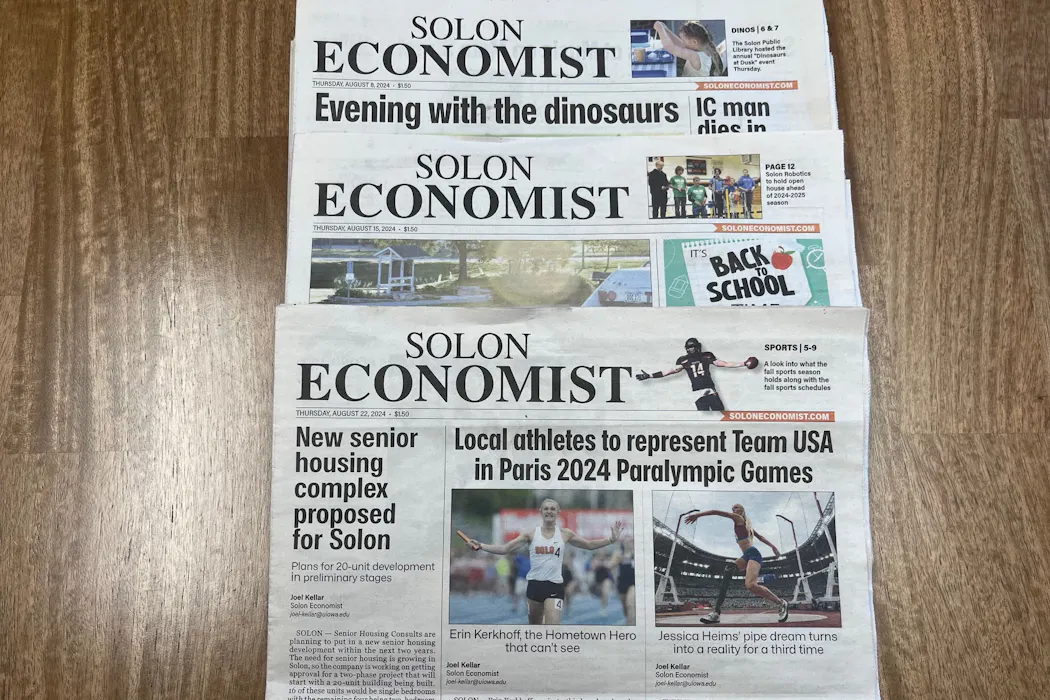
Catherine Bilskie, the advertising and office manager for the newspaper in Solon, Iowa, had seen many local news outlets close. So she was sure her job at the Solon Economist was about to go one Friday morning in February 2024.
But to her surprise, a new owner, Jason Brummond, appeared. He not only promised to keep her and her co-worker employed at the weekly paper but assured them raises if they agreed to an unusual new venture. And he wasn’t a wealthy benefactor or a representative from a private equity firm – he came from the University of Iowa.
It’s just one example of academic institutions stepping up to address the “news desert” crisis: Thousands of communities across the U.S. have lost local newspapers over the past two decades. And journalism faculty, staff and students are increasingly working together to either rescue legacy newspapers or start new publications for communities lacking local news outlets.
These partnerships have ranged from the Spanish-language news site Noticiero Móvil at the University of Nevada, Reno, to “Good Morning Indian Country” at the University of Kansas, to The Scope at Northeastern in Boston.
We’re journalism professors who have studied and experienced the opportunities and challenges of running community news through higher education. Our new book, “News Desert U,” asks whether this approach is one solution to saving local news. We believe the need is urgent given the stakes and the scope of the crisis.
Knowing your community
These experiments come against a grim backdrop.
Over 3,000 newspapers have closed in the U.S. in the past 20 years, including about 170 in 2025, according to Northwestern’s 2026 State of Local News report. Causes include an antiquated business model, declining advertising revenue and hedge-fund buyouts that have gutted papers. Northwestern’s 2025 report estimated that total print newspaper circulation has declined 70% in the past 20 years.
But university partnerships can show promise, we found, with the help of the next generation of journalists.
Iowa’s Solon Economist is one example. The University of Iowa doesn’t actually own the paper, or its sister paper, the Mount Vernon-Lisbon Sun. Still, the relationship is key to making the new venture work.
Its owner, Brummond, is also the publisher of the University of Iowa’s student newspaper, the Daily Iowan, which is owned and operated by the nonprofit Student Publications. While the student newspaper office is inside the journalism school’s building, it operates independently.
In August 2023, Student Publications began talks about buying the Sun and the Economist after the weeklies’ then owner reached out about selling the publications. With both newspapers 20-30 minutes from campus, discussions included how the faculty and students could help the papers.
The Journalism School’s director, Melissa Tully, was immediately in favor – provided that the newspapers’ existing professional staff stay and not be replaced with students. In addition to the editors, this included keeping the advertising and circulation staff.
“They know these communities. So that was really important just from a moral and ethical imperative, but also from a news perspective,” she said. “They’re trusted in their communities. They know what’s going on.”
Student Publications bought both newspapers for US$10,000 in 2024. Since then, circulation has remained stable at both, Brummond said, even as many other publications across the country have suffered declines.
Meanwhile, students in classes such as community news, high school sports, social media marketing and photography contribute for academic credit while other students do paid internships.
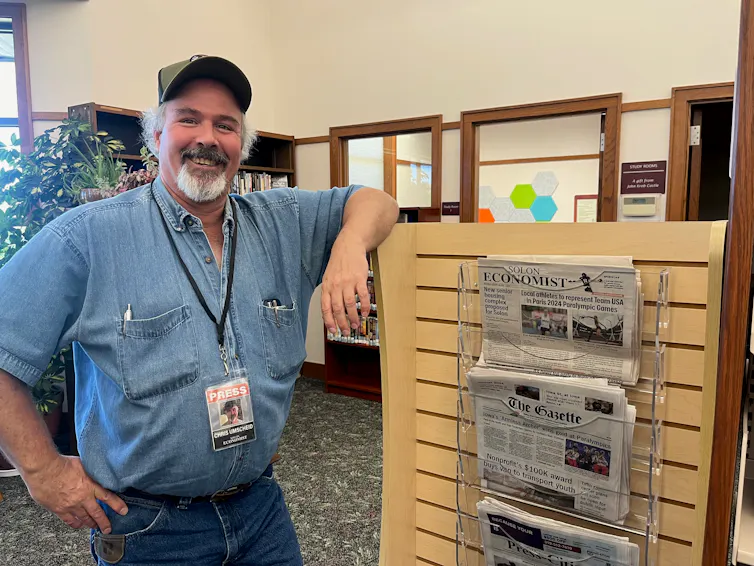
Solon Economist Editor Chris Umscheid said he welcomes a revolving door of student interns because it means he’s “actually going to have staff for once.”
“People thought we were going to be the university’s paper, and we’re not,” he said. “I don’t anticipate anything changing there. We’re still going to focus on everything Solon that we can.”
Teri Finneman, CC BY
The success has led to Student Publications getting requests to buy other newspapers, Tully said, and it’s working on a list of criteria to consider future partnerships. Brummond cautions these arrangements aren’t easy to pull off, as they require a careful review of finances, workflow and logistical complications that come with a merger.
Liz King, who served as Solon Public Library director, said many locals were afraid the newspaper would close, which would have been a hard blow for the town of about 3,000.
Some readers only get their news through the newspaper, she said. “They’re not comfortable with online sources.”
A $10 deal
Dink NeSmith had a similar close scare in Georgia with the The Oglethorpe Echo.
Owner Ralph Maxwell had decided in September 2021 that he had no choice but to shutter the paper due to his own health issues, revenue declines and lack of interest from prospective buyers. He gave NeSmith, an old friend and retired newspaper owner, an early heads-up.
“I don’t know that I want to live in a town that doesn’t have its newspaper,” was NeSmith’s response. He told Maxwell: “You can’t close the Echo.”
NeSmith immediately reached out to the University of Georgia’s journalism school to suggest a partnership.
In the meantime, NeSmith worked to set up a separate nonprofit, Oglethorpe Echo Legacy, for the paper’s new ownership structure. Keeping the newspaper’s finances independent of the university was an important step to ensure the paper would not be subject to any possible “whims” of future administrations, as Charles Davis, the journalism school’s dean, put it. That status was also a signal to Oglethorpe County that the paper’s goal was to serve the community, not make money, he added.
The new nonprofit bought the paper from Maxwell in October 2021 for $10 – a check that Maxwell never cashed and has since been framed.
Davis asked Andy Johnston, an adjunct professor with decades of journalism experience, to serve as the newspaper’s full-time editor. Since November 2021, Johnston has led a team of journalism faculty and students, with the help of several adult staff and volunteers from the county.
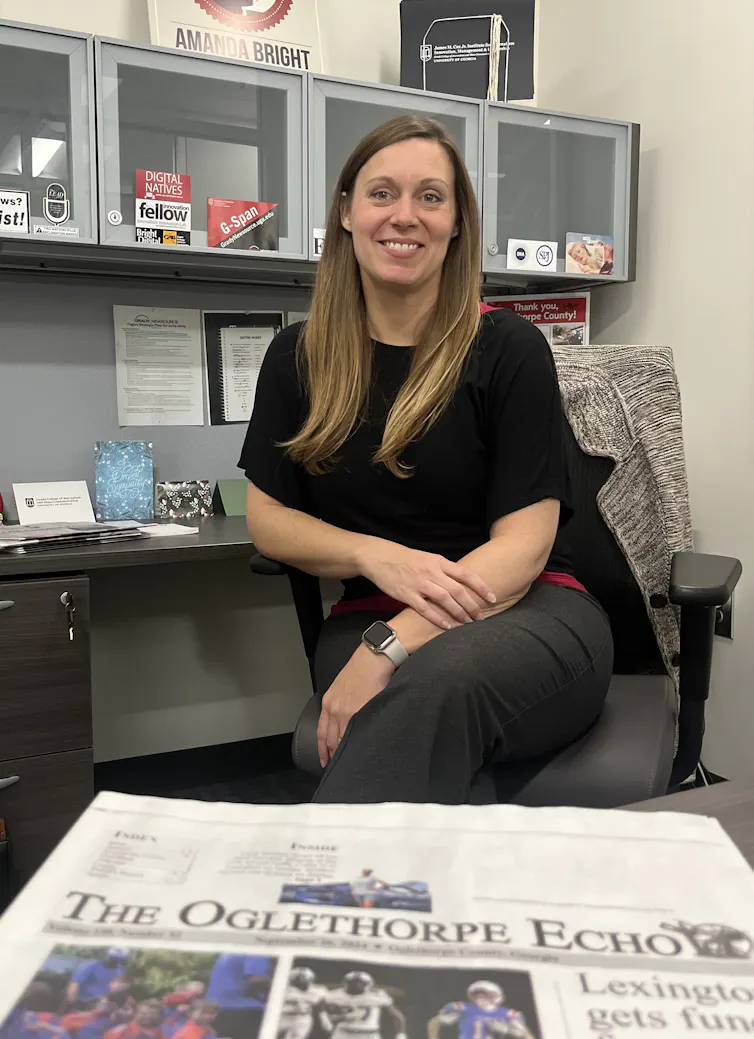
The paper covers a wide terrain. Oglethorpe County has over 16,000 people stretching over 442 square miles, and Lexington, where the Echo has its office, is 18 miles (29 kilometers) from the campus in Athens. The reporting staff is provided by journalism professor Amanda Bright’s capstone class – 20 students each semester. Supplementary funding comes from the journalism school, various grants and Echo subscription and advertising funds.
She pairs two students to each beat, with one in charge of a story and the other in charge of editing and producing, with a rotation each week. Students need to turn in eight stories a semester – with corresponding editing and producing assignments that include video, an email newsletter and social media – to get class credit.
When the journalism school took over, the weekly had only a printed newspaper, with no website, social media presence or other digital products, she said. So in their first print edition, the editors outlined their plan for the newspaper to readers and then introduced the student reporters, which they still do every semester.
Teri Finneman, CC BY
The partnership has paid off. Print subscriptions to The Echo have doubled and overall digital audience has quadrupled thanks to the launch of new digital products, Bright said. Advertising revenue, meanwhile, has tripled, she said. However, it took some time for local businesses to get used to advertising again, NeSmith said.
But many challenges remain. Johnston has to handle student turnover every semester while students covering events such as government meetings face a steep learning curve and need support. The additional time it takes to edit student copy means content doesn’t appear as quickly. Many faculty members have to work long hours to keep the paper afloat.
But the broader impact is clear: More than two dozen students have gone into local news as a career following their time at the Echo, Bright said.
Should other universities want to follow this model, they need at least two key people in leadership, whether that’s two faculty members or one from faculty and a professional editor, Bright said. “That’s a bottom-line necessity for sanity,” she added.
Service over profits
One common theme from our research is that a service-oriented approach to news that addresses the community’s needs takes priority over profit at these partnerships.
The built-in advantages for these initiatives is that the faculty and staff who tend to manage them get their paychecks and health insurance from their university work. They don’t need to draw a living wage from the news outlet’s finances.
These partnerships are also ideal for students seeking real-world experience while earning class credit or internship wages. And journalism schools are already stocked with multimedia equipment that students can use for their reporting.
Still, they can look deceptively simple on the surface, Brummond said. Tully, at the University of Iowa, recommends other interested universities should go slowly. Building a successful project takes patient experimentation and a willingness to regroup when needed, in her view.
“Doing this slowly is OK,” she said. “In the end, it’s going to be better. So far, that’s been a good recipe for us.”

Teri Finneman and Pamela Walck are co-authors of the book “News Desert U.”
Pamela E. Walck does not work for, consult, own shares in or receive funding from any company or organization that would benefit from this article, and has disclosed no relevant affiliations beyond their academic appointment.
Original source: https://analysis1.mil-osi.com/2026/10/29/faculty-and-students-show-how-reporting-is-done-when-a-university-partners-with-local-news/