

Source: The Conversation – UK
When scientists study exoplanets, planets orbiting stars other than the Sun, they often lack three-dimensional information. For example, general mathematical relationships are used to estimate a planet’s radius, even though that distance may be different depending on where it is measured.
Similar principles apply to measuring the atmosphere of an exoplanet, which often blurs all the features around the planet into one average spectrum. A spectrum is the record of how starlight filters through the atmosphere.
Dr David Grant, at the University of Bristol, and I have developed a new method called “transmission strings” to map the structure of the atmosphere of these distant alien worlds.
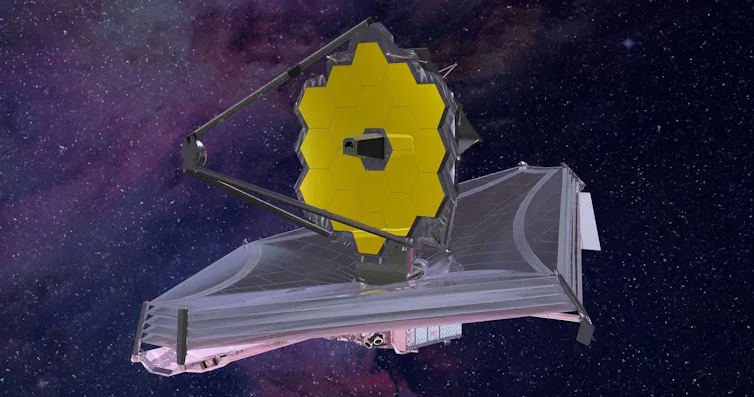
By analysing data from the largest and most powerful telescope in space, the James Webb Space Telescope (JWST), we have, for the first time, mapped the changing shape of an exoplanet atmosphere. The results, published in Nature Astronomy, revealed a planetary atmosphere that was asymmetric – with one side more extended than the other.
In this new research study, led by Dr Lili Alderson at Cornell University in Ithaca, US, we looked at Wasp-17b, which orbits a star some 1,300 light years from Earth. It falls into a category of planet called a hot Jupiter, a giant gas world that orbits close to its host star – and therefore experiences very high temperatures. Wasp-17b’s skewed shape reveals how intense heat and supersonic winds influence the atmosphere.
The transmission strings method involves tracking the planet as it passes in front of its star (or transits) from our point of view on Earth. As this happened, our team captured the composition of light around the edge of the planet’s atmosphere, or limb, from different angles.
As the transit begins and ends (stages known as ingress and egress, respectively) it is possible to obtain spatial information about the planet. This is possible because the ingress and egress is the period of time where the planet is just passing the edge of the star and is not fully in front of its disk.
During ingress and egress, which lasts roughly 31 minutes in total for Wasp-17b, light is only shining through small segments of the atmosphere. At these stages, it is possible to get greater spatial resolution – to measure the extent of the atmosphere with a greater level of detail – than when light is shining through the whole limb of the planet, as it does during the middle phase of the transit. This is illustrated in our artist’s impression at the top of this article.
The transmission strings method fits the ingress and egress measurements with a series of different shapes for the planet’s atmosphere. Our team then compared these with a perfectly circular planet using a series of mathematical functions to determine the best fit. Traditional mathematical modelling extracts a spectrum of light only as an average across the entire limb.
Hothouse worlds
Hot Jupiter planets like Wasp-17b are tidally locked to their star. This means that one side is permanently facing the star, while the other faces the darkness of space.
This drives winds of thousands of miles per hour as the atmosphere moves from the hot to the cold side. The winds transport the heat first across the evening side, then over the nightside where they cool down, and finally over the morning onto the dayside where the atmosphere is heated again and repeats this journey.
Northrop Grumman
The hotter the air, the more inflated a planet’s atmosphere will be. Rather than assuming the atmosphere is a circle with the same radius all the way around, our technique allows astronomers to measure different distances from the centre to the edge of the planet.
We are then able to go around the edge of the planet and measure this changing inflation of the atmosphere, and therefore the changing temperature of the air that makes it up.
Importantly, these first observations implementing the transmission strings method find that the atmospheric chemical composition and temperature shifts match well to theoretical models of the planet.
The atmosphere of Wasp-17b is physically more inflated on the hot side than the cold side, with a smooth transition in temperature over the pole of the planet.
These findings for Wasp-17b are part of a large study of the planet that have previously revealed clouds made of quartz in the planet’s atmosphere.
The Wasp-17b data, from a team led by Professor Nikole Lewis at Cornell University and I, should help astronomers recreate a full map of an exoplanet’s atmosphere from empirical observational data.
This successful demonstration of transmission strings on Wasp-17b not only fulfils this goal but also paves the way for mapping many more exoplanets.
The process is starting to differentiate conditions across exoplanet latitudes, beyond just day and night sides, and providing a first step towards mapping weather-scale patterns in exoplanet climates.

Hannah Wakeford is an Associate Professor at the University of Bristol and receives funding from UK Research and Innovation (UKRI) under the UK government’s Horizon Europe funding guarantee formerly ERC Starting Grant (grant number EP/Y006313/1). HRW acknowledges the significant harm caused to members of the LGBTQIA+ community in the Department of State and Nasa, while under the leadership of James Webb as Under Secretary of State and Nasa Administrator, respectively.
Original source: https://analysis1.mil-osi.com/2026/10/29/scientists-map-a-distant-planets-atmosphere-for-the-first-time-and-its-lopsided/