

Source: The Conversation (Au and NZ)

For many, the internet is feeling less secure these days, thanks to generative artificial intelligence (AI) tools making it easier than ever to exploit hidden security flaws.
Last week’s PHP incident is a great example. PHP is one of the main technologies that run in the background, supporting more than 70% of the websites we use every day. A critical vulnerability prompted many organisations to take their websites offline to secure them.
The national cyber security agency, Australian Signals Directorate, is also warning of rapidly evolving cyber threats. It issued more than 4,400 notifications about potentially malicious cyber activity in 2025–26, almost 80% more than the previous year.
In the wrong hands, AI tools can threaten the underlying systems the internet relies on, outpacing many organisations’ capability to patch them.
With all this on the horizon, it’s reasonable to ask: could failures similar to the PHP issue become widespread? Worse, could the internet itself be brought down?
Is there an off switch for the internet?
First, let’s establish there’s no big switch that turns the internet off. Why? Because the internet is not just one big box of technology. It’s not like your smartphone or TV that you can power on and off.
Instead, the internet is a global network of computers and other devices connected to each other, and it supports a collection of services.
Think of the applications you use every day, from browsing social media to sending emails or banking. For these services to run, computers use network infrastructure to exchange data. For example, when you look at a website hosted on a server in the United States, data travels between your computer or smartphone and that server through network connections.
These connections may use physical cables that run between continents to connect networks together, as well as wireless links (such as wifi) and satellites.
This network is like the roads between Melbourne and Brisbane. One road may be blocked, but there will usually be alternative routes, although there may be some travel interruptions or delays.

CC BY-SA
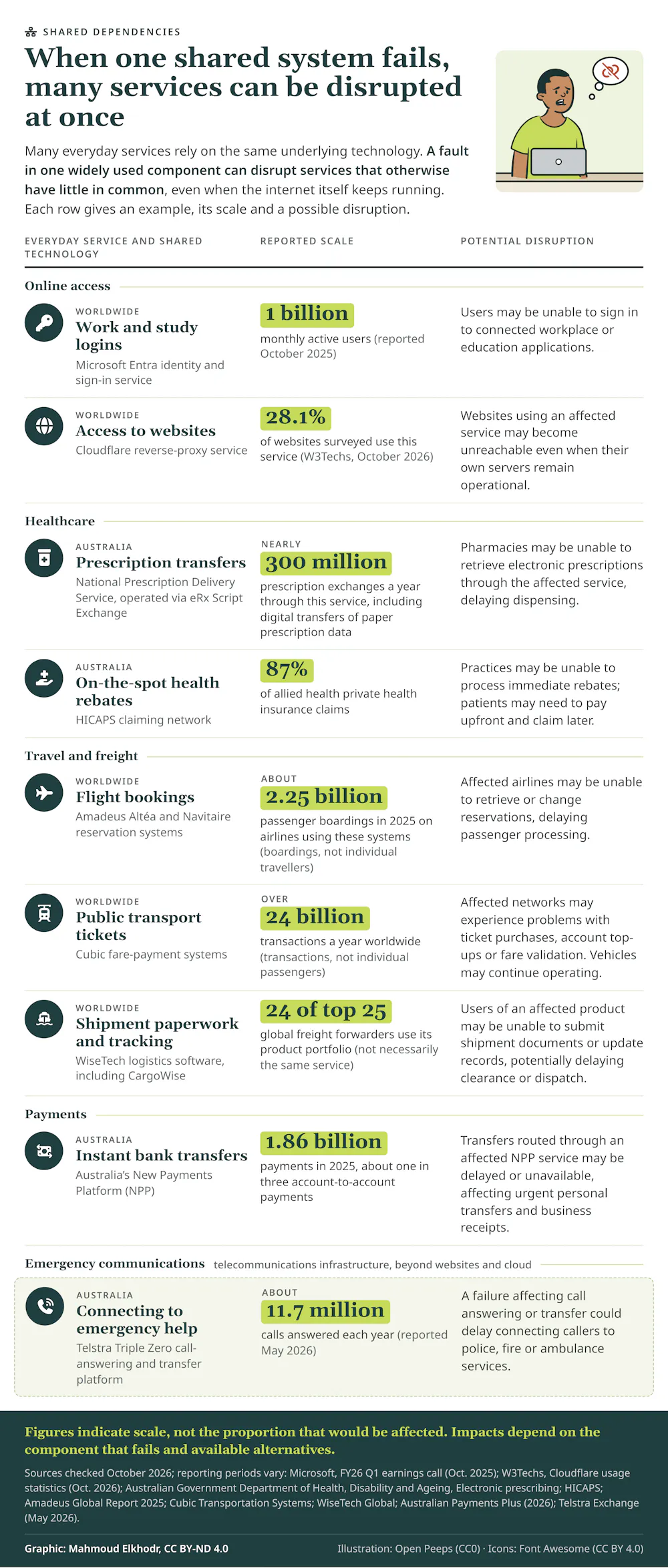
Losing access to one internet system doesn’t necessarily mean losing access to others. But what happens when many of these systems depend on the same underlying technology?
These are known as shared dependencies. Think, for instance, of how we use Google or Microsoft accounts to access school, university or workplace services. A failure in the shared sign-in system could prevent us from accessing email, Word documents and online learning platforms at the same time.
What an internet outage would really look like
A complete internet blackout is highly unlikely, given its underlying infrastructure.
Interruptions to specific services, on the other hand, are both plausible and likely to continue to increase. If there was a cyber attack on healthcare systems, for example, a clinic might continue consultations but Medicare claims might be delayed.
A transport or banking app might be unavailable due to security risks, while trains could still run and card payments continue to work, assuming these services were not affected, as well.
Patching or recovery from cyber incidents can range from routine repairs to systems or equipment, to investigating compromised systems, which may involve complex digital forensic work.
The reach of an outage depends on which shared systems fail and whether alternatives are available. The examples below show how widely some digital services and technologies are used, and how a failure could affect our lives.
CC BY-ND
Preparing before something goes wrong
All this shows that the better we plan for interruptions to online services, the more resilient we can be.
For organisations and businesses, that means having a well-prepared and tested incident response plan. This plan would include clear criteria for when a system must be isolated or a service taken offline, alongside arrangements for maintaining essential operations, and a recovery plan.
The key is preparation, so that any service outage follows a pre-planned response rather than having to act in the moment. This can reduce the risk of a single vulnerability turning into a disaster.
How can I prepare for online service outages?
For users, the same principle applies. Preparedness is essential, and it starts now by identifying the services, apps or tools that would disrupt our lives or businesses if they became unavailable.
1. Keep essentials offline
Store important contact numbers, photos, receipts, booking details and essential documents such as medical prescriptions securely so you can access them even without an internet connection.
2. Identify alternatives
Find other ways to communicate, access your data, make a payment or complete an essential task if your usual service is unavailable. For example, if you normally sign in to a website through Google or Microsoft, check whether it offers another sign-in method and set it up, too. For payments, keep a physical card and a small cash reserve rather than relying entirely on your smartphone wallet.
3. Set up and test
Prepare backup arrangements and check that they work. For example, switch off your internet connection and open your saved documents to confirm they’re available locally, not just when you’re connected to the cloud. Many services rely on multi-factor authentication. Where available, generate backup sign-in codes and store them securely offline.
The internet itself is very unlikely to fail completely. But the individual services we all depend on are far more vulnerable. Whether an interruption becomes a brief inconvenience or a prolonged crisis depends on how well we prepare in advance – before anything goes wrong.

Mahmoud Elkhodr does not work for, consult, own shares in or receive funding from any company or organisation that would benefit from this article, and has disclosed no relevant affiliations beyond their academic appointment.
Original source: https://analysis1.mil-osi.com/2026/10/28/what-would-happen-if-the-internet-went-down/