

Source: The Conversation (Au and NZ)
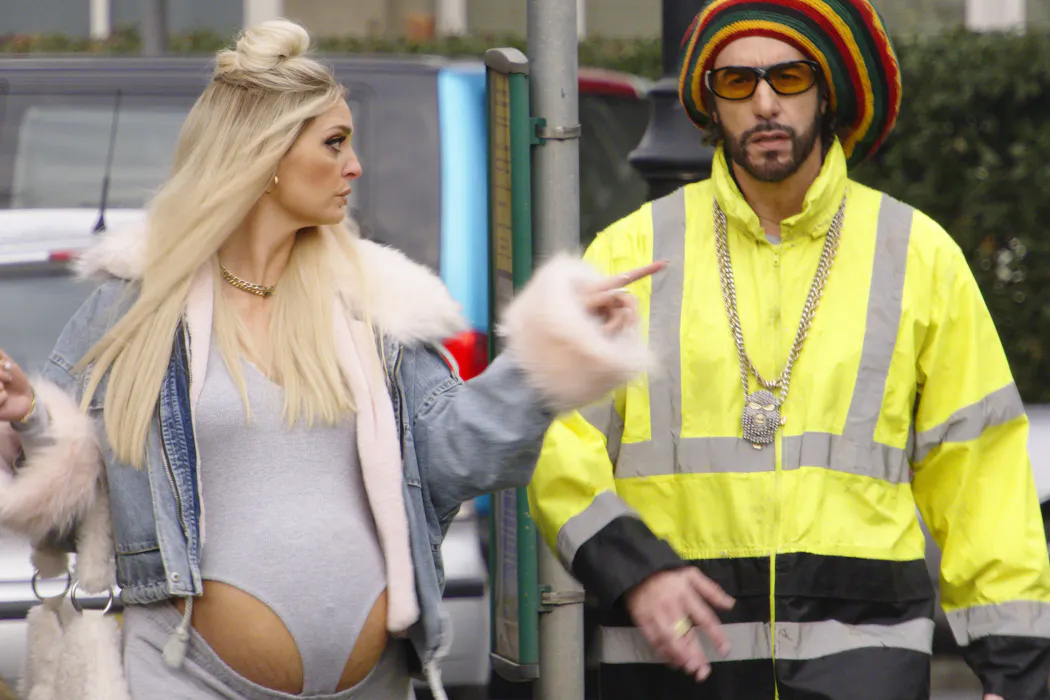
A new Ali G film is out, and the old argument is back. Campaigners are pressing cinemas to pull Ali G: Who Iz I?, calling the character a racist caricature. Defenders say the joke was never targeted at the people it appears to mock.
Both sides assume the character must be one thing or another. That assumption is overly simplistic.
Media scholar Simon Weaver offers a better description: Ali G is an example of what he calls “liquid racism”, using humour that can be read several ways at once, so it slips away whenever someone tries to pin it down.
Audiences end up divided, each side certain that their reading is the correct one.
Why there is no easy answer
Part of the difficulty is who Ali G is.
Sacha Baron Cohen, a British Jewish comedian, plays a “wannabe” rapper from suburban Staines who presents as Black, perhaps Asian (usually meaning South Asian in British usage), perhaps neither.
Ali G first appeared on Channel 4’s The 11 O’Clock Show in 1998, an apparently clueless interviewer who quizzed politicians and other public figures who did not know the character was invented.
Da Ali G Show followed in 2000, later moving to HBO in 2003 and 2004 in the United States, with the character starring in the 2002 film Ali G Indahouse.
Now, 24 years since his last feature film appearance, the character is back.
In Ali G: Who Iz I?, Ali G discovers after 20 years of “chillin’, tokin’ and bonin’”, his girlfriend Julie (Morgana Robinson) is eight months pregnant.
In the process of pawning off some belongings to make ends meet, he receives an expired fax from HBO offering to renew the Ali G show. He heads to America to reclaim his former celebrity glory and meets adversaries who threaten him and his child.
Aware of cultural appropriation criticisms, Ali G seeks out his biological father, undergoing a process of cringe-worthy yet humorous identity rediscovery where he eventually embraces his Scottish heritage.
Decades after his debut, commentators are still disputing Ali G’s acceptability. Is Baron Cohen’s character a satire of white appropriation of Blackness? Or is Ali G a highly insensitive racial caricature?
Three racist readings that cancel each other out
Weaver provides three clear – but competing – answers to what Ali G really is, each embodying its own kind of racism.
He is a minstrel, performing disparaging stereotypes (laziness, clowning, mangled words) that echo Britain’s blackface minstrel shows.
He is a “wigger” – a North American slang term blending “white” and the n-word, often meant as an insult, for a white person seen as copying Black youth culture. Read as a white man imitating Black style, the performance assumes cultures belong to fixed groups, inviting audiences to laugh at people who live between cultures, such as British working-class and/or Asian youth.

Prime
Or, finally, he is an Asian man imitating Black style. This reading rests partly on his name, since “Ali” is often assumed to be Asian, and partly on the belief that some young British Asians adopt Black street style because they see it as “cooler” than their own.
This casts British Asian culture as a poor copy of Black culture, treating the Asian imitator as someone who has embraced a supposedly inferior culture, and done so badly. This ridicule targets class as well as race, since the butt of the joke is a working-class young man.
Who Iz I? represents Ali G most obviously as minstrel and wigger, seen in his reluctance to be employed or take responsibility for his soon-to-be-born child.
In (limited) defence of Baron Cohen
The strongest defence that Ali G is purely satire is that the joke is aimed at those who are not “in on it”. Who Iz I? intentionally emphasises this by way of a quote from the French philosopher Voltaire.
The opening title card reads: “Those who can make you believe absurdities can make you commit atrocities”.
Britain’s media regulator tacitly accepted the argument that viewers and the creators were “in on” the joke of another Baron Cohen character in 2004, when it cleared a Borat sketch in which he led a bar crowd in an antisemitic song. It ruled Baron Cohen’s character – and his actions – could be read as satire for exposing prejudice.
This defence explains why Ali G might not be racist – but does not explain why so many people think he is.
Weaver’s “liquid racism” argument is clear that this does not make the character harmless. Racist meanings retain their potential for harm, even when confusion makes those meanings challenging to name.
What the joke does
Judging Ali G calls for careful reading, not a verdict.
Two questions are more useful than “is he racist?”.
One is: “which reading of the character is an audience responding to?”. The other: “what does the ambiguity do for the joke?”
Who Iz I? is a test of both.
More than two decades on, audiences, campaigners and cinemas are again deciding which Ali G they see. That disagreement is not a sign that the debate has failed. It may be the clearest evidence of what liquid racism looks like in practice.

Aaron Teo has received funding from the Community Broadcasting Foundation and has had research financially supported by the State Library of Queensland. He is Queensland Convenor for the Asian Australian Alliance.
Original source: https://analysis1.mil-osi.com/2026/10/27/is-ali-g-racist/