

Source: The Conversation – UK
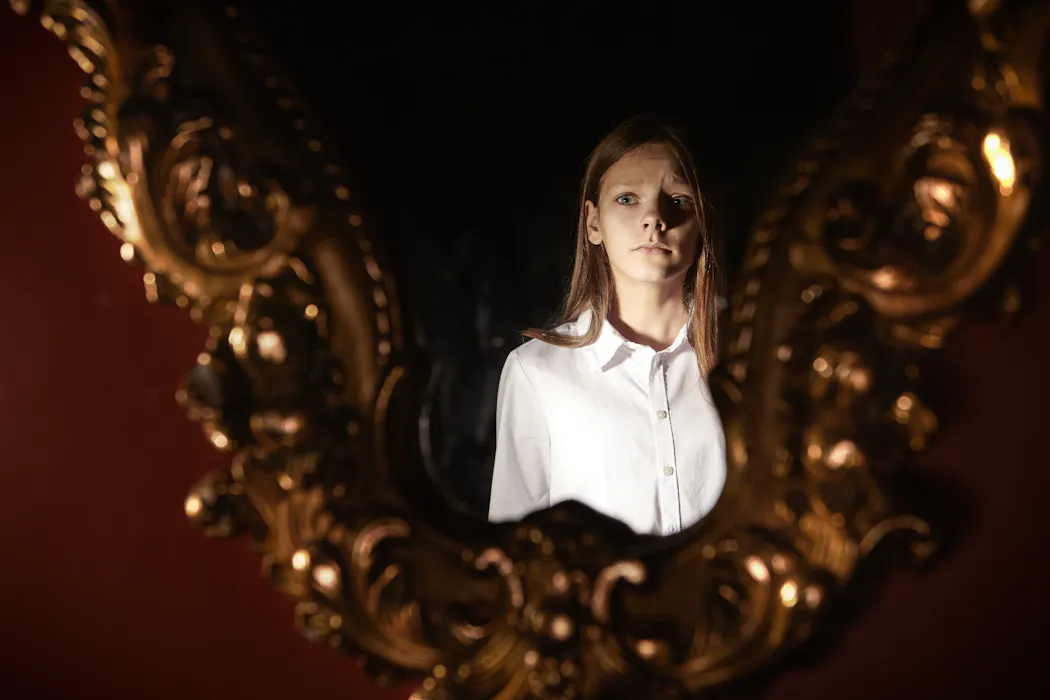
It’s Halloween night. Someone has dared you to turn off the lights and stand in front of the mirror. The rules are simple, stare into your reflection and say her name three times.
Bloody Mary. Bloody Mary. Bloody Mary.
According to the creepy urban legend, a terrifying figure will appear in the glass. Depending on which version of the story you follow, she might be a bloodied woman, a witch or a ghost seeking revenge. Sometimes, she simply appears behind you. In more sinister versions, she reaches out of the mirror.
Most of us encountered some variation of this story as children. Those brave enough to have tried it may even swear they saw a monstrous face appear in the mirror before them.
As tempting as it might be to believe that the monster you saw in mirror was something supernatural, the real explanation is perhaps even stranger. Your brain is perfectly capable of turning your own reflection into something you barely recognise.
The monster in the mirror
In 2010, Italian psychologist Giovanni Caputo published a study with the intriguing title Strange-face-in-the-mirror illusion. He asked 66 volunteers to sit approximately 40 centimetres from a mirror in a dimly lit room and look at their own faces for one minute.
Around two-thirds reported significant distortions of their faces. More than a quarter described seeing an unfamiliar person, while others reported fantastical beings, animals or the faces of relatives – sometimes deceased. Some changes began after less than a minute.
The participants weren’t being asked to summon ghosts. They were simply looking at themselves. So why would something as familiar as our own face suddenly become strange?
The explanation partly lies in the 1804 work done by Swiss physician Ignaz Paul Vital Troxler who described a curious phenomenon. When we fix our gaze on one point, objects elsewhere in our visual field can gradually fade from awareness. This is now known as the Troxler effect, or Troxler fading.
This effect happens partly because sensory neurons, which detect and transmit information about what we see, adapt to relatively constant stimulation. Our visual system is particularly interested in change: movement, shifting contrast and anything that might require our attention.
Normally, we hardly notice this process. Even when we believe we’re staring steadily, our eyes make tiny movements that continually refresh visual information. But prolonged fixation can allow relatively stable features, particularly those away from the centre of our gaze, to become less distinct.
Now imagine applying this to your face. When you stare at your own eyes in a mirror, the surrounding features remain relatively stationary. The contours of your cheeks, the edges of your nose and the outline of your mouth provide a fairly constant pattern of information.
But in dim light, those features are already harder to distinguish – so the Troxler effect alone cannot explain why someone might see an entirely different face. For that, we need to consider how the brain recognises faces.
Human beings are extraordinarily sensitive to faces. We can recognise familiar people from surprisingly little visual information and detect subtle changes in expression.
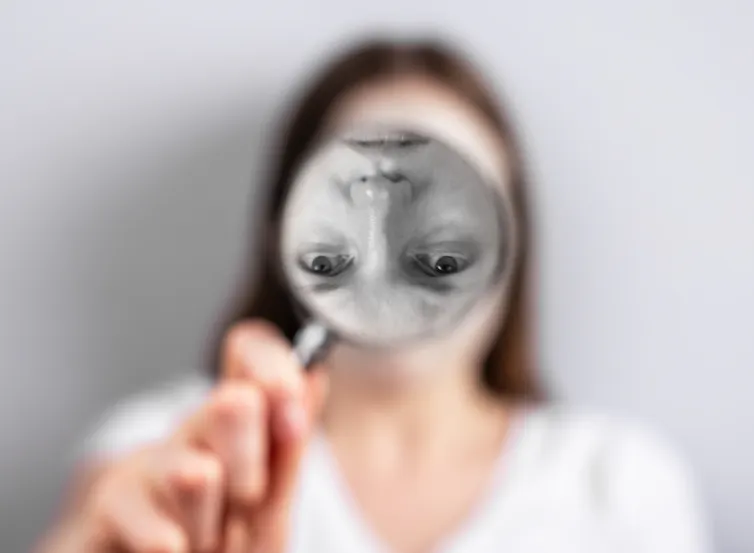
This ability involves a network of brain regions, including the fusiform face area, which responds particularly strongly to faces. Rather than analysing every feature independently, our visual system processes the relationships between them – including the distance between the eyes, the position of the nose and the arrangement of facial features.
valiantsin suprunovich/ Shutterstock
When you look into a mirror, your brain isn’t simply recording what is in front of you. It interprets visual information using previous experience and expectations – and there’s perhaps no face you know better than your own. But under dim lighting, the information arriving from your eyes becomes less reliable. Shadows obscure features, contrast diminishes and the relationships between parts of the face become harder to resolve.
The brain must continue interpreting this increasingly ambiguous information. Sometimes the result is a distorted version of your own face. Sometimes it resembles another person altogether.
The mechanisms behind these illusions are still under investigation. But what makes the experience disturbing is that the reflection remains recognisably human while no longer appearing to belong to you.
Haunted mirrors
Long before children began summoning Bloody Mary, reflective surfaces were associated with spirits, prophecy and the dead.
The ancient practice of catoptromancy involved divination using mirrors. Related traditions of scrying involved gazing into reflective surfaces in the hope of seeing visions or messages hidden from ordinary sight.
Mirrors also acquired significance in mourning traditions. In some communities, they were covered following a death because of the belief they could trap the soul or reveal the dead. Other traditions have different explanations for covering mirrors – including setting aside concerns about personal appearance during mourning.
We cannot conclude that visual illusions gave rise to these customs. But it’s intriguing that prolonged staring, low illumination and the expectation of seeing something unusual feature in both supernatural mirror rituals and experiments producing perceptual distortions.
The Bloody Mary ritual adds another ingredient: anticipation. You expect something frightening, and that expectation may influence how you interpret ambiguous shadows and unfamiliar features.
In this way, the ritual creates the very conditions in which something unsettling might appear. The legend tells you what to expect, and your visual system may provide something that seems to confirm it. So, this Halloween, remember that you don’t need to believe in ghosts for something strange to happen.

Michelle Spear does not work for, consult, own shares in or receive funding from any company or organisation that would benefit from this article, and has disclosed no relevant affiliations beyond their academic appointment.
Original source: https://analysis1.mil-osi.com/2026/10/27/can-your-brain-make-you-see-ghosts-the-science-behind-the-bloody-mary-legend/