

Source: The Conversation – Canada
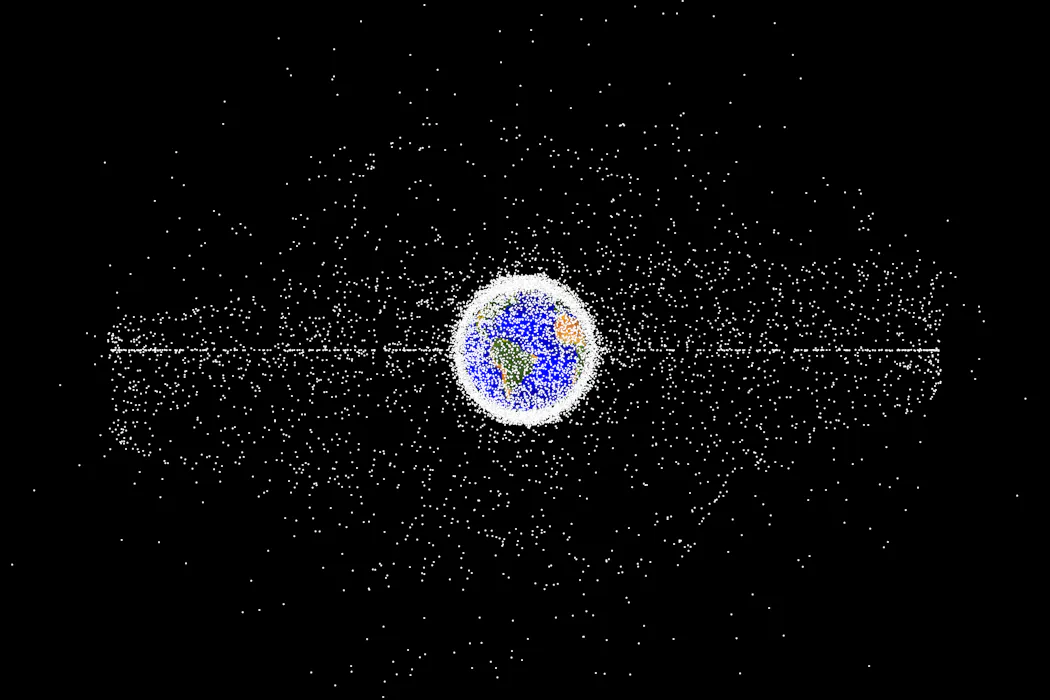
SpaceX has started a trend. More American companies are betting that they can beat the laws of physics by launching thousands of enormous satellites to create orbital “AI data centres” with names like Cowboy Space’s Stampede.
Space commercialization has progressed to a point where numerous aerospace and technology experts view these ambitious corporate orbital agendas as entirely detached from practical reality.

(ESA)
This technology is untested. Some of the proposed satellites are twice as large as the International Space Station. Extrapolations for re-entry into our atmosphere suggest that if these satellites were launched, hundreds of them would drop large pieces on Earth every year.
There are also many other serious safety, atmospheric pollution and light pollution problems with these proposals.
A licensing assembly line
First, SpaceX filed a proposal for one million satellites, invoking the hypothetical Kardashev scale (originally proposed to measure an alien civilization’s level of technological advancement) and other language that looked more like teenage fan fiction than a serious government document.
The United States Federal Communications Commission (FCC) parroted this language back when filing acceptance documents, stating: This satellite system will represent the “first step towards becoming a Kardashev II-level civilization – one that can harness the Sun’s full power.”
Four other companies then filed copycat orbital data centre plans within weeks of SpaceX: Blue Origin (involving 51,600 satellites), Starcloud (88,000 satellites), Cowboy Space (20,000 satellites) and Orbital Compute (100,000 satellites).
They all plan to launch from the U.S., which means they only need approval from the FCC — an agency that is increasingly mandated to approve anything and everything American in what it describes as a “licensing assembly line.”

(Samantha Lawler), CC BY-NC-ND
For example, the FCC recently approved Reflect Orbital for launch of a test orbital mirror. This despite thousands of comments in opposition from the general public, research papers by scientists demonstrating harm to ecosystems and human health and even a direct admission of possible permanent eye damage by Reflect Orbital in its own documents.
Large satellites landing on Earth
The FCC licensing process is opaque. The unprecedented scale of the SpaceX million satellite request in particular at least made the FCC ask more public follow-up questions than they usually do for satellite licensing.
The most recent round of questions forced the companies to reveal the mass and cross-sectional area of their satellites, previously undisclosed. The answers, and their implications for re-entries and orbital safety, are truly alarming.
SpaceX gives the mass of each of their one million proposed satellites as four tonnes, with other companies giving similar masses.
SpaceX’s Starlink is the most numerous mega-constellation thus far, with more than 11,000 satellites in orbit as of October 2026. These satellites have five-year operating lifetimes and on average one or two car-sized satellites re-enter every day, depositing their mass in the upper atmosphere as metal vapour.
If they don’t burn up completely, pieces may hit the ground.
One piece of a Starlink satellite has been discovered on the ground — by a Saskatchewan farmer in 2024. Thanks to geography, land use and Starlink’s chosen orbital distribution, Saskatchewan is the easiest place in the world to find space debris. A chunk of a SpaceX rocket also landed in a farmer’s field there in the same year.
Conservatively, assuming the Starlink debris is the only piece that made it to Earth, that would give Starlink a 0.05 per cent re-entry survival rate. If SpaceX’s million satellite orbital data centre mega-constellation has the same re-entry survival rate, then 500 satellites would drop pieces on the ground every five years.
SpaceX also recently stated in a New York Times article that up to five per cent of the mass of some of their satellites could survive re-entry. That implies 500 satellites could each drop 400 pounds of debris over the five-year operating lifetime of the million-satellite orbital data centre.
The casualty risk of each re-entry is low. But SpaceX plans to roll the dice a million times, and the consequences may land on our heads.
Larger satellites, higher risks
All the companies want to use the exact same narrow band of “sun-synchronous terminator orbits.” Theoretically, these orbits allow constant access to sunlight. But due to Earth’s axial tilt, that’s only true for orbits above 1,400 kilometres altitude.
This means that you can either have continuous sunlight or low-latency communications (without much time lag), but not both. Notably, all of the filed orbital data centre proposals include much lower altitude orbits than 1,400 kilometres.

(Cowboy Space)
The cross-sectional areas listed for several companies’ individual satellites are ludicrous. Cowboy released sketches that imply each of their 20,000 satellites will have a cross-sectional area more than twice as large as the International Space Station.
This is the largest structure ever in orbit — larger than a six-bedroom house, featuring six sleeping quarters, two bathrooms and a gym — and was built from separately launched modular pieces.
Much larger satellites mean much higher collision risks, and the risks are already high with today’s satellites and debris.

(NASA)
A sky filled with satellites
The proliferation of commercial satellites has already changed the night sky for everyone in the world. Sometimes when I first glance up at the stars, I have a moment of dizziness as my brain scrambles to determine which points are moving and which are stationary.
I was part of a team that predicted one in 15 visible points in the night sky would soon be a moving satellite, not a star. Back in 2022, when that paper was published, many thought we were being sensationalist or exaggerating. Now, I’m convinced we were too conservative.
The same team recently authored a paper showing what the proposed orbital data centres would look like as they move across the sky in rings in the morning and evening.
The future of low-Earth orbit and our shared night sky is straight out of a science-fiction novel. And it looks like the U.S. Federal Communications Commission will get the deciding vote on whether it’s a dystopian one.

Samantha Lawler receives funding from the Natural Sciences and Engineering Research Council of Canada. She is a fellow of the Outer Space Institute and a member of the Center for Space Environmentalism.
Original source: https://analysis1.mil-osi.com/2026/10/21/corporate-orbital-data-centre-proposals-are-dangerous-for-humanity/