

Source: The Conversation – UK
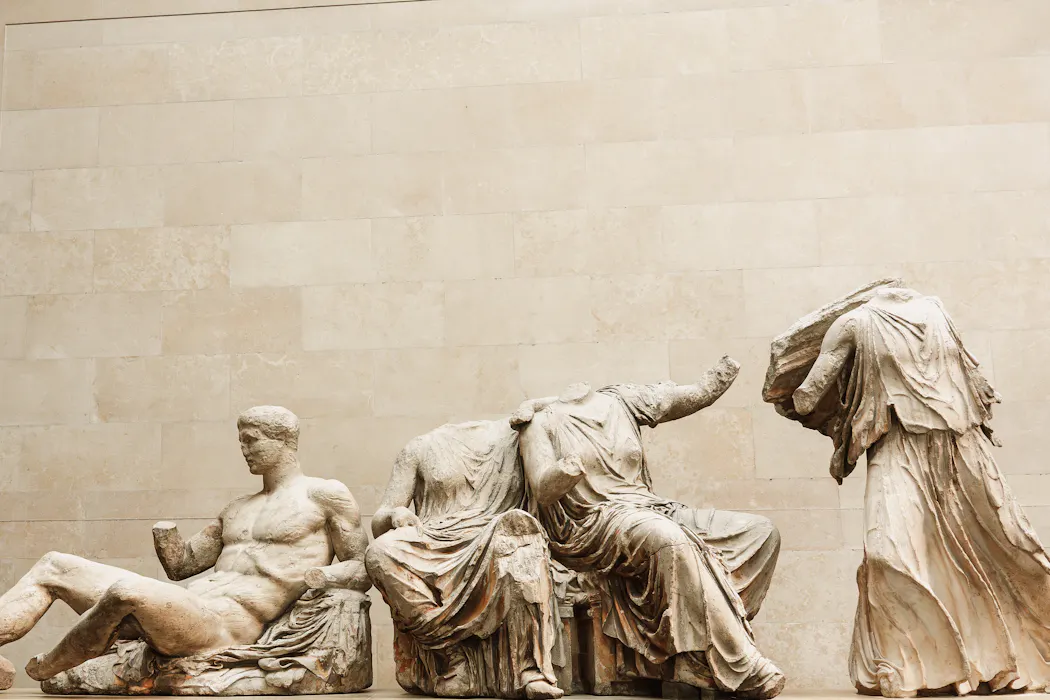
European museums have become more willing to discuss the colonial histories of their collections. But acknowledging how an object entered a museum is not the same as questioning who should control it – or who gets to produce knowledge about the past.
Few antiquities are more recognisable or such enduring symbols of dispute over cultural heritage than the Parthenon marbles (447 BC to 432 BC) in London.
The marbles made their way to Britain through Lord Elgin, Britain’s ambassador to the Ottoman court. Elgin removed about half of the Parthenon’s surviving marbles from the Athenian Acropolis in Greece between 1801 and 1812 under a disputed Ottoman permit, and sold them to the British government in 1816. The first official request for permanent repatriation was submitted to the British Museum by Greece in 1983 and the dispute has been ongoing.
In October 2026, George Osborne, chair of the British Museum, proposed an arrangement under which the marbles would spend periods in both Athens and London. Greece has consistently opposed any loan that leaves British ownership claims intact.
This article is part of our State of the Arts series. These articles tackle the challenges of the arts and heritage industry – and celebrate the wins, too.
When explanation becomes an endpoint
Provenance research, exhibitions and scholarly debate have made the history of collecting visible. This is progress, without which we cannot distinguish between forms of acquisition or make informed decisions about restitution. But there’s a danger in treating explanation as the endpoint of inquiry.
Once the circumstances of an acquisition are reconstructed, a contested object can appear to have been dealt with intellectually. So the object remains where it was, and the institution holding it retains authority over access, display and research.
The Parthenon marbles show the limits of this: we know a great deal about Elgin’s permit and its disputed wording, yet that knowledge has not settled who should decide their future.
Wikimedia
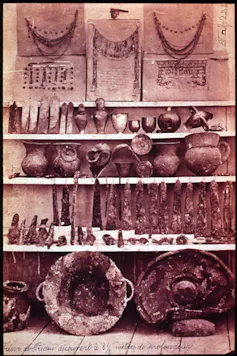
Historical explanation can also manufacture historical distance – and distance is convenient. Take Troy’s Treasure of Priam, which the German archaeologist Heinrich Schliemann smuggled out of the Ottoman Empire in 1873. This “acquisition” history is well documented, yet the finds, donated to Berlin, were looted by the Red Army and taken to the Soviet Union during the second world war. They continue to sit in a Moscow museum.
Germany has voiced claims for their return, but pursues them with little urgency, and the situation appears to have settled into acceptance. Whereas Turkey, where the objects were excavated, has little say at all despite wanting them back. In fact, the new Troy Museum has even set aside a room for them as a symbolic gesture, ready for their eventual return. But like Germany, they feel that Russia is never going to hand the objects back. So an account of past practices does not address their continuing consequences.
In many cases, the institutions that accumulated collections, archives, expertise and prestige under historic political arrangements still possess those resources today. However, historical circumstance should be part of the explanation, not a substitute for examining the present.
Legal is not the same as legitimate
And so, Greece seeks reunification of the Parthenon marbles but the British Museum argues that its acquisition was lawful under Ottoman authority, and that universal museums safeguard heritage for all of humanity.
The first claim concerns the 1800s. The question of who should hold the marbles concerns 2026. Legal continuity across two centuries of political transformation – the fall of an empire, the birth of a nation state – is not indisputable. It must be argued, not asserted.
The second claim, that universal access requires universal ownership, is also undercut by precedent. In 2023, the Vatican Museums gave three Parthenon fragments to Greece outright, rather than on loan, without any visible loss to either collection.
Also, a loan isn’t simply a practical solution to where objects should be exhibited. It sets the terms of the relationship. If a loan requires Greece to acknowledge British ownership, it asks the country seeking return to accept the very claim it disputes. One party holds the objects and dictates the conditions of their movement; the other must negotiate within a framework it rejects. Sharing access is not the same as sharing authority.

Wikimedia
Another highly contested artefact is the bust of the Egyptian queen Nefertiti (1370 BC to 1330 BC). Discovered in 1912 during excavations at Amarna on the east bank of the Nile, the bust was allocated to the Germans under the partage system, which divided finds between the excavating parties. Egypt sought its return but negotiations broke down in 1933. The bust remains in Berlin.
The Nefertiti is often presented by Berlin’s museums as an ambassador of Egyptian art. The metaphor is revealing. An ambassador represents a country beyond its borders but the authority to appoint one should belong to the country represented. Who, then, has the authority to decide where Nefertiti should be?
Research access
The restitution debate often concentrates on the antiquities themselves. But who controls the archives? Who holds the laboratories, budgets and professorships? Whose interpretations dominate? Restitution that answers none of these questions changes less than it promises.
Alternatives already exist. In 2022, the German institution Stiftung Preußischer Kulturbesitz transferred ownership of 512 Benin objects to Nigeria – roughly a third remain in Berlin on an initial ten-year loan. This proves that an institution can relinquish ownership without ending display or research collaboration.
The history of those objects – looted in the British expedition of 1897– differs from the Parthenon, Nefertiti and Treasure of Priam removals. Each case requires its own assessment. But the principle stands: retaining ownership is not the only way to preserve access.
The challenge for archaeology isn’t to become more critical of earlier generations, but to examine how the discipline’s structures shape the questions it asks and the answers it produces. That requires transparent provenance research, genuine collaboration with communities connected to contested collections, and a willingness to reconsider ownership where the evidence warrants it. Above all, it requires distinguishing between acknowledging an unequal past and changing the arrangements through which its consequences persist.
Archaeology knows how Nefertiti, the Treasure of Priam and the marbles came to be where they are. It’s been far less willing to ask why it remains certain institution’s right to send them anywhere at all. Until it does, the colonial past remains not invisible, but curated – explained in our exhibitions, governed on our terms.

Stephan Blum does not work for, consult, own shares in or receive funding from any company or organisation that would benefit from this article, and has disclosed no relevant affiliations beyond their academic appointment.
Original source: https://analysis1.mil-osi.com/2026/10/21/parthenon-marbles-loan-to-greece-is-not-a-simple-solution-who-gets-control-over-objects/