

Source: The Conversation (Au and NZ)
The 19th century pastoralist Thomas Austin was homesick. He yearned for the pastimes of his home in England – especially rabbit hunting. He asked his family to send him some rabbits.
On Christmas Day in 1859, around two dozen wild and domestic rabbits arrived in Australia.
Delighted, Austin released them on his Barwon Park estate near Geelong. A member of the Acclimatisation Society of Victoria, Austin was among many working to bring European animal species to Australia. Of his efforts, he would later write:
the introduction of a few rabbits could do little harm and might provide a touch of home, in addition to a spot of hunting
Domestic rabbits first came to Australia with the First Fleet. But these introductions were domestic rabbits and didn’t establish.
Austin’s rabbits fared differently, as they were from wild genetic stock and much better suited to establishing self-sustaining populations. These rabbits began one of the most devastating biological invasions in Australia’s history. Rabbits, after all, breed like rabbits.
Every Australian knows common myna birds are bad, rabbits are worse and feral cats kill native animals unchecked.
But how do we decide what makes an introduced species “good” or “bad” – and will we ever concede that some species are here to stay?
Our new series on invasive species explores these questions.
It didn’t take long for rabbits to go from desirable to undesirable. In the 1950s, CSIRO scientists began releasing biocontrols – viruses lethal to rabbits. Rabbit numbers are now estimated at around 200 million, vastly lower than a century ago. Even so, rabbits are resilient. They remain one of Australia’s most widespread and damaging invasive species – perhaps even the worst.

Engraving by Robert Bruce, 1867
What’s the issue with rabbits?
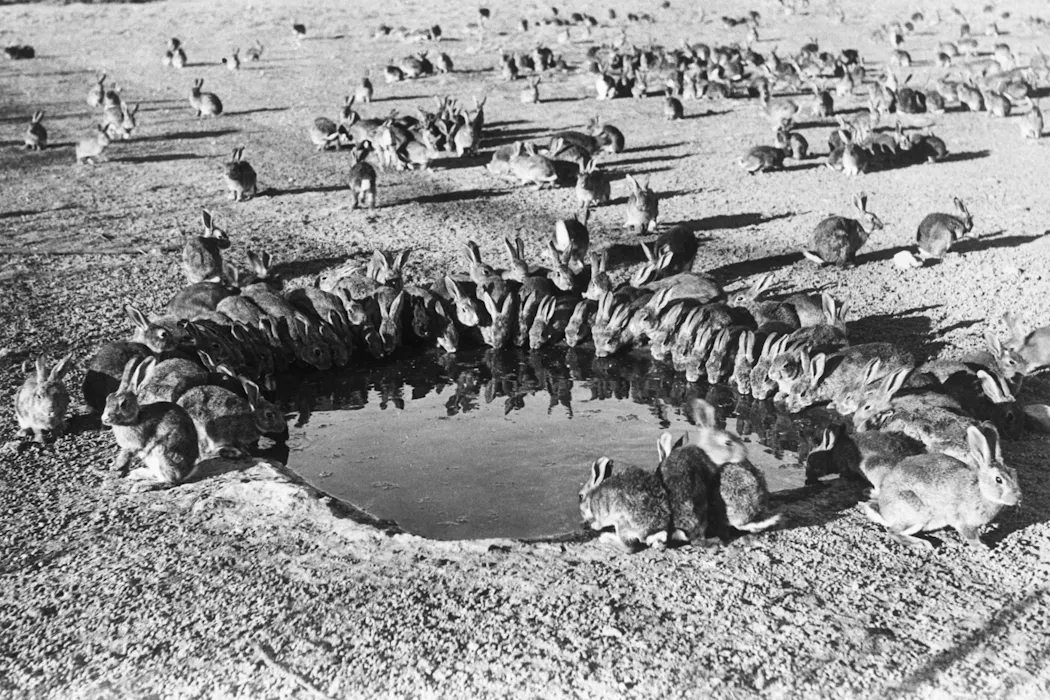
As rabbits spread across the continent, their numbers grew to plague proportions. Farmers came to loathe them for their ability to eat through pastures, spread weeds and dig huge warrens.
Desperate farmers resorted to traps and poisons, while many people worked as rabbiters. Some farmers were forced to abandon their properties.
In 1901, West Australian authorities saw rabbits approaching and began building enormously long fences to keep them out. It was pointless. By 1920, Australia had an estimated 10 billion rabbits.

CSIRO, CC BY-NC-ND
Rabbits don’t just affect farmers
As highly efficient grazers, rabbits compete for food with endangered yellow-footed and brush-tailed rock-wallabies, southern hairy-nosed wombats and many other native herbivores.
Rabbits consume up to a third of their body weight each day. Even at very low densities, they can stop regrowth of native trees and shrubs by selective grazing. Their digging of large warrens can increase erosion, degrade the surrounding land and accelerate the spread of invasive weeds.
Rabbits are incredibly good at making more rabbits. A doe can get pregnant and give birth about 30 days later to between three and eight kittens. A single doe can produce up to 50 kittens a year. Young rabbits begin breeding at around 4 months old.
Their sheer fecundity makes them hard for native or introduced predators to control. In some areas of Australia, European rabbits can breed year-round.
As a result, Australia’s rabbits threaten over 300 species of native animals and plants.
Rabbits also represent an abundant source of prey for foxes and feral cats, two introduced species which have become apex predators in Australia. These opportunistic hunters kill and eat threatened bilbies, bandicoots, lizards and birds, too. Foxes also target lambs and other young livestock, leading to major losses for farmers.
The sheer size of the rabbit population supports large numbers of cats and foxes, intensifying the damage to native species.
Biocontrols work – but are not a silver bullet
In the 1950s, scientists at CSIRO researched and then released the first biological control for rabbits, Myxoma virus. This virus causes the lethal disease myxomatosis, which slashed rabbit numbers by an estimated 95% in some areas.
Over time, the surviving rabbits built up resistance to Myxoma virus.
In 1984, another virus was identified in domestic rabbits in China. Rabbit calicivirus – otherwise known as Rabbit haemorrhagic disease virus – spread and infected rabbits in many countries.
In 1995, scientists began testing calicivirus on South Australia’s Wardang Island. It was an ideal biocontrol candidate, as it only infected rabbits, was stable in the environment and caused a disease with rapid onset and progress.
During testing, the virus was carried by flies to the mainland. In the wild, it proved highly effective at keeping rabbit numbers down, though surviving rabbits began to develop immunity.
About 20 years later, a highly virulent new strain appeared in Europe and spread to Australia, where it cut rabbit numbers by 60%.
In 2017, authorities released a new strain of the calicivirus, known as K5, to augment the effectiveness of the naturally circulating virus strains.
This year, sharp rises in rabbit numbers have been reported. We don’t yet know if this is due to a mild winter and plant growth after good rainfall, a reduction in effectiveness of the circulating viruses, or both.
So how can we get on top of this trend before the rabbits get out of hand again?
At CSIRO, we have developed a new way of growing rabbit calicivirus in the lab to speed up selection of new variants with potential to boost control.
We are also tracking virus strains circulating in Australia to map the activity of the various rabbit biocontrol viruses. Anyone can send in samples from rabbit carcasses to be tested through our citizen science project.
CSIRO researchers have begun investigating longer-term solutions such as genetic biocontrol (commonly known as gene drives) for key pests – including rabbits.

JohnCarnemolla/Getty
There is no single answer
While rabbit viruses work very well for a time, they are not a silver bullet.
To keep numbers down long-term, we need to combine viruses with other control methods such as baiting, fumigation and destruction of rabbit warrens and, ultimately, novel technologies such as gene drives.
If we do nothing, we will once again have a true plague of rabbits. Keeping them under control is essential.

Ina Smith works for CSIRO, which researches and releases rabbit biocontrols.
Elena Smertina works for CSIRO, which researches and releases rabbit biocontrols.
Original source: https://analysis1.mil-osi.com/2026/10/20/why-the-humble-rabbit-might-be-australias-worst-introduced-species/