

Source: The Conversation – USA (3)
In October 2024, right before the presidential election, I had coffee with Kim, a Congolese asylum-seeker living in southern Maine. Our conversation quickly turned to politics, and I cautiously asked about her views, although she could not vote.
During his campaign, Donald Trump had vowed mass deportations, and I assumed immigration policies would be among her top priorities.
But instead, she quickly turned to matters of faith, invoking her strongly held beliefs. Kim – a pseudonym, like all names used in this article – was an evangelical Christian whose life revolved around her church: a nondenominational congregation led by other Congolese migrants.
“Democrats are not people of God,” she declared. People in her community were “traditional,” she added, and generally wanted politicians who were, too. Congolese Christians, she said, usually believed marriage should only occur between a man and a woman, that sex and gender are chosen by God, and that life is sacred from conception.
Her pronouncement underscores an important but often overlooked reality. Popular commentary in the U.S. often portrays evangelicals as one homogeneous, overwhelmingly white group. In reality, they are diverse, from political views and geography to race: 3 in 10 U.S. evangelicals are not white.
And a growing percentage are migrants – a term I use for people who have come to the U.S., regardless of their legal status.
Belonging and belief
Overall, 12% of evangelicals in the U.S. were born outside the country, according to a 2024 study conducted by the Pew Research Center. Another 7% have at least one parent born outside the country. These figures are likely underestimates, since undocumented migrants generally avoid surveys for fear of deportation.
As an anthropologist of religion, I’ve studied the growing number of migrants drawn to evangelical faith – and learned how significantly faith shapes their lives in the United States. In turn, these migrants are shaping America’s religious landscape.

Joe Raedle/Getty Images
While writing my 2022 book, “In the Hands of God,” I spent over a year attending evangelical churches around Washington, D.C., that catered to Brazilian migrants. I interviewed about 80 churchgoers and surveyed dozens more.
Congregants described how belief and belonging helped them overcome challenges such as loneliness, “feeling stuck” due to their legal precariousness and being exploited at work. I heard stories of employers holding migrants’ passports hostage, or refusing to pay construction workers seriously injured on the job.
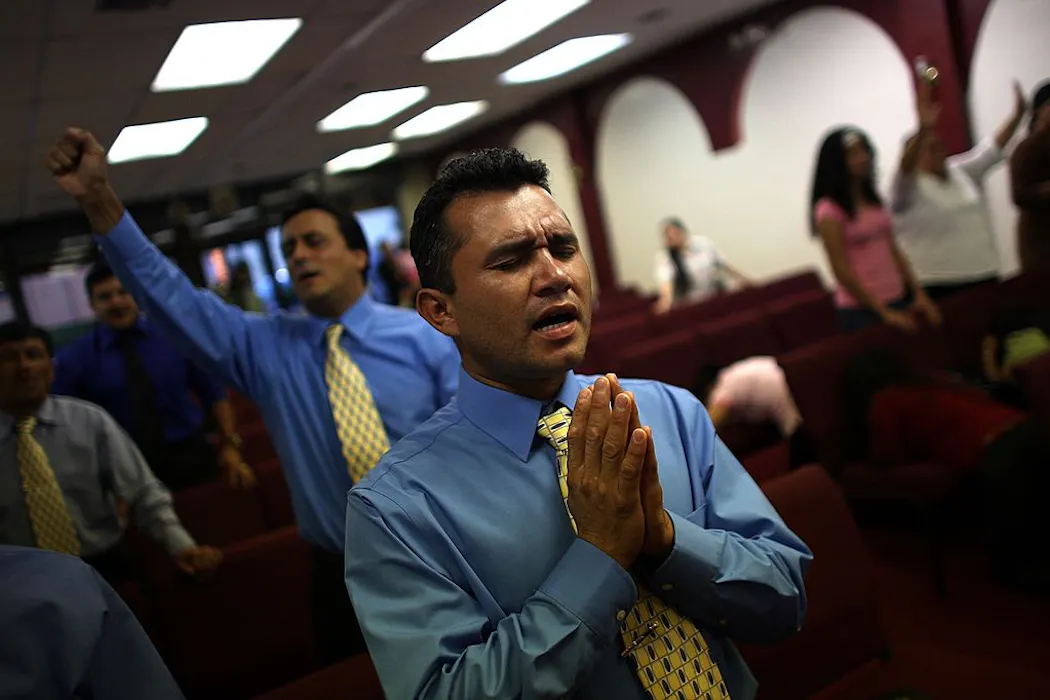
Migrants often told me that their churches’ close-knit communities, and evangelical Christianity’s emphasis on fostering an intimate relationship with God, gave them a sense of empowerment. Through prayer, worship, Bible study and fasting, they tried to discern and implement God’s plan for their lives.
The three congregations that I attended offered multiple prayer, study and worship opportunities for migrants throughout the week, both at church and at congregants’ homes. Many pastors were migrants themselves and shared from the pulpit their stories of overcoming adversity.
Gláucia, an undocumented migrant from Brazil, described leaving herself “in the hands of God” as she faced uncertainty about her future.
“I love living here,” she explained. “But if God wants me to leave, I’m under God’s will. Wherever God directs me, I will go. Therefore, I don’t get worried, because we can’t become worried about what comes tomorrow. Because tomorrow belongs to God.
“The most I can do,” she added, “which I always try to do, is pray to God to give direction” to political leaders.

Kelvin Ma/MediaNews Group/Boston Herald via Getty Images
Growing communities
Some people I met identified as evangelical before coming to the U.S., but a significant number were converts. Even among people who had attended evangelical churches in Brazil, many insisted that they truly “met Jesus” in the United States and reflected that their faith back home had been “lukewarm.”
Angela, an undocumented migrant, knew many evangelicals in Brazil. It wasn’t until arriving in the U.S., though, that she converted from Catholicism. She told me, “When you are here, without your family, without any friends, you feel alone, and look for something to hold on to,” she told me.
According to large-scale surveys, most immigrants in the U.S. are Christian, and the majority of Christian migrants are Catholic.
Over the past several decades, however, a growing percentage of people in Latin America, long a Catholic stronghold, have been embracing evangelical churches. That has influenced the religious makeup of migrants to the United States. Others convert to evangelical Christianity once they arrive, as my research highlights.

Najlah Feanny/Corbis via Getty Images
Most of the migrants I met reported intense psychological pain as they endured family separation, workplace exploitation and legal uncertainty, which prompted them to search for meaning and comfort in religious spaces. Migrant evangelical churches, they found, spoke directly to their distress. Their style of worship and theological teachings provided concrete tools, including practices such as prayer, fasting and sharing personal testimony, that relieved migrants’ suffering.
Research suggests it is also common for migrants from other parts of the world, including Taiwan and China, to turn to evangelical, charismatic and Pentecostal churches to address difficulties they confront in the United States.
Changing face of Christianity
Evangelical churches play a major role in these migrants’ experiences of the U.S. In turn, these migrants are playing a significant role in American Christianity, as I explain in “The Handbook of Contemporary Christianity in the United States.”
Over the past few decades, Americans have become less Christian and less religious. In 2007, 78% of Americans called themselves Christians; today, that number is 63%.
Migrants, however, are more likely to have a religious affiliation: 87%, compared with 70% of all people in the United States. In Maine, for example, where I live, journalists have noted how African migrants are reinvigorating churches. And many thriving migrant churches are evangelical.
Looking toward the future, I believe these trends will continue to transform U.S. religion, which may affect politics as well. Many migrants I met, including green-card holders and asylum-seekers, hoped to eventually gain citizenship and be able to vote. Many attended church alongside their own children, born in the U.S. – future voters whose attitudes may be shaped by their parents’ experiences of both migration and faith.

John Moore/Getty Images
I learned that evangelical migrants’ identity as “people of God” was central to their political views, as it is for their white, U.S.-born counterparts. Some of them believed Trump would restore the United States to its presumed destiny as an explicitly Christian nation. His policies about abortion, marriage and gender seemed to outweigh concerns about the risks his immigration policies posed to them and their families. Since the start of his second term, with its waves of sometimes violent and aggressive ICE raids, detentions and deportations, I have wondered how they would assess the administration today.
Regardless of their political views, it is clear that migrants will continue to look to evangelical faith to cope with and make sense of their experiences in the United States. My research underscores the significant role evangelical faith plays in the life of growing numbers of migrants and the far-reaching impacts of such faith for U.S. society.

Johanna Bard Richlin does not work for, consult, own shares in or receive funding from any company or organization that would benefit from this article, and has disclosed no relevant affiliations beyond their academic appointment.
Original source: https://analysis1.mil-osi.com/2026/10/16/belonging-and-belief-why-evangelical-churches-draw-many-migrants-in-the-us/