

Source: The Conversation (Au and NZ)
In George Orwell’s 1945 allegorical novella Animal Farm, pigs coach the other revolutionary farm animals in their new creed of Animalism using the memorable maxim: four legs good, two legs bad.
In Australia, there’s a parallel mantra: native animals good, introduced animals bad. Australians learn from an early age to distinguish between these groups. A sighting of a koala or kangaroo is good and natural, but seeing rabbits amid eucalypts or flocks of starlings in the sky is bad and wrong.
As an environmental historian, I’m interested in how we come to make these decisions, and the impact they have.
Every Australian knows common myna birds are bad, rabbits are worse and feral cats kill native animals unchecked.
But how do we decide what makes an introduced species “good” or “bad” – and will we ever concede that some species are here to stay?
Our new series on invasive species explores these questions.
How do we decide?
In our official and unofficial categorisations, some introduced animals are denigrated further as “invasives” – species labelled pests that threaten some native animals and more favoured introduced species. If these invasive species were once domesticated, they are deemed “feral” or “wild”.
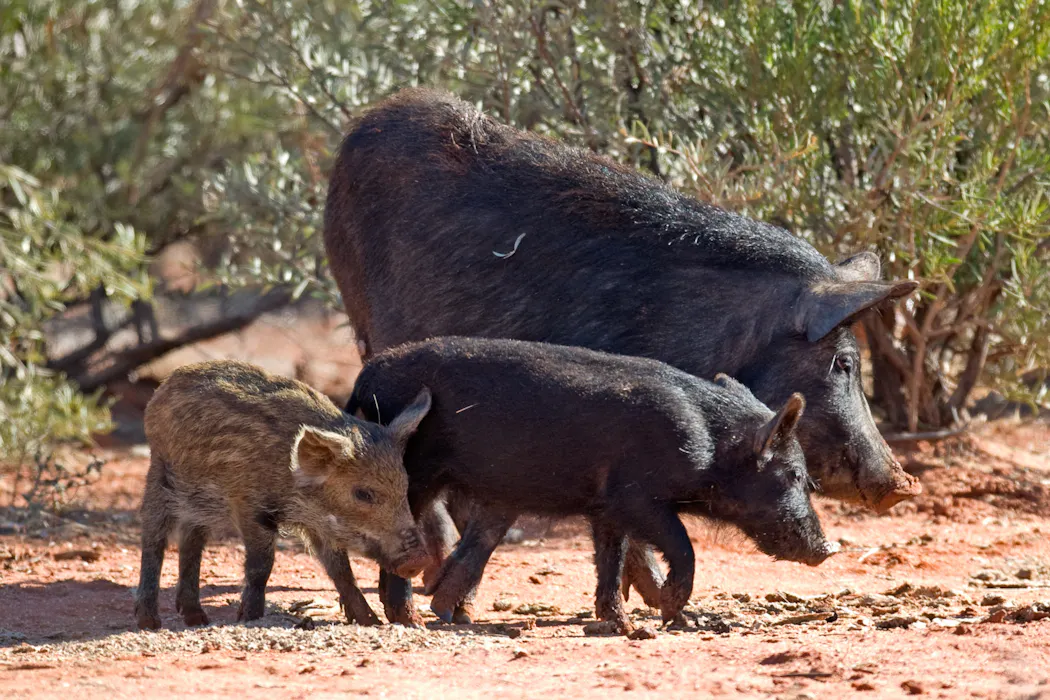
The ecologists of Australia’s Threatened Species Recovery Hub consider the worst invasive animal species to be European rabbits and foxes, black rats, feral pigs, cats, goats and cattle, while the federal Department of Agriculture, Fisheries and Forestry adds feral deer and wild dogs to this list. Other authorities include camels.
Except for stowaway rats, all of these animals were deliberately introduced to Australia by settler colonists. Breeding populations were kept alive during perilous sea voyages and cared for while they adapted.
Each species established itself on the new continent as planned. But they became too successful and have been vilified for it.

Ken Griffiths/Getty
No species is intrinsically evil. Rather, some humans decide a given animal is good or bad based on how they affect our interests. Australia’s deliberately introduced species were lauded at first. They had jobs such as eating pests, carrying heavy loads, providing sport or furnishing meat. When they stopped serving this purpose and began to serve themselves, their presence became a betrayal.
Unwanted impacts are used to justify the routine shooting of free living pigs, deer and goats. Traps and poison sprays target feral cats. Continental-scale fences were built to keep rabbits out, while lethal viruses suppress their numbers.
That the problem is with how they live rather than what they are can be seen clearly in the case of cattle. Cows grazing in a field are seen as entirely acceptable – even an affirmation of a long-established way of life.
But even within fences, both cattle and sheep eat plants down to their roots, cause erosion and produce methane that adds to climate change. To feed them, native grasses are replaced with introduced ones able to withstand heavy grazing. Wild dogs are killed to protect flocks and herds.
Outside of the fences, the harms done by wild cattle have earned them a place in the top ten invasive species in Australia.
Animals good, animals bad
Other animals are more firmly placed in the negative category – even if it took them time to get there.
Domesticated rabbits bred for meat or fur were repeatedly brought into Australia from 1788 onward, but only began to flourish after free-living rabbits were introduced in 1859.
What changed? These new rabbits were adaptive and highly fertile. But pastoralists had also made things better for them by killing off predators, such as dingoes and wedge tailed eagles, and degrading the habitat of competitors like burrowing bettongs and bandicoots.
From the 1860s, one-humped dromedary camels were introduced to Australia after the explorers Robert O’Hara Burke and William John Wills realised they were well-suited to moving people and goods through Australia’s dry interior.
The domesticated camel population peaked at almost 13,000 in 1917 before they were progressively replaced by cars and trucks. The remaining camels were released to fend for themselves.
They did well: about one million camels now roam Australia – the world’s largest free-living population. Australian camels are exported to the Middle East, valued for their genetic diversity. Those remaining are considered pests.

Paws and Prints/Unsplash, CC BY-NC-ND
Even native species can be invasive
The term “invasive” refers to species found outside their ecological bioregions, rather than being related to arbitrary national boundaries. This means animals native to Australia are not immune from the label of being invasive.
Kookaburras from the eastern states were brought to Western Australia in the 1890s to control snakes. Once there, these large kingfishers established themselves and began eating many smaller birds and reptiles.
Some species needed no human help.
The ubiquitous Australian white ibis was a rare visitor to the nation’s coasts until the 1980s. But when interior waterways were diverted for irrigation, the wetlands on which ibises relied dried up.
Soon, winged scouts discovered what human cities had to offer – drains, ponds, landfill sites and rubbish bins. These adaptable “bin chickens” draw responses from irritation to admiration. Authorities issue reminders they are native and cannot be harmed.
Species out of balance
In Animal Farm, power soon goes to the heads of the revolutionary pigs. Their original commandment – that all animals are equal – is amended to say that some are more equal than others. This holds in Australia in the present. With a few exceptions, domesticated and native species are more equal than other animals.
That’s not to downplay the damage some non-domestic species can do. That cats and foxes have driven significant declines in some native species is just one instance of genuine harm.
But could we approach this issue differently?
Almost 20 years ago, free-roaming camels were fouling water sources, driving away kangaroos and eating food plants in Central Australia. But First Nations groups did not blame the camels.
As Pitjantjatjara informants told anthropologist Petronella Vaarzon-Morel, the issue was that camels had no Dreaming. They were strangers on Country without a fixed set of relationships and without knowledge of how they should behave.
In response, First Nations groups opted for selective removal of live animals, hunting for food and interventions by rangers. Pintupi hunters in Central Australia’s Gibson Desert have pursued a similar response to free-living cats.
Rather than moral judgements, finely tuned actions like these could begin to address the problems associated with species not currently in good relations with the other animals – both human and more than human – with whom they now share this continent.
This article draws on Nancy Cushing’s forthcoming book, A New History of Australia in 15 Animals, which examines the shared histories of humans, rabbits, camels, ibises and other animals.

Nancy Cushing has received past funding from the State Library of New South Wales Fellowship Program. She is a member of the Australian Historical Association and the Australian and Aotearoa New Zealand Environmental History Network.
Original source: https://analysis1.mil-osi.com/2026/10/13/introduced-species-arent-good-or-bad-but-when-they-slip-from-our-control-we-are-quick-to-condemn-them/