

Source: The Conversation (Au and NZ)
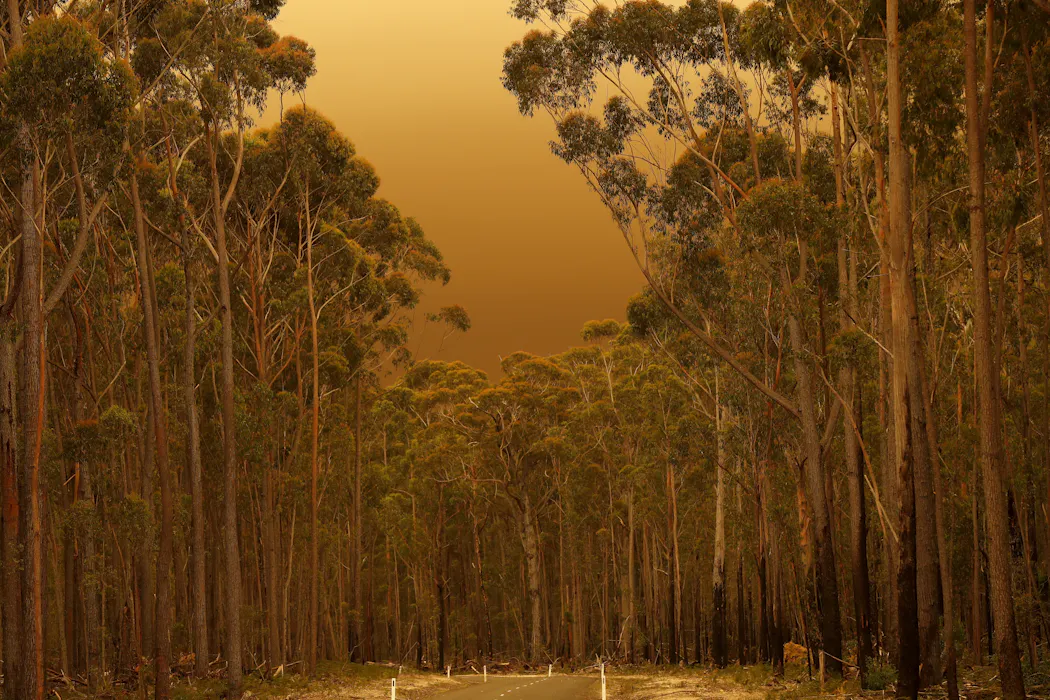
Bushfire season is here. The Bureau of Meteorology expects the declared El Niño to be strong to very strong. Southeastern Australia is bracing for a long run of dangerous fire weather.
Weather is only part of a catastrophic fire. Another factor is fuel – combustible vegetation. Our new research, published today, shows the current fuel load in some Australian forests is not “natural”. It is a product of colonisation, which loaded Australian landscapes with fuel a century before human-made climate change began.
Consider Croajingolong National Park, in Victoria’s far east. It has every level of protection possible: national park, designated wilderness area and UNESCO Biosphere Reserve. It’s also one of the most repeatedly incinerated forests in Australia: the 2019–20 Black Summer fires alone burned through 90% of the park.
The reprieves between bushfire have collapsed, from roughly 40 years in the late 1800s to about five years in the most recent decade.
Reading a natural archive
We conducted this research in partnership with the Gunaikurnai Land and Waters Aboriginal Corporation, coauthors of the study, on GunaiKurnai Country in the Croajingolong National Park, which takes its name from the Krauatungalung people of the GunaiKurnai.
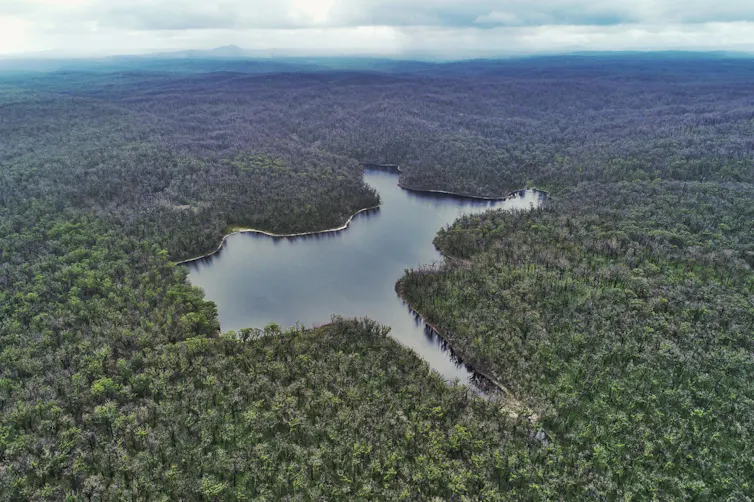
Our archive is Purghagoolah, called Lake Elusive by colonial mapmakers, a deep lake inside the park. Our data were pollen, charcoal and sediment.
Michael-Shawn Fletcher
In February 2021 we took a core sample – a cylindrical piece of layered sediment – from its depths to retrieve evidence of a 1,000-year history. The pollen and charcoal within the sediment, blown in from the surrounding 10,000 square kilometres, offer records of a vast slice of Australia’s most frequently burnt forests.
Pollen reveals what grew, charcoal tells us about fire, and the infrared spectra of this charcoal reveals how hot these fires were. This allows us to separate cooler cultural fire – where low-intensity fires were strategically applied to the landscape – from hot wildfire. In addition, magnetic minerals track erosion of soil into the lake, and radiocarbon and lead dating anchor this history in time.

Michael-Shawn Fletcher
Before and after
We found that for more than 800 years, frequent, low-temperature cultural burning under GunaiKurnai care kept held this land as stable, open woodland. In this period, the landscape was low in charcoal, rarely scorched by hot fires, and without the erosion that follows.
There was no lack of dangerous fire weather in the past. Fire seasons as severe as Ash Wednesday, Black Saturday and Black Summer occurred over these centuries, yet cared-for Country did not experience catastrophic fire.
However, during the colonisation of Gippsland, frontier violence and massacres between the 1830s and 1860s removed GunaiKurnai people from Country and disrupted a millennia-long relationship of care.
After colonisation, everything in the sediment core changes. Hot fire becomes dominant, shrubs thicken, eucalypt cover surges to nearly four times pre-colonial levels, and open woodland becomes today’s flammable forest. Charcoal rises sharply, alongside an increase in hot fires. Soil washes into the lake, no longer bound by living plants.
All this took place before human-driven climate change properly began, echoing what we found across southeast Australia in a 2022 study: a region-wide increase of shrubs following the British invasion.
The outcome is a catastrophic wildfire loop: each hot fire drives thick, flammable regrowth that primes the next climate-driven fire. Climate change did not start this vulnerability – it amplifies one that colonisation began.
A wilderness that colonisation built
All this, in a place we protect as pristine wilderness. Official vegetation maps treat Croajingolong’s forests as the natural, pre-colonial baseline state. But our data demonstrates otherwise – the wilderness we protect is one colonisation made. Management relying on that false baseline entrenches fire danger, and ignores the ecological and cultural relationships held within the now-lost woodlands.
Aboriginal people have long said it plainly: wild Country is sick Country, Country that has lost its people and their care.
GunaiKurnai ancestors were born with towera (fire), an essential part of the old peoples’ practical daily life on Country, as GunaiKurnai Elder and study coauthor Uncle Russell Mullett says:
Not treating country with towera, Country becomes extremely dangerous for GunaiKurnai, animals, and plants. Studies such as this provide firm scientific evidence to support towera land management initiatives for Country.
A region-wide transformation
The waters of Purghagoolah sit within roughly 3 million to 4 million hectares of forest that runs unbroken from the Victorian Central Highlands to the New South Wales south coast. Around 80% of it is resprouting eucalypt forest, that could benefit from regular cooler cultural burns.
The rest of these forests, around 20%, is the fire-sensitive mountain and alpine ash forest of the valleys and high country. They have a fundamentally different fire ecology that requires hot fire to release and germinate seeds separated by long fire-free intervals. Yet these atypical, less extensive forests dominate public discourse and fire policy. This fosters an ethos of fire suppression that increases risk across vast forest areas.
Bring back the carers
None of this diminishes the threat of climate change. Rather, our research emphasises the parts of the story that have been historically overlooked: the fuel, and the care by people who once kept it in check.
Fire management must grow beyond hazard-reduction burning and climate adaptation into restoring healthy Country and cultural burning, with Traditional Owners resourced to lead the way. Cultural burning reduces catastrophic fires, is better for the soil, and protects our plants and animals.
Purghagoolah leaves us with hope. Through at least eight centuries of severe fire weather, fire stayed in human hands and catastrophic fire was contained. Country needs people. When Country is cared for, climate is not the only factor that dictates how it burns.

Michael-Shawn Fletcher receives funding from the Australian Research Council.
Anthony John Romano and Russell Mullett do not work for, consult, own shares in or receive funding from any company or organisation that would benefit from this article, and have disclosed no relevant affiliations beyond their academic appointment.
Original source: https://analysis1.mil-osi.com/2026/10/07/colonisation-not-climate-change-first-primed-these-forests-to-burn/