

Source: The Conversation (Au and NZ)
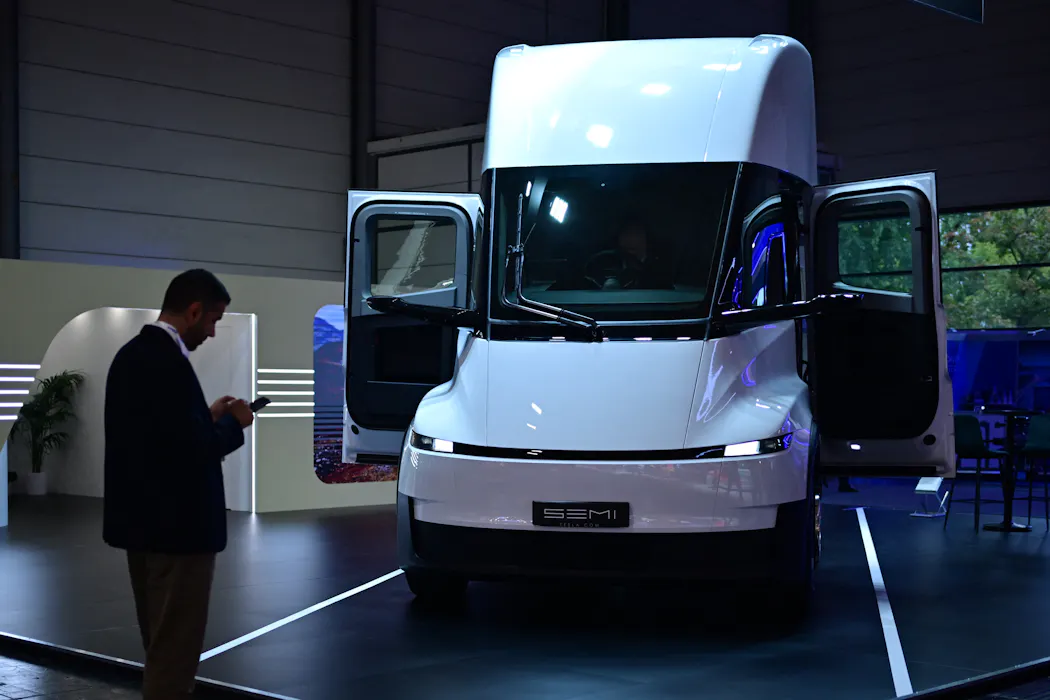
It’s hard to run heavy trucks without fossil fuels – especially in Australia. They’re big, heavy and cover long distances. Powering big rigs with today’s batteries suffers from added weight and cost. Then there’s recharging time.
For smaller trucks covering shorter distances, the task is much easier. The shift is already on in nations such as China. But many experts predict long-haul battery-electric trucks won’t beat diesel on total running costs until the 2030s, when battery prices have fallen far enough.
My recent study suggests that timeline could be too pessimistic for one reason – the emergence of driverless trucks, which are being tested on public roads in the United States.
Australia already has a large fleet of driverless trucks carrying ore in the Pilbara. None are currently on public highways – but that could change. Late last year, transport ministers agreed to allow conditional deployment on selected public roads beginning in 2027.
So far, public debate has focused on driver jobs and safety. But there’s a key factor which we’re not talking about – money. Autonomous trucks change the economics of freight so much they tip the balance in favour of electric.

VCG/Getty
Drivers make trucks go faster – but at a cost
Today’s heavy trucks have drivers, which means every hour on the road is an hour of wages. To keep wage costs low, freight companies encourage drivers to drive at the speed limit (100kmh for heavy freight) and get the trip done.
Speed has a large hidden cost – especially for heavy freight. Air resistance rises sharply as a truck goes faster, meaning a fast truck uses more fuel per kilometre than a slow one. But for a driven truck, arriving sooner avoids enough expense in the form of wages that it usually outweigh extra fuel costs.
If there’s no driver, the balance flips.
For an autonomous diesel truck, it doesn’t matter as much if the trip takes a bit longer. Using less energy per kilometre means burning a little less fuel.
The difference is more pronounced for autonomous electric trucks, where slower, more energy efficient trips could make it possible to use trucks with smaller, cheaper battery packs. Smaller battery packs also means a truck can carry more freight.
Our modelling shows the optimal speed for an autonomous electric truck is around 80km/h. Because there’s no driver who needs to rest, the trip can potentially be made without stopping.
Sydney to Melbourne, slow and steady
To test whether autonomous electric trucks change the financial equation, I modelled Australia’s busiest freight corridor, Sydney to Melbourne.
The result: autonomy made electric trucks much more competitive with diesel. The effect was the equivalent of a sharp fall in battery prices of A$34 a kilowatt hour. (As of 2025, battery prices were about A$162/kWh.)
In effect, autonomy would make electric trucks significantly more financially appealing and could accelerate adoption by several years.
Freight companies would gain more if they used driverless trucks more hours of the day. At present, a typical long-distance diesel truck is driven 25% of the time.
If autonomous trucks could run 50% of the time, that would boost the financial appeal again. The effect would be the equivalent of cutting battery prices by A$75/kWh.
There’s a crucial caveat: autonomous electric trucks gain this advantage as long as they do most of their charging cheaply at the depot to avoid paying fast charger rates on the Hume Freeway.
Autonomous electric trucks are best suited to medium routes
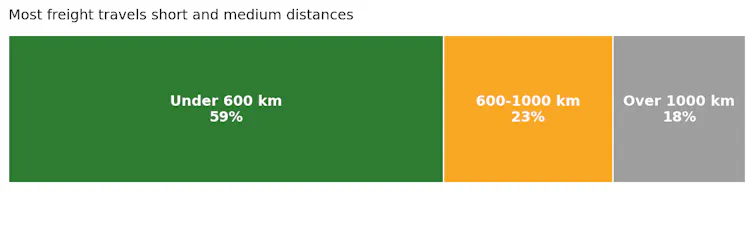
Most driven electric trucks currently available work best on shorter routes (under 600km). That’s good news, because complex urban environments are likely to be reserved for driven trucks, for safety and regulatory reasons.
Autonomous electric trucks will likely be restricted to specific corridors outside urbanised areas for safety, regulatory and technical reasons.
Three medium-length interstate corridors are well suited for trucks combining autonomy and electrification – Sydney to Melbourne (877km), Brisbane-Sydney (915km) and Adelaide-Melbourne (~726km). These are the busiest in the country.
Author provided, CC BY-NC-ND
From impossible to possible
Heavy trucks were long thought to be too hard to electrify. But plunging battery prices have made urban delivery trucks viable, while larger electric trucks are now being released.
My research suggests it’s now possible to electrify much of our heavy freight – and that going autonomous would accelerate financial viability over busy medium-length routes.
Authorities will have to be satisfied that these trucks are safe and resolve questions over potential job losses. But over time, the favourable economics of self-driving electric trucks may well be enough to make them a reality.

Anthony Wiskich does not work for, consult, own shares in or receive funding from any company or organisation that would benefit from this article, and has disclosed no relevant affiliations beyond their academic appointment.
Original source: https://analysis1.mil-osi.com/2026/10/07/electric-long-haul-trucks-could-become-a-reality-sooner-if-theres-no-driver/